Introduction to PredicateCalculus
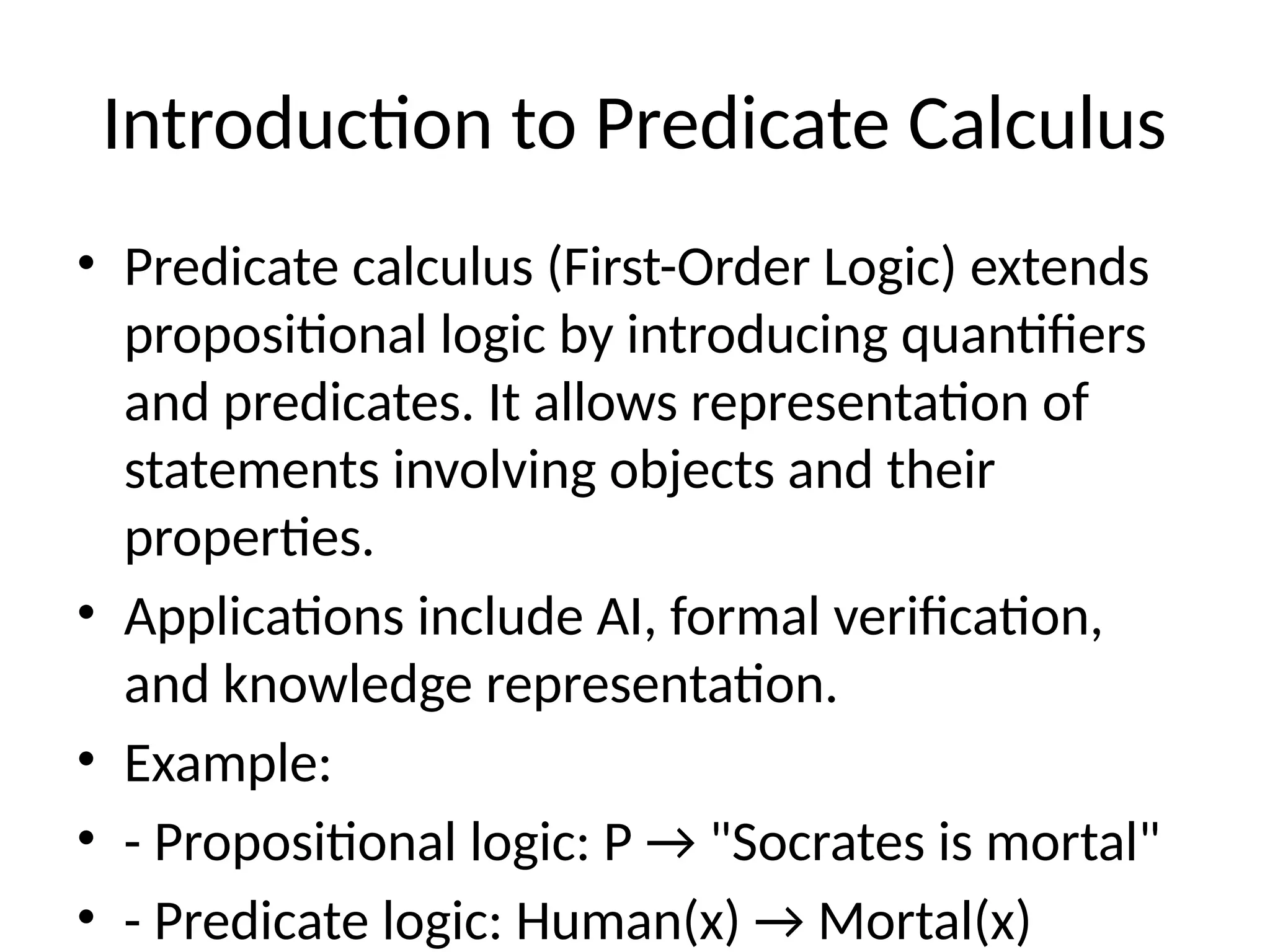
• Predicate calculus (First-Order Logic) extends
propositional logic by introducing quantifiers
and predicates. It allows representation of
statements involving objects and their
properties.
• Applications include AI, formal verification,
and knowledge representation.
• Example:
• - Propositional logic: P → "Socrates is mortal"
• - Predicate logic: Human(x) → Mortal(x)
3.
Components of PredicateLogic
• - Predicates: Functions returning true/false,
e.g., Likes(John, IceCream)
• - Constants: Specific objects like John,
IceCream
• - Variables: x, y, z
• - Quantifiers: (universal), (existential)
∀ ∃
• - Connectives: , , ¬, →, ↔
∧ ∨
4.
Syntax of PredicateCalculus
• Syntax defines well-formed formulas (WFFs).
• Rules:
• - Correct arity for predicates
• - Proper use of quantifiers
• - Correct parenthesis usage
• Examples:
• - Valid: x (P(x) Q(x))
∀ ∨
• - Invalid: P(x)
∀ ∧
5.
Semantics of PredicateCalculus
• Semantics assign meaning to formulas.
• - Domain: Set of objects
• - Interpretation: Maps constants/predicates
• Truth Conditions:
• - x P(x) is true if P(x) holds for all x
∀
• - x P(x) is true if P(x) holds for at least one x
∃
6.
What is InferenceTheory?
• Inference Theory is about deriving conclusions
from premises using formal rules.
• Formal: Γ φ means φ is derivable from
⊢
premises Γ.
• Enables automation of logical deduction and
reasoning.
7.
Inference Rules inPredicate
Calculus
• - Universal Instantiation (UI): From x P(x),
∀
infer P(a)
• - Existential Instantiation (EI): From x P(x),
∃
infer P(c)
• - Universal Generalization (UG): From P(x),
infer x P(x)
∀
• - Existential Generalization (EG): From P(a),
infer x P(x)
∃
• - Modus Ponens (MP): From P and P → Q,
infer Q
8.
Soundness and Completeness
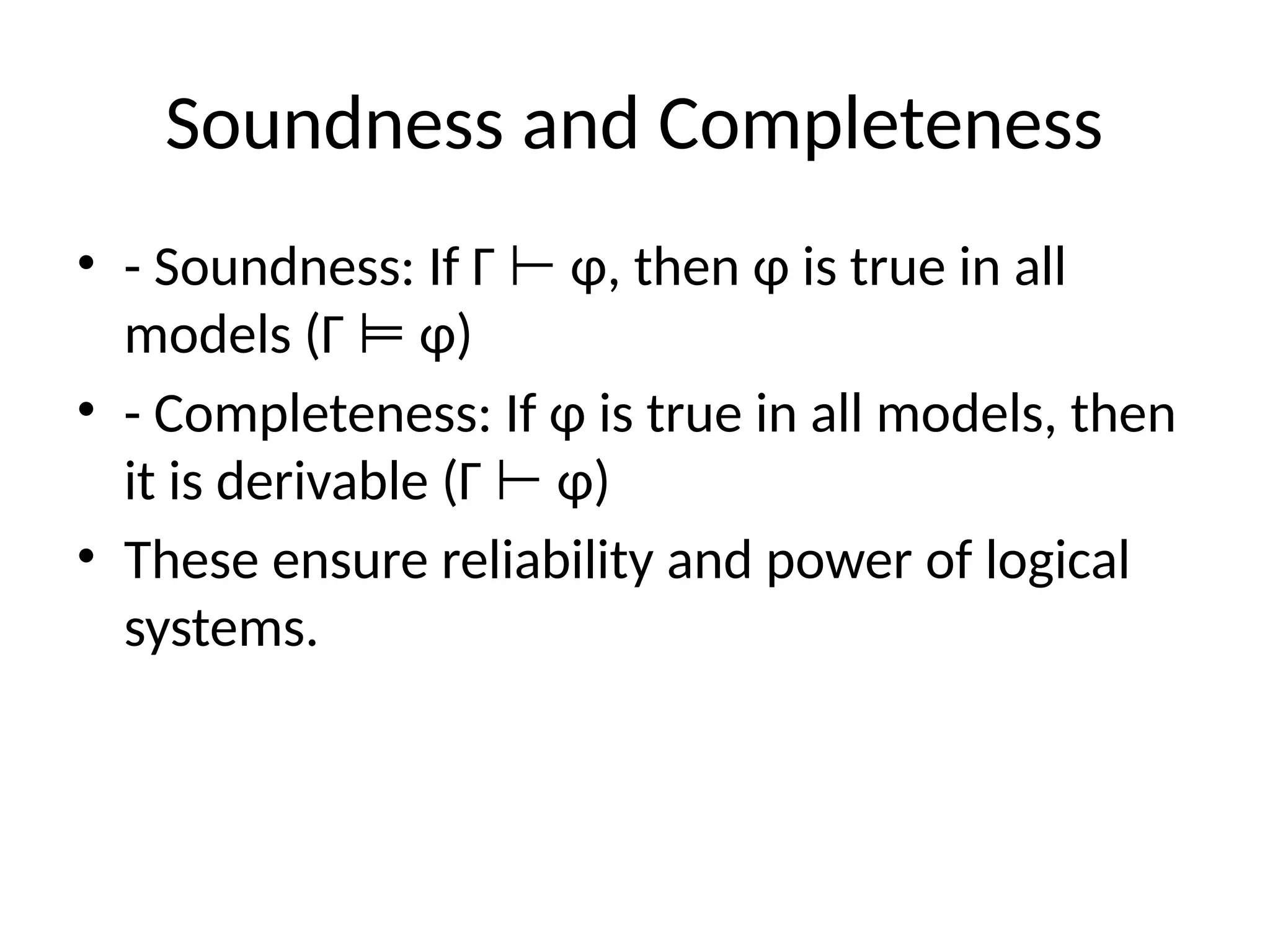
•- Soundness: If Γ φ, then φ is true in all
⊢
models (Γ φ)
⊨
• - Completeness: If φ is true in all models, then
it is derivable (Γ φ)
⊢
• These ensure reliability and power of logical
systems.
9.
Proof Techniques
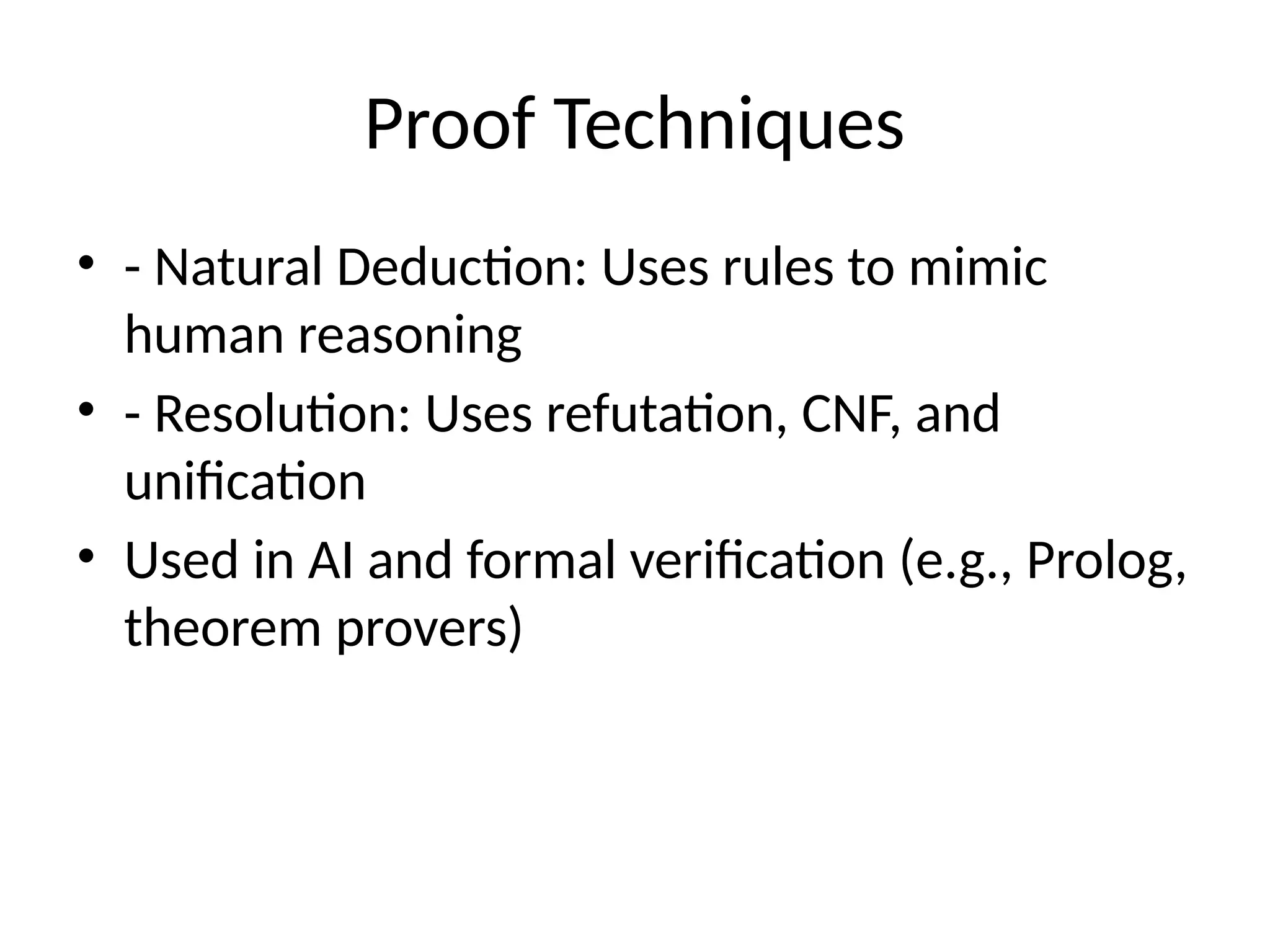
• -Natural Deduction: Uses rules to mimic
human reasoning
• - Resolution: Uses refutation, CNF, and
unification
• Used in AI and formal verification (e.g., Prolog,
theorem provers)
10.
Sample Inference Derivation
•Given:
• 1. x (Human(x) → Mortal(x))
∀
• 2. Human(Socrates)
• Steps:
• - UI on 1: Human(Socrates) →
Mortal(Socrates)
• - MP with 2: Mortal(Socrates)
11.
Applications of PredicateCalculus
• - AI: Knowledge representation, expert
systems
• - Software: Formal verification
• - Databases: Logic-based querying
• - Mathematics and Linguistics: Proofs and
syntax analysis
12.
Conclusion
• Predicate calculusenables expressive logical
representation.
• Inference theory powers reasoning and
automation.
• Next steps: Explore proof systems, logic
programming, and theorem provers.
![Inference Theory of the Predicate
Calculus
• Foundations, Logic, and Applications
• Presented by: [Your Name]
• Institution: [Your Institution]
• Date: [Insert Date]](https://image.slidesharecdn.com/inferencetheoryofpredicatecalculus-250524113331-aa5230b2/75/Inference_Theory_of_Predicate_Calculus-pptx-1-2048.jpg)