INFA work plan
set up
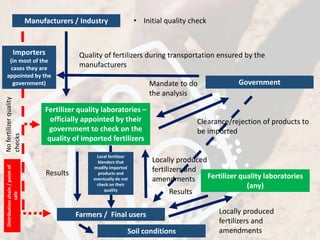
Manufacturers / Industry
Fertilizer quality laboratories –
officially appointed by their
government to check on the
quality of imported fertilizers
Farmers / Final users
Quality of fertilizers during transportation ensured by the
manufacturers
• Initial quality check
Government
Clearance/rejection of products to
be imported
Mandate to do
the analysis
Locally produced
fertilizers and
amendments Fertilizer quality laboratories
(any)
Locally produced
fertilizers and
amendments
Results
Results
Nofertilizerquality
checks
Distributionchain/pointof
sale
Importers
(in most of the
cases they are
appointed by the
government)
Local fertilizer
blenders that
modify imported
products and
eventually do not
check on their
quality
Soil conditions
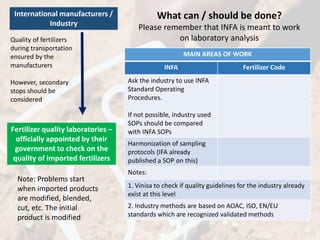
International manufacturers /
Industry
Fertilizer quality laboratories –
officially appointed by their
government to check on the
quality of imported fertilizers
MAIN AREAS OF WORK
INFA Fertilizer Code
Ask the industry to use INFA
Standard Operating
Procedures.
If not possible, industry used
SOPs should be compared
with INFA SOPs
Harmonization of sampling
protocols (IFA already
published a SOP on this)
Notes:
1. Vinisa to check if quality guidelines for the industry already
exist at this level
2. Industry methods are based on AOAC, ISO, EN/EU
standards which are recognized validated methods
What can / should be done?
Please remember that INFA is meant to work
on laboratory analysisQuality of fertilizers
during transportation
ensured by the
manufacturers
However, secondary
stops should be
considered
Note: Problems start
when imported products
are modified, blended,
cut, etc. The initial
product is modified
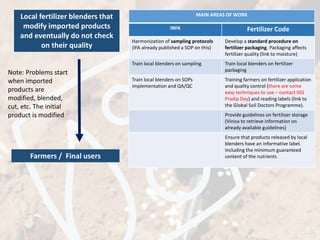
MAIN AREAS OF WORK
INFA Fertilizer Code
Harmonization of sampling protocols
(IFA already published a SOP on this)
Develop a standard procedure on
fertilizer packaging. Packaging affects
fertilizer quality (link to moisture)
Train local blenders on sampling Train local blenders on fertilizer
packaging
Train local blenders on SOPs
implementation and QA/QC
Training farmers on fertilizer application
and quality control (there are some
easy techniques to use – contact IISS
Pradip Dey) and reading labels (link to
the Global Soil Doctors Programme).
Provide guidelines on fertilizer storage
(Vinisa to retrieve information on
already available guidelines)
Ensure that products released by local
blenders have an informative label.
Including the minimum guaranteed
content of the nutrients
Note: Problems start
when imported
products are
modified, blended,
cut, etc. The initial
product is modified
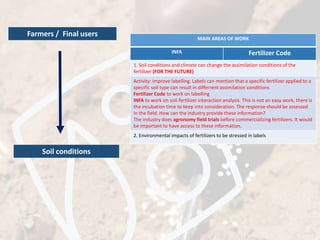
Farmers / Final users
Local fertilizer blenders that
modify imported products
and eventually do not check
on their quality
MAIN AREAS OF WORK
INFA Fertilizer Code
1. Soil conditions and climate can change the assimilation conditions of the
fertilizer (FOR THE FUTURE)
Activity: improve labelling. Labels can mention that a specific fertilizer applied to a
specific soil type can result in differrent assimilation conditions
Fertilizer Code to work on labelling
INFA to work on soil-fertilizer interaction analysis. This is not an easy work, there is
the incubation time to keep into consideration. The response should be assessed
in the field. How can the industry provide these information?
The industry does agronomy field trials before commercializing fertilizers. It would
be important to have access to these information.
2. Environmental impacts of fertilizers to be stressed in labels
Farmers / Final users
Soil conditions
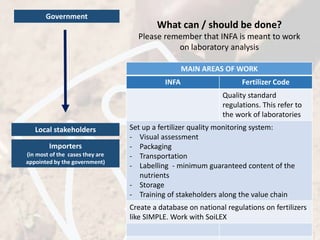
MAIN AREAS OF WORK
INFA Fertilizer Code
Quality standard
regulations. This refer to
the work of laboratories
Set up a fertilizer quality monitoring system:
- Visual assessment
- Packaging
- Transportation
- Labelling - minimum guaranteed content of the
nutrients
- Storage
- Training of stakeholders along the value chain
Create a database on national regulations on fertilizers
like SIMPLE. Work with SoiLEX
What can / should be done?
Please remember that INFA is meant to work
on laboratory analysis
Local stakeholders
Government
Importers
(in most of the cases they are
appointed by the government)
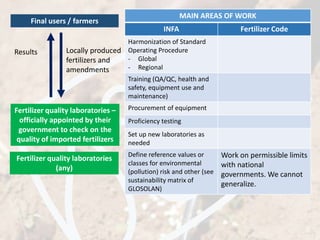
Final users / farmers
Fertilizer quality laboratories –
officially appointed by their
government to check on the
quality of imported fertilizers
MAIN AREAS OF WORK
INFA Fertilizer Code
Harmonization of Standard
Operating Procedure
- Global
- Regional
Training (QA/QC, health and
safety, equipment use and
maintenance)
Procurement of equipment
Proficiency testing
Set up new laboratories as
needed
Define reference values or
classes for environmental
(pollution) risk and other (see
sustainability matrix of
GLOSOLAN)
Work on permissible limits
with national
governments. We cannot
generalize.
Fertilizer quality laboratories
(any)
Locally produced
fertilizers and
amendments
Results
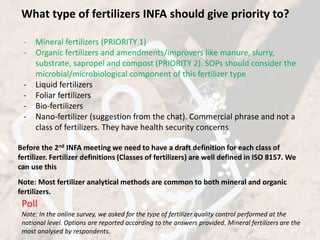
What type of fertilizers INFA should give priority to?
- Mineral fertilizers (PRIORITY 1)
- Organic fertilizers and amendments/improvers like manure, slurry,
substrate, sapropel and compost (PRIORITY 2). SOPs should consider the
microbial/microbiological component of this fertilizer type
- Liquid fertilizers
- Foliar fertilizers
- Bio-fertilizers
- Nano-fertilizer (suggestion from the chat). Commercial phrase and not a
class of fertilizers. They have health security concerns
Poll
Note: In the online survey, we asked for the type of fertilizer quality control performed at the
national level. Options are reported according to the answers provided. Mineral fertilizers are the
most analysed by respondents.
Before the 2nd INFA meeting we need to have a draft definition for each class of
fertilizer. Fertilizer definitions (Classes of fertilizers) are well defined in ISO 8157. We
can use this
Note: Most fertilizer analytical methods are common to both mineral and organic
fertilizers.
Final users / farmers
MAIN AREAS OF WORK
INFA Fertilizer Code
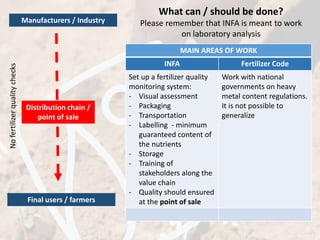
Set up a fertilizer quality
monitoring system:
- Visual assessment
- Packaging
- Transportation
- Labelling - minimum
guaranteed content of
the nutrients
- Storage
- Training of
stakeholders along the
value chain
- Quality should ensured
at the point of sale
Work with national
governments on heavy
metal content regulations.
It is not possible to
generalize
What can / should be done?
Please remember that INFA is meant to work
on laboratory analysis
Distribution chain /
point of sale
Manufacturers / Industry
Nofertilizerqualitychecks
Thanks for your
contribution

INFA launch meeting - Item 8: INFA work plan

  • 1.
  • 2.
    Manufacturers / Industry Fertilizerquality laboratories – officially appointed by their government to check on the quality of imported fertilizers Farmers / Final users Quality of fertilizers during transportation ensured by the manufacturers • Initial quality check Government Clearance/rejection of products to be imported Mandate to do the analysis Locally produced fertilizers and amendments Fertilizer quality laboratories (any) Locally produced fertilizers and amendments Results Results Nofertilizerquality checks Distributionchain/pointof sale Importers (in most of the cases they are appointed by the government) Local fertilizer blenders that modify imported products and eventually do not check on their quality Soil conditions
  • 3.
    International manufacturers / Industry Fertilizerquality laboratories – officially appointed by their government to check on the quality of imported fertilizers MAIN AREAS OF WORK INFA Fertilizer Code Ask the industry to use INFA Standard Operating Procedures. If not possible, industry used SOPs should be compared with INFA SOPs Harmonization of sampling protocols (IFA already published a SOP on this) Notes: 1. Vinisa to check if quality guidelines for the industry already exist at this level 2. Industry methods are based on AOAC, ISO, EN/EU standards which are recognized validated methods What can / should be done? Please remember that INFA is meant to work on laboratory analysisQuality of fertilizers during transportation ensured by the manufacturers However, secondary stops should be considered Note: Problems start when imported products are modified, blended, cut, etc. The initial product is modified
  • 4.
    MAIN AREAS OFWORK INFA Fertilizer Code Harmonization of sampling protocols (IFA already published a SOP on this) Develop a standard procedure on fertilizer packaging. Packaging affects fertilizer quality (link to moisture) Train local blenders on sampling Train local blenders on fertilizer packaging Train local blenders on SOPs implementation and QA/QC Training farmers on fertilizer application and quality control (there are some easy techniques to use – contact IISS Pradip Dey) and reading labels (link to the Global Soil Doctors Programme). Provide guidelines on fertilizer storage (Vinisa to retrieve information on already available guidelines) Ensure that products released by local blenders have an informative label. Including the minimum guaranteed content of the nutrients Note: Problems start when imported products are modified, blended, cut, etc. The initial product is modified Farmers / Final users Local fertilizer blenders that modify imported products and eventually do not check on their quality
  • 5.
    MAIN AREAS OFWORK INFA Fertilizer Code 1. Soil conditions and climate can change the assimilation conditions of the fertilizer (FOR THE FUTURE) Activity: improve labelling. Labels can mention that a specific fertilizer applied to a specific soil type can result in differrent assimilation conditions Fertilizer Code to work on labelling INFA to work on soil-fertilizer interaction analysis. This is not an easy work, there is the incubation time to keep into consideration. The response should be assessed in the field. How can the industry provide these information? The industry does agronomy field trials before commercializing fertilizers. It would be important to have access to these information. 2. Environmental impacts of fertilizers to be stressed in labels Farmers / Final users Soil conditions
  • 6.
    MAIN AREAS OFWORK INFA Fertilizer Code Quality standard regulations. This refer to the work of laboratories Set up a fertilizer quality monitoring system: - Visual assessment - Packaging - Transportation - Labelling - minimum guaranteed content of the nutrients - Storage - Training of stakeholders along the value chain Create a database on national regulations on fertilizers like SIMPLE. Work with SoiLEX What can / should be done? Please remember that INFA is meant to work on laboratory analysis Local stakeholders Government Importers (in most of the cases they are appointed by the government)
  • 7.
    Final users /farmers Fertilizer quality laboratories – officially appointed by their government to check on the quality of imported fertilizers MAIN AREAS OF WORK INFA Fertilizer Code Harmonization of Standard Operating Procedure - Global - Regional Training (QA/QC, health and safety, equipment use and maintenance) Procurement of equipment Proficiency testing Set up new laboratories as needed Define reference values or classes for environmental (pollution) risk and other (see sustainability matrix of GLOSOLAN) Work on permissible limits with national governments. We cannot generalize. Fertilizer quality laboratories (any) Locally produced fertilizers and amendments Results
  • 8.
    What type offertilizers INFA should give priority to? - Mineral fertilizers (PRIORITY 1) - Organic fertilizers and amendments/improvers like manure, slurry, substrate, sapropel and compost (PRIORITY 2). SOPs should consider the microbial/microbiological component of this fertilizer type - Liquid fertilizers - Foliar fertilizers - Bio-fertilizers - Nano-fertilizer (suggestion from the chat). Commercial phrase and not a class of fertilizers. They have health security concerns Poll Note: In the online survey, we asked for the type of fertilizer quality control performed at the national level. Options are reported according to the answers provided. Mineral fertilizers are the most analysed by respondents. Before the 2nd INFA meeting we need to have a draft definition for each class of fertilizer. Fertilizer definitions (Classes of fertilizers) are well defined in ISO 8157. We can use this Note: Most fertilizer analytical methods are common to both mineral and organic fertilizers.
  • 9.
    Final users /farmers MAIN AREAS OF WORK INFA Fertilizer Code Set up a fertilizer quality monitoring system: - Visual assessment - Packaging - Transportation - Labelling - minimum guaranteed content of the nutrients - Storage - Training of stakeholders along the value chain - Quality should ensured at the point of sale Work with national governments on heavy metal content regulations. It is not possible to generalize What can / should be done? Please remember that INFA is meant to work on laboratory analysis Distribution chain / point of sale Manufacturers / Industry Nofertilizerqualitychecks
  • 10.