Overview of IEC Process
           and Tools


Tessie Fields, Andrew Sites, John Boyer
             June 24, 2010
What are we going to cover?
            Tessie Fields
Receptor evaluation as it relates to IECs
                Q&A

           Andrew Sites
Overview of IEC Process and IEC Tools
 Using the IEC Tools - Case example
                Q&A

            John Boyer
        Vapor Intrusion Issues
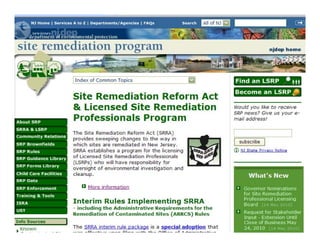
New SRRA Training and Tools

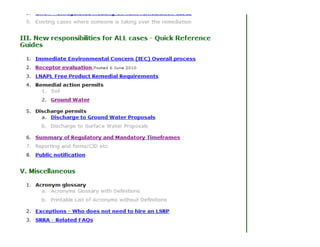
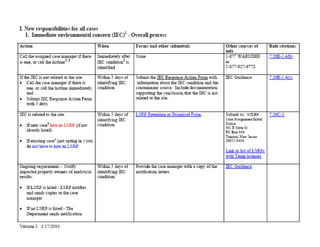
New Quick Reference Guides for:

•   Immediate Environmental Concern

•   Receptor Evaluation

Provides a soup to nuts guide to what has to
    be submitted and when
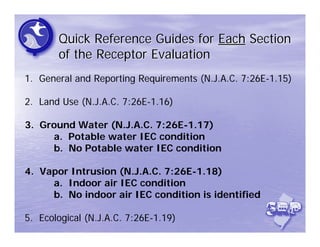
Quick Reference Guides for Each Section
       of the Receptor Evaluation
1. General and Reporting Requirements (N.J.A.C. 7:26E-1.15)

2. Land Use (N.J.A.C. 7:26E-1.16)

3. Ground Water (N.J.A.C. 7:26E-1.17)
     a. Potable water IEC condition
     b. No Potable water IEC condition

4. Vapor Intrusion (N.J.A.C. 7:26E-1.18)
     a. Indoor air IEC condition
     b. No indoor air IEC condition is identified

5. Ecological (N.J.A.C. 7:26E-1.19)
Receptor Evaluation
     Quick Reference Guide

• Also has a brief introduction

• An index to all the separate guides

• Link to related FAQs
  – How to conduct and report a well search

• Contact information for Bureau Chiefs Mark
  Pederson, Steve Maybury or Kevin Kratina
What is a Receptor Evaluation?

It’s a periodic report
• Initial Receptor Evaluation Report/form*
  (270 days)

• Updated Receptor Evaluation Report/form
  – Remedial Investigation Report
  – Remedial Action Report

  * Regulatory timeframe
  * Also has a Mandatory Timeframe of 1 Year
Receptor Evaluation Report
    Timeframes

• The Department is considering changes to
  regulatory and mandatory timeframes for
  the interim rule proposal in September

• Updates on this topic will be provided on
  the web and via the Listserv
What is a Receptor Evaluation?

It’s an ongoing process of identifying receptors
   and mitigating exposure

• Includes triggers and timeframes to:
  – Identify land use around the site
  – Sample potable water
  – Conduct vapor intrusion investigation


• The mechanism by which most IECs are identified
Who has to submit a Receptor
      Evaluation Report/form?

• All Existing Cases
  – Unless remediation is completed before November 26,
    2010

• All New Cases
  – Unless remediation is completed in less than 9 months
  – UHOT cases

     Will be submitted by LSRPs and non-LSRPs
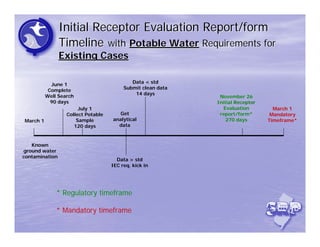
Initial Receptor Evaluation Report/form
                Timeline with Potable Water Requirements for
                Existing Cases

            June 1                          Data < std
           Complete                      Submit clean data
          Well Search                        14 days
                                                              November 26
            90 days                                          Initial Receptor
                       July 1                                   Evaluation        March 1
                  Collect Potable      Get                    report/form*       Mandatory
March 1               Sample        analytical                   270 days       Timeframe*
                     120 days         data


   Known
ground water
contamination
                                      Data > std
                                    IEC req. kick in


              * Regulatory timeframe

              * Mandatory timeframe
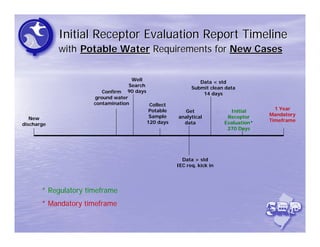
Initial Receptor Evaluation Report Timeline
            with Potable Water Requirements for New Cases


                                    Well                      Data < std
                                   Search                  Submit clean data
                         Confirm 90 days                       14 days
                      ground water
                      contamination        Collect
                                           Potable                                      1 Year
                                                        Get               Initial
                                           Sample    analytical                       Mandatory
   New                                                                   Receptor
                                          120 days                                    Timeframe
discharge                                              data             Evaluation*
                                                                         270 Days


                                                       Data > std
                                                     IEC req. kick in


       * Regulatory timeframe
       * Mandatory timeframe
Receptor Evaluation Report

• The initial receptor evaluation report describes all
  potable water and/or VI work conducted to date. It
  is:

 “What you know at the time the report is submitted”

• If an extension of regulatory or mandatory timeframe
  is needed the remediating party may request an
  extension pursuant to the ARRCS rules (N.J.A.C.
  7:26C-3)
Any general questions about the
     Receptor Evaluation?
Immediate Environmental Concern

• Overview of IEC Process

• Overview of IEC Tools

• Using the IEC Tools - Case example

•Q&A
What is an IEC?

• Contaminant source in the environment

• Migration pathway

• Human receptor (people coming in contact
 with contamination above a standard or
 screening level)
Three types of IECs

• Potable wells

• Vapor intrusion

• Direct contact
Basic IEC Concept

• Delineate IEC problem

• Mitigate IEC problem

• Remove source causing IEC problem
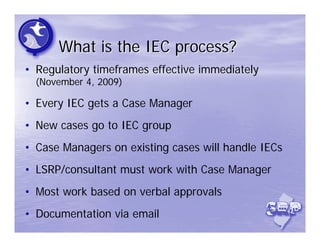
What is the IEC process?
• Regulatory timeframes effective immediately
  (November 4, 2009)

• Every IEC gets a Case Manager
• New cases go to IEC group
• Case Managers on existing cases will handle IECs
• LSRP/consultant must work with Case Manager
• Most work based on verbal approvals
• Documentation via email
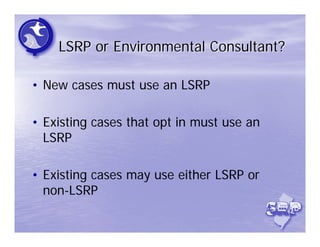
LSRP or Environmental Consultant?

• New cases must use an LSRP

• Existing cases that opt in must use an
  LSRP

• Existing cases may use either LSRP or
  non-LSRP
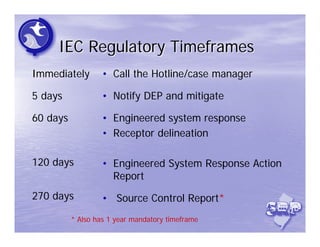
IEC Regulatory Timeframes
Immediately        • Call the Hotline/case manager

5 days             • Notify DEP and mitigate

60 days            • Engineered system response
                   • Receptor delineation

120 days           • Engineered System Response Action
                     Report
270 days           • Source Control Report*
          * Also has 1 year mandatory timeframe
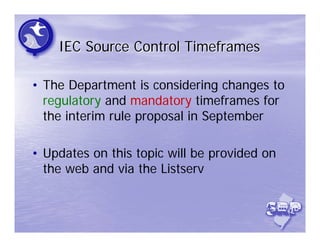
IEC Source Control Timeframes

• The Department is considering changes to
  regulatory and mandatory timeframes for
  the interim rule proposal in September

• Updates on this topic will be provided on
  the web and via the Listserv
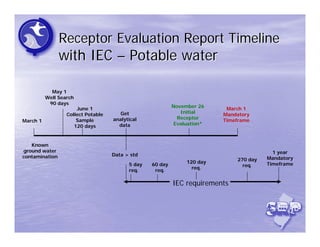
Receptor Evaluation Report Timeline
                with IEC – Potable water

            May 1
          Well Search
           90 days
                                                           November 26
                      June 1                                               March 1
                                       Get                    Initial
                  Collect Potable                                         Mandatory
                                    analytical               Receptor
March 1               Sample                                              Timeframe
                                      data                  Evaluation*
                     120 days


   Known
ground water                                                                              1 year
contamination                       Data > std
                                                                              270 day   Mandatory
                                                                120 day                 Timeframe
                                          5 day   60 day                        req.
                                                                  req.
                                          req.     req.

                                                           IEC requirements
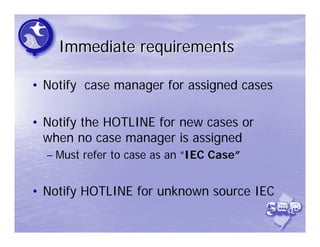
Immediate requirements

• Notify case manager for assigned cases

• Notify the HOTLINE for new cases or
  when no case manager is assigned
  – Must refer to case as an “IEC Case”


• Notify HOTLINE for unknown source IEC
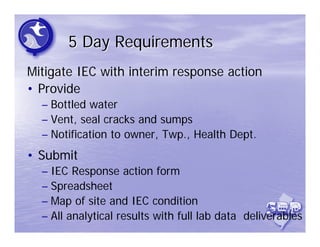
5 Day Requirements
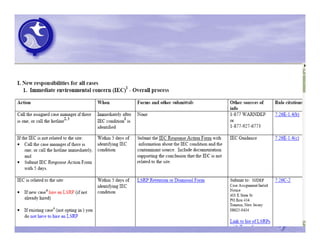
Mitigate IEC with interim response action
• Provide
  – Bottled water
  – Vent, seal cracks and sumps
  – Notification to owner, Twp., Health Dept.
• Submit
  – IEC Response action form
  – Spreadsheet
  – Map of site and IEC condition
  – All analytical results with full lab data deliverables
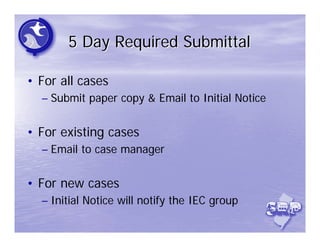
5 Day Required Submittal

• For all cases
  – Submit paper copy & Email to Initial Notice


• For existing cases
  – Email to case manager


• For new cases
  – Initial Notice will notify the IEC group
60 Day Requirements
• Identify additional receptors (potable wells
  and structures)
   – Conduct sampling
   – Comply with notification requirements

• Install permanent mitigation (Engineered
  System Response Action)
   – POET or waterline connection
   – Sub-slab ventilation
120 Day Requirements
Submit IEC Engineered Receptor Response
  Action Report

• Receptor delineation & Receptor control description

• IEC Immediate Action Form

• Spreadsheet with all data

• Map

• GIS compatible map submission
270 Day Requirements
• Conduct focused remedial investigation

• Initiate source control

• Submit IEC Source Control Report
  – IEC Response Action Form
  – Spreadsheet with all data
  – Map of CKE area
  – GIS compatible map submission
IEC Guidance

• Written for more common types of IEC
  conditions

• Time extensions can be requested

• Frequent communications and information
  sharing with case manager is vital
What will your case manager do?
• Ensure each requirement is completed

• Establish routine updates

• Communicate with you throughout IEC
  process

• Document progress or lack of progress
SRP Guidance Library
• IEC Guidance document

• IEC - GAC POET Specifications
• Excel spreadsheets:
  – Potable water
  – Vapor intrusion
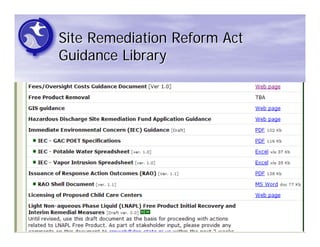
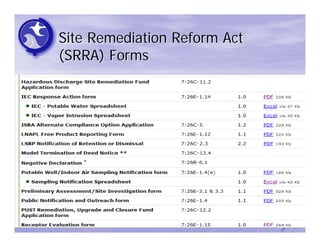
Site Remediation Reform Act
Guidance Library
SRP Forms Library
• IEC Response action form

• Excel spreadsheets:
  – Potable water
  – Vapor intrusion
Site Remediation Reform Act
(SRRA) Forms
IEC Tools

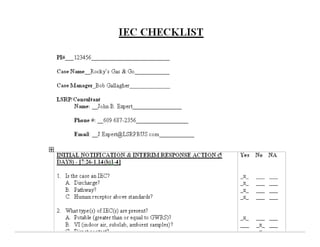
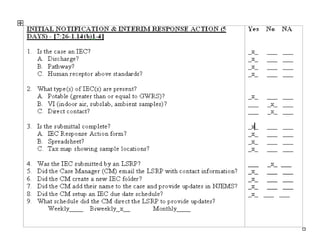
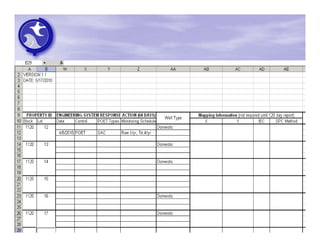
• Checklist

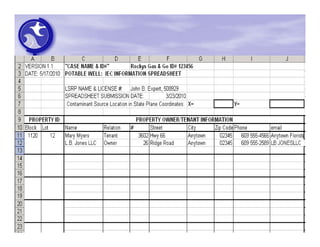
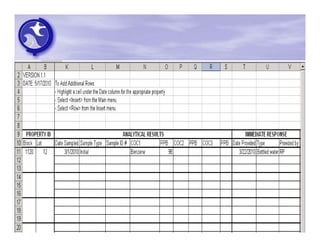
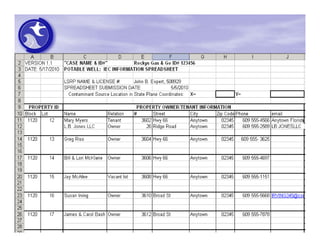
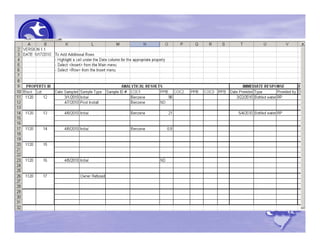
• Spreadsheet

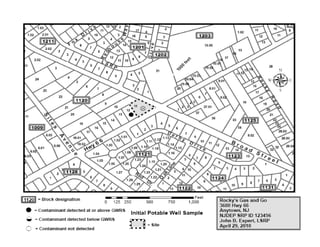
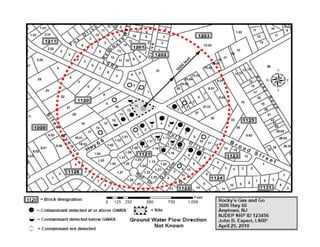
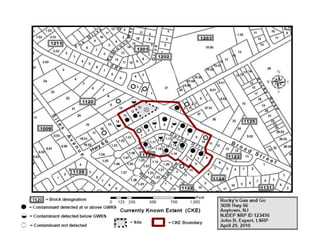
• Maps

• Quick Reference Guide
IEC Checklist and Spreadsheet
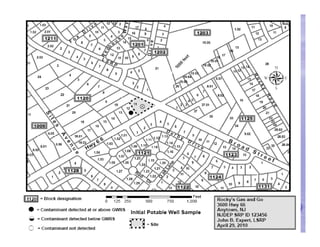
IEC Case Example

• New case
• Contaminated wells
• Residential/commercial area
• Source: gas station
• Waterlines on some streets
• Unknown groundwater flow direction
IEC Tools

• Simplifies and standardizes reporting process

• Promotes consistency between cases

• Facilitates compliance with new rule requirements

• Allows for easier electronic submissions

• Allows for real-time decisions between LSRP and
  case manager
Any questions about the
     IEC Process?
Vapor Intrusion Pathway:
Immediate Environmental Concern
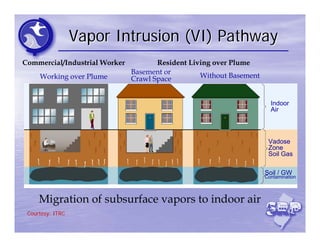
Vapor Intrusion (VI) Pathway
Commercial/Industrial Worker          Resident Living over Plume
                               Basement or
     Working over Plume        Crawl Space        Without Basement


                                                                       Indoor
                                                                       Air


                                                                      Vadose
                                                                      Zone
                                                                      Soil Gas

                                                                     Soil / GW
                                                                     Contamination


     Migration of subsurface vapors to indoor air
 Courtesy: ITRC
What Constitutes a VI IEC?

A vapor intrusion IEC exists at a structure if:
  1) The results of an indoor air sample exceeds the
     appropriate NJDEP Indoor Air Screening Level;
     and,
  2) The indoor air exceedance is resulting from a
     completed vapor intrusion pathway (evaluate
     potential background sources).
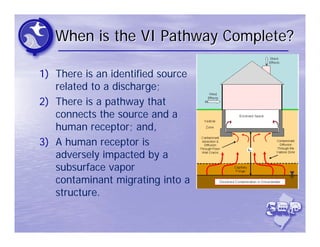
When is the VI Pathway Complete?

1) There is an identified source
   related to a discharge;
2) There is a pathway that
   connects the source and a
   human receptor; and,
3) A human receptor is
   adversely impacted by a
   subsurface vapor
   contaminant migrating into a
   structure.
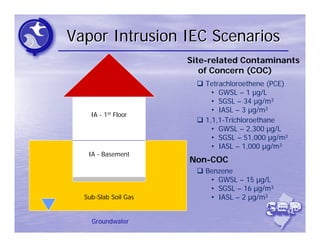
Vapor Intrusion IEC Scenarios
                      Site-related Contaminants
                         of Concern (COC)
                         Tetrachloroethene (PCE)
                            • GWSL – 1 µg/L
                            • SGSL – 34 µg/m3
                            • IASL – 3 µg/m3
    IA - 1st Floor
                         1,1,1-Trichloroethane
                            • GWSL – 2,300 µg/L
                            • SGSL – 51,000 µg/m3
                            • IASL – 1,000 µg/m3
   IA - Basement
                      Non-COC
                         Benzene
                           • GWSL – 15 µg/L
                           • SGSL – 16 µg/m3
  Sub-Slab Soil Gas        • IASL – 2 µg/m3


    Groundwater
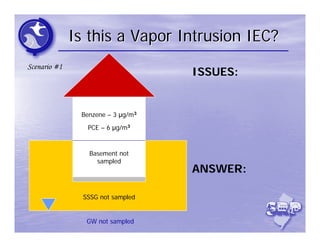
Is this a Vapor Intrusion IEC?
Scenario #1
                                   ISSUES:


               Benzene – 3 μg/m3
                 PCE – 6 μg/m3


                 Basement not
                   sampled
                                   ANSWER:

                SSSG not sampled


                 GW not sampled
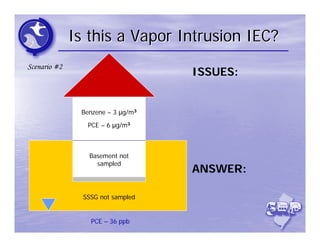
Is this a Vapor Intrusion IEC?
Scenario #2
                                   ISSUES:


               Benzene – 3 μg/m3
                 PCE – 6 μg/m3


                 Basement not
                   sampled
                                   ANSWER:

                SSSG not sampled


                  PCE – 36 ppb
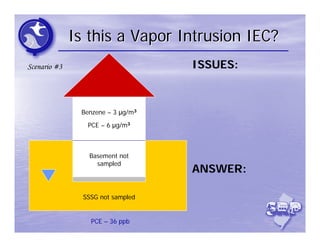
Is this a Vapor Intrusion IEC?
Scenario #3                        ISSUES:


               Benzene – 3 μg/m3
                 PCE – 6 μg/m3


                 Basement not
                   sampled
                                   ANSWER:

                SSSG not sampled


                  PCE – 36 ppb
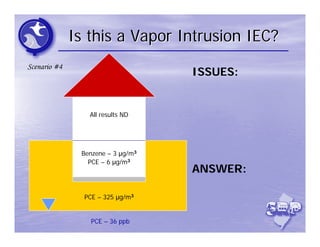
Is this a Vapor Intrusion IEC?
Scenario #4
                                   ISSUES:


                 All results ND


               Benzene – 3 μg/m3
                 PCE – 6 μg/m3
                                   ANSWER:

                PCE – 325 μg/m3


                  PCE – 36 ppb
Is this a Vapor Intrusion IEC?
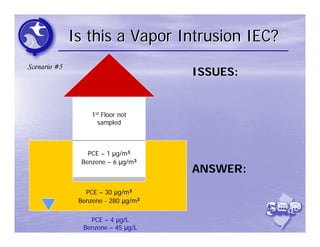
Scenario #5
                                     ISSUES:


                   1st Floor not
                     sampled


                 PCE – 1 μg/m3
               Benzene – 6 μg/m3
                                     ANSWER:
                 PCE – 30 μg/m3
               Benzene - 280 μg/m3

                  PCE – 4 μg/L
                Benzene – 45 μg/L
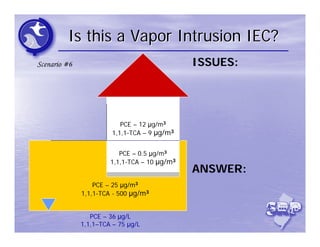
Is this a Vapor Intrusion IEC?
Scenario #6                                   ISSUES:


                           PCE – 12 μg/m3
                        1,1,1-TCA – 9 μg/m3


                          PCE – 0.5 μg/m3
                       1,1,1-TCA – 10 μg/m3
                                              ANSWER:
                  PCE – 25 μg/m3
              1,1,1-TCA - 500 μg/m3


                 PCE – 36 μg/L
              1,1,1–TCA – 75 μg/L
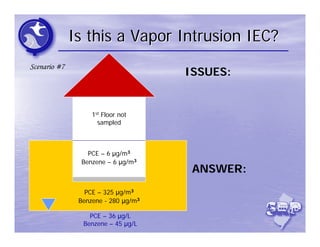
Is this a Vapor Intrusion IEC?
Scenario #7
                                     ISSUES:


                   1st Floor not
                     sampled


                 PCE – 6 μg/m3
               Benzene – 6 μg/m3
                                      ANSWER:
                 PCE – 325 μg/m3
               Benzene - 280 μg/m3

                  PCE – 36 μg/L
                Benzene – 45 μg/L
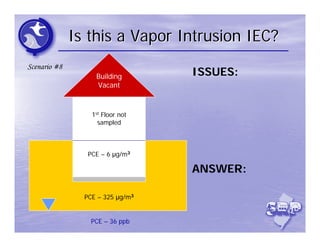
Is this a Vapor Intrusion IEC?
Scenario #8
                   Building       ISSUES:
                   Vacant


                  1st Floor not
                    sampled


                 PCE – 6 μg/m3

                                  ANSWER:

                PCE – 325 μg/m3


                  PCE – 36 ppb
Is this a Vapor Intrusion IEC?
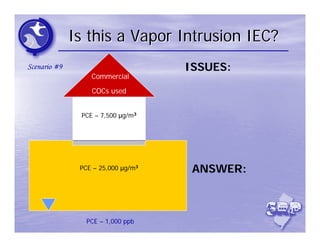
Scenario #9                         ISSUES:
                  Commercial

                  COCs used


               PCE – 7,500 μg/m3


               PCE – 25,000 μg/m3    ANSWER:


                 PCE – 1,000 ppb
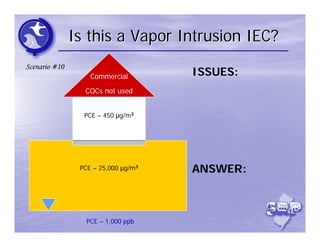
Is this a Vapor Intrusion IEC?
Scenario #10
                   Commercial        ISSUES:
                 COCs not used


                 PCE – 450 μg/m3


                PCE – 25,000 μg/m3   ANSWER:


                  PCE – 1,000 ppb
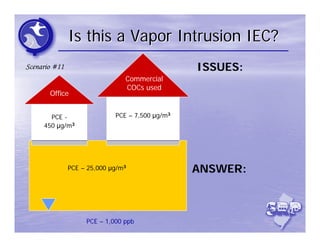
Is this a Vapor Intrusion IEC?
Scenario #11                                     ISSUES:
                                Commercial
                                COCs used
       Office


       PCE -                 PCE – 7,500 μg/m3
     450 μg/m3


               PCE – 25,000 μg/m3                ANSWER:


                    PCE – 1,000 ppb
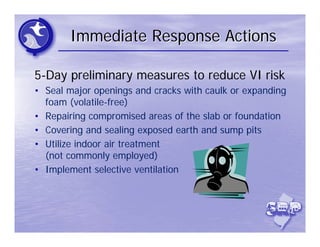
Immediate Response Actions

5-Day preliminary measures to reduce VI risk
• Seal major openings and cracks with caulk or expanding
  foam (volatile-free)
• Repairing compromised areas of the slab or foundation
• Covering and sealing exposed earth and sump pits
• Utilize indoor air treatment
  (not commonly employed)
• Implement selective ventilation
Questions?

Indoor Environmental Concern Training

  • 1.
    Overview of IECProcess and Tools Tessie Fields, Andrew Sites, John Boyer June 24, 2010
  • 2.
    What are wegoing to cover? Tessie Fields Receptor evaluation as it relates to IECs Q&A Andrew Sites Overview of IEC Process and IEC Tools Using the IEC Tools - Case example Q&A John Boyer Vapor Intrusion Issues
  • 3.
    New SRRA Trainingand Tools New Quick Reference Guides for: • Immediate Environmental Concern • Receptor Evaluation Provides a soup to nuts guide to what has to be submitted and when
  • 7.
    Quick Reference Guidesfor Each Section of the Receptor Evaluation 1. General and Reporting Requirements (N.J.A.C. 7:26E-1.15) 2. Land Use (N.J.A.C. 7:26E-1.16) 3. Ground Water (N.J.A.C. 7:26E-1.17) a. Potable water IEC condition b. No Potable water IEC condition 4. Vapor Intrusion (N.J.A.C. 7:26E-1.18) a. Indoor air IEC condition b. No indoor air IEC condition is identified 5. Ecological (N.J.A.C. 7:26E-1.19)
  • 8.
    Receptor Evaluation Quick Reference Guide • Also has a brief introduction • An index to all the separate guides • Link to related FAQs – How to conduct and report a well search • Contact information for Bureau Chiefs Mark Pederson, Steve Maybury or Kevin Kratina
  • 9.
    What is aReceptor Evaluation? It’s a periodic report • Initial Receptor Evaluation Report/form* (270 days) • Updated Receptor Evaluation Report/form – Remedial Investigation Report – Remedial Action Report * Regulatory timeframe * Also has a Mandatory Timeframe of 1 Year
  • 10.
    Receptor Evaluation Report Timeframes • The Department is considering changes to regulatory and mandatory timeframes for the interim rule proposal in September • Updates on this topic will be provided on the web and via the Listserv
  • 11.
    What is aReceptor Evaluation? It’s an ongoing process of identifying receptors and mitigating exposure • Includes triggers and timeframes to: – Identify land use around the site – Sample potable water – Conduct vapor intrusion investigation • The mechanism by which most IECs are identified
  • 12.
    Who has tosubmit a Receptor Evaluation Report/form? • All Existing Cases – Unless remediation is completed before November 26, 2010 • All New Cases – Unless remediation is completed in less than 9 months – UHOT cases Will be submitted by LSRPs and non-LSRPs
  • 13.
    Initial Receptor EvaluationReport/form Timeline with Potable Water Requirements for Existing Cases June 1 Data < std Complete Submit clean data Well Search 14 days November 26 90 days Initial Receptor July 1 Evaluation March 1 Collect Potable Get report/form* Mandatory March 1 Sample analytical 270 days Timeframe* 120 days data Known ground water contamination Data > std IEC req. kick in * Regulatory timeframe * Mandatory timeframe
  • 14.
    Initial Receptor EvaluationReport Timeline with Potable Water Requirements for New Cases Well Data < std Search Submit clean data Confirm 90 days 14 days ground water contamination Collect Potable 1 Year Get Initial Sample analytical Mandatory New Receptor 120 days Timeframe discharge data Evaluation* 270 Days Data > std IEC req. kick in * Regulatory timeframe * Mandatory timeframe
  • 15.
    Receptor Evaluation Report •The initial receptor evaluation report describes all potable water and/or VI work conducted to date. It is: “What you know at the time the report is submitted” • If an extension of regulatory or mandatory timeframe is needed the remediating party may request an extension pursuant to the ARRCS rules (N.J.A.C. 7:26C-3)
  • 16.
    Any general questionsabout the Receptor Evaluation?
  • 17.
    Immediate Environmental Concern •Overview of IEC Process • Overview of IEC Tools • Using the IEC Tools - Case example •Q&A
  • 18.
    What is anIEC? • Contaminant source in the environment • Migration pathway • Human receptor (people coming in contact with contamination above a standard or screening level)
  • 19.
    Three types ofIECs • Potable wells • Vapor intrusion • Direct contact
  • 20.
    Basic IEC Concept •Delineate IEC problem • Mitigate IEC problem • Remove source causing IEC problem
  • 21.
    What is theIEC process? • Regulatory timeframes effective immediately (November 4, 2009) • Every IEC gets a Case Manager • New cases go to IEC group • Case Managers on existing cases will handle IECs • LSRP/consultant must work with Case Manager • Most work based on verbal approvals • Documentation via email
  • 22.
    LSRP or EnvironmentalConsultant? • New cases must use an LSRP • Existing cases that opt in must use an LSRP • Existing cases may use either LSRP or non-LSRP
  • 23.
    IEC Regulatory Timeframes Immediately • Call the Hotline/case manager 5 days • Notify DEP and mitigate 60 days • Engineered system response • Receptor delineation 120 days • Engineered System Response Action Report 270 days • Source Control Report* * Also has 1 year mandatory timeframe
  • 24.
    IEC Source ControlTimeframes • The Department is considering changes to regulatory and mandatory timeframes for the interim rule proposal in September • Updates on this topic will be provided on the web and via the Listserv
  • 25.
    Receptor Evaluation ReportTimeline with IEC – Potable water May 1 Well Search 90 days November 26 June 1 March 1 Get Initial Collect Potable Mandatory analytical Receptor March 1 Sample Timeframe data Evaluation* 120 days Known ground water 1 year contamination Data > std 270 day Mandatory 120 day Timeframe 5 day 60 day req. req. req. req. IEC requirements
  • 26.
    Immediate requirements • Notifycase manager for assigned cases • Notify the HOTLINE for new cases or when no case manager is assigned – Must refer to case as an “IEC Case” • Notify HOTLINE for unknown source IEC
  • 27.
    5 Day Requirements MitigateIEC with interim response action • Provide – Bottled water – Vent, seal cracks and sumps – Notification to owner, Twp., Health Dept. • Submit – IEC Response action form – Spreadsheet – Map of site and IEC condition – All analytical results with full lab data deliverables
  • 28.
    5 Day RequiredSubmittal • For all cases – Submit paper copy & Email to Initial Notice • For existing cases – Email to case manager • For new cases – Initial Notice will notify the IEC group
  • 29.
    60 Day Requirements •Identify additional receptors (potable wells and structures) – Conduct sampling – Comply with notification requirements • Install permanent mitigation (Engineered System Response Action) – POET or waterline connection – Sub-slab ventilation
  • 30.
    120 Day Requirements SubmitIEC Engineered Receptor Response Action Report • Receptor delineation & Receptor control description • IEC Immediate Action Form • Spreadsheet with all data • Map • GIS compatible map submission
  • 31.
    270 Day Requirements •Conduct focused remedial investigation • Initiate source control • Submit IEC Source Control Report – IEC Response Action Form – Spreadsheet with all data – Map of CKE area – GIS compatible map submission
  • 32.
    IEC Guidance • Writtenfor more common types of IEC conditions • Time extensions can be requested • Frequent communications and information sharing with case manager is vital
  • 33.
    What will yourcase manager do? • Ensure each requirement is completed • Establish routine updates • Communicate with you throughout IEC process • Document progress or lack of progress
  • 34.
    SRP Guidance Library •IEC Guidance document • IEC - GAC POET Specifications • Excel spreadsheets: – Potable water – Vapor intrusion
  • 35.
    Site Remediation ReformAct Guidance Library
  • 36.
    SRP Forms Library •IEC Response action form • Excel spreadsheets: – Potable water – Vapor intrusion
  • 37.
    Site Remediation ReformAct (SRRA) Forms
  • 38.
    IEC Tools • Checklist •Spreadsheet • Maps • Quick Reference Guide
  • 39.
    IEC Checklist andSpreadsheet
  • 42.
    IEC Case Example •New case • Contaminated wells • Residential/commercial area • Source: gas station • Waterlines on some streets • Unknown groundwater flow direction
  • 53.
    IEC Tools • Simplifiesand standardizes reporting process • Promotes consistency between cases • Facilitates compliance with new rule requirements • Allows for easier electronic submissions • Allows for real-time decisions between LSRP and case manager
  • 54.
    Any questions aboutthe IEC Process?
  • 55.
  • 56.
    Vapor Intrusion (VI)Pathway Commercial/Industrial Worker Resident Living over Plume Basement or Working over Plume Crawl Space Without Basement Indoor Air Vadose Zone Soil Gas Soil / GW Contamination Migration of subsurface vapors to indoor air Courtesy: ITRC
  • 57.
    What Constitutes aVI IEC? A vapor intrusion IEC exists at a structure if: 1) The results of an indoor air sample exceeds the appropriate NJDEP Indoor Air Screening Level; and, 2) The indoor air exceedance is resulting from a completed vapor intrusion pathway (evaluate potential background sources).
  • 58.
    When is theVI Pathway Complete? 1) There is an identified source related to a discharge; 2) There is a pathway that connects the source and a human receptor; and, 3) A human receptor is adversely impacted by a subsurface vapor contaminant migrating into a structure.
  • 59.
    Vapor Intrusion IECScenarios Site-related Contaminants of Concern (COC)  Tetrachloroethene (PCE) • GWSL – 1 µg/L • SGSL – 34 µg/m3 • IASL – 3 µg/m3 IA - 1st Floor  1,1,1-Trichloroethane • GWSL – 2,300 µg/L • SGSL – 51,000 µg/m3 • IASL – 1,000 µg/m3 IA - Basement Non-COC  Benzene • GWSL – 15 µg/L • SGSL – 16 µg/m3 Sub-Slab Soil Gas • IASL – 2 µg/m3 Groundwater
  • 60.
    Is this aVapor Intrusion IEC? Scenario #1 ISSUES: Benzene – 3 μg/m3 PCE – 6 μg/m3 Basement not sampled ANSWER: SSSG not sampled GW not sampled
  • 61.
    Is this aVapor Intrusion IEC? Scenario #2 ISSUES: Benzene – 3 μg/m3 PCE – 6 μg/m3 Basement not sampled ANSWER: SSSG not sampled PCE – 36 ppb
  • 62.
    Is this aVapor Intrusion IEC? Scenario #3 ISSUES: Benzene – 3 μg/m3 PCE – 6 μg/m3 Basement not sampled ANSWER: SSSG not sampled PCE – 36 ppb
  • 63.
    Is this aVapor Intrusion IEC? Scenario #4 ISSUES: All results ND Benzene – 3 μg/m3 PCE – 6 μg/m3 ANSWER: PCE – 325 μg/m3 PCE – 36 ppb
  • 64.
    Is this aVapor Intrusion IEC? Scenario #5 ISSUES: 1st Floor not sampled PCE – 1 μg/m3 Benzene – 6 μg/m3 ANSWER: PCE – 30 μg/m3 Benzene - 280 μg/m3 PCE – 4 μg/L Benzene – 45 μg/L
  • 65.
    Is this aVapor Intrusion IEC? Scenario #6 ISSUES: PCE – 12 μg/m3 1,1,1-TCA – 9 μg/m3 PCE – 0.5 μg/m3 1,1,1-TCA – 10 μg/m3 ANSWER: PCE – 25 μg/m3 1,1,1-TCA - 500 μg/m3 PCE – 36 μg/L 1,1,1–TCA – 75 μg/L
  • 66.
    Is this aVapor Intrusion IEC? Scenario #7 ISSUES: 1st Floor not sampled PCE – 6 μg/m3 Benzene – 6 μg/m3 ANSWER: PCE – 325 μg/m3 Benzene - 280 μg/m3 PCE – 36 μg/L Benzene – 45 μg/L
  • 67.
    Is this aVapor Intrusion IEC? Scenario #8 Building ISSUES: Vacant 1st Floor not sampled PCE – 6 μg/m3 ANSWER: PCE – 325 μg/m3 PCE – 36 ppb
  • 68.
    Is this aVapor Intrusion IEC? Scenario #9 ISSUES: Commercial COCs used PCE – 7,500 μg/m3 PCE – 25,000 μg/m3 ANSWER: PCE – 1,000 ppb
  • 69.
    Is this aVapor Intrusion IEC? Scenario #10 Commercial ISSUES: COCs not used PCE – 450 μg/m3 PCE – 25,000 μg/m3 ANSWER: PCE – 1,000 ppb
  • 70.
    Is this aVapor Intrusion IEC? Scenario #11 ISSUES: Commercial COCs used Office PCE - PCE – 7,500 μg/m3 450 μg/m3 PCE – 25,000 μg/m3 ANSWER: PCE – 1,000 ppb
  • 71.
    Immediate Response Actions 5-Daypreliminary measures to reduce VI risk • Seal major openings and cracks with caulk or expanding foam (volatile-free) • Repairing compromised areas of the slab or foundation • Covering and sealing exposed earth and sump pits • Utilize indoor air treatment (not commonly employed) • Implement selective ventilation
  • 72.