IN
DIVIDUALISTIC
/CO
LLECTIVISTIC
CULTURES
The SELF IN WESTERN AND
EASTERN THOUGHT
BACKGROUND
Theory: Individualism-Collectivism Model
▪Used to explain large amounts of variation seen in
human behavior, social interaction, and personality
▪Explain differences in people and/or groups
How?
Collectivist Cultures: individual needs, desires, etc. are
secondary to those of the group (Asia)
Individualistic Cultures: Higher value on the needs and
accomplishments of the individual rather than the group
(United States)
EASTERN AND WESTERN INFLUENCES ON DEVELOPMENT OF SELF
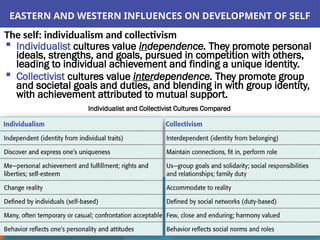
▪ Individualist cultures value independence. They promote personal
ideals, strengths, and goals, pursued in competition with others,
leading to individual achievement and finding a unique identity.
▪ Collectivist cultures value interdependence. They promote group
and societal goals and duties, and blending in with group identity,
with achievement attributed to mutual support.
Individualist and Collectivist Cultures Compared
The self: individualism and collectivism
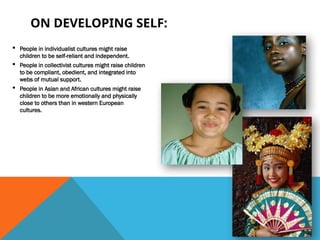
▪ People in individualist cultures might raise
children to be self-reliant and independent.
▪ People in collectivist cultures might raise children
to be compliant, obedient, and integrated into
webs of mutual support.
▪ People in Asian and African cultures might raise
children to be more emotionally and physically
close to others than in western European
cultures.
ON DEVELOPING SELF:
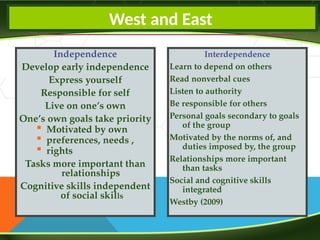
Interdependence
Learn to depend on others
Read nonverbal cues
Listen to authority
Be responsible for others
Personal goals secondary to goals
of the group
Motivated by the norms of, and
duties imposed by, the group
Relationships more important
than tasks
Social and cognitive skills
integrated
Westby (2009)
Independence
Develop early independence
Express yourself
Responsible for self
Live on one’s own
One’s own goals take priority
▪ Motivated by own
▪ preferences, needs ,
▪ rights
Tasks more important than
relationships
Cognitive skills independent
of social skills
•The Difference Between West and East
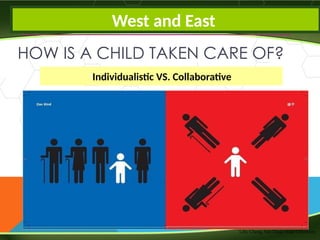
West and East
HOW IS A CHILD TAKEN CARE OF?
•Individualistic VS. Collaborative
•The Difference Between West and East
West and East
Lilly Cheng, San Diego State University
CAUTIONS IN DEFINING “INDIVIDUALISTIC & COLLECTIVISTIC
“Conclusions about collectivist and
individualistic cultures shouldn’t be
overly sweeping and must be carefully
applied to selective, specific behaviors,
situations, and cultures.
“I may not be able to give my kids
everything they want but I
give them what they need.
Love, time, and attention.
You can’t buy those things.”
– Nishan Panwar
Nothing has a stronger
influence psychologically on
their environment and
especially on their children
than the unlived life of the
parent.
—Carl Gustav Jung
Life doesn't make any sense with
out interdependence. We need ea
ch other, and the sooner we learn
that, the better for us all.
Erik Erikson

Individualism vs Collectivism in Group Dynamics

  • 1.
  • 2.
    BACKGROUND Theory: Individualism-Collectivism Model ▪Usedto explain large amounts of variation seen in human behavior, social interaction, and personality ▪Explain differences in people and/or groups How? Collectivist Cultures: individual needs, desires, etc. are secondary to those of the group (Asia) Individualistic Cultures: Higher value on the needs and accomplishments of the individual rather than the group (United States)
  • 3.
    EASTERN AND WESTERNINFLUENCES ON DEVELOPMENT OF SELF ▪ Individualist cultures value independence. They promote personal ideals, strengths, and goals, pursued in competition with others, leading to individual achievement and finding a unique identity. ▪ Collectivist cultures value interdependence. They promote group and societal goals and duties, and blending in with group identity, with achievement attributed to mutual support. Individualist and Collectivist Cultures Compared The self: individualism and collectivism
  • 4.
    ▪ People inindividualist cultures might raise children to be self-reliant and independent. ▪ People in collectivist cultures might raise children to be compliant, obedient, and integrated into webs of mutual support. ▪ People in Asian and African cultures might raise children to be more emotionally and physically close to others than in western European cultures. ON DEVELOPING SELF:
  • 5.
    Interdependence Learn to dependon others Read nonverbal cues Listen to authority Be responsible for others Personal goals secondary to goals of the group Motivated by the norms of, and duties imposed by, the group Relationships more important than tasks Social and cognitive skills integrated Westby (2009) Independence Develop early independence Express yourself Responsible for self Live on one’s own One’s own goals take priority ▪ Motivated by own ▪ preferences, needs , ▪ rights Tasks more important than relationships Cognitive skills independent of social skills •The Difference Between West and East West and East
  • 6.
    HOW IS ACHILD TAKEN CARE OF? •Individualistic VS. Collaborative •The Difference Between West and East West and East Lilly Cheng, San Diego State University
  • 7.
    CAUTIONS IN DEFINING“INDIVIDUALISTIC & COLLECTIVISTIC “Conclusions about collectivist and individualistic cultures shouldn’t be overly sweeping and must be carefully applied to selective, specific behaviors, situations, and cultures.
  • 8.
    “I may notbe able to give my kids everything they want but I give them what they need. Love, time, and attention. You can’t buy those things.” – Nishan Panwar Nothing has a stronger influence psychologically on their environment and especially on their children than the unlived life of the parent. —Carl Gustav Jung Life doesn't make any sense with out interdependence. We need ea ch other, and the sooner we learn that, the better for us all. Erik Erikson

Editor's Notes

  • #3 Click to reveal bullets. On the last domain on each list, related to attributions for behavior, you might add/clarify that people in collectivist societies are more likely to give credit to others for accomplishments, as mentioned in the text when describing interviews with successful athletes.
  • #4 Click to reveal bullets.