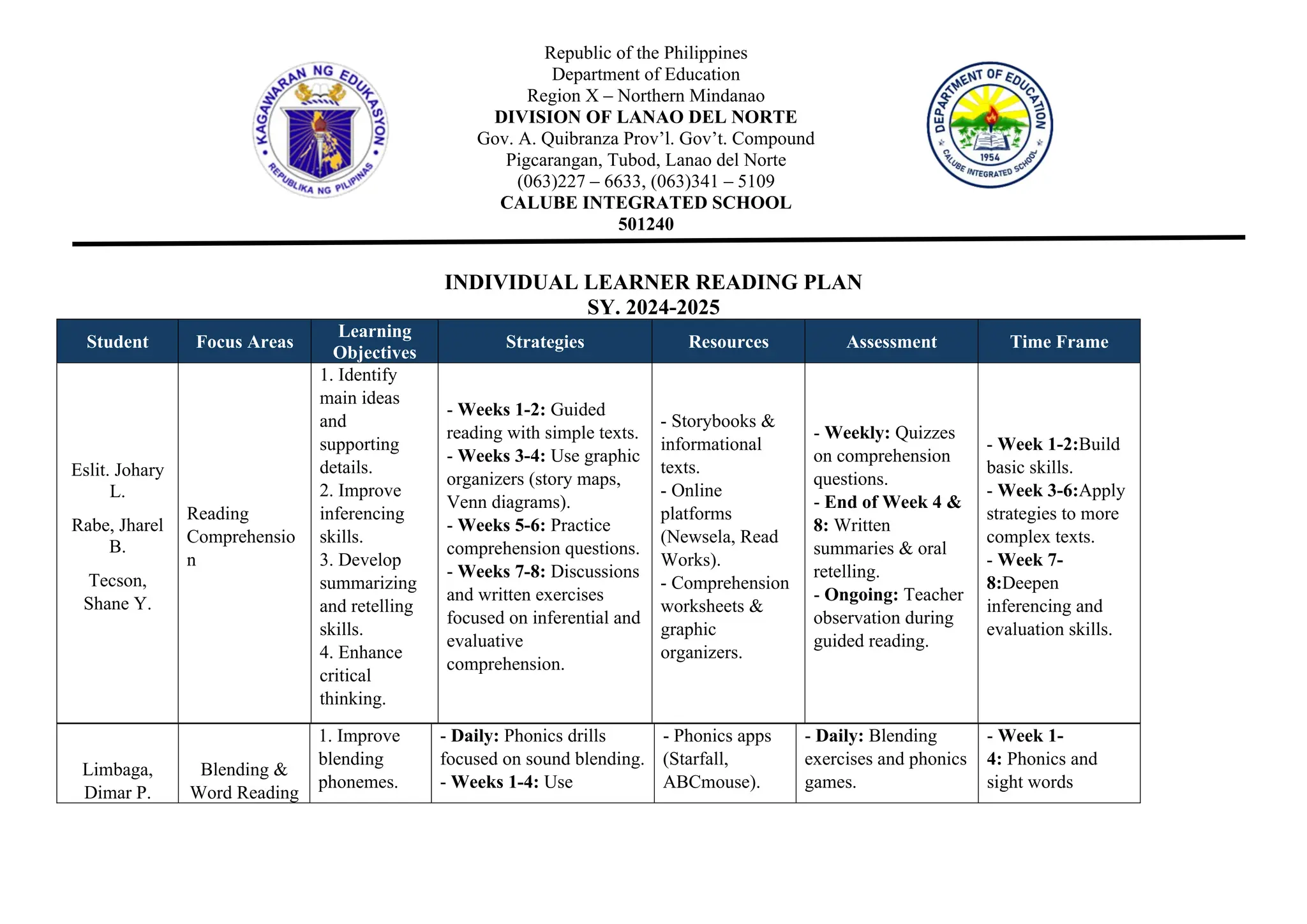
INDIVIDUAL LEARNER READING PLAN
SY. 2024-2025
Student Focus Areas
Learning
Objectives
Strategies Resources Assessment Time Frame
Eslit. Johary
L.
Rabe, Jharel
B.
Tecson,
Shane Y.
Reading
Comprehensio
n
1. Identify
main ideas
and
supporting
details.
2. Improve
inferencing
skills.
3. Develop
summarizing
and retelling
skills.
4. Enhance
critical
thinking.
- Weeks 1-2: Guided
reading with simple texts.
- Weeks 3-4: Use graphic
organizers (story maps,
Venn diagrams).
- Weeks 5-6: Practice
comprehension questions.
- Weeks 7-8: Discussions
and written exercises
focused on inferential and
evaluative
comprehension.
- Storybooks &
informational
texts.
- Online
platforms
(Newsela, Read
Works).
- Comprehension
worksheets &
graphic
organizers.
- Weekly: Quizzes
on comprehension
questions.
- End of Week 4 &
8: Written
summaries & oral
retelling.
- Ongoing: Teacher
observation during
guided reading.
- Week 1-2:Build
basic skills.
- Week 3-6:Apply
strategies to more
complex texts.
- Week 7-
8:Deepen
inferencing and
evaluation skills.
Limbaga,
Dimar P.
Blending &
Word Reading
1. Improve
blending
phonemes.
- Daily: Phonics drills
focused on sound blending.
- Weeks 1-4: Use
- Phonics apps
(Starfall,
ABCmouse).
- Daily: Blending
exercises and phonics
games.
- Week 1-
4: Phonics and
sight words
Republic of the Philippines
Department of Education
Region X – Northern Mindanao
DIVISION OF LANAO DEL NORTE
Gov. A. Quibranza Prov’l. Gov’t. Compound
Pigcarangan, Tubod, Lanao del Norte
(063)227 – 6633, (063)341 – 5109
CALUBE INTEGRATED SCHOOL
501240
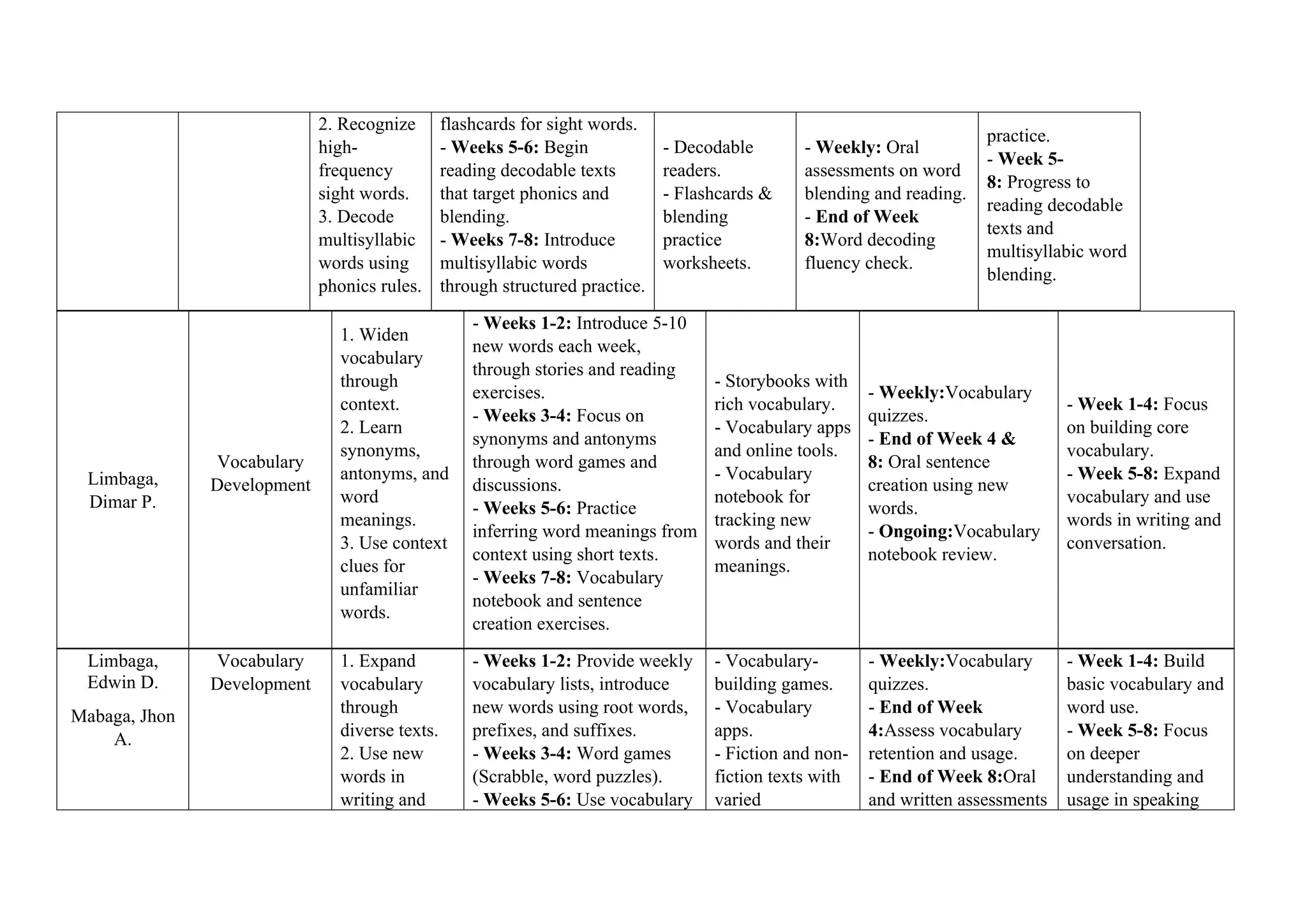
2. Recognize
high-
frequency
sight words.
3. Decode
multisyllabic
words using
phonics rules.
flashcards for sight words.
- Weeks 5-6: Begin
reading decodable texts
that target phonics and
blending.
- Weeks 7-8: Introduce
multisyllabic words
through structured practice.
- Decodable
readers.
- Flashcards &
blending
practice
worksheets.
- Weekly: Oral
assessments on word
blending and reading.
- End of Week
8:Word decoding
fluency check.
practice.
- Week 5-
8: Progress to
reading decodable
texts and
multisyllabic word
blending.
Limbaga,
Dimar P.
Vocabulary
Development
1. Widen
vocabulary
through
context.
2. Learn
synonyms,
antonyms, and
word
meanings.
3. Use context
clues for
unfamiliar
words.
- Weeks 1-2: Introduce 5-10
new words each week,
through stories and reading
exercises.
- Weeks 3-4: Focus on
synonyms and antonyms
through word games and
discussions.
- Weeks 5-6: Practice
inferring word meanings from
context using short texts.
- Weeks 7-8: Vocabulary
notebook and sentence
creation exercises.
- Storybooks with
rich vocabulary.
- Vocabulary apps
and online tools.
- Vocabulary
notebook for
tracking new
words and their
meanings.
- Weekly:Vocabulary
quizzes.
- End of Week 4 &
8: Oral sentence
creation using new
words.
- Ongoing:Vocabulary
notebook review.
- Week 1-4: Focus
on building core
vocabulary.
- Week 5-8: Expand
vocabulary and use
words in writing and
conversation.
Limbaga,
Edwin D.
Mabaga, Jhon
A.
Vocabulary
Development
1. Expand
vocabulary
through
diverse texts.
2. Use new
words in
writing and
- Weeks 1-2: Provide weekly
vocabulary lists, introduce
new words using root words,
prefixes, and suffixes.
- Weeks 3-4: Word games
(Scrabble, word puzzles).
- Weeks 5-6: Use vocabulary
- Vocabulary-
building games.
- Vocabulary
apps.
- Fiction and non-
fiction texts with
varied
- Weekly:Vocabulary
quizzes.
- End of Week
4:Assess vocabulary
retention and usage.
- End of Week 8:Oral
and written assessments
- Week 1-4: Build
basic vocabulary and
word use.
- Week 5-8: Focus
on deeper
understanding and
usage in speaking
speaking.
3. Understand
multiple
meanings of
words.
in sentence construction, oral
and written.
- Weeks 7-8: Discuss
multiple meanings of words
in context through stories.
vocabulary.
- Vocabulary lists
and word-study
tools.
on using new words in
context.
and writing.
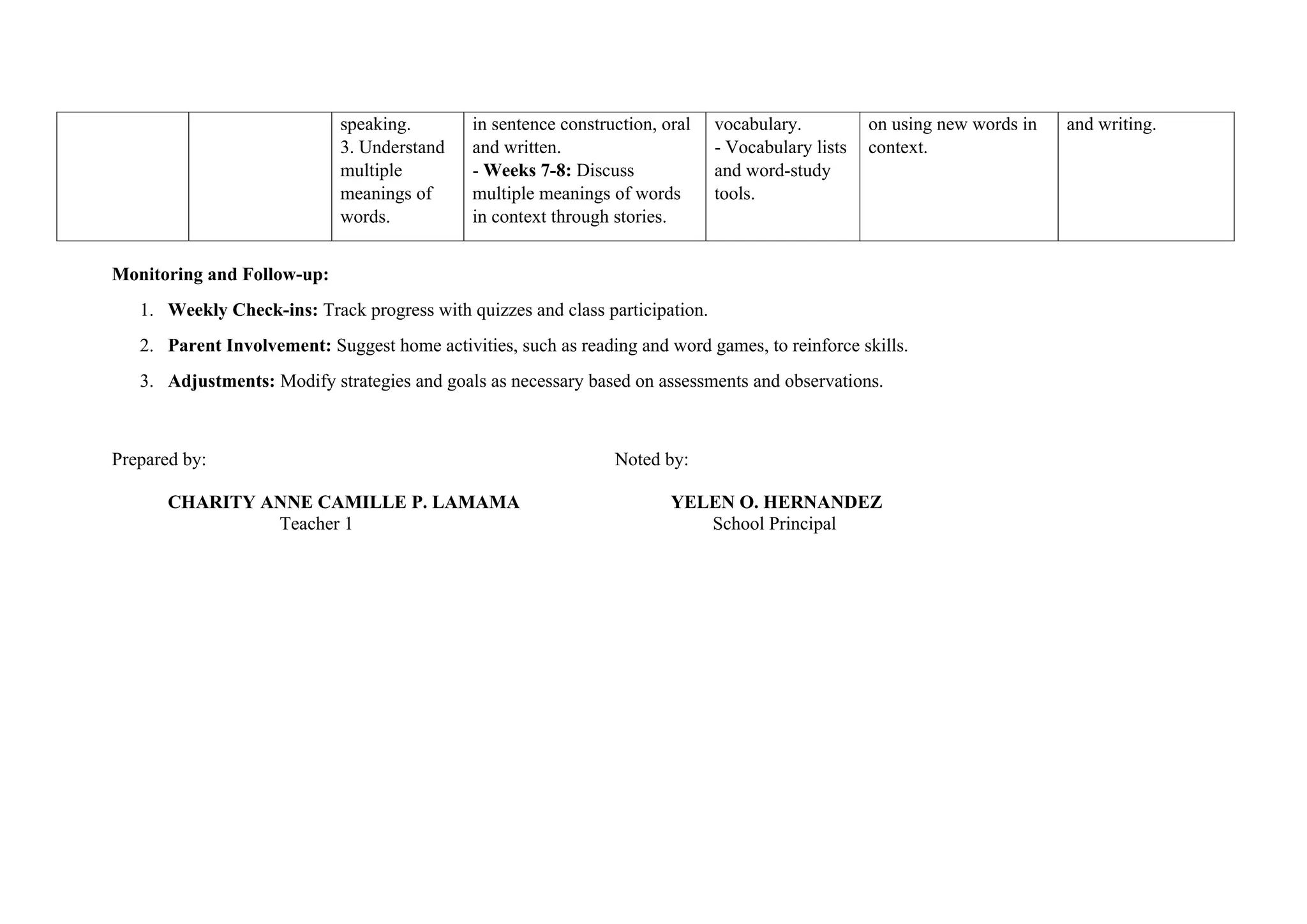
Monitoring and Follow-up:
1. Weekly Check-ins: Track progress with quizzes and class participation.
2. Parent Involvement: Suggest home activities, such as reading and word games, to reinforce skills.
3. Adjustments: Modify strategies and goals as necessary based on assessments and observations.
Prepared by: Noted by:
CHARITY ANNE CAMILLE P. LAMAMA YELEN O. HERNANDEZ
Teacher 1 School Principal
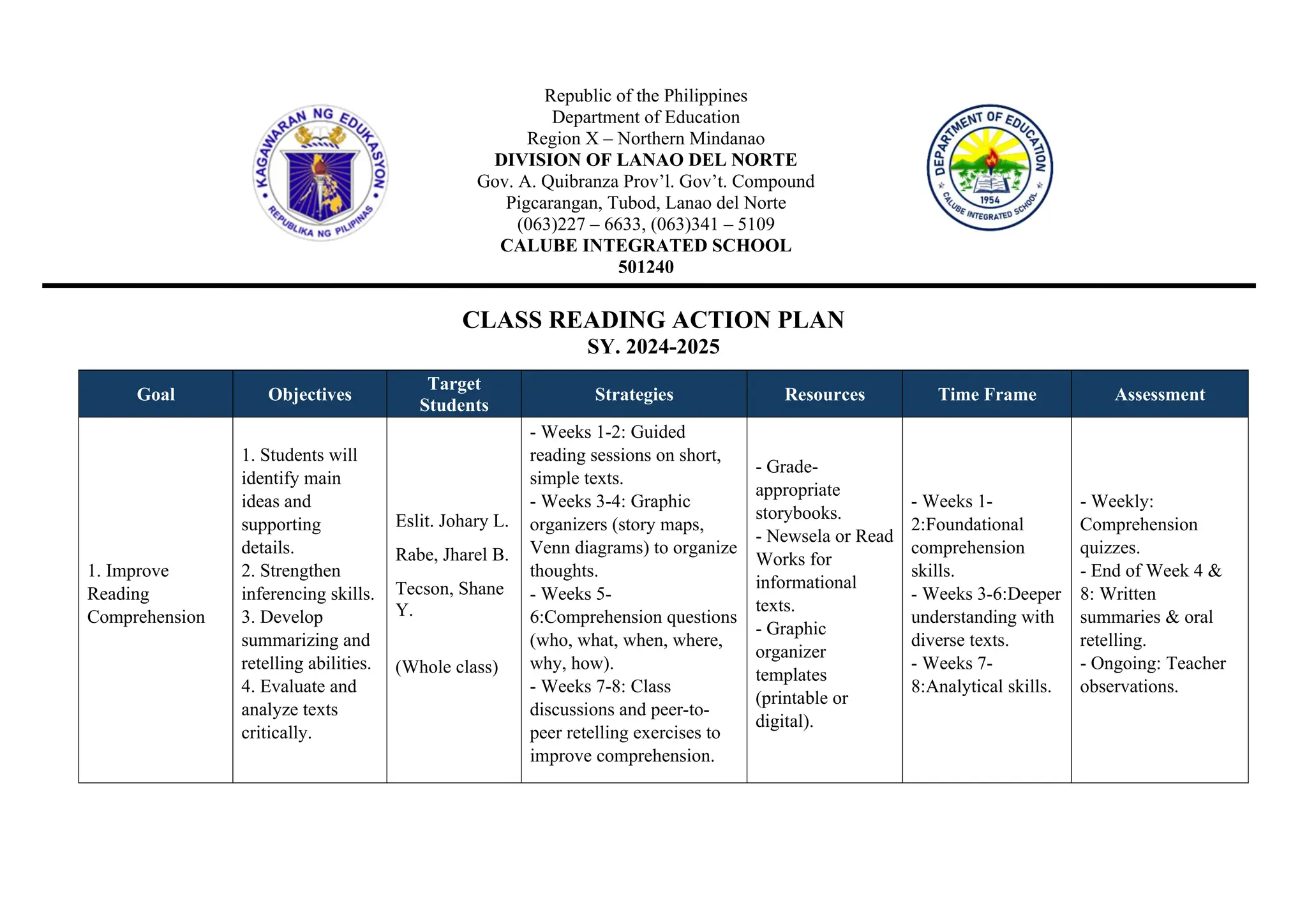
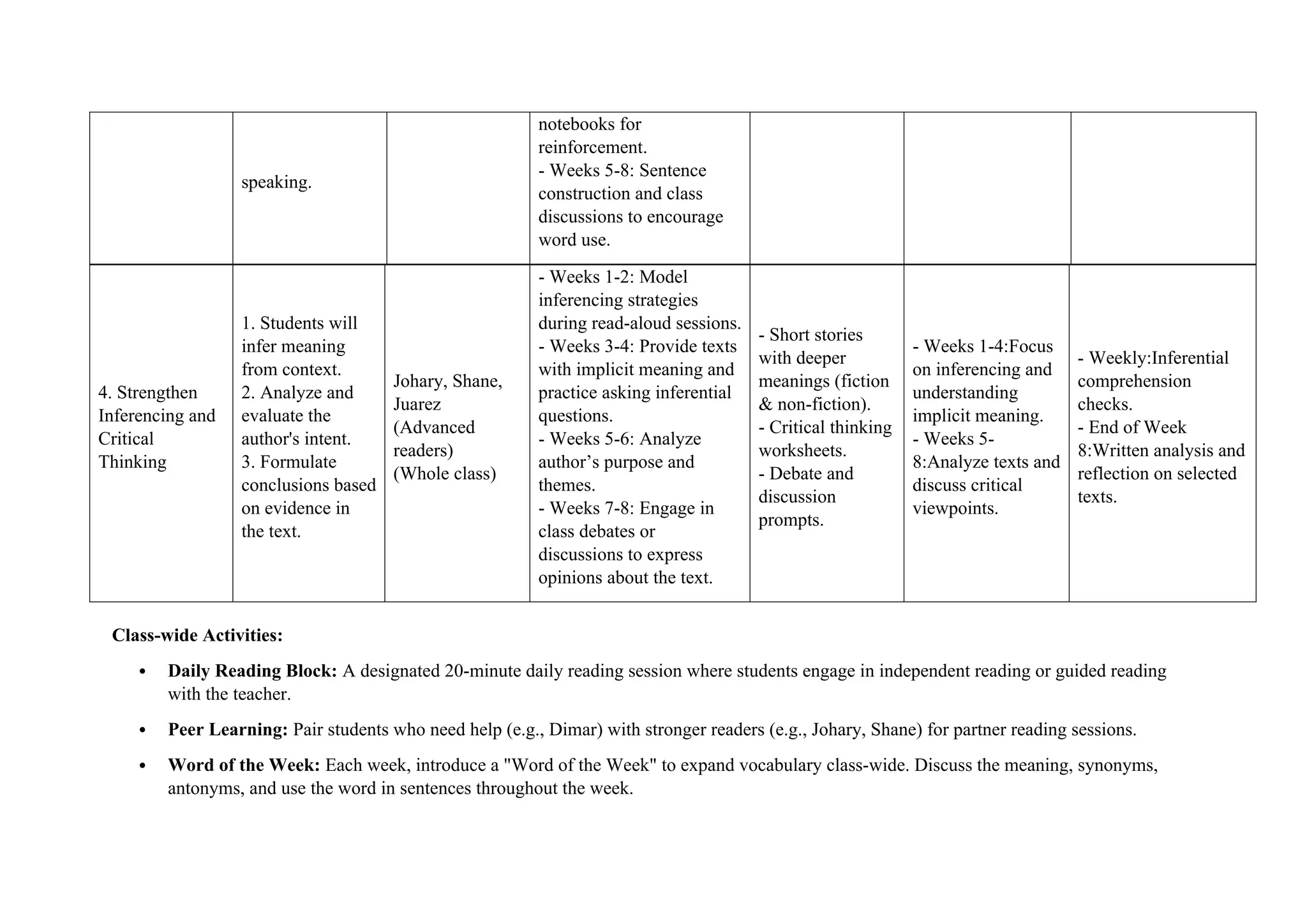
CLASS READING ACTION PLAN
SY. 2024-2025
Goal Objectives
Target
Students
Strategies Resources Time Frame Assessment
1. Improve
Reading
Comprehension
1. Students will
identify main
ideas and
supporting
details.
2. Strengthen
inferencing skills.
3. Develop
summarizing and
retelling abilities.
4. Evaluate and
analyze texts
critically.
Eslit. Johary L.
Rabe, Jharel B.
Tecson, Shane
Y.
(Whole class)
- Weeks 1-2: Guided
reading sessions on short,
simple texts.
- Weeks 3-4: Graphic
organizers (story maps,
Venn diagrams) to organize
thoughts.
- Weeks 5-
6:Comprehension questions
(who, what, when, where,
why, how).
- Weeks 7-8: Class
discussions and peer-to-
peer retelling exercises to
improve comprehension.
- Grade-
appropriate
storybooks.
- Newsela or Read
Works for
informational
texts.
- Graphic
organizer
templates
(printable or
digital).
- Weeks 1-
2:Foundational
comprehension
skills.
- Weeks 3-6:Deeper
understanding with
diverse texts.
- Weeks 7-
8:Analytical skills.
- Weekly:
Comprehension
quizzes.
- End of Week 4 &
8: Written
summaries & oral
retelling.
- Ongoing: Teacher
observations.
Republic of the Philippines
Department of Education
Region X – Northern Mindanao
DIVISION OF LANAO DEL NORTE
Gov. A. Quibranza Prov’l. Gov’t. Compound
Pigcarangan, Tubod, Lanao del Norte
(063)227 – 6633, (063)341 – 5109
CALUBE INTEGRATED SCHOOL
501240
2. Develop
Phonics and
Blending Skills
1. Students will
blend phonemes to
read words
fluently.
2. Recognize sight
words.
3. Decode
multisyllabic
words.
Limbaga, Dimar
P.
(and other
students
struggling with
blending)
(Small group
interventions)
- Daily: Short phonics
drills to practice sound
blending.
- Weeks 1-4: Use of
flashcards for sight words
and decodable texts.
- Weeks 5-6: Target
blending with longer,
multisyllabic words.
- Week 7-8: Group reading
of decodable readers with
a focus on blending.
- Phonics apps
(e.g., Starfall,
ABCmouse).
- Flashcards for
sight words.
- Decodable
readers and word
lists.
- Daily: 10-15
minutes
phonics/blending
sessions.
- Weeks 1-4:Sight
words and simple
blending.
- Weeks 5-
8:Progress to more
complex words.
- Weekly:Blending
assessments through
oral reading.
- End of Week
8: Decoding fluency
test.
- Ongoing:Small
group monitoring.
3. Expand
Vocabulary
1. Students will
learn new
vocabulary each
week.
2. Use context
clues to determine
meanings.
3. Practice using
new words in
writing and
Limbaga, Edwin
D.
Mabaga, Jhon
A.
(Whole class)
- Weekly: Introduce 5-10
new words using stories
and informational texts.
- Weeks 1-2: Teach word
roots, prefixes, and
suffixes to understand
word formation.
- Weeks 3-4: Word games
like Scrabble, crossword
puzzles, and vocabulary
- Vocabulary-
building apps.
- Word games
(e.g., Scrabble,
crossword
puzzles).
- Personal
vocabulary
notebooks for
each student.
- Weekly: Introduce
new vocabulary.
- Weeks 1-
4:Reinforce new
words and word
formation.
- Weeks 5-8:Focus
on usage in context.
- Weekly: Vocabulary
quizzes.
- Ongoing:
Vocabulary notebooks
review.
- End of Week 4 &
8: Sentence
construction
exercises.
speaking.
notebooks for
reinforcement.
- Weeks 5-8: Sentence
construction and class
discussions to encourage
word use.
4. Strengthen
Inferencing and
Critical
Thinking
1. Students will
infer meaning
from context.
2. Analyze and
evaluate the
author's intent.
3. Formulate
conclusions based
on evidence in
the text.
Johary, Shane,
Juarez
(Advanced
readers)
(Whole class)
- Weeks 1-2: Model
inferencing strategies
during read-aloud sessions.
- Weeks 3-4: Provide texts
with implicit meaning and
practice asking inferential
questions.
- Weeks 5-6: Analyze
author’s purpose and
themes.
- Weeks 7-8: Engage in
class debates or
discussions to express
opinions about the text.
- Short stories
with deeper
meanings (fiction
& non-fiction).
- Critical thinking
worksheets.
- Debate and
discussion
prompts.
- Weeks 1-4:Focus
on inferencing and
understanding
implicit meaning.
- Weeks 5-
8:Analyze texts and
discuss critical
viewpoints.
- Weekly:Inferential
comprehension
checks.
- End of Week
8:Written analysis and
reflection on selected
texts.
Class-wide Activities:
 Daily Reading Block: A designated 20-minute daily reading session where students engage in independent reading or guided reading
with the teacher.
 Peer Learning: Pair students who need help (e.g., Dimar) with stronger readers (e.g., Johary, Shane) for partner reading sessions.
 Word of the Week: Each week, introduce a "Word of the Week" to expand vocabulary class-wide. Discuss the meaning, synonyms,
antonyms, and use the word in sentences throughout the week.
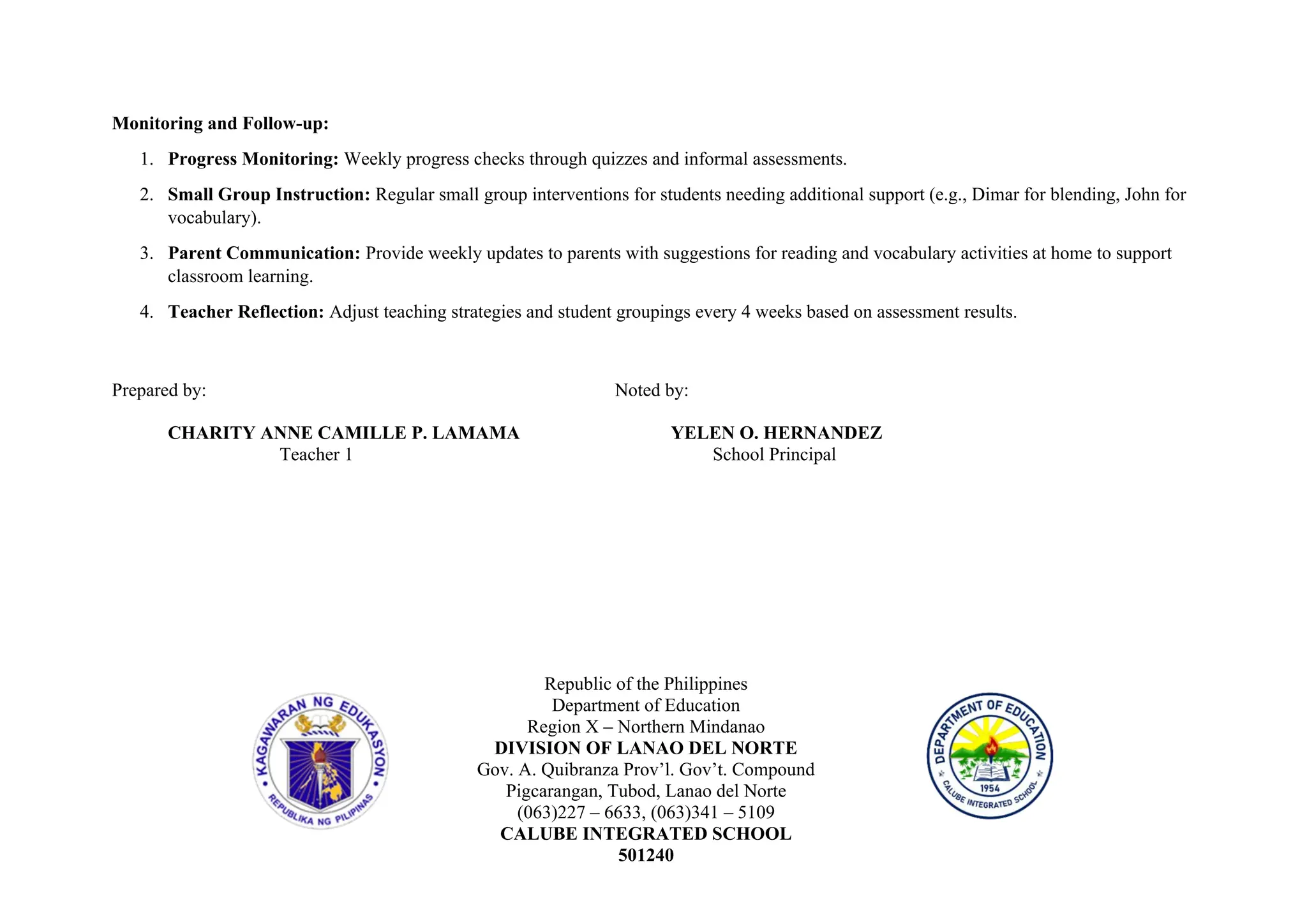
Monitoring and Follow-up:
1. Progress Monitoring: Weekly progress checks through quizzes and informal assessments.
2. Small Group Instruction: Regular small group interventions for students needing additional support (e.g., Dimar for blending, John for
vocabulary).
3. Parent Communication: Provide weekly updates to parents with suggestions for reading and vocabulary activities at home to support
classroom learning.
4. Teacher Reflection: Adjust teaching strategies and student groupings every 4 weeks based on assessment results.
Prepared by: Noted by:
CHARITY ANNE CAMILLE P. LAMAMA YELEN O. HERNANDEZ
Teacher 1 School Principal
Republic of the Philippines
Department of Education
Region X – Northern Mindanao
DIVISION OF LANAO DEL NORTE
Gov. A. Quibranza Prov’l. Gov’t. Compound
Pigcarangan, Tubod, Lanao del Norte
(063)227 – 6633, (063)341 – 5109
CALUBE INTEGRATED SCHOOL
501240
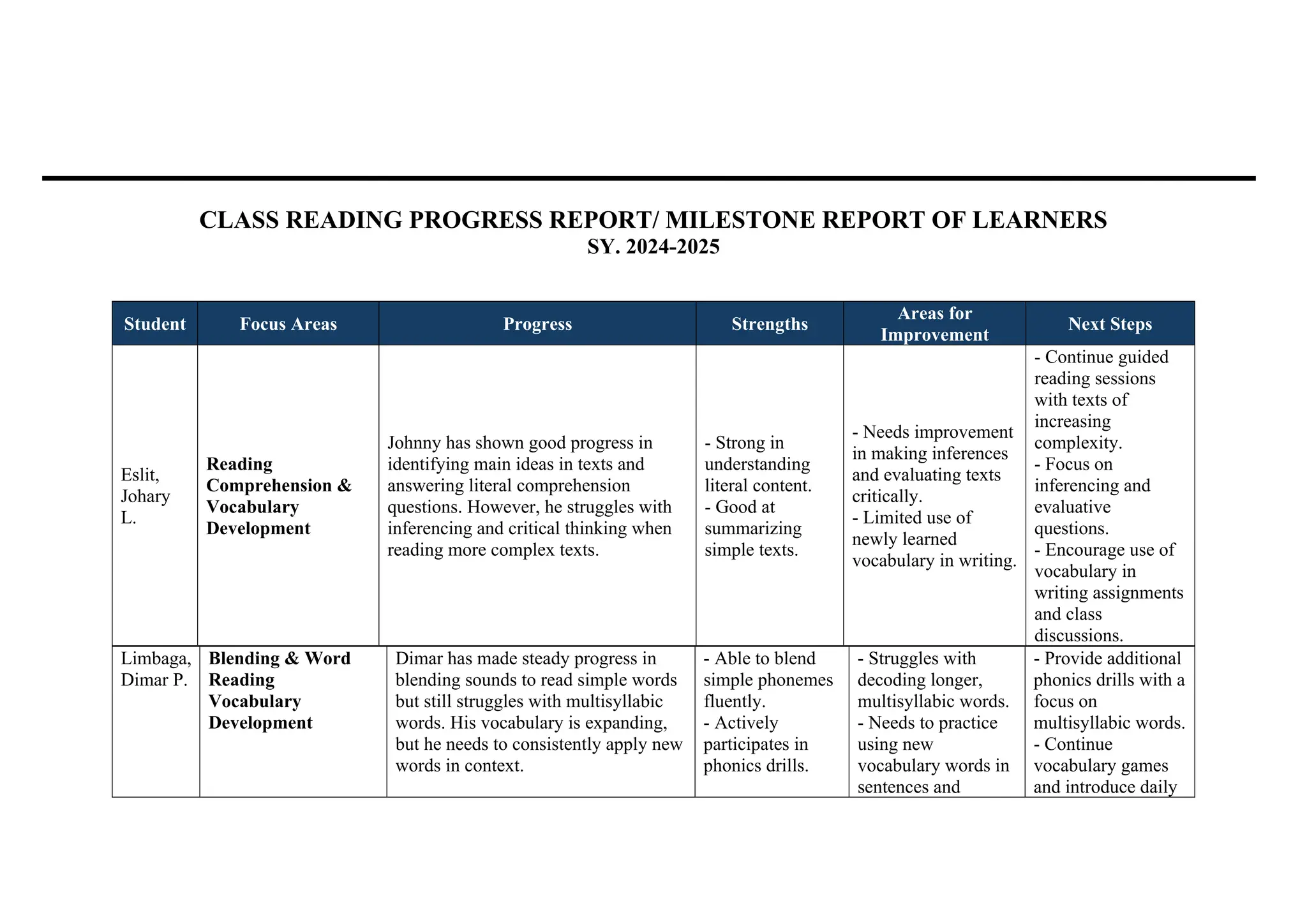
CLASS READING PROGRESS REPORT/ MILESTONE REPORT OF LEARNERS
SY. 2024-2025
Student Focus Areas Progress Strengths
Areas for
Improvement
Next Steps
Eslit,
Johary
L.
Reading
Comprehension &
Vocabulary
Development
Johnny has shown good progress in
identifying main ideas in texts and
answering literal comprehension
questions. However, he struggles with
inferencing and critical thinking when
reading more complex texts.
- Strong in
understanding
literal content.
- Good at
summarizing
simple texts.
- Needs improvement
in making inferences
and evaluating texts
critically.
- Limited use of
newly learned
vocabulary in writing.
- Continue guided
reading sessions
with texts of
increasing
complexity.
- Focus on
inferencing and
evaluative
questions.
- Encourage use of
vocabulary in
writing assignments
and class
discussions.
Limbaga,
Dimar P.
Blending & Word
Reading
Vocabulary
Development
Dimar has made steady progress in
blending sounds to read simple words
but still struggles with multisyllabic
words. His vocabulary is expanding,
but he needs to consistently apply new
words in context.
- Able to blend
simple phonemes
fluently.
- Actively
participates in
phonics drills.
- Struggles with
decoding longer,
multisyllabic words.
- Needs to practice
using new
vocabulary words in
sentences and
- Provide additional
phonics drills with a
focus on
multisyllabic words.
- Continue
vocabulary games
and introduce daily
conversation.
word use
challenges.
- Small group
reading practice.
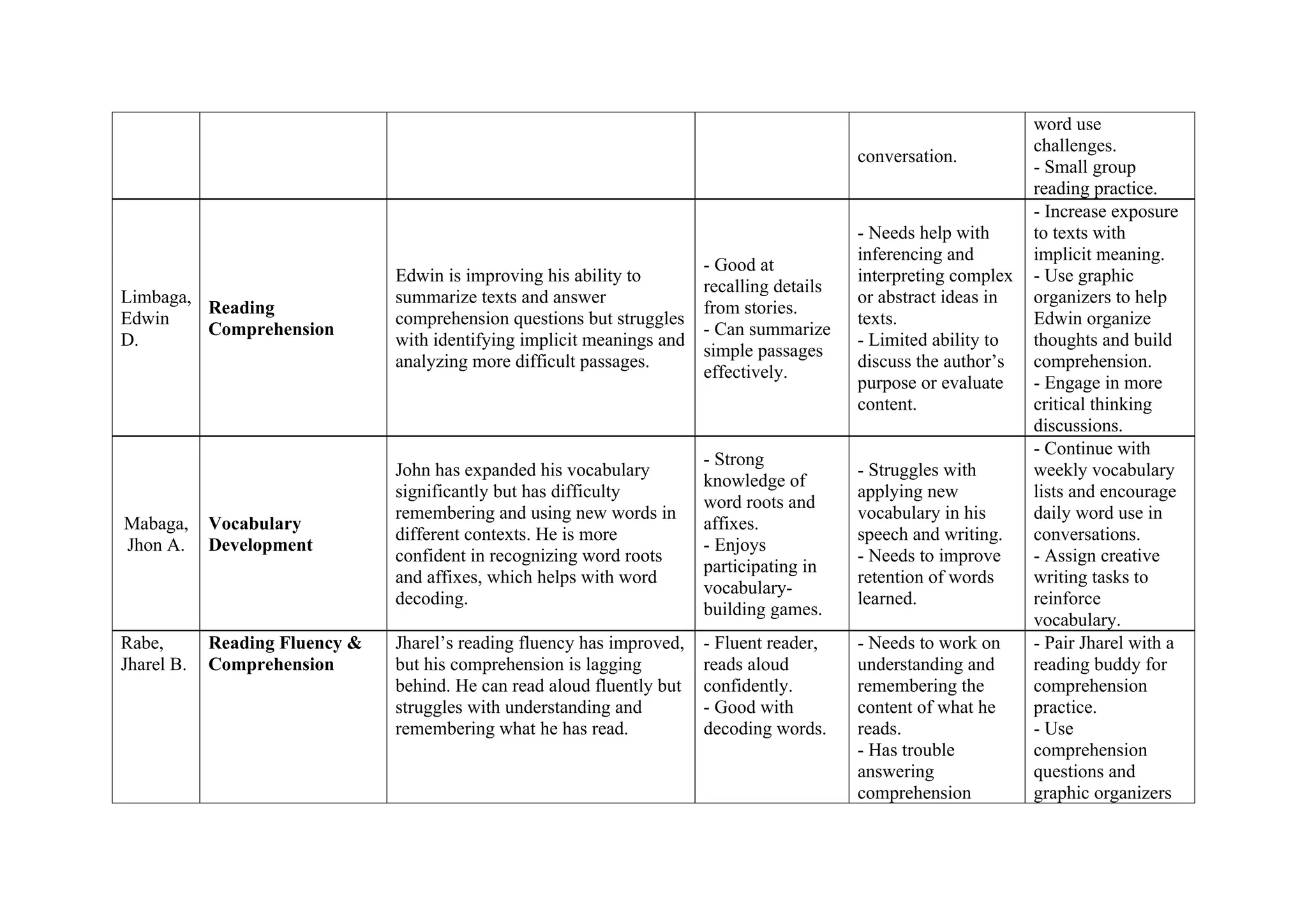
Limbaga,
Edwin
D.
Reading
Comprehension
Edwin is improving his ability to
summarize texts and answer
comprehension questions but struggles
with identifying implicit meanings and
analyzing more difficult passages.
- Good at
recalling details
from stories.
- Can summarize
simple passages
effectively.
- Needs help with
inferencing and
interpreting complex
or abstract ideas in
texts.
- Limited ability to
discuss the author’s
purpose or evaluate
content.
- Increase exposure
to texts with
implicit meaning.
- Use graphic
organizers to help
Edwin organize
thoughts and build
comprehension.
- Engage in more
critical thinking
discussions.
Mabaga,
Jhon A.
Vocabulary
Development
John has expanded his vocabulary
significantly but has difficulty
remembering and using new words in
different contexts. He is more
confident in recognizing word roots
and affixes, which helps with word
decoding.
- Strong
knowledge of
word roots and
affixes.
- Enjoys
participating in
vocabulary-
building games.
- Struggles with
applying new
vocabulary in his
speech and writing.
- Needs to improve
retention of words
learned.
- Continue with
weekly vocabulary
lists and encourage
daily word use in
conversations.
- Assign creative
writing tasks to
reinforce
vocabulary.
Rabe,
Jharel B.
Reading Fluency &
Comprehension
Jharel’s reading fluency has improved,
but his comprehension is lagging
behind. He can read aloud fluently but
struggles with understanding and
remembering what he has read.
- Fluent reader,
reads aloud
confidently.
- Good with
decoding words.
- Needs to work on
understanding and
remembering the
content of what he
reads.
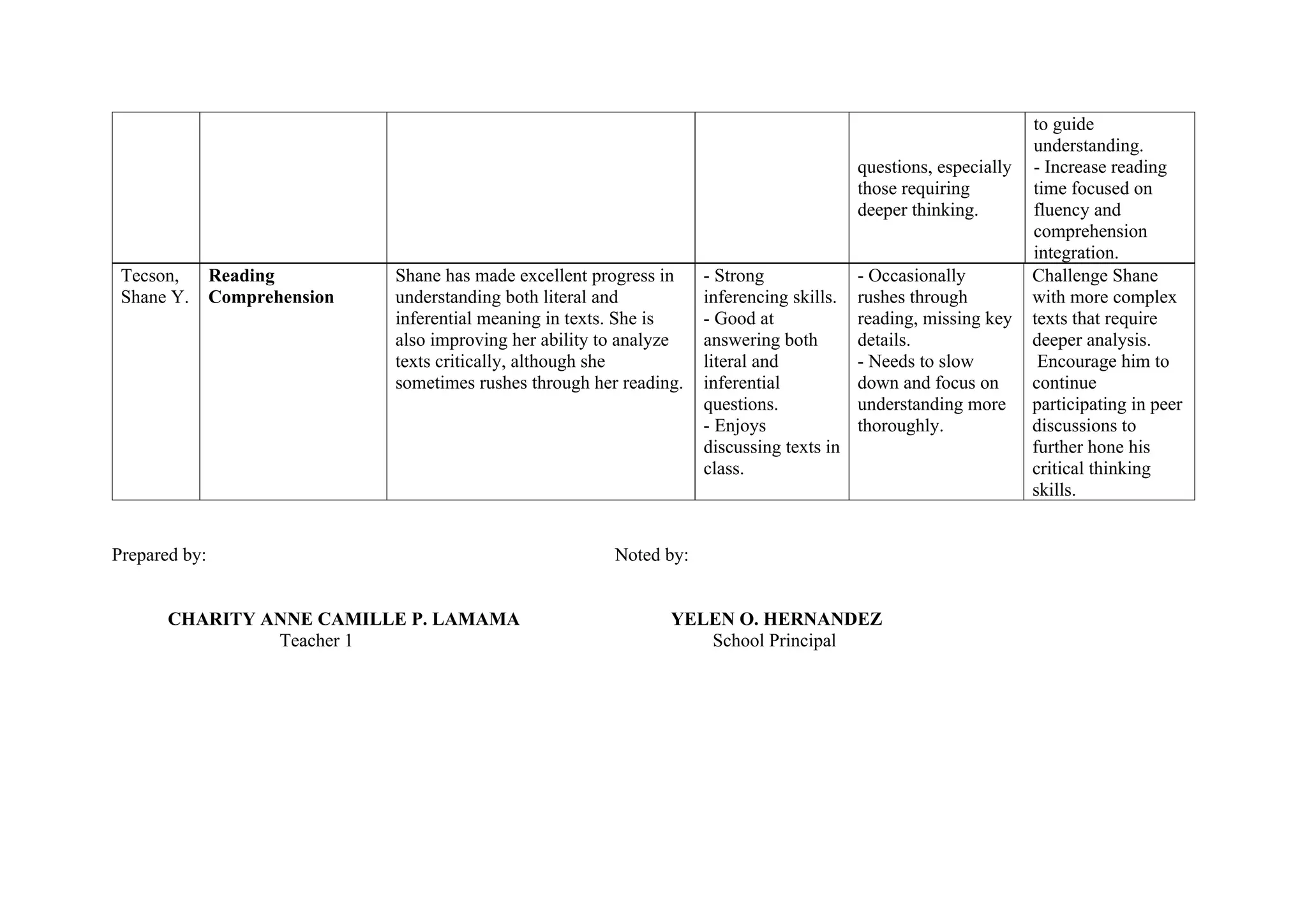
- Has trouble
answering
comprehension
- Pair Jharel with a
reading buddy for
comprehension
practice.
- Use
comprehension
questions and
graphic organizers
questions, especially
those requiring
deeper thinking.
to guide
understanding.
- Increase reading
time focused on
fluency and
comprehension
integration.
Tecson,
Shane Y.
Reading
Comprehension
Shane has made excellent progress in
understanding both literal and
inferential meaning in texts. She is
also improving her ability to analyze
texts critically, although she
sometimes rushes through her reading.
- Strong
inferencing skills.
- Good at
answering both
literal and
inferential
questions.
- Enjoys
discussing texts in
class.
- Occasionally
rushes through
reading, missing key
details.
- Needs to slow
down and focus on
understanding more
thoroughly.
Challenge Shane
with more complex
texts that require
deeper analysis.
Encourage him to
continue
participating in peer
discussions to
further hone his
critical thinking
skills.
Prepared by: Noted by:
CHARITY ANNE CAMILLE P. LAMAMA YELEN O. HERNANDEZ
Teacher 1 School Principal

INDIVIDUAL LEARNER READING PLAN FOR GRADE 7 STUDENTS.docx

  • 1.
    INDIVIDUAL LEARNER READINGPLAN SY. 2024-2025 Student Focus Areas Learning Objectives Strategies Resources Assessment Time Frame Eslit. Johary L. Rabe, Jharel B. Tecson, Shane Y. Reading Comprehensio n 1. Identify main ideas and supporting details. 2. Improve inferencing skills. 3. Develop summarizing and retelling skills. 4. Enhance critical thinking. - Weeks 1-2: Guided reading with simple texts. - Weeks 3-4: Use graphic organizers (story maps, Venn diagrams). - Weeks 5-6: Practice comprehension questions. - Weeks 7-8: Discussions and written exercises focused on inferential and evaluative comprehension. - Storybooks & informational texts. - Online platforms (Newsela, Read Works). - Comprehension worksheets & graphic organizers. - Weekly: Quizzes on comprehension questions. - End of Week 4 & 8: Written summaries & oral retelling. - Ongoing: Teacher observation during guided reading. - Week 1-2:Build basic skills. - Week 3-6:Apply strategies to more complex texts. - Week 7- 8:Deepen inferencing and evaluation skills. Limbaga, Dimar P. Blending & Word Reading 1. Improve blending phonemes. - Daily: Phonics drills focused on sound blending. - Weeks 1-4: Use - Phonics apps (Starfall, ABCmouse). - Daily: Blending exercises and phonics games. - Week 1- 4: Phonics and sight words Republic of the Philippines Department of Education Region X – Northern Mindanao DIVISION OF LANAO DEL NORTE Gov. A. Quibranza Prov’l. Gov’t. Compound Pigcarangan, Tubod, Lanao del Norte (063)227 – 6633, (063)341 – 5109 CALUBE INTEGRATED SCHOOL 501240
  • 2.
    2. Recognize high- frequency sight words. 3.Decode multisyllabic words using phonics rules. flashcards for sight words. - Weeks 5-6: Begin reading decodable texts that target phonics and blending. - Weeks 7-8: Introduce multisyllabic words through structured practice. - Decodable readers. - Flashcards & blending practice worksheets. - Weekly: Oral assessments on word blending and reading. - End of Week 8:Word decoding fluency check. practice. - Week 5- 8: Progress to reading decodable texts and multisyllabic word blending. Limbaga, Dimar P. Vocabulary Development 1. Widen vocabulary through context. 2. Learn synonyms, antonyms, and word meanings. 3. Use context clues for unfamiliar words. - Weeks 1-2: Introduce 5-10 new words each week, through stories and reading exercises. - Weeks 3-4: Focus on synonyms and antonyms through word games and discussions. - Weeks 5-6: Practice inferring word meanings from context using short texts. - Weeks 7-8: Vocabulary notebook and sentence creation exercises. - Storybooks with rich vocabulary. - Vocabulary apps and online tools. - Vocabulary notebook for tracking new words and their meanings. - Weekly:Vocabulary quizzes. - End of Week 4 & 8: Oral sentence creation using new words. - Ongoing:Vocabulary notebook review. - Week 1-4: Focus on building core vocabulary. - Week 5-8: Expand vocabulary and use words in writing and conversation. Limbaga, Edwin D. Mabaga, Jhon A. Vocabulary Development 1. Expand vocabulary through diverse texts. 2. Use new words in writing and - Weeks 1-2: Provide weekly vocabulary lists, introduce new words using root words, prefixes, and suffixes. - Weeks 3-4: Word games (Scrabble, word puzzles). - Weeks 5-6: Use vocabulary - Vocabulary- building games. - Vocabulary apps. - Fiction and non- fiction texts with varied - Weekly:Vocabulary quizzes. - End of Week 4:Assess vocabulary retention and usage. - End of Week 8:Oral and written assessments - Week 1-4: Build basic vocabulary and word use. - Week 5-8: Focus on deeper understanding and usage in speaking
  • 3.
    speaking. 3. Understand multiple meanings of words. insentence construction, oral and written. - Weeks 7-8: Discuss multiple meanings of words in context through stories. vocabulary. - Vocabulary lists and word-study tools. on using new words in context. and writing. Monitoring and Follow-up: 1. Weekly Check-ins: Track progress with quizzes and class participation. 2. Parent Involvement: Suggest home activities, such as reading and word games, to reinforce skills. 3. Adjustments: Modify strategies and goals as necessary based on assessments and observations. Prepared by: Noted by: CHARITY ANNE CAMILLE P. LAMAMA YELEN O. HERNANDEZ Teacher 1 School Principal
  • 4.
    CLASS READING ACTIONPLAN SY. 2024-2025 Goal Objectives Target Students Strategies Resources Time Frame Assessment 1. Improve Reading Comprehension 1. Students will identify main ideas and supporting details. 2. Strengthen inferencing skills. 3. Develop summarizing and retelling abilities. 4. Evaluate and analyze texts critically. Eslit. Johary L. Rabe, Jharel B. Tecson, Shane Y. (Whole class) - Weeks 1-2: Guided reading sessions on short, simple texts. - Weeks 3-4: Graphic organizers (story maps, Venn diagrams) to organize thoughts. - Weeks 5- 6:Comprehension questions (who, what, when, where, why, how). - Weeks 7-8: Class discussions and peer-to- peer retelling exercises to improve comprehension. - Grade- appropriate storybooks. - Newsela or Read Works for informational texts. - Graphic organizer templates (printable or digital). - Weeks 1- 2:Foundational comprehension skills. - Weeks 3-6:Deeper understanding with diverse texts. - Weeks 7- 8:Analytical skills. - Weekly: Comprehension quizzes. - End of Week 4 & 8: Written summaries & oral retelling. - Ongoing: Teacher observations. Republic of the Philippines Department of Education Region X – Northern Mindanao DIVISION OF LANAO DEL NORTE Gov. A. Quibranza Prov’l. Gov’t. Compound Pigcarangan, Tubod, Lanao del Norte (063)227 – 6633, (063)341 – 5109 CALUBE INTEGRATED SCHOOL 501240
  • 5.
    2. Develop Phonics and BlendingSkills 1. Students will blend phonemes to read words fluently. 2. Recognize sight words. 3. Decode multisyllabic words. Limbaga, Dimar P. (and other students struggling with blending) (Small group interventions) - Daily: Short phonics drills to practice sound blending. - Weeks 1-4: Use of flashcards for sight words and decodable texts. - Weeks 5-6: Target blending with longer, multisyllabic words. - Week 7-8: Group reading of decodable readers with a focus on blending. - Phonics apps (e.g., Starfall, ABCmouse). - Flashcards for sight words. - Decodable readers and word lists. - Daily: 10-15 minutes phonics/blending sessions. - Weeks 1-4:Sight words and simple blending. - Weeks 5- 8:Progress to more complex words. - Weekly:Blending assessments through oral reading. - End of Week 8: Decoding fluency test. - Ongoing:Small group monitoring. 3. Expand Vocabulary 1. Students will learn new vocabulary each week. 2. Use context clues to determine meanings. 3. Practice using new words in writing and Limbaga, Edwin D. Mabaga, Jhon A. (Whole class) - Weekly: Introduce 5-10 new words using stories and informational texts. - Weeks 1-2: Teach word roots, prefixes, and suffixes to understand word formation. - Weeks 3-4: Word games like Scrabble, crossword puzzles, and vocabulary - Vocabulary- building apps. - Word games (e.g., Scrabble, crossword puzzles). - Personal vocabulary notebooks for each student. - Weekly: Introduce new vocabulary. - Weeks 1- 4:Reinforce new words and word formation. - Weeks 5-8:Focus on usage in context. - Weekly: Vocabulary quizzes. - Ongoing: Vocabulary notebooks review. - End of Week 4 & 8: Sentence construction exercises.
  • 6.
    speaking. notebooks for reinforcement. - Weeks5-8: Sentence construction and class discussions to encourage word use. 4. Strengthen Inferencing and Critical Thinking 1. Students will infer meaning from context. 2. Analyze and evaluate the author's intent. 3. Formulate conclusions based on evidence in the text. Johary, Shane, Juarez (Advanced readers) (Whole class) - Weeks 1-2: Model inferencing strategies during read-aloud sessions. - Weeks 3-4: Provide texts with implicit meaning and practice asking inferential questions. - Weeks 5-6: Analyze author’s purpose and themes. - Weeks 7-8: Engage in class debates or discussions to express opinions about the text. - Short stories with deeper meanings (fiction & non-fiction). - Critical thinking worksheets. - Debate and discussion prompts. - Weeks 1-4:Focus on inferencing and understanding implicit meaning. - Weeks 5- 8:Analyze texts and discuss critical viewpoints. - Weekly:Inferential comprehension checks. - End of Week 8:Written analysis and reflection on selected texts. Class-wide Activities:  Daily Reading Block: A designated 20-minute daily reading session where students engage in independent reading or guided reading with the teacher.  Peer Learning: Pair students who need help (e.g., Dimar) with stronger readers (e.g., Johary, Shane) for partner reading sessions.  Word of the Week: Each week, introduce a "Word of the Week" to expand vocabulary class-wide. Discuss the meaning, synonyms, antonyms, and use the word in sentences throughout the week.
  • 7.
    Monitoring and Follow-up: 1.Progress Monitoring: Weekly progress checks through quizzes and informal assessments. 2. Small Group Instruction: Regular small group interventions for students needing additional support (e.g., Dimar for blending, John for vocabulary). 3. Parent Communication: Provide weekly updates to parents with suggestions for reading and vocabulary activities at home to support classroom learning. 4. Teacher Reflection: Adjust teaching strategies and student groupings every 4 weeks based on assessment results. Prepared by: Noted by: CHARITY ANNE CAMILLE P. LAMAMA YELEN O. HERNANDEZ Teacher 1 School Principal Republic of the Philippines Department of Education Region X – Northern Mindanao DIVISION OF LANAO DEL NORTE Gov. A. Quibranza Prov’l. Gov’t. Compound Pigcarangan, Tubod, Lanao del Norte (063)227 – 6633, (063)341 – 5109 CALUBE INTEGRATED SCHOOL 501240
  • 8.
    CLASS READING PROGRESSREPORT/ MILESTONE REPORT OF LEARNERS SY. 2024-2025 Student Focus Areas Progress Strengths Areas for Improvement Next Steps Eslit, Johary L. Reading Comprehension & Vocabulary Development Johnny has shown good progress in identifying main ideas in texts and answering literal comprehension questions. However, he struggles with inferencing and critical thinking when reading more complex texts. - Strong in understanding literal content. - Good at summarizing simple texts. - Needs improvement in making inferences and evaluating texts critically. - Limited use of newly learned vocabulary in writing. - Continue guided reading sessions with texts of increasing complexity. - Focus on inferencing and evaluative questions. - Encourage use of vocabulary in writing assignments and class discussions. Limbaga, Dimar P. Blending & Word Reading Vocabulary Development Dimar has made steady progress in blending sounds to read simple words but still struggles with multisyllabic words. His vocabulary is expanding, but he needs to consistently apply new words in context. - Able to blend simple phonemes fluently. - Actively participates in phonics drills. - Struggles with decoding longer, multisyllabic words. - Needs to practice using new vocabulary words in sentences and - Provide additional phonics drills with a focus on multisyllabic words. - Continue vocabulary games and introduce daily
  • 9.
    conversation. word use challenges. - Smallgroup reading practice. Limbaga, Edwin D. Reading Comprehension Edwin is improving his ability to summarize texts and answer comprehension questions but struggles with identifying implicit meanings and analyzing more difficult passages. - Good at recalling details from stories. - Can summarize simple passages effectively. - Needs help with inferencing and interpreting complex or abstract ideas in texts. - Limited ability to discuss the author’s purpose or evaluate content. - Increase exposure to texts with implicit meaning. - Use graphic organizers to help Edwin organize thoughts and build comprehension. - Engage in more critical thinking discussions. Mabaga, Jhon A. Vocabulary Development John has expanded his vocabulary significantly but has difficulty remembering and using new words in different contexts. He is more confident in recognizing word roots and affixes, which helps with word decoding. - Strong knowledge of word roots and affixes. - Enjoys participating in vocabulary- building games. - Struggles with applying new vocabulary in his speech and writing. - Needs to improve retention of words learned. - Continue with weekly vocabulary lists and encourage daily word use in conversations. - Assign creative writing tasks to reinforce vocabulary. Rabe, Jharel B. Reading Fluency & Comprehension Jharel’s reading fluency has improved, but his comprehension is lagging behind. He can read aloud fluently but struggles with understanding and remembering what he has read. - Fluent reader, reads aloud confidently. - Good with decoding words. - Needs to work on understanding and remembering the content of what he reads. - Has trouble answering comprehension - Pair Jharel with a reading buddy for comprehension practice. - Use comprehension questions and graphic organizers
  • 10.
    questions, especially those requiring deeperthinking. to guide understanding. - Increase reading time focused on fluency and comprehension integration. Tecson, Shane Y. Reading Comprehension Shane has made excellent progress in understanding both literal and inferential meaning in texts. She is also improving her ability to analyze texts critically, although she sometimes rushes through her reading. - Strong inferencing skills. - Good at answering both literal and inferential questions. - Enjoys discussing texts in class. - Occasionally rushes through reading, missing key details. - Needs to slow down and focus on understanding more thoroughly. Challenge Shane with more complex texts that require deeper analysis. Encourage him to continue participating in peer discussions to further hone his critical thinking skills. Prepared by: Noted by: CHARITY ANNE CAMILLE P. LAMAMA YELEN O. HERNANDEZ Teacher 1 School Principal