INDIAN CINEMA
HINDI CINEMA
P R E S E N T E D BY - S H R E YA J H A
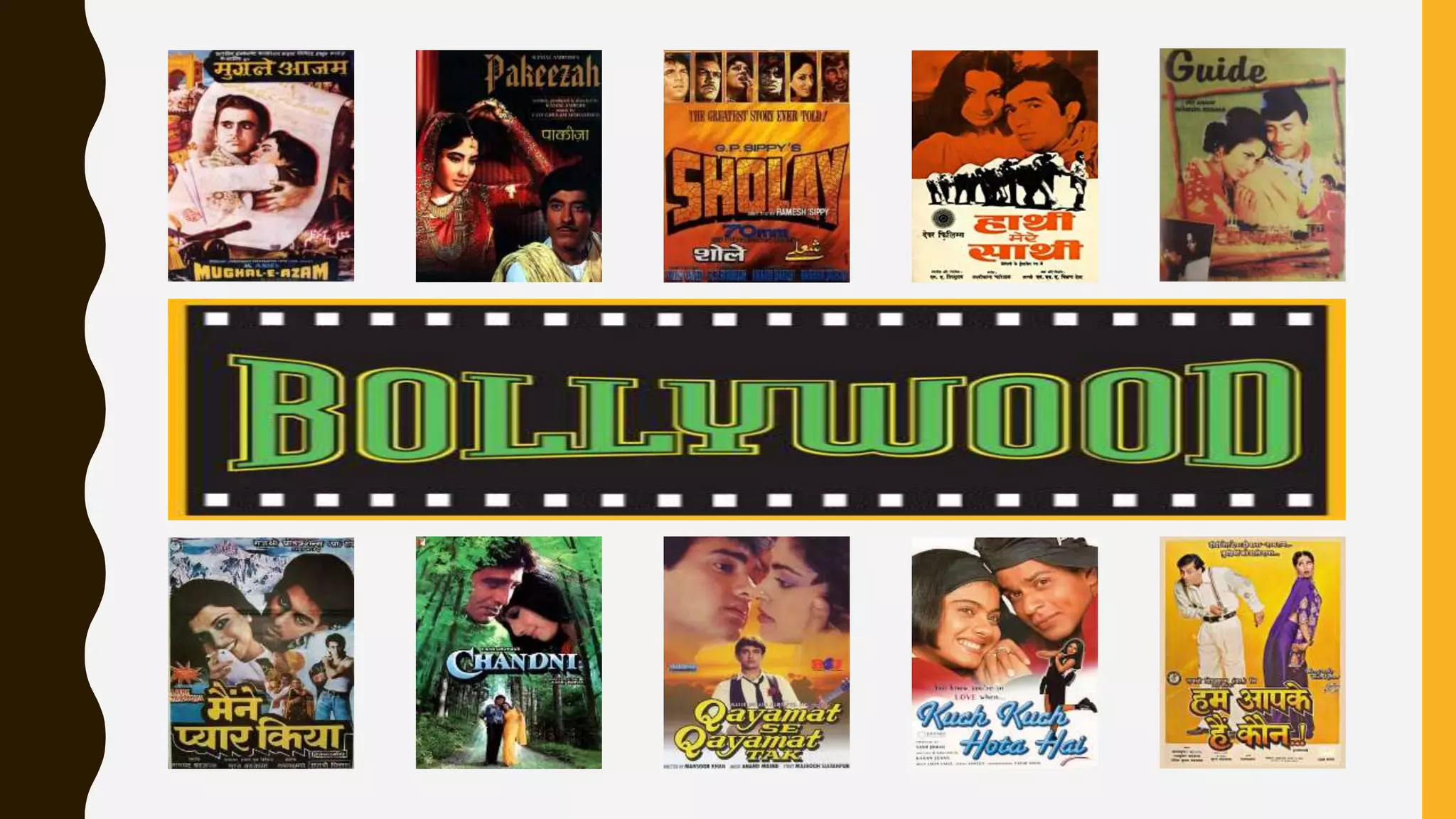
HINDI FILM INDUSTRY-BOLLYWOOD
• The Hindi film industry is currently the largest and dominates Indian films.
• Based in Bombay (now Mumbai), it is the center of Indian film industry.
• Known popularly as “Bollywood”- A blending of Bombay and Hollywood.
• Cinema was shown for the first time by Lumiere brothers on July 17, 1896.
• N.G. Chitre and R.G. Torney of Bombay were first to make a film based on the life of a
Holy man in Maharashtra which came out in 1912.
• The next movie was Raja Harishchandra (a silent film) on May 3, 1913 considered as
India’s first film by Dhandiraj Govindraj Phalke (Dada Sahab).
• D.G. Phalke is acclaimed as “Father of Indian cinema”.
HISTORY OF HINDI CINEMA
• In early 1930’s, the silent Indian cinema began to talk, sing and dance with the release
of “Alam Ara” on March14, 1931. It was produced by Ardeshir Irani (Imperial Film
Company).
• In 1937, Ardeshir Irani made “Kisan Kanya”, India’s first colour fim.
• Late 1940s-1960s were known as the Golden age of Indian Cinema. Some of the
critically acclaimed Hindi films like Mother India, Do Bigha Zameen, Awaara Pyaasa,
Mugal-E-Azam were produced during the same period.
• This era gave us the best actors-directors of all times like Guru Dutt, Raj Kapoor,
Mehboob Khan, Vijay Bhatt and Vimal Roy.
• Greatest music talents like Mohammad Rafi, Kishor Kumar, Lata Mangeshkar and S.D.
Burman belonged to the same era.
• The 60s began with a bang with movies like Raj Kapoor’s Mugal-E-Azam, Jis desh me
ganga behti hai and Sangam, Guru Dutt’s Saheb Biwi aur Gulam, Dev Anand’s Guide,
Bimal Roy’s Bandini and B.R. Chopra’s Waqt.
• 70s completely changed the way films were made with their narrative style, story and
content.
• Masala films were the demand of the time and it saw the rise of action stars like Amitabh
Bachchan.
• Movies like, Kamal Amrohi’s Pakeezah, Devar’s Haathi Mere Saathi, Ramesh Sippy’s
Sholay, Zanjeer, Deewar, Khoon Pasina, Dharamveer, Amar Akbar Anthony, Hum Kisi Se
Kam Nahin and Muquaddar Ka Sikandar.
• New Bollywood started from 1990s to present.
• 90s was a mixed genre of romantic, thriller, action and comedy films like Qayamat Se
Qayamat Tak, Maine Pyaar Kiya, Chandni, Kuch Kuch hota hai, etc.
• In this period technology gifted Dolby digital sound effects, advanced special effect,
choreography and International appeal.
PARALLEL CINEMA
• During the Golden age (in1950s-1960s), Indian cinema was introduced to an
alternative cinema aka parallel cinema or Indian new wave.
• It originated in West Bengal and was initially led by Bengali cinema and produced
internationally acclaimed filmmakers like Satyajit Ray, Mrinal Sen, Ritwik Ghatak, Tapan
Sinha and others.
• It is known for its serious content, realism and naturalism.
• Satyajit Ray’s Pather Panchali(1955), Aparajita(1956), The World of Apu(1959) known
as “The Apu Triology” won major prizes at Cannes, Berlin and Venice Film Festivals.
• Films like Guru Dutt’s Pyaasa(1957) and Kagaz Ke Phool(1959), Raj Kapoor’s
Awaara(1951) and Shree 420(1955), Dilip Kumar’s Aan(1952) were such films dealing
with working-class urban India.
• During late 1980s, the Parallel Cinema started declining due to ignorance of National
Film Development Corporation of India as they lacked “entertainment value”.
THANK YOU

Indian cinema- hindi cinema

  • 1.
    INDIAN CINEMA HINDI CINEMA PR E S E N T E D BY - S H R E YA J H A
  • 2.
    HINDI FILM INDUSTRY-BOLLYWOOD •The Hindi film industry is currently the largest and dominates Indian films. • Based in Bombay (now Mumbai), it is the center of Indian film industry. • Known popularly as “Bollywood”- A blending of Bombay and Hollywood. • Cinema was shown for the first time by Lumiere brothers on July 17, 1896. • N.G. Chitre and R.G. Torney of Bombay were first to make a film based on the life of a Holy man in Maharashtra which came out in 1912. • The next movie was Raja Harishchandra (a silent film) on May 3, 1913 considered as India’s first film by Dhandiraj Govindraj Phalke (Dada Sahab). • D.G. Phalke is acclaimed as “Father of Indian cinema”.
  • 4.
    HISTORY OF HINDICINEMA • In early 1930’s, the silent Indian cinema began to talk, sing and dance with the release of “Alam Ara” on March14, 1931. It was produced by Ardeshir Irani (Imperial Film Company). • In 1937, Ardeshir Irani made “Kisan Kanya”, India’s first colour fim. • Late 1940s-1960s were known as the Golden age of Indian Cinema. Some of the critically acclaimed Hindi films like Mother India, Do Bigha Zameen, Awaara Pyaasa, Mugal-E-Azam were produced during the same period. • This era gave us the best actors-directors of all times like Guru Dutt, Raj Kapoor, Mehboob Khan, Vijay Bhatt and Vimal Roy. • Greatest music talents like Mohammad Rafi, Kishor Kumar, Lata Mangeshkar and S.D. Burman belonged to the same era.
  • 6.
    • The 60sbegan with a bang with movies like Raj Kapoor’s Mugal-E-Azam, Jis desh me ganga behti hai and Sangam, Guru Dutt’s Saheb Biwi aur Gulam, Dev Anand’s Guide, Bimal Roy’s Bandini and B.R. Chopra’s Waqt. • 70s completely changed the way films were made with their narrative style, story and content. • Masala films were the demand of the time and it saw the rise of action stars like Amitabh Bachchan. • Movies like, Kamal Amrohi’s Pakeezah, Devar’s Haathi Mere Saathi, Ramesh Sippy’s Sholay, Zanjeer, Deewar, Khoon Pasina, Dharamveer, Amar Akbar Anthony, Hum Kisi Se Kam Nahin and Muquaddar Ka Sikandar. • New Bollywood started from 1990s to present. • 90s was a mixed genre of romantic, thriller, action and comedy films like Qayamat Se Qayamat Tak, Maine Pyaar Kiya, Chandni, Kuch Kuch hota hai, etc. • In this period technology gifted Dolby digital sound effects, advanced special effect, choreography and International appeal.
  • 8.
    PARALLEL CINEMA • Duringthe Golden age (in1950s-1960s), Indian cinema was introduced to an alternative cinema aka parallel cinema or Indian new wave. • It originated in West Bengal and was initially led by Bengali cinema and produced internationally acclaimed filmmakers like Satyajit Ray, Mrinal Sen, Ritwik Ghatak, Tapan Sinha and others. • It is known for its serious content, realism and naturalism. • Satyajit Ray’s Pather Panchali(1955), Aparajita(1956), The World of Apu(1959) known as “The Apu Triology” won major prizes at Cannes, Berlin and Venice Film Festivals. • Films like Guru Dutt’s Pyaasa(1957) and Kagaz Ke Phool(1959), Raj Kapoor’s Awaara(1951) and Shree 420(1955), Dilip Kumar’s Aan(1952) were such films dealing with working-class urban India. • During late 1980s, the Parallel Cinema started declining due to ignorance of National Film Development Corporation of India as they lacked “entertainment value”.
  • 10.