Promoting Gender-
Inclusive Teaching
Methods
What is gender-inclusive
teaching methods?
Practice of creating an
educational environment and
using instructional approaches
that are sensitive to all gender
identities
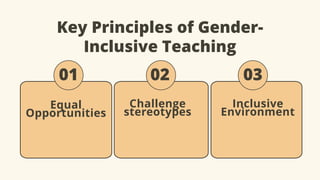
Key Principles of Gender-
Inclusive Teaching
Challenge
stereotypes
Inclusive
Environment
01
Equal
Opportunities
02 03
Key Principles of Gender-
Inclusive Teaching
Adapting
to needs
04
Diverse
Curriculum
05
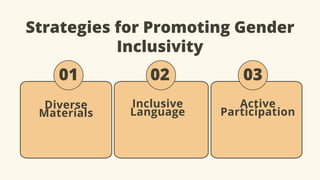
Strategies for Promoting Gender
Inclusivity
Inclusive
Language
Active
Participation
01
Diverse
Materials
02 03
Strategies for Promoting Gender
Inclusivity
Fair
Assessmen
t
04
Addressing
Bullying
05
?
Overcoming
Challenges
? ?
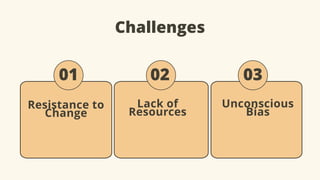
Challenges
Lack of
Resources
Unconscious
Bias
01
Resistance to
Change
02 03
Challenges
Time
Constraints
Assessment
and
Evaluation
04
Classroom
Dynamics
05 06
?
Engaging the School
Community
? ?
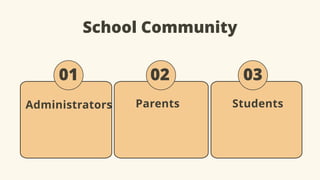
School Community
Parents Students
01
Administrators
02 03
?
How to engage the
School Community?
? ?
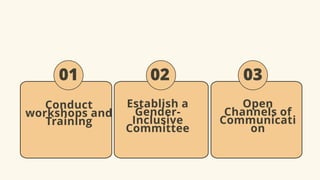
Establish a
Gender-
Inclusive
Committee
Open
Channels of
Communicati
on
01
Conduct
workshops and
Training
02 03
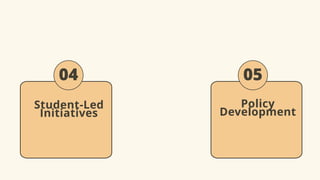
Policy
Development
04
Student-Led
Initiatives
05
Thank you for
listening!
Resource
Page

Inclusive Teachin Strat

Editor's Notes

  • #2 Promoting gender-inclusive teaching methods refers to the practice of creating an educational environment and using instructional approaches that are sensitive to and supportive of all gender identities, rather than favoring one gender over another. we will explore the importance of gender-inclusive teaching methods and how educators can create more equitable and inclusive learning environments. We will cover key concepts, practical strategies, and real-world examples to empower you to promote gender inclusivity in your classrooms.
  • #3 It's about ensuring that all students, regardless of their gender identity, have equal opportunities to learn and thrive. Gender inclusivity challenges harmful stereotypes and creates a supportive learning environment. Why does this matter? Because gender disparities exist in education, and they affect both students and teachers. These disparities can limit a student's potential and impact their self-esteem. According to [cite relevant statistics or research], we still have work to do.
  • #4 Equal Opportunities: Ensuring all students have the same opportunities. When assigning tasks or projects, make sure they are not gender-specific. Avoid activities or projects that assume certain interests or skills based on gender. Avoiding gender-based grouping or assumptions about which students should participate in certain activities or subjects. Encourage all students to engage in a variety of tasks and roles. Challenging Stereotypes: Identifying and addressing stereotypes. Using inclusive language that avoids stereotypes and assumptions about gender. This includes addressing students with gender-neutral terms like "students" or "scholars" rather than gendered terms like "boys" or "girls.“Instead use students, learners, everyone. Inclusive Environment: Creating a classroom that values diversity. Creating a classroom atmosphere where students are free from gender-based discrimination, bullying, or harassment. Encourage respectful dialogue and address any inappropriate behavior promptly.
  • #5  Diverse Curriculum: Using materials representing various perspectives. Ensure that all course materials, including digital resources, are accessible to all students, taking into consideration diverse gender identities and expressions. Adapting to Needs: Recognizing and accommodating diverse learning styles and needs. Offer a variety of learning opportunities, such as group work, individual projects, hands-on activities, and discussions, allowing students to choose how they demonstrate their knowledge. Differentiated activities
  • #7  Diverse Materials: Use inclusive textbooks and resources. Ensure that course materials, textbooks, and examples feature a diversity of gender identities and perspectives. This helps all students see themselves and their experiences reflected in the curriculum. Inclusive Language: Avoid gendered language and pronouns. Use language that is gender-neutral and avoids reinforcing stereotypes or assumptions about gender. Address students as "students" or "scholars" instead of using gendered terms like "boys" or "girls." Active Participation: Encourage all students to participate. Offer a variety of learning opportunities, such as group work, individual projects, hands-on activities, and discussions, allowing students to choose how they demonstrate their knowledge.
  • #8  Addressing Bullying: Act promptly against gender-based bullying. Fair Assessment: Ensure assessments are gender-sensitive. Maintain open lines of communication with students and be receptive to their feedback. Create opportunities for students to share their experiences and suggest improvements for a more inclusive classroom.
  • #10 Resistance to Change: Explanation: One challenge you may face is resistance to change from colleagues, administrators, or even students and parents who are accustomed to traditional teaching methods. Solution: To overcome this, it's crucial to communicate the benefits of gender-inclusive teaching clearly. Share research and success stories that demonstrate the positive impact on student engagement and learning outcomes. 2. Lack of Resources: Explanation: Another challenge is the scarcity of gender-inclusive teaching resources, such as inclusive textbooks and materials. Solution: Seek out organizations, educational websites, or publishers that offer gender-inclusive materials. Additionally, collaborate with colleagues to create or adapt existing materials to suit your classroom needs. 3. Unconscious Bias: Explanation: Unconscious bias can affect our teaching methods and interactions with students. It may lead to unintentional reinforcement of stereotypes. Solution: Regularly reflect on your teaching practices and be open to feedback. Consider attending workshops or training on recognizing and mitigating unconscious bias.
  • #11 4. Classroom Dynamics: Explanation: Maintaining an inclusive classroom environment can be challenging when managing diverse student needs and behaviors. Solution: Establish clear classroom rules and expectations that promote respect and inclusivity. Encourage open dialogue and address any incidents of discrimination promptly. 5. Time Constraints: Explanation: Teachers often face time constraints in covering curriculum content, which can make it challenging to incorporate additional strategies for gender inclusivity. Solution: Integrate gender-inclusive elements into existing lessons where possible, rather than creating entirely new ones. Small changes can make a big difference over time. 6. Assessments and Evaluation: Explanation: Designing assessments that are gender-sensitive can be demanding, and traditional evaluation methods may not adequately measure all students' abilities. Solution: Explore alternative assessment methods, such as project-based assessments or peer evaluations, that allow students to showcase their skills in diverse ways. In conclusion, while implementing gender-inclusive teaching methods may present challenges, these challenges are not insurmountable. By recognizing and addressing these obstacles head-on, educators can create a more equitable and inclusive learning environment that benefits all students. Remember, persistence and commitment to change are key to overcoming these challenges and fostering a more inclusive educational experience.
  • #13 Speaker: Creating gender-inclusive classrooms is not a responsibility that falls solely on the shoulders of teachers. It's a collaborative effort that involves the entire school community, including administrators, parents, and students. Let's delve into why this collaboration is crucial. 1. Administrators: Explanation: Administrators play a pivotal role in setting the tone and policies of the school. Their support is critical for implementing and sustaining gender-inclusive practices. Importance: When administrators champion gender inclusivity, it sends a clear message that it is a priority within the school. This support can result in the allocation of resources, training, and policies that promote gender inclusivity. 2. Parents: Explanation: Parents are vital partners in education. They can influence students' attitudes and behaviors both at home and at school. Importance: Engaging parents in discussions about gender inclusivity helps build a bridge between home and school. It fosters a shared commitment to creating a safe and inclusive learning environment for all students. 3. Students: Explanation: Students are at the heart of the educational process. They can be powerful advocates for change and can contribute to a more inclusive classroom culture. Importance: Involving students in discussions about gender inclusivity empowers them to be more aware of their own biases and to challenge stereotypes. It promotes empathy, understanding, and respectful
  • #15 Conduct Workshops and Training: Collaborate with administrators to organize workshops and training sessions for teachers, parents, and students. These sessions can raise awareness and provide practical strategies for fostering gender inclusivity. Establish a Gender-Inclusive Committee: Create a committee comprising teachers, parents, and students to oversee and drive gender-inclusive initiatives within the school. This committee can brainstorm ideas, set goals, and monitor progress. Open Channels of Communication: Maintain open and transparent communication with parents, sharing information about classroom activities related to gender inclusivity. Encourage parents to be involved and offer their perspectives.
  • #16 Student-Led Initiatives: Encourage student-led projects and initiatives that promote gender inclusivity. Students can organize awareness campaigns, events, or peer mentoring programs. Policy Development: Work with administrators to develop and enforce school policies that reflect a commitment to gender inclusivity, such as anti-bullying and anti-discrimination policies. In conclusion, creating gender-inclusive classrooms is a shared responsibility that extends beyond the teacher's role. By engaging administrators, parents, and students in this journey, we create a stronger foundation for lasting change. Together, we can foster a school community that values diversity, promotes equality, and ensures that all students have an inclusive and enriching educational experience.