Out line:
• Title:Specify the title of the report and the date it was written.
incident Details: Document details of the incident, including the
time, location, and individuals involved.
• Description of the Incident: Provide a comprehensive description
of the incident, including the sequence of events and any
witnesses.
• Immediate Actions Taken: Outline the actions that were taken
immediately after the incident occurred.
• Follow-Up Actions: Identify any further investigations or support
provided following the incident.
• Conclusion: Summarize the incident, recommendations, and next
steps to prevent recurrence.
3.
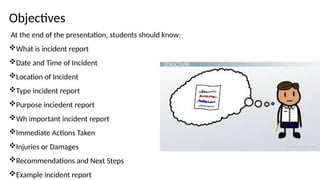
Objectives
At the endof the presentation, students should know:
What is incident report
Date and Time of Incident
Location of Incident
Type incident report
Purpose inciedent report
Wh important incident report
Immediate Actions Taken
Injuries or Damages
Recommendations and Next Steps
Example incident report
4.
Incident Report
Definition andExamples Why Incident Reports Are So Important for Nurses “To err
is human, to cover up is unforgivable, and to fail to learn is inexcusable,” states
Professor Liam Donaldson, World Health Organization (WHO) Envoy for Patient
Safety.
An incident report is a critical document used to record details of accidents, patient
injuries, and unusual events in healthcare settings like hospitals or nursing homes.
Despite careful precautions by medical staff, accidents can still happen. All nurses
involved in or witnessing the incident should complete an incident report. This
report, often called an accident report, captures the specifics of the event while the
information is still fresh. Macrae, C. (2016).
5.
Date and Timeof Incident
1 Date
The incident occurred on [Date] at [Time] according to
local time.
2 Time
Please specify the time zone in which the incident took
place to ensure accurate record-keeping.
3 Day of the Week
Record the day of the week (e.g., Monday, Tuesday) to
aid in understanding the context of the incident.
6.
Incident Report
Written atthe first opportunity after the incident so that the
details are not blurry or forgotten.
Written with a pen (ink) not pencil. Information written using a
pencil can be erased.
Details should be complete and accurate.
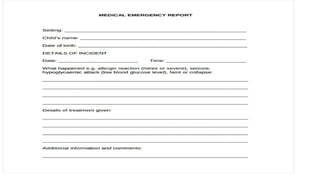
The patient should be identified with the following details:
1. Full name
2. Hospital bed number
3. Hospital ID
4. Patients diagnosis
5. Patient’s condition before and after the incident
7.
Details of wardor clinical area
Date, time and place of incident
Details of equipments used including the
serial number or asset tag identification (if
appropriate)
Location of Incident
8.
Purpose of anIncident Report
People often regard an incident report as a black mark against the nursing
staff who wrote it. This should not be the case because an informed
consent is a legal document of an incident that took place. Wald, H., &
Shojania, K. G. (2001).
The purposes of an incident report are the following:
To document the exact detail of an accident or unusual incident that
occurred in a health-care institution.
To be used in the future when dealing with liability issues stemming
from the incident.
To protect the nursing staff against unjust accusation.
To protect and safeguard the client in case of negligence on the part of
the nurse.
Helps in the evaluation of nursing care to ensure safe care to all
patients.
9.
Incident reports innursing document events where injuries or property
damage occur, affecting safety.
They come in three types:
Sentinel Event: Serious incidents causing death or major injury (e.g.,
fatal medication errors).
Minor Event: Less severe incidents causing injury or damage (e.g., a
patient tripping).
Near-Miss: Potentially harmful events that didn’t result in injury (e.g.,
almost giving the wrong medication).
10.
Important incident report
Thesereports are important because they:
Protect Nurses: Document errors, which can help in legal situations.
Protect Organizations: Show that policies were followed and aid in legal
defenses.
Improve Care: Help identify safety issues and improve practices.
Encourage Reporting: Foster a culture where staff feel safe reporting issues.
Facilitate Compensation: Ensure fair handling of injury or damage claims.
Overall, incident reports help ensure safety and legal protection for both staff
and patients.
11.
Injuries or Damages
Injuries
Listany injuries sustained
by individuals involved,
including the severity and
nature of the injuries.
Damages
Detail any property
damage caused by the
incident, including the
extent and location of
the damage.
Costs
If possible, provide
an estimated cost of
the injuries and
damages sustained.
12.
For example insteadof writing:
“Mr. ibrahim could not listen when I told him to stay in bed. He is very difficult to care for. It is his fault why he fell
on the floor.”
You should write:
“I heard a loud crash, and immediately went to the ward. I found Mr. ibrahim on the floor.”
Events should be written in sequence that they occurred.
• Proper technical terms should be used. For example instead of using the word bottle specify that it is a urinal.
Identifies the witnesses.
• Identifies the medications given before the incident (if applicable)
Identifies the equipment that is involved or used.
• Signed legibly with the correct designation.
14.
References:
• Macrae, C.(2016). The problem with incident reporting. BMJ
quality & safety, 25(2), 71-75.
• Wald, H., & Shojania, K. G. (2001). Incident reporting. Making
health care safer: A critical analysis of patient safety practices, 41.
• Lawton, R., & Parker, D. (2002). Barriers to incident reporting in a
healthcare system. BMJ Quality & Safety, 11(1), 15-18.
• Evans, S. M., Berry, J. G., Smith, B. J., Esterman, A., Selim, P.,
O’Shaughnessy, J., & DeWit, M. (2006). Attitudes and barriers to
incident reporting: a collaborative hospital study. BMJ Quality &
Safety, 15(1), 39-43.

![Date and Time of Incident
1 Date
The incident occurred on [Date] at [Time] according to
local time.
2 Time
Please specify the time zone in which the incident took
place to ensure accurate record-keeping.
3 Day of the Week
Record the day of the week (e.g., Monday, Tuesday) to
aid in understanding the context of the incident.](https://image.slidesharecdn.com/incidentreportmanagmentragad-250308205235-603b3b24/85/incidente-report-in-management-for-nursing-5-320.jpg)