Rules for debate
Why debate?
By preparing for and participating in
debates, pupils learn to find and use
information to support their
arguments. They also learn how to
present their ideas clearly and
persuasively.
Through debating, they learn to
understand views that are
different from their own because,
when debating, they may have to
argue a case that they don’t fully
agree
Preparation
Good debaters are very well
prepared. The debate you conduct in
your class may be an informal one,
but could build towards a situation
where your pupils debate seriously in
competitions.
Before constructing a speech, debaters collect
as much information on the topic as possible,
from libraries, newspapers, magazines and
discussion with people.
They think of all the points in support of the
motion, and against the motion. In other words,
they become familiar with the opposition’s case
as well as their own. They prepare themselves
for all possible questions that might be asked
by the opposition, and all possible challenges
Good debaters structure their arguments
very persuasively. They listen to other people
debating, so that they learn the art and the
skill of debating. They join debating
societies, and debate as often as possible.
The process
There are two teams, each consisting of two
or three speakers. One team (the affirmative)
supports the motion, and the other (the
negative) opposes the motion.
There is a chairperson, who controls the
proceedings.
The speeches and speaking time are divided
equally between the two teams.
Each speaker makes a speech they have
prepared to argue their case. The sides
speak in turn, starting with the proposer
of the motion (affirmative, negative,
affirmative, negative). Each speaker has a
specified amount of time to speak (e.g.
three minutes or five minutes).
Then the debate can be opened to the
floor, with speakers standing up to offer
points supporting or opposing the motion.
Each speaker from the floor is allowed a
specified amount of time (e.g. one minute
or three minutes).
Each team may then speak in ‘rebuttal’,
after a short period has been allowed for
the teams to consult. This means that they
have a chance to argue against points
raised by the opposition. Each team may
have one rebuttal speech each, or more.
The first rebuttal speech is made by the
negative side and the final rebuttal speech
is made by the affirmative.
Important rules
The team supporting the motion must not
shift its point of view. The same goes for
the opposition, who must oppose the
motion completely (whatever their private
opinions may be).
If a speaker makes a statement, they must
be able to provide evidence or reasons to
support the statement.
Facts presented in a debate must be
accurate.
Speakers may not bring up new points in a
rebuttal speech.
Seating arrangement
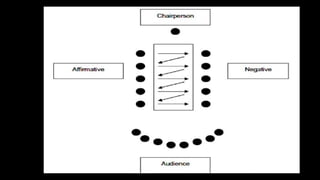
The chairperson sits at the head of the table.
The two debating parties are seated opposite
each other. The audience sit a short distance
away from the table, and should be able to
see both parties. So if necessary, additional
seats for the audience should be arranged in
several rows rather than behind one of the
debating parties.
.
Sources:
https://www.open.edu/openlearncreate/mod/oucontent/
view.php?id=161813&section=4.7
https://www.living-democracy.com/textbooks/volume-4/
students-manual-6/student-handout-35/

Importance things to remember in debate.pptx

  • 1.
  • 2.
    Why debate? By preparingfor and participating in debates, pupils learn to find and use information to support their arguments. They also learn how to present their ideas clearly and persuasively.
  • 3.
    Through debating, theylearn to understand views that are different from their own because, when debating, they may have to argue a case that they don’t fully agree
  • 4.
    Preparation Good debaters arevery well prepared. The debate you conduct in your class may be an informal one, but could build towards a situation where your pupils debate seriously in competitions.
  • 5.
    Before constructing aspeech, debaters collect as much information on the topic as possible, from libraries, newspapers, magazines and discussion with people. They think of all the points in support of the motion, and against the motion. In other words, they become familiar with the opposition’s case as well as their own. They prepare themselves for all possible questions that might be asked by the opposition, and all possible challenges
  • 6.
    Good debaters structuretheir arguments very persuasively. They listen to other people debating, so that they learn the art and the skill of debating. They join debating societies, and debate as often as possible.
  • 7.
    The process There aretwo teams, each consisting of two or three speakers. One team (the affirmative) supports the motion, and the other (the negative) opposes the motion. There is a chairperson, who controls the proceedings. The speeches and speaking time are divided equally between the two teams.
  • 8.
    Each speaker makesa speech they have prepared to argue their case. The sides speak in turn, starting with the proposer of the motion (affirmative, negative, affirmative, negative). Each speaker has a specified amount of time to speak (e.g. three minutes or five minutes).
  • 9.
    Then the debatecan be opened to the floor, with speakers standing up to offer points supporting or opposing the motion. Each speaker from the floor is allowed a specified amount of time (e.g. one minute or three minutes).
  • 10.
    Each team maythen speak in ‘rebuttal’, after a short period has been allowed for the teams to consult. This means that they have a chance to argue against points raised by the opposition. Each team may have one rebuttal speech each, or more. The first rebuttal speech is made by the negative side and the final rebuttal speech is made by the affirmative.
  • 11.
    Important rules The teamsupporting the motion must not shift its point of view. The same goes for the opposition, who must oppose the motion completely (whatever their private opinions may be).
  • 12.
    If a speakermakes a statement, they must be able to provide evidence or reasons to support the statement. Facts presented in a debate must be accurate. Speakers may not bring up new points in a rebuttal speech.
  • 13.
    Seating arrangement The chairpersonsits at the head of the table. The two debating parties are seated opposite each other. The audience sit a short distance away from the table, and should be able to see both parties. So if necessary, additional seats for the audience should be arranged in several rows rather than behind one of the debating parties.
  • 14.
  • 15.