WELCOME TO OUR PRESENTATION
Group Members
 Arif Hussain
 Anjuman Shaheen
 Aliya Batool
 Aimen Zahra
Course: Education Testing and Evaluation.
Program: B.Ed 1.5 Years 2023-24
Instructor: Sir Mutaher Hussain
IMPORTANCE OF CLASSROOM ASSESSMENT AND
EVALUATION IN EDUCATION
ASSESSMENT:
 “Assessment is feedback from the student to the instructor about
the student's learning.”
 According to Murry Print (1993):
“Assessment involves the interpretation of measurement data. It
makes sense of the data collected on student performance.”
 According to Dictionary of Education (1989):
“Assessment is the process whereby one attempts to measure
the quality and quantity of learning and teaching using various
assessment techniques.”
TYPES OF ASSESSMENTS
EVALUATION:
 Evaluation uses methods and measures to judge
student learning and understanding of the
material for purposes of grading and reporting.
 “A systematic process of determining what the
actual outcomes are but it also involves judgment
of desirability of whatever outcomes are
demonstrated.” (Travers, 1955)
 “ The process of obtaining and providing useful
information for judging decision alternatives”
(Stufflebeam et al 1971)
TYPES OF EVALUATION
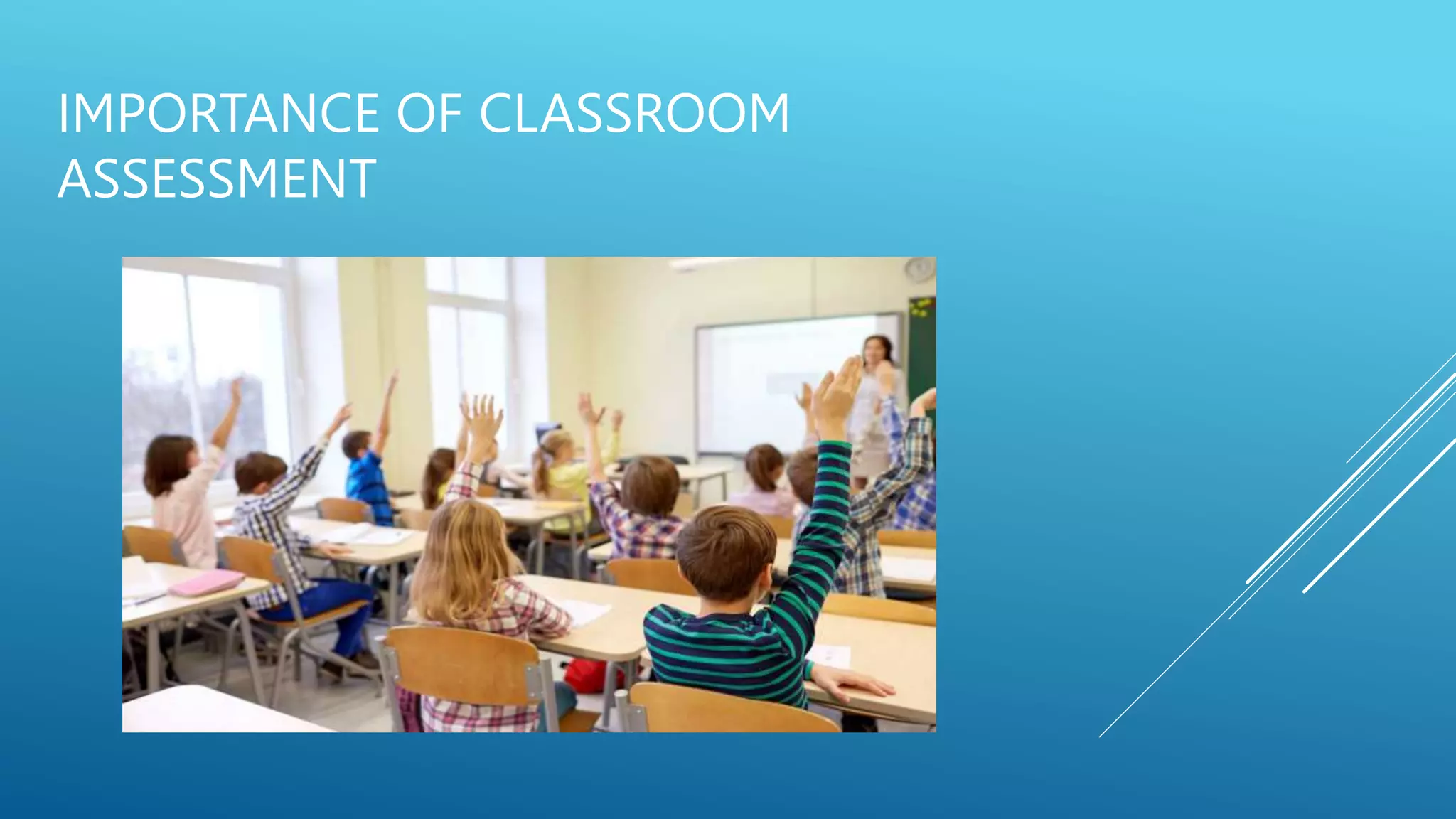
IMPORTANCE OF CLASSROOM
ASSESSMENT
• It is used to motivate students.
• It provides opportunities to remedy mistakes
• Assessment serves as a diagnostic tool
• Assessment enables grading and degree classification
• Assessment works as a performance indicator for students
• It is used as a performance indicator for teacher
• Assessment is also a performance indicator for institution
PURPOSES OF CLASSROOM ASSESSMENT:
1. Capturing student time and attention.
2. Generating appropriate student learning activity.
3. Generating marks or grades which distinguish between students
or enable pass/fail decisions to be made.
4. Providing evidence for other outside the course to enable them
to assess the appropriateness of standards on the course.
PURPOSES OF
CLASSROOM ASSESSMENT:
• Planning and conducting instruction
• Placing pupils
• Providing feedback and incentives
• Diagnosing pupils problems and improvables
• Assessing and grading academic learning and
progress
IMPORTANCE OF EVALUATION
• Placement Decisions
• Feedback
• Guidance and counseling
• Improve Learning
• Improve Instructions
• Motivation
• Reporting to Parents
• Program Evaluation
• Monitoring students progress
• Diagnosing learning problems
• Assigning grades
• Classification and selection of students
THE PURPOSES OF EVALUATION
According to Oguniyi (1984)
 To determine the relative effectiveness of the program in terms of
students’ behavioral output
 To make reliable decisions about educational planning
 To identify students'’ growth or lack of growth in acquiring desirable
knowledge, skills, attitudes and societal values
 To help teachers determine the effectiveness of their teaching
techniques and learning materials
 Whether learning is taking place
 What is not being learned
THE PURPOSES OF EVALUATION
COMPARISON BETWEEN ASSESSMENT VS EVALUATION
CONCLUSION:
Classroom assessment and evaluation have critical roles in
education. It provides teachers with useful information about
their students’ abilities and progress, enabling them to
modify and adapt their instruction, and create more targeted
and personalized learning experiences. It also enables
educators and administrators to make informed decisions
about classroom practices, curriculum development, and
resource allocation. Ultimately, classroom assessment and
evaluation helps to improve student learning outcomes and
promote better student engagement, which ultimately
benefits students in their academic and personal lives.
Appreciate Your Questions?
THANK YOU

Importance of Classroom assessment and evaluation system in education UPDATED.pptx

  • 1.
    WELCOME TO OURPRESENTATION
  • 2.
    Group Members  ArifHussain  Anjuman Shaheen  Aliya Batool  Aimen Zahra Course: Education Testing and Evaluation. Program: B.Ed 1.5 Years 2023-24 Instructor: Sir Mutaher Hussain
  • 3.
    IMPORTANCE OF CLASSROOMASSESSMENT AND EVALUATION IN EDUCATION
  • 4.
    ASSESSMENT:  “Assessment isfeedback from the student to the instructor about the student's learning.”  According to Murry Print (1993): “Assessment involves the interpretation of measurement data. It makes sense of the data collected on student performance.”  According to Dictionary of Education (1989): “Assessment is the process whereby one attempts to measure the quality and quantity of learning and teaching using various assessment techniques.”
  • 5.
  • 6.
    EVALUATION:  Evaluation usesmethods and measures to judge student learning and understanding of the material for purposes of grading and reporting.  “A systematic process of determining what the actual outcomes are but it also involves judgment of desirability of whatever outcomes are demonstrated.” (Travers, 1955)  “ The process of obtaining and providing useful information for judging decision alternatives” (Stufflebeam et al 1971)
  • 7.
  • 10.
  • 11.
    • It isused to motivate students. • It provides opportunities to remedy mistakes • Assessment serves as a diagnostic tool • Assessment enables grading and degree classification • Assessment works as a performance indicator for students • It is used as a performance indicator for teacher • Assessment is also a performance indicator for institution PURPOSES OF CLASSROOM ASSESSMENT:
  • 12.
    PURPOSES OF CLASSROOMASSESSMENT: 1. Capturing student time and attention. 2. Generating appropriate student learning activity. 3. Generating marks or grades which distinguish between students or enable pass/fail decisions to be made. 4. Providing evidence for other outside the course to enable them to assess the appropriateness of standards on the course.
  • 13.
    PURPOSES OF CLASSROOM ASSESSMENT: •Planning and conducting instruction • Placing pupils • Providing feedback and incentives • Diagnosing pupils problems and improvables • Assessing and grading academic learning and progress
  • 14.
    IMPORTANCE OF EVALUATION •Placement Decisions • Feedback • Guidance and counseling • Improve Learning • Improve Instructions • Motivation • Reporting to Parents • Program Evaluation • Monitoring students progress • Diagnosing learning problems • Assigning grades • Classification and selection of students
  • 15.
    THE PURPOSES OFEVALUATION According to Oguniyi (1984)  To determine the relative effectiveness of the program in terms of students’ behavioral output  To make reliable decisions about educational planning  To identify students'’ growth or lack of growth in acquiring desirable knowledge, skills, attitudes and societal values  To help teachers determine the effectiveness of their teaching techniques and learning materials  Whether learning is taking place  What is not being learned
  • 16.
    THE PURPOSES OFEVALUATION
  • 17.
    THE PURPOSES OFEVALUATION
  • 18.
  • 20.
    CONCLUSION: Classroom assessment andevaluation have critical roles in education. It provides teachers with useful information about their students’ abilities and progress, enabling them to modify and adapt their instruction, and create more targeted and personalized learning experiences. It also enables educators and administrators to make informed decisions about classroom practices, curriculum development, and resource allocation. Ultimately, classroom assessment and evaluation helps to improve student learning outcomes and promote better student engagement, which ultimately benefits students in their academic and personal lives.
  • 21.
  • 22.