People celebrating Carnaval
in Rio de Janeiro, Brazil
1. Name all of the different colors that you see in the
photo. Which is your favorite?
2. Would you like to be at the place in the photo? Why
or why not?
3. Imagine this photo in black and white. What would
you think of it? What would be lost?
“
When multiple colors dance across the same scene,
the result can be a carnival.”
—Annie Griffiths
Color
Matters
Unit 1
9
8
OWI_1_SE_09313_008-023_U01_CR2.indd 8-9 4/26/16 7:13 AM
Learn new words. Listen and repeat. TR: 3
Work in pairs. Which colors make you feel happy? Sad?
Angry? Excited?
2
3
Your brain can see 7 million colors.
How many of them can you name? What
do different colors make you think of?
Discuss. Then listen and read. TR: 2
1
red is a symbol of good luck
in many cultures. It is the traditional
color for wedding dresses in China and
India. But many cultures associate red with
danger. This is why we see it on emergency
vehicles and warning signs. Eight percent of
the population is red-green colorblind: they
can’t clearly see the difference between
red and green.
Green is a color that makes people feel at
peace because it’s the most common color in
nature. The green in leaves and grass comes
from something called chlorophyll. This word
comes from the Greek khloros (green) and
phyllon (leaf).
Green also symbolizes safety. Because of
this, it’s used in traffic lights to signal
when it’s safe to go.
blue is the most popular color in the
world. More than half the world’s flags have
blue in them. Blue is also the most common
color used by businesses. Many businesses
use the color blue to represent them in
logos and advertisements. This is because
blue helps us feel like we can trust them.
indigo is a dark color between blue
and purple. Indigo clothing was a sign
of luxury in the past because indigo
dye came from a rare plant. It was very
expensive, and few people could wear
clothes made with this dye. Now we use
indigo dye to make blue jeans.
Violet is a light purple
color. It is one of the oldest
colors in the world. There
are violet cave paintings
in France that are
25,000 years old!
However in some
countries, for example
Thailand and Brazil, violet
is the color of death.
Orange gets its name from the fruit.
The word originally described the taste
of the fruit’s peel, but by the sixteenth
century, orange was also the name
of this bright color.
Yellow is the color of taxis
and school buses because it’s
the most visible color on
the road. Like red, yellow
is also used to warn
people of dangerous
situations.
Because it attracts
attention, yellow is
used for highlighter
pens. The bright color
activates different parts of
the brain that help the reader
remember the highlighted text.
11
10
OWI_1_SE_09313_008-023_U01_CR2.indd 10-11 4/26/16 7:13 AM
Listen. How do the speakers correct information? Write the
words and phrases you hear. TR: 7
7
7
Speaking Strategy TR: 6
common   flag   luxury   to signal
Photographer Annie Griffiths has
traveled all around the world. In many of
the places she’s visited, Annie has seen
. However, Annie
chooses to focus on the beauty of the places and
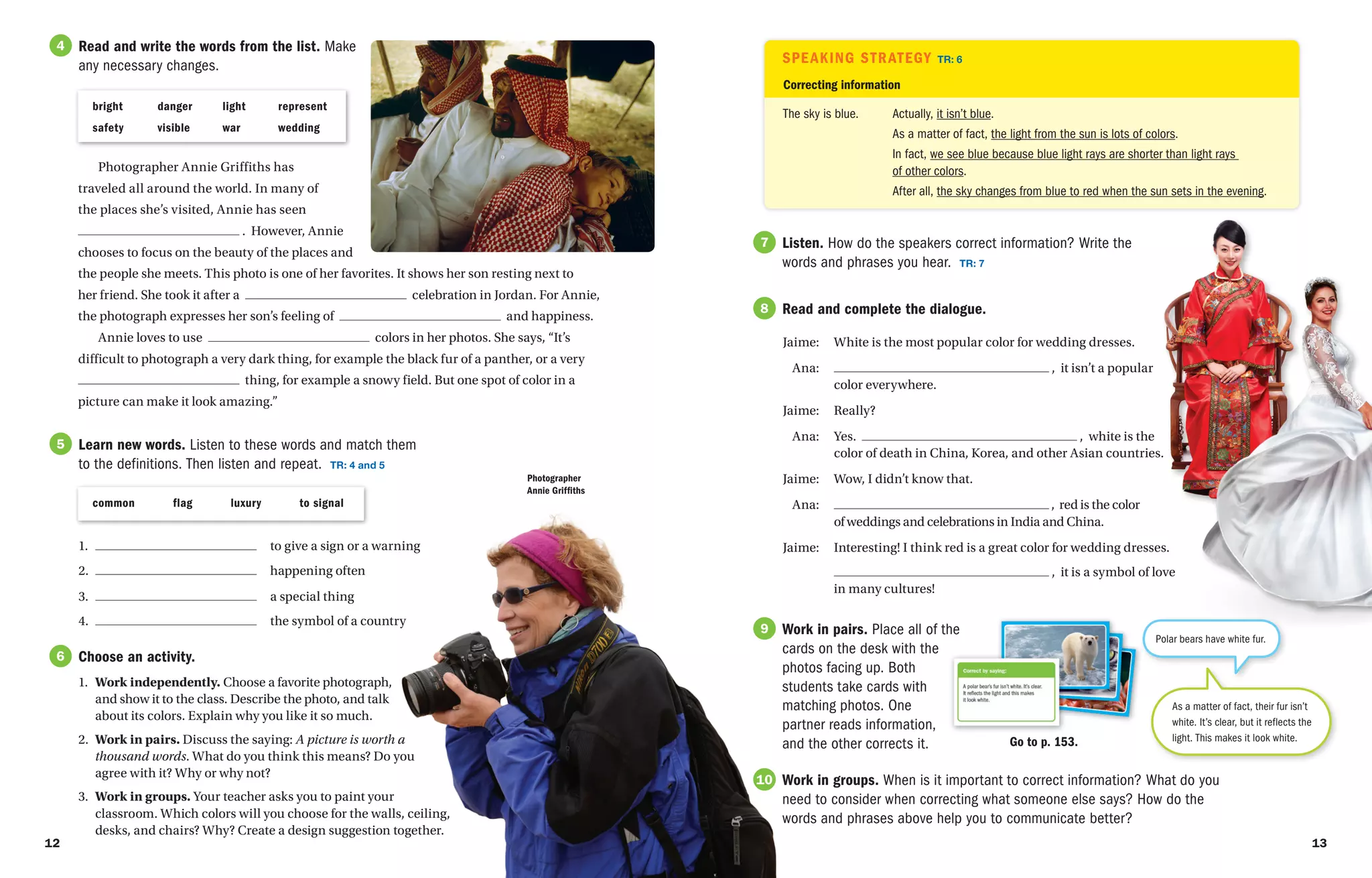
the people she meets. This photo is one of her favorites. It shows her son resting next to
her friend. She took it after a celebration in Jordan. For Annie,
the photograph expresses her son’s feeling of and happiness.
Annie loves to use colors in her photos. She says, “It’s
difficult to photograph a very dark thing, for example the black fur of a panther, or a very
thing, for example a snowy field. But one spot of color in a
picture can make it look amazing.”
bright danger light represent
safety visible war wedding
Read and write the words from the list. Make
any necessary changes.
4
Learn new words. Listen to these words and match them
to the definitions. Then listen and repeat. TR: 4 and 5
5
Choose an activity.
1. Work independently. Choose a favorite photograph,
and show it to the class. Describe the photo, and talk
about its colors. Explain why you like it so much.
2. Work in pairs. Discuss the saying: A picture is worth a
thousand words. What do you think this means? Do you
agree with it? Why or why not?
3. Work in groups. Your teacher asks you to paint your
classroom. Which colors will you choose for the walls, ceiling,
desks, and chairs? Why? Create a design suggestion together.
6
Correcting information
Actually, it isn’t blue.
As a matter of fact, the light from the sun is lots of colors.
In fact, we see blue because blue light rays are shorter than light rays
of other colors.
After all, the sky changes from blue to red when the sun sets in the evening.
The sky is blue.
Read and complete the dialogue.
Jaime: White is the most popular color for wedding dresses.
Ana: , it isn’t a popular
		 color everywhere.
Jaime:	Really?
Ana: Yes. , white is the
		 color of death in China, Korea, and other Asian countries.
Jaime:	
Wow, I didn’t know that.
Ana: , red is the color
		 of weddings and celebrations in India and China.
Jaime:	
Interesting! I think red is a great color for wedding dresses.
		 , it is a symbol of love
		 in many cultures!
7
8
Work in pairs. Place all of the
cards on the desk with the
photos facing up. Both
students take cards with
matching photos. One
partner reads information,
and the other corrects it.
7
9
Work in groups. When is it important to correct information? What do you
need to consider when correcting what someone else says? How do the
words and phrases above help you to communicate better?
7
10
Polar bears have white fur.
As a matter of fact, their fur isn’t
white. It’s clear, but it reflects the
light. This makes it look white.
Go to p. 153.
1. to give a sign or a warning
2. happening often
3. a special thing
4. the symbol of a country
Photographer
Annie Griffiths
12 13
OWI_1_SE_09313_008-023_U01_CR2.indd 12-13 4/26/16 7:13 AM
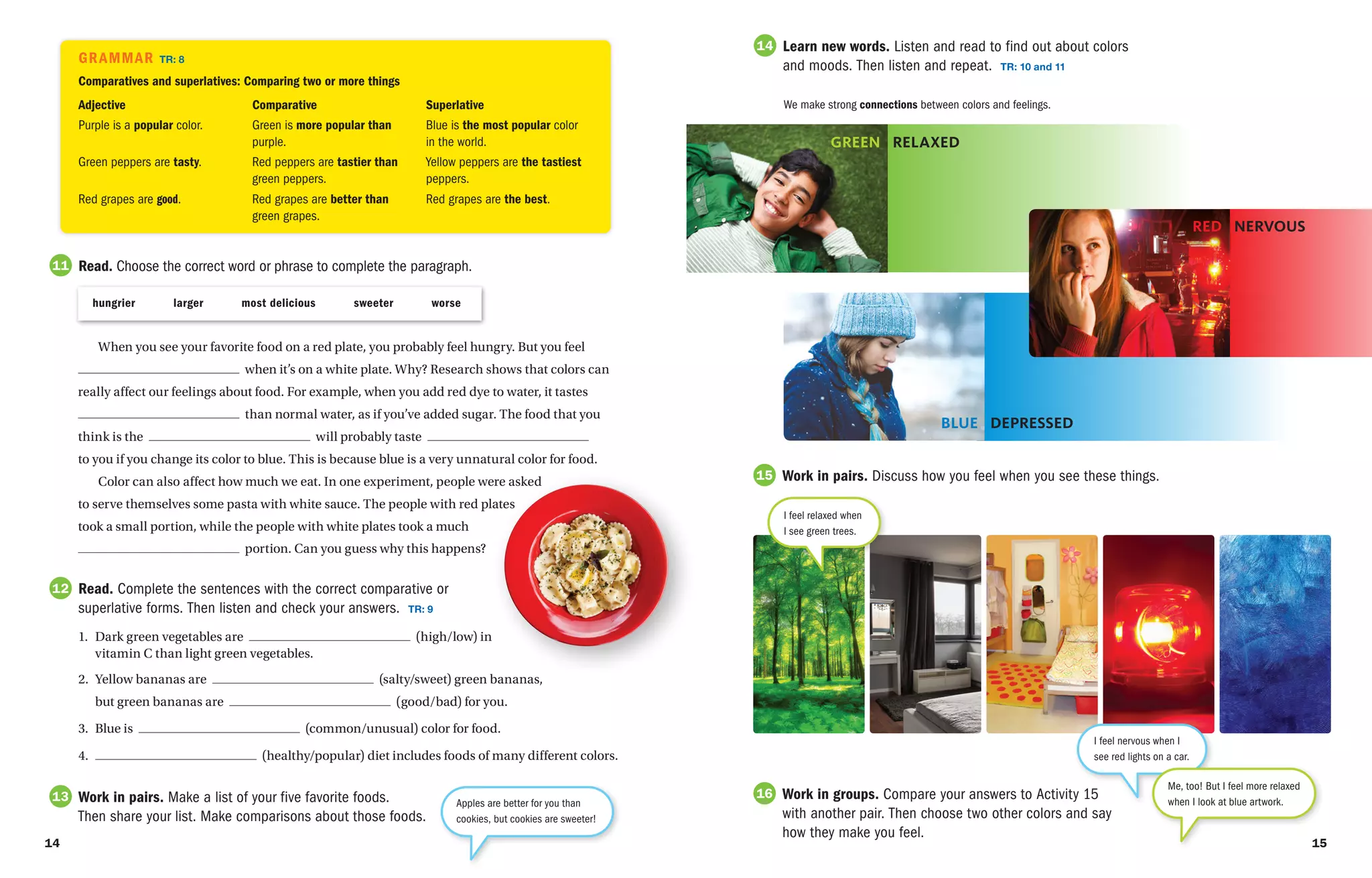
Work in pairs. Discuss how you feel when you see these things.
15
Adjective
Purple is a popular color.
Green peppers are tasty.
Red grapes are good.
Comparative
Green is more popular than
purple.
Red peppers are tastier than
green peppers.
Red grapes are better than
green grapes.
Superlative
Blue is the most popular color
in the world.
Yellow peppers are the tastiest
peppers.
Red grapes are the best.
Comparatives and superlatives: Comparing two or more things
Grammar TR: 8
Read. Complete the sentences with the correct comparative or
superlative forms. Then listen and check your answers. TR: 9
1. Dark green vegetables are (high/low) in
vitamin C than light green vegetables.
2. Yellow bananas are (salty/sweet) green bananas,
but green bananas are (good/bad) for you.
3. Blue is (common/unusual) color for food.
4. (healthy/popular) diet includes foods of many different colors.
12
hungrier   larger   most delicious   sweeter   worse
Read. Choose the correct word or phrase to complete the paragraph.
11
When you see your favorite food on a red plate, you probably feel hungry. But you feel
when it’s on a white plate. Why? Research shows that colors can
really affect our feelings about food. For example, when you add red dye to water, it tastes
than normal water, as if you’ve added sugar. The food that you
think is the will probably taste
to you if you change its color to blue. This is because blue is a very unnatural color for food.
Color can also affect how much we eat. In one experiment, people were asked
to serve themselves some pasta with white sauce. The people with red plates
took a small portion, while the people with white plates took a much
portion. Can you guess why this happens?
Work in pairs. Make a list of your five favorite foods.
Then share your list. Make comparisons about those foods.
7
13
Learn new words. Listen and read to find out about colors
and moods. Then listen and repeat. TR: 10 and 11
7
14
Apples are better for you than
cookies, but cookies are sweeter!
We make strong connections between colors and feelings.
Work in groups. Compare your answers to Activity 15
with another pair. Then choose two other colors and say
how they make you feel.
16
I feel nervous when I
see red lights on a car.
I feel relaxed when
I see green trees.
Me, too! But I feel more relaxed
when I look at blue artwork.
green relaxed
Red nervous
blue depressed
14 15
OWI_1_SE_09313_008-023_U01_CR2.indd 14-15 4/26/16 7:13 AM
The history of one of the most popular colors
Purple is one of the most popular
colors today. There are purple
clothes, purple handbags, purple
bicycles, purple furniture, even purple
computers! But in the past, purple was
a very expensive and unusual color.
Let’s take a look at the rich and
sometimes dangerous history of the
color purple.
Read the text again. Number the events in the order that
they happened.
21
company  to notice  ordinary  royalty
Before you read, discuss in pairs. Look at the
photos and the timeline. What do you think the
reading is about?
17
Learn new words. Find these words in the text.
Use the other words in the sentences to guess each
word’s meaning. Then listen and repeat. TR: 12
18
While you read, think about the order of the
events. TR: 13
19
After you read, discuss in pairs.
1. Why do scientists think that the earliest organisms
were purple?
2. Why was the color purple so expensive during the
Roman Empire?
3. Who usually wore purple in England in the
sixteenth century?
4. How did William Perkin discover a way to make
purple dye? What advantage did his discovery have?
20
Discuss in groups.
1. What color clothes do you like to wear? Why?
2. In Roman and Elizabethan times, purple was a sign of luxury.
What color means luxury to you? Does the color purple have any
special meaning in your culture?
3. Why do some people like to have luxury items, such as clothing?
Are luxury items important to you? Why or why not?
22
The Very Beginning
Some scientists believe that the first
organisms to appear on Earth over 500
million years ago probably looked purple,
not green. Plants today are green because
they use green chlorophyll to produce
energy. But these early organisms
probably used something called retinal,
which is a dark purple color.
3,000 years ago
During the time of the Roman
Empire, it was very difficult to
make purple dye. The dye came
from sea snails. But 10,000 dead
sea snails got you just one gram
of purple dye . . . as well as a very
bad smell! This special purple
dye was called Tyrian purple,
and it was the preferred
color of emperors.
500 years ago
In sixteenth-century England, purple
was only for royalty. Queen Elizabeth I’s
clothes were
purple, but
ordinary people
were not allowed
to wear the color.
150 years ago
In 1856, William Perkin, an 18-year-
old science student, noticed something
strange while conducting an experiment.
The chemicals he used to clean his
equipment combined with the chemicals
he used in his experiment, and produced
a bright purple color. This discovery
led Perkin to start a company using this
chemical combination to make purple
dye. The dye was much cheaper than
the sea-snail dye.
Thanks to Perkin,
now anyone
can wear purple
clothes.
Only Queen Elizabeth I wears purple clothes.
Sea snails are used to make purple clothes for emperors.
Many of the Earth’s plants appear to be purple, not green.
Anyone can wear purple clothes.
William Perkin discovers how to make purple dye.
17
16
OWI_1_SE_09313_008-023_U01_CR2.indd 16-17 4/26/16 7:14 AM
VIDE
Before you watch, discuss in pairs. How do we use
color in our life? Think about ways that color warns or
informs us about things.
Work in pairs. You’re going to watch a video called
Seeing Colors? Look at the photo. How many different
colors can you see? Do you think that all animals see
colors the same as you do?
23
24
Work in pairs. Choose one of
these gadgets, and find out how
it uses infrared light. Share your
answer with the class.
27
Watch scene 1.1. While you watch, write the letter
for each color in order, based on the range of
visible light.
25
Choose an activity.
1. Work independently. Find
pictures of things in nature
that match each color in the
range of visible light. Arrange
the pictures in order on a sheet
of paper, and glue them. Then
label each item and its color.
2. Work in pairs. Go online to
find out why you see a rainbow
when it rains on a sunny day.
Make a presentation to explain
the science.
3. Work in groups. How
important is color in your life?
Can you imagine a life without
color? What problems might
there be? List at least three.
28
After you watch, work in pairs to answer the questions.
1. Why don’t insects and animals see colors like most humans do?
2. What can bees see in flowers that is invisible to humans?
3. How can a snake see a mouse in the dark?
4. What color is infrared light to a snake?
5. What percentage of men are color-blind? What percentage of
women are color-blind?
26
TV remote control
supermarket check-out scanner
night-vision goggles
car keys
A mouse visible in a thermogram, an image that
shows an object’s temperature
a. dark blue b. green c. infrared d. light blue e. orange f. red g. ultraviolet h. violet i. yellow
18 19
18
OWI_1_SE_09313_008-023_U01_CR2.indd 18-19 4/26/16 7:14 AM
WRITING
A topic sentence introduces the main idea of a paragraph. The topic sentence
is usually the first sentence of the paragraph. It explains:
• why you are writing • what you want to say
Look at these examples of topic sentences:
In this article, I’m going to discuss the history of the color orange.
When taking a photograph, it’s important to think about light and color.
There’s a coat in my closet. The coat is red.
The sun is shining in the sky.
People often feel depressed when they see the color black.
The: Identifying general and specific things
Grammar TR: 14
Read the announcement and the response. Underline the topic sentence.
I would like to tell you about my favorite color
and explain why I think it’s perfect for this season.
My favorite color is orange. I think it’s a warm and
bright color, and it makes me feel happy and safe.
When I see this color, I think of fall. Although
it gets cooler and the days are much shorter, I
love the fall. When I go outside, I enjoy walking
through the dark orange leaves and listening to
the sound they make under my feet. I also think
of the smell of fire when I see this color. It’s great
to be at home and sit by the warm fire with my
family. Orange is also the color of my favorite
food—pumpkin soup. It’s so delicious! This
warm and beautiful color should be everywhere
this season—outside, in our homes, and even
on our plates!
32
Read. Circle the correct word.
The / A Colors of Success
Imagine you’re at a shopping mall. You want to go to the / a café and get the / a drink
and the / a snack. There are two different cafés in the mall. How do you choose the / a
café you want to visit? You probably look at the prices and the menus. But the / a colors
that the / a café uses are also very important.
29
Work in pairs. Take turns naming familiar brand-name
products. Can your partner name the colors for the
brand? Why do you think the companies chose the
colors for each product?
30
Work in pairs. Take turns. Use a coin to move.
(Heads = 1 space; tails = 2 spaces) Complete
each sentence with the or a / an.
31
Go to p. 155.
Work in pairs. Make a list of the things that the writer connects with
his/her favorite color. Do you think his/her ideas are effective? Why or
why not?
33
Write. Write a paragraph about your favorite color and what you
associate with this color. Use a strong topic sentence.
34
Do you want
to feel calm and
relaxed? Then you
will probably choose
The Coffee Place.
The / A green color
makes you think of
nature and peace.
Do you want to
go someplace exciting
and lively? Then you
will probably choose
The Coffee Machine.
Many companies use
the / a color red because
it seems bright and
fun, and it attracts
young people.
Think about your favorite brands. Which colors do they use? What do those colors
mean to you?
COMPETITION
Write and tell us about your
favorite color.
What color do you want
to see at home and
around town this season?
Tell us what the color
means to you.
20 21
OWI_1_SE_09313_008-023_U01_CR2.indd 20-21 4/26/16 7:14 AM
Make an
Impact
Plan and create an art presentation.
• 
Research the use of color in Aboriginal art.
• 
Draw an object from your own culture
using Aboriginal art techniques.
• 
Present your drawing to the class. Explain
why you chose the colors you used.
Plan and make a presentation about
color and taste.
• 
Choose five foods. Use food coloring to
change each food’s color.
• 
Ask friends and family to taste and react
to the foods.
• 
Present the results to the class.
Blog about colors in your community.
• 
Find colorful people, places,
and things in your community.
Take photos of them.
• 
Write a blog about your photos.
Explain why you took each photo
and how the colors make you feel.
• 
Publish your blog and respond to your
classmates’ comments.
A
B
C
1. Watch scene 1.2.
2. Discuss how photographers can use their
skills to help other people.
3. Think about issues or social problems
in your area. How could you use
photographs to teach others about
these issues?
—Annie Griffiths
National Geographic Photographer
“Look around and ask yourself, ‘Who needs
pictures? Who needs help?’ With photography,
the opportunities are endless . . .”
Look for Opportunities
22 23
OWI_1_SE_09313_008-023_U01_CR2.indd 22-23 4/26/16 7:14 AM

impact2sb_u1_ame.pdf

  • 1.
    People celebrating Carnaval inRio de Janeiro, Brazil 1. Name all of the different colors that you see in the photo. Which is your favorite? 2. Would you like to be at the place in the photo? Why or why not? 3. Imagine this photo in black and white. What would you think of it? What would be lost? “ When multiple colors dance across the same scene, the result can be a carnival.” —Annie Griffiths Color Matters Unit 1 9 8 OWI_1_SE_09313_008-023_U01_CR2.indd 8-9 4/26/16 7:13 AM
  • 2.
    Learn new words.Listen and repeat. TR: 3 Work in pairs. Which colors make you feel happy? Sad? Angry? Excited? 2 3 Your brain can see 7 million colors. How many of them can you name? What do different colors make you think of? Discuss. Then listen and read. TR: 2 1 red is a symbol of good luck in many cultures. It is the traditional color for wedding dresses in China and India. But many cultures associate red with danger. This is why we see it on emergency vehicles and warning signs. Eight percent of the population is red-green colorblind: they can’t clearly see the difference between red and green. Green is a color that makes people feel at peace because it’s the most common color in nature. The green in leaves and grass comes from something called chlorophyll. This word comes from the Greek khloros (green) and phyllon (leaf). Green also symbolizes safety. Because of this, it’s used in traffic lights to signal when it’s safe to go. blue is the most popular color in the world. More than half the world’s flags have blue in them. Blue is also the most common color used by businesses. Many businesses use the color blue to represent them in logos and advertisements. This is because blue helps us feel like we can trust them. indigo is a dark color between blue and purple. Indigo clothing was a sign of luxury in the past because indigo dye came from a rare plant. It was very expensive, and few people could wear clothes made with this dye. Now we use indigo dye to make blue jeans. Violet is a light purple color. It is one of the oldest colors in the world. There are violet cave paintings in France that are 25,000 years old! However in some countries, for example Thailand and Brazil, violet is the color of death. Orange gets its name from the fruit. The word originally described the taste of the fruit’s peel, but by the sixteenth century, orange was also the name of this bright color. Yellow is the color of taxis and school buses because it’s the most visible color on the road. Like red, yellow is also used to warn people of dangerous situations. Because it attracts attention, yellow is used for highlighter pens. The bright color activates different parts of the brain that help the reader remember the highlighted text. 11 10 OWI_1_SE_09313_008-023_U01_CR2.indd 10-11 4/26/16 7:13 AM
  • 3.
    Listen. How dothe speakers correct information? Write the words and phrases you hear. TR: 7 7 7 Speaking Strategy TR: 6 common   flag   luxury   to signal Photographer Annie Griffiths has traveled all around the world. In many of the places she’s visited, Annie has seen . However, Annie chooses to focus on the beauty of the places and the people she meets. This photo is one of her favorites. It shows her son resting next to her friend. She took it after a celebration in Jordan. For Annie, the photograph expresses her son’s feeling of and happiness. Annie loves to use colors in her photos. She says, “It’s difficult to photograph a very dark thing, for example the black fur of a panther, or a very thing, for example a snowy field. But one spot of color in a picture can make it look amazing.” bright danger light represent safety visible war wedding Read and write the words from the list. Make any necessary changes. 4 Learn new words. Listen to these words and match them to the definitions. Then listen and repeat. TR: 4 and 5 5 Choose an activity. 1. Work independently. Choose a favorite photograph, and show it to the class. Describe the photo, and talk about its colors. Explain why you like it so much. 2. Work in pairs. Discuss the saying: A picture is worth a thousand words. What do you think this means? Do you agree with it? Why or why not? 3. Work in groups. Your teacher asks you to paint your classroom. Which colors will you choose for the walls, ceiling, desks, and chairs? Why? Create a design suggestion together. 6 Correcting information Actually, it isn’t blue. As a matter of fact, the light from the sun is lots of colors. In fact, we see blue because blue light rays are shorter than light rays of other colors. After all, the sky changes from blue to red when the sun sets in the evening. The sky is blue. Read and complete the dialogue. Jaime: White is the most popular color for wedding dresses. Ana: , it isn’t a popular color everywhere. Jaime: Really? Ana: Yes. , white is the color of death in China, Korea, and other Asian countries. Jaime: Wow, I didn’t know that. Ana: , red is the color of weddings and celebrations in India and China. Jaime: Interesting! I think red is a great color for wedding dresses. , it is a symbol of love in many cultures! 7 8 Work in pairs. Place all of the cards on the desk with the photos facing up. Both students take cards with matching photos. One partner reads information, and the other corrects it. 7 9 Work in groups. When is it important to correct information? What do you need to consider when correcting what someone else says? How do the words and phrases above help you to communicate better? 7 10 Polar bears have white fur. As a matter of fact, their fur isn’t white. It’s clear, but it reflects the light. This makes it look white. Go to p. 153. 1. to give a sign or a warning 2. happening often 3. a special thing 4. the symbol of a country Photographer Annie Griffiths 12 13 OWI_1_SE_09313_008-023_U01_CR2.indd 12-13 4/26/16 7:13 AM
  • 4.
    Work in pairs.Discuss how you feel when you see these things. 15 Adjective Purple is a popular color. Green peppers are tasty. Red grapes are good. Comparative Green is more popular than purple. Red peppers are tastier than green peppers. Red grapes are better than green grapes. Superlative Blue is the most popular color in the world. Yellow peppers are the tastiest peppers. Red grapes are the best. Comparatives and superlatives: Comparing two or more things Grammar TR: 8 Read. Complete the sentences with the correct comparative or superlative forms. Then listen and check your answers. TR: 9 1. Dark green vegetables are (high/low) in vitamin C than light green vegetables. 2. Yellow bananas are (salty/sweet) green bananas, but green bananas are (good/bad) for you. 3. Blue is (common/unusual) color for food. 4. (healthy/popular) diet includes foods of many different colors. 12 hungrier   larger   most delicious   sweeter   worse Read. Choose the correct word or phrase to complete the paragraph. 11 When you see your favorite food on a red plate, you probably feel hungry. But you feel when it’s on a white plate. Why? Research shows that colors can really affect our feelings about food. For example, when you add red dye to water, it tastes than normal water, as if you’ve added sugar. The food that you think is the will probably taste to you if you change its color to blue. This is because blue is a very unnatural color for food. Color can also affect how much we eat. In one experiment, people were asked to serve themselves some pasta with white sauce. The people with red plates took a small portion, while the people with white plates took a much portion. Can you guess why this happens? Work in pairs. Make a list of your five favorite foods. Then share your list. Make comparisons about those foods. 7 13 Learn new words. Listen and read to find out about colors and moods. Then listen and repeat. TR: 10 and 11 7 14 Apples are better for you than cookies, but cookies are sweeter! We make strong connections between colors and feelings. Work in groups. Compare your answers to Activity 15 with another pair. Then choose two other colors and say how they make you feel. 16 I feel nervous when I see red lights on a car. I feel relaxed when I see green trees. Me, too! But I feel more relaxed when I look at blue artwork. green relaxed Red nervous blue depressed 14 15 OWI_1_SE_09313_008-023_U01_CR2.indd 14-15 4/26/16 7:13 AM
  • 5.
    The history ofone of the most popular colors Purple is one of the most popular colors today. There are purple clothes, purple handbags, purple bicycles, purple furniture, even purple computers! But in the past, purple was a very expensive and unusual color. Let’s take a look at the rich and sometimes dangerous history of the color purple. Read the text again. Number the events in the order that they happened. 21 company  to notice  ordinary  royalty Before you read, discuss in pairs. Look at the photos and the timeline. What do you think the reading is about? 17 Learn new words. Find these words in the text. Use the other words in the sentences to guess each word’s meaning. Then listen and repeat. TR: 12 18 While you read, think about the order of the events. TR: 13 19 After you read, discuss in pairs. 1. Why do scientists think that the earliest organisms were purple? 2. Why was the color purple so expensive during the Roman Empire? 3. Who usually wore purple in England in the sixteenth century? 4. How did William Perkin discover a way to make purple dye? What advantage did his discovery have? 20 Discuss in groups. 1. What color clothes do you like to wear? Why? 2. In Roman and Elizabethan times, purple was a sign of luxury. What color means luxury to you? Does the color purple have any special meaning in your culture? 3. Why do some people like to have luxury items, such as clothing? Are luxury items important to you? Why or why not? 22 The Very Beginning Some scientists believe that the first organisms to appear on Earth over 500 million years ago probably looked purple, not green. Plants today are green because they use green chlorophyll to produce energy. But these early organisms probably used something called retinal, which is a dark purple color. 3,000 years ago During the time of the Roman Empire, it was very difficult to make purple dye. The dye came from sea snails. But 10,000 dead sea snails got you just one gram of purple dye . . . as well as a very bad smell! This special purple dye was called Tyrian purple, and it was the preferred color of emperors. 500 years ago In sixteenth-century England, purple was only for royalty. Queen Elizabeth I’s clothes were purple, but ordinary people were not allowed to wear the color. 150 years ago In 1856, William Perkin, an 18-year- old science student, noticed something strange while conducting an experiment. The chemicals he used to clean his equipment combined with the chemicals he used in his experiment, and produced a bright purple color. This discovery led Perkin to start a company using this chemical combination to make purple dye. The dye was much cheaper than the sea-snail dye. Thanks to Perkin, now anyone can wear purple clothes. Only Queen Elizabeth I wears purple clothes. Sea snails are used to make purple clothes for emperors. Many of the Earth’s plants appear to be purple, not green. Anyone can wear purple clothes. William Perkin discovers how to make purple dye. 17 16 OWI_1_SE_09313_008-023_U01_CR2.indd 16-17 4/26/16 7:14 AM
  • 6.
    VIDE Before you watch,discuss in pairs. How do we use color in our life? Think about ways that color warns or informs us about things. Work in pairs. You’re going to watch a video called Seeing Colors? Look at the photo. How many different colors can you see? Do you think that all animals see colors the same as you do? 23 24 Work in pairs. Choose one of these gadgets, and find out how it uses infrared light. Share your answer with the class. 27 Watch scene 1.1. While you watch, write the letter for each color in order, based on the range of visible light. 25 Choose an activity. 1. Work independently. Find pictures of things in nature that match each color in the range of visible light. Arrange the pictures in order on a sheet of paper, and glue them. Then label each item and its color. 2. Work in pairs. Go online to find out why you see a rainbow when it rains on a sunny day. Make a presentation to explain the science. 3. Work in groups. How important is color in your life? Can you imagine a life without color? What problems might there be? List at least three. 28 After you watch, work in pairs to answer the questions. 1. Why don’t insects and animals see colors like most humans do? 2. What can bees see in flowers that is invisible to humans? 3. How can a snake see a mouse in the dark? 4. What color is infrared light to a snake? 5. What percentage of men are color-blind? What percentage of women are color-blind? 26 TV remote control supermarket check-out scanner night-vision goggles car keys A mouse visible in a thermogram, an image that shows an object’s temperature a. dark blue b. green c. infrared d. light blue e. orange f. red g. ultraviolet h. violet i. yellow 18 19 18 OWI_1_SE_09313_008-023_U01_CR2.indd 18-19 4/26/16 7:14 AM
  • 7.
    WRITING A topic sentenceintroduces the main idea of a paragraph. The topic sentence is usually the first sentence of the paragraph. It explains: • why you are writing • what you want to say Look at these examples of topic sentences: In this article, I’m going to discuss the history of the color orange. When taking a photograph, it’s important to think about light and color. There’s a coat in my closet. The coat is red. The sun is shining in the sky. People often feel depressed when they see the color black. The: Identifying general and specific things Grammar TR: 14 Read the announcement and the response. Underline the topic sentence. I would like to tell you about my favorite color and explain why I think it’s perfect for this season. My favorite color is orange. I think it’s a warm and bright color, and it makes me feel happy and safe. When I see this color, I think of fall. Although it gets cooler and the days are much shorter, I love the fall. When I go outside, I enjoy walking through the dark orange leaves and listening to the sound they make under my feet. I also think of the smell of fire when I see this color. It’s great to be at home and sit by the warm fire with my family. Orange is also the color of my favorite food—pumpkin soup. It’s so delicious! This warm and beautiful color should be everywhere this season—outside, in our homes, and even on our plates! 32 Read. Circle the correct word. The / A Colors of Success Imagine you’re at a shopping mall. You want to go to the / a café and get the / a drink and the / a snack. There are two different cafés in the mall. How do you choose the / a café you want to visit? You probably look at the prices and the menus. But the / a colors that the / a café uses are also very important. 29 Work in pairs. Take turns naming familiar brand-name products. Can your partner name the colors for the brand? Why do you think the companies chose the colors for each product? 30 Work in pairs. Take turns. Use a coin to move. (Heads = 1 space; tails = 2 spaces) Complete each sentence with the or a / an. 31 Go to p. 155. Work in pairs. Make a list of the things that the writer connects with his/her favorite color. Do you think his/her ideas are effective? Why or why not? 33 Write. Write a paragraph about your favorite color and what you associate with this color. Use a strong topic sentence. 34 Do you want to feel calm and relaxed? Then you will probably choose The Coffee Place. The / A green color makes you think of nature and peace. Do you want to go someplace exciting and lively? Then you will probably choose The Coffee Machine. Many companies use the / a color red because it seems bright and fun, and it attracts young people. Think about your favorite brands. Which colors do they use? What do those colors mean to you? COMPETITION Write and tell us about your favorite color. What color do you want to see at home and around town this season? Tell us what the color means to you. 20 21 OWI_1_SE_09313_008-023_U01_CR2.indd 20-21 4/26/16 7:14 AM
  • 8.
    Make an Impact Plan andcreate an art presentation. • Research the use of color in Aboriginal art. • Draw an object from your own culture using Aboriginal art techniques. • Present your drawing to the class. Explain why you chose the colors you used. Plan and make a presentation about color and taste. • Choose five foods. Use food coloring to change each food’s color. • Ask friends and family to taste and react to the foods. • Present the results to the class. Blog about colors in your community. • Find colorful people, places, and things in your community. Take photos of them. • Write a blog about your photos. Explain why you took each photo and how the colors make you feel. • Publish your blog and respond to your classmates’ comments. A B C 1. Watch scene 1.2. 2. Discuss how photographers can use their skills to help other people. 3. Think about issues or social problems in your area. How could you use photographs to teach others about these issues? —Annie Griffiths National Geographic Photographer “Look around and ask yourself, ‘Who needs pictures? Who needs help?’ With photography, the opportunities are endless . . .” Look for Opportunities 22 23 OWI_1_SE_09313_008-023_U01_CR2.indd 22-23 4/26/16 7:14 AM