Impact Analysis of OCR Quality on
ResearchTasks in Digital Archives
Myriam C. Traub, Jacco van Ossenbruggen, Lynda Hardman
Centrum Wiskunde & Informatica, Amsterdam
Context
✤ Research in collaboration with the
National Library of The
Netherlands
✤ Digital newspaper archive:
✤ 10 million pages covering 1618
to 1995
✤ +/- 1200 newspaper titles
✤ Available data: scanned image
of the page, OCRed text and
metadata records
2
Interviews
✤ Aim:
✤ Find out what types of
research tasks scholars
perform on digital archives
✤ Which quantitative / distant
reading tasks are not
(sufficiently) supported
✤ Scholars with experience in
performing historical research
on digital archives
3
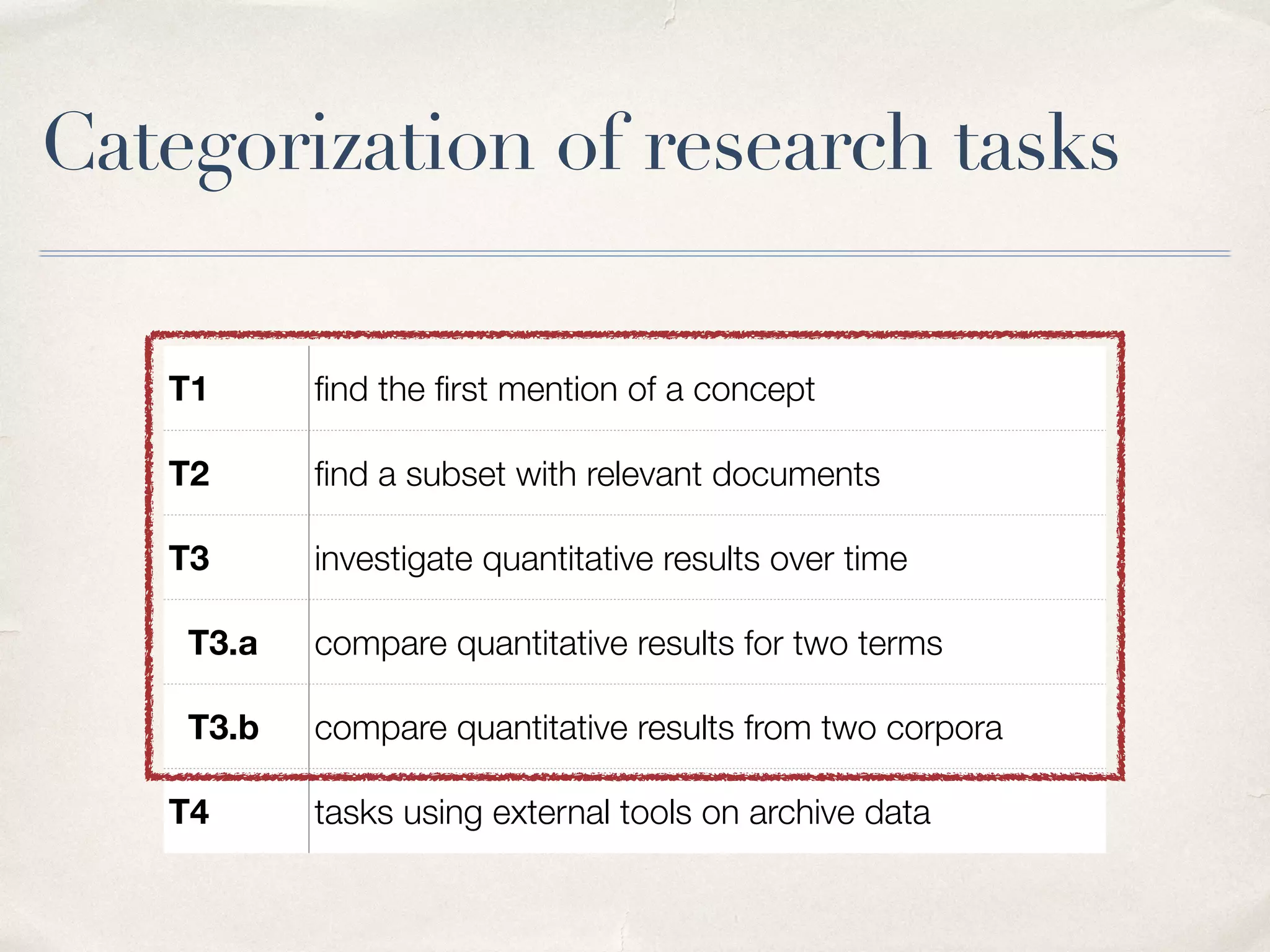
Categorization of research tasks
T1 find the first mention of a concept
T2 find a subset with relevant documents
T3 investigate quantitative results over time
T3.a compare quantitative results for two terms
T3.b compare quantitative results from two corpora
T4 tasks using external tools on archive data
5
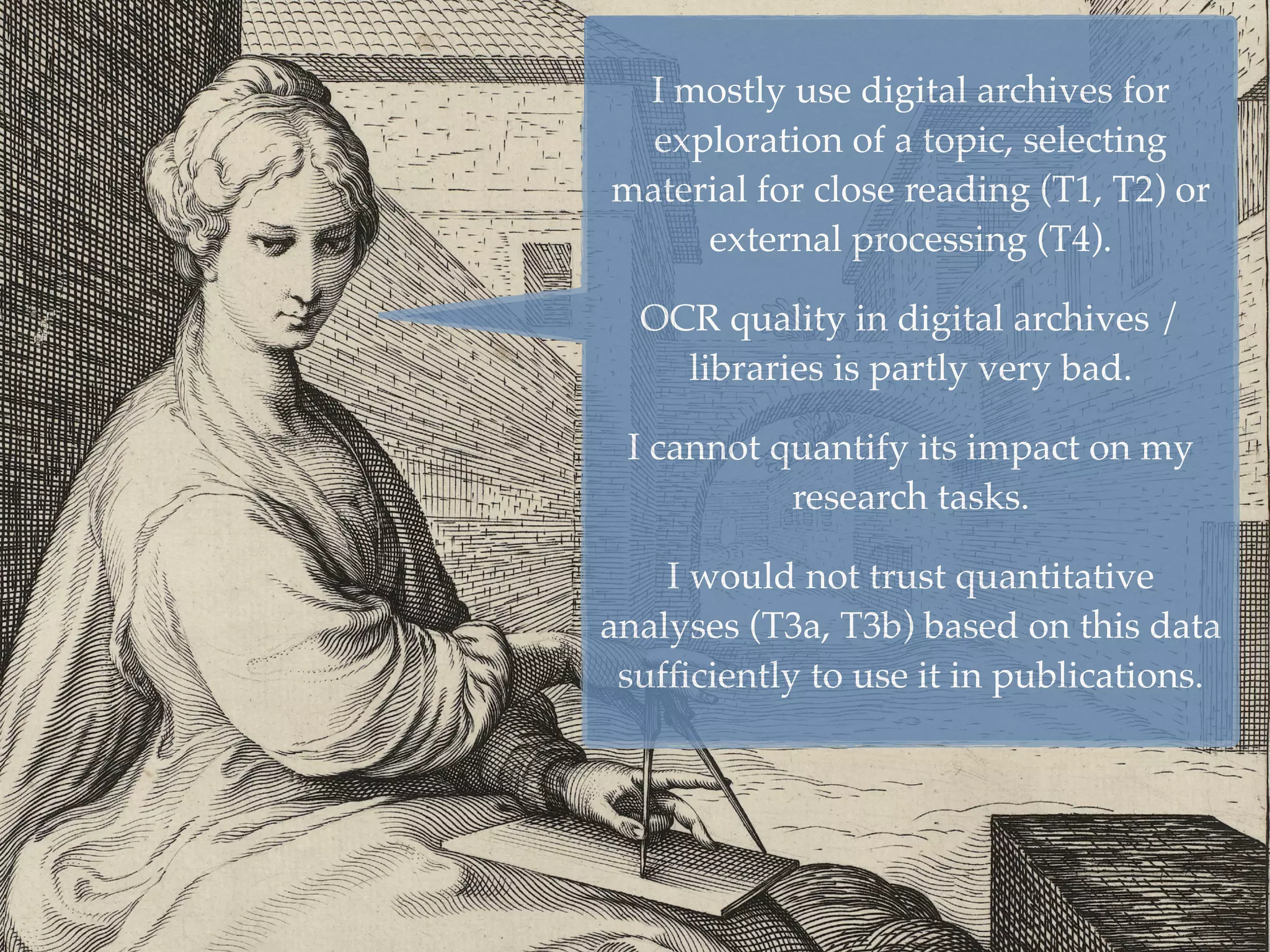
I mostly use digital archives for
exploration of a topic, selecting
material for close reading (T1, T2) or
external processing (T4).
OCR quality in digital archives /
libraries is partly very bad.
I cannot quantify its impact on my
research tasks.
I would not trust quantitative
analyses (T3a, T3b) based on this data
sufficiently to use it in publications.
Literature
✤ OCR quality is addressed from
the perspective of the collection
owner/OCR software developer
✤ Usability studies for digital
libraries
✤ Robustness of search engines
towards OCR errors
✤ Error removal in post-
processing either systematically
or intellectually
6
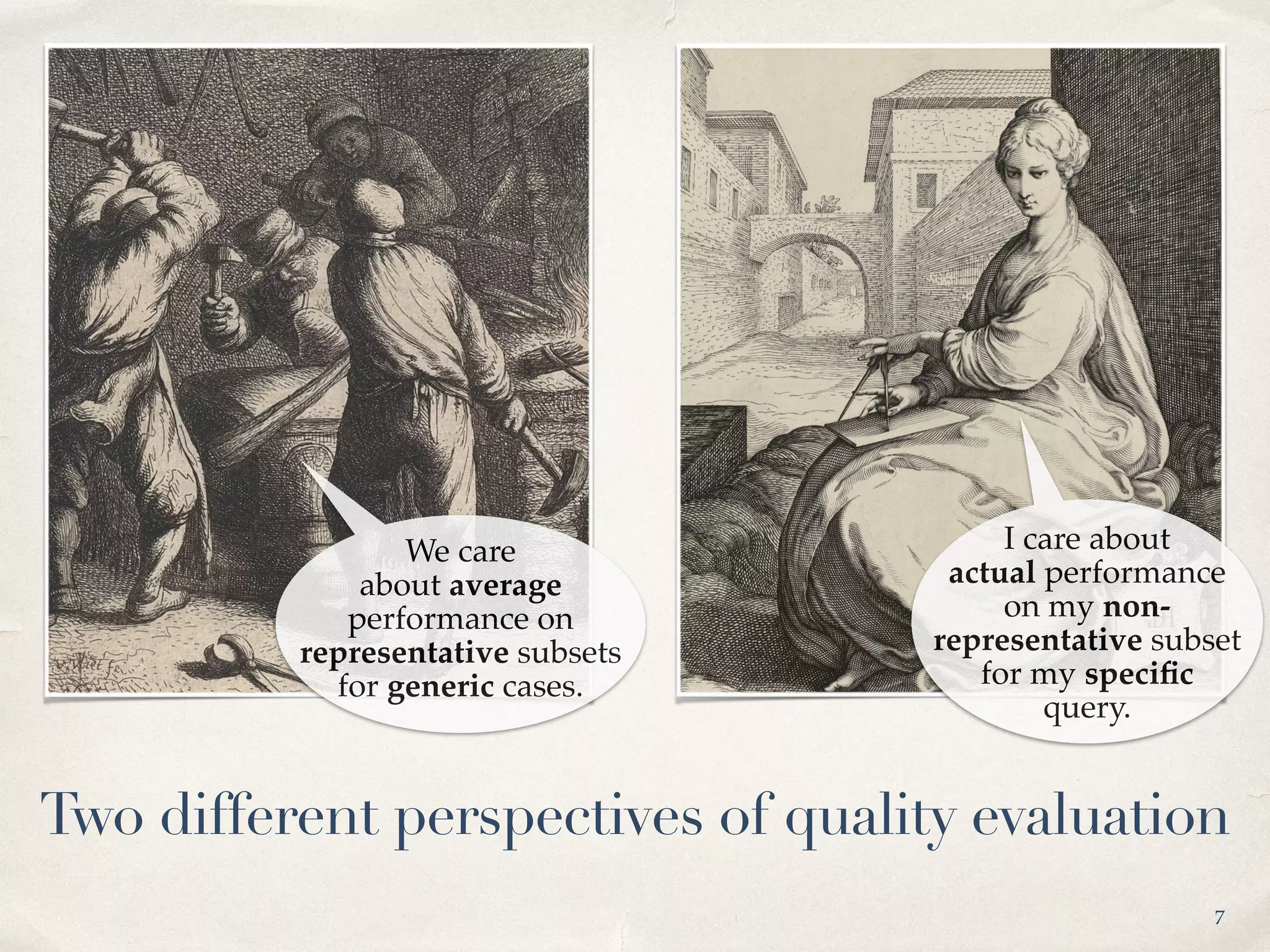
We care
about average
performance on
representative subsets
for generic cases.
I care about
actual performance
on my non-
representative subset
for my specific
query.
7
Two different perspectives of quality evaluation
Use case
✤ Aims:
✤ To study the impact on
research tasks in detail
✤ Identify starting points for
workarounds and/or further
research
✤ Tasks T1 - T3
8
T1: Finding the
first mention
✤ Key requirement: recall
✤ 100% recall is unrealistic
✤ Aim: Find out how a scholar
can assess the reliability of
results
9
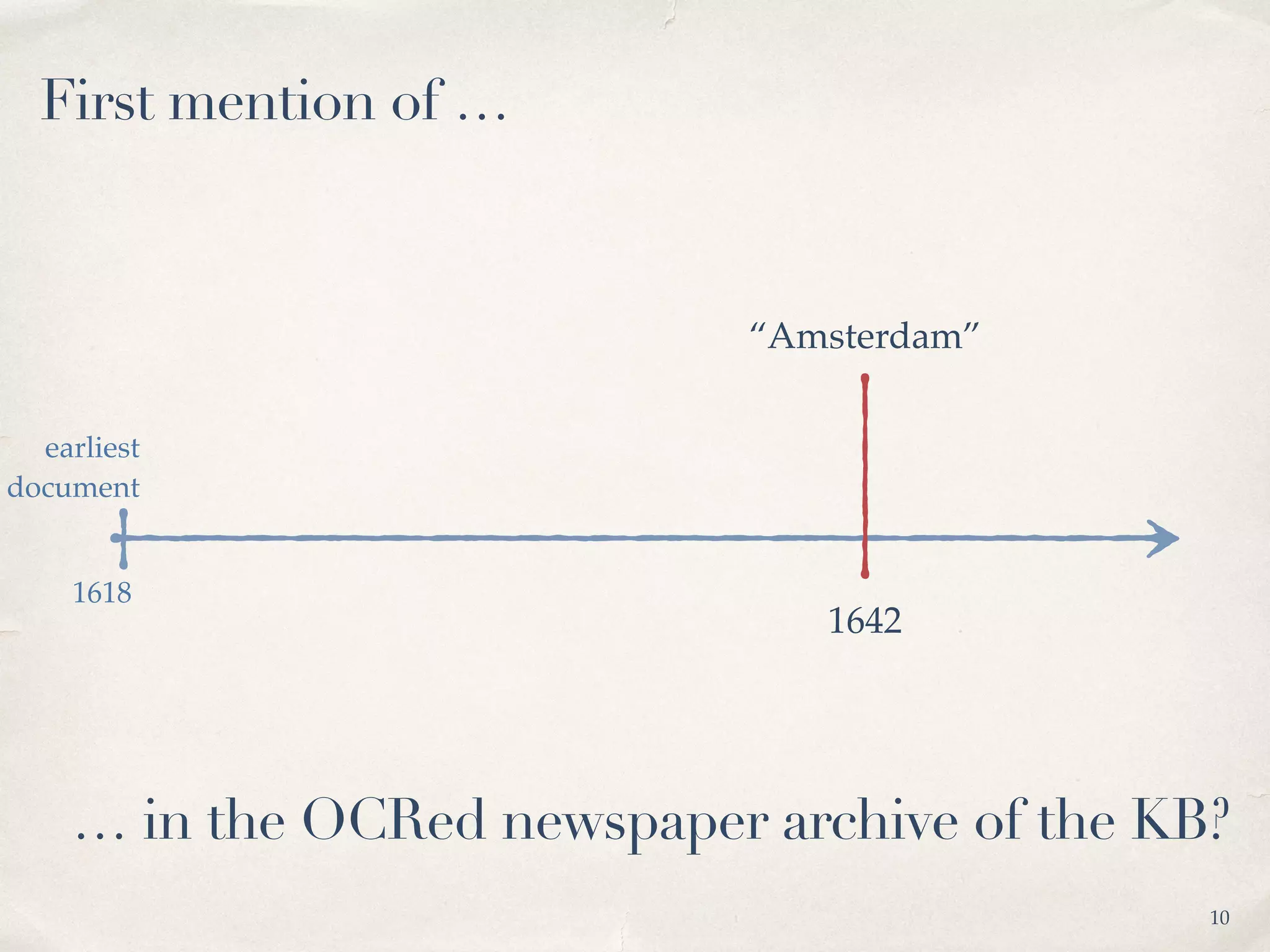
“Amsterdam”
1642
10
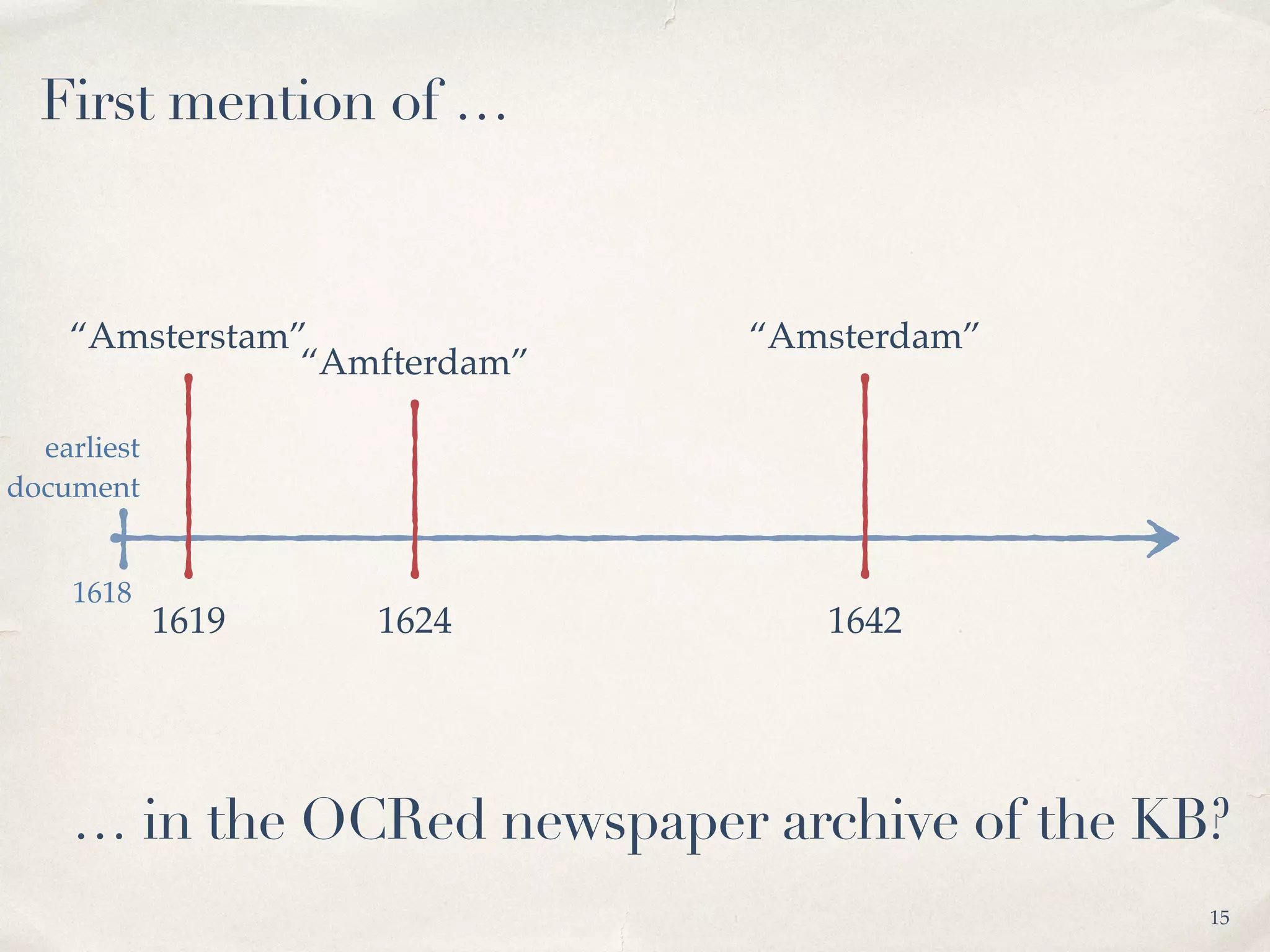
First mention of …
… in the OCRed newspaper archive of the KB?
1618
earliest
document
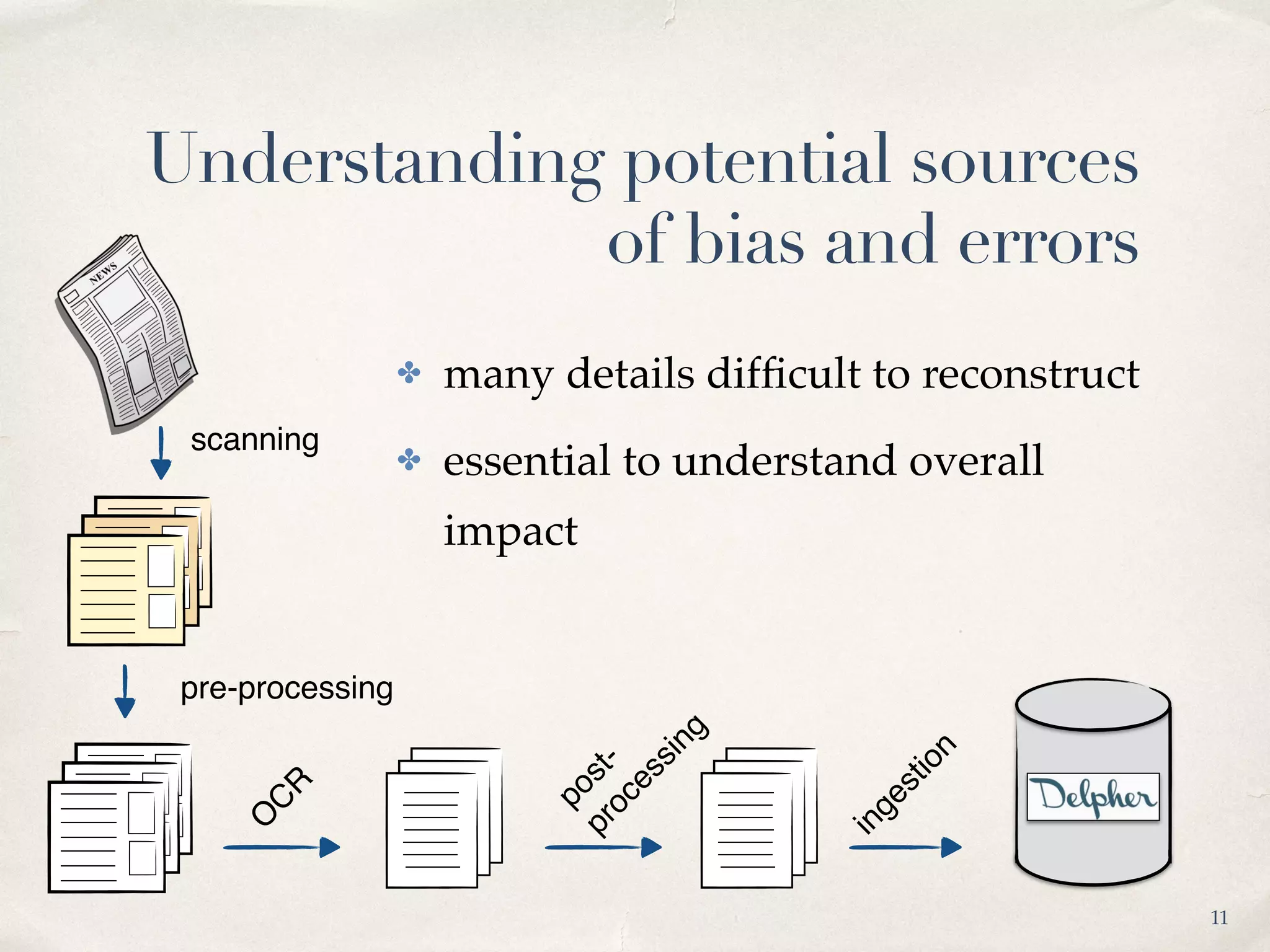
O
C
R
pre-processing
post-processing
ingestion
scanning
11
Understanding potential sources
of bias and errors
✤ many details difficult to reconstruct
✤ essential to understand overall
impact
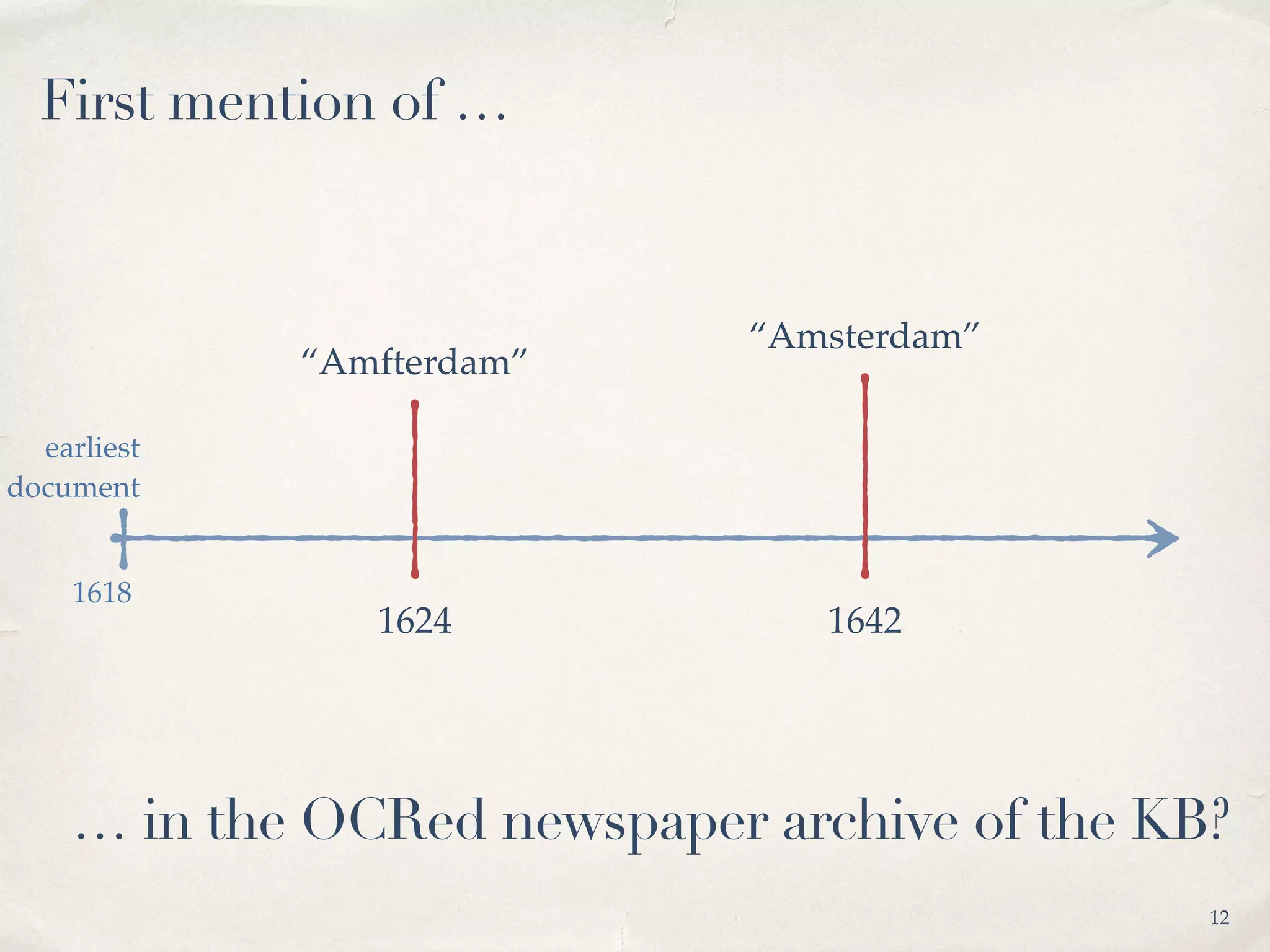
“Amsterdam”
1642
12
First mention of …
… in the OCRed newspaper archive of the KB?
1618
earliest
document
“Amfterdam”
1624
01
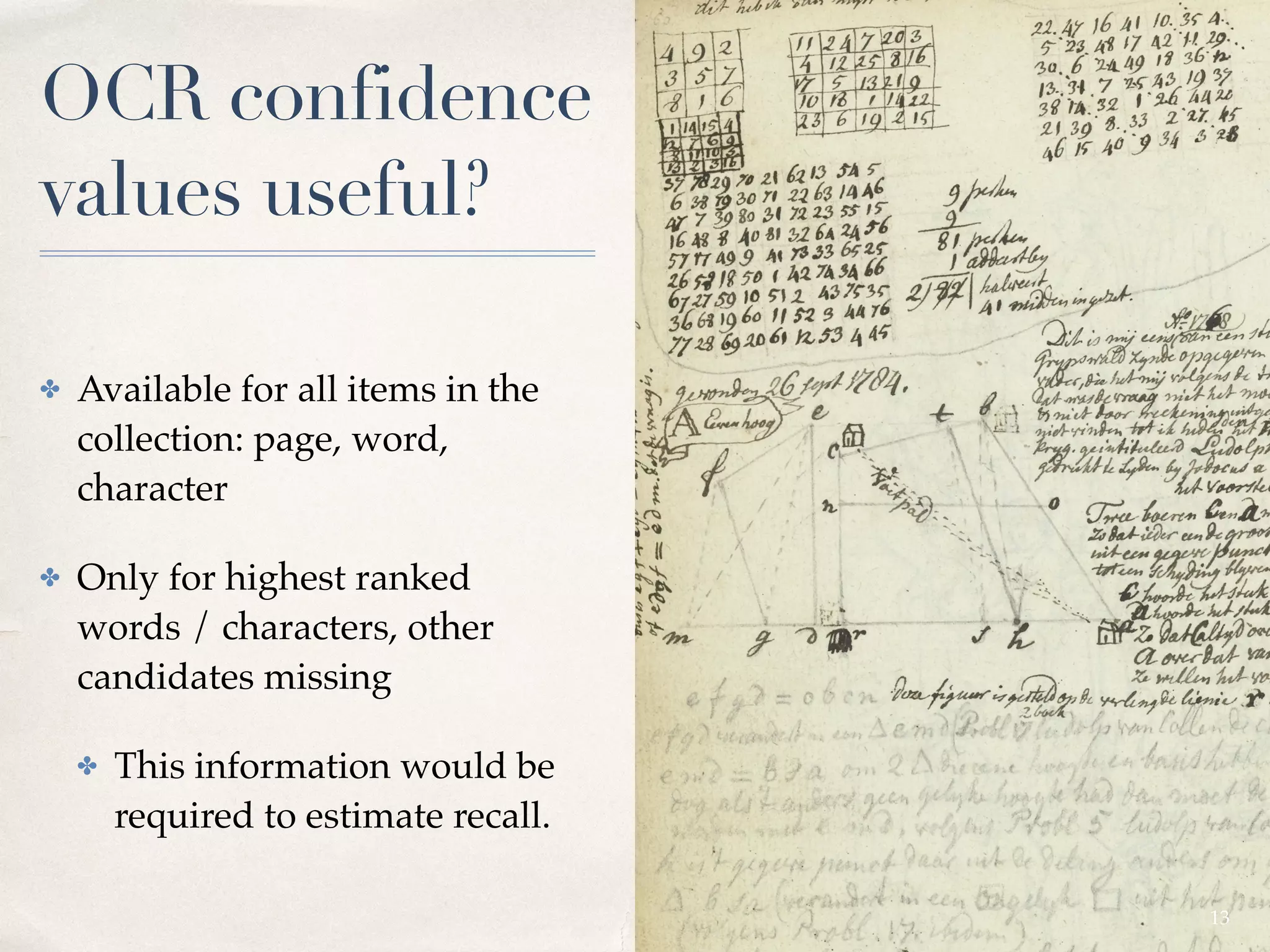
OCR confidence
values useful?
✤ Available for all items in the
collection: page, word,
character
✤ Only for highest ranked
words / characters, other
candidates missing
✤ This information would be
required to estimate recall.
13
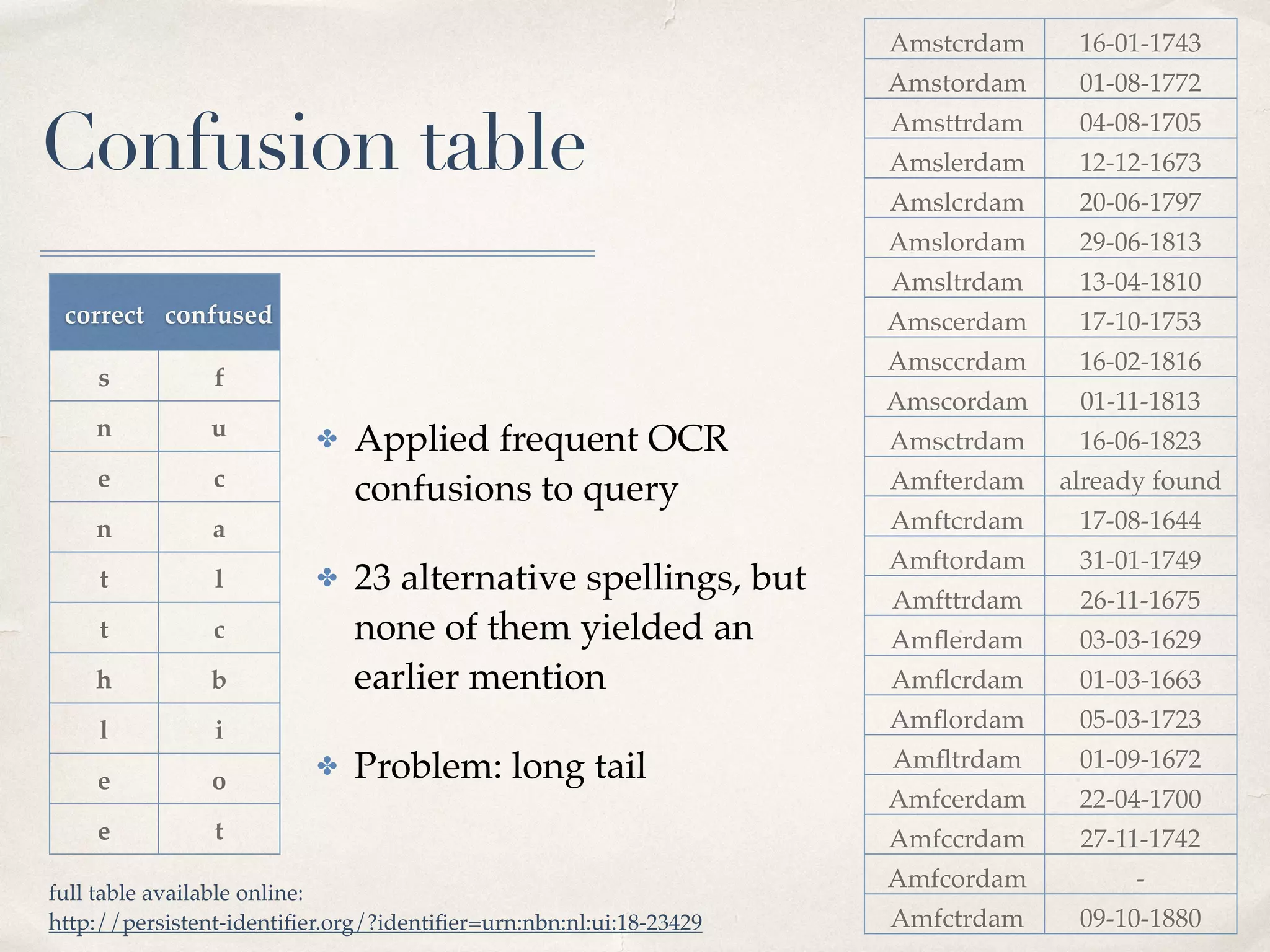
Confusion table
✤ Applied frequent OCR
confusions to query
✤ 23 alternative spellings, but
none of them yielded an
earlier mention
✤ Problem: long tail
Amstcrdam 16-01-1743
Amstordam 01-08-1772
Amsttrdam 04-08-1705
Amslerdam 12-12-1673
Amslcrdam 20-06-1797
Amslordam 29-06-1813
Amsltrdam 13-04-1810
Amscerdam 17-10-1753
Amsccrdam 16-02-1816
Amscordam 01-11-1813
Amsctrdam 16-06-1823
Amfterdam already found
Amftcrdam 17-08-1644
Amftordam 31-01-1749
Amfttrdam 26-11-1675
Amflerdam 03-03-1629
Amflcrdam 01-03-1663
Amflordam 05-03-1723
Amfltrdam 01-09-1672
Amfcerdam 22-04-1700
Amfccrdam 27-11-1742
Amfcordam -
Amfctrdam 09-10-1880
correct confused
s f
n u
e c
n a
t l
t c
h b
l i
e o
e t
full table available online:
http://persistent-identifier.org/?identifier=urn:nbn:nl:ui:18-23429
“Amsterdam”
1642
“Amfterdam”
1624
“Amsterstam”
1619
15
First mention of …
1618
… in the OCRed newspaper archive of the KB?
earliest
document
“Amsterdam”
1642
“Amfterdam”
1624
“Amsterstam”
1619
16
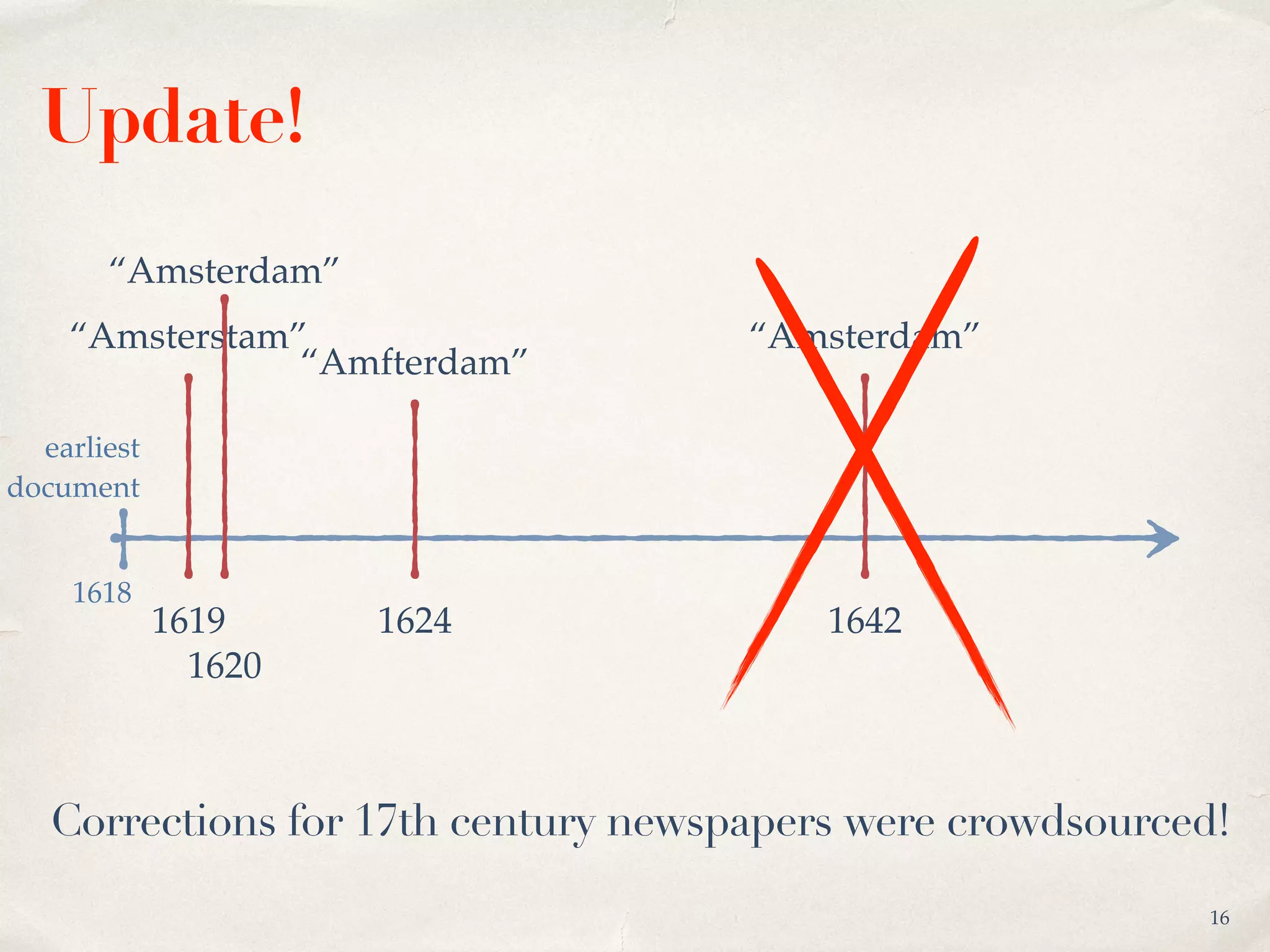
Update!
1618
Corrections for 17th century newspapers were crowdsourced!
earliest
document
“Amsterdam”
1620
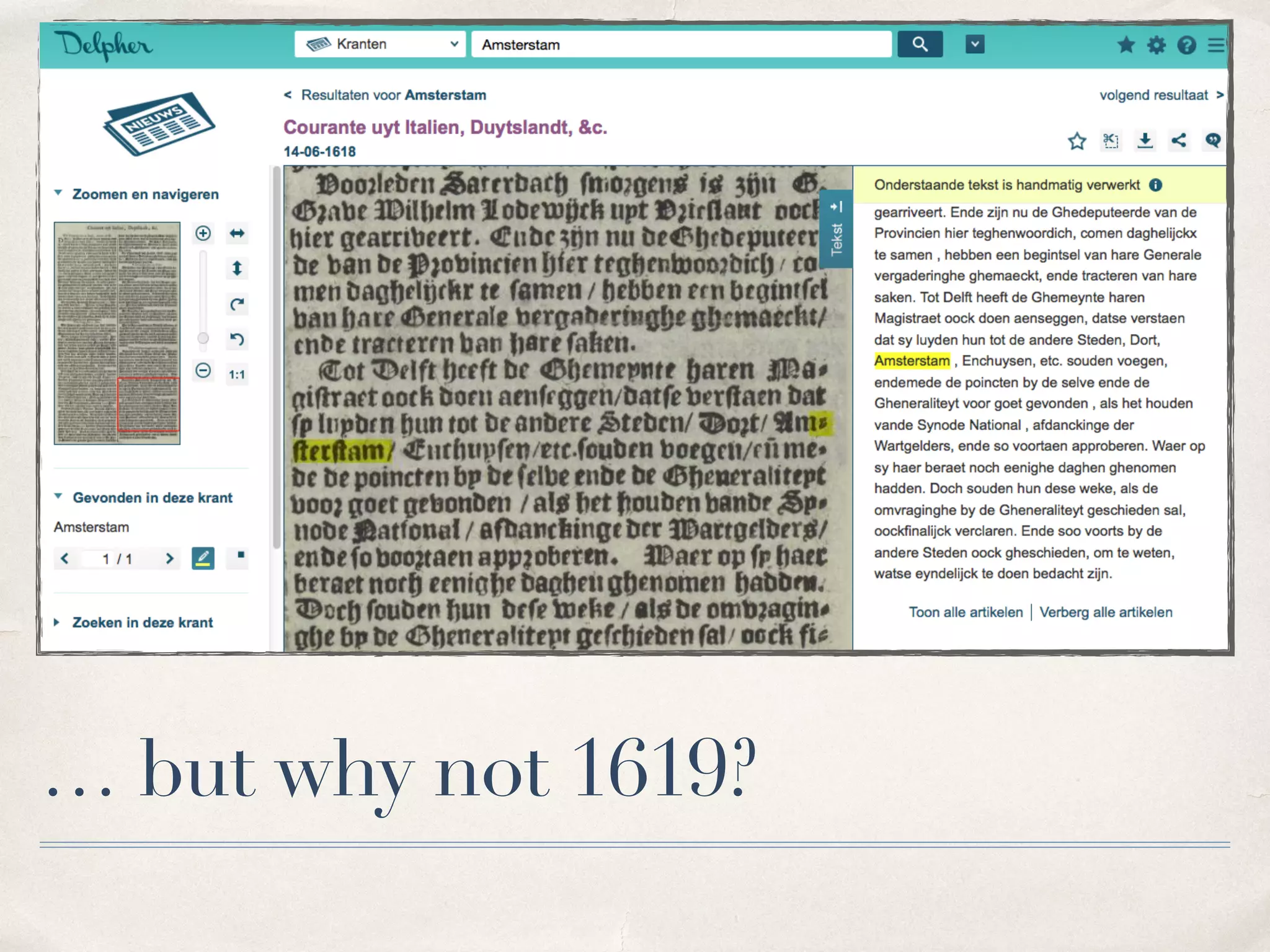
… but why not 1619?
Confusion Matrix OCR Confidence
Values
Alternative
Confidence
Values
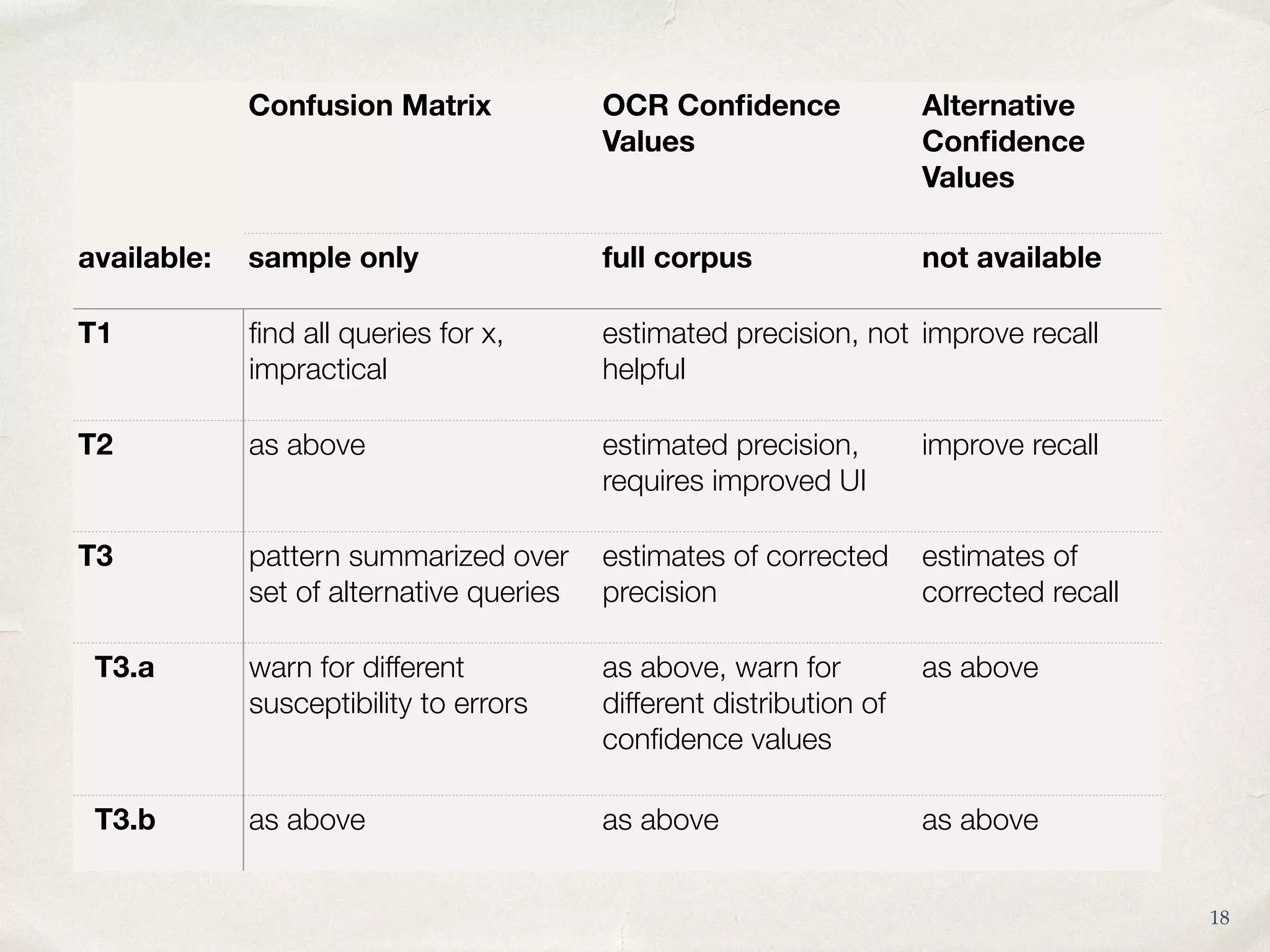
available: sample only full corpus not available
T1 find all queries for x,
impractical
estimated precision, not
helpful
improve recall
T2 as above estimated precision,
requires improved UI
improve recall
T3 pattern summarized over
set of alternative queries
estimates of corrected
precision
estimates of
corrected recall
T3.a warn for different
susceptibility to errors
as above, warn for
different distribution of
confidence values
as above
T3.b as above as above as above
18
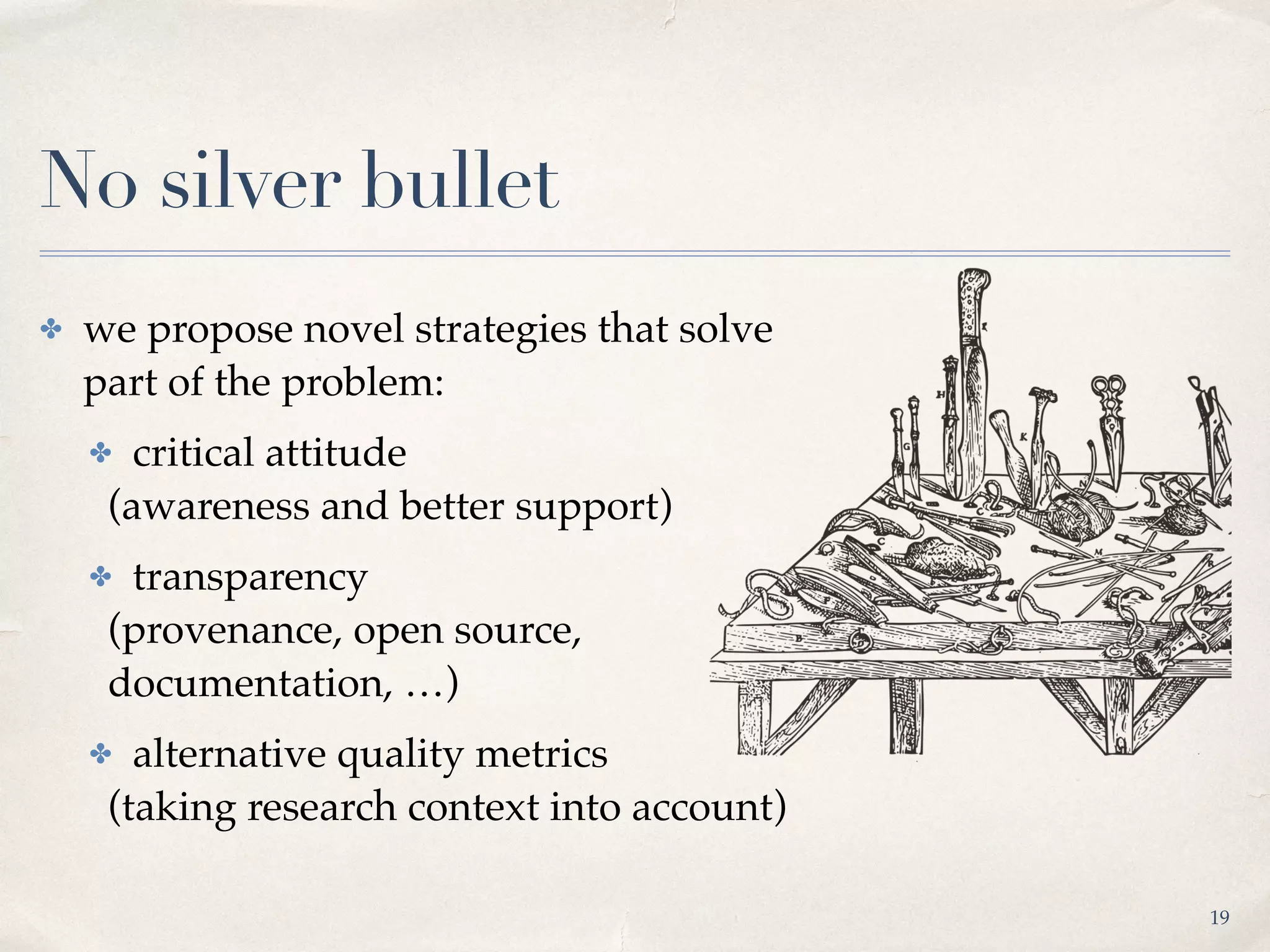
No silver bullet
✤ we propose novel strategies that solve
part of the problem:
✤ critical attitude
(awareness and better support)
✤ transparency
(provenance, open source,
documentation, …)
✤ alternative quality metrics
(taking research context into account)
19
Conclusions
Problems
✤ Scholars see OCR
quality as a serious
problem, but cannot
assess its impact
✤ OCR technology is
unlikely to be perfect
✤ OCR errors are
reported in terms of
averages measured
over representative
samples
✤ Impact on a specific
research task cannot
be assessed based on
average error metrics
Start of solutions
✤ Impact of OCR is
different for different
research tasks, so
these tasks need to
made be explicit
✤ OCR errors often
assumed to be
random but are often
partly systematic
✤ Tool pipelines and
their limitations need
to be transparent &
better documented
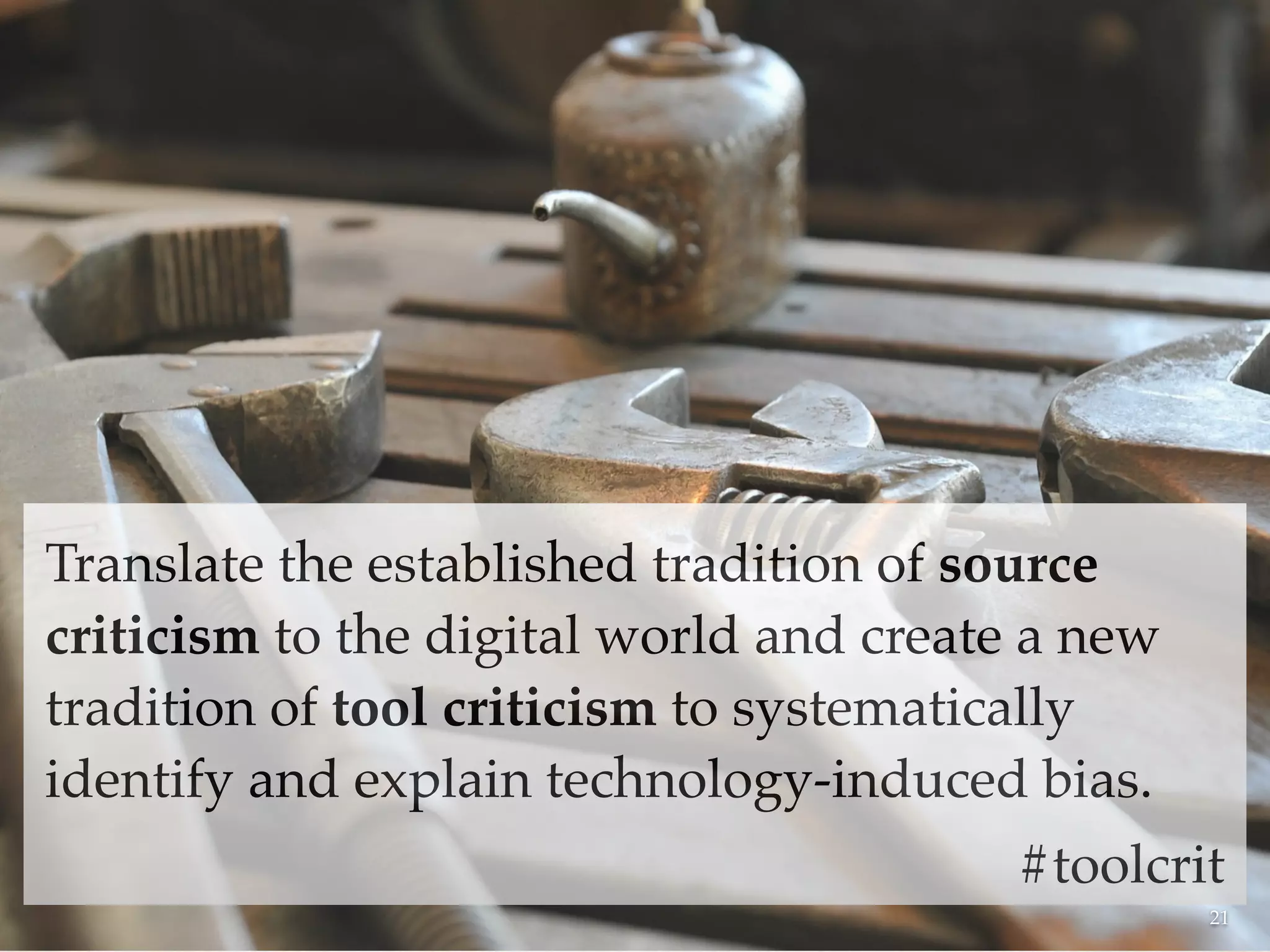
Translate the established tradition of source
criticism to the digital world and create a new
tradition of tool criticism to systematically
identify and explain technology-induced bias.
#toolcrit
21

Impact Analysis of OCR Quality on Research Tasks in Digital Archives

  • 1.
    Impact Analysis ofOCR Quality on ResearchTasks in Digital Archives Myriam C. Traub, Jacco van Ossenbruggen, Lynda Hardman Centrum Wiskunde & Informatica, Amsterdam
  • 2.
    Context ✤ Research incollaboration with the National Library of The Netherlands ✤ Digital newspaper archive: ✤ 10 million pages covering 1618 to 1995 ✤ +/- 1200 newspaper titles ✤ Available data: scanned image of the page, OCRed text and metadata records 2
  • 3.
    Interviews ✤ Aim: ✤ Findout what types of research tasks scholars perform on digital archives ✤ Which quantitative / distant reading tasks are not (sufficiently) supported ✤ Scholars with experience in performing historical research on digital archives 3
  • 4.
    Categorization of researchtasks T1 find the first mention of a concept T2 find a subset with relevant documents T3 investigate quantitative results over time T3.a compare quantitative results for two terms T3.b compare quantitative results from two corpora T4 tasks using external tools on archive data
  • 5.
    5 I mostly usedigital archives for exploration of a topic, selecting material for close reading (T1, T2) or external processing (T4). OCR quality in digital archives / libraries is partly very bad. I cannot quantify its impact on my research tasks. I would not trust quantitative analyses (T3a, T3b) based on this data sufficiently to use it in publications.
  • 6.
    Literature ✤ OCR qualityis addressed from the perspective of the collection owner/OCR software developer ✤ Usability studies for digital libraries ✤ Robustness of search engines towards OCR errors ✤ Error removal in post- processing either systematically or intellectually 6
  • 7.
    We care about average performanceon representative subsets for generic cases. I care about actual performance on my non- representative subset for my specific query. 7 Two different perspectives of quality evaluation
  • 8.
    Use case ✤ Aims: ✤To study the impact on research tasks in detail ✤ Identify starting points for workarounds and/or further research ✤ Tasks T1 - T3 8
  • 9.
    T1: Finding the firstmention ✤ Key requirement: recall ✤ 100% recall is unrealistic ✤ Aim: Find out how a scholar can assess the reliability of results 9
  • 10.
    “Amsterdam” 1642 10 First mention of… … in the OCRed newspaper archive of the KB? 1618 earliest document
  • 11.
    O C R pre-processing post-processing ingestion scanning 11 Understanding potential sources ofbias and errors ✤ many details difficult to reconstruct ✤ essential to understand overall impact
  • 12.
    “Amsterdam” 1642 12 First mention of… … in the OCRed newspaper archive of the KB? 1618 earliest document “Amfterdam” 1624
  • 13.
    01 OCR confidence values useful? ✤Available for all items in the collection: page, word, character ✤ Only for highest ranked words / characters, other candidates missing ✤ This information would be required to estimate recall. 13
  • 14.
    Confusion table ✤ Appliedfrequent OCR confusions to query ✤ 23 alternative spellings, but none of them yielded an earlier mention ✤ Problem: long tail Amstcrdam 16-01-1743 Amstordam 01-08-1772 Amsttrdam 04-08-1705 Amslerdam 12-12-1673 Amslcrdam 20-06-1797 Amslordam 29-06-1813 Amsltrdam 13-04-1810 Amscerdam 17-10-1753 Amsccrdam 16-02-1816 Amscordam 01-11-1813 Amsctrdam 16-06-1823 Amfterdam already found Amftcrdam 17-08-1644 Amftordam 31-01-1749 Amfttrdam 26-11-1675 Amflerdam 03-03-1629 Amflcrdam 01-03-1663 Amflordam 05-03-1723 Amfltrdam 01-09-1672 Amfcerdam 22-04-1700 Amfccrdam 27-11-1742 Amfcordam - Amfctrdam 09-10-1880 correct confused s f n u e c n a t l t c h b l i e o e t full table available online: http://persistent-identifier.org/?identifier=urn:nbn:nl:ui:18-23429
  • 15.
    “Amsterdam” 1642 “Amfterdam” 1624 “Amsterstam” 1619 15 First mention of… 1618 … in the OCRed newspaper archive of the KB? earliest document
  • 16.
    “Amsterdam” 1642 “Amfterdam” 1624 “Amsterstam” 1619 16 Update! 1618 Corrections for 17thcentury newspapers were crowdsourced! earliest document “Amsterdam” 1620
  • 17.
    … but whynot 1619?
  • 18.
    Confusion Matrix OCRConfidence Values Alternative Confidence Values available: sample only full corpus not available T1 find all queries for x, impractical estimated precision, not helpful improve recall T2 as above estimated precision, requires improved UI improve recall T3 pattern summarized over set of alternative queries estimates of corrected precision estimates of corrected recall T3.a warn for different susceptibility to errors as above, warn for different distribution of confidence values as above T3.b as above as above as above 18
  • 19.
    No silver bullet ✤we propose novel strategies that solve part of the problem: ✤ critical attitude (awareness and better support) ✤ transparency (provenance, open source, documentation, …) ✤ alternative quality metrics (taking research context into account) 19
  • 20.
    Conclusions Problems ✤ Scholars seeOCR quality as a serious problem, but cannot assess its impact ✤ OCR technology is unlikely to be perfect ✤ OCR errors are reported in terms of averages measured over representative samples ✤ Impact on a specific research task cannot be assessed based on average error metrics Start of solutions ✤ Impact of OCR is different for different research tasks, so these tasks need to made be explicit ✤ OCR errors often assumed to be random but are often partly systematic ✤ Tool pipelines and their limitations need to be transparent & better documented
  • 21.
    Translate the establishedtradition of source criticism to the digital world and create a new tradition of tool criticism to systematically identify and explain technology-induced bias. #toolcrit 21