MANAKULA VINAYAGAR INSTITUTE OF
TECHNOLOGY
Accredited by NBA & NAAC ‘A’ Grade
MINIPROJECT LAB - ITP63
IMAGE CAPTIONING SYSTEM
TEAM MEMBERS
Sriranjaani. G
Pavithra. K
Sangeetha. R
Subathradevi. P
ABSTRACT
Our project introduces a novel approach to image captioning by
incorporating sound and context.
- Two extensively trained models are combined to achieve improved results.
- Sound recommendations are made based on the image scene, enhancing the
overall user experience.
- Captions are generated using a combination of natural language processing
and state-of-the-art computer vision models.
- Achieved Top 5 accuracy of 67% and Top 1 accuracy of 53%, setting a new
standard in image captioning.
- Our model is the first of its kind to offer this level of accuracy and
innovation.
- This approach has significant implications for visually impaired individuals,
providing them with a comprehensive and vivid description of the visual
content.
2
INTRODUCTION
Image captioning generates descriptive and contextually relevant captions for
images. It combines computer vision and natural language processing
(NLP).The goal of our project is to bridge the gap between visual and textual
information. It utilizes deep learning techniques and advanced neural network
architectures. The CNNs extract visual features, while RNNs or transformers
generate captions. Advancements in machine learning and large datasets have
driven progress. Challenges include capturing fine-grained details, handling
complex scenes, and addressing biases. Techniques like attention mechanisms,
reinforcement learning, and multimodal learning are being explored. Image
captioning finds applications in image understanding, assistive technologies,
content retrieval, and social media. The existing image captioning systems
generate textual captions for images using deep learning models, combining
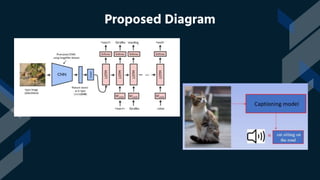
computer vision and NLP techniques. The proposed system aims to enhance
image captioning by incorporating audio information, allowing for more
comprehensive and contextually rich captions that capture both visual and
auditory aspects of the scene.
3
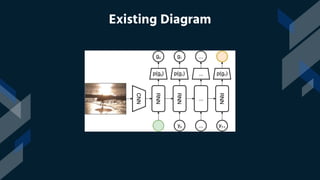
Existing Diagram
Proposed Diagram
Hardware Requirements
6
• Processor Intel i5 Processor or higher
• RAM 8GB (or) higher
• Hard disk 256SSD
• System Requirements Laptop (or) PC
Software Requirements
• Deep Learning Frameworks
• Speech Recognition Libraries
• Image Processing Libraries
• Natural Language Processing Libraries
• Streamlit frameworks
7
UML Diagram
8
• USE CASE DIAGRAM
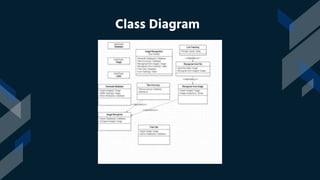
• CLASS DIAGRAM
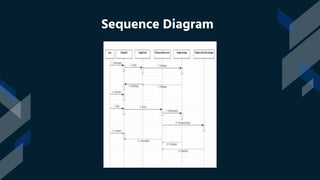
• SEQUENCE DIAGRAM
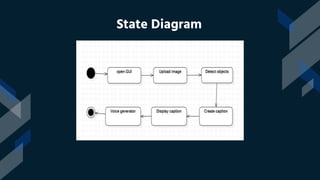
• STATE DIAGRAM
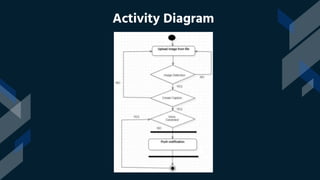
• ACTIVITY DIAGRAM
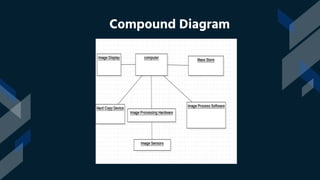
• COMPOUND DIAGRAM
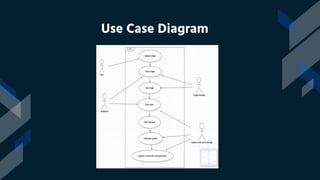
Use Case Diagram
Class Diagram
Sequence Diagram
State Diagram
Activity Diagram
Compound Diagram
ADVANTAGES
› Enhanced understanding
› Accessibility
› Searchability
› Content indexing and retrieval
› Natural language communication
› Multilingualism
› Educational and training purposes
15
Input
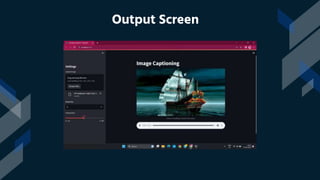
Output Screen
conclusion
18
Our project represents an innovation in the field,
leveraging both visual and auditory information to
generate more comprehensive and contextually rich
captions. By combining deep learning techniques,
including neural network architectures and audio
processing, we have enhanced the average accuracy of
67%, contextuality, and accessibility of image captions.
Our solution addresses challenges in capturing,
understanding of images. With applications ranging from
assisting visually impaired individuals to improving
image search and retrieval, we are proud to offer a
versatile and impactful tool that enhances content
understanding, fosters inclusive human-computer
interaction, and opens up new possibilities for leveraging
the power of visual and audio information.
Future Works
19
In our project we enhanced an image with audio
generation. It can be improved by using automation in
image as well as video. It will be helpful in many
multimedia platforms. So, for in this project, the text
description is in English, it can be developed as a
multilanguage description in order to overcome the
language issues. The integration of audio in image
captioning can also improve the accuracy and richness of
the generated captions, as the audio information can
complement and supplement the visual cues captured in
the image.
THANK YOU

image caption lab and captioning system with pptx

  • 1.
    MANAKULA VINAYAGAR INSTITUTEOF TECHNOLOGY Accredited by NBA & NAAC ‘A’ Grade MINIPROJECT LAB - ITP63 IMAGE CAPTIONING SYSTEM TEAM MEMBERS Sriranjaani. G Pavithra. K Sangeetha. R Subathradevi. P
  • 2.
    ABSTRACT Our project introducesa novel approach to image captioning by incorporating sound and context. - Two extensively trained models are combined to achieve improved results. - Sound recommendations are made based on the image scene, enhancing the overall user experience. - Captions are generated using a combination of natural language processing and state-of-the-art computer vision models. - Achieved Top 5 accuracy of 67% and Top 1 accuracy of 53%, setting a new standard in image captioning. - Our model is the first of its kind to offer this level of accuracy and innovation. - This approach has significant implications for visually impaired individuals, providing them with a comprehensive and vivid description of the visual content. 2
  • 3.
    INTRODUCTION Image captioning generatesdescriptive and contextually relevant captions for images. It combines computer vision and natural language processing (NLP).The goal of our project is to bridge the gap between visual and textual information. It utilizes deep learning techniques and advanced neural network architectures. The CNNs extract visual features, while RNNs or transformers generate captions. Advancements in machine learning and large datasets have driven progress. Challenges include capturing fine-grained details, handling complex scenes, and addressing biases. Techniques like attention mechanisms, reinforcement learning, and multimodal learning are being explored. Image captioning finds applications in image understanding, assistive technologies, content retrieval, and social media. The existing image captioning systems generate textual captions for images using deep learning models, combining computer vision and NLP techniques. The proposed system aims to enhance image captioning by incorporating audio information, allowing for more comprehensive and contextually rich captions that capture both visual and auditory aspects of the scene. 3
  • 4.
  • 5.
  • 6.
    Hardware Requirements 6 • ProcessorIntel i5 Processor or higher • RAM 8GB (or) higher • Hard disk 256SSD • System Requirements Laptop (or) PC
  • 7.
    Software Requirements • DeepLearning Frameworks • Speech Recognition Libraries • Image Processing Libraries • Natural Language Processing Libraries • Streamlit frameworks 7
  • 8.
    UML Diagram 8 • USECASE DIAGRAM • CLASS DIAGRAM • SEQUENCE DIAGRAM • STATE DIAGRAM • ACTIVITY DIAGRAM • COMPOUND DIAGRAM
  • 9.
  • 10.
  • 11.
  • 12.
  • 13.
  • 14.
  • 15.
    ADVANTAGES › Enhanced understanding ›Accessibility › Searchability › Content indexing and retrieval › Natural language communication › Multilingualism › Educational and training purposes 15
  • 16.
  • 17.
  • 18.
    conclusion 18 Our project representsan innovation in the field, leveraging both visual and auditory information to generate more comprehensive and contextually rich captions. By combining deep learning techniques, including neural network architectures and audio processing, we have enhanced the average accuracy of 67%, contextuality, and accessibility of image captions. Our solution addresses challenges in capturing, understanding of images. With applications ranging from assisting visually impaired individuals to improving image search and retrieval, we are proud to offer a versatile and impactful tool that enhances content understanding, fosters inclusive human-computer interaction, and opens up new possibilities for leveraging the power of visual and audio information.
  • 19.
    Future Works 19 In ourproject we enhanced an image with audio generation. It can be improved by using automation in image as well as video. It will be helpful in many multimedia platforms. So, for in this project, the text description is in English, it can be developed as a multilanguage description in order to overcome the language issues. The integration of audio in image captioning can also improve the accuracy and richness of the generated captions, as the audio information can complement and supplement the visual cues captured in the image.
  • 20.