IFRS 16 Lease Accounting Changes
The Internal Accounting Standards Board (IASB) and Financial Accounting Standards Board
(FASB) released new global lease accounting standards in Q1 2016. The changes have huge
implications for all companies with leases and those that file financial statements, as leases will become a
key feature on company balance sheets. For most companies the new guidance is effective January
2019, a comparative two year look-back would be January 2017.
The Impact
 Profit & loss analysis will be significantly different from today
 Key financial metrics reported by companies such as EBITDA, ROA and Debt-Equity ratio, will be
impacted
 Significant administrative and reporting requirements will be put into effect
Balance Sheet
 Identifying embedded leases is important to avoid misstating the balance sheet. The general rule
under the new model is that an arrangement contains a lease if (1) there is an explicit or implicit
asset in the contract, and (2) the customer controls use of the asset. Changing certain contract
terms may change the conclusion regarding whether an arrangement contains an embedded
lease.
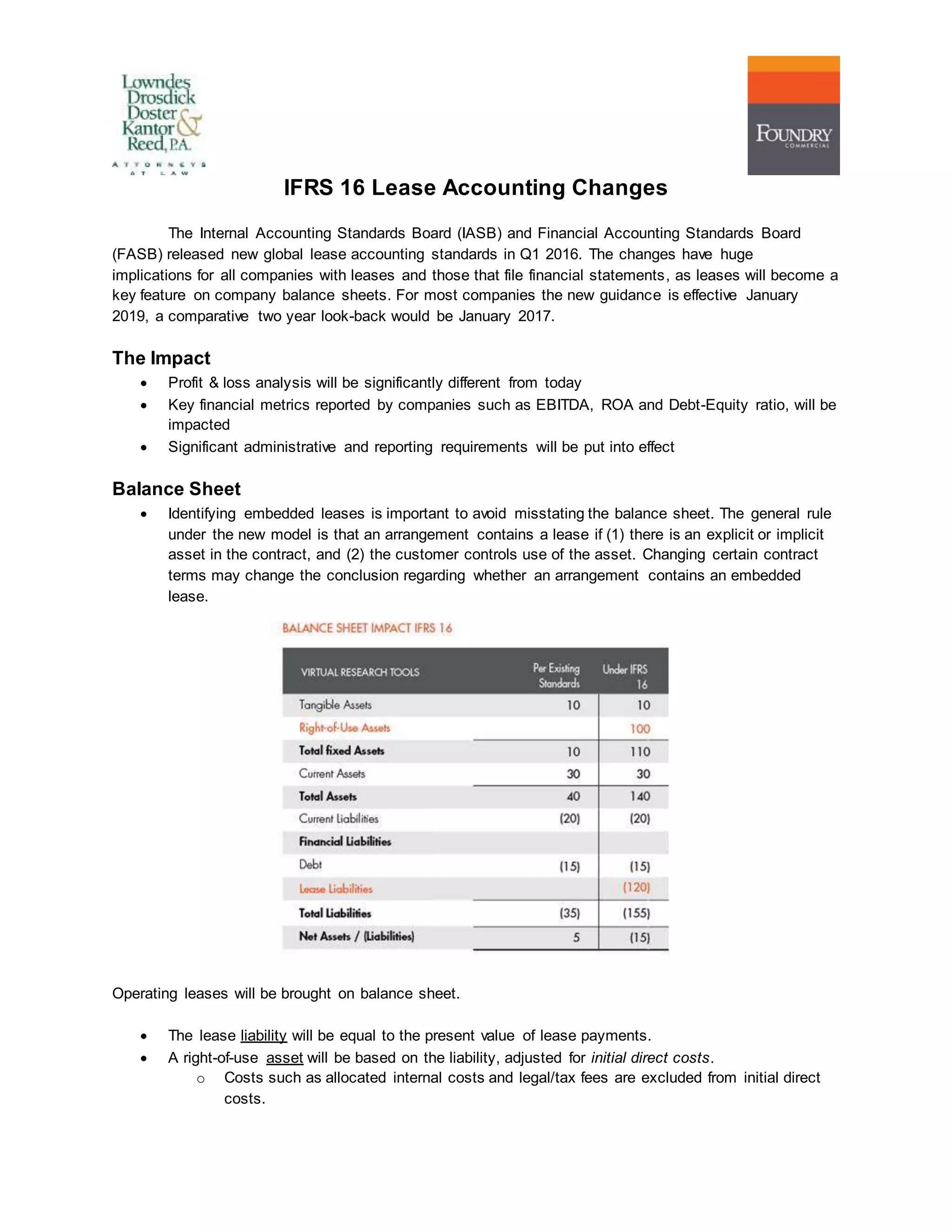
Operating leases will be brought on balance sheet.
 The lease liability will be equal to the present value of lease payments.
 A right-of-use asset will be based on the liability, adjusted for initial direct costs.
o Costs such as allocated internal costs and legal/tax fees are excluded from initial direct
costs.
Lease Term Includes:
 Non-cancellable lease term
 Renewal periods that are reasonably certain to be exercised by the lessee or within the control of
the lessor
 Periods covered by an option to terminate the lease that the lessee is reasonably certain to not
exercise
Lease Modifications
 A lease modification may be accounted for as a modification to the original lease or as the
creation of a separate lease.
 A lessee will only reassess variable lease payments that depend on an index or rate when the
lease liability is re-measured for another reason independent of a change in a reference index or
rate.
 A lessor should not reassess the lease term or a lessee option to purchase the asset unless the
lease is modified and that modification is not accounted for as a separate lease.
Transition
 Owners & landlords can expect lessees to ask for shorter lease terms and more renewal options.
o Attorneys need to be prepared to discuss what lease duration will best serve the needs of
the client.
 Companies may want to revisit their lease-versus-buy decision criteria.
 Leasing software and systems may require upgrades and enhancements, which may require a
significant runway to adequately prepare for transition.
Preparation Should Start Today
 Attorneys need to stress the importance of beginning preparation to come into compliance with
the new standards today. Companies with hundreds or thousands of leases on the books will face
thousands of hours in preparing financial statements to match the new standards.
References
http://www.fasb.org/jsp/FASB/Document_C/DocumentPage?cid=1176167901010&acceptedDis claimer=tr
ue
http://www.fasb.org/jsp/FASB/Page/BridgePage&cid=1351027207574
http://www.pwc.com/us/en/cfodirect/assets/pdf/accounting-guides/pwc-lease-accounting-guide.pdf
http://www.pwc.com/us/en/cfodirect/issues/lease-accounting.html

IFRS16

  • 1.
    IFRS 16 LeaseAccounting Changes The Internal Accounting Standards Board (IASB) and Financial Accounting Standards Board (FASB) released new global lease accounting standards in Q1 2016. The changes have huge implications for all companies with leases and those that file financial statements, as leases will become a key feature on company balance sheets. For most companies the new guidance is effective January 2019, a comparative two year look-back would be January 2017. The Impact  Profit & loss analysis will be significantly different from today  Key financial metrics reported by companies such as EBITDA, ROA and Debt-Equity ratio, will be impacted  Significant administrative and reporting requirements will be put into effect Balance Sheet  Identifying embedded leases is important to avoid misstating the balance sheet. The general rule under the new model is that an arrangement contains a lease if (1) there is an explicit or implicit asset in the contract, and (2) the customer controls use of the asset. Changing certain contract terms may change the conclusion regarding whether an arrangement contains an embedded lease. Operating leases will be brought on balance sheet.  The lease liability will be equal to the present value of lease payments.  A right-of-use asset will be based on the liability, adjusted for initial direct costs. o Costs such as allocated internal costs and legal/tax fees are excluded from initial direct costs.
  • 2.
    Lease Term Includes: Non-cancellable lease term  Renewal periods that are reasonably certain to be exercised by the lessee or within the control of the lessor  Periods covered by an option to terminate the lease that the lessee is reasonably certain to not exercise Lease Modifications  A lease modification may be accounted for as a modification to the original lease or as the creation of a separate lease.  A lessee will only reassess variable lease payments that depend on an index or rate when the lease liability is re-measured for another reason independent of a change in a reference index or rate.  A lessor should not reassess the lease term or a lessee option to purchase the asset unless the lease is modified and that modification is not accounted for as a separate lease. Transition  Owners & landlords can expect lessees to ask for shorter lease terms and more renewal options. o Attorneys need to be prepared to discuss what lease duration will best serve the needs of the client.  Companies may want to revisit their lease-versus-buy decision criteria.  Leasing software and systems may require upgrades and enhancements, which may require a significant runway to adequately prepare for transition. Preparation Should Start Today  Attorneys need to stress the importance of beginning preparation to come into compliance with the new standards today. Companies with hundreds or thousands of leases on the books will face thousands of hours in preparing financial statements to match the new standards. References
  • 3.