Guidance for the Private Sector in Emerging Markets
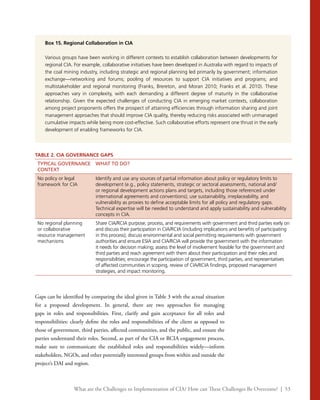
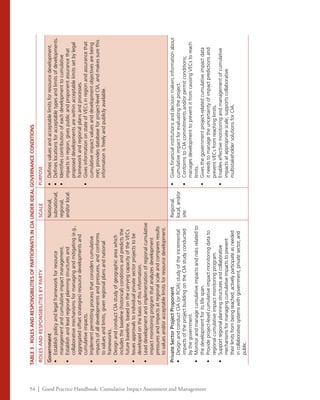
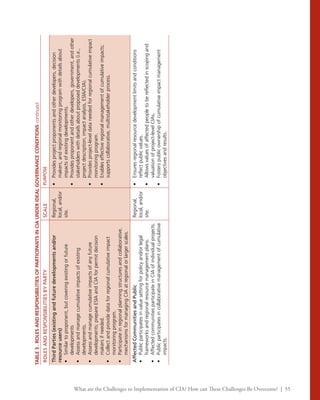
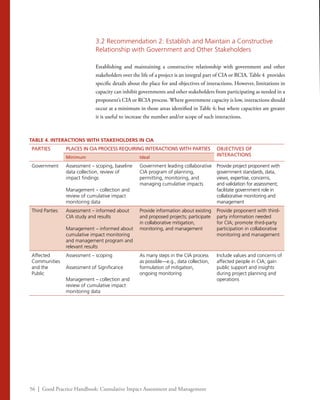
Good Practice Handbook
Cumulative Impact Assessment and Management:
Guidance for the Private Sector in Emerging Markets
Table of Contents | 1
Table of Contents
List of Acronyms..........................................................................................................................................................3
Acknowledgements.......................................................................................................................................................4
Foreword......................................................................................................................................................................5
Executive Summary......................................................................................................................................................7
Introduction...............................................................................................................................................................13
IFC’s Context.............................................................................................................................................................15
Section 1. 	 What is Cumulative Impact Assessment and Management, and Why is it Needed?..........................19
	 1.1 What are Cumulative Impacts?..................................................................................................19
	 1.2 What is Cumulative Impact Assessment and Management?.......................................................21
	 1.3 Under What Conditions Should a CIA be Conducted?.............................................................23
	 1.4 What are the Expected Outcomes of CIA?.................................................................................25
	 1.5 How Does CIA Compare with Other Environmental and Social Risk Management Tools?............... 27
		1.5.1 Comparing ESIAs and CIAs...........................................................................................28
Section 2. 	 What is the Process for Implementing CIA? ......................................................................................33
	 Step 1: 	 Scoping Phase I – VECs, Spatial and Temporal Boundaries.................................................33
	 Step 2: 	 Scoping Phase II – Other Activities and Environmental Drivers..........................................36
	 Step 3: 	 Establish Information on Baseline Status of VECs...............................................................39
	 Step 4: 	 Assess Cumulative Impacts on VECs...................................................................................42
	 Step 5: 	 Assess Significance of Predicted Cumulative Impacts...........................................................46
	 Step 6: 	 Management of Cumulative Impacts – Design and Implementation...................................48
Section 3.	 What are the Challenges to Implementation of CIA? How can these Challenges Be Overcome?......... 51
	 3.1 Recommendation 1: Clarify Roles and Responsibilities...............................................................52
	 3.2 Recommendation 2: Establish and Maintain a Constructive Relationship
	 with Government and Other Stakeholders................................................................................56
Section 4.	 Conclusions.........................................................................................................................................57
2 | Good Practice Handbook: Cumulative Impact Assessment and Management
Boxes
1. 	 Differentiated Approach: Impact Versus Leverage................................................................................................11
2. 	 Demise of the Aral Sea........................................................................................................................................20
3 . 	 Valued Environmental and Social Components...................................................................................................21
4. 	 Hydro Cascade with no Governmental Requirement for CIA..............................................................................26
5. 	 Contrasting Views of the Need for Impact Management.....................................................................................30
6. 	 CIA When Different Project Components are Subject to Separate ESIAs............................................................31
7. 	 Rules of Thumb – How to Set Geographical and Temporal Boundaries...............................................................35
8. 	 Establishing the Spatial Boundary for CIA..........................................................................................................36
9. 	 Cumulative Impacts of Climate and Hydropower................................................................................................37
10. 	Strategic Approach to Assessing Multiple Small Developments (Scoping)............................................................38
11. 	Strategic Approach to Assessing Multiple Small Developments (Analysis)............................................................42
12. 	RCIA of Hydro Impacts on American Eel...........................................................................................................44
13. 	Shared Responsibility for Management of Cumulative Impacts...........................................................................48
14. 	Mitigation of Panama Hydroelectric Developments.............................................................................................50
15. 	Regional Collaboration in CIA............................................................................................................................53
Appendixes
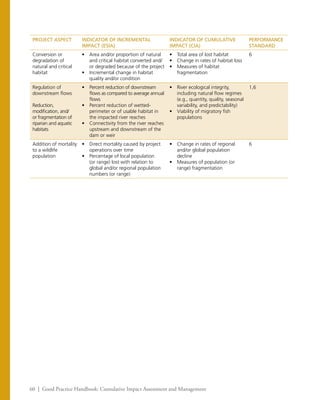
1. 	 Examples of Indicators for Assessing Incremental Project Impacts and Cumulative Impacts.......................................59
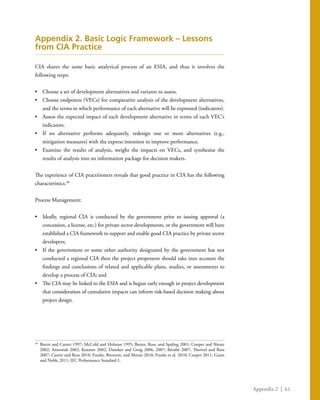
2. 	 Basic Logic Framework – Lessons from CIA Practice...........................................................................................61
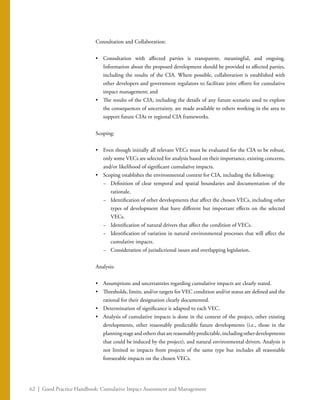
3. 	 Standard Annotated ToR for an RCIA..............................................................................................................................65
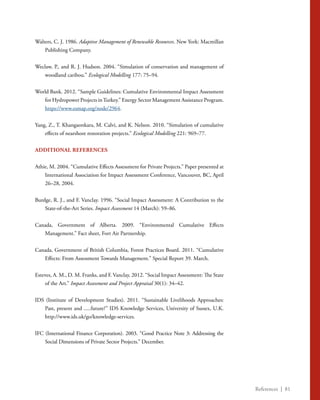
References..................................................................................................................................................................71
List of Acronyms | 3
List of Acronyms
CIA	 Cumulative Impact Assessment and Management
DAI	 Direct Area of Influence
ESIA	 Environmental and Social Impact Assessment
ESMS	 Environmental and Social Management System
GN1	 IFC Guidance Note 1
GPH	 IFC Good Practice Handbook
IBRD	 International Bank for Reconstruction and Development (World Bank)
IFC	 International Finance Corporation
MDB	 Multilateral Development Bank
RCIA	 Rapid Cumulative Impact Assessment and Management
SEA	 Strategic Environmental Assessment
VEC	 Valued Environmental and Social Component
4 | Good Practice Handbook: Cumulative Impact Assessment and Management
Acknowledgments
This Good Practice Handbook, “Cumulative Impact Assessment and Management:
Guidance for the Private Sector in Emerging Markets” (2013) was jointly prepared by
the Environmental, Social, and Governance Department of the International Finance
Corporation (IFC) and ESSA Technologies Ltd., Vancouver, BC, Canada. It was written
by a team led by Pablo Cardinale, IFC Principal Environmental Specialist, and Lorne
Greig, Senior Consultant of ESSA Technologies, under the guidance of Patricia Miller,
IFC’s Chief Sustainability Advisor.
The drafting team was composed of Mauricio Athie, Lakhdeep Babra, Susan Botha, Pablo
Cardinale, Patricia Miller, Justin Pooley, and Eric Shayer from IFC, Lorne Greig and
Samantha Boardley from ESSATechnologies, and their consultants Peter Duinker, Robert
R. Everitt and M. Joan Freeman. In addition, this Good Practice Handbook benefited
significantly from extensive comments from an internal and external peer review process,
which involved diverse people and institutions—too many to acknowledge individually.
However, the drafting team is very thankful for their valuable and insightful comments
and hopes they find their input reflected in this final version.
Finally, we would like to thank the Environment, Social and Governance Department’s
knowledge management team, led by Reidar Kvam, and especially Susan Botha, Amelia
Hui Xin Goh, Dickson Tang, Fiorella Facello, and Rashanika Hayley Fowler, who
consistently and diligently accompanied and supported the development of this Good
Practice Handbook.
Foreword | 5
Foreword
IFC prides itself on contributing to the continuing evolution in environmental and social
impact and risk management practices, as reflected in our Policy and Performance Standards
onEnvironmentalandSocialSustainabilityandregularpublicationsofgoodpracticeguidance.
One of the biggest risk management challenges currently facing project developers
in emerging markets is the appropriate assessment and management of cumulative
impacts and risks related to their business activities. Factors such as climate change and
unpredictability of climate patterns, increasing and competing water use demands, decline
of species biodiversity, degradation of ecosystem services, and changing socio-economic
circumstances all add complexity to risk assessment and management. Potential system-
wide consequences resulting from the combination of individual effects of multiple
actions overtime are particularly important to understand better.
Therefore, it is my pleasure to present this Good Practice Handbook (GPH) on Cumulative
Impact Assessment and Management: Guidance for the Private Sector in Emerging Markets.
This GPH recognizes the important role of governments in preparing cumulative impact
assessment frameworks to assist private sector companies in the identification and
management of cumulative impacts. However, the reality is that these frameworks are
rarely available in emerging markets, and more often it is left to the private developer to
try and take into consideration not only its own contribution to cumulative impacts, but
also other projects and external factors that may place their developments at risk.
IFC expects that the six-step process proposed in this GPH will foster the consolidation
of this evolving good practice globally, and assist private sector companies in emerging
markets to identify their contribution to cumulative impacts and guide them in the
effective design and implementation of measures to manage such cumulative effects.
I hope that this handbook will be found useful by practitioners and others having to deal
with cumulative impacts, and that it contributes further to IFC’s mission of promoting
sustainable private sector development.
William Bulmer
Director
Environment, Social and Governance Department
Executive Summary
ExecutiveSummary
ExecutiveSummary
Executive Summary | 7
Executive Summary
The International Finance Corporation (IFC), the private sector arm of the World Bank
Group, is committed to ensuring that the costs of economic development do not fall
disproportionately on those who are poor or vulnerable. This commitment is implemented
through the January 1, 2012 IFC Policy on Environmental and Social Sustainability and
its corresponding, comprehensive set of eight Performance Standards that define IFC
clients’ responsibilities for managing their environmental and social impacts and risks.
Specifically, Performance Standard 1: Assessment and Management of Environmental
and Social Risks and Impacts recognizes that because of the increasing significance of
systemwide risk factors such as climate change, water availability, decline of species
biodiversity, degradation of ecosystem services, and modification of socioeconomic and
population dynamics, among others, cumulative impact assessment and management
(CIA) is an essential framework for risk management.
Thereseemstobesignificantdebateanddisagreementamongacademics,developers,practitioners,
and civil society organizations about whether CIA should be an integral component of a good
environmental and social impact assessment (ESIA) or a separate stand-alone process.
CIA is evolving and there is no single accepted state of global practice. What is important
is that during the process of identifying environmental and social impacts and risks,
developers or project sponsors (a) recognize that their actions, activities, and projects—
their developments1
—may contribute to cumulative impacts on valued environmental
and social components (VECs)2
on which other existing or future developments may
also have detrimental effects, and (b) avoid and/or minimize these impacts to the greatest
extent possible. Furthermore, their developments may be at risk because of an increase in
cumulative effects over ecosystem services they may depend on.
Good practice requires that, at a minimum, project sponsors assess during the ESIA
process whether their development may contribute to cumulative impacts on VECs and/
or may be at risk from cumulative effects on VECs they depend on.
This Good Practice Handbook proposes as a useful preliminary approach for developers in
emerging markets the conduct of a rapid cumulative impact assessment (RCIA). The RCIA
can be an integral component of the ESIA or a separate process. It entails a desk review that,
1
	 The term development is used throughout this document to refer to projects, actions, or business activities
potentially subject to a CIA.
2
	 See Box 3 for definition of VECs.
8 | Good Practice Handbook: Cumulative Impact Assessment and Management
in consultation with the affected communities and other stakeholders, enables the developer
todeterminewhetheritsactivitiesarelikelytosignificantlyaffecttheviabilityorsustainability
of selected VECs. The proposed approach recognizes that, especially in emerging markets,
the many challenges associated with managing a good CIA process include lack of basic
baseline data, uncertainty associated with anticipated developments, limited government
capacity, and absence of strategic regional, sectoral, or integrated resource planning schemes.
Given the many challenges, this handbook recommends that developers:
•	 follow a six-step RCIA process,
•	 engage stakeholders as early as possible and throughout the decision-making process,3
and
•	 clearly record the fundamental reasoning behind each important decision made,
supporting it with as much technical evidence as possible.
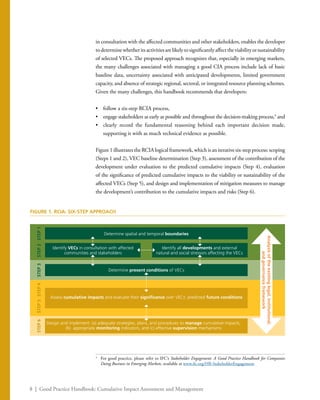
Figure 1 illustrates the RCIA logical framework, which is an iterative six-step process: scoping
(Steps 1 and 2), VEC baseline determination (Step 3), assessment of the contribution of the
development under evaluation to the predicted cumulative impacts (Step 4), evaluation
of the significance of predicted cumulative impacts to the viability or sustainability of the
affected VECs (Step 5), and design and implementation of mitigation measures to manage
the development’s contribution to the cumulative impacts and risks (Step 6).
3
	 For good practice, please refer to IFC’s Stakeholder Engagement: A Good Practice Handbook for Companies
Doing Business in Emerging Markets, available at www.ifc.org/HB-StakeholderEngagement
FIGURE 1. RCIA: SIX-STEP APPROACH
STEP1STEP2STEP3STEP4STEP5STEP6
Determine spatial and temporal boundaries
Identify VECs in consultation with affected
communities and stakeholders
Identify all developments and external
natural and social stressors affecting the VECs
Determine present conditions of VECs
Assess cumulative impacts and evaluate their significance over VECs’ predicted future conditions
Design and implement: (a) adequate strategies, plans, and procedures to manage cumulative impacts,
(b) appropriate monitoring indicators, and (c) effective supervision mechanisms
Analysisoftheexistinglegal,institutional,
andgovernanceframework
Executive Summary | 9
Depending on the scenario, the RCIA may evolve into a more robust and comprehensive
CIA, which requires the participation of many parties and is best led by local governments
or regional planners.
CIA processes involve continuous engagement with affected communities, developers,
and other stakeholders. In practice, effective design and implementation of complete CIA
processes is often beyond the technical and financial capacity of a single developer. CIA thus
transcends the responsibility of a single project developer. On occasion, it may be in the best
interest of a private sector developer to lead the CIA process, but the management measures
that will be recommended as a result of the process may ultimately be effective only if
the government is involved. CIAs are multistakeholder, iterative processes that (a) require
the involvement of multiple multidisciplinary teams and an effective, efficient governance
structure and (b) tend to be time and data intensive. They should follow internationally
recognized good practices, such as those in the Canadian Environmental Assessment
Agency’s Cumulative Effects Assessment Practitioners’ Guide4
or those outlined by the U.S.
Council on Environmental Quality in its guidance report on how to consider cumulative
effects under the U.S. National Environmental Protection Act (NEPA) (CEQ 1997).
There is no fundamental conceptual difference between a RCIA and a CIA; the first is a
simplified version of the second. The preliminary screening exercise resulting from a RCIA
may evolve into a CIA. The only difference in practice is that typically an RCIA involves
only a desk review of available information, including existing ESIAs; strategic, regional,
and/or resource planning documents; and reports from nongovernmental organizations
(NGOs), the scientific community, and other interested actors. A CIA is likely to involve
a complex governance structure and consultation with several parties and stakeholders to
determine the VECs to assess, the baseline data requirements and sampling methodology,
acceptable future conditions of VECs, indicators and thresholds, mitigation measures,
monitoring protocols, and supervision mechanisms.
When a government-led CIA exists, or when there are clear requirements related to a
specific management unit (e.g., watershed, airshed, flyway, or landscape) resulting from
regional, sectoral, or integrated resource or strategic planning efforts, private sector actors
simply need to comply with the overarching requirements of the existing CIA.
Where resource inventories and plans do not exist, this GPH proposes that private sector
sponsors should at least perform a RCIA. The initial screening results of the RCIA will
provide several potential scenarios (Box 1):
4
	 Available at http://www.ceaa-acee.gc.ca/default.asp?lang=En&n=43952694-1&toc=show.
10 | Good Practice Handbook: Cumulative Impact Assessment and Management
•	 Significant risk for cumulative impacts/significant leverage: The development under
consideration represents a significant contributor to the expected cumulative impacts or
will be the first of several future reasonably anticipated developments that will use the same
resource and/or potentially affect the same VECs. In these cases, through consultation with
stakeholders, the RCIA will help assess potential cumulative impacts that could be expected
over time, and guide the developer in defining the required mitigation measures. The private
developercanuseStep6todesignastrategytoappropriatelymanagecumulativeimpactsand
provide advice to the government on the appropriate governance structure to ensure other
developers will follow suit. This is an ideal case, where the private sector sponsor can capitalize
on the ESIA process, including baseline generation and stakeholder engagement, and the
RCIA may organically evolve into a more robust CIA process and contribute to leveraging
governments by outlining a strategic approach to managing cumulative impacts.
•	 Significant risk for cumulative impacts/limited leverage: The development under
consideration is immersed in an environment where the cumulative impacts are evident
but the issues are complex, many actors are already involved, and the solution is clearly
beyond any individual project sponsor. In this case, the RCIA will help the developer
(a) determine the significance of the overall cumulative impacts and its contribution
to these cumulative impacts, and (b) design environmental and social management
plans and procedures to appropriately mitigate those contributions. In this case, the
developer should be accountable only for the design and implementation of mitigation
measures commensurate with the magnitude and significance of its contribution to the
cumulative impacts. However, individual sponsors should use their best efforts to engage
other developers, governments, and other stakeholders in acknowledging the cumulative
impacts and risks and in designing coherent management strategies to mitigate them.
•	 Limited to no contribution to cumulative impacts: The RCIA determines that even though
there are clear cumulative impacts, the development’s contribution to the cumulative impacts
over the affected VECs are negligible or nil. In this case, no measures other than the ones
resulting from the ESIA process would be necessary. In this situation, however, if there are
cumulative impacts from other sources that are not being addressed, the developer may
consider it pertinent to draw this to the attention of the government or other stakeholders,
and assess whether its project may be at risk from the unmanaged cumulative effect.
This GPH emphasizes, therefore, that ultimately governments are responsible for preparing
CIA frameworks to assist private sector actors in the identification and management of
cumulative impacts. Because these frameworks rarely exist in emerging markets, this GPH also
recognizes that it is clearly still in the private developer’s interest to take into consideration not
only its own contribution to cumulative impacts, but also other projects and external factors
that may affect similar VECs. Not doing so may place the developer’s own efforts at risk and
also negatively affect its reputation. However, undertaking this process can be challenging and
requires the cooperation of government, other developers, and other stakeholders.
Executive Summary | 11
Box 1. Differentiated Approach: Impact versus Leverage
IFC is considering the financing of two hydroelectric power projects in Nepal.
Significant Impact/High Leverage: The first project under consideration is a hydroelectric power plant in the
Kabeli River, which is currently requesting cofinancing from the International Development Association (IDA) and
IFC. It is a dual purpose peaking, run of river, 37.6 MW hydroelectric power plant, located about 620 km east
of Kathmandu. The Kabeli River is an important tributary in the Tamor River watershed. This is expected to be
the first power plant constructed in this remote area of the country, but twenty four other hydropower projects
are in various stages of consideration to be developed in the Tamor River basin. Six projects will be on the Kabeli
River and its tributaries; the remaining ones are to be constructed on Tamor River or its tributaries. All of the
projects planned within the Kabeli watershed, are located upstream of the project under IFC consideration. As
currently planned, hydroelectric power development of the Tamor River is likely to convert this natural habitat
into a fragmented river with regulated flows. Because this HPP is the first project to be constructed in the Tamor
River watershed and it is the one farthest downstream in the Kabeli before its confluence with the Tamor River,
consideration of cumulative impacts at the Tamor River watershed level is crucial. To proceed with financing,
IDA and IFC are working together as the World Bank Group to ensure a CIA is performed at the Tamor River
watershed level. This process is just beginning, but it is expected to be led by the government and involve a
wide range of stakeholders in the selection of the VECs to focus on, determination of indicators and thresholds,
management strategies, and monitoring indicators and supervision mechanisms. A potential management
solution includes consideration of an “intact river” approach in which another major tributary of the Tamor
would be left untouched. In addition, all projects in the watershed will need to follow design and operational
criteria and mitigation measures developed by the project under consideration in order to manage cumulative
impacts over the selected VECs.
Significant Impact/Limited Leverage: A very different case is the consideration for financing of another
HPP on the Upper Trishuli. This is a 216 MW plant located about 50 km directly north of Kathmandu. Two
other HPPs operate in the Trishuli River downstream from the proposed project. Two additional projects are
under construction, one upstream from the proposed project and the other between the proposed project
and an existing project downstream. The cumulative impacts are evident not only in terms of aquatic habitat
fragmentation but also in terms of overall degradation of the catchment area (e.g., deforestation, erosion,
multiple access roads, and transmission lines). In this case, for IFC financing to proceed, the company has
been asked to update the ESIA, strengthening the ecological and social baselines, improving the stakeholder
engagement process, and performing a RCIA to assess cumulative impacts and determine the project’s potential
contribution to the most significant cumulative impacts, namely fish migration, loss of aquatic and riparian
habitat, catchment erosion, and landscape fragmentation. The company will be required to include plans and
procedures to mitigate identified cumulative impacts as part of the environmental and social management
plan, and with the help of the IBRD, use best efforts to work with the government, other sponsors, the affected
community and other stakeholders to coordinate efforts to manage cumulative impacts at the watershed level.
12 | Good Practice Handbook: Cumulative Impact Assessment and Management
Introduction
Introduction
Introduction
Introduction | 13
Introduction
The major environmental and social management challenges that we face today—climate
change, loss of biodiversity, the decline of ocean fisheries, limitations on food security, the
scarcity of usable freshwater resources, displacement of communities with consequent
increases in urban poverty, and inviability of traditional local livelihoods—are all the result of
cumulative impacts5
from a large number of activities that are for the most part individually
insignificant, but together have had regional or even global repercussions. The importance
of understanding the cumulative environmental and social impacts from multiple projects,
actions, or activities—or even from the same actions over an extended period of time—located
in the same geographic region or affecting the same resource (e.g., watershed, airshed) has been
acknowledged for decades. In some cases, the most ecologically devastating environmental
effects and subsequent social consequences may result not from the direct effects of a particular
action, project, or activity but from the combination of existing stresses and the individually
minor effects of multiple actions over time (Clarke 1994).
Consequently, although the environmental and social impact assessment (ESIA) process is
essentialtoassessingandmanagingtheenvironmentalandsocialimpactsofindividualprojects,
it often may be insufficient for identifying and managing incremental impacts on areas or
resources used or directly affected by a given development from other existing, planned, or
reasonably defined developments at the time the risks and impacts are identified.
5
	 It should be noted that the terms “impact” and “effect” are used interchangeably throughout this handbook.
They both describe any change that a development may cause in a selected VEC.
The U.S. Council on
Environmental Quality
(1997, Executive Summary
page v) defines cumulative
effects assessment (CEA)
as follows: “the impact
on the environment which
results from the incremental
impact of the action when
added to their past, present
and reasonably foreseeable
future actions regardless
of what agency (federal
or non-federal) or person
undertakes such other
action.”
Hegmann et al. (1999,
Section 2, page 3)
define cumulative effects
as “changes to the
environment that are caused
by an action in combination
with other past, present and
future actions.”
14 | Good Practice Handbook: Cumulative Impact Assessment and Management
Cumulative impacts are contextual and encompass a broad spectrum of impacts at
different spatial and temporal scales.6
In some cases, cumulative impacts occur because
a series of projects of the same type are being developed; for example, when several
hydroelectric projects are constructed or planned on the same river or within the same
watershed, when multiple oil and gas projects or mines are developed in close proximity,
or when a number of wind farms are constructed or planned within the same flyway or
region. In other cases, cumulative impacts occur from the combined effects over a given
resource of a mix of different types of projects; for example, the development of a mine
site, access roads, transmission lines, and other adjacent land uses.
This Good Practice Handbook is based on IFC’s experience in applying its Performance
Standards and is nonprescriptive in its approach. It should be used in conjunction
with the Performance Standards, their Guidance Notes, and the World Bank Group
Environmental, Health, and Safety Guidelines, which contain basic requirements
and good international practices to be followed when designing, developing, and/or
implementing projects. This document is not intended to duplicate requirements under
the existing IFC Sustainability Framework. Its purpose is to provide practical guidance
to companies investing in emerging markets to improve their understanding, assessment,
and management of cumulative environmental and social impacts associated with their
developments.
6
	 A given impact may be generated at a specific site or moment in time, but its consequences may be felt in a
different geographical area (e.g., downwind or downstream), or materialize sometime later (e.g., bioaccumulation,
attainment of a resilience threshold). This transcends the traditional “direct area of influence” (DAI) concept, and
underscores the need for analysis of indirect and cumulative effects, as well as the need to expand the geographical
boundaries of the impact assessment and/or the time frame used for the analysis.
IFC’s Context | 15
IFC’s Context
IFC Performance Standard 1, Assessment and Management of Environmental and Social
Risks and Impacts, recognizes that in some instances, private sector developers need to
consider cumulative effects in their identification and management of environmental
and social impacts and risks. Therefore, IFC believes that when a private sector project
sponsor faces cumulative environmental and social impacts, it should have mechanisms
for identifying the magnitude and significance of its contribution to those impacts and
risks, and should include appropriate mitigation measures as an integral component of
the project’s environmental and social management system (ESMS).
For private sector management of cumulative impacts, IFC considers good practice to be
two pronged:
•	 effective application of and adherence to the mitigation hierarchy7
in environmental
and social management of the specific contributions by the project to the expected
cumulative impacts; and
•	 besteffortstoengagein,enhance,and/orcontributetoamultistakeholder,collaborative
approach to implementing management actions that are beyond the capacity of an
individual project proponent.
Performance Standard 1, in paragraph 8, defines the area of influence to encompass “cumulative
impacts that result from the incremental impact, on areas or resources used or directly impacted
by the project, from other existing, planned, or reasonably defined developments at the time
the risks and impact identification process is conducted.” Performance Standard 1, in footnote
16, limits the cumulative impacts to be addressed to “those impacts generally recognized as
important on the basis of scientific concerns and/or concerns from Affected Communities”
and provides examples such as “incremental contribution of gaseous emissions to an airshed;
reduction of water flows in a watershed due to multiple withdrawals; increases in sediment
loads to a watershed; interference with migratory routes or wildlife movement; or more traffic
congestion and accidents due to increases in vehicular traffic on community roadways.”
7
	 Defined in Performance Standard 1, paragraph 3, as the strategy to first anticipate and avoid impacts on
and risks to workers, the environment, and/or Affected Communities or, where avoidance is not possible,
to minimize impacts and risks. Acceptable options for minimizing will vary and include abating, rectifying,
repairing, and/or restoring. Finally, where residual impacts remain, these must be compensated for and/or offset.
It is important to note that compensation and/or offsets are the mechanisms proposed for managing residual
impacts, not cumulative impacts. This is an important clarification as it is impractical for a single sponsor to
offset cumulative impacts. However, regional offset of cumulative impacts could still be possible as part of a

collaborative CIA mitigation led by the government or a coalition of developers.
16 | Good Practice Handbook: Cumulative Impact Assessment and Management
Even though Performance Standard 1 does not expressly require, or put the sole onus on,
private sector clients to undertake a CIA, in paragraph 11 it states that the impact and
risk identification process “will take into account the findings and conclusions of related
and applicable plans, studies, or assessments prepared by relevant government authorities
or other parties that are directly related to the project and its area of influence” including
“master economic development plans, country or regional plans, feasibility studies,
alternatives analyses, and cumulative, regional, sectoral, or strategic environmental
assessments where relevant.” Furthermore, footnote 17 states, “the client can take these
into account by focusing on the project’s incremental contribution to selected impacts
generally recognized as important on the basis of scientific concern or concerns from the
Affected Communities within the area addressed by these larger scope regional studies or
cumulative assessments.”
Similarly, Performance Standard Guidance Note 1 (GN1), in paragraph GN38, states,
“in situations where multiple projects occur in, or are planned for, the same geographic
area...it may also be appropriate for the client to conduct a CIA as part of the risks
and impacts identification process.” However, in paragraph GN41, it recommends that
this assessment should (a) “be commensurate with the incremental contribution, source,
extent, and severity of the cumulative impacts anticipated,” and (b) “determine if the
project is incrementally responsible for adversely affecting an ecosystem component or
specific characteristic beyond an acceptable predetermined threshold (carrying capacity)
by the relevant government entity, in consultation with other relevant stakeholders.”
Therefore, although the total cumulative impacts due to multiple projects typically
should be identified in government-sponsored assessments and regional planning efforts,
according to Performance Standard 1, IFC clients are expected to ensure that their own
assessment determines the degree to which each project under review is contributing to
the cumulative effects. This handbook acknowledges the importance of differentiating
between those actions over which a private sector sponsor has direct control and those
for which it may have leverage to influence others to achieve optimal cumulative impact
management as part of a multistakeholder effort—an effort that ideally should be led by
government agencies, but at a minimum must involve government agencies.8
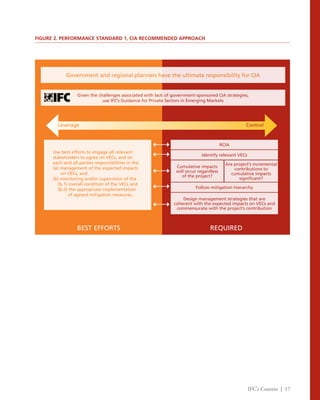
Figure 2
illustrates the overall context and proposed approach that exemplifies general compliance
with Performance Standard 1.
8
	 For further details, see Franks, Everingham, and Brereton 2012.
IFC’s Context | 17
FIGURE 2. PERFORMANCE STANDARD 1, CIA RECOMMENDED APPROACH
BEST EFFORTS REQUIRED
Government and regional planners have the ultimate responsibility for CIA
Given the challenges associated with lack of government-sponsored CIA strategies,
use IFC’s Guidance for Private Sectors in Emerging Markets
Identify relevant VECs
Cumulative impacts
will occur regardless
of the project?
Are project’s incremental
contributions to
cumulative impacts
significant?
Follow mitigation hierarchy
Design management strategies that are
coherent with the expected impacts on VECs and
commensurate with the project’s contribution
RCIA
Leverage Control
Use best efforts to engage all relevant
stakeholders to agree on VECs, and on
each and all parties responsibilities in the:
(a) management of the expected impacts
on VECs, and
(b) monitoring and/or supervision of the
(b.1) overall condition of the VECs and
(b.2) the appropriate implementation
of agreed mitigation measures.
18 | Good Practice Handbook: Cumulative Impact Assessment and Management
Section 1. What is Cumulative Impact Assessment
and Management, and Why is it Needed?
BasicCIAConcepts
H | Good Practice Handbook: Cumulative Impact Assessment and Management
BasicCIAConcepts
What is Cumulative Impact Assessment and Management, and Why is it Needed? | 19
1. What is Cumulative Impact Assessment and
Management, and Why is it Needed?
1.1 What are Cumulative Impacts?
Cumulative impacts are those that result from the successive, incremental, and/or
combined effects of an action, project, or activity (collectively referred to in this document
as “developments”) when added to other existing, planned, and/or reasonably anticipated
future ones. For practical reasons, the identification and management of cumulative
impacts are limited to those effects generally recognized as important on the basis of
scientific concerns and/or concerns of affected communities.9
Examples of cumulative impacts include the following:
•	 Effects on ambient conditions such as the incremental contribution of pollutant
emissions in an airshed.
•	 Increases in pollutant concentrations in a water body or in the soil or sediments, or
their bioaccumulation.
•	 Reduction of water flow in a watershed due to multiple withdrawals.
•	 Increases in sediment loads on a watershed or increased erosion.
•	 Interference with migratory routes or wildlife movement.
•	 Increased pressure on the carrying capacity or the survival of indicator species in an
ecosystem.
•	 Wildlife population reduction caused by increased hunting, road kills, and forestry
operations.
•	 Depletion of a forest as a result of multiple logging concessions.
•	 Secondary or induced social impacts, such as in-migration, or more traffic congestion
and accidents along community roadways owing to increases in transport activity in a
project’s area of influence.
Multiple and successive environmental and social impacts from existing developments,
combined with the potential incremental impacts resulting from proposed and/or
anticipated future developments, may result in significant cumulative impacts that would
not be expected in the case of a stand-alone development.10
Box 2 provides an example.
9
	 Affected communities are defined as local communities directly affected by the project (Performance Standard
1, paragraph 1).
10
	 See GN1, paragraph GN37.
20 | Good Practice Handbook: Cumulative Impact Assessment and Management
Box 2. Demise of the Aral Sea
The Aral Sea Basin, surrounded by desert, is shared by eastern
Kazakhstan and eastern Uzbekistan. It is fed primarily by the Amu
Darya and Syr Darya rivers. The Aral Sea was the world’s fourth
largest lake, covering 68,300 km2
with a volume of 1,006 km3
. In
the late 1950s, the lake was teeming with life. It supported fishing
ports and a thriving commercial fishery with an annual catch of
46,000 tonnes in the early 1960s. During that decade, water
began to be diverted from the two rivers for use in hydropower
generation and irrigation systems for growing cotton. The
irrigation systems expanded, and today approximately 7 million ha
of agricultural land depends on those systems. By the 1980s, the
water from the two rivers was nearly completely used before the
flow reached the Aral Sea Basin (ADB 2010, 82–84).
The cumulative impacts have aggregated over the past 30 years.
By 1986, the Aral Sea had split into two water bodies, the
“Southern Aral Sea” and “Northern Aral Sea.” By 2002, the level
of the Southern Aral Sea had fallen by 22 m. By 2005, the Aral Sea
had shrunk to half of its former size and its volume had diminished by 75 percent. Kazakhstan built a dam between
the northern and southern parts of the Aral Sea. Completed in 2005, the dam was basically a death sentence for
the southern Aral Sea, which was judged to be beyond saving. All of the inflow from the Syr Darya now stays in the
Northern Aral Sea. The Southern Aral Sea continues to shrink. The shallow eastern basin all but disappeared in 2009
after four years of drought reduced and eventually stopped any inflow from the Amu Darya. In 2010, the drought
ended and water entered the eastern basin once again. But in 2011, less water entered the basin. Water levels in
2011 were lower than in any previous year except 2009.a
The magnitude of the cumulative socioeconomic impacts is almost unprecedented. The retreat of the Aral Sea
shoreline decimated former ports and fishing communities. The once abundant fishery has virtually ceased to
exist. The increasingly saline water of the rivers has become polluted with fertilizer and pesticides. The blowing
dust from the exposed seabed, contaminated with agricultural chemicals, is a public health hazard as it settles
onto fields, degrading the soil.b
Much of the former Aral Sea Basin has now become desert. Rusted hulks of
boats and ships lie abandoned in the desert as a poignant reminder of this once great aquatic ecosystem.
One can argue that the demise of Aral is a trade-off against the socioeconomic benefits of irrigated agriculture.
Unfortunately, unsustainable land and water management practices combined with poor maintenance of
irrigation infrastructure has led to severe land degradation. Vast stretches of irrigated land in the Amu Darya
and Syr Darya river basins are now salinized or waterlogged, as are many other areas in Central Asia. Estimates
are that more than half of the irrigated land in Central Asia is salinized or waterlogged (ADB 2010, 154–56).
a
	 See “Our Amazing Planet,” http://www.ouramazingplanet.com/1805-aral-sea-continues-to-shrink.html.
b
	 See NASA Earth Observatory, http://earthobservatory.nasa.gov/Features/WorldOfChange/aral_sea.php.
Source: NASA Earth Observatory, http://
earthobservatory.nasa.gov/Features/WorldOfChange/
aral_sea.php.
What is Cumulative Impact Assessment and Management, and Why is it Needed? | 21
1.2 What Is Cumulative Impact Assessment and Management?
CIA is the process of (a) analyzing the potential impacts and risks of proposed developments in
the context of the potential effects of other human activities and natural environmental and social
external drivers on the chosen VECs over time, and (b) proposing concrete measures to avoid,
reduce, or mitigate such cumulative impacts and risk to the extent possible.
The key analytical task is to discern how the potential impacts of a proposed development might
combine, cumulatively, with the potential impacts of the other human activities and other natural
stressors such as droughts or extreme climatic events. VECs are immersed in a natural ever-changing
environment that affects their condition and resilience.VECs are integrators of the stressors that affect
them.Forexample,periodicextremesofprecipitation(droughtsorfloods),temperature(extremecold
or heat), or fluctuations in predators all affect the condition of biological VECs. Today and into the
future, global warming (climate change) can be expected to have substantial impacts on the condition
of VECs. Box 3 provides a further explanation on VECs.
Box 3 . Valued Environmental and Social Components (VECs)
CIAs are complex, and cost time and money. For a CIA to be effective in supporting good overall environmental and
social risk management, its scope must be properly defined. Because it is unrealistic to think that every environmental
and social aspect that can be subject to cumulative impacts can be appropriately factored into a CIA, it is good practice
to focus the assessment and management strategies on Valued Environmental and Social Components (VECsa
).
What are VECs?
VECs are environmental and social attributes that are considered to be important in assessing risks; they may be:
•	 physical features, habitats, wildlife populations (e.g., biodiversity),
•	 ecosystem services,
•	 natural processes (e.g., water and nutrient cycles, microclimate),
•	 social conditions (e.g., health, economics), or
•	 cultural aspects (e.g., traditional spiritual ceremonies).
While VECs may be directly or indirectly affected by a specific development, they often are also affected by the
cumulative effects of several developments. VECs are the ultimate recipient of impacts because they tend to be at the
ends of ecological pathways. Throughout this handbook the acronym VECs refers to sensitive or valued receptors of
impact whose desired future condition determines the assessment end points to be used in the CIA process.
The identification of assessment end points is a critical step in any risk assessment. To guide subsequent analysis,
the identification of end points needs to be initiated during the scoping phase (Section 2, Steps 1 and 2) through
social and ecological scoping. Social scoping through participatory, meaningful, and transparent consultation and
good-faith engagement with affected communities and/or stakeholders is used to establish the terms in which
a
Acronym originally coined by Beanlands and Duinker (1983) to refer to “valued ecosystem components.”
22 | Good Practice Handbook: Cumulative Impact Assessment and Management
Box 3 . Valued Environmental and Social Components (VECs) continued
cumulative impacts should be expressed (i.e., which environmental attributes or components of the environment
will be the subject of CIA). Ecological scoping is used to identify how impacts can be studied and predicted. VECs
should reflect public concern about social, cultural, economic, or aesthetic values, and also the scientific concerns
of the professional community (Beanlands and Duinker 1983). It is important that VECs build from existing
definitions of valuable environmental and social components described in the Performance Standards (e.g., critical
habitat in Performance Standard 6 and critical cultural heritage in Performance Standard 7). For VECs related to
biodiversity, GN6 provides explicit guidance on natural and critical habitat values.
How do VECs influence the CIA process?
CIA is inherently future-oriented. The concern for assessment of cumulative impacts is driven by the need to
understand the conditions of VECs that are expected to result from the combination of development impacts
and natural forces. For instance, to what extent will a terrestrial habitat be fragmented beyond its ecological
functionality by the cumulative impacts of multiple linear infrastructure developments?
Good CIA focuses on understanding whether cumulative impacts will affect the sustainability or viability of a VEC as
indicated by the predicted condition of the VEC. Consequently, the significance of cumulative impacts is judged in the
context of thresholds or limits of acceptable change, within which the VEC condition is considered to be acceptable but
beyond which further change in condition is not acceptable. If such thresholds are not established, the significance of
cumulative impacts cannot be determined. Step 5 in Section 2 better describes the importance of defining thresholds
for assessing the significance of cumulative impacts and designing effective management strategies.
Defining thresholds for VECs
The viability or sustainability of VECs, whether ecological, biological, or related to human communities, is
their capacity to endure—i.e., for the ecosystem, community, or population to remain diverse and productive
over time. This is reflected in the definition of sustainable use in the Convention on Biological Diversity: using
the “components of biological diversity in a way and at a rate that does not lead to the long-term decline of
biological diversity, thereby maintaining its potential to meet the needs and aspirations of future generations.”
The viability or sustainability of VECs depends upon both the forces that affect them and their social and
ecological vulnerability (sensitivity), i.e., the degree to which they are susceptible to and unable to cope with
injury, damage, or harm.
Defining thresholds of acceptable VEC condition involves social and ecological scoping informed by scientific
understanding. In setting them, one considers points at which there is an abrupt change in a VEC condition,
where small changes in a given environmental or social driver produce large responses in the condition of the
VEC (after Groffman et al. 2006). Ecological thresholds for physical VECs such as air, water, and soil quality are
often readily available in either government-established ambient quality standards or in international scientific
literature. Thresholds may in some cases be determined from Performance Standards and Guidance Notes (e.g.,
biodiversity-related critical habitat thresholds in GN6). See Appendix 1 for examples of indicators of cumulative
impacts that are required to be addressed in meeting the IFC Performance Standards.
What is Cumulative Impact Assessment and Management, and Why is it Needed? | 23
“Other human activities” of greatest importance in CIA are those that (a) will occur in the
future, or, if already existing, have ongoing influences on the environment in the future,
and (b) are expected to interact with the same VECs in the future as does the development
under assessment. CIA represents an analytical complication in ESIA because the spatial
horizon of impact assessment is usually greater than in “normal” project ESIA, and the
interactions between human activities and VECs increase in number and complexity.
Project-initiated CIA11
or RCIA has six objectives:
1.	 Assess the potential impacts and risks of a proposed development over time, in the
context of potential effects from other developments and natural environmental and
social external drivers on a chosen VEC.
2.	 Verify that the proposed development’s cumulative social and environmental impacts
and risks will not exceed a threshold that could compromise the sustainability or
viability of selected VECs.
3.	 Confirm that the proposed development’s value and feasibility are not limited by
cumulative social and environmental effects.
4.	 Support the development of governance structures for making decisions and
managing cumulative impacts at the appropriate geographic scale (e.g., airshed, river
catchment, town, regional landscape).
5.	 Ensure that the concerns of affected communities about the cumulative impacts of a
proposed development are identified, documented, and addressed.
6.	 Manage potential reputation risks.
Assessmentofcumulativeimpactsshouldemployinformationfromavarietyofinstruments
including, regional and local environmental, social and resource studies, programs and/
or planning documents; strategic, sectoral, and regional assessments; project impact
assessments, cumulative impact assessments, and targeted studies on specific issues.
1.3 Under What Conditions Should a CIA Be Conducted?
Cumulative impact assessment and management is appropriate whenever there is
concern that a project or activity under review may contribute to cumulative impacts
on one or more VECs.
This concern may be preexisting or a consequence of the potential cumulative impacts
of the development and other projects or actions, human activities, or exogenous factors
(e.g., natural drivers). CIA is also appropriate whenever a given development is expected
11
	 Government-led CIAs may differ on these objectives and focus on ensuring the future health of the VECs.
24 | Good Practice Handbook: Cumulative Impact Assessment and Management
to have significant or irreversible impacts on the future condition of one or more VECs
that also are, or will be, affected by other developments. The other developments may
already exist, be reasonably predictable, or be a mix of existing and reasonably anticipated
developments. In circumstances where a series of developments of the same type is
occurring, or being planned, the need for CIA can be fairly obvious.12
For example:
•	 when a series of mining developments occur within an area where they will impact
the same VECs (perhaps common water bodies or watercourses, wildlife populations,
community health, community loss of access to assets, or multiple land takings);
•	 when a series of hydroelectric developments occur within the same river or within
the same watershed with cumulative impacts in common on flora and fauna, on
downstream water availability or quality, on watershed sediment dynamics, on
navigation, on local communities’ livelihoods, or on adjacent land uses because of
increased access from associated roads; or
•	 When a series of agricultural developments occur that will cumulatively impact land use
patterns, having cumulative impacts on downstream water availability (from withdrawal
of water for irrigation), on downstream water quality, or on local community livelihoods.
Good CIA practice is not limited to assessing the impacts of developments of the same
type. For example, CIA might be needed for the development of a mine in association
with increased access from road construction that will bring further induced development
(perhaps in association with developments in adjacent forest management, hydroelectric
power developments, agriculture or other activities, all of which may affect local
communities, wildlife, or water availability and quality).
In some cases, CIA may be needed to assess and manage the impacts of several new
projects, activities, or actions that are being developed or planned. In other situations,
CIA of a single new development may be appropriate when it occurs in an area where
concerns exist about cumulative impacts—concerns that are either well documented or
identified through consultation with affected communities and other stakeholders. In
some situations, different components of the same development13
are assessed in separate
ESIAs, and the cumulative impacts from these components should be subject to CIA. The
key point in determining the need for CIA is that one or more VECs will be cumulatively
impacted by different developments, whatever they may be.
12
	 Cumulative impacts can occur (a) when there is “spatial crowding” as a result of overlapping impacts from
various actions on the same VEC in a limited area, (e.g., increased noise levels in a community from industrial
developments, existing roads, and a new highway; or landscape fragmentation caused by the installation of
several transmission lines in the same area) or (b) when there is “temporal crowding” as impacts on a VEC from
different actions occur in a shorter period of time than the VEC needs to recover (e.g., impaired health of a fish’s
downstream migration when subjected to several cascading hydropower plants).
13
	 Including associated facilities and other related infrastructure such as roads, ports, railroads, bridges, or terminals.
What is Cumulative Impact Assessment and Management, and Why is it Needed? | 25
Cumulative impacts may also be identified and acknowledged in the ESIA process, and
the measures proposed for managing the incremental contribution of a given project can
be covered by the project’s ESMS. This is often the case when dealing with well-studied
airsheds, watersheds, seascapes, and landscapes, or with widely recognized global issues such
as climate change. For instance, methods for assessing the incremental contribution to airshed
degradation from the emissions of a new thermoelectric generation plant are well established
in the scientific community and are typically an integral component of a good ESIA process.
Similarly, the determination of greenhouse gas emissions and their management within the
climate change context are well-recognized global practices. Neither of these cases would
require a separate CIA process; the inclusion of standard pollution prevention and control
measures as an integral component of ESMS would typically suffice.
1.4 What Are the Expected Outcomes of CIA?
The expected outcomes of a good CIA can be summarized as follows (Section 2 provides
greater detail):
•	 Identification of all VECs that may be affected by the development under evaluation.
•	 In consultation with stakeholders, agreement on the selected VECs the assessment
will focus on.
•	 Identification of all other existing and reasonably anticipated and/or planned and
potentially induced developments,14
as well as natural environmental and external
social drivers that could affect the selected VECs.
•	 Assessment and/or estimation of the future condition of selected VECs, as the result
of the cumulative impacts that the development is expected to have, when combined
with those of other reasonably predictable developments as well as those from natural
environmental and external social drivers.
•	 Evaluation of the future condition of the VECs relative to established or estimated
thresholds of VEC condition or to comparable benchmarks.
•	 Avoidance and minimization, in accordance with the mitigation hierarchy, of the
development’s impact on the VECs for the life of the development or for as long as
the impacts continue to be present.
•	 Monitoring and management of risks to VEC viability or sustainability over
the life span of either the development or its effects, whichever lasts longer.15
14
	 As identified in diverse sources such as sectoral project inventories, regional or resources development plans,
and watershed management plans, among others.
15
	 Interactions with government and third parties should be included in risk management actions.
26 | Good Practice Handbook: Cumulative Impact Assessment and Management
•	 Provision of project-related monitoring data to governments and other stakeholders for
the life of the development, and material support for the development of collaborative
regional monitoring and resource management initiatives.
•	 Continuous engagement and participation of the affected communities in the
decision-making process, VEC selection, impact identification and mitigation, and
monitoring and supervision.
Because cumulative impacts often result from the successive, incremental, and/or
combined16
impacts of multiple developments, responsibility for their prevention and
management is shared among the various contributing developments. Because it is usually
beyond the capability of any one party to implement all of the measures needed to reduce
or eliminate cumulative impacts, collaborative efforts will likely be needed. Governments
can play a significant role in ensuring environmental and social sustainability by providing
and implementing enabling regulatory frameworks that guide and support the appropriate
identification and management of cumulative impacts and risks (See Box 4).
16
	 Combined impacts can be either additive (e.g., equal to the sum of individual effects), synergistic (e.g., total
effect is greater than the sum of the individual effects), or antagonistic (e.g., individual effects counteract or
neutralize each other).
Box 4. Hydro Cascade with No Governmental Requirement for CIA
In one case, 37 hydroelectric projects (2 existing, 9 under construction, and 26 proposed) would occur
within a single river basin where the host country had no regulatory requirement for CIA. IFC supported
two clients who were involved with several projects—some in close proximity and others located in another
part of the basin. Despite the lack of a regulatory requirement for CIA, IFC worked with the proponents to
develop a collaborative CIA and coordinated impact monitoring program, which was implemented through
a steering committee composed of companies and government agencies. The CIA was not limited to the
specific projects of the two proponents but set the spatial context as the entire river basin. The CIA found
that without management there would likely be significant cumulative impacts on the water flow regime,
water quality, and the aquatic environment.
In addition, IFC collaborated with the IBRD to raise the awareness of the host country to the issue of
cumulative impacts. A workshop was organized at which the intensity of development and results of the CIA
were discussed with government representatives and consensus was reached that development of a formal
CIA requirement was imperative; that there was a clear need for basin management planning; and that
there was still time for effective CIA. In addition, it was proposed that when multiple small-scale hydropower
projects were being planned (which would not individually trigger an ESIA requirement), CIA for the overall
set of projects would be an appropriate alternative to project-specific impact assessment.
What is Cumulative Impact Assessment and Management, and Why is it Needed? | 27
Over the years, the World Bank has developed extensive documents and guidance tools for
governments to design and implement countrywide or sectorwide strategic approaches to
environmental and social management. These are described and defined in Operational Policy
4.0117
(see Annex A of OP 4.01 for definitions)18
and in publications on strategic environmental
management19
and poverty and social impact analysis.20
They are invaluable sources of
information and good practice for setting appropriate and enabling regulatory environments.
1.5 How Does CIA Compare with Other Environmental and Social
Risk Management Tools?
CIA is one of several tools to consider as part of an overall process of environmental and
social risk assessment and management. These tools, identified in Table 1, have been
developed to inform decision-making processes in different project development and/or
sector planning contexts.
17
	See http://siteresources.worldbank.org/INTFORESTS/Resources/OP401.pdf and http://web.
worldbank.org/WBSITE/EXTERNAL/TOPICS/CSO/0,,contentMDK:20064724~pagePK:220503~
piPK:220476~theSitePK:228717~isCURL:Y~isCURL:Y~isCURL:Y~isCURL:Y~isCURL:Y,00.html.
18
	See http://web.worldbank.org/WBSITE/EXTERNAL/TOPICS/CSO/0,,contentMDK:20066691~page
PK:220503~piPK:220476~theSitePK:228717~isCURL:Y~isCURL:Y~isCURL:Y,00.html.
19
	 See World Bank, 2011, “Strategic Environmental Assessment in Policy and Sector Reform,” http://siteresources.
worldbank.org/ENVIRONMENT/Resources/244380-1236266590146/Policy_SEA_WB.pdf, World Bank,
2008; and “Strategic Environmental Assessment for Policies: An Instrument for Good Governance,” http://
siteresources.worldbank.org/INTRANETENVIRONMENT/1705772-1210788188539/21819527/SEA_
FOR_POLICIES.pdf.
20
	Seehttp://web.worldbank.org/WBSITE/EXTERNAL/TOPICS/EXTPSIA/0,,contentMDK:21717714~menu
PK:6145452~pagePK:148956~piPK:216618~theSitePK:490130~isCURL:Y~isCURL:Y~
isCURL:Y~isCURL:Y,00.html.
21
	 See World Bank, OP 4.01, footnotes 11 and 12.
TABLE 1. TOOLS FOR ENVIRONMENTAL AND SOCIAL RISK ASSESSMENT AND MANAGEMENT
Environmental
and Social Impacts
Assessment (ESIA)
•	 Applies to the potential impacts of a particular development proposal
•	 Done in the context of a well-defined development proposal for which the construction
and operational details of the development alternatives are known
•	 May include an assessment of the project’s contribution to a well-known accumulated
impact and propose standard mitigation measures (e.g., greenhouse gas emissions, airshed
pollution, depletion of wild fish stocks)
Strategic
Environmental
Assessment (SEA)21
•	 Relates to potential impacts of governmentwide or sectorwide policies, plans, or programs
•	 Anticipates how instruments such as policies that are not specifically tied to a particular
physical development may result in a variety of impacts at different times and places
Regional or Sectoral
Impact Assessment
•	 Assesses the impacts of the potential developmental future of a geographic region or of an
overall sector or industry (sometimes referred to as regional or sectoral SEA)
Cumulative Impact
Assessment and
Management (CIA)
•	 Assesses the ecological and social impacts that determine the status of environmental
components and affected communities (VECs)
•	 Requires consideration of past, present, and future projects and natural drivers that affect them
•	 Assessment reflects the geographical and temporal context in which the effects are
aggregating and interacting (e.g., airshed, river catchment, town, landscape)
28 | Good Practice Handbook: Cumulative Impact Assessment and Management
Unlike government agencies, a private sector developer or project sponsor has no control
over the actions undertaken by other developers that affect similar VECs, and therefore
it is unlikely to have much leverage to influence any mitigation actions by third parties.
However, when faced with cumulative impacts and risks, private sector developers or
project sponsors may engage in a simpler RCIA process (see Appendix 3 for an annotated
RCIA Terms of Reference) instead of a full CIA. An RCIA follows the same logical
and analytical framework as a CIA, but the analysis is based on a desk review of readily
available information and previous environmental and social assessments. Very focused
new baseline data on VECs may be needed, and additional new stakeholder engagement
may also be necessary (see Step 3 in Section 2).
1.5.1 Comparing ESIAs and CIAs
ESIAs22
and CIAs share the same basic logical framework and analytical process and tools (see
Appendix 2 for a basic logic framework for a CIA); however, they take different perspectives.
The perspectives can be characterized as project-centered (ESIA) or VEC-centered (CIA).
As illustrated in Figure 3, in an ESIA the focus of analysis begins with the project. The area
where the project will have environmental and social impacts is identified as are the VECs
that will be affected. The impacts on the VECs are identified and a mitigation hierarchy23
is
applied to avoid them when possible and to minimize and mitigate them when avoidance
is not possible. Where residual impacts remain, impacts and risks to workers, affected
communities, and the environment are compensated or offset.
22
	 For further details on ESIA and good practices related to the resulting ESMS, please refer to Performance
Standard 1 and GN1 as well as Performance Standards 2–8 and their corresponding GNs.
23
	 Please refer to footnote 7.
FIGURE 3. ESIA: PROJECT-CENTERED PERSPECTIVE
PROJECT
Impact
2
Impact
3
Impact
1
Indirect
Impact
What is Cumulative Impact Assessment and Management, and Why is it Needed? | 29
To identify the environmental and social components that may be impacted by the project,
CIA also begins with a project-centered view. However, as illustrated in Figure 4, the focus then
shifts to the VECs. The area considered is the area in which the VECs occur, which is where
other stresses (developments, human activities not subject to ESIA, and natural environmental
and external social drivers) may also affect them. Once the other impacts have been identified,
the cumulative impacts are assessed as the resulting change in the condition of the VECs.
A cumulative impact includes two components:
•	 The anticipated future condition, which is the total effect of the other existing, and
predictable future developments and external natural environmental and social drivers, and
•	 The contribution of the development under evaluation to the cumulative impacts.

In the CIA context, the incremental impact of a development under review is the difference
between the condition of the VEC when impacted only by the other developments in the
future baseline and the condition of the VEC when impacted by both the development
under review and the future baseline impacts (Figure 5 ). In the context of ESIA and CIA,
a project’s incremental impacts are the same but are viewed differently—and the views can
give very different assessments of the need for impact management (see Box 5).
VEC
Other human activities
not subject to ESIA
Proposed action’s
impact on the VEC
Other past, present, and
future impact on the VEC
Cumulative impact
on the VEC
Natural environmental
drivers (stresses)
Project 1
Indirect Impact
Project 2
Project 3
FIGURE 4. CIA: VEC-CENTERED PERSPECTIVE
FIGURE 5. CIA: VEC-CENTERED PERSPECTIVE
+ =
30 | Good Practice Handbook: Cumulative Impact Assessment and Management
The different views can be seen in how indicators are used to characterize an impact. In
ESIA, indicators may be chosen to reflect the incremental change in a VEC, while in
CIA indicators are chosen to reflect the resulting condition of the VEC. Appendix 1 lists
comparisons of indicators that reflect an incremental project impact (a change in the VEC),
with indicators that reflect the condition of the VEC. During the CIA scoping stages
(Section 2 – Steps 1 and 2), the choice of VECs and their indicators is critical to the success
of the assessment (see Box 6).
The two different views are not always distinct, and as noted before, CIA can be fully
integrated throughout a good ESIA process. This approach has been advocated by many
practitioners (see Duinker 1994 or Duinker and Greig 2006). ESIAs should be conducted
in a manner that supports systematic CIA.
Box 5. Contrasting Views of the Need for Impact Management
The ESIA for a metals refining operation in an emerging market country concluded simply that because the
concentration of heavy metals in the discharge to a river would be lower than the country’s discharge standard
that the project should proceed as designed. No additional mitigation was identified. However, the river was
already badly degraded; the ambient concentrations of heavy metals already exceeded the ambient water quality
standards, human health was being compromised, and officials in the city downstream were struggling to find
ways to improve water quality. In this context, either project relocation or additional mitigation to reduce the
discharge of heavy metals to the maximum extent possible would have been appropriate, together with other
mitigations to reduce the loading from existing sources. This case illustrates the importance of informed strategic-
level resource planning, such as integrated resources plans, which often are critical to successful CIAs.
What is Cumulative Impact Assessment and Management, and Why is it Needed? | 31
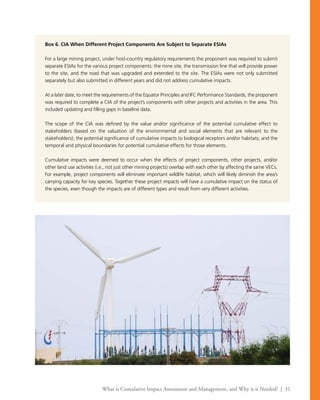
Box 6. CIA When Different Project Components Are Subject to Separate ESIAs
For a large mining project, under host-country regulatory requirements the proponent was required to submit
separate ESIAs for the various project components: the mine site, the transmission line that will provide power
to the site, and the road that was upgraded and extended to the site. The ESIAs were not only submitted
separately but also submitted in different years and did not address cumulative impacts.
At a later date, to meet the requirements of the Equator Principles and IFC Performance Standards, the proponent
was required to complete a CIA of the project’s components with other projects and activities in the area. This
included updating and filling gaps in baseline data.
The scope of the CIA was defined by the value and/or significance of the potential cumulative effect to
stakeholders (based on the valuation of the environmental and social elements that are relevant to the
stakeholders); the potential significance of cumulative impacts to biological receptors and/or habitats; and the
temporal and physical boundaries for potential cumulative effects for those elements.
Cumulative impacts were deemed to occur when the effects of project components, other projects, and/or
other land use activities (i.e., not just other mining projects) overlap with each other by affecting the same VECs.
For example, project components will eliminate important wildlife habitat, which will likely diminish the area’s
carrying capacity for key species. Together these project impacts will have a cumulative impact on the status of
the species, even though the impacts are of different types and result from very different activities.
32 | Good Practice Handbook: Cumulative Impact Assessment and Management
Processfor
ImplementingaCIA
Section 2. What Is the Process for
Implementing a CIA?
J | Good Practice Handbook: Cumulative Impact Assessment and Management
Processfor
ImplementingaCIA
What Is the Process for Implementing CIA? | 33
2. What Is the Process for Implementing a CIA?
Assessment of accumulated impacts may draw on information from a variety of sources
including regional environmental, social, and resource studies and programs; strategic,
sectoral, and regional environmental assessments; project environmental assessments; CIAs
from similar situations; and targeted studies on specific issues.
The following six-step process and the appendices that follow lead users of this handbook from
the scoping phase to the management phase, providing key questions to consider along the
way. Additional relevant guidance may exist in the Performance Standard Guidance Notes.
Keep in mind that the process for CIA must be flexible; the steps may not proceed
in sequence and may need to be implemented iteratively, with some steps revisited in
response to the results of others. For example, in the issue identification (scoping) step,
consideration of potential effects is often repeated, with the findings and analysis refined
each time, until a final list of issues is produced.24
Step 1: Scoping Phase I – VECs, Spatial and Temporal Boundaries
Objectives:
•	 Identify and agree on VECs in consultation with stakeholders.
•	 Determine the time frame for the analysis.
•	 Establish the geographic scope of the analysis.
Questions to answer:
•	 Whose involvement is key?
•	 WhichVEC resources, ecosystems, or human values are affected?
•	 Are there concerns from existing cumulative impacts?
This step is critical to successful CIA because it establishes the scope of the analysis of
cumulative impacts. Critical to the success of scoping is that it appropriately characterizes
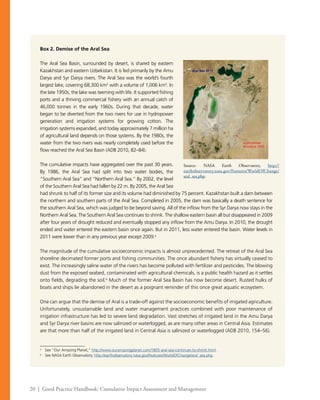
the context for the analysis (i.e., context scoping, as identified by Baxter et al. 2001). If not
already done, identification of the key participants should be completed early in this step
and updated as needed as the overall process proceeds. Best practice involves an open,
participatory, transparent, and meaningful consultation with affected communities and other
relevant interested parties as early in the scoping phase as possible. As described in Section 3,
this is one of the major challenges associated with a CIA process. For a description of an ideal
arrangement of stakeholder roles and responsibilities, please refer to Table 3 in that section.
24
	 The CIA (or RCIA) should include the entire list of potential effects that were identified during the scoping
process, identify any potential effects the CIA will not examine in detail, and describe the rationale for
eliminating them from further evaluation. At the start, all potential effects are identified but by the end, the
list of issues will have been reduced to a list of key issues to examine in detail in the CIA.
34 | Good Practice Handbook: Cumulative Impact Assessment and Management
The output of scoping includes identification of the VECs for which cumulative impacts
will be assessed and managed, and the spatial and temporal boundaries for the assessment.
Information to consider in establishing the scope of CIA includes the following:
•	 VECs known or suspected to be affected by the development (based on prior sectoral
assessments or the project’s ESIA).
•	 Known cumulative impact issues within the region.
•	 Concerns for cumulative impacts identified in consultation with stakeholders, including
potentiallyaffectedcommunities(thesemayexistatdistancefromtheplanneddevelopment).
•	 Regional assessments prepared by governments, multilateral development banks
(MDBs), and other stakeholders.
•	 CIAs prepared by sponsors of other developments in the region.
•	 Information from NGOs.
Appendix 1 contains an illustrative list of potential VECs identified for each IFC
Performance Standard.
Boundaries for the analysis need to encompass the geographic and temporal extent of impacts
(from other past, present, and predictable future developments) that influence VEC condition
throughout the time period during which project impacts will occur. This scope is likely to
extend beyond a project’s direct area of influence (DAI) as typically defined in ESIA (see Box 7).
This is typically an iterative process in which the first boundaries are often set by educated
guess but incrementally improved as new information indicates that a different boundary is
required for the analysis. Boundaries are expanded to the point at which the VEC is no longer
affected significantly or the effects are no longer of scientific concern or of interest to the affected
communities. For example, in the case of biodiversity values, habitat ranges or migration
pathways are often used as boundary-defining variables. By contrast, if landscape fragmentation
is at stake in a transportation project, the likely extension of secondary and tertiary roads, along
with population growth, are well-established risk factors to consider. In any case, the CIA should
explain the basis for the final delineation of the geographic and temporal boundaries. VECs
for which the project will have no direct or indirect impact do not need to be the subject of
CIA. Priority should be given to those VECs that are likely to be at the greatest risk from the
development’s contribution to cumulative impacts (see Box 8).
What Is the Process for Implementing CIA? | 35
Box 7. Rules of Thumb - How to Set Geographical and Temporal Boundariesa
The suggested rules of thumb to determine the geographic boundaries for the analysis are as follows:
a.	 Include the area that will be directly affected by the project or activity (DAI - in the traditional ESIA sense).
b.	 List the important resources (VECs) within the DAI.
c.	 Define if these VECs occupy a wider area beyond the DAI.b
d.	 Consider the distance an effect can travel, and other impacts the VEC may be exposed to within its range.
The proposed basic rules of thumb to determine the temporal boundaries for the assessment are as follows:
I.	 Use the time frame expected for the complete life cycle of the proposed development.
II.	 Specify whether the expected time frame of the potential effects of proposed development can extend
beyond (I).
III.	 Use the most conservative time frame between (I) and (III).
IV.	 Using professional judgment to balance between overestimating and underestimating, and make sure to
document the justification or rationale.
V.	 Exclude future actions if (i) they are outside the geographical boundary, (ii) they do not affect VECs,
or (iii) their inclusion cannot be supported by technical or scientific evidence.
a
	 After CEQ 1997.
b
	 As an example, for biodiversity components, see the definition of discrete management unit in Performance Standard 6 and related
guidance in GN6, which emphasizes the importance of defining an ecologically relevant boundary. CIA boundaries should be defined by
the area occupied by the VEC. The spatial context for CIA can be a mosaic rather than a single area.
Through an evaluation of the regional cumulative impact, the scoping stage of CIA should
not only establish the dimensions of the cumulative impact study (VECs of concern,
spatial and temporal assessment scales) but also assess how well cumulative impacts have
already been identified and analyzed.
If the condition and trends of VECs are already known and the incremental contribution of
the development to cumulative impacts can be established quickly, then the emphasis for CIA
should be placed on cumulative impact management rather than impact assessment.
36 | Good Practice Handbook: Cumulative Impact Assessment and Management
Box 8. Establishing the Spatial Boundary for CIA
To assess the impacts of a regional oil pipeline development in an arctic environment, the study area for
the ESIA was defined as several kilometers on either side of the pipeline along its route. The CIA for the
project adopted the same study area. While it was well known that the pipeline would likely induce future
development of additional oil fields along the pipeline route, such developments would occur outside the
defined study area and thus were not included as reasonably predictable future projects for inclusion in the
CIA analysis. Few other existing or likely future projects were identified within the study area. Impacts on the
wide-ranging northern caribou herds and grizzly bear, whose ranges included the project study area, were
deemed insignificant in both the ESIA and CIA analyses.
Understanding that CIA analysis should be done in the context of the VECs ranges, the regulator that reviewed
the proponent’s ESIA and CIA required the proponent to redo the CIA analysis to include the potential impacts of
the likely future oil-field development along the pipeline route. These proposed developments fell largely within
the range of the VECs and would have had potential impacts both within the oil fields themselves and along
the routes of connector pipelines that would link to the regional pipeline. This analysis, done in the appropriate
context for analysis of cumulative impacts on the VECs, concluded that the cumulative impacts of the likely future
developments and those of the enabling regional pipeline resulted in a cumulative impact that would require a
regional cumulative impact management strategy. While this would not prevent approval of the regional pipeline,
it clearly created the opportunity for the development of a multiparty cumulative impact management program to
prevent significant impacts from future developments before they arise.
Step 2: Scoping Phase II – Other Activities and Environmental Drivers
Objectives:
•	 Identify other past, existing, or planned activities within the analytical boundaries.
•	 Assess the potential presence of natural and social external influences and stressors (e.g.,
droughts, other extreme climatic events).
Questions to answer:
•	 Are there any other existing or planned activities affecting the sameVEC?
•	 Are there any natural forces and/or phenomena affecting the sameVEC?
The purpose of this step is to identify the totality of stresses that determine the condition of
VECs selected for CIA. Estimation of the magnitude of impacts will likely occur in step 4.
What is important in Step 2 is identification of the sources of stress—past developments whose
impacts persist, existing developments, and foreseeable future developments, as well as any
other relevant external social and/or environmental drivers (e.g., wildfires, droughts, floods,
predator interactions, human migration, and new settlements). Box 9 provides an example. In
making this determination, the key question is simply what environmental and social factors
may influence the condition of the VEC. In most cases, these factors should be known.
What Is the Process for Implementing CIA? | 37
Box 9. Cumulative Impacts of Climate and Hydropower
The ESIA for a hydropower development that would provide peaking power predicted no significant impacts on
lakes immediately downstream of the development. The ESIA analysis was based on the recent midterm flows
in the river system.
A separate CIA properly took into account the contribution of the natural driving force of longer-term climatic
variation in water availability reflected in the long-term records. Modeling analysis of lake levels in the region,
based on the long-term precipitation patterns showed that there could be a sharp decline in water levels
during extended periods of drought that historically had occasionally lasted for periods of 10 to 20 years. The
project effects at such times would significantly worsen an already difficult situation for some of the affected
communities, as during such extended droughts the shorelines of downstream lakes receded considerable
distances. While only a fraction of the drop in lake level would be attributable to the project impact this
additional impact was considered unacceptable.
The analysis highlighted the need for mitigation measures that could manage the lake levels during such
periods, providing a net benefit to the downstream communities and their fisheries during extended droughts.
Had the CIA not properly taken into account the natural driving impact of climate cycles on the hydrological
regime, the company might have been held accountable at some point for the unacceptable impacts.
An important part of this step is determining an appropriate strategy for identifying stresses
that result from activities other than the proposed development. Detailed identification
of other projects, activities, or actions that are likely to have significant impacts and
can play an important role in the management of cumulative impacts is appropriate.
However, in environments affected by a large number of small developments, creating an
inventory of all sources may not be the best approach; some form of statistically stratified
estimation of all development types involved may be appropriate. It may be helpful to
classify developments according to common characteristics of their impacts. The amount
of detail required is determined by what is needed to credibly estimate the types and
intensity of impacts that influence the condition of the selected VECs.
In addition to other human activities, natural drivers that exert an influence on VEC
condition should be identified and characterized. Natural environmental processes—for
example, drought or flooding—have significant impacts on a variety of environmental
and social components. Project impacts that discharge pollutants to lakes or rivers, or that
withdraw water for industrial or agricultural purposes are likely to be more significant
during periods of drought. The fire regime in forested areas is a major driver that shapes
social, ecological, and economic systems. For the purposes of CIA, identification of such
processes is not a question of new research, but is based on existing knowledge of the
ecology and/or natural dynamics of the selected VECs.
38 | Good Practice Handbook: Cumulative Impact Assessment and Management
Guidance for identifying reasonably predictable projects recommends reference to local,
regional,ornationaldevelopmentplansandgenerallyrecommendsthatashorttimehorizonbe
considered(e.g.,threetofouryearsintheEuropeanUnion)owingtouncertaintyaboutlonger-
term developments.25
Where development plans are not available, guidance recommends
that emphasis be given to identifying other projects in the planning stage or formal approval
process (e.g., through preparation of ESIA documents or permit submissions). This short-
term view does not provide certainty regarding which developments will actually occur. Some
developments in the planning stage will not proceed while others that are not immediately
apparent will be developed and go ahead. Proponents clearly cannot know for certain what
specific developments will occur but in some circumstances, where rapid development is
occurring, a general pattern of development may be able to be anticipated. The CIA should
clearly justify the reasoning behind the temporal boundary used for the assessment, as well
as all the different developments and external stressors included in the analysis (see Box 10).
25
	 For a good logical framework of how to define other developments, including certain reasonably anticipated,
and/or hypothetical ones, refer to Box 10 of World Bank 2012.
Box 10. Strategic Approach to Assessing Multiple Small Developments (Scoping)
CIA may be relevant and considered appropriate even if a project is expected to have only a small impact,
whenever the project will contribute to the cumulative impact or be at risk from the cumulative effects of
existing projects, or a large number of other reasonably predictable projects.
A regional CIA approach was taken to assess cumulative effects for a region that is the traditional territory of
numerous aboriginal groups and which is characterized by extensive unconsolidated sands with dune complexes,
open grasslands, patches of trees and shrubs with several game species including species that are rare, threatened,
or endangered; and numerous areas of historical spiritual significance. The dominant activities within the region
included a high density of gas wells (approximately 70 percent of the area was leased for exploration) and
widespread livestock grazing. The development of a significant number of additional gas wells was highly likely,
so rather than a well-by-well approach a regional CIA was undertaken.
The CIA was done in three phases: baseline assessment; impacts and trends identification; scenario analysis
and recommendations. Aggregation of impacts by livestock grazing and gas well development was facilitated
by treating both as surface disturbances. The underlying objectives of the baseline assessment (Step 3 in this
handbook) were to identify activities that have the greatest potential for surface disturbance impacts on ecological
integrity and sustainability, and to identify key issues and concerns with biological, economic, and social VECs.
Whenever there is potential for a large number of similar developments a regional analysis should be considered.
This is not, however, the responsibility of an individual proponent. This strategy, if pursued, requires the engagement
of other proponents and government agencies to develop a coordinated and/or pooled analysis.
* for results of this analysis please refer to Box 11
What Is the Process for Implementing CIA? | 39
In cases where no data are available from third parties about existing or planned
developments, the developer may promote the benefits of CIA to third parties and
encourage them to provide information on existing developments and future plans;
obtain whatever data government authorities have regarding existing and planned
developments; and, in the absence of specific information about projects and their
impacts, use generic information about the other projects, their inputs, and their effects
for typical developments of similar size.
In addition to other projects, actions, or activities that are known to be under development or
identified in planning documents, good practice also considers future developments that are
likely to be induced by the project under consideration. If experience has shown that projects
of the same type as the one being assessed cause further associated development to occur, then
such developments are reasonably predictable. Because induced development is not identified
onthebasisofspecificdevelopmentplans,scenarioanalysismaybeanappropriateapproachfor
examining the potential cumulative impacts that could be associated with such development.
Each scenario must be possible. The objective of scenario analysis is not to predict a most likely
future but to help to assess the consequences of uncertainty, so that the need for cumulative
impact management under different future conditions can be anticipated.
Step 3: Establish Information on Baseline Status of VECs
Objectives:
•	 Define the existing condition ofVEC.
•	 Understand its potential reaction to stress, its resilience, and its recovery time.
•	 Assess trends.
Questions to answer:
•	 What is the existing condition of theVEC?
•	 What are the indicators used to assess such condition?
•	 What additional data are needed?
•	 Who may already have this information?
A common concern among developers is the level of effort, time, and resources required
to collect adequate data for appropriately assessing cumulative impacts. The availability
of relevant data is critical for the success of a CIA, and the methodology to be used to
determine VEC baseline conditions should be defined as early as possible.
Generally speaking, data requirements should be determined early on during the scoping
phases of the CIA process. A developer may use existing information when such information
provides a sufficient basis for a complete assessment of cumulative impacts. However, if during
the scoping phases a developer determines that the existing information contains significant
40 | Good Practice Handbook: Cumulative Impact Assessment and Management
gaps that prevent the performance of an adequate assessment of cumulative impacts, it should
obtain the information needed using internationally recognized methodologies.
Typically, the new baseline data to be collected for a CIA will not be as detailed as that generated
during an ESIA, because of the larger area covered and/or changes in the type of data required for
the different scale of the assessment. Data that are needed focus on the most important VECs.
Collection of new baseline data tends to be limited and targeted to indicators that would allow
determination of any changes in VEC conditions. Practitioners must have a clear understanding
of the final use of the data, to be able to technically defend the analysis. It is not good practice to
embark on costly collection of new baseline data without careful consideration of the expected
cumulative impact to be assessed for specific and well-defined VECs. For instance, during an
ESIA, intensive and detailed field surveys of soil, vegetation, and fauna may be required in order
to assess direct impacts of a given development on biodiversity and land use. In contrast, because
CIA may require expanding the geographical boundary to thousands of hectares, the analysis
may rely on satellite imagery or existing vegetation or fauna studies on broader scales.
In some cases, the collection of data for some VECs, such as water quality, air quality, and
noise levels, provides a baseline condition that integrates the collective effects of all existing
developments and exogenous pressures. For example, to assess the cumulative ambient air
quality impacts of a proposal to site a fossil-fueled power plant in a given airshed, a developer
may need to collect data on the existing ambient air quality while calculating future impacts
where additional power plant capacity is anticipated to be installed in the same airshed.
Other illustrative examples: (a) the construction of an irrigation project that would alter the
volume and timing of watershed flows into an estuary, which may require the collection of
additional data to assess the cumulative change in flow regime at the estuary and resulting
impacts where other proposals would have similar effects, or (b) an expansion of the
geographical and temporal scales of data collection, in order to assess the cumulative impacts
of a proposed activity on the natural resource base that indigenous peoples, pastoralists,
forest dwellers, or other communities depend upon for their livelihoods.
Baseline (historical) information on the condition of VECs establishes the “big picture”
context for thinking about changes in VEC condition, can help developers avoid the pitfalls
associated with shifting baselines (Pauly 1995), and can be used in a variety of ways.
The determination of the trend of change in the baseline condition of a given VEC over
time may indicate the level of concern for cumulative impacts. If there is a history of a long
or steep decline in VEC condition, it may be inferred that there is an increased likelihood
that a threshold is being approached. As described in further detail in Step 5, threshold levels
What Is the Process for Implementing CIA? | 41
(tipping points), at which a VEC’s response to additional impacts may change abruptly, are
often not known with any degree of certainty. A simple analysis of the overall change in
condition relative to a baseline can at least provide some indication of the change that has
already occurred; however, this analysis must be approached with caution if the baseline
condition is recent and thus possibly representative of an already shifted baseline.
If sufficient information is available to establish the natural range of variation in a given
VEC condition, it can be used for comparison with the estimated future state developed
in Step 4 and when assessing significance in Step 5. When compared with information
about the past time trend in development pressures (part of the analysis in Step 4), it may
also provide some insight into VEC sensitivity to stresses. Good indicators of condition
are important. Historical trend analysis should be approached with some caution because
some indicators can be very stable, essentially hiding impact responses. Consistent use of
indicators is important (Bérubé 2007).
Estimating the past condition of a VEC is often a challenging task, requiring the collection
of historical information about the VEC which can be difficult to obtain. Various sources
of information can be explored—reports from governments, NGOs, and MDBs; prior
ESIAs; knowledge from resident communities; biodiversity databases such as GBIF26
or
IBAT;27
information from “controls,” or areas with VECs in common that are exposed to
differing levels of impact (assessed relative to the impact history developed in Step 2), or
scientific literature. Hydro-Québec found that in most cases the best “state of reference”
was the time when information became available and when the condition of the VEC
could be considered more or less stable, which in its first 12 cumulative effects assessments
ranged from 10 to 20 years (Bérubé 2007).
26
	See http://www.gbif.org.
27
	See https://www.ibatforbusiness.org.
42 | Good Practice Handbook: Cumulative Impact Assessment and Management
Step 4: Assess Cumulative Impacts on VECs
Objectives:
•	 Identify potential environmental and social impacts and risks.
•	 Assess expected impacts as the potential change in condition of the VEC (i.e., viability,
sustainability).
•	 Identify any potential additive, countervailing, masking, and/or synergistic effects.
Questions to answer:
•	 What are the key potential impacts and risks that could affect the long-term sustainability and/
or viability of theVEC?
•	 Are there known or predictable cause-effect relationships?
•	 Can these impacts and risks interact with each other?
Analysis of cumulative impacts on VECs involves estimating the future state of the VECs
that may result from the impacts they experience from various past, present, and predictable
future developments (see Box 11). The objective is to estimate the state of VECs as it
results from the aggregated stresses that affect them. In this context, in addition to the
stresses imposed by developments, the assessment should encompass the potential range
of environmental variation that may influence VEC condition and not be based solely on
expected average conditions (e.g., change in climate patterns and/or predictability).
In CIA, impacts are measured not in terms of the intensity of the stress added by a
given development but in terms of the VEC response and, ultimately, any significant
changes to its condition. The methods used for analysis are specific to the characteristics
of the VEC (e.g., different methods are appropriate for analysis of impacts on physical,
environmental, biotic, and social VECs, and their resilience). A wide spectrum of methods
Box 11. Strategic Approach to Assessing Multiple Small Developments (Analysis)
The analysis for the regional CIA done for the multiple small gas developments referenced in Box 10 developed
three alternative GIS-based land use scenarios: business as usual; enhanced development; and conservation. Rather
than focusing on a fixed prediction about the most likely future impacts, emphasis was placed on developing a set
of plausible accounts of cumulative change under each scenario. This approach allowed decisions to be based not
only on past trends, but also on potential future trends, which may include a number of surprises.
Core biodiversity hot spots with a high priority for conservation were identified. Under the conservation
scenario, regional biodiversity hot spots would be maintained as protected areas. This would be done by
limiting the number of new gas wells in such areas. Production would be maintained, however, through
increased use of directional drilling near the biodiversity hot spots.
What Is the Process for Implementing CIA? | 43
has been used for CIA (see Box 12 for an illustrative case); these methods generally can
be characterized as impact models, numerical models, spatial analysis using geographical
information systems (GIS), and indicator-based approaches.28
Some specific examples
and references are listed here:
•	 Conceptual modeling, pathways, network analysis29
(Bernard et al. 1993; Brismar 2004;
Canter 2008; Cooper 2008; Perdicoúlis and Piper 2008; Tricker 2007).
•	 Cost-benefit analysis (Crookes and de Wit 2009).
•	 Decision support systems (King and Pushchak 2008).
•	 GIS analysis (Atkinson, Canter, and Mangham 2008; Atkinson and Canter 2011;
Blaser et al. 2004; Dutta, Mahatha, and De 2004; Great Sand Hills Scientific
Advisory Committee 2007; Houle et al. 2010; Johnson et al. 2005; MacDonald 2000;
MacDonald, Coe, and Litschert 2004; Quinn et al. 2004; Scrimgeour, Hvenegaard,
and Tchir 2008; Seitz, Westbrook, and Noble 2011; Squires, Westbrook, and Dubé
2010; Sorensen et al. 2008; Strimbu and Innes 2011; Tiner 2005).
•	 Habitat modeling (Cantor and Atkinson 2008; Canter and Atkinson 2011; Blaser et al.
2004; Houle et al. 2010; Johnson et al. 2005; Strimbu and Innes 2011).
•	 Information compilation with simple checklists, or more complex layered or matrix formats
(Canter and Kamath 1995; Canter andTorney 2008; Cooper 2011; MacDonald 2000).
•	 Indicators and indices of VEC condition (Cantor and Atkinson 2008; Dubé 2003;
Gonzales-Sanson and Aguilar 2010; King and Pushchak 2008; Mitchell and Parkins
2011; Seitz, Westbrook, and Noble 2011; Squires, Westbrook, and Dubé 2010).
•	 Landscape modeling30
(Great Sand Hills Scientific Advisory Committee 2007;
MacDonald, Coe, and Litschert 2004; Quinn et al. 2004).
•	 Population viability analysis (Jeffrey and Duinker 2002; Johnson and Boyce 2001).
•	 Quantitative and/or simulation modeling, including spatially explicit GIS-
based models (CEQ 1997; Dutta, Mahatha, and De 2004; Hegmann et al. 1999;
Krzyzanowksi 2011; MacDonald 2000; Van Damme et al., 2003, 2008; Weclaw and
Hudson 2004; Walters 1986; Yang et al. 2010).
•	 Scenario analysis (Blaser et al. 2004; CCME 2009; Cavalcanti and la Rovere 2011;
Crookes and de Wit 2009; Duinker and Greig 2007; Ehrlich 2010; Great Sand Hills
Scientific Advisory Committee 2007; Greig et al. 2004; Harriman and Noble 2008;
Hegmann and Yarranton 2011; Jeffrey and Duinker 2002; Johnson et al. 2011; Lindsay,
Svrcek, and Smith 2002; Mitchell and Parkins 2011; Noble 2008; Quinn et al. 2004;
Seitz, Westbrook, and Noble 2011; Strimbu and Innes 2011; Weclaw and Hudson 2004)
•	 Sustainability appraisal (Cooper 2010; Gibson 2011).
28
	 For a good overview, see Box 18 and Table 4.1 of “Sample Guidelines: Cumulative Environmental Impact
Assessment for Hydropower Projects in Turkey.” World Bank, 2012. https://www.esmap.org/node/2964.
29
	See http://www.wcslivinglandscapes.org/WhatWeDo/ConservationStrategy.aspx and https://miradi.org.
30
	See http://www.wcslivinglandscapes.org/WhatWeDo/LandscapeSpeciesAnalysis.aspx.
44 | Good Practice Handbook: Cumulative Impact Assessment and Management
Box 12. RCIA of Hydro Impacts on American Eel
The American eel is a species that spawns in the Sargasso Sea and migrates to freshwater rivers and lakes
to grow and mature. When mature it migrates downstream and returns to the Sargasso Sea. In a northern
segment of its range this large, long-lived species declined substantially following construction of hydropower
dams and is now listed as endangered.
Human activities that affect the species include harvesting by fisheries, hydropower developments (inhibition
of upstream migration, mortality during downstream migration), barriers to migration by other water control
dams, habitat alteration, changes in water quality and contaminants. Natural drivers that impact the species
include: changes in the food web, parasites, and potential changes in ocean currents associated with climate
change. A published study indicated that of the various impacts, fisheries and hydropower development likely
had the greatest impact. As a consequence fisheries in the region were closed.
To develop a rapid estimate of the impact of the mortality caused by hydro developments during downstream
migration a RCIA was developed in the form of a quantitative spreadsheet model for one watershed
in the region where 11 hydropower developments were located on the main stem of the river, other
developments were located on tributary rivers. Without a detailed inventory of the distribution of eel habitat
in the watershed or specific studies of eel mortality at the individual stations, the model was designed to
permit scenario analysis to explore scenarios of habitat distribution (simply the proportion of habitat in the
watershed located in areas between the different developments) and estimates of the mortality rate for eels
passing through stations of similar size and design drawn from the scientific literature. The model simply
estimated the survival rate for the population of mature eels that would migrate downstream for spawning
as a result of the cumulative mortality from the 11 main stem developments. Although a better estimate of
impact could be obtained with a detailed habitat survey in the watershed, analysis of all developments, not
just those on the main stem, revealed that under reasonable assumptions of habitat distribution, the survival
rate would be less than 10 percent, an unsustainable impact.
What Is the Process for Implementing CIA? | 45
•	 Thresholds (Bérubé 2007; Bonnell and Storey 2000; Canter and Atkinson 2010; Damman
2002; Deverman 2003; Dubé 2003; Duinker and Greig 2006; Groffman et al. 2006;
Gunn and Noble 2009; Hegmann and Yarranton 2011; Kilgour et al. 2007; Krzyzanowksi
2011; Mitchell and Parkins 2011; Noble 2010a; Piper 2001, 2002; Quinn et al. 2004;
Schultz 2010; Seitz, Westbrook, and Noble 2011; Spaling et al. 2000; Squires, Westbrook,
and Dubé 2010; Therivel and Ross 2007; Tricker 2007; Weclaw and Hudson 2004) .
•	 Visual amenity analysis (Brereton et al. 2008).
As discussed previously, CIA analysis is futures oriented. The impact of the project is not assessed
as the difference between the expected future condition of VECs and that of a past baseline
condition. It is assessed as the difference between the estimated future condition of VECs in the
context of the stresses imposed by all other sources (projects and natural environmental drivers)
and the estimated VEC condition in the context of the future baseline plus the development
under evaluation.31
Of concern is not just estimation of the development’s impact, but
estimation of the future condition of VECs in the context of all stresses—which is the
cumulative impact—and can be evaluated in reference to an established threshold level of
acceptable condition, if known, or in reference to a past baseline.
The estimate of the cumulative project impact, together with ESIA results, indicates
the need for project-specific mitigation. By contrast, the estimated overall cumulative
impact indicates the need for mitigation to be implemented by the various project
owners or proponent parties to ensure that their respective contributions to the overall
condition of the VECs is coherent and/or compatible with what is mandated or required
by government-led—or government-agreed—regional cumulative impact management
initiatives, or as a minimum compliant with ambient quality standards for the desired use.
A key part of the assessment step is estimation of the effectiveness of project mitigation
and other cumulative impact management measures to reduce impacts, and this is done
iteratively between Steps 4, 5, and 6.
31
	 In CIA it is critical to not confuse past and future baselines (Bérubé 2007).
46 | Good Practice Handbook: Cumulative Impact Assessment and Management
Step 5: Assess Significance of Predicted Cumulative Impacts
Objectives:
•	 Define appropriate “thresholds” and indicators.
•	 Determine impact and risk magnitude and significance in the context of past, present, and
future actions.
•	 Identify trade-offs.
Questions to answer:
•	 Do these impacts affect the sustainability and/or viability of the resource and/orVEC?
•	 What are the consequences and/or trade-offs of taking the action versus no action?
Significance determination is a normal component of ESIA and CIA and occurs near the
end of the assessment process. Significance is typically evaluated after project mitigation
measures are factored in.
Determination of significance can be difficult and it is often controversial.32
Any potential
cumulative impact that warrants additional mitigation and/or monitoring beyond that
identified in the ESIA should be considered significant. A key good practice for the
appropriate determination of impact significance and overall agreement among affected
communities and other relevant stakeholders is to strengthen mitigation measures and
monitoring programs, focusing on expected probable cumulative impacts.
In the ESIA process, components of impact significance (magnitude, spatial scale, duration,
frequency) are typically factors in deciding whether mitigation is necessary. Consequently,
the evaluation of significance and the design of management and/or mitigation are in reality
iterative. The significance of a cumulative impact is evaluated not in terms of the amount
of change, but in terms of the potential resulting impact to the vulnerability and/or risk
to the sustainability of the VECs assessed. This means evaluating cumulative impacts in
the context of ecological thresholds.33
Determining ecological thresholds for biological and
social VECs has proven to be difficult. In many cases, such thresholds may not be clearly
identified until they are actually crossed, at which point recovery may take a long time with
considerable cost or may simply not be possible. Consequently, a precautionary approach
that explicitly considers uncertainty in ecological and sociological relationships is essential
when thresholds of acceptable VEC condition are being established.34
32
	 Significance determination has been a challenge in ESIA and a rich literature has developed (Lawrence Environmental
2002). Little if any guidance for significance determination exists specifically for CIA, however a review of ESIA
significance determination in the context of sustainability was prepared for the Canadian Joint Review panel for the
Mackenzie Gas Project (Lawrence 2005). This work has since been expanded upon and presented in the primary
literature (see Lawrence 2007a, 2007b, 2007c). Experience with significance determination in 12 CIAs prepared by
Hydro-Québec (Bérubé 2007) was that application of significance determination methods normally used in ESIA
was very difficult. In the context of regional trends in VEC condition driven by multiple developments, the standard
matrix used in ESIA was found to be useless, and level of significance was not always determined in CIA.
33
	 Some Performance Standards and Guidance Notes offer a useful basis for such thresholds, for instance,
biodiversity-related critical habitat thresholds (see GN6).
34
	 Databases of ecological thresholds can be found at http://www.resalliance.org.
What Is the Process for Implementing CIA? | 47
Current practice indicates that determination of thresholds is an essential component
not only for the assessment of significance of cumulative impacts but also for the design of
management strategies. To be able to determine the significance of cumulative impacts, some
limits of acceptable change in VEC condition are needed to which incremental effects can be
compared. In practice, if the cumulative impacts of all combined developments on a VEC do
not exceed a limit or threshold, the development would be considered acceptable. Thresholds
are limits beyond which changes resulting from cumulative impacts become of concern; they
are typically expressed in terms of carrying capacity, goals, targets, and/or limits of acceptable
change. These thresholds reflect and integrate scientific data, societal values, and concerns from
affected communities. A threshold can be the maximum concentration of a certain nutrient in
a body of water beyond which an algal bloom will occur, the concentration of pollutant in an
airshed beyond which health of nearby communities could be adversely affected, or a maximum
amount of linear infrastructure in a landscape before visual impacts become unacceptable.
In reality, however, since such thresholds are not widely defined or available, the CIA is
often hindered. As described in the World Bank’s “Sample Guidelines for Cumulative
Environmental Assessment for Hydropower Projects in Turkey” (World Bank 2012) and
in Hegmann et al. (1999), there is not always an objective technique for determining
thresholds and professional judgment must usually be relied upon. Good practice implies
making attempts to estimate thresholds for VECs studied, and applying the mitigation
hierarchy to manage those impacts that may result in exceeding predicted thresholds.
An alternative is to identify the limits of acceptable change, in consultation with the
scientific community and the affected community. This approach focuses on the
identification of VEC conditions that are deemed acceptable to stakeholders. The
advantage of this approach is that once acceptable VEC conditions have been agreed
upon, the appropriate combination of levels of use and management strategies required
to sustain those conditions can be determined. Similarly, when carrying-capacity levels or
specific thresholds cannot be determined, trend analysis can be very helpful to determine
whether a desired VEC condition or limit of acceptable change for a VEC is likely to be
achieved or whether unacceptable VEC conversion and/or degradation is likely to occur.
Finally, in the absence of defined thresholds or in the face of an inability to determine
limits of acceptable change, practitioners should first acknowledge this lack or inability
as part of the CIA process, and use their best efforts to suggest appropriate thresholds
or limits, based on available scientific evidence and in consultation with stakeholders,
government agencies, and technical experts.
48 | Good Practice Handbook: Cumulative Impact Assessment and Management
Step 6: Management of Cumulative Impacts – Design and
Implementation
Objectives:
•	 Use the mitigation hierarchy.
•	 Design management strategies to address significant cumulative impacts on selectedVECs.
•	 Engage other parties needed for effective collaboration or coordination.
•	 Propose mitigation and monitoring programs.
•	 Manage uncertainties with informed adaptive management.
Questions to answer:
•	 How can cumulative impacts be avoided, minimized, and/or mitigated?
•	 How can the effectiveness of proposed management measures be assessed?
•	 What are the triggers for specific adaptive management decisions?
The management measures needed to prevent cumulative impacts will depend on both the
context in which the development impacts occur (i.e., the impacts from other projects and
natural drivers that affect the VECs) and the characteristics of the development’s impacts.
Since cumulative impacts typically result from the actions of multiple stakeholders, the
responsibility for their management is collective, requiring individual actions to eliminate
or minimize individual development’s contributions. At times, cumulative impacts could
transcend a regional threshold and therefore collaboration in regional strategies may be
necessary to prevent or effectively manage such impacts. Where cumulative impacts already
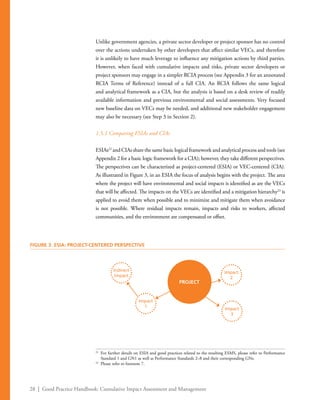
exist, as in the examples described in Box 13, management actions by other projects may be
needed to prevent unacceptable cumulative impacts.
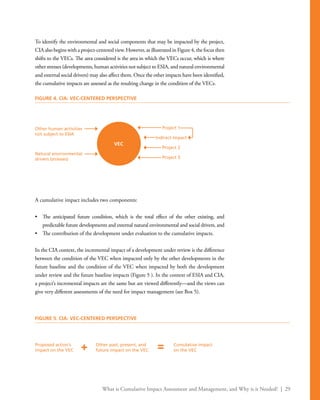
Box 13. Shared Responsibility for Management of Cumulative Impacts
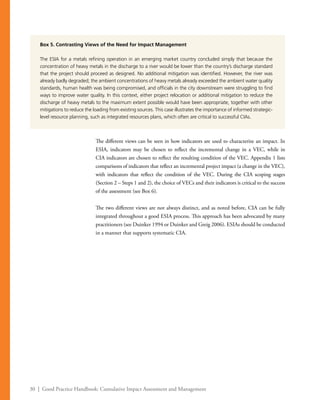
Significant cumulative effects on a predatory wildlife species resulting from existing forest harvesting, mines,
oil and gas operations, and recreational activities (managed by the government) were revealed when the
CIA for a new mine proposal was completed. The proposed management response was the creation of a
“carnivore compensation program” to be jointly supported by the new mine, the dominant forestry company
in the area, some oil and gas interests, and the government.
In another case, concern for the cumulative effects of the biochemical oxygen demand from the discharge
of a proposed pulp mill together with the discharges of existing mills resulted in a requirement for a joint
monitoring program implemented by the operators of the existing mills together with the operators of the new
mill. In addition, should dissolved oxygen drop below a specified limit, immediate corrective action is required
to be taken jointly by the parties (Therivel and Ross 2007).
What Is the Process for Implementing CIA? | 49
Management of cumulative impacts therefore, does not rest solely with developments that
come later in the development sequence. Ignoring possible cumulative impacts during project
development carries the risk of having unanticipated constraints imposed at a later time.
The analysis phase of the project CIA may indicate the need and/or potential for additional
mitigation measures beyond those identified in the project ESIA. The design of such additional
mitigation measures for the development, if needed, is an early part of the work in this step of
managing cumulative impacts. Iteration of the analysis (Step 4), significance evaluation (Step
5), and management (mitigation) design (this step) may be needed.
If specific project mitigation that will prevent unacceptable cumulative impacts can be
identified and implemented, then the developer may not need to initiate collaborative
engagement of others in impact management. When prevention of unacceptable
cumulative impacts by project mitigation alone is not possible, collaborative engagement
in regional management strategies will be necessary. In all cases, collaborative engagement
in regional efforts to manage cumulative impacts (e.g., design of project monitoring
to fit with regional monitoring programs where they exist) may help to reduce the
risk of additional unanticipated management commitments at a later time, as regional
development proceeds. Specific actions that may be needed to effectively manage
cumulative impacts include the following:
•	 Project design changes to avoid cumulative impacts (location, timing, technology).
•	 Project mitigation to minimize cumulative impacts, including adaptive management
approaches to project mitigation.35
•	 Mitigation of project impacts by other projects (not under control of the proponent
to further minimize impacts on VECs).36
•	 Collaborative protection and enhancement of regional areas to preserve biodiversity
(Kiesecker et al. 2009a, 2009b; McKenney and Kiesecker 2010).
•	 Collaborative engagement in other regional cumulative impact management strategies.
•	 Participation in regional monitoring programs to assess the realized cumulative
impacts and efficacy of management efforts.
The first two points are clearly the responsibility of the project, the third point is the
responsibility of other project proponents to address their contribution to cumulative
35
	 Adaptive management strategies are not a panacea. A common misunderstanding that has emerged in some
ESIA practice is that adaptive management is primarily a post-hoc response to developing management
responses after problems emerge. In fact, it is a well-developed and rigorous discipline for experimental
management used for reducing uncertainty about how to manage effectively. Consequently, adaptive
management is not appropriate if impacts may not be reversible. In addition, it is best employed to assess
management strategies to which VECs are responsive over a relatively short term.
36
	 Hydro-Québec found this to be particularly important in CIA practice (Bérubé 2007).
50 | Good Practice Handbook: Cumulative Impact Assessment and Management
impacts (some of which may be discovered during the project CIA process), and the last
three points involve collaborative engagement with other stakeholders, including project
proponents, government agencies, affected communities, conservation groups, and
expert groups. Ultimately, governments should establish cumulative impact assessment
frameworks that provide mechanisms to identify parties and contributors to the CIA
process, including VECs selection and impact management processes (see Box 14).
Box 14. Mitigation of Panama Hydroelectric Developments
Together with international and local lenders and other MDBs, IFC is financing the development of two cascading
hydropower projects on the Chiriqui Viejo River in Chiriqui Province in western Panama. These projects are
situated in the upper reaches of the watershed above approximately a dozen other cascading projects being
constructed or planned for development by other private sector sponsors. An RCIA was conducted with the
support of the lenders group. Results from the RCIA indicated that in addition to the barrier effect caused by
the dams, dikes, and levees, the reduced downstream flows between the different projects could significantly
impair aquatic habitat connectivity in the dewatered segments and jeopardize the ultimate viability of the
mountain mullet, a catadromous fish currently present in the river.
Because these two projects are the highest in the watershed, the natural movement of spawning fish
downstream and juveniles upstream would first be impacted by several projects under construction in the
lower reaches of the river. Lack of mitigation of this barrier effect by projects downstream from the IFC-
financed projects would likely compromise the viability of juvenile and adult fish populations in the higher
sections of the river.
To address this situation, these two projects have taken a two-tiered approach:
First, they have developed a comprehensive downstream ecological flow management plan that will ensure
that these two projects release enough water in the dewatered segments downstream, to maintain not only
aquatic habitat connectivity, but also enough usable habitat for key indicator fish and invertebrate species.
They are working with the group of lenders, other project sponsors, and the responsible government agencies
in Panama to tackle not only connectivity but also other cumulative issues (e.g., sediment load) at a watershed
level. These solutions are still being negotiated but include fish hatcheries, as well as catch-and-release of
juvenile and adult fish to repopulate the stream in the dewatered segments upstream from the different dams.
Challengesto
ImplementingaCIA
Section 3. What are the Challenges to
Implementation of CIA? How can These
Challenges Be Overcome?
Challengesto
ImplementingaCIA
What are the Challenges to Implementation of CIA? How can These Challenges Be Overcome? | 51
3. What are the Challenges to Implementation of
CIA? How can These Challenges Be Overcome?
This final section recognizes that the application of this six-step process entails many
challenges, as does the implementation of an effective strategy to manage cumulative
impacts and risk for multiple projects, actions, and activities. This section provides some
key recommendations to consider when trying to overcome such challenges.
The well-described economist’s “Tragedy of the Commons” explored by Hardin (1968)
illustrates the many challenges that assessment and management of cumulative impacts
may face. Some examples:
•	 Information on proposed developments may be limited by commercial considerations.
•	 Identifying and describing “predictable future development” and “external natural
and social stressors” in sufficient detail to assess their social and environmental impacts
and effects can be fraught with difficulty.
•	 Stakeholders may assign different priorities to VECs.
•	 VEC baseline conditions and acceptable thresholds are often unavailable because of
lack of data or agreed scientific methodologies.
•	 Attribution of impacts is a process dominated by uncertainties, and getting individual
project sponsors to accept responsibilities and impact management is not always a
straightforward task.
•	 Exercising leverage over government and over other developers can be an overwhelming
task for private developers, which often may produce negligible results.
•	 Engaging stakeholders in discussing strategic cumulative impacts, when the discussion
is promoted by a specific developer sponsor, tends to be confusing and could be
counterproductive.
•	 Project sponsors may not share data collaboratively or define mitigation strategies
jointly.
CIA requires interactions with numerous organizations and individuals from government,
third parties, affected communities, and other stakeholders. Numerous groups have an
interest in CIA because of its wider geographic scope and focus on impacts from multiple
developments. But what should their role be in a project-level CIA? The type of interactions
that project proponents should have with interested parties will vary, depending on the
development and its location. In locations where third parties are organized (e.g., farmer
or industry association) and concerned about environmental impacts, third parties may
become very involved in some parts of the assessment (e.g., scoping, provision of data,
development of mitigation) or in ongoing management actions. Also, in locations where
52 | Good Practice Handbook: Cumulative Impact Assessment and Management
governments have established regional planning processes and means of managing natural
resources regionally, they too may become actively involved in parts of the assessment
(scoping, provision of data, determination of significance of impacts) or in implementation
of management actions (e.g., regional monitoring program).
Deciding why, when, and how to interact with government(s), third parties, and affected
communities is not straightforward; it requires considerable thought and expertise.37
To
determine the appropriate type and scope of interactions requires an understanding of
constraints on both governance and participants’ capacity.
3.1 Recommendation 1: Clarify Roles and Responsibilities
A wide range of roles and responsibilities are possible. The principles and purpose for
involving different parties in CIA or RCIA should not change, no matter what the
circumstances of government, third parties, or affected communities are. The principles
are meaningful engagement of affected communities, involvement and collaboration
with governments, and interaction with third parties. At a minimum, interactions with
government, third parties, and affected communities should accomplish the purposes
that relate to a client’s project-specific CIA or RCIA. The ideal roles and responsibilities
of different parties and the purpose of these roles/responsibilities are listed in Table 3. See
also Box 15.
As illustrated inTable 2, significant gaps typically exist between the actual governance context
for a development and the ideal roles and responsibilities shown in Table 3. Gaps in roles
and responsibilities need to be explicitly identified and handled by different management
strategies in a CIA or RCIA.
37
	 For guidance, please refer to these IFC documents on good practice and guidance on stakeholder engagement,
participatory monitoring, and grievance mechanisms:
	•	 www.ifc.org/HB-StakeholderEngagement
	•	 www.ifc.org/GPN-Grievance
	•	 http://www1.ifc.org/wps/wcm/connect/topics_ext_content/ifc_external_corporate_site/
ifc+sustainability/publications/publications_gpn_socialdimensions__wci__1319578072859
	•	 www.ifc.org/HB-WaterFootprint	
	•	 http://www1.ifc.org/wps/wcm/connect/topics_ext_content/ifc_external_corporate_site/
ifc+sustainability/publications/publications_handbook_doingbetterbusiness__wci__1319576642349
What are the Challenges to Implementation of CIA? How can These Challenges Be Overcome? | 53
Gaps can be identified by comparing the ideal given in Table 3 with the actual situation
for a proposed development. In general, there are two approaches for managing
gaps in roles and responsibilities. First, clarify and gain acceptance for all roles and
responsibilities: clearly define the roles and responsibilities of the client as opposed to
those of government, third parties, affected communities, and the public, and ensure the
parties understand their roles. Second, as part of the CIA or RCIA engagement process,
make sure to communicate the established roles and responsibilities widely—inform
stakeholders, NGOs, and other potentially interested groups from within and outside the
project’s DAI and region.
Box 15. Regional Collaboration in CIA
Various groups have been working in different contexts to establish collaboration between developments for
regional CIA. For example, collaborative initiatives have been developed in Australia with regard to impacts of
the coal mining industry, including strategic and regional planning led primarily by government; information
exchange—networking and forums; pooling of resources to support CIA initiatives and programs; and
multistakeholder and regional monitoring (Franks, Brereton, and Moran 2010; Franks et al. 2010). These
approaches vary in complexity, with each demanding a different degree of maturity in the collaborative
relationship. Given the expected challenges of conducting CIA in emerging market contexts, collaboration
among project proponents offers the prospect of attaining efficiencies through information sharing and joint
management approaches that should improve CIA quality, thereby reducing risks associated with unmanaged
cumulative impacts while being more cost-effective. Such collaborative efforts represent one thrust in the early
development of enabling frameworks for CIA.
TABLE 2. CIA GOVERNANCE GAPS
TYPICAL GOVERNANCE
CONTEXT
WHAT TO DO?
No policy or legal
framework for CIA
Identify and use any sources of partial information about policy or regulatory limits to
development (e.g., policy statements, strategic or sectoral assessments, national and/
or regional development actions plans and targets, including those referenced under
international agreements and conventions); use sustainability, irreplaceability, and
vulnerability as proxies to define acceptable limits for all policy and regulatory gaps.
Technical expertise will be needed to understand and apply sustainability and vulnerability
concepts in CIA.
No regional planning
or collaborative
resource management
mechanisms
Share CIA/RCIA purpose, process, and requirements with government and third parties early on
and discuss their participation in CIA/RCIA (including implications and benefits of participating
in this process); discuss environmental and social permitting requirements with government
authorities and ensure ESIA and CIA/RCIA will provide the government with the information
it needs for decision making; assess the level of involvement feasible for the government and
third parties and reach agreement with them about their participation and their roles and
responsibilities; encourage the participation of government, third parties, and representatives
of affected communities in scoping, review of CIA/RCIA findings, proposed management
strategies, and impact monitoring.
54 | Good Practice Handbook: Cumulative Impact Assessment and Management
TABLE3.ROLESANDRESPONSIBILITIESOFPARTICIPANTSINCIAUNDERIDEALGOVERNANCECONDITIONS
ROLESANDRESPONSIBILITIESBYPARTYSCALEPURPOSE
Government
•	Establishpolicyandlegalframeworkforresource
managementandcumulativeimpactmanagement.
•	Establishandleadregionalplanningstructuresand
collaborativemechanismsformanagingandmitigating(e.g.,
aggregatedoffsetstrategies)resourcedevelopmentsand
cumulativeimpacts.
•	Implementpermittingprocessthatconsiderscumulative
impactsofalldevelopmentsandpressures,andconforms
tovaluesandlimits,givenregionalplansandnational
frameworks.
•	DesignandconductCIAstudyofgeographicareawhich
includesthebaseline(historical)conditionsandpredictsthe
futurebaseline,basedonthecarryingcapacityoftheVECs
•	Issuesapprovalstoindividualprivatesectorprojectstobe
developedonthebasisofthisinformation.
•	Leaddevelopmentandimplementationofregionalcumulative
impactmonitoringprogramthatanalyzesdevelopment
pressuresandimpactsatregionalscaleandcomparesresults
tovaluesand/oracceptablelimitsforresourcedevelopment.
National,
subnational,
regional,
and/orlocal.
•	Definesvaluesandacceptablelimitsforresourcedevelopment.
•	Defineslocationsforacceptabletypesandlimitsofdevelopments.
•	Identifiescontributionofeachdevelopmenttocumulative
impactsinregion,givespublicandproponentassurancethat
proposeddevelopmentsarewithinacceptablelimitssetbylegal
frameworkandregionalplansandprocesses.
•	GivesinformationonstateofVECsinregionandassurancethat
cumulativeimpactvaluesanddevelopmentobjectivesarebeing
met;providesdatabaseforproject-levelCIA,andmakessurethis
informationisfreelyandpubliclyavailable.
PrivateSectorProjectProponent
•	DesignandconductCIA(orRCIA)studyoftheincremental
impactsoftheprojectbuildingontheCIAstudyconducted
bythegovernment.
•	Monitorandmanagecumulativeimpactsandrisksrelatedto
thedevelopmentforitslifespan.
•	Provideproject-levelcumulativeimpactmonitoringdatato
regionalcumulativeimpactmonitoringprogram.
•	Supportregionalplanningstructuresandcollaborative
mechanismsformanagingcumulativeimpactstoprevent
theirlimitsfrombeingreached;activelyparticipateasneeded
incollaborativesystemswithgovernment,privatesector,and
public.
Regional,
local,and/or
site.
•	Givesfinancialinstitutionsanddecisionmakersinformationabout
cumulativeimpactforevaluatingtheproject.
•	ConformstoCIAcommitmentsand/orpermitconditions;
managesdevelopmenttopreventitfromcausingVECstoreach
limits.
•	Givesthegovernmentproject-relatedcumulativeimpactdata
itneedstomanagetheuncertaintyofimpactpredictionsand
preventVECsfromreachinglimits.
•	Enableseffectivemonitoringandmanagementofcumulative
impactsatappropriatescale;supportscollaborative
multistakeholdersolutionsforCIA.
What are the Challenges to Implementation of CIA? How can These Challenges Be Overcome? | 55
TABLE3.ROLESANDRESPONSIBILITIESOFPARTICIPANTSINCIAUNDERIDEALGOVERNANCECONDITIONScontinued
ROLESANDRESPONSIBILITIESBYPARTYSCALEPURPOSE
ThirdParties(existingandfuturedevelopmentsand/or
resourceusers)
•	Similartoproponent,butcoveringexistingorfuture
developments
•	Assessandmanagecumulativeimpactsofexisting
developments.
•	Assessandmanagecumulativeimpactsofanyfuture
developments;prepareESIAandCIAforpermitdecision
makersifneeded.
•	Collectandprovidedataforregionalcumulativeimpact
monitoringprogram.
•	Participateinregionalplanningstructuresandcollaborative.
mechanismsformanagingCIAatregionalorlargerscales.
Regional,
local,and/or
site.
•	Providesprojectproponentsandotherdevelopers,decision
makers,andregionalmonitoringprogramwithdetailsabout
impactsofexistingdevelopments.
•	Providesproponentandotherdevelopers,government,andother
stakeholderswithdetailsaboutproposeddevelopments(i.e.,
projectdescription,impactanalysis,ESIA/CIA).
•	Providesproject-leveldataneededforregionalcumulativeimpact
monitoringprogram.
•	Enableseffectiveregionalmanagementofcumulativeimpacts;
supportscollaborative,multistakeholderprocess.
AffectedCommunitiesandPublic
•	Publicparticipatesinvaluesettingforpolicyand/orlegal
frameworksandregionalresourcemanagementplans.
•	AffectedcommunitiesparticipateinCIAofindividualprojects.
•	Publicparticipatesincollaborativemanagementofcumulative
impacts.
Regional,
local,and/or
site.
•	Ensuresregionalresourcedevelopmentlimitsandconditions
reflectpublicvalues.
•	Allowsvaluesofaffectedpeopletobereflectedinscopingand
valuationofproject-levelCIAs.
•	Fosterspublicownershipofcumulativeimpactmanagement
objectivesandresults.
56 | Good Practice Handbook: Cumulative Impact Assessment and Management
3.2 Recommendation 2: Establish and Maintain a Constructive
Relationship with Government and Other Stakeholders
Establishing and maintaining a constructive relationship with government and other
stakeholders over the life of a project is an integral part of CIA or RCIA. Table 4 provides
specific details about the place for and objectives of interactions. However, limitations in
capacity can inhibit governments and other stakeholders from participating as needed in a
proponent’s CIA or RCIA process. Where government capacity is low, interactions should
occur at a minimum in those areas identified in Table 4; but where capacities are greater
it is useful to increase the number and/or scope of such interactions.
TABLE 4. INTERACTIONS WITH STAKEHOLDERS IN CIA
PARTIES PLACES IN CIA PROCESS REQUIRING INTERACTIONS WITH PARTIES OBJECTIVES OF
INTERACTIONSMinimum Ideal
Government Assessment – scoping, baseline
data collection, review of
impact findings
Management – collection and
review of cumulative impact
monitoring data
Government leading collaborative
CIA program of planning,
permitting, monitoring, and
managing cumulative impacts
Provide project proponent with
government standards, data,
views, expertise, concerns,
and validation for assessment;
facilitate government role in
collaborative monitoring and
management
Third Parties Assessment – informed about
CIA study and results
Management – informed about
cumulative impact monitoring
and management program and
relevant results
Provide information about existing
and proposed projects; participate
in collaborative mitigation,
monitoring, and management
Provide proponent with third-
party information needed
for CIA; promote third-party
participation in collaborative
monitoring and management
Affected
Communities
and the
Public
Assessment – scoping
Assessment of Significance
Management – collection and
review of cumulative impact
monitoring data
As many steps in the CIA process
as possible­—e.g., data collection,
formulation of mitigation,
ongoing monitoring
Include values and concerns of
affected people in CIA; gain
public support and insights
during project planning and
operations
Conclusions
Conclusions
N | Good Practice Handbook: Cumulative Impact Assessment and Management
Conclusions
Conclusions | 57
Conclusions
While the expanded geographical and temporal scope of CIA (relative to ESIA) is often
a challenge, the most significant challenge to performing and implementing a good CIA
process lies in its multistakeholder nature. To facilitate the assessment and management
of cumulative impacts, practitioners have called for, and in some developed countries
governments are now beginning to develop, regional enabling frameworks for CIA. Such
frameworks would support CIA by:
•	 Creating transparent mechanisms for disclosing available information on proposed
developments;
•	 Establishing regional thresholds for VEC condition;
•	 Making available information on current states and trends in VEC condition;
•	 Making available information on the impacts of existing developments;
•	 Possibly providing regional modeling tools; and
•	 Developing a framework for regional cumulative impact mitigation and monitoring.
However, these frameworks are generally not well advanced or widely available yet.
The creation of a regional enabling framework for CIA is beyond the capacity of
individual proponents. However, good practice for cumulative impact assessment and
management includes supporting the development of such frameworks. This may take
several forms: working to engage other parties in the CIA or RCIA process; sharing
the results of the project CIA or RCIA including recommendations for project-specific
and regional management actions needed by others to effectively manage cumulative
impacts; and supporting the implementation of collaborative approaches to cumulative
impact management through information exchange networking, pooling resources for
implementation of shared management initiatives, and participation in multistakeholder
and/or regional monitoring.38
38
	Even when a project-specific CIA is not required, good environmental management practice supports
regional efforts to assess and manage cumulative impacts. This would include making project ESIA reports
and project impact monitoring results available to others who are working to manage cumulative impacts
within the regional context.
58 | Good Practice Handbook: Cumulative Impact Assessment and Management
Furthermore, because the basic logic framework for ESIA and CIA is essentially the
same39
and they share many common standard tools and analytical methods, the key
strategy needed in addressing the expanded scope of CIA is to ensure four conditions:
•	 The CIA team has adequate qualifications and skills.
•	 The budget for the proponent’s CIA is specified and included in the project budget with
the amounts allocated appropriate for the likely scope and level of detail of the CIA.
•	 The assessment schedule is appropriate, given the augmented scope and complex
multistakeholder context.
•	 Thebestandmostup-to-dateavailableinformationisusedandexpertopinionisconsulted.
Preliminary estimates of monitoring and mitigation costs may be developed early on in
project development, but the full costs will likely need to be reassessed once the CIA or
RCIA is complete.
ItiscriticaltothesuccessofCIAorRCIA,asapplicable,thattheindividualprojectmitigation
and, where needed, regional cumulative impact management strategies be implemented
as designed. At the same time, estimates of cumulative impacts are often uncertain. The
management approach to implementation thus needs to be adaptive, monitoring both the
impacts and the effectiveness of management approaches, and adjusting the management
to ensure avoidance of unacceptable cumulative impacts. As with management of impacts
identified in ESIA, this works best when management of cumulative impacts is integrated
into company business plans and strategies.
39
	 See Appendix 2, Basic Logic Framework for CIA.
Appendixes
Appendixes
Appendices
Appendix 1 | 59
Appendix 1. Examples of Indicators for Assessing Incremental
Project Impacts and Cumulative Impacts
The following table provides examples of endpoints or indicators typically used on standard ESIAs vis-á-vis those that would
be recommended or used in a CIA. The second column represents indicators of incremental change while the third column
refers to those that would reflect cumulative impacts over selected VECs. The last column makes reference to the applicable IFC
Performance Standard for the impact type.
PROJECT ASPECT INDICATOR OF INCREMENTAL
IMPACT (ESIA)
INDICATOR OF CUMULATIVE
IMPACT (CIA)
PERFORMANCE
STANDARD
Additional wage
employment
opportunities
•	 Incremental numbers of employed
and unemployed, participation
rates of affected population
•	 Incremental value of subsistence
income, wage, and other income
to population
•	 Number, size, skill levels of
regional labor force
•	 Measures for shifts in livelihood
and sustainability of livelihoods
1, 2
Addition of a
pollutant to the
environment (air,
water)
•	 Concentration of the pollutant in
the emission and/or discharge
•	 Concentration relative to discharge
standard
•	 Load from the project
•	 Characterization of the spatial
emission and/or discharge plume
from the project
•	 Concentration of the pollutant
in the receiving environment
•	 Concentration relative to
ambient standard
•	 Total loading (from all sources)
of the pollutant
•	 Characterization of the spatial
pattern of the concentration of
pollutants in the downstream
environment
3
Additional incidents
of disease, alcohol
and drugs problems,
and crime
•	 Number of additional incidents
of sexually transmitted diseases,
alcohol and drug problems; crime
rates
•	 Incremental changes to demands
on health, social, and policing
services
•	 Total number of incidents,
proportion of population
affected
•	 Measures for community and
regional health and wellness;
safety and security
4
Loss of Land (land
alienation)
•	 Area and/or proportion of land
lost, damaged, or inaccessible
because of the project
•	 Incremental change in benefits
of affected land users (e.g., lost
agricultural production, subsistence
use)
•	 Total land area available, value
of land use benefits
•	 Total population affected
•	 Measures for sustainable
livelihood and poverty
5
60 | Good Practice Handbook: Cumulative Impact Assessment and Management
PROJECT ASPECT INDICATOR OF INCREMENTAL
IMPACT (ESIA)
INDICATOR OF CUMULATIVE
IMPACT (CIA)
PERFORMANCE
STANDARD
Conversion or
degradation of
natural and critical
habitat
•	 Area and/or proportion of natural
and critical habitat converted and/
or degraded because of the project
•	 Incremental change in habitat
quality and/or condition
•	 Total area of lost habitat
•	 Change in rates of habitat loss
•	 Measures of habitat
fragmentation
6
Regulation of
downstream flows
Reduction,
modification, and/
or fragmentation of
riparian and aquatic
habitats
•	 Percent reduction of downstream
flows as compared to average annual
flows
•	 Percent reduction of wetted-
perimeter or of usable habitat in
the impacted river reaches
•	 Connectivity from the river reaches
upstream and downstream of the
dam or weir
•	 River ecological integrity,
including natural flow regimes
(e.g., quantity, quality, seasonal
variability, and predictability)
•	 Viability of migratory fish
populations
1,6
Addition of mortality
to a wildlife
population
•	 Direct mortality caused by project
operations over time
•	 Percentage of local population
(or range) lost with relation to
global and/or regional population
numbers (or range)
•	 Change in rates of regional
and/or global population
decline
•	 Measures of population (or
range) fragmentation
6
Appendix 2 | 61
Appendix 2. Basic Logic Framework – Lessons
from CIA Practice
CIA shares the same basic analytical process of an ESIA, and thus it involves the
following steps:
•	 Choose a set of development alternatives and variants to assess.
•	 Choose endpoints (VECs) for comparative analysis of the development alternatives,
and the terms in which performance of each alternative will be expressed (indicators).
•	 Assess the expected impact of each development alternative in terms of each VEC’s
indicators.
•	 If no alternative performs adequately, redesign one or more alternatives (e.g.,
mitigation measures) with the express intention to improve performance.
•	 Examine the results of analysis, weight the impacts on VECs, and synthesize the
results of analysis into an information package for decision makers.
The experience of CIA practitioners reveals that good practice in CIA has the following
characteristics.40
Process Management:
•	 Ideally, regional CIA is conducted by the government prior to issuing approval (a
concession, a license, etc.) for private sector developments, or the government will have
established a CIA framework to support and enable good CIA practice by private sector
developers;
•	 If the government or some other authority designated by the government has not
conducted a regional CIA then the project proponent should take into account the
findings and conclusions of related and applicable plans, studies, or assessments to
develop a process of CIA; and
•	 The CIA may be linked to the ESIA and is begun early enough in project development
that consideration of cumulative impacts can inform risk-based decision making about
project design.
40
	 Burris and Canter 1997; McCold and Holman 1995; Baxter, Ross, and Spaling 2001; Cooper and Sheate
2002; Antoniuk 2002; Kennett 2002; Duinker and Greig 2006, 2007; Bérubé 2007; Therivel and Ross
2007; Canter and Ross 2010; Franks, Brereton, and Moran 2010; Franks et al. 2010; Cooper 2011; Gunn
and Noble 2011; IFC Performance Standard 1.
62 | Good Practice Handbook: Cumulative Impact Assessment and Management
Consultation and Collaboration:
•	 Consultation with affected parties is transparent, meaningful, and ongoing.
Information about the proposed development should be provided to affected parties,
including the results of the CIA. Where possible, collaboration is established with
other developers and government regulators to facilitate joint efforts for cumulative
impact management; and
•	 The results of the CIA, including the details of any future scenario used to explore
the consequences of uncertainty, are made available to others working in the area to
support future CIAs or regional CIA frameworks.
Scoping:
•	 Even though initially all relevant VECs must be evaluated for the CIA to be robust,
only some VECs are selected for analysis based on their importance, existing concerns,
and/or likelihood of significant cumulative impacts.
•	 Scoping establishes the environmental context for CIA, including the following:
−− Definition of clear temporal and spatial boundaries and documentation of the
rationale.
−− Identification of other developments that affect the chosen VECs, including other
types of development that have different but important effects on the selected
VECs.
−− Identification of natural drivers that affect the condition of VECs.
−− Identification of variation in natural environmental processes that will affect the
cumulative impacts.
−− Consideration of jurisdictional issues and overlapping legislation.
Analysis:
•	 Assumptions and uncertainties regarding cumulative impacts are clearly stated.
•	 Thresholds, limits, and/or targets for VEC condition and/or status are defined and the
rational for their designation clearly documented.
•	 Determination of significance is adapted to each VEC.
•	 Analysis of cumulative impacts is done in the context of the project, other existing
developments, other reasonably predictable future developments (i.e., those in the
planningstageandothersthatarereasonablypredictable,includingotherdevelopments
that could be induced by the project), and natural environmental drivers. Analysis is
not limited to impacts from projects of the same type but includes all reasonable
foreseeable impacts on the chosen VECs.
Appendix 3 | 63
•	 Analysis may be limited to a single future projection of reasonably predictable future
developments; however, in this scenario the analysis includes assessment of cumulative
impacts over the possible range of environmental variation (i.e., it is not focused only
on expected average conditions). For example: a critical concern with regard to the
discharge of pollutants may be the rate of dilution, and the associated impacts can be
expected to be at a maximum when natural river flows are at a minimum, rather than
at an average or maximum.
•	 When appropriate, alternative development scenarios are used to assess the potential
environmental and social risks during the lifetime of the project.
•	 The analysis of different cumulative impacts is done at a spatial and temporal scale that
is appropriate for the particular VEC and/or cumulative impact (for example, some
wildlife species range over a large area and will be affected by projects throughout the
area; diversions and/or withdrawals of water from rivers may have cumulative impacts
at considerable distances from a proposed project, where the watercourse converges
with other rivers that are similarly affected).
•	 Analysis and conclusions are based on the scale of measurement appropriate to the
impact being assessed. Thus, for example, biophysical impacts are analyzed and
reported quantitatively, although conclusions may be summarized qualitatively.
•	 The difference between a past baseline of observed condition, if known, and the future
analytical baseline (of predicted state without the project) is clarified.
•	 Identification of the project contribution to cumulative impacts is based on a
comparison of the predicted environmental condition resulting from other existing
and future developments (the future baseline) and the environmental condition that
results when the project impacts are added to the future baseline.
•	 Consideration of the significance of cumulative impacts may be done either (a) in
regard to the change in environmental (VEC) condition relative to a past or present
baseline, or (b) relative to an established threshold and/or objective for VEC condition.
Impact Management:
•	 Effects monitoring needed to assess the realized cumulative impacts is clearly defined
and implemented. Monitoring recommendations may extend beyond what will be
done by the proponent to identify coordinated monitoring by other developers and
stakeholders.
•	 In addition to mitigation of the proposed project’s impacts, multiparty regional
mitigation and/or management (e.g., additional mitigation of other developments,
offsets, management programs) that may be needed to effectively manage cumulative
impacts is also identified and support from other stakeholders (governments,
developers and communities) is sought to implement it (e.g., by an existing authority
64 | Good Practice Handbook: Cumulative Impact Assessment and Management
such as a watershed coordinating agency, if it exists; or if no such agency exists, by a
collaborative initiative established by the various proponents—see Franks, Brereton,
and Moran 2010; Franks et al. 2010).
•	 The project’s monitoring of cumulative impacts is used to update its management
system and drive future management of impacts.
•	 Ideally, the government updates the CIA report to incorporate the results of the
project monitoring program to inform future decision making.
Appendix 3 | 65
Appendix 3. Standard Annotated ToR for an RCIA41
Terms of Reference for < the project >
1. Introduction
These terms of reference (ToR) describe the requirements for rapid cumulative impact
assessment and management for < the project >
< Provide background description of project purpose and location>
2. IFC Requirements for CIA
Performance Standard 1 defines the project area of influence to encompass “cumulative
impacts that result from the incremental impact, on areas or resources used or directly
impacted by the project, from other existing, planned, or reasonably defined developments
at the time the risks and impact identification process is conducted.” Performance Standard
1 offers some context to limit the cumulative impacts to be addressed to “those impacts
generally recognized as important on the basis of scientific concerns and/or concerns
from Affected Communities” and provides examples such as “incremental contribution of
gaseous emissions to an airshed; reduction of water flows in a watershed due to multiple
withdrawals; increases in sediment loads to a watershed; interference with migratory
routes or wildlife movement; or more traffic congestion and accidents due to increases in
vehicular traffic on community roadways.”
Even though Performance Standard 1 does not expressly require, or put the sole onus on,
private sector clients to complete a CIA, it states that the impact and risk identification
process “will take into account the findings and conclusions of related and applicable
plans, studies, or assessments prepared by relevant government authorities or other parties
that are directly related to the project and its area of influence” including “master economic
development plans, country or regional plans, feasibility studies, alternatives analyses, and
cumulative, regional, sectoral, or strategic environmental assessments where relevant.”
Furthermore, it goes on to state, “the client can take these into account by focusing on the
project’s incremental contribution to selected impacts generally recognized as important
on the basis of scientific concern or concerns from the Affected Communities within the
area addressed by these larger scope regional studies or cumulative assessments.”
41
	 Orange text on italics indicate where users may insert text according to project needs.
66 | Good Practice Handbook: Cumulative Impact Assessment and Management
Similarly, Performance Standard 1 GN1 states that “in situations where multiple projects
occur in, or are planned for, the same geographic area... it may also be appropriate for
the client to conduct a CIA as part of the risks and impacts identification process.”
However, it clearly recommends that this assessment should (a) “be commensurate with
the incremental contribution, source, extent, and severity of the cumulative impacts
anticipated,” and (b) “determine if the project is incrementally responsible for adversely
affecting an ecosystem component or specific characteristic beyond an acceptable
predetermined threshold (carrying capacity) by the relevant government entity, in
consultation with other relevant stakeholders.”
Therefore, although the total cumulative impacts due to multiple projects should be
typically identified in government-sponsored assessments and regional planning efforts,
to comply with Performance Standard 1, IFC clients are expected to ensure that their own
assessment determines the degree to which the project under review is contributing to the
cumulative effects.
3. Objective
The RCIA analysis has two objectives:
•	 To determine if the combined impacts of: the project, other projects and activities,
and natural environmental drivers will result in VEC condition that may put the
sustainability of a VEC at risk (i.e., exceed a threshold for VEC condition which is an
unacceptable outcome); and
•	 To determine what management measures could be implemented to prevent
unacceptable VEC condition, this may include additional mitigation of the project
being assessed, additional mitigation of other existing or predictable future projects,
or other regional management strategies that could maintain VEC condition within
acceptable limits.
Appendix 3 | 67
4. Conduct of the RCIA
<In the following sections add additional text as needed to provide specific characteristic
of the RCIA ToR that are known at the time the ToR are issued. For example, where it is
already known that there are regional concerns for the conditions of one or more VECs, these
concerns should be identified.>
IFC’s Good Practice Handbook, “Cumulative Impact Assessment and Management
Guidance for the Private Sector in Emerging Markets” describes a six-step process that
should be used in conducting a CIA for <the project>.
•	 Scoping phase I – VECs, spatial and temporal Boundaries
•	 Scoping phase II – Other activities and environmental drivers
•	 Establish information on baseline status of VECs
•	 Assess cumulative impacts on VECs
•	 Assess significance of predicted cumulative impacts
•	 Management of cumulative impacts – design and implementation
The following ToR sections provide a brief outline of the work to be undertaken in
conducting the RCIA for <the project>. Refer to the CIA GPH for additional guidance
regarding conduct of the following steps.
4.1 Scoping Phase I – VECs, Spatial and Temporal Boundaries
Tasks:
•	 Identify the VECs to include in the RCIA.
•	 Identify the spatial boundaries of the RCIA.
•	 Identify the temporal extent of the RCIA.
Note:
•	 VECs to include are those that would be affected by the project. Thus VECs for which
an impact was deemed insignificant in the ESIA are not to be included in the CIA.
•	 If the number of VECs is too large to conduct an analysis of all, then priority for
analysis should be given to those for which there is existing regional concern, as
reflected in the regional baseline information (see section 4.3).
68 | Good Practice Handbook: Cumulative Impact Assessment and Management
4.2 Scoping Phase II – Other Activities and Environmental Drivers
Tasks:
•	 Identify other existing and reasonably predictable projects and human activities that
do/would affect the VECs to be included in the RCIA.
•	 Identify natural environmental drivers that also impact the condition VECs identified
in section 4.1.
Note:
•	 Developments that could be reasonable expected to be induced by the projects are
considered to be reasonably predictable.
•	 Where there is a significant potential for further development, but not specific
development proposals in place, a scenario of potential development may be
considered.
4.3 Establish Information on Baseline Status of VECs
Tasks:
•	 Collect available information on the impacts of the other activities and natural drivers
on the condition of the VECs.
•	 Collect available information on trends in VEC condition.
•	 Collect available information on regional thresholds for VEC condition.
Note:
•	 If regional thresholds for VEC condition have not been established, they may have
to be estimated based on estimates from other regions. When feasible, the estimation
should be peer reviewed.
4.4 Assess Cumulative Impacts on VECs
Tasks:
•	 Establish indicators for expression of VEC condition. This may already be reflected
in the information collected on VEC baseline status (in Section 4.3). If not, then
indicators will need to be established that can be estimated from the baseline
information.
•	 Estimate the “future baseline” for condition of the VECs—i.e., the condition of VECs
as affected by the other projects, human activities, and natural drivers.
•	 Estimate the project impact on VEC condition. This estimation is done with the
effects of planned project mitigation included.
Appendix 3 | 69
•	 Estimate the cumulative impact on VECs—the total impact on the VECs when the
impacts of the development are combined with the future baseline.
Note:
•	 A wide variety of methods have been used for CIA analysis, methods chosen for the
analysis should be chosen to be compatible with the information available for the
analysis and that can provide, whenever possible, a quantitative estimate of cumulative
impact.
•	 If qualitative estimates of cumulative impact are to be developed, they should be based on
the consensus estimate of a panel of experts rather than on the opinion of an individual
expert.
4.5 Assess Significance of Anticipated Cumulative Impacts
Task:
•	 Assess the significance of the foreseen cumulative impacts on the VEC.
Note:
•	 When the cumulative impact on VEC condition will approach, be near to, or exceed
a threshold, the impact is significant.
•	 The analysis may reveal that significant cumulative impacts will exist without the
project.
4.6 Management of Cumulative Impacts – Design and Implementation
Tasks:
•	 Identify, when necessary, additional project mitigation (beyond that identified in the
project ESIA) to reduce an estimated unacceptable cumulative impact on a VEC to
an acceptable level (iteration with the tasks described in Sections 4.4 and 4.5 will be
necessary to assess the value of such additional mitigation). This should represent
effective application of the mitigation hierarchy42
in environmental and social
management of the specific project contributions to the expected cumulative impacts.
42
	 Defined in Performance Standard 1 as the strategy to first anticipate and avoid impacts on and risks to workers,
the environment, and/or affected communities, or minimize impacts and risks where avoidance is not possible.
Acceptable options for minimizing will vary; they include abating, rectifying, repairing, and/or restoring.
Residual impacts must be compensated for and/or offset. It is important to emphasize that offset is the last
resource option that should be used to compensate for residual impacts of a given action or project; it should
not be used to manage cumulative impacts on a selected VEC. However, regional offset of cumulative impacts
could still be possible as part of a collaborative CIA mitigation process led by the government or a coalition of
developers.
70 | Good Practice Handbook: Cumulative Impact Assessment and Management
•	 If necessary, identify the potential, or need for, additional mitigation of other existing
or reasonably predictable future projects.
•	 Identify the potential for other regional strategies that could maintain VECs at
acceptable conditions.
•	 Undertake best efforts to engage, enhance, and contribute to a multistakeholder
collaborative approach for the implementation of management actions that are
beyond the capacity of the project proponent.
4.7 Stakeholder Engagement
Stakeholder engagement43
is critical to the success of RCIA. Engagement should start early
in the process, i.e., in Scoping (Sections 4.1, 4.2) and continue throughout the RCIA
process. It will be essential to collect the information needed for the RCIA analysis and
likely also to secure cooperation in implementation of mitigation of the impacts of other
projects, and or identification and design of regional cumulative impact management
strategies that may be needed to avoid unacceptable cumulative impacts.
Stakeholder engagement should be designed and implemented to:
•	 clarify stakeholder roles and responsibilities in the RCIA process, and to
•	 establish and maintain a constructive relationship with government and other
stakeholders.
The second point is essential when additional mitigation is needed for other projects.
Engaging in assigning blame for cumulative impacts is likely to be counterproductive.
Cumulative impacts are, by their multiparty nature, a collective responsibility and in this
regard maintaining a constructive relationship will be essential.
43
	 For further guidance, please refer to IFC published documents on good practice and guidance on stakeholder
engagement, participatory monitoring, and grievance mechanisms:
	•	 www.ifc.org/HB-StakeholderEngagement
	•	 www.ifc.org/GPN-Grievance
	•	 http://www1.ifc.org/wps/wcm/connect/topics_ext_content/ifc_external_corporate_site/
ifc+sustainability/publications/publications_gpn_socialdimensions__wci__1319578072859
	•	 www.ifc.org/HB-WaterFootprint
	•	 http://www1.ifc.org/wps/wcm/connect/topics_ext_content/ifc_external_corporate_site/
ifc+sustainability/publications/publications_handbook_doingbetterbusiness__wci__1319576642349
References
References
References
References | 71
References
LITERATURE CITED
Antoniuk, T. 2002. “Cumulative effects assessment of pipeline projects.” In Cumulative
Environmental Effects Management: Tools and Approaches, edited by A. J. Kennedy,
143–61. Edmonton, AB: Alberta Society of Professional Biologists.
ADB (Asian Development Bank). 2010. Central Asia Atlas of Natural Resources. (Manila: ADB),
Atkinson, S. F., L. W. Canter, and W. M. Mangham. 2008. “Multiple Uses of Geographic
Information Systems (GIS) in Cumulative Effects Assessment (CEA).” Presented at
International Association for Impact Assessment Special Topic Meeting, “Assessing
and Managing Cumulative Environmental Effects,” Calgary, AB, November 6–9.
Atkinson, S.F., and L.W. Canter. 2011. “Assessing the cumulative effects of projects using
geographic information systems.” Environmental Impact Assessment Review 31(5): 457–64.
Baxter, W., W. A. Ross, and H. Spaling. 2001. “Improving the practice of cumulative
effects assessment in Canada.” Impact Assessment and Project Appraisal 19(4): 253–62.
Beanlands, G. E., and P. N. Duinker. 1983. “An ecological framework for environmental
impact assessment in Canada.” Institute for Resource and Environmental Studies,
Dalhousie University, Halifax, NS, and Federal Environmental Assessment Review
Office, Hull, QC.
Bernard, D. P., D. B. Hunsaker, and D. R. Marmorek. 1993. “Tools for Improving
PredictiveCapabilitiesofEnvironmentalImpactAssessments:StructuredHypotheses,
Audits and Monitoring.” In The Scientific challenges of NEPA: future directions based
on 20 years of experience, edited by Stephen G. Hildebrand and Jonnie B. Cannon,
547–64. Boca Raton, FL: CRC Press Inc.. ISBN 0-87371-908-5.
Bérubé, Michel. 2007. “Cumulative effects assessment at Hydro-Québec: what have we
learned?” Impact Assessment and Project Appraisal 25(2): 101–109.
Blaser, B., H. Liu, D. McDermott, F. Nuszdorfer, N. T. Phan, U. Vanchindorj, L. Johnson,
and J. Wyckoff. 2004. GIS-Based Assessment of Cumulative Effects. Report No. CDOT-
DTD-R-2004-6, Colorado Department ofTransportation Research Branch, Denver, CO.
72 | Good Practice Handbook: Cumulative Impact Assessment and Management
Bonnell, S., and K. Storey. 2000. “Addressing cumulative effects through strategic
environmentalassessment:acasestudyofsmallhydrodevelopmentinNewfoundland,
Canada.” Journal of Environmental Assessment Policy and Management 2(4): 477–99.
Brereton, D., C. Moran, G. McIlwain, J. McIntosh, and K. Parkinson. 2008. Assessing the
Cumulative Impacts of Mining on Regional Communities: An Exploratory Study of Coal
Mining in the Muswellbrook Area of NSW. Centre for Social Responsibility in Mining and
Centre for Water in the Minerals Industry, University of Queensland, Brisbane, Australia.
Brismar, A. 2004. “Attention to impact pathways in EISs of large dam projects.”
Environmental Impact Assessment Review 24: 59–87.
Burris, R., and L. Canter. 1997. “Cumulative impacts are not properly addressed in
environmental assessments.” Environmental Impact Assessment Review 17(1): 5–18.
Canter, L. 2008. Conceptual models, matrices, networks and adaptive management:
emerging methods for CEA. Paper presented at “Assessing and Managing Cumulative
Environmental Effects, International Association for Impact Assessment, Calgary, AB.
Canter, L. W., and S. F. Atkinson. 2008. “Environmental Indicators, Indices, and Habitat
Suitability Models.” Presented at International Association for Impact Assessment
Special Topic Meeting, “Assessing and Managing Cumulative Environmental
Effects,” Calgary, AB November 6–9.
———. 2010. “Adaptive management with integrated decision making: an emerging tool for
cumulative effects management.” Impact Assessment and Project Appraisal 28(4): 287–97.
———. 2011. “Multiple uses of indicators and indices in cumulative effects assessment
and management.” Environmental Impact Assessment Review 31(5): 484–90.
Canter, L.W., and J. Kamath. 1995. “Questionnaire Checklist for Cumulative Impacts.”
Environmental Impact Assessment Review 15(4): 311–39.
Canter, Larry, and Bill Ross. 2010. “State of practice of cumulative effects assessment and
management: the good, the bad and the ugly.” Impact Assessment and Project Appraisal
28(4): 261–68.
Canter,L.W.,andD.Torney.2008.“Amatrix-basedCEAprocessformarinefisheriesmanagement.”
Paper presented at International Association for Impact Assessment conference, “Assessing
and Managing Cumulative Environmental Effects,” Calgary, AB, November 6–9.
References | 73
Cavalcanti, P. M. P. S., and E. L. La Rovere. 2011. “Strategic environmental assessment of
mining activities: a methodology for quantification of cumulative impacts on the air
quality.” Journal of Air & Waste Management 61: 377–89.
CCME (Canadian Council of Ministers of the Environment). 2009. Regional Strategic
Environmental Assessment in Canada: Principles and Guidance. CCME, Winnipeg, MB.
	 http://www.ccme.ca/publications.
CEQ (U.S. Council on Environmental Quality). 1997. “Considering Cumulative Effects
Under the National Environmental Policy Act.” CEQ Executive Office of the
President. 	 http://energy.gov/sites/prod/files/nepapub/nepa_documents/
RedDont/G-CEQ-ConsidCumulEffects.pdf.
Clarke, Ray. 1994. “Cumulative Effects Assessment: A Tool for Sustainable Development.
Impact Assessment.” Impact Assessment Bulletin Volume 12, Fall 1994. pp. 313–31.
Cooper, Lourdes M. 2008. “Network Analysis in CEA, Ecosystem Services Assessment,
and Green Space Planning.” Presented at International Association for Impact
Assessment Special Topic Meeting, “Assessing and Managing Cumulative
Environmental Effects,” Calgary, AB, November 6–9.
———. 2010. “Network analysis in CEA, ecosystem services assessment, and green space
planning.” Impact Assessment and Project Appraisal 28(4): 269–78.
———. 2011. “CEA in policies and plans: UK case studies.” Environmental Impact
Assessment Review 31(5):465–80. http://www.sciencedirect.com/science/article/pii/
S0195925511000229.
Cooper, Lourdes M., and William R. Sheate. 2002. “Cumulative effects assessment:
A review of UK environmental impact statements.” Environmental Impact
Assessment Review 22(4):415–39. http://www.sciencedirect.com/science/article/pii/
S0195925502000100.
Crookes, D. J., and M. P. de Wit. 2009. “An evaluation of tools for an assessment of
cumulative effects in socioeconomic impact studies.” Journal of Environmental
Assessment Policy and Management 11(3): 311–29.
74 | Good Practice Handbook: Cumulative Impact Assessment and Management
Damman, D. C. 2002. “The challenges of developing regional frameworks for cumulative effects
assessment.” In Cumulative Environmental Effects Management:Tools and Approaches, edited
by A. J. Kennedy, 165–76. Edmonton, AB: Alberta Society of Professional Biologists.
Deverman, R. 2003. “Gathering the harvest: assessing indirect and cumulative effects for
the Ohio River Bridges Project.” Environmental Practice 5: 330–45.
Dubé, M. G. 2003. “Cumulative effect assessment in Canada: a regional framework for
aquatic ecosystems.” Environmental Impact Assessment Review 23: 723–45.
Duinker, P. N. 1994. “Cumulative Effects Assessment: What’s the Big Deal?” Pages 11-
24, in A. J. Kennedy (ed.) Cumulative Effects Assessment in Canada: From Concept
to Practice. Alberta Society of Professional Biologists, Calgary, Alberta.
Duinker, P. N., and L. A. Greig. 2006. “The Impotence of Cumulative Effects Assessment in
Canada: Ailments and Ideas for Redeployment.” Environmental Management 37(2):153-
61. http://link.springer.com/article/10.1007%2Fs00267-004-0240-5#.
———. 2007. “Scenario analysis in environmental impact assessment: Improving
explorations of the future.” Environmental Impact Assessment Review 27(3):206–19.
http://www.sciencedirect.com/science/article/pii/S0195925506001302.
Dutta, P., S. Mahatha, and P. De. 2004. “A methodology for cumulative impact assessment
in opencast mining projects with special reference to air quality assessment.” Impact
Assessment and Project Appraisal 22(3): 235–50.
Ehrlich, A. 2010. “Cumulative cultural effects and reasonably foreseeable future
developments in the Upper Thelon Basin, Canada.” Impact Assessment and Project
Appraisal 28(4): 279–86.
Faris, Tamra. 2008. “Cumulative Impact Assessment for Marine Fisheries Actions.”
Presentation to International Association for Impact Assessment Special Topic
Meeting, “Assessing and Managing Cumulative Environmental Effects,” Calgary AB,
November 6–9. http://www.iaia.org.
Franks, Daniel M., David Brereton, and Chris J. Moran. 2010. “Managing the cumulative
impacts of coal mining on regional communities and environments in Australia.”
Impact Assessment and Project Appraisal 28(4): 299–312.
References | 75
Franks, D. M., D. Brereton, C. J. Moran, T. Sarker, and T. Cohen. 2010. “Cumulative
Impacts–AGoodPracticeGuidefortheAustralianCoalMiningIndustry.”Australian
Coal Association Research Program. Centre for Social Responsibility in Mining and
Centre for Water in the Minerals Industry, Sustainable Minerals Institute, University
of Queensland, Brisbane. http://www.csrm.uq.edu.au/docs/CSRM%20SMI%20
Good%20Practice%20Guide%20document%20LR.PDF.
Franks, D. M., J. Everingham, and D. Brereton. 2012. “Governance Strategies to Manage
and Monitor Cumulative Impacts at the Regional Level.” Final Report, Australian
Coal Association Research Program, Project C19025. Centre for Social Responsibility
in Mining, University of Queensland, Brisbane. https://www.csrm.uq.edu.au/
Portals/0/C19025FinalReport.pdf. 
Gibson, R. B. 2011. “Application of a contribution to sustainability test by the Joint
Review Panel for the Canadian Mackenzie Gas Project.” Impact Assessment Project
Appraisal 29(3): 231–44.
Gonzales-Sanson, G., and C. Aguilar. 2010. “Reef Fish Diversity Components as Indicators of
Cumulative Effects in a Highly Impacted Fringe Reef.” Ecological Indicators 10: 766–72.
Great Sand Hills Scientific Advisory Committee. 2007. “Great Sand Hills Regional
Environmental Study.” Canada Plains Research Center, Regina, SK.
Greig, L., K. Pawley, and P. Duinker. 2004. “Alternative Scenarios of Future Development:
An Aid to Cumulative Effects Assessment.” Prepared for Canadian Environmental
Assessment Agency, Gatineau, QC. Research and Development Monograph Series,
2002. Catalog No. En105-3/21-2005E-HTML, ISBN 0-662-39661-8
Groffman, Peter M., Jill S. Baron, Tamara Blett, Arthur J. Gold, Iris Goodman, Lance
H. Gunderson, Barbara M. Levinson, Margaret A. Palmer, Hans W. Paerl, Garry D.
Peterson, N. LeRoy Poff, David W. Rejeski, James F. Reynolds, Monica G. Turner,
Kathleen C. Weathers, and John Wiens. 2006. “Ecological Thresholds: The Key to
Successful Environmental Management or an Important Concept with No Practical
Application?” Ecosystems 9: 1–13. doi: 10.1007/s10021-003-0142-z.
	 http://landscape.zoology.wisc.edu/People/Turner/groffman2006ecosys.pdf.
Gunn, J. H., and B. Noble. 2009. “A conceptual basis and methodological framework for
regional strategic environmental assessment (R-SEA).” Impact Assessment and Project
Appraisal 27(4): 258–70.
76 | Good Practice Handbook: Cumulative Impact Assessment and Management
———. 2011. “Conceptual and methodological challenges to integrating SEA and
cumulative effects assessment.” Environmental Impact Assessment Review 31: 154–160.
	 http://www.sciencedirect.com/science/article/pii/S0195925509001474.
Hardin,G.1968.“TheTragedyoftheCommons.”Science162(3859):1243–48.doi:10.1126/
science.162.3859.1243. http://www.sciencemag.org/content/162/3859/1243.
Harriman, J. A. E., and B. F. Noble. 2008. “Characterizing project and strategic approaches
to regional cumulative effects assessment in Canada.” Journal of Environmental
Assessment and Policy Management 10(1): 25–50.
Hegmann, G., C. Cocklin, R. Creasey, S. Dupuis, A. Kennedy, L. Kingsley, W. Ross, H.
Spaling, and D. Stalker. 1999. “Cumulative Effects Assessment Practitioners Guide.”
Prepared for the Canadian Environmental Assessment Agency by the Cumulative
Effects Assessment Working Group and AXYS Environmental Consulting Ltd.
http://www.ceaa-acee.gc.ca/default.asp?lang=En&n=43952694-1.
Hegmann, G ., and G. A.Yarranton. 2011. “Alchemy to reason: Effective use of cumulative
effects assessment in resource management.” Environmental Impact Assessment Review
31: 484–90. http://www.sciencedirect.com/science/article/pii/S0195925511000242.
Houle, M., D. Fortin, C. Dussault, R. Courtois, and J.-P. Ouellet. 2010. “Cumulative
effects of forestry on habitat use by gray wolf (Canis lupus) in the boreal forest.”
Landscape Ecology 25: 419–33.
IFC (International Finance Corporation). 2012. “Guidance Note 1: Assessment and
Management of Social and Environmental Risks and Impacts.” www.ifc.org/
sustainabilityframework2012.
Jeffrey, B., and P. N. Duinker. 2002. “A comparative analysis of cumulative impact
assessments involving mining developments and species at risk.” In Cumulative
Environmental Effects Management: Tools and Approaches, edited by A. J. Kennedy,
77–96. Edmonton, AB: Alberta Society of Professional Biologists.
Johnson, C., and M. Boyce. 2001. “A quantitative approach for regional environmental
assessment: application of a habitat-based population viability analysis to wildlife of the
Canadian central Arctic.” Canadian Environmental Assessment Agency, Ottawa, ON.
References | 77
Johnson, C. T., M. S. Boyce, R. L. Case, H. D. Cluff, R. J. Gau, A. Gunn, and R.
Mulders. 2005. “Cumulative Effects of human developments on Arctic wildlife.”
Wildlife Monographs 160: 1–36.
Johnson, D., K. Lalonde, M. McEachern, J. Kenney, G. Mendoza, A. Buffin, and K.
Rich. 2011. “Improving cumulative effects assessment in Alberta: regional strategic
assessment.” Environmental Impact Assessment Review 31: 481–83.
Jones, C. R., B. J. Orr, and J. R. Eiser. 2011. “When is enough, enough? Identifying
predictors of capacity estimates for onshore wind-power development in a region of
the UK.” Energy Policy 39: 4563–77.
Kennett, S. A. 2002. “Lessons from Cheviot: Redefining government’s role in cumulative
effects assessment.” In Cumulative Environmental Effects Management: Tools and
Approaches, edited by A. J. Kennedy, 17–29. Edmonton, AB: Alberta Society of
Professional Biologists.
Kiesecker, Joseph M., Holly Copeland, Amy Pocewicz, and Bruce McKenney. 2009a.
“Development by Design: Blending landscape planning with the mitigation
hierarchy.” Frontiers in Ecology and the Environment 8: 261–66.
Kiesecker, Joseph M., Holly Copeland, Amy Pocewicz, Nate Nibbelink, Bruce
McKenney, John Dahlke, Matt Holloran, and Dan Stroud. 2009b. “A Framework
for Implementing Biodiversity Offsets: Selecting Sites and Determining Scale.”
Bioscience 59(1): 77–84.
Kilgour, B. W., M. G. Dubé, K. Hedley, C. B. Pott, and K. R. Munkittrick. 2007. “Aquatic
environmental effects monitoring guidance for environmental assessment practitioners.”
Environmental Monitoring and Assessment 130: 423–36.
King, S. C., and R. Pushchak. 2008. “Incorporating cumulative effects into environmental
assessments of mariculture: limitations and failures of current siting methods.”
Environmental Impact Assessment Review 28: 572–86.
Krzyzanowski, J. 2011. “Approaching cumulative effects through air pollution modelling.”
Water, Air & Soil Pollution 214: 253–73.
78 | Good Practice Handbook: Cumulative Impact Assessment and Management
Lawrence, David P. 2005. “Significance Criteria and Determination in Sustainability-
Based Environmental Impact Assessment.” Prepared for Mackenzie Gas Project Joint
Review Panel, November 30. http://www.ceaa-acee.gc.ca/155701CE-docs/David_
Lawrence-eng.pdf.
———. 2007a. “Impact significance determination – Designing an approach.”
Environmental Impact Assessment Review 27: 730–54.
———. 2007b. “Impact significance determination – Back to basics.” Environmental
Impact Assessment Review 27: 755–69.
———. 2007c. “Impact significance determination – Pushing the boundaries.”
Environmental Impact Assessment Review 27: 770–88.
Lawrence Environmental. 2002. “Significance in Environmental Assessment.” Canadian
Environmental Assessment Agency – Research and Development Monograph Series,
Catalogue No. EN 105-3/74-2003E-IN, ISBN 0-662-34452-9.
Lindsay, K. M., C. P. Svrcek, and D. W. Smith. 2002. “Evaluation of cumulative effects
assessment in Friends of the West County Association V. Canada and land use
planning alternatives.” Journal of Environmental Assessment Policy and Management
4(2): 151–69.
Lintner, Stephen F. 2008. “World Bank Experience: Cumulative Effects Assessment and
Management.” Presentation to IAIA Conference, “Assessing and Managing Cumulative
Environmental Effects,” Calgary, AB, November 6–9.
MacDonald, L. H. 2000. “Evaluating and Managing Cumulative Effects: Process and
Constraints.” Environmental Management 26(3): 299—315.
MacDonald, L. H., D. Coe, and S. Litschert. 2004. “Assessing Cumulative Watershed
Effects in the Central Sierra Nevada: Hillslope Measurements and Catchment-Scale
Modelling.” In Proceedings of the Sierra Nevada Science Symposium, edited by D. D.
Murphy and P. A. Stine, 149–57. PSW-GTR-193, USDA Forest Service, Pacific
Southwest Research Station, Albany, CA.
McCold, L., and J. Holman. 1995. “Cumulative impacts in environmental assessments:
how well are they considered?” Environmental Professional 17(1): 2–8.
References | 79
McKenney, Bruce A., and Joseph M. Kiesecker. 2010. “Policy Development for Biodiversity
Offsets: A Review of Policy Frameworks.” Environmental Management 45: 165–76.
Mitchell, R. E., and J. R. Parkins. 2011. “The challenge of developing social indicators for
cumulative effects assessment and land use planning.” Ecology and Society 16(2): 29.
http://www.ecologyandsociety.org/vol16/iss2/
Noble, B. 2008. “Strategic approaches to regional cumulative effects assessment: a case study
of the Great Sand Hills, Canada.” Impact Assessment and Project Appraisal 26(2): 78–90.
———. 2010a. Introduction to Environmental Impact Assessment: A Guide to Principles and
Practice, 2nd ed. Don Mills, ON: Oxford University Press.
Pauly, Daniel. 1995. “Anecdotes and the shifting baseline syndrome in fisheries.” Trends in
Ecology and Evolution 10 (10): 430–430.
Perdicoúlis, A., and J. Piper. 2008. “Network and system diagrams revisited: satisfying CEA
requirements for causality analysis.” Environmental Impact Assessment Review 28: 455–68.
Piper, J. M. 2001. “Barriers to implementation of cumulative effects assessment.” Journal of
Environmental Assessment Policy and Management 3(4): 465–81.
———. 2002. “CEA and sustainable development: evidence from UK case studies.”
Environmental Impact Assessment Review 22: 17–36.
Quinn, M. S., G. Greenaway, D. Duke, and T. Lee. 2004. “A Collaborative Approach to
Assessing Regional Cumulative Effects in the Transboundary Crown of the Continent.”
Canadian Environmental Assessment Agency, Hull, QC.
Schultz, C. A. 2010. “Challenges in connecting cumulative effects analysis to effective wildlife
conservation planning.” BioScience 60(7): 545–51.
Scrimgeour, G. J., and P. A. Chambers. 2000. “Cumulative effects of pulp mill and municipal
effluents on epilithic biomass and nutrient limitation in a large northern river ecosystem.”
Canadian Journal of Fisheries and Aquatic Sciences 57: 1342–354.
Scrimgeour, G. J., P. J. Hvenegaard, and J. Tchir. 2008. “Cumulative industrial activity alters
lotic fish assemblages in two boreal forest watersheds of Alberta, Canada.” Environmental
Management 42: 957–70.
80 | Good Practice Handbook: Cumulative Impact Assessment and Management
Seitz, N. E., C. J. Westbrook, and B. F. Noble. 2011. “Bringing science into river systems
cumulative effects assessment practice.” Environmental Impact Assessment Review 31:
172–79.
Sorensen, T., P. D. McLoughlin, D. Hervieux, E. Dzus, J. Nolan, B. Wynes, and S.
Boutin. 2008. “Determining sustainable levels of cumulative effects for boreal
caribou.” Journal of Wildlife Management 72(4): 900–05.
Spaling, H., J. Zwier, W. Ross, and R. Creasy. 2000. “Managing regional cumulative
effects of oil sands development in Alberta, Canada.” Journal of Environmental
Assessment Policy and Management 2(4): 501–28.
Squires, A. J., C. J. Westbrook, and M. G. Dubé. 2010. “An approach for assessing
cumulative effects in a model river, the Athabasca River Basin.” Integrated
Environmental Assessment and Management 6(1): 119–34.
Strimbu, B., and J. Innes. 2011. “An analytical platform for cumulative impact assessment
based on multiple futures: the impact of petroleum drilling and forest harvesting on
moose (Alces alces) and marten (Martes americana) habitats in northeastern British
Columbia.” Journal of Environmental Management 92: 1740–52.
Therivel, Riki, and Bill Ross. 2007. “Cumulative effects assessment: Does scale matter?”
Environmental Impact Assessment Review 27: 365–85
Tiner, R. W. 2005. “Assessing the cumulative loss of wetland functions in the Nanticoke River
watershed using enhanced national wetlands inventory data.” Wetlands 25(2): 405–19.
Tricker, R. C. 2007. “Assessing cumulative environmental effects from major public
transport projects.” Transport Policy 14: 293–305.
Van Damme, L., J. S. Russell, F. Doyon, P. N. Duinker, T. Gooding, K. Hirsch, R.
Rothwell, and A. Rudy. 2003. “The development and application of a decision
support system for sustainable forest management on the Boreal Plain.” Journal of
Environmental Engineering and Science 2: S23–S34. doi:10.1139/s03-031.
Van Damme, L., P. N. Duinker, and D. Quintilio. 2008. “Embedding science and
innovation in forest management: recent experiences at Millar Western in west-
central Alberta.” The Forestry Chronicle. 84: 301–06.
References | 81
Walters, C. J. 1986. Adaptive Management of Renewable Resources. New York: Macmillan
Publishing Company.
Weclaw, P., and R. J. Hudson. 2004. “Simulation of conservation and management of
woodland caribou.” Ecological Modelling 177: 75–94.
World Bank. 2012. “Sample Guidelines: Cumulative Environmental Impact Assessment
for Hydropower Projects inTurkey.” Energy Sector Management Assistance Program.
https://www.esmap.org/node/2964.
Yang, Z., T. Khangaonkara, M. Calvi, and K. Nelson. 2010. “Simulation of cumulative
effects of nearshore restoration projects.” Ecological Modelling 221: 969–77.
ADDITIONAL REFERENCES
Athie, M. 2004. “Cumulative Effects Assessment for Private Projects.” Paper presented at
International Association for Impact Assessment Conference, Vancouver, BC, April
26–28, 2004.
Burdge, R. J., and F. Vanclay. 1996. “Social Impact Assessment: A Contribution to the
State-of-the-Art Series. Impact Assessment 14 (March): 59–86.
Canada, Government of Alberta. 2009. “Environmental Cumulative Effects
Management.” Fact sheet, Fort Air Partnership.
Canada, Government of British Columbia, Forest Practices Board. 2011. “Cumulative
Effects: From Assessment Towards Management.” Special Report 39. March.
Esteves, A. M., D. M. Franks, and F. Vanclay. 2012. “Social Impact Assessment: The State
of the Art.” Impact Assessment and Project Appraisal 30(1): 34–42.
IDS (Institute of Development Studies). 2011. “Sustainable Livelihoods Approaches:
Past, present and .....future?” IDS Knowledge Services, University of Sussex, U.K.
http://www.ids.uk/go/knowledge-services.
IFC (International Finance Corporation). 2003. “Good Practice Note 3: Addressing the
Social Dimensions of Private Sector Projects.” December.
82 | Good Practice Handbook: Cumulative Impact Assessment and Management
———. 2006. “Policy and Performance Standards on Social and Environmental
Sustainability and Policy on Disclosure of Information.” April 30.
———. 2007. “Banking on Sustainability: Financing Environmental and Social
Opportunities in Emerging Markets.”
———. 2009. “Good Practice Note 7: Addressing Grievances from Project-Affected
Communities.” September.
IPCC (Intergovernmental Panel on Climate Change),Working Group II. 2007. “Advances
in Vulnerability Assessment.” In Climate Change 2007: Impacts, Adaptation, and
Vulnerability, IPCC Fourth Assessment Report.
Kasmann,E.2009.“Ex-antepovertyandsocialimpactassessmentforcrises.”Paperpresented
at 3rd China–ASEAN Forum on Social Development and Poverty Reduction, 4th
ASEAN+3 High-Level Seminar on Poverty Reduction, and Asia-wide Regional High-
level Meeting on the Impact of the Global Economic Slowdown on Poverty and
Sustainable Development in Asia and the Pacific, Hanoi, Vietnam, September 28–30.
Kennett,S.A.2000.“TheFutureforCumulativeEffectsAssessment:BeyondtheEnvironmental
Assessment Paradigm.” Canadian Institute of Resource Law No. 69 (Winter).
Noble, B. 2010b. “Cumulative Environmental Effects and the Tyranny of Small Decisions:
Towards Meaningful Cumulative Effects Assessment and Management.” Natural Resources
and Environmental Studies Institute Occasional Paper No. 8, University of Northern
British Columbia, Prince George, BC. http://www.unbc.ca/nres/occasional.html.
OECD (Organization for Economic Co-operation and Development). 2006. “Applying
Strategic and Environmental Assessment: Good Practice Guidance for Development
Co-operation.” DAC Guidelines and Reference Series.
Serrat, O. 2008. “The Sustainable Livelihoods Approach.” Knowledge Solutions No. 15,
Asian Development Bank. November.
WCD (World Commission on Dams). 2000. “Cumulative Impacts.” Dams and
Development: A New Framework for Decision Making. The Report for the World
Commission on Dams. http://www.internationalrivers.org/files/attached-files/world_
commission_on_dams_final_report.pdf.
Stay Connected
Scribd:
http://www.scribd.com/IFCSustainability
Linkedin:
http://www.linkedin.com/pub/ifc-sustainability/1b/729/1ba
Contact:
asksustainability@ifc.org
2121 Pennsylvania Ave. NW
Washington, DC 20433
Tel. 1-202-473-1000
www.ifc.org/sustainability
asksustainability@ifc.org
Copyright
The material in this publication is copyrighted. IFC encourages the dissemination of the content for
educational purposes. Content from this publication may be used freely without prior permission,
provided that clear attribution is given to IFC and that content is not used for commercial purposes.
Disclaimer
The findings, interpretations, views, and conclusions expressed herein are those of the authors and do
not necessarily reflect the views of the Executive Directors of the International Finance Corporation or of
the the World Bank or the governments they represent.
The project examples in this publication are presented for illustrative purposes only. They do not necessarily
reflect actual projects and have intentionally been drafted without reference to specific projects.
For more information on IFC’s commitment to sustainability, including links to the Sustainability
Framework, please visit www.ifc.org/sustainabilityframework.
August 2013

Ifc good practicehandbook_cumulative impact assessment

  • 1.
    Guidance for thePrivate Sector in Emerging Markets Good Practice Handbook Cumulative Impact Assessment and Management: Guidance for the Private Sector in Emerging Markets
  • 3.
    Table of Contents| 1 Table of Contents List of Acronyms..........................................................................................................................................................3 Acknowledgements.......................................................................................................................................................4 Foreword......................................................................................................................................................................5 Executive Summary......................................................................................................................................................7 Introduction...............................................................................................................................................................13 IFC’s Context.............................................................................................................................................................15 Section 1. What is Cumulative Impact Assessment and Management, and Why is it Needed?..........................19 1.1 What are Cumulative Impacts?..................................................................................................19 1.2 What is Cumulative Impact Assessment and Management?.......................................................21 1.3 Under What Conditions Should a CIA be Conducted?.............................................................23 1.4 What are the Expected Outcomes of CIA?.................................................................................25 1.5 How Does CIA Compare with Other Environmental and Social Risk Management Tools?............... 27 1.5.1 Comparing ESIAs and CIAs...........................................................................................28 Section 2. What is the Process for Implementing CIA? ......................................................................................33 Step 1: Scoping Phase I – VECs, Spatial and Temporal Boundaries.................................................33 Step 2: Scoping Phase II – Other Activities and Environmental Drivers..........................................36 Step 3: Establish Information on Baseline Status of VECs...............................................................39 Step 4: Assess Cumulative Impacts on VECs...................................................................................42 Step 5: Assess Significance of Predicted Cumulative Impacts...........................................................46 Step 6: Management of Cumulative Impacts – Design and Implementation...................................48 Section 3. What are the Challenges to Implementation of CIA? How can these Challenges Be Overcome?......... 51 3.1 Recommendation 1: Clarify Roles and Responsibilities...............................................................52 3.2 Recommendation 2: Establish and Maintain a Constructive Relationship with Government and Other Stakeholders................................................................................56 Section 4. Conclusions.........................................................................................................................................57
  • 4.
    2 | GoodPractice Handbook: Cumulative Impact Assessment and Management Boxes 1. Differentiated Approach: Impact Versus Leverage................................................................................................11 2. Demise of the Aral Sea........................................................................................................................................20 3 . Valued Environmental and Social Components...................................................................................................21 4. Hydro Cascade with no Governmental Requirement for CIA..............................................................................26 5. Contrasting Views of the Need for Impact Management.....................................................................................30 6. CIA When Different Project Components are Subject to Separate ESIAs............................................................31 7. Rules of Thumb – How to Set Geographical and Temporal Boundaries...............................................................35 8. Establishing the Spatial Boundary for CIA..........................................................................................................36 9. Cumulative Impacts of Climate and Hydropower................................................................................................37 10. Strategic Approach to Assessing Multiple Small Developments (Scoping)............................................................38 11. Strategic Approach to Assessing Multiple Small Developments (Analysis)............................................................42 12. RCIA of Hydro Impacts on American Eel...........................................................................................................44 13. Shared Responsibility for Management of Cumulative Impacts...........................................................................48 14. Mitigation of Panama Hydroelectric Developments.............................................................................................50 15. Regional Collaboration in CIA............................................................................................................................53 Appendixes 1. Examples of Indicators for Assessing Incremental Project Impacts and Cumulative Impacts.......................................59 2. Basic Logic Framework – Lessons from CIA Practice...........................................................................................61 3. Standard Annotated ToR for an RCIA..............................................................................................................................65 References..................................................................................................................................................................71
  • 5.
    List of Acronyms| 3 List of Acronyms CIA Cumulative Impact Assessment and Management DAI Direct Area of Influence ESIA Environmental and Social Impact Assessment ESMS Environmental and Social Management System GN1 IFC Guidance Note 1 GPH IFC Good Practice Handbook IBRD International Bank for Reconstruction and Development (World Bank) IFC International Finance Corporation MDB Multilateral Development Bank RCIA Rapid Cumulative Impact Assessment and Management SEA Strategic Environmental Assessment VEC Valued Environmental and Social Component
  • 6.
    4 | GoodPractice Handbook: Cumulative Impact Assessment and Management Acknowledgments This Good Practice Handbook, “Cumulative Impact Assessment and Management: Guidance for the Private Sector in Emerging Markets” (2013) was jointly prepared by the Environmental, Social, and Governance Department of the International Finance Corporation (IFC) and ESSA Technologies Ltd., Vancouver, BC, Canada. It was written by a team led by Pablo Cardinale, IFC Principal Environmental Specialist, and Lorne Greig, Senior Consultant of ESSA Technologies, under the guidance of Patricia Miller, IFC’s Chief Sustainability Advisor. The drafting team was composed of Mauricio Athie, Lakhdeep Babra, Susan Botha, Pablo Cardinale, Patricia Miller, Justin Pooley, and Eric Shayer from IFC, Lorne Greig and Samantha Boardley from ESSATechnologies, and their consultants Peter Duinker, Robert R. Everitt and M. Joan Freeman. In addition, this Good Practice Handbook benefited significantly from extensive comments from an internal and external peer review process, which involved diverse people and institutions—too many to acknowledge individually. However, the drafting team is very thankful for their valuable and insightful comments and hopes they find their input reflected in this final version. Finally, we would like to thank the Environment, Social and Governance Department’s knowledge management team, led by Reidar Kvam, and especially Susan Botha, Amelia Hui Xin Goh, Dickson Tang, Fiorella Facello, and Rashanika Hayley Fowler, who consistently and diligently accompanied and supported the development of this Good Practice Handbook.
  • 7.
    Foreword | 5 Foreword IFCprides itself on contributing to the continuing evolution in environmental and social impact and risk management practices, as reflected in our Policy and Performance Standards onEnvironmentalandSocialSustainabilityandregularpublicationsofgoodpracticeguidance. One of the biggest risk management challenges currently facing project developers in emerging markets is the appropriate assessment and management of cumulative impacts and risks related to their business activities. Factors such as climate change and unpredictability of climate patterns, increasing and competing water use demands, decline of species biodiversity, degradation of ecosystem services, and changing socio-economic circumstances all add complexity to risk assessment and management. Potential system- wide consequences resulting from the combination of individual effects of multiple actions overtime are particularly important to understand better. Therefore, it is my pleasure to present this Good Practice Handbook (GPH) on Cumulative Impact Assessment and Management: Guidance for the Private Sector in Emerging Markets. This GPH recognizes the important role of governments in preparing cumulative impact assessment frameworks to assist private sector companies in the identification and management of cumulative impacts. However, the reality is that these frameworks are rarely available in emerging markets, and more often it is left to the private developer to try and take into consideration not only its own contribution to cumulative impacts, but also other projects and external factors that may place their developments at risk. IFC expects that the six-step process proposed in this GPH will foster the consolidation of this evolving good practice globally, and assist private sector companies in emerging markets to identify their contribution to cumulative impacts and guide them in the effective design and implementation of measures to manage such cumulative effects. I hope that this handbook will be found useful by practitioners and others having to deal with cumulative impacts, and that it contributes further to IFC’s mission of promoting sustainable private sector development. William Bulmer Director Environment, Social and Governance Department

  • 9.
  • 10.
  • 11.
    Executive Summary |7 Executive Summary The International Finance Corporation (IFC), the private sector arm of the World Bank Group, is committed to ensuring that the costs of economic development do not fall disproportionately on those who are poor or vulnerable. This commitment is implemented through the January 1, 2012 IFC Policy on Environmental and Social Sustainability and its corresponding, comprehensive set of eight Performance Standards that define IFC clients’ responsibilities for managing their environmental and social impacts and risks. Specifically, Performance Standard 1: Assessment and Management of Environmental and Social Risks and Impacts recognizes that because of the increasing significance of systemwide risk factors such as climate change, water availability, decline of species biodiversity, degradation of ecosystem services, and modification of socioeconomic and population dynamics, among others, cumulative impact assessment and management (CIA) is an essential framework for risk management. Thereseemstobesignificantdebateanddisagreementamongacademics,developers,practitioners, and civil society organizations about whether CIA should be an integral component of a good environmental and social impact assessment (ESIA) or a separate stand-alone process. CIA is evolving and there is no single accepted state of global practice. What is important is that during the process of identifying environmental and social impacts and risks, developers or project sponsors (a) recognize that their actions, activities, and projects— their developments1 —may contribute to cumulative impacts on valued environmental and social components (VECs)2 on which other existing or future developments may also have detrimental effects, and (b) avoid and/or minimize these impacts to the greatest extent possible. Furthermore, their developments may be at risk because of an increase in cumulative effects over ecosystem services they may depend on. Good practice requires that, at a minimum, project sponsors assess during the ESIA process whether their development may contribute to cumulative impacts on VECs and/ or may be at risk from cumulative effects on VECs they depend on. This Good Practice Handbook proposes as a useful preliminary approach for developers in emerging markets the conduct of a rapid cumulative impact assessment (RCIA). The RCIA can be an integral component of the ESIA or a separate process. It entails a desk review that, 1 The term development is used throughout this document to refer to projects, actions, or business activities potentially subject to a CIA. 2 See Box 3 for definition of VECs.
  • 12.
    8 | GoodPractice Handbook: Cumulative Impact Assessment and Management in consultation with the affected communities and other stakeholders, enables the developer todeterminewhetheritsactivitiesarelikelytosignificantlyaffecttheviabilityorsustainability of selected VECs. The proposed approach recognizes that, especially in emerging markets, the many challenges associated with managing a good CIA process include lack of basic baseline data, uncertainty associated with anticipated developments, limited government capacity, and absence of strategic regional, sectoral, or integrated resource planning schemes. Given the many challenges, this handbook recommends that developers: • follow a six-step RCIA process, • engage stakeholders as early as possible and throughout the decision-making process,3 and • clearly record the fundamental reasoning behind each important decision made, supporting it with as much technical evidence as possible. Figure 1 illustrates the RCIA logical framework, which is an iterative six-step process: scoping (Steps 1 and 2), VEC baseline determination (Step 3), assessment of the contribution of the development under evaluation to the predicted cumulative impacts (Step 4), evaluation of the significance of predicted cumulative impacts to the viability or sustainability of the affected VECs (Step 5), and design and implementation of mitigation measures to manage the development’s contribution to the cumulative impacts and risks (Step 6). 3 For good practice, please refer to IFC’s Stakeholder Engagement: A Good Practice Handbook for Companies Doing Business in Emerging Markets, available at www.ifc.org/HB-StakeholderEngagement FIGURE 1. RCIA: SIX-STEP APPROACH STEP1STEP2STEP3STEP4STEP5STEP6 Determine spatial and temporal boundaries Identify VECs in consultation with affected communities and stakeholders Identify all developments and external natural and social stressors affecting the VECs Determine present conditions of VECs Assess cumulative impacts and evaluate their significance over VECs’ predicted future conditions Design and implement: (a) adequate strategies, plans, and procedures to manage cumulative impacts, (b) appropriate monitoring indicators, and (c) effective supervision mechanisms Analysisoftheexistinglegal,institutional, andgovernanceframework
  • 13.
    Executive Summary |9 Depending on the scenario, the RCIA may evolve into a more robust and comprehensive CIA, which requires the participation of many parties and is best led by local governments or regional planners. CIA processes involve continuous engagement with affected communities, developers, and other stakeholders. In practice, effective design and implementation of complete CIA processes is often beyond the technical and financial capacity of a single developer. CIA thus transcends the responsibility of a single project developer. On occasion, it may be in the best interest of a private sector developer to lead the CIA process, but the management measures that will be recommended as a result of the process may ultimately be effective only if the government is involved. CIAs are multistakeholder, iterative processes that (a) require the involvement of multiple multidisciplinary teams and an effective, efficient governance structure and (b) tend to be time and data intensive. They should follow internationally recognized good practices, such as those in the Canadian Environmental Assessment Agency’s Cumulative Effects Assessment Practitioners’ Guide4 or those outlined by the U.S. Council on Environmental Quality in its guidance report on how to consider cumulative effects under the U.S. National Environmental Protection Act (NEPA) (CEQ 1997). There is no fundamental conceptual difference between a RCIA and a CIA; the first is a simplified version of the second. The preliminary screening exercise resulting from a RCIA may evolve into a CIA. The only difference in practice is that typically an RCIA involves only a desk review of available information, including existing ESIAs; strategic, regional, and/or resource planning documents; and reports from nongovernmental organizations (NGOs), the scientific community, and other interested actors. A CIA is likely to involve a complex governance structure and consultation with several parties and stakeholders to determine the VECs to assess, the baseline data requirements and sampling methodology, acceptable future conditions of VECs, indicators and thresholds, mitigation measures, monitoring protocols, and supervision mechanisms. When a government-led CIA exists, or when there are clear requirements related to a specific management unit (e.g., watershed, airshed, flyway, or landscape) resulting from regional, sectoral, or integrated resource or strategic planning efforts, private sector actors simply need to comply with the overarching requirements of the existing CIA. Where resource inventories and plans do not exist, this GPH proposes that private sector sponsors should at least perform a RCIA. The initial screening results of the RCIA will provide several potential scenarios (Box 1): 4 Available at http://www.ceaa-acee.gc.ca/default.asp?lang=En&n=43952694-1&toc=show.
  • 14.
    10 | GoodPractice Handbook: Cumulative Impact Assessment and Management • Significant risk for cumulative impacts/significant leverage: The development under consideration represents a significant contributor to the expected cumulative impacts or will be the first of several future reasonably anticipated developments that will use the same resource and/or potentially affect the same VECs. In these cases, through consultation with stakeholders, the RCIA will help assess potential cumulative impacts that could be expected over time, and guide the developer in defining the required mitigation measures. The private developercanuseStep6todesignastrategytoappropriatelymanagecumulativeimpactsand provide advice to the government on the appropriate governance structure to ensure other developers will follow suit. This is an ideal case, where the private sector sponsor can capitalize on the ESIA process, including baseline generation and stakeholder engagement, and the RCIA may organically evolve into a more robust CIA process and contribute to leveraging governments by outlining a strategic approach to managing cumulative impacts. • Significant risk for cumulative impacts/limited leverage: The development under consideration is immersed in an environment where the cumulative impacts are evident but the issues are complex, many actors are already involved, and the solution is clearly beyond any individual project sponsor. In this case, the RCIA will help the developer (a) determine the significance of the overall cumulative impacts and its contribution to these cumulative impacts, and (b) design environmental and social management plans and procedures to appropriately mitigate those contributions. In this case, the developer should be accountable only for the design and implementation of mitigation measures commensurate with the magnitude and significance of its contribution to the cumulative impacts. However, individual sponsors should use their best efforts to engage other developers, governments, and other stakeholders in acknowledging the cumulative impacts and risks and in designing coherent management strategies to mitigate them. • Limited to no contribution to cumulative impacts: The RCIA determines that even though there are clear cumulative impacts, the development’s contribution to the cumulative impacts over the affected VECs are negligible or nil. In this case, no measures other than the ones resulting from the ESIA process would be necessary. In this situation, however, if there are cumulative impacts from other sources that are not being addressed, the developer may consider it pertinent to draw this to the attention of the government or other stakeholders, and assess whether its project may be at risk from the unmanaged cumulative effect. This GPH emphasizes, therefore, that ultimately governments are responsible for preparing CIA frameworks to assist private sector actors in the identification and management of cumulative impacts. Because these frameworks rarely exist in emerging markets, this GPH also recognizes that it is clearly still in the private developer’s interest to take into consideration not only its own contribution to cumulative impacts, but also other projects and external factors that may affect similar VECs. Not doing so may place the developer’s own efforts at risk and also negatively affect its reputation. However, undertaking this process can be challenging and requires the cooperation of government, other developers, and other stakeholders.

  • 15.
    Executive Summary |11 Box 1. Differentiated Approach: Impact versus Leverage IFC is considering the financing of two hydroelectric power projects in Nepal. Significant Impact/High Leverage: The first project under consideration is a hydroelectric power plant in the Kabeli River, which is currently requesting cofinancing from the International Development Association (IDA) and IFC. It is a dual purpose peaking, run of river, 37.6 MW hydroelectric power plant, located about 620 km east of Kathmandu. The Kabeli River is an important tributary in the Tamor River watershed. This is expected to be the first power plant constructed in this remote area of the country, but twenty four other hydropower projects are in various stages of consideration to be developed in the Tamor River basin. Six projects will be on the Kabeli River and its tributaries; the remaining ones are to be constructed on Tamor River or its tributaries. All of the projects planned within the Kabeli watershed, are located upstream of the project under IFC consideration. As currently planned, hydroelectric power development of the Tamor River is likely to convert this natural habitat into a fragmented river with regulated flows. Because this HPP is the first project to be constructed in the Tamor River watershed and it is the one farthest downstream in the Kabeli before its confluence with the Tamor River, consideration of cumulative impacts at the Tamor River watershed level is crucial. To proceed with financing, IDA and IFC are working together as the World Bank Group to ensure a CIA is performed at the Tamor River watershed level. This process is just beginning, but it is expected to be led by the government and involve a wide range of stakeholders in the selection of the VECs to focus on, determination of indicators and thresholds, management strategies, and monitoring indicators and supervision mechanisms. A potential management solution includes consideration of an “intact river” approach in which another major tributary of the Tamor would be left untouched. In addition, all projects in the watershed will need to follow design and operational criteria and mitigation measures developed by the project under consideration in order to manage cumulative impacts over the selected VECs. Significant Impact/Limited Leverage: A very different case is the consideration for financing of another HPP on the Upper Trishuli. This is a 216 MW plant located about 50 km directly north of Kathmandu. Two other HPPs operate in the Trishuli River downstream from the proposed project. Two additional projects are under construction, one upstream from the proposed project and the other between the proposed project and an existing project downstream. The cumulative impacts are evident not only in terms of aquatic habitat fragmentation but also in terms of overall degradation of the catchment area (e.g., deforestation, erosion, multiple access roads, and transmission lines). In this case, for IFC financing to proceed, the company has been asked to update the ESIA, strengthening the ecological and social baselines, improving the stakeholder engagement process, and performing a RCIA to assess cumulative impacts and determine the project’s potential contribution to the most significant cumulative impacts, namely fish migration, loss of aquatic and riparian habitat, catchment erosion, and landscape fragmentation. The company will be required to include plans and procedures to mitigate identified cumulative impacts as part of the environmental and social management plan, and with the help of the IBRD, use best efforts to work with the government, other sponsors, the affected community and other stakeholders to coordinate efforts to manage cumulative impacts at the watershed level.
  • 16.
    12 | GoodPractice Handbook: Cumulative Impact Assessment and Management
  • 17.
  • 18.
  • 19.
    Introduction | 13 Introduction Themajor environmental and social management challenges that we face today—climate change, loss of biodiversity, the decline of ocean fisheries, limitations on food security, the scarcity of usable freshwater resources, displacement of communities with consequent increases in urban poverty, and inviability of traditional local livelihoods—are all the result of cumulative impacts5 from a large number of activities that are for the most part individually insignificant, but together have had regional or even global repercussions. The importance of understanding the cumulative environmental and social impacts from multiple projects, actions, or activities—or even from the same actions over an extended period of time—located in the same geographic region or affecting the same resource (e.g., watershed, airshed) has been acknowledged for decades. In some cases, the most ecologically devastating environmental effects and subsequent social consequences may result not from the direct effects of a particular action, project, or activity but from the combination of existing stresses and the individually minor effects of multiple actions over time (Clarke 1994). Consequently, although the environmental and social impact assessment (ESIA) process is essentialtoassessingandmanagingtheenvironmentalandsocialimpactsofindividualprojects, it often may be insufficient for identifying and managing incremental impacts on areas or resources used or directly affected by a given development from other existing, planned, or reasonably defined developments at the time the risks and impacts are identified. 5 It should be noted that the terms “impact” and “effect” are used interchangeably throughout this handbook. They both describe any change that a development may cause in a selected VEC. The U.S. Council on Environmental Quality (1997, Executive Summary page v) defines cumulative effects assessment (CEA) as follows: “the impact on the environment which results from the incremental impact of the action when added to their past, present and reasonably foreseeable future actions regardless of what agency (federal or non-federal) or person undertakes such other action.” Hegmann et al. (1999, Section 2, page 3) define cumulative effects as “changes to the environment that are caused by an action in combination with other past, present and future actions.”
  • 20.
    14 | GoodPractice Handbook: Cumulative Impact Assessment and Management Cumulative impacts are contextual and encompass a broad spectrum of impacts at different spatial and temporal scales.6 In some cases, cumulative impacts occur because a series of projects of the same type are being developed; for example, when several hydroelectric projects are constructed or planned on the same river or within the same watershed, when multiple oil and gas projects or mines are developed in close proximity, or when a number of wind farms are constructed or planned within the same flyway or region. In other cases, cumulative impacts occur from the combined effects over a given resource of a mix of different types of projects; for example, the development of a mine site, access roads, transmission lines, and other adjacent land uses. This Good Practice Handbook is based on IFC’s experience in applying its Performance Standards and is nonprescriptive in its approach. It should be used in conjunction with the Performance Standards, their Guidance Notes, and the World Bank Group Environmental, Health, and Safety Guidelines, which contain basic requirements and good international practices to be followed when designing, developing, and/or implementing projects. This document is not intended to duplicate requirements under the existing IFC Sustainability Framework. Its purpose is to provide practical guidance to companies investing in emerging markets to improve their understanding, assessment, and management of cumulative environmental and social impacts associated with their developments. 6 A given impact may be generated at a specific site or moment in time, but its consequences may be felt in a different geographical area (e.g., downwind or downstream), or materialize sometime later (e.g., bioaccumulation, attainment of a resilience threshold). This transcends the traditional “direct area of influence” (DAI) concept, and underscores the need for analysis of indirect and cumulative effects, as well as the need to expand the geographical boundaries of the impact assessment and/or the time frame used for the analysis.
  • 21.
    IFC’s Context |15 IFC’s Context IFC Performance Standard 1, Assessment and Management of Environmental and Social Risks and Impacts, recognizes that in some instances, private sector developers need to consider cumulative effects in their identification and management of environmental and social impacts and risks. Therefore, IFC believes that when a private sector project sponsor faces cumulative environmental and social impacts, it should have mechanisms for identifying the magnitude and significance of its contribution to those impacts and risks, and should include appropriate mitigation measures as an integral component of the project’s environmental and social management system (ESMS). For private sector management of cumulative impacts, IFC considers good practice to be two pronged: • effective application of and adherence to the mitigation hierarchy7 in environmental and social management of the specific contributions by the project to the expected cumulative impacts; and • besteffortstoengagein,enhance,and/orcontributetoamultistakeholder,collaborative approach to implementing management actions that are beyond the capacity of an individual project proponent. Performance Standard 1, in paragraph 8, defines the area of influence to encompass “cumulative impacts that result from the incremental impact, on areas or resources used or directly impacted by the project, from other existing, planned, or reasonably defined developments at the time the risks and impact identification process is conducted.” Performance Standard 1, in footnote 16, limits the cumulative impacts to be addressed to “those impacts generally recognized as important on the basis of scientific concerns and/or concerns from Affected Communities” and provides examples such as “incremental contribution of gaseous emissions to an airshed; reduction of water flows in a watershed due to multiple withdrawals; increases in sediment loads to a watershed; interference with migratory routes or wildlife movement; or more traffic congestion and accidents due to increases in vehicular traffic on community roadways.” 7 Defined in Performance Standard 1, paragraph 3, as the strategy to first anticipate and avoid impacts on and risks to workers, the environment, and/or Affected Communities or, where avoidance is not possible, to minimize impacts and risks. Acceptable options for minimizing will vary and include abating, rectifying, repairing, and/or restoring. Finally, where residual impacts remain, these must be compensated for and/or offset. It is important to note that compensation and/or offsets are the mechanisms proposed for managing residual impacts, not cumulative impacts. This is an important clarification as it is impractical for a single sponsor to offset cumulative impacts. However, regional offset of cumulative impacts could still be possible as part of a collaborative CIA mitigation led by the government or a coalition of developers.
  • 22.
    16 | GoodPractice Handbook: Cumulative Impact Assessment and Management Even though Performance Standard 1 does not expressly require, or put the sole onus on, private sector clients to undertake a CIA, in paragraph 11 it states that the impact and risk identification process “will take into account the findings and conclusions of related and applicable plans, studies, or assessments prepared by relevant government authorities or other parties that are directly related to the project and its area of influence” including “master economic development plans, country or regional plans, feasibility studies, alternatives analyses, and cumulative, regional, sectoral, or strategic environmental assessments where relevant.” Furthermore, footnote 17 states, “the client can take these into account by focusing on the project’s incremental contribution to selected impacts generally recognized as important on the basis of scientific concern or concerns from the Affected Communities within the area addressed by these larger scope regional studies or cumulative assessments.” Similarly, Performance Standard Guidance Note 1 (GN1), in paragraph GN38, states, “in situations where multiple projects occur in, or are planned for, the same geographic area...it may also be appropriate for the client to conduct a CIA as part of the risks and impacts identification process.” However, in paragraph GN41, it recommends that this assessment should (a) “be commensurate with the incremental contribution, source, extent, and severity of the cumulative impacts anticipated,” and (b) “determine if the project is incrementally responsible for adversely affecting an ecosystem component or specific characteristic beyond an acceptable predetermined threshold (carrying capacity) by the relevant government entity, in consultation with other relevant stakeholders.” Therefore, although the total cumulative impacts due to multiple projects typically should be identified in government-sponsored assessments and regional planning efforts, according to Performance Standard 1, IFC clients are expected to ensure that their own assessment determines the degree to which each project under review is contributing to the cumulative effects. This handbook acknowledges the importance of differentiating between those actions over which a private sector sponsor has direct control and those for which it may have leverage to influence others to achieve optimal cumulative impact management as part of a multistakeholder effort—an effort that ideally should be led by government agencies, but at a minimum must involve government agencies.8 Figure 2 illustrates the overall context and proposed approach that exemplifies general compliance with Performance Standard 1. 8 For further details, see Franks, Everingham, and Brereton 2012.
  • 23.
    IFC’s Context |17 FIGURE 2. PERFORMANCE STANDARD 1, CIA RECOMMENDED APPROACH BEST EFFORTS REQUIRED Government and regional planners have the ultimate responsibility for CIA Given the challenges associated with lack of government-sponsored CIA strategies, use IFC’s Guidance for Private Sectors in Emerging Markets Identify relevant VECs Cumulative impacts will occur regardless of the project? Are project’s incremental contributions to cumulative impacts significant? Follow mitigation hierarchy Design management strategies that are coherent with the expected impacts on VECs and commensurate with the project’s contribution RCIA Leverage Control Use best efforts to engage all relevant stakeholders to agree on VECs, and on each and all parties responsibilities in the: (a) management of the expected impacts on VECs, and (b) monitoring and/or supervision of the (b.1) overall condition of the VECs and (b.2) the appropriate implementation of agreed mitigation measures.
  • 24.
    18 | GoodPractice Handbook: Cumulative Impact Assessment and Management
  • 25.
    Section 1. Whatis Cumulative Impact Assessment and Management, and Why is it Needed? BasicCIAConcepts
  • 26.
    H | GoodPractice Handbook: Cumulative Impact Assessment and Management BasicCIAConcepts
  • 27.
    What is CumulativeImpact Assessment and Management, and Why is it Needed? | 19 1. What is Cumulative Impact Assessment and Management, and Why is it Needed? 1.1 What are Cumulative Impacts? Cumulative impacts are those that result from the successive, incremental, and/or combined effects of an action, project, or activity (collectively referred to in this document as “developments”) when added to other existing, planned, and/or reasonably anticipated future ones. For practical reasons, the identification and management of cumulative impacts are limited to those effects generally recognized as important on the basis of scientific concerns and/or concerns of affected communities.9 Examples of cumulative impacts include the following: • Effects on ambient conditions such as the incremental contribution of pollutant emissions in an airshed. • Increases in pollutant concentrations in a water body or in the soil or sediments, or their bioaccumulation. • Reduction of water flow in a watershed due to multiple withdrawals. • Increases in sediment loads on a watershed or increased erosion. • Interference with migratory routes or wildlife movement. • Increased pressure on the carrying capacity or the survival of indicator species in an ecosystem. • Wildlife population reduction caused by increased hunting, road kills, and forestry operations. • Depletion of a forest as a result of multiple logging concessions. • Secondary or induced social impacts, such as in-migration, or more traffic congestion and accidents along community roadways owing to increases in transport activity in a project’s area of influence. Multiple and successive environmental and social impacts from existing developments, combined with the potential incremental impacts resulting from proposed and/or anticipated future developments, may result in significant cumulative impacts that would not be expected in the case of a stand-alone development.10 Box 2 provides an example. 9 Affected communities are defined as local communities directly affected by the project (Performance Standard 1, paragraph 1). 10 See GN1, paragraph GN37.
  • 28.
    20 | GoodPractice Handbook: Cumulative Impact Assessment and Management Box 2. Demise of the Aral Sea The Aral Sea Basin, surrounded by desert, is shared by eastern Kazakhstan and eastern Uzbekistan. It is fed primarily by the Amu Darya and Syr Darya rivers. The Aral Sea was the world’s fourth largest lake, covering 68,300 km2 with a volume of 1,006 km3 . In the late 1950s, the lake was teeming with life. It supported fishing ports and a thriving commercial fishery with an annual catch of 46,000 tonnes in the early 1960s. During that decade, water began to be diverted from the two rivers for use in hydropower generation and irrigation systems for growing cotton. The irrigation systems expanded, and today approximately 7 million ha of agricultural land depends on those systems. By the 1980s, the water from the two rivers was nearly completely used before the flow reached the Aral Sea Basin (ADB 2010, 82–84). The cumulative impacts have aggregated over the past 30 years. By 1986, the Aral Sea had split into two water bodies, the “Southern Aral Sea” and “Northern Aral Sea.” By 2002, the level of the Southern Aral Sea had fallen by 22 m. By 2005, the Aral Sea had shrunk to half of its former size and its volume had diminished by 75 percent. Kazakhstan built a dam between the northern and southern parts of the Aral Sea. Completed in 2005, the dam was basically a death sentence for the southern Aral Sea, which was judged to be beyond saving. All of the inflow from the Syr Darya now stays in the Northern Aral Sea. The Southern Aral Sea continues to shrink. The shallow eastern basin all but disappeared in 2009 after four years of drought reduced and eventually stopped any inflow from the Amu Darya. In 2010, the drought ended and water entered the eastern basin once again. But in 2011, less water entered the basin. Water levels in 2011 were lower than in any previous year except 2009.a The magnitude of the cumulative socioeconomic impacts is almost unprecedented. The retreat of the Aral Sea shoreline decimated former ports and fishing communities. The once abundant fishery has virtually ceased to exist. The increasingly saline water of the rivers has become polluted with fertilizer and pesticides. The blowing dust from the exposed seabed, contaminated with agricultural chemicals, is a public health hazard as it settles onto fields, degrading the soil.b Much of the former Aral Sea Basin has now become desert. Rusted hulks of boats and ships lie abandoned in the desert as a poignant reminder of this once great aquatic ecosystem. One can argue that the demise of Aral is a trade-off against the socioeconomic benefits of irrigated agriculture. Unfortunately, unsustainable land and water management practices combined with poor maintenance of irrigation infrastructure has led to severe land degradation. Vast stretches of irrigated land in the Amu Darya and Syr Darya river basins are now salinized or waterlogged, as are many other areas in Central Asia. Estimates are that more than half of the irrigated land in Central Asia is salinized or waterlogged (ADB 2010, 154–56). a See “Our Amazing Planet,” http://www.ouramazingplanet.com/1805-aral-sea-continues-to-shrink.html. b See NASA Earth Observatory, http://earthobservatory.nasa.gov/Features/WorldOfChange/aral_sea.php. Source: NASA Earth Observatory, http:// earthobservatory.nasa.gov/Features/WorldOfChange/ aral_sea.php.
  • 29.
    What is CumulativeImpact Assessment and Management, and Why is it Needed? | 21 1.2 What Is Cumulative Impact Assessment and Management? CIA is the process of (a) analyzing the potential impacts and risks of proposed developments in the context of the potential effects of other human activities and natural environmental and social external drivers on the chosen VECs over time, and (b) proposing concrete measures to avoid, reduce, or mitigate such cumulative impacts and risk to the extent possible. The key analytical task is to discern how the potential impacts of a proposed development might combine, cumulatively, with the potential impacts of the other human activities and other natural stressors such as droughts or extreme climatic events. VECs are immersed in a natural ever-changing environment that affects their condition and resilience.VECs are integrators of the stressors that affect them.Forexample,periodicextremesofprecipitation(droughtsorfloods),temperature(extremecold or heat), or fluctuations in predators all affect the condition of biological VECs. Today and into the future, global warming (climate change) can be expected to have substantial impacts on the condition of VECs. Box 3 provides a further explanation on VECs. Box 3 . Valued Environmental and Social Components (VECs) CIAs are complex, and cost time and money. For a CIA to be effective in supporting good overall environmental and social risk management, its scope must be properly defined. Because it is unrealistic to think that every environmental and social aspect that can be subject to cumulative impacts can be appropriately factored into a CIA, it is good practice to focus the assessment and management strategies on Valued Environmental and Social Components (VECsa ). What are VECs? VECs are environmental and social attributes that are considered to be important in assessing risks; they may be: • physical features, habitats, wildlife populations (e.g., biodiversity), • ecosystem services, • natural processes (e.g., water and nutrient cycles, microclimate), • social conditions (e.g., health, economics), or • cultural aspects (e.g., traditional spiritual ceremonies). While VECs may be directly or indirectly affected by a specific development, they often are also affected by the cumulative effects of several developments. VECs are the ultimate recipient of impacts because they tend to be at the ends of ecological pathways. Throughout this handbook the acronym VECs refers to sensitive or valued receptors of impact whose desired future condition determines the assessment end points to be used in the CIA process. The identification of assessment end points is a critical step in any risk assessment. To guide subsequent analysis, the identification of end points needs to be initiated during the scoping phase (Section 2, Steps 1 and 2) through social and ecological scoping. Social scoping through participatory, meaningful, and transparent consultation and good-faith engagement with affected communities and/or stakeholders is used to establish the terms in which a Acronym originally coined by Beanlands and Duinker (1983) to refer to “valued ecosystem components.”
  • 30.
    22 | GoodPractice Handbook: Cumulative Impact Assessment and Management Box 3 . Valued Environmental and Social Components (VECs) continued cumulative impacts should be expressed (i.e., which environmental attributes or components of the environment will be the subject of CIA). Ecological scoping is used to identify how impacts can be studied and predicted. VECs should reflect public concern about social, cultural, economic, or aesthetic values, and also the scientific concerns of the professional community (Beanlands and Duinker 1983). It is important that VECs build from existing definitions of valuable environmental and social components described in the Performance Standards (e.g., critical habitat in Performance Standard 6 and critical cultural heritage in Performance Standard 7). For VECs related to biodiversity, GN6 provides explicit guidance on natural and critical habitat values. How do VECs influence the CIA process? CIA is inherently future-oriented. The concern for assessment of cumulative impacts is driven by the need to understand the conditions of VECs that are expected to result from the combination of development impacts and natural forces. For instance, to what extent will a terrestrial habitat be fragmented beyond its ecological functionality by the cumulative impacts of multiple linear infrastructure developments? Good CIA focuses on understanding whether cumulative impacts will affect the sustainability or viability of a VEC as indicated by the predicted condition of the VEC. Consequently, the significance of cumulative impacts is judged in the context of thresholds or limits of acceptable change, within which the VEC condition is considered to be acceptable but beyond which further change in condition is not acceptable. If such thresholds are not established, the significance of cumulative impacts cannot be determined. Step 5 in Section 2 better describes the importance of defining thresholds for assessing the significance of cumulative impacts and designing effective management strategies. Defining thresholds for VECs The viability or sustainability of VECs, whether ecological, biological, or related to human communities, is their capacity to endure—i.e., for the ecosystem, community, or population to remain diverse and productive over time. This is reflected in the definition of sustainable use in the Convention on Biological Diversity: using the “components of biological diversity in a way and at a rate that does not lead to the long-term decline of biological diversity, thereby maintaining its potential to meet the needs and aspirations of future generations.” The viability or sustainability of VECs depends upon both the forces that affect them and their social and ecological vulnerability (sensitivity), i.e., the degree to which they are susceptible to and unable to cope with injury, damage, or harm. Defining thresholds of acceptable VEC condition involves social and ecological scoping informed by scientific understanding. In setting them, one considers points at which there is an abrupt change in a VEC condition, where small changes in a given environmental or social driver produce large responses in the condition of the VEC (after Groffman et al. 2006). Ecological thresholds for physical VECs such as air, water, and soil quality are often readily available in either government-established ambient quality standards or in international scientific literature. Thresholds may in some cases be determined from Performance Standards and Guidance Notes (e.g., biodiversity-related critical habitat thresholds in GN6). See Appendix 1 for examples of indicators of cumulative impacts that are required to be addressed in meeting the IFC Performance Standards.
  • 31.
    What is CumulativeImpact Assessment and Management, and Why is it Needed? | 23 “Other human activities” of greatest importance in CIA are those that (a) will occur in the future, or, if already existing, have ongoing influences on the environment in the future, and (b) are expected to interact with the same VECs in the future as does the development under assessment. CIA represents an analytical complication in ESIA because the spatial horizon of impact assessment is usually greater than in “normal” project ESIA, and the interactions between human activities and VECs increase in number and complexity. Project-initiated CIA11 or RCIA has six objectives: 1. Assess the potential impacts and risks of a proposed development over time, in the context of potential effects from other developments and natural environmental and social external drivers on a chosen VEC. 2. Verify that the proposed development’s cumulative social and environmental impacts and risks will not exceed a threshold that could compromise the sustainability or viability of selected VECs. 3. Confirm that the proposed development’s value and feasibility are not limited by cumulative social and environmental effects. 4. Support the development of governance structures for making decisions and managing cumulative impacts at the appropriate geographic scale (e.g., airshed, river catchment, town, regional landscape). 5. Ensure that the concerns of affected communities about the cumulative impacts of a proposed development are identified, documented, and addressed. 6. Manage potential reputation risks. Assessmentofcumulativeimpactsshouldemployinformationfromavarietyofinstruments including, regional and local environmental, social and resource studies, programs and/ or planning documents; strategic, sectoral, and regional assessments; project impact assessments, cumulative impact assessments, and targeted studies on specific issues. 1.3 Under What Conditions Should a CIA Be Conducted? Cumulative impact assessment and management is appropriate whenever there is concern that a project or activity under review may contribute to cumulative impacts on one or more VECs. This concern may be preexisting or a consequence of the potential cumulative impacts of the development and other projects or actions, human activities, or exogenous factors (e.g., natural drivers). CIA is also appropriate whenever a given development is expected 11 Government-led CIAs may differ on these objectives and focus on ensuring the future health of the VECs.
  • 32.
    24 | GoodPractice Handbook: Cumulative Impact Assessment and Management to have significant or irreversible impacts on the future condition of one or more VECs that also are, or will be, affected by other developments. The other developments may already exist, be reasonably predictable, or be a mix of existing and reasonably anticipated developments. In circumstances where a series of developments of the same type is occurring, or being planned, the need for CIA can be fairly obvious.12 For example: • when a series of mining developments occur within an area where they will impact the same VECs (perhaps common water bodies or watercourses, wildlife populations, community health, community loss of access to assets, or multiple land takings); • when a series of hydroelectric developments occur within the same river or within the same watershed with cumulative impacts in common on flora and fauna, on downstream water availability or quality, on watershed sediment dynamics, on navigation, on local communities’ livelihoods, or on adjacent land uses because of increased access from associated roads; or • When a series of agricultural developments occur that will cumulatively impact land use patterns, having cumulative impacts on downstream water availability (from withdrawal of water for irrigation), on downstream water quality, or on local community livelihoods. Good CIA practice is not limited to assessing the impacts of developments of the same type. For example, CIA might be needed for the development of a mine in association with increased access from road construction that will bring further induced development (perhaps in association with developments in adjacent forest management, hydroelectric power developments, agriculture or other activities, all of which may affect local communities, wildlife, or water availability and quality). In some cases, CIA may be needed to assess and manage the impacts of several new projects, activities, or actions that are being developed or planned. In other situations, CIA of a single new development may be appropriate when it occurs in an area where concerns exist about cumulative impacts—concerns that are either well documented or identified through consultation with affected communities and other stakeholders. In some situations, different components of the same development13 are assessed in separate ESIAs, and the cumulative impacts from these components should be subject to CIA. The key point in determining the need for CIA is that one or more VECs will be cumulatively impacted by different developments, whatever they may be. 12 Cumulative impacts can occur (a) when there is “spatial crowding” as a result of overlapping impacts from various actions on the same VEC in a limited area, (e.g., increased noise levels in a community from industrial developments, existing roads, and a new highway; or landscape fragmentation caused by the installation of several transmission lines in the same area) or (b) when there is “temporal crowding” as impacts on a VEC from different actions occur in a shorter period of time than the VEC needs to recover (e.g., impaired health of a fish’s downstream migration when subjected to several cascading hydropower plants). 13 Including associated facilities and other related infrastructure such as roads, ports, railroads, bridges, or terminals.
  • 33.
    What is CumulativeImpact Assessment and Management, and Why is it Needed? | 25 Cumulative impacts may also be identified and acknowledged in the ESIA process, and the measures proposed for managing the incremental contribution of a given project can be covered by the project’s ESMS. This is often the case when dealing with well-studied airsheds, watersheds, seascapes, and landscapes, or with widely recognized global issues such as climate change. For instance, methods for assessing the incremental contribution to airshed degradation from the emissions of a new thermoelectric generation plant are well established in the scientific community and are typically an integral component of a good ESIA process. Similarly, the determination of greenhouse gas emissions and their management within the climate change context are well-recognized global practices. Neither of these cases would require a separate CIA process; the inclusion of standard pollution prevention and control measures as an integral component of ESMS would typically suffice. 1.4 What Are the Expected Outcomes of CIA? The expected outcomes of a good CIA can be summarized as follows (Section 2 provides greater detail): • Identification of all VECs that may be affected by the development under evaluation. • In consultation with stakeholders, agreement on the selected VECs the assessment will focus on. • Identification of all other existing and reasonably anticipated and/or planned and potentially induced developments,14 as well as natural environmental and external social drivers that could affect the selected VECs. • Assessment and/or estimation of the future condition of selected VECs, as the result of the cumulative impacts that the development is expected to have, when combined with those of other reasonably predictable developments as well as those from natural environmental and external social drivers. • Evaluation of the future condition of the VECs relative to established or estimated thresholds of VEC condition or to comparable benchmarks. • Avoidance and minimization, in accordance with the mitigation hierarchy, of the development’s impact on the VECs for the life of the development or for as long as the impacts continue to be present. • Monitoring and management of risks to VEC viability or sustainability over the life span of either the development or its effects, whichever lasts longer.15 14 As identified in diverse sources such as sectoral project inventories, regional or resources development plans, and watershed management plans, among others. 15 Interactions with government and third parties should be included in risk management actions.
  • 34.
    26 | GoodPractice Handbook: Cumulative Impact Assessment and Management • Provision of project-related monitoring data to governments and other stakeholders for the life of the development, and material support for the development of collaborative regional monitoring and resource management initiatives. • Continuous engagement and participation of the affected communities in the decision-making process, VEC selection, impact identification and mitigation, and monitoring and supervision. Because cumulative impacts often result from the successive, incremental, and/or combined16 impacts of multiple developments, responsibility for their prevention and management is shared among the various contributing developments. Because it is usually beyond the capability of any one party to implement all of the measures needed to reduce or eliminate cumulative impacts, collaborative efforts will likely be needed. Governments can play a significant role in ensuring environmental and social sustainability by providing and implementing enabling regulatory frameworks that guide and support the appropriate identification and management of cumulative impacts and risks (See Box 4). 16 Combined impacts can be either additive (e.g., equal to the sum of individual effects), synergistic (e.g., total effect is greater than the sum of the individual effects), or antagonistic (e.g., individual effects counteract or neutralize each other). Box 4. Hydro Cascade with No Governmental Requirement for CIA In one case, 37 hydroelectric projects (2 existing, 9 under construction, and 26 proposed) would occur within a single river basin where the host country had no regulatory requirement for CIA. IFC supported two clients who were involved with several projects—some in close proximity and others located in another part of the basin. Despite the lack of a regulatory requirement for CIA, IFC worked with the proponents to develop a collaborative CIA and coordinated impact monitoring program, which was implemented through a steering committee composed of companies and government agencies. The CIA was not limited to the specific projects of the two proponents but set the spatial context as the entire river basin. The CIA found that without management there would likely be significant cumulative impacts on the water flow regime, water quality, and the aquatic environment. In addition, IFC collaborated with the IBRD to raise the awareness of the host country to the issue of cumulative impacts. A workshop was organized at which the intensity of development and results of the CIA were discussed with government representatives and consensus was reached that development of a formal CIA requirement was imperative; that there was a clear need for basin management planning; and that there was still time for effective CIA. In addition, it was proposed that when multiple small-scale hydropower projects were being planned (which would not individually trigger an ESIA requirement), CIA for the overall set of projects would be an appropriate alternative to project-specific impact assessment.
  • 35.
    What is CumulativeImpact Assessment and Management, and Why is it Needed? | 27 Over the years, the World Bank has developed extensive documents and guidance tools for governments to design and implement countrywide or sectorwide strategic approaches to environmental and social management. These are described and defined in Operational Policy 4.0117 (see Annex A of OP 4.01 for definitions)18 and in publications on strategic environmental management19 and poverty and social impact analysis.20 They are invaluable sources of information and good practice for setting appropriate and enabling regulatory environments. 1.5 How Does CIA Compare with Other Environmental and Social Risk Management Tools? CIA is one of several tools to consider as part of an overall process of environmental and social risk assessment and management. These tools, identified in Table 1, have been developed to inform decision-making processes in different project development and/or sector planning contexts. 17 See http://siteresources.worldbank.org/INTFORESTS/Resources/OP401.pdf and http://web. worldbank.org/WBSITE/EXTERNAL/TOPICS/CSO/0,,contentMDK:20064724~pagePK:220503~ piPK:220476~theSitePK:228717~isCURL:Y~isCURL:Y~isCURL:Y~isCURL:Y~isCURL:Y,00.html. 18 See http://web.worldbank.org/WBSITE/EXTERNAL/TOPICS/CSO/0,,contentMDK:20066691~page PK:220503~piPK:220476~theSitePK:228717~isCURL:Y~isCURL:Y~isCURL:Y,00.html. 19 See World Bank, 2011, “Strategic Environmental Assessment in Policy and Sector Reform,” http://siteresources. worldbank.org/ENVIRONMENT/Resources/244380-1236266590146/Policy_SEA_WB.pdf, World Bank, 2008; and “Strategic Environmental Assessment for Policies: An Instrument for Good Governance,” http:// siteresources.worldbank.org/INTRANETENVIRONMENT/1705772-1210788188539/21819527/SEA_ FOR_POLICIES.pdf. 20 Seehttp://web.worldbank.org/WBSITE/EXTERNAL/TOPICS/EXTPSIA/0,,contentMDK:21717714~menu PK:6145452~pagePK:148956~piPK:216618~theSitePK:490130~isCURL:Y~isCURL:Y~ isCURL:Y~isCURL:Y,00.html. 21 See World Bank, OP 4.01, footnotes 11 and 12. TABLE 1. TOOLS FOR ENVIRONMENTAL AND SOCIAL RISK ASSESSMENT AND MANAGEMENT Environmental and Social Impacts Assessment (ESIA) • Applies to the potential impacts of a particular development proposal • Done in the context of a well-defined development proposal for which the construction and operational details of the development alternatives are known • May include an assessment of the project’s contribution to a well-known accumulated impact and propose standard mitigation measures (e.g., greenhouse gas emissions, airshed pollution, depletion of wild fish stocks) Strategic Environmental Assessment (SEA)21 • Relates to potential impacts of governmentwide or sectorwide policies, plans, or programs • Anticipates how instruments such as policies that are not specifically tied to a particular physical development may result in a variety of impacts at different times and places Regional or Sectoral Impact Assessment • Assesses the impacts of the potential developmental future of a geographic region or of an overall sector or industry (sometimes referred to as regional or sectoral SEA) Cumulative Impact Assessment and Management (CIA) • Assesses the ecological and social impacts that determine the status of environmental components and affected communities (VECs) • Requires consideration of past, present, and future projects and natural drivers that affect them • Assessment reflects the geographical and temporal context in which the effects are aggregating and interacting (e.g., airshed, river catchment, town, landscape)
  • 36.
    28 | GoodPractice Handbook: Cumulative Impact Assessment and Management Unlike government agencies, a private sector developer or project sponsor has no control over the actions undertaken by other developers that affect similar VECs, and therefore it is unlikely to have much leverage to influence any mitigation actions by third parties. However, when faced with cumulative impacts and risks, private sector developers or project sponsors may engage in a simpler RCIA process (see Appendix 3 for an annotated RCIA Terms of Reference) instead of a full CIA. An RCIA follows the same logical and analytical framework as a CIA, but the analysis is based on a desk review of readily available information and previous environmental and social assessments. Very focused new baseline data on VECs may be needed, and additional new stakeholder engagement may also be necessary (see Step 3 in Section 2). 1.5.1 Comparing ESIAs and CIAs ESIAs22 and CIAs share the same basic logical framework and analytical process and tools (see Appendix 2 for a basic logic framework for a CIA); however, they take different perspectives. The perspectives can be characterized as project-centered (ESIA) or VEC-centered (CIA). As illustrated in Figure 3, in an ESIA the focus of analysis begins with the project. The area where the project will have environmental and social impacts is identified as are the VECs that will be affected. The impacts on the VECs are identified and a mitigation hierarchy23 is applied to avoid them when possible and to minimize and mitigate them when avoidance is not possible. Where residual impacts remain, impacts and risks to workers, affected communities, and the environment are compensated or offset. 22 For further details on ESIA and good practices related to the resulting ESMS, please refer to Performance Standard 1 and GN1 as well as Performance Standards 2–8 and their corresponding GNs. 23 Please refer to footnote 7. FIGURE 3. ESIA: PROJECT-CENTERED PERSPECTIVE PROJECT Impact 2 Impact 3 Impact 1 Indirect Impact
  • 37.
    What is CumulativeImpact Assessment and Management, and Why is it Needed? | 29 To identify the environmental and social components that may be impacted by the project, CIA also begins with a project-centered view. However, as illustrated in Figure 4, the focus then shifts to the VECs. The area considered is the area in which the VECs occur, which is where other stresses (developments, human activities not subject to ESIA, and natural environmental and external social drivers) may also affect them. Once the other impacts have been identified, the cumulative impacts are assessed as the resulting change in the condition of the VECs. A cumulative impact includes two components: • The anticipated future condition, which is the total effect of the other existing, and predictable future developments and external natural environmental and social drivers, and • The contribution of the development under evaluation to the cumulative impacts. In the CIA context, the incremental impact of a development under review is the difference between the condition of the VEC when impacted only by the other developments in the future baseline and the condition of the VEC when impacted by both the development under review and the future baseline impacts (Figure 5 ). In the context of ESIA and CIA, a project’s incremental impacts are the same but are viewed differently—and the views can give very different assessments of the need for impact management (see Box 5). VEC Other human activities not subject to ESIA Proposed action’s impact on the VEC Other past, present, and future impact on the VEC Cumulative impact on the VEC Natural environmental drivers (stresses) Project 1 Indirect Impact Project 2 Project 3 FIGURE 4. CIA: VEC-CENTERED PERSPECTIVE FIGURE 5. CIA: VEC-CENTERED PERSPECTIVE + =
  • 38.
    30 | GoodPractice Handbook: Cumulative Impact Assessment and Management The different views can be seen in how indicators are used to characterize an impact. In ESIA, indicators may be chosen to reflect the incremental change in a VEC, while in CIA indicators are chosen to reflect the resulting condition of the VEC. Appendix 1 lists comparisons of indicators that reflect an incremental project impact (a change in the VEC), with indicators that reflect the condition of the VEC. During the CIA scoping stages (Section 2 – Steps 1 and 2), the choice of VECs and their indicators is critical to the success of the assessment (see Box 6). The two different views are not always distinct, and as noted before, CIA can be fully integrated throughout a good ESIA process. This approach has been advocated by many practitioners (see Duinker 1994 or Duinker and Greig 2006). ESIAs should be conducted in a manner that supports systematic CIA. Box 5. Contrasting Views of the Need for Impact Management The ESIA for a metals refining operation in an emerging market country concluded simply that because the concentration of heavy metals in the discharge to a river would be lower than the country’s discharge standard that the project should proceed as designed. No additional mitigation was identified. However, the river was already badly degraded; the ambient concentrations of heavy metals already exceeded the ambient water quality standards, human health was being compromised, and officials in the city downstream were struggling to find ways to improve water quality. In this context, either project relocation or additional mitigation to reduce the discharge of heavy metals to the maximum extent possible would have been appropriate, together with other mitigations to reduce the loading from existing sources. This case illustrates the importance of informed strategic- level resource planning, such as integrated resources plans, which often are critical to successful CIAs.
  • 39.
    What is CumulativeImpact Assessment and Management, and Why is it Needed? | 31 Box 6. CIA When Different Project Components Are Subject to Separate ESIAs For a large mining project, under host-country regulatory requirements the proponent was required to submit separate ESIAs for the various project components: the mine site, the transmission line that will provide power to the site, and the road that was upgraded and extended to the site. The ESIAs were not only submitted separately but also submitted in different years and did not address cumulative impacts. At a later date, to meet the requirements of the Equator Principles and IFC Performance Standards, the proponent was required to complete a CIA of the project’s components with other projects and activities in the area. This included updating and filling gaps in baseline data. The scope of the CIA was defined by the value and/or significance of the potential cumulative effect to stakeholders (based on the valuation of the environmental and social elements that are relevant to the stakeholders); the potential significance of cumulative impacts to biological receptors and/or habitats; and the temporal and physical boundaries for potential cumulative effects for those elements. Cumulative impacts were deemed to occur when the effects of project components, other projects, and/or other land use activities (i.e., not just other mining projects) overlap with each other by affecting the same VECs. For example, project components will eliminate important wildlife habitat, which will likely diminish the area’s carrying capacity for key species. Together these project impacts will have a cumulative impact on the status of the species, even though the impacts are of different types and result from very different activities.
  • 40.
    32 | GoodPractice Handbook: Cumulative Impact Assessment and Management
  • 41.
    Processfor ImplementingaCIA Section 2. WhatIs the Process for Implementing a CIA?
  • 42.
    J | GoodPractice Handbook: Cumulative Impact Assessment and Management Processfor ImplementingaCIA
  • 43.
    What Is theProcess for Implementing CIA? | 33 2. What Is the Process for Implementing a CIA? Assessment of accumulated impacts may draw on information from a variety of sources including regional environmental, social, and resource studies and programs; strategic, sectoral, and regional environmental assessments; project environmental assessments; CIAs from similar situations; and targeted studies on specific issues. The following six-step process and the appendices that follow lead users of this handbook from the scoping phase to the management phase, providing key questions to consider along the way. Additional relevant guidance may exist in the Performance Standard Guidance Notes. Keep in mind that the process for CIA must be flexible; the steps may not proceed in sequence and may need to be implemented iteratively, with some steps revisited in response to the results of others. For example, in the issue identification (scoping) step, consideration of potential effects is often repeated, with the findings and analysis refined each time, until a final list of issues is produced.24 Step 1: Scoping Phase I – VECs, Spatial and Temporal Boundaries Objectives: • Identify and agree on VECs in consultation with stakeholders. • Determine the time frame for the analysis. • Establish the geographic scope of the analysis. Questions to answer: • Whose involvement is key? • WhichVEC resources, ecosystems, or human values are affected? • Are there concerns from existing cumulative impacts? This step is critical to successful CIA because it establishes the scope of the analysis of cumulative impacts. Critical to the success of scoping is that it appropriately characterizes the context for the analysis (i.e., context scoping, as identified by Baxter et al. 2001). If not already done, identification of the key participants should be completed early in this step and updated as needed as the overall process proceeds. Best practice involves an open, participatory, transparent, and meaningful consultation with affected communities and other relevant interested parties as early in the scoping phase as possible. As described in Section 3, this is one of the major challenges associated with a CIA process. For a description of an ideal arrangement of stakeholder roles and responsibilities, please refer to Table 3 in that section. 24 The CIA (or RCIA) should include the entire list of potential effects that were identified during the scoping process, identify any potential effects the CIA will not examine in detail, and describe the rationale for eliminating them from further evaluation. At the start, all potential effects are identified but by the end, the list of issues will have been reduced to a list of key issues to examine in detail in the CIA.
  • 44.
    34 | GoodPractice Handbook: Cumulative Impact Assessment and Management The output of scoping includes identification of the VECs for which cumulative impacts will be assessed and managed, and the spatial and temporal boundaries for the assessment. Information to consider in establishing the scope of CIA includes the following: • VECs known or suspected to be affected by the development (based on prior sectoral assessments or the project’s ESIA). • Known cumulative impact issues within the region. • Concerns for cumulative impacts identified in consultation with stakeholders, including potentiallyaffectedcommunities(thesemayexistatdistancefromtheplanneddevelopment). • Regional assessments prepared by governments, multilateral development banks (MDBs), and other stakeholders. • CIAs prepared by sponsors of other developments in the region. • Information from NGOs. Appendix 1 contains an illustrative list of potential VECs identified for each IFC Performance Standard. Boundaries for the analysis need to encompass the geographic and temporal extent of impacts (from other past, present, and predictable future developments) that influence VEC condition throughout the time period during which project impacts will occur. This scope is likely to extend beyond a project’s direct area of influence (DAI) as typically defined in ESIA (see Box 7). This is typically an iterative process in which the first boundaries are often set by educated guess but incrementally improved as new information indicates that a different boundary is required for the analysis. Boundaries are expanded to the point at which the VEC is no longer affected significantly or the effects are no longer of scientific concern or of interest to the affected communities. For example, in the case of biodiversity values, habitat ranges or migration pathways are often used as boundary-defining variables. By contrast, if landscape fragmentation is at stake in a transportation project, the likely extension of secondary and tertiary roads, along with population growth, are well-established risk factors to consider. In any case, the CIA should explain the basis for the final delineation of the geographic and temporal boundaries. VECs for which the project will have no direct or indirect impact do not need to be the subject of CIA. Priority should be given to those VECs that are likely to be at the greatest risk from the development’s contribution to cumulative impacts (see Box 8).
  • 45.
    What Is theProcess for Implementing CIA? | 35 Box 7. Rules of Thumb - How to Set Geographical and Temporal Boundariesa The suggested rules of thumb to determine the geographic boundaries for the analysis are as follows: a. Include the area that will be directly affected by the project or activity (DAI - in the traditional ESIA sense). b. List the important resources (VECs) within the DAI. c. Define if these VECs occupy a wider area beyond the DAI.b d. Consider the distance an effect can travel, and other impacts the VEC may be exposed to within its range. The proposed basic rules of thumb to determine the temporal boundaries for the assessment are as follows: I. Use the time frame expected for the complete life cycle of the proposed development. II. Specify whether the expected time frame of the potential effects of proposed development can extend beyond (I). III. Use the most conservative time frame between (I) and (III). IV. Using professional judgment to balance between overestimating and underestimating, and make sure to document the justification or rationale. V. Exclude future actions if (i) they are outside the geographical boundary, (ii) they do not affect VECs, or (iii) their inclusion cannot be supported by technical or scientific evidence. a After CEQ 1997. b As an example, for biodiversity components, see the definition of discrete management unit in Performance Standard 6 and related guidance in GN6, which emphasizes the importance of defining an ecologically relevant boundary. CIA boundaries should be defined by the area occupied by the VEC. The spatial context for CIA can be a mosaic rather than a single area. Through an evaluation of the regional cumulative impact, the scoping stage of CIA should not only establish the dimensions of the cumulative impact study (VECs of concern, spatial and temporal assessment scales) but also assess how well cumulative impacts have already been identified and analyzed. If the condition and trends of VECs are already known and the incremental contribution of the development to cumulative impacts can be established quickly, then the emphasis for CIA should be placed on cumulative impact management rather than impact assessment.
  • 46.
    36 | GoodPractice Handbook: Cumulative Impact Assessment and Management Box 8. Establishing the Spatial Boundary for CIA To assess the impacts of a regional oil pipeline development in an arctic environment, the study area for the ESIA was defined as several kilometers on either side of the pipeline along its route. The CIA for the project adopted the same study area. While it was well known that the pipeline would likely induce future development of additional oil fields along the pipeline route, such developments would occur outside the defined study area and thus were not included as reasonably predictable future projects for inclusion in the CIA analysis. Few other existing or likely future projects were identified within the study area. Impacts on the wide-ranging northern caribou herds and grizzly bear, whose ranges included the project study area, were deemed insignificant in both the ESIA and CIA analyses. Understanding that CIA analysis should be done in the context of the VECs ranges, the regulator that reviewed the proponent’s ESIA and CIA required the proponent to redo the CIA analysis to include the potential impacts of the likely future oil-field development along the pipeline route. These proposed developments fell largely within the range of the VECs and would have had potential impacts both within the oil fields themselves and along the routes of connector pipelines that would link to the regional pipeline. This analysis, done in the appropriate context for analysis of cumulative impacts on the VECs, concluded that the cumulative impacts of the likely future developments and those of the enabling regional pipeline resulted in a cumulative impact that would require a regional cumulative impact management strategy. While this would not prevent approval of the regional pipeline, it clearly created the opportunity for the development of a multiparty cumulative impact management program to prevent significant impacts from future developments before they arise. Step 2: Scoping Phase II – Other Activities and Environmental Drivers Objectives: • Identify other past, existing, or planned activities within the analytical boundaries. • Assess the potential presence of natural and social external influences and stressors (e.g., droughts, other extreme climatic events). Questions to answer: • Are there any other existing or planned activities affecting the sameVEC? • Are there any natural forces and/or phenomena affecting the sameVEC? The purpose of this step is to identify the totality of stresses that determine the condition of VECs selected for CIA. Estimation of the magnitude of impacts will likely occur in step 4. What is important in Step 2 is identification of the sources of stress—past developments whose impacts persist, existing developments, and foreseeable future developments, as well as any other relevant external social and/or environmental drivers (e.g., wildfires, droughts, floods, predator interactions, human migration, and new settlements). Box 9 provides an example. In making this determination, the key question is simply what environmental and social factors may influence the condition of the VEC. In most cases, these factors should be known.
  • 47.
    What Is theProcess for Implementing CIA? | 37 Box 9. Cumulative Impacts of Climate and Hydropower The ESIA for a hydropower development that would provide peaking power predicted no significant impacts on lakes immediately downstream of the development. The ESIA analysis was based on the recent midterm flows in the river system. A separate CIA properly took into account the contribution of the natural driving force of longer-term climatic variation in water availability reflected in the long-term records. Modeling analysis of lake levels in the region, based on the long-term precipitation patterns showed that there could be a sharp decline in water levels during extended periods of drought that historically had occasionally lasted for periods of 10 to 20 years. The project effects at such times would significantly worsen an already difficult situation for some of the affected communities, as during such extended droughts the shorelines of downstream lakes receded considerable distances. While only a fraction of the drop in lake level would be attributable to the project impact this additional impact was considered unacceptable. The analysis highlighted the need for mitigation measures that could manage the lake levels during such periods, providing a net benefit to the downstream communities and their fisheries during extended droughts. Had the CIA not properly taken into account the natural driving impact of climate cycles on the hydrological regime, the company might have been held accountable at some point for the unacceptable impacts. An important part of this step is determining an appropriate strategy for identifying stresses that result from activities other than the proposed development. Detailed identification of other projects, activities, or actions that are likely to have significant impacts and can play an important role in the management of cumulative impacts is appropriate. However, in environments affected by a large number of small developments, creating an inventory of all sources may not be the best approach; some form of statistically stratified estimation of all development types involved may be appropriate. It may be helpful to classify developments according to common characteristics of their impacts. The amount of detail required is determined by what is needed to credibly estimate the types and intensity of impacts that influence the condition of the selected VECs. In addition to other human activities, natural drivers that exert an influence on VEC condition should be identified and characterized. Natural environmental processes—for example, drought or flooding—have significant impacts on a variety of environmental and social components. Project impacts that discharge pollutants to lakes or rivers, or that withdraw water for industrial or agricultural purposes are likely to be more significant during periods of drought. The fire regime in forested areas is a major driver that shapes social, ecological, and economic systems. For the purposes of CIA, identification of such processes is not a question of new research, but is based on existing knowledge of the ecology and/or natural dynamics of the selected VECs.
  • 48.
    38 | GoodPractice Handbook: Cumulative Impact Assessment and Management Guidance for identifying reasonably predictable projects recommends reference to local, regional,ornationaldevelopmentplansandgenerallyrecommendsthatashorttimehorizonbe considered(e.g.,threetofouryearsintheEuropeanUnion)owingtouncertaintyaboutlonger- term developments.25 Where development plans are not available, guidance recommends that emphasis be given to identifying other projects in the planning stage or formal approval process (e.g., through preparation of ESIA documents or permit submissions). This short- term view does not provide certainty regarding which developments will actually occur. Some developments in the planning stage will not proceed while others that are not immediately apparent will be developed and go ahead. Proponents clearly cannot know for certain what specific developments will occur but in some circumstances, where rapid development is occurring, a general pattern of development may be able to be anticipated. The CIA should clearly justify the reasoning behind the temporal boundary used for the assessment, as well as all the different developments and external stressors included in the analysis (see Box 10). 25 For a good logical framework of how to define other developments, including certain reasonably anticipated, and/or hypothetical ones, refer to Box 10 of World Bank 2012. Box 10. Strategic Approach to Assessing Multiple Small Developments (Scoping) CIA may be relevant and considered appropriate even if a project is expected to have only a small impact, whenever the project will contribute to the cumulative impact or be at risk from the cumulative effects of existing projects, or a large number of other reasonably predictable projects. A regional CIA approach was taken to assess cumulative effects for a region that is the traditional territory of numerous aboriginal groups and which is characterized by extensive unconsolidated sands with dune complexes, open grasslands, patches of trees and shrubs with several game species including species that are rare, threatened, or endangered; and numerous areas of historical spiritual significance. The dominant activities within the region included a high density of gas wells (approximately 70 percent of the area was leased for exploration) and widespread livestock grazing. The development of a significant number of additional gas wells was highly likely, so rather than a well-by-well approach a regional CIA was undertaken. The CIA was done in three phases: baseline assessment; impacts and trends identification; scenario analysis and recommendations. Aggregation of impacts by livestock grazing and gas well development was facilitated by treating both as surface disturbances. The underlying objectives of the baseline assessment (Step 3 in this handbook) were to identify activities that have the greatest potential for surface disturbance impacts on ecological integrity and sustainability, and to identify key issues and concerns with biological, economic, and social VECs. Whenever there is potential for a large number of similar developments a regional analysis should be considered. This is not, however, the responsibility of an individual proponent. This strategy, if pursued, requires the engagement of other proponents and government agencies to develop a coordinated and/or pooled analysis. * for results of this analysis please refer to Box 11
  • 49.
    What Is theProcess for Implementing CIA? | 39 In cases where no data are available from third parties about existing or planned developments, the developer may promote the benefits of CIA to third parties and encourage them to provide information on existing developments and future plans; obtain whatever data government authorities have regarding existing and planned developments; and, in the absence of specific information about projects and their impacts, use generic information about the other projects, their inputs, and their effects for typical developments of similar size. In addition to other projects, actions, or activities that are known to be under development or identified in planning documents, good practice also considers future developments that are likely to be induced by the project under consideration. If experience has shown that projects of the same type as the one being assessed cause further associated development to occur, then such developments are reasonably predictable. Because induced development is not identified onthebasisofspecificdevelopmentplans,scenarioanalysismaybeanappropriateapproachfor examining the potential cumulative impacts that could be associated with such development. Each scenario must be possible. The objective of scenario analysis is not to predict a most likely future but to help to assess the consequences of uncertainty, so that the need for cumulative impact management under different future conditions can be anticipated. Step 3: Establish Information on Baseline Status of VECs Objectives: • Define the existing condition ofVEC. • Understand its potential reaction to stress, its resilience, and its recovery time. • Assess trends. Questions to answer: • What is the existing condition of theVEC? • What are the indicators used to assess such condition? • What additional data are needed? • Who may already have this information? A common concern among developers is the level of effort, time, and resources required to collect adequate data for appropriately assessing cumulative impacts. The availability of relevant data is critical for the success of a CIA, and the methodology to be used to determine VEC baseline conditions should be defined as early as possible. Generally speaking, data requirements should be determined early on during the scoping phases of the CIA process. A developer may use existing information when such information provides a sufficient basis for a complete assessment of cumulative impacts. However, if during the scoping phases a developer determines that the existing information contains significant
  • 50.
    40 | GoodPractice Handbook: Cumulative Impact Assessment and Management gaps that prevent the performance of an adequate assessment of cumulative impacts, it should obtain the information needed using internationally recognized methodologies. Typically, the new baseline data to be collected for a CIA will not be as detailed as that generated during an ESIA, because of the larger area covered and/or changes in the type of data required for the different scale of the assessment. Data that are needed focus on the most important VECs. Collection of new baseline data tends to be limited and targeted to indicators that would allow determination of any changes in VEC conditions. Practitioners must have a clear understanding of the final use of the data, to be able to technically defend the analysis. It is not good practice to embark on costly collection of new baseline data without careful consideration of the expected cumulative impact to be assessed for specific and well-defined VECs. For instance, during an ESIA, intensive and detailed field surveys of soil, vegetation, and fauna may be required in order to assess direct impacts of a given development on biodiversity and land use. In contrast, because CIA may require expanding the geographical boundary to thousands of hectares, the analysis may rely on satellite imagery or existing vegetation or fauna studies on broader scales. In some cases, the collection of data for some VECs, such as water quality, air quality, and noise levels, provides a baseline condition that integrates the collective effects of all existing developments and exogenous pressures. For example, to assess the cumulative ambient air quality impacts of a proposal to site a fossil-fueled power plant in a given airshed, a developer may need to collect data on the existing ambient air quality while calculating future impacts where additional power plant capacity is anticipated to be installed in the same airshed. Other illustrative examples: (a) the construction of an irrigation project that would alter the volume and timing of watershed flows into an estuary, which may require the collection of additional data to assess the cumulative change in flow regime at the estuary and resulting impacts where other proposals would have similar effects, or (b) an expansion of the geographical and temporal scales of data collection, in order to assess the cumulative impacts of a proposed activity on the natural resource base that indigenous peoples, pastoralists, forest dwellers, or other communities depend upon for their livelihoods. Baseline (historical) information on the condition of VECs establishes the “big picture” context for thinking about changes in VEC condition, can help developers avoid the pitfalls associated with shifting baselines (Pauly 1995), and can be used in a variety of ways. The determination of the trend of change in the baseline condition of a given VEC over time may indicate the level of concern for cumulative impacts. If there is a history of a long or steep decline in VEC condition, it may be inferred that there is an increased likelihood that a threshold is being approached. As described in further detail in Step 5, threshold levels
  • 51.
    What Is theProcess for Implementing CIA? | 41 (tipping points), at which a VEC’s response to additional impacts may change abruptly, are often not known with any degree of certainty. A simple analysis of the overall change in condition relative to a baseline can at least provide some indication of the change that has already occurred; however, this analysis must be approached with caution if the baseline condition is recent and thus possibly representative of an already shifted baseline. If sufficient information is available to establish the natural range of variation in a given VEC condition, it can be used for comparison with the estimated future state developed in Step 4 and when assessing significance in Step 5. When compared with information about the past time trend in development pressures (part of the analysis in Step 4), it may also provide some insight into VEC sensitivity to stresses. Good indicators of condition are important. Historical trend analysis should be approached with some caution because some indicators can be very stable, essentially hiding impact responses. Consistent use of indicators is important (Bérubé 2007). Estimating the past condition of a VEC is often a challenging task, requiring the collection of historical information about the VEC which can be difficult to obtain. Various sources of information can be explored—reports from governments, NGOs, and MDBs; prior ESIAs; knowledge from resident communities; biodiversity databases such as GBIF26 or IBAT;27 information from “controls,” or areas with VECs in common that are exposed to differing levels of impact (assessed relative to the impact history developed in Step 2), or scientific literature. Hydro-Québec found that in most cases the best “state of reference” was the time when information became available and when the condition of the VEC could be considered more or less stable, which in its first 12 cumulative effects assessments ranged from 10 to 20 years (Bérubé 2007). 26 See http://www.gbif.org. 27 See https://www.ibatforbusiness.org.
  • 52.
    42 | GoodPractice Handbook: Cumulative Impact Assessment and Management Step 4: Assess Cumulative Impacts on VECs Objectives: • Identify potential environmental and social impacts and risks. • Assess expected impacts as the potential change in condition of the VEC (i.e., viability, sustainability). • Identify any potential additive, countervailing, masking, and/or synergistic effects. Questions to answer: • What are the key potential impacts and risks that could affect the long-term sustainability and/ or viability of theVEC? • Are there known or predictable cause-effect relationships? • Can these impacts and risks interact with each other? Analysis of cumulative impacts on VECs involves estimating the future state of the VECs that may result from the impacts they experience from various past, present, and predictable future developments (see Box 11). The objective is to estimate the state of VECs as it results from the aggregated stresses that affect them. In this context, in addition to the stresses imposed by developments, the assessment should encompass the potential range of environmental variation that may influence VEC condition and not be based solely on expected average conditions (e.g., change in climate patterns and/or predictability). In CIA, impacts are measured not in terms of the intensity of the stress added by a given development but in terms of the VEC response and, ultimately, any significant changes to its condition. The methods used for analysis are specific to the characteristics of the VEC (e.g., different methods are appropriate for analysis of impacts on physical, environmental, biotic, and social VECs, and their resilience). A wide spectrum of methods Box 11. Strategic Approach to Assessing Multiple Small Developments (Analysis) The analysis for the regional CIA done for the multiple small gas developments referenced in Box 10 developed three alternative GIS-based land use scenarios: business as usual; enhanced development; and conservation. Rather than focusing on a fixed prediction about the most likely future impacts, emphasis was placed on developing a set of plausible accounts of cumulative change under each scenario. This approach allowed decisions to be based not only on past trends, but also on potential future trends, which may include a number of surprises. Core biodiversity hot spots with a high priority for conservation were identified. Under the conservation scenario, regional biodiversity hot spots would be maintained as protected areas. This would be done by limiting the number of new gas wells in such areas. Production would be maintained, however, through increased use of directional drilling near the biodiversity hot spots.
  • 53.
    What Is theProcess for Implementing CIA? | 43 has been used for CIA (see Box 12 for an illustrative case); these methods generally can be characterized as impact models, numerical models, spatial analysis using geographical information systems (GIS), and indicator-based approaches.28 Some specific examples and references are listed here: • Conceptual modeling, pathways, network analysis29 (Bernard et al. 1993; Brismar 2004; Canter 2008; Cooper 2008; Perdicoúlis and Piper 2008; Tricker 2007). • Cost-benefit analysis (Crookes and de Wit 2009). • Decision support systems (King and Pushchak 2008). • GIS analysis (Atkinson, Canter, and Mangham 2008; Atkinson and Canter 2011; Blaser et al. 2004; Dutta, Mahatha, and De 2004; Great Sand Hills Scientific Advisory Committee 2007; Houle et al. 2010; Johnson et al. 2005; MacDonald 2000; MacDonald, Coe, and Litschert 2004; Quinn et al. 2004; Scrimgeour, Hvenegaard, and Tchir 2008; Seitz, Westbrook, and Noble 2011; Squires, Westbrook, and Dubé 2010; Sorensen et al. 2008; Strimbu and Innes 2011; Tiner 2005). • Habitat modeling (Cantor and Atkinson 2008; Canter and Atkinson 2011; Blaser et al. 2004; Houle et al. 2010; Johnson et al. 2005; Strimbu and Innes 2011). • Information compilation with simple checklists, or more complex layered or matrix formats (Canter and Kamath 1995; Canter andTorney 2008; Cooper 2011; MacDonald 2000). • Indicators and indices of VEC condition (Cantor and Atkinson 2008; Dubé 2003; Gonzales-Sanson and Aguilar 2010; King and Pushchak 2008; Mitchell and Parkins 2011; Seitz, Westbrook, and Noble 2011; Squires, Westbrook, and Dubé 2010). • Landscape modeling30 (Great Sand Hills Scientific Advisory Committee 2007; MacDonald, Coe, and Litschert 2004; Quinn et al. 2004). • Population viability analysis (Jeffrey and Duinker 2002; Johnson and Boyce 2001). • Quantitative and/or simulation modeling, including spatially explicit GIS- based models (CEQ 1997; Dutta, Mahatha, and De 2004; Hegmann et al. 1999; Krzyzanowksi 2011; MacDonald 2000; Van Damme et al., 2003, 2008; Weclaw and Hudson 2004; Walters 1986; Yang et al. 2010). • Scenario analysis (Blaser et al. 2004; CCME 2009; Cavalcanti and la Rovere 2011; Crookes and de Wit 2009; Duinker and Greig 2007; Ehrlich 2010; Great Sand Hills Scientific Advisory Committee 2007; Greig et al. 2004; Harriman and Noble 2008; Hegmann and Yarranton 2011; Jeffrey and Duinker 2002; Johnson et al. 2011; Lindsay, Svrcek, and Smith 2002; Mitchell and Parkins 2011; Noble 2008; Quinn et al. 2004; Seitz, Westbrook, and Noble 2011; Strimbu and Innes 2011; Weclaw and Hudson 2004) • Sustainability appraisal (Cooper 2010; Gibson 2011). 28 For a good overview, see Box 18 and Table 4.1 of “Sample Guidelines: Cumulative Environmental Impact Assessment for Hydropower Projects in Turkey.” World Bank, 2012. https://www.esmap.org/node/2964. 29 See http://www.wcslivinglandscapes.org/WhatWeDo/ConservationStrategy.aspx and https://miradi.org. 30 See http://www.wcslivinglandscapes.org/WhatWeDo/LandscapeSpeciesAnalysis.aspx.
  • 54.
    44 | GoodPractice Handbook: Cumulative Impact Assessment and Management Box 12. RCIA of Hydro Impacts on American Eel The American eel is a species that spawns in the Sargasso Sea and migrates to freshwater rivers and lakes to grow and mature. When mature it migrates downstream and returns to the Sargasso Sea. In a northern segment of its range this large, long-lived species declined substantially following construction of hydropower dams and is now listed as endangered. Human activities that affect the species include harvesting by fisheries, hydropower developments (inhibition of upstream migration, mortality during downstream migration), barriers to migration by other water control dams, habitat alteration, changes in water quality and contaminants. Natural drivers that impact the species include: changes in the food web, parasites, and potential changes in ocean currents associated with climate change. A published study indicated that of the various impacts, fisheries and hydropower development likely had the greatest impact. As a consequence fisheries in the region were closed. To develop a rapid estimate of the impact of the mortality caused by hydro developments during downstream migration a RCIA was developed in the form of a quantitative spreadsheet model for one watershed in the region where 11 hydropower developments were located on the main stem of the river, other developments were located on tributary rivers. Without a detailed inventory of the distribution of eel habitat in the watershed or specific studies of eel mortality at the individual stations, the model was designed to permit scenario analysis to explore scenarios of habitat distribution (simply the proportion of habitat in the watershed located in areas between the different developments) and estimates of the mortality rate for eels passing through stations of similar size and design drawn from the scientific literature. The model simply estimated the survival rate for the population of mature eels that would migrate downstream for spawning as a result of the cumulative mortality from the 11 main stem developments. Although a better estimate of impact could be obtained with a detailed habitat survey in the watershed, analysis of all developments, not just those on the main stem, revealed that under reasonable assumptions of habitat distribution, the survival rate would be less than 10 percent, an unsustainable impact.
  • 55.
    What Is theProcess for Implementing CIA? | 45 • Thresholds (Bérubé 2007; Bonnell and Storey 2000; Canter and Atkinson 2010; Damman 2002; Deverman 2003; Dubé 2003; Duinker and Greig 2006; Groffman et al. 2006; Gunn and Noble 2009; Hegmann and Yarranton 2011; Kilgour et al. 2007; Krzyzanowksi 2011; Mitchell and Parkins 2011; Noble 2010a; Piper 2001, 2002; Quinn et al. 2004; Schultz 2010; Seitz, Westbrook, and Noble 2011; Spaling et al. 2000; Squires, Westbrook, and Dubé 2010; Therivel and Ross 2007; Tricker 2007; Weclaw and Hudson 2004) . • Visual amenity analysis (Brereton et al. 2008). As discussed previously, CIA analysis is futures oriented. The impact of the project is not assessed as the difference between the expected future condition of VECs and that of a past baseline condition. It is assessed as the difference between the estimated future condition of VECs in the context of the stresses imposed by all other sources (projects and natural environmental drivers) and the estimated VEC condition in the context of the future baseline plus the development under evaluation.31 Of concern is not just estimation of the development’s impact, but estimation of the future condition of VECs in the context of all stresses—which is the cumulative impact—and can be evaluated in reference to an established threshold level of acceptable condition, if known, or in reference to a past baseline. The estimate of the cumulative project impact, together with ESIA results, indicates the need for project-specific mitigation. By contrast, the estimated overall cumulative impact indicates the need for mitigation to be implemented by the various project owners or proponent parties to ensure that their respective contributions to the overall condition of the VECs is coherent and/or compatible with what is mandated or required by government-led—or government-agreed—regional cumulative impact management initiatives, or as a minimum compliant with ambient quality standards for the desired use. A key part of the assessment step is estimation of the effectiveness of project mitigation and other cumulative impact management measures to reduce impacts, and this is done iteratively between Steps 4, 5, and 6. 31 In CIA it is critical to not confuse past and future baselines (Bérubé 2007).
  • 56.
    46 | GoodPractice Handbook: Cumulative Impact Assessment and Management Step 5: Assess Significance of Predicted Cumulative Impacts Objectives: • Define appropriate “thresholds” and indicators. • Determine impact and risk magnitude and significance in the context of past, present, and future actions. • Identify trade-offs. Questions to answer: • Do these impacts affect the sustainability and/or viability of the resource and/orVEC? • What are the consequences and/or trade-offs of taking the action versus no action? Significance determination is a normal component of ESIA and CIA and occurs near the end of the assessment process. Significance is typically evaluated after project mitigation measures are factored in. Determination of significance can be difficult and it is often controversial.32 Any potential cumulative impact that warrants additional mitigation and/or monitoring beyond that identified in the ESIA should be considered significant. A key good practice for the appropriate determination of impact significance and overall agreement among affected communities and other relevant stakeholders is to strengthen mitigation measures and monitoring programs, focusing on expected probable cumulative impacts. In the ESIA process, components of impact significance (magnitude, spatial scale, duration, frequency) are typically factors in deciding whether mitigation is necessary. Consequently, the evaluation of significance and the design of management and/or mitigation are in reality iterative. The significance of a cumulative impact is evaluated not in terms of the amount of change, but in terms of the potential resulting impact to the vulnerability and/or risk to the sustainability of the VECs assessed. This means evaluating cumulative impacts in the context of ecological thresholds.33 Determining ecological thresholds for biological and social VECs has proven to be difficult. In many cases, such thresholds may not be clearly identified until they are actually crossed, at which point recovery may take a long time with considerable cost or may simply not be possible. Consequently, a precautionary approach that explicitly considers uncertainty in ecological and sociological relationships is essential when thresholds of acceptable VEC condition are being established.34 32 Significance determination has been a challenge in ESIA and a rich literature has developed (Lawrence Environmental 2002). Little if any guidance for significance determination exists specifically for CIA, however a review of ESIA significance determination in the context of sustainability was prepared for the Canadian Joint Review panel for the Mackenzie Gas Project (Lawrence 2005). This work has since been expanded upon and presented in the primary literature (see Lawrence 2007a, 2007b, 2007c). Experience with significance determination in 12 CIAs prepared by Hydro-Québec (Bérubé 2007) was that application of significance determination methods normally used in ESIA was very difficult. In the context of regional trends in VEC condition driven by multiple developments, the standard matrix used in ESIA was found to be useless, and level of significance was not always determined in CIA. 33 Some Performance Standards and Guidance Notes offer a useful basis for such thresholds, for instance, biodiversity-related critical habitat thresholds (see GN6). 34 Databases of ecological thresholds can be found at http://www.resalliance.org.
  • 57.
    What Is theProcess for Implementing CIA? | 47 Current practice indicates that determination of thresholds is an essential component not only for the assessment of significance of cumulative impacts but also for the design of management strategies. To be able to determine the significance of cumulative impacts, some limits of acceptable change in VEC condition are needed to which incremental effects can be compared. In practice, if the cumulative impacts of all combined developments on a VEC do not exceed a limit or threshold, the development would be considered acceptable. Thresholds are limits beyond which changes resulting from cumulative impacts become of concern; they are typically expressed in terms of carrying capacity, goals, targets, and/or limits of acceptable change. These thresholds reflect and integrate scientific data, societal values, and concerns from affected communities. A threshold can be the maximum concentration of a certain nutrient in a body of water beyond which an algal bloom will occur, the concentration of pollutant in an airshed beyond which health of nearby communities could be adversely affected, or a maximum amount of linear infrastructure in a landscape before visual impacts become unacceptable. In reality, however, since such thresholds are not widely defined or available, the CIA is often hindered. As described in the World Bank’s “Sample Guidelines for Cumulative Environmental Assessment for Hydropower Projects in Turkey” (World Bank 2012) and in Hegmann et al. (1999), there is not always an objective technique for determining thresholds and professional judgment must usually be relied upon. Good practice implies making attempts to estimate thresholds for VECs studied, and applying the mitigation hierarchy to manage those impacts that may result in exceeding predicted thresholds. An alternative is to identify the limits of acceptable change, in consultation with the scientific community and the affected community. This approach focuses on the identification of VEC conditions that are deemed acceptable to stakeholders. The advantage of this approach is that once acceptable VEC conditions have been agreed upon, the appropriate combination of levels of use and management strategies required to sustain those conditions can be determined. Similarly, when carrying-capacity levels or specific thresholds cannot be determined, trend analysis can be very helpful to determine whether a desired VEC condition or limit of acceptable change for a VEC is likely to be achieved or whether unacceptable VEC conversion and/or degradation is likely to occur. Finally, in the absence of defined thresholds or in the face of an inability to determine limits of acceptable change, practitioners should first acknowledge this lack or inability as part of the CIA process, and use their best efforts to suggest appropriate thresholds or limits, based on available scientific evidence and in consultation with stakeholders, government agencies, and technical experts.
  • 58.
    48 | GoodPractice Handbook: Cumulative Impact Assessment and Management Step 6: Management of Cumulative Impacts – Design and Implementation Objectives: • Use the mitigation hierarchy. • Design management strategies to address significant cumulative impacts on selectedVECs. • Engage other parties needed for effective collaboration or coordination. • Propose mitigation and monitoring programs. • Manage uncertainties with informed adaptive management. Questions to answer: • How can cumulative impacts be avoided, minimized, and/or mitigated? • How can the effectiveness of proposed management measures be assessed? • What are the triggers for specific adaptive management decisions? The management measures needed to prevent cumulative impacts will depend on both the context in which the development impacts occur (i.e., the impacts from other projects and natural drivers that affect the VECs) and the characteristics of the development’s impacts. Since cumulative impacts typically result from the actions of multiple stakeholders, the responsibility for their management is collective, requiring individual actions to eliminate or minimize individual development’s contributions. At times, cumulative impacts could transcend a regional threshold and therefore collaboration in regional strategies may be necessary to prevent or effectively manage such impacts. Where cumulative impacts already exist, as in the examples described in Box 13, management actions by other projects may be needed to prevent unacceptable cumulative impacts. Box 13. Shared Responsibility for Management of Cumulative Impacts Significant cumulative effects on a predatory wildlife species resulting from existing forest harvesting, mines, oil and gas operations, and recreational activities (managed by the government) were revealed when the CIA for a new mine proposal was completed. The proposed management response was the creation of a “carnivore compensation program” to be jointly supported by the new mine, the dominant forestry company in the area, some oil and gas interests, and the government. In another case, concern for the cumulative effects of the biochemical oxygen demand from the discharge of a proposed pulp mill together with the discharges of existing mills resulted in a requirement for a joint monitoring program implemented by the operators of the existing mills together with the operators of the new mill. In addition, should dissolved oxygen drop below a specified limit, immediate corrective action is required to be taken jointly by the parties (Therivel and Ross 2007).
  • 59.
    What Is theProcess for Implementing CIA? | 49 Management of cumulative impacts therefore, does not rest solely with developments that come later in the development sequence. Ignoring possible cumulative impacts during project development carries the risk of having unanticipated constraints imposed at a later time. The analysis phase of the project CIA may indicate the need and/or potential for additional mitigation measures beyond those identified in the project ESIA. The design of such additional mitigation measures for the development, if needed, is an early part of the work in this step of managing cumulative impacts. Iteration of the analysis (Step 4), significance evaluation (Step 5), and management (mitigation) design (this step) may be needed. If specific project mitigation that will prevent unacceptable cumulative impacts can be identified and implemented, then the developer may not need to initiate collaborative engagement of others in impact management. When prevention of unacceptable cumulative impacts by project mitigation alone is not possible, collaborative engagement in regional management strategies will be necessary. In all cases, collaborative engagement in regional efforts to manage cumulative impacts (e.g., design of project monitoring to fit with regional monitoring programs where they exist) may help to reduce the risk of additional unanticipated management commitments at a later time, as regional development proceeds. Specific actions that may be needed to effectively manage cumulative impacts include the following: • Project design changes to avoid cumulative impacts (location, timing, technology). • Project mitigation to minimize cumulative impacts, including adaptive management approaches to project mitigation.35 • Mitigation of project impacts by other projects (not under control of the proponent to further minimize impacts on VECs).36 • Collaborative protection and enhancement of regional areas to preserve biodiversity (Kiesecker et al. 2009a, 2009b; McKenney and Kiesecker 2010). • Collaborative engagement in other regional cumulative impact management strategies. • Participation in regional monitoring programs to assess the realized cumulative impacts and efficacy of management efforts. The first two points are clearly the responsibility of the project, the third point is the responsibility of other project proponents to address their contribution to cumulative 35 Adaptive management strategies are not a panacea. A common misunderstanding that has emerged in some ESIA practice is that adaptive management is primarily a post-hoc response to developing management responses after problems emerge. In fact, it is a well-developed and rigorous discipline for experimental management used for reducing uncertainty about how to manage effectively. Consequently, adaptive management is not appropriate if impacts may not be reversible. In addition, it is best employed to assess management strategies to which VECs are responsive over a relatively short term. 36 Hydro-Québec found this to be particularly important in CIA practice (Bérubé 2007).
  • 60.
    50 | GoodPractice Handbook: Cumulative Impact Assessment and Management impacts (some of which may be discovered during the project CIA process), and the last three points involve collaborative engagement with other stakeholders, including project proponents, government agencies, affected communities, conservation groups, and expert groups. Ultimately, governments should establish cumulative impact assessment frameworks that provide mechanisms to identify parties and contributors to the CIA process, including VECs selection and impact management processes (see Box 14). Box 14. Mitigation of Panama Hydroelectric Developments Together with international and local lenders and other MDBs, IFC is financing the development of two cascading hydropower projects on the Chiriqui Viejo River in Chiriqui Province in western Panama. These projects are situated in the upper reaches of the watershed above approximately a dozen other cascading projects being constructed or planned for development by other private sector sponsors. An RCIA was conducted with the support of the lenders group. Results from the RCIA indicated that in addition to the barrier effect caused by the dams, dikes, and levees, the reduced downstream flows between the different projects could significantly impair aquatic habitat connectivity in the dewatered segments and jeopardize the ultimate viability of the mountain mullet, a catadromous fish currently present in the river. Because these two projects are the highest in the watershed, the natural movement of spawning fish downstream and juveniles upstream would first be impacted by several projects under construction in the lower reaches of the river. Lack of mitigation of this barrier effect by projects downstream from the IFC- financed projects would likely compromise the viability of juvenile and adult fish populations in the higher sections of the river. To address this situation, these two projects have taken a two-tiered approach: First, they have developed a comprehensive downstream ecological flow management plan that will ensure that these two projects release enough water in the dewatered segments downstream, to maintain not only aquatic habitat connectivity, but also enough usable habitat for key indicator fish and invertebrate species. They are working with the group of lenders, other project sponsors, and the responsible government agencies in Panama to tackle not only connectivity but also other cumulative issues (e.g., sediment load) at a watershed level. These solutions are still being negotiated but include fish hatcheries, as well as catch-and-release of juvenile and adult fish to repopulate the stream in the dewatered segments upstream from the different dams.
  • 61.
    Challengesto ImplementingaCIA Section 3. Whatare the Challenges to Implementation of CIA? How can These Challenges Be Overcome?
  • 62.
  • 63.
    What are theChallenges to Implementation of CIA? How can These Challenges Be Overcome? | 51 3. What are the Challenges to Implementation of CIA? How can These Challenges Be Overcome? This final section recognizes that the application of this six-step process entails many challenges, as does the implementation of an effective strategy to manage cumulative impacts and risk for multiple projects, actions, and activities. This section provides some key recommendations to consider when trying to overcome such challenges. The well-described economist’s “Tragedy of the Commons” explored by Hardin (1968) illustrates the many challenges that assessment and management of cumulative impacts may face. Some examples: • Information on proposed developments may be limited by commercial considerations. • Identifying and describing “predictable future development” and “external natural and social stressors” in sufficient detail to assess their social and environmental impacts and effects can be fraught with difficulty. • Stakeholders may assign different priorities to VECs. • VEC baseline conditions and acceptable thresholds are often unavailable because of lack of data or agreed scientific methodologies. • Attribution of impacts is a process dominated by uncertainties, and getting individual project sponsors to accept responsibilities and impact management is not always a straightforward task. • Exercising leverage over government and over other developers can be an overwhelming task for private developers, which often may produce negligible results. • Engaging stakeholders in discussing strategic cumulative impacts, when the discussion is promoted by a specific developer sponsor, tends to be confusing and could be counterproductive. • Project sponsors may not share data collaboratively or define mitigation strategies jointly. CIA requires interactions with numerous organizations and individuals from government, third parties, affected communities, and other stakeholders. Numerous groups have an interest in CIA because of its wider geographic scope and focus on impacts from multiple developments. But what should their role be in a project-level CIA? The type of interactions that project proponents should have with interested parties will vary, depending on the development and its location. In locations where third parties are organized (e.g., farmer or industry association) and concerned about environmental impacts, third parties may become very involved in some parts of the assessment (e.g., scoping, provision of data, development of mitigation) or in ongoing management actions. Also, in locations where
  • 64.
    52 | GoodPractice Handbook: Cumulative Impact Assessment and Management governments have established regional planning processes and means of managing natural resources regionally, they too may become actively involved in parts of the assessment (scoping, provision of data, determination of significance of impacts) or in implementation of management actions (e.g., regional monitoring program). Deciding why, when, and how to interact with government(s), third parties, and affected communities is not straightforward; it requires considerable thought and expertise.37 To determine the appropriate type and scope of interactions requires an understanding of constraints on both governance and participants’ capacity. 3.1 Recommendation 1: Clarify Roles and Responsibilities A wide range of roles and responsibilities are possible. The principles and purpose for involving different parties in CIA or RCIA should not change, no matter what the circumstances of government, third parties, or affected communities are. The principles are meaningful engagement of affected communities, involvement and collaboration with governments, and interaction with third parties. At a minimum, interactions with government, third parties, and affected communities should accomplish the purposes that relate to a client’s project-specific CIA or RCIA. The ideal roles and responsibilities of different parties and the purpose of these roles/responsibilities are listed in Table 3. See also Box 15. As illustrated inTable 2, significant gaps typically exist between the actual governance context for a development and the ideal roles and responsibilities shown in Table 3. Gaps in roles and responsibilities need to be explicitly identified and handled by different management strategies in a CIA or RCIA. 37 For guidance, please refer to these IFC documents on good practice and guidance on stakeholder engagement, participatory monitoring, and grievance mechanisms: • www.ifc.org/HB-StakeholderEngagement • www.ifc.org/GPN-Grievance • http://www1.ifc.org/wps/wcm/connect/topics_ext_content/ifc_external_corporate_site/ ifc+sustainability/publications/publications_gpn_socialdimensions__wci__1319578072859 • www.ifc.org/HB-WaterFootprint • http://www1.ifc.org/wps/wcm/connect/topics_ext_content/ifc_external_corporate_site/ ifc+sustainability/publications/publications_handbook_doingbetterbusiness__wci__1319576642349
  • 65.
    What are theChallenges to Implementation of CIA? How can These Challenges Be Overcome? | 53 Gaps can be identified by comparing the ideal given in Table 3 with the actual situation for a proposed development. In general, there are two approaches for managing gaps in roles and responsibilities. First, clarify and gain acceptance for all roles and responsibilities: clearly define the roles and responsibilities of the client as opposed to those of government, third parties, affected communities, and the public, and ensure the parties understand their roles. Second, as part of the CIA or RCIA engagement process, make sure to communicate the established roles and responsibilities widely—inform stakeholders, NGOs, and other potentially interested groups from within and outside the project’s DAI and region. Box 15. Regional Collaboration in CIA Various groups have been working in different contexts to establish collaboration between developments for regional CIA. For example, collaborative initiatives have been developed in Australia with regard to impacts of the coal mining industry, including strategic and regional planning led primarily by government; information exchange—networking and forums; pooling of resources to support CIA initiatives and programs; and multistakeholder and regional monitoring (Franks, Brereton, and Moran 2010; Franks et al. 2010). These approaches vary in complexity, with each demanding a different degree of maturity in the collaborative relationship. Given the expected challenges of conducting CIA in emerging market contexts, collaboration among project proponents offers the prospect of attaining efficiencies through information sharing and joint management approaches that should improve CIA quality, thereby reducing risks associated with unmanaged cumulative impacts while being more cost-effective. Such collaborative efforts represent one thrust in the early development of enabling frameworks for CIA. TABLE 2. CIA GOVERNANCE GAPS TYPICAL GOVERNANCE CONTEXT WHAT TO DO? No policy or legal framework for CIA Identify and use any sources of partial information about policy or regulatory limits to development (e.g., policy statements, strategic or sectoral assessments, national and/ or regional development actions plans and targets, including those referenced under international agreements and conventions); use sustainability, irreplaceability, and vulnerability as proxies to define acceptable limits for all policy and regulatory gaps. Technical expertise will be needed to understand and apply sustainability and vulnerability concepts in CIA. No regional planning or collaborative resource management mechanisms Share CIA/RCIA purpose, process, and requirements with government and third parties early on and discuss their participation in CIA/RCIA (including implications and benefits of participating in this process); discuss environmental and social permitting requirements with government authorities and ensure ESIA and CIA/RCIA will provide the government with the information it needs for decision making; assess the level of involvement feasible for the government and third parties and reach agreement with them about their participation and their roles and responsibilities; encourage the participation of government, third parties, and representatives of affected communities in scoping, review of CIA/RCIA findings, proposed management strategies, and impact monitoring.
  • 66.
    54 | GoodPractice Handbook: Cumulative Impact Assessment and Management TABLE3.ROLESANDRESPONSIBILITIESOFPARTICIPANTSINCIAUNDERIDEALGOVERNANCECONDITIONS ROLESANDRESPONSIBILITIESBYPARTYSCALEPURPOSE Government • Establishpolicyandlegalframeworkforresource managementandcumulativeimpactmanagement. • Establishandleadregionalplanningstructuresand collaborativemechanismsformanagingandmitigating(e.g., aggregatedoffsetstrategies)resourcedevelopmentsand cumulativeimpacts. • Implementpermittingprocessthatconsiderscumulative impactsofalldevelopmentsandpressures,andconforms tovaluesandlimits,givenregionalplansandnational frameworks. • DesignandconductCIAstudyofgeographicareawhich includesthebaseline(historical)conditionsandpredictsthe futurebaseline,basedonthecarryingcapacityoftheVECs • Issuesapprovalstoindividualprivatesectorprojectstobe developedonthebasisofthisinformation. • Leaddevelopmentandimplementationofregionalcumulative impactmonitoringprogramthatanalyzesdevelopment pressuresandimpactsatregionalscaleandcomparesresults tovaluesand/oracceptablelimitsforresourcedevelopment. National, subnational, regional, and/orlocal. • Definesvaluesandacceptablelimitsforresourcedevelopment. • Defineslocationsforacceptabletypesandlimitsofdevelopments. • Identifiescontributionofeachdevelopmenttocumulative impactsinregion,givespublicandproponentassurancethat proposeddevelopmentsarewithinacceptablelimitssetbylegal frameworkandregionalplansandprocesses. • GivesinformationonstateofVECsinregionandassurancethat cumulativeimpactvaluesanddevelopmentobjectivesarebeing met;providesdatabaseforproject-levelCIA,andmakessurethis informationisfreelyandpubliclyavailable. PrivateSectorProjectProponent • DesignandconductCIA(orRCIA)studyoftheincremental impactsoftheprojectbuildingontheCIAstudyconducted bythegovernment. • Monitorandmanagecumulativeimpactsandrisksrelatedto thedevelopmentforitslifespan. • Provideproject-levelcumulativeimpactmonitoringdatato regionalcumulativeimpactmonitoringprogram. • Supportregionalplanningstructuresandcollaborative mechanismsformanagingcumulativeimpactstoprevent theirlimitsfrombeingreached;activelyparticipateasneeded incollaborativesystemswithgovernment,privatesector,and public. Regional, local,and/or site. • Givesfinancialinstitutionsanddecisionmakersinformationabout cumulativeimpactforevaluatingtheproject. • ConformstoCIAcommitmentsand/orpermitconditions; managesdevelopmenttopreventitfromcausingVECstoreach limits. • Givesthegovernmentproject-relatedcumulativeimpactdata itneedstomanagetheuncertaintyofimpactpredictionsand preventVECsfromreachinglimits. • Enableseffectivemonitoringandmanagementofcumulative impactsatappropriatescale;supportscollaborative multistakeholdersolutionsforCIA.
  • 67.
    What are theChallenges to Implementation of CIA? How can These Challenges Be Overcome? | 55 TABLE3.ROLESANDRESPONSIBILITIESOFPARTICIPANTSINCIAUNDERIDEALGOVERNANCECONDITIONScontinued ROLESANDRESPONSIBILITIESBYPARTYSCALEPURPOSE ThirdParties(existingandfuturedevelopmentsand/or resourceusers) • Similartoproponent,butcoveringexistingorfuture developments • Assessandmanagecumulativeimpactsofexisting developments. • Assessandmanagecumulativeimpactsofanyfuture developments;prepareESIAandCIAforpermitdecision makersifneeded. • Collectandprovidedataforregionalcumulativeimpact monitoringprogram. • Participateinregionalplanningstructuresandcollaborative. mechanismsformanagingCIAatregionalorlargerscales. Regional, local,and/or site. • Providesprojectproponentsandotherdevelopers,decision makers,andregionalmonitoringprogramwithdetailsabout impactsofexistingdevelopments. • Providesproponentandotherdevelopers,government,andother stakeholderswithdetailsaboutproposeddevelopments(i.e., projectdescription,impactanalysis,ESIA/CIA). • Providesproject-leveldataneededforregionalcumulativeimpact monitoringprogram. • Enableseffectiveregionalmanagementofcumulativeimpacts; supportscollaborative,multistakeholderprocess. AffectedCommunitiesandPublic • Publicparticipatesinvaluesettingforpolicyand/orlegal frameworksandregionalresourcemanagementplans. • AffectedcommunitiesparticipateinCIAofindividualprojects. • Publicparticipatesincollaborativemanagementofcumulative impacts. Regional, local,and/or site. • Ensuresregionalresourcedevelopmentlimitsandconditions reflectpublicvalues. • Allowsvaluesofaffectedpeopletobereflectedinscopingand valuationofproject-levelCIAs. • Fosterspublicownershipofcumulativeimpactmanagement objectivesandresults.
  • 68.
    56 | GoodPractice Handbook: Cumulative Impact Assessment and Management 3.2 Recommendation 2: Establish and Maintain a Constructive Relationship with Government and Other Stakeholders Establishing and maintaining a constructive relationship with government and other stakeholders over the life of a project is an integral part of CIA or RCIA. Table 4 provides specific details about the place for and objectives of interactions. However, limitations in capacity can inhibit governments and other stakeholders from participating as needed in a proponent’s CIA or RCIA process. Where government capacity is low, interactions should occur at a minimum in those areas identified in Table 4; but where capacities are greater it is useful to increase the number and/or scope of such interactions. TABLE 4. INTERACTIONS WITH STAKEHOLDERS IN CIA PARTIES PLACES IN CIA PROCESS REQUIRING INTERACTIONS WITH PARTIES OBJECTIVES OF INTERACTIONSMinimum Ideal Government Assessment – scoping, baseline data collection, review of impact findings Management – collection and review of cumulative impact monitoring data Government leading collaborative CIA program of planning, permitting, monitoring, and managing cumulative impacts Provide project proponent with government standards, data, views, expertise, concerns, and validation for assessment; facilitate government role in collaborative monitoring and management Third Parties Assessment – informed about CIA study and results Management – informed about cumulative impact monitoring and management program and relevant results Provide information about existing and proposed projects; participate in collaborative mitigation, monitoring, and management Provide proponent with third- party information needed for CIA; promote third-party participation in collaborative monitoring and management Affected Communities and the Public Assessment – scoping Assessment of Significance Management – collection and review of cumulative impact monitoring data As many steps in the CIA process as possible­—e.g., data collection, formulation of mitigation, ongoing monitoring Include values and concerns of affected people in CIA; gain public support and insights during project planning and operations
  • 69.
  • 70.
    N | GoodPractice Handbook: Cumulative Impact Assessment and Management Conclusions
  • 71.
    Conclusions | 57 Conclusions Whilethe expanded geographical and temporal scope of CIA (relative to ESIA) is often a challenge, the most significant challenge to performing and implementing a good CIA process lies in its multistakeholder nature. To facilitate the assessment and management of cumulative impacts, practitioners have called for, and in some developed countries governments are now beginning to develop, regional enabling frameworks for CIA. Such frameworks would support CIA by: • Creating transparent mechanisms for disclosing available information on proposed developments; • Establishing regional thresholds for VEC condition; • Making available information on current states and trends in VEC condition; • Making available information on the impacts of existing developments; • Possibly providing regional modeling tools; and • Developing a framework for regional cumulative impact mitigation and monitoring. However, these frameworks are generally not well advanced or widely available yet. The creation of a regional enabling framework for CIA is beyond the capacity of individual proponents. However, good practice for cumulative impact assessment and management includes supporting the development of such frameworks. This may take several forms: working to engage other parties in the CIA or RCIA process; sharing the results of the project CIA or RCIA including recommendations for project-specific and regional management actions needed by others to effectively manage cumulative impacts; and supporting the implementation of collaborative approaches to cumulative impact management through information exchange networking, pooling resources for implementation of shared management initiatives, and participation in multistakeholder and/or regional monitoring.38 38 Even when a project-specific CIA is not required, good environmental management practice supports regional efforts to assess and manage cumulative impacts. This would include making project ESIA reports and project impact monitoring results available to others who are working to manage cumulative impacts within the regional context.
  • 72.
    58 | GoodPractice Handbook: Cumulative Impact Assessment and Management Furthermore, because the basic logic framework for ESIA and CIA is essentially the same39 and they share many common standard tools and analytical methods, the key strategy needed in addressing the expanded scope of CIA is to ensure four conditions: • The CIA team has adequate qualifications and skills. • The budget for the proponent’s CIA is specified and included in the project budget with the amounts allocated appropriate for the likely scope and level of detail of the CIA. • The assessment schedule is appropriate, given the augmented scope and complex multistakeholder context. • Thebestandmostup-to-dateavailableinformationisusedandexpertopinionisconsulted. Preliminary estimates of monitoring and mitigation costs may be developed early on in project development, but the full costs will likely need to be reassessed once the CIA or RCIA is complete. ItiscriticaltothesuccessofCIAorRCIA,asapplicable,thattheindividualprojectmitigation and, where needed, regional cumulative impact management strategies be implemented as designed. At the same time, estimates of cumulative impacts are often uncertain. The management approach to implementation thus needs to be adaptive, monitoring both the impacts and the effectiveness of management approaches, and adjusting the management to ensure avoidance of unacceptable cumulative impacts. As with management of impacts identified in ESIA, this works best when management of cumulative impacts is integrated into company business plans and strategies. 39 See Appendix 2, Basic Logic Framework for CIA.
  • 73.
  • 74.
  • 75.
    Appendix 1 |59 Appendix 1. Examples of Indicators for Assessing Incremental Project Impacts and Cumulative Impacts The following table provides examples of endpoints or indicators typically used on standard ESIAs vis-á-vis those that would be recommended or used in a CIA. The second column represents indicators of incremental change while the third column refers to those that would reflect cumulative impacts over selected VECs. The last column makes reference to the applicable IFC Performance Standard for the impact type. PROJECT ASPECT INDICATOR OF INCREMENTAL IMPACT (ESIA) INDICATOR OF CUMULATIVE IMPACT (CIA) PERFORMANCE STANDARD Additional wage employment opportunities • Incremental numbers of employed and unemployed, participation rates of affected population • Incremental value of subsistence income, wage, and other income to population • Number, size, skill levels of regional labor force • Measures for shifts in livelihood and sustainability of livelihoods 1, 2 Addition of a pollutant to the environment (air, water) • Concentration of the pollutant in the emission and/or discharge • Concentration relative to discharge standard • Load from the project • Characterization of the spatial emission and/or discharge plume from the project • Concentration of the pollutant in the receiving environment • Concentration relative to ambient standard • Total loading (from all sources) of the pollutant • Characterization of the spatial pattern of the concentration of pollutants in the downstream environment 3 Additional incidents of disease, alcohol and drugs problems, and crime • Number of additional incidents of sexually transmitted diseases, alcohol and drug problems; crime rates • Incremental changes to demands on health, social, and policing services • Total number of incidents, proportion of population affected • Measures for community and regional health and wellness; safety and security 4 Loss of Land (land alienation) • Area and/or proportion of land lost, damaged, or inaccessible because of the project • Incremental change in benefits of affected land users (e.g., lost agricultural production, subsistence use) • Total land area available, value of land use benefits • Total population affected • Measures for sustainable livelihood and poverty 5
  • 76.
    60 | GoodPractice Handbook: Cumulative Impact Assessment and Management PROJECT ASPECT INDICATOR OF INCREMENTAL IMPACT (ESIA) INDICATOR OF CUMULATIVE IMPACT (CIA) PERFORMANCE STANDARD Conversion or degradation of natural and critical habitat • Area and/or proportion of natural and critical habitat converted and/ or degraded because of the project • Incremental change in habitat quality and/or condition • Total area of lost habitat • Change in rates of habitat loss • Measures of habitat fragmentation 6 Regulation of downstream flows Reduction, modification, and/ or fragmentation of riparian and aquatic habitats • Percent reduction of downstream flows as compared to average annual flows • Percent reduction of wetted- perimeter or of usable habitat in the impacted river reaches • Connectivity from the river reaches upstream and downstream of the dam or weir • River ecological integrity, including natural flow regimes (e.g., quantity, quality, seasonal variability, and predictability) • Viability of migratory fish populations 1,6 Addition of mortality to a wildlife population • Direct mortality caused by project operations over time • Percentage of local population (or range) lost with relation to global and/or regional population numbers (or range) • Change in rates of regional and/or global population decline • Measures of population (or range) fragmentation 6
  • 77.
    Appendix 2 |61 Appendix 2. Basic Logic Framework – Lessons from CIA Practice CIA shares the same basic analytical process of an ESIA, and thus it involves the following steps: • Choose a set of development alternatives and variants to assess. • Choose endpoints (VECs) for comparative analysis of the development alternatives, and the terms in which performance of each alternative will be expressed (indicators). • Assess the expected impact of each development alternative in terms of each VEC’s indicators. • If no alternative performs adequately, redesign one or more alternatives (e.g., mitigation measures) with the express intention to improve performance. • Examine the results of analysis, weight the impacts on VECs, and synthesize the results of analysis into an information package for decision makers. The experience of CIA practitioners reveals that good practice in CIA has the following characteristics.40 Process Management: • Ideally, regional CIA is conducted by the government prior to issuing approval (a concession, a license, etc.) for private sector developments, or the government will have established a CIA framework to support and enable good CIA practice by private sector developers; • If the government or some other authority designated by the government has not conducted a regional CIA then the project proponent should take into account the findings and conclusions of related and applicable plans, studies, or assessments to develop a process of CIA; and • The CIA may be linked to the ESIA and is begun early enough in project development that consideration of cumulative impacts can inform risk-based decision making about project design. 40 Burris and Canter 1997; McCold and Holman 1995; Baxter, Ross, and Spaling 2001; Cooper and Sheate 2002; Antoniuk 2002; Kennett 2002; Duinker and Greig 2006, 2007; Bérubé 2007; Therivel and Ross 2007; Canter and Ross 2010; Franks, Brereton, and Moran 2010; Franks et al. 2010; Cooper 2011; Gunn and Noble 2011; IFC Performance Standard 1.
  • 78.
    62 | GoodPractice Handbook: Cumulative Impact Assessment and Management Consultation and Collaboration: • Consultation with affected parties is transparent, meaningful, and ongoing. Information about the proposed development should be provided to affected parties, including the results of the CIA. Where possible, collaboration is established with other developers and government regulators to facilitate joint efforts for cumulative impact management; and • The results of the CIA, including the details of any future scenario used to explore the consequences of uncertainty, are made available to others working in the area to support future CIAs or regional CIA frameworks. Scoping: • Even though initially all relevant VECs must be evaluated for the CIA to be robust, only some VECs are selected for analysis based on their importance, existing concerns, and/or likelihood of significant cumulative impacts. • Scoping establishes the environmental context for CIA, including the following: −− Definition of clear temporal and spatial boundaries and documentation of the rationale. −− Identification of other developments that affect the chosen VECs, including other types of development that have different but important effects on the selected VECs. −− Identification of natural drivers that affect the condition of VECs. −− Identification of variation in natural environmental processes that will affect the cumulative impacts. −− Consideration of jurisdictional issues and overlapping legislation. Analysis: • Assumptions and uncertainties regarding cumulative impacts are clearly stated. • Thresholds, limits, and/or targets for VEC condition and/or status are defined and the rational for their designation clearly documented. • Determination of significance is adapted to each VEC. • Analysis of cumulative impacts is done in the context of the project, other existing developments, other reasonably predictable future developments (i.e., those in the planningstageandothersthatarereasonablypredictable,includingotherdevelopments that could be induced by the project), and natural environmental drivers. Analysis is not limited to impacts from projects of the same type but includes all reasonable foreseeable impacts on the chosen VECs.
  • 79.
    Appendix 3 |63 • Analysis may be limited to a single future projection of reasonably predictable future developments; however, in this scenario the analysis includes assessment of cumulative impacts over the possible range of environmental variation (i.e., it is not focused only on expected average conditions). For example: a critical concern with regard to the discharge of pollutants may be the rate of dilution, and the associated impacts can be expected to be at a maximum when natural river flows are at a minimum, rather than at an average or maximum. • When appropriate, alternative development scenarios are used to assess the potential environmental and social risks during the lifetime of the project. • The analysis of different cumulative impacts is done at a spatial and temporal scale that is appropriate for the particular VEC and/or cumulative impact (for example, some wildlife species range over a large area and will be affected by projects throughout the area; diversions and/or withdrawals of water from rivers may have cumulative impacts at considerable distances from a proposed project, where the watercourse converges with other rivers that are similarly affected). • Analysis and conclusions are based on the scale of measurement appropriate to the impact being assessed. Thus, for example, biophysical impacts are analyzed and reported quantitatively, although conclusions may be summarized qualitatively. • The difference between a past baseline of observed condition, if known, and the future analytical baseline (of predicted state without the project) is clarified. • Identification of the project contribution to cumulative impacts is based on a comparison of the predicted environmental condition resulting from other existing and future developments (the future baseline) and the environmental condition that results when the project impacts are added to the future baseline. • Consideration of the significance of cumulative impacts may be done either (a) in regard to the change in environmental (VEC) condition relative to a past or present baseline, or (b) relative to an established threshold and/or objective for VEC condition. Impact Management: • Effects monitoring needed to assess the realized cumulative impacts is clearly defined and implemented. Monitoring recommendations may extend beyond what will be done by the proponent to identify coordinated monitoring by other developers and stakeholders. • In addition to mitigation of the proposed project’s impacts, multiparty regional mitigation and/or management (e.g., additional mitigation of other developments, offsets, management programs) that may be needed to effectively manage cumulative impacts is also identified and support from other stakeholders (governments, developers and communities) is sought to implement it (e.g., by an existing authority
  • 80.
    64 | GoodPractice Handbook: Cumulative Impact Assessment and Management such as a watershed coordinating agency, if it exists; or if no such agency exists, by a collaborative initiative established by the various proponents—see Franks, Brereton, and Moran 2010; Franks et al. 2010). • The project’s monitoring of cumulative impacts is used to update its management system and drive future management of impacts. • Ideally, the government updates the CIA report to incorporate the results of the project monitoring program to inform future decision making.
  • 81.
    Appendix 3 |65 Appendix 3. Standard Annotated ToR for an RCIA41 Terms of Reference for < the project > 1. Introduction These terms of reference (ToR) describe the requirements for rapid cumulative impact assessment and management for < the project > < Provide background description of project purpose and location> 2. IFC Requirements for CIA Performance Standard 1 defines the project area of influence to encompass “cumulative impacts that result from the incremental impact, on areas or resources used or directly impacted by the project, from other existing, planned, or reasonably defined developments at the time the risks and impact identification process is conducted.” Performance Standard 1 offers some context to limit the cumulative impacts to be addressed to “those impacts generally recognized as important on the basis of scientific concerns and/or concerns from Affected Communities” and provides examples such as “incremental contribution of gaseous emissions to an airshed; reduction of water flows in a watershed due to multiple withdrawals; increases in sediment loads to a watershed; interference with migratory routes or wildlife movement; or more traffic congestion and accidents due to increases in vehicular traffic on community roadways.” Even though Performance Standard 1 does not expressly require, or put the sole onus on, private sector clients to complete a CIA, it states that the impact and risk identification process “will take into account the findings and conclusions of related and applicable plans, studies, or assessments prepared by relevant government authorities or other parties that are directly related to the project and its area of influence” including “master economic development plans, country or regional plans, feasibility studies, alternatives analyses, and cumulative, regional, sectoral, or strategic environmental assessments where relevant.” Furthermore, it goes on to state, “the client can take these into account by focusing on the project’s incremental contribution to selected impacts generally recognized as important on the basis of scientific concern or concerns from the Affected Communities within the area addressed by these larger scope regional studies or cumulative assessments.” 41 Orange text on italics indicate where users may insert text according to project needs.
  • 82.
    66 | GoodPractice Handbook: Cumulative Impact Assessment and Management Similarly, Performance Standard 1 GN1 states that “in situations where multiple projects occur in, or are planned for, the same geographic area... it may also be appropriate for the client to conduct a CIA as part of the risks and impacts identification process.” However, it clearly recommends that this assessment should (a) “be commensurate with the incremental contribution, source, extent, and severity of the cumulative impacts anticipated,” and (b) “determine if the project is incrementally responsible for adversely affecting an ecosystem component or specific characteristic beyond an acceptable predetermined threshold (carrying capacity) by the relevant government entity, in consultation with other relevant stakeholders.” Therefore, although the total cumulative impacts due to multiple projects should be typically identified in government-sponsored assessments and regional planning efforts, to comply with Performance Standard 1, IFC clients are expected to ensure that their own assessment determines the degree to which the project under review is contributing to the cumulative effects. 3. Objective The RCIA analysis has two objectives: • To determine if the combined impacts of: the project, other projects and activities, and natural environmental drivers will result in VEC condition that may put the sustainability of a VEC at risk (i.e., exceed a threshold for VEC condition which is an unacceptable outcome); and • To determine what management measures could be implemented to prevent unacceptable VEC condition, this may include additional mitigation of the project being assessed, additional mitigation of other existing or predictable future projects, or other regional management strategies that could maintain VEC condition within acceptable limits.
  • 83.
    Appendix 3 |67 4. Conduct of the RCIA <In the following sections add additional text as needed to provide specific characteristic of the RCIA ToR that are known at the time the ToR are issued. For example, where it is already known that there are regional concerns for the conditions of one or more VECs, these concerns should be identified.> IFC’s Good Practice Handbook, “Cumulative Impact Assessment and Management Guidance for the Private Sector in Emerging Markets” describes a six-step process that should be used in conducting a CIA for <the project>. • Scoping phase I – VECs, spatial and temporal Boundaries • Scoping phase II – Other activities and environmental drivers • Establish information on baseline status of VECs • Assess cumulative impacts on VECs • Assess significance of predicted cumulative impacts • Management of cumulative impacts – design and implementation The following ToR sections provide a brief outline of the work to be undertaken in conducting the RCIA for <the project>. Refer to the CIA GPH for additional guidance regarding conduct of the following steps. 4.1 Scoping Phase I – VECs, Spatial and Temporal Boundaries Tasks: • Identify the VECs to include in the RCIA. • Identify the spatial boundaries of the RCIA. • Identify the temporal extent of the RCIA. Note: • VECs to include are those that would be affected by the project. Thus VECs for which an impact was deemed insignificant in the ESIA are not to be included in the CIA. • If the number of VECs is too large to conduct an analysis of all, then priority for analysis should be given to those for which there is existing regional concern, as reflected in the regional baseline information (see section 4.3).
  • 84.
    68 | GoodPractice Handbook: Cumulative Impact Assessment and Management 4.2 Scoping Phase II – Other Activities and Environmental Drivers Tasks: • Identify other existing and reasonably predictable projects and human activities that do/would affect the VECs to be included in the RCIA. • Identify natural environmental drivers that also impact the condition VECs identified in section 4.1. Note: • Developments that could be reasonable expected to be induced by the projects are considered to be reasonably predictable. • Where there is a significant potential for further development, but not specific development proposals in place, a scenario of potential development may be considered. 4.3 Establish Information on Baseline Status of VECs Tasks: • Collect available information on the impacts of the other activities and natural drivers on the condition of the VECs. • Collect available information on trends in VEC condition. • Collect available information on regional thresholds for VEC condition. Note: • If regional thresholds for VEC condition have not been established, they may have to be estimated based on estimates from other regions. When feasible, the estimation should be peer reviewed. 4.4 Assess Cumulative Impacts on VECs Tasks: • Establish indicators for expression of VEC condition. This may already be reflected in the information collected on VEC baseline status (in Section 4.3). If not, then indicators will need to be established that can be estimated from the baseline information. • Estimate the “future baseline” for condition of the VECs—i.e., the condition of VECs as affected by the other projects, human activities, and natural drivers. • Estimate the project impact on VEC condition. This estimation is done with the effects of planned project mitigation included.
  • 85.
    Appendix 3 |69 • Estimate the cumulative impact on VECs—the total impact on the VECs when the impacts of the development are combined with the future baseline. Note: • A wide variety of methods have been used for CIA analysis, methods chosen for the analysis should be chosen to be compatible with the information available for the analysis and that can provide, whenever possible, a quantitative estimate of cumulative impact. • If qualitative estimates of cumulative impact are to be developed, they should be based on the consensus estimate of a panel of experts rather than on the opinion of an individual expert. 4.5 Assess Significance of Anticipated Cumulative Impacts Task: • Assess the significance of the foreseen cumulative impacts on the VEC. Note: • When the cumulative impact on VEC condition will approach, be near to, or exceed a threshold, the impact is significant. • The analysis may reveal that significant cumulative impacts will exist without the project. 4.6 Management of Cumulative Impacts – Design and Implementation Tasks: • Identify, when necessary, additional project mitigation (beyond that identified in the project ESIA) to reduce an estimated unacceptable cumulative impact on a VEC to an acceptable level (iteration with the tasks described in Sections 4.4 and 4.5 will be necessary to assess the value of such additional mitigation). This should represent effective application of the mitigation hierarchy42 in environmental and social management of the specific project contributions to the expected cumulative impacts. 42 Defined in Performance Standard 1 as the strategy to first anticipate and avoid impacts on and risks to workers, the environment, and/or affected communities, or minimize impacts and risks where avoidance is not possible. Acceptable options for minimizing will vary; they include abating, rectifying, repairing, and/or restoring. Residual impacts must be compensated for and/or offset. It is important to emphasize that offset is the last resource option that should be used to compensate for residual impacts of a given action or project; it should not be used to manage cumulative impacts on a selected VEC. However, regional offset of cumulative impacts could still be possible as part of a collaborative CIA mitigation process led by the government or a coalition of developers.
  • 86.
    70 | GoodPractice Handbook: Cumulative Impact Assessment and Management • If necessary, identify the potential, or need for, additional mitigation of other existing or reasonably predictable future projects. • Identify the potential for other regional strategies that could maintain VECs at acceptable conditions. • Undertake best efforts to engage, enhance, and contribute to a multistakeholder collaborative approach for the implementation of management actions that are beyond the capacity of the project proponent. 4.7 Stakeholder Engagement Stakeholder engagement43 is critical to the success of RCIA. Engagement should start early in the process, i.e., in Scoping (Sections 4.1, 4.2) and continue throughout the RCIA process. It will be essential to collect the information needed for the RCIA analysis and likely also to secure cooperation in implementation of mitigation of the impacts of other projects, and or identification and design of regional cumulative impact management strategies that may be needed to avoid unacceptable cumulative impacts. Stakeholder engagement should be designed and implemented to: • clarify stakeholder roles and responsibilities in the RCIA process, and to • establish and maintain a constructive relationship with government and other stakeholders. The second point is essential when additional mitigation is needed for other projects. Engaging in assigning blame for cumulative impacts is likely to be counterproductive. Cumulative impacts are, by their multiparty nature, a collective responsibility and in this regard maintaining a constructive relationship will be essential. 43 For further guidance, please refer to IFC published documents on good practice and guidance on stakeholder engagement, participatory monitoring, and grievance mechanisms: • www.ifc.org/HB-StakeholderEngagement • www.ifc.org/GPN-Grievance • http://www1.ifc.org/wps/wcm/connect/topics_ext_content/ifc_external_corporate_site/ ifc+sustainability/publications/publications_gpn_socialdimensions__wci__1319578072859 • www.ifc.org/HB-WaterFootprint • http://www1.ifc.org/wps/wcm/connect/topics_ext_content/ifc_external_corporate_site/ ifc+sustainability/publications/publications_handbook_doingbetterbusiness__wci__1319576642349
  • 87.
  • 88.
  • 89.
    References | 71 References LITERATURECITED Antoniuk, T. 2002. “Cumulative effects assessment of pipeline projects.” In Cumulative Environmental Effects Management: Tools and Approaches, edited by A. J. Kennedy, 143–61. Edmonton, AB: Alberta Society of Professional Biologists. ADB (Asian Development Bank). 2010. Central Asia Atlas of Natural Resources. (Manila: ADB), Atkinson, S. F., L. W. Canter, and W. M. Mangham. 2008. “Multiple Uses of Geographic Information Systems (GIS) in Cumulative Effects Assessment (CEA).” Presented at International Association for Impact Assessment Special Topic Meeting, “Assessing and Managing Cumulative Environmental Effects,” Calgary, AB, November 6–9. Atkinson, S.F., and L.W. Canter. 2011. “Assessing the cumulative effects of projects using geographic information systems.” Environmental Impact Assessment Review 31(5): 457–64. Baxter, W., W. A. Ross, and H. Spaling. 2001. “Improving the practice of cumulative effects assessment in Canada.” Impact Assessment and Project Appraisal 19(4): 253–62. Beanlands, G. E., and P. N. Duinker. 1983. “An ecological framework for environmental impact assessment in Canada.” Institute for Resource and Environmental Studies, Dalhousie University, Halifax, NS, and Federal Environmental Assessment Review Office, Hull, QC. Bernard, D. P., D. B. Hunsaker, and D. R. Marmorek. 1993. “Tools for Improving PredictiveCapabilitiesofEnvironmentalImpactAssessments:StructuredHypotheses, Audits and Monitoring.” In The Scientific challenges of NEPA: future directions based on 20 years of experience, edited by Stephen G. Hildebrand and Jonnie B. Cannon, 547–64. Boca Raton, FL: CRC Press Inc.. ISBN 0-87371-908-5. Bérubé, Michel. 2007. “Cumulative effects assessment at Hydro-Québec: what have we learned?” Impact Assessment and Project Appraisal 25(2): 101–109. Blaser, B., H. Liu, D. McDermott, F. Nuszdorfer, N. T. Phan, U. Vanchindorj, L. Johnson, and J. Wyckoff. 2004. GIS-Based Assessment of Cumulative Effects. Report No. CDOT- DTD-R-2004-6, Colorado Department ofTransportation Research Branch, Denver, CO.
  • 90.
    72 | GoodPractice Handbook: Cumulative Impact Assessment and Management Bonnell, S., and K. Storey. 2000. “Addressing cumulative effects through strategic environmentalassessment:acasestudyofsmallhydrodevelopmentinNewfoundland, Canada.” Journal of Environmental Assessment Policy and Management 2(4): 477–99. Brereton, D., C. Moran, G. McIlwain, J. McIntosh, and K. Parkinson. 2008. Assessing the Cumulative Impacts of Mining on Regional Communities: An Exploratory Study of Coal Mining in the Muswellbrook Area of NSW. Centre for Social Responsibility in Mining and Centre for Water in the Minerals Industry, University of Queensland, Brisbane, Australia. Brismar, A. 2004. “Attention to impact pathways in EISs of large dam projects.” Environmental Impact Assessment Review 24: 59–87. Burris, R., and L. Canter. 1997. “Cumulative impacts are not properly addressed in environmental assessments.” Environmental Impact Assessment Review 17(1): 5–18. Canter, L. 2008. Conceptual models, matrices, networks and adaptive management: emerging methods for CEA. Paper presented at “Assessing and Managing Cumulative Environmental Effects, International Association for Impact Assessment, Calgary, AB. Canter, L. W., and S. F. Atkinson. 2008. “Environmental Indicators, Indices, and Habitat Suitability Models.” Presented at International Association for Impact Assessment Special Topic Meeting, “Assessing and Managing Cumulative Environmental Effects,” Calgary, AB November 6–9. ———. 2010. “Adaptive management with integrated decision making: an emerging tool for cumulative effects management.” Impact Assessment and Project Appraisal 28(4): 287–97. ———. 2011. “Multiple uses of indicators and indices in cumulative effects assessment and management.” Environmental Impact Assessment Review 31(5): 484–90. Canter, L.W., and J. Kamath. 1995. “Questionnaire Checklist for Cumulative Impacts.” Environmental Impact Assessment Review 15(4): 311–39. Canter, Larry, and Bill Ross. 2010. “State of practice of cumulative effects assessment and management: the good, the bad and the ugly.” Impact Assessment and Project Appraisal 28(4): 261–68. Canter,L.W.,andD.Torney.2008.“Amatrix-basedCEAprocessformarinefisheriesmanagement.” Paper presented at International Association for Impact Assessment conference, “Assessing and Managing Cumulative Environmental Effects,” Calgary, AB, November 6–9.
  • 91.
    References | 73 Cavalcanti,P. M. P. S., and E. L. La Rovere. 2011. “Strategic environmental assessment of mining activities: a methodology for quantification of cumulative impacts on the air quality.” Journal of Air & Waste Management 61: 377–89. CCME (Canadian Council of Ministers of the Environment). 2009. Regional Strategic Environmental Assessment in Canada: Principles and Guidance. CCME, Winnipeg, MB. http://www.ccme.ca/publications. CEQ (U.S. Council on Environmental Quality). 1997. “Considering Cumulative Effects Under the National Environmental Policy Act.” CEQ Executive Office of the President. http://energy.gov/sites/prod/files/nepapub/nepa_documents/ RedDont/G-CEQ-ConsidCumulEffects.pdf. Clarke, Ray. 1994. “Cumulative Effects Assessment: A Tool for Sustainable Development. Impact Assessment.” Impact Assessment Bulletin Volume 12, Fall 1994. pp. 313–31. Cooper, Lourdes M. 2008. “Network Analysis in CEA, Ecosystem Services Assessment, and Green Space Planning.” Presented at International Association for Impact Assessment Special Topic Meeting, “Assessing and Managing Cumulative Environmental Effects,” Calgary, AB, November 6–9. ———. 2010. “Network analysis in CEA, ecosystem services assessment, and green space planning.” Impact Assessment and Project Appraisal 28(4): 269–78. ———. 2011. “CEA in policies and plans: UK case studies.” Environmental Impact Assessment Review 31(5):465–80. http://www.sciencedirect.com/science/article/pii/ S0195925511000229. Cooper, Lourdes M., and William R. Sheate. 2002. “Cumulative effects assessment: A review of UK environmental impact statements.” Environmental Impact Assessment Review 22(4):415–39. http://www.sciencedirect.com/science/article/pii/ S0195925502000100. Crookes, D. J., and M. P. de Wit. 2009. “An evaluation of tools for an assessment of cumulative effects in socioeconomic impact studies.” Journal of Environmental Assessment Policy and Management 11(3): 311–29.
  • 92.
    74 | GoodPractice Handbook: Cumulative Impact Assessment and Management Damman, D. C. 2002. “The challenges of developing regional frameworks for cumulative effects assessment.” In Cumulative Environmental Effects Management:Tools and Approaches, edited by A. J. Kennedy, 165–76. Edmonton, AB: Alberta Society of Professional Biologists. Deverman, R. 2003. “Gathering the harvest: assessing indirect and cumulative effects for the Ohio River Bridges Project.” Environmental Practice 5: 330–45. Dubé, M. G. 2003. “Cumulative effect assessment in Canada: a regional framework for aquatic ecosystems.” Environmental Impact Assessment Review 23: 723–45. Duinker, P. N. 1994. “Cumulative Effects Assessment: What’s the Big Deal?” Pages 11- 24, in A. J. Kennedy (ed.) Cumulative Effects Assessment in Canada: From Concept to Practice. Alberta Society of Professional Biologists, Calgary, Alberta. Duinker, P. N., and L. A. Greig. 2006. “The Impotence of Cumulative Effects Assessment in Canada: Ailments and Ideas for Redeployment.” Environmental Management 37(2):153- 61. http://link.springer.com/article/10.1007%2Fs00267-004-0240-5#. ———. 2007. “Scenario analysis in environmental impact assessment: Improving explorations of the future.” Environmental Impact Assessment Review 27(3):206–19. http://www.sciencedirect.com/science/article/pii/S0195925506001302. Dutta, P., S. Mahatha, and P. De. 2004. “A methodology for cumulative impact assessment in opencast mining projects with special reference to air quality assessment.” Impact Assessment and Project Appraisal 22(3): 235–50. Ehrlich, A. 2010. “Cumulative cultural effects and reasonably foreseeable future developments in the Upper Thelon Basin, Canada.” Impact Assessment and Project Appraisal 28(4): 279–86. Faris, Tamra. 2008. “Cumulative Impact Assessment for Marine Fisheries Actions.” Presentation to International Association for Impact Assessment Special Topic Meeting, “Assessing and Managing Cumulative Environmental Effects,” Calgary AB, November 6–9. http://www.iaia.org. Franks, Daniel M., David Brereton, and Chris J. Moran. 2010. “Managing the cumulative impacts of coal mining on regional communities and environments in Australia.” Impact Assessment and Project Appraisal 28(4): 299–312.
  • 93.
    References | 75 Franks,D. M., D. Brereton, C. J. Moran, T. Sarker, and T. Cohen. 2010. “Cumulative Impacts–AGoodPracticeGuidefortheAustralianCoalMiningIndustry.”Australian Coal Association Research Program. Centre for Social Responsibility in Mining and Centre for Water in the Minerals Industry, Sustainable Minerals Institute, University of Queensland, Brisbane. http://www.csrm.uq.edu.au/docs/CSRM%20SMI%20 Good%20Practice%20Guide%20document%20LR.PDF. Franks, D. M., J. Everingham, and D. Brereton. 2012. “Governance Strategies to Manage and Monitor Cumulative Impacts at the Regional Level.” Final Report, Australian Coal Association Research Program, Project C19025. Centre for Social Responsibility in Mining, University of Queensland, Brisbane. https://www.csrm.uq.edu.au/ Portals/0/C19025FinalReport.pdf.  Gibson, R. B. 2011. “Application of a contribution to sustainability test by the Joint Review Panel for the Canadian Mackenzie Gas Project.” Impact Assessment Project Appraisal 29(3): 231–44. Gonzales-Sanson, G., and C. Aguilar. 2010. “Reef Fish Diversity Components as Indicators of Cumulative Effects in a Highly Impacted Fringe Reef.” Ecological Indicators 10: 766–72. Great Sand Hills Scientific Advisory Committee. 2007. “Great Sand Hills Regional Environmental Study.” Canada Plains Research Center, Regina, SK. Greig, L., K. Pawley, and P. Duinker. 2004. “Alternative Scenarios of Future Development: An Aid to Cumulative Effects Assessment.” Prepared for Canadian Environmental Assessment Agency, Gatineau, QC. Research and Development Monograph Series, 2002. Catalog No. En105-3/21-2005E-HTML, ISBN 0-662-39661-8 Groffman, Peter M., Jill S. Baron, Tamara Blett, Arthur J. Gold, Iris Goodman, Lance H. Gunderson, Barbara M. Levinson, Margaret A. Palmer, Hans W. Paerl, Garry D. Peterson, N. LeRoy Poff, David W. Rejeski, James F. Reynolds, Monica G. Turner, Kathleen C. Weathers, and John Wiens. 2006. “Ecological Thresholds: The Key to Successful Environmental Management or an Important Concept with No Practical Application?” Ecosystems 9: 1–13. doi: 10.1007/s10021-003-0142-z. http://landscape.zoology.wisc.edu/People/Turner/groffman2006ecosys.pdf. Gunn, J. H., and B. Noble. 2009. “A conceptual basis and methodological framework for regional strategic environmental assessment (R-SEA).” Impact Assessment and Project Appraisal 27(4): 258–70.
  • 94.
    76 | GoodPractice Handbook: Cumulative Impact Assessment and Management ———. 2011. “Conceptual and methodological challenges to integrating SEA and cumulative effects assessment.” Environmental Impact Assessment Review 31: 154–160. http://www.sciencedirect.com/science/article/pii/S0195925509001474. Hardin,G.1968.“TheTragedyoftheCommons.”Science162(3859):1243–48.doi:10.1126/ science.162.3859.1243. http://www.sciencemag.org/content/162/3859/1243. Harriman, J. A. E., and B. F. Noble. 2008. “Characterizing project and strategic approaches to regional cumulative effects assessment in Canada.” Journal of Environmental Assessment and Policy Management 10(1): 25–50. Hegmann, G., C. Cocklin, R. Creasey, S. Dupuis, A. Kennedy, L. Kingsley, W. Ross, H. Spaling, and D. Stalker. 1999. “Cumulative Effects Assessment Practitioners Guide.” Prepared for the Canadian Environmental Assessment Agency by the Cumulative Effects Assessment Working Group and AXYS Environmental Consulting Ltd. http://www.ceaa-acee.gc.ca/default.asp?lang=En&n=43952694-1. Hegmann, G ., and G. A.Yarranton. 2011. “Alchemy to reason: Effective use of cumulative effects assessment in resource management.” Environmental Impact Assessment Review 31: 484–90. http://www.sciencedirect.com/science/article/pii/S0195925511000242. Houle, M., D. Fortin, C. Dussault, R. Courtois, and J.-P. Ouellet. 2010. “Cumulative effects of forestry on habitat use by gray wolf (Canis lupus) in the boreal forest.” Landscape Ecology 25: 419–33. IFC (International Finance Corporation). 2012. “Guidance Note 1: Assessment and Management of Social and Environmental Risks and Impacts.” www.ifc.org/ sustainabilityframework2012. Jeffrey, B., and P. N. Duinker. 2002. “A comparative analysis of cumulative impact assessments involving mining developments and species at risk.” In Cumulative Environmental Effects Management: Tools and Approaches, edited by A. J. Kennedy, 77–96. Edmonton, AB: Alberta Society of Professional Biologists. Johnson, C., and M. Boyce. 2001. “A quantitative approach for regional environmental assessment: application of a habitat-based population viability analysis to wildlife of the Canadian central Arctic.” Canadian Environmental Assessment Agency, Ottawa, ON.
  • 95.
    References | 77 Johnson,C. T., M. S. Boyce, R. L. Case, H. D. Cluff, R. J. Gau, A. Gunn, and R. Mulders. 2005. “Cumulative Effects of human developments on Arctic wildlife.” Wildlife Monographs 160: 1–36. Johnson, D., K. Lalonde, M. McEachern, J. Kenney, G. Mendoza, A. Buffin, and K. Rich. 2011. “Improving cumulative effects assessment in Alberta: regional strategic assessment.” Environmental Impact Assessment Review 31: 481–83. Jones, C. R., B. J. Orr, and J. R. Eiser. 2011. “When is enough, enough? Identifying predictors of capacity estimates for onshore wind-power development in a region of the UK.” Energy Policy 39: 4563–77. Kennett, S. A. 2002. “Lessons from Cheviot: Redefining government’s role in cumulative effects assessment.” In Cumulative Environmental Effects Management: Tools and Approaches, edited by A. J. Kennedy, 17–29. Edmonton, AB: Alberta Society of Professional Biologists. Kiesecker, Joseph M., Holly Copeland, Amy Pocewicz, and Bruce McKenney. 2009a. “Development by Design: Blending landscape planning with the mitigation hierarchy.” Frontiers in Ecology and the Environment 8: 261–66. Kiesecker, Joseph M., Holly Copeland, Amy Pocewicz, Nate Nibbelink, Bruce McKenney, John Dahlke, Matt Holloran, and Dan Stroud. 2009b. “A Framework for Implementing Biodiversity Offsets: Selecting Sites and Determining Scale.” Bioscience 59(1): 77–84. Kilgour, B. W., M. G. Dubé, K. Hedley, C. B. Pott, and K. R. Munkittrick. 2007. “Aquatic environmental effects monitoring guidance for environmental assessment practitioners.” Environmental Monitoring and Assessment 130: 423–36. King, S. C., and R. Pushchak. 2008. “Incorporating cumulative effects into environmental assessments of mariculture: limitations and failures of current siting methods.” Environmental Impact Assessment Review 28: 572–86. Krzyzanowski, J. 2011. “Approaching cumulative effects through air pollution modelling.” Water, Air & Soil Pollution 214: 253–73.
  • 96.
    78 | GoodPractice Handbook: Cumulative Impact Assessment and Management Lawrence, David P. 2005. “Significance Criteria and Determination in Sustainability- Based Environmental Impact Assessment.” Prepared for Mackenzie Gas Project Joint Review Panel, November 30. http://www.ceaa-acee.gc.ca/155701CE-docs/David_ Lawrence-eng.pdf. ———. 2007a. “Impact significance determination – Designing an approach.” Environmental Impact Assessment Review 27: 730–54. ———. 2007b. “Impact significance determination – Back to basics.” Environmental Impact Assessment Review 27: 755–69. ———. 2007c. “Impact significance determination – Pushing the boundaries.” Environmental Impact Assessment Review 27: 770–88. Lawrence Environmental. 2002. “Significance in Environmental Assessment.” Canadian Environmental Assessment Agency – Research and Development Monograph Series, Catalogue No. EN 105-3/74-2003E-IN, ISBN 0-662-34452-9. Lindsay, K. M., C. P. Svrcek, and D. W. Smith. 2002. “Evaluation of cumulative effects assessment in Friends of the West County Association V. Canada and land use planning alternatives.” Journal of Environmental Assessment Policy and Management 4(2): 151–69. Lintner, Stephen F. 2008. “World Bank Experience: Cumulative Effects Assessment and Management.” Presentation to IAIA Conference, “Assessing and Managing Cumulative Environmental Effects,” Calgary, AB, November 6–9. MacDonald, L. H. 2000. “Evaluating and Managing Cumulative Effects: Process and Constraints.” Environmental Management 26(3): 299—315. MacDonald, L. H., D. Coe, and S. Litschert. 2004. “Assessing Cumulative Watershed Effects in the Central Sierra Nevada: Hillslope Measurements and Catchment-Scale Modelling.” In Proceedings of the Sierra Nevada Science Symposium, edited by D. D. Murphy and P. A. Stine, 149–57. PSW-GTR-193, USDA Forest Service, Pacific Southwest Research Station, Albany, CA. McCold, L., and J. Holman. 1995. “Cumulative impacts in environmental assessments: how well are they considered?” Environmental Professional 17(1): 2–8.
  • 97.
    References | 79 McKenney,Bruce A., and Joseph M. Kiesecker. 2010. “Policy Development for Biodiversity Offsets: A Review of Policy Frameworks.” Environmental Management 45: 165–76. Mitchell, R. E., and J. R. Parkins. 2011. “The challenge of developing social indicators for cumulative effects assessment and land use planning.” Ecology and Society 16(2): 29. http://www.ecologyandsociety.org/vol16/iss2/ Noble, B. 2008. “Strategic approaches to regional cumulative effects assessment: a case study of the Great Sand Hills, Canada.” Impact Assessment and Project Appraisal 26(2): 78–90. ———. 2010a. Introduction to Environmental Impact Assessment: A Guide to Principles and Practice, 2nd ed. Don Mills, ON: Oxford University Press. Pauly, Daniel. 1995. “Anecdotes and the shifting baseline syndrome in fisheries.” Trends in Ecology and Evolution 10 (10): 430–430. Perdicoúlis, A., and J. Piper. 2008. “Network and system diagrams revisited: satisfying CEA requirements for causality analysis.” Environmental Impact Assessment Review 28: 455–68. Piper, J. M. 2001. “Barriers to implementation of cumulative effects assessment.” Journal of Environmental Assessment Policy and Management 3(4): 465–81. ———. 2002. “CEA and sustainable development: evidence from UK case studies.” Environmental Impact Assessment Review 22: 17–36. Quinn, M. S., G. Greenaway, D. Duke, and T. Lee. 2004. “A Collaborative Approach to Assessing Regional Cumulative Effects in the Transboundary Crown of the Continent.” Canadian Environmental Assessment Agency, Hull, QC. Schultz, C. A. 2010. “Challenges in connecting cumulative effects analysis to effective wildlife conservation planning.” BioScience 60(7): 545–51. Scrimgeour, G. J., and P. A. Chambers. 2000. “Cumulative effects of pulp mill and municipal effluents on epilithic biomass and nutrient limitation in a large northern river ecosystem.” Canadian Journal of Fisheries and Aquatic Sciences 57: 1342–354. Scrimgeour, G. J., P. J. Hvenegaard, and J. Tchir. 2008. “Cumulative industrial activity alters lotic fish assemblages in two boreal forest watersheds of Alberta, Canada.” Environmental Management 42: 957–70.
  • 98.
    80 | GoodPractice Handbook: Cumulative Impact Assessment and Management Seitz, N. E., C. J. Westbrook, and B. F. Noble. 2011. “Bringing science into river systems cumulative effects assessment practice.” Environmental Impact Assessment Review 31: 172–79. Sorensen, T., P. D. McLoughlin, D. Hervieux, E. Dzus, J. Nolan, B. Wynes, and S. Boutin. 2008. “Determining sustainable levels of cumulative effects for boreal caribou.” Journal of Wildlife Management 72(4): 900–05. Spaling, H., J. Zwier, W. Ross, and R. Creasy. 2000. “Managing regional cumulative effects of oil sands development in Alberta, Canada.” Journal of Environmental Assessment Policy and Management 2(4): 501–28. Squires, A. J., C. J. Westbrook, and M. G. Dubé. 2010. “An approach for assessing cumulative effects in a model river, the Athabasca River Basin.” Integrated Environmental Assessment and Management 6(1): 119–34. Strimbu, B., and J. Innes. 2011. “An analytical platform for cumulative impact assessment based on multiple futures: the impact of petroleum drilling and forest harvesting on moose (Alces alces) and marten (Martes americana) habitats in northeastern British Columbia.” Journal of Environmental Management 92: 1740–52. Therivel, Riki, and Bill Ross. 2007. “Cumulative effects assessment: Does scale matter?” Environmental Impact Assessment Review 27: 365–85 Tiner, R. W. 2005. “Assessing the cumulative loss of wetland functions in the Nanticoke River watershed using enhanced national wetlands inventory data.” Wetlands 25(2): 405–19. Tricker, R. C. 2007. “Assessing cumulative environmental effects from major public transport projects.” Transport Policy 14: 293–305. Van Damme, L., J. S. Russell, F. Doyon, P. N. Duinker, T. Gooding, K. Hirsch, R. Rothwell, and A. Rudy. 2003. “The development and application of a decision support system for sustainable forest management on the Boreal Plain.” Journal of Environmental Engineering and Science 2: S23–S34. doi:10.1139/s03-031. Van Damme, L., P. N. Duinker, and D. Quintilio. 2008. “Embedding science and innovation in forest management: recent experiences at Millar Western in west- central Alberta.” The Forestry Chronicle. 84: 301–06.
  • 99.
    References | 81 Walters,C. J. 1986. Adaptive Management of Renewable Resources. New York: Macmillan Publishing Company. Weclaw, P., and R. J. Hudson. 2004. “Simulation of conservation and management of woodland caribou.” Ecological Modelling 177: 75–94. World Bank. 2012. “Sample Guidelines: Cumulative Environmental Impact Assessment for Hydropower Projects inTurkey.” Energy Sector Management Assistance Program. https://www.esmap.org/node/2964. Yang, Z., T. Khangaonkara, M. Calvi, and K. Nelson. 2010. “Simulation of cumulative effects of nearshore restoration projects.” Ecological Modelling 221: 969–77. ADDITIONAL REFERENCES Athie, M. 2004. “Cumulative Effects Assessment for Private Projects.” Paper presented at International Association for Impact Assessment Conference, Vancouver, BC, April 26–28, 2004. Burdge, R. J., and F. Vanclay. 1996. “Social Impact Assessment: A Contribution to the State-of-the-Art Series. Impact Assessment 14 (March): 59–86. Canada, Government of Alberta. 2009. “Environmental Cumulative Effects Management.” Fact sheet, Fort Air Partnership. Canada, Government of British Columbia, Forest Practices Board. 2011. “Cumulative Effects: From Assessment Towards Management.” Special Report 39. March. Esteves, A. M., D. M. Franks, and F. Vanclay. 2012. “Social Impact Assessment: The State of the Art.” Impact Assessment and Project Appraisal 30(1): 34–42. IDS (Institute of Development Studies). 2011. “Sustainable Livelihoods Approaches: Past, present and .....future?” IDS Knowledge Services, University of Sussex, U.K. http://www.ids.uk/go/knowledge-services. IFC (International Finance Corporation). 2003. “Good Practice Note 3: Addressing the Social Dimensions of Private Sector Projects.” December.
  • 100.
    82 | GoodPractice Handbook: Cumulative Impact Assessment and Management ———. 2006. “Policy and Performance Standards on Social and Environmental Sustainability and Policy on Disclosure of Information.” April 30. ———. 2007. “Banking on Sustainability: Financing Environmental and Social Opportunities in Emerging Markets.” ———. 2009. “Good Practice Note 7: Addressing Grievances from Project-Affected Communities.” September. IPCC (Intergovernmental Panel on Climate Change),Working Group II. 2007. “Advances in Vulnerability Assessment.” In Climate Change 2007: Impacts, Adaptation, and Vulnerability, IPCC Fourth Assessment Report. Kasmann,E.2009.“Ex-antepovertyandsocialimpactassessmentforcrises.”Paperpresented at 3rd China–ASEAN Forum on Social Development and Poverty Reduction, 4th ASEAN+3 High-Level Seminar on Poverty Reduction, and Asia-wide Regional High- level Meeting on the Impact of the Global Economic Slowdown on Poverty and Sustainable Development in Asia and the Pacific, Hanoi, Vietnam, September 28–30. Kennett,S.A.2000.“TheFutureforCumulativeEffectsAssessment:BeyondtheEnvironmental Assessment Paradigm.” Canadian Institute of Resource Law No. 69 (Winter). Noble, B. 2010b. “Cumulative Environmental Effects and the Tyranny of Small Decisions: Towards Meaningful Cumulative Effects Assessment and Management.” Natural Resources and Environmental Studies Institute Occasional Paper No. 8, University of Northern British Columbia, Prince George, BC. http://www.unbc.ca/nres/occasional.html. OECD (Organization for Economic Co-operation and Development). 2006. “Applying Strategic and Environmental Assessment: Good Practice Guidance for Development Co-operation.” DAC Guidelines and Reference Series. Serrat, O. 2008. “The Sustainable Livelihoods Approach.” Knowledge Solutions No. 15, Asian Development Bank. November. WCD (World Commission on Dams). 2000. “Cumulative Impacts.” Dams and Development: A New Framework for Decision Making. The Report for the World Commission on Dams. http://www.internationalrivers.org/files/attached-files/world_ commission_on_dams_final_report.pdf.
  • 101.
  • 102.
    2121 Pennsylvania Ave.NW Washington, DC 20433 Tel. 1-202-473-1000 www.ifc.org/sustainability asksustainability@ifc.org Copyright The material in this publication is copyrighted. IFC encourages the dissemination of the content for educational purposes. Content from this publication may be used freely without prior permission, provided that clear attribution is given to IFC and that content is not used for commercial purposes. Disclaimer The findings, interpretations, views, and conclusions expressed herein are those of the authors and do not necessarily reflect the views of the Executive Directors of the International Finance Corporation or of the the World Bank or the governments they represent. The project examples in this publication are presented for illustrative purposes only. They do not necessarily reflect actual projects and have intentionally been drafted without reference to specific projects. For more information on IFC’s commitment to sustainability, including links to the Sustainability Framework, please visit www.ifc.org/sustainabilityframework. August 2013