Duchenne Muscular
Dystrophy
IEP vs. 504
504
 Section 504 is the part of the Rehabilitation Act of
1973 that applies to persons (including students)
with disabilities. Section 504 is a civil rights act
that protects the civil rights of persons with
disabilities.
 The Law states that no person with a disability
can be excluded from or denied benefits of any
program receiving federal financial assistance.
504 Eligibility
 The child must have a mental or physical impairment
that substantially limits one or more of a person's
major life activities.
 “Major life activities” include functions such as caring
for one's self, performing manual tasks, walking,
seeing, hearing, speaking, breathing, learning, and
working.
 The child‟s disability must impact their education in
order to qualify for educational accommodations.
 This determination is made by a school team,
including the parents.
Accommodations
 Accommodations are adjustments made by the
classroom teacher(s) and other school staff to
help students benefit from their educational
program. In some cases a plan should be
developed outlining services and
accommodations.
 Accommodations need to take into account both
the functional limitations of the individual and the
alternative methods of performing tasks or
activities to participate without jeopardizing
outcomes.
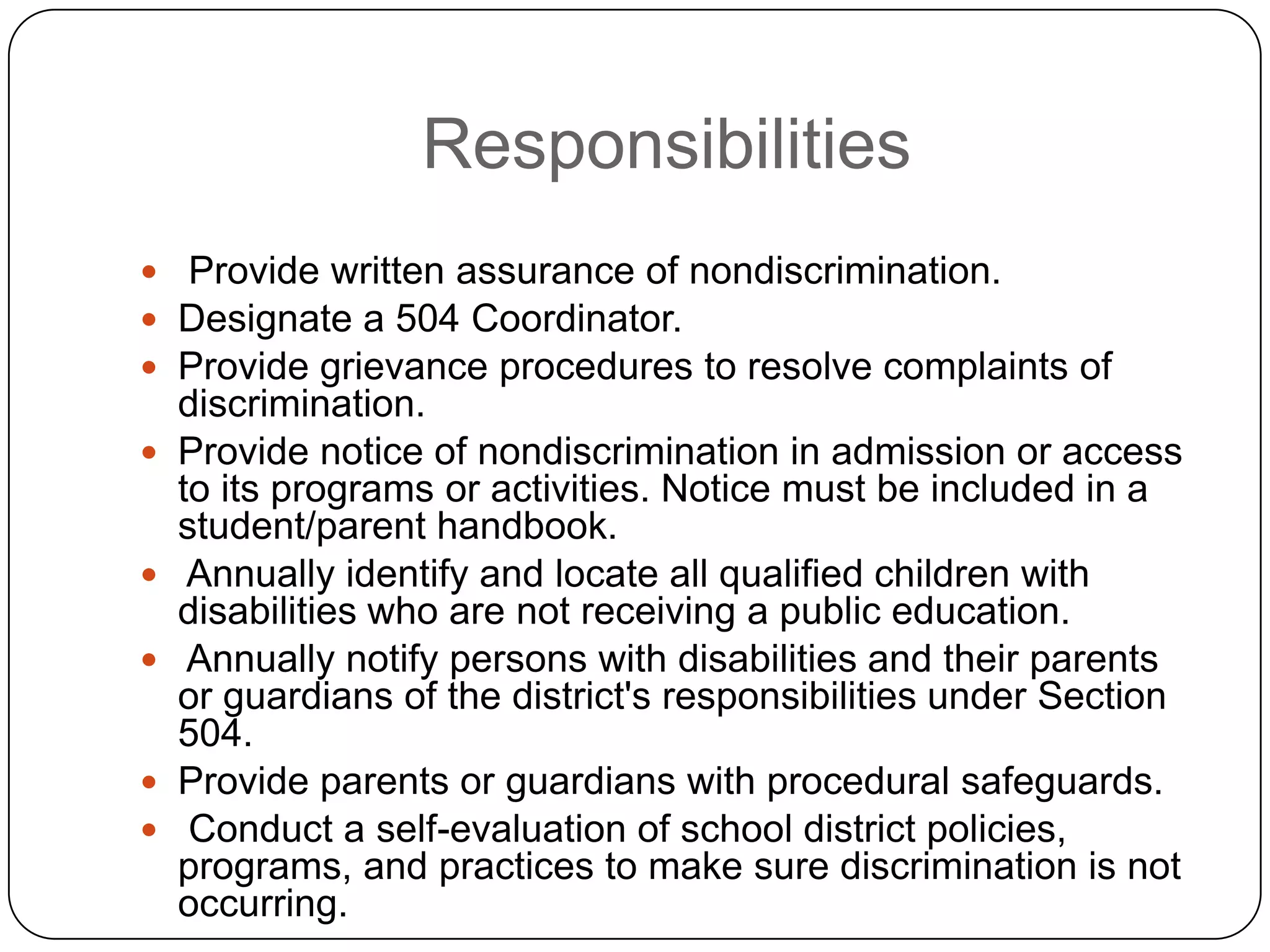
Responsibilities
 Provide written assurance of nondiscrimination.
 Designate a 504 Coordinator.
 Provide grievance procedures to resolve complaints of
discrimination.
 Provide notice of nondiscrimination in admission or access
to its programs or activities. Notice must be included in a
student/parent handbook.
 Annually identify and locate all qualified children with
disabilities who are not receiving a public education.
 Annually notify persons with disabilities and their parents
or guardians of the district's responsibilities under Section
504.
 Provide parents or guardians with procedural safeguards.
 Conduct a self-evaluation of school district policies,
programs, and practices to make sure discrimination is not
occurring.
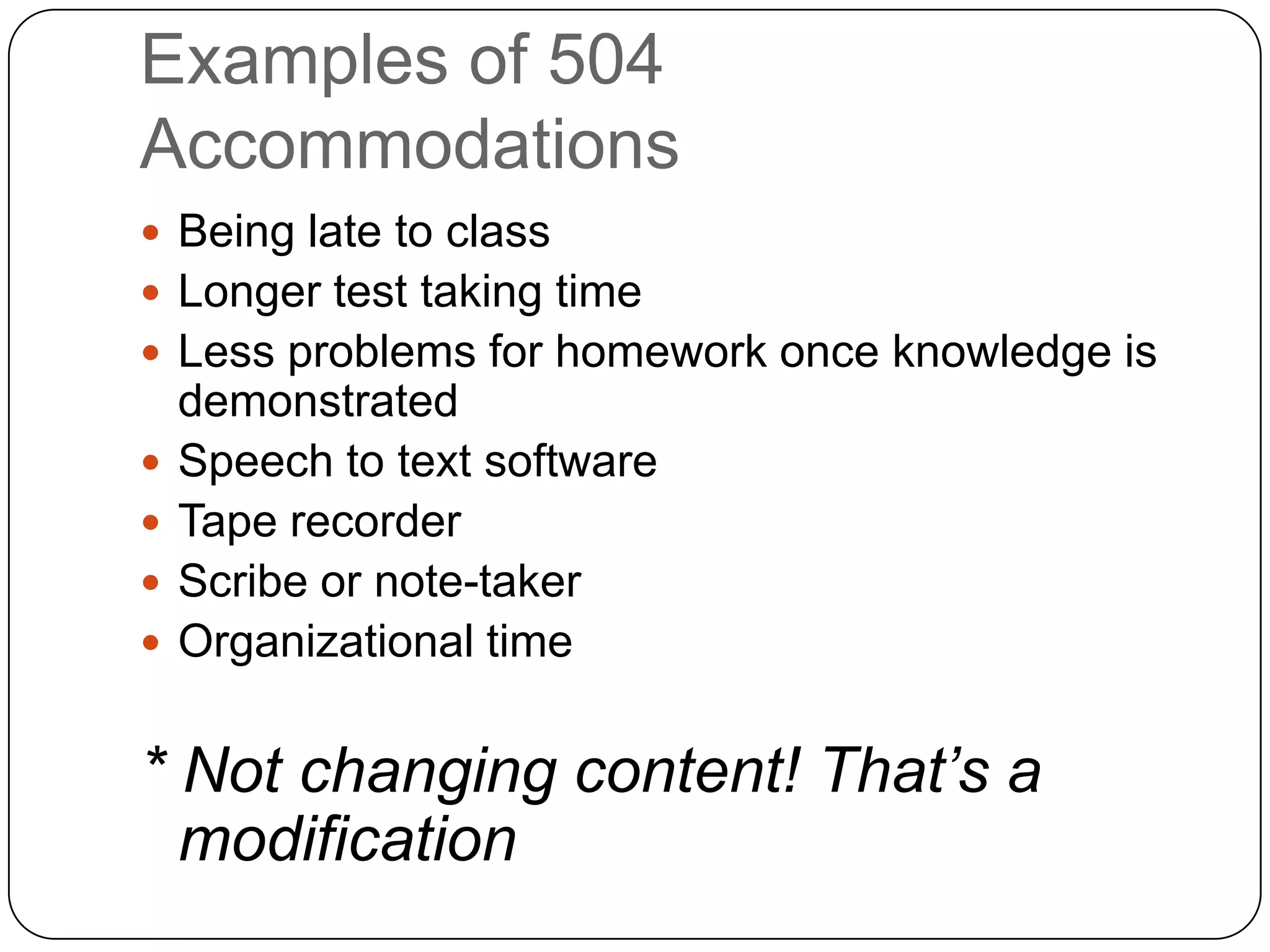
Examples of 504
Accommodations
 Being late to class
 Longer test taking time
 Less problems for homework once knowledge is
demonstrated
 Speech to text software
 Tape recorder
 Scribe or note-taker
 Organizational time
* Not changing content! That’s a
modification
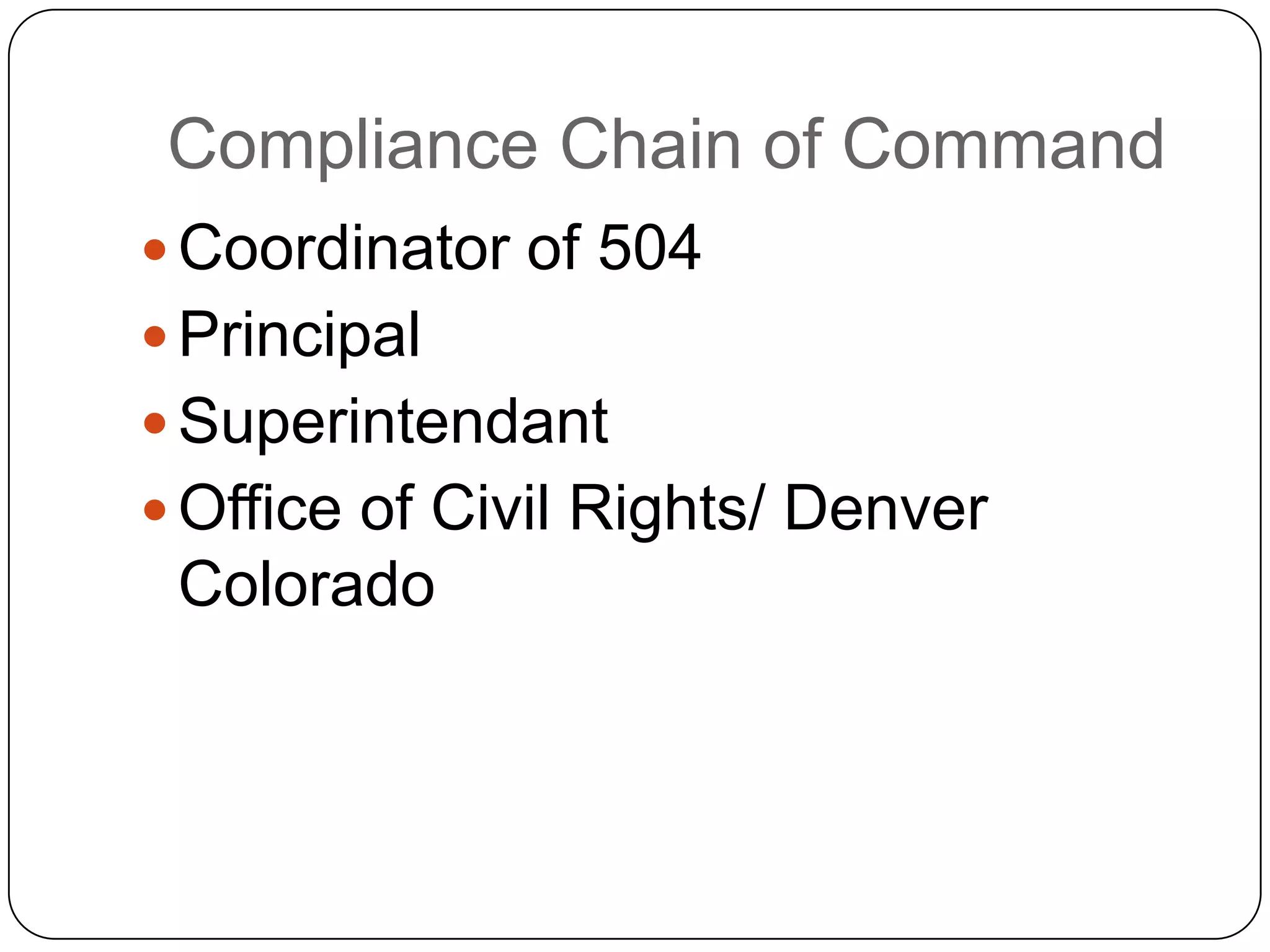
Compliance Chain of Command
 Coordinator of 504
 Principal
 Superintendant
 Office of Civil Rights/ Denver
Colorado
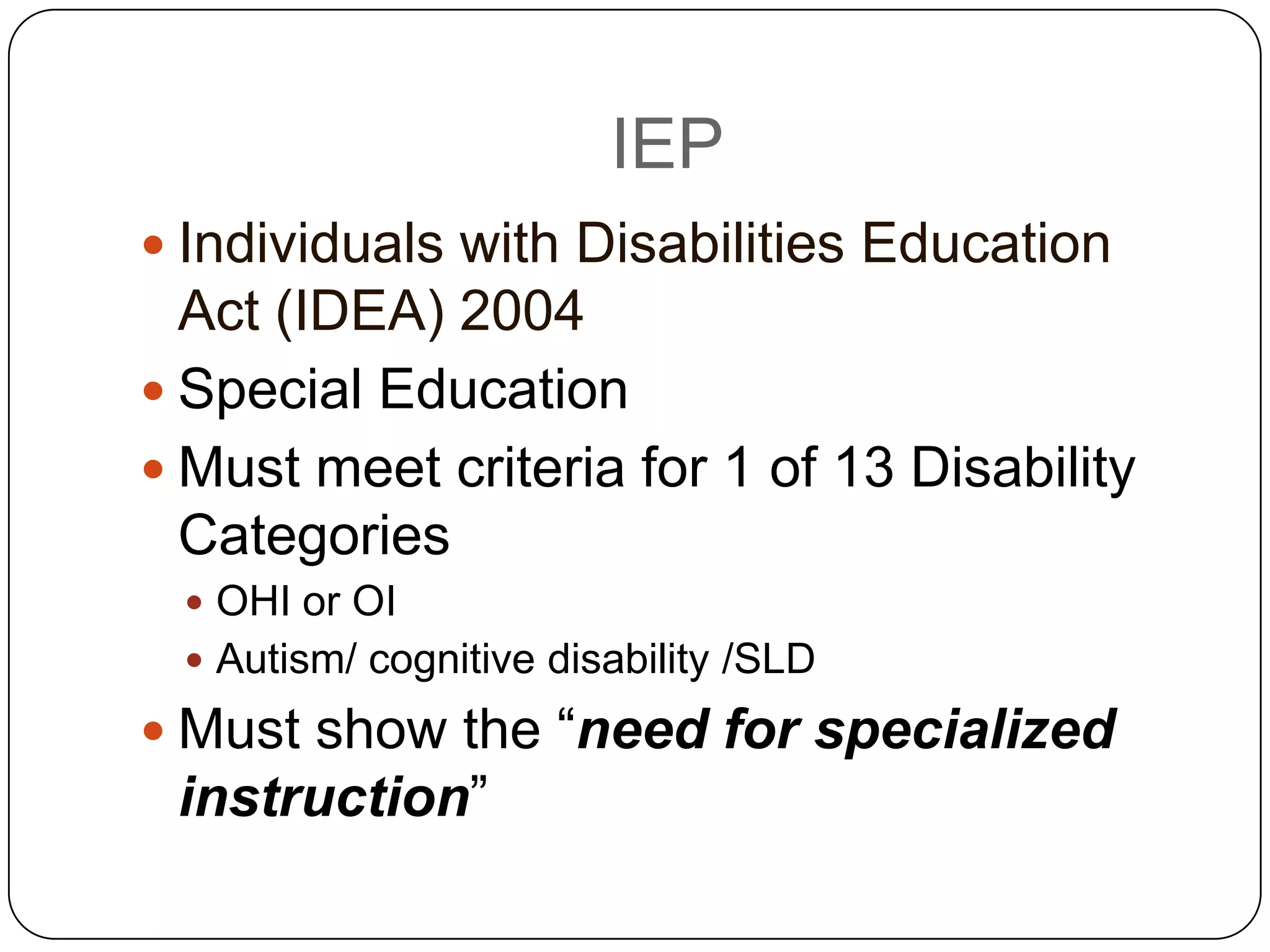
IEP
 Individuals with Disabilities Education
Act (IDEA) 2004
 Special Education
 Must meet criteria for 1 of 13 Disability
Categories
 OHI or OI
 Autism/ cognitive disability /SLD
 Must show the “need for specialized
instruction”
IDEA „04
 § 300.301 Initial evaluations. (a) (b)
 (a) General. Each public agency must conduct a full and
individual initial evaluation, in accordance with §§ 300.305
and 300.306, before the
 initial provision of special education and related services to
a child with a disability under this part.
 The PEA has 60 days from the date of signed informed
parental consent to complete a comprehensive educational
evaluation.
 The 60 day timeline doesn‟t start from the date the parent
sent a letter requesting an evaluation. The 60 day timeline
starts from the day the PEA receives the request and
permission to evaluate no matter who is in the office to
receive the letter.
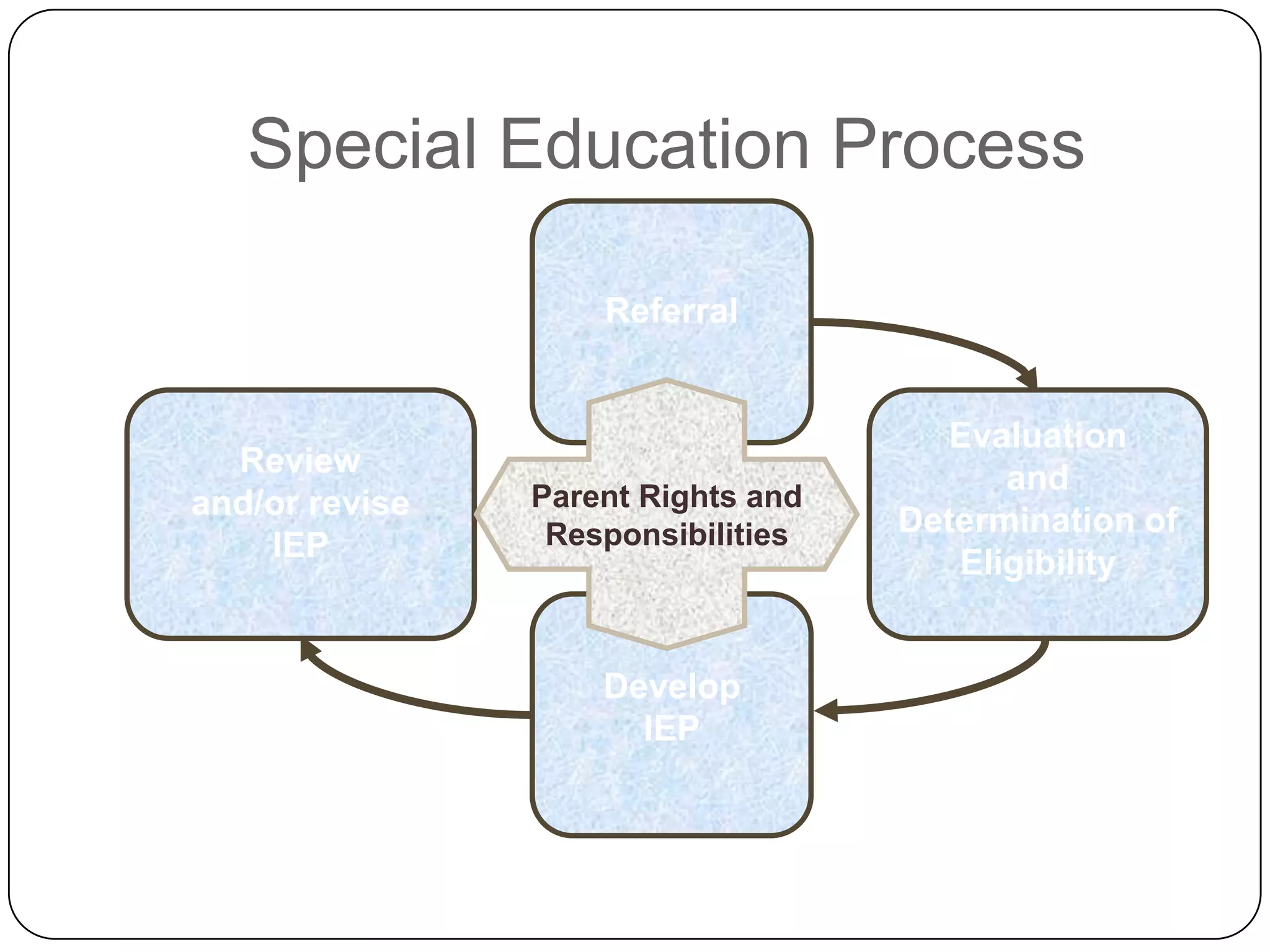
Special Education Process
Evaluation
and
Determination of
Eligibility
Review
and/or revise
IEP
Referral
Develop
IEP
Parent Rights and
Responsibilities
IEP Includes
 Present levels of academic achievement and
functional performance (PLAAFP), including
special factors;
 Measurable annual goals and the way
progress toward the goals will be measured
and reported to parents;
 Special education and related services;
 OT, PT, AT, Adaptive PE, Modified curriculum
 Supplementary aids, services, and
accommodations; and
 Assistive technology considerations
IEP Continued…
 Supports for school personnel;
 Consideration of extended school year
(ESY) services;
 Participation in state and district-wide
assessments;
 Transition services, when appropriate; and
 Educational placement in the least
restrictive environment (LRE).
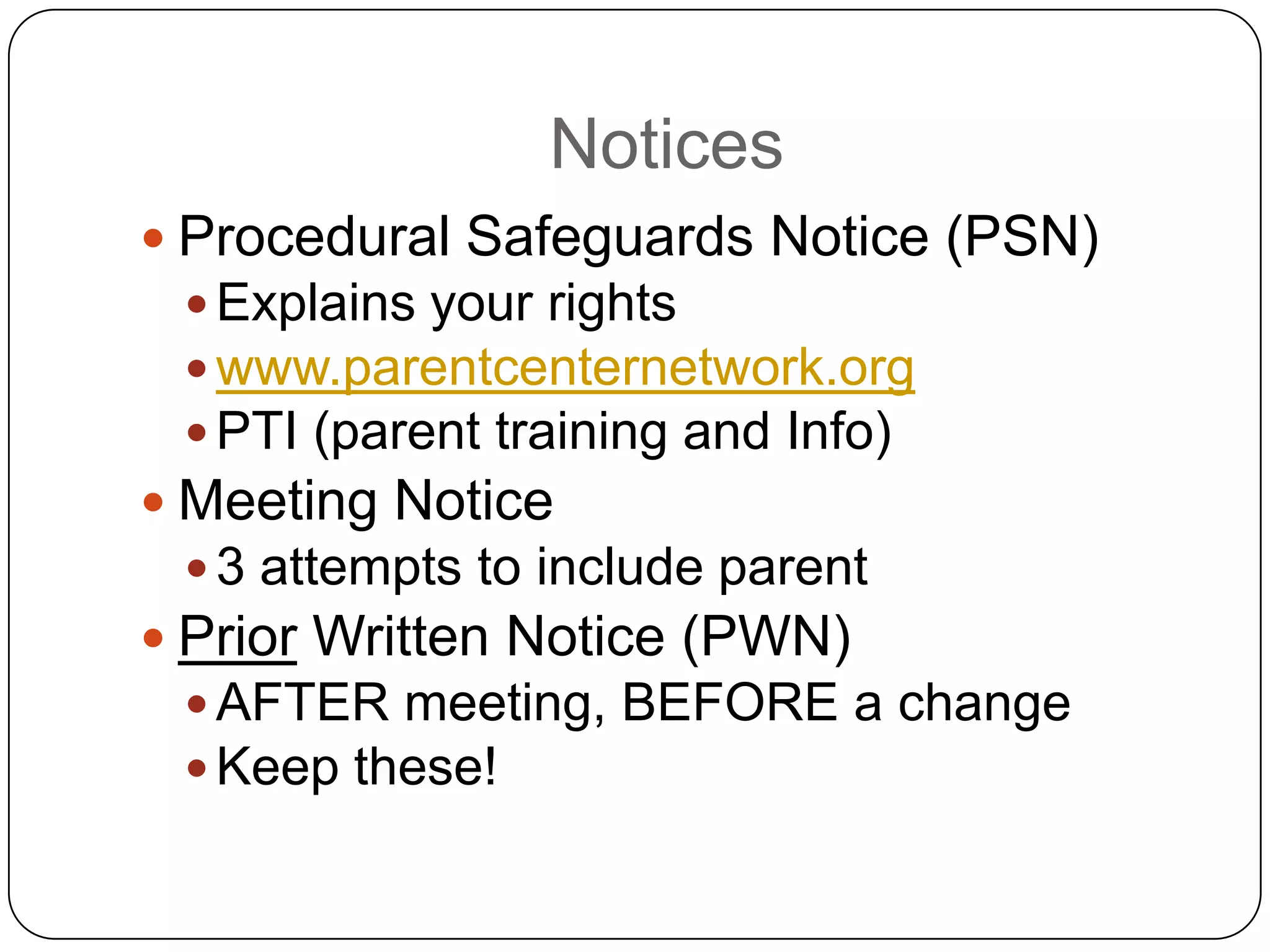
Notices
 Procedural Safeguards Notice (PSN)
 Explains your rights
 www.parentcenternetwork.org
 PTI (parent training and Info)
 Meeting Notice
3 attempts to include parent
 Prior Written Notice (PWN)
 AFTER meeting, BEFORE a change
Keep these!
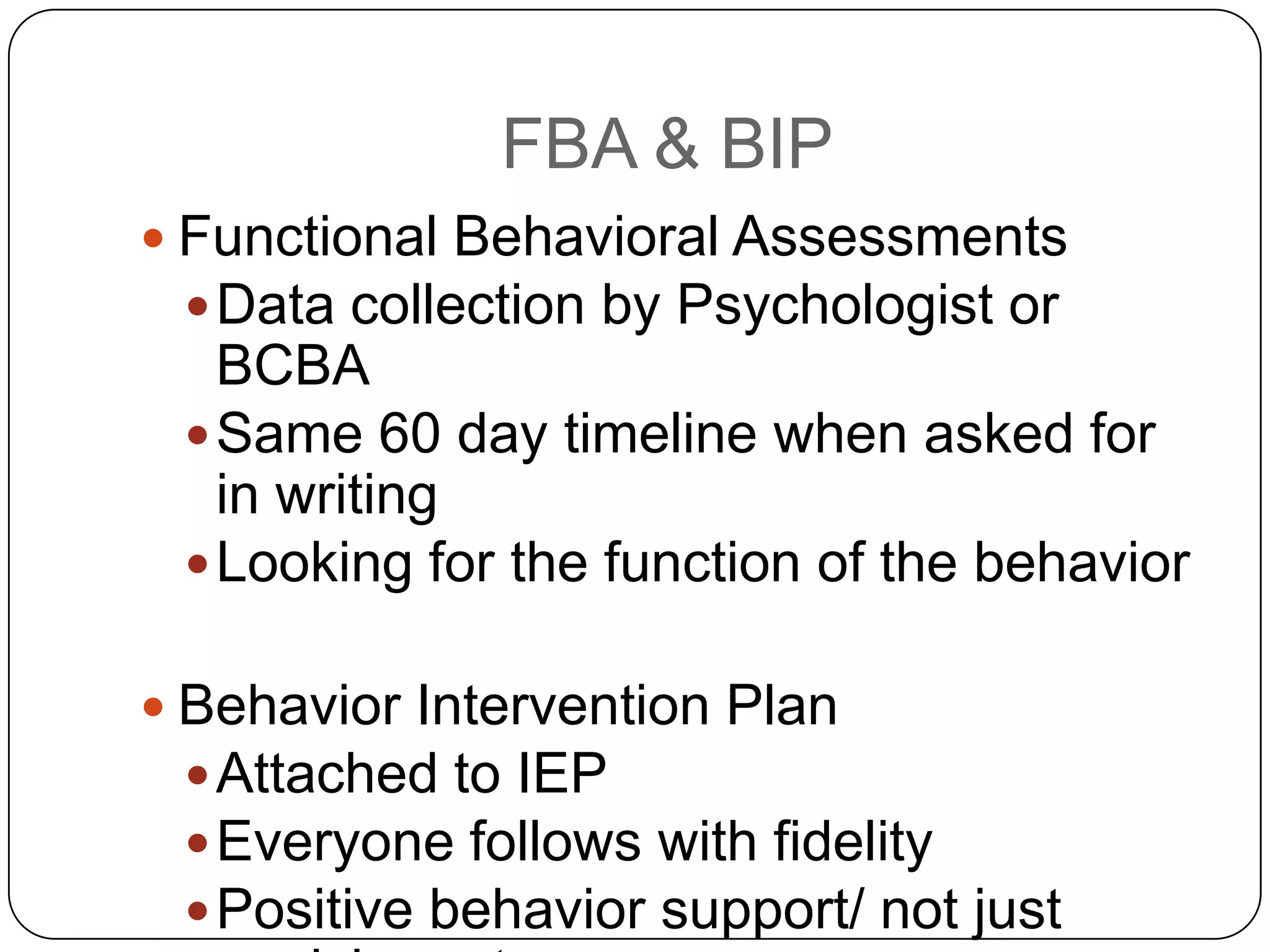
FBA & BIP
 Functional Behavioral Assessments
Data collection by Psychologist or
BCBA
Same 60 day timeline when asked for
in writing
Looking for the function of the behavior
 Behavior Intervention Plan
Attached to IEP
Everyone follows with fidelity
Positive behavior support/ not just
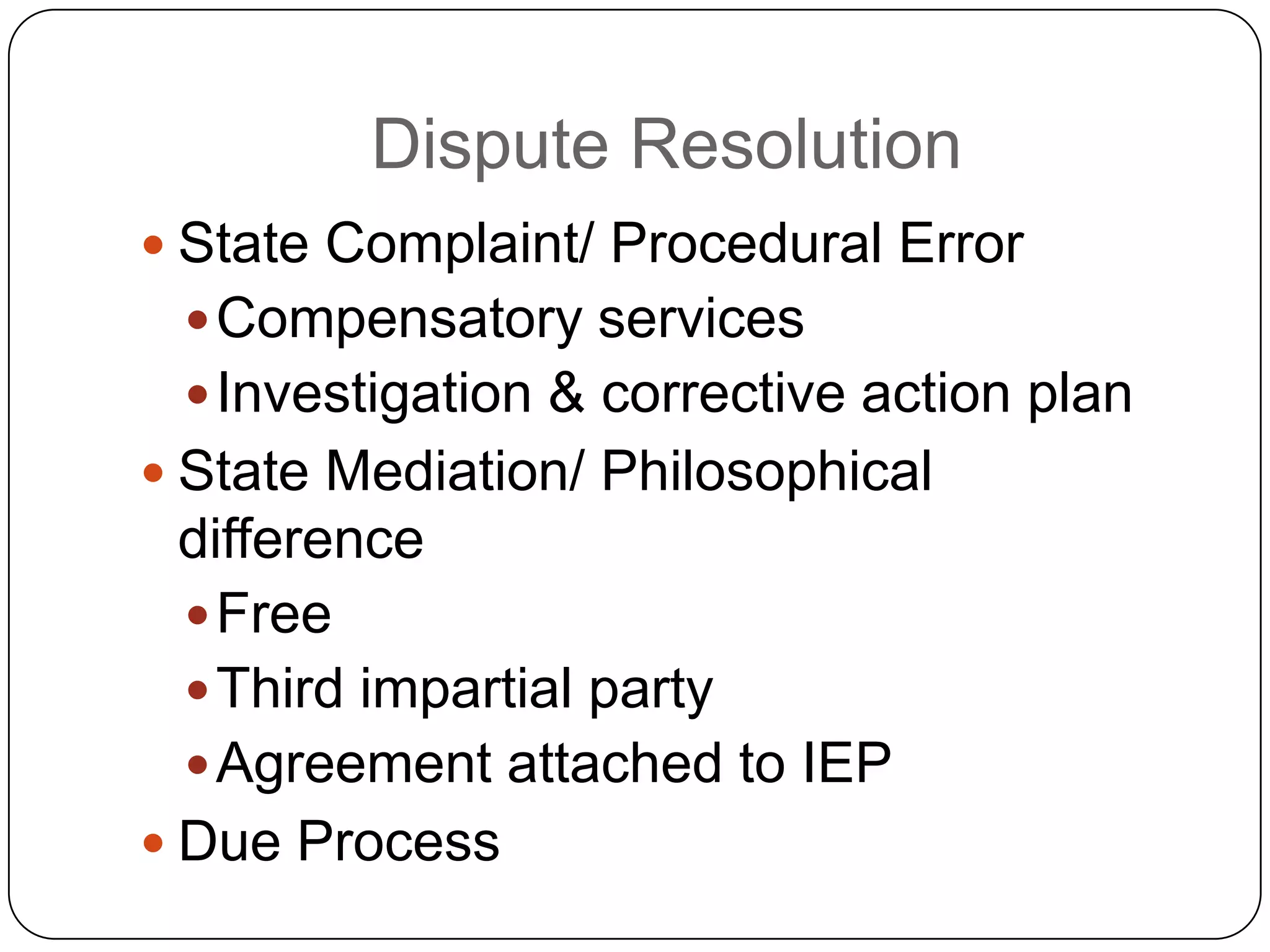
Dispute Resolution
 State Complaint/ Procedural Error
Compensatory services
Investigation & corrective action plan
 State Mediation/ Philosophical
difference
Free
Third impartial party
Agreement attached to IEP
 Due Process
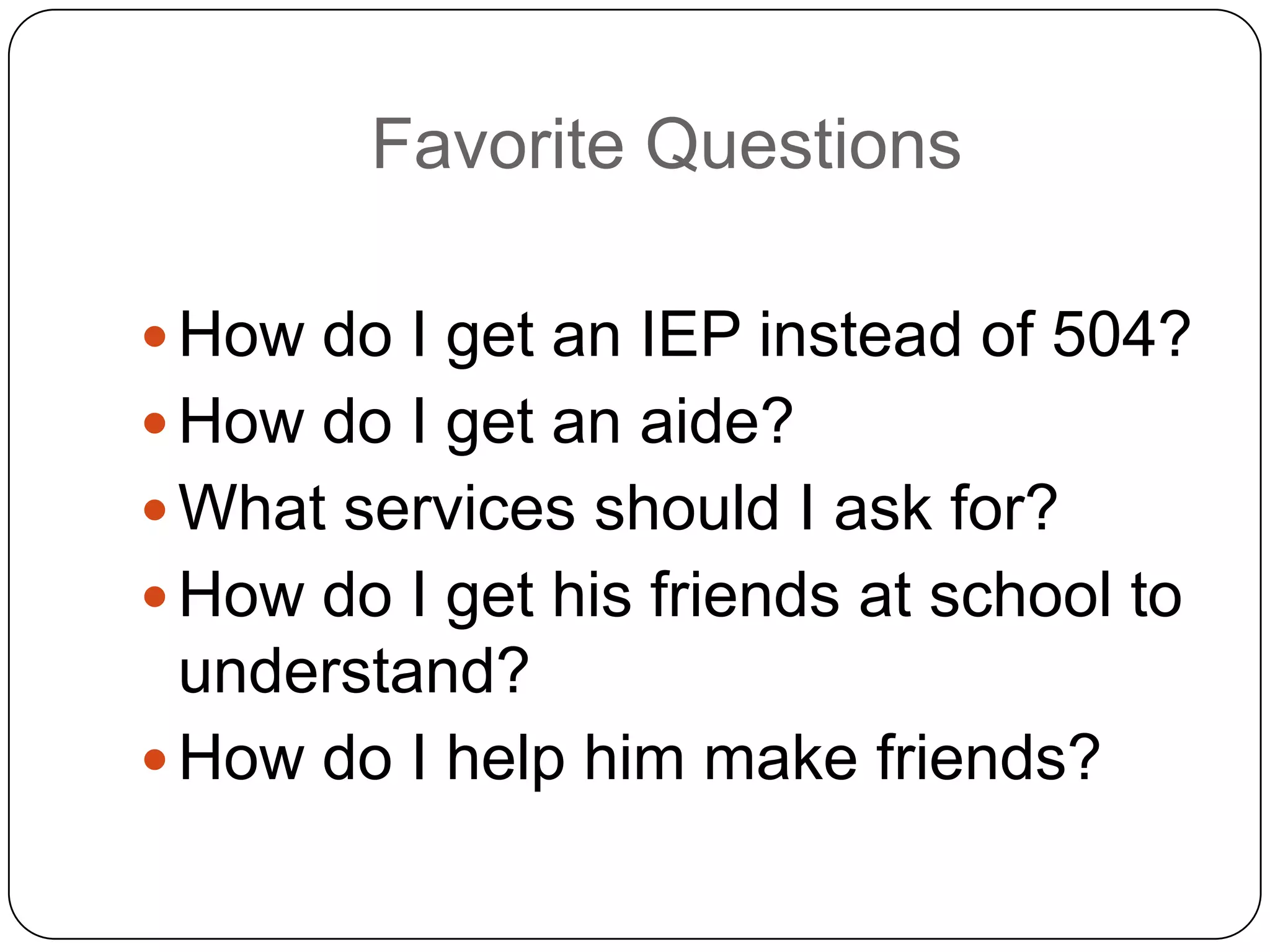
Favorite Questions
 How do I get an IEP instead of 504?
 How do I get an aide?
 What services should I ask for?
 How do I get his friends at school to
understand?
 How do I help him make friends?
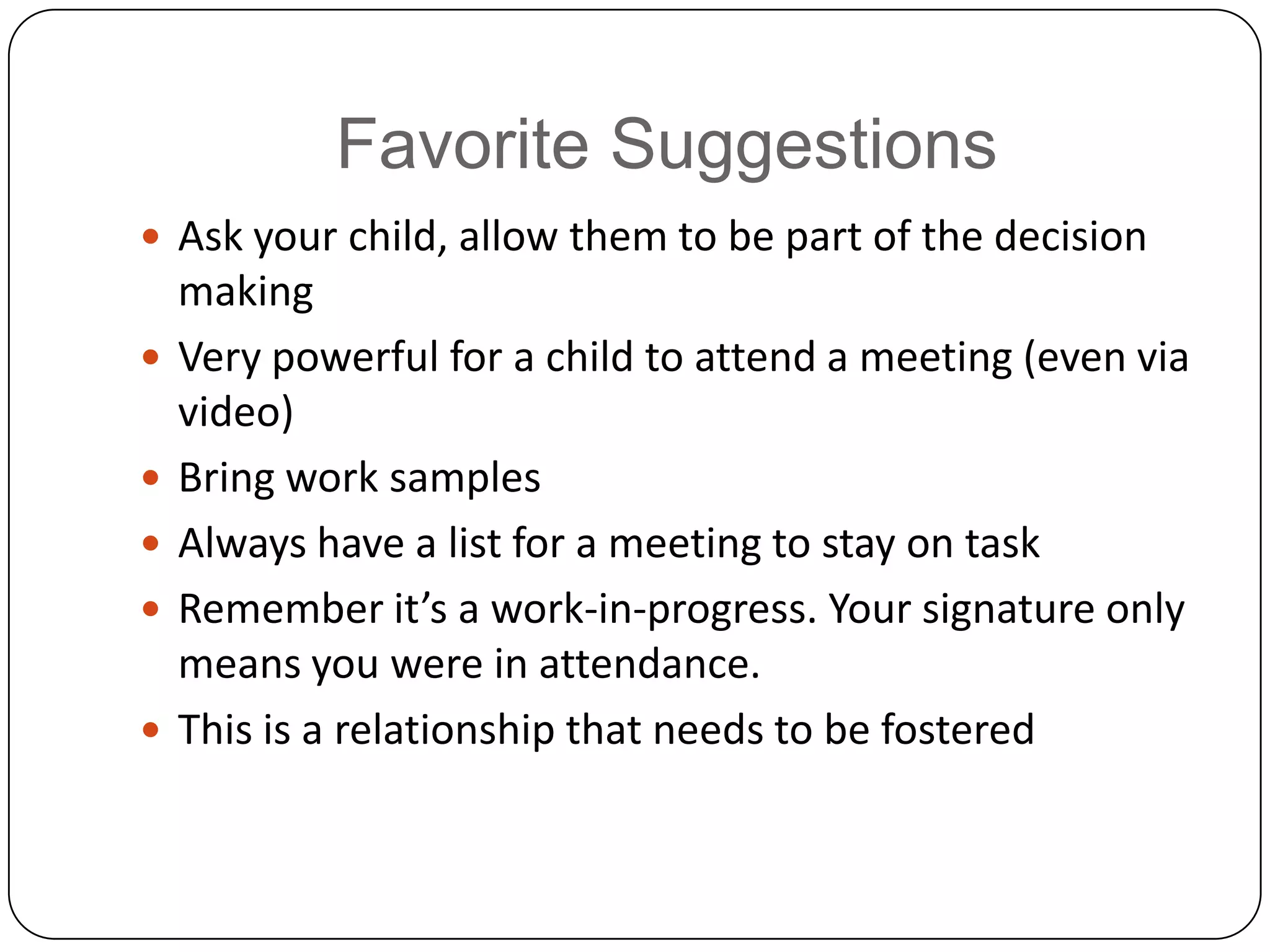
Favorite Suggestions
 Ask your child, allow them to be part of the decision
making
 Very powerful for a child to attend a meeting (even via
video)
 Bring work samples
 Always have a list for a meeting to stay on task
 Remember it’s a work-in-progress. Your signature only
means you were in attendance.
 This is a relationship that needs to be fostered
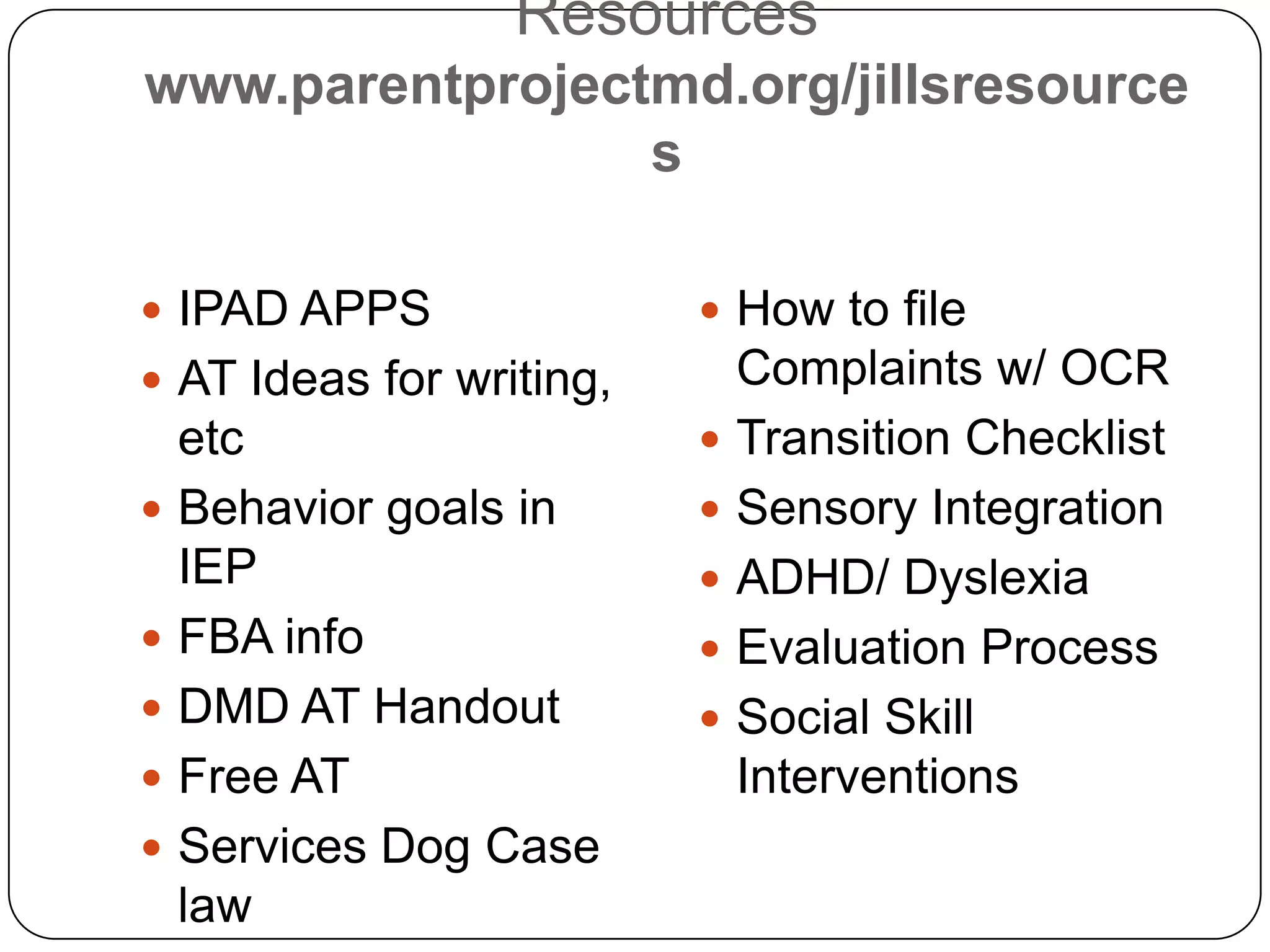
Resources
www.parentprojectmd.org/jillsresource
s
 IPAD APPS
 AT Ideas for writing,
etc
 Behavior goals in
IEP
 FBA info
 DMD AT Handout
 Free AT
 Services Dog Case
law
 How to file
Complaints w/ OCR
 Transition Checklist
 Sensory Integration
 ADHD/ Dyslexia
 Evaluation Process
 Social Skill
Interventions

IEP vs 504 For Duchenne Muscular Dystrophy

  • 1.
  • 2.
    504  Section 504is the part of the Rehabilitation Act of 1973 that applies to persons (including students) with disabilities. Section 504 is a civil rights act that protects the civil rights of persons with disabilities.  The Law states that no person with a disability can be excluded from or denied benefits of any program receiving federal financial assistance.
  • 3.
    504 Eligibility  Thechild must have a mental or physical impairment that substantially limits one or more of a person's major life activities.  “Major life activities” include functions such as caring for one's self, performing manual tasks, walking, seeing, hearing, speaking, breathing, learning, and working.  The child‟s disability must impact their education in order to qualify for educational accommodations.  This determination is made by a school team, including the parents.
  • 4.
    Accommodations  Accommodations areadjustments made by the classroom teacher(s) and other school staff to help students benefit from their educational program. In some cases a plan should be developed outlining services and accommodations.  Accommodations need to take into account both the functional limitations of the individual and the alternative methods of performing tasks or activities to participate without jeopardizing outcomes.
  • 5.
    Responsibilities  Provide writtenassurance of nondiscrimination.  Designate a 504 Coordinator.  Provide grievance procedures to resolve complaints of discrimination.  Provide notice of nondiscrimination in admission or access to its programs or activities. Notice must be included in a student/parent handbook.  Annually identify and locate all qualified children with disabilities who are not receiving a public education.  Annually notify persons with disabilities and their parents or guardians of the district's responsibilities under Section 504.  Provide parents or guardians with procedural safeguards.  Conduct a self-evaluation of school district policies, programs, and practices to make sure discrimination is not occurring.
  • 6.
    Examples of 504 Accommodations Being late to class  Longer test taking time  Less problems for homework once knowledge is demonstrated  Speech to text software  Tape recorder  Scribe or note-taker  Organizational time * Not changing content! That’s a modification
  • 7.
    Compliance Chain ofCommand  Coordinator of 504  Principal  Superintendant  Office of Civil Rights/ Denver Colorado
  • 8.
    IEP  Individuals withDisabilities Education Act (IDEA) 2004  Special Education  Must meet criteria for 1 of 13 Disability Categories  OHI or OI  Autism/ cognitive disability /SLD  Must show the “need for specialized instruction”
  • 9.
    IDEA „04  §300.301 Initial evaluations. (a) (b)  (a) General. Each public agency must conduct a full and individual initial evaluation, in accordance with §§ 300.305 and 300.306, before the  initial provision of special education and related services to a child with a disability under this part.  The PEA has 60 days from the date of signed informed parental consent to complete a comprehensive educational evaluation.  The 60 day timeline doesn‟t start from the date the parent sent a letter requesting an evaluation. The 60 day timeline starts from the day the PEA receives the request and permission to evaluate no matter who is in the office to receive the letter.
  • 10.
    Special Education Process Evaluation and Determinationof Eligibility Review and/or revise IEP Referral Develop IEP Parent Rights and Responsibilities
  • 11.
    IEP Includes  Presentlevels of academic achievement and functional performance (PLAAFP), including special factors;  Measurable annual goals and the way progress toward the goals will be measured and reported to parents;  Special education and related services;  OT, PT, AT, Adaptive PE, Modified curriculum  Supplementary aids, services, and accommodations; and  Assistive technology considerations
  • 12.
    IEP Continued…  Supportsfor school personnel;  Consideration of extended school year (ESY) services;  Participation in state and district-wide assessments;  Transition services, when appropriate; and  Educational placement in the least restrictive environment (LRE).
  • 13.
    Notices  Procedural SafeguardsNotice (PSN)  Explains your rights  www.parentcenternetwork.org  PTI (parent training and Info)  Meeting Notice 3 attempts to include parent  Prior Written Notice (PWN)  AFTER meeting, BEFORE a change Keep these!
  • 14.
    FBA & BIP Functional Behavioral Assessments Data collection by Psychologist or BCBA Same 60 day timeline when asked for in writing Looking for the function of the behavior  Behavior Intervention Plan Attached to IEP Everyone follows with fidelity Positive behavior support/ not just
  • 15.
    Dispute Resolution  StateComplaint/ Procedural Error Compensatory services Investigation & corrective action plan  State Mediation/ Philosophical difference Free Third impartial party Agreement attached to IEP  Due Process
  • 16.
    Favorite Questions  Howdo I get an IEP instead of 504?  How do I get an aide?  What services should I ask for?  How do I get his friends at school to understand?  How do I help him make friends?
  • 17.
    Favorite Suggestions  Askyour child, allow them to be part of the decision making  Very powerful for a child to attend a meeting (even via video)  Bring work samples  Always have a list for a meeting to stay on task  Remember it’s a work-in-progress. Your signature only means you were in attendance.  This is a relationship that needs to be fostered
  • 18.
    Resources www.parentprojectmd.org/jillsresource s  IPAD APPS AT Ideas for writing, etc  Behavior goals in IEP  FBA info  DMD AT Handout  Free AT  Services Dog Case law  How to file Complaints w/ OCR  Transition Checklist  Sensory Integration  ADHD/ Dyslexia  Evaluation Process  Social Skill Interventions