IELTS preparation
course
Gloria M. Cataño García
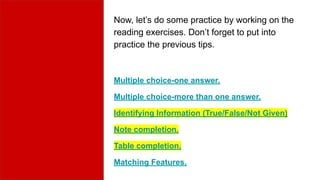
Now, let’s do some practice by working on the
reading exercises. Don’t forget to put into
practice the previous tips.
Multiple choice-one answer.
Multiple choice-more than one answer.
Identifying Information (True/False/Not Given)
Note completion.
Table completion.
Matching Features.
Class nº 3
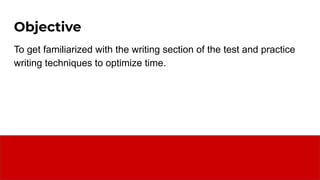
Objective
To get familiarized with the writing section of the test and practice
writing techniques to optimize time.
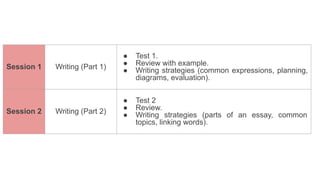
Session 1 Writing (Part 1)
● Test 1.
● Review with example.
● Writing strategies (common expressions, planning,
diagrams, evaluation).
Session 2 Writing (Part 2)
● Test 2
● Review.
● Writing strategies (parts of an essay, common
topics, linking words).
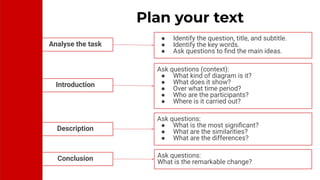
Plan your text
Analyse the task
Introduction
Description
Conclusion
● Identify the question, title, and subtitle.
● Identify the key words.
● Ask questions to find the main ideas.
Ask questions (context):
● What kind of diagram is it?
● What does it show?
● Over what time period?
● Who are the participants?
● Where is it carried out?
Ask questions:
● What is the most significant?
● What are the similarities?
● What are the differences?
Ask questions:
What is the remarkable change?
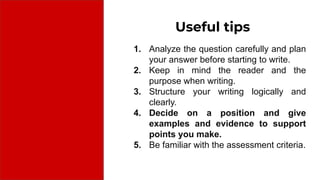
Useful tips
1. Analyze the question carefully and plan
your answer before starting to write.
2. Keep in mind the reader and the
purpose when writing.
3. Structure your writing logically and
clearly.
4. Decide on a position and give
examples and evidence to support
points you make.
5. Be familiar with the assessment criteria.
Assessment criteria
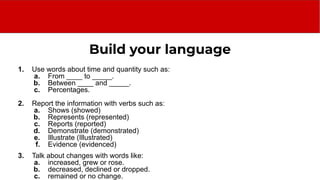
Build your language
1. Use words about time and quantity such as:
a. From ____ to _____.
b. Between ____ and _____.
c. Percentages.
2. Report the information with verbs such as:
a. Shows (showed)
b. Represents (represented)
c. Reports (reported)
d. Demonstrate (demonstrated)
e. Illustrate (Illustrated)
f. Evidence (evidenced)
3. Talk about changes with words like:
a. increased, grew or rose.
b. decreased, declined or dropped.
c. remained or no change.
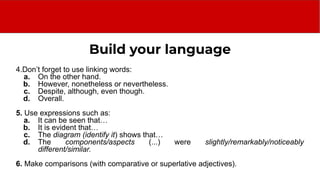
Build your language
4.Don’t forget to use linking words:
a. On the other hand.
b. However, nonetheless or nevertheless.
c. Despite, although, even though.
d. Overall.
5. Use expressions such as:
a. It can be seen that…
b. It is evident that…
c. The diagram (identify it) shows that…
d. The components/aspects (...) were slightly/remarkably/noticeably
different/similar.
6. Make comparisons (with comparative or superlative adjectives).
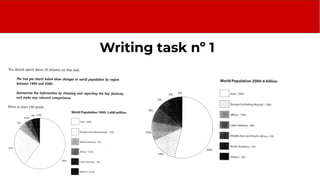
Writing task nº 1
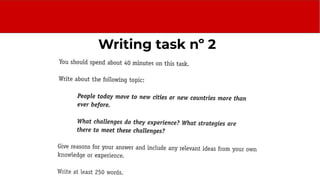
Writing task nº 2
LET’S PRACTICE
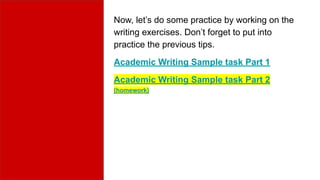
Now, let’s do some practice by working on the
writing exercises. Don’t forget to put into
practice the previous tips.
Academic Writing Sample task Part 1
Academic Writing Sample task Part 2
(homework)
Thank you

IELTS preparation course class nº 3 writing.pdf

  • 1.
  • 2.
    Now, let’s dosome practice by working on the reading exercises. Don’t forget to put into practice the previous tips. Multiple choice-one answer. Multiple choice-more than one answer. Identifying Information (True/False/Not Given) Note completion. Table completion. Matching Features.
  • 3.
  • 4.
    Objective To get familiarizedwith the writing section of the test and practice writing techniques to optimize time.
  • 5.
    Session 1 Writing(Part 1) ● Test 1. ● Review with example. ● Writing strategies (common expressions, planning, diagrams, evaluation). Session 2 Writing (Part 2) ● Test 2 ● Review. ● Writing strategies (parts of an essay, common topics, linking words).
  • 6.
    Plan your text Analysethe task Introduction Description Conclusion ● Identify the question, title, and subtitle. ● Identify the key words. ● Ask questions to find the main ideas. Ask questions (context): ● What kind of diagram is it? ● What does it show? ● Over what time period? ● Who are the participants? ● Where is it carried out? Ask questions: ● What is the most significant? ● What are the similarities? ● What are the differences? Ask questions: What is the remarkable change?
  • 7.
    Useful tips 1. Analyzethe question carefully and plan your answer before starting to write. 2. Keep in mind the reader and the purpose when writing. 3. Structure your writing logically and clearly. 4. Decide on a position and give examples and evidence to support points you make. 5. Be familiar with the assessment criteria.
  • 8.
  • 9.
    Build your language 1.Use words about time and quantity such as: a. From ____ to _____. b. Between ____ and _____. c. Percentages. 2. Report the information with verbs such as: a. Shows (showed) b. Represents (represented) c. Reports (reported) d. Demonstrate (demonstrated) e. Illustrate (Illustrated) f. Evidence (evidenced) 3. Talk about changes with words like: a. increased, grew or rose. b. decreased, declined or dropped. c. remained or no change.
  • 10.
    Build your language 4.Don’tforget to use linking words: a. On the other hand. b. However, nonetheless or nevertheless. c. Despite, although, even though. d. Overall. 5. Use expressions such as: a. It can be seen that… b. It is evident that… c. The diagram (identify it) shows that… d. The components/aspects (...) were slightly/remarkably/noticeably different/similar. 6. Make comparisons (with comparative or superlative adjectives).
  • 11.
  • 13.
  • 15.
  • 16.
    Now, let’s dosome practice by working on the writing exercises. Don’t forget to put into practice the previous tips. Academic Writing Sample task Part 1 Academic Writing Sample task Part 2 (homework)
  • 17.