Guide to the Software Engineering Body of
                           Knowledge


                         2004 Version


           SWEBOK®
             A project of the IEEE Computer Society
                Professional Practices Committee


© IEEE – 2004 Version            ®SWEBOK is an official service mark of the IEEE
© IEEE – 2004 Version
Guide to the Software Engineering Body of
                           Knowledge

                                      2004 Version


           SWEBOK®

                                        Executive Editors
                           Alain Abran, École de technologie supérieure
                               James W. Moore, The MITRE Corp.

                                             Editors
                          Pierre Bourque, École de technologie supérieure
                          Robert Dupuis, Université du Québec à Montréal

                                      Project Champion
                   Leonard L. Tripp, Chair, Professional Practices Committee,
                             IEEE Computer Society (2001-2003)


                                      http://computer.org

                                  Los Alamitos, California
                        Washington       •      Brussels       •       Tokyo


© IEEE – 2004 Version                                ®SWEBOK is an official service mark of the IEEE
Library of Congress Cataloging-in-Publication Data


              Guide to the software engineering body of knowledge : 2004 version
                          / executive editors, Alain Abran, James W. Moore;
                  editors, Pierre Bourque, Robert Dupuis, Leonard L. Tripp.
                 p. cm.
          1. Software engineering. 2. Computer software--Development.       I.
          Abran, Alain, 1949-       . II. Moore, James W., 1948-     .
                                            To be completed

                                                                                                            2001005442


               Copyright © 2004 by The Institute of Electrical and Electronics Engineers, Inc. All rights reserved.

Copyright and Reprint Permissions: This document may be copied, in whole or in part, in any form or by any means, as is, or
with alterations, provided that (1) alterations are clearly marked as alterations and (2) this copyright notice is included
unmodified in any copy. Any other use or distribution of this document is prohibited without the prior express permission of
IEEE.

You use this document on the condition that you indemnify and hold harmless IEEE from any and all liability or damages to
yourself or your hardware or software, or third parties, including attorneys' fees, court costs, and other related costs and expenses,
arising out of your use of this document irrespective of the cause of said liability.

IEEE MAKES THIS DOCUMENT AVAILABLE ON AN "AS IS" BASIS AND MAKES NO WARRANTY, EXPRESS OR IMPLIED, AS TO
THE ACCURACY, CAPABILITY, EFFICIENCY MERCHANTABILITY, OR FUNCTIONING OF THIS DOCUMENT. IN NO EVENT
WILL IEEE BE LIABLE FOR ANY GENERAL, CONSEQUENTIAL, INDIRECT, INCIDENTAL, EXEMPLARY, OR SPECIAL
DAMAGES, EVEN IF IEEE HAS BEEN ADVISED OF THE POSSIBILITY OF SUCH DAMAGES.

                                                         To be completed

                                            Additional copies may be ordered from:

          IEEE Computer Society                      IEEE Service Center                   IEEE Computer Society
         Customer Service Center                        445 Hoes Lane                        Asia/Pacific Office
        10662 Los Vaqueros Circle                       P.O. Box 1331                      Watanabe Bldg., 1-4-2
               P.O. Box 3014                     Piscataway, NJ 08855-1331                     Minami-Aoyama
       Los Alamitos, CA 90720-1314                 Tel: + 1-732-981-0060                 Minato-ku, Tokyo 107-0062
           Tel: + 1-714-821-8380                   Fax: + 1-732-981-9667                            JAPAN
          Fax: + 1-714-821-4641                   http://shop.ieee.org/store/               Tel: + 81-3-3408-3118
      E-mail: cs.books@computer.org              customer-service@ieee.org                  Fax: + 81-3-3408-3553
                                                                                          tokyo.ofc@computer.org


                                                Publisher: Angela Burgess
                                    Group Managing Editor, CS Press: Deborah Plummer
                                            Advertising/Promotions: Tom Fink
                                              Production Editor: Bob Werner
                                          Printed in the United States of America


                                                                                                          © IEEE – 2004 Version
TABLE OF CONTENTS
FOREWORD ..................................................................................................................................vii
SWEBOK Committees ................................................................................................................ ix
Preface to the SWEBOK Guide...............................................................................................xviii
CHAPTER 1       INTRODUCTION TO THE GUIDE ..........................................................................1-1
CHAPTER 2       SOFTWARE REQUIREMENTS ...............................................................................2-1
CHAPTER 3       SOFTWARE DESIGN ...........................................................................................3-1
CHAPTER 4       SOFTWARE CONSTRUCTION ..............................................................................4-1
CHAPTER 5       SOFTWARE TESTING..........................................................................................5-1
CHAPTER 6       SOFTWARE MAINTENANCE ...............................................................................6-1
CHAPTER 7       SOFTWARE CONFIGURATION MANAGEMENT ....................................................7-1
CHAPTER 8       SOFTWARE ENGINEERING MANAGEMENT .........................................................8-1
CHAPTER 9       SOFTWARE ENGINEERING PROCESS ..................................................................9-1
CHAPTER 10      SOFTWARE ENGINEERING TOOLS AND METHODS ...........................................10-1
CHAPTER 11      SOFTWARE QUALITY.......................................................................................11-1
CHAPTER 12      KNOWLEDGE AREAS OF THE RELATED DISCIPLINES………………….….…..12-1
APPENDIX A KNOWLEDGE AREA DESCRIPTION SPECIFICATIONS FOR THE
                2004 VERSION OF THE GUIDE TO THE SOFTWARE ENGINEERING
                BODY OF KNOWLEDGE.....................................................................................A-1
Appendix B      EVOLUTION OF THE GUIDE ............................................................................... B-1
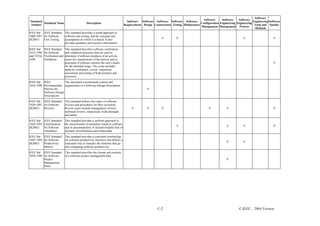
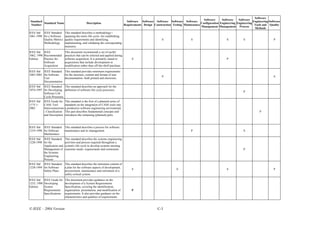
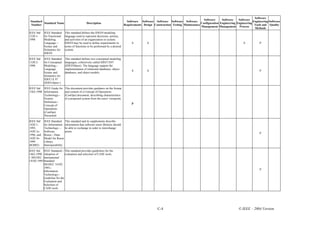
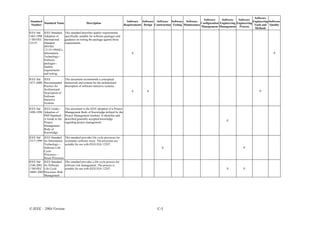
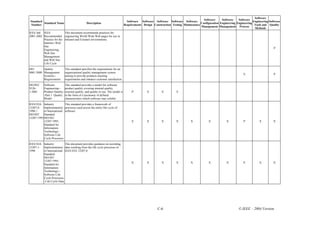
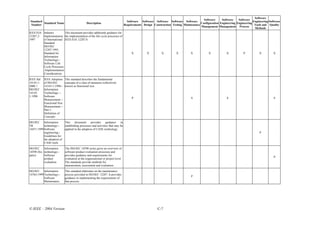
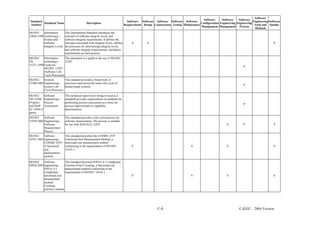
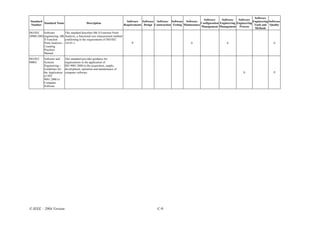
APPENDIX C      ALLOCATION OF IEEE AND ISO SOFTWARE ENGINEERING STANDARDS TO
                SWEBOK KNOWLEDGE AREAS ...................................................................... C-1
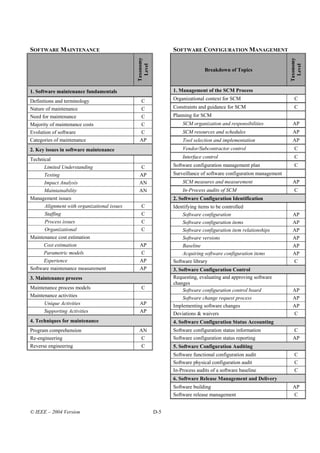
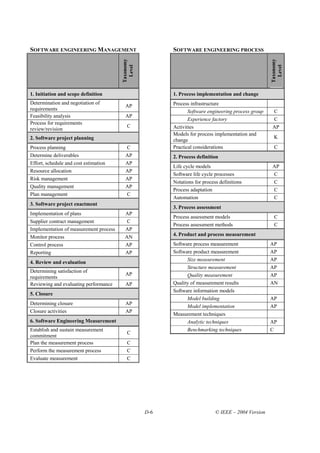
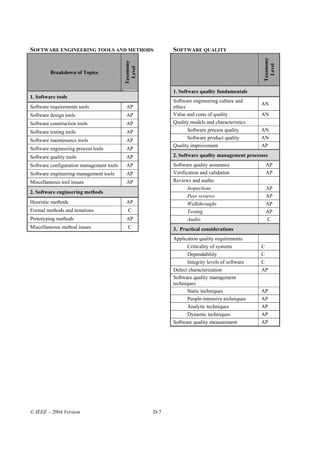
APPENDIX D CLASSIFICATION OF TOPICS ACCORDING TO BLOOM’S TAXONOMY ................D-1


© IEEE – 2004 Version                                                  v
vi   © IEEE – 2004 Version
FOREWORD
    In this Guide, the IEEE Computer Society establishes for the first time a baseline for the body of knowledge for
the field of software engineering, and the work partially fulfills the Society’s responsibility to promote the
advancement of both theory and practice in this field. In so doing, the Society has been guided by the experience of
disciplines with longer histories, but was not bound either by their problems or their solutions.
   It should be noted that the Guide does not purport to define the body of knowledge, but rather to serve as a
compendium and guide to the body of knowledge that has been developing and evolving over the past four decades.
Furthermore, this body of knowledge is not static. The Guide must, necessarily, develop and evolve as software
engineering matures. It nevertheless constitutes a valuable element of the software engineering infrastructure.
   In 1958, John Tukey, the world-renowned statistician, coined the term software. The term software engineering
was used in the title of a NATO conference held in Germany in 1968. The IEEE Computer Society first published its
Transactions on Software Engineering in 1972. The committee established within the IEEE Computer Society for
developing software engineering standards was founded in 1976.
    The first holistic view of software engineering to emerge from the IEEE Computer Society resulted from an
effort led by Fletcher Buckley to develop IEEE standard 730 for software quality assurance, which was completed in
1979. The purpose of IEEE Std 730 was to provide uniform, minimum acceptable requirements for preparation and
content of software quality assurance plans. This standard was influential in completing the developing standards in
the following topics: configuration management, software testing, software requirements, software design, and
software verification and validation.
    During the period 1981-1985, the IEEE Computer Society held a series of workshops concerning the application
of software engineering standards. These workshops involved practitioners sharing their experiences with existing
standards. The workshops also held sessions on planning for future standards, including one involving measures and
metrics for software engineering products and processes. The planning also resulted in IEEE Std 1002, Taxonomy of
Software Engineering Standards (1986), which provided a new, holistic view of software engineering. The standard
describes the form and content of a software engineering standards taxonomy. It explains the various types of
software engineering standards, their functional and external relationships, and the role of various functions
participating in the software life cycle.
   In 1990, planning for an international standard with an overall view was begun. The planning focused on
reconciling the software process views from IEEE Std 1074 and the revised U.S. DoD standard 2167A. The revision
was eventually published as DoD Std 498. The international standard was completed in 1995 with designation,
ISO/IEC12207, and given the title of Standard for Software Life Cycle Processes. Std ISO/IEC 12207 provided a
major point of departure for the body of knowledge captured in this book.
    It was the IEEE Computer Society Board of Governors’ approval of the motion put forward in May 1993 by
Fletcher Buckley which resulted in the writing of this book. The Association for Computing Machinery (ACM)
Council approved a related motion in August 1993. The two motions led to a joint committee under the leadership of
Mario Barbacci and Stuart Zweben who served as co-chairs. The mission statement of the joint committee was “To
establish the appropriate sets(s) of criteria and norms for professional practice of software engineering upon which
industrial decisions, professional certification, and educational curricula can be based.” The steering committee
organized task forces in the following areas:
     1. Define Required Body of Knowledge and Recommended Practices;
     2. Define Ethics and Professional Standards;
     3. Define Educational Curricula for undergraduate, graduate, and continuing education.
   This book supplies the first component: required body of knowledge and recommend practices.
   The code of ethics and professional practice for software engineering was completed in 1998 and approved by
both the ACM Council and the IEEE Computer Society Board of Governors. It has been adopted by numerous
corporations and other organizations and is included in several recent textbooks.
   The educational curriculum for undergraduates is being completed by a joint effort of the IEEE Computer
Society and the ACM, and is expected to be completed in 2004.


© IEEE – 2004 Version                               vii
Every profession is based on a body of knowledge and recommended practices, although they are not always
defined in a precise manner. In many cases, these are formally documented, usually in a form that permits them to be
used for such purposes as accreditation of academic programs, development of education and training programs,
certification of specialists, or professional licensing. Generally, a professional society or related body maintains
custody of such a formal definition. In cases where no such formality exists, the body of knowledge and
recommended practices are “generally recognized” by practitioners and may be codified in a variety of ways for
different uses.
    It is hoped that readers will find this book useful in guiding them towards the knowledge and resources they need
in their lifelong career development as software engineering professionals.
    The book is dedicated to Fletcher Buckley in recognition of his commitment to promoting software engineering
as a professional discipline and his excellence as a software engineering practitioner in radar applications.

                                      Leonard L. Tripp, IEEE Fellow 2003
               Chair, Professional Practices Committee, IEEE Computer Society, (2001-2003)
                     Chair, Joint IEEE Computer Society and ACM Steering Committee
                  for the Establishment of Software Engineering as a Profession (1998-1999)
           Chair, Software Engineering Standards Committee, IEEE Computer Society (1992-1998)


                                                    viii                                 © IEEE – 2004 Version
ASSOCIATE EDITORS
The following persons served as Associate Editors for either the Trial version published in 2001
                                   or for the 2004 version.


Software Requirements
      PeterSawyer and Gerald Kotonya, Computing Department, Lancaster University, UK,
      {p.sawyer} {g.kotonya}@lancaster.ac.uk
Software Design
      Guy Tremblay, Département d’informatique, UQAM, Canada, tremblay.guy@uqam.ca
Software Construction
      Steve McConnell, Construx Software, USA, Steve.McConnell@construx.com
      Terry Bollinger, the MITRE Corporation, USA, terry@mitre.org
      Philippe Gabrini, Département d’informatique, UQAM, Canada,
      gabrini.philippe@uqam.ca
      Louis Martin, Département d’informatique, UQAM, Canada,
      martin.louis@uqam.ca
Software Testing
      Antonia Bertolino and Eda Marchetti, ISTI-CNR, Italy,
      {antonia.bertolino} {eda.marchetti}@isti.cnr.it
Software Maintenance
      Thomas M. Pigoski, Techsoft Inc., USA, tmpigoski@techsoft.com
      Alain April, École de technologie supérieure, Canada, aapril@ele.etsmtl.ca
Software Configuration Management
      John A. Scott, Lawrence Livermore National Laboratory, USA, scott7@llnl,gov
      David Nisse, USA, nissed@worldnet.att.net
Software Engineering Management
      Dennis Frailey, Raytheon Company, USA, DJFrailey@Raytheon.com
      Stephen G. MacDonell, Auckland University of technology, New Zealand,
      smacdone@aut.ac.nz
      Andrew R. Gray, University of Otago, New Zealand
Software Engineering Process
      Khaled El Eman, served while at the Canadian National Research Council, Canada,
      khaled.el-emam@nrc-cnrc.gc.ca
Software Engineerting Tools and Methods
      David Carrington, School of Information Technology and electrical Engineering, The
      University of Queensland, Australia,
      davec@itee.uq.edu.au
Software Quality
      Alain April, École de technologie supérieure, Canada, aapril@ele.etsmtl.ca
      Dolores Wallace, retired from the National Institute of Standards and Technology, USA
      Dolores.Wallace@nist.gov
      Larry Reeker, NIST, USA, Larry.Reeker@nist.gov
References Editor
      Marc Bouisset, Département d’informatique, UQAM, Bouisset.Marc@uqam.ca


© IEEE – 2004 Version                      ix
x   © IEEE – 2004 Version
Industrial Advisory
                        BOARD


At the time of the publication, the following people formed the Industrial Advisory Board:


         Mario R. Barbacci, Software Engineering Institute, representing the
         IEEE Computer Society
         Carl Chang, representing Computing Curricula 2001
         François Coallier, École de technologie supérieure, speaking as ISO/IEC JTC 1 / SC7
         Chairman
         Charles Howell, The MITRE Corporation
         Anatol Kark, National Research Council of Canada
         Philippe Kruchten, University of British Columbia, served as representative of Rational
         Software
         Laure Le Bars, SAP Labs (Canada)
         Steve McConnell, Construx Software
         Dan Nash, Raytheon Company
         Fred Otto, Canadian Council of Professional Engineers (CCPE)
         Richard Metz, The Boeing Company
         Larry Reeker, National Institute of Standards and Technology,
         Department of Commerce, USA

  The following persons served along with the IAB in the Executive Change Control Board for
 the 2004 edition:

        Donald Bagert, Rose-Hulman Institute of Technology, represening the IEEE Computer
        Society Professional Practices Committee

        Ann Sobel, Miami University, representing the Computing Curricula Software
        Engineering Steering Committee


© IEEE – 2004 Version                      xi
PANEL OF EXPERTS


The following persons served on the panel of expert for the preparation of the Trial version of the
Guide:


        Steve McConnell, Construx Software
        Roger Pressman, R.S. Pressman and Associates
        Ian Sommerville, Lancaster University, UK


                                            xii                            © IEEE – 2004 Version
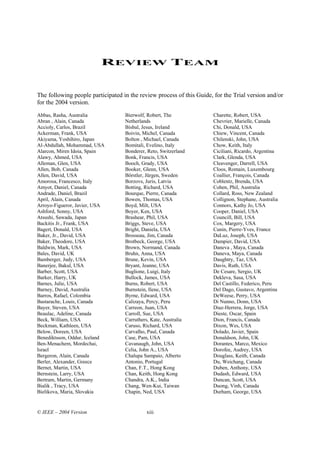
REVIEW TEAM


The following people participated in the review process of this Guide, for the Trial version and/or
for the 2004 version.
Abbas, Rasha, Australia            Bierwolf, Robert, The              Charette, Robert, USA
Abran , Alain, Canada              Netherlands                        Chevrier, Marielle, Canada
Accioly, Carlos, Brazil            Bisbal, Jesus, Ireland             Chi, Donald, USA
Ackerman, Frank, USA               Boivin, Michel, Canada             Chiew, Vincent, Canada
Akiyama, Yoshihiro, Japan          Bolton , Michael, Canada           Chilenski, John, USA
Al-Abdullah, Mohammad, USA         Bomitali, Evelino, Italy           Chow, Keith, Italy
Alarcon, Miren Idoia, Spain        Bonderer, Reto, Switzerland        Ciciliani, Ricardo, Argentina
Alawy, Ahmed, USA                  Bonk, Francis, USA                 Clark, Glenda, USA
Alleman, Glen, USA                 Booch, Grady, USA                  Cleavenger, Darrell, USA
Allen, Bob, Canada                 Booker, Glenn, USA                 Cloos, Romain, Luxembourg
Allen, David, USA                  Börstler, Jürgen, Sweden           Coallier, François, Canada
Amorosa, Francesco, Italy          Borzovs, Juris, Latvia             Coblentz, Brenda, USA
Amyot, Daniel, Canada              Botting, Richard, USA              Cohen, Phil, Australia
Andrade, Daniel, Brazil            Bourque, Pierre, Canada            Collard, Ross, New Zealand
April, Alain, Canada               Bowen, Thomas, USA                 Collignon, Stephane, Australia
Arroyo-Figueror, Javier, USA       Boyd, Milt, USA                    Connors, Kathy Jo, USA
Ashford, Sonny, USA                Boyer, Ken, USA                    Cooper, Daniel, USA
Atsushi, Sawada, Japan             Brashear, Phil, USA                Councill, Bill, USA
Backitis Jr., Frank, USA           Briggs, Steve, USA                 Cox, Margery, USA
Bagert, Donald, USA                Bright, Daniela, USA               Cunin, Pierre-Yves, France
Baker, Jr., David, USA             Brosseau, Jim, Canada              DaLuz, Joseph, USA
Baker, Theodore, USA               Brotbeck, George, USA              Dampier, David, USA
Baldwin, Mark, USA                 Brown, Normand, Canada             Daneva , Maya, Canada
Bales, David, UK                   Bruhn, Anna, USA                   Daneva, Maya, Canada
Bamberger, Judy, USA               Brune, Kevin, USA                  Daughtry, Taz, USA
Banerjee, Bakul, USA               Bryant, Jeanne, USA                Davis, Ruth, USA
Barber, Scott, USA                 Buglione, Luigi, Italy             De Cesare, Sergio, UK
Barker, Harry, UK                  Bullock, James, USA                Dekleva, Sasa, USA
Barnes, Julie, USA                 Burns, Robert, USA                 Del Castillo, Federico, Peru
Barney, David, Australia           Burnstein, Ilene, USA              Del Dago, Gustavo, Argentina
Barros, Rafael, Colombia           Byrne, Edward, USA                 DeWeese, Perry, USA
Bastarache, Louis, Canada          Calizaya, Percy, Peru              Di Nunno, Donn, USA
Bayer, Steven, USA                 Carreon, Juan, USA                 Diaz-Herrera, Jorge, USA
Beaulac, Adeline, Canada           Carroll, Sue, USA                  Dieste, Oscar, Spain
Beck, William, USA                 Carruthers, Kate, Australia        Dion, Francis, Canada
Beckman, Kathleen, USA             Caruso, Richard, USA               Dixon, Wes, USA
Below, Doreen, USA                 Carvalho, Paul, Canada             Dolado, Javier, Spain
Benediktsson, Oddur, Iceland       Case, Pam, USA                     Donaldson, John, UK
Ben-Menachem, Mordechai,           Cavanaugh, John, USA               Dorantes, Marco, Mexico
Israel                             Celia, John A., USA                Dorofee, Audrey, USA
Bergeron, Alain, Canada            Chalupa Sampaio, Alberto           Douglass, Keith, Canada
Berler, Alexander, Greece          Antonio, Portugal                  Du, Weichang, Canada
Bernet, Martin, USA                Chan, F.T., Hong Kong              Duben, Anthony, USA
Bernstein, Larry, USA              Chan, Keith, Hong Kong             Dudash, Edward, USA
Bertram, Martin, Germany           Chandra, A.K., India               Duncan, Scott, USA
Bialik , Tracy, USA                Chang, Wen-Kui, Taiwan             Duong, Vinh, Canada
Bielikova, Maria, Slovakia         Chapin, Ned, USA                   Durham, George, USA


© IEEE – 2004 Version                       xiii
Dutil, Daniel, Canada           Gresse von Wangenheim,           Jones, Griffin, USA
Dutton, Jeffrey, USA            Christiane, Brazil               Jones, James E., USA
Ebert, Christof, France         Grigonis, George, USA            Jones, Alan, UK
Edge, Gary, USA                 Gupta, Arun, USA                 Jones, James, USA
Edwards, Helen Maria, UK        Gustafson, David, USA            Jones, Larry, Canada
El-Kadi, Amr, Egypt             Gutcher, Frank, USA              Jones, Paul, USA
Endres, David, USA              Haas, Bob, USA                   Ju, Dehua, China
Engelmann, Franz, Switzerland   Hagar, Jon, USA                  Juan-Martinez, Manuel-
Escue, Marilyn, USA             Hagstrom, Erick, USA             Fernando, Spain
Espinoza, Marco, Peru           Hailey, Victoria, Canada         Juhasz, Zoltan, Hungary
Fay, Istvan, Hungary            Hall, Duncan, New Zealand        Juristo, Natalia, Spain
Fayad, Mohamed, USA             Haller, John, USA                Kaiser, Michael, Switzerland
Fendrich, John, USA             Halstead-Nussloch, Richard,      Kambic, George, USA
Ferguson, Robert, USA           USA                              Kamthan, Pankaj, Canada
Fernandez, Eduardo, USA         Hamm, Linda, USA                 Kaner, Cem, USA
Fernandez-Sanchez, Jose Luis,   Hankewitz, Lutz, Germany         Kark, Anatol, Canada
Spain                           Harker, Rob, USA                 Kasser, Joe, USA
Filgueiras, Lucia, Brazil       Hart, Hal, USA                   Kasser, Joseph, Australia
Finkelstein, Anthony, UK        Hart, Ronald, USA                Katz, Alf, Australia
Flinchbaugh, Scott, USA         Hartner, Clinton, USA            Kececi, Nihal, Canada
Forrey, Arden, USA              Hayeck, Elie, USA                Kell, Penelope, USA
Fortenberry, Kirby, USA         He, Zhonglin, UK                 Kelly, Diane, Canada
Foster, Henrietta, USA          Hedger, Dick, USA                Kelly, Frank, USA
Fowler, Martin, USA             Hefner, Rick, USA                Kenett, Ron, Israel
Fowler, John Jr., USA           Heinrich, Mark, USA              Kenney, Mary L., USA
Fox, Christopher, USA           Heinze, Sherry, Canada           Kerievsky, Joshua, USA
Frankl, Phyllis, USA            Hensel, Alan, USA                Kerr, John, USA
Freibergs, Imants, Latvia       Herrmann, Debra, USA             Kierzyk, Robert, USA
Frezza, Stephen, USA            Hesse, Wolfgang, Germany         Kinsner, W., Canada
Fruehauf, Karol, Switzerland    Hilburn, Thomas, USA             Kirkpatrick, Harry, USA
Fuggetta, Alphonso, Italy       Hill, Michael, USA               Kittiel, Linda, USA
Fujii, Roger, USA               Ho, Vinh, Canada                 Klappholz, David, USA
FUSCHI, David Luigi, Italy      Hodgen, Bruce, Australia         Klein, Joshua, Israel
Fuschi, David Luigi, Italy      Hodges, Brett, Canada            Knight, Claire, UK
Gabrini, Philippe, Canada       Hoffman, Douglas, Canada         Knoke, Peter, USA
Gagnon, Eric, Canada            Hoffman, Michael, USA            Ko, Roy, Hong Kong
Ganor, Eitan, Israel            Hoganson, Tammy, USA             Kolewe, Ralph, Canada
Garbajosa, Juan, Spain          Hollocker, Chuck, USA            Komal, Surinder Singh, Canada
Garceau, Benoît, Canada         Horch, John, USA                 Kovalovsky, Stefan, Austria
Garcia-Palencia, Omar,          Howard, Adrian, United           Krauth, Péter, Hungary
Colombia                        Kingdom                          Krishnan, Nirmala, USA
Garner, Barry, USA              Huang, Hui Min, USA              Kromholz, Alfred, Canada
Gelperin, David, USA            Hung, Chih-Cheng, USA            Kruchten, Philippe, Canada
Gersting, Judith, Hawaii        Hung, Peter, USA                 Kuehner, Nathanael, Canada
Giesler, Gregg, USA             Hunt, Theresa, USA               Kwok, Shui Hung, Canada
Gil, Indalecio, Spain           Hunter, John, USA                Lacroix, Dominique, Canada
Gilchrist, Thomas, USA          Hvannberg, Ebba Thora, Iceland   LaMotte, Stephen W., USA
Giurescu, Nicolae, Canada       Hybertson, Duane, USA            Land, Susan, USA
Glass, Robert, USA              Ikiz, Seckin, Turkey             Lange, Douglas, USA
Glynn, Garth, UK                Iyengar, Dwaraka, USA            Laporte, Claude, Canada
Goers, Ron, USA                 Jackelen, George, USA            Lawlis, Patricia, USA
Gogates, Gregory, USA           Jaeger, Dawn, USA                Le, Thach, USA
Goldsmith, Robin, USA           Jahnke, Jens, Canada             Leavitt, Randal, Canada
Goodbrand, Alan, Canada         James, Jean, USA                 LeBel, Réjean, Canada
Gorski, Janusz, Poland          Jino, Mario, Brazil              Leciston, David, USA
Graybill , Mark, USA            Johnson, Vandy, USA              Lee, Chanyoung, USA


                                         xiv                          © IEEE – 2004 Version
Lehman, Meir (Manny), UK         Miller, Mark, USA                Phipps, Robert, USA
Leigh, William, USA              Miranda, Eduardo, Canada         Phister, Paul, USA
Lembo, Jim, USA                  Mistrik, Ivan, Germany           Phister, Jr., Paul, USA
Lenss, John, USA                 Mitasiunas, Antanas, Lithuania   Piattini, Mario, Spain
Leonard, Eugene, USA             Modell, Howard, USA              Piersall, Jeff, USA
Lethbridge, Timothy, Canada      Modell, Staiger,USA              Pillai, S.K., India
Leung, Hareton, Hong Kong        Modesitt, Kenneth, USA           Pinder, Alan, UK
Lever, Ronald, The Netherlands   Moland, Kathryn, USA             Pinheiro, Francisco A., Brazil
Levesque, Ghislain, Canada       Moldavsky, Symon, Ukraine        Plekhanova, Valentina, United
Ley, Earl, USA                   Montequín, Vicente R., Spain     Kingdom
Linders , Ben, Netherlands       Moreno, Ana Maria, Spain         Poon, Peter, USA
Linscomb , Dennis, USA           Mosiuoa, Tseliso, Lesotho        Poppendieck, Mary, USA
Little, Joyce Currie, USA        Moudry, James, USA               Powell, Mace, USA
Logan, Jim, USA                  Msheik, Hamdan, Canada           Predenkoski, Mary, USA
Long, Carol, United Kingdom      Mularz, Diane, USA               Prescott, Allen, USA
Lounis, Hakim, Canada            Mullens, David, USA              Pressman, Roger, USA
Low, Graham, Australia           Müllerburg, Monika, Germany      Price, Art, USA
Lutz, Michael, USA               Murali, Nagarajan, Australia     Price, Margaretha, USA
Lynch, Gary, USA                 Murphy, Mike, USA                Pullum, Laura, USA
Machado, Cristina, Brazil        Napier, John, USA                Purser, Keith, USA
MacKay, Stephen, Canada          Narasimhadevara, Sudha,          Purssey, John, Australia
MacKenzie, Garth, USA            Canada                           Pustaver, John, USA
MacNeil, Paul, USA               Narawane, Ranjana, India         Quinn, Anne, USA
Magel, Kenneth, USA              Narayanan, Ramanathan, India     Radnell, David, Australia
Mains, Harold, USA               Navarro Ramirez, Daniel,         Rae, Andrew, United Kingdom
Malak, Renee, USA                Mexico                           Rafea, Ahmed, Egypt
Maldonado, José Carlos, Brazil   Navas Plano, Francisco, Spain    Ramsden, Patrick, Australia
Marcos, Esperanza, Spain         Navrat, Pavol, Slovakia          Rao, N.Vyaghrewara, India
Marinescu, Radu, Romania         Neumann, Dolly, USA              Rawsthorne, Dan, USA
Marm, Waldo, Peru                Nguyen-Kim, Hong, Canada         Reader, Katherine, USA
Marusca, Ioan, Canada            Nikandros, George, Australia     Reddy, Vijay,USA
Matlen, Duane, USA               Nishiyama, Tetsuto, Japan        Redwine, Samuel, USA
Matsumoto, Yoshihiro, Japan      Nunn, David, USA                 Reed, Karl, Australia
McBride, Tom, Australia          O'Donoghue, David, Ireland       Reedy, Ann, USA
McCarthy, Glenn, USA             Oliver, David John, Australia    Reeker, Larry, USA
McChesney, Ian, UK               Olson, Keith, USA                Rethard, Tom, USA
McCormick, Thomas, Canada        Oskarsson, Östen, Sweden         Reussner, Ralf, Germany
McCown, Christian, USA           Ostrom, Donald, USA              Rios, Joaquin, Spain
McDonald, Jim, USA               Oudshoorn, Michael, Australia    Risbec, Philippe, France
McGrath Carroll, Sue, USA        Owen, Cherry, USA                Roach, Steve, USA
McHutchison, Diane, USA          Pai, Hsueh-Ieng, Canada          Robillard, Pierre, Canada
McKinnell, Brian, Canada         Parrish, Lee, USA                Rocha, Zalkind, Brazil
McMichael, Robert, USA           Parsons, Samuel, USA             Rodeiro Iglesias, Javier, Spain
McMillan, William, USA           Patel, Dilip, UK                 Rodriguez-Dapena, Patricia,
McQuaid, Patricia, USA           Paulk, Mark, USA                 Spain
Mead, Nancy, USA                 Pavelka, Jan, Czech Republic     Rogoway, Paul, Israel
Meeuse, Jaap, The Netherlands    Pavlov, Vladimir, Ukraine        Rontondi, Guido, Italy
Meier, Michael, USA              Pawlyszyn, Blanche, USA          Roose, Philippe, France
Meisenzahl, Christopher, USA     Pecceu, Didier, France           Rosca, Daniela, USA
Melhart, Bonnie, USA             Perisic, Branko, Yugoslavia      Rosenberg, Linda, USA
Mengel, Susan, USA               Perry, Dale, USA                 Rourke, Michael, Australia
Meredith, Denis, USA             Peters, Dennis, Canada           Rout, Terry, Australia
Meyerhoff, Dirk, Germany         Petersen, Erik, Australia        Rufer, Russ, USA
Mili, Hafedh, Canada             Pfahl, Dietmar, Germany          Ruiz, Francisco, Spain
Miller, Chris, Netherlands       Pfeiffer, Martin, Germany        Ruocco, Anthony, USA
Miller, Keith, USA               Phillips, Dwayne, USA            Rutherfoord, Rebecca, USA


© IEEE – 2004 Version                      xv
Ryan, Michael, Ireland             Sorensen, Reed, USA             Urbanowicz, Theodore, USA
Salustri, Filippo, Canada          Soundarajan, Neelam, USA        Van Duine, Dan, USA
Salustri, Filippo, Canada          Sousa Santos, Frederico,        Van Ekris, Jaap, Netherlands
Salwin, Arthur, USA                Portugal                        Van Oosterhout, Bram, Australia
Sanden, Bo, USA                    Spillers, Mark, USA             Vander Plaats, Jim, USA
Sandmayr, Helmut, Switzerland      Spinellis, Diomidis, Greece     Vegas, Sira, Spain
Santana Filho, Ozeas Vieira,       Splaine, Steve, USA             Verner, June, USA
Brazil                             Springer, Donald, USA           Villas-Boas, André, Brazil
Sato, Tomonobu, Japan              Staiger, John, USA              Vollman, Thomas, USA
satyadas, antony, USA              Starai, Thomas, USA             Walker, Richard, Australia
Satyadas, Antony, USA              Steurs, Stefan, Belgium         Walsh, Bucky, USA
Schaaf, Robert, USA                St-Pierre, Denis, Canada        Wang, Yingxu, Sweden
Scheper, Charlotte, USA            Stroulia, Eleni, Canada         Wear, Larry, USA
Schiffel, Jeffrey, USA             Subramanian, K.S., India        Weigel, richard, USA
Schlicht, Bill, USA                Sundaram, Sai, UK               Weinstock, Charles, USA
Schrott, William, USA              Swanek, James, USA              Wenyin, Liu, China
Schwarm, Stephen, USA              Swearingen, Sandra, USA         Werner, Linda, USA
Schweppe, Edmund, USA              Szymkowiak , Paul, Canada       Wheeler, David, USA
Sebern, Mark, USA                  Tamai, Tetsuo, Japan            White, Nathan, USA
Seffah, Ahmed, Canada              Tasker, Dan, New Zealand        White, Stephanie, USA
Selby, Nancy, USA                  Taylor, Stanford, USA           Whitmire, Scott, USA
Selph, William, USA                Terekhov, Andrey A., Russian    Wijbrans, Klaas, The
Sen, Dhruba, USA                   Federation,                     Netherlands
Senechal, Raymond, USA             Terski, Matt, USA               Wijbrans-Roodbergen, Margot,
Sepulveda, Christian, USA          Thayer, Richard, USA            The Netherlands
Setlur, Atul, USA                  Thomas, Michael, USA            Wilkie, Frederick, UK
Sharp, David, USA                  Thompson, A. Allan, Australia   Wille, Cornelius, Germany
Shepard, Terry, Canada             Thompson, John Barrie, UK       Wilson, Charles, USA
Shepherd, Alan, Germany            Titus, Jason, USA               Wilson, Leon, USA
Shillato, Rrobert W, USA           Tockey, Steve, USA              Wilson, Russell, USA
Shintani, Katsutoshi, Japan        Tovar, Edmundo, Spain           Woechan, Kenneth, USA
Silva, Andres, Spain               Towhidnejad, Massood, USA       Woit , Denise, Canada
Silva, Andres, Spain               Trellue, Patricia, USA          Yadin, Aharon, Israel
Singer, Carl, USA                  Trèves, Nicolas, France         Yih, Swu, Taiwan
Sinnett, Paul, UK                  Troy, Elliot, USA               Young, Michal, USA
Sintzoff, André, France            Tsui, Frank, USA                Yrivarren, Jorge, Peru
Sitte, Renate, Australia           Tsuneo, Furuyama, Japan         Znotka, Juergen, Germany
Sky, Richard, USA                  Tuohy, Kenney, USA              Zuser, Wolfgang, Austria
Smilie, Kevin, USA                 Tuohy, Marsha P., USA           Zvegintzov, Nicholas, USA
Smith, David, USA                  Turczyn, Stephen, USA           Zweben, Stu, USA
Sophatsathit, Peraphon, Thailand   Upchurch, Richard, USA


                                            xvi                         © IEEE – 2004 Version
The following motion was unanimously adopted by the Industrial Advisory Board
                             on February 6, 2004.
The Industrial Advisory Board finds that the Software Engineering Body of Knowledge project initiated
in 1998 has been successfully completed; and endorses the 2004 Version of the Guide to the SWEBOK
and commends it to the IEEE Computer Society Board of Governors for their approval.


 The following motion adopted by the IEEE Computer Society Board of Governors
                               in February 2004.
MOVED, that the Board of Governors of the IEEE Computer Society approves the 2004 Edition of the
Guide to the Software Engineering Body of Knowledge and authorizes the Chair of the Professional
Practices Committee to proceed with printing.


   © IEEE – 2004 Version                     xvii
xviii   © IEEE – 2004 Version
PREFACE

Software engineering is an emerging discipline and                    has long offered a certification for computing
there are unmistakable trends indicating an increasing                professionals.
level of maturity:                                               All of these efforts are based upon the presumption
     Several universities throughout the world offer             that there is a Body of Knowledge that should be
     undergraduate degrees in software engineering.              mastered by practicing software engineers. The Body
     For example, such degrees are offered at the                of Knowledge exists in the literature that has
     University of New South Wales (Australia),                  accumulated over the past thirty years. This book
     McMaster University (Canada), the Rochester                 provides a Guide to that Body of Knowledge.
     Institute of Technology (US), the University of
                                                                 PURPOSE
     Sheffield (UK) and other universities.
     In the US, the Engineering Accreditation                    The purpose of the Guide to the Software Engineering
     Commission of the Accreditation Board for                   Body of Knowledge is to provide a consensually-
     Engineering and Technology (ABET) is                        validated characterization of the bounds of the
     responsible for the accreditation of undergraduate          software engineering discipline and to provide a
     software engineering programs.                              topical access to the Body of Knowledge supporting
                                                                 that discipline. The Body of Knowledge is subdivided
     The Canadian Information Processing Society has
                                                                 into ten software engineering Knowledge Areas (KA)
     published criteria to accredit software engineering
                                                                 plus an additional chapter providing an overview of the
     undergraduate university programs.
                                                                 Knowledge Areas of strongly related disciplines. The
     The Software Engineering Institute’s Capability             descriptions of the KAs are designed to discriminate
     Maturity Model for Software (SW CMM) and the                among the various important concepts, permitting
     new Capability Maturity Model Integration                   readers to find their way quickly to subjects of interest.
     (CMMI) are used to assess organizational                    Upon finding a subject, readers are referred to key
     capability for software engineering. The famous             papers or book chapters selected because they
     ISO 9000 quality management standards have                  succinctly present the knowledge.
     been applied to software engineering by the new
                                                                 In browsing the Guide, readers will note that the
     ISO/IEC 90003.
                                                                 content is markedly different from Computer Science.
     The Texas Board of Professional Engineers has               Just as electrical engineering is based upon the science
     begun to license professional software engineers.           of physics, software engineering should be based,
     The Association of Professional Engineers and               among others, upon computer science. In both cases,
      Geoscientists of British Columbia (APEGBC) has             though, the emphasis is necessarily different. Scientists
      begun registering software professional engineers          extend our knowledge of the laws of nature while
      and the Professional Engineers of Ontario (PEO)            engineers apply those laws of nature to build useful
      has also announced requirements for licensing.             artifacts, under a number of constraints. Therefore, the
                                                                 emphasis of the Guide is placed upon the construction
     The Association for Computing Machinery
                                                                 of useful software artifacts.
     (ACM) and the Computer Society of the Institute
     of Electrical and Electronics Engineers (IEEE)              Readers will also notice that many important aspects of
     have jointly developed and adopted a Code of                information technology, that may constitute important
     Ethics and Professional Practice for software               software engineering knowledge, are not covered in
     engineering professionals1.                                 the Guide; they include: specific programming
                                                                 languages, relational databases and networks. This is a
     The IEEE Computer Society offers the Certified
                                                                 consequence of an engineering-based approach. In all
     Software Development Professional certification
                                                                 fields—not only computing—the designers of
     for software engineering. The Institute for
                                                                 engineering curricula have realized that specific
     Certification of Computing Professionals (ICCP)
                                                                 technologies are replaced much more rapidly than the
                                                                 engineering work force. An engineer must be equipped
                                                                 with the essential knowledge that supports the
1
    The ACM/CS Software Engineering Code of Ethics and           selection of the appropriate technology at the
    Professional Practice can be found at:                       appropriate time in the appropriate circumstance. For
    http://www.computer.org/certification/ethics.htm


© IEEE – 2004 Version                                      xix
example, software might be built in Fortran using              engineering for defining education and training
functional decomposition or in C++ using object-               requirements,       classifying     jobs,      developing
oriented techniques. The techniques for software               performance evaluation policies or specifying software
configuring instances of those systems would be quite          development tasks. It also addresses practicing, or
different. But, the principles and objectives of               managing, software engineers and the officials
configuration management remain the same. The                  responsible for making public policy regarding
Guide therefore does not focus on the rapidly changing         licensing and professional guidelines. In addition,
technologies, although their general principles are            professional societies and educators defining the
described in relevant Knowledge Areas.                         certification rules, accreditation policies for university
These exclusions demonstrate that this Guide is                curricula, and guidelines for professional practice will
necessarily incomplete. The Guide covers software              benefit from SWEBOK, as well as the students
engineering knowledge that is necessary, but not               learning the software engineering profession and
sufficient for a software engineer. Practicing software        educators and trainers engaged in defining curricula
engineers will need to know many things about                  and course content.
computer science, project management and systems               EVOLUTION OF THE GUIDE
engineering—to name a few—that fall outside the
Body of Knowledge characterized by this Guide.                 From 1993 to 2000, the IEEE Computer Society and
However, stating that this information should be               the Association for Computing Machinery (ACM)
known by software engineers is not the same as stating         cooperated in promoting the professionalization of
that this knowledge falls within the bounds of the             software engineering through their joint Software
software engineering discipline. Instead, it should be         Engineering Coordinating Committee (SWECC). The
stated that software engineers need to know some               Code of Ethics was completed under stewardship of
things taken from other disciplines—and that is the            the SWECC primarily through volunteer efforts. The
approach adopted by this Guide. So, this Guide                 SWEBOK project was initiated by the SWECC in
characterizes the Body of Knowledge falling within the         1998.
scope of software engineering and provides references          The SWEBOK project’s scope, the variety of
to relevant information from other disciplines. A              communities involved, and the need for broad
chapter of the Guide provides a taxonomical overview           participation suggested a need for full-time rather than
of the related disciplines derived from authoritative          volunteer management. For this purpose, the IEEE-
sources.                                                       Computer Society contracted the Software Engineering
The emphasis on engineering practice leads the Guide           Management Research Laboratory at the Université du
toward a strong relationship with the normative                Québec à Montréal (UQAM) to manage the effort. In
literature. Most of the computer science, information          recent years, UQAM has been joined by the École de
technology and software engineering literature                 technologie supérieure, Montréal, Québec.
provides information useful to software engineers, but         The project plan comprised three successive phases:
a relatively small portion is normative. A normative           Strawman, Stoneman and Ironman. An early prototype,
document prescribes what an engineer should do in a            Strawman, demonstrated how the project might be
specified situation rather than providing information          organized. The publication of the widely circulated
that might be helpful. The normative literature is             Trial Version of the Guide in 2001 marked the end of
validated by consensus formed among practitioners              the Stoneman phase of the project and initiated a
and is concentrated in standards and related                   period of trial usage. The current Guide marks the end
documents. From the beginning, the SWEBOK project              of the Ironman period by providing a Guide that has
was conceived as having a strong relationship to the           achieved consensus through broad review and trial
normative literature of software engineering. The two          application.
major standards bodies for software engineering (IEEE
Computer Society Software Engineering Standards                The project team developed two important principles
Committee and ISO/IEC JTC1/SC7) are represented in             for guiding the project: transparency and consensus.
the project. Ultimately, we hope that software                 By transparency, we mean that the development
engineering practice standards will contain principles         process is itself documented, published, and publicized
directly traceable to the Guide.                               so that important decisions and status are visible to all
                                                               concerned parties. By consensus, we mean that the
INTENDED AUDIENCE                                              only practical method for legitimizing a statement of
                                                               this kind is through broad participation and agreement
The Guide is oriented toward a variety of audiences,           by all significant sectors of the relevant community.
all over the world. It aims to serve public and private        Literally hundreds of contributors, reviewers, and trial
organizations in need of a consistent view of software


                                                          xx                                © IEEE – 2004 Version
users have played a part in producing the current                   the earlier consensus process. We updated the
document.                                                           reference list so that it would be easier to obtain the
Like any software project, the SWEBOK project has                   references.
many stakeholders—some of which are formally                        Trial usage resulted in the recommendation that three
represented. An Industrial Advisory Board, composed                 Knowledge Areas should be rewritten. Practitioners
of representatives from industry (Boeing, Construx                  remarked that the Construction KA was difficult to
Software, the MITRE Corporation, Rational Software,                 apply in a practical context. The Management KA was
Raytheon Systems, and SAP Labs-Canada), research                    perceived as being too close to general management
agencies (National Institute of Standards and                       and not sufficiently specific to software engineering
Technology, National Research Council of Canada),                   concerns. The Quality KA was viewed as an
the Canadian Council of Professional Engineers, and                 uncomfortable mix of process quality and product
the IEEE Computer Society, have provided financial                  quality; it was revised to emphasize the latter.
support for the project. The IAB’s generous support                 Finally, some KAs were revised to remove material
permits us to make the products of the SWEBOK                       duplicating that of other KAs.
project publicly available without any charge (visit
http://www.swebok.org).        IAB     membership        is         LIMITATIONS
supplemented with the chairs of ISO/IEC JTC1/SC7
and the related Computing Curricula 2001 initiative.                Even though the Guide has gone through an elaborate
The IAB reviews and approves the project plans,                     development and review process, the following
oversees consensus building and review processes,                   limitations of this process must be recognized and
promotes the project, and lends credibility to the effort.          stated:
In general, it ensures the relevance of the effort to real-              Software engineering continues to be infused
world needs.                                                             with new technology and new practices.
The Trial Version of the Guide was the product of                        Acceptance of new techniques grows and older
extensive review and comment. In three public review                     techniques are discarded. The topics listed as
cycles, a total of roughly 500 reviewers from 42                         “generally accepted” in this Guide are carefully
countries provided roughly 9,000 comments, all of                        selected at this time. Inevitably, though, the
which are available at www.swebok.org. To produce                        selection will need to evolve.
the current version, we released the Trial Version for                   The amount of literature that has been published
extensive trial usage. Trial application in specialized                  on software engineering is considerable and the
studies resulted in 17 papers describing good aspects                    reference material included in this Guide should
of the Guide, as well as aspects needing improvement.                    not be seen as a definitive selection but rather as a
A web-based survey captured additional experience:                       reasonable selection. Obviously, there are other
573 individuals from 55 countries registered for the                     excellent authors and excellent references than
survey; 124 reviewers from 21 countries actually                         those included in the Guide. In the case of the
provided comments—1020 of them. Additional                               Guide, references were selected because they are
suggestions for improvement resulted from liaison                        written in English, readily available, recent, easily
with related organizations and efforts: IEEE-CS/ACM                      readable, and—taken as a group—provide
Computing Curricula Software Engineering; the IEEE-                      coverage of the topics within the KA
CS Certified Software Development Professional                           Important and highly relevant reference material
project; ISO/IEC JTC1/SC7 (software and systems
                                                                         written in other languages than English have been
engineering     standards),   the     IEEE    Software                   omitted from the selected reference material.
Engineering Standards Committee; the American
Society for Quality, Software Division; and an                      Additionally, one must consider that
engineering professional society, the Canadian Council                   Software engineering is an emerging discipline.
of Professional Engineers.                                               This is especially true if you compare it to certain
                                                                         more established engineering disciplines. This
CHANGES SINCE THE TRIAL VERSION                                          means notably that the boundaries between the
The overall goal of the current revision was to improve                  Knowledge Areas of software engineering and
the readability, consistency, and usability of the Guide.                between software engineering and its Related
This implied a general rewrite of the entire text to                     Disciplines remain a matter for continued
make the style consistent throughout the document. In                    evolution.
several cases, the topical breakdown of the KA was                  The contents of this Guide must therefore be viewed as
rearranged to make it more usable, but we were careful              an “informed and reasonable” characterization of the
to include the same information that was approved by                software engineering Body of Knowledge and as


© IEEE – 2004 Version                                         xxi
baseline for future evolution. Additionally, please note          policy makers around the world regarding the practice
that the Guide is not attempting nor does it claim to             and definition of engineering and software engineering
replace or amend in any way laws, rules and                       in particular.
procedures that have been defined by official public


                                                           xxii                              © IEEE – 2004 Version
Alain Abran                                            Executive Editors of the                               James W. Moore
École de technologie supérieure                         Guide to the Software                           The MITRE Corporation
                                                        Engineering Body of
                                                            Knowledge
Pierre Bourque                                           Editors of the Guide to                                Robert Dupuis
École de Technologie Supérieure                        the Software Engineering                Université du Québec à Montréal
                                                          Body of Knowledge
Leonard Tripp                                          Chair of the Professional
1999 President                                          Practices Committee,
IEEE Computer Society                                  IEEE Computer Society
                                                             (2001-2003)
                                                                2004
                                  The SWEBOK project web site is http://www.swebok.org/

                                                                       acknowledge the indispensable contribution of
ACKNOWLEDGMENTS
                                                                       the hundreds of reviewers.
The SWEBOK editorial team gratefully                                   The editorial team also wishes to thank the
acknowledges the support provided by the                               following people who contributed to the project
members of the Industrial Advisory Board.                              in various manners: Mark Ardis, Yussef
Funding for this project has been provided by the                      Belkebir, Michel Boivin, Julie Bonneau, Simon
ACM, Boeing, the Canadian Council of                                   Bouchard, François Cossette, Vinh Duong, Gilles
Professional Engineers, Construx Software, the                         Gauthier, Michèle Hébert, Paula Hawthorn,
IEEE     Computer      Society,     the    MITRE                       Richard W. Heiman, Julie Hudon, Idrissa
corporation, the National Institute of Standards                       Konkobo, Rene Köppel, Lucette Lapointe,
and Technology, the National Research Council                          Claude Laporte, Luis Molinié, Hamdan Msheik,
of Canada, Rational Software, Raytheon                                 Iphigénie N’Diyae, Serge Oligny, Suzanne
Company, and SAP Labs (Canada). The team is                            Paquette, Keith Paton, Dave Rayford, Normand
thankful for the counsel provided by the Panel of                      Séguin, Paul Sinnett, Denis St-Pierre, Dale Strok,
Experts. The team also appreciates the important                       Pascale Tardif, Louise Thibaudeau, Dolores
work performed by the Associate Editors. We                            Wallace, Évariste Valery Bevo Wandji, and
would also like to express our gratitude for initial                   Michal Young.
work on the Knowledge Area Descriptions
                                                                       Finally, there are surely other people who have
completed by Imants Freibergs, Stephen Frezza,
                                                                       contributed to this Guide, either directly or
Andrew Gray, Vinh T. Ho, Michael Lutz, Larry
                                                                       indirectly, whose names we have inadvertently
Reeker, Guy Tremblay, Chris Verhoef, and
                                                                       omitted. To those people, we offer our tacit
Sybille Wolff. The editorial team must also
                                                                       appreciation and apologize for having omitted
                                                                       explicit recognition here.


© IEEE – 2004 Version                                       xxiii
xxiv   © IEEE – 2004 Version
CHAPTER 1
                                       INTRODUCTION TO THE GUIDE

In spite of the millions of software professionals
worldwide and the ubiquitous presence of software in our                    WHAT ARE THE CHARACTERISTICS OF A PROFESSION ?
society, software engineering has only recently reached
                                                                            Gary Ford and Norman Gibbs studied several recognized
the status of a legitimate engineering discipline and a
recognized profession.                                                      professions, including medicine, law, engineering, and
                                                                            accounting.3 They concluded that an engineering
Achieving consensus by the profession on a core body of                     profession is characterized by several components:
knowledge is a key milestone in all disciplines and had
                                                                                  An initial professional education in a curriculum
been identified by the IEEE Computer Society as crucial
for the evolution of software engineering towards                                 validated by society through accreditation
professional status. This Guide, written under the auspices                       Registration of fitness to practice via voluntary
of the Professional Practices Committee, is part of a                             certification or mandatory licensing
multi-year project designed to reach such a consensus.                            Specialized skill development           and    continuing
                                                                                  professional education
WHAT IS SOFTWARE ENGINEERING?                                                     Communal support via a professional society
The IEEE Computer Society defines software engineering                            A commitment to norms of conduct often prescribed
as:                                                                               in a code of ethics
“(1) The application of a systematic, disciplined,                          This Guide contributes to the first three of these
quantifiable approach to the development, operation, and                    components. Articulating a Body of Knowledge is an
maintenance of software; that is, the application of                        essential step toward developing a profession because it
engineering to software.                                                    represents a broad consensus regarding what a software
(2) The study of approaches as in (1).”1                                    engineering professional should know. Without such a
                                                                            consensus, no licensing examination can be validated, no
                                                                            curriculum can prepare an individual for an examination,
WHAT IS A RECOGNIZED PROFESSION?
                                                                            and no criteria can be formulated for accrediting a
For software engineering to be fully known as a                             curriculum. The development of consensus is also a
legitimate engineering discipline and a recognized                          prerequisite to the adoption of coherent skills
profession, consensus on a core body of knowledge is                        development and continuing professional education
imperative. This fact is well illustrated by Starr when he                  programs in organizations.
defines what can be considered a legitimate discipline and
a recognized profession. In his Pulitzer Prize-winning                      WHAT ARE          THE     OBJECTIVES     OF   THE    SWEBOK
book on the history of the medical profession in the USA,                   PROJECT?
he states that:
                                                                            The Guide should not be confused with the Body of
“The legitimization of professional authority involves                      Knowledge itself, which already exists in the published
three distinctive claims: first, that the knowledge and                     literature. The purpose of the Guide is to describe what
competence of the professional have been validated by a                     portion of the Body of Knowledge is generally accepted,
community of his or her peers; second, that this                            to organize that portion, and to provide a topical access to
consensually validated knowledge rests on rational,                         it. Additional information on the meaning given to
scientific grounds; and third, that the professional’s                      “generally accepted” can be found below and in Appendix
judgment and advice are oriented toward a set of                            A.
substantive values, such as health. These aspects of
legitimacy correspond to the kinds of attributes–collegial,                 The Guide to the Software Engineering Body of
cognitive, and moral–usually embodied in the term
“profession.”2
                                                                                Books, 1982. p. 15.
                                                                            3
1
                                                                                G. Ford and N. E. Gibbs, “A Mature Profession of Software
    “IEEE Standard Glossary of Software Engineering Terminology,”               Engineering,” Software Engineering Institute, Carnegie Mellon
    IEEE, Piscataway, NJ std 610.12-1990, 1990.                                 University, Pittsburgh, Pennsylvania, Technical CMU/SEI-96-TR-
2
    P. Starr, The Social Transformation of American Medicine: Basic             004, January 1996.


© IEEE – 2004 Version                                                 1-1
Knowledge (SWEBOK) was established with the                            In establishing a boundary, it is also important to identify
following five objectives:                                             what disciplines share that boundary, and often a common
1.      To promote a consistent           view   of   software         intersection, with software engineering. To this end, the
        engineering worldwide                                          Guide also recognizes eight related disciplines, listed in
                                                                       Table 2 (see chapter 12, Related Disciplines of Software
2.      To clarify the place–and set the boundary–of                   Engineering). Software engineers should, of course, have
        software engineering with respect to other                     knowledge of material from these fields (and the KA
        disciplines such as computer science, project                  descriptions may make reference to them). It is not,
        management,     computer   engineering,  and                   however, an objective of the SWEBOK Guide to
        mathematics                                                    characterize the knowledge of the related disciplines, but
3.      To characterize the contents of the software                   rather what knowledge is viewed as specific to software
        engineering discipline                                         engineering.
4.      To provide a topical access to the Software                                   Table 2 Related disciplines.
        Engineering Body of Knowledge
                                                                            Computer engineering              Project management
5.      To provide a foundation for curriculum development
                                                                            Computer science                  Quality management
        and for individual certification and licensing
        material                                                            Management                        Software ergonomics
The first of these objectives, a consistent worldwide view                  Mathematics                       Systems engineering
of software engineering, was supported by a development
process which engaged approximately 500 reviewers from                 HIERARCHICAL ORGANIZATION
42 countries in the Stoneman phase (1998-2001) leading
to the Trial version, and over 120 reviewers from 21                   The organization of the KA descriptions or chapters
countries in the Ironman phase (2003) leading to the 2004              supports the third of the project’s objectives–a
version. More information regarding the development                    characterization of the contents of software engineering.
process can be found in the Preface and on the Web site                The detailed specifications provided by the project’s
(www.swebok.org). Professional and learned societies                   editorial team to the associate editors regarding the
and public agencies involved in software engineering                   contents of the KA descriptions can be found in Appendix
were officially contacted, made aware of this project, and             A.
invited to participate in the review process. Associate                The Guide uses a hierarchical organization to decompose
editors were recruited from North America, the Pacific                 each KA into a set of topics with recognizable labels. A
Rim, and Europe. Presentations on the project were made                two- or three-level breakdown provides a reasonable way
at various international venues and more are scheduled for             to find topics of interest. The Guide treats the selected
the upcoming year.                                                     topics in a manner compatible with major schools of
The second of the objectives, the desire to set a boundary             thought and with breakdowns generally found in industry
for software engineering, motivates the fundamental                    and in software engineering literature and standards. The
organization of the Guide. The material that is recognized             breakdowns of topics do not presume particular
as being within this discipline is organized into the first            application domains, business uses, management
ten Knowledge Areas (KAs) listed in Table 1. Each of                   philosophies, development methods, and so forth. The
these KAs is treated as a chapter in this Guide.                       extent of each topic’s description is only that needed to
                                                                       understand the generally accepted nature of the topics and
       Table 1 The SWEBOK Knowledge Areas (KAs).                       for the reader to successfully find reference material.
     Software requirements                                             After all, the Body of Knowledge is found in the
     Software design                                                   reference material themselves, and not in the Guide.
     Software construction
                                                                       REFERENCE MATERIAL AND MATRIX
     Software testing
     Software maintenance                                              To provide a topical access to the knowledge–the fourth
     Software configuration management                                 of the project’s objectives–the Guide identifies reference
                                                                       material for each KA, including book chapters, refereed
     Software engineering management
                                                                       papers, or other recognized sources of authoritative
     Software engineering process                                      information. Each KA description also includes a matrix
     Software engineering tools and methods                            relating the reference material to the listed topics. The
     Software quality                                                  total volume of cited literature is intended to be suitable
                                                                       for mastery through the completion of an undergraduate
                                                                       education plus four years of experience.
                                                                       In this edition of the Guide, all KAs were allocated

                                                                 1–2                                      © IEEE – 2004 Version
around 500 pages of reference material, and this was the                                               included in the study material for the software
specification the associate editors were invited to apply. It                                          engineering licensing examination that graduates would
may be argued that some KAs, such as software design                                                   take after gaining four years of work experience.
for instance, deserve more pages of reference material                                                 Although this criterion is specific to the U.S. style of
than others. Such modulation may be applied in future                                                  education and does not necessarily apply to other
editions of the Guide.                                                                                 countries, we deem it useful. However, the two
It should be noted that the Guide does not attempt to be                                               definitions of generally accepted knowledge should be
comprehensive in its citations. Much material that is both                                             seen as complementary.
suitable and excellent is not referenced. Material was
selected in part because–taken as a collection–it provides                                             LIMITATIONS RELATED TO THE BOOK FORMAT
coverage of the topics described.
                                                                                                       The book format for which this edition was conceived has
DEPTH OF TREATMENT                                                                                     its limitations. The nature of the contents would be better
                                                                                                       served using a hypertext structure, where a topic would be
From the outset, the question arose as to the depth of                                                 linked to topics other than the ones immediately
treatment the Guide should provide. The project team                                                   preceding and following it in a list.
adopted an approach which supports the fifth of the                                                    Some boundaries between KAs, sub-areas, and so on, are
project’s objectives–providing a foundation for                                                        also sometimes relatively arbitrary. These boundaries are
curriculum development, certification, and licensing. The                                              not to be given too much importance. As much as
editorial team applied the criterion of generally accepted                                             possible, pointers and links have been given in the text
knowledge, to be distinguished from advanced and                                                       where relevant and useful.
research knowledge (on the grounds of maturity) and
from specialized knowledge (on the grounds of generality                                               Links between KAs are not of the input-output type. The
of application). The definition comes from the Project                                                 KAs are meant to be views on the knowledge one should
Management Institute: “The generally accepted                                                          possess in software engineering with respect to the KA in
knowledge applies to most projects most of the time, and                                               question. The decomposition of the discipline within KAs
widespread consensus validates its value and                                                           and the order in which the KAs are presented are not to be
effectiveness”.4                                                                                       assimilated with any particular method or model. The
                                                                                                       methods are described in the appropriate KA in the Guide,
                                                                                                       and the Guide itself is not one of them.
                                                                  Generally Accepted
                  Practices used only for certain types


                                                             Established traditional practices
                                                          recommended by many organizations            THE KNOWLEDGE AREAS
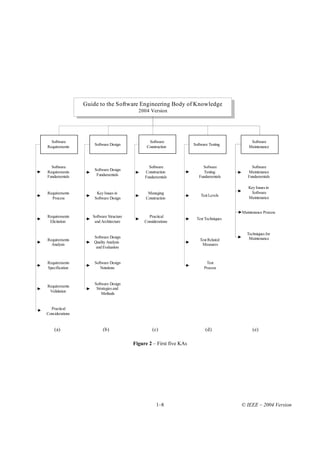
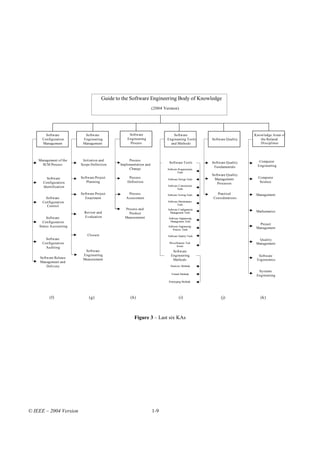
                                                                                                       Figure 1 maps out the eleven chapters and the important
                                                                                                       topics incorporated within them. The first five KAs are
    Specialized

                              of software


                                                                                                       presented in traditional waterfall life cycle sequence.
                                                                                                       However, this does not imply that the Guide adopts or
                                                               Advanced and Research                   encourages the waterfall model, or any other model. The
                                                          Innovative practices tested and used         subsequent KAs are presented in alphabetical order, and
                                                            only by some organizations and             those of the related disciplines are presented in the last
                                                           concepts still being developed and          chapter. This is identical to the sequence in which they
                                                            tested in research organizations           are presented in this Guide.

                                                                                                       STRUCTURE OF THE KA DESCRIPTIONS

                                              Figure 1 Categories of knowledge                         The KA descriptions are structured as follows.
However, the term “generally accepted” does not imply                                                  In the introduction, a brief definition of the KA, and an
that the designated knowledge should be uniformly                                                      overview of its scope and of its relationship with other
applied to all software engineering endeavors–each                                                     KAs are presented.
project’s needs determine that–but it does imply that                                                  The breakdown of topics constitutes the core of each KA
competent, capable software engineers should be                                                        description, describing the decomposition of the KA into
equipped with this knowledge for potential application.                                                sub-areas, topics, and sub-topics. For each topic or sub-
More precisely, generally accepted knowledge should be                                                 topic, a short description is given, along with one or more
                                                                                                       references.
4
                                                                                                       The reference material was chosen because it is
    A Guide to the Project Management Body of Knowledge, 2000
    Edition, Project Management Institute, Newport Square, PA.
                                                                                                       considered to constitute the best presentation of the
    www.pmi.org.                                                                                       knowledge relative to the topic, taking into account the


© IEEE – 2004 Version                                                                            1-3
limitations imposed on the choice of references (see                 involving substantial non-software components, as many
above). A matrix links the topics to the reference material.         as three different types of documents are produced:
The last part of the KA description is the list of                   system definition, system requirements specification, and
recommended references. Appendix A of each KA                        software requirements specification. The sub-area
includes suggestions for further reading for those users             describes all three documents and the underlying
who wish to learn more about the KA topics. Appendix B               activities.
presents the list of standards most relevant to the KA.              The sixth sub-area is requirements validation, the aim of
Note that citations enclosed in square brackets “[ ]” in the         which is to pick up any problems before resources are
text identify recommended references, while those                    committed to addressing the requirements. Requirements
enclosed in parentheses “( )” identify the usual references          validation is concerned with the process of examining the
used to write or justify the text. The former are to be              requirements documents to ensure that they are defining
found in the corresponding section of the KA and the                 the right system (that is, the system that the user expects).
latter in Appendix A of the KA.                                      It is subdivided into descriptions of the conduct of
Brief summaries of the KA descriptions and Appendices                requirements reviews, prototyping, and model validation
are given next.                                                      and acceptance tests.
                                                                     The seventh and last sub-area is practical considerations.
Software Requirements KA (see Figure 2, column a)                    It describes topics which need to be understood in
                                                                     practice. The first topic is the iterative nature of the
A requirement is defined as a property that must be                  requirements process. The next three topics are
exhibited in order to solve some real-world problem.                 fundamentally about change management and the
The first knowledge sub-area is software requirements                maintenance of the requirements in a state which
fundamentals. It includes definitions of software                    accurately mirrors the software to be built, or that has
requirements themselves, but also of the major types of              already been built. It includes change management,
requirements: product vs. process, functional vs. non-               requirements attributes, and requirements tracing. The
functional, emergent properties. The sub-area also                   final topic is requirements measurement.
describes the importance of quantifiable requirements and
distinguishes between systems and software requirements.             Software Design KA (see Figure 2, column b)
The second knowledge sub-area is the requirements                    According to the IEEE definition [IEEE610.12-90],
process, which introduces the process itself, orienting the          design is both “the process of defining the architecture,
remaining five sub-areas and showing how requirements                components, interfaces, and other characteristics of a
engineering dovetails with the other software engineering            system or component” and “the result of [that] process.”
processes. It describes process models, process actors,              The KA is divided into six sub-areas.
process support and management, and process quality and
improvement.                                                         The first sub-area presents the software design
                                                                     fundamentals, which form an underlying basis to the
The third sub-area is requirements elicitation, which is             understanding of the role and scope of software design.
concerned with where software requirements come from                 These are general software concepts, the context of
and how the software engineer can collect them. It                   software design, the software design process, and the
includes requirement sources and elicitation techniques.             enabling techniques for software design.
The fourth sub-area, requirements analysis, is concerned
                                                                     The second sub-area groups together the key issues in
with the process of analyzing requirements to:
                                                                     software design. They include concurrency, control and
     detect and resolve conflicts between requirements               handling of events, distribution of components, error and
      discover the bounds of the software and how it must            exception handling and fault tolerance, interaction and
      interact with its environment                                  presentation, and data persistence.
      elaborate system requirements to software                      The third sub-area is software structure and architecture,
      requirements                                                   the topics of which are architectural structures and
Requirements         analysis    includes    requirements            viewpoints, architectural styles, design patterns, and,
classification, conceptual modeling, architectural design            finally, families of programs and frameworks.
and requirements allocation, and requirements                        The fourth sub-area describes software design quality
negotiation.                                                         analysis and evaluation. While there is a entire KA
The fifth sub-area is requirements specification.                    devoted to software quality, this sub-area presents the
Requirements specification typically refers to the                   topics specifically related to software design. These
production of a document, or its electronic equivalent,              aspects are quality attributes, quality analysis, and
that can be systematically reviewed, evaluated, and                  evaluation techniques and measures.
approved. For complex systems, particularly those                    The fifth sub-area is software design notations, which are

                                                               1–4                                      © IEEE – 2004 Version
divided into structural and behavioral descriptions.                 practical considerations and the test activities.
The last sub-area describes software design strategies and
methods. First, general strategies are described, followed           Software Maintenance (see Figure 2, column e)
by function-oriented design methods, object-oriented
design methods, data-structure centered design,                      Once in operation, anomalies are uncovered, operating
component-based design, and others.                                  environments change, and new user requirements surface.
                                                                     The maintenance phase of the lifecycle commences upon
                                                                     delivery but maintenance activities occur much earlier.
Software Construction KA (see Figure 2, column c)                    The Software Maintenance KA is divided into four sub-
Software construction refers to the detailed creation of             areas.
working, meaningful software through a combination of                The first one presents software maintenance
coding, verification, unit testing, integration testing, and         fundamentals: definitions and terminology, the nature of
debugging. The KA includes three sub-areas.                          maintenance, the need for maintenance, the majority of
The first sub-area is software construction fundamentals.            maintenance costs, the evolution of software, and the
The first three topics are basic principles of construction:         categories of maintenance.
minimizing complexity, anticipating change, and                      The second sub-area groups together the key issues in
constructing for verification. The last topic discusses              software maintenance. These are the technical issues, the
standards for construction.                                          management issues, maintenance cost estimation, and
The second sub-area describes managing construction.                 software maintenance measurement.
The topics are construction models, construction                     The third sub-area describes the maintenance process.
planning, and construction measurement.                              The topics here are the maintenance processes and
The third sub-area covers practical considerations. The              maintenance activities.
topics are construction design, construction languages,              Techniques for maintenance constitute the fourth sub-
coding, construction testing, reuse, construction quality,           area. These include program comprehension, re-
and integration.                                                     engineering, and reverse engineering.

Software Testing (see Figure 2, column d)                            Software Configuration Management (see Figure 3,
                                                                     column f)
Software Testing consists of the dynamic verification of
the behavior of a program on a finite set of test cases,             Software Configuration Management (SCM) is the
suitably selected from the usually infinite executions               discipline of identifying the configuration of software at
domain, against the expected behavior. It includes five              distinct points in time for the purpose of systematically
sub-areas.                                                           controlling changes to the configuration and of
It begins with a description of software testing                     maintaining the integrity and traceability of the
fundamentals. First, the testing-related terminology is              configuration throughout the system life cycle. This KA
presented, then key issues of testing are described, and             includes six sub-areas.
finally the relationship of testing to other activities is           The first sub-area is management of the SCM process. It
covered.                                                             covers the topics of the organizational context for SCM,
The second sub-area is test levels. These are divided                constraints and guidance for SCM, planning for SCM, the
between the targets of the tests and the objectives of the           SCM plan itself, and surveillance of SCM.
tests.                                                               The second sub-area is software configuration
The third sub-area is test techniques. The first category            identification, which identifies items to be controlled,
includes the tests based on the tester’s intuition and               establishes identification schemes for the items and their
experience. A second group comprises specification-                  versions, and establishes the tools and techniques to be
based techniques, followed by code-based techniques,                 used in acquiring and managing controlled items. The
fault-based techniques, usage-based techniques, and                  first topics in this sub-area are identification of the items
techniques relative to the nature of the application. A              to be controlled and the software library.
discussion of how to select and combine the appropriate              The third sub-area is software configuration control,
techniques is also presented.                                        which is the management of changes during the software
The fourth sub-area covers test related measures. The                life cycle. The topics are: first, requesting, evaluating, and
measures are grouped into those related to the evaluation            approving software changes; second, implementing
of the program under test and the evaluation of the tests            software changes; and third, deviations, and waivers.
performed.                                                           The fourth sub-area is software configuration status
The last sub-area describes the test process, and includes           accounting. Its topics are software configuration status
                                                                     information and software configuration status reporting.


© IEEE – 2004 Version                                          1-5
The fifth sub-area is software configuration auditing. It            change. The topics here are process infrastructure, the
consists of software functional configuration auditing,              software process management cycle, models for process
software physical configuration auditing, and in-process             implementation and change, and practical considerations.
audits of a software baseline.                                       The second sub-area deals with process definition. It
The last sub-area is software release management and                 includes the topics of software life cycle models, software
delivery, covering software building and software release            life-cycle processes, notations for process definitions,
management.                                                          process adaptation, and automation
                                                                     The third sub-area is process assessment. The topics here
Software Engineering Management (see Figure 3,                       include process assessment models and process
column g)                                                            assessment methods.
The Software Engineering Management KA addresses the                 The fourth sub-area describes process and product
management and measurement of software engineering.                  measurements. The software engineering process covers

While measurement is an important aspect of all KAs, it              general product measurement, as well as process
is here that the topic of measurement programs is                    measurement in general. Measurements specific to KAs
presented. There are six sub-areas for software                      are described in the relevant KA. The topics are process
engineering management. The first five cover software                measurement, software product measurement, quality of
project management and the sixth describes the software              measurement results, software information models, and
measurement programs.                                                process measurement techniques.
The first sub-area is initiation and scope definition, which
comprises determination and negotiation of requirements,             Software Engineering Tools and Methods (see Figure
feasibility analysis, and process for the review and                 3, column i)
revision of requirements.                                            The Software Engineering Tools and Methods KA
The second sub-area is software project planning, and                includes both software engineering tools and software
includes process planning, determining deliverables,                 engineering methods.
effort, schedule and cost estimation, resource allocation,           The software engineering tools sub-area uses the same
risk management, quality management, and plan                        structure as the Guide itself, with one topic for each of the
management.                                                          other nine software engineering KAs. An additional topic
The third sub-area is software project enactment. The                is provided: miscellaneous tools issues, such as tool
topics here are implementation of plans, supplier contract           integration techniques, which are potentially applicable to
management, implementation of measurement process,                   all classes of tools.
monitor process, control process,? and reporting.                    The software engineering methods sub-area is divided
The fourth sub-area is review and evaluation, which                  into four subsections: heuristic methods dealing with
includes the topics of determining satisfaction of                   informal approaches, formal methods dealing with
requirements and reviewing and evaluating performance.               mathematically based approaches, and prototyping
The fifth sub-area describes closure: determining closure            methods dealing with software development approaches
and closure activities.                                              based on various forms of prototyping.
Finally, the sixth sub-area describes software engineering
                                                                     Software Quality (see Figure 3, column j)
measurement, more specifically, measurement programs.
Product and process measures are described in the                    The Software Quality KA deals with software quality
Software Engineering Process KA. Many of the other                   considerations which transcend the software life cycle
KAs also describe measures specific to their KA. The                 processes. Since software quality is a ubiquitous concern
topics of this sub-area are: establish and sustain                   in software engineering, it is also considered in many of
measurement commitment, plan the measurement                         the other Kas, and the reader will notice pointers to those
process, perform the measurement process, and evaluate               KAs throughout this KA. The description of this KA
measurement.                                                         covers three sub-areas.
                                                                     The first sub-area describes the software quality
Software Engineering Process (see Figure 3, column h)                fundamentals such as software engineering culture and
The Software Engineering Process KA is concerned with                ethics, the value and costs of quality, models and quality
the definition, implementation, assessment, measurement,             characteristics, and quality improvement.
management, change, and improvement of the software                  The second sub-area covers software quality management
engineering process itself. It is divided into four sub-             processes. The topics here are software quality assurance,
areas.                                                               verification and validation, and reviews and audits.
The first sub-area presents process implementation and               The third and final sub-area describes practical

                                                               1–6                                      © IEEE – 2004 Version
considerations related to software quality. The topics are            users), in support of the project’s fifth objective, the
software quality requirements, defect characterization,               fourth appendix rates each topic with one of a set of
software quality management techniques, and software                  pedagogical categories commonly attributed to Benjamin
quality measurement.                                                  Bloom. The concept is that educational objectives can be
                                                                      classified into six categories representing increasing
Related Disciplines     OF   Software Engineering       (see          depth: knowledge, comprehension, application, analysis,
Figure 3, column k)                                                   synthesis, and evaluation. Results of this exercise for all
                                                                      KAs can be found in Appendix D. This Appendix must
The last chapter is entitled Related Disciplines of                   not, however, be viewed as a definitive classification, but
Software Engineering. In order to circumscribe software               much more as a starting point.
engineering, it is necessary to identify the disciplines with
which software engineering shares a common boundary.
This chapter identifies, in alphabetical order, these related
disciplines. For each related discipline, and using a
consensus-based recognized source as found, are
identified:
     an informative definition (when feasible);
     a list of KAs.
The related disciplines are:
     Computer engineering              Project management
     Computer science                  Quality management
     Management                        Software ergonomics
     Mathematics                       Systems engineering

APPENDICES

Appendix A. KA Description Specifications
The appendix describes the specifications provided by the
editorial team to the associate editors for the content,
recommended references, format, and style of the KA
descriptions.

APPENDIX B. EVOLUTION OF THE GUIDE
The second appendix describes the project’s proposal for
the evolution of the Guide. The 2004 Guide is simply the
current edition of a guide which will continue evolving to
meet the needs of the software engineering community.
Planning for evolution is not yet complete, but a tentative
outline of the process is provided in this appendix. As of
this writing, this process has been endorsed by the
project’s Industrial Advisory Board and briefed to the
Board of Governors of the IEEE Computer Society, but is
not yet either funded or implemented.

APPENDIX C. ALLOCATION OF STANDARDS TO KAS
The third appendix is an annotated table of the most
relevant standards, mostly from the IEEE and the ISO,
allocated to the KAs of the SWEBOK Guide.

APPENDIX D. BLOOM RATINGS
As an aid, notably to curriculum developers (and other


© IEEE – 2004 Version                                           1-7
Guide to the Software Engineering Body of Knowledge
                                           2004 Version


  Software                                      Software                                    Software
                     Software Design                                 Software Testing
Requirements                                   Construction                                Maintenance


  Software                                      Software                  Sofware            Software
                     Software Design
Requirements                                  Construction                 Testing         Maintenance
Fundamentals          Fundamentals                                      Fundamentals       Fundamentals
                                              Fundamentals

                                                                                           Key Issues in
Requirements          Key Issues in            Managing                                      Software
                                                                         Test Levels
  Process            Software Design          Construction                                 Maintenance


                                                                                        Maintenance Process
Requirements        Software Structure          Practical
                                                                      Test Techniques
 Elicitation         and Architecture         Considerations

                                                                                          Techniques for
                     Software Design                                                       Maintenance
Requirements                                                            Test Related
                     Quality Analysis
  Analysis                                                               Measures
                      and Evaluation


Requirements         Software Design                                        Test
Specification           Notations                                          Process


                     Software Design
Requirements
                      Strategies and
 Validation
                         Methods


  Practical
Considerations


    (a)                   (b)                     (c)                       (d)               (e)

                                         Figure 2 – First five KAs


                                                     1–8                                © IEEE – 2004 Version
Guide to the Software Engineering Body of Knowledge
                                                                   (2004 Version)


        Software          Software                 Software                    Software                                Knowledge Areas of
      Configuration      Engineering              Engineering              Engineering Tools        Software Quality      the Related
      Management         Management                Process                   and Methods                                  Disciplines


    Management of the    Initiation and            Process                                                                Computer
                                                                            Software Tools          Software Quality
      SCM Process       Scope Definition      Implementation and                                                         Engineering
                                                                                                     Fundamentals
                                                   Change                  Software Requirements
                                                                                   Tools
                                                                                                    Software Quality
        Software        Software Project           Process                 Software Design Tools     Management          Computer
      Configuration        Planning               Definition                                           Processes          Science
      Identification                                                       Software Construction
                                                                                   Tools
                        Software Project          Process                  Software Testing Tools     Practical         Management
        Software          Enactment              Assessment                                         Considerations
      Configuration                                                        Software Maintenance
                                                                                   Tools
         Control
                                                Process and                Software Configuration
                          Review and                                        Management Tools                            Mathematics
                                                  Product
        Software          Evaluation            Measurement                 Software Engineering
      Configuration                                                          Management Tools
                                                                                                                          Project
    Status Accounting                                                      Software Engineering
                                                                                                                        Management
                                                                               Process Tools

                            Closure                                        Software Quality Tools
        Software                                                                                                          Quality
      Configuration                                                         Miscellaneous Tool                          Management
                                                                                  Issues
        Auditing
                          Software                                            Software
                         Engineering                                         Engineering                                 Software
     Software Release    Measurement                                          Methods                                   Ergonomics
     Management and
         Delivery                                                            Heuristic Methods
                                                                                                                         Systems
                                                                              Formal Methods
                                                                                                                        Engineering
                                                                            Prototyping Methods


          (f)                (g)                    (h)                             (i)                  (j)              (k)


                                                      Figure 3 – Last six KAs


© IEEE – 2004 Version                                              1-9
1–10   © IEEE – 2004 Version
CHAPTER 2
                                      SOFTWARE REQUIREMENTS

                                                                     breakdown reflects the fact that the requirements process,
ACRONYMS                                                             if it is to be successful, must be considered as a process
DAG               Directed Acyclic Graph                             involving complex, tightly coupled activities (both se-
FSM               Functional Size Measurement                        quential and concurrent), rather than as a discrete, one-off
INCOSE            International Council on Systems Engi-             activity performed at the outset of a software development
                  neering                                            project.
SADT              Structured Analysis and Design Tech-               The Software Requirements KA is related closely to the
                  nique                                              Software Design, Software Testing, Software Mainte-
UML               Unified Modeling Language                          nance, Software Configuration Management, Software
INTRODUCTION                                                         Engineering Management, Software Engineering Process,
                                                                     and Software Quality KAs.
The Software Requirements Knowledge Area (KA) is
concerned with the elicitation, analysis, specification, and
validation of software requirements. It is widely acknowl-
                                                                     BREAKDOWN OF TOPICS FOR SOFTWARE
edged within the software industry that software engineer-           REQUIREMENTS
ing projects are critically vulnerable when these activities         1. Software Requirements Fundamentals
are performed poorly.
                                                                     1.1. Definition of a Software Requirement
Software requirements express the needs and constraints              At its most basic, a software requirement is a property
placed on a software product that contribute to the solu-            which must be exhibited in order to solve some problem
tion of some real-world problem. [Kot00]                             in the real world. The Guide refers to requirements on
The term ‘requirements engineering’ is widely used in the            ‘software’ because it is concerned with problems to be
field to denote the systematic handling of requirements.             addressed by software. Hence, a software requirement is a
For reasons of consistency, though, this term will not be            property which must be exhibited by software developed
used in the Guide, as it has been decided that the use of            or adapted to solve a particular problem. The problem
the term ‘engineering’ for activities other than software            may be to automate part of a task of someone who will
engineering ones is to be avoided in this edition of the             use the software, to support the business processes of the
Guide.                                                               organization that has commissioned the software, to cor-
                                                                     rect shortcomings of existing software, to control a de-
For the same reason, ‘requirements engineer’, a term                 vice, and many more. The functioning of users, business
which appears in some of the literature, will not be used            processes, and devices is typically complex. By extension,
either. Instead, the term ‘software engineer’, or, in some           therefore, the requirements on particular software are
specific cases, ‘requirements specialist’ will be used, the          typically a complex combination of requirements from
latter where the role in question is usually performed by            different people at different levels of an organization and
an individual other than a software engineer. This does              from the environment in which the software will operate.
not imply, however, that a software engineer could not
perform the function.                                                An essential property of all software requirements is that
                                                                     they be verifiable. It may be difficult or costly to verify
The KA breakdown is broadly compatible with the sec-                 certain software requirements. For example, verification
tions of IEEE 12207 that refer to requirements activities.           of the throughput requirement on the call center may ne-
(IEEE12207.1-96)                                                     cessitate the development of simulation software. Both the
A risk inherent in the proposed breakdown is that a water-           software requirements and software quality personnel
fall-like process may be inferred. To guard against this,            must ensure that the requirements can be verified within
sub-area 2, Requirements Process, is designed to provide             the available resource constraints.
a high-level overview of the requirements process by set-            Requirements have other attributes in addition to the be-
ting out the resources and constraints under which the               havioral properties that they express. Common examples
process operates and which act to configure it.                      include a priority rating to enable trade-offs in the face of
An alternate decomposition could use a product-based                 finite resources and a status value to enable project pro-
structure (system requirements, software requirements,               gress to be monitored. Typically, software requirements
prototypes, use cases, and so on). The process-based                 are uniquely identified so that they can be subjected to


© IEEE – 2004 Version                                          2-1
software configuration control and managed over the en-                 shall be written in Ada.’). These are sometimes known as
tire software life cycle. [Kot00; Pfl01; Som05; Tha97]                  process requirements.
1.2. Product and Process Requirements                                   Some software requirements generate implicit process
A distinction can be drawn between product parameters                   requirements. The choice of verification technique is one
and process parameters. Product parameters are require-                 example. Another might be the use of particularly rigor-
ments on software to be developed (for example, ‘The                    ous analysis techniques (such as formal specification
software shall verify that a student meets all prerequisites            methods) to reduce faults which can lead to inadequate
before he or she registers for a course.’).                             reliability. Process requirements may also be imposed
                                                                        directly by the development organization, their customer,
A process parameter is essentially a constraint on the de-              or a third party such as a safety regulator [Kot00; Som97].
velopment of the software (for example, ‘The software


                                                           Software
                                                         Requirements


      Software
                       Requirements      Requirements     Requirements         Requirements      Requirements          Practical
    Requirements
                          Process         Elicitation       Analysis           Specification      Validation         Considerations
    Fundamentals


     Definition of a                                                           System                                Iterative Nature
                                         Requirements     Requirements                           Requirements
     Software          Process Models                                          Definition                            of Requirements
                                         Sources          Classification                         Reviews
     Requirement                                                               Document                              Process


     Product and                                                               Systems
                                         Elicitation       Conceptual                                                Change
     Process           Process Actors                                          Requirements      Prototyping
                                         Techniques        Modeling                                                  Management
     Requirements                                                              Specification

                                                           Architectural
     Functional and                                                            Software
                       Process Support                     Design and                            Model                Requirements
     Non-functional                                                            Requirements
                       and Management                      Requirements                          Validation           Attributes
     Requirements                                                              Specification
                                                           Allocation


     Emergent          Process Quality                    Requirements                           Acceptance           Requirements
     Properties        and Improvement                    Negotiation                            Tests                Tracing


     Quantifiable                                                                                                     Measuring
     Requirements                                                                                                     Requirements


     System
     Requirements
     and Software
     Requirements


                                  Figure 1 Breakdown of topics for the Software Requirements KA

1.3. Functional and Non-functional Requirements                         performance requirements, maintainability requirements,
Functional requirements describe the functions that the                 safety requirements, reliability requirements, or one of
software is to execute; for example, formatting some text               many other types of software requirements. These topics
or modulating a signal. They are sometimes known as                     are also discussed in the Software Quality KA. [Kot00;
capabilities.                                                           Som97]

Non-functional requirements are the ones that act to con-               1.4. Emergent Properties
strain the solution. Non-functional requirements are some-              Some requirements represent emergent properties of
times known as constraints or quality requirements. They                software; that is, requirements which cannot be addressed
can be further classified according to whether they are                 by a single component, but which depend for their satis-


                                                               2-2                                             © IEEE – 2004 Version
faction on how all the software components interoperate.                    ning of a project and continuing to be refined
The throughput requirement for a call center would, for                     throughout the life cycle
example, depend on how the telephone system, informa-                       identifies software requirements as configuration
tion system, and the operators all interacted under actual                  items, and manages them using the same software
operating conditions. Emergent properties are crucially                     configuration management practices as other prod-
dependent on the system architecture. [Som05]                               ucts of the software life cycle processes
                                                                            needs to be adapted to the organization and project
1.5. Quantifiable Requirements                                              context
Software requirements should be stated as clearly and as              In particular, the topic is concerned with how the activi-
unambiguously as possible, and, where appropriate, quan-              ties of elicitation, analysis, specification, and validation
titatively. It is important to avoid vague and unverifiable           are configured for different types of projects and con-
requirements which depend for their interpretation on                 straints. The topic also includes activities which provide
subjective judgment (‘The software shall be reliable’;                input into the requirements process, such as marketing
‘The software shall be user-friendly’). This is particularly          and feasibility studies. [Kot00; Rob99; Som97; Som05]
important for non-functional requirements. Two examples
of quantified requirements are the following: a call cen-             2.2. Process Actors
ter's software must increase the center’s throughput by               This topic introduces the roles of the people who partici-
20%; and a system shall have a probability of generating a            pate in the requirements process. This process is funda-
fatal error during any hour of operation of less than 1 *             mentally interdisciplinary, and the requirements specialist
10-8. The throughput requirement is at a very high level              needs to mediate between the domain of the stakeholder
and will need to be used to derive a number of detailed               and that of software engineering. There are often many

requirements. The reliability requirement will tightly con-           people involved besides the requirements specialist, each
strain the system architecture. [Dav93; Som05]                        of whom has a stake in the software. The stakeholders
                                                                      will vary across projects, but always include us-
1.6. System Requirements and Software Requirements                    ers/operators and customers (who need not be the same).
In this topic, system means ‘an interacting combination of            [Gog93]
elements to accomplish a defined objective. These include
hardware, software, firmware, people, information, tech-              Typical examples of software stakeholders include (but
niques, facilities, services, and other support elements,’ as         are not restricted to):
defined by the International Council on Systems Engi-                       Users–This group comprises those who will operate
neering (INCOSE00).                                                         the software. It is often a heterogeneous group com-
System requirements are the requirements for the system                     prising people with different roles and requirements.
as a whole. In a system containing software components,                     Customers–This group comprises those who have
software requirements are derived from system require-                      commissioned the software or who represent the
ments.                                                                      software’s target market.
                                                                            Market analysts–A mass-market product will not
The literature on requirements sometimes calls system                       have a commissioning customer, so marketing peo-
requirements ‘user requirements’. The Guide defines ‘user                   ple are often needed to establish what the market
requirements’ in a restricted way as the requirements of                    needs and to act as proxy customers.
the system’s customers or end-users. System require-                        Regulators–Many application domains such as
ments, by contrast, encompass user requirements, re-                        banking and public transport are regulated. Software
quirements of other stakeholders (such as regulatory au-                    in these domains must comply with the requirements
thorities), and requirements without an identifiable human                  of the regulatory authorities.
source.                                                                     Software engineers–These individuals have a le-
                                                                            gitimate interest in profiting from developing the
2. Requirements Process                                                     software by, for example, reusing components in
This section introduces the software requirements process,                  other products. If, in this scenario, a customer of a
orienting the remaining five sub-areas and showing how                      particular product has specific requirements which
the requirements process dovetails with the overall soft-                   compromise the potential for component reuse, the
ware engineering process. [Dav93; Som05]                                    software engineers must carefully weigh their own
                                                                            stake against those of the customer.
2.1. Process Models                                                   It will not be possible to perfectly satisfy the requirements
The objective of this topic is to provide an understanding            of every stakeholder, and it is the software engineer’s job
that the requirements process:                                        to negotiate trade-offs which are both acceptable to the
     is not a discrete front-end activity of the software             principal stakeholders and within budgetary, technical,
     life cycle, but rather a process initiated at the begin-         regulatory, and other constraints. A prerequisite for this is
                                                                      that all the stakeholders be identified, the nature of their


© IEEE – 2004 Version                                           2-3
‘stake’ analyzed, and their requirements elicited. [Dav93;           3.1.    Requirements Sources
Kot00; Rob99; Som97; You01]                                                  [Dav93; Gog93; Pfl01]
2.3. Process Support and Management                                  Requirements have many sources in typical software, and
This topic introduces the project management resources               it is essential that all potential sources be identified and
required and consumed by the requirements process. It                evaluated for their impact on it. This topic is designed to
establishes the context for the first sub-area (Initiation           promote awareness of the various sources of software
and Scope Definition) of the Software Engineering Man-               requirements and of the frameworks for managing them.
agement KA. Its principal purpose is to make the link                The main points covered are:
between the process activities identified in 2.1 and the
                                                                            Goals. The term goal (sometimes called ‘business
issues of cost, human resources, training, and tools.
                                                                            concern’ or ‘critical success factor’) refers to the
[Rob99; Som97; You01]
                                                                            overall, high-level objectives of the software. Goals
2.4. Process Quality and Improvement                                        provide the motivation for the software, but are of-
This topic is concerned with the assessment of the quality                  ten vaguely formulated. Software engineers need to
and improvement of the requirements process. Its purpose                    pay particular attention to assessing the value (rela-
is to emphasize the key role the requirements process                       tive to priority) and cost of goals. A feasibility study
plays in terms of the cost and timeliness of a software                     is a relatively low-cost way of doing this. [Lou95].
product, and of the customer’s satisfaction with it                         Domain knowledge. The software engineer needs to
[Som97]. It will help to orient the requirements process                    acquire, or have available, knowledge about the ap-
with quality standards and process improvement models                       plication domain. This enables them to infer tacit
for software and systems. Process quality and improve-                      knowledge that the stakeholders do not articulate,
ment is closely related to both the Software Quality KA                     assess the trade-offs that will be necessary between
and the Software Engineering Process KA. Of particular                      conflicting requirements, and, sometimes, to act as a
interest are issues of software quality attributes and meas-                ‘user’ champion.
urement, and software process definition. This topic cov-                   Stakeholders (see topic 2.2 Process Actors). Much
ers:                                                                        software has proved unsatisfactory because it has
                                                                            stressed the requirements of one group of stake-
     requirements process coverage by process im-                           holders at the expense of those of others. Hence,
     provement standards and models                                         software is delivered which is difficult to use or
     requirements process measures and benchmarking                         which subverts the cultural or political structures of
     improvement planning and implementation [Kot00;                        the customer organization. The software engineer
     Som97; You01]                                                          needs to identify, represent, and manage the ‘view-
3. Requirements Elicitation                                                 points’ of many different types of stakeholders.
                                                                            [Kot00].
    [Dav93; Gog93; Lou95; Pfl01]                                            The operational environment. Requirements will be
Requirements elicitation is concerned with where soft-                      derived from the environment in which the software
ware requirements come from and how the software engi-                      will be executed. These may be, for example, timing
neer can collect them. It is the first stage in building an                 constraints in real-time software or interoperability
understanding of the problem the software is required to                    constraints in an office environment. These must be
solve. It is fundamentally a human activity, and is where                   actively sought out, because they can greatly affect
the stakeholders are identified and relationships estab-                    software feasibility and cost, and restrict design
lished between the development team and the customer. It                    choices. [Tha97]
is variously termed ‘requirements capture’, ‘requirements                   The organizational environment. Software is often
discovery’, and ‘requirements acquisition.’                                 required to support a business process, the selection
                                                                            of which may be conditioned by the structure, cul-
One of the fundamental tenets of good software engineer-                    ture, and internal politics of the organization. The
ing is that there be good communication between software                    software engineer needs to be sensitive to these,
users and software engineers. Before development begins,                    since, in general, new software should not force un-
requirements specialists may form the conduit for this                      planned change on the business process.
communication. They must mediate between the domain
of the software users (and other stakeholders) and the               3.2.    Elicitation Techniques
technical world of the software engineer.                                    [Dav93; Kot00; Lou95; Pfl01]
                                                                     Once the requirements sources have been identified, the
                                                                     software engineer can start eliciting requirements from
                                                                     them. This topic concentrates on techniques for getting
                                                                     human stakeholders to articulate their requirements. It is a
                                                                     very difficult area and the software engineer needs to be


                                                               2-4                                        © IEEE – 2004 Version
sensitized to the fact that (for example) users may have                      relatively expensive, but they are instructive because
difficulty describing their tasks, may leave important in-                    they illustrate that many user tasks and business
formation unstated, or may be unwilling or unable to co-                      processes are too subtle and complex for their actors
operate. It is particularly important to understand that                      to describe easily.
elicitation is not a passive activity, and that, even if coop-
erative and articulate stakeholders are available, the soft-
                                                                       4. Requirements Analysis
ware engineer has to work hard to elicit the right informa-                   [Som05]
tion. A number of techniques exist for doing this, the                 This topic is concerned with the process of analyzing re-
principal ones being: [Gog93]                                          quirements to:
     Interviews, a ‘traditional’ means of eliciting re-                      detect and resolve conflicts between requirements
     quirements. It is important to understand the advan-                    discover the bounds of the software and how it must
     tages and limitations of interviews, and how they                       interact with its environment
     should be conducted.                                                    elaborate system requirements to derive software
     Scenarios, a valuable means for providing context to                    requirements
     the elicitation of user requirements. They allow the              The traditional view of requirements analysis has been
     software engineer to provide a framework for ques-                that it be reduced to conceptual modeling using one of a
     tions about user tasks by permitting ‘what if’ and                number of analysis methods such as the Structured Analy-
     ‘how is this done’ questions to be asked. The most                sis and Design Technique (SADT). While conceptual
     common type of scenario is the use case. There is a               modeling is important, we include the classification of
     link here to topic 4.2. (Conceptual Modeling), be-                requirements to help inform trade-offs between require-
     cause scenario notations such as use cases and dia-               ments (requirements classification) and the process of
     grams are common in modeling software.                            establishing these trade-offs (requirements negotiation).
     Prototypes, a valuable tool for clarifying unclear                [Dav93]
     requirements. They can act in a similar way to sce-
     narios by providing users with a context within                   Care must be taken to describe requirements precisely
     which they can better understand what information                 enough to enable the requirements to be validated, their
     they need to provide. There is a wide range of proto-             implementation to be verified, and their costs to be esti-
     typing techniques, from paper mock-ups of screen                  mated.
     designs to beta-test versions of software products,
                                                                       4.1.    Requirements Classification
     and a strong overlap of their use for requirements
     elicitation and the use of prototypes for require-                        [Dav93; Kot00; Som05]
     ments validation (see topic 6.2 Prototyping).                     Requirements can be classified on a number of dimen-
     Facilitated meetings. The purpose of these is to try              sions. Examples include:
     to achieve a summative effect whereby a group of
     people can bring more insight into their software re-                    Whether the requirement is functional or non-
     quirements than by working individually. They can                        functional (see topic 1.3 Functional and Non-
     brainstorm and refine ideas which may be difficult                       functional Requirements).
     to bring to the surface using interviews. Another ad-                    Whether the requirement is derived from one or
     vantage is that conflicting requirements surface                         more high-level requirements or an emergent prop-
     early on in a way that lets the stakeholders recognize                   erty (see topic 1.4 Emergent Properties), or is being
     where there is conflict. When it works well, this                        imposed directly on the software by a stakeholder or
     technique may result in a richer and more consistent                     some other source.
     set of requirements than might otherwise be achiev-                      Whether the requirement is on the product or the
     able. However, meetings need to be handled care-                         process. Requirements on the process can constrain
     fully (hence the need for a facilitator) to prevent a                    the choice of contractor, the software engineering
     situation from occurring where the critical abilities                    process to be adopted, or the standards to be adhered
     of the team are eroded by group loyalty, or the re-                      to.
     quirements reflecting the concerns of a few outspo-                      The requirement priority. In general, the higher the
     ken (and perhaps senior) people are favored to the                       priority, the more essential the requirement is for
     detriment of others.                                                     meeting the overall goals of the software. Often
     Observation. The importance of software context                          classified on a fixed-point scale such as mandatory,
     within the organizational environment has led to the                     highly desirable, desirable, or optional, the priority
     adaptation of observational techniques for require-                      often has to be balanced against the cost of devel-
     ments elicitation. Software engineers learn about                        opment and implementation.
     user tasks by immersing themselves in the environ-                       The scope of the requirement. Scope refers to the
     ment and observing how users interact with their                         extent to which a requirement affects the software
     software and with each other. These techniques are                       and software components. Some requirements, par-


© IEEE – 2004 Version                                            2-5
ticularly certain non-functional ones, have a global                  The process requirements of the customer. Custom-
        scope in that their satisfaction cannot be allocated to               ers may impose their favored notation or method, or
        a discrete component. Hence, a requirement with                       prohibit any with which they are unfamiliar. This
        global scope may strongly affect the software archi-                  factor can conflict with the previous factor.
        tecture and the design of many components,                            The availability of methods and tools. Notations or
        whereas one with a narrow scope may offer a num-                      methods which are poorly supported by training and
        ber of design choices and have little impact on the                   tools may not achieve widespread acceptance even if
        satisfaction of other requirements.                                   they are suited to particular types of problems.
        Volatility/stability. Some requirements will change             Note that, in almost all cases, it is useful to start by build-
       during the life cycle of the software, and even dur-             ing a model of the software context. The software context
       ing the development process itself. It is useful if              provides a connection between the intended software and
       some estimate of the likelihood that a requirement               its external environment. This is crucial to understanding
       change can be made. For example, in a banking ap-                the software’s context in its operational environment and
       plication, requirements for functions to calculate and           to identifying its interfaces with the environment.
       credit interest to customers’ accounts are likely to be
       more stable than a requirement to support a particu-             The issue of modeling is tightly coupled with that of
       lar kind of tax-free account. The former reflect a               methods. For practical purposes, a method is a notation
       fundamental feature of the banking domain (that ac-              (or set of notations) supported by a process which guides
       counts can earn interest), while the latter may be               the application of the notations. There is little empirical
       rendered obsolete by a change to government legis-               evidence to support claims for the superiority of one nota-
       lation. Flagging potentially volatile requirements               tion over another. However, the widespread acceptance of
       can help the software engineer establish a design                a particular method or notation can lead to beneficial in-
       which is more tolerant of change.                                dustry-wide pooling of skills and knowledge. This is cur-
                                                                        rently the situation with the UML (Unified Modeling
Other classifications may be appropriate, depending upon
                                                                        Language). (UML04)
the organization’s normal practice and the application
itself.                                                                 Formal modeling using notations based on discrete
                                                                        mathematics, and which are traceable to logical reasoning,
There is a strong overlap between requirements classifica-
                                                                        have made an impact in some specialized domains. These
tion and requirements attributes (see topic 7.3 Require-
                                                                        may be imposed by customers or standards, or may offer
ments Attributes).
                                                                        compelling advantages to the analysis of certain critical
4.2.    Conceptual Modeling                                             functions or components.
        [Dav93; Kot00; Som05]                                           This topic does not seek to ‘teach’ a particular modeling
The development of models of a real-world problem is                    style or notation, but rather provides guidance on the pur-
key to software requirements analysis. Their purpose is to              pose and intent of modeling.
aid in understanding the problem, rather than to initiate               Two standards provide notations which may be useful in
design of the solution. Hence, conceptual models com-                   performing conceptual modeling–IEEE Std 1320.1,
prise models of entities from the problem domain config-                IDEF0 for functional modeling; and IEEE Std 1320.2,
ured to reflect their real-world relationships and depend-              IDEF1X97 (IDEFObject) for information modeling.
encies.
                                                                        4.3.   Architectural Design and Requirements Allocation
Several kinds of models can be developed. These include
                                                                               [Dav93; Som05]
data and control flows, state models, event traces, user
interactions, object models, data models, and many others.              At some point, the architecture of the solution must be
The factors that influence the choice of model include:                 derived. Architectural design is the point at which the
                                                                        requirements process overlaps with software or systems
       The nature of the problem. Some types of software
                                                                        design, and illustrates how impossible it is to cleanly de-
       demand that certain aspects be analyzed particularly
                                                                        couple the two tasks. [Som01] This topic is closely re-
       rigorously. For example, control flow and state
                                                                        lated to the Software Structure and Architecture sub-area
       models are likely to be more important for real-time
                                                                        in the Software Design KA. In many cases, the software
       software than for management information software,
                                                                        engineer acts as software architect because the process of
       while it would usually be the opposite for data mod-
                                                                        analyzing and elaborating the requirements demands that
       els.
                                                                        the components that will be responsible for satisfying the
       The expertise of the software engineer. It is often
                                                                        requirements be identified. This is requirements alloca-
       more productive to adopt a modeling notation or
                                                                        tion–the assignment, to components, of the responsibility
       method with which the software engineer has ex-
                                                                        for satisfying requirements.
       perience.


                                                                  2-6                                        © IEEE – 2004 Version
Allocation is important to permit detailed analysis of re-          among the large number of requirements. So, in software
quirements. Hence, for example, once a set of require-              engineering jargon, ‘software requirements specification’
ments has been allocated to a component, the individual             typically refers to the production of a document, or its
requirements can be further analyzed to discover further            electronic equivalent, which can be systematically re-
requirements on how the component needs to interact                 viewed, evaluated, and approved. For complex systems,
with other components in order to satisfy the allocated             particularly those involving substantial non-software
requirements. In large projects, allocation stimulates a            components, as many as three different types of docu-
new round of analysis for each subsystem. As an example,            ments are produced: system definition, system require-
requirements for a particular braking performance for a             ments, and software requirements. For simple software
car (braking distance, safety in poor driving conditions,           products, only the third of these is required. All three
smoothness of application, pedal pressure required, and so          documents are described here, with the understanding that
on) may be allocated to the braking hardware (mechanical            they may be combined as appropriate. A description of
and hydraulic assemblies) and an anti-lock braking system           systems engineering can be found in Chapter 12, Related
(ABS). Only when a requirement for an anti-lock braking             Disciplines of Software Engineering.
system has been identified, and the requirements allocated
to it, can the capabilities of the ABS, the braking hard-           5.1. The System Definition Document
ware, and emergent properties (such as the car weight) be           This document (sometimes known as the user require-
used to identify the detailed ABS software requirements.            ments document or concept of operations) records the
                                                                    system requirements. It defines the high-level system re-
Architectural design is closely identified with conceptual          quirements from the domain perspective. Its readership
modeling. The mapping from real-world domain entities               includes representatives of the system users/customers
to software components is not always obvious, so archi-             (marketing may play these roles for market-driven soft-
tectural design is identified as a separate topic. The re-          ware), so its content must be couched in terms of the do-
quirements of notations and methods are broadly the same            main. The document lists the system requirements along
for both conceptual modeling and architectural design.              with background information about the overall objectives
IEEE Std 1471-2000, Recommended Practice for Archi-                 for the system, its target environment and a statement of
tectural Description of Software Intensive Systems, sug-            the constraints, assumptions, and non-functional require-
gests a multiple-viewpoint approach to describing the               ments. It may include conceptual models designed to il-
architecture of systems and their software items.                   lustrate the system context, usage scenarios and the prin-
(IEEE1471-00)                                                       cipal domain entities, as well as data, information, and
                                                                    workflows. IEEE Std 1362, Concept of Operations
4.4. Requirements Negotiation                                       Document, provides advice on the preparation and content
Another term commonly used for this sub-topic is ‘con-              of such a document. (IEEE1362-98)
flict resolution’. This concerns resolving problems with
requirements where conflicts occur between two stake-               5.2.   System Requirements Specification
holders requiring mutually incompatible features, between                  [Dav93; Kot00; Rob99; Tha97]
requirements and resources, or between functional and               Developers of systems with substantial software and non-
non-functional requirements, for example. [Kot00,                   software components, a modern airliner, for example,
Som97] In most cases, it is unwise for the software engi-           often separate the description of system requirements
neer to make a unilateral decision, and so it becomes nec-          from the description of software requirements. In this
essary to consult with the stakeholder(s) to reach a con-           view, system requirements are specified, the software
sensus on an appropriate trade-off. It is often important           requirements are derived from the system requirements,
for contractual reasons that such decisions be traceable            and then the requirements for the software components
back to the customer. We have classified this as a soft-            are specified. Strictly speaking, system requirements
ware requirements analysis topic because problems                   specification is a systems engineering activity and falls
emerge as the result of analysis. However, a strong case            outside the scope of this Guide. IEEE Std 1233 is a guide
can also be made for considering it a requirements valida-          for developing system requirements. (IEEE1233-98)
tion topic.
                                                                    5.3.   Software Requirements Specification
5. Requirements Specification                                              [Kot00; Rob99]
For most engineering professions, the term ‘specification’
refers to the assignment of numerical values or limits to a         Software requirements specification establishes the basis
product’s design goals. (Vin90) Typical physical systems            for agreement between customers and contractors or sup-
have a relatively small number of such values. Typical              pliers (in market-driven projects, these roles may be
software has a large number of requirements, and the em-            played by the marketing and development divisions) on
phasis is shared between performing the numerical quanti-           what the software product is to do, as well as what it is
fication and managing the complexity of interaction                 not expected to do. For non-technical readers, the soft-
                                                                    ware requirements specification document is often ac-


© IEEE – 2004 Version                                         2-7
companied by a software requirements definition docu-                review the document(s). Requirements documents are
ment.                                                                subject to the same software configuration management
                                                                     practices as the other deliverables of the software life cy-
Software requirements specification permits a rigorous
                                                                     cle processes. (Bry94, Ros98)
assessment of requirements before design can begin and
reduces later redesign. It should also provide a realistic           It is normal to explicitly schedule one or more points in
basis for estimating product costs, risks, and schedules.            the requirements process where the requirements are vali-
                                                                     dated. The aim is to pick up any problems before re-
Organizations can also use a software requirements speci-
                                                                     sources are committed to addressing the requirements.
fication document to develop their own validation and
                                                                     Requirements validation is concerned with the process of
verification plans more productively.
                                                                     examining the requirements document to ensure that it
Software requirements specification provides an informed             defines the right software (that is, the software that the
basis for transferring a software product to new users or            users expect). [Kot00]
new machines. Finally, it can provide a basis for software
enhancement.                                                         6.1.   Requirements Reviews
                                                                            [Kot00; Som05; Tha97]
Software requirements are often written in natural lan-
guage, but, in software requirements specification, this             Perhaps the most common means of validation is by in-
may be supplemented by formal or semi-formal descrip-                spection or reviews of the requirements document(s). A
tions. Selection of appropriate notations permits particular         group of reviewers is assigned a brief to look for errors,
requirements and aspects of the software architecture to             mistaken assumptions, lack of clarity, and deviation from
be described more precisely and concisely than natural               standard practice. The composition of the group that con-
language. The general rule is that notations should be               ducts the review is important (at least one representative
used which allow the requirements to be described as pre-            of the customer should be included for a customer-driven
cisely as possible. This is particularly crucial for safety-         project, for example), and it may help to provide guidance
critical and certain other types of dependable software.             on what to look for in the form of checklists.
However, the choice of notation is often constrained by              Reviews may be constituted on completion of the system
the training, skills and preferences of the document’s au-           definition document, the system specification document,
thors and readers.                                                   the software requirements specification document, the
A number of quality indicators have been developed                   baseline specification for a new release, or at any other
which can be used to relate the quality of software re-              step in the process. IEEE Std 1028 provides guidance on
quirements specification to other project variables such as          conducting such reviews. (IEEE1028-97) Reviews are
cost, acceptance, performance, schedule, reproducibility,            also covered in the Software Quality KA, topic 2.3 Re-
etc. Quality indicators for individual software require-             views and Audits.
ments specification statements include imperatives, direc-
                                                                     6.2.   Prototyping
tives, weak phrases, options, and continuances. Indicators
for the entire software requirements specification docu-                    [Dav93; Kot00; Som05; Tha97]
ment include size, readability, specification, depth, and            Prototyping is commonly a means for validating the soft-
text structure. [Dav93; Tha97] (Ros98)                               ware engineer's interpretation of the software require-
IEEE has a standard, IEEE Std 830 [IEEE830-98], for the              ments, as well as for eliciting new requirements. As with
production and content of the software requirements                  elicitation, there is a range of prototyping techniques and
specification. Also, IEEE 1465 (similar to ISO/IEC                   a number of points in the process where prototype valida-
12119), is a standard treating quality requirements in               tion may be appropriate. The advantage of prototypes is
software packages. (IEEE1465-98)                                     that they can make it easier to interpret the software engi-
                                                                     neer's assumptions and, where needed, give useful feed-
6. Requirements validation                                           back on why they are wrong. For example, the dynamic
    [Dav93]                                                          behavior of a user interface can be better understood
                                                                     through an animated prototype than through textual de-
The requirements documents may be subject to validation              scription or graphical models. There are also disadvan-
and verification procedures. The requirements may be                 tages, however. These include the danger of users’ atten-
validated to ensure that the software engineer has under-            tion being distracted from the core underlying functional-
stood the requirements, and it is also important to verify           ity by cosmetic issues or quality problems with the proto-
that a requirements document conforms to company stan-               type. For this reason, several people recommend proto-
dards, and that it is understandable, consistent, and com-           types which avoid software, such as flip-chart-based
plete. Formal notations offer the important advantage of             mockups. Prototypes may be costly to develop. However,
permitting the last two properties to be proven (in a re-            if they avoid the wastage of resources caused by trying to
stricted sense, at least). Different stakeholders, including         satisfy erroneous requirements, their cost can be more
representatives of the customer and developer, should                easily justified.


                                                               2-8                                      © IEEE – 2004 Version
6.3.   Model Validation                                               of, existing software where the architecture is a given. In
       [Dav93; Kot00; Tha97]                                          practice, therefore, it is almost always impractical to im-
                                                                      plement the requirements process as a linear, determinis-
It is typically necessary to validate the quality of the mod-         tic process in which software requirements are elicited
els developed during analysis. For example, in object                 from the stakeholders, baselined, allocated, and handed
models, it is useful to perform a static analysis to verify           over to the software development team. It is certainly a
that communication paths exist between objects which, in              myth that the requirements for large software projects are
the stakeholders’ domain, exchange data. If formal speci-             ever perfectly understood or perfectly specified. [Som97]
fication notations are used, it is possible to use formal
reasoning to prove specification properties.                          Instead, requirements typically iterate towards a level of
                                                                      quality and detail which is sufficient to permit design and
6.4.   Acceptance Tests                                               procurement decisions to be made. In some projects, this
       [Dav93]                                                        may result in the requirements being baselined before all
                                                                      their properties are fully understood. This risks expensive
An essential property of a software requirement is that it            rework if problems emerge late in the software engineer-
should be possible to validate that the finished product              ing process. However, software engineers are necessarily
satisfies it. Requirements which cannot be validated are              constrained by project management plans and must there-
really just ‘wishes’. An important task is therefore plan-            fore take steps to ensure that the ‘quality’ of the require-
ning how to verify each requirement. In most cases, de-
                                                                      ments is as high as possible given the available resources.
signing acceptance tests does this.
                                                                      They should, for example, make explicit any assumptions
Identifying and designing acceptance tests may be diffi-              which underpin the requirements, as well as any known
cult for non-functional requirements (see topic 1.3 Func-             problems.
tional and Non-functional Requirements). To be vali-
                                                                      In almost all cases, requirements understanding continues
dated, they must first be analyzed to the point where they            to evolve as design and development proceeds. This often
can be expressed quantitatively.                                      leads to the revision of requirements late in the life cycle.
Additional information can be found in the Software Test-             Perhaps the most crucial point in understanding require-
ing KA, sub-topic 2.2.4 Conformance Testing.                          ments engineering is that a significant proportion of the
                                                                      requirements will change. This is sometimes due to errors
7. Practical Considerations                                           in the analysis, but it is frequently an inevitable conse-
The first level of decomposition of sub-areas presented in            quence of change in the ‘environment’: for example, the
this KA may seem to describe a linear sequence of activi-             customer's operating or business environment, or the mar-
ties. This is a simplified view of the process. [Dav93]               ket into which software must sell. Whatever the cause, it
                                                                      is important to recognize the inevitability of change and
The requirements process spans the whole software life                take steps to mitigate its effects. Change has to be man-
cycle. Change management and the maintenance of the                   aged by ensuring that proposed changes go through a de-
requirements in a state which accurately mirrors the soft-            fined review and approval process, and, by applying care-
ware to be built, or that has been built, are key to the suc-         ful requirements tracing, impact analysis, and software
cess of the software engineering process. [Kot00; Lou95]              configuration management (see the Software Configura-
Not every organization has a culture of documenting and               tion Management KA). Hence, the requirements process
managing requirements. It is frequent in dynamic start-up             is not merely a front-end task in software development,
companies, driven by a strong ‘product vision’ and lim-               but spans the whole software life cycle. In a typical pro-
ited resources, to view requirements documentation as an              ject, the software requirements activities evolve over time
unnecessary overhead. Most often, however, as these                   from elicitation to change management.
companies expand, as their customer base grows, and as
                                                                      7.2.   Change Management
their product starts to evolve, they discover that they need
to recover the requirements that motivated product fea-                      [Kot00]
tures in order to assess the impact of proposed changes.              Change management is central to the management of re-
Hence, requirements documentation and change manage-                  quirements. This topic describes the role of change man-
ment are key to the success of any requirements process.              agement, the procedures that need to be in place, and the
                                                                      analysis that should be applied to proposed changes. It has
7.1.   Iterative nature of the Requirements Process
                                                                      strong links to the Software Configuration Management
       [Kot00; You01]                                                 KA.
There is general pressure in the software industry for ever
                                                                      7.3.   Requirements Attributes
shorter development cycles, and this is particularly pro-
nounced in highly competitive market-driven sectors.                         [Kot00]
Moreover, most projects are constrained in some way by                Requirements should consist not only of a specification of
their environment, and many are upgrades to, or revisions             what is required, but also of ancillary information which


© IEEE – 2004 Version                                           2-9
helps manage and interpret the requirements. This should              satisfy it (for example, from a system requirement into the
include the various classification dimensions of the re-              software requirements that have been elaborated from it,
quirement (see topic 4.1 Requirements Classification) and             and on into the code modules that implement it).
the verification method or acceptance test plan. It may
                                                                      The requirements tracing for a typical project will form a
also include additional information such as a summary
                                                                      complex directed acyclic graph (DAG) of requirements.
rationale for each requirement, the source of each re-
quirement, and a change history. The most important re-               7.5. Measuring Requirements
quirements attribute, however, is an identifier which al-             As a practical matter, it is typically useful to have some
lows the requirements to be uniquely and unambiguously                concept of the ‘volume’ of the requirements for a particu-
identified.                                                           lar software product. This number is useful in evaluating
7.4.   Requirements Tracing                                           the ‘size’ of a change in requirements, in estimating the
                                                                      cost of a development or maintenance task, or simply for
       [Kot00]
                                                                      use as the denominator in other measurements. Functional
Requirements tracing is concerned with recovering the                 Size Measurement (FSM) is a technique for evaluating the
source of requirements and predicting the effects of re-              size of a body of functional requirements. IEEE Std
quirements. Tracing is fundamental to performing impact               14143.1 defines the concept of FSM. [IEEE14143.1-00]
analysis when requirements change. A requirement should               Standards from ISO/IEC and other sources describe par-
be traceable backwards to the requirements and stake-                 ticular FSM methods
holders which motivated it (from a software requirement
                                                                      Additional information on size measurement and stan-
back to the system requirement(s) that it helps satisfy, for
                                                                      dards will be found in the Software Engineering Process
example). Conversely, a requirement should be traceable
                                                                      KA.
forwards into the requirements and design entities that


                                                               2-10                                      © IEEE – 2004 Version
MATRIX OF TOPICS VS. REFERENCE MATERIAL


                                                                   [IEEE830


                                                                              [IEEE141


                                                                                                                                 [Som97]

                                                                                                                                           [Som05]
                                                                                                                       [Rob99]


                                                                                                                                                               [You01]
                                                        [Gog93]


                                                                              43.1-00]


                                                                                                                                                     [Tha97]
                                                                                                   [Lou95]
                                              [Dav93]


                                                                                         [Kot00]


                                                                                                             [Pfl01]
                                                                   -98]
1. Software Requirements Fundamentals
1.1 Definition of a Software Requirement                                                  *                   *                            c5        c1
1.2 Product and Process Requirements                                                      *                                      c1
1.3 Functional and Non-functional
                                                                                          *                                      c1
    Requirements
1.4 Emergent Properties                                                                                                                    c2
                                              c3s
1.5 Quantifiable Requirements                                                                                                              c6
                                               4
1.6 System Requirements and Software
    Requirements
2. Requirements Process                        *                                                                                           c5
2.1 Process Models                                                                       c2s1                           *        c2        c3
2.2 Process Actors                            c2         *                               c2s2                          c3        c2                             c3
2.3 Process Support and Management                                                                                     c3        c2                            c2,c7
2.4 Process Quality and Improvement                                                      c2s4                                    c2                             c5
3. Requirements Elicitation                    *         *                                          *         *
3.1 Requirements Sources                      c2         *                               c3s1       *         *                                      c1
3.2 Elicitation Techniques                    c2         *                               c3s2       *         *
4. Requirements Analysis                       *                                                                                           c6
4.1 Requirements Classification                *                                         c8s1                                              c6
4.2 Conceptual Modeling                        *                                          *                                                c7
4.3 Architectural Design and Requirements
                                               *                                                                                           c10
    Allocation
4.4 Requirements Negotiation                                                             c3s4                                     *
5. Requirements Specification
5.1 The System Definition Document
5.2 The System Requirements Specification      *                                          *                            c9                            c3
5.3 The Software Requirements Specification    *                      *                   *                            c9                            c3
6. Requirements Validation                     *                                          *
6.1 Requirements Reviews                                                                 c4s1                                              c6        c5
6.2 Prototyping                               c6                                         c4s2                                              c8        c6
6.3 Model Validation                          *                                          c4s3                                                        c5
6.4 Acceptance Tests                          *
7. Practical Considerations                    *                                          *         *
7.1 Iterative Nature of the Requirements
                                                                                         c5s1                                    c2                                c6
    Process
7.2 Change Management                                                                    c5s3
7.3 Requirement Attributes                                                               c5s2
7.4 Requirements Tracing                                                                 c5s4
7.5 Measuring Requirements                                                      *


© IEEE – 2004 Version                                             2-11
Sons, 2000.
RECOMMENDED REFERENCES FOR SOFTWARE                                 [Lou95] P. Loucopulos and V. Karakostas, Systems Re-
REQUIREMENTS                                                        quirements Engineering: McGraw-Hill, 1995.
[Dav93] A. M. Davis, Software Requirements: Objects,                [Pfl01] S. L. Pfleeger, "Software Engineering: Theory and
Functions and States: Prentice-Hall, 1993.                          Practice," Second ed: Prentice-Hall, 2001, Chap. 4.
[Gog93] J. Goguen and C. Linde, "Techniques for Re-                 [Rob99] S. Robertson and J. Robertson, Mastering the
quirements Elicitation," presented at International Sympo-          Requirements Process: Addison-Wesley, 1999.
sium on Requirements Engineering, San Diego, Califor-               [Som97] I. Sommerville and P. Sawyer, "Requirements
nia, 1993                                                           engineering: A Good Practice Guide," John Wiley and
[IEEE830-98] IEEE Std 830-1998, IEEE Recommended                    Sons, 1997, Chap. 1-2.
Practice for Software Requirements Specifications: IEEE,            [Som05] I. Sommerville, "Software Engineering," Sev-
1998.                                                               enth ed: Addison-Wesley, 2005.
(IEEE14143.1-00)          IEEE          Std       14143.1-          [Tha97] R. H. Thayer and M. Dorfman, Eds., "Software
2000//ISO/IEC14143-1:1998, Information Technology-                  Requirements Engineering." IEEE Computer Society
Software Measurement-Functional Size Measurement-                   Press, 1997, 176-205, 389-404.
Part 1: Definitions of Concepts: IEEE, 2000.                        [You01] R. R. You, Effective Requirements Practices:
[Kot00] G. Kotonya and I. Sommerville, Requirements                 Addison-Wesley, 2001.
Engineering: Processes and Techniques: John Wiley and


                                                             2-12                                    © IEEE – 2004 Version
rements Engineering: Guest Editors' Introduction," IEEE
APPENDIX A. LIST OF FURTHER READINGS                               Software, vol. 11, iss. 2, 12-16, March, 1994
(Ale02) I. Alexander and R. Stevens, Writing Better Re-            (Def94) J. DeFoe, "Requirements Engineering Technol-
quirements: Addison-Wesley, 2002.                                  ogy in Industrial Education," presented at IEEE Interna-
(Ard97) M. Ardis, "Formal Methods for Telecommunica-               tional Conference on Requirements Engineering, 1994
tion System Requirements: A survey of Standardized                 (Dem97) E. Demirors, "A Blackboard Framework for
Languages," Annals of Software Engineering, vol. 3, 1997           Supporting Teams in Software Development," presented
(Ber97) V. Berzins and al, "A Requirements Evolution               at Ninth IEEE International Conference on Software En-
Model for Computer Aided Prototyping," presented at                gineering and Knowledge Engineering, Skokie, Illinois:
Ninth IEEE International Conference on Software Engi-              Knowledge Systems Institute, 1997
neering and Knowledge Engineering, Skokie, Illinois:               (Die95) M. Diepstraten, "Command and Control System
Knowledge Systems Institute, 1997                                  Requirements Analysis and System Requirements Speci-
(Bey95) H. Beyer and K. Holtzblatt, "Apprenticing with             fication for a Tactical System," presented at First IEEE
the Customer," Communications of the ACM, vol. 38, iss.            International Conference on Engineering of Complex
5, 45-52, May, 1995                                                Computer Systems, 1995
(Bru95) G. Bruno and R. Agarwal, "Validating Software              (Dob94) J. Dobson and R. Strens, "Organizational Re-
Requirements Using Operational Models," presented at               quirements Definition for Information Technology," pre-
Second Symposium on Software Quality Techniques and                sented at IEEE International Conference on Requirements
Acquisition Criteria, Florence, Italy, 1995                        Engineering, 1994
(Bry94) E. Bryne, "IEEE Standard 830: Recommended                  (Duf95) D. Duffy and al, "A Framework for Require-
Practice for Software Requirements Specification," pre-            ments Analysis Using Automated Reasoning," presented
sented at IEEE International Conference on Requirements            at Seventh International Conference on Advanced Infor-
Engineering, 1994                                                  mation Systems Engineering, 1995
(Buc94) G. Bucci and al, "An Object-Oriented Dual Lan-             (Eas95) S. Easterbrook and B. Nuseibeh, "Managing In-
guage for Specifying Reactive Systems," presented at               consistencies in an Evolving Specification," presented at
IEEE International Conference on Requirements Engi-                Second International Symposium on Requirements Engi-
neering, 1994                                                      neering, 1995
(Bus95) D. Bustard and P. Lundy, "Enhancing Soft Sys-              (Edw95) M. Edwards and al, "RECAP: A Requirements
tems Analysis with Formal Modeling," presented at Sec-             Elicitation, Capture, and Analysis Process Prototype Tool
ond International Symposium on Requirements Engineer-              for Large Complex Systems," presented at First IEEE
ing, 1995                                                          International Conference on Engineering of Complex
(Che94) M. Chechik and J. Gannon, "Automated Verifi-               Computer Systems, 1995
cation of Requirements Implementation," presented at               (ElE95) K. El-Emam and N. Madhavji, "Requirements
Proceedings of the International Symposium on Software             Engineering Practices in Information Systems Develop-
Testing and Analysis, Special Issue, 1994                          ment: A Multiple Case Study," presented at Second Inter-
(Chu95) L. Chung and B. Nixon, "Dealing with Non-                  national Symposium on Requirements Engineering, 1995
Functional Requirements: Three Experimental Studies of             (Fai97) R. Fairley and R. Thayer, "The Concept of Opera-
a Process-Oriented Approach," presented at Seventeenth             tions: The Bridge From Operational Requirements to
IEEE International Conference on Software Engineering,             Technical Specifications," Annals of Software Engineer-
1995                                                               ing, vol. 3, 1997
(Cia97) P. Ciancarini and al, "Engineering Formal Re-              (Fic95) S. Fickas and M. Feather, "Requirements Moni-
quirements: An Analysis and Testing Method for Z Docu-             toring in Dynamic Environments," presented at Second
ments," Annals of Software Engineering, vol. 3, 1997               International Symposium on Requirements Engineering,
(Cre94) R. Crespo, "We Need to Identify the Require-               1995
ments of the Statements of Non-Functional Require-                 (Fie95) R. Fields and al, "A Task-Centered Approach to
ments," presented at International Workshop on Require-            Analyzing Human Error Tolerance Requirements," pre-
ments Engineering: Foundations of Software Quality,                sented at Second International Symposium on Require-
1994                                                               ments Engineering, 1995
(Cur94) P. Curran and al, "BORIS-R Specification of the            (Gha94) J. Ghajar-Dowlatshahi and A. Varnekar, "Rapid
Requirements of a Large-Scale Software Intensive Sys-              Prototyping in Requirements Specification Phase of Soft-
tem," presented at Requirements Elicitation for Software-          ware Systems," presented at Fourth International Sympo-
Based Systems, 1994                                                sium on Systems Engineering, Sunnyvale, California:
(Dar97) R. Darimont and J. Souquieres, "Reusing Opera-             National Council on Systems Engineering, 1994
tional Requirements: A Process-Oriented Approach," pre-            (Gib95) M. Gibson, "Domain Knowledge Reuse During
sented at IEEE International Symposium on Requirements             Requirements Engineering," presented at Seventh Interna-
Engineering, 1997                                                  tional Conference on Advanced Information Systems En-
(Dav94) A. Davis and P. Hsia, "Giving Voice to Re-                 gineering (CAiSE '95), 1995
quirements Engineering: Guest Editors' Introduction,"


© IEEE – 2004 Version                                       2-13
(Gol94) L. Goldin and D. Berry, "AbstFinder: A Proto-              (Lal95) V. Lalioti and B. Theodoulidis, "Visual Scenarios
type Abstraction Finder for Natural Language Text for              for Validation of Requirements Specification," presented
Use in Requirements Elicitation: Design, Methodology               at Seventh International Conference on Software Engi-
and Evaluation," presented at IEEE International Confer-           neering and Knowledge Engineering, Skokie, Illinois:
ence on Requirements Engineering, 1994                             Knowledge Systems Institute, 1995
(Got97) O. Gotel and A. Finkelstein, "Extending Re-                (Lam95) A. v. Lamsweerde and al, "Goal-Directed Elabo-
quirements Traceability: Lessons Learned from an                   ration of Requirements for a Meeting Scheduler: Prob-
Industrial Case Study," presented at IEEE International            lems and Lessons Learnt," presented at Second Interna-
Symposium on Requirements Engineering, 1997                        tional Symposium on Requirements Engineering, 1995
(Hei96) M. Heimdahl, "Errors Introduced during the                 (Lei97) J. Leite and al, "Enhancing a Requirements Base-
TACS II Requirements Specification Effort: A Retrospec-            line with Scenarios," presented at IEEE International
tive Case Study," presented at Eighteenth IEEE Interna-            Symposium on Requirements Engineering, 1997
tional Conference on Software Engineering, 1996                    (Ler97) F. Lerch and al., "Using Simulation-Based Ex-
(Hei96a) C. Heitmeyer and al, "Automated Consistency               periments for Software Requirements Engineering,"
Checking Requirements Specifications," ACM Transac-                Annals of Software Engineering, vol. 3, 1997
tions on Software Engineering and Methodology, vol. 5,             (Lev94) N. Leveson and al, "Requirements Specification
iss. 3, 231-261, July, 1996                                        for Process-Control Systems," IEEE Transactions on
(Hol95) K. Holtzblatt and H. Beyer, "Requirements Gath-            Software Engineering, vol. 20, iss. 9, 684-707, Septem-
ering: The Human Factor," Communications of the ACM,               ber, 1994
vol. 38, iss. 5, 31-32, May, 1995                                  (Lut96a) R. Lutz and R. Woodhouse, "Contributions of
(Hud96) E. Hudlicka, "Requirements Elicitation with In-            SFMEA to Requirements Analysis," presented at Second
direct Knowledge Elicitation Techniques: Comparison of             IEEE International Conference on Requirements Engi-
Three Methods," presented at Second IEEE International             neering, 1996
Conference on Requirements Engineering, 1996                       (Lut97) R. Lutz and R. Woodhouse, "Requirements Ana-
(Hug94) K. Hughes and al, "A Taxonomy for Require-                 lysis Using Forward and Backward Search," Annals of
ments Analysis Techniques," presented at IEEE Interna-             Software Engineering, vol. 3, 1997
tional Conference on Requirements Engineering, 1994                (Mac96) L. Macaulay, Requirements Engineering. Lon-
(Hug95) J. Hughes and al, "Presenting Ethnography in the           don UK: Springer, 1996.
Requirements Process," presented at Second IEEE Inter-             (Mai95) N. Maiden and al, "Computational Mechanisms
national Symposium on Requirements Engineering, 1995               for Distributed Requirements Engineering," presented at
(Hut94) A. T. F. Hutt, Ed., "Object Analysis and Design -          Seventh International Conference on Software Engineer-
Comparison of Methods. Object Analysis and Design -                ing and Knowledge Engineering, Skokie, Illinois: Knowl-
Description of Methods." John Wiley & Sons, 1994.                  edge Systems Institute, 1995
(INCOSE00) INCOSE, How To: Guide for all Engineers,                (Mar94) B. Mar, "Requirements for Development of
Version 2: International Council on Systems Engineering,           Software Requirements," presented at Fourth International
2000.                                                              Symposium on Systems Engineering, Sunnyvale, Califor-
(Jac95) M. Jackson, Software Requirements and Specifi-             nia, 1994
cations. Reading, Massachusetts: Addison Wesley, 1995.             (Mas97) P. Massonet and A. v. Lamsweerde, "Analogical
(Jac97) M. Jackson, "The Meaning of Requirements,"                 Reuse of Requirements Frameworks," presented at IEEE
Annals of Software Engineering, vol. 3, 1997                       International Symposium on Requirements Engineering,
(Jon96) S. Jones and C. Britton, "Early Elicitation and            1997
Definition of Requirements for an Interactive Multimedia           (McF95) I. McFarland and I. Reilly, "Requirements Tra-
Information System," presented at Second IEEE Interna-             ceability in an Integrated Development Environment,"
tional Conference on Requirements Engineering, 1996                presented at Second International Symposium on Re-
(Kir96) T. Kirner and A. Davis, "Nonfunctional Require-            quirements Engineering, 1995
ments for Real-Time Systems," Advances in Computers,               (Mea94) N. Mead, "The Role of Software Architecture in
1996                                                               Requirements Engineering," presented at IEEE Interna-
(Kle97) M. Klein, "Handling Exceptions in Collaborative            tional Conference on Requirements Engineering, 1994
Requirements Acquisition," presented at IEEE Interna-              (Mos95) D. Mostert and S. v. Solms, "A Technique to
tional Symposium on Requirements Engineering, 1997                 Include Computer Security, Safety, and Resilience Re-
(Kos97) R. Kosman, "A Two-Step Methodology to Re-                  quirements as Part of the Requirements Specification,"
duce Requirements Defects," Annals of Software Engi-               Journal of Systems and Software, vol. 31, iss. 1, 45-53,
neering, vol. 3, 1997                                              October, 1995
(Kro95) J. Krogstie and al, "Towards a Deeper Under-               (Myl95) J. Mylopoulos and al, "Multiple Viewpoints Ana-
standing of Quality in Requirements Engineering," pre-             lysis of Software Specification Process," IEEE Transac-
sented at Seventh International Conference on Advanced             tions on Software Engineering, 1995
Information Systems Engineering (CAiSE '95), 1995                  (Nis92) K. Nishimura and S. Honiden, "Representing and


                                                            2-14                                    © IEEE – 2004 Version
Using Non-Functional Requirements: A Process-Oriented               tems Analysis," vol. 1 and 2. Englewood Cliffs, New Jer-
Approach," IEEE Transactions on Software Engineering,               sey: Prentice Hall, 1994.
December, 1992                                                      (Rob94a) W. Robinson and S. Fickas, "Supporting Multi-
(Nis97) H. Nissen and al, "View-Directed Requirements               Perspective Requirements Engineering," presented at
Engineering: A Framework and Metamodel," presented at               IEEE International Conference on Requirements Engi-
Ninth IEEE International Conference on Software Engi-               neering, 1994
neering and Knowledge Engineering, Skokie, Illinois:                (Ros98) L. Rosenberg, T. F. Hammer and L. L. Huffman,
Knowledge Systems Institute, 1997                                   "Requirements, testing and metrics," presented at 15th
(OBr96) L. O'Brien, "From Use Case to Database: Im-                 Annual Pacific Northwest Software Quality Conference,
plementing a Requirements Tracking System," Software                Utah, 1998
Development, vol. 4, iss. 2, 43-47, February, 1996                  (Sch94) W. Schoening, "The Next Big Step in Systems
(UML04) Object Management Group, "Unified Modeling                  Engineering Tools: Integrating Automated Requirements
Language," 2004, available at http://www.uml.org                    Tools with Computer Simulated Synthesis and Test," pre-
(Opd94) A. Opdahl, "Requirements Engineering for                    sented at Fourth International Symposium on Systems
Software Performance," presented at International Work-             Engineering, Sunnyvale, California, 1994
shop on Requirements Engineering: Foundations of Soft-              (She94) M. Shekaran, "The Role of Software Architecture
ware Quality, 1994                                                  in Requirements Engineering," presented at IEEE Interna-
(Pin96) F. Pinheiro and J. Goguen, "An Object-Oriented              tional Conference on Requirements Engineering, 1994
Tool for Tracing Requirements," IEEE Software, vol. 13,             (Sid97) J. Siddiqi and al, "Towards Quality Requirements
iss. 2, 52-64, March, 1996                                          Via Animated Formal Specifications," Annals of Software
(Pla96) G. Playle and C. Schroeder, "Software Require-              Engineering, vol. 3, 1997
ments Elicitation: Problems, Tools, and Techniques,"                (Span97) G. Spanoudakis and A. Finkelstein, "Reconcil-
Crosstalk: The Journal of Defense Software Engineering,             ing Requirements: A Method for Managing Interference,
vol. 9, iss. 12, 19-24, December, 1996                              Inconsistency, and Conflict," Annals of Software Engi-
(Poh94) K. Pohl and al, "Applying AI Techniques to Re-              neering, vol. 3, 1997
quirements Engineering: The NATURE Prototype," pre-                 (Ste94) R. Stevens, "Structured Requirements," presented
sented at IEEE Workshop on Research Issues in the Inter-            at Fourth International Symposium on Systems Engineer-
section Between Software Engineering and Artificial In-             ing, Sunnyvale, California, 1994
telligence, 1994                                                    (Vin90) W. G. Vincenti, What Engineers Know and How
(Por95) A. Porter and al, "Comparing Detection Methods              They Know It - Analytical Studies form Aeronautical His-
for Software Requirements Inspections: A Replicated                 tory. Baltimore and London: John Hopkins University
Experiment," IEEE Transactions on Software Engineer-                Press, 1990.
ing, vol. 21, iss. 6, 563-575, June, 1995                           (Wei03) K. Weigers, Software Requirements, 2nd ed:
(Pot95) C. Potts and al, "An Evaluation of Inquiry-Based            Microsoft Press, 2003.
Requirements Analysis for an Internet Server," presented            (Whi95) S. White and M. Edwards, "A Requirements
at Second International Symposium on Requirements En-               Taxonomy for Specifying Complex Systems," presented
gineering, 1995                                                     at First IEEE International Conference on Engineering of
(Pot97) C. Potts and I. Hsi, "Abstraction and Context in            Complex Computer Systems, 1995
Requirements Engineering: Toward a Synthesis," Annals               (Wil99) B. Wiley, Essential System Requirements: A
of Software Engineering, vol. 3, 1997                               Practical Guide to Event-Driven Methods: Addison-
(Pot97a) C. Potts and W. Newstetter, "Naturalistic Inquiry          Wesley, 1999.
and Requirements Engineering: Reconciling Their Theo-               (Wyd96) T. Wyder, "Capturing Requirements With Use
retical Foundations," presented at IEEE International               Cases," Software Development, vol. 4, iss. 2, 36-40, Feb-
Symposium on Requirements Engineering, 1997                         ruary, 1996
(Ram95) B. Ramesh and al, "Implementing Requirements                (Yen97) J. Yen and W. Tiao, "A Systematic Tradeoff
Traceability: A Case Study," presented at Second Interna-           Analysis for Conflicting Imprecise Requirements," pre-
tional Symposium on Requirements Engineering, 1995                  sented at IEEE International Symposium on Requirements
(Reg95) B. Regnell and al, "Improving the Use Case Dri-             Engineering, 1997
ven Approach to Requirements Engineering," presented at             (Yu97) E. Yu, "Towards Modeling and Reasoning Sup-
Second IEEE International Symposium on Requirements                 port for Early-Phase Requirements Engineering," pre-
Engineering, 1995                                                   sented at IEEE International Symposium on Requirements
(Reu94) H. Reubenstein, "The Role of Software Architec-             Engineering, 1997
ture in Software Requirements Engineering," presented at            (Zav96) P. Zave and M. Jackson, "Where Do Operations
IEEE International Conference on Requirements Engi-                 Come From? A Multiparadigm Specification Technique,"
neering, 1994                                                       IEEE Transactions on Software Engineering,, vol. 22, iss.
(Rob94) J. Robertson and S. Robertson, "Complete Sys-               7, 508-528, July, 1996


© IEEE – 2004 Version                                        2-15
(IEEE1465-98)            IEEE         Std          1465-
APPENDIX B. LIST OF STANDARDS                                     1998//ISO/IEC12119:1994, IEEE Standard Adoption of
(IEEE830-98) IEEE Std 830-1998, IEEE Recommended                  International Standard ISO/IEC12119:1994(E), Informa-
Practice for Software Requirements Specifications: IEEE,          tion Technology-Software packages-Quality requirements
1998.                                                             and testing: IEEE, 1998.
(IEEE1028-97) IEEE Std 1028-1997 (R2002), IEEE                    (IEEEP1471-00) IEEE Std 1471-2000, IEEE Recom-
Standard for Software Reviews: IEEE, 1997.                        mended Practice for Architectural Descriptionos Software
(IEEE1233-98) IEEE Std 1233-1998, "IEEE Guide for                 Intensive Systems: Architecture Working Group of the
Developing System Requirements Specifications," 1998              Software Engineering Standards Committee, 2000.
(IEEE1320.1-98) IEEE Std 1320.1-1998, IEEE Standard               (IEEE12207.0-96)            IEEE/EIA            12207.0-
for Functional Modeling Language-Syntax and Semantics             1996//ISO/IEC12207:1995, Industry Implementation of
for IDEF0: IEEE, 1998.                                            Int. Std. ISO/IEC 12207:95, Standard for Information
(IEEE1320.2-98) IEEE Std 1320.2-1998, "IEEE Standard              Technology-Software Life Cycle Processes, IEEE, 1996.
for Conceptual Modeling Language-Syntax and Seman-                (IEEE14143.1-00)          IEEE       Std        14143.1-
tics for IDEFIX97 (IDEFObjetct)," IEEE, 1998.                     2000//ISO/IEC14143-1:1998, Information Technology-
(IEEE1362-98) IEEE Std 1362-1998, IEEE Guide for                  Software Measurement-Functional Size Measurement-
Information Technology-System Definition-Concept of               Part 1: Definitions of Concepts: IEEE, 2000.
Operations (ConOps) Document: IEEE, 1998.


                                                           2-16                                    © IEEE – 2004 Version
CHAPTER 3
                                                SOFTWARE DESIGN

                                                                        Concerning the scope of the Software Design knowledge
ACRONYMS                                                                area (KA), the current KA description does not discuss
ADL       Architecture Description Languages                            every topic the name of which contains the word “design.”
                                                                        In Tom DeMarco’s terminology (DeM99), the KA dis-
CRC       Collaboration Responsibilities Card
                                                                        cussed in this chapter deals mainly with D-design (decom-
ERD       Entity-Relationship Diagrams                                  position design, mapping software into component pieces).
IDL       Interface Description Languages                               However, because of its importance in the growing field of
                                                                        software architecture, we will also address FP-design (fam-
DFD       Data Flow Diagram
                                                                        ily pattern design, whose goal is to establish exploitable
PDL       Pseudo-Code and Program Design Languages                      commonalities in a family of software). By contrast, the
CBD       Component-based design                                        Software Design KA does not address I-design (invention
                                                                        design, usually performed during the software requirements
INTRODUCTION                                                            process with the objective of conceptualizing and spe-
                                                                        cifying software to satisfy discovered needs and require-
Design is defined in [IEEE610.12-90] as both “the process               ments), since this topic should be considered part of requi-
of defining the architecture, components, interfaces, and               rements analysis and specification.
other characteristics of a system or component” and “the
result of [that] process.” Viewed as a process, software                The Software Design KA description is related specifically
design is the software engineering life cycle activity in               to Software Requirements, Software Construction, Soft-
which software requirements are analyzed in order to pro-               ware Engineering Management, Software Quality and Re-
duce a description of the software’s internal structure that            lated Disciplines of Software Engineering.
will serve as the basis for its construction. More precisely, a
software design (the result) must describe the software
                                                                        BREAKDOWN OF TOPICS FOR SOFTWARE
architecture—that is, how software is decomposed and                    DESIGN
organized into components—and the interfaces between                    1. Software Design Fundamentals
those components. It must also describe the components at
a level of detail that enable their construction.                       The concepts, notions, and terminology introduced here
                                                                        form an underlying basis for understanding the role and
Software design plays an important role in developing                   scope of software design.
software: it allows software engineers to produce various
models that form a kind of blueprint of the solution to be              1.1. General Design Concepts
implemented. We can analyze and evaluate these models to                Software is not the only field where design is involved. In
determine whether or not they will allow us to fulfill the              the general sense, we can view design as a form of problem-
various requirements. We can also examine and evaluate                  solving. [Bud03:c1] For example, the concept of a wicked
various alternative solutions and trade-offs. Finally, we can           problem–a problem with no definitive solution–is interesting
use the resulting models to plan the subsequent develop-                in terms of understanding the limits of design. [Bud04:c1] A
ment activities, in addition to using them as input and the             number of other notions and concepts are also of interest in
starting point of construction and testing.                             understanding design in its general sense: goals, constraints,
In a standard listing of software life cycle processes such as          alternatives, representations, and solutions. [Smi93]
IEEE/EIA 12207 Software Life Cycle Processes                            1.2. Context of Software Design
[IEEE12207.0-96], software design consists of two activi-
                                                                        To understand the role of software design, it is important to
ties that fit between software requirements analysis and
                                                                        understand the context in which it fits, the software engi-
software construction:
                                                                        neering life cycle. Thus, it is important to understand the
      Software architectural design (sometimes called top-              major characteristics of software requirements analysis vs.
      level design): describing software’s top-level structure          software design vs. software construction vs. software
      and organization and identifying the various compo-               testing. [IEEE12207.0-96]; Lis01:c11; Mar02; Pfl01:c2;
      nents                                                             Pre04:c2]
      Software detailed design: describing each component
      sufficiently to allow for its construction.


© IEEE – 2004 Version                                             3–1
1.3.   Software Design Process                                                   1.4.2. Coupling and cohesion
Software design is generally considered a two-step process:                             Coupling is defined as the strength of the relation-
[Bas03; Dor02:v1c4s2; Fre83:I; IEEE12207.0-96];                                         ships between modules, whereas cohesion is defined
Lis01:c13; Mar02:D]                                                                     by how the elements making up a module are re-
1.3.1. Architectural Design                                                             lated. [Bas98:c6; Jal97:c5; Pfl01:c5; Pre04:c9]
       Architectural design describes how software is de-                        1.4.3. Decomposition and modularization
       composed and organized into components (the soft-                                Decomposing and modularizing large software into a
       ware architecture) [IEEEP1471-00]                                                number of smaller independent ones, usually with
1.3.2. Detailed Design                                                                  the goal of placing different functionalities or re-
                                                                                        sponsibilities in different components. [Bas98:c6;
       Detailed design describes the specific behavior of
                                                                                        Bus96:c6; Jal97 :c5; Pfl01:c5; Pre04:c9]
       these components.
                                                                                 1.4.4. Encapsulation/information hiding
The output of this process is a set of models and artifacts
                                                                                        Encapsulation/information hiding means grouping
that record the major decisions that have been taken.
                                                                                        and packaging the elements and internal details of an
[Bud04:c2; IEE1016-98; Lis01:c13; Pre04:c9
                                                                                        abstraction and making those details inaccessible.
1.4. Enabling Techniques                                                                [Bas98:c6; Bus96:c6; Jal97:c5; Pfl01:c5; Pre04:c9]
According to the Oxford English Dictionary, a principle is                       1.4.5. Separation of interface and implementation
“a basic truth or a general law … that is used as a basis of                            Separating interface and implementation involves
reasoning or a guide to action.” Software design principles,                            defining a component by specifying a public inter-
also called enabling techniques [Bus96], are key notions                                face, known to the clients, separate from the details
considered fundamental to many different software design                                of how the component is realized. [Bas98:c6;
approaches and concepts. The enabling techniques are the                                Bos00:c10; Lis01:c1,c9]
following: [Bas98:c6; Bus96:c6; IEEE1016-98; Jal97:c5,c6;                        1.4.6. Sufficiency, completeness and primitiveness
Lis01:c1,c3; Pfl01:c5; Pre04:c9]
                                                                                        Achieving sufficiency, completeness, and primitive-
1.4.1. Abstraction                                                                      ness means ensuring that a software component cap-
       Abstraction is “the process of forgetting information                            tures all the important characteristics of an abstrac-
       so that things that are different can be treated as if                           tion, and nothing more. [Bus96:c6; Lis01:c5]
       they were the same”. [Lis01] In the context of soft-
       ware design, two key abstraction mechanisms are
       parameterization and specification. Abstraction by
       specification leads to three major kinds of abstrac-
       tion: procedural abstraction, data abstraction and
       control     (iteration)    abstraction.    [Bas98:c6;
       Jal97:c5,c6; Lis01:c1,c2,c5,c6; Pre04:c1]


                                                                      Software Design


                                                                                     Software Design                                 Software Design
             Software Design         Key Issues in        Software Structure                                   Software
                                                                                     Quality Analysis                                 Strategies and
              Fundamentals          Software Design        and Architecture                                 Design Notations
                                                                                     and Evaluation                                     Methods


              General design                                                         Quality attributes         Structural          General Strategies
                                      Concurrency            Architectural
                concepts                                                                                      descriptions
                                                             structures and
                                                                                                              (static view)
              The context of       Control and handling       viewpoints
                                                                                   Quality analysis and                              Function-oriented
             software design            of events                                  evaluation techniques   Behavior descriptions    (structured) design
                                                          Architectural styles
                                                                                                             (dynamic view)
               The software          Distribution of      (macroarchitectural                                                        Object-oriented
              design process          components              patterns)                 Measures                                        design
                                   Error and exception      Design patterns
                                    handline and fault                                                                                Data-structrure
                                                          (microarchitectural                                                         centered design
             Enabling techniques        tolerance              patterns)
                                     Interaction and                                                                                Component-based
                                      presentation        Families of programs                                                          design
                                                            and frameworks
                                     Data persistence
                                                                                                                                     Other methods

                                               Figure 1 Breakdown of topics for the Software Design KA

                                                                          3–2                                                  © IEEE – 2004 Version
2. Key Issues in Software Design                                       3. Software Structure and Architecture
A number of key issues must be dealt with when designing               In its strict sense, a software architecture is “a description
software. Some are quality concerns that all software must             of the subsystems and components of a software system
address—for example, performance. Another important                    and the relationships between them”. (Bus96:c6) Architec-
issue is how to decompose, organize, and package software              ture thus attempts to define the internal structure—
components. This is so fundamental that all design approa-             according to the Oxford English Dictionary, “the way in
ches must address it in one way or another (see topic 1.4              which something is constructed or organized”—of the
Enabling Techniques and sub-area 6 Software Design                     resulting software. During the mid-1990s, however, soft-
Strategies and Mehtods). In contrast, other issues “deal with          ware architecture started to emerge as a broader discipline
some aspect of software’s behavior that is not in the applica-         involving the study of software structures and architectures
tion domain, but which addresses some of the supporting                in a more generic way [Sha96]. This gave rise to a number
domains”. [Bos00] Such issues, which often cross-cut the               of interesting ideas about software design at different levels
system’s functionality, have been referred to as aspects:              of abstraction. Some of these concepts can be useful during
“[aspects] tend not to be units of software’s functional de-           the architectural design (for example, architectural style) of
composition, but rather to be properties that affect the per-          specific software, as well as during its detailed design (for
formance or semantics of the components in systemic                    example, lower-level design patterns). But they can also be
ways” (Kic97). A number of these key, cross-cutting issues             useful for designing generic systems, leading to the design
are the following (presented in alphabetical order):                   of families of programs (also known as product lines).
2.1. Concurrency                                                       Interestingly, most of these concepts can be seen as at-
                                                                       tempts to describe, and thus reuse, generic design knowl-
How to decompose the software into processes, tasks and                edge.
threads and deal with related efficiency, atomicity, synchro-
nization, and scheduling issues. [Bos00:c5; Mar02:CSD;                 3.1. Architectural Structures and Viewpoints
Mey97:c30; Pre04:c9]                                                   Different high-level facets of a software design can and
2.2. Control and Handling of Events                                    should be described and documented. These facets are often
                                                                       called views: “A view represents a partial aspect of a soft-
How to organize data and control flow, how to handle reac-             ware architecture that shows specific properties of a soft-
tive and temporal events through various mechanisms such               ware system” [Bus96:c6]. These distinct views pertain to
as implicit invocation and call-backs. [Bas98:c5;                      distinct issues associated with software design—for exam-
Mey97:c32; Pfl01:c5]                                                   ple, the logical view (satisfying the functional require-
2.3. Distribution of Components                                        ments) vs. the process view (concurrency issues) vs. the
How to distribute the software across the hardware, how                physical view (distribution issues) vs. the development
the components communicate, how middleware can be                      view (how the design is broken down into implementation
used to deal with heterogeneous software. [Bas03:c16;                  units). Other authors use different terminologies, like be-
Bos00:c5; Bus96:c2 Mar94:DD; Mey97:c30; Pre04:c30]                     havioral vs. functional vs. structural vs. data modeling
                                                                       views. In summary, a software design is a multi-faceted
2.4. Error and Exception Handling and Fault Tolerance                  artifact produced by the design process and generally com-
How to prevent and tolerate faults and deal with excep-                posed of relatively independent and orthogonal views.
tional conditions. [Lis01:c4; Mey97:c12; Pfl01:c5]                     [Bas03:c2; Boo99:c31; Bud04:c5; Bus96:c6; IEEE1016-98;
                                                                       IEEE1471-00]Architectural Styles (macroarchitectural pat-
2.5. Interaction and Presentation
                                                                       terns)
How to structure and organize the interactions with users
                                                                       An architectural style is “a set of constraints on an architec-
and the presentation of information (for example, separa-
tion of presentation and business logic using the Model-               ture [that] defines a set or family of architectures that satis-
                                                                       fies them” [Bas03:c2]. An architectural style can thus be
View-Controller      approach).     [Bas98:c6;      Bos00:c5;
Bus96:c2; Lis01:c13; Mey97:c32] It is to be noted that this            seen as a meta-model which can provide software’s high-
topic is not about specifying user interface details, which is         level organization (its macroarchitecture). Various authors
the task of user interface design (a part of Software Ergo-            have identified a number of major architectural styles.
nomics); see Related Disciplines of Software Engineering.              [Bas03:c5; Boo99:c28; Bos00:c6; Bus96:c1,c6; Pfl01:c5]
                                                                           General structure (for example, layers, pipes and fil-
2.6. Data Persistence
                                                                           ters, blackboard)
How long-lived data are to be handled. [Bos00:c5;
Mey97:c31]                                                                 Distributed systems (for example, client-server, three-
                                                                           tiers, broker)
                                                                           Interactive systems (for example, Model-View-
                                                                           Controller, Presentation-Abstraction-Control)


© IEEE – 2004 Version                                            3–3
Adaptable systems (for example, micro-kernel, reflec-                4.2. Quality Analysis and Evaluation Techniques
    tion)                                                                Various tools and techniques can help ensure a software
    Others (for example, batch, interpreters, process con-               design’s quality.
    trol, rule-based).                                                       Software design reviews: informal or semiformal, often
3.2. Design Patterns (microarchitectural patterns)                           group-based, techniques to verify and ensure the qual-
Succinctly described, a pattern is “a common solution to a                   ity of design artifacts (for example, architecture re-
common problem in a given context”. (Jac99) While archi-                     views [Bas03:c11], design reviews and inspections
tectural styles can be viewed as patterns describing the                     [Bud04:c4; Fre83:VIII; IEEE1028-97; Jal97:c5,c7;
high-level organization of software (their macroarchitec-                    Lis01:c14; Pfl01:c5], scenario-based techniques
ture), other design patterns can be used to describe details                 [Bas98:c9;     Bos00:c5],     requirements     tracing
at a lower, more local level (their microarchitecture).                      [Dor02:v1c4s2; Pfl01:c11])
[Bas98:c13; Boo99:c28; Bus96:c1; Mar02:DP]                                   Static analysis: formal or semiformal static (non-
    Creational patterns (for example, builder, factory,                      executable) analysis that can be used to evaluate a de-
    prototype, and singleton)                                                sign (for example, fault-tree analysis or automated
                                                                             cross-checking) [Jal97:c5; Pfl01:c5]
    Structural patterns (for example, adapter, bridge, com-
    posite, decorator, façade, flyweight, and proxy)                         Simulation and prototyping: dynamic techniques to
                                                                             evaluate a design (for example, performance simula-
    Behavioral patterns (for example, command, inter-                        tion or feasibility prototype [Bas98:c10; Bos00:c5;
    preter, iterator, mediator, memento, observer, state,                    Bud04:c4; Pfl01:c5])
    strategy, template, visitor)
                                                                         4.3. Measures
3.3. Families of Programs and Frameworks
                                                                         Measures can be used to assess or to quantitatively estimate
One possible approach to allow the reuse of software de-                 various aspects of a software design’s size, structure, or
signs and components is to design families of software, also             quality. Most measures that have been proposed generally
known as software product lines. This can be done by iden-               depend on the approach used for producing the design.
tifying the commonalities among members of such families                 These measures are classified in two broad categories:
and by using reusable and customizable components to
account for the variability among family members.                            Function-oriented (structured) design measures: the
[Bos00:c7,c10; Bas98:c15; Pre04:c30]                                         design’s structure, obtained mostly through functional
                                                                             decomposition; generally represented as a structure
In OO programming, a key related notion is that of the                       chart (sometimes called a hierarchical diagram) on
framework: a partially complete software subsystem that                      which various measures can be computed [Jal97:c5,c7,
can be extended by appropriately instantiating specific                      Pre04:c15]
plug-ins (also known as hot spots). [Bos00:c11; Boo99:c28;
Bus96:c6]                                                                    Object-oriented design measures: the design’s overall
                                                                             structure is often represented as a class diagram, on
4. Software Design Quality Analysis and                                      which various measures can be computed. Measures on
   Evaluation                                                                the properties of each class’s internal content can also
                                                                             be computed [Jal97:c6,c7; Pre04:c15]
This section includes a number of quality and evaluation
topics that are specifically related to software design. Most            5. Software Design Notations
are covered in a general manner in the Software Quality KA.
                                                                         Many notations and languages exist to represent software
4.1. Quality Attributes                                                  design artifacts. Some are used mainly to describe a de-
Various attributes are generally considered important for                sign’s structural organization, others to represent software
obtaining a software design of good quality—various “ili-                behavior. Certain notations are used mostly during architec-
ties” (maintainability, portability, testability, traceability),         tural design and others mainly during detailed design, al-
various “nesses” (correctness, robustness), including “fit-              though some notations can be used in both steps. In addi-
ness of purpose”. [Bos00:c5; Bud04:c4; Bus96:c6;                         tion, some notations are used mostly in the context of spe-
ISO9126.1-01; ISO15026-98; Mar94:D; Mey97:c3;                            cific methods (see the Software Design Strategies and
Pfl01:c5] An interesting distinction is the one between                  Methods sub-area). Here, they are categorized into nota-
quality attributes discernable at run-time (performance,                 tions for describing the structural (static) view vs. the be-
security, availability, functionality, usability), those not             havioral (dynamic) view.
discernable at run-time (modifiability, portability, reusabil-           5.1. Structural Descriptions (static view)
ity, integrability and testability), and those related to the
                                                                         The following notations, mostly (but not always) graphical,
architecture’s intrinsic qualities (conceptual integrity, cor-
                                                                         describe and represent the structural aspects of a software
rectness and completeness, buildability). [Bas03:c4]
                                                                         design—that is, they describe the major components and
                                                                         how they are interconnected (static view):

                                                                   3–4                                       © IEEE – 2004 Version
Architecture description languages (ADLs): textual,                   Flowcharts and structured flowcharts: used to repre-
    often formal, languages used to describe a software ar-               sent the flow of control and the associated actions to be
    chitecture in terms of components and connectors                      performed [Fre83:VII; Mar02:DR; Pre04:c11]
    [Bas03:c12]                                                           Sequence diagrams: used to show the interactions
    Class and object diagrams: used to represent a set of                 among a group of objects, with emphasis on the time-
    classes (and objects) and their interrelationships                    ordering of messages [Boo99:c18]
    [Boo99:c8,c14; Jal97:c5,c6]                                           State transition and statechart diagrams: used to show
    Component diagrams: used to represent a set of com-                   the control flow from state to state in a state machine
    ponents (“physical and replaceable part[s] of a system                [Boo99:c24; Bud04:c6; Mar02:DR; Jal97:c7]
    that [conform] to and [provide] the realization of a set              Formal specification languages: textual languages that
    of interfaces” [Boo99]) and their interrelationships                  use basic notions from mathematics (for example,
    [Boo99:c12,c31]                                                       logic, set, sequence) to rigorously and abstractly define
    Collaboration responsibilities cards (CRCs): used to                  software component interfaces and behavior, often in
    denote the names of components (class), their respon-                 terms of pre- and post-conditions [Bud04:c18;
    sibilities, and their collaborating components’ names                 Dor02:v1c6s5; Mey97:c11]
    [Boo99:c4; Bus96]                                                     Pseudo-code and program design languages (PDLs):
    Deployment diagrams: used to represent a set of                       structured, programming-like languages used to de-
    (physical) nodes and their interrelationships, and, thus,             scribe, generally at the detailed design stage, the beha-
    to model the physical aspects of a system [Boo99:c30]                 vior of a procedure or method [Bud04:c6; Fre83:VII;
    Entity-relationship diagrams (ERDs): used to represent                Jal97:c7; Pre04:c8, c11]
    conceptual models of data stored in information sys-              6. Software Design Strategies and Methods
    tems [Bud04:c6; Dor02:v1c5; Mar02:DR]
                                                                      There exist various general strategies to help guide the
    Interface description languages (IDLs): programming-              design process. [Bud04:c9, Mar02:D] In contrast with gen-
    like languages used to define the interfaces (names and           eral strategies, methods are more specific in that they gen-
    types of exported operations) of software components              erally suggest and provide a set of notations to be used with
    [Bas98:c8; Boo99:c11]                                             the method, a description of the process to be used when
    Jackson structure diagrams: used to describe the data             following the method and a set of guidelines in using the
    structures in terms of sequence, selection, and iteration         method. [Bud04:c8] Such methods are useful as a means of
    [Bud04:c6; Mar02:DR]                                              transferring knowledge and as a common framework for
                                                                      teams of software engineers. [Bud03:c8] See also the Soft-
    Structure charts: used to describe the calling structure
                                                                      ware Engineering Tools and Methods KA.
    of programs (which module calls, and is called by,
    which other module) [Bud04:c6; Jal97:c5; Mar02:DR;                6.1. General Strategies
    Pre04:c10]                                                        Some often-cited examples of general strategies useful in
5.2. Behavioral Descriptions (dynamic view)                           the design process are divide-and-conquer and stepwise
                                                                      refinement [Bud04:c12; Fre83:V], top-down vs. bottom-up
The following notations and languages, some graphical and
                                                                      strategies [Jal97:c5; Lis01:c13], data abstraction and infor-
some textual, are used to describe the dynamic behavior of
                                                                      mation hiding [Fre83:V], use of heuristics [Bud04:c8], use
software and components. Many of these notations are
                                                                      of patterns and pattern languages [Bud04:c10; Bus96:c5],
useful mostly, but not exclusively, during detailed design.
                                                                      use of an iterative and incremental approach. [Pfl01:c2]
    Activity diagrams: used to show the control flow from
                                                                      6.2. Function-oriented (structured) Design
    activity (“ongoing non-atomic execution within a state
    machine”) to activity [Boo99:c19]                                      [Bud04:c14; Dor02:v1c6s4; Fre83:V; Jal97:c5;
    Collaboration diagrams: used to show the interactions                  Pre04:c9, c10]
    that occur among a group of objects, where the empha-             This is one of the classical methods of software design,
    sis is on the objects, their links, and the messages they         where decomposition centers on identifying the major
    exchange on these links [Boo99:c18]                               software functions and then elaborating and refining them
    Data flow diagrams (DFDs): used to show data flow                 in a top-down manner. Structured design is generally used
    among a set of processes [Bud04:c6; Mar02:DR;                     after structured analysis, thus producing, among other
    Pre04:c8]                                                         things, data flow diagrams and associated process descrip-
                                                                      tions. Researchers have proposed various strategies (for
    Decision tables and diagrams: used to represent com-
                                                                      example, transformation analysis, transaction analysis) and
    plex combinations of conditions and actions
                                                                      heuristics (for example, fan-in/fan-out, scope of effect vs.
    [Pre04:c11]
                                                                      scope of control) to transform a DFD into a software archi-
                                                                      tecture generally represented as a structure chart.


© IEEE – 2004 Version                                           3–5
6.3. Object-oriented Design                                         software engineer first describes the input and output data
     [Bud0:c16; Dor02:v1:c6s2,s3; Fre83:VI; Jal97:c6;               structures (using Jackson’s structure diagrams?, for in-
                                                                    stance) and then develops the program’s control structure
     Mar02:D; Pre04:c9]                                             based on these data structure diagrams. Various heuristics
Numerous software design methods based on objects have              have been proposed to deal with special cases—for exam-
been proposed. The field has evolved from the early object-         ple, when there is a mismatch between the input and output
based design of the mid-1980s (noun = object; verb =                structures.
method; adjective = attribute) through OO design, where             6.5. Component-based Design (CBD)
inheritance and polymorphism play a key role, to the field
of component-based design, where meta-information can be            A software component is an independent unit, having well-
defined and accessed (through reflection, for example).             defined interfaces and dependencies that can be composed
Although OO design’s roots stem from the concept of data            and deployed independently. Component-based design
abstraction, responsibility-driven design has also been             addresses issues related to providing, developing, and inte-
proposed as an alternative approach to OO design.                   grating such components in order to improve reuse.
                                                                    [Bud04:c11]
6.4. Data-structure Centered Design
                                                                    6.6. Other Methods
     [Bud04:c15; Fre83:III,VII; Mar02:D]
                                                                    Other interesting but less mainstream approaches also exist:
Data-structure-centered design (for example, Jackson,               formal and rigorous methods [Bud04:c18; Dor02:c5; Fre83;
Warnier-Orr) starts from the data structures a program              Mey97:c11; Pre04:c29] and transformational methods.
manipulates rather than from the function it performs. The          [Pfl98:c2]


                                                              3–6                                       © IEEE – 2004 Version
MATRIX OF TOPICS VS. REFERENCE MATERIAL


                                                                                                                               [IEEE1471-00]
                                                                                               [IEEE1016-98]

                                                                                                               [IEEE1028-97]


                                                                                                                                               [IEEE12207.0-


                                                                                                                                                                              [ISO15026-98]
                                                                                                                                                               [ISO9126-01]


                                                                                                                                                                                                                       [Mar02]*
                                                                                                                                                                                                                        {Mar94}


                                                                                                                                                                                                                                   [Mey97]
                                                      [Bud03]
                       {Bas98}


                                                                           [Dor02]
                                 [Boo99]


                                                                                                                                                                                                                                                                  [Smi93]
                                                                [Bus96]
                       [Bas03]


                                            [Bos00]


                                                                                     [Fre83]


                                                                                                                                                                                                                                                        [Pre04]
                                                                                                                                                                                                            [Lis01]
                                                                                                                                                                                               [Jal97]


                                                                                                                                                                                                                                              [Pfl01]
                                                                                                                                                    96]
1. Software Design
Fundamentals
1.1 General Design
                                                      c1                                                                                                                                                                                                           *
Concepts
1.2 The Context of
                                                                                                                                                    *                                                      c11s1         D                   c2s2       c2
Software Design
1.3 The Software       c2s1,                                                                                                                                                                               c13s1,
                                                      c2                  v1c4s2     2-22         *                                                 *                                                                    D                              c9
Design Process         c2s4                                                                                                         *                                                                      c13s2
                                                                                                                                                                                                         c1s1,c1s2,
                                                                                                                                                                                                         c3s1-c3s3,
                                                                                                                                                                                              c5s1,
1.4 Enabling Tech-                                                                                                                                                                                         77-85,                            c5s2,
                       {c6s1}              c10s3                c6s3                              *                                                                                           c5s2,                                                     c9
niques                                                                                                                                                                                        c6s2
                                                                                                                                                                                                            c5s8,                            c5s5
                                                                                                                                                                                                          125-128,
                                                                                                                                                                                                         c9s1-c9s3
2. Key Issues in
Software Design
2.1 Concurrency                            c5s4.1                                                                                                                                                                       CSD        c30                  c9
2.2 Control and Han-                                                                                                                                                                                                              c32s4,
                       {c5s2}                                                                                                                                                                                                                c5s3
dling of Events                                                                                                                                                                                                                   c32s5
                       c16s3,
2.3 Distribution of
                       c16s4               c5s4.1               c2s3                                                                                                                                                   {DD}        c30                  c30
Components
2.4 Error and Excep-
tion Handling and                                                                                                                                                                                        c4s3-c4s5                 c12       c5s5
Fault Tolerance
2.5 Interaction and
                       {c6s2}              c5s4.1               c2s4                                                                                                                                       c13s3                  c32s2
Presentation
2.6 Data Persistence                       c5s4.1                                                                                                                                                                                  c31
                                                                                                                                                                                                                      * see the
                                                                                                                                                                                                                        next
                                                                                                                                                                                                                       section


© IEEE – 2004 Version                                                     3–7
[IEEE1471-00]
                                                                                                   [IEEE1016-98]

                                                                                                                   [IEEE1028-97]


                                                                                                                                                   [IEEE12207.0-


                                                                                                                                                                                  [ISO15026-98]
                                                                                                                                                                   [ISO9126-01]


                                                                                                                                                                                                                        [Mar02]*
                                                                                                                                                                                                                         {Mar94}


                                                                                                                                                                                                                                   [Mey97]
                                                         [Bud03]
                                   [Boo99]


                                                                               [Dor02]


                                                                                                                                                                                                                                                                  [Smi93]
                         {Bas98}


                                                                    [Bus96]
                         [Bas03]


                                               [Bos00]


                                                                                         [Fre83]


                                                                                                                                                                                                                                                        [Pre04]
                                                                                                                                                                                                              [Lis01]
                                                                                                                                                                                                   [Jal97]


                                                                                                                                                                                                                                              [Pfl01]
                                                                                                                                                        96]
3. Software Struc-
ture and Architec-
ture
3.1 Architectural
Structures and View-      c2s5     c31                   c5        c6s1                               *
                                                                                                                                        *
points
                                                                   c1s1-
3.2 Architectural
                          c5s9     c28       c6s3.1                c1s3,                                                                                                                                                                     c5s3
Styles                                                             c6s2
                         {c13s3                                    c1s1-
3.3 Design patterns        }
                                   c28
                                                                   c1s3
                                                                                                                                                                                                                         DP
                                              c7s1,
3.4 Families of Pro-                          c7s2,
                         {c15s1,             c10s2-
grams and Frame-         c15s3}
                                   c28
                                             c10s4,
                                                                   c6s2                                                                                                                                                                                 C30
works                                        c11s2,
                                             c11s4
4. Software Design
Quality Analysis and
Evaluation
4.1 Quality Attributes    c4s2               c5s2.3      c4        c6s4
                                                                                                                                                                        *              *
                                                                                                                                                                                                                         {D}       c3        c5s5
                         c11s3,
4.2 Quality Analysis                         c5s2.1,
                         {c9s1,                                                                                                                                                                                                              c5s6,
                                             c5s2.2,                                     542-                                                                                                     c5s5,
and Evaluation Tech-      c9s2,
                                              c5s3,
                                                         c4                   v1c4s2
                                                                                         576                                                                                                      c7s3
                                                                                                                                                                                                             c14s1                           c5s7,
niques                   c10s2,                                                                                          *                                                                                                                   c11s5
                                              c5s4
                         c10s3}
                                                                                                                                                                                                  c5s6,
4.3 Measures                                                                                                                                                                                      c6s5,                                                 c15
                                                                                                                                                                                                  c7s4


                                                                              3–8                                                                                                 © IEEE – 2004 Version
[IEEE1471-00]
                                                                                                    [IEEE1016-98]

                                                                                                                    [IEEE1028-97]


                                                                                                                                                    [IEEE12207.0-


                                                                                                                                                                                   [ISO15026-98]
                                                                                                                                                                    [ISO9126-01]


                                                                                                                                                                                                                         [Mar02]*
                                                                                                                                                                                                                          {Mar94}


                                                                                                                                                                                                                                    [Mey97]
                                                          [Bud03]
                                    [Boo99]


                                                                                [Dor02]


                                                                                                                                                                                                                                                                    [Smi93]
                         {Bas98}


                                                                     [Bus96]
                         [Bas03]


                                              [Bos00]


                                                                                          [Fre83]


                                                                                                                                                                                                                                                          [Pre04]
                                                                                                                                                                                                               [Lis01]
                                                                                                                                                                                                    [Jal97]


                                                                                                                                                                                                                                              [Pfl01]
                                                                                                                                                         96]
5. Software Design
Notations
                                   c4, c8,
5.1 Structural De-                  c11,
                          {c8s4}
                                    c12,                                                                                                                                                           c5s3,c
scriptions               c12s1,
                                    c14,
                                                          c6        429
                                                                                                                                                                                                    6s3
                                                                                                                                                                                                                          DR                             c10
(Static View)            c12s2
                                    c30,
                                    c31
5.2 Behavioral                                                                            485-
                                    c18,
                                                                                          490,
Descriptions                        c19,                c6, c18                v1c5
                                                                                          506-
                                                                                                                                                                                                   c7s2                   DR        c11                 c8, c11
(Dynamic View)                      c24
                                                                                          513
6. Software Design
Strategies and
Methods
                                                                                          304-
                                                          c8,
                                                                    c5s1-                 320,
6.1 General Strategies                                   c10,
                                                                    c5s4                  533-
                                                                                                                                                                                                   c5s1.4     c13s13                          c2s2
                                                         c12
                                                                                          539
6.2 Function-oriented                                                                     328-
                                                         c14                   v1c6s4                                                                                                              c5s4                                                 c9, c10
(structured) Design                                                                       352
                                                                               v1c6s2
6.3 Object-oriented                                                                       420-
                                                         c16                      ,                                                                                                                c6s4                    D                              c9
Design                                                                         v1c6s3
                                                                                          436
                                                                                          201-
6.4 Data-structure                                                                        210,
                                                         C15                                                                                                                                                               D
Centered Design                                                                           514-
                                                                                          532
6.5 Component-based
                                                         c11
Design (CBD)
                                                                                181-      395-
6.6 Other Methods                                        c18
                                                                                192       407
                                                                                                                                                                                                                                    c11       c2s2       C29


© IEEE – 2004 Version                                                          3–9
[IEEE12207.0-96]            IEEE/EIA             12207.0-
RECOMMENDED REFERENCES FOR SOFTWARE                                  1996//ISO/IEC12207:1995, Industry Implementation of Int.
DESIGN                                                               Std. ISO/IEC 12207:95, Standard for Information Technol-
[Bas98] L. Bass, P. Clements and R. Kazman, Software                 ogy-Software Life Cycle Processes, vol. IEEE, 1996.
Architecture in Practice: Addison-Wesley, 1998.                      [ISO9126-01] ISO/IEC 9126-1:2001, Software Engineer-
[Bas03] L. Bass, P. Clements and R. Kazman, Software                 ing-Product Quality-Part 1: Quality Model: ISO and IEC,
Architecture in Practice, Second ed: Addison-Wesley,                 2001.
2003.                                                                [ISO15026-98] ISO/IEC 15026-1998, Information technol-
[Boo99] G. Booch, J. Rumbaugh and I. Jacobson, The                   ogy -- System and software integrity levels: ISO and IEC,
Unified Modeling Language User Guide, First ed: Addison-             1998.
Wesley, 1999.                                                        [Jal97] P. Jalote, An Integrated Approach to Software En-
[Bos00] J. Bosch, Design & Use of Software Architectures:            gineering, Second ed. New York: Springer-Verlag, 1997.
Adopting and Evolving a Product-line Approach, First ed:             [Lis01] B. Liskov and J. Guttag, Program Development in
ACM Press, 2000.                                                     Java: Abstraction, Specification, and Object-Oriented
[Bud04] D. Budgen, Software Design, Second ed: Addison-              Design, First ed: Addison-Wesley, 2001.
Wesley, 2004.                                                        [Mar94] J. J. Marciniak, Encyclopedia of Software Engi-
[Bus96] F. Buschmann, R. Meunier, H. Rohnert, P. Som-                neering: J. Wiley & Sons, 1994.
merlad and M. Stal, Pattern-oriented Software Architec-                       The references to the Encyclopedia are as dol-
ture: A System of Patterns, First ed: John Wiley & Sons,             lows :
1996.                                                                         CBD = Componenent-based Design
[Dor02] M. Dorfman and R. H. Thayer, Eds., "Software                          D    = Design
Engineering." (Vol. 1 & vol. 2), IEEE Computer Society
Press, 2002.                                                                  DD = Design of the Distributed System
[Fre83] P. Freeman and A. I. Wasserman, Tutorial on Soft-                     DR = Design Representation
ware Design Techniques, Fourth ed: IEEE Computer Soci-               [Mar02] J. J. Marciniak, Encyclopedia of Software Engi-
ety Press, 1983.                                                     neering, Second ed: J. Wiley & Sons, 2002.
[IEEE610.12-90] IEEE Std 610.12-1990 (R2002), IEEE                   [Mey97] B. Meyer, Object-Oriented Software Construc-
Standard Glossary of Software Engineering Terminology:               tion, Second ed: Prentice-Hall, 1997.
IEEE, 1990.                                                          [Pfl01] S. L. Pfleeger, Software Engineering: Theory and
[IEEE1016-98] IEEE Std 1016-1998, IEEE Recommended                   Practice, Second ed: Prentice-Hall, 2001.
Practice for Software Design Descriptions: IEEE, 1998.               [Pre04] R. S. Pressman, Software Engineering: A Practi-
[IEEE1028-97] IEEE Std 1028-1997 (R2002), IEEE Stan-                 tioner's Approach, Sixth ed: McGraw-Hill, 2004.
dard for Software Reviews: IEEE, 1997.                               [Smi93] G. Smith and G. Browne, "Conceptual foundations
[IEEE1471-00] IEEE Std 1471-2000, IEEE Recommended                   of design problem-solving," IEEE Transactions on Systems,
Practice for Architectural Descriptionos Software Intensive          Man and Cybernetics, vol. 23, iss. 5, 1209-1219, Sep-Oct,
Systems: Architecture Working Group of the Software                  1993.
Engineering Standards Committee, 2000.


                                                              3–10                                     © IEEE – 2004 Version
Programming, 1997
APPENDIX A. LIST OF FURTHER READINGS
                                                                    (Kru95) P. B. Kruchten, "The 4+1 view model of architec-
(Boo94a) G. Booch, Object Oriented Analysis and Design              ture," IEEE Software, vol. 12, iss. 6, 42-50, 1995
with Applications, Second ed: The Benjamin/Cummings
                                                                    (Lar98) C. Larman, Applying UML and Patterns: An intro-
Publishing Company, Inc., 1994.
                                                                    duction to Object-Oriented Analysis and Design: Prentice-
(Coa91) P. Coad and E. Yourdon, Object-Oriented Design:             Hall, 1998.
Yourdon Press, 1991.
                                                                    (McC93) S. McConnell, Code Complete: A Practical
(Cro84) N. Cross, Developments in Design Methodology:               Handbook of Software Construction: Microsoft Press,
John Wiley & Sons, 1984.                                            1993.
(DSo99) D. F. D'Souza and A. C. Wills, Objects, Compo-              (Pag00) M. Page-Jones, Fundamentals of Object-Oriented
nents, and Frameworks with UML - The Catalysis Ap-                  Design in UML: Addison-Wesley, 2000.
proach: Addison-Wesley, 1999.
                                                                    (Pet92) H. Petroski, To Engineer is Human: The role of
(Dem99) T. DeMarco, "The Paradox of Software Architec-              failure in successful design: Vintage Books, 1992.
ture and Design," Stevens Prize Lecture, August, 1999
                                                                    (Pre95) W. Pree, Design Patterns for Object-Oriented
(Fen98) N. E. Fenton and S. L. Pfleeger, Software Metrics:          Software Development: Addison-Wesley and ACM Press,
A Rigorous & Practical Approach, Second ed: International           1995.
Thomson Computer Press, 1998.
                                                                    (Rie96) A. J. Riel, Object-Oriented Design Heuristics:
(Fow99) M. Fowler, Refactoring: Improving the Design of             Addison-Wesley, 1996.
Existing Code: Addison-Wesley, 1999.
                                                                    (Rum91) J. Rumbaugh, M. Blaha, W. Premerlani, F. Eddy
(Fow03) M. Fowler, Patterns of Enterprise Application               and W. Lorensen, Object-Oriented Modeling and Design:
Architecture, First ed. Boston, MA: Addison-Wesley, 2003.           Prentice-Hall, 1991.
(Gam95) E. Gamma, R. Helm, R. Johnson and J. Vlissides,             (Sha96) M. Shaw and D. Garlan, Software architecture:
Design Patterns: Elements of Reusable Object-Oriented               Perspectives on an emerging discipline: Prentice-Hall,
Software: Addison-Wesley, 1995.                                     1996.
(Hut94) A. T. F. Hutt, Object Analysis and Design - Com-            (Som05) I. Sommerville, Software Engineering, Sixth ed:
parison of Methods. Object Analysis and Design - Descrip-           Addison-Wesley, 2001.
tion of Methods: John Wiley & Sons, 1994.
                                                                    (Wie98) R. Wieringa, "A Survey of Structured and Object:
(Jac99) I. Jacobson, G. Booch and J. Rumbaugh, The Uni-             Oriented Software Specification Methods and Techniques,"
fied Software Development Process: Addison-Wesley,                  ACM Computing Surveys, vol. 30, iss. 4, 459-527, 1998
1999.
                                                                    (Wir90) R. Wirfs-Brock, B. Wilkerson and L. Wiener,
(Kic97) G. Kiczales, J. Lamping, A. Mendhekar, C. Maeda,            Designing Object-Oriented Software: Prentice-Hall, 1990.
C. Lopes, J.-M. Loingtier and J. Irwin, "Aspect-oriented
programming," presented at ECOOP '97 - Object-Oriented


© IEEE – 2004 Version                                        3–11
Practice for Architectural Descriptionos Software Intensive
                                                                Systems: Architecture Working Group of the Software
                                                                Engineering Standards Committee, 2000.
APPENDIX B. LIST OF STANDARDS                                   (IEEE12207.0-96)            IEEE/EIA             12207.0-
                                                                1996//ISO/IEC12207:1995, Industry Implementation of Int.
(IEEE610.12-90) IEEE Std 610.12-1990 (R2002), IEEE
                                                                Std. ISO/IEC 12207:95, Standard for Information Technol-
Standard Glossary of Software Engineering Terminology:
                                                                ogy-Software Life Cycle Processes, vol. IEEE, 1996.
IEEE, 1990.
                                                                (ISO9126-01) ISO/IEC 9126-1:2001, Software Engineer-
(IEEE1016-98) IEEE Std 1016-1998, IEEE Recommended
                                                                ing-Product Quality-Part 1: Quality Model: ISO and IEC,
Practice for Software Design Descriptions: IEEE, 1998.
                                                                2001.
(IEEE1028-97) IEEE Std 1028-1997 (R2002), IEEE Stan-
                                                                (ISO15026-98) ISO/IEC 15026-1998, Information technol-
dard for Software Reviews: IEEE, 1997.
                                                                ogy -- System and software integrity levels: ISO and IEC,
(IEEE1471-00) IEEE Std 1471-2000, IEEE Recommended              1998.


                                                         3–12                                      © IEEE – 2004 Version
CHAPTER 4
                                       SOFTWARE CONSTRUCTION

                                                                         to project management, insofar as the management of con-
ACRONYMS                                                                 struction can present considerable challenges.

OMG                      Object Management Group                         BREAKDOWN OF TOPICS FOR SOFTWARE CONSTRUCTION
UML                      Unified Modeling Language
                                                                         The breakdown of the Software Construction KA is pre-
                                                                         sented below, together with brief descriptions of the major
INTRODUCTION                                                             topics associated with it. Appropriate references are also
The term software construction refers to the detailed crea-              given for each of the topics. Figure 1 gives a graphical
tion of working, meaningful software through a combina-                  representation of the top-level decomposition of the break-
tion of coding, verification, unit testing, integration testing,         down for this KA.
and debugging.
                                                                         1.     Software Construction Fundamentals
The Software Construction Knowledge Area is linked to all
the other KAs, most strongly to Software Design and Soft-                The fundamentals of software construction include
ware Testing. This is because the software construction                       Minimizing complexity
process itself involves significant software design and test                  Anticipating change
activity. It also uses the output of design and provides one
of the inputs to testing, both design and testing being the                   Constructing for verification
activities, not the KAs in this case. Detailed boundaries                     Standards in construction
between design, construction, and testing (if any) will vary             The first three concepts apply to design as well as to con-
depending upon the software life cycle processes that are                struction. The following sections define these concepts and
used in a project.                                                       describe how they apply to construction.
Although some detailed design may be performed prior to                  1.1.        Minimizing Complexity [Bec99; Ben00; Hun00;
construction, much design work is performed within the                               Ker99; Mag93; McC04]
construction activity itself. Thus the Software Construction
KA is closely linked to the Software Design KA.                          A major factor in how people convey intent to computers is
                                                                         the severely limited ability of people to hold complex struc-
Throughout construction, software engineers both unit test               tures and information in their working memories, especially
and integration test their work. Thus, the Software Con-                 over long periods of time. This leads to one of the strongest
struction KA is closely linked to the Software Testing KA                drivers in software construction: minimizing complexity.
as well.                                                                 The need to reduce complexity applies to essentially every
Software construction typically produces the highest vol-                aspect of software construction, and is particularly critical
ume of configuration items that need to be managed in a                  to the process of verification and testing of software con-
software project (source files, content, test cases, and so              structions.
on). Thus, the Software Construction KA is also closely                  In software construction, reduced complexity is achieved
linked to the Software Configuration Management KA.                      through emphasizing the creation of code that is simple and
Since software construction relies heavily on tools and                  readable rather than clever.
methods, and is probably the most tool-intensive of the                  Minimizing complexity is accomplished through making
KAs, it is linked to the Software Engineering Tools and                  use of standards, which is discussed in topic 1.4 Standards
Methods KA.                                                              in Construction, and through numerous specific techniques
While software quality is important in all the KAs, code is              which are summarized in topic 3.3 Coding. It is also sup-
the ultimate deliverable of a software project, and thus                 ported by the construction-focused quality techniques
Software Quality is also closely linked to Software Con-                 summarized in topic 3.5 Construction Quality.
struction.                                                               1.2.        Anticipating Change
Among the Related Disciplines of Software Engineering,                               [Ben00; Ker99; McC04]
the Software Construction KA is most akin to computer
science in its use of knowledge of algorithms and of de-                 Most software will change over time, and the anticipation
tailed coding practices, both of which are often considered              of change drives many aspects of software construction.
to belong to the computer science domain. It is also related             Software is unavoidably part of changing external envi-


© IEEE – 2004 Version                                              4–1
ronments, and changes in those outside environments affect             dards for languages like Java and C++)
software in diverse ways.                                              communication methods (for example, standards for
Anticipating change is supported by many specific tech-                document formats and contents)
niques summarized in topic 3.3 Coding.                                 platforms (for example, programmer interface standards
1.3.        Constructing for Verification                              for operating system calls)
            [Ben00; Hun00; Ker99; Mag93; McC04]                        tools (for example, diagrammatic standards for nota-
Constructing for verification means building software in               tions like UML (Unified Modeling Language))
such a way that faults can be ferreted out readily by the           Use of external standards. Construction depends on the use
software engineers writing the software, as well as during          of external standards for construction languages, construc-
independent testing and operational activities. Specific            tion tools, technical interfaces, and interactions between
techniques which support constructing for verification              Software Construction and other KAs. Standards come
include following coding standards to support code re-              from numerous sources, including hardware and software
views, unit testing, organizing code to support automated           interface specifications such as the Object Management
testing, and restricted use of complex or hard-to-understand        Group (OMG) and international organizations such as the
language structures, among others.                                  IEEE or ISO.
1.4.        Standards in Construction                               Use of internal standards. Standards may also be created
            [IEEE12207-95; McC04]                                   on an organizational basis at the corporate level or for use
                                                                    on specific projects. These standards support coordination
Standards which directly affect construction issues include         of group activities, minimizing complexity, anticipating
     programming languages (for example, language stan-             change, and constructing for verification.


                                                 Software Construction

                       Software                        Managing                           Practical
                     Construction                     Construction                      Considerations
                     Fundamentals
                  Minimizing Complexity              Construction Models                Construction design
                                                                                        Construction Languages
                  Anticipating Change
                                                     Construction Planning
                                                                                        Coding
                  Constructing for
                  Verification                       Construction                       Construction Testing
                                                     Measurement                        Reuse
                  Standards in
                  Construction                                                          Construction Quality
                                                                                        Integration
                              Figure 1. Breakdown of topics for the Software Construction KA.

                                                                    extensive design work, and detailed planning. The more
2.     Managing Construction                                        linear approaches tend to emphasize the activities that pre-
2.1.        Construction Models [Bec99; McC04]                      cede construction (requirements and design), and tend to
                                                                    create more distinct separations between the activities. In
Numerous models have been created to develop software,
                                                                    these models, the main emphasis of construction may be
some of which emphasize construction more than others.
                                                                    coding.
Some models are more linear from the construction point of          Other models are more iterative, such as evolutionary pro-
view, such as the waterfall and staged delivery life cycle
                                                                    totyping, extreme programming, and scrum. These ap-
models. These models treat construction as an activity              proaches tend to treat construction as an activity which
which occurs only after significant prerequisite work has           occurs concurrently with other software development ac-
been completed—including detailed requirements work,                tivities, including requirements, design, and planning, or
(the above lines need to be brought down below the figure)


                                                              4–2                                       © IEEE – 2004 Version
overlaps them. These approaches tend to mix design, cod-                 Just as construction workers building a physical structure
ing, and testing activities, and they often treat the combina-           must adapt by making small-scale modifications to account
tion of activities as construction.                                      for unanticipated gaps in the builder’s plans, software con-
Consequently, what is considered to be “construction”                    struction workers must make modifications on a smaller or
depends to some degree on the life cycle model used.                     larger scale to flesh out details of the software design dur-
                                                                         ing construction.
2.2.        Construction Planning
                                                                         The details of the design activity at the construction level
            [Bec99; McC04]                                               are essentially the same as described in the Software De-
The choice of construction method is a key aspect of the                 sign KA, but they are applied on a smaller scale.
construction planning activity. The choice of construction               3.2.        Construction Languages
method affects the extent to which construction prerequi-
sites are performed, the order in which they are performed,                          [Hun00; McC04]
and the degree to which they are expected to be completed                Construction languages include all forms of communica-
before construction work begins.                                         tion by which a human can specify an executable problem
The approach to construction affects the project’s ability to            solution to a computer.
reduce complexity, anticipate change, and construct for                  The simplest type of construction language is a configura-
verification. Each of these objectives may also be addressed             tion language, in which software engineers choose from a
at the process, requirements, and design levels—but they                 limited set of predefined options to create new or custom
will also be influenced by the choice of construction                    software installations. The text-based configuration files
method.                                                                  used in both the Windows and Unix operating systems are
Construction planning also defines the order in which com-               examples of this, and the menu style selection lists of some
ponents are created and integrated, the software quality                 program generators constitute another.
management processes, the allocation of task assignments                 Toolkit languages are used to build applications out of
to specific software engineers, and the other tasks, accord-             toolkits (integrated sets of application-specific reusable
ing to the chosen method.                                                parts), and are more complex than configuration languages.
2.3.        Construction Measurement                                     Toolkit languages may be explicitly defined as application
                                                                         programming languages (for example, scripts), or may
            [McC04]                                                      simply be implied by the set of interfaces of a toolkit.
Numerous construction activities and artifacts can be meas-              Programming languages are the most flexible type of con-
ured, including code developed, code modified, code re-                  struction languages. They also contain the least amount of
used, code destroyed, code complexity, code inspection                   information about specific application areas and develop-
statistics, fault-fix and fault-find rates, effort, and schedul-         ment processes, and so require the most training and skill to
ing. These measurements can be useful for purposes of                    use effectively.
managing construction, ensuring quality during construc-
tion, improving the construction process, as well as for                 There are three general kinds of notation used for pro-
other reasons. See the Software Engineering Process KA                   gramming languages, namely:
for more on measurements.                                                   Linguistic
                                                                            Formal
3.     Practical considerations
                                                                            Visual
Construction is an activity in which the software has to
come to terms with arbitrary and chaotic real-world con-                 Linguistic notations are distinguished in particular by the
straints, and to do so exactly. Due to its proximity to real-            use of word-like strings of text to represent complex soft-
world constraints, construction is more driven by practical              ware constructions, and the combination of such word-like
considerations than some other KAs, and software engi-                   strings into patterns which have a sentence-like syntax.
neering is perhaps most craft-like in the construction area.             Properly used, each such string should have a strong se-
                                                                         mantic connotation providing an immediate intuitive under-
3.1.        Construction Design                                          standing of what will happen when the underlying software
            [Bec99; Ben00; Hun00; IEEE12207-95; Mag93;                   construction is executed.
            McC04]                                                       Formal notations rely less on intuitive, everyday meanings
Some projects allocate more design activity to construction;             of words and text strings, and more on definitions backed
others to a phase explicitly focused on design. Regardless               up by precise, unambiguous, and formal (or mathematical)
of the exact allocation, some detailed design work will                  definitions. Formal construction notations and formal
occur at the construction level, and that design work tends              methods are at the heart of most forms of system program-
to be dictated by immovable constraints imposed by the                   ming, where accuracy, time behavior, and testability are
real-world problem that is being addressed by the software.              more important than ease of mapping into natural language.
                                                                         Formal constructions also use precisely defined ways of


© IEEE – 2004 Version                                              4–3
combining symbols which avoid the ambiguity of many               and IEEE Std 1008-1987, IEEE Standard for Software Unit
natural language constructions.                                   Testing.
Visual notations rely much less on the text-oriented nota-        See also the corresponding sub-topics in the Software Test-
tions of both linguistic and formal construction, and instead     ing KA: 2.1.1 Unit Testing and 2.1.2 Integration Testing
rely on direct visual interpretation and placement of visual      for more specialized reference material.
entities which represent the underlying software. Visual
construction tends to be somewhat limited by the difficulty
of making “complex” statements using only movement of             3.5.       Reuse
visual entities on a display. However, it can also be a pow-                 [IEEE1517-99; Som05].
erful tool in cases where the primary programming task is         As stated in the introduction of (IEEE1517-99):
simply to build and “adjust” a visual interface to a program,
the detailed behavior of which had been defined earlier.           “Implementing software reuse entails more than creating
                                                                  and using libraries of assets. It requires formalizing the
3.3.          Coding                                              practice of reuse by integrating reuse processes and activi-
              [Ben00; IEEE12207-95; McC04]                        ties into the software life cycle.” However, reuse is impor-
The following considerations apply to the software con-           tant enough in software construction that it is included here
struction coding activity:                                        as a topic.
    Techniques for creating understandable source code,           The tasks related to reuse in software construction during
    including naming and source code layout                       coding and testing are:
    Use of classes, enumerated types, variables, named               the selection of the reusable units, databases, test pro-
    constants, and other similar entities                            cedures, or test data
    Use of control structures                                        the evaluation of code or test reusability
    Handling of error conditions—both planned errors and             the reporting of reuse information on new code, test
    exceptions (input of bad data, for example)                      procedures, or test data.
    Prevention of code-level security breaches (buffer over-
    runs or array index overflows, for example)                   3.6.       Construction Quality
    Resource usage via use of exclusion mechanisms and                       [Bec99; Hun00; IEEE12207-95; Mag93;
    discipline in accessing serially reusable resources (in-                 McC04]
    cluding threads or database locks)                            Numerous techniques exist to ensure the quality of code as
    Source code organization (into statements, routines,          it is constructed. The primary techniques used for construc-
    classes, packages, or other structures)                       tion include:
    Code documentation                                                 Unit testing and integration testing (as mentioned in
    Code tuning                                                        topic 3.4 Construction Testing)
3.4.          Construction Testing                                     Test-first development (see also the Software Testing
                                                                       KA, topic 2.2 Objectives of Testing)
              [Bec99; Hun00; Mag93; McC04]
                                                                       Code stepping
Construction involves two forms of testing, which are often
performed by the software engineer who wrote the code:                 Use of assertions
                                                                       Debugging
       Unit testing
                                                                       Technical reviews (see also the Software Quality KA,
       Integration testing                                             sub-topic 3.3 Technical Reviews)
The purpose of construction testing is to reduce the gap               Static analysis (IEEE1028) (see also the Software Qual-
between the time at which faults are inserted into the code            ity KA, topic 3.3 Reviews and Audits)
and the time those faults are detected. In some cases, con-       The specific technique or techniques selected depend on the
struction testing is performed after code has been written.       nature of the software being constructed, as well as on the
In other cases, test cases may be created before code is          skills set of the software engineers performing the construc-
written.                                                          tion.
Construction testing typically involves a subset of types of      Construction quality activities are differentiated from other
testing, which are described in the Software Testing KA.          quality activities by their focus. Construction quality activi-
For instance, construction testing does not typically include     ties focus on code and on artifacts that are closely related to
system testing, alpha testing, beta testing, stress testing,      code: small-scale designs—as opposed to other artifacts
configuration testing, usability testing, or other, more spe-     which are less directly connected to the code, such as re-
cialized kinds of testing.                                        quirements, high-level designs, and plans.
Two standards have been published on the topic: IEEE Std
829-1998, IEEE Standard for Software Test Documentation


                                                            4–4                                         © IEEE – 2004 Version
3.7.      Integration                                              Concerns related to construction integration include plan-
          [Bec99; IEEE12207-95; McC04]                             ning the sequence in which components will be integrated,
                                                                   creating scaffolding to support interim versions of the soft-
A key activity during construction is the integration of           ware, determining the degree of testing and quality work
separately constructed routines, classes, components, and          performed on components before they are integrated, and
subsystems. In addition, a particular software system may          determining points in the project at which interim versions
need to be integrated with other software or hardware sys-         of the software are tested.
tems.


© IEEE – 2004 Version                                        4–5
Matrix of Topics vs. Reference Material


                                                                                                          [Mag93]
                                                                                     12207.0]
                                                   [Hun00]


                                                                                                [Ker99]
                                        [Ben00]
                             [Bec99]


                                                                                                                                         [Som05]
                                                                                                                              [Mcc04]
                                                                     [IEEE


                                                                                      [IEEE
                                                                             1517]
1. Software Construction
  Fundamentals
                                                                                                                              c2, c3,
                                                                                                                              c7-c9,
                                                                                                                               c24,
1.1 Minimizing Complexity        c17     c2, c3       c7, c8                                     c2, c3             c6         c27,
                                                                                                                               c28,
                                                                                                                               c31,
                                                                                                                             c32, c34
                                                                                                                              c3-c5,
                                          c11,                                                                                 c24,
1.2 Anticipating Change                                                                          c2, c9
                                        c13, c14                                                                               c31,
                                                                                                                             c32, c34
                                                                                                                               c8,
1.3 Constructing for Veri-                         c21, c23,                                    c1, c5,   c2, c3, c5,
                                              c4                                                                             c20-c23,
fication                                           c34, c43                                       c6          c7
                                                                                                                             c31, c34
1.4 Standards in Construc-
                                                                                       X                                            c4
tion
2. Managing Construc-
tion
                                                                                                                              c2, c3,
2.1 Construction Modals          c10
                                                                                                                             c27, c29
                                                                                                                              c3, c4,
                               c12,
2.2 Construction Planning                                                                                                      c21,
                             c15, c21
                                                                                                                             c27-c29
2.3 Construction Meas-
                                                                                                                             c25, c28
urement
3. Practical Considera-
tions
                                        c8-c10,                                                                                c3, c5,
3.1 Construction Design          c17                     c33                           X                            c6
                                        p175-6                                                                                  c24
3.2 Construction Lan-                              c12, c14-
                                                                                                                                    c4
guages                                               c20
                                                                                                                             c5-c19,
3.3 Coding                              c6-c10                                         X
                                                                                                                             c25-c26
3.4 Construction Testing         c18               c34, c43                            X                            c4       c22, c23
3.5 Reuse                                                               X                                                                     c14
                                                                                                                               c8,
3.6 Construction Quality         c18                     c18                           X                  c4, c6, c7
                                                                                                                             c20-c25
3.7 Integration                  c16                                                   X                                       c29
                                                               4–6                                                       © IEEE – 2004 Version
1996//ISO/IEC12207:1995, Industry Implementation of
RECOMMENDED REFERENCES         FOR    SOFTWARE CON-             Int. Std. ISO/IEC 12207:95, Standard for Information
STRUCTION                                                       Technology-Software Life Cycle Processes, vol. IEEE,
                                                                1996.
[Bec99] K. Beck, "Extreme Programming Explained:
Embrace Change," Addison-Wesley, 1999, Chap. 10, 12,            [Ker99a] B. W. Kernighan and R. Pike, "The Practice of
15, 16-18, 21.                                                  Programming," Addison-Wesley, 1999, Chap. 2, 3, 5, 6,
                                                                9.
[Ben00a] J. Bentley, "Programming Pearls," Second ed:
Addison-Wesley, 2000, Chap. 2-4, 6-11, 13, 14, pp. 175-         [Mag93] S. Maguire, "Writing Solid Code: Microsoft's
176.                                                            Techniques for Developing Bug-Free C Software," Mi-
                                                                crosoft Press, 1993, Chap. 2-7.
[Hun00] A. Hunt and D. Thomas, "The Pragmatic Pro-
grammer," Addison-Wesley, 2000, Chap. 7, 8 12, 14-21,           [McC04] S. McConnell, Code Complete: A Practical
23, 33, 34, 36-40, 42, 43.                                      Handbook of Software Construction, Microsoft Press, 2nd
                                                                edition, 2004.
[IEEE1517-99] IEEE Std 1517-1999, IEEE Standard for
Information Technology-Software Life Cycle Processes-           [Som05] I. Sommerville, "Software Engineering," Sev-
Reuse Processes: IEEE, 1999.                                    enth ed: Addison-Wesley, 2005.
[IEEE12207.0-96]           IEEE/EIA           12207.0-


© IEEE – 2004 Version                                     4–7
Code: Microsoft Press, 2002.
APPENDIX A. LIST OF FURTHER READINGS                            (Hum97b) W. S. Humphrey, Introduction to the Personal
(Bar98) T. T. Barker, Writing Software Documentation: A         Software Process: Addison-Wesley, 1997.
Task-Oriented Approach: Allyn & Bacon, 1998.                    (Mey97) B. Meyer, "Object-Oriented Software Construc-
(Bec02) K. Beck, "Test-Driven Development: By Exam-             tion," Second ed: Prentice-Hall, 1997, Chap. 6, 10, 11.
ple," Addison-Wesley, 2002.                                     (Set96) R. Sethi, "Programming Languages: Concepts &
(Fow99) M. Fowler and al, Refactoring: Improving the            Constructs," Second ed: Addison-Wesley, 1996, Parts II -
Design of Existing Code: Addison-Wesley, 1999.                  V.
(How02) M. Howard and D. C. Leblanc, Writing Secure


                                                          4–8                                    © IEEE – 2004 Version
(IEEE1517-99) IEEE Std 1517-1999, IEEE Standard for
APPENDIX B. LIST OF STANDARDS                             Information Technology-Software Life Cycle Processes-
                                                          Reuse Processes: IEEE, 1999.
(IEEE829-98) IEEE Std 829-1998, IEEE Standard for
Software Test Documentation: IEEE, 1998.                  (IEEE12207.0-96)         IEEE/EIA           12207.0-
                                                          1996//ISO/IEC12207:1995, Industry Implementation of
(IEEE1008-87) IEEE Std 1008-1987 (R2003), IEEE            Int. Std. ISO/IEC 12207:95, Standard for Information
Standard for Software Unit Testing: IEEE, 1987.           Technology-Software Life Cycle Processes, vol. IEEE,
(IEEE1028-97) IEEE Std 1028-1997 (R2002), IEEE            1996.
Standard for Software Reviews: IEEE, 1997.


© IEEE – 2004 Version                               4–9
4–10   © IEEE – 2004 Version
CHAPTER 5
                                             SOFTWARE TESTING
                                                                       requirements or reasonable expectations. See, in the
ACRONYM                                                                Software Requirements KA, topic 6.4 Acceptance
                                                                       Tests
SRET               Software Reliability Engineered Testing
                                                                   The view of software testing has evolved towards a more
                                                                   constructive one. Testing is no longer seen as an activity
INTRODUCTION                                                       which starts only after the coding phase is complete, with
Testing is an activity performed for evaluating product            the limited purpose of detecting failures. Software testing is
quality, and for improving it, by identifying defects and          now seen as an activity which should encompass the whole
problems.                                                          development and maintenance process, and is itself an
                                                                   important part of the actual product construction. Indeed,
Software testing consists of the dynamic verification of the       planning for testing should start with the early stages of the
behavior of a program on a finite set of test cases, suitably      requirement process, and test plans and procedures must be
selected from the usually infinite executions domain,              systematically and continuously developed, and possibly
against the expected behavior.                                     refined, as development proceeds. These test planning and
In the above definition, italicized words correspond to key        designing activities themselves constitute useful input for
issues in identifying the Knowledge Area of Software               designers in highlighting potential weaknesses (like design
Testing. In particular:                                            oversights or contradictions, and omissions or ambiguities
    Dynamic: This term means that testing always implies           in the documentation).
    executing the program on (valued) inputs. To be                It is currently considered that the right attitude towards
    precise, the input value alone is not always sufficient to     quality is one of prevention: it is obviously much better to
    determine a test, since a complex, non deterministic           avoid problems than to correct them. Testing must be seen,
    system might react to the same input with different            then, primarily as a means for checking not only whether
    behaviors, depending on the system state. In this KA,          the prevention has been effective, but also for identifying
    though, the term “input” will be maintained, with the          faults in those cases where, for some reason, it has not been
    implied convention that its meaning also includes a            effective. It is perhaps obvious, but worth recognizing, that,
    specified input state, in those cases in which it is           even after successful completion of an extensive testing
    needed. Different from testing, and complementary to           campaign, the software could still contain faults. The
    it, are static techniques, as described in the Software        remedy for software failures experienced after delivery is
    Quality KA                                                     provided by corrective maintenance actions. Software
    Finite: Even in simple programs, so many test cases            maintenance topics are covered in the Software
    are theoretically possible that exhaustive testing could       Maintenance KA.
    require months or years to execute. This is why in             In the Software Quality KA (See topic 3.3 Software Quality
    practice the whole test set can generally be considered        Management techniques), software quality management
    infinite. Testing always implies a trade-off between           techniques are notably categorized into: static techniques
    limited resources and schedules, and inherently                (no code execution), and dynamic techniques (code
    unlimited test requirements                                    execution). Both categories are useful. This knowledge area
    Selected: The many proposed test techniques differ             focuses on dynamic techniques.
    essentially in how they select the test set, and software      Software testing is also related to software construction
    engineers must be aware that different selection criteria      (see topic 3.4 Construction Testing in that KA). Unit and
    may yield vastly different degrees of effectiveness.           integration testing are intimately related to software
    How to identify the most suitable selection criterion          construction, if not part of it.
    under given conditions is a very complex problem; in
    practice, risk analysis techniques and test engineering        BREAKDOWN OF TOPICS
    expertise are applied
                                                                   The Software Testing KA breakdown of topics is shown in
    Expected: It must be possible, although not always
                                                                   Figure 1.
    easy, to decide whether the observed outcomes of
    program execution are acceptable or not, otherwise the         The first sub-area describes Software Testing
    testing effort would be useless. The observed behavior         Fundamentals. It covers the basic definitions in the field of
    may be checked against user expectations (commonly             software testing, the basic terminology and key issues, and
    referred to as testing for validation), against a              its relationship with other activities.
    specification (testing for verification), or, finally,         The second sub-area, Test Levels, consists of two
    against the anticipated behavior from implicit                 (orthogonal) topics: 2.1 lists the levels in which the testing

© IEEE – 2004 Version                                        5–1
of large software is traditionally subdivided; and 2.2                   is posed). Criteria for addressing the first question are
considers testing for specific conditions or properties, and             referred to as test adequacy criteria, while those addressing
is referred to as objectives of testing. Not all types of testing        the second question are the test selection criteria.
apply to every software product, nor has every possible                  Several Test Techniques have been developed in the past
type been listed.                                                        few decades, and new ones are still being proposed.
The test target and test objective together determine how                Generally accepted techniques are covered in sub-area 3.
the test set is identified, both with regard to its consistency–         Test-related Measures are dealt with in sub-area 4.
how much testing is enough for achieving the stated
objective–and its composition–which test cases should be                 Finally, issues relative to Test Process are covered in sub-
selected for achieving the stated objective (although usually            area 5.
the “for achieving the stated objective” part is left implicit
and only the first part of the two italicized questions above


                                                             Software Testing


            Software Testing                                       Test                   Test Related
                                    Test Levels                                                                   Test Process
             Fundamentals                                       Techniques                 Measures


             Testing-Related      The Target of the                                      Evaluation of the         Practical
              Terminology                                    Based on Tester's          Program Under Test
                                       Test                                                                      Considerations
                                                         Intuition and Experience

              Keys Issues          Objectives of
                                                                                         Evaluation of the       Test Activities
                                     Testing
                                                           Specification-based           Tests Performed

            Relationships of
            Testing to Other
                                                              Code-based
               Activities

                                                               Fault-based


                                                              Usage-based


                                                            Based on Nature
                                                             of Application

                                                            Selecting and
                                                         Combining Techniques


                                   Figure 1 Breakdown of topics for the Software Testing KA.

                                                                         several others. This terminology is precisely defined in
1.     Software Testing Fundamentals                                     IEEE Standard 610.12-1990, Standard Glossary of
1.1.    Testing-related terminology                                      Software Engineering Terminology (IEEE610-90), and is
                                                                         also discussed in the Software Quality KA. It is essential to
1.1.1. Definitions of testing and related terminology                    clearly distinguish between the cause of a malfunction, for
       [Bei90:c1; Jor02:c2; Lyu96:c2s2.2] (IEEE610.12-                   which the term fault or defect will be used here, and an
       90)                                                               undesired effect observed in the system’s delivered service,
A comprehensive introduction to the Software Testing KA                  which will be called a failure. Testing can reveal failures,
is provided in the recommended references.                               but it is the faults that can and must be removed.
1.1.2. Faults vs. Failures                                               However, it should be recognized that the cause of a failure
         [Jor02:c2; Lyu96:c2s2.2; Per95:c1; Pfl01:c8]                    cannot always be unequivocally identified. No theoretical
                                                                         criteria exist to definitively determine what fault caused the
         (IEEE610.12-90; IEEE982.1-88)                                   observed failure. It might be said that it was the fault that
Many terms are used in the software engineering literature               had to be modified to remove the problem, but other
to describe a malfunction, notably fault, failure, error, and            modifications could have worked just as well. To avoid


                                                               5–2                                            © IEEE – 2004 Version
ambiguity, some authors prefer to speak of failure-causing           1.2.7. Testability
inputs (Fra98) instead of faults, that is, those sets of inputs               [Bei90:c3,c13] (Bac90; Ber96a; Voa95)
that cause a failure to appear.
                                                                     The term “software testability” has two related, but
1.2.   Key issues                                                    different, meanings: on the one hand, it refers to the degree
1.2.1. Test selection criteria/Test adequacy criteria (or            to which it is easy for a software to fulfill a given test
       stopping rules)                                               coverage criterion, as in (Bac90); on the other hand, it is
       [Pfl01:c8s7.3; Zhu97:s1.1] (Wey83; Wey91; Zhu97)              defined as the likelihood, possibly measured statistically,
                                                                     that the software will expose a failure under testing, if it is
A test selection criterion is a means of deciding what a             faulty, as in (Voa95, Ber96a). Both meanings are
suitable set of test cases should be. A selection criterion can      important.
be used for selecting the test cases, or for checking whether
or not a selected test suite is adequate, that is, to decide         1.3.     Relationships of testing to other activities
whether or not the testing can be stopped. See also the sub-         Software testing is related to, but different from, static
topic Termination, under topic 5.1 Management concerns.              software quality management techniques, proofs of
1.2.2. Testing   effectiveness/Objectives        for    testing      correctness, debugging, and programming. However, it is
       [Bei90:c1s1.4; Per95:c21] (Fra98)                             informative to consider testing from the point of view of
                                                                     software quality analysts and of certifiers.
Testing is the observation of a sample of program
executions. Sample selection can be guided by different                     Testing vs. Static Software Quality Management
objectives: it is only in light of the objective pursued that               techniques See also the Software Quality KA, sub-area
the effectiveness of the test set can be evaluated.                         2. Software Quality Management Processes
1.2.3. Testing for defect identification                                    [Bei90:c1; Per95:c17] (IEEE1008-87)
       [Bei90:c1; Kan99:c1]                                                 Testing vs. Correctness Proofs and Formal Verification
                                                                            [Bei90:c1s5; Pfl01:c8]
In testing for defect identification, a successful test is one
which causes the system to fail. This is quite different from               Testing vs. Debugging. See also the Software
testing to demonstrate that the software meets its                          Construction KA, topic 3.4 Construction Testing
specifications, or other desired properties, in which case                  [Bei90:c1s2.1] (IEEE1008-87)
testing is successful if no (significant) failures are observed.            Testing vs. Programming. See also the Software
1.2.4. The oracle problem                                                   Construction KA, topic 3.4 Construction Testing
                                                                            [Bei90:c1s2.3]
       [Bei90:c1] (Ber96, Wey83)
                                                                            Testing and Certification (Wak99)
An oracle is any (human or mechanical) agent which
decides whether or not a program behaved correctly in a              2.     Test Levels
given test, and accordingly produces a verdict of “pass” or
“fail”. There exist many different kinds of oracles, and             2.1.     The target of the test
oracle automation can be very difficult and expensive.               Software testing is usually performed at different levels
1.2.5. Theoretical and practical limitations of testing              along the development and maintenance processes. That is
       [Kan99:c2] (How76)                                            to say, the target of the test can vary: a single module, a
                                                                     group of such modules (related by purpose, use, behavior,
Testing theory warns against ascribing an unjustified level          or structure), or a whole system. [Bei90:c1; Jor02:c13;
of confidence to series of passed tests. Unfortunately, most         Pfl01:c8] Three big test stages can be conceptually
established results of testing theory are negative ones, in          distinguished, namely Unit, Integration, and System. No
that they state what testing can never achieve as opposed to         process model is implied, nor are any of those three stages
what it actually achieved. The most famous quotation in              assumed to have greater importance than the other two.
this regard is the Dijkstra aphorism that “program testing
can be used to show the presence of bugs, but never to               2.1.1. Unit testing
show their absence.” The obvious reason is that complete                      [Bei90:c1; Per95:c17; Pfl01:c8s7.3] (IEEE1008-87)
testing is not feasible in real software. Because of this,           Unit testing verifies the functioning in isolation of software
testing must be driven based on risk, and can be seen as a           pieces which are separately testable. Depending on the
risk management strategy.                                            context, these could be the individual subprograms or a
1.2.6. The problem of infeasible paths                               larger component made of tightly related units. A test unit
       [Bei90:c3]                                                    is defined more precisely in the IEEE Standard for
                                                                     Software Unit Testing (IEEE1008-87), which also
Infeasible paths, the control flow paths that cannot be              describes an integrated approach to systematic and
exercised by any input data, are a significant problem in            documented unit testing. Typically, unit testing occurs with
path-oriented testing, and particularly in the automated             access to the code being tested and with the support of
derivation of test inputs for code-based testing techniques.


© IEEE – 2004 Version                                          5–3
debugging tools, and might involve the programmers who             References recommended above for this topic describe the
wrote the code.                                                    set of potential test objectives. The sub-topics listed below
2.1.2. Integration testing                                         are those most often cited in the literature. Note that some
                                                                   kinds of testing are more appropriate for custom-made
       [Jor02:c13,14; Pfl01:c8s7.4]                                software packages, installation testing, for example; and
Integration testing is the process of verifying the interaction    others for generic products, like beta testing.
between software components. Classical integration testing         2.3.1. Acceptance/qualification testing
strategies, such as top-down or bottom-up, are used with
traditional, hierarchically structured software.                          [Per95:c10; Pfl01:c9s8.5] (IEEE12207.0-96:s5.3.9)
Modern systematic integration strategies are rather                Acceptance testing checks the system behavior against the
architecture-driven, which implies integrating the software        customer’s requirements, however these may have been
components or subsystems based on identified functional            expressed; the customers undertake, or specify, typical
threads. Integration testing is a continuous activity, at each     tasks to check that their requirements have been met, or that
stage of which software engineers must abstract away               the organization has identified these for the target market
lower-level perspectives and concentrate on the                    for the software. This testing activity may or may not
perspectives of the level they are integrating. Except for         involve the developers of the system.
small, simple software, systematic, incremental integration        2.3.2. Installation testing
testing strategies are usually preferred to putting all the               [Per95:c9; Pfl01:c9s8.6]
components together at once, which is pictorially called
“big bang” testing.                                                Usually after completion of software and acceptance
                                                                   testing, the software can be verified upon installation in the
2.1.3. System testing                                              target environment. Installation testing can be viewed as
       [Jor02:c15; Pfl01:c9]                                       system testing conducted once again according to hardware
System testing is concerned with the behavior of a whole           configuration requirements. Installation procedures may
system. The majority of functional failures should already         also be verified.
have been identified during unit and integration testing.          2.3.3. Alpha and beta testing
System testing is usually considered appropriate for                      [Kan99:c13]
comparing the system to the non-functional system
requirements, such as security, speed, accuracy, and               Before the software is released, it is sometimes given to a
reliability. External interfaces to other applications,            small, representative set of potential users for trial use,
utilities, hardware devices, or the operating environment          either in-house (alpha testing) or external (beta testing).
are also evaluated at this level. See the Software                 These users report problems with the product. Alpha and
Requirements KA for more information on functional and             beta use is often uncontrolled, and the testing is not always
non-functional requirements.                                       referred to a test plan.
2.2.   Objectives of Testing                                       2.3.4. Conformance testing/Functional testing/Correctness
                                                                          testing
2.3.              [Per95:c8; Pfl01:c9s8.3]
                                                                          [Kan99:c7; Per95:c8] (Wak99)
Testing is conducted in view of a specific objective, which
is stated more or less explicitly, and with varying degrees        Conformance testing is aimed at validating whether or not
of precision. Stating the objective in precise, quantitative       the observed behavior of the tested software conforms to its
terms allows control to be established over the test process.      specifications.
Testing can be aimed at verifying different properties. Test       2.3.5. Reliability achievement and evaluation
cases can be designed to check that the functional                        [Lyu96:c7; Pfl01:c9s.8.4] (Pos96)
specifications are correctly implemented, which is                 In helping to identify faults, testing is a means to improve
variously referred to in the literature as conformance             reliability. By contrast, by randomly generating test cases
testing, correctness testing, or functional testing. However,      according to the operational profile, statistical measures of
several other non-functional properties may be tested as           reliability can be derived. Using reliability growth models,
well, including performance, reliability, and usability,           both objectives can be pursued together (see also sub-topic
among many others.                                                 4.1.4 Life test, reliability evaluation).
Other important objectives for testing include (but are not        2.3.6. Regression testing
limited to) reliability measurement, usability evaluation,
and acceptance, for which different approaches would be                   [Kan99:c7; Per95:c11,c12; Pfl01:c9s8.1] (Rot96)
taken. Note that the test objective varies with the test target;   According to (IEEE610.12-90), regression testing is the
in general, different purposes being addressed at a different      “selective retesting of a system or component to verify that
level of testing.                                                  modifications have not caused unintended effects [...]”. In
                                                                   practice, the idea is to show that software which previously


                                                             5–4                                        © IEEE – 2004 Version
passed the? tests still does. Beizer (Bei90) defines it as any     of executions deemed equivalent. The leading principle
repetition of tests intended to show that the software’s           underlying such techniques is to be as systematic as
behavior is unchanged, except insofar as required.                 possible in identifying a representative set of program
Obviously a trade-off must be made between the assurance           behaviors; for instance, considering subclasses of the input
given by regression testing every time a change is made            domain, scenarios, states, and dataflow.
and the resources required to do that.                             It is difficult to find a homogeneous basis for classifying all
Regression testing can be conducted at each of the test            techniques, and the one used here must be seen as a
levels described in topic 2.1 The target of the test, and may      compromise. The classification is based on how tests are
apply to functional and non-functional testing.                    generated from the software engineer’s intuition and
2.3.7. Performance testing                                         experience, the specifications, the code structure, the (real
                                                                   or artificial) faults to be discovered, the field usage, or,
       [Per95:c17; Pfl01:c9s8.3] (Wak99)                           finally, the nature of the application. Sometimes these
This is specifically aimed at verifying that the software          techniques are classified as white-box, also called glass-
meets the specified performance requirements, for instance,        box, if the tests rely on information about how the software
capacity and response time. A specific kind of performance         has been designed or coded, or as black-box if the test cases
testing is volume testing (Per95:p185,p487; Pfl01:p401), in        rely only on the input/output behavior. One last category
which internal program or system limitations are tried.            deals with combined use of two or more techniques.
2.3.8. Stress testing                                              Obviously, these techniques are not used equally often by
                                                                   all practitioners. Included in the list are those that a
       [Per95:c17; Pfl01:c9s8.3]                                   software engineer should know.
Stress testing exercises a software at the maximum design          3.1.   Based on the software engineer’s intuition and
load, as well as beyond it.                                                experience
2.3.9. Back-to-back testing                                        3.1.1. Ad hoc testing
A single test set is performed on two implemented versions                [Kan99:c1]
of a software product, and the results are compared.
                                                                   Perhaps the most widely practiced technique remains ad
2.3.10. Recovery testing [Per95:c17; Pfl01:c9s8.3]                 hoc testing: tests are derived relying on the software
Recovery testing is aimed at verifying software restart            engineer’s skill, intuition, and experience with similar
capabilities after a “disaster”.                                   programs. Ad hoc testing might be useful for identifying
2.3.11. Configuration testing                                      special tests, those not easily captured by formalized
                                                                   techniques.
       [Kan99:c8; Pfl01:c9s8.3]
                                                                   3.1.2. Exploratory testing
In cases where software is built to serve different users,
                                                                   Exploratory testing is defined as simultaneous learning, test
configuration testing analyzes the software under the
various specified configurations.                                  design, and test execution; that is, the tests are not defined
                                                                   in advance in an established test plan, but are dynamically
2.3.12. Usability testing                                          designed, executed, and modified. The effectiveness of
       [Per95:c8; Pfl01:c9s8.3]                                    exploratory testing relies on the software engineer’s
                                                                   knowledge, which can be derived from various sources:
This process evaluates how easy it is for end-users to use
                                                                   observed product behavior during testing, familiarity with
and learn the software, including user documentation, how
                                                                   the application, the platform, the failure process, the type of
effectively the software functions in supporting user tasks,
                                                                   possible faults and failures, the risk associated with a
and, finally, its ability to recover from user errors.
                                                                   particular product, and so on. [Kan01:c3]
2.3.13. Test-driven development
                                                                   3.2.   Specification-based techniques
       [Bec02]
                                                                   3.2.1. Equivalence partitioning
Test-driven development is not a test technique per se,
                                                                          [Jor02:c7; Kan99:c7]
promoting the use of tests as a surrogate for a requirements
specification document rather than as an independent check         The input domain is subdivided into a collection of subsets,
that the software has correctly implemented the                    or equivalent classes, which are deemed equivalent
requirements.                                                      according to a specified relation, and a representative set of
                                                                   tests (sometimes only one) is taken from each class.
3.   Test Techniques                                               3.2.2. Boundary-value analysis
One of the aims of testing is to reveal as much potential for             [Jor02:c6; Kan99:c7]
failure as possible, and many techniques have been
                                                                   Test cases are chosen on and near the boundaries of the
developed to do this, which attempt to “break” the program,
                                                                   input domain of variables, with the underlying rationale
by running one or more tests drawn from identified classes
                                                                   that many faults tend to concentrate near the extreme values


© IEEE – 2004 Version                                        5–5
of inputs. An extension of this technique is robustness          variables are defined, used, and killed (undefined). The
testing, wherein test cases are also chosen outside the input    strongest criterion, all definition-use paths, requires that,
domain of variables, to test program robustness to               for each variable, every control flow path segment from a
unexpected or erroneous inputs.                                  definition of that variable to a use of that definition is
3.2.3. Decision table                                            executed. In order to reduce the number of paths required,
                                                                 weaker strategies such as all-definitions and all-uses are
       [Bei90:c10s3] (Jor02)                                     employed.
Decision tables represent logical relationships between          3.3.3. Reference models for             code-based      testing
conditions (roughly, inputs) and actions (roughly, outputs).            (flowgraph, call graph)
Test cases are systematically derived by considering every
possible combination of conditions and actions. A related               [Bei90:c3; Jor02:c5].
techniques is cause-effect graphing. [Pfl01:c9]                  Although not a technique in itself, the control structure of a
3.2.4. Finite-state machine-based                                program is graphically represented using a flowgraph in
                                                                 code-based testing techniques. A flowgraph is a directed
       [Bei90:c11; Jor02:c8]                                     graph the nodes and arcs of which correspond to program
By modeling a program as a finite state machine, tests can       elements. For instance, nodes may represent statements or
be selected in order to cover states and transitions on it.      uninterrupted sequences of statements, and arcs the transfer
3.2.5. Testing from formal specifications                        of control between nodes.

       [Zhu97:s2.2] (Ber91; Dic93; Hor95)                        3.4.   Fault-based techniques
Giving the specifications in a formal language allows for        3.5.             (Mor90)
automatic derivation of functional test cases, and, at the       With different degrees of formalization, fault-based testing
same time, provides a reference output, an oracle, for           techniques devise test cases specifically aimed at revealing
checking test results. Methods exist for deriving test cases     categories of likely or pre-defined faults.
from model-based (Dic93, Hor95) or from algebraic                3.5.1. Error guessing
specifications. (Ber91)
                                                                        [Kan99:c7]
3.2.6. Random testing
                                                                 In error guessing, test cases are specifically designed by
       [Bei90:c13; Kan99:c7]                                     software engineers trying to figure out the most plausible
Tests are generated purely at random, not to be confused         faults in a given program. A good source of information is
with statistical testing from the operational profile as         the history of faults discovered in earlier projects, as well as
described in sub-topic 3.5.1 Operational profile. This form      the software engineer’s expertise.
of testing falls under the heading of the specification-based    3.5.2. Mutation testing
entry, since at least the input domain must be known, to be
able to pick random points within it.                                   [Per95:c17; Zhu97:s3.2-s3.3]
3.3.   Code-based techniques                                     A mutant is a slightly modified version of the program
                                                                 under test, differing from it by a small, syntactic change.
3.3.1. Control flow-based criteria                               Every test case exercises both the original and all generated
       [Bei90:c3; Jor02:c10] (Zhu97)                             mutants: if a test case is successful in identifying the
Control flow-based coverage criteria is aimed at covering        difference between the program and a mutant, the latter is
all the statements or blocks of statements in a program, or      said to be “killed”. Originally conceived as a technique to
specified combinations of them. Several coverage criteria        evaluate a test set (see 4.2), mutation testing is also a
have been proposed, like decision/condition coverage. The        testing criterion in itself: either tests are randomly
strongest of the control flow-based criteria is path testing,    generated until enough mutants have been killed, or tests
which aims to execute all entry-to-exit control flow paths in    are specifically designed to kill surviving mutants. In the
the flowgraph. Since path testing is generally not feasible      latter case, mutation testing can also be categorized as a
because of loops, other, less stringent criteria tend to be      code-based technique. The underlying assumption of
used in practice, such as statement testing, branch testing,     mutation testing, the coupling effect, is that, by looking for
and condition/decision testing. The adequacy of such tests       simple syntactic faults, more complex faults, but real ones,
is measured in percentages; for example, when all branches       will be found. For the technique to be effective, a large
have been executed at least once by the tests, 100% branch       number of mutants must be automatically derived in a
coverage is said to have been achieved.                          systematic way.
3.3.2. Data flow-based criteria
       [Bei90:c5] (Jor02; Zhu97)
In data flow-based testing, the control flowgraph is
annotated with information about how the program


                                                           5–6                                         © IEEE – 2004 Version
3.6.     Usage-based techniques                                      comparisons have been conducted to analyze the conditions
3.6.1. Operational profile                                           that make one approach more effective than the other.
         [Jor02:c15; Lyu96:c5; Pfl01:c9]                             4.     Test-related measures
In testing for reliability evaluation, the test environment          Sometimes, test techniques are confused with test
must reproduce the operational environment of the software           objectives. Test techniques are to be viewed as aids which
as closely as possible. The idea is to infer, from the               help to ensure the achievement of test objectives. For
observed test results, the future reliability of the software        instance, branch coverage is a popular test technique.
when in actual use. To do this, inputs are assigned a                Achieving a specified branch coverage measure should not
probability distribution, or profile, according to their             be considered as the objective of testing per se: it is a
occurrence in actual operation.                                      means to improve the chances of finding failures by
3.6.2. Software Reliability Engineered Testing                       systematically exercising every program branch out of a
         [Lyu96:c6]                                                  decision point. To avoid such misunderstandings, a clear
                                                                     distinction should be made between test-related measures,
Software Reliability Engineered Testing (SRET) is a testing          which provide an evaluation of the program under test
method encompassing the whole development process,                   based on the observed test outputs, and those which
whereby testing is “designed and guided by reliability               evaluate the thoroughness of the test set. Additional
objectives and expected relative usage and criticality of            information on measurement programs is provided in the
different functions in the field.”                                   Software Engineering Management KA, sub-area 6.
3.7.     Techniques based on the nature of the application           Software      Engineering     Measurement.      Additional
The above techniques apply to all types of software.                 information on measures can be found in the Software
However, for some kinds of applications, some additional             Engineering Process KA, sub-area 4. Process and Product
know-how is required for test derivation. A list of a few            Measurement.
specialized testing fields is provided here, based on the            Measurement is usually considered instrumental to quality
nature of the application under test:                                analysis. Measurement may also be used to optimize the
       Object-oriented     testing   [Jor02:c17;   Pfl01:c8s7.5]     planning and execution of the tests. Test management can
       (Bin00)                                                       use several process measures to monitor progress.
                                                                     Measures relative to the test process for management
       Component-based testing                                       purposes are considered in topic 5.1 Practical
       Web-based testing                                             Considerations.
       GUI testing [Jor20]                                           4.1.     Evaluation of the program under test (IEEE982.1-
                                                                               98)
       Testing of concurrent programs (Car91)
                                                                     4.1.1. Program measurements to aid in planning and
       Protocol conformance testing (Pos96; Boc94)
                                                                            designing testing
       Testing of real-time systems (Sch94)
                                                                              [Bei90:c7s4.2; Jor02:c9] (Ber96; IEEE982.1-88)
       Testing of safety-critical systems (IEEE1228-94)
                                                                     Measures based on program size (for example, source lines
3.8.     Selecting and combining techniques                          of code or function points) or on program structure (like
3.8.1. Functional and structural                                     complexity) are used to guide testing. Structural measures
                                                                     can also include measurements among program modules, in
         [Bei90:c1s.2.2; Jor02:c2,c9,c12; Per95:c17]
                                                                     terms of the frequency with which modules call each other.
        (Pos96)
                                                                     4.1.2. Fault types, classification, and statistics
Specification-based and code-based test techniques are
                                                                              [Bei90:c2; Jor02:c2; Pfl01:c8]
often contrasted as functional vs. structural testing. These
two approaches to test selection are not to be seen as                        (Bei90; IEEE1044-93; Kan99; Lyu96)
alternative, but rather as complementary; in fact, they use          The testing literature is rich in classifications and
different sources of information, and have proved to                 taxonomies of faults. To make testing more effective, it is
highlight different kinds of problems. They could be used            important to know which types of faults could be found in
in combination, depending on budgetary considerations.               the software under test, and the relative frequency with
3.8.2. Deterministic vs. random                                      which these faults have occurred in the past. This
                                                                     information can be very useful in making quality
         (Ham92; Lyu96:p541-547)
                                                                     predictions, as well as for process improvement. More
Test cases can be selected in a deterministic way, according         information can be found in the Software Quality KA, topic
to one of the various techniques listed, or randomly drawn           3.2 Defect Characterization. An IEEE standard exists on
from some distribution of inputs, such as is usually done in         how to classify software “anomalies” (IEEE1044-93).
reliability testing. Several analytical and empirical


© IEEE – 2004 Version                                          5–7
4.1.3. Fault density                                             based. Some also argue that this technique should be used
       [Per95:c20] (IEEE982.1-88; Lyu96:c9)                      with great care, since inserting faults into software involves
                                                                 the obvious risk of leaving them there.
A program under test can be assessed by counting and
classifying the discovered faults by their types. For each       4.2.3. Mutation score
fault class, fault density is measured as the ratio between               [Zhu97:s3.2-s3.3]
the number of faults found and the size of the program.          In mutation testing (see sub-topic 3.4.2), the ratio of killed
4.1.4. Life test, reliability evaluation                         mutants to the total number of generated mutants can be a
       [Pfl01:c9] (Pos96:p146-154)                               measure of the effectiveness of the executed test set.
A statistical estimate of software reliability, which can be     4.2.4. Comparison and relative effectiveness of different
obtained by reliability achievement and evaluation (see                 techniques
sub-topic 2.2.5), can be used to evaluate a product and                   [Jor02:c9,c12; Per95:c17; Zhu97:s5] (Fra93; Fra98;
decide whether or not testing can be stopped.                             Pos96: p64-72)
4.1.5. Reliability growth models                                 Several studies have been conducted to compare the
       [Lyu96:c7; Pfl01:c9] (Lyu96:c3,c4)                        relative effectiveness of different test techniques. It is
Reliability growth models provide a prediction of reliability    important to be precise as to the property against which the
based on the failures observed under reliability                 techniques are being assessed; what, for instance, is the
achievement and evaluation (see sub-topic 2.2.5). They           exact meaning given to the term “effectiveness”? Possible
assume, in general, that the faults that caused the observed     interpretations are: the number of tests needed to find the
failures have been fixed (although some models also accept       first failure, the ratio of the number of faults found through
imperfect fixes), and thus, on average, the product’s            testing to all the faults found during and after testing, or
reliability exhibits an increasing trend. There now exist        how much reliability was improved. Analytical and
dozens of published models. Many are laid down on some           empirical comparisons between different techniques have
common assumptions, while others differ. Notably, these          been conducted according to each of the notions of
models are divided into failure-count and time-between-          effectiveness specified above.
failure models.
                                                                 5.     Test Process
4.2.   Evaluation of the tests performed
                                                                 Testing concepts, strategies, techniques, and measures need
4.2.1. Coverage/thoroughness measures                            to be integrated into a defined and controlled process which
       [Jor02:c9; Pfl01:c8] (IEEE982.1-88)                       is run by people. The test process supports testing activities
Several test adequacy criteria require that the test cases       and provides guidance to testing teams, from test planning
systematically exercise a set of elements identified in the      to test output evaluation, in such a way as to provide
program or in the specifications (see sub-area 3). To            justified assurance that the test objectives will be met cost-
evaluate the thoroughness of the executed tests, testers can     effectively.
monitor the elements covered, so that they can dynamically       5.1.     Practical Considerations
measure the ratio between covered elements and their total       5.1.1. Attitudes/Egoless programming
number. For example, it is possible to measure the
percentage of covered branches in the program flowgraph,                  [Bei90:c13s3.2; Pfl01:c8]
or that of the functional requirements exercised among           A very important component of successful testing is a
those listed in the specifications document. Code-based          collaborative attitude towards testing and quality assurance
adequacy criteria require appropriate instrumentation of the     activities. Managers have a key role in fostering a generally
program under test.                                              favorable reception towards failure discovery during
4.2.2. Fault seeding                                             development and maintenance; for instance, by preventing
                                                                 a mindset of code ownership among programmers, so that
       [Pfl01:c8] (Zhu97:s3.1)                                   they will not feel responsible for failures revealed by their
Some faults are artificially introduced into the program         code.
before test. When the tests are executed, some of these          5.1.2. Test guides
seeded faults will be revealed, and possibly some faults
which were already there will be as well. In theory,                      [Kan01]
depending on which of the artificial faults are discovered,      The testing phases could be guided by various aims, for
and how many, testing effectiveness can be evaluated, and        example: in risk-based testing, which uses the product risks
the remaining number of genuine faults can be estimated.         to prioritize and focus the test strategy; or in scenario-based
In practice, statisticians question the distribution and         testing, in which test cases are defined based on specified
representativeness of seeded faults relative to genuine faults   software scenarios.
and the small sample size on which any extrapolations are


                                                           5–8                                        © IEEE – 2004 Version
5.1.3. Test process management                                     be associated with the analysis of risks. Moreover, the
       [Bec02: III; Per95:c1-c4; Pfl01:c9] (IEEE1074:97;           resources that are worth spending on testing should be
                                                                   commensurate with the use/criticality of the application:
       IEEE12207.0-96:s5.3.9,s5.4.2, s6.4,s6.5)                    different techniques have different costs, and yield different
Test activities conducted at different levels (see sub-area 2.     levels of confidence in product reliability.
Test Levels) must be organized, together with people, tools,       5.1.7. Termination
policies, and measurements, into a well-defined process
which is an integral part of the life cycle. In IEEE/EIA                  [Bei90:c2s2.4; Per95:c2]
Standard 12207.0, testing is not described as a stand-alone        A decision must be made as to how much testing is enough
process, but principles for testing activities are included        and when a test stage can be terminated. Thoroughness
along with both the five primary life cycle processes and          measures, such as achieved code coverage or functional
the supporting process. In IEEE Std 1074, testing is               completeness, as well as estimates of fault density or of
grouped with other evaluation activities as integral to the        operational reliability, provide useful support, but are not
entire life cycle.                                                 sufficient in themselves. The decision also involves
5.1.4. Test    documentation    and    work    products            considerations about the costs and risks incurred by the
       [Bei90:c13s5; Kan99:c12; Per95:c19; Pfl01:c9s8.8]           potential for remaining failures, as opposed to the costs
       (IEEE829-98)                                                implied by continuing to test. See also sub-topic 1.2.1 Test
                                                                   selection criteria/Test adequacy criteria.
Documentation is an integral part of the formalization of
the test process. The IEEE Standard for Software Test              5.1.8. Test reuse and test patterns
Documentation (IEEE829-98) provides a good description                    [Bei90:c13s5]
of test documents and of their relationship with one another       To carry out testing or maintenance in an organized and
and with the testing process. Test documents may include,          cost/effective way, the means used to test each part of the
among others, Test Plan, Test Design Specification, Test           software should be reused systematically. This repository
Procedure Specification, Test Case Specification, Test Log,        of test materials must be under the control of software
and Test Incident or Problem Report. The software under            configuration management, so that changes to software
test is documented as the Test Item. Test documentation            requirements or design can be reflected in changes to the
should be produced and continually updated, to the same            scope of the tests conducted.
level of quality as other types of documentation in software
engineering.                                                       The test solutions adopted for testing some application
                                                                   types under certain circumstances, with the motivations
5.1.5. Internal vs. independent test team                          behind the decisions taken, form a test pattern which can
       [Bei90:c13s2.2-c13s2.3; Kan99:c15; Per95:c4;                itself be documented for later reuse in similar projects.
       Pfl01:c9]                                                   5.2.   Test Activities
Formalization of the test process may involve formalizing          Under this topic, a brief overview of test activities is given;
the test team organization as well. The test team can be           as often implied by the following description, successful
composed of internal members (that is, on the project team,        management of test activities strongly depends on the
involved or not in software construction), of external             Software Configuration Management process.
members, in the hope of bringing in an unbiased,                   5.2.1. Planning
independent perspective, or, finally, of both internal and
external members. Considerations of costs, schedule,                      [Kan99:c12; Per95:c19; Pfl01:c8s7.6] (IEEE829-
maturity levels of the involved organizations, and criticality            98:s4; IEEE1008-87:s1-s3)
of the application may determine the decision.                     Like any other aspect of project management, testing
5.1.6. Cost/effort estimation and other process measures           activities must be planned. Key aspects of test planning
       [Per95:c4,c21] (Per95: Appendix B; Pos96:p139-              include coordination of personnel, management of available
       145; IEEE982.1-88)                                          test facilities and equipment (which may include magnetic
Several measures related to the resources spent on testing,        media, test plans and procedures), and planning for possible
as well as to the relative fault-finding effectiveness of the      undesirable outcomes. If more than one baseline of the
various test phases, are used by managers to control and           software is being maintained, then a major planning
improve the test process. These test measures may cover            consideration is the time and effort needed to ensure that
such aspects as: number of test cases specified, number of         the test environment is set to the proper configuration.
test cases executed, number of test cases passed, and              5.2.2. Test-case generation
number of test cases failed, among others.                                [Kan99:c7] (Pos96:c2; IEEE1008-87:s4,s5)
Evaluation of test phase reports can be combined with root-        Generation of test cases is based on the level of testing to
cause analysis to evaluate test process effectiveness in           be performed, and the particular testing techniques. Test
finding faults as early as possible. Such an evaluation could


© IEEE – 2004 Version                                        5–9
cases should be under the control of software configuration     test results are particularly important, a formal review
management and include the expected results for each test.      board may be convened to evaluate them.
5.2.3. Test environment development                             5.2.6. Problem reporting/Test log
      [Kan99:c11]                                                      [Kan99:c5; Per95:c20] (IEEE829-98:s9-s10)
The environment used for testing should be compatible           Testing activities can be entered into a test log to identify
with the software engineering tools. It should facilitate       when a test was conducted, who performed the test, what
development and control of test cases, as well as logging       software configuration was the basis for testing, and other
and recovery of expected results, scripts, and other testing    relevant identification information. Unexpected or incorrect
materials.                                                      test results can be recorded in a problem reporting system,
5.2.4. Execution                                                the data of which form the basis for later debugging and for
                                                                fixing the problems that were observed as failures during
      [Bei90:c13; Kan99:c11] (IEEE1008-87:s6,s7)                testing. Also, anomalies not classified as faults could be
Execution of tests should embody a basic principle of           documented in case they later turn out to be more serious
scientific experimentation: everything done during testing      than first thought. Test Reports are also an input to the
should be performed and documented clearly enough that          Change Management request process (see the Software
another person could replicate the results. Hence, testing      Configuration Management KA, sub-area 3. Software
should be performed in accordance with documented               Configuration Control).
procedures using a clearly defined version of the software      5.2.7. Defect tracking
under test.
                                                                       [Kan99:c6]
5.2.5. Test results evaluation
                                                                Failures observed during testing are most often due to faults
      [Per95:c20,c21] (Pos96:p18-20, p131-138)                  or defects in the software. Such defects can be analyzed to
The results of testing must be evaluated to determine           determine when they were introduced into the software,
whether or not the test has been successful. In most cases,     what kind of error caused them to be created (poorly
‘successful’ means that the software performed as               defined requirements, incorrect variable declaration,
expected, and did not have any major unexpected                 memory leak, programming syntax error, for example), and
outcomes. Not all unexpected outcomes are necessarily           when they could have been first observed in the software.
faults, however, but could be judged to be simply noise.        Defect tracking information is used to determine what
Before a failure can be removed, an analysis and debugging      aspects of software engineering need improvement and how
effort is needed to isolate, identify, and describe it. When    effective previous analyses and testing have been.


                                                         5–10                                       © IEEE – 2004 Version
MATRIX OF TOPICS VS. REFERENCE MATERIAL
                                           [Bec02]   [Bei90]   [Jor02]   [Kan99    [Kan01]   [Lyu96]   [Per95]   [Pfl01]   [Zhu97]

1.     Software Testing
       Fundamentals
5.3.     Testing-related
          Terminology
       Definitions of testing and
       related terminology
                                                       c1        c2                          c2s2.2
       Faults vs. Failures                                       c2                          c2s2.2      c1        c8
5.4.     Key Issues
       Test selection criteria/Test
       adequacy criteria (or stopping                                                                            c8s7.3     s1.1
       rules)
       Testing
       effectiveness/Objectives for                  c1s1.4                                             c21
       testing
       Testing for defect identification               c1                    c1
       The oracle problem                              c1
       Theoretical and practical
       limitations of testing
                                                                             c2
       The problem of infeasible paths                 c3
       Testability                                   c3,c13
5.5.     Relationships of Testing
          to other Activities
       Testing vs. Static Analysis
       Techniques
                                                       c1                                               c17
       Testing vs. Correctness Proofs
       and Formal Verification
                                                      c1s5                                                         c8
       Testing vs. Debugging                         c1s2.1
       Testing vs. Programming                       c1s2.3
       Testing and Certification

2.     Test Levels
5.6.     The Target of the Tests                       c1       c13                                                c8
       Unit testing                                    c1                                               c17      c8s7.3
       Integration testing                                     c13,c14                                           c8s7.4
       System testing                                            c15                                               c9
5.7.     Objectives of Testing                                                                           c8      c9s8.3
       Acceptance/qualification testing                                                                 c10      c9s8.5
       Installation testing                                                                              c9      c9s8.6
       Alpha and Beta testing                                                c13
       Conformance testing/
       Functional testing/ Correctness                                       c7                          c8
       testing
       Reliability achievement and
       evaluation by testing
                                                                                               c7                c9s8.4
       Regression testing                                                    c7                        c11,c12   c9s8.1
       Performance testing                                                                               c17     c9s8.3
       Stress testing                                                                                    c17     c9s8.3
       Back-to-back testing
       Recovery testing                                                                                 c17      c9s8.3
       Configuration testing                                                 c8                                  c9s8.3
       Usability testing                                                                                 c8      c9s8.3
       Test-driven development               III


     © IEEE – 2004 Version                                            5–11
[Bec02]   [Bei90]    [Jor02]      [Kan99]   [Kan01]   [Lyu96]   [Per95]   [Pfl01]   [Zhu97]

3.     Test Techniques
5.8.    Based on Tester’s Intuition
         and Experience
       Ad hoc testing                                                           c1
       Exploratory testing                                                                c3
5.9.    Specification-based
       Equivalence partitioning                                     c7          c7
       Boundary-value analysis                                      c6          c7
       Decision table                                 c10s3                                                             c9
       Finite-state machine-based                      c11          c8
       Testing from formal specifications                                                                                         s2.2
       Random testing                                  c13                      c7
5.10. Code-based
       Control flow-based criteria                      c3         c10                                                  c8
       Data flow-based criteria                         c5
       Reference models for code-based
       testing
                                                        c3          c5

5.11. Fault-based
       Error guessing                                                           c7
       Mutation testing                                                                                      c17                s3.2, s3.3
5.12. Usage-based
     Operational profile                                           c15                              c5                  c9
     Software Reliability Engineered
     Testing
                                                                                                    c6

5.13. Based on Nature of
       Application
       Object-oriented testing                                     c17                                                c8s7.5
       Component-based testing
       Web-based testing
       GUI testing                                                 c20
       Testing of concurrent programs
       Protocol conformance testing
       Testing of distributed systems
       Testing of real-time systems
5.14. Selecting and Combining
       Techniques
       Functional and structural                      c1s2.2    c1,c11s11.3                                  c17
       Deterministic vs. Random


                                                                    5–12                                     © IEEE – 2004 Version
[Bec02]   [Bei90]    [Jor02]   [Kan99   [Kan01]   [Lyu96]   [Per95]   [Pfl01]   [Zhu97]

4.   Test Related Measures
5.15. Evaluation of the Program
       under Test
      Program measurements to aid in
                                                          c7s4.2       c9
      planning and designing testing.
      Types, classification and statistics of
                                                            c2         c1                                               c8
      faults
      Fault density                                                                                           c20
      Life test, reliability evaluation                                                                                 c9
      Reliability growth models                                                                     c7                  c9
5.16. Evaluation of the Tests
       Performed
      Coverage/thoroughness measures                                   c9                                               c8
      Fault seeding                                                                                                     c8
      Mutation score                                                                                                            s3.2, s3.3
      Comparison and relative
                                                                     c8,c11                                   c17                  s5
      effectiveness of different techniques

5.   Test Process
5.17. Practical Considerations
      Attitudes/Egoless programming                       c13s3.2                                                       c8
      Test guides                                 III                                     C5
      Test process management                                                                                c1-c4      c9
      Test documentation and work
                                                           c13s5                c12                           c19     c9s8.8
      products
                                                          c13s2.2,
      Internal vs. independent test team                                        c15                           c4        c9
                                                           c1s2.3
      Cost/effort estimation and other
                                                                                                            c4,c21
      process measures
      Termination                                         c2s2.4                                              c2
      Test reuse and test patterns                        c13s5
5.18. Test Activities
      Planning                                                                  c12                           c19     c87s7.6
      Test case generation                                                       c7
      Test environment development                                              c11
      Execution                                             c13                 c11
      Test results evaluation                                                                               c20,c21
      Problem reporting/Test log                                                 c5                           c20
      Defect tracking                                                            c6


     © IEEE – 2004 Version                                            5–13
Learned in Software Testing: Wiley Computer Publishing,
RECOMMENDED REFERENCES FOR SOFTWARE TESTING                   2001.
[Bec02] K. Beck, "Test-Driven         Development     by      [Lyu96] M. R. Lyu, "Handbook of Software Reliability
Example," Addison-Wesley, 2002.                               Engineering," Mc-Graw-Hill/IEEE, 1996, Chap. 2s2.2, 5-
                                                              7.
[Bei90] B. Beizer, "Software Testing Techniques,"
International Thomson Press, 1990, Chap. 1-3, 5, 7s4,         [Per95] W. Perry, "Effective Methods for Software
10s3, 11, 13.                                                 Testing," Wiley, 1995, Chap. 1-4, 9, 10-12, 17, 19-21.
[Jor02] P. C. Jorgensen, "Software Testing: A Craftsman's     [Pfl01] S. L. Pfleeger, "Software Engineering: Theory and
Approach," Second Edition, CRC Press, 2004, Chap. 2, 5-       Practice," Second ed: Prentice-Hall, 2001, Chap. 8, 9.
10, 12-15, 17, 20.                                            [Zhu97] H. Zhu, P. A. V. Hall and J. H. R. May,
[Kan99] C. Kaner, J. Falk and H. Q. Nguyen, "Testing          "Software Unit Test Coverage and Adequacy," ACM
Computer Software," Second ed: Wiley, 1999, Chap. 1, 2,       Computing Surveys, vol. 29, iss. 4, 366-427 (Sections 1,
5-8, 11-13, 15.                                               2.2, 3.2, 3.3), Dec., 1997
[Kan01] C. Kaner, J. Bach and B. Pettichord, Lessons


                                                       5–14                                    © IEEE – 2004 Version
(Kan99) C. Kaner, J. Falk and H. Q. Nguyen, "Testing
APPENDIX A. LIST OF FURTHER READINGS                                Computer Software," Second ed: Wiley, 1999.
(Bac90) R. Bache and M. Müllerburg, "Measures of                    (Lyu96) M. R. Lyu, Handbook of Software Reliability
Testability as a Basis for Quality Assurance," Software             Engineering: Mc-Graw-Hill/IEEE, 1996.
Engineering Journal, vol. 5, 86-92, March, 1990                     (Mor90) L. J. Morell, "A Theory of Fault-Based Testing,"
(Bei90) B. Beizer, "Software Testing Techniques,"                   IEEE Transactions on Software Engineering, vol. 16, iss.
Second ed: International Thomson Press, 1990.                       8, 844-857, August, 1990
(Ber91) G. Bernot, M. C. Gaudel and B. Marre, "Software             (Ost88) T. J. Ostrand and M. J. Balcer, "The Category-
Testing Based On Formal Specifications: a Theory and a              Partition Method for Specifying and Generating
Tool," Software Engineering Journal, 387-405, Nov.,                 Functional Tests," Communications of ACM, vol. 31, iss.
1991                                                                3, 676-686, June, 1988
(Ber96) A. Bertolino and M. Marrè, "How many paths are              (Ost98) T. Ostrand, A. Anodide, H. Foster and T.
needed for branch testing?," The Journal of Systems and             Goradia, "A Visual Test Development Environment for
Software, vol. 35, iss. 2, 95-106, 1996                             GUI Systems," presented at ACM Proc. Int. Symposium
                                                                    on Sw Testing and Analysis (ISSTA' 98), Clearwater
(Ber96a) A. Bertolino and L. Strigini, "On the Use of               Beach, Florida, USA, 1998
Testability Measures for Dependability Assessment,"
IEEE Transactions on Software Engineering, vol. 22, iss.            (Per95) W. Perry, Effective Methods for Software Testing:
2, 97-108, Feb., 1996                                               Wiley, 1995.
(Bin00) R. V. Binder, Testing Object-Oriented Systems               (Pfl01) S. L. Pfleeger, "Software Engineering: Theory and
Models, Patterns, and Tools: Addison-Wesley, 2000.                  Practice," Second ed: Prentice-Hall, 2001, Chap. 8, 9.
(Boc94) G. V. Bochmann and A. Petrenko, "Protocol                   (Pos96) R. M. Poston, Automating Specification-based
Testing: Review of Methods and Relevance for Software               Software Testing: IEEE, 1996.
Testing," presented at ACM Proc. Int. Symposium on Sw               (Rot96) G. Rothermel and M. J. Harrold, "Analyzing
Testing and Analysis (ISSTA' 94), Seattle, Washington,              Regression    Test   Selection  Techniques,"    IEEE
USA, 1994                                                           Transactions on Software Engineering, vol. 22, iss. 8,
(Car91) R. H. Carver and K. C. Tai, "Replay and testing             529-, Aug., 1996
for concurrent programs," IEEE Software, 66-74, March,              (Sch94) W. Schütz, "Fundamental Issues in Testing
1991                                                                Distributed Real-Time Systems," Real-Time Systems
(Dic93) J. Dick and A. Faivre, "Automating The                      Journal, vol. 7, iss. 2, 129-157, Sept., 1994
Generation and Sequencing of Test Cases From Model-                 (Voa95) J. M. Voas and K. W. Miller, "Software
Based Specifications," presented at FME'93: Industrial-             Testability: The New Verification," IEEE Software, 17-
Strenght Formal Method, LNCS 670, 1993                              28, May, 1995
(Fran93) P. Frankl and E. Weyuker, "A formal analysis of            (Wak99) S. Wakid, D. R. Kuhn and D. R. Wallace,
the fault detecting ability of testing methods," IEEE               "Toward Credible IT Testing and Certification," IEEE
Transactions on Software Engineering, vol. 19, iss. 3,              Software, 39-47, July-August, 1999
202-, March, 1993                                                   (Wey82) E. J. Weyuker, "On Testing Non-testable
(Fran98) P. Frankl, D. Hamlet, B. Littlewood and L.                 Programs," The Computer Journal, vol. 25, iss. 4, 465-
Strigini, "Evaluating testing methods by delivered                  470, 1982
reliability," IEEE Transactions on Software Engineering,            (Wey83) E. J. Weyuker, "Assessing Test Data Adequacy
vol. 24, iss. 8, 586-601, August, 1998                              through Program Inference," ACM Trans. on
(Ham92) D. Hamlet, "Are we testing for true reliability?,"          Programming Languages and Systems, vol. 5, iss. 4, 641-
IEEE Software, 21-27, July, 1992                                    655, October, 1983
(Hor95) H. Horcher and J. Peleska, "Using Formal                    (Wey91) E. J. Weyuker, S. N. Weiss and D. Hamlet,
Specifications to Support Software Testing," Software               "Comparison of Program Test Strategies," presented at
Quality Journal, vol. 4, 309-327, 1995                              Proc. Symposium on Testing, Analysis and Verification
(How76) W. E. Howden, "Reliability of the Path Analysis             TAV 4, Victoria, British Columbia, 1991
Testing Strategy," IEEE Transactions on Software                    (Zhu97) H. Zhu, P. A. V. Hall and J. H. R. May,
Engineering, vol. 2, iss. 3, 208-215, Sept., 1976                   "Software Unit Test Coverage and Adequacy," ACM
(Jor02) P. C. Jorgensen, "Software Testing: A Craftsman's           Computing Surveys, vol. 29, iss. 4, 366-427, Dec., 1997
Approach," Second Edition, CRC Press, 2004.


© IEEE – 2004 Version                                        5–15
Standard for Software Unit Testing: IEEE, 1987.
APPENDIX B. LIST OF STANDARDS                              (IEEE1044-93) IEEE Std 1044-1993 (R2002), IEEE
(IEEE610.12-90) IEEE Std 610.12-1990 (R2002), IEEE         Standard for the Classification of Software Anomalies:
Standard Glossary of Software Engineering Terminology:     IEEE, 1993.
IEEE, 1990.                                                (IEEE1228-94) IEEE Std 1228-1994, Standard for
(IEEE829-98) IEEE Std 829-1998, Standard for Software      Software Safety Plans: IEEE, 1994.
Test Documentation: IEEE, 1998.                            (IEEE12207.0-96)         IEEE/EIA           12207.0-
(IEEE982.1-88) IEEE Std 982.1-1988, IEEE Standard          1996//ISO/IEC12207:1995, Industry Implementation of
Dictionary of Measures to Produce Reliable Software:       Int. Std. ISO/IEC 12207:95, Standard for Information
IEEE, 1988.                                                Technology-Software Life Cycle Processes, vol. IEEE,
                                                           1996.
(IEEE1008-87) IEEE Std 1008-1987 (R2003), IEEE


                                                    5–16                                    © IEEE – 2004 Version
CHAPTER 6
                                     SOFTWARE MAINTENANCE
ACRONYMS                                                            BREAKDOWN OF TOPICS FOR SOFTWARE MAINTENANCE

CMMi          Capability Maturity Model Integration                 The Software Maintenance KA breakdown of topics is
                                                                    shown in Figure 1.
ICSM          International   Conference    on   Software
              Maintenance                                           1.   Software Maintenance Fundamentals
SCM           Software Configuration Management
                                                                    This first section introduces the concepts and terminology
SQA           Software Quality Assurance                            that form an underlying basis to understanding the role
V&V           Verification and Validation                           and scope of software maintenance. The topics provide
                                                                    definitions and emphasize why there is a need for
Y2K           Year 2000
                                                                    maintenance. Categories of software maintenance are
                                                                    critical to understanding its underlying meaning.
INTRODUCTION
                                                                    1.1. Definitions and Terminology
Software development efforts result in the delivery of a                 [IEEE1219-98:s3.1.12; IEEE12207.0-96:s3.1,s5.5;
software product which satisfies user requirements.
                                                                         ISO14764-99:s6.1]
Accordingly, the software product must change or evolve.
Once in operation, defects are uncovered, operating                 Software maintenance is defined in the IEEE Standard for
environments change, and new user requirements surface.             Software Maintenance, IEEE 1219, as the modification of
The maintenance phase of the life cycle begins following            a software product after delivery to correct faults, to
a warranty period or post-implementation support                    improve performance or other attributes, or to adapt the
delivery, but maintenance activities occur much earlier.            product to a modified environment. The standard also
                                                                    addresses maintenance activities prior to delivery of the
Software maintenance is an integral part of a software life
                                                                    software product, but only in an information appendix of
cycle. However, it has not, historically, received the same
                                                                    the standard.
degree of attention that the other phases have.
Historically, software development has had a much higher            The IEEE/EIA 12207 standard for software life cycle
profile than software maintenance in most organizations.            processes essentially depicts maintenance as one of the
This is now changing, as organizations strive to squeeze            primary life cycle processes, and describes maintenance
the most out of their software development investment by            as the process of a software product undergoing
keeping software operating as long as possible. Concerns            “modification to code and associated documentation due
about the Year 2000 (Y2K) rollover focused significant              to a problem or the need for improvement. The objective
attention on the software maintenance phase, and the                is to modify the existing software product while
Open Source paradigm has brought further attention to               preserving its integrity.” ISO/IEC 14764, the international
the issue of maintaining software artifacts developed by            standard for software maintenance, defines software
others.                                                             maintenance in the same terms as IEEE/EIA 12207 and
                                                                    emphasizes the pre-delivery aspects of maintenance,
In the Guide, software maintenance is defined as the
                                                                    planning, for example.
totality of activities required to provide cost-effective
support to software. Activities are performed during the            1.2. Nature of Maintenance
pre-delivery stage, as well as during the post-delivery                  [Pfl01:c11s11.2]
stage. Pre-delivery activities include planning for post-
delivery operations, for maintainability, and for logistics         Software maintenance sustains the software product
determination for transition activities. Post-delivery              throughout its operational life cycle. Modification
activities include software modification, training, and             requests are logged and tracked, the impact of proposed
operating or interfacing to a help desk.                            changes is determined, code and other software artifacts
                                                                    are modified, testing is conducted, and a new version of
The Software Maintenance KA is related to all other                 the software product is released. Also, training and daily
aspects of software engineering. Therefore, this KA                 support are provided to users. Pfleeger [Pfl01] states that

description is linked to all other chapters of the Guide.           “maintenance has a broader scope, with more to track and
                                                                    control” than development.


© IEEE – 2004 Version                                         6-1
A maintainer is defined by IEEE/EIA 12207 as an                Maintainers can learn from the developer’s knowledge of
organization which performs maintenance activities             the software. Contact with the developers and early
[IEEE12207.0-96]. In this KA, the term will sometimes          involvement by the maintainer helps reduce the
refer to individuals who perform those activities,             maintenance effort. In some instances, the software
contrasting them with the developers.                          engineer cannot be reached or has moved on to other
IEEE/EIA 12207 identifies the primary activities of            tasks, which creates an additional challenge for the
software maintenance as: process implementation;               maintainers. Maintenance must take the products of the
problem and modification analysis; modification                development, code, or documentation, for example, and
implementation;      maintenance      review/acceptance;       support them immediately and evolve/maintain them
migration; and retirement. These activities are discussed      progressively    over    the   software     life cycle.
in topic 3.2 Maintenance Activities.


                                                  Software Maintenance


          Software                     Key Issues in
                                                                    Maintenance                 Techniques for
        Maintenance                     Software
                                                                     Process                     Maintenance
        Fundamentals                   Maintenance


       Definitions and               Technical                    Maintenance Processes        Program Comprehension
       Terminology                   Issues


       Nature of                     Management                   Maintenance Activities       Re-engineering
       Maintenance                   Issues

                                                                                               Reverse Engineering
       Need for Maintenance          Maintenance Cost
                                     Estimation

       Majority of                   Software Maintenance
       Maintenance Costs             Measurement


       Evolution of Soffware


       Categories of
       Maintenance
                               Figure 1 Breakdown of topics for the Software Maintenance KA


1.3. Need for Maintenance                                     to corrective and non-corrective software         actions.
                                                              Maintenance must be performed in order to:
   [Pfl01:c11.s11.2; Pig97: c2s2.3; Tak97:c1]
                                                                   Correct faults
Maintenance is needed to ensure that the software
continues to satisfy user requirements. Maintenance is             Improve the design
applicable to software developed using any software life           Implement enhancements
cycle model (for example, spiral). The system changes due


                                                        6-2                                    © IEEE – 2004 Version
Interface with other systems                                       maintenance decisions are aided by understanding what
     Adapt programs so that different hardware, software,               happens to systems (and software) over time. Others state
     system features, and telecommunications facilities can             that maintenance is continued development, except that
     be used                                                            there is an extra input (or constraint)–existing large
                                                                        software is never complete and continues to evolve. As it
     Migrate legacy software                                            evolves, it grows more complex unless some action is taken
     Retire software                                                    to reduce this complexity.
The maintainer’s activities comprise               four    key          Since software demonstrates regular behavior and trends,
characteristics, according to Pfleeger [Pfl01]:                         these can be measured. Attempts to develop predictive
     Maintaining control over the software’s day-to-day                 models to estimate maintenance effort have been made,
     functions                                                          and, as a result, useful management tools have been
                                                                        developed. [Art88], (Bel72)
     Maintaining control over software modification
                                                                        1.6. Categories of Maintenance
     Perfecting existing functions
                                                                             [Art88:c1s1.2; Lie78; Dor02:v1c9s1.5; IEEE1219-
     Preventing software performance from degrading to
     unacceptable levels                                                     98:s3.1.1,s3.1.2,s3.1.7,A.1.7; ISO14764-
1.4. Majority of Maintenance Costs                                           99:s4.1,s4.3,s4.10, s4.11,s6.2; Pig97:c2s2.3]
   [Abr93:63-90; Pfl01:c11s11.3; Pig97:c3;                              Lientz & Swanson initially defined three categories of
                                                                        maintenance: corrective, adaptive, and perfective. [Lie78;
   Pre01:c30s2.1,c30s2.2]                                               IEEE 1219-98] This definition was later updated in the
Maintenance consumes a major share of software life cycle               Standard for Software Engineering-Software Maintenance,
financial resources. A common perception of software                    ISO/IEC 14764 to include four categories, as follows:
maintenance is that it merely fixes faults. However, studies                  Corrective maintenance: Reactive modification of a
and surveys over the years have indicated that the majority,                  software product performed after delivery to correct
over 80%, of the software maintenance effort is used for                      discovered problems
non-corrective actions. [Abr93, Pig97, Pre01] Jones
(Jon91) describes the way in which software maintenance                       Adaptive maintenance: Modification of a software
managers often group enhancements and corrections                             product performed after delivery to keep a software
together in their management reports. This inclusion of                       product usable in a changed or changing environment
enhancement requests with problem reports contributes to                      Perfective maintenance: Modification of a software
some of the misconceptions regarding the high cost of                         product after delivery to improve performance or
corrections. Understanding the categories of software                         maintainability
maintenance helps to understand the structure of software                     Preventive maintenance: Modification of a software
maintenance costs. Also, understanding the factors that                       product after delivery to detect and correct latent
influence the maintainability of a system can help to                         faults in the software product before they become
contain costs. Pfleeger [Pfl01] presents some of the                          effective faults
technical and non-technical factors affecting software
maintenance costs, as follows:                                          ISO/IEC 14764 classifies adaptive and perfective
                                                                        maintenance as enhancements. It also groups together the
     Application type                                                   corrective and preventive maintenance categories into a
     Software novelty                                                   correction category, as shown in Table 1. Preventive
     Software maintenance staff availability                            maintenance, the newest category, is most often performed
                                                                        on software products where safety is critical.
     Software life span
     Hardware characteristics
                                                                                            Correction        Enhancement
     Quality   of    software        design,      construction,
     documentation and testing                                                Proactive     Preventive        Perfective
1.5. Evolution of Software                                                    Reactive      Corrective        Adaptive
     [Art88:c1s1.0,s1.1,s1.2,c11,s1.1,s1.2; Leh97:108-124],
     (Bel72)                                                                      Table 1: Software maintenance categories
Lehman first addressed software maintenance and                         2.   Key Issues in Software Maintenance
evolution of systems in 1969. Over a period of twenty
years, his research led to the formulation of eight “Laws of            A number of key issues must be dealt with to ensure the
Evolution”. [Leh97] Key findings include the fact that                  effective maintenance of software. It is important to
maintenance is evolutionary developments, and that                      understand that software maintenance provides unique


© IEEE – 2004 Version                                             6-3
technical and management challenges for software                  software. Maintainers must possess an intimate knowledge
engineers. Trying to find a fault in software containing          of the software’s structure and content [Pfl01]. They use
500K lines of code that the software engineer did not             that knowledge to perform impact analysis, which
develop is a good example. Similarly, competing with              identifies all systems and software products affected by a
software developers for resources is a constant battle.           software change request and develops an estimate of the
Planning for a future release, while coding the next release      resources needed to accomplish the change. [Art88]
and sending out emergency patches for the current release,        Additionally, the risk of making the change is determined.
also creates a challenge. The following section presents          The change request, sometimes called a modification
some of the technical and management issues related to            request (MR) and often called a problem report (PR), must
software maintenance. They have been grouped under the            first be analyzed and translated into software terms.
following topic headings:                                         [Dor02] It is performed after a change request enters the
     Technical issues                                             software configuration management process. Arthur
                                                                  [Art88] states that the objectives of impact analysis are:
     Management issues
                                                                       Determination of the scope of a change in order to
     Cost estimation and                                               plan and implement work
     Measures                                                          Development of accurate estimates of resources
2.1. Technical Issues                                                  needed to perform the work
2.1.1. Limited understanding                                           Analysis of the cost/benefits of the requested change
       [Dor02:v1c9s1.11.4; Pfl01:c11s11.3; Tak97:c3]                   Communication to others of the complexity of a given
Limited understanding refers to how quickly a software                 change
engineer can understand where to make a change or a               The severity of a problem is often used to decide how and
correction in software which this individual did not              when a problem will be fixed. The software engineer then
develop. Research indicates that some 40% to 60% of the           identifies the affected components. Several potential
maintenance effort is devoted to understanding the                solutions are provided and then a recommendation is made
software to be modified. Thus, the topic of software              as to the best course of action.
comprehension is of great interest to software engineers.         Software designed with maintainability in mind greatly
Comprehension is more difficult in text-oriented                  facilitates impact analysis. More information can be found
representation, in source code, for example, where it is          in the Software Configuration Management KA.
often difficult to trace the evolution of software through its
releases/versions if changes are not documented and when          2.1.4. Maintainability
the developers are not available to explain it, which is often           [ISO14764-99:s6.8s6.8.1; Pfl01: c9s9.4; Pig97:c16]
the case. Thus, software engineers may initially have a           How does one promote and follow up on maintainability
limited understanding of the software, and much has to be         issues during development? The IEEE [IEEE610.12-90]
done to remedy this.                                              defines maintainability as the ease with which software can
2.1.2. Testing                                                    be maintained, enhanced, adapted, or corrected to satisfy
       [Art88:c9; Pfl01:c11s11.3]                                 specified requirements. ISO/IEC defines maintainability as
                                                                  one of the quality characteristics (ISO9126-01).
The cost of repeating full testing on a major piece of
software can be significant in terms of time and money.           Maintainability sub-characteristics must be specified,
Regression testing, the selective retesting of a software or      reviewed, and controlled during the software development
component to verify that the modifications have not caused        activities in order to reduce maintenance costs. If this is
unintended effects, is important to maintenance. As well,         done successfully, the maintainability of the software will
finding time to test is often difficult. There is also the        improve. This is often difficult to achieve because the
challenge of coordinating tests when different members of         maintainability sub-characteristics are not an important
the maintenance team are working on different problems at         focus during the software development process. The
the same time. [Plf01] When software performs critical            developers are preoccupied with many other things and
functions, it may be impossible to bring it offline to test.      often disregard the maintainer’s requirements. This in turn
The Software Testing KA provides additional information           can, and often does, result in a lack of system
and references on the matter in its sub-topic 2.2.6               documentation, which is a leading cause of difficulties in
Regression testing.                                               program comprehension and impact analysis. It has also
                                                                  been observed that the presence of systematic and mature
2.1.3. Impact analysis                                            processes, techniques, and tools helps to enhance the
       [Art88:c3; Dor02:v1c9s1.10; Pfl01: c11s11.5]               maintainability of a system.
Impact analysis describes how to conduct, cost effectively,
a complete analysis of the impact of a change in existing


                                                            6-4                                      © IEEE – 2004 Version
2.2. Management Issues                                                  many pros and cons to each of these options [Par86,
                                                                        Pig97], the decision should be made on a case-by-case
2.2.1. Alignment with organizational objectives
                                                                        basis. What is important is the delegation or assignment of
       [Ben00:c6sa; Dor02:v1c9s1.6]
                                                                        the maintenance responsibility to a single group or person
Organizational objectives describe how to demonstrate the               [Pig97], regardless of the organization’s structure.
return on investment of software maintenance activities.
                                                                        2.2.5. Outsourcing
Bennett [Ben00] states that “initial software development is
                                                                               [Dor02:v1c9s1.7; Pig97:c9s9.1,s9.2], (Car94;
usually project-based, with a defined time scale and budget.
                                                                               McC02)
The main emphasis is to deliver on time and within budget
to meet user needs. In contrast, software maintenance often             Outsourcing of maintenance is becoming a major industry.
has the objective of extending the life of a software for as            Large corporations are outsourcing entire portfolios of
long as possible. In addition, it may be driven by the need             software systems, including software maintenance. More
to meet user demand for software updates and enhance-                   often, the outsourcing option is selected for less mission-
ments. In both cases, the return on investment is much less             critical software, as companies are unwilling to lose control
clear, so that the view at senior management level is often             of the software used in their core business. Carey (Car94)
of a major activity consuming significant resources with no             reports that some will outsource only if they can find ways
clear quantifiable benefit for the organization.”                       of maintaining strategic control. However, control
                                                                        measures are hard to find. One of the major challenges for
2.2.2. Staffing
                                                                        the outsourcers is to determine the scope of the
       [Dek92:10-17; Dor02:v1c9s1.6; Par86: c4s8-c4s11]
                                                                        maintenance services required and the contractual details.
       (Lie81)
                                                                        McCracken (McC02) states that 50% of outsourcers
Staffing refers to how to attract and keep software                     provide services without any clear service-level agreement.
maintenance staff. Maintenance is often not viewed as                   Outsourcing companies typically spend a number of
glamorous work. Deklava provides a list of staffing-related             months assessing the software before they will enter into a
problems based on survey data. [Dek92] As a result,                     contractual relationship. [Dor02] Another challenge
software maintenance personnel are frequently viewed as                 identified is the transition of the software to the outsourcer.
“second-class citizens” (Lie81) and morale therefore                    [Pig97]
suffers. [Dor02]                                                        2.3. Maintenance Cost Estimation
2.2.3. Process                                                          Software engineers must understand the different
       [Pau93; Ben00:c6sb; Dor02:v1c9s1.3]                              categories of software maintenance, discussed above, in
Software process is a set of activities, methods, practices,            order to address the question of estimating the cost of
and transformations which people use to develop and                     software maintenance. For planning purposes, estimating
maintain software and the associated products. [Pau93] At               costs is an important aspect of software maintenance.
the process level, software maintenance activities shares               2.3.1. Cost estimation
much in common with software development (for example,                         [Art88:c3; Boe81:c30; Jon98:c27; Pfl01:c11s11.3;
software configuration management is a crucial activity in                     Pig97:c8]
both). [Ben00] Maintenance also requires several activities
which are not found in software development (see section                It was mentioned in sub-topic 2.1.3, Impact Analysis, that
3.2 on unique activities for details). These activities present         impact analysis identifies all systems and software products
challenges to management. [Dor02]                                       affected by a software change request and develops an
                                                                        estimate of the resources needed to accomplish that change.
2.2.4. Organizational aspects of maintenance                            [Art88]
       [Pfl01:c12s12.1-c12s12.3; Par86:c4s7;
                                                                        Maintenance cost estimates are affected by many technical
       Pig97:c2s2.5; Tak97:c8]
                                                                        and non-technical factors. ISO/IEC14764 states that “the
Organizational aspects describe how to identify which                   two most popular approaches to estimating resources for
organization and/or function will be responsible for the                software maintenance are the use of parametric models and
maintenance of software. The team that develops the                     the use of experience” [ISO14764-99:s7.4.1]. Most often, a
software is not necessarily assigned to maintain the                    combination of these is used.
software once it is operational.
                                                                        2.3.2. Parametric models
In deciding where the software maintenance function will                       [Ben00:s7; Boe81:c30; Jon98:c27; Pfl01:c11s11.3]
be located, software engineering organizations may, for
example, stay with the original developer or go to a                    Some work has been undertaken in applying parametric
separate team (or maintainer). Often, the maintainer option             cost modeling to software maintenance. [Boe81, Ben00] Of
is chosen to ensure that the software runs properly and                 significance is that data from past projects are needed in
evolves to satisfy changing user needs. Since there are                 order to use the models. Jones [Jon98] discusses all aspects


© IEEE – 2004 Version                                             6-5
of estimating costs, including function points                That list includes a number of measures for each of the four
(IEEE14143.1-00), and provides a detailed chapter on          sub-characteristics of maintainability:
maintenance estimation.                                            Analyzability: Measures of the maintainer’s effort or
2.3.3. Experience                                                  resources expended in trying to diagnose deficiencies
       [ISO14764-00:s7,s7.2,s7.2.1,s7.2.4; Pig97:c8;               or causes of failure, or in identifying parts to be
       Sta94]                                                      modified
Experience, in the form of expert judgment (using the              Changeability: Measures of the maintainer’s effort
Delphi technique, for example), analogies, and a work              associated with implementing a specified modification
breakdown structure, are several approaches which should           Stability: Measures of the unexpected behavior of
be used to augment data from parametric models. Clearly            software, including that encountered during testing
the best approach to maintenance estimation is to combine          Testability: Measures of the maintainer’s and users’
empirical data and experience. These data should be                effort in trying to test the modified software
provided as a result of a measurement program.
                                                              Certain measures of the maintainability of software can be
2.4. Software Maintenance Measurement                         obtained using available commercial tools. (Lag96; Apr00)
     [IEEE1061-98:A.2; Pig97:c14s14.6; Gra87 ; Tak97:
     c6s6.1-c6s6.3]                                           3.   Maintenance Process
Grady and Caswell [Gra87] discuss establishing a              The Maintenance Process sub-area provides references and
corporate-wide software measurement program, in which         standards used to implement the software maintenance
software maintenance measurement forms and data               process. The Maintenance Activities topic differentiates
collection are described. The Practical Software and          maintenance from development and shows its relationship
Systems Measurement (PSM) project describes an issue-         to other software engineering activities.
driven measurement process that is used by many
organizations and is quite practical. [McG01]                 The need for software engineering process is well
                                                              documented. CMMi models apply to software
There are software measures that are common to all            maintenance processes, and are similar to the developers’
endeavors, the following categories of which the Software     processes. [SEI01] Software Maintenance Capability
Engineering Institute (SEI) has identified: size; effort;     Maturity models which address the unique processes of
schedule; and quality. [Pig97] These measures constitute a    software maintenance are described in (Apr03, Nie02,
good starting point for the maintainer. Discussion of         Kaj01).
process and product measurement is presented in the
Software Engineering Process KA. The software                 3.1. Maintenance Processes
measurement program is described in the Software                  [IEEE1219-98:s4; ISO14764-99:s8; IEEE12207.0-
Engineering Management KA.                                        96:s5.5; Par86:c7s1; Pig97:c5; Tak97:c2]

2.4.1. Specific Measures                                      Maintenance processes provide needed activities and
       [Car90:s2-s3; IEEE1219-98:Table3; Sta94:239-           detailed inputs/outputs to those activities, and are described
       249]                                                   in software maintenance standards IEEE 1219 and ISO/IEC
                                                              14764.
Abran [Abr93] presents internal benchmarking techniques       The maintenance process model described in the Standard
to compare different internal maintenance organizations.      for Software Maintenance (IEEE 1219) starts with the
The maintainer must determine which measures are              software maintenance effort during the post-delivery stage
appropriate for the organization in question. [IEEE1219-      and discusses items such as planning for maintenance. That
98; ISO9126-01; Sta94] suggests measures which are more       process is depicted in Figure 3.
specific to software maintenance measurement programs.


                                                        6-6                                       © IEEE – 2004 Version
Figure 2 The IEEE1219-98 Maintenance Process Activities
ISO/IEC 14764 [ISO14764-99] is an elaboration of the                    Process Implementation
IEEE/EIA 12207.0-96 maintenance process. The activities                 Problem and Modification Analysis
of the ISO/IEC maintenance process are similar to those of
the IEEE, except that they are aggregated a little                      Modification Implementation
differently. The maintenance process activities developed               Maintenance Review/Acceptance
by ISO/IEC are shown in Figure 4.                                       Migration
       Process                                                          Software Retirement
    Implementation                                                 Takang & Grubb [Tak97] provide a history of maintenance
                                                                   process models leading up to the development of the IEEE
                                                                   and ISO/IEC process models. Parikh [Par86] also gives a
                                                                   good overview of a generic maintenance process. Recently,
                                                                   agile methodologies have been emerging which promote
                                                                   light processes. This requirement emerges from the ever-
                                                                   increasing demand for fast turn-around of maintenance
             Problem and            Maintenance                    services. Some experiments with Xtreme maintenance are
             Modification            Review/                       presented in (Poo01).
               Analysis             Acceptance
                                                                   3.2. Maintenance Activities
                                                                   As already noted, many maintenance activities are similar
                                                                   to those of software development. Maintainers perform
                         Modification                              analysis, design, coding, testing, and documentation. They
                        Implementation                             must track requirements in their activities just as is done in
                                                                   development, and update documentation as baselines
                                                                   change. ISO/IEC14764 recommends that, when a
                                                                   maintainer refers to a similar development process, he must
                                                                   adapt it to meet his specific needs [ISO14764-99:s8.3.2.1,
                                           Migration               2]. However, for software maintenance, some activities
                     Retirement                                    involve processes unique to software maintenance.
Figure 3 ISO/IEC 14764-00 Software Maintenance                     3.2.1. Unique activities
Process                                                                   [Art88:c3; Dor02:v1c9s1.9.1; IEEE1219-
                                                                          98:s4.1,s4.2; ISO14764-99:s8.2.2.1,s8.3.2.1;
                                                                          Pfl01:c11s11.2]
Each of the ISO/IEC 14764 primary software maintenance
activities is further broken down into tasks, as follows.          There are a number of processes, activities, and practices
                                                                   that are unique to software maintenance, for example:


© IEEE – 2004 Version                                        6-7
Transition: a controlled and coordinated sequence of                Assess the risk of a given release and develop a
     activities during which software is transferred                     back-out plan in case problems should arise
     progressively from the developer to the maintainer                  Inform all the stakeholders
     [Dek92, Pig97]
                                                                 Whereas software development projects can typically last
     Modification       Request       acceptance/rejection:      from some months to a few of years, the maintenance phase
     modification request work over a certain                    usually lasts for many years. Making estimates of resources
     size/effort/complexity may be rejected by maintainers       is a key element of maintenance planning. Those resources
     and rerouted to a developer [Dor02], (Apr01)                should be included in the developers’ project planning
     Modification Request and Problem Report Help Desk:          budgets. Software maintenance planning should begin with
     an end-user support function that triggers the              the decision to develop a new system and should consider
     assessment, prioritization, and costing of modification     quality objectives (IEEE1061-98). A concept document
     requests [Ben00]                                            should be developed, followed by a maintenance plan.
     Impact Analysis (see section 2.1.3 for details)             The concept document for maintenance [ISO14764-
     Software Support: help and advice to users                  99:s7.2] should address:
     concerning a request for information (for example,                  The scope of the software maintenance
     business rules, validation, data meaning and ad-hoc                 Adaptation of the software maintenance process
     requests/reports) (Apr03)
                                                                         Identification   of   the     software   maintenance
     Service Level Agreements (SLAs) and specialized                     organization
     (domain-specific) maintenance contracts which are
     the responsibility of the maintainers (Apr01)                       An estimate of software maintenance costs
                                                                 The next step is to develop a corresponding software
3.2.2. Supporting activities
                                                                 maintenance plan. This plan should be prepared during
       [IEEE1219-98:A.7,A.11; IEEE12207.0-96:c6,c7;
                                                                 software development, and should specify how users will
       ITI01; Pig97:c10s10.2,c18] ;(Kaj01)
                                                                 request software modifications or report problems.
Maintainers may also perform supporting activities, such as      Software maintenance planning [Pig97] is addressed in
software maintenance planning, software configuration            IEEE 1219 [IEEE1219-98] and ISO/IEC 14764.
management, verification and validation, software quality        [ISO14764-99] ISO/IEC14764 provides guidelines for a
assurance, reviews, audits, and user training.                   maintenance plan.
Another supporting activity, maintainer training, is also        Finally, at the highest level, the maintenance organization
needed. [Pig97;IEEE12207.0-96] (Kaj01)                           will have to conduct business planning activities
                                                                 (budgetary, financial, and human resources) just like all the
3.2.3. Maintenance planning activity
                                                                 other divisions of the organization. The management
       [IEEE1219-98:A.3; ISO14764-99:s7; ITI01;
                                                                 knowledge required to do so can be found in the Related
       Pig97:c7,c8]
                                                                 Disciplines of Software Engineering chapter.
An important activity for software maintenance is planning,
                                                                 3.2.4. Software configuration management
and maintainers must address the issues associated with a
                                                                        [Art88:c2,c10; IEEE1219-98:A.11; IEEE12207.0-
number of planning perspectives:
                                                                        96:s6.2; Pfl01:c11s11.5; Tak97:c7]
        Business planning (organizational level)
                                                                 The IEEE Standard for Software Maintenance, IEEE 1219
        Maintenance planning (transition level)                  [IEEE1219-98],       describes    software     configuration
        Release/version planning (software level)                management as a critical element of the maintenance
        Individual software change request planning              process. Software configuration management procedures
        (request level)                                          should provide for the verification, validation, and audit of
                                                                 each step required to identify, authorize, implement, and
At the individual request level, planning is carried out         release the software product.
during the impact analysis (refer to sub-topic 2.1.3 Impact
Analysis for details). The release/version planning activity     It is not sufficient to simply track Modification Requests or
requires that the maintainer [ITI01]:                            Problem Reports. The software product and any changes
                                                                 made to it must be controlled. This control is established by
        Collect the dates of availability of individual          implementing and enforcing an approved software
        requests                                                 configuration management (SCM) process. The Software
        Agree with users on the content of subsequent            Configuration Management KA provides details of SCM
        releases/versions                                        and discusses the process by which software change
        Identify potential conflicts and develop alternatives    requests are submitted, evaluated, and approved. SCM for
                                                                 software maintenance is different from SCM for software


                                                           6-8                                         © IEEE – 2004 Version
development in the number of small changes that must be               4.2. Reengineering
controlled on operational software. The SCM process is                    [Arn92:c1,c3-c6; Dor02:v1c9s1.11.4; IEEE1219-98:
implemented by developing and following a configuration                   B.2], (Fow99)
management plan and operating procedures. Maintainers                 Reengineering is defined as the examination and alteration
participate in Configuration Control Boards to determine              of software to reconstitute it in a new form, and includes
the content of the next release/version.                              the subsequent implementation of the new form. Dorfman
3.2.5. Software quality                                               and Thayer [Dor02] state that reengineering is the most
       [Art98:c7s4; IEE12207.0-96:s6.3; IEEE1219-                     radical (and expensive) form of alteration. Others believe
       98:A.7; ISO14764-99:s5.5.3.2]                                  that reengineering can be used for minor changes. It is
                                                                      often not undertaken to improve maintainability, but to
It is not sufficient, either, to simply hope that increased           replace aging legacy software. Arnold [Arn92] provides a
quality will result from the maintenance of software. It              comprehensive compendium of topics, for example:
must be planned and processes implemented to support the              concepts, tools and techniques, case studies, and risks and
maintenance process. The activities and techniques for                benefits associated with reengineering.
Software Quality Assurance (SQA), V&V, reviews, and
audits must be selected in concert with all the other                 4.3. Reverse engineering
processes to achieve the desired level of quality. It is also              [Arn92:c12; Dor02:v1c9s1.11.3; IEEE1219-98:B.3;
recommended that the maintainer adapt the software                         Tak97:c4, Hen01]
development processes, techniques and deliverables, for               Reverse engineering is the process of analyzing software to
instance testing documentation, and test results.                     identify the software’s components and their inter-
[ISO14764-99]                                                         relationships and to create representations of the software
More details can be found in the Software Quality KA.                 in another form or at higher levels of abstraction. Reverse
                                                                      engineering is passive; it does not change the software, or
4.   Techniques for Maintenance                                       result in new software. Reverse engineering efforts produce
                                                                      call graphs and control flow graphs from source code. One
This sub-area introduces some of the generally accepted               type of reverse engineering is redocumentation. Another
techniques used in software maintenance.                              type is design recovery [Dor02]. Refactoring is program
4.1. Program Comprehension                                            transformation which reorganizes a program without
     [Arn92:c14; Dor02:v1c9s1.11.4; Tak97:c3]                         changing its behavior, and is a form of reverse engineering
Programmers spend considerable time in reading and                    that seeks to improve program structure. (Fow99)
understanding programs in order to implement changes.                 Finally, data reverse engineering has gained in importance
Code browsers are key tools for program comprehension.                over the last few years where logical schemas are recovered
Clear and concise documentation can aid in program                    from physical databases. (Hen01)
comprehension.


© IEEE – 2004 Version                                           6-9
MATRIX OF TOPICS VS. REFERENCE MATERIAL


                                                                                                                                                                               [IEEE12207.0-96]
                                                                                                                      [IEEE610.12-90]


                                                                                                                                          [IEEE1061-98]


                                                                                                                                                            [IEEE1219-98]


                                                                                                                                                                                                    [ISO14764-00]
                                 [Abr93]


                                           [Arn92]


                                                                                                 [Dek92]


                                                                                                                                                                                                                                                                                                 [Tak97]
                                                               [Ben00]


                                                                                       [Car90]


                                                                                                           [Dor97]


                                                                                                                                                                                                                                [Leh97]
                                                                           [Boe81]


                                                                                                                                                                                                                    [Jon98]


                                                                                                                                                                                                                                           [Par86]
                                                     [Art88]


                                                                                                                                                                                                                                                                             [Pre04]
                                                                                                                                                                                                                                                                   [Pig97]


                                                                                                                                                                                                                                                                                       [Sta94]
                                                                                                                                                                                                                                                       [Pfl01]
1. Software Maintenance
   Fundamentals

1.1 Definitions and
                                63-90                          s4                                                                                         s3.1.12                                   s6.1
Terminology
1.2 Nature of Maintenance                                                                                                                                                    s3, s5.5                                                                c11s11.2

1.3 Need for Maintenance                                                                                                                                                                                                                             c11s11.2    c2s2.3                          c1

1.4 Majority of Maintenance
                                63-90                                                                                                                                                                                                                c11s11.3      c3        C31
Costs
                                                                         c1s1.0-
                                                                          c1s1.2,
1.5 Evolution of Software                                                c11s1.1,                                                                                                                                             108-124
                                                                         c11s1.2

                                                                                                                                                          s3.1.1,                                   s4.1,
                                                                                                                                                          s3.1.2,                                 s4.3s4.1
1.6 Categories of Maintenance   63-90                                    c1s1.2         s5                                              v1c9s1.5
                                                                                                                                                          s3.1.7,                                 0, s4.11,
                                                                                                                                                                                                                                                                 c2s2.3
                                                                                                                                                           A.1.7                                     s6.2

2. Key Issues in Software
   Maintenance
2.1 Technical Issues                                                                   s6c

                                                                                                                                        v1c9s1.1
  Limited understanding                                                               s11.4
                                                                                                                                          1.4
                                                                                                                                                                                                                                                     c11s11.3                                    c3

  Testing                                                                  c9                                                                                                                                                                        c11s11.3

                                                                                                                                        v1c9s1.1
                                                                                      s10.1,
                                                                                                                                          0.1-
  Impact analysis                                                          c3         s10.2,
                                                                                                                                        v1c9s1.1
                                                                                                                                                                                                                                                     c11s11.5
                                                                                      s10.3
                                                                                                                                          0.3

                                                                                     s5, s9.3,                                                                                                      s6.8,
  Maintainability                           s3
                                                                                      s11.4                                                                                                        s6.8.1
                                                                                                                                                                                                                                                      c9s9.4      c16

2.2 Management Issues
  Alignment with
                                                                                       s6a                                              v1c9s1.6
  organizational objectives
                                                                                                                                                                                                                                          c4s8-
  Staffing                                                                                                           10-17              v1c9s1.6
                                                                                                                                                                                                                                          c4s11

  Process                                                                              s6b                                              v1c9s1.3

                                                                                                                                                                                                                                                     c12s12.1
  Organizational aspects of
                                                                                      s6a, s7                                                                                                                                             c4s7          -        c2s2.5                          c8
  maintenance                                                                                                                                                                                                                                        c12s12.3

                                                                                                                                                                                                                                                                 c9s9.1-
  Outsourcing                                                                           s7                                              v1c9s1.7
                                                                                                                                                                                                                                                                 c9s9.2

2.3 Maintenance Cost
    Estimation
  Cost estimation                                                          c3           s7       c30                                                                                                                c27                              c11s11.3      c8

  Parametric models                                                                     s7       c30                                                                                                                c27                              c11s11.3

                                                                                                                                                                                                  s7,s7.2,
  Experience                                                                                                                                                                                      s7.2.1,                                                          c8
                                                                                                                                                                                                   s7.2.4


                                                                                     6-10                                                                                   © IEEE – 2004 Version
s9.1,
                                                                                                                                                                    c6s6.1-
2.4 Measures                 63-90   A.2                        s9.2,                                                                          c14s14.6
                                                                                                                                                                    c6s6.3
                                                                s10.1

  Specific Measures          63-90                              s9.2      s2-s3              Table 3                                                      239-249

3. Maintenance Process
3.1 Maintenance Processes                                        s8                             s4                  s8       c7s1                c5                   c2

3.2 Maintenance Activities                                      s9.1                                     s5.5

                                                                                  v1c9s1.9                       s8.2.2.1,
  Unique Activities          63-90                     c3        s6b
                                                                                     .1
                                                                                             s4.1-s4.2
                                                                                                                 s8.3.2.1
                                                                                                                                    c11s11.2

                                                                                                                                               c10s10.2
  Supporting Activities                                                                      A.7,A.11    c6,c7
                                                                                                                                                 , c18

  Maintenance Planning
                                                                                               A.3                  s7                          c7,c8
  Activity
                                                               s2, s6b,
  Software Configuration                                         s9.2,
                                                      c2,c10                                   A.11      s6.2                       c11s11.5                          c7
  Management                                                    s10.1,
                                                                s11.4

                                                               s7, s8,
                                                                s9.2,
  Software Quality           63-90                    c7s4      s9.3,                          A.7       s6.3    s5.5.3.2
                                                               s11.4,
                                                                s11.5

4. Techniques for
   Maintenance
                                                                                  v1c9s1.1
4.1 Program Comprehension                    c14                s11.4
                                                                                    1.4
                                                                                                                                                                      c3

                                                                s9.2,
                                                                                  v1c9s1.1
4.2 Re-engineering                         c1,c3-c6            s11.4,
                                                                                    1.4
                                                                                               B.2
                                                               s11.5

                                                                s9.2,
                                                               s10.3,
                                                                                  v1c9s1.1
4.3 Reverse Engineering                      c12               s11.2,
                                                                                    1.3
                                                                                               B.3                                                                    c4
                                                               s11.3,
                                                               s11.5


© IEEE – 2004 Version                                           6-11
Technology-Software Life Cycle Processes, vol. IEEE,
RECOMMENDED        REFERENCES       FOR      SOFTWARE        1996.
MAINTENANCE                                                  [ISO9126-01]     ISO/IEC     9126-1:2001,     Software
 [Abr93] A. Abran and H. Nguyenkim, "Measurement of          Engineering-Product Quality-Part 1: Quality Model: ISO
the Maintenance Process from a Demand-Based                  and IEC, 2001.
Perspective," Journal of Software Maintenance: Research      [ISO14764-99]     ISO/IEC     14764-1999,      Software
and Practice, vol. 5, iss. 2, 63-90, 1993                    Engineering-Software Maintenance: ISO and IEC, 1999.
[Arn93] R. S. Arnold, Software Reengineering: IEEE            [ITI01] IT Infrastructure Library, "Service Delivery and
Computer Society, 1993.                                      Service Support," Stationary Office, Office of Government
[Art98] L. J. Arthur, Software Evolution: The Software       of Commerce, 2001
Maintenance Challenge: John Wiley & Sons, 1988.              [Jon98] T. C. Jones, Estimating Software Costs: McGraw-
[Ben00] K. H. Bennett, "Software Maintenance: A              Hill, 1998.
Tutorial," in Software Engineering, M. Dorfman and R.        [Leh97] M. M. Lehman, "Laws of Software Evolution
Thayer, Eds.: IEEE Computer Society Press, 2000.             Revisited," presented at EWSPT96, 1997
[Boe81] B. W. Boehm, Software Engineering Economics:         [Lie78] B. Lienz, E. B. Swanson and G. E. Tompkins,
Prentice-Hall, 1981.                                         "Characteristics of Applications Software Maintenance,"
[Car90] D. N. Card and R. L. Glass, Measuring Software       Communications of the ACM, vol. 21, 1978
Design Quality: Prentice Hall, 1990.                         [Par86] G. Parikh, Handbook of Software Maintenance:
[Dek92] S. Dekleva, "Delphi Study of Software                John Wiley & Sons, 1986.
Maintenance Problems," presented at Proceedings of the       [Pfl01] S. L. Pfleeger, Software Engineering: Theory and
International Conference on Software Maintenance, 1992       Practice, Second ed: Prentice-Hall, 2001.
[Dor02] M. Dorfman and R. H. Thayer, Eds., "Software         [Pig97] T. M. Pigoski, Practical Software Maintenance:
Engineering." (Vol. 1 & vol. 2), IEEE Computer Society       Best Practices for Managing your Software Investment,
Press, 2002.                                                 First ed: John Wiley & Sons, 1997.
[Gra87] R. B. Grady and D. L. Caswell, Software Metrics:     [Pre04] R. S. Pressman, Software Engineering: A
Establishing A Company-Wide Program. Englewood Cliffs        Practitioner's Approach, Sixth ed: McGraw-Hill, 2004.
NJ, USA: Prentice-Hall, 1987.                                [SEI01] Software Engineering Institute, "Capability
[IEEE610.12-90] IEEE Std 610.12-1990 (R2002), IEEE           Maturity Model Integration, v1.1," CMU/SEI-2002-TR-
Standard Glossary of Software Engineering Terminology:       002, ESC-TR-2002-002, December, 2001
IEEE, 1990.                                                  [Sta94] G. E. Stark, L. C. Kern and C. V. Vowell, "A
[IEEE1061-98] IEEE Std 1061-1998, IEEE Standard for a        Software Metric Set for Program Maintenance
Software Quality Metrics Methodology: IEEE, 1998.            Management," Journal of Systems and Software, vol. 24,
[IEEE1219-98] IEEE Std 1219-1998, IEEE Standard for          iss. 3, March, 1994
Software Maintenance: IEEE, 1998.                            [Tak97] A. Takang and P. Grubb, Software Maintenance
[IEEE12207.0-96]          IEEE/EIA            12207.0-       Concepts and Practice: International Thomson Computer
1996//ISO/IEC12207:1995, Industry Implementation of Int.     Press, 1997.
Std. ISO/IEC 12207:95, Standard for Information


                                                      6-12                                     © IEEE – 2004 Version
Engineering." (Vol. 1 & vol. 2), IEEE Computer Society
APPENDIX A. LIST OF FURTHER READINGS                            Press, 2002.

(Abr93) A. Abran, "Maintenance Productivity & Quality           (Fow99) M. Fowler and al, Refactoring: Improving the
Studies: Industry Feedback on Benchmarking," presented          Design of Existing Code: Addison-Wesley, 1999.
at Proceedings of the Software Maintenance Conference,          (Gra87) R. B. Grady and D. L. Caswell, Software Metrics:
ICSM93, Montréal, 1993                                          Establishing A Company-Wide Program. Englewood Cliffs
(Apr00) A. April and D. Al-Shurougi, "Software Product          NJ, USA: Prentice-Hall, 1987.
Measurement for Supplier Evaluation," presented at              (Gra92) R. B. Grady, Practical Software Metrics for
FESMA2000, Madrid, 2000                                         project Management and Process Management: Prentice
(Apr01) A. April, J. Bouman, A. Abran and D. Al-                Hall, Englewood Cliffs, NJ 07632, 1992.
Shurougi, "Software Maintenance in a Service Level              (Jon91) C. Jones,      Applied   Software   Measurement:
Agreement: Controlling the Customer's Expectations,"            McGraw-Hill, 1991.
presented at European Software Measurement Conference,          (Kaj01) M. Kajko-Mattson, "Motivating the Corrective
Heidelberg, Germany, 2001                                       Maintenance Maturity Model (Cm3)," presented at 7th
(Apr03) A. April, A. Abran and R. Dumke, "Software              International Conference on Engineering of Complex
Maintenance Capability Maturity Model (SM-CMM):                 Systems, 2001
Process Performance Measurement," presented at 13th             (Kaj01a) M. Kajko-Mattson, S. Forssander and U. Olsson,
International Wokshop on Software Measurement _                 "Corrective Maintenance Maturity Model: Maintainer's
IWSM2003, Montreal, 2003                                        Education and Training," presented at International
(Bas85) V. R. Basili, "Quantitative Evaluation of Software      Conference on Software Engineering, 2001
Methodology," presented at Proceedings First Pan-Pacific        (Kho95) T. M. Khoshgoftaar, R. M. Szabo and J. M. Voas,
Computer Conference, 1985                                       "Detecting Program Module with Low Testability,"
(Bel72) L. Belady and M. M. Lehman, "An introduction to         presented at Proceedings of the International Conference
growth dynamics," in Statistical Computer Performance           on Software Maintenance-1995, Los Alamitos, CA, 1995
Evaluation, W. Freiberger, Ed. New York: Academic               (Lag96) B. Laguë and A. April, "Mapping for the ISO9126
Press, 1972.                                                    Maintainability Internal Metrics to an industrial research
(Ben00) K. H. Bennett and V. T. Rajlich, "Software              tool," presented at SESS, Montréal, 1996
Maintenance and Evolution: A Roadmap," in The Future            (Leh85) M. M. Lehman and L. A. Belady, Program
of Software Engineering, A. Finklestein, Ed.: ACM Press,        Evolution: Processes of Software Change. (London) Ltd.:
2000.                                                           Academic Press Inc., 1985.
(Bol95) C. Boldyreff, E. Burd, R. Hather, R. Mortimer, M.       (Leh97) M. M. Lehman, "Laws of Software Evolution
Munro and E. Younger, "The AMES Approach to                     Revisited," presented at EWSPT96, 1997
Application Understanding: A Case Study," presented at
Proceedings of the International Conference on Software         (Lie81) B. P. Lientz and E. B. Swanson, "Problems in
Maintenance-1995, Los Alamitos, CA, 1995                        application software mainteanance," Communications of
                                                                ACM, vol. 24, iss. 11, 763-769, 1981
(Boo94) G. Booch and D. Bryan, Software Engineering
with Ada, Third ed: Benjamin/Cummings, 1994.                    (McC02) B. McCracken, "Taking Control of IT
                                                                Performance," presented at InfoServer LLC, Dallas, Texas,
(Cap94) M. A. Capretz and M. Munro, "Software                   2002
Configuration Management Issues in the Maintenance of
Existing Systems," Journal of Software Maintenance:             (Nie02) F. Niessink, V. Clerk and H. v. Vliet, "The IT
Research and Practice, vol. 6, iss. 2, 1994                     Capability Maturity Model," release L2+3-0.3 draft, 2002,
                                                                available at http://www.itservicecmm.org/doc/itscmm-123-
(Car92) J. Cardow, "You Can't Teach Software                    0.3.pdf
Maintenance!," presented at Proceedings of the Sixth
Annual Meeting and Conference of the Software                   (Oma91) P. W. Oman, J. Hagemeister and D. Ash, "A
Management Association, 1992                                    Definition and Taxonomy for Software Maintainability,"
                                                                University of Idaho, Software Engineering Test Lab,
(Car94) D. Carey, "Executive round-table on business            Technical Report, 91-08 TR November, 1991
issues in outsourcing- Making the decision," CIO Canada,
iss. June/July, 1994                                            (Oma92) P. Oman and J. Hagemeister, "Metrics for
                                                                Assessing Software System Maintainability," presented at
(Dor97) M. Dorfman and R. H. Thayer, Eds., "Software            Proceedings of the International Conference on Software
Engineering." IEEE Computer Society Press, 1997.                Maintenance-1992, Los Alamitos, CA, 1992
(Dor02) M. Dorfman and R. H. Thayer, Eds., "Software            (Pig93) T. M. Pigoski, "Maintainable Software: Why You


© IEEE – 2004 Version                                    6-13
Want It and How to Get It," presented at Proceedings of the    (Sch99) S. R. Schach, Classical and Object-Oriented
Third Software Engineering Research Forum-November             Software Engineering With UML and C++: McGraw-Hill,
1993, University of West Florida Press, 1993                   1999.
(Pig94) T. M. Pigoski, "Software Maintenance," in              (Sch97) S. L. Schneberger, Client/Server Software
Encyclopedia of Software Engineering. New York, NY:            Maintenance: McGraw-Hill, 1997.
John Wiley & Sons, 1994.                                       (Sch87) N. F. Schneidewind, "The State of Software
(Pol03) M. Polo, M. Piattini and F. R. (editors), Eds., "      Maintenance," presented at Proceedings of the IEEE, 1987
Advances in Software Maintenance Management:                   (Som96) I. Sommerville, Software Engineering, Fifth ed:
Technologies and Solutions.." Hershey, PA, Idea Group          Addison-Wesley, 1996.
Publishing, 2003.
                                                               (Val94) J. D. Vallett, S. E. Condon, L. Briand, Y. M. Kim
(Poo00) C. Poole and W. Huisman, "Using Extreme                and V. R. Basili, "Building on Experience Factory for
Programming in a Maintenance Environment," IEEE                Maintenance," presented at Proceedings of the Software
Software, iss. November/December, 42-50, 2001                  Engineering Workshop, Software Engineering Laboratory,
(Put97) L. H. Putman and W. Myers, "Industrial Strength        1994
Software - Effective Management Using Measurement,"
Los Alamitos, CA, 1997


                                                        6-14                                    © IEEE – 2004 Version
(IEEE14143.1-00)          IEEE         Std   14143.1-
APPENDIX A. LIST OF STANDARDS                                 2000//ISO/IEC14143-1:1998, Information Technology-
                                                              Software Measurement-Functional Size Measurement-Part
(IEEE610.12-90) IEEE Std 610.12-1990 (R2002), IEEE            1: Definitions of Concepts: IEEE, 2000.
Standard Glossary of Software Engineering Terminology:
IEEE, 1990.                                                   (ISO9126-01)     ISO/IEC     9126-1:2001,     Software
                                                              Engineering-Product Quality-Part 1: Quality Model: ISO
(IEEE1061-98) IEEE Std 1061-1998, IEEE Standard for a         and IEC, 2001.
Software Quality Metrics Methodology: IEEE, 1998.
                                                              (ISO14764-99)     ISO/IEC     14764-1999,      Software
(IEEE1219-98) IEEE Std 1219-1998, IEEE Standard for           Engineering-Software Maintenance: ISO and IEC, 1999.
Software Maintenance: IEEE, 1998.
                                                              (ISO15271-98) ISO/IEC TR 15271:1998, Information
(IEEE12207.0-96)          IEEE/EIA            12207.0-        Technology - Guide for ISO/IEC 12207, (Software Life
1996//ISO/IEC12207:1995, Industry Implementation of Int.      Cycle Process): ISO and IEC, 1998. [Abr93]
Std. ISO/IEC 12207:95, Standard for Information
Technology-Software Life Cycle Processes, vol. IEEE,
1996.


© IEEE – 2004 Version                                  6-15
6-16   © IEEE – 2004 Version
CHAPTER 7
                     SOFTWARE CONFIGURATION MANAGEMENT

                                                                      Software configuration management (SCM) is a supporting
ACRONYMS                                                              software life cycle process (IEEE12207.0-96) which
                                                                      benefits   project    management,      development and
CCB           Configuration Control Board                             maintenance activities, assurance activities, and the
CM            Configuration Management                                customers and users of the end-product.
FCA           Functional Configuration Audit                          The concepts of configuration management apply to all
MTBF          Mean Time Between Failures                              items to be controlled, although there are some differences
                                                                      in implementation between hardware CM and software
PCA           Physical Configuration Audit                            CM.
SCCB          Software Configuration Control Board                    SCM is closely related to the software quality assurance
SCI           Software Configuration Item                             (SQA) activity. As defined in the Software Quality KA,
SCM           Software Configuration Management                       SQA processes provide assurance that the software
                                                                      products and processes in the project life cycle conform to
SCMP          Software Configuration Management Plan                  their specified requirements by planning, enacting, and
SCR           Software Change Request                                 performing a set of activities to provide adequate
                                                                      confidence that quality is being built into the software.
SCSA          Software Configuration Status Accounting
                                                                      SCM activities help in accomplishing these SQA goals. In
SEI/CMMi      Software Engineering Institute’s Capability             some project contexts (see, for example, IEEE730-02),
              Maturity Model Integration                              specific SQA requirements prescribe certain SCM
SQA           Software Quality Assurance                              activities.
SRS           Software Requirement Specification                      The SCM activities are: management and planning of the
                                                                      SCM process, software configuration identification,
USNRC         U.S. Nuclear Regulatory Commission
                                                                      software configuration control, software configuration
                                                                      status accounting, software configuration auditing, and
INTRODUCTION                                                          software release management and delivery.
A system can be defined as a collection of components                 Figure 1 shows a stylized representation of these activities.
organized to accomplish a specific function or set of                    Coordination of Change Activities (“Code Management”)

functions (IEEE 610.12-90). The configuration of a system                            Authorization of Changes
                                                                                        (Should changes be made?)
                                                                                                                             Supports
                                                                                                                              Customer
is the functional and/or physical characteristics of                                                                           Maintenance Team


hardware, firmware, or software, or a combination of these,                                     Status for: Project Management
                                                                                                             Product Assurance                    Physical &
as set forth in technical documentation and achieved in a                                                     Development Team                     Functional
                                                                                                                                                     Completeness
product. (Buc96) It can also be thought of as a collection
of specific versions of hardware, firmware, or software                  Mgmt. &             Control          Status              Release         Auditing
                                                                         Planning                           Accounting           Processing
items combined according to specific build procedures to                                    Management

serve a particular purpose. Configuration management                     SCMP
                                                                                           Development
                                                                                              Team
(CM), then, is the discipline of identifying the
configuration of a system at distinct points in time for the                                              Configuration Identification
purpose of systematically controlling changes to the
configuration, and maintaining the integrity and traceability                                     Figure 1. SCM Activities
of the configuration throughout the system life
                                                                      The Software Configuration Management KA is related to
cycle.(Ber97) It is formally defined (IEEE610.12-90) as:
                                                                      all the other KAs, since the object of configuration
“A discipline applying technical and administrative                   management is the artifact produced and used throughout
direction and surveillance to: identify and document the              the software engineering process.
functional and physical characteristics of a configuration
item, control changes to those characteristics, record and
report change processing and implementation status, and
verify compliance with specified requirements.”


© IEEE – 2004 Version                                           7–1
program. Managing non-conforming items is usually the
BREAKDOWN OF TOPICS FOR SCM                                           responsibility of the quality assurance activity; however,
                                                                      SCM might assist with tracking and reporting on software
1.     Management of the SCM Process                                  configuration items falling into this category.

SCM controls the evolution and integrity of a product by              Perhaps the closest relationship is with the software
identifying its elements, managing and controlling change,            development and maintenance organizations.
and verifying, recording, and reporting on configuration              It is within this context that many of the software
information. From the software engineer’s perspective,                configuration control tasks are conducted. Frequently, the
SCM facilitates development and change implementation                 same tools support development, maintenance, and SCM
activities. A successful SCM implementation requires                  purposes.
careful planning and management. This, in turn, requires an           1.2.      Constraints and Guidance for the SCM Process
understanding of the organizational context for, and the                        [Ber92 :c5; IEEE828-98:c4s1,c4s2.3; Moo98]
constraints placed on, the design and implementation of the
SCM process.                                                          Constraints affecting, and guidance for, the SCM process
                                                                      come from a number of sources. Policies and procedures
1.1.        Organizational Context for SCM                            set forth at corporate or other organizational levels might
            [Ber92 :c4; Dar90:c2; IEEE828-98:c4s2.1]                  influence or prescribe the design and implementation of the
To plan an SCM process for a project, it is necessary to              SCM process for a given project. In addition, the contract
understand the organizational context and the relationships           between the acquirer and the supplier might contain
among the organizational elements. SCM interacts with                 provisions affecting the SCM process. For example, certain
several other activities or organizational elements.                  configuration audits might be required, or it might be
The organizational elements responsible for the software              specified that certain items be placed under CM. When
                                                                      software products to be developed have the potential to
engineering supporting processes may be structured in
various ways. Although the responsibility for performing              affect public safety, external regulatory bodies may impose
certain SCM tasks might be assigned to other parts of the             constraints (see, for example, USNRC1.169-97). Finally,
                                                                      the particular software life cycle process chosen for a
organization, such as the development organization, the
overall responsibility for SCM often rests with a distinct            software project and the tools selected to implement the
organizational element or designated individual.                      software affect the design and implementation of the SCM
                                                                      process. [Ber92]
Software is frequently developed as part of a larger system
                                                                      Guidance for designing and implementing an SCM process
containing hardware and firmware elements. In this case,
                                                                      can also be obtained from ‘best practice’, as reflected in the
SCM activities take place in parallel with hardware and
firmware CM activities, and must be consistent with                   standards on software engineering issued by the various
system-level CM. Buckley [Buc96:c2] describes SCM                     standards organizations. Moore [Moo98] provides a
                                                                      roadmap to these organizations and their standards. Best
within this context. Note that firmware contains hardware
and software, therefore both hardware and software CM                 practice is also reflected in process improvement and
                                                                      process assessment models such as the Software
concepts are applicable.
                                                                      Engineering Institute’s Capability Maturity Model
SCM might interface with an organization’s quality                    Integration (SEI/CMMi) (SEI01) and ISO/IEC15504
assurance activity on issues such as records management               Software Engineering–Process Assessment (ISO/IEC
and non-conforming items. Regarding the former, some                  15504-98).
items under SCM control might also be project records
subject to provisions of the organization’s quality assurance


                                                                7–2                                        © IEEE – 2004 Version
Software Configuration Management


                                                                               Software                                   Software
        Management                Software           Software                                       Software
                                                                             Configuration                                 Release
        of the SCM              Configuration      Configuration                                  Configuration
                                                                                Status                                  Management
          Process               Identification       Control                                        Auditing
                                                                              Accounting                                and Delivery

         Organizational          Identifying        Requesting,                 Software             Software             Software
        Context for SCM          Items to be       Evaluating and             Configuration         Functional            Building
                                 Controlled         Approving                     Status           Configuration
       Constraints and             Software          Software                  Information            Audit               Software
        Guidance for             Configuration       Changes                                                              Release
                                                                                Software             Software
        SCM Process                Software           Software                                                           Management
                                 Configuration
                                                                              Configuration          Physical
        Planning for                                Configuration                 Status
                                     Items          Control Board                                  Configuration
           SCM                                                                  Reporting
                                   Software                                                           Audit
            SCM                  Configuration     Software Change
       Organization and                                                                             In-Process
                                      Item         Request Process
        Responsibilities                                                                            Audits of a
                                 Relationships
                                                   Implementing                                      Software
        SCM Resources              Software
         and Schedules             Versions          Software                                        Baseline
                                                     Changes
         Tool Selection            Baseline
              and
                                  Acquiring        Deviations and
        Implementation                               Waivers
                                   Software
            Vendor/              Configuration
         Subcontractor              Items
            Control
                                  Software
       Interface Control
                                   Library
          Software
        Configuration
       Management Plan

        Surveillance of
            SCM
        SCM Measures
            and
         Measurement
         In-Process
        Audits of SCM


                           Figure 2 Breakdown of topics for the Software Configuration Management KA

1.3.       Planning for SCM                                               1.3.1. SCM organization and responsibilities
           [Dar90 :c2; IEEE12207.0-96 :c6.s2.1;                                  [Ber92:c7; Buc96:c3; IEEE828-98:c4s2]
           Som01 :c29]
                                                                          To prevent confusion about who will perform given SCM
The planning of an SCM process for a given project should                 activities or tasks, organizations to be involved in the SCM
be consistent with the organizational context, applicable                 process need to be clearly identified. Specific
constraints, commonly accepted guidance, and the nature of                responsibilities for given SCM activities or tasks also need
the project (for example, size and criticality). The major                to be assigned to organizational entities, either by title or by
activities    covered     are:    Software     Configuration              organizational element. The overall authority and reporting
Identification, Software Configuration Control, Software                  channels for SCM should also be identified, although this
Configuration Status Accounting, Software Configuration                   might be accomplished at the project management or
Auditing, and Software Release Management and Delivery.                   quality assurance planning stage.
In addition, issues such as organization and responsibilities,
resources and schedules, tool selection and implementation,               1.3.2. SCM Resources and Schedules
vendor and subcontractor control, and interface control are                      [Ber92:c7; Buc96:c3; IEEE828-98:c4s4; c4s5]
typically considered. The results of the planning activity are            Planning for SCM identifies the staff and tools involved in
recorded in an SCM Plan (SCMP), which is typically                        carrying out SCM activities and tasks. It addresses
subject to SQA review and audit.                                          scheduling questions by establishing necessary sequences


© IEEE – 2004 Version                                               7–3
of SCM tasks and identifying their relationships to the                   Code Mgmt            Baselines,     CCBs         DBMS, Code Mgmt Systems
project schedules and milestones established at the project                Systems             Libraries,
                                                                                                 SCRs
management planning stage. Any training requirements
necessary for implementing the plans and training new staff               Planning             Control           Status           Release            Auditing
                                                                                                               Accounting       Management
members are also specified.                                                                Management                           and Delivery

1.3.3. Tool selection and implementation                                  SCMP
                                                                                           Development
                                                                                              Team
       [Ber92:c15; Con98:c6; Pre01:c31]
Different types of tool capabilities, and procedures for their                                                  Configuration Identification
use, support SCM activities. Depending on the situation,
these tool capabilities can be made available with some                          Change                       Change              Release          Audit
combination of manual tools, automated tools providing a                      Implementation                Evaluation &
                                                                                                             Approval
                                                                                                                                Authorization
                                                                                                                                & Preparation
                                                                                                                                                 Procedures

single SCM capability, automated tools integrating a range
of SCM (and perhaps other) capabilities, or integrated tool                Figure 3 Characterization of SCM Tools and related
environments which serve the needs of multiple                                                 procedures
participants in the software engineering process (for
example, SCM, development, V&V). Automated tool                         In this example, code management systems support the
support becomes increasingly important, and increasingly                operation of software libraries by controlling access to
difficult to establish, as projects grow in size and as project         library elements, coordinating the activities of multiple
environments become more complex. These tool                            users, and helping to enforce operating procedures. Other
capabilities provide support for:                                       tools support the process of building software and release
                                                                        documentation from the software elements contained in the
   the SCM Library                                                      libraries. Tools for managing software change requests
   the software change request (SCR) and approval                       support the change control procedures applied to controlled
   procedures                                                           software items. Other tools can provide database
   code (and related        work    products)    and   change           management and reporting capabilities for management,
   management tasks                                                     development, and quality assurance activities. As
                                                                        mentioned above, the capabilities of several tool types
   reporting software configuration status and collecting               might be integrated into SCM systems, which in turn are
   SCM measurements                                                     closely coupled to various other software activities.
   software configuration auditing                                      In planning, the software engineer picks SCM tools fit for
   managing and tracking software documentation                         the job. Planning considers issues that might arise in the
   performing software builds                                           implementation of these tools, particularly if some form of
                                                                        culture change is necessary. An overview of SCM systems
   managing and tracking software releases and their                    and selection considerations is given in [Dar90:c3,AppA],
   delivery                                                             and a case study on selecting an SCM system is given in
The tools used in these areas can also provide                          [Mid97]. Complementary information on SCM tools can be
measurements for process improvement. Royce [Roy98]                     found in the Software Engineering Tools and Methods KA.
describes seven core measures of value in managing
                                                                        1.3.4. Vendor/Subcontractor Control
software engineering processes. Information available from
                                                                               [Ber92:c13; Buc96:c11; IEEE828-98:c4s3.6]
the various SCM tools relates to Royce’s Work and
Progress management indicator and to his quality indicators             A software project might acquire or make use of purchased
of Change Traffic and Stability, Breakage and Modularity,               software products, such as compilers or other tools. SCM
Rework and Adaptability, and MTBF (mean time between                    planning considers if and how these items will be taken
failures) and Maturity. Reporting on these indicators can be            under configuration control (for example, integrated into
organized in various ways, such as by software                          the project libraries) and how changes or updates will be
configuration item or by type of change requested.                      evaluated and managed.
Figure 4 shows a representative mapping of tool                         Similar considerations apply to subcontracted software. In
capabilities and procedures to SCM Activities.                          this case, the SCM requirements to be imposed on the
                                                                        subcontractor’s SCM process as part of the subcontract and
                                                                        the means for monitoring compliance also need to be
                                                                        established. The latter includes consideration of what SCM
                                                                        information must be available for effective compliance
                                                                        monitoring.


                                                                  7–4                                                        © IEEE – 2004 Version
1.3.5. Interface control                                                   The software quality assurance authority, as part of a
       [IEEE828-98:c4s3.5]                                                 compliance auditing activity, might also perform this
                                                                           surveillance.
When a software item will interface with another software
or hardware item, a change to either item can affect the                   The use of integrated SCM tools with process control
other. The planning for the SCM process considers how the                  capability can make the surveillance task easier. Some tools
interfacing items will be identified and how changes to the                facilitate process compliance while providing flexibility for
items will be managed and communicated. The SCM role                       the software engineer to adapt procedures. Other tools
may be part of a larger, system-level process for interface                enforce process, leaving the software engineer with less
specification and control, and may involve interface                       flexibility. Surveillance requirements and the level of
specifications, interface control plans, and interface control             flexibility to be provided to the software engineer are
documents. In this case, SCM planning for interface control                important considerations in tool selection.
takes place within the context of the system-level process.                1.5.1. SCM measures and measurement
A discussion of the performance of interface control                              [Buc96:c3; Roy98]
activities is given in [Ber92:c12].
                                                                           SCM measures can be designed to provide specific
1.4.         SCM Plan [Ber92:c7; Buc96:c3; Pau93:L2-81]
                                                                           information on the evolving product or to provide insight
The results of SCM planning for a given project are                        into the functioning of the SCM process. A related goal of
recorded in a Software Configuration Management Plan                       monitoring the SCM process is to discover opportunities
(SCMP), a ‘living document’ which serves as a reference                    for process improvement. Measurements of SCM processes
for the SCM process. It is maintained (that is, updated and                provide a good means for monitoring the effectiveness of
approved) as necessary during the software life cycle. In                  SCM activities on an ongoing basis. These measurements
implementing the SCMP, it is typically necessary to                        are useful in characterizing the current state of the process,
develop a number of more detailed, subordinate procedures                  as well as in providing a basis for making comparisons over
defining how specific requirements will be carried out                     time. Analysis of the measurements may produce insights
during day-to-day activities.                                              leading to process changes and corresponding updates to
Guidance on the creation and maintenance of an SCMP,                       the SCMP.
based on the information produced by the planning activity,                Software libraries and the various SCM tool capabilities
is available from a number of sources, such as [IEEE828-                   provide sources for extracting information about the
98:c4]. This reference provides requirements for the                       characteristics of the SCM process (as well as providing
information to be contained in an SCMP. It also defines and                project and management information). For example,
describes six categories of SCM information to be included                 information about the time required to accomplish various
in an SCMP:                                                                types of changes would be useful in an evaluation of the
       Introduction (purpose, scope, terms used)                           criteria for determining what levels of authority are optimal
                                                                           for authorizing certain types of changes.
       SCM Management (organization, responsibilities,
       authorities, applicable policies, directives, and                   Care must be taken to keep the focus of the surveillance on
       procedures)                                                         the insights that can be gained from the measurements, not
                                                                           on the measurements themselves. Discussion of process
       SCM      Activities     (configuration      identification,
                                                                           and product measurement is presented in the Software
       configuration control, and so on)
                                                                           Engineering Process KA. The software measurement
       SCM Schedules (coordination with other project                      program is described in the Software Engineering
       activities)                                                         Management KA.
       SCM Resources (tools, physical resources, and human                 1.5.2. In-process audits of SCM
       resources)                                                                 [Buc96:c15]
       SCMP Maintenance
                                                                           Audits can be carried out during the software engineering
1.5.         Surveillance of Software Configuration                        process to investigate the current status of specific elements
             Management                                                    of the configuration or to assess the implementation of the
             [Pau93 :L2-87]                                                SCM process. In-process auditing of SCM provides a more
After the SCM process has been implemented, some degree                    formal mechanism for monitoring selected aspects of the
of surveillance may be necessary to ensure that the                        process and may be coordinated with the SQA function.
provisions of the SCMP are properly carried out (see, for                  See also sub-area 5. Software Configuration Auditing.
example [Buc96]). There are likely to be specific SQA
requirements for ensuring compliance with specified SCM
processes and procedures. This could involve an SCM
authority ensuring that those with the assigned
responsibility perform the defined SCM tasks correctly.


© IEEE – 2004 Version                                                7–5
the need to support the evolution of the software items and
2.     Software Configuration Identification                           their relationships.
       [IEEE12207.0-96 :c6s2.2]
                                                                       2.1.4. Software version
The software configuration identification activity identifies                 [Bab86:c2]
items to be controlled, establishes identification schemes
for the items and their versions, and establishes the tools            Software items evolve as a software project proceeds. A
and techniques to be used in acquiring and managing                    version of a software item is a particular identified and
controlled items. These activities provide the basis for the           specified item. It can be thought of as a state of an evolving
other SCM activities.                                                  item. [Con98:c3-c5] A revision is a new version of an item
                                                                       that is intended to replace the old version of the item. A
2.1.        Identifying Items to be Controlled
                                                                       variant is a new version of an item that will be added to the
            [Ber92 :c8; IEEE828-98:c4s3.1; Pau93 :L2-83;
                                                                       configuration without replacing the old version.
            Som05:c29]
A first step in controlling change is to identify the software         2.1.5. Baseline
items to be controlled. This involves understanding the                       [Bab86:c5; Buc96:c4; Pre04:c27]
software configuration within the context of the system                A software baseline is a set of software configuration items
configuration, selecting software configuration items,                 formally designated and fixed at a specific time during the
developing a strategy for labeling software items and                  software life cycle. The term is also used to refer to a
describing their relationships, and identifying the baselines          particular version of a software configuration item that has
to be used, along with the procedure for a baseline’s                  been agreed on. In either case, the baseline can only be
acquisition of the items.                                              changed through formal change control procedures. A
2.1.1. Software configuration                                          baseline, together with all approved changes to the
       [Buc96:c4; c6, Pre04:c27]                                       baseline, represents the current approved configuration.
                                                                       Commonly used baselines are the functional, allocated,
A software configuration is the set of functional and
                                                                       developmental, and product baselines (see, for example,
physical characteristics of software as set forth in the
                                                                       [Ber92]). The functional baseline corresponds to the
technical documentation or achieved in a product
                                                                       reviewed system requirements. The allocated baseline
(IEEE610.12-90). It can be viewed as a part of an overall
                                                                       corresponds to the reviewed software requirements
system configuration.
                                                                       specification and software interface requirements
2.1.2. Software configuration item                                     specification. The developmental baseline represents the
       [Buc96:c4;c6; Con98:c2; Pre04:c27]                              evolving software configuration at selected times during the
                                                                       software life cycle. Change authority for this baseline
A software configuration item (SCI) is an aggregation of               typically rests primarily with the development organization,
software designated for configuration management, and is               but may be shared with other organizations (for example,
treated as a single entity in the SCM process (IEEE610.12-             SCM or Test). The product baseline corresponds to the
90). A variety of items, in addition to the code itself, are           completed software product delivered for system
typically controlled by SCM. Software items with potential             integration. The baselines to be used for a given project,
to become SCIs include plans, specifications and design                along with their associated levels of authority needed for
documentation, testing materials, software tools, source and
                                                                       change approval, are typically identified in the SCMP.
executable code, code libraries, data and data dictionaries,
and documentation for installation, maintenance,                       2.1.6. Acquiring software configuration items
operations, and software use.                                                 [Buc96:c4]
Selecting SCIs is an important process in which a balance              Software configuration items are placed under SCM control
must be achieved between providing adequate visibility for             at different times; that is, they are incorporated into a
project control purposes and providing a manageable                    particular baseline at a particular point in the software life
number of controlled items. A list of criteria for SCI                 cycle. The triggering event is the completion of some form
selection is given in [Ber92].                                         of formal acceptance task, such as a formal review. Figure
2.1.3. Software configuration item relationships                       2 characterizes the growth of baselined items as the life
       [Con98:c2; Pre04:c27]                                           cycle proceeds. This figure is based on the waterfall model
                                                                       for purposes of illustration only; the subscripts used in the
The structural relationships among the selected SCIs, and              figure indicate versions of the evolving items. The software
their constituent parts, affect other SCM activities or tasks,         change request (SCR) is described in topic 3.1 Requesting,
such as software building or analyzing the impact of                   Evaluating, and Approving Software Changes.
proposed changes. Proper tracking of these relationships is
also important for supporting traceability. The design of the
identification scheme for SCIs should consider the need to
map the identified items to the software structure, as well as


                                                                 7–6                                        © IEEE – 2004 Version
Requirements    Design         Test Readiness    Acceptance
                                                                           approving certain changes, support for the implementation
         Review          Review         Review                             of those changes, and the concept of formal deviations from
                                                                           project requirements, as well as waivers of them.
        SRSA            SRSB
                                        SRSC               SRSD            Information derived from these activities is useful in
                                                                           measuring change traffic and breakage, and aspects of
                                        SDDB               SDDC
                        SDDA                                               rework.
         SCR control                    CodeA              CodeB           3.1.             Requesting, Evaluating, and Approving Software
         of SRS
                                         Test              Test
                                                                                            Changes
         models                                                                             [IEEE828-98:c4s3.2; Pre04:c27; Som05:c29]
                        SCR control     PlansA            PlansB
                        of SRS, SDD                                        The first step in managing changes to controlled items is
                        models                            User
                                                         ManualA
                                                                           determining what changes to make. The software change
                                          SCR control
                                          of SRS, SDD
                                                                           request process (see Figure 5) provides formal procedures
                                          Code, Test    Regression         for submitting and recording change requests, evaluating
                                          Plans         Test DBA           the potential cost and impact of a proposed change, and
                  Figure 4 Acquisition of items                            accepting, modifying, or rejecting the proposed change.
                                                                           Requests for changes to software configuration items may
Following the acquisition of an SCI, changes to the item                   be originated by anyone at any point in the software life
must be formally approved as appropriate for the SCI and                   cycle and may include a suggested solution and requested
the baseline involved, as defined in the SCMP. Following                   priority. One source of change requests is the initiation of
approval, the item is incorporated into the software baseline              corrective action in response to Problem Reports.
according to the appropriate procedure.                                    Regardless of the source, the type of change (for example,
2.2.         Software Library                                              defect or enhancement) is usually recorded on the SCR.
             [Bab86 :c2 ;c5; Buc96 :c4; IEEE828-
             98:c4s3.1;Pau93:L2-82; Som01:c29]                                      Need for
                                                                                    Change
                                                                                                                   Preliminary
                                                                                                                  Investigation
A software library is a controlled collection of software and
related documentation designed to aid in software                                     Change
development, use, and maintenance (IEEE610.12-90). It is                           identified for
                                                                                  controlled item                 CCB Review
                                                                                                                                     Rejected
                                                                                                                                                   Inform
                                                                                                                                                  Requester
also instrumental in software release management and
delivery activities. Several types of libraries might be used,                    SCR generated
                                                                                                                          Approved


each corresponding to a particular level of maturity of the                         or updated                     Assign to
                                                                                                                   Software                     ‘Emergency Path’
software item. For example, a working library could                                                                Engineer                     usually also exists.

support coding and a project support library could support                                                          Schedule,
                                                                                                                                                Changes can be
                                                                                                                                                implemented with
                                                                                  SCR evaluated incomplete
testing, while a master library could be used for finished                                                         design, test,
                                                                                                                 complete change
                                                                                                                                                change process
                                                                                                                                                performed afterward
                                                                                                      complete
products. An appropriate level of SCM control (associated
baseline and level of authority for change) is associated                              Figure 5 Flow of a Change Control Process
with each library. Security, in terms of access control and                This provides an opportunity for tracking defects and
the backup facilities, is a key aspect of library management.              collecting change activity measurements by change type.
A model of a software library is described in [Ber92:c14].                 Once an SCR is received, a technical evaluation (also
The tool(s) used for each library must support the SCM                     known as an impact analysis) is performed to determine the
control needs for that library, both in terms of controlling               extent of the modifications that would be necessary should
SCIs and controlling access to the library. At the working                 the change request be accepted. A good understanding of
library level, this is a code management capability serving                the relationships among software (and possibly, hardware)
developers, maintainers, and SCM. It is focused on                         items is important for this task. Finally, an established
managing the versions of software items while supporting                   authority, commensurate with the affected baseline, the SCI
the activities of multiple developers. At higher levels of                 involved, and the nature of the change, will evaluate the
control, access is more restricted and SCM is the primary                  technical and managerial aspects of the change request and
user.                                                                      either accept, modify, reject, or defer the proposed change.
These libraries are also an important source of information                3.1.1. Software Configuration Control Board
for measurements of work and progress.                                            [Ber92:c9; Buc96:c9,c11; Pre04:c27]

3.     Software Configuration Control                                      The authority for accepting or rejecting proposed changes
                                                                           rests with an entity typically known as a Configuration
       [IEEE12207.0-96 :c6s2.3; Pau93 :L2-84]                              Control Board (CCB). In smaller projects, this authority
Software configuration control is concerned with managing                  may actually reside with the leader or an assigned
changes during the software life cycle. It covers the process              individual rather than a multi-person board. There can be
for determining what changes to make, the authority for                    multiple levels of change authority depending on a variety


© IEEE – 2004 Version                                                7–7
of criteria, such as the criticality of the item involved, the         activities might contain provisions which cannot be
nature of the change (for example, impact on budget and                satisfied at the designated point in the life cycle. A
schedule), or the current point in the life cycle. The                 deviation is an authorization to depart from a provision
composition of the CCBs used for a given system varies                 prior to the development of the item. A waiver is an
depending on these criteria (an SCM representative would               authorization to use an item, following its development,
always be present). All stakeholders, appropriate to the               that departs from the provision in some way. In these cases,
level of the CCB, are represented. When the scope of                   a formal process is used for gaining approval for deviations
authority of a CCB is strictly software, it is known as a              from, or waivers of, the provisions.
Software Configuration Control Board (SCCB). The
activities of the CCB are typically subject to software                4.     Software Configuration Status Accounting
quality audit or review.                                                      [IEEE12207.0-96 :c6s2.4; Pau93 :L2-85; Pre04:c27;
                                                                              Som05:c29]
3.1.2. Software change request process
       [Buc96:c9,c11; Pre04:c27]                                       Software configuration status accounting (SCSA) is the
                                                                       recording and reporting of information needed for effective
An effective software change request (SCR) process                     management of the software configuration.
requires the use of supporting tools and procedures ranging
from paper forms and a documented procedure to an                      4.1.        Software Configuration Status Information
electronic tool for originating change requests, enforcing                         [Buc96 :c13; IEEE828-98:c4s3.3]
the flow of the change process, capturing CCB decisions,               The SCSA activity designs and operates a system for the
and reporting change process information. A link between               capture and reporting of necessary information as the life
this tool capability and the problem reporting system can              cycle proceeds. As in any information system, the
facilitate the tracking of solutions for reported problems.            configuration status information to be managed for the
Change process descriptions and supporting forms                       evolving configurations must be identified, collected, and
(information) are given in a variety of references, for                maintained. Various information and measurements are
example [Ber92:c9].                                                    needed to support the SCM process and to meet the
3.2.      Implementing Software Changes                                configuration status reporting needs of management,
          [Bab86 :c6; Ber92 :c9; Buc96 :c9,c11; IEEE828-               software engineering, and other related activities. The types
          98:c4s3.2.4; Pre04:c27; Som05:c29]                           of information available include the approved configuration
                                                                       identification, as well as the identification and current
Approved SCRs are implemented using the defined                        implementation status of changes, deviations, and waivers.
software procedures in accordance with the applicable                  A partial list of important data elements is given in
schedule requirements. Since a number of approved SCRs                 [Ber92:c10].
might be implemented simultaneously, it is necessary to
provide a means for tracking which SCRs are incorporated               Some form of automated tool support is necessary to
into particular software versions and baselines. As part of            accomplish the SCSA data collection and reporting tasks.
the closure of the change process, completed changes may               This could be a database capability, or it could be a stand-
undergo configuration audits and software quality                      alone tool or a capability of a larger, integrated tool
verification. This includes ensuring that only approved                environment.
changes have been made. The change request process                     4.2.        Software Configuration Status Reporting
described above will typically document the SCM (and                               [Ber92 :c10; Buc96 :c13]
other) approval information for the change.                            Reported information can be used by various organizational
The actual implementation of a change is supported by the              and project elements, including the development team, the
library tool capabilities, which provide version                       maintenance team, project management, and software
management and code repository support. At a minimum,                  quality activities. Reporting can take the form of ad hoc
these tools provide check-in/out and associated version                queries to answer specific questions or the periodic
control capabilities. More powerful tools can support                  production of pre-designed reports. Some information
parallel development and geographically distributed                    produced by the status accounting activity during the
environments. These tools may be manifested as separate                course of the life cycle might become quality assurance
specialized applications under the control of an independent           records.
SCM group. They may also appear as an integrated part of               In addition to reporting the current status of the
the software engineering environment. Finally, they may be             configuration, the information obtained by the SCSA can
as elementary as a rudimentary change control system                   serve as a basis for various measurements of interest to
provided with an operating system.                                     management, development, and SCM. Examples include
3.3.      Deviations and Waivers                                       the number of change requests per SCI and the average
          [Ber92 :c9; Buc96 :c12]                                      time needed to implement a change request.
The constraints imposed on a software engineering effort or
the specifications produced during the development


                                                                 7–8                                       © IEEE – 2004 Version
well as distribution to customers. When different versions
5.     Software Configuration Auditing                                 of a software item are available for delivery, such as
     [IEEE828-98:c4s3.4; IEEE12207.0-96 :c6s2.5;                       versions for different platforms or versions with varying
     Pau93 :L2-86; Pre04:c276c27]                                      capabilities, it is frequently necessary to recreate specific
                                                                       versions and package the correct materials for delivery of
A software audit is an activity performed to independently
                                                                       the version. The software library is a key element in
evaluate the conformance of software products and                      accomplishing release and delivery tasks.
processes to applicable regulations, standards, guidelines,
plans, and procedures (IEEE1028-97). Audits are                        6.1.      Software Building
conducted according to a well-defined process consisting of                      [Bab86 :c6; Som05:c29]
various auditor roles and responsibilities. Consequently,              Software building is the activity of combining the correct
each audit must be carefully planned. An audit can require             versions of software configuration items, using the
a number of individuals to perform a variety of tasks over a           appropriate configuration data, into an executable program
fairly short period of time. Tools to support the planning             for delivery to a customer or other recipient, such as the
and conduct of an audit can greatly facilitate the process.            testing activity. For systems with hardware or firmware, the
Guidance for conducting software audits is available in                executable program is delivered to the system building
various references, such as [Ber92:c11; Buc96:c15] and                 activity. Build instructions ensure that the proper build
(IEEE1028-97).                                                         steps are taken and in the correct sequence. In addition to
The software configuration auditing activity determines the            building software for new releases, it is usually also
extent to which an item satisfies the required functional and          necessary for SCM to have the capability to reproduce
physical characteristics. Informal audits of this type can be          previous releases for recovery, testing, maintenance or
conducted at key points in the life cycle. Two types of                additional release purposes.
formal audits might be required by the governing contract              Software is built using particular versions of supporting
(for example, in contracts covering critical software): the            tools, such as compilers. It might be necessary to rebuild an
Functional Configuration Audit (FCA) and the Physical                  exact copy of a previously built software configuration
Configuration Audit (PCA). Successful completion of                    item. In this case, the supporting tools and associated build
these audits can be a prerequisite for the establishment of            instructions need to be under SCM control to ensure
the product baseline. Buckley [Buc96:c15] contrasts the                availability of the correct versions of the tools.
purposes of the FCA and PCA in hardware versus software
                                                                       A tool capability is useful for selecting the correct versions
contexts, and recommends careful evaluation of the need
                                                                       of software items for a given target environment and for
for a software FCA and PCA before performing them.
                                                                       automating the process of building the software from the
5.1.        Software Functional Configuration Audit                    selected versions and appropriate configuration data. For
The purpose of the software FCA is to ensure that the                  large projects with parallel development or distributed
audited software item is consistent with its governing                 development environments, this tool capability is
specifications. The output of the software verification and            necessary. Most software engineering environments
validation activities is a key input to this audit.                    provide this capability. These tools vary in complexity from
                                                                       requiring the software engineer to learn a specialized
5.2.        Software Physical Configuration Audit                      scripting language to graphics-oriented approaches that
The purpose of the software physical configuration audit               hide much of the complexity of an “intelligent” build
(PCA) is to ensure that the design and reference                       facility.
documentation is consistent with the as-built software                 The build process and products are often subject to
product.                                                               software quality verification. Outputs of the build process
5.3.        In-process Audits of a Software Baseline                   might be needed for future reference and may become
As mentioned above, audits can be carried out during the               quality assurance records.
development process to investigate the current status of               6.2.      Software Release Management
specific elements of the configuration. In this case, an audit                   [Som05:c29]
could be applied to sampled baseline items to ensure that              Software      release   management      encompasses      the
performance is consistent with specifications or to ensure             identification, packaging, and delivery of the elements of a
that evolving documentation continues to be consistent with
                                                                       product, for example, executable program, documentation,
the developing baseline item.                                          release notes, and configuration data. Given that product
                                                                       changes can occur on a continuing basis, one concern for
6.     Software Release Management and Delivery
                                                                       release management is determining when to issue a release.
       [IEEE12207.0-96:c6s2.6]                                         The severity of the problems addressed by the release and
The term “release” is used in this context to refer to the             measurements of the fault densities of prior releases affect
distribution of a software configuration item outside the              this decision. (Som01) The packaging task must identify
development activity. This includes internal releases as               which product items are to be delivered, and then select the


© IEEE – 2004 Version                                            7–9
correct variants of those items, given the intended               systems. An example would be a case where the supplier
application of the product. The information documenting           was required to notify a customer of newly reported
the physical contents of a release is known as a version          problems.
description document. The release notes typically describe        A tool capability is needed for supporting these release
new capabilities, known problems, and platform                    management functions. It is useful to have a connection
requirements necessary for proper product operation. The          with the tool capability supporting the change request
package to be released also contains installation or              process in order to map release contents to the SCRs that
upgrading instructions. The latter can be complicated by the      have been received. This tool capability might also
fact that some current users might have versions that are         maintain information on various target platforms and on
several releases old. Finally, in some cases, the release         various customer environments.
management activity might be required to track the
distribution of the product to various customers or target


                                                           7–10                                     © IEEE – 2004 Version
3g0-   A   i.-7.3(o0-    A)1n              Au0-               A6(ng)14.8(        )]TJ/TT4              1              Tf473         f62.2(7                15)-7.3(30)8.6(-6282.5(c177.3(.3f64)1.18(di7.3(863.2(7                      56f)1.1-f734)15(.)23-7.3()-843.2(62.96ef453.78   121.371   0.48   -062


                 MATRIX OF TOPICS VS. REFERENCE MATERIAL


                                                                                                                                                                                     [IEEE12207.0-96]
                                                                                                                                                                     [IEEE828-98]


                                                                                                                                                                                                                  [Moo98]


                                                                                                                                                                                                                                                                           [Som05]
                                                                                                                                    [Con98]


                                                                                                                                                                                                        [Mid97]
                                                                                             [Bab86]


                                                                                                                                                                                                                                                             [Roy98]
                                                                                                                                                                                                                             [Pau93]
                                                                                                                          [Buc96]


                                                                                                                                                 [Dar90]
                                                                                                            [Ber92]


                                                                                                                                                                                                                                           [Pre04]
                         1.     Management of the SCM Process
                         1.1    Organizational Context for SCM                                              c4            c2                     c2                c4s2.1
                         1.2    Constraints and Guidance for SCM Process                                    c5                                                  c4s1, c4s2.3                                       *
                         1.3    Planning for SCM                                                                                                 c2                                 6.2.1                                                                                  c29
                                SCM organization and responsibilities                                       c7            c3                                        c4s2
                                SCM resources and schedules                                                 c7            c3                                     c4s4, c4s5

                                Tool selection and implementation                                           c15                     c6        c3, App A                                                  *                                                    *

                                Vendor/subcontractor control                                                c13          c11                                       c4s3.6

                                Interface control                                                           c12                                                    c4s3.5
                         1.4    SCM Plan                                                                    c7            c3                                         c4                                                     L2-81
                         1.5    Surveillance of SCM                                                                        *                                         c4                                                     L2-87
                                SCM measures and measurement                                                              c3                                                                                                                         188-202, 283-298
                                In-process audits of SCM                                                                 c15
                         2.     Software Configuration Identification                                                                                                               c6s2.2
                         2.1    Identifying Items to be Controlled                                          c8                                                     c4s3.1                                                   L2-83                                          c29
                                Software configuration                                                                   c4,c6                                                                                                            c27
                                Software configuration item                                                  *           c4,c6      c2                                                                                                    c27
                                Software configuration item relationships                                                           c2                                                                                                    c27
                                Software versions                                            c2                                                                                                                                           c27
                                Baseline                                                     c5              *            c4                                                                                                              c27
                                Acquiring software configuration items                                                    c4
                         2.2    Software Library                                            c2,c5           c14           c4                                       c4s3.1                                                   L2-82                                          c29
                         3.     Software Configuration Control                                                                                                                      c6s2.3                                  L2-84
                         3.1    Requesting, Evaluating and Approving Software Changes                                                                              c4s3.2                                                                 c27                              c29

                                Software configuration control board                                        c9          c9,c11                                                                                                            c27
                                Software change request process                                             c9          c9,c11                                                                                                            c27
                         3.2    Implementing Software Changes                                c6             c9          c9,c11                                    c4s3.2.4                                                                c27                              c29
                         3.3    Deviations and Waivers                                                      c9           c12
                         4.     Software Configuration Status Accounting                                                                                                            c6s2.4                                  L2-85         c27                              c29
                         4.1    Software Configuration Status Information                                   c10          c13                                       c4s3.3
                         4.2    Software Configuration Status Reporting                                     c10          c13
                         5.     Software Configuration Auditing                                             c11          c15                                       c4s3.4           c6s2.5                                  L2-86       c26, c27


                 © IEEE – 2004 Version                                                                     7–11
1996//ISO/IEC12207:1995, Industry Implementation of Int.
RECOMMENDED REFERENCES FOR SCM                              Std. ISO/IEC 12207:95, Standard for Information
                                                            Technology-Software Life Cycle Processes, vol. IEEE,
[Bab86] W. A. Babich, Software Configuration                1996.
Management, Coordination for Team Productivity:
Addison-Wesley, 1986.                                       [Mid97] A. K. Midha, "Software Configuration
                                                            Management for the 21st Century," Bell Labs Technical
[Ber92] H. R. Berlack, Software Configuration               Journal, vol. 2, iss. 1, 154-165, Winter, 1997
Management. New York: John Wiley & Sons, 1992.
                                                            [Moo98] J. W. Moore, Software Engineering Standards, A
[Buc96] F. J. Buckley, Implementing Configuration           User's Roadmap. Los Alamitos, CA: IEEE Computer
Management: Hardware, Software, and Firmware, Second        Society, 1998.
ed. Los Alamitos, CA: IEEE Computer Society Press,
1996.                                                       [Pau93] M. C. Paulk and al, "Key Practices of the
                                                            Capability Maturity Model, Version 1.1," Software
[Con98] R. Conradi and B. Westfechtel, "Version Models      Engineering Institute, Carnegie Mellon University,
for Software Configuration Management," ACM                 Technical Report CMU/SEI-93-TR-025, 1993
Computing Surveys, vol. 30, iss. 2, June, 1998
                                                            [Pre04] R. S. Pressman, Software Engineering: A
[Dar90] S. A. Dart, Spectrum of Functionality in            Practitioner's Approach, Sixth ed: McGraw-Hill, 2004.
Configuration Management Systems. Carnegie Mellon
University: Software Engineering Institute, 1990.           [Roy98] W. Royce, Software Project Management, A
                                                            United Framework: Addison-Wesley, 1998.
[IEEE828-98] IEEE Std 828-1998, IEEE Standard for
Software Configuration Management Plans: IEEE, 1998.        [Som05] I. Sommerville, Software Engineering, Seventh
                                                            ed: Addison-Wesley, 2005.
[IEEE12207.0-96]          IEEE/EIA           12207.0-


                                                     7–12                                    © IEEE – 2004 Version
(Hoe02) A. v. d. Hoek, "Configuration Management
APPENDIX A. LIST OF FURTHER READINGS                         Yellow       Pages,"      2002,       available     at
                                                             http://www.cmtoday.com/yp/configuration_management.ht
(Bab86) W. A. Babich, Software Configuration                 ml
Management, Coordination for Team Productivity:
Addison-Wesley, 1986.                                        (Hum89) W. Humphrey, Managing the Software Process:
                                                             Massachusetts: Addison Wesley, 1989.
(Ber92) H. R. Berlack, Software Configuration
Management. New York: John Wiley & Sons, 1992.               (Pau95) M. C. Paulk and al, The Capability Maturity
                                                             Model, Guidelines for Improving the Software Process.
(Ber97) E. H. Bersoff, "Elements of Software                 Reading, Massachusetts: Addison-Wesley, 1995.
Configuration Management," in Software Engineering, M.
Dorfman and R. H. Thayer, Eds. Los Alamitos, CA: IEEE        (Som01a) I. Sommerville, "Software Configuration
Computer Society Press, 1997.                                Management," presented at ICSE SCM-6 Workshop,
                                                             Berlin, 2001
(Buc96) F. J. Buckley, Implementing Configuration
Management: Hardware, Software, and Firmware, Second         (USNRC1.169-97) USNRC Regulatory Guide 1.169,
ed. Los Alamitos, CA: IEEE Computer Society Press,           "Configuration Management Plans for Digital Computer
1996.                                                        Software Used in Safety Systems of Nuclear Power Plants,"
                                                             presented at U.S. Nuclear Regulatory Commission,
(ElE98) K. El-Emam and al, "SPICE, The Theory and            Washington DC, 1997
Practice of Software Process Improvement and Capability
Determination," presented at IEEE Computer Society, Los      (Vin88) J. Vincent, A. Waters and J. Sinclair, Software
Alamitos, CA, 1998                                           Quality Assurance: Practice and Implementation.
                                                             Englewood Cliffs, NJ: Prentice-Hall, 1988.
(Est95)   J.   Estublier,    "Software  Configuration
Management," presented at ICSE SCM-4 and SCM-5               (Whi91) D. Whitgift, Methods and Tools for Software
Workshops Selected Papers, Berlin, 1995                      Configuration Management. Chichester, England: John
                                                             Wiley & Sons, 1991.
(Gra92) R. B. Grady, Practical Software Metrics for
project Management and Process Management: Prentice
Hall, Englewood Cliffs, NJ 07632, 1992.


© IEEE – 2004 Version                                     7–13
1996.
APPENDIX B. LIST OF STANDARDS                                 (IEEE12207.1-96) IEEE/EIA 12207.1-1996, Industry
                                                              Implementation of Int. Std. ISO/IEC 12207:95, Standard
                                                              for Information Technology-Software Life Cycle Processes
(IEEE730-02) IEEE Std 730-2002, IEEE Standard for             - Life cycle data: IEEE, 1996.
Software Quality Assurance Plans: IEEE, 2002.
                                                              (IEEE12207.2-97) IEEE/EIA 12207.2-1997, Industry
(IEEE828-98) IEEE Std 828-1998, IEEE Standard for             Implementation of Int. Std. ISO/IEC 12207:95, Standard
Software Configuration Management Plans: IEEE, 1998.          for Information Technology-Software Life Cycle Processes
(IEEE1028-97) IEEE Std 1028-1997 (R2002), IEEE                - Implementation. Considerations: IEEE, 1997.
Standard for Software Reviews: IEEE, 1997.
                                                              (ISO15846-98) ISO/IEC TR 15846:1998, Information
(IEEE12207.0-96)          IEEE/EIA            12207.0-        Technology - Software Life Cycle Processes -
1996//ISO/IEC12207:1995, Industry Implementation of Int.      Configuration Management. Geneva, Switzerland,: ISO
Std. ISO/IEC 12207:95, Standard for Information               and IEC, 1998.
Technology-Software Life Cycle Processes, vol. IEEE,


                                                       7–14                                    © IEEE – 2004 Version
CHAPTER 8
                        SOFTWARE ENGINEERING MANAGEMENT

ACRONYM
PMBOK                           Guide to the Project                    is not to diminish the importance of organizational
                                Management Body   of                    management issues.
                                Knowledge                               Since the link to the related disciplines–obviously
SQA                             Software Quality Assurance              management–is important, it will be described in more
                                                                        detail than in the other KA descriptions. Aspects of
INTRODUCTION                                                            organizational management are important in terms of their
                                                                        impact on software engineering, policy management, for
Software Engineering Management can be defined as the                   instance: organizational policies and standards provide the
application    of     management      activities–planning,              framework in which software engineering is undertaken.
coordinating, measuring, monitoring, controlling, and                   These policies may need to be influenced by the
reporting–to ensure that the development and maintenance                requirements of effective software development and
of software is systematic, disciplined, and quantified                  maintenance, and a number of software engineering-
(IEEE610.12-90).                                                        specific policies may need to be established for effective
The Software Engineering Management KA therefore                        management of software engineering at an organizational
addresses the management and measurement of software                    level. For example, policies are usually necessary to
engineering. While measurement is an important aspect of                establish specific organization-wide processes or
all KAs, it is here that the topic of measurements programs             procedures for such software engineering tasks as
is presented.                                                           designing, implementing, estimating, tracking, and
While it is true to say that, in one sense it should be                 reporting. Such policies are essential to effective long-term
possible to manage software engineering in the same way                 software engineering management, by establishing a
as any other (complex) process, there are aspects specific to           consistent basis on which to analyze past performance and
software products and the software life cycle processes                 implement improvements, for example.
which complicate effective management–just a few of                     Another important aspect of management is personnel
which are as follows:                                                   management: policies and procedures for hiring, training
   The perception of clients is such that there is often a              and motivating personnel, and mentoring for career
   lack of appreciation for the complexity inherent in                  development are important not only at the project level, but
   software engineering, particularly in relation to the                also to the longer term success of an organization. Software
   impact of changing requirements.                                     engineering personnel may present unique training or
                                                                        personnel management challenges (for example,
   It is almost inevitable that the software engineering                maintaining currency in a context where the underlying
   processes themselves will generate the need for new or               technology undergoes continuous and rapid change).
   changed client requirements.                                         Communication management is also often mentioned as an
   As a result, software is often built in an iterative process         overlooked, but major aspect of the performance of
   rather than a sequence of closed tasks.                              individuals in a field where precise understanding of user
   Software engineering necessarily incorporates aspects                needs and of complex requirements and designs is
   of creativity and discipline–maintaining an appropriate              necessary. Finally, portfolio management, which is the
   balance between the two is often difficult.                          capacity to have an overall vision not only of the set of
                                                                        software under development, but also of the software
   The degree of novelty and complexity of software is                  already in use in an organization, is necessary.
   often extremely high.                                                Furthermore, software reuse is a key factor in maintaining
   There is a rapid rate of change in the underlying                    and improving productivity and competitiveness. Effective
   technology.                                                          reuse requires a strategic vision that reflects the unique
With respect to software engineering, management                        power and requirements of this technique.
activities occur at three levels: organizational and                    In addition to understanding the aspects of management
infrastructure management, project management, and                      that are uniquely influenced by software, software
measurement program planning and control. The last two                  engineers must have some knowledge of the more general
are covered in detail in this KA description. However, this             aspects, even in the first four years after graduation that is
                                                                        targeted in the Guide.


© IEEE – 2004 Version                                             8–1
Organizational culture and behavior, and functional                  models are developed using           statistical,   expert
enterprise management in terms of procurement, supply                knowledge, or other techniques.
chain management, marketing, sales, and distribution, all       The software engineering project management sub-areas
have an influence, albeit indirectly, on an organization’s      makes extensive use of the software engineering
software engineering process.                                   measurement sub-area.
Relevant to this KA is the notion of project management, as     Not unexpectedly, this KA is closely related to others in the
“the construction of useful software artifacts” is normally     Guide to the SWEBOK, and reading the following KA
managed in the form of (perhaps programs of) individual         descriptions in conjunction with this one would be
projects. In this regard, we find extensive support in the      particularly useful.
Guide to the Project Management Body of Knowledge
(PMBOK) (PMI00), which itself includes the following                 Software Requirements, where some of the activities to
project management KAs: project integration management,              be performed during the Initiation and Scope definition
project scope management, project time management,                   phase of the project are described
project cost management, project quality management,                 Software Configuration Management, as this deals with
project human resource management, and project                       the identification, control, status accounting, and audit
communications management. Clearly, all these topics have            of the software configuration, along with software
direct relevance to the Software Engineering Management              release management and delivery
KA. To attempt to duplicate the content of the Guide to the          Software Engineering Process, because processes and
PMBOK here would be both impossible and inappropriate.               projects are closely related (this KA also describes
Instead, we suggest that the reader interested in project            process and product measurement)
management beyond what is specific to software
engineering projects consult the PMBOK itself. Project               Software Quality, as quality is constantly a goal of
management is also found in the Related Disciplines of               management and is an aim of many activities that must
Software Engineering chapter.                                        be managed
The Software Engineering Management KA consists of              BREAKDOWN OF TOPICS FOR SOFTWARE ENGINEERING
both the software project management process, in its first      MANAGEMENT
five sub-areas, and software engineering measurement in
the last sub-area. While these two subjects are often           As the Software Engineering Management KA is viewed
regarded as being separate, and indeed they do possess          here as an organizational process which incorporates the
many unique aspects, their close relationship has led to        notion of process and project management, we have created
their combined treatment in this KA. Unfortunately, a           a breakdown that is both topic-based and life cycle-based.
common perception of the software industry is that it           However, the primary basis for the top-level breakdown is
delivers products late, over budget, and of poor quality and    the process of managing a software engineering project.
uncertain       functionality.       Measurement-informed       There are six major sub-areas. The first five sub-areas
management–an assumed principle of any true engineering         largely follow the IEEE/EIA 12207 Management Process.
discipline–can help to turn this perception around. In          The six sub-areas are:
essence, management without measurement, qualitative and             Initiation and scope definition, which deals with the
quantitative, suggests a lack of rigor, and measurement              decision to initiate a software engineering project
without management suggests a lack of purpose or context.
                                                                     Software project planning, which addresses the
In the same way, however, management and measurement
                                                                     activities undertaken to prepare for a successful
without expert knowledge is equally ineffectual, so we
                                                                     software engineering, from a management perspective
must be careful to avoid over-emphasizing the quantitative
aspects of Software Engineering Management (SEM).                    Software project enactment, which deals with generally
Effective management requires a combination of both                  accepted software engineering management activities
numbers and experience.                                              that occur during software engineering
The following working definitions are adopted here:                  Review and evaluation, which deal with assurance that
                                                                     the software is satisfactory
   Management process refers to the activities that are
   undertaken in order to ensure that the software                   Closure, which addresses the post-completion activities
   engineering processes are performed in a manner                   of a software engineering project
   consistent with the organization’s policies, goals, and           Software engineering measurement, which deals with
   standards.                                                        the effective development and implementation of
   Measurement refers to the assignment of values and                measurement programs in software engineering
   labels to aspects of software engineering (products,              organizations (IEEE12207.0-96)
   processes, and resources as defined by [Fen98]) and the      The Software Maintenance KA breakdown of topics is
   models that are derived from them, whether these             shown in Figure 1.


                                                               8–2                                   © IEEE – 2004 Version
Software Engineering
                                                          Management


        Initiation and     Software Project    Software Project            Review and                              SW Engineering
                                                                                                  Closure
       Scope Definition        Planning          Enactment                 Evaluation                               Measurement


       Determination                                                     Determining                               Establish and
                                                Implementation                                Determining
       and Negotiation     Process Planning                              Satisfaction of                           Sustain
                                                of Plans                                      Closure
       of Requirements                                                   Requirements                              Measurement
                                                                                                                   Commitment
                                                                         Reviewing and                             Plan the
       Feasibility         Determine            Supplier                                      Closure
                                                                         Evaluating                                Measurement
       Analysis            Deliverables         Contract                                      Activities
                                                                         Performance                               Process
                                                Management

       Process for the     Effort, Schedule     Implementation                                                      Perform the
       Review and          and Cost             of Measurement                                                      Measurement
       Revision of         Estimation           Process                                                             Process
       Requirements

                           Resource             Monitor Process                                                    Evaluate
                           Allocation                                                                              Measurement


                           Risk                 Control Process
                           Management


                           Quality
                                                Reporting
                           Management


                           Plan
                           Management

                                  Figure 1 Breakdown of topics for the Software Engineering Management KA

                          Figure 1 Breakdown of topics for the Software Engineering Management KA


                                                                        Software requirement methods for requirements elicitation
1.     Initiation and Scope Definition
                                                                        (for example, observation), analysis (for example, data
The focus of this set of activities is on the effective                 modeling, use-case modeling), specification, and validation
determination of software requirements via various                      (for example, prototyping) must be selected and applied,
elicitation methods and the assessment of the project’s                 taking into account the various stakeholder perspectives.
feasibility from a variety of standpoints. Once feasibility             This leads to the determination of project scope, objectives,
has been established, the remaining task within this process            and constraints. This is always an important activity, as it
is the specification of requirements validation and change              sets the visible boundaries for the set of tasks being
procedures (see also the Software Requirements KA).                     undertaken, and is particularly so where the novelty of the
1.1.     Determination and negotiation of requirements                  undertaking is high. Additional information can be found in
                                                                        the Software Requirements KA.
         [Dor02: v2c4; Pfl01: c4; Pre04: c7; Som05: c5]


© IEEE – 2004 Version                                             8–3
1.2.    Feasibility analysis (technical,          operational,           ongoing plan management, review, and revision are also
        financial, social/political)                                     clearly stated and agreed.
        [Pre04: c6; Som05: c6]                                           2.1.   Process planning
Software engineers? must be assured that adequate                        Selection of the appropriate software life cycle model (for
capability and resources are available in the form of people,            example, spiral, evolutionary prototyping) and the
expertise, facilities, infrastructure, and support (either               adaptation and deployment of appropriate software life
internally or externally) to ensure that the project can be              cycle processes are undertaken in light of the particular
successfully completed in a timely and cost-effective                    scope and requirements of the project. Relevant methods
manner (using, for example, a requirement-capability                     and tools are also selected. [Dor02: v1c6,v2c8; Pfl01: c2;
matrix). This often requires some ‘ball-park’ estimation of              Pre04: c2; Rei02: c1,c3,c5; Som05: c3; Tha97: c3] At the
effort and cost based on appropriate methods (for example,               project level, appropriate methods and tools are used to
expert-informed analogy techniques).                                     decompose the project into tasks, with associated inputs,
1.3.    Process for the review and revision of requirements              outputs, and completion conditions (for example, work
                                                                         breakdown structure). [Dor02: v2c7; Pfl01: c3; Pre04: c21;
Given the inevitability of change, it is vital that agreement            Rei02: c4,c5; Som05: c4; Tha97: c4,c6] This in turn
among stakeholders is reached at this early point as to the              influences decisions on the project’s high-level schedule
means by which scope and requirements are to be reviewed                 and organization structure.
and revised (for example, via agreed change management
procedures). This clearly implies that scope and                         2.2.   Determine deliverables
requirements will not be ‘set in stone’, but can and should              The product(s) of each task (for example, architectural
be revisited at predetermined points as the process unfolds              design, inspection report) are specified and characterized.
(for example, at design reviews, management reviews). If                 [Pfl01: c3; Pre04: c24; Tha97: c4] Opportunities to reuse
changes are accepted, then some form of traceability                     software components from previous developments or to
analysis and risk analysis (see topic 2..5 Risk Management)              utilize off-the-shelf software products are evaluated. Use of
should be used to ascertain the impact of those changes. A               third parties and procured software are planned and
managed change approach should also be useful when it                    suppliers are selected.
comes time to review the outcome of the project, as the                  2.3.   Effort, schedule, and cost estimation
scope and requirements should form the basis for the
evaluation of success. [Som05: c6] See also the software                 Based on the breakdown of tasks, inputs, and outputs, the
configuration control sub-area of the Software                           expected effort range required for each task is determined
Configuration Management KA.                                             using a calibrated estimation model based on historical
                                                                         size-effort data where available and relevant, or other
2.     Software Project Planning                                         methods like expert judgment. Task dependencies are
                                                                         established and potential bottlenecks are identified using
The iterative planning process is informed by the scope and              suitable methods (for example, critical path analysis).
requirements and by the establishment of feasibility. At this            Bottlenecks are resolved where possible, and the expected
point, software life cycle processes are evaluated and the               schedule of tasks with projected start times, durations, and
most appropriate (given the nature of the project, its degree            end times is produced (for example, PERT chart). Resource
of novelty, its functional and technical complexity, its                 requirements (people, tools) are translated into cost
quality requirements, and so on) is selected. Where                      estimates. [Dor02: v2c7; Fen98: c12; Pfl01: c3; Pre04: c23,
relevant, the project itself is then planned in the form of a            c24; Rei02: c5,c6; Som05: c4,c23; Tha97: c5] This is a
hierarchical decomposition of tasks, the associated                      highly iterative activity which must be negotiated and
deliverables of each task are specified and characterized in             revised until consensus is reached among affected
terms of quality and other attributes in line with stated                stakeholders (primarily engineering and management).
requirements, and detailed effort, schedule, and cost
estimation is undertaken. Resources are then allocated to                2.4.   Resource allocation
tasks so as to optimize personnel productivity (at                              [Pfl01: c3; Pre04: c24; Rei02: c8,c9; Som05: c4;
individual, team, and organizational levels), equipment and                     Tha97: c6,c7]
materials utilization, and adherence to schedule. Detailed
risk management is undertaken and the ‘risk profile’ of the              Equipment, facilities, and people are associated with the
project is discussed among, and accepted by, all relevant                scheduled tasks, including the allocation of responsibilities
stakeholders. Comprehensive software quality management                  for completion (using, for example, a Gantt chart). This
processes are determined as part of the planning process in              activity is informed and constrained by the availability of
the form of procedures and responsibilities for software                 resources and their optimal use under these circumstances,
quality assurance, verification and validation, reviews, and             as well as by issues relating to personnel (for example,
audits (see the Software Quality KA). As an iterative                    productivity of individuals/teams, team dynamics,
process, it is vital that the processes and responsibilities for         organizational and team structures).


                                                                   8–4                                       © IEEE – 2004 Version
2.5.    Risk management                                               expectation that such adherence will lead to the successful
Risk identification and analysis (what can go wrong, how              satisfaction of stakeholder requirements and achievement
and why, and what are the likely consequences), critical              of the project objectives. Fundamental to enactment are the
risk assessment (which are the most significant risks in              ongoing management activities of measuring, monitoring,
terms of exposure, which can we do something about in                 controlling, and reporting.
terms of leverage), risk mitigation and contingency                   3.1.   Implementation of plans
planning (formulating a strategy to deal with risks and to                   [Pfl01: c3; Som05: c4]
manage the risk profile) are all undertaken. Risk
assessment methods (for example, decision trees and                   The project is initiated and the project activities are
process simulations) should be used in order to highlight             undertaken according to the schedule. In the process,
and evaluate risks. Project abandonment policies should               resources are utilized (for example, personnel effort,
also be determined at this point in discussion with all other         funding) and deliverables are produced (for example,
stakeholders. [Dor02: v2c7; Pfl01: c3; Pre04: c25; Rei02:             architectural design documents, test cases).
c11; Som05: c4; Tha97: c4] Software-unique aspects of                 3.2.   Supplier contract management
risk, such as software engineers’ tendency to add unwanted                   [Som05:c4]
features or the risks attendant in software’s intangible
nature, must influence the project’s risk management.                 Prepare and execute agreements with suppliers, monitor
                                                                      supplier performance, and accept supplier products,
2.6.    Quality management                                            incorporating them as appropriate.
        [Dor02: v1c8,v2c3-c5; Pre04: c26; Rei02: c10;                 3.3.   Implementation of measurement process
        Som05: c24,c25; Tha97: c9,c10]                                      [Fen98: c13,c14; Pre04: c22; Rei02: c10,c12;
Quality is defined in terms of pertinent attributes of the            Tha97: c3,c10]
specific project and any associated product(s), perhaps in            The measurement process is enacted alongside the software
both quantitative and qualitative terms. These quality                project, ensuring that relevant and useful data are collected
characteristics will have been determined in the                      (see also topics 6.2 Plan the Measurement Process and 6.3
specification of detailed software requirements. See also             Perform the Measurement Process).
the Software Requirements KA.
                                                                      3.4.   Monitor process
Thresholds for adherence to quality are set for each
indicator as appropriate to stakeholder expectations for the                 [Dor02: v1c8, v2c2-c5,c7; Rei02: c10;
software at hand. Procedures relating to ongoing SQA                         Som05: c25; Tha97: c3;c9]
throughout the process and for product (deliverable)                  Adherence to the various plans is assessed continually and
verification and validation are also specified at this stage          at predetermined intervals. Outputs and completion
(for example, technical reviews and inspections) (see also            conditions for each task are analyzed. Deliverables are
the Software Quality KA).                                             evaluated in terms of their required characteristics (for
2.7.    Plan management                                               example, via reviews and audits). Effort expenditure,
        [Som05: c4; Tha97: c4]                                        schedule adherence and costs to date are investigated, and
                                                                      resource usage is examined. The project risk profile is
How the project will be managed and how the plan will be              revisited, and adherence to quality requirements is
managed must also be planned. Reporting, monitoring, and              evaluated.
control of the project must fit the selected software
engineering process and the realities of the project, and             Measurement data are modeled and analyzed. Variance
must be reflected in the various artifacts that will be used          analysis based on the deviation of actual from expected
for managing it. But, in an environment where change is an            outcomes and values is undertaken. This may be in the
expectation rather than a shock, it is vital that plans are           form of cost overruns, schedule slippage, and the like.
themselves managed. This requires that adherence to plans             Outlier identification and analysis of quality and other
be systematically directed, monitored, reviewed, reported,            measurement data is performed (for example, defect
and, where appropriate, revised. Plans associated with other          density analysis). Risk exposure and leverage are
management-oriented support processes (for example,                   recalculated and decisions trees, simulations, and so on are
documentation, software configuration management, and                 rerun in the light of new data. These activities enable
problem resolution) also need to be managed in the same               problem detection and exception identification based on
manner.                                                               exceeded thresholds. Outcomes are reported as needed and
                                                                      certainly where acceptable thresholds are surpassed.
3.     Software Project Enactment                                     3.5.   Control process
The plans are then implemented, and the processes                            [Dor02: v2c7; Rei02: c10; Tha97: c3,c9]
embodied in the plans are enacted. Throughout, there is a             The outcomes of the process monitoring activities provide
focus on adherence to the plans, with an overriding                   the basis on which action decisions are taken. Where
© IEEE – 2004 Version                                           8–5
appropriate, and where the impact and associated risks are           in topic 2.2 Objectives of Testing and in the Software
modeled and managed, changes can be made to the project.             Quality KA, in topic 2.3 Reviews and Audits.
This may take the form of corrective action (for example,            4.2.    Reviewing and evaluating performance
retesting certain components), it may involve the
incorporation of contingencies so that similar occurrences                   [Dor02: v1c8,v2c3,c5; Pfl01: c8,c9;
are avoided (for example, the decision to use prototyping to                 Rei02: c10; Tha97: c3,c10]
assist in software requirements validation), and/or it may           Periodic performance reviews for project personnel provide
entail the revision of the various plans and other project           insights as to the likelihood of adherence to plans as well as
documents (for example, requirements specification) to               possible areas of difficulty (for example, team member
accommodate the unexpected outcomes and their                        conflicts). The various methods, tools, and techniques
implications.                                                        employed are evaluated for their effectiveness and
In some instances, it may lead to abandonment of the                 appropriateness, and the process itself is systematically and
project. In all cases, change control and software                   periodically assessed for its relevance, utility, and efficacy
configuration management procedures are adhered to (see              in the project context. Where appropriate, changes are
also the Software Configuration Management KA),                      made and managed.
decisions are documented and communicated to all relevant
parties, plans are revisited and revised where necessary,            5.     Closure
and relevant data is recorded in the central database (see           The project reaches closure when all the plans and
also topic 6.3 Perform the Measurement Process).
                                                                     embodied processes have been enacted and completed. At
3.6.    Reporting                                                    this stage, the criteria for project success are revisited.
        [Rei02: c10; Tha97: c3,c10]                                  Once closure is established, archival, post mortem, and
                                                                     process improvement activities are performed.
At specified and agreed periods, adherence to the plans is
reported, both within the organization (for example to the           5.1.    Determining closure
project portfolio steering committee) and to external                        [Dor02: v1c8,v2c3,c5; Rei02: c10; Tha97: c3,c10]
stakeholders (for example clients, users). Reports of this           The tasks as specified in the plans are complete, and
nature should focus on overall adherence, as opposed to the          satisfactory achievement of completion criteria is
detailed reporting required frequently within the project            confirmed. All planned products have been delivered with
team.                                                                acceptable characteristics. Requirements are checked off
                                                                     and confirmed as satisfied, and the objectives of the project
4.     Review and Evaluation
                                                                     have been achieved. These processes generally involve all
At critical points in the project, overall progress towards          stakeholders and result in the documentation of client
achievement of the stated objectives and satisfaction of             acceptance and any remaining known problem reports.
stakeholder requirements are evaluated. Similarly,                   5.2.    Closure activities
assessments of the effectiveness of the overall process to
date, the personnel involved, and the tools and methods                      [Pfl01: c12; Som05: c4]
employed are also undertaken at particular milestones.               After closure has been confirmed, archival of project
4.1.    Determining satisfaction of requirements                     materials takes place in line with stakeholder-agreed
                                                                     methods, location, and duration. The organization’s
        [Rei02: c10; Tha97: c3,c10]                                  measurement database is updated with final project data
Since attaining stakeholder (user and customer) satisfaction         and post-project analyses are undertaken. A project post
is one of our principal aims, it is important that progress          mortem is undertaken so that issues, problems, and
towards this aim be formally and periodically assessed.              opportunities encountered during the process (particularly
This occurs on achievement of major project milestones               via review and evaluation, see sub-area 4.) are analyzed,
(for example confirmation of software design architecture,           lessons are drawn from the process and fed into
software integration technical review). Variances from               organizational learning and improvement endeavors (see
expectations are identified and appropriate action is taken.         also the Software Engineering Process KA).
As in the control process activity above (see topic 3.5
Control Process), in all cases change control and software           6.     Software Engineering Measurement
configuration management procedures are adhered to (see                     [ISO15939-02]
the Software Configuration Management KA), decisions
are documented and communicated to all relevant parties,             The importance of measurement and its role in better
plans are revisited and revised where necessary, and                 management practices is widely acknowledged, and so its
relevant data are recorded in the central database (see also         importance can only increase in the coming years. Effective
topic 6.3 Perform the Measurement Process). More                     measurement has become one of the cornerstones of
information can also be found in the Software Testing KA,            organizational maturity.


                                                               8–6                                        © IEEE – 2004 Version
Key terms on software measures and measurement methods               Identify information needs. Information needs are based
have been defined in [ISO15939-02] on the basis of the               on the goals, constraints, risks and problems of the
ISO international vocabulary of metrology [ISO93].                   organizational unit. They may be derived from business,
Nevertheless, readers will encounter terminology                     organizational, regulatory, and/or product objectives.
differences in the literature; for example, the term                 They must be identified and prioritized. Then, a subset
“metrics” is sometimes used in place of “measures”.                  to be addressed must be selected and the results
This topic follows international standard, ISO/IEC 15939,            documented, communicated, and reviewed by
which describes a process which defines the activities and           stakeholders [ISO15939-02: 5.2.2].
tasks necessary to implement a software measurement                  Select measures. Candidate measures must be selected,
process and includes, as well, a measurement information             with clear links to the information needs. Measures
model.                                                               must then be selected based on the priorities of the
6.1.   Establish and Sustain Measurement Commitment                  information needs and other criteria such as cost of
                                                                     collection, degree of process disruption during
   Accept requirements for measurement.              Each            collection, ease of analysis, ease of obtaining accurate,
   measurement endeavor should be guided by                          consistent data, and so on [ISO15939-02: 5.2.3 and
   organizational objectives and driven by a set of                  Appendix C].
   measurement requirements established by the
   organization and the project. For example, an                     Define data collection, analysis, and reporting
   organizational objective might be “first-to-market with           procedures. This encompasses collection procedures
   new products”. [Fen98: c3,c13; Pre04: c22] This in                and schedules, storage, verification, analysis, reporting,
   turn might engender a requirement that factors                    and configuration management of data [ISO15939-02:
   contributing to this objective be measured so that                5.2.4].
   projects might be managed to meet this objective.                 Define criteria for evaluating the information products.
   -   Define scope of measurement. The organizational               Criteria for evaluation are influenced by the technical
       unit to which each measurement requirement is to be           and business objectives of the organizational unit.
       applied must be established. This may consist of a            Information products include those associated with the
       functional area, a single project, a single site, or          product being produced, as well as those associated
       even the whole enterprise. All subsequent                     with the processes being used to manage and measure
       measurement tasks related to this requirement                 the project [ISO15939-02: 5.2.5 and Appendices D, E].
       should be within the defined scope. In addition, the          Review, approve,        and    provide    resources    for
       stakeholders should be identified.                            measurement tasks.
   -   Commitment of management and staff to                         -   The measurement plan must be reviewed and
       measurement. The commitment must be formally                      approved by the appropriate stakeholders. This
       established, communicated, and supported by                       includes all data collection procedures, storage,
       resources (see next item).                                        analysis, and reporting procedures; evaluation
   Commit resources for measurement. The organization’s                  criteria; schedules; and responsibilities. Criteria for
   commitment to measurement is an essential factor for                  reviewing these artifacts should have been
   success, as evidenced by assignment of resources for                  established at the organizational unit level or higher
   implementing the measurement process. Assigning                       and should be used as the basis for these reviews.
   resources includes allocation of responsibility for the               Such criteria should take into consideration previous
   various tasks of the measurement process (such as user,               experience, availability of resources, and potential
   analyst, and librarian) and providing adequate funding,               disruptions to projects when changes from current
   training, tools, and support to conduct the process in an             practices are proposed. Approval demonstrates
   enduring fashion.                                                     commitment to the measurement process
                                                                         [ISO15939-02: 5.2.6.1 and Appendix F].
6.2.   Plan the Measurement Process
                                                                     -   Resources should be made available for
   Characterize the organizational unit. The organizational              implementing    the   planned    and    approved
   unit provides the context for measurement, so it is                   measurement tasks. Resource availability may be
   important to make this context explicit and to articulate             staged in cases where changes are to be piloted
   the assumptions that it embodies and the constraints that             before widespread deployment. Consideration
   it imposes. Characterization can be in terms of                       should be paid to the resources necessary for
   organizational    processes,    application    domains,               successful deployment of new procedures or
   technology, and organizational interfaces. An                         measures [ISO15939-02: 5.2.6.2].
   organizational process model is also typically an
   element of the organizational unit characterization               Acquire and Deploy Supporting Technologies. This
   [ISO15939-02: 5.2.1].                                             includes    evaluation  of  available supporting
                                                                     technologies, selection of the most appropriate

© IEEE – 2004 Version                                          8–7
technologies, acquisition of those technologies and                   Communicate results. Information products must be
   deployment of those technologies [ISO15939-02:                        documented and communicated to users and
   5.2.7].                                                               stakeholders [ISO15939-02: 5.3.4].
6.3.   Perform the Measurement Process                                6.4.   Evaluate Measurement
   Integrate measurement procedures with relevant                        Evaluate information products. Evaluate information
   processes. The measurement procedures, such as data                   products against specified evaluation criteria and
   collection, must be integrated into the processes they                determine strengths and weaknesses of the information
   are measuring. This may involve changing current                      products. This may be performed by an internal process
   processes to accommodate data collection or generation                or an external audit and should include feedback from
   activities. It may also involve analysis of current                   measurement users. Record lessons learned in an
   processes to minimize additional effort and evaluation                appropriate data base [ISO15939-02: 5.4.1 and
   of the effect on employees to ensure that the                         Appendix D].
   measurement procedures will be accepted. Morale                       Evaluate the measurement process.         Evaluate the
   issues and other human factors need to be considered.                 measurement process against specified evaluation
   In addition, the measurement procedures must be                       criteria and determine the strengths and weaknesses of
   communicated to those providing the data, training may                the process. This may be performed by an internal
   need to be provided, and support must typically be                    process or an external audit and should include
   provided. Data analysis and reporting procedures must                 feedback from measurement users. Record lessons
   typically be integrated into organizational and/or project            learned in an appropriate data base [ISO15939-02: 5.4.1
   processes in a similar manner [ISO15939-02: 5.3.1].                   and Appendix D].
   Collect data. The data must be collected, verified, and               Identify potential improvements. Such improvements
   stored [ISO15939-02 :5.3.2].                                          may be changes in the format of indicators, changes in
   Analyze data and develop information products. Data                   units measured, or reclassification of categories.
   may be aggregated, transformed, or re-coded as part of                Determine the costs and benefits of potential
   the analysis process, using a degree of rigor appropriate             improvements and select appropriate improvement
   to the nature of the data and the information needs. The              actions. Communicate proposed improvements to the
   results of this analysis are typically indicators such as             measurement process owner and stakeholders for
   graphs, numbers, or other indications that must be                    review and approval. Also communicate lack of
   interpreted, resulting in initial conclusions to be                   potential improvements if the analysis fails to identify
   presented to stakeholders. The results and conclusions                improvements [ISO15939-02: 5.4.2].
   must be reviewed, using a process defined by the
   organization (which may be formal or informal). Data
   providers and measurement users should participate in
   reviewing the data to ensure that they are meaningful,
   and accurate, and that they can result in reasonable
   actions [ISO15939-02: 5.3.3 and Appendix G].


                                                                8–8                                      © IEEE – 2004 Version
MATRIX OF TOPICS VS. REFERENCE MATERIAL


                                             [Dor02] [ISO15939-02] [Fen98]         [Pfl01]   [Pre04]   [Rei02]    [Som05]   [Tha97]
1. Initiation and scope definition
1.1 Determination and negotiation of
                                               v2c4                                  c4        c7                   c5
requirements
1.2 Feasibility analysis                                                                       c6                   c6
1.3 Process for the review and revision of
                                                                                                                    c6
requirements
2. Software Project Planning
                                             v1c6,v2c7,
2.1 Process planning                                                                c2,c3    c2,c21    c1,c3,c5    c3,c4    c3,c4,c6
                                               v2c8
2.2 Determine deliverables                                                           c3        c24                            c4
23 Effort, schedule and cost estimation        v2c7                          c12     c3      C23,c24    c5,c6      c4,c23     c5
2.4 Resource allocation                                                              c3        c24      c8,c9       c4       c6,c7
2.5 Risk management                            v2c7                                  c3        c25       c11        c4        c4
                                             v1c8,v2c3-
2.6 Quality management                                                                         c26       c10      c24,c25    c9,c10
                                                 c5
2.7 Plan management                                                                                                 c4        c4
3. Software Project Enactment
3.1 Implementation of plans                                                          c3                             c4
3.2 Supplier contract management                                                                                    c4
3.3 Implementation of measurement
                                                                         c13c,14               c22     c10,c12               c3,c10
process
                                             v1c8,v2c2-
3.4 Monitor process                                                                                      c10        c25      c3,c9
                                               c5,c7
3.5 Control process                            v2c7                                                      c10                 c3,c9
3.6 Reporting                                                                                            c10                 c3,c10
4. Review and evaluation
4.1 Determining satisfaction of
                                                                                                         c10                 c3,c10
requirements
                                             v1c8,v2c3,
4.2 Reviewing and evaluating performance                                            c8,c9                c10                 c3,c10
                                                 c5
5. Closure
                                             v1c8,v2c3,
5.1 Determining closure                                                                                  c10                 c3,c10
                                                 c5
5.2 Closure activities                                                              c12                             c4
6. Software Engineering Measurement                           *
6.1 Establish and sustain measurement
                                                                         c3,c13                c22
commitment
6.2 Plan the measurement process                          c5,C,D,E,F
6.3 Perform the measurement process                         c5,G
6.4 Evaluate measurement                                    c5,D


 © IEEE – 2004 Version                                                 8–9
[Pfl01] S. L. Pfleeger, "Software Engineering: Theory and
RECOMMENDED REFERENCES FOR SOFTWARE
                                                                   Practice," Second ed: Prentice-Hall, 2001, Chap 2-
ENGINEERING MANAGEMENT
                                                                   4,8,9,12,13.
[Dor02] M. Dorfman and R. H. Thayer, Eds., "Software               [Pre04] R. S. Pressman, "Software Engineering: A
Engineering." (Vol. 1 & vol. 2), IEEE Computer Society             Practitioner's Approach," Sixth ed: McGraw-Hill, 2004,
Press, 2002, Vol. 1, Chap. 6, 8, Vol. 2, Chap. 3, 4, 5, 7, 8.      Chap. 2, 6, 7, 22-26.
[Fen98] N. E. Fenton and S. L. Pfleeger, "Software                 [Rei02] D. J. Reifer, Ed., "Software Management." IEEE
Metrics: A Rigorous & Practical Approach," Second ed:              Computer Society, 2002, Chap. 1-6, 7-12, 13.
International Thomson Computer Press, 1998, Chap. 1-14.
                                                                   [Som05] I. Sommerville, "Software Engineering," Seventh
[ISO15939-02]     ISO/IEC    15939:2002,      Software             ed: Addison-Wesley, 2005, Chap. 3-6, 23-25.
Engineering-Software Measurement Process: ISO and IEC,
                                                                   [Tha97] R. H. Thayer, Ed., "Software Engineering Project
2002.
                                                                   Management." IEEE Computer Society, 1997, Chap. 1-10.


                                                                8–10                                 © IEEE – 2004 Version
Oriented Software Development," Computer, 26-31,
APPENDIX A. LIST OF FURTHER READINGS
                                                                 September, 1996
(Adl99) T. R. Adler, J. G. Leonard and R. K. Nordgren,           (Fen98) N. E. Fenton and S. L. Pfleeger, Software Metrics:
"Improving Risk Management: Moving from Risk                     A Rigorous & Practical Approach, Second ed: International
Elimination to Risk Avoidance," Information and Software         Thomson Computer Press, 1998.
Technology, vol. 41, 29-34, 1999                                 (Fle99) R. Fleming, "A Fresh Perspective on Old
(Bai98) R. Baines, "Across Disciplines: Risk, Design,            Problems," IEEE Software, 106-113, January/February,
Method, Process, and Tools," IEEE Software, 61-64,               1999
July/August, 1998                                                (Fug98) A. Fuggetta, L. Lavazza, S. Morasca, S. Cinti, G.
(Bin97) R. V. Binder, "Can a Manufacturing Quality Model         Oldano and E. Orazi, "Applying GQM in an Industrial
Work for Software?," IEEE Software, 101-102,105,                 Software Factory," ACM Transactions on Software
September/October, 1997                                          Engineering and Methodology, vol. 7, iss. 4, 411-448, 1998
(Boe97) B. W. Boehm and T. DeMarco, "Software Risk               (Gar97) P. R. Garvey, D. J. Phair and J. A. Wilson, "An
Management," IEEE Software, 17-19, May/June, 1997                Information Architecture for Risk Assessment and
(Bri96) L. C. Briand, S. Morasca and V. R. Basili,               Management," IEEE Software, 25-34, May/June, 1997
"Property-Based Software Engineering Measurement,"               (Gem97) A. Gemmer, "Risk Management: Moving beyond
IEEE Transactions on Software Engineering, vol. 22, iss. 1,      Process," Computer, 33-43, May, 1997
68-86, 1996                                                      (Gla97) R. L. Glass, "The Ups and Downs of Programmer
(Bri96a) L. Briand, K. E. Emam and S. Morasca, "On the           Stress," Communications of the ACM, vol. 40, iss. 4, 17-19,
Application of Measurement Theory in Software                    1997
Engineering," Empirical Software Engineering, vol. 1, 61-        (Gla98) R. L. Glass, "Short-Term and Long-Term
88, 1996                                                         Remedies for Runaway Projects," Communications of the
(Bri97) L. C. Briand, S. Morasca and V. R. Basili,               ACM, vol. 41, iss. 7, 13-15, 1998
"Response to: Comments on 'Property-based Software               (Gla98a) R. L. Glass, "How Not to Prepare for a Consulting
Engineering Measurement: Refining the Addivity                   Assignment, and Other Ugly Consultancy Truths,"
Properties'," IEEE Transactions on Software Engineering,         Communications of the ACM, vol. 41, iss. 12, 11-13, 1998
vol. 23, iss. 3, 196-197, 1997                                   (Gla99) R. L. Glass, "The Realities of Software
(Bro87) F. P. J. Brooks, "No Silver Bullet: Essence and          Technology Payoffs," Communications of the ACM, vol.
Accidents of Software Engineering," Computer, 10-19,             42, iss. 2, 74-79, 1999
Apr., 1987                                                       (Gra99) R. Grable, J. Jernigan, C. Pogue and D. Divis,
(Cap96) J. Capers, Applied Software Measurement:                 "Metrics for Small Projects: Experiences at the SED," IEEE
Assuring Productivity and Quality, Second ed: McGraw-            Software, 21-29, March/April, 1999
Hill, Inc., 1996.                                                (Gra87) R. B. Grady and D. L. Caswell, Software Metrics:
(Car97) M. J. Carr, "Risk Management May Not Be For              Establishing A Company-Wide Program. Englewood Cliffs
Everyone," IEEE Software, 21-24, May/June, 1997                  NJ, USA: Prentice-Hall, 1987.
(Cha96) R. N. Charette, "Large-Scale Project Management          (Hal97) T. Hall and N. Fenton, "Implementing Effective
is Risk Management," IEEE Software, 110-117, July, 1996          Software Metrics Programs," IEEE Software, 55-64,
(Cha97) R. N. Charette, K. M. Adams and M. B. White,             Mar/Apr, 1997
"Managing Risk in Software Maintenance," IEEE Software,          (Hen99) S. M. Henry and K. T. Stevens, "Using Belbin's
43-50, May/June, 1997                                            Leadership Role to Improve Team Effectiveness: An
(Col96) B. Collier, T. DeMarco and P. Fearey, "A Defined         Empirical Investigation," Journal of Systems and Software,
Process for Project Postmortem Review," IEEE Software,           vol. 44, 241-250, 1999
65-72, July, 1996                                                (Hoh99) L. Hohmann, "Coaching the Rookie Manager,"
(Con97) E. H. Conrow and P. S. Shishido, "Implementing           IEEE Software, 16-19, January/February, 1999
Risk Management on Software Intensive Projects," IEEE            (Hsi96) P. Hsia, "Making Software Development Visible,"
Software, 83-89, May/June, 1997                                  IEEE Software, 23-26, March, 1996
(Dav98) A. M. Davis, "Predictions and Farewells," IEEE           (Hum97) W. S. Humphrey, Managing Technical People:
Software, 6-9, July/August, 1998                                 Innovation, Teamwork, and the Software Process: Addison-
(Dem87) T. DeMarco and T. Lister, Peopleware:                    Wesley, 1997.
Productive Projects and Teams: Dorset House Publishing,          (IEEE12207.0-96)              IEEE/EIA            12207.0-
1987.                                                            1996//ISO/IEC12207:1995, Industry Implementation of Int.
(Dem96) T. DeMarco and A. Miller, "Managing Large                Std. ISO/IEC 12207:95, Standard for Information
Software Projects," IEEE Software, 24-27, July, 1996             Technology-Software Life Cycle Processes, vol. IEEE,
(Fav98) J. Favaro and S. L. Pfleeger, "Making Software           1996.
Development Investment Decisions," ACM SIGSoft                   (Jac98) M. Jackman, "Homeopathic Remedies for Team
Software Engineering Notes, vol. 23, iss. 5, 69-74, 1998         Toxicity," IEEE Software, 43-45, July/August, 1998
(Fay96) M. E. Fayad and M. Cline, "Managing Object-              (Kan97) K. Kansala, "Integrating Risk Assessment with

© IEEE – 2004 Version                                     8–11
Cost Estimation," IEEE Software, 61-67, May/June, 1997          Measurement Programs," IEEE Software, 45-53, Mar/Apr,
(Kar97) J. Karlsson and K. Ryan, "A Cost-Value Aproach          1997
for Prioritizing Requirements," IEEE Software, 87-74,           (Par96) K. V. C. Parris, "Implementing Accountability,"
September/October, 1997                                         IEEE Software, 83-93, July, 1996
(Kar96) D. W. Karolak, "Software Engineering Risk               (Pfl97) S. L. Pfleeger, "Assessing Measurement (Guest
Management," IEEE Computer Society, 1996                        Editor's     Introduction),"   IEEE       Software,   25-26,
(Kau99) K. Kautz, "Making Sense of Measurement for              March/April, 1997
Small Organizations," IEEE Software, 14-20, March/April,        (Pfl97a) S. L. Pfleeger, R. Jeffery, B. Curtis and B.
1999                                                            Kitchenham, "Status Report on Software Measurement,"
(Kei98) M. Keil, P. E. Cule, K. Lyytinen and R. C.              IEEE Software, 33-43, March/April, 1997
Schmict, "A Framework for Identifying Software Project          (Put97) L. H. Putman and W. Myers, "Industrial Strength
Risks," Communications of the ACM, vol. 41, iss. 11, 76-        Software - Effective Management Using Measurement,"
83, 1998                                                        Los Alamitos, CA, 1997
(Ker99) B. Kernighan and R. Pike, "Finding Performance          (Rob99) P. N. Robillard, "The Role of Knowledge in
Improvements," IEEE Software, 61-65, March/April, 1999          Software Development," Communications of the ACM, vol.
(Kit97) B. Kitchenham and S. Linkman, "Estimates,               42, iss. 1, 87-92, 1999
Uncertainty, and Risk," IEEE Software, 69-74, May/June,         (Rod97) A. G. Rodrigues and T. M. Williams, "System
1997                                                            Dynamics in Software Project Management: Towards the
(Lat98) F. v. Latum, R. v. Solingen, M. Oivo, B. Hoisl,         Development of a Formal Integrated Framework,"
D.Rombach and G. Ruhe, "Adopting GQM-Based                      European Journal of Information Systems, vol. 6, 51-66,
Measurement in an Industrial Environment," IEEE                 1997
Software, 78-86, January-February, 1998                         (Rop97) J. Ropponen and K. Lyytinen, "Can Software Risk
(Leu96) H. K. N. Leung, "A Risk Index for Software              Management Improve System Development: An
Producers," Software Maintenance: Research and Practice,        Exploratory Study," European Journal of Information
vol. 8, 281-294, 1996                                           Systems, vol. 6, 41-50, 1997
(Lis97) T. Lister, "Risk Management is Project                  (Sch99) C. Schmidt, P. Dart, L. Johnston, L. Sterling and P.
Management for Adults," IEEE Software, 20-22, May/June,         Thorne, "Disincentives for Communicating Risk: A Risk
1997                                                            Paradox," Information and Software Technology, vol. 41,
(Mac96) K. Mackey, "Why Bad Things Happen to Good               403-411, 1999
Projects," IEEE Software, 27-32, May, 1996                      (Sco92) R. L. v. Scoy, "Software Development Risk:
(Mac98) K. Mackey, "Beyond Dilbert: Creating Cultures           Opportunity, Not Problem," Software Engineering Institute,
that Work," IEEE Software, 48-49, January/February, 1998        Carnegie Mellon University CMU/SEI-92-TR-30, 1992
(Mad97) R. J. Madachy, "Heuristic Risk Assessment Using         (Sla98) S. A. Slaughter, D. E. Harter and M. S. Krishnan,
Cost Factors," IEEE Software, 51-59, May/June, 1997             "Evaluating      the    Cost    of      Software    Quality,"
(McC96) S. C. McConell, Rapid Development: Taming               Communications of the ACM, vol. 41, iss. 8, 67-73, 1998
Wild Software Schedules: Microsoft Press, 1996.                 (Sol98) R. v. Solingen, R. Berghout and F. v. Latum,
(McC97) S. C. McConell, Software Project Survival Guide:        "Interrupts: just a minute never is," IEEE Software, 97-103,
Microsoft Press, 1997.                                          September/October, 1998
(McC99) S. C. McConell, "Software Engineering                   (Whi95) N. Whitten, Managing Software Development
Principles," IEEE Software, 6-8, March/April, 1999              Projects: Formulas for Success: Wiley, 1995.
(Moy97) T. Moynihan, "How Experienced Project                   (Wil99) B. Wiley, Essential System Requirements: A
Managers Assess Risk," IEEE Software, 35-41, May/June,          Practical Guide to Event-Driven Methods: Addison-
1997                                                            Wesley, 1999.
(Ncs98) P. Ncsi, "Managing OO Projects Better," IEEE            (Zel98) M. V. Zelkowitz and D. R. Wallace, "Experimental
Software, 50-60, July/August, 1998                              Models for Validating Technology," Computer, vol. 31, iss.
(Nol99) A. J. Nolan, "Learning From Success," IEEE              5, 23-31, 1998
Software, 97-105, January/February, 1999
(Off97) R. J. Offen and R. Jeffery, "Establishing Software


                                                             8–12                                   © IEEE – 2004 Version
Technology-Software Life Cycle Processes, vol. IEEE,
APPENDIX B. LIST OF STANDARDS
                                                              1996.
(IEEE610.12-90) IEEE Std 610.12-1990 (R2002), IEEE            (ISO15939-02)     ISO/IEC    15939:2002,      Software
Standard Glossary of Software Engineering Terminology:        Engineering-Software Measurement Process: ISO and IEC,
IEEE, 1990.                                                   2002.
(IEEE12207.0-96)          IEEE/EIA            12207.0-         (PMI00) Project Management Institute Standards
1996//ISO/IEC12207:1995, Industry Implementation of Int.      Committee, A guide to the project management body of
Std. ISO/IEC 12207:95, Standard for Information               knowledge (PMBOK): Project Management Institute, 2000.


© IEEE – 2004 Version                                  8–13
8–14   © IEEE – 2004 Version
CHAPTER 9
                               SOFTWARE ENGINEERING PROCESS
                                                                            the organization. This meaning is used in the KA in a
                                                                            very few instances.
ACRONYMS                                                               This KA applies to any part of the management of software
CMMi              Capability Maturity Model Integration                life cycle processes where procedural or technological
                                                                       change is being introduced for process or product im-
EF                Experience Factory                                   provement.
FP                Function Point
                                                                       Software engineering process is relevant not only to large
HRM               Human Resources Management                           organizations. On the contrary, process-related activities
IDEAL             Initiating-Diagnosing-Establishing-                  can, and have been, performed successfully by small or-
                  Acting-Leaning (model)                               ganizations, teams, and individuals.
OMG               Object Management Group                              The objective of managing software life cycle processes is
QIP               Quality Improvement Paradigm                         to implement new or better processes in actual practices, be
                                                                       they individual, project, or organizational.
SCAMPI            CMM Based Appraisal for Process Im-
                  provement using the CMMi                             This KA does not explicitly address human resources man-
                                                                       agement (HRM), for example, as embodied in the People
SCE               Software Capability Evaluation                       CMM (Cur02) and systems engineering processes
SEPG              Software Engineering Process Group                   [ISO1528-028; IEEE 1220-98].

INTRODUCTION                                                           It should also be recognized that many software engineer-
                                                                       ing process issues are closely related to other disciplines,
The Software Engineering Process KA can be examined on                 such as management, albeit sometimes using a different
two levels. The first level encompasses the technical and              terminology.
managerial activities within the software life cycle proc-
esses that are performed during software acquisition, de-
velopment, maintenance, and retirement. The second is the              BREAKDOWN OF TOPICS FOR SOFTWARE
meta-level, which is concerned with the definition, imple-             ENGINEERING PROCESS
mentation, assessment, measurement, management, change,                Figure 1 shows the breakdown of topics in this KA.
and improvement of the software life cycle processes them-
selves. The first level is covered by the other KAs in the             1. Process Implementation and Change
Guide. This KA is concerned with the second.                           This sub-area focuses on organizational change. It de-
                                                                       scribes the infrastructure, activities, models, and practical
The term “software engineering process” can be interpreted
                                                                       considerations for process implementation and change.
in different ways, and this may cause confusion.
      One meaning, where the word the is used, as in the               Described here is the situation in which processes are de-
      software engineering process, could imply that there is          ployed for the first time (for example, introducing an in-
      only one right way of performing software engineering            spection process within a project or a method covering the
      tasks. This meaning is avoided in the Guide, because             complete life cycle), and where current processes are
      no such process exists. Standards such as IEEE12207              changed (for example, introducing a tool, or optimizing a
      speak of software engineering processes, meaning that            procedure). This can also be termed process evolution. In
      there are many processes involved, such as Develop-              both instances, existing practices have to be modified. If the
      ment Process or Configuration Management Process.                modifications are extensive, then changes in the organiza-
                                                                       tional culture may also be necessary.
      A second meaning refers to the general discussion of
      processes related to software engineering. This is the

      meaning intended in the title of this KA, and the one
      most often intended in the KA description.
      Finally, a third meaning could signify the actual set of
      activities performed within an organization, which
      could be viewed as one process, especially from within


© IEEE – 2004 Version                                            9–1
Software
                                                 Engineering Process


            Process
                                                                                                     Process and
        Implementation                     Process                         Process
                                                                                                       Product
          and Change                      Definition                      Assessment
                                                                                                     Measurement


                                      Software Life Cycle              Process Assessment           Process Measurement
        Process
                                      Models                           Models
        Infrastructure


        Software Process              Software Life                    Process                      Software Products
        Management                    Cycle Processes                  Assessment                   Measurement
        Cycle                                                          Methods

        Models for Process
                                      Notations for                                                 Quality of
        Implementation and
                                      Process                                                       Measurement Results
        Change
                                      Definitions

                                                                                                    Software
        Practical                     Process Adaptation
                                                                                                    Information Models
        Considerations


                                      Automation                                                    Process
                                                                                                    Measurement
                                                                                                    Techniques


                           Figure 1. Breakdown of topics for the Software Engineering Process KA


1.1. Process infrastructure                                            be established, such as a steering committee to oversee the
    [IEEE12207.0-96; ISO15504-98; SEL96]                               software engineering process effort.

This topic includes the knowledge related to the software              A description of an infrastructure for process improvement
engineering process infrastructure.                                    in general is provided in [McF96]. Two main types of in-
                                                                       frastructure are used in practice: the Software Engineering
To establish software life cycle processes, it is necessary to         Process Group and the Experience Factory.
have an appropriate infrastructure in place, meaning that
the resources must be available (competent staff, tools, and           1.1.1. Software Engineering Process Group (SEPG)
funding) and the responsibilities assigned. When these                 The SEPG is intended to be the central focus of software
tasks have been completed, it is an indication of manage-              engineering process improvement, and it has a number of
ment’s commitment to, and ownership of, the software en-               responsibilities in terms of initiating and sustaining it.
gineering process effort. Various committees may have to               These are described in [Fow90].


                                                                 9–2                                      © IEEE – 2004 Version
1.1.2. Experience Factory (EF)                                         Guidelines about process implementation and change
The concept of the EF separates the project organization               within software engineering organizations, including action
(the software development organization, for example) from              planning, training, management sponsorship and commit-
the improvement organization. The project organization                 ment, and the selection of pilot projects, and which cover
focuses on the development and maintenance of software,                both processes and tools, are given in [Moi98; San98;
while the EF is concerned with software engineering proc-              Sti99]. Empirical studies on success factors for process
ess improvement.                                                       change are reported in (ElE99a).
The EF is intended to institutionalize the collective learning         The role of change agents in this activity is discussed in
of an organization by developing, updating, and delivering             (Hut94). Process implementation and change can also be
to the project organization experience packages (for exam-             seen as an instance of consulting (either internal or exter-
ple, guides, models, and training courses), also referred to           nal).
as process assets. The project organization offers the EF
                                                                       One can also view organizational change from the perspec-
their products, the plans used in their development, and the
                                                                       tive of technology transfer (Rog83). Software engineering
data gathered during development and operation. Examples
                                                                       articles which discuss technology transfer and the charac-
of experience packages are presented in [Bas92].
                                                                       teristics of recipients of new technology (which could in-
1.2. Software process management cycle                                 clude process-related technologies) are (Pfl99; Rag89).
     [Bas92; Fow90; IEEE12207.0-96;            ISO15504-98;
                                                                       There are two ways of approaching the evaluation of proc-
Mcf96; SEL96]
                                                                       ess implementation and change, either in terms of changes
The management of software processes consists of four                  to the process itself or in terms of changes to the process
activities sequenced in an iterative cycle allowing for con-           outcomes (for example, measuring the return on investment
tinuous feedback and improvement of the software process:              from making the change). A pragmatic look at what can be
                                                                       achieved from such evaluation studies is given in (Her98).
    The Establish Process Infrastructure activity consists
    of establishing commitment to process implementation               Overviews of how to evaluate process implementation and
    and change (including obtaining management buy-in),                change, and examples of studies that do so, can be found in
    and putting in place an appropriate infrastructure (re-            [Gol99], (Kit98; Kra99; McG94).
    sources and responsibilities) to make it happen.
                                                                       2. Process Definition
    The goal of the Planning activity is to understand the
                                                                       A process definition can be a procedure, a policy, or a stan-
    current business objectives and process needs of the
                                                                       dard. Software life cycle processes are defined for a num-
    individual, project, or organization, to identify its
                                                                       ber of reasons, including increasing the quality of the prod-
    strengths and weaknesses, and to make a plan for proc-
                                                                       uct, facilitating human understanding and communication,
    ess implementation and change.
                                                                       supporting process improvement, supporting process man-
    The goal of Process Implementation and Change is to                agement, providing automated process guidance, and pro-
    execute the plan, deploy new processes (which may                  viding automated execution support. The types of process
    involve, for example, the deployment of tools and                  definitions required will depend, at least partially, on the
    training of staff), and/or change existing processes.              reason for the definition.
    Process Evaluation is concerned with finding out how               It should also be noted that the context of the project and
    well the implementation and change went, whether or                organization will determine the type of process definition
    not the expected benefits materialized. The results are            that is most useful. Important variables to consider include
    then used as input for subsequent cycles.                          the nature of the work (for example, maintenance or devel-
1.3. Models for process implementation and change                      opment), the application domain, the life cycle model, and
Two general models that have emerged for driving process               the maturity of the organization.
implementation and change are the Quality Improvement
                                                                       2.1. Software life cycle models
Paradigm (QIP) [SEL96] and the IDEAL model [McF96].
The two paradigms are compared in [SEL96]. Evaluation of                   [Pfl01:c2; IEEE12207.0-96]
process implementation and change outcomes can be quali-               Software life cycle models serve as a high-level definition
tative or quantitative.                                                of the phases that occur during development. They are not
                                                                       aimed at providing detailed definitions, but at highlighting
1.4. Practical considerations
                                                                       the key activities and their interdependencies. Examples of
Process implementation and change constitute an instance               software life cycle models are the waterfall model, the
of organizational change. Most successful organizational               throwaway prototyping model, evolutionary development,
change efforts treat the change as a project in its own right,         incremental/iterative delivery, spiral model, reusable soft-
with appropriate plans, monitoring, and review.                        ware model, and automated software synthesis. Compari-


© IEEE – 2004 Version                                            9–3
sons of these models are provided in [Com97], (Dav88),                 There are a number of notations being used to define proc-
and a method for selecting among many of them in (Ale91).              esses (SPC92). A key difference between them is in the
                                                                       type of information the frameworks mentioned above de-
2.2. Software life cycle processes                                     fine, capture, and use. The software engineer should be
Definitions of software life cycle processes tend to be more           aware of the following approaches: data flow diagrams, in
detailed than software life cycle models. However, software            terms of process purpose and outcomes [ISO15504-98], as
life cycle processes do not attempt to order their processes           a list of processes decomposed into constituent activities
in time. This means that, in principle, the software life cy-          and tasks defined in natural language [ IEEE12207.0-96],
cle processes can be arranged to fit any of the software life          Statecharts (Har98), ETVX (Rad85), Actor-Dependency
cycle models. The main reference in this area is IEEE/EIA              modeling (Yu94), SADT notation (Mcg93), Petri nets
12207.0: Information Technology – Software Life Cycle                  (Ban95); IDEF0 (IEEE1320.1-98), and rule-based (Bar95).
Processes [IEEE12207.0-96].                                            More recently, a process modeling standard has been pub-
The IEEE 1074:1997 standard on developing life cycle                   lished by the OMG which is intended to harmonize model-
processes also provides a list of processes and activities for         ing notations. This is termed the SPEM (Software Process
software development and maintenance [IEEE1074-97], as                 Engineering Meta-Model) specification .[OMG02]
well as a list of life cycle activities which can be mapped            2.4. Process adaptation
into processes and organized in the same way as any of the
software life cycle models. In addition, it identifies and                  [IEEE12207.0-96; ISO15504-98; Joh99]
links other IEEE software standards to these activities. In            It is important to note that predefined processes–even stan-
principle, IEEE Std 1074 can be used to build processes                dardized ones–must be adapted to local needs, for example,
conforming to any of the life cycle models. Standards                  organizational context, project size, regulatory require-
which focus on maintenance processes are: IEEE Std 1219-               ments, industry practices, and corporate cultures. Some
1998 and ISO 14764: 1998 [IEEE1219-98].                                standards, such as IEEE/EIA 12207, contain mechanisms
                                                                       and recommendations for accomplishing the adaptation.
Other important standards providing process definitions
include:                                                               2.5. Automation
                                                                            [Pfl01:c2]
    IEEE Std 1540:          Software    Risk    Management
    (IEEE1540-01)                                                      Automated tools either support the execution of the process
    IEEE Std 1517: Software Reuse Processes (IEEE1517-                 definitions or they provide guidance to humans performing
    99)                                                                the defined processes. In cases where process analysis is
                                                                       performed, some tools allow different types of simulations
     ISO/IEC 15939: Software Measurement Process                       (for example, discrete event simulation).
     [ISO15939-02]. See also the Software Engineering
     Management KA for a detailed description of this                  In addition, there are tools which support each of the above
     process.                                                          process definition notations. Moreover, these tools can exe-
In some situations, software engineering processes must be             cute the process definitions to provide automated support to
defined taking into account the organizational processes for           the actual processes, or to fully automate them in some
quality management. ISO 9001 [ISO9001-00] provides                     instances. An overview of process-modeling tools can be
requirements for quality management processes, and                     found in [Fin94] and of process-centered environments in
ISO/IEC 90003 interprets those requirements for organiza-              (Gar96). Work on applying the Internet to the provision of
tions developing software (ISO9003-04).                                real-time process guidance is described in (Kel98).

Some software life cycle processes emphasize rapid deliv-              3. Process Assessment
ery and strong user participation, namely agile methods                Process assessment is carried out using both an assessment
such as Extreme Programming [Bec99]. A form of the se-                 model and an assessment method. In some instances, the
lection problem concerns the choice along the agile plan-              term “appraisal” is used instead of assessment, and the term
driven method axis. A risk-based approach to making that               “capability evaluation” is used when the appraisal is for the
decision is described in (Boe03a).                                     purpose of awarding a contract.
2.3. Notations for Process Definitions                                 3.1. Process assessment models
Processes can be defined at different levels of abstraction            An assessment model captures what is recognized as good
(for example, generic definitions vs. adapted definitions,             practices. These practices may pertain to technical software
descriptive vs. prescriptive vs. proscriptive) [Pfl01]. Vari-          engineering activities only, or may also refer to, for exam-
ous elements of a process can be defined, for example, ac-             ple, management, systems engineering, and human re-
tivities, products (artifacts), and resources. Detailed frame-         sources management activities as well.
works which structure the types of information required to
define processes are described in (Mad94).                             ISO/IEC 15504 [ISO15504-98] defines an exemplar as-
                                                                       sessment model and conformance requirements on other

                                                                 9–4                                       © IEEE – 2004 Version
assessment models. Specific assessment models available              and product improvement efforts can only be assessed if a
and in use are Sw-CMM (SEI95), CMMi [SEI01], and                    set of baseline measures has been established.
Bootstrap [Sti99]. Many other capability and maturity
                                                                     Measurement can be performed to support the initiation of
models have been defined, for example, for design, docu-
                                                                     process implementation and change or to evaluate the con-
mentation, and formal methods, to name a few. ISO 9001 is
                                                                     sequences of process implementation and change, or it can
another common assessment model which has been applied
                                                                     be performed on the product itself.
by software organizations (ISO9001-00).
                                                                     Key terms on software measures and measurement methods
A maturity model for systems engineering has also been
                                                                     have been defined in ISO/IEC 15939 on the basis of the
developed, which would be useful where a project or or-
                                                                     ISO international vocabulary of metrology. ISO/IEC 15359
ganization is involved in the development and maintenance
                                                                     also provides a standard process for measuring both process
of systems, including software (EIA/IS731-99).
                                                                     and product characteristics. [VIM93]
The applicability of assessment models to small organiza-
                                                                     Nevertheless, readers will encounter terminological differ-
tions is addressed in [Joh99; San98].
                                                                     ences in the literature; for example, the term “metric” is
There are two general architectures for an assessment                sometimes used in place of “measure”.
model that make different assumptions about the order in
which processes must be assessed: continuous and staged              4.1. Process measurement
(Pau94). They are very different, and should be evaluated                 [ISO15539-02]
by the organization considering them to determine which              The term “process measurement” as used here means that
would be the most pertinent to their needs and objectives.           quantitative information about the process is collected, ana-
                                                                     lyzed, and interpreted. Measurement is used to identify the
3.2. Process assessment methods
                                                                     strengths and weaknesses of processes, and to evaluate
     [Gol99]                                                         processes after they have been implemented and/or
In order to perform an assessment, a specific assessment             changed.
method needs to be followed to produce a quantitative                Process measurement may serve other purposes as well. For
score which characterizes the capability of the process (or          example, process measurement is useful for managing a
maturity of the organization).                                       software engineering project. Here, the focus is on process
The CBA-IPI assessment method, for example, focused on               measurement for the purpose of process implementation
process improvement (Dun96) and the SCE method fo-                   and change.
cused on evaluating the capability of suppliers (Bar95).             The path diagram in Figure 2 illustrates an important as-
Both of these were developed for the SW-CMM. Require-                sumption made in most software engineering projects,
ments on both types of methods which reflect what are be-            which is that usually the process has an impact on project
lieved to be good assessment practices are provided in               outcomes. The context affects the relationship between the
[ISO15504-98], (Mas95). The SCAMPI methods are                       process and process outcomes. This means that this proc-
geared towards CMMi assessments [SEI01]. The activi-                ess-to-process outcome relationship depends on the context.
ties performed during an assessment, the distribution of
effort on these activities, as well as the atmosphere during         Not every process will have a positive impact on all out-
an assessment are different when they are for improvement            comes. For example, the introduction of software inspec-
than when they are for a contract award.                             tions may reduce testing effort and cost, but may increase
                                                                     elapsed time if each inspection introduces long delays due
There have been criticisms of process assessment models              to the scheduling of large inspection meetings. (Vot93)
and methods, for example (Fay97; Gra98). Most of these               Therefore, it is preferable to use multiple process outcome
criticisms have been concerned with the empirical evidence           measures which are important to the organization’s busi-
supporting the use of assessment models and methods.                 ness.
However, since the publication of these articles, there has
been some systematic evidence supporting the efficacy of             While some effort can be made to assess the utilization of
process assessments. (Cla97; Ele00; Ele00a; Kri99)                   tools and hardware, the primary resource that needs to be
                                                                     managed in software engineering is personnel. As a result,
4. Process and Product Measurement                                   the main measures of interest are those related to the pro-
While the application of measurement to software engineer-           ductivity of teams or processes (for example, using a meas-
ing can be complex, particularly in terms of modeling and            ure of function points produced per unit of person-effort)
analysis methods, there are several aspects of software en-          and their associated levels of experience in software engi-
gineering measurement which are fundamental and which                neering in general, and perhaps in particular technologies.
underlie many of the more advanced measurement and                   [Fen98: c3, c11; Som05: c25]
analysis processes. Furthermore, achievement of process              Process outcomes could, for example, be product quality
                                                                     (faults per KLOC (Kilo Lines of Code) or per Function


© IEEE – 2004 Version                                          9–5
Point (FP)), maintainability (the effort to make a certain             4.2.2. Structure measurement
type of change), productivity (LOC (Lines of Code) or                  A diverse range of measures of software product structure
Function Points per person-month), time-to-market, or cus-             may be applied to both high- and low-level design and code
tomer satisfaction (as measured through a customer sur-                artifacts to reflect control flow (for example the cyclomatic
vey). This relationship depends on the particular context              number, code knots), data flow (for example, measures of
(for example, size of the organization or size of the pro-             slicing), nesting (for example, the nesting polynomial
ject).                                                                 measure, the BAND measure), control structures (for ex-
In general, we are most concerned about process outcomes.              ample, the vector measure, the NPATH measure), and
However, in order to achieve the process outcomes that we              modular structure and interaction (for example, information
desire (for example, better quality, better maintainability,           flow, tree-based measures, coupling and cohesion). [Fen98:
greater customer satisfaction), we have to implement the               c8; Pre04: c15]
appropriate process.                                                   4.2.3. Quality measurement
                                                                       As a multi-dimensional attribute, quality measurement is
Of course, it is not only the process that has an impact on
                                                                       less straightforward to define than those above. Further-
outcomes. Other factors, such as the capability of the staff
                                                                       more, some of the dimensions of quality are likely to re-
and the tools that are used, play an important role. When
                                                                       quire measurement in qualitative rather than quantitative
evaluating the impact of a process change, for example, it is
                                                                       form. A more detailed discussion of software quality meas-
important to factor out these other influences. Furthermore,
                                                                       urement is provided in the Software Quality KA, topic 4.4.
the extent to which the process is institutionalized (that is,
                                                                       ISO models of software product quality and of related
process fidelity) is important, as it may explain why “good”
                                                                       measurements are described in ISO9126, parts 1 to 4
processes do not always give the desired outcomes in a
                                                                       [ISO9126-01]. [Fen98: c9,c10; Pre04: c15; Som05: c24]
given situation.
                                                                       4.3. Quality of measurement results
                                                                       The quality of the measurement results (accuracy, repro-
                                            Process                    ducibility, repeatability, convertibility, random measure-
    Process
                                           Outcomes                    ment errors) is essential for the measurement programs to
                                                                       provide effective and bounded results. Key characteristics
                                                                       of measurement results and related quality of measuring
                                                                       instruments have been defined in the ISO International vo-
                                                                       cabulary on metrology. [VIM93]
                         Context                                       The theory of measurement establishes the foundation on
                                                                       which meaningful measurements can be made. The theory
Figure 2 Path diagram showing the relationship between                 of measurement and scale types is discussed in [Kan02].
process and outcomes (results).                                        Measurement is defined in the theory as “the assignment of
                                                                       numbers to objects in a systematic way to represent proper-
4.2. Software product measurement                                      ties of the object.”
    [ISO9126-01]                                                       An appreciation of software measurement scales and the
Software product measurement includes, notably, the                    implications of each scale type in relation to the subsequent
measurement of product size, product structure, and prod-              selection of data analysis methods is especially important.
uct quality.
4.2.1. Size measurement
Software product size is most often assessed by measures
of length (for example, lines of source code in a module,
pages in a software requirements specification document),
or functionality (for example, function points in a specifica-
tion). The principles of functional size measurement are
provided in IEEE Std. 14143.1. International standards for
functional size measurement methods include ISO/IEC
19761, 20926 and 20968 [IEEE14143.1-00; ISO19761-03;
ISO20926-03; ISO20968-02].


                                                                 9–6                                       © IEEE – 2004 Version
4.4. Software information models                                      4.5.1. Analytical techniques
As the data are collected and the measurement repository is           The analytical techniques are characterized as relying on
populated, we become able to build models using both data             “quantitative evidence to determine where improvements
and knowledge.                                                        are needed and whether an improvement initiative has been
                                                                      successful.” The analytical type is exemplified by the Qual-
These models exist for the purposes of analysis, classifica-
                                                                      ity Improvement Paradigm (QIP) consisting of a cycle of
tion, and prediction. Such models need to be evaluated to
                                                                      understanding, assessing, and packaging [SEL96]. The
ensure that their levels of accuracy are sufficient and that
                                                                      techniques presented next are intended as other examples of
their limitations are known and understood. The refinement
                                                                      analytical techniques, and reflect what is done in practice.
of models, which takes place both during and after projects
                                                                      [Fen98; Mus99], (Lyu96; Wei93, Zel98) Whether or not a
are completed, is another important activity.
                                                                      specific organization uses all these techniques will depend,
4.4.1. Model building                                                 at least partially, on its maturity.
Model building includes both calibration and evaluation of
                                                                      •        Experimental Studies: Experimentation involves
the model. The goal-driven approach to measurement in-
                                                                          setting up controlled or quasi experiments in the
forms the model building process to the extent that models
                                                                          organization to evaluate processes. (McG94) Usually, a
are constructed to answer relevant questions and achieve
                                                                          new process is compared with the current process to
software improvement goals. This process is also influ-
                                                                          determine whether or not the former has better process
enced by the implied limitations of particular measurement
                                                                          outcomes.
scales in relation to the choice of analysis method. The
models are calibrated (by using particularly relevant obser-              Another type of experimental study is process
vations, for example, recent projects, projects using similar             simulation. This type of study can be used to analyze
technology) and their effectiveness is evaluated (for exam-               process behavior, explore process improvement
ple, by testing their performance on holdout samples).                    potentials, predict process outcomes if the current
[Fen98: c4,c6,c13;Pfl01: c3,c11,c12; Som05: c25]                          process is changed in a certain way, and control
4.4.2. Model implementation                                               process execution. Initial data about the performance
Model implementation includes both interpretation and                     of the current process need to be collected, however, as
refinement of models–the calibrated models are applied to                 a basis for the simulation.
the process, their outcomes are interpreted and evaluated in
                                                                      •        Process Definition Review is a means by which a
the context of the process/project, and the models are then
                                                                          process definition (either a descriptive or a prescriptive
refined where appropriate. [Fen98: c6; Pfl01: c3,c11,c12;
                                                                          one, or both) is reviewed, and deficiencies and
Pre04: c22; Som05: c25]
                                                                          potential process improvements identified. Typical
4.5. Process measurement techniques                                       examples of this are presented in (Ban95; Kel98). An
Measurement techniques may be used to analyze software                    easy operational way to analyze a process is to
engineering processes and to identify strengths and weak-                 compare it to an existing standard (national,
nesses. This can be performed to initiate process implemen-               international, or professional body), such as IEEE/EIA
tation and change, or to evaluate the consequences of proc-               12207.0[IEEE12207.0-96]. With this approach,
ess implementation and change.                                            quantitative data are not collected on the process, or, if
                                                                          they are, they play a supportive role. The individuals
The quality of measurement results, such as accuracy, re-
                                                                          performing the analysis of the process definition use
peatability, and reproducibility, are issues in the measure-
                                                                          their knowledge and capabilities to decide what
ment of software engineering processes, since there are
                                                                          process changes would potentially lead to desirable
both instrument-based and judgmental measurements, as,
                                                                          process outcomes. Observational studies can also
for example, when assessors assign scores to a particular
                                                                          provide useful feedback for identifying process
process. A discussion and method for achieving quality of
                                                                          improvements. (Agr99)
measurement are presented in [Gol99].
Process measurement techniques have been classified into              •        Orthogonal Defect Classification is a technique
two general types: analytic and benchmarking. The two                     which can be used to link faults found with potential
types of techniques can be used together since they are                   causes. It relies on a mapping between fault types and
based on different types of information. (Car91)                          fault triggers. (Chi92; Chi96) The IEEE Standard on
                                                                          the classification of faults (or anomalies) may be useful
                                                                          in this context (IEEE Standard for the Classification of
                                                                          Software Anomalies (IEEE1044-93).
                                                                          Root Cause Analysis is another common analytical
                                                                          technique which is used in practice. This involves
                                                                          tracing back from detected problems (for example,
                                                                          faults) to identify the process causes, with the aim of


© IEEE – 2004 Version                                           9–7
changing the process to avoid these problems in the                   in a specified order [Hum95]. It is ‘bottom-up’ in the
    future. Examples for different types of processes are                 sense that it stipulates personal data collection and
    described in (Col93; Ele97; Nak91).                                   improvements based on the data interpretations.
    The Orthogonal Defect Classification technique de-               4.5.2. Benchmarking techniques
    scribed above can be used to find catagories in which            The second type of technique, benchmarking, “depends on
    many problems exist, at which point they can be                  identifying an ‘excellent’ organization in a field and docu-
    analyzed. Orthogonal Defect Classification is thus a             menting its practices and tools.” Benchmarking assumes
    technique used to make a quantitative selection for              that if a less-proficient organization adopts the practices of
    where to apply Root Cause Analysis.                              the excellent organization, it will also become excellent.
                                                                     Benchmarking involves assessing the maturity of an or-
•        Statistical Process Control is an effective way to
                                                                     ganization or the capability of its processes. It is exempli-
    identify stability, or the lack of it, in the process
                                                                     fied by the software process assessment work. A general
    through the use of control charts and their
                                                                     introductory overview of process assessments and their
    interpretations. A good introduction to SPC in the
                                                                     application is provided in (Zah98).
    context of software engineering is presented in (Flo99).
•       The Personal Software Process defines a series of
    improvements to an individual’s development practices


                                                               9–8                                        © IEEE – 2004 Version
MATRIX OF TOPICS VS. REFERENCE MATERIAL


                                                                                                                                                                          [OMG02]
                                                                                [Com97]


                                                                                                                                            [McF96]


                                                                                                                                                                                                                            [SEL96]

                                                                                                                                                                                                                                      [Som05]
                                                                                                                                                                [Mus99]
                                                                                                              [Fow90]


                                                                                                                                                      [Moi98]
                                        [Abr96]


                                                                      [Boe03]


                                                                                                                                                                                                        [San98]
                                                                                          [Fen98]


                                                                                                                                                                                                                  [SEI01]
                                                  [Bas92]

                                                            [Bec99]


                                                                                                                        [Gol99]

                                                                                                                                  [Joh99]


                                                                                                                                                                                              [Pre04]
                                                                                                    [Fin94]


                                                                                                                                                                                    [Pfl01]


                                                                                                                                                                                                                                                [Sti99]
1. Process Implementation and
Change
1.1 Process Infrastructure                          *                                                           *                             *                                                                               *
1.2 Software Process Management
                                                    *                                                           *                             *                                                                               *
    Cycle
1.3 Models for Process
                                                                                                                                              *                                                                               *
    Implementation and Change
1.4 Practical Considerations                                                                                               *                            *                                                 *                                       *
2. Process Definition
2.1Software Life Cycle Models                                                      *                                                                                                     c2
2.2 Software Life Cycle Processes                              *         *
2.3 Notations for Process Definitions                                                                                                                                     *              c2
2.4 Process Adaptation                                                                                                               *
2.5 Automation                                                                                         *                                                                                 c2
3. Process Assessment
3.1 Process Assessment Models                                                                                                        *                                                                    *          *                            *
3.2 Process Assessment Methods                                                                                             *                                                                                         *
4. Measurement
                                                                                          c3,c
4.1 Process Measurement                                                                                                                                                                                                               c25
                                                                                           11
                                                                                          c8-
4.2 Software Products Measurement                                                                                                                                                             c15                                     c24
                                                                                          c10
4.3 Quality of Measurement Results       *                                                 c2                                                                                          c11
4.4 Software Information Models
                                                                                          c4,c
                                                                                                                                                                                    c3,c11
   Model building                                                                          6,c                                                                                                                                        c25
                                                                                                                                                                                     ,c12
                                                                                           13
                                                                                                                                                                                    c3,c11
   Model Implementation                                                                    c6                                                                                                 c22                             *       c25
                                                                                                                                                                                     ,c12
4.5 Process Measurement
                                                                                             *                             *                                       *
    Techniques


© IEEE – 2004 Version                                                           9–9
IEEE 14143.1
                                                                                                                                                                                                                                                       IEEE 12207
                                                   ISO 9000-3


                                                                                                                                                                               IEEE 1044


                                                                                                                                                                                           IEEE 1061


                                                                                                                                                                                                       IEEE 1074


                                                                                                                                                                                                                   IEEE 1219


                                                                                                                                                                                                                               IEEE 1517


                                                                                                                                                                                                                                           IEEE 1540
                                                                           ISO 14764


                                                                                          ISO 15504


                                                                                                      ISO 15288


                                                                                                                  ISO 15939


                                                                                                                              ISO 19761


                                                                                                                                          ISO 20926


                                                                                                                                                      ISO 20968


                                                                                                                                                                     ISO VIM
                                        ISO 9001


                                                                ISO 9126
1. Process Implementation and
Change
1.1 Process Infrastructure


                                                                                          *


                                                                                                                                                                                                                                                       *
1.2 Software Process Management


                                                                                          *


                                                                                                                                                                                                                                                       *
    Cycle
1.3 Models for Process
    Implementation and Change
1.4 Practical Considerations
2. Process Definition
2.1 Life Cycle Models
2.2 Software Life Cycle Processes
                                        *

                                                   *


                                                                           *


                                                                                                                  *


                                                                                                                                                                                                       *


                                                                                                                                                                                                                   *

                                                                                                                                                                                                                               *


                                                                                                                                                                                                                                           *


                                                                                                                                                                                                                                                       *
2.3 Notations for Process Definitions


                                                                                          *
2.4 Process Adaptation


                                                                                                                                                                                                                                                       *
2.5 Automation
3. Process Assessment
3.1 Process Assessment Models
                                        *


                                                                                          *
3.2 Process Assessment Methods
                                                                                          *


4. Measurement
4.1 Process Measurement
                                                                                                                  *


                                                                                                                                                                     *
4.2 Software Products Measurement
                                                                *


                                                                                                                  *

                                                                                                                              *


                                                                                                                                          *


                                                                                                                                                                                                                                                                    *
4.3 Quality of Measurement Results


                                                                                                                                                                     *
4.4 Software Information Models
        Model building
        Model Implementation
4.5 Process Measurement


                                                                                                                                                                               *


                                                                                                                                                                                                                                                       *
Techniques


                                                                                       9–10                                                                       © IEEE – 2004 Version
[ISO15504-98] ISO/IEC TR 15504:1998, Information
RECOMMENDED REFERENCES                                               Technology - Software Process Assessment (parts 1-9): ISO
[Abr96] A. Abran and P. N. Robillard, "Function Points               and IEC, 1998.
Analysis: An Empirical Study of its Measurement Proc-                [ISO15939-02] ISO/IEC 15939:2002, Software Engineer-
esses," IEEE Transactions on Software Engineering, vol.              ing-Software Measurement Process: ISO and IEC, 2002.
22, 895-909, 1996
                                                                     [Joh99] D. Johnson and J. Brodman, "Tailoring the CMM
[Bas92] V. Basili, G. Caldiera, F. McGarry, R. Pajerski, G.          for Small Businesses, Small Organizations, and Small Pro-
Page and S. Waligora, "The Software Engineering Labora-              jects," presented at Elements of Software Process Assess-
tory - An Operational Software Experience Factory," pre-             ment and Improvement,, 1999
sented at Proceedings of the International Conference on
                                                                     [McF96] B. McFeeley, "IDEAL: A User's Guide for Soft-
Software Engineering, 1992
                                                                     ware Process Improvement," Software Engineering Insti-
[Bec99] K. Beck, Extreme Programming Explained: Em-                  tute    CMU/SEI-96-HB-001,      1996,    available    at
brace Change: Addison-Wesley, 1999.                                  http://www.sei.cmu.edu/pub/documents/96.reports/pdf/hb0
[Boe03] B. Boehm and R. Turner, "Using Risk to Balance               01.96.pdf
Agile and Plan-Driven Methods," Computer, 57-66, June,               [Moi98] D. Moitra, "Managing Change for Software Proc-
2003                                                                 ess Improvement Initiatives: A Practical Experience-Based
[Com97] E. Comer, "Alternative Software Life Cycle Mo-               Approach," Software Process - Improvement and Practice,
dels," presented at Software Engineering, 1997                       vol. 4, iss. 4, 199-207, 1998
[ElE99] K. El-Emam and N. Madhavji, Elements of Soft-                [Mus99] J. Musa, Software Reliability Engineering: More
ware Process Assessment and Improvement: IEEE CS                     Reliable Software, Faster Development and Testing:
Press, 1999.                                                         McGraw Hill, 1999.
[Fen98] N. E. Fenton and S. L. Pfleeger, Software Metrics:           [OMG02] Object Management Group, "Software Process
A Rigorous & Practical Approach, Second ed: International            Engineering Metamodel Specification," 2002, available at
Thomson Computer Press, 1998.                                        http://www.omg.org/docs/formal/02-11-14.pdf
[Fin94] A. Finkelstein, J. Kramer and B. Nuseibeh, "Soft-            [Pfl01] S. L. Pfleeger, Software Engineering: Theory and
ware Process Modeling and Technology," Research Studies              Practice, Second ed: Prentice-Hall, 2001.
Press Ltd., 1994                                                     [Pre04] R. S. Pressman, Software Engineering: A Practi-
[Fow90] P. Fowler and S. Rifkin, "Software Engineering               tioner's Approach, Sixth ed: McGraw-Hill, 2004.
Process Group Guide," Software Engineering Institute,                [San98] M. Sanders, "The SPIRE Handbook: Better, Faster,
Technical Report CMU/SEI-90-TR-24, 1990, available at                Cheaper Software Development in Small Organisations,"
http://www.sei.cmu.edu/pub/documents/90.reports/pdf/tr24.            European Comission, 1998
90.pdf
                                                                     [SEI01] Software Engineering Institute, "Capability Matur-
[Gol99] D. Goldenson, K. El-Emam, J. Herbsleb and C.                 ity Model Integration, v1.1," 2001, available at
Deephouse, "Empirical Studies of Software Process As-                http://www.sei.cmu.edu/cmmi/cmmi.html
sessment Methods," presented at Elements of Software
                                                                     [SEL96] Software Engineering Laboratory, "Software Pro-
Process Assessment and Improvement, 1999
                                                                     cess Improvement Guidebook," NASA/GSFC, Technical
[IEEE1074-97] IEEE Std 1074-1997, IEEE Standard for                  Report SEL-95-102, April, 1996, available at
Developing Software Life Cycle Processes: IEEE, 1997.                http://sel.gsfc.nasa.gov/website/documents/online-doc/95-
[IEEE12207.0-96]            IEEE/EIA             12207.0-            102.pdf
1996//ISO/IEC12207:1995, Industry Implementation of Int.             [Som05] I. Sommerville, Software Engineering, Seventh
Std. ISO/IEC 12207:95, Standard for Information Technol-             ed: Addison-Wesley, 2005.
ogy-Software Life Cycle Processes, vol. IEEE, 1996.
                                                                     [Sti99] H. Stienen, "Software Process Assessment and Im-
[VIM93] ISO VIM, International Vocabulary of Basic and               provement: 5 Years of Experiences with Bootstrap," in
General Terms in Metrology. Geneva, Switzerland: ISO,                Elements of Software Process Assessment and Improve-
1993.                                                                ment, K. El-Emam and N. Madhavji, Eds.: IEEE CS Press,
[ISO9126-01] ISO/IEC 9126-1:2001, Software Engineer-                 1999.
ing-Product Quality-Part 1: Quality Model: ISO and IEC,
2001.


© IEEE – 2004 Version                                         9–11
Analysis of the Requirements Change Process for a Large
Appendix A. List of Further Readings                                 System," presented at Proceedings of the International Con-
                                                                     ference on Software Maintenance, 1997
(Agr99) W. Agresti, "The Role of Design and Analysis in
                                                                     (ElE-99a) K. El-Emam, B. Smith and P. Fusaro, "Success
Process Improvement," presented at Elements of Software
                                                                     Factors and Barriers in Software Process Improvement: An
Process Assessment and Improvement, 1999
                                                                     Empirical Study," in Better Software Practice for Business
(Ale91) L. Alexander and A. Davis, "Criteria for Selecting           Benefit: Principles and Experiences, R. Messnarz and C.
Software Process Models," presented at Proceedings of                Tully, Eds.: IEEE CS Press, 1999.
COMPSAC'91, 1991
                                                                     (ElE-00a) K. El-Emam and A. Birk, "Validating the
(Ban95) S. Bandinelli, A. Fuggetta, L. Lavazza, M. Loi and           ISO/IEC 15504 Measures of Software Development Proc-
G. Picco, "Modeling and Improving an Industrial Software             ess Capability," Journal of Systems and Software, vol. 51,
Process," IEEE Transactions on Software Engineering, vol.            iss. 2, 119-149, 2000
21, iss. 5, 440-454, 1995
                                                                     (ElE-00b) K. El-Emam and A. Birk, "Validating the
(Bar95) N. Barghouti, D. Rosenblum, D. Belanger and C.               ISO/IEC 15504 Measures of Software Requirements Ana-
Alliegro, "Two Case Studies in Modeling Real, Corporate              lysis Process Capability," IEEE Transactions on Software
Processes," Software Process - Improvement and Practice,             Engineering, vol. 26, iss. 6, 541-566, June, 2000
vol. Pilot Issue, 17-32, 1995
                                                                     (Fay97) M. Fayad and M. Laitinen, "Process Assessment:
(Boe03a) B. Boehm and R. Turner, Balancing Agility and               Considered Wasteful," Communications of the ACM, vol.
Discipline: A Guide for the Perplexed: Addison-Wesley,               40, iss. 11, November, 1997
2003.
                                                                     (Flo99) W. Florac and A. Carleton, Measuring the Software
(Bur99) I. Burnstein, A. Homyen, T. Suwanassart, G. Sax-             Process: Statistical Process Control for Software Process
ena and R. Grom, "A Testing Maturity Model for Software              Improvement: Addison Wesley, 1999.
Test Process Assessment and Improvement," Software
                                                                     (Gar96) P. Garg and M. Jazayeri, "Process-Centered Soft-
Quality Professional, vol. 1, iss. 4, 8-21, 1999
                                                                     ware Engineering Environments: A Grand Tour," in Soft-
(Chi92) R. Chillarege, I. Bhandhari, J. Chaar, M. Halliday,          ware Process, A. Fuggetta and A. Wolf, Eds.: John Wiley
D. Moebus, B. Ray and M. Wong, "Orthogonal Defect                    & Sons, 1996.
Classification - A Concept for In-Process Measurement,"
                                                                     (Gra97) R. Grady, Successful Software Process Improve-
IEEE Transactions on Software Engineering, vol. 18, iss.
                                                                     ment: Prentice Hall, 1997.
11, 943-956, 1992
                                                                     (Gra88) E. Gray and W. Smith, "On the Limitations of
(Chi96) R. Chillarege, "Orthogonal Defect Classification,"
                                                                     Software Process Assessment and the Recognition of a Re-
in Handbook of Software Reliability Engineering, M. Lyu,
                                                                     quired Re-Orientation for Global Process Improvement,"
Ed.: IEEE CS Press, 1996.
                                                                     Software Quality Journal, vol. 7, 21-34, 1998
(Col93) J. Collofello and B. Gosalia, "An Application of
                                                                     (Har98) D. Harel and M. Politi, Modeling Reactive Systems
Causal Analysis to the Software Production Process," Soft-
                                                                     with Statecharts: The Statemate Approach: McGraw-Hill,
ware Practice and Experience, vol. 23, iss. 10, 1095-1105,
                                                                     1998.
1993
                                                                     (Her98) J. Herbsleb, "Hard Problems and Hard Science: On
(Cur02) B. Curtis, W. Hefley and S. Miller, "The People
                                                                     the Practical Limits of Experimentation," IEEE TCSE Soft-
Capability Maturity Model: Guidelines for Improving the
                                                                     ware Process Newsletter, vol. 11, 18-21, 1998, available at
Workforce,", Addison-Wesley, 2002.
                                                                     http://www.seg.iit.nrc.ca/SPN
(Dav88) A. Davis, E. Bersoff and E. Comer, "A Strategy
                                                                     (Hum95) W. Humphrey, A Discipline for Software Engi-
for Comparing Alternative Software Development Life
                                                                     neering: Addison Wesley, 1995.
Cycle Models," IEEE Transactions on Software Engineer-
ing, vol. 14, iss. 10, 1453-1461, 1988                               (Hum99) W. Humphrey, An Introduction to the Team Soft-
                                                                     ware Process: Addison-Wesley, 1999.
(Dun96) D. Dunnaway and S. Masters, "CMM-Based Ap-
praisal for Internal Process Improvement (CBA IPI): Me-              (Hut94) D. Hutton, The Change Agent's Handbook: A Sur-
thod Description," Software Engineering Institute                    vival Guide for Quality Improvement Champions: Irwin,
CMU/SEI-96-TR-007,            1996,     available      at            1994.
http://www.sei.cmu.edu/pub/documents/96.reports/pdf/tr00             (Kan02) S. H. Kan, Metrics and Models in Software Qual-
7.96.pdf                                                             ity Engineering, Second ed: Addison-Wesley, 2002.
(EIA/IS731-99) EIA, "EIA/IS 731 Systems Engineering                  (Kel98) M. Kellner, U. Becker-Kornstaedt, W. Riddle, J.
Capability      Model,"      1999,     available  at                 Tomal and M. Verlage, "Process Guides: Effective Guid-
http://www.geia.org/eoc/G47/index.html                               ance for Process Participants," presented at Proceedings of
(ElE-97) K. El-Emam, D. Holtje and N. Madhavji, "Causal              the 5th International Conference on the Software Process,


                                                              9–12                                      © IEEE – 2004 Version
1998                                                                 Systems and Software, vol. 47, 111-124, 1999
(Kit98) B. Kitchenham, "Selecting Projects for Technology            (Pfl01) S. L. Pfleeger, Software Engineering: Theory and
Evaluation," IEEE TCSE Software Process Newsletter, iss.             Practice, Second ed: Prentice-Hall, Inc., 2001.
11, 3-6, 1998, available at http://www.seg.iit.nrc.ca/SPN            (Rad85) R. Radice, N. Roth, A. O. H. Jr. and W. Ciarfella,
(Kra99) H. Krasner, "The Payoff for Software Process Im-             "A Programming Process Architecture," IBM Systems
provement: What it is and How to Get it," presented at               Journal, vol. 24, iss. 2, 79-90, 1985
Elements of Software Process Assessment and Improve-                 (Rag89) S. Raghavan and D. Chand, "Diffusing Software-
ment, 1999                                                           Engineering Methods," IEEE Software, 81-90, July, 1989
(Kri99) M. S. Krishnan and M. Kellner, "Measuring Proc-              (Rog83) E. Rogers, Diffusion of Innovations: Free Press,
ess Consistency: Implications for Reducing Software De-              1983.
fects," IEEE Transactions on Software Engineering, vol.
25, iss. 6, 800-815, November/December, 1999                         (Sch99) E. Schein, Process Consultation Revisited: Build-
                                                                     ing the Helping Relationship: Addison-Wesley, 1999.
(Lyu96) M. R. Lyu, Handbook of Software Reliability En-
gineering: Mc-Graw-Hill/IEEE, 1996.                                  (SEI95) Software Engineering Institute, The Capability
                                                                     Maturity Model: Guidelines for Improving the Software
(Mad94) N. Madhavji, D. Hoeltje, W. Hong and T. Bruck-               Process: Addison-Wesley, 1995.
haus, "Elicit: A Method for Eliciting Process Models," pre-
sented at Proceedings of the Third International Conference          (SEL96) Software Engineering Laboratory, "Software Pro-
on the Software Process, 1994                                        cess Improvement Guidebook," Software Engineering La-
                                                                     boratory: NASA/GSFC, Technical Report SEL-95-102,
(Mas95) S. Masters and C. Bothwell, "CMM Appraisal                   April,              1996,            available            at
Framework - Version 1.0," Software Engineering Institute             http://sel.gsfc.nasa.gov/website/documents/online-doc/95-
CMU/SEI-TR-95-001,         1995,      available        at            102.pdf
http://www.sei.cmu.edu/pub/documents/95.reports/pdf/tr00
1.95.pdf                                                             (SPC92) Software Productivity Consortium, "Process Defi-
                                                                     nition and Modeling Guidebook," Software Productivity
(McG94) F. McGarry, R. Pajerski, G. Page, S. Waligora, V.            Consortium, SPC-92041-CMC, 1992
Basili and M. Zelkowitz, "Software Process Improvement
in the NASA Software Engineering Laboratory," Software               (Som97) I. Sommerville and P. Sawyer, Requirements en-
Engineering Institute CMU/SEI-94-TR-22, 1994, available              gineering: A Good Practice Guide: John Wiley and Sons,
at                                                                   1997.
http://www.sei.cmu.edu/pub/documents/94.reports/pdf/tr22.            (Vot93) L. Votta, "Does Every Inspection Need a Meeting
94.pdf                                                               ?," ACM Software Engineering Notes, vol. 18, iss. 5, 107-
(McG01) J. McGarry, D. Card, C. Jones, B. Layman,                    114, 1993
E.Clark, J. Dean and F. Hall, Practical Software Measure-            (Wei93) G. M. Weinberg, "Quality Software Manage-
ment: Objective Information for Decision Makers: Addi-               ment," First-Order Measurement (Ch. 8, Measuring Cost
son-Wesley, 2001.                                                    and Value), vol. 2, 1993
(Mcg93) C. McGowan and S. Bohner, "Model Based Proc-                 (Yu94) E. Yu and J. Mylopolous, "Understanding 'Why' in
ess Assessments," presented at Proceedings of the Interna-           Software Process Modeling, Analysis, and Design," pre-
tional Conference on Software Engineering, 1993                      sented at Proceedings of the 16th International Conference
(Nak91) T. Nakajo and H. Kume, "A Case History Analysis              on Software Engineering, 1994
of Software Error Cause-Effect Relationship," IEEE Trans-            (Zah98) S. Zahran, Software Process Improvement: Practi-
actions on Software Engineering, vol. 17, iss. 8, 1991               cal Guidelines for Business Success: Addison Wesley,
(Pau94) M. Paulk and M. Konrad, "Measuring Process Ca-               1998.
pability Versus Organizational Process Maturity," pre-               (Zel98) M. V. Zelkowitz and D. R. Wallace, "Experimental
sented at Proceedings of the 4th International Conference            Models for Validating Technology," Computer, vol. 31, iss.
on Software Quality, 1994                                            5, 23-31, 1998
(Pfl99) S. L. Pfleeger, "Understanding and Improving
Technology Transfer in Software Engineering," Journal of


© IEEE – 2004 Version                                         9–13
(IEEE14143.1-00)          IEEE         Std   14143.1-
Appendix B. List of Standards                                      2000//ISO/IEC14143-1:1998, Information Technology-
                                                                   Software Measurement-Functional Size Measurement-Part
                                                                   1: Definitions of Concepts: IEEE, 2000.
 (IEEE1044-93) IEEE Std 1044-1993 (R2002), IEEE Stan-              (ISO9001-00) ISO 9001:2000, Quality Management Sys-
dard for the Classification of Software Anomalies: IEEE,           tems-Requirements: ISO, 1994.
1993.
                                                                   (ISO9126-01) ISO/IEC 9126-1:2001, Software Engineer-
(IEEE1061-98) IEEE Std 1061-1998, IEEE Standard for a              ing-Product Quality-Part 1: Quality Model: ISO and IEC,
Software Quality Metrics Methodology: IEEE Computer,               2001.
1998.
                                                                   (ISO14674-99) ISO/IEC 14674:1999, Information Tech-
(IEEE1074-97) IEEE Std 1074-1997, IEEE Standard for                nology - Software Maintenance: ISO and IEC, 1999.
Developing Software Life Cycle Processes: IEEE, 1997.
                                                                   (ISO15288-02) ISO/IEC 15288:2002, Systems Engineer-
(IEEE1219-98) IEEE Std 1219-1998, IEEE Standard for                ing-System Life cycle process: ISO and IEC, 2002.
Software Maintenance: IEEE, 1998.
                                                                   (ISO15504-98) ISO/IEC TR 15504:1998, Information
(IEEE1220-98) IEEE Std 1220-1998, IEEE Standard for                Technology - Software Process Assessment (parts 1-9): ISO
the Application and Management of the Systems Engineer-            and IEC, 1998.
ing Process: IEEE, 1998.
                                                                   (ISO15939-02) ISO/IEC 15939:2002, Software Engineer-
(IEEE1517-99) IEEE Std 1517-1999, IEEE Standard for                ing-Software Measurement Process: ISO and IEC, 2002.
Information Technology-Software Life Cycle Processes-
                                                                   (ISO19761-03) ISO/IEC 19761:2003, Software Engineer-
Reuse Processes: IEEE, 1999.
                                                                   ing-Cosmic FPP-A functional Size Measurement Method:
(IEEE1540-01) IEEE Std 1540-2001//ISO/IEC16085:2003,               ISO and IEC, 2003.
IEEE Standard for Software Life Cycle Processes-Risk Ma-
                                                                   (ISO20926-03) ISO/IEC 20926:2003, Software Engineer-
nagement: IEEE, 2001.
                                                                   ing-IFPUG 4.1 Unadjusted functional Size measurement
(IEEE12207.0-96)            IEEE/EIA             12207.0-          method-Counting practices manual: ISO and IEC, 2003.
1996//ISO/IEC12207:1995, Industry Implementation of Int.
                                                                   (ISO20968-02) ISO/IEC 20968:2002, Software Engineer-
Std. ISO/IEC 12207:95, Standard for Information Technol-
                                                                   ing-MK II Function Point Analysis- Counting Practices
ogy-Software Life Cycle Processes, vol. IEEE, 1996.
                                                                   Manual: ISO and IEC, 2002.
(IEEE12207.1-96) IEEE/EIA 12207.1-1996, Industry Im-
                                                                   (ISO90003-04) ISO/IEC 90003:2004, Software and Sys-
plementation of Int. Std. ISO/IEC 12207:95, Standard for
                                                                   tems Engineering-Guidelines for the Application of
Information Technology-Software Life Cycle Processes -
                                                                   ISO9001:2000 to Computer Software: ISO and IEC, 2004.
Life cycle data: IEEE, 1996.
                                                                   (VIM93) ISO VIM, International Vocabulary of Basic and
(IEEE12207.2-97) IEEE/EIA 12207.2-1997, Industry Im-
                                                                   General Terms in Metrology. Geneva, Switzerland: ISO,
plementation of Int. Std. ISO/IEC 12207:95, Standard for
                                                                   1993.
Information Technology-Software Life Cycle Processes -
Implementation. Considerations: IEEE, 1997.


                                                            9–14                                     © IEEE – 2004 Version
CHAPTER 10
                 SOFTWARE ENGINEERING TOOLS AND METHODS


ACRONYM                                                                                  Software Engineering Tools and Methods

CASE                            Computer Assisted
                                Software Engineering                     Software Engineering                         Software Engineering
                                                                                Tools                                       Methods
INTRODUCTION
                                                                         Software Requirements                           Heuristic Methods
Software development tools are the computer-based tools                          Tools                                     Structured methods
that are intended to assist the software life cycle processes.              Requirements modeling
                                                                                                                         Data-oriented methods
                                                                           Requirements traceability
Tools allow repetitive, well-defined actions to be                                                                      Object-oriented methods
automated, reducing the cognitive load on the software                   Software Design Tools

engineer who is then free to concentrate on the creative                  Software Construction                           Formal Methods
                                                                                 Tools
aspects of the process. Tools are often designed to support                   Program editors
                                                                                                                        Specification languages &
                                                                                                                                notations
particular software engineering methods, reducing any                    Compilers & code generators
                                                                                Interpreters
                                                                                                                               Refinement
administrative load associated with applying the method                          Debuggers                           Verification/proving properties

manually. Like software engineering methods, they are                    Software Testing Tools                        Prototyping Methods
intended to make software engineering more systematic,                          Test generators
                                                                          Test execution frameworks                               Styles
and they vary in scope from supporting individual tasks to                      Test evaluation
                                                                               Test management
                                                                                                                           Prototyping target
                                                                                                                          Evaluation techniques
encompassing the complete life cycle.                                       Performance analysis
                                                                          Software Maintenance
Software engineering methods impose structure on the                             Tools
software engineering activity with the goal of making the                      Comprehension
                                                                               Reengineering
activity systematic and ultimately more likely to be                     Software Configuration
successful. Methods usually provide a notation and                         Management Tools
vocabulary, procedures for performing identifiable tasks,                 Defect, enhancement, issue
                                                                            and problem tracking
and guidelines for checking both the process and the                         Version managment
                                                                              Release and build
product. They vary widely in scope, from a single life cycle               Software Engineering
phase to the complete life cycle. The emphasis in this KA is                Management Tools
on software engineering methods encompassing multiple                     Project planning and tracking
                                                                               Risk management
life cycle phases, since phase-specific methods are covered                       Measurement
                                                                           Software Engineering
by other KAs.                                                                  Process Tools
While there are detailed manuals on specific tools and                           Process modeling
                                                                               Process management
numerous research papers on innovative tools, generic                    Integrated CASE environments
                                                                            Process-centered software
technical writings on software engineering tools are                         engineering environments

relatively scarce.. One difficulty is the high rate of change             Software Quality Tools
                                                                              Review and audit
in software tools in general. Specific details alter regularly,                Static analysis
making it difficult to provide concrete, up-to-date                         Miscellaneous Tools
examples.                                                                          Issues
                                                                           Tool integration techniques
The Software Engineering Tools and Methods KA covers                               Meta tools
                                                                                 Tool evaluation
the complete life cycle processes, and is therefore related to
every KA in the Guide.
                                                                    Figure 1 Breakdown of topics in the Software Engineering
                                                                                    Tools and Methods KA


© IEEE – 2004 Version                                             10–1
programming environments. This topic also covers
BREAKDOWN OF TOPICS           FOR   SOFTWARE ENGINEERING
                                                                             pre-processors, linker/loaders, and code generators.
TOOLS AND METHODS
                                                                             Interpreters. These tools provide software execution
1.     Software EngineeringTools                                             through emulation. They can support software
                                                                             construction activities by providing a more controllable
The first five topics in the Software Engineering Tools sub-                 and observable environment for program execution.
area correspond to the first five KAs of the Guide                           Debuggers. These tools are considered a separate
(Software Requirements, Software Design, Software                            category since they support the software construction
Construction,      Software      Testing,   and    Software                  process, but they are different from program editors
Maintenance). The next four topics correspond to the
                                                                             and compilers.
remaining KAs (Software Configuration Management,
Software Engineering Management, Software Engineering                 1.4.     Software Testing Tools
Process, and Software Quality). An additional topic is
provided, Miscellaneous, addressing areas such as tool                         [Dor02, Pfl01, Rei96]
integration techniques which are potentially applicable to                   Test generators. These tools assist in the development
all classes of tools.                                                        of test cases.
1.1.     Software Requirements Tools                                         Test execution frameworks. These tools enable the
                                                                             execution of test cases in a controlled environment
        [Dor97, Dor02]
                                                                             where the behavior of the object under test is observed.
Tools for dealing with software requirements have been
                                                                             Test evaluation tools. These tools support the
classified into two categories: modeling and traceability
                                                                             assessment of the results of test execution, helping to
tools.
                                                                             determine whether or not the observed behavior
       Requirements modeling tools. These tools are used for                 conforms to the expected behavior.
       eliciting, analyzing, specifying, and validating software
                                                                             Test management tools. These tools provide support
       requirements
                                                                             for all aspects of the software testing process.
       Requirement traceability tools. [Dor02] These tools
                                                                             Performance analysis tools. [Rei96] These tools are
       are becoming increasingly important as the complexity
                                                                             used for measuring and analyzing software
       of software grows. Since they are also relevant in other
                                                                             performance, which is a specialized form of testing
       life cycle processes, they are presented separately from
                                                                             where the goal is to assess performance behavior rather
       the requirements modeling tools.
                                                                             than functional behavior (correctness).
1.2.     Software Design Tools
                                                                      1.5.     Software Maintenance Tools
        [Dor02]
                                                                               [Dor02, Pfl01]
This topic covers tools for creating and checking software
designs. There are a variety of such tools, with much of this         This topic encompasses tools which are particularly
variety being a consequence of the diversity of software              important in software maintenance where existing software
design notations and methods. In spite of this variety, no            is being modified. Two categories are identified:
compelling divisions for this topic have been found.                  comprehension tools and reengineering tools.
                                                                             Comprehension tools. [Re196] These tools assist in
1.3.     Software Construction Tools
                                                                             the human comprehension of programs. Examples
        [Dor02, Rei96]                                                       include visualization tools such as animators and
This topic covers software construction tools. These tools                   program slicers.
are used to produce and translate program representation                     Reengineering tools. In the Software Maintenance KA,
(for instance, source code) which is sufficiently detailed                   reengineering is defined as the examination and
and explicit to enable machine execution.                                    alteration of the subject software to reconstitute it in a
       Program editors. These tools are used for the creation                new form, and includes the subsequent implementation
       and modification of programs, and possibly the                        of the new form. Reengineering tools support that
       documents associated with them. They can be general                   activity.
       purpose text or document editors, or they can be               Reverse engineering tools assist the process by working
       specialized for a target language.                             backwards from an existing product to create artifacts such
       Compilers and code generators. Traditionally,                  as specification and design descriptions, which then can be
       compilers have been non-interactive translators of             transformed to generate a new product from an old one.
       source code, but there has been a trend to integrate
                                                                      1.6.     Software Configuration Management Tools
       compilers and program editors to provide integrated
                                                                               [Dor02, Rei96, Som05]


                                                               10–2                                           © IEEE – 2004 Version
Tools for configuration management have been divided into                  incorporate information on the software life cycle
three categories: tracking, version management, and                        processes, and guide and monitor the user according to
release tools.                                                             the defined process.
       Defect, enhancement, issue, and problem-tracking             1.9.     Software Quality Tools
       tools. These tools are used in connection with the
       problem-tracking issues associated with a particular                 [Dor02]
       software product.
                                                                    Quality tools are divided into two categories: inspection
       Version management tools. These tools are involved           and analysis tools.
       in the management of multiple versions of a product.
                                                                           Review and audit tools. These tools are used to support
       Release and build tools. These tools are used to                    reviews and audits.
       manage the tasks of software release and build. The
       category includes installation tools which have become              Static analysis tools. [Cla96, Pfl01, Rei96] These tools
       widely used for configuring the installation of software            are used to analyze software artifacts, such as syntactic
       products.                                                           and semantic analyzers, as well as data, control flow,
                                                                           and dependency analyzers. Such tools are intended for
Additional information is given in the Software                            checking software artifacts for conformance or for
Configuration Management KA, topic 2.3 Planning for                        verifying desired properties.
SCM.
                                                                    1.10. Miscellaneous tool issues
1.7.     Software Engineering Management Tools
         [Dor02]                                                            [Dor02]
Software engineering management tools are subdivided                This topic covers issues applicable to all classes of tools.
into three categories: project planning and tracking, risk          Three categories have been identified: tool integration
management, and measurement.                                        techniques, meta-tools, and tool evaluation.
       Project planning and tracking tools. These tools are                Tool integration techniques. [Pfl01, Rei96, Som01]
       used in software project effort measurement and cost                (Bro94) Tool integration is important for making
       estimation, as well as project scheduling.                          individual tools cooperate. This category potentially
                                                                           overlaps with the integrated CASE environments
       Risk management tools. These tools are used in                      category where integration techniques are applied,
       identifying, estimating, and monitoring risks.                      however it was felt that it is sufficiently distinct to
       Measurement tools. The measurement tools assist in                  merit a category of its own. Typical kinds of tool
       performing the activities related to the software                   integration are platform, presentation, process, data,
       measurement program.                                                and control.
1.8.     Software Engineering Process Tools                                Meta tools. Meta-tools generate other tools; compiler-
                                                                           compilers are the classic example.
        [Dor02, Som05]
                                                                           Tool evaluation. [Pfl01] (IEEE1209-92, IEEE1348-95,
Software engineering process tools are divided into:                       Mos92, Val97) Because of the continuous evolution of
modeling tools, management tools, and software                             software engineering tools, tool evaluation is an
development environments.                                                  essential topic.
       Process modeling tools. [Pfl01] These tools are used         2.     Software Engineering Methods
       to model and investigate software engineering
       processes.                                                   The Software Engineering Methods sub-area is divided into
                                                                    three topics: heuristic methods dealing with informal
       Process management tools. These tools provide                approaches, formal methods dealing with mathematically
       support for software engineering management.                 based approaches, and prototyping methods dealing with
       Integrated CASE environments. [Rei96, Som05]                 software engineering approaches based on various forms of
       (ECMA55-93,           ECMA69-94,         IEEE1209-92,        prototyping. The first three topics are not disjoint; rather
       IEEE1348-95, Mul96)         Integrated computer-aided        they represent distinct concerns. For example, an object-
       software engineering tools or environments covering          oriented method may incorporate formal techniques and
       multiple phases of the software engineering life cycle       rely on prototyping for verification and validation. Like
       belong in this sub-topic. Such tools perform multiple        software engineering tools, methodologies continuously
       functions and hence potentially interact with the            evolve. Consequently, the KA description avoids as far as
       software life cycle process being executed.                  possible naming particular methodologies.
       Process-centered software engineering environments.
       [Rei96] (Gar96)      These environments explicitly


© IEEE – 2004 Version                                             10–3
2.1.     Heuristic methods                                                classified as model-oriented, property-oriented, or
         [Was96]                                                          behavior-oriented.
This topic contains four categories: structured, data-                    Refinement. [Pre04] This topic deals with how the
oriented, object-oriented, and domain-specific. The                       method refines (or transforms) the specification into a
domain-specific category includes specialized methods for                 form which is closer to the desired final form of an
developing systems which involve real-time, safety, or                    executable program.
security aspects.                                                         Verification/proving properties. [Cla96, Pfl01,
       Structured methods. [Dor02, Pfl01, Pre04, Som05] The               Som05] This topic covers the verification properties
       system is built from a functional viewpoint, starting              that are specific to the formal approach, including both
       with a high-level view and progressively refining this             theorem proving and model checking.
       into a more detailed design.                                2.3.     Prototyping methods
       Data-oriented methods. [Dor02, Pre04] Here, the
                                                                            [Pre04, Som05, Was96]
       starting points are the data structures that a program
       manipulates, rather than the function it performs.          This subsection covers methods involving software
                                                                   prototyping, and is subdivided into prototyping styles,
       Object-oriented methods. [Dor02, Pfl01, Pre04,
                                                                   targets, and evaluation techniques.
       Som05] The system is viewed as a collection of
       objects rather than functions.                                   Prototyping styles. [Dor02, Pfl01, Pre04] (Pom96)
                                                                        The prototyping styles topic identifies the various
2.2.     Formal methods                                                 approaches: throwaway, evolutionary, and executable
                                                                        specification.
        [Dor02, Pre04, Som05]
                                                                          Prototyping target. [Dor97] (Pom96) Examples of the
This subsection deals with mathematically based software                  targets of a prototyping method may be requirements,
engineering methods, and is subdivided according to the                   architectural design, or the user interface.
various aspects of formal methods.
                                                                          Prototyping evaluation techniques. This topic covers
       Specification languages and notations. [Cla96, Pfl01,              the ways in which the results of a prototype exercise
       Pre01] This topic concerns the specification notation              are used.
       or language used. Specification languages can be


                                                            10–4                                          © IEEE – 2004 Version
MATRIX OF TOPICS VS. REFERENCE MATERIAL


                                                                [Dor02]        [Pfl01]
                                                   [Cla96]                                [Pre04]   [Rei96]   [Som05]   [Was96]
                                                                {Dor97}       {PFL98}

 1.   Software Tools
                                                             {c4s1} ,v2c8s4
 1.1 Software Requirements Tools
 Requirement modeling tools
 Requirements traceability tools                                v1c4s2
                                                                v2c8s4
 1.2 Software Design Tools
                                                                v2c8s4                              c112s2
 1.3 Software Construction Tools
 Program editors
 Compilers and code generators
 Interpreters
 Debuggers
 1.4 Software Testing Tools                                     v2c8s4        C8s7,c9s7             c112s3
 Test generators
 Test execution frameworks
 Test evaluation tools
 Test management tools
 Performance analysis tools                                                                         c112s5
 1.5 Software Maintenance Tools                                 v2c8s4         c11s5
 Comprehension tools                                                                                c112s5
 Reengineering tools
 1.6 Software Configuration Management Tools                    v2c8s4         c11s5                c112s3      c29
 Defect, enhancement, issue and problem-tracking
 tools
 Version management tools
 Release and built tools


© IEEE – 2004 Version                                10–5
[Dor02]          [Pfl01]
                                                     [Cla96]                                         [Pre04]        [Rei96]       [Som05]   [Was96]
                                                                  {Dor97}         {PFL98}
1.7 Software Engineering Management Tools                         v2c8s4
Project planning and tracking tools
Risk management tools
Measurement tools
1.8 Software Engineering Process Tools                            v2c8s4
Process modeling tools                                                            c2s3, 2s4
Process management tools
Integrated CASE environments                                                                                     c112s3, c112s4     c3
Process-centered software engineering environments                                                                  c112s5
1.9 Software Quality Tools                                        v2c8s4
Review and audit tools
Static analysis tools                                  *                            C8s7                            c112s5
1.10 Miscellaneous Tool Issues                                    v2c8s4
Tool integration techniques                                                         c1s8                            c112s4                     *
Meta tools
Tool evaluation                                                                    C9s10

2.   Development Methods
2.1 Heuristic Methods                                                                                                                          *
Structured methods                                             v1c5s1, v1c6s3       c4s5              c7-c9                         c15
Data-oriented methods                                          v1c5s1, v1c6s3                         c7-c9
Object-oriented methods                                        v1c6s2, v1c6s3   c4s4, c6, c8s5        c7-c9                         c12
2.2 Formal Methods                                                v1c6s5                               c28                          c9
Specification languages and notation                   *                            c4s5
Refinement
Verification/proving properties                        *                         c5s7, c8s3
2.3 Prototyping Methods                                                                                                             c8         *
Styles                                                            v1c4s4         c4s6, c5s6
Prototyping target                                                v1c4s4
Evaluation techniques
                                                     10–6                                        © IEEE – 2004 Version
Practice, Second ed: Prentice-Hall, Inc., 2001.
RECOMMENDED     REFERENCES           FOR     SOFTWARE
ENGINEERING TOOLS AND METHODS                                 [Pre04] R. S. Pressman, Software Engineering: A
                                                              Practitioner's Approach, Sixth ed: McGraw-Hill, 2004.
[Cla96] E. M. Clarke, J. M. Wing and al, "Formal Methods:
                                                              [Rei96] S. P. Reiss, Software Tools and Environments in
State of the Art and Future Directions," ACM Computer
                                                              The Computer Science and Engineering Handbook: CRC
Surveys, vol. 28, iss. 4, 626-643, 1996
                                                              Press, 1996.
[Dor97] M. Dorfman and R. H. Thayer, Eds., "Software
                                                              [Som05] I. Sommerville, Software Engineering, Seventh
Engineering." IEEE Computer Society Press, 1997.
                                                              ed: Addison-Wesley, 2005.
[Dor02] M. Dorfman and R. H. Thayer, Eds., "Software
                                                              [Was96] A. I. Wasserman, "Toward a Discipline of
Engineering, Vol. 1 & vol.2." IEEE Computer Society
                                                              Software Engineering," IEEE Software, vol. 13, iss. 6, 23-
Press, 2002.
                                                              31, November, 1996
[Pfl01] S. L. Pfleeger, Software Engineering: Theory and


© IEEE – 2004 Version                                       10–7
(Moo98) J. W. Moore, Software Engineering Standards, A
APPENDIX A. LIST OF FURTHER READINGS
                                                                User's Roadmap. Los Alamitos, CA: IEEE Computer
(Ber93) E. V. Berard, Essays on Object-Oriented Software        Society, 1998.
Engineering: Prentice-Hall, 1993.                               (Mos92) V. Mosley, "How to Assess Tools Efficiently and
(Bis92) W. Bischofberger and G. Pomberger, Prototyping-         Quantitatively," IEEE Software, vol. 9, iss. 3, 29-32, May,
Oriented Software Development: Concepts and Tools:              1992
Springer-Verlag, 1992.                                          (Mül96) H. A. Muller, R. J. Norman and J. Slonim, Eds.,
(Bro94) A. W. Brown and al, Principles of CASE Tool             "Computer Aided Software Engineering." A special issue
Integration: Oxford University Press, 1994.                     of Automated Software Engineering, 3(3/4), Kluwer, 1996.
(Car95) D. J. Carney and A. W. Brown, "On the Necessary         (Mül00) H. Müller and al, "Reverse Engineering: A
Conditions for the Composition of Integrated Software           Roadmap," in The Future of Software Engineering, A.
Engineering Environments," presented at Advances in             Finkelstein, Ed.: ACM, 2000, 49-60.
Computers, 1995                                                 (Pom96) G. Pomberger and G. Blaschek, Object-
(Col94) D. Coleman, P. Arnold, S. Godoff, C. Dollin, H.         Orientation and Prototyping in Software Engineering:
Gilchrist, F. Hayes and P. Jeremaes, Object-Oriented            Prentice Hall, 1996.
Development: The Fusion Method: Prentice Hall, 1994.            (Pos96) R. M. Poston, Automating Specification-based
(Cra95) D. Craigen, S. Gerhart and T. Ralston, "Formal          Software Testing: IEEE, 1996.
Methods Reality Check: Industrial Usage," IEEE                  (Ric92) C. Rich and R. C. Waters, "Knowledge Intensive
Transactions on Software Engineering, vol. 21, iss. 2, 90-      Software Engineering Tools," IEEE Transactions on
98, February, 1995                                              Knowledge and Data Engineering, vol. 4, iss. 5, 424-430,
(Fin00) A. Finkelstein, Ed., "The Future of Software            October, 1992
Engineering." ACM, 2000.                                        (Son92) X. Song and L. J. Osterweil, "Towards Objective,
(Gar96) P. K. Garg and M. Jazayeri, Process-Centered            Systematic Design-Method Comparisons," IEEE Software,
Software Engineering Environments: IEEE Computer                vol. 9, iss. 3, 43-53, May, 1992
Society, 1996.                                                  (Tuc96) A. B. Tucker, The Computer Science and
(Har00) W. Harrison, H.Ossher and P. Tarr, "Software            Engineering Handbook: CRC Press, 1996.
Engineering Tools and Environments: A Roadmap," 2000            (Val97) L. A. Valaer and R. C. B. II, "Choosing a User
(Jar98) S. Jarzabek and R. Huang, "The Case for User-           Interface Development Tool," IEEE Software, vol. 14, iss.
Centered CASE Tools," Communications of the ACM, vol.           4, 29-39, 1997
41, iss. 8, 93-99, August, 1998                                 (Vin90) W. G. Vincenti, What Engineers Know and How
(Kit95) B. Kitchenham, L. Pickard and S. L. Pfleeger,           They Know It - Analytical Studies form Aeronautical
"Case Studies for Method and Tool Evaluation," IEEE             History. Baltimore and London: John Hopkins University
Software, vol. 12, iss. 4, 52-62, July, 1995                    Press, 1990.
(Lam00) A. v. Lamsweerde, "Formal Specification: A              (Wie98) R. Wieringa, "A Survey of Structured and Object-
Roadmap," in The Future of Software Engineering, A.             Oriented Software Specification Methods and Techniques,"
Finkelstein, Ed.: ACM, 2000, 149-159.                           ACM Computing Surveys, vol. 30, iss. 4, 459-527, 1998
(Mey97)     B.    Meyer,     Object-Oriented     Software
Construction, Second ed: Prentice-Hall, 1997.


                                                         10–8                                      © IEEE – 2004 Version
Practice for the Evaluation and Selection of CASE Tools,
APPENDIX B. LIST OF STANDARDS
                                                           (ISO/IEC 14102, 1995), 1992.
(ECMA55-93) ECMA, TR/55 Reference Model for                (IEEE1348-95) IEEE Std 1348-1995, Recommended
Frameworks of Software Engineering Environments, Third     Practice for the Adoption of CASE Tools, (ISO/IEC
ed, 1993.                                                  14471), 1995.
(ECMA69-94) ECMA, TR/69 Reference Model for Project        (IEEE12207.0-96)          IEEE/EIA            12207.0-
Support Environments, 1994.                                1996//ISO/IEC12207:1995, Industry Implementation of Int.
(IEEE1175.1-02) IEEE Std 1175.1-2002, IEEE Guide for       Std. ISO/IEC 12207:95, Standard for Information
CASE      Tool     Interconnections-Classification and     Technology-Software Life Cycle Processes, vol. IEEE,
Description: IEEE, 2002.                                   1996.
(IEEE1209-92) IEEE Std 1209-1992, Recommended


© IEEE – 2004 Version                                    10–9
10–10   © IEEE – 2004 Version
CHAPTER 11
                                             SOFTWARE QUALITY
                                                                       The important concept is that the software requirements
ACRONYMS                                                               define the required quality characteristics of the software,
                                                                       and influence the measurement methods and acceptance
CMMi           Capability Maturity Model Integrated                    criteria for assessing these characteristics.
COTS           Commercial Off-the-shelf Software                       1.1.Software Engineering Culture and Ethics
PDCA           Plan, Do, Check, Act                                    Software engineers are expected to share a commitment to
SQA            Software Quality Assurance                              software quality as part of their culture. A healthy software
                                                                       engineering culture is described in [Wie96].
SQM            Software Quality Management
                                                                       Ethics can play a significant role in software quality, the
TQM            Total Quality Management                                culture, and the attitudes of software engineers. The IEEE
V&V            Verification and Validation                             Computer Society and the ACM [IEEE99] have developed
                                                                       a code of ethics and professional practice based on eight
INTRODUCTION                                                           principles, to help software engineers reinforce attitudes
                                                                       related to quality and to the independence of their work.
What is software quality, and why is it so important that it           1.2.Value and Costs of Quality
be pervasive in the Swebok Guide? Over the years, authors
and organizations have defined the term “quality”                         [Boe78; NIST03; Pre04; Wei93]
differently. To Phil Crosby (Cro79), it was “conformance to            The notion of “quality” is not as simple as it may seem.
user requirements.” Watts Humphrey (Hum89) refers to it as             For any engineered product, there are many desired
“achieving excellent levels of fitness for use”, while IBM             qualities relevant to a particular perspective of the product,
coined the phrase "“market-driven quality”, which is based on          to be discussed and determined at the time that the product
achieving total customer satisfaction. The Baldrige criteria           requirements are set down. Quality characteristics may be
for organizational quality (NIST03) use a similar phrase,              required or not, or may be required to a greater or lesser
“customer-driven quality”, and include customer satisfaction           degree, and tradeoffs may be made among them. [Pfl01]
as a major consideration. More recently, quality has been              The cost of quality can be differentiated into prevention
defined in (ISO9001-00) as “the degree to which a set of               cost, appraisal cost, internal failure cost, and external
inherent characteristics fulfils requirements.”                        failure cost. [Hou99]
This chapter deals with software quality considerations                A motivation behind a software project is the desire to
which transcend the life cycle processes. Software quality             create software that has value, and this value may or may
is a ubiquitous concern in software engineering, and so it is          not be quantified as a cost. The customer will have some
also considered in many of the KAs. In summary, the                    maximum cost in mind, in return for which it is expected
SWEBOK Guide describes a number of ways of achieving                   that the basic purpose of the software will be fulfilled. The
software quality. In particular, this KA will cover static             customer may also have some expectation as to the quality
techniques, those which do not require the execution of the            of the software. Sometimes customers may not have
software being evaluated, while the dynamic techniques are             thought through the quality issues or their related costs. Is
covered in the Software Testing KA.                                    the characteristic merely decorative, or is it essential to the
                                                                       software? If the answer lies somewhere in between, as is
BREAKDOWN OF SOFTWARE QUALITY TOPICS                                   almost always the case, it is a matter of making the
                                                                       customer a part of the decision process and fully aware of
1.   Software Quality Fundamentals                                     both costs and benefits. Ideally, most of these decisions will
                                                                       be made in the software requirements process (see the
Agreement on quality requirements, as well as clear                    Software Requirements KA), but these issues may arise
communication to the software engineer on what                         throughout the software life cycle. There is no definite rule
constitutes quality, require that the many aspects of quality          as to how these decisions should be made, but the software
be formally defined and discussed.                                     engineer should be able to present quality alternatives and
A software engineer should understand the underlying                   their costs. A discussion concerning cost and the value of
meanings of quality concepts and characteristics and their             quality requirements can be found in [Jon96:c5;
value to the software under development or to maintenance.             Wei96:c11].


© IEEE – 2004 Version                                           11-1
Software Quality


                                                        Software Quality
                        Software Quality                                                    Practical
                                                          Management
                         Fundamentals                                                     Considerations
                                                            Processes


                       Software Engineering            Software Quality                 Application Quality
                       Culture and Ethics              Assurance                        Requirements


                       Value and Costs                 Verification and                 Defect
                       of Quality                      Validation                       Characterization


                                                                                        Software Quality
                       Models and                      Reviews and                      Management
                       Quality                         Audits                           Techniques
                       Characteristics


                                                                                        Software Quality
                       Quality Improvement
                                                                                        Measurement


                                 Figure 1 Breakdown of topics for the Software Quality KA
                                                                     Models and criteria which evaluate the capabilities of
1.3.Models and quality characteristics                               software organizations are primarily project organization
                                                                     and management considerations, and, as such, are covered
   [Dac01; Kia95; Lap91; Lew92; Mus99; NIST; Pre01;                  in the Software Engineering Management and Software
    Rak97; Sei02; Wal96]                                             Engineering Process KAs.
Terminology for software quality characteristics differs             Of course, it is not possible to completely distinguish the
from one taxonomy (or model of software quality) to                  quality of the process from the quality of the product.
another, each model perhaps having a different number of             Process quality, discussed in the Software Engineering
hierarchical levels and a different total number of                  Process KA of this Guide, influences the quality
characteristics. Various authors have produced models of             characteristics of software products, which in turn affect
software quality characteristics or attributes which can be          quality-in-use as perceived by the customer.
useful for discussing, planning, and rating the quality of
software products. [Boe78; McC77] ISO/IEC has defined                Two important quality standards are TicKIT [Llo03], and
three related models of software product quality (internal           one which has an impact on software quality, the ISO9001
quality, external quality, and quality in use) (ISO9126-01)          standard [ISO9001-00], along with its guidelines for
and a set of related parts (ISO14598-98).                            application to software [ISO90003-04].
                                                                     Another industry standard on software quality is CMMi
1.3.1.    Software engineering process quality
                                                                     [SEI02], also discussed in the Software Engineering
Software quality management and software engineering                 Process KA. CMMi intends to provide guidance for
process quality have a direct bearing on the quality of the          improving processes. Specific process areas related to
software product.                                                    quality management are: a) process and product quality
                                                                     assurance, b) process verification, and c) process


                                                              11–2                                      © IEEE – 2004 Version
validation. CMMi classifies reviews and audits as                     who have stated that the quality of a product is directly
methods of verification, and not as specific processes like           linked to the quality of the process used to create it.
(IEEE12207.0-96).                                                     (Cro79, Dem86, Jur89)
There was initially some debate over whether ISO9001 or               Approaches such as the Total Quality Management
CMMi should be used by software engineers to ensure                   (TQM) process of Plan, Do, Check, and Act (PDCA) are
quality. This debate is widely published, and, as a result,           tools by which quality objectives can be met.
the position has been taken that the two are                          Management sponsorship supports process and product
complementary, and that having ISO9001 certification                  evaluations and the resulting findings. Then, an
can help greatly in achieving the higher maturity levels of           improvement program is developed identifying detailed
the CMMi. [Dac01]                                                     actions and improvement projects to be addressed in a
                                                                      feasible time frame. Management support implies that
1.3.2.    Software product quality
                                                                      each improvement project has enough resources to
The software engineer needs, first of all, to determine the           achieve the goal defined for it. Management sponsorship
real purpose of the software. In this regard, it is of prime          must be solicited frequently by implementing proactive
importance to keep in mind that the customer’s                        communication activities. The involvement of work
requirements come first, and that they include quality                groups, as well as middle-management support and
requirements, not just functional requirements. Thus, the             resources allocated at project level, are discussed in the
software engineer has a responsibility to elicit quality              Software Engineering Process KA.
requirements which may not be explicit at the outset, and
to discuss their importance as well as the level of                   2.   Software Quality Management Processes
difficulty in attaining them. All processes associated with           Software quality management (SQM) applies to all
software quality (for example, building, checking, and                perspectives of software processes, products, and
improving quality) will be designed with these                        resources. It defines processes, process owners, and
requirements in mind, and they carry additional costs.                requirements for those processes, measurements of the
Standard (ISO9126-01) defines, for two of its three                   process and its outputs, and feedback channels. (Art93)
models of quality, the related quality characteristics and            Software quality management processes consist of many
sub-characteristics, and measures which are useful for                activities. Some may find defects directly, while others
assessing software product quality. (Sur03)                           indicate where further examination may be valuable. The
The meaning of the term “product” is extended to include              latter are also referred to as direct-defect-finding
any artifact which is the output of any process used to               activities. Many activities often serve as both.
build the final software product. Examples of a product               Planning for software quality involves:
include, but are not limited to, an entire system
requirements specification, a software requirements                   (1) defining the required product in terms of its quality
specification for a software component of a system, a                 characteristics (described in more detail in, for instance,
design module, code, test documentation, or reports                   the Software Engineering Management KA)
produced as a result of quality analysis tasks. While most            (2) planning the processes to achieve the required product
treatments of quality are described in terms of the final             (described in, for instance, the Software Design and the
software and system performance, sound engineering                    Software Construction KAs).
practice requires that intermediate products relevant to              These aspects differ from, for instance, the planning SQM
quality be evaluated throughout the software engineering              processes themselves, which assess planned quality
process.                                                              characteristics versus actual implementation of those
1.4.Quality improvement                                               plans. How well software products will, or do, satisfy
   [NIST03; Pre04; Wei96]                                             customer and stakeholder requirements, provide value to
                                                                      the customers and other stakeholders, and provide the
The quality of software products can be improved through              software quality needed to meet software requirements.
an iterative process of continuous improvement which
requires management control, coordination, and feedback               SQM can be used to evaluate the intermediate products as
from many concurrent processes: (1) the software life                 well as the final product.
cycle processes, (2) the process of error/defect detection,           Some of the specific SQM processes are defined in
removal, and prevention, and (3) the quality improvement              standard (IEEE12207.0-96):
process. (Kin92)                                                           Quality assurance process
The theory and concepts behind quality improvement,                        Verification process
such as building in quality through the prevention and
early detection of errors, continuous improvement, and                     Validation process
customer focus, are pertinent to software engineering.                     Review process

These concepts are based on the work of experts in quality                 Audit process

© IEEE – 2004 Version                                          11-3
These processes encourage quality and also find possible               The SQA plan defines the means that will be used to
problems. But they differ somewhat in their emphasis.                  ensure that software developed for a specific product
SQM processes help ensure better software quality in a                 satisfies the user’s requirements and is of the highest
given project. They also provide, as a by-product, general             quality possible within project constraints. In order to do
information to management, including an indication of the              so, it must first ensure that the quality target is clearly
quality of the entire software engineering process. The                defined and understood. It must consider management,
Software Engineering Process and Software Engineering                  development, and maintenance plans for the software.
Management KAs discuss quality programs for the                        Refer to standard (IEEE730-98) for details.
organization developing the software. SQM can provide                  The specific quality activities and tasks are laid out, with
relevant feedback for these areas.                                     their costs and resource requirements, their overall
SQM processes consist of tasks and techniques to indicate              management objectives, and their schedule in relation to
how software plans (for example, management,                           those objectives in the software engineering management,
development, configuration management) are being                       development, or maintenance plans. The SQA plan should
implemented and how well the intermediate and final                    be consistent with the software configuration management
products are meeting their specified requirements. Results             plan (refer to the Software Configuration Management
from these tasks are assembled in reports for management               KA). The SQA plan identifies documents, standards,
before corrective action is taken. The management of an                practices, and conventions governing the project and how
SQM process is tasked with ensuring that the results of                they will be checked and monitored to ensure adequacy
these reports are accurate.                                            and compliance. The SQA plan also identifies measures,
                                                                       statistical techniques, procedures for problem reporting
As described in this KA, SQM processes are closely                     and corrective action, resources such as tools, techniques,
related; they can overlap and are sometimes even                       and methodologies, security for physical media, training,
combined. They seem largely reactive in nature because                 and SQA reporting and documentation. Moreover, the
they address the processes as practiced and the products               SQA plan addresses the software quality assurance
as produced; but they have a major role at the planning                activities of any other type of activity described in the
stage in being proactive in terms of the processes and                 software plans, such as procurement of supplier software
procedures needed to attain the quality characteristics and            to the project or commercial off-the-shelf software
degree of quality needed by the stakeholders in the                    (COTS), installation, and service after delivery of the
software.                                                              software. It can also contain acceptance criteria, as well as
Risk management can also play an important role in                     reporting and management activities which are critical to
delivering quality software. Incorporating disciplined risk            software quality.
analysis and management techniques into the software life              2.2.Verification & Validation
cycle processes can increase the potential for producing a
quality product (Cha89).        Refer to the Software                  [Fre98; Hor03; Pfl01; Pre04; Som05; Wal89; Wal96]
Engineering Management KA for related material on risk                 For purposes of brevity, Verification and Validation
management.                                                            (V&V) are treated as a single topic in this Guide, rather
2.1.Software Quality Assurance                                         than as two separate topics as in the standard
                                                                       (IEEE12207.0-96). “Software V&V is a disciplined
[Ack02; Ebe94; Fre98; Gra92; Hor03; Pfl01; Pre04;                      approach to assessing software products throughout the
Rak97; Sch99; Som05; Voa99; Wal89; Wal96]                              product life-cycle. A V&V effort strives to ensure that
SQA processes provide assurance that the software                      quality is built into the software and that the software
products and processes in the project life cycle conform to            satisfies user requirements” (IEEE1059-93).
their specified requirements by planning, enacting, and                V&V addresses software product quality directly, and
performing a set of activities to provide adequate                     uses testing techniques which can locate defects so that
confidence that quality is being built into the software.              they can be addressed. It also assesses the intermediate
This means ensuring that the problem is clearly and                    products, however, and, in this capacity, the intermediate
adequately stated and that the solution’s requirements are             steps of the software life cycle processes.
properly defined and expressed. SQA seeks to maintain
the quality throughout the development and maintenance                 The V&V process determines whether or not products of
of the product by the execution of a variety of activities at          a given development or maintenance activity conform to
each stage which can result in early identification of                 the requirement of that activity, and whether or not the
problems, an almost inevitable feature of any complex                  final software product fulfills its intended purpose and
activity. The role of SQA with respect to process is to                meets user requirements. Verification is an attempt to
ensure that planned processes are appropriate and later                ensure that the product is built correctly, in the sense that
implemented according to plan, and that relevant                       the output products of an activity meet the specifications
measurement processes are provided to the appropriate                  imposed on them in previous activities. Validation is an
organization.                                                          attempt to ensure that the right product is built, that is, the


                                                                11–4                                        © IEEE – 2004 Version
product fulfills its specific intended purpose. Both the             2.3.2.   Technical Reviews
verification process and the validation process begin early
in the development or maintenance phase. They provide                         [Fre98; Hor03; Lew92; Pfl01; Pre04;
an examination of key product features in relation both to                    Som05; Voa99; Wal89; Wal96]
the product’s immediate predecessor and to the
specifications it must meet.                                         “The purpose of a technical review is to evaluate a
The purpose of planning V&V is to ensure that each                   software product to determine its suitability for its
                                                                     intended use. The objective is to identify discrepancies
resource, role, and responsibility is clearly assigned. The
resulting V&V plan documents and describes the various               from approved specifications and standards. The results
resources and their roles and activities, as well as the             should provide management with evidence confirming (or
                                                                     not) that the product meets the specifications and adheres
techniques and tools to be used. An understanding of the
different purposes of each V&V activity will help in the             to standards, and that changes are controlled. ”
careful planning of the techniques and resources needed to           (IEEE1028-97).
fulfill their purposes. Standards (IEEE1012-98:s7,                   Specific roles must be established in a technical review: a
IEEE1059-93: Appendix A) specify what ordinarily goes                decision-maker, a review leader, a recorder, and technical
into a V&V plan.                                                     staff to support the review activities. A technical review
The plan also addresses the management, communication,               requires that mandatory inputs be in place in order to
policies, and procedures of the V&V activities and their             proceed:
interaction, as well as defect reporting and documentation                Statement of objectives
requirements.                                                             A specific software product
2.3.Reviews and Audits                                                    The specific project management plan
For purposes of brevity, reviews and audits are treated as                The issues list associated with this product
a single topic in this Guide, rather than as two separate
topics as in (IEEE12207.0-96). The review and audit                       The technical review procedure
process is broadly defined in (IEEE12207.0-96) and in                The team follows the review procedure. A technically
more detail in (IEEE1028-97). Five types of reviews or               qualified individual presents an overview of the product,
audits are presented in the IEEE1028-97 standard:                    and the examination is conducted during one or more
     Management reviews                                              meetings. The technical review is completed once all the
                                                                     activities listed in the examination have been completed.
     Technical reviews
                                                                     2.3.3.   Inspections
     Inspections
     Walk-throughs                                                            [Ack02; Fre98; Gil93; Rad02; Rak97]
     Audits                                                          “The purpose of an inspection is to detect and identify
                                                                     software product anomalies”       (IEEE1028-97). Two
2.3.1.   Management Reviews
                                                                     important differentiators of inspections as opposed to
“The purpose of a management review is to monitor                    reviews are:
progress, determine the status of plans and schedules,
confirm requirements and their system allocation, or                     1.   An individual holding a management position
evaluate the effectiveness of management approaches                           over any member of the inspection team shall not
used to achieve fitness for purpose” [IEEE1028-97]. They                      participate in the inspection.
support decisions about changes and corrective actions
that are required during a software project. Management                  2.   An inspection is to be led by an impartial
reviews determine the adequacy of plans, schedules, and                       facilitator who is trained in inspection
requirements, and monitor their progress or                                   techniques.
inconsistencies. These reviews may be performed on
products such as audit reports, progress reports, V&V                Software inspections always involve the author of an
reports, and plans of many types, including risk                     intermediate or final product, while other reviews might
management, project management, software configuration
                                                                     not. Inspections also include an inspection leader, a
management, software safety, and risk assessment, among              recorder, a reader, and a few (2 to 5) inspectors. The
others. Refer to the Software Engineering Management                 members of an inspection team may possess different
and to the Software Configuration Management KAs for
                                                                     expertise, such as domain expertise, design method
related material.                                                    expertise, or language expertise. Inspections are usually
                                                                     conducted on one relatively small section of the product at
                                                                     a time. Each team member must examine the software
                                                                     product and other review inputs prior to the review


© IEEE – 2004 Version                                         11-5
meeting, perhaps by applying an analytical technique                    identify instances of non-conformance and produce a
(refer to section 3.3.3) to a small section of the product, or          report requiring the team to take corrective action.
to the entire product with a focus only on one aspect, for              While there may be many formal names for reviews and
example, interfaces. Any anomaly found is documented                    audits, such as those identified in the standard
and sent to the inspection leader. During the inspection,               (IEEE1028-97), the important point is that they can occur
the inspection leader conducts the session and verifies that            on almost any product at any stage of the development or
everyone has prepared for the inspection. A checklist,                  maintenance process.
with anomalies and questions germane to the issues of
interest, is a common tool used in inspections. The                     3.   Practical Considerations
resulting list often classifies the anomalies (refer to
IEEE1044-93 for details) and is reviewed for                            3.1.Software Quality Requirements
completeness and accuracy by the team. The inspection                        [Hor03; Lew92; Rak97; Sch99; Wal89; Wal96]
exit decision must correspond to one of the following
three criteria:                                                         3.1.1.   Influence factors

    1.   Accept with no, or at most minor, reworking                    Various factors influence planning, management, and
                                                                        selection of SQM activities and techniques, including:
    2.   Accept with rework verification
                                                                              The domain of the system in which the software will
    3.   Reinspect                                                            reside (safety-critical, mission-critical, business-
Inspection meetings typically last a few hours, whereas                       critical)
technical reviews and audits are usually broader in scope
                                                                              System and software requirements
and take longer.
                                                                              The commercial (external) or standard (internal)
2.3.4.   Walk-throughs                                                        components to be used in the system
         [Fre98; Hor03; Pfl01; Pre04; Som05;                                  The specific      software    engineering    standards
                                                                              applicable
         Wal89; Wal96]
                                                                              The methods and software tools to be used for
“The purpose of a walk-through is to evaluate a software                      development and maintenance, and for quality
product. A walk-through may be conducted for the                              evaluation and improvement
purpose of educating an audience regarding a software                         The budget, staff, project organization, plans, and
product. ” (IEEE1028-97). The major objectives are to                         scheduling of all the processes
[IEEE1028-97]:
                                                                              The intended users and use of the system
     find anomalies
                                                                              The integrity level of the system
     improve the software product
                                                                        Information on these factors influences how the SQM
     consider alternative implementations                               processes are organized and documented, how specific
     evaluate conformance to standards and specifications               SQM activities are selected, and what resources are
                                                                        needed and which will impose bounds on the efforts.
The walk-through is similar to an inspection, but is                    3.1.2.   Dependability
typically conducted less formally. The walk-through is                  In cases where system failure may have extremely severe
primarily organized by the software engineer to give his                consequences, overall dependability (hardware, software,
teammates the opportunity to review his work, as an                     and human) is the main quality requirement over and
assurance technique.                                                    above basic functionality. Software dependability includes
2.3.5.   Audits                                                         such characteristics as fault tolerance, safety, security, and
                                                                        usability. Reliability is also a criterion which can be
         [Fre98; Hor03; Pfl01; Pre01; Som05;                            defined in terms of dependability (ISO9126).
         Voa99; Wal89; Wal96]                                           The body of literature for systems must be highly
                                                                        dependable (“high confidence” or “high integrity
“The purpose of a software audit is to provide an                       systems”). Terminology for traditional mechanical and
independent evaluation of the conformance of software                   electrical systems which may not include software has
products and processes to applicable regulations,                       been imported for discussing threats or hazards, risks,
standards, guidelines, plans, and procedures” [IEEE1028-                system integrity, and related concepts, and may be found
97]. The audit is a formally organized activity, with                   in the references cited for this section.
participants having specific roles, such as lead auditor,
another auditor, a recorder, or an initiator, and includes a
representative of the audited organization. The audit will


                                                                 11–6                                       © IEEE – 2004 Version
3.1.3.   Integrity levels of software                                 Failures found in testing as a result of software faults are
                                                                      included as defects in the discussion in this section.
The integrity level is determined based on the possible
                                                                      Reliability models are built from failure data collected
consequences of failure of the software and the
                                                                      during software testing or from software in service, and
probability of failure. For software in which safety or
                                                                      thus can be used to predict future failures and to assist in
security is important, techniques such as hazard analysis
                                                                      decisions on when to stop testing. [Mus89]
for safety or threat analysis for security may be used to
develop a planning activity which would identify where                One probable action resulting from SQM findings is to
potential trouble spots lie. The failure history of similar           remove the defects from the product under examination.
software may also help in identifying which techniques                Other actions enable the achievement of full value from
will be most useful in detecting faults and assessing                 the findings of SQM activities. These actions include
quality. Integrity levels (for example, gradation of                  analyzing and summarizing the findings, and the use of
integrity) are proposed in (IEEE1012-98).                             measurement techniques to improve the product and the
                                                                      process, as well as to track the defects and their removal.
3.2.Defect Characterization
                                                                      Process improvement is primarily discussed in the
   [Fri95; Hor03; Lew92; Rub94; Wak99; Wal89]                         Software Engineering Process KA, with the SQM process
SQM processes find defects. Characterizing those defects              being a source of information.
leads to an understanding of the product, facilitates                 Data on the inadequacies and defects found during the
corrections to the process or the product, and informs                implementation of SQM techniques may be lost unless
project management or the customer of the status of the               they are recorded. For some techniques (for example,
process or product. Many defect (fault) taxonomies exist,             technical reviews, audits, inspections), recorders are
and, while attempts have been made to gain consensus on               present to set down such information, along with issues
a fault and failure taxonomy, the literature indicates that           and decisions. When automated tools are used, the tool
there are quite a few in use. [Bei90, Chi96, Gra92],                  output may provide the defect information. Data about
(IEEE1044-93) Defect (anomaly) characterization is also               defects may be collected and recorded on an SCR
used in audits and reviews, with the review leader often              (software change request) form and may subsequently be
presenting a list of anomalies provided by team members               entered into some type of database, either manually or
for consideration at a review meeting.                                automatically, from an analysis tool. Reports about
As new design methods and languages evolve, along with                defects are provided to the management of the
advances in overall software technologies, new classes of             organization.
defects appear, and a great deal of effort is required to             3.3.Software Quality Management Techniques
interpret previously defined classes. When tracking
                                                                          [Bas94; Bei90; Con86; Chi96; Fen97; Fri95; Lev95;
defects, the software engineer is interested not only in the
number of defects, but also the types. Information alone,                 Mus89; Pen93; Sch99; Wak99; Wei93; Zel98]
without some classification, is not really of any use in              SQM techniques can be categorized in many ways: static,
identifying the underlying causes of the defects since                people-intensive, analytical, dynamic.
specific types of problems need to be grouped together in
order for determinations to be made about them. The point             3.3.1.   Static techniques
is to establish a defect taxonomy that is meaningful to the           Static techniques involve examination of the project
organization and to the software engineers.                           documentation and software, and other information about
SQM discovers information at all stages of software                   the software products, without executing them. These
development and maintenance. Typically, where the word                techniques may include people-intensive activities (as de-
“defect” is used, it refers to a “fault” as defined below.            fined in 3.3.2) or analytical activities (as defined in 3.3.3)
However, different cultures and standards may use                     conducted by individuals, with or without the assistance
somewhat different meanings for these terms, which has                of automated tools.
led to attempts to define them. Partial definitions taken             3.3.2.   People-intensive techniques
from standard (IEEE610.12-90) are:
     Error: “A difference…between a computed result                   The setting for people-intensive techniques, including
     and the correct result”                                          reviews and audits, may vary from a formal meeting to an
                                                                      informal gathering or a desk-check situation, but (usually,
     Fault: “An incorrect step, process, or data definition           at least) two or more people are involved. Preparation
     in a computer program”                                           ahead of time may be necessary. Resources other than the
     Failure: “The [incorrect] result of a fault”                     items under examination may include checklists and
                                                                      results from analytical techniques and testing. These
     Mistake: “A human action that produces an incorrect
                                                                      activities are discussed in (IEEE1028-97) on reviews and
     result”
                                                                      audits. [Fre98, Hor03] and [Jon96, Rak97]


© IEEE – 2004 Version                                          11-7
3.3.3.   Analytical techniques                                         specification to ensure the output’s traceability,
                                                                       consistency, completeness, correctness, and performance.
A software engineer generally applies analytical
                                                                       This confirmation also includes the outputs of the
techniques. Sometimes several software engineers use the
                                                                       development and maintenance processes, collecting,
same technique, but each applies it to different parts of the
                                                                       analyzing, and measuring the results. SQA ensures that
product. Some techniques are tool-driven; others are
                                                                       appropriate types of tests are planned, developed, and
manual. Some may find defects directly, but they are
                                                                       implemented, and V&V develops test plans, strategies,
typically used to support other techniques. Some also
                                                                       cases, and procedures.
include various assessments as part of overall quality
analysis. Examples of such techniques include complexity               Testing is discussed in detail in the Software Testing KA.
analysis, control flow analysis, and algorithmic analysis.             Two types of testing may fall under the headings SQA
                                                                       and V&V, because of their responsibility for the quality of
Each type of analysis has a specific purpose, and not all
                                                                       the materials used in the project:
types are applied to every project. An example of a
support technique is complexity analysis, which is useful                   Evaluation and test of tools to be used on the project
for determining whether or not the design or                                (IEEE1462-98)
implementation is too complex to develop correctly, to                      Conformance test (or review of conformance test) of
test, or to maintain. The results of a complexity analysis                  components and COTS products to be used in the
may also be used in developing test cases. Defect-finding                   product; there now exists a standard for software
techniques, such as control flow analysis, may also be                      packages (IEEE1465-98)
used to support another activity. For software with many
                                                                       Sometimes an independent V&V organization may be
algorithms, algorithmic analysis is important, especially
                                                                       asked to monitor the test process, and sometimes to
when an incorrect algorithm could cause a catastrophic
                                                                       witness the actual execution to ensure that it is conducted
result. There are too many analytical techniques to list
                                                                       in accordance with specified procedures. Again, V&V
them all here. The list and references provided may offer
                                                                       may be called upon to evaluate the testing itself: adequacy
insights into the selection of a technique, as well as
                                                                       of plans and procedures, and adequacy and accuracy of
suggestions for further reading.
                                                                       results.
Other, more formal, types of analytical techniques are
                                                                       Another type of testing that may fall under the heading of
known as formal methods. They are used to verify
                                                                       V&V organization is third-party testing. The third party is
software requirements and designs. Proof of correctness
                                                                       not the developer, nor is in any way associated with the
applies to critical parts of software. They have mostly
                                                                       development of the product. Instead, the third party is an
been used in the verification of crucial parts of critical
                                                                       independent facility, usually accredited by some body of
systems, such as specific security and safety requirements.
                                                                       authority. Their purpose is to test a product for
(Nas97)
                                                                       conformance to a specific set of requirements.
3.3.4.   Dynamic techniques                                            3.4.Software Quality Measurement
Different kinds of dynamic techniques are performed                       [Gra92]
throughout the development and maintenance of software.
                                                                       The models of software product quality often include
Generally, these are testing techniques, but techniques
                                                                       measures to determine the degree of each quality
such as simulation, model checking, and symbolic
                                                                       characteristic attained by the product.
execution may be considered dynamic. Code reading is
considered a static technique, but experienced software                If they are selected properly, measures can support
engineers may execute the code as they read through it. In             software quality (among other aspects of the software life
this sense, code reading may also qualify as a dynamic                 cycle processes) in multiple ways. They can help in the
technique. This discrepancy in categorizing indicates that             management decision-making process. They can find
people with different roles in the organization may                    problematic areas and bottlenecks in the software process;
consider and apply these techniques differently.                       and they can help the software engineers assess the
                                                                       quality of their work for SQA purposes and for longer-
Some testing may thus be performed in the development
                                                                       term process quality improvement.
process, SQA process, or V&V process, again depending
on project organization. Because SQM plans address                     With the increasing sophistication of software, questions
testing, this section includes some comments on testing.               of quality go beyond whether or not the software works to
The Software Testing KA provides discussion and                        how well it achieves measurable quality goals.
technical references to theory, techniques for testing, and            There are a few more topics where measurement supports
automation.                                                            SQM directly. These include assistance in deciding when
3.3.5.   Testing                                                       to stop testing. For this, reliability models and
                                                                       benchmarks, both using fault and failure data, are useful.
The assurance processes described in SQA and V&V
examine every output relative to the software requirement


                                                                11–8                                      © IEEE – 2004 Version
The cost of SQM processes is an issue which is almost                 schedule has not been respected, such as in testing, or that
always raised in deciding how a project should be                     certain classes of faults will become more intense unless
organized. Often, generic models of cost are used, which              some corrective action is taken in development. The
are based on when a defect is found and how much effort               predictive techniques assist in planning test time and in
it takes to fix the defect relative to finding the defect             predicting failure. More discussion on measurement in
earlier in the development process. Project data may give             general appears in the Software Engineering Process and
a better picture of cost. Discussion on this topic can be             Software Engineering Management KAs. More specific
found in [Rak97: pp. 39-50]. Related information can be               information on testing measurement is presented in the
found in the Software Engineering Process and Software                Software Testing KA.
Engineering Management KAs.                                           References [Fen97, Jon96, Kan02, Pfl01] provide
Finally, the SQM reports themselves provide valuable                  discussion on defect analysis, which consists of measuring
information not only on these processes, but also on how              defect occurrences and then applying statistical methods
all the software life cycle processes can be improved.                to understanding the types of defects that occur most
Discussions on these topics are found in [McC04] and                  frequently, that is, answering questions in order to assess
(IEEE1012-98).                                                        their density. They also aid in understanding the trends
While the measures for quality characteristics and product            and how well detection techniques are working, and how
features may be useful in themselves (for example, the                well the development and maintenance processes are
number of defective requirements or the proportion of                 progressing. Measurement of test coverage helps to
defective requirements), mathematical and graphical                   estimate how much test effort remains to be done, and to
techniques can be applied to aid in the interpretation of             predict possible remaining defects. From these
the measures. These fit into the following categories and             measurement methods, defect profiles can be developed
are discussed in [Fen97, Jon96, Kan02, Lyu96, Mus99].                 for a specific application domain. Then, for the next
                                                                      software system within that organization, the profiles can
     Statistically-based (for example, Pareto analysis, run           be used to guide the SQM processes, that is, to expend the
     charts, scatter plots, normal distribution)                      effort where the problems are most likely to occur.
     Statistical tests (for example, the binomial test, chi-          Similarly, benchmarks, or defect counts typical of that
     squared test)                                                    domain, may serve as one aid in determining when the
     Trend analysis                                                   product is ready for delivery.

     Prediction (for example, reliability models)                     Discussion on using data from SQM to improve
                                                                      development and maintenance processes appears in the
The statistically based techniques and tests often provide a          Software Engineering Management and the Software
snapshot of the more troublesome areas of the software                Engineering Process KAs.
product under examination. The resulting charts and
graphs are visualization aids which the decision-makers
can use to focus resources where they appear most
needed. Results from trend analysis may indicate that a


© IEEE – 2004 Version                                          11-9
MATRIX OF TOPICS VS. REFERENCE MATERIAL


                                                                                                                                                                                                           [NIST03]
                                                                                                                                                                                 [McC77]
                                                                           [ISO900

                                                                           [ISO900


                                                                                                                                                                                               [Mus99]
                                                            [Hou99]


                                                                                                                                                         [Lew92]


                                                                                                                                                                                                                                                   [Rak97]


                                                                                                                                                                                                                                                                               [Wal96]
                                                                          [IEEE99


                                                                                                                                               [Lap91]


                                                                                                                                                                                                                                                                                         [Wei93]

                                                                                                                                                                                                                                                                                                   [Wei96]
                                                  [Dac01]
                                      [Boe78]


                                                                                                                    [Jon96]
                                                                                                                                  [Kia95]


                                                                                                                                                                                                                                       [Pre04]
                                                                                                                                                                   [Llo03]


                                                                                                                                                                                                                                                                 [Sei02]
                                                                                                                                                                                                                            [Pfl01]
                                                                            03-04]
                                                                             1-00]
                                                                          ]
1. Software Quality
   Fundamental
1.1 Software Engineering
     Culture and Ethics                                                   *                                                                                                                                                                                                                         *
1.2 Value and Cost of Quality          *                     *                                                       *                                                                                        *             *           *                                                 *         *
1.3 Models and Quality
    Characteristics                    *           *                                    *             *                            *            *         *         *             *              *            *                         *           *             *              *
1.4 Software Quality
     Improvement                                                                                                                                                                                              *                         *                                                           *


                                                                                                                                                                                                                          [Som05]
                                                                                                                         [Lew92]


                                                                                                                                                                       [Rad02]

                                                                                                                                                                                           [Rak97]


                                                                                                                                                                                                                                                       [Wal89]

                                                                                                                                                                                                                                                                       [Wal96]
                            [Ack02]


                                                                                                          [Hor03]


                                                                                                                                                                                                                                         [Voa99]
                                                                                            [Gra92]
                                                [Ebe94]


                                                                                                                                                                                                         [Sch99]
                                                                [Fre98]


                                                                                                                                                         [Pre04]
                                                                              [Gil93]


2. Software Quality                                                                                                                         [Pfl01]
   Management
   Processes
2.1 Software Quality
Assurance                       *                *               *                           *             *                                 *             *                                *             *                *               *             *                 *
2.2 Verification and
Validation                                                       *                                         *                                 *             *                                                               *                             *                 *
2.3 Reviews and Audits          *                                *              *                          *                  *              *             *             *                  *                              *               *             *                 *
                                [McC04]


                                [Wak99]
                                [Mus89]
                                [Mus99]
                                [Kan02]


                                [Rub94]
                                [Lew92]
                                [Con86]


                                [Rak97]


                                [Wal89]
                                [Wal96]
                                 [Gra92]
                                 [Hor03]


                                 [Lyu96]


                                 [Wei93]
                                 [Fen97]


                                 [Lev95]


                                 [Pen93]


                                 [Sch99]
                                 [Chi96]
                                 [Bas84]


                                 [Jon96]
                                 [Fre98]
                                  [Bei90]


                                  [Zel98]
                                  [Fri95]


                                  [Pfl01]


3. Software Quality
   Practical
   Considerations
3.1 Software Quality
    Requirements
                                                                                                      *                                     *                                                             *                  *                   * *
3.2 Defect
    Characterization
                                           *                *                           * * *                                               *                      *                                                  *               * *

3.3 SQM Techniques                  * * * * * * *                                                     * *                         *                                *                  *                   *                  * *                                 * *
3.4 Software Quality
    Measurement
                                                                      *                      *               * *                                      * *                    *                       * *


                                                                                                                    11–10                                                                                                             © IEEE – 2004 Version
Systems-Requirements: ISO, 2000.
RECOMMENDED REFERENCES FOR SOFTWARE QUALITY                      [ISO90003-04] ISO/IEC 90003:2004, Software and
[Ack02] F. A. Ackerman, "Software Inspections and the            Systems Engineering-Guidelines for the Application of
Cost Effective Production of Reliable Software," in              ISO9001:2000 to Computer Software: ISO and IEC, 2004.
Software Engineering, Volume 2, The Supporting                   [Jon96] C. Jones and J. Capers, Applied Software
Processes ; Richard H. Thayer and Mark Christensen               Measurement: Assuring Productivity and Quality, Second
editors, Wiley-IEEE Computer Society Press, 2002.                ed: McGraw-Hill, 1996.
[Bas84] V. R. Basili and D.M.Weiss, "A Methodology for           [Kan02] S. H. Kan, Metrics and Models in Software
Collecting Valid Software Engineering Data," IEEE                Quality Engineering, Second ed: Addison-Wesley, 2002.
Transactions on Software Engineering, vol. SE-10, iss. 6,        [Kia95] D. Kiang, "Harmonization of International
728-738, November, 1984                                          Software Standards on Integrity and Dependability," in
[Bei90] B. Beizer, Software Testing           Techniques:        Proc. IEEE International Software Engineering Standards
International Thomson Press, 1990.                               Symposium, Los Alamitos, CA, 1995
[Boe78] B. W. Boehm and al, "Characteristics of Software         [Lap91] J. C. Laprie, Dependability: Basic Concepts and
Quality," TRW series on Software Technologies, vol. 1,           Terminology in English, French, German, Italian and
1978                                                             Japanese, IFIP WG 10.4. New York: Springer-Verlag,
[Chi96] R. Chillarege, "Orthogonal Defect Classification,"       1991.
in Handbook of Software Reliability Engineering, M. Lyu,         [Lev95] N. G. Leveson, Safeware: System Safety and
Ed.: IEEE CS Press, 1996.                                        Computers: Massachusetts: Addison-Wesley, 1995.
[Con86] S. D. Conte, H. E. Dunsmore and V. Y. Shen,              [Lew92] R. O. Lewis, Independent Verification and
Software Engineering Metrics and Models: The Benjamin /          Validation: A Life Cycle Engineering Process for Quality
Cummings Publishing Company, Inc., 1986.                         Software: John Wiley & Sons, Inc., 1992.
[Dac01] G. Dache, "IT Companies will gain competitive            [Llo03] Lloyd's Register, "TickIT Guide," iss. 5, 2003,
advantage by integrating CMM with ISO9001," Quality              available at http://www.tickit.org
System Update, vol. 11, iss. 11, November, 2001                  [Lyu96] M. R. Lyu, Handbook of Software Reliability
[Ebe94] R. G. Ebenau and S. Strauss, Software Inspection         Engineering: Mc-Graw-Hill/IEEE, 1996.
Process: McGraw-Hill, 1994.                                      [Mcc77] J. A. McCall, "Factors in Software Quality -
[Fen98] N. E. Fenton and S. L. Pfleeger, Software Metrics:       General Electric," n77C1502, June, 1977
A Rigorous & Practical Approach, Second ed: International        [McC04] S. McConnell, Code Complete: A Practical
Thomson Computer Press, 1998.                                    Handbook of Software Construction, Microsoft Press, 2nd
[Fre98] D. P. Freedman and G. M. Weinberg, Handbook of           edition, 2004.
Walkthroughs, Inspections, and Technical Reviews: Little,        [Mus89] J. D. Musa and A. F. Ackerman, "Quantifying
Brown and Company, 1998.                                         Software Validation: When to stop testing?," IEEE
[Fri95] M. A. Friedman and J. M. Voas, Software                  Software, vol. 6, iss. 3, 19-27, May, 1989
Assessment: Reliability, Safety Testability: John Wiley &        [Mus99] J. Musa, Software Reliability Engineering: More
Sons, Inc., 1995.[Gil93] T. Gilb, D. Graham, Software            Reliable Software, Faster Development and Testing:
Inspections, Addison, Reading, MA, 1993.                         McGraw Hill, 1999.
[Gra92] R. B. Grady, Practical Software Metrics for              [NIST03] National Institute of Standards and Technology,
project Management and Process Management: Prentice              "Balridge National Quality Program," available at
Hall, Englewood Cliffs, NJ 07632, 1992.                          http://www.quality.nist.gov
[Hor03] J. W. Horch, Practical Guide to Software Quality         [Pen93] W. W. Peng and D. R. Wallace, "Software Error
Management: Artech-House Publishers, 2003.                       Analysis," National Institute of Standards and Technology,
[Hou99] D. Houston, "Software Quality Professional,"             Gaithersburg, NIST SP 500-209 MD 20899, December,
ASQC, vol. 1, iss. 2, 1999                                       1993, available at http://hissa.nist.gov/SWERROR/
[IEEE-CS-99] IEEE-CS-1999, "Software Engineering                 [Pfl01] S. L. Pfleeger, Software Engineering: Theory and
Code of Ethics and Professional Practice," IEEE-CS/ACM,          Practice, Second ed: Prentice-Hall, Inc., 2001.
1999,                     available                  at          [Pre04] R. S. Pressman, Software Engineering: A
http://www.computer.org/certification/ethics.htm                 Practitioner's Approach, Sixth ed: McGraw-Hill, 2004.
[ISO9001-00]   ISO    9001:2000,   Quality   Management          [Rad02] R. Radice High Quality Low Cost Software


© IEEE – 2004 Version                                    11-11
Inspections, Paradoxicon, 2002, pp. 479.                          "Toward Credible IT Testing and Certification," IEEE
[Rak97] S. R. Rakitin, Software Verification and                  Software, 39-47, July-August, 1999
Validation: A Practitioner's Guide: Artech House, Inc.,           [Wal89] D. R. Wallace and R. U. Fujii, "Software
1997.                                                             Verification and Validation: An Overview," IEEE
[Rub94] J. Rubin, Handbook of Usability Testing: How to           Software, vol. 6, iss. 3, 10-17, May, 1989
Plan, Design, and Conduct Effective Tests: John Wiley &           [Wal96] D. R. Wallace, L. Ippolito and B. Cuthill,
Sons, 1994.                                                       "Reference Information for the Software Verification and
[Sch99] G. C. Schulmeyer and J. I. McManus, Handbook of           Validation Process," NIST SP 500-234, Gaithersburg,
Software Quality Assurance, Third ed: Prentice Hall, 1999.        NIST MD 20899, April, 1996, available at
                                                                  http://hissa.nist.gov/VV234/
[SEI02] Software Engineering Institute, "Capability
Maturity Model Integration for Software Engineering               [Wei93] G. M. Weinberg, "Quality Software Management:
(CMMI)," Software Engineering Institute, Carnegie Mellon          First-Order Measurement," vol. 2: Dorset House, 1993, Ch.
University CMU/SEI-2002-TR-028, ESC-TR-2002-028,                  8, Measuring Cost and Value.
2002                                                              [Wie96] K. Wiegers, Creating a Software Engineering
[Som05] I. Sommerville, Software Engineering, Seventh             Culture: Dorset House, 1996.
ed: Addison-Wesley, 2005.                                         [Zel98] M. V. Zelkowitz and D. R. Wallace, "Experimental
[Voa99] J. Voas, "Certifying Software For High Assurance          Models for Validating Technology," Computer, vol. 31, iss.
Environments," IEEE Software, vol. 16, iss. 4, 48-54, July-       5, 23-31, 1998
August, 1999
[Wak99] S. Wakid, D. R. Kuhn and D. R. Wallace,


                                                              11–12                                  © IEEE – 2004 Version
London: McGraw-Hill, 1994.
APPENDIX A. LIST OF FURTHER READINGS                                (Jur89) J. M. Juran, Juran on Leadership for Quality. New-
(Abr96) A. Abran and P. N. Robillard, "Function Points              York: The Free Press, 1989.
Analysis: An Empirical Study of its Measurement                     (Kin92) M. R. Kindl, "Software Quality and Testing: What
Processes," presented at IEEE Transactions on Software              DoD Can Learn from Commercial Practices," U.S. Army
Engineering, 1996                                                   Institute for Research in Management Information,
(Art93) L. J. Arthur, Improving Software Quality: An                Communications and Computer Sciences, Georgia Institute
Insider's Guide to TQM: John Wiley & Sons, 1993.                    of Technology, Atlanta, Georgia August, 1992
(Bev97) N. Bevan, "Quality and Usability: A New                     (NAS97) NASA, "Formal Methods Specification and
Framework," in Achieving Software Product Quality, E. v.            Analysis Guidebook for the Verification of Software and
Veenendaal and J. McMullan, Eds. Uitgeverij Tutein                  Computer Systems, Volume II: A Practitioner's
Nolthenius, Holland, 1997.                                          Companion,"              1997,         available      at
                                                                    http://eis.jpl.nasa.gov/quality/Formal_Methods/
(Cha89) R. N. Charette, Software Engineering Risk
Analysis and Management: McGraw-Hill, 1989.                         (Pal97) J. D. Palmer, "Traceability," in Software
                                                                    Engineering, M. Dorfman and R. Thayer, Eds., 1997, 266-
(Cro79) P. B. Crosby, Quality is free: McGraw-Hill, 1979.           276.
(Dem86) W. E. Deming, Out of the Crisis: MIT Press,                 (Ros98) L. Rosenberg, "Applying and Interpreting Object-
1986.                                                               Oriented Metrics," presented at Software Tech. Conf.,
(Dod00) Department of Defense and US Army, "Practical               1998,                       available                 at
Software and Systems Measurement: A Foundation for                  http://satc.gsfc.nasa.gov/support/index.html
Objective Project Management, Version 4.0b," October,               (Sur03) W. Suryn, A. Abran and A. April, "ISO/IEC
2000, available at http://www.psmsc.com                             SQuaRE. The second generation of standards for software
(Hum89) W. Humphrey, "Managing the Software Process,"               product quality," presented at IASTED2003, Marina del
Massachusetts: Addison Wesley, 1989, Chap. 8, 10, 16.               Rey, California, 2003
(Hya96) L. E. Hyatt and L. Rosenberg, "A Software                   (Vin90) W. G. Vincenti, What Engineers Know and How
Quality Model and Metrics for Identifying Project Risks             They Know It - Analytical Studies form Aeronautical
and Assessing Software Quality," presented at 8th Annual            History. Baltimore and London: John Hopkins University
Software Technology Conference, Utah, 1996                          Press, 1990.
(Inc94) D. Ince, ISO 9001 and Software Quality Assurance.


© IEEE – 2004 Version                                       11-13
(IEEE1462-98) IEEE Std 1462-1998//ISO/IEC14102,
APPENDIX B. LIST OF STANDARDS                                 Information Technology - Guideline for the Evaluation and
                                                              Selection of CASE tools.
                                                              (IEEE1465-98) IEEE Std 1465-1998//ISO/IEC12119:1994,
(FIPS140.1-94) FIPS 140-1, Security Requirements for          IEEE Standard Adoption of International Standard
Cryptographic Modules, 1994.                                  IDO/IEC12119:1994(E), Information Technology-Software
(IEC61508-98) IEC 61508, "Functional Safety - Safety -        packages-Quality requirements and testing: IEEE, 1998.
related Systems Parts 1,2,3," Institution of Electrical       (IEEE12207.0-96)          IEEE/EIA            12207.0-
Engineers, 1998                                               1996//ISO/IEC12207:1995, Industry Implementation of Int.
(IEEE610.12-90) IEEE Std 610.12-1990 (R2002), IEEE            Std. ISO/IEC 12207:95, Standard for Information
Standard Glossary of Software Engineering Terminology:        Technology-Software Life Cycle Processes, vol. IEEE,
IEEE, 1990.                                                   1996.
(IEEE730-02) IEEE Std 730-2002, IEEE Standard for             (ISO9001-00) ISO 9001:2000, Quality           Management
Software Quality Assurance Plans: IEEE, 2002.                 Systems-Requirements: ISO, 2000.
(IEEE982.1-88) IEEE Std 982.1-1988, IEEE Standard             (ISO9126-01)     ISO/IEC     9126-1:2001,     Software
Dictionary of Measures to Produce Reliable Software,          Engineering-Product Quality-Part 1: Quality Model: ISO
1988.                                                         and IEC, 2001.
(IEEE1008-87) IEEE Std 1008-1987 (R2003), IEEE                (ISO14598-98) ISO/IEC 14598:1998, Software Product
Standard for Software Unit Testing: IEEE, 1987.               Evaluation: ISO and IEC, 1998.
(IEEE1012-98) IEEE Std 1012-1998, Software Verification       (ISO15026-98)      ISO/IEC    15026:1998,       Information
and Validation: IEEE, 1998.                                   technology -- System and software integrity levels: ISO and
(IEEE1028-97) IEEE Std 1028-1997 (R2002), IEEE                IEC, 1998.
Standard for Software Reviews: IEEE, 1997.                    (ISO15504-98) ISO/IEC TR 15504-1998, Information
(IEEE1044-93) IEEE Std 1044-1993 (R2002), IEEE                Technology - Software Process Assessment (parts 1-9): ISO
Standard for the Classification of Software Anomalies:        and IEC, 1998.
IEEE, 1993.                                                   (ISO15939-00)    ISO/IEC  15939:2000,   Information
(IEEE1059-93) IEEE Std 1059-1993, IEEE Guide for              Technology - Software Measurement Process: ISO and
                                                              IEC, 2000.
Software Verification and Validation Plans: IEEE, 1993.
                                                              (ISO90003-04) ISO/IEC 90003:2004, Software and
(IEEE1061-98) IEEE Std 1061-1998, IEEE Standard for a
                                                              Systems Engineering-Guidelines for the Application of
Software Quality Metrics Methodology: IEEE, 1998.
                                                              ISO9001:2000 to Computer Software: ISO and IEC, 2004.
(IEEE1228-94) IEEE Std 1228-1994, Software Safety
Plans: IEEE, 1994.


                                                          11–14                                  © IEEE – 2004 Version
CHAPTER 12
                                                RELATED DISCIPLINES OF
                                                SOFTWARE ENGINEERING


INTRODUCTION

In order to circumscribe software engineering, it is necessary to identify the disciplines with which software engineering
shares a common boundary. This chapter identifies, in alphabetical order, these Related Disciplines. Of course, the Related
Disciplines also share many common boundaries between themselves.
This chapter identifies for each Related Discipline and using a consensus-based recognized source as found:
        an informative definition (when feasible);
        a list of knowledge areas.
Figure 1 gives a graphical representation of these Related Disciplines

                                                                 Related Disciplines of
                                                                 Software Engineering


       Computer          Computer                                                  Project         Quality          Software     Systems
                                           Management        Mathematics
      Engineering         Science                                                 Management      Management       Ergonomics   Engineering


                                              Figure 1 Related Disciplines of Software Engineering


                                                                                           Digital Signal Processing
LIST OF RELATED DISCIPLINES AND THEIR KNOWLEDGE AREAS                                      Distributed Systems
Computer Engineering                                                                       Electronics
                                                                                           Embedded Systems
The draft report of the volume on computer engineering of
the Computing Curricula 2001 project (CC2001)1 states                                      Human-Computer Interaction
that “computer engineering embodies the science and                                        Information Management
technology of design, construction, implementation and
                                                                                           Intelligent Systems
maintenance of software and hardware components of
modern computing systems and computer-controlled                                           Computer Networks
equipment.”                                                                                Operating Systems
This report identifies the following Knowledge Areas                                       Programming Fundamentals
(known as areas in the report) for computer engineering:
                                                                                           Probability and Statistics
             Algorithms and Complexity
                                                                                           Social and Professional Issues
             Computer Architecture and Organization
                                                                                           Software Engineering
             Computer Systems Engineering
                                                                                           Test and Verification
             Circuits and Systems
                                                                                           VLSI/ASIC Design
             Digital Logic
             Discrete Structures

1
    http://www.eng.auburn.edu/ece/CCCE/Iron_Man_Draft_October_2003.pdf


© IEEE –2004 Version                                                       12-1
Computer Science                                                       the following areas should be present in an undergraduate
                                                                       engineering curriculum:
The final report of the volume on computer science of the
Computing Curricula 2001 project (CC2001)2 identifies the                       Linear algebra;
following list of knowledge areas (identified as areas in the                        Differential and integral calculus;
report) for computer science:                                                        Differential equations;
        •     Discrete Structures                                                    Probability;
        •     Programming Fundamentals                                               Statistics;
        •     Algorithms and Complexity                                              Numerical analysis;

        •     Architecture and Organization                                     Discrete mathematics.
                                                                       A more focused list of mathematical topics (called units
        •     Operating Systems                                        and topics in the report) that underpin software engineering
        •     Net-Centric Computing                                    can be found in the draft report of the volume on software
                                                                       engineering of the Computing Curricula 2001 project
        •     Programming Languages                                    (CC2001)5.
        •     Human-Computer Interaction
                                                                       Project Management
        •     Graphics and Visual Computing
                                                                       Project management is defined in the 2000 Edition of “A
        •     Intelligent Systems                                      Guide to the Project Management Body of Knowledge”
                                                                       (PMBOK®6 Guide) published by the Project Management
        •     Information Management                                   Institute and adopted as IEEE Std 1490-2003, as “the
        •     Social and Professional Issues                           application of knowledge, skills, tools, and techniques to
                                                                       project activities to meet project requirements”.
        •     Software Engineering
                                                                       The Knowledge Areas identified in the PMBOK Guide for
        •     Computational Science and Numerical Methods              project management are:
                                                                                Project Integration Management
Management
                                                                                Project Scope Management
The European MBA Guidelines defined by the European                             Project Time Management
association of national accreditation bodies (EQUAL)3
states that MBA should notably include coverage of and                          Project Cost Management
instruction in:                                                                 Project Quality Management
     - accounting                                                               Project Human Resource Management
        -     finance                                                           Project Communications Management
        -     marketing and sales                                               Project Risk Management
        -     operations management                                             Project Procurement Management
        -     information systems management
        -     law                                                      Quality Management
        -     human resource management                                Quality management is defined in ISO 9000-2000 as
                                                                       “coordinated activities to direct and control an organization
        -     economics
                                                                       with regard to quality.” The three selected reference on
        -     quantitative analysis                                    quality management are:
        -     business policy and strategy
                                                                               -     ISO 9000:2000 Quality management systems --
Mathematics                                                                          Fundamentals and vocabulary;

Two sources are selected to identify the list of knowledge                     -     ISO 9001:2000 Quality management systems –
areas for mathematics. The report titled “Accreditation                              Requirements;
Criteria and Procedures”4 of the Canadian Engineering                          -     ISO 9004:2000 Quality management systems --
Accreditation Board identifies that appropriate elements of                          Guidelines for performance improvements;

2
    http://www.computer.org/education/cc2001/final/cc2001.pdf
3                                                                      5
    http://www.efmd.be/                                                    http://sites.computer.org/ccse/volume/FirstDraft.pdf
4                                                                      6
    http://www.ccpe.ca/e/files/report_ceab.pdf                             PMBOK is a registered trademark in the United States and other nations.


                                                                12-2                                                       © IEEE –2004 Version
The American Society for Quality identifies the following                                          (Meta-)Models of HCI
Knowledge Areas (first-level breakdown topics in their                                    Use and Context of Computers
outline) in their Body of Knowledge for certification as a
Quality Engineer7:                                                                                 Human Social Organization and Work
     - Management and leadership in quality engineering                                            Application Areas
        -     Quality systems development, implementation and                                      Human-Machine Fit and Adaptation
              verification                                                                Human Characteristics
        -     Planning, controlling, and assuring product and                                      Human Information Processing
              process quality;
                                                                                                   Language, Communication, Interaction
        -     Reliability and risk management;
                                                                                                   Ergonomics
        -     Problem solving and quality improvement;
                                                                                          Computer System and Interface Architecture
        -     Quantitative methods;
                                                                                                   Input and Output Devices
Software Ergonomics                                                                                Dialogue Techniques
                                                                                                   Dialogue Genre
The field of ergonomics is defined by ISO Technical
Committee 159 on Ergonomics as “Ergonomics or (human                                               Computer Graphics
factors) is the scientific discipline concerned with the                                  Dialogue Architecture
understanding of the interactions among human and other
elements of a system, and the profession that applies                                     Development Process
theory, principles, data and methods to design in order to                                         Design Approaches
optimize human well-being and overall system                                                       Implementation Techniques
performance.”8
                                                                                                   Evaluation Techniques
A list Knowledge Areas for ergonomics as it applies to  9                                      Example Systems and Case Studies
software is proposed below:                                                               A more focused list of topics on human computer interface
Cognition                                                                                 design (called units and topics in the report) for software
                                                                                          engineering curriculum purposes can be found in the draft
Cognitive AI I: Reasoning                                                                 report of the volume on software engineering of the
Machine Learning and Grammar Induction                                                    Computing Curricula 2001 project (CC2001)10.
Formal Methods in Cognitive Science: Language
                                                                                          Systems Engineering
Formal Methods in Cognitive Science: Reasoning
                                                                                          The International Council on Systems Engineering
Formal Methods in Cognitive Science:                                                      (INCOSE)11 states that “Systems Engineering is an
         Cognitive Architecture                                                           interdisciplinary approach and means to enable the
Cognitive AI II: Learning                                                                 realization of successful systems. It focuses on defining
                                                                                          customer needs and required functionality early in the
Foundations of Cognitive Science                                                          development cycle, documenting requirements, then
Information Extraction from Speech and Text                                               proceeding with design synthesis and system validation
Lexical Processing                                                                        while considering the complete problem: operations
                                                                                          performance, test, manufacturing, cost and schedule,
Computational Language Acquisition                                                        training and support and disposal.
The Nature of HCI
                                                                                          Systems Engineering integrates all the disciplines and
                                                                                          specialty groups into a team effort forming a structured
7
    http://www.asq.org/cert/types/cqe/bok.html                                            development process that proceeds from concept to
8
                                                                                          production to operation. Systems Engineering considers
http://isotc.iso.ch/livelink/livelink.exe/fetch/2000/2122/687806/ISO_TC_159__
Ergonomics_.pdf?nodeid=1162319&vernum=0
                                                                                          both the business and the technical needs of all customers
9
  This list was compiled for the 2001 edition of the SWEBOK Guide from the                with the goal of providing a quality product that meets the
list of courses offered at the John Hopkins University Department of Cognitive            user needs.
Sciences and from the ACM SIGCHI Curricula for Human-Computer
Interaction9.
The list was then refined by three experts in the field: two from Université du
Québec à Montréal and W. W. McMillan, from Eastern Michigan University.
They were asked to indicate which of these topics should be known by a
                                                                                          10
software engineer. The topics that were rejected by two of the three respondents               http://sites.computer.org/ccse/volume/FirstDraft.pdf
                                                                                          11
were removed from the original list.                                                           www.incose.org


© IEEE –2004 Version                                                               12-3
The International Council on Systems Engineering
(INCOSE, www.incose.org) is working on a Guide to the
Systems Engineering Body of Knowledge. Preliminary
versions include the following first level competency areas:
1.Business Processes and Operational Assessment (BPOA)
2. System / Solution / Test Architecture (SSTA)
3. Life Cycle Cost & Cost Benefit Analysis (LCC & CBA)
4. Serviceability / Logistics (S/L)
5. Modeling, Simulation, & Analysis (MS&A)
6. Management: Risk, Configuration, Baseline (Mgt)


                                                               12-4   © IEEE –2004 Version
APPENDIX A
               KNOWLEDGE AREA DESCRIPTION SPECIFICATIONS
                        FOR THE IRONMAN VERSION
                OF THE GUIDE TO THE SOFTWARE ENGINEERING
                           BODY OF KNOWLEDGE
                                                                    Software Engineering Body of Knowledge is
INTRODUCTION                                                        definitely viewed as a multi-phase effort and many
This document presents version 1.9 of the specifications            iterations within each phase as well as multiple phases
provided by the Editorial Team to the Knowledge Area                will be necessary to continuously improve these
Specialist regarding the Knowledge Area Descriptions of             breakdowns.
the Guide to the Software Engineering Body of Knowledge        c)   The proposed breakdown of topics within a
(Ironman Version).                                                  Knowledge Area must decompose the subset of the
This document begins by presenting specifications on the            Software Engineering Body of Knowledge that is
contents of the Knowledge Area Description. Criteria and            “generally accepted”. See section 2.6 below for a
requirements are defined for proposed breakdowns of                 more detailed discussion on this.
topics, for the rationale underlying these breakdowns and      d)   The proposed breakdown of topics within a
the succinct description of topics, for selecting reference         Knowledge Area must not presume specific
materials, and for identifying relevant Knowledge Areas of          application domains, business needs, sizes of
Related Disciplines. Important input documents are also             organizations, organizational structures, management
identified and their role within the project is explained.          philosophies, software life cycle models, software
Non-content issues such as submission format and style              technologies or software development methods.
guidelines are also discussed.
                                                               e)   The proposed breakdown of topics must, as much as
CONTENT GUIDELINES                                                  possible, be compatible with the various schools of
                                                                    thought within software engineering.
The following guidelines are presented in a schematic form
                                                               f)   The proposed breakdown of topics within Knowledge
in the figure found below. While all components are part of
the Knowledge Area Description, it must be made very                Areas must be compatible with the breakdown of
                                                                    software engineering generally found in industry and
clear that some components are essential, while other are
                                                                    in the software engineering literature and standards.
not. The breakdown(s) of topics, the selected reference
material and the matrix of reference material versus topics    g)   The proposed breakdown of topics is expected to be
are essential. Without them there is no Knowledge Area              as inclusive as possible. It is deemed better to suggest
Description. The other components could be produced by              too many topics and have them be abandoned later
other means if, for whatever reason, the Editorial Team             than the reverse.
cannot provide them within the given timeframe and should      h)   The Knowledge Area Associate Editors are expected
not be viewed as major stumbling blocks.                            to adopt the position that even though the following
                                                                    “themes” are common across all Knowledge Areas,
CRITERIA AND REQUIREMENTS FOR PROPOSING                             they are also an integral part of all Knowledge Areas
THE BREAKDOWN(S) OF TOPICS WITHIN A                                 and therefore must be incorporated into the proposed
KNOWLEDGE AREA                                                      breakdown of topics of each Knowledge Area. These
                                                                    common themes are quality (in general) and
The following requirements and criteria should be used
                                                                    measurement.
when proposing a breakdown of topics within a given
Knowledge Area:                                                     Please note that the issue of how to properly handle
                                                                    these “cross-running” or “orthogonal topics” and
a)   Knowledge Area Specialists are expected to propose
                                                                    whether or not they should be handled in a different
     one or possibly two complementary breakdowns that
                                                                    manner has not been completely resolved yet.
     are specific to their Knowledge Area. The topics
     found in all breakdowns within a given Knowledge          i)   The proposed breakdowns should be at most two or
     Area must be identical.                                        three levels deep. Even though no upper or lower
                                                                    limit is imposed on the number of topics within each
b)   These breakdowns of topics are expected to be
                                                                    Knowledge Area, Knowledge Area Associate Editors
     “reasonable”, not “perfect”. The Guide to the
                                                                    are expected to propose a reasonable and manageable


© IEEE – 2004 Version                                         A–1
number of topics per Knowledge Area. Emphasis                         Area should be viewed and will be presented as an
     should also be put on the selection of the topics                     “informed and reasonable selection” rather than as a
     themselves rather than on their organization in an                    definitive list.
     appropriate hierarchy.                                                Additional reference material can be included in a
j)   Proposed topic names must be significant enough to                    “Further Readings” list. These further readings still
     be meaningful even when cited outside the Guide to                    must be related to the topics in the breakdown. They
     the Software Engineering Body of Knowledge.                           must also discuss generally accepted knowledge.
k)   The description of a Knowledge Area will include a                    There should not be a matrix between the reference
     chart (in tree form) describing the knowledge                         material listed in Further Readings and the individual
     breakdown.                                                            topics.
                                                                      e)   If deemed feasible and cost-effective by the IEEE
CRITERIA AND REQUIREMENTS FOR DESCRIBING                                   Computer Society, selected reference material will be
TOPICS                                                                     published on the Guide to the Software Engineering
                                                                           Body of Knowledge web site. To facilitate this task,
a)   Topics need only to be sufficiently described so the
                                                                           preference should be given to reference material for
     reader can select the appropriate reference material
                                                                           which the copyrights already belong to the IEEE
     according to his/her needs.
                                                                           Computer Society. This should however not be seen
CRITERIA AND REQUIREMENTS FOR SELECTING                                    as a constraint or an obligation.
REFERENCE MATERIAL                                                    f)   A matrix of reference material versus topics must be
                                                                           provided.
a)   Specific reference material must be identified for each
     topic. Each reference material can of course cover               CRITERIA AND REQUIREMENTS FOR
     multiple topics.                                                 IDENTIFYING KNOWLEDGE AREAS OF THE
b)   Proposed Reference Material can be book chapters,                RELATED DISCIPLINES
     refereed journal papers, refereed conference papers or
     refereed technical or industrial reports or any other            a)   Knowledge Area Associate Editors are expected to
     type of recognized artifact such as web documents.                    identify in a separate section which Knowledge Areas
     They must be generally available and must not be                      of the Related Disciplines are sufficiently relevant to
     confidential in nature. Reference should be as precise                the Software Engineering Knowledge Area that has
     as possible by identifying what specific chapter or                   been assigned to them be expected knowledge by a
     section is relevant.                                                  graduate plus four years of experience.
c)   Proposed Reference Material must be in English.                  This information will be particularly useful to and will
                                                                      engage much dialogue between the Guide to the Software
d)   A reasonable amount of reference material must be                Engineering Body of Knowledge initiative and our sister
     selected for each Knowledge Area. The following                  initiatives responsible for defining a common software
     guidelines should be used in determining how much is             engineering curricula and standard performance norms for
     reasonable:                                                      software engineers.
     If the reference material were written in a coherent             The list of Knowledge Areas of Related Disciplines can be
     manner that followed the proposed breakdown of                   found in the Proposed Baseline List of Related Disciplines.
     topics and in a uniform style (for example in a new              If deemed necessary and if accompanied by a justification,
     book based on the proposed Knowledge Area                        Knowledge Area Specialists can also propose additional
     description), an average target for the number of                Related Disciplines not already included or identified in the
     pages would be 500. However, this target may not be              Proposed Baseline List of Related Disciplines. (Please note
     attainable when selecting existing reference material            that a classification of the topics from the Related
     due to differences in style, and overlap and                     Disciplines has been produced but will be published on the
     redundancy between the selected reference material.              web site at a latter date in a separate working document.
     The amount of reference material would be                        Please contact the editorial team for more information).
     reasonable if it consisted of the study material on this
     Knowledge Area of a software engineering licensing               COMMON TABLE OF CONTENTS
     exam that a graduate would pass after completing four            Knowledge Area descriptions should use the following
     years of work experience.                                            table of contents:
     The Guide to the Software Engineering Body of                         Introduction
     Knowledge is intended by definition to be selective in
     its choice of topics and associated reference material                Breakdown of topics of the Knowledge Area (for
     The list of reference material for each Knowledge                     clarity purposes, we believe this section should be


                                                                A–2                                      © IEEE – 2004 Version
placed in front and not in an appendix at the end of
     the document. Also, it should be accompanied by a
     figure describing the breakdown)                                                                                              Generally Accepted


                                                                                   Practices used only for certain types
     Matrix of topics vs. Reference material                                                                                  Established traditional practices
                                                                                                                           recommended by many organizations
     Recommended references for the Knowledge Area
     being described (please do not mix them with
     references used to write the Knowledge Area


                                                                     Specialized

                                                                                                of software
     description)
     List of Further Readings                                                                                                   Advanced and Research
                                                                                                                           Innovative practices tested and used
WHAT DO WE MEAN BY “GENERALLY ACCEPTED                                                                                       only by some organizations and
KNOWLEDGE”?                                                                                                                 concepts still being developed and
The software engineering body of knowledge is an all-                                                                        tested in research organizations
inclusive term that describes the sum of knowledge within
the profession of software engineering. However, the
Guide to the Software Engineering Body of Knowledge
seeks to identify and describe that subset of the body of                                                           Figure 1 Categories of knowledge
knowledge that is generally accepted or, in other words, the
core body of knowledge. To better illustrate what               LENGTH OF KNOWLEDGE AREA DESCRIPTION
“generally accepted knowledge” is relative to other types of    Knowledge Area Descriptions are currently expected to be
knowledge, Figure 1 proposes a draft three-category             roughly in the 10 pages range using the format of the
schema for classifying knowledge.                               International Conference on Software Engineering format
The Project Management Institute in its Guide to the            as defined below. This includes text, references, appendices
Project Management Body of Knowledge1 defines                   and tables etc. This, of course, does not include the
“generally accepted” knowledge for project management in        reference materials themselves. This limit should, however,
the following manner:                                           not be seen as a constraint or an obligation.
‘“Generally accepted” means that the knowledge and              ROLE OF EDITORIAL TEAM
practices described are applicable to most projects most of
the time, and that there is widespread consensus about their    Alain Abran and James W. Moore are the Executive
value and usefulness. “Generally accepted” does not mean        Editors and are responsible for maintaining good relations
that the knowledge and practices described are or should be     with the IEEE CS, the Industrial Advisory Board, the
applied uniformly on all projects; the project management       Executive Change Control Board and the Panel of Experts
team is always responsible for determining what is              as well as for the overall strategy, approach, organization
appropriate for any given project.’                             and funding of the project.
The Guide to the Project Management Body of Knowledge           Pierre Bourque and Robert Dupuis are the Editors and are
is now an IEEE Standard.                                        responsible for the coordination, operation and logistics of
                                                                this project. More specifically, the Editors are responsible
At the Mont-Tremblant kick off meeting in 1998, the             for developing the project plan, the Knowledge Area
Industrial Advisory Board better defined “generally             description specification and for coordinating Knowledge
accepted” as knowledge to be included in the study              Area Associate Editors and their contribution, for
material of a software engineering licensing exam that a        recruiting the reviewers and the review captains as well as
graduate would pass after completing four years of work         coordinating the various review cycles.
experience. These two definitions should be seen as
complementary.                                                  The Editors are therefore responsible for the coherence of
                                                                the entire Guide and for identifying and establishing links
Knowledge Area Associate Editors are also expected to be        between the Knowledge Areas. The Editors and the
somewhat forward looking in their interpretation by taking      Knowledge Area Associate Editors will negotiate the
into consideration not only what is “generally accepted”        resolution of gaps and overlaps between Knowledge Areas.
today and but what they expect will be “generally
accepted” in a 3 to 5 years timeframe.                          IMPORTANT RELATED DOCUMENTS (IN
                                                                ALPHABETICAL ORDER OF FIRST AUTHOR)
1
    See [1] “A Guide to the Project Management Body of          1.           P. Bourque, R. Dupuis, A. Abran, J. W. Moore, L.
    Knowledge,” Project Management Institute, Newton Square,
                                                                             Tripp, D. Frailey, A Baseline List of Knowledge
    PA 1996, 2000. Can be downloaded from www.pmi.org
                                                                             Areas for the Stone Man Version of the Guide to the


© IEEE – 2004 Version                                          A–3
Software Engineering Body of Knowledge,                          Even though the Guide to the Software Engineering Body
     Université du Québec à Montréal, Montréal, February              of Knowledge is not a software engineering standards
     1999.                                                            development project per se, special care will be taken
Based on the Straw Man version, on the discussions held               throughout the project regarding the compatibility of the
and the expectations stated at the kick off meeting of the            Guide with the current IEEE and ISO Software
Industrial Advisory Board, on other body of knowledge                 Engineering Standards Collection.
proposals, and on criteria defined in this document, this             5.   IEEE Standard Glossary of Software Engineering
document proposes a baseline list of ten Knowledge Areas                   Terminology, IEEE, Piscataway, NJ std 610.12-1990,
for the Trial Version of the Guide to the Software                         1990.
Engineering Body of Knowledge. This baseline may of                   The hierarchy of references for terminology is Merriam
course evolve as work progresses and issues are identified            Webster’s Collegiate Dictionary (10th Edition), IEEE
during the course of the project.                                     Standard 610.12 and new proposed definitions if required.
This document is available at www.swebok.org.                         6.   Information Technology – Software Life Cycle
2.   P. Bourque, R. Dupuis, A. Abran, J. W. Moore, L.                      Processes, International Standard, Technical ISO/IEC
     Tripp. A Proposed Baseline List of Related                            12207:1995(E), 1995.
     Disciplines for the Stone Man Version of the Guide to            This standard is considered the key standard regarding the
     the Software Engineering Body of Knowledge,                      definition of life cycle process and has been adopted by the
     Université du Québec à Montréal, Montréal, February              two main standardization bodies in software engineering:
     1999.                                                            ISO/IEC JTC1 SC7 and the IEEE Computer Society
Based on the Straw Man version, on the discussions held               Software Engineering Standards Committee. It also has
and the expectations stated at the kick off meeting of the            been designated as the pivotal standard around which the
Industrial Advisory Board and on subsequent work, this                Software Engineering Standards Committee (SESC) is
document proposes a baseline list of Related Disciplines              currently harmonizing its entire collection of standards.
and Knowledge Areas within these Related Disciplines.                 This standard was a key input to the Straw Man version.
This document has been submitted to and discussed with                Even though we do not intend that the Guide to the
the Industrial Advisory Board and a recognized list of                Software Engineering Body of Knowledge be fully 12207-
Knowledge Areas still has to be identified for certain                compliant, this standard remains a key input to the Stone
Related Disciplines. Knowledge Area Specialists will be               Man version and special care will be taken throughout the
informed of the evolution of this document.                           project regarding the compatibility of the Guide with the
The current version is available at www.swebok.org                    12207 standard.
3.   P. Bourque, R. Dupuis, A. Abran, J. W. Moore, L.                 7.   Merriam Webster’s Collegiate Dictionary (10th
     Tripp, K. Shyne, B. Pflug, M. Maya, and G.                            Edition).
     Tremblay, Guide to the Software Engineering Body                 See note for IEEE 610.12 Standard.
     of Knowledge - A Straw Man Version, Université du
     Québec à Montréal, Montréal, Technical Report,                   STYLE AND TECHNICAL GUIDELINES
     September 1998.
                                                                      Knowledge Area Descriptions should conform to the
This report is the basis for the entire project. It defines           International Conference on Software Engineering
general project strategy, rationale and underlying principles         Proceedings format (templates are available at
and proposes an initial list of Knowledge Areas and                   http://sunset.usc.edu/icse99/cfp /technical_papers.html).
Related Disciplines.
                                                                      Knowledge Area Descriptions are expected to follow the
This report is available at www.swebok.org.                           IEEE      Computer      Society     Style     Guide. See
4.   J. W. Moore, Software Engineering Standards, A                   http://computer.org/author/style/cs-style.htm
     User’s Road Map. Los Alamitos: IEEE Computer                     Microsoft Word is the preferred submission format. Please
     Society Press, 1998.                                             contact the Editorial Team if this is not feasible for you.
This book describes the scope, roles, uses, and
development trends of the most widely used software                   OTHER DETAILED GUIDELINES
engineering standards. It concentrates on important                   When referencing the guide, we recommend that you use
software engineering activities — quality and project                 the full title “Guide to the SWEBOK” instead of only
management, system engineering, dependability, and                    “SWEBOK.”
safety. The analysis and regrouping of the standard
collections exposes you to key relationships between                  For the purpose of simplicity, we recommend that
standards.                                                            Knowledge Area Associate Editors avoid footnotes.


                                                                A–4                                      © IEEE – 2004 Version
Instead, they should try to include their content in the main    editing (grammar, punctuation, and capitalization), style
text.                                                            editing (conformance to the Computer Society magazines’
We recommend using in the text explicit references to            house style), and content editing (flow, meaning, clarity,
standards, as opposed to simply inserting numbers                directness, and organization). The final editing will be a
referencing items in the bibliography. We believe it would       collaborative process in which the Editorial Team and the
allow to better expose the reader to the source and scope of     authors work together to achieve a concise, well worded,
a standard.                                                      and useful a Knowledge Area Description.
The text accompanying figures and tables should be self-         RELEASE OF COPYRIGHT
explanatory or have enough related text. This would ensure
that the reader knows what the figures and tables mean.          All intellectual properties associated with the Guide to the
                                                                 Software Engineering Body of Knowledge will remain
Make sure you use current information about references           with the IEEE Computer Society. Knowledge Area
(versions, titles, etc.)                                         Associate Editors were asked to sign a copyright release
To make sure that some information contained in the Guide        form.
to the SWEBOK does not become rapidly obsolete, please           It is also understood that the Guide to the Software
avoid directly naming tools and products. Instead, try to        Engineering Body of Knowledge will be put in the public
name their functions. The list of tools and products can         domain by the IEEE Computer Society, free of charge
always be put in an appendix.                                    through web technology, or by other means.
You are expected to spell out all acronyms used and to use       For    more   information,      see    http://computer.org/
all appropriate copyrights, service marks, etc.                  copyright.htm
The Knowledge Area Descriptions should always be
written in third person.

EDITING
The Editorial Team and professional editors will edit
knowledge Area Descriptions. Editing includes copy


© IEEE – 2004 Version                                           A–5
A–6   © IEEE – 2004 Version
APPENDIX B
            EVOLUTION OF THE GUIDE TO THE SOFTWARE ENGINEERING
                           BODY OF KNOWLEDGE
                                                                        joint ACM/IEEE-CS project to develop an
INTRODUCTION                                                            undergraduate software engineering curriculum, is
Although the 2004 Guide to the Software Engineering Body                largely reconciled with the scope of the SWEBOK
of Knowledge is a milestone in reaching a broad agreement               Guide.
on the content of the software engineering discipline, it is            The IEEE-CS Software Engineering Standards
not the end of the process. The 2004 Guide is simply the                Committee (SESC) has organized its collection by the
current edition of a guide that will continue evolving to meet          knowledge areas of the SWEBOK Guide, and the IEEE
the needs of the software engineering community. Planning               Standards Association has already published a CD-
for evolution is not yet complete, but a tentative outline of           ROM collected edition of software engineering
the process is provided in this section. As of this writing, this       standards that reflects that organization.
process has been endorsed by the project’s Industrial                   ISO/IEC JTC/SC7, the international standards
Advisory Board and briefed to the Board of Governors of the             organization for software and systems engineering, is
IEEE Computer Society, but is not yet either funded or                  adopting the SWEBOK Guide as ISO/IEC Technical
implemented.                                                            Report 19759, and harmonizing its collection with that
STAKEHOLDERS                                                            of IEEE.
                                                                        The IEEE Computer Society Press, in cooperation with
Widespread adoption of the SWEBOK Guide has produced a
                                                                        SESC, is developing a book series based on software
substantial community of stakeholders in addition to the
                                                                        engineering standards and the SWEBOK Guide.
Computer Society itself. There are a number of projects—
both inside and outside the Computer Society—that are                   The Computer Society’s Software Engineering Portal,
coordinating their content with the content of the SWEBOK               currently in planning, will be organized by the
Guide. (More about that in a moment.) Several corporations,             knowledge areas of the SWEBOK Guide.
including some of the members of the project’s Industrial               The Trial Use Version of the SWEBOK Guide was
Advisory Board, have adopted the Guide for use in their                 translated into Japanese. It is anticipated that the 2004
internal programs for education and training. In a broader              Version will also be translated into Japanese, Chinese,
sense, the software engineering practitioner community,                 and possibly other languages.
professional development community, and education
community pay attention to the SWEBOK Guide to help                 THE EVOLUTION PROCESS
define the scope of their efforts. A notable stakeholder group      Obviously, a product with this much uptake must be evolved
is the holders of the IEEE Computer Society’s                       in an open, consultative, deliberate and transparent fashion
certification—Certified          Software        Development        so that other projects can successfully coordinate efforts.
Professional—because the scope of the CSDP examination              The currently planned strategy is to evolve the SWEBOK
is largely aligned with the scope of the SWEBOK Guide.              Guide using a “time-boxed” approach. The time-box
The IEEE Computer Society and other organizations are               approach is selected because it allows the SWEBOK Guide
now conducting a number of projects that have a                     and coordinating projects to perform revision in anticipation
dependency on the evolution of the SWEBOK Guide:                    of a fixed date for convergence. The initial time-box is
                                                                    currently planned to be four years in duration.
     The CSDP examination, initially developed in parallel
     with the SWEBOK Guide, will evolve to a close match            At the beginning of the time-box, in consultation with
     to the Guide—both in scope1 and reference material.            coordinating projects, and overall plan for the four-year
                                                                    revision would be determined. During the first year,
     The Computer Society’s Distance Learning curriculum
                                                                    structural changes to the SWEBOK Guide (e.g. changes in
     for software engineers will have the same scope as the
                                                                    number or scope of knowledge areas) would be determined.
     SWEBOK Guide. An initial overview course is already
                                                                    During the second and third years, the selection and
     available.
                                                                    treatment of topics within the knowledge areas would be
     Although the goals of undergraduate education differ           revised. During the fourth year, the text of the knowledge
     somewhat from those of professional development, the           area descriptions would be revised and up-to-date references
                                                                    would be selected.
1
 The CSDP adds one knowledge area, Business Practices               The overall project would be managed by a Computer
and Engineering Economics, to the ten knowledge areas               Society committee of composed of volunteers and
covered by the SWEBOK Guide.


          © IEEE – 2004 Version                                     B-1
representatives of coordinating projects. The committee          ANTICIPATED CHANGES
would be responsible to set overall plans, coordinate with
                                                                 It is important to note that the SWEBOK Guide is inherently
stakeholders, and recommend approval of the final revision.
                                                                 a conservative document for several reasons. First, it limits
The committee would be advised by a SWEBOK Advisory
                                                                 itself to knowledge characteristic of software engineering; so
Committee (SWAC) composed of organizational adopters of
                                                                 information from related disciplines—even disciplines
the SWEBOK Guide. The SWAC would also be the focus
                                                                 applied by software engineers—is omitted. Second, it is
for obtaining corporate financial support for the evolution of
                                                                 developed and approved by a consensus process; so it can
the SWEBOK Guide. Past corporate financial support has
                                                                 only record information for which broad agreement can be
allowed us to make the SWEBOK Guide available for free
                                                                 obtained. Third, knowledge regarded as specialized to
on a web site. Future support will allow us to continue the
                                                                 specific domains is excluded. Finally and most importantly,
practice for future editions.
                                                                 the Guide records only the knowledge which is “generally
Notionally, each of the four years would include a cycle of      accepted.” Even current and valid techniques may need
workshop, drafting, balloting, and ballot resolution. A yearly   some time to gain general acceptance within the community.
cycle might involve the following activities:
                                                                 This conservative approach is apparent in the current
     A workshop, organized as a part of a major conference,      SWEBOK Guide. After six years of work, it still has the
     would specify issues for treatment during the coming        same ten knowledge areas. One might ask if that selection of
     year, prioritize the issues, recommend approaches for       knowledge areas will ever be changed. The plan for
     dealing with them, and nominate drafters to implement       evolution includes some criteria for adding a knowledge area
     the approaches.                                             or changing the scope of a knowledge area. In principle, the
     Each drafter would write or modify a knowledge area         candidate must be widely recognized inside and outside the
     description using the approach recommended by the           software engineering community as representing a distinct
     workshop and available references. In the final year of     area of knowledge and the generally accepted knowledge
     the cycle, drafters would recommend specific up-to-date     within the proposed area must be sufficiently detailed and
     references for citation in the SWEBOK Guide. Drafters       complete to merit treatment similar to those currently in the
     would also be responsible for modifying their drafts in     SWEBOK Guide. In operational terms, it must be possible to
     response to comments from balloters.                        cleanly decouple the proposed knowledge area from the
     Each annual cycle would include balloting on the            existing ones and that decoupling must add significant value
     revisions to the knowledge area descriptions. Balloters     to the overall taxonomy of knowledge provided by the
     would review the drafted knowledge area descriptions        Guide. However, simply being a “cross-cutting” topic is not
     and the recommended references, provide comments,           justification for separate treatment because separation, in
     and vote approval on the revisions. Balloting would be      many cases, simply compounds the problem of topic
     open to members of the Computer Society and other           overlap. In general, growth in the total number of knowledge
     qualified participants. (Non-members would have to pay      areas is to be avoided when it complicates the efforts of
     a fee to defray the expense of balloting.) Holders of the   readers to find desired information.
     CSDP would be particularly welcome as members of            Adding a topic to a knowledge area is easier. In principle, it
     the balloting group, or as volunteers in other roles.       must be mature (or, at least, rapidly reaching maturity) and is
     A Ballot Resolution Committee would be selected by          must be generally accepted2. Evidence for general
     the Managing Committee to serve as intermediaries           acceptance can be found in many places, including software
     between the drafters and the balloters. Its job is to       engineering curricula, software engineering standards, and
     determine consensus for changes requested by the            widely-used textbooks. Of course, topics must be suitable to
     balloting group and to ensure that the drafters             the SWEBOK Guide’s design point of a bachelor’s degree
     implement the needed changes. In some cases, the            plus four years of experience.3
     Ballot Resolution Committee may phrase questions for
     the balloting group and use their answers to guide the
                                                                 2
     revision of the draft. Each year’s goal is to achieve         For the definition of “generally accepted,” we use IEEE Std
     consensus among the balloting group on the new and          1490-1998, Adoption of PMI Standard—A Guide to the
     revised draft knowledge areas and to gain a vote of         Project Management Body of Knowledge: “Generally
     approval from the balloters. Although the SWEBOK            accepted means that the knowledge and practices described
     Guide would not be changed until the end of the time        are applicable to most projects most of the time, and that
     box, the approved material from each year’s cycle will      there is widespread consensus about their value and
     be made freely available.                                   usefulness. It does not mean that the knowledge and
At the conclusion of the time-box, the completed product,        practices should be applied uniformly to all projects without
SWEBOK Guide 2008, would be reviewed and approved by             considering whether they are appropriate.”
                                                                 3
the Computer Society Board of Governors for publication. If        Of course, this particular specification is stated in terms
continuing corporate financial support can be obtained, the      relevant to the US. In other countries, it might be stated
product would be made freely available on a web site.            differently.


                                                           B-2                         © IEEE – 2004 Version
That design point raises the issue of the volume of material    A final topic is the role to be played by users of the
referenced by the SWEBOK Guide. The total amount of             SWEBOK Guide in its evolution. The Editorial Team
material should be consistent with the design point of          believes that continual public comment is the fuel that will
bachelor’s degree plus four years of experience. Currently,     drive the evolution of the SWEBOK Guide. Public
the editorial team estimates an appropriate amount to be        comments will raise issues for treatment by the annual
5000 pages of textbook material. During the evolution of the    workshop, hence setting the agenda for revision of the
Guide, it will be necessary to manage the lists of cited        SWEBOK Guide. We hope to provide a public, on-line
material so that references are currently accessible, provide   forum for comment by any member of the software
appropriate coverage of the knowledge areas, and total to a     engineering community and to serve as a focal point for
reasonable amount of material.                                  adoption activities.


© IEEE – 2004 Version                                     B-3
B-4   © IEEE – 2004 Version
APPENDIX C
     ALLOCATION OF IEEE AND ISO SOFTWARE ENGINEERING STANDARDS TO SWEBOK
                               KNOWLEDGE AREAS
This table lists software engineering standards produced by IEEE and ISO/IEC JTC1/SC7, as well as a few selected standards from other sources. For each standard, its
number and title is provided. In addition, the “Description” column provides material excerpted from the standard’s abstract or other introductory material. Each of the
standards is mapped to the Knowledge Areas of the SWEBOK Guide. In a few cases—like vocabulary standards—the standard applies equally to all KAs; in such cases,
an X appears in every column. In most cases, each standard has a forced allocation to a single primary knowledge area; this allocation is marked with a “P”. In many
cases, there are secondary allocations to other KAs; these are marked with an “S”. The list is ordered by standard number, regardless of its category (IEEE, ISO, etc).

                                                                                                                                                                            Software
                                                                                                                                       Software     Software    Software
Standard                                                                          Software Software Software Software Software                                             Engineering Software
         Standard Name                        Description                                                                            Configuration Engineering Engineering
Number                                                                          Requirements Design Construction Testing Maintenance                                        Tools and Quality
                                                                                                                                     Management Management Process
                                                                                                                                                                            Methods
IEEE Std   IEEE Standard    This standard is a glossary of software
610.12-    Glossary of      engineering terminology.
1990       Software                                                                  X          X         X          X         X            X           X           X           X         X
(R2002)    Engineering
           Terminology
IEEE Std   IEEE Standard This standard specifies the format and content of
730-2002   for Software    Software Quality Assurance plans.
                                                                                                                                            S            S                                P
           Quality
           Assurance Plans
IEEE Std   IEEE Standard    This standard specifies the content of a Software
828-1998   for Software     Configuration Management plan along with
           Configuration    requirements for specific activities.                                                                           P            S
           Management
           Plans
IEEE Std   IEEE Standard This standard describes the form and content of
829-1998   for Software  a basic set of documentation for planning,
                                                                                                           S         P                                                                    S
           Test          executing and reporting software testing.
           Documentation
IEEE Std   IEEE             This document recommends the content and
830-1998   Recommended      characteristics of a Software Requirements
           Practice for     Specification. Sample outlines are provided.
                                                                                     P
           Software
           Requirements
           Specifications
IEEE Std IEEE Standard      This standard provides a set of measures for
982.1-1988 Dictionary of    evaluating the reliability of a software product
           Measures to      and for obtaining early forecasts of the
                                                                                                S          S         S                                   S                                P
           Produce          reliability of a product under development.
           Reliable
           Software


© IEEE – 2004 Version                                                                                   C-1
Software
                                                                                                                                             Software     Software    Software
Standard                                                                                Software Software Software Software Software                                             Engineering Software
         Standard Name                             Description                                                                             Configuration Engineering Engineering
Number                                                                                Requirements Design Construction Testing Maintenance                                        Tools and Quality
                                                                                                                                           Management Management Process
                                                                                                                                                                                  Methods
IEEE Std IEEE Standard          This standard describes a sound approach to
1008-1987 for Software          software unit testing, and the concepts and
(R2003)   Unit Testing          assumptions on which it is based. It also                                        S         P                                              S                     S
                                provides guidance and resource information.

IEEE Std     IEEE Standard      This standard describes software verification
1012-1998    for Software       and validation processes that are used to
and 1012a-   Verification and   determine if software products of an activity
1998         Validation         meets the requirements of the activity and to
                                determine if software satisfies the user's needs                                                                                                                P
                                for the intended usage. The scope includes
                                analysis, evaluation, review, inspection,
                                assessment and testing of both products and
                                processes.
IEEE Std IEEE             This document recommends content and
1016-1998 Recommended organization of a Software Design Description.
          Practice for                                                                                P
          Software Design
          Descriptions
IEEE Std IEEE Standard          This standard defines five types of software
1028-1997 for Software          reviews and procedures for their execution.
(R2002)   Reviews               Review types include management reviews,                   S          S          S                                S            S                                P
                                technical reviews, inspections, walk-throughs
                                and audits.
IEEE Std IEEE Standard          This standard provides a uniform approach to
1044-1993 Classification        the classification of anomalies found in software
                                                                                                                           S                                   S          S                     P
(R2002)   for Software          and its documentation. It includes helpful lists of
          Anomalies             anomaly classifications and related data.
IEEE Std IEEE Standard          This standard provides a consistent terminology
1045-1992 for Software          for software productivity measures and defines a
                                                                                                                                                               P          S
(R2002)   Productivity          consistent way to measure the elements that go
          Metrics               into computing software productivity.
IEEE Std IEEE Standard          This standard describes the format and contents
1058-1998 for Software          of a software project management plan.
          Project                                                                                                                                              P
          Management
          Plans


                                                                                                              C-2                                                      © IEEE – 2004 Version
Software
                                                                                                                                         Software     Software    Software
Standard                                                                            Software Software Software Software Software                                             Engineering Software
         Standard Name                          Description                                                                            Configuration Engineering Engineering
Number                                                                            Requirements Design Construction Testing Maintenance                                        Tools and Quality
                                                                                                                                       Management Management Process
                                                                                                                                                                              Methods
IEEE Std IEEE Standard        This standard describes a methodology--
1061-1998 for a Software      spanning the entire life cycle--for establishing
          Quality Metrics     quality requirements and identifying,                                          S                   S                         S          S                     P
          Methodology         implementing, and validating the corresponding
                              measures.
IEEE Std IEEE                 This document recommends a set of useful
1062, 1998 Recommended        practices that can be selected and applied during
Edition    Practice for       software acquisition. It is primarily suited to          S                                                                   P
           Software           acquisitions that include development or
           Acquisition        modification rather than off-the-shelf purchase.
IEEE Std IEEE Standard This standard provides minimum requirements
1063-2001 for Software  for the structure, content and format of user
                                                                                                             P                                                                              S
          User          documentation--both printed and electronic.
          Documentation
IEEE Std IEEE Standard This standard describes an approach for the
1074-1997 for Developing definition of software life cycle processes.
                                                                                                                                                                      P
          Software Life
          Cycle Processes
IEEE Std   IEEE Guide for     This standard is the first of a planned series of
1175.1-    CASE Tool          standards on the integration of CASE tools into
2002       Interconnections   a productive software engineering environment.
           - Classification   This part describes fundamental concepts and                                                                                                        P
           and Description    introduces the remaining (planned) parts.


IEEE Std IEEE Standard        This standard describes a process for software
1219-1998 for Software        maintenance and its management.                                                                    P                                    S
          Maintenance
IEEE Std IEEE Standard        This standard describes the systems engineering
1220-1998 for the             activities and process required throughout a
          Application and     system's life cycle to develop systems meeting
          Management of       customer needs, requirements and constraints.                                                                                           P
          the Systems
          Engineering
          Process
IEEE Std IEEE Standard        This standard describes the minimum content of
1228-1994 for Software        a plan for the software aspects of development,
                                                                                       S                               S                                   S                                P
          Safety Plans        procurement, maintenance and retirement of a
                              safety-critical system.
IEEE Std IEEE Guide for       This document provides guidance on the
1233, 1998 Developing         development of a System Requirements
Edition    System             Specification, covering the identification,
           Requirements       organization, presentation, and modification of          P
           Specifications     requirements. It also provides guidance on the
                              characteristics and qualities of requirements.


© IEEE – 2004 Version                                                                                     C-3
Software
                                                                                                                                         Software     Software    Software
 Standard                                                                           Software Software Software Software Software                                             Engineering Software
          Standard Name                          Description                                                                           Configuration Engineering Engineering
 Number                                                                           Requirements Design Construction Testing Maintenance                                        Tools and Quality
                                                                                                                                       Management Management Process
                                                                                                                                                                              Methods
IEEE Std    IEEE Standard      This standard defines the IDEF0 modeling
1320.1-     for Functional     language used to represent decisions, actions,
1998        Modeling           and activities of an organization or system.
            Language—          IDEF0 may be used to define requirements in             S          S                                                                   S           P
            Syntax and         terms of functions to be performed by a desired
            Semantics for      system.
            IDEF0
IEEE Std    IEEE Standard      This standard defines two conceptual modeling
1320.2-     for Conceptual     languages, collectively called IDEF1X97
1998        Modeling--         (IDEFObject). The language support the
            Language           implementation of relational databases, object
                                                                                       S          S                                                                               P
            Syntax and         databases, and object models.
            Semantics for
            IDEF1X 97
            (IDEFobject )
IEEE Std IEEE Guide for        This document provides guidance on the format
1362-1998 Information          and content of a Concept of Operations
          Technology--         (ConOps) document, describing characteristics
          System               of a proposed system from the users' viewpoint.
          Definition--
                                                                                       P
          Concept of
          Operations
          (ConOps)
          Document
IEEE Std    IEEE Standard      This standard and its supplements describe
1420.1-     for Information    information that software reuse libraries should
1995,       Technology—        be able to exchange in order to interchange
1420.1a-    Software           assets.
                                                                                                                                                                                  P
1996, and   Reuse—Data
1420.1b-    Model for Reuse
1999        Library
(R2002)     Interoperability
IEEE Std IEEE Standard-- This standard provides guidelines for the
1462-1998 Adoption of        evaluation and selection of CASE tools.
// ISO/IEC International
14102:1995 Standard
           ISO/IEC 14102:
           1995--
                                                                                                                                                                                  P
           Information
           Technology--
           Guideline for the
           Evaluation and
           Selection of
           CASE tools


                                                                                                          C-4                                                      © IEEE – 2004 Version
Software
                                                                                                                                       Software     Software    Software
Standard                                                                          Software Software Software Software Software                                             Engineering Software
         Standard Name                          Description                                                                          Configuration Engineering Engineering
Number                                                                          Requirements Design Construction Testing Maintenance                                        Tools and Quality
                                                                                                                                     Management Management Process
                                                                                                                                                                            Methods
IEEE Std     IEEE Standard,   This standard describes quality requirements
1465-1998    Adoption of      specifically suitable for software packages and
// ISO/IEC   International    guidance on testing the package against those
12119        Standard         requirements.
             ISO/IEC
             12119:1994(E),
             Information                                                             S                                                                                                    P
             Technology--
             Software
             packages--
             Quality
             requirements
             and testing
IEEE Std IEEE                 This document recommends a conceptual
1471-2000 Recommended         framework and content for the architectural
          Practice for        description of software-intensive systems.
          Architectural
                                                                                     S          S                                                                               P
          Description of
          Software
          Intensive
          Systems
IEEE Std IEEE Guide--         This document is the IEEE adoption of a Project
1490-1998 Adoption of         Management Body of Knowledge defined by the
          PMI Standard--      Project Management Institute. It identifies and
          A Guide to the      described generally accepted knowledge
                                                                                                                                                         P
          Project             regarding project management.
          Management
          Body of
          Knowledge
IEEE Std IEEE Standard        This standard provides life cycle processes for
1517-1999 for Information     systematic software reuse. The processes are
           Technology—        suitable for use with IEEE/EIA 12207.
           Software Life                                                                                   S                                                        P
           Cycle
           Processes—
           Reuse Processes
IEEE Std IEEE Standard        This standard provides a life cycle process for
1540-2001 for Software        software risk management. The process is
// ISO/IEC Life Cycle         suitable for use with IEEE/EIA 12207.                                                                                      S          P
16085:2003 Processes- Risk
           Management


© IEEE – 2004 Version                                                                                   C-5
Software
                                                                                                                                          Software     Software    Software
Standard                                                                             Software Software Software Software Software                                             Engineering Software
         Standard Name                          Description                                                                             Configuration Engineering Engineering
Number                                                                             Requirements Design Construction Testing Maintenance                                        Tools and Quality
                                                                                                                                        Management Management Process
                                                                                                                                                                               Methods
IEEE Std IEEE              This document recommends practices for
2001-2002 Recommended engineering World Wide Web pages for use in
          Practice for the Intranet and Extranet environments.
          Internet--Web
          Site
                                                                                                                                                                                             P
          Engineering,
          Web Site
          Management
          and Web Site
          Life Cycle
ISO       Quality             This standard specifies the requirements for an
9001:2000 Management          organizational quality management system
                                                                                                                                                                       S                     P
          Systems--           aiming to provide products meeting
          Requirements        requirements and enhance customer satisfaction.
ISO/IEC    Software           This standard provides a model for software
9126-      Engineering--      product quality covering internal quality,
1:2001     Product Quality-   external quality, and quality in use. The model is        P          S          S         S
           -Part 1: Quality   in the form of a taxonomy of defined
           Model              characteristics which software may exhibit.
IEEE/EIA Industry           This standard provides a framework of
12207.0- Implementation processes used across the entire life cycle of
1996 //    of International software.
ISO/IEC    Standard
12207:1995 ISO/IEC
           12207:1995,                                                                  X          X         X          X         X            X           X           P           X         X
           Standard for
           Information
           Technology–
           Software Life
           Cycle Processes
IEEE/EIA Industry         This document provides guidance on recording
12207.1- Implementation data resulting from the life cycle processes of
1996     of International IEEE/EIA 12207.0.
         Standard
         ISO/IEC
         12207:1995,
                                                                                        X          X         X          X         X            X           X           P           X         X
         Standard for
         Information
         Technology--
         Software Life
         Cycle Processes-
         -Life Cycle Data


                                                                                                           C-6                                                      © IEEE – 2004 Version
Software
                                                                                                                                         Software     Software    Software
Standard                                                                            Software Software Software Software Software                                             Engineering Software
         Standard Name                          Description                                                                            Configuration Engineering Engineering
Number                                                                            Requirements Design Construction Testing Maintenance                                        Tools and Quality
                                                                                                                                       Management Management Process
                                                                                                                                                                              Methods
IEEE/EIA Industry         This document provides additional guidance for
12207.2- Implementation the implementation of the life cycle processes of
1997     of International IEEE/EIA 12207.0.
         Standard
         ISO/IEC
         12207:1995,
         Standard for                                                                  X          X         X          X         X            X           X           P           X         X
         Information
         Technology--
         Software Life
         Cycle Processes-
         -Implementation
         Considerations
IEEE Std    IEEE Adoption This standard describes the fundamental
14143.1-    of ISO/IEC      concepts of a class of measures collectively
2000 //     14143-1:1998-- known as functional size.
ISO/IEC     Information
14143-      Technology—
1:1998      Software
                                                                                       P                                         S                         S                                S
            Measurement—
            Functional Size
            Measurement—
            Part 1:
            Definition of
            Concepts
ISO/IEC    Information     This     document     provides     guidance    in
TR         technology--    establishing processes and activities that may be
14471:1999 Software        applied in the adoption of CASE technology.
           engineering--                                                                                                                                                          P
           Guidelines for
           the adoption of
           CASE tools
ISO/IEC    Information       The ISO/IEC 14598 series gives an overview of
14598 (Six technology--      software product evaluation processes and
parts)     Software          provides guidance and requirements for
                                                                                                                                                                                            P
           product           evaluation at the organizational or project level.
           evaluation        The standards provide methods for
                             measurement, assessment and evaluation.
ISO/IEC    Information       This standard elaborates on the maintenance
14764:1999 Technology--      process provided in ISO/IEC 12207. It provides
                                                                                                                                 P
           Software          guidance in implementing the requirements of
           Maintenance       that process.


© IEEE – 2004 Version                                                                                     C-7
Software
                                                                                                                                          Software     Software    Software
Standard                                                                             Software Software Software Software Software                                             Engineering Software
         Standard Name                          Description                                                                             Configuration Engineering Engineering
Number                                                                             Requirements Design Construction Testing Maintenance                                        Tools and Quality
                                                                                                                                        Management Management Process
                                                                                                                                                                               Methods
ISO/IEC    Information        This International Standard introduces the
15026:1998 Technology--       concepts of software integrity levels and
           System and         software integrity requirements. It defines the
           Software           concepts associated with integrity levels, defines        S          S                                                                                         P
           Integrity Levels   the processes for determining integrity levels
                              and software integrity requirements, and places
                              requirements on each process.
ISO/IEC    Information      This document is a guide to the use of ISO/IEC
TR         technology--     12207.
15271:1998 Guide for
                                                                                                                                                                       P
           ISO/IEC 12207
           (Software Life
           Cycle Processes)
ISO/IEC    Systems         This standard provides a framework of
15288:2002 Engineering-- processes used across the entire life cycle of
                                                                                                                                                                       P
           System Life     human-made systems.
           Cycle Processes
ISO/IEC     Software          This technical report (now being revised as a
TR 15504 Engineering--        standard) provides requirements on methods for
(9 parts)   Process           performing process assessment as a basis for
                                                                                                                                                                       P
and Draft Assessment          process improvement or capability
IS 15504 (5                   determination.
parts)
ISO/IEC    Software           This standard provides a life cycle process for
15939:2002 Engineering--      software measurement. The process is suitable
           Software           for use with IEEE/EIA 12207.                                                                                                  S          P                     S
           Measurement
           Process
ISO/IEC    Software           This standard describes the COSMIC-FFP
19761:2003 engineering--      Functional Size Measurement Method, a
           COSMIC-FFP--       functional size measurement method
           A functional       conforming to the requirements of ISO/IEC                 P                                         S                         S                                S
           size               14143-1.
           measurement
           method
ISO/IEC    Software         This standard describes IFPUG 4.1 Unadjusted
20926:2003 engineering -    Function Point Counting, a functional size
           IFPUG 4.1        measurement method conforming to the
           Unadjusted       requirements of ISO/IEC 14143-1.
           functional size                                                              P                                         S                         S                                S
           measurement
           method -
           Counting
           practices manual


                                                                                                           C-8                                                      © IEEE – 2004 Version
Software
                                                                                                                                   Software     Software    Software
Standard                                                                      Software Software Software Software Software                                             Engineering Software
         Standard Name                        Description                                                                        Configuration Engineering Engineering
Number                                                                      Requirements Design Construction Testing Maintenance                                        Tools and Quality
                                                                                                                                 Management Management Process
                                                                                                                                                                        Methods
ISO/IEC    Software         This standard describes Mk II Function Point
20968:2002 engineering--Mk Analysis, a functional size measurement method
           II Function      conforming to the requirements of ISO/IEC
           Point Analysis-- 14143-1.                                             P                                         S                         S                                S
           Counting
           Practices
           Manual
ISO/IEC    Software and      This standard provides guidance for
90003      Systems           organizations in the application of
           Engineering--     ISO 9001:2000 to the acquisition, supply,
           Guidelines for    development, operation and maintenance of
           the Application   computer software.                                                                                                                 S                     P
           of ISO
           9001:2000 to
           Computer
           Software


© IEEE – 2004 Version                                                                               C-9
C-10   © IEEE – 2004 Version
APPENDIX D
            CLASSIFICATION OFTOPICSACCORDINGTOBLOOM’STAXONOMY

INTRODUCTION
                                                                      So the evaluations can be adapted for more senior
Bloom’s taxonomy1 is a well-known and widely used                     software engineers or software engineers specializing
classification of cognitive educational goals. In order to            in certain knowledge areas, no topic is given a
help audiences who wish to use the Guide as a tool in                 taxonomy level higher than Analysis.            This is
defining course material, university curricula, university            consistent with the approach taken in the Software
program accreditation criteria, job descriptions, role                Engineering Education Body of Knowledge (SEEK)
descriptions within a software engineering process                    where no topic is assigned a taxonomy level higher
definition,     professional    development      paths    and         than Application2. The purpose of SEEK is to define a
professional training programs and other needs, Bloom’s               software engineering education body of knowledge
taxonomy levels for SWEBOK Guide topics are proposed                  appropriate for guiding the development of
in this appendix for a software engineering graduate with             undergraduate software engineering curricula.
four years of experience. A software engineering graduate             Though distinct notably in terms of scope, SEEK and
with four years of experience is in essence the “target” of           the SWEBOK Guide are closely related3.
the SWEBOK Guide as defined by what is meant by                   Bloom’s Taxonomy of the Cognitive Domain proposed in
generally accepted knowledge (See Introduction of the             1956 contains six levels. Table 14 presents these levels and
SWEBOK Guide).                                                    keywords often associated with each level.
Since this Appendix only pertains to what can be
considered as “generally accepted” knowledge, it is very
important to remember that a software engineer must know
substantially more than this “category” of knowledge. In
addition to “generally accepted” knowledge, a software
engineering graduate with four years of knowledge must
possess some elements from the Related Disciplines as
well as certain elements of specialized knowledge,
advanced knowledge and possibly even research
knowledge (see Introduction of the SWEBOK Guide).
The following assumptions were made when specifying
the proposed taxonomy levels:
     The evaluations are proposed for a “generalist”
     software engineer and not a software engineer
     working in a specialized group such as a software
     configuration management team, for instance.
     Obviously, such a software engineer would require or
     would attain much higher taxonomy levels in the
     specialty area of their group;
     A software engineer with four years of experience is
     still at the beginning of their career and would be
     assigned relatively few management duties, or at least       2
                                                                    See Joint Task Force on Computing Curricula – IEEE
     not for major endeavors.          “Management-related
                                                                  Computer Society Association for Computing Machinery,
     topics” are therefore not given priority in the proposed
                                                                  Computing Curricula – Software Engineering Volume –
     evaluations. For the same reason, taxonomy levels
                                                                  Publid Draft 1 – Computing Curriculum Software
     tend to be lower for “early-life cycle topics” such as
                                                                  Engineering, 2003. http://sites.computer.org/ccse/
     those related to software requirements than for more         3
     technically-oriented topics such as those within               See P Bourque, F. Robert, J.-M. Lavoie, A. Lee, S.
     software design, software construction or software           Trudel, T. Lethbridge, “Guide to the Software Engineering
     testing.                                                     Body of Knowledge (SWEBOK) and the Software
                                                                  Engineering Education Body of Knowledge (SEEK) – A
                                                                  Preliminary Mapping”, in Proc. Tenth Intern. Workshop
                                                                  Software Technology and Engineering Practice
                                                                  Conference (STEP 2002), pp. 8-35, 2002)
1                                                                 4
 B. Bloom (Eds), Taxonomy of Educational Objectives:                Table taken from
The Classification of Educational Goals, Mackay, 1956.            http://www.nwlink.com/~donclark/hrd/bloom.html
© IEEE – 2004 Version                                       D-1
Table 1 Bloom’s Taxonomy
              Bloom’s Taxonomy Level                                                 Associated Keywords
Knowledge: Recall of data.                                  Defines, describes, identifies, knows, labels, lists, matches, names,
                                                            outlines, recalls, recognizes, reproduces, selects, states.
Comprehension: Understand the meaning, translation,         Comprehends, converts, defends, distinguishes, estimates, explains,
interpolation, and interpretation of instructions and       extends, generalizes, gives examples, infers, interprets, paraphrases,
problems. State a problem in one's own words.               predicts, rewrites, summarizes, translates.
Application: Use a concept in a new situation or            Applies, changes, computes, constructs, demonstrates, discovers,
unprompted use of an abstraction. Applies what was          manipulates, modifies, operates, predicts, prepares, produces,
learned in the classroom into novel situations in the       relates, shows, solves, uses.
workplace.


Analysis: Separates material or concepts into               Analyzes,       breaks      down,       compares,      contrasts, diagrams,
component parts so that its organizational structure may    deconstructs, differentiates, discriminates, distinguishes, identifies,
be understood. Distinguishes between facts and              illustrates, infers, outlines, relates, selects, separates.
inferences.
Synthesis: Builds a structure or pattern from diverse       Categorizes, combines, compiles, composes, creates, devises,
elements. Put parts together to form a whole, with          designs, explains, generates, modifies, organizes, plans, rearranges,
emphasis on creating a new meaning or structure             reconstructs, relates, reorganizes, revises, rewrites, summarizes,
                                                            tells, writes.
Evaluation: Make judgments about the value of ideas         Appraises, compares, concludes, contrasts, criticizes, critiques,
or materials.                                               defends, describes, discriminates, evaluates, explains, interprets,
                                                            justifies, relates, summarizes, supports.


The breakdown of topics in the tables does not match                  Finally, please bear in mind that the evaluations of this
perfectly tha breakdown in the Knowledge Areas. The                   Appendix should definitely only be seen as a proposal to
evaluation for this Appendix was prepared while some                  be further developed and validated.
comments were still coming in.


                                                      D-2                                   © IEEE – 2004 Version
SOFTWARE REQUIREMENTS5                                           SOFTWARE DESIGN


                                                                                                                    Taxonomy
                                                Taxonom
                                                 y Level


                                                                                                                      Level
            Breakdown of Topics                                               Breakdown of Topics


1. Software requirements fundamentals
                                                                 1. Software Design Fundamentals
Definition of software requirement                 C
                                                                 General design concepts                              C
Product and process requirements                   C
                                                                 Context of software design                           C
Functional and non-functional requirements         C
                                                                 Software design process                              C
Emergent properties                                C
                                                                 Enabling techniques                                 AN
Quantifiable requirements                          C
                                                                 2. Key issues in software design
System requirements and software requirements      C
                                                                 Concurrency                                         AP
2. Requirements process
                                                                 Control and handling of events                      AP
Process models                                     C
                                                                 Distribution of components                          AP
Process actors                                     C
                                                                 Error and exception handling and fault tolerance    AP
Process support and management                     C
                                                                 Interaction and presentation                        AP
Process quality and improvement                    C
                                                                 Data persistence                                    AP
3. Requirements elicitation
                                                                 3. Software structure and architecture
Requirements sources                              C
                                                                 Architectural structures and viewpoints             AP
Elicitation techniques                            AP
                                                                 Architectural styles (macroarchictural patterns)    AN
4. Requirements analysis
                                                                 Design patterns (microarchitectural patterns)       AN
Requirements classification                      AP              Families of programs and frameworks                  C
Conceptual modeling                              AN
                                                                 4. Software design quality analysis and evaluation
Architectural design and requirements
                                                 AN              Quality attributes                                   C
allocation
Requirements negotiation                          AP             Quality analysis and evaluation techniques          AN
5. Requirements specification                                    Measures                                             C
System definition document                         C             5. Software design notations
System requirements specification                  C             Structural descriptions (static)                    AP
Software requirements specification               AP             Behavioral descriptions (dynamic)                   AP

6. Requirements validation                                       6. Software design strategies and methods

Requirements reviews                              AP             General strategies                                  AN
Prototyping                                       AP             Function-oriented (structured) design               AP
Model validation                                  C              Object-oriented design                              AN
Acceptance tests                                  AP             Data-structure centered design                       C
                                                                 Component-based design (CBD)                         C
7. Practical Considerations
                                                                 Other methods                                        C
Iterative nature of requirements process          C
Change management                                 AP
Requirements attributes                           C
Requirements tracing                              AP
Measuring requirements                            AP


5
 K: Knowledge, C: Comprehension, AP: Application, AN:
Analysis, E: Evaluation, S: Synthesis
© IEEE – 2004 Version                                      D-3
SOFTWARE CONSTRUCTION                                    SOFTWARE TESTING


                                                                                                        Taxonomy
                                        Taxonomy


                                                                                                          Level
                                          Level
         Breakdown of Topics                                       Breakdown of Topics


                                                         1. Software testing fundamentals
1. Software construction fundamentals
                                                         Testing-related terminology                     C
Minimizing complexity                     AN
                                                         Key issues                                      AP
Anticipating change                       AN
                                                         Relationships of testing to other activities    C
Constructing for verification             AN
Standards in construction                 AP             2. Test levels

2. Managing construction                                 The target of the tests                         AP
                                                         Objectives of testing                           AP
Construction methods                       C
Construction planning                      AP            3. Test techniques
Construction measurement                   AP            Based on tester’s intuition and experience      AP
3. Practical considerations                              Specification-based                             AP
                                                         Code-based                                      AP
Construction design                       AN
                                                         Fault-based                                     AP
Construction languages                    AP
                                                         Usage-based                                     AP
Coding                                    AN
                                                         Based on nature of application                  AP
Construction testing                      AP
                                                         Selecting and combining techniques              AP
Construction quality                      AN
Integration                               AP             4. Test related measures
                                                         Evaluation of the program under test            AN
                                                         Evaluation of the tests performed               AN
                                                         5. Test process
                                                         Management concerns                             C
                                                         Test activities                                 AP


                                                   D-4                        © IEEE – 2004 Version
SOFTWARE MAINTENANCE                                          SOFTWARE CONFIGURATION MANAGEMENT


                                             Taxonomy


                                                                                                                  Taxonomy
                                               Level


                                                                                                                    Level
                                                                             Breakdown of Topics


1. Software maintenance fundamentals                          1. Management of the SCM Process

Definitions and terminology                   C               Organizational context for SCM                         C
Nature of maintenance                         C               Constraints and guidance for SCM                       C
Need for maintenance                          C               Planning for SCM
Majority of maintenance costs                 C                   SCM organization and responsibilities            AP
Evolution of software                         C                   SCM resources and schedules                      AP
Categories of maintenance                     AP                  Tool selection and implementation                AP
2. Key issues in software maintenance                             Vendor/Subcontractor control                       C

Technical                                                         Interface control                                  C
      Limited Understanding                    C              Software configuration management plan                 C
      Testing                                 AP              Surveillance of software configuration management
      Impact Analysis                         AN                  SCM measures and measurement                     AP
      Maintainability                         AN                  In-Process audits of SCM                           C
Management issues                                             2. Software Configuration Identification
      Alignment with organizational issues      C             Identifying items to be controlled
      Staffing                                  C                 Software configuration                           AP
      Process issues                            C                 Software configuration items                     AP
      Organizational                            C                 Software configuration item relationships        AP
Maintenance cost estimation                                       Software versions                                AP
      Cost estimation                         AP                  Baseline                                         AP
      Parametric models                       C                   Acquiring software configuration items           AP
      Experience                              AP              Software library                                     C
Software maintenance measurement              AP              3. Software Configuration Control
3. Maintenance process                                        Requesting, evaluating and approving software
                                                              changes
Maintenance process models                      C                 Software configuration control board             AP
Maintenance activities                                            Software change request process                  AP
      Unique Activities                       AP              Implementing software changes                        AP
      Supporting Activities                   AP              Deviations & waivers                                 C
4. Techniques for maintenance                                 4. Software Configuration Status Accounting
Program comprehension                         AN              Software configuration status information             C
Re-engineering                                 C              Software configuration status reporting               AP
Reverse engineering                            C              5. Software Configuration Auditing
                                                              Software functional configuration audit                C
                                                              Software physical configuration audit                  C
                                                              In-Process audits of a software baseline               C
                                                              6. Software Release Management and Delivery
                                                              Software building                                    AP
                                                              Software release management                          C


© IEEE – 2004 Version                                   D-5
SOFTWARE ENGINEERING MANAGEMENT                          SOFTWARE ENGINEERING PROCESS


                                        Taxonomy


                                                                                                     Taxonomy
                                          Level


                                                                                                       Level
1. Initiation and scope definition                       1. Process implementation and change
Determination and negotiation of                         Process infrastructure
                                          AP
requirements                                                    Software engineering process group    C
Feasibility analysis                      AP
                                                                Experience factory                    C
Process for requirements
                                           C             Activities                                   AP
review/revision
                                                         Models for process implementation and
2. Software project planning                                                                           K
                                                         change
Process planning                          C              Practical considerations                      C
Determine deliverables                    AP             2. Process definition
Effort, schedule and cost estimation      AP
                                                         Life cycle models                            AP
Resource allocation                       AP
                                                         Software life cycle processes                C
Risk management                           AP
                                                         Notations for process definitions            C
Quality management                        AP
                                                         Process adaptation                           C
Plan management                           C
                                                         Automation                                   C
3. Software project enactment
                                                         3. Process assessment
Implementation of plans                   AP
                                                         Process assessment models                     C
Supplier contract management               C
                                                         Process assessment methods                    C
Implementation of measurement process     AP
Monitor process                           AN             4. Product and process measurement
Control process                           AP             Software process measurement                AP
Reporting                                 AP             Software product measurement                AP
                                                               Size measurement                      AP
4. Review and evaluation
                                                               Structure measurement                 AP
Determining satisfaction of
                                          AP                   Quality measurement                   AP
requirements
Reviewing and evaluating performance      AP             Quality of measurement results              AN
                                                         Software information models
5. Closure
                                                               Model building                        AP
Determining closure                       AP
                                                               Model implementation                  AP
Closure activities                        AP
                                                         Measurement techniques
6. Software Engineering Measurement                            Analytic techniques                   AP
Establish and sustain measurement                              Benchmarking techniques               C
                                           C
commitment
Plan the measurement process               C
Perform the measurement process            C
Evaluate measurement                       C


                                                   D-6                       © IEEE – 2004 Version
SOFTWARE ENGINEERING TOOLS AND METHODS                     SOFTWARE QUALITY


                                                                                                 Taxonomy
                                          Taxonomy


                                                                                                   Level
                                            Level
         Breakdown of Topics


                                                           1. Software quality fundamentals
1. Software tools
                                                           Software engineering culture and
                                                                                                 AN
Software requirements tools                AP              ethics
Software design tools                      AP              Value and costs of quality            AN
Software construction tools                AP              Quality models and characteristics
Software testing tools                     AP                     Software process quality       AN
Software maintenance tools                 AP                     Software product quality       AN
                                                           Quality improvement                   AP
Software engineering process tools         AP
Software quality tools                     AP              2. Software quality management processes
Software configuration management tools    AP              Software quality assurance             AP
Software engineering management tools      AP              Verification and validation            AP
Miscellaneous tool issues                  AP              Reviews and audits
                                                                  Inspections                     AP
2. Software engineering methods
                                                                  Peer reviews                    AP
Heuristic methods                          AP                     Walkthroughs                    AP
Formal methods and notations                C                     Testing                         AP
Prototyping methods                        AP                     Audits                          C
Miscellaneous method issues                 C              3. Practical considerations
                                                           Application quality requirements
                                                                  Criticality of systems         C
                                                                  Dependability                  C
                                                                  Integrity levels of software   C
                                                           Defect characterization               AP
                                                           Software quality management
                                                           techniques
                                                                  Static techniques              AP
                                                                  People-intensive techniques    AP
                                                                  Analytic techniques            AP
                                                                  Dynamic techniques             AP
                                                           Software quality measurement          AP


© IEEE – 2004 Version                                D-7
D-8   © IEEE – 2004 Version

Ieee,.Guide.To.The.Software.Engineering.Body.Of.Knowlewdge.2004.Version.Swebok.(2005)

  • 1.
    Guide to theSoftware Engineering Body of Knowledge 2004 Version SWEBOK® A project of the IEEE Computer Society Professional Practices Committee © IEEE – 2004 Version ®SWEBOK is an official service mark of the IEEE
  • 2.
    © IEEE –2004 Version
  • 3.
    Guide to theSoftware Engineering Body of Knowledge 2004 Version SWEBOK® Executive Editors Alain Abran, École de technologie supérieure James W. Moore, The MITRE Corp. Editors Pierre Bourque, École de technologie supérieure Robert Dupuis, Université du Québec à Montréal Project Champion Leonard L. Tripp, Chair, Professional Practices Committee, IEEE Computer Society (2001-2003) http://computer.org Los Alamitos, California Washington • Brussels • Tokyo © IEEE – 2004 Version ®SWEBOK is an official service mark of the IEEE
  • 4.
    Library of CongressCataloging-in-Publication Data Guide to the software engineering body of knowledge : 2004 version / executive editors, Alain Abran, James W. Moore; editors, Pierre Bourque, Robert Dupuis, Leonard L. Tripp. p. cm. 1. Software engineering. 2. Computer software--Development. I. Abran, Alain, 1949- . II. Moore, James W., 1948- . To be completed 2001005442 Copyright © 2004 by The Institute of Electrical and Electronics Engineers, Inc. All rights reserved. Copyright and Reprint Permissions: This document may be copied, in whole or in part, in any form or by any means, as is, or with alterations, provided that (1) alterations are clearly marked as alterations and (2) this copyright notice is included unmodified in any copy. Any other use or distribution of this document is prohibited without the prior express permission of IEEE. You use this document on the condition that you indemnify and hold harmless IEEE from any and all liability or damages to yourself or your hardware or software, or third parties, including attorneys' fees, court costs, and other related costs and expenses, arising out of your use of this document irrespective of the cause of said liability. IEEE MAKES THIS DOCUMENT AVAILABLE ON AN "AS IS" BASIS AND MAKES NO WARRANTY, EXPRESS OR IMPLIED, AS TO THE ACCURACY, CAPABILITY, EFFICIENCY MERCHANTABILITY, OR FUNCTIONING OF THIS DOCUMENT. IN NO EVENT WILL IEEE BE LIABLE FOR ANY GENERAL, CONSEQUENTIAL, INDIRECT, INCIDENTAL, EXEMPLARY, OR SPECIAL DAMAGES, EVEN IF IEEE HAS BEEN ADVISED OF THE POSSIBILITY OF SUCH DAMAGES. To be completed Additional copies may be ordered from: IEEE Computer Society IEEE Service Center IEEE Computer Society Customer Service Center 445 Hoes Lane Asia/Pacific Office 10662 Los Vaqueros Circle P.O. Box 1331 Watanabe Bldg., 1-4-2 P.O. Box 3014 Piscataway, NJ 08855-1331 Minami-Aoyama Los Alamitos, CA 90720-1314 Tel: + 1-732-981-0060 Minato-ku, Tokyo 107-0062 Tel: + 1-714-821-8380 Fax: + 1-732-981-9667 JAPAN Fax: + 1-714-821-4641 http://shop.ieee.org/store/ Tel: + 81-3-3408-3118 E-mail: cs.books@computer.org customer-service@ieee.org Fax: + 81-3-3408-3553 tokyo.ofc@computer.org Publisher: Angela Burgess Group Managing Editor, CS Press: Deborah Plummer Advertising/Promotions: Tom Fink Production Editor: Bob Werner Printed in the United States of America © IEEE – 2004 Version
  • 5.
    TABLE OF CONTENTS FOREWORD..................................................................................................................................vii SWEBOK Committees ................................................................................................................ ix Preface to the SWEBOK Guide...............................................................................................xviii CHAPTER 1 INTRODUCTION TO THE GUIDE ..........................................................................1-1 CHAPTER 2 SOFTWARE REQUIREMENTS ...............................................................................2-1 CHAPTER 3 SOFTWARE DESIGN ...........................................................................................3-1 CHAPTER 4 SOFTWARE CONSTRUCTION ..............................................................................4-1 CHAPTER 5 SOFTWARE TESTING..........................................................................................5-1 CHAPTER 6 SOFTWARE MAINTENANCE ...............................................................................6-1 CHAPTER 7 SOFTWARE CONFIGURATION MANAGEMENT ....................................................7-1 CHAPTER 8 SOFTWARE ENGINEERING MANAGEMENT .........................................................8-1 CHAPTER 9 SOFTWARE ENGINEERING PROCESS ..................................................................9-1 CHAPTER 10 SOFTWARE ENGINEERING TOOLS AND METHODS ...........................................10-1 CHAPTER 11 SOFTWARE QUALITY.......................................................................................11-1 CHAPTER 12 KNOWLEDGE AREAS OF THE RELATED DISCIPLINES………………….….…..12-1 APPENDIX A KNOWLEDGE AREA DESCRIPTION SPECIFICATIONS FOR THE 2004 VERSION OF THE GUIDE TO THE SOFTWARE ENGINEERING BODY OF KNOWLEDGE.....................................................................................A-1 Appendix B EVOLUTION OF THE GUIDE ............................................................................... B-1 APPENDIX C ALLOCATION OF IEEE AND ISO SOFTWARE ENGINEERING STANDARDS TO SWEBOK KNOWLEDGE AREAS ...................................................................... C-1 APPENDIX D CLASSIFICATION OF TOPICS ACCORDING TO BLOOM’S TAXONOMY ................D-1 © IEEE – 2004 Version v
  • 6.
    vi © IEEE – 2004 Version
  • 7.
    FOREWORD In this Guide, the IEEE Computer Society establishes for the first time a baseline for the body of knowledge for the field of software engineering, and the work partially fulfills the Society’s responsibility to promote the advancement of both theory and practice in this field. In so doing, the Society has been guided by the experience of disciplines with longer histories, but was not bound either by their problems or their solutions. It should be noted that the Guide does not purport to define the body of knowledge, but rather to serve as a compendium and guide to the body of knowledge that has been developing and evolving over the past four decades. Furthermore, this body of knowledge is not static. The Guide must, necessarily, develop and evolve as software engineering matures. It nevertheless constitutes a valuable element of the software engineering infrastructure. In 1958, John Tukey, the world-renowned statistician, coined the term software. The term software engineering was used in the title of a NATO conference held in Germany in 1968. The IEEE Computer Society first published its Transactions on Software Engineering in 1972. The committee established within the IEEE Computer Society for developing software engineering standards was founded in 1976. The first holistic view of software engineering to emerge from the IEEE Computer Society resulted from an effort led by Fletcher Buckley to develop IEEE standard 730 for software quality assurance, which was completed in 1979. The purpose of IEEE Std 730 was to provide uniform, minimum acceptable requirements for preparation and content of software quality assurance plans. This standard was influential in completing the developing standards in the following topics: configuration management, software testing, software requirements, software design, and software verification and validation. During the period 1981-1985, the IEEE Computer Society held a series of workshops concerning the application of software engineering standards. These workshops involved practitioners sharing their experiences with existing standards. The workshops also held sessions on planning for future standards, including one involving measures and metrics for software engineering products and processes. The planning also resulted in IEEE Std 1002, Taxonomy of Software Engineering Standards (1986), which provided a new, holistic view of software engineering. The standard describes the form and content of a software engineering standards taxonomy. It explains the various types of software engineering standards, their functional and external relationships, and the role of various functions participating in the software life cycle. In 1990, planning for an international standard with an overall view was begun. The planning focused on reconciling the software process views from IEEE Std 1074 and the revised U.S. DoD standard 2167A. The revision was eventually published as DoD Std 498. The international standard was completed in 1995 with designation, ISO/IEC12207, and given the title of Standard for Software Life Cycle Processes. Std ISO/IEC 12207 provided a major point of departure for the body of knowledge captured in this book. It was the IEEE Computer Society Board of Governors’ approval of the motion put forward in May 1993 by Fletcher Buckley which resulted in the writing of this book. The Association for Computing Machinery (ACM) Council approved a related motion in August 1993. The two motions led to a joint committee under the leadership of Mario Barbacci and Stuart Zweben who served as co-chairs. The mission statement of the joint committee was “To establish the appropriate sets(s) of criteria and norms for professional practice of software engineering upon which industrial decisions, professional certification, and educational curricula can be based.” The steering committee organized task forces in the following areas: 1. Define Required Body of Knowledge and Recommended Practices; 2. Define Ethics and Professional Standards; 3. Define Educational Curricula for undergraduate, graduate, and continuing education. This book supplies the first component: required body of knowledge and recommend practices. The code of ethics and professional practice for software engineering was completed in 1998 and approved by both the ACM Council and the IEEE Computer Society Board of Governors. It has been adopted by numerous corporations and other organizations and is included in several recent textbooks. The educational curriculum for undergraduates is being completed by a joint effort of the IEEE Computer Society and the ACM, and is expected to be completed in 2004. © IEEE – 2004 Version vii

  • 8.
    Every profession isbased on a body of knowledge and recommended practices, although they are not always defined in a precise manner. In many cases, these are formally documented, usually in a form that permits them to be used for such purposes as accreditation of academic programs, development of education and training programs, certification of specialists, or professional licensing. Generally, a professional society or related body maintains custody of such a formal definition. In cases where no such formality exists, the body of knowledge and recommended practices are “generally recognized” by practitioners and may be codified in a variety of ways for different uses. It is hoped that readers will find this book useful in guiding them towards the knowledge and resources they need in their lifelong career development as software engineering professionals. The book is dedicated to Fletcher Buckley in recognition of his commitment to promoting software engineering as a professional discipline and his excellence as a software engineering practitioner in radar applications. Leonard L. Tripp, IEEE Fellow 2003 Chair, Professional Practices Committee, IEEE Computer Society, (2001-2003) Chair, Joint IEEE Computer Society and ACM Steering Committee for the Establishment of Software Engineering as a Profession (1998-1999) Chair, Software Engineering Standards Committee, IEEE Computer Society (1992-1998) viii © IEEE – 2004 Version
  • 9.
    ASSOCIATE EDITORS The followingpersons served as Associate Editors for either the Trial version published in 2001 or for the 2004 version. Software Requirements PeterSawyer and Gerald Kotonya, Computing Department, Lancaster University, UK, {p.sawyer} {g.kotonya}@lancaster.ac.uk Software Design Guy Tremblay, Département d’informatique, UQAM, Canada, tremblay.guy@uqam.ca Software Construction Steve McConnell, Construx Software, USA, Steve.McConnell@construx.com Terry Bollinger, the MITRE Corporation, USA, terry@mitre.org Philippe Gabrini, Département d’informatique, UQAM, Canada, gabrini.philippe@uqam.ca Louis Martin, Département d’informatique, UQAM, Canada, martin.louis@uqam.ca Software Testing Antonia Bertolino and Eda Marchetti, ISTI-CNR, Italy, {antonia.bertolino} {eda.marchetti}@isti.cnr.it Software Maintenance Thomas M. Pigoski, Techsoft Inc., USA, tmpigoski@techsoft.com Alain April, École de technologie supérieure, Canada, aapril@ele.etsmtl.ca Software Configuration Management John A. Scott, Lawrence Livermore National Laboratory, USA, scott7@llnl,gov David Nisse, USA, nissed@worldnet.att.net Software Engineering Management Dennis Frailey, Raytheon Company, USA, DJFrailey@Raytheon.com Stephen G. MacDonell, Auckland University of technology, New Zealand, smacdone@aut.ac.nz Andrew R. Gray, University of Otago, New Zealand Software Engineering Process Khaled El Eman, served while at the Canadian National Research Council, Canada, khaled.el-emam@nrc-cnrc.gc.ca Software Engineerting Tools and Methods David Carrington, School of Information Technology and electrical Engineering, The University of Queensland, Australia, davec@itee.uq.edu.au Software Quality Alain April, École de technologie supérieure, Canada, aapril@ele.etsmtl.ca Dolores Wallace, retired from the National Institute of Standards and Technology, USA Dolores.Wallace@nist.gov Larry Reeker, NIST, USA, Larry.Reeker@nist.gov References Editor Marc Bouisset, Département d’informatique, UQAM, Bouisset.Marc@uqam.ca © IEEE – 2004 Version ix
  • 10.
    x © IEEE – 2004 Version
  • 11.
    Industrial Advisory BOARD At the time of the publication, the following people formed the Industrial Advisory Board: Mario R. Barbacci, Software Engineering Institute, representing the IEEE Computer Society Carl Chang, representing Computing Curricula 2001 François Coallier, École de technologie supérieure, speaking as ISO/IEC JTC 1 / SC7 Chairman Charles Howell, The MITRE Corporation Anatol Kark, National Research Council of Canada Philippe Kruchten, University of British Columbia, served as representative of Rational Software Laure Le Bars, SAP Labs (Canada) Steve McConnell, Construx Software Dan Nash, Raytheon Company Fred Otto, Canadian Council of Professional Engineers (CCPE) Richard Metz, The Boeing Company Larry Reeker, National Institute of Standards and Technology, Department of Commerce, USA The following persons served along with the IAB in the Executive Change Control Board for the 2004 edition: Donald Bagert, Rose-Hulman Institute of Technology, represening the IEEE Computer Society Professional Practices Committee Ann Sobel, Miami University, representing the Computing Curricula Software Engineering Steering Committee © IEEE – 2004 Version xi
  • 12.
    PANEL OF EXPERTS Thefollowing persons served on the panel of expert for the preparation of the Trial version of the Guide: Steve McConnell, Construx Software Roger Pressman, R.S. Pressman and Associates Ian Sommerville, Lancaster University, UK xii © IEEE – 2004 Version
  • 13.
    REVIEW TEAM The followingpeople participated in the review process of this Guide, for the Trial version and/or for the 2004 version. Abbas, Rasha, Australia Bierwolf, Robert, The Charette, Robert, USA Abran , Alain, Canada Netherlands Chevrier, Marielle, Canada Accioly, Carlos, Brazil Bisbal, Jesus, Ireland Chi, Donald, USA Ackerman, Frank, USA Boivin, Michel, Canada Chiew, Vincent, Canada Akiyama, Yoshihiro, Japan Bolton , Michael, Canada Chilenski, John, USA Al-Abdullah, Mohammad, USA Bomitali, Evelino, Italy Chow, Keith, Italy Alarcon, Miren Idoia, Spain Bonderer, Reto, Switzerland Ciciliani, Ricardo, Argentina Alawy, Ahmed, USA Bonk, Francis, USA Clark, Glenda, USA Alleman, Glen, USA Booch, Grady, USA Cleavenger, Darrell, USA Allen, Bob, Canada Booker, Glenn, USA Cloos, Romain, Luxembourg Allen, David, USA Börstler, Jürgen, Sweden Coallier, François, Canada Amorosa, Francesco, Italy Borzovs, Juris, Latvia Coblentz, Brenda, USA Amyot, Daniel, Canada Botting, Richard, USA Cohen, Phil, Australia Andrade, Daniel, Brazil Bourque, Pierre, Canada Collard, Ross, New Zealand April, Alain, Canada Bowen, Thomas, USA Collignon, Stephane, Australia Arroyo-Figueror, Javier, USA Boyd, Milt, USA Connors, Kathy Jo, USA Ashford, Sonny, USA Boyer, Ken, USA Cooper, Daniel, USA Atsushi, Sawada, Japan Brashear, Phil, USA Councill, Bill, USA Backitis Jr., Frank, USA Briggs, Steve, USA Cox, Margery, USA Bagert, Donald, USA Bright, Daniela, USA Cunin, Pierre-Yves, France Baker, Jr., David, USA Brosseau, Jim, Canada DaLuz, Joseph, USA Baker, Theodore, USA Brotbeck, George, USA Dampier, David, USA Baldwin, Mark, USA Brown, Normand, Canada Daneva , Maya, Canada Bales, David, UK Bruhn, Anna, USA Daneva, Maya, Canada Bamberger, Judy, USA Brune, Kevin, USA Daughtry, Taz, USA Banerjee, Bakul, USA Bryant, Jeanne, USA Davis, Ruth, USA Barber, Scott, USA Buglione, Luigi, Italy De Cesare, Sergio, UK Barker, Harry, UK Bullock, James, USA Dekleva, Sasa, USA Barnes, Julie, USA Burns, Robert, USA Del Castillo, Federico, Peru Barney, David, Australia Burnstein, Ilene, USA Del Dago, Gustavo, Argentina Barros, Rafael, Colombia Byrne, Edward, USA DeWeese, Perry, USA Bastarache, Louis, Canada Calizaya, Percy, Peru Di Nunno, Donn, USA Bayer, Steven, USA Carreon, Juan, USA Diaz-Herrera, Jorge, USA Beaulac, Adeline, Canada Carroll, Sue, USA Dieste, Oscar, Spain Beck, William, USA Carruthers, Kate, Australia Dion, Francis, Canada Beckman, Kathleen, USA Caruso, Richard, USA Dixon, Wes, USA Below, Doreen, USA Carvalho, Paul, Canada Dolado, Javier, Spain Benediktsson, Oddur, Iceland Case, Pam, USA Donaldson, John, UK Ben-Menachem, Mordechai, Cavanaugh, John, USA Dorantes, Marco, Mexico Israel Celia, John A., USA Dorofee, Audrey, USA Bergeron, Alain, Canada Chalupa Sampaio, Alberto Douglass, Keith, Canada Berler, Alexander, Greece Antonio, Portugal Du, Weichang, Canada Bernet, Martin, USA Chan, F.T., Hong Kong Duben, Anthony, USA Bernstein, Larry, USA Chan, Keith, Hong Kong Dudash, Edward, USA Bertram, Martin, Germany Chandra, A.K., India Duncan, Scott, USA Bialik , Tracy, USA Chang, Wen-Kui, Taiwan Duong, Vinh, Canada Bielikova, Maria, Slovakia Chapin, Ned, USA Durham, George, USA © IEEE – 2004 Version xiii
  • 14.
    Dutil, Daniel, Canada Gresse von Wangenheim, Jones, Griffin, USA Dutton, Jeffrey, USA Christiane, Brazil Jones, James E., USA Ebert, Christof, France Grigonis, George, USA Jones, Alan, UK Edge, Gary, USA Gupta, Arun, USA Jones, James, USA Edwards, Helen Maria, UK Gustafson, David, USA Jones, Larry, Canada El-Kadi, Amr, Egypt Gutcher, Frank, USA Jones, Paul, USA Endres, David, USA Haas, Bob, USA Ju, Dehua, China Engelmann, Franz, Switzerland Hagar, Jon, USA Juan-Martinez, Manuel- Escue, Marilyn, USA Hagstrom, Erick, USA Fernando, Spain Espinoza, Marco, Peru Hailey, Victoria, Canada Juhasz, Zoltan, Hungary Fay, Istvan, Hungary Hall, Duncan, New Zealand Juristo, Natalia, Spain Fayad, Mohamed, USA Haller, John, USA Kaiser, Michael, Switzerland Fendrich, John, USA Halstead-Nussloch, Richard, Kambic, George, USA Ferguson, Robert, USA USA Kamthan, Pankaj, Canada Fernandez, Eduardo, USA Hamm, Linda, USA Kaner, Cem, USA Fernandez-Sanchez, Jose Luis, Hankewitz, Lutz, Germany Kark, Anatol, Canada Spain Harker, Rob, USA Kasser, Joe, USA Filgueiras, Lucia, Brazil Hart, Hal, USA Kasser, Joseph, Australia Finkelstein, Anthony, UK Hart, Ronald, USA Katz, Alf, Australia Flinchbaugh, Scott, USA Hartner, Clinton, USA Kececi, Nihal, Canada Forrey, Arden, USA Hayeck, Elie, USA Kell, Penelope, USA Fortenberry, Kirby, USA He, Zhonglin, UK Kelly, Diane, Canada Foster, Henrietta, USA Hedger, Dick, USA Kelly, Frank, USA Fowler, Martin, USA Hefner, Rick, USA Kenett, Ron, Israel Fowler, John Jr., USA Heinrich, Mark, USA Kenney, Mary L., USA Fox, Christopher, USA Heinze, Sherry, Canada Kerievsky, Joshua, USA Frankl, Phyllis, USA Hensel, Alan, USA Kerr, John, USA Freibergs, Imants, Latvia Herrmann, Debra, USA Kierzyk, Robert, USA Frezza, Stephen, USA Hesse, Wolfgang, Germany Kinsner, W., Canada Fruehauf, Karol, Switzerland Hilburn, Thomas, USA Kirkpatrick, Harry, USA Fuggetta, Alphonso, Italy Hill, Michael, USA Kittiel, Linda, USA Fujii, Roger, USA Ho, Vinh, Canada Klappholz, David, USA FUSCHI, David Luigi, Italy Hodgen, Bruce, Australia Klein, Joshua, Israel Fuschi, David Luigi, Italy Hodges, Brett, Canada Knight, Claire, UK Gabrini, Philippe, Canada Hoffman, Douglas, Canada Knoke, Peter, USA Gagnon, Eric, Canada Hoffman, Michael, USA Ko, Roy, Hong Kong Ganor, Eitan, Israel Hoganson, Tammy, USA Kolewe, Ralph, Canada Garbajosa, Juan, Spain Hollocker, Chuck, USA Komal, Surinder Singh, Canada Garceau, Benoît, Canada Horch, John, USA Kovalovsky, Stefan, Austria Garcia-Palencia, Omar, Howard, Adrian, United Krauth, Péter, Hungary Colombia Kingdom Krishnan, Nirmala, USA Garner, Barry, USA Huang, Hui Min, USA Kromholz, Alfred, Canada Gelperin, David, USA Hung, Chih-Cheng, USA Kruchten, Philippe, Canada Gersting, Judith, Hawaii Hung, Peter, USA Kuehner, Nathanael, Canada Giesler, Gregg, USA Hunt, Theresa, USA Kwok, Shui Hung, Canada Gil, Indalecio, Spain Hunter, John, USA Lacroix, Dominique, Canada Gilchrist, Thomas, USA Hvannberg, Ebba Thora, Iceland LaMotte, Stephen W., USA Giurescu, Nicolae, Canada Hybertson, Duane, USA Land, Susan, USA Glass, Robert, USA Ikiz, Seckin, Turkey Lange, Douglas, USA Glynn, Garth, UK Iyengar, Dwaraka, USA Laporte, Claude, Canada Goers, Ron, USA Jackelen, George, USA Lawlis, Patricia, USA Gogates, Gregory, USA Jaeger, Dawn, USA Le, Thach, USA Goldsmith, Robin, USA Jahnke, Jens, Canada Leavitt, Randal, Canada Goodbrand, Alan, Canada James, Jean, USA LeBel, Réjean, Canada Gorski, Janusz, Poland Jino, Mario, Brazil Leciston, David, USA Graybill , Mark, USA Johnson, Vandy, USA Lee, Chanyoung, USA xiv © IEEE – 2004 Version
  • 15.
    Lehman, Meir (Manny),UK Miller, Mark, USA Phipps, Robert, USA Leigh, William, USA Miranda, Eduardo, Canada Phister, Paul, USA Lembo, Jim, USA Mistrik, Ivan, Germany Phister, Jr., Paul, USA Lenss, John, USA Mitasiunas, Antanas, Lithuania Piattini, Mario, Spain Leonard, Eugene, USA Modell, Howard, USA Piersall, Jeff, USA Lethbridge, Timothy, Canada Modell, Staiger,USA Pillai, S.K., India Leung, Hareton, Hong Kong Modesitt, Kenneth, USA Pinder, Alan, UK Lever, Ronald, The Netherlands Moland, Kathryn, USA Pinheiro, Francisco A., Brazil Levesque, Ghislain, Canada Moldavsky, Symon, Ukraine Plekhanova, Valentina, United Ley, Earl, USA Montequín, Vicente R., Spain Kingdom Linders , Ben, Netherlands Moreno, Ana Maria, Spain Poon, Peter, USA Linscomb , Dennis, USA Mosiuoa, Tseliso, Lesotho Poppendieck, Mary, USA Little, Joyce Currie, USA Moudry, James, USA Powell, Mace, USA Logan, Jim, USA Msheik, Hamdan, Canada Predenkoski, Mary, USA Long, Carol, United Kingdom Mularz, Diane, USA Prescott, Allen, USA Lounis, Hakim, Canada Mullens, David, USA Pressman, Roger, USA Low, Graham, Australia Müllerburg, Monika, Germany Price, Art, USA Lutz, Michael, USA Murali, Nagarajan, Australia Price, Margaretha, USA Lynch, Gary, USA Murphy, Mike, USA Pullum, Laura, USA Machado, Cristina, Brazil Napier, John, USA Purser, Keith, USA MacKay, Stephen, Canada Narasimhadevara, Sudha, Purssey, John, Australia MacKenzie, Garth, USA Canada Pustaver, John, USA MacNeil, Paul, USA Narawane, Ranjana, India Quinn, Anne, USA Magel, Kenneth, USA Narayanan, Ramanathan, India Radnell, David, Australia Mains, Harold, USA Navarro Ramirez, Daniel, Rae, Andrew, United Kingdom Malak, Renee, USA Mexico Rafea, Ahmed, Egypt Maldonado, José Carlos, Brazil Navas Plano, Francisco, Spain Ramsden, Patrick, Australia Marcos, Esperanza, Spain Navrat, Pavol, Slovakia Rao, N.Vyaghrewara, India Marinescu, Radu, Romania Neumann, Dolly, USA Rawsthorne, Dan, USA Marm, Waldo, Peru Nguyen-Kim, Hong, Canada Reader, Katherine, USA Marusca, Ioan, Canada Nikandros, George, Australia Reddy, Vijay,USA Matlen, Duane, USA Nishiyama, Tetsuto, Japan Redwine, Samuel, USA Matsumoto, Yoshihiro, Japan Nunn, David, USA Reed, Karl, Australia McBride, Tom, Australia O'Donoghue, David, Ireland Reedy, Ann, USA McCarthy, Glenn, USA Oliver, David John, Australia Reeker, Larry, USA McChesney, Ian, UK Olson, Keith, USA Rethard, Tom, USA McCormick, Thomas, Canada Oskarsson, Östen, Sweden Reussner, Ralf, Germany McCown, Christian, USA Ostrom, Donald, USA Rios, Joaquin, Spain McDonald, Jim, USA Oudshoorn, Michael, Australia Risbec, Philippe, France McGrath Carroll, Sue, USA Owen, Cherry, USA Roach, Steve, USA McHutchison, Diane, USA Pai, Hsueh-Ieng, Canada Robillard, Pierre, Canada McKinnell, Brian, Canada Parrish, Lee, USA Rocha, Zalkind, Brazil McMichael, Robert, USA Parsons, Samuel, USA Rodeiro Iglesias, Javier, Spain McMillan, William, USA Patel, Dilip, UK Rodriguez-Dapena, Patricia, McQuaid, Patricia, USA Paulk, Mark, USA Spain Mead, Nancy, USA Pavelka, Jan, Czech Republic Rogoway, Paul, Israel Meeuse, Jaap, The Netherlands Pavlov, Vladimir, Ukraine Rontondi, Guido, Italy Meier, Michael, USA Pawlyszyn, Blanche, USA Roose, Philippe, France Meisenzahl, Christopher, USA Pecceu, Didier, France Rosca, Daniela, USA Melhart, Bonnie, USA Perisic, Branko, Yugoslavia Rosenberg, Linda, USA Mengel, Susan, USA Perry, Dale, USA Rourke, Michael, Australia Meredith, Denis, USA Peters, Dennis, Canada Rout, Terry, Australia Meyerhoff, Dirk, Germany Petersen, Erik, Australia Rufer, Russ, USA Mili, Hafedh, Canada Pfahl, Dietmar, Germany Ruiz, Francisco, Spain Miller, Chris, Netherlands Pfeiffer, Martin, Germany Ruocco, Anthony, USA Miller, Keith, USA Phillips, Dwayne, USA Rutherfoord, Rebecca, USA © IEEE – 2004 Version xv
  • 16.
    Ryan, Michael, Ireland Sorensen, Reed, USA Urbanowicz, Theodore, USA Salustri, Filippo, Canada Soundarajan, Neelam, USA Van Duine, Dan, USA Salustri, Filippo, Canada Sousa Santos, Frederico, Van Ekris, Jaap, Netherlands Salwin, Arthur, USA Portugal Van Oosterhout, Bram, Australia Sanden, Bo, USA Spillers, Mark, USA Vander Plaats, Jim, USA Sandmayr, Helmut, Switzerland Spinellis, Diomidis, Greece Vegas, Sira, Spain Santana Filho, Ozeas Vieira, Splaine, Steve, USA Verner, June, USA Brazil Springer, Donald, USA Villas-Boas, André, Brazil Sato, Tomonobu, Japan Staiger, John, USA Vollman, Thomas, USA satyadas, antony, USA Starai, Thomas, USA Walker, Richard, Australia Satyadas, Antony, USA Steurs, Stefan, Belgium Walsh, Bucky, USA Schaaf, Robert, USA St-Pierre, Denis, Canada Wang, Yingxu, Sweden Scheper, Charlotte, USA Stroulia, Eleni, Canada Wear, Larry, USA Schiffel, Jeffrey, USA Subramanian, K.S., India Weigel, richard, USA Schlicht, Bill, USA Sundaram, Sai, UK Weinstock, Charles, USA Schrott, William, USA Swanek, James, USA Wenyin, Liu, China Schwarm, Stephen, USA Swearingen, Sandra, USA Werner, Linda, USA Schweppe, Edmund, USA Szymkowiak , Paul, Canada Wheeler, David, USA Sebern, Mark, USA Tamai, Tetsuo, Japan White, Nathan, USA Seffah, Ahmed, Canada Tasker, Dan, New Zealand White, Stephanie, USA Selby, Nancy, USA Taylor, Stanford, USA Whitmire, Scott, USA Selph, William, USA Terekhov, Andrey A., Russian Wijbrans, Klaas, The Sen, Dhruba, USA Federation, Netherlands Senechal, Raymond, USA Terski, Matt, USA Wijbrans-Roodbergen, Margot, Sepulveda, Christian, USA Thayer, Richard, USA The Netherlands Setlur, Atul, USA Thomas, Michael, USA Wilkie, Frederick, UK Sharp, David, USA Thompson, A. Allan, Australia Wille, Cornelius, Germany Shepard, Terry, Canada Thompson, John Barrie, UK Wilson, Charles, USA Shepherd, Alan, Germany Titus, Jason, USA Wilson, Leon, USA Shillato, Rrobert W, USA Tockey, Steve, USA Wilson, Russell, USA Shintani, Katsutoshi, Japan Tovar, Edmundo, Spain Woechan, Kenneth, USA Silva, Andres, Spain Towhidnejad, Massood, USA Woit , Denise, Canada Silva, Andres, Spain Trellue, Patricia, USA Yadin, Aharon, Israel Singer, Carl, USA Trèves, Nicolas, France Yih, Swu, Taiwan Sinnett, Paul, UK Troy, Elliot, USA Young, Michal, USA Sintzoff, André, France Tsui, Frank, USA Yrivarren, Jorge, Peru Sitte, Renate, Australia Tsuneo, Furuyama, Japan Znotka, Juergen, Germany Sky, Richard, USA Tuohy, Kenney, USA Zuser, Wolfgang, Austria Smilie, Kevin, USA Tuohy, Marsha P., USA Zvegintzov, Nicholas, USA Smith, David, USA Turczyn, Stephen, USA Zweben, Stu, USA Sophatsathit, Peraphon, Thailand Upchurch, Richard, USA xvi © IEEE – 2004 Version
  • 17.
    The following motionwas unanimously adopted by the Industrial Advisory Board on February 6, 2004. The Industrial Advisory Board finds that the Software Engineering Body of Knowledge project initiated in 1998 has been successfully completed; and endorses the 2004 Version of the Guide to the SWEBOK and commends it to the IEEE Computer Society Board of Governors for their approval. The following motion adopted by the IEEE Computer Society Board of Governors in February 2004. MOVED, that the Board of Governors of the IEEE Computer Society approves the 2004 Edition of the Guide to the Software Engineering Body of Knowledge and authorizes the Chair of the Professional Practices Committee to proceed with printing. © IEEE – 2004 Version xvii
  • 18.
    xviii © IEEE – 2004 Version
  • 19.
    PREFACE Software engineering isan emerging discipline and has long offered a certification for computing there are unmistakable trends indicating an increasing professionals. level of maturity: All of these efforts are based upon the presumption Several universities throughout the world offer that there is a Body of Knowledge that should be undergraduate degrees in software engineering. mastered by practicing software engineers. The Body For example, such degrees are offered at the of Knowledge exists in the literature that has University of New South Wales (Australia), accumulated over the past thirty years. This book McMaster University (Canada), the Rochester provides a Guide to that Body of Knowledge. Institute of Technology (US), the University of PURPOSE Sheffield (UK) and other universities. In the US, the Engineering Accreditation The purpose of the Guide to the Software Engineering Commission of the Accreditation Board for Body of Knowledge is to provide a consensually- Engineering and Technology (ABET) is validated characterization of the bounds of the responsible for the accreditation of undergraduate software engineering discipline and to provide a software engineering programs. topical access to the Body of Knowledge supporting that discipline. The Body of Knowledge is subdivided The Canadian Information Processing Society has into ten software engineering Knowledge Areas (KA) published criteria to accredit software engineering plus an additional chapter providing an overview of the undergraduate university programs. Knowledge Areas of strongly related disciplines. The The Software Engineering Institute’s Capability descriptions of the KAs are designed to discriminate Maturity Model for Software (SW CMM) and the among the various important concepts, permitting new Capability Maturity Model Integration readers to find their way quickly to subjects of interest. (CMMI) are used to assess organizational Upon finding a subject, readers are referred to key capability for software engineering. The famous papers or book chapters selected because they ISO 9000 quality management standards have succinctly present the knowledge. been applied to software engineering by the new In browsing the Guide, readers will note that the ISO/IEC 90003. content is markedly different from Computer Science. The Texas Board of Professional Engineers has Just as electrical engineering is based upon the science begun to license professional software engineers. of physics, software engineering should be based, The Association of Professional Engineers and among others, upon computer science. In both cases, Geoscientists of British Columbia (APEGBC) has though, the emphasis is necessarily different. Scientists begun registering software professional engineers extend our knowledge of the laws of nature while and the Professional Engineers of Ontario (PEO) engineers apply those laws of nature to build useful has also announced requirements for licensing. artifacts, under a number of constraints. Therefore, the emphasis of the Guide is placed upon the construction The Association for Computing Machinery of useful software artifacts. (ACM) and the Computer Society of the Institute of Electrical and Electronics Engineers (IEEE) Readers will also notice that many important aspects of have jointly developed and adopted a Code of information technology, that may constitute important Ethics and Professional Practice for software software engineering knowledge, are not covered in engineering professionals1. the Guide; they include: specific programming languages, relational databases and networks. This is a The IEEE Computer Society offers the Certified consequence of an engineering-based approach. In all Software Development Professional certification fields—not only computing—the designers of for software engineering. The Institute for engineering curricula have realized that specific Certification of Computing Professionals (ICCP) technologies are replaced much more rapidly than the engineering work force. An engineer must be equipped with the essential knowledge that supports the 1 The ACM/CS Software Engineering Code of Ethics and selection of the appropriate technology at the Professional Practice can be found at: appropriate time in the appropriate circumstance. For http://www.computer.org/certification/ethics.htm © IEEE – 2004 Version xix

  • 20.
    example, software mightbe built in Fortran using engineering for defining education and training functional decomposition or in C++ using object- requirements, classifying jobs, developing oriented techniques. The techniques for software performance evaluation policies or specifying software configuring instances of those systems would be quite development tasks. It also addresses practicing, or different. But, the principles and objectives of managing, software engineers and the officials configuration management remain the same. The responsible for making public policy regarding Guide therefore does not focus on the rapidly changing licensing and professional guidelines. In addition, technologies, although their general principles are professional societies and educators defining the described in relevant Knowledge Areas. certification rules, accreditation policies for university These exclusions demonstrate that this Guide is curricula, and guidelines for professional practice will necessarily incomplete. The Guide covers software benefit from SWEBOK, as well as the students engineering knowledge that is necessary, but not learning the software engineering profession and sufficient for a software engineer. Practicing software educators and trainers engaged in defining curricula engineers will need to know many things about and course content. computer science, project management and systems EVOLUTION OF THE GUIDE engineering—to name a few—that fall outside the Body of Knowledge characterized by this Guide. From 1993 to 2000, the IEEE Computer Society and However, stating that this information should be the Association for Computing Machinery (ACM) known by software engineers is not the same as stating cooperated in promoting the professionalization of that this knowledge falls within the bounds of the software engineering through their joint Software software engineering discipline. Instead, it should be Engineering Coordinating Committee (SWECC). The stated that software engineers need to know some Code of Ethics was completed under stewardship of things taken from other disciplines—and that is the the SWECC primarily through volunteer efforts. The approach adopted by this Guide. So, this Guide SWEBOK project was initiated by the SWECC in characterizes the Body of Knowledge falling within the 1998. scope of software engineering and provides references The SWEBOK project’s scope, the variety of to relevant information from other disciplines. A communities involved, and the need for broad chapter of the Guide provides a taxonomical overview participation suggested a need for full-time rather than of the related disciplines derived from authoritative volunteer management. For this purpose, the IEEE- sources. Computer Society contracted the Software Engineering The emphasis on engineering practice leads the Guide Management Research Laboratory at the Université du toward a strong relationship with the normative Québec à Montréal (UQAM) to manage the effort. In literature. Most of the computer science, information recent years, UQAM has been joined by the École de technology and software engineering literature technologie supérieure, Montréal, Québec. provides information useful to software engineers, but The project plan comprised three successive phases: a relatively small portion is normative. A normative Strawman, Stoneman and Ironman. An early prototype, document prescribes what an engineer should do in a Strawman, demonstrated how the project might be specified situation rather than providing information organized. The publication of the widely circulated that might be helpful. The normative literature is Trial Version of the Guide in 2001 marked the end of validated by consensus formed among practitioners the Stoneman phase of the project and initiated a and is concentrated in standards and related period of trial usage. The current Guide marks the end documents. From the beginning, the SWEBOK project of the Ironman period by providing a Guide that has was conceived as having a strong relationship to the achieved consensus through broad review and trial normative literature of software engineering. The two application. major standards bodies for software engineering (IEEE Computer Society Software Engineering Standards The project team developed two important principles Committee and ISO/IEC JTC1/SC7) are represented in for guiding the project: transparency and consensus. the project. Ultimately, we hope that software By transparency, we mean that the development engineering practice standards will contain principles process is itself documented, published, and publicized directly traceable to the Guide. so that important decisions and status are visible to all concerned parties. By consensus, we mean that the INTENDED AUDIENCE only practical method for legitimizing a statement of this kind is through broad participation and agreement The Guide is oriented toward a variety of audiences, by all significant sectors of the relevant community. all over the world. It aims to serve public and private Literally hundreds of contributors, reviewers, and trial organizations in need of a consistent view of software xx © IEEE – 2004 Version
  • 21.
    users have playeda part in producing the current the earlier consensus process. We updated the document. reference list so that it would be easier to obtain the Like any software project, the SWEBOK project has references. many stakeholders—some of which are formally Trial usage resulted in the recommendation that three represented. An Industrial Advisory Board, composed Knowledge Areas should be rewritten. Practitioners of representatives from industry (Boeing, Construx remarked that the Construction KA was difficult to Software, the MITRE Corporation, Rational Software, apply in a practical context. The Management KA was Raytheon Systems, and SAP Labs-Canada), research perceived as being too close to general management agencies (National Institute of Standards and and not sufficiently specific to software engineering Technology, National Research Council of Canada), concerns. The Quality KA was viewed as an the Canadian Council of Professional Engineers, and uncomfortable mix of process quality and product the IEEE Computer Society, have provided financial quality; it was revised to emphasize the latter. support for the project. The IAB’s generous support Finally, some KAs were revised to remove material permits us to make the products of the SWEBOK duplicating that of other KAs. project publicly available without any charge (visit http://www.swebok.org). IAB membership is LIMITATIONS supplemented with the chairs of ISO/IEC JTC1/SC7 and the related Computing Curricula 2001 initiative. Even though the Guide has gone through an elaborate The IAB reviews and approves the project plans, development and review process, the following oversees consensus building and review processes, limitations of this process must be recognized and promotes the project, and lends credibility to the effort. stated: In general, it ensures the relevance of the effort to real- Software engineering continues to be infused world needs. with new technology and new practices. The Trial Version of the Guide was the product of Acceptance of new techniques grows and older extensive review and comment. In three public review techniques are discarded. The topics listed as cycles, a total of roughly 500 reviewers from 42 “generally accepted” in this Guide are carefully countries provided roughly 9,000 comments, all of selected at this time. Inevitably, though, the which are available at www.swebok.org. To produce selection will need to evolve. the current version, we released the Trial Version for The amount of literature that has been published extensive trial usage. Trial application in specialized on software engineering is considerable and the studies resulted in 17 papers describing good aspects reference material included in this Guide should of the Guide, as well as aspects needing improvement. not be seen as a definitive selection but rather as a A web-based survey captured additional experience: reasonable selection. Obviously, there are other 573 individuals from 55 countries registered for the excellent authors and excellent references than survey; 124 reviewers from 21 countries actually those included in the Guide. In the case of the provided comments—1020 of them. Additional Guide, references were selected because they are suggestions for improvement resulted from liaison written in English, readily available, recent, easily with related organizations and efforts: IEEE-CS/ACM readable, and—taken as a group—provide Computing Curricula Software Engineering; the IEEE- coverage of the topics within the KA CS Certified Software Development Professional Important and highly relevant reference material project; ISO/IEC JTC1/SC7 (software and systems written in other languages than English have been engineering standards), the IEEE Software omitted from the selected reference material. Engineering Standards Committee; the American Society for Quality, Software Division; and an Additionally, one must consider that engineering professional society, the Canadian Council Software engineering is an emerging discipline. of Professional Engineers. This is especially true if you compare it to certain more established engineering disciplines. This CHANGES SINCE THE TRIAL VERSION means notably that the boundaries between the The overall goal of the current revision was to improve Knowledge Areas of software engineering and the readability, consistency, and usability of the Guide. between software engineering and its Related This implied a general rewrite of the entire text to Disciplines remain a matter for continued make the style consistent throughout the document. In evolution. several cases, the topical breakdown of the KA was The contents of this Guide must therefore be viewed as rearranged to make it more usable, but we were careful an “informed and reasonable” characterization of the to include the same information that was approved by software engineering Body of Knowledge and as © IEEE – 2004 Version xxi
  • 22.
    baseline for futureevolution. Additionally, please note policy makers around the world regarding the practice that the Guide is not attempting nor does it claim to and definition of engineering and software engineering replace or amend in any way laws, rules and in particular. procedures that have been defined by official public xxii © IEEE – 2004 Version
  • 23.
    Alain Abran Executive Editors of the James W. Moore École de technologie supérieure Guide to the Software The MITRE Corporation Engineering Body of Knowledge Pierre Bourque Editors of the Guide to Robert Dupuis École de Technologie Supérieure the Software Engineering Université du Québec à Montréal Body of Knowledge Leonard Tripp Chair of the Professional 1999 President Practices Committee, IEEE Computer Society IEEE Computer Society (2001-2003) 2004 The SWEBOK project web site is http://www.swebok.org/ acknowledge the indispensable contribution of ACKNOWLEDGMENTS the hundreds of reviewers. The SWEBOK editorial team gratefully The editorial team also wishes to thank the acknowledges the support provided by the following people who contributed to the project members of the Industrial Advisory Board. in various manners: Mark Ardis, Yussef Funding for this project has been provided by the Belkebir, Michel Boivin, Julie Bonneau, Simon ACM, Boeing, the Canadian Council of Bouchard, François Cossette, Vinh Duong, Gilles Professional Engineers, Construx Software, the Gauthier, Michèle Hébert, Paula Hawthorn, IEEE Computer Society, the MITRE Richard W. Heiman, Julie Hudon, Idrissa corporation, the National Institute of Standards Konkobo, Rene Köppel, Lucette Lapointe, and Technology, the National Research Council Claude Laporte, Luis Molinié, Hamdan Msheik, of Canada, Rational Software, Raytheon Iphigénie N’Diyae, Serge Oligny, Suzanne Company, and SAP Labs (Canada). The team is Paquette, Keith Paton, Dave Rayford, Normand thankful for the counsel provided by the Panel of Séguin, Paul Sinnett, Denis St-Pierre, Dale Strok, Experts. The team also appreciates the important Pascale Tardif, Louise Thibaudeau, Dolores work performed by the Associate Editors. We Wallace, Évariste Valery Bevo Wandji, and would also like to express our gratitude for initial Michal Young. work on the Knowledge Area Descriptions Finally, there are surely other people who have completed by Imants Freibergs, Stephen Frezza, contributed to this Guide, either directly or Andrew Gray, Vinh T. Ho, Michael Lutz, Larry indirectly, whose names we have inadvertently Reeker, Guy Tremblay, Chris Verhoef, and omitted. To those people, we offer our tacit Sybille Wolff. The editorial team must also appreciation and apologize for having omitted explicit recognition here. © IEEE – 2004 Version xxiii
  • 24.
    xxiv © IEEE – 2004 Version
  • 25.
    CHAPTER 1 INTRODUCTION TO THE GUIDE In spite of the millions of software professionals worldwide and the ubiquitous presence of software in our WHAT ARE THE CHARACTERISTICS OF A PROFESSION ? society, software engineering has only recently reached Gary Ford and Norman Gibbs studied several recognized the status of a legitimate engineering discipline and a recognized profession. professions, including medicine, law, engineering, and accounting.3 They concluded that an engineering Achieving consensus by the profession on a core body of profession is characterized by several components: knowledge is a key milestone in all disciplines and had An initial professional education in a curriculum been identified by the IEEE Computer Society as crucial for the evolution of software engineering towards validated by society through accreditation professional status. This Guide, written under the auspices Registration of fitness to practice via voluntary of the Professional Practices Committee, is part of a certification or mandatory licensing multi-year project designed to reach such a consensus. Specialized skill development and continuing professional education WHAT IS SOFTWARE ENGINEERING? Communal support via a professional society The IEEE Computer Society defines software engineering A commitment to norms of conduct often prescribed as: in a code of ethics “(1) The application of a systematic, disciplined, This Guide contributes to the first three of these quantifiable approach to the development, operation, and components. Articulating a Body of Knowledge is an maintenance of software; that is, the application of essential step toward developing a profession because it engineering to software. represents a broad consensus regarding what a software (2) The study of approaches as in (1).”1 engineering professional should know. Without such a consensus, no licensing examination can be validated, no curriculum can prepare an individual for an examination, WHAT IS A RECOGNIZED PROFESSION? and no criteria can be formulated for accrediting a For software engineering to be fully known as a curriculum. The development of consensus is also a legitimate engineering discipline and a recognized prerequisite to the adoption of coherent skills profession, consensus on a core body of knowledge is development and continuing professional education imperative. This fact is well illustrated by Starr when he programs in organizations. defines what can be considered a legitimate discipline and a recognized profession. In his Pulitzer Prize-winning WHAT ARE THE OBJECTIVES OF THE SWEBOK book on the history of the medical profession in the USA, PROJECT? he states that: The Guide should not be confused with the Body of “The legitimization of professional authority involves Knowledge itself, which already exists in the published three distinctive claims: first, that the knowledge and literature. The purpose of the Guide is to describe what competence of the professional have been validated by a portion of the Body of Knowledge is generally accepted, community of his or her peers; second, that this to organize that portion, and to provide a topical access to consensually validated knowledge rests on rational, it. Additional information on the meaning given to scientific grounds; and third, that the professional’s “generally accepted” can be found below and in Appendix judgment and advice are oriented toward a set of A. substantive values, such as health. These aspects of legitimacy correspond to the kinds of attributes–collegial, The Guide to the Software Engineering Body of cognitive, and moral–usually embodied in the term “profession.”2 Books, 1982. p. 15. 3 1 G. Ford and N. E. Gibbs, “A Mature Profession of Software “IEEE Standard Glossary of Software Engineering Terminology,” Engineering,” Software Engineering Institute, Carnegie Mellon IEEE, Piscataway, NJ std 610.12-1990, 1990. University, Pittsburgh, Pennsylvania, Technical CMU/SEI-96-TR- 2 P. Starr, The Social Transformation of American Medicine: Basic 004, January 1996. © IEEE – 2004 Version 1-1
  • 26.
    Knowledge (SWEBOK) wasestablished with the In establishing a boundary, it is also important to identify following five objectives: what disciplines share that boundary, and often a common 1. To promote a consistent view of software intersection, with software engineering. To this end, the engineering worldwide Guide also recognizes eight related disciplines, listed in Table 2 (see chapter 12, Related Disciplines of Software 2. To clarify the place–and set the boundary–of Engineering). Software engineers should, of course, have software engineering with respect to other knowledge of material from these fields (and the KA disciplines such as computer science, project descriptions may make reference to them). It is not, management, computer engineering, and however, an objective of the SWEBOK Guide to mathematics characterize the knowledge of the related disciplines, but 3. To characterize the contents of the software rather what knowledge is viewed as specific to software engineering discipline engineering. 4. To provide a topical access to the Software Table 2 Related disciplines. Engineering Body of Knowledge Computer engineering Project management 5. To provide a foundation for curriculum development Computer science Quality management and for individual certification and licensing material Management Software ergonomics The first of these objectives, a consistent worldwide view Mathematics Systems engineering of software engineering, was supported by a development process which engaged approximately 500 reviewers from HIERARCHICAL ORGANIZATION 42 countries in the Stoneman phase (1998-2001) leading to the Trial version, and over 120 reviewers from 21 The organization of the KA descriptions or chapters countries in the Ironman phase (2003) leading to the 2004 supports the third of the project’s objectives–a version. More information regarding the development characterization of the contents of software engineering. process can be found in the Preface and on the Web site The detailed specifications provided by the project’s (www.swebok.org). Professional and learned societies editorial team to the associate editors regarding the and public agencies involved in software engineering contents of the KA descriptions can be found in Appendix were officially contacted, made aware of this project, and A. invited to participate in the review process. Associate The Guide uses a hierarchical organization to decompose editors were recruited from North America, the Pacific each KA into a set of topics with recognizable labels. A Rim, and Europe. Presentations on the project were made two- or three-level breakdown provides a reasonable way at various international venues and more are scheduled for to find topics of interest. The Guide treats the selected the upcoming year. topics in a manner compatible with major schools of The second of the objectives, the desire to set a boundary thought and with breakdowns generally found in industry for software engineering, motivates the fundamental and in software engineering literature and standards. The organization of the Guide. The material that is recognized breakdowns of topics do not presume particular as being within this discipline is organized into the first application domains, business uses, management ten Knowledge Areas (KAs) listed in Table 1. Each of philosophies, development methods, and so forth. The these KAs is treated as a chapter in this Guide. extent of each topic’s description is only that needed to understand the generally accepted nature of the topics and Table 1 The SWEBOK Knowledge Areas (KAs). for the reader to successfully find reference material. Software requirements After all, the Body of Knowledge is found in the Software design reference material themselves, and not in the Guide. Software construction REFERENCE MATERIAL AND MATRIX Software testing Software maintenance To provide a topical access to the knowledge–the fourth Software configuration management of the project’s objectives–the Guide identifies reference material for each KA, including book chapters, refereed Software engineering management papers, or other recognized sources of authoritative Software engineering process information. Each KA description also includes a matrix Software engineering tools and methods relating the reference material to the listed topics. The Software quality total volume of cited literature is intended to be suitable for mastery through the completion of an undergraduate education plus four years of experience. In this edition of the Guide, all KAs were allocated 1–2 © IEEE – 2004 Version
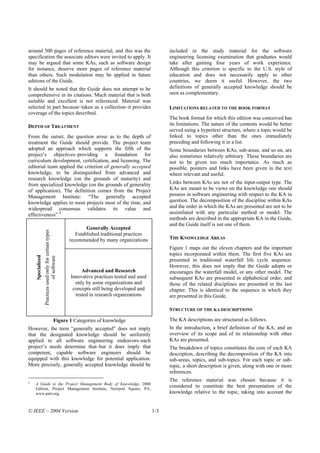
  • 27.
    around 500 pagesof reference material, and this was the included in the study material for the software specification the associate editors were invited to apply. It engineering licensing examination that graduates would may be argued that some KAs, such as software design take after gaining four years of work experience. for instance, deserve more pages of reference material Although this criterion is specific to the U.S. style of than others. Such modulation may be applied in future education and does not necessarily apply to other editions of the Guide. countries, we deem it useful. However, the two It should be noted that the Guide does not attempt to be definitions of generally accepted knowledge should be comprehensive in its citations. Much material that is both seen as complementary. suitable and excellent is not referenced. Material was selected in part because–taken as a collection–it provides LIMITATIONS RELATED TO THE BOOK FORMAT coverage of the topics described. The book format for which this edition was conceived has DEPTH OF TREATMENT its limitations. The nature of the contents would be better served using a hypertext structure, where a topic would be From the outset, the question arose as to the depth of linked to topics other than the ones immediately treatment the Guide should provide. The project team preceding and following it in a list. adopted an approach which supports the fifth of the Some boundaries between KAs, sub-areas, and so on, are project’s objectives–providing a foundation for also sometimes relatively arbitrary. These boundaries are curriculum development, certification, and licensing. The not to be given too much importance. As much as editorial team applied the criterion of generally accepted possible, pointers and links have been given in the text knowledge, to be distinguished from advanced and where relevant and useful. research knowledge (on the grounds of maturity) and from specialized knowledge (on the grounds of generality Links between KAs are not of the input-output type. The of application). The definition comes from the Project KAs are meant to be views on the knowledge one should Management Institute: “The generally accepted possess in software engineering with respect to the KA in knowledge applies to most projects most of the time, and question. The decomposition of the discipline within KAs widespread consensus validates its value and and the order in which the KAs are presented are not to be effectiveness”.4 assimilated with any particular method or model. The methods are described in the appropriate KA in the Guide, and the Guide itself is not one of them. Generally Accepted Practices used only for certain types Established traditional practices recommended by many organizations THE KNOWLEDGE AREAS Figure 1 maps out the eleven chapters and the important topics incorporated within them. The first five KAs are Specialized of software presented in traditional waterfall life cycle sequence. However, this does not imply that the Guide adopts or Advanced and Research encourages the waterfall model, or any other model. The Innovative practices tested and used subsequent KAs are presented in alphabetical order, and only by some organizations and those of the related disciplines are presented in the last concepts still being developed and chapter. This is identical to the sequence in which they tested in research organizations are presented in this Guide. STRUCTURE OF THE KA DESCRIPTIONS Figure 1 Categories of knowledge The KA descriptions are structured as follows. However, the term “generally accepted” does not imply In the introduction, a brief definition of the KA, and an that the designated knowledge should be uniformly overview of its scope and of its relationship with other applied to all software engineering endeavors–each KAs are presented. project’s needs determine that–but it does imply that The breakdown of topics constitutes the core of each KA competent, capable software engineers should be description, describing the decomposition of the KA into equipped with this knowledge for potential application. sub-areas, topics, and sub-topics. For each topic or sub- More precisely, generally accepted knowledge should be topic, a short description is given, along with one or more references. 4 The reference material was chosen because it is A Guide to the Project Management Body of Knowledge, 2000 Edition, Project Management Institute, Newport Square, PA. considered to constitute the best presentation of the www.pmi.org. knowledge relative to the topic, taking into account the © IEEE – 2004 Version 1-3
  • 28.
    limitations imposed onthe choice of references (see involving substantial non-software components, as many above). A matrix links the topics to the reference material. as three different types of documents are produced: The last part of the KA description is the list of system definition, system requirements specification, and recommended references. Appendix A of each KA software requirements specification. The sub-area includes suggestions for further reading for those users describes all three documents and the underlying who wish to learn more about the KA topics. Appendix B activities. presents the list of standards most relevant to the KA. The sixth sub-area is requirements validation, the aim of Note that citations enclosed in square brackets “[ ]” in the which is to pick up any problems before resources are text identify recommended references, while those committed to addressing the requirements. Requirements enclosed in parentheses “( )” identify the usual references validation is concerned with the process of examining the used to write or justify the text. The former are to be requirements documents to ensure that they are defining found in the corresponding section of the KA and the the right system (that is, the system that the user expects). latter in Appendix A of the KA. It is subdivided into descriptions of the conduct of Brief summaries of the KA descriptions and Appendices requirements reviews, prototyping, and model validation are given next. and acceptance tests. The seventh and last sub-area is practical considerations. Software Requirements KA (see Figure 2, column a) It describes topics which need to be understood in practice. The first topic is the iterative nature of the A requirement is defined as a property that must be requirements process. The next three topics are exhibited in order to solve some real-world problem. fundamentally about change management and the The first knowledge sub-area is software requirements maintenance of the requirements in a state which fundamentals. It includes definitions of software accurately mirrors the software to be built, or that has requirements themselves, but also of the major types of already been built. It includes change management, requirements: product vs. process, functional vs. non- requirements attributes, and requirements tracing. The functional, emergent properties. The sub-area also final topic is requirements measurement. describes the importance of quantifiable requirements and distinguishes between systems and software requirements. Software Design KA (see Figure 2, column b) The second knowledge sub-area is the requirements According to the IEEE definition [IEEE610.12-90], process, which introduces the process itself, orienting the design is both “the process of defining the architecture, remaining five sub-areas and showing how requirements components, interfaces, and other characteristics of a engineering dovetails with the other software engineering system or component” and “the result of [that] process.” processes. It describes process models, process actors, The KA is divided into six sub-areas. process support and management, and process quality and improvement. The first sub-area presents the software design fundamentals, which form an underlying basis to the The third sub-area is requirements elicitation, which is understanding of the role and scope of software design. concerned with where software requirements come from These are general software concepts, the context of and how the software engineer can collect them. It software design, the software design process, and the includes requirement sources and elicitation techniques. enabling techniques for software design. The fourth sub-area, requirements analysis, is concerned The second sub-area groups together the key issues in with the process of analyzing requirements to: software design. They include concurrency, control and detect and resolve conflicts between requirements handling of events, distribution of components, error and discover the bounds of the software and how it must exception handling and fault tolerance, interaction and interact with its environment presentation, and data persistence. elaborate system requirements to software The third sub-area is software structure and architecture, requirements the topics of which are architectural structures and Requirements analysis includes requirements viewpoints, architectural styles, design patterns, and, classification, conceptual modeling, architectural design finally, families of programs and frameworks. and requirements allocation, and requirements The fourth sub-area describes software design quality negotiation. analysis and evaluation. While there is a entire KA The fifth sub-area is requirements specification. devoted to software quality, this sub-area presents the Requirements specification typically refers to the topics specifically related to software design. These production of a document, or its electronic equivalent, aspects are quality attributes, quality analysis, and that can be systematically reviewed, evaluated, and evaluation techniques and measures. approved. For complex systems, particularly those The fifth sub-area is software design notations, which are 1–4 © IEEE – 2004 Version
  • 29.
    divided into structuraland behavioral descriptions. practical considerations and the test activities. The last sub-area describes software design strategies and methods. First, general strategies are described, followed Software Maintenance (see Figure 2, column e) by function-oriented design methods, object-oriented design methods, data-structure centered design, Once in operation, anomalies are uncovered, operating component-based design, and others. environments change, and new user requirements surface. The maintenance phase of the lifecycle commences upon delivery but maintenance activities occur much earlier. Software Construction KA (see Figure 2, column c) The Software Maintenance KA is divided into four sub- Software construction refers to the detailed creation of areas. working, meaningful software through a combination of The first one presents software maintenance coding, verification, unit testing, integration testing, and fundamentals: definitions and terminology, the nature of debugging. The KA includes three sub-areas. maintenance, the need for maintenance, the majority of The first sub-area is software construction fundamentals. maintenance costs, the evolution of software, and the The first three topics are basic principles of construction: categories of maintenance. minimizing complexity, anticipating change, and The second sub-area groups together the key issues in constructing for verification. The last topic discusses software maintenance. These are the technical issues, the standards for construction. management issues, maintenance cost estimation, and The second sub-area describes managing construction. software maintenance measurement. The topics are construction models, construction The third sub-area describes the maintenance process. planning, and construction measurement. The topics here are the maintenance processes and The third sub-area covers practical considerations. The maintenance activities. topics are construction design, construction languages, Techniques for maintenance constitute the fourth sub- coding, construction testing, reuse, construction quality, area. These include program comprehension, re- and integration. engineering, and reverse engineering. Software Testing (see Figure 2, column d) Software Configuration Management (see Figure 3, column f) Software Testing consists of the dynamic verification of the behavior of a program on a finite set of test cases, Software Configuration Management (SCM) is the suitably selected from the usually infinite executions discipline of identifying the configuration of software at domain, against the expected behavior. It includes five distinct points in time for the purpose of systematically sub-areas. controlling changes to the configuration and of It begins with a description of software testing maintaining the integrity and traceability of the fundamentals. First, the testing-related terminology is configuration throughout the system life cycle. This KA presented, then key issues of testing are described, and includes six sub-areas. finally the relationship of testing to other activities is The first sub-area is management of the SCM process. It covered. covers the topics of the organizational context for SCM, The second sub-area is test levels. These are divided constraints and guidance for SCM, planning for SCM, the between the targets of the tests and the objectives of the SCM plan itself, and surveillance of SCM. tests. The second sub-area is software configuration The third sub-area is test techniques. The first category identification, which identifies items to be controlled, includes the tests based on the tester’s intuition and establishes identification schemes for the items and their experience. A second group comprises specification- versions, and establishes the tools and techniques to be based techniques, followed by code-based techniques, used in acquiring and managing controlled items. The fault-based techniques, usage-based techniques, and first topics in this sub-area are identification of the items techniques relative to the nature of the application. A to be controlled and the software library. discussion of how to select and combine the appropriate The third sub-area is software configuration control, techniques is also presented. which is the management of changes during the software The fourth sub-area covers test related measures. The life cycle. The topics are: first, requesting, evaluating, and measures are grouped into those related to the evaluation approving software changes; second, implementing of the program under test and the evaluation of the tests software changes; and third, deviations, and waivers. performed. The fourth sub-area is software configuration status The last sub-area describes the test process, and includes accounting. Its topics are software configuration status information and software configuration status reporting. © IEEE – 2004 Version 1-5
  • 30.
    The fifth sub-areais software configuration auditing. It change. The topics here are process infrastructure, the consists of software functional configuration auditing, software process management cycle, models for process software physical configuration auditing, and in-process implementation and change, and practical considerations. audits of a software baseline. The second sub-area deals with process definition. It The last sub-area is software release management and includes the topics of software life cycle models, software delivery, covering software building and software release life-cycle processes, notations for process definitions, management. process adaptation, and automation The third sub-area is process assessment. The topics here Software Engineering Management (see Figure 3, include process assessment models and process column g) assessment methods. The Software Engineering Management KA addresses the The fourth sub-area describes process and product management and measurement of software engineering. measurements. The software engineering process covers While measurement is an important aspect of all KAs, it general product measurement, as well as process is here that the topic of measurement programs is measurement in general. Measurements specific to KAs presented. There are six sub-areas for software are described in the relevant KA. The topics are process engineering management. The first five cover software measurement, software product measurement, quality of project management and the sixth describes the software measurement results, software information models, and measurement programs. process measurement techniques. The first sub-area is initiation and scope definition, which comprises determination and negotiation of requirements, Software Engineering Tools and Methods (see Figure feasibility analysis, and process for the review and 3, column i) revision of requirements. The Software Engineering Tools and Methods KA The second sub-area is software project planning, and includes both software engineering tools and software includes process planning, determining deliverables, engineering methods. effort, schedule and cost estimation, resource allocation, The software engineering tools sub-area uses the same risk management, quality management, and plan structure as the Guide itself, with one topic for each of the management. other nine software engineering KAs. An additional topic The third sub-area is software project enactment. The is provided: miscellaneous tools issues, such as tool topics here are implementation of plans, supplier contract integration techniques, which are potentially applicable to management, implementation of measurement process, all classes of tools. monitor process, control process,? and reporting. The software engineering methods sub-area is divided The fourth sub-area is review and evaluation, which into four subsections: heuristic methods dealing with includes the topics of determining satisfaction of informal approaches, formal methods dealing with requirements and reviewing and evaluating performance. mathematically based approaches, and prototyping The fifth sub-area describes closure: determining closure methods dealing with software development approaches and closure activities. based on various forms of prototyping. Finally, the sixth sub-area describes software engineering Software Quality (see Figure 3, column j) measurement, more specifically, measurement programs. Product and process measures are described in the The Software Quality KA deals with software quality Software Engineering Process KA. Many of the other considerations which transcend the software life cycle KAs also describe measures specific to their KA. The processes. Since software quality is a ubiquitous concern topics of this sub-area are: establish and sustain in software engineering, it is also considered in many of measurement commitment, plan the measurement the other Kas, and the reader will notice pointers to those process, perform the measurement process, and evaluate KAs throughout this KA. The description of this KA measurement. covers three sub-areas. The first sub-area describes the software quality Software Engineering Process (see Figure 3, column h) fundamentals such as software engineering culture and The Software Engineering Process KA is concerned with ethics, the value and costs of quality, models and quality the definition, implementation, assessment, measurement, characteristics, and quality improvement. management, change, and improvement of the software The second sub-area covers software quality management engineering process itself. It is divided into four sub- processes. The topics here are software quality assurance, areas. verification and validation, and reviews and audits. The first sub-area presents process implementation and The third and final sub-area describes practical 1–6 © IEEE – 2004 Version
  • 31.
    considerations related tosoftware quality. The topics are users), in support of the project’s fifth objective, the software quality requirements, defect characterization, fourth appendix rates each topic with one of a set of software quality management techniques, and software pedagogical categories commonly attributed to Benjamin quality measurement. Bloom. The concept is that educational objectives can be classified into six categories representing increasing Related Disciplines OF Software Engineering (see depth: knowledge, comprehension, application, analysis, Figure 3, column k) synthesis, and evaluation. Results of this exercise for all KAs can be found in Appendix D. This Appendix must The last chapter is entitled Related Disciplines of not, however, be viewed as a definitive classification, but Software Engineering. In order to circumscribe software much more as a starting point. engineering, it is necessary to identify the disciplines with which software engineering shares a common boundary. This chapter identifies, in alphabetical order, these related disciplines. For each related discipline, and using a consensus-based recognized source as found, are identified: an informative definition (when feasible); a list of KAs. The related disciplines are: Computer engineering Project management Computer science Quality management Management Software ergonomics Mathematics Systems engineering APPENDICES Appendix A. KA Description Specifications The appendix describes the specifications provided by the editorial team to the associate editors for the content, recommended references, format, and style of the KA descriptions. APPENDIX B. EVOLUTION OF THE GUIDE The second appendix describes the project’s proposal for the evolution of the Guide. The 2004 Guide is simply the current edition of a guide which will continue evolving to meet the needs of the software engineering community. Planning for evolution is not yet complete, but a tentative outline of the process is provided in this appendix. As of this writing, this process has been endorsed by the project’s Industrial Advisory Board and briefed to the Board of Governors of the IEEE Computer Society, but is not yet either funded or implemented. APPENDIX C. ALLOCATION OF STANDARDS TO KAS The third appendix is an annotated table of the most relevant standards, mostly from the IEEE and the ISO, allocated to the KAs of the SWEBOK Guide. APPENDIX D. BLOOM RATINGS As an aid, notably to curriculum developers (and other © IEEE – 2004 Version 1-7
  • 32.
    Guide to theSoftware Engineering Body of Knowledge 2004 Version Software Software Software Software Design Software Testing Requirements Construction Maintenance Software Software Sofware Software Software Design Requirements Construction Testing Maintenance Fundamentals Fundamentals Fundamentals Fundamentals Fundamentals Key Issues in Requirements Key Issues in Managing Software Test Levels Process Software Design Construction Maintenance Maintenance Process Requirements Software Structure Practical Test Techniques Elicitation and Architecture Considerations Techniques for Software Design Maintenance Requirements Test Related Quality Analysis Analysis Measures and Evaluation Requirements Software Design Test Specification Notations Process Software Design Requirements Strategies and Validation Methods Practical Considerations (a) (b) (c) (d) (e) Figure 2 – First five KAs 1–8 © IEEE – 2004 Version
  • 33.
    Guide to theSoftware Engineering Body of Knowledge (2004 Version) Software Software Software Software Knowledge Areas of Configuration Engineering Engineering Engineering Tools Software Quality the Related Management Management Process and Methods Disciplines Management of the Initiation and Process Computer Software Tools Software Quality SCM Process Scope Definition Implementation and Engineering Fundamentals Change Software Requirements Tools Software Quality Software Software Project Process Software Design Tools Management Computer Configuration Planning Definition Processes Science Identification Software Construction Tools Software Project Process Software Testing Tools Practical Management Software Enactment Assessment Considerations Configuration Software Maintenance Tools Control Process and Software Configuration Review and Management Tools Mathematics Product Software Evaluation Measurement Software Engineering Configuration Management Tools Project Status Accounting Software Engineering Management Process Tools Closure Software Quality Tools Software Quality Configuration Miscellaneous Tool Management Issues Auditing Software Software Engineering Engineering Software Software Release Measurement Methods Ergonomics Management and Delivery Heuristic Methods Systems Formal Methods Engineering Prototyping Methods (f) (g) (h) (i) (j) (k) Figure 3 – Last six KAs © IEEE – 2004 Version 1-9
  • 34.
    1–10 © IEEE – 2004 Version
  • 35.
    CHAPTER 2 SOFTWARE REQUIREMENTS breakdown reflects the fact that the requirements process, ACRONYMS if it is to be successful, must be considered as a process DAG Directed Acyclic Graph involving complex, tightly coupled activities (both se- FSM Functional Size Measurement quential and concurrent), rather than as a discrete, one-off INCOSE International Council on Systems Engi- activity performed at the outset of a software development neering project. SADT Structured Analysis and Design Tech- The Software Requirements KA is related closely to the nique Software Design, Software Testing, Software Mainte- UML Unified Modeling Language nance, Software Configuration Management, Software INTRODUCTION Engineering Management, Software Engineering Process, and Software Quality KAs. The Software Requirements Knowledge Area (KA) is concerned with the elicitation, analysis, specification, and validation of software requirements. It is widely acknowl- BREAKDOWN OF TOPICS FOR SOFTWARE edged within the software industry that software engineer- REQUIREMENTS ing projects are critically vulnerable when these activities 1. Software Requirements Fundamentals are performed poorly. 1.1. Definition of a Software Requirement Software requirements express the needs and constraints At its most basic, a software requirement is a property placed on a software product that contribute to the solu- which must be exhibited in order to solve some problem tion of some real-world problem. [Kot00] in the real world. The Guide refers to requirements on The term ‘requirements engineering’ is widely used in the ‘software’ because it is concerned with problems to be field to denote the systematic handling of requirements. addressed by software. Hence, a software requirement is a For reasons of consistency, though, this term will not be property which must be exhibited by software developed used in the Guide, as it has been decided that the use of or adapted to solve a particular problem. The problem the term ‘engineering’ for activities other than software may be to automate part of a task of someone who will engineering ones is to be avoided in this edition of the use the software, to support the business processes of the Guide. organization that has commissioned the software, to cor- rect shortcomings of existing software, to control a de- For the same reason, ‘requirements engineer’, a term vice, and many more. The functioning of users, business which appears in some of the literature, will not be used processes, and devices is typically complex. By extension, either. Instead, the term ‘software engineer’, or, in some therefore, the requirements on particular software are specific cases, ‘requirements specialist’ will be used, the typically a complex combination of requirements from latter where the role in question is usually performed by different people at different levels of an organization and an individual other than a software engineer. This does from the environment in which the software will operate. not imply, however, that a software engineer could not perform the function. An essential property of all software requirements is that they be verifiable. It may be difficult or costly to verify The KA breakdown is broadly compatible with the sec- certain software requirements. For example, verification tions of IEEE 12207 that refer to requirements activities. of the throughput requirement on the call center may ne- (IEEE12207.1-96) cessitate the development of simulation software. Both the A risk inherent in the proposed breakdown is that a water- software requirements and software quality personnel fall-like process may be inferred. To guard against this, must ensure that the requirements can be verified within sub-area 2, Requirements Process, is designed to provide the available resource constraints. a high-level overview of the requirements process by set- Requirements have other attributes in addition to the be- ting out the resources and constraints under which the havioral properties that they express. Common examples process operates and which act to configure it. include a priority rating to enable trade-offs in the face of An alternate decomposition could use a product-based finite resources and a status value to enable project pro- structure (system requirements, software requirements, gress to be monitored. Typically, software requirements prototypes, use cases, and so on). The process-based are uniquely identified so that they can be subjected to © IEEE – 2004 Version 2-1
  • 36.
    software configuration controland managed over the en- shall be written in Ada.’). These are sometimes known as tire software life cycle. [Kot00; Pfl01; Som05; Tha97] process requirements. 1.2. Product and Process Requirements Some software requirements generate implicit process A distinction can be drawn between product parameters requirements. The choice of verification technique is one and process parameters. Product parameters are require- example. Another might be the use of particularly rigor- ments on software to be developed (for example, ‘The ous analysis techniques (such as formal specification software shall verify that a student meets all prerequisites methods) to reduce faults which can lead to inadequate before he or she registers for a course.’). reliability. Process requirements may also be imposed directly by the development organization, their customer, A process parameter is essentially a constraint on the de- or a third party such as a safety regulator [Kot00; Som97]. velopment of the software (for example, ‘The software Software Requirements Software Requirements Requirements Requirements Requirements Requirements Practical Requirements Process Elicitation Analysis Specification Validation Considerations Fundamentals Definition of a System Iterative Nature Requirements Requirements Requirements Software Process Models Definition of Requirements Sources Classification Reviews Requirement Document Process Product and Systems Elicitation Conceptual Change Process Process Actors Requirements Prototyping Techniques Modeling Management Requirements Specification Architectural Functional and Software Process Support Design and Model Requirements Non-functional Requirements and Management Requirements Validation Attributes Requirements Specification Allocation Emergent Process Quality Requirements Acceptance Requirements Properties and Improvement Negotiation Tests Tracing Quantifiable Measuring Requirements Requirements System Requirements and Software Requirements Figure 1 Breakdown of topics for the Software Requirements KA 1.3. Functional and Non-functional Requirements performance requirements, maintainability requirements, Functional requirements describe the functions that the safety requirements, reliability requirements, or one of software is to execute; for example, formatting some text many other types of software requirements. These topics or modulating a signal. They are sometimes known as are also discussed in the Software Quality KA. [Kot00; capabilities. Som97] Non-functional requirements are the ones that act to con- 1.4. Emergent Properties strain the solution. Non-functional requirements are some- Some requirements represent emergent properties of times known as constraints or quality requirements. They software; that is, requirements which cannot be addressed can be further classified according to whether they are by a single component, but which depend for their satis- 2-2 © IEEE – 2004 Version
  • 37.
    faction on howall the software components interoperate. ning of a project and continuing to be refined The throughput requirement for a call center would, for throughout the life cycle example, depend on how the telephone system, informa- identifies software requirements as configuration tion system, and the operators all interacted under actual items, and manages them using the same software operating conditions. Emergent properties are crucially configuration management practices as other prod- dependent on the system architecture. [Som05] ucts of the software life cycle processes needs to be adapted to the organization and project 1.5. Quantifiable Requirements context Software requirements should be stated as clearly and as In particular, the topic is concerned with how the activi- unambiguously as possible, and, where appropriate, quan- ties of elicitation, analysis, specification, and validation titatively. It is important to avoid vague and unverifiable are configured for different types of projects and con- requirements which depend for their interpretation on straints. The topic also includes activities which provide subjective judgment (‘The software shall be reliable’; input into the requirements process, such as marketing ‘The software shall be user-friendly’). This is particularly and feasibility studies. [Kot00; Rob99; Som97; Som05] important for non-functional requirements. Two examples of quantified requirements are the following: a call cen- 2.2. Process Actors ter's software must increase the center’s throughput by This topic introduces the roles of the people who partici- 20%; and a system shall have a probability of generating a pate in the requirements process. This process is funda- fatal error during any hour of operation of less than 1 * mentally interdisciplinary, and the requirements specialist 10-8. The throughput requirement is at a very high level needs to mediate between the domain of the stakeholder and will need to be used to derive a number of detailed and that of software engineering. There are often many requirements. The reliability requirement will tightly con- people involved besides the requirements specialist, each strain the system architecture. [Dav93; Som05] of whom has a stake in the software. The stakeholders will vary across projects, but always include us- 1.6. System Requirements and Software Requirements ers/operators and customers (who need not be the same). In this topic, system means ‘an interacting combination of [Gog93] elements to accomplish a defined objective. These include hardware, software, firmware, people, information, tech- Typical examples of software stakeholders include (but niques, facilities, services, and other support elements,’ as are not restricted to): defined by the International Council on Systems Engi- Users–This group comprises those who will operate neering (INCOSE00). the software. It is often a heterogeneous group com- System requirements are the requirements for the system prising people with different roles and requirements. as a whole. In a system containing software components, Customers–This group comprises those who have software requirements are derived from system require- commissioned the software or who represent the ments. software’s target market. Market analysts–A mass-market product will not The literature on requirements sometimes calls system have a commissioning customer, so marketing peo- requirements ‘user requirements’. The Guide defines ‘user ple are often needed to establish what the market requirements’ in a restricted way as the requirements of needs and to act as proxy customers. the system’s customers or end-users. System require- Regulators–Many application domains such as ments, by contrast, encompass user requirements, re- banking and public transport are regulated. Software quirements of other stakeholders (such as regulatory au- in these domains must comply with the requirements thorities), and requirements without an identifiable human of the regulatory authorities. source. Software engineers–These individuals have a le- gitimate interest in profiting from developing the 2. Requirements Process software by, for example, reusing components in This section introduces the software requirements process, other products. If, in this scenario, a customer of a orienting the remaining five sub-areas and showing how particular product has specific requirements which the requirements process dovetails with the overall soft- compromise the potential for component reuse, the ware engineering process. [Dav93; Som05] software engineers must carefully weigh their own stake against those of the customer. 2.1. Process Models It will not be possible to perfectly satisfy the requirements The objective of this topic is to provide an understanding of every stakeholder, and it is the software engineer’s job that the requirements process: to negotiate trade-offs which are both acceptable to the is not a discrete front-end activity of the software principal stakeholders and within budgetary, technical, life cycle, but rather a process initiated at the begin- regulatory, and other constraints. A prerequisite for this is that all the stakeholders be identified, the nature of their © IEEE – 2004 Version 2-3
  • 38.
    ‘stake’ analyzed, andtheir requirements elicited. [Dav93; 3.1. Requirements Sources Kot00; Rob99; Som97; You01] [Dav93; Gog93; Pfl01] 2.3. Process Support and Management Requirements have many sources in typical software, and This topic introduces the project management resources it is essential that all potential sources be identified and required and consumed by the requirements process. It evaluated for their impact on it. This topic is designed to establishes the context for the first sub-area (Initiation promote awareness of the various sources of software and Scope Definition) of the Software Engineering Man- requirements and of the frameworks for managing them. agement KA. Its principal purpose is to make the link The main points covered are: between the process activities identified in 2.1 and the Goals. The term goal (sometimes called ‘business issues of cost, human resources, training, and tools. concern’ or ‘critical success factor’) refers to the [Rob99; Som97; You01] overall, high-level objectives of the software. Goals 2.4. Process Quality and Improvement provide the motivation for the software, but are of- This topic is concerned with the assessment of the quality ten vaguely formulated. Software engineers need to and improvement of the requirements process. Its purpose pay particular attention to assessing the value (rela- is to emphasize the key role the requirements process tive to priority) and cost of goals. A feasibility study plays in terms of the cost and timeliness of a software is a relatively low-cost way of doing this. [Lou95]. product, and of the customer’s satisfaction with it Domain knowledge. The software engineer needs to [Som97]. It will help to orient the requirements process acquire, or have available, knowledge about the ap- with quality standards and process improvement models plication domain. This enables them to infer tacit for software and systems. Process quality and improve- knowledge that the stakeholders do not articulate, ment is closely related to both the Software Quality KA assess the trade-offs that will be necessary between and the Software Engineering Process KA. Of particular conflicting requirements, and, sometimes, to act as a interest are issues of software quality attributes and meas- ‘user’ champion. urement, and software process definition. This topic cov- Stakeholders (see topic 2.2 Process Actors). Much ers: software has proved unsatisfactory because it has stressed the requirements of one group of stake- requirements process coverage by process im- holders at the expense of those of others. Hence, provement standards and models software is delivered which is difficult to use or requirements process measures and benchmarking which subverts the cultural or political structures of improvement planning and implementation [Kot00; the customer organization. The software engineer Som97; You01] needs to identify, represent, and manage the ‘view- 3. Requirements Elicitation points’ of many different types of stakeholders. [Kot00]. [Dav93; Gog93; Lou95; Pfl01] The operational environment. Requirements will be Requirements elicitation is concerned with where soft- derived from the environment in which the software ware requirements come from and how the software engi- will be executed. These may be, for example, timing neer can collect them. It is the first stage in building an constraints in real-time software or interoperability understanding of the problem the software is required to constraints in an office environment. These must be solve. It is fundamentally a human activity, and is where actively sought out, because they can greatly affect the stakeholders are identified and relationships estab- software feasibility and cost, and restrict design lished between the development team and the customer. It choices. [Tha97] is variously termed ‘requirements capture’, ‘requirements The organizational environment. Software is often discovery’, and ‘requirements acquisition.’ required to support a business process, the selection of which may be conditioned by the structure, cul- One of the fundamental tenets of good software engineer- ture, and internal politics of the organization. The ing is that there be good communication between software software engineer needs to be sensitive to these, users and software engineers. Before development begins, since, in general, new software should not force un- requirements specialists may form the conduit for this planned change on the business process. communication. They must mediate between the domain of the software users (and other stakeholders) and the 3.2. Elicitation Techniques technical world of the software engineer. [Dav93; Kot00; Lou95; Pfl01] Once the requirements sources have been identified, the software engineer can start eliciting requirements from them. This topic concentrates on techniques for getting human stakeholders to articulate their requirements. It is a very difficult area and the software engineer needs to be 2-4 © IEEE – 2004 Version
  • 39.
    sensitized to thefact that (for example) users may have relatively expensive, but they are instructive because difficulty describing their tasks, may leave important in- they illustrate that many user tasks and business formation unstated, or may be unwilling or unable to co- processes are too subtle and complex for their actors operate. It is particularly important to understand that to describe easily. elicitation is not a passive activity, and that, even if coop- erative and articulate stakeholders are available, the soft- 4. Requirements Analysis ware engineer has to work hard to elicit the right informa- [Som05] tion. A number of techniques exist for doing this, the This topic is concerned with the process of analyzing re- principal ones being: [Gog93] quirements to: Interviews, a ‘traditional’ means of eliciting re- detect and resolve conflicts between requirements quirements. It is important to understand the advan- discover the bounds of the software and how it must tages and limitations of interviews, and how they interact with its environment should be conducted. elaborate system requirements to derive software Scenarios, a valuable means for providing context to requirements the elicitation of user requirements. They allow the The traditional view of requirements analysis has been software engineer to provide a framework for ques- that it be reduced to conceptual modeling using one of a tions about user tasks by permitting ‘what if’ and number of analysis methods such as the Structured Analy- ‘how is this done’ questions to be asked. The most sis and Design Technique (SADT). While conceptual common type of scenario is the use case. There is a modeling is important, we include the classification of link here to topic 4.2. (Conceptual Modeling), be- requirements to help inform trade-offs between require- cause scenario notations such as use cases and dia- ments (requirements classification) and the process of grams are common in modeling software. establishing these trade-offs (requirements negotiation). Prototypes, a valuable tool for clarifying unclear [Dav93] requirements. They can act in a similar way to sce- narios by providing users with a context within Care must be taken to describe requirements precisely which they can better understand what information enough to enable the requirements to be validated, their they need to provide. There is a wide range of proto- implementation to be verified, and their costs to be esti- typing techniques, from paper mock-ups of screen mated. designs to beta-test versions of software products, 4.1. Requirements Classification and a strong overlap of their use for requirements elicitation and the use of prototypes for require- [Dav93; Kot00; Som05] ments validation (see topic 6.2 Prototyping). Requirements can be classified on a number of dimen- Facilitated meetings. The purpose of these is to try sions. Examples include: to achieve a summative effect whereby a group of people can bring more insight into their software re- Whether the requirement is functional or non- quirements than by working individually. They can functional (see topic 1.3 Functional and Non- brainstorm and refine ideas which may be difficult functional Requirements). to bring to the surface using interviews. Another ad- Whether the requirement is derived from one or vantage is that conflicting requirements surface more high-level requirements or an emergent prop- early on in a way that lets the stakeholders recognize erty (see topic 1.4 Emergent Properties), or is being where there is conflict. When it works well, this imposed directly on the software by a stakeholder or technique may result in a richer and more consistent some other source. set of requirements than might otherwise be achiev- Whether the requirement is on the product or the able. However, meetings need to be handled care- process. Requirements on the process can constrain fully (hence the need for a facilitator) to prevent a the choice of contractor, the software engineering situation from occurring where the critical abilities process to be adopted, or the standards to be adhered of the team are eroded by group loyalty, or the re- to. quirements reflecting the concerns of a few outspo- The requirement priority. In general, the higher the ken (and perhaps senior) people are favored to the priority, the more essential the requirement is for detriment of others. meeting the overall goals of the software. Often Observation. The importance of software context classified on a fixed-point scale such as mandatory, within the organizational environment has led to the highly desirable, desirable, or optional, the priority adaptation of observational techniques for require- often has to be balanced against the cost of devel- ments elicitation. Software engineers learn about opment and implementation. user tasks by immersing themselves in the environ- The scope of the requirement. Scope refers to the ment and observing how users interact with their extent to which a requirement affects the software software and with each other. These techniques are and software components. Some requirements, par- © IEEE – 2004 Version 2-5
  • 40.
    ticularly certain non-functionalones, have a global The process requirements of the customer. Custom- scope in that their satisfaction cannot be allocated to ers may impose their favored notation or method, or a discrete component. Hence, a requirement with prohibit any with which they are unfamiliar. This global scope may strongly affect the software archi- factor can conflict with the previous factor. tecture and the design of many components, The availability of methods and tools. Notations or whereas one with a narrow scope may offer a num- methods which are poorly supported by training and ber of design choices and have little impact on the tools may not achieve widespread acceptance even if satisfaction of other requirements. they are suited to particular types of problems. Volatility/stability. Some requirements will change Note that, in almost all cases, it is useful to start by build- during the life cycle of the software, and even dur- ing a model of the software context. The software context ing the development process itself. It is useful if provides a connection between the intended software and some estimate of the likelihood that a requirement its external environment. This is crucial to understanding change can be made. For example, in a banking ap- the software’s context in its operational environment and plication, requirements for functions to calculate and to identifying its interfaces with the environment. credit interest to customers’ accounts are likely to be more stable than a requirement to support a particu- The issue of modeling is tightly coupled with that of lar kind of tax-free account. The former reflect a methods. For practical purposes, a method is a notation fundamental feature of the banking domain (that ac- (or set of notations) supported by a process which guides counts can earn interest), while the latter may be the application of the notations. There is little empirical rendered obsolete by a change to government legis- evidence to support claims for the superiority of one nota- lation. Flagging potentially volatile requirements tion over another. However, the widespread acceptance of can help the software engineer establish a design a particular method or notation can lead to beneficial in- which is more tolerant of change. dustry-wide pooling of skills and knowledge. This is cur- rently the situation with the UML (Unified Modeling Other classifications may be appropriate, depending upon Language). (UML04) the organization’s normal practice and the application itself. Formal modeling using notations based on discrete mathematics, and which are traceable to logical reasoning, There is a strong overlap between requirements classifica- have made an impact in some specialized domains. These tion and requirements attributes (see topic 7.3 Require- may be imposed by customers or standards, or may offer ments Attributes). compelling advantages to the analysis of certain critical 4.2. Conceptual Modeling functions or components. [Dav93; Kot00; Som05] This topic does not seek to ‘teach’ a particular modeling The development of models of a real-world problem is style or notation, but rather provides guidance on the pur- key to software requirements analysis. Their purpose is to pose and intent of modeling. aid in understanding the problem, rather than to initiate Two standards provide notations which may be useful in design of the solution. Hence, conceptual models com- performing conceptual modeling–IEEE Std 1320.1, prise models of entities from the problem domain config- IDEF0 for functional modeling; and IEEE Std 1320.2, ured to reflect their real-world relationships and depend- IDEF1X97 (IDEFObject) for information modeling. encies. 4.3. Architectural Design and Requirements Allocation Several kinds of models can be developed. These include [Dav93; Som05] data and control flows, state models, event traces, user interactions, object models, data models, and many others. At some point, the architecture of the solution must be The factors that influence the choice of model include: derived. Architectural design is the point at which the requirements process overlaps with software or systems The nature of the problem. Some types of software design, and illustrates how impossible it is to cleanly de- demand that certain aspects be analyzed particularly couple the two tasks. [Som01] This topic is closely re- rigorously. For example, control flow and state lated to the Software Structure and Architecture sub-area models are likely to be more important for real-time in the Software Design KA. In many cases, the software software than for management information software, engineer acts as software architect because the process of while it would usually be the opposite for data mod- analyzing and elaborating the requirements demands that els. the components that will be responsible for satisfying the The expertise of the software engineer. It is often requirements be identified. This is requirements alloca- more productive to adopt a modeling notation or tion–the assignment, to components, of the responsibility method with which the software engineer has ex- for satisfying requirements. perience. 2-6 © IEEE – 2004 Version
  • 41.
    Allocation is importantto permit detailed analysis of re- among the large number of requirements. So, in software quirements. Hence, for example, once a set of require- engineering jargon, ‘software requirements specification’ ments has been allocated to a component, the individual typically refers to the production of a document, or its requirements can be further analyzed to discover further electronic equivalent, which can be systematically re- requirements on how the component needs to interact viewed, evaluated, and approved. For complex systems, with other components in order to satisfy the allocated particularly those involving substantial non-software requirements. In large projects, allocation stimulates a components, as many as three different types of docu- new round of analysis for each subsystem. As an example, ments are produced: system definition, system require- requirements for a particular braking performance for a ments, and software requirements. For simple software car (braking distance, safety in poor driving conditions, products, only the third of these is required. All three smoothness of application, pedal pressure required, and so documents are described here, with the understanding that on) may be allocated to the braking hardware (mechanical they may be combined as appropriate. A description of and hydraulic assemblies) and an anti-lock braking system systems engineering can be found in Chapter 12, Related (ABS). Only when a requirement for an anti-lock braking Disciplines of Software Engineering. system has been identified, and the requirements allocated to it, can the capabilities of the ABS, the braking hard- 5.1. The System Definition Document ware, and emergent properties (such as the car weight) be This document (sometimes known as the user require- used to identify the detailed ABS software requirements. ments document or concept of operations) records the system requirements. It defines the high-level system re- Architectural design is closely identified with conceptual quirements from the domain perspective. Its readership modeling. The mapping from real-world domain entities includes representatives of the system users/customers to software components is not always obvious, so archi- (marketing may play these roles for market-driven soft- tectural design is identified as a separate topic. The re- ware), so its content must be couched in terms of the do- quirements of notations and methods are broadly the same main. The document lists the system requirements along for both conceptual modeling and architectural design. with background information about the overall objectives IEEE Std 1471-2000, Recommended Practice for Archi- for the system, its target environment and a statement of tectural Description of Software Intensive Systems, sug- the constraints, assumptions, and non-functional require- gests a multiple-viewpoint approach to describing the ments. It may include conceptual models designed to il- architecture of systems and their software items. lustrate the system context, usage scenarios and the prin- (IEEE1471-00) cipal domain entities, as well as data, information, and workflows. IEEE Std 1362, Concept of Operations 4.4. Requirements Negotiation Document, provides advice on the preparation and content Another term commonly used for this sub-topic is ‘con- of such a document. (IEEE1362-98) flict resolution’. This concerns resolving problems with requirements where conflicts occur between two stake- 5.2. System Requirements Specification holders requiring mutually incompatible features, between [Dav93; Kot00; Rob99; Tha97] requirements and resources, or between functional and Developers of systems with substantial software and non- non-functional requirements, for example. [Kot00, software components, a modern airliner, for example, Som97] In most cases, it is unwise for the software engi- often separate the description of system requirements neer to make a unilateral decision, and so it becomes nec- from the description of software requirements. In this essary to consult with the stakeholder(s) to reach a con- view, system requirements are specified, the software sensus on an appropriate trade-off. It is often important requirements are derived from the system requirements, for contractual reasons that such decisions be traceable and then the requirements for the software components back to the customer. We have classified this as a soft- are specified. Strictly speaking, system requirements ware requirements analysis topic because problems specification is a systems engineering activity and falls emerge as the result of analysis. However, a strong case outside the scope of this Guide. IEEE Std 1233 is a guide can also be made for considering it a requirements valida- for developing system requirements. (IEEE1233-98) tion topic. 5.3. Software Requirements Specification 5. Requirements Specification [Kot00; Rob99] For most engineering professions, the term ‘specification’ refers to the assignment of numerical values or limits to a Software requirements specification establishes the basis product’s design goals. (Vin90) Typical physical systems for agreement between customers and contractors or sup- have a relatively small number of such values. Typical pliers (in market-driven projects, these roles may be software has a large number of requirements, and the em- played by the marketing and development divisions) on phasis is shared between performing the numerical quanti- what the software product is to do, as well as what it is fication and managing the complexity of interaction not expected to do. For non-technical readers, the soft- ware requirements specification document is often ac- © IEEE – 2004 Version 2-7
  • 42.
    companied by asoftware requirements definition docu- review the document(s). Requirements documents are ment. subject to the same software configuration management practices as the other deliverables of the software life cy- Software requirements specification permits a rigorous cle processes. (Bry94, Ros98) assessment of requirements before design can begin and reduces later redesign. It should also provide a realistic It is normal to explicitly schedule one or more points in basis for estimating product costs, risks, and schedules. the requirements process where the requirements are vali- dated. The aim is to pick up any problems before re- Organizations can also use a software requirements speci- sources are committed to addressing the requirements. fication document to develop their own validation and Requirements validation is concerned with the process of verification plans more productively. examining the requirements document to ensure that it Software requirements specification provides an informed defines the right software (that is, the software that the basis for transferring a software product to new users or users expect). [Kot00] new machines. Finally, it can provide a basis for software enhancement. 6.1. Requirements Reviews [Kot00; Som05; Tha97] Software requirements are often written in natural lan- guage, but, in software requirements specification, this Perhaps the most common means of validation is by in- may be supplemented by formal or semi-formal descrip- spection or reviews of the requirements document(s). A tions. Selection of appropriate notations permits particular group of reviewers is assigned a brief to look for errors, requirements and aspects of the software architecture to mistaken assumptions, lack of clarity, and deviation from be described more precisely and concisely than natural standard practice. The composition of the group that con- language. The general rule is that notations should be ducts the review is important (at least one representative used which allow the requirements to be described as pre- of the customer should be included for a customer-driven cisely as possible. This is particularly crucial for safety- project, for example), and it may help to provide guidance critical and certain other types of dependable software. on what to look for in the form of checklists. However, the choice of notation is often constrained by Reviews may be constituted on completion of the system the training, skills and preferences of the document’s au- definition document, the system specification document, thors and readers. the software requirements specification document, the A number of quality indicators have been developed baseline specification for a new release, or at any other which can be used to relate the quality of software re- step in the process. IEEE Std 1028 provides guidance on quirements specification to other project variables such as conducting such reviews. (IEEE1028-97) Reviews are cost, acceptance, performance, schedule, reproducibility, also covered in the Software Quality KA, topic 2.3 Re- etc. Quality indicators for individual software require- views and Audits. ments specification statements include imperatives, direc- 6.2. Prototyping tives, weak phrases, options, and continuances. Indicators for the entire software requirements specification docu- [Dav93; Kot00; Som05; Tha97] ment include size, readability, specification, depth, and Prototyping is commonly a means for validating the soft- text structure. [Dav93; Tha97] (Ros98) ware engineer's interpretation of the software require- IEEE has a standard, IEEE Std 830 [IEEE830-98], for the ments, as well as for eliciting new requirements. As with production and content of the software requirements elicitation, there is a range of prototyping techniques and specification. Also, IEEE 1465 (similar to ISO/IEC a number of points in the process where prototype valida- 12119), is a standard treating quality requirements in tion may be appropriate. The advantage of prototypes is software packages. (IEEE1465-98) that they can make it easier to interpret the software engi- neer's assumptions and, where needed, give useful feed- 6. Requirements validation back on why they are wrong. For example, the dynamic [Dav93] behavior of a user interface can be better understood through an animated prototype than through textual de- The requirements documents may be subject to validation scription or graphical models. There are also disadvan- and verification procedures. The requirements may be tages, however. These include the danger of users’ atten- validated to ensure that the software engineer has under- tion being distracted from the core underlying functional- stood the requirements, and it is also important to verify ity by cosmetic issues or quality problems with the proto- that a requirements document conforms to company stan- type. For this reason, several people recommend proto- dards, and that it is understandable, consistent, and com- types which avoid software, such as flip-chart-based plete. Formal notations offer the important advantage of mockups. Prototypes may be costly to develop. However, permitting the last two properties to be proven (in a re- if they avoid the wastage of resources caused by trying to stricted sense, at least). Different stakeholders, including satisfy erroneous requirements, their cost can be more representatives of the customer and developer, should easily justified. 2-8 © IEEE – 2004 Version
  • 43.
    6.3. Model Validation of, existing software where the architecture is a given. In [Dav93; Kot00; Tha97] practice, therefore, it is almost always impractical to im- plement the requirements process as a linear, determinis- It is typically necessary to validate the quality of the mod- tic process in which software requirements are elicited els developed during analysis. For example, in object from the stakeholders, baselined, allocated, and handed models, it is useful to perform a static analysis to verify over to the software development team. It is certainly a that communication paths exist between objects which, in myth that the requirements for large software projects are the stakeholders’ domain, exchange data. If formal speci- ever perfectly understood or perfectly specified. [Som97] fication notations are used, it is possible to use formal reasoning to prove specification properties. Instead, requirements typically iterate towards a level of quality and detail which is sufficient to permit design and 6.4. Acceptance Tests procurement decisions to be made. In some projects, this [Dav93] may result in the requirements being baselined before all their properties are fully understood. This risks expensive An essential property of a software requirement is that it rework if problems emerge late in the software engineer- should be possible to validate that the finished product ing process. However, software engineers are necessarily satisfies it. Requirements which cannot be validated are constrained by project management plans and must there- really just ‘wishes’. An important task is therefore plan- fore take steps to ensure that the ‘quality’ of the require- ning how to verify each requirement. In most cases, de- ments is as high as possible given the available resources. signing acceptance tests does this. They should, for example, make explicit any assumptions Identifying and designing acceptance tests may be diffi- which underpin the requirements, as well as any known cult for non-functional requirements (see topic 1.3 Func- problems. tional and Non-functional Requirements). To be vali- In almost all cases, requirements understanding continues dated, they must first be analyzed to the point where they to evolve as design and development proceeds. This often can be expressed quantitatively. leads to the revision of requirements late in the life cycle. Additional information can be found in the Software Test- Perhaps the most crucial point in understanding require- ing KA, sub-topic 2.2.4 Conformance Testing. ments engineering is that a significant proportion of the requirements will change. This is sometimes due to errors 7. Practical Considerations in the analysis, but it is frequently an inevitable conse- The first level of decomposition of sub-areas presented in quence of change in the ‘environment’: for example, the this KA may seem to describe a linear sequence of activi- customer's operating or business environment, or the mar- ties. This is a simplified view of the process. [Dav93] ket into which software must sell. Whatever the cause, it is important to recognize the inevitability of change and The requirements process spans the whole software life take steps to mitigate its effects. Change has to be man- cycle. Change management and the maintenance of the aged by ensuring that proposed changes go through a de- requirements in a state which accurately mirrors the soft- fined review and approval process, and, by applying care- ware to be built, or that has been built, are key to the suc- ful requirements tracing, impact analysis, and software cess of the software engineering process. [Kot00; Lou95] configuration management (see the Software Configura- Not every organization has a culture of documenting and tion Management KA). Hence, the requirements process managing requirements. It is frequent in dynamic start-up is not merely a front-end task in software development, companies, driven by a strong ‘product vision’ and lim- but spans the whole software life cycle. In a typical pro- ited resources, to view requirements documentation as an ject, the software requirements activities evolve over time unnecessary overhead. Most often, however, as these from elicitation to change management. companies expand, as their customer base grows, and as 7.2. Change Management their product starts to evolve, they discover that they need to recover the requirements that motivated product fea- [Kot00] tures in order to assess the impact of proposed changes. Change management is central to the management of re- Hence, requirements documentation and change manage- quirements. This topic describes the role of change man- ment are key to the success of any requirements process. agement, the procedures that need to be in place, and the analysis that should be applied to proposed changes. It has 7.1. Iterative nature of the Requirements Process strong links to the Software Configuration Management [Kot00; You01] KA. There is general pressure in the software industry for ever 7.3. Requirements Attributes shorter development cycles, and this is particularly pro- nounced in highly competitive market-driven sectors. [Kot00] Moreover, most projects are constrained in some way by Requirements should consist not only of a specification of their environment, and many are upgrades to, or revisions what is required, but also of ancillary information which © IEEE – 2004 Version 2-9
  • 44.
    helps manage andinterpret the requirements. This should satisfy it (for example, from a system requirement into the include the various classification dimensions of the re- software requirements that have been elaborated from it, quirement (see topic 4.1 Requirements Classification) and and on into the code modules that implement it). the verification method or acceptance test plan. It may The requirements tracing for a typical project will form a also include additional information such as a summary complex directed acyclic graph (DAG) of requirements. rationale for each requirement, the source of each re- quirement, and a change history. The most important re- 7.5. Measuring Requirements quirements attribute, however, is an identifier which al- As a practical matter, it is typically useful to have some lows the requirements to be uniquely and unambiguously concept of the ‘volume’ of the requirements for a particu- identified. lar software product. This number is useful in evaluating 7.4. Requirements Tracing the ‘size’ of a change in requirements, in estimating the cost of a development or maintenance task, or simply for [Kot00] use as the denominator in other measurements. Functional Requirements tracing is concerned with recovering the Size Measurement (FSM) is a technique for evaluating the source of requirements and predicting the effects of re- size of a body of functional requirements. IEEE Std quirements. Tracing is fundamental to performing impact 14143.1 defines the concept of FSM. [IEEE14143.1-00] analysis when requirements change. A requirement should Standards from ISO/IEC and other sources describe par- be traceable backwards to the requirements and stake- ticular FSM methods holders which motivated it (from a software requirement Additional information on size measurement and stan- back to the system requirement(s) that it helps satisfy, for dards will be found in the Software Engineering Process example). Conversely, a requirement should be traceable KA. forwards into the requirements and design entities that 2-10 © IEEE – 2004 Version
  • 45.
    MATRIX OF TOPICSVS. REFERENCE MATERIAL [IEEE830 [IEEE141 [Som97] [Som05] [Rob99] [You01] [Gog93] 43.1-00] [Tha97] [Lou95] [Dav93] [Kot00] [Pfl01] -98] 1. Software Requirements Fundamentals 1.1 Definition of a Software Requirement * * c5 c1 1.2 Product and Process Requirements * c1 1.3 Functional and Non-functional * c1 Requirements 1.4 Emergent Properties c2 c3s 1.5 Quantifiable Requirements c6 4 1.6 System Requirements and Software Requirements 2. Requirements Process * c5 2.1 Process Models c2s1 * c2 c3 2.2 Process Actors c2 * c2s2 c3 c2 c3 2.3 Process Support and Management c3 c2 c2,c7 2.4 Process Quality and Improvement c2s4 c2 c5 3. Requirements Elicitation * * * * 3.1 Requirements Sources c2 * c3s1 * * c1 3.2 Elicitation Techniques c2 * c3s2 * * 4. Requirements Analysis * c6 4.1 Requirements Classification * c8s1 c6 4.2 Conceptual Modeling * * c7 4.3 Architectural Design and Requirements * c10 Allocation 4.4 Requirements Negotiation c3s4 * 5. Requirements Specification 5.1 The System Definition Document 5.2 The System Requirements Specification * * c9 c3 5.3 The Software Requirements Specification * * * c9 c3 6. Requirements Validation * * 6.1 Requirements Reviews c4s1 c6 c5 6.2 Prototyping c6 c4s2 c8 c6 6.3 Model Validation * c4s3 c5 6.4 Acceptance Tests * 7. Practical Considerations * * * 7.1 Iterative Nature of the Requirements c5s1 c2 c6 Process 7.2 Change Management c5s3 7.3 Requirement Attributes c5s2 7.4 Requirements Tracing c5s4 7.5 Measuring Requirements * © IEEE – 2004 Version 2-11
  • 46.
    Sons, 2000. RECOMMENDED REFERENCESFOR SOFTWARE [Lou95] P. Loucopulos and V. Karakostas, Systems Re- REQUIREMENTS quirements Engineering: McGraw-Hill, 1995. [Dav93] A. M. Davis, Software Requirements: Objects, [Pfl01] S. L. Pfleeger, "Software Engineering: Theory and Functions and States: Prentice-Hall, 1993. Practice," Second ed: Prentice-Hall, 2001, Chap. 4. [Gog93] J. Goguen and C. Linde, "Techniques for Re- [Rob99] S. Robertson and J. Robertson, Mastering the quirements Elicitation," presented at International Sympo- Requirements Process: Addison-Wesley, 1999. sium on Requirements Engineering, San Diego, Califor- [Som97] I. Sommerville and P. Sawyer, "Requirements nia, 1993 engineering: A Good Practice Guide," John Wiley and [IEEE830-98] IEEE Std 830-1998, IEEE Recommended Sons, 1997, Chap. 1-2. Practice for Software Requirements Specifications: IEEE, [Som05] I. Sommerville, "Software Engineering," Sev- 1998. enth ed: Addison-Wesley, 2005. (IEEE14143.1-00) IEEE Std 14143.1- [Tha97] R. H. Thayer and M. Dorfman, Eds., "Software 2000//ISO/IEC14143-1:1998, Information Technology- Requirements Engineering." IEEE Computer Society Software Measurement-Functional Size Measurement- Press, 1997, 176-205, 389-404. Part 1: Definitions of Concepts: IEEE, 2000. [You01] R. R. You, Effective Requirements Practices: [Kot00] G. Kotonya and I. Sommerville, Requirements Addison-Wesley, 2001. Engineering: Processes and Techniques: John Wiley and 2-12 © IEEE – 2004 Version
  • 47.
    rements Engineering: GuestEditors' Introduction," IEEE APPENDIX A. LIST OF FURTHER READINGS Software, vol. 11, iss. 2, 12-16, March, 1994 (Ale02) I. Alexander and R. Stevens, Writing Better Re- (Def94) J. DeFoe, "Requirements Engineering Technol- quirements: Addison-Wesley, 2002. ogy in Industrial Education," presented at IEEE Interna- (Ard97) M. Ardis, "Formal Methods for Telecommunica- tional Conference on Requirements Engineering, 1994 tion System Requirements: A survey of Standardized (Dem97) E. Demirors, "A Blackboard Framework for Languages," Annals of Software Engineering, vol. 3, 1997 Supporting Teams in Software Development," presented (Ber97) V. Berzins and al, "A Requirements Evolution at Ninth IEEE International Conference on Software En- Model for Computer Aided Prototyping," presented at gineering and Knowledge Engineering, Skokie, Illinois: Ninth IEEE International Conference on Software Engi- Knowledge Systems Institute, 1997 neering and Knowledge Engineering, Skokie, Illinois: (Die95) M. Diepstraten, "Command and Control System Knowledge Systems Institute, 1997 Requirements Analysis and System Requirements Speci- (Bey95) H. Beyer and K. Holtzblatt, "Apprenticing with fication for a Tactical System," presented at First IEEE the Customer," Communications of the ACM, vol. 38, iss. International Conference on Engineering of Complex 5, 45-52, May, 1995 Computer Systems, 1995 (Bru95) G. Bruno and R. Agarwal, "Validating Software (Dob94) J. Dobson and R. Strens, "Organizational Re- Requirements Using Operational Models," presented at quirements Definition for Information Technology," pre- Second Symposium on Software Quality Techniques and sented at IEEE International Conference on Requirements Acquisition Criteria, Florence, Italy, 1995 Engineering, 1994 (Bry94) E. Bryne, "IEEE Standard 830: Recommended (Duf95) D. Duffy and al, "A Framework for Require- Practice for Software Requirements Specification," pre- ments Analysis Using Automated Reasoning," presented sented at IEEE International Conference on Requirements at Seventh International Conference on Advanced Infor- Engineering, 1994 mation Systems Engineering, 1995 (Buc94) G. Bucci and al, "An Object-Oriented Dual Lan- (Eas95) S. Easterbrook and B. Nuseibeh, "Managing In- guage for Specifying Reactive Systems," presented at consistencies in an Evolving Specification," presented at IEEE International Conference on Requirements Engi- Second International Symposium on Requirements Engi- neering, 1994 neering, 1995 (Bus95) D. Bustard and P. Lundy, "Enhancing Soft Sys- (Edw95) M. Edwards and al, "RECAP: A Requirements tems Analysis with Formal Modeling," presented at Sec- Elicitation, Capture, and Analysis Process Prototype Tool ond International Symposium on Requirements Engineer- for Large Complex Systems," presented at First IEEE ing, 1995 International Conference on Engineering of Complex (Che94) M. Chechik and J. Gannon, "Automated Verifi- Computer Systems, 1995 cation of Requirements Implementation," presented at (ElE95) K. El-Emam and N. Madhavji, "Requirements Proceedings of the International Symposium on Software Engineering Practices in Information Systems Develop- Testing and Analysis, Special Issue, 1994 ment: A Multiple Case Study," presented at Second Inter- (Chu95) L. Chung and B. Nixon, "Dealing with Non- national Symposium on Requirements Engineering, 1995 Functional Requirements: Three Experimental Studies of (Fai97) R. Fairley and R. Thayer, "The Concept of Opera- a Process-Oriented Approach," presented at Seventeenth tions: The Bridge From Operational Requirements to IEEE International Conference on Software Engineering, Technical Specifications," Annals of Software Engineer- 1995 ing, vol. 3, 1997 (Cia97) P. Ciancarini and al, "Engineering Formal Re- (Fic95) S. Fickas and M. Feather, "Requirements Moni- quirements: An Analysis and Testing Method for Z Docu- toring in Dynamic Environments," presented at Second ments," Annals of Software Engineering, vol. 3, 1997 International Symposium on Requirements Engineering, (Cre94) R. Crespo, "We Need to Identify the Require- 1995 ments of the Statements of Non-Functional Require- (Fie95) R. Fields and al, "A Task-Centered Approach to ments," presented at International Workshop on Require- Analyzing Human Error Tolerance Requirements," pre- ments Engineering: Foundations of Software Quality, sented at Second International Symposium on Require- 1994 ments Engineering, 1995 (Cur94) P. Curran and al, "BORIS-R Specification of the (Gha94) J. Ghajar-Dowlatshahi and A. Varnekar, "Rapid Requirements of a Large-Scale Software Intensive Sys- Prototyping in Requirements Specification Phase of Soft- tem," presented at Requirements Elicitation for Software- ware Systems," presented at Fourth International Sympo- Based Systems, 1994 sium on Systems Engineering, Sunnyvale, California: (Dar97) R. Darimont and J. Souquieres, "Reusing Opera- National Council on Systems Engineering, 1994 tional Requirements: A Process-Oriented Approach," pre- (Gib95) M. Gibson, "Domain Knowledge Reuse During sented at IEEE International Symposium on Requirements Requirements Engineering," presented at Seventh Interna- Engineering, 1997 tional Conference on Advanced Information Systems En- (Dav94) A. Davis and P. Hsia, "Giving Voice to Re- gineering (CAiSE '95), 1995 quirements Engineering: Guest Editors' Introduction," © IEEE – 2004 Version 2-13
  • 48.
    (Gol94) L. Goldinand D. Berry, "AbstFinder: A Proto- (Lal95) V. Lalioti and B. Theodoulidis, "Visual Scenarios type Abstraction Finder for Natural Language Text for for Validation of Requirements Specification," presented Use in Requirements Elicitation: Design, Methodology at Seventh International Conference on Software Engi- and Evaluation," presented at IEEE International Confer- neering and Knowledge Engineering, Skokie, Illinois: ence on Requirements Engineering, 1994 Knowledge Systems Institute, 1995 (Got97) O. Gotel and A. Finkelstein, "Extending Re- (Lam95) A. v. Lamsweerde and al, "Goal-Directed Elabo- quirements Traceability: Lessons Learned from an ration of Requirements for a Meeting Scheduler: Prob- Industrial Case Study," presented at IEEE International lems and Lessons Learnt," presented at Second Interna- Symposium on Requirements Engineering, 1997 tional Symposium on Requirements Engineering, 1995 (Hei96) M. Heimdahl, "Errors Introduced during the (Lei97) J. Leite and al, "Enhancing a Requirements Base- TACS II Requirements Specification Effort: A Retrospec- line with Scenarios," presented at IEEE International tive Case Study," presented at Eighteenth IEEE Interna- Symposium on Requirements Engineering, 1997 tional Conference on Software Engineering, 1996 (Ler97) F. Lerch and al., "Using Simulation-Based Ex- (Hei96a) C. Heitmeyer and al, "Automated Consistency periments for Software Requirements Engineering," Checking Requirements Specifications," ACM Transac- Annals of Software Engineering, vol. 3, 1997 tions on Software Engineering and Methodology, vol. 5, (Lev94) N. Leveson and al, "Requirements Specification iss. 3, 231-261, July, 1996 for Process-Control Systems," IEEE Transactions on (Hol95) K. Holtzblatt and H. Beyer, "Requirements Gath- Software Engineering, vol. 20, iss. 9, 684-707, Septem- ering: The Human Factor," Communications of the ACM, ber, 1994 vol. 38, iss. 5, 31-32, May, 1995 (Lut96a) R. Lutz and R. Woodhouse, "Contributions of (Hud96) E. Hudlicka, "Requirements Elicitation with In- SFMEA to Requirements Analysis," presented at Second direct Knowledge Elicitation Techniques: Comparison of IEEE International Conference on Requirements Engi- Three Methods," presented at Second IEEE International neering, 1996 Conference on Requirements Engineering, 1996 (Lut97) R. Lutz and R. Woodhouse, "Requirements Ana- (Hug94) K. Hughes and al, "A Taxonomy for Require- lysis Using Forward and Backward Search," Annals of ments Analysis Techniques," presented at IEEE Interna- Software Engineering, vol. 3, 1997 tional Conference on Requirements Engineering, 1994 (Mac96) L. Macaulay, Requirements Engineering. Lon- (Hug95) J. Hughes and al, "Presenting Ethnography in the don UK: Springer, 1996. Requirements Process," presented at Second IEEE Inter- (Mai95) N. Maiden and al, "Computational Mechanisms national Symposium on Requirements Engineering, 1995 for Distributed Requirements Engineering," presented at (Hut94) A. T. F. Hutt, Ed., "Object Analysis and Design - Seventh International Conference on Software Engineer- Comparison of Methods. Object Analysis and Design - ing and Knowledge Engineering, Skokie, Illinois: Knowl- Description of Methods." John Wiley & Sons, 1994. edge Systems Institute, 1995 (INCOSE00) INCOSE, How To: Guide for all Engineers, (Mar94) B. Mar, "Requirements for Development of Version 2: International Council on Systems Engineering, Software Requirements," presented at Fourth International 2000. Symposium on Systems Engineering, Sunnyvale, Califor- (Jac95) M. Jackson, Software Requirements and Specifi- nia, 1994 cations. Reading, Massachusetts: Addison Wesley, 1995. (Mas97) P. Massonet and A. v. Lamsweerde, "Analogical (Jac97) M. Jackson, "The Meaning of Requirements," Reuse of Requirements Frameworks," presented at IEEE Annals of Software Engineering, vol. 3, 1997 International Symposium on Requirements Engineering, (Jon96) S. Jones and C. Britton, "Early Elicitation and 1997 Definition of Requirements for an Interactive Multimedia (McF95) I. McFarland and I. Reilly, "Requirements Tra- Information System," presented at Second IEEE Interna- ceability in an Integrated Development Environment," tional Conference on Requirements Engineering, 1996 presented at Second International Symposium on Re- (Kir96) T. Kirner and A. Davis, "Nonfunctional Require- quirements Engineering, 1995 ments for Real-Time Systems," Advances in Computers, (Mea94) N. Mead, "The Role of Software Architecture in 1996 Requirements Engineering," presented at IEEE Interna- (Kle97) M. Klein, "Handling Exceptions in Collaborative tional Conference on Requirements Engineering, 1994 Requirements Acquisition," presented at IEEE Interna- (Mos95) D. Mostert and S. v. Solms, "A Technique to tional Symposium on Requirements Engineering, 1997 Include Computer Security, Safety, and Resilience Re- (Kos97) R. Kosman, "A Two-Step Methodology to Re- quirements as Part of the Requirements Specification," duce Requirements Defects," Annals of Software Engi- Journal of Systems and Software, vol. 31, iss. 1, 45-53, neering, vol. 3, 1997 October, 1995 (Kro95) J. Krogstie and al, "Towards a Deeper Under- (Myl95) J. Mylopoulos and al, "Multiple Viewpoints Ana- standing of Quality in Requirements Engineering," pre- lysis of Software Specification Process," IEEE Transac- sented at Seventh International Conference on Advanced tions on Software Engineering, 1995 Information Systems Engineering (CAiSE '95), 1995 (Nis92) K. Nishimura and S. Honiden, "Representing and 2-14 © IEEE – 2004 Version
  • 49.
    Using Non-Functional Requirements:A Process-Oriented tems Analysis," vol. 1 and 2. Englewood Cliffs, New Jer- Approach," IEEE Transactions on Software Engineering, sey: Prentice Hall, 1994. December, 1992 (Rob94a) W. Robinson and S. Fickas, "Supporting Multi- (Nis97) H. Nissen and al, "View-Directed Requirements Perspective Requirements Engineering," presented at Engineering: A Framework and Metamodel," presented at IEEE International Conference on Requirements Engi- Ninth IEEE International Conference on Software Engi- neering, 1994 neering and Knowledge Engineering, Skokie, Illinois: (Ros98) L. Rosenberg, T. F. Hammer and L. L. Huffman, Knowledge Systems Institute, 1997 "Requirements, testing and metrics," presented at 15th (OBr96) L. O'Brien, "From Use Case to Database: Im- Annual Pacific Northwest Software Quality Conference, plementing a Requirements Tracking System," Software Utah, 1998 Development, vol. 4, iss. 2, 43-47, February, 1996 (Sch94) W. Schoening, "The Next Big Step in Systems (UML04) Object Management Group, "Unified Modeling Engineering Tools: Integrating Automated Requirements Language," 2004, available at http://www.uml.org Tools with Computer Simulated Synthesis and Test," pre- (Opd94) A. Opdahl, "Requirements Engineering for sented at Fourth International Symposium on Systems Software Performance," presented at International Work- Engineering, Sunnyvale, California, 1994 shop on Requirements Engineering: Foundations of Soft- (She94) M. Shekaran, "The Role of Software Architecture ware Quality, 1994 in Requirements Engineering," presented at IEEE Interna- (Pin96) F. Pinheiro and J. Goguen, "An Object-Oriented tional Conference on Requirements Engineering, 1994 Tool for Tracing Requirements," IEEE Software, vol. 13, (Sid97) J. Siddiqi and al, "Towards Quality Requirements iss. 2, 52-64, March, 1996 Via Animated Formal Specifications," Annals of Software (Pla96) G. Playle and C. Schroeder, "Software Require- Engineering, vol. 3, 1997 ments Elicitation: Problems, Tools, and Techniques," (Span97) G. Spanoudakis and A. Finkelstein, "Reconcil- Crosstalk: The Journal of Defense Software Engineering, ing Requirements: A Method for Managing Interference, vol. 9, iss. 12, 19-24, December, 1996 Inconsistency, and Conflict," Annals of Software Engi- (Poh94) K. Pohl and al, "Applying AI Techniques to Re- neering, vol. 3, 1997 quirements Engineering: The NATURE Prototype," pre- (Ste94) R. Stevens, "Structured Requirements," presented sented at IEEE Workshop on Research Issues in the Inter- at Fourth International Symposium on Systems Engineer- section Between Software Engineering and Artificial In- ing, Sunnyvale, California, 1994 telligence, 1994 (Vin90) W. G. Vincenti, What Engineers Know and How (Por95) A. Porter and al, "Comparing Detection Methods They Know It - Analytical Studies form Aeronautical His- for Software Requirements Inspections: A Replicated tory. Baltimore and London: John Hopkins University Experiment," IEEE Transactions on Software Engineer- Press, 1990. ing, vol. 21, iss. 6, 563-575, June, 1995 (Wei03) K. Weigers, Software Requirements, 2nd ed: (Pot95) C. Potts and al, "An Evaluation of Inquiry-Based Microsoft Press, 2003. Requirements Analysis for an Internet Server," presented (Whi95) S. White and M. Edwards, "A Requirements at Second International Symposium on Requirements En- Taxonomy for Specifying Complex Systems," presented gineering, 1995 at First IEEE International Conference on Engineering of (Pot97) C. Potts and I. Hsi, "Abstraction and Context in Complex Computer Systems, 1995 Requirements Engineering: Toward a Synthesis," Annals (Wil99) B. Wiley, Essential System Requirements: A of Software Engineering, vol. 3, 1997 Practical Guide to Event-Driven Methods: Addison- (Pot97a) C. Potts and W. Newstetter, "Naturalistic Inquiry Wesley, 1999. and Requirements Engineering: Reconciling Their Theo- (Wyd96) T. Wyder, "Capturing Requirements With Use retical Foundations," presented at IEEE International Cases," Software Development, vol. 4, iss. 2, 36-40, Feb- Symposium on Requirements Engineering, 1997 ruary, 1996 (Ram95) B. Ramesh and al, "Implementing Requirements (Yen97) J. Yen and W. Tiao, "A Systematic Tradeoff Traceability: A Case Study," presented at Second Interna- Analysis for Conflicting Imprecise Requirements," pre- tional Symposium on Requirements Engineering, 1995 sented at IEEE International Symposium on Requirements (Reg95) B. Regnell and al, "Improving the Use Case Dri- Engineering, 1997 ven Approach to Requirements Engineering," presented at (Yu97) E. Yu, "Towards Modeling and Reasoning Sup- Second IEEE International Symposium on Requirements port for Early-Phase Requirements Engineering," pre- Engineering, 1995 sented at IEEE International Symposium on Requirements (Reu94) H. Reubenstein, "The Role of Software Architec- Engineering, 1997 ture in Software Requirements Engineering," presented at (Zav96) P. Zave and M. Jackson, "Where Do Operations IEEE International Conference on Requirements Engi- Come From? A Multiparadigm Specification Technique," neering, 1994 IEEE Transactions on Software Engineering,, vol. 22, iss. (Rob94) J. Robertson and S. Robertson, "Complete Sys- 7, 508-528, July, 1996 © IEEE – 2004 Version 2-15
  • 50.
    (IEEE1465-98) IEEE Std 1465- APPENDIX B. LIST OF STANDARDS 1998//ISO/IEC12119:1994, IEEE Standard Adoption of (IEEE830-98) IEEE Std 830-1998, IEEE Recommended International Standard ISO/IEC12119:1994(E), Informa- Practice for Software Requirements Specifications: IEEE, tion Technology-Software packages-Quality requirements 1998. and testing: IEEE, 1998. (IEEE1028-97) IEEE Std 1028-1997 (R2002), IEEE (IEEEP1471-00) IEEE Std 1471-2000, IEEE Recom- Standard for Software Reviews: IEEE, 1997. mended Practice for Architectural Descriptionos Software (IEEE1233-98) IEEE Std 1233-1998, "IEEE Guide for Intensive Systems: Architecture Working Group of the Developing System Requirements Specifications," 1998 Software Engineering Standards Committee, 2000. (IEEE1320.1-98) IEEE Std 1320.1-1998, IEEE Standard (IEEE12207.0-96) IEEE/EIA 12207.0- for Functional Modeling Language-Syntax and Semantics 1996//ISO/IEC12207:1995, Industry Implementation of for IDEF0: IEEE, 1998. Int. Std. ISO/IEC 12207:95, Standard for Information (IEEE1320.2-98) IEEE Std 1320.2-1998, "IEEE Standard Technology-Software Life Cycle Processes, IEEE, 1996. for Conceptual Modeling Language-Syntax and Seman- (IEEE14143.1-00) IEEE Std 14143.1- tics for IDEFIX97 (IDEFObjetct)," IEEE, 1998. 2000//ISO/IEC14143-1:1998, Information Technology- (IEEE1362-98) IEEE Std 1362-1998, IEEE Guide for Software Measurement-Functional Size Measurement- Information Technology-System Definition-Concept of Part 1: Definitions of Concepts: IEEE, 2000. Operations (ConOps) Document: IEEE, 1998. 2-16 © IEEE – 2004 Version
  • 51.
    CHAPTER 3 SOFTWARE DESIGN Concerning the scope of the Software Design knowledge ACRONYMS area (KA), the current KA description does not discuss ADL Architecture Description Languages every topic the name of which contains the word “design.” In Tom DeMarco’s terminology (DeM99), the KA dis- CRC Collaboration Responsibilities Card cussed in this chapter deals mainly with D-design (decom- ERD Entity-Relationship Diagrams position design, mapping software into component pieces). IDL Interface Description Languages However, because of its importance in the growing field of software architecture, we will also address FP-design (fam- DFD Data Flow Diagram ily pattern design, whose goal is to establish exploitable PDL Pseudo-Code and Program Design Languages commonalities in a family of software). By contrast, the CBD Component-based design Software Design KA does not address I-design (invention design, usually performed during the software requirements INTRODUCTION process with the objective of conceptualizing and spe- cifying software to satisfy discovered needs and require- Design is defined in [IEEE610.12-90] as both “the process ments), since this topic should be considered part of requi- of defining the architecture, components, interfaces, and rements analysis and specification. other characteristics of a system or component” and “the result of [that] process.” Viewed as a process, software The Software Design KA description is related specifically design is the software engineering life cycle activity in to Software Requirements, Software Construction, Soft- which software requirements are analyzed in order to pro- ware Engineering Management, Software Quality and Re- duce a description of the software’s internal structure that lated Disciplines of Software Engineering. will serve as the basis for its construction. More precisely, a software design (the result) must describe the software BREAKDOWN OF TOPICS FOR SOFTWARE architecture—that is, how software is decomposed and DESIGN organized into components—and the interfaces between 1. Software Design Fundamentals those components. It must also describe the components at a level of detail that enable their construction. The concepts, notions, and terminology introduced here form an underlying basis for understanding the role and Software design plays an important role in developing scope of software design. software: it allows software engineers to produce various models that form a kind of blueprint of the solution to be 1.1. General Design Concepts implemented. We can analyze and evaluate these models to Software is not the only field where design is involved. In determine whether or not they will allow us to fulfill the the general sense, we can view design as a form of problem- various requirements. We can also examine and evaluate solving. [Bud03:c1] For example, the concept of a wicked various alternative solutions and trade-offs. Finally, we can problem–a problem with no definitive solution–is interesting use the resulting models to plan the subsequent develop- in terms of understanding the limits of design. [Bud04:c1] A ment activities, in addition to using them as input and the number of other notions and concepts are also of interest in starting point of construction and testing. understanding design in its general sense: goals, constraints, In a standard listing of software life cycle processes such as alternatives, representations, and solutions. [Smi93] IEEE/EIA 12207 Software Life Cycle Processes 1.2. Context of Software Design [IEEE12207.0-96], software design consists of two activi- To understand the role of software design, it is important to ties that fit between software requirements analysis and understand the context in which it fits, the software engi- software construction: neering life cycle. Thus, it is important to understand the Software architectural design (sometimes called top- major characteristics of software requirements analysis vs. level design): describing software’s top-level structure software design vs. software construction vs. software and organization and identifying the various compo- testing. [IEEE12207.0-96]; Lis01:c11; Mar02; Pfl01:c2; nents Pre04:c2] Software detailed design: describing each component sufficiently to allow for its construction. © IEEE – 2004 Version 3–1
  • 52.
    1.3. Software Design Process 1.4.2. Coupling and cohesion Software design is generally considered a two-step process: Coupling is defined as the strength of the relation- [Bas03; Dor02:v1c4s2; Fre83:I; IEEE12207.0-96]; ships between modules, whereas cohesion is defined Lis01:c13; Mar02:D] by how the elements making up a module are re- 1.3.1. Architectural Design lated. [Bas98:c6; Jal97:c5; Pfl01:c5; Pre04:c9] Architectural design describes how software is de- 1.4.3. Decomposition and modularization composed and organized into components (the soft- Decomposing and modularizing large software into a ware architecture) [IEEEP1471-00] number of smaller independent ones, usually with 1.3.2. Detailed Design the goal of placing different functionalities or re- sponsibilities in different components. [Bas98:c6; Detailed design describes the specific behavior of Bus96:c6; Jal97 :c5; Pfl01:c5; Pre04:c9] these components. 1.4.4. Encapsulation/information hiding The output of this process is a set of models and artifacts Encapsulation/information hiding means grouping that record the major decisions that have been taken. and packaging the elements and internal details of an [Bud04:c2; IEE1016-98; Lis01:c13; Pre04:c9 abstraction and making those details inaccessible. 1.4. Enabling Techniques [Bas98:c6; Bus96:c6; Jal97:c5; Pfl01:c5; Pre04:c9] According to the Oxford English Dictionary, a principle is 1.4.5. Separation of interface and implementation “a basic truth or a general law … that is used as a basis of Separating interface and implementation involves reasoning or a guide to action.” Software design principles, defining a component by specifying a public inter- also called enabling techniques [Bus96], are key notions face, known to the clients, separate from the details considered fundamental to many different software design of how the component is realized. [Bas98:c6; approaches and concepts. The enabling techniques are the Bos00:c10; Lis01:c1,c9] following: [Bas98:c6; Bus96:c6; IEEE1016-98; Jal97:c5,c6; 1.4.6. Sufficiency, completeness and primitiveness Lis01:c1,c3; Pfl01:c5; Pre04:c9] Achieving sufficiency, completeness, and primitive- 1.4.1. Abstraction ness means ensuring that a software component cap- Abstraction is “the process of forgetting information tures all the important characteristics of an abstrac- so that things that are different can be treated as if tion, and nothing more. [Bus96:c6; Lis01:c5] they were the same”. [Lis01] In the context of soft- ware design, two key abstraction mechanisms are parameterization and specification. Abstraction by specification leads to three major kinds of abstrac- tion: procedural abstraction, data abstraction and control (iteration) abstraction. [Bas98:c6; Jal97:c5,c6; Lis01:c1,c2,c5,c6; Pre04:c1] Software Design Software Design Software Design Software Design Key Issues in Software Structure Software Quality Analysis Strategies and Fundamentals Software Design and Architecture Design Notations and Evaluation Methods General design Quality attributes Structural General Strategies Concurrency Architectural concepts descriptions structures and (static view) The context of Control and handling viewpoints Quality analysis and Function-oriented software design of events evaluation techniques Behavior descriptions (structured) design Architectural styles (dynamic view) The software Distribution of (macroarchitectural Object-oriented design process components patterns) Measures design Error and exception Design patterns handline and fault Data-structrure (microarchitectural centered design Enabling techniques tolerance patterns) Interaction and Component-based presentation Families of programs design and frameworks Data persistence Other methods Figure 1 Breakdown of topics for the Software Design KA 3–2 © IEEE – 2004 Version
  • 53.
    2. Key Issuesin Software Design 3. Software Structure and Architecture A number of key issues must be dealt with when designing In its strict sense, a software architecture is “a description software. Some are quality concerns that all software must of the subsystems and components of a software system address—for example, performance. Another important and the relationships between them”. (Bus96:c6) Architec- issue is how to decompose, organize, and package software ture thus attempts to define the internal structure— components. This is so fundamental that all design approa- according to the Oxford English Dictionary, “the way in ches must address it in one way or another (see topic 1.4 which something is constructed or organized”—of the Enabling Techniques and sub-area 6 Software Design resulting software. During the mid-1990s, however, soft- Strategies and Mehtods). In contrast, other issues “deal with ware architecture started to emerge as a broader discipline some aspect of software’s behavior that is not in the applica- involving the study of software structures and architectures tion domain, but which addresses some of the supporting in a more generic way [Sha96]. This gave rise to a number domains”. [Bos00] Such issues, which often cross-cut the of interesting ideas about software design at different levels system’s functionality, have been referred to as aspects: of abstraction. Some of these concepts can be useful during “[aspects] tend not to be units of software’s functional de- the architectural design (for example, architectural style) of composition, but rather to be properties that affect the per- specific software, as well as during its detailed design (for formance or semantics of the components in systemic example, lower-level design patterns). But they can also be ways” (Kic97). A number of these key, cross-cutting issues useful for designing generic systems, leading to the design are the following (presented in alphabetical order): of families of programs (also known as product lines). 2.1. Concurrency Interestingly, most of these concepts can be seen as at- tempts to describe, and thus reuse, generic design knowl- How to decompose the software into processes, tasks and edge. threads and deal with related efficiency, atomicity, synchro- nization, and scheduling issues. [Bos00:c5; Mar02:CSD; 3.1. Architectural Structures and Viewpoints Mey97:c30; Pre04:c9] Different high-level facets of a software design can and 2.2. Control and Handling of Events should be described and documented. These facets are often called views: “A view represents a partial aspect of a soft- How to organize data and control flow, how to handle reac- ware architecture that shows specific properties of a soft- tive and temporal events through various mechanisms such ware system” [Bus96:c6]. These distinct views pertain to as implicit invocation and call-backs. [Bas98:c5; distinct issues associated with software design—for exam- Mey97:c32; Pfl01:c5] ple, the logical view (satisfying the functional require- 2.3. Distribution of Components ments) vs. the process view (concurrency issues) vs. the How to distribute the software across the hardware, how physical view (distribution issues) vs. the development the components communicate, how middleware can be view (how the design is broken down into implementation used to deal with heterogeneous software. [Bas03:c16; units). Other authors use different terminologies, like be- Bos00:c5; Bus96:c2 Mar94:DD; Mey97:c30; Pre04:c30] havioral vs. functional vs. structural vs. data modeling views. In summary, a software design is a multi-faceted 2.4. Error and Exception Handling and Fault Tolerance artifact produced by the design process and generally com- How to prevent and tolerate faults and deal with excep- posed of relatively independent and orthogonal views. tional conditions. [Lis01:c4; Mey97:c12; Pfl01:c5] [Bas03:c2; Boo99:c31; Bud04:c5; Bus96:c6; IEEE1016-98; IEEE1471-00]Architectural Styles (macroarchitectural pat- 2.5. Interaction and Presentation terns) How to structure and organize the interactions with users An architectural style is “a set of constraints on an architec- and the presentation of information (for example, separa- tion of presentation and business logic using the Model- ture [that] defines a set or family of architectures that satis- fies them” [Bas03:c2]. An architectural style can thus be View-Controller approach). [Bas98:c6; Bos00:c5; Bus96:c2; Lis01:c13; Mey97:c32] It is to be noted that this seen as a meta-model which can provide software’s high- topic is not about specifying user interface details, which is level organization (its macroarchitecture). Various authors the task of user interface design (a part of Software Ergo- have identified a number of major architectural styles. nomics); see Related Disciplines of Software Engineering. [Bas03:c5; Boo99:c28; Bos00:c6; Bus96:c1,c6; Pfl01:c5] General structure (for example, layers, pipes and fil- 2.6. Data Persistence ters, blackboard) How long-lived data are to be handled. [Bos00:c5; Mey97:c31] Distributed systems (for example, client-server, three- tiers, broker) Interactive systems (for example, Model-View- Controller, Presentation-Abstraction-Control) © IEEE – 2004 Version 3–3
  • 54.
    Adaptable systems (forexample, micro-kernel, reflec- 4.2. Quality Analysis and Evaluation Techniques tion) Various tools and techniques can help ensure a software Others (for example, batch, interpreters, process con- design’s quality. trol, rule-based). Software design reviews: informal or semiformal, often 3.2. Design Patterns (microarchitectural patterns) group-based, techniques to verify and ensure the qual- Succinctly described, a pattern is “a common solution to a ity of design artifacts (for example, architecture re- common problem in a given context”. (Jac99) While archi- views [Bas03:c11], design reviews and inspections tectural styles can be viewed as patterns describing the [Bud04:c4; Fre83:VIII; IEEE1028-97; Jal97:c5,c7; high-level organization of software (their macroarchitec- Lis01:c14; Pfl01:c5], scenario-based techniques ture), other design patterns can be used to describe details [Bas98:c9; Bos00:c5], requirements tracing at a lower, more local level (their microarchitecture). [Dor02:v1c4s2; Pfl01:c11]) [Bas98:c13; Boo99:c28; Bus96:c1; Mar02:DP] Static analysis: formal or semiformal static (non- Creational patterns (for example, builder, factory, executable) analysis that can be used to evaluate a de- prototype, and singleton) sign (for example, fault-tree analysis or automated cross-checking) [Jal97:c5; Pfl01:c5] Structural patterns (for example, adapter, bridge, com- posite, decorator, façade, flyweight, and proxy) Simulation and prototyping: dynamic techniques to evaluate a design (for example, performance simula- Behavioral patterns (for example, command, inter- tion or feasibility prototype [Bas98:c10; Bos00:c5; preter, iterator, mediator, memento, observer, state, Bud04:c4; Pfl01:c5]) strategy, template, visitor) 4.3. Measures 3.3. Families of Programs and Frameworks Measures can be used to assess or to quantitatively estimate One possible approach to allow the reuse of software de- various aspects of a software design’s size, structure, or signs and components is to design families of software, also quality. Most measures that have been proposed generally known as software product lines. This can be done by iden- depend on the approach used for producing the design. tifying the commonalities among members of such families These measures are classified in two broad categories: and by using reusable and customizable components to account for the variability among family members. Function-oriented (structured) design measures: the [Bos00:c7,c10; Bas98:c15; Pre04:c30] design’s structure, obtained mostly through functional decomposition; generally represented as a structure In OO programming, a key related notion is that of the chart (sometimes called a hierarchical diagram) on framework: a partially complete software subsystem that which various measures can be computed [Jal97:c5,c7, can be extended by appropriately instantiating specific Pre04:c15] plug-ins (also known as hot spots). [Bos00:c11; Boo99:c28; Bus96:c6] Object-oriented design measures: the design’s overall structure is often represented as a class diagram, on 4. Software Design Quality Analysis and which various measures can be computed. Measures on Evaluation the properties of each class’s internal content can also be computed [Jal97:c6,c7; Pre04:c15] This section includes a number of quality and evaluation topics that are specifically related to software design. Most 5. Software Design Notations are covered in a general manner in the Software Quality KA. Many notations and languages exist to represent software 4.1. Quality Attributes design artifacts. Some are used mainly to describe a de- Various attributes are generally considered important for sign’s structural organization, others to represent software obtaining a software design of good quality—various “ili- behavior. Certain notations are used mostly during architec- ties” (maintainability, portability, testability, traceability), tural design and others mainly during detailed design, al- various “nesses” (correctness, robustness), including “fit- though some notations can be used in both steps. In addi- ness of purpose”. [Bos00:c5; Bud04:c4; Bus96:c6; tion, some notations are used mostly in the context of spe- ISO9126.1-01; ISO15026-98; Mar94:D; Mey97:c3; cific methods (see the Software Design Strategies and Pfl01:c5] An interesting distinction is the one between Methods sub-area). Here, they are categorized into nota- quality attributes discernable at run-time (performance, tions for describing the structural (static) view vs. the be- security, availability, functionality, usability), those not havioral (dynamic) view. discernable at run-time (modifiability, portability, reusabil- 5.1. Structural Descriptions (static view) ity, integrability and testability), and those related to the The following notations, mostly (but not always) graphical, architecture’s intrinsic qualities (conceptual integrity, cor- describe and represent the structural aspects of a software rectness and completeness, buildability). [Bas03:c4] design—that is, they describe the major components and how they are interconnected (static view): 3–4 © IEEE – 2004 Version
  • 55.
    Architecture description languages(ADLs): textual, Flowcharts and structured flowcharts: used to repre- often formal, languages used to describe a software ar- sent the flow of control and the associated actions to be chitecture in terms of components and connectors performed [Fre83:VII; Mar02:DR; Pre04:c11] [Bas03:c12] Sequence diagrams: used to show the interactions Class and object diagrams: used to represent a set of among a group of objects, with emphasis on the time- classes (and objects) and their interrelationships ordering of messages [Boo99:c18] [Boo99:c8,c14; Jal97:c5,c6] State transition and statechart diagrams: used to show Component diagrams: used to represent a set of com- the control flow from state to state in a state machine ponents (“physical and replaceable part[s] of a system [Boo99:c24; Bud04:c6; Mar02:DR; Jal97:c7] that [conform] to and [provide] the realization of a set Formal specification languages: textual languages that of interfaces” [Boo99]) and their interrelationships use basic notions from mathematics (for example, [Boo99:c12,c31] logic, set, sequence) to rigorously and abstractly define Collaboration responsibilities cards (CRCs): used to software component interfaces and behavior, often in denote the names of components (class), their respon- terms of pre- and post-conditions [Bud04:c18; sibilities, and their collaborating components’ names Dor02:v1c6s5; Mey97:c11] [Boo99:c4; Bus96] Pseudo-code and program design languages (PDLs): Deployment diagrams: used to represent a set of structured, programming-like languages used to de- (physical) nodes and their interrelationships, and, thus, scribe, generally at the detailed design stage, the beha- to model the physical aspects of a system [Boo99:c30] vior of a procedure or method [Bud04:c6; Fre83:VII; Entity-relationship diagrams (ERDs): used to represent Jal97:c7; Pre04:c8, c11] conceptual models of data stored in information sys- 6. Software Design Strategies and Methods tems [Bud04:c6; Dor02:v1c5; Mar02:DR] There exist various general strategies to help guide the Interface description languages (IDLs): programming- design process. [Bud04:c9, Mar02:D] In contrast with gen- like languages used to define the interfaces (names and eral strategies, methods are more specific in that they gen- types of exported operations) of software components erally suggest and provide a set of notations to be used with [Bas98:c8; Boo99:c11] the method, a description of the process to be used when Jackson structure diagrams: used to describe the data following the method and a set of guidelines in using the structures in terms of sequence, selection, and iteration method. [Bud04:c8] Such methods are useful as a means of [Bud04:c6; Mar02:DR] transferring knowledge and as a common framework for teams of software engineers. [Bud03:c8] See also the Soft- Structure charts: used to describe the calling structure ware Engineering Tools and Methods KA. of programs (which module calls, and is called by, which other module) [Bud04:c6; Jal97:c5; Mar02:DR; 6.1. General Strategies Pre04:c10] Some often-cited examples of general strategies useful in 5.2. Behavioral Descriptions (dynamic view) the design process are divide-and-conquer and stepwise refinement [Bud04:c12; Fre83:V], top-down vs. bottom-up The following notations and languages, some graphical and strategies [Jal97:c5; Lis01:c13], data abstraction and infor- some textual, are used to describe the dynamic behavior of mation hiding [Fre83:V], use of heuristics [Bud04:c8], use software and components. Many of these notations are of patterns and pattern languages [Bud04:c10; Bus96:c5], useful mostly, but not exclusively, during detailed design. use of an iterative and incremental approach. [Pfl01:c2] Activity diagrams: used to show the control flow from 6.2. Function-oriented (structured) Design activity (“ongoing non-atomic execution within a state machine”) to activity [Boo99:c19] [Bud04:c14; Dor02:v1c6s4; Fre83:V; Jal97:c5; Collaboration diagrams: used to show the interactions Pre04:c9, c10] that occur among a group of objects, where the empha- This is one of the classical methods of software design, sis is on the objects, their links, and the messages they where decomposition centers on identifying the major exchange on these links [Boo99:c18] software functions and then elaborating and refining them Data flow diagrams (DFDs): used to show data flow in a top-down manner. Structured design is generally used among a set of processes [Bud04:c6; Mar02:DR; after structured analysis, thus producing, among other Pre04:c8] things, data flow diagrams and associated process descrip- tions. Researchers have proposed various strategies (for Decision tables and diagrams: used to represent com- example, transformation analysis, transaction analysis) and plex combinations of conditions and actions heuristics (for example, fan-in/fan-out, scope of effect vs. [Pre04:c11] scope of control) to transform a DFD into a software archi- tecture generally represented as a structure chart. © IEEE – 2004 Version 3–5
  • 56.
    6.3. Object-oriented Design software engineer first describes the input and output data [Bud0:c16; Dor02:v1:c6s2,s3; Fre83:VI; Jal97:c6; structures (using Jackson’s structure diagrams?, for in- stance) and then develops the program’s control structure Mar02:D; Pre04:c9] based on these data structure diagrams. Various heuristics Numerous software design methods based on objects have have been proposed to deal with special cases—for exam- been proposed. The field has evolved from the early object- ple, when there is a mismatch between the input and output based design of the mid-1980s (noun = object; verb = structures. method; adjective = attribute) through OO design, where 6.5. Component-based Design (CBD) inheritance and polymorphism play a key role, to the field of component-based design, where meta-information can be A software component is an independent unit, having well- defined and accessed (through reflection, for example). defined interfaces and dependencies that can be composed Although OO design’s roots stem from the concept of data and deployed independently. Component-based design abstraction, responsibility-driven design has also been addresses issues related to providing, developing, and inte- proposed as an alternative approach to OO design. grating such components in order to improve reuse. [Bud04:c11] 6.4. Data-structure Centered Design 6.6. Other Methods [Bud04:c15; Fre83:III,VII; Mar02:D] Other interesting but less mainstream approaches also exist: Data-structure-centered design (for example, Jackson, formal and rigorous methods [Bud04:c18; Dor02:c5; Fre83; Warnier-Orr) starts from the data structures a program Mey97:c11; Pre04:c29] and transformational methods. manipulates rather than from the function it performs. The [Pfl98:c2] 3–6 © IEEE – 2004 Version
  • 57.
    MATRIX OF TOPICSVS. REFERENCE MATERIAL [IEEE1471-00] [IEEE1016-98] [IEEE1028-97] [IEEE12207.0- [ISO15026-98] [ISO9126-01] [Mar02]* {Mar94} [Mey97] [Bud03] {Bas98} [Dor02] [Boo99] [Smi93] [Bus96] [Bas03] [Bos00] [Fre83] [Pre04] [Lis01] [Jal97] [Pfl01] 96] 1. Software Design Fundamentals 1.1 General Design c1 * Concepts 1.2 The Context of * c11s1 D c2s2 c2 Software Design 1.3 The Software c2s1, c13s1, c2 v1c4s2 2-22 * * D c9 Design Process c2s4 * c13s2 c1s1,c1s2, c3s1-c3s3, c5s1, 1.4 Enabling Tech- 77-85, c5s2, {c6s1} c10s3 c6s3 * c5s2, c9 niques c6s2 c5s8, c5s5 125-128, c9s1-c9s3 2. Key Issues in Software Design 2.1 Concurrency c5s4.1 CSD c30 c9 2.2 Control and Han- c32s4, {c5s2} c5s3 dling of Events c32s5 c16s3, 2.3 Distribution of c16s4 c5s4.1 c2s3 {DD} c30 c30 Components 2.4 Error and Excep- tion Handling and c4s3-c4s5 c12 c5s5 Fault Tolerance 2.5 Interaction and {c6s2} c5s4.1 c2s4 c13s3 c32s2 Presentation 2.6 Data Persistence c5s4.1 c31 * see the next section © IEEE – 2004 Version 3–7
  • 58.
    [IEEE1471-00] [IEEE1016-98] [IEEE1028-97] [IEEE12207.0- [ISO15026-98] [ISO9126-01] [Mar02]* {Mar94} [Mey97] [Bud03] [Boo99] [Dor02] [Smi93] {Bas98} [Bus96] [Bas03] [Bos00] [Fre83] [Pre04] [Lis01] [Jal97] [Pfl01] 96] 3. Software Struc- ture and Architec- ture 3.1 Architectural Structures and View- c2s5 c31 c5 c6s1 * * points c1s1- 3.2 Architectural c5s9 c28 c6s3.1 c1s3, c5s3 Styles c6s2 {c13s3 c1s1- 3.3 Design patterns } c28 c1s3 DP c7s1, 3.4 Families of Pro- c7s2, {c15s1, c10s2- grams and Frame- c15s3} c28 c10s4, c6s2 C30 works c11s2, c11s4 4. Software Design Quality Analysis and Evaluation 4.1 Quality Attributes c4s2 c5s2.3 c4 c6s4 * * {D} c3 c5s5 c11s3, 4.2 Quality Analysis c5s2.1, {c9s1, c5s6, c5s2.2, 542- c5s5, and Evaluation Tech- c9s2, c5s3, c4 v1c4s2 576 c7s3 c14s1 c5s7, niques c10s2, * c11s5 c5s4 c10s3} c5s6, 4.3 Measures c6s5, c15 c7s4 3–8 © IEEE – 2004 Version
  • 59.
    [IEEE1471-00] [IEEE1016-98] [IEEE1028-97] [IEEE12207.0- [ISO15026-98] [ISO9126-01] [Mar02]* {Mar94} [Mey97] [Bud03] [Boo99] [Dor02] [Smi93] {Bas98} [Bus96] [Bas03] [Bos00] [Fre83] [Pre04] [Lis01] [Jal97] [Pfl01] 96] 5. Software Design Notations c4, c8, 5.1 Structural De- c11, {c8s4} c12, c5s3,c scriptions c12s1, c14, c6 429 6s3 DR c10 (Static View) c12s2 c30, c31 5.2 Behavioral 485- c18, 490, Descriptions c19, c6, c18 v1c5 506- c7s2 DR c11 c8, c11 (Dynamic View) c24 513 6. Software Design Strategies and Methods 304- c8, c5s1- 320, 6.1 General Strategies c10, c5s4 533- c5s1.4 c13s13 c2s2 c12 539 6.2 Function-oriented 328- c14 v1c6s4 c5s4 c9, c10 (structured) Design 352 v1c6s2 6.3 Object-oriented 420- c16 , c6s4 D c9 Design v1c6s3 436 201- 6.4 Data-structure 210, C15 D Centered Design 514- 532 6.5 Component-based c11 Design (CBD) 181- 395- 6.6 Other Methods c18 192 407 c11 c2s2 C29 © IEEE – 2004 Version 3–9
  • 60.
    [IEEE12207.0-96] IEEE/EIA 12207.0- RECOMMENDED REFERENCES FOR SOFTWARE 1996//ISO/IEC12207:1995, Industry Implementation of Int. DESIGN Std. ISO/IEC 12207:95, Standard for Information Technol- [Bas98] L. Bass, P. Clements and R. Kazman, Software ogy-Software Life Cycle Processes, vol. IEEE, 1996. Architecture in Practice: Addison-Wesley, 1998. [ISO9126-01] ISO/IEC 9126-1:2001, Software Engineer- [Bas03] L. Bass, P. Clements and R. Kazman, Software ing-Product Quality-Part 1: Quality Model: ISO and IEC, Architecture in Practice, Second ed: Addison-Wesley, 2001. 2003. [ISO15026-98] ISO/IEC 15026-1998, Information technol- [Boo99] G. Booch, J. Rumbaugh and I. Jacobson, The ogy -- System and software integrity levels: ISO and IEC, Unified Modeling Language User Guide, First ed: Addison- 1998. Wesley, 1999. [Jal97] P. Jalote, An Integrated Approach to Software En- [Bos00] J. Bosch, Design & Use of Software Architectures: gineering, Second ed. New York: Springer-Verlag, 1997. Adopting and Evolving a Product-line Approach, First ed: [Lis01] B. Liskov and J. Guttag, Program Development in ACM Press, 2000. Java: Abstraction, Specification, and Object-Oriented [Bud04] D. Budgen, Software Design, Second ed: Addison- Design, First ed: Addison-Wesley, 2001. Wesley, 2004. [Mar94] J. J. Marciniak, Encyclopedia of Software Engi- [Bus96] F. Buschmann, R. Meunier, H. Rohnert, P. Som- neering: J. Wiley & Sons, 1994. merlad and M. Stal, Pattern-oriented Software Architec- The references to the Encyclopedia are as dol- ture: A System of Patterns, First ed: John Wiley & Sons, lows : 1996. CBD = Componenent-based Design [Dor02] M. Dorfman and R. H. Thayer, Eds., "Software D = Design Engineering." (Vol. 1 & vol. 2), IEEE Computer Society Press, 2002. DD = Design of the Distributed System [Fre83] P. Freeman and A. I. Wasserman, Tutorial on Soft- DR = Design Representation ware Design Techniques, Fourth ed: IEEE Computer Soci- [Mar02] J. J. Marciniak, Encyclopedia of Software Engi- ety Press, 1983. neering, Second ed: J. Wiley & Sons, 2002. [IEEE610.12-90] IEEE Std 610.12-1990 (R2002), IEEE [Mey97] B. Meyer, Object-Oriented Software Construc- Standard Glossary of Software Engineering Terminology: tion, Second ed: Prentice-Hall, 1997. IEEE, 1990. [Pfl01] S. L. Pfleeger, Software Engineering: Theory and [IEEE1016-98] IEEE Std 1016-1998, IEEE Recommended Practice, Second ed: Prentice-Hall, 2001. Practice for Software Design Descriptions: IEEE, 1998. [Pre04] R. S. Pressman, Software Engineering: A Practi- [IEEE1028-97] IEEE Std 1028-1997 (R2002), IEEE Stan- tioner's Approach, Sixth ed: McGraw-Hill, 2004. dard for Software Reviews: IEEE, 1997. [Smi93] G. Smith and G. Browne, "Conceptual foundations [IEEE1471-00] IEEE Std 1471-2000, IEEE Recommended of design problem-solving," IEEE Transactions on Systems, Practice for Architectural Descriptionos Software Intensive Man and Cybernetics, vol. 23, iss. 5, 1209-1219, Sep-Oct, Systems: Architecture Working Group of the Software 1993. Engineering Standards Committee, 2000. 3–10 © IEEE – 2004 Version
  • 61.
    Programming, 1997 APPENDIX A.LIST OF FURTHER READINGS (Kru95) P. B. Kruchten, "The 4+1 view model of architec- (Boo94a) G. Booch, Object Oriented Analysis and Design ture," IEEE Software, vol. 12, iss. 6, 42-50, 1995 with Applications, Second ed: The Benjamin/Cummings (Lar98) C. Larman, Applying UML and Patterns: An intro- Publishing Company, Inc., 1994. duction to Object-Oriented Analysis and Design: Prentice- (Coa91) P. Coad and E. Yourdon, Object-Oriented Design: Hall, 1998. Yourdon Press, 1991. (McC93) S. McConnell, Code Complete: A Practical (Cro84) N. Cross, Developments in Design Methodology: Handbook of Software Construction: Microsoft Press, John Wiley & Sons, 1984. 1993. (DSo99) D. F. D'Souza and A. C. Wills, Objects, Compo- (Pag00) M. Page-Jones, Fundamentals of Object-Oriented nents, and Frameworks with UML - The Catalysis Ap- Design in UML: Addison-Wesley, 2000. proach: Addison-Wesley, 1999. (Pet92) H. Petroski, To Engineer is Human: The role of (Dem99) T. DeMarco, "The Paradox of Software Architec- failure in successful design: Vintage Books, 1992. ture and Design," Stevens Prize Lecture, August, 1999 (Pre95) W. Pree, Design Patterns for Object-Oriented (Fen98) N. E. Fenton and S. L. Pfleeger, Software Metrics: Software Development: Addison-Wesley and ACM Press, A Rigorous & Practical Approach, Second ed: International 1995. Thomson Computer Press, 1998. (Rie96) A. J. Riel, Object-Oriented Design Heuristics: (Fow99) M. Fowler, Refactoring: Improving the Design of Addison-Wesley, 1996. Existing Code: Addison-Wesley, 1999. (Rum91) J. Rumbaugh, M. Blaha, W. Premerlani, F. Eddy (Fow03) M. Fowler, Patterns of Enterprise Application and W. Lorensen, Object-Oriented Modeling and Design: Architecture, First ed. Boston, MA: Addison-Wesley, 2003. Prentice-Hall, 1991. (Gam95) E. Gamma, R. Helm, R. Johnson and J. Vlissides, (Sha96) M. Shaw and D. Garlan, Software architecture: Design Patterns: Elements of Reusable Object-Oriented Perspectives on an emerging discipline: Prentice-Hall, Software: Addison-Wesley, 1995. 1996. (Hut94) A. T. F. Hutt, Object Analysis and Design - Com- (Som05) I. Sommerville, Software Engineering, Sixth ed: parison of Methods. Object Analysis and Design - Descrip- Addison-Wesley, 2001. tion of Methods: John Wiley & Sons, 1994. (Wie98) R. Wieringa, "A Survey of Structured and Object: (Jac99) I. Jacobson, G. Booch and J. Rumbaugh, The Uni- Oriented Software Specification Methods and Techniques," fied Software Development Process: Addison-Wesley, ACM Computing Surveys, vol. 30, iss. 4, 459-527, 1998 1999. (Wir90) R. Wirfs-Brock, B. Wilkerson and L. Wiener, (Kic97) G. Kiczales, J. Lamping, A. Mendhekar, C. Maeda, Designing Object-Oriented Software: Prentice-Hall, 1990. C. Lopes, J.-M. Loingtier and J. Irwin, "Aspect-oriented programming," presented at ECOOP '97 - Object-Oriented © IEEE – 2004 Version 3–11
  • 62.
    Practice for ArchitecturalDescriptionos Software Intensive Systems: Architecture Working Group of the Software Engineering Standards Committee, 2000. APPENDIX B. LIST OF STANDARDS (IEEE12207.0-96) IEEE/EIA 12207.0- 1996//ISO/IEC12207:1995, Industry Implementation of Int. (IEEE610.12-90) IEEE Std 610.12-1990 (R2002), IEEE Std. ISO/IEC 12207:95, Standard for Information Technol- Standard Glossary of Software Engineering Terminology: ogy-Software Life Cycle Processes, vol. IEEE, 1996. IEEE, 1990. (ISO9126-01) ISO/IEC 9126-1:2001, Software Engineer- (IEEE1016-98) IEEE Std 1016-1998, IEEE Recommended ing-Product Quality-Part 1: Quality Model: ISO and IEC, Practice for Software Design Descriptions: IEEE, 1998. 2001. (IEEE1028-97) IEEE Std 1028-1997 (R2002), IEEE Stan- (ISO15026-98) ISO/IEC 15026-1998, Information technol- dard for Software Reviews: IEEE, 1997. ogy -- System and software integrity levels: ISO and IEC, (IEEE1471-00) IEEE Std 1471-2000, IEEE Recommended 1998. 3–12 © IEEE – 2004 Version
  • 63.
    CHAPTER 4 SOFTWARE CONSTRUCTION to project management, insofar as the management of con- ACRONYMS struction can present considerable challenges. OMG Object Management Group BREAKDOWN OF TOPICS FOR SOFTWARE CONSTRUCTION UML Unified Modeling Language The breakdown of the Software Construction KA is pre- sented below, together with brief descriptions of the major INTRODUCTION topics associated with it. Appropriate references are also The term software construction refers to the detailed crea- given for each of the topics. Figure 1 gives a graphical tion of working, meaningful software through a combina- representation of the top-level decomposition of the break- tion of coding, verification, unit testing, integration testing, down for this KA. and debugging. 1. Software Construction Fundamentals The Software Construction Knowledge Area is linked to all the other KAs, most strongly to Software Design and Soft- The fundamentals of software construction include ware Testing. This is because the software construction Minimizing complexity process itself involves significant software design and test Anticipating change activity. It also uses the output of design and provides one of the inputs to testing, both design and testing being the Constructing for verification activities, not the KAs in this case. Detailed boundaries Standards in construction between design, construction, and testing (if any) will vary The first three concepts apply to design as well as to con- depending upon the software life cycle processes that are struction. The following sections define these concepts and used in a project. describe how they apply to construction. Although some detailed design may be performed prior to 1.1. Minimizing Complexity [Bec99; Ben00; Hun00; construction, much design work is performed within the Ker99; Mag93; McC04] construction activity itself. Thus the Software Construction KA is closely linked to the Software Design KA. A major factor in how people convey intent to computers is the severely limited ability of people to hold complex struc- Throughout construction, software engineers both unit test tures and information in their working memories, especially and integration test their work. Thus, the Software Con- over long periods of time. This leads to one of the strongest struction KA is closely linked to the Software Testing KA drivers in software construction: minimizing complexity. as well. The need to reduce complexity applies to essentially every Software construction typically produces the highest vol- aspect of software construction, and is particularly critical ume of configuration items that need to be managed in a to the process of verification and testing of software con- software project (source files, content, test cases, and so structions. on). Thus, the Software Construction KA is also closely In software construction, reduced complexity is achieved linked to the Software Configuration Management KA. through emphasizing the creation of code that is simple and Since software construction relies heavily on tools and readable rather than clever. methods, and is probably the most tool-intensive of the Minimizing complexity is accomplished through making KAs, it is linked to the Software Engineering Tools and use of standards, which is discussed in topic 1.4 Standards Methods KA. in Construction, and through numerous specific techniques While software quality is important in all the KAs, code is which are summarized in topic 3.3 Coding. It is also sup- the ultimate deliverable of a software project, and thus ported by the construction-focused quality techniques Software Quality is also closely linked to Software Con- summarized in topic 3.5 Construction Quality. struction. 1.2. Anticipating Change Among the Related Disciplines of Software Engineering, [Ben00; Ker99; McC04] the Software Construction KA is most akin to computer science in its use of knowledge of algorithms and of de- Most software will change over time, and the anticipation tailed coding practices, both of which are often considered of change drives many aspects of software construction. to belong to the computer science domain. It is also related Software is unavoidably part of changing external envi- © IEEE – 2004 Version 4–1
  • 64.
    ronments, and changesin those outside environments affect dards for languages like Java and C++) software in diverse ways. communication methods (for example, standards for Anticipating change is supported by many specific tech- document formats and contents) niques summarized in topic 3.3 Coding. platforms (for example, programmer interface standards 1.3. Constructing for Verification for operating system calls) [Ben00; Hun00; Ker99; Mag93; McC04] tools (for example, diagrammatic standards for nota- Constructing for verification means building software in tions like UML (Unified Modeling Language)) such a way that faults can be ferreted out readily by the Use of external standards. Construction depends on the use software engineers writing the software, as well as during of external standards for construction languages, construc- independent testing and operational activities. Specific tion tools, technical interfaces, and interactions between techniques which support constructing for verification Software Construction and other KAs. Standards come include following coding standards to support code re- from numerous sources, including hardware and software views, unit testing, organizing code to support automated interface specifications such as the Object Management testing, and restricted use of complex or hard-to-understand Group (OMG) and international organizations such as the language structures, among others. IEEE or ISO. 1.4. Standards in Construction Use of internal standards. Standards may also be created [IEEE12207-95; McC04] on an organizational basis at the corporate level or for use on specific projects. These standards support coordination Standards which directly affect construction issues include of group activities, minimizing complexity, anticipating programming languages (for example, language stan- change, and constructing for verification. Software Construction Software Managing Practical Construction Construction Considerations Fundamentals Minimizing Complexity Construction Models Construction design Construction Languages Anticipating Change Construction Planning Coding Constructing for Verification Construction Construction Testing Measurement Reuse Standards in Construction Construction Quality Integration Figure 1. Breakdown of topics for the Software Construction KA. extensive design work, and detailed planning. The more 2. Managing Construction linear approaches tend to emphasize the activities that pre- 2.1. Construction Models [Bec99; McC04] cede construction (requirements and design), and tend to create more distinct separations between the activities. In Numerous models have been created to develop software, these models, the main emphasis of construction may be some of which emphasize construction more than others. coding. Some models are more linear from the construction point of Other models are more iterative, such as evolutionary pro- view, such as the waterfall and staged delivery life cycle totyping, extreme programming, and scrum. These ap- models. These models treat construction as an activity proaches tend to treat construction as an activity which which occurs only after significant prerequisite work has occurs concurrently with other software development ac- been completed—including detailed requirements work, tivities, including requirements, design, and planning, or (the above lines need to be brought down below the figure) 4–2 © IEEE – 2004 Version
  • 65.
    overlaps them. Theseapproaches tend to mix design, cod- Just as construction workers building a physical structure ing, and testing activities, and they often treat the combina- must adapt by making small-scale modifications to account tion of activities as construction. for unanticipated gaps in the builder’s plans, software con- Consequently, what is considered to be “construction” struction workers must make modifications on a smaller or depends to some degree on the life cycle model used. larger scale to flesh out details of the software design dur- ing construction. 2.2. Construction Planning The details of the design activity at the construction level [Bec99; McC04] are essentially the same as described in the Software De- The choice of construction method is a key aspect of the sign KA, but they are applied on a smaller scale. construction planning activity. The choice of construction 3.2. Construction Languages method affects the extent to which construction prerequi- sites are performed, the order in which they are performed, [Hun00; McC04] and the degree to which they are expected to be completed Construction languages include all forms of communica- before construction work begins. tion by which a human can specify an executable problem The approach to construction affects the project’s ability to solution to a computer. reduce complexity, anticipate change, and construct for The simplest type of construction language is a configura- verification. Each of these objectives may also be addressed tion language, in which software engineers choose from a at the process, requirements, and design levels—but they limited set of predefined options to create new or custom will also be influenced by the choice of construction software installations. The text-based configuration files method. used in both the Windows and Unix operating systems are Construction planning also defines the order in which com- examples of this, and the menu style selection lists of some ponents are created and integrated, the software quality program generators constitute another. management processes, the allocation of task assignments Toolkit languages are used to build applications out of to specific software engineers, and the other tasks, accord- toolkits (integrated sets of application-specific reusable ing to the chosen method. parts), and are more complex than configuration languages. 2.3. Construction Measurement Toolkit languages may be explicitly defined as application programming languages (for example, scripts), or may [McC04] simply be implied by the set of interfaces of a toolkit. Numerous construction activities and artifacts can be meas- Programming languages are the most flexible type of con- ured, including code developed, code modified, code re- struction languages. They also contain the least amount of used, code destroyed, code complexity, code inspection information about specific application areas and develop- statistics, fault-fix and fault-find rates, effort, and schedul- ment processes, and so require the most training and skill to ing. These measurements can be useful for purposes of use effectively. managing construction, ensuring quality during construc- tion, improving the construction process, as well as for There are three general kinds of notation used for pro- other reasons. See the Software Engineering Process KA gramming languages, namely: for more on measurements. Linguistic Formal 3. Practical considerations Visual Construction is an activity in which the software has to come to terms with arbitrary and chaotic real-world con- Linguistic notations are distinguished in particular by the straints, and to do so exactly. Due to its proximity to real- use of word-like strings of text to represent complex soft- world constraints, construction is more driven by practical ware constructions, and the combination of such word-like considerations than some other KAs, and software engi- strings into patterns which have a sentence-like syntax. neering is perhaps most craft-like in the construction area. Properly used, each such string should have a strong se- mantic connotation providing an immediate intuitive under- 3.1. Construction Design standing of what will happen when the underlying software [Bec99; Ben00; Hun00; IEEE12207-95; Mag93; construction is executed. McC04] Formal notations rely less on intuitive, everyday meanings Some projects allocate more design activity to construction; of words and text strings, and more on definitions backed others to a phase explicitly focused on design. Regardless up by precise, unambiguous, and formal (or mathematical) of the exact allocation, some detailed design work will definitions. Formal construction notations and formal occur at the construction level, and that design work tends methods are at the heart of most forms of system program- to be dictated by immovable constraints imposed by the ming, where accuracy, time behavior, and testability are real-world problem that is being addressed by the software. more important than ease of mapping into natural language. Formal constructions also use precisely defined ways of © IEEE – 2004 Version 4–3
  • 66.
    combining symbols whichavoid the ambiguity of many and IEEE Std 1008-1987, IEEE Standard for Software Unit natural language constructions. Testing. Visual notations rely much less on the text-oriented nota- See also the corresponding sub-topics in the Software Test- tions of both linguistic and formal construction, and instead ing KA: 2.1.1 Unit Testing and 2.1.2 Integration Testing rely on direct visual interpretation and placement of visual for more specialized reference material. entities which represent the underlying software. Visual construction tends to be somewhat limited by the difficulty of making “complex” statements using only movement of 3.5. Reuse visual entities on a display. However, it can also be a pow- [IEEE1517-99; Som05]. erful tool in cases where the primary programming task is As stated in the introduction of (IEEE1517-99): simply to build and “adjust” a visual interface to a program, the detailed behavior of which had been defined earlier. “Implementing software reuse entails more than creating and using libraries of assets. It requires formalizing the 3.3. Coding practice of reuse by integrating reuse processes and activi- [Ben00; IEEE12207-95; McC04] ties into the software life cycle.” However, reuse is impor- The following considerations apply to the software con- tant enough in software construction that it is included here struction coding activity: as a topic. Techniques for creating understandable source code, The tasks related to reuse in software construction during including naming and source code layout coding and testing are: Use of classes, enumerated types, variables, named the selection of the reusable units, databases, test pro- constants, and other similar entities cedures, or test data Use of control structures the evaluation of code or test reusability Handling of error conditions—both planned errors and the reporting of reuse information on new code, test exceptions (input of bad data, for example) procedures, or test data. Prevention of code-level security breaches (buffer over- runs or array index overflows, for example) 3.6. Construction Quality Resource usage via use of exclusion mechanisms and [Bec99; Hun00; IEEE12207-95; Mag93; discipline in accessing serially reusable resources (in- McC04] cluding threads or database locks) Numerous techniques exist to ensure the quality of code as Source code organization (into statements, routines, it is constructed. The primary techniques used for construc- classes, packages, or other structures) tion include: Code documentation Unit testing and integration testing (as mentioned in Code tuning topic 3.4 Construction Testing) 3.4. Construction Testing Test-first development (see also the Software Testing KA, topic 2.2 Objectives of Testing) [Bec99; Hun00; Mag93; McC04] Code stepping Construction involves two forms of testing, which are often performed by the software engineer who wrote the code: Use of assertions Debugging Unit testing Technical reviews (see also the Software Quality KA, Integration testing sub-topic 3.3 Technical Reviews) The purpose of construction testing is to reduce the gap Static analysis (IEEE1028) (see also the Software Qual- between the time at which faults are inserted into the code ity KA, topic 3.3 Reviews and Audits) and the time those faults are detected. In some cases, con- The specific technique or techniques selected depend on the struction testing is performed after code has been written. nature of the software being constructed, as well as on the In other cases, test cases may be created before code is skills set of the software engineers performing the construc- written. tion. Construction testing typically involves a subset of types of Construction quality activities are differentiated from other testing, which are described in the Software Testing KA. quality activities by their focus. Construction quality activi- For instance, construction testing does not typically include ties focus on code and on artifacts that are closely related to system testing, alpha testing, beta testing, stress testing, code: small-scale designs—as opposed to other artifacts configuration testing, usability testing, or other, more spe- which are less directly connected to the code, such as re- cialized kinds of testing. quirements, high-level designs, and plans. Two standards have been published on the topic: IEEE Std 829-1998, IEEE Standard for Software Test Documentation 4–4 © IEEE – 2004 Version
  • 67.
    3.7. Integration Concerns related to construction integration include plan- [Bec99; IEEE12207-95; McC04] ning the sequence in which components will be integrated, creating scaffolding to support interim versions of the soft- A key activity during construction is the integration of ware, determining the degree of testing and quality work separately constructed routines, classes, components, and performed on components before they are integrated, and subsystems. In addition, a particular software system may determining points in the project at which interim versions need to be integrated with other software or hardware sys- of the software are tested. tems. © IEEE – 2004 Version 4–5
  • 68.
    Matrix of Topicsvs. Reference Material [Mag93] 12207.0] [Hun00] [Ker99] [Ben00] [Bec99] [Som05] [Mcc04] [IEEE [IEEE 1517] 1. Software Construction Fundamentals c2, c3, c7-c9, c24, 1.1 Minimizing Complexity c17 c2, c3 c7, c8 c2, c3 c6 c27, c28, c31, c32, c34 c3-c5, c11, c24, 1.2 Anticipating Change c2, c9 c13, c14 c31, c32, c34 c8, 1.3 Constructing for Veri- c21, c23, c1, c5, c2, c3, c5, c4 c20-c23, fication c34, c43 c6 c7 c31, c34 1.4 Standards in Construc- X c4 tion 2. Managing Construc- tion c2, c3, 2.1 Construction Modals c10 c27, c29 c3, c4, c12, 2.2 Construction Planning c21, c15, c21 c27-c29 2.3 Construction Meas- c25, c28 urement 3. Practical Considera- tions c8-c10, c3, c5, 3.1 Construction Design c17 c33 X c6 p175-6 c24 3.2 Construction Lan- c12, c14- c4 guages c20 c5-c19, 3.3 Coding c6-c10 X c25-c26 3.4 Construction Testing c18 c34, c43 X c4 c22, c23 3.5 Reuse X c14 c8, 3.6 Construction Quality c18 c18 X c4, c6, c7 c20-c25 3.7 Integration c16 X c29 4–6 © IEEE – 2004 Version
  • 69.
    1996//ISO/IEC12207:1995, Industry Implementationof RECOMMENDED REFERENCES FOR SOFTWARE CON- Int. Std. ISO/IEC 12207:95, Standard for Information STRUCTION Technology-Software Life Cycle Processes, vol. IEEE, 1996. [Bec99] K. Beck, "Extreme Programming Explained: Embrace Change," Addison-Wesley, 1999, Chap. 10, 12, [Ker99a] B. W. Kernighan and R. Pike, "The Practice of 15, 16-18, 21. Programming," Addison-Wesley, 1999, Chap. 2, 3, 5, 6, 9. [Ben00a] J. Bentley, "Programming Pearls," Second ed: Addison-Wesley, 2000, Chap. 2-4, 6-11, 13, 14, pp. 175- [Mag93] S. Maguire, "Writing Solid Code: Microsoft's 176. Techniques for Developing Bug-Free C Software," Mi- crosoft Press, 1993, Chap. 2-7. [Hun00] A. Hunt and D. Thomas, "The Pragmatic Pro- grammer," Addison-Wesley, 2000, Chap. 7, 8 12, 14-21, [McC04] S. McConnell, Code Complete: A Practical 23, 33, 34, 36-40, 42, 43. Handbook of Software Construction, Microsoft Press, 2nd edition, 2004. [IEEE1517-99] IEEE Std 1517-1999, IEEE Standard for Information Technology-Software Life Cycle Processes- [Som05] I. Sommerville, "Software Engineering," Sev- Reuse Processes: IEEE, 1999. enth ed: Addison-Wesley, 2005. [IEEE12207.0-96] IEEE/EIA 12207.0- © IEEE – 2004 Version 4–7
  • 70.
    Code: Microsoft Press,2002. APPENDIX A. LIST OF FURTHER READINGS (Hum97b) W. S. Humphrey, Introduction to the Personal (Bar98) T. T. Barker, Writing Software Documentation: A Software Process: Addison-Wesley, 1997. Task-Oriented Approach: Allyn & Bacon, 1998. (Mey97) B. Meyer, "Object-Oriented Software Construc- (Bec02) K. Beck, "Test-Driven Development: By Exam- tion," Second ed: Prentice-Hall, 1997, Chap. 6, 10, 11. ple," Addison-Wesley, 2002. (Set96) R. Sethi, "Programming Languages: Concepts & (Fow99) M. Fowler and al, Refactoring: Improving the Constructs," Second ed: Addison-Wesley, 1996, Parts II - Design of Existing Code: Addison-Wesley, 1999. V. (How02) M. Howard and D. C. Leblanc, Writing Secure 4–8 © IEEE – 2004 Version
  • 71.
    (IEEE1517-99) IEEE Std1517-1999, IEEE Standard for APPENDIX B. LIST OF STANDARDS Information Technology-Software Life Cycle Processes- Reuse Processes: IEEE, 1999. (IEEE829-98) IEEE Std 829-1998, IEEE Standard for Software Test Documentation: IEEE, 1998. (IEEE12207.0-96) IEEE/EIA 12207.0- 1996//ISO/IEC12207:1995, Industry Implementation of (IEEE1008-87) IEEE Std 1008-1987 (R2003), IEEE Int. Std. ISO/IEC 12207:95, Standard for Information Standard for Software Unit Testing: IEEE, 1987. Technology-Software Life Cycle Processes, vol. IEEE, (IEEE1028-97) IEEE Std 1028-1997 (R2002), IEEE 1996. Standard for Software Reviews: IEEE, 1997. © IEEE – 2004 Version 4–9
  • 72.
    4–10 © IEEE – 2004 Version
  • 73.
    CHAPTER 5 SOFTWARE TESTING requirements or reasonable expectations. See, in the ACRONYM Software Requirements KA, topic 6.4 Acceptance Tests SRET Software Reliability Engineered Testing The view of software testing has evolved towards a more constructive one. Testing is no longer seen as an activity INTRODUCTION which starts only after the coding phase is complete, with Testing is an activity performed for evaluating product the limited purpose of detecting failures. Software testing is quality, and for improving it, by identifying defects and now seen as an activity which should encompass the whole problems. development and maintenance process, and is itself an important part of the actual product construction. Indeed, Software testing consists of the dynamic verification of the planning for testing should start with the early stages of the behavior of a program on a finite set of test cases, suitably requirement process, and test plans and procedures must be selected from the usually infinite executions domain, systematically and continuously developed, and possibly against the expected behavior. refined, as development proceeds. These test planning and In the above definition, italicized words correspond to key designing activities themselves constitute useful input for issues in identifying the Knowledge Area of Software designers in highlighting potential weaknesses (like design Testing. In particular: oversights or contradictions, and omissions or ambiguities Dynamic: This term means that testing always implies in the documentation). executing the program on (valued) inputs. To be It is currently considered that the right attitude towards precise, the input value alone is not always sufficient to quality is one of prevention: it is obviously much better to determine a test, since a complex, non deterministic avoid problems than to correct them. Testing must be seen, system might react to the same input with different then, primarily as a means for checking not only whether behaviors, depending on the system state. In this KA, the prevention has been effective, but also for identifying though, the term “input” will be maintained, with the faults in those cases where, for some reason, it has not been implied convention that its meaning also includes a effective. It is perhaps obvious, but worth recognizing, that, specified input state, in those cases in which it is even after successful completion of an extensive testing needed. Different from testing, and complementary to campaign, the software could still contain faults. The it, are static techniques, as described in the Software remedy for software failures experienced after delivery is Quality KA provided by corrective maintenance actions. Software Finite: Even in simple programs, so many test cases maintenance topics are covered in the Software are theoretically possible that exhaustive testing could Maintenance KA. require months or years to execute. This is why in In the Software Quality KA (See topic 3.3 Software Quality practice the whole test set can generally be considered Management techniques), software quality management infinite. Testing always implies a trade-off between techniques are notably categorized into: static techniques limited resources and schedules, and inherently (no code execution), and dynamic techniques (code unlimited test requirements execution). Both categories are useful. This knowledge area Selected: The many proposed test techniques differ focuses on dynamic techniques. essentially in how they select the test set, and software Software testing is also related to software construction engineers must be aware that different selection criteria (see topic 3.4 Construction Testing in that KA). Unit and may yield vastly different degrees of effectiveness. integration testing are intimately related to software How to identify the most suitable selection criterion construction, if not part of it. under given conditions is a very complex problem; in practice, risk analysis techniques and test engineering BREAKDOWN OF TOPICS expertise are applied The Software Testing KA breakdown of topics is shown in Expected: It must be possible, although not always Figure 1. easy, to decide whether the observed outcomes of program execution are acceptable or not, otherwise the The first sub-area describes Software Testing testing effort would be useless. The observed behavior Fundamentals. It covers the basic definitions in the field of may be checked against user expectations (commonly software testing, the basic terminology and key issues, and referred to as testing for validation), against a its relationship with other activities. specification (testing for verification), or, finally, The second sub-area, Test Levels, consists of two against the anticipated behavior from implicit (orthogonal) topics: 2.1 lists the levels in which the testing © IEEE – 2004 Version 5–1
  • 74.
    of large softwareis traditionally subdivided; and 2.2 is posed). Criteria for addressing the first question are considers testing for specific conditions or properties, and referred to as test adequacy criteria, while those addressing is referred to as objectives of testing. Not all types of testing the second question are the test selection criteria. apply to every software product, nor has every possible Several Test Techniques have been developed in the past type been listed. few decades, and new ones are still being proposed. The test target and test objective together determine how Generally accepted techniques are covered in sub-area 3. the test set is identified, both with regard to its consistency– Test-related Measures are dealt with in sub-area 4. how much testing is enough for achieving the stated objective–and its composition–which test cases should be Finally, issues relative to Test Process are covered in sub- selected for achieving the stated objective (although usually area 5. the “for achieving the stated objective” part is left implicit and only the first part of the two italicized questions above Software Testing Software Testing Test Test Related Test Levels Test Process Fundamentals Techniques Measures Testing-Related The Target of the Evaluation of the Practical Terminology Based on Tester's Program Under Test Test Considerations Intuition and Experience Keys Issues Objectives of Evaluation of the Test Activities Testing Specification-based Tests Performed Relationships of Testing to Other Code-based Activities Fault-based Usage-based Based on Nature of Application Selecting and Combining Techniques Figure 1 Breakdown of topics for the Software Testing KA. several others. This terminology is precisely defined in 1. Software Testing Fundamentals IEEE Standard 610.12-1990, Standard Glossary of 1.1. Testing-related terminology Software Engineering Terminology (IEEE610-90), and is also discussed in the Software Quality KA. It is essential to 1.1.1. Definitions of testing and related terminology clearly distinguish between the cause of a malfunction, for [Bei90:c1; Jor02:c2; Lyu96:c2s2.2] (IEEE610.12- which the term fault or defect will be used here, and an 90) undesired effect observed in the system’s delivered service, A comprehensive introduction to the Software Testing KA which will be called a failure. Testing can reveal failures, is provided in the recommended references. but it is the faults that can and must be removed. 1.1.2. Faults vs. Failures However, it should be recognized that the cause of a failure [Jor02:c2; Lyu96:c2s2.2; Per95:c1; Pfl01:c8] cannot always be unequivocally identified. No theoretical criteria exist to definitively determine what fault caused the (IEEE610.12-90; IEEE982.1-88) observed failure. It might be said that it was the fault that Many terms are used in the software engineering literature had to be modified to remove the problem, but other to describe a malfunction, notably fault, failure, error, and modifications could have worked just as well. To avoid 5–2 © IEEE – 2004 Version
  • 75.
    ambiguity, some authorsprefer to speak of failure-causing 1.2.7. Testability inputs (Fra98) instead of faults, that is, those sets of inputs [Bei90:c3,c13] (Bac90; Ber96a; Voa95) that cause a failure to appear. The term “software testability” has two related, but 1.2. Key issues different, meanings: on the one hand, it refers to the degree 1.2.1. Test selection criteria/Test adequacy criteria (or to which it is easy for a software to fulfill a given test stopping rules) coverage criterion, as in (Bac90); on the other hand, it is [Pfl01:c8s7.3; Zhu97:s1.1] (Wey83; Wey91; Zhu97) defined as the likelihood, possibly measured statistically, that the software will expose a failure under testing, if it is A test selection criterion is a means of deciding what a faulty, as in (Voa95, Ber96a). Both meanings are suitable set of test cases should be. A selection criterion can important. be used for selecting the test cases, or for checking whether or not a selected test suite is adequate, that is, to decide 1.3. Relationships of testing to other activities whether or not the testing can be stopped. See also the sub- Software testing is related to, but different from, static topic Termination, under topic 5.1 Management concerns. software quality management techniques, proofs of 1.2.2. Testing effectiveness/Objectives for testing correctness, debugging, and programming. However, it is [Bei90:c1s1.4; Per95:c21] (Fra98) informative to consider testing from the point of view of software quality analysts and of certifiers. Testing is the observation of a sample of program executions. Sample selection can be guided by different Testing vs. Static Software Quality Management objectives: it is only in light of the objective pursued that techniques See also the Software Quality KA, sub-area the effectiveness of the test set can be evaluated. 2. Software Quality Management Processes 1.2.3. Testing for defect identification [Bei90:c1; Per95:c17] (IEEE1008-87) [Bei90:c1; Kan99:c1] Testing vs. Correctness Proofs and Formal Verification [Bei90:c1s5; Pfl01:c8] In testing for defect identification, a successful test is one which causes the system to fail. This is quite different from Testing vs. Debugging. See also the Software testing to demonstrate that the software meets its Construction KA, topic 3.4 Construction Testing specifications, or other desired properties, in which case [Bei90:c1s2.1] (IEEE1008-87) testing is successful if no (significant) failures are observed. Testing vs. Programming. See also the Software 1.2.4. The oracle problem Construction KA, topic 3.4 Construction Testing [Bei90:c1s2.3] [Bei90:c1] (Ber96, Wey83) Testing and Certification (Wak99) An oracle is any (human or mechanical) agent which decides whether or not a program behaved correctly in a 2. Test Levels given test, and accordingly produces a verdict of “pass” or “fail”. There exist many different kinds of oracles, and 2.1. The target of the test oracle automation can be very difficult and expensive. Software testing is usually performed at different levels 1.2.5. Theoretical and practical limitations of testing along the development and maintenance processes. That is [Kan99:c2] (How76) to say, the target of the test can vary: a single module, a group of such modules (related by purpose, use, behavior, Testing theory warns against ascribing an unjustified level or structure), or a whole system. [Bei90:c1; Jor02:c13; of confidence to series of passed tests. Unfortunately, most Pfl01:c8] Three big test stages can be conceptually established results of testing theory are negative ones, in distinguished, namely Unit, Integration, and System. No that they state what testing can never achieve as opposed to process model is implied, nor are any of those three stages what it actually achieved. The most famous quotation in assumed to have greater importance than the other two. this regard is the Dijkstra aphorism that “program testing can be used to show the presence of bugs, but never to 2.1.1. Unit testing show their absence.” The obvious reason is that complete [Bei90:c1; Per95:c17; Pfl01:c8s7.3] (IEEE1008-87) testing is not feasible in real software. Because of this, Unit testing verifies the functioning in isolation of software testing must be driven based on risk, and can be seen as a pieces which are separately testable. Depending on the risk management strategy. context, these could be the individual subprograms or a 1.2.6. The problem of infeasible paths larger component made of tightly related units. A test unit [Bei90:c3] is defined more precisely in the IEEE Standard for Software Unit Testing (IEEE1008-87), which also Infeasible paths, the control flow paths that cannot be describes an integrated approach to systematic and exercised by any input data, are a significant problem in documented unit testing. Typically, unit testing occurs with path-oriented testing, and particularly in the automated access to the code being tested and with the support of derivation of test inputs for code-based testing techniques. © IEEE – 2004 Version 5–3
  • 76.
    debugging tools, andmight involve the programmers who References recommended above for this topic describe the wrote the code. set of potential test objectives. The sub-topics listed below 2.1.2. Integration testing are those most often cited in the literature. Note that some kinds of testing are more appropriate for custom-made [Jor02:c13,14; Pfl01:c8s7.4] software packages, installation testing, for example; and Integration testing is the process of verifying the interaction others for generic products, like beta testing. between software components. Classical integration testing 2.3.1. Acceptance/qualification testing strategies, such as top-down or bottom-up, are used with traditional, hierarchically structured software. [Per95:c10; Pfl01:c9s8.5] (IEEE12207.0-96:s5.3.9) Modern systematic integration strategies are rather Acceptance testing checks the system behavior against the architecture-driven, which implies integrating the software customer’s requirements, however these may have been components or subsystems based on identified functional expressed; the customers undertake, or specify, typical threads. Integration testing is a continuous activity, at each tasks to check that their requirements have been met, or that stage of which software engineers must abstract away the organization has identified these for the target market lower-level perspectives and concentrate on the for the software. This testing activity may or may not perspectives of the level they are integrating. Except for involve the developers of the system. small, simple software, systematic, incremental integration 2.3.2. Installation testing testing strategies are usually preferred to putting all the [Per95:c9; Pfl01:c9s8.6] components together at once, which is pictorially called “big bang” testing. Usually after completion of software and acceptance testing, the software can be verified upon installation in the 2.1.3. System testing target environment. Installation testing can be viewed as [Jor02:c15; Pfl01:c9] system testing conducted once again according to hardware System testing is concerned with the behavior of a whole configuration requirements. Installation procedures may system. The majority of functional failures should already also be verified. have been identified during unit and integration testing. 2.3.3. Alpha and beta testing System testing is usually considered appropriate for [Kan99:c13] comparing the system to the non-functional system requirements, such as security, speed, accuracy, and Before the software is released, it is sometimes given to a reliability. External interfaces to other applications, small, representative set of potential users for trial use, utilities, hardware devices, or the operating environment either in-house (alpha testing) or external (beta testing). are also evaluated at this level. See the Software These users report problems with the product. Alpha and Requirements KA for more information on functional and beta use is often uncontrolled, and the testing is not always non-functional requirements. referred to a test plan. 2.2. Objectives of Testing 2.3.4. Conformance testing/Functional testing/Correctness testing 2.3. [Per95:c8; Pfl01:c9s8.3] [Kan99:c7; Per95:c8] (Wak99) Testing is conducted in view of a specific objective, which is stated more or less explicitly, and with varying degrees Conformance testing is aimed at validating whether or not of precision. Stating the objective in precise, quantitative the observed behavior of the tested software conforms to its terms allows control to be established over the test process. specifications. Testing can be aimed at verifying different properties. Test 2.3.5. Reliability achievement and evaluation cases can be designed to check that the functional [Lyu96:c7; Pfl01:c9s.8.4] (Pos96) specifications are correctly implemented, which is In helping to identify faults, testing is a means to improve variously referred to in the literature as conformance reliability. By contrast, by randomly generating test cases testing, correctness testing, or functional testing. However, according to the operational profile, statistical measures of several other non-functional properties may be tested as reliability can be derived. Using reliability growth models, well, including performance, reliability, and usability, both objectives can be pursued together (see also sub-topic among many others. 4.1.4 Life test, reliability evaluation). Other important objectives for testing include (but are not 2.3.6. Regression testing limited to) reliability measurement, usability evaluation, and acceptance, for which different approaches would be [Kan99:c7; Per95:c11,c12; Pfl01:c9s8.1] (Rot96) taken. Note that the test objective varies with the test target; According to (IEEE610.12-90), regression testing is the in general, different purposes being addressed at a different “selective retesting of a system or component to verify that level of testing. modifications have not caused unintended effects [...]”. In practice, the idea is to show that software which previously 5–4 © IEEE – 2004 Version
  • 77.
    passed the? testsstill does. Beizer (Bei90) defines it as any of executions deemed equivalent. The leading principle repetition of tests intended to show that the software’s underlying such techniques is to be as systematic as behavior is unchanged, except insofar as required. possible in identifying a representative set of program Obviously a trade-off must be made between the assurance behaviors; for instance, considering subclasses of the input given by regression testing every time a change is made domain, scenarios, states, and dataflow. and the resources required to do that. It is difficult to find a homogeneous basis for classifying all Regression testing can be conducted at each of the test techniques, and the one used here must be seen as a levels described in topic 2.1 The target of the test, and may compromise. The classification is based on how tests are apply to functional and non-functional testing. generated from the software engineer’s intuition and 2.3.7. Performance testing experience, the specifications, the code structure, the (real or artificial) faults to be discovered, the field usage, or, [Per95:c17; Pfl01:c9s8.3] (Wak99) finally, the nature of the application. Sometimes these This is specifically aimed at verifying that the software techniques are classified as white-box, also called glass- meets the specified performance requirements, for instance, box, if the tests rely on information about how the software capacity and response time. A specific kind of performance has been designed or coded, or as black-box if the test cases testing is volume testing (Per95:p185,p487; Pfl01:p401), in rely only on the input/output behavior. One last category which internal program or system limitations are tried. deals with combined use of two or more techniques. 2.3.8. Stress testing Obviously, these techniques are not used equally often by all practitioners. Included in the list are those that a [Per95:c17; Pfl01:c9s8.3] software engineer should know. Stress testing exercises a software at the maximum design 3.1. Based on the software engineer’s intuition and load, as well as beyond it. experience 2.3.9. Back-to-back testing 3.1.1. Ad hoc testing A single test set is performed on two implemented versions [Kan99:c1] of a software product, and the results are compared. Perhaps the most widely practiced technique remains ad 2.3.10. Recovery testing [Per95:c17; Pfl01:c9s8.3] hoc testing: tests are derived relying on the software Recovery testing is aimed at verifying software restart engineer’s skill, intuition, and experience with similar capabilities after a “disaster”. programs. Ad hoc testing might be useful for identifying 2.3.11. Configuration testing special tests, those not easily captured by formalized techniques. [Kan99:c8; Pfl01:c9s8.3] 3.1.2. Exploratory testing In cases where software is built to serve different users, Exploratory testing is defined as simultaneous learning, test configuration testing analyzes the software under the various specified configurations. design, and test execution; that is, the tests are not defined in advance in an established test plan, but are dynamically 2.3.12. Usability testing designed, executed, and modified. The effectiveness of [Per95:c8; Pfl01:c9s8.3] exploratory testing relies on the software engineer’s knowledge, which can be derived from various sources: This process evaluates how easy it is for end-users to use observed product behavior during testing, familiarity with and learn the software, including user documentation, how the application, the platform, the failure process, the type of effectively the software functions in supporting user tasks, possible faults and failures, the risk associated with a and, finally, its ability to recover from user errors. particular product, and so on. [Kan01:c3] 2.3.13. Test-driven development 3.2. Specification-based techniques [Bec02] 3.2.1. Equivalence partitioning Test-driven development is not a test technique per se, [Jor02:c7; Kan99:c7] promoting the use of tests as a surrogate for a requirements specification document rather than as an independent check The input domain is subdivided into a collection of subsets, that the software has correctly implemented the or equivalent classes, which are deemed equivalent requirements. according to a specified relation, and a representative set of tests (sometimes only one) is taken from each class. 3. Test Techniques 3.2.2. Boundary-value analysis One of the aims of testing is to reveal as much potential for [Jor02:c6; Kan99:c7] failure as possible, and many techniques have been Test cases are chosen on and near the boundaries of the developed to do this, which attempt to “break” the program, input domain of variables, with the underlying rationale by running one or more tests drawn from identified classes that many faults tend to concentrate near the extreme values © IEEE – 2004 Version 5–5
  • 78.
    of inputs. Anextension of this technique is robustness variables are defined, used, and killed (undefined). The testing, wherein test cases are also chosen outside the input strongest criterion, all definition-use paths, requires that, domain of variables, to test program robustness to for each variable, every control flow path segment from a unexpected or erroneous inputs. definition of that variable to a use of that definition is 3.2.3. Decision table executed. In order to reduce the number of paths required, weaker strategies such as all-definitions and all-uses are [Bei90:c10s3] (Jor02) employed. Decision tables represent logical relationships between 3.3.3. Reference models for code-based testing conditions (roughly, inputs) and actions (roughly, outputs). (flowgraph, call graph) Test cases are systematically derived by considering every possible combination of conditions and actions. A related [Bei90:c3; Jor02:c5]. techniques is cause-effect graphing. [Pfl01:c9] Although not a technique in itself, the control structure of a 3.2.4. Finite-state machine-based program is graphically represented using a flowgraph in code-based testing techniques. A flowgraph is a directed [Bei90:c11; Jor02:c8] graph the nodes and arcs of which correspond to program By modeling a program as a finite state machine, tests can elements. For instance, nodes may represent statements or be selected in order to cover states and transitions on it. uninterrupted sequences of statements, and arcs the transfer 3.2.5. Testing from formal specifications of control between nodes. [Zhu97:s2.2] (Ber91; Dic93; Hor95) 3.4. Fault-based techniques Giving the specifications in a formal language allows for 3.5. (Mor90) automatic derivation of functional test cases, and, at the With different degrees of formalization, fault-based testing same time, provides a reference output, an oracle, for techniques devise test cases specifically aimed at revealing checking test results. Methods exist for deriving test cases categories of likely or pre-defined faults. from model-based (Dic93, Hor95) or from algebraic 3.5.1. Error guessing specifications. (Ber91) [Kan99:c7] 3.2.6. Random testing In error guessing, test cases are specifically designed by [Bei90:c13; Kan99:c7] software engineers trying to figure out the most plausible Tests are generated purely at random, not to be confused faults in a given program. A good source of information is with statistical testing from the operational profile as the history of faults discovered in earlier projects, as well as described in sub-topic 3.5.1 Operational profile. This form the software engineer’s expertise. of testing falls under the heading of the specification-based 3.5.2. Mutation testing entry, since at least the input domain must be known, to be able to pick random points within it. [Per95:c17; Zhu97:s3.2-s3.3] 3.3. Code-based techniques A mutant is a slightly modified version of the program under test, differing from it by a small, syntactic change. 3.3.1. Control flow-based criteria Every test case exercises both the original and all generated [Bei90:c3; Jor02:c10] (Zhu97) mutants: if a test case is successful in identifying the Control flow-based coverage criteria is aimed at covering difference between the program and a mutant, the latter is all the statements or blocks of statements in a program, or said to be “killed”. Originally conceived as a technique to specified combinations of them. Several coverage criteria evaluate a test set (see 4.2), mutation testing is also a have been proposed, like decision/condition coverage. The testing criterion in itself: either tests are randomly strongest of the control flow-based criteria is path testing, generated until enough mutants have been killed, or tests which aims to execute all entry-to-exit control flow paths in are specifically designed to kill surviving mutants. In the the flowgraph. Since path testing is generally not feasible latter case, mutation testing can also be categorized as a because of loops, other, less stringent criteria tend to be code-based technique. The underlying assumption of used in practice, such as statement testing, branch testing, mutation testing, the coupling effect, is that, by looking for and condition/decision testing. The adequacy of such tests simple syntactic faults, more complex faults, but real ones, is measured in percentages; for example, when all branches will be found. For the technique to be effective, a large have been executed at least once by the tests, 100% branch number of mutants must be automatically derived in a coverage is said to have been achieved. systematic way. 3.3.2. Data flow-based criteria [Bei90:c5] (Jor02; Zhu97) In data flow-based testing, the control flowgraph is annotated with information about how the program 5–6 © IEEE – 2004 Version
  • 79.
    3.6. Usage-based techniques comparisons have been conducted to analyze the conditions 3.6.1. Operational profile that make one approach more effective than the other. [Jor02:c15; Lyu96:c5; Pfl01:c9] 4. Test-related measures In testing for reliability evaluation, the test environment Sometimes, test techniques are confused with test must reproduce the operational environment of the software objectives. Test techniques are to be viewed as aids which as closely as possible. The idea is to infer, from the help to ensure the achievement of test objectives. For observed test results, the future reliability of the software instance, branch coverage is a popular test technique. when in actual use. To do this, inputs are assigned a Achieving a specified branch coverage measure should not probability distribution, or profile, according to their be considered as the objective of testing per se: it is a occurrence in actual operation. means to improve the chances of finding failures by 3.6.2. Software Reliability Engineered Testing systematically exercising every program branch out of a [Lyu96:c6] decision point. To avoid such misunderstandings, a clear distinction should be made between test-related measures, Software Reliability Engineered Testing (SRET) is a testing which provide an evaluation of the program under test method encompassing the whole development process, based on the observed test outputs, and those which whereby testing is “designed and guided by reliability evaluate the thoroughness of the test set. Additional objectives and expected relative usage and criticality of information on measurement programs is provided in the different functions in the field.” Software Engineering Management KA, sub-area 6. 3.7. Techniques based on the nature of the application Software Engineering Measurement. Additional The above techniques apply to all types of software. information on measures can be found in the Software However, for some kinds of applications, some additional Engineering Process KA, sub-area 4. Process and Product know-how is required for test derivation. A list of a few Measurement. specialized testing fields is provided here, based on the Measurement is usually considered instrumental to quality nature of the application under test: analysis. Measurement may also be used to optimize the Object-oriented testing [Jor02:c17; Pfl01:c8s7.5] planning and execution of the tests. Test management can (Bin00) use several process measures to monitor progress. Measures relative to the test process for management Component-based testing purposes are considered in topic 5.1 Practical Web-based testing Considerations. GUI testing [Jor20] 4.1. Evaluation of the program under test (IEEE982.1- 98) Testing of concurrent programs (Car91) 4.1.1. Program measurements to aid in planning and Protocol conformance testing (Pos96; Boc94) designing testing Testing of real-time systems (Sch94) [Bei90:c7s4.2; Jor02:c9] (Ber96; IEEE982.1-88) Testing of safety-critical systems (IEEE1228-94) Measures based on program size (for example, source lines 3.8. Selecting and combining techniques of code or function points) or on program structure (like 3.8.1. Functional and structural complexity) are used to guide testing. Structural measures can also include measurements among program modules, in [Bei90:c1s.2.2; Jor02:c2,c9,c12; Per95:c17] terms of the frequency with which modules call each other. (Pos96) 4.1.2. Fault types, classification, and statistics Specification-based and code-based test techniques are [Bei90:c2; Jor02:c2; Pfl01:c8] often contrasted as functional vs. structural testing. These two approaches to test selection are not to be seen as (Bei90; IEEE1044-93; Kan99; Lyu96) alternative, but rather as complementary; in fact, they use The testing literature is rich in classifications and different sources of information, and have proved to taxonomies of faults. To make testing more effective, it is highlight different kinds of problems. They could be used important to know which types of faults could be found in in combination, depending on budgetary considerations. the software under test, and the relative frequency with 3.8.2. Deterministic vs. random which these faults have occurred in the past. This information can be very useful in making quality (Ham92; Lyu96:p541-547) predictions, as well as for process improvement. More Test cases can be selected in a deterministic way, according information can be found in the Software Quality KA, topic to one of the various techniques listed, or randomly drawn 3.2 Defect Characterization. An IEEE standard exists on from some distribution of inputs, such as is usually done in how to classify software “anomalies” (IEEE1044-93). reliability testing. Several analytical and empirical © IEEE – 2004 Version 5–7
  • 80.
    4.1.3. Fault density based. Some also argue that this technique should be used [Per95:c20] (IEEE982.1-88; Lyu96:c9) with great care, since inserting faults into software involves the obvious risk of leaving them there. A program under test can be assessed by counting and classifying the discovered faults by their types. For each 4.2.3. Mutation score fault class, fault density is measured as the ratio between [Zhu97:s3.2-s3.3] the number of faults found and the size of the program. In mutation testing (see sub-topic 3.4.2), the ratio of killed 4.1.4. Life test, reliability evaluation mutants to the total number of generated mutants can be a [Pfl01:c9] (Pos96:p146-154) measure of the effectiveness of the executed test set. A statistical estimate of software reliability, which can be 4.2.4. Comparison and relative effectiveness of different obtained by reliability achievement and evaluation (see techniques sub-topic 2.2.5), can be used to evaluate a product and [Jor02:c9,c12; Per95:c17; Zhu97:s5] (Fra93; Fra98; decide whether or not testing can be stopped. Pos96: p64-72) 4.1.5. Reliability growth models Several studies have been conducted to compare the [Lyu96:c7; Pfl01:c9] (Lyu96:c3,c4) relative effectiveness of different test techniques. It is Reliability growth models provide a prediction of reliability important to be precise as to the property against which the based on the failures observed under reliability techniques are being assessed; what, for instance, is the achievement and evaluation (see sub-topic 2.2.5). They exact meaning given to the term “effectiveness”? Possible assume, in general, that the faults that caused the observed interpretations are: the number of tests needed to find the failures have been fixed (although some models also accept first failure, the ratio of the number of faults found through imperfect fixes), and thus, on average, the product’s testing to all the faults found during and after testing, or reliability exhibits an increasing trend. There now exist how much reliability was improved. Analytical and dozens of published models. Many are laid down on some empirical comparisons between different techniques have common assumptions, while others differ. Notably, these been conducted according to each of the notions of models are divided into failure-count and time-between- effectiveness specified above. failure models. 5. Test Process 4.2. Evaluation of the tests performed Testing concepts, strategies, techniques, and measures need 4.2.1. Coverage/thoroughness measures to be integrated into a defined and controlled process which [Jor02:c9; Pfl01:c8] (IEEE982.1-88) is run by people. The test process supports testing activities Several test adequacy criteria require that the test cases and provides guidance to testing teams, from test planning systematically exercise a set of elements identified in the to test output evaluation, in such a way as to provide program or in the specifications (see sub-area 3). To justified assurance that the test objectives will be met cost- evaluate the thoroughness of the executed tests, testers can effectively. monitor the elements covered, so that they can dynamically 5.1. Practical Considerations measure the ratio between covered elements and their total 5.1.1. Attitudes/Egoless programming number. For example, it is possible to measure the percentage of covered branches in the program flowgraph, [Bei90:c13s3.2; Pfl01:c8] or that of the functional requirements exercised among A very important component of successful testing is a those listed in the specifications document. Code-based collaborative attitude towards testing and quality assurance adequacy criteria require appropriate instrumentation of the activities. Managers have a key role in fostering a generally program under test. favorable reception towards failure discovery during 4.2.2. Fault seeding development and maintenance; for instance, by preventing a mindset of code ownership among programmers, so that [Pfl01:c8] (Zhu97:s3.1) they will not feel responsible for failures revealed by their Some faults are artificially introduced into the program code. before test. When the tests are executed, some of these 5.1.2. Test guides seeded faults will be revealed, and possibly some faults which were already there will be as well. In theory, [Kan01] depending on which of the artificial faults are discovered, The testing phases could be guided by various aims, for and how many, testing effectiveness can be evaluated, and example: in risk-based testing, which uses the product risks the remaining number of genuine faults can be estimated. to prioritize and focus the test strategy; or in scenario-based In practice, statisticians question the distribution and testing, in which test cases are defined based on specified representativeness of seeded faults relative to genuine faults software scenarios. and the small sample size on which any extrapolations are 5–8 © IEEE – 2004 Version
  • 81.
    5.1.3. Test processmanagement be associated with the analysis of risks. Moreover, the [Bec02: III; Per95:c1-c4; Pfl01:c9] (IEEE1074:97; resources that are worth spending on testing should be commensurate with the use/criticality of the application: IEEE12207.0-96:s5.3.9,s5.4.2, s6.4,s6.5) different techniques have different costs, and yield different Test activities conducted at different levels (see sub-area 2. levels of confidence in product reliability. Test Levels) must be organized, together with people, tools, 5.1.7. Termination policies, and measurements, into a well-defined process which is an integral part of the life cycle. In IEEE/EIA [Bei90:c2s2.4; Per95:c2] Standard 12207.0, testing is not described as a stand-alone A decision must be made as to how much testing is enough process, but principles for testing activities are included and when a test stage can be terminated. Thoroughness along with both the five primary life cycle processes and measures, such as achieved code coverage or functional the supporting process. In IEEE Std 1074, testing is completeness, as well as estimates of fault density or of grouped with other evaluation activities as integral to the operational reliability, provide useful support, but are not entire life cycle. sufficient in themselves. The decision also involves 5.1.4. Test documentation and work products considerations about the costs and risks incurred by the [Bei90:c13s5; Kan99:c12; Per95:c19; Pfl01:c9s8.8] potential for remaining failures, as opposed to the costs (IEEE829-98) implied by continuing to test. See also sub-topic 1.2.1 Test selection criteria/Test adequacy criteria. Documentation is an integral part of the formalization of the test process. The IEEE Standard for Software Test 5.1.8. Test reuse and test patterns Documentation (IEEE829-98) provides a good description [Bei90:c13s5] of test documents and of their relationship with one another To carry out testing or maintenance in an organized and and with the testing process. Test documents may include, cost/effective way, the means used to test each part of the among others, Test Plan, Test Design Specification, Test software should be reused systematically. This repository Procedure Specification, Test Case Specification, Test Log, of test materials must be under the control of software and Test Incident or Problem Report. The software under configuration management, so that changes to software test is documented as the Test Item. Test documentation requirements or design can be reflected in changes to the should be produced and continually updated, to the same scope of the tests conducted. level of quality as other types of documentation in software engineering. The test solutions adopted for testing some application types under certain circumstances, with the motivations 5.1.5. Internal vs. independent test team behind the decisions taken, form a test pattern which can [Bei90:c13s2.2-c13s2.3; Kan99:c15; Per95:c4; itself be documented for later reuse in similar projects. Pfl01:c9] 5.2. Test Activities Formalization of the test process may involve formalizing Under this topic, a brief overview of test activities is given; the test team organization as well. The test team can be as often implied by the following description, successful composed of internal members (that is, on the project team, management of test activities strongly depends on the involved or not in software construction), of external Software Configuration Management process. members, in the hope of bringing in an unbiased, 5.2.1. Planning independent perspective, or, finally, of both internal and external members. Considerations of costs, schedule, [Kan99:c12; Per95:c19; Pfl01:c8s7.6] (IEEE829- maturity levels of the involved organizations, and criticality 98:s4; IEEE1008-87:s1-s3) of the application may determine the decision. Like any other aspect of project management, testing 5.1.6. Cost/effort estimation and other process measures activities must be planned. Key aspects of test planning [Per95:c4,c21] (Per95: Appendix B; Pos96:p139- include coordination of personnel, management of available 145; IEEE982.1-88) test facilities and equipment (which may include magnetic Several measures related to the resources spent on testing, media, test plans and procedures), and planning for possible as well as to the relative fault-finding effectiveness of the undesirable outcomes. If more than one baseline of the various test phases, are used by managers to control and software is being maintained, then a major planning improve the test process. These test measures may cover consideration is the time and effort needed to ensure that such aspects as: number of test cases specified, number of the test environment is set to the proper configuration. test cases executed, number of test cases passed, and 5.2.2. Test-case generation number of test cases failed, among others. [Kan99:c7] (Pos96:c2; IEEE1008-87:s4,s5) Evaluation of test phase reports can be combined with root- Generation of test cases is based on the level of testing to cause analysis to evaluate test process effectiveness in be performed, and the particular testing techniques. Test finding faults as early as possible. Such an evaluation could © IEEE – 2004 Version 5–9
  • 82.
    cases should beunder the control of software configuration test results are particularly important, a formal review management and include the expected results for each test. board may be convened to evaluate them. 5.2.3. Test environment development 5.2.6. Problem reporting/Test log [Kan99:c11] [Kan99:c5; Per95:c20] (IEEE829-98:s9-s10) The environment used for testing should be compatible Testing activities can be entered into a test log to identify with the software engineering tools. It should facilitate when a test was conducted, who performed the test, what development and control of test cases, as well as logging software configuration was the basis for testing, and other and recovery of expected results, scripts, and other testing relevant identification information. Unexpected or incorrect materials. test results can be recorded in a problem reporting system, 5.2.4. Execution the data of which form the basis for later debugging and for fixing the problems that were observed as failures during [Bei90:c13; Kan99:c11] (IEEE1008-87:s6,s7) testing. Also, anomalies not classified as faults could be Execution of tests should embody a basic principle of documented in case they later turn out to be more serious scientific experimentation: everything done during testing than first thought. Test Reports are also an input to the should be performed and documented clearly enough that Change Management request process (see the Software another person could replicate the results. Hence, testing Configuration Management KA, sub-area 3. Software should be performed in accordance with documented Configuration Control). procedures using a clearly defined version of the software 5.2.7. Defect tracking under test. [Kan99:c6] 5.2.5. Test results evaluation Failures observed during testing are most often due to faults [Per95:c20,c21] (Pos96:p18-20, p131-138) or defects in the software. Such defects can be analyzed to The results of testing must be evaluated to determine determine when they were introduced into the software, whether or not the test has been successful. In most cases, what kind of error caused them to be created (poorly ‘successful’ means that the software performed as defined requirements, incorrect variable declaration, expected, and did not have any major unexpected memory leak, programming syntax error, for example), and outcomes. Not all unexpected outcomes are necessarily when they could have been first observed in the software. faults, however, but could be judged to be simply noise. Defect tracking information is used to determine what Before a failure can be removed, an analysis and debugging aspects of software engineering need improvement and how effort is needed to isolate, identify, and describe it. When effective previous analyses and testing have been. 5–10 © IEEE – 2004 Version
  • 83.
    MATRIX OF TOPICSVS. REFERENCE MATERIAL [Bec02] [Bei90] [Jor02] [Kan99 [Kan01] [Lyu96] [Per95] [Pfl01] [Zhu97] 1. Software Testing Fundamentals 5.3. Testing-related Terminology Definitions of testing and related terminology c1 c2 c2s2.2 Faults vs. Failures c2 c2s2.2 c1 c8 5.4. Key Issues Test selection criteria/Test adequacy criteria (or stopping c8s7.3 s1.1 rules) Testing effectiveness/Objectives for c1s1.4 c21 testing Testing for defect identification c1 c1 The oracle problem c1 Theoretical and practical limitations of testing c2 The problem of infeasible paths c3 Testability c3,c13 5.5. Relationships of Testing to other Activities Testing vs. Static Analysis Techniques c1 c17 Testing vs. Correctness Proofs and Formal Verification c1s5 c8 Testing vs. Debugging c1s2.1 Testing vs. Programming c1s2.3 Testing and Certification 2. Test Levels 5.6. The Target of the Tests c1 c13 c8 Unit testing c1 c17 c8s7.3 Integration testing c13,c14 c8s7.4 System testing c15 c9 5.7. Objectives of Testing c8 c9s8.3 Acceptance/qualification testing c10 c9s8.5 Installation testing c9 c9s8.6 Alpha and Beta testing c13 Conformance testing/ Functional testing/ Correctness c7 c8 testing Reliability achievement and evaluation by testing c7 c9s8.4 Regression testing c7 c11,c12 c9s8.1 Performance testing c17 c9s8.3 Stress testing c17 c9s8.3 Back-to-back testing Recovery testing c17 c9s8.3 Configuration testing c8 c9s8.3 Usability testing c8 c9s8.3 Test-driven development III © IEEE – 2004 Version 5–11
  • 84.
    [Bec02] [Bei90] [Jor02] [Kan99] [Kan01] [Lyu96] [Per95] [Pfl01] [Zhu97] 3. Test Techniques 5.8. Based on Tester’s Intuition and Experience Ad hoc testing c1 Exploratory testing c3 5.9. Specification-based Equivalence partitioning c7 c7 Boundary-value analysis c6 c7 Decision table c10s3 c9 Finite-state machine-based c11 c8 Testing from formal specifications s2.2 Random testing c13 c7 5.10. Code-based Control flow-based criteria c3 c10 c8 Data flow-based criteria c5 Reference models for code-based testing c3 c5 5.11. Fault-based Error guessing c7 Mutation testing c17 s3.2, s3.3 5.12. Usage-based Operational profile c15 c5 c9 Software Reliability Engineered Testing c6 5.13. Based on Nature of Application Object-oriented testing c17 c8s7.5 Component-based testing Web-based testing GUI testing c20 Testing of concurrent programs Protocol conformance testing Testing of distributed systems Testing of real-time systems 5.14. Selecting and Combining Techniques Functional and structural c1s2.2 c1,c11s11.3 c17 Deterministic vs. Random 5–12 © IEEE – 2004 Version
  • 85.
    [Bec02] [Bei90] [Jor02] [Kan99 [Kan01] [Lyu96] [Per95] [Pfl01] [Zhu97] 4. Test Related Measures 5.15. Evaluation of the Program under Test Program measurements to aid in c7s4.2 c9 planning and designing testing. Types, classification and statistics of c2 c1 c8 faults Fault density c20 Life test, reliability evaluation c9 Reliability growth models c7 c9 5.16. Evaluation of the Tests Performed Coverage/thoroughness measures c9 c8 Fault seeding c8 Mutation score s3.2, s3.3 Comparison and relative c8,c11 c17 s5 effectiveness of different techniques 5. Test Process 5.17. Practical Considerations Attitudes/Egoless programming c13s3.2 c8 Test guides III C5 Test process management c1-c4 c9 Test documentation and work c13s5 c12 c19 c9s8.8 products c13s2.2, Internal vs. independent test team c15 c4 c9 c1s2.3 Cost/effort estimation and other c4,c21 process measures Termination c2s2.4 c2 Test reuse and test patterns c13s5 5.18. Test Activities Planning c12 c19 c87s7.6 Test case generation c7 Test environment development c11 Execution c13 c11 Test results evaluation c20,c21 Problem reporting/Test log c5 c20 Defect tracking c6 © IEEE – 2004 Version 5–13
  • 86.
    Learned in SoftwareTesting: Wiley Computer Publishing, RECOMMENDED REFERENCES FOR SOFTWARE TESTING 2001. [Bec02] K. Beck, "Test-Driven Development by [Lyu96] M. R. Lyu, "Handbook of Software Reliability Example," Addison-Wesley, 2002. Engineering," Mc-Graw-Hill/IEEE, 1996, Chap. 2s2.2, 5- 7. [Bei90] B. Beizer, "Software Testing Techniques," International Thomson Press, 1990, Chap. 1-3, 5, 7s4, [Per95] W. Perry, "Effective Methods for Software 10s3, 11, 13. Testing," Wiley, 1995, Chap. 1-4, 9, 10-12, 17, 19-21. [Jor02] P. C. Jorgensen, "Software Testing: A Craftsman's [Pfl01] S. L. Pfleeger, "Software Engineering: Theory and Approach," Second Edition, CRC Press, 2004, Chap. 2, 5- Practice," Second ed: Prentice-Hall, 2001, Chap. 8, 9. 10, 12-15, 17, 20. [Zhu97] H. Zhu, P. A. V. Hall and J. H. R. May, [Kan99] C. Kaner, J. Falk and H. Q. Nguyen, "Testing "Software Unit Test Coverage and Adequacy," ACM Computer Software," Second ed: Wiley, 1999, Chap. 1, 2, Computing Surveys, vol. 29, iss. 4, 366-427 (Sections 1, 5-8, 11-13, 15. 2.2, 3.2, 3.3), Dec., 1997 [Kan01] C. Kaner, J. Bach and B. Pettichord, Lessons 5–14 © IEEE – 2004 Version
  • 87.
    (Kan99) C. Kaner,J. Falk and H. Q. Nguyen, "Testing APPENDIX A. LIST OF FURTHER READINGS Computer Software," Second ed: Wiley, 1999. (Bac90) R. Bache and M. Müllerburg, "Measures of (Lyu96) M. R. Lyu, Handbook of Software Reliability Testability as a Basis for Quality Assurance," Software Engineering: Mc-Graw-Hill/IEEE, 1996. Engineering Journal, vol. 5, 86-92, March, 1990 (Mor90) L. J. Morell, "A Theory of Fault-Based Testing," (Bei90) B. Beizer, "Software Testing Techniques," IEEE Transactions on Software Engineering, vol. 16, iss. Second ed: International Thomson Press, 1990. 8, 844-857, August, 1990 (Ber91) G. Bernot, M. C. Gaudel and B. Marre, "Software (Ost88) T. J. Ostrand and M. J. Balcer, "The Category- Testing Based On Formal Specifications: a Theory and a Partition Method for Specifying and Generating Tool," Software Engineering Journal, 387-405, Nov., Functional Tests," Communications of ACM, vol. 31, iss. 1991 3, 676-686, June, 1988 (Ber96) A. Bertolino and M. Marrè, "How many paths are (Ost98) T. Ostrand, A. Anodide, H. Foster and T. needed for branch testing?," The Journal of Systems and Goradia, "A Visual Test Development Environment for Software, vol. 35, iss. 2, 95-106, 1996 GUI Systems," presented at ACM Proc. Int. Symposium on Sw Testing and Analysis (ISSTA' 98), Clearwater (Ber96a) A. Bertolino and L. Strigini, "On the Use of Beach, Florida, USA, 1998 Testability Measures for Dependability Assessment," IEEE Transactions on Software Engineering, vol. 22, iss. (Per95) W. Perry, Effective Methods for Software Testing: 2, 97-108, Feb., 1996 Wiley, 1995. (Bin00) R. V. Binder, Testing Object-Oriented Systems (Pfl01) S. L. Pfleeger, "Software Engineering: Theory and Models, Patterns, and Tools: Addison-Wesley, 2000. Practice," Second ed: Prentice-Hall, 2001, Chap. 8, 9. (Boc94) G. V. Bochmann and A. Petrenko, "Protocol (Pos96) R. M. Poston, Automating Specification-based Testing: Review of Methods and Relevance for Software Software Testing: IEEE, 1996. Testing," presented at ACM Proc. Int. Symposium on Sw (Rot96) G. Rothermel and M. J. Harrold, "Analyzing Testing and Analysis (ISSTA' 94), Seattle, Washington, Regression Test Selection Techniques," IEEE USA, 1994 Transactions on Software Engineering, vol. 22, iss. 8, (Car91) R. H. Carver and K. C. Tai, "Replay and testing 529-, Aug., 1996 for concurrent programs," IEEE Software, 66-74, March, (Sch94) W. Schütz, "Fundamental Issues in Testing 1991 Distributed Real-Time Systems," Real-Time Systems (Dic93) J. Dick and A. Faivre, "Automating The Journal, vol. 7, iss. 2, 129-157, Sept., 1994 Generation and Sequencing of Test Cases From Model- (Voa95) J. M. Voas and K. W. Miller, "Software Based Specifications," presented at FME'93: Industrial- Testability: The New Verification," IEEE Software, 17- Strenght Formal Method, LNCS 670, 1993 28, May, 1995 (Fran93) P. Frankl and E. Weyuker, "A formal analysis of (Wak99) S. Wakid, D. R. Kuhn and D. R. Wallace, the fault detecting ability of testing methods," IEEE "Toward Credible IT Testing and Certification," IEEE Transactions on Software Engineering, vol. 19, iss. 3, Software, 39-47, July-August, 1999 202-, March, 1993 (Wey82) E. J. Weyuker, "On Testing Non-testable (Fran98) P. Frankl, D. Hamlet, B. Littlewood and L. Programs," The Computer Journal, vol. 25, iss. 4, 465- Strigini, "Evaluating testing methods by delivered 470, 1982 reliability," IEEE Transactions on Software Engineering, (Wey83) E. J. Weyuker, "Assessing Test Data Adequacy vol. 24, iss. 8, 586-601, August, 1998 through Program Inference," ACM Trans. on (Ham92) D. Hamlet, "Are we testing for true reliability?," Programming Languages and Systems, vol. 5, iss. 4, 641- IEEE Software, 21-27, July, 1992 655, October, 1983 (Hor95) H. Horcher and J. Peleska, "Using Formal (Wey91) E. J. Weyuker, S. N. Weiss and D. Hamlet, Specifications to Support Software Testing," Software "Comparison of Program Test Strategies," presented at Quality Journal, vol. 4, 309-327, 1995 Proc. Symposium on Testing, Analysis and Verification (How76) W. E. Howden, "Reliability of the Path Analysis TAV 4, Victoria, British Columbia, 1991 Testing Strategy," IEEE Transactions on Software (Zhu97) H. Zhu, P. A. V. Hall and J. H. R. May, Engineering, vol. 2, iss. 3, 208-215, Sept., 1976 "Software Unit Test Coverage and Adequacy," ACM (Jor02) P. C. Jorgensen, "Software Testing: A Craftsman's Computing Surveys, vol. 29, iss. 4, 366-427, Dec., 1997 Approach," Second Edition, CRC Press, 2004. © IEEE – 2004 Version 5–15
  • 88.
    Standard for SoftwareUnit Testing: IEEE, 1987. APPENDIX B. LIST OF STANDARDS (IEEE1044-93) IEEE Std 1044-1993 (R2002), IEEE (IEEE610.12-90) IEEE Std 610.12-1990 (R2002), IEEE Standard for the Classification of Software Anomalies: Standard Glossary of Software Engineering Terminology: IEEE, 1993. IEEE, 1990. (IEEE1228-94) IEEE Std 1228-1994, Standard for (IEEE829-98) IEEE Std 829-1998, Standard for Software Software Safety Plans: IEEE, 1994. Test Documentation: IEEE, 1998. (IEEE12207.0-96) IEEE/EIA 12207.0- (IEEE982.1-88) IEEE Std 982.1-1988, IEEE Standard 1996//ISO/IEC12207:1995, Industry Implementation of Dictionary of Measures to Produce Reliable Software: Int. Std. ISO/IEC 12207:95, Standard for Information IEEE, 1988. Technology-Software Life Cycle Processes, vol. IEEE, 1996. (IEEE1008-87) IEEE Std 1008-1987 (R2003), IEEE 5–16 © IEEE – 2004 Version
  • 89.
    CHAPTER 6 SOFTWARE MAINTENANCE ACRONYMS BREAKDOWN OF TOPICS FOR SOFTWARE MAINTENANCE CMMi Capability Maturity Model Integration The Software Maintenance KA breakdown of topics is shown in Figure 1. ICSM International Conference on Software Maintenance 1. Software Maintenance Fundamentals SCM Software Configuration Management This first section introduces the concepts and terminology SQA Software Quality Assurance that form an underlying basis to understanding the role V&V Verification and Validation and scope of software maintenance. The topics provide definitions and emphasize why there is a need for Y2K Year 2000 maintenance. Categories of software maintenance are critical to understanding its underlying meaning. INTRODUCTION 1.1. Definitions and Terminology Software development efforts result in the delivery of a [IEEE1219-98:s3.1.12; IEEE12207.0-96:s3.1,s5.5; software product which satisfies user requirements. ISO14764-99:s6.1] Accordingly, the software product must change or evolve. Once in operation, defects are uncovered, operating Software maintenance is defined in the IEEE Standard for environments change, and new user requirements surface. Software Maintenance, IEEE 1219, as the modification of The maintenance phase of the life cycle begins following a software product after delivery to correct faults, to a warranty period or post-implementation support improve performance or other attributes, or to adapt the delivery, but maintenance activities occur much earlier. product to a modified environment. The standard also addresses maintenance activities prior to delivery of the Software maintenance is an integral part of a software life software product, but only in an information appendix of cycle. However, it has not, historically, received the same the standard. degree of attention that the other phases have. Historically, software development has had a much higher The IEEE/EIA 12207 standard for software life cycle profile than software maintenance in most organizations. processes essentially depicts maintenance as one of the This is now changing, as organizations strive to squeeze primary life cycle processes, and describes maintenance the most out of their software development investment by as the process of a software product undergoing keeping software operating as long as possible. Concerns “modification to code and associated documentation due about the Year 2000 (Y2K) rollover focused significant to a problem or the need for improvement. The objective attention on the software maintenance phase, and the is to modify the existing software product while Open Source paradigm has brought further attention to preserving its integrity.” ISO/IEC 14764, the international the issue of maintaining software artifacts developed by standard for software maintenance, defines software others. maintenance in the same terms as IEEE/EIA 12207 and emphasizes the pre-delivery aspects of maintenance, In the Guide, software maintenance is defined as the planning, for example. totality of activities required to provide cost-effective support to software. Activities are performed during the 1.2. Nature of Maintenance pre-delivery stage, as well as during the post-delivery [Pfl01:c11s11.2] stage. Pre-delivery activities include planning for post- delivery operations, for maintainability, and for logistics Software maintenance sustains the software product determination for transition activities. Post-delivery throughout its operational life cycle. Modification activities include software modification, training, and requests are logged and tracked, the impact of proposed operating or interfacing to a help desk. changes is determined, code and other software artifacts are modified, testing is conducted, and a new version of The Software Maintenance KA is related to all other the software product is released. Also, training and daily aspects of software engineering. Therefore, this KA support are provided to users. Pfleeger [Pfl01] states that description is linked to all other chapters of the Guide. “maintenance has a broader scope, with more to track and control” than development. © IEEE – 2004 Version 6-1
  • 90.
    A maintainer isdefined by IEEE/EIA 12207 as an Maintainers can learn from the developer’s knowledge of organization which performs maintenance activities the software. Contact with the developers and early [IEEE12207.0-96]. In this KA, the term will sometimes involvement by the maintainer helps reduce the refer to individuals who perform those activities, maintenance effort. In some instances, the software contrasting them with the developers. engineer cannot be reached or has moved on to other IEEE/EIA 12207 identifies the primary activities of tasks, which creates an additional challenge for the software maintenance as: process implementation; maintainers. Maintenance must take the products of the problem and modification analysis; modification development, code, or documentation, for example, and implementation; maintenance review/acceptance; support them immediately and evolve/maintain them migration; and retirement. These activities are discussed progressively over the software life cycle. in topic 3.2 Maintenance Activities. Software Maintenance Software Key Issues in Maintenance Techniques for Maintenance Software Process Maintenance Fundamentals Maintenance Definitions and Technical Maintenance Processes Program Comprehension Terminology Issues Nature of Management Maintenance Activities Re-engineering Maintenance Issues Reverse Engineering Need for Maintenance Maintenance Cost Estimation Majority of Software Maintenance Maintenance Costs Measurement Evolution of Soffware Categories of Maintenance Figure 1 Breakdown of topics for the Software Maintenance KA 1.3. Need for Maintenance to corrective and non-corrective software actions. Maintenance must be performed in order to: [Pfl01:c11.s11.2; Pig97: c2s2.3; Tak97:c1] Correct faults Maintenance is needed to ensure that the software continues to satisfy user requirements. Maintenance is Improve the design applicable to software developed using any software life Implement enhancements cycle model (for example, spiral). The system changes due 6-2 © IEEE – 2004 Version
  • 91.
    Interface with othersystems maintenance decisions are aided by understanding what Adapt programs so that different hardware, software, happens to systems (and software) over time. Others state system features, and telecommunications facilities can that maintenance is continued development, except that be used there is an extra input (or constraint)–existing large software is never complete and continues to evolve. As it Migrate legacy software evolves, it grows more complex unless some action is taken Retire software to reduce this complexity. The maintainer’s activities comprise four key Since software demonstrates regular behavior and trends, characteristics, according to Pfleeger [Pfl01]: these can be measured. Attempts to develop predictive Maintaining control over the software’s day-to-day models to estimate maintenance effort have been made, functions and, as a result, useful management tools have been developed. [Art88], (Bel72) Maintaining control over software modification 1.6. Categories of Maintenance Perfecting existing functions [Art88:c1s1.2; Lie78; Dor02:v1c9s1.5; IEEE1219- Preventing software performance from degrading to unacceptable levels 98:s3.1.1,s3.1.2,s3.1.7,A.1.7; ISO14764- 1.4. Majority of Maintenance Costs 99:s4.1,s4.3,s4.10, s4.11,s6.2; Pig97:c2s2.3] [Abr93:63-90; Pfl01:c11s11.3; Pig97:c3; Lientz & Swanson initially defined three categories of maintenance: corrective, adaptive, and perfective. [Lie78; Pre01:c30s2.1,c30s2.2] IEEE 1219-98] This definition was later updated in the Maintenance consumes a major share of software life cycle Standard for Software Engineering-Software Maintenance, financial resources. A common perception of software ISO/IEC 14764 to include four categories, as follows: maintenance is that it merely fixes faults. However, studies Corrective maintenance: Reactive modification of a and surveys over the years have indicated that the majority, software product performed after delivery to correct over 80%, of the software maintenance effort is used for discovered problems non-corrective actions. [Abr93, Pig97, Pre01] Jones (Jon91) describes the way in which software maintenance Adaptive maintenance: Modification of a software managers often group enhancements and corrections product performed after delivery to keep a software together in their management reports. This inclusion of product usable in a changed or changing environment enhancement requests with problem reports contributes to Perfective maintenance: Modification of a software some of the misconceptions regarding the high cost of product after delivery to improve performance or corrections. Understanding the categories of software maintainability maintenance helps to understand the structure of software Preventive maintenance: Modification of a software maintenance costs. Also, understanding the factors that product after delivery to detect and correct latent influence the maintainability of a system can help to faults in the software product before they become contain costs. Pfleeger [Pfl01] presents some of the effective faults technical and non-technical factors affecting software maintenance costs, as follows: ISO/IEC 14764 classifies adaptive and perfective maintenance as enhancements. It also groups together the Application type corrective and preventive maintenance categories into a Software novelty correction category, as shown in Table 1. Preventive Software maintenance staff availability maintenance, the newest category, is most often performed on software products where safety is critical. Software life span Hardware characteristics Correction Enhancement Quality of software design, construction, documentation and testing Proactive Preventive Perfective 1.5. Evolution of Software Reactive Corrective Adaptive [Art88:c1s1.0,s1.1,s1.2,c11,s1.1,s1.2; Leh97:108-124], (Bel72) Table 1: Software maintenance categories Lehman first addressed software maintenance and 2. Key Issues in Software Maintenance evolution of systems in 1969. Over a period of twenty years, his research led to the formulation of eight “Laws of A number of key issues must be dealt with to ensure the Evolution”. [Leh97] Key findings include the fact that effective maintenance of software. It is important to maintenance is evolutionary developments, and that understand that software maintenance provides unique © IEEE – 2004 Version 6-3
  • 92.
    technical and managementchallenges for software software. Maintainers must possess an intimate knowledge engineers. Trying to find a fault in software containing of the software’s structure and content [Pfl01]. They use 500K lines of code that the software engineer did not that knowledge to perform impact analysis, which develop is a good example. Similarly, competing with identifies all systems and software products affected by a software developers for resources is a constant battle. software change request and develops an estimate of the Planning for a future release, while coding the next release resources needed to accomplish the change. [Art88] and sending out emergency patches for the current release, Additionally, the risk of making the change is determined. also creates a challenge. The following section presents The change request, sometimes called a modification some of the technical and management issues related to request (MR) and often called a problem report (PR), must software maintenance. They have been grouped under the first be analyzed and translated into software terms. following topic headings: [Dor02] It is performed after a change request enters the Technical issues software configuration management process. Arthur [Art88] states that the objectives of impact analysis are: Management issues Determination of the scope of a change in order to Cost estimation and plan and implement work Measures Development of accurate estimates of resources 2.1. Technical Issues needed to perform the work 2.1.1. Limited understanding Analysis of the cost/benefits of the requested change [Dor02:v1c9s1.11.4; Pfl01:c11s11.3; Tak97:c3] Communication to others of the complexity of a given Limited understanding refers to how quickly a software change engineer can understand where to make a change or a The severity of a problem is often used to decide how and correction in software which this individual did not when a problem will be fixed. The software engineer then develop. Research indicates that some 40% to 60% of the identifies the affected components. Several potential maintenance effort is devoted to understanding the solutions are provided and then a recommendation is made software to be modified. Thus, the topic of software as to the best course of action. comprehension is of great interest to software engineers. Software designed with maintainability in mind greatly Comprehension is more difficult in text-oriented facilitates impact analysis. More information can be found representation, in source code, for example, where it is in the Software Configuration Management KA. often difficult to trace the evolution of software through its releases/versions if changes are not documented and when 2.1.4. Maintainability the developers are not available to explain it, which is often [ISO14764-99:s6.8s6.8.1; Pfl01: c9s9.4; Pig97:c16] the case. Thus, software engineers may initially have a How does one promote and follow up on maintainability limited understanding of the software, and much has to be issues during development? The IEEE [IEEE610.12-90] done to remedy this. defines maintainability as the ease with which software can 2.1.2. Testing be maintained, enhanced, adapted, or corrected to satisfy [Art88:c9; Pfl01:c11s11.3] specified requirements. ISO/IEC defines maintainability as one of the quality characteristics (ISO9126-01). The cost of repeating full testing on a major piece of software can be significant in terms of time and money. Maintainability sub-characteristics must be specified, Regression testing, the selective retesting of a software or reviewed, and controlled during the software development component to verify that the modifications have not caused activities in order to reduce maintenance costs. If this is unintended effects, is important to maintenance. As well, done successfully, the maintainability of the software will finding time to test is often difficult. There is also the improve. This is often difficult to achieve because the challenge of coordinating tests when different members of maintainability sub-characteristics are not an important the maintenance team are working on different problems at focus during the software development process. The the same time. [Plf01] When software performs critical developers are preoccupied with many other things and functions, it may be impossible to bring it offline to test. often disregard the maintainer’s requirements. This in turn The Software Testing KA provides additional information can, and often does, result in a lack of system and references on the matter in its sub-topic 2.2.6 documentation, which is a leading cause of difficulties in Regression testing. program comprehension and impact analysis. It has also been observed that the presence of systematic and mature 2.1.3. Impact analysis processes, techniques, and tools helps to enhance the [Art88:c3; Dor02:v1c9s1.10; Pfl01: c11s11.5] maintainability of a system. Impact analysis describes how to conduct, cost effectively, a complete analysis of the impact of a change in existing 6-4 © IEEE – 2004 Version
  • 93.
    2.2. Management Issues many pros and cons to each of these options [Par86, Pig97], the decision should be made on a case-by-case 2.2.1. Alignment with organizational objectives basis. What is important is the delegation or assignment of [Ben00:c6sa; Dor02:v1c9s1.6] the maintenance responsibility to a single group or person Organizational objectives describe how to demonstrate the [Pig97], regardless of the organization’s structure. return on investment of software maintenance activities. 2.2.5. Outsourcing Bennett [Ben00] states that “initial software development is [Dor02:v1c9s1.7; Pig97:c9s9.1,s9.2], (Car94; usually project-based, with a defined time scale and budget. McC02) The main emphasis is to deliver on time and within budget to meet user needs. In contrast, software maintenance often Outsourcing of maintenance is becoming a major industry. has the objective of extending the life of a software for as Large corporations are outsourcing entire portfolios of long as possible. In addition, it may be driven by the need software systems, including software maintenance. More to meet user demand for software updates and enhance- often, the outsourcing option is selected for less mission- ments. In both cases, the return on investment is much less critical software, as companies are unwilling to lose control clear, so that the view at senior management level is often of the software used in their core business. Carey (Car94) of a major activity consuming significant resources with no reports that some will outsource only if they can find ways clear quantifiable benefit for the organization.” of maintaining strategic control. However, control measures are hard to find. One of the major challenges for 2.2.2. Staffing the outsourcers is to determine the scope of the [Dek92:10-17; Dor02:v1c9s1.6; Par86: c4s8-c4s11] maintenance services required and the contractual details. (Lie81) McCracken (McC02) states that 50% of outsourcers Staffing refers to how to attract and keep software provide services without any clear service-level agreement. maintenance staff. Maintenance is often not viewed as Outsourcing companies typically spend a number of glamorous work. Deklava provides a list of staffing-related months assessing the software before they will enter into a problems based on survey data. [Dek92] As a result, contractual relationship. [Dor02] Another challenge software maintenance personnel are frequently viewed as identified is the transition of the software to the outsourcer. “second-class citizens” (Lie81) and morale therefore [Pig97] suffers. [Dor02] 2.3. Maintenance Cost Estimation 2.2.3. Process Software engineers must understand the different [Pau93; Ben00:c6sb; Dor02:v1c9s1.3] categories of software maintenance, discussed above, in Software process is a set of activities, methods, practices, order to address the question of estimating the cost of and transformations which people use to develop and software maintenance. For planning purposes, estimating maintain software and the associated products. [Pau93] At costs is an important aspect of software maintenance. the process level, software maintenance activities shares 2.3.1. Cost estimation much in common with software development (for example, [Art88:c3; Boe81:c30; Jon98:c27; Pfl01:c11s11.3; software configuration management is a crucial activity in Pig97:c8] both). [Ben00] Maintenance also requires several activities which are not found in software development (see section It was mentioned in sub-topic 2.1.3, Impact Analysis, that 3.2 on unique activities for details). These activities present impact analysis identifies all systems and software products challenges to management. [Dor02] affected by a software change request and develops an estimate of the resources needed to accomplish that change. 2.2.4. Organizational aspects of maintenance [Art88] [Pfl01:c12s12.1-c12s12.3; Par86:c4s7; Maintenance cost estimates are affected by many technical Pig97:c2s2.5; Tak97:c8] and non-technical factors. ISO/IEC14764 states that “the Organizational aspects describe how to identify which two most popular approaches to estimating resources for organization and/or function will be responsible for the software maintenance are the use of parametric models and maintenance of software. The team that develops the the use of experience” [ISO14764-99:s7.4.1]. Most often, a software is not necessarily assigned to maintain the combination of these is used. software once it is operational. 2.3.2. Parametric models In deciding where the software maintenance function will [Ben00:s7; Boe81:c30; Jon98:c27; Pfl01:c11s11.3] be located, software engineering organizations may, for example, stay with the original developer or go to a Some work has been undertaken in applying parametric separate team (or maintainer). Often, the maintainer option cost modeling to software maintenance. [Boe81, Ben00] Of is chosen to ensure that the software runs properly and significance is that data from past projects are needed in evolves to satisfy changing user needs. Since there are order to use the models. Jones [Jon98] discusses all aspects © IEEE – 2004 Version 6-5
  • 94.
    of estimating costs,including function points That list includes a number of measures for each of the four (IEEE14143.1-00), and provides a detailed chapter on sub-characteristics of maintainability: maintenance estimation. Analyzability: Measures of the maintainer’s effort or 2.3.3. Experience resources expended in trying to diagnose deficiencies [ISO14764-00:s7,s7.2,s7.2.1,s7.2.4; Pig97:c8; or causes of failure, or in identifying parts to be Sta94] modified Experience, in the form of expert judgment (using the Changeability: Measures of the maintainer’s effort Delphi technique, for example), analogies, and a work associated with implementing a specified modification breakdown structure, are several approaches which should Stability: Measures of the unexpected behavior of be used to augment data from parametric models. Clearly software, including that encountered during testing the best approach to maintenance estimation is to combine Testability: Measures of the maintainer’s and users’ empirical data and experience. These data should be effort in trying to test the modified software provided as a result of a measurement program. Certain measures of the maintainability of software can be 2.4. Software Maintenance Measurement obtained using available commercial tools. (Lag96; Apr00) [IEEE1061-98:A.2; Pig97:c14s14.6; Gra87 ; Tak97: c6s6.1-c6s6.3] 3. Maintenance Process Grady and Caswell [Gra87] discuss establishing a The Maintenance Process sub-area provides references and corporate-wide software measurement program, in which standards used to implement the software maintenance software maintenance measurement forms and data process. The Maintenance Activities topic differentiates collection are described. The Practical Software and maintenance from development and shows its relationship Systems Measurement (PSM) project describes an issue- to other software engineering activities. driven measurement process that is used by many organizations and is quite practical. [McG01] The need for software engineering process is well documented. CMMi models apply to software There are software measures that are common to all maintenance processes, and are similar to the developers’ endeavors, the following categories of which the Software processes. [SEI01] Software Maintenance Capability Engineering Institute (SEI) has identified: size; effort; Maturity models which address the unique processes of schedule; and quality. [Pig97] These measures constitute a software maintenance are described in (Apr03, Nie02, good starting point for the maintainer. Discussion of Kaj01). process and product measurement is presented in the Software Engineering Process KA. The software 3.1. Maintenance Processes measurement program is described in the Software [IEEE1219-98:s4; ISO14764-99:s8; IEEE12207.0- Engineering Management KA. 96:s5.5; Par86:c7s1; Pig97:c5; Tak97:c2] 2.4.1. Specific Measures Maintenance processes provide needed activities and [Car90:s2-s3; IEEE1219-98:Table3; Sta94:239- detailed inputs/outputs to those activities, and are described 249] in software maintenance standards IEEE 1219 and ISO/IEC 14764. Abran [Abr93] presents internal benchmarking techniques The maintenance process model described in the Standard to compare different internal maintenance organizations. for Software Maintenance (IEEE 1219) starts with the The maintainer must determine which measures are software maintenance effort during the post-delivery stage appropriate for the organization in question. [IEEE1219- and discusses items such as planning for maintenance. That 98; ISO9126-01; Sta94] suggests measures which are more process is depicted in Figure 3. specific to software maintenance measurement programs. 6-6 © IEEE – 2004 Version
  • 95.
    Figure 2 TheIEEE1219-98 Maintenance Process Activities ISO/IEC 14764 [ISO14764-99] is an elaboration of the Process Implementation IEEE/EIA 12207.0-96 maintenance process. The activities Problem and Modification Analysis of the ISO/IEC maintenance process are similar to those of the IEEE, except that they are aggregated a little Modification Implementation differently. The maintenance process activities developed Maintenance Review/Acceptance by ISO/IEC are shown in Figure 4. Migration Process Software Retirement Implementation Takang & Grubb [Tak97] provide a history of maintenance process models leading up to the development of the IEEE and ISO/IEC process models. Parikh [Par86] also gives a good overview of a generic maintenance process. Recently, agile methodologies have been emerging which promote light processes. This requirement emerges from the ever- increasing demand for fast turn-around of maintenance Problem and Maintenance services. Some experiments with Xtreme maintenance are Modification Review/ presented in (Poo01). Analysis Acceptance 3.2. Maintenance Activities As already noted, many maintenance activities are similar to those of software development. Maintainers perform Modification analysis, design, coding, testing, and documentation. They Implementation must track requirements in their activities just as is done in development, and update documentation as baselines change. ISO/IEC14764 recommends that, when a maintainer refers to a similar development process, he must adapt it to meet his specific needs [ISO14764-99:s8.3.2.1, Migration 2]. However, for software maintenance, some activities Retirement involve processes unique to software maintenance. Figure 3 ISO/IEC 14764-00 Software Maintenance 3.2.1. Unique activities Process [Art88:c3; Dor02:v1c9s1.9.1; IEEE1219- 98:s4.1,s4.2; ISO14764-99:s8.2.2.1,s8.3.2.1; Pfl01:c11s11.2] Each of the ISO/IEC 14764 primary software maintenance activities is further broken down into tasks, as follows. There are a number of processes, activities, and practices that are unique to software maintenance, for example: © IEEE – 2004 Version 6-7
  • 96.
    Transition: a controlledand coordinated sequence of Assess the risk of a given release and develop a activities during which software is transferred back-out plan in case problems should arise progressively from the developer to the maintainer Inform all the stakeholders [Dek92, Pig97] Whereas software development projects can typically last Modification Request acceptance/rejection: from some months to a few of years, the maintenance phase modification request work over a certain usually lasts for many years. Making estimates of resources size/effort/complexity may be rejected by maintainers is a key element of maintenance planning. Those resources and rerouted to a developer [Dor02], (Apr01) should be included in the developers’ project planning Modification Request and Problem Report Help Desk: budgets. Software maintenance planning should begin with an end-user support function that triggers the the decision to develop a new system and should consider assessment, prioritization, and costing of modification quality objectives (IEEE1061-98). A concept document requests [Ben00] should be developed, followed by a maintenance plan. Impact Analysis (see section 2.1.3 for details) The concept document for maintenance [ISO14764- Software Support: help and advice to users 99:s7.2] should address: concerning a request for information (for example, The scope of the software maintenance business rules, validation, data meaning and ad-hoc Adaptation of the software maintenance process requests/reports) (Apr03) Identification of the software maintenance Service Level Agreements (SLAs) and specialized organization (domain-specific) maintenance contracts which are the responsibility of the maintainers (Apr01) An estimate of software maintenance costs The next step is to develop a corresponding software 3.2.2. Supporting activities maintenance plan. This plan should be prepared during [IEEE1219-98:A.7,A.11; IEEE12207.0-96:c6,c7; software development, and should specify how users will ITI01; Pig97:c10s10.2,c18] ;(Kaj01) request software modifications or report problems. Maintainers may also perform supporting activities, such as Software maintenance planning [Pig97] is addressed in software maintenance planning, software configuration IEEE 1219 [IEEE1219-98] and ISO/IEC 14764. management, verification and validation, software quality [ISO14764-99] ISO/IEC14764 provides guidelines for a assurance, reviews, audits, and user training. maintenance plan. Another supporting activity, maintainer training, is also Finally, at the highest level, the maintenance organization needed. [Pig97;IEEE12207.0-96] (Kaj01) will have to conduct business planning activities (budgetary, financial, and human resources) just like all the 3.2.3. Maintenance planning activity other divisions of the organization. The management [IEEE1219-98:A.3; ISO14764-99:s7; ITI01; knowledge required to do so can be found in the Related Pig97:c7,c8] Disciplines of Software Engineering chapter. An important activity for software maintenance is planning, 3.2.4. Software configuration management and maintainers must address the issues associated with a [Art88:c2,c10; IEEE1219-98:A.11; IEEE12207.0- number of planning perspectives: 96:s6.2; Pfl01:c11s11.5; Tak97:c7] Business planning (organizational level) The IEEE Standard for Software Maintenance, IEEE 1219 Maintenance planning (transition level) [IEEE1219-98], describes software configuration Release/version planning (software level) management as a critical element of the maintenance Individual software change request planning process. Software configuration management procedures (request level) should provide for the verification, validation, and audit of each step required to identify, authorize, implement, and At the individual request level, planning is carried out release the software product. during the impact analysis (refer to sub-topic 2.1.3 Impact Analysis for details). The release/version planning activity It is not sufficient to simply track Modification Requests or requires that the maintainer [ITI01]: Problem Reports. The software product and any changes made to it must be controlled. This control is established by Collect the dates of availability of individual implementing and enforcing an approved software requests configuration management (SCM) process. The Software Agree with users on the content of subsequent Configuration Management KA provides details of SCM releases/versions and discusses the process by which software change Identify potential conflicts and develop alternatives requests are submitted, evaluated, and approved. SCM for software maintenance is different from SCM for software 6-8 © IEEE – 2004 Version
  • 97.
    development in thenumber of small changes that must be 4.2. Reengineering controlled on operational software. The SCM process is [Arn92:c1,c3-c6; Dor02:v1c9s1.11.4; IEEE1219-98: implemented by developing and following a configuration B.2], (Fow99) management plan and operating procedures. Maintainers Reengineering is defined as the examination and alteration participate in Configuration Control Boards to determine of software to reconstitute it in a new form, and includes the content of the next release/version. the subsequent implementation of the new form. Dorfman 3.2.5. Software quality and Thayer [Dor02] state that reengineering is the most [Art98:c7s4; IEE12207.0-96:s6.3; IEEE1219- radical (and expensive) form of alteration. Others believe 98:A.7; ISO14764-99:s5.5.3.2] that reengineering can be used for minor changes. It is often not undertaken to improve maintainability, but to It is not sufficient, either, to simply hope that increased replace aging legacy software. Arnold [Arn92] provides a quality will result from the maintenance of software. It comprehensive compendium of topics, for example: must be planned and processes implemented to support the concepts, tools and techniques, case studies, and risks and maintenance process. The activities and techniques for benefits associated with reengineering. Software Quality Assurance (SQA), V&V, reviews, and audits must be selected in concert with all the other 4.3. Reverse engineering processes to achieve the desired level of quality. It is also [Arn92:c12; Dor02:v1c9s1.11.3; IEEE1219-98:B.3; recommended that the maintainer adapt the software Tak97:c4, Hen01] development processes, techniques and deliverables, for Reverse engineering is the process of analyzing software to instance testing documentation, and test results. identify the software’s components and their inter- [ISO14764-99] relationships and to create representations of the software More details can be found in the Software Quality KA. in another form or at higher levels of abstraction. Reverse engineering is passive; it does not change the software, or 4. Techniques for Maintenance result in new software. Reverse engineering efforts produce call graphs and control flow graphs from source code. One This sub-area introduces some of the generally accepted type of reverse engineering is redocumentation. Another techniques used in software maintenance. type is design recovery [Dor02]. Refactoring is program 4.1. Program Comprehension transformation which reorganizes a program without [Arn92:c14; Dor02:v1c9s1.11.4; Tak97:c3] changing its behavior, and is a form of reverse engineering Programmers spend considerable time in reading and that seeks to improve program structure. (Fow99) understanding programs in order to implement changes. Finally, data reverse engineering has gained in importance Code browsers are key tools for program comprehension. over the last few years where logical schemas are recovered Clear and concise documentation can aid in program from physical databases. (Hen01) comprehension. © IEEE – 2004 Version 6-9
  • 98.
    MATRIX OF TOPICSVS. REFERENCE MATERIAL [IEEE12207.0-96] [IEEE610.12-90] [IEEE1061-98] [IEEE1219-98] [ISO14764-00] [Abr93] [Arn92] [Dek92] [Tak97] [Ben00] [Car90] [Dor97] [Leh97] [Boe81] [Jon98] [Par86] [Art88] [Pre04] [Pig97] [Sta94] [Pfl01] 1. Software Maintenance Fundamentals 1.1 Definitions and 63-90 s4 s3.1.12 s6.1 Terminology 1.2 Nature of Maintenance s3, s5.5 c11s11.2 1.3 Need for Maintenance c11s11.2 c2s2.3 c1 1.4 Majority of Maintenance 63-90 c11s11.3 c3 C31 Costs c1s1.0- c1s1.2, 1.5 Evolution of Software c11s1.1, 108-124 c11s1.2 s3.1.1, s4.1, s3.1.2, s4.3s4.1 1.6 Categories of Maintenance 63-90 c1s1.2 s5 v1c9s1.5 s3.1.7, 0, s4.11, c2s2.3 A.1.7 s6.2 2. Key Issues in Software Maintenance 2.1 Technical Issues s6c v1c9s1.1 Limited understanding s11.4 1.4 c11s11.3 c3 Testing c9 c11s11.3 v1c9s1.1 s10.1, 0.1- Impact analysis c3 s10.2, v1c9s1.1 c11s11.5 s10.3 0.3 s5, s9.3, s6.8, Maintainability s3 s11.4 s6.8.1 c9s9.4 c16 2.2 Management Issues Alignment with s6a v1c9s1.6 organizational objectives c4s8- Staffing 10-17 v1c9s1.6 c4s11 Process s6b v1c9s1.3 c12s12.1 Organizational aspects of s6a, s7 c4s7 - c2s2.5 c8 maintenance c12s12.3 c9s9.1- Outsourcing s7 v1c9s1.7 c9s9.2 2.3 Maintenance Cost Estimation Cost estimation c3 s7 c30 c27 c11s11.3 c8 Parametric models s7 c30 c27 c11s11.3 s7,s7.2, Experience s7.2.1, c8 s7.2.4 6-10 © IEEE – 2004 Version
  • 99.
    s9.1, c6s6.1- 2.4 Measures 63-90 A.2 s9.2, c14s14.6 c6s6.3 s10.1 Specific Measures 63-90 s9.2 s2-s3 Table 3 239-249 3. Maintenance Process 3.1 Maintenance Processes s8 s4 s8 c7s1 c5 c2 3.2 Maintenance Activities s9.1 s5.5 v1c9s1.9 s8.2.2.1, Unique Activities 63-90 c3 s6b .1 s4.1-s4.2 s8.3.2.1 c11s11.2 c10s10.2 Supporting Activities A.7,A.11 c6,c7 , c18 Maintenance Planning A.3 s7 c7,c8 Activity s2, s6b, Software Configuration s9.2, c2,c10 A.11 s6.2 c11s11.5 c7 Management s10.1, s11.4 s7, s8, s9.2, Software Quality 63-90 c7s4 s9.3, A.7 s6.3 s5.5.3.2 s11.4, s11.5 4. Techniques for Maintenance v1c9s1.1 4.1 Program Comprehension c14 s11.4 1.4 c3 s9.2, v1c9s1.1 4.2 Re-engineering c1,c3-c6 s11.4, 1.4 B.2 s11.5 s9.2, s10.3, v1c9s1.1 4.3 Reverse Engineering c12 s11.2, 1.3 B.3 c4 s11.3, s11.5 © IEEE – 2004 Version 6-11
  • 100.
    Technology-Software Life CycleProcesses, vol. IEEE, RECOMMENDED REFERENCES FOR SOFTWARE 1996. MAINTENANCE [ISO9126-01] ISO/IEC 9126-1:2001, Software [Abr93] A. Abran and H. Nguyenkim, "Measurement of Engineering-Product Quality-Part 1: Quality Model: ISO the Maintenance Process from a Demand-Based and IEC, 2001. Perspective," Journal of Software Maintenance: Research [ISO14764-99] ISO/IEC 14764-1999, Software and Practice, vol. 5, iss. 2, 63-90, 1993 Engineering-Software Maintenance: ISO and IEC, 1999. [Arn93] R. S. Arnold, Software Reengineering: IEEE [ITI01] IT Infrastructure Library, "Service Delivery and Computer Society, 1993. Service Support," Stationary Office, Office of Government [Art98] L. J. Arthur, Software Evolution: The Software of Commerce, 2001 Maintenance Challenge: John Wiley & Sons, 1988. [Jon98] T. C. Jones, Estimating Software Costs: McGraw- [Ben00] K. H. Bennett, "Software Maintenance: A Hill, 1998. Tutorial," in Software Engineering, M. Dorfman and R. [Leh97] M. M. Lehman, "Laws of Software Evolution Thayer, Eds.: IEEE Computer Society Press, 2000. Revisited," presented at EWSPT96, 1997 [Boe81] B. W. Boehm, Software Engineering Economics: [Lie78] B. Lienz, E. B. Swanson and G. E. Tompkins, Prentice-Hall, 1981. "Characteristics of Applications Software Maintenance," [Car90] D. N. Card and R. L. Glass, Measuring Software Communications of the ACM, vol. 21, 1978 Design Quality: Prentice Hall, 1990. [Par86] G. Parikh, Handbook of Software Maintenance: [Dek92] S. Dekleva, "Delphi Study of Software John Wiley & Sons, 1986. Maintenance Problems," presented at Proceedings of the [Pfl01] S. L. Pfleeger, Software Engineering: Theory and International Conference on Software Maintenance, 1992 Practice, Second ed: Prentice-Hall, 2001. [Dor02] M. Dorfman and R. H. Thayer, Eds., "Software [Pig97] T. M. Pigoski, Practical Software Maintenance: Engineering." (Vol. 1 & vol. 2), IEEE Computer Society Best Practices for Managing your Software Investment, Press, 2002. First ed: John Wiley & Sons, 1997. [Gra87] R. B. Grady and D. L. Caswell, Software Metrics: [Pre04] R. S. Pressman, Software Engineering: A Establishing A Company-Wide Program. Englewood Cliffs Practitioner's Approach, Sixth ed: McGraw-Hill, 2004. NJ, USA: Prentice-Hall, 1987. [SEI01] Software Engineering Institute, "Capability [IEEE610.12-90] IEEE Std 610.12-1990 (R2002), IEEE Maturity Model Integration, v1.1," CMU/SEI-2002-TR- Standard Glossary of Software Engineering Terminology: 002, ESC-TR-2002-002, December, 2001 IEEE, 1990. [Sta94] G. E. Stark, L. C. Kern and C. V. Vowell, "A [IEEE1061-98] IEEE Std 1061-1998, IEEE Standard for a Software Metric Set for Program Maintenance Software Quality Metrics Methodology: IEEE, 1998. Management," Journal of Systems and Software, vol. 24, [IEEE1219-98] IEEE Std 1219-1998, IEEE Standard for iss. 3, March, 1994 Software Maintenance: IEEE, 1998. [Tak97] A. Takang and P. Grubb, Software Maintenance [IEEE12207.0-96] IEEE/EIA 12207.0- Concepts and Practice: International Thomson Computer 1996//ISO/IEC12207:1995, Industry Implementation of Int. Press, 1997. Std. ISO/IEC 12207:95, Standard for Information 6-12 © IEEE – 2004 Version
  • 101.
    Engineering." (Vol. 1& vol. 2), IEEE Computer Society APPENDIX A. LIST OF FURTHER READINGS Press, 2002. (Abr93) A. Abran, "Maintenance Productivity & Quality (Fow99) M. Fowler and al, Refactoring: Improving the Studies: Industry Feedback on Benchmarking," presented Design of Existing Code: Addison-Wesley, 1999. at Proceedings of the Software Maintenance Conference, (Gra87) R. B. Grady and D. L. Caswell, Software Metrics: ICSM93, Montréal, 1993 Establishing A Company-Wide Program. Englewood Cliffs (Apr00) A. April and D. Al-Shurougi, "Software Product NJ, USA: Prentice-Hall, 1987. Measurement for Supplier Evaluation," presented at (Gra92) R. B. Grady, Practical Software Metrics for FESMA2000, Madrid, 2000 project Management and Process Management: Prentice (Apr01) A. April, J. Bouman, A. Abran and D. Al- Hall, Englewood Cliffs, NJ 07632, 1992. Shurougi, "Software Maintenance in a Service Level (Jon91) C. Jones, Applied Software Measurement: Agreement: Controlling the Customer's Expectations," McGraw-Hill, 1991. presented at European Software Measurement Conference, (Kaj01) M. Kajko-Mattson, "Motivating the Corrective Heidelberg, Germany, 2001 Maintenance Maturity Model (Cm3)," presented at 7th (Apr03) A. April, A. Abran and R. Dumke, "Software International Conference on Engineering of Complex Maintenance Capability Maturity Model (SM-CMM): Systems, 2001 Process Performance Measurement," presented at 13th (Kaj01a) M. Kajko-Mattson, S. Forssander and U. Olsson, International Wokshop on Software Measurement _ "Corrective Maintenance Maturity Model: Maintainer's IWSM2003, Montreal, 2003 Education and Training," presented at International (Bas85) V. R. Basili, "Quantitative Evaluation of Software Conference on Software Engineering, 2001 Methodology," presented at Proceedings First Pan-Pacific (Kho95) T. M. Khoshgoftaar, R. M. Szabo and J. M. Voas, Computer Conference, 1985 "Detecting Program Module with Low Testability," (Bel72) L. Belady and M. M. Lehman, "An introduction to presented at Proceedings of the International Conference growth dynamics," in Statistical Computer Performance on Software Maintenance-1995, Los Alamitos, CA, 1995 Evaluation, W. Freiberger, Ed. New York: Academic (Lag96) B. Laguë and A. April, "Mapping for the ISO9126 Press, 1972. Maintainability Internal Metrics to an industrial research (Ben00) K. H. Bennett and V. T. Rajlich, "Software tool," presented at SESS, Montréal, 1996 Maintenance and Evolution: A Roadmap," in The Future (Leh85) M. M. Lehman and L. A. Belady, Program of Software Engineering, A. Finklestein, Ed.: ACM Press, Evolution: Processes of Software Change. (London) Ltd.: 2000. Academic Press Inc., 1985. (Bol95) C. Boldyreff, E. Burd, R. Hather, R. Mortimer, M. (Leh97) M. M. Lehman, "Laws of Software Evolution Munro and E. Younger, "The AMES Approach to Revisited," presented at EWSPT96, 1997 Application Understanding: A Case Study," presented at Proceedings of the International Conference on Software (Lie81) B. P. Lientz and E. B. Swanson, "Problems in Maintenance-1995, Los Alamitos, CA, 1995 application software mainteanance," Communications of ACM, vol. 24, iss. 11, 763-769, 1981 (Boo94) G. Booch and D. Bryan, Software Engineering with Ada, Third ed: Benjamin/Cummings, 1994. (McC02) B. McCracken, "Taking Control of IT Performance," presented at InfoServer LLC, Dallas, Texas, (Cap94) M. A. Capretz and M. Munro, "Software 2002 Configuration Management Issues in the Maintenance of Existing Systems," Journal of Software Maintenance: (Nie02) F. Niessink, V. Clerk and H. v. Vliet, "The IT Research and Practice, vol. 6, iss. 2, 1994 Capability Maturity Model," release L2+3-0.3 draft, 2002, available at http://www.itservicecmm.org/doc/itscmm-123- (Car92) J. Cardow, "You Can't Teach Software 0.3.pdf Maintenance!," presented at Proceedings of the Sixth Annual Meeting and Conference of the Software (Oma91) P. W. Oman, J. Hagemeister and D. Ash, "A Management Association, 1992 Definition and Taxonomy for Software Maintainability," University of Idaho, Software Engineering Test Lab, (Car94) D. Carey, "Executive round-table on business Technical Report, 91-08 TR November, 1991 issues in outsourcing- Making the decision," CIO Canada, iss. June/July, 1994 (Oma92) P. Oman and J. Hagemeister, "Metrics for Assessing Software System Maintainability," presented at (Dor97) M. Dorfman and R. H. Thayer, Eds., "Software Proceedings of the International Conference on Software Engineering." IEEE Computer Society Press, 1997. Maintenance-1992, Los Alamitos, CA, 1992 (Dor02) M. Dorfman and R. H. Thayer, Eds., "Software (Pig93) T. M. Pigoski, "Maintainable Software: Why You © IEEE – 2004 Version 6-13
  • 102.
    Want It andHow to Get It," presented at Proceedings of the (Sch99) S. R. Schach, Classical and Object-Oriented Third Software Engineering Research Forum-November Software Engineering With UML and C++: McGraw-Hill, 1993, University of West Florida Press, 1993 1999. (Pig94) T. M. Pigoski, "Software Maintenance," in (Sch97) S. L. Schneberger, Client/Server Software Encyclopedia of Software Engineering. New York, NY: Maintenance: McGraw-Hill, 1997. John Wiley & Sons, 1994. (Sch87) N. F. Schneidewind, "The State of Software (Pol03) M. Polo, M. Piattini and F. R. (editors), Eds., " Maintenance," presented at Proceedings of the IEEE, 1987 Advances in Software Maintenance Management: (Som96) I. Sommerville, Software Engineering, Fifth ed: Technologies and Solutions.." Hershey, PA, Idea Group Addison-Wesley, 1996. Publishing, 2003. (Val94) J. D. Vallett, S. E. Condon, L. Briand, Y. M. Kim (Poo00) C. Poole and W. Huisman, "Using Extreme and V. R. Basili, "Building on Experience Factory for Programming in a Maintenance Environment," IEEE Maintenance," presented at Proceedings of the Software Software, iss. November/December, 42-50, 2001 Engineering Workshop, Software Engineering Laboratory, (Put97) L. H. Putman and W. Myers, "Industrial Strength 1994 Software - Effective Management Using Measurement," Los Alamitos, CA, 1997 6-14 © IEEE – 2004 Version
  • 103.
    (IEEE14143.1-00) IEEE Std 14143.1- APPENDIX A. LIST OF STANDARDS 2000//ISO/IEC14143-1:1998, Information Technology- Software Measurement-Functional Size Measurement-Part (IEEE610.12-90) IEEE Std 610.12-1990 (R2002), IEEE 1: Definitions of Concepts: IEEE, 2000. Standard Glossary of Software Engineering Terminology: IEEE, 1990. (ISO9126-01) ISO/IEC 9126-1:2001, Software Engineering-Product Quality-Part 1: Quality Model: ISO (IEEE1061-98) IEEE Std 1061-1998, IEEE Standard for a and IEC, 2001. Software Quality Metrics Methodology: IEEE, 1998. (ISO14764-99) ISO/IEC 14764-1999, Software (IEEE1219-98) IEEE Std 1219-1998, IEEE Standard for Engineering-Software Maintenance: ISO and IEC, 1999. Software Maintenance: IEEE, 1998. (ISO15271-98) ISO/IEC TR 15271:1998, Information (IEEE12207.0-96) IEEE/EIA 12207.0- Technology - Guide for ISO/IEC 12207, (Software Life 1996//ISO/IEC12207:1995, Industry Implementation of Int. Cycle Process): ISO and IEC, 1998. [Abr93] Std. ISO/IEC 12207:95, Standard for Information Technology-Software Life Cycle Processes, vol. IEEE, 1996. © IEEE – 2004 Version 6-15
  • 104.
    6-16 © IEEE – 2004 Version
  • 105.
    CHAPTER 7 SOFTWARE CONFIGURATION MANAGEMENT Software configuration management (SCM) is a supporting ACRONYMS software life cycle process (IEEE12207.0-96) which benefits project management, development and CCB Configuration Control Board maintenance activities, assurance activities, and the CM Configuration Management customers and users of the end-product. FCA Functional Configuration Audit The concepts of configuration management apply to all MTBF Mean Time Between Failures items to be controlled, although there are some differences in implementation between hardware CM and software PCA Physical Configuration Audit CM. SCCB Software Configuration Control Board SCM is closely related to the software quality assurance SCI Software Configuration Item (SQA) activity. As defined in the Software Quality KA, SCM Software Configuration Management SQA processes provide assurance that the software products and processes in the project life cycle conform to SCMP Software Configuration Management Plan their specified requirements by planning, enacting, and SCR Software Change Request performing a set of activities to provide adequate confidence that quality is being built into the software. SCSA Software Configuration Status Accounting SCM activities help in accomplishing these SQA goals. In SEI/CMMi Software Engineering Institute’s Capability some project contexts (see, for example, IEEE730-02), Maturity Model Integration specific SQA requirements prescribe certain SCM SQA Software Quality Assurance activities. SRS Software Requirement Specification The SCM activities are: management and planning of the SCM process, software configuration identification, USNRC U.S. Nuclear Regulatory Commission software configuration control, software configuration status accounting, software configuration auditing, and INTRODUCTION software release management and delivery. A system can be defined as a collection of components Figure 1 shows a stylized representation of these activities. organized to accomplish a specific function or set of Coordination of Change Activities (“Code Management”) functions (IEEE 610.12-90). The configuration of a system Authorization of Changes (Should changes be made?) Supports Customer is the functional and/or physical characteristics of Maintenance Team hardware, firmware, or software, or a combination of these, Status for: Project Management Product Assurance Physical & as set forth in technical documentation and achieved in a Development Team Functional Completeness product. (Buc96) It can also be thought of as a collection of specific versions of hardware, firmware, or software Mgmt. & Control Status Release Auditing Planning Accounting Processing items combined according to specific build procedures to Management serve a particular purpose. Configuration management SCMP Development Team (CM), then, is the discipline of identifying the configuration of a system at distinct points in time for the Configuration Identification purpose of systematically controlling changes to the configuration, and maintaining the integrity and traceability Figure 1. SCM Activities of the configuration throughout the system life The Software Configuration Management KA is related to cycle.(Ber97) It is formally defined (IEEE610.12-90) as: all the other KAs, since the object of configuration “A discipline applying technical and administrative management is the artifact produced and used throughout direction and surveillance to: identify and document the the software engineering process. functional and physical characteristics of a configuration item, control changes to those characteristics, record and report change processing and implementation status, and verify compliance with specified requirements.” © IEEE – 2004 Version 7–1
  • 106.
    program. Managing non-conformingitems is usually the BREAKDOWN OF TOPICS FOR SCM responsibility of the quality assurance activity; however, SCM might assist with tracking and reporting on software 1. Management of the SCM Process configuration items falling into this category. SCM controls the evolution and integrity of a product by Perhaps the closest relationship is with the software identifying its elements, managing and controlling change, development and maintenance organizations. and verifying, recording, and reporting on configuration It is within this context that many of the software information. From the software engineer’s perspective, configuration control tasks are conducted. Frequently, the SCM facilitates development and change implementation same tools support development, maintenance, and SCM activities. A successful SCM implementation requires purposes. careful planning and management. This, in turn, requires an 1.2. Constraints and Guidance for the SCM Process understanding of the organizational context for, and the [Ber92 :c5; IEEE828-98:c4s1,c4s2.3; Moo98] constraints placed on, the design and implementation of the SCM process. Constraints affecting, and guidance for, the SCM process come from a number of sources. Policies and procedures 1.1. Organizational Context for SCM set forth at corporate or other organizational levels might [Ber92 :c4; Dar90:c2; IEEE828-98:c4s2.1] influence or prescribe the design and implementation of the To plan an SCM process for a project, it is necessary to SCM process for a given project. In addition, the contract understand the organizational context and the relationships between the acquirer and the supplier might contain among the organizational elements. SCM interacts with provisions affecting the SCM process. For example, certain several other activities or organizational elements. configuration audits might be required, or it might be The organizational elements responsible for the software specified that certain items be placed under CM. When software products to be developed have the potential to engineering supporting processes may be structured in various ways. Although the responsibility for performing affect public safety, external regulatory bodies may impose certain SCM tasks might be assigned to other parts of the constraints (see, for example, USNRC1.169-97). Finally, the particular software life cycle process chosen for a organization, such as the development organization, the overall responsibility for SCM often rests with a distinct software project and the tools selected to implement the organizational element or designated individual. software affect the design and implementation of the SCM process. [Ber92] Software is frequently developed as part of a larger system Guidance for designing and implementing an SCM process containing hardware and firmware elements. In this case, can also be obtained from ‘best practice’, as reflected in the SCM activities take place in parallel with hardware and firmware CM activities, and must be consistent with standards on software engineering issued by the various system-level CM. Buckley [Buc96:c2] describes SCM standards organizations. Moore [Moo98] provides a roadmap to these organizations and their standards. Best within this context. Note that firmware contains hardware and software, therefore both hardware and software CM practice is also reflected in process improvement and process assessment models such as the Software concepts are applicable. Engineering Institute’s Capability Maturity Model SCM might interface with an organization’s quality Integration (SEI/CMMi) (SEI01) and ISO/IEC15504 assurance activity on issues such as records management Software Engineering–Process Assessment (ISO/IEC and non-conforming items. Regarding the former, some 15504-98). items under SCM control might also be project records subject to provisions of the organization’s quality assurance 7–2 © IEEE – 2004 Version
  • 107.
    Software Configuration Management Software Software Management Software Software Software Configuration Release of the SCM Configuration Configuration Configuration Status Management Process Identification Control Auditing Accounting and Delivery Organizational Identifying Requesting, Software Software Software Context for SCM Items to be Evaluating and Configuration Functional Building Controlled Approving Status Configuration Constraints and Software Software Information Audit Software Guidance for Configuration Changes Release Software Software SCM Process Software Software Management Configuration Configuration Physical Planning for Configuration Status Items Control Board Configuration SCM Reporting Software Audit SCM Configuration Software Change Organization and In-Process Item Request Process Responsibilities Audits of a Relationships Implementing Software SCM Resources Software and Schedules Versions Software Baseline Changes Tool Selection Baseline and Acquiring Deviations and Implementation Waivers Software Vendor/ Configuration Subcontractor Items Control Software Interface Control Library Software Configuration Management Plan Surveillance of SCM SCM Measures and Measurement In-Process Audits of SCM Figure 2 Breakdown of topics for the Software Configuration Management KA 1.3. Planning for SCM 1.3.1. SCM organization and responsibilities [Dar90 :c2; IEEE12207.0-96 :c6.s2.1; [Ber92:c7; Buc96:c3; IEEE828-98:c4s2] Som01 :c29] To prevent confusion about who will perform given SCM The planning of an SCM process for a given project should activities or tasks, organizations to be involved in the SCM be consistent with the organizational context, applicable process need to be clearly identified. Specific constraints, commonly accepted guidance, and the nature of responsibilities for given SCM activities or tasks also need the project (for example, size and criticality). The major to be assigned to organizational entities, either by title or by activities covered are: Software Configuration organizational element. The overall authority and reporting Identification, Software Configuration Control, Software channels for SCM should also be identified, although this Configuration Status Accounting, Software Configuration might be accomplished at the project management or Auditing, and Software Release Management and Delivery. quality assurance planning stage. In addition, issues such as organization and responsibilities, resources and schedules, tool selection and implementation, 1.3.2. SCM Resources and Schedules vendor and subcontractor control, and interface control are [Ber92:c7; Buc96:c3; IEEE828-98:c4s4; c4s5] typically considered. The results of the planning activity are Planning for SCM identifies the staff and tools involved in recorded in an SCM Plan (SCMP), which is typically carrying out SCM activities and tasks. It addresses subject to SQA review and audit. scheduling questions by establishing necessary sequences © IEEE – 2004 Version 7–3
  • 108.
    of SCM tasksand identifying their relationships to the Code Mgmt Baselines, CCBs DBMS, Code Mgmt Systems project schedules and milestones established at the project Systems Libraries, SCRs management planning stage. Any training requirements necessary for implementing the plans and training new staff Planning Control Status Release Auditing Accounting Management members are also specified. Management and Delivery 1.3.3. Tool selection and implementation SCMP Development Team [Ber92:c15; Con98:c6; Pre01:c31] Different types of tool capabilities, and procedures for their Configuration Identification use, support SCM activities. Depending on the situation, these tool capabilities can be made available with some Change Change Release Audit combination of manual tools, automated tools providing a Implementation Evaluation & Approval Authorization & Preparation Procedures single SCM capability, automated tools integrating a range of SCM (and perhaps other) capabilities, or integrated tool Figure 3 Characterization of SCM Tools and related environments which serve the needs of multiple procedures participants in the software engineering process (for example, SCM, development, V&V). Automated tool In this example, code management systems support the support becomes increasingly important, and increasingly operation of software libraries by controlling access to difficult to establish, as projects grow in size and as project library elements, coordinating the activities of multiple environments become more complex. These tool users, and helping to enforce operating procedures. Other capabilities provide support for: tools support the process of building software and release documentation from the software elements contained in the the SCM Library libraries. Tools for managing software change requests the software change request (SCR) and approval support the change control procedures applied to controlled procedures software items. Other tools can provide database code (and related work products) and change management and reporting capabilities for management, management tasks development, and quality assurance activities. As mentioned above, the capabilities of several tool types reporting software configuration status and collecting might be integrated into SCM systems, which in turn are SCM measurements closely coupled to various other software activities. software configuration auditing In planning, the software engineer picks SCM tools fit for managing and tracking software documentation the job. Planning considers issues that might arise in the performing software builds implementation of these tools, particularly if some form of culture change is necessary. An overview of SCM systems managing and tracking software releases and their and selection considerations is given in [Dar90:c3,AppA], delivery and a case study on selecting an SCM system is given in The tools used in these areas can also provide [Mid97]. Complementary information on SCM tools can be measurements for process improvement. Royce [Roy98] found in the Software Engineering Tools and Methods KA. describes seven core measures of value in managing 1.3.4. Vendor/Subcontractor Control software engineering processes. Information available from [Ber92:c13; Buc96:c11; IEEE828-98:c4s3.6] the various SCM tools relates to Royce’s Work and Progress management indicator and to his quality indicators A software project might acquire or make use of purchased of Change Traffic and Stability, Breakage and Modularity, software products, such as compilers or other tools. SCM Rework and Adaptability, and MTBF (mean time between planning considers if and how these items will be taken failures) and Maturity. Reporting on these indicators can be under configuration control (for example, integrated into organized in various ways, such as by software the project libraries) and how changes or updates will be configuration item or by type of change requested. evaluated and managed. Figure 4 shows a representative mapping of tool Similar considerations apply to subcontracted software. In capabilities and procedures to SCM Activities. this case, the SCM requirements to be imposed on the subcontractor’s SCM process as part of the subcontract and the means for monitoring compliance also need to be established. The latter includes consideration of what SCM information must be available for effective compliance monitoring. 7–4 © IEEE – 2004 Version
  • 109.
    1.3.5. Interface control The software quality assurance authority, as part of a [IEEE828-98:c4s3.5] compliance auditing activity, might also perform this surveillance. When a software item will interface with another software or hardware item, a change to either item can affect the The use of integrated SCM tools with process control other. The planning for the SCM process considers how the capability can make the surveillance task easier. Some tools interfacing items will be identified and how changes to the facilitate process compliance while providing flexibility for items will be managed and communicated. The SCM role the software engineer to adapt procedures. Other tools may be part of a larger, system-level process for interface enforce process, leaving the software engineer with less specification and control, and may involve interface flexibility. Surveillance requirements and the level of specifications, interface control plans, and interface control flexibility to be provided to the software engineer are documents. In this case, SCM planning for interface control important considerations in tool selection. takes place within the context of the system-level process. 1.5.1. SCM measures and measurement A discussion of the performance of interface control [Buc96:c3; Roy98] activities is given in [Ber92:c12]. SCM measures can be designed to provide specific 1.4. SCM Plan [Ber92:c7; Buc96:c3; Pau93:L2-81] information on the evolving product or to provide insight The results of SCM planning for a given project are into the functioning of the SCM process. A related goal of recorded in a Software Configuration Management Plan monitoring the SCM process is to discover opportunities (SCMP), a ‘living document’ which serves as a reference for process improvement. Measurements of SCM processes for the SCM process. It is maintained (that is, updated and provide a good means for monitoring the effectiveness of approved) as necessary during the software life cycle. In SCM activities on an ongoing basis. These measurements implementing the SCMP, it is typically necessary to are useful in characterizing the current state of the process, develop a number of more detailed, subordinate procedures as well as in providing a basis for making comparisons over defining how specific requirements will be carried out time. Analysis of the measurements may produce insights during day-to-day activities. leading to process changes and corresponding updates to Guidance on the creation and maintenance of an SCMP, the SCMP. based on the information produced by the planning activity, Software libraries and the various SCM tool capabilities is available from a number of sources, such as [IEEE828- provide sources for extracting information about the 98:c4]. This reference provides requirements for the characteristics of the SCM process (as well as providing information to be contained in an SCMP. It also defines and project and management information). For example, describes six categories of SCM information to be included information about the time required to accomplish various in an SCMP: types of changes would be useful in an evaluation of the Introduction (purpose, scope, terms used) criteria for determining what levels of authority are optimal for authorizing certain types of changes. SCM Management (organization, responsibilities, authorities, applicable policies, directives, and Care must be taken to keep the focus of the surveillance on procedures) the insights that can be gained from the measurements, not on the measurements themselves. Discussion of process SCM Activities (configuration identification, and product measurement is presented in the Software configuration control, and so on) Engineering Process KA. The software measurement SCM Schedules (coordination with other project program is described in the Software Engineering activities) Management KA. SCM Resources (tools, physical resources, and human 1.5.2. In-process audits of SCM resources) [Buc96:c15] SCMP Maintenance Audits can be carried out during the software engineering 1.5. Surveillance of Software Configuration process to investigate the current status of specific elements Management of the configuration or to assess the implementation of the [Pau93 :L2-87] SCM process. In-process auditing of SCM provides a more After the SCM process has been implemented, some degree formal mechanism for monitoring selected aspects of the of surveillance may be necessary to ensure that the process and may be coordinated with the SQA function. provisions of the SCMP are properly carried out (see, for See also sub-area 5. Software Configuration Auditing. example [Buc96]). There are likely to be specific SQA requirements for ensuring compliance with specified SCM processes and procedures. This could involve an SCM authority ensuring that those with the assigned responsibility perform the defined SCM tasks correctly. © IEEE – 2004 Version 7–5
  • 110.
    the need tosupport the evolution of the software items and 2. Software Configuration Identification their relationships. [IEEE12207.0-96 :c6s2.2] 2.1.4. Software version The software configuration identification activity identifies [Bab86:c2] items to be controlled, establishes identification schemes for the items and their versions, and establishes the tools Software items evolve as a software project proceeds. A and techniques to be used in acquiring and managing version of a software item is a particular identified and controlled items. These activities provide the basis for the specified item. It can be thought of as a state of an evolving other SCM activities. item. [Con98:c3-c5] A revision is a new version of an item that is intended to replace the old version of the item. A 2.1. Identifying Items to be Controlled variant is a new version of an item that will be added to the [Ber92 :c8; IEEE828-98:c4s3.1; Pau93 :L2-83; configuration without replacing the old version. Som05:c29] A first step in controlling change is to identify the software 2.1.5. Baseline items to be controlled. This involves understanding the [Bab86:c5; Buc96:c4; Pre04:c27] software configuration within the context of the system A software baseline is a set of software configuration items configuration, selecting software configuration items, formally designated and fixed at a specific time during the developing a strategy for labeling software items and software life cycle. The term is also used to refer to a describing their relationships, and identifying the baselines particular version of a software configuration item that has to be used, along with the procedure for a baseline’s been agreed on. In either case, the baseline can only be acquisition of the items. changed through formal change control procedures. A 2.1.1. Software configuration baseline, together with all approved changes to the [Buc96:c4; c6, Pre04:c27] baseline, represents the current approved configuration. Commonly used baselines are the functional, allocated, A software configuration is the set of functional and developmental, and product baselines (see, for example, physical characteristics of software as set forth in the [Ber92]). The functional baseline corresponds to the technical documentation or achieved in a product reviewed system requirements. The allocated baseline (IEEE610.12-90). It can be viewed as a part of an overall corresponds to the reviewed software requirements system configuration. specification and software interface requirements 2.1.2. Software configuration item specification. The developmental baseline represents the [Buc96:c4;c6; Con98:c2; Pre04:c27] evolving software configuration at selected times during the software life cycle. Change authority for this baseline A software configuration item (SCI) is an aggregation of typically rests primarily with the development organization, software designated for configuration management, and is but may be shared with other organizations (for example, treated as a single entity in the SCM process (IEEE610.12- SCM or Test). The product baseline corresponds to the 90). A variety of items, in addition to the code itself, are completed software product delivered for system typically controlled by SCM. Software items with potential integration. The baselines to be used for a given project, to become SCIs include plans, specifications and design along with their associated levels of authority needed for documentation, testing materials, software tools, source and change approval, are typically identified in the SCMP. executable code, code libraries, data and data dictionaries, and documentation for installation, maintenance, 2.1.6. Acquiring software configuration items operations, and software use. [Buc96:c4] Selecting SCIs is an important process in which a balance Software configuration items are placed under SCM control must be achieved between providing adequate visibility for at different times; that is, they are incorporated into a project control purposes and providing a manageable particular baseline at a particular point in the software life number of controlled items. A list of criteria for SCI cycle. The triggering event is the completion of some form selection is given in [Ber92]. of formal acceptance task, such as a formal review. Figure 2.1.3. Software configuration item relationships 2 characterizes the growth of baselined items as the life [Con98:c2; Pre04:c27] cycle proceeds. This figure is based on the waterfall model for purposes of illustration only; the subscripts used in the The structural relationships among the selected SCIs, and figure indicate versions of the evolving items. The software their constituent parts, affect other SCM activities or tasks, change request (SCR) is described in topic 3.1 Requesting, such as software building or analyzing the impact of Evaluating, and Approving Software Changes. proposed changes. Proper tracking of these relationships is also important for supporting traceability. The design of the identification scheme for SCIs should consider the need to map the identified items to the software structure, as well as 7–6 © IEEE – 2004 Version
  • 111.
    Requirements Design Test Readiness Acceptance approving certain changes, support for the implementation Review Review Review of those changes, and the concept of formal deviations from project requirements, as well as waivers of them. SRSA SRSB SRSC SRSD Information derived from these activities is useful in measuring change traffic and breakage, and aspects of SDDB SDDC SDDA rework. SCR control CodeA CodeB 3.1. Requesting, Evaluating, and Approving Software of SRS Test Test Changes models [IEEE828-98:c4s3.2; Pre04:c27; Som05:c29] SCR control PlansA PlansB of SRS, SDD The first step in managing changes to controlled items is models User ManualA determining what changes to make. The software change SCR control of SRS, SDD request process (see Figure 5) provides formal procedures Code, Test Regression for submitting and recording change requests, evaluating Plans Test DBA the potential cost and impact of a proposed change, and Figure 4 Acquisition of items accepting, modifying, or rejecting the proposed change. Requests for changes to software configuration items may Following the acquisition of an SCI, changes to the item be originated by anyone at any point in the software life must be formally approved as appropriate for the SCI and cycle and may include a suggested solution and requested the baseline involved, as defined in the SCMP. Following priority. One source of change requests is the initiation of approval, the item is incorporated into the software baseline corrective action in response to Problem Reports. according to the appropriate procedure. Regardless of the source, the type of change (for example, 2.2. Software Library defect or enhancement) is usually recorded on the SCR. [Bab86 :c2 ;c5; Buc96 :c4; IEEE828- 98:c4s3.1;Pau93:L2-82; Som01:c29] Need for Change Preliminary Investigation A software library is a controlled collection of software and related documentation designed to aid in software Change development, use, and maintenance (IEEE610.12-90). It is identified for controlled item CCB Review Rejected Inform Requester also instrumental in software release management and delivery activities. Several types of libraries might be used, SCR generated Approved each corresponding to a particular level of maturity of the or updated Assign to Software ‘Emergency Path’ software item. For example, a working library could Engineer usually also exists. support coding and a project support library could support Schedule, Changes can be implemented with SCR evaluated incomplete testing, while a master library could be used for finished design, test, complete change change process performed afterward complete products. An appropriate level of SCM control (associated baseline and level of authority for change) is associated Figure 5 Flow of a Change Control Process with each library. Security, in terms of access control and This provides an opportunity for tracking defects and the backup facilities, is a key aspect of library management. collecting change activity measurements by change type. A model of a software library is described in [Ber92:c14]. Once an SCR is received, a technical evaluation (also The tool(s) used for each library must support the SCM known as an impact analysis) is performed to determine the control needs for that library, both in terms of controlling extent of the modifications that would be necessary should SCIs and controlling access to the library. At the working the change request be accepted. A good understanding of library level, this is a code management capability serving the relationships among software (and possibly, hardware) developers, maintainers, and SCM. It is focused on items is important for this task. Finally, an established managing the versions of software items while supporting authority, commensurate with the affected baseline, the SCI the activities of multiple developers. At higher levels of involved, and the nature of the change, will evaluate the control, access is more restricted and SCM is the primary technical and managerial aspects of the change request and user. either accept, modify, reject, or defer the proposed change. These libraries are also an important source of information 3.1.1. Software Configuration Control Board for measurements of work and progress. [Ber92:c9; Buc96:c9,c11; Pre04:c27] 3. Software Configuration Control The authority for accepting or rejecting proposed changes rests with an entity typically known as a Configuration [IEEE12207.0-96 :c6s2.3; Pau93 :L2-84] Control Board (CCB). In smaller projects, this authority Software configuration control is concerned with managing may actually reside with the leader or an assigned changes during the software life cycle. It covers the process individual rather than a multi-person board. There can be for determining what changes to make, the authority for multiple levels of change authority depending on a variety © IEEE – 2004 Version 7–7
  • 112.
    of criteria, suchas the criticality of the item involved, the activities might contain provisions which cannot be nature of the change (for example, impact on budget and satisfied at the designated point in the life cycle. A schedule), or the current point in the life cycle. The deviation is an authorization to depart from a provision composition of the CCBs used for a given system varies prior to the development of the item. A waiver is an depending on these criteria (an SCM representative would authorization to use an item, following its development, always be present). All stakeholders, appropriate to the that departs from the provision in some way. In these cases, level of the CCB, are represented. When the scope of a formal process is used for gaining approval for deviations authority of a CCB is strictly software, it is known as a from, or waivers of, the provisions. Software Configuration Control Board (SCCB). The activities of the CCB are typically subject to software 4. Software Configuration Status Accounting quality audit or review. [IEEE12207.0-96 :c6s2.4; Pau93 :L2-85; Pre04:c27; Som05:c29] 3.1.2. Software change request process [Buc96:c9,c11; Pre04:c27] Software configuration status accounting (SCSA) is the recording and reporting of information needed for effective An effective software change request (SCR) process management of the software configuration. requires the use of supporting tools and procedures ranging from paper forms and a documented procedure to an 4.1. Software Configuration Status Information electronic tool for originating change requests, enforcing [Buc96 :c13; IEEE828-98:c4s3.3] the flow of the change process, capturing CCB decisions, The SCSA activity designs and operates a system for the and reporting change process information. A link between capture and reporting of necessary information as the life this tool capability and the problem reporting system can cycle proceeds. As in any information system, the facilitate the tracking of solutions for reported problems. configuration status information to be managed for the Change process descriptions and supporting forms evolving configurations must be identified, collected, and (information) are given in a variety of references, for maintained. Various information and measurements are example [Ber92:c9]. needed to support the SCM process and to meet the 3.2. Implementing Software Changes configuration status reporting needs of management, [Bab86 :c6; Ber92 :c9; Buc96 :c9,c11; IEEE828- software engineering, and other related activities. The types 98:c4s3.2.4; Pre04:c27; Som05:c29] of information available include the approved configuration identification, as well as the identification and current Approved SCRs are implemented using the defined implementation status of changes, deviations, and waivers. software procedures in accordance with the applicable A partial list of important data elements is given in schedule requirements. Since a number of approved SCRs [Ber92:c10]. might be implemented simultaneously, it is necessary to provide a means for tracking which SCRs are incorporated Some form of automated tool support is necessary to into particular software versions and baselines. As part of accomplish the SCSA data collection and reporting tasks. the closure of the change process, completed changes may This could be a database capability, or it could be a stand- undergo configuration audits and software quality alone tool or a capability of a larger, integrated tool verification. This includes ensuring that only approved environment. changes have been made. The change request process 4.2. Software Configuration Status Reporting described above will typically document the SCM (and [Ber92 :c10; Buc96 :c13] other) approval information for the change. Reported information can be used by various organizational The actual implementation of a change is supported by the and project elements, including the development team, the library tool capabilities, which provide version maintenance team, project management, and software management and code repository support. At a minimum, quality activities. Reporting can take the form of ad hoc these tools provide check-in/out and associated version queries to answer specific questions or the periodic control capabilities. More powerful tools can support production of pre-designed reports. Some information parallel development and geographically distributed produced by the status accounting activity during the environments. These tools may be manifested as separate course of the life cycle might become quality assurance specialized applications under the control of an independent records. SCM group. They may also appear as an integrated part of In addition to reporting the current status of the the software engineering environment. Finally, they may be configuration, the information obtained by the SCSA can as elementary as a rudimentary change control system serve as a basis for various measurements of interest to provided with an operating system. management, development, and SCM. Examples include 3.3. Deviations and Waivers the number of change requests per SCI and the average [Ber92 :c9; Buc96 :c12] time needed to implement a change request. The constraints imposed on a software engineering effort or the specifications produced during the development 7–8 © IEEE – 2004 Version
  • 113.
    well as distributionto customers. When different versions 5. Software Configuration Auditing of a software item are available for delivery, such as [IEEE828-98:c4s3.4; IEEE12207.0-96 :c6s2.5; versions for different platforms or versions with varying Pau93 :L2-86; Pre04:c276c27] capabilities, it is frequently necessary to recreate specific versions and package the correct materials for delivery of A software audit is an activity performed to independently the version. The software library is a key element in evaluate the conformance of software products and accomplishing release and delivery tasks. processes to applicable regulations, standards, guidelines, plans, and procedures (IEEE1028-97). Audits are 6.1. Software Building conducted according to a well-defined process consisting of [Bab86 :c6; Som05:c29] various auditor roles and responsibilities. Consequently, Software building is the activity of combining the correct each audit must be carefully planned. An audit can require versions of software configuration items, using the a number of individuals to perform a variety of tasks over a appropriate configuration data, into an executable program fairly short period of time. Tools to support the planning for delivery to a customer or other recipient, such as the and conduct of an audit can greatly facilitate the process. testing activity. For systems with hardware or firmware, the Guidance for conducting software audits is available in executable program is delivered to the system building various references, such as [Ber92:c11; Buc96:c15] and activity. Build instructions ensure that the proper build (IEEE1028-97). steps are taken and in the correct sequence. In addition to The software configuration auditing activity determines the building software for new releases, it is usually also extent to which an item satisfies the required functional and necessary for SCM to have the capability to reproduce physical characteristics. Informal audits of this type can be previous releases for recovery, testing, maintenance or conducted at key points in the life cycle. Two types of additional release purposes. formal audits might be required by the governing contract Software is built using particular versions of supporting (for example, in contracts covering critical software): the tools, such as compilers. It might be necessary to rebuild an Functional Configuration Audit (FCA) and the Physical exact copy of a previously built software configuration Configuration Audit (PCA). Successful completion of item. In this case, the supporting tools and associated build these audits can be a prerequisite for the establishment of instructions need to be under SCM control to ensure the product baseline. Buckley [Buc96:c15] contrasts the availability of the correct versions of the tools. purposes of the FCA and PCA in hardware versus software A tool capability is useful for selecting the correct versions contexts, and recommends careful evaluation of the need of software items for a given target environment and for for a software FCA and PCA before performing them. automating the process of building the software from the 5.1. Software Functional Configuration Audit selected versions and appropriate configuration data. For The purpose of the software FCA is to ensure that the large projects with parallel development or distributed audited software item is consistent with its governing development environments, this tool capability is specifications. The output of the software verification and necessary. Most software engineering environments validation activities is a key input to this audit. provide this capability. These tools vary in complexity from requiring the software engineer to learn a specialized 5.2. Software Physical Configuration Audit scripting language to graphics-oriented approaches that The purpose of the software physical configuration audit hide much of the complexity of an “intelligent” build (PCA) is to ensure that the design and reference facility. documentation is consistent with the as-built software The build process and products are often subject to product. software quality verification. Outputs of the build process 5.3. In-process Audits of a Software Baseline might be needed for future reference and may become As mentioned above, audits can be carried out during the quality assurance records. development process to investigate the current status of 6.2. Software Release Management specific elements of the configuration. In this case, an audit [Som05:c29] could be applied to sampled baseline items to ensure that Software release management encompasses the performance is consistent with specifications or to ensure identification, packaging, and delivery of the elements of a that evolving documentation continues to be consistent with product, for example, executable program, documentation, the developing baseline item. release notes, and configuration data. Given that product changes can occur on a continuing basis, one concern for 6. Software Release Management and Delivery release management is determining when to issue a release. [IEEE12207.0-96:c6s2.6] The severity of the problems addressed by the release and The term “release” is used in this context to refer to the measurements of the fault densities of prior releases affect distribution of a software configuration item outside the this decision. (Som01) The packaging task must identify development activity. This includes internal releases as which product items are to be delivered, and then select the © IEEE – 2004 Version 7–9
  • 114.
    correct variants ofthose items, given the intended systems. An example would be a case where the supplier application of the product. The information documenting was required to notify a customer of newly reported the physical contents of a release is known as a version problems. description document. The release notes typically describe A tool capability is needed for supporting these release new capabilities, known problems, and platform management functions. It is useful to have a connection requirements necessary for proper product operation. The with the tool capability supporting the change request package to be released also contains installation or process in order to map release contents to the SCRs that upgrading instructions. The latter can be complicated by the have been received. This tool capability might also fact that some current users might have versions that are maintain information on various target platforms and on several releases old. Finally, in some cases, the release various customer environments. management activity might be required to track the distribution of the product to various customers or target 7–10 © IEEE – 2004 Version
  • 115.
    3g0- A i.-7.3(o0- A)1n Au0- A6(ng)14.8( )]TJ/TT4 1 Tf473 f62.2(7 15)-7.3(30)8.6(-6282.5(c177.3(.3f64)1.18(di7.3(863.2(7 56f)1.1-f734)15(.)23-7.3()-843.2(62.96ef453.78 121.371 0.48 -062 MATRIX OF TOPICS VS. REFERENCE MATERIAL [IEEE12207.0-96] [IEEE828-98] [Moo98] [Som05] [Con98] [Mid97] [Bab86] [Roy98] [Pau93] [Buc96] [Dar90] [Ber92] [Pre04] 1. Management of the SCM Process 1.1 Organizational Context for SCM c4 c2 c2 c4s2.1 1.2 Constraints and Guidance for SCM Process c5 c4s1, c4s2.3 * 1.3 Planning for SCM c2 6.2.1 c29 SCM organization and responsibilities c7 c3 c4s2 SCM resources and schedules c7 c3 c4s4, c4s5 Tool selection and implementation c15 c6 c3, App A * * Vendor/subcontractor control c13 c11 c4s3.6 Interface control c12 c4s3.5 1.4 SCM Plan c7 c3 c4 L2-81 1.5 Surveillance of SCM * c4 L2-87 SCM measures and measurement c3 188-202, 283-298 In-process audits of SCM c15 2. Software Configuration Identification c6s2.2 2.1 Identifying Items to be Controlled c8 c4s3.1 L2-83 c29 Software configuration c4,c6 c27 Software configuration item * c4,c6 c2 c27 Software configuration item relationships c2 c27 Software versions c2 c27 Baseline c5 * c4 c27 Acquiring software configuration items c4 2.2 Software Library c2,c5 c14 c4 c4s3.1 L2-82 c29 3. Software Configuration Control c6s2.3 L2-84 3.1 Requesting, Evaluating and Approving Software Changes c4s3.2 c27 c29 Software configuration control board c9 c9,c11 c27 Software change request process c9 c9,c11 c27 3.2 Implementing Software Changes c6 c9 c9,c11 c4s3.2.4 c27 c29 3.3 Deviations and Waivers c9 c12 4. Software Configuration Status Accounting c6s2.4 L2-85 c27 c29 4.1 Software Configuration Status Information c10 c13 c4s3.3 4.2 Software Configuration Status Reporting c10 c13 5. Software Configuration Auditing c11 c15 c4s3.4 c6s2.5 L2-86 c26, c27 © IEEE – 2004 Version 7–11
  • 116.
    1996//ISO/IEC12207:1995, Industry Implementationof Int. RECOMMENDED REFERENCES FOR SCM Std. ISO/IEC 12207:95, Standard for Information Technology-Software Life Cycle Processes, vol. IEEE, [Bab86] W. A. Babich, Software Configuration 1996. Management, Coordination for Team Productivity: Addison-Wesley, 1986. [Mid97] A. K. Midha, "Software Configuration Management for the 21st Century," Bell Labs Technical [Ber92] H. R. Berlack, Software Configuration Journal, vol. 2, iss. 1, 154-165, Winter, 1997 Management. New York: John Wiley & Sons, 1992. [Moo98] J. W. Moore, Software Engineering Standards, A [Buc96] F. J. Buckley, Implementing Configuration User's Roadmap. Los Alamitos, CA: IEEE Computer Management: Hardware, Software, and Firmware, Second Society, 1998. ed. Los Alamitos, CA: IEEE Computer Society Press, 1996. [Pau93] M. C. Paulk and al, "Key Practices of the Capability Maturity Model, Version 1.1," Software [Con98] R. Conradi and B. Westfechtel, "Version Models Engineering Institute, Carnegie Mellon University, for Software Configuration Management," ACM Technical Report CMU/SEI-93-TR-025, 1993 Computing Surveys, vol. 30, iss. 2, June, 1998 [Pre04] R. S. Pressman, Software Engineering: A [Dar90] S. A. Dart, Spectrum of Functionality in Practitioner's Approach, Sixth ed: McGraw-Hill, 2004. Configuration Management Systems. Carnegie Mellon University: Software Engineering Institute, 1990. [Roy98] W. Royce, Software Project Management, A United Framework: Addison-Wesley, 1998. [IEEE828-98] IEEE Std 828-1998, IEEE Standard for Software Configuration Management Plans: IEEE, 1998. [Som05] I. Sommerville, Software Engineering, Seventh ed: Addison-Wesley, 2005. [IEEE12207.0-96] IEEE/EIA 12207.0- 7–12 © IEEE – 2004 Version
  • 117.
    (Hoe02) A. v.d. Hoek, "Configuration Management APPENDIX A. LIST OF FURTHER READINGS Yellow Pages," 2002, available at http://www.cmtoday.com/yp/configuration_management.ht (Bab86) W. A. Babich, Software Configuration ml Management, Coordination for Team Productivity: Addison-Wesley, 1986. (Hum89) W. Humphrey, Managing the Software Process: Massachusetts: Addison Wesley, 1989. (Ber92) H. R. Berlack, Software Configuration Management. New York: John Wiley & Sons, 1992. (Pau95) M. C. Paulk and al, The Capability Maturity Model, Guidelines for Improving the Software Process. (Ber97) E. H. Bersoff, "Elements of Software Reading, Massachusetts: Addison-Wesley, 1995. Configuration Management," in Software Engineering, M. Dorfman and R. H. Thayer, Eds. Los Alamitos, CA: IEEE (Som01a) I. Sommerville, "Software Configuration Computer Society Press, 1997. Management," presented at ICSE SCM-6 Workshop, Berlin, 2001 (Buc96) F. J. Buckley, Implementing Configuration Management: Hardware, Software, and Firmware, Second (USNRC1.169-97) USNRC Regulatory Guide 1.169, ed. Los Alamitos, CA: IEEE Computer Society Press, "Configuration Management Plans for Digital Computer 1996. Software Used in Safety Systems of Nuclear Power Plants," presented at U.S. Nuclear Regulatory Commission, (ElE98) K. El-Emam and al, "SPICE, The Theory and Washington DC, 1997 Practice of Software Process Improvement and Capability Determination," presented at IEEE Computer Society, Los (Vin88) J. Vincent, A. Waters and J. Sinclair, Software Alamitos, CA, 1998 Quality Assurance: Practice and Implementation. Englewood Cliffs, NJ: Prentice-Hall, 1988. (Est95) J. Estublier, "Software Configuration Management," presented at ICSE SCM-4 and SCM-5 (Whi91) D. Whitgift, Methods and Tools for Software Workshops Selected Papers, Berlin, 1995 Configuration Management. Chichester, England: John Wiley & Sons, 1991. (Gra92) R. B. Grady, Practical Software Metrics for project Management and Process Management: Prentice Hall, Englewood Cliffs, NJ 07632, 1992. © IEEE – 2004 Version 7–13
  • 118.
    1996. APPENDIX B. LISTOF STANDARDS (IEEE12207.1-96) IEEE/EIA 12207.1-1996, Industry Implementation of Int. Std. ISO/IEC 12207:95, Standard for Information Technology-Software Life Cycle Processes (IEEE730-02) IEEE Std 730-2002, IEEE Standard for - Life cycle data: IEEE, 1996. Software Quality Assurance Plans: IEEE, 2002. (IEEE12207.2-97) IEEE/EIA 12207.2-1997, Industry (IEEE828-98) IEEE Std 828-1998, IEEE Standard for Implementation of Int. Std. ISO/IEC 12207:95, Standard Software Configuration Management Plans: IEEE, 1998. for Information Technology-Software Life Cycle Processes (IEEE1028-97) IEEE Std 1028-1997 (R2002), IEEE - Implementation. Considerations: IEEE, 1997. Standard for Software Reviews: IEEE, 1997. (ISO15846-98) ISO/IEC TR 15846:1998, Information (IEEE12207.0-96) IEEE/EIA 12207.0- Technology - Software Life Cycle Processes - 1996//ISO/IEC12207:1995, Industry Implementation of Int. Configuration Management. Geneva, Switzerland,: ISO Std. ISO/IEC 12207:95, Standard for Information and IEC, 1998. Technology-Software Life Cycle Processes, vol. IEEE, 7–14 © IEEE – 2004 Version
  • 119.
    CHAPTER 8 SOFTWARE ENGINEERING MANAGEMENT ACRONYM PMBOK Guide to the Project is not to diminish the importance of organizational Management Body of management issues. Knowledge Since the link to the related disciplines–obviously SQA Software Quality Assurance management–is important, it will be described in more detail than in the other KA descriptions. Aspects of INTRODUCTION organizational management are important in terms of their impact on software engineering, policy management, for Software Engineering Management can be defined as the instance: organizational policies and standards provide the application of management activities–planning, framework in which software engineering is undertaken. coordinating, measuring, monitoring, controlling, and These policies may need to be influenced by the reporting–to ensure that the development and maintenance requirements of effective software development and of software is systematic, disciplined, and quantified maintenance, and a number of software engineering- (IEEE610.12-90). specific policies may need to be established for effective The Software Engineering Management KA therefore management of software engineering at an organizational addresses the management and measurement of software level. For example, policies are usually necessary to engineering. While measurement is an important aspect of establish specific organization-wide processes or all KAs, it is here that the topic of measurements programs procedures for such software engineering tasks as is presented. designing, implementing, estimating, tracking, and While it is true to say that, in one sense it should be reporting. Such policies are essential to effective long-term possible to manage software engineering in the same way software engineering management, by establishing a as any other (complex) process, there are aspects specific to consistent basis on which to analyze past performance and software products and the software life cycle processes implement improvements, for example. which complicate effective management–just a few of Another important aspect of management is personnel which are as follows: management: policies and procedures for hiring, training The perception of clients is such that there is often a and motivating personnel, and mentoring for career lack of appreciation for the complexity inherent in development are important not only at the project level, but software engineering, particularly in relation to the also to the longer term success of an organization. Software impact of changing requirements. engineering personnel may present unique training or personnel management challenges (for example, It is almost inevitable that the software engineering maintaining currency in a context where the underlying processes themselves will generate the need for new or technology undergoes continuous and rapid change). changed client requirements. Communication management is also often mentioned as an As a result, software is often built in an iterative process overlooked, but major aspect of the performance of rather than a sequence of closed tasks. individuals in a field where precise understanding of user Software engineering necessarily incorporates aspects needs and of complex requirements and designs is of creativity and discipline–maintaining an appropriate necessary. Finally, portfolio management, which is the balance between the two is often difficult. capacity to have an overall vision not only of the set of software under development, but also of the software The degree of novelty and complexity of software is already in use in an organization, is necessary. often extremely high. Furthermore, software reuse is a key factor in maintaining There is a rapid rate of change in the underlying and improving productivity and competitiveness. Effective technology. reuse requires a strategic vision that reflects the unique With respect to software engineering, management power and requirements of this technique. activities occur at three levels: organizational and In addition to understanding the aspects of management infrastructure management, project management, and that are uniquely influenced by software, software measurement program planning and control. The last two engineers must have some knowledge of the more general are covered in detail in this KA description. However, this aspects, even in the first four years after graduation that is targeted in the Guide. © IEEE – 2004 Version 8–1
  • 120.
    Organizational culture andbehavior, and functional models are developed using statistical, expert enterprise management in terms of procurement, supply knowledge, or other techniques. chain management, marketing, sales, and distribution, all The software engineering project management sub-areas have an influence, albeit indirectly, on an organization’s makes extensive use of the software engineering software engineering process. measurement sub-area. Relevant to this KA is the notion of project management, as Not unexpectedly, this KA is closely related to others in the “the construction of useful software artifacts” is normally Guide to the SWEBOK, and reading the following KA managed in the form of (perhaps programs of) individual descriptions in conjunction with this one would be projects. In this regard, we find extensive support in the particularly useful. Guide to the Project Management Body of Knowledge (PMBOK) (PMI00), which itself includes the following Software Requirements, where some of the activities to project management KAs: project integration management, be performed during the Initiation and Scope definition project scope management, project time management, phase of the project are described project cost management, project quality management, Software Configuration Management, as this deals with project human resource management, and project the identification, control, status accounting, and audit communications management. Clearly, all these topics have of the software configuration, along with software direct relevance to the Software Engineering Management release management and delivery KA. To attempt to duplicate the content of the Guide to the Software Engineering Process, because processes and PMBOK here would be both impossible and inappropriate. projects are closely related (this KA also describes Instead, we suggest that the reader interested in project process and product measurement) management beyond what is specific to software engineering projects consult the PMBOK itself. Project Software Quality, as quality is constantly a goal of management is also found in the Related Disciplines of management and is an aim of many activities that must Software Engineering chapter. be managed The Software Engineering Management KA consists of BREAKDOWN OF TOPICS FOR SOFTWARE ENGINEERING both the software project management process, in its first MANAGEMENT five sub-areas, and software engineering measurement in the last sub-area. While these two subjects are often As the Software Engineering Management KA is viewed regarded as being separate, and indeed they do possess here as an organizational process which incorporates the many unique aspects, their close relationship has led to notion of process and project management, we have created their combined treatment in this KA. Unfortunately, a a breakdown that is both topic-based and life cycle-based. common perception of the software industry is that it However, the primary basis for the top-level breakdown is delivers products late, over budget, and of poor quality and the process of managing a software engineering project. uncertain functionality. Measurement-informed There are six major sub-areas. The first five sub-areas management–an assumed principle of any true engineering largely follow the IEEE/EIA 12207 Management Process. discipline–can help to turn this perception around. In The six sub-areas are: essence, management without measurement, qualitative and Initiation and scope definition, which deals with the quantitative, suggests a lack of rigor, and measurement decision to initiate a software engineering project without management suggests a lack of purpose or context. Software project planning, which addresses the In the same way, however, management and measurement activities undertaken to prepare for a successful without expert knowledge is equally ineffectual, so we software engineering, from a management perspective must be careful to avoid over-emphasizing the quantitative aspects of Software Engineering Management (SEM). Software project enactment, which deals with generally Effective management requires a combination of both accepted software engineering management activities numbers and experience. that occur during software engineering The following working definitions are adopted here: Review and evaluation, which deal with assurance that the software is satisfactory Management process refers to the activities that are undertaken in order to ensure that the software Closure, which addresses the post-completion activities engineering processes are performed in a manner of a software engineering project consistent with the organization’s policies, goals, and Software engineering measurement, which deals with standards. the effective development and implementation of Measurement refers to the assignment of values and measurement programs in software engineering labels to aspects of software engineering (products, organizations (IEEE12207.0-96) processes, and resources as defined by [Fen98]) and the The Software Maintenance KA breakdown of topics is models that are derived from them, whether these shown in Figure 1. 8–2 © IEEE – 2004 Version
  • 121.
    Software Engineering Management Initiation and Software Project Software Project Review and SW Engineering Closure Scope Definition Planning Enactment Evaluation Measurement Determination Determining Establish and Implementation Determining and Negotiation Process Planning Satisfaction of Sustain of Plans Closure of Requirements Requirements Measurement Commitment Reviewing and Plan the Feasibility Determine Supplier Closure Evaluating Measurement Analysis Deliverables Contract Activities Performance Process Management Process for the Effort, Schedule Implementation Perform the Review and and Cost of Measurement Measurement Revision of Estimation Process Process Requirements Resource Monitor Process Evaluate Allocation Measurement Risk Control Process Management Quality Reporting Management Plan Management Figure 1 Breakdown of topics for the Software Engineering Management KA Figure 1 Breakdown of topics for the Software Engineering Management KA Software requirement methods for requirements elicitation 1. Initiation and Scope Definition (for example, observation), analysis (for example, data The focus of this set of activities is on the effective modeling, use-case modeling), specification, and validation determination of software requirements via various (for example, prototyping) must be selected and applied, elicitation methods and the assessment of the project’s taking into account the various stakeholder perspectives. feasibility from a variety of standpoints. Once feasibility This leads to the determination of project scope, objectives, has been established, the remaining task within this process and constraints. This is always an important activity, as it is the specification of requirements validation and change sets the visible boundaries for the set of tasks being procedures (see also the Software Requirements KA). undertaken, and is particularly so where the novelty of the 1.1. Determination and negotiation of requirements undertaking is high. Additional information can be found in the Software Requirements KA. [Dor02: v2c4; Pfl01: c4; Pre04: c7; Som05: c5] © IEEE – 2004 Version 8–3
  • 122.
    1.2. Feasibility analysis (technical, operational, ongoing plan management, review, and revision are also financial, social/political) clearly stated and agreed. [Pre04: c6; Som05: c6] 2.1. Process planning Software engineers? must be assured that adequate Selection of the appropriate software life cycle model (for capability and resources are available in the form of people, example, spiral, evolutionary prototyping) and the expertise, facilities, infrastructure, and support (either adaptation and deployment of appropriate software life internally or externally) to ensure that the project can be cycle processes are undertaken in light of the particular successfully completed in a timely and cost-effective scope and requirements of the project. Relevant methods manner (using, for example, a requirement-capability and tools are also selected. [Dor02: v1c6,v2c8; Pfl01: c2; matrix). This often requires some ‘ball-park’ estimation of Pre04: c2; Rei02: c1,c3,c5; Som05: c3; Tha97: c3] At the effort and cost based on appropriate methods (for example, project level, appropriate methods and tools are used to expert-informed analogy techniques). decompose the project into tasks, with associated inputs, 1.3. Process for the review and revision of requirements outputs, and completion conditions (for example, work breakdown structure). [Dor02: v2c7; Pfl01: c3; Pre04: c21; Given the inevitability of change, it is vital that agreement Rei02: c4,c5; Som05: c4; Tha97: c4,c6] This in turn among stakeholders is reached at this early point as to the influences decisions on the project’s high-level schedule means by which scope and requirements are to be reviewed and organization structure. and revised (for example, via agreed change management procedures). This clearly implies that scope and 2.2. Determine deliverables requirements will not be ‘set in stone’, but can and should The product(s) of each task (for example, architectural be revisited at predetermined points as the process unfolds design, inspection report) are specified and characterized. (for example, at design reviews, management reviews). If [Pfl01: c3; Pre04: c24; Tha97: c4] Opportunities to reuse changes are accepted, then some form of traceability software components from previous developments or to analysis and risk analysis (see topic 2..5 Risk Management) utilize off-the-shelf software products are evaluated. Use of should be used to ascertain the impact of those changes. A third parties and procured software are planned and managed change approach should also be useful when it suppliers are selected. comes time to review the outcome of the project, as the 2.3. Effort, schedule, and cost estimation scope and requirements should form the basis for the evaluation of success. [Som05: c6] See also the software Based on the breakdown of tasks, inputs, and outputs, the configuration control sub-area of the Software expected effort range required for each task is determined Configuration Management KA. using a calibrated estimation model based on historical size-effort data where available and relevant, or other 2. Software Project Planning methods like expert judgment. Task dependencies are established and potential bottlenecks are identified using The iterative planning process is informed by the scope and suitable methods (for example, critical path analysis). requirements and by the establishment of feasibility. At this Bottlenecks are resolved where possible, and the expected point, software life cycle processes are evaluated and the schedule of tasks with projected start times, durations, and most appropriate (given the nature of the project, its degree end times is produced (for example, PERT chart). Resource of novelty, its functional and technical complexity, its requirements (people, tools) are translated into cost quality requirements, and so on) is selected. Where estimates. [Dor02: v2c7; Fen98: c12; Pfl01: c3; Pre04: c23, relevant, the project itself is then planned in the form of a c24; Rei02: c5,c6; Som05: c4,c23; Tha97: c5] This is a hierarchical decomposition of tasks, the associated highly iterative activity which must be negotiated and deliverables of each task are specified and characterized in revised until consensus is reached among affected terms of quality and other attributes in line with stated stakeholders (primarily engineering and management). requirements, and detailed effort, schedule, and cost estimation is undertaken. Resources are then allocated to 2.4. Resource allocation tasks so as to optimize personnel productivity (at [Pfl01: c3; Pre04: c24; Rei02: c8,c9; Som05: c4; individual, team, and organizational levels), equipment and Tha97: c6,c7] materials utilization, and adherence to schedule. Detailed risk management is undertaken and the ‘risk profile’ of the Equipment, facilities, and people are associated with the project is discussed among, and accepted by, all relevant scheduled tasks, including the allocation of responsibilities stakeholders. Comprehensive software quality management for completion (using, for example, a Gantt chart). This processes are determined as part of the planning process in activity is informed and constrained by the availability of the form of procedures and responsibilities for software resources and their optimal use under these circumstances, quality assurance, verification and validation, reviews, and as well as by issues relating to personnel (for example, audits (see the Software Quality KA). As an iterative productivity of individuals/teams, team dynamics, process, it is vital that the processes and responsibilities for organizational and team structures). 8–4 © IEEE – 2004 Version
  • 123.
    2.5. Risk management expectation that such adherence will lead to the successful Risk identification and analysis (what can go wrong, how satisfaction of stakeholder requirements and achievement and why, and what are the likely consequences), critical of the project objectives. Fundamental to enactment are the risk assessment (which are the most significant risks in ongoing management activities of measuring, monitoring, terms of exposure, which can we do something about in controlling, and reporting. terms of leverage), risk mitigation and contingency 3.1. Implementation of plans planning (formulating a strategy to deal with risks and to [Pfl01: c3; Som05: c4] manage the risk profile) are all undertaken. Risk assessment methods (for example, decision trees and The project is initiated and the project activities are process simulations) should be used in order to highlight undertaken according to the schedule. In the process, and evaluate risks. Project abandonment policies should resources are utilized (for example, personnel effort, also be determined at this point in discussion with all other funding) and deliverables are produced (for example, stakeholders. [Dor02: v2c7; Pfl01: c3; Pre04: c25; Rei02: architectural design documents, test cases). c11; Som05: c4; Tha97: c4] Software-unique aspects of 3.2. Supplier contract management risk, such as software engineers’ tendency to add unwanted [Som05:c4] features or the risks attendant in software’s intangible nature, must influence the project’s risk management. Prepare and execute agreements with suppliers, monitor supplier performance, and accept supplier products, 2.6. Quality management incorporating them as appropriate. [Dor02: v1c8,v2c3-c5; Pre04: c26; Rei02: c10; 3.3. Implementation of measurement process Som05: c24,c25; Tha97: c9,c10] [Fen98: c13,c14; Pre04: c22; Rei02: c10,c12; Quality is defined in terms of pertinent attributes of the Tha97: c3,c10] specific project and any associated product(s), perhaps in The measurement process is enacted alongside the software both quantitative and qualitative terms. These quality project, ensuring that relevant and useful data are collected characteristics will have been determined in the (see also topics 6.2 Plan the Measurement Process and 6.3 specification of detailed software requirements. See also Perform the Measurement Process). the Software Requirements KA. 3.4. Monitor process Thresholds for adherence to quality are set for each indicator as appropriate to stakeholder expectations for the [Dor02: v1c8, v2c2-c5,c7; Rei02: c10; software at hand. Procedures relating to ongoing SQA Som05: c25; Tha97: c3;c9] throughout the process and for product (deliverable) Adherence to the various plans is assessed continually and verification and validation are also specified at this stage at predetermined intervals. Outputs and completion (for example, technical reviews and inspections) (see also conditions for each task are analyzed. Deliverables are the Software Quality KA). evaluated in terms of their required characteristics (for 2.7. Plan management example, via reviews and audits). Effort expenditure, [Som05: c4; Tha97: c4] schedule adherence and costs to date are investigated, and resource usage is examined. The project risk profile is How the project will be managed and how the plan will be revisited, and adherence to quality requirements is managed must also be planned. Reporting, monitoring, and evaluated. control of the project must fit the selected software engineering process and the realities of the project, and Measurement data are modeled and analyzed. Variance must be reflected in the various artifacts that will be used analysis based on the deviation of actual from expected for managing it. But, in an environment where change is an outcomes and values is undertaken. This may be in the expectation rather than a shock, it is vital that plans are form of cost overruns, schedule slippage, and the like. themselves managed. This requires that adherence to plans Outlier identification and analysis of quality and other be systematically directed, monitored, reviewed, reported, measurement data is performed (for example, defect and, where appropriate, revised. Plans associated with other density analysis). Risk exposure and leverage are management-oriented support processes (for example, recalculated and decisions trees, simulations, and so on are documentation, software configuration management, and rerun in the light of new data. These activities enable problem resolution) also need to be managed in the same problem detection and exception identification based on manner. exceeded thresholds. Outcomes are reported as needed and certainly where acceptable thresholds are surpassed. 3. Software Project Enactment 3.5. Control process The plans are then implemented, and the processes [Dor02: v2c7; Rei02: c10; Tha97: c3,c9] embodied in the plans are enacted. Throughout, there is a The outcomes of the process monitoring activities provide focus on adherence to the plans, with an overriding the basis on which action decisions are taken. Where © IEEE – 2004 Version 8–5
  • 124.
    appropriate, and wherethe impact and associated risks are in topic 2.2 Objectives of Testing and in the Software modeled and managed, changes can be made to the project. Quality KA, in topic 2.3 Reviews and Audits. This may take the form of corrective action (for example, 4.2. Reviewing and evaluating performance retesting certain components), it may involve the incorporation of contingencies so that similar occurrences [Dor02: v1c8,v2c3,c5; Pfl01: c8,c9; are avoided (for example, the decision to use prototyping to Rei02: c10; Tha97: c3,c10] assist in software requirements validation), and/or it may Periodic performance reviews for project personnel provide entail the revision of the various plans and other project insights as to the likelihood of adherence to plans as well as documents (for example, requirements specification) to possible areas of difficulty (for example, team member accommodate the unexpected outcomes and their conflicts). The various methods, tools, and techniques implications. employed are evaluated for their effectiveness and In some instances, it may lead to abandonment of the appropriateness, and the process itself is systematically and project. In all cases, change control and software periodically assessed for its relevance, utility, and efficacy configuration management procedures are adhered to (see in the project context. Where appropriate, changes are also the Software Configuration Management KA), made and managed. decisions are documented and communicated to all relevant parties, plans are revisited and revised where necessary, 5. Closure and relevant data is recorded in the central database (see The project reaches closure when all the plans and also topic 6.3 Perform the Measurement Process). embodied processes have been enacted and completed. At 3.6. Reporting this stage, the criteria for project success are revisited. [Rei02: c10; Tha97: c3,c10] Once closure is established, archival, post mortem, and process improvement activities are performed. At specified and agreed periods, adherence to the plans is reported, both within the organization (for example to the 5.1. Determining closure project portfolio steering committee) and to external [Dor02: v1c8,v2c3,c5; Rei02: c10; Tha97: c3,c10] stakeholders (for example clients, users). Reports of this The tasks as specified in the plans are complete, and nature should focus on overall adherence, as opposed to the satisfactory achievement of completion criteria is detailed reporting required frequently within the project confirmed. All planned products have been delivered with team. acceptable characteristics. Requirements are checked off and confirmed as satisfied, and the objectives of the project 4. Review and Evaluation have been achieved. These processes generally involve all At critical points in the project, overall progress towards stakeholders and result in the documentation of client achievement of the stated objectives and satisfaction of acceptance and any remaining known problem reports. stakeholder requirements are evaluated. Similarly, 5.2. Closure activities assessments of the effectiveness of the overall process to date, the personnel involved, and the tools and methods [Pfl01: c12; Som05: c4] employed are also undertaken at particular milestones. After closure has been confirmed, archival of project 4.1. Determining satisfaction of requirements materials takes place in line with stakeholder-agreed methods, location, and duration. The organization’s [Rei02: c10; Tha97: c3,c10] measurement database is updated with final project data Since attaining stakeholder (user and customer) satisfaction and post-project analyses are undertaken. A project post is one of our principal aims, it is important that progress mortem is undertaken so that issues, problems, and towards this aim be formally and periodically assessed. opportunities encountered during the process (particularly This occurs on achievement of major project milestones via review and evaluation, see sub-area 4.) are analyzed, (for example confirmation of software design architecture, lessons are drawn from the process and fed into software integration technical review). Variances from organizational learning and improvement endeavors (see expectations are identified and appropriate action is taken. also the Software Engineering Process KA). As in the control process activity above (see topic 3.5 Control Process), in all cases change control and software 6. Software Engineering Measurement configuration management procedures are adhered to (see [ISO15939-02] the Software Configuration Management KA), decisions are documented and communicated to all relevant parties, The importance of measurement and its role in better plans are revisited and revised where necessary, and management practices is widely acknowledged, and so its relevant data are recorded in the central database (see also importance can only increase in the coming years. Effective topic 6.3 Perform the Measurement Process). More measurement has become one of the cornerstones of information can also be found in the Software Testing KA, organizational maturity. 8–6 © IEEE – 2004 Version
  • 125.
    Key terms onsoftware measures and measurement methods Identify information needs. Information needs are based have been defined in [ISO15939-02] on the basis of the on the goals, constraints, risks and problems of the ISO international vocabulary of metrology [ISO93]. organizational unit. They may be derived from business, Nevertheless, readers will encounter terminology organizational, regulatory, and/or product objectives. differences in the literature; for example, the term They must be identified and prioritized. Then, a subset “metrics” is sometimes used in place of “measures”. to be addressed must be selected and the results This topic follows international standard, ISO/IEC 15939, documented, communicated, and reviewed by which describes a process which defines the activities and stakeholders [ISO15939-02: 5.2.2]. tasks necessary to implement a software measurement Select measures. Candidate measures must be selected, process and includes, as well, a measurement information with clear links to the information needs. Measures model. must then be selected based on the priorities of the 6.1. Establish and Sustain Measurement Commitment information needs and other criteria such as cost of collection, degree of process disruption during Accept requirements for measurement. Each collection, ease of analysis, ease of obtaining accurate, measurement endeavor should be guided by consistent data, and so on [ISO15939-02: 5.2.3 and organizational objectives and driven by a set of Appendix C]. measurement requirements established by the organization and the project. For example, an Define data collection, analysis, and reporting organizational objective might be “first-to-market with procedures. This encompasses collection procedures new products”. [Fen98: c3,c13; Pre04: c22] This in and schedules, storage, verification, analysis, reporting, turn might engender a requirement that factors and configuration management of data [ISO15939-02: contributing to this objective be measured so that 5.2.4]. projects might be managed to meet this objective. Define criteria for evaluating the information products. - Define scope of measurement. The organizational Criteria for evaluation are influenced by the technical unit to which each measurement requirement is to be and business objectives of the organizational unit. applied must be established. This may consist of a Information products include those associated with the functional area, a single project, a single site, or product being produced, as well as those associated even the whole enterprise. All subsequent with the processes being used to manage and measure measurement tasks related to this requirement the project [ISO15939-02: 5.2.5 and Appendices D, E]. should be within the defined scope. In addition, the Review, approve, and provide resources for stakeholders should be identified. measurement tasks. - Commitment of management and staff to - The measurement plan must be reviewed and measurement. The commitment must be formally approved by the appropriate stakeholders. This established, communicated, and supported by includes all data collection procedures, storage, resources (see next item). analysis, and reporting procedures; evaluation Commit resources for measurement. The organization’s criteria; schedules; and responsibilities. Criteria for commitment to measurement is an essential factor for reviewing these artifacts should have been success, as evidenced by assignment of resources for established at the organizational unit level or higher implementing the measurement process. Assigning and should be used as the basis for these reviews. resources includes allocation of responsibility for the Such criteria should take into consideration previous various tasks of the measurement process (such as user, experience, availability of resources, and potential analyst, and librarian) and providing adequate funding, disruptions to projects when changes from current training, tools, and support to conduct the process in an practices are proposed. Approval demonstrates enduring fashion. commitment to the measurement process [ISO15939-02: 5.2.6.1 and Appendix F]. 6.2. Plan the Measurement Process - Resources should be made available for Characterize the organizational unit. The organizational implementing the planned and approved unit provides the context for measurement, so it is measurement tasks. Resource availability may be important to make this context explicit and to articulate staged in cases where changes are to be piloted the assumptions that it embodies and the constraints that before widespread deployment. Consideration it imposes. Characterization can be in terms of should be paid to the resources necessary for organizational processes, application domains, successful deployment of new procedures or technology, and organizational interfaces. An measures [ISO15939-02: 5.2.6.2]. organizational process model is also typically an element of the organizational unit characterization Acquire and Deploy Supporting Technologies. This [ISO15939-02: 5.2.1]. includes evaluation of available supporting technologies, selection of the most appropriate © IEEE – 2004 Version 8–7
  • 126.
    technologies, acquisition ofthose technologies and Communicate results. Information products must be deployment of those technologies [ISO15939-02: documented and communicated to users and 5.2.7]. stakeholders [ISO15939-02: 5.3.4]. 6.3. Perform the Measurement Process 6.4. Evaluate Measurement Integrate measurement procedures with relevant Evaluate information products. Evaluate information processes. The measurement procedures, such as data products against specified evaluation criteria and collection, must be integrated into the processes they determine strengths and weaknesses of the information are measuring. This may involve changing current products. This may be performed by an internal process processes to accommodate data collection or generation or an external audit and should include feedback from activities. It may also involve analysis of current measurement users. Record lessons learned in an processes to minimize additional effort and evaluation appropriate data base [ISO15939-02: 5.4.1 and of the effect on employees to ensure that the Appendix D]. measurement procedures will be accepted. Morale Evaluate the measurement process. Evaluate the issues and other human factors need to be considered. measurement process against specified evaluation In addition, the measurement procedures must be criteria and determine the strengths and weaknesses of communicated to those providing the data, training may the process. This may be performed by an internal need to be provided, and support must typically be process or an external audit and should include provided. Data analysis and reporting procedures must feedback from measurement users. Record lessons typically be integrated into organizational and/or project learned in an appropriate data base [ISO15939-02: 5.4.1 processes in a similar manner [ISO15939-02: 5.3.1]. and Appendix D]. Collect data. The data must be collected, verified, and Identify potential improvements. Such improvements stored [ISO15939-02 :5.3.2]. may be changes in the format of indicators, changes in Analyze data and develop information products. Data units measured, or reclassification of categories. may be aggregated, transformed, or re-coded as part of Determine the costs and benefits of potential the analysis process, using a degree of rigor appropriate improvements and select appropriate improvement to the nature of the data and the information needs. The actions. Communicate proposed improvements to the results of this analysis are typically indicators such as measurement process owner and stakeholders for graphs, numbers, or other indications that must be review and approval. Also communicate lack of interpreted, resulting in initial conclusions to be potential improvements if the analysis fails to identify presented to stakeholders. The results and conclusions improvements [ISO15939-02: 5.4.2]. must be reviewed, using a process defined by the organization (which may be formal or informal). Data providers and measurement users should participate in reviewing the data to ensure that they are meaningful, and accurate, and that they can result in reasonable actions [ISO15939-02: 5.3.3 and Appendix G]. 8–8 © IEEE – 2004 Version
  • 127.
    MATRIX OF TOPICSVS. REFERENCE MATERIAL [Dor02] [ISO15939-02] [Fen98] [Pfl01] [Pre04] [Rei02] [Som05] [Tha97] 1. Initiation and scope definition 1.1 Determination and negotiation of v2c4 c4 c7 c5 requirements 1.2 Feasibility analysis c6 c6 1.3 Process for the review and revision of c6 requirements 2. Software Project Planning v1c6,v2c7, 2.1 Process planning c2,c3 c2,c21 c1,c3,c5 c3,c4 c3,c4,c6 v2c8 2.2 Determine deliverables c3 c24 c4 23 Effort, schedule and cost estimation v2c7 c12 c3 C23,c24 c5,c6 c4,c23 c5 2.4 Resource allocation c3 c24 c8,c9 c4 c6,c7 2.5 Risk management v2c7 c3 c25 c11 c4 c4 v1c8,v2c3- 2.6 Quality management c26 c10 c24,c25 c9,c10 c5 2.7 Plan management c4 c4 3. Software Project Enactment 3.1 Implementation of plans c3 c4 3.2 Supplier contract management c4 3.3 Implementation of measurement c13c,14 c22 c10,c12 c3,c10 process v1c8,v2c2- 3.4 Monitor process c10 c25 c3,c9 c5,c7 3.5 Control process v2c7 c10 c3,c9 3.6 Reporting c10 c3,c10 4. Review and evaluation 4.1 Determining satisfaction of c10 c3,c10 requirements v1c8,v2c3, 4.2 Reviewing and evaluating performance c8,c9 c10 c3,c10 c5 5. Closure v1c8,v2c3, 5.1 Determining closure c10 c3,c10 c5 5.2 Closure activities c12 c4 6. Software Engineering Measurement * 6.1 Establish and sustain measurement c3,c13 c22 commitment 6.2 Plan the measurement process c5,C,D,E,F 6.3 Perform the measurement process c5,G 6.4 Evaluate measurement c5,D © IEEE – 2004 Version 8–9
  • 128.
    [Pfl01] S. L.Pfleeger, "Software Engineering: Theory and RECOMMENDED REFERENCES FOR SOFTWARE Practice," Second ed: Prentice-Hall, 2001, Chap 2- ENGINEERING MANAGEMENT 4,8,9,12,13. [Dor02] M. Dorfman and R. H. Thayer, Eds., "Software [Pre04] R. S. Pressman, "Software Engineering: A Engineering." (Vol. 1 & vol. 2), IEEE Computer Society Practitioner's Approach," Sixth ed: McGraw-Hill, 2004, Press, 2002, Vol. 1, Chap. 6, 8, Vol. 2, Chap. 3, 4, 5, 7, 8. Chap. 2, 6, 7, 22-26. [Fen98] N. E. Fenton and S. L. Pfleeger, "Software [Rei02] D. J. Reifer, Ed., "Software Management." IEEE Metrics: A Rigorous & Practical Approach," Second ed: Computer Society, 2002, Chap. 1-6, 7-12, 13. International Thomson Computer Press, 1998, Chap. 1-14. [Som05] I. Sommerville, "Software Engineering," Seventh [ISO15939-02] ISO/IEC 15939:2002, Software ed: Addison-Wesley, 2005, Chap. 3-6, 23-25. Engineering-Software Measurement Process: ISO and IEC, [Tha97] R. H. Thayer, Ed., "Software Engineering Project 2002. Management." IEEE Computer Society, 1997, Chap. 1-10. 8–10 © IEEE – 2004 Version
  • 129.
    Oriented Software Development,"Computer, 26-31, APPENDIX A. LIST OF FURTHER READINGS September, 1996 (Adl99) T. R. Adler, J. G. Leonard and R. K. Nordgren, (Fen98) N. E. Fenton and S. L. Pfleeger, Software Metrics: "Improving Risk Management: Moving from Risk A Rigorous & Practical Approach, Second ed: International Elimination to Risk Avoidance," Information and Software Thomson Computer Press, 1998. Technology, vol. 41, 29-34, 1999 (Fle99) R. Fleming, "A Fresh Perspective on Old (Bai98) R. Baines, "Across Disciplines: Risk, Design, Problems," IEEE Software, 106-113, January/February, Method, Process, and Tools," IEEE Software, 61-64, 1999 July/August, 1998 (Fug98) A. Fuggetta, L. Lavazza, S. Morasca, S. Cinti, G. (Bin97) R. V. Binder, "Can a Manufacturing Quality Model Oldano and E. Orazi, "Applying GQM in an Industrial Work for Software?," IEEE Software, 101-102,105, Software Factory," ACM Transactions on Software September/October, 1997 Engineering and Methodology, vol. 7, iss. 4, 411-448, 1998 (Boe97) B. W. Boehm and T. DeMarco, "Software Risk (Gar97) P. R. Garvey, D. J. Phair and J. A. Wilson, "An Management," IEEE Software, 17-19, May/June, 1997 Information Architecture for Risk Assessment and (Bri96) L. C. Briand, S. Morasca and V. R. Basili, Management," IEEE Software, 25-34, May/June, 1997 "Property-Based Software Engineering Measurement," (Gem97) A. Gemmer, "Risk Management: Moving beyond IEEE Transactions on Software Engineering, vol. 22, iss. 1, Process," Computer, 33-43, May, 1997 68-86, 1996 (Gla97) R. L. Glass, "The Ups and Downs of Programmer (Bri96a) L. Briand, K. E. Emam and S. Morasca, "On the Stress," Communications of the ACM, vol. 40, iss. 4, 17-19, Application of Measurement Theory in Software 1997 Engineering," Empirical Software Engineering, vol. 1, 61- (Gla98) R. L. Glass, "Short-Term and Long-Term 88, 1996 Remedies for Runaway Projects," Communications of the (Bri97) L. C. Briand, S. Morasca and V. R. Basili, ACM, vol. 41, iss. 7, 13-15, 1998 "Response to: Comments on 'Property-based Software (Gla98a) R. L. Glass, "How Not to Prepare for a Consulting Engineering Measurement: Refining the Addivity Assignment, and Other Ugly Consultancy Truths," Properties'," IEEE Transactions on Software Engineering, Communications of the ACM, vol. 41, iss. 12, 11-13, 1998 vol. 23, iss. 3, 196-197, 1997 (Gla99) R. L. Glass, "The Realities of Software (Bro87) F. P. J. Brooks, "No Silver Bullet: Essence and Technology Payoffs," Communications of the ACM, vol. Accidents of Software Engineering," Computer, 10-19, 42, iss. 2, 74-79, 1999 Apr., 1987 (Gra99) R. Grable, J. Jernigan, C. Pogue and D. Divis, (Cap96) J. Capers, Applied Software Measurement: "Metrics for Small Projects: Experiences at the SED," IEEE Assuring Productivity and Quality, Second ed: McGraw- Software, 21-29, March/April, 1999 Hill, Inc., 1996. (Gra87) R. B. Grady and D. L. Caswell, Software Metrics: (Car97) M. J. Carr, "Risk Management May Not Be For Establishing A Company-Wide Program. Englewood Cliffs Everyone," IEEE Software, 21-24, May/June, 1997 NJ, USA: Prentice-Hall, 1987. (Cha96) R. N. Charette, "Large-Scale Project Management (Hal97) T. Hall and N. Fenton, "Implementing Effective is Risk Management," IEEE Software, 110-117, July, 1996 Software Metrics Programs," IEEE Software, 55-64, (Cha97) R. N. Charette, K. M. Adams and M. B. White, Mar/Apr, 1997 "Managing Risk in Software Maintenance," IEEE Software, (Hen99) S. M. Henry and K. T. Stevens, "Using Belbin's 43-50, May/June, 1997 Leadership Role to Improve Team Effectiveness: An (Col96) B. Collier, T. DeMarco and P. Fearey, "A Defined Empirical Investigation," Journal of Systems and Software, Process for Project Postmortem Review," IEEE Software, vol. 44, 241-250, 1999 65-72, July, 1996 (Hoh99) L. Hohmann, "Coaching the Rookie Manager," (Con97) E. H. Conrow and P. S. Shishido, "Implementing IEEE Software, 16-19, January/February, 1999 Risk Management on Software Intensive Projects," IEEE (Hsi96) P. Hsia, "Making Software Development Visible," Software, 83-89, May/June, 1997 IEEE Software, 23-26, March, 1996 (Dav98) A. M. Davis, "Predictions and Farewells," IEEE (Hum97) W. S. Humphrey, Managing Technical People: Software, 6-9, July/August, 1998 Innovation, Teamwork, and the Software Process: Addison- (Dem87) T. DeMarco and T. Lister, Peopleware: Wesley, 1997. Productive Projects and Teams: Dorset House Publishing, (IEEE12207.0-96) IEEE/EIA 12207.0- 1987. 1996//ISO/IEC12207:1995, Industry Implementation of Int. (Dem96) T. DeMarco and A. Miller, "Managing Large Std. ISO/IEC 12207:95, Standard for Information Software Projects," IEEE Software, 24-27, July, 1996 Technology-Software Life Cycle Processes, vol. IEEE, (Fav98) J. Favaro and S. L. Pfleeger, "Making Software 1996. Development Investment Decisions," ACM SIGSoft (Jac98) M. Jackman, "Homeopathic Remedies for Team Software Engineering Notes, vol. 23, iss. 5, 69-74, 1998 Toxicity," IEEE Software, 43-45, July/August, 1998 (Fay96) M. E. Fayad and M. Cline, "Managing Object- (Kan97) K. Kansala, "Integrating Risk Assessment with © IEEE – 2004 Version 8–11
  • 130.
    Cost Estimation," IEEESoftware, 61-67, May/June, 1997 Measurement Programs," IEEE Software, 45-53, Mar/Apr, (Kar97) J. Karlsson and K. Ryan, "A Cost-Value Aproach 1997 for Prioritizing Requirements," IEEE Software, 87-74, (Par96) K. V. C. Parris, "Implementing Accountability," September/October, 1997 IEEE Software, 83-93, July, 1996 (Kar96) D. W. Karolak, "Software Engineering Risk (Pfl97) S. L. Pfleeger, "Assessing Measurement (Guest Management," IEEE Computer Society, 1996 Editor's Introduction)," IEEE Software, 25-26, (Kau99) K. Kautz, "Making Sense of Measurement for March/April, 1997 Small Organizations," IEEE Software, 14-20, March/April, (Pfl97a) S. L. Pfleeger, R. Jeffery, B. Curtis and B. 1999 Kitchenham, "Status Report on Software Measurement," (Kei98) M. Keil, P. E. Cule, K. Lyytinen and R. C. IEEE Software, 33-43, March/April, 1997 Schmict, "A Framework for Identifying Software Project (Put97) L. H. Putman and W. Myers, "Industrial Strength Risks," Communications of the ACM, vol. 41, iss. 11, 76- Software - Effective Management Using Measurement," 83, 1998 Los Alamitos, CA, 1997 (Ker99) B. Kernighan and R. Pike, "Finding Performance (Rob99) P. N. Robillard, "The Role of Knowledge in Improvements," IEEE Software, 61-65, March/April, 1999 Software Development," Communications of the ACM, vol. (Kit97) B. Kitchenham and S. Linkman, "Estimates, 42, iss. 1, 87-92, 1999 Uncertainty, and Risk," IEEE Software, 69-74, May/June, (Rod97) A. G. Rodrigues and T. M. Williams, "System 1997 Dynamics in Software Project Management: Towards the (Lat98) F. v. Latum, R. v. Solingen, M. Oivo, B. Hoisl, Development of a Formal Integrated Framework," D.Rombach and G. Ruhe, "Adopting GQM-Based European Journal of Information Systems, vol. 6, 51-66, Measurement in an Industrial Environment," IEEE 1997 Software, 78-86, January-February, 1998 (Rop97) J. Ropponen and K. Lyytinen, "Can Software Risk (Leu96) H. K. N. Leung, "A Risk Index for Software Management Improve System Development: An Producers," Software Maintenance: Research and Practice, Exploratory Study," European Journal of Information vol. 8, 281-294, 1996 Systems, vol. 6, 41-50, 1997 (Lis97) T. Lister, "Risk Management is Project (Sch99) C. Schmidt, P. Dart, L. Johnston, L. Sterling and P. Management for Adults," IEEE Software, 20-22, May/June, Thorne, "Disincentives for Communicating Risk: A Risk 1997 Paradox," Information and Software Technology, vol. 41, (Mac96) K. Mackey, "Why Bad Things Happen to Good 403-411, 1999 Projects," IEEE Software, 27-32, May, 1996 (Sco92) R. L. v. Scoy, "Software Development Risk: (Mac98) K. Mackey, "Beyond Dilbert: Creating Cultures Opportunity, Not Problem," Software Engineering Institute, that Work," IEEE Software, 48-49, January/February, 1998 Carnegie Mellon University CMU/SEI-92-TR-30, 1992 (Mad97) R. J. Madachy, "Heuristic Risk Assessment Using (Sla98) S. A. Slaughter, D. E. Harter and M. S. Krishnan, Cost Factors," IEEE Software, 51-59, May/June, 1997 "Evaluating the Cost of Software Quality," (McC96) S. C. McConell, Rapid Development: Taming Communications of the ACM, vol. 41, iss. 8, 67-73, 1998 Wild Software Schedules: Microsoft Press, 1996. (Sol98) R. v. Solingen, R. Berghout and F. v. Latum, (McC97) S. C. McConell, Software Project Survival Guide: "Interrupts: just a minute never is," IEEE Software, 97-103, Microsoft Press, 1997. September/October, 1998 (McC99) S. C. McConell, "Software Engineering (Whi95) N. Whitten, Managing Software Development Principles," IEEE Software, 6-8, March/April, 1999 Projects: Formulas for Success: Wiley, 1995. (Moy97) T. Moynihan, "How Experienced Project (Wil99) B. Wiley, Essential System Requirements: A Managers Assess Risk," IEEE Software, 35-41, May/June, Practical Guide to Event-Driven Methods: Addison- 1997 Wesley, 1999. (Ncs98) P. Ncsi, "Managing OO Projects Better," IEEE (Zel98) M. V. Zelkowitz and D. R. Wallace, "Experimental Software, 50-60, July/August, 1998 Models for Validating Technology," Computer, vol. 31, iss. (Nol99) A. J. Nolan, "Learning From Success," IEEE 5, 23-31, 1998 Software, 97-105, January/February, 1999 (Off97) R. J. Offen and R. Jeffery, "Establishing Software 8–12 © IEEE – 2004 Version
  • 131.
    Technology-Software Life CycleProcesses, vol. IEEE, APPENDIX B. LIST OF STANDARDS 1996. (IEEE610.12-90) IEEE Std 610.12-1990 (R2002), IEEE (ISO15939-02) ISO/IEC 15939:2002, Software Standard Glossary of Software Engineering Terminology: Engineering-Software Measurement Process: ISO and IEC, IEEE, 1990. 2002. (IEEE12207.0-96) IEEE/EIA 12207.0- (PMI00) Project Management Institute Standards 1996//ISO/IEC12207:1995, Industry Implementation of Int. Committee, A guide to the project management body of Std. ISO/IEC 12207:95, Standard for Information knowledge (PMBOK): Project Management Institute, 2000. © IEEE – 2004 Version 8–13
  • 132.
    8–14 © IEEE – 2004 Version
  • 133.
    CHAPTER 9 SOFTWARE ENGINEERING PROCESS the organization. This meaning is used in the KA in a very few instances. ACRONYMS This KA applies to any part of the management of software CMMi Capability Maturity Model Integration life cycle processes where procedural or technological change is being introduced for process or product im- EF Experience Factory provement. FP Function Point Software engineering process is relevant not only to large HRM Human Resources Management organizations. On the contrary, process-related activities IDEAL Initiating-Diagnosing-Establishing- can, and have been, performed successfully by small or- Acting-Leaning (model) ganizations, teams, and individuals. OMG Object Management Group The objective of managing software life cycle processes is QIP Quality Improvement Paradigm to implement new or better processes in actual practices, be they individual, project, or organizational. SCAMPI CMM Based Appraisal for Process Im- provement using the CMMi This KA does not explicitly address human resources man- agement (HRM), for example, as embodied in the People SCE Software Capability Evaluation CMM (Cur02) and systems engineering processes SEPG Software Engineering Process Group [ISO1528-028; IEEE 1220-98]. INTRODUCTION It should also be recognized that many software engineer- ing process issues are closely related to other disciplines, The Software Engineering Process KA can be examined on such as management, albeit sometimes using a different two levels. The first level encompasses the technical and terminology. managerial activities within the software life cycle proc- esses that are performed during software acquisition, de- velopment, maintenance, and retirement. The second is the BREAKDOWN OF TOPICS FOR SOFTWARE meta-level, which is concerned with the definition, imple- ENGINEERING PROCESS mentation, assessment, measurement, management, change, Figure 1 shows the breakdown of topics in this KA. and improvement of the software life cycle processes them- selves. The first level is covered by the other KAs in the 1. Process Implementation and Change Guide. This KA is concerned with the second. This sub-area focuses on organizational change. It de- scribes the infrastructure, activities, models, and practical The term “software engineering process” can be interpreted considerations for process implementation and change. in different ways, and this may cause confusion. One meaning, where the word the is used, as in the Described here is the situation in which processes are de- software engineering process, could imply that there is ployed for the first time (for example, introducing an in- only one right way of performing software engineering spection process within a project or a method covering the tasks. This meaning is avoided in the Guide, because complete life cycle), and where current processes are no such process exists. Standards such as IEEE12207 changed (for example, introducing a tool, or optimizing a speak of software engineering processes, meaning that procedure). This can also be termed process evolution. In there are many processes involved, such as Develop- both instances, existing practices have to be modified. If the ment Process or Configuration Management Process. modifications are extensive, then changes in the organiza- tional culture may also be necessary. A second meaning refers to the general discussion of processes related to software engineering. This is the meaning intended in the title of this KA, and the one most often intended in the KA description. Finally, a third meaning could signify the actual set of activities performed within an organization, which could be viewed as one process, especially from within © IEEE – 2004 Version 9–1
  • 134.
    Software Engineering Process Process Process and Implementation Process Process Product and Change Definition Assessment Measurement Software Life Cycle Process Assessment Process Measurement Process Models Models Infrastructure Software Process Software Life Process Software Products Management Cycle Processes Assessment Measurement Cycle Methods Models for Process Notations for Quality of Implementation and Process Measurement Results Change Definitions Software Practical Process Adaptation Information Models Considerations Automation Process Measurement Techniques Figure 1. Breakdown of topics for the Software Engineering Process KA 1.1. Process infrastructure be established, such as a steering committee to oversee the [IEEE12207.0-96; ISO15504-98; SEL96] software engineering process effort. This topic includes the knowledge related to the software A description of an infrastructure for process improvement engineering process infrastructure. in general is provided in [McF96]. Two main types of in- frastructure are used in practice: the Software Engineering To establish software life cycle processes, it is necessary to Process Group and the Experience Factory. have an appropriate infrastructure in place, meaning that the resources must be available (competent staff, tools, and 1.1.1. Software Engineering Process Group (SEPG) funding) and the responsibilities assigned. When these The SEPG is intended to be the central focus of software tasks have been completed, it is an indication of manage- engineering process improvement, and it has a number of ment’s commitment to, and ownership of, the software en- responsibilities in terms of initiating and sustaining it. gineering process effort. Various committees may have to These are described in [Fow90]. 9–2 © IEEE – 2004 Version
  • 135.
    1.1.2. Experience Factory(EF) Guidelines about process implementation and change The concept of the EF separates the project organization within software engineering organizations, including action (the software development organization, for example) from planning, training, management sponsorship and commit- the improvement organization. The project organization ment, and the selection of pilot projects, and which cover focuses on the development and maintenance of software, both processes and tools, are given in [Moi98; San98; while the EF is concerned with software engineering proc- Sti99]. Empirical studies on success factors for process ess improvement. change are reported in (ElE99a). The EF is intended to institutionalize the collective learning The role of change agents in this activity is discussed in of an organization by developing, updating, and delivering (Hut94). Process implementation and change can also be to the project organization experience packages (for exam- seen as an instance of consulting (either internal or exter- ple, guides, models, and training courses), also referred to nal). as process assets. The project organization offers the EF One can also view organizational change from the perspec- their products, the plans used in their development, and the tive of technology transfer (Rog83). Software engineering data gathered during development and operation. Examples articles which discuss technology transfer and the charac- of experience packages are presented in [Bas92]. teristics of recipients of new technology (which could in- 1.2. Software process management cycle clude process-related technologies) are (Pfl99; Rag89). [Bas92; Fow90; IEEE12207.0-96; ISO15504-98; There are two ways of approaching the evaluation of proc- Mcf96; SEL96] ess implementation and change, either in terms of changes The management of software processes consists of four to the process itself or in terms of changes to the process activities sequenced in an iterative cycle allowing for con- outcomes (for example, measuring the return on investment tinuous feedback and improvement of the software process: from making the change). A pragmatic look at what can be achieved from such evaluation studies is given in (Her98). The Establish Process Infrastructure activity consists of establishing commitment to process implementation Overviews of how to evaluate process implementation and and change (including obtaining management buy-in), change, and examples of studies that do so, can be found in and putting in place an appropriate infrastructure (re- [Gol99], (Kit98; Kra99; McG94). sources and responsibilities) to make it happen. 2. Process Definition The goal of the Planning activity is to understand the A process definition can be a procedure, a policy, or a stan- current business objectives and process needs of the dard. Software life cycle processes are defined for a num- individual, project, or organization, to identify its ber of reasons, including increasing the quality of the prod- strengths and weaknesses, and to make a plan for proc- uct, facilitating human understanding and communication, ess implementation and change. supporting process improvement, supporting process man- The goal of Process Implementation and Change is to agement, providing automated process guidance, and pro- execute the plan, deploy new processes (which may viding automated execution support. The types of process involve, for example, the deployment of tools and definitions required will depend, at least partially, on the training of staff), and/or change existing processes. reason for the definition. Process Evaluation is concerned with finding out how It should also be noted that the context of the project and well the implementation and change went, whether or organization will determine the type of process definition not the expected benefits materialized. The results are that is most useful. Important variables to consider include then used as input for subsequent cycles. the nature of the work (for example, maintenance or devel- 1.3. Models for process implementation and change opment), the application domain, the life cycle model, and Two general models that have emerged for driving process the maturity of the organization. implementation and change are the Quality Improvement 2.1. Software life cycle models Paradigm (QIP) [SEL96] and the IDEAL model [McF96]. The two paradigms are compared in [SEL96]. Evaluation of [Pfl01:c2; IEEE12207.0-96] process implementation and change outcomes can be quali- Software life cycle models serve as a high-level definition tative or quantitative. of the phases that occur during development. They are not aimed at providing detailed definitions, but at highlighting 1.4. Practical considerations the key activities and their interdependencies. Examples of Process implementation and change constitute an instance software life cycle models are the waterfall model, the of organizational change. Most successful organizational throwaway prototyping model, evolutionary development, change efforts treat the change as a project in its own right, incremental/iterative delivery, spiral model, reusable soft- with appropriate plans, monitoring, and review. ware model, and automated software synthesis. Compari- © IEEE – 2004 Version 9–3
  • 136.
    sons of thesemodels are provided in [Com97], (Dav88), There are a number of notations being used to define proc- and a method for selecting among many of them in (Ale91). esses (SPC92). A key difference between them is in the type of information the frameworks mentioned above de- 2.2. Software life cycle processes fine, capture, and use. The software engineer should be Definitions of software life cycle processes tend to be more aware of the following approaches: data flow diagrams, in detailed than software life cycle models. However, software terms of process purpose and outcomes [ISO15504-98], as life cycle processes do not attempt to order their processes a list of processes decomposed into constituent activities in time. This means that, in principle, the software life cy- and tasks defined in natural language [ IEEE12207.0-96], cle processes can be arranged to fit any of the software life Statecharts (Har98), ETVX (Rad85), Actor-Dependency cycle models. The main reference in this area is IEEE/EIA modeling (Yu94), SADT notation (Mcg93), Petri nets 12207.0: Information Technology – Software Life Cycle (Ban95); IDEF0 (IEEE1320.1-98), and rule-based (Bar95). Processes [IEEE12207.0-96]. More recently, a process modeling standard has been pub- The IEEE 1074:1997 standard on developing life cycle lished by the OMG which is intended to harmonize model- processes also provides a list of processes and activities for ing notations. This is termed the SPEM (Software Process software development and maintenance [IEEE1074-97], as Engineering Meta-Model) specification .[OMG02] well as a list of life cycle activities which can be mapped 2.4. Process adaptation into processes and organized in the same way as any of the software life cycle models. In addition, it identifies and [IEEE12207.0-96; ISO15504-98; Joh99] links other IEEE software standards to these activities. In It is important to note that predefined processes–even stan- principle, IEEE Std 1074 can be used to build processes dardized ones–must be adapted to local needs, for example, conforming to any of the life cycle models. Standards organizational context, project size, regulatory require- which focus on maintenance processes are: IEEE Std 1219- ments, industry practices, and corporate cultures. Some 1998 and ISO 14764: 1998 [IEEE1219-98]. standards, such as IEEE/EIA 12207, contain mechanisms and recommendations for accomplishing the adaptation. Other important standards providing process definitions include: 2.5. Automation [Pfl01:c2] IEEE Std 1540: Software Risk Management (IEEE1540-01) Automated tools either support the execution of the process IEEE Std 1517: Software Reuse Processes (IEEE1517- definitions or they provide guidance to humans performing 99) the defined processes. In cases where process analysis is performed, some tools allow different types of simulations ISO/IEC 15939: Software Measurement Process (for example, discrete event simulation). [ISO15939-02]. See also the Software Engineering Management KA for a detailed description of this In addition, there are tools which support each of the above process. process definition notations. Moreover, these tools can exe- In some situations, software engineering processes must be cute the process definitions to provide automated support to defined taking into account the organizational processes for the actual processes, or to fully automate them in some quality management. ISO 9001 [ISO9001-00] provides instances. An overview of process-modeling tools can be requirements for quality management processes, and found in [Fin94] and of process-centered environments in ISO/IEC 90003 interprets those requirements for organiza- (Gar96). Work on applying the Internet to the provision of tions developing software (ISO9003-04). real-time process guidance is described in (Kel98). Some software life cycle processes emphasize rapid deliv- 3. Process Assessment ery and strong user participation, namely agile methods Process assessment is carried out using both an assessment such as Extreme Programming [Bec99]. A form of the se- model and an assessment method. In some instances, the lection problem concerns the choice along the agile plan- term “appraisal” is used instead of assessment, and the term driven method axis. A risk-based approach to making that “capability evaluation” is used when the appraisal is for the decision is described in (Boe03a). purpose of awarding a contract. 2.3. Notations for Process Definitions 3.1. Process assessment models Processes can be defined at different levels of abstraction An assessment model captures what is recognized as good (for example, generic definitions vs. adapted definitions, practices. These practices may pertain to technical software descriptive vs. prescriptive vs. proscriptive) [Pfl01]. Vari- engineering activities only, or may also refer to, for exam- ous elements of a process can be defined, for example, ac- ple, management, systems engineering, and human re- tivities, products (artifacts), and resources. Detailed frame- sources management activities as well. works which structure the types of information required to define processes are described in (Mad94). ISO/IEC 15504 [ISO15504-98] defines an exemplar as- sessment model and conformance requirements on other 9–4 © IEEE – 2004 Version
  • 137.
    assessment models. Specificassessment models available and product improvement efforts can only be assessed if a and in use are Sw-CMM (SEI95), CMMi [SEI01], and set of baseline measures has been established. Bootstrap [Sti99]. Many other capability and maturity Measurement can be performed to support the initiation of models have been defined, for example, for design, docu- process implementation and change or to evaluate the con- mentation, and formal methods, to name a few. ISO 9001 is sequences of process implementation and change, or it can another common assessment model which has been applied be performed on the product itself. by software organizations (ISO9001-00). Key terms on software measures and measurement methods A maturity model for systems engineering has also been have been defined in ISO/IEC 15939 on the basis of the developed, which would be useful where a project or or- ISO international vocabulary of metrology. ISO/IEC 15359 ganization is involved in the development and maintenance also provides a standard process for measuring both process of systems, including software (EIA/IS731-99). and product characteristics. [VIM93] The applicability of assessment models to small organiza- Nevertheless, readers will encounter terminological differ- tions is addressed in [Joh99; San98]. ences in the literature; for example, the term “metric” is There are two general architectures for an assessment sometimes used in place of “measure”. model that make different assumptions about the order in which processes must be assessed: continuous and staged 4.1. Process measurement (Pau94). They are very different, and should be evaluated [ISO15539-02] by the organization considering them to determine which The term “process measurement” as used here means that would be the most pertinent to their needs and objectives. quantitative information about the process is collected, ana- lyzed, and interpreted. Measurement is used to identify the 3.2. Process assessment methods strengths and weaknesses of processes, and to evaluate [Gol99] processes after they have been implemented and/or In order to perform an assessment, a specific assessment changed. method needs to be followed to produce a quantitative Process measurement may serve other purposes as well. For score which characterizes the capability of the process (or example, process measurement is useful for managing a maturity of the organization). software engineering project. Here, the focus is on process The CBA-IPI assessment method, for example, focused on measurement for the purpose of process implementation process improvement (Dun96) and the SCE method fo- and change. cused on evaluating the capability of suppliers (Bar95). The path diagram in Figure 2 illustrates an important as- Both of these were developed for the SW-CMM. Require- sumption made in most software engineering projects, ments on both types of methods which reflect what are be- which is that usually the process has an impact on project lieved to be good assessment practices are provided in outcomes. The context affects the relationship between the [ISO15504-98], (Mas95). The SCAMPI methods are process and process outcomes. This means that this proc- geared towards CMMi assessments [SEI01]. The activi- ess-to-process outcome relationship depends on the context. ties performed during an assessment, the distribution of effort on these activities, as well as the atmosphere during Not every process will have a positive impact on all out- an assessment are different when they are for improvement comes. For example, the introduction of software inspec- than when they are for a contract award. tions may reduce testing effort and cost, but may increase elapsed time if each inspection introduces long delays due There have been criticisms of process assessment models to the scheduling of large inspection meetings. (Vot93) and methods, for example (Fay97; Gra98). Most of these Therefore, it is preferable to use multiple process outcome criticisms have been concerned with the empirical evidence measures which are important to the organization’s busi- supporting the use of assessment models and methods. ness. However, since the publication of these articles, there has been some systematic evidence supporting the efficacy of While some effort can be made to assess the utilization of process assessments. (Cla97; Ele00; Ele00a; Kri99) tools and hardware, the primary resource that needs to be managed in software engineering is personnel. As a result, 4. Process and Product Measurement the main measures of interest are those related to the pro- While the application of measurement to software engineer- ductivity of teams or processes (for example, using a meas- ing can be complex, particularly in terms of modeling and ure of function points produced per unit of person-effort) analysis methods, there are several aspects of software en- and their associated levels of experience in software engi- gineering measurement which are fundamental and which neering in general, and perhaps in particular technologies. underlie many of the more advanced measurement and [Fen98: c3, c11; Som05: c25] analysis processes. Furthermore, achievement of process Process outcomes could, for example, be product quality (faults per KLOC (Kilo Lines of Code) or per Function © IEEE – 2004 Version 9–5
  • 138.
    Point (FP)), maintainability(the effort to make a certain 4.2.2. Structure measurement type of change), productivity (LOC (Lines of Code) or A diverse range of measures of software product structure Function Points per person-month), time-to-market, or cus- may be applied to both high- and low-level design and code tomer satisfaction (as measured through a customer sur- artifacts to reflect control flow (for example the cyclomatic vey). This relationship depends on the particular context number, code knots), data flow (for example, measures of (for example, size of the organization or size of the pro- slicing), nesting (for example, the nesting polynomial ject). measure, the BAND measure), control structures (for ex- In general, we are most concerned about process outcomes. ample, the vector measure, the NPATH measure), and However, in order to achieve the process outcomes that we modular structure and interaction (for example, information desire (for example, better quality, better maintainability, flow, tree-based measures, coupling and cohesion). [Fen98: greater customer satisfaction), we have to implement the c8; Pre04: c15] appropriate process. 4.2.3. Quality measurement As a multi-dimensional attribute, quality measurement is Of course, it is not only the process that has an impact on less straightforward to define than those above. Further- outcomes. Other factors, such as the capability of the staff more, some of the dimensions of quality are likely to re- and the tools that are used, play an important role. When quire measurement in qualitative rather than quantitative evaluating the impact of a process change, for example, it is form. A more detailed discussion of software quality meas- important to factor out these other influences. Furthermore, urement is provided in the Software Quality KA, topic 4.4. the extent to which the process is institutionalized (that is, ISO models of software product quality and of related process fidelity) is important, as it may explain why “good” measurements are described in ISO9126, parts 1 to 4 processes do not always give the desired outcomes in a [ISO9126-01]. [Fen98: c9,c10; Pre04: c15; Som05: c24] given situation. 4.3. Quality of measurement results The quality of the measurement results (accuracy, repro- Process ducibility, repeatability, convertibility, random measure- Process Outcomes ment errors) is essential for the measurement programs to provide effective and bounded results. Key characteristics of measurement results and related quality of measuring instruments have been defined in the ISO International vo- cabulary on metrology. [VIM93] Context The theory of measurement establishes the foundation on which meaningful measurements can be made. The theory Figure 2 Path diagram showing the relationship between of measurement and scale types is discussed in [Kan02]. process and outcomes (results). Measurement is defined in the theory as “the assignment of numbers to objects in a systematic way to represent proper- 4.2. Software product measurement ties of the object.” [ISO9126-01] An appreciation of software measurement scales and the Software product measurement includes, notably, the implications of each scale type in relation to the subsequent measurement of product size, product structure, and prod- selection of data analysis methods is especially important. uct quality. 4.2.1. Size measurement Software product size is most often assessed by measures of length (for example, lines of source code in a module, pages in a software requirements specification document), or functionality (for example, function points in a specifica- tion). The principles of functional size measurement are provided in IEEE Std. 14143.1. International standards for functional size measurement methods include ISO/IEC 19761, 20926 and 20968 [IEEE14143.1-00; ISO19761-03; ISO20926-03; ISO20968-02]. 9–6 © IEEE – 2004 Version
  • 139.
    4.4. Software informationmodels 4.5.1. Analytical techniques As the data are collected and the measurement repository is The analytical techniques are characterized as relying on populated, we become able to build models using both data “quantitative evidence to determine where improvements and knowledge. are needed and whether an improvement initiative has been successful.” The analytical type is exemplified by the Qual- These models exist for the purposes of analysis, classifica- ity Improvement Paradigm (QIP) consisting of a cycle of tion, and prediction. Such models need to be evaluated to understanding, assessing, and packaging [SEL96]. The ensure that their levels of accuracy are sufficient and that techniques presented next are intended as other examples of their limitations are known and understood. The refinement analytical techniques, and reflect what is done in practice. of models, which takes place both during and after projects [Fen98; Mus99], (Lyu96; Wei93, Zel98) Whether or not a are completed, is another important activity. specific organization uses all these techniques will depend, 4.4.1. Model building at least partially, on its maturity. Model building includes both calibration and evaluation of • Experimental Studies: Experimentation involves the model. The goal-driven approach to measurement in- setting up controlled or quasi experiments in the forms the model building process to the extent that models organization to evaluate processes. (McG94) Usually, a are constructed to answer relevant questions and achieve new process is compared with the current process to software improvement goals. This process is also influ- determine whether or not the former has better process enced by the implied limitations of particular measurement outcomes. scales in relation to the choice of analysis method. The models are calibrated (by using particularly relevant obser- Another type of experimental study is process vations, for example, recent projects, projects using similar simulation. This type of study can be used to analyze technology) and their effectiveness is evaluated (for exam- process behavior, explore process improvement ple, by testing their performance on holdout samples). potentials, predict process outcomes if the current [Fen98: c4,c6,c13;Pfl01: c3,c11,c12; Som05: c25] process is changed in a certain way, and control 4.4.2. Model implementation process execution. Initial data about the performance Model implementation includes both interpretation and of the current process need to be collected, however, as refinement of models–the calibrated models are applied to a basis for the simulation. the process, their outcomes are interpreted and evaluated in • Process Definition Review is a means by which a the context of the process/project, and the models are then process definition (either a descriptive or a prescriptive refined where appropriate. [Fen98: c6; Pfl01: c3,c11,c12; one, or both) is reviewed, and deficiencies and Pre04: c22; Som05: c25] potential process improvements identified. Typical 4.5. Process measurement techniques examples of this are presented in (Ban95; Kel98). An Measurement techniques may be used to analyze software easy operational way to analyze a process is to engineering processes and to identify strengths and weak- compare it to an existing standard (national, nesses. This can be performed to initiate process implemen- international, or professional body), such as IEEE/EIA tation and change, or to evaluate the consequences of proc- 12207.0[IEEE12207.0-96]. With this approach, ess implementation and change. quantitative data are not collected on the process, or, if they are, they play a supportive role. The individuals The quality of measurement results, such as accuracy, re- performing the analysis of the process definition use peatability, and reproducibility, are issues in the measure- their knowledge and capabilities to decide what ment of software engineering processes, since there are process changes would potentially lead to desirable both instrument-based and judgmental measurements, as, process outcomes. Observational studies can also for example, when assessors assign scores to a particular provide useful feedback for identifying process process. A discussion and method for achieving quality of improvements. (Agr99) measurement are presented in [Gol99]. Process measurement techniques have been classified into • Orthogonal Defect Classification is a technique two general types: analytic and benchmarking. The two which can be used to link faults found with potential types of techniques can be used together since they are causes. It relies on a mapping between fault types and based on different types of information. (Car91) fault triggers. (Chi92; Chi96) The IEEE Standard on the classification of faults (or anomalies) may be useful in this context (IEEE Standard for the Classification of Software Anomalies (IEEE1044-93). Root Cause Analysis is another common analytical technique which is used in practice. This involves tracing back from detected problems (for example, faults) to identify the process causes, with the aim of © IEEE – 2004 Version 9–7
  • 140.
    changing the processto avoid these problems in the in a specified order [Hum95]. It is ‘bottom-up’ in the future. Examples for different types of processes are sense that it stipulates personal data collection and described in (Col93; Ele97; Nak91). improvements based on the data interpretations. The Orthogonal Defect Classification technique de- 4.5.2. Benchmarking techniques scribed above can be used to find catagories in which The second type of technique, benchmarking, “depends on many problems exist, at which point they can be identifying an ‘excellent’ organization in a field and docu- analyzed. Orthogonal Defect Classification is thus a menting its practices and tools.” Benchmarking assumes technique used to make a quantitative selection for that if a less-proficient organization adopts the practices of where to apply Root Cause Analysis. the excellent organization, it will also become excellent. Benchmarking involves assessing the maturity of an or- • Statistical Process Control is an effective way to ganization or the capability of its processes. It is exempli- identify stability, or the lack of it, in the process fied by the software process assessment work. A general through the use of control charts and their introductory overview of process assessments and their interpretations. A good introduction to SPC in the application is provided in (Zah98). context of software engineering is presented in (Flo99). • The Personal Software Process defines a series of improvements to an individual’s development practices 9–8 © IEEE – 2004 Version
  • 141.
    MATRIX OF TOPICSVS. REFERENCE MATERIAL [OMG02] [Com97] [McF96] [SEL96] [Som05] [Mus99] [Fow90] [Moi98] [Abr96] [Boe03] [San98] [Fen98] [SEI01] [Bas92] [Bec99] [Gol99] [Joh99] [Pre04] [Fin94] [Pfl01] [Sti99] 1. Process Implementation and Change 1.1 Process Infrastructure * * * * 1.2 Software Process Management * * * * Cycle 1.3 Models for Process * * Implementation and Change 1.4 Practical Considerations * * * * 2. Process Definition 2.1Software Life Cycle Models * c2 2.2 Software Life Cycle Processes * * 2.3 Notations for Process Definitions * c2 2.4 Process Adaptation * 2.5 Automation * c2 3. Process Assessment 3.1 Process Assessment Models * * * * 3.2 Process Assessment Methods * * 4. Measurement c3,c 4.1 Process Measurement c25 11 c8- 4.2 Software Products Measurement c15 c24 c10 4.3 Quality of Measurement Results * c2 c11 4.4 Software Information Models c4,c c3,c11 Model building 6,c c25 ,c12 13 c3,c11 Model Implementation c6 c22 * c25 ,c12 4.5 Process Measurement * * * Techniques © IEEE – 2004 Version 9–9
  • 142.
    IEEE 14143.1 IEEE 12207 ISO 9000-3 IEEE 1044 IEEE 1061 IEEE 1074 IEEE 1219 IEEE 1517 IEEE 1540 ISO 14764 ISO 15504 ISO 15288 ISO 15939 ISO 19761 ISO 20926 ISO 20968 ISO VIM ISO 9001 ISO 9126 1. Process Implementation and Change 1.1 Process Infrastructure * * 1.2 Software Process Management * * Cycle 1.3 Models for Process Implementation and Change 1.4 Practical Considerations 2. Process Definition 2.1 Life Cycle Models 2.2 Software Life Cycle Processes * * * * * * * * * 2.3 Notations for Process Definitions * 2.4 Process Adaptation * 2.5 Automation 3. Process Assessment 3.1 Process Assessment Models * * 3.2 Process Assessment Methods * 4. Measurement 4.1 Process Measurement * * 4.2 Software Products Measurement * * * * * 4.3 Quality of Measurement Results * 4.4 Software Information Models Model building Model Implementation 4.5 Process Measurement * * Techniques 9–10 © IEEE – 2004 Version
  • 143.
    [ISO15504-98] ISO/IEC TR15504:1998, Information RECOMMENDED REFERENCES Technology - Software Process Assessment (parts 1-9): ISO [Abr96] A. Abran and P. N. Robillard, "Function Points and IEC, 1998. Analysis: An Empirical Study of its Measurement Proc- [ISO15939-02] ISO/IEC 15939:2002, Software Engineer- esses," IEEE Transactions on Software Engineering, vol. ing-Software Measurement Process: ISO and IEC, 2002. 22, 895-909, 1996 [Joh99] D. Johnson and J. Brodman, "Tailoring the CMM [Bas92] V. Basili, G. Caldiera, F. McGarry, R. Pajerski, G. for Small Businesses, Small Organizations, and Small Pro- Page and S. Waligora, "The Software Engineering Labora- jects," presented at Elements of Software Process Assess- tory - An Operational Software Experience Factory," pre- ment and Improvement,, 1999 sented at Proceedings of the International Conference on [McF96] B. McFeeley, "IDEAL: A User's Guide for Soft- Software Engineering, 1992 ware Process Improvement," Software Engineering Insti- [Bec99] K. Beck, Extreme Programming Explained: Em- tute CMU/SEI-96-HB-001, 1996, available at brace Change: Addison-Wesley, 1999. http://www.sei.cmu.edu/pub/documents/96.reports/pdf/hb0 [Boe03] B. Boehm and R. Turner, "Using Risk to Balance 01.96.pdf Agile and Plan-Driven Methods," Computer, 57-66, June, [Moi98] D. Moitra, "Managing Change for Software Proc- 2003 ess Improvement Initiatives: A Practical Experience-Based [Com97] E. Comer, "Alternative Software Life Cycle Mo- Approach," Software Process - Improvement and Practice, dels," presented at Software Engineering, 1997 vol. 4, iss. 4, 199-207, 1998 [ElE99] K. El-Emam and N. Madhavji, Elements of Soft- [Mus99] J. Musa, Software Reliability Engineering: More ware Process Assessment and Improvement: IEEE CS Reliable Software, Faster Development and Testing: Press, 1999. McGraw Hill, 1999. [Fen98] N. E. Fenton and S. L. Pfleeger, Software Metrics: [OMG02] Object Management Group, "Software Process A Rigorous & Practical Approach, Second ed: International Engineering Metamodel Specification," 2002, available at Thomson Computer Press, 1998. http://www.omg.org/docs/formal/02-11-14.pdf [Fin94] A. Finkelstein, J. Kramer and B. Nuseibeh, "Soft- [Pfl01] S. L. Pfleeger, Software Engineering: Theory and ware Process Modeling and Technology," Research Studies Practice, Second ed: Prentice-Hall, 2001. Press Ltd., 1994 [Pre04] R. S. Pressman, Software Engineering: A Practi- [Fow90] P. Fowler and S. Rifkin, "Software Engineering tioner's Approach, Sixth ed: McGraw-Hill, 2004. Process Group Guide," Software Engineering Institute, [San98] M. Sanders, "The SPIRE Handbook: Better, Faster, Technical Report CMU/SEI-90-TR-24, 1990, available at Cheaper Software Development in Small Organisations," http://www.sei.cmu.edu/pub/documents/90.reports/pdf/tr24. European Comission, 1998 90.pdf [SEI01] Software Engineering Institute, "Capability Matur- [Gol99] D. Goldenson, K. El-Emam, J. Herbsleb and C. ity Model Integration, v1.1," 2001, available at Deephouse, "Empirical Studies of Software Process As- http://www.sei.cmu.edu/cmmi/cmmi.html sessment Methods," presented at Elements of Software [SEL96] Software Engineering Laboratory, "Software Pro- Process Assessment and Improvement, 1999 cess Improvement Guidebook," NASA/GSFC, Technical [IEEE1074-97] IEEE Std 1074-1997, IEEE Standard for Report SEL-95-102, April, 1996, available at Developing Software Life Cycle Processes: IEEE, 1997. http://sel.gsfc.nasa.gov/website/documents/online-doc/95- [IEEE12207.0-96] IEEE/EIA 12207.0- 102.pdf 1996//ISO/IEC12207:1995, Industry Implementation of Int. [Som05] I. Sommerville, Software Engineering, Seventh Std. ISO/IEC 12207:95, Standard for Information Technol- ed: Addison-Wesley, 2005. ogy-Software Life Cycle Processes, vol. IEEE, 1996. [Sti99] H. Stienen, "Software Process Assessment and Im- [VIM93] ISO VIM, International Vocabulary of Basic and provement: 5 Years of Experiences with Bootstrap," in General Terms in Metrology. Geneva, Switzerland: ISO, Elements of Software Process Assessment and Improve- 1993. ment, K. El-Emam and N. Madhavji, Eds.: IEEE CS Press, [ISO9126-01] ISO/IEC 9126-1:2001, Software Engineer- 1999. ing-Product Quality-Part 1: Quality Model: ISO and IEC, 2001. © IEEE – 2004 Version 9–11
  • 144.
    Analysis of theRequirements Change Process for a Large Appendix A. List of Further Readings System," presented at Proceedings of the International Con- ference on Software Maintenance, 1997 (Agr99) W. Agresti, "The Role of Design and Analysis in (ElE-99a) K. El-Emam, B. Smith and P. Fusaro, "Success Process Improvement," presented at Elements of Software Factors and Barriers in Software Process Improvement: An Process Assessment and Improvement, 1999 Empirical Study," in Better Software Practice for Business (Ale91) L. Alexander and A. Davis, "Criteria for Selecting Benefit: Principles and Experiences, R. Messnarz and C. Software Process Models," presented at Proceedings of Tully, Eds.: IEEE CS Press, 1999. COMPSAC'91, 1991 (ElE-00a) K. El-Emam and A. Birk, "Validating the (Ban95) S. Bandinelli, A. Fuggetta, L. Lavazza, M. Loi and ISO/IEC 15504 Measures of Software Development Proc- G. Picco, "Modeling and Improving an Industrial Software ess Capability," Journal of Systems and Software, vol. 51, Process," IEEE Transactions on Software Engineering, vol. iss. 2, 119-149, 2000 21, iss. 5, 440-454, 1995 (ElE-00b) K. El-Emam and A. Birk, "Validating the (Bar95) N. Barghouti, D. Rosenblum, D. Belanger and C. ISO/IEC 15504 Measures of Software Requirements Ana- Alliegro, "Two Case Studies in Modeling Real, Corporate lysis Process Capability," IEEE Transactions on Software Processes," Software Process - Improvement and Practice, Engineering, vol. 26, iss. 6, 541-566, June, 2000 vol. Pilot Issue, 17-32, 1995 (Fay97) M. Fayad and M. Laitinen, "Process Assessment: (Boe03a) B. Boehm and R. Turner, Balancing Agility and Considered Wasteful," Communications of the ACM, vol. Discipline: A Guide for the Perplexed: Addison-Wesley, 40, iss. 11, November, 1997 2003. (Flo99) W. Florac and A. Carleton, Measuring the Software (Bur99) I. Burnstein, A. Homyen, T. Suwanassart, G. Sax- Process: Statistical Process Control for Software Process ena and R. Grom, "A Testing Maturity Model for Software Improvement: Addison Wesley, 1999. Test Process Assessment and Improvement," Software (Gar96) P. Garg and M. Jazayeri, "Process-Centered Soft- Quality Professional, vol. 1, iss. 4, 8-21, 1999 ware Engineering Environments: A Grand Tour," in Soft- (Chi92) R. Chillarege, I. Bhandhari, J. Chaar, M. Halliday, ware Process, A. Fuggetta and A. Wolf, Eds.: John Wiley D. Moebus, B. Ray and M. Wong, "Orthogonal Defect & Sons, 1996. Classification - A Concept for In-Process Measurement," (Gra97) R. Grady, Successful Software Process Improve- IEEE Transactions on Software Engineering, vol. 18, iss. ment: Prentice Hall, 1997. 11, 943-956, 1992 (Gra88) E. Gray and W. Smith, "On the Limitations of (Chi96) R. Chillarege, "Orthogonal Defect Classification," Software Process Assessment and the Recognition of a Re- in Handbook of Software Reliability Engineering, M. Lyu, quired Re-Orientation for Global Process Improvement," Ed.: IEEE CS Press, 1996. Software Quality Journal, vol. 7, 21-34, 1998 (Col93) J. Collofello and B. Gosalia, "An Application of (Har98) D. Harel and M. Politi, Modeling Reactive Systems Causal Analysis to the Software Production Process," Soft- with Statecharts: The Statemate Approach: McGraw-Hill, ware Practice and Experience, vol. 23, iss. 10, 1095-1105, 1998. 1993 (Her98) J. Herbsleb, "Hard Problems and Hard Science: On (Cur02) B. Curtis, W. Hefley and S. Miller, "The People the Practical Limits of Experimentation," IEEE TCSE Soft- Capability Maturity Model: Guidelines for Improving the ware Process Newsletter, vol. 11, 18-21, 1998, available at Workforce,", Addison-Wesley, 2002. http://www.seg.iit.nrc.ca/SPN (Dav88) A. Davis, E. Bersoff and E. Comer, "A Strategy (Hum95) W. Humphrey, A Discipline for Software Engi- for Comparing Alternative Software Development Life neering: Addison Wesley, 1995. Cycle Models," IEEE Transactions on Software Engineer- ing, vol. 14, iss. 10, 1453-1461, 1988 (Hum99) W. Humphrey, An Introduction to the Team Soft- ware Process: Addison-Wesley, 1999. (Dun96) D. Dunnaway and S. Masters, "CMM-Based Ap- praisal for Internal Process Improvement (CBA IPI): Me- (Hut94) D. Hutton, The Change Agent's Handbook: A Sur- thod Description," Software Engineering Institute vival Guide for Quality Improvement Champions: Irwin, CMU/SEI-96-TR-007, 1996, available at 1994. http://www.sei.cmu.edu/pub/documents/96.reports/pdf/tr00 (Kan02) S. H. Kan, Metrics and Models in Software Qual- 7.96.pdf ity Engineering, Second ed: Addison-Wesley, 2002. (EIA/IS731-99) EIA, "EIA/IS 731 Systems Engineering (Kel98) M. Kellner, U. Becker-Kornstaedt, W. Riddle, J. Capability Model," 1999, available at Tomal and M. Verlage, "Process Guides: Effective Guid- http://www.geia.org/eoc/G47/index.html ance for Process Participants," presented at Proceedings of (ElE-97) K. El-Emam, D. Holtje and N. Madhavji, "Causal the 5th International Conference on the Software Process, 9–12 © IEEE – 2004 Version
  • 145.
    1998 Systems and Software, vol. 47, 111-124, 1999 (Kit98) B. Kitchenham, "Selecting Projects for Technology (Pfl01) S. L. Pfleeger, Software Engineering: Theory and Evaluation," IEEE TCSE Software Process Newsletter, iss. Practice, Second ed: Prentice-Hall, Inc., 2001. 11, 3-6, 1998, available at http://www.seg.iit.nrc.ca/SPN (Rad85) R. Radice, N. Roth, A. O. H. Jr. and W. Ciarfella, (Kra99) H. Krasner, "The Payoff for Software Process Im- "A Programming Process Architecture," IBM Systems provement: What it is and How to Get it," presented at Journal, vol. 24, iss. 2, 79-90, 1985 Elements of Software Process Assessment and Improve- (Rag89) S. Raghavan and D. Chand, "Diffusing Software- ment, 1999 Engineering Methods," IEEE Software, 81-90, July, 1989 (Kri99) M. S. Krishnan and M. Kellner, "Measuring Proc- (Rog83) E. Rogers, Diffusion of Innovations: Free Press, ess Consistency: Implications for Reducing Software De- 1983. fects," IEEE Transactions on Software Engineering, vol. 25, iss. 6, 800-815, November/December, 1999 (Sch99) E. Schein, Process Consultation Revisited: Build- ing the Helping Relationship: Addison-Wesley, 1999. (Lyu96) M. R. Lyu, Handbook of Software Reliability En- gineering: Mc-Graw-Hill/IEEE, 1996. (SEI95) Software Engineering Institute, The Capability Maturity Model: Guidelines for Improving the Software (Mad94) N. Madhavji, D. Hoeltje, W. Hong and T. Bruck- Process: Addison-Wesley, 1995. haus, "Elicit: A Method for Eliciting Process Models," pre- sented at Proceedings of the Third International Conference (SEL96) Software Engineering Laboratory, "Software Pro- on the Software Process, 1994 cess Improvement Guidebook," Software Engineering La- boratory: NASA/GSFC, Technical Report SEL-95-102, (Mas95) S. Masters and C. Bothwell, "CMM Appraisal April, 1996, available at Framework - Version 1.0," Software Engineering Institute http://sel.gsfc.nasa.gov/website/documents/online-doc/95- CMU/SEI-TR-95-001, 1995, available at 102.pdf http://www.sei.cmu.edu/pub/documents/95.reports/pdf/tr00 1.95.pdf (SPC92) Software Productivity Consortium, "Process Defi- nition and Modeling Guidebook," Software Productivity (McG94) F. McGarry, R. Pajerski, G. Page, S. Waligora, V. Consortium, SPC-92041-CMC, 1992 Basili and M. Zelkowitz, "Software Process Improvement in the NASA Software Engineering Laboratory," Software (Som97) I. Sommerville and P. Sawyer, Requirements en- Engineering Institute CMU/SEI-94-TR-22, 1994, available gineering: A Good Practice Guide: John Wiley and Sons, at 1997. http://www.sei.cmu.edu/pub/documents/94.reports/pdf/tr22. (Vot93) L. Votta, "Does Every Inspection Need a Meeting 94.pdf ?," ACM Software Engineering Notes, vol. 18, iss. 5, 107- (McG01) J. McGarry, D. Card, C. Jones, B. Layman, 114, 1993 E.Clark, J. Dean and F. Hall, Practical Software Measure- (Wei93) G. M. Weinberg, "Quality Software Manage- ment: Objective Information for Decision Makers: Addi- ment," First-Order Measurement (Ch. 8, Measuring Cost son-Wesley, 2001. and Value), vol. 2, 1993 (Mcg93) C. McGowan and S. Bohner, "Model Based Proc- (Yu94) E. Yu and J. Mylopolous, "Understanding 'Why' in ess Assessments," presented at Proceedings of the Interna- Software Process Modeling, Analysis, and Design," pre- tional Conference on Software Engineering, 1993 sented at Proceedings of the 16th International Conference (Nak91) T. Nakajo and H. Kume, "A Case History Analysis on Software Engineering, 1994 of Software Error Cause-Effect Relationship," IEEE Trans- (Zah98) S. Zahran, Software Process Improvement: Practi- actions on Software Engineering, vol. 17, iss. 8, 1991 cal Guidelines for Business Success: Addison Wesley, (Pau94) M. Paulk and M. Konrad, "Measuring Process Ca- 1998. pability Versus Organizational Process Maturity," pre- (Zel98) M. V. Zelkowitz and D. R. Wallace, "Experimental sented at Proceedings of the 4th International Conference Models for Validating Technology," Computer, vol. 31, iss. on Software Quality, 1994 5, 23-31, 1998 (Pfl99) S. L. Pfleeger, "Understanding and Improving Technology Transfer in Software Engineering," Journal of © IEEE – 2004 Version 9–13
  • 146.
    (IEEE14143.1-00) IEEE Std 14143.1- Appendix B. List of Standards 2000//ISO/IEC14143-1:1998, Information Technology- Software Measurement-Functional Size Measurement-Part 1: Definitions of Concepts: IEEE, 2000. (IEEE1044-93) IEEE Std 1044-1993 (R2002), IEEE Stan- (ISO9001-00) ISO 9001:2000, Quality Management Sys- dard for the Classification of Software Anomalies: IEEE, tems-Requirements: ISO, 1994. 1993. (ISO9126-01) ISO/IEC 9126-1:2001, Software Engineer- (IEEE1061-98) IEEE Std 1061-1998, IEEE Standard for a ing-Product Quality-Part 1: Quality Model: ISO and IEC, Software Quality Metrics Methodology: IEEE Computer, 2001. 1998. (ISO14674-99) ISO/IEC 14674:1999, Information Tech- (IEEE1074-97) IEEE Std 1074-1997, IEEE Standard for nology - Software Maintenance: ISO and IEC, 1999. Developing Software Life Cycle Processes: IEEE, 1997. (ISO15288-02) ISO/IEC 15288:2002, Systems Engineer- (IEEE1219-98) IEEE Std 1219-1998, IEEE Standard for ing-System Life cycle process: ISO and IEC, 2002. Software Maintenance: IEEE, 1998. (ISO15504-98) ISO/IEC TR 15504:1998, Information (IEEE1220-98) IEEE Std 1220-1998, IEEE Standard for Technology - Software Process Assessment (parts 1-9): ISO the Application and Management of the Systems Engineer- and IEC, 1998. ing Process: IEEE, 1998. (ISO15939-02) ISO/IEC 15939:2002, Software Engineer- (IEEE1517-99) IEEE Std 1517-1999, IEEE Standard for ing-Software Measurement Process: ISO and IEC, 2002. Information Technology-Software Life Cycle Processes- (ISO19761-03) ISO/IEC 19761:2003, Software Engineer- Reuse Processes: IEEE, 1999. ing-Cosmic FPP-A functional Size Measurement Method: (IEEE1540-01) IEEE Std 1540-2001//ISO/IEC16085:2003, ISO and IEC, 2003. IEEE Standard for Software Life Cycle Processes-Risk Ma- (ISO20926-03) ISO/IEC 20926:2003, Software Engineer- nagement: IEEE, 2001. ing-IFPUG 4.1 Unadjusted functional Size measurement (IEEE12207.0-96) IEEE/EIA 12207.0- method-Counting practices manual: ISO and IEC, 2003. 1996//ISO/IEC12207:1995, Industry Implementation of Int. (ISO20968-02) ISO/IEC 20968:2002, Software Engineer- Std. ISO/IEC 12207:95, Standard for Information Technol- ing-MK II Function Point Analysis- Counting Practices ogy-Software Life Cycle Processes, vol. IEEE, 1996. Manual: ISO and IEC, 2002. (IEEE12207.1-96) IEEE/EIA 12207.1-1996, Industry Im- (ISO90003-04) ISO/IEC 90003:2004, Software and Sys- plementation of Int. Std. ISO/IEC 12207:95, Standard for tems Engineering-Guidelines for the Application of Information Technology-Software Life Cycle Processes - ISO9001:2000 to Computer Software: ISO and IEC, 2004. Life cycle data: IEEE, 1996. (VIM93) ISO VIM, International Vocabulary of Basic and (IEEE12207.2-97) IEEE/EIA 12207.2-1997, Industry Im- General Terms in Metrology. Geneva, Switzerland: ISO, plementation of Int. Std. ISO/IEC 12207:95, Standard for 1993. Information Technology-Software Life Cycle Processes - Implementation. Considerations: IEEE, 1997. 9–14 © IEEE – 2004 Version
  • 147.
    CHAPTER 10 SOFTWARE ENGINEERING TOOLS AND METHODS ACRONYM Software Engineering Tools and Methods CASE Computer Assisted Software Engineering Software Engineering Software Engineering Tools Methods INTRODUCTION Software Requirements Heuristic Methods Software development tools are the computer-based tools Tools Structured methods that are intended to assist the software life cycle processes. Requirements modeling Data-oriented methods Requirements traceability Tools allow repetitive, well-defined actions to be Object-oriented methods automated, reducing the cognitive load on the software Software Design Tools engineer who is then free to concentrate on the creative Software Construction Formal Methods Tools aspects of the process. Tools are often designed to support Program editors Specification languages & notations particular software engineering methods, reducing any Compilers & code generators Interpreters Refinement administrative load associated with applying the method Debuggers Verification/proving properties manually. Like software engineering methods, they are Software Testing Tools Prototyping Methods intended to make software engineering more systematic, Test generators Test execution frameworks Styles and they vary in scope from supporting individual tasks to Test evaluation Test management Prototyping target Evaluation techniques encompassing the complete life cycle. Performance analysis Software Maintenance Software engineering methods impose structure on the Tools software engineering activity with the goal of making the Comprehension Reengineering activity systematic and ultimately more likely to be Software Configuration successful. Methods usually provide a notation and Management Tools vocabulary, procedures for performing identifiable tasks, Defect, enhancement, issue and problem tracking and guidelines for checking both the process and the Version managment Release and build product. They vary widely in scope, from a single life cycle Software Engineering phase to the complete life cycle. The emphasis in this KA is Management Tools on software engineering methods encompassing multiple Project planning and tracking Risk management life cycle phases, since phase-specific methods are covered Measurement Software Engineering by other KAs. Process Tools While there are detailed manuals on specific tools and Process modeling Process management numerous research papers on innovative tools, generic Integrated CASE environments Process-centered software technical writings on software engineering tools are engineering environments relatively scarce.. One difficulty is the high rate of change Software Quality Tools Review and audit in software tools in general. Specific details alter regularly, Static analysis making it difficult to provide concrete, up-to-date Miscellaneous Tools examples. Issues Tool integration techniques The Software Engineering Tools and Methods KA covers Meta tools Tool evaluation the complete life cycle processes, and is therefore related to every KA in the Guide. Figure 1 Breakdown of topics in the Software Engineering Tools and Methods KA © IEEE – 2004 Version 10–1
  • 148.
    programming environments. Thistopic also covers BREAKDOWN OF TOPICS FOR SOFTWARE ENGINEERING pre-processors, linker/loaders, and code generators. TOOLS AND METHODS Interpreters. These tools provide software execution 1. Software EngineeringTools through emulation. They can support software construction activities by providing a more controllable The first five topics in the Software Engineering Tools sub- and observable environment for program execution. area correspond to the first five KAs of the Guide Debuggers. These tools are considered a separate (Software Requirements, Software Design, Software category since they support the software construction Construction, Software Testing, and Software process, but they are different from program editors Maintenance). The next four topics correspond to the and compilers. remaining KAs (Software Configuration Management, Software Engineering Management, Software Engineering 1.4. Software Testing Tools Process, and Software Quality). An additional topic is provided, Miscellaneous, addressing areas such as tool [Dor02, Pfl01, Rei96] integration techniques which are potentially applicable to Test generators. These tools assist in the development all classes of tools. of test cases. 1.1. Software Requirements Tools Test execution frameworks. These tools enable the execution of test cases in a controlled environment [Dor97, Dor02] where the behavior of the object under test is observed. Tools for dealing with software requirements have been Test evaluation tools. These tools support the classified into two categories: modeling and traceability assessment of the results of test execution, helping to tools. determine whether or not the observed behavior Requirements modeling tools. These tools are used for conforms to the expected behavior. eliciting, analyzing, specifying, and validating software Test management tools. These tools provide support requirements for all aspects of the software testing process. Requirement traceability tools. [Dor02] These tools Performance analysis tools. [Rei96] These tools are are becoming increasingly important as the complexity used for measuring and analyzing software of software grows. Since they are also relevant in other performance, which is a specialized form of testing life cycle processes, they are presented separately from where the goal is to assess performance behavior rather the requirements modeling tools. than functional behavior (correctness). 1.2. Software Design Tools 1.5. Software Maintenance Tools [Dor02] [Dor02, Pfl01] This topic covers tools for creating and checking software designs. There are a variety of such tools, with much of this This topic encompasses tools which are particularly variety being a consequence of the diversity of software important in software maintenance where existing software design notations and methods. In spite of this variety, no is being modified. Two categories are identified: compelling divisions for this topic have been found. comprehension tools and reengineering tools. Comprehension tools. [Re196] These tools assist in 1.3. Software Construction Tools the human comprehension of programs. Examples [Dor02, Rei96] include visualization tools such as animators and This topic covers software construction tools. These tools program slicers. are used to produce and translate program representation Reengineering tools. In the Software Maintenance KA, (for instance, source code) which is sufficiently detailed reengineering is defined as the examination and and explicit to enable machine execution. alteration of the subject software to reconstitute it in a Program editors. These tools are used for the creation new form, and includes the subsequent implementation and modification of programs, and possibly the of the new form. Reengineering tools support that documents associated with them. They can be general activity. purpose text or document editors, or they can be Reverse engineering tools assist the process by working specialized for a target language. backwards from an existing product to create artifacts such Compilers and code generators. Traditionally, as specification and design descriptions, which then can be compilers have been non-interactive translators of transformed to generate a new product from an old one. source code, but there has been a trend to integrate 1.6. Software Configuration Management Tools compilers and program editors to provide integrated [Dor02, Rei96, Som05] 10–2 © IEEE – 2004 Version
  • 149.
    Tools for configurationmanagement have been divided into incorporate information on the software life cycle three categories: tracking, version management, and processes, and guide and monitor the user according to release tools. the defined process. Defect, enhancement, issue, and problem-tracking 1.9. Software Quality Tools tools. These tools are used in connection with the problem-tracking issues associated with a particular [Dor02] software product. Quality tools are divided into two categories: inspection Version management tools. These tools are involved and analysis tools. in the management of multiple versions of a product. Review and audit tools. These tools are used to support Release and build tools. These tools are used to reviews and audits. manage the tasks of software release and build. The category includes installation tools which have become Static analysis tools. [Cla96, Pfl01, Rei96] These tools widely used for configuring the installation of software are used to analyze software artifacts, such as syntactic products. and semantic analyzers, as well as data, control flow, and dependency analyzers. Such tools are intended for Additional information is given in the Software checking software artifacts for conformance or for Configuration Management KA, topic 2.3 Planning for verifying desired properties. SCM. 1.10. Miscellaneous tool issues 1.7. Software Engineering Management Tools [Dor02] [Dor02] Software engineering management tools are subdivided This topic covers issues applicable to all classes of tools. into three categories: project planning and tracking, risk Three categories have been identified: tool integration management, and measurement. techniques, meta-tools, and tool evaluation. Project planning and tracking tools. These tools are Tool integration techniques. [Pfl01, Rei96, Som01] used in software project effort measurement and cost (Bro94) Tool integration is important for making estimation, as well as project scheduling. individual tools cooperate. This category potentially overlaps with the integrated CASE environments Risk management tools. These tools are used in category where integration techniques are applied, identifying, estimating, and monitoring risks. however it was felt that it is sufficiently distinct to Measurement tools. The measurement tools assist in merit a category of its own. Typical kinds of tool performing the activities related to the software integration are platform, presentation, process, data, measurement program. and control. 1.8. Software Engineering Process Tools Meta tools. Meta-tools generate other tools; compiler- compilers are the classic example. [Dor02, Som05] Tool evaluation. [Pfl01] (IEEE1209-92, IEEE1348-95, Software engineering process tools are divided into: Mos92, Val97) Because of the continuous evolution of modeling tools, management tools, and software software engineering tools, tool evaluation is an development environments. essential topic. Process modeling tools. [Pfl01] These tools are used 2. Software Engineering Methods to model and investigate software engineering processes. The Software Engineering Methods sub-area is divided into three topics: heuristic methods dealing with informal Process management tools. These tools provide approaches, formal methods dealing with mathematically support for software engineering management. based approaches, and prototyping methods dealing with Integrated CASE environments. [Rei96, Som05] software engineering approaches based on various forms of (ECMA55-93, ECMA69-94, IEEE1209-92, prototyping. The first three topics are not disjoint; rather IEEE1348-95, Mul96) Integrated computer-aided they represent distinct concerns. For example, an object- software engineering tools or environments covering oriented method may incorporate formal techniques and multiple phases of the software engineering life cycle rely on prototyping for verification and validation. Like belong in this sub-topic. Such tools perform multiple software engineering tools, methodologies continuously functions and hence potentially interact with the evolve. Consequently, the KA description avoids as far as software life cycle process being executed. possible naming particular methodologies. Process-centered software engineering environments. [Rei96] (Gar96) These environments explicitly © IEEE – 2004 Version 10–3
  • 150.
    2.1. Heuristic methods classified as model-oriented, property-oriented, or [Was96] behavior-oriented. This topic contains four categories: structured, data- Refinement. [Pre04] This topic deals with how the oriented, object-oriented, and domain-specific. The method refines (or transforms) the specification into a domain-specific category includes specialized methods for form which is closer to the desired final form of an developing systems which involve real-time, safety, or executable program. security aspects. Verification/proving properties. [Cla96, Pfl01, Structured methods. [Dor02, Pfl01, Pre04, Som05] The Som05] This topic covers the verification properties system is built from a functional viewpoint, starting that are specific to the formal approach, including both with a high-level view and progressively refining this theorem proving and model checking. into a more detailed design. 2.3. Prototyping methods Data-oriented methods. [Dor02, Pre04] Here, the [Pre04, Som05, Was96] starting points are the data structures that a program manipulates, rather than the function it performs. This subsection covers methods involving software prototyping, and is subdivided into prototyping styles, Object-oriented methods. [Dor02, Pfl01, Pre04, targets, and evaluation techniques. Som05] The system is viewed as a collection of objects rather than functions. Prototyping styles. [Dor02, Pfl01, Pre04] (Pom96) The prototyping styles topic identifies the various 2.2. Formal methods approaches: throwaway, evolutionary, and executable specification. [Dor02, Pre04, Som05] Prototyping target. [Dor97] (Pom96) Examples of the This subsection deals with mathematically based software targets of a prototyping method may be requirements, engineering methods, and is subdivided according to the architectural design, or the user interface. various aspects of formal methods. Prototyping evaluation techniques. This topic covers Specification languages and notations. [Cla96, Pfl01, the ways in which the results of a prototype exercise Pre01] This topic concerns the specification notation are used. or language used. Specification languages can be 10–4 © IEEE – 2004 Version
  • 151.
    MATRIX OF TOPICSVS. REFERENCE MATERIAL [Dor02] [Pfl01] [Cla96] [Pre04] [Rei96] [Som05] [Was96] {Dor97} {PFL98} 1. Software Tools {c4s1} ,v2c8s4 1.1 Software Requirements Tools Requirement modeling tools Requirements traceability tools v1c4s2 v2c8s4 1.2 Software Design Tools v2c8s4 c112s2 1.3 Software Construction Tools Program editors Compilers and code generators Interpreters Debuggers 1.4 Software Testing Tools v2c8s4 C8s7,c9s7 c112s3 Test generators Test execution frameworks Test evaluation tools Test management tools Performance analysis tools c112s5 1.5 Software Maintenance Tools v2c8s4 c11s5 Comprehension tools c112s5 Reengineering tools 1.6 Software Configuration Management Tools v2c8s4 c11s5 c112s3 c29 Defect, enhancement, issue and problem-tracking tools Version management tools Release and built tools © IEEE – 2004 Version 10–5
  • 152.
    [Dor02] [Pfl01] [Cla96] [Pre04] [Rei96] [Som05] [Was96] {Dor97} {PFL98} 1.7 Software Engineering Management Tools v2c8s4 Project planning and tracking tools Risk management tools Measurement tools 1.8 Software Engineering Process Tools v2c8s4 Process modeling tools c2s3, 2s4 Process management tools Integrated CASE environments c112s3, c112s4 c3 Process-centered software engineering environments c112s5 1.9 Software Quality Tools v2c8s4 Review and audit tools Static analysis tools * C8s7 c112s5 1.10 Miscellaneous Tool Issues v2c8s4 Tool integration techniques c1s8 c112s4 * Meta tools Tool evaluation C9s10 2. Development Methods 2.1 Heuristic Methods * Structured methods v1c5s1, v1c6s3 c4s5 c7-c9 c15 Data-oriented methods v1c5s1, v1c6s3 c7-c9 Object-oriented methods v1c6s2, v1c6s3 c4s4, c6, c8s5 c7-c9 c12 2.2 Formal Methods v1c6s5 c28 c9 Specification languages and notation * c4s5 Refinement Verification/proving properties * c5s7, c8s3 2.3 Prototyping Methods c8 * Styles v1c4s4 c4s6, c5s6 Prototyping target v1c4s4 Evaluation techniques 10–6 © IEEE – 2004 Version
  • 153.
    Practice, Second ed:Prentice-Hall, Inc., 2001. RECOMMENDED REFERENCES FOR SOFTWARE ENGINEERING TOOLS AND METHODS [Pre04] R. S. Pressman, Software Engineering: A Practitioner's Approach, Sixth ed: McGraw-Hill, 2004. [Cla96] E. M. Clarke, J. M. Wing and al, "Formal Methods: [Rei96] S. P. Reiss, Software Tools and Environments in State of the Art and Future Directions," ACM Computer The Computer Science and Engineering Handbook: CRC Surveys, vol. 28, iss. 4, 626-643, 1996 Press, 1996. [Dor97] M. Dorfman and R. H. Thayer, Eds., "Software [Som05] I. Sommerville, Software Engineering, Seventh Engineering." IEEE Computer Society Press, 1997. ed: Addison-Wesley, 2005. [Dor02] M. Dorfman and R. H. Thayer, Eds., "Software [Was96] A. I. Wasserman, "Toward a Discipline of Engineering, Vol. 1 & vol.2." IEEE Computer Society Software Engineering," IEEE Software, vol. 13, iss. 6, 23- Press, 2002. 31, November, 1996 [Pfl01] S. L. Pfleeger, Software Engineering: Theory and © IEEE – 2004 Version 10–7
  • 154.
    (Moo98) J. W.Moore, Software Engineering Standards, A APPENDIX A. LIST OF FURTHER READINGS User's Roadmap. Los Alamitos, CA: IEEE Computer (Ber93) E. V. Berard, Essays on Object-Oriented Software Society, 1998. Engineering: Prentice-Hall, 1993. (Mos92) V. Mosley, "How to Assess Tools Efficiently and (Bis92) W. Bischofberger and G. Pomberger, Prototyping- Quantitatively," IEEE Software, vol. 9, iss. 3, 29-32, May, Oriented Software Development: Concepts and Tools: 1992 Springer-Verlag, 1992. (Mül96) H. A. Muller, R. J. Norman and J. Slonim, Eds., (Bro94) A. W. Brown and al, Principles of CASE Tool "Computer Aided Software Engineering." A special issue Integration: Oxford University Press, 1994. of Automated Software Engineering, 3(3/4), Kluwer, 1996. (Car95) D. J. Carney and A. W. Brown, "On the Necessary (Mül00) H. Müller and al, "Reverse Engineering: A Conditions for the Composition of Integrated Software Roadmap," in The Future of Software Engineering, A. Engineering Environments," presented at Advances in Finkelstein, Ed.: ACM, 2000, 49-60. Computers, 1995 (Pom96) G. Pomberger and G. Blaschek, Object- (Col94) D. Coleman, P. Arnold, S. Godoff, C. Dollin, H. Orientation and Prototyping in Software Engineering: Gilchrist, F. Hayes and P. Jeremaes, Object-Oriented Prentice Hall, 1996. Development: The Fusion Method: Prentice Hall, 1994. (Pos96) R. M. Poston, Automating Specification-based (Cra95) D. Craigen, S. Gerhart and T. Ralston, "Formal Software Testing: IEEE, 1996. Methods Reality Check: Industrial Usage," IEEE (Ric92) C. Rich and R. C. Waters, "Knowledge Intensive Transactions on Software Engineering, vol. 21, iss. 2, 90- Software Engineering Tools," IEEE Transactions on 98, February, 1995 Knowledge and Data Engineering, vol. 4, iss. 5, 424-430, (Fin00) A. Finkelstein, Ed., "The Future of Software October, 1992 Engineering." ACM, 2000. (Son92) X. Song and L. J. Osterweil, "Towards Objective, (Gar96) P. K. Garg and M. Jazayeri, Process-Centered Systematic Design-Method Comparisons," IEEE Software, Software Engineering Environments: IEEE Computer vol. 9, iss. 3, 43-53, May, 1992 Society, 1996. (Tuc96) A. B. Tucker, The Computer Science and (Har00) W. Harrison, H.Ossher and P. Tarr, "Software Engineering Handbook: CRC Press, 1996. Engineering Tools and Environments: A Roadmap," 2000 (Val97) L. A. Valaer and R. C. B. II, "Choosing a User (Jar98) S. Jarzabek and R. Huang, "The Case for User- Interface Development Tool," IEEE Software, vol. 14, iss. Centered CASE Tools," Communications of the ACM, vol. 4, 29-39, 1997 41, iss. 8, 93-99, August, 1998 (Vin90) W. G. Vincenti, What Engineers Know and How (Kit95) B. Kitchenham, L. Pickard and S. L. Pfleeger, They Know It - Analytical Studies form Aeronautical "Case Studies for Method and Tool Evaluation," IEEE History. Baltimore and London: John Hopkins University Software, vol. 12, iss. 4, 52-62, July, 1995 Press, 1990. (Lam00) A. v. Lamsweerde, "Formal Specification: A (Wie98) R. Wieringa, "A Survey of Structured and Object- Roadmap," in The Future of Software Engineering, A. Oriented Software Specification Methods and Techniques," Finkelstein, Ed.: ACM, 2000, 149-159. ACM Computing Surveys, vol. 30, iss. 4, 459-527, 1998 (Mey97) B. Meyer, Object-Oriented Software Construction, Second ed: Prentice-Hall, 1997. 10–8 © IEEE – 2004 Version
  • 155.
    Practice for theEvaluation and Selection of CASE Tools, APPENDIX B. LIST OF STANDARDS (ISO/IEC 14102, 1995), 1992. (ECMA55-93) ECMA, TR/55 Reference Model for (IEEE1348-95) IEEE Std 1348-1995, Recommended Frameworks of Software Engineering Environments, Third Practice for the Adoption of CASE Tools, (ISO/IEC ed, 1993. 14471), 1995. (ECMA69-94) ECMA, TR/69 Reference Model for Project (IEEE12207.0-96) IEEE/EIA 12207.0- Support Environments, 1994. 1996//ISO/IEC12207:1995, Industry Implementation of Int. (IEEE1175.1-02) IEEE Std 1175.1-2002, IEEE Guide for Std. ISO/IEC 12207:95, Standard for Information CASE Tool Interconnections-Classification and Technology-Software Life Cycle Processes, vol. IEEE, Description: IEEE, 2002. 1996. (IEEE1209-92) IEEE Std 1209-1992, Recommended © IEEE – 2004 Version 10–9
  • 156.
    10–10 © IEEE – 2004 Version
  • 157.
    CHAPTER 11 SOFTWARE QUALITY The important concept is that the software requirements ACRONYMS define the required quality characteristics of the software, and influence the measurement methods and acceptance CMMi Capability Maturity Model Integrated criteria for assessing these characteristics. COTS Commercial Off-the-shelf Software 1.1.Software Engineering Culture and Ethics PDCA Plan, Do, Check, Act Software engineers are expected to share a commitment to SQA Software Quality Assurance software quality as part of their culture. A healthy software engineering culture is described in [Wie96]. SQM Software Quality Management Ethics can play a significant role in software quality, the TQM Total Quality Management culture, and the attitudes of software engineers. The IEEE V&V Verification and Validation Computer Society and the ACM [IEEE99] have developed a code of ethics and professional practice based on eight INTRODUCTION principles, to help software engineers reinforce attitudes related to quality and to the independence of their work. What is software quality, and why is it so important that it 1.2.Value and Costs of Quality be pervasive in the Swebok Guide? Over the years, authors and organizations have defined the term “quality” [Boe78; NIST03; Pre04; Wei93] differently. To Phil Crosby (Cro79), it was “conformance to The notion of “quality” is not as simple as it may seem. user requirements.” Watts Humphrey (Hum89) refers to it as For any engineered product, there are many desired “achieving excellent levels of fitness for use”, while IBM qualities relevant to a particular perspective of the product, coined the phrase "“market-driven quality”, which is based on to be discussed and determined at the time that the product achieving total customer satisfaction. The Baldrige criteria requirements are set down. Quality characteristics may be for organizational quality (NIST03) use a similar phrase, required or not, or may be required to a greater or lesser “customer-driven quality”, and include customer satisfaction degree, and tradeoffs may be made among them. [Pfl01] as a major consideration. More recently, quality has been The cost of quality can be differentiated into prevention defined in (ISO9001-00) as “the degree to which a set of cost, appraisal cost, internal failure cost, and external inherent characteristics fulfils requirements.” failure cost. [Hou99] This chapter deals with software quality considerations A motivation behind a software project is the desire to which transcend the life cycle processes. Software quality create software that has value, and this value may or may is a ubiquitous concern in software engineering, and so it is not be quantified as a cost. The customer will have some also considered in many of the KAs. In summary, the maximum cost in mind, in return for which it is expected SWEBOK Guide describes a number of ways of achieving that the basic purpose of the software will be fulfilled. The software quality. In particular, this KA will cover static customer may also have some expectation as to the quality techniques, those which do not require the execution of the of the software. Sometimes customers may not have software being evaluated, while the dynamic techniques are thought through the quality issues or their related costs. Is covered in the Software Testing KA. the characteristic merely decorative, or is it essential to the software? If the answer lies somewhere in between, as is BREAKDOWN OF SOFTWARE QUALITY TOPICS almost always the case, it is a matter of making the customer a part of the decision process and fully aware of 1. Software Quality Fundamentals both costs and benefits. Ideally, most of these decisions will be made in the software requirements process (see the Agreement on quality requirements, as well as clear Software Requirements KA), but these issues may arise communication to the software engineer on what throughout the software life cycle. There is no definite rule constitutes quality, require that the many aspects of quality as to how these decisions should be made, but the software be formally defined and discussed. engineer should be able to present quality alternatives and A software engineer should understand the underlying their costs. A discussion concerning cost and the value of meanings of quality concepts and characteristics and their quality requirements can be found in [Jon96:c5; value to the software under development or to maintenance. Wei96:c11]. © IEEE – 2004 Version 11-1
  • 158.
    Software Quality Software Quality Software Quality Practical Management Fundamentals Considerations Processes Software Engineering Software Quality Application Quality Culture and Ethics Assurance Requirements Value and Costs Verification and Defect of Quality Validation Characterization Software Quality Models and Reviews and Management Quality Audits Techniques Characteristics Software Quality Quality Improvement Measurement Figure 1 Breakdown of topics for the Software Quality KA Models and criteria which evaluate the capabilities of 1.3.Models and quality characteristics software organizations are primarily project organization and management considerations, and, as such, are covered [Dac01; Kia95; Lap91; Lew92; Mus99; NIST; Pre01; in the Software Engineering Management and Software Rak97; Sei02; Wal96] Engineering Process KAs. Terminology for software quality characteristics differs Of course, it is not possible to completely distinguish the from one taxonomy (or model of software quality) to quality of the process from the quality of the product. another, each model perhaps having a different number of Process quality, discussed in the Software Engineering hierarchical levels and a different total number of Process KA of this Guide, influences the quality characteristics. Various authors have produced models of characteristics of software products, which in turn affect software quality characteristics or attributes which can be quality-in-use as perceived by the customer. useful for discussing, planning, and rating the quality of software products. [Boe78; McC77] ISO/IEC has defined Two important quality standards are TicKIT [Llo03], and three related models of software product quality (internal one which has an impact on software quality, the ISO9001 quality, external quality, and quality in use) (ISO9126-01) standard [ISO9001-00], along with its guidelines for and a set of related parts (ISO14598-98). application to software [ISO90003-04]. Another industry standard on software quality is CMMi 1.3.1. Software engineering process quality [SEI02], also discussed in the Software Engineering Software quality management and software engineering Process KA. CMMi intends to provide guidance for process quality have a direct bearing on the quality of the improving processes. Specific process areas related to software product. quality management are: a) process and product quality assurance, b) process verification, and c) process 11–2 © IEEE – 2004 Version
  • 159.
    validation. CMMi classifiesreviews and audits as who have stated that the quality of a product is directly methods of verification, and not as specific processes like linked to the quality of the process used to create it. (IEEE12207.0-96). (Cro79, Dem86, Jur89) There was initially some debate over whether ISO9001 or Approaches such as the Total Quality Management CMMi should be used by software engineers to ensure (TQM) process of Plan, Do, Check, and Act (PDCA) are quality. This debate is widely published, and, as a result, tools by which quality objectives can be met. the position has been taken that the two are Management sponsorship supports process and product complementary, and that having ISO9001 certification evaluations and the resulting findings. Then, an can help greatly in achieving the higher maturity levels of improvement program is developed identifying detailed the CMMi. [Dac01] actions and improvement projects to be addressed in a feasible time frame. Management support implies that 1.3.2. Software product quality each improvement project has enough resources to The software engineer needs, first of all, to determine the achieve the goal defined for it. Management sponsorship real purpose of the software. In this regard, it is of prime must be solicited frequently by implementing proactive importance to keep in mind that the customer’s communication activities. The involvement of work requirements come first, and that they include quality groups, as well as middle-management support and requirements, not just functional requirements. Thus, the resources allocated at project level, are discussed in the software engineer has a responsibility to elicit quality Software Engineering Process KA. requirements which may not be explicit at the outset, and to discuss their importance as well as the level of 2. Software Quality Management Processes difficulty in attaining them. All processes associated with Software quality management (SQM) applies to all software quality (for example, building, checking, and perspectives of software processes, products, and improving quality) will be designed with these resources. It defines processes, process owners, and requirements in mind, and they carry additional costs. requirements for those processes, measurements of the Standard (ISO9126-01) defines, for two of its three process and its outputs, and feedback channels. (Art93) models of quality, the related quality characteristics and Software quality management processes consist of many sub-characteristics, and measures which are useful for activities. Some may find defects directly, while others assessing software product quality. (Sur03) indicate where further examination may be valuable. The The meaning of the term “product” is extended to include latter are also referred to as direct-defect-finding any artifact which is the output of any process used to activities. Many activities often serve as both. build the final software product. Examples of a product Planning for software quality involves: include, but are not limited to, an entire system requirements specification, a software requirements (1) defining the required product in terms of its quality specification for a software component of a system, a characteristics (described in more detail in, for instance, design module, code, test documentation, or reports the Software Engineering Management KA) produced as a result of quality analysis tasks. While most (2) planning the processes to achieve the required product treatments of quality are described in terms of the final (described in, for instance, the Software Design and the software and system performance, sound engineering Software Construction KAs). practice requires that intermediate products relevant to These aspects differ from, for instance, the planning SQM quality be evaluated throughout the software engineering processes themselves, which assess planned quality process. characteristics versus actual implementation of those 1.4.Quality improvement plans. How well software products will, or do, satisfy [NIST03; Pre04; Wei96] customer and stakeholder requirements, provide value to the customers and other stakeholders, and provide the The quality of software products can be improved through software quality needed to meet software requirements. an iterative process of continuous improvement which requires management control, coordination, and feedback SQM can be used to evaluate the intermediate products as from many concurrent processes: (1) the software life well as the final product. cycle processes, (2) the process of error/defect detection, Some of the specific SQM processes are defined in removal, and prevention, and (3) the quality improvement standard (IEEE12207.0-96): process. (Kin92) Quality assurance process The theory and concepts behind quality improvement, Verification process such as building in quality through the prevention and early detection of errors, continuous improvement, and Validation process customer focus, are pertinent to software engineering. Review process These concepts are based on the work of experts in quality Audit process © IEEE – 2004 Version 11-3
  • 160.
    These processes encouragequality and also find possible The SQA plan defines the means that will be used to problems. But they differ somewhat in their emphasis. ensure that software developed for a specific product SQM processes help ensure better software quality in a satisfies the user’s requirements and is of the highest given project. They also provide, as a by-product, general quality possible within project constraints. In order to do information to management, including an indication of the so, it must first ensure that the quality target is clearly quality of the entire software engineering process. The defined and understood. It must consider management, Software Engineering Process and Software Engineering development, and maintenance plans for the software. Management KAs discuss quality programs for the Refer to standard (IEEE730-98) for details. organization developing the software. SQM can provide The specific quality activities and tasks are laid out, with relevant feedback for these areas. their costs and resource requirements, their overall SQM processes consist of tasks and techniques to indicate management objectives, and their schedule in relation to how software plans (for example, management, those objectives in the software engineering management, development, configuration management) are being development, or maintenance plans. The SQA plan should implemented and how well the intermediate and final be consistent with the software configuration management products are meeting their specified requirements. Results plan (refer to the Software Configuration Management from these tasks are assembled in reports for management KA). The SQA plan identifies documents, standards, before corrective action is taken. The management of an practices, and conventions governing the project and how SQM process is tasked with ensuring that the results of they will be checked and monitored to ensure adequacy these reports are accurate. and compliance. The SQA plan also identifies measures, statistical techniques, procedures for problem reporting As described in this KA, SQM processes are closely and corrective action, resources such as tools, techniques, related; they can overlap and are sometimes even and methodologies, security for physical media, training, combined. They seem largely reactive in nature because and SQA reporting and documentation. Moreover, the they address the processes as practiced and the products SQA plan addresses the software quality assurance as produced; but they have a major role at the planning activities of any other type of activity described in the stage in being proactive in terms of the processes and software plans, such as procurement of supplier software procedures needed to attain the quality characteristics and to the project or commercial off-the-shelf software degree of quality needed by the stakeholders in the (COTS), installation, and service after delivery of the software. software. It can also contain acceptance criteria, as well as Risk management can also play an important role in reporting and management activities which are critical to delivering quality software. Incorporating disciplined risk software quality. analysis and management techniques into the software life 2.2.Verification & Validation cycle processes can increase the potential for producing a quality product (Cha89). Refer to the Software [Fre98; Hor03; Pfl01; Pre04; Som05; Wal89; Wal96] Engineering Management KA for related material on risk For purposes of brevity, Verification and Validation management. (V&V) are treated as a single topic in this Guide, rather 2.1.Software Quality Assurance than as two separate topics as in the standard (IEEE12207.0-96). “Software V&V is a disciplined [Ack02; Ebe94; Fre98; Gra92; Hor03; Pfl01; Pre04; approach to assessing software products throughout the Rak97; Sch99; Som05; Voa99; Wal89; Wal96] product life-cycle. A V&V effort strives to ensure that SQA processes provide assurance that the software quality is built into the software and that the software products and processes in the project life cycle conform to satisfies user requirements” (IEEE1059-93). their specified requirements by planning, enacting, and V&V addresses software product quality directly, and performing a set of activities to provide adequate uses testing techniques which can locate defects so that confidence that quality is being built into the software. they can be addressed. It also assesses the intermediate This means ensuring that the problem is clearly and products, however, and, in this capacity, the intermediate adequately stated and that the solution’s requirements are steps of the software life cycle processes. properly defined and expressed. SQA seeks to maintain the quality throughout the development and maintenance The V&V process determines whether or not products of of the product by the execution of a variety of activities at a given development or maintenance activity conform to each stage which can result in early identification of the requirement of that activity, and whether or not the problems, an almost inevitable feature of any complex final software product fulfills its intended purpose and activity. The role of SQA with respect to process is to meets user requirements. Verification is an attempt to ensure that planned processes are appropriate and later ensure that the product is built correctly, in the sense that implemented according to plan, and that relevant the output products of an activity meet the specifications measurement processes are provided to the appropriate imposed on them in previous activities. Validation is an organization. attempt to ensure that the right product is built, that is, the 11–4 © IEEE – 2004 Version
  • 161.
    product fulfills itsspecific intended purpose. Both the 2.3.2. Technical Reviews verification process and the validation process begin early in the development or maintenance phase. They provide [Fre98; Hor03; Lew92; Pfl01; Pre04; an examination of key product features in relation both to Som05; Voa99; Wal89; Wal96] the product’s immediate predecessor and to the specifications it must meet. “The purpose of a technical review is to evaluate a The purpose of planning V&V is to ensure that each software product to determine its suitability for its intended use. The objective is to identify discrepancies resource, role, and responsibility is clearly assigned. The resulting V&V plan documents and describes the various from approved specifications and standards. The results resources and their roles and activities, as well as the should provide management with evidence confirming (or not) that the product meets the specifications and adheres techniques and tools to be used. An understanding of the different purposes of each V&V activity will help in the to standards, and that changes are controlled. ” careful planning of the techniques and resources needed to (IEEE1028-97). fulfill their purposes. Standards (IEEE1012-98:s7, Specific roles must be established in a technical review: a IEEE1059-93: Appendix A) specify what ordinarily goes decision-maker, a review leader, a recorder, and technical into a V&V plan. staff to support the review activities. A technical review The plan also addresses the management, communication, requires that mandatory inputs be in place in order to policies, and procedures of the V&V activities and their proceed: interaction, as well as defect reporting and documentation Statement of objectives requirements. A specific software product 2.3.Reviews and Audits The specific project management plan For purposes of brevity, reviews and audits are treated as The issues list associated with this product a single topic in this Guide, rather than as two separate topics as in (IEEE12207.0-96). The review and audit The technical review procedure process is broadly defined in (IEEE12207.0-96) and in The team follows the review procedure. A technically more detail in (IEEE1028-97). Five types of reviews or qualified individual presents an overview of the product, audits are presented in the IEEE1028-97 standard: and the examination is conducted during one or more Management reviews meetings. The technical review is completed once all the activities listed in the examination have been completed. Technical reviews 2.3.3. Inspections Inspections Walk-throughs [Ack02; Fre98; Gil93; Rad02; Rak97] Audits “The purpose of an inspection is to detect and identify software product anomalies” (IEEE1028-97). Two 2.3.1. Management Reviews important differentiators of inspections as opposed to “The purpose of a management review is to monitor reviews are: progress, determine the status of plans and schedules, confirm requirements and their system allocation, or 1. An individual holding a management position evaluate the effectiveness of management approaches over any member of the inspection team shall not used to achieve fitness for purpose” [IEEE1028-97]. They participate in the inspection. support decisions about changes and corrective actions that are required during a software project. Management 2. An inspection is to be led by an impartial reviews determine the adequacy of plans, schedules, and facilitator who is trained in inspection requirements, and monitor their progress or techniques. inconsistencies. These reviews may be performed on products such as audit reports, progress reports, V&V Software inspections always involve the author of an reports, and plans of many types, including risk intermediate or final product, while other reviews might management, project management, software configuration not. Inspections also include an inspection leader, a management, software safety, and risk assessment, among recorder, a reader, and a few (2 to 5) inspectors. The others. Refer to the Software Engineering Management members of an inspection team may possess different and to the Software Configuration Management KAs for expertise, such as domain expertise, design method related material. expertise, or language expertise. Inspections are usually conducted on one relatively small section of the product at a time. Each team member must examine the software product and other review inputs prior to the review © IEEE – 2004 Version 11-5
  • 162.
    meeting, perhaps byapplying an analytical technique identify instances of non-conformance and produce a (refer to section 3.3.3) to a small section of the product, or report requiring the team to take corrective action. to the entire product with a focus only on one aspect, for While there may be many formal names for reviews and example, interfaces. Any anomaly found is documented audits, such as those identified in the standard and sent to the inspection leader. During the inspection, (IEEE1028-97), the important point is that they can occur the inspection leader conducts the session and verifies that on almost any product at any stage of the development or everyone has prepared for the inspection. A checklist, maintenance process. with anomalies and questions germane to the issues of interest, is a common tool used in inspections. The 3. Practical Considerations resulting list often classifies the anomalies (refer to IEEE1044-93 for details) and is reviewed for 3.1.Software Quality Requirements completeness and accuracy by the team. The inspection [Hor03; Lew92; Rak97; Sch99; Wal89; Wal96] exit decision must correspond to one of the following three criteria: 3.1.1. Influence factors 1. Accept with no, or at most minor, reworking Various factors influence planning, management, and selection of SQM activities and techniques, including: 2. Accept with rework verification The domain of the system in which the software will 3. Reinspect reside (safety-critical, mission-critical, business- Inspection meetings typically last a few hours, whereas critical) technical reviews and audits are usually broader in scope System and software requirements and take longer. The commercial (external) or standard (internal) 2.3.4. Walk-throughs components to be used in the system [Fre98; Hor03; Pfl01; Pre04; Som05; The specific software engineering standards applicable Wal89; Wal96] The methods and software tools to be used for “The purpose of a walk-through is to evaluate a software development and maintenance, and for quality product. A walk-through may be conducted for the evaluation and improvement purpose of educating an audience regarding a software The budget, staff, project organization, plans, and product. ” (IEEE1028-97). The major objectives are to scheduling of all the processes [IEEE1028-97]: The intended users and use of the system find anomalies The integrity level of the system improve the software product Information on these factors influences how the SQM consider alternative implementations processes are organized and documented, how specific evaluate conformance to standards and specifications SQM activities are selected, and what resources are needed and which will impose bounds on the efforts. The walk-through is similar to an inspection, but is 3.1.2. Dependability typically conducted less formally. The walk-through is In cases where system failure may have extremely severe primarily organized by the software engineer to give his consequences, overall dependability (hardware, software, teammates the opportunity to review his work, as an and human) is the main quality requirement over and assurance technique. above basic functionality. Software dependability includes 2.3.5. Audits such characteristics as fault tolerance, safety, security, and usability. Reliability is also a criterion which can be [Fre98; Hor03; Pfl01; Pre01; Som05; defined in terms of dependability (ISO9126). Voa99; Wal89; Wal96] The body of literature for systems must be highly dependable (“high confidence” or “high integrity “The purpose of a software audit is to provide an systems”). Terminology for traditional mechanical and independent evaluation of the conformance of software electrical systems which may not include software has products and processes to applicable regulations, been imported for discussing threats or hazards, risks, standards, guidelines, plans, and procedures” [IEEE1028- system integrity, and related concepts, and may be found 97]. The audit is a formally organized activity, with in the references cited for this section. participants having specific roles, such as lead auditor, another auditor, a recorder, or an initiator, and includes a representative of the audited organization. The audit will 11–6 © IEEE – 2004 Version
  • 163.
    3.1.3. Integrity levels of software Failures found in testing as a result of software faults are included as defects in the discussion in this section. The integrity level is determined based on the possible Reliability models are built from failure data collected consequences of failure of the software and the during software testing or from software in service, and probability of failure. For software in which safety or thus can be used to predict future failures and to assist in security is important, techniques such as hazard analysis decisions on when to stop testing. [Mus89] for safety or threat analysis for security may be used to develop a planning activity which would identify where One probable action resulting from SQM findings is to potential trouble spots lie. The failure history of similar remove the defects from the product under examination. software may also help in identifying which techniques Other actions enable the achievement of full value from will be most useful in detecting faults and assessing the findings of SQM activities. These actions include quality. Integrity levels (for example, gradation of analyzing and summarizing the findings, and the use of integrity) are proposed in (IEEE1012-98). measurement techniques to improve the product and the process, as well as to track the defects and their removal. 3.2.Defect Characterization Process improvement is primarily discussed in the [Fri95; Hor03; Lew92; Rub94; Wak99; Wal89] Software Engineering Process KA, with the SQM process SQM processes find defects. Characterizing those defects being a source of information. leads to an understanding of the product, facilitates Data on the inadequacies and defects found during the corrections to the process or the product, and informs implementation of SQM techniques may be lost unless project management or the customer of the status of the they are recorded. For some techniques (for example, process or product. Many defect (fault) taxonomies exist, technical reviews, audits, inspections), recorders are and, while attempts have been made to gain consensus on present to set down such information, along with issues a fault and failure taxonomy, the literature indicates that and decisions. When automated tools are used, the tool there are quite a few in use. [Bei90, Chi96, Gra92], output may provide the defect information. Data about (IEEE1044-93) Defect (anomaly) characterization is also defects may be collected and recorded on an SCR used in audits and reviews, with the review leader often (software change request) form and may subsequently be presenting a list of anomalies provided by team members entered into some type of database, either manually or for consideration at a review meeting. automatically, from an analysis tool. Reports about As new design methods and languages evolve, along with defects are provided to the management of the advances in overall software technologies, new classes of organization. defects appear, and a great deal of effort is required to 3.3.Software Quality Management Techniques interpret previously defined classes. When tracking [Bas94; Bei90; Con86; Chi96; Fen97; Fri95; Lev95; defects, the software engineer is interested not only in the number of defects, but also the types. Information alone, Mus89; Pen93; Sch99; Wak99; Wei93; Zel98] without some classification, is not really of any use in SQM techniques can be categorized in many ways: static, identifying the underlying causes of the defects since people-intensive, analytical, dynamic. specific types of problems need to be grouped together in order for determinations to be made about them. The point 3.3.1. Static techniques is to establish a defect taxonomy that is meaningful to the Static techniques involve examination of the project organization and to the software engineers. documentation and software, and other information about SQM discovers information at all stages of software the software products, without executing them. These development and maintenance. Typically, where the word techniques may include people-intensive activities (as de- “defect” is used, it refers to a “fault” as defined below. fined in 3.3.2) or analytical activities (as defined in 3.3.3) However, different cultures and standards may use conducted by individuals, with or without the assistance somewhat different meanings for these terms, which has of automated tools. led to attempts to define them. Partial definitions taken 3.3.2. People-intensive techniques from standard (IEEE610.12-90) are: Error: “A difference…between a computed result The setting for people-intensive techniques, including and the correct result” reviews and audits, may vary from a formal meeting to an informal gathering or a desk-check situation, but (usually, Fault: “An incorrect step, process, or data definition at least) two or more people are involved. Preparation in a computer program” ahead of time may be necessary. Resources other than the Failure: “The [incorrect] result of a fault” items under examination may include checklists and results from analytical techniques and testing. These Mistake: “A human action that produces an incorrect activities are discussed in (IEEE1028-97) on reviews and result” audits. [Fre98, Hor03] and [Jon96, Rak97] © IEEE – 2004 Version 11-7
  • 164.
    3.3.3. Analytical techniques specification to ensure the output’s traceability, consistency, completeness, correctness, and performance. A software engineer generally applies analytical This confirmation also includes the outputs of the techniques. Sometimes several software engineers use the development and maintenance processes, collecting, same technique, but each applies it to different parts of the analyzing, and measuring the results. SQA ensures that product. Some techniques are tool-driven; others are appropriate types of tests are planned, developed, and manual. Some may find defects directly, but they are implemented, and V&V develops test plans, strategies, typically used to support other techniques. Some also cases, and procedures. include various assessments as part of overall quality analysis. Examples of such techniques include complexity Testing is discussed in detail in the Software Testing KA. analysis, control flow analysis, and algorithmic analysis. Two types of testing may fall under the headings SQA and V&V, because of their responsibility for the quality of Each type of analysis has a specific purpose, and not all the materials used in the project: types are applied to every project. An example of a support technique is complexity analysis, which is useful Evaluation and test of tools to be used on the project for determining whether or not the design or (IEEE1462-98) implementation is too complex to develop correctly, to Conformance test (or review of conformance test) of test, or to maintain. The results of a complexity analysis components and COTS products to be used in the may also be used in developing test cases. Defect-finding product; there now exists a standard for software techniques, such as control flow analysis, may also be packages (IEEE1465-98) used to support another activity. For software with many Sometimes an independent V&V organization may be algorithms, algorithmic analysis is important, especially asked to monitor the test process, and sometimes to when an incorrect algorithm could cause a catastrophic witness the actual execution to ensure that it is conducted result. There are too many analytical techniques to list in accordance with specified procedures. Again, V&V them all here. The list and references provided may offer may be called upon to evaluate the testing itself: adequacy insights into the selection of a technique, as well as of plans and procedures, and adequacy and accuracy of suggestions for further reading. results. Other, more formal, types of analytical techniques are Another type of testing that may fall under the heading of known as formal methods. They are used to verify V&V organization is third-party testing. The third party is software requirements and designs. Proof of correctness not the developer, nor is in any way associated with the applies to critical parts of software. They have mostly development of the product. Instead, the third party is an been used in the verification of crucial parts of critical independent facility, usually accredited by some body of systems, such as specific security and safety requirements. authority. Their purpose is to test a product for (Nas97) conformance to a specific set of requirements. 3.3.4. Dynamic techniques 3.4.Software Quality Measurement Different kinds of dynamic techniques are performed [Gra92] throughout the development and maintenance of software. The models of software product quality often include Generally, these are testing techniques, but techniques measures to determine the degree of each quality such as simulation, model checking, and symbolic characteristic attained by the product. execution may be considered dynamic. Code reading is considered a static technique, but experienced software If they are selected properly, measures can support engineers may execute the code as they read through it. In software quality (among other aspects of the software life this sense, code reading may also qualify as a dynamic cycle processes) in multiple ways. They can help in the technique. This discrepancy in categorizing indicates that management decision-making process. They can find people with different roles in the organization may problematic areas and bottlenecks in the software process; consider and apply these techniques differently. and they can help the software engineers assess the quality of their work for SQA purposes and for longer- Some testing may thus be performed in the development term process quality improvement. process, SQA process, or V&V process, again depending on project organization. Because SQM plans address With the increasing sophistication of software, questions testing, this section includes some comments on testing. of quality go beyond whether or not the software works to The Software Testing KA provides discussion and how well it achieves measurable quality goals. technical references to theory, techniques for testing, and There are a few more topics where measurement supports automation. SQM directly. These include assistance in deciding when 3.3.5. Testing to stop testing. For this, reliability models and benchmarks, both using fault and failure data, are useful. The assurance processes described in SQA and V&V examine every output relative to the software requirement 11–8 © IEEE – 2004 Version
  • 165.
    The cost ofSQM processes is an issue which is almost schedule has not been respected, such as in testing, or that always raised in deciding how a project should be certain classes of faults will become more intense unless organized. Often, generic models of cost are used, which some corrective action is taken in development. The are based on when a defect is found and how much effort predictive techniques assist in planning test time and in it takes to fix the defect relative to finding the defect predicting failure. More discussion on measurement in earlier in the development process. Project data may give general appears in the Software Engineering Process and a better picture of cost. Discussion on this topic can be Software Engineering Management KAs. More specific found in [Rak97: pp. 39-50]. Related information can be information on testing measurement is presented in the found in the Software Engineering Process and Software Software Testing KA. Engineering Management KAs. References [Fen97, Jon96, Kan02, Pfl01] provide Finally, the SQM reports themselves provide valuable discussion on defect analysis, which consists of measuring information not only on these processes, but also on how defect occurrences and then applying statistical methods all the software life cycle processes can be improved. to understanding the types of defects that occur most Discussions on these topics are found in [McC04] and frequently, that is, answering questions in order to assess (IEEE1012-98). their density. They also aid in understanding the trends While the measures for quality characteristics and product and how well detection techniques are working, and how features may be useful in themselves (for example, the well the development and maintenance processes are number of defective requirements or the proportion of progressing. Measurement of test coverage helps to defective requirements), mathematical and graphical estimate how much test effort remains to be done, and to techniques can be applied to aid in the interpretation of predict possible remaining defects. From these the measures. These fit into the following categories and measurement methods, defect profiles can be developed are discussed in [Fen97, Jon96, Kan02, Lyu96, Mus99]. for a specific application domain. Then, for the next software system within that organization, the profiles can Statistically-based (for example, Pareto analysis, run be used to guide the SQM processes, that is, to expend the charts, scatter plots, normal distribution) effort where the problems are most likely to occur. Statistical tests (for example, the binomial test, chi- Similarly, benchmarks, or defect counts typical of that squared test) domain, may serve as one aid in determining when the Trend analysis product is ready for delivery. Prediction (for example, reliability models) Discussion on using data from SQM to improve development and maintenance processes appears in the The statistically based techniques and tests often provide a Software Engineering Management and the Software snapshot of the more troublesome areas of the software Engineering Process KAs. product under examination. The resulting charts and graphs are visualization aids which the decision-makers can use to focus resources where they appear most needed. Results from trend analysis may indicate that a © IEEE – 2004 Version 11-9
  • 166.
    MATRIX OF TOPICSVS. REFERENCE MATERIAL [NIST03] [McC77] [ISO900 [ISO900 [Mus99] [Hou99] [Lew92] [Rak97] [Wal96] [IEEE99 [Lap91] [Wei93] [Wei96] [Dac01] [Boe78] [Jon96] [Kia95] [Pre04] [Llo03] [Sei02] [Pfl01] 03-04] 1-00] ] 1. Software Quality Fundamental 1.1 Software Engineering Culture and Ethics * * 1.2 Value and Cost of Quality * * * * * * * * 1.3 Models and Quality Characteristics * * * * * * * * * * * * * * * 1.4 Software Quality Improvement * * * [Som05] [Lew92] [Rad02] [Rak97] [Wal89] [Wal96] [Ack02] [Hor03] [Voa99] [Gra92] [Ebe94] [Sch99] [Fre98] [Pre04] [Gil93] 2. Software Quality [Pfl01] Management Processes 2.1 Software Quality Assurance * * * * * * * * * * * * * 2.2 Verification and Validation * * * * * * * 2.3 Reviews and Audits * * * * * * * * * * * * * [McC04] [Wak99] [Mus89] [Mus99] [Kan02] [Rub94] [Lew92] [Con86] [Rak97] [Wal89] [Wal96] [Gra92] [Hor03] [Lyu96] [Wei93] [Fen97] [Lev95] [Pen93] [Sch99] [Chi96] [Bas84] [Jon96] [Fre98] [Bei90] [Zel98] [Fri95] [Pfl01] 3. Software Quality Practical Considerations 3.1 Software Quality Requirements * * * * * * 3.2 Defect Characterization * * * * * * * * * * 3.3 SQM Techniques * * * * * * * * * * * * * * * * * 3.4 Software Quality Measurement * * * * * * * * * 11–10 © IEEE – 2004 Version
  • 167.
    Systems-Requirements: ISO, 2000. RECOMMENDEDREFERENCES FOR SOFTWARE QUALITY [ISO90003-04] ISO/IEC 90003:2004, Software and [Ack02] F. A. Ackerman, "Software Inspections and the Systems Engineering-Guidelines for the Application of Cost Effective Production of Reliable Software," in ISO9001:2000 to Computer Software: ISO and IEC, 2004. Software Engineering, Volume 2, The Supporting [Jon96] C. Jones and J. Capers, Applied Software Processes ; Richard H. Thayer and Mark Christensen Measurement: Assuring Productivity and Quality, Second editors, Wiley-IEEE Computer Society Press, 2002. ed: McGraw-Hill, 1996. [Bas84] V. R. Basili and D.M.Weiss, "A Methodology for [Kan02] S. H. Kan, Metrics and Models in Software Collecting Valid Software Engineering Data," IEEE Quality Engineering, Second ed: Addison-Wesley, 2002. Transactions on Software Engineering, vol. SE-10, iss. 6, [Kia95] D. Kiang, "Harmonization of International 728-738, November, 1984 Software Standards on Integrity and Dependability," in [Bei90] B. Beizer, Software Testing Techniques: Proc. IEEE International Software Engineering Standards International Thomson Press, 1990. Symposium, Los Alamitos, CA, 1995 [Boe78] B. W. Boehm and al, "Characteristics of Software [Lap91] J. C. Laprie, Dependability: Basic Concepts and Quality," TRW series on Software Technologies, vol. 1, Terminology in English, French, German, Italian and 1978 Japanese, IFIP WG 10.4. New York: Springer-Verlag, [Chi96] R. Chillarege, "Orthogonal Defect Classification," 1991. in Handbook of Software Reliability Engineering, M. Lyu, [Lev95] N. G. Leveson, Safeware: System Safety and Ed.: IEEE CS Press, 1996. Computers: Massachusetts: Addison-Wesley, 1995. [Con86] S. D. Conte, H. E. Dunsmore and V. Y. Shen, [Lew92] R. O. Lewis, Independent Verification and Software Engineering Metrics and Models: The Benjamin / Validation: A Life Cycle Engineering Process for Quality Cummings Publishing Company, Inc., 1986. Software: John Wiley & Sons, Inc., 1992. [Dac01] G. Dache, "IT Companies will gain competitive [Llo03] Lloyd's Register, "TickIT Guide," iss. 5, 2003, advantage by integrating CMM with ISO9001," Quality available at http://www.tickit.org System Update, vol. 11, iss. 11, November, 2001 [Lyu96] M. R. Lyu, Handbook of Software Reliability [Ebe94] R. G. Ebenau and S. Strauss, Software Inspection Engineering: Mc-Graw-Hill/IEEE, 1996. Process: McGraw-Hill, 1994. [Mcc77] J. A. McCall, "Factors in Software Quality - [Fen98] N. E. Fenton and S. L. Pfleeger, Software Metrics: General Electric," n77C1502, June, 1977 A Rigorous & Practical Approach, Second ed: International [McC04] S. McConnell, Code Complete: A Practical Thomson Computer Press, 1998. Handbook of Software Construction, Microsoft Press, 2nd [Fre98] D. P. Freedman and G. M. Weinberg, Handbook of edition, 2004. Walkthroughs, Inspections, and Technical Reviews: Little, [Mus89] J. D. Musa and A. F. Ackerman, "Quantifying Brown and Company, 1998. Software Validation: When to stop testing?," IEEE [Fri95] M. A. Friedman and J. M. Voas, Software Software, vol. 6, iss. 3, 19-27, May, 1989 Assessment: Reliability, Safety Testability: John Wiley & [Mus99] J. Musa, Software Reliability Engineering: More Sons, Inc., 1995.[Gil93] T. Gilb, D. Graham, Software Reliable Software, Faster Development and Testing: Inspections, Addison, Reading, MA, 1993. McGraw Hill, 1999. [Gra92] R. B. Grady, Practical Software Metrics for [NIST03] National Institute of Standards and Technology, project Management and Process Management: Prentice "Balridge National Quality Program," available at Hall, Englewood Cliffs, NJ 07632, 1992. http://www.quality.nist.gov [Hor03] J. W. Horch, Practical Guide to Software Quality [Pen93] W. W. Peng and D. R. Wallace, "Software Error Management: Artech-House Publishers, 2003. Analysis," National Institute of Standards and Technology, [Hou99] D. Houston, "Software Quality Professional," Gaithersburg, NIST SP 500-209 MD 20899, December, ASQC, vol. 1, iss. 2, 1999 1993, available at http://hissa.nist.gov/SWERROR/ [IEEE-CS-99] IEEE-CS-1999, "Software Engineering [Pfl01] S. L. Pfleeger, Software Engineering: Theory and Code of Ethics and Professional Practice," IEEE-CS/ACM, Practice, Second ed: Prentice-Hall, Inc., 2001. 1999, available at [Pre04] R. S. Pressman, Software Engineering: A http://www.computer.org/certification/ethics.htm Practitioner's Approach, Sixth ed: McGraw-Hill, 2004. [ISO9001-00] ISO 9001:2000, Quality Management [Rad02] R. Radice High Quality Low Cost Software © IEEE – 2004 Version 11-11
  • 168.
    Inspections, Paradoxicon, 2002,pp. 479. "Toward Credible IT Testing and Certification," IEEE [Rak97] S. R. Rakitin, Software Verification and Software, 39-47, July-August, 1999 Validation: A Practitioner's Guide: Artech House, Inc., [Wal89] D. R. Wallace and R. U. Fujii, "Software 1997. Verification and Validation: An Overview," IEEE [Rub94] J. Rubin, Handbook of Usability Testing: How to Software, vol. 6, iss. 3, 10-17, May, 1989 Plan, Design, and Conduct Effective Tests: John Wiley & [Wal96] D. R. Wallace, L. Ippolito and B. Cuthill, Sons, 1994. "Reference Information for the Software Verification and [Sch99] G. C. Schulmeyer and J. I. McManus, Handbook of Validation Process," NIST SP 500-234, Gaithersburg, Software Quality Assurance, Third ed: Prentice Hall, 1999. NIST MD 20899, April, 1996, available at http://hissa.nist.gov/VV234/ [SEI02] Software Engineering Institute, "Capability Maturity Model Integration for Software Engineering [Wei93] G. M. Weinberg, "Quality Software Management: (CMMI)," Software Engineering Institute, Carnegie Mellon First-Order Measurement," vol. 2: Dorset House, 1993, Ch. University CMU/SEI-2002-TR-028, ESC-TR-2002-028, 8, Measuring Cost and Value. 2002 [Wie96] K. Wiegers, Creating a Software Engineering [Som05] I. Sommerville, Software Engineering, Seventh Culture: Dorset House, 1996. ed: Addison-Wesley, 2005. [Zel98] M. V. Zelkowitz and D. R. Wallace, "Experimental [Voa99] J. Voas, "Certifying Software For High Assurance Models for Validating Technology," Computer, vol. 31, iss. Environments," IEEE Software, vol. 16, iss. 4, 48-54, July- 5, 23-31, 1998 August, 1999 [Wak99] S. Wakid, D. R. Kuhn and D. R. Wallace, 11–12 © IEEE – 2004 Version
  • 169.
    London: McGraw-Hill, 1994. APPENDIXA. LIST OF FURTHER READINGS (Jur89) J. M. Juran, Juran on Leadership for Quality. New- (Abr96) A. Abran and P. N. Robillard, "Function Points York: The Free Press, 1989. Analysis: An Empirical Study of its Measurement (Kin92) M. R. Kindl, "Software Quality and Testing: What Processes," presented at IEEE Transactions on Software DoD Can Learn from Commercial Practices," U.S. Army Engineering, 1996 Institute for Research in Management Information, (Art93) L. J. Arthur, Improving Software Quality: An Communications and Computer Sciences, Georgia Institute Insider's Guide to TQM: John Wiley & Sons, 1993. of Technology, Atlanta, Georgia August, 1992 (Bev97) N. Bevan, "Quality and Usability: A New (NAS97) NASA, "Formal Methods Specification and Framework," in Achieving Software Product Quality, E. v. Analysis Guidebook for the Verification of Software and Veenendaal and J. McMullan, Eds. Uitgeverij Tutein Computer Systems, Volume II: A Practitioner's Nolthenius, Holland, 1997. Companion," 1997, available at http://eis.jpl.nasa.gov/quality/Formal_Methods/ (Cha89) R. N. Charette, Software Engineering Risk Analysis and Management: McGraw-Hill, 1989. (Pal97) J. D. Palmer, "Traceability," in Software Engineering, M. Dorfman and R. Thayer, Eds., 1997, 266- (Cro79) P. B. Crosby, Quality is free: McGraw-Hill, 1979. 276. (Dem86) W. E. Deming, Out of the Crisis: MIT Press, (Ros98) L. Rosenberg, "Applying and Interpreting Object- 1986. Oriented Metrics," presented at Software Tech. Conf., (Dod00) Department of Defense and US Army, "Practical 1998, available at Software and Systems Measurement: A Foundation for http://satc.gsfc.nasa.gov/support/index.html Objective Project Management, Version 4.0b," October, (Sur03) W. Suryn, A. Abran and A. April, "ISO/IEC 2000, available at http://www.psmsc.com SQuaRE. The second generation of standards for software (Hum89) W. Humphrey, "Managing the Software Process," product quality," presented at IASTED2003, Marina del Massachusetts: Addison Wesley, 1989, Chap. 8, 10, 16. Rey, California, 2003 (Hya96) L. E. Hyatt and L. Rosenberg, "A Software (Vin90) W. G. Vincenti, What Engineers Know and How Quality Model and Metrics for Identifying Project Risks They Know It - Analytical Studies form Aeronautical and Assessing Software Quality," presented at 8th Annual History. Baltimore and London: John Hopkins University Software Technology Conference, Utah, 1996 Press, 1990. (Inc94) D. Ince, ISO 9001 and Software Quality Assurance. © IEEE – 2004 Version 11-13
  • 170.
    (IEEE1462-98) IEEE Std1462-1998//ISO/IEC14102, APPENDIX B. LIST OF STANDARDS Information Technology - Guideline for the Evaluation and Selection of CASE tools. (IEEE1465-98) IEEE Std 1465-1998//ISO/IEC12119:1994, (FIPS140.1-94) FIPS 140-1, Security Requirements for IEEE Standard Adoption of International Standard Cryptographic Modules, 1994. IDO/IEC12119:1994(E), Information Technology-Software (IEC61508-98) IEC 61508, "Functional Safety - Safety - packages-Quality requirements and testing: IEEE, 1998. related Systems Parts 1,2,3," Institution of Electrical (IEEE12207.0-96) IEEE/EIA 12207.0- Engineers, 1998 1996//ISO/IEC12207:1995, Industry Implementation of Int. (IEEE610.12-90) IEEE Std 610.12-1990 (R2002), IEEE Std. ISO/IEC 12207:95, Standard for Information Standard Glossary of Software Engineering Terminology: Technology-Software Life Cycle Processes, vol. IEEE, IEEE, 1990. 1996. (IEEE730-02) IEEE Std 730-2002, IEEE Standard for (ISO9001-00) ISO 9001:2000, Quality Management Software Quality Assurance Plans: IEEE, 2002. Systems-Requirements: ISO, 2000. (IEEE982.1-88) IEEE Std 982.1-1988, IEEE Standard (ISO9126-01) ISO/IEC 9126-1:2001, Software Dictionary of Measures to Produce Reliable Software, Engineering-Product Quality-Part 1: Quality Model: ISO 1988. and IEC, 2001. (IEEE1008-87) IEEE Std 1008-1987 (R2003), IEEE (ISO14598-98) ISO/IEC 14598:1998, Software Product Standard for Software Unit Testing: IEEE, 1987. Evaluation: ISO and IEC, 1998. (IEEE1012-98) IEEE Std 1012-1998, Software Verification (ISO15026-98) ISO/IEC 15026:1998, Information and Validation: IEEE, 1998. technology -- System and software integrity levels: ISO and (IEEE1028-97) IEEE Std 1028-1997 (R2002), IEEE IEC, 1998. Standard for Software Reviews: IEEE, 1997. (ISO15504-98) ISO/IEC TR 15504-1998, Information (IEEE1044-93) IEEE Std 1044-1993 (R2002), IEEE Technology - Software Process Assessment (parts 1-9): ISO Standard for the Classification of Software Anomalies: and IEC, 1998. IEEE, 1993. (ISO15939-00) ISO/IEC 15939:2000, Information (IEEE1059-93) IEEE Std 1059-1993, IEEE Guide for Technology - Software Measurement Process: ISO and IEC, 2000. Software Verification and Validation Plans: IEEE, 1993. (ISO90003-04) ISO/IEC 90003:2004, Software and (IEEE1061-98) IEEE Std 1061-1998, IEEE Standard for a Systems Engineering-Guidelines for the Application of Software Quality Metrics Methodology: IEEE, 1998. ISO9001:2000 to Computer Software: ISO and IEC, 2004. (IEEE1228-94) IEEE Std 1228-1994, Software Safety Plans: IEEE, 1994. 11–14 © IEEE – 2004 Version
  • 171.
    CHAPTER 12 RELATED DISCIPLINES OF SOFTWARE ENGINEERING INTRODUCTION In order to circumscribe software engineering, it is necessary to identify the disciplines with which software engineering shares a common boundary. This chapter identifies, in alphabetical order, these Related Disciplines. Of course, the Related Disciplines also share many common boundaries between themselves. This chapter identifies for each Related Discipline and using a consensus-based recognized source as found: an informative definition (when feasible); a list of knowledge areas. Figure 1 gives a graphical representation of these Related Disciplines Related Disciplines of Software Engineering Computer Computer Project Quality Software Systems Management Mathematics Engineering Science Management Management Ergonomics Engineering Figure 1 Related Disciplines of Software Engineering Digital Signal Processing LIST OF RELATED DISCIPLINES AND THEIR KNOWLEDGE AREAS Distributed Systems Computer Engineering Electronics Embedded Systems The draft report of the volume on computer engineering of the Computing Curricula 2001 project (CC2001)1 states Human-Computer Interaction that “computer engineering embodies the science and Information Management technology of design, construction, implementation and Intelligent Systems maintenance of software and hardware components of modern computing systems and computer-controlled Computer Networks equipment.” Operating Systems This report identifies the following Knowledge Areas Programming Fundamentals (known as areas in the report) for computer engineering: Probability and Statistics Algorithms and Complexity Social and Professional Issues Computer Architecture and Organization Software Engineering Computer Systems Engineering Test and Verification Circuits and Systems VLSI/ASIC Design Digital Logic Discrete Structures 1 http://www.eng.auburn.edu/ece/CCCE/Iron_Man_Draft_October_2003.pdf © IEEE –2004 Version 12-1
  • 172.
    Computer Science the following areas should be present in an undergraduate engineering curriculum: The final report of the volume on computer science of the Computing Curricula 2001 project (CC2001)2 identifies the Linear algebra; following list of knowledge areas (identified as areas in the Differential and integral calculus; report) for computer science: Differential equations; • Discrete Structures Probability; • Programming Fundamentals Statistics; • Algorithms and Complexity Numerical analysis; • Architecture and Organization Discrete mathematics. A more focused list of mathematical topics (called units • Operating Systems and topics in the report) that underpin software engineering • Net-Centric Computing can be found in the draft report of the volume on software engineering of the Computing Curricula 2001 project • Programming Languages (CC2001)5. • Human-Computer Interaction Project Management • Graphics and Visual Computing Project management is defined in the 2000 Edition of “A • Intelligent Systems Guide to the Project Management Body of Knowledge” (PMBOK®6 Guide) published by the Project Management • Information Management Institute and adopted as IEEE Std 1490-2003, as “the • Social and Professional Issues application of knowledge, skills, tools, and techniques to project activities to meet project requirements”. • Software Engineering The Knowledge Areas identified in the PMBOK Guide for • Computational Science and Numerical Methods project management are: Project Integration Management Management Project Scope Management The European MBA Guidelines defined by the European Project Time Management association of national accreditation bodies (EQUAL)3 states that MBA should notably include coverage of and Project Cost Management instruction in: Project Quality Management - accounting Project Human Resource Management - finance Project Communications Management - marketing and sales Project Risk Management - operations management Project Procurement Management - information systems management - law Quality Management - human resource management Quality management is defined in ISO 9000-2000 as “coordinated activities to direct and control an organization - economics with regard to quality.” The three selected reference on - quantitative analysis quality management are: - business policy and strategy - ISO 9000:2000 Quality management systems -- Mathematics Fundamentals and vocabulary; Two sources are selected to identify the list of knowledge - ISO 9001:2000 Quality management systems – areas for mathematics. The report titled “Accreditation Requirements; Criteria and Procedures”4 of the Canadian Engineering - ISO 9004:2000 Quality management systems -- Accreditation Board identifies that appropriate elements of Guidelines for performance improvements; 2 http://www.computer.org/education/cc2001/final/cc2001.pdf 3 5 http://www.efmd.be/ http://sites.computer.org/ccse/volume/FirstDraft.pdf 4 6 http://www.ccpe.ca/e/files/report_ceab.pdf PMBOK is a registered trademark in the United States and other nations. 12-2 © IEEE –2004 Version
  • 173.
    The American Societyfor Quality identifies the following (Meta-)Models of HCI Knowledge Areas (first-level breakdown topics in their Use and Context of Computers outline) in their Body of Knowledge for certification as a Quality Engineer7: Human Social Organization and Work - Management and leadership in quality engineering Application Areas - Quality systems development, implementation and Human-Machine Fit and Adaptation verification Human Characteristics - Planning, controlling, and assuring product and Human Information Processing process quality; Language, Communication, Interaction - Reliability and risk management; Ergonomics - Problem solving and quality improvement; Computer System and Interface Architecture - Quantitative methods; Input and Output Devices Software Ergonomics Dialogue Techniques Dialogue Genre The field of ergonomics is defined by ISO Technical Committee 159 on Ergonomics as “Ergonomics or (human Computer Graphics factors) is the scientific discipline concerned with the Dialogue Architecture understanding of the interactions among human and other elements of a system, and the profession that applies Development Process theory, principles, data and methods to design in order to Design Approaches optimize human well-being and overall system Implementation Techniques performance.”8 Evaluation Techniques A list Knowledge Areas for ergonomics as it applies to 9 Example Systems and Case Studies software is proposed below: A more focused list of topics on human computer interface Cognition design (called units and topics in the report) for software engineering curriculum purposes can be found in the draft Cognitive AI I: Reasoning report of the volume on software engineering of the Machine Learning and Grammar Induction Computing Curricula 2001 project (CC2001)10. Formal Methods in Cognitive Science: Language Systems Engineering Formal Methods in Cognitive Science: Reasoning The International Council on Systems Engineering Formal Methods in Cognitive Science: (INCOSE)11 states that “Systems Engineering is an Cognitive Architecture interdisciplinary approach and means to enable the Cognitive AI II: Learning realization of successful systems. It focuses on defining customer needs and required functionality early in the Foundations of Cognitive Science development cycle, documenting requirements, then Information Extraction from Speech and Text proceeding with design synthesis and system validation Lexical Processing while considering the complete problem: operations performance, test, manufacturing, cost and schedule, Computational Language Acquisition training and support and disposal. The Nature of HCI Systems Engineering integrates all the disciplines and specialty groups into a team effort forming a structured 7 http://www.asq.org/cert/types/cqe/bok.html development process that proceeds from concept to 8 production to operation. Systems Engineering considers http://isotc.iso.ch/livelink/livelink.exe/fetch/2000/2122/687806/ISO_TC_159__ Ergonomics_.pdf?nodeid=1162319&vernum=0 both the business and the technical needs of all customers 9 This list was compiled for the 2001 edition of the SWEBOK Guide from the with the goal of providing a quality product that meets the list of courses offered at the John Hopkins University Department of Cognitive user needs. Sciences and from the ACM SIGCHI Curricula for Human-Computer Interaction9. The list was then refined by three experts in the field: two from Université du Québec à Montréal and W. W. McMillan, from Eastern Michigan University. They were asked to indicate which of these topics should be known by a 10 software engineer. The topics that were rejected by two of the three respondents http://sites.computer.org/ccse/volume/FirstDraft.pdf 11 were removed from the original list. www.incose.org © IEEE –2004 Version 12-3
  • 174.
    The International Councilon Systems Engineering (INCOSE, www.incose.org) is working on a Guide to the Systems Engineering Body of Knowledge. Preliminary versions include the following first level competency areas: 1.Business Processes and Operational Assessment (BPOA) 2. System / Solution / Test Architecture (SSTA) 3. Life Cycle Cost & Cost Benefit Analysis (LCC & CBA) 4. Serviceability / Logistics (S/L) 5. Modeling, Simulation, & Analysis (MS&A) 6. Management: Risk, Configuration, Baseline (Mgt) 12-4 © IEEE –2004 Version
  • 175.
    APPENDIX A KNOWLEDGE AREA DESCRIPTION SPECIFICATIONS FOR THE IRONMAN VERSION OF THE GUIDE TO THE SOFTWARE ENGINEERING BODY OF KNOWLEDGE Software Engineering Body of Knowledge is INTRODUCTION definitely viewed as a multi-phase effort and many This document presents version 1.9 of the specifications iterations within each phase as well as multiple phases provided by the Editorial Team to the Knowledge Area will be necessary to continuously improve these Specialist regarding the Knowledge Area Descriptions of breakdowns. the Guide to the Software Engineering Body of Knowledge c) The proposed breakdown of topics within a (Ironman Version). Knowledge Area must decompose the subset of the This document begins by presenting specifications on the Software Engineering Body of Knowledge that is contents of the Knowledge Area Description. Criteria and “generally accepted”. See section 2.6 below for a requirements are defined for proposed breakdowns of more detailed discussion on this. topics, for the rationale underlying these breakdowns and d) The proposed breakdown of topics within a the succinct description of topics, for selecting reference Knowledge Area must not presume specific materials, and for identifying relevant Knowledge Areas of application domains, business needs, sizes of Related Disciplines. Important input documents are also organizations, organizational structures, management identified and their role within the project is explained. philosophies, software life cycle models, software Non-content issues such as submission format and style technologies or software development methods. guidelines are also discussed. e) The proposed breakdown of topics must, as much as CONTENT GUIDELINES possible, be compatible with the various schools of thought within software engineering. The following guidelines are presented in a schematic form f) The proposed breakdown of topics within Knowledge in the figure found below. While all components are part of the Knowledge Area Description, it must be made very Areas must be compatible with the breakdown of software engineering generally found in industry and clear that some components are essential, while other are in the software engineering literature and standards. not. The breakdown(s) of topics, the selected reference material and the matrix of reference material versus topics g) The proposed breakdown of topics is expected to be are essential. Without them there is no Knowledge Area as inclusive as possible. It is deemed better to suggest Description. The other components could be produced by too many topics and have them be abandoned later other means if, for whatever reason, the Editorial Team than the reverse. cannot provide them within the given timeframe and should h) The Knowledge Area Associate Editors are expected not be viewed as major stumbling blocks. to adopt the position that even though the following “themes” are common across all Knowledge Areas, CRITERIA AND REQUIREMENTS FOR PROPOSING they are also an integral part of all Knowledge Areas THE BREAKDOWN(S) OF TOPICS WITHIN A and therefore must be incorporated into the proposed KNOWLEDGE AREA breakdown of topics of each Knowledge Area. These common themes are quality (in general) and The following requirements and criteria should be used measurement. when proposing a breakdown of topics within a given Knowledge Area: Please note that the issue of how to properly handle these “cross-running” or “orthogonal topics” and a) Knowledge Area Specialists are expected to propose whether or not they should be handled in a different one or possibly two complementary breakdowns that manner has not been completely resolved yet. are specific to their Knowledge Area. The topics found in all breakdowns within a given Knowledge i) The proposed breakdowns should be at most two or Area must be identical. three levels deep. Even though no upper or lower limit is imposed on the number of topics within each b) These breakdowns of topics are expected to be Knowledge Area, Knowledge Area Associate Editors “reasonable”, not “perfect”. The Guide to the are expected to propose a reasonable and manageable © IEEE – 2004 Version A–1
  • 176.
    number of topicsper Knowledge Area. Emphasis Area should be viewed and will be presented as an should also be put on the selection of the topics “informed and reasonable selection” rather than as a themselves rather than on their organization in an definitive list. appropriate hierarchy. Additional reference material can be included in a j) Proposed topic names must be significant enough to “Further Readings” list. These further readings still be meaningful even when cited outside the Guide to must be related to the topics in the breakdown. They the Software Engineering Body of Knowledge. must also discuss generally accepted knowledge. k) The description of a Knowledge Area will include a There should not be a matrix between the reference chart (in tree form) describing the knowledge material listed in Further Readings and the individual breakdown. topics. e) If deemed feasible and cost-effective by the IEEE CRITERIA AND REQUIREMENTS FOR DESCRIBING Computer Society, selected reference material will be TOPICS published on the Guide to the Software Engineering Body of Knowledge web site. To facilitate this task, a) Topics need only to be sufficiently described so the preference should be given to reference material for reader can select the appropriate reference material which the copyrights already belong to the IEEE according to his/her needs. Computer Society. This should however not be seen CRITERIA AND REQUIREMENTS FOR SELECTING as a constraint or an obligation. REFERENCE MATERIAL f) A matrix of reference material versus topics must be provided. a) Specific reference material must be identified for each topic. Each reference material can of course cover CRITERIA AND REQUIREMENTS FOR multiple topics. IDENTIFYING KNOWLEDGE AREAS OF THE b) Proposed Reference Material can be book chapters, RELATED DISCIPLINES refereed journal papers, refereed conference papers or refereed technical or industrial reports or any other a) Knowledge Area Associate Editors are expected to type of recognized artifact such as web documents. identify in a separate section which Knowledge Areas They must be generally available and must not be of the Related Disciplines are sufficiently relevant to confidential in nature. Reference should be as precise the Software Engineering Knowledge Area that has as possible by identifying what specific chapter or been assigned to them be expected knowledge by a section is relevant. graduate plus four years of experience. c) Proposed Reference Material must be in English. This information will be particularly useful to and will engage much dialogue between the Guide to the Software d) A reasonable amount of reference material must be Engineering Body of Knowledge initiative and our sister selected for each Knowledge Area. The following initiatives responsible for defining a common software guidelines should be used in determining how much is engineering curricula and standard performance norms for reasonable: software engineers. If the reference material were written in a coherent The list of Knowledge Areas of Related Disciplines can be manner that followed the proposed breakdown of found in the Proposed Baseline List of Related Disciplines. topics and in a uniform style (for example in a new If deemed necessary and if accompanied by a justification, book based on the proposed Knowledge Area Knowledge Area Specialists can also propose additional description), an average target for the number of Related Disciplines not already included or identified in the pages would be 500. However, this target may not be Proposed Baseline List of Related Disciplines. (Please note attainable when selecting existing reference material that a classification of the topics from the Related due to differences in style, and overlap and Disciplines has been produced but will be published on the redundancy between the selected reference material. web site at a latter date in a separate working document. The amount of reference material would be Please contact the editorial team for more information). reasonable if it consisted of the study material on this Knowledge Area of a software engineering licensing COMMON TABLE OF CONTENTS exam that a graduate would pass after completing four Knowledge Area descriptions should use the following years of work experience. table of contents: The Guide to the Software Engineering Body of Introduction Knowledge is intended by definition to be selective in its choice of topics and associated reference material Breakdown of topics of the Knowledge Area (for The list of reference material for each Knowledge clarity purposes, we believe this section should be A–2 © IEEE – 2004 Version
  • 177.
    placed in frontand not in an appendix at the end of the document. Also, it should be accompanied by a figure describing the breakdown) Generally Accepted Practices used only for certain types Matrix of topics vs. Reference material Established traditional practices recommended by many organizations Recommended references for the Knowledge Area being described (please do not mix them with references used to write the Knowledge Area Specialized of software description) List of Further Readings Advanced and Research Innovative practices tested and used WHAT DO WE MEAN BY “GENERALLY ACCEPTED only by some organizations and KNOWLEDGE”? concepts still being developed and The software engineering body of knowledge is an all- tested in research organizations inclusive term that describes the sum of knowledge within the profession of software engineering. However, the Guide to the Software Engineering Body of Knowledge seeks to identify and describe that subset of the body of Figure 1 Categories of knowledge knowledge that is generally accepted or, in other words, the core body of knowledge. To better illustrate what LENGTH OF KNOWLEDGE AREA DESCRIPTION “generally accepted knowledge” is relative to other types of Knowledge Area Descriptions are currently expected to be knowledge, Figure 1 proposes a draft three-category roughly in the 10 pages range using the format of the schema for classifying knowledge. International Conference on Software Engineering format The Project Management Institute in its Guide to the as defined below. This includes text, references, appendices Project Management Body of Knowledge1 defines and tables etc. This, of course, does not include the “generally accepted” knowledge for project management in reference materials themselves. This limit should, however, the following manner: not be seen as a constraint or an obligation. ‘“Generally accepted” means that the knowledge and ROLE OF EDITORIAL TEAM practices described are applicable to most projects most of the time, and that there is widespread consensus about their Alain Abran and James W. Moore are the Executive value and usefulness. “Generally accepted” does not mean Editors and are responsible for maintaining good relations that the knowledge and practices described are or should be with the IEEE CS, the Industrial Advisory Board, the applied uniformly on all projects; the project management Executive Change Control Board and the Panel of Experts team is always responsible for determining what is as well as for the overall strategy, approach, organization appropriate for any given project.’ and funding of the project. The Guide to the Project Management Body of Knowledge Pierre Bourque and Robert Dupuis are the Editors and are is now an IEEE Standard. responsible for the coordination, operation and logistics of this project. More specifically, the Editors are responsible At the Mont-Tremblant kick off meeting in 1998, the for developing the project plan, the Knowledge Area Industrial Advisory Board better defined “generally description specification and for coordinating Knowledge accepted” as knowledge to be included in the study Area Associate Editors and their contribution, for material of a software engineering licensing exam that a recruiting the reviewers and the review captains as well as graduate would pass after completing four years of work coordinating the various review cycles. experience. These two definitions should be seen as complementary. The Editors are therefore responsible for the coherence of the entire Guide and for identifying and establishing links Knowledge Area Associate Editors are also expected to be between the Knowledge Areas. The Editors and the somewhat forward looking in their interpretation by taking Knowledge Area Associate Editors will negotiate the into consideration not only what is “generally accepted” resolution of gaps and overlaps between Knowledge Areas. today and but what they expect will be “generally accepted” in a 3 to 5 years timeframe. IMPORTANT RELATED DOCUMENTS (IN ALPHABETICAL ORDER OF FIRST AUTHOR) 1 See [1] “A Guide to the Project Management Body of 1. P. Bourque, R. Dupuis, A. Abran, J. W. Moore, L. Knowledge,” Project Management Institute, Newton Square, Tripp, D. Frailey, A Baseline List of Knowledge PA 1996, 2000. Can be downloaded from www.pmi.org Areas for the Stone Man Version of the Guide to the © IEEE – 2004 Version A–3
  • 178.
    Software Engineering Bodyof Knowledge, Even though the Guide to the Software Engineering Body Université du Québec à Montréal, Montréal, February of Knowledge is not a software engineering standards 1999. development project per se, special care will be taken Based on the Straw Man version, on the discussions held throughout the project regarding the compatibility of the and the expectations stated at the kick off meeting of the Guide with the current IEEE and ISO Software Industrial Advisory Board, on other body of knowledge Engineering Standards Collection. proposals, and on criteria defined in this document, this 5. IEEE Standard Glossary of Software Engineering document proposes a baseline list of ten Knowledge Areas Terminology, IEEE, Piscataway, NJ std 610.12-1990, for the Trial Version of the Guide to the Software 1990. Engineering Body of Knowledge. This baseline may of The hierarchy of references for terminology is Merriam course evolve as work progresses and issues are identified Webster’s Collegiate Dictionary (10th Edition), IEEE during the course of the project. Standard 610.12 and new proposed definitions if required. This document is available at www.swebok.org. 6. Information Technology – Software Life Cycle 2. P. Bourque, R. Dupuis, A. Abran, J. W. Moore, L. Processes, International Standard, Technical ISO/IEC Tripp. A Proposed Baseline List of Related 12207:1995(E), 1995. Disciplines for the Stone Man Version of the Guide to This standard is considered the key standard regarding the the Software Engineering Body of Knowledge, definition of life cycle process and has been adopted by the Université du Québec à Montréal, Montréal, February two main standardization bodies in software engineering: 1999. ISO/IEC JTC1 SC7 and the IEEE Computer Society Based on the Straw Man version, on the discussions held Software Engineering Standards Committee. It also has and the expectations stated at the kick off meeting of the been designated as the pivotal standard around which the Industrial Advisory Board and on subsequent work, this Software Engineering Standards Committee (SESC) is document proposes a baseline list of Related Disciplines currently harmonizing its entire collection of standards. and Knowledge Areas within these Related Disciplines. This standard was a key input to the Straw Man version. This document has been submitted to and discussed with Even though we do not intend that the Guide to the the Industrial Advisory Board and a recognized list of Software Engineering Body of Knowledge be fully 12207- Knowledge Areas still has to be identified for certain compliant, this standard remains a key input to the Stone Related Disciplines. Knowledge Area Specialists will be Man version and special care will be taken throughout the informed of the evolution of this document. project regarding the compatibility of the Guide with the The current version is available at www.swebok.org 12207 standard. 3. P. Bourque, R. Dupuis, A. Abran, J. W. Moore, L. 7. Merriam Webster’s Collegiate Dictionary (10th Tripp, K. Shyne, B. Pflug, M. Maya, and G. Edition). Tremblay, Guide to the Software Engineering Body See note for IEEE 610.12 Standard. of Knowledge - A Straw Man Version, Université du Québec à Montréal, Montréal, Technical Report, STYLE AND TECHNICAL GUIDELINES September 1998. Knowledge Area Descriptions should conform to the This report is the basis for the entire project. It defines International Conference on Software Engineering general project strategy, rationale and underlying principles Proceedings format (templates are available at and proposes an initial list of Knowledge Areas and http://sunset.usc.edu/icse99/cfp /technical_papers.html). Related Disciplines. Knowledge Area Descriptions are expected to follow the This report is available at www.swebok.org. IEEE Computer Society Style Guide. See 4. J. W. Moore, Software Engineering Standards, A http://computer.org/author/style/cs-style.htm User’s Road Map. Los Alamitos: IEEE Computer Microsoft Word is the preferred submission format. Please Society Press, 1998. contact the Editorial Team if this is not feasible for you. This book describes the scope, roles, uses, and development trends of the most widely used software OTHER DETAILED GUIDELINES engineering standards. It concentrates on important When referencing the guide, we recommend that you use software engineering activities — quality and project the full title “Guide to the SWEBOK” instead of only management, system engineering, dependability, and “SWEBOK.” safety. The analysis and regrouping of the standard collections exposes you to key relationships between For the purpose of simplicity, we recommend that standards. Knowledge Area Associate Editors avoid footnotes. A–4 © IEEE – 2004 Version
  • 179.
    Instead, they shouldtry to include their content in the main editing (grammar, punctuation, and capitalization), style text. editing (conformance to the Computer Society magazines’ We recommend using in the text explicit references to house style), and content editing (flow, meaning, clarity, standards, as opposed to simply inserting numbers directness, and organization). The final editing will be a referencing items in the bibliography. We believe it would collaborative process in which the Editorial Team and the allow to better expose the reader to the source and scope of authors work together to achieve a concise, well worded, a standard. and useful a Knowledge Area Description. The text accompanying figures and tables should be self- RELEASE OF COPYRIGHT explanatory or have enough related text. This would ensure that the reader knows what the figures and tables mean. All intellectual properties associated with the Guide to the Software Engineering Body of Knowledge will remain Make sure you use current information about references with the IEEE Computer Society. Knowledge Area (versions, titles, etc.) Associate Editors were asked to sign a copyright release To make sure that some information contained in the Guide form. to the SWEBOK does not become rapidly obsolete, please It is also understood that the Guide to the Software avoid directly naming tools and products. Instead, try to Engineering Body of Knowledge will be put in the public name their functions. The list of tools and products can domain by the IEEE Computer Society, free of charge always be put in an appendix. through web technology, or by other means. You are expected to spell out all acronyms used and to use For more information, see http://computer.org/ all appropriate copyrights, service marks, etc. copyright.htm The Knowledge Area Descriptions should always be written in third person. EDITING The Editorial Team and professional editors will edit knowledge Area Descriptions. Editing includes copy © IEEE – 2004 Version A–5
  • 180.
    A–6 © IEEE – 2004 Version
  • 181.
    APPENDIX B EVOLUTION OF THE GUIDE TO THE SOFTWARE ENGINEERING BODY OF KNOWLEDGE joint ACM/IEEE-CS project to develop an INTRODUCTION undergraduate software engineering curriculum, is Although the 2004 Guide to the Software Engineering Body largely reconciled with the scope of the SWEBOK of Knowledge is a milestone in reaching a broad agreement Guide. on the content of the software engineering discipline, it is The IEEE-CS Software Engineering Standards not the end of the process. The 2004 Guide is simply the Committee (SESC) has organized its collection by the current edition of a guide that will continue evolving to meet knowledge areas of the SWEBOK Guide, and the IEEE the needs of the software engineering community. Planning Standards Association has already published a CD- for evolution is not yet complete, but a tentative outline of ROM collected edition of software engineering the process is provided in this section. As of this writing, this standards that reflects that organization. process has been endorsed by the project’s Industrial ISO/IEC JTC/SC7, the international standards Advisory Board and briefed to the Board of Governors of the organization for software and systems engineering, is IEEE Computer Society, but is not yet either funded or adopting the SWEBOK Guide as ISO/IEC Technical implemented. Report 19759, and harmonizing its collection with that STAKEHOLDERS of IEEE. The IEEE Computer Society Press, in cooperation with Widespread adoption of the SWEBOK Guide has produced a SESC, is developing a book series based on software substantial community of stakeholders in addition to the engineering standards and the SWEBOK Guide. Computer Society itself. There are a number of projects— both inside and outside the Computer Society—that are The Computer Society’s Software Engineering Portal, coordinating their content with the content of the SWEBOK currently in planning, will be organized by the Guide. (More about that in a moment.) Several corporations, knowledge areas of the SWEBOK Guide. including some of the members of the project’s Industrial The Trial Use Version of the SWEBOK Guide was Advisory Board, have adopted the Guide for use in their translated into Japanese. It is anticipated that the 2004 internal programs for education and training. In a broader Version will also be translated into Japanese, Chinese, sense, the software engineering practitioner community, and possibly other languages. professional development community, and education community pay attention to the SWEBOK Guide to help THE EVOLUTION PROCESS define the scope of their efforts. A notable stakeholder group Obviously, a product with this much uptake must be evolved is the holders of the IEEE Computer Society’s in an open, consultative, deliberate and transparent fashion certification—Certified Software Development so that other projects can successfully coordinate efforts. Professional—because the scope of the CSDP examination The currently planned strategy is to evolve the SWEBOK is largely aligned with the scope of the SWEBOK Guide. Guide using a “time-boxed” approach. The time-box The IEEE Computer Society and other organizations are approach is selected because it allows the SWEBOK Guide now conducting a number of projects that have a and coordinating projects to perform revision in anticipation dependency on the evolution of the SWEBOK Guide: of a fixed date for convergence. The initial time-box is currently planned to be four years in duration. The CSDP examination, initially developed in parallel with the SWEBOK Guide, will evolve to a close match At the beginning of the time-box, in consultation with to the Guide—both in scope1 and reference material. coordinating projects, and overall plan for the four-year revision would be determined. During the first year, The Computer Society’s Distance Learning curriculum structural changes to the SWEBOK Guide (e.g. changes in for software engineers will have the same scope as the number or scope of knowledge areas) would be determined. SWEBOK Guide. An initial overview course is already During the second and third years, the selection and available. treatment of topics within the knowledge areas would be Although the goals of undergraduate education differ revised. During the fourth year, the text of the knowledge somewhat from those of professional development, the area descriptions would be revised and up-to-date references would be selected. 1 The CSDP adds one knowledge area, Business Practices The overall project would be managed by a Computer and Engineering Economics, to the ten knowledge areas Society committee of composed of volunteers and covered by the SWEBOK Guide. © IEEE – 2004 Version B-1
  • 182.
    representatives of coordinatingprojects. The committee ANTICIPATED CHANGES would be responsible to set overall plans, coordinate with It is important to note that the SWEBOK Guide is inherently stakeholders, and recommend approval of the final revision. a conservative document for several reasons. First, it limits The committee would be advised by a SWEBOK Advisory itself to knowledge characteristic of software engineering; so Committee (SWAC) composed of organizational adopters of information from related disciplines—even disciplines the SWEBOK Guide. The SWAC would also be the focus applied by software engineers—is omitted. Second, it is for obtaining corporate financial support for the evolution of developed and approved by a consensus process; so it can the SWEBOK Guide. Past corporate financial support has only record information for which broad agreement can be allowed us to make the SWEBOK Guide available for free obtained. Third, knowledge regarded as specialized to on a web site. Future support will allow us to continue the specific domains is excluded. Finally and most importantly, practice for future editions. the Guide records only the knowledge which is “generally Notionally, each of the four years would include a cycle of accepted.” Even current and valid techniques may need workshop, drafting, balloting, and ballot resolution. A yearly some time to gain general acceptance within the community. cycle might involve the following activities: This conservative approach is apparent in the current A workshop, organized as a part of a major conference, SWEBOK Guide. After six years of work, it still has the would specify issues for treatment during the coming same ten knowledge areas. One might ask if that selection of year, prioritize the issues, recommend approaches for knowledge areas will ever be changed. The plan for dealing with them, and nominate drafters to implement evolution includes some criteria for adding a knowledge area the approaches. or changing the scope of a knowledge area. In principle, the Each drafter would write or modify a knowledge area candidate must be widely recognized inside and outside the description using the approach recommended by the software engineering community as representing a distinct workshop and available references. In the final year of area of knowledge and the generally accepted knowledge the cycle, drafters would recommend specific up-to-date within the proposed area must be sufficiently detailed and references for citation in the SWEBOK Guide. Drafters complete to merit treatment similar to those currently in the would also be responsible for modifying their drafts in SWEBOK Guide. In operational terms, it must be possible to response to comments from balloters. cleanly decouple the proposed knowledge area from the Each annual cycle would include balloting on the existing ones and that decoupling must add significant value revisions to the knowledge area descriptions. Balloters to the overall taxonomy of knowledge provided by the would review the drafted knowledge area descriptions Guide. However, simply being a “cross-cutting” topic is not and the recommended references, provide comments, justification for separate treatment because separation, in and vote approval on the revisions. Balloting would be many cases, simply compounds the problem of topic open to members of the Computer Society and other overlap. In general, growth in the total number of knowledge qualified participants. (Non-members would have to pay areas is to be avoided when it complicates the efforts of a fee to defray the expense of balloting.) Holders of the readers to find desired information. CSDP would be particularly welcome as members of Adding a topic to a knowledge area is easier. In principle, it the balloting group, or as volunteers in other roles. must be mature (or, at least, rapidly reaching maturity) and is A Ballot Resolution Committee would be selected by must be generally accepted2. Evidence for general the Managing Committee to serve as intermediaries acceptance can be found in many places, including software between the drafters and the balloters. Its job is to engineering curricula, software engineering standards, and determine consensus for changes requested by the widely-used textbooks. Of course, topics must be suitable to balloting group and to ensure that the drafters the SWEBOK Guide’s design point of a bachelor’s degree implement the needed changes. In some cases, the plus four years of experience.3 Ballot Resolution Committee may phrase questions for the balloting group and use their answers to guide the 2 revision of the draft. Each year’s goal is to achieve For the definition of “generally accepted,” we use IEEE Std consensus among the balloting group on the new and 1490-1998, Adoption of PMI Standard—A Guide to the revised draft knowledge areas and to gain a vote of Project Management Body of Knowledge: “Generally approval from the balloters. Although the SWEBOK accepted means that the knowledge and practices described Guide would not be changed until the end of the time are applicable to most projects most of the time, and that box, the approved material from each year’s cycle will there is widespread consensus about their value and be made freely available. usefulness. It does not mean that the knowledge and At the conclusion of the time-box, the completed product, practices should be applied uniformly to all projects without SWEBOK Guide 2008, would be reviewed and approved by considering whether they are appropriate.” 3 the Computer Society Board of Governors for publication. If Of course, this particular specification is stated in terms continuing corporate financial support can be obtained, the relevant to the US. In other countries, it might be stated product would be made freely available on a web site. differently. B-2 © IEEE – 2004 Version
  • 183.
    That design pointraises the issue of the volume of material A final topic is the role to be played by users of the referenced by the SWEBOK Guide. The total amount of SWEBOK Guide in its evolution. The Editorial Team material should be consistent with the design point of believes that continual public comment is the fuel that will bachelor’s degree plus four years of experience. Currently, drive the evolution of the SWEBOK Guide. Public the editorial team estimates an appropriate amount to be comments will raise issues for treatment by the annual 5000 pages of textbook material. During the evolution of the workshop, hence setting the agenda for revision of the Guide, it will be necessary to manage the lists of cited SWEBOK Guide. We hope to provide a public, on-line material so that references are currently accessible, provide forum for comment by any member of the software appropriate coverage of the knowledge areas, and total to a engineering community and to serve as a focal point for reasonable amount of material. adoption activities. © IEEE – 2004 Version B-3
  • 184.
    B-4 © IEEE – 2004 Version
  • 185.
    APPENDIX C ALLOCATION OF IEEE AND ISO SOFTWARE ENGINEERING STANDARDS TO SWEBOK KNOWLEDGE AREAS This table lists software engineering standards produced by IEEE and ISO/IEC JTC1/SC7, as well as a few selected standards from other sources. For each standard, its number and title is provided. In addition, the “Description” column provides material excerpted from the standard’s abstract or other introductory material. Each of the standards is mapped to the Knowledge Areas of the SWEBOK Guide. In a few cases—like vocabulary standards—the standard applies equally to all KAs; in such cases, an X appears in every column. In most cases, each standard has a forced allocation to a single primary knowledge area; this allocation is marked with a “P”. In many cases, there are secondary allocations to other KAs; these are marked with an “S”. The list is ordered by standard number, regardless of its category (IEEE, ISO, etc). Software Software Software Software Standard Software Software Software Software Software Engineering Software Standard Name Description Configuration Engineering Engineering Number Requirements Design Construction Testing Maintenance Tools and Quality Management Management Process Methods IEEE Std IEEE Standard This standard is a glossary of software 610.12- Glossary of engineering terminology. 1990 Software X X X X X X X X X X (R2002) Engineering Terminology IEEE Std IEEE Standard This standard specifies the format and content of 730-2002 for Software Software Quality Assurance plans. S S P Quality Assurance Plans IEEE Std IEEE Standard This standard specifies the content of a Software 828-1998 for Software Configuration Management plan along with Configuration requirements for specific activities. P S Management Plans IEEE Std IEEE Standard This standard describes the form and content of 829-1998 for Software a basic set of documentation for planning, S P S Test executing and reporting software testing. Documentation IEEE Std IEEE This document recommends the content and 830-1998 Recommended characteristics of a Software Requirements Practice for Specification. Sample outlines are provided. P Software Requirements Specifications IEEE Std IEEE Standard This standard provides a set of measures for 982.1-1988 Dictionary of evaluating the reliability of a software product Measures to and for obtaining early forecasts of the S S S S P Produce reliability of a product under development. Reliable Software © IEEE – 2004 Version C-1
  • 186.
    Software Software Software Software Standard Software Software Software Software Software Engineering Software Standard Name Description Configuration Engineering Engineering Number Requirements Design Construction Testing Maintenance Tools and Quality Management Management Process Methods IEEE Std IEEE Standard This standard describes a sound approach to 1008-1987 for Software software unit testing, and the concepts and (R2003) Unit Testing assumptions on which it is based. It also S P S S provides guidance and resource information. IEEE Std IEEE Standard This standard describes software verification 1012-1998 for Software and validation processes that are used to and 1012a- Verification and determine if software products of an activity 1998 Validation meets the requirements of the activity and to determine if software satisfies the user's needs P for the intended usage. The scope includes analysis, evaluation, review, inspection, assessment and testing of both products and processes. IEEE Std IEEE This document recommends content and 1016-1998 Recommended organization of a Software Design Description. Practice for P Software Design Descriptions IEEE Std IEEE Standard This standard defines five types of software 1028-1997 for Software reviews and procedures for their execution. (R2002) Reviews Review types include management reviews, S S S S S P technical reviews, inspections, walk-throughs and audits. IEEE Std IEEE Standard This standard provides a uniform approach to 1044-1993 Classification the classification of anomalies found in software S S S P (R2002) for Software and its documentation. It includes helpful lists of Anomalies anomaly classifications and related data. IEEE Std IEEE Standard This standard provides a consistent terminology 1045-1992 for Software for software productivity measures and defines a P S (R2002) Productivity consistent way to measure the elements that go Metrics into computing software productivity. IEEE Std IEEE Standard This standard describes the format and contents 1058-1998 for Software of a software project management plan. Project P Management Plans C-2 © IEEE – 2004 Version
  • 187.
    Software Software Software Software Standard Software Software Software Software Software Engineering Software Standard Name Description Configuration Engineering Engineering Number Requirements Design Construction Testing Maintenance Tools and Quality Management Management Process Methods IEEE Std IEEE Standard This standard describes a methodology-- 1061-1998 for a Software spanning the entire life cycle--for establishing Quality Metrics quality requirements and identifying, S S S S P Methodology implementing, and validating the corresponding measures. IEEE Std IEEE This document recommends a set of useful 1062, 1998 Recommended practices that can be selected and applied during Edition Practice for software acquisition. It is primarily suited to S P Software acquisitions that include development or Acquisition modification rather than off-the-shelf purchase. IEEE Std IEEE Standard This standard provides minimum requirements 1063-2001 for Software for the structure, content and format of user P S User documentation--both printed and electronic. Documentation IEEE Std IEEE Standard This standard describes an approach for the 1074-1997 for Developing definition of software life cycle processes. P Software Life Cycle Processes IEEE Std IEEE Guide for This standard is the first of a planned series of 1175.1- CASE Tool standards on the integration of CASE tools into 2002 Interconnections a productive software engineering environment. - Classification This part describes fundamental concepts and P and Description introduces the remaining (planned) parts. IEEE Std IEEE Standard This standard describes a process for software 1219-1998 for Software maintenance and its management. P S Maintenance IEEE Std IEEE Standard This standard describes the systems engineering 1220-1998 for the activities and process required throughout a Application and system's life cycle to develop systems meeting Management of customer needs, requirements and constraints. P the Systems Engineering Process IEEE Std IEEE Standard This standard describes the minimum content of 1228-1994 for Software a plan for the software aspects of development, S S S P Safety Plans procurement, maintenance and retirement of a safety-critical system. IEEE Std IEEE Guide for This document provides guidance on the 1233, 1998 Developing development of a System Requirements Edition System Specification, covering the identification, Requirements organization, presentation, and modification of P Specifications requirements. It also provides guidance on the characteristics and qualities of requirements. © IEEE – 2004 Version C-3
  • 188.
    Software Software Software Software Standard Software Software Software Software Software Engineering Software Standard Name Description Configuration Engineering Engineering Number Requirements Design Construction Testing Maintenance Tools and Quality Management Management Process Methods IEEE Std IEEE Standard This standard defines the IDEF0 modeling 1320.1- for Functional language used to represent decisions, actions, 1998 Modeling and activities of an organization or system. Language— IDEF0 may be used to define requirements in S S S P Syntax and terms of functions to be performed by a desired Semantics for system. IDEF0 IEEE Std IEEE Standard This standard defines two conceptual modeling 1320.2- for Conceptual languages, collectively called IDEF1X97 1998 Modeling-- (IDEFObject). The language support the Language implementation of relational databases, object S S P Syntax and databases, and object models. Semantics for IDEF1X 97 (IDEFobject ) IEEE Std IEEE Guide for This document provides guidance on the format 1362-1998 Information and content of a Concept of Operations Technology-- (ConOps) document, describing characteristics System of a proposed system from the users' viewpoint. Definition-- P Concept of Operations (ConOps) Document IEEE Std IEEE Standard This standard and its supplements describe 1420.1- for Information information that software reuse libraries should 1995, Technology— be able to exchange in order to interchange 1420.1a- Software assets. P 1996, and Reuse—Data 1420.1b- Model for Reuse 1999 Library (R2002) Interoperability IEEE Std IEEE Standard-- This standard provides guidelines for the 1462-1998 Adoption of evaluation and selection of CASE tools. // ISO/IEC International 14102:1995 Standard ISO/IEC 14102: 1995-- P Information Technology-- Guideline for the Evaluation and Selection of CASE tools C-4 © IEEE – 2004 Version
  • 189.
    Software Software Software Software Standard Software Software Software Software Software Engineering Software Standard Name Description Configuration Engineering Engineering Number Requirements Design Construction Testing Maintenance Tools and Quality Management Management Process Methods IEEE Std IEEE Standard, This standard describes quality requirements 1465-1998 Adoption of specifically suitable for software packages and // ISO/IEC International guidance on testing the package against those 12119 Standard requirements. ISO/IEC 12119:1994(E), Information S P Technology-- Software packages-- Quality requirements and testing IEEE Std IEEE This document recommends a conceptual 1471-2000 Recommended framework and content for the architectural Practice for description of software-intensive systems. Architectural S S P Description of Software Intensive Systems IEEE Std IEEE Guide-- This document is the IEEE adoption of a Project 1490-1998 Adoption of Management Body of Knowledge defined by the PMI Standard-- Project Management Institute. It identifies and A Guide to the described generally accepted knowledge P Project regarding project management. Management Body of Knowledge IEEE Std IEEE Standard This standard provides life cycle processes for 1517-1999 for Information systematic software reuse. The processes are Technology— suitable for use with IEEE/EIA 12207. Software Life S P Cycle Processes— Reuse Processes IEEE Std IEEE Standard This standard provides a life cycle process for 1540-2001 for Software software risk management. The process is // ISO/IEC Life Cycle suitable for use with IEEE/EIA 12207. S P 16085:2003 Processes- Risk Management © IEEE – 2004 Version C-5
  • 190.
    Software Software Software Software Standard Software Software Software Software Software Engineering Software Standard Name Description Configuration Engineering Engineering Number Requirements Design Construction Testing Maintenance Tools and Quality Management Management Process Methods IEEE Std IEEE This document recommends practices for 2001-2002 Recommended engineering World Wide Web pages for use in Practice for the Intranet and Extranet environments. Internet--Web Site P Engineering, Web Site Management and Web Site Life Cycle ISO Quality This standard specifies the requirements for an 9001:2000 Management organizational quality management system S P Systems-- aiming to provide products meeting Requirements requirements and enhance customer satisfaction. ISO/IEC Software This standard provides a model for software 9126- Engineering-- product quality covering internal quality, 1:2001 Product Quality- external quality, and quality in use. The model is P S S S -Part 1: Quality in the form of a taxonomy of defined Model characteristics which software may exhibit. IEEE/EIA Industry This standard provides a framework of 12207.0- Implementation processes used across the entire life cycle of 1996 // of International software. ISO/IEC Standard 12207:1995 ISO/IEC 12207:1995, X X X X X X X P X X Standard for Information Technology– Software Life Cycle Processes IEEE/EIA Industry This document provides guidance on recording 12207.1- Implementation data resulting from the life cycle processes of 1996 of International IEEE/EIA 12207.0. Standard ISO/IEC 12207:1995, X X X X X X X P X X Standard for Information Technology-- Software Life Cycle Processes- -Life Cycle Data C-6 © IEEE – 2004 Version
  • 191.
    Software Software Software Software Standard Software Software Software Software Software Engineering Software Standard Name Description Configuration Engineering Engineering Number Requirements Design Construction Testing Maintenance Tools and Quality Management Management Process Methods IEEE/EIA Industry This document provides additional guidance for 12207.2- Implementation the implementation of the life cycle processes of 1997 of International IEEE/EIA 12207.0. Standard ISO/IEC 12207:1995, Standard for X X X X X X X P X X Information Technology-- Software Life Cycle Processes- -Implementation Considerations IEEE Std IEEE Adoption This standard describes the fundamental 14143.1- of ISO/IEC concepts of a class of measures collectively 2000 // 14143-1:1998-- known as functional size. ISO/IEC Information 14143- Technology— 1:1998 Software P S S S Measurement— Functional Size Measurement— Part 1: Definition of Concepts ISO/IEC Information This document provides guidance in TR technology-- establishing processes and activities that may be 14471:1999 Software applied in the adoption of CASE technology. engineering-- P Guidelines for the adoption of CASE tools ISO/IEC Information The ISO/IEC 14598 series gives an overview of 14598 (Six technology-- software product evaluation processes and parts) Software provides guidance and requirements for P product evaluation at the organizational or project level. evaluation The standards provide methods for measurement, assessment and evaluation. ISO/IEC Information This standard elaborates on the maintenance 14764:1999 Technology-- process provided in ISO/IEC 12207. It provides P Software guidance in implementing the requirements of Maintenance that process. © IEEE – 2004 Version C-7
  • 192.
    Software Software Software Software Standard Software Software Software Software Software Engineering Software Standard Name Description Configuration Engineering Engineering Number Requirements Design Construction Testing Maintenance Tools and Quality Management Management Process Methods ISO/IEC Information This International Standard introduces the 15026:1998 Technology-- concepts of software integrity levels and System and software integrity requirements. It defines the Software concepts associated with integrity levels, defines S S P Integrity Levels the processes for determining integrity levels and software integrity requirements, and places requirements on each process. ISO/IEC Information This document is a guide to the use of ISO/IEC TR technology-- 12207. 15271:1998 Guide for P ISO/IEC 12207 (Software Life Cycle Processes) ISO/IEC Systems This standard provides a framework of 15288:2002 Engineering-- processes used across the entire life cycle of P System Life human-made systems. Cycle Processes ISO/IEC Software This technical report (now being revised as a TR 15504 Engineering-- standard) provides requirements on methods for (9 parts) Process performing process assessment as a basis for P and Draft Assessment process improvement or capability IS 15504 (5 determination. parts) ISO/IEC Software This standard provides a life cycle process for 15939:2002 Engineering-- software measurement. The process is suitable Software for use with IEEE/EIA 12207. S P S Measurement Process ISO/IEC Software This standard describes the COSMIC-FFP 19761:2003 engineering-- Functional Size Measurement Method, a COSMIC-FFP-- functional size measurement method A functional conforming to the requirements of ISO/IEC P S S S size 14143-1. measurement method ISO/IEC Software This standard describes IFPUG 4.1 Unadjusted 20926:2003 engineering - Function Point Counting, a functional size IFPUG 4.1 measurement method conforming to the Unadjusted requirements of ISO/IEC 14143-1. functional size P S S S measurement method - Counting practices manual C-8 © IEEE – 2004 Version
  • 193.
    Software Software Software Software Standard Software Software Software Software Software Engineering Software Standard Name Description Configuration Engineering Engineering Number Requirements Design Construction Testing Maintenance Tools and Quality Management Management Process Methods ISO/IEC Software This standard describes Mk II Function Point 20968:2002 engineering--Mk Analysis, a functional size measurement method II Function conforming to the requirements of ISO/IEC Point Analysis-- 14143-1. P S S S Counting Practices Manual ISO/IEC Software and This standard provides guidance for 90003 Systems organizations in the application of Engineering-- ISO 9001:2000 to the acquisition, supply, Guidelines for development, operation and maintenance of the Application computer software. S P of ISO 9001:2000 to Computer Software © IEEE – 2004 Version C-9
  • 194.
    C-10 © IEEE – 2004 Version
  • 195.
    APPENDIX D CLASSIFICATION OFTOPICSACCORDINGTOBLOOM’STAXONOMY INTRODUCTION So the evaluations can be adapted for more senior Bloom’s taxonomy1 is a well-known and widely used software engineers or software engineers specializing classification of cognitive educational goals. In order to in certain knowledge areas, no topic is given a help audiences who wish to use the Guide as a tool in taxonomy level higher than Analysis. This is defining course material, university curricula, university consistent with the approach taken in the Software program accreditation criteria, job descriptions, role Engineering Education Body of Knowledge (SEEK) descriptions within a software engineering process where no topic is assigned a taxonomy level higher definition, professional development paths and than Application2. The purpose of SEEK is to define a professional training programs and other needs, Bloom’s software engineering education body of knowledge taxonomy levels for SWEBOK Guide topics are proposed appropriate for guiding the development of in this appendix for a software engineering graduate with undergraduate software engineering curricula. four years of experience. A software engineering graduate Though distinct notably in terms of scope, SEEK and with four years of experience is in essence the “target” of the SWEBOK Guide are closely related3. the SWEBOK Guide as defined by what is meant by Bloom’s Taxonomy of the Cognitive Domain proposed in generally accepted knowledge (See Introduction of the 1956 contains six levels. Table 14 presents these levels and SWEBOK Guide). keywords often associated with each level. Since this Appendix only pertains to what can be considered as “generally accepted” knowledge, it is very important to remember that a software engineer must know substantially more than this “category” of knowledge. In addition to “generally accepted” knowledge, a software engineering graduate with four years of knowledge must possess some elements from the Related Disciplines as well as certain elements of specialized knowledge, advanced knowledge and possibly even research knowledge (see Introduction of the SWEBOK Guide). The following assumptions were made when specifying the proposed taxonomy levels: The evaluations are proposed for a “generalist” software engineer and not a software engineer working in a specialized group such as a software configuration management team, for instance. Obviously, such a software engineer would require or would attain much higher taxonomy levels in the specialty area of their group; A software engineer with four years of experience is still at the beginning of their career and would be assigned relatively few management duties, or at least 2 See Joint Task Force on Computing Curricula – IEEE not for major endeavors. “Management-related Computer Society Association for Computing Machinery, topics” are therefore not given priority in the proposed Computing Curricula – Software Engineering Volume – evaluations. For the same reason, taxonomy levels Publid Draft 1 – Computing Curriculum Software tend to be lower for “early-life cycle topics” such as Engineering, 2003. http://sites.computer.org/ccse/ those related to software requirements than for more 3 technically-oriented topics such as those within See P Bourque, F. Robert, J.-M. Lavoie, A. Lee, S. software design, software construction or software Trudel, T. Lethbridge, “Guide to the Software Engineering testing. Body of Knowledge (SWEBOK) and the Software Engineering Education Body of Knowledge (SEEK) – A Preliminary Mapping”, in Proc. Tenth Intern. Workshop Software Technology and Engineering Practice Conference (STEP 2002), pp. 8-35, 2002) 1 4 B. Bloom (Eds), Taxonomy of Educational Objectives: Table taken from The Classification of Educational Goals, Mackay, 1956. http://www.nwlink.com/~donclark/hrd/bloom.html © IEEE – 2004 Version D-1
  • 196.
    Table 1 Bloom’sTaxonomy Bloom’s Taxonomy Level Associated Keywords Knowledge: Recall of data. Defines, describes, identifies, knows, labels, lists, matches, names, outlines, recalls, recognizes, reproduces, selects, states. Comprehension: Understand the meaning, translation, Comprehends, converts, defends, distinguishes, estimates, explains, interpolation, and interpretation of instructions and extends, generalizes, gives examples, infers, interprets, paraphrases, problems. State a problem in one's own words. predicts, rewrites, summarizes, translates. Application: Use a concept in a new situation or Applies, changes, computes, constructs, demonstrates, discovers, unprompted use of an abstraction. Applies what was manipulates, modifies, operates, predicts, prepares, produces, learned in the classroom into novel situations in the relates, shows, solves, uses. workplace. Analysis: Separates material or concepts into Analyzes, breaks down, compares, contrasts, diagrams, component parts so that its organizational structure may deconstructs, differentiates, discriminates, distinguishes, identifies, be understood. Distinguishes between facts and illustrates, infers, outlines, relates, selects, separates. inferences. Synthesis: Builds a structure or pattern from diverse Categorizes, combines, compiles, composes, creates, devises, elements. Put parts together to form a whole, with designs, explains, generates, modifies, organizes, plans, rearranges, emphasis on creating a new meaning or structure reconstructs, relates, reorganizes, revises, rewrites, summarizes, tells, writes. Evaluation: Make judgments about the value of ideas Appraises, compares, concludes, contrasts, criticizes, critiques, or materials. defends, describes, discriminates, evaluates, explains, interprets, justifies, relates, summarizes, supports. The breakdown of topics in the tables does not match Finally, please bear in mind that the evaluations of this perfectly tha breakdown in the Knowledge Areas. The Appendix should definitely only be seen as a proposal to evaluation for this Appendix was prepared while some be further developed and validated. comments were still coming in. D-2 © IEEE – 2004 Version
  • 197.
    SOFTWARE REQUIREMENTS5 SOFTWARE DESIGN Taxonomy Taxonom y Level Level Breakdown of Topics Breakdown of Topics 1. Software requirements fundamentals 1. Software Design Fundamentals Definition of software requirement C General design concepts C Product and process requirements C Context of software design C Functional and non-functional requirements C Software design process C Emergent properties C Enabling techniques AN Quantifiable requirements C 2. Key issues in software design System requirements and software requirements C Concurrency AP 2. Requirements process Control and handling of events AP Process models C Distribution of components AP Process actors C Error and exception handling and fault tolerance AP Process support and management C Interaction and presentation AP Process quality and improvement C Data persistence AP 3. Requirements elicitation 3. Software structure and architecture Requirements sources C Architectural structures and viewpoints AP Elicitation techniques AP Architectural styles (macroarchictural patterns) AN 4. Requirements analysis Design patterns (microarchitectural patterns) AN Requirements classification AP Families of programs and frameworks C Conceptual modeling AN 4. Software design quality analysis and evaluation Architectural design and requirements AN Quality attributes C allocation Requirements negotiation AP Quality analysis and evaluation techniques AN 5. Requirements specification Measures C System definition document C 5. Software design notations System requirements specification C Structural descriptions (static) AP Software requirements specification AP Behavioral descriptions (dynamic) AP 6. Requirements validation 6. Software design strategies and methods Requirements reviews AP General strategies AN Prototyping AP Function-oriented (structured) design AP Model validation C Object-oriented design AN Acceptance tests AP Data-structure centered design C Component-based design (CBD) C 7. Practical Considerations Other methods C Iterative nature of requirements process C Change management AP Requirements attributes C Requirements tracing AP Measuring requirements AP 5 K: Knowledge, C: Comprehension, AP: Application, AN: Analysis, E: Evaluation, S: Synthesis © IEEE – 2004 Version D-3
  • 198.
    SOFTWARE CONSTRUCTION SOFTWARE TESTING Taxonomy Taxonomy Level Level Breakdown of Topics Breakdown of Topics 1. Software testing fundamentals 1. Software construction fundamentals Testing-related terminology C Minimizing complexity AN Key issues AP Anticipating change AN Relationships of testing to other activities C Constructing for verification AN Standards in construction AP 2. Test levels 2. Managing construction The target of the tests AP Objectives of testing AP Construction methods C Construction planning AP 3. Test techniques Construction measurement AP Based on tester’s intuition and experience AP 3. Practical considerations Specification-based AP Code-based AP Construction design AN Fault-based AP Construction languages AP Usage-based AP Coding AN Based on nature of application AP Construction testing AP Selecting and combining techniques AP Construction quality AN Integration AP 4. Test related measures Evaluation of the program under test AN Evaluation of the tests performed AN 5. Test process Management concerns C Test activities AP D-4 © IEEE – 2004 Version
  • 199.
    SOFTWARE MAINTENANCE SOFTWARE CONFIGURATION MANAGEMENT Taxonomy Taxonomy Level Level Breakdown of Topics 1. Software maintenance fundamentals 1. Management of the SCM Process Definitions and terminology C Organizational context for SCM C Nature of maintenance C Constraints and guidance for SCM C Need for maintenance C Planning for SCM Majority of maintenance costs C SCM organization and responsibilities AP Evolution of software C SCM resources and schedules AP Categories of maintenance AP Tool selection and implementation AP 2. Key issues in software maintenance Vendor/Subcontractor control C Technical Interface control C Limited Understanding C Software configuration management plan C Testing AP Surveillance of software configuration management Impact Analysis AN SCM measures and measurement AP Maintainability AN In-Process audits of SCM C Management issues 2. Software Configuration Identification Alignment with organizational issues C Identifying items to be controlled Staffing C Software configuration AP Process issues C Software configuration items AP Organizational C Software configuration item relationships AP Maintenance cost estimation Software versions AP Cost estimation AP Baseline AP Parametric models C Acquiring software configuration items AP Experience AP Software library C Software maintenance measurement AP 3. Software Configuration Control 3. Maintenance process Requesting, evaluating and approving software changes Maintenance process models C Software configuration control board AP Maintenance activities Software change request process AP Unique Activities AP Implementing software changes AP Supporting Activities AP Deviations & waivers C 4. Techniques for maintenance 4. Software Configuration Status Accounting Program comprehension AN Software configuration status information C Re-engineering C Software configuration status reporting AP Reverse engineering C 5. Software Configuration Auditing Software functional configuration audit C Software physical configuration audit C In-Process audits of a software baseline C 6. Software Release Management and Delivery Software building AP Software release management C © IEEE – 2004 Version D-5
  • 200.
    SOFTWARE ENGINEERING MANAGEMENT SOFTWARE ENGINEERING PROCESS Taxonomy Taxonomy Level Level 1. Initiation and scope definition 1. Process implementation and change Determination and negotiation of Process infrastructure AP requirements Software engineering process group C Feasibility analysis AP Experience factory C Process for requirements C Activities AP review/revision Models for process implementation and 2. Software project planning K change Process planning C Practical considerations C Determine deliverables AP 2. Process definition Effort, schedule and cost estimation AP Life cycle models AP Resource allocation AP Software life cycle processes C Risk management AP Notations for process definitions C Quality management AP Process adaptation C Plan management C Automation C 3. Software project enactment 3. Process assessment Implementation of plans AP Process assessment models C Supplier contract management C Process assessment methods C Implementation of measurement process AP Monitor process AN 4. Product and process measurement Control process AP Software process measurement AP Reporting AP Software product measurement AP Size measurement AP 4. Review and evaluation Structure measurement AP Determining satisfaction of AP Quality measurement AP requirements Reviewing and evaluating performance AP Quality of measurement results AN Software information models 5. Closure Model building AP Determining closure AP Model implementation AP Closure activities AP Measurement techniques 6. Software Engineering Measurement Analytic techniques AP Establish and sustain measurement Benchmarking techniques C C commitment Plan the measurement process C Perform the measurement process C Evaluate measurement C D-6 © IEEE – 2004 Version
  • 201.
    SOFTWARE ENGINEERING TOOLSAND METHODS SOFTWARE QUALITY Taxonomy Taxonomy Level Level Breakdown of Topics 1. Software quality fundamentals 1. Software tools Software engineering culture and AN Software requirements tools AP ethics Software design tools AP Value and costs of quality AN Software construction tools AP Quality models and characteristics Software testing tools AP Software process quality AN Software maintenance tools AP Software product quality AN Quality improvement AP Software engineering process tools AP Software quality tools AP 2. Software quality management processes Software configuration management tools AP Software quality assurance AP Software engineering management tools AP Verification and validation AP Miscellaneous tool issues AP Reviews and audits Inspections AP 2. Software engineering methods Peer reviews AP Heuristic methods AP Walkthroughs AP Formal methods and notations C Testing AP Prototyping methods AP Audits C Miscellaneous method issues C 3. Practical considerations Application quality requirements Criticality of systems C Dependability C Integrity levels of software C Defect characterization AP Software quality management techniques Static techniques AP People-intensive techniques AP Analytic techniques AP Dynamic techniques AP Software quality measurement AP © IEEE – 2004 Version D-7
  • 202.
    D-8 © IEEE – 2004 Version