Inside Out
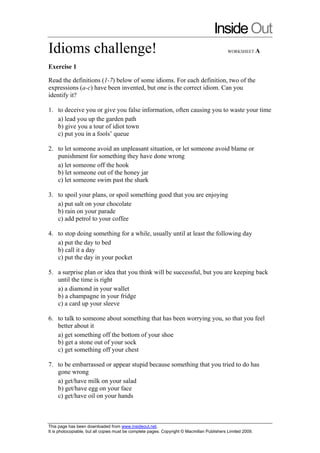
Idioms challenge!                                                                            WORKSHEET A


Exercise 1

Read the definitions (1-7) below of some idioms. For each definition, two of the
expressions (a-c) have been invented, but one is the correct idiom. Can you
identify it?

1. to deceive you or give you false information, often causing you to waste your time
   a) lead you up the garden path
   b) give you a tour of idiot town
   c) put you in a fools’ queue

2. to let someone avoid an unpleasant situation, or let someone avoid blame or
   punishment for something they have done wrong
   a) let someone off the hook
   b) let someone out of the honey jar
   c) let someone swim past the shark

3. to spoil your plans, or spoil something good that you are enjoying
   a) put salt on your chocolate
   b) rain on your parade
   c) add petrol to your coffee

4. to stop doing something for a while, usually until at least the following day
   a) put the day to bed
   b) call it a day
   c) put the day in your pocket

5. a surprise plan or idea that you think will be successful, but you are keeping back
   until the time is right
   a) a diamond in your wallet
   b) a champagne in your fridge
   c) a card up your sleeve

6. to talk to someone about something that has been worrying you, so that you feel
   better about it
   a) get something off the bottom of your shoe
   b) get a stone out of your sock
   c) get something off your chest

7. to be embarrassed or appear stupid because something that you tried to do has
   gone wrong
   a) get/have milk on your salad
   b) get/have egg on your face
   c) get/have oil on your hands


This page has been downloaded from www.insideout.net.
It is photocopiable, but all copies must be complete pages. Copyright © Macmillan Publishers Limited 2009.
Inside Out
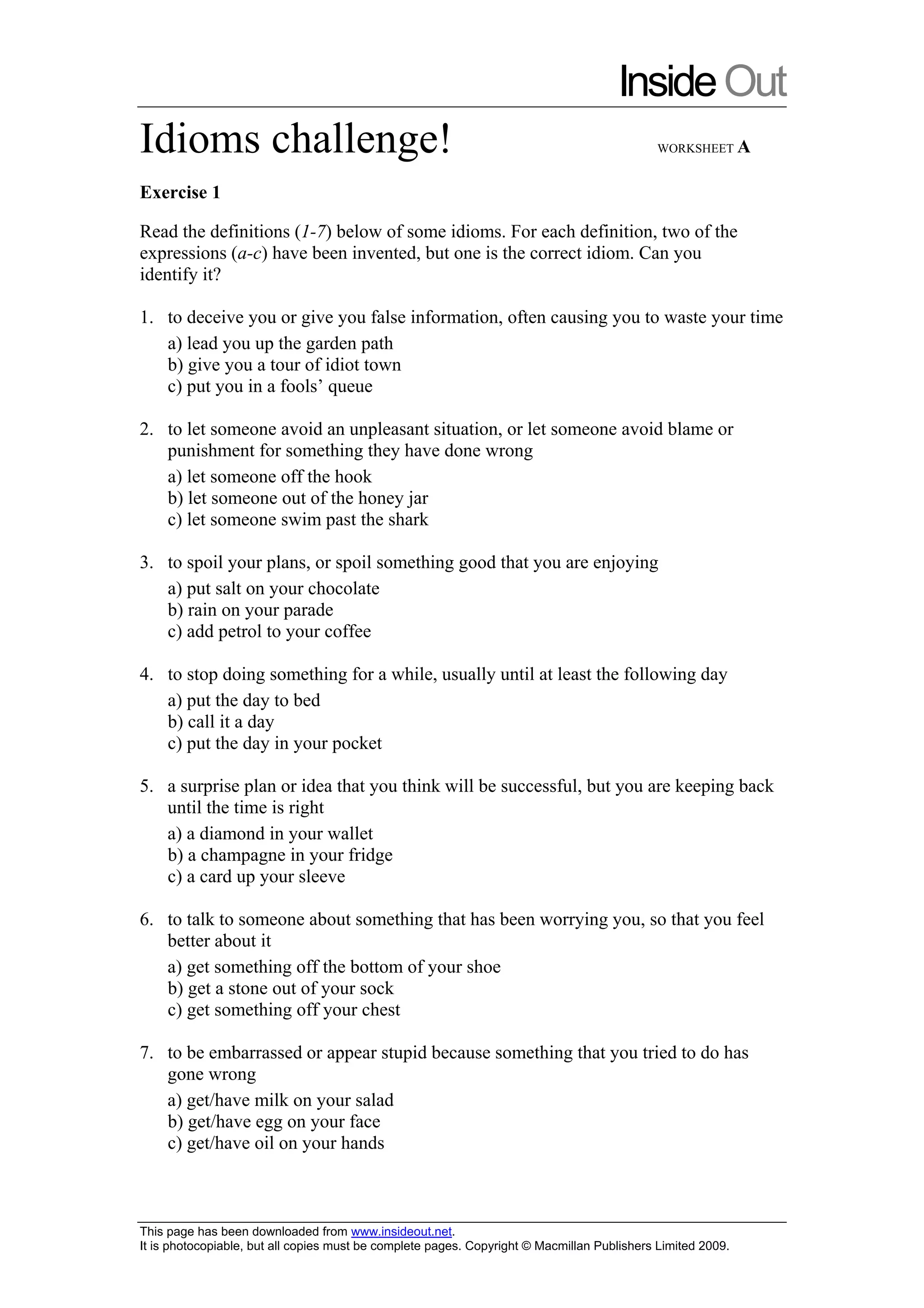
Idioms challenge!                                                                            WORKSHEET B


Exercise 2

Now choose the correct answer, a, b or c for each of the questions below.

1. What does it mean if you ‘eat your words’?
   a) You admit that something you said earlier was wrong.
   b) You think you are always right, and like listening to your own arguments.
   c) You do not speak clearly.

2. What does ‘the icing on the cake’ mean?
   a) something unhealthy and unnecessary
   b) something that you notice immediately but is actually not very important
   c) something that makes a good situation even better

3. What does it mean if something happens ‘in a flash’?
   a) It happens very quickly.
   b) It happens very slowly.
   c) It attracts the attention of a lot of people.

4. What does it mean if somebody is trying to sell you something that ‘fell off the
   back of a lorry’?
   a) It is damaged (even though it might look in good condition).
   b) It has been stolen.
   c) No one else wants it.

5. What does it mean if somebody or something does not ‘cut the mustard’?
   a) They do not reach the required or expected standard.
   b) They perform well in difficult circumstances.
   c) They do the job they are intended to do.

6. What does it mean if an idea or plan is ‘pie in the sky’?
   a) It has already failed.
   b) It would make a current situation worse.
   c) It is totally unrealistic and therefore will never happen.

7. What does ‘the grass is always greener’ mean? (The complete expression is ‘the
   grass is always greener on the other side of the fence’.)
   a) Life seems better somewhere else, or other people’s situations seem better than
   your own.
   b) Things will get better if you are optimistic.
   c) Some people are always lying about what they have or do, so you should never
   believe them.


This page has been downloaded from www.insideout.net.
It is photocopiable, but all copies must be complete pages. Copyright © Macmillan Publishers Limited 2009.
Inside Out
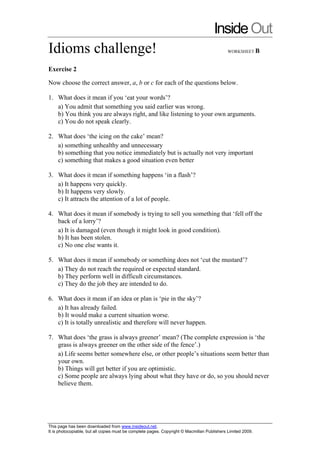
Idioms challenge!                                                                            WORKSHEET C


Exercise 3

Complete the sentences below with the appropriate idioms from Exercises 1 and 2.
You may need to change the verb forms.

1. ‘What? He offered you a new laptop for a hundred pounds? Are you sure it didn’t
   ______ ______ ______ ______ ______ ______ ______ ?’

2. ‘Our company’s new advertising campaign has been a total disaster, so now we’ve
   all got ______ ______ ______ ______. The problem was that we didn’t have
   enough money, or the right people. Last year they said we’d have everything we
   needed, but it was all ______ ______ ______ ______ .’

3. ‘I was very nervous about telling Jo what had happened, as I didn’t know how
   she’d react, but I really needed to ______ it ______ ______ ______ .’

4. ‘They were losing 1-0, but then he came on as a substitute and changed the game
   ______ ______ ______ . Five minutes later they were winning 3-1. The fourth
   goal was the ______ ______ ______ ______. Everyone who’d said he wasn’t a
   great player had to ______ their ______ .’

5. ‘It’s so unfair. Basically it’s Tony’s fault the project failed but our boss didn’t
   realise that, so he was ______ ______ ______ ______ and I got the blame
   instead.’

6. ‘I’m tired and I can’t think straight any more. Why don’t we just ______ ______
   ______ ______ and continue tomorrow morning?’

7. ‘The new guy at work didn’t last long. It was clear after a month that he ______
   really ______ ______ ______ , so they told him his contract wouldn’t be
   extended.’

8. ‘Mary was getting all excited about organising the party. Then the owner of the
   venue ______ ______ ______ ______ by saying the party couldn’t go on after
   11pm, so she had to cancel everything.’

9. ‘Look, let’s wait and see if they accept our first proposal. If not, don’t worry, I’ve
   got another ______ ______ my ______ . It’s a suggestion I’m sure they’ll like.’

10. ‘The estate agents said they’d found us a two-bedroom flat right on the edge of the
    park. Well, when we got there we realised they’d been ______ us ______ ______
    ______ ______ – it was a mile from the park and the second bedroom was tiny.’

11. ‘You know what, Dave, the ______ ______ ______ ______ . I know it looks like
    Steve’s got the perfect job, but if you actually had to do it for a few months I think
    you would get tired of it.’


This page has been downloaded from www.insideout.net.
It is photocopiable, but all copies must be complete pages. Copyright © Macmillan Publishers Limited 2009.

IDIOMS CHALLENGE

  • 1.
    Inside Out Idioms challenge! WORKSHEET A Exercise 1 Read the definitions (1-7) below of some idioms. For each definition, two of the expressions (a-c) have been invented, but one is the correct idiom. Can you identify it? 1. to deceive you or give you false information, often causing you to waste your time a) lead you up the garden path b) give you a tour of idiot town c) put you in a fools’ queue 2. to let someone avoid an unpleasant situation, or let someone avoid blame or punishment for something they have done wrong a) let someone off the hook b) let someone out of the honey jar c) let someone swim past the shark 3. to spoil your plans, or spoil something good that you are enjoying a) put salt on your chocolate b) rain on your parade c) add petrol to your coffee 4. to stop doing something for a while, usually until at least the following day a) put the day to bed b) call it a day c) put the day in your pocket 5. a surprise plan or idea that you think will be successful, but you are keeping back until the time is right a) a diamond in your wallet b) a champagne in your fridge c) a card up your sleeve 6. to talk to someone about something that has been worrying you, so that you feel better about it a) get something off the bottom of your shoe b) get a stone out of your sock c) get something off your chest 7. to be embarrassed or appear stupid because something that you tried to do has gone wrong a) get/have milk on your salad b) get/have egg on your face c) get/have oil on your hands This page has been downloaded from www.insideout.net. It is photocopiable, but all copies must be complete pages. Copyright © Macmillan Publishers Limited 2009.
  • 2.
    Inside Out Idioms challenge! WORKSHEET B Exercise 2 Now choose the correct answer, a, b or c for each of the questions below. 1. What does it mean if you ‘eat your words’? a) You admit that something you said earlier was wrong. b) You think you are always right, and like listening to your own arguments. c) You do not speak clearly. 2. What does ‘the icing on the cake’ mean? a) something unhealthy and unnecessary b) something that you notice immediately but is actually not very important c) something that makes a good situation even better 3. What does it mean if something happens ‘in a flash’? a) It happens very quickly. b) It happens very slowly. c) It attracts the attention of a lot of people. 4. What does it mean if somebody is trying to sell you something that ‘fell off the back of a lorry’? a) It is damaged (even though it might look in good condition). b) It has been stolen. c) No one else wants it. 5. What does it mean if somebody or something does not ‘cut the mustard’? a) They do not reach the required or expected standard. b) They perform well in difficult circumstances. c) They do the job they are intended to do. 6. What does it mean if an idea or plan is ‘pie in the sky’? a) It has already failed. b) It would make a current situation worse. c) It is totally unrealistic and therefore will never happen. 7. What does ‘the grass is always greener’ mean? (The complete expression is ‘the grass is always greener on the other side of the fence’.) a) Life seems better somewhere else, or other people’s situations seem better than your own. b) Things will get better if you are optimistic. c) Some people are always lying about what they have or do, so you should never believe them. This page has been downloaded from www.insideout.net. It is photocopiable, but all copies must be complete pages. Copyright © Macmillan Publishers Limited 2009.
  • 3.
    Inside Out Idioms challenge! WORKSHEET C Exercise 3 Complete the sentences below with the appropriate idioms from Exercises 1 and 2. You may need to change the verb forms. 1. ‘What? He offered you a new laptop for a hundred pounds? Are you sure it didn’t ______ ______ ______ ______ ______ ______ ______ ?’ 2. ‘Our company’s new advertising campaign has been a total disaster, so now we’ve all got ______ ______ ______ ______. The problem was that we didn’t have enough money, or the right people. Last year they said we’d have everything we needed, but it was all ______ ______ ______ ______ .’ 3. ‘I was very nervous about telling Jo what had happened, as I didn’t know how she’d react, but I really needed to ______ it ______ ______ ______ .’ 4. ‘They were losing 1-0, but then he came on as a substitute and changed the game ______ ______ ______ . Five minutes later they were winning 3-1. The fourth goal was the ______ ______ ______ ______. Everyone who’d said he wasn’t a great player had to ______ their ______ .’ 5. ‘It’s so unfair. Basically it’s Tony’s fault the project failed but our boss didn’t realise that, so he was ______ ______ ______ ______ and I got the blame instead.’ 6. ‘I’m tired and I can’t think straight any more. Why don’t we just ______ ______ ______ ______ and continue tomorrow morning?’ 7. ‘The new guy at work didn’t last long. It was clear after a month that he ______ really ______ ______ ______ , so they told him his contract wouldn’t be extended.’ 8. ‘Mary was getting all excited about organising the party. Then the owner of the venue ______ ______ ______ ______ by saying the party couldn’t go on after 11pm, so she had to cancel everything.’ 9. ‘Look, let’s wait and see if they accept our first proposal. If not, don’t worry, I’ve got another ______ ______ my ______ . It’s a suggestion I’m sure they’ll like.’ 10. ‘The estate agents said they’d found us a two-bedroom flat right on the edge of the park. Well, when we got there we realised they’d been ______ us ______ ______ ______ ______ – it was a mile from the park and the second bedroom was tiny.’ 11. ‘You know what, Dave, the ______ ______ ______ ______ . I know it looks like Steve’s got the perfect job, but if you actually had to do it for a few months I think you would get tired of it.’ This page has been downloaded from www.insideout.net. It is photocopiable, but all copies must be complete pages. Copyright © Macmillan Publishers Limited 2009.