Introduction
• Psychology usesdifferent approaches to study
human behavior. Two key approaches:
Idiographic and Nomothetic. They differ in
their focus, methods, and applications.
3.
Idiographic Approach
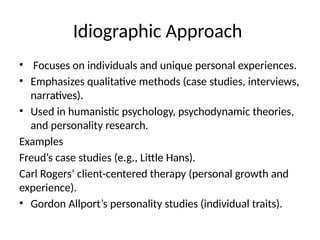
• Focuseson individuals and unique personal experiences.
• Emphasizes qualitative methods (case studies, interviews,
narratives).
• Used in humanistic psychology, psychodynamic theories,
and personality research.
Examples
Freud’s case studies (e.g., Little Hans).
Carl Rogers’ client-centered therapy (personal growth and
experience).
• Gordon Allport’s personality studies (individual traits).
4.
Nomothetic Approach
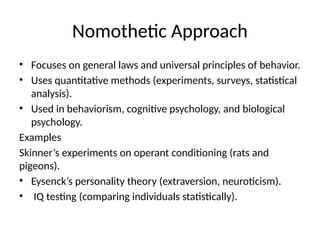
• Focuseson general laws and universal principles of behavior.
• Uses quantitative methods (experiments, surveys, statistical
analysis).
• Used in behaviorism, cognitive psychology, and biological
psychology.
Examples
Skinner’s experiments on operant conditioning (rats and
pigeons).
• Eysenck’s personality theory (extraversion, neuroticism).
• IQ testing (comparing individuals statistically).
5.
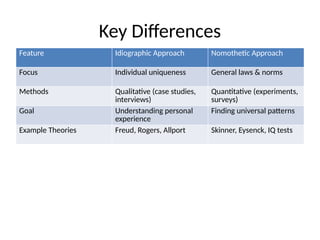
Key Differences
Feature IdiographicApproach Nomothetic Approach
Focus Individual uniqueness General laws & norms
Methods Qualitative (case studies,
interviews)
Quantitative (experiments,
surveys)
Goal Understanding personal
experience
Finding universal patterns
Example Theories Freud, Rogers, Allport Skinner, Eysenck, IQ tests
6.
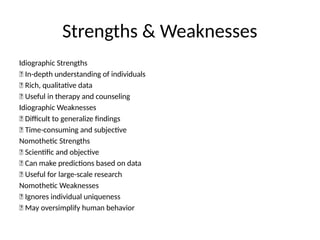
Strengths & Weaknesses
IdiographicStrengths
✅ In-depth understanding of individuals
✅ Rich, qualitative data
✅ Useful in therapy and counseling
Idiographic Weaknesses
❌ Difficult to generalize findings
❌ Time-consuming and subjective
Nomothetic Strengths
✅ Scientific and objective
✅ Can make predictions based on data
✅ Useful for large-scale research
Nomothetic Weaknesses
❌ Ignores individual uniqueness
❌ May oversimplify human behavior