Integrating Digital
Epigraphies
http://ides.io
Hugh Cayless, Duke Collaboratory for Classics Computing
@hcayless
IG I³ 40
• Inscriptiones Graecae
• Volume One (inscriptions of Attica before Euclid)
• Third Edition
• Number 40
IG I³ 40
• IG I-3 40 (SEG)
• IG I[3] 40 (Claros)
• IG I3 40 (OCR-ed form of IG I³ 40)
• and, of course, there’s IG I² 39…
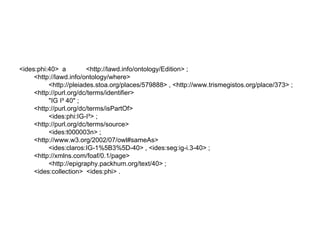
<ides:phi:40> a <http://lawd.info/ontology/Edition> ;
<http://lawd.info/ontology/where>
<http://pleiades.stoa.org/places/579888> , <http://www.trismegistos.org/place/373> ;
<http://purl.org/dc/terms/identifier>
"IG I³ 40" ;
<http://purl.org/dc/terms/isPartOf>
<ides:phi:IG-I³> ;
<http://purl.org/dc/terms/source>
<ides:t000003n> ;
<http://www.w3.org/2002/07/owl#sameAs>
<ides:claros:IG-1%5B3%5D-40> , <ides:seg:ig-i.3-40> ;
<http://xmlns.com/foaf/0.1/page>
<http://epigraphy.packhum.org/text/40> ;
<ides:collection> <ides:phi> .
<ides:phi:40> a <http://lawd.info/ontology/Edition> ;
<http://lawd.info/ontology/where>
<http://pleiades.stoa.org/places/579888> , <http://www.trismegistos.org/place/373> ;
<http://purl.org/dc/terms/identifier>
"IG I³ 40" ;
<http://purl.org/dc/terms/isPartOf>
<ides:phi:IG-I³> ;
<http://purl.org/dc/terms/source>
<ides:t000003n> ;
<http://www.w3.org/2002/07/owl#sameAs>
<ides:claros:IG-1%5B3%5D-40> , <ides:seg:ig-i.3-40> ;
<http://xmlns.com/foaf/0.1/page>
<http://epigraphy.packhum.org/text/40> ;
<ides:collection> <ides:phi> .
IDEs’ name for the inscription
associated places
IDEs’ name for PHI 40
Where it is on the Web
IDEs’ name for the same Edition
from Claros and SEG
<ides:phi:40>
<http://purl.org/dc/terms/source>
<ides:t000003n> .
• How do we say anything about this “fact”?
• How would we know how we know that PHI40 is a
publication of the inscription we’ve named
ides:t000003n?
• What do we do if our facts change?
Data reconciliation
• We get data from multiple sources
• Every Edition must derive from an Inscription.
• If we don’t immediately know two Editions from two
sources derive from the same Inscription, we’ll
make up two Inscription ids on ingest. These will
have to be merged later.
IG I³ 40
(PHI)
IG I[3] 40
(Claros)
A B
Before Merge
IG I³ 40
(PHI)
IG I[3] 40
(Claros)
A B
After Merge
Now what?
IG I³ 40
(PHI)
IG I[3] 40
(Claros)
A B
Who made this connection? When and why?
When did this
become invalid?
What replaced it?
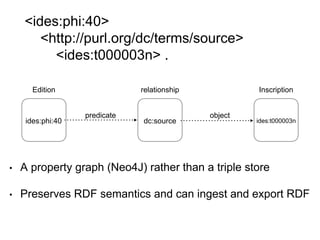
<ides:phi:40>
<http://purl.org/dc/terms/source>
<ides:t000003n> .
predicate object
ides:phi:40 dc:source ides:t000003n
• A property graph (Neo4J) rather than a triple store
• Preserves RDF semantics and can ingest and export RDF
Edition relationship Inscription
Pros
• We can say anything we like about relationships, in-
place, without needing workarounds.
• While still maintaining the Linked Data/RDF
semantics we want.
• Powerful query language (Cypher)
Cons
• No SPARQL (though potential for adding it later)
• If we use lots of extra capabilities, we’ll need to
think about how (or whether) to express them in
RDF.
• There’s not a great variety of property graph
databases.
Questions
• Is RDF really suitable for the highly-contingent facts
we have in the Humanities?
• There are various ways to solve this problem using
RDF tools (reification, named graphs, etc.). Should
we standardize on one of those instead?
• What sorts of information should we capture about
interventions?

IDEs DH2016

  • 1.
    Integrating Digital Epigraphies http://ides.io Hugh Cayless,Duke Collaboratory for Classics Computing @hcayless
  • 2.
    IG I³ 40 •Inscriptiones Graecae • Volume One (inscriptions of Attica before Euclid) • Third Edition • Number 40
  • 3.
    IG I³ 40 •IG I-3 40 (SEG) • IG I[3] 40 (Claros) • IG I3 40 (OCR-ed form of IG I³ 40) • and, of course, there’s IG I² 39…
  • 4.
    <ides:phi:40> a <http://lawd.info/ontology/Edition>; <http://lawd.info/ontology/where> <http://pleiades.stoa.org/places/579888> , <http://www.trismegistos.org/place/373> ; <http://purl.org/dc/terms/identifier> "IG I³ 40" ; <http://purl.org/dc/terms/isPartOf> <ides:phi:IG-I³> ; <http://purl.org/dc/terms/source> <ides:t000003n> ; <http://www.w3.org/2002/07/owl#sameAs> <ides:claros:IG-1%5B3%5D-40> , <ides:seg:ig-i.3-40> ; <http://xmlns.com/foaf/0.1/page> <http://epigraphy.packhum.org/text/40> ; <ides:collection> <ides:phi> .
  • 5.
    <ides:phi:40> a <http://lawd.info/ontology/Edition>; <http://lawd.info/ontology/where> <http://pleiades.stoa.org/places/579888> , <http://www.trismegistos.org/place/373> ; <http://purl.org/dc/terms/identifier> "IG I³ 40" ; <http://purl.org/dc/terms/isPartOf> <ides:phi:IG-I³> ; <http://purl.org/dc/terms/source> <ides:t000003n> ; <http://www.w3.org/2002/07/owl#sameAs> <ides:claros:IG-1%5B3%5D-40> , <ides:seg:ig-i.3-40> ; <http://xmlns.com/foaf/0.1/page> <http://epigraphy.packhum.org/text/40> ; <ides:collection> <ides:phi> . IDEs’ name for the inscription associated places IDEs’ name for PHI 40 Where it is on the Web IDEs’ name for the same Edition from Claros and SEG
  • 6.
    <ides:phi:40> <http://purl.org/dc/terms/source> <ides:t000003n> . • Howdo we say anything about this “fact”? • How would we know how we know that PHI40 is a publication of the inscription we’ve named ides:t000003n? • What do we do if our facts change?
  • 7.
    Data reconciliation • Weget data from multiple sources • Every Edition must derive from an Inscription. • If we don’t immediately know two Editions from two sources derive from the same Inscription, we’ll make up two Inscription ids on ingest. These will have to be merged later.
  • 8.
    IG I³ 40 (PHI) IGI[3] 40 (Claros) A B Before Merge IG I³ 40 (PHI) IG I[3] 40 (Claros) A B After Merge
  • 9.
    Now what? IG I³40 (PHI) IG I[3] 40 (Claros) A B Who made this connection? When and why? When did this become invalid? What replaced it?
  • 10.
    <ides:phi:40> <http://purl.org/dc/terms/source> <ides:t000003n> . predicate object ides:phi:40dc:source ides:t000003n • A property graph (Neo4J) rather than a triple store • Preserves RDF semantics and can ingest and export RDF Edition relationship Inscription
  • 11.
    Pros • We cansay anything we like about relationships, in- place, without needing workarounds. • While still maintaining the Linked Data/RDF semantics we want. • Powerful query language (Cypher)
  • 12.
    Cons • No SPARQL(though potential for adding it later) • If we use lots of extra capabilities, we’ll need to think about how (or whether) to express them in RDF. • There’s not a great variety of property graph databases.
  • 13.
    Questions • Is RDFreally suitable for the highly-contingent facts we have in the Humanities? • There are various ways to solve this problem using RDF tools (reification, named graphs, etc.). Should we standardize on one of those instead? • What sorts of information should we capture about interventions?