Ideology And Image Britain And Language
Multilingual Matters Dennis Ager download
https://ebookbell.com/product/ideology-and-image-britain-and-
language-multilingual-matters-dennis-ager-2206090
Explore and download more ebooks at ebookbell.com
Here are some recommended products that we believe you will be
interested in. You can click the link to download.
Mediating Ideology In Text And Image Ten Critical Studies Inger Lassen
Ed
https://ebookbell.com/product/mediating-ideology-in-text-and-image-
ten-critical-studies-inger-lassen-ed-1717512
Violence And Power In Ancient Egypt Image And Ideology Before The New
Kingdom 1st Edition Laurel Bestock
https://ebookbell.com/product/violence-and-power-in-ancient-egypt-
image-and-ideology-before-the-new-kingdom-1st-edition-laurel-
bestock-33377974
Romanticism And Parenting Image Instruction And Ideology 1st Carolyn
Weber
https://ebookbell.com/product/romanticism-and-parenting-image-
instruction-and-ideology-1st-carolyn-weber-5847124
Image And Performance Agency And Ideology Representations Of The Human
Figure In Funerary Contexts In Anglosaxon Art Ad 400680 Lisa Mary
Brundle
https://ebookbell.com/product/image-and-performance-agency-and-
ideology-representations-of-the-human-figure-in-funerary-contexts-in-
anglosaxon-art-ad-400680-lisa-mary-brundle-49993096
The Image Of The Prophet Between Ideal And Ideology A Scholarly
Investigation Christiane J Gruber Editor Avinoam Shalem Editor
https://ebookbell.com/product/the-image-of-the-prophet-between-ideal-
and-ideology-a-scholarly-investigation-christiane-j-gruber-editor-
avinoam-shalem-editor-51109708
The Image Of The Prophet Between Ideal And Ideology Christiane J
Gruber
https://ebookbell.com/product/the-image-of-the-prophet-between-ideal-
and-ideology-christiane-j-gruber-5216480
The Image Of The Prophet Between Ideal And Ideology Gruber Christiane
J Shalem
https://ebookbell.com/product/the-image-of-the-prophet-between-ideal-
and-ideology-gruber-christiane-j-shalem-56016804
Death And The Moving Image Ideology Iconography And I Michele Aaron
https://ebookbell.com/product/death-and-the-moving-image-ideology-
iconography-and-i-michele-aaron-51973274
Colonial India And The Making Of Empire Cinema Image Ideology And
Identity Prem Chowdhry
https://ebookbell.com/product/colonial-india-and-the-making-of-empire-
cinema-image-ideology-and-identity-prem-chowdhry-11659492
Ideology and Image
MULTILINGUAL MATTERS SERIES
Series Editor: Professor John Edwards, St. Francis Xavier University, Antigonish,
Nova Scotia, Canada
Other Books in the Series
Beyond Bilingualism: Multilingualism and Multilingual Education
Jasone Cenoz and Fred Genesee (eds)
Beyond Boundaries: Language and Identity in Contemporary Europe
Paul Gubbins and Mike Holt (eds)
Bilingualism: Beyond Basic Principles
Jean-Marc Dewaele, Alex Housen and Li Wei (eds)
Can Threatened Languages be Saved?
Joshua Fishman (ed.)
A Dynamic Model of Multilingualism
Philip Herdina and UlrikeJessner
Identity, Insecurity and Image: France and Language
Dennis Ager
Language and Society in a Changing Italy
Arturo Tosi
Language Attitudes in Sub-Saharan Africa
Efurosibina Adegbija
Language, Ethnicityand Education
Peter Broederand Guus Extra
Language Planning in Malawi, Mozambique and the Philippines
Robert B. Kaplan and Richard B. Baldauf, Jr. (eds)
Language Planning in Nepal, Taiwanand Sweden
Richard B. Baldauf, Jr. and Robert B. Kaplan (eds)
Language Planning: From Practice to Theory
Robert B. Kaplan and Richard B. Baldauf, Jr. (eds)
Linguistic Minorities in Central and Eastern Europe
Christina Bratt Paulston and Donald Peckham (eds)
Motivation in Language Planning and Language Policy
Dennis Ager
Multilingualism in Spain
M. Teresa Turell (ed.)
Quebec's Aboriginal Languages
Jacques Maurais (ed.)
The Other Languages of Europe
Guus Extra and Durk Gorier (eds)
Other Books of Interest
Bilingualism and Social Relations:Turkish Speakers in North Western Europe
/. Normann Jorgensen (ed.)
Language, Politics and Society: The New Languages Department
Sue Wright, Linda Hantrais and Jolyon Howorth (eds)
Understanding Deaf Culture: In Search of Deafhood
Paddy Ladd
Please contact us for the latest book information:
Multilingual Matters,Frankfurt Lodge, ClevedonHall,
Victoria Road,Clevedon, BS217HH,England
http://www.multilingual-inatters.com
MULTILINGUAL MATTERS 124
Series Editor: John Edwards
Ideology and Image
Britain and Language
Dennis Ager
MULTILINGUAL MATTERSLTD
Clevedon • Buffalo • Toronto • Sydney
Library of Congress Cataloging in PublicationData
Ager,D.E.
Ideology and Image: Britain and Language/Dennis Ager.
1. Language planning-Great Britain.2. Language policy-Great Britain. 3.Linguistic
minorities-Great Britain. 4. Great Britain-Politics and government I. Title.
P40.5.L352 G732003
306.44'941-dc21 2002154985
British Library Cataloguing in PublicationData
A catalogue entry for this book is availablefrom the British Library.
ISBN 1-85359-660-4 (hbk)
ISBN 1-85359-659-0 (pbk)
Multilingual MattersLtd
UK: Frankfurt Lodge, Clevedon Hall, Victoria Road, Clevedon BS217HH.
USA: UTP, 2250 Military Road, Tonawanda, NY 14150,USA.
Canada: UTP, 5201 Dufferin Street, North York, Ontario M3H 5T8, Canada.
Australia: Footprint Books, PO Box418, Church Point, NSW 2103, Australia.
Copyright © 2003Dennis Ager.
All rights reserved. No part of this work may be reproduced in any form or by any
means withoutpermission in writing from the publisher.
Printed and bound in Great Britain by the Cromwell Press Ltd.
Contents
Preface vi i
Acknowledgements viii
Tables ix
Figures x
Introduction 1
Society and Language 2
Language Planning and Language Policy 5
Motivation 8
This book 12
1. Language Communities 15
The standard English community 19
Communities using rural and social dialects
of English 25
The territorial communities 32
The non-territorial communities 34
Communities, individuals and
linguistic repertoires 40
2. Language Attitudes 43
Attitudes towards English , 44
Attitudes towards the territorial languages 55
Attitudes towards non-territorial languages 61
3. Planning and policy: from 880 to the 1950s 63
What actors attempted to influence language
for what ends? 63
Social, political and economic aims 7T2
Planners: the state, social categories and
individuals , 74
4. Non-political language planning 77
Individuals and Purism 78
Societies and associations , 84
The publishing industry 87
The Media .87
Dictionaries, grammars and style manuals 90
v
Ideology and Image.Britain and Language
5. Language rights 91
Human Rights Act, 1998 92
Sexism in language 95
Other discrimination in language 97
The maintenance of non-indigenous languages 100
Motivation in rights 104
6. Language as a resource for citizens 107
Adult literacy 107
Clarity in the civil service:
the Plain EnglishCampaign 113
Political discourse 117
The Better English Campaign 119
7. Language as a resource for the state 123
English Language Teaching and
the BritishCouncil 123
Foreign languages in education 132
Motivation in resource-oriented language policy .. 140
8. Language as a political problem 143
Standard English and the national curriculum. . . . 143
Multiculturalism 150
The territorial languages and the European
Charter for Regionalor Minority Languages . 158
Wales 160
Scotland 165
Northern Ireland 167
Motivation in problem-solving policy 170
9. British language policy and planning in perspective . . . . 173
International comparisons 173
Motivation in British LPP 182
Language and power 184
Appendix 189
References 198
Index 205
Preface
The contrast between France and Britain could not apparently be
greater than in their respective attitudes and policies towards
language. The French Academy defends and protects French; the
British Academy has no such role. Language is specifically mentioned
in the French Constitution and the Toubon Law of 1994 declares that
'French is a fundamental constituent of French identity and heritage'.
Yet the British Statute of Pleading confirming English as the official
language of the law dates from 1362, nearly two centuries before the
French equivalent. The 1611 Authorised Version of the Bible, with its
incalculable influence on English culture and language, was
commissioned by royal authority. Samuel Johnson's Dictionary, which
'beat forty Frenchmen', resulted in his being awarded a pension from
prime minister Lord Bute. While the French government took until
1992 to alter the Constitution and until 1994 to 'defend' French against
Americanisms in the Toubon Law, in Britain during the 1980s and 1990s
the Secretary of State for Education launched a Better English
Campaign and legislated for 'correct' English in the National
Curriculum. How true is it therefore that the British state has had no
interest in and no influence onEnglish?
In the present study of language planning and policy in Britain I
have deliberately sought to identify the effect of, and motivation for,
the exercise of political authority, and hence social behaviour, on
language and on language behaviour in the recent past. That the
British state and governments have an interest in controlling and
directing language and language behaviour seems to me undeniable.
What is different is how they do it.
vii
Acknowledgements
The author is grateful to a number of people for comments on drafts
of this book. Dhruba Biswas helped considerably with issues of
language maintenance. Bernard Spolsky has made helpful comments.
An anonymous reader for Multilingual Matters, too, pointed out the
need to sharpen up the argument and made a number of helpful
suggestions. I am particularly grateful to Joseph LoBianco and Tom
Bloor, who have confirmed the importance of the connection between
language usage and politics, both in the narrow sense of the politicsof
language and in more general ways. Joseph Lo Bianco has provided
much help from an international point of view, from his practical
experiences of language planning in a political environment, and from
his deep knowledge of research in language planning and policy. Tom
Bloor, who read the manuscript at a late stage, has helped me clarify
the argument in detail, and has helped greatly with his knowledge of
sociolinguistics and experience in English studies. Many unidentified
and unidentifiable Britishcivil servants, from a number of government
departments, have responded courteously, fully and patiently to
requests, telephone calls and emails, giving information and sometimes
the background to the facts. Annis Ager, as ever, has been an
invaluable help in many ways.
V l l l
Tables
Table 1.1 Left-right, libertarian-authoritarian, welfare
and the Euro: views by class and vote, 1999 .. 18
Table 1.2 Communities with which the UK
population identifies 23
Table 1.3 British identity, 1997 and 1999 24
Table 1.4 Working population by region
and country (2001) 27
Table 1.5 Social class structure and mobility in
Great Britain 29
Table 1.6 Summary indexes of social class mobility ... 29
Table 1.7 Class profiles of men aged 35and over at the
time of the survey: pre-1900 to 1959 31
Table 1.8 Religious affinities in Northern Ireland . . . . 33
Table 1.9 1991 Census by ethnic group 35
Table 2.1 Attitudes towards Welsh 60
Table 7.1 First language speakers of
languages worldwide 124
Table 7.2 Speakers of English worldwide 124
Table 7.3 Estimates of native speaker numbers in 2050 126
Table 7,4 Drafting language ofEuropean
Commission documents 127
Table 8.1 Enrolmentsin ESOL classes 156
IX
Figures
Figure Intro.1 Identity sequence, attitudinal structure
and purposes in motivation 8
Figure Intro.2 Motivations of powerful states 11
Figure 1.1 The Whig interpretation of history 21
Figure 1.2 Identity sequence for UnitedKingdom
communities 42
Figure 2.1 Ideologies of the standard language 51
Figure 5.1 Motivationfor policy on language rights . . . . 106
Figure 6.1 Motivation in resource-oriented
language policy for the citizen 122
Figure 7.1 The world language hierarchy 131
Figure 7.2 Motivationin resource-oriented
language policy 142
Figure 8.1 Motivationin problem-solving policy 172
Figure 9.1 Motivation in British LPP 181
Introduction
The English language has never had a state-registered guardian.
English is already such a patchwork language that the Word
Police would hardly know where to start. Instead of an academy,
we've ruled ourselves and allowed the natural forces of change to
be curbed only loosely by general dogma and prejudice. (John
Simpson, chief editor of the Oxford English Dictionary,in The
Guardian 27.12.1995)
There has long been a naive and romantic belief that in Britain
language, like culture, is, or ought to be, a simple reflection of a
mysterious social consensus. We, the robustly individualYeomen, with
our Old Etonian's inbred, effortless superiority and our Little
Englander's xenophobia, have democratically rejected 'them', the
committees, the centralising academy and the intrusive state. 'Many
linguists have held the view that language change is a natural,
spontaneous phenomenon, the result of underlying social and/or
linguistic forces that it is impossible or undesirable to tamper with'
(Crystal, 1987: 364). The history of English has been one of apparently
untrammelled development and expansion, without any of the controls
and checks imposed by such authorities as the French Academy,which
is often represented as the archetype of an oppressive authority.
Indeed, many English-speaking countries seem to have adopted the
same attitude.
English is in this way supposed to enjoy a unique position among
languages, and to be a natural product like rainwater. The 'general
dogma and prejudice' of those who speak it may be regrettable, but the
end product is cause for pride. So,even for the linguist Jespersen in 1905
(Jespersen 1982: 14), 'English is like an English park, which is laid out
seemingly without any definite plan, and in which you are allowed to
walk anywhere without having to fear a stern keeper enforcing
rigorous regulations'. The result of this aimless and uncontrolled
development, for the BBC editor Elmes, introducinga Radio 4 series in
2000 on the Routes of English presented by Melvyn Bragg, is a
1
Ideology and Image. Britain and Language
wonderful and marvellous achievement brought about by complete
anarchy : 'It is that unfettered freedom to do what we damn well like
with our words that is the glory of English' (Elmes, 2000:106).
The view raises any number of questions. Who are the democratic
'we'? How have 'we' ruled ourselves? How 'natural' are the mysterious
'forces of change'? What is meant by 'dogma and prejudice', or, for that
matter, 'unfettered freedom'? What sort of contrasts with France and
the French Academy does the absence of an English one imply? Is it
true, as Elmes alleges (p. 104) , that 'this country has always resisted
the formal establishment of an Academy to legislate on matters of
linguistic correctness'? Is it true, as he continues, that 'This seems to
bubble up out of the British character'? In essence, and taken to the
extreme, what is being suggested is that British English has a life
independent of its users and of British society. It is our belief that such
reification of language is dubious; that, as in most countries, there has
long been control and management of language and particularly of
language behaviour; that language control by authority, much of it
connected to the state, continues; and that views like Simpson's or
Elmes' require us to explore what is meant by 'authority', by 'we' and
by 'they' in such matters. In a book about Language Policyand Planning
in the United Kingdom, where of course English is also not the only
language, we should explore society as much as language.
Society and Language
Many of those who are professionally concerned with language
study, including Simpson and Elmes, have long accepted that language
change, and language behaviour more generally, are directly affected
by social forces. As an aspect of social behaviour, language behaviour is
not an abstract or idealised phenomenon but depends on relationships
with other people: 'language is a social fact', as Saussure was already
saying in 1900 (Saussure, 1916: 33).
Society affects how language is used and how it changes. The main
disciplines studying the effects of society on language are
sociolinguistics and the sociology of language. Chambers (1995),
examining sociolinguistic theory, is convinced that the origin and
theoretical core of the discipline is the systematic correlation of
dependent linguistic variables, such as the pronunciation of -ing in
English, with independent social variables such as age, gender or class.
Identifying systematic correlation of the choice of a variant (such as -
in' or -ing) of the linguistic variable with a variant (such as upper,
middle or lower class) of the independent social variable class, is the
origin of sociolinguistics. During the period since Labov's 1966 studies
of covariation in New York City, and Trudgill's 1974 work on Norwich,
many data-driven sociolinguistic studies have appeared and there
remain many who consider that covariation remains at the heart of
sociolinguistics. There have also however been interpretative studies
of such correlations between social category and language use,
investigating the significance of a wide range of language behaviour in
social contexts. The linguistic variable has developed from being a
very specific item of pronunciation or grammar to such wider examples
of language behaviour as the choice of language variety (as between
Cockney or standard English in London), the choice of language (as
between French and English in Quebec), or the choice of discourse (as in
political rhetoric). Kaplan and Baldauf (1997: 271), dealing more
specifically with language planning and policy, give a list of
variables in language behaviour which includes categories such as
language change, language shift, language death, language survival,
language revival, and language contact.
The social variable, originally a specific feature of social structure
such as age, sex or class, has been modified through the concept of the
'social actor' whose social role it is that determines linguistic
behaviour. Thus a person's membership of social networks could
determine selection of linguistic variants, as could their role, whether
such an actor is a group or an individual, within the power structureof
society and particularly within group relations. The social variable
can thus represent not merely social structure but also social institutions
(the professions, political parties, the state bureaucracy) or social
processes (network membership, upward or downward social mobility,
social attitudes). Chambers notes that there is a wide range of studies
of the language-society relationship, all of them often confusingly
called sociolinguistics, which he defines as personal, stylistic, social,
sociocultural and sociological according to the degree of attention paid
to language behaviour (near to psychology and linguistics) as against
social behaviour (near to sociology and other social sciences). Cameron,
commenting on the 'correlational fallacy' that 'language reflects
society', calls for a 'demythologized sociolinguistics' which would
'deal with such matters as the production and reproduction oflinguistic
norms by institutions and socializing practices; how these norms are
apprehended, accepted, resisted and subverted by individual actors
and what their relation is to the construction of identity' (Cameron,
1990; reprinted in Coupland &Jaworski, 1997:62).
Because sociolinguisticswas born - or at least baptised - in the 1960s,
Introduction 3
3
Ideokxtv and Image. Britain andLanguage
its view of how language was affected by society was coloured by the
attitudes of the time towards the study of society. Sociology itself, also
a new science, was preoccupied with the roles of the socioeconomic
categories, with studying social systems but particularly with
opposition to the established order and to the elite, and with the
battle between capitalism and socialism. The two other main social
sciences, economics and political science, were involved only insofar as
they affected social variables. Coulmas (1992:30) did indeed point out
that the invention of the printing press, and, crucially, the
development of the market in printed books that it enabled, meant
that in Europe the Reformation could take place and could be taken to
the people. It was this economic development that led to the need for
language codification, for use of the vernaculars rather than Latin and
for the social revolution that followed. But only rarely, and recently,
have the specifically political ideologies, parties and personalities
been invoked to explain or understand influences on language
behaviour, and vice-versa, whether this involves language itself, its
users or their attitudes. Thus Critical Discourse Analysiswas described
by van Dijk in 1993 (Cheshire and Trudgill,1998: 367) as 'focusing on
the role of discourse in the (re)production and challenge of dominance
... defined here as the exercise of social power by elites, institutions
and groups, that results in social inequality, including political,
cultural, class, ethnic, racial and gender inequality'.
Such developments in sociolinguistics accept that socioeconomic
structures, institutions and processes, however defined, influence
language behaviour. The best evidence of this is diachronic or
historical: a change in language is noted and correlated with a change
in society. Sometimes, but not always, the social change is alleged to be
the cause of the linguistic change. Language change usually requires
time, so the change from an agrarian to an industrial society in Britain
between 1750 and 1850 was not reflected in improved literacyor greater
use of the standard language until the early 1900s or even later.
Stylistic changes in the language, such as increased use of
Americanisms, first required social changes based on increased
communication, the invention of film and radio. But there are at least
two much more rapid ways in which the social actors of today can
cause change in language and language behaviour. The first is through
discourse, the language practices of individual or group social actors.
These language practices affect the way other people understand that
such social actors see the world, and, if these other people adopt these
practices or refuse them, they, consciously or unconsciously, have
introduction 5
adopted the politics and the policies of the actors concerned along with
their language. When group A refers to group B as freedom fighters,
while group C calls the same people terrorists, attempts are being
made to persuade others to adopt a sociopolitical stance through
adoption of deliberately biased language. This hegemonic effect,
realised eventually in language change, is important in two aspects of
social behaviour: consumer behaviour and political behaviour. In both
domains language is fundamental,both as a means of influencing others
and also as an indication of the extent to which such influence has been
successful. In both domains, too, the linguistic consequences of social
pressure may well be ephemeral: in modern German, the linguistic
differences which had developed between East and West Germany
between 1945 and 1989 had all but disappeared by 2002.
The second direct method of social influence over language is
through specific planning or policy actions, as when a parent instructs a
child not to use a swearword, when a regulatory body attempts to
prohibit the use of discriminatory racist or sexist terms, or when a
government passes legislation directly affecting a particular language.
Perhaps surprisingly, the linguistic consequences can be rapid, as with
the disappearance of overtly discriminatory language between 1970
and 1990.
Language Planning and Language Policy
The question then arises as to whether both these methods, and
other ways in which social behaviour affects language behaviour, can
fairly be called language planning. Language planning and policy,
henceforth referred to as LPP, is both a practical activity and an area
of study and research (Ricento, 2000). It has generally been recognised
as worthy of attention since about the end of World War 2, from the
period when major efforts were being made in nation buildingfollowing
the decolonisation of the British, and later the French, empires. At
about this time, many aspects of life in new nations and old were
thought to be amenable to planning and social organisation. The social
sciences, including linguistics, were developing methods to solve
practical problems such as the writingof grammars, the development
of dictionaries and the writing of textbooks, and generally avoided
open statements of political ideas and ideologies. After about 1970,
though, with the oil crisis of the mid-1970s, and recognising the
effectiveness of such 'practical' planning, LPP was more often
considered by commentators to be an activity whose effects did little
more than represent and reinforce existing power relationships. Many
Ideology and Image.Britain andLanguage
social scientists, evaluating LPP efforts, adopted a more critical tone,
noting continuing (neo)colonialism, the social stratification of societies
both developed and developing, and the role of language in
perpetuating inequality. Many earlier hopes for the social sciences
faded, particularly for their role in progress and linear development.
After about 1990 and the breakup of the Soviet Union, growing
recognition of the continuing power of psycho-social forces such as
ethnicity and nationalism, and the movement towards the recognition
of human rights, meant that LPP practice became more concerned with
trying to save endangered languages, with multiculturalism and
multilingualism, and with fostering diversity. It was at this time, too,
that in LPP research new analyses of opposition movements, including
terrorist/freedom fighter movements such as the IRA and ETA, saw
that language had long had a powerful symbolic role in defining
communities and providing a rallying point for attitudinal change,
which LPP had to be careful in approaching.
'"Language planning" is an activity ... intended to promote
systematic language change in some community of speakers ... Language
policy (promulgated by government or other authoritative body or
person) is a body of ideas, laws, regulations, rules and practices
intended to achieve the planned language change' (Kaplan and
Baldauf, 1997: xi). The differences, although they will be followed in
this book and are clear to Kaplan and Baldauf, are by no means
followed in the literature. Our use of the acronym LPP includes the two
ideas of forward planning for language change and the implementation
of precise actions of various sorts intended to bring it about.
LPP research investigates society's influence on language, firstly
from a linguistic (language-internal) point of view, where LPP affects
the ways in which people use the forms of a language and hence
linguistic processes like codification (standardisation)and elaboration
(terminological expansion). Secondly, from a sociological (language-
external) standpoint, LPP research investigates influence on the status
in society of particular languages or language varieties, and hence on
social processes of the selection of these and the acceptance of norms. It
also discusses the acquisition (teaching and learning) of language(s)
and language varieties. These three widely recognised areas of
application (technically known in LPP as corpus, status, and
acquisition) are sometimes complemented by a fourth, concerned with
what might be called symbolic or prestige policy, manipulating the
image of a language its users, or others, have towards it. So corpus
policy may recognise a spelling reform, as with dictionary entries; a
Introduction I
particular language may be allowed to enter parliamentary use in order
to certify its status, as with Scottish Gaelic; textbooks may be written
to encourage its acquisition, as with Cornish; and the prestige of a
language may be raised by erecting new road signs in Welsh. Finally,
and inevitably, LPP research is also concerned with the structures and
processes of policy making and policy implementation: who does it and
how. In this area it quickly became apparent that it is not just
Language Academies which plan language behaviour: the agents of
control are far more widely spread.
LPP practice is seen by some as a mechanism mainly concerned with
deciding who in society should have access to power and economic
resources. Indeed, the ideology of language planners is often cited as
though it were itself a social variable. Thus for Tollefson (1991: 16–7),
for example, 'there is a close association between language, power, and
privilege'. For Rahman (2002: 289) 'power should be the focal
analytical category ... in the US ... freedom of linguistic choice is
denied in practice, and non-English speakers learn English ... or remain
powerless ... in Australia, nationalist (language policy) ... was
supported by powerful elite groups/ Certainly sociolinguists generally
would agree with Cooper that 'to plan language is to plan society',
that language planning is rarely solely about language. Many social
scientists would go as far as to say that to plan society is to plan
language, and that social planners inevitably influence both language
and language use. This may be done directly, by language legislation, or
influence may be subtler, as when the hegemonic discourse of social
planners becomes itself a form of LPP. An account of language planning
and policy in a particular context hence needs to identify, not solely
what is proposed, what behavioural prescriptions are put forward, but
'what actors attempt to influence what behaviours of which people for
what ends under what conditions by what means through what
decision-making processes with what effect?' (Cooper, 1989: 98).
LPP in practice is carried out by a range of social actors, which we
have divided for convenience into three: authoritative individuals;
groups, categories and communities which often lack direct political
power; and the politically powerful government and state. Individuals
certainly have influenced language: Dr Johnson and Shakespeare have
both left their mark on English. Communities and groups have also
influenced language use: the British elite, particularly, has had a
major role in influencing how every member of British society speaks
and writes standard English. Territorial groups like the dialect
speakers of Yorkshire and east London have ensured the survival and
Ideologyand Image. Britain andLanguage
sometimes the dissemination of their own ways of speaking; so have
ethnic groups like Jamaican Creole speakers and large-scale social
categories like women. Our question, here, is whether and how far
British governments and public authorities, too, have influenced and
do influence language and language behaviour. Does Britain have a
language policy or policies?
Motivation
One of the questions which arises when investigating the planning
and policy decisions made in a particular society, is 'Why?' Why do
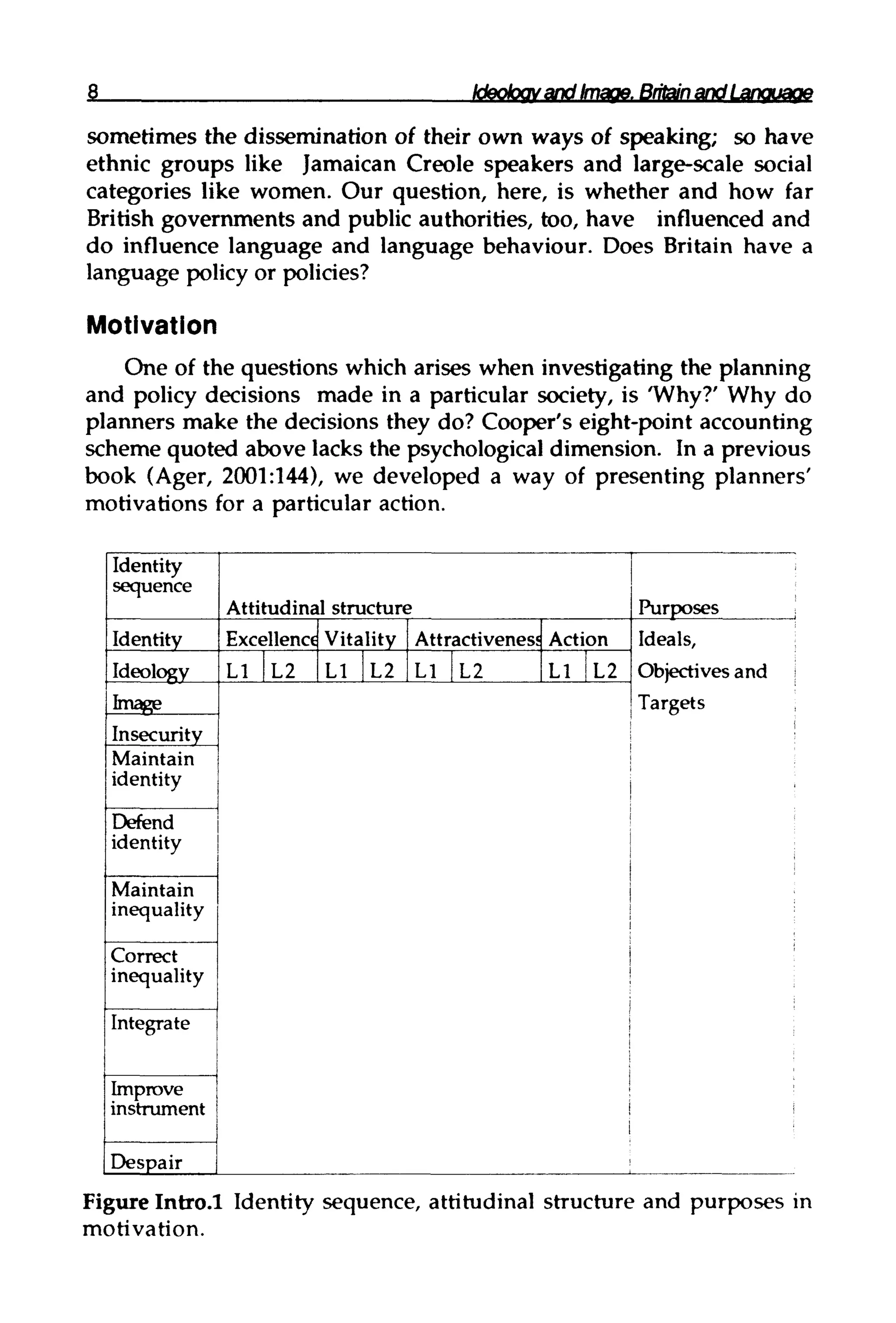
planners make the decisions they do? Cooper's eight-point accounting
scheme quoted above lacks the psychological dimension. In a previous
book (Ager, 2001:144), we developed a way of presenting planners'
motivations for a particularaction.
Identity
sequence
Identity
Ideology
Image
Insecurity
Maintain
identity
Defend
identity
Maintain
inequality
Correct
inequality
Integrate
Improve
instrument
Despair
Attitudinal structure Purposes j
Excellence Vitality Attractiveness Action Ideals,
L1 L2 L1 L2 L1 L2 L1 L2 Objectives and i
Targets
I i
Figure Intro.l Identity sequence, attitudinal structure and purposes in
motivation.
Introduction 2
Figures Intro.l and 2 portray the three components of motivation
that we proposed to explain a particular action by planners. These are
identity, attitude and goals. We assume, first, that individuals or
organisms construct, develop and defend their own self-identity, and
that we can identify eleven different aspects of this process:
• the construction of personal and social identity;
• ideology, or the philosophical, religious or moral
underpinning of the identity;
• image, or the manipulation of the way that identity appears
to others;
• insecurity, the feeling that the identity is under attack;
• the maintenance of identity;
• its defence against attack;
» the maintenance of inequalitybetween groups living in a host
society;
• the correction of such inequality;
• two motives for learning a new language: integration, or the
desire to empathise with another country or community;
• and instrumentality, the desire to improve skills;
• and finally, perhaps, feelings of despair at the prospect of
the destruction of identity.
So, for example, the stages in British identity construction and
defence to which the Education Acts of the 1880s can be related are a
mixture of instrumentality, the wish to improve the skills of those
being educated, and the correction of the social inequality from which
the uneducated suffered.
Figure Intro.l lists these aspects of identity in the left-hand column.
In the central columns we represented the attitudes related to each
action. Attitudes are made up of three components: knowledge,
emotion, and desire for action. Knowledge, we decided, meant
knowledge about a language's history, structure, advantages and value,
summarised as its 'excellence', and about its 'vitality', or the number of
domains in which it is used. The emotive component is represented by
the 'attractiveness' of the language. 'Action' means the desire to pass a
specific law, or carry out some specific action in language planning such
as writing a dictionary or teaching a foreign language. The right-hand
column of Figure Intro.l represents three levels of 'goal' or purpose for
each planning action: the general ideal, a more specific objective and a
very precise and definite target.
As an example of how the display portrays motivation we could
Ideology and Image.Britain and Language
consider the actions of the Conservative government in the 1980s in
developing the National Curriculum, as we discussed the issue in Ager,
2001: 40-55. In this display, attitudes are measured: from 3 for strongly
felt ones to 1 for weak or absent ones.
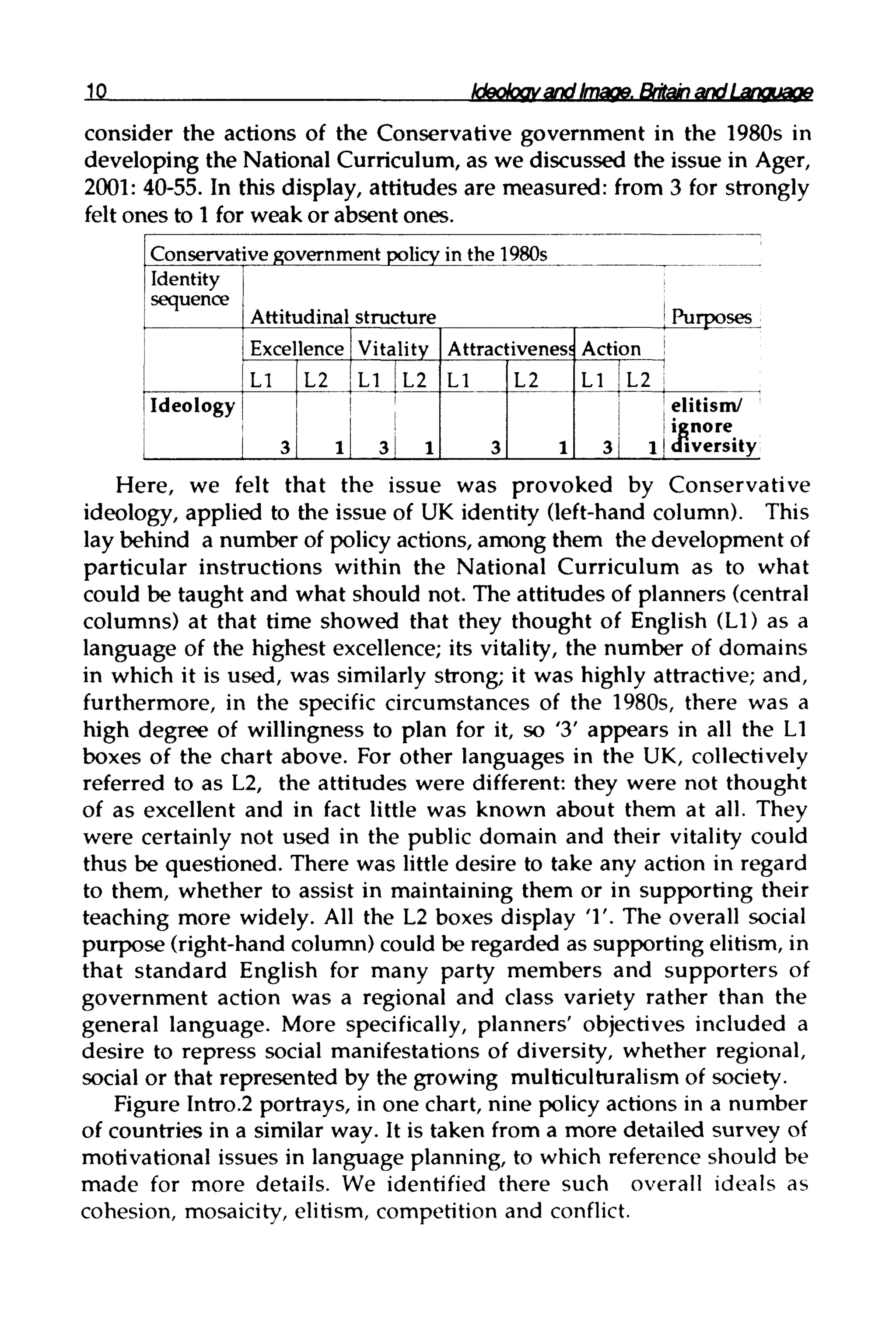
Conservative government policy in the 1980s
Identity
sequence
Ideology
Attitudinal structure Purposes
Excellence
L1
3
L2
1
Vitality
L1
3
L2
1
Attractiveness
L1
3
L2
1
Action
L1
3
L2
elitism/
ignore
1 jdiversity
Here, we felt that the issue was provoked by Conservative
ideology, applied to the issue of UK identity (left-hand column). This
lay behind a number of policy actions, among them the development of
particular instructions within the National Curriculum as to what
could be taught and what should not. The attitudes of planners (central
columns) at that time showed that they thought of English (L1)as a
language of the highest excellence; its vitality, the number of domains
in which it is used, was similarly strong; it was highly attractive; and,
furthermore, in the specific circumstances of the 1980s, there was a
high degree of willingness to plan for it, so '3' appears in all the L1
boxes of the chart above. For other languages in the UK, collectively
referred to as L2, the attitudes were different: they were not thought
of as excellent and in fact little was known about them at all. They
were certainly not used in the public domain and their vitality could
thus be questioned. There was little desire to take any action in regard
to them, whether to assist in maintaining them or in supporting their
teaching more widely. All the L2 boxes display '1'. The overall social
purpose (right-hand column) could be regarded as supporting elitism, in
that standard English for many party members and supporters of
government action was a regional and class variety rather than the
general language. More specifically, planners' objectives included a
desire to repress social manifestations of diversity, whether regional,
social or that represented by the growing multiculturalism of society.
Figure Intro.2 portrays, in one chart, nine policy actions in a number
of countries in a similar way. It is taken from a more detailed survey of
motivational issues in language planning, to which reference should be
made for more details. We identified there such overall ideals as
cohesion, mosaicity, elitism, competition and conflict.
Introduction 11
Motivation of powerful states
Identity
sequence
IDENTITY
(personal)
IDENTITY
(social) eg
Algeria
(Arabic/
Berber)
Algeria
(spoken/
Classical
Arabic)
India
IDEOLOGY
UK
Attitudinal structure
Exc'ence
L1
1
1
3
3
IMAGE | '
Germany 3
Japan,
INSECURITY
Neologism in
French
3
1
L2
1
3
3
1
1
_L
3
MAINTAINIDENTITY
DEFEND IDENTITY
MAINTAIN
INEQUALITY
eg anti-Roma
(Slovakia)
CORRECT
INEQUALITY
eg Australia
._ .
3
3
INTEGRATE ,
1
3
Vitality
L1 L2
1
1
3
T
1-
3
1
3
•*
Attract
L1 L2
_1 1
1 Ideal / objective
Action 1
~ ~T "T ~ ~ ' " "
LI [L2 t
"f ""
i
1
__1| 3 1
3
3
h -|
ll 3
3 1
1
3
3
| ._
1
3 1
-2
3
3
3 3
1 3
J H
1, 3
1
1
— i
3
~ | ] ^ -
3
3
3
3
,
cohesion/
accept L1 spoken
Arabic, reject L2
Berber
._ _ ._ . _ . .
cohesion/
accept L1 spoken,
promote L2 Classical
Arabic
mosaic/
multiculturalism
elitism/
ignore diversity
I competition/
1 foster German
1
3
competition/ seek
favourable image
conflict/
xenophobia
j
i '
conflict/ i
repress Roma
1 mosaic/
multilingualism
3
] 3
i
IMPROyEJNSTRUMENT
'DESPAIR !~~ 1 1"
Figure Intro. 2 Motivations of powerful states
Source: Ager, 2001: 201
12 Ideology and Image,
This book
This book has two aims: firstly to investigate a dozen examples of
recent action on language or language behaviour in the United
Kingdom, in order to see how these fit into the definitions of LPP we
have mentioned above. Secondly, to describe and characterise
contemporary British LPP against an understanding of British society,
to compare it with countries such as France, and to explore issues of
motivation and power that it raises.
The book is based on published material, on the declarations of the
social actors involved, and on generally available information, and
tries to be as balanced as possible when considering the more political
statements and opinions involved. It concentrates on authoritative and
on governmental actions, on attempts to control language by the leaders
and rulers of society. It directs attention particularly to what has
happened during the last twenty-five years of the twentieth century,
examining the position in the year 2002. It looks at issues of the
motivation for language policy to see whether there is a type of
motivation which characterises British LPP, in the same way that we
found characteristic structures for France. It treats the United Kingdom
of England, Wales, Scotland and Northern Ireland, although there is
necessarily a brief mention of LPP actions in the Republic of Ireland.
Because there is a close link between society and language, because we
are investigating social influences on language, and because of the view
exemplified above that 'we', rather than 'they', control language, we
take the view that we must examine aspects of British society and
social behaviour just as much as linguistic behaviour. We also define
both social and linguistic behaviour broadly, including language
attitudes and language-related behaviour as well as the actual words
and expressions used. We thus continue the approach we adopted in
Ager 1999, on LPP in France,and in Ager 2001,on motivationinLPP.
The social variables we use include, to start with, the various
language communities within the United Kingdom and their
interrelationships. We hence discuss in Chapters 1 and 2 the natureof
the British language communities, starting with the standard English
community itself. Here, we look at such issues as the size of the
population which can be said to speak or recognise standard English;
the various definitions of the term which have been used, and the
social, political and economic characteristicsof the community. One of
our main concerns here is with issues of identity,and we have noted the
extent to which the identity issue has been changing in the United
Kingdom in recent years. 'Identity' is often used as a code word for
Introduction 13
'nationalism', and we investigate the changing nature of English
nationalism. Discussion of such issues often takes us apparently far
from language behaviour; it is our contention that without an
appropriate understanding of the nature of the society which uses the
language, any attempt to understand language behaviour, and
particularly language planning and policy, must be incomplete. One
cannot remove the 'socio' from 'sociolinguistics', and nor can one remove
the 'planning' from 'language planning'. Even less can one begin to
understand language policy without realising that it is indeed a
policy, and like any other policy, is closely connected with social
conditions, with social structures and processes, with the
environmental background to decisions, and particularly with politics,
political parties, their aims and ideologies. We continue in the same
way with the other language communities of Britain: the regional and
social communities using varieties of English; the territorial
communities, particularly Wales, Scotland and Northern Ireland; and
the non-territorial language communities. In Chapter 2 we examine the
language attitudes of these communities. Some of these have been
specifically studied and measured; others must be deduced from
influential published writings or actions. Overall, we devote about a
quarter of the book to Chapters 1 and 2, and to such considerations,
which are unfortunately often regarded as irrelevant to language
planning. In our view they are crucial; although they are often ignored
in writing on LPP, they are neither simply background nor inessential.
They condition the appearance of language behaviour, as well as of
behaviour towards language.
We regard language behaviour as one aspect of social behaviour.
Our view of the linguistic variable is that we are interested in the
choice of language or variety, where there is the possibility of choice;
the existence and role of types of discourse; the nature of language use in
certain professions including the state bureaucracy; attempts to 'purify'
or 'improve' language use in the general population; attempts to
improve literacy; attempts to outlaw the use of certain discriminatory
terms; attempts to influence the status of different languages through
the educational system; and deliberate attempts to influence the fate
of 'minority' languages. These types of language behaviour are not
limited to 'corpus' matters, but cover all the areas of possible language
planning, including 'status', 'image' and 'acquisition'. As in our
discussion of France, we refuse to accept that language planning is just
about the forms of language.
In Chapter 3 we briefly review some of the main aspects of the
14 Ideology and Image. Britain and Language
development of LPP in Britain since 880 AD. There have been centuries
of careful language planning, much of it official. There are many cogent
demonstrations of the nature of this planning on English, such as
Bailey (1991) or, in a specific period, Smith (1984). Histories of the
language (Baugh and Cable, 2002; Fennell, 2001) give many examples of
social pressures including those evidenced in Samuel Johnson's
Dictionary of 1755 or in the nineteenth century Public Schools, and
indeed of official language policy decisions such as those of Parliament
in 1362 or the royal decision to authorise a translation of the Bible,
published in 1611 and in use for 250years. The decision not to have an
Academy in Britain in 1714, far from 'bubbling out of the British
character', was as political as Richelieu's decision to take over a
private group in France in 1635. The ideological, and occasionally
political, nature of British LPP up to quite recent times, and the fact of
its existence, can be traced in manyways.
In Chapter 4 we examine the influence of individuals,societies and
such groups as the publishing industry. But our main aim in this book
has been to study recent official planning and policy.Governmental
language planning and policy decisions are sometimes regarded as
reflecting the rights to use or acquire a language or language variety,
which individuals or social groups have or wish to have in society; the
resources a society has or wishes to develop among its citizens; or the
problems which confront it (Ruiz, 1984). Many LPP decisions fall neatly
into such categories, although there remain plenty which do not or
which combine them in different ways. A dozen or so examples of
recent UK LPP decisions, taken from quite different areas of public life,
are organised in successive chapters (5 to 8) according to this basic
structure of rights, resources and problems. We feel that these
demonstrate, firstly, an increasing concern with language on the part of
social planners over the period. There is, secondly, an increasingly
political approach to LPP. Then, in Chapter 9, the conclusion assesses
and evaluates contemporary LPP in Britain, compares it with LPP
elsewhere, shows how significant it actually is, and also how closely
our examples have been associated with other types of policy and
with political ideologies. We then evaluate the motivations which
seem to have provoked policy decisions. We have concluded as a
general comment that although planners' motives are often mixed, both
ideology, the philosophical, religious or moral underpinning of
identity construction, and image construction, the manipulation of the
outsiders' view of British identity, seem to have significant roles to
play in the history of British LPP.
Chapter 1
LanguageCommunities
In this Chapter we consider the language communities of the United
Kingdom. We examine who they are, explore their self-awareness and
their attitudes, particularly political ones like nationalism and
regionalism. In the next chapter we look at attitudes towards these
languages and towards language behaviour, although these often
relate closely to political attitudes.
The concept of a language community' is at first sight a convenient
way of describing the group of people who share a common language
and who thus may be expected to share attitudes towards that
language and towards other ones. The Sapir-Whorf hypothesis (see
e.g. Crystal 1987: 15) proposes that the meanings of languages are
unique to their community of users, and that each community hence
interprets the world differently through the mask of its language. In
the strong version of the hypothesis, all the meanings and
relationships expressed by a particular language are specific to it, and
its speakers are united in the unique understanding of the world they
have. But the idea is not so simple as it at first appears. The first and
most obvious difficulty, for English, is that the language itself is not
monolithic. The English-language community cannot be sensibly
defined as "those whose first language is English', for the obvious
reasons that in such a large group - several hundred million people at
least - the 'common' language is likely to vary. American, British,
Australian, Canadian, Indian and New Zealand English, to name a few
recognisable geographically distinguishable varieties, differ
considerably in vocabulary, less so in syntax, identifiably so in
pronunciation. Attitudes towards particular linguistic features and
variables will themselves vary, so that for example 'in the USA
prestige forms are rhotic, whereas in England they are non-rhotic' in
words like car,card, butter (Milroy and Milroy, 1985: 20). Each country
also has within it numerous regional differences of dialect and accent.
15
16 Ideology and Image. Britain and Language
so while in northern England means until in the South and bus is
pronounced quite differently in the two areas. Similarly, even within
one geographically-marked variety there are differences between
socially-marked varieties: apart from phonetic variables like the
pronunciation of the vowel in rope or brooch (Chambers, 1995: 61),
syntactic ones like the play what I wrote provoke different reactions as
between different social classes. Indeed, the same pronunciation(such
as-ing) or choice of word (such as filly) may attract condemnation in
one area and be regarded as elitist in another. Over time, too,
linguistic items that are elitist become less so, as with ain't or h-
dropping. Items that are regarded as socially inferior rise in status,
like the British Estuary pronunciation, and attitudes towards such
changes vary between parts of the English-speakingcommunity.
The second set of difficulties derives from the differences between
the circumstances, history and social conditions of different users of the
'same' language. The history, traditions and feelings of nationhood of
Australians are not readily shared even with near neighbours the New
Zealanders, let alone with other nations and groups. Both may use
English but since Australia was a penal colony and then a major
immigrant destination while New Zealand's population was and has
remained mainly Maori or Polynesian in origin, attitudes, towards
English, towards Polynesian languages and certainly towards other
languages such as German, are not necessarily the same. The 'battle'
between English and Spanish in the USA is meaningless in Australia.
Attitudes towards the differences between 'Catholic' and 'Protestant'
English in Northern Ireland are quite different in England, where such
language differences may not be recognised, do not correlate with
religion, and the interreligious differences are in any case not felt in
the same way. Attitudes towards the elite in Australia and Britain
are quite different, and thus attitudes towards elite language and
towards socially inferior varieties may be quite different. Similarly,
even in one geographical area the subdivisions of society hold different
language attitudes. Hence attitudes towards standard English or
towards dialects differ according to social background, educational
level and many other social factors within one society, and also as
between different societies. The (language and other) attitudes of the
wealthy and well-educated are definably different from those of the
poor and badly-educated; attitudes of rural speakers are different from
those in towns; those of tenth-generation descendants ofimmigrants
differ from those of first-generationimmigrants.
Another main difficulty is the difference between L1 and L2
Language Communities 17
language users in English-speaking communities, whether English is
learnt early or late in life. L1 users need English for most, if not all,
their communicative situations. For others, English is an instrumental
necessity without which it may be difficult to eat, work or be
entertained, but may not be their only means of communication with
family and friends. For others who come to English late in life there is
a positive attraction in learning to use the language of Shakespeare or
Julia Roberts, but again this subdivides the language community. And
yet another cause of subdivision is that between English-using
communities where the history of language contact is different:
between Malaysia and Belgium. Yet another depends on the amount
and type of English required for international commerce or work as an
airline pilot or telephone operator.
Even the British Isles thus contain many language communities,
both within English (users of the standard, of rural and of social
dialects) and outside it (users of indigenous and of non-indigenous
languages). Unsurprisingly, language attitudes, whether towards
English or another language, or towards the users of language, are not
the same everywhere, as we shall see in the next chapter. In this
chapter we concentrate on four different types of language community in
Britain: users of standard English as their L1;users of regional or social
dialects as their L1; users of territorial languages, although here the
L1 is often and indeed usually English; and users of non-territorial
languages, although here again the L1 may not be the non-territorial
language.
There are of course many social and political characteristics and
attitudes which differentiate Great Britain from other countries and
which are common across all four nations and in all types of language
community. One of these is that of the main political parties, with the
Conservative Party being traditionally the party of big business and
right-wing attitudes; the Labour Party that of the working class and
the political Left; and a Liberal Democratic party usually between the
two extremes. There are other, mainly single-issue parties, such as the
nationalist parties in Scotland, Wales and Northern Ireland. Across
these three classes and two main parties the annual British Social
Attitudes survey plots three attitudinal scales: left-right, welfarism
and libertarian-authoritarian. The left-right scale, for example, notes
attitudes towards income redistribution, big business, the law ('one law
for the rich and one for the poor'); while the libertarian-
authoritarianism scale measures attitudes towards 'respect for
traditional British values', equal opportunities for blacks and Asians,
Ideology and Image.Britain andLanguage
and the censorship of films and magazines. The welfarism scale asked
questions about attitudes towards the level of government spending on
benefits, the fairness or otherwise of social security. On these bases,
the parties did not, in 1999, altogether repeat the class divisions, nor
are the views of the social classes on welfare or liberty immediately
predictable. But views on income redistribution and on some moral
issues show the Labour party's attitudes still lay more to the left
than those of the Conservatives.
Table 1.1 Left-right, libertarian-authoritarian,welfare and the Euro:
views by class and vote, 1999
Conservative Labour Gap
Salariat
Redistribution 26 48 22
Welfare benefits 33 47 14
Censorship 26 33 7
The Euro 41 70 29
Self-employed
Redistribution 16 41 25
Welfare benefits 34 44 10
Censorship 23 33 10
The Euro 22 71 49
Working class
Redistribution 23 46 23
Welfare benefits 25 46 19
Censorship 39 33 6
The Euro 17 25 8
Notes: Figures are percentages of the sample with left-wing' views.
Source: Selected and adapted from Jowell et al. 2002: 63-4
In 1999, the single concern which most divided the parties had
little to do with these major issues: it was the Euro,the common coinage
of most countries in the European Union.In 1987, the main issue which
divided the parties had been the debate over nuclear arms. Otherwise,
it could be said that general attitudes did not show sharp divisions
between the parties or the classes over important issues such as income
redistribution and censorship.
Despite the existence of such characteristicscommon to the whole
of the British Isles we concentrate below, less on 'British' identity,
more on those of the separate language communities. Inevitably
however there remains some confusion between 'British' and 'English'.
Language Communities 19
The Standard English Community
The total population of the United Kingdom, as recorded by the
1991 Census, was 54,888,844 people. Of these, 51,114,048 were born in
the United Kingdom; those born in England itself 42,897,179. Does this
provide us with a count of the users of standard British English?
Hardly. The traditional definition of the community using British
spoken standard English combines a geographical defining factor
(south-east England) and two socially important factors: use by the
educated, and use by the elite. "The idiomatic use (of shall and will)
comes by nature to southern Englishmen' (Fowler 1926:142); 'the
grammar and core vocabulary of educated usage in English' (Strevens,
1985:5); 'Received Standard' is 'the best, that form which has the
widest currency and is heard with practically no variation among
speakers of the better class all over the country. This type might be
called Public School English' (Partridge 1947:306).
Most definitions used today stress one or the other of these social
elements; the regional one is rarely included, and indeed is usually
specifically excluded since standard English is (said to be) spoken
across the country. Thus Trudgill (in Bex & Watts, 1999: 117-28),
considers that standard English is a 'purely social dialect'. It is
'spoken as their native variety by about 12-15% of the British
population, and this small percentage does not constitute a random
cross-section of the population. They are very much concentrated at the
top of the social scale'. This would give a figure for standard English
speakers of some six to nine million, distributed through the country.
Definitions based on education usually start with the usage ofPublic
Schools and Oxbridge, as with Partridge above. This would imply
about seven or eight per cent of the population at most, since this has
been the maximumproportion in independent education for most of the
twentieth century: under five million people. Even if the definition is
broadened to include all those who have completed secondary
education (Greenbaum (1990:18): 'the language of the educated all over
Great Britain') this would still imply a maximum of some fifty percent
of the population. The terms used in National Curriculum documents in
the year 2000 also stress the idea of 'educated' users: 'standard English,
spoken and written, is the predominant language in which knowledge
and skills are taught and learned'.
Sometimes, standard English is defined as a written form. Thus
standard English is 'essentially the same form of English used in books
and newspapers all over the world' (Honey, 1997: 1-3). This definition
would imply a common international form for standard English and
20 Ideology and Image. Britainand Language
mean that there remained little connection between the standard and
the UK. Whether in speech or writing, most commentators nonetheless
still tend to identify at least two geographically distinct forms:
American English and British English. Others would accord standard
status to the English of each of the major English-speaking political
entities, so that there would be a British, an American, an Australian,
an Indian, a Canadian, a Singaporean and a New Zealand standard.
Other definitions use concepts such as that of a neutral, unmarked
form, against which all others are 'deviant' or 'idiosyncratic'; of one
against which notions of correctness can be tested; of a canonical form
against which dialects can be defined; and of idealisation, so that
standard English is never actually realised anywhere but isintuitively
known by all users. This implies that standard English could be part of
the linguistic repertoire of the total UK population, some fifty-eight
million people or more in 2002, particularly so since the UK is
essentially monolingual and only marginally bilingual, a majority
have learnt English as their first language, and the English taught in
schools has for long been the standard form (even more so since the
introduction of the National Curriculum in the early 1990s),
The British Isles are, as we know, home to four nations: England,
Scotland, Ireland and Wales. The facts, the history, the myths and the
taboos which together create the self-identity and attitudes of
citizens of the United Kingdom, its 'imagined community', are a
mixture of those which derive from the individual nation, from the
social status and personal history of the individual and those which
rulers of England, Britain, Great Britain or the United Kingdom have
from time to time manufactured to support their view of history or
their agenda for government. The enduring nature of such myths means
that identity concepts are often fuzzy, particularly as between the
labels 'England' and 'Britain'. Thus the arrival of James I of England
in 1603, uniting the crowns of England and Scotland, where he had been
King since 1567, meant the need to rename the kingdom and create a
myth of Britain, and to subdue the separate cultural identities of the
four nations. Later, and after the civil wars of the 1640s, the
Restoration of 1660 and the settlement of 1688, the Whig interpretation
of history was to found an enduring set of attitudes which persist today
as probably the most widely accepted background to civic and political
life, and which can be found in all British political parties even
though rarely stated. The main features of this background myth are
the following (see e.g. Larsen, H. 1997:38-9):
Language Communities 21
The Anglo-Saxons were the first true Englishmen.
Their liberties were withdrawn after the Norman Conquest.
The civil war merely replaced one tyranny with another.
The settlement of 1688, the 'Glorious Revolution', inaugurated a
new age of English liberty.
The Constitution balances the powers of the monarch (the
crown), the titled aristocracy (the lords), and the landed
gentry (the commons).
Parliament is the forum for balancing and harmonising
interests.
The legitimacy of Parliament is paramount and its independence
is unquestioned.
Britain is committed to a non-interventionist state, an open
market and a free international economy.
The English/British political system is superior to continental
political systems.
Political/institutional pragmatism is preferable to grandiose,
abstract, continental schemes.
Rights are to be justified as the traditional liberties once
enjoyed by Englishmen (and to be enjoyed again) rather than
asserted as the natural and inherent rights of man.
Parliamentary sovereignty is bound up with defiance of the
European continent.
Figure 1.1 The Whig interpretation of history
This political and attitudinal background surfaces again and again
today in widespread contemporary political attitudes. Parts of it are
changing; parts of it remain very obvious, particularly in discussions of
the European Union and the Euro; it is apparent in media attitudes
towards universality and towards any grandiose and abstract schemes
or centralised policies. English/British identity has continued to be a
topic of debate, sharpened particularly as devolution was brought
about in 1998. At that point, two speeches may be said to characterise
the positions of the main contemporary political parties on the issue of
national identity: that by the then leader of the Conservative Party,
William Hague, on 24th January 1999, and that by Tony Blair, leader
of the Labour Party, on 28th March 2000. Robin Cook, then Foreign
Secretary, clarified this latter position further on 19th April, 2001, in
what has become known as his 'tikka masala' speech. For Hague,
'there is one UK: 'we sink or swim together'. The English have always
had a strong inherent sense of their own identity, but have never felt
22 Ideology and Image,BritainandLanguaqe
the need to express it'. There are four principal features of the British
character: 'our individualism and spirit of enterprise; our social
mobility and our loyalty to local institutions, which are both reflected
in, and, in turn, are shaped by the political institutions of Great
Britain'. Hague was careful to specify that 'local' did not mean
'regional': 'we are not a regional nation'. English nationalism is ' a
backlash' and a 'sleeping dragon', provoked by Scottish and Welsh
nationalism, which will lead to the disintegration of Great Britain.
For Tony Blair, also, 'we are stronger together than apart',
although 'true Britishness lies in our values, not in unchanging
institutions'. These values were tolerance, adaptability, work, strong
communities and families, fair play (rights and responsibilities), and
an outward looking approach to the world. Britain's mixed population
showed, according to Blair, that outdated 19th century conceptions of
blood and territory were inappropriate, and should be modernised and
replaced by a devolved plural state.
Robin Cook responded directly to the three threats to British
identity (multiculturalism, devolution, and Europe) which Hague had
outlined. 'Pluralism is ... an immense asset that contributes to the
cultural and economic vitality of our nation. ... Chicken Tikka Massala
is now a true British national dish.' Britain is a European country 'in
the more profound sense of sharing European assumptions about how
society should be organised. ... we reject insular nationalism and the
politics of fear.' Devolution has "been a success for Scotland and for
Wales, but has also been a success for Britain.' 'Centuries of living
together and working together have created enduring bonds between
each of the constituent nations that make up Britain. ... our common
identity as British.' It is the diversity of modern Britain that is
'consistent with the historical experience of our islands' and which is a
'unique asset.'
No political leader had anything good to say about nationalism;
all were talking of British, not English, national identity; Hague
indeed was concerned that English nationalism might be a negative
force.
Some small British political parties support 'Britishness' or
'Englishness'. The British National Party has a long history as a semi-
Fascist group opposing immigration. In recent years a UK Independence
Party has proposed independence from the European Union. Neither
has mainstream support. Again, the confusion between British and
English identity remains.
More scientific attempts at defining attitudes towardsnationalism
Language Communities 23
and ethnicity have been made in surveysof public opinion, particularly
at the time of devolution in 1998. Thus the MORI surveying
organisation conducted a poll for The Economist in September 1999 on
the identity issue. One question posed to a representative sample across
Great Britain (hence not in Northern Ireland) showed that overall
only 40% of the population named Britain as a country with which
they identified, even though respondents could name two or three
'communities'. 45% of respondents named the individual country,
England, Scotland or Wales. In both Scotland and Wales percentages
of over 70% identified with their country. In England, by contrast, the
percentage identifying with England (41%) was by a long way the
smallest of any in the three countries, slightly less than that including
Britain among their responses. The numbers identifying with the
Commonwealth, or regarding themselves as world citizens, were under
ten percent in each case, with Wales seeming the least interested in
such communities (3% with the Commonwealth, 2% with the global
community). Europe, as a community with which to identify, scored
slightly higher: 16% across Great Britain, with approximately the
same percentages in each country.
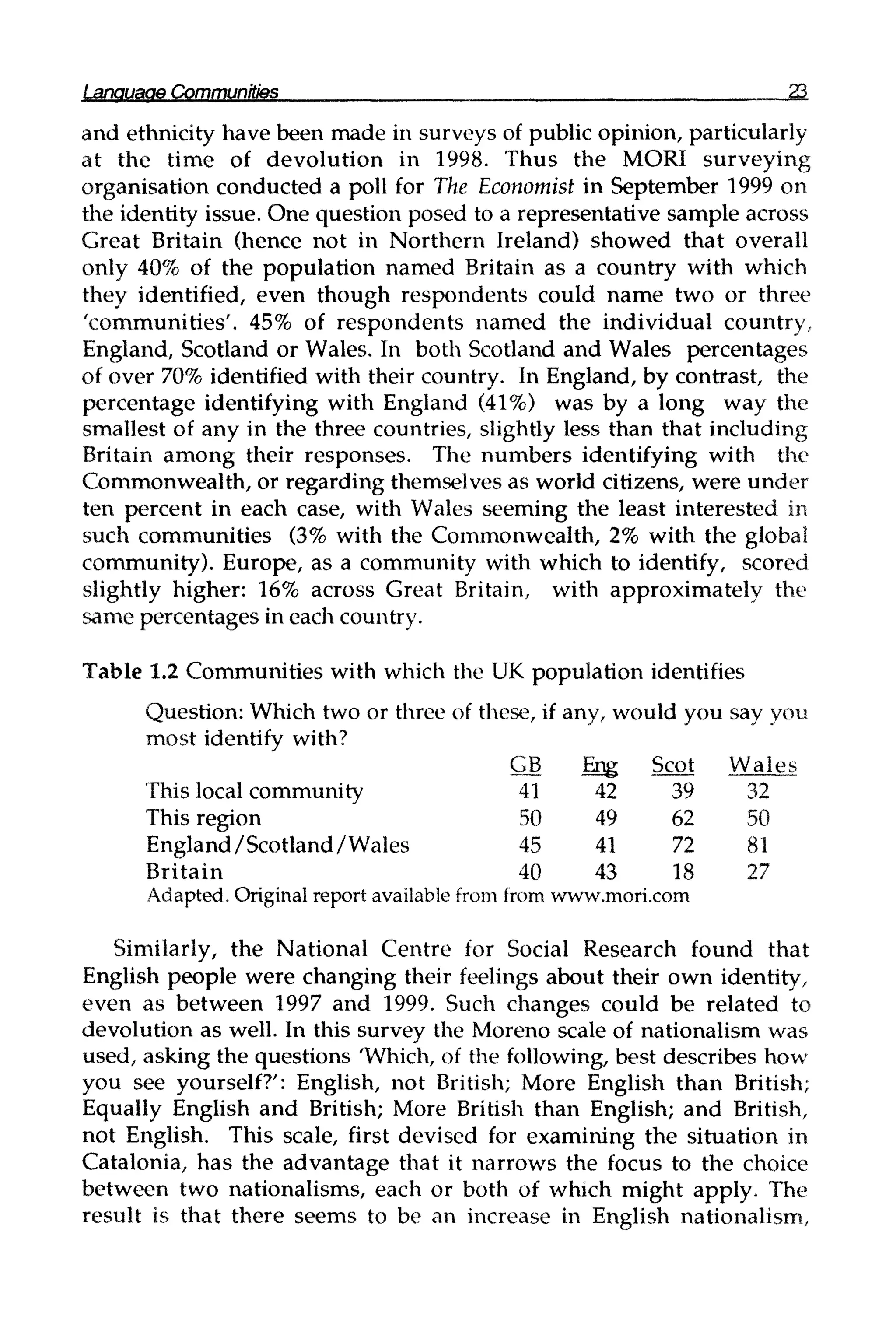
Table 1.2 Communities with which the UK population identifies
Question: Which two or three of these, if any, would you say you
most identify with?
GB Eng Scot Wales
This local community 41 42 39 32
This region 50 49 62 50
England/Scotland/Wales 45 41 72 81
Britain 40 43 18 27
Adapted. Original report availablefrom from www.mori.com
Similarly, the National Centre for Social Research found that
English people were changing their feelings about their own identity,
even as between 1997 and 1999. Such changes could be related to
devolution as well. In this survey the Moreno scale of nationalism was
used, asking the questions 'Which,of the following, best describes how
you see yourself?': English, not British; More English than British;
Equally English and British; More British than English; and British,
not English. This scale, first devised for examining the situation in
Catalonia, has the advantage that it narrows the focus to the choice
between two nationalisms, each or both of which might apply. The
result is that there seems to be an increase in English nationalism,
24 Ideology and Image.
sparked by devolution. Nonetheless, in England at any rate, dual
nationalism is still the most frequently chosen category: most people
feel themselves to be equally English and British.
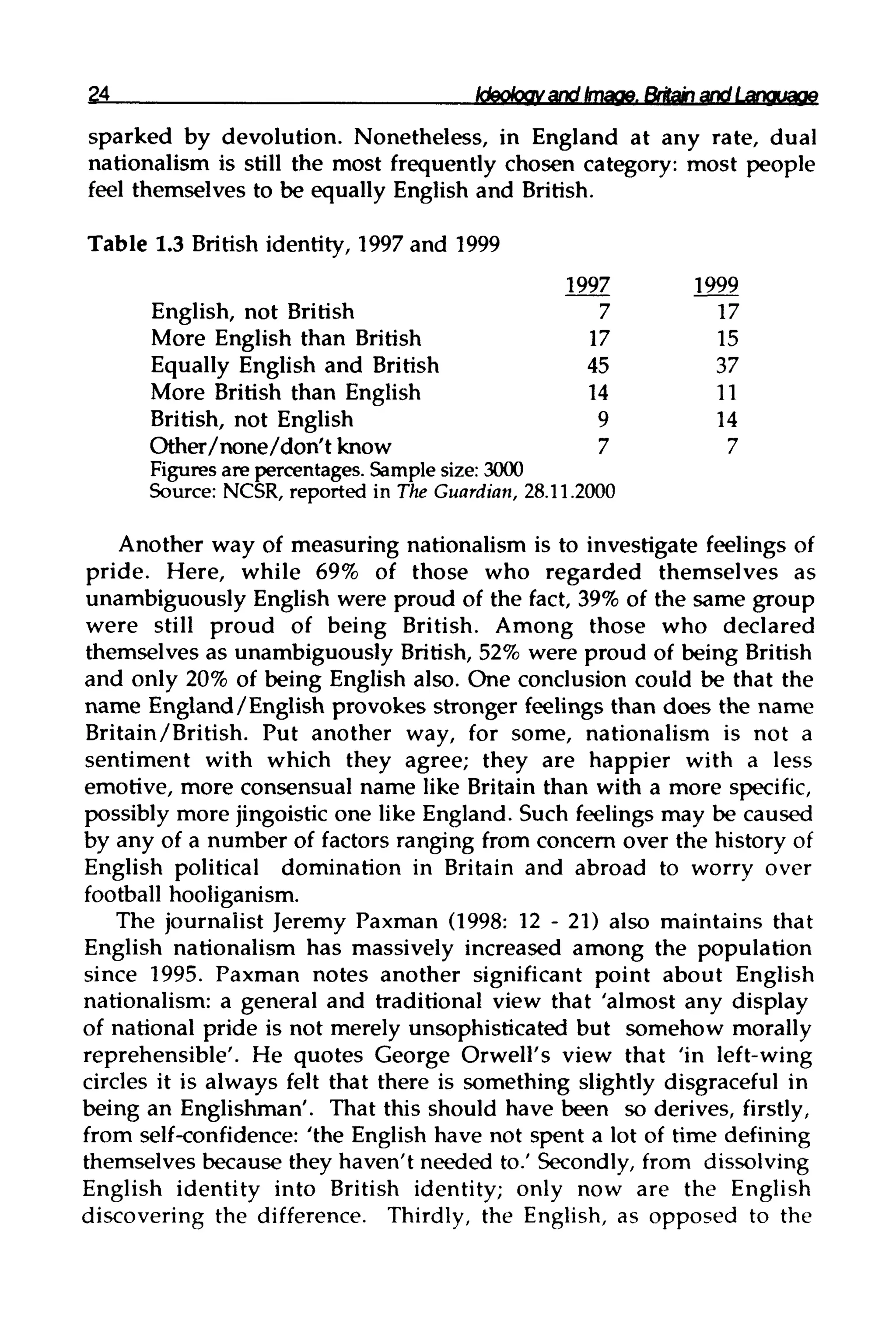
Table 1.3 British identity, 1997 and 1999
1997 1999
English, not British 7 17
More English than British 17 15
Equally English and British 45 37
More British than English 14 11
British, not English 9 14
Other/none/don't know 7 7
Figures are percentages. Sample size: 3000
Source: NCSR, reported in The Guardian, 28.11.2000
Another way of measuring nationalism is to investigate feelings of
pride. Here, while 69% of those who regarded themselves as
unambiguously English were proud of the fact, 39% of the same group
were still proud of being British. Among those who declared
themselves as unambiguously British, 52% were proud of being British
and only 20% of being English also. One conclusion could be that the
name England/English provokes stronger feelings than does the name
Britain/British. Put another way, for some, nationalism is not a
sentiment with which they agree; they are happier with a less
emotive, more consensual name like Britain than with a more specific,
possibly more jingoistic one like England. Such feelings may be caused
by any of a number of factors ranging from concern over the history of
English political domination in Britain and abroad to worry over
football hooliganism.
The journalist Jeremy Paxman (1998: 12 - 21) also maintains that
English nationalism has massively increased among the population
since 1995. Paxman notes another significant point about English
nationalism: a general and traditional view that 'almost any display
of national pride is not merely unsophisticated but somehow morally
reprehensible'. He quotes George Orwell's view that 'in left-wing
circles it is always felt that there is something slightly disgraceful in
being an Englishman'. That this should have been so derives, firstly,
from self-confidence: 'the English have not spent a lot of time defining
themselves because they haven't needed to.' Secondly, from dissolving
English identity into British identity; only now are the English
discovering the difference. Thirdly, the English, as opposed to the
Language Communities 25
Scottish or Welsh, have had no immediately identifiable 'enemy'
against whom to sharpen their sense of nationalism. The nearest
equivalent is the French, the traditional enemy, and indeed Paxman
did discover that identity issues in England are sharpened by the
contrasts the public feel between themselves and France. He found,
admittedly on adhoc and anecdotal grounds, that many people agreed
that while the English and British floundered with the name of their
nation, 'the French know who they are'. But the contrast and the
enmity are not particularly strong.
Communities using Rural and Social Dialects of English
Like standard English, the rural and social dialects of the language
have both geographical and social settings. Because urbanisation and
population movements have greatly affected language use for a
considerable time, the social diversity of rural dialects has been
generally ignored in dialect studies, many of which have been aimed
rather at preserving fast disappearing regional dialects.
Dialectologists have thus usually concentrated on identifying the
lexical components and phonology of the language use of rural dwellers
who have stayed in their local area all their lives. Such a requirement
necessarily excludes the better educated, the richer, and those who
travel to find work. 'Rural dialects', as studied in the bulk of dialect
studies, are in effect the language of agricultural workers who are tied
to the land - an increasingly restricted group. The language attitudes of
such a restricted group may or may not be shared by the wider social
mix of those living in dialect areas, who have often retained little
more than the accent. Nonetheless, it is likely that some language
attitudes will be common in dialect areas, shared even by those who do
not necessarily speak dialect or whose accent is not normally
regionally marked. Similarly, it is difficult to be absolutely sure
about users of social dialects, except through specific sociolinguistic
studies of variation where the class membership formed part of the
investigation.
The English regions
The regional distribution of dialects of English in England during
the twentieth century was extensively studied over the period between
1950 and 1961 and published as the Survey of English Dialects (see
Trudgill, 1990; Orton et al., 1978; Fennell, 2001). In general, and in
England, at least four major traditional dialect areas are recognised:
26 Ideology and Image. Britain and Language
North, East and West Midlands, and South. Ultimately, these dialect
differences derive from those between the Germanic dialects of the
Angles (East Anglia, Midlands and North), the Saxons (Essex and
Wessex) and the Jutes (Kent); and from differential effects of the
Scandinavian invasions (North and East); while the influence of
French has not followed regional lines. Modern dialect areas can also
be identified and do not exactly mirror the traditional ones. Modern
dialects show differences between areas such as the Northeast;
Northern (Yorkshire and Lancashire); the East, the West and the
Central Midlands; East Anglia; the Home Counties; and the
Southwest. In addition, Trudgill notes that the large urban areas such
as London, Birmingham, Liverpool and Manchester have developed
characteristic dialect forms of their own. Areas can be distinguished on
the basis of pronunciation and some differential word and grammatical
usage. Thus for example the pronunciation of but divides southern from
northern dialects; the final g in long is noticed in Liverpool,
Manchester and Birmingham; and the vocalisation of / in milk is
indicative of Estuary English (originally parts of East Anglia and the
Home Counties, but now rapidly spreading). Word equivalents like
sneck/latch differentiate North from South, and while / until
differentiate Yorkshire from both North and South, although these
usages are declining. Gross divisions like these can be further
subdivided, and pronunciation and accent differences between even
small areas can be recognised by many.
Dialect forms of English outside England itself include Scots and
Ulster Scots, (seeChapter 8). Barbour (2000) considers these to be more
dialectally marked than a third form, the 'standard language in
Scotland' or Scottish English. There are recognisable, different
pronunciations and accents of English associated with Scotland, but
also with Wales and with Northern Ireland, although none of these is
normally considered to have attained the status of a dialect. In terms
of the relative sizes of the English regions, and the comparison of these
with the populations of the other three countries of the United
Kingdom, Table 1.4 shows comparative estimates of the population
aged over 16as in 2001.
We noted in Table 1.2 above that across Britain half the population
associated with the region, slightly more than associated with the
name 'England' or 'Britain'. Political regionalism and claims for
regional autonomy have however not been a strong feature of England
over the past two hundred years, except in some specific areas such as
Northumberland, Yorkshire, Cornwall, perhaps Essex, where a
Language Communities 27
tradition of cultural independence has been maintained. This is
probably due to a number of factors. Historically, the Anglo-Saxon
regional kingdoms disappeared after 1066; there have been no regional
conflicts within England (the fifteenth-century Wars of the Roses were
dynastic rather than regional). The Enclosure Acts, particularly
between 1750 and 1830, changed the open field system and hence
removed peasants from direct contact with 'their' land. Education,
particularly the education of the elite in Public Schools, has been
national since the early 1800s and destroyed local links. Parliament,
also, has rarely split on regional lines. Parliamentary constituencies
have been reformed constantly since 1832: in 1885, in 1948 and most
recently in 1997. Local government was redesigned in 1835, 1894, 1974
and again in the mid-1990s, and regional loyalties have either
disappeared or been weakened as a consequence. There are both unitary
and two-tier authorities; small counties such as Rutland 'disappeared'
in the 1960s and were recreated in the 1990s.
Table 1.4 Workingpopulation by region and country (2001)
Region Populationover 16
North East 2,033,000
North West 5,370,000
Yorkshire and the Humber 3,974,000
East Midlands 3,338,000
West Midlands 4,185,000
East 4313,000
London 5,747,000
South East 6,408,000
South West 3,947,000
TOTALS
England 39,315,000
Scotland 4,045,000
Wales 2,320,000
Northern Ireland 1,275,000
United Kingdom 46,953,000
Note: Population aged over 16 only.
Source: Labour Market Survey (Septemberto November2001).
The New Labour proposals of 1997 to develop stronger regional
governance at the top level have resulted in the creation of Regional
Development Agencies whose main function is the economic
development of their region. The 'political' partner of these agencies,
28 Ideology and Image. Britain and Language
the Regional Assemblies or Chambers, which were proposed as elected
'governments' having a range of functionssimilar to those of the Welsh
and Scottish parliaments, have not been received with open arms: a
poll found only 45% in favour in 1999 (Economist, 26.3.1999), with
greatest support in London, the North-East and the South-West.Policy
as laid out in the White Paper of May 2002 (Your Region, Your Choice)
was to conduct a referendum region by region on whether an elected
Assembly would be established there. Possibly, nine such regional
governments may then appear in England. Each would have a
population at least comparable to that of Scotland, the largest of the
devolved countries. As can be seen from the list of Table 1.4, only one
has a regional name other than a simple geographical indication. Even
this one, Yorkshire and the Humber, is divided by a major river, the
Humber, and although it apparently combines two areas (the East
Riding of Yorkshire and North Lincolnshire) these have traditionally
felt little fellow-feeling. All in all, regionalism is not a strong factor
in feelings of nationalism or ethnicity in England.
London already has an elected Assembly and an elected Mayor,
while the other Chambers or Assemblies so far have appointed, not
elected, members. None of the proposals for England show much
interest in language matters, and the dialect boundaries do not
necessarily coincide with the regions, or indeed, with the former
counties.
The English social classes
Technically, class membership is usually derived from occupation.
Thus the Office for National Statistics (previously the Registrar-
General) allocates the population according to current or last
occupation in a scheme established in 1911. This classification produces
six social classes: I (professional occupations), II (managerial and
technical), III (skilled non-manual), III (skilled manual), IV (partly
skilled) and V (unskilled occupations). It is highly unlikely that such
a scheme would enable us to pinpoint social dialects for each such
'class' in England. One of the factors making this even more unlikelyis
social mobility, mentioned by William Hague as a defining
characteristic of (modern) Britain (see page 22). Analysing social
mobility in Britain, Heath and Payne (in Halsey & Webb, 2000: 260)
used seven classes: the higher salariat (professionals, managers and
administrators in large enterprises); the lower salariat (semi-
professionals, managers and administrators in small enterprises);
routine white-collar workers; petty bourgeoisie (farmers, small
Language Communities 29
employers and self-employed workers);higher working class and lower
working class. Table 1.5 shows the percentage membership of these
among men in Britain aged over 55, and over 35, in 1995, together with
an indication of how stable class memberships have been. This latter
figure shows how class structures have changed: there has been a large
increase in the salariat, and a decrease in the working class. Table 1.6
gives summary indexes of social mobility for men in the same two birth
cohorts, showing again that upward mobility, out of working class
employments, means it is unlikely that social classes are stable enough
to retain clearly differentiated social class dialects. The conclusion
must be that social class solidarity is not a strong feature of modern
Britain, and that class loyalties are unlikely to be strong enough to
foster the retention of class dialects at this large scale.
Table 1.5 Social class structure and mobility in Great Britain
Class Cohort born in 1930–39 Cohortborn in 1950-59
17.1 (47) 23.2(68)
15.0 (38) 19.1(40)
5.8 (6) 4.5 (1)
13.3 (31) 15.3(31)
25.6 (34) 22.0 (35)
23.2 (35) 15.8(33)
First figure is percentage of the total in each cohort; figure in brackets is the
percentage of each cohort in the same class as their father.
Tables 1.5 and 1.6 calculated from Halsey & Webb, 2000: 260–5
Table 1.6 Summary indexes of social classmobility
Class Cohortborn in 1930–39 Cohort born in 1950-59
Percentage stable 34 35
Upwardly mobile 38 42
Downwardly mobile 18 13
Horizontal movements 10 10
Class membership, class-based attitudes and class loyalty,
however, are often claimed to be a strong and continuing feature of
British and particularly of English social attitudes. An anthology of
'Englishness' (Milsted, 2001) devotes thirty pages (118–148) to
humorous quotations, mainly from literary sources, demonstrating
strong awareness of class distinctions. These range from a 1577
description of the 'foure sorts of Englishmen, as gentlemen, citizens or
burgesses, yeomen, and artificers or labourers' to John Stuart Mill's 'the
30 Ideology and Image.Britain and Language
very idea of equality is strange and offensive to them. They do not
dislike to have many people above them as long as they have some
below them' (1860); to HilaireBelloc's
The Rich arrived in pairs
And also in Rolls-Royces ...
The Poor arrived in Fords
Whose features they resembled ...
The People in Between
Looked underdone and harassed (1932)
and to the Frost Report's television sketch of 1967:
Cleese: I get a feeling of superiority over them.
Barker: I get a feeling of inferiority from him, but a feeling of
superiority over him.
Corbett: I get a pain in the back of my neck.
Class awareness usually relies on a simple division of this type into
two or three groups: middle class, working class and an intermediate
group ('petty bourgeoisie') made up of the self-employed, farmers and
owners of small businesses. Indeed, the simplest division usually made
in sociolinguistic work is into WorkingClass, MiddleClass and Upper
Class (cf. Trudgill, 1974). Class membership and attitudes seem to
differ according to which of the two main sociological and political
traditions is followed, consciously or not: the Marxian and the
Weberian. The Marxian model is essentially a two-class structure in
which ownership of the means of production is significant and there is
opposition between the working class and the ruling class or
bourgeoisie. Thus Hoggart (1957: 62) identified the British working
class's attitude towards 'them':
'They' are the 'people at the top', the 'higher-ups', ... 'get yer in
the end', 'talk posh', 'are all twisters really', 'never tell yer
owt', ... 'treat yer like muck'.
Hilaire Belloc acidly made his Justice of the Peace clarify right
and wrong:
Distinguish carefully between these two,
This thing is yours, that other thing is mine.
Language Communities 31
You have a shirt, a brimless hat, a shoe
And half a coat. I am the Lord benign
Of fifty hundred acres of fat land
To which I have a right. You understand? ...
I do not envy you your hat, your shoe,
Why should you envy me my small estate? ...
Moreover, I have got the upper hand,
And mean to keep it. Do you understand? (quoted in Milsted,
2001: 139-40)
The Weberian multi-dimensional model uses a number of defining
characteristics such as income, occupation, or education, each or all of
which may define class membership; there is less opposition between
the classes and movement between them seems to be recognised.
British attitudes, however, remain fairly fixed. Thus, humorously and
more seriously (Milsted,2001: 138and 146):
Bow, bow, ye lower middle classes!
Bow ye tradesmen, bow ye masses!...
We are peers of the highest station ...
Pillars of the British nation! (W. S. Gilbert in Iolanthe, 1882)
Dear Michael,
I am always hearing about the Middle Classes. What is it they
really want? Can you put it down on a sheet of note paper and I
will see whether we can give it to them. (Prime Minister Harold
Macmillan, memo to the Head of the Conservative Party
Research Department, October 1957).
Heath and Payne (in Halsey & Webb, 2000: 260) give the following
chart of changes in the size of the classes during the twentieth century,
Table 1.7 Class profiles of men aged 35 and over at the time of the
survey: pre-1900 to 1959
Pre-1900 1900-09 1920-9 1940-49 1950-9
I 7 10 16 21 23
II 11 9 13 16 19
III 8 8 7 4 5
IV 12 10 9 15 15
V / V1 32 31 32 23 22
VII 30 32 23 20 16
Percentages. Classes as in Table 1.5
32 Ideology and Image,Britishandlanguage
Allum (1995: 69) considers a class structure, based on prestige and
attitude, of five or six percent 'ruling class', 45-55 percent 'middle class'
and 40-50 percent 'working class' to be characteristic of Britain between
1965 and 1980. , and it is probable that the trends then noticed,
involving a general decline in the numbers of the traditional working
class and an increase in those of the middle class, have continued.
The Territorial Communities
By this term is meant Scotland, Wales and Northern Ireland, which
achieved recognition of their status, different for each, through
devolution in 1998. In these countries, the languages involved are
Scottish Gaelic, Welsh and Irish. There are or were other territorial
languages within the geographical area of the British Isles, including
Norn (last speakers disappeared in the eighteenth century from the
Orkneys and Shetlands), Manx (last native speaker died in the 1970s),
Cornish (the last native speakers died about 1800), and Channel
Islands French (particularly Jersiais; some elderly native speakers of
Channel Islands French remain). The Isle of Man and the Channel
Islands are of course politically independent administrations as far as
languages and most other internal matters are concerned, and retain
some official role for their languages. Cornwall does have a political
party, Mebyon Kernow, aiming at political autonomy, and a self-
defined 'Stannary Parliament', recreated, from a 13th-century
administration which regulated the tin trade, by the tin industry in
the 1970s. Activists have defaced English Heritage signs, and a survey
in 2000 by Plymouth University claimed to find 30% of children
'feeling Cornish, not English'. Although Cornish was not recognised at
the time of ratification of the European Charter for Regional and
Minority Languages, local activists expected an official recognition to
occur in late 2002.
Scotland, Wales and Northern Ireland have retained awareness of
their cultural differences from England despite their conquest and
despite subsequent integration of their economies and political life over
centuries. Awareness of language, particularly of the territorial
language and its position in relation to English, and its role as a symbol
of difference, has differed between the countries. Thus while the
Welsh Language Society has actively campaigned in favour of Welsh
the parallel organisations in Scotland have been limited in their
outspokenness. In Northern Ireland language has become an integral
part of the ideology and beliefs of those opposing British control, on a
par with such symbols as different flags.
Language Communities 33
The Scottish Executive estimates the 2001 population as 5,100,000.
This had decreased somewhat since a peak of some 5,200,000 in the
1980s, after falling to 4.7 million just after 1945. The 1991 Census
showed 65,978 speakers of Gaelic in Scotland, 1.35% of the population
at that time. This had decreased from 79,307 in 1981 (1.6%) and from
210,677 (5.2%) in 1901.
According to the Welsh Assembly, the precise population of Wales
in 2001 was 2,949,000. The statistics for those able to speak Welsh, and
perhaps more significantly those who speak Welsh only, show a
consistent decline since 1921. 37.1% of the population spoke Welsh in
1921, with a monolingual population of some 6.3%. In 1991, the figures
were 17.9% (508,000 people) who could speak Welsh, and a negligible
monolingual population.
According to the Northern Ireland Executive,the population in 2001
was 1,577,816. This was divided in the following way between the
religious communities:
Table 1.8 Religious affinities in Northern Ireland
Roman Catholic 605,639
Presbyterian 336,871
Church of Ireland 279,280
Methodist 59,517
Other 122,448
None 59,234
Not stated 114,827
Speakers of Irish were 45,338 in 1991 (3%). Other languages were not
recorded at the time (but see page 168).
The three countries now enjoy devolution, having control of matters
relating to education, health, transport, environment, home affairs and
local government, leaving taxation, defence and foreign affairs to
Westminster. They are the responsible authorities for the UK
government's actions in relation to the European Charter for Regional
and Minority Languages. Officially, each devolved country hence has
full control of its own language policy. In practical terms all three
countries use English as their normal means of communication and show
little signs of changing this in the future. Their populations are
essentially monolingual in English or contain a minority bilingual in
English and the territorial language.
Nationalism, including political nationalism, is nonetheless
significant in all three countries. In Wales and Northern Ireland, it is
34 Ideology and Image. Britain and Language
closely associated with language issues, so both political and language
issues are treated together in Chapter 2. By contrast, the Scottish
languages, Gaelic and Scots, have not acted as major symbols of
nationalism. Scottish Gaelic has indeed played a role in the
movement, since Gaelic is clearly different from English and symbolises
the Celtic tradition. Scots, a dialect form of English, could be
associated with English domination, although revived interest in
Scots has accompanied its acceptance as a regional language in the
European Charter. Political nationalism is strong in Scotland, widely
symbolised by the flag, the Gaelic language, Highland cultural
manifestations (haggis, bagpipes, the kilt), and such assertions of
national economic independence as the discovery of oil and the
priorities of the Scottish Parliament in social spending since 1998.
Table 1.2 shows 72% of the Scottish population identifying with
Scotland, and the Moreno scale of nationalism shows 32% feeling
Scottish, not British (both England and Wales had 17%); 35% feeling
more Scottish than British; 22% equally British and Scottish (against
37% in England and 36% in Wales);4% feeling British, not Scottish.
The Non-territorial Communities
Britain has few monolingual communities not using English, except
among recent immigrants and, in that case, principally among women.
Even these monolingual communities are rare, although for example
40% of Edinburgh's ethnic minority groups say they do not use local
shops because of English language difficulties. More usually, non-
territorial communities are bilingual, using English and at least one
other language in their everyday life. These communities have greatly
increased in number and size since the 1950s.
An estimate of the possible size of the different ethnic communities
was made by Parekh (2000), and is also periodically made by the
Office for National Statistics (see Appendix). There were no official
statistics before 1962, and indeed the accuracy of current ones is dubious.
One of the main difficulties involved is the matter of definitions. The
UK Census first collected information on ethnic groups in 1991. The
results showed that 5.5% of the population, 3,015,050 people,
classified themselves as such at that time. However, official ethnic
group labels as used in the Census in Britain seem an almost hilariously
unscientific mix of self-reported nationality, skin colour and
geography, even though the origin of the labels derives from an
assessment of the views expressed by the groups involved at that time.
The categories used in 1991 did not include those born in Ireland
Language Communities 35
(North and South), counted as 837,464 individuals. Although their
housing pattern and employment groups show a slightly more
working-class pattern than the majority of the population, there has
been little segregation, much intermarriage and little socioeconomic
differentiation from the host population. Census results did include the
nine categories of Table 1.8.
Table 1.9 1991Census by ethnic group
White 51,873,794
Black-Caribbean 499,964
Black-African 212,362
Black-other please describe 178,401
Indian 840,255
Pakistani 476,555
Bangladeshi 162,835
Chinese 156,938
Other groups: Asian 197,534
Any other ethnic group please describe 290,206
TOTAL 54,888,844
The predetermined categories were accepted by about three
quarters, but only three quarters, of 'ethnic' respondees. 7.1% of the
minority group population described themselves as 'Black-other',
while a further 16.9% placed themselves in 'Any other ethnic group'.
The categories chosen to describe Britain'sethnic minority population
have been criticised as an attempt to 'enforce the external boundaries
given by the dominant group ... done in the name of combating
discrimination and prejudice' (Isajiw, 1993), so skin colour or
'visibility', rather than ethnic group or nationality, is clearly the
main discriminator applied. Indeed, the 1991 categories were
unsatisfactory in a number of other ways (Aspinall, 2000). The first of
these is 'hybridity'. Many mixed marriages have taken place and the
resultant offspring prefer to regard themselves as 'Mixed' - some
230,000 in 1991 although the lack of an appropriate category means
that this number is likely to have been underreported. Terms like
'Black Caribbean' had less relevance for second generation migrants,
born in the UK,and indeed some 60,000 persons described themselves as
'Black British' in 1991, rejecting both the Caribbean and the African
categories. One of the major problems was the use of 'outsider terms
that defy difference' (Aspinall, 2000: 113) such as 'Asian' or even
'Indian', where cultural differences, particularly of religion.
36 Ideologyand Image. Britainand Language
disappeared. Similarly, the 'myth of homogeneity' of the White
population concealed the existence of those who regarded themselves
as Irish, and presented problems for the significant numbers of both
first and second-generation people with Turkish, Cypriot or other
Mediterranean or Middle Eastern origins. Thus 26,597 people were born
in Turkey, of whom 24,088 reported themselves as 'White'; 78,031 in
Cyprus (75,516 'White'); 101,719 (55,023 'White') in the Middle East
(Iran, Iraq, Israel, Jordan, Lebanon, Syria and 'other'). Even the other
British nations (Welsh, Scottish, English) disappeared from view.
New categories were developed for the 2001 Census, even though they
vary between the four countries (England, Wales, Scotland, Northern
Ireland). These included 'Mixed', 'Black British' and a question on
religion. The idea of 'ethnic group' has been modified by that of
'cultural background'. In questions for the Scottish census, the term
'British' has been largely replaced by 'Scottish'. In terms of feelingsof
identity, ethnicity and 'belonging', there has been a notable
development towards such labels as 'Black British' and 'British Asian'
among young people born in Britain, which these categories are likely
to clarify further.
Almost half of all ethnic group members in the country live in
London, and make up 33.9%of the population of inner London and 23.8%
of that of outer London. Other urban centres include Leicester (28.5%),
West Midlands (18.3%) and West Yorkshire (10.4%). By contrast,
Wales, Scotland and Northern Ireland each have less than 2% ethnic
minority inhabitants. Rural areas throughout the British Isles have
low concentrations of ethnic community members. This concentration,
urbanisation and 'ghettoisation' was roundlycondemned in a series of
reports on disturbances which took place in Oldham, Burnley and
Bradford in the summer of 2001, and was considered by some to be at the
root of insular, closed attitudes towards other British citizens by some
individuals and communities. Another factor tending in the same
direction, also pointed out by these reports, was that of renewal from
source countries. Thus it was a common practice for long return visits to
be made to 'home'. Marital practices, too, in some communities led to
young men seeking a bride from 'home' to maintain traditional
practices concerning the status of women. Such brides entered Britain,
often without English and without any understanding of British
society. British immigration and refugee bureaucracy was speeded up
and often waived for some categories of immigrant, particularly for
religious leaders, and some arrived without any training, any English
or any understanding of the British community or of British social
Language Communities 37
norms. While such practices kept alive the contacts, languages,
religions and traditions of the 'source' country within the 'host'
country, together they also held the danger of keeping the community
in Britain apart from the remainder of British society, and preventing
the development of the immigrant community through the stages
recognised elsewhere, where original first generation migrants became
second and third generation descendants, more attuned to the normsof
the host than of the sending communities.
Immigration to Britain is officially controlled through specific
legislation including citizenship/nationality requirements. The
British Citizenship Act of 1948 gave residence rights to about 25% of
the world's population. In 1962, the Commonwealth Immigrants Act
massively reduced this; the 1971 Immigration Act restricted entry even
more, although it had to be temporarily modified as Idi Amin expelled
Asians from Uganda in 1972. In 2002, control was effected by the Home
Office Immigration and Nationality Directorate through the 1981
British Nationality Act and the 1999 Immigration and Asylum Act,
pending a new Act in late2002.
Peach et al. in Halsey and Webb's British Social Trends (2000: 128-
75) reviewed the development and characteristics of the main
immigrant groups, using the 1991 Census for estimates of size. The
Black Caribbean population of 499,964 members was probably
underreported for a number of reasons, although the figure of about half
a million has remained stable since the primary immigration of the
period 1948-1973, with a peak in 1961. Family structure remains
characteristic, with households headed by a single female, often with
dependent children. Unemployment is approximately double that for
white groups, while the occupational structure is skewed towards blue-
collar employment. On the other hand, there was also evidence of
increasing integration: there is high participation in the labour force,
a major increase in home ownership and a high level of mixed
marriages, as well as dispersion from inner-city ghettoes. In terms of
languages, English Creoles have a special position within the non-
territorial languages. Since there was a large influx of migration from
the West Indies between 1950 and 1965, Jamaican Creole, often called
British Black English (BBE) in imitation of American terminology,
has been extensively studied (Sutcliffe, 1982). Such studies date
mainly from the 1970s and 1980s, although It is not the case that
British Black English has disappeared' (Fennell, 2001: 206). As
generations follow, BBEmay remain in isolated features rather than in
the full system. Accent certainly remains a strong feature, and the
38 Ideology and Image. Britain and Language
identity implications of accent and language remain strong among the
Black community. Immigrants in the 1950s were often recruited for, and
entered, specific types of employment in transport and the National
Health Service. This characteristic has not continued with subsequent
generations.
Black Africans have come mainly from Nigeria and Ghana.
Immigration started with student populations being trained for the end
of colonialism, while the economic collapse of much of Africa has
prevented their return. Characteristic family practices include
fostering, and both religion and national origin seem to facilitate the
emergence of a distinct cultural and social life, supported by many
regional, ethnic and national associations themselves maintaining
well-developed social networks. As with Black Caribbeans,
unemployment and underemployment is high, with much part-time or
casual work. Since the population is young, mostly under 45 in 1991, and
first-generation, languages tend to be maintained as part of these
networks.
The Chinese group is the smallest, and split between those of Hong
Kong origin (48%), mainly poorly educated, and those from the Chinese
Republic (17%) and Southeast Asia, professional and highly
educated.The proportion of Chinese with first degrees is double that of
the white population. Unemployment is low; 41% work in the catering
trade; households are often multi-family, indicative of extended
family structures. Overall, the Chinese are regarded as the most
successful ethnic group among immigrants to Britain since the 1950s. In
terms of languages, the population is diverse, with many different
Chinese languages in use among the mainlyyoung population.
Nearly half the three million ethnic minority population of the
UK in 1991 came from South Asia: Pakistan, India and Bangladesh.
These national labels conceal major differences in religion, place of
origin, employment characteristics, socioeconomic profile and
language. Indians are mainly Hindu or Sikh; Pakistanis and
Bangladeshis mainly Muslim. Indians of rural origin originate from the
wealthier areas of the Punjab while Pakistanis came from the poorer
rural parts; Indians also came from a higher socioeconomic base, or
from East Africa where they formed the middle classes. All three
national origins in fact relate to small, specified areas of the sending
country. A sample of Indians declared language abilities as Punjabi
(62%), Hindi (33%), Gujarati (20%)Urdu (20%)and Bengali (2%); most
of the sample, responding in 1994, were multilingual. All groups share
support of traditional family structures: marriage within the group,
LanguageCommunities
households with more than one family. Indians have made rapid
economic progress while Bangladeshis and Pakistanis are more
represented in blue-collar occupations and have higher unemployment.
Pakistanis and Bangladeshis have a large household size, with
significant overcrowding particularly among Bangladeshis. The
Bangladeshi population is heavily concentrated: many lived in inner
London, 25%of the British population in one borough, Tower Hamlets,
and Bangladeshis have remained more segregated than other groups.
Pakistani groups are strongly present in the Northern textile towns of
West Yorkshire and Lancashire, while Indians are present in the
South and Midlands. Although all three groups are present in London,
it is mainly the Indians who have located in the suburbs.
The official categories have no connection to language use. Neither
do the published tables of country of origin. Estimates given in 2000
varied between 450,000 and one and a half million people 'with little
command of the English language' (Grover, 2000). The lack of any form
of language question except for the 2001 Census in Wales, Scotland and
Northern Ireland, where the questions ask only for knowledge of the
territorial language, means that there will still be no adequate
information on speaker numbers or type of knowledge (spoken, reading,
writing) for non-indigenous languages. Even in education, statistics to
identify need are hard to come by, often lack clarity, and definitions
vary. A 1999 survey of languages used in London schools (see
Appendix) found considerably more Yoruba speakers than either
French or Spanish ones, and separately identified such languages as
the English and French Creoles.
One language-related group, the Romani, present since the Middle
Ages, have generally avoided involvement with the political life of
Britain. Their sense of identity is closely identified with the tradition
of nomadism and travel, and with the international spread of the
group. Wherever Gypsies have travelled, they have absorbed
religions, languages and customs of those among whom they have
lived, while maintaining a sense of identity and difference which
today enables international contact.
Similarly, the Jews, present since the Norman Conquest, have
maintained the sense of a different identity while at the same time
accepting the norms and behaviours of those among whom they live.
The population is estimated at around 290,000, having declined from
about 430,000 in the 1950s; it is mainlyurban, and five London boroughs
contain half the British Jewish population. There is a dense network of
organisations; a third of Jewish children attend Jewish schools
Exploring the Variety of Random
Documents with Different Content
“Madam—The undersigned, residents of this city, in common with
many others of their fellow-citizens, feeling a deep and abiding
interest in the great subject of Spiritual and immortal existence,
anxiously desire to witness, and investigate for themselves, the
Spiritual manifestations said to have been recently made in various
parts of the country, and especially the phenomena connected with
yourself and your two sisters, respectfully and cordially invite you, if
consistent with your other duties and engagements, to visit our city
at your earliest convenience.
“D. A. Eddy.”
“Leonard Humphrey, F. Gale,
William Burdell, Philip Reed,
J. H. Wade, John Fowler,
N. Upton, John J. Janney,
J. H. Coulter, Jesse Morris,
T. S. Buttolph.”
“Cleveland, O., August 27, 1851.
“Dear Mrs. Fish:
“I snatch a moment in the hurry to say we are all well, including the
baby. She has got over her cough entirely, and is more interesting, if
possible, than ever.
“Spiritual manifestations are gaining rapidly.
“I was in Buffalo last week: saw Messrs. C. C. Bristol, Dudley, Albro,
and Hayes. They are all writing mediums, and the things they write
are truly astonishing. Their hands are moved without any effort, and
the evidence of its being the work of Spirits is beyond the least
flickering of doubt. They all inquired (very interestedly) after you,
regretting they could not have seen you on your return. Will you be
likely to come this way again this fall? We sincerely hope you will
find it possible to do so. Do drop us a line. How have you found
things on arrival at home? Mrs. E. joins me in love to you. We
remain truly your friends.
M. L. WRIGHT.
“Cleveland, September 8, 1851.
“My Dear Friend:
“We received yours of the 11th, and were thankful for it. You
doubtless know what is going on here, as Mr. Gray tells me he sends
you the Plaindealer. Spirits told us the truth about the Clark family,
etc. You will see my article signed ‘A Friend of Truth,’ which heads
him off entirely and puts a stop to any further designs against
Spiritual matters. I have another article ready; if necessary, I shall
publish it. Burr is in hot water; one of his attorneys called on me a
few days since, and tried to settle the matter and get it out of court,
but your friends here turn a deaf ear to all his propositions. He
called on me again yesterday, and asked me on what conditions I
thought you would settle with him. (He not knowing that you had
nothing to do with the prosecution.) I told him it could not be
accomplished short of his acknowledging in every paper of the Union
that he was a liar, a blackguard and a villain, paying the costs of the
court, and giving you money enough to purchase a place in this city;
and I did not know as that would do it. He is badly frightened.
Everything has been properly attended to, and we have no fears of
the result. Bail has been given for costs and everything is right.
“Now, my dear friend, do not allow anyone to influence you to
discontinue this suit. Burr deserves to be punished to the fullest
extent of the law, and for your own sake, for the sake of your
friends, and for the sake of the cause in which we are engaged,
permit it to go through.
“Your visit here, though not a golden one, will, I doubt not, be the
most important event in your whole life. The trial will not come off in
the October term, but will quite likely the next. We must all ‘keep
cool.’ Now, Leah, make up your mind to settle in Cleveland, where
you have so many good friends, whom you know you can trust. We
intend to visit you before navigation closes, if possible.
“Remember me to Calvin, Mr. and Mrs. Smith, your mother, Maggie
and Katie, dear little Charlie, and may good Spirits aid you in every
emergency, direct you aright in all things, so that when called to
exchange worlds, your earth life shall close like flowers at setting
sun. So may we all live and die. My wife unites in love to you.
“Ever yours truly,
“M. L. Wright.”
INTERESTING LETTER FROM MRS. AMY POST.
The letter written by a venerable Quaker lady, who has for years
been a neighbor and intimate friend of Mrs. Fish and the Fox family,
speaks a language so plain that we have requested the privilege of
publishing it, though not so intended by the author.—Cleveland
Plaindealer.
“Rochester, June, 1851.
“My Dear Friend, A. Leah Fish:
“I have often thought of thee and thy company since you left your
beautiful home for an Ohio city, and have been much delighted to
hear you have found friends who can appreciate the value and
importance of this wonderful development to mankind. When I think
of the very happy change it has made in my views and feelings,
regarding the present as well as the future life, I feel anxious that all
the world should become acquainted with it. It is a wealth I had
despaired of ever obtaining—to be convinced that we have
commenced to live a life which will never end—a life whose joys,
too, are enhanced by our practices of goodness. I have always
admired the doctrine and wished to believe it, viz., ‘Inasmuch as ye
have done it unto one of the least of these my brethren, ye have,’
etc.; and also, ‘In my father’s house there are many mansions;’ but
the belief I had on this point was always accompanied with a desire
for more positive proof of immortality. For some time before your
family made me acquainted with this blessed Spirit-rapping
dispensation, I had become more settled in the belief, and
unreasonable but popular doctrine of there being no half-way house;
but we must either go to Heaven or to Hell. But what am I writing
this to thee for? Thee knows how happy I have been made, and how
thankful I have been that you all have been willing to bear
“Amy Post.”
persecutions and revilings, self-denial and provocations, for the sake
of the Truth, and clearing yourselves from the imputations of
deception. Oh! could strangers only know as I have known the trials
you have endured and the sacrifices you made the first two years,
they could not be made to believe it an invention of your own, nor
pursued for mercenary purposes. Thy mother has been so troubled
and unhappy away from you all that I could not feel surprised at her
accepting thy very kind invitation to come to you. The feelings of a
mother are tenderly alive to the interests of her children. I know
truly, therefore, I was very glad, for your as well as her sake, to
have your own mother with you, as you have never before been
without her guardian protection.
“Please give my loving regards to Margaretta and Calvin, and do all
the good you can. Believe me to be thy sincere and affectionate
friend,
DOINGS AT THE DUNHAM—THE PHILOSOPHY OF SPIRITUALISM AS RAPPED OUT
BY DR. BENJAMIN FRANKLIN.
(From the Cleveland Plaindealer.)
“So engrossed are we in worldly affairs, that we have but little time
to investigate Spiritual matters, although opportunities present
themselves twice a day at the Dunham House. There are, however, a
few gentlemen of leisure who are taking up this subject
systematically, and looking into its mysteries earnestly. Some dozen
of the most intellectual minds in the city have formed a league to
jointly, candidly, and honestly investigate this phenomenon, have
already had two sittings, and report ‘progress.’ We have been kindly
invited by this circle to attend whenever our convenience would
admit, knowing that we had the moral courage to publish what we
saw and heard, without stopping to inquire whether anything similar
had been published fifty years before, or without consulting the
masculine grannies of the day, whether it met their approval or not.
By such invitation we attended a little while last evening, and found
the company had progressed so far as to discard all tests of the
medium, of the Spirituality of the communications, and were actually
(as they believed) taking lessons in philosophy from the ancient
masters. After sitting a while, and hearing a great variety of rapping
sounds, there was a loud knocker appeared which was
simultaneously recognized, by several who had heard it before, as
the signal of Benjamin Franklin. He was a long time questioned
concerning Spiritual matters, sometimes answering by raps, and
sometimes using the alphabet. It was in substance as follows:
“Spirit is the great positive of all existence, and matter the great
negative. There is an elemental difference between Matter and
Spirit. Electricity and magnetism are always connected with matter,
and belong to it. The dividing link between matter and mind is
between magnetism and vitality.
“There are different degrees of refinement in the electrical and
magnetic media. Chemical affinities are electrical and magnetic.
Cohesion and gravitation also depend on similar principles.
“The time has not yet come when the true philosophy may be
explained, but will soon. Investigation and experience will hasten it
on.
“Repulsion in nature is caused by stronger attraction. The ascension
of a balloon from the earth is a fair illustration of the principle of
repulsion. Everything in the universe takes its appropriate place by
virtue of its elemental affinities, and can occupy no other place,
without changing the relations of itself and every other body in
existence. The earth, as also every other heavenly body, is caused to
move in its appropriate orbit by the united action of every other
body in existence, and cannot be made to come in contact with
other bodies; for the combining influences of all the separate bodies
mark out separate paths for each. Thought is mental motion, and is
conveyed from one mind to another through an intermediate
medium, which is put in motion by this mental action. This medium,
in its refinement lies between the nervous medium and Spirit, and
exists in every degree of refinement from the nervous fluid to Spirit.
“Clairvoyance consists in insulating the mind of the subject, and in
proportion as the mind is brought into clear contact with higher
refinements of this medium, will the subject become clear-sighted.
Biology, as used by Burr and others, is an improper term. Psychology
would be a better word. The word Biology was used to make the
subject a humbug. The phenomena attending Psychological
(Biological) experiments, belong to the lower class of mesmeric
influences—and pass from them through every degree, to perfect
clear-sightedness.
“Much further information was given which we failed to note. As the
doctor promised to meet the circle again, we hope to report a more
complete theory. After which the circle drew up close to the table,
and various rapping sounds were heard upon the chairs, the table,
the floor, etc. The sound of sawing boards, driving nails into a box or
something hollow, was repeated several times.”
CHAPTER XVIII.
NEW YORK CITY, FROM JANUARY, 1852.
Competing Claims upon Us—Decision in Favor of New York as Residence—Death of
Calvin R. Brown—Remains Removed to Rochester for Burial—Personal Friendships—
Alice and Phœbe Cary—Course of Test Experiments at Dr. Gray’s—The Monday
Evening Circle—Rules of Séances.
I have sketched our experiences thus far at Rochester, Albany, Troy,
New York, Buffalo, and Ohio generally; after which I returned to
Albany and Troy, a second time, by the earnest entreaty of friends—
taking Glens Falls on the way, where I remained with my uncle John
and Calvin; my mother and the girls being at that time in Cincinnati
for the second time.
A fortnight after this I returned to my pleasant home in Rochester
(corner of Troup and Sophia Streets). I now considered that we were
fairly entitled to repose; and thought that, after the publicity given to
the Spirit manifestations, through the press, and the thousands of
our visitors, including persons from all parts of the Union, the duty
imposed on us had been reasonably and, as I deemed, sufficiently
discharged.
But it soon became evident that isolation had now become
impossible. Invitations and appeals of the most urgent character
rained upon me from important individuals, and from collective
bodies of prominent men in the respective cities and towns.
The Spirits, who had sent us forth, had well understood that, after
our hands had thus been “put to the plough,” it would be beyond
our possibility to “look back.” Many friends to the new cause urged
their advice that we should establish ourselves in one of the great
centres of population and movement, where the thousands and tens
of thousands of our locomotive people could conveniently come and
hear for themselves. New York was naturally indicated for this
purpose, but Cleveland and Cincinnati disputed her claim; while our
friends in Rochester insisted that their city was the most appropriate
and natural home and centre for the “Rochester Knockings.”
At last our Ohio friends, and indeed all others, concurred in the
selection of New York, as a duty and for the good of humanity; while
still hoping for occasional excursions for the benefit of other places.
At Rochester, by way of keeping up a continued hold upon us, they
offered to provide for the payment of the rent of my house, in the
hope that I would eventually return to it. But this I could not accept.
Shall I ever forget that day of our departure from Rochester? Our
friends crowded the depot, and the parting embraces and hand-
grasps continued even after the train had started in its first slow
movements. No small number of our friends made their adieux in
tears and blessings: while, for my part, I remember that I did
nothing but cry all the way to Syracuse. This was in the early days of
January, 1852.
After a few days of stay with friends and relations—(for we were an
old Knickerbocker family, and it was in my early childhood that
grandfather had transplanted us to Wayne County, which was to us
then almost the far West, with its deserted wigwams and wandering
Indian hunters)—we settled for a short time in a house temporarily
taken, till the one found for me by a good friend, Mr. Sweet, should
be ready. I established myself in West 26th Street, in a large and
handsome brown stone front, in a neighborhood then of first-rate
excellence, in which I resided for two years. From that house I
removed to 15th Street, next door to Irving Place; from which, after
a residence of a year, I removed, by advice of my friends, to No. 1
Ludlow Place, which I left only to go to my husband’s home in West
37th Street, on my marriage, in 1858, which epoch was also the
close of my career of public mediumship. Twenty-six years have now
elapsed from that most blessed of days to this. Our home has been
indeed a happy one. Though I have lost children, it has never been
that which Victor Hugo had not the heart to wish for his worst
enemy, a house without a child. Indeed, it has usually been full of
them. I am still “mother,” and my husband “father,” to a well-beloved
little crowd who are the same to us as our very own, and by whom I
am indiscriminately called “Aunt Leah” and “Ma.” And what with
relatives, and friends on visits, and nephews and nieces of whose
education we have taken charge, for the better advantages of New
York, it has been one pretty full of visible inmates, as well as those
who are not the less real because invisible. And these latter are ever
ready to respond, with the dear familiar raps and alphabet, to our
desire to communicate with them; to say nothing of occasional
manifestations in other ways, of their presence with us. An earnest
thought or request rarely fails to bring our unseen ones.
During two years from the date of my marriage with Calvin R. Brown
(see page 230), he had been slowly declining. He breathed the last
breath of his blameless life on the 4th of May, 1853, while I was still
residing in 26th Street. He had attained the age of nearly twenty-
nine years. Professor S. B. Brittan preached the funeral sermon in
New York on the 6th day of May, at 8 o’clock p.m. A large concourse
of personal friends and friends of the cause of Spiritualism attended.
After Professor Brittan had concluded his discourse, Judge Edmonds
delivered a short eulogy which purported to come from the Spirit
world. Dr. Gray came in rather late, as he had been detained by
professional duties, and begged the indulgence of the audience, as
he felt it alike a pleasure and a duty he owed to the departed, to pay
a small tribute to his memory, and of condolence to the bereft
family. He then said, “I have been his attendant physician, and
conversed with him daily during his slow decline. He suffered much
at times, but never complained. He always met me with a smile. He
had no fear of death, still he wanted to live. He was firm, truthful,
and honorable in every sense. He was a husband, a son, and a
brother—and a linch-pin in the cause of Spiritualism. Honor to whom
honor is due.”
During the delivery of the speeches, rappings were heard all over
the room, in response.
I regret that the paper, giving a minute account of the funeral, has
been lost. Arrangements were made by the friends, Judge Edmonds,
Dr. Gray, and Mr. Partridge, to procure a church in Rochester, and
announce through the papers that the funeral would be held on the
8th of May. These parties telegraphed a message to Isaac Post, of
that city, to the above effect, who immediately returned the answer,
“Bring on your dead. My house is at your service.” We started on the
following morning with his remains. Our party consisted of mother,
Maggie, Cathy, Lizzie (my daughter), and myself. They engaged the
undertaker to go with us to attend to the burying of our dead. We
arrived in Rochester at seven o’clock p.m., and found the hearse and
carriages at the depot waiting to take us to Mr. Post’s house, where
already had assembled a large company of friends who deeply
sympathized with us.
The funeral was appointed at ten o’clock a.m. of the 8th. Rev. Chas.
Hammond delivered the funeral sermon. The remains were taken to
Mount Hope Cemetery; from whence we returned to Isaac Post’s,
where we tarried over night. We engaged a travelling coach early
the next morning, and started for Newark, thirty miles east of
Rochester. We arrived at my brother David’s about three o’clock p.m.
The children all met us at the turn of the lane: all were delighted to
see us. We took them in the carriage with us; little Georgie, who was
about seven years of age, was wonderfully struck with the
appearance of our deep mourning, and said, “Grandma, what makes
you all dress so black? Did anybody die?” Mother replied, “Yes, dear,
your uncle Calvin died.” He replied, “Oh dear, that’s too bad.” After
dinner we all went to sister Maria’s, a distance of one mile, taking
the children with us. When David and his family went home, little
Georgie wanted to stay with us, which he did, and played with little
Charlie Smith until bed-time—when they retired and apparently slept
well all night. The next morning Georgie felt sick. My brother
Stephen harnessed up his horses, and we took him home. They
went for the doctor immediately, but he died before twelve o’clock
that day. His funeral was on the 12th day of the month. Two
Methodist ministers officiated.
It was a singular coincidence that two Universalist and two
Methodist ministers selected the same Bible text, the same funeral
hymns, and the same tunes, at the services in New York, Rochester,
and Newark. In my affliction I had not noticed this until mother
spoke of it, and said it was evident that the same guardian
influences had controlled on all these three occasions, distinct as
they were in time, place, and circumstances. It was probably meant
that we should recognize and feel the presence of the unseen
friends, who thus signified their sympathy with us in our grief.
Lizzie, Katie, and myself started for New York on the morning of the
13th, leaving mother and Maggie with David and Elizabeth, who had
suffered such a sudden bereavement.
I abstain from speaking of the private friendships which grew out of
so much opportunity for acquaintance and intercourse with so many
out of the best classes of New York society (in the true sense of the
word). I am proud as well as happy to have enjoyed such high and
precious and ennobling friendships, many of which are not wholly
severed even by that death which only makes our friends invisible
for a time to our mortal eyes, since a thought, a wish can still bring
to me those signal sounds which are as their voices. I will indulge
myself here only with a page or two about two semi-angelic women,
Alice and Phœbe Cary, who have now risen into the completeness of
their angelhood.
Alice and Phœbe Cary were among my truest, best, and dearest
friends. I was introduced to them by Mr. Greeley when we first came
to New York, and our friendship continued during their life. We
passed many pleasant evenings with the sisters and a few select
friends.
The last time I saw Phœbe, we met in Arnold’s store, the day before
we sailed for Europe. She came and sat down beside me, and laid
her hand gently on mine before I saw her. I was delighted to see
her, but was startled by her changed appearance. I rallied her a
little, and tried to cheer her. She smiled faintly, but not as she was
wont to do. Phœbe had made a confidante of me some time before.
She called on me late one afternoon, and sent up word to me to
come at once, as she could remain but a short time.
It was an unexpected call, at that hour, and I hastened to see her as
soon as possible. She said, “I could not rest without seeing you. Sit
down. I want to talk with you.” I inquired about Alice’s health, as
usual, and she said, “Alice will never be any better. What shall I do
when she leaves me? I cannot live without her.”
Her dark expressive eyes spoke more than her words. I tried to
console her, but I did not know the nature of the incurable disease
that was slowly but surely wearing Alice’s life away. She remained
some time, and when leaving me at the door her eyes filled with
tears.
Mr. Robert Cary (their father), and his elder daughter, from
Cincinnati, always visited us when they were in New York, and they
both related many interesting occurrences which they had witnessed
in their own family. I will here relate their “Ghost Story,” as they told
it to me.
“There had been a thunder-storm, and the pouring rain had driven
all into the house. Our new house was finished, but we had not yet
moved into it. This new house stood opposite the old one. The rain
was over, and the sun was shining brightly when our mother called
out, and asked, ‘How it came that Rhoda and Lucy were in the new
house?’
“The door of the new house was open, and there stood Rhoda, in
plain sight, holding Lucy in her arms. The whole family came to the
door, and all saw the same. They called ‘Rhoda!’ but received no
answer. They supposed Rhoda had gone with Lucy into the house to
escape the rain; when at this moment Rhoda came down-stairs
where she had left Lucy asleep. She, too, saw what we had seen—
the apparition of her own ‘wraith’ with that of Lucy in her arms.
“All felt solemnly impressed, and believed it to be a warning of
something sorrowful. They went over immediately, and examined
every part of the house, but not a trace of any human being was
discernible. Rhoda died within a year, and Lucy a month later. They
frequently saw Spirits distinctly.”
(For further particulars of these events see a “Memorial of Alice and
Phœbe Cary,” by Mary Clemmer.)
Phœbe possessed ready wit. She attended our first reception (soon
after my marriage to Mr. Underhill), after we had moved into our
new house. When she met me at the parlor door, she whispered in
my ear, “My feet are quite wet; I forgot my india rubbers.” It had
rained hard that afternoon. I told her she could find a change up-
stairs in my room; and sent one of my girls to wait upon her. When
she came down into the parlor, she said to me, aside, “I little
thought I should stand in your shoes so soon.”
These sisters were devoted Spiritualists, but knowing how often I
was importuned by believers and curious people, they would
sometimes specify, in their notes of invitation, that they wanted me
“socially, not Spiritually.” I subjoin to this chapter facsimiles of two of
Alice’s precious little missives, which I preserve among my treasures
of the heart. I add to them also facsimiles of the writing of Horace
Greeley and Judge Edmonds, which can never lose their interest for
Spiritualists. I leave Mr. Greeley’s letter as a puzzle to the reader to
decipher it. It is well known that a special apprenticeship had to be
served in the Tribune office to train a few compositors into the
possibility of reading his writing.
“Alice Cary.”
When Mrs. Greeley died in October, 1872, Mr. Greeley in his great
sorrow sought for consolation through the Spirits. At his request Mr.
Oliver Johnson came and asked me to get a communication from
Spirit friends of Mr. Greeley. Mr. Underhill, his mother, Mr. Johnson,
and myself took seats at the table, and waited in silence for some
Spirit to manifest. Very soon the alphabet was signalled for, and this
was spelled (it was taken down by Mr. Underhill), “Bear my message
to my dear friend Horace. Tell him many kindred Spirits are hovering
around him in this day of trial; and though he may not be
susceptible to our heart-whisperings now, when quiet and rested he
will feel the truthfulness of this message. Truth will meet a response
in his honest heart.
COURSES OF TEST EXPERIMENTATION.
One of the courses of test experimentation made within this period
in New York was as follows:
I met a party of gentlemen at the house of Dr. John F. Gray, in
Lafayette Place, New York City, for about two years. The meetings
were held once a week. The circle was composed of Dr. John F. Gray,
Hon. John W. Edmonds, Dr. Robert T. Hallock, Dr. Hull, Charles
Partridge, and George Washington Rains. The latter gentleman was
an officer in the U. S. Army, and stationed at that time on Governor’s
Island.
This party carefully, honestly, and scientifically investigated the
rappings and all phenomena connected therewith. They sought to
ascertain, if possible, the peculiar temperament of both mind and
body, or the predominant qualities of either, or both, to become
instrumental, or to interpose an agency, between the visible and
invisible worlds.
They were disgusted with the silly pretended exposé of the
conceited “Buffalo doctors,” and the equally silly and infamous C. C.
Burr.
Major Rains was an educated chemist and fine electrician. He
arranged a swing, which was fastened to iron or steel chains,
sustained by tackles and pulleys attached to the ceiling. I sat in the
swing, and over my head was a large glass of circular form, about
two and a half feet in diameter, and beneath my feet (which were
about four feet from the floor) was a steel circular disk about three
feet in diameter. The whole arrangement was suspended by the
tackles. Major Rains brought his electrometer, and made every
experiment that their ingenuity could invent or suggest. They
suspended the table; each person in the room standing on horse-
shoe magnets provided for that occasion.
The physicians were provided with stethoscopes, and placed them
on different parts of my person. They all declared “that the sounds
had nothing whatever to do with the physical body;” and, “So far as
we can discover, the mediums have no more power over the sounds
than the investigators have.”
Such has been the character of the verdict, whenever an honest
attempt has been made to discover the source of the rappings.
PRIVATE CIRCLE FOR MEETINGS ON MONDAY EVENINGS.
This circle was composed of Professor Mapes, Dr. A. D. Wilson, Dr.
Kirby, Dr. John F. Gray, W. P. Sanger and wife, Dr. Robert Hallock,
George Willets, Hon. John W. Edmonds, John T. Daley, and several
others. This party was known as Professor Mapes’s party.
This party agreed to sit for development, and waive all personal
questions, as they wanted to learn all they could of a general
character.
It was also agreed, by the heads of the committee, that no fanatic in
Spiritualism, nor dictatorial or selfish individual, should be admitted
to their party. If, by chance, any one conflicting with the harmony of
the circle was admitted, he was forthwith expelled. I could mention
several who were thus dismissed, or gotten rid of, after having been
admitted. I must pass over many very interesting and important
facts that were made known to and through that intellectual and
honorable party. One circumstance, as a visible and tangible
phenomenon, was beyond all cavil.
Professor Mapes was requested, by Spirit direction, to place a
number of three-cent pieces on the floor, under the table between
his feet, and they would let him see what the Spirits would do with
them. All the gentlemen present searched their pockets, but could
not find enough to gratify the demand of the Spirits; so one of the
gentlemen of the party went out and succeeded in getting a large
handful of them. They were then more plentiful in circulation than
they are now. The professor then placed them as directed. He
scattered the coin on the floor, and placed his feet in front of the
money, protecting it from any interference; they strictly prohibited all
women save myself and the wife of one of the company, from the
circle—for my sisters were at that time holding sittings at their own
home. The party was then directed to examine the situation of the
professor and the money. The gas was burning brightly. I never
turned down the lights, and knew nothing of cabinets or curtains,
and had never, at that time, heard of them. The professor sat at one
end of the table, and I sat, facing him, at the other end. We were at
further distance apart than any other two of the circle. The Spirits
directed us to sing. We sang a few minutes, and they spelled out
“look.” The professor moved back, and there, in five piles lying
neatly piled one upon the other, to the extent of four inches each in
height, were the three-cent pieces. The company were all directed to
leave their seats and look at them. Professor Mapes made a draft of
the positions of the money before and after the experiment.
One of the party, a gentleman of veracity, had his gaiter unbuttoned
while sitting in the circle. He was greatly excited, but, according to
the rules under which he entered the association, he did not speak
until the manifestations ceased. He was then called upon to explain
to the circle; which he did by holding up his feet and showing to the
circle that a playful Spirit had meddled with one of his gaiters. (He
wore cloth gaiters and low shoes.) And the strangest part of the
thing was that it could not be found in the room. He was asked to
explain what the sensation was. He said, “The hand that held my
foot was icy cold, and the nimble fingers that unbuttoned the gaiter
were burning hot.” He added, “My gaiter was new, and buttoned
tightly.” They were sometimes directed to get on the table; and,
without hands touching it, it would run all over the floor—sometimes
with one, and often with two or three persons, upon it.
RULES OF SÉANCES.
At our public hours, none were admitted but investigators. An
intelligent waiter at the door received the fee on their entrance,
though the number was not inconsiderable who were welcome
without fee, nor of those to whom, when I had reason to know them
to be poor and deserving, I afterward returned it.
The following were my private rules, made known to all visitors,
compliance with which was enforced by the general public feeling,
and by the respectful and polite tone which characterized my
receptions, and the personal consideration of which all the family
were the objects, from our noble mother, who was usually present,
to our youngest sister, Katie (now Mrs. Jencken, in London).
“RULES OF ORDER.
“Each individual in the Circle is entitled to a just proportion of the time, and that it
may be secured to each in turn, without interruption or annoyance, System and
Order are essential, to secure which, the following Rules of Order are expected to
be observed.
“First.—Each person may use the time which properly belongs to him as he sees
fit, but, having so used it, cannot again ask questions, or in any way appropriate
the time, except he is again reached in rotation.
“Second.—Any aid that new investigators may require will be cheerfully rendered
by Mrs. Brown, but no other person in the Circle should, by prompting,
suggesting, loud conversation, or otherwise, interfere with the person in
communication. Particular attention is called to this Rule, and an exact and rigid
observance of it requested, as its violation results in great loss of time and
disturbs the Harmony, which is essential to reliable communications.
“Third.—Conversation in the Circle, except by those in communication with the
Spirit, should be as little as possible, and that aside and in an undertone.
“Fourth.—All persons should follow, without delay or discussion, all directions with
reference to conduct, position, etc., as compliance with directions generally insures
satisfactory manifestations, while neglect or refusal usually results in their partial
or complete cessation.
“Fifth.—The ladies, in whose presence the manifestations are made, will use their
best exertions to satisfy all inquiries; but since the manifestations, alike in their
commencement, character and duration, are above their personal control, they
cannot promise that all persons, or all inquiries, will obtain answers, no
manifestations being made except as the Spirits will.
EXPLANATIONS.
The subject should be approached in good faith and with entire truthfulness and
honesty, by all who seek correct responses. This remark is suggested by the law
which in Spiritual intercourse is believed to be of universal application, viz., ‘Like
attracts Like.’
“The communications are mainly conversational in their nature, and in answer to
questions such as can be responded to by the Spirits in the monosyllables, Yes and
No.
“Inquirers should direct their questions to the Spirits, as if they were conversing
with them in the body, stating their questions plainly, either in writing or orally.
The answers by the Spirits are given by signals as follows:
Three raps signifying Yes.
One rap “ No.
Two raps “ neither Yes nor No, but variously, according to the nature of
the question, as: not now, not yet, not quite, don’t know, and the like.
Five raps signifying Alphabet—The Alphabet is never responded to, except when
the signal for it has been given by the Spirit. Hence, to save time, it is never
called, unless the signal has been heard.
Continuous light raps indicate an error in the answer just given. They annul the
signal previously made, and the question should be repeated.
Continuous loud raps indicate want of Harmony in the Circle, and may generally be
taken as a reproof in consequence of some violation of the Rules of Order.
Admission One Dollar.
Hours: From 3 to 5 p.m., and 8 to 10 in the evening; except Wednesday and
Saturday evenings, and Saturday afternoons, which are reserved for private
parties.
The mornings of each day are also appropriated to private parties, the terms for
which are five dollars for each hour, and for which arrangements can be made by
application to Mrs. Brown.
☞No visitors will be received on Sundays.
We received a great deal of money. There were occasional days
when my maid, the good and faithful Susie, would make returns of a
hundred dollars as the day’s receipts; but it was as freely spent as
given. We, none of us, have ever been accused of the spirit of
hoarding; nor had Mammon any temple in the home or in the hearts
of any of us, though Charity had; and that, I think, is one of the
frequent though not invariable fruits of Spiritualism and intercourse
with Spirits, observable in human character and life. Money, and
selfishness in all its forms, are apt to shrink into small dimensions of
value in the minds of persons who communicate much with those of
the next life, and who thus come to know and realize, as a certainty,
the truth of that next life.
My dear Mr. & Mrs. Underhill
Can you come and
take tea with us to-morrow
evening? I do hope so. I want
you socially—not spiritually. Mr.
Oliver Johnson and Mr. Owen will
be here, and both of them hope
to meet you. Tea at six o’clock.
Our number is 52 East 20th St.
near the Fourth Ave.
Hoping to see you.
I am most truly yours.
Alice Cary.
Sunday.
My dear Mrs. Underhill—
Can you and Mr.
Underhill drink tea with us
tomorrow evening? Half past six
is our hour. You will meet Mr.
Davis of Washington, and
probably Mr. Greeley
Hoping to see you.
I am very truly yours,
Alice Cary.
52 East 20th St.
Saturday.
March 30. ’58
Dear Leah
I have a gathering
of spiritualists at my house on the
first Monday evening of every
month. The first one will be next
Monday April 5th. Will you come?
You will meet many old friends
Yrs J W Edmonds
159 Lexington Avenue
between 31st & 32d Street]
New York Tribune
New York, Dec. 4, 1876
My Friend:
I thank you for your
note just opened. I will try to call
on you soon, but I am very busy.
I have a letter from
my folks to-day. They are at
Arcachon near Bordeaux on the
south-west coast of France. Mrs.
Greeley cannot walk a step being
a fearful sufferer from
rheumatism, but her hives are
better. The girls are both with her
and well. I may try to find you
next sunday.
Yours, Horace Greeley.
Mrs. Leah Underhill
CHAPTER XIX.
NEW YORK CITY (Continued).
Our Brilliant Success with the Superior Intellectual Classes—Whiskey at Washington—
Cognizance of Domestic Secrets—Discomfiture of Anderson, “the Wizard of the
North”—Remarkable Experience with a Very Notorious Person.
Our rooms were frequented by much of the best society in New
York; and it was common to see the street encumbered with long
files of carriages. Particularly the intellectual and literary classes
were familiar visitors, both at our circles and in our private life. Many
of them became our most intimate friends. Hundreds of promiscuous
visitors were deeply interested, and were, in reality, Spiritualists at
heart who had not the courage to face the social and business
disadvantages attaching to the public avowal of such a novel and
unpopular doctrine, which the clergy, as a rule, denounced. Several
of the most highly respected Senators in Congress having become
open and warm Spiritualists—among whom Gov. N. P. Tallmadge was
the most openly zealous—probably nearly all of that body passed
through the experience of our rooms; for I frequently received
telegrams from Washington for private engagements for a party of a
dozen or more. It was remarkable how the superior classes of actors
took to Spiritualism, and I have been greatly interested in them from
my earliest acquaintance with them. My tenderest sympathies have
been awakened when sitting in circles with many of them, who have
been raised in my estimation far above the level of those who fancy
themselves to be their superiors.
This Spiritualism is a searcher of hearts, and the truly good get
satisfactory answers and elevated Spirits to guide and watch over
them. But to return to Washington, it was not at that time a very
satisfactory place for the prosecution of Spiritualism: even though it
was such a centre of congregation from all parts of the country. It
was, indeed, a centre of political agitation, and business connected
with the Government; but at that time, at least, too much whiskey
was consumed there. The following letter from my young sister Katie
will sufficiently illustrate this:
“I am tired of my life. Only think of it! Last evening a party of twelve
fine-looking gentlemen visited our rooms. All, but two, were as
drunk as they could well be. They made mean, low remarks. Only
imagine Maggie and me, and dear mother, before a crowd of
drunken Senators! One very fine-looking man stood up before the
crowd, and addressed them thus: ‘I wish to be heard, gentlemen.
This is all a humbug, but it is worth a dollar to sit in the sunlight of
Miss Kate’s eyes.’
“(Margaretta had left in disgust.) At this sudden announcement, all
was still as death. My face was red as fire. A friend walked up to me.
He was from the Navy-yard, and said, ‘Don’t mind him, he is drunk; I
would not pay the least attention to him. He is a gentleman when
sober; and when I repeat his language to him to-morrow, he will feel
ashamed of his conduct.’ We all left the room, and that ended the
scene. Oh, dear Leah, I long to be laid in a peaceful grave. I care
not how soon. I would live on a crust of bread, and drink cold water,
if I could live a different life. Oh, how we wished for you, dear Leah!
I told them, if my sister Leah was with us, they would not dare insult
us. They would be escorted by officers from our rooms.
“Washington is a mean city. I despise nearly everything I meet here.
Gov. Tallmadge and Waddy Thompson are honorable gentlemen.
They bring their friends during our private hours.”
I have written these extracts from my child-sister’s letter, to more
fully illustrate the dreadful position we held at that time. Still, some
wondered how it was that the “Fox Family” should have been the
Welcome to our website – the perfect destination for book lovers and
knowledge seekers. We believe that every book holds a new world,
offering opportunities for learning, discovery, and personal growth.
That’s why we are dedicated to bringing you a diverse collection of
books, ranging from classic literature and specialized publications to
self-development guides and children's books.
More than just a book-buying platform, we strive to be a bridge
connecting you with timeless cultural and intellectual values. With an
elegant, user-friendly interface and a smart search system, you can
quickly find the books that best suit your interests. Additionally,
our special promotions and home delivery services help you save time
and fully enjoy the joy of reading.
Join us on a journey of knowledge exploration, passion nurturing, and
personal growth every day!
ebookbell.com

Ideology And Image Britain And Language Multilingual Matters Dennis Ager

  • 1.
    Ideology And ImageBritain And Language Multilingual Matters Dennis Ager download https://ebookbell.com/product/ideology-and-image-britain-and- language-multilingual-matters-dennis-ager-2206090 Explore and download more ebooks at ebookbell.com
  • 2.
    Here are somerecommended products that we believe you will be interested in. You can click the link to download. Mediating Ideology In Text And Image Ten Critical Studies Inger Lassen Ed https://ebookbell.com/product/mediating-ideology-in-text-and-image- ten-critical-studies-inger-lassen-ed-1717512 Violence And Power In Ancient Egypt Image And Ideology Before The New Kingdom 1st Edition Laurel Bestock https://ebookbell.com/product/violence-and-power-in-ancient-egypt- image-and-ideology-before-the-new-kingdom-1st-edition-laurel- bestock-33377974 Romanticism And Parenting Image Instruction And Ideology 1st Carolyn Weber https://ebookbell.com/product/romanticism-and-parenting-image- instruction-and-ideology-1st-carolyn-weber-5847124 Image And Performance Agency And Ideology Representations Of The Human Figure In Funerary Contexts In Anglosaxon Art Ad 400680 Lisa Mary Brundle https://ebookbell.com/product/image-and-performance-agency-and- ideology-representations-of-the-human-figure-in-funerary-contexts-in- anglosaxon-art-ad-400680-lisa-mary-brundle-49993096
  • 3.
    The Image OfThe Prophet Between Ideal And Ideology A Scholarly Investigation Christiane J Gruber Editor Avinoam Shalem Editor https://ebookbell.com/product/the-image-of-the-prophet-between-ideal- and-ideology-a-scholarly-investigation-christiane-j-gruber-editor- avinoam-shalem-editor-51109708 The Image Of The Prophet Between Ideal And Ideology Christiane J Gruber https://ebookbell.com/product/the-image-of-the-prophet-between-ideal- and-ideology-christiane-j-gruber-5216480 The Image Of The Prophet Between Ideal And Ideology Gruber Christiane J Shalem https://ebookbell.com/product/the-image-of-the-prophet-between-ideal- and-ideology-gruber-christiane-j-shalem-56016804 Death And The Moving Image Ideology Iconography And I Michele Aaron https://ebookbell.com/product/death-and-the-moving-image-ideology- iconography-and-i-michele-aaron-51973274 Colonial India And The Making Of Empire Cinema Image Ideology And Identity Prem Chowdhry https://ebookbell.com/product/colonial-india-and-the-making-of-empire- cinema-image-ideology-and-identity-prem-chowdhry-11659492
  • 6.
  • 7.
    MULTILINGUAL MATTERS SERIES SeriesEditor: Professor John Edwards, St. Francis Xavier University, Antigonish, Nova Scotia, Canada Other Books in the Series Beyond Bilingualism: Multilingualism and Multilingual Education Jasone Cenoz and Fred Genesee (eds) Beyond Boundaries: Language and Identity in Contemporary Europe Paul Gubbins and Mike Holt (eds) Bilingualism: Beyond Basic Principles Jean-Marc Dewaele, Alex Housen and Li Wei (eds) Can Threatened Languages be Saved? Joshua Fishman (ed.) A Dynamic Model of Multilingualism Philip Herdina and UlrikeJessner Identity, Insecurity and Image: France and Language Dennis Ager Language and Society in a Changing Italy Arturo Tosi Language Attitudes in Sub-Saharan Africa Efurosibina Adegbija Language, Ethnicityand Education Peter Broederand Guus Extra Language Planning in Malawi, Mozambique and the Philippines Robert B. Kaplan and Richard B. Baldauf, Jr. (eds) Language Planning in Nepal, Taiwanand Sweden Richard B. Baldauf, Jr. and Robert B. Kaplan (eds) Language Planning: From Practice to Theory Robert B. Kaplan and Richard B. Baldauf, Jr. (eds) Linguistic Minorities in Central and Eastern Europe Christina Bratt Paulston and Donald Peckham (eds) Motivation in Language Planning and Language Policy Dennis Ager Multilingualism in Spain M. Teresa Turell (ed.) Quebec's Aboriginal Languages Jacques Maurais (ed.) The Other Languages of Europe Guus Extra and Durk Gorier (eds) Other Books of Interest Bilingualism and Social Relations:Turkish Speakers in North Western Europe /. Normann Jorgensen (ed.) Language, Politics and Society: The New Languages Department Sue Wright, Linda Hantrais and Jolyon Howorth (eds) Understanding Deaf Culture: In Search of Deafhood Paddy Ladd Please contact us for the latest book information: Multilingual Matters,Frankfurt Lodge, ClevedonHall, Victoria Road,Clevedon, BS217HH,England http://www.multilingual-inatters.com
  • 8.
    MULTILINGUAL MATTERS 124 SeriesEditor: John Edwards Ideology and Image Britain and Language Dennis Ager MULTILINGUAL MATTERSLTD Clevedon • Buffalo • Toronto • Sydney
  • 9.
    Library of CongressCataloging in PublicationData Ager,D.E. Ideology and Image: Britain and Language/Dennis Ager. 1. Language planning-Great Britain.2. Language policy-Great Britain. 3.Linguistic minorities-Great Britain. 4. Great Britain-Politics and government I. Title. P40.5.L352 G732003 306.44'941-dc21 2002154985 British Library Cataloguing in PublicationData A catalogue entry for this book is availablefrom the British Library. ISBN 1-85359-660-4 (hbk) ISBN 1-85359-659-0 (pbk) Multilingual MattersLtd UK: Frankfurt Lodge, Clevedon Hall, Victoria Road, Clevedon BS217HH. USA: UTP, 2250 Military Road, Tonawanda, NY 14150,USA. Canada: UTP, 5201 Dufferin Street, North York, Ontario M3H 5T8, Canada. Australia: Footprint Books, PO Box418, Church Point, NSW 2103, Australia. Copyright © 2003Dennis Ager. All rights reserved. No part of this work may be reproduced in any form or by any means withoutpermission in writing from the publisher. Printed and bound in Great Britain by the Cromwell Press Ltd.
  • 10.
    Contents Preface vi i Acknowledgementsviii Tables ix Figures x Introduction 1 Society and Language 2 Language Planning and Language Policy 5 Motivation 8 This book 12 1. Language Communities 15 The standard English community 19 Communities using rural and social dialects of English 25 The territorial communities 32 The non-territorial communities 34 Communities, individuals and linguistic repertoires 40 2. Language Attitudes 43 Attitudes towards English , 44 Attitudes towards the territorial languages 55 Attitudes towards non-territorial languages 61 3. Planning and policy: from 880 to the 1950s 63 What actors attempted to influence language for what ends? 63 Social, political and economic aims 7T2 Planners: the state, social categories and individuals , 74 4. Non-political language planning 77 Individuals and Purism 78 Societies and associations , 84 The publishing industry 87 The Media .87 Dictionaries, grammars and style manuals 90 v
  • 11.
    Ideology and Image.Britainand Language 5. Language rights 91 Human Rights Act, 1998 92 Sexism in language 95 Other discrimination in language 97 The maintenance of non-indigenous languages 100 Motivation in rights 104 6. Language as a resource for citizens 107 Adult literacy 107 Clarity in the civil service: the Plain EnglishCampaign 113 Political discourse 117 The Better English Campaign 119 7. Language as a resource for the state 123 English Language Teaching and the BritishCouncil 123 Foreign languages in education 132 Motivation in resource-oriented language policy .. 140 8. Language as a political problem 143 Standard English and the national curriculum. . . . 143 Multiculturalism 150 The territorial languages and the European Charter for Regionalor Minority Languages . 158 Wales 160 Scotland 165 Northern Ireland 167 Motivation in problem-solving policy 170 9. British language policy and planning in perspective . . . . 173 International comparisons 173 Motivation in British LPP 182 Language and power 184 Appendix 189 References 198 Index 205
  • 12.
    Preface The contrast betweenFrance and Britain could not apparently be greater than in their respective attitudes and policies towards language. The French Academy defends and protects French; the British Academy has no such role. Language is specifically mentioned in the French Constitution and the Toubon Law of 1994 declares that 'French is a fundamental constituent of French identity and heritage'. Yet the British Statute of Pleading confirming English as the official language of the law dates from 1362, nearly two centuries before the French equivalent. The 1611 Authorised Version of the Bible, with its incalculable influence on English culture and language, was commissioned by royal authority. Samuel Johnson's Dictionary, which 'beat forty Frenchmen', resulted in his being awarded a pension from prime minister Lord Bute. While the French government took until 1992 to alter the Constitution and until 1994 to 'defend' French against Americanisms in the Toubon Law, in Britain during the 1980s and 1990s the Secretary of State for Education launched a Better English Campaign and legislated for 'correct' English in the National Curriculum. How true is it therefore that the British state has had no interest in and no influence onEnglish? In the present study of language planning and policy in Britain I have deliberately sought to identify the effect of, and motivation for, the exercise of political authority, and hence social behaviour, on language and on language behaviour in the recent past. That the British state and governments have an interest in controlling and directing language and language behaviour seems to me undeniable. What is different is how they do it. vii
  • 13.
    Acknowledgements The author isgrateful to a number of people for comments on drafts of this book. Dhruba Biswas helped considerably with issues of language maintenance. Bernard Spolsky has made helpful comments. An anonymous reader for Multilingual Matters, too, pointed out the need to sharpen up the argument and made a number of helpful suggestions. I am particularly grateful to Joseph LoBianco and Tom Bloor, who have confirmed the importance of the connection between language usage and politics, both in the narrow sense of the politicsof language and in more general ways. Joseph Lo Bianco has provided much help from an international point of view, from his practical experiences of language planning in a political environment, and from his deep knowledge of research in language planning and policy. Tom Bloor, who read the manuscript at a late stage, has helped me clarify the argument in detail, and has helped greatly with his knowledge of sociolinguistics and experience in English studies. Many unidentified and unidentifiable Britishcivil servants, from a number of government departments, have responded courteously, fully and patiently to requests, telephone calls and emails, giving information and sometimes the background to the facts. Annis Ager, as ever, has been an invaluable help in many ways. V l l l
  • 14.
    Tables Table 1.1 Left-right,libertarian-authoritarian, welfare and the Euro: views by class and vote, 1999 .. 18 Table 1.2 Communities with which the UK population identifies 23 Table 1.3 British identity, 1997 and 1999 24 Table 1.4 Working population by region and country (2001) 27 Table 1.5 Social class structure and mobility in Great Britain 29 Table 1.6 Summary indexes of social class mobility ... 29 Table 1.7 Class profiles of men aged 35and over at the time of the survey: pre-1900 to 1959 31 Table 1.8 Religious affinities in Northern Ireland . . . . 33 Table 1.9 1991 Census by ethnic group 35 Table 2.1 Attitudes towards Welsh 60 Table 7.1 First language speakers of languages worldwide 124 Table 7.2 Speakers of English worldwide 124 Table 7.3 Estimates of native speaker numbers in 2050 126 Table 7,4 Drafting language ofEuropean Commission documents 127 Table 8.1 Enrolmentsin ESOL classes 156 IX
  • 15.
    Figures Figure Intro.1 Identitysequence, attitudinal structure and purposes in motivation 8 Figure Intro.2 Motivations of powerful states 11 Figure 1.1 The Whig interpretation of history 21 Figure 1.2 Identity sequence for UnitedKingdom communities 42 Figure 2.1 Ideologies of the standard language 51 Figure 5.1 Motivationfor policy on language rights . . . . 106 Figure 6.1 Motivation in resource-oriented language policy for the citizen 122 Figure 7.1 The world language hierarchy 131 Figure 7.2 Motivationin resource-oriented language policy 142 Figure 8.1 Motivationin problem-solving policy 172 Figure 9.1 Motivation in British LPP 181
  • 16.
    Introduction The English languagehas never had a state-registered guardian. English is already such a patchwork language that the Word Police would hardly know where to start. Instead of an academy, we've ruled ourselves and allowed the natural forces of change to be curbed only loosely by general dogma and prejudice. (John Simpson, chief editor of the Oxford English Dictionary,in The Guardian 27.12.1995) There has long been a naive and romantic belief that in Britain language, like culture, is, or ought to be, a simple reflection of a mysterious social consensus. We, the robustly individualYeomen, with our Old Etonian's inbred, effortless superiority and our Little Englander's xenophobia, have democratically rejected 'them', the committees, the centralising academy and the intrusive state. 'Many linguists have held the view that language change is a natural, spontaneous phenomenon, the result of underlying social and/or linguistic forces that it is impossible or undesirable to tamper with' (Crystal, 1987: 364). The history of English has been one of apparently untrammelled development and expansion, without any of the controls and checks imposed by such authorities as the French Academy,which is often represented as the archetype of an oppressive authority. Indeed, many English-speaking countries seem to have adopted the same attitude. English is in this way supposed to enjoy a unique position among languages, and to be a natural product like rainwater. The 'general dogma and prejudice' of those who speak it may be regrettable, but the end product is cause for pride. So,even for the linguist Jespersen in 1905 (Jespersen 1982: 14), 'English is like an English park, which is laid out seemingly without any definite plan, and in which you are allowed to walk anywhere without having to fear a stern keeper enforcing rigorous regulations'. The result of this aimless and uncontrolled development, for the BBC editor Elmes, introducinga Radio 4 series in 2000 on the Routes of English presented by Melvyn Bragg, is a 1
  • 17.
    Ideology and Image.Britain and Language wonderful and marvellous achievement brought about by complete anarchy : 'It is that unfettered freedom to do what we damn well like with our words that is the glory of English' (Elmes, 2000:106). The view raises any number of questions. Who are the democratic 'we'? How have 'we' ruled ourselves? How 'natural' are the mysterious 'forces of change'? What is meant by 'dogma and prejudice', or, for that matter, 'unfettered freedom'? What sort of contrasts with France and the French Academy does the absence of an English one imply? Is it true, as Elmes alleges (p. 104) , that 'this country has always resisted the formal establishment of an Academy to legislate on matters of linguistic correctness'? Is it true, as he continues, that 'This seems to bubble up out of the British character'? In essence, and taken to the extreme, what is being suggested is that British English has a life independent of its users and of British society. It is our belief that such reification of language is dubious; that, as in most countries, there has long been control and management of language and particularly of language behaviour; that language control by authority, much of it connected to the state, continues; and that views like Simpson's or Elmes' require us to explore what is meant by 'authority', by 'we' and by 'they' in such matters. In a book about Language Policyand Planning in the United Kingdom, where of course English is also not the only language, we should explore society as much as language. Society and Language Many of those who are professionally concerned with language study, including Simpson and Elmes, have long accepted that language change, and language behaviour more generally, are directly affected by social forces. As an aspect of social behaviour, language behaviour is not an abstract or idealised phenomenon but depends on relationships with other people: 'language is a social fact', as Saussure was already saying in 1900 (Saussure, 1916: 33). Society affects how language is used and how it changes. The main disciplines studying the effects of society on language are sociolinguistics and the sociology of language. Chambers (1995), examining sociolinguistic theory, is convinced that the origin and theoretical core of the discipline is the systematic correlation of dependent linguistic variables, such as the pronunciation of -ing in English, with independent social variables such as age, gender or class. Identifying systematic correlation of the choice of a variant (such as - in' or -ing) of the linguistic variable with a variant (such as upper, middle or lower class) of the independent social variable class, is the
  • 18.
    origin of sociolinguistics.During the period since Labov's 1966 studies of covariation in New York City, and Trudgill's 1974 work on Norwich, many data-driven sociolinguistic studies have appeared and there remain many who consider that covariation remains at the heart of sociolinguistics. There have also however been interpretative studies of such correlations between social category and language use, investigating the significance of a wide range of language behaviour in social contexts. The linguistic variable has developed from being a very specific item of pronunciation or grammar to such wider examples of language behaviour as the choice of language variety (as between Cockney or standard English in London), the choice of language (as between French and English in Quebec), or the choice of discourse (as in political rhetoric). Kaplan and Baldauf (1997: 271), dealing more specifically with language planning and policy, give a list of variables in language behaviour which includes categories such as language change, language shift, language death, language survival, language revival, and language contact. The social variable, originally a specific feature of social structure such as age, sex or class, has been modified through the concept of the 'social actor' whose social role it is that determines linguistic behaviour. Thus a person's membership of social networks could determine selection of linguistic variants, as could their role, whether such an actor is a group or an individual, within the power structureof society and particularly within group relations. The social variable can thus represent not merely social structure but also social institutions (the professions, political parties, the state bureaucracy) or social processes (network membership, upward or downward social mobility, social attitudes). Chambers notes that there is a wide range of studies of the language-society relationship, all of them often confusingly called sociolinguistics, which he defines as personal, stylistic, social, sociocultural and sociological according to the degree of attention paid to language behaviour (near to psychology and linguistics) as against social behaviour (near to sociology and other social sciences). Cameron, commenting on the 'correlational fallacy' that 'language reflects society', calls for a 'demythologized sociolinguistics' which would 'deal with such matters as the production and reproduction oflinguistic norms by institutions and socializing practices; how these norms are apprehended, accepted, resisted and subverted by individual actors and what their relation is to the construction of identity' (Cameron, 1990; reprinted in Coupland &Jaworski, 1997:62). Because sociolinguisticswas born - or at least baptised - in the 1960s, Introduction 3 3
  • 19.
    Ideokxtv and Image.Britain andLanguage its view of how language was affected by society was coloured by the attitudes of the time towards the study of society. Sociology itself, also a new science, was preoccupied with the roles of the socioeconomic categories, with studying social systems but particularly with opposition to the established order and to the elite, and with the battle between capitalism and socialism. The two other main social sciences, economics and political science, were involved only insofar as they affected social variables. Coulmas (1992:30) did indeed point out that the invention of the printing press, and, crucially, the development of the market in printed books that it enabled, meant that in Europe the Reformation could take place and could be taken to the people. It was this economic development that led to the need for language codification, for use of the vernaculars rather than Latin and for the social revolution that followed. But only rarely, and recently, have the specifically political ideologies, parties and personalities been invoked to explain or understand influences on language behaviour, and vice-versa, whether this involves language itself, its users or their attitudes. Thus Critical Discourse Analysiswas described by van Dijk in 1993 (Cheshire and Trudgill,1998: 367) as 'focusing on the role of discourse in the (re)production and challenge of dominance ... defined here as the exercise of social power by elites, institutions and groups, that results in social inequality, including political, cultural, class, ethnic, racial and gender inequality'. Such developments in sociolinguistics accept that socioeconomic structures, institutions and processes, however defined, influence language behaviour. The best evidence of this is diachronic or historical: a change in language is noted and correlated with a change in society. Sometimes, but not always, the social change is alleged to be the cause of the linguistic change. Language change usually requires time, so the change from an agrarian to an industrial society in Britain between 1750 and 1850 was not reflected in improved literacyor greater use of the standard language until the early 1900s or even later. Stylistic changes in the language, such as increased use of Americanisms, first required social changes based on increased communication, the invention of film and radio. But there are at least two much more rapid ways in which the social actors of today can cause change in language and language behaviour. The first is through discourse, the language practices of individual or group social actors. These language practices affect the way other people understand that such social actors see the world, and, if these other people adopt these practices or refuse them, they, consciously or unconsciously, have
  • 20.
    introduction 5 adopted thepolitics and the policies of the actors concerned along with their language. When group A refers to group B as freedom fighters, while group C calls the same people terrorists, attempts are being made to persuade others to adopt a sociopolitical stance through adoption of deliberately biased language. This hegemonic effect, realised eventually in language change, is important in two aspects of social behaviour: consumer behaviour and political behaviour. In both domains language is fundamental,both as a means of influencing others and also as an indication of the extent to which such influence has been successful. In both domains, too, the linguistic consequences of social pressure may well be ephemeral: in modern German, the linguistic differences which had developed between East and West Germany between 1945 and 1989 had all but disappeared by 2002. The second direct method of social influence over language is through specific planning or policy actions, as when a parent instructs a child not to use a swearword, when a regulatory body attempts to prohibit the use of discriminatory racist or sexist terms, or when a government passes legislation directly affecting a particular language. Perhaps surprisingly, the linguistic consequences can be rapid, as with the disappearance of overtly discriminatory language between 1970 and 1990. Language Planning and Language Policy The question then arises as to whether both these methods, and other ways in which social behaviour affects language behaviour, can fairly be called language planning. Language planning and policy, henceforth referred to as LPP, is both a practical activity and an area of study and research (Ricento, 2000). It has generally been recognised as worthy of attention since about the end of World War 2, from the period when major efforts were being made in nation buildingfollowing the decolonisation of the British, and later the French, empires. At about this time, many aspects of life in new nations and old were thought to be amenable to planning and social organisation. The social sciences, including linguistics, were developing methods to solve practical problems such as the writingof grammars, the development of dictionaries and the writing of textbooks, and generally avoided open statements of political ideas and ideologies. After about 1970, though, with the oil crisis of the mid-1970s, and recognising the effectiveness of such 'practical' planning, LPP was more often considered by commentators to be an activity whose effects did little more than represent and reinforce existing power relationships. Many
  • 21.
    Ideology and Image.BritainandLanguage social scientists, evaluating LPP efforts, adopted a more critical tone, noting continuing (neo)colonialism, the social stratification of societies both developed and developing, and the role of language in perpetuating inequality. Many earlier hopes for the social sciences faded, particularly for their role in progress and linear development. After about 1990 and the breakup of the Soviet Union, growing recognition of the continuing power of psycho-social forces such as ethnicity and nationalism, and the movement towards the recognition of human rights, meant that LPP practice became more concerned with trying to save endangered languages, with multiculturalism and multilingualism, and with fostering diversity. It was at this time, too, that in LPP research new analyses of opposition movements, including terrorist/freedom fighter movements such as the IRA and ETA, saw that language had long had a powerful symbolic role in defining communities and providing a rallying point for attitudinal change, which LPP had to be careful in approaching. '"Language planning" is an activity ... intended to promote systematic language change in some community of speakers ... Language policy (promulgated by government or other authoritative body or person) is a body of ideas, laws, regulations, rules and practices intended to achieve the planned language change' (Kaplan and Baldauf, 1997: xi). The differences, although they will be followed in this book and are clear to Kaplan and Baldauf, are by no means followed in the literature. Our use of the acronym LPP includes the two ideas of forward planning for language change and the implementation of precise actions of various sorts intended to bring it about. LPP research investigates society's influence on language, firstly from a linguistic (language-internal) point of view, where LPP affects the ways in which people use the forms of a language and hence linguistic processes like codification (standardisation)and elaboration (terminological expansion). Secondly, from a sociological (language- external) standpoint, LPP research investigates influence on the status in society of particular languages or language varieties, and hence on social processes of the selection of these and the acceptance of norms. It also discusses the acquisition (teaching and learning) of language(s) and language varieties. These three widely recognised areas of application (technically known in LPP as corpus, status, and acquisition) are sometimes complemented by a fourth, concerned with what might be called symbolic or prestige policy, manipulating the image of a language its users, or others, have towards it. So corpus policy may recognise a spelling reform, as with dictionary entries; a
  • 22.
    Introduction I particular languagemay be allowed to enter parliamentary use in order to certify its status, as with Scottish Gaelic; textbooks may be written to encourage its acquisition, as with Cornish; and the prestige of a language may be raised by erecting new road signs in Welsh. Finally, and inevitably, LPP research is also concerned with the structures and processes of policy making and policy implementation: who does it and how. In this area it quickly became apparent that it is not just Language Academies which plan language behaviour: the agents of control are far more widely spread. LPP practice is seen by some as a mechanism mainly concerned with deciding who in society should have access to power and economic resources. Indeed, the ideology of language planners is often cited as though it were itself a social variable. Thus for Tollefson (1991: 16–7), for example, 'there is a close association between language, power, and privilege'. For Rahman (2002: 289) 'power should be the focal analytical category ... in the US ... freedom of linguistic choice is denied in practice, and non-English speakers learn English ... or remain powerless ... in Australia, nationalist (language policy) ... was supported by powerful elite groups/ Certainly sociolinguists generally would agree with Cooper that 'to plan language is to plan society', that language planning is rarely solely about language. Many social scientists would go as far as to say that to plan society is to plan language, and that social planners inevitably influence both language and language use. This may be done directly, by language legislation, or influence may be subtler, as when the hegemonic discourse of social planners becomes itself a form of LPP. An account of language planning and policy in a particular context hence needs to identify, not solely what is proposed, what behavioural prescriptions are put forward, but 'what actors attempt to influence what behaviours of which people for what ends under what conditions by what means through what decision-making processes with what effect?' (Cooper, 1989: 98). LPP in practice is carried out by a range of social actors, which we have divided for convenience into three: authoritative individuals; groups, categories and communities which often lack direct political power; and the politically powerful government and state. Individuals certainly have influenced language: Dr Johnson and Shakespeare have both left their mark on English. Communities and groups have also influenced language use: the British elite, particularly, has had a major role in influencing how every member of British society speaks and writes standard English. Territorial groups like the dialect speakers of Yorkshire and east London have ensured the survival and
  • 23.
    Ideologyand Image. BritainandLanguage sometimes the dissemination of their own ways of speaking; so have ethnic groups like Jamaican Creole speakers and large-scale social categories like women. Our question, here, is whether and how far British governments and public authorities, too, have influenced and do influence language and language behaviour. Does Britain have a language policy or policies? Motivation One of the questions which arises when investigating the planning and policy decisions made in a particular society, is 'Why?' Why do planners make the decisions they do? Cooper's eight-point accounting scheme quoted above lacks the psychological dimension. In a previous book (Ager, 2001:144), we developed a way of presenting planners' motivations for a particularaction. Identity sequence Identity Ideology Image Insecurity Maintain identity Defend identity Maintain inequality Correct inequality Integrate Improve instrument Despair Attitudinal structure Purposes j Excellence Vitality Attractiveness Action Ideals, L1 L2 L1 L2 L1 L2 L1 L2 Objectives and i Targets I i Figure Intro.l Identity sequence, attitudinal structure and purposes in motivation.
  • 24.
    Introduction 2 Figures Intro.land 2 portray the three components of motivation that we proposed to explain a particular action by planners. These are identity, attitude and goals. We assume, first, that individuals or organisms construct, develop and defend their own self-identity, and that we can identify eleven different aspects of this process: • the construction of personal and social identity; • ideology, or the philosophical, religious or moral underpinning of the identity; • image, or the manipulation of the way that identity appears to others; • insecurity, the feeling that the identity is under attack; • the maintenance of identity; • its defence against attack; » the maintenance of inequalitybetween groups living in a host society; • the correction of such inequality; • two motives for learning a new language: integration, or the desire to empathise with another country or community; • and instrumentality, the desire to improve skills; • and finally, perhaps, feelings of despair at the prospect of the destruction of identity. So, for example, the stages in British identity construction and defence to which the Education Acts of the 1880s can be related are a mixture of instrumentality, the wish to improve the skills of those being educated, and the correction of the social inequality from which the uneducated suffered. Figure Intro.l lists these aspects of identity in the left-hand column. In the central columns we represented the attitudes related to each action. Attitudes are made up of three components: knowledge, emotion, and desire for action. Knowledge, we decided, meant knowledge about a language's history, structure, advantages and value, summarised as its 'excellence', and about its 'vitality', or the number of domains in which it is used. The emotive component is represented by the 'attractiveness' of the language. 'Action' means the desire to pass a specific law, or carry out some specific action in language planning such as writing a dictionary or teaching a foreign language. The right-hand column of Figure Intro.l represents three levels of 'goal' or purpose for each planning action: the general ideal, a more specific objective and a very precise and definite target. As an example of how the display portrays motivation we could
  • 25.
    Ideology and Image.Britainand Language consider the actions of the Conservative government in the 1980s in developing the National Curriculum, as we discussed the issue in Ager, 2001: 40-55. In this display, attitudes are measured: from 3 for strongly felt ones to 1 for weak or absent ones. Conservative government policy in the 1980s Identity sequence Ideology Attitudinal structure Purposes Excellence L1 3 L2 1 Vitality L1 3 L2 1 Attractiveness L1 3 L2 1 Action L1 3 L2 elitism/ ignore 1 jdiversity Here, we felt that the issue was provoked by Conservative ideology, applied to the issue of UK identity (left-hand column). This lay behind a number of policy actions, among them the development of particular instructions within the National Curriculum as to what could be taught and what should not. The attitudes of planners (central columns) at that time showed that they thought of English (L1)as a language of the highest excellence; its vitality, the number of domains in which it is used, was similarly strong; it was highly attractive; and, furthermore, in the specific circumstances of the 1980s, there was a high degree of willingness to plan for it, so '3' appears in all the L1 boxes of the chart above. For other languages in the UK, collectively referred to as L2, the attitudes were different: they were not thought of as excellent and in fact little was known about them at all. They were certainly not used in the public domain and their vitality could thus be questioned. There was little desire to take any action in regard to them, whether to assist in maintaining them or in supporting their teaching more widely. All the L2 boxes display '1'. The overall social purpose (right-hand column) could be regarded as supporting elitism, in that standard English for many party members and supporters of government action was a regional and class variety rather than the general language. More specifically, planners' objectives included a desire to repress social manifestations of diversity, whether regional, social or that represented by the growing multiculturalism of society. Figure Intro.2 portrays, in one chart, nine policy actions in a number of countries in a similar way. It is taken from a more detailed survey of motivational issues in language planning, to which reference should be made for more details. We identified there such overall ideals as cohesion, mosaicity, elitism, competition and conflict.
  • 26.
    Introduction 11 Motivation ofpowerful states Identity sequence IDENTITY (personal) IDENTITY (social) eg Algeria (Arabic/ Berber) Algeria (spoken/ Classical Arabic) India IDEOLOGY UK Attitudinal structure Exc'ence L1 1 1 3 3 IMAGE | ' Germany 3 Japan, INSECURITY Neologism in French 3 1 L2 1 3 3 1 1 _L 3 MAINTAINIDENTITY DEFEND IDENTITY MAINTAIN INEQUALITY eg anti-Roma (Slovakia) CORRECT INEQUALITY eg Australia ._ . 3 3 INTEGRATE , 1 3 Vitality L1 L2 1 1 3 T 1- 3 1 3 •* Attract L1 L2 _1 1 1 Ideal / objective Action 1 ~ ~T "T ~ ~ ' " " LI [L2 t "f "" i 1 __1| 3 1 3 3 h -| ll 3 3 1 1 3 3 | ._ 1 3 1 -2 3 3 3 3 1 3 J H 1, 3 1 1 — i 3 ~ | ] ^ - 3 3 3 3 , cohesion/ accept L1 spoken Arabic, reject L2 Berber ._ _ ._ . _ . . cohesion/ accept L1 spoken, promote L2 Classical Arabic mosaic/ multiculturalism elitism/ ignore diversity I competition/ 1 foster German 1 3 competition/ seek favourable image conflict/ xenophobia j i ' conflict/ i repress Roma 1 mosaic/ multilingualism 3 ] 3 i IMPROyEJNSTRUMENT 'DESPAIR !~~ 1 1" Figure Intro. 2 Motivations of powerful states Source: Ager, 2001: 201
  • 27.
    12 Ideology andImage, This book This book has two aims: firstly to investigate a dozen examples of recent action on language or language behaviour in the United Kingdom, in order to see how these fit into the definitions of LPP we have mentioned above. Secondly, to describe and characterise contemporary British LPP against an understanding of British society, to compare it with countries such as France, and to explore issues of motivation and power that it raises. The book is based on published material, on the declarations of the social actors involved, and on generally available information, and tries to be as balanced as possible when considering the more political statements and opinions involved. It concentrates on authoritative and on governmental actions, on attempts to control language by the leaders and rulers of society. It directs attention particularly to what has happened during the last twenty-five years of the twentieth century, examining the position in the year 2002. It looks at issues of the motivation for language policy to see whether there is a type of motivation which characterises British LPP, in the same way that we found characteristic structures for France. It treats the United Kingdom of England, Wales, Scotland and Northern Ireland, although there is necessarily a brief mention of LPP actions in the Republic of Ireland. Because there is a close link between society and language, because we are investigating social influences on language, and because of the view exemplified above that 'we', rather than 'they', control language, we take the view that we must examine aspects of British society and social behaviour just as much as linguistic behaviour. We also define both social and linguistic behaviour broadly, including language attitudes and language-related behaviour as well as the actual words and expressions used. We thus continue the approach we adopted in Ager 1999, on LPP in France,and in Ager 2001,on motivationinLPP. The social variables we use include, to start with, the various language communities within the United Kingdom and their interrelationships. We hence discuss in Chapters 1 and 2 the natureof the British language communities, starting with the standard English community itself. Here, we look at such issues as the size of the population which can be said to speak or recognise standard English; the various definitions of the term which have been used, and the social, political and economic characteristicsof the community. One of our main concerns here is with issues of identity,and we have noted the extent to which the identity issue has been changing in the United Kingdom in recent years. 'Identity' is often used as a code word for
  • 28.
    Introduction 13 'nationalism', andwe investigate the changing nature of English nationalism. Discussion of such issues often takes us apparently far from language behaviour; it is our contention that without an appropriate understanding of the nature of the society which uses the language, any attempt to understand language behaviour, and particularly language planning and policy, must be incomplete. One cannot remove the 'socio' from 'sociolinguistics', and nor can one remove the 'planning' from 'language planning'. Even less can one begin to understand language policy without realising that it is indeed a policy, and like any other policy, is closely connected with social conditions, with social structures and processes, with the environmental background to decisions, and particularly with politics, political parties, their aims and ideologies. We continue in the same way with the other language communities of Britain: the regional and social communities using varieties of English; the territorial communities, particularly Wales, Scotland and Northern Ireland; and the non-territorial language communities. In Chapter 2 we examine the language attitudes of these communities. Some of these have been specifically studied and measured; others must be deduced from influential published writings or actions. Overall, we devote about a quarter of the book to Chapters 1 and 2, and to such considerations, which are unfortunately often regarded as irrelevant to language planning. In our view they are crucial; although they are often ignored in writing on LPP, they are neither simply background nor inessential. They condition the appearance of language behaviour, as well as of behaviour towards language. We regard language behaviour as one aspect of social behaviour. Our view of the linguistic variable is that we are interested in the choice of language or variety, where there is the possibility of choice; the existence and role of types of discourse; the nature of language use in certain professions including the state bureaucracy; attempts to 'purify' or 'improve' language use in the general population; attempts to improve literacy; attempts to outlaw the use of certain discriminatory terms; attempts to influence the status of different languages through the educational system; and deliberate attempts to influence the fate of 'minority' languages. These types of language behaviour are not limited to 'corpus' matters, but cover all the areas of possible language planning, including 'status', 'image' and 'acquisition'. As in our discussion of France, we refuse to accept that language planning is just about the forms of language. In Chapter 3 we briefly review some of the main aspects of the
  • 29.
    14 Ideology andImage. Britain and Language development of LPP in Britain since 880 AD. There have been centuries of careful language planning, much of it official. There are many cogent demonstrations of the nature of this planning on English, such as Bailey (1991) or, in a specific period, Smith (1984). Histories of the language (Baugh and Cable, 2002; Fennell, 2001) give many examples of social pressures including those evidenced in Samuel Johnson's Dictionary of 1755 or in the nineteenth century Public Schools, and indeed of official language policy decisions such as those of Parliament in 1362 or the royal decision to authorise a translation of the Bible, published in 1611 and in use for 250years. The decision not to have an Academy in Britain in 1714, far from 'bubbling out of the British character', was as political as Richelieu's decision to take over a private group in France in 1635. The ideological, and occasionally political, nature of British LPP up to quite recent times, and the fact of its existence, can be traced in manyways. In Chapter 4 we examine the influence of individuals,societies and such groups as the publishing industry. But our main aim in this book has been to study recent official planning and policy.Governmental language planning and policy decisions are sometimes regarded as reflecting the rights to use or acquire a language or language variety, which individuals or social groups have or wish to have in society; the resources a society has or wishes to develop among its citizens; or the problems which confront it (Ruiz, 1984). Many LPP decisions fall neatly into such categories, although there remain plenty which do not or which combine them in different ways. A dozen or so examples of recent UK LPP decisions, taken from quite different areas of public life, are organised in successive chapters (5 to 8) according to this basic structure of rights, resources and problems. We feel that these demonstrate, firstly, an increasing concern with language on the part of social planners over the period. There is, secondly, an increasingly political approach to LPP. Then, in Chapter 9, the conclusion assesses and evaluates contemporary LPP in Britain, compares it with LPP elsewhere, shows how significant it actually is, and also how closely our examples have been associated with other types of policy and with political ideologies. We then evaluate the motivations which seem to have provoked policy decisions. We have concluded as a general comment that although planners' motives are often mixed, both ideology, the philosophical, religious or moral underpinning of identity construction, and image construction, the manipulation of the outsiders' view of British identity, seem to have significant roles to play in the history of British LPP.
  • 30.
    Chapter 1 LanguageCommunities In thisChapter we consider the language communities of the United Kingdom. We examine who they are, explore their self-awareness and their attitudes, particularly political ones like nationalism and regionalism. In the next chapter we look at attitudes towards these languages and towards language behaviour, although these often relate closely to political attitudes. The concept of a language community' is at first sight a convenient way of describing the group of people who share a common language and who thus may be expected to share attitudes towards that language and towards other ones. The Sapir-Whorf hypothesis (see e.g. Crystal 1987: 15) proposes that the meanings of languages are unique to their community of users, and that each community hence interprets the world differently through the mask of its language. In the strong version of the hypothesis, all the meanings and relationships expressed by a particular language are specific to it, and its speakers are united in the unique understanding of the world they have. But the idea is not so simple as it at first appears. The first and most obvious difficulty, for English, is that the language itself is not monolithic. The English-language community cannot be sensibly defined as "those whose first language is English', for the obvious reasons that in such a large group - several hundred million people at least - the 'common' language is likely to vary. American, British, Australian, Canadian, Indian and New Zealand English, to name a few recognisable geographically distinguishable varieties, differ considerably in vocabulary, less so in syntax, identifiably so in pronunciation. Attitudes towards particular linguistic features and variables will themselves vary, so that for example 'in the USA prestige forms are rhotic, whereas in England they are non-rhotic' in words like car,card, butter (Milroy and Milroy, 1985: 20). Each country also has within it numerous regional differences of dialect and accent. 15
  • 31.
    16 Ideology andImage. Britain and Language so while in northern England means until in the South and bus is pronounced quite differently in the two areas. Similarly, even within one geographically-marked variety there are differences between socially-marked varieties: apart from phonetic variables like the pronunciation of the vowel in rope or brooch (Chambers, 1995: 61), syntactic ones like the play what I wrote provoke different reactions as between different social classes. Indeed, the same pronunciation(such as-ing) or choice of word (such as filly) may attract condemnation in one area and be regarded as elitist in another. Over time, too, linguistic items that are elitist become less so, as with ain't or h- dropping. Items that are regarded as socially inferior rise in status, like the British Estuary pronunciation, and attitudes towards such changes vary between parts of the English-speakingcommunity. The second set of difficulties derives from the differences between the circumstances, history and social conditions of different users of the 'same' language. The history, traditions and feelings of nationhood of Australians are not readily shared even with near neighbours the New Zealanders, let alone with other nations and groups. Both may use English but since Australia was a penal colony and then a major immigrant destination while New Zealand's population was and has remained mainly Maori or Polynesian in origin, attitudes, towards English, towards Polynesian languages and certainly towards other languages such as German, are not necessarily the same. The 'battle' between English and Spanish in the USA is meaningless in Australia. Attitudes towards the differences between 'Catholic' and 'Protestant' English in Northern Ireland are quite different in England, where such language differences may not be recognised, do not correlate with religion, and the interreligious differences are in any case not felt in the same way. Attitudes towards the elite in Australia and Britain are quite different, and thus attitudes towards elite language and towards socially inferior varieties may be quite different. Similarly, even in one geographical area the subdivisions of society hold different language attitudes. Hence attitudes towards standard English or towards dialects differ according to social background, educational level and many other social factors within one society, and also as between different societies. The (language and other) attitudes of the wealthy and well-educated are definably different from those of the poor and badly-educated; attitudes of rural speakers are different from those in towns; those of tenth-generation descendants ofimmigrants differ from those of first-generationimmigrants. Another main difficulty is the difference between L1 and L2
  • 32.
    Language Communities 17 languageusers in English-speaking communities, whether English is learnt early or late in life. L1 users need English for most, if not all, their communicative situations. For others, English is an instrumental necessity without which it may be difficult to eat, work or be entertained, but may not be their only means of communication with family and friends. For others who come to English late in life there is a positive attraction in learning to use the language of Shakespeare or Julia Roberts, but again this subdivides the language community. And yet another cause of subdivision is that between English-using communities where the history of language contact is different: between Malaysia and Belgium. Yet another depends on the amount and type of English required for international commerce or work as an airline pilot or telephone operator. Even the British Isles thus contain many language communities, both within English (users of the standard, of rural and of social dialects) and outside it (users of indigenous and of non-indigenous languages). Unsurprisingly, language attitudes, whether towards English or another language, or towards the users of language, are not the same everywhere, as we shall see in the next chapter. In this chapter we concentrate on four different types of language community in Britain: users of standard English as their L1;users of regional or social dialects as their L1; users of territorial languages, although here the L1 is often and indeed usually English; and users of non-territorial languages, although here again the L1 may not be the non-territorial language. There are of course many social and political characteristics and attitudes which differentiate Great Britain from other countries and which are common across all four nations and in all types of language community. One of these is that of the main political parties, with the Conservative Party being traditionally the party of big business and right-wing attitudes; the Labour Party that of the working class and the political Left; and a Liberal Democratic party usually between the two extremes. There are other, mainly single-issue parties, such as the nationalist parties in Scotland, Wales and Northern Ireland. Across these three classes and two main parties the annual British Social Attitudes survey plots three attitudinal scales: left-right, welfarism and libertarian-authoritarian. The left-right scale, for example, notes attitudes towards income redistribution, big business, the law ('one law for the rich and one for the poor'); while the libertarian- authoritarianism scale measures attitudes towards 'respect for traditional British values', equal opportunities for blacks and Asians,
  • 33.
    Ideology and Image.BritainandLanguage and the censorship of films and magazines. The welfarism scale asked questions about attitudes towards the level of government spending on benefits, the fairness or otherwise of social security. On these bases, the parties did not, in 1999, altogether repeat the class divisions, nor are the views of the social classes on welfare or liberty immediately predictable. But views on income redistribution and on some moral issues show the Labour party's attitudes still lay more to the left than those of the Conservatives. Table 1.1 Left-right, libertarian-authoritarian,welfare and the Euro: views by class and vote, 1999 Conservative Labour Gap Salariat Redistribution 26 48 22 Welfare benefits 33 47 14 Censorship 26 33 7 The Euro 41 70 29 Self-employed Redistribution 16 41 25 Welfare benefits 34 44 10 Censorship 23 33 10 The Euro 22 71 49 Working class Redistribution 23 46 23 Welfare benefits 25 46 19 Censorship 39 33 6 The Euro 17 25 8 Notes: Figures are percentages of the sample with left-wing' views. Source: Selected and adapted from Jowell et al. 2002: 63-4 In 1999, the single concern which most divided the parties had little to do with these major issues: it was the Euro,the common coinage of most countries in the European Union.In 1987, the main issue which divided the parties had been the debate over nuclear arms. Otherwise, it could be said that general attitudes did not show sharp divisions between the parties or the classes over important issues such as income redistribution and censorship. Despite the existence of such characteristicscommon to the whole of the British Isles we concentrate below, less on 'British' identity, more on those of the separate language communities. Inevitably however there remains some confusion between 'British' and 'English'.
  • 34.
    Language Communities 19 TheStandard English Community The total population of the United Kingdom, as recorded by the 1991 Census, was 54,888,844 people. Of these, 51,114,048 were born in the United Kingdom; those born in England itself 42,897,179. Does this provide us with a count of the users of standard British English? Hardly. The traditional definition of the community using British spoken standard English combines a geographical defining factor (south-east England) and two socially important factors: use by the educated, and use by the elite. "The idiomatic use (of shall and will) comes by nature to southern Englishmen' (Fowler 1926:142); 'the grammar and core vocabulary of educated usage in English' (Strevens, 1985:5); 'Received Standard' is 'the best, that form which has the widest currency and is heard with practically no variation among speakers of the better class all over the country. This type might be called Public School English' (Partridge 1947:306). Most definitions used today stress one or the other of these social elements; the regional one is rarely included, and indeed is usually specifically excluded since standard English is (said to be) spoken across the country. Thus Trudgill (in Bex & Watts, 1999: 117-28), considers that standard English is a 'purely social dialect'. It is 'spoken as their native variety by about 12-15% of the British population, and this small percentage does not constitute a random cross-section of the population. They are very much concentrated at the top of the social scale'. This would give a figure for standard English speakers of some six to nine million, distributed through the country. Definitions based on education usually start with the usage ofPublic Schools and Oxbridge, as with Partridge above. This would imply about seven or eight per cent of the population at most, since this has been the maximumproportion in independent education for most of the twentieth century: under five million people. Even if the definition is broadened to include all those who have completed secondary education (Greenbaum (1990:18): 'the language of the educated all over Great Britain') this would still imply a maximum of some fifty percent of the population. The terms used in National Curriculum documents in the year 2000 also stress the idea of 'educated' users: 'standard English, spoken and written, is the predominant language in which knowledge and skills are taught and learned'. Sometimes, standard English is defined as a written form. Thus standard English is 'essentially the same form of English used in books and newspapers all over the world' (Honey, 1997: 1-3). This definition would imply a common international form for standard English and
  • 35.
    20 Ideology andImage. Britainand Language mean that there remained little connection between the standard and the UK. Whether in speech or writing, most commentators nonetheless still tend to identify at least two geographically distinct forms: American English and British English. Others would accord standard status to the English of each of the major English-speaking political entities, so that there would be a British, an American, an Australian, an Indian, a Canadian, a Singaporean and a New Zealand standard. Other definitions use concepts such as that of a neutral, unmarked form, against which all others are 'deviant' or 'idiosyncratic'; of one against which notions of correctness can be tested; of a canonical form against which dialects can be defined; and of idealisation, so that standard English is never actually realised anywhere but isintuitively known by all users. This implies that standard English could be part of the linguistic repertoire of the total UK population, some fifty-eight million people or more in 2002, particularly so since the UK is essentially monolingual and only marginally bilingual, a majority have learnt English as their first language, and the English taught in schools has for long been the standard form (even more so since the introduction of the National Curriculum in the early 1990s), The British Isles are, as we know, home to four nations: England, Scotland, Ireland and Wales. The facts, the history, the myths and the taboos which together create the self-identity and attitudes of citizens of the United Kingdom, its 'imagined community', are a mixture of those which derive from the individual nation, from the social status and personal history of the individual and those which rulers of England, Britain, Great Britain or the United Kingdom have from time to time manufactured to support their view of history or their agenda for government. The enduring nature of such myths means that identity concepts are often fuzzy, particularly as between the labels 'England' and 'Britain'. Thus the arrival of James I of England in 1603, uniting the crowns of England and Scotland, where he had been King since 1567, meant the need to rename the kingdom and create a myth of Britain, and to subdue the separate cultural identities of the four nations. Later, and after the civil wars of the 1640s, the Restoration of 1660 and the settlement of 1688, the Whig interpretation of history was to found an enduring set of attitudes which persist today as probably the most widely accepted background to civic and political life, and which can be found in all British political parties even though rarely stated. The main features of this background myth are the following (see e.g. Larsen, H. 1997:38-9):
  • 36.
    Language Communities 21 TheAnglo-Saxons were the first true Englishmen. Their liberties were withdrawn after the Norman Conquest. The civil war merely replaced one tyranny with another. The settlement of 1688, the 'Glorious Revolution', inaugurated a new age of English liberty. The Constitution balances the powers of the monarch (the crown), the titled aristocracy (the lords), and the landed gentry (the commons). Parliament is the forum for balancing and harmonising interests. The legitimacy of Parliament is paramount and its independence is unquestioned. Britain is committed to a non-interventionist state, an open market and a free international economy. The English/British political system is superior to continental political systems. Political/institutional pragmatism is preferable to grandiose, abstract, continental schemes. Rights are to be justified as the traditional liberties once enjoyed by Englishmen (and to be enjoyed again) rather than asserted as the natural and inherent rights of man. Parliamentary sovereignty is bound up with defiance of the European continent. Figure 1.1 The Whig interpretation of history This political and attitudinal background surfaces again and again today in widespread contemporary political attitudes. Parts of it are changing; parts of it remain very obvious, particularly in discussions of the European Union and the Euro; it is apparent in media attitudes towards universality and towards any grandiose and abstract schemes or centralised policies. English/British identity has continued to be a topic of debate, sharpened particularly as devolution was brought about in 1998. At that point, two speeches may be said to characterise the positions of the main contemporary political parties on the issue of national identity: that by the then leader of the Conservative Party, William Hague, on 24th January 1999, and that by Tony Blair, leader of the Labour Party, on 28th March 2000. Robin Cook, then Foreign Secretary, clarified this latter position further on 19th April, 2001, in what has become known as his 'tikka masala' speech. For Hague, 'there is one UK: 'we sink or swim together'. The English have always had a strong inherent sense of their own identity, but have never felt
  • 37.
    22 Ideology andImage,BritainandLanguaqe the need to express it'. There are four principal features of the British character: 'our individualism and spirit of enterprise; our social mobility and our loyalty to local institutions, which are both reflected in, and, in turn, are shaped by the political institutions of Great Britain'. Hague was careful to specify that 'local' did not mean 'regional': 'we are not a regional nation'. English nationalism is ' a backlash' and a 'sleeping dragon', provoked by Scottish and Welsh nationalism, which will lead to the disintegration of Great Britain. For Tony Blair, also, 'we are stronger together than apart', although 'true Britishness lies in our values, not in unchanging institutions'. These values were tolerance, adaptability, work, strong communities and families, fair play (rights and responsibilities), and an outward looking approach to the world. Britain's mixed population showed, according to Blair, that outdated 19th century conceptions of blood and territory were inappropriate, and should be modernised and replaced by a devolved plural state. Robin Cook responded directly to the three threats to British identity (multiculturalism, devolution, and Europe) which Hague had outlined. 'Pluralism is ... an immense asset that contributes to the cultural and economic vitality of our nation. ... Chicken Tikka Massala is now a true British national dish.' Britain is a European country 'in the more profound sense of sharing European assumptions about how society should be organised. ... we reject insular nationalism and the politics of fear.' Devolution has "been a success for Scotland and for Wales, but has also been a success for Britain.' 'Centuries of living together and working together have created enduring bonds between each of the constituent nations that make up Britain. ... our common identity as British.' It is the diversity of modern Britain that is 'consistent with the historical experience of our islands' and which is a 'unique asset.' No political leader had anything good to say about nationalism; all were talking of British, not English, national identity; Hague indeed was concerned that English nationalism might be a negative force. Some small British political parties support 'Britishness' or 'Englishness'. The British National Party has a long history as a semi- Fascist group opposing immigration. In recent years a UK Independence Party has proposed independence from the European Union. Neither has mainstream support. Again, the confusion between British and English identity remains. More scientific attempts at defining attitudes towardsnationalism
  • 38.
    Language Communities 23 andethnicity have been made in surveysof public opinion, particularly at the time of devolution in 1998. Thus the MORI surveying organisation conducted a poll for The Economist in September 1999 on the identity issue. One question posed to a representative sample across Great Britain (hence not in Northern Ireland) showed that overall only 40% of the population named Britain as a country with which they identified, even though respondents could name two or three 'communities'. 45% of respondents named the individual country, England, Scotland or Wales. In both Scotland and Wales percentages of over 70% identified with their country. In England, by contrast, the percentage identifying with England (41%) was by a long way the smallest of any in the three countries, slightly less than that including Britain among their responses. The numbers identifying with the Commonwealth, or regarding themselves as world citizens, were under ten percent in each case, with Wales seeming the least interested in such communities (3% with the Commonwealth, 2% with the global community). Europe, as a community with which to identify, scored slightly higher: 16% across Great Britain, with approximately the same percentages in each country. Table 1.2 Communities with which the UK population identifies Question: Which two or three of these, if any, would you say you most identify with? GB Eng Scot Wales This local community 41 42 39 32 This region 50 49 62 50 England/Scotland/Wales 45 41 72 81 Britain 40 43 18 27 Adapted. Original report availablefrom from www.mori.com Similarly, the National Centre for Social Research found that English people were changing their feelings about their own identity, even as between 1997 and 1999. Such changes could be related to devolution as well. In this survey the Moreno scale of nationalism was used, asking the questions 'Which,of the following, best describes how you see yourself?': English, not British; More English than British; Equally English and British; More British than English; and British, not English. This scale, first devised for examining the situation in Catalonia, has the advantage that it narrows the focus to the choice between two nationalisms, each or both of which might apply. The result is that there seems to be an increase in English nationalism,
  • 39.
    24 Ideology andImage. sparked by devolution. Nonetheless, in England at any rate, dual nationalism is still the most frequently chosen category: most people feel themselves to be equally English and British. Table 1.3 British identity, 1997 and 1999 1997 1999 English, not British 7 17 More English than British 17 15 Equally English and British 45 37 More British than English 14 11 British, not English 9 14 Other/none/don't know 7 7 Figures are percentages. Sample size: 3000 Source: NCSR, reported in The Guardian, 28.11.2000 Another way of measuring nationalism is to investigate feelings of pride. Here, while 69% of those who regarded themselves as unambiguously English were proud of the fact, 39% of the same group were still proud of being British. Among those who declared themselves as unambiguously British, 52% were proud of being British and only 20% of being English also. One conclusion could be that the name England/English provokes stronger feelings than does the name Britain/British. Put another way, for some, nationalism is not a sentiment with which they agree; they are happier with a less emotive, more consensual name like Britain than with a more specific, possibly more jingoistic one like England. Such feelings may be caused by any of a number of factors ranging from concern over the history of English political domination in Britain and abroad to worry over football hooliganism. The journalist Jeremy Paxman (1998: 12 - 21) also maintains that English nationalism has massively increased among the population since 1995. Paxman notes another significant point about English nationalism: a general and traditional view that 'almost any display of national pride is not merely unsophisticated but somehow morally reprehensible'. He quotes George Orwell's view that 'in left-wing circles it is always felt that there is something slightly disgraceful in being an Englishman'. That this should have been so derives, firstly, from self-confidence: 'the English have not spent a lot of time defining themselves because they haven't needed to.' Secondly, from dissolving English identity into British identity; only now are the English discovering the difference. Thirdly, the English, as opposed to the
  • 40.
    Language Communities 25 Scottishor Welsh, have had no immediately identifiable 'enemy' against whom to sharpen their sense of nationalism. The nearest equivalent is the French, the traditional enemy, and indeed Paxman did discover that identity issues in England are sharpened by the contrasts the public feel between themselves and France. He found, admittedly on adhoc and anecdotal grounds, that many people agreed that while the English and British floundered with the name of their nation, 'the French know who they are'. But the contrast and the enmity are not particularly strong. Communities using Rural and Social Dialects of English Like standard English, the rural and social dialects of the language have both geographical and social settings. Because urbanisation and population movements have greatly affected language use for a considerable time, the social diversity of rural dialects has been generally ignored in dialect studies, many of which have been aimed rather at preserving fast disappearing regional dialects. Dialectologists have thus usually concentrated on identifying the lexical components and phonology of the language use of rural dwellers who have stayed in their local area all their lives. Such a requirement necessarily excludes the better educated, the richer, and those who travel to find work. 'Rural dialects', as studied in the bulk of dialect studies, are in effect the language of agricultural workers who are tied to the land - an increasingly restricted group. The language attitudes of such a restricted group may or may not be shared by the wider social mix of those living in dialect areas, who have often retained little more than the accent. Nonetheless, it is likely that some language attitudes will be common in dialect areas, shared even by those who do not necessarily speak dialect or whose accent is not normally regionally marked. Similarly, it is difficult to be absolutely sure about users of social dialects, except through specific sociolinguistic studies of variation where the class membership formed part of the investigation. The English regions The regional distribution of dialects of English in England during the twentieth century was extensively studied over the period between 1950 and 1961 and published as the Survey of English Dialects (see Trudgill, 1990; Orton et al., 1978; Fennell, 2001). In general, and in England, at least four major traditional dialect areas are recognised:
  • 41.
    26 Ideology andImage. Britain and Language North, East and West Midlands, and South. Ultimately, these dialect differences derive from those between the Germanic dialects of the Angles (East Anglia, Midlands and North), the Saxons (Essex and Wessex) and the Jutes (Kent); and from differential effects of the Scandinavian invasions (North and East); while the influence of French has not followed regional lines. Modern dialect areas can also be identified and do not exactly mirror the traditional ones. Modern dialects show differences between areas such as the Northeast; Northern (Yorkshire and Lancashire); the East, the West and the Central Midlands; East Anglia; the Home Counties; and the Southwest. In addition, Trudgill notes that the large urban areas such as London, Birmingham, Liverpool and Manchester have developed characteristic dialect forms of their own. Areas can be distinguished on the basis of pronunciation and some differential word and grammatical usage. Thus for example the pronunciation of but divides southern from northern dialects; the final g in long is noticed in Liverpool, Manchester and Birmingham; and the vocalisation of / in milk is indicative of Estuary English (originally parts of East Anglia and the Home Counties, but now rapidly spreading). Word equivalents like sneck/latch differentiate North from South, and while / until differentiate Yorkshire from both North and South, although these usages are declining. Gross divisions like these can be further subdivided, and pronunciation and accent differences between even small areas can be recognised by many. Dialect forms of English outside England itself include Scots and Ulster Scots, (seeChapter 8). Barbour (2000) considers these to be more dialectally marked than a third form, the 'standard language in Scotland' or Scottish English. There are recognisable, different pronunciations and accents of English associated with Scotland, but also with Wales and with Northern Ireland, although none of these is normally considered to have attained the status of a dialect. In terms of the relative sizes of the English regions, and the comparison of these with the populations of the other three countries of the United Kingdom, Table 1.4 shows comparative estimates of the population aged over 16as in 2001. We noted in Table 1.2 above that across Britain half the population associated with the region, slightly more than associated with the name 'England' or 'Britain'. Political regionalism and claims for regional autonomy have however not been a strong feature of England over the past two hundred years, except in some specific areas such as Northumberland, Yorkshire, Cornwall, perhaps Essex, where a
  • 42.
    Language Communities 27 traditionof cultural independence has been maintained. This is probably due to a number of factors. Historically, the Anglo-Saxon regional kingdoms disappeared after 1066; there have been no regional conflicts within England (the fifteenth-century Wars of the Roses were dynastic rather than regional). The Enclosure Acts, particularly between 1750 and 1830, changed the open field system and hence removed peasants from direct contact with 'their' land. Education, particularly the education of the elite in Public Schools, has been national since the early 1800s and destroyed local links. Parliament, also, has rarely split on regional lines. Parliamentary constituencies have been reformed constantly since 1832: in 1885, in 1948 and most recently in 1997. Local government was redesigned in 1835, 1894, 1974 and again in the mid-1990s, and regional loyalties have either disappeared or been weakened as a consequence. There are both unitary and two-tier authorities; small counties such as Rutland 'disappeared' in the 1960s and were recreated in the 1990s. Table 1.4 Workingpopulation by region and country (2001) Region Populationover 16 North East 2,033,000 North West 5,370,000 Yorkshire and the Humber 3,974,000 East Midlands 3,338,000 West Midlands 4,185,000 East 4313,000 London 5,747,000 South East 6,408,000 South West 3,947,000 TOTALS England 39,315,000 Scotland 4,045,000 Wales 2,320,000 Northern Ireland 1,275,000 United Kingdom 46,953,000 Note: Population aged over 16 only. Source: Labour Market Survey (Septemberto November2001). The New Labour proposals of 1997 to develop stronger regional governance at the top level have resulted in the creation of Regional Development Agencies whose main function is the economic development of their region. The 'political' partner of these agencies,
  • 43.
    28 Ideology andImage. Britain and Language the Regional Assemblies or Chambers, which were proposed as elected 'governments' having a range of functionssimilar to those of the Welsh and Scottish parliaments, have not been received with open arms: a poll found only 45% in favour in 1999 (Economist, 26.3.1999), with greatest support in London, the North-East and the South-West.Policy as laid out in the White Paper of May 2002 (Your Region, Your Choice) was to conduct a referendum region by region on whether an elected Assembly would be established there. Possibly, nine such regional governments may then appear in England. Each would have a population at least comparable to that of Scotland, the largest of the devolved countries. As can be seen from the list of Table 1.4, only one has a regional name other than a simple geographical indication. Even this one, Yorkshire and the Humber, is divided by a major river, the Humber, and although it apparently combines two areas (the East Riding of Yorkshire and North Lincolnshire) these have traditionally felt little fellow-feeling. All in all, regionalism is not a strong factor in feelings of nationalism or ethnicity in England. London already has an elected Assembly and an elected Mayor, while the other Chambers or Assemblies so far have appointed, not elected, members. None of the proposals for England show much interest in language matters, and the dialect boundaries do not necessarily coincide with the regions, or indeed, with the former counties. The English social classes Technically, class membership is usually derived from occupation. Thus the Office for National Statistics (previously the Registrar- General) allocates the population according to current or last occupation in a scheme established in 1911. This classification produces six social classes: I (professional occupations), II (managerial and technical), III (skilled non-manual), III (skilled manual), IV (partly skilled) and V (unskilled occupations). It is highly unlikely that such a scheme would enable us to pinpoint social dialects for each such 'class' in England. One of the factors making this even more unlikelyis social mobility, mentioned by William Hague as a defining characteristic of (modern) Britain (see page 22). Analysing social mobility in Britain, Heath and Payne (in Halsey & Webb, 2000: 260) used seven classes: the higher salariat (professionals, managers and administrators in large enterprises); the lower salariat (semi- professionals, managers and administrators in small enterprises); routine white-collar workers; petty bourgeoisie (farmers, small
  • 44.
    Language Communities 29 employersand self-employed workers);higher working class and lower working class. Table 1.5 shows the percentage membership of these among men in Britain aged over 55, and over 35, in 1995, together with an indication of how stable class memberships have been. This latter figure shows how class structures have changed: there has been a large increase in the salariat, and a decrease in the working class. Table 1.6 gives summary indexes of social mobility for men in the same two birth cohorts, showing again that upward mobility, out of working class employments, means it is unlikely that social classes are stable enough to retain clearly differentiated social class dialects. The conclusion must be that social class solidarity is not a strong feature of modern Britain, and that class loyalties are unlikely to be strong enough to foster the retention of class dialects at this large scale. Table 1.5 Social class structure and mobility in Great Britain Class Cohort born in 1930–39 Cohortborn in 1950-59 17.1 (47) 23.2(68) 15.0 (38) 19.1(40) 5.8 (6) 4.5 (1) 13.3 (31) 15.3(31) 25.6 (34) 22.0 (35) 23.2 (35) 15.8(33) First figure is percentage of the total in each cohort; figure in brackets is the percentage of each cohort in the same class as their father. Tables 1.5 and 1.6 calculated from Halsey & Webb, 2000: 260–5 Table 1.6 Summary indexes of social classmobility Class Cohortborn in 1930–39 Cohort born in 1950-59 Percentage stable 34 35 Upwardly mobile 38 42 Downwardly mobile 18 13 Horizontal movements 10 10 Class membership, class-based attitudes and class loyalty, however, are often claimed to be a strong and continuing feature of British and particularly of English social attitudes. An anthology of 'Englishness' (Milsted, 2001) devotes thirty pages (118–148) to humorous quotations, mainly from literary sources, demonstrating strong awareness of class distinctions. These range from a 1577 description of the 'foure sorts of Englishmen, as gentlemen, citizens or burgesses, yeomen, and artificers or labourers' to John Stuart Mill's 'the
  • 45.
    30 Ideology andImage.Britain and Language very idea of equality is strange and offensive to them. They do not dislike to have many people above them as long as they have some below them' (1860); to HilaireBelloc's The Rich arrived in pairs And also in Rolls-Royces ... The Poor arrived in Fords Whose features they resembled ... The People in Between Looked underdone and harassed (1932) and to the Frost Report's television sketch of 1967: Cleese: I get a feeling of superiority over them. Barker: I get a feeling of inferiority from him, but a feeling of superiority over him. Corbett: I get a pain in the back of my neck. Class awareness usually relies on a simple division of this type into two or three groups: middle class, working class and an intermediate group ('petty bourgeoisie') made up of the self-employed, farmers and owners of small businesses. Indeed, the simplest division usually made in sociolinguistic work is into WorkingClass, MiddleClass and Upper Class (cf. Trudgill, 1974). Class membership and attitudes seem to differ according to which of the two main sociological and political traditions is followed, consciously or not: the Marxian and the Weberian. The Marxian model is essentially a two-class structure in which ownership of the means of production is significant and there is opposition between the working class and the ruling class or bourgeoisie. Thus Hoggart (1957: 62) identified the British working class's attitude towards 'them': 'They' are the 'people at the top', the 'higher-ups', ... 'get yer in the end', 'talk posh', 'are all twisters really', 'never tell yer owt', ... 'treat yer like muck'. Hilaire Belloc acidly made his Justice of the Peace clarify right and wrong: Distinguish carefully between these two, This thing is yours, that other thing is mine.
  • 46.
    Language Communities 31 Youhave a shirt, a brimless hat, a shoe And half a coat. I am the Lord benign Of fifty hundred acres of fat land To which I have a right. You understand? ... I do not envy you your hat, your shoe, Why should you envy me my small estate? ... Moreover, I have got the upper hand, And mean to keep it. Do you understand? (quoted in Milsted, 2001: 139-40) The Weberian multi-dimensional model uses a number of defining characteristics such as income, occupation, or education, each or all of which may define class membership; there is less opposition between the classes and movement between them seems to be recognised. British attitudes, however, remain fairly fixed. Thus, humorously and more seriously (Milsted,2001: 138and 146): Bow, bow, ye lower middle classes! Bow ye tradesmen, bow ye masses!... We are peers of the highest station ... Pillars of the British nation! (W. S. Gilbert in Iolanthe, 1882) Dear Michael, I am always hearing about the Middle Classes. What is it they really want? Can you put it down on a sheet of note paper and I will see whether we can give it to them. (Prime Minister Harold Macmillan, memo to the Head of the Conservative Party Research Department, October 1957). Heath and Payne (in Halsey & Webb, 2000: 260) give the following chart of changes in the size of the classes during the twentieth century, Table 1.7 Class profiles of men aged 35 and over at the time of the survey: pre-1900 to 1959 Pre-1900 1900-09 1920-9 1940-49 1950-9 I 7 10 16 21 23 II 11 9 13 16 19 III 8 8 7 4 5 IV 12 10 9 15 15 V / V1 32 31 32 23 22 VII 30 32 23 20 16 Percentages. Classes as in Table 1.5
  • 47.
    32 Ideology andImage,Britishandlanguage Allum (1995: 69) considers a class structure, based on prestige and attitude, of five or six percent 'ruling class', 45-55 percent 'middle class' and 40-50 percent 'working class' to be characteristic of Britain between 1965 and 1980. , and it is probable that the trends then noticed, involving a general decline in the numbers of the traditional working class and an increase in those of the middle class, have continued. The Territorial Communities By this term is meant Scotland, Wales and Northern Ireland, which achieved recognition of their status, different for each, through devolution in 1998. In these countries, the languages involved are Scottish Gaelic, Welsh and Irish. There are or were other territorial languages within the geographical area of the British Isles, including Norn (last speakers disappeared in the eighteenth century from the Orkneys and Shetlands), Manx (last native speaker died in the 1970s), Cornish (the last native speakers died about 1800), and Channel Islands French (particularly Jersiais; some elderly native speakers of Channel Islands French remain). The Isle of Man and the Channel Islands are of course politically independent administrations as far as languages and most other internal matters are concerned, and retain some official role for their languages. Cornwall does have a political party, Mebyon Kernow, aiming at political autonomy, and a self- defined 'Stannary Parliament', recreated, from a 13th-century administration which regulated the tin trade, by the tin industry in the 1970s. Activists have defaced English Heritage signs, and a survey in 2000 by Plymouth University claimed to find 30% of children 'feeling Cornish, not English'. Although Cornish was not recognised at the time of ratification of the European Charter for Regional and Minority Languages, local activists expected an official recognition to occur in late 2002. Scotland, Wales and Northern Ireland have retained awareness of their cultural differences from England despite their conquest and despite subsequent integration of their economies and political life over centuries. Awareness of language, particularly of the territorial language and its position in relation to English, and its role as a symbol of difference, has differed between the countries. Thus while the Welsh Language Society has actively campaigned in favour of Welsh the parallel organisations in Scotland have been limited in their outspokenness. In Northern Ireland language has become an integral part of the ideology and beliefs of those opposing British control, on a par with such symbols as different flags.
  • 48.
    Language Communities 33 TheScottish Executive estimates the 2001 population as 5,100,000. This had decreased somewhat since a peak of some 5,200,000 in the 1980s, after falling to 4.7 million just after 1945. The 1991 Census showed 65,978 speakers of Gaelic in Scotland, 1.35% of the population at that time. This had decreased from 79,307 in 1981 (1.6%) and from 210,677 (5.2%) in 1901. According to the Welsh Assembly, the precise population of Wales in 2001 was 2,949,000. The statistics for those able to speak Welsh, and perhaps more significantly those who speak Welsh only, show a consistent decline since 1921. 37.1% of the population spoke Welsh in 1921, with a monolingual population of some 6.3%. In 1991, the figures were 17.9% (508,000 people) who could speak Welsh, and a negligible monolingual population. According to the Northern Ireland Executive,the population in 2001 was 1,577,816. This was divided in the following way between the religious communities: Table 1.8 Religious affinities in Northern Ireland Roman Catholic 605,639 Presbyterian 336,871 Church of Ireland 279,280 Methodist 59,517 Other 122,448 None 59,234 Not stated 114,827 Speakers of Irish were 45,338 in 1991 (3%). Other languages were not recorded at the time (but see page 168). The three countries now enjoy devolution, having control of matters relating to education, health, transport, environment, home affairs and local government, leaving taxation, defence and foreign affairs to Westminster. They are the responsible authorities for the UK government's actions in relation to the European Charter for Regional and Minority Languages. Officially, each devolved country hence has full control of its own language policy. In practical terms all three countries use English as their normal means of communication and show little signs of changing this in the future. Their populations are essentially monolingual in English or contain a minority bilingual in English and the territorial language. Nationalism, including political nationalism, is nonetheless significant in all three countries. In Wales and Northern Ireland, it is
  • 49.
    34 Ideology andImage. Britain and Language closely associated with language issues, so both political and language issues are treated together in Chapter 2. By contrast, the Scottish languages, Gaelic and Scots, have not acted as major symbols of nationalism. Scottish Gaelic has indeed played a role in the movement, since Gaelic is clearly different from English and symbolises the Celtic tradition. Scots, a dialect form of English, could be associated with English domination, although revived interest in Scots has accompanied its acceptance as a regional language in the European Charter. Political nationalism is strong in Scotland, widely symbolised by the flag, the Gaelic language, Highland cultural manifestations (haggis, bagpipes, the kilt), and such assertions of national economic independence as the discovery of oil and the priorities of the Scottish Parliament in social spending since 1998. Table 1.2 shows 72% of the Scottish population identifying with Scotland, and the Moreno scale of nationalism shows 32% feeling Scottish, not British (both England and Wales had 17%); 35% feeling more Scottish than British; 22% equally British and Scottish (against 37% in England and 36% in Wales);4% feeling British, not Scottish. The Non-territorial Communities Britain has few monolingual communities not using English, except among recent immigrants and, in that case, principally among women. Even these monolingual communities are rare, although for example 40% of Edinburgh's ethnic minority groups say they do not use local shops because of English language difficulties. More usually, non- territorial communities are bilingual, using English and at least one other language in their everyday life. These communities have greatly increased in number and size since the 1950s. An estimate of the possible size of the different ethnic communities was made by Parekh (2000), and is also periodically made by the Office for National Statistics (see Appendix). There were no official statistics before 1962, and indeed the accuracy of current ones is dubious. One of the main difficulties involved is the matter of definitions. The UK Census first collected information on ethnic groups in 1991. The results showed that 5.5% of the population, 3,015,050 people, classified themselves as such at that time. However, official ethnic group labels as used in the Census in Britain seem an almost hilariously unscientific mix of self-reported nationality, skin colour and geography, even though the origin of the labels derives from an assessment of the views expressed by the groups involved at that time. The categories used in 1991 did not include those born in Ireland
  • 50.
    Language Communities 35 (Northand South), counted as 837,464 individuals. Although their housing pattern and employment groups show a slightly more working-class pattern than the majority of the population, there has been little segregation, much intermarriage and little socioeconomic differentiation from the host population. Census results did include the nine categories of Table 1.8. Table 1.9 1991Census by ethnic group White 51,873,794 Black-Caribbean 499,964 Black-African 212,362 Black-other please describe 178,401 Indian 840,255 Pakistani 476,555 Bangladeshi 162,835 Chinese 156,938 Other groups: Asian 197,534 Any other ethnic group please describe 290,206 TOTAL 54,888,844 The predetermined categories were accepted by about three quarters, but only three quarters, of 'ethnic' respondees. 7.1% of the minority group population described themselves as 'Black-other', while a further 16.9% placed themselves in 'Any other ethnic group'. The categories chosen to describe Britain'sethnic minority population have been criticised as an attempt to 'enforce the external boundaries given by the dominant group ... done in the name of combating discrimination and prejudice' (Isajiw, 1993), so skin colour or 'visibility', rather than ethnic group or nationality, is clearly the main discriminator applied. Indeed, the 1991 categories were unsatisfactory in a number of other ways (Aspinall, 2000). The first of these is 'hybridity'. Many mixed marriages have taken place and the resultant offspring prefer to regard themselves as 'Mixed' - some 230,000 in 1991 although the lack of an appropriate category means that this number is likely to have been underreported. Terms like 'Black Caribbean' had less relevance for second generation migrants, born in the UK,and indeed some 60,000 persons described themselves as 'Black British' in 1991, rejecting both the Caribbean and the African categories. One of the major problems was the use of 'outsider terms that defy difference' (Aspinall, 2000: 113) such as 'Asian' or even 'Indian', where cultural differences, particularly of religion.
  • 51.
    36 Ideologyand Image.Britainand Language disappeared. Similarly, the 'myth of homogeneity' of the White population concealed the existence of those who regarded themselves as Irish, and presented problems for the significant numbers of both first and second-generation people with Turkish, Cypriot or other Mediterranean or Middle Eastern origins. Thus 26,597 people were born in Turkey, of whom 24,088 reported themselves as 'White'; 78,031 in Cyprus (75,516 'White'); 101,719 (55,023 'White') in the Middle East (Iran, Iraq, Israel, Jordan, Lebanon, Syria and 'other'). Even the other British nations (Welsh, Scottish, English) disappeared from view. New categories were developed for the 2001 Census, even though they vary between the four countries (England, Wales, Scotland, Northern Ireland). These included 'Mixed', 'Black British' and a question on religion. The idea of 'ethnic group' has been modified by that of 'cultural background'. In questions for the Scottish census, the term 'British' has been largely replaced by 'Scottish'. In terms of feelingsof identity, ethnicity and 'belonging', there has been a notable development towards such labels as 'Black British' and 'British Asian' among young people born in Britain, which these categories are likely to clarify further. Almost half of all ethnic group members in the country live in London, and make up 33.9%of the population of inner London and 23.8% of that of outer London. Other urban centres include Leicester (28.5%), West Midlands (18.3%) and West Yorkshire (10.4%). By contrast, Wales, Scotland and Northern Ireland each have less than 2% ethnic minority inhabitants. Rural areas throughout the British Isles have low concentrations of ethnic community members. This concentration, urbanisation and 'ghettoisation' was roundlycondemned in a series of reports on disturbances which took place in Oldham, Burnley and Bradford in the summer of 2001, and was considered by some to be at the root of insular, closed attitudes towards other British citizens by some individuals and communities. Another factor tending in the same direction, also pointed out by these reports, was that of renewal from source countries. Thus it was a common practice for long return visits to be made to 'home'. Marital practices, too, in some communities led to young men seeking a bride from 'home' to maintain traditional practices concerning the status of women. Such brides entered Britain, often without English and without any understanding of British society. British immigration and refugee bureaucracy was speeded up and often waived for some categories of immigrant, particularly for religious leaders, and some arrived without any training, any English or any understanding of the British community or of British social
  • 52.
    Language Communities 37 norms.While such practices kept alive the contacts, languages, religions and traditions of the 'source' country within the 'host' country, together they also held the danger of keeping the community in Britain apart from the remainder of British society, and preventing the development of the immigrant community through the stages recognised elsewhere, where original first generation migrants became second and third generation descendants, more attuned to the normsof the host than of the sending communities. Immigration to Britain is officially controlled through specific legislation including citizenship/nationality requirements. The British Citizenship Act of 1948 gave residence rights to about 25% of the world's population. In 1962, the Commonwealth Immigrants Act massively reduced this; the 1971 Immigration Act restricted entry even more, although it had to be temporarily modified as Idi Amin expelled Asians from Uganda in 1972. In 2002, control was effected by the Home Office Immigration and Nationality Directorate through the 1981 British Nationality Act and the 1999 Immigration and Asylum Act, pending a new Act in late2002. Peach et al. in Halsey and Webb's British Social Trends (2000: 128- 75) reviewed the development and characteristics of the main immigrant groups, using the 1991 Census for estimates of size. The Black Caribbean population of 499,964 members was probably underreported for a number of reasons, although the figure of about half a million has remained stable since the primary immigration of the period 1948-1973, with a peak in 1961. Family structure remains characteristic, with households headed by a single female, often with dependent children. Unemployment is approximately double that for white groups, while the occupational structure is skewed towards blue- collar employment. On the other hand, there was also evidence of increasing integration: there is high participation in the labour force, a major increase in home ownership and a high level of mixed marriages, as well as dispersion from inner-city ghettoes. In terms of languages, English Creoles have a special position within the non- territorial languages. Since there was a large influx of migration from the West Indies between 1950 and 1965, Jamaican Creole, often called British Black English (BBE) in imitation of American terminology, has been extensively studied (Sutcliffe, 1982). Such studies date mainly from the 1970s and 1980s, although It is not the case that British Black English has disappeared' (Fennell, 2001: 206). As generations follow, BBEmay remain in isolated features rather than in the full system. Accent certainly remains a strong feature, and the
  • 53.
    38 Ideology andImage. Britain and Language identity implications of accent and language remain strong among the Black community. Immigrants in the 1950s were often recruited for, and entered, specific types of employment in transport and the National Health Service. This characteristic has not continued with subsequent generations. Black Africans have come mainly from Nigeria and Ghana. Immigration started with student populations being trained for the end of colonialism, while the economic collapse of much of Africa has prevented their return. Characteristic family practices include fostering, and both religion and national origin seem to facilitate the emergence of a distinct cultural and social life, supported by many regional, ethnic and national associations themselves maintaining well-developed social networks. As with Black Caribbeans, unemployment and underemployment is high, with much part-time or casual work. Since the population is young, mostly under 45 in 1991, and first-generation, languages tend to be maintained as part of these networks. The Chinese group is the smallest, and split between those of Hong Kong origin (48%), mainly poorly educated, and those from the Chinese Republic (17%) and Southeast Asia, professional and highly educated.The proportion of Chinese with first degrees is double that of the white population. Unemployment is low; 41% work in the catering trade; households are often multi-family, indicative of extended family structures. Overall, the Chinese are regarded as the most successful ethnic group among immigrants to Britain since the 1950s. In terms of languages, the population is diverse, with many different Chinese languages in use among the mainlyyoung population. Nearly half the three million ethnic minority population of the UK in 1991 came from South Asia: Pakistan, India and Bangladesh. These national labels conceal major differences in religion, place of origin, employment characteristics, socioeconomic profile and language. Indians are mainly Hindu or Sikh; Pakistanis and Bangladeshis mainly Muslim. Indians of rural origin originate from the wealthier areas of the Punjab while Pakistanis came from the poorer rural parts; Indians also came from a higher socioeconomic base, or from East Africa where they formed the middle classes. All three national origins in fact relate to small, specified areas of the sending country. A sample of Indians declared language abilities as Punjabi (62%), Hindi (33%), Gujarati (20%)Urdu (20%)and Bengali (2%); most of the sample, responding in 1994, were multilingual. All groups share support of traditional family structures: marriage within the group,
  • 54.
    LanguageCommunities households with morethan one family. Indians have made rapid economic progress while Bangladeshis and Pakistanis are more represented in blue-collar occupations and have higher unemployment. Pakistanis and Bangladeshis have a large household size, with significant overcrowding particularly among Bangladeshis. The Bangladeshi population is heavily concentrated: many lived in inner London, 25%of the British population in one borough, Tower Hamlets, and Bangladeshis have remained more segregated than other groups. Pakistani groups are strongly present in the Northern textile towns of West Yorkshire and Lancashire, while Indians are present in the South and Midlands. Although all three groups are present in London, it is mainly the Indians who have located in the suburbs. The official categories have no connection to language use. Neither do the published tables of country of origin. Estimates given in 2000 varied between 450,000 and one and a half million people 'with little command of the English language' (Grover, 2000). The lack of any form of language question except for the 2001 Census in Wales, Scotland and Northern Ireland, where the questions ask only for knowledge of the territorial language, means that there will still be no adequate information on speaker numbers or type of knowledge (spoken, reading, writing) for non-indigenous languages. Even in education, statistics to identify need are hard to come by, often lack clarity, and definitions vary. A 1999 survey of languages used in London schools (see Appendix) found considerably more Yoruba speakers than either French or Spanish ones, and separately identified such languages as the English and French Creoles. One language-related group, the Romani, present since the Middle Ages, have generally avoided involvement with the political life of Britain. Their sense of identity is closely identified with the tradition of nomadism and travel, and with the international spread of the group. Wherever Gypsies have travelled, they have absorbed religions, languages and customs of those among whom they have lived, while maintaining a sense of identity and difference which today enables international contact. Similarly, the Jews, present since the Norman Conquest, have maintained the sense of a different identity while at the same time accepting the norms and behaviours of those among whom they live. The population is estimated at around 290,000, having declined from about 430,000 in the 1950s; it is mainlyurban, and five London boroughs contain half the British Jewish population. There is a dense network of organisations; a third of Jewish children attend Jewish schools
  • 55.
    Exploring the Varietyof Random Documents with Different Content
  • 56.
    “Madam—The undersigned, residentsof this city, in common with many others of their fellow-citizens, feeling a deep and abiding interest in the great subject of Spiritual and immortal existence, anxiously desire to witness, and investigate for themselves, the Spiritual manifestations said to have been recently made in various parts of the country, and especially the phenomena connected with yourself and your two sisters, respectfully and cordially invite you, if consistent with your other duties and engagements, to visit our city at your earliest convenience.
  • 57.
    “D. A. Eddy.” “LeonardHumphrey, F. Gale, William Burdell, Philip Reed, J. H. Wade, John Fowler, N. Upton, John J. Janney, J. H. Coulter, Jesse Morris, T. S. Buttolph.” “Cleveland, O., August 27, 1851. “Dear Mrs. Fish: “I snatch a moment in the hurry to say we are all well, including the baby. She has got over her cough entirely, and is more interesting, if possible, than ever. “Spiritual manifestations are gaining rapidly. “I was in Buffalo last week: saw Messrs. C. C. Bristol, Dudley, Albro, and Hayes. They are all writing mediums, and the things they write are truly astonishing. Their hands are moved without any effort, and the evidence of its being the work of Spirits is beyond the least flickering of doubt. They all inquired (very interestedly) after you, regretting they could not have seen you on your return. Will you be likely to come this way again this fall? We sincerely hope you will find it possible to do so. Do drop us a line. How have you found things on arrival at home? Mrs. E. joins me in love to you. We remain truly your friends. M. L. WRIGHT. “Cleveland, September 8, 1851. “My Dear Friend:
  • 58.
    “We received yoursof the 11th, and were thankful for it. You doubtless know what is going on here, as Mr. Gray tells me he sends you the Plaindealer. Spirits told us the truth about the Clark family, etc. You will see my article signed ‘A Friend of Truth,’ which heads him off entirely and puts a stop to any further designs against Spiritual matters. I have another article ready; if necessary, I shall publish it. Burr is in hot water; one of his attorneys called on me a few days since, and tried to settle the matter and get it out of court, but your friends here turn a deaf ear to all his propositions. He called on me again yesterday, and asked me on what conditions I thought you would settle with him. (He not knowing that you had nothing to do with the prosecution.) I told him it could not be accomplished short of his acknowledging in every paper of the Union that he was a liar, a blackguard and a villain, paying the costs of the court, and giving you money enough to purchase a place in this city; and I did not know as that would do it. He is badly frightened. Everything has been properly attended to, and we have no fears of the result. Bail has been given for costs and everything is right. “Now, my dear friend, do not allow anyone to influence you to discontinue this suit. Burr deserves to be punished to the fullest extent of the law, and for your own sake, for the sake of your friends, and for the sake of the cause in which we are engaged, permit it to go through. “Your visit here, though not a golden one, will, I doubt not, be the most important event in your whole life. The trial will not come off in the October term, but will quite likely the next. We must all ‘keep cool.’ Now, Leah, make up your mind to settle in Cleveland, where you have so many good friends, whom you know you can trust. We intend to visit you before navigation closes, if possible. “Remember me to Calvin, Mr. and Mrs. Smith, your mother, Maggie and Katie, dear little Charlie, and may good Spirits aid you in every emergency, direct you aright in all things, so that when called to exchange worlds, your earth life shall close like flowers at setting sun. So may we all live and die. My wife unites in love to you.
  • 59.
    “Ever yours truly, “M.L. Wright.” INTERESTING LETTER FROM MRS. AMY POST. The letter written by a venerable Quaker lady, who has for years been a neighbor and intimate friend of Mrs. Fish and the Fox family, speaks a language so plain that we have requested the privilege of publishing it, though not so intended by the author.—Cleveland Plaindealer. “Rochester, June, 1851. “My Dear Friend, A. Leah Fish: “I have often thought of thee and thy company since you left your beautiful home for an Ohio city, and have been much delighted to hear you have found friends who can appreciate the value and importance of this wonderful development to mankind. When I think of the very happy change it has made in my views and feelings, regarding the present as well as the future life, I feel anxious that all the world should become acquainted with it. It is a wealth I had despaired of ever obtaining—to be convinced that we have commenced to live a life which will never end—a life whose joys, too, are enhanced by our practices of goodness. I have always admired the doctrine and wished to believe it, viz., ‘Inasmuch as ye have done it unto one of the least of these my brethren, ye have,’ etc.; and also, ‘In my father’s house there are many mansions;’ but the belief I had on this point was always accompanied with a desire for more positive proof of immortality. For some time before your family made me acquainted with this blessed Spirit-rapping dispensation, I had become more settled in the belief, and unreasonable but popular doctrine of there being no half-way house; but we must either go to Heaven or to Hell. But what am I writing this to thee for? Thee knows how happy I have been made, and how thankful I have been that you all have been willing to bear
  • 60.
    “Amy Post.” persecutions andrevilings, self-denial and provocations, for the sake of the Truth, and clearing yourselves from the imputations of deception. Oh! could strangers only know as I have known the trials you have endured and the sacrifices you made the first two years, they could not be made to believe it an invention of your own, nor pursued for mercenary purposes. Thy mother has been so troubled and unhappy away from you all that I could not feel surprised at her accepting thy very kind invitation to come to you. The feelings of a mother are tenderly alive to the interests of her children. I know truly, therefore, I was very glad, for your as well as her sake, to have your own mother with you, as you have never before been without her guardian protection. “Please give my loving regards to Margaretta and Calvin, and do all the good you can. Believe me to be thy sincere and affectionate friend, DOINGS AT THE DUNHAM—THE PHILOSOPHY OF SPIRITUALISM AS RAPPED OUT BY DR. BENJAMIN FRANKLIN. (From the Cleveland Plaindealer.) “So engrossed are we in worldly affairs, that we have but little time to investigate Spiritual matters, although opportunities present themselves twice a day at the Dunham House. There are, however, a few gentlemen of leisure who are taking up this subject systematically, and looking into its mysteries earnestly. Some dozen of the most intellectual minds in the city have formed a league to jointly, candidly, and honestly investigate this phenomenon, have already had two sittings, and report ‘progress.’ We have been kindly invited by this circle to attend whenever our convenience would admit, knowing that we had the moral courage to publish what we saw and heard, without stopping to inquire whether anything similar had been published fifty years before, or without consulting the masculine grannies of the day, whether it met their approval or not.
  • 61.
    By such invitationwe attended a little while last evening, and found the company had progressed so far as to discard all tests of the medium, of the Spirituality of the communications, and were actually (as they believed) taking lessons in philosophy from the ancient masters. After sitting a while, and hearing a great variety of rapping sounds, there was a loud knocker appeared which was simultaneously recognized, by several who had heard it before, as the signal of Benjamin Franklin. He was a long time questioned concerning Spiritual matters, sometimes answering by raps, and sometimes using the alphabet. It was in substance as follows: “Spirit is the great positive of all existence, and matter the great negative. There is an elemental difference between Matter and Spirit. Electricity and magnetism are always connected with matter, and belong to it. The dividing link between matter and mind is between magnetism and vitality. “There are different degrees of refinement in the electrical and magnetic media. Chemical affinities are electrical and magnetic. Cohesion and gravitation also depend on similar principles. “The time has not yet come when the true philosophy may be explained, but will soon. Investigation and experience will hasten it on. “Repulsion in nature is caused by stronger attraction. The ascension of a balloon from the earth is a fair illustration of the principle of repulsion. Everything in the universe takes its appropriate place by virtue of its elemental affinities, and can occupy no other place, without changing the relations of itself and every other body in existence. The earth, as also every other heavenly body, is caused to move in its appropriate orbit by the united action of every other body in existence, and cannot be made to come in contact with other bodies; for the combining influences of all the separate bodies mark out separate paths for each. Thought is mental motion, and is conveyed from one mind to another through an intermediate medium, which is put in motion by this mental action. This medium,
  • 62.
    in its refinementlies between the nervous medium and Spirit, and exists in every degree of refinement from the nervous fluid to Spirit. “Clairvoyance consists in insulating the mind of the subject, and in proportion as the mind is brought into clear contact with higher refinements of this medium, will the subject become clear-sighted. Biology, as used by Burr and others, is an improper term. Psychology would be a better word. The word Biology was used to make the subject a humbug. The phenomena attending Psychological (Biological) experiments, belong to the lower class of mesmeric influences—and pass from them through every degree, to perfect clear-sightedness. “Much further information was given which we failed to note. As the doctor promised to meet the circle again, we hope to report a more complete theory. After which the circle drew up close to the table, and various rapping sounds were heard upon the chairs, the table, the floor, etc. The sound of sawing boards, driving nails into a box or something hollow, was repeated several times.”
  • 63.
    CHAPTER XVIII. NEW YORKCITY, FROM JANUARY, 1852. Competing Claims upon Us—Decision in Favor of New York as Residence—Death of Calvin R. Brown—Remains Removed to Rochester for Burial—Personal Friendships— Alice and Phœbe Cary—Course of Test Experiments at Dr. Gray’s—The Monday Evening Circle—Rules of Séances. I have sketched our experiences thus far at Rochester, Albany, Troy, New York, Buffalo, and Ohio generally; after which I returned to Albany and Troy, a second time, by the earnest entreaty of friends— taking Glens Falls on the way, where I remained with my uncle John and Calvin; my mother and the girls being at that time in Cincinnati for the second time. A fortnight after this I returned to my pleasant home in Rochester (corner of Troup and Sophia Streets). I now considered that we were fairly entitled to repose; and thought that, after the publicity given to the Spirit manifestations, through the press, and the thousands of our visitors, including persons from all parts of the Union, the duty imposed on us had been reasonably and, as I deemed, sufficiently discharged. But it soon became evident that isolation had now become impossible. Invitations and appeals of the most urgent character rained upon me from important individuals, and from collective bodies of prominent men in the respective cities and towns. The Spirits, who had sent us forth, had well understood that, after our hands had thus been “put to the plough,” it would be beyond our possibility to “look back.” Many friends to the new cause urged their advice that we should establish ourselves in one of the great centres of population and movement, where the thousands and tens
  • 64.
    of thousands ofour locomotive people could conveniently come and hear for themselves. New York was naturally indicated for this purpose, but Cleveland and Cincinnati disputed her claim; while our friends in Rochester insisted that their city was the most appropriate and natural home and centre for the “Rochester Knockings.” At last our Ohio friends, and indeed all others, concurred in the selection of New York, as a duty and for the good of humanity; while still hoping for occasional excursions for the benefit of other places. At Rochester, by way of keeping up a continued hold upon us, they offered to provide for the payment of the rent of my house, in the hope that I would eventually return to it. But this I could not accept. Shall I ever forget that day of our departure from Rochester? Our friends crowded the depot, and the parting embraces and hand- grasps continued even after the train had started in its first slow movements. No small number of our friends made their adieux in tears and blessings: while, for my part, I remember that I did nothing but cry all the way to Syracuse. This was in the early days of January, 1852. After a few days of stay with friends and relations—(for we were an old Knickerbocker family, and it was in my early childhood that grandfather had transplanted us to Wayne County, which was to us then almost the far West, with its deserted wigwams and wandering Indian hunters)—we settled for a short time in a house temporarily taken, till the one found for me by a good friend, Mr. Sweet, should be ready. I established myself in West 26th Street, in a large and handsome brown stone front, in a neighborhood then of first-rate excellence, in which I resided for two years. From that house I removed to 15th Street, next door to Irving Place; from which, after a residence of a year, I removed, by advice of my friends, to No. 1 Ludlow Place, which I left only to go to my husband’s home in West 37th Street, on my marriage, in 1858, which epoch was also the close of my career of public mediumship. Twenty-six years have now elapsed from that most blessed of days to this. Our home has been
  • 65.
    indeed a happyone. Though I have lost children, it has never been that which Victor Hugo had not the heart to wish for his worst enemy, a house without a child. Indeed, it has usually been full of them. I am still “mother,” and my husband “father,” to a well-beloved little crowd who are the same to us as our very own, and by whom I am indiscriminately called “Aunt Leah” and “Ma.” And what with relatives, and friends on visits, and nephews and nieces of whose education we have taken charge, for the better advantages of New York, it has been one pretty full of visible inmates, as well as those who are not the less real because invisible. And these latter are ever ready to respond, with the dear familiar raps and alphabet, to our desire to communicate with them; to say nothing of occasional manifestations in other ways, of their presence with us. An earnest thought or request rarely fails to bring our unseen ones. During two years from the date of my marriage with Calvin R. Brown (see page 230), he had been slowly declining. He breathed the last breath of his blameless life on the 4th of May, 1853, while I was still residing in 26th Street. He had attained the age of nearly twenty- nine years. Professor S. B. Brittan preached the funeral sermon in New York on the 6th day of May, at 8 o’clock p.m. A large concourse of personal friends and friends of the cause of Spiritualism attended. After Professor Brittan had concluded his discourse, Judge Edmonds delivered a short eulogy which purported to come from the Spirit world. Dr. Gray came in rather late, as he had been detained by professional duties, and begged the indulgence of the audience, as he felt it alike a pleasure and a duty he owed to the departed, to pay a small tribute to his memory, and of condolence to the bereft family. He then said, “I have been his attendant physician, and conversed with him daily during his slow decline. He suffered much at times, but never complained. He always met me with a smile. He had no fear of death, still he wanted to live. He was firm, truthful, and honorable in every sense. He was a husband, a son, and a
  • 66.
    brother—and a linch-pinin the cause of Spiritualism. Honor to whom honor is due.” During the delivery of the speeches, rappings were heard all over the room, in response. I regret that the paper, giving a minute account of the funeral, has been lost. Arrangements were made by the friends, Judge Edmonds, Dr. Gray, and Mr. Partridge, to procure a church in Rochester, and announce through the papers that the funeral would be held on the 8th of May. These parties telegraphed a message to Isaac Post, of that city, to the above effect, who immediately returned the answer, “Bring on your dead. My house is at your service.” We started on the following morning with his remains. Our party consisted of mother, Maggie, Cathy, Lizzie (my daughter), and myself. They engaged the undertaker to go with us to attend to the burying of our dead. We arrived in Rochester at seven o’clock p.m., and found the hearse and carriages at the depot waiting to take us to Mr. Post’s house, where already had assembled a large company of friends who deeply sympathized with us. The funeral was appointed at ten o’clock a.m. of the 8th. Rev. Chas. Hammond delivered the funeral sermon. The remains were taken to Mount Hope Cemetery; from whence we returned to Isaac Post’s, where we tarried over night. We engaged a travelling coach early the next morning, and started for Newark, thirty miles east of Rochester. We arrived at my brother David’s about three o’clock p.m. The children all met us at the turn of the lane: all were delighted to see us. We took them in the carriage with us; little Georgie, who was about seven years of age, was wonderfully struck with the appearance of our deep mourning, and said, “Grandma, what makes you all dress so black? Did anybody die?” Mother replied, “Yes, dear, your uncle Calvin died.” He replied, “Oh dear, that’s too bad.” After dinner we all went to sister Maria’s, a distance of one mile, taking the children with us. When David and his family went home, little Georgie wanted to stay with us, which he did, and played with little Charlie Smith until bed-time—when they retired and apparently slept
  • 67.
    well all night.The next morning Georgie felt sick. My brother Stephen harnessed up his horses, and we took him home. They went for the doctor immediately, but he died before twelve o’clock that day. His funeral was on the 12th day of the month. Two Methodist ministers officiated. It was a singular coincidence that two Universalist and two Methodist ministers selected the same Bible text, the same funeral hymns, and the same tunes, at the services in New York, Rochester, and Newark. In my affliction I had not noticed this until mother spoke of it, and said it was evident that the same guardian influences had controlled on all these three occasions, distinct as they were in time, place, and circumstances. It was probably meant that we should recognize and feel the presence of the unseen friends, who thus signified their sympathy with us in our grief. Lizzie, Katie, and myself started for New York on the morning of the 13th, leaving mother and Maggie with David and Elizabeth, who had suffered such a sudden bereavement. I abstain from speaking of the private friendships which grew out of so much opportunity for acquaintance and intercourse with so many out of the best classes of New York society (in the true sense of the word). I am proud as well as happy to have enjoyed such high and precious and ennobling friendships, many of which are not wholly severed even by that death which only makes our friends invisible for a time to our mortal eyes, since a thought, a wish can still bring to me those signal sounds which are as their voices. I will indulge myself here only with a page or two about two semi-angelic women, Alice and Phœbe Cary, who have now risen into the completeness of their angelhood. Alice and Phœbe Cary were among my truest, best, and dearest friends. I was introduced to them by Mr. Greeley when we first came to New York, and our friendship continued during their life. We
  • 68.
    passed many pleasantevenings with the sisters and a few select friends. The last time I saw Phœbe, we met in Arnold’s store, the day before we sailed for Europe. She came and sat down beside me, and laid her hand gently on mine before I saw her. I was delighted to see her, but was startled by her changed appearance. I rallied her a little, and tried to cheer her. She smiled faintly, but not as she was wont to do. Phœbe had made a confidante of me some time before. She called on me late one afternoon, and sent up word to me to come at once, as she could remain but a short time. It was an unexpected call, at that hour, and I hastened to see her as soon as possible. She said, “I could not rest without seeing you. Sit down. I want to talk with you.” I inquired about Alice’s health, as usual, and she said, “Alice will never be any better. What shall I do when she leaves me? I cannot live without her.” Her dark expressive eyes spoke more than her words. I tried to console her, but I did not know the nature of the incurable disease that was slowly but surely wearing Alice’s life away. She remained some time, and when leaving me at the door her eyes filled with tears. Mr. Robert Cary (their father), and his elder daughter, from Cincinnati, always visited us when they were in New York, and they both related many interesting occurrences which they had witnessed in their own family. I will here relate their “Ghost Story,” as they told it to me. “There had been a thunder-storm, and the pouring rain had driven all into the house. Our new house was finished, but we had not yet moved into it. This new house stood opposite the old one. The rain was over, and the sun was shining brightly when our mother called out, and asked, ‘How it came that Rhoda and Lucy were in the new house?’
  • 69.
    “The door ofthe new house was open, and there stood Rhoda, in plain sight, holding Lucy in her arms. The whole family came to the door, and all saw the same. They called ‘Rhoda!’ but received no answer. They supposed Rhoda had gone with Lucy into the house to escape the rain; when at this moment Rhoda came down-stairs where she had left Lucy asleep. She, too, saw what we had seen— the apparition of her own ‘wraith’ with that of Lucy in her arms. “All felt solemnly impressed, and believed it to be a warning of something sorrowful. They went over immediately, and examined every part of the house, but not a trace of any human being was discernible. Rhoda died within a year, and Lucy a month later. They frequently saw Spirits distinctly.” (For further particulars of these events see a “Memorial of Alice and Phœbe Cary,” by Mary Clemmer.) Phœbe possessed ready wit. She attended our first reception (soon after my marriage to Mr. Underhill), after we had moved into our new house. When she met me at the parlor door, she whispered in my ear, “My feet are quite wet; I forgot my india rubbers.” It had rained hard that afternoon. I told her she could find a change up- stairs in my room; and sent one of my girls to wait upon her. When she came down into the parlor, she said to me, aside, “I little thought I should stand in your shoes so soon.” These sisters were devoted Spiritualists, but knowing how often I was importuned by believers and curious people, they would sometimes specify, in their notes of invitation, that they wanted me “socially, not Spiritually.” I subjoin to this chapter facsimiles of two of Alice’s precious little missives, which I preserve among my treasures of the heart. I add to them also facsimiles of the writing of Horace Greeley and Judge Edmonds, which can never lose their interest for Spiritualists. I leave Mr. Greeley’s letter as a puzzle to the reader to decipher it. It is well known that a special apprenticeship had to be served in the Tribune office to train a few compositors into the possibility of reading his writing.
  • 70.
    “Alice Cary.” When Mrs.Greeley died in October, 1872, Mr. Greeley in his great sorrow sought for consolation through the Spirits. At his request Mr. Oliver Johnson came and asked me to get a communication from Spirit friends of Mr. Greeley. Mr. Underhill, his mother, Mr. Johnson, and myself took seats at the table, and waited in silence for some Spirit to manifest. Very soon the alphabet was signalled for, and this was spelled (it was taken down by Mr. Underhill), “Bear my message to my dear friend Horace. Tell him many kindred Spirits are hovering around him in this day of trial; and though he may not be susceptible to our heart-whisperings now, when quiet and rested he will feel the truthfulness of this message. Truth will meet a response in his honest heart. COURSES OF TEST EXPERIMENTATION. One of the courses of test experimentation made within this period in New York was as follows: I met a party of gentlemen at the house of Dr. John F. Gray, in Lafayette Place, New York City, for about two years. The meetings were held once a week. The circle was composed of Dr. John F. Gray, Hon. John W. Edmonds, Dr. Robert T. Hallock, Dr. Hull, Charles Partridge, and George Washington Rains. The latter gentleman was an officer in the U. S. Army, and stationed at that time on Governor’s Island. This party carefully, honestly, and scientifically investigated the rappings and all phenomena connected therewith. They sought to ascertain, if possible, the peculiar temperament of both mind and body, or the predominant qualities of either, or both, to become instrumental, or to interpose an agency, between the visible and invisible worlds. They were disgusted with the silly pretended exposé of the conceited “Buffalo doctors,” and the equally silly and infamous C. C. Burr.
  • 71.
    Major Rains wasan educated chemist and fine electrician. He arranged a swing, which was fastened to iron or steel chains, sustained by tackles and pulleys attached to the ceiling. I sat in the swing, and over my head was a large glass of circular form, about two and a half feet in diameter, and beneath my feet (which were about four feet from the floor) was a steel circular disk about three feet in diameter. The whole arrangement was suspended by the tackles. Major Rains brought his electrometer, and made every experiment that their ingenuity could invent or suggest. They suspended the table; each person in the room standing on horse- shoe magnets provided for that occasion. The physicians were provided with stethoscopes, and placed them on different parts of my person. They all declared “that the sounds had nothing whatever to do with the physical body;” and, “So far as we can discover, the mediums have no more power over the sounds than the investigators have.” Such has been the character of the verdict, whenever an honest attempt has been made to discover the source of the rappings. PRIVATE CIRCLE FOR MEETINGS ON MONDAY EVENINGS. This circle was composed of Professor Mapes, Dr. A. D. Wilson, Dr. Kirby, Dr. John F. Gray, W. P. Sanger and wife, Dr. Robert Hallock, George Willets, Hon. John W. Edmonds, John T. Daley, and several others. This party was known as Professor Mapes’s party. This party agreed to sit for development, and waive all personal questions, as they wanted to learn all they could of a general character. It was also agreed, by the heads of the committee, that no fanatic in Spiritualism, nor dictatorial or selfish individual, should be admitted to their party. If, by chance, any one conflicting with the harmony of the circle was admitted, he was forthwith expelled. I could mention several who were thus dismissed, or gotten rid of, after having been
  • 72.
    admitted. I mustpass over many very interesting and important facts that were made known to and through that intellectual and honorable party. One circumstance, as a visible and tangible phenomenon, was beyond all cavil. Professor Mapes was requested, by Spirit direction, to place a number of three-cent pieces on the floor, under the table between his feet, and they would let him see what the Spirits would do with them. All the gentlemen present searched their pockets, but could not find enough to gratify the demand of the Spirits; so one of the gentlemen of the party went out and succeeded in getting a large handful of them. They were then more plentiful in circulation than they are now. The professor then placed them as directed. He scattered the coin on the floor, and placed his feet in front of the money, protecting it from any interference; they strictly prohibited all women save myself and the wife of one of the company, from the circle—for my sisters were at that time holding sittings at their own home. The party was then directed to examine the situation of the professor and the money. The gas was burning brightly. I never turned down the lights, and knew nothing of cabinets or curtains, and had never, at that time, heard of them. The professor sat at one end of the table, and I sat, facing him, at the other end. We were at further distance apart than any other two of the circle. The Spirits directed us to sing. We sang a few minutes, and they spelled out “look.” The professor moved back, and there, in five piles lying neatly piled one upon the other, to the extent of four inches each in height, were the three-cent pieces. The company were all directed to leave their seats and look at them. Professor Mapes made a draft of the positions of the money before and after the experiment. One of the party, a gentleman of veracity, had his gaiter unbuttoned while sitting in the circle. He was greatly excited, but, according to the rules under which he entered the association, he did not speak until the manifestations ceased. He was then called upon to explain to the circle; which he did by holding up his feet and showing to the circle that a playful Spirit had meddled with one of his gaiters. (He
  • 73.
    wore cloth gaitersand low shoes.) And the strangest part of the thing was that it could not be found in the room. He was asked to explain what the sensation was. He said, “The hand that held my foot was icy cold, and the nimble fingers that unbuttoned the gaiter were burning hot.” He added, “My gaiter was new, and buttoned tightly.” They were sometimes directed to get on the table; and, without hands touching it, it would run all over the floor—sometimes with one, and often with two or three persons, upon it. RULES OF SÉANCES. At our public hours, none were admitted but investigators. An intelligent waiter at the door received the fee on their entrance, though the number was not inconsiderable who were welcome without fee, nor of those to whom, when I had reason to know them to be poor and deserving, I afterward returned it. The following were my private rules, made known to all visitors, compliance with which was enforced by the general public feeling, and by the respectful and polite tone which characterized my receptions, and the personal consideration of which all the family were the objects, from our noble mother, who was usually present, to our youngest sister, Katie (now Mrs. Jencken, in London). “RULES OF ORDER. “Each individual in the Circle is entitled to a just proportion of the time, and that it may be secured to each in turn, without interruption or annoyance, System and Order are essential, to secure which, the following Rules of Order are expected to be observed. “First.—Each person may use the time which properly belongs to him as he sees fit, but, having so used it, cannot again ask questions, or in any way appropriate the time, except he is again reached in rotation. “Second.—Any aid that new investigators may require will be cheerfully rendered by Mrs. Brown, but no other person in the Circle should, by prompting, suggesting, loud conversation, or otherwise, interfere with the person in
  • 74.
    communication. Particular attentionis called to this Rule, and an exact and rigid observance of it requested, as its violation results in great loss of time and disturbs the Harmony, which is essential to reliable communications. “Third.—Conversation in the Circle, except by those in communication with the Spirit, should be as little as possible, and that aside and in an undertone. “Fourth.—All persons should follow, without delay or discussion, all directions with reference to conduct, position, etc., as compliance with directions generally insures satisfactory manifestations, while neglect or refusal usually results in their partial or complete cessation. “Fifth.—The ladies, in whose presence the manifestations are made, will use their best exertions to satisfy all inquiries; but since the manifestations, alike in their commencement, character and duration, are above their personal control, they cannot promise that all persons, or all inquiries, will obtain answers, no manifestations being made except as the Spirits will. EXPLANATIONS. The subject should be approached in good faith and with entire truthfulness and honesty, by all who seek correct responses. This remark is suggested by the law which in Spiritual intercourse is believed to be of universal application, viz., ‘Like attracts Like.’ “The communications are mainly conversational in their nature, and in answer to questions such as can be responded to by the Spirits in the monosyllables, Yes and No. “Inquirers should direct their questions to the Spirits, as if they were conversing with them in the body, stating their questions plainly, either in writing or orally. The answers by the Spirits are given by signals as follows: Three raps signifying Yes. One rap “ No. Two raps “ neither Yes nor No, but variously, according to the nature of the question, as: not now, not yet, not quite, don’t know, and the like. Five raps signifying Alphabet—The Alphabet is never responded to, except when the signal for it has been given by the Spirit. Hence, to save time, it is never called, unless the signal has been heard. Continuous light raps indicate an error in the answer just given. They annul the signal previously made, and the question should be repeated.
  • 75.
    Continuous loud rapsindicate want of Harmony in the Circle, and may generally be taken as a reproof in consequence of some violation of the Rules of Order. Admission One Dollar. Hours: From 3 to 5 p.m., and 8 to 10 in the evening; except Wednesday and Saturday evenings, and Saturday afternoons, which are reserved for private parties. The mornings of each day are also appropriated to private parties, the terms for which are five dollars for each hour, and for which arrangements can be made by application to Mrs. Brown. ☞No visitors will be received on Sundays. We received a great deal of money. There were occasional days when my maid, the good and faithful Susie, would make returns of a hundred dollars as the day’s receipts; but it was as freely spent as given. We, none of us, have ever been accused of the spirit of hoarding; nor had Mammon any temple in the home or in the hearts of any of us, though Charity had; and that, I think, is one of the frequent though not invariable fruits of Spiritualism and intercourse with Spirits, observable in human character and life. Money, and selfishness in all its forms, are apt to shrink into small dimensions of value in the minds of persons who communicate much with those of the next life, and who thus come to know and realize, as a certainty, the truth of that next life.
  • 76.
    My dear Mr.& Mrs. Underhill Can you come and take tea with us to-morrow evening? I do hope so. I want you socially—not spiritually. Mr. Oliver Johnson and Mr. Owen will be here, and both of them hope to meet you. Tea at six o’clock. Our number is 52 East 20th St. near the Fourth Ave.
  • 77.
    Hoping to seeyou. I am most truly yours. Alice Cary. Sunday. My dear Mrs. Underhill— Can you and Mr. Underhill drink tea with us tomorrow evening? Half past six
  • 78.
    is our hour.You will meet Mr. Davis of Washington, and probably Mr. Greeley Hoping to see you. I am very truly yours, Alice Cary. 52 East 20th St. Saturday.
  • 79.
    March 30. ’58 DearLeah I have a gathering of spiritualists at my house on the first Monday evening of every month. The first one will be next
  • 80.
    Monday April 5th.Will you come? You will meet many old friends Yrs J W Edmonds 159 Lexington Avenue between 31st & 32d Street]
  • 81.
    New York Tribune NewYork, Dec. 4, 1876
  • 82.
    My Friend: I thankyou for your note just opened. I will try to call on you soon, but I am very busy. I have a letter from my folks to-day. They are at Arcachon near Bordeaux on the south-west coast of France. Mrs. Greeley cannot walk a step being a fearful sufferer from rheumatism, but her hives are better. The girls are both with her and well. I may try to find you next sunday. Yours, Horace Greeley. Mrs. Leah Underhill
  • 83.
    CHAPTER XIX. NEW YORKCITY (Continued). Our Brilliant Success with the Superior Intellectual Classes—Whiskey at Washington— Cognizance of Domestic Secrets—Discomfiture of Anderson, “the Wizard of the North”—Remarkable Experience with a Very Notorious Person. Our rooms were frequented by much of the best society in New York; and it was common to see the street encumbered with long files of carriages. Particularly the intellectual and literary classes were familiar visitors, both at our circles and in our private life. Many of them became our most intimate friends. Hundreds of promiscuous visitors were deeply interested, and were, in reality, Spiritualists at heart who had not the courage to face the social and business disadvantages attaching to the public avowal of such a novel and unpopular doctrine, which the clergy, as a rule, denounced. Several of the most highly respected Senators in Congress having become open and warm Spiritualists—among whom Gov. N. P. Tallmadge was the most openly zealous—probably nearly all of that body passed through the experience of our rooms; for I frequently received telegrams from Washington for private engagements for a party of a dozen or more. It was remarkable how the superior classes of actors took to Spiritualism, and I have been greatly interested in them from my earliest acquaintance with them. My tenderest sympathies have been awakened when sitting in circles with many of them, who have been raised in my estimation far above the level of those who fancy themselves to be their superiors. This Spiritualism is a searcher of hearts, and the truly good get satisfactory answers and elevated Spirits to guide and watch over them. But to return to Washington, it was not at that time a very satisfactory place for the prosecution of Spiritualism: even though it
  • 84.
    was such acentre of congregation from all parts of the country. It was, indeed, a centre of political agitation, and business connected with the Government; but at that time, at least, too much whiskey was consumed there. The following letter from my young sister Katie will sufficiently illustrate this: “I am tired of my life. Only think of it! Last evening a party of twelve fine-looking gentlemen visited our rooms. All, but two, were as drunk as they could well be. They made mean, low remarks. Only imagine Maggie and me, and dear mother, before a crowd of drunken Senators! One very fine-looking man stood up before the crowd, and addressed them thus: ‘I wish to be heard, gentlemen. This is all a humbug, but it is worth a dollar to sit in the sunlight of Miss Kate’s eyes.’ “(Margaretta had left in disgust.) At this sudden announcement, all was still as death. My face was red as fire. A friend walked up to me. He was from the Navy-yard, and said, ‘Don’t mind him, he is drunk; I would not pay the least attention to him. He is a gentleman when sober; and when I repeat his language to him to-morrow, he will feel ashamed of his conduct.’ We all left the room, and that ended the scene. Oh, dear Leah, I long to be laid in a peaceful grave. I care not how soon. I would live on a crust of bread, and drink cold water, if I could live a different life. Oh, how we wished for you, dear Leah! I told them, if my sister Leah was with us, they would not dare insult us. They would be escorted by officers from our rooms. “Washington is a mean city. I despise nearly everything I meet here. Gov. Tallmadge and Waddy Thompson are honorable gentlemen. They bring their friends during our private hours.” I have written these extracts from my child-sister’s letter, to more fully illustrate the dreadful position we held at that time. Still, some wondered how it was that the “Fox Family” should have been the
  • 85.
    Welcome to ourwebsite – the perfect destination for book lovers and knowledge seekers. We believe that every book holds a new world, offering opportunities for learning, discovery, and personal growth. That’s why we are dedicated to bringing you a diverse collection of books, ranging from classic literature and specialized publications to self-development guides and children's books. More than just a book-buying platform, we strive to be a bridge connecting you with timeless cultural and intellectual values. With an elegant, user-friendly interface and a smart search system, you can quickly find the books that best suit your interests. Additionally, our special promotions and home delivery services help you save time and fully enjoy the joy of reading. Join us on a journey of knowledge exploration, passion nurturing, and personal growth every day! ebookbell.com