24/02/2015
1
Tempe and its development
in Indonesia
International Conference on Tempe and Its Related Products
Yogyakarta, 15-17 Feb 2015
By:
Kukuh S. Achmad
Bambang Prasetya
Anna Melianawati
Badan Standardisasi Nasional (BSN)
- Standardization perspective -
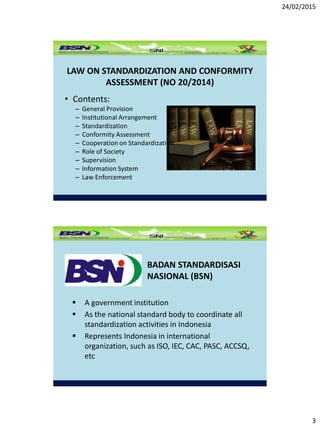
Standardization in Indonesia
Indonesian National Standard on Tempe
Codex Standard on Tempe
Challenges
24/02/2015
2
STANDARDIZATION IN INDONESIA
Competitiveness
• Development
• Implementation
• Scientific
• Industry
• Legal
• Accreditation
• Certification
• Testing
• Inspection
Legislation
Research and Development, Cooperation, Dissemination,
Supervision, Information, Education
Metrology Standardization
Conformity
Assessment
Institutional Framework
24/02/2015
3
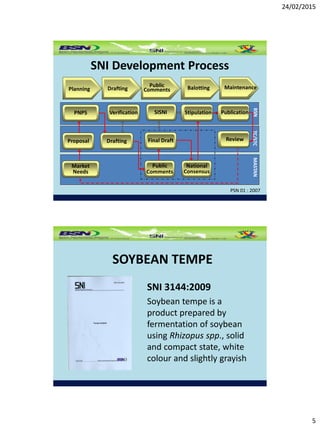
LAW ON STANDARDIZATION AND CONFORMITY
ASSESSMENT (NO 20/2014)
• Contents:
– General Provision
– Institutional Arrangement
– Standardization
– Conformity Assessment
– Cooperation on Standardization
– Role of Society
– Supervision
– Information System
– Law Enforcement
BADAN STANDARDISASI
NASIONAL (BSN)
 A government institution
 As the national standard body to coordinate all
standardization activities in Indonesia
 Represents Indonesia in international
organization, such as ISO, IEC, CAC, PASC, ACCSQ,
etc
24/02/2015
4
INDONESIAN NATIONAL STANDARD
(SNI) ON TEMPE
STANDAR NASIONAL INDONESIA (SNI)
 Total number 8354 (as
of January 2015)
 Developed by 105
Technical Committees
(TC) and 32 Sub
Technical Committees
(STC)
 273 SNIs adopted to be
technical regulation
www.bsn.go.id
24/02/2015
5
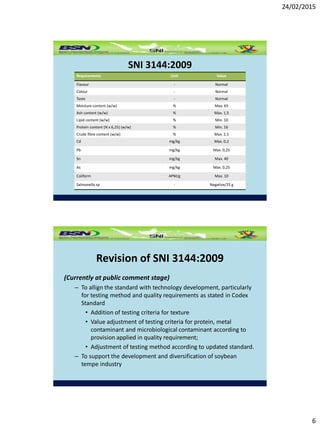
Planning Drafting
Public
Comments Balotting
PNPS
Proposal Drafting
Market
Needs
Verification
Public
Comments
National
Consensus
Final Draft
SISNI
Maintenance
BSNTC/STCMASTAN
Publication
Review
Stipulation
PSN 01 : 2007
SNI Development Process
SNI 3144:2009
Soybean tempe is a
product prepared by
fermentation of soybean
using Rhizopus spp., solid
and compact state, white
colour and slightly grayish
SOYBEAN TEMPE
24/02/2015
6
Requirements Unit Value
Flavour - Normal
Colour - Normal
Taste - Normal
Moisture content (w/w) % Max. 65
Ash content (w/w) % Max. 1,5
Lipid content (w/w) % Min. 10
Protein content (N x 6,25) (w/w) % Min. 16
Crude fibre content (w/w) % Max. 2,5
Cd mg/kg Max. 0,2
Pb mg/kg Max. 0,25
Sn mg/kg Max. 40
As mg/kg Max. 0,25
Coliform APM/g Max. 10
Salmonella sp - Negative/25 g
SNI 3144:2009
Revision of SNI 3144:2009
(Currently at public comment stage)
– To allign the standard with technology development, particularly
for testing method and quality requirements as stated in Codex
Standard
• Addition of testing criteria for texture
• Value adjustment of testing criteria for protein, metal
contaminant and microbiological contaminant according to
provision applied in quality requirement;
• Adjustment of testing method according to updated standard.
– To support the development and diversification of soybean
tempe industry
24/02/2015
7
CODEX STANDARD ON TEMPE
Codex Alimentarius Commission
• Intergovernmental organization
• Joint FAO/WHO since 1961/1963
• Secretariat: FAO Headquarter, Rome
• Membership of Codex is open to all member of United
Nations
• Codex members: 185 Countries, 1 Member Organization (EU)
• Codex members from Asia: 23 Countries
• Codex members from ASEAN: 10 Countries
• Indonesia has become Codex member since 1971
• Objective:
– To protect the health of consumers
– To ensure fair practice in the international food trade
24/02/2015
8
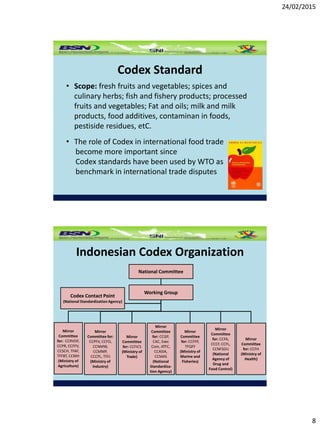
Codex Standard
• Scope: fresh fruits and vegetables; spices and
culinary herbs; fish and fishery products; processed
fruits and vegetables; Fat and oils; milk and milk
products, food additives, contaminan in foods,
pestiside residues, etC.
• The role of Codex in international food trade
become more important since
Codex standards have been used by WTO as
benchmark in international trade disputes
Working Group
Indonesian Codex Organization
National Committee
Codex Contact Point
(National Standardization Agency)
Mirror
Committee
for: CCRVDF,
CCPR, CCFFV,
CCSCH, TFAF,
TFFBT, CCMH
(Ministry of
Agriculture)
Mirror
Committee for:
CCPFV, CCFO,
CCNMW,
CCMMP,
CCCPL, TFFJ
(Ministry of
Industry)
Mirror
Committee
for: CCFICS
(Ministry of
Trade)
Mirror
Committee
for: CCGP,
CAC, Exec
Com, ATFC,
CCASIA,
CCMAS
(National
Standardiza-
tion Agency)
Mirror
Committee
for: CCFA,
CCCF, CCFL,
CCNFSDU
(National
Agency of
Drug and
Food Control)
Mirror
Committee
for: CCFFP,
TFQFF
(Ministry of
Marine and
Fisheries)
Mirror
Committee
for: CCFH
(Ministry of
Health)
24/02/2015
9
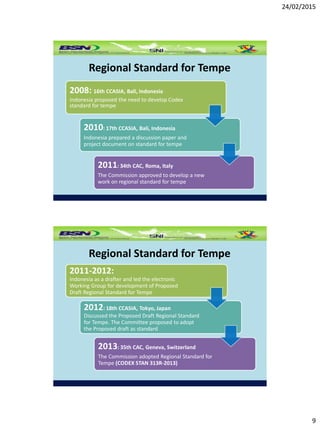
Regional Standard for Tempe
2008: 16th CCASIA, Bali, Indonesia
Indonesia proposed the need to develop Codex
standard for tempe
2010: 17th CCASIA, Bali, Indonesia
Indonesia prepared a discussion paper and
project document on standard for tempe
2011: 34th CAC, Roma, Italy
The Commission approved to develop a new
work on regional standard for tempe
2011-2012:
Indonesia as a drafter and led the electronic
Working Group for development of Proposed
Draft Regional Standard for Tempe
2012: 18th CCASIA, Tokyo, Japan
Discussed the Proposed Draft Regional Standard
for Tempe. The Committee proposed to adopt
the Proposed draft as standard
2013: 35th CAC, Geneva, Switzerland
The Commission adopted Regional Standard for
Tempe (CODEX STAN 313R-2013)
Regional Standard for Tempe
24/02/2015
10
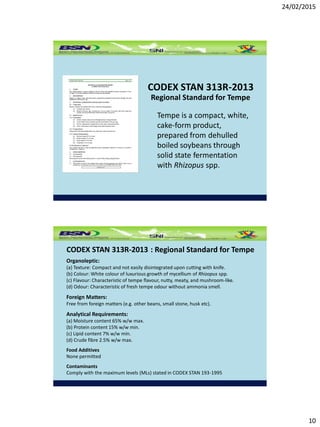
Tempe is a compact, white,
cake-form product,
prepared from dehulled
boiled soybeans through
solid state fermentation
with Rhizopus spp.
CODEX STAN 313R-2013
Regional Standard for Tempe
Organoleptic:
(a) Texture: Compact and not easily disintegrated upon cutting with knife.
(b) Colour: White colour of luxurious growth of mycellium of Rhizopus spp.
(c) Flavour: Characteristic of tempe flavour, nutty, meaty, and mushroom-like.
(d) Odour: Characteristic of fresh tempe odour without ammonia smell.
Foreign Matters:
Free from foreign matters (e.g. other beans, small stone, husk etc).
Analytical Requirements:
(a) Moisture content 65% w/w max.
(b) Protein content 15% w/w min.
(c) Lipid content 7% w/w min.
(d) Crude fibre 2.5% w/w max.
Food Additives
None permitted
Contaminants
Comply with the maximum levels (MLs) stated in CODEX STAN 193-1995
CODEX STAN 313R-2013 : Regional Standard for Tempe
24/02/2015
11
Benefit of Standard for Tempe as
Codex Standard
• To make tempe products as nutritious food
source and popular in international level
• As a source of protein for vegetarian, diets
and specific community group
• To promote Indonesia internationally as an
inventor of tempe which has become a
nutritious and preferred food at any level of
community
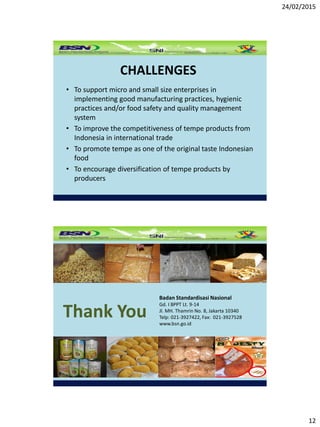
CHALLENGES
24/02/2015
12
• To support micro and small size enterprises in
implementing good manufacturing practices, hygienic
practices and/or food safety and quality management
system
• To improve the competitiveness of tempe products from
Indonesia in international trade
• To promote tempe as one of the original taste Indonesian
food
• To encourage diversification of tempe products by
producers
CHALLENGES
Thank You
Badan Standardisasi Nasional
Gd. I BPPT Lt. 9-14
Jl. MH. Thamrin No. 8, Jakarta 10340
Telp: 021-3927422, Fax: 021-3927528
www.bsn.go.id

Tempe and its development in Indonesia (standardization and report on national nutritional guidelines)

  • 1.
    24/02/2015 1 Tempe and itsdevelopment in Indonesia International Conference on Tempe and Its Related Products Yogyakarta, 15-17 Feb 2015 By: Kukuh S. Achmad Bambang Prasetya Anna Melianawati Badan Standardisasi Nasional (BSN) - Standardization perspective - Standardization in Indonesia Indonesian National Standard on Tempe Codex Standard on Tempe Challenges
  • 2.
    24/02/2015 2 STANDARDIZATION IN INDONESIA Competitiveness •Development • Implementation • Scientific • Industry • Legal • Accreditation • Certification • Testing • Inspection Legislation Research and Development, Cooperation, Dissemination, Supervision, Information, Education Metrology Standardization Conformity Assessment Institutional Framework
  • 3.
    24/02/2015 3 LAW ON STANDARDIZATIONAND CONFORMITY ASSESSMENT (NO 20/2014) • Contents: – General Provision – Institutional Arrangement – Standardization – Conformity Assessment – Cooperation on Standardization – Role of Society – Supervision – Information System – Law Enforcement BADAN STANDARDISASI NASIONAL (BSN)  A government institution  As the national standard body to coordinate all standardization activities in Indonesia  Represents Indonesia in international organization, such as ISO, IEC, CAC, PASC, ACCSQ, etc
  • 4.
    24/02/2015 4 INDONESIAN NATIONAL STANDARD (SNI)ON TEMPE STANDAR NASIONAL INDONESIA (SNI)  Total number 8354 (as of January 2015)  Developed by 105 Technical Committees (TC) and 32 Sub Technical Committees (STC)  273 SNIs adopted to be technical regulation www.bsn.go.id
  • 5.
    24/02/2015 5 Planning Drafting Public Comments Balotting PNPS ProposalDrafting Market Needs Verification Public Comments National Consensus Final Draft SISNI Maintenance BSNTC/STCMASTAN Publication Review Stipulation PSN 01 : 2007 SNI Development Process SNI 3144:2009 Soybean tempe is a product prepared by fermentation of soybean using Rhizopus spp., solid and compact state, white colour and slightly grayish SOYBEAN TEMPE
  • 6.
    24/02/2015 6 Requirements Unit Value Flavour- Normal Colour - Normal Taste - Normal Moisture content (w/w) % Max. 65 Ash content (w/w) % Max. 1,5 Lipid content (w/w) % Min. 10 Protein content (N x 6,25) (w/w) % Min. 16 Crude fibre content (w/w) % Max. 2,5 Cd mg/kg Max. 0,2 Pb mg/kg Max. 0,25 Sn mg/kg Max. 40 As mg/kg Max. 0,25 Coliform APM/g Max. 10 Salmonella sp - Negative/25 g SNI 3144:2009 Revision of SNI 3144:2009 (Currently at public comment stage) – To allign the standard with technology development, particularly for testing method and quality requirements as stated in Codex Standard • Addition of testing criteria for texture • Value adjustment of testing criteria for protein, metal contaminant and microbiological contaminant according to provision applied in quality requirement; • Adjustment of testing method according to updated standard. – To support the development and diversification of soybean tempe industry
  • 7.
    24/02/2015 7 CODEX STANDARD ONTEMPE Codex Alimentarius Commission • Intergovernmental organization • Joint FAO/WHO since 1961/1963 • Secretariat: FAO Headquarter, Rome • Membership of Codex is open to all member of United Nations • Codex members: 185 Countries, 1 Member Organization (EU) • Codex members from Asia: 23 Countries • Codex members from ASEAN: 10 Countries • Indonesia has become Codex member since 1971 • Objective: – To protect the health of consumers – To ensure fair practice in the international food trade
  • 8.
    24/02/2015 8 Codex Standard • Scope:fresh fruits and vegetables; spices and culinary herbs; fish and fishery products; processed fruits and vegetables; Fat and oils; milk and milk products, food additives, contaminan in foods, pestiside residues, etC. • The role of Codex in international food trade become more important since Codex standards have been used by WTO as benchmark in international trade disputes Working Group Indonesian Codex Organization National Committee Codex Contact Point (National Standardization Agency) Mirror Committee for: CCRVDF, CCPR, CCFFV, CCSCH, TFAF, TFFBT, CCMH (Ministry of Agriculture) Mirror Committee for: CCPFV, CCFO, CCNMW, CCMMP, CCCPL, TFFJ (Ministry of Industry) Mirror Committee for: CCFICS (Ministry of Trade) Mirror Committee for: CCGP, CAC, Exec Com, ATFC, CCASIA, CCMAS (National Standardiza- tion Agency) Mirror Committee for: CCFA, CCCF, CCFL, CCNFSDU (National Agency of Drug and Food Control) Mirror Committee for: CCFFP, TFQFF (Ministry of Marine and Fisheries) Mirror Committee for: CCFH (Ministry of Health)
  • 9.
    24/02/2015 9 Regional Standard forTempe 2008: 16th CCASIA, Bali, Indonesia Indonesia proposed the need to develop Codex standard for tempe 2010: 17th CCASIA, Bali, Indonesia Indonesia prepared a discussion paper and project document on standard for tempe 2011: 34th CAC, Roma, Italy The Commission approved to develop a new work on regional standard for tempe 2011-2012: Indonesia as a drafter and led the electronic Working Group for development of Proposed Draft Regional Standard for Tempe 2012: 18th CCASIA, Tokyo, Japan Discussed the Proposed Draft Regional Standard for Tempe. The Committee proposed to adopt the Proposed draft as standard 2013: 35th CAC, Geneva, Switzerland The Commission adopted Regional Standard for Tempe (CODEX STAN 313R-2013) Regional Standard for Tempe
  • 10.
    24/02/2015 10 Tempe is acompact, white, cake-form product, prepared from dehulled boiled soybeans through solid state fermentation with Rhizopus spp. CODEX STAN 313R-2013 Regional Standard for Tempe Organoleptic: (a) Texture: Compact and not easily disintegrated upon cutting with knife. (b) Colour: White colour of luxurious growth of mycellium of Rhizopus spp. (c) Flavour: Characteristic of tempe flavour, nutty, meaty, and mushroom-like. (d) Odour: Characteristic of fresh tempe odour without ammonia smell. Foreign Matters: Free from foreign matters (e.g. other beans, small stone, husk etc). Analytical Requirements: (a) Moisture content 65% w/w max. (b) Protein content 15% w/w min. (c) Lipid content 7% w/w min. (d) Crude fibre 2.5% w/w max. Food Additives None permitted Contaminants Comply with the maximum levels (MLs) stated in CODEX STAN 193-1995 CODEX STAN 313R-2013 : Regional Standard for Tempe
  • 11.
    24/02/2015 11 Benefit of Standardfor Tempe as Codex Standard • To make tempe products as nutritious food source and popular in international level • As a source of protein for vegetarian, diets and specific community group • To promote Indonesia internationally as an inventor of tempe which has become a nutritious and preferred food at any level of community CHALLENGES
  • 12.
    24/02/2015 12 • To supportmicro and small size enterprises in implementing good manufacturing practices, hygienic practices and/or food safety and quality management system • To improve the competitiveness of tempe products from Indonesia in international trade • To promote tempe as one of the original taste Indonesian food • To encourage diversification of tempe products by producers CHALLENGES Thank You Badan Standardisasi Nasional Gd. I BPPT Lt. 9-14 Jl. MH. Thamrin No. 8, Jakarta 10340 Telp: 021-3927422, Fax: 021-3927528 www.bsn.go.id