Pattern-driven Reuse in Architecture-centric
            Welcome
      Evolution for Service Software
        Aakash Ahmad, Pooyan Jamshidi and Claus Pahl
   Presentation Title
      [ahmad.aakash|pooyan.jamshidi|claus.pahl]@computing.dcu.ie


              Software and System Engineering group
           http://www.computing.dcu.ie/~cpahl/sse-group.htm
           School of Computing, Dublin City University, Ireland


                                            THE IRISH SOFTWARE ENGINEERING RESEARCH CENTRE
Agenda
        - Evolution in Service-driven Architectures

        - Related Research - Patterns and Evolution

        - Change Pattern to guide Architecture Evolution

        - Architecture Evolution-case for EBPP

        - Pattern-based Architecture Evolution

        - Experimental Analysis & Evaluation

        - Conclusions & Outlook

                                                                                                  2
LERO© 2010                                       THE IRISH SOFTWARE ENGINEERING RESEARCH CENTRE
Evolution in Service-driven Architectures
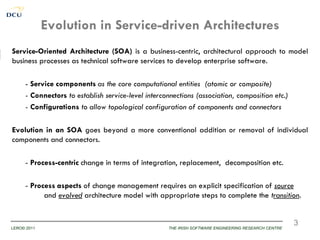
Service-Oriented Architecture (SOA) is a business-centric, architectural approach to model
business processes as technical software services to develop enterprise software.

     - Service components as the core computational entities (atomic or composite)
     - Connectors to establish service-level interconnections (association, composition etc.)
     - Configurations to allow topological configuration of components and connectors

Evolution in an SOA goes beyond a more conventional addition or removal of individual
components and connectors.

     - Process-centric change in terms of integration, replacement, decomposition etc.

     - Process aspects of change management requires an explicit specification of source
           and evolved architecture model with appropriate steps to complete the transition.


                                                                                                     3
LERO© 2011                                          THE IRISH SOFTWARE ENGINEERING RESEARCH CENTRE
The needs for Reuse in Service Architecture Evolution
A continuous change in business and technical requirements lead towards frequent
maintenance and evolution cycles in service software.


     …community wide efforts are required to develop processes, framework and
     patterns etc., to enable systematic maintenance an explicit evolution for SOAs …
     [MESOA 07, 08, 09, 10]


                                                                                                    4
LERO© 2011                                         THE IRISH SOFTWARE ENGINEERING RESEARCH CENTRE
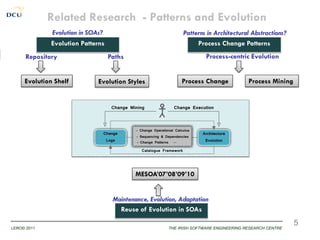
Related Research - Patterns and Evolution
              Evolution in SOAs?                             Patterns in Architectural Abstractions?
              Evolution1Patterns                                  Process Change Patterns
      Repository                   Paths                              Process-centric Evolution


     Evolution Shelf          Evolution Styles              Process Change             Process Mining


                                            MESOA’07’08’09’10


                                    Maintenance, Evolution, Adaptation
                                      Reuse of Evolution in SOAs
                                                                                                        5
LERO© 2011                                             THE IRISH SOFTWARE ENGINEERING RESEARCH CENTRE
Change Patterns to guide Architecture Evolution
Central Hypothesis: The application of change patterns to architectural transformation supports potential
   reuse in architecture-centric software evolution.


  Pattern Identification – recurring sequences from Architecture Change Logs [IWSSA’12]
  Pattern Specification – once-off formal specification in Pattern Catalogue [SHARK’12]
  Pattern Instantiation – multiple instantiations to support pattern-based reuse in evolution.

                 Pattern-based Evolution                                    Benefits for Pattern-based Reuse


                                                                                                           6
 LERO© 2011                                               THE IRISH SOFTWARE ENGINEERING RESEARCH CENTRE
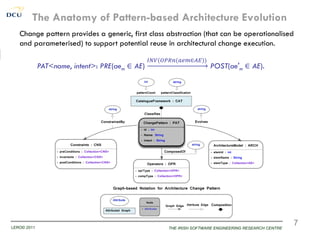
The Anatomy of Pattern-based Architecture Evolution
   Change pattern provides a generic, first class abstraction (that can be operationalised
   and parameterised) to support potential reuse in architectural change execution.

                                                𝐼𝑁𝑉(𝑂𝑃𝑅𝑛(𝑎𝑒𝑚∈𝐴𝐸))
             PAT<name, intent>: PRE(aem ∈ AE)                        POST(ae′m ∈ AE).


LERO© 2011
                                                                                                      7
                                                     THE IRISH SOFTWARE ENGINEERING RESEARCH CENTRE
Graph-based Change Pattern Notation
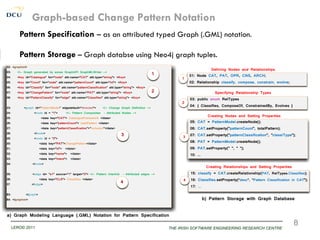
   Pattern Specification – as an attributed typed Graph (.GML) notation.

   Pattern Storage – Graph databse using Neo4j graph tuples.


LERO© 2011
                                                                                                8
                                               THE IRISH SOFTWARE ENGINEERING RESEARCH CENTRE
Architecture Evolution Case for EBPP
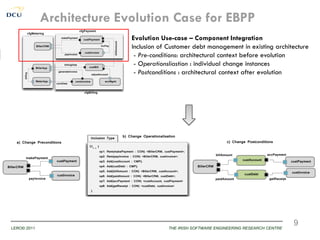
                            Evolution Use-case – Component Integration
                            Inclusion of Customer debt management in existing architecture
                             - Pre-conditions: architectural context before evolution
                             - Operationsliastion : individual change instances
                             - Postconditions : architectural context after evolution


                                                                                         9
LERO© 2011                              THE IRISH SOFTWARE ENGINEERING RESEARCH CENTRE
Pattern-based Architecture Evolution
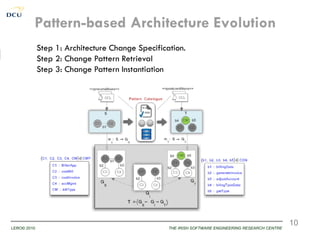
             Step 1: Architecture Change Specification.
             Step 2: Change Pattern Retrieval
             Step 3: Change Pattern Instantiation


                                                                                                   10
LERO© 2010                                        THE IRISH SOFTWARE ENGINEERING RESEARCH CENTRE
Step 1: Change Specification
  A declarative specification allows syntactical context of architectural change:
      i) Source Architecture Model (GS)
     ii) Architectural Constraints as pre- and post-conditions (PRE, POST ∈ [CNS])
    iii) Architecture Elements (AE) that need to evolved such that AE ∈ GS.

                Context Constraints: Gs inv, pre, post -- Constraints specification on architecture model

                -- Invarinats for structural integrity of component and connector

                 inv: Constraints.INV -> forAll(Component.hasPORT >= 1)


                -- Preconditions to specify existence of architecture elements before evolution

                  pre: Constraints.PRE -> exists(Component = ‘BillerApp’)

                 pre: Constraints.PRE -> exists(Connector(BillerApp, custBill) | Connector = ‘billingData’)


                -- Post to specify existence of architecture elements after evolution

                 post: Constraints.POST-> exists(Component = ‘BillerApp’)

                  post: Constraints.POST -> exists(Component = ‘custBill’)

                  post: Constraints.POST -> exists(Connector(billType, custBill) | Connector = ‘getType’)


                              OCL-based Constraints Specification on Architecture Models

                                                                                                                                         11
LERO© 2010                                                                              THE IRISH SOFTWARE ENGINEERING RESEARCH CENTRE
Step 2: Change Pattern Retrieval
                                   (Root) <relatesTo> [Nodes] :
(ChangePattern) <isComposedOf, ConstrainedBy, Evolves> [Operators | Constraints | ArchitectureModel]


 Query - Which change pattern(s) allow integration of a mediator component among two directly connected
 components?
                  01: START pattern = node(ChangePattern)

                  02: MATCH (pattern) – [:ConstrainedBy] - > (Constraints)

                  03:                   – [:Composedof] - > (Operators)

                  04: WHERE Operators IS NOT Null

                  05: RETURN ChangPattern.name, ChangePattern.intent, Operators.operatorType


                 Listing: Cypher Query to Retrieve Pattern Name, Intent and Operationalisation


        START - command to set the primary node(s),
        MATCH - based on user-specified change constraints respectively.
        WHERE - allows for additional conditional checking, while
        RETURN - provides the gathered results.

                                                                                                                   12
LERO© 2010                                                        THE IRISH SOFTWARE ENGINEERING RESEARCH CENTRE
Step 3: Change Pattern Instantiation

                                                                                               
                                                                                                     
                                    
                                                                                             


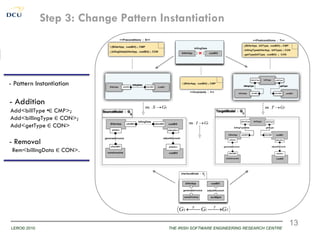
- Pattern Instantiation                                            


- Addition                         ms : S  GS                                          mt : T  GT
              ∈
Add<billType • CMP>;
Add<billingType ∈ CON>;
                                                          mI : I  GI
Add<getType ∈ CON>

- Removal
 Rem<billingData ∈ CON>.


                                                     GS S GI T GT
                                                            

                                                                                                          13
LERO© 2010                                       THE IRISH SOFTWARE ENGINEERING RESEARCH CENTRE
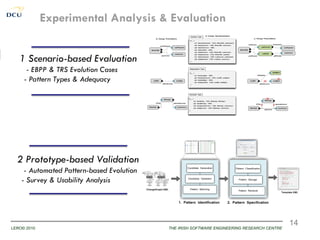
Experimental Analysis & Evaluation


   1 Scenario-based Evaluation
      - EBPP & TRS Evolution Cases
     - Pattern Types & Adequacy


  2 Prototype-based Validation
     - Automated Pattern-based Evolution
    - Survey & Usability Analysis


                                                                                            14
LERO© 2010                                 THE IRISH SOFTWARE ENGINEERING RESEARCH CENTRE
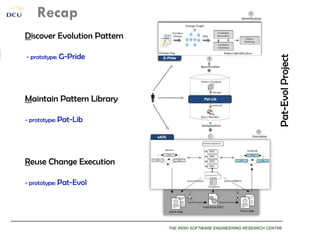
Recap
Discover Evolution Pattern

- prototype: G-Pride


                                                                         Pat-Evol Project
Maintain Pattern Library

- prototype: Pat-Lib


Reuse Change Execution

- prototype: Pat-Evol


                             THE IRISH SOFTWARE ENGINEERING RESEARCH CENTRE
Thank you for your attention.


                                                                                 16
LERO© 2011                      THE IRISH SOFTWARE ENGINEERING RESEARCH CENTRE

Pattern-based Evolution

  • 1.
    Pattern-driven Reuse inArchitecture-centric Welcome Evolution for Service Software Aakash Ahmad, Pooyan Jamshidi and Claus Pahl Presentation Title [ahmad.aakash|pooyan.jamshidi|claus.pahl]@computing.dcu.ie Software and System Engineering group http://www.computing.dcu.ie/~cpahl/sse-group.htm School of Computing, Dublin City University, Ireland THE IRISH SOFTWARE ENGINEERING RESEARCH CENTRE
  • 2.
    Agenda - Evolution in Service-driven Architectures - Related Research - Patterns and Evolution - Change Pattern to guide Architecture Evolution - Architecture Evolution-case for EBPP - Pattern-based Architecture Evolution - Experimental Analysis & Evaluation - Conclusions & Outlook 2 LERO© 2010 THE IRISH SOFTWARE ENGINEERING RESEARCH CENTRE
  • 3.
    Evolution in Service-drivenArchitectures Service-Oriented Architecture (SOA) is a business-centric, architectural approach to model business processes as technical software services to develop enterprise software. - Service components as the core computational entities (atomic or composite) - Connectors to establish service-level interconnections (association, composition etc.) - Configurations to allow topological configuration of components and connectors Evolution in an SOA goes beyond a more conventional addition or removal of individual components and connectors. - Process-centric change in terms of integration, replacement, decomposition etc. - Process aspects of change management requires an explicit specification of source and evolved architecture model with appropriate steps to complete the transition. 3 LERO© 2011 THE IRISH SOFTWARE ENGINEERING RESEARCH CENTRE
  • 4.
    The needs forReuse in Service Architecture Evolution A continuous change in business and technical requirements lead towards frequent maintenance and evolution cycles in service software. …community wide efforts are required to develop processes, framework and patterns etc., to enable systematic maintenance an explicit evolution for SOAs … [MESOA 07, 08, 09, 10] 4 LERO© 2011 THE IRISH SOFTWARE ENGINEERING RESEARCH CENTRE
  • 5.
    Related Research -Patterns and Evolution Evolution in SOAs? Patterns in Architectural Abstractions? Evolution1Patterns Process Change Patterns Repository Paths Process-centric Evolution Evolution Shelf Evolution Styles Process Change Process Mining MESOA’07’08’09’10 Maintenance, Evolution, Adaptation Reuse of Evolution in SOAs 5 LERO© 2011 THE IRISH SOFTWARE ENGINEERING RESEARCH CENTRE
  • 6.
    Change Patterns toguide Architecture Evolution Central Hypothesis: The application of change patterns to architectural transformation supports potential reuse in architecture-centric software evolution. Pattern Identification – recurring sequences from Architecture Change Logs [IWSSA’12] Pattern Specification – once-off formal specification in Pattern Catalogue [SHARK’12] Pattern Instantiation – multiple instantiations to support pattern-based reuse in evolution. Pattern-based Evolution Benefits for Pattern-based Reuse 6 LERO© 2011 THE IRISH SOFTWARE ENGINEERING RESEARCH CENTRE
  • 7.
    The Anatomy ofPattern-based Architecture Evolution Change pattern provides a generic, first class abstraction (that can be operationalised and parameterised) to support potential reuse in architectural change execution. 𝐼𝑁𝑉(𝑂𝑃𝑅𝑛(𝑎𝑒𝑚∈𝐴𝐸)) PAT<name, intent>: PRE(aem ∈ AE) POST(ae′m ∈ AE). LERO© 2011 7 THE IRISH SOFTWARE ENGINEERING RESEARCH CENTRE
  • 8.
    Graph-based Change PatternNotation Pattern Specification – as an attributed typed Graph (.GML) notation. Pattern Storage – Graph databse using Neo4j graph tuples. LERO© 2011 8 THE IRISH SOFTWARE ENGINEERING RESEARCH CENTRE
  • 9.
    Architecture Evolution Casefor EBPP Evolution Use-case – Component Integration Inclusion of Customer debt management in existing architecture - Pre-conditions: architectural context before evolution - Operationsliastion : individual change instances - Postconditions : architectural context after evolution 9 LERO© 2011 THE IRISH SOFTWARE ENGINEERING RESEARCH CENTRE
  • 10.
    Pattern-based Architecture Evolution Step 1: Architecture Change Specification. Step 2: Change Pattern Retrieval Step 3: Change Pattern Instantiation 10 LERO© 2010 THE IRISH SOFTWARE ENGINEERING RESEARCH CENTRE
  • 11.
    Step 1: ChangeSpecification A declarative specification allows syntactical context of architectural change: i) Source Architecture Model (GS) ii) Architectural Constraints as pre- and post-conditions (PRE, POST ∈ [CNS]) iii) Architecture Elements (AE) that need to evolved such that AE ∈ GS. Context Constraints: Gs inv, pre, post -- Constraints specification on architecture model -- Invarinats for structural integrity of component and connector inv: Constraints.INV -> forAll(Component.hasPORT >= 1) -- Preconditions to specify existence of architecture elements before evolution pre: Constraints.PRE -> exists(Component = ‘BillerApp’) pre: Constraints.PRE -> exists(Connector(BillerApp, custBill) | Connector = ‘billingData’) -- Post to specify existence of architecture elements after evolution post: Constraints.POST-> exists(Component = ‘BillerApp’) post: Constraints.POST -> exists(Component = ‘custBill’) post: Constraints.POST -> exists(Connector(billType, custBill) | Connector = ‘getType’) OCL-based Constraints Specification on Architecture Models 11 LERO© 2010 THE IRISH SOFTWARE ENGINEERING RESEARCH CENTRE
  • 12.
    Step 2: ChangePattern Retrieval (Root) <relatesTo> [Nodes] : (ChangePattern) <isComposedOf, ConstrainedBy, Evolves> [Operators | Constraints | ArchitectureModel] Query - Which change pattern(s) allow integration of a mediator component among two directly connected components? 01: START pattern = node(ChangePattern) 02: MATCH (pattern) – [:ConstrainedBy] - > (Constraints) 03: – [:Composedof] - > (Operators) 04: WHERE Operators IS NOT Null 05: RETURN ChangPattern.name, ChangePattern.intent, Operators.operatorType Listing: Cypher Query to Retrieve Pattern Name, Intent and Operationalisation START - command to set the primary node(s), MATCH - based on user-specified change constraints respectively. WHERE - allows for additional conditional checking, while RETURN - provides the gathered results. 12 LERO© 2010 THE IRISH SOFTWARE ENGINEERING RESEARCH CENTRE
  • 13.
    Step 3: ChangePattern Instantiation           - Pattern Instantiation   - Addition ms : S  GS mt : T  GT ∈ Add<billType • CMP>; Add<billingType ∈ CON>; mI : I  GI Add<getType ∈ CON> - Removal Rem<billingData ∈ CON>. GS S GI T GT   13 LERO© 2010 THE IRISH SOFTWARE ENGINEERING RESEARCH CENTRE
  • 14.
    Experimental Analysis &Evaluation 1 Scenario-based Evaluation - EBPP & TRS Evolution Cases - Pattern Types & Adequacy 2 Prototype-based Validation - Automated Pattern-based Evolution - Survey & Usability Analysis 14 LERO© 2010 THE IRISH SOFTWARE ENGINEERING RESEARCH CENTRE
  • 15.
    Recap Discover Evolution Pattern -prototype: G-Pride Pat-Evol Project Maintain Pattern Library - prototype: Pat-Lib Reuse Change Execution - prototype: Pat-Evol THE IRISH SOFTWARE ENGINEERING RESEARCH CENTRE
  • 16.
    Thank you foryour attention. 16 LERO© 2011 THE IRISH SOFTWARE ENGINEERING RESEARCH CENTRE