International Baccalaureate Diploma
Programme
Grade 11/12 pre-university course
information session
Contents:
1. EIS and IB mission statements;
2. EIS/IB current status;
2. Learner profile;
3. What is the IB Diploma Programme?
4. Diploma Programme curriculum;
5. Subjects;
6. Curriculum contents;
7. Assessment;
8. University recognition;
9. IB philosophy;
Mission
Edubridge International School will furnish for its students a world
class education and holistic development which will inculcate in them:
●
●
●
●
●

A global perspective with a social conscience
A sense of fulfilling individual dreams
Responsible thought and action
An awareness of diversity and appreciation for multiculturalism
A goal to make significant contributions to the global society.

Aims
Edubridge International School aims to set unparalleled standards of
excellence within the learning environment by providing challenging
opportunities for its students. Each student will be able to share the
experience of tremendous intellectual, emotional, spiritual and physical
growth.
IB Mission Statement:

The International Baccalaureate aims to develop inquiring, knowledgeable and caring
young people who help to create a better and more peaceful world through
intercultural understanding and respect.
To this end the organization works with schools, governments and international
organizations to develop challenging programmes of international education and
rigorous assessment.
These programmes encourage students across the world to become active,
compassionate and lifelong learners who understand that other people, with their
differences, can also be right.
Our Status as an IB School:
Edubridge International School is a Candidate School for the IB
Diploma Programme (DP), the Primary Years Programme (PYP)
and the Middle Years Programme (MYP). We are pursuing
authorization as an IB World School. These are schools that
share a common philosophy—a commitment to high quality,
challenging, international education that Edubridge International
School believes is important for our students. Only schools
authorized by the IB Organization can offer any of its three
academic programmes: the Primary Years Programme (PYP), the
Middle Years Programme (MYP), or the Diploma Programme
(and in addition the IB Career-related Certificate). Candidate
status gives no guarantee that authorization will be granted. For
further information about the IB and its programmes, visit http:
//www.ibo.org.
Our Status as an IB School:
The IB has a rigorous process to assure the quality of
IB World Schools. As part of the process of becoming
an authorized IB World School, we must go through a
consultancy phase and an authorization visit.
EIS has already had a favorable “consultancy phase”
visit from the IB [Sept. 2013] and an affirmative report
[Oct.2013]. We are now awaiting our IB Diploma
authorization visit in late January 2014. We have also
been accepted as a candidate school for the IB MYP
and the IB PYP [Jan 2014].
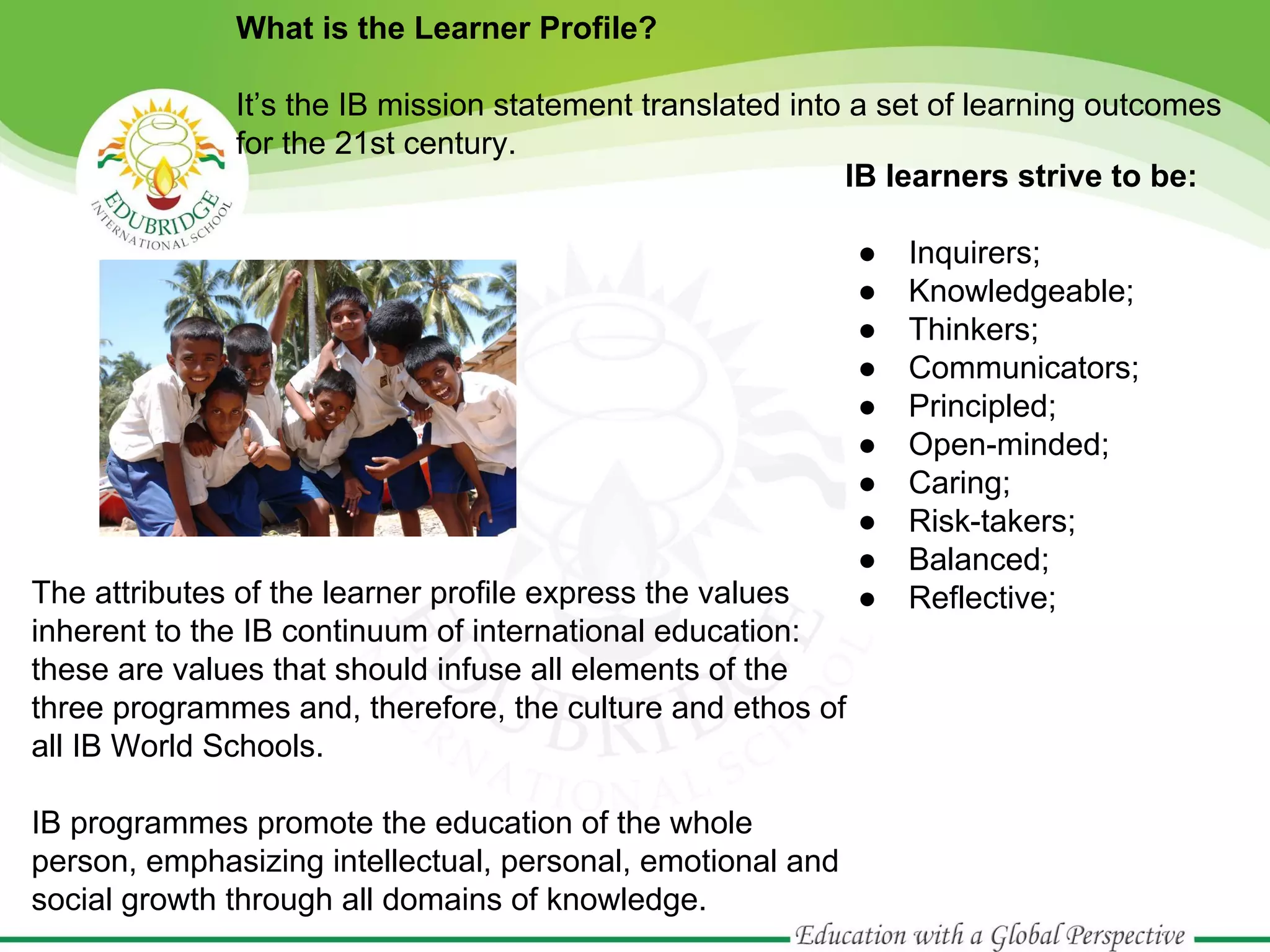
What is the Learner Profile?
It’s the IB mission statement translated into a set of learning outcomes
for the 21st century.
IB learners strive to be:

The attributes of the learner profile express the values
inherent to the IB continuum of international education:
these are values that should infuse all elements of the
three programmes and, therefore, the culture and ethos of
all IB World Schools.
IB programmes promote the education of the whole
person, emphasizing intellectual, personal, emotional and
social growth through all domains of knowledge.

●
●
●
●
●
●
●
●
●
●

Inquirers;
Knowledgeable;
Thinkers;
Communicators;
Principled;
Open-minded;
Caring;
Risk-takers;
Balanced;
Reflective;
What is the IB Diploma Programme?
The three IB programmes [PYP, MYP, IB Diploma], each contain four
core elements … see below

1. Curriculum

2. Student assessment

3. Professional development

4. School evaluation

The IB Diploma Programme is designed as an academically
challenging and balanced programme of education with final
examinations that prepares students, normally aged 16 – 19, for
success at university and life beyond.
Contents: What does the Diploma Programme
curriculum contain?
The curriculum contains six subject groups and a core of
three parts.
Students study
concurrently, over 2 years:
●

●

●

Three subjects at
higher level
(240 hours each);
Three subjects at
standard level
(150 hours each);
All three parts of the
core [TOK, CAS, EE];

The IB Learner Profile and
the core are central to the
philosophy of the Diploma
Programme.
EIS Subjects offered August 2014 (pending authorization):
●
●

●

●

●
●

Group 1: Studies in Language and Literature [English HL/SL];
Group 2: Language Acquisition;
○ Spanish ab initio [SL only];
○ Hindi [HL/SL];
Group 3: Individuals and Societies:
○ Business and Management [HL/SL];
○ Economics [HL/SL];
○ Environmental Systems and Societies [only SL and is both Group 3 and 4]
Group 4: Experimental Sciences:
○ Biology [HL/SL];
○ Physics [HL/SL];
○ Chemistry [HL]/SL];
Group 5: Mathematics and Computer Sciences; [Mathematics HL/SL];
Group 6: The Arts;
○ Visual Arts [HL/SL];
Core Elements of the IB Diploma
The extended essay:
●

4,000 words;

●

Offers the
opportunity to
investigate a
research question of
individual interest,
within a student’s
chosen subject;

●

Familiarises students
with the independent
research and writing
skills expected at
university;
Theory of Knowlege
Theory of knowledge [TOK] is:

●

Interdisciplinary;

●

Has a component of class contact plus treated within each of the
subject groups;

●

Explores the nature of knowledge across disciplines;

●

Encouraging an appreciation of other cultural perspectives;
Creativity, activity and service
(CAS):
●

Encourages students to be involved
in artistic pursuits, sports and
community service;

●

Education outside the classroom;

●

Development of the learner profile;

●

Students must undertake CAS
outside of their timetabled classes,
sometimes inside, but sometimes
outside the school, but always
under adult supervision;
Assessment
What is special about IB assessment?
IB assessment is rigorous, criterion related, consistent and differentiating
of student ability.
Diploma Programme assessment
includes both final examinations
[May, 2nd year] and internal
assessment [throughout the 2 year
course] undertaken by the teacher
and assessed according to set IB
criteria and then externally
moderated by the IB;
All 4,000 examiners are ‘quality
checked’ through a process of
moderation;
The IB undertakes random
inspections of schools during
exams;
Results are published on 5 July;
University recognition
Life after graduation:
●

The IB works closely with universities in all regions of the world to
gain recognition for the IB diploma:

●

Direct online access for university admissions officers and government
officials to syllabuses and recent examination papers;
○
○
○
○

●

A database of university admission policies on www.ibo.org;
Recognition in over 100 countries;
Recognition by over 2,000 universities;
Some universities offer scholarships and advanced placement for IB
students;

Students applying to a particular university can access their grades
directly from the IB’s secure web site.
Thank you!
All information in this presentation has been
taken, with permission from the IBO website
http://www.ibo.org
Please refer to the IBO website for further
information regarding the IB Primary Years
Programme, Middle Years Programme and
IB Diploma Programme.

IB Diploma Information Session at EIS

  • 1.
    International Baccalaureate Diploma Programme Grade11/12 pre-university course information session
  • 2.
    Contents: 1. EIS andIB mission statements; 2. EIS/IB current status; 2. Learner profile; 3. What is the IB Diploma Programme? 4. Diploma Programme curriculum; 5. Subjects; 6. Curriculum contents; 7. Assessment; 8. University recognition; 9. IB philosophy;
  • 3.
    Mission Edubridge International Schoolwill furnish for its students a world class education and holistic development which will inculcate in them: ● ● ● ● ● A global perspective with a social conscience A sense of fulfilling individual dreams Responsible thought and action An awareness of diversity and appreciation for multiculturalism A goal to make significant contributions to the global society. Aims Edubridge International School aims to set unparalleled standards of excellence within the learning environment by providing challenging opportunities for its students. Each student will be able to share the experience of tremendous intellectual, emotional, spiritual and physical growth.
  • 4.
    IB Mission Statement: TheInternational Baccalaureate aims to develop inquiring, knowledgeable and caring young people who help to create a better and more peaceful world through intercultural understanding and respect. To this end the organization works with schools, governments and international organizations to develop challenging programmes of international education and rigorous assessment. These programmes encourage students across the world to become active, compassionate and lifelong learners who understand that other people, with their differences, can also be right.
  • 5.
    Our Status asan IB School: Edubridge International School is a Candidate School for the IB Diploma Programme (DP), the Primary Years Programme (PYP) and the Middle Years Programme (MYP). We are pursuing authorization as an IB World School. These are schools that share a common philosophy—a commitment to high quality, challenging, international education that Edubridge International School believes is important for our students. Only schools authorized by the IB Organization can offer any of its three academic programmes: the Primary Years Programme (PYP), the Middle Years Programme (MYP), or the Diploma Programme (and in addition the IB Career-related Certificate). Candidate status gives no guarantee that authorization will be granted. For further information about the IB and its programmes, visit http: //www.ibo.org.
  • 6.
    Our Status asan IB School: The IB has a rigorous process to assure the quality of IB World Schools. As part of the process of becoming an authorized IB World School, we must go through a consultancy phase and an authorization visit. EIS has already had a favorable “consultancy phase” visit from the IB [Sept. 2013] and an affirmative report [Oct.2013]. We are now awaiting our IB Diploma authorization visit in late January 2014. We have also been accepted as a candidate school for the IB MYP and the IB PYP [Jan 2014].
  • 7.
    What is theLearner Profile? It’s the IB mission statement translated into a set of learning outcomes for the 21st century. IB learners strive to be: The attributes of the learner profile express the values inherent to the IB continuum of international education: these are values that should infuse all elements of the three programmes and, therefore, the culture and ethos of all IB World Schools. IB programmes promote the education of the whole person, emphasizing intellectual, personal, emotional and social growth through all domains of knowledge. ● ● ● ● ● ● ● ● ● ● Inquirers; Knowledgeable; Thinkers; Communicators; Principled; Open-minded; Caring; Risk-takers; Balanced; Reflective;
  • 8.
    What is theIB Diploma Programme? The three IB programmes [PYP, MYP, IB Diploma], each contain four core elements … see below 1. Curriculum 2. Student assessment 3. Professional development 4. School evaluation The IB Diploma Programme is designed as an academically challenging and balanced programme of education with final examinations that prepares students, normally aged 16 – 19, for success at university and life beyond.
  • 9.
    Contents: What doesthe Diploma Programme curriculum contain? The curriculum contains six subject groups and a core of three parts. Students study concurrently, over 2 years: ● ● ● Three subjects at higher level (240 hours each); Three subjects at standard level (150 hours each); All three parts of the core [TOK, CAS, EE]; The IB Learner Profile and the core are central to the philosophy of the Diploma Programme.
  • 10.
    EIS Subjects offeredAugust 2014 (pending authorization): ● ● ● ● ● ● Group 1: Studies in Language and Literature [English HL/SL]; Group 2: Language Acquisition; ○ Spanish ab initio [SL only]; ○ Hindi [HL/SL]; Group 3: Individuals and Societies: ○ Business and Management [HL/SL]; ○ Economics [HL/SL]; ○ Environmental Systems and Societies [only SL and is both Group 3 and 4] Group 4: Experimental Sciences: ○ Biology [HL/SL]; ○ Physics [HL/SL]; ○ Chemistry [HL]/SL]; Group 5: Mathematics and Computer Sciences; [Mathematics HL/SL]; Group 6: The Arts; ○ Visual Arts [HL/SL];
  • 11.
    Core Elements ofthe IB Diploma The extended essay: ● 4,000 words; ● Offers the opportunity to investigate a research question of individual interest, within a student’s chosen subject; ● Familiarises students with the independent research and writing skills expected at university;
  • 12.
    Theory of Knowlege Theoryof knowledge [TOK] is: ● Interdisciplinary; ● Has a component of class contact plus treated within each of the subject groups; ● Explores the nature of knowledge across disciplines; ● Encouraging an appreciation of other cultural perspectives;
  • 13.
    Creativity, activity andservice (CAS): ● Encourages students to be involved in artistic pursuits, sports and community service; ● Education outside the classroom; ● Development of the learner profile; ● Students must undertake CAS outside of their timetabled classes, sometimes inside, but sometimes outside the school, but always under adult supervision;
  • 14.
    Assessment What is specialabout IB assessment? IB assessment is rigorous, criterion related, consistent and differentiating of student ability. Diploma Programme assessment includes both final examinations [May, 2nd year] and internal assessment [throughout the 2 year course] undertaken by the teacher and assessed according to set IB criteria and then externally moderated by the IB; All 4,000 examiners are ‘quality checked’ through a process of moderation; The IB undertakes random inspections of schools during exams; Results are published on 5 July;
  • 15.
    University recognition Life aftergraduation: ● The IB works closely with universities in all regions of the world to gain recognition for the IB diploma: ● Direct online access for university admissions officers and government officials to syllabuses and recent examination papers; ○ ○ ○ ○ ● A database of university admission policies on www.ibo.org; Recognition in over 100 countries; Recognition by over 2,000 universities; Some universities offer scholarships and advanced placement for IB students; Students applying to a particular university can access their grades directly from the IB’s secure web site.
  • 16.
    Thank you! All informationin this presentation has been taken, with permission from the IBO website http://www.ibo.org Please refer to the IBO website for further information regarding the IB Primary Years Programme, Middle Years Programme and IB Diploma Programme.