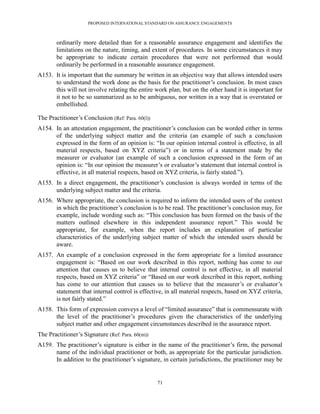
International
                                                                 Exposure Draft
Auditing                                                           April 2011
and Assurance                          Comments requested by September 1, 2011
Standards Board


                  Proposed International Standard on Assurance
                  Engagements (ISAE)

                  ISAE 3000 (Revised), Assurance
                  Engagements Other Than Audits or
                  Reviews of Historical Financial
                  Information
                  Proposed Consequential Amendments

                  International Framework for
                  Assurance Engagements
                  ISAE 3402, Assurance Reports on
                  Controls at a Service Organization
                  Exposure Draft of Proposed ISAE
                  3410, Assurance Engagements on
                  Greenhouse Gas Statements
REQUEST FOR COMMENTS
The International Auditing and Assurance Standards Board (IAASB) approved this exposure
draft, proposed International Standard on Assurance Engagements (ISAE) 3000 (Revised),
Assurance Engagements Other Than Audits or Reviews of Historical Financial Information, for
publication in April 2011. This proposed ISAE may be modified in light of comments received
before being issued in final form.
Respondents are asked to submit their comments electronically through the IAASB website
(www.iaasb.org), using the ―Submit a Comment‖ link on the Exposure Drafts and Consultation
Papers page. Please note that first-time users must register to use this feature. All comments will
be considered a matter of public record and will ultimately be posted on the IAASB website.
Comments can also be faxed to the attention of the IAASB Technical Director at +1 (212) 856-
9420, or mailed to:
                                       Technical Director
                     International Auditing and Assurance Standards Board
                                   545 Fifth Avenue, 14th Floor
                               New York, New York 10017 USA

Comments should be submitted by September 1, 2011.
Copies of this exposure draft may be downloaded free of charge from the IAASB website at
www.iaasb.org.
The IAASB develops auditing and assurance standards and guidance for use by all professional
accountants under a shared standard-setting process involving the Public Interest Oversight
Board, which oversees the activities of the IAASB, and the IAASB Consultative Advisory
Group, which provides public interest input into the development of the standards and guidance.
The objective of the IAASB is to serve the public interest by setting high-quality auditing and
assurance standards and by facilitating the convergence of international and national standards,
thereby enhancing the quality and uniformity of practice throughout the world and strengthening
public confidence in the global auditing and assurance profession.
The structures and processes that support the operations of the IAASB are facilitated by IFAC.
The mission of IFAC is to serve the public interest, strengthen the worldwide accountancy
profession and contribute to the development of strong international economies by establishing
and promoting adherence to high quality professional standards, furthering the international
convergence of such standards and speaking out on public interest issues where the profession’s
expertise is most relevant.
Copyright © April 2011 by the International Federation of Accountants (IFAC). All rights
reserved. Permission is granted to make copies of this work to achieve maximum exposure and
feedback provided that each copy bears the following credit line: ―Copyright © April 2011 by the
International Federation of Accountants (IFAC). All rights reserved. Used with permission of
IFAC. Permission is granted to make copies of this work to achieve maximum exposure and
feedback.‖


                                                2
CONTENT

                                                                                                                             Page
Explanatory Memorandum
   Introduction ..........................................................................................................     4
   Background ..........................................................................................................       4
   Significant Matters ...............................................................................................         4
   Project Timetable .................................................................................................        12
   Guide for Respondents .........................................................................................            12
Exposure Draft
   Proposed International Standard on Assurance Engagements (ISAE) 3000, Assurance
   Engagements Other Than Audits or Reviews of Historical Financial Information                                               16
Proposed Consequential Amendments
   International Framework for Assurance Engagements ........................................                                 78
   ISAE 3402, Assurance Reports on Controls at a Service Organization ..............                                         118
   Exposure Draft of Proposed ISAE 3410, Assurance Engagements on Greenhouse Gas
   Statements ............................................................................................................   120


                                                                      3
EXPLANATORY MEMORANDUM

Introduction
This memorandum provides background to, and an explanation of, the proposed revised
International Standard on Assurance Engagements (ISAE) 3000, Assurance Engagements Other
Than Audits or Reviews of Historical Financial Information. The International Auditing and
Assurance Standards Board (IAASB) approved the proposed ISAE in March 2011 for exposure.

Background
Extant ISAE 3000 was approved by the IAASB in December 2003. At the time of its release, the
IAASB acknowledged assurance services as an evolving field and, accordingly, decided that the
IAASB should keep practical implementation of ISAE 3000 under review. Since its issuance in
2003, practitioners and national standard setters have gained considerable experience with ISAE
3000. That experience had identified a number of opportunities for revising ISAE 3000 to clarify
how some of the core underlying concepts should be applied in practice.
The IAASB commenced the project to revise ISAE 3000 in March 2009, in accordance with its
commitment in its Strategy and Work Program, 2009–2011.

Significant Matters
Nature and Extent of Requirements
The IAASB’s intention is for proposed ISAE 3000 to be a principles-based standard that is
capable of being applied effectively to a broad range of underlying subject matters, and that will
provide a basis for current and future subject-specific ISAEs. In determining the nature and
extent of requirements to include in the proposed ISAE, all requirements in the Clarified ISAs
were reviewed to determine whether an equivalent requirement, adapted as appropriate, should
be reflected in the proposed revised ISAE. The IAASB acknowledged that inclusion of general
requirements covering all significant areas of any assurance engagements other than audits or
reviews of historical financial information would avoid the need for them to be included in topic-
specific ISAEs and therefore unnecessary duplication of requirements across various ISAEs. It
also acknowledged that doing so may also assist in the harmonization of practices around the
world and improve the consistency and comparability of engagements undertaken in reference to
ISAE 3000 alone.
At the same time, the IAASB recognized that ISAE 3000 should not be so unwieldy as to be
impracticable or inappropriate to apply in light of the broad range of engagements and
circumstances that it covers. Equally, the ISAE should facilitate innovation in the evolving field
of assurance, not act as an impediment.
Proposed ISAE 3000 reflects those requirements that, in the IAASB’s view, enable consistent
high quality engagements while being sufficiently flexible to apply to the broad range of relevant
engagements.


                                                4
EXPLANATORY MEMORANDUM


Levels of Assurance
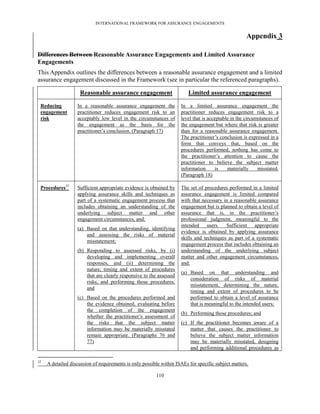
Consistent with extant ISAE 3000, proposed ISAE 3000 recognizes that two levels of assurance
are possible for engagements: reasonable assurance and limited assurance. Definitions for
reasonable and limited assurance engagements are set out in paragraph 8(a)(i) of the proposed
standard.
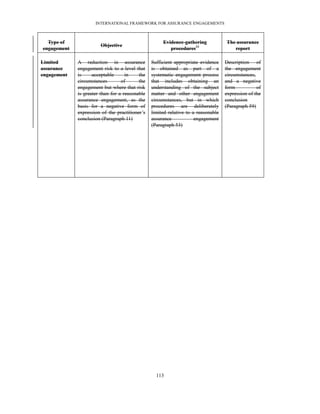
Like extant ISAE, the proposed definition of limited assurance explains its relationship to
reasonable assurance. In particular, it explains that a limited assurance engagement is one in
which the practitioner reduces engagement risk to a level that is acceptable in the circumstances
of the engagement but where that risk is greater than for a reasonable assurance engagement.
Accordingly, the set of procedures performed in a limited assurance engagement is limited
compared with that necessary in a reasonable assurance engagement.
The proposed definition of a limited assurance engagement, however, also explains that in such
engagements the set of procedures performed is planned to obtain a level of assurance that is, in
the practitioner’s professional judgment, meaningful to the intended users. The IAASB believes
it is important to indicate a threshold level of assurance for limited assurance engagements, with
that being made in reference to the intended users. Importantly, proposed ISAE 3000 introduces
additional guidance indicating factors that are relevant to the practitioner’s consideration,
including recognizing that the level of assurance the practitioner plans is not ordinarily
susceptible to quantification (see paragraph A2).
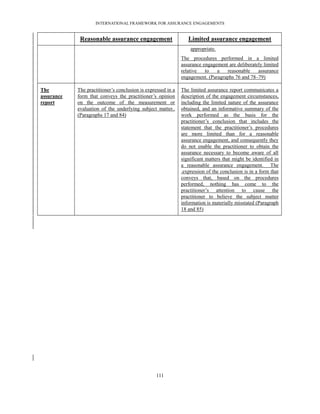
Proposed ISAE 3000 also introduces additional guidance designed to help readers better
understand the differences between reasonable and limited assurance. Amongst other matters, the
definition of a reasonable assurance engagement explains that the practitioner’s conclusion is
expressed in a form that conveys the practitioner’s opinion on the outcome of the measurement
or evaluation of the underlying subject matter; in comparison, the definition of a limited
assurance engagement explains that the practitioner’s conclusion is expressed in the form that
conveys that, based on the procedures performed, nothing has come to the practitioner’s attention
to cause the practitioner to believe the subject matter information is materially misstated. This is
in contrast to the use of ―positive form‖ and ―negative form‖ terminology in extant ISAE 3000,
which feedback had indicated as being confusing and underplaying the value of the conclusion in
a limited assurance engagement. (The matter of the form of the practitioner’s conclusion in a
limited assurance engagement is further discussed in the section ―Limited Assurance
Engagements‖ below.)
Other guidance included in proposed ISAE 3000 to help readers better understand the similarities
and differences between the two levels of assurance includes the explicit statement that
professional judgments about materiality are made in light of surrounding circumstances, but are
not affected by the level of assurance; that is, for the same intended users, materiality for a
reasonable assurance engagement is the same as for a limited assurance engagement. This is
because materiality is based on the information needs of intended users (see paragraph A84).
Similarly, the suitability of criteria and the appropriateness of an underlying subject matter are
not affected by the level of assurance (see paragraphs A9 and A38 respectively).


                                                 5
EXPLANATORY MEMORANDUM


Limited Assurance Engagements
Proposed ISAE 3000 clarifies the requirements of the practitioner with respect to the procedures
to be performed in a limited assurance engagement. Amongst other matters, the practitioner is
required to determine the nature, timing and extent of the procedures to be performed to obtain a
level of assurance that is meaningful to intended users. This determination is to be made based
on the practitioner’s understanding of the underlying subject matter, and other engagement
circumstances, and the practitioner’s consideration of areas where material misstatements are
likely to arise (see paragraph 42). The IAASB concluded, however, that unlike in a reasonable
assurance engagement, the practitioner is not required in all limited assurance engagements to
obtain an understanding of internal control over the preparation of the subject matter information
as a basis for identifying such areas (see paragraphs 37 and A93).
In the context of a limited assurance engagement, paragraph 42(c) of proposed ISAE 3000 also
states:
       If the practitioner becomes aware of a matter(s) that causes the practitioner to believe the subject
       matter information may be materially misstated, the practitioner shall design and perform additional
       procedures sufficient to enable the practitioner to:
       (a)   Conclude that the matter(s) is not likely to cause the subject matter information to be
             materially misstated; or
       (b)   Determine that the matter(s) causes the subject matter information to be materially misstated.
The IAASB decided to use the word ―may‖ in the proposed ISAE 3000 to describe the trigger
point for performing additional procedures. The IAASB considered substituting ―are‖ or ―are
likely to be‖ for the word ―may‖ on the basis that ―may‖ might set too low a threshold and would
therefore lead to an excessive amount of work being performed for a limited assurance
engagement. These alternatives were rejected because the IAASB did not consider it appropriate
for a practitioner to report without having performed additional procedures when in fact the
practitioner has cause to believe that the subject matter information may be materially misstated.
The IAASB’s view is that the practitioner should perform additional procedures to the extent
where the practitioner either is able to determine that the matter(s) causes the subject matter
information to be materially misstated (paragraph 42(c)(ii)) or, alternatively, is able to conclude
that the matter(s) is not likely to cause the subject matter information to be materially misstated
(paragraph 42(c)(i)). This required response captures the key principle to be applied as a matter
of public interest in undertaking any limited assurance engagement that whenever matters come
to the practitioner’s attention that cause the practitioner to believe the subject matter information
may be materially misstated, the practitioner must pursue those matters.
In regard to paragraph 42(c)(i), the IAASB discussed defining or describing the meaning of ―not
likely‖ or ―likely.‖ It was decided that any definition or description that involved a quantitative
approach would imply a level of precision that is rarely, if ever, achievable in practice.
In regard to paragraph 42(c)(ii), the practitioner needs to obtain sufficient appropriate evidence
to support a conclusion in the assurance report that the subject matter information is materially
misstated.


                                                       6
EXPLANATORY MEMORANDUM


The IAASB has also explored whether the practitioner’s conclusion should use wording that may
be viewed as taking a more positive form. The IAASB deliberated on use of phrases such as
―based on our work described in this report, the subject matter information is credible‖ or ―…
appears credible,‖ or are ―is worthy of belief,‖ or ―plausible,‖ in place of the phrase ―nothing has
come to our attention that causes us to believe …‖
The IAASB concluded, taking account of input received from various stakeholders, that these
alternative expressions may have the unintended result of causing users to misinterpret the basis
of the practitioner’s conclusion on the subject matter information in a limited assurance
engagement. The IAASB believes that the expression of the practitioner’s conclusion in the
required form, taken in conjunction with the description of the work performed (as discussed
below), is a critical element of the practitioner’s communications to users to convey the limits of
the assurance engagement.

Describing the Practitioner’s Procedures in the Assurance Report
For both reasonable assurance and limited assurance engagements, the practitioner’s report is
required to include an informative summary of the work performed as the basis for the
practitioner’s conclusion to help intended users understand the nature of the assurance conveyed
(see paragraphs 60(k) and A150–A153).
In the case of a limited assurance engagement, this summary is essential to understanding the
assurance conveyed by the practitioner’s conclusion as the level of assurance that the practitioner
obtains can vary depending on the procedures performed in the individual circumstances of the
engagement. Therefore, it is important that the summary be written in an objective way that
allows an appreciation by intended users of the nature, timing and extent of procedures
performed as the basis for the practitioner’s conclusion. While it is difficult to describe the
appropriate level of summation in a general way, in most cases it will not involve relating the
entire work plan. Nevertheless, it is important for it not to be so summarized as to be ambiguous,
nor written in a way that is overstated or embellished. The IAASB welcomes views on whether
an appropriate balance has been achieved in the proposed ISAE requirements and guidance
material.
The IAASB also considered whether further requirements or guidance should be included regarding
the level of detail for the summary of the practitioner’s procedures for a limited assurance
engagement. The IAASB is of the view that more specific requirements or guidance are not
appropriate given the wide variety of engagements to which ISAE 3000 applies.
The practitioner’s report in a limited assurance engagement also is also required to include a
statement that the practitioner’s procedures are more limited than for a reasonable assurance
engagement, and consequently they do not enable the practitioner to obtain the assurance
necessary to become aware of all significant matters that might be identified in a reasonable
assurance engagement.
This additional requirement for limited assurance engagements reflects a perception in some
quarters that the form of conclusion required for a limited assurance engagement (that is,
―nothing came to our attention to cause us to believe the subject matter is materially
misstated…‖) may be misunderstood by some users as conveying a level of assurance that is

                                                 7
EXPLANATORY MEMORANDUM


equal to or even higher than that conveyed by a reasonable assurance opinion. The IAASB is of
the view that requiring limited assurance reports to include the statement noted above mitigates
the risk of this being the case.

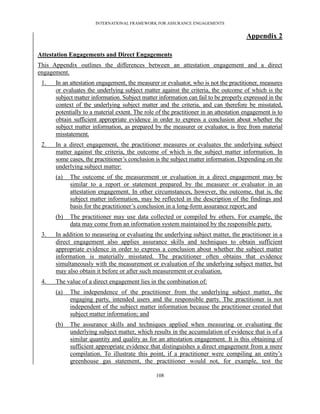
Attestation and Direct Engagements
Proposed ISAE 3000 recognizes that an assurance engagement may be either an attestation
engagement or a direct engagement. Definitions for both types of engagements are set out in
paragraph 8(a)(ii) of the proposed standard. Attestation engagements are often more familiar, as
audits and reviews of financial statements have been structured as attestation engagements, that
is, where a party other than the practitioner measures or evaluates the underlying subject matter
against the criteria. However, direct engagements, including many performance or ―value for
money‖ audits, have become common in the public sector over recent decades and have been
undertaken increasingly in the private sector also.
Due to the lack of familiarity of many with direct engagements, proposed ISAE 3000 introduces
new application and other explanatory material addressing direct engagements. In addition to a
definition of a direct engagement, that material includes an explanation of the nature of direct
engagements, their differences from, and similarities to, attestation engagements, and how they
differ from compilation engagements (see paragraphs A3-A6). Amongst other things, proposed
ISAE 3000 notes that:
(a)   In a direct engagement, the practitioner measures or evaluates the underlying subject matter
      against the criteria and the practitioner presents the resulting subject matter information as
      part of, or accompanying, the assurance report;
(b)   In addition to measuring or evaluating the underlying subject matter, the practitioner in a
      direct engagement also applies assurance skills and techniques to obtain sufficient
      appropriate evidence in order to express a conclusion about whether the subject matter
      information is materially misstated. The practitioner often obtains that evidence
      simultaneously with the measurement or evaluation of the underlying subject matter, but
      may also obtain it before or after such measurement or evaluation; and
(c)   The value of a direct engagement lies in the combination of:
      (i)    The independence of the practitioner from the underlying subject matter, the
             engaging party, intended users and the responsible party. The practitioner is not
             independent of the subject matter information because the practitioner created that
             subject matter information; and
      (ii)   The assurance skills and techniques applied when measuring or evaluating the
             underlying subject matter, which results in the accumulation of evidence that is of a
             similar quantity and quality as for an attestation engagement. It is this obtaining of
             sufficient appropriate evidence that distinguishes a direct engagement from a mere
             compilation.
Proposed ISAE 3000 also includes material designed to clarify the application of the standard to
direct engagements. In particular, it includes material regarding circumstances when the
practitioner selects or develops the applicable criteria, including the need for the criteria to be
suitable in these, as in all, assurance engagements. In such cases, the proposed standard notes
                                                 8
EXPLANATORY MEMORANDUM


that particular care may be needed to assess the suitability of the criteria in the circumstances of
the engagement and indicates that it may be appropriate to discuss the choice of criteria with the
appropriate party(ies) and disclose in the assurance report the basis for using the criteria the
practitioner has selected or developed (see paragraphs 8(c), 20(b)(ii), 30, 60(d), A9–A10, A42–
A49, A68, A78 and A144). Guidance with respect to risks, objectivity, and the form of the
practitioner’s conclusion are provided in paragraphs A12(b)(ii), A68 and A155-A156,
respectively.

Direct Engagements: Misstatements and the Practitioner’s Objective
In a direct engagement, the practitioner measures or evaluates the underlying subject matter
against the criteria and the practitioner presents the resulting subject matter information as part
of, or accompanying, the assurance report. Proposed ISAE 3000 defines, in paragraph 8(n), a
misstatement as ―a difference between the subject matter information and the proper
measurement or evaluation (including where relevant, presentation and disclosure) of the
underlying subject matter against the applicable criteria. This definition applies to all assurance
engagements under the ISAEs, including those where the practitioner’s conclusion is the subject
matter information. Misstatements can be intentional or unintentional, and include omissions.‖
Paragraph 6(a) specifies as an objective of the practitioner ―to obtain either reasonable assurance
or limited assurance, as appropriate, about whether the subject matter information (that is, the
reported outcome of this measurement or evaluation of the underlying subject matter) is free
from material misstatement.‖
During the IAASB’s deliberations, a concern was expressed that, in the case of a direct
engagement where the practitioner’s conclusion is the subject matter information, proposed
ISAE 3000 makes no distinction between a misstatement in the subject matter information and a
failure (in a reasonable assurance engagement) of the practitioner to detect a material
misstatement. Accordingly, in these circumstances, proposed ISAE 3000 may be interpreted to
mean that the practitioner’s objective is to obtain reasonable assurance that the assurance
engagement has not failed to detect a material misstatement in the subject matter information that
the practitioner presents.
The IAASB deliberated this concern and concluded that misstatements, as defined, can occur in both
attestation and direct engagements because the outcome of the measurement or evaluation of the
subject matter against the criteria can be wrong. The IAASB acknowledges that, in a direct
engagement, a misstatement that arises from the practitioner’s measurement or evaluation cannot be
distinguished from the failure by the practitioner to detect this misstatement. However, from a
reader’s perspective, the subject matter information conveyed is nevertheless misstated. Therefore,
the IAASB concluded that the definition of ―misstatement‖ is appropriate for both types of assurance
engagements.

Professional Accountants
Extant ISAE 3000 was written for application by professional accountants in public practice.1 A
professional accountant in public practice is defined2 as a member of an IFAC member body.
1
    The purpose of extant ISAE 3000 is ―to establish basic principles and essential procedures for ... professional
    accountants in public practice.‖
                                                        9
EXPLANATORY MEMORANDUM


Membership in an IFAC member body carries with it obligations in regard to education, quality
control and ethics, amongst others. Further, IFAC member bodies are subject to IFAC’s Member
Body Compliance Program and Statements of Membership Obligations to assist in ensuring the
quality of professional accountants’ services.3
The IAASB considered whether the proposed ISAE 3000 should be written to include
application by competent practitioners other than professional accountants in public practice,
which may include, for example, public sector auditors. During the IAASB’s deliberations, a view
was expressed that the application of ISAE 3000 should be limited to professional accountants in
public practice. This is because a practitioner, other than a professional accountant in public
practice, might not have the necessary background, training and experience to be able to properly
apply the standard. Further, application of ISAE 3000 by such practitioners may lead to
inconsistencies in the application of the standard and confusion amongst users of assurance
reports regarding the education, ethics, and quality control requirements of the practitioner, some
of which may be subjective in nature. However, it was noted by the IAASB that the public
interest would be better served if all competent practitioners were able to use ISAE 3000 to
benchmark their work effort on assurance engagements. This includes practitioners other than
professional accountants in public practice, who already may be performing assurance
engagements of the type envisioned under ISAE 3000.
The IAASB concluded that the proposed revised ISAE should be written bearing in mind that it
may be used by either a professional accountant in public practice or a competent practitioner
other than a profession accountant in public practice. To ensure the public interest is served, the
IAASB concluded that proposed ISAE 3000 should require:
(a)     The practitioner to comply with Parts A and B of the Code of Ethics for Professional
        Accountants issued by the International Ethics Standards Board for Accountants (the
        IESBA Code) related to assurance engagements, or other professional requirements, or
        requirements imposed by laws or regulations, that are at least as demanding (see paragraph
        16);
(b)     The engagement partner: to be a member of a firm that applies ISQC 1,4 or other
        professional requirements, or requirements in laws or regulations, that are at least as
        demanding as ISQC 1; to have specialist knowledge and competence in assurance skills
        and techniques developed through extensive training and practical application; and to have
        sufficient competence in the underlying subject matter and its measurement or evaluation
        to accept responsibility for the assurance conclusion (see paragraph 25(a)-(c));
(c)     A statement in the assurance report that the practitioner who is performing the engagement
        is a member of a firm that is subject to ISQC 1, other professional requirements, or
        requirements in laws or regulations that are at least as demanding as ISQC 1 (see paragraph
        60(i));

2
      See the Glossary of Terms in the ―Handbook of International Quality Control, Auditing, Review, Other
      Assurance and Related Services Pronouncements‖ published by IFAC.
3
      See the IFAC Compliance Program website at http://www.ifac.org/ComplianceProgram/.
4
      ISQC 1, Quality Controls for Firms that Perform Audits and Reviews of Financial Statements, and Other
      Assurance and Related Services Engagements

                                                     10
EXPLANATORY MEMORANDUM


(d)     A statement in the assurance report that the practitioner complies with the independence
        and other ethical requirements of the IESBA Code, or other professional requirements, or
        requirements imposed by laws or regulations, that are at least as demanding as Parts A and
        B of the IESBA Code related to assurance engagements (see paragraph 60 (j)); and
The proposed ISAE 3000 acknowledges that it is premised on the basis of (a) and (b) above. It
explains that if a competent practitioner other than a profession accountant in public practice
chooses to represent compliance with this or other ISAEs, it is important to recognize that ISAE
3000 includes requirements that reflect this premise (see paragraph 2 and 3).

Guidance to Enhance the Consistent Application of Proposed ISAE 3000
Proposed ISAE 3000 is written in the context of a wide array of underlying subject matters and
engagement circumstances. Some such engagements are already being performed, for example,
assurance on statements about the effectiveness of internal control. Others, however, are at
present only developing, for example possible future engagements addressing integrated
reporting or corporate social responsibility reporting.
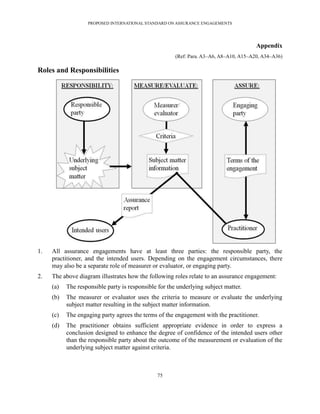
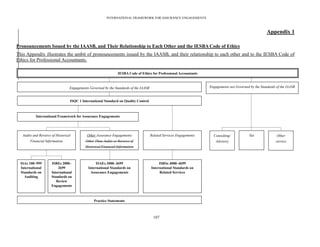
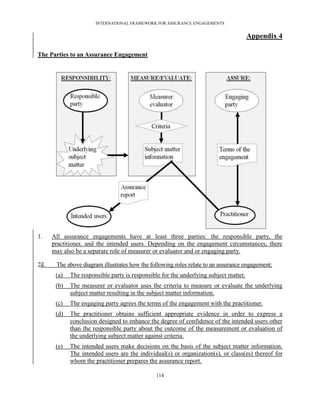
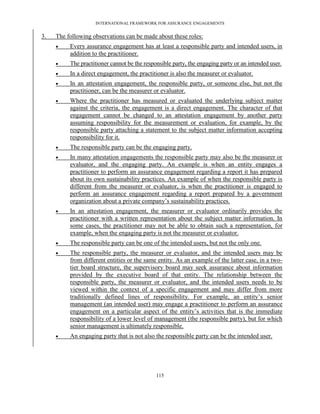
The Appendix of proposed ISAE 3000 introduces material that illustrates the roles related to an
assurance engagement. It describes the range of possible relationships between the responsible
party, the measurer or evaluator, the engaging party, the practitioner and the intended users.

In addition, the application material in proposed ISAE 3000 includes additional guidance
elaborating on the meaning of ―assurance skill and techniques,‖ which are essential to the
definition of practitioner (see paragraph A8). Guidance is also provided on the application of
materiality in an assurance engagement, particularly with respect to qualitative information (see
paragraphs A84-A91).

Historical Financial Information
In considering additional guidance in proposed ISAE 3000 to enhance its consistent application,
the IAASB explored the circumstance when a reasonable assurance engagement addresses
subject matter information that encompasses both historical financial information and other
information and discussed the question of whether such an engagement should be conducted
under ISAE 3000 or ISA 805.5 The IAASB concluded that a ―bright line‖ distinction would
neither be meaningful nor applicable in all cases, and that it is appropriate to allow the flexibility
for this determination to be subject to the practitioner’s professional judgment in light of
individual engagement circumstances.

Relationship between ISAE 3000 and the International Framework for Assurance
Engagements
Extant ISAE 3000 stated that it is to be read in the context of the International Framework for
Assurance Engagements (the Framework). Proposed ISAE 3000 includes all material in the
extant Framework that is necessary for ISAE 3000 to be understood without reference to the
Framework. In considering this approach, the IAASB recognizes that practitioners rarely access
5
      ISA 805, Special Considerations—Audits of Single Financial Statements and Specific Elements, Accounts or
      Items of a Financial Statement
                                                      11
EXPLANATORY MEMORANDUM


the Framework, preferring instead to refer to the content of ISAE 3000 for guidance when
performing engagements.
The IAASB considered and rejected the idea of withdrawing the Framework, acknowledging that
it plays a useful role in providing an overview of assurance concepts, without the burden of
specific requirements.

Proposed Consequential Amendments
Accompanying the exposure of proposed ISAE 3000 are proposed consequential amendments to
the International Framework for Assurance Engagements. These proposed amendments reflect
the impact of changes proposed in ISAE 3000, thereby enabling readers to see how the proposed
amendments to extant ISAE 3000 would affect that document. The proposed amendments do not
change underlying concepts with the Framework except to clarify them where a particular need
to do so has been identified through experience with ISAE 3000.
Consequential amendments are also proposed to ISAE 3402.6
The IAASB concluded that consequential amendments should not be proposed to ISAE 3400.7
ISAE 3400 had not been updated to take account of developments in other standards, including
extant ISAE 3000, since it was issued. Proposed amendments may suggest that the standard has
been subject to a more significant update that has been the case. The IAASB has included in its
consultation on its Strategy and Work Program8 consideration of a project to determine whether
to revise or withdraw ISAE 3400.
At present the IAASB has two other proposed ISAEs under development: ISAE 34109 and ISAE
342010. The IAASB has committed to including in the exposure draft of proposed revised ISAE
3000 any consequential amendments to proposed ISAE 3410 as a result of proposed changes to
ISAE 3000. Proposed conforming amendments that may arise on proposed ISAE 3420 have not
been included as the IAASB is actively considering comments received on exposure.

Project Timetable
Subject to comments received on exposure of proposed ISAE 3000, the IAASB intends to
finalize the standard in 2012.

Guide for Respondents
The IAASB welcomes comments on all matters addressed in the exposure draft, including the
proposed consequential amendments to the Framework, standards and proposed standards.
Comments are most helpful when they refer to specific paragraphs, include the reasons for the
comments, and, where appropriate, make specific suggestions for any proposed changes to
wording. When a respondent agrees with proposals in this exposure draft (especially those

6
     ISAE 3402, Assurance Reports on Controls at a Service Organization
7
     ISAE 3400, The Examination of Prospective Financial Information
8
     Proposed Strategy and Work Program for 2012–2014
9
     ISAE 3410, Assurance Engagements on Greenhouse Gas Statements
10
     ISAE 3420, Assurance Reports on the Process to Compile Pro Forma Financial Information Included in a
     Prospectus. The comment period for ISAE 3420 closed on September 30, 2010.
                                                   12
EXPLANATORY MEMORANDUM


calling for change in current practice), it will be helpful for the IAASB to be made aware of this
view.

Request for Examples of Assurance Engagements
The IAASB recognizes the increasing demand for assurance engagements under ISAE 3000 in
several jurisdictions and its growing use in different engagement circumstances. To assist the
IAASB in ensuring broad applicability and relevance of ISAE 3000, respondents are asked to
provide examples of assurance engagements that are being undertaken in practice. Please include
copies of relevant assurance reports where possible; or alternatively describe the underlying
subject matter, the subject matter information, the criteria, the procedures, whether the
engagement was a direct engagement or an attestation engagement, and whether it was a limited
assurance or reasonable assurance engagement.

Request for Specific Comments
The IAASB would welcome views on the following:
1.   Do respondents believe that the nature and extent of requirements in proposed ISAE 3000
     would enable consistent high quality assurance engagements while being sufficiently
     flexible given the broad range of engagements to which proposed ISAE 3000 will apply?
2.   With respect to levels of assurance:
     (a)   Does proposed ISAE 3000 properly define, and explain the difference between,
           reasonable assurance engagements and limited assurance engagements?
     (b)   Are the requirements and other material in proposed ISAE 3000 appropriate to both
           reasonable assurance engagements and limited assurance engagements?
     (c)   Should the proposed ISAE 3000 require, for limited assurance, the practitioner to
           obtain an understanding of internal control over the preparation of the subject matter
           information when relevant to the underlying subject matter and other engagement
           circumstances?
3.   With respect to attestation and direct engagements:
     (a)   Do respondents agree with the proposed changes in terminology from ―assurance-
           based engagements‖ to ―attestation engagements‖ as well as those from ―direct-
           reporting engagements‖ to ―direct engagements‖?
     (b)   Does proposed ISAE 3000 properly define, and explain the difference between, direct
           engagements and attestation engagements?
     (c)   Are the objectives, requirements and other material in the proposed ISAE 3000
           appropriate to both direct engagements and attestation engagements? In particular:
           (i)   In a direct engagement when the practitioner’s conclusion is the subject matter
                 information, do respondents believe that the practitioner’s objective in
                 paragraph 6(a) (that is, to obtain either reasonable assurance or limited
                 assurance about whether the subject matter information is free of material


                                               13
EXPLANATORY MEMORANDUM


                  misstatement) is appropriate in light of the definition of a misstatement (see
                  paragraph 8(n))?
           (ii)   In some direct engagements the practitioner may select or develop the
                  applicable criteria. Do respondents believe the requirements and guidance in
                  proposed ISAE 3000 appropriately address such circumstances?
4.   With respect to describing the practitioner’s procedures in the assurance report:
     (a)   Is the requirement to include a summary of the work performed as the basis for the
           practitioner’s conclusion appropriate?
     (b)   Is the requirement, in the case of limited assurance engagements, to state that the
           practitioner’s procedures are more limited than for a reasonable assurance
           engagement and consequently they do not enable the practitioner to obtain the
           assurance necessary to become aware of all significant matters that might be
           identified in a reasonable assurance engagement, appropriate?
     (c)   Should further requirements or guidance be included regarding the level of detail needed
           for the summary of the practitioner’s procedures in a limited assurance engagement?
5.   Do respondents believe that the form of the practitioner’s conclusion in a limited assurance
     engagement (that is, ―based on the procedures performed, nothing has come to the
     practitioner’s attention to cause the practitioner to believe the subject matter information is
     materially misstated‖) communicates adequately the assurance obtained by the
     practitioner?
6.   With respect to those applying the standard:
     (a)   Do respondents agree with the approach taken in proposed ISAE 3000 regarding
           application of the standard by competent practitioners other than professional
           accountants in public practice?
     (b)   Do respondents agree with proposed definition of ―practitioner‖?

Comments on Other Matters
The IAASB is also interested in comments on matters set out below.
    Public Sector—Recognizing the applicability of proposed ISAE 3000 to many assurance
     engagements in the public sector, the IAASB invites respondents from this sector to
     comment on the proposed ISAE, in particular on whether, in their opinion, the special
     considerations in the public sector environment have been dealt with appropriately in the
     proposed ISAE.
    Small- and Medium-Sized Practices (SMPs) and Small- and Medium-Sized Entities
     (SMEs)—Recognizing the applicability of proposed ISAE 3000 to assurance engagements
     on historical financial information in a SME context or by SMPs, the IAASB invites
     respondents from this constituency to comment on the proposed ISAE, in particular on the
     scalability of requirements.


                                                14
EXPLANATORY MEMORANDUM


   Developing Nations—Recognizing that many developing nations have adopted or are in the
    process of adopting the International Standards, the IAASB invites respondents from these
    nations to comment on the proposed ISAE, in particular, on any foreseeable difficulties in
    applying it in a developing nation environment.
   Translations—Recognizing that many respondents may intend to translate the final ISAE
    for adoption in their own environments, the IAASB welcomes comment on potential
    translation issues respondents may note in reviewing the proposed ISAE.
   Effective Date—The IAASB believes that an appropriate effective date for the final ISAE
    3000 would be 12–15 months after approval of the final standard but with earlier
    application permitted. The IAASB welcomes comment on whether this would provide a
    sufficient period to support effective implementation of the ISAE.


                                             15
Assurance Engagements other than Audits or Reviews of Historical Financial
                              Information—
 Proposed International Standard on Assurance Engagements 3000 (Revised)
                                                               CONTENTS
                                                                                                                                Paragraph
Introduction ..............................................................................................................           1-3
Relationship with other Pronouncements .................................................................                               4
Effective Date ...........................................................................................................             5
Objectives of the Practitioner ................................................................................                       6-7
Definitions ................................................................................................................          8-9
Requirements
Conduct of an Assurance Engagement in Accordance with ISAEs .........................                                              10-15
Ethical Requirements ................................................................................................                 16
Acceptance and Continuance .....................................................................................                   17-26
Quality Control .........................................................................................................          27-32
Professional Skepticism and Professional Judgment ...............................................                                  33-34
Planning and Performing the Engagement ...............................................................                             35-36
Obtaining Evidence ...................................................................................................             37-52
Considering Subsequent Events ................................................................................                        53
Other Information .....................................................................................................               54
Description of Applicable Criteria ............................................................................                       55
Forming the Assurance Conclusion ..........................................................................                        56-57
Preparing the Assurance Report ................................................................................                    58-62
Unmodified and Modified Conclusions ....................................................................                           63-67
Other Communication Responsibilities ....................................................................                             68
Documentation ..........................................................................................................           69-70
Application and Other Explanatory Material
Objectives of the Practitioner ....................................................................................                   A1
Definitions .................................................................................................................    A2–A20
Conduct of an Assurance Engagement in Accordance with ISAEs .........................                                           A21–A27
Ethical Requirements .................................................................................................          A28–A32
Acceptance and Continuance ....................................................................................                 A33–A56
                                                                        16
Quality Control .........................................................................................................    A57–A69
Professional Skepticism and Professional Judgment ................................................                           A70–A79
Planning and Performing the Engagement ...............................................................                       A80–A91
Obtaining Evidence ...................................................................................................      A92–A126
Considering Subsequent Events ................................................................................              A127–A128
Other Information .....................................................................................................         A129
Description of the Applicable Criteria ......................................................................               A130–A132
Forming the Assurance Conclusion ..........................................................................                 A133–A137
Preparing the Assurance Report ................................................................................             A138–A163
Unmodified and Modified Conclusions ....................................................................                    A164–A165
Other Communication Responsibilities ....................................................................                       A166
Documentation ..........................................................................................................    A167–A175
Appendix: Roles and Responsibilities


 Proposed International Standard on Assurance Engagements (ISAE) 3000, Assurance
 Engagements other than Audits or Reviews of Historical Financial Information, should be read
 in conjunction with the Preface to the International Standards on Quality Control, Auditing,
 Review, Other Assurance and Related Services.


                                                                     17
PROPOSED INTERNATIONAL STANDARD ON ASSURANCE ENGAGEMENTS


Introduction
1.     This International Standard on Assurance Engagements (ISAE) deals with assurance
       engagements other than audits or reviews of historical financial information, which are
       dealt with in International Standards on Auditing (ISAs) and International Standards on
       Review Engagements (ISREs), respectively. (Ref: Para. A21–A22)
2.     This ISAE is premised on the basis that:
       (a)   The members of the engagement team and the engagement quality control reviewer
             (if any) are subject to Parts A and B of the Code of Ethics for Professional
             Accountants issued by the International Ethics Standards Board for Accountants (the
             IESBA Code) related to assurance engagements, or other professional requirements,
             or requirements in laws or regulations, that are at least as demanding; and (Ref: Para.
             A28–A32)

       (b)   The practitioner who is performing the engagement is a member of a firm that is
             subject to ISQC 1, or other professional requirements, or requirements in laws or
             regulations, regarding the firm’s responsibility for its system of quality control, that
             are at least as demanding as ISQC 1.1 (Ref: Para. A58–A59)
3.     Quality control within firms that perform assurance engagements, and compliance with
       ethical principles, including independence requirements, are widely recognized as being in
       the public interest and an integral part of high quality assurance engagements. Professional
       accountants in public practice will be familiar with such requirements. If a competent
       practitioner other than a professional accountant in public practice chooses to represent
       compliance with this or other ISAEs, it is important to recognize that this ISAE includes
       requirements that reflect the premise in the preceding paragraph.

Relationship with other Pronouncements
4.     The International Framework for Assurance Engagements (the Framework) identifies
       those engagements to which ISAEs apply. Where a subject matter-specific ISAE is relevant
       to the subject matter of a particular engagement that ISAE applies in addition to this ISAE.
       (Ref: Para. A21–A22)

Effective Date
5.     This ISAE is effective for assurance engagements where the assurance report is dated on or
       after [date].


1
     International Standard on Quality Control (ISQC) 1, Quality Control for Firms that Perform Audits and Reviews
     of Financial Statements, and Other Assurance and Related Services Engagements

                                                        18
PROPOSED INTERNATIONAL STANDARD ON ASSURANCE ENGAGEMENTS


Objectives of the Practitioner
6.   In conducting an assurance engagement, the objectives of the practitioner are:
     (a)   To obtain either reasonable assurance or limited assurance, as appropriate, about
           whether the subject matter information (that is, the reported outcome of the
           measurement or evaluation of the underlying subject matter) is free from material
           misstatement;
     (b)   To express a conclusion regarding the outcome of the measurement or evaluation of
           the underlying subject matter through a written report that clearly conveys either
           reasonable or limited assurance and describes the basis for the conclusion; (Ref: Para.
           A1) and

     (c)   To communicate further as required by relevant ISAEs.
7.   In all cases when reasonable assurance or limited assurance, as appropriate, cannot be
     obtained and a qualified conclusion in the practitioner’s assurance report is insufficient in
     the circumstances for purposes of reporting to the intended users, the ISAEs require that
     the practitioner disclaim a conclusion or withdraw (or resign) from the engagement, where
     withdrawal is possible under applicable laws or regulations.

Definitions
8.   For purposes of this ISAE and other ISAEs, unless indicated to the contrary, the following
     terms have the meanings attributed below.
     (a)   Assurance engagement―An engagement in which a practitioner aims to obtain
           sufficient appropriate evidence in order to express a conclusion designed to enhance
           the degree of confidence of the intended users other than the responsible party about
           the outcome of the measurement or evaluation of an underlying subject matter against
           criteria. Each assurance engagement is classified on two dimensions:
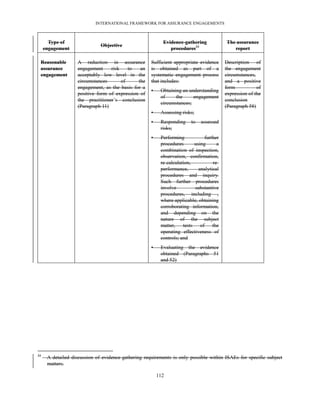
           (i)   Either a reasonable assurance engagement or a limited assurance engagement:
                 a.     Reasonable assurance engagement―An assurance engagement in which
                        the practitioner reduces engagement risk to an acceptably low level in the
                        circumstances of the engagement as the basis for the practitioner’s
                        conclusion. The practitioner’s conclusion is expressed in a form that
                        conveys the practitioner’s opinion on the outcome of the measurement or
                        evaluation of the underlying subject matter.
                 b.     Limited assurance engagement―An assurance engagement in which the
                        practitioner reduces engagement risk to a level that is acceptable in the
                        circumstances of the engagement but where that risk is greater than for a
                        reasonable assurance engagement. The practitioner’s conclusion is
                        expressed in a form that conveys that, based on the procedures performed,
                        nothing has come to the practitioner’s attention to cause the practitioner to
                        believe the subject matter information is materially misstated. The set of
                        procedures performed in a limited assurance engagement is limited

                                                 19
PROPOSED INTERNATIONAL STANDARD ON ASSURANCE ENGAGEMENTS


                           compared with that necessary in a reasonable assurance engagement but is
                           planned to obtain a level of assurance that is, in the practitioner’s
                           professional judgment, meaningful to the intended users. The limited
                           assurance report communicates the limited nature of the assurance
                           obtained. (Ref: Para. A2)
             (ii)   Either an attestation engagement or a direct engagement: (Ref: Para. A3–A6)
                    a.     Attestation engagement―An assurance engagement in which a party
                           other than the practitioner measures or evaluates the underlying subject
                           matter against the criteria. A party other than the practitioner also often
                           presents the resulting subject matter information in a report or statement.
                           In some cases, however, the subject matter information may be presented
                           by the practitioner in the assurance report. (Ref: Para. A3)
                    b.     Direct engagement―An assurance engagement in which the practitioner
                           measures or evaluates the underlying subject matter against the criteria
                           and the practitioner presents the resulting subject matter information as
                           part of, or accompanying, the assurance report. (Ref: Para. A4–A5)
      (b)    Assurance skills and techniques―Those planning, evidence gathering, evidence
             evaluation and reporting skills and techniques demonstrated by an assurance
             practitioner which are distinct from expertise in the underlying subject matter of any
             particular assurance engagement or its measurement or evaluation. (Ref: Para. A8)
      (c)    Criteria―The benchmarks used to measure or evaluate the underlying subject matter
             including, where relevant, those for presentation and disclosure. The ―applicable
             criteria‖ are the criteria used for the particular engagement. (Ref: Para. A9–A10)
      (d)    Engagement circumstances―The broad context defining the particular engagement,
             which includes the terms of the engagement, whether it is a reasonable assurance
             engagement or a limited assurance engagement, and a direct engagement or an
             attestation engagement, the characteristics of the underlying subject matter, the
             applicable measurement or evaluation criteria, the information needs of the intended
             users, relevant characteristics of the responsible party, the measurer or evaluator, and
             the engaging party and their environment, and other matters, for example events,
             transactions, conditions and practices, that may have a significant effect on the
             engagement.
      (e)    Engagement partner―The partner or other person in the firm who is responsible for
             the engagement and its performance, and for the assurance report that is issued on
             behalf of the firm, and who, where required, has the appropriate authority from a
             professional, legal or regulatory body.2
      (f)    Engagement risk―The risk that the practitioner expresses an inappropriate
             conclusion when the subject matter information is materially misstated. (Ref: Para. A11–
             A14)


2
    ―Engagement partner,‖ and ―firm‖ should be read as referring to their public sector equivalents where relevant.

                                                        20
PROPOSED INTERNATIONAL STANDARD ON ASSURANCE ENGAGEMENTS


      (g)    Engaging party―The party(ies) that engages the practitioner to perform the assurance
             engagement. (Ref: Para. A15)
      (h)    Engagement team―All partners and staff performing the engagement, and any
             individuals engaged by the firm or a network firm who perform procedures on the
             engagement. This excludes a practitioner’s external expert engaged by the firm or a
             network firm.
      (i)    Evidence―Information used by the practitioner in arriving at the practitioner’s
             conclusion. Evidence includes both information contained in relevant information
             systems, if any, and other information. For purposes of the ISAEs:
             (i)      Sufficiency of evidence is the measure of the quantity of evidence. The quantity
                      of the evidence needed is affected by the risks of material misstatement and also
                      by the quality of such evidence.
             (ii)     Appropriateness of evidence is the measure of the quality of evidence; that is,
                      its relevance and its reliability in providing support for the practitioner’s
                      conclusion.
      (j)    Firm―A sole practitioner, partnership or corporation or other entity of individual
             practitioners.3
      (k)    Historical financial information―Information expressed in financial terms in relation
             to a particular entity, derived primarily from that entity’s accounting system, about
             economic events occurring in past time periods or about economic conditions or
             circumstances at points in time in the past.
      (l)    Intended users―The individual(s) or organization(s), or class(es) thereof for whom
             the practitioner prepares the assurance report. (Ref: Para. A16–A18)
      (m) Measurer or evaluator―The party(ies) who measures or evaluates the underlying
          subject matter against the applicable criteria. (Ref: Para. A44)
      (n)    Misstatement―A difference between the subject matter information and the proper
             measurement or evaluation (including, where relevant, presentation and disclosure) of
             the underlying subject matter against the applicable criteria. This definition applies to all
             assurance engagements under the ISAEs, including those where the practitioner’s
             conclusion is the subject matter information. Misstatements can be intentional or
             unintentional, and include omissions. (Ref: Para. A7)
      (o)    Misstatement of fact (with respect to other information)―Other information that is
             unrelated to matters appearing in the subject matter information or the assurance
             report that is incorrectly stated or presented. A material misstatement of fact may
             undermine the credibility of the document containing subject matter information.
      (p)    Other information―Information (other than the subject matter information and the
             assurance report thereon) which is included, either by law, regulation or custom, in a
             document containing subject matter information and the assurance report thereon.


3
    See footnote 2.

                                                    21
PROPOSED INTERNATIONAL STANDARD ON ASSURANCE ENGAGEMENTS


      (q)   Practitioner―The individual(s) conducting the engagement (usually the engagement
            partner or other members of the engagement team, or, as applicable, the firm) by
            applying assurance skills and techniques to obtain reasonable assurance or limited
            assurance, as appropriate, about whether the subject matter information is free from
            material misstatement. In a direct engagement, the practitioner both measures or
            evaluates the underlying subject matter against the criteria and applies assurance
            skills and techniques to obtain reasonable assurance or limited assurance, as
            appropriate, about whether the outcome of that measurement or evaluation is free
            from material misstatement. Where this ISAE expressly intends that a requirement or
            responsibility be fulfilled by the engagement partner, the term ―engagement partner‖
            rather than ―practitioner‖ is used.
      (r)   Practitioner’s expert―An individual or organization possessing expertise in a field other
            than accounting or assurance, whose work in that field is used by the practitioner to assist
            the practitioner in obtaining sufficient appropriate evidence. A practitioner’s expert may
            be either a practitioner’s internal expert (who is a partner or staff, including temporary
            staff, of the practitioner’s firm or a network firm), or a practitioner’s external expert.
      (s)   Professional judgment―The application of relevant training, knowledge and
            experience, within the context provided by assurance and ethical standards, in making
            informed decisions about the courses of action that are appropriate in the
            circumstances of the engagement.
      (t)   Professional skepticism―An attitude that includes a questioning mind, being alert to
            conditions which may indicate possible misstatement, and a critical assessment of
            evidence.
      (u)   Responsible party―The party(ies) responsible for the underlying subject matter. (Ref:
            Para. A34)
      (v)   Risk of material misstatement―The risk that the subject matter information is
            materially misstated. (Ref: Para. A7)
      (w) Subject matter information―The outcome of the measurement or evaluation of the
          underlying subject matter against the applicable criteria, i.e., the information that
          results from applying the criteria to the underlying subject matter. (Ref: Para. A19)
      (x)   Underlying subject matter―The phenomenon that is measured or evaluated by
            applying criteria.
9.    For the purposes of this ISAE and other ISAEs, references to ―appropriate party(ies)‖
      should be read hereafter as ―the responsible party, the measurer or evaluator, or the
      engaging party, as appropriate.‖ (Ref: Para. A20, A34)

Requirements
Conduct of an Assurance Engagement in Accordance with ISAEs
Complying with Standards that are Relevant to the Engagement
10.   The practitioner shall comply with this ISAE and any subject matter-specific ISAEs
      relevant to the engagement.

                                                   22
PROPOSED INTERNATIONAL STANDARD ON ASSURANCE ENGAGEMENTS


11.   The practitioner shall not represent compliance with this or any other ISAE unless the
      practitioner has complied with the requirements of this ISAE and any other ISAE relevant
      to the engagement. (Ref: Para. A21–A22)

Text of an ISAE
12.   The practitioner shall have an understanding of the entire text of an ISAE, including its
      application and other explanatory material, to understand its objectives and to apply its
      requirements properly. (Ref: Para. A23–A27)

Complying with Relevant Requirements
13.   Subject to the following paragraph, the practitioner shall comply with each requirement of
      this ISAE and any relevant subject matter-specific ISAE unless, in the circumstances of the
      engagement the requirement is not relevant because it is conditional and the condition does
      not exist.
14.   In exceptional circumstances, the practitioner may judge it necessary to depart from a
      relevant requirement in an ISAE. In such circumstances, the practitioner shall perform
      alternative procedures to achieve the aim of that requirement. The need for the practitioner
      to depart from a relevant requirement is expected to arise only where the requirement is for
      a specific procedure to be performed and, in the specific circumstances of the engagement,
      that procedure would be ineffective in achieving the aim of the requirement.

Failure to Achieve an Objective
15.   If the objectives in this ISAE or a relevant subject matter-specific ISAE cannot be
      achieved, the practitioner shall evaluate whether this requires the practitioner to modify the
      practitioner’s conclusion or withdraw from the engagement (where withdrawal is possible
      under applicable laws or regulations). Failure to achieve the objectives in a relevant ISAE
      represents a significant matter requiring documentation in accordance with paragraph 69 of
      this ISAE.

Ethical Requirements
16.   The practitioner shall comply with Parts A and B of the IESBA Code related to assurance
      engagements, or other professional requirements, or requirements imposed by laws or
      regulations, that are at least as demanding. (Ref: Para. A28-A32, A57

Acceptance and Continuance
17.   The engagement partner shall be satisfied that appropriate procedures regarding the
      acceptance and continuance of client relationships and assurance engagements have been
      followed by the firm, and shall determine that conclusions reached in this regard are
      appropriate.
18.   The practitioner shall accept or continue an assurance engagement only when:
      (a)   The practitioner has no reason to believe that relevant ethical requirements, including
            independence, will not be satisfied; (Ref: Para. A28-A32)


                                                 23
PROPOSED INTERNATIONAL STANDARD ON ASSURANCE ENGAGEMENTS


      (b)   The practitioner is satisfied that those persons who are to perform the engagement
            collectively have the appropriate competence and capabilities (see also paragraph 28);
            and
      (c)   The basis upon which the engagement is to be performed has been agreed, through:
            (i)    Establishing that the preconditions for an assurance engagement are present (see
                   also paragraphs 20–21); and
            (ii)   Confirming that there is a common understanding between the practitioner and
                   the engaging party of the terms of the engagement, including the practitioner’s
                   reporting responsibilities.
19.   If the engagement partner obtains information that would have caused the firm to decline
      the engagement had that information been available earlier, the engagement partner shall
      communicate that information promptly to the firm, so that the firm and the engagement
      partner can take the necessary action (see also paragraph 22).

Preconditions for the Assurance Engagement
20.   In order to establish whether the preconditions for an assurance engagement are present,
      the practitioner shall determine whether: (Ref: Para. A33)
      (a)   The roles and responsibilities of the appropriate parties are suitable in the
            circumstances; and (Ref: Para. A34–A36)
      (b)   The engagement exhibits all of the following characteristics:
            (i)    The underlying subject matter is appropriate; (Ref: Para. A37–41)
            (ii)   The criteria to be applied in the preparation of the subject matter information
                   are suitable and will be available to the intended users; (Ref: Para. A42–A49)
            (iii) The practitioner will have access to the evidence needed to support the
                  practitioner’s conclusion; (Ref: Para. A50–A52)
            (iv) The practitioner’s conclusion, in the form appropriate to either a reasonable
                 assurance engagement or a limited assurance engagement, is to be contained in
                 a written report; and
            (v)    A rational purpose including, in the case of a limited assurance engagement,
                   that a meaningful level of assurance can be obtained. (Ref: Para. A53)
21.   If the preconditions for an assurance engagement are not present, the practitioner shall
      discuss the matter with the engaging party. If changes cannot be made to meet the
      preconditions, the practitioner shall not accept the engagement as an assurance engagement
      unless required by laws or regulations to do so. However, an engagement conducted under
      such circumstances does not comply with ISAEs. Accordingly, the practitioner shall not
      include any reference within the assurance report to the engagement having been conducted
      in accordance with ISAE 3000 or any other ISAE(s).
22.   If it is discovered after the engagement has been accepted that one or more preconditions
      for an assurance engagement is not present, the practitioner shall discuss the matter with
      the appropriate party(ies), and shall determine:
                                                  24
PROPOSED INTERNATIONAL STANDARD ON ASSURANCE ENGAGEMENTS


      (a)   Whether the matter can be resolved;
      (b)   Whether it is appropriate to continue with the engagement; and
      (c)   Whether, and if so how, to communicate the matter in the assurance report.

Agreeing on the Terms of the Engagement
23.   The practitioner shall agree the terms of the engagement with the engaging party. The
      agreed terms of the engagement shall be specified in sufficient detail in an engagement
      letter or other suitable form of written agreement, confirmation, or in laws or regulations.
      (Ref: Para. A54–A55)

24.   On recurring engagements, the practitioner shall assess whether circumstances require the
      terms of the engagement to be revised and whether there is a need to remind the engaging
      party of the existing terms of the engagement.

Acceptance of a Change in the Terms of the Engagement
25.   The practitioner shall not agree to a change in the terms of the engagement where there is
      no reasonable justification for doing so. If such a change is made, the practitioner shall not
      disregard evidence that was obtained prior to the change. (Ref: Para. A56)

Assurance Report Prescribed by Laws or Regulations
26.   In some cases, laws or regulations of the relevant jurisdiction prescribe the layout or
      wording of the assurance report. In these circumstances, the practitioner shall evaluate:
      (a)   Whether intended users might misunderstand the assurance obtained from the
            engagement; and
      (b)   If so, whether additional explanation in the assurance report can mitigate possible
            misunderstanding.
      If the practitioner concludes that additional explanation in the assurance report cannot
      mitigate possible misunderstanding, the practitioner shall not accept the engagement,
      unless required by laws or regulations to do so. An engagement conducted in accordance
      with such laws or regulations does not comply with ISAEs. Accordingly, the practitioner
      shall not include any reference within the assurance report to the engagement having been
      conducted in accordance with ISAE 3000 or any other ISAE(s). (See also paragraph 61.)

Quality Control
Characteristics of the Engagement Partner
27.   The engagement partner shall:
      (a)   Be a member of a firm that applies ISQC 1, or other professional requirements, or
            requirements in laws or regulations, that are at least as demanding as ISQC 1; (Ref:
            Para. A57–A59)

      (b)   Have specialist knowledge and competence in assurance skills and techniques
            developed through extensive training and practical application; and (Ref: Para. A57 and
            A60)
                                                  25
PROPOSED INTERNATIONAL STANDARD ON ASSURANCE ENGAGEMENTS


      (c)   Have sufficient competence in the underlying subject matter and its measurement or
            evaluation to accept responsibility for the assurance conclusion. (Ref: Para. A61–A62)

Assignment of the Team
28.   The engagement partner shall: (Ref: Para. A63)
      (a)   Be satisfied that the engagement team and any practitioner’s external experts
            collectively have the appropriate competence and capabilities to: (Ref: Para. A64–A65)
            (i)    Perform the engagement in accordance with relevant standards and applicable
                   legal and regulatory requirements; and
            (ii)   Enable an assurance report that is appropriate in the circumstances to be issued.
      (b)   Be satisfied that the engagement team will be able to be involved in the work of:
            (i)    A practitioner’s expert where the work of that expert is to be used; and (Ref: Para.
                   A64–A65)

            (ii)   Another practitioner where the work of that practitioner is to be used, (Ref: Para.
                   A66)

            to an extent that is sufficient to accept responsibility for the conclusion on the subject
            matter information.

Responsibilities of the Engagement Partner
29.   The engagement partner shall take responsibility for the overall quality on the engagement.
      This includes responsibility for:
      (a)   Following appropriate procedures regarding the acceptance and continuance of client
            relationships and engagements;
      (b)   Directing, supervising, planning and performing the engagement to achieve compliance
            with professional standards and applicable legal and regulatory requirements;
      (c)   Reviews being performed in accordance with the firm’s review policies and
            procedures, and reviewing the engagement documentation on or before the date of the
            assurance report; (Ref: Para. A67)
      (d)   Maintaining appropriate engagement documentation to provide evidence of achievement
            of the practitioner’s objectives, and that the engagement was performed in accordance
            with relevant ISAEs and relevant legal and regulatory requirements; and
      (e)   The engagement team undertaking appropriate consultation on difficult or
            contentious matters.
30.   Throughout the engagement, the engagement partner shall remain alert, through
      observation and making inquiries as necessary, for evidence of non-compliance with
      relevant ethical requirements by members of the engagement team. If matters come to the
      engagement partner’s attention through the firm’s system of quality control or otherwise
      that indicate that members of the engagement team have not complied with relevant ethical
      requirements, the engagement partner, in consultation with others in the firm, shall
      determine the appropriate action. (Ref: Para. A68)
                                                  26
PROPOSED INTERNATIONAL STANDARD ON ASSURANCE ENGAGEMENTS


31.   The engagement partner shall consider the results of the firm’s monitoring process as
      evidenced in the latest information circulated by the firm and, if applicable, other network
      firms and whether deficiencies noted in that information may affect the assurance
      engagement.

Engagement Quality Control Review
32.   For those engagements, if any, for which a quality control review is required by laws or
      regulations or for which the firm has determined that an engagement quality control review
      is required:
      (a)     The engagement partner shall take responsibility for discussing significant matters
              arising during the engagement with the engagement quality control reviewer, and not
              dating the assurance report until completion of that review; and
      (b)     The engagement quality control reviewer shall perform an objective evaluation of the
              significant judgments made by the engagement team, and the conclusions reached in
              formulating the assurance report. This evaluation shall involve. (Ref: Para. A69)
              (i)    Discussion of significant matters with the engagement partner;
              (ii)   Review of the subject matter information and the proposed assurance report;
              (iii) Review of selected engagement documentation relating to the significant
                    judgments the engagement team made and the conclusions it reached; and
              (iv) Evaluation of the conclusions reached in formulating the assurance report and
                   consideration of whether the proposed assurance report is appropriate.

Professional Skepticism and Professional Judgment
33.   The practitioner shall plan and perform an engagement with professional skepticism. (Ref:
      Para. A70–A74)

34.   The practitioner shall exercise professional judgment in planning and performing an
      assurance engagement. (Ref: Para. A75–A79)

Planning and Performing the Engagement
Planning
35.   The practitioner shall plan the engagement so that it will be performed in an effective
      manner, including setting the scope, timing and direction of the engagement, and
      determining the nature, timing and extent of planned procedures that are required to be
      carried out in order to achieve the objective of the engagement. (Ref: Para. A80–A83)

Materiality
36.   The practitioner shall consider materiality when: (Ref: Para. A84–A91)
      (a)     Planning and performing the assurance engagement, including when determining the
              nature, timing and extent of procedures; and
      (b)     Evaluating whether the subject matter information is free from misstatement.

                                                   27
PROPOSED INTERNATIONAL STANDARD ON ASSURANCE ENGAGEMENTS


Obtaining Evidence
37.   The practitioner shall obtain an understanding of the underlying subject matter and other
      engagement circumstances sufficient to design and perform procedures in order to achieve
      the objectives of the engagement. In the case of a reasonable assurance engagement, the
      practitioner’s understanding shall include an understanding of internal control over the
      preparation of the subject matter information when relevant to the underlying subject
      matter and other engagement circumstances. (Ref: Para. A92–A93)
38.   When designing and performing procedures, the practitioner shall consider the relevance
      and reliability of the information to be used as evidence. If:
      (a)   Evidence obtained from one source is inconsistent with that obtained from another; or
      (b)   The practitioner has doubts over the reliability of information to be used as evidence,
      the practitioner shall determine what changes or additions to procedures are necessary to
      resolve the matter, and shall consider the effect of the matter, if any, on other aspects of the
      engagement.

Assurance Procedures
39.   The practitioner shall apply assurance skills and techniques as part of an iterative,
      systematic engagement process.
40.   The practitioner shall apply professional judgment to determine the nature, timing and
      extent of procedures in accordance with the circumstances of the engagement. (Ref: Para.
      A94–A95)

41.   In a reasonable assurance engagement the practitioner shall:
      (a)   Based on the practitioner’s understanding (see paragraph 37), identify and assess the
            risks of material misstatement;
      (b)   Respond to assessed risks, by (i) developing and implementing overall responses, and (ii)
            determining the nature, timing and extent of procedures that are clearly responsive to the
            assessed risks, and performing those procedures. Those procedures shall involve
            substantive procedures (including obtaining corroborating information from independent
            sources, when relevant), and when relevant to the engagement circumstances, tests of the
            operating effectiveness of controls over the measurer or evaluator’s preparation of the
            subject matter information (in the case of an attestation engagement) or over data used by
            the practitioner in measuring or evaluating the underlying subject matter (in a direct
            engagement); and
      (c)   Based on the procedures performed and the evidence obtained, evaluate before the
            completion of the engagement whether the practitioner’s assessment of the risks that
            the subject matter information may be materially misstated remains appropriate. (Ref:
            Para. A96)

42.   In a limited assurance engagement, the practitioner shall:
      (a)   Based on the practitioner’s understanding (see paragraph 37) and consideration of
            areas where material misstatements are likely to arise, determine the nature, timing

                                                 28
PROPOSED INTERNATIONAL STANDARD ON ASSURANCE ENGAGEMENTS


            and extent of procedures to be performed to obtain a level of assurance that is
            meaningful to the intended users; (Ref: Para. A2)
      (b)   Perform those procedures; and
      (c)   If the practitioner becomes aware of a matter(s) that causes the practitioner to believe
            the subject matter information may be materially misstated, the practitioner shall
            design and perform additional procedures sufficient to enable the practitioner to: (Ref:
            Para. A96–A98)

            (i)    Conclude that the matter(s) is not likely to cause the subject matter information
                   to be materially misstated; or
            (ii)   Determine that the matter(s) causes the subject matter information to be materially
                   misstated.
43.   The practitioner shall accumulate uncorrected misstatements identified during the
      engagement other than those that are clearly trivial. (Ref: Para. A99)
44.   The practitioner shall evaluate the sufficiency and appropriateness of the evidence obtained in
      the context of the engagement (including whether it is a reasonable assurance or limited
      assurance engagement) and, if necessary in the circumstances, attempt to obtain further
      evidence. The practitioner shall consider all relevant evidence, regardless of whether it appears
      to corroborate or to contradict the measurement or evaluation of the underlying subject matter
      against the applicable criteria. If the practitioner is unable to obtain necessary further evidence,
      the practitioner shall consider the implications for the practitioner’s conclusion in paragraph 56.
      (Ref: Para. A100–A105)

Work Performed by a Practitioner’s Expert
45.   When the work of a practitioner’s expert is to be used, the practitioner shall also: (Ref: Para.
      A106–A110)

      (a)   Evaluate whether the practitioner’s expert has the necessary competence, capabilities
            and objectivity for the practitioner’s purposes. In the case of a practitioner’s external
            expert, the evaluation of objectivity shall include inquiry regarding interests and
            relationships that may create a threat to that expert’s objectivity; (Ref: Para. A111–A114)
      (b)   Obtain a sufficient understanding of the field of expertise of the practitioner’s expert;
            (Ref: Para. A115–A116)

      (c)   Agree with the practitioner’s expert on the nature, scope and objectives of that
            expert’s work; and (Ref: Para. A117–118)
      (d)   Evaluate the adequacy of the practitioner’s expert’s work for the practitioner’s
            purposes. (Ref: Para. A119–A120)

Work Performed by Another Practitioner or an Internal Auditor
46.   When the work of another practitioner or an internal auditor is to be used, the practitioner
      shall be satisfied that work is adequate for the practitioner’s purposes. (Ref: Para. A121)


                                                   29
PROPOSED INTERNATIONAL STANDARD ON ASSURANCE ENGAGEMENTS


Written Representations
47.   The practitioner shall request from the appropriate party(ies) a written representation that it
      has provided the practitioner with all information of which the appropriate party(ies) is
      aware that is relevant to the engagement. (Ref: Para. A51–A52 and A122–A126)
48.   In an attestation engagement, the practitioner shall request from the measurer or evaluator a
      written representation about the measurement or evaluation of the underlying subject
      matter against the applicable criteria, including that all relevant matters are reflected in the
      subject matter information.
49.   In a direct engagement, the practitioner shall request from the responsible party a written
      representation that acknowledges responsibility for the underlying subject matter unless
      that responsibility is prescribed by laws or regulations in sufficient detail.
50.   When written representations relate to matters that are material to the subject matter
      information, the practitioner shall:
      (a)   Evaluate their reasonableness and consistency with other evidence obtained,
            including other representations (oral or written); and
      (b)   Consider whether those making the representations can be expected to be well
            informed on the particular matters.
51.   The date of the written representations shall be as near as practicable to, but not after, the
      date of the assurance report.

Requested Written Representations Not Provided or Not Reliable
52.   If one or more of the requested written representations are not provided or the practitioner
      concludes that there is sufficient doubt about the competence, integrity, ethical values or
      diligence of those providing the written representations, or that the written representations
      are not reliable, the practitioner shall: (Ref: Para. A126)
      (a)   Discuss the matter with the appropriate party(ies);
      (b)   Reevaluate the integrity of those from whom the representations were requested or
            received and evaluate the effect that this may have on the reliability of representations
            (oral or written) and evidence in general; and
      (c)   Take appropriate actions, including determining the possible effect on the conclusion
            in the assurance report.

Considering Subsequent Events
53.   The practitioner has no responsibility to perform any procedures regarding the subject
      matter information after the date of the assurance report. Nevertheless, when relevant to the
      engagement, the practitioner shall consider the effect on the subject matter information and
      on the assurance report of events up to the date of the assurance report, and shall respond
      appropriately to facts that become known to the practitioner after the date of the assurance
      report, that, had they been known to the practitioner at that date, may have caused the
      practitioner to amend the assurance report. The extent of consideration of subsequent


                                                 30
PROPOSED INTERNATIONAL STANDARD ON ASSURANCE ENGAGEMENTS


      events depends on the potential for such events to affect the subject matter information and
      to affect the appropriateness of the practitioner’s conclusion. (Ref: Para. A127–A128)

Other Information
54.   When documents containing the subject matter information and the assurance report
      thereon include other information, the practitioner shall read that other information to
      identify material inconsistencies, if any, with the subject matter information or the
      assurance report and, if on reading that other information, the practitioner: (Ref: Para. A129)
      (a)   Identifies a material inconsistency between that other information and the subject
            matter information or the assurance report; or
      (b)   Becomes aware of a material misstatement of fact in that other information that is
            unrelated to matters appearing in the subject matter information or the assurance
            report,
      the practitioner shall discuss the matter with the appropriate party(ies) and take further
      action as appropriate.

Description of Applicable Criteria
55.   The practitioner shall evaluate whether the subject matter information adequately refers to
      or describes the applicable criteria. (Ref: Para. A130–A132)

Forming the Assurance Conclusion
56.   The practitioner shall form a conclusion about whether the reported outcome of the
      measurement or evaluation of the underlying subject matter is free from material
      misstatement. In forming that conclusion, the practitioner shall consider: (Ref: Para. A1 and
      A133–A134)
      (a)   The practitioner’s conclusion in paragraph 44 regarding the sufficiency and
            appropriateness of evidence obtained; and
      (b)   An evaluation of whether uncorrected misstatements are material, individually or in
            aggregate. (Ref: Para. A99)
57.   If the practitioner is unable to obtain sufficient appropriate evidence, a scope limitation
      exists and the practitioner shall express a qualified conclusion, disclaim a conclusion, or
      withdraw from the engagement, where withdrawal is possible under applicable laws or
      regulations, as appropriate. (Ref: Para. A135–A137)

Preparing the Assurance Report
58.   The assurance report shall be in writing and shall contain a clear expression of the
      practitioner’s conclusion that conveys the assurance obtained about the subject matter
      information. (Ref: Para. A138–A140)
59.   The practitioner’s conclusion on the subject matter information shall be clearly separated
      from any emphasis of matter, findings, recommendations or similar information included in
      the assurance report, and the wording used shall make it clear that findings,

                                                 31
PROPOSED INTERNATIONAL STANDARD ON ASSURANCE ENGAGEMENTS


      recommendations or similar information is not intended to detract from the practitioner’s
      conclusion. (Ref: Para. A138–A140)

Assurance Report Content
60.   The assurance report shall include at a minimum the following basic elements:
      (a)   A title that clearly indicates the report is an independent assurance report. (Ref: Para.
            A141)

      (b)   An addressee. (Ref: Para. A142)
      (c)   An identification or description of the subject matter information and, when
            appropriate, the underlying subject matter. In the case of a direct engagement, this
            may be reflected in the description of the findings and basis for the practitioner’s
            conclusion in the assurance report. When the practitioner’s conclusion is worded in
            terms of a statement made by the measurer or evaluator, that statement shall be
            appended to the assurance report, reproduced in the assurance report or referenced
            therein to a source that is available to the intended users. (Ref: Para. A143)
      (d)   Identification of the criteria. (Ref: Para. A144)
      (e)   Where appropriate, a description of any significant, inherent limitations associated
            with the measurement or evaluation of the underlying subject matter against the
            criteria. (Ref: Para. A145)
      (f)   When the applicable criteria are designed for a specific purpose, a statement alerting
            readers to this fact and that, as a result, the subject matter information may not be
            suitable for another purpose. (Ref: Para. A146–A147)
      (g)   A statement to identify the responsible party and the measurer or evaluator if
            different, and to describe their responsibilities and the practitioner’s responsibilities.
            (Ref: Para. A148)

      (h)   A statement that the engagement was performed in accordance with this ISAE or,
            where there is a subject matter specific ISAE, that ISAE. (Ref: Para. A149)
      (i)   A statement that the firm of which the practitioner is a member applies ISQC 1, or
            other professional requirements, or requirements in laws or regulations that are at least
            as demanding as ISQC 1.
      (j)   A statement that the practitioner complies with the independence and other ethical
            requirements of the IESBA Code, or other professional requirements, or requirements
            imposed by laws or regulations, that are at least as demanding as Parts A and B of the
            IESBA Code related to assurance engagements.
      (k)   An informative summary of the work performed as the basis for the practitioner’s
            conclusion, recognizing in the case of a limited assurance engagement, that an
            appreciation of the nature, timing, and extent of procedures performed is essential to
            understanding the assurance conveyed by the practitioner’s conclusion. In a limited
            assurance engagement the summary of the work performed shall state that the
            practitioner’s procedures are more limited than for a reasonable assurance
            engagement, and consequently they do not enable the practitioner to obtain the
                                                    32
PROPOSED INTERNATIONAL STANDARD ON ASSURANCE ENGAGEMENTS


            assurance necessary to become aware of all significant matters that might be
            identified in a reasonable assurance engagement. (Ref: Para. A150–A153)
      (l)   The practitioner’s conclusion: (Ref: Para. A1, A154–A155)
            (i)    Where appropriate, the conclusion shall inform the intended users of the context
                   in which the practitioner’s conclusion is to be read. (Ref: Para. A158)
            (ii)   In a reasonable assurance engagement, the conclusion shall be expressed in the
                   form of an opinion.
            (iii) In a limited assurance engagement, the conclusion shall be expressed in a form
                  that conveys that, based on the procedures performed, nothing has come to the
                  practitioner’s attention to cause the practitioner to believe the subject matter
                  information is materially misstated. (Ref: Para. A157–A158)
            (iv) Where the practitioner expresses a modified conclusion, the assurance report
                 shall contain a clear description of the matter(s) giving rise to the modification.
      (m) The practitioner’s signature. (Ref: Para. A159)
      (n)   The date of the assurance report. The assurance report shall be dated no earlier than
            the date on which the practitioner has obtained the evidence on which the
            practitioner’s conclusion is based, including: (Ref: Para. A160)
            (i)    In the case of a attestation engagement, evidence that those with the recognized
                   authority have asserted that they have taken responsibility for the subject matter
                   information; and
            (ii)   In the case of direct engagement, receipt of the written representation required
                   by paragraph 49.
      (o)   The location in the jurisdiction where the practitioner practices.

Reference to the Practitioner’s Expert in the Assurance Report
61.   If the practitioner refers to the work of a practitioner’s expert in the assurance report, the
      wording of that report shall not imply that the practitioner’s responsibility for the
      conclusion expressed in that report is reduced because of the involvement of that expert.
      (Ref: Para. A161–A163)

Assurance Report Prescribed by Laws or Regulations
62.   If the practitioner is required by laws or regulations to use a specific layout or wording of
      the assurance report, the assurance report shall refer to this or other ISAEs only if the
      assurance report includes, at a minimum, each of the elements identified in paragraph 60.

Unmodified and Modified Conclusions
63.   The practitioner shall express an unmodified conclusion when the practitioner concludes:
      (a)   In the case of a reasonable assurance engagement, that the subject matter information
            is prepared, in all material respects, in accordance with the applicable criteria; or


                                                  33
PROPOSED INTERNATIONAL STANDARD ON ASSURANCE ENGAGEMENTS


      (b)   In the case of a limited assurance engagement, that, based on the procedures
            performed, nothing has come to the attention of the practitioner that causes the
            practitioner to believe that the subject matter information is not prepared, in all
            material respects, in accordance with the applicable criteria.
64.   The practitioner shall express a modified conclusion when the following circumstances
      exist and, in the practitioner’s professional judgment, the effect of the matter is or may be
      material:
      (a)   When a scope limitation exists (see paragraph 57). In such cases, the practitioner
            shall express a qualified conclusion or a disclaimer of conclusion.
      (b)   When:
            (i)    The practitioner’s conclusion is worded in terms of a statement made by the
                   measurer or evaluator, and that statement is incorrect, in a material respect; or
            (ii)   The practitioner’s conclusion is worded in terms of the underlying subject
                   matter and the criteria, and the subject matter information is not free from
                   material misstatement. (Ref: Para. A164–A165)
            In such cases, the practitioner shall express a qualified or adverse conclusion.
65.   The practitioner shall express a qualified conclusion when the effects, or possible effects,
      of a matter are not so material and pervasive as to require an adverse conclusion or a
      disclaimer of conclusion. A qualified conclusion is expressed as being ―except for‖ the
      effects, or possible effects, of the matter to which the qualification relates. (Ref: Para. A165)
66.   If the practitioner expresses a modified conclusion because of a scope limitation but is also
      aware of a matter(s) that causes the subject matter information to be materially misstated,
      the practitioner shall include in the assurance report a clear description of both the scope
      limitation and the matter(s) that causes that the subject matter information to be materially
      misstated.
67.   In those cases where the practitioner’s unqualified conclusion would be worded in terms of a
      statement made by the measurer or evaluator, and that statement has identified and properly
      described that the subject matter information is materially misstated, the practitioner shall
      either:
      (a)   Express a qualified or adverse conclusion worded in terms of the underlying subject
            matter and the criteria; or
      (b)   If specifically required by the terms of the engagement to word the conclusion in
            terms of statement made by the measurer or evaluator, express an unqualified
            conclusion but emphasize the matter by specifically referring to it in the assurance
            report.

Other Communication Responsibilities
68.   The practitioner shall consider whether, pursuant to the terms of the engagement and other
      engagement circumstances, any matter has come to the attention of the practitioner that
      should be communicated with the responsible party, the measurer or evaluator, the
      engaging party, those charged with governance or others. (Ref: Para. A166)
                                                  34
PROPOSED INTERNATIONAL STANDARD ON ASSURANCE ENGAGEMENTS


Documentation
69.   The practitioner shall prepare on a timely basis engagement documentation that provides a
      record of the basis for the assurance report that is sufficient and appropriate to enable an
      experienced practitioner, having no previous connection with the engagement, to
      understand: (Ref: Para. A167–A175)
      (a)   The nature, timing and extent of the procedures performed to comply with relevant
            ISAEs and applicable legal and regulatory requirements;
      (b)   The results of the procedures performed, and the evidence obtained; and
      (c)   Significant matters arising during the engagement, the conclusions reached thereon, and
            significant professional judgments made in reaching those conclusions.
70.   If the practitioner identifies information that is inconsistent with the practitioner’s final
      conclusion regarding a significant matter, the practitioner shall document how the
      practitioner addressed the inconsistency.


                                                   ***
Application and Other Explanatory Material
Objectives of the Practitioner
The Practitioner’s Conclusion (Ref: Para. 6(b), 56, 60(l))
A1. Where the subject matter information is made up of a number of aspects, separate
    conclusions may be provided on each aspect. While not all such conclusions need to relate
    to the same level of assurance, each conclusion is expressed in the form that is appropriate
    to either a reasonable assurance engagement or a limited assurance engagement.

Definitions
A Level of Assurance that is Meaningful to the Intended Users (Ref: Para. 8(a)(i)b, 42(a))
A2. The level of assurance the practitioner plans to obtain is not ordinarily susceptible to
    quantification, and whether it is meaningful to the intended users is a matter of professional
    judgment for the practitioner to determine in the circumstances of the engagement,
    including the practitioner’s perception of the information needs of intended users In a
    limited assurance engagement, the practitioner performs a set of procedures that is limited
    compared with that necessary in a reasonable assurance engagement but is, nonetheless,
    planned to obtain a level of assurance that is meaningful to the intended users (see also
    paragraphs A16–A18, and A85). Factors that are relevant to consider may include, for
    example:
           The characteristics of the underlying subject matter and the applicable criteria, and
            whether there are any relevant subject matter-specific ISAEs.
           Instructions or other indications from the engaging party about the nature of the
            assurance the engaging party is seeking the practitioner to obtain. For example, the
            terms of the engagement may stipulate particular procedures that the engaging party
                                                    35
PROPOSED INTERNATIONAL STANDARD ON ASSURANCE ENGAGEMENTS


           considers necessary or particular aspects of the subject matter information the
           engaging party would like the practitioner to focus procedures on.
          Whether the practitioner is able to design procedures to address the material
           misstatements that are likely to arise in the subject matter information.
          Whether the nature and extent of planned procedures is sufficient for the practitioner
           to conclude about those aspects of the subject matter information to which the
           procedures are directed.
          Generally accepted practice, if it exists, with respect to assurance engagements for the
           particular subject matter information, or similar or related subject matter information.

Attestation Engagements and Direct Engagements (Ref: Para. 8(a)(ii), Appendix)
A3. In an attestation engagement, the measurer or evaluator, who is not the practitioner,
    measures or evaluates the underlying subject matter against the criteria, the outcome of
    which is the subject matter information. Subject matter information can fail to be properly
    expressed in the context of the underlying subject matter and the criteria, and can therefore
    be misstated, potentially to a material extent. The role of the practitioner in an attestation
    engagement is to obtain sufficient appropriate evidence in order to express a conclusion
    about whether the subject matter information, as prepared by the measurer or evaluator, is
    free from material misstatement.
A4. In a direct engagement, the practitioner measures or evaluates the underlying subject matter
    against the criteria, the outcome of which is the subject matter information. In some cases,
    the practitioner’s conclusion is the subject matter information. Depending on the underlying
    subject matter:
     (a)   The outcome of the measurement or evaluation in a direct engagement may be similar
           to a report or statement prepared by the measurer or evaluator in an attestation
           engagement. In other circumstances, however, the outcome ,that is, the subject matter
           information, may be reflected in the description of the findings and basis for the
           practitioner’s conclusion in the report (see also paragraph A140); and
     (b)   The practitioner may use data collected or compiled by others. For example, the data
           may come from an information system maintained by the responsible party.
A5. In addition to measuring or evaluating the underlying subject matter, the practitioner in a
    direct engagement also applies assurance skills and techniques to obtain sufficient
    appropriate evidence in order to express a conclusion about whether the subject matter
    information is materially misstated. The practitioner often obtains that evidence
    simultaneously with the measurement or evaluation of the underlying subject matter, but
    may also obtain it before or after such measurement or evaluation.
A6. In a direct engagement the value lies in the combination of:
     (a)   The independence of the practitioner from the underlying subject matter, the
           engaging party, intended users and the responsible party. The practitioner is not
           independent of the subject matter information because the practitioner created that
           subject matter information; and

                                                36
PROPOSED INTERNATIONAL STANDARD ON ASSURANCE ENGAGEMENTS


      (b)    The assurance skills and techniques applied when measuring or evaluating the
             underlying subject matter, which results in the accumulation of evidence that is of a
             similar quantity and quality as for an attestation engagement. It is this obtaining of
             sufficient appropriate evidence that distinguishes a direct engagement from a mere
             compilation. To illustrate this point, if a practitioner were compiling an entity’s
             greenhouse gas statement, the practitioner would not, for example, test the calibration
             of monitoring devices. In a direct engagement, however, the practitioner would,
             where relevant, either calibrate monitoring devices as part of the measurement
             process, or test the calibration of monitoring devices performed by others to the same
             extent as would be the case if the engagement were an attestation engagement.
The Risk of Material Misstatement (Ref: Para. 8(v))
A7. In the ISAEs, the potential for the measurement or evaluation of an aspect of the subject
    matter information to be different from a proper measurement or evaluation of that aspect
    using the applicable criteria is known as the risk of material misstatement for both
    attestation engagements and direct engagements.

Assurance Skill and Techniques (Ref: Para. 8(b))
A8. Assurance skills and techniques include: application of professional skepticism and
    professional judgment to planning and performing an assurance engagement, including
    obtaining and evaluating evidence; understanding information systems and the role and
    limitations of internal control; linking the consideration of materiality and engagement
    risks to the nature, timing and extent of procedures; applying procedures including inquiry,
    inspection, re-calculation, re-performance, observation, confirmation, and analytical
    procedures; systematic documentation practices; and, assurance report-writing skills.

Criteria (Ref: Para. 8(c), Appendix)
A9. Suitable criteria are required for reasonably consistent measurement or evaluation of an
    underlying subject matter within the context of professional judgment. Without the frame
    of reference provided by suitable criteria, any conclusion is open to individual
    interpretation and misunderstanding. The suitability of criteria is context-sensitive, that is,
    it is determined in the context of the engagement circumstances. Even for the same
    underlying subject matter there can be different criteria, which will yield a different
    measurement or evaluation. For example, one measurer or evaluator might select the
    number of customer complaints resolved to the acknowledged satisfaction of the customer
    for the underlying subject matter of customer satisfaction; another measurer or evaluator
    might select the number of repeat purchases in the three months following the initial
    purchase. The suitability of criteria is not affected by the level of assurance, that is, if
    criteria are unsuitable for a reasonable assurance engagement, they are also unsuitable for a
    limited assurance engagement, and vice versa.
A10. In some direct engagements, the applicable criteria may be determined by another party. In
     other direct engagements, however, the practitioner selects or develops the applicable
     criteria. When this is the case, and more than one set of relevant established criteria exist or
     the practitioner develops the applicable criteria, particular care may be needed to assess
     their suitability in the circumstances of the engagement since there is no independent
                                                   37
PROPOSED INTERNATIONAL STANDARD ON ASSURANCE ENGAGEMENTS


     review of practitioner’s professional judgment. It may be appropriate in such cases to
     discuss the choice of criteria with the appropriate party(ies) and disclose in the assurance
     report the basis for using a particular set of criteria the practitioner has selected or
     developed. (See also paragraph A68.)

Engagement Risk (Ref: Para. 8(f))
A11. Engagement risk does not refer to or include the practitioner’s business risks such as loss
     from litigation, adverse publicity, or other events arising in connection with a subject
     matter information reported on.
A12. In general, engagement risk can be represented by the following components, although not
     all of these components will necessarily be present or significant for all assurance
     engagements:
     (a)   Risks that the practitioner does not directly influence, which may consist of:
           (i)    The susceptibility of the subject matter information to a material misstatement
                  before consideration of any related controls (inherent risk); and
           (ii)   The risk that a material misstatement that occurs in the subject matter
                  information will not be prevented, or detected and corrected, on a timely basis
                  by the appropriate party(ies)’s internal control (control risk); and
     (b)   Risks that the practitioner does directly influence, which may consist of:
           (i)    The risk that the procedures performed by the practitioner will not detect a
                  material misstatement (detection risk); and
           (ii)   In the case of a direct engagement, the risks associated with the practitioner’s
                  measurement or evaluation of the underlying subject matter against the
                  applicable criteria.
A13. The degree to which each of these components is relevant to the engagement is affected by
     the engagement circumstances, in particular:
          The nature of the underlying subject matter and the subject matter information. For
           example, the concept of control risk may be more useful when the underlying subject
           matter relates to the preparation of information about an entity’s performance than
           when it relates to information about the effectiveness of a controls or the existence of
           a physical condition.
          Whether a reasonable assurance or a limited assurance engagement is being
           performed. For example, in limited assurance attestation engagements the practitioner
           may often decide to obtain evidence by means other than tests of controls, in which
           case consideration of control risk may be less relevant than in a reasonable assurance
           attestation engagement on the same subject matter information.
          Whether it is a direct engagement or an attestation engagement. As noted in the
           previous paragraph, while the concept of control risk is relevant to attestation
           engagements, the broader concept of measurement or evaluation risk is relevant to
           direct engagements.

                                                38
PROPOSED INTERNATIONAL STANDARD ON ASSURANCE ENGAGEMENTS


      The consideration of risks is a matter of professional judgment, rather than a matter capable
      of precise measurement.
A14. Reducing engagement risk to zero is very rarely attainable or cost beneficial and, therefore,
     ―reasonable assurance‖ is less than absolute assurance, as a result of factors such as the
     following:
           The use of selective testing.
           The inherent limitations of internal control.
           The fact that much of the evidence available to the practitioner is persuasive rather
            than conclusive.
           The use of professional judgment in gathering and evaluating evidence and forming
            conclusions based on that evidence.
           In some cases, the characteristics of the underlying subject matter when evaluated or
            measured against the applicable criteria.

The Engaging Party (Ref: Para. 8(g), Appendix)
A15. The engaging party may be, under different circumstances, management or those charged
     with governance of the responsible party, a legislature, the intended users, the measurer or
     evaluator (other than in a direct engagement, where the practitioner is the measurer or
     evaluator), or a different third party.

Intended Users (Ref: Para. 8(l), Appendix)
A16. In some cases there may be intended users other than those to whom the assurance report is
     addressed. The practitioner may not be able to identify all those who will read the
     assurance report, particularly where a large number of people have access to it. In such
     cases, particularly where possible readers are likely to have a broad range of interests in the
     underlying subject matter, intended users may be limited to major stakeholders with
     significant and common interests. Intended users may be identified in different ways, for
     example, by agreement between the practitioner and the responsible party or engaging
     party, or by laws or regulations.
A17. Intended users or their representatives may be directly involved with the practitioner and
     the responsible party (and the engaging party if different) in determining the requirements
     of the engagement. Regardless of the involvement of others however, and unlike an agreed-
     upon procedures engagement (which involves reporting findings based upon the
     procedures, rather than a conclusion):
      (a)   The practitioner is responsible for determining the nature, timing and extent of
            procedures; and
      (b)   The practitioner may need to perform additional procedures if information comes to
            the practitioner’s attention that differs significantly from that on which the
            determination of planned procedures was based (see paragraph A96–A98).
A18. In some cases, intended users (for example, bankers and regulators) impose a requirement
     on, or request the appropriate party(ies) to arrange for an assurance engagement to be
                                                 39
PROPOSED INTERNATIONAL STANDARD ON ASSURANCE ENGAGEMENTS


      performed for a specific purpose. When engagements use criteria that are designed for a
      specific purpose, paragraph 60(f) requires a statement alerting readers to this fact. In
      addition, the practitioner may consider it appropriate to indicate that the assurance report is
      intended solely for specific users. Depending on the engagement circumstances, this may
      be achieved by restricting the distribution or use of the assurance report (see paragraph
      A146–A147).

Subject Matter Information (Ref: Para. 8(w), Appendix)
A19. In some cases, the subject matter information may be a statement that evaluates an aspect
     of a process, or of performance or compliance, in relation to the criteria. For example,
     ―ABC’s internal control operated effectively in terms of XYZ criteria during the period
     ….‖ or ―ABC’s governance structure conformed with XYZ criteria during the period …‖

The Appropriate Party(ies) (Ref: Para. 9, Appendix)
A20. The roles played by the responsible party, the measurer or evaluator, and the engaging party
     can vary (see paragraph A34). Also, management and governance structures vary by
     jurisdiction and by entity, reflecting influences such as different cultural and legal
     backgrounds, and size and ownership characteristics. Such diversity means that it is not
     possible for ISAEs to specify for all engagements the person(s) with whom the practitioner
     is to inquire of, request representations from, or otherwise communicate with in all
     circumstances. In some cases, for example, when the appropriate party(ies) is only part of a
     complete legal entity, identifying the appropriate management personnel or those charged
     with governance with whom to communicate will require the exercise of professional
     judgment to determine which person(s) have the appropriate responsibilities for and
     knowledge of the matters concerned.

Conduct of an Assurance Engagement in Accordance with ISAEs
Complying with Standards that are Relevant to the Engagement (Ref: Para. 1, 4, 11)
A21. This ISAE includes requirements that apply to all assurance engagements (other than audits
     or reviews of historical financial information), including engagements in accordance with a
     subject matter-specific ISAE. In some cases, a subject matter-specific ISAE is also relevant
     to the engagement. A subject matter-specific ISAE is relevant to the engagement when the
     ISAE is in effect, the subject matter of the ISAE is relevant to the engagement, and the
     circumstances addressed by the ISAE exist.
A22. The ISAs and ISREs have not been written for assurance engagements other than audits
     and reviews of historical financial information, and do not apply to such engagements.
     They may, however, provide guidance in relation to the assurance process generally for
     practitioners undertaking an assurance engagement in accordance with this ISAE.

Text of an ISAE (Ref: Para. 12)
A23. ISAEs contain the objectives of the practitioner in following the ISAEs, and requirements
     designed to enable the firm to meet those objectives. In addition, they contain related
     guidance in the form of application and other explanatory material, introductory material
     that provides context relevant to a proper understanding of the ISQC, and definitions.
                                                  40
PROPOSED INTERNATIONAL STANDARD ON ASSURANCE ENGAGEMENTS


A24. The objectives in an ISAE provide the context in which the requirements of the ISAE are
     set, and are intended to assist in:
     (a)    Understanding what is be accomplished; and
     (b)    Deciding whether more needs to be done to achieve the objectives.
      The proper application of the requirements of an ISAE by the practitioner is expected to
      provide a sufficient basis for the practitioner’s achievement of the objectives. However,
      because the circumstances of assurance engagements vary widely and all such
      circumstances cannot be anticipated in the ISAEs, the practitioner is responsible for
      determining the procedures necessary to fulfill the requirements of relevant ISAEs and to
      achieve the objectives stated therein. In the circumstances of an engagement, there may be
      particular matters that require the practitioner to perform procedures in addition to those
      required by relevant ISAEs to meet the objectives specified in those ISAEs.
A25. The requirements of ISAEs are expressed using ―shall.‖
A26. Where necessary, the application and other explanatory material provides further explanation
     of the requirements and guidance for carrying them out. In particular, it may:
      (a)   Explain more precisely what a requirement means or is intended to cover; and
      (b)   Include examples that may be appropriate in the circumstances.
      While such guidance does not in itself impose a requirement, it is relevant to the proper
      application of the requirements. The application and other explanatory material may also
      provide background information on matters addressed in an ISAE. Where appropriate,
      additional considerations specific to public sector audit organizations or smaller firms are
      included within the application and other explanatory material. These additional
      considerations assist in the application of the requirements in the ISAEs. They do not,
      however, limit or reduce the responsibility of the practitioner to apply and comply with the
      requirements in an ISAE.
A27. Definitions are provided in the ISAEs to assist in the consistent application and
     interpretation of the ISAEs, and are not intended to override definitions that may be
     established for other purposes, whether by laws, regulations or otherwise.

Ethical Requirements (Ref: Para. 2(a), 16, 18(a))
A28. Part A of the IESBA Code establishes the following fundamental principles with which the
     practitioner is required to comply:
      (a)   Integrity;
      (b)   Objectivity;
      (c)   Professional competence and due care;
      (d)   Confidentiality; and
      (e)   Professional behavior.
A29. Part A of the IESBA Code also provides a conceptual framework for professional
     accountants to apply to:

                                                    41
PROPOSED INTERNATIONAL STANDARD ON ASSURANCE ENGAGEMENTS


     (a)   Identify threats to compliance with the fundamental principles. Threats fall into one
           or more of the following categories:
           (i)    Self-interest;
           (ii)   Self-review;
           (iii) Advocacy;
           (iv) Familiarity; and
           (v)    Intimidation;
     (b)   Evaluate the significance of the threats identified; and
     (c)   Apply safeguards, when necessary, to eliminate the threats or reduce them to an
           acceptable level. Safeguards are necessary when the professional accountant
           determines that the threats are not at a level at which a reasonable and informed third
           party would be likely to conclude, weighing all the specific facts and circumstances
           available to the professional accountant at that time, that compliance with the
           fundamental principles is not compromised.
A30. Part B of the IESBA Code describes how the conceptual framework in Part A applies in
     certain situations to professional accountants in public practice, including:
          Professional appointment
          Conflicts of interest
          Second opinions
          Fees and other types of remuneration
          Marketing professional services
          Gifts and hospitality
          Custody of client assets
          Objectivity
          Independence.
A31. The IESBA Code defines independence as comprising both independence of mind and
     independence in appearance. Independence safeguards the ability to form an assurance
     conclusion without being affected by influences that might compromise that conclusion.
     Independence enhances the ability to act with integrity, to be objective and to maintain an
     attitude of professional skepticism. Matters addressed in IESBA Code with respect to
     independence include:
          Financial interests
          Loans and guarantees
          Business relationships
          Family and personal relationships
          Employment with assurance clients
                                                42
PROPOSED INTERNATIONAL STANDARD ON ASSURANCE ENGAGEMENTS


           Recent service with an assurance client
           Serving as a director or officer of an assurance client
           Long association of senior personnel with assurance clients
           Provision of non-assurance services to assurance clients
           Fees (relative size, overdue, and contingent fees)
           Gifts and hospitality
           Actual or threatened litigation.
A32. Professional requirements, or requirements imposed by laws or regulations, are at least as
     demanding as Parts A and B of the IESBA Code related to assurance engagements when
     they address all the matters referred to in paragraphs A28–A31 and impose obligations that
     achieve the aims of the requirements set out in Parts A and B of the IESBA Code related to
     assurance engagements.

Acceptance and Continuance
Preconditions for the Engagement (Ref: Para. 20)
A33. In a public sector environment, some of the preconditions for an assurance engagement
     may be assumed to be present, for example:
      (a)   The roles and responsibilities of public sector audit organizations and the government
            entities scoped into assurance engagements are assumed to be appropriate because
            they are generally set out in legislation;
      (b)   Public sector audit organizations’ right of access to the information necessary to
            perform the engagement is often set out in legislation;
      (c)   The practitioner’s conclusion, in the form appropriate to either a reasonable assurance
            engagement or a limited assurance engagement, is generally required by legislation to
            be contained in a written report; and
      (d)   A rational purpose is generally present because the engagement is set out in
            legislation.
Roles and Responsibilities (Ref: Para. 8(u), 9, 20(a), Appendix)
A34. All assurance engagements have at least three parties: the responsible party, the
     practitioner, and the intended users. Depending on the engagement circumstances, the roles
     of measurer or evaluator and of the engaging party may also be performed by one of these
     parties or by another party(ies). See the Appendix for a discussion of how each of these
     roles relate to an assurance engagement.
A35. Evidence that the appropriate relationship exists with respect to responsibility for the
     underlying subject matter may be obtained through an acknowledgement provided by the
     responsible party. Such an acknowledgement also establishes a basis for a common
     understanding of the responsibility of the responsible party and the practitioner. A written
     acknowledgement is the most appropriate form of documenting the responsible party’s
     understanding. In the absence of a written acknowledgement of responsibility, it may still

                                                     43
PROPOSED INTERNATIONAL STANDARD ON ASSURANCE ENGAGEMENTS


     be appropriate for the practitioner to accept the engagement if, for example, other sources,
     such as legislation or a contract, indicate responsibility. In other cases, it may be
     appropriate to decline the engagement depending on the circumstances, or to disclose the
     circumstances in the assurance report.
A36. The measurer or evaluator in an attestation engagement is responsible for having a
     reasonable basis for the subject matter information. What constitutes a reasonable basis will
     depend on the nature of the underlying subject matter and other engagement circumstances.
     In some cases, a formal process with extensive internal controls may be needed to provide
     the measurer or evaluator with reasonable basis that the outcome of their measurement or
     evaluation of the underlying subject matter is free from material misstatement. The fact that
     the practitioner will report on the subject matter information is not a substitute for the
     measurer or evaluator’s own processes to have a reasonable basis for the subject matter
     information. In a direct engagement, the process of measuring or evaluating the underlying
     subject matter and of obtaining sufficient appropriate evidence provides the practitioner,
     who is the measurer or evaluator, with a reasonable basis for the subject matter
     information.
Appropriateness of the Underlying Subject Matter (Ref: Para. 20(b)(i))
A37. An appropriate underlying subject matter is:
     (a)   Identifiable, and capable of consistent measurement or evaluation against the
           applicable criteria; and
     (b)   Such that the information about it can be subjected to procedures for obtaining
           sufficient appropriate evidence to support a reasonable assurance or limited assurance
           conclusion, as appropriate.
A38. The appropriateness of an underlying subject matter is not affected by the level of
     assurance, that is, if an underlying subject matter is not appropriate for a reasonable
     assurance engagement, it is also not appropriate for a limited assurance engagement, and
     vice versa.
A39. Different underlying subject matters have different characteristics, including the degree to
     which information about them is qualitative versus quantitative, objective versus
     subjective, historical versus prospective, and relates to a point in time or covers a period.
     Such characteristics affect the:
     (a)   Precision with which the underlying subject matter can be measured or evaluated
           against criteria; and
     (b)   The persuasiveness of available evidence.
A40. Identifying such characteristics and considering their effects assists the practitioner when
     assessing the appropriateness of the underlying subject matter, and also in determining the
     content of the assurance report (see paragraph A143).
A41. In some cases, the assurance engagement may relate to only one part of a broader
     underlying subject matter. For example, the practitioner may be engaged to report on one
     aspect of an entity’s contribution to sustainable development, such as a number of
     programs run by an entity that have positive environmental outcomes. In determining

                                                 44
PROPOSED INTERNATIONAL STANDARD ON ASSURANCE ENGAGEMENTS


      whether the engagement exhibits the characteristic of having an appropriate underlying
      subject matter in such cases, it may be appropriate for the practitioner to consider whether
      information about the aspect on which the practitioner is asked to report is likely to meet
      the information needs of intended users, and also how the subject matter information will
      be presented and distributed, for example, whether there are more significant programs
      with less favorable outcomes that the entity is not reporting upon.

Suitability and Availability of the Criteria (Ref: Para. 20(b)(ii))
Suitability of the criteria
A42. Suitable criteria exhibit the following characteristics:
      (a)   Relevance: relevant criteria result in subject matter information that assists decision-
            making by the intended users.
      (b)   Completeness: criteria are complete when subject matter information prepared in
            accordance with them does not omit relevant factors that could reasonably be
            expected to affect decisions of the intended users made on the basis of that subject
            matter information. Complete criteria include, where relevant, benchmarks for
            presentation and disclosure.
      (c)   Reliability: reliable criteria allow reasonably consistent measurement or evaluation of
            the underlying subject matter including, where relevant, presentation and disclosure,
            when used in similar circumstances by different practitioners.
      (d)   Neutrality: neutral criteria result in subject matter information that is free from bias.
      (e)   Understandability: understandable criteria result in subject matter information that
            can be understood by the intended users.
A43. Vague descriptions of expectations or judgments of an individual practitioner’s experiences
     do not constitute suitable criteria.
A44. The suitability of criteria for a particular engagement depends on whether they reflect the
     above characteristics. The relative importance of each characteristic to a particular
     engagement is a matter of professional judgment. This is the case for both direct
     engagements (where the practitioner may select or develop the applicable criteria) and
     attestation engagements (where the criteria are selected by another party).
A45. Criteria can be developed in a variety of ways, for example, they may be:
           Embodied in laws or regulations.
           Issued by authorized or recognized bodies of experts that follow a transparent due
            process.
           Developed collectively by a group that does not follow a transparent due process.
           Published in scholarly journals or books.
           Developed for sale on a proprietary basis.
           Specifically designed for the purpose of preparing the subject matter information in
            the particular circumstances of the engagement.

                                                     45
PROPOSED INTERNATIONAL STANDARD ON ASSURANCE ENGAGEMENTS


      How criteria are developed may affect the work that the practitioner carries out to assess
      their suitability.
A46. In some cases, laws or regulations prescribe the criteria to be used for the engagement. In
     the absence of indications to the contrary, such criteria are presumed to be suitable, as are
     criteria issued by authorized or recognized bodies of experts that follow a transparent due
     process if they are relevant to the intended users’ information needs. Such criteria are
     known as established criteria. Even when established criteria exist for an underlying
     subject matter, specific users may agree to other criteria for their specific purposes. For
     example, various frameworks can be used as established criteria for evaluating the
     effectiveness of internal control. Specific users may, however, develop a more detailed set
     of criteria that meet their specific information needs in relation to, for example, prudential
     supervision. In such cases, the assurance report:
      (a)   Notes, when it is relevant to the circumstances of the engagement, that the criteria are
            not embodied in laws or regulations, or issued by authorized or recognized bodies of
            experts that follow a transparent due process; and
      (b)   Alerts readers of the assurance report that the subject matter information is prepared
            in accordance with special purpose criteria and that, as a result, the subject matter
            information may not be suitable for another purpose.
A47. If criteria are specifically designed for the purpose of preparing the subject matter
     information in the particular circumstances of the engagement, they are not suitable if they
     result in subject matter information or an assurance report that is misleading to the intended
     users. It is desirable for the intended users or the engaging party to acknowledge that
     specifically developed criteria are suitable for the intended users’ purposes. The absence of
     such an acknowledgement may affect what is to be done to assess the suitability of the
     applicable criteria, and the information provided about the criteria in the assurance report.

Availability of the criteria
A48. Criteria need to be available to the intended users to allow them to understand how the
     underlying subject matter has been measured or evaluated. Criteria are made available to
     the intended users in one or more of the following ways:
      (a)   Publicly.
      (b)   Through inclusion in a clear manner in the presentation of the subject matter
            information.
      (c)   Through inclusion in a clear manner in the assurance report.
      (d)   By general understanding, for example the criterion for measuring time in hours and
            minutes.
A49. Criteria may also be available only to specific intended users, for example the terms of a
     contract, or criteria issued by an industry association that are available only to those in the
     industry because they are relevant only to a specific purpose. When this is the case,
     paragraph 60(f) requires a statement alerting readers to this fact. In addition, the
     practitioner may consider it appropriate to indicate that the assurance report is intended
     solely for specific users (see paragraph A146–A147).
                                                 46
PROPOSED INTERNATIONAL STANDARD ON ASSURANCE ENGAGEMENTS


Access to Evidence (Ref: Para. 20(b)(iii))
Quantity and quality of available evidence
A50. The quantity or quality of available evidence is affected by:
      (a)   The characteristics of the underlying subject matter or the subject matter information.
            For example, less objective evidence might be expected when the subject matter
            information is future oriented rather than historical; and
      (b)   Other circumstances such as when evidence that could reasonably be expected to
            exist is not available because of, for example, the timing of the practitioner’s
            appointment, an entity’s document retention policy, inadequate information systems,
            or a restriction imposed by the responsible party.
      Ordinarily, evidence will be persuasive rather than conclusive.

Access to records (Ref: Para. 47)
A51. Seeking the agreement of the appropriate party(ies) that it acknowledges and understands
     its responsibility to provide the practitioner with the following may assist the practitioner in
     determining whether the engagement exhibits the characteristic of access to evidence:
      (a)   Access to all information of which the appropriate party(ies) is aware that is relevant
            to the preparation of the subject matter information such as records, documentation
            and other matters;
      (b)   Additional information that the practitioner may request from the appropriate
            party(ies) for the purpose of the engagement; and
      (c)   Unrestricted access to persons within the appropriate party(ies) from whom the
            practitioner determines it necessary to obtain evidence.
A52. The nature of relationships between the responsible party, the measurer or evaluator, and
     the engaging party may affect the practitioner’s ability to access to records, documentation
     and other information the practitioner may require as evidence to complete the
     engagement. The nature of such relationships may therefore be a relevant consideration
     when determining whether or not to accept the engagement. Examples of some
     circumstances in which the nature of these relationships may be problematic are included
     in paragraph A126.

A Rational Purpose (Ref: Para. 20(b)(v))
A53. In determining whether the engagement has a rational purpose, relevant considerations may
     include the following:
           The intended users of the subject matter information and the assurance report
            (particularly, when the applicable criteria are designed for a special purpose) and the
            likelihood that the subject matter information and the assurance report will be used or
            distributed more broadly than to intended users.
           Whether aspects of the subject matter information are expected to be excluded from
            the assurance engagement, and the reason for their exclusion.

                                                 47
PROPOSED INTERNATIONAL STANDARD ON ASSURANCE ENGAGEMENTS


          The characteristics of the relationships between the responsible party, the measurer or
           evaluator, and the engaging party, for example, when the measurer or evaluator is not
           the responsible party, whether the responsible party consents to the use to be made of
           the subject matter information and will have the opportunity to review the subject
           matter information before it is made available to intended users or to distribute
           comment with the subject matter information, as may be the case in a public sector
           performance audit.
          Who selected the criteria to be applied to measure or evaluate the underlying subject
           matter, and the degree of judgment and scope for bias in applying them. The
           engagement is more likely to have a rational purpose if the intended users selected or
           were involved in selecting the criteria.
          Whether there are any significant limitations on the scope of the practitioner’s work.
          Whether the practitioner believes the engaging party intends to associate the
           practitioner’s name with the underlying subject matter or the subject matter
           information in an inappropriate manner.
          In the case of a limited assurance engagement, whether the engagement
           circumstances are such that performing procedures that are limited relative to a
           reasonable assurance engagement will result in the practitioner obtaining a level of
           assurance that is meaningful to the intended users. For example, in some cases the
           inherent risks associated with measuring or evaluating the underlying subject matter
           in accordance with the applicable criteria may be so high that the work effort
           associated with a reasonable assurance engagement is needed for the practitioner to
           obtain a level of assurance that is meaningful to the intended users. (See also
           paragraphs A2).

Agreeing on the Terms of the Engagement (Ref: Para. 23)
A54. It is in the interests of both the engaging party and the practitioner that the practitioner
     sends an engagement letter before the commencement of the engagement to help avoid
     misunderstandings with respect to the engagement. The form and content of the
     engagement letter or contract will vary with the engagement circumstances, for example, if
     laws or regulations prescribe in sufficient detail the terms of the engagement, the
     practitioner need not record them in a written agreement, except for the fact that such laws
     or regulations apply and that management acknowledges and understands its
     responsibilities.
A55. Laws or regulations, particularly in the public sector, may mandate the appointment of a
     practitioner and set out specific powers, such as the power to access an appropriate
     party(ies)’s records and other information, and responsibilities, such as requiring the
     practitioner to report directly to a minister, the legislature or the public if an appropriate
     party(ies) attempts to limit the scope of the engagement.

Acceptance of a Change in the Terms of the Engagement (Ref: Para. 25)
A56. A change in circumstances that affects the intended users’ requirements, or a
     misunderstanding concerning the nature of the engagement, ordinarily will justify a request

                                                48
PROPOSED INTERNATIONAL STANDARD ON ASSURANCE ENGAGEMENTS


      for a change in the engagement, for example, from an assurance engagement to a non-
      assurance engagement, or from a reasonable assurance engagement to a limited assurance
      engagement.

Quality Control
Professional Accountants in Public Practice (Ref: Para. 16, 27(a)–(b))
A57. This ISAE has been written in the context of a range of measures taken to ensure the
     quality of assurance engagements undertaken by professional accountants in public
     practice, such as those taken by IFAC member bodies in accordance with IFAC’s Member
     Body Compliance Program and Statements of Membership Obligations. Such measures
     include:
           Competency requirements, such as education and experience benchmarks for entry to
            membership, and ongoing continuing professional development/life-long learning
            requirements.
           Quality control policies and procedures implemented across the firm. ISQC 1 applies
            to all firms of professional accountants in respect of assurance and related service
            engagements.
           A comprehensive Code of Ethics, including detailed independence requirements, founded
            on fundamental principles of integrity, objectivity, professional competence and due care,
            confidentiality and professional behavior.

Firm Level Quality Control (Ref: Para. 2(b), 27(a))
A58. ISQC 1 deals with the firm’s responsibilities to establish and maintain its system of quality
     control for assurance engagements. It sets out the responsibilities of the firm for
     establishing policies and procedures designed to provide it with reasonable assurance that
     the firm and its personnel comply with relevant ethical requirements, including those
     pertaining to independence. Compliance with ISQC 1 requires, among other things, that the
     firm establish and maintain a system of quality control that includes policies and
     procedures addressing each of the following elements, and that it documents its policies
     and procedures and communicates them to the firm’s personnel:
      (a)   Leadership responsibilities for quality within the firm;
      (b)   Relevant ethical requirements;
      (c)   Acceptance and continuance of client relationships and specific engagements;
      (d)   Human resources;
      (e)   Engagement performance; and
      (f)   Monitoring.
A59. Other professional requirements, or requirements in laws or regulations that deal with the
     firm’s responsibilities to establish and maintain a system of quality control are at least as
     demanding as ISQC 1 when they address all the matters referred to in the preceding


                                                      49
PROPOSED INTERNATIONAL STANDARD ON ASSURANCE ENGAGEMENTS


      paragraph and impose obligations on the firm that achieve the aims of the requirements set
      out in ISQC 1.

Specialist Knowledge and Experience in Assurance (Ref: Para. 27(b))
A60. No one professional accountant can master all areas of accountancy. Specialization is
     necessary to ensure services can be provided by professional accountants having sufficient
     depth of knowledge and expertise.4 One area of specialization is assurance, which includes,
     but is broader than, assurance engagements on historical financial information.
     Competence in assurance requires specialist knowledge and experience in assurance skills
     and techniques developed through extensive training and practical application. In many
     jurisdictions, regulators develop rules for registration that, along with IES 8, may provide
     useful benchmarks for assessing compliance with paragraph 27(b) of this ISAE in a
     particular jurisdiction. Such rules may involve, for example, demonstration of specific
     competencies, or a requirement to spend set periods of time on particular aspects of
     assurance engagements.

Skills, Knowledge and Experience with Respect to the Underlying Subject Matter and its
Measurement or Evaluation (Ref: Para. 27(c))
A61. A practitioner may be requested to perform assurance engagements with respect to a wide
     range of underlying subject matter and subject matter information. Some may require
     specialized skills and knowledge beyond those ordinarily possessed by a particular
     individual.
A62. The IESBA Code requires the professional accountant in public practice to agree to provide
     only those services that the professional accountant in public practice is competent to
     perform.5 The practitioner has sole responsibility for the assurance conclusion expressed,
     and that responsibility is not reduced by the practitioner’s use of the work of a
     practitioner’s expert. Nonetheless, if the practitioner using the work of a practitioner’s
     expert, having followed this ISAE, concludes that the work of that expert is adequate for
     the practitioner’s purposes, the practitioner may accept that expert’s findings or conclusions
     in the expert’s field as appropriate evidence.

Assignment of the Team
Collective Competence and Capabilities (Ref: Para. 28)
A63. ISQC 1 requires the firm to establish policies and procedures for the acceptance and
     continuance of client relationships and specific engagements, designed to provide the firm
     with reasonable assurance that it will only undertake or continue relationships and
     engagements where the firm is competent to perform the engagement and has the
     capabilities, including time and resources, to do so.6


4
    International Education Standard (IES) 8, Competence Requirements for Audit Professionals
5
    The IESBA Code, paragraph 210.6
6
    ISQC 1, paragraph 26

                                                      50
PROPOSED INTERNATIONAL STANDARD ON ASSURANCE ENGAGEMENTS


Practitioner’s Expert (Ref: Para. 28(a), 28(b)(i))
A64. Some of the assurance work may be performed by a multi-disciplinary team that includes
     one or more practitioner’s expert. For example, a practitioner’s expert may be needed to
     assist the practitioner in obtaining an understanding of the underlying subject matter and
     other engagement circumstances or in one or more of the matters mentioned in paragraph
     41 (in the case of a reasonable assurance engagement) or 42 (in the case of a limited
     assurance engagement).
A65. When the work of a practitioner’s expert is to be used, it may be appropriate to perform
     some of the procedures required by paragraph 45 at the engagement acceptance or
     continuance stage.
Other Practitioners (Ref: Para. 28(b)(ii))
A66. The subject matter information may include information upon which another practitioner
     may have expressed a conclusion. The practitioner, in concluding on the subject matter
     information, may decide to use the evidence on which that other practitioner’s conclusion
     is based to provide evidence regarding the subject matter information.
Review Responsibilities (Ref: Para. 29(c))
A67. Under ISQC 1, the firm’s review responsibility policies and procedures are determined on
     the basis that the work of less experienced team members is reviewed by more experienced
     team members.7
Objectivity in a Direct Engagement (Ref: Para. 30)
A68. In a direct engagement, the practitioner both measures or evaluates the underlying subject
     matter and obtains sufficient appropriate evidence about that measurement or evaluation.
     The practitioner may also select or develop the applicable criteria (see paragraph A10).
     Engagement level quality control policies and procedures are particularly important in a
     direct engagement because of the threats to objectivity that these multiple roles can pose.
     Actions to eliminate such threats or reduce them to an acceptable level by applying
     safeguards may include:
            Having separate assurance personnel undertake each role.
            Increasing the level of direction, supervision and review, particularly of the assurance
             personnel undertaking the measurement or evaluation of the underlying subject
             matter.
            Undertaking an engagement quality control review.
      If the threats to objectivity cannot be eliminated or reduced to an acceptable level by
      applying safeguards, it may be appropriate to withdraw from the engagement, where
      withdrawal is possible under applicable laws or regulations.
Engagement Quality Control Review (Ref: Para. 32(b))
A69. Other matters that may be considered in an engagement quality control review include:


7
    ISQC 1, paragraph 33

                                                     51
PROPOSED INTERNATIONAL STANDARD ON ASSURANCE ENGAGEMENTS


      (a)   The engagement team’s evaluation of the firm’s independence in relation to the
            engagement;
      (b)   Whether appropriate consultation has taken place on matters involving differences of
            conclusion or other difficult or contentious matters, and the conclusions arising from
            those consultations; and
      (c)   Whether engagement documentation selected for review reflects the work performed
            in relation to the significant judgments and supports the conclusions reached.

Professional Skepticism and Professional Judgment
Professional Skepticism (Ref: Para. 33)
A70. Professional skepticism includes being alert to, for example:
           Evidence that is inconsistent with other evidence obtained.
           Information that calls into question the reliability of documents and responses to
            inquiries to be used as evidence.
           Circumstances that suggest the need for procedures in addition to those required by
            relevant ISAEs.
A71. Maintaining professional skepticism throughout the engagement is necessary if the
     practitioner is, for example, to reduce the risks of:
           Overlooking unusual circumstances.
           Over generalizing when drawing conclusions from observations.
           Using inappropriate assumptions in determining the nature, timing, and extent of the
            procedures and evaluating the results thereof.
A72. Professional skepticism is necessary to the critical assessment of evidence. This includes
     questioning inconsistent evidence and the reliability of documents and responses to
     inquiries. It also includes consideration of the sufficiency and appropriateness of evidence
     obtained in the light of the circumstances.
A73. Unless the engagement involves assurance about the genuineness of documents, the
     practitioner may accept records and documents as genuine unless the practitioner has
     reason to believe the contrary. Nevertheless, the practitioner is required by paragraph 38 to
     consider the reliability of information to be used as evidence.
A74.The practitioner cannot be expected to disregard past experience of the honesty and integrity
     of those who provide evidence. Nevertheless, a belief that those who provide evidence are
     honest and have integrity does not relieve the practitioner of the need to maintain
     professional skepticism.

Professional Judgment (Ref: Para. 34)
A75. Professional judgment is essential to the proper conduct of an assurance engagement. This
     is because interpretation of relevant ethical requirements and relevant ISAEs and the
     informed decisions required throughout the engagement cannot be made without the

                                                52
PROPOSED INTERNATIONAL STANDARD ON ASSURANCE ENGAGEMENTS


      application of relevant knowledge and experience to the facts and circumstances.
      Professional judgment is necessary in particular regarding decisions about:
           Materiality and engagement risk.
           The nature, timing, and extent of procedures used to meet the requirements of
            relevant ISAEs and obtain evidence.
           Evaluating whether sufficient appropriate evidence has been obtained, and whether
            more needs to be done to achieve the overall objectives of ISAE 3000 and any
            relevant subject matter-specific ISAE. In particular in the case of a limited assurance
            engagement, professional judgment is required in evaluating whether a level of
            assurance that is meaningful to the intended users has been obtained.
           In the case of a direct engagement, applying the criteria to the subject matter, and if
            the practitioner selects or develops the applicable criteria, selecting or developing
            them. In the case of an attestation engagement, evaluating such judgments made by
            others.
           The appropriate conclusions to draw based on the evidence obtained.
A76. The distinguishing feature of the professional judgment expected of a practitioner is that it
     is exercised by a practitioner whose training, knowledge and experience have assisted in
     developing the necessary competencies to achieve reasonable judgments.
A77. The exercise of professional judgment in any particular case is based on the facts and
     circumstances that are known by the practitioner. Consultation on difficult or contentious
     matters during the course of the engagement, both within the engagement team and
     between the engagement team and others at the appropriate level within or outside the firm
     assist the practitioner in making informed and reasonable judgments.
A78. Professional judgment can be evaluated based on whether the judgment reached reflects a
     competent application of assurance and measurement or evaluation principles and is
     appropriate in the light of, and consistent with, the facts and circumstances that were
     known to the practitioner up to the date of the practitioner’s assurance report.
A79. Professional judgment needs to be exercised throughout the engagement. It also needs to be
     appropriately documented. In this regard, paragraph 69 requires the practitioner to prepare
     documentation sufficient to enable an experienced practitioner, having no previous
     connection with the engagement, to understand the significant professional judgments
     made in reaching conclusions on significant matters arising during the engagement.
     Professional judgment is not to be used as the justification for decisions that are not
     otherwise supported by the facts and circumstances of the engagement or sufficient
     appropriate evidence.

Planning and Performing the Engagement
Planning (Ref: Para. 35)
A80. Planning involves the engagement partner, other key members of the engagement team,
     and any key practitioner’s external experts developing an overall strategy for the scope,
     emphasis, timing and conduct of the engagement, and an engagement plan, consisting of a

                                                53
PROPOSED INTERNATIONAL STANDARD ON ASSURANCE ENGAGEMENTS


     detailed approach for the nature, timing and extent of procedures to be performed and the
     reasons for selecting them. Adequate planning helps to devote appropriate attention to
     important areas of the engagement, identify potential problems on a timely basis and
     properly organize and manage the engagement in order for it to be performed in an
     effective and efficient manner. Adequate planning also assists the practitioner to properly
     assign work to engagement team members, and facilitates their direction and supervision
     and the review of their work. Further, it assists, where applicable, the coordination of work
     done by other practitioners and experts. The nature and extent of planning activities will
     vary with the engagement circumstances, for example the size and complexity of the
     responsible party and the practitioner’s previous experience with it. Examples of the main
     matters to be considered include:
          The characteristics of the engagement that define its scope, including the terms of the
           engagement and the characteristics of the underlying subject matter and the
           applicable criteria.
          The expected timing and the nature of the communications required.
          The results of preliminary engagement activities and, where applicable, whether
           knowledge gained on other engagements performed by the engagement partner for the
           appropriate party(ies) is relevant.
          The engagement process, including in the case of a direct engagement the process of
           designing the practitioner’s measurement or evaluation of the underlying subject matter,
           possible sources of evidence, and choices among alternative measurement or evaluation
           methods.
          The practitioner’s understanding of the appropriate party(ies) and their environment,
           including the risks that the subject matter information may be materially misstated.
          Identification of intended users and their information needs, and consideration of
           materiality and the components of engagement risk.
          Whether the risk of fraud is relevant to the engagement.
          The nature, timing and extent of resources necessary to perform the engagement, such as
           personnel and expertise requirements, including the nature and extent of experts’
           involvement.
          The impact of the internal audit function on the engagement.
A81. The practitioner may decide to discuss elements of planning with the appropriate party(ies)
     to facilitate the conduct and management of the engagement (for example, to coordinate
     some of the planned procedures with the work of the appropriate party(ies)’s personnel).
     Although these discussions often occur, the overall engagement strategy and the
     engagement plan remain the practitioner’s responsibility. When discussing matters included
     in the overall engagement strategy or engagement plan, care is required in order not to
     compromise the effectiveness of the engagement. For example, discussing the nature and
     timing of detailed procedures with the appropriate party(ies) may compromise the
     effectiveness of the engagement by making the procedures too predictable.


                                                54
PROPOSED INTERNATIONAL STANDARD ON ASSURANCE ENGAGEMENTS


A82. Planning is not a discrete phase, but rather a continual and iterative process throughout the
     engagement. As a result of unexpected events, changes in conditions, or evidence obtained,
     the practitioner may need to revise the overall strategy and engagement plan, and thereby
     the resulting planned nature, timing and extent of procedures.
A83. In smaller or less complex engagements, the entire engagement may be conducted by a
     very small engagement team, possibly involving the engagement partner (who may be a
     sole practitioner) working without any other engagement team members. With a smaller
     team, co-ordination of, and communication between, team members are easier. Establishing
     the overall engagement strategy in such cases need not be a complex or time-consuming
     exercise; it varies according to the size of the entity, the complexity of the engagement, and
     the size of the engagement team. For example, in the case of a recurring engagement, a
     brief memorandum prepared at the completion of the previous period, based on a review of
     the working papers and highlighting issues identified in the engagement just completed,
     updated in the current period based on discussions with the owner-manager, can serve as
     the documented engagement strategy for the current engagement.

Materiality (Ref: Para. 36)
A84. Professional judgments about materiality are made in light of surrounding circumstances,
     but are not affected by the level of assurance, that is, for the same intended users,
     materiality for a reasonable assurance engagement is the same as for a limited assurance
     engagement because materiality is based on the information needs of intended users.
A85. The criteria may discuss the concept of materiality in the context of the preparation and
     presentation of the subject matter information and thereby provide a frame of reference for
     the practitioner in considering materiality for the engagement. Although criteria may
     discuss materiality in different terms, the concept of materiality generally includes the
     matters discussed in paragraphs A84–A91. If the applicable criteria do not include a
     discussion of the concept of materiality, these paragraphs provide the practitioner with a
     frame of reference.
A86. Misstatements, including omissions, are considered to be material if they, individually or in
     the aggregate, could reasonably be expected to influence relevant decisions of intended
     users taken on the basis of the subject matter information. The practitioner’s consideration
     of materiality is a matter of professional judgment, and is affected by the practitioner’s
     perception of the common information needs of intended users as a group. In this context,
     it is reasonable for the practitioner to assume that intended users:
      (a)   Have a reasonable knowledge of the underlying subject matter, and a willingness to
            study the subject matter information with reasonable diligence;
      (b)   Understand that the subject matter information is prepared and assured to appropriate
            levels of materiality, and have an understanding of any materiality concepts included
            in the applicable criteria;
      (c)   Understand any inherent uncertainties involved in the measuring or evaluating the
            underlying subject matter; and


                                                55
PROPOSED INTERNATIONAL STANDARD ON ASSURANCE ENGAGEMENTS


     (d)   Make reasonable decisions on the basis of the subject matter information taken as a
           whole.
     Unless the engagement has been designed to meet the particular information needs of
     specific users, the possible effect of misstatements on specific users, whose information
     needs may vary widely, is not ordinarily considered. (See also paragraphs A16–A18).
A87. Materiality is considered in the context of qualitative factors and, when applicable,
     quantitative factors. The relative importance of qualitative factors and quantitative factors
     when considering materiality in a particular engagement is a matter for the practitioner’s
     professional judgment.
A88. Qualitative factors may include such things as:
          The interaction between, and relative importance of, various components of the
           subject matter information when it is made up of multiple components, such as a
           report that includes numerous performance indicators.
          The wording chosen with respect to subject matter information that is expressed in
           narrative form.
          The characteristics of the presentation adopted for the subject matter information
           when the applicable criteria allow for variations in that presentation.
          The nature of a misstatement, for example, the nature of observed deviations from a
           control when the subject matter information is a statement that the control is
           effective.
          Whether a misstatement affects compliance with laws or regulations.
          In the case of periodic reporting on an underlying subject matter, the effect of an
           adjustment that affects past or current subject matter information or is likely to affect
           future subject matter information.
          Whether a misstatement is the result of an intentional act or is unintentional.
          Whether a misstatement is significant having regard to the practitioner’s
           understanding of known previous communications to users, for example, in relation
           to the expected outcome of the measurement or evaluation of the underlying subject
           matter.
          Whether a misstatement relates to the relationship between the responsible party, the
           measurer or evaluator, or the engaging party or their relationship with other parties.
A89. Quantitative factors relate to the magnitude of misstatements relative to reported amounts
     for those aspects of the subject matter information, if any, that are:
          Expressed numerically; or
          Otherwise related to numerical values (for example, the number of observed
           deviations from a control may be a relevant quantitative factor when the subject
           matter information is a statement that the control is effective).
A90. When quantitative factors are applicable, planning the engagement solely to detect
     individually material misstatements overlooks the fact that the aggregate of individually
                                                56
PROPOSED INTERNATIONAL STANDARD ON ASSURANCE ENGAGEMENTS


     immaterial misstatements may cause the subject matter information to be materially
     misstated. It may therefore be appropriate when planning the nature, timing and extent of
     procedures for the practitioner to determine a quantity less than materiality as a basis for
     determining the nature, timing and extent of procedures.
A91. Materiality relates to the information covered by the assurance report. Therefore, when the
     engagement covers some, but not all aspects of the information communicated about an
     underlying subject matter, materiality is considered in relation to only that portion that is
     covered by the engagement.

Obtaining Evidence
Understanding the Engagement Circumstances (Ref: Para. 37)
A92. Obtaining an understanding of the underlying subject matter and other engagement
     circumstances provides the practitioner with a frame of reference for exercising
     professional judgment throughout the engagement, for example when:
          Considering the characteristics of the underlying subject matter;
          Assessing the suitability of criteria;
          Considering the factors that, in the practitioner’s professional judgment, are significant in
           directing the engagement team’s efforts, including where special consideration may be
           necessary; for example, the need for specialized skills or the work of an expert;
          Establishing and evaluating the continued appropriateness of quantitative materiality
           levels (where appropriate), and considering qualitative materiality factors;
          Developing expectations for use when performing analytical procedures;
          Designing and performing procedures; and
          Evaluating evidence, including the reasonableness of the oral and written
           representations received by the practitioner.
A93. The practitioner ordinarily has a lesser depth of understanding than the responsible party.
     The practitioner also ordinarily has a lesser depth of understanding for a limited assurance
     engagement than for a reasonable assurance engagement, for example, while in some
     limited assurance engagements the practitioner may obtain an understanding of internal
     control over the preparation of the subject matter information, this is often not the case.

The Nature, Timing and Extent of Procedures (Ref: Para. 40)
A94. The practitioner chooses a combination of procedures to obtain reasonable assurance or
     limited assurance, as appropriate. Procedures include: inspection; observation;
     confirmation; re-calculation; re-performance; analytical procedures; and inquiry. Factors
     affecting the practitioner’s selection of procedures include: the nature of the underlying
     subject matter; whether the engagement is a direct engagement or an attestation
     engagement, and the information needs of the intended users and the engaging party,
     including relevant time and cost constraints.


                                                    57
PROPOSED INTERNATIONAL STANDARD ON ASSURANCE ENGAGEMENTS


A95. In some cases, a subject matter-specific ISAE may include requirements that affect the
     nature, timing and extent of procedures. For example, a subject matter-specific ISAE may
     describe the nature or extent of particular procedures to be performed or the level of
     assurance expected to be obtained in a particular type of engagement. Even in such cases,
     determining the exact nature, timing and extent of procedures is a matter of professional
     judgment and will vary from one engagement to the next.

Additional Procedures (Ref: Para. 41(c), 42(c))
A96. An assurance engagement is an iterative process, and information may come to the
     practitioner’s attention that differs significantly from that on which the determination of
     planned procedures was based. As the practitioner performs planned procedures, the
     evidence obtained may cause the auditor to perform additional procedures. In the case of an
     attestation engagement, such procedures may include asking the measurer or evaluator to
     examine the matter identified by the practitioner, and to make adjustments to the subject
     matter information if appropriate.
A97. The practitioner may become aware of a matter(s) that causes the practitioner to believe the
     subject matter information may be materially misstated when, for example, performing
     analytical procedures if the practitioner identifies a fluctuation or relationship that is
     inconsistent with other relevant information or that differs significantly from expected
     amounts or ratios. In such cases, the practitioner may investigate such differences by, for
     example, inquiring of the appropriate party(ies) or performing other procedures as
     appropriate in the circumstances.
A98. If, in the case of a limited assurance engagement, a matter(s) comes to the practitioner’s
     attention that causes the practitioner to believe the subject matter information may be
     materially misstated, the practitioner is required by paragraph 42(c) to design and perform
     additional procedures. If having done so, however, the practitioner is not able to obtain
     sufficient appropriate evidence to either conclude that the matter(s) is not likely to cause
     the subject matter information to be materially misstated or determine that it does cause the
     subject matter information to be materially misstated, a scope limitation exists and
     paragraph 57 applies.

Accumulating Uncorrected Misstatements (Ref: Para. 43, 56(b))
A99. Uncorrected misstatements are accumulated during the engagement (see paragraph 43) for
     the purpose of evaluating whether, individually or in aggregate, they are material when
     forming the practitioner’s conclusion (see paragraph 56(b)).

Sufficiency and Appropriateness of Evidence (Ref: Para. 44)
A100. Evidence is necessary to support the practitioner’s conclusion and assurance report. It is
      cumulative in nature and is primarily obtained from procedures performed during the
      course of the engagement. It may, however, also include information obtained from other
      sources such as previous engagements (provided the practitioner has determined whether
      changes have occurred since the previous engagement that may affect its relevance to the
      current engagement) or a firm’s quality control procedures for client acceptance and
      continuance. Evidence may come from sources inside and outside the appropriate

                                                  58
PROPOSED INTERNATIONAL STANDARD ON ASSURANCE ENGAGEMENTS


       party(ies). Also, information that may be used as evidence may have been prepared by an
       expert employed or engaged by the appropriate party(ies). Evidence comprises both
       information that supports and corroborates aspects of the subject matter information, and
       any information that contradicts aspects of the subject matter information. In addition, in
       some cases, the absence of information (for example, refusal by the appropriate party(ies)
       to provide a requested representation) is used by the practitioner, and therefore, also
       constitutes evidence. Most of the practitioner’s work in forming the assurance conclusion
       consists of obtaining and evaluating evidence.
A101. The sufficiency and appropriateness of evidence are interrelated. Sufficiency is the
      measure of the quantity of evidence. The quantity of evidence needed is affected by the
      risks of the subject matter information being materially misstated (the higher the risks,
      the more evidence is likely to be required) and also by the quality of such evidence (the
      higher the quality, the less may be required). Obtaining more evidence, however, may not
      compensate for its poor quality.
A102. Appropriateness is the measure of the quality of evidence; that is, its relevance and its
      reliability in providing support for the practitioner’s conclusion. The reliability of
      evidence is influenced by its source and by its nature, and is dependent on the individual
      circumstances under which it is obtained. Generalizations about the reliability of various
      kinds of evidence can be made; however, such generalizations are subject to important
      exceptions. Even when evidence is obtained from sources external to the appropriate
      party(ies), circumstances may exist that could affect its reliability. For example, evidence
      obtained from an independent external source may not be reliable if the source is not
      knowledgeable. While recognizing that exceptions may exist, the following
      generalizations about the reliability of evidence may be useful:
            Evidence is more reliable when it is obtained from independent sources outside the
             appropriate party(ies).
            Evidence that is generated internally is more reliable when the related controls are
             effective.
            Evidence obtained directly by the practitioner (for example, observation of the
             application of a control) is more reliable than evidence obtained indirectly or by
             inference (for example, inquiry about the application of a control).
            Evidence is more reliable when it exists in documentary form, whether paper,
             electronic, or other media (for example, a contemporaneously written record of a
             meeting is ordinarily more reliable than a subsequent oral representation of what
             was discussed).
A103. The practitioner ordinarily obtains more assurance from consistent evidence obtained
      from different sources or of a different nature than from items of evidence considered
      individually. In addition, obtaining evidence from different sources or of a different
      nature may indicate that an individual item of evidence is not reliable. For example,
      corroborating information obtained from a source independent of the appropriate
      party(ies) may increase the assurance the practitioner obtains from a representation from
      the appropriate party(ies). Conversely, when evidence obtained from one source is

                                               59
PROPOSED INTERNATIONAL STANDARD ON ASSURANCE ENGAGEMENTS


       inconsistent with that obtained from another, the practitioner determines what additional
       procedures are necessary to resolve the inconsistency.
A104. In terms of obtaining sufficient appropriate evidence, it is generally more difficult to
      obtain assurance about subject matter information covering a period than about subject
      matter information at a point in time. In addition, conclusions provided on processes
      ordinarily are limited to the period covered by the engagement; the practitioner provides
      no conclusion about whether the process will continue to function in the specified manner
      in the future.
A105. Whether sufficient appropriate evidence has been obtained on which to base the
      practitioner’s conclusion is a matter of professional judgment.

Considerations when a Practitioner’s Expert is involved on the Engagement
Nature, Timing and Extent of Procedures (Ref: Para. 45)
A106. The following matters are often relevant when determining the nature, timing and extent
      of procedures with respect to the work of a practitioner’s expert when some of the
      assurance work is performed by a multi-disciplinary team that includes one or more
      practitioner’s expert (see paragraph A64):
       (a)   The significance of that expert’s work in the context of the engagement (see also
             paragraphs A107–A108);
       (b)   The nature of the matter to which that expert’s work relates;
       (c)   The risks of material misstatement in the matter to which that expert’s work relates;
       (d)   The practitioner’s knowledge of and experience with previous work performed by
             that expert; and
       (e)   Whether that expert is subject to the practitioner’s firm’s quality control policies
             and procedures (see also paragraphs A109–A110).

Integrating the work of a practitioner’s expert
A107. Assurance engagements may be performed on a wide range of underlying subject matters
      that require specialized skills and knowledge beyond those possessed by the practitioner
      and for which the work of a practitioner’s expert is used. In some situations the
      practitioner’s expert will be consulted to provide advice on an individual matter, but the
      greater the significance of the practitioner’s expert’s work in the context of the
      engagement, the more likely it is that expert will work as part of a multi-disciplinary team
      comprising subject matter experts and other assurance personnel. The more that expert’s
      work is integrated in nature, timing and extent with the overall work effort, the more
      important is effective two-way communication between the practitioner’s expert and
      other assurance personnel. Effective two-way communication facilitates the proper
      integration of the expert’s work with the work of others on the engagement.
A108. As noted at paragraph A65, when the work of a practitioner’s expert is to be used, it may
      be appropriate to perform some of the procedures required by paragraph 45 at the
      engagement acceptance or continuance stage. This is particularly so when the work of the

                                                  60
PROPOSED INTERNATIONAL STANDARD ON ASSURANCE ENGAGEMENTS


       practitioner’s expert will be fully integrated with the work of other assurance personnel
       and when the work of the practitioner’s expert is to be used in the early stages of the
       engagement, for example during initial planning and risk assessment.

The practitioner’s firm’s quality control policies and procedures
A109. A practitioner’s internal expert may be a partner or staff, including temporary staff, of the
      practitioner’s firm, and therefore subject to the quality control policies and procedures of
      that firm in accordance with ISQC 1 or other professional requirements, or requirements
      in laws or regulations, that are at least as demanding as ISQC 1. Alternatively, a
      practitioner’s internal expert may be a partner or staff, including temporary staff, of a
      network firm, which may share common quality control policies and procedures with the
      practitioner’s firm. A practitioner’s external expert is not a member of the engagement
      team and is not subject to quality control policies and procedures in accordance with
      ISQC 1.
A110. Engagement teams are entitled to rely on the firm’s system of quality control, unless
      information provided by the firm or other parties suggests otherwise. The extent of that
      reliance will vary with the circumstances, and may affect the nature, timing and extent of
      the practitioner’s procedures with respect to such matters as:
            Competence and capabilities, through recruitment and training programs.
            The practitioner’s evaluation of the objectivity of the practitioner’s expert.
             Practitioner’s internal experts are subject to relevant ethical requirements, including
             those pertaining to independence.
            The practitioner’s evaluation of the adequacy of the practitioner’s expert’s work.
             For example, the firm’s training programs may provide the practitioner’s internal
             experts with an appropriate understanding of the interrelationship of their expertise
             with the evidence gathering process. Reliance on such training and other firm
             processes, such as protocols for scoping the work of the practitioner’s internal
             experts, may affect the nature, timing and extent of the practitioner’s procedures to
             evaluate the adequacy of the practitioner’s expert’s work.
            Adherence to regulatory and legal requirements, through monitoring processes.
            Agreement with the practitioner’s expert.
       Such reliance does not reduce the practitioner’s responsibility to meet the requirements of
       this ISAE.

The Competence, Capabilities and Objectivity of the Practitioner’s Expert (Ref: Para. 45(a))
A111. Information regarding the competence, capabilities and objectivity of a practitioner’s
      expert may come from a variety of sources, such as:
            Personal experience with previous work of that expert.
            Discussions with that expert.
            Discussions with other practitioners or others who are familiar with that expert’s
             work.
                                                 61
PROPOSED INTERNATIONAL STANDARD ON ASSURANCE ENGAGEMENTS


            Knowledge of that expert’s qualifications, membership of a professional body or
             industry association, license to practice, or other forms of external recognition.
            Published papers or books written by that expert.
            The firm’s quality control policies and procedures (see also paragraphs A109–
             A110).
A112. While practitioner’s experts do not require the same proficiency as the practitioner in
      performing all aspects of an assurance engagement, a practitioner’s experts whose work
      is used may need a sufficient understanding of relevant ISAEs to enable that expert to
      relate the work assigned to them to the engagement objective.
A113. The evaluation of the significance of threats to objectivity and of whether there is a need for
      safeguards may depend upon the role of the practitioner’s expert and the significance of the
      expert’s work in the context of the engagement. There may be some circumstances in which
      safeguards cannot reduce threats to an acceptable level, for example, if in an attestation
      engagement a proposed practitioner’s expert is an individual who has played a significant
      role in preparing the subject matter information.
A114. When evaluating the objectivity of a practitioner’s external expert, it may be relevant to:
            Inquire of the appropriate party(ies) about any known interests or relationships that
             the appropriate party(ies) has with the practitioner’s external expert that may affect
             that expert’s objectivity.
            Discuss with that expert any applicable safeguards, including any professional
             requirements that apply to that expert; and evaluate whether the safeguards are
             adequate to reduce threats to an acceptable level. Interests and relationships that it
             may be relevant to discuss with the practitioner’s expert include:
             ○     Financial interests.
             ○     Business and personal relationships.
             ○     Provision of other services by the expert, including by the organization in the
                   case of an external expert that is an organization.
       In some cases, it may also be appropriate for the practitioner to obtain a written
       representation from the practitioner’s external expert about any interests or relationships
       with the appropriate party(ies) of which that expert is aware.

Obtaining an Understanding of the Field of Expertise of the Practitioner’s Expert (Ref: Para. 45(b))
A115. Having a sufficient understanding of the field of expertise of the practitioner’s expert
      enables the practitioner to:
       (a)   Agree with the practitioner’s expert the nature, scope and objectives of that expert’s
             work for the practitioner’s purposes; and
       (b)   Evaluate the adequacy of that work for the practitioner’s purposes.
A116. Aspects of the practitioner’s expert’s field relevant to the practitioner’s understanding
      may include:

                                                  62
PROPOSED INTERNATIONAL STANDARD ON ASSURANCE ENGAGEMENTS


            Whether that expert’s field has areas of specialty within it that are relevant to the
             engagement.
            Whether any professional or other standards, and regulatory or legal requirements
             apply.
            What assumptions and methods, including models where applicable, are used by the
             practitioner’s expert, and whether they are generally accepted within that expert’s
             field and appropriate in the circumstances of the engagement.
            The nature of internal and external data or information the practitioner’s expert
             uses.

Agreement with the Practitioner’s Expert (Ref: Para. 45(c))
A117. It may be appropriate for the practitioner’s agreement with the practitioner’s expert to
      also include matters such as the following:
       (a)   The respective roles and responsibilities of the practitioner and that expert;
       (b)   The nature, timing and extent of communication between the practitioner and that
             expert, including the form of any report to be provided by that expert; and
       (c)   The need for the practitioner’s expert to observe confidentiality requirements.
A118. The matters noted in paragraph A110 may affect the level of detail and formality of the
      agreement between the practitioner and the practitioner’s expert, including whether it is
      appropriate that the agreement be in writing. The agreement between the practitioner and
      a practitioner’s external expert is often in the form of an engagement letter.

Evaluating the Adequacy of the Practitioner’s Expert’s Work (Ref: Para. 45(d))
A119. The following matters are ordinarily relevant when evaluating the adequacy of the
      practitioner’s expert’s work for the practitioner’s purposes:
       (a)   The relevance and reasonableness of that expert’s findings or conclusions, and their
             consistency with other evidence;
       (b)   If that expert’s work involves use of significant assumptions and methods, the
             relevance and reasonableness of those assumptions and methods in the
             circumstances; and
       (c)   If that expert’s work involves the use of source data that is significant to that
             expert’s work, the relevance, completeness, and accuracy of that source data.
A120. If the practitioner determines that the work of the practitioner’s expert is not adequate for
      the practitioner’s purposes, options available to the practitioner include:
       (a)   Agreeing with that expert on the nature and extent of further work to be performed
             by that expert; or
       (b)   Performing additional procedures appropriate to the circumstances.


                                                 63
PROPOSED INTERNATIONAL STANDARD ON ASSURANCE ENGAGEMENTS


Work Performed by Another Practitioner or an Internal Auditor (Ref: Para. 46)
A121. While paragraphs A106–A120 have been written in the context of using work performed
      by a practitioner’s expert, they may also provide helpful guidance with respect to using
      work performed by another practitioner or an internal auditor.

Written Representations (Ref: Para. 47)
A122. Written confirmation of oral representations reduces the possibility of misunderstandings
      between the practitioner and the appropriate party(ies). The person(s) from whom the
      practitioner requests written representations will ordinarily be a member of senior
      management or those charged with governance depending on, for example, the
      management and governance structure of the appropriate party(ies), which may vary by
      jurisdiction and by entity, reflecting influences such as different cultural and legal
      backgrounds, and size and ownership characteristics.
A123. In a direct engagement where the responsibility for the underlying subject matter is
      prescribed by laws or regulations in sufficient detail, the practitioner may nonetheless
      choose to request from the responsible party a written representation that acknowledges
      responsibility when, for example:
            Those who signed the terms of the audit engagement on behalf of the appropriate
             party(ies) no longer have the relevant responsibilities;
            The terms of the audit engagement were prepared in a previous year; or
            There is any indication that those responsibilities are misunderstood.
A124. Other written representations requested may include the following:
            Whether the appropriate party(ies) believes the effects of uncorrected misstatements
             are immaterial, individually and in aggregate, to the subject matter information. A
             summary of such items is ordinarily included in or attached to the written
             representation;
            That significant assumptions used in making any material estimates are reasonable;
             and
            That the appropriate party(ies) has communicated to the practitioner all deficiencies
             in internal control relevant to the engagement that are not clearly trivial and
             inconsequential of which the appropriate party(ies) is aware.
            In the case of an attestation engagement where the responsible party is different
             from the measurer or evaluator, that the responsible party acknowledges
             responsibility for the underlying subject matter.
A125. Representations by the appropriate party(ies) cannot replace other evidence the
      practitioner could reasonably expect to be available. Although written representations
      provide necessary evidence, they do not provide sufficient appropriate evidence on their
      own about any of the matters with which they deal. Furthermore, the fact that the
      practitioner has received reliable written representations does not affect the nature or
      extent of other evidence that the auditor obtains.

                                                64
PROPOSED INTERNATIONAL STANDARD ON ASSURANCE ENGAGEMENTS


Requested Written Representations Not Provided or Not Reliable (Ref: Para. 52)
A126. Circumstances in which the practitioner may not be able to obtain requested written
      representations include, for example, when:
            The responsible party contracts a third party to perform the relevant measurement
             or evaluation and later engages the practitioner to undertake an attestation
             engagement on the resultant subject matter information. In some such cases, for
             example where the responsible party has an ongoing relationship with the measurer
             or evaluator, the responsible party may be able to arrange for the measurer or
             evaluator to provide requested written representations, or the responsible party may
             be in a position to provide such representations if the responsible party has a
             reasonable basis for doing so, but in other cases this may not be so.
            An intended user engages the practitioner to undertake an attestation engagement
             on publicly available information but does not have a relationship with the
             responsible party of the kind necessary to ensure that party responds to the
             practitioner’s request for a written representation.
            The assurance engagement is undertaken against the wishes of the measurer or
             evaluator. This may be the case when, for example, the engagement is undertaken
             pursuant to a court order, or a public sector auditor is required by the legislature or
             other competent authority to undertake a particular engagement.
       In these or similar circumstances, the practitioner may not have access to the evidence
       needed to support the practitioner’s conclusion. If this is the case paragraph 57 of this
       ISAE applies.

Considering Subsequent Events (Ref: Para. 53)
A127. Consideration of subsequent events in some assurance engagements may not be relevant
      because of the nature of the underlying subject matter. For example, when the
      engagement requires a conclusion about the accuracy of a statistical return at a point in
      time, events occurring between that point in time and the date of the assurance report may
      not affect the conclusion or require disclosure in the return or the assurance report.
A128. As noted in paragraph 53, the practitioner has no responsibility to perform any
      procedures regarding the subject matter information after the date of the practitioner’s
      report. However, if, after the date of the practitioner’s report, a fact becomes known to
      the practitioner that, had it been known to the practitioner at the date of the practitioner’s
      report, may have caused the practitioner to amend the report, the practitioner may need to
      discuss the matter with the appropriate party(ies) or take other action as appropriate in the
      circumstances.

Other Information (Ref: Para. 54)
A129. Further actions that may be appropriate if the practitioner identifies a material
      inconsistency or becomes aware of a material misstatement of fact include, for example:
            Requesting the appropriate party(ies) to consult with a qualified third party, such as
             the appropriate party(ies)’s legal counsel.

                                                65
PROPOSED INTERNATIONAL STANDARD ON ASSURANCE ENGAGEMENTS


            Obtaining legal advice about the consequences of different courses of action.
            Communicating with third parties (for example, a regulator).
            Withholding the assurance report.
            Withdrawing from the engagement, where withdrawal is possible under applicable
             laws or regulations.
            Describing the material inconsistency in the assurance report.

Description of the Applicable Criteria (Ref: Para. 55)
A130. The description of the applicable criteria advises intended users of the framework on
      which the subject matter information is based, and is particularly important when there
      are significant differences between various criteria regarding how particular matters may
      be treated in the subject matter information.
A131. A description that the subject matter information is prepared in accordance with particular
      criteria is appropriate only if the subject matter information complies with all relevant
      requirements of those criteria that are effective.
A132. A description of the applicable criteria that contains imprecise qualifying or limiting
      language (for example, ―the subject matter information is in substantial compliance with
      the requirements of XYZ‖) is not an adequate description as it may mislead users of the
      subject matter information.

Forming the Assurance Conclusion
Evaluating the Sufficiency and Appropriateness of Evidence (Ref: Para. 56)
A133. An assurance engagement is a cumulative and iterative process. As the practitioner
      performs planned procedures, the evidence obtained may cause the practitioner to change
      the nature, timing or extent of other planned procedures. Information may come to the
      practitioner’s attention that differs significantly from that expected and upon which
      planned procedures were based. For example:
            The extent of misstatements that the practitioner prevents or detects may alter the
             practitioner’s professional judgment about the reliability of particular sources of
             information.
            The practitioner may become aware of discrepancies in relevant information, or
             conflicting or missing evidence.
            Analytical procedures performed towards the end of the engagement may indicate a
             previously unrecognized risk of material misstatement.
       In such circumstances, the practitioner may need to reevaluate the planned procedures.
A134. The practitioner’s professional judgment as to what constitutes sufficient appropriate
      evidence is influenced by such factors as the following:
            Significance of a potential misstatement and the likelihood of its having a material
             effect, individually or aggregated with other potential misstatements, on the subject
             matter information.
                                                 66
PROPOSED INTERNATIONAL STANDARD ON ASSURANCE ENGAGEMENTS


             Effectiveness of the appropriate party(ies)’s responses to address the known risks.
             Experience gained during previous assurance engagements with respect to similar
              potential misstatements.
             Results of procedures performed, including whether such procedures identified
              specific misstatements.
             Source and reliability of the available information.
             Persuasiveness of the evidence.
             Understanding of the appropriate party(ies) and its environment.

Scope Limitations (Ref: Para. 57)
A135. A scope limitation may arise from:
       (a)   Circumstances beyond the control of the appropriate party(ies). For example,
             documentation the practitioner considers it necessary to inspect may have been
             accidentally destroyed;
       (b)   Circumstances relating to the nature or timing of the practitioner’s work. For
             example, a physical process the practitioner considers it necessary to observe may
             have occurred before the practitioner’s engagement; or
       (c)   Limitations imposed by the responsible party, the measurer or evaluator, or the
             engaging party on the practitioner who, for example, may prevent the practitioner
             from performing a procedure the practitioner considers to be necessary in the
             circumstances. Limitations of this kind may have other implications for the
             engagement, such as for the practitioner’s consideration of risks of material
             misstatement and engagement acceptance and continuance.
A136. An inability to perform a specific procedure does not constitute a scope limitation if the
      practitioner is able to obtain sufficient appropriate audit evidence by performing
      alternative procedures.
A137. The set of procedures performed in a limited assurance engagement is, by definition,
      limited compared with that necessary in a reasonable assurance engagement. Limitations
      known to exist prior to accepting a limited assurance engagement are a relevant
      consideration when establishing whether the preconditions for an assurance engagement
      are present, in particular, whether the engagement exhibits the characteristics of access to
      evidence (see paragraph 20(b)(iii)) and a rational purpose (see paragraph 20(b)(v)). If a
      further limitation is imposed the appropriate party(ies)after a limited assurance
      engagement has been accepted, it may be appropriate to withdraw from the engagement,
      where withdrawal is possible under applicable laws or regulations.

Preparing the Assurance Report
Form of Assurance Report (Ref: Para. 58–59)
A138. Oral and other forms of expressing conclusions can be misunderstood without the support
      of a written report. For this reason, the practitioner does not report orally or by use of

                                                 67
PROPOSED INTERNATIONAL STANDARD ON ASSURANCE ENGAGEMENTS


         symbols without also providing a written assurance report that is readily available
         whenever the oral report is provided or the symbol is used. For example, a symbol could
         be hyperlinked to a written assurance report on the Internet.
A139. This ISAE does not require a standardized format for reporting on all assurance
      engagements. Instead it identifies the basic elements the assurance report is to include.
      Assurance reports are tailored to the specific engagement circumstances. The practitioner
      may use headings, paragraph numbers, typographical devices, for example the bolding of
      text, and other mechanisms to enhance the clarity and readability of the assurance report.
A140. The practitioner may choose a ―short form‖ or ―long form‖ style of reporting to facilitate
      effective communication to the intended users. ―Short-form‖ reports ordinarily include
      only the basic elements. ―Long-form‖ reports include other information and explanations
      that are not intended to affect the practitioner’s conclusion. As well as the basic elements,
      long-form reports may describe in detail the terms of the engagement, the criteria being
      used, findings relating to particular aspects of the engagement, details of the
      qualifications and experience of the practitioner and others involved with the
      engagement, disclosure of materiality levels, and, in some cases, recommendations.
      Whether to include any such information depends on its significance to the information
      needs of the intended users. As required by paragraph 59, additional information is
      clearly separated from the practitioner’s conclusion and worded in such a manner so as
      make it clear that it is not intended to detract from that conclusion.

Assurance Report Content
Title (Ref: Para. 60(a))
A141. An appropriate title helps to identify the nature of the assurance report, and to distinguish
      it from reports issued by others, such as those who do not have to comply with the same
      ethical requirements as the practitioner.

Addressee (Ref: Para. 60(b))
A142. An addressee identifies the party or parties to whom the assurance report is directed. The
      assurance report is ordinarily addressed to the engaging party, but in some cases there
      may be other intended users.

Subject Matter Information and Underlying Subject Matter (Ref: Para. 60(c))
A143. Identification and description of the subject matter information and, when appropriate,
      the underlying subject matter includes for example:
               The point in time or period of time to which the measurement or evaluation of the
                underlying subject matter relates.
               Where applicable, the name of the responsible party or component of the
                responsible party to which the underlying subject matter relates.
               An explanation of those characteristics of the underlying subject matter or the
                subject matter information of which the intended users should be aware, and how
                such characteristics may influence the precision of the measurement or evaluation

                                                     68
PROPOSED INTERNATIONAL STANDARD ON ASSURANCE ENGAGEMENTS


               of the underlying subject matter against the applicable criteria, or the
               persuasiveness of available evidence. For example:
               ○      The degree to which the subject matter information is qualitative versus
                      quantitative, objective versus subjective, or historical versus prospective.
               ○      Changes in the underlying subject matter or other engagement circumstances
                      that affect the comparability of the subject matter information from one period
                      to the next.

Criteria (Ref: Para. 60(d))
A144. The assurance report identifies the criteria against which the underlying subject matter
      was measured or evaluated so the intended users can understand the basis for the
      practitioner’s conclusion. The assurance report may include the criteria, or refer to them
      if they are included in the subject matter information or if they are otherwise available
      from a readily accessible source. It may be relevant in the circumstances, to disclose:
              The source of the criteria, and whether or not the criteria are embodied in laws or
               regulations, or issued by authorized or recognized bodies of experts that follow a
               transparent due process, that is, whether they are established criteria in the context
               of the underlying subject matter (and if they are not, a description of why they are
               considered suitable).
              Measurement or evaluation methods used when the criteria allow for choice
               between a number of methods.
              Any significant interpretations made in applying the criteria in the engagement
               circumstances.
              Whether there have been any changes in the measurement or evaluation methods
               used.

Inherent Limitations (Ref: Para. 60(e))
A145. While in some cases, inherent limitations can be expected to be well understood by
      readers of an assurance report, in other cases it may be appropriate to make explicit
      reference in the assurance report. For example, in an assurance report related to the
      effectiveness of internal control, it may be appropriate to note that the historic evaluation
      of effectiveness is not relevant to future periods due to the risk that internal control may
      become inadequate because of changes in conditions, or that the degree of compliance
      with policies or procedures may deteriorate.

Specific Purpose (Ref: Para. 60(f))
A146. In some cases the criteria used to measure or evaluate the underlying subject matter
      information may be designed for a specific purpose. For example, a regulator may require
      certain entities to use particular criteria designed for regulatory purposes. To avoid
      misunderstandings, the practitioner alerts readers of the assurance report to this fact and
      that, therefore, the subject matter information may not be suitable for another purpose.


                                                  69
PROPOSED INTERNATIONAL STANDARD ON ASSURANCE ENGAGEMENTS


A147. In addition to the alert required by paragraph 60(f), the practitioner may consider it
      appropriate to indicate that the assurance report is intended solely for specific users.
      Depending on the engagement circumstances, for example, the laws or regulations of the
      particular jurisdiction, this may be achieved by restricting the distribution or use of the
      assurance report. While an assurance report may be restricted in this way, the absence of
      a restriction regarding a particular reader or purpose does not itself indicate that a legal
      responsibility is owed by the practitioner in relation to that reader or for that purpose.
      Whether a legal responsibility is owed will depend on the legal circumstances of each
      case and the relevant jurisdiction.

Relative Responsibilities (Ref: Para. 60(g))
A148. Identifying relative responsibilities informs the intended users that the responsible party
      is responsible for the underlying subject matter, and:
        (a)   In the case of a direct engagement that the practitioner’s role is to independently
              measure or evaluate the underlying subject matter and express a conclusion about
              the subject matter information; or
        (b)   In the case of an attestation engagement, that the measurer or evaluator is
              responsible for the subject matter information, and the practitioner’s role is to
              independently express a conclusion about it.

Subject Matter Specific ISAE (Ref: Para. 60(h))
A149. Where a subject matter specific ISAE applies to only part of the subject matter
      information, it may be appropriate to cite both that subject matter specific ISAE and this
      ISAE.

Summary of the Work Performed (Ref: Para. 60(k))
A150. The summary of the work performed helps the intended users understand the nature of
      the assurance conveyed by the assurance report. For many assurance engagements,
      infinite variations in procedures are possible in theory. In practice, however, these are
      difficult to communicate clearly and unambiguously. ISA 7008, the ISREs and subject
      matter-specific ISAEs may provide guidance to practitioners on the appropriate type of
      summary.
A151. Where no specific ISAE provides guidance on procedures for a particular underlying
      subject matter, the summary might include a more detailed description of the work
      performed. It may be appropriate to include in the summary a statement that the work
      performed included evaluating the suitability of the criteria.
A152. Because in a limited assurance engagement an appreciation of the nature, timing, and
      extent of procedures performed is essential to understanding the assurance conveyed by a
      conclusion expressed in a form that conveys that, based on the procedures performed,
      nothing has come to the practitioner’s attention to cause the practitioner to believe the
      subject matter information is materially misstated, the summary of the work performed is

8
    ISA 700, Forming an Opinion and Reporting on Financial Statements
                                                    70
PROPOSED INTERNATIONAL STANDARD ON ASSURANCE ENGAGEMENTS


        ordinarily more detailed than for a reasonable assurance engagement and identifies the
        limitations on the nature, timing, and extent of procedures. In some circumstances it may
        be appropriate to indicate certain procedures that were not performed that would
        ordinarily be performed in a reasonable assurance engagement.
A153. It is important that the summary be written in an objective way that allows intended users
      to understand the work done as the basis for the practitioner’s conclusion. In most cases
      this will not involve relating the entire work plan, but on the other hand it is important for
      it not to be so summarized as to be ambiguous, nor written in a way that is overstated or
      embellished.

The Practitioner’s Conclusion (Ref: Para. 60(l))
A154. In an attestation engagement, the practitioner’s conclusion can be worded either in terms
      of the underlying subject matter and the criteria (an example of such a conclusion
      expressed in the form of an opinion is: ―In our opinion internal control is effective, in all
      material respects, based on XYZ criteria‖) or in terms of a statement made by the
      measurer or evaluator (an example of such a conclusion expressed in the form of an
      opinion is: ―In our opinion the measurer’s or evaluator’s statement that internal control is
      effective, in all material respects, based on XYZ criteria, is fairly stated.‖).
A155. In a direct engagement, the practitioner’s conclusion is always worded in terms of the
      underlying subject matter and the criteria.
A156. Where appropriate, the conclusion is required to inform the intended users of the context
      in which the practitioner’s conclusion is to be read. The practitioner’s conclusion may, for
      example, include wording such as: ―This conclusion has been formed on the basis of the
      matters outlined elsewhere in this independent assurance report.‖ This would be
      appropriate, for example, when the report includes an explanation of particular
      characteristics of the underlying subject matter of which the intended users should be
      aware.
A157. An example of a conclusion expressed in the form appropriate for a limited assurance
      engagement is: ―Based on our work described in this report, nothing has come to our
      attention that causes us to believe that internal control is not effective, in all material
      respects, based on XYZ criteria‖ or ―Based on our work described in this report, nothing
      has come to our attention that causes us to believe that the measurer’s or evaluator’s
      statement that internal control is effective, in all material respects, based on XYZ criteria,
      is not fairly stated.‖
A158. This form of expression conveys a level of ―limited assurance‖ that is commensurate with
      the level of the practitioner’s procedures given the characteristics of the underlying
      subject matter and other engagement circumstances described in the assurance report.
The Practitioner’s Signature (Ref: Para. 60(m))
A159. The practitioner’s signature is either in the name of the practitioner’s firm, the personal
      name of the individual practitioner or both, as appropriate for the particular jurisdiction.
      In addition to the practitioner’s signature, in certain jurisdictions, the practitioner may be


                                                   71
PROPOSED INTERNATIONAL STANDARD ON ASSURANCE ENGAGEMENTS


        required to make a declaration in the practitioner’s report about professional designations
        or recognition by the appropriate licensing authority in that jurisdiction.

Date (Ref: Para. 60(n))
A160. Including the assurance report date informs the intended users that the practitioner has
      considered the effect on the subject matter information and on the assurance report of
      events that occurred up to that date.

Reference to the Practitioner’s Expert in the Assurance Report (Ref: Para. 61)
A161. In some cases, laws or regulations may require a reference to the work of a practitioner’s
      expert in the assurance report, for example, for the purposes of transparency in the public
      sector. It may also be appropriate in others circumstances, for example, to explain the
      nature of a modification of the practitioner’s conclusion, or when the work of an expert is
      integral to findings included in a long form report.
A162. Nonetheless, the practitioner has sole responsibility for the conclusion expressed, and that
      responsibility is not reduced by the practitioner’s use of the work of a practitioner’s
      expert. It is important therefore that if the assurance report refers to a practitioner’s
      expert, that the wording of that report does not imply that the practitioner’s responsibility
      for the conclusion expressed is reduced because of the involvement of that expert.
A163. A generic reference in a long form report to the engagement having been conducted by
      suitably qualified personnel including subject matter experts and assurance specialist is
      unlikely to be misunderstood as reduced responsibility. The potential for misunderstanding
      is higher, however, in the case of short form reports, where minimum contextual
      information is able to be presented, or when the practitioner’s expert is referred to by name.
      Therefore, additional wording may be needed in such cases to prevent the assurance report
      implying that the practitioner’s responsibility for the conclusion expressed is reduced
      because of the involvement of the expert.

Unmodified and Modified Conclusions (Ref: Para. 64(b))
A164. In those direct engagements where the subject matter information is presented only in the
      practitioner’s conclusion, and the practitioner concludes that the subject matter does not,
      in all material respects, conform with the criteria, for example: ―In our opinion, except
      for […], internal control is effective, in all material respects, based on XYZ criteria,‖
      such a conclusion would also be considered to be qualified (or adverse as appropriate).
A165. The term ―pervasive‖ describes the effects on the subject matter information of
      misstatements or the possible effects on the subject matter information of misstatements,
      if any, that are undetected due to an inability to obtain sufficient appropriate evidence.
      Pervasive effects on the subject matter information are those that, in the practitioner’s
      professional judgment:
        (a)    Are not confined to specific aspects of the subject matter information;
        (b)    If so confined, represent or could represent a substantial proportion of the subject
               matter information; or

                                                  72
PROPOSED INTERNATIONAL STANDARD ON ASSURANCE ENGAGEMENTS


       (c)   In relation to disclosures, are fundamental to the intended users’ understanding of
             the subject matter information.

Other Communication Responsibilities (Ref: Para. 68)
A166. Matters that may be appropriate to communicate with the responsible party, the measurer
      or evaluator, the engaging party or others include fraud or suspected fraud, and in the
      case of an attestation engagement, bias in the preparation of the subject matter
      information.

Documentation (Ref: Para. 69)
A167. Documentation includes a record of the practitioner’s reasoning on all significant matters
      that require the exercise of professional judgment, and related conclusions. The existence
      of difficult questions of principle or professional judgment, calls for the documentation to
      include the relevant facts that were known by the practitioner at the time the conclusion
      was reached.
A168. It is neither necessary nor practical to document every matter considered, or professional
      judgment made, during an engagement. Further, it is unnecessary for the auditor to document
      separately (as in a checklist, for example) compliance with matters for which compliance is
      demonstrated by documents included within the engagement file. Similarly, the practitioner
      need not include in engagement file superseded drafts of working papers, notes that reflect
      incomplete or preliminary thinking, previous copies of documents corrected for
      typographical or other errors, and duplicates of documents.
A169. In applying professional judgment to assessing the extent of documentation to be prepared
      and retained, the practitioner may consider what is necessary to provide an understanding of
      the work performed and the basis of the principal decisions taken (but not the detailed aspects
      of the engagement) to another practitioner who has no previous experience with the
      engagement. That other practitioner may only be able to obtain an understanding of detailed
      aspects of the engagement by discussing them with the practitioner who prepared the
      documentation.
A170. Documentation ordinarily includes a record of:
            The identifying characteristics of the specific items or matters tested;
            Who performed the engagement work and the date such work was completed; and
            Who reviewed the engagement work performed and the date and extent of such review.
            Discussions of significant matters with the appropriate party(ies) and others, including
             the nature of the significant matters discussed and when and with whom the discussions
             took place.

Quality Control
A171. Documentation ordinarily includes a record of:
            Issues identified with respect to compliance with relevant ethical requirements and
             how they were resolved.

                                                 73
PROPOSED INTERNATIONAL STANDARD ON ASSURANCE ENGAGEMENTS


            Conclusions on compliance with independence requirements that apply to the
             engagement, and any relevant discussions with the firm that support these
             conclusions.
            Conclusions reached regarding the acceptance and continuance of client
             relationships and assurance engagements.
            The nature and scope of, and conclusions resulting from, consultations undertaken
             during the course of the engagement.

Assembly of the Final Engagement File
A172. ISQC 1 (or other professional requirements, or requirements in laws or regulation that are
      at least as demanding as ISQC 1) requires firms to establish policies and procedures for
      the timely completion of the assembly of engagement files. An appropriate time limit
      within which to complete the assembly of the final engagement file is ordinarily not more
      than 60 days after the date of the assurance report.
A173. The completion of the assembly of the final engagement file after the date of the
      assurance report is an administrative process that does not involve the performance of
      new procedures or the drawing of new conclusions. Changes may, however, be made to
      the documentation during the final assembly process if they are administrative in nature.
      Examples of such changes include:
            Deleting or discarding superseded documentation.
            Sorting, collating and cross-referencing working papers.
            Signing off on completion checklists relating to the file assembly process.
            Documenting evidence that the practitioner has obtained, discussed and agreed with
             the relevant members of the engagement team before the date of the assurance
             report.
A174. After the assembly of the final engagement file has been completed, engagement
      documentation of any nature is not deleted or discarded before the end of its retention
      period.
A175. If the practitioner finds it necessary to amend existing engagement documentation or add
      new engagement documentation after the assembly of the final engagement file has been
      completed, regardless of the nature of the amendments or additions, the documentation
      includes:
       (a)   The specific reasons for making the amendments or additions; and
       (b)   When and by whom they were made and reviewed.


                                                74
PROPOSED INTERNATIONAL STANDARD ON ASSURANCE ENGAGEMENTS


                                                                                        Appendix
                                                       (Ref: Para. A3–A6, A8–A10, A15–A20, A34–A36)

Roles and Responsibilities


1.   All assurance engagements have at least three parties: the responsible party, the
     practitioner, and the intended users. Depending on the engagement circumstances, there
     may also be a separate role of measurer or evaluator, or engaging party.
2.   The above diagram illustrates how the following roles relate to an assurance engagement:
     (a)   The responsible party is responsible for the underlying subject matter.
     (b)   The measurer or evaluator uses the criteria to measure or evaluate the underlying
           subject matter resulting in the subject matter information.
     (c)   The engaging party agrees the terms of the engagement with the practitioner.
     (d)   The practitioner obtains sufficient appropriate evidence in order to express a
           conclusion designed to enhance the degree of confidence of the intended users other
           than the responsible party about the outcome of the measurement or evaluation of the
           underlying subject matter against criteria.


                                               75
PROPOSED INTERNATIONAL STANDARD ON ASSURANCE ENGAGEMENTS


     (e)   The intended users make decisions on the basis of the subject matter information. The
           intended users are the individual(s) or organization(s), or class(es) thereof for whom
           the practitioner prepares the assurance report.
3.   The following observations can be made about these roles:
          Every assurance engagement has at least a responsible party and intended users, in
           addition to the practitioner.
          The practitioner cannot be the responsible party, the engaging party or an intended
           user.
          In a direct engagement, the practitioner is also the measurer or evaluator.
          In an attestation engagement, the responsible party, or someone else, but not the
           practitioner, can be the measurer or evaluator.
          Where the practitioner has measured or evaluated the underlying subject matter
           against the criteria, the engagement is a direct engagement. The character of that
           engagement cannot be changed to an attestation engagement by another party
           assuming responsibility for the measurement or evaluation, for example, by the
           responsible party attaching a statement to the subject matter information accepting
           responsibility for it.
          The responsible party can be the engaging party.
          In many attestation engagements the responsible party may also be the measurer or
           evaluator, and the engaging party. An example is when an entity engages a
           practitioner to perform an assurance engagement regarding a report it has prepared
           about its own sustainability practices. An example of when the responsible party is
           different from the measurer or evaluator, is when the practitioner is engaged to
           perform an assurance engagement regarding a report prepared by a government
           organization about a private company’s sustainability practices.
          In an attestation engagement, the measurer or evaluator ordinarily provides the
           practitioner with a written representation about the subject matter information. In
           some cases, the practitioner may not be able to obtain such a representation, for
           example, when the engaging party is not the measurer or evaluator.
          The responsible party can be one of the intended users, but not the only one.
          The responsible party, the measurer or evaluator, and the intended users may be from
           different entities or the same entity. As an example of the latter case, in a two-tier
           board structure, the supervisory board may seek assurance about information
           provided by the executive board of that entity. The relationship between the
           responsible party, the measurer or evaluator, and the intended users needs to be
           viewed within the context of a specific engagement and may differ from more
           traditionally defined lines of responsibility. For example, an entity’s senior
           management (an intended user) may engage a practitioner to perform an assurance
           engagement on a particular aspect of the entity’s activities that is the immediate


                                                76
PROPOSED INTERNATIONAL STANDARD ON ASSURANCE ENGAGEMENTS


    responsibility of a lower level of management (the responsible party), but for which
    senior management is ultimately responsible.
   An engaging party that is not also the responsible party can be the intended user.


                                         77
PROPOSED CONSEQUENTIAL AMENDMENTS


                       International Framework for Assurance Engagements
                                                                CONTENTS
                                                                                                                                   Paragraph
Introduction ................................................................................................................           1–4
Ethical Principles and Quality Control Standards ....................................................                                   5–9
Description of Assurance Engagements ...................................................................                              10–11
Attestation Engagements and Direct Engagements ..................................................                                     12–15
Reasonable Assurance Engagements and Limited Assurance Engagements ...........                                                        16–18
Scope of the Framework ...........................................................................................                    19–21
Reports on Non-Assurance Engagements .................................................................                                22–23
Preconditions for an Assurance Engagement ............................................................                                24–27
Elements of an Assurance Engagement .....................................................................                                28
Three Party Relationship............................................................................................                  29–39
Underlying Subject Matter .........................................................................................                   40–42
Criteria .......................................................................................................................      43–49
Evidence .....................................................................................................................        50–81
Assurance Report .......................................................................................................              82–92
Other Matters .............................................................................................................           93–95
Inappropriate Use of the Practitioner’s Name ...........................................................                                 96
Appendix 1: Pronouncements Issued by the IAASB, and Their Relationship to Each Other and
            the IESBA Code of Ethics
Appendix 2: Attestation Engagements and Direct Engagements
Appendix 3: Reasonable Assurance Engagements and Limited Assurance Engagements
Appendix 4: The Parties to an Assurance Engagement
Appendix 5: Categorization of Underlying Subject Matters


                                                                          78
INTERNATIONAL FRAMEWORK FOR ASSURANCE ENGAGEMENTS


Introduction
    1.        This Framework is issued solely to facilitate understanding of defines and describes the
              elements and objectives of an assurance engagement and the identifies engagements to
              which International Standards on Auditing (ISAs), International Standards on Review
              Engagements (ISREs) and International Standards on Assurance Engagements (ISAEs)
              apply.
    2.        This Framework is not a Standard and, accordingly, does not itself establish any basic
              principles or essential procedures, or contain any standards or provide procedural
              requirements for the performance of audits, reviews, or other assurance engagements.
              An assurance report cannot, therefore, claim that an engagement has been conducted in
              accordance with this Framework, but rather should refer to relevant Assurance
              Standards. ISAs, ISREs and ISAEsAssurance Standards contain basic principles,
              essential proceduresobjectives, requirements application and other explanatory material,
              introductory material and definitions that are and related guidance, consistent with the
              concepts in this Framework, and are to be applied in audit, review, and other assurance
              engagements.1 Appendix 1 illustrates the ambit of pronouncements issued by the
              IAASB and their relationship to each other and to the IESBA Code of Ethics for
              Professional Accountants.for the performance of assurance engagements. The
              relationship between the Framework and the ISAs, ISREs and ISAEs is illustrated in the
              ―Structure of Pronouncements Issued by the IAASB‖ section of the Handbook of
              International Auditing, Assurance, and Ethics Pronouncements.
    2.13      This Framework It provides a frame of reference for:
              (a) Professional accountants in public practice (―pPractitioners‖) whoen performing
                  assurance engagements. Professional accountants in the public sector refer to the
                  Public Sector Perspective at the end of the Framework. Professional accountants who
                  are neither in public practice nor in the public sector are encouraged to ;
              (b) Others involved with assurance engagements, including the intended users of an
                  assurance report and those engaging a practitioner (the ―engaging party‖)the
                  responsible party; and
              (c)   The International Auditing and Assurance Standards Board (IAASB) in its
                    development of ISAs, ISREs and ISAEs (hereinafter referred to as Assurance
                    Standards), Practice Statements and other papers.
    34.       The following is an overview of this Framework:
                   Introduction: This Framework deals with assurance engagements performed by
                    practitioners. It provides a frame of reference for practitioners and others involved
                    with assurance engagements, such as those engaging a practitioner (the ―engaging
                    party‖).


1
         See the Preface to the International Standards on Quality Control, Auditing, Review, Other Assurance and
         Related Services

                                                         79
INTERNATIONAL FRAMEWORK FOR ASSURANCE ENGAGEMENTS


                Definition and objectiveDescription of an assurance engagements: This section
                 defines describes assurance engagements and identifies the objectives of the two
                 types of assurance engagement a practitioner is permitted to perform. This
                 Framework calls these two types distinguishes direct engagements from attestation
                 engagements, and reasonable assurance engagements and from limited assurance
                 engagements.2
                Scope of the Framework: This section distinguishes assurance engagements from
                 other engagements, such as consulting engagements.
                Engagement acceptancePreconditions for an Assurance Engagement: This section
                 sets out preconditions characteristics that must be exhibited before for a practitioner
                 can to accept an assurance engagement.
                Elements of an assurance engagement: This section identifies and discusses five
                 elements assurance engagements performed by practitioners exhibit: a three party
                 relationship, an underlying subject matter, criteria, evidence and an assurance
                 report. It further explains important distinctions between reasonable assurance
                 engagements and limited assurance engagements (also outlined in the Appendix
                 3). This section also discusses, for example, the significant variation in the
                 underlying subject matters of assurance engagements, the required characteristics
                 of suitable criteria, the role of risk and materiality in assurance engagements, and
                 how conclusions are expressed in each of the two types of reasonable assurance
                 engagements and in limited assurance engagements.
               Inappropriate use of the practitioner’s name: This section discusses implications of
                a practitioner’s association with a subject matter.
               Other matters: This section discusses communication responsibilities other than the
                practitioner’s assurance report, documentation, and the implications of a
                practitioner’s association with an underlying subject matter or with subject matter
                information.

Ethical Principles and Quality Control Standards
    45.    Quality control within firms that perform assurance engagements, and compliance with
           ethical principles, including independence requirements, are widely recognized as being
           in the public interest and an integral part of high quality assurance engagements. Such
           engagements are performed in accordance with Assurance Standards, which are
           premised on the basis that: In addition to this Framework and ISAs, ISREs and ISAEs,
           practitioners who perform assurance engagements are governed by:
           (a) The members of the engagement team and the engagement quality control reviewer, if
               applicable, are subject to Parts A and B of the IFAC Code of Ethics for Professional
               Accountants issued by the International Ethics Standards Board for Accountants (the
               IESBA Code) related to assurance engagements, or other professional requirements,


2
      For assurance engagements regarding historical financial information in particular, reasonable assurance
      engagements are called audits, and limited assurance engagements are called reviews.

                                                      80
INTERNATIONAL FRAMEWORK FOR ASSURANCE ENGAGEMENTS


                     or requirements in laws or regulations, that are at least demandingwhich establishes
                     fundamental ethical principles for professional accountants; and
               (b) The practitioner performing the engagement is a member of a firm that is subject to
                   International Standards on Quality Control 1(ISQCs 1), or other professional
                   requirements, or requirements in laws or regulations, regarding the firm’s
                   responsibility for its system of quality control, that are at least as demanding as
                   ISQC 1, which establish standards and provide guidance on a firm’s system of
                   quality control. 34

The IESBA Code
    56.        Part A of the IESBA Code establishes sets out the following fundamental ethical
               principles with which the practitioner is required to complythat all professional
               accountants are required to observe, including:
               (a)    Integrity;
               (b)    Objectivity;
               (c)    Professional competence and due care;
               (d)    Confidentiality; and
               (e)    Professional behavior.
    76.        Part A also provides a conceptual framework for professional accountants to apply to
               identify threats to compliance with the fundamental principles, evaluate the significance
               of the threats identified, and apply safeguards, when necessary, to eliminate the threats
               or reduce them to an acceptable level.
    8.         Part B of the IESBA Code describes how the conceptual framework in Part A applies in
               certain situations to professional accountants in public practice, including
               independence. The IESBA Code defines independence as comprising both
               independence of mind and independence in appearance. Independence safeguards the
               ability to form an assurance conclusion without being affected by influences that might
               compromise that conclusion. Independence enhances the ability to act with integrity, to
               be objective and to maintain an attitude of professional skepticism., which applies only
               to professional accountants in public practice (―practitioners‖), includes a conceptual
               approach to independence that takes into account, for each assurance engagement,
               threats to independence, accepted safeguards and the public interest. It requires firms
               and members of assurance teams to identify and evaluate circumstances and
               relationships that create threats to independence and to take appropriate action to
               eliminate these threats or to reduce them to an acceptable level by the application of
               safeguards.


3
         ―Firm‖ should be read as referring to the public sector equivalent where relevant.
4
         Additional standards and guidance requirements on quality control procedures for specific types of assurance
         engagement are set out in ISAs, ISREs and ISAEs.

                                                              81
INTERNATIONAL FRAMEWORK FOR ASSURANCE ENGAGEMENTS


ISQC 1
    97.    ISQC 1 deals with the firm’s responsibilities to establish and maintain its system of
           quality control for assurance engagements. Compliance with ISQC 1 requires, among
           other things, that the firm establish and maintain a system of quality control that
           includes policies and procedures addressing each of the following elements, and that it
           documents its policies and procedures and communicates them to the firm’s personnel:
           (a) Leadership responsibilities for quality within the firm;
           (b) Relevant ethical requirements;
           (c) Acceptance and continuance of client relationships and specific engagements;
           (d) Human resources;
           (e) Engagement performance; and
           (f)   Monitoring.
Definition and Objective of an Description of Assurance Engagements
    710.   ―An assurance engagement‖ means is an engagement in which a practitioner aims to obtain
           sufficient appropriate evidence in order to expresses a conclusion designed to enhance the
           degree of confidence of the intended users other than the responsible party about the
           outcome of the measurement or evaluation or measurement of an underlying subject matter
           against criteria.
    811.   The outcome of the measurement or evaluation or measurement of an underlying subject
           matter is the information that results from applying the criteria to the underlying subject
           matter. For example:
                 The recognition, measurement, preparation and presentation and disclosure
                  represented in the of financial statements (outcome) result from measuring an entity’s
                  financial position, financial performance and cash flows (underlying subject matter)
                  by applying a financial reporting framework for recognition, measurement,
                  presentation and disclosure, such as International Financial Reporting Standards,
                  (criteria). to an entity’s financial position, financial performance and cash flows
                  (subject matter).
                 An assertion statement about the effectiveness of internal control (outcome) results
                  from evaluating the effectiveness of an entity’s internal control process (underlying
                  subject matter) by applying a framework for evaluating the effectiveness of internal
                  control, relevant criteria such asCOSO5 or CoCo, 6 (criteria) to internal control, a
                  process (subject matter).


5
      ―Internal Control – Integrated Framework‖ The Committee of Sponsoring Organizations of the Treadway
      Commission.
6
      ―Guidance on Assessing Control – The CoCo Principles‖ Criteria of Control Board, The Canadian Institute of
      Chartered Accountants.

                                                       82
INTERNATIONAL FRAMEWORK FOR ASSURANCE ENGAGEMENTS


              Entity-specific performance measures (outcome) result from measuring various
               aspects of performance (underlying subject matter) by applying relevant measurement
               methodologies (criteria).
              A greenhouse gas statement (outcome) result from measuring an entity’s greenhouse
               emissions (underlying subject matter) by applying recognition, measurement and
               presentation protocols (criteria).
              A statement about compliance (outcome) results from evaluating the compliance of an
               entity (underlying subject matter) with, for example, laws and regulations (criteria).
        In the remainder of this Framework, the term ―subject matter information‖ will be used to
        mean the outcome of the measurement or evaluation or measurement of an underlying
        subject matter. It is the subject matter information about which the practitioner gathers
        sufficient appropriate evidence to provide a reasonable basis for expressing a conclusion in
        an assurance report.
10. In some assurance engagements, the evaluation or measurement of the subject matter is
performed by the responsible party, and the subject matter information is in the form of an
assertion by the responsible party that is made available to the intended users. These
engagements are called ―assertion-based

   engagements.‖ In other assurance engagements, the practitioner either directly performs the evaluation or
         measurement of the subject matter, or obtains a representation from the responsible party that has
         performed the evaluation or measurement that is not available to the intended users. The subject matter
         information is provided to the intended users in the assurance report. These engagements are called
         ―direct reporting engagements.‖

Attestation Engagements and Direct Engagements
 12.     In an attestation engagement, a party other than the practitioner, measures or evaluates
         the underlying subject matter against the criteria, the outcome of which is the subject
         matter information. A party other than the practitioner also often presents the resulting
         subject matter information in a report or statement. In some cases, however, the subject
         matter information may be presented as part of, or accompanying, the assurance report.
 13.     The role of the practitioner in an attestation engagement is to obtain sufficient
         appropriate evidence in order to express a conclusion about whether the subject matter
         information, as prepared by the measurer or evaluator, is free from material
         misstatement. That conclusion can be worded either in terms of a statement made by the
         measurer or evaluator or in terms of the underlying subject matter and the criteria. (See also
         paragraph 83.)
 14.     In a direct engagement, the practitioner measures or evaluates the underlying subject
         matter against the criteria, the outcome of which is the subject matter information,
         which the practitioner presents as part of, or accompanying, the assurance report.
 15.     In addition to measuring or evaluating the underlying subject matter, the practitioner in
         a direct engagement also applies assurance skills and techniques to obtain sufficient
         appropriate evidence about the outcome of the measurement or evaluation of the
         underlying subject matter against the applicable criteria. The practitioner often obtains

                                                      83
INTERNATIONAL FRAMEWORK FOR ASSURANCE ENGAGEMENTS


            that evidence simultaneously with the measurement or evaluation of the underlying
            subject matter, but may also obtain it before or after such measurement or evaluation. In
            a direct engagement, the practitioner’s conclusion is worded in terms of the underlying
            subject matter and the criteria. (See also Appendix 2.)

Reasonable Assurance Engagements and Limited Assurance Engagements
    1116. Under this Framework, there are two types of assurance engagement a practitioner is
          permitted to may perform: a reasonable assurance engagement and or a limited assurance
          engagement.
    17.     The objective of In a reasonable assurance engagement the practitioner reduces is a
            reduction in assurance engagement risk to an acceptably low level in the circumstances of
            the engagement7 as the basis for a positive form of expression of the practitioner’s
            conclusion. The practitioner’s conclusion is expressed in a form that conveys the
            practitioner’s opinion on the outcome of the measurement or evaluation of the
            underlying subject matter.
    18.     The objective ofIn a limited assurance engagement the practitioner is a reducestion in
            assurance engagement risk to a level that is acceptable in the circumstances of the
            engagement, but where that risk is greater than for a reasonable assurance engagement., as
            the basis for a negative form of expression of the practitioner’s conclusion. The
            practitioner’s conclusion is expressed in a form that conveys that, based on the
            procedures performed, nothing has come to the practitioner’s attention to cause the
            practitioner to believe the subject matter information is materially misstated. The set of
            procedures performed in a limited assurance engagement is limited compared with that
            necessary in a reasonable assurance engagement but is planned to obtain a level of
            assurance that is, in the practitioner’s professional judgment, meaningful to the intended
            users. The limited assurance report communicates the limited nature of the assurance
            obtained. (See also Appendix 3.)

Scope of the Framework
    1219. Not all engagements performed by practitioners are assurance engagements. Other
          frequently performed engagements that are not consistent with the description in
          paragraph 10 above do not meet the above definition (and therefore are not covered by
          this Framework) include:


7
      Engagement circumstances refers to the broad context defining the particular engagement, which includes the
      terms of the engagement, including whether it is a reasonable assurance engagement or a limited assurance
      engagement, the characteristics of the underlying subject matter, the applicable measurement or evaluation
      criteria to be used, the information needs of the intended users, relevant characteristics of the responsible
      partiesy to the engagement and their and its their environment, and other matters, for example events,
      transactions, conditions and practices, that may have a significant effect on the engagement.

                                                         84
INTERNATIONAL FRAMEWORK FOR ASSURANCE ENGAGEMENTS


                  Engagements covered by International Standards for Related Services (ISRS),
                   such as agreed-upon procedures engagements and compilations of financial or
                   other information.8
                  The preparation of tax returns where no conclusion conveying assurance is
                   expressed.
                  Consulting (or advisory) engagements,9 such as management and tax consulting.
    1320. An assurance engagement may be part of a larger engagement, for example, when a
          business acquisition consulting engagement includes a requirement to convey assurance
          regarding historical or prospective financial information. In such circumstances, this
          Framework is relevant only to the assurance portion of the engagement.
    1421. The following engagements, which may meet the definitionbe consistent with the
          description in paragraph 710, need are not be performed in accordance with considered
          assurance engagements in terms of this Framework:
            (a)    Engagements to testify in legal proceedings regarding accounting, auditing,
                   taxation or other matters; and
            (b)    Engagements that include professional opinions, views or wording from which a user
                   may derive some assurance, if all of the following apply:
                   (i)    Those opinions, views or wording are merely incidental to the overall
                          engagement;
                   (ii)   Any written report issued is expressly restricted for use by only the intended
                          users specified in the report;
                   (iii) Under a written understanding with the specified intended users, the
                         engagement is not intended to be an assurance engagement; and
                   (iv) The engagement is not represented as an assurance engagement in the
                        professional accountant’s report.

Reports on Non-Assurance Engagements
    1522. A practitioner reporting on an engagement that is not an assurance engagement within
          the scope of this Framework, clearly distinguishes that report from an assurance report.
          So as not to confuse users, a report that is not an assurance report avoids, for example:

8
      ISRS 4400, Engagements to Perform Agreed-Upon Procedures Regarding Financial Information, and ISRS
      4410, Engagements to Compile Financial Information
9
      Consulting engagements employ a professional accountant’s technical skills, education, observations,
      experiences, and knowledge of the consulting process. The consulting process is an analytical process that
      typically involves some combination of activities relating to: objective-setting, fact-finding, definition of
      problems or opportunities, evaluation of alternatives, development of recommendations including actions,
      communication of results, and sometimes implementation and follow-up. Reports (if issued) are generally
      written in a narrative (or ―long form‖) style. Generally the work performed is only for the use and benefit of the
      client. The nature and scope of work is determined by agreement between the professional accountant and the
      client. Any service that meets the definition of an assurance engagement is not a consulting engagement but an
      assurance engagement.

                                                           85
INTERNATIONAL FRAMEWORK FOR ASSURANCE ENGAGEMENTS


            Implying compliance with this Framework, ISAs, ISREs or ISAEs or with
             Assurance Standards.
            Inappropriately using the words ―assurance,‖ ―audit‖ or ―review.‖
            Including a statement that could reasonably be mistaken for a conclusion based on
             sufficient appropriate evidence that is designed to enhance the degree of
             confidence of intended users about the outcome of the measurement or evaluation
             or measurement of an underlying subject matter against criteria.
 1623. The practitioner and the responsible party may agree to apply the principles of this
       Framework to an engagement when there are no intended users other than the
       responsible party but where all other requirements of the ISAs, ISREs or ISAEs relevant
       Assurance Standards are met. In such cases, the practitioner’s report includes a
       statement restricting the use of the report to the responsible party.

Engagement AcceptancePreconditions for an Assurance Engagement
 1724. A practitioner accepts an assurance engagement only where the practitioner’s
       preliminary knowledge of the engagement circumstances indicates thatThe following
       preconditions for an assurance engagement are relevant when considering whether an
       assurance engagement is to be accepted or continued:
        (a) The roles and responsibilities of the responsible party, the measurer or evaluator, or
             the engaging party, as appropriate, are suitable in the circumstancesRelevant
             ethical requirements, such as independence and professional competence will be
             satisfied; and
        (b) The engagement exhibits all of the following characteristics:
            (i)    The underlying subject matter is appropriate;
            (ii)   The criteria to be used applied in the preparation of the subject matter
                   information are suitable and will be are available to the intended users;
            (iii) The practitioner will have has access to sufficient appropriatethe evidence
                  needed to support the practitioner’s conclusion;
            (iv) The practitioner’s conclusion, in the form appropriate to either a reasonable
                 assurance engagement or a limited assurance engagement, is to be contained
                 in a written report; and
            (v)    The practitioner is satisfied that tThere is a rational purpose for the
                   engagement. If there is a significant limitation on the scope of the
                   practitioner’s work (see paragraph 55), it may be unlikely that the
                   engagement has a rational purpose. Also, a practitioner may believe the
                   engaging party intends to associate the practitioner’s name with the subject
                   matter in an inappropriate manner (see paragraph 61).
        Specific ISAs, ISREs or ISAEs may include additional requirements that need to be
        satisfied prior to accepting an engagement.


                                               86
INTERNATIONAL FRAMEWORK FOR ASSURANCE ENGAGEMENTS


 25.   The subject matters of different assurance engagements can vary greatly. It is important,
       however, that the practitioner be satisfied that those persons who are to perform the
       engagement collectively have the appropriate competence and capabilities. (See also
       paragraphs 33–34)
 1826. When a potential engagement cannot be accepted as an assurance engagement because
       it does not exhibit all the characteristics in the previous paragraph, the engaging party
       may be able to identify a different engagement that will meet the needs of intended
       users. For example:
        (a)   If the original criteria were not suitable, an assurance engagement that meets the
              preconditions in paragraph 24 may still be performed if:
              (i)    The engaging party can identify an aspect of the original underlying subject
                     matter for which those criteria are suitable, and. In such cases, the
                     practitioner could perform an assurance engagement with respect to that
                     aspect as an underlying subject matter in its own right, with . In such cases,
                     the assurance report makinges it clear that it does not relate to the original
                     underlying subject matter in its entirety; or
              (ii)   Alternative criteria suitable for the underlying original subject matter can be
                     selected or developed.
        (b)   The engaging party may request an engagement that is not an assurance
              engagement, such as a consulting or an agreed-upon procedures engagement.
 1927. Having been accepted, it is not appropriate to change an assurance engagement, a
       practitioner may not change that engagement to a non-assurance engagement, or from a
       reasonable assurance engagement to a limited assurance engagement, without
       reasonable justification. A change in circumstances that affects the intended users’
       requirements, or a misunderstanding concerning the nature of the engagement,
       ordinarily willmay justify a request for a change in the engagement. If such a change is
       made, the practitioner does not disregard evidence that was obtained prior to the change
       is not disregarded.

Elements of an Assurance Engagement
 2028. The following elements of an assurance engagement are discussed in this section:
        (a)   A three party relationship involving a practitioner, a responsible party, and
              intended users;
        (b)   An appropriate underlying subject matter;
        (c)   Suitable criteria;
        (d)   Sufficient appropriate evidence; and
        (e)   A written assurance report in the form appropriate to a reasonable assurance
              engagement or a limited assurance engagement.


                                                87
INTERNATIONAL FRAMEWORK FOR ASSURANCE ENGAGEMENTS


Three Party Relationship
     2129. All aAssurance engagements have at least involve three separate parties: a practitioner,
           a responsible party and intended users. Depending on the engagement circumstances,
           there may also be a separate role of measurer or evaluator, or engaging party. (See also
           Appendix 4.)
     2230. The responsible party and the intended users may be from different entities or the same
           entity. As an example of the latter case, in a two-tier board structure, the supervisory
           board may seek assurance about information provided by the management executive
           board of that entity. The relationship between the responsible party and the intended
           users needs to be viewed within the context of a specific engagement and may differ
           from more traditionally defined lines of responsibility. For example, an entity’s senior
           management (an intended user) may engage a practitioner to perform an assurance
           engagement on a particular aspect of the entity’s activities that is the immediate
           responsibility of a lower level of management (the responsible party), but for which
           senior management is ultimately responsible.

Practitioner
     2331. The term ―practitioner‖ as used in this Framework is broader than the term ―auditor‖ as
           used in ISAs and ISREs, which relates only to practitioners performing audit or review
           engagements with respect to historical financial information. is the individual(s)
           conducting the engagement (usually the engagement partner or other members of the
           engagement team, or, as applicable, the firm) by applying assurance skills and
           techniques to obtain reasonable assurance or limited assurance, as appropriate, about
           whether the subject matter information is free from material misstatement.10 In a direct
           engagement, the practitioner both measures or evaluates the underlying subject matter
           against the criteria and applies assurance skills and techniques to obtain reasonable
           assurance or limited assurance, as appropriate, about whether the outcome of that
           measurement or evaluation is free from material misstatement.
     2532. If a competent practitioner other than a professional accountant in public practice
           chooses to represent compliance with an Assurance Standard, it is important to
           recognize that those Standards include requirements that reflect the premise in the
           paragraph 5 regarding the IESBA Code and ISQC 1, or other professional requirements,
           or requirements in laws or regulations that are at least as demanding.
     2433. A practitioner may be requested to perform assurance engagements on a wide range of
           subject matters. Some subject matters may require specialized skills and knowledge
           beyond those ordinarily possessed by an individual practitioner. In such cases, as
           discussed in paragraph 25, those persons carrying out the engagement collectively need
           to have appropriate competence and capabilities. In addition, the engagement team
           needs to be able to be sufficiently involved in the work of the practitioner’s expert, and
           to obtain the evidence necessary to conclude whether the work of that expert is adequate
           for the practitioner’s purposes.

10
       ―Engagement partner,‖ and ―firm‖ should be read as referring to their public sector equivalents where relevant.

                                                           88
INTERNATIONAL FRAMEWORK FOR ASSURANCE ENGAGEMENTS


 34.    As noted in paragraph 17 (a), a practitioner does not accept aAn engagement is not
        accepted if preliminary knowledge of the engagement circumstances indicates that
        ethical requirements regarding professional competence will not be satisfied. In some
        cases, theise requirements can be satisfied by the practitioner using the work of persons
        from other professional disciplines, referred to as a practitioner’s experts. In such cases,
        the practitioner is satisfied that those persons carrying out the engagement collectively
        possess the requisite skills and knowledge, and that the practitioner has an adequate
        level of involvement in the engagement and understanding of the work for which any
        expert is used. The practitioner has sole responsibility for the assurance conclusion
        expressed, and that responsibility is not reduced by the practitioner’s use of the work of
        a practitioner’s expert. Nonetheless, if the practitioner using the work of a practitioner’s
        expert, having followed the relevant Assurance Standards, concludes that the work of
        that expert is adequate for the practitioner’s purposes, the practitioner may accept that
        expert’s findings or conclusions in the expert’s field as appropriate evidence.

Responsible Party
 2535. The responsible party is the party responsible for the underlying subject matter. person
       (or persons) who:
        (a)   In a direct reporting engagement, is responsible for the subject matter; or
        (b)   In an assertion-based attestation engagement, the responsible party is also responsible
              for the subject matter information (the assertion), and may be responsible for the
              subject matter. An example of when the responsible party is responsible for both the
              subject matter information and the subject matter, is when an entity engages a
              practitioner to perform an assurance engagement regarding a report it has prepared
              about its own sustainability practices. An example of when the responsible party is
              responsible for the subject matter information but not the subject matter, is when a
              government organization engages a practitioner to perform an assurance engagement
              regarding a report about a private company’s sustainability practices that the
              organization has prepared and is to distribute to intended users.
        The responsible party may or may not be the party who that engages the practitioner to
        perform the assurance engagement (the engaging party).
 26.    The responsible party ordinarily provides the practitioner with a written representation
        that evaluates or measures the subject matter against the identified criteria, whether or
        not it is to be made available as an assertion to the intended users. In a direct reporting
        engagement, the practitioner may not be able to obtain such a representation when the
        engaging party is different from the responsible party.

Intended Users
 2736. The intended users are the individual(s) or organization(s), or class(es) thereof person,
       persons or class of persons for whom the practitioner prepares the assurance report. The
       responsible party can be one of the intended users, but not the only one.
 2837. Whenever practical, the assurance report is addressed to all the intended users, but in some
       cases there may be other In some cases, there may be intended users other than those to
                                                89
INTERNATIONAL FRAMEWORK FOR ASSURANCE ENGAGEMENTS


         whom the assurance report is addressed. The practitioner may not be able to identify all
         those who will read the assurance report, particularly where there is a large number of
         people who will have access to it. In such cases, particularly where possible readers are
         likely to have a broad range of interests in the underlying subject matter, intended users may
         be limited to major stakeholders with significant and common interests. Intended users may
         be identified in different ways, for example, by agreement between the practitioner and the
         responsible party or engaging party, or by laws or regulations.
 2938. Whenever practical, iIntended users or their representatives are may be directly involved
       with the practitioner and the responsible party (and the engaging party if different) in
       determining the requirements of the engagement. Regardless of the involvement of others
       however, and unlike an agreed-upon procedures engagement (which involves reporting
       factual findings based upon the procedures, rather than a conclusion):
         (a)   The practitioner is responsible for determining the nature, timing and extent of
               procedures; and
         (b)   The practitioner may need to perform additional procedures if information comes
               to the practitioner’s attention that differs significantly from that on which the
               determination of planned procedures was basedis required to pursue any matter
               the practitioner becomes aware of that leads the practitioner to question whether a
               material modification should be made to the subject matter information.
 3039. In some cases, intended users (for example, bankers and regulators) impose a requirement
       foron, or request, the responsible party (or the engaging party if different) to arrange for, an
       assurance engagement to be performed for a specific purpose. When engagements use
       criteria that are designed for specified intended users or a specific purpose, the assurance
       report includes a statement alerting readers to this fact. In addition, the practitioner may
       considers it appropriate to indicate that the assurance report is intended solely for specific
       users. Depending on the engagement circumstances, this may be achieved by including a
       restrictiong in the distribution or use of the assurance report that limits its use to those users
       or that purpose. Footnote 8: While an assurance report may be restricted whenever it is
       intended only for specified intended users or for a specific purpose, the absence of a
       restriction regarding a particular reader or purpose, does not itself indicate that a legal
       responsibility is owed by the practitioner in relation to that reader or for that purpose.
       Whether a legal responsibility is owed will depend on the circumstances of each case and
       the relevant jurisdiction.

Underlying Subject Matter
 3140. The underlying subject matter, and subject matter information, of an assurance
       engagement can take many forms, such as:
              Historical Ffinancial performance or conditions (for example, historical or
               prospective financial position, financial performance and cash flows) for which
               the subject matter information may be the recognition, measurement, presentation
               and disclosure represented in financial statements.
              Future financial performance or condition (for example, prospective financial
               position, financial performance and cash flows) for which the subject matter
                                                   90
INTERNATIONAL FRAMEWORK FOR ASSURANCE ENGAGEMENTS


                 information may be the recognition, measurement, presentation and disclosure
                 represented in a financial forecast or projection.
                Non-financial performance or conditions (for example, performance of an entity) for
                 which the subject matter information may be key indicators of efficiency and
                 effectiveness.
                Physical characteristics (for example, capacity of a facility) for which the subject
                 matter information may be a specifications document.
                Systems and processes (for example, an entity’s internal control or IT system) for
                 which the subject matter information may be an assertion a statement about
                 effectiveness.
                Behavior (for example, corporate governance, compliance with regulation, human
                 resource practices) for which the subject matter information may be a statement of
                 compliance or a statement of effectiveness.
           Appendix 5 shows a categorization of the range of possible underlying subject matters
           with some examples.
 3241. Different underlying Ssubject matters have different characteristics, including the degree to
       which information about them is qualitative versus quantitative, objective versus subjective,
       historical versus prospective, and relates to a point in time or covers a period. Such
       characteristics affect the:
           (a) Precision with which the underlying subject matter can be measured or evaluated or
                measured against criteria; and
           (b) The persuasiveness of available evidence.
           The assurance report may notes characteristics that are of particular relevance to the
           intended users.
 3342. The appropriateness of an underlying subject matter is not affected by the level of
       assurance, that is, if an underlying subject matter is not appropriate for a reasonable
       assurance engagement, it is also not appropriate for a limited assurance engagement,
       and vice versa. An appropriate underlying subject matter is:
           (a)   Identifiable, and capable of consistent measurement or evaluation or measurement
                 against the identified criteria; and
           (b)   Such that the information about it can be subjected to procedures for gathering
                 sufficient appropriate evidence to support a reasonable assurance or limited
                 assurance conclusion, as appropriate.

Criteria
 3443. Criteria are the benchmarks used to measure or evaluate or measure the underlying subject
       matter including, where relevant, those benchmarks for presentation and disclosure. Criteria
       can be formal, for example in the preparation of financial statements, the criteria may be
       International Financial Reporting Standards or International Public Sector Accounting
       Standards; when reporting on the operating effectiveness of internal controls, the criteria

                                                  91
INTERNATIONAL FRAMEWORK FOR ASSURANCE ENGAGEMENTS


       may be based on an established internal control framework or individual control objectives
       specifically designed for the engagementpurpose; and when reporting on compliance, the
       criteria may be the applicable law, regulation or contract. Examples of less formal criteria
       are an internally developed code of conduct or an agreed level of performance (such as the
       number of times a particular committee is expected to meet in a year).
3544. Suitable criteria are required for reasonably consistent measurement or evaluation or
      measurement of an underlying subject matter within the context of professional judgment.
      Without the frame of reference provided by suitable criteria, any conclusion is open to
      individual interpretation and misunderstanding. Suitable criteria are context-sensitive, that
      is, relevant to the engagement circumstances. Even for the same underlying subject matter
      there can be different criteria, which will yield a different measurement or evaluation. For
      example, one responsible party might select the number of customer complaints resolved to
      the acknowledged satisfaction of the customer for the underlying subject matter of customer
      satisfaction; another responsible party might select the number of repeat purchases in the
      three months following the initial purchase.
3645. Suitable criteria exhibit the following characteristics:
       (a)    Relevance: relevant Relevant criteria contribute to conclusions result in subject matter
              information that assist decision-making by the intended users.
       (b)    Completeness: criteria Criteria are sufficiently complete when subject matter
              information prepared in accordance with them does not omit relevant factors that
              could reasonably be expected to affect decisions by the intended users made on the
              basis of that subject matter informationconclusions in the context of the engagement
              circumstances are not omitted. Complete criteria include, where relevant, benchmarks
              for presentation and disclosure.
       (c)    Reliability: reliable Reliable criteria allow reasonably consistent measurement or
              evaluation or measurement of the underlying subject matter including, where
              relevant, presentation and disclosure, when used in similar circumstances by similarly
              qualifieddifferent practitioners.
       (d)    Neutrality: neutral Neutral criteria contribute to conclusionsresult in subject matter
              information that are is free from bias.
       (e)    Understandability: understandable Understandable criteria result in subject matter
              information that can be understood by the intended users. contribute to conclusions
              that are clear, comprehensive, and not subject to significantly different interpretations.
46. The evaluation or measurement of a subject matter on the basis of Vague descriptions of the
       practitioner’s own expectations, or judgments and of an individual practitioner’s
       experiences do would not constitute suitable criteria.
3747. The practitioner assesses the suitability of criteria for a particular engagement by
      considering whether they reflect the above characteristics. The relative importance of each
      of the above characteristics when assessing the suitability of criteria to a particular
      engagement is a matter of professional judgment. The suitability of criteria is not affected
      by the level of assurance, that is, if criteria ar e unsuitable for a reasonable assurance
      engagement, they are also unsuitable for a limited assurance engagement, and vice versa.

                                                 92
INTERNATIONAL FRAMEWORK FOR ASSURANCE ENGAGEMENTS


            Criteria can either be established or specifically developed. Established criteria are those
            embodied inmay be prescribed by laws or regulations, or issued by authorized or
            recognized bodies of experts that follow a transparent due process (established criteria).
            Other criteria may be sSpecifically developed criteria are those designed for the purpose of
            preparing the subject matter information in the particular circumstances of the engagement.
            Whether criteria are established or specifically developed affects the work that the
            practitioner carries outneeded to assess their suitability for a particular engagement, for
            example, in the absence of indications to the contrary, established criteria are presumed to
            be suitable if they are relevant to the intended users’ information needs.
     3848. Criteria need to be available to the intended users to allow them to understand how the
           underlying subject matter has been measured or evaluated or measured. Criteria are
           made available to the intended users in one or more of the following ways:
            (a)   Publicly.
            (b)   Through inclusion in a clear manner in the presentation of the subject matter
                  information.
            (c)   Through inclusion in a clear manner in the assurance report.
            (d)   By general understanding, for example the criterion for measuring time in hours
                  and minutes.
     409    Criteria may also be available only to specific intended users, for example the terms of a
            contract, or criteria issued by an industry association that are available only to those in the
            industry because they are relevant only to a specific purpose (see also paragraph 39). When
            identified criteria are available only to specific intended users, or are relevant only to a
            specific purpose, use of the assurance report is restricted to those users or for that purpose.11

Evidence
     3950. The practitioner plans and performs an aAssurance engagements are planned and
           performed with an attitude of professional skepticism to obtain sufficient appropriate
           evidence in the context of the engagement about whether the subject matter information
           is free of material misstatement. The practitioner Professional judgment needs to be
           exercised in considerings materiality, assurance engagement risk, and the quantity and
           quality of available evidence when planning and performing the engagement, in
           particular when determining the nature, timing and extent of evidence-gathering
           procedures.

Professional Skepticism
     4051. The practitioner plans and performs an assurance engagement with an attitude of
           pProfessional skepticism is an attitude that includes being alert to, for example,
           evidence that is inconsistent with other evidence obtained, information that calls into
           question the reliability of documents and responses to inquiries to be used as evidence,
           and circumstances that suggest the need for procedures in addition to those required by

11
       [THIS FOOTNOTE MOVED TO TEXT IN PARAGRAPH 30]

                                                      93
INTERNATIONAL FRAMEWORK FOR ASSURANCE ENGAGEMENTS


           relevant Assurance Standards.recognizing that circumstances may exist that cause the
           subject matter information to be materially misstated. An attitude of professional
           skepticism means the practitioner makes a critical assessment, with a questioning mind,
           of the validity of evidence obtained and is alert to evidence that contradicts or brings
           into question the reliability of documents or representations by the responsible party.
           For example, an attitude of Maintaining professional skepticism is necessary throughout
           the engagement process for the is necessary practitioner to, for example, to reduce the
           risk of overlooking suspicious unusual circumstances, of over generalizing when
           drawing conclusions from observations, and of using faulty inappropriate assumptions
           in determining the nature, timing and extent of evidence gathering procedures and
           evaluating the results thereof.
 52.       Professional skepticism is necessary to the critical assessment of evidence. This
           includes questioning inconsistent evidence and the reliability of documents and
           responses to inquiries. It also includes consideration of the sufficiency and
           appropriateness of evidence obtained in the light of the circumstances.
 4153. An assurance engagement rarely involves the authentication of documentation, nor is
       the practitioner trained as or expected to be an expert in such authentication. However,
       the practitioner considers the reliability of the information to be used as evidence, for
       example photocopies, facsimiles, filmed, digitized or other electronic documents,
       including consideration of controls over their preparation and maintenance where
       relevant.Unless the engagement involves assurance about the genuineness of
       documents, records and documents may be accepted as genuine unless the practitioner
       has reason to believe the contrary. Nevertheless, the practitioner considers the reliability
       of information to be used as evidence.
 54.       The practitioner cannot be expected to disregard past experience of the honesty and
           integrity of those who provide evidence. Nevertheless, a belief that those who provide
           evidence are honest and have integrity does not relieve the practitioner of the need to
           maintain professional skepticism.

Professional Judgment
 4655.Professional judgment is essential to the proper conduct of an assurance engagement. This
      is because interpretation of relevant ethical requirements and relevant Assurance
      Standards and the informed decisions required throughout the engagement cannot be
      made without the application of relevant knowledge and experience to the facts and
      circumstances. Professional judgment is necessary in particular regarding decisions about:
             Materiality and engagement risk.
             The nature, timing, and extent of procedures used to meet the requirements of
              relevant Assurance Standards and obtain evidence.
             Evaluating whether sufficient appropriate evidence has been obtained, and whether
              more needs to be done to achieve the overall objectives of relevant Assurance
              Standards. In particular, in the case of a limited assurance engagement, professional
              judgment is required in evaluating whether a level of assurance that is meaningful to
              the intended users has been obtained.
                                                 94
INTERNATIONAL FRAMEWORK FOR ASSURANCE ENGAGEMENTS


              In the case of a direct engagement, applying the criteria to the subject matter, and if the
               practitioner selects or develops the applicable criteria, selecting or developing them. In
               the case of an attestation engagement, evaluating such judgments made by others.
              The appropriate conclusions to draw based on the evidence obtained.
 56.   The distinguishing feature of the professional judgment expected of a practitioner is that
       it is exercised by a practitioner whose training, knowledge and experience have assisted
       in developing the necessary competencies to achieve reasonable judgments.
 57.   The exercise of professional judgment in any particular case is based on the facts and
       circumstances that are known by the practitioner. Consultation on difficult or contentious
       matters during the course of the engagement, both within the engagement team and
       between the engagement team and others at the appropriate level within or outside the
       firm assist the practitioner in making informed and reasonable judgments.
 58.   Professional judgment can be evaluated based on whether the judgment reached reflects a
       competent application of assurance and measurement or evaluation principles and is
       appropriate in the light of, and consistent with, the facts and circumstances that were
       known to the practitioner up to the date of the practitioner’s assurance report.
 59.   Professional judgment needs to be exercised throughout the engagement. Professional
       judgment is not to be used as the justification for decisions that are not otherwise supported
       by the facts and circumstances of the engagement or sufficient appropriate evidence.

Sufficiency and Appropriateness of Evidence
 4260. The sufficiency and appropriateness of evidence are interrelated. Sufficiency is the
       measure of the quantity of evidence. The quantity of evidence needed is affected by the
       risks of the subject matter information being materially misstated (the higher the risks,
       the more evidence is likely to be required) and also by the quality of such evidence (the
       higher the quality, the less may be required). Obtaining more evidence, however, may
       not compensate for its poor quality.
 61.       Appropriateness is the measure of the quality of evidence; that is, its relevance and its
           reliability in providing support for the practitioner’s conclusion. The quantity of
           evidence needed is affected by the risk of the subject matter information being
           materially misstated (the greater the risk, the more evidence is likely to be required) and
           also by the quality of such evidence (the higher the quality, the less may be required).
           Accordingly, the sufficiency and appropriateness of evidence are interrelated. However,
           merely obtaining more evidence may not compensate for its poor quality.
 4362. The reliability of evidence is influenced by its source and by its nature, and is dependent on
       the individual circumstances under which it is obtained. Generalizations about the reliability
       of various kinds of evidence can be made; however, such generalizations are subject to
       important exceptions. Even when evidence is obtained from external sources external to the
       entity, circumstances may exist that could affect the its reliability of the information
       obtained. For example, evidence obtained from an independent external source may not be
       reliable if the source is not knowledgeable. While recognizing that exceptions may exist, the
       following generalizations about the reliability of evidence may be useful:

                                                    95
INTERNATIONAL FRAMEWORK FOR ASSURANCE ENGAGEMENTS


              Evidence is more reliable when it is obtained from external independent sources
               outside the entity.
              Evidence that is generated internally is more reliable when the related controls are
               effective.
              Evidence obtained directly by the practitioner (for example, observation of the
               application of a control) is more reliable than evidence obtained indirectly or by
               inference (for example, inquiry about the application of a control).
              Evidence is more reliable when it exists in documentary form, whether paper,
               electronic, or other media (for example, a contemporaneously written record of a
               meeting is more reliable than a subsequent oral representation of what was discussed).
        1      Evidence provided by original documents is more reliable than evidence provided by
               photocopies or facsimiles.
 4463. The practitioner ordinarily obtains mMore assurance is ordinarily obtained from consistent
       evidence obtained from different sources or of a different nature than from items of
       evidence considered individually. In addition, obtaining evidence from different sources or
       of a different nature may either corroborate other evidence or indicate that an individual
       item of evidence is not reliable. For example, corroborating information obtained from a
       source independent of the entity may increase the assurance the practitioner obtains from a
       representation from the responsible party. Conversely, wWhen evidence obtained from one
       source is inconsistent with that obtained from another, the practitioner it is necessary to
       determines what additional evidence-gathering procedures are necessary needed to resolve
       the inconsistency.
 4564. In terms of obtaining sufficient appropriate evidence, it is generally more difficult to obtain
       assurance about subject matter information covering a period than about subject matter
       information at a point in time. In addition, conclusions provided on processes ordinarily are
       limited to the period covered by the engagement; the practitioner provides no conclusion
       about whether the process will continue to function in the specified manner in the future.
 4665. Whether sufficient appropriate evidence has been obtained on which to base the
       practitioner’s conclusion is a matter of professional judgment, which involves The
       practitioner considerings the relationship between the cost of obtaining evidence and the
       usefulness of the information obtained. However, the matter of difficulty or expense
       involved is not in itself a valid basis for omitting an evidence-gathering procedure for which
       there is no alternative. The practitioner uses professional judgment and exercises
       professional skepticism in evaluating the quantity and quality of evidence, and thus its
       sufficiency and appropriateness, to support the assurance report.

Materiality
 4766. Materiality is relevant when the practitioner planning and performing the assurance
       engagement, including when determininges the nature, timing and extent of evidence-
       gathering procedures, and when assessing evaluating whether the subject matter
       information is free of misstatement. Professional judgments about materiality are made in
       light of surrounding circumstances, but are not affected by the level of assurance, that is, for

                                                  96
INTERNATIONAL FRAMEWORK FOR ASSURANCE ENGAGEMENTS


             the same intended users, materiality for a reasonable assurance engagement is the same as
             for a limited assurance engagement because materiality is based on the information needs of
             intended users.
     67.     Misstatements, including omissions, are considered to be material if they, individually
             or in the aggregate, could reasonably be expected to influence relevant decisions of
             intended users taken on the basis of the subject matter information. The practitioner’s
             consideration of materiality is a matter of professional judgment, and is affected by the
             practitioner’s perception of the common information needs of intended users as a group.
             Unless the engagement has been designed to meet the particular information needs of
             specific users, the possible effect of misstatements on specific users, whose information
             needs may vary widely, is not ordinarily considered. When considering materiality, the
             practitioner understands and assesses what factors might influence the decisions of the
             intended users. For example, when the identified criteria allow for variations in the
             presentation of the subject matter information, the practitioner considers how the
             adopted presentation might influence the decisions of the intended users.
     68.     Materiality is considered in the context of quantitative and qualitative factors and, when
             applicable, quantitative factors. , such as relative magnitude, the nature and extent of the
             effect of these factors on the evaluation or measurement of the subject matter, and the
             interests of the intended users. The assessment of materiality and tThe relative importance
             of qualitative and quantitative and qualitative factors when considering materiality in a
             particular engagement are is a matters for the practitioner’s professional judgment.
     69.     Materiality relates to the information covered by the practitioner assurance report.
             Therefore, when the engagement covers some, but not all aspects of the subject matter
             information, materiality is considered in relation to only that portion of the subject
             matter information that is covered by the engagement.

Assurance Engagement Risk
     970.    Subject matter information can fail to be properly expressed in the context of the
             underlying subject matter and the criteria, and can therefore be misstated, potentially to
             a material extent. This occurs when the subject matter information does not properly
             reflect the application of the criteria to measure or evaluate the underlying subject
             matter, for example, when an entity’s financial statements do not give a true and fair
             view of (or present fairly, in all material respects) its financial position, financial
             performance and cash flows in accordance with International Financial Reporting
             Standards, or when an entity’s assertion that its internal control is effective is not fairly
             stated, in all material respects, based on COSO or CoCo.
     4871. Assurance eEngagement risk is the risk that the practitioner expresses an inappropriate
           conclusion when the subject matter information is materially misstated.12 Engagement


12
       (a) This includes the risk, in those direct reporting engagements where the subject matter information is
       presented only in the practitioner’s conclusion, that the practitioner inappropriately concludes that the
       underlying subject matter does, in all material respects, conform with the criteria, for example: ―In our opinion,
       internal control is effective, in all material respects, based on XYZ criteria.‖

                                                            97
INTERNATIONAL FRAMEWORK FOR ASSURANCE ENGAGEMENTS


        risk does not refer to or include the practitioner’s business risks such as loss from
        litigation, adverse publicity, or other events arising in connection with a subject matter
        reported on.In a reasonable assurance engagement, the practitioner reduces assurance
        engagement risk to an acceptably low level in the circumstances of the engagement to
        obtain reasonable assurance as the basis for a positive form of expression of the
        practitioner’s conclusion. The level of assurance engagement risk is higher in a limited
        assurance engagement than in a reasonable assurance engagement because of the
        different nature, timing or extent of evidence-gathering procedures. However in a
        limited assurance engagement, the combination of the nature, timing and extent of
        evidence-gathering procedures is at least sufficient for the practitioner to obtain a
        meaningful level of assurance as the basis for a negative form of expression. To be
        meaningful, the level of assurance obtained by the practitioner is likely to enhance the
        intended users’ confidence about the subject matter information to a degree that is
        clearly more than inconsequential.
72.     Reducing engagement risk to zero is very rarely attainable or cost beneficial and,
        therefore, ―reasonable assurance‖ is less than absolute assurance, as a result of factors
        such as the following:
              The use of selective testing.
              The inherent limitations of internal control.
              The fact that much of the evidence available to the practitioner is persuasive rather
               than conclusive.
              The use of professional judgment in gathering and evaluating evidence and
               forming conclusions based on that evidence.
              In some cases, the characteristics of the subject matter when measured or
               evaluated against the applicable criteria.
4973. In general, assurance engagement risk can be represented by the following components,
      although not all of these components will necessarily be present or significant for all
      assurance engagements:
        (a)    Risks that the practitioner does not directly influence, which may consist of:
               (i)    The susceptibility of the subject matter information to a material misstatement
                      before consideration of any related controls (inherent risk); and
               (ii)   The risk that a material misstatement that occurs in the subject matter
                      information will not be prevented, or detected and corrected, on a timely basis
                      by internal control (control risk); and
        (b)    Risks that the practitioner does directly influence, which may consist of:


  (b) In addition to assurance engagement risk, the practitioner is exposed to the risk of expressing an
  inappropriate conclusion when the subject matter information is not materially misstated, and risks through loss
  from litigation, adverse publicity, or other events arising in connection with an underlying subject matter
  reported on. These risks are not part of assurance engagement risk.

                                                      98
INTERNATIONAL FRAMEWORK FOR ASSURANCE ENGAGEMENTS


              (i)    The risk that the procedures performed by the practitioner will not detect a
                     material misstatement (detection risk); and
              (ii)   In the case of a direct engagement, the risks associated with the practitioner’s
                     measurement or evaluation of the subject matter against the applicable criteria.
        (a)   The risk that the subject matter information is materially misstated, which in turn
              consists of:
              (i)    Inherent risk: the susceptibility of the subject matter information to a
                     material misstatement, assuming that there are no related controls; and
              (ii)   Control risk: the risk that a material misstatement that could occur will not
                     be prevented, or detected and corrected, on a timely basis by related internal
                     controls. When control risk is relevant to the subject matter, some control
                     risk will always exist because of the inherent limitations of the design and
                     operation of internal control; and
        (b)   Detection risk: the risk that the practitioner will not detect a material misstatement
              that exists.
 74.    The degree to which the practitioner considers each of these components is relevant to the
        engagement is affected by the engagement circumstances, in particular: by the nature of the
        subject matter and whether a reasonable assurance or a limited assurance engagement is
        being performed.
             The nature of the underlying subject matter and the subject matter information. For
              example, the concept of control risk may be more useful when the underlying subject
              matter relates to the preparation of information about an entity’s performance than
              when it relates to information about the effectiveness of a controls or the existence of
              a physical condition.
             Whether a reasonable assurance or a limited assurance engagement is being
              performed. For example, in limited assurance attestation engagements the practitioner
              may often decide to obtain evidence by means other than tests of controls, in which
              case consideration of control risk may be less relevant than in a reasonable assurance
              attestation engagement on the same subject matter information.
             Whether it is a direct engagement or an attestation engagement. As noted in the
              previous paragraph, while the concept of control risk is relevant to attestation
              engagements, the broader concept of measurement or evaluation risk is relevant to
              direct engagements.
        The consideration of risks is a matter of professional judgment, rather than a matter
        capable of precise measurement.

Nature, Timing and Extent of Evidence-gathering Procedures
 5075. A combination of procedures is typically used to obtain either reasonable assurance or
       limited assurance. Procedures may include: inspection; observation; confirmation; re-
       calculation; re-performance; analytical procedures; and inquiry. The exact nature,
       timing and extent of evidence-gathering procedures will vary from one engagement to

                                                 99
INTERNATIONAL FRAMEWORK FOR ASSURANCE ENGAGEMENTS


             the next. For many assurance engagementsIn theory, infinite variations in evidence-
             gathering procedures are possible in theory. In practice, however, these are difficult to
             communicate clearly and unambiguously. The practitioner attempts to communicate
             them clearly and unambiguously and uses the form appropriate to a reasonable
             assurance engagement or a limited assurance engagement.13
     51.     ―Reasonable assurance‖ is a concept relating to accumulating evidence necessary for
             the practitioner to conclude in relation to the subject matter information taken as a
             whole. To be in a position to express a conclusion in the positive form required in a
             reasonable assurance engagement, it is necessary for the practitioner to obtain sufficient
             appropriate evidence as part of an iterative, systematic engagement process involving:
             (a)   Obtaining an understanding of the subject matter and other engagement
                   circumstances which, depending on the subject matter, includes obtaining an
                   understanding of internal control;
             (b)   Based on that understanding, assessing the risks that the subject matter
                   information may be materially misstated;
             (c)   Responding to assessed risks, including developing overall responses, and
                   determining the nature, timing and extent of further procedures;
             (d)   Performing further procedures clearly linked to the identified risks, using a
                   combination of inspection, observation, confirmation, re-calculation, re-performance,
                   analytical procedures and inquiry. Such further procedures involve substantive
                   procedures including, where applicable, obtaining corroborating information from
                   sources independent of the responsible party, and depending on the nature of the
                   subject matter, tests of the operating effectiveness of controls; and
             (e)   Evaluating the sufficiency and appropriateness of evidence.
     52.     ―Reasonable assurance‖ is less than absolute assurance. Reducing assurance engagement
             risk to zero is very rarely attainable or cost beneficial as a result of factors such as the
             following:
             •     The use of selective testing.
             •     The inherent limitations of internal control.
             •     The fact that much of the evidence available to the practitioner is persuasive rather
                   than conclusive.
             •     The use of judgment in gathering and evaluating evidence and forming
                   conclusions based on that evidence.
             •     In some cases, the characteristics of the subject matter when evaluated or
                   measured against the identified criteria.


13
       Where the subject matter information is made up of a number of aspects, separate conclusions may be provided
       on each aspect. While not all such conclusions need to relate to the same level of evidence-gathering
       procedures, each conclusion is expressed in the form that is appropriate to either a reasonable assurance or a
       limited assurance engagement.

                                                         100
INTERNATIONAL FRAMEWORK FOR ASSURANCE ENGAGEMENTS


5376. Both reasonable assurance and limited assurance engagements require the application of
      assurance skills and techniques and the gathering of sufficient appropriate evidence as part
      of an iterative, systematic engagement process that includes obtaining an understanding of
      the underlying subject matter and other engagement circumstances.
77.    A reasonable assurance engagement involves:
        (a)   Based on an understanding of the underlying subject matter and other engagement
              circumstances, identifying and assessing the risks of material misstatement;
        (b)   Responding to assessed risks, by (i) developing and implementing overall responses,
              and (ii) determining the nature, timing and extent of procedures that are clearly
              responsive to the assessed risks, and performing those procedures; and
        (c)   Based on the procedures performed and the evidence obtained, evaluating before the
              completion of the engagement whether the earlier assessment of the risks that the
              subject matter information may be materially misstated remains appropriate.
78.    The nature, timing and extent of procedures for gathering sufficient appropriate evidence in
       a limited assurance engagement are, however, deliberately limited relative to a reasonable
       assurance engagement. For some subject matters, there may be specific pronouncements to
       provide guidance on procedures for gathering sufficient appropriate evidence for a limited
       assurance engagement. For example, ISRE 2400, ―Engagements to Review Financial
       Statements‖ A subject matter-specific Assurance Standard may establishes that, for
       example, sufficient appropriate evidence for a particular type of limited assurance
       engagement reviews of financial statements is obtained primarily through analytical
       procedures and inquiries. In the absence of a relevant pronouncementsubject matter-specific
       Assurance Standards for other types of limited assurance engagements, however, the
       procedures for gathering sufficient appropriate evidence may or may not primarily be
       analytical procedures and inquiries and will vary with the circumstances of the engagement,
       in particular, the underlying subject matter, and the information needs of the intended users
       and the engaging party, including relevant time and cost constraints. For both reasonable
       assurance and limited assurance engagements, if the practitioner becomes aware of a matter
       that leads the practitioner to question whether a material modification should be made to the
       subject matter information, the practitioner pursues the matter by performing other
       procedures sufficient to enable the practitioner to report. Determining the exact nature,
       timing and extent of procedures is a matter of professional judgment and will vary from
       one engagement to the next.
79.    A limited assurance engagement involves:
        (a)   Based on an understanding of the underlying subject matter and other engagement
              circumstances, and consideration of risks of material misstatement, determining
              the nature, timing and extent of procedures to be performed to obtain a level of
              assurance that is meaningful to the intended users;
        (b)   Performing those procedures; and
        (c)   Designing and performing additional procedures, as appropriate, if the
              practitioner becomes aware of a matter that causes the practitioner to believe the
              subject matter information may be materially misstated.
                                               101
INTERNATIONAL FRAMEWORK FOR ASSURANCE ENGAGEMENTS


Quantity and Quality of Available Evidence
 5480. The quantity or quality of available evidence is affected by:
        (a)   The characteristics of the underlying subject matter and subject matter
              information. For example, less objective evidence might be expected when
              information about the subject matter information is future oriented rather than
              historical (see paragraph 3241); and
        (b)   Other cCircumstances of the engagement other than the characteristics of the
              subject matter, such as when evidence that could reasonably be expected to exist is
              not available because of, for example, the timing of the practitioner’s
              appointment, an entity’s document retention policy, or a restriction imposed by the
              responsible party.
        Ordinarily, available evidence will be persuasive rather than conclusive.
 5581. An unqualified conclusion is not appropriate for either type ofa reasonable assurance or
       a limited assurance engagement in the case of a material limitation on the scope of the
       practitioner’s work, that is, when:
        (a)   Circumstances prevent the practitioner from obtaining evidence required to reduce
              assurance engagement risk to the appropriate level; or
        (b)   The responsible party or the engaging A party to the engagement imposes a
              restriction that prevents the practitioner from obtaining evidence required to
              reduce assurance engagement risk to the appropriate level.

Assurance Report
 5682. The practitioner forms a conclusion on the basis of the evidence obtained, and provides
       a written report containing a clear expression of that conclusion that conveys the
       assurance obtained about the subject matter information. ISAs, ISREs and ISAEs
       Assurance Standards establish basic elements for assurance reports. In addition, the
       practitioner considers other reporting responsibilities, including communicating with
       those charged with governance when it is appropriate to do so.
 5783. In an assertion-based attestation engagement, the practitioner’s conclusion can be
       worded either:
        (a)   In terms of a statement made by the measurer or evaluator, that is, the party
              responsible for measuring or evaluating the underlying subject matter party’s
              assertion (for example: ―In our opinion the responsible party’s assertion statement
              that internal control is effective, in all material respects, based on XYZ criteria, is
              fairly stated‖); or
        (b)   Directly iIn terms of the underlying subject matter and the criteria (for example:
              ―In our opinion internal control is effective, in all material respects, based on XYZ
              criteria‖).
        In a direct reporting engagement, the practitioner’s conclusion is worded directly as for
        (b) above, that is in terms of the underlying subject matter and the criteria.

                                                102
INTERNATIONAL FRAMEWORK FOR ASSURANCE ENGAGEMENTS


                                       Can the practitioner’s conclusion be worded in terms of:

                       The underlying subject A statement made by the measurer or evaluator who is not
                       matter and the criteria? the practitioner?

     Attestation                 Yes                                             Yes
     engagement

     Direct                      Yes                                             No
     engagement                                       (the practitioner is the measurer or evaluator in a direct
                                                      engagement, so there is no statement made by another
                                                                                party)

5884. In a reasonable assurance engagement, the practitioner’s expresses the conclusion is
      expressed in the positive form that conveys the practitioner’s opinion on the outcome of
      the measurement or evaluation of the underlying subject matter, for example: ―In our
      opinion internal control is effective, in all material respects, based on XYZ criteria.‖
      This form of expression conveys ―reasonable assurance.‖ Having performed evidence-
      gathering procedures of a nature, timing and extent that were reasonable given the
      characteristics of the underlying subject matter and other relevant engagement
      circumstances described in the assurance report, the practitioner has obtained sufficient
      appropriate evidence to reduce assurance engagement risk to an acceptably low level.
5985. In a limited assurance engagement, the practitioner’s expresses the conclusion is
      expressed in the negativea form that conveys that, based on the procedures performed,
      nothing has come to the practitioner’s attention to cause the practitioner to believe the
      subject matter information is materially misstated, for example, ―Based on our work
      described in this report, nothing has come to our attention that causes us to believe that
      internal control is not effective, in all material respects, based on XYZ criteria.‖ This
      form of expression conveys a level of ―limited assurance‖ that is proportional to
      commensurate with the level of the practitioner’s evidence-gathering procedures given
      the characteristics of the underlying subject matter and other engagement circumstances
      described in the assurance report.
86     The practitioner may choose a ―short form‖ or ―long form‖ style of reporting to
       facilitate effective communication to the intended users. ―Short-form‖ reports ordinarily
       include only the basic elements. ―Long-form‖ reports include other information and
       explanations that are not intended to affect the practitioner’s conclusion. As well as the
       basic elements, long-form reports may describe in detail the terms of the engagement,
       the criteria being used, findings relating to particular aspects of the engagement, details
       of the qualifications and experience of the practitioner and others involved with the
       engagement, disclosure of materiality levels, and, in some cases, recommendations.
       Whether to include any such information depends on its significance to the information
       needs of the intended users.


                                                103
INTERNATIONAL FRAMEWORK FOR ASSURANCE ENGAGEMENTS


87.    The practitioner’s conclusion on the subject matter information is clearly separated
       from any emphasis of matter, findings, recommendations or similar information
       included in the assurance report, and the wording used makes it clear that findings,
       recommendations or similar information is not intended to detract from the
       practitioner’s conclusion.
6088. The A practitioner’s does not express an unqualified conclusion is modified for either
      type of assurance engagement when the following circumstances exist and, in the
      practitioner’s professional judgment, the effect of the matter is or may be material:
       (a)   There is a limitation on the scope of the practitioner’s work (see paragraph 55).
             The practitioner expresses The practitioner is unable to obtain sufficient
             appropriate evidence in the context of the engagement, in which case a scope
             limitation exists and a qualified conclusion or a disclaimer of conclusion is
             expressed depending on how the materiality or pervasiveness of the limitation is.
             In some cases the practitioner considers withdrawing from the engagement.
       (b)   In those cases, wWhenre:
             (i)    The practitioner’s conclusion is worded in terms of a statement made by the
                    measurer or evaluatorthe responsible party’s assertion, and that assertion
                    statement is incorrectnot fairly stated, in all a material respects; or
             (ii)   The practitioner’s conclusion is worded directly in terms of the underlying
                    subject matter and the criteria, and the subject matter information is not free
                    from materially misstatementd,. Footnote 11: In those direct reporting
                    engagements where the subject matter information is presented only in the
                    practitioner’s conclusion, and the practitioner concludes that the subject
                    matter information does not, in all material respects, conform with the
                    criteria, for example: ―In our opinion, except for […], internal control is
                    effective, in all material respects, based on XYZ criteria,‖ such a conclusion
                    would also be considered to be qualified (or adverse as appropriate).
             In such cases, the practitioner expresses a qualified or adverse conclusion is
             expressed, depending on the materiality and pervasiveness of the matter how
             material or pervasive the matter is.
89.    A qualified conclusion is expressed as being ―except for‖ the effects, or possible effects,
       of the matter to which the qualification relates.
90.    In those cases where the practitioner’s unqualified conclusion would be worded in terms
       of a statement made by the measurer or evaluator, and that statement has identified and
       properly described that the subject matter information is materially misstated:
       (a)    A qualified or adverse conclusion worded in terms of the underlying subject
              matter and the criteria is expressed; or
       (b)    If specifically required by the terms of the engagement to word the conclusion in
               terms of statement made by the measurer or evaluator, an unqualified conclusion
               is expressed but emphasizes the matter by specifically referring to it in the
               assurance report.

                                               104
INTERNATIONAL FRAMEWORK FOR ASSURANCE ENGAGEMENTS


 91.    IfWhen it is discovered after the engagement has been accepted, that the criteria are
        unsuitable or the underlying subject matter is not appropriate for an assurance
        engagement. The practitioner expresses:
        (a)    A qualified conclusion or adverse conclusion is expressed depending on how
               material or pervasive the matter is, when the unsuitable criteria or inappropriate
               underlying subject matter is likely to mislead the intended users; or
        (b)    A qualified conclusion or a disclaimer of conclusion is expressed depending on
               how material or pervasive the matter is, in other cases.
         In some cases the practitioner considers withdrawing from the engagement.
 92.   A qualified conclusion is expressed when the effects, or possible effects, of a matter are
       not so material or pervasive as to require an adverse conclusion or a disclaimer of
       conclusion. A qualified conclusion is expressed as being ―except for‖ the effects, or
       possible effects, of the matter to which the qualification relates.

Other Matters

Other Communication Responsibilities
 93.    In some cases, pursuant to the terms of the engagement and other engagement
        circumstances, matters may come to the attention of the practitioner that the practitioner
        communicates with management or those charged with governance of the entity,
        another party to the engagement, or others.

Documentation
 94.   Engagement documentation provides a record of the basis for the assurance report when it
       is prepared on a timely basis and is sufficient and appropriate to enable an experienced
       practitioner, having no previous connection with the engagement, to understand:
       (a)    The nature, timing and extent of the procedures performed to comply with relevant
              Assurance Standards and applicable legal and regulatory requirements;
       (b)    The results of the procedures performed, and the evidence obtained; and
       (c)    Significant matters arising during the engagement, the conclusions reached thereon,
              and significant professional judgments made in reaching those conclusions.
 95.   Engagement documentation includes how the practitioner addressed any inconsistency
       between information identified by the practitioner and the practitioner’s final conclusion
       regarding a significant matter.

Inappropriate Use of the Practitioner’s Name
 6196. A practitioner is associated with an underlying subject matter when the practitioner
       reports on information about that underlying subject matter or consents to the use of the
       practitioner’s name in a professional connection with that underlying subject matter. If
       the practitioner is not associated in this manner, third parties can assume no
       responsibility of the practitioner. If the practitioner learns that a party is inappropriately

                                                105
INTERNATIONAL FRAMEWORK FOR ASSURANCE ENGAGEMENTS


        using the practitioner’s name in association with an underlying subject matter, the
        practitioner requires the party to cease doing so. The practitioner also considers what
        other steps may be needed, such as informing any known third party users of the
        inappropriate use of the practitioner’s name or seeking legal advice.

Public Sector Perspective
 1.     This Framework is relevant to all professional accountants in the public sector who are
        independent of the entity for which they perform assurance engagements. Where
        professional accountants in the public sector are not independent of the entity for which
        they perform an assurance engagement, the guidance in footnote 1 should be adopted.


                                              106
INTERNATIONAL FRAMEWORK FOR ASSURANCE ENGAGEMENTS


                                                                                                                                                          Appendix 1

Pronouncements Issued by the IAASB, and Their Relationship to Each Other and the IESBA Code of Ethics
This Appendix illustrates the ambit of pronouncements issued by the IAASB, and their relationship to each other and to the IESBA Code of
Ethics for Professional Accountants.

                                                                IESBA Code of Ethics for Professional Accountants


                                  Engagements Governed by the Standards of the IAASB                                  Engagements not Governed by the Standards of the IAASB


                                  ISQC 1 International Standard on Quality Control


           International Framework for Assurance Engagements


   Audits and Reviews of Historical         Other Assurance Engagements                Related Services Engagements     Consulting/           Tax               Other
        Financial Information               Other Than Audits or Reviews of                                              Advisory                              service
                                           Historical Financial Information


  ISAs 100–999        ISREs 2000–                 ISAEs 3000–3699                           ISRSs 4000–4699
  International           2699               International Standards on                International Standards on
  Standards on        International           Assurance Engagements                         Related Services
    Auditing          Standards on
                         Review
                      Engagements


                                                 Practice Statements


                                                                                         107
INTERNATIONAL FRAMEWORK FOR ASSURANCE ENGAGEMENTS


                                                                                       Appendix 2

Attestation Engagements and Direct Engagements
This Appendix outlines the differences between an attestation engagement and a direct
engagement.
 1.   In an attestation engagement, the measurer or evaluator, who is not the practitioner, measures
      or evaluates the underlying subject matter against the criteria, the outcome of which is the
      subject matter information. Subject matter information can fail to be properly expressed in the
      context of the underlying subject matter and the criteria, and can therefore be misstated,
      potentially to a material extent. The role of the practitioner in an attestation engagement is to
      obtain sufficient appropriate evidence in order to express a conclusion about whether the
      subject matter information, as prepared by the measurer or evaluator, is free from material
      misstatement.
 2.   In a direct engagement, the practitioner measures or evaluates the underlying subject
      matter against the criteria, the outcome of which is the subject matter information. In
      some cases, the practitioner’s conclusion is the subject matter information. Depending on the
      underlying subject matter:
      (a)   The outcome of the measurement or evaluation in a direct engagement may be
            similar to a report or statement prepared by the measurer or evaluator in an
            attestation engagement. In other circumstances, however, the outcome, that is, the
            subject matter information, may be reflected in the description of the findings and
            basis for the practitioner’s conclusion in a long-form assurance report; and
      (b)   The practitioner may use data collected or compiled by others. For example, the
            data may come from an information system maintained by the responsible party.
 3.   In addition to measuring or evaluating the underlying subject matter, the practitioner in a
      direct engagement also applies assurance skills and techniques to obtain sufficient
      appropriate evidence in order to express a conclusion about whether the subject matter
      information is materially misstated. The practitioner often obtains that evidence
      simultaneously with the measurement or evaluation of the underlying subject matter, but
      may also obtain it before or after such measurement or evaluation.
 4.   The value of a direct engagement lies in the combination of:
      (a)   The independence of the practitioner from the underlying subject matter, the
            engaging party, intended users and the responsible party. The practitioner is not
            independent of the subject matter information because the practitioner created that
            subject matter information; and
      (b)   The assurance skills and techniques applied when measuring or evaluating the
            underlying subject matter, which results in the accumulation of evidence that is of a
            similar quantity and quality as for an attestation engagement. It is this obtaining of
            sufficient appropriate evidence that distinguishes a direct engagement from a mere
            compilation. To illustrate this point, if a practitioner were compiling an entity’s
            greenhouse gas statement, the practitioner would not, for example, test the

                                                108
INTERNATIONAL FRAMEWORK FOR ASSURANCE ENGAGEMENTS


calibration of monitoring devices. In a direct engagement, however, the practitioner
would, where relevant, either calibrate monitoring devices as part of the
measurement process, or test the calibration of monitoring devices performed by
others to the same extent as would be the case if the engagement were an attestation
engagement.


                                  109
INTERNATIONAL FRAMEWORK FOR ASSURANCE ENGAGEMENTS


                                                                                                     Appendix 3

Differences Between Reasonable Assurance Engagements and Limited Assurance
Engagements
This Appendix outlines the differences between a reasonable assurance engagement and a limited
assurance engagement discussed in the Framework (see in particular the referenced paragraphs).

                    Reasonable assurance engagement                      Limited assurance engagement

 Reducing          In a reasonable assurance engagement the          In a limited assurance engagement the
 engagement        practitioner reduces engagement risk to an        practitioner reduces engagement risk to a
 risk              acceptably low level in the circumstances of      level that is acceptable in the circumstances of
                   the engagement as the basis for the               the engagement but where that risk is greater
                   practitioner’s conclusion. (Paragraph 17)         than for a reasonable assurance engagement.
                                                                     The practitioner’s conclusion is expressed in a
                                                                     form that conveys that, based on the
                                                                     procedures performed, nothing has come to
                                                                     the practitioner’s attention to cause the
                                                                     practitioner to believe the subject matter
                                                                     information       is   materially     misstated.
                                                                     (Paragraph 18)

 Procedures32      Sufficient appropriate evidence is obtained by    The set of procedures performed in a limited
                   applying assurance skills and techniques as       assurance engagement is limited compared
                   part of a systematic engagement process that      with that necessary in a reasonable assurance
                   includes obtaining an understanding of the        engagement but is planned to obtain a level of
                   underlying subject matter and other               assurance that is, in the practitioner’s
                   engagement circumstances, and:                    professional judgment, meaningful to the
                                                                     intended users. Sufficient appropriate
                   (a) Based on that understanding, identifying
                                                                     evidence is obtained by applying assurance
                       and assessing the risks of material
                                                                     skills and techniques as part of a systematic
                       misstatement;
                                                                     engagement process that includes obtaining an
                   (b) Responding to assessed risks, by (i)          understanding of the underlying subject
                       developing and implementing overall           matter and other engagement circumstances,
                       responses, and (ii) determining the           and:
                       nature, timing and extent of procedures
                                                                     (a) Based on that understanding and
                       that are clearly responsive to the assessed
                                                                         consideration of risks of material
                       risks, and performing those procedures;
                                                                         misstatement, determining the nature,
                       and
                                                                         timing and extent of procedures to be
                   (c) Based on the procedures performed and             performed to obtain a level of assurance
                       the evidence obtained, evaluating before          that is meaningful to the intended users;
                       the completion of the engagement
                                                                     (b) Performing those procedures; and
                       whether the practitioner’s assessment of
                       the risks that the subject matter             (c) If the practitioner becomes aware of a
                       information may be materially misstated           matter that causes the practitioner to
                       remain appropriate. (Paragraphs 76 and            believe the subject matter information
                       77)                                               may be materially misstated, designing
                                                                         and performing additional procedures as

32
     A detailed discussion of requirements is only possible within ISAEs for specific subject matters.

                                                         110
INTERNATIONAL FRAMEWORK FOR ASSURANCE ENGAGEMENTS


             Reasonable assurance engagement                     Limited assurance engagement
                                                                  appropriate.
                                                              The procedures performed in a limited
                                                              assurance engagement are deliberately limited
                                                              relative   to   a   reasonable     assurance
                                                              engagement. (Paragraphs 76 and 78–79)

The         The practitioner’s conclusion is expressed in a   The limited assurance report communicates a
assurance   form that conveys the practitioner’s opinion      description of the engagement circumstances,
report      on the outcome of the measurement or              including the limited nature of the assurance
            evaluation of the underlying subject matter..     obtained, and an informative summary of the
            (Paragraphs 17 and 84)                            work performed as the basis for the
                                                              practitioner’s conclusion that includes the
                                                              statement that the practitioner’s procedures
                                                              are more limited than for a reasonable
                                                              assurance engagement, and consequently they
                                                              do not enable the practitioner to obtain the
                                                              assurance necessary to become aware of all
                                                              significant matters that might be identified in
                                                              a reasonable assurance engagement. The
                                                              .expression of the conclusion is in a form that
                                                              conveys that, based on the procedures
                                                              performed, nothing has come to the
                                                              practitioner’s attention to cause the
                                                              practitioner to believe the subject matter
                                                              information is materially misstated (Paragraph
                                                              18 and 85)


                                                 111
INTERNATIONAL FRAMEWORK FOR ASSURANCE ENGAGEMENTS


       Type of                                             Evidence-gathering             The assurance
                              Objective
     engagement                                               procedures33                   report

 Reasonable        A reduction in assurance          Sufficient appropriate evidence      Description of
 assurance         engagement     risk    to   an    is obtained as part of a             the engagement
 engagement        acceptably low level in the       systematic engagement process        circumstances,
                   circumstances       of     the    that includes:                       and a positive
                   engagement, as the basis for a                                         form           of
                                                     •    Obtaining an understanding
                   positive form of expression of                                         expression of the
                                                          of     the     engagement
                   the practitioner’s conclusion                                          conclusion
                                                          circumstances;
                   (Paragraph 11)                                                         (Paragraph 58)
                                                     •    Assessing risks;
                                                     •    Responding     to   assessed
                                                          risks;
                                                     •    Performing            further
                                                          procedures       using      a
                                                          combination of inspection,
                                                          observation, confirmation,
                                                          re-calculation,           re-
                                                          performance,       analytical
                                                          procedures and inquiry.
                                                          Such further procedures
                                                          involve          substantive
                                                          procedures, including ,
                                                          where applicable, obtaining
                                                          corroborating information,
                                                          and depending on the
                                                          nature of the subject
                                                          matter,    tests    of    the
                                                          operating effectiveness of
                                                          controls; and
                                                     •    Evaluating the evidence
                                                          obtained (Paragraphs 51
                                                          and 52)


33
      A detailed discussion of evidence-gathering requirements is only possible within ISAEs for specific subject
      matters.

                                                         112
INTERNATIONAL FRAMEWORK FOR ASSURANCE ENGAGEMENTS


  Type of                                            Evidence-gathering            The assurance
                       Objective
engagement                                              procedures33                  report

Limited      A reduction in assurance           Sufficient appropriate evidence    Description of
assurance    engagement risk to a level that    is obtained as part of a           the engagement
engagement   is     acceptable      in    the   systematic engagement process      circumstances,
             circumstances        of      the   that includes obtaining an         and a negative
             engagement but where that risk     understanding of the subject       form           of
             is greater than for a reasonable   matter and other engagement        expression of the
             assurance engagement, as the       circumstances, but in which        conclusion
             basis for a negative form of       procedures are deliberately        (Paragraph 59)
             expression of the practitioner’s   limited relative to a reasonable
             conclusion (Paragraph 11)          assurance            engagement
                                                (Paragraph 53)


                                                  113
INTERNATIONAL FRAMEWORK FOR ASSURANCE ENGAGEMENTS


                                                                                       Appendix 4

The Parties to an Assurance Engagement


1.    All assurance engagements have at least three parties: the responsible party, the
      practitioner, and the intended users. Depending on the engagement circumstances, there
      may also be a separate role of measurer or evaluator and or engaging party.

22.    The above diagram illustrates how the following roles relate to an assurance engagement:
       (a)   The responsible party is responsible for the underlying subject matter.
       (b)   The measurer or evaluator uses the criteria to measure or evaluate the underlying
             subject matter resulting in the subject matter information.
       (c)   The engaging party agrees the terms of the engagement with the practitioner.
       (d)   The practitioner obtains sufficient appropriate evidence in order to express a
             conclusion designed to enhance the degree of confidence of the intended users other
             than the responsible party about the outcome of the measurement or evaluation of
             the underlying subject matter against criteria.
       (e)   The intended users make decisions on the basis of the subject matter information.
             The intended users are the individual(s) or organization(s), or class(es) thereof for
             whom the practitioner prepares the assurance report.

                                               114
INTERNATIONAL FRAMEWORK FOR ASSURANCE ENGAGEMENTS


3.   The following observations can be made about these roles:
         Every assurance engagement has at least a responsible party and intended users, in
          addition to the practitioner.
         The practitioner cannot be the responsible party, the engaging party or an intended user.
         In a direct engagement, the practitioner is also the measurer or evaluator.
         In an attestation engagement, the responsible party, or someone else, but not the
          practitioner, can be the measurer or evaluator.
         Where the practitioner has measured or evaluated the underlying subject matter
          against the criteria, the engagement is a direct engagement. The character of that
          engagement cannot be changed to an attestation engagement by another party
          assuming responsibility for the measurement or evaluation, for example, by the
          responsible party attaching a statement to the subject matter information accepting
          responsibility for it.
         The responsible party can be the engaging party.
         In many attestation engagements the responsible party may also be the measurer or
          evaluator, and the engaging party. An example is when an entity engages a
          practitioner to perform an assurance engagement regarding a report it has prepared
          about its own sustainability practices. An example of when the responsible party is
          different from the measurer or evaluator, is when the practitioner is engaged to
          perform an assurance engagement regarding a report prepared by a government
          organization about a private company’s sustainability practices.
         In an attestation engagement, the measurer or evaluator ordinarily provides the
          practitioner with a written representation about the subject matter information. In
          some cases, the practitioner may not be able to obtain such a representation, for
          example, when the engaging party is not the measurer or evaluator.
         The responsible party can be one of the intended users, but not the only one.
         The responsible party, the measurer or evaluator, and the intended users may be
          from different entities or the same entity. As an example of the latter case, in a two-
          tier board structure, the supervisory board may seek assurance about information
          provided by the executive board of that entity. The relationship between the
          responsible party, the measurer or evaluator, and the intended users needs to be
          viewed within the context of a specific engagement and may differ from more
          traditionally defined lines of responsibility. For example, an entity’s senior
          management (an intended user) may engage a practitioner to perform an assurance
          engagement on a particular aspect of the entity’s activities that is the immediate
          responsibility of a lower level of management (the responsible party), but for which
          senior management is ultimately responsible.
         An engaging party that is not also the responsible party can be the intended user.


                                              115
INTERNATIONAL FRAMEWORK FOR ASSURANCE ENGAGEMENTS


                                                                                                Appendix 5

Categorization of Underlying Subject Matters
The table below shows a categorization of the range of possible underlying subject matters with
some examples. For some categories no example is given because it is unlikely that assurance
engagements with respect to information in these categories would be undertaken. The
categorization is not necessarily complete, the categories are not necessarily mutually exclusive,
and some underlying subject matter or subject matter information may have components in more
than one category, for example, integrated reporting and corporate social responsibility reporting
will likely have both historical and future oriented information and both financial and non-
financial information. Also, in some cases, the examples are the subject matter information, in
other cases they are the underlying subject matter or merely an indication of the type of question
that information could assist with, whichever is more meaningful in the circumstances.

     Information about:                Historical Information                 Future Oriented Information
 Financial   Performance        An attestation engagement on this            Forecast/projected cash flow
                                information would be an audit or
             Position           review to be conducted in accordance         Forecast/projected financial
                                with the ISAs or ISREs                        position
                                                                             An entity’s creditworthiness

 Non-        Performance/          Greenhouse Gas Statement                 Expected emissions reductions
 Financial   Use        of         KPIs                                      attributable to a new technology, or
             Resources/                                                       GHGs to be captured by planting
                                   Statement on effective use of
                                                                              trees
             Value        for       resources
             Money                                                           Statement that a proposed action
                                   Statement on Value for Money
                                                                              will provide value for money
                                                                             Corporate social responsibility
                                                                              reporting

             Condition             Description of a system/process
                                    as implemented at a point in time
                                   Physical characteristics, for
                                    example, the size of leased
                                    property

 System/     Description           The description of a system of
 Process                            internal control

             Design                The design of controls at a service      The design of proposed controls for
                                    organization                              a forthcoming production process

             Operation/            The operating effectiveness of
             Performance            procedures for hiring and training
                                    staff


                                                      116
INTERNATIONAL FRAMEWORK FOR ASSURANCE ENGAGEMENTS


    Information about:              Historical Information            Future Oriented Information
Aspects of   Compliance          An entity’s compliance with e.g.,
Behavior                          loan covenants, or specific legal
                                  or regulatory requirements

             Human               Evaluation of audit committee
             Behavior             effectiveness

             Other               The fitness for purpose of a
                                  software package


                                                   117
PROPOSED CONSEQUENTIAL AMENDMENTS


ISAE 3402, Assurance Reports on Controls at a Service Organization
 A.   Replacing ―(an) assertion(s),‖ with ―(a) statement(s)‖ wherever it appears except in
      paragraph A1 (once) and paragraph A23 (four times).
 B.   Deleting the struck through text and inserting the underlined text in the following
      paragraphs:
      2.    The ―International Framework for Assurance Engagements‖ (the Assurance
            Framework) states that an assurance engagement may be a ―reasonable assurance‖
            engagement or a ―limited assurance‖ engagement; that an assurance engagement
            may be either an ―assertion-basedattestation‖ engagement or a ―direct reporting‖
            engagement; and, that the assurance conclusion for an assertion-based attestation
            engagement can be worded either in terms of a statement made by the measurer or
            evaluator the responsible party’s assertion or directly in terms of the underlying
            subject matter and the criteria. This ISAE only deals with assertion-based attestation
            engagements that convey reasonable assurance, with the assurance conclusion
            worded directly in terms of the subject matter and the criteria.
      5.    The performance of assurance engagements other than audits or reviews of historical
            financial information requires the service auditor to comply with ISAE 3000. ISAE
            3000 includes requirements in relation to such topics as engagement acceptance,
            continuance, planning and performing the engagement, obtaining evidence, and
            documentation that apply to all such assurance engagements, including engagements
            in accordance with this ISAE. This ISAE expands on how ISAE 3000 is to be applied
            in a reasonable assurance engagement to report on controls at a service organization.
            The Assurance Framework, which defines and describes the elements and objectives
            of an assurance engagement, provides the context for understanding this ISAE and
            ISAE 3000.
      6.    Compliance with ISAE 3000 requires, among other things, compliance with Parts A
            and B of the Code of Ethics for Professional Accountants issued by the International
            Ethics Standards Board for Accountants (the IESBA Code) related to assurance
            engagements, or other professional requirements, or requirements imposed by laws or
            regulations, that are at least as demandingthat the service auditor comply with the
            International Federation of Accountants’ Code of Ethics for Professional
            Accountants (IFAC Code), and implement quality control procedures that are
            applicable to the individual engagement.
      7.    This ISAE is effective for assurance engagements where the service auditor’s
            assurance report covers periods ending on or after June 15, 2011.
      15.   As required by ISAE 3000, the service auditor shall determine whether the criteria
            to be used by assess whether the service organization has used suitable criteria in
            preparing the description of its system, in evaluating whether controls are suitably
            designed, and, in the case of a type 2 report, in evaluating whether controls are
            operating effectively, are suitable.


                                              118
PROPOSED CONSEQUENTIAL AMENDMENTS


          19.   When planning and performing the engagementIn complying with paragraph 36 of
                ISAE 3000, the service auditor shall consider materiality with respect to the fair
                presentation of the description, the suitability of the design of controls and, in the
                case of a type 2 report, the operating effectiveness of controls. (Ref: Para. A16-A18)
          20.   In complying with paragraph 37 of ISAE 3000, tThe service auditor shall obtain an
                understanding of the service organization’s system, including controls that are
                included in the scope of the engagement. (Ref: Para. A19-A20)

          Heading above paragraph 43: Considering Subsequent Events
          A5. The service auditor is subject to relevant independence requirements, which
              ordinarily comprise Parts A and B of the IFAC Code together with national
              requirements that are more restrictive. In performing an engagement in accordance
              with this ISAE, the IFAC IESBA Code does not require the service auditor to be
              independent from each user entity.
          A14. ISAE 3000 requires the service auditor, among other things, to determine whether the
               criteria to be used assess theare suitabileity of criteria, and the appropriateness of the
               underlying subject matter is appropriate. The subject matter is the underlying
               condition of interest to intended users of an assurance report. The following table
               identifies the subject matter and minimum criteria for each of the opinions in type 2
               and type 1 reports.
          A44. The IFAC IESBA Code requires that …
          A46. ISQC 1 (or national other professional requirements, or requirements in laws or
               regulations, regarding the firm’s responsibility for its system of quality control, that
               are at least as demanding) requires firms to establish policies and procedures for the
               timely completion of the assembly of engagement files…
     C.   Inserting the following text above the heading Service Auditor’s Responsibilities in
          Examples 1 and 2 in Appendix 2:

          Independence, Quality Control and Expertise
          We have complied with the Code of Ethics for Professional Accountants issued by the
          International Ethics Standards Board for Accountants, which includes independence and
          other requirements founded on fundamental principles of integrity, objectivity,
          professional competence and due care, confidentiality and professional behavior.
          In accordance with International Standard on Quality Control 1, 34 [name of firm]
          maintains a comprehensive system of quality control including documented policies and
          procedures regarding compliance with ethical requirements, professional standards and
          applicable legal and regulatory requirements.
          This engagement was conducted by a multidisciplinary team including assurance
          practitioners, and outsourcing and IT experts.

34
      ISQC 1, Quality Control for Firms that Perform Audits and Reviews of Financial Statements, and Other
      Assurance and Related Services Engagements

                                                    119
PROPOSED CONSEQUENTIAL AMENDMENTS


Proposed ISAE 3410, Assurance Engagements on Greenhouse Gas Statements
 A.   Deleting the struck through text and inserting the underlined text in the following
      paragraphs:
      5.      The International Framework for Assurance Engagements (the Assurance
              Framework) notes that an assurance engagement may be either an assertion-
              basedattestation engagement or a direct reporting engagement. This ISAE deals
              only with assertion-based attestation engagements.
      9.      The performance of assurance engagements other than audits or reviews of
              historical financial information requires the practitioner to comply with ISAE
              3000. ISAE 3000 includes requirements in relation to such topics as engagement
              acceptance continuance, planning and performing the engagement, obtaining
              evidence, and documentation that apply to all assurance engagements, including
              engagements in accordance with this ISAE. This ISAE expands on how ISAE
              3000 is to be applied in an assurance engagement to report on an entity’s GHG
              statement. The Assurance Framework, which defines and describes the elements
              and objectives of an assurance engagement, provides context for understanding
              this ISAE and ISAE 3000.
      10.     Compliance with ISAE 3000 requires, among other things, compliance with Parts
              A and B of the Code of Ethics for Professional Accountants issued by the
              International Ethics Standards Board for Accountants (the IESBA Code) related to
              assurance engagements, or other professional requirements, or requirements imposed
              by laws or regulations, that are at least as demandingthat the practitioner comply
              with the independence and other requirements of the Code of Ethics for
              Professional Accountants issued by the International Ethics Standards Board for
              Accountants (IESBA Code) and implement quality control procedures that are
              applicable to the individual engagement. (Ref: Para. A5–A6)
      15.     The engagement partner shall, in complying with paragraphs 27(b), 27(c), and
              28(a) of ISAE 3000: …
      16.     In order to establish whether the preconditions for the engagement are present in
              accordance with paragraph 18 of ISAE 3000:
              …
             (b)   The practitioner shall determine whether the criteria to be used are assess the
                   suitabileity of the applicable criteria as required by ISAE 3000. …
      Heading above paragraph 17: Agreeingment on Terms of the Engagement Terms
      17.     The agreed terms of the engagement required to be agreed by ISAE 3000 shall
              include: …
      19.     When establishing the overallplanning the engagement strategy, the practitioner
              shall determine materiality for the GHG statement.
      22L.    In obtaining the understanding required by paragraph 37 of ISAE 3000, Tthe
              practitioner shall: …

                                               120
PROPOSED CONSEQUENTIAL AMENDMENTS


22R.   In obtaining the understanding required by paragraph 37 of ISAE 3000, tThe
       practitioner shall …
24.    In obtaining the understanding required by paragraph 37 of ISAE 3000, tThe
       practitioner shall obtain an understanding of …

Heading above paragraph 59: Considering Subsequent Events
69.    The practitioner shall form a conclusion about conclude as to whether the
       practitioner has obtained reasonable or limited assurance, as appropriate, about the
       GHG statement. ...
A20.   ISAE 3000 requires the practitioner to determine whether assess the
       appropriateness of the subject matter is appropriate. In the case of a GHG
       statement, the entity’s emissions (and removals and emissions deductions if
       applicable) are the subject matter of the engagement …
A83.   This ISAE distinguishes the practitioner’s responsibilities in relation to
       compliance with two different categories of laws and regulations as follows:
       …
       (b)   Other laws and regulations that do not have a direct effect on the determination
             of the quantities and disclosures in the GHG statement, but compliance with
             which may be fundamental to the operating aspects of the business, to an
             entity’s ability to continue its business, or to avoid material penalties (for
             example, compliance with the terms of an operating license, or compliance with
             environmental regulations). Maintaining Planning and performing an
             engagement with professional skepticism throughout the engagement, as
             required by ISAE 3000 …
A120. ISAE 3000 requires the practitioner to prepare on a timely basis engagement
      documentation that provides a record of the basis for the assurance reportdocument
      matters that are significant in providing evidence that supports the assurance
      report and that the engagement was performed in accordance with ISAEs…


                                        121
International Federation of Accountants
545 Fifth Avenue, 14th Floor, New York, NY 10017 USA
Tel +1 (212) 286-9344 Fax +1(212) 286-9570 www.ifac.org

Iaasb isae 3000_ed

  • 1.
    International Exposure Draft Auditing April 2011 and Assurance Comments requested by September 1, 2011 Standards Board Proposed International Standard on Assurance Engagements (ISAE) ISAE 3000 (Revised), Assurance Engagements Other Than Audits or Reviews of Historical Financial Information Proposed Consequential Amendments International Framework for Assurance Engagements ISAE 3402, Assurance Reports on Controls at a Service Organization Exposure Draft of Proposed ISAE 3410, Assurance Engagements on Greenhouse Gas Statements
  • 2.
    REQUEST FOR COMMENTS TheInternational Auditing and Assurance Standards Board (IAASB) approved this exposure draft, proposed International Standard on Assurance Engagements (ISAE) 3000 (Revised), Assurance Engagements Other Than Audits or Reviews of Historical Financial Information, for publication in April 2011. This proposed ISAE may be modified in light of comments received before being issued in final form. Respondents are asked to submit their comments electronically through the IAASB website (www.iaasb.org), using the ―Submit a Comment‖ link on the Exposure Drafts and Consultation Papers page. Please note that first-time users must register to use this feature. All comments will be considered a matter of public record and will ultimately be posted on the IAASB website. Comments can also be faxed to the attention of the IAASB Technical Director at +1 (212) 856- 9420, or mailed to: Technical Director International Auditing and Assurance Standards Board 545 Fifth Avenue, 14th Floor New York, New York 10017 USA Comments should be submitted by September 1, 2011. Copies of this exposure draft may be downloaded free of charge from the IAASB website at www.iaasb.org. The IAASB develops auditing and assurance standards and guidance for use by all professional accountants under a shared standard-setting process involving the Public Interest Oversight Board, which oversees the activities of the IAASB, and the IAASB Consultative Advisory Group, which provides public interest input into the development of the standards and guidance. The objective of the IAASB is to serve the public interest by setting high-quality auditing and assurance standards and by facilitating the convergence of international and national standards, thereby enhancing the quality and uniformity of practice throughout the world and strengthening public confidence in the global auditing and assurance profession. The structures and processes that support the operations of the IAASB are facilitated by IFAC. The mission of IFAC is to serve the public interest, strengthen the worldwide accountancy profession and contribute to the development of strong international economies by establishing and promoting adherence to high quality professional standards, furthering the international convergence of such standards and speaking out on public interest issues where the profession’s expertise is most relevant. Copyright © April 2011 by the International Federation of Accountants (IFAC). All rights reserved. Permission is granted to make copies of this work to achieve maximum exposure and feedback provided that each copy bears the following credit line: ―Copyright © April 2011 by the International Federation of Accountants (IFAC). All rights reserved. Used with permission of IFAC. Permission is granted to make copies of this work to achieve maximum exposure and feedback.‖ 2
  • 3.
    CONTENT Page Explanatory Memorandum Introduction .......................................................................................................... 4 Background .......................................................................................................... 4 Significant Matters ............................................................................................... 4 Project Timetable ................................................................................................. 12 Guide for Respondents ......................................................................................... 12 Exposure Draft Proposed International Standard on Assurance Engagements (ISAE) 3000, Assurance Engagements Other Than Audits or Reviews of Historical Financial Information 16 Proposed Consequential Amendments International Framework for Assurance Engagements ........................................ 78 ISAE 3402, Assurance Reports on Controls at a Service Organization .............. 118 Exposure Draft of Proposed ISAE 3410, Assurance Engagements on Greenhouse Gas Statements ............................................................................................................ 120 3
  • 4.
    EXPLANATORY MEMORANDUM Introduction This memorandumprovides background to, and an explanation of, the proposed revised International Standard on Assurance Engagements (ISAE) 3000, Assurance Engagements Other Than Audits or Reviews of Historical Financial Information. The International Auditing and Assurance Standards Board (IAASB) approved the proposed ISAE in March 2011 for exposure. Background Extant ISAE 3000 was approved by the IAASB in December 2003. At the time of its release, the IAASB acknowledged assurance services as an evolving field and, accordingly, decided that the IAASB should keep practical implementation of ISAE 3000 under review. Since its issuance in 2003, practitioners and national standard setters have gained considerable experience with ISAE 3000. That experience had identified a number of opportunities for revising ISAE 3000 to clarify how some of the core underlying concepts should be applied in practice. The IAASB commenced the project to revise ISAE 3000 in March 2009, in accordance with its commitment in its Strategy and Work Program, 2009–2011. Significant Matters Nature and Extent of Requirements The IAASB’s intention is for proposed ISAE 3000 to be a principles-based standard that is capable of being applied effectively to a broad range of underlying subject matters, and that will provide a basis for current and future subject-specific ISAEs. In determining the nature and extent of requirements to include in the proposed ISAE, all requirements in the Clarified ISAs were reviewed to determine whether an equivalent requirement, adapted as appropriate, should be reflected in the proposed revised ISAE. The IAASB acknowledged that inclusion of general requirements covering all significant areas of any assurance engagements other than audits or reviews of historical financial information would avoid the need for them to be included in topic- specific ISAEs and therefore unnecessary duplication of requirements across various ISAEs. It also acknowledged that doing so may also assist in the harmonization of practices around the world and improve the consistency and comparability of engagements undertaken in reference to ISAE 3000 alone. At the same time, the IAASB recognized that ISAE 3000 should not be so unwieldy as to be impracticable or inappropriate to apply in light of the broad range of engagements and circumstances that it covers. Equally, the ISAE should facilitate innovation in the evolving field of assurance, not act as an impediment. Proposed ISAE 3000 reflects those requirements that, in the IAASB’s view, enable consistent high quality engagements while being sufficiently flexible to apply to the broad range of relevant engagements. 4
  • 5.
    EXPLANATORY MEMORANDUM Levels ofAssurance Consistent with extant ISAE 3000, proposed ISAE 3000 recognizes that two levels of assurance are possible for engagements: reasonable assurance and limited assurance. Definitions for reasonable and limited assurance engagements are set out in paragraph 8(a)(i) of the proposed standard. Like extant ISAE, the proposed definition of limited assurance explains its relationship to reasonable assurance. In particular, it explains that a limited assurance engagement is one in which the practitioner reduces engagement risk to a level that is acceptable in the circumstances of the engagement but where that risk is greater than for a reasonable assurance engagement. Accordingly, the set of procedures performed in a limited assurance engagement is limited compared with that necessary in a reasonable assurance engagement. The proposed definition of a limited assurance engagement, however, also explains that in such engagements the set of procedures performed is planned to obtain a level of assurance that is, in the practitioner’s professional judgment, meaningful to the intended users. The IAASB believes it is important to indicate a threshold level of assurance for limited assurance engagements, with that being made in reference to the intended users. Importantly, proposed ISAE 3000 introduces additional guidance indicating factors that are relevant to the practitioner’s consideration, including recognizing that the level of assurance the practitioner plans is not ordinarily susceptible to quantification (see paragraph A2). Proposed ISAE 3000 also introduces additional guidance designed to help readers better understand the differences between reasonable and limited assurance. Amongst other matters, the definition of a reasonable assurance engagement explains that the practitioner’s conclusion is expressed in a form that conveys the practitioner’s opinion on the outcome of the measurement or evaluation of the underlying subject matter; in comparison, the definition of a limited assurance engagement explains that the practitioner’s conclusion is expressed in the form that conveys that, based on the procedures performed, nothing has come to the practitioner’s attention to cause the practitioner to believe the subject matter information is materially misstated. This is in contrast to the use of ―positive form‖ and ―negative form‖ terminology in extant ISAE 3000, which feedback had indicated as being confusing and underplaying the value of the conclusion in a limited assurance engagement. (The matter of the form of the practitioner’s conclusion in a limited assurance engagement is further discussed in the section ―Limited Assurance Engagements‖ below.) Other guidance included in proposed ISAE 3000 to help readers better understand the similarities and differences between the two levels of assurance includes the explicit statement that professional judgments about materiality are made in light of surrounding circumstances, but are not affected by the level of assurance; that is, for the same intended users, materiality for a reasonable assurance engagement is the same as for a limited assurance engagement. This is because materiality is based on the information needs of intended users (see paragraph A84). Similarly, the suitability of criteria and the appropriateness of an underlying subject matter are not affected by the level of assurance (see paragraphs A9 and A38 respectively). 5
  • 6.
    EXPLANATORY MEMORANDUM Limited AssuranceEngagements Proposed ISAE 3000 clarifies the requirements of the practitioner with respect to the procedures to be performed in a limited assurance engagement. Amongst other matters, the practitioner is required to determine the nature, timing and extent of the procedures to be performed to obtain a level of assurance that is meaningful to intended users. This determination is to be made based on the practitioner’s understanding of the underlying subject matter, and other engagement circumstances, and the practitioner’s consideration of areas where material misstatements are likely to arise (see paragraph 42). The IAASB concluded, however, that unlike in a reasonable assurance engagement, the practitioner is not required in all limited assurance engagements to obtain an understanding of internal control over the preparation of the subject matter information as a basis for identifying such areas (see paragraphs 37 and A93). In the context of a limited assurance engagement, paragraph 42(c) of proposed ISAE 3000 also states: If the practitioner becomes aware of a matter(s) that causes the practitioner to believe the subject matter information may be materially misstated, the practitioner shall design and perform additional procedures sufficient to enable the practitioner to: (a) Conclude that the matter(s) is not likely to cause the subject matter information to be materially misstated; or (b) Determine that the matter(s) causes the subject matter information to be materially misstated. The IAASB decided to use the word ―may‖ in the proposed ISAE 3000 to describe the trigger point for performing additional procedures. The IAASB considered substituting ―are‖ or ―are likely to be‖ for the word ―may‖ on the basis that ―may‖ might set too low a threshold and would therefore lead to an excessive amount of work being performed for a limited assurance engagement. These alternatives were rejected because the IAASB did not consider it appropriate for a practitioner to report without having performed additional procedures when in fact the practitioner has cause to believe that the subject matter information may be materially misstated. The IAASB’s view is that the practitioner should perform additional procedures to the extent where the practitioner either is able to determine that the matter(s) causes the subject matter information to be materially misstated (paragraph 42(c)(ii)) or, alternatively, is able to conclude that the matter(s) is not likely to cause the subject matter information to be materially misstated (paragraph 42(c)(i)). This required response captures the key principle to be applied as a matter of public interest in undertaking any limited assurance engagement that whenever matters come to the practitioner’s attention that cause the practitioner to believe the subject matter information may be materially misstated, the practitioner must pursue those matters. In regard to paragraph 42(c)(i), the IAASB discussed defining or describing the meaning of ―not likely‖ or ―likely.‖ It was decided that any definition or description that involved a quantitative approach would imply a level of precision that is rarely, if ever, achievable in practice. In regard to paragraph 42(c)(ii), the practitioner needs to obtain sufficient appropriate evidence to support a conclusion in the assurance report that the subject matter information is materially misstated. 6
  • 7.
    EXPLANATORY MEMORANDUM The IAASBhas also explored whether the practitioner’s conclusion should use wording that may be viewed as taking a more positive form. The IAASB deliberated on use of phrases such as ―based on our work described in this report, the subject matter information is credible‖ or ―… appears credible,‖ or are ―is worthy of belief,‖ or ―plausible,‖ in place of the phrase ―nothing has come to our attention that causes us to believe …‖ The IAASB concluded, taking account of input received from various stakeholders, that these alternative expressions may have the unintended result of causing users to misinterpret the basis of the practitioner’s conclusion on the subject matter information in a limited assurance engagement. The IAASB believes that the expression of the practitioner’s conclusion in the required form, taken in conjunction with the description of the work performed (as discussed below), is a critical element of the practitioner’s communications to users to convey the limits of the assurance engagement. Describing the Practitioner’s Procedures in the Assurance Report For both reasonable assurance and limited assurance engagements, the practitioner’s report is required to include an informative summary of the work performed as the basis for the practitioner’s conclusion to help intended users understand the nature of the assurance conveyed (see paragraphs 60(k) and A150–A153). In the case of a limited assurance engagement, this summary is essential to understanding the assurance conveyed by the practitioner’s conclusion as the level of assurance that the practitioner obtains can vary depending on the procedures performed in the individual circumstances of the engagement. Therefore, it is important that the summary be written in an objective way that allows an appreciation by intended users of the nature, timing and extent of procedures performed as the basis for the practitioner’s conclusion. While it is difficult to describe the appropriate level of summation in a general way, in most cases it will not involve relating the entire work plan. Nevertheless, it is important for it not to be so summarized as to be ambiguous, nor written in a way that is overstated or embellished. The IAASB welcomes views on whether an appropriate balance has been achieved in the proposed ISAE requirements and guidance material. The IAASB also considered whether further requirements or guidance should be included regarding the level of detail for the summary of the practitioner’s procedures for a limited assurance engagement. The IAASB is of the view that more specific requirements or guidance are not appropriate given the wide variety of engagements to which ISAE 3000 applies. The practitioner’s report in a limited assurance engagement also is also required to include a statement that the practitioner’s procedures are more limited than for a reasonable assurance engagement, and consequently they do not enable the practitioner to obtain the assurance necessary to become aware of all significant matters that might be identified in a reasonable assurance engagement. This additional requirement for limited assurance engagements reflects a perception in some quarters that the form of conclusion required for a limited assurance engagement (that is, ―nothing came to our attention to cause us to believe the subject matter is materially misstated…‖) may be misunderstood by some users as conveying a level of assurance that is 7
  • 8.
    EXPLANATORY MEMORANDUM equal toor even higher than that conveyed by a reasonable assurance opinion. The IAASB is of the view that requiring limited assurance reports to include the statement noted above mitigates the risk of this being the case. Attestation and Direct Engagements Proposed ISAE 3000 recognizes that an assurance engagement may be either an attestation engagement or a direct engagement. Definitions for both types of engagements are set out in paragraph 8(a)(ii) of the proposed standard. Attestation engagements are often more familiar, as audits and reviews of financial statements have been structured as attestation engagements, that is, where a party other than the practitioner measures or evaluates the underlying subject matter against the criteria. However, direct engagements, including many performance or ―value for money‖ audits, have become common in the public sector over recent decades and have been undertaken increasingly in the private sector also. Due to the lack of familiarity of many with direct engagements, proposed ISAE 3000 introduces new application and other explanatory material addressing direct engagements. In addition to a definition of a direct engagement, that material includes an explanation of the nature of direct engagements, their differences from, and similarities to, attestation engagements, and how they differ from compilation engagements (see paragraphs A3-A6). Amongst other things, proposed ISAE 3000 notes that: (a) In a direct engagement, the practitioner measures or evaluates the underlying subject matter against the criteria and the practitioner presents the resulting subject matter information as part of, or accompanying, the assurance report; (b) In addition to measuring or evaluating the underlying subject matter, the practitioner in a direct engagement also applies assurance skills and techniques to obtain sufficient appropriate evidence in order to express a conclusion about whether the subject matter information is materially misstated. The practitioner often obtains that evidence simultaneously with the measurement or evaluation of the underlying subject matter, but may also obtain it before or after such measurement or evaluation; and (c) The value of a direct engagement lies in the combination of: (i) The independence of the practitioner from the underlying subject matter, the engaging party, intended users and the responsible party. The practitioner is not independent of the subject matter information because the practitioner created that subject matter information; and (ii) The assurance skills and techniques applied when measuring or evaluating the underlying subject matter, which results in the accumulation of evidence that is of a similar quantity and quality as for an attestation engagement. It is this obtaining of sufficient appropriate evidence that distinguishes a direct engagement from a mere compilation. Proposed ISAE 3000 also includes material designed to clarify the application of the standard to direct engagements. In particular, it includes material regarding circumstances when the practitioner selects or develops the applicable criteria, including the need for the criteria to be suitable in these, as in all, assurance engagements. In such cases, the proposed standard notes 8
  • 9.
    EXPLANATORY MEMORANDUM that particularcare may be needed to assess the suitability of the criteria in the circumstances of the engagement and indicates that it may be appropriate to discuss the choice of criteria with the appropriate party(ies) and disclose in the assurance report the basis for using the criteria the practitioner has selected or developed (see paragraphs 8(c), 20(b)(ii), 30, 60(d), A9–A10, A42– A49, A68, A78 and A144). Guidance with respect to risks, objectivity, and the form of the practitioner’s conclusion are provided in paragraphs A12(b)(ii), A68 and A155-A156, respectively. Direct Engagements: Misstatements and the Practitioner’s Objective In a direct engagement, the practitioner measures or evaluates the underlying subject matter against the criteria and the practitioner presents the resulting subject matter information as part of, or accompanying, the assurance report. Proposed ISAE 3000 defines, in paragraph 8(n), a misstatement as ―a difference between the subject matter information and the proper measurement or evaluation (including where relevant, presentation and disclosure) of the underlying subject matter against the applicable criteria. This definition applies to all assurance engagements under the ISAEs, including those where the practitioner’s conclusion is the subject matter information. Misstatements can be intentional or unintentional, and include omissions.‖ Paragraph 6(a) specifies as an objective of the practitioner ―to obtain either reasonable assurance or limited assurance, as appropriate, about whether the subject matter information (that is, the reported outcome of this measurement or evaluation of the underlying subject matter) is free from material misstatement.‖ During the IAASB’s deliberations, a concern was expressed that, in the case of a direct engagement where the practitioner’s conclusion is the subject matter information, proposed ISAE 3000 makes no distinction between a misstatement in the subject matter information and a failure (in a reasonable assurance engagement) of the practitioner to detect a material misstatement. Accordingly, in these circumstances, proposed ISAE 3000 may be interpreted to mean that the practitioner’s objective is to obtain reasonable assurance that the assurance engagement has not failed to detect a material misstatement in the subject matter information that the practitioner presents. The IAASB deliberated this concern and concluded that misstatements, as defined, can occur in both attestation and direct engagements because the outcome of the measurement or evaluation of the subject matter against the criteria can be wrong. The IAASB acknowledges that, in a direct engagement, a misstatement that arises from the practitioner’s measurement or evaluation cannot be distinguished from the failure by the practitioner to detect this misstatement. However, from a reader’s perspective, the subject matter information conveyed is nevertheless misstated. Therefore, the IAASB concluded that the definition of ―misstatement‖ is appropriate for both types of assurance engagements. Professional Accountants Extant ISAE 3000 was written for application by professional accountants in public practice.1 A professional accountant in public practice is defined2 as a member of an IFAC member body. 1 The purpose of extant ISAE 3000 is ―to establish basic principles and essential procedures for ... professional accountants in public practice.‖ 9
  • 10.
    EXPLANATORY MEMORANDUM Membership inan IFAC member body carries with it obligations in regard to education, quality control and ethics, amongst others. Further, IFAC member bodies are subject to IFAC’s Member Body Compliance Program and Statements of Membership Obligations to assist in ensuring the quality of professional accountants’ services.3 The IAASB considered whether the proposed ISAE 3000 should be written to include application by competent practitioners other than professional accountants in public practice, which may include, for example, public sector auditors. During the IAASB’s deliberations, a view was expressed that the application of ISAE 3000 should be limited to professional accountants in public practice. This is because a practitioner, other than a professional accountant in public practice, might not have the necessary background, training and experience to be able to properly apply the standard. Further, application of ISAE 3000 by such practitioners may lead to inconsistencies in the application of the standard and confusion amongst users of assurance reports regarding the education, ethics, and quality control requirements of the practitioner, some of which may be subjective in nature. However, it was noted by the IAASB that the public interest would be better served if all competent practitioners were able to use ISAE 3000 to benchmark their work effort on assurance engagements. This includes practitioners other than professional accountants in public practice, who already may be performing assurance engagements of the type envisioned under ISAE 3000. The IAASB concluded that the proposed revised ISAE should be written bearing in mind that it may be used by either a professional accountant in public practice or a competent practitioner other than a profession accountant in public practice. To ensure the public interest is served, the IAASB concluded that proposed ISAE 3000 should require: (a) The practitioner to comply with Parts A and B of the Code of Ethics for Professional Accountants issued by the International Ethics Standards Board for Accountants (the IESBA Code) related to assurance engagements, or other professional requirements, or requirements imposed by laws or regulations, that are at least as demanding (see paragraph 16); (b) The engagement partner: to be a member of a firm that applies ISQC 1,4 or other professional requirements, or requirements in laws or regulations, that are at least as demanding as ISQC 1; to have specialist knowledge and competence in assurance skills and techniques developed through extensive training and practical application; and to have sufficient competence in the underlying subject matter and its measurement or evaluation to accept responsibility for the assurance conclusion (see paragraph 25(a)-(c)); (c) A statement in the assurance report that the practitioner who is performing the engagement is a member of a firm that is subject to ISQC 1, other professional requirements, or requirements in laws or regulations that are at least as demanding as ISQC 1 (see paragraph 60(i)); 2 See the Glossary of Terms in the ―Handbook of International Quality Control, Auditing, Review, Other Assurance and Related Services Pronouncements‖ published by IFAC. 3 See the IFAC Compliance Program website at http://www.ifac.org/ComplianceProgram/. 4 ISQC 1, Quality Controls for Firms that Perform Audits and Reviews of Financial Statements, and Other Assurance and Related Services Engagements 10
  • 11.
    EXPLANATORY MEMORANDUM (d) A statement in the assurance report that the practitioner complies with the independence and other ethical requirements of the IESBA Code, or other professional requirements, or requirements imposed by laws or regulations, that are at least as demanding as Parts A and B of the IESBA Code related to assurance engagements (see paragraph 60 (j)); and The proposed ISAE 3000 acknowledges that it is premised on the basis of (a) and (b) above. It explains that if a competent practitioner other than a profession accountant in public practice chooses to represent compliance with this or other ISAEs, it is important to recognize that ISAE 3000 includes requirements that reflect this premise (see paragraph 2 and 3). Guidance to Enhance the Consistent Application of Proposed ISAE 3000 Proposed ISAE 3000 is written in the context of a wide array of underlying subject matters and engagement circumstances. Some such engagements are already being performed, for example, assurance on statements about the effectiveness of internal control. Others, however, are at present only developing, for example possible future engagements addressing integrated reporting or corporate social responsibility reporting. The Appendix of proposed ISAE 3000 introduces material that illustrates the roles related to an assurance engagement. It describes the range of possible relationships between the responsible party, the measurer or evaluator, the engaging party, the practitioner and the intended users. In addition, the application material in proposed ISAE 3000 includes additional guidance elaborating on the meaning of ―assurance skill and techniques,‖ which are essential to the definition of practitioner (see paragraph A8). Guidance is also provided on the application of materiality in an assurance engagement, particularly with respect to qualitative information (see paragraphs A84-A91). Historical Financial Information In considering additional guidance in proposed ISAE 3000 to enhance its consistent application, the IAASB explored the circumstance when a reasonable assurance engagement addresses subject matter information that encompasses both historical financial information and other information and discussed the question of whether such an engagement should be conducted under ISAE 3000 or ISA 805.5 The IAASB concluded that a ―bright line‖ distinction would neither be meaningful nor applicable in all cases, and that it is appropriate to allow the flexibility for this determination to be subject to the practitioner’s professional judgment in light of individual engagement circumstances. Relationship between ISAE 3000 and the International Framework for Assurance Engagements Extant ISAE 3000 stated that it is to be read in the context of the International Framework for Assurance Engagements (the Framework). Proposed ISAE 3000 includes all material in the extant Framework that is necessary for ISAE 3000 to be understood without reference to the Framework. In considering this approach, the IAASB recognizes that practitioners rarely access 5 ISA 805, Special Considerations—Audits of Single Financial Statements and Specific Elements, Accounts or Items of a Financial Statement 11
  • 12.
    EXPLANATORY MEMORANDUM the Framework,preferring instead to refer to the content of ISAE 3000 for guidance when performing engagements. The IAASB considered and rejected the idea of withdrawing the Framework, acknowledging that it plays a useful role in providing an overview of assurance concepts, without the burden of specific requirements. Proposed Consequential Amendments Accompanying the exposure of proposed ISAE 3000 are proposed consequential amendments to the International Framework for Assurance Engagements. These proposed amendments reflect the impact of changes proposed in ISAE 3000, thereby enabling readers to see how the proposed amendments to extant ISAE 3000 would affect that document. The proposed amendments do not change underlying concepts with the Framework except to clarify them where a particular need to do so has been identified through experience with ISAE 3000. Consequential amendments are also proposed to ISAE 3402.6 The IAASB concluded that consequential amendments should not be proposed to ISAE 3400.7 ISAE 3400 had not been updated to take account of developments in other standards, including extant ISAE 3000, since it was issued. Proposed amendments may suggest that the standard has been subject to a more significant update that has been the case. The IAASB has included in its consultation on its Strategy and Work Program8 consideration of a project to determine whether to revise or withdraw ISAE 3400. At present the IAASB has two other proposed ISAEs under development: ISAE 34109 and ISAE 342010. The IAASB has committed to including in the exposure draft of proposed revised ISAE 3000 any consequential amendments to proposed ISAE 3410 as a result of proposed changes to ISAE 3000. Proposed conforming amendments that may arise on proposed ISAE 3420 have not been included as the IAASB is actively considering comments received on exposure. Project Timetable Subject to comments received on exposure of proposed ISAE 3000, the IAASB intends to finalize the standard in 2012. Guide for Respondents The IAASB welcomes comments on all matters addressed in the exposure draft, including the proposed consequential amendments to the Framework, standards and proposed standards. Comments are most helpful when they refer to specific paragraphs, include the reasons for the comments, and, where appropriate, make specific suggestions for any proposed changes to wording. When a respondent agrees with proposals in this exposure draft (especially those 6 ISAE 3402, Assurance Reports on Controls at a Service Organization 7 ISAE 3400, The Examination of Prospective Financial Information 8 Proposed Strategy and Work Program for 2012–2014 9 ISAE 3410, Assurance Engagements on Greenhouse Gas Statements 10 ISAE 3420, Assurance Reports on the Process to Compile Pro Forma Financial Information Included in a Prospectus. The comment period for ISAE 3420 closed on September 30, 2010. 12
  • 13.
    EXPLANATORY MEMORANDUM calling forchange in current practice), it will be helpful for the IAASB to be made aware of this view. Request for Examples of Assurance Engagements The IAASB recognizes the increasing demand for assurance engagements under ISAE 3000 in several jurisdictions and its growing use in different engagement circumstances. To assist the IAASB in ensuring broad applicability and relevance of ISAE 3000, respondents are asked to provide examples of assurance engagements that are being undertaken in practice. Please include copies of relevant assurance reports where possible; or alternatively describe the underlying subject matter, the subject matter information, the criteria, the procedures, whether the engagement was a direct engagement or an attestation engagement, and whether it was a limited assurance or reasonable assurance engagement. Request for Specific Comments The IAASB would welcome views on the following: 1. Do respondents believe that the nature and extent of requirements in proposed ISAE 3000 would enable consistent high quality assurance engagements while being sufficiently flexible given the broad range of engagements to which proposed ISAE 3000 will apply? 2. With respect to levels of assurance: (a) Does proposed ISAE 3000 properly define, and explain the difference between, reasonable assurance engagements and limited assurance engagements? (b) Are the requirements and other material in proposed ISAE 3000 appropriate to both reasonable assurance engagements and limited assurance engagements? (c) Should the proposed ISAE 3000 require, for limited assurance, the practitioner to obtain an understanding of internal control over the preparation of the subject matter information when relevant to the underlying subject matter and other engagement circumstances? 3. With respect to attestation and direct engagements: (a) Do respondents agree with the proposed changes in terminology from ―assurance- based engagements‖ to ―attestation engagements‖ as well as those from ―direct- reporting engagements‖ to ―direct engagements‖? (b) Does proposed ISAE 3000 properly define, and explain the difference between, direct engagements and attestation engagements? (c) Are the objectives, requirements and other material in the proposed ISAE 3000 appropriate to both direct engagements and attestation engagements? In particular: (i) In a direct engagement when the practitioner’s conclusion is the subject matter information, do respondents believe that the practitioner’s objective in paragraph 6(a) (that is, to obtain either reasonable assurance or limited assurance about whether the subject matter information is free of material 13
  • 14.
    EXPLANATORY MEMORANDUM misstatement) is appropriate in light of the definition of a misstatement (see paragraph 8(n))? (ii) In some direct engagements the practitioner may select or develop the applicable criteria. Do respondents believe the requirements and guidance in proposed ISAE 3000 appropriately address such circumstances? 4. With respect to describing the practitioner’s procedures in the assurance report: (a) Is the requirement to include a summary of the work performed as the basis for the practitioner’s conclusion appropriate? (b) Is the requirement, in the case of limited assurance engagements, to state that the practitioner’s procedures are more limited than for a reasonable assurance engagement and consequently they do not enable the practitioner to obtain the assurance necessary to become aware of all significant matters that might be identified in a reasonable assurance engagement, appropriate? (c) Should further requirements or guidance be included regarding the level of detail needed for the summary of the practitioner’s procedures in a limited assurance engagement? 5. Do respondents believe that the form of the practitioner’s conclusion in a limited assurance engagement (that is, ―based on the procedures performed, nothing has come to the practitioner’s attention to cause the practitioner to believe the subject matter information is materially misstated‖) communicates adequately the assurance obtained by the practitioner? 6. With respect to those applying the standard: (a) Do respondents agree with the approach taken in proposed ISAE 3000 regarding application of the standard by competent practitioners other than professional accountants in public practice? (b) Do respondents agree with proposed definition of ―practitioner‖? Comments on Other Matters The IAASB is also interested in comments on matters set out below.  Public Sector—Recognizing the applicability of proposed ISAE 3000 to many assurance engagements in the public sector, the IAASB invites respondents from this sector to comment on the proposed ISAE, in particular on whether, in their opinion, the special considerations in the public sector environment have been dealt with appropriately in the proposed ISAE.  Small- and Medium-Sized Practices (SMPs) and Small- and Medium-Sized Entities (SMEs)—Recognizing the applicability of proposed ISAE 3000 to assurance engagements on historical financial information in a SME context or by SMPs, the IAASB invites respondents from this constituency to comment on the proposed ISAE, in particular on the scalability of requirements. 14
  • 15.
    EXPLANATORY MEMORANDUM  Developing Nations—Recognizing that many developing nations have adopted or are in the process of adopting the International Standards, the IAASB invites respondents from these nations to comment on the proposed ISAE, in particular, on any foreseeable difficulties in applying it in a developing nation environment.  Translations—Recognizing that many respondents may intend to translate the final ISAE for adoption in their own environments, the IAASB welcomes comment on potential translation issues respondents may note in reviewing the proposed ISAE.  Effective Date—The IAASB believes that an appropriate effective date for the final ISAE 3000 would be 12–15 months after approval of the final standard but with earlier application permitted. The IAASB welcomes comment on whether this would provide a sufficient period to support effective implementation of the ISAE. 15
  • 16.
    Assurance Engagements otherthan Audits or Reviews of Historical Financial Information— Proposed International Standard on Assurance Engagements 3000 (Revised) CONTENTS Paragraph Introduction .............................................................................................................. 1-3 Relationship with other Pronouncements ................................................................. 4 Effective Date ........................................................................................................... 5 Objectives of the Practitioner ................................................................................ 6-7 Definitions ................................................................................................................ 8-9 Requirements Conduct of an Assurance Engagement in Accordance with ISAEs ......................... 10-15 Ethical Requirements ................................................................................................ 16 Acceptance and Continuance ..................................................................................... 17-26 Quality Control ......................................................................................................... 27-32 Professional Skepticism and Professional Judgment ............................................... 33-34 Planning and Performing the Engagement ............................................................... 35-36 Obtaining Evidence ................................................................................................... 37-52 Considering Subsequent Events ................................................................................ 53 Other Information ..................................................................................................... 54 Description of Applicable Criteria ............................................................................ 55 Forming the Assurance Conclusion .......................................................................... 56-57 Preparing the Assurance Report ................................................................................ 58-62 Unmodified and Modified Conclusions .................................................................... 63-67 Other Communication Responsibilities .................................................................... 68 Documentation .......................................................................................................... 69-70 Application and Other Explanatory Material Objectives of the Practitioner .................................................................................... A1 Definitions ................................................................................................................. A2–A20 Conduct of an Assurance Engagement in Accordance with ISAEs ......................... A21–A27 Ethical Requirements ................................................................................................. A28–A32 Acceptance and Continuance .................................................................................... A33–A56 16
  • 17.
    Quality Control ......................................................................................................... A57–A69 Professional Skepticism and Professional Judgment ................................................ A70–A79 Planning and Performing the Engagement ............................................................... A80–A91 Obtaining Evidence ................................................................................................... A92–A126 Considering Subsequent Events ................................................................................ A127–A128 Other Information ..................................................................................................... A129 Description of the Applicable Criteria ...................................................................... A130–A132 Forming the Assurance Conclusion .......................................................................... A133–A137 Preparing the Assurance Report ................................................................................ A138–A163 Unmodified and Modified Conclusions .................................................................... A164–A165 Other Communication Responsibilities .................................................................... A166 Documentation .......................................................................................................... A167–A175 Appendix: Roles and Responsibilities Proposed International Standard on Assurance Engagements (ISAE) 3000, Assurance Engagements other than Audits or Reviews of Historical Financial Information, should be read in conjunction with the Preface to the International Standards on Quality Control, Auditing, Review, Other Assurance and Related Services. 17
  • 18.
    PROPOSED INTERNATIONAL STANDARDON ASSURANCE ENGAGEMENTS Introduction 1. This International Standard on Assurance Engagements (ISAE) deals with assurance engagements other than audits or reviews of historical financial information, which are dealt with in International Standards on Auditing (ISAs) and International Standards on Review Engagements (ISREs), respectively. (Ref: Para. A21–A22) 2. This ISAE is premised on the basis that: (a) The members of the engagement team and the engagement quality control reviewer (if any) are subject to Parts A and B of the Code of Ethics for Professional Accountants issued by the International Ethics Standards Board for Accountants (the IESBA Code) related to assurance engagements, or other professional requirements, or requirements in laws or regulations, that are at least as demanding; and (Ref: Para. A28–A32) (b) The practitioner who is performing the engagement is a member of a firm that is subject to ISQC 1, or other professional requirements, or requirements in laws or regulations, regarding the firm’s responsibility for its system of quality control, that are at least as demanding as ISQC 1.1 (Ref: Para. A58–A59) 3. Quality control within firms that perform assurance engagements, and compliance with ethical principles, including independence requirements, are widely recognized as being in the public interest and an integral part of high quality assurance engagements. Professional accountants in public practice will be familiar with such requirements. If a competent practitioner other than a professional accountant in public practice chooses to represent compliance with this or other ISAEs, it is important to recognize that this ISAE includes requirements that reflect the premise in the preceding paragraph. Relationship with other Pronouncements 4. The International Framework for Assurance Engagements (the Framework) identifies those engagements to which ISAEs apply. Where a subject matter-specific ISAE is relevant to the subject matter of a particular engagement that ISAE applies in addition to this ISAE. (Ref: Para. A21–A22) Effective Date 5. This ISAE is effective for assurance engagements where the assurance report is dated on or after [date]. 1 International Standard on Quality Control (ISQC) 1, Quality Control for Firms that Perform Audits and Reviews of Financial Statements, and Other Assurance and Related Services Engagements 18
  • 19.
    PROPOSED INTERNATIONAL STANDARDON ASSURANCE ENGAGEMENTS Objectives of the Practitioner 6. In conducting an assurance engagement, the objectives of the practitioner are: (a) To obtain either reasonable assurance or limited assurance, as appropriate, about whether the subject matter information (that is, the reported outcome of the measurement or evaluation of the underlying subject matter) is free from material misstatement; (b) To express a conclusion regarding the outcome of the measurement or evaluation of the underlying subject matter through a written report that clearly conveys either reasonable or limited assurance and describes the basis for the conclusion; (Ref: Para. A1) and (c) To communicate further as required by relevant ISAEs. 7. In all cases when reasonable assurance or limited assurance, as appropriate, cannot be obtained and a qualified conclusion in the practitioner’s assurance report is insufficient in the circumstances for purposes of reporting to the intended users, the ISAEs require that the practitioner disclaim a conclusion or withdraw (or resign) from the engagement, where withdrawal is possible under applicable laws or regulations. Definitions 8. For purposes of this ISAE and other ISAEs, unless indicated to the contrary, the following terms have the meanings attributed below. (a) Assurance engagement―An engagement in which a practitioner aims to obtain sufficient appropriate evidence in order to express a conclusion designed to enhance the degree of confidence of the intended users other than the responsible party about the outcome of the measurement or evaluation of an underlying subject matter against criteria. Each assurance engagement is classified on two dimensions: (i) Either a reasonable assurance engagement or a limited assurance engagement: a. Reasonable assurance engagement―An assurance engagement in which the practitioner reduces engagement risk to an acceptably low level in the circumstances of the engagement as the basis for the practitioner’s conclusion. The practitioner’s conclusion is expressed in a form that conveys the practitioner’s opinion on the outcome of the measurement or evaluation of the underlying subject matter. b. Limited assurance engagement―An assurance engagement in which the practitioner reduces engagement risk to a level that is acceptable in the circumstances of the engagement but where that risk is greater than for a reasonable assurance engagement. The practitioner’s conclusion is expressed in a form that conveys that, based on the procedures performed, nothing has come to the practitioner’s attention to cause the practitioner to believe the subject matter information is materially misstated. The set of procedures performed in a limited assurance engagement is limited 19
  • 20.
    PROPOSED INTERNATIONAL STANDARDON ASSURANCE ENGAGEMENTS compared with that necessary in a reasonable assurance engagement but is planned to obtain a level of assurance that is, in the practitioner’s professional judgment, meaningful to the intended users. The limited assurance report communicates the limited nature of the assurance obtained. (Ref: Para. A2) (ii) Either an attestation engagement or a direct engagement: (Ref: Para. A3–A6) a. Attestation engagement―An assurance engagement in which a party other than the practitioner measures or evaluates the underlying subject matter against the criteria. A party other than the practitioner also often presents the resulting subject matter information in a report or statement. In some cases, however, the subject matter information may be presented by the practitioner in the assurance report. (Ref: Para. A3) b. Direct engagement―An assurance engagement in which the practitioner measures or evaluates the underlying subject matter against the criteria and the practitioner presents the resulting subject matter information as part of, or accompanying, the assurance report. (Ref: Para. A4–A5) (b) Assurance skills and techniques―Those planning, evidence gathering, evidence evaluation and reporting skills and techniques demonstrated by an assurance practitioner which are distinct from expertise in the underlying subject matter of any particular assurance engagement or its measurement or evaluation. (Ref: Para. A8) (c) Criteria―The benchmarks used to measure or evaluate the underlying subject matter including, where relevant, those for presentation and disclosure. The ―applicable criteria‖ are the criteria used for the particular engagement. (Ref: Para. A9–A10) (d) Engagement circumstances―The broad context defining the particular engagement, which includes the terms of the engagement, whether it is a reasonable assurance engagement or a limited assurance engagement, and a direct engagement or an attestation engagement, the characteristics of the underlying subject matter, the applicable measurement or evaluation criteria, the information needs of the intended users, relevant characteristics of the responsible party, the measurer or evaluator, and the engaging party and their environment, and other matters, for example events, transactions, conditions and practices, that may have a significant effect on the engagement. (e) Engagement partner―The partner or other person in the firm who is responsible for the engagement and its performance, and for the assurance report that is issued on behalf of the firm, and who, where required, has the appropriate authority from a professional, legal or regulatory body.2 (f) Engagement risk―The risk that the practitioner expresses an inappropriate conclusion when the subject matter information is materially misstated. (Ref: Para. A11– A14) 2 ―Engagement partner,‖ and ―firm‖ should be read as referring to their public sector equivalents where relevant. 20
  • 21.
    PROPOSED INTERNATIONAL STANDARDON ASSURANCE ENGAGEMENTS (g) Engaging party―The party(ies) that engages the practitioner to perform the assurance engagement. (Ref: Para. A15) (h) Engagement team―All partners and staff performing the engagement, and any individuals engaged by the firm or a network firm who perform procedures on the engagement. This excludes a practitioner’s external expert engaged by the firm or a network firm. (i) Evidence―Information used by the practitioner in arriving at the practitioner’s conclusion. Evidence includes both information contained in relevant information systems, if any, and other information. For purposes of the ISAEs: (i) Sufficiency of evidence is the measure of the quantity of evidence. The quantity of the evidence needed is affected by the risks of material misstatement and also by the quality of such evidence. (ii) Appropriateness of evidence is the measure of the quality of evidence; that is, its relevance and its reliability in providing support for the practitioner’s conclusion. (j) Firm―A sole practitioner, partnership or corporation or other entity of individual practitioners.3 (k) Historical financial information―Information expressed in financial terms in relation to a particular entity, derived primarily from that entity’s accounting system, about economic events occurring in past time periods or about economic conditions or circumstances at points in time in the past. (l) Intended users―The individual(s) or organization(s), or class(es) thereof for whom the practitioner prepares the assurance report. (Ref: Para. A16–A18) (m) Measurer or evaluator―The party(ies) who measures or evaluates the underlying subject matter against the applicable criteria. (Ref: Para. A44) (n) Misstatement―A difference between the subject matter information and the proper measurement or evaluation (including, where relevant, presentation and disclosure) of the underlying subject matter against the applicable criteria. This definition applies to all assurance engagements under the ISAEs, including those where the practitioner’s conclusion is the subject matter information. Misstatements can be intentional or unintentional, and include omissions. (Ref: Para. A7) (o) Misstatement of fact (with respect to other information)―Other information that is unrelated to matters appearing in the subject matter information or the assurance report that is incorrectly stated or presented. A material misstatement of fact may undermine the credibility of the document containing subject matter information. (p) Other information―Information (other than the subject matter information and the assurance report thereon) which is included, either by law, regulation or custom, in a document containing subject matter information and the assurance report thereon. 3 See footnote 2. 21
  • 22.
    PROPOSED INTERNATIONAL STANDARDON ASSURANCE ENGAGEMENTS (q) Practitioner―The individual(s) conducting the engagement (usually the engagement partner or other members of the engagement team, or, as applicable, the firm) by applying assurance skills and techniques to obtain reasonable assurance or limited assurance, as appropriate, about whether the subject matter information is free from material misstatement. In a direct engagement, the practitioner both measures or evaluates the underlying subject matter against the criteria and applies assurance skills and techniques to obtain reasonable assurance or limited assurance, as appropriate, about whether the outcome of that measurement or evaluation is free from material misstatement. Where this ISAE expressly intends that a requirement or responsibility be fulfilled by the engagement partner, the term ―engagement partner‖ rather than ―practitioner‖ is used. (r) Practitioner’s expert―An individual or organization possessing expertise in a field other than accounting or assurance, whose work in that field is used by the practitioner to assist the practitioner in obtaining sufficient appropriate evidence. A practitioner’s expert may be either a practitioner’s internal expert (who is a partner or staff, including temporary staff, of the practitioner’s firm or a network firm), or a practitioner’s external expert. (s) Professional judgment―The application of relevant training, knowledge and experience, within the context provided by assurance and ethical standards, in making informed decisions about the courses of action that are appropriate in the circumstances of the engagement. (t) Professional skepticism―An attitude that includes a questioning mind, being alert to conditions which may indicate possible misstatement, and a critical assessment of evidence. (u) Responsible party―The party(ies) responsible for the underlying subject matter. (Ref: Para. A34) (v) Risk of material misstatement―The risk that the subject matter information is materially misstated. (Ref: Para. A7) (w) Subject matter information―The outcome of the measurement or evaluation of the underlying subject matter against the applicable criteria, i.e., the information that results from applying the criteria to the underlying subject matter. (Ref: Para. A19) (x) Underlying subject matter―The phenomenon that is measured or evaluated by applying criteria. 9. For the purposes of this ISAE and other ISAEs, references to ―appropriate party(ies)‖ should be read hereafter as ―the responsible party, the measurer or evaluator, or the engaging party, as appropriate.‖ (Ref: Para. A20, A34) Requirements Conduct of an Assurance Engagement in Accordance with ISAEs Complying with Standards that are Relevant to the Engagement 10. The practitioner shall comply with this ISAE and any subject matter-specific ISAEs relevant to the engagement. 22
  • 23.
    PROPOSED INTERNATIONAL STANDARDON ASSURANCE ENGAGEMENTS 11. The practitioner shall not represent compliance with this or any other ISAE unless the practitioner has complied with the requirements of this ISAE and any other ISAE relevant to the engagement. (Ref: Para. A21–A22) Text of an ISAE 12. The practitioner shall have an understanding of the entire text of an ISAE, including its application and other explanatory material, to understand its objectives and to apply its requirements properly. (Ref: Para. A23–A27) Complying with Relevant Requirements 13. Subject to the following paragraph, the practitioner shall comply with each requirement of this ISAE and any relevant subject matter-specific ISAE unless, in the circumstances of the engagement the requirement is not relevant because it is conditional and the condition does not exist. 14. In exceptional circumstances, the practitioner may judge it necessary to depart from a relevant requirement in an ISAE. In such circumstances, the practitioner shall perform alternative procedures to achieve the aim of that requirement. The need for the practitioner to depart from a relevant requirement is expected to arise only where the requirement is for a specific procedure to be performed and, in the specific circumstances of the engagement, that procedure would be ineffective in achieving the aim of the requirement. Failure to Achieve an Objective 15. If the objectives in this ISAE or a relevant subject matter-specific ISAE cannot be achieved, the practitioner shall evaluate whether this requires the practitioner to modify the practitioner’s conclusion or withdraw from the engagement (where withdrawal is possible under applicable laws or regulations). Failure to achieve the objectives in a relevant ISAE represents a significant matter requiring documentation in accordance with paragraph 69 of this ISAE. Ethical Requirements 16. The practitioner shall comply with Parts A and B of the IESBA Code related to assurance engagements, or other professional requirements, or requirements imposed by laws or regulations, that are at least as demanding. (Ref: Para. A28-A32, A57 Acceptance and Continuance 17. The engagement partner shall be satisfied that appropriate procedures regarding the acceptance and continuance of client relationships and assurance engagements have been followed by the firm, and shall determine that conclusions reached in this regard are appropriate. 18. The practitioner shall accept or continue an assurance engagement only when: (a) The practitioner has no reason to believe that relevant ethical requirements, including independence, will not be satisfied; (Ref: Para. A28-A32) 23
  • 24.
    PROPOSED INTERNATIONAL STANDARDON ASSURANCE ENGAGEMENTS (b) The practitioner is satisfied that those persons who are to perform the engagement collectively have the appropriate competence and capabilities (see also paragraph 28); and (c) The basis upon which the engagement is to be performed has been agreed, through: (i) Establishing that the preconditions for an assurance engagement are present (see also paragraphs 20–21); and (ii) Confirming that there is a common understanding between the practitioner and the engaging party of the terms of the engagement, including the practitioner’s reporting responsibilities. 19. If the engagement partner obtains information that would have caused the firm to decline the engagement had that information been available earlier, the engagement partner shall communicate that information promptly to the firm, so that the firm and the engagement partner can take the necessary action (see also paragraph 22). Preconditions for the Assurance Engagement 20. In order to establish whether the preconditions for an assurance engagement are present, the practitioner shall determine whether: (Ref: Para. A33) (a) The roles and responsibilities of the appropriate parties are suitable in the circumstances; and (Ref: Para. A34–A36) (b) The engagement exhibits all of the following characteristics: (i) The underlying subject matter is appropriate; (Ref: Para. A37–41) (ii) The criteria to be applied in the preparation of the subject matter information are suitable and will be available to the intended users; (Ref: Para. A42–A49) (iii) The practitioner will have access to the evidence needed to support the practitioner’s conclusion; (Ref: Para. A50–A52) (iv) The practitioner’s conclusion, in the form appropriate to either a reasonable assurance engagement or a limited assurance engagement, is to be contained in a written report; and (v) A rational purpose including, in the case of a limited assurance engagement, that a meaningful level of assurance can be obtained. (Ref: Para. A53) 21. If the preconditions for an assurance engagement are not present, the practitioner shall discuss the matter with the engaging party. If changes cannot be made to meet the preconditions, the practitioner shall not accept the engagement as an assurance engagement unless required by laws or regulations to do so. However, an engagement conducted under such circumstances does not comply with ISAEs. Accordingly, the practitioner shall not include any reference within the assurance report to the engagement having been conducted in accordance with ISAE 3000 or any other ISAE(s). 22. If it is discovered after the engagement has been accepted that one or more preconditions for an assurance engagement is not present, the practitioner shall discuss the matter with the appropriate party(ies), and shall determine: 24
  • 25.
    PROPOSED INTERNATIONAL STANDARDON ASSURANCE ENGAGEMENTS (a) Whether the matter can be resolved; (b) Whether it is appropriate to continue with the engagement; and (c) Whether, and if so how, to communicate the matter in the assurance report. Agreeing on the Terms of the Engagement 23. The practitioner shall agree the terms of the engagement with the engaging party. The agreed terms of the engagement shall be specified in sufficient detail in an engagement letter or other suitable form of written agreement, confirmation, or in laws or regulations. (Ref: Para. A54–A55) 24. On recurring engagements, the practitioner shall assess whether circumstances require the terms of the engagement to be revised and whether there is a need to remind the engaging party of the existing terms of the engagement. Acceptance of a Change in the Terms of the Engagement 25. The practitioner shall not agree to a change in the terms of the engagement where there is no reasonable justification for doing so. If such a change is made, the practitioner shall not disregard evidence that was obtained prior to the change. (Ref: Para. A56) Assurance Report Prescribed by Laws or Regulations 26. In some cases, laws or regulations of the relevant jurisdiction prescribe the layout or wording of the assurance report. In these circumstances, the practitioner shall evaluate: (a) Whether intended users might misunderstand the assurance obtained from the engagement; and (b) If so, whether additional explanation in the assurance report can mitigate possible misunderstanding. If the practitioner concludes that additional explanation in the assurance report cannot mitigate possible misunderstanding, the practitioner shall not accept the engagement, unless required by laws or regulations to do so. An engagement conducted in accordance with such laws or regulations does not comply with ISAEs. Accordingly, the practitioner shall not include any reference within the assurance report to the engagement having been conducted in accordance with ISAE 3000 or any other ISAE(s). (See also paragraph 61.) Quality Control Characteristics of the Engagement Partner 27. The engagement partner shall: (a) Be a member of a firm that applies ISQC 1, or other professional requirements, or requirements in laws or regulations, that are at least as demanding as ISQC 1; (Ref: Para. A57–A59) (b) Have specialist knowledge and competence in assurance skills and techniques developed through extensive training and practical application; and (Ref: Para. A57 and A60) 25
  • 26.
    PROPOSED INTERNATIONAL STANDARDON ASSURANCE ENGAGEMENTS (c) Have sufficient competence in the underlying subject matter and its measurement or evaluation to accept responsibility for the assurance conclusion. (Ref: Para. A61–A62) Assignment of the Team 28. The engagement partner shall: (Ref: Para. A63) (a) Be satisfied that the engagement team and any practitioner’s external experts collectively have the appropriate competence and capabilities to: (Ref: Para. A64–A65) (i) Perform the engagement in accordance with relevant standards and applicable legal and regulatory requirements; and (ii) Enable an assurance report that is appropriate in the circumstances to be issued. (b) Be satisfied that the engagement team will be able to be involved in the work of: (i) A practitioner’s expert where the work of that expert is to be used; and (Ref: Para. A64–A65) (ii) Another practitioner where the work of that practitioner is to be used, (Ref: Para. A66) to an extent that is sufficient to accept responsibility for the conclusion on the subject matter information. Responsibilities of the Engagement Partner 29. The engagement partner shall take responsibility for the overall quality on the engagement. This includes responsibility for: (a) Following appropriate procedures regarding the acceptance and continuance of client relationships and engagements; (b) Directing, supervising, planning and performing the engagement to achieve compliance with professional standards and applicable legal and regulatory requirements; (c) Reviews being performed in accordance with the firm’s review policies and procedures, and reviewing the engagement documentation on or before the date of the assurance report; (Ref: Para. A67) (d) Maintaining appropriate engagement documentation to provide evidence of achievement of the practitioner’s objectives, and that the engagement was performed in accordance with relevant ISAEs and relevant legal and regulatory requirements; and (e) The engagement team undertaking appropriate consultation on difficult or contentious matters. 30. Throughout the engagement, the engagement partner shall remain alert, through observation and making inquiries as necessary, for evidence of non-compliance with relevant ethical requirements by members of the engagement team. If matters come to the engagement partner’s attention through the firm’s system of quality control or otherwise that indicate that members of the engagement team have not complied with relevant ethical requirements, the engagement partner, in consultation with others in the firm, shall determine the appropriate action. (Ref: Para. A68) 26
  • 27.
    PROPOSED INTERNATIONAL STANDARDON ASSURANCE ENGAGEMENTS 31. The engagement partner shall consider the results of the firm’s monitoring process as evidenced in the latest information circulated by the firm and, if applicable, other network firms and whether deficiencies noted in that information may affect the assurance engagement. Engagement Quality Control Review 32. For those engagements, if any, for which a quality control review is required by laws or regulations or for which the firm has determined that an engagement quality control review is required: (a) The engagement partner shall take responsibility for discussing significant matters arising during the engagement with the engagement quality control reviewer, and not dating the assurance report until completion of that review; and (b) The engagement quality control reviewer shall perform an objective evaluation of the significant judgments made by the engagement team, and the conclusions reached in formulating the assurance report. This evaluation shall involve. (Ref: Para. A69) (i) Discussion of significant matters with the engagement partner; (ii) Review of the subject matter information and the proposed assurance report; (iii) Review of selected engagement documentation relating to the significant judgments the engagement team made and the conclusions it reached; and (iv) Evaluation of the conclusions reached in formulating the assurance report and consideration of whether the proposed assurance report is appropriate. Professional Skepticism and Professional Judgment 33. The practitioner shall plan and perform an engagement with professional skepticism. (Ref: Para. A70–A74) 34. The practitioner shall exercise professional judgment in planning and performing an assurance engagement. (Ref: Para. A75–A79) Planning and Performing the Engagement Planning 35. The practitioner shall plan the engagement so that it will be performed in an effective manner, including setting the scope, timing and direction of the engagement, and determining the nature, timing and extent of planned procedures that are required to be carried out in order to achieve the objective of the engagement. (Ref: Para. A80–A83) Materiality 36. The practitioner shall consider materiality when: (Ref: Para. A84–A91) (a) Planning and performing the assurance engagement, including when determining the nature, timing and extent of procedures; and (b) Evaluating whether the subject matter information is free from misstatement. 27
  • 28.
    PROPOSED INTERNATIONAL STANDARDON ASSURANCE ENGAGEMENTS Obtaining Evidence 37. The practitioner shall obtain an understanding of the underlying subject matter and other engagement circumstances sufficient to design and perform procedures in order to achieve the objectives of the engagement. In the case of a reasonable assurance engagement, the practitioner’s understanding shall include an understanding of internal control over the preparation of the subject matter information when relevant to the underlying subject matter and other engagement circumstances. (Ref: Para. A92–A93) 38. When designing and performing procedures, the practitioner shall consider the relevance and reliability of the information to be used as evidence. If: (a) Evidence obtained from one source is inconsistent with that obtained from another; or (b) The practitioner has doubts over the reliability of information to be used as evidence, the practitioner shall determine what changes or additions to procedures are necessary to resolve the matter, and shall consider the effect of the matter, if any, on other aspects of the engagement. Assurance Procedures 39. The practitioner shall apply assurance skills and techniques as part of an iterative, systematic engagement process. 40. The practitioner shall apply professional judgment to determine the nature, timing and extent of procedures in accordance with the circumstances of the engagement. (Ref: Para. A94–A95) 41. In a reasonable assurance engagement the practitioner shall: (a) Based on the practitioner’s understanding (see paragraph 37), identify and assess the risks of material misstatement; (b) Respond to assessed risks, by (i) developing and implementing overall responses, and (ii) determining the nature, timing and extent of procedures that are clearly responsive to the assessed risks, and performing those procedures. Those procedures shall involve substantive procedures (including obtaining corroborating information from independent sources, when relevant), and when relevant to the engagement circumstances, tests of the operating effectiveness of controls over the measurer or evaluator’s preparation of the subject matter information (in the case of an attestation engagement) or over data used by the practitioner in measuring or evaluating the underlying subject matter (in a direct engagement); and (c) Based on the procedures performed and the evidence obtained, evaluate before the completion of the engagement whether the practitioner’s assessment of the risks that the subject matter information may be materially misstated remains appropriate. (Ref: Para. A96) 42. In a limited assurance engagement, the practitioner shall: (a) Based on the practitioner’s understanding (see paragraph 37) and consideration of areas where material misstatements are likely to arise, determine the nature, timing 28
  • 29.
    PROPOSED INTERNATIONAL STANDARDON ASSURANCE ENGAGEMENTS and extent of procedures to be performed to obtain a level of assurance that is meaningful to the intended users; (Ref: Para. A2) (b) Perform those procedures; and (c) If the practitioner becomes aware of a matter(s) that causes the practitioner to believe the subject matter information may be materially misstated, the practitioner shall design and perform additional procedures sufficient to enable the practitioner to: (Ref: Para. A96–A98) (i) Conclude that the matter(s) is not likely to cause the subject matter information to be materially misstated; or (ii) Determine that the matter(s) causes the subject matter information to be materially misstated. 43. The practitioner shall accumulate uncorrected misstatements identified during the engagement other than those that are clearly trivial. (Ref: Para. A99) 44. The practitioner shall evaluate the sufficiency and appropriateness of the evidence obtained in the context of the engagement (including whether it is a reasonable assurance or limited assurance engagement) and, if necessary in the circumstances, attempt to obtain further evidence. The practitioner shall consider all relevant evidence, regardless of whether it appears to corroborate or to contradict the measurement or evaluation of the underlying subject matter against the applicable criteria. If the practitioner is unable to obtain necessary further evidence, the practitioner shall consider the implications for the practitioner’s conclusion in paragraph 56. (Ref: Para. A100–A105) Work Performed by a Practitioner’s Expert 45. When the work of a practitioner’s expert is to be used, the practitioner shall also: (Ref: Para. A106–A110) (a) Evaluate whether the practitioner’s expert has the necessary competence, capabilities and objectivity for the practitioner’s purposes. In the case of a practitioner’s external expert, the evaluation of objectivity shall include inquiry regarding interests and relationships that may create a threat to that expert’s objectivity; (Ref: Para. A111–A114) (b) Obtain a sufficient understanding of the field of expertise of the practitioner’s expert; (Ref: Para. A115–A116) (c) Agree with the practitioner’s expert on the nature, scope and objectives of that expert’s work; and (Ref: Para. A117–118) (d) Evaluate the adequacy of the practitioner’s expert’s work for the practitioner’s purposes. (Ref: Para. A119–A120) Work Performed by Another Practitioner or an Internal Auditor 46. When the work of another practitioner or an internal auditor is to be used, the practitioner shall be satisfied that work is adequate for the practitioner’s purposes. (Ref: Para. A121) 29
  • 30.
    PROPOSED INTERNATIONAL STANDARDON ASSURANCE ENGAGEMENTS Written Representations 47. The practitioner shall request from the appropriate party(ies) a written representation that it has provided the practitioner with all information of which the appropriate party(ies) is aware that is relevant to the engagement. (Ref: Para. A51–A52 and A122–A126) 48. In an attestation engagement, the practitioner shall request from the measurer or evaluator a written representation about the measurement or evaluation of the underlying subject matter against the applicable criteria, including that all relevant matters are reflected in the subject matter information. 49. In a direct engagement, the practitioner shall request from the responsible party a written representation that acknowledges responsibility for the underlying subject matter unless that responsibility is prescribed by laws or regulations in sufficient detail. 50. When written representations relate to matters that are material to the subject matter information, the practitioner shall: (a) Evaluate their reasonableness and consistency with other evidence obtained, including other representations (oral or written); and (b) Consider whether those making the representations can be expected to be well informed on the particular matters. 51. The date of the written representations shall be as near as practicable to, but not after, the date of the assurance report. Requested Written Representations Not Provided or Not Reliable 52. If one or more of the requested written representations are not provided or the practitioner concludes that there is sufficient doubt about the competence, integrity, ethical values or diligence of those providing the written representations, or that the written representations are not reliable, the practitioner shall: (Ref: Para. A126) (a) Discuss the matter with the appropriate party(ies); (b) Reevaluate the integrity of those from whom the representations were requested or received and evaluate the effect that this may have on the reliability of representations (oral or written) and evidence in general; and (c) Take appropriate actions, including determining the possible effect on the conclusion in the assurance report. Considering Subsequent Events 53. The practitioner has no responsibility to perform any procedures regarding the subject matter information after the date of the assurance report. Nevertheless, when relevant to the engagement, the practitioner shall consider the effect on the subject matter information and on the assurance report of events up to the date of the assurance report, and shall respond appropriately to facts that become known to the practitioner after the date of the assurance report, that, had they been known to the practitioner at that date, may have caused the practitioner to amend the assurance report. The extent of consideration of subsequent 30
  • 31.
    PROPOSED INTERNATIONAL STANDARDON ASSURANCE ENGAGEMENTS events depends on the potential for such events to affect the subject matter information and to affect the appropriateness of the practitioner’s conclusion. (Ref: Para. A127–A128) Other Information 54. When documents containing the subject matter information and the assurance report thereon include other information, the practitioner shall read that other information to identify material inconsistencies, if any, with the subject matter information or the assurance report and, if on reading that other information, the practitioner: (Ref: Para. A129) (a) Identifies a material inconsistency between that other information and the subject matter information or the assurance report; or (b) Becomes aware of a material misstatement of fact in that other information that is unrelated to matters appearing in the subject matter information or the assurance report, the practitioner shall discuss the matter with the appropriate party(ies) and take further action as appropriate. Description of Applicable Criteria 55. The practitioner shall evaluate whether the subject matter information adequately refers to or describes the applicable criteria. (Ref: Para. A130–A132) Forming the Assurance Conclusion 56. The practitioner shall form a conclusion about whether the reported outcome of the measurement or evaluation of the underlying subject matter is free from material misstatement. In forming that conclusion, the practitioner shall consider: (Ref: Para. A1 and A133–A134) (a) The practitioner’s conclusion in paragraph 44 regarding the sufficiency and appropriateness of evidence obtained; and (b) An evaluation of whether uncorrected misstatements are material, individually or in aggregate. (Ref: Para. A99) 57. If the practitioner is unable to obtain sufficient appropriate evidence, a scope limitation exists and the practitioner shall express a qualified conclusion, disclaim a conclusion, or withdraw from the engagement, where withdrawal is possible under applicable laws or regulations, as appropriate. (Ref: Para. A135–A137) Preparing the Assurance Report 58. The assurance report shall be in writing and shall contain a clear expression of the practitioner’s conclusion that conveys the assurance obtained about the subject matter information. (Ref: Para. A138–A140) 59. The practitioner’s conclusion on the subject matter information shall be clearly separated from any emphasis of matter, findings, recommendations or similar information included in the assurance report, and the wording used shall make it clear that findings, 31
  • 32.
    PROPOSED INTERNATIONAL STANDARDON ASSURANCE ENGAGEMENTS recommendations or similar information is not intended to detract from the practitioner’s conclusion. (Ref: Para. A138–A140) Assurance Report Content 60. The assurance report shall include at a minimum the following basic elements: (a) A title that clearly indicates the report is an independent assurance report. (Ref: Para. A141) (b) An addressee. (Ref: Para. A142) (c) An identification or description of the subject matter information and, when appropriate, the underlying subject matter. In the case of a direct engagement, this may be reflected in the description of the findings and basis for the practitioner’s conclusion in the assurance report. When the practitioner’s conclusion is worded in terms of a statement made by the measurer or evaluator, that statement shall be appended to the assurance report, reproduced in the assurance report or referenced therein to a source that is available to the intended users. (Ref: Para. A143) (d) Identification of the criteria. (Ref: Para. A144) (e) Where appropriate, a description of any significant, inherent limitations associated with the measurement or evaluation of the underlying subject matter against the criteria. (Ref: Para. A145) (f) When the applicable criteria are designed for a specific purpose, a statement alerting readers to this fact and that, as a result, the subject matter information may not be suitable for another purpose. (Ref: Para. A146–A147) (g) A statement to identify the responsible party and the measurer or evaluator if different, and to describe their responsibilities and the practitioner’s responsibilities. (Ref: Para. A148) (h) A statement that the engagement was performed in accordance with this ISAE or, where there is a subject matter specific ISAE, that ISAE. (Ref: Para. A149) (i) A statement that the firm of which the practitioner is a member applies ISQC 1, or other professional requirements, or requirements in laws or regulations that are at least as demanding as ISQC 1. (j) A statement that the practitioner complies with the independence and other ethical requirements of the IESBA Code, or other professional requirements, or requirements imposed by laws or regulations, that are at least as demanding as Parts A and B of the IESBA Code related to assurance engagements. (k) An informative summary of the work performed as the basis for the practitioner’s conclusion, recognizing in the case of a limited assurance engagement, that an appreciation of the nature, timing, and extent of procedures performed is essential to understanding the assurance conveyed by the practitioner’s conclusion. In a limited assurance engagement the summary of the work performed shall state that the practitioner’s procedures are more limited than for a reasonable assurance engagement, and consequently they do not enable the practitioner to obtain the 32
  • 33.
    PROPOSED INTERNATIONAL STANDARDON ASSURANCE ENGAGEMENTS assurance necessary to become aware of all significant matters that might be identified in a reasonable assurance engagement. (Ref: Para. A150–A153) (l) The practitioner’s conclusion: (Ref: Para. A1, A154–A155) (i) Where appropriate, the conclusion shall inform the intended users of the context in which the practitioner’s conclusion is to be read. (Ref: Para. A158) (ii) In a reasonable assurance engagement, the conclusion shall be expressed in the form of an opinion. (iii) In a limited assurance engagement, the conclusion shall be expressed in a form that conveys that, based on the procedures performed, nothing has come to the practitioner’s attention to cause the practitioner to believe the subject matter information is materially misstated. (Ref: Para. A157–A158) (iv) Where the practitioner expresses a modified conclusion, the assurance report shall contain a clear description of the matter(s) giving rise to the modification. (m) The practitioner’s signature. (Ref: Para. A159) (n) The date of the assurance report. The assurance report shall be dated no earlier than the date on which the practitioner has obtained the evidence on which the practitioner’s conclusion is based, including: (Ref: Para. A160) (i) In the case of a attestation engagement, evidence that those with the recognized authority have asserted that they have taken responsibility for the subject matter information; and (ii) In the case of direct engagement, receipt of the written representation required by paragraph 49. (o) The location in the jurisdiction where the practitioner practices. Reference to the Practitioner’s Expert in the Assurance Report 61. If the practitioner refers to the work of a practitioner’s expert in the assurance report, the wording of that report shall not imply that the practitioner’s responsibility for the conclusion expressed in that report is reduced because of the involvement of that expert. (Ref: Para. A161–A163) Assurance Report Prescribed by Laws or Regulations 62. If the practitioner is required by laws or regulations to use a specific layout or wording of the assurance report, the assurance report shall refer to this or other ISAEs only if the assurance report includes, at a minimum, each of the elements identified in paragraph 60. Unmodified and Modified Conclusions 63. The practitioner shall express an unmodified conclusion when the practitioner concludes: (a) In the case of a reasonable assurance engagement, that the subject matter information is prepared, in all material respects, in accordance with the applicable criteria; or 33
  • 34.
    PROPOSED INTERNATIONAL STANDARDON ASSURANCE ENGAGEMENTS (b) In the case of a limited assurance engagement, that, based on the procedures performed, nothing has come to the attention of the practitioner that causes the practitioner to believe that the subject matter information is not prepared, in all material respects, in accordance with the applicable criteria. 64. The practitioner shall express a modified conclusion when the following circumstances exist and, in the practitioner’s professional judgment, the effect of the matter is or may be material: (a) When a scope limitation exists (see paragraph 57). In such cases, the practitioner shall express a qualified conclusion or a disclaimer of conclusion. (b) When: (i) The practitioner’s conclusion is worded in terms of a statement made by the measurer or evaluator, and that statement is incorrect, in a material respect; or (ii) The practitioner’s conclusion is worded in terms of the underlying subject matter and the criteria, and the subject matter information is not free from material misstatement. (Ref: Para. A164–A165) In such cases, the practitioner shall express a qualified or adverse conclusion. 65. The practitioner shall express a qualified conclusion when the effects, or possible effects, of a matter are not so material and pervasive as to require an adverse conclusion or a disclaimer of conclusion. A qualified conclusion is expressed as being ―except for‖ the effects, or possible effects, of the matter to which the qualification relates. (Ref: Para. A165) 66. If the practitioner expresses a modified conclusion because of a scope limitation but is also aware of a matter(s) that causes the subject matter information to be materially misstated, the practitioner shall include in the assurance report a clear description of both the scope limitation and the matter(s) that causes that the subject matter information to be materially misstated. 67. In those cases where the practitioner’s unqualified conclusion would be worded in terms of a statement made by the measurer or evaluator, and that statement has identified and properly described that the subject matter information is materially misstated, the practitioner shall either: (a) Express a qualified or adverse conclusion worded in terms of the underlying subject matter and the criteria; or (b) If specifically required by the terms of the engagement to word the conclusion in terms of statement made by the measurer or evaluator, express an unqualified conclusion but emphasize the matter by specifically referring to it in the assurance report. Other Communication Responsibilities 68. The practitioner shall consider whether, pursuant to the terms of the engagement and other engagement circumstances, any matter has come to the attention of the practitioner that should be communicated with the responsible party, the measurer or evaluator, the engaging party, those charged with governance or others. (Ref: Para. A166) 34
  • 35.
    PROPOSED INTERNATIONAL STANDARDON ASSURANCE ENGAGEMENTS Documentation 69. The practitioner shall prepare on a timely basis engagement documentation that provides a record of the basis for the assurance report that is sufficient and appropriate to enable an experienced practitioner, having no previous connection with the engagement, to understand: (Ref: Para. A167–A175) (a) The nature, timing and extent of the procedures performed to comply with relevant ISAEs and applicable legal and regulatory requirements; (b) The results of the procedures performed, and the evidence obtained; and (c) Significant matters arising during the engagement, the conclusions reached thereon, and significant professional judgments made in reaching those conclusions. 70. If the practitioner identifies information that is inconsistent with the practitioner’s final conclusion regarding a significant matter, the practitioner shall document how the practitioner addressed the inconsistency. *** Application and Other Explanatory Material Objectives of the Practitioner The Practitioner’s Conclusion (Ref: Para. 6(b), 56, 60(l)) A1. Where the subject matter information is made up of a number of aspects, separate conclusions may be provided on each aspect. While not all such conclusions need to relate to the same level of assurance, each conclusion is expressed in the form that is appropriate to either a reasonable assurance engagement or a limited assurance engagement. Definitions A Level of Assurance that is Meaningful to the Intended Users (Ref: Para. 8(a)(i)b, 42(a)) A2. The level of assurance the practitioner plans to obtain is not ordinarily susceptible to quantification, and whether it is meaningful to the intended users is a matter of professional judgment for the practitioner to determine in the circumstances of the engagement, including the practitioner’s perception of the information needs of intended users In a limited assurance engagement, the practitioner performs a set of procedures that is limited compared with that necessary in a reasonable assurance engagement but is, nonetheless, planned to obtain a level of assurance that is meaningful to the intended users (see also paragraphs A16–A18, and A85). Factors that are relevant to consider may include, for example:  The characteristics of the underlying subject matter and the applicable criteria, and whether there are any relevant subject matter-specific ISAEs.  Instructions or other indications from the engaging party about the nature of the assurance the engaging party is seeking the practitioner to obtain. For example, the terms of the engagement may stipulate particular procedures that the engaging party 35
  • 36.
    PROPOSED INTERNATIONAL STANDARDON ASSURANCE ENGAGEMENTS considers necessary or particular aspects of the subject matter information the engaging party would like the practitioner to focus procedures on.  Whether the practitioner is able to design procedures to address the material misstatements that are likely to arise in the subject matter information.  Whether the nature and extent of planned procedures is sufficient for the practitioner to conclude about those aspects of the subject matter information to which the procedures are directed.  Generally accepted practice, if it exists, with respect to assurance engagements for the particular subject matter information, or similar or related subject matter information. Attestation Engagements and Direct Engagements (Ref: Para. 8(a)(ii), Appendix) A3. In an attestation engagement, the measurer or evaluator, who is not the practitioner, measures or evaluates the underlying subject matter against the criteria, the outcome of which is the subject matter information. Subject matter information can fail to be properly expressed in the context of the underlying subject matter and the criteria, and can therefore be misstated, potentially to a material extent. The role of the practitioner in an attestation engagement is to obtain sufficient appropriate evidence in order to express a conclusion about whether the subject matter information, as prepared by the measurer or evaluator, is free from material misstatement. A4. In a direct engagement, the practitioner measures or evaluates the underlying subject matter against the criteria, the outcome of which is the subject matter information. In some cases, the practitioner’s conclusion is the subject matter information. Depending on the underlying subject matter: (a) The outcome of the measurement or evaluation in a direct engagement may be similar to a report or statement prepared by the measurer or evaluator in an attestation engagement. In other circumstances, however, the outcome ,that is, the subject matter information, may be reflected in the description of the findings and basis for the practitioner’s conclusion in the report (see also paragraph A140); and (b) The practitioner may use data collected or compiled by others. For example, the data may come from an information system maintained by the responsible party. A5. In addition to measuring or evaluating the underlying subject matter, the practitioner in a direct engagement also applies assurance skills and techniques to obtain sufficient appropriate evidence in order to express a conclusion about whether the subject matter information is materially misstated. The practitioner often obtains that evidence simultaneously with the measurement or evaluation of the underlying subject matter, but may also obtain it before or after such measurement or evaluation. A6. In a direct engagement the value lies in the combination of: (a) The independence of the practitioner from the underlying subject matter, the engaging party, intended users and the responsible party. The practitioner is not independent of the subject matter information because the practitioner created that subject matter information; and 36
  • 37.
    PROPOSED INTERNATIONAL STANDARDON ASSURANCE ENGAGEMENTS (b) The assurance skills and techniques applied when measuring or evaluating the underlying subject matter, which results in the accumulation of evidence that is of a similar quantity and quality as for an attestation engagement. It is this obtaining of sufficient appropriate evidence that distinguishes a direct engagement from a mere compilation. To illustrate this point, if a practitioner were compiling an entity’s greenhouse gas statement, the practitioner would not, for example, test the calibration of monitoring devices. In a direct engagement, however, the practitioner would, where relevant, either calibrate monitoring devices as part of the measurement process, or test the calibration of monitoring devices performed by others to the same extent as would be the case if the engagement were an attestation engagement. The Risk of Material Misstatement (Ref: Para. 8(v)) A7. In the ISAEs, the potential for the measurement or evaluation of an aspect of the subject matter information to be different from a proper measurement or evaluation of that aspect using the applicable criteria is known as the risk of material misstatement for both attestation engagements and direct engagements. Assurance Skill and Techniques (Ref: Para. 8(b)) A8. Assurance skills and techniques include: application of professional skepticism and professional judgment to planning and performing an assurance engagement, including obtaining and evaluating evidence; understanding information systems and the role and limitations of internal control; linking the consideration of materiality and engagement risks to the nature, timing and extent of procedures; applying procedures including inquiry, inspection, re-calculation, re-performance, observation, confirmation, and analytical procedures; systematic documentation practices; and, assurance report-writing skills. Criteria (Ref: Para. 8(c), Appendix) A9. Suitable criteria are required for reasonably consistent measurement or evaluation of an underlying subject matter within the context of professional judgment. Without the frame of reference provided by suitable criteria, any conclusion is open to individual interpretation and misunderstanding. The suitability of criteria is context-sensitive, that is, it is determined in the context of the engagement circumstances. Even for the same underlying subject matter there can be different criteria, which will yield a different measurement or evaluation. For example, one measurer or evaluator might select the number of customer complaints resolved to the acknowledged satisfaction of the customer for the underlying subject matter of customer satisfaction; another measurer or evaluator might select the number of repeat purchases in the three months following the initial purchase. The suitability of criteria is not affected by the level of assurance, that is, if criteria are unsuitable for a reasonable assurance engagement, they are also unsuitable for a limited assurance engagement, and vice versa. A10. In some direct engagements, the applicable criteria may be determined by another party. In other direct engagements, however, the practitioner selects or develops the applicable criteria. When this is the case, and more than one set of relevant established criteria exist or the practitioner develops the applicable criteria, particular care may be needed to assess their suitability in the circumstances of the engagement since there is no independent 37
  • 38.
    PROPOSED INTERNATIONAL STANDARDON ASSURANCE ENGAGEMENTS review of practitioner’s professional judgment. It may be appropriate in such cases to discuss the choice of criteria with the appropriate party(ies) and disclose in the assurance report the basis for using a particular set of criteria the practitioner has selected or developed. (See also paragraph A68.) Engagement Risk (Ref: Para. 8(f)) A11. Engagement risk does not refer to or include the practitioner’s business risks such as loss from litigation, adverse publicity, or other events arising in connection with a subject matter information reported on. A12. In general, engagement risk can be represented by the following components, although not all of these components will necessarily be present or significant for all assurance engagements: (a) Risks that the practitioner does not directly influence, which may consist of: (i) The susceptibility of the subject matter information to a material misstatement before consideration of any related controls (inherent risk); and (ii) The risk that a material misstatement that occurs in the subject matter information will not be prevented, or detected and corrected, on a timely basis by the appropriate party(ies)’s internal control (control risk); and (b) Risks that the practitioner does directly influence, which may consist of: (i) The risk that the procedures performed by the practitioner will not detect a material misstatement (detection risk); and (ii) In the case of a direct engagement, the risks associated with the practitioner’s measurement or evaluation of the underlying subject matter against the applicable criteria. A13. The degree to which each of these components is relevant to the engagement is affected by the engagement circumstances, in particular:  The nature of the underlying subject matter and the subject matter information. For example, the concept of control risk may be more useful when the underlying subject matter relates to the preparation of information about an entity’s performance than when it relates to information about the effectiveness of a controls or the existence of a physical condition.  Whether a reasonable assurance or a limited assurance engagement is being performed. For example, in limited assurance attestation engagements the practitioner may often decide to obtain evidence by means other than tests of controls, in which case consideration of control risk may be less relevant than in a reasonable assurance attestation engagement on the same subject matter information.  Whether it is a direct engagement or an attestation engagement. As noted in the previous paragraph, while the concept of control risk is relevant to attestation engagements, the broader concept of measurement or evaluation risk is relevant to direct engagements. 38
  • 39.
    PROPOSED INTERNATIONAL STANDARDON ASSURANCE ENGAGEMENTS The consideration of risks is a matter of professional judgment, rather than a matter capable of precise measurement. A14. Reducing engagement risk to zero is very rarely attainable or cost beneficial and, therefore, ―reasonable assurance‖ is less than absolute assurance, as a result of factors such as the following:  The use of selective testing.  The inherent limitations of internal control.  The fact that much of the evidence available to the practitioner is persuasive rather than conclusive.  The use of professional judgment in gathering and evaluating evidence and forming conclusions based on that evidence.  In some cases, the characteristics of the underlying subject matter when evaluated or measured against the applicable criteria. The Engaging Party (Ref: Para. 8(g), Appendix) A15. The engaging party may be, under different circumstances, management or those charged with governance of the responsible party, a legislature, the intended users, the measurer or evaluator (other than in a direct engagement, where the practitioner is the measurer or evaluator), or a different third party. Intended Users (Ref: Para. 8(l), Appendix) A16. In some cases there may be intended users other than those to whom the assurance report is addressed. The practitioner may not be able to identify all those who will read the assurance report, particularly where a large number of people have access to it. In such cases, particularly where possible readers are likely to have a broad range of interests in the underlying subject matter, intended users may be limited to major stakeholders with significant and common interests. Intended users may be identified in different ways, for example, by agreement between the practitioner and the responsible party or engaging party, or by laws or regulations. A17. Intended users or their representatives may be directly involved with the practitioner and the responsible party (and the engaging party if different) in determining the requirements of the engagement. Regardless of the involvement of others however, and unlike an agreed- upon procedures engagement (which involves reporting findings based upon the procedures, rather than a conclusion): (a) The practitioner is responsible for determining the nature, timing and extent of procedures; and (b) The practitioner may need to perform additional procedures if information comes to the practitioner’s attention that differs significantly from that on which the determination of planned procedures was based (see paragraph A96–A98). A18. In some cases, intended users (for example, bankers and regulators) impose a requirement on, or request the appropriate party(ies) to arrange for an assurance engagement to be 39
  • 40.
    PROPOSED INTERNATIONAL STANDARDON ASSURANCE ENGAGEMENTS performed for a specific purpose. When engagements use criteria that are designed for a specific purpose, paragraph 60(f) requires a statement alerting readers to this fact. In addition, the practitioner may consider it appropriate to indicate that the assurance report is intended solely for specific users. Depending on the engagement circumstances, this may be achieved by restricting the distribution or use of the assurance report (see paragraph A146–A147). Subject Matter Information (Ref: Para. 8(w), Appendix) A19. In some cases, the subject matter information may be a statement that evaluates an aspect of a process, or of performance or compliance, in relation to the criteria. For example, ―ABC’s internal control operated effectively in terms of XYZ criteria during the period ….‖ or ―ABC’s governance structure conformed with XYZ criteria during the period …‖ The Appropriate Party(ies) (Ref: Para. 9, Appendix) A20. The roles played by the responsible party, the measurer or evaluator, and the engaging party can vary (see paragraph A34). Also, management and governance structures vary by jurisdiction and by entity, reflecting influences such as different cultural and legal backgrounds, and size and ownership characteristics. Such diversity means that it is not possible for ISAEs to specify for all engagements the person(s) with whom the practitioner is to inquire of, request representations from, or otherwise communicate with in all circumstances. In some cases, for example, when the appropriate party(ies) is only part of a complete legal entity, identifying the appropriate management personnel or those charged with governance with whom to communicate will require the exercise of professional judgment to determine which person(s) have the appropriate responsibilities for and knowledge of the matters concerned. Conduct of an Assurance Engagement in Accordance with ISAEs Complying with Standards that are Relevant to the Engagement (Ref: Para. 1, 4, 11) A21. This ISAE includes requirements that apply to all assurance engagements (other than audits or reviews of historical financial information), including engagements in accordance with a subject matter-specific ISAE. In some cases, a subject matter-specific ISAE is also relevant to the engagement. A subject matter-specific ISAE is relevant to the engagement when the ISAE is in effect, the subject matter of the ISAE is relevant to the engagement, and the circumstances addressed by the ISAE exist. A22. The ISAs and ISREs have not been written for assurance engagements other than audits and reviews of historical financial information, and do not apply to such engagements. They may, however, provide guidance in relation to the assurance process generally for practitioners undertaking an assurance engagement in accordance with this ISAE. Text of an ISAE (Ref: Para. 12) A23. ISAEs contain the objectives of the practitioner in following the ISAEs, and requirements designed to enable the firm to meet those objectives. In addition, they contain related guidance in the form of application and other explanatory material, introductory material that provides context relevant to a proper understanding of the ISQC, and definitions. 40
  • 41.
    PROPOSED INTERNATIONAL STANDARDON ASSURANCE ENGAGEMENTS A24. The objectives in an ISAE provide the context in which the requirements of the ISAE are set, and are intended to assist in: (a) Understanding what is be accomplished; and (b) Deciding whether more needs to be done to achieve the objectives. The proper application of the requirements of an ISAE by the practitioner is expected to provide a sufficient basis for the practitioner’s achievement of the objectives. However, because the circumstances of assurance engagements vary widely and all such circumstances cannot be anticipated in the ISAEs, the practitioner is responsible for determining the procedures necessary to fulfill the requirements of relevant ISAEs and to achieve the objectives stated therein. In the circumstances of an engagement, there may be particular matters that require the practitioner to perform procedures in addition to those required by relevant ISAEs to meet the objectives specified in those ISAEs. A25. The requirements of ISAEs are expressed using ―shall.‖ A26. Where necessary, the application and other explanatory material provides further explanation of the requirements and guidance for carrying them out. In particular, it may: (a) Explain more precisely what a requirement means or is intended to cover; and (b) Include examples that may be appropriate in the circumstances. While such guidance does not in itself impose a requirement, it is relevant to the proper application of the requirements. The application and other explanatory material may also provide background information on matters addressed in an ISAE. Where appropriate, additional considerations specific to public sector audit organizations or smaller firms are included within the application and other explanatory material. These additional considerations assist in the application of the requirements in the ISAEs. They do not, however, limit or reduce the responsibility of the practitioner to apply and comply with the requirements in an ISAE. A27. Definitions are provided in the ISAEs to assist in the consistent application and interpretation of the ISAEs, and are not intended to override definitions that may be established for other purposes, whether by laws, regulations or otherwise. Ethical Requirements (Ref: Para. 2(a), 16, 18(a)) A28. Part A of the IESBA Code establishes the following fundamental principles with which the practitioner is required to comply: (a) Integrity; (b) Objectivity; (c) Professional competence and due care; (d) Confidentiality; and (e) Professional behavior. A29. Part A of the IESBA Code also provides a conceptual framework for professional accountants to apply to: 41
  • 42.
    PROPOSED INTERNATIONAL STANDARDON ASSURANCE ENGAGEMENTS (a) Identify threats to compliance with the fundamental principles. Threats fall into one or more of the following categories: (i) Self-interest; (ii) Self-review; (iii) Advocacy; (iv) Familiarity; and (v) Intimidation; (b) Evaluate the significance of the threats identified; and (c) Apply safeguards, when necessary, to eliminate the threats or reduce them to an acceptable level. Safeguards are necessary when the professional accountant determines that the threats are not at a level at which a reasonable and informed third party would be likely to conclude, weighing all the specific facts and circumstances available to the professional accountant at that time, that compliance with the fundamental principles is not compromised. A30. Part B of the IESBA Code describes how the conceptual framework in Part A applies in certain situations to professional accountants in public practice, including:  Professional appointment  Conflicts of interest  Second opinions  Fees and other types of remuneration  Marketing professional services  Gifts and hospitality  Custody of client assets  Objectivity  Independence. A31. The IESBA Code defines independence as comprising both independence of mind and independence in appearance. Independence safeguards the ability to form an assurance conclusion without being affected by influences that might compromise that conclusion. Independence enhances the ability to act with integrity, to be objective and to maintain an attitude of professional skepticism. Matters addressed in IESBA Code with respect to independence include:  Financial interests  Loans and guarantees  Business relationships  Family and personal relationships  Employment with assurance clients 42
  • 43.
    PROPOSED INTERNATIONAL STANDARDON ASSURANCE ENGAGEMENTS  Recent service with an assurance client  Serving as a director or officer of an assurance client  Long association of senior personnel with assurance clients  Provision of non-assurance services to assurance clients  Fees (relative size, overdue, and contingent fees)  Gifts and hospitality  Actual or threatened litigation. A32. Professional requirements, or requirements imposed by laws or regulations, are at least as demanding as Parts A and B of the IESBA Code related to assurance engagements when they address all the matters referred to in paragraphs A28–A31 and impose obligations that achieve the aims of the requirements set out in Parts A and B of the IESBA Code related to assurance engagements. Acceptance and Continuance Preconditions for the Engagement (Ref: Para. 20) A33. In a public sector environment, some of the preconditions for an assurance engagement may be assumed to be present, for example: (a) The roles and responsibilities of public sector audit organizations and the government entities scoped into assurance engagements are assumed to be appropriate because they are generally set out in legislation; (b) Public sector audit organizations’ right of access to the information necessary to perform the engagement is often set out in legislation; (c) The practitioner’s conclusion, in the form appropriate to either a reasonable assurance engagement or a limited assurance engagement, is generally required by legislation to be contained in a written report; and (d) A rational purpose is generally present because the engagement is set out in legislation. Roles and Responsibilities (Ref: Para. 8(u), 9, 20(a), Appendix) A34. All assurance engagements have at least three parties: the responsible party, the practitioner, and the intended users. Depending on the engagement circumstances, the roles of measurer or evaluator and of the engaging party may also be performed by one of these parties or by another party(ies). See the Appendix for a discussion of how each of these roles relate to an assurance engagement. A35. Evidence that the appropriate relationship exists with respect to responsibility for the underlying subject matter may be obtained through an acknowledgement provided by the responsible party. Such an acknowledgement also establishes a basis for a common understanding of the responsibility of the responsible party and the practitioner. A written acknowledgement is the most appropriate form of documenting the responsible party’s understanding. In the absence of a written acknowledgement of responsibility, it may still 43
  • 44.
    PROPOSED INTERNATIONAL STANDARDON ASSURANCE ENGAGEMENTS be appropriate for the practitioner to accept the engagement if, for example, other sources, such as legislation or a contract, indicate responsibility. In other cases, it may be appropriate to decline the engagement depending on the circumstances, or to disclose the circumstances in the assurance report. A36. The measurer or evaluator in an attestation engagement is responsible for having a reasonable basis for the subject matter information. What constitutes a reasonable basis will depend on the nature of the underlying subject matter and other engagement circumstances. In some cases, a formal process with extensive internal controls may be needed to provide the measurer or evaluator with reasonable basis that the outcome of their measurement or evaluation of the underlying subject matter is free from material misstatement. The fact that the practitioner will report on the subject matter information is not a substitute for the measurer or evaluator’s own processes to have a reasonable basis for the subject matter information. In a direct engagement, the process of measuring or evaluating the underlying subject matter and of obtaining sufficient appropriate evidence provides the practitioner, who is the measurer or evaluator, with a reasonable basis for the subject matter information. Appropriateness of the Underlying Subject Matter (Ref: Para. 20(b)(i)) A37. An appropriate underlying subject matter is: (a) Identifiable, and capable of consistent measurement or evaluation against the applicable criteria; and (b) Such that the information about it can be subjected to procedures for obtaining sufficient appropriate evidence to support a reasonable assurance or limited assurance conclusion, as appropriate. A38. The appropriateness of an underlying subject matter is not affected by the level of assurance, that is, if an underlying subject matter is not appropriate for a reasonable assurance engagement, it is also not appropriate for a limited assurance engagement, and vice versa. A39. Different underlying subject matters have different characteristics, including the degree to which information about them is qualitative versus quantitative, objective versus subjective, historical versus prospective, and relates to a point in time or covers a period. Such characteristics affect the: (a) Precision with which the underlying subject matter can be measured or evaluated against criteria; and (b) The persuasiveness of available evidence. A40. Identifying such characteristics and considering their effects assists the practitioner when assessing the appropriateness of the underlying subject matter, and also in determining the content of the assurance report (see paragraph A143). A41. In some cases, the assurance engagement may relate to only one part of a broader underlying subject matter. For example, the practitioner may be engaged to report on one aspect of an entity’s contribution to sustainable development, such as a number of programs run by an entity that have positive environmental outcomes. In determining 44
  • 45.
    PROPOSED INTERNATIONAL STANDARDON ASSURANCE ENGAGEMENTS whether the engagement exhibits the characteristic of having an appropriate underlying subject matter in such cases, it may be appropriate for the practitioner to consider whether information about the aspect on which the practitioner is asked to report is likely to meet the information needs of intended users, and also how the subject matter information will be presented and distributed, for example, whether there are more significant programs with less favorable outcomes that the entity is not reporting upon. Suitability and Availability of the Criteria (Ref: Para. 20(b)(ii)) Suitability of the criteria A42. Suitable criteria exhibit the following characteristics: (a) Relevance: relevant criteria result in subject matter information that assists decision- making by the intended users. (b) Completeness: criteria are complete when subject matter information prepared in accordance with them does not omit relevant factors that could reasonably be expected to affect decisions of the intended users made on the basis of that subject matter information. Complete criteria include, where relevant, benchmarks for presentation and disclosure. (c) Reliability: reliable criteria allow reasonably consistent measurement or evaluation of the underlying subject matter including, where relevant, presentation and disclosure, when used in similar circumstances by different practitioners. (d) Neutrality: neutral criteria result in subject matter information that is free from bias. (e) Understandability: understandable criteria result in subject matter information that can be understood by the intended users. A43. Vague descriptions of expectations or judgments of an individual practitioner’s experiences do not constitute suitable criteria. A44. The suitability of criteria for a particular engagement depends on whether they reflect the above characteristics. The relative importance of each characteristic to a particular engagement is a matter of professional judgment. This is the case for both direct engagements (where the practitioner may select or develop the applicable criteria) and attestation engagements (where the criteria are selected by another party). A45. Criteria can be developed in a variety of ways, for example, they may be:  Embodied in laws or regulations.  Issued by authorized or recognized bodies of experts that follow a transparent due process.  Developed collectively by a group that does not follow a transparent due process.  Published in scholarly journals or books.  Developed for sale on a proprietary basis.  Specifically designed for the purpose of preparing the subject matter information in the particular circumstances of the engagement. 45
  • 46.
    PROPOSED INTERNATIONAL STANDARDON ASSURANCE ENGAGEMENTS How criteria are developed may affect the work that the practitioner carries out to assess their suitability. A46. In some cases, laws or regulations prescribe the criteria to be used for the engagement. In the absence of indications to the contrary, such criteria are presumed to be suitable, as are criteria issued by authorized or recognized bodies of experts that follow a transparent due process if they are relevant to the intended users’ information needs. Such criteria are known as established criteria. Even when established criteria exist for an underlying subject matter, specific users may agree to other criteria for their specific purposes. For example, various frameworks can be used as established criteria for evaluating the effectiveness of internal control. Specific users may, however, develop a more detailed set of criteria that meet their specific information needs in relation to, for example, prudential supervision. In such cases, the assurance report: (a) Notes, when it is relevant to the circumstances of the engagement, that the criteria are not embodied in laws or regulations, or issued by authorized or recognized bodies of experts that follow a transparent due process; and (b) Alerts readers of the assurance report that the subject matter information is prepared in accordance with special purpose criteria and that, as a result, the subject matter information may not be suitable for another purpose. A47. If criteria are specifically designed for the purpose of preparing the subject matter information in the particular circumstances of the engagement, they are not suitable if they result in subject matter information or an assurance report that is misleading to the intended users. It is desirable for the intended users or the engaging party to acknowledge that specifically developed criteria are suitable for the intended users’ purposes. The absence of such an acknowledgement may affect what is to be done to assess the suitability of the applicable criteria, and the information provided about the criteria in the assurance report. Availability of the criteria A48. Criteria need to be available to the intended users to allow them to understand how the underlying subject matter has been measured or evaluated. Criteria are made available to the intended users in one or more of the following ways: (a) Publicly. (b) Through inclusion in a clear manner in the presentation of the subject matter information. (c) Through inclusion in a clear manner in the assurance report. (d) By general understanding, for example the criterion for measuring time in hours and minutes. A49. Criteria may also be available only to specific intended users, for example the terms of a contract, or criteria issued by an industry association that are available only to those in the industry because they are relevant only to a specific purpose. When this is the case, paragraph 60(f) requires a statement alerting readers to this fact. In addition, the practitioner may consider it appropriate to indicate that the assurance report is intended solely for specific users (see paragraph A146–A147). 46
  • 47.
    PROPOSED INTERNATIONAL STANDARDON ASSURANCE ENGAGEMENTS Access to Evidence (Ref: Para. 20(b)(iii)) Quantity and quality of available evidence A50. The quantity or quality of available evidence is affected by: (a) The characteristics of the underlying subject matter or the subject matter information. For example, less objective evidence might be expected when the subject matter information is future oriented rather than historical; and (b) Other circumstances such as when evidence that could reasonably be expected to exist is not available because of, for example, the timing of the practitioner’s appointment, an entity’s document retention policy, inadequate information systems, or a restriction imposed by the responsible party. Ordinarily, evidence will be persuasive rather than conclusive. Access to records (Ref: Para. 47) A51. Seeking the agreement of the appropriate party(ies) that it acknowledges and understands its responsibility to provide the practitioner with the following may assist the practitioner in determining whether the engagement exhibits the characteristic of access to evidence: (a) Access to all information of which the appropriate party(ies) is aware that is relevant to the preparation of the subject matter information such as records, documentation and other matters; (b) Additional information that the practitioner may request from the appropriate party(ies) for the purpose of the engagement; and (c) Unrestricted access to persons within the appropriate party(ies) from whom the practitioner determines it necessary to obtain evidence. A52. The nature of relationships between the responsible party, the measurer or evaluator, and the engaging party may affect the practitioner’s ability to access to records, documentation and other information the practitioner may require as evidence to complete the engagement. The nature of such relationships may therefore be a relevant consideration when determining whether or not to accept the engagement. Examples of some circumstances in which the nature of these relationships may be problematic are included in paragraph A126. A Rational Purpose (Ref: Para. 20(b)(v)) A53. In determining whether the engagement has a rational purpose, relevant considerations may include the following:  The intended users of the subject matter information and the assurance report (particularly, when the applicable criteria are designed for a special purpose) and the likelihood that the subject matter information and the assurance report will be used or distributed more broadly than to intended users.  Whether aspects of the subject matter information are expected to be excluded from the assurance engagement, and the reason for their exclusion. 47
  • 48.
    PROPOSED INTERNATIONAL STANDARDON ASSURANCE ENGAGEMENTS  The characteristics of the relationships between the responsible party, the measurer or evaluator, and the engaging party, for example, when the measurer or evaluator is not the responsible party, whether the responsible party consents to the use to be made of the subject matter information and will have the opportunity to review the subject matter information before it is made available to intended users or to distribute comment with the subject matter information, as may be the case in a public sector performance audit.  Who selected the criteria to be applied to measure or evaluate the underlying subject matter, and the degree of judgment and scope for bias in applying them. The engagement is more likely to have a rational purpose if the intended users selected or were involved in selecting the criteria.  Whether there are any significant limitations on the scope of the practitioner’s work.  Whether the practitioner believes the engaging party intends to associate the practitioner’s name with the underlying subject matter or the subject matter information in an inappropriate manner.  In the case of a limited assurance engagement, whether the engagement circumstances are such that performing procedures that are limited relative to a reasonable assurance engagement will result in the practitioner obtaining a level of assurance that is meaningful to the intended users. For example, in some cases the inherent risks associated with measuring or evaluating the underlying subject matter in accordance with the applicable criteria may be so high that the work effort associated with a reasonable assurance engagement is needed for the practitioner to obtain a level of assurance that is meaningful to the intended users. (See also paragraphs A2). Agreeing on the Terms of the Engagement (Ref: Para. 23) A54. It is in the interests of both the engaging party and the practitioner that the practitioner sends an engagement letter before the commencement of the engagement to help avoid misunderstandings with respect to the engagement. The form and content of the engagement letter or contract will vary with the engagement circumstances, for example, if laws or regulations prescribe in sufficient detail the terms of the engagement, the practitioner need not record them in a written agreement, except for the fact that such laws or regulations apply and that management acknowledges and understands its responsibilities. A55. Laws or regulations, particularly in the public sector, may mandate the appointment of a practitioner and set out specific powers, such as the power to access an appropriate party(ies)’s records and other information, and responsibilities, such as requiring the practitioner to report directly to a minister, the legislature or the public if an appropriate party(ies) attempts to limit the scope of the engagement. Acceptance of a Change in the Terms of the Engagement (Ref: Para. 25) A56. A change in circumstances that affects the intended users’ requirements, or a misunderstanding concerning the nature of the engagement, ordinarily will justify a request 48
  • 49.
    PROPOSED INTERNATIONAL STANDARDON ASSURANCE ENGAGEMENTS for a change in the engagement, for example, from an assurance engagement to a non- assurance engagement, or from a reasonable assurance engagement to a limited assurance engagement. Quality Control Professional Accountants in Public Practice (Ref: Para. 16, 27(a)–(b)) A57. This ISAE has been written in the context of a range of measures taken to ensure the quality of assurance engagements undertaken by professional accountants in public practice, such as those taken by IFAC member bodies in accordance with IFAC’s Member Body Compliance Program and Statements of Membership Obligations. Such measures include:  Competency requirements, such as education and experience benchmarks for entry to membership, and ongoing continuing professional development/life-long learning requirements.  Quality control policies and procedures implemented across the firm. ISQC 1 applies to all firms of professional accountants in respect of assurance and related service engagements.  A comprehensive Code of Ethics, including detailed independence requirements, founded on fundamental principles of integrity, objectivity, professional competence and due care, confidentiality and professional behavior. Firm Level Quality Control (Ref: Para. 2(b), 27(a)) A58. ISQC 1 deals with the firm’s responsibilities to establish and maintain its system of quality control for assurance engagements. It sets out the responsibilities of the firm for establishing policies and procedures designed to provide it with reasonable assurance that the firm and its personnel comply with relevant ethical requirements, including those pertaining to independence. Compliance with ISQC 1 requires, among other things, that the firm establish and maintain a system of quality control that includes policies and procedures addressing each of the following elements, and that it documents its policies and procedures and communicates them to the firm’s personnel: (a) Leadership responsibilities for quality within the firm; (b) Relevant ethical requirements; (c) Acceptance and continuance of client relationships and specific engagements; (d) Human resources; (e) Engagement performance; and (f) Monitoring. A59. Other professional requirements, or requirements in laws or regulations that deal with the firm’s responsibilities to establish and maintain a system of quality control are at least as demanding as ISQC 1 when they address all the matters referred to in the preceding 49
  • 50.
    PROPOSED INTERNATIONAL STANDARDON ASSURANCE ENGAGEMENTS paragraph and impose obligations on the firm that achieve the aims of the requirements set out in ISQC 1. Specialist Knowledge and Experience in Assurance (Ref: Para. 27(b)) A60. No one professional accountant can master all areas of accountancy. Specialization is necessary to ensure services can be provided by professional accountants having sufficient depth of knowledge and expertise.4 One area of specialization is assurance, which includes, but is broader than, assurance engagements on historical financial information. Competence in assurance requires specialist knowledge and experience in assurance skills and techniques developed through extensive training and practical application. In many jurisdictions, regulators develop rules for registration that, along with IES 8, may provide useful benchmarks for assessing compliance with paragraph 27(b) of this ISAE in a particular jurisdiction. Such rules may involve, for example, demonstration of specific competencies, or a requirement to spend set periods of time on particular aspects of assurance engagements. Skills, Knowledge and Experience with Respect to the Underlying Subject Matter and its Measurement or Evaluation (Ref: Para. 27(c)) A61. A practitioner may be requested to perform assurance engagements with respect to a wide range of underlying subject matter and subject matter information. Some may require specialized skills and knowledge beyond those ordinarily possessed by a particular individual. A62. The IESBA Code requires the professional accountant in public practice to agree to provide only those services that the professional accountant in public practice is competent to perform.5 The practitioner has sole responsibility for the assurance conclusion expressed, and that responsibility is not reduced by the practitioner’s use of the work of a practitioner’s expert. Nonetheless, if the practitioner using the work of a practitioner’s expert, having followed this ISAE, concludes that the work of that expert is adequate for the practitioner’s purposes, the practitioner may accept that expert’s findings or conclusions in the expert’s field as appropriate evidence. Assignment of the Team Collective Competence and Capabilities (Ref: Para. 28) A63. ISQC 1 requires the firm to establish policies and procedures for the acceptance and continuance of client relationships and specific engagements, designed to provide the firm with reasonable assurance that it will only undertake or continue relationships and engagements where the firm is competent to perform the engagement and has the capabilities, including time and resources, to do so.6 4 International Education Standard (IES) 8, Competence Requirements for Audit Professionals 5 The IESBA Code, paragraph 210.6 6 ISQC 1, paragraph 26 50
  • 51.
    PROPOSED INTERNATIONAL STANDARDON ASSURANCE ENGAGEMENTS Practitioner’s Expert (Ref: Para. 28(a), 28(b)(i)) A64. Some of the assurance work may be performed by a multi-disciplinary team that includes one or more practitioner’s expert. For example, a practitioner’s expert may be needed to assist the practitioner in obtaining an understanding of the underlying subject matter and other engagement circumstances or in one or more of the matters mentioned in paragraph 41 (in the case of a reasonable assurance engagement) or 42 (in the case of a limited assurance engagement). A65. When the work of a practitioner’s expert is to be used, it may be appropriate to perform some of the procedures required by paragraph 45 at the engagement acceptance or continuance stage. Other Practitioners (Ref: Para. 28(b)(ii)) A66. The subject matter information may include information upon which another practitioner may have expressed a conclusion. The practitioner, in concluding on the subject matter information, may decide to use the evidence on which that other practitioner’s conclusion is based to provide evidence regarding the subject matter information. Review Responsibilities (Ref: Para. 29(c)) A67. Under ISQC 1, the firm’s review responsibility policies and procedures are determined on the basis that the work of less experienced team members is reviewed by more experienced team members.7 Objectivity in a Direct Engagement (Ref: Para. 30) A68. In a direct engagement, the practitioner both measures or evaluates the underlying subject matter and obtains sufficient appropriate evidence about that measurement or evaluation. The practitioner may also select or develop the applicable criteria (see paragraph A10). Engagement level quality control policies and procedures are particularly important in a direct engagement because of the threats to objectivity that these multiple roles can pose. Actions to eliminate such threats or reduce them to an acceptable level by applying safeguards may include:  Having separate assurance personnel undertake each role.  Increasing the level of direction, supervision and review, particularly of the assurance personnel undertaking the measurement or evaluation of the underlying subject matter.  Undertaking an engagement quality control review. If the threats to objectivity cannot be eliminated or reduced to an acceptable level by applying safeguards, it may be appropriate to withdraw from the engagement, where withdrawal is possible under applicable laws or regulations. Engagement Quality Control Review (Ref: Para. 32(b)) A69. Other matters that may be considered in an engagement quality control review include: 7 ISQC 1, paragraph 33 51
  • 52.
    PROPOSED INTERNATIONAL STANDARDON ASSURANCE ENGAGEMENTS (a) The engagement team’s evaluation of the firm’s independence in relation to the engagement; (b) Whether appropriate consultation has taken place on matters involving differences of conclusion or other difficult or contentious matters, and the conclusions arising from those consultations; and (c) Whether engagement documentation selected for review reflects the work performed in relation to the significant judgments and supports the conclusions reached. Professional Skepticism and Professional Judgment Professional Skepticism (Ref: Para. 33) A70. Professional skepticism includes being alert to, for example:  Evidence that is inconsistent with other evidence obtained.  Information that calls into question the reliability of documents and responses to inquiries to be used as evidence.  Circumstances that suggest the need for procedures in addition to those required by relevant ISAEs. A71. Maintaining professional skepticism throughout the engagement is necessary if the practitioner is, for example, to reduce the risks of:  Overlooking unusual circumstances.  Over generalizing when drawing conclusions from observations.  Using inappropriate assumptions in determining the nature, timing, and extent of the procedures and evaluating the results thereof. A72. Professional skepticism is necessary to the critical assessment of evidence. This includes questioning inconsistent evidence and the reliability of documents and responses to inquiries. It also includes consideration of the sufficiency and appropriateness of evidence obtained in the light of the circumstances. A73. Unless the engagement involves assurance about the genuineness of documents, the practitioner may accept records and documents as genuine unless the practitioner has reason to believe the contrary. Nevertheless, the practitioner is required by paragraph 38 to consider the reliability of information to be used as evidence. A74.The practitioner cannot be expected to disregard past experience of the honesty and integrity of those who provide evidence. Nevertheless, a belief that those who provide evidence are honest and have integrity does not relieve the practitioner of the need to maintain professional skepticism. Professional Judgment (Ref: Para. 34) A75. Professional judgment is essential to the proper conduct of an assurance engagement. This is because interpretation of relevant ethical requirements and relevant ISAEs and the informed decisions required throughout the engagement cannot be made without the 52
  • 53.
    PROPOSED INTERNATIONAL STANDARDON ASSURANCE ENGAGEMENTS application of relevant knowledge and experience to the facts and circumstances. Professional judgment is necessary in particular regarding decisions about:  Materiality and engagement risk.  The nature, timing, and extent of procedures used to meet the requirements of relevant ISAEs and obtain evidence.  Evaluating whether sufficient appropriate evidence has been obtained, and whether more needs to be done to achieve the overall objectives of ISAE 3000 and any relevant subject matter-specific ISAE. In particular in the case of a limited assurance engagement, professional judgment is required in evaluating whether a level of assurance that is meaningful to the intended users has been obtained.  In the case of a direct engagement, applying the criteria to the subject matter, and if the practitioner selects or develops the applicable criteria, selecting or developing them. In the case of an attestation engagement, evaluating such judgments made by others.  The appropriate conclusions to draw based on the evidence obtained. A76. The distinguishing feature of the professional judgment expected of a practitioner is that it is exercised by a practitioner whose training, knowledge and experience have assisted in developing the necessary competencies to achieve reasonable judgments. A77. The exercise of professional judgment in any particular case is based on the facts and circumstances that are known by the practitioner. Consultation on difficult or contentious matters during the course of the engagement, both within the engagement team and between the engagement team and others at the appropriate level within or outside the firm assist the practitioner in making informed and reasonable judgments. A78. Professional judgment can be evaluated based on whether the judgment reached reflects a competent application of assurance and measurement or evaluation principles and is appropriate in the light of, and consistent with, the facts and circumstances that were known to the practitioner up to the date of the practitioner’s assurance report. A79. Professional judgment needs to be exercised throughout the engagement. It also needs to be appropriately documented. In this regard, paragraph 69 requires the practitioner to prepare documentation sufficient to enable an experienced practitioner, having no previous connection with the engagement, to understand the significant professional judgments made in reaching conclusions on significant matters arising during the engagement. Professional judgment is not to be used as the justification for decisions that are not otherwise supported by the facts and circumstances of the engagement or sufficient appropriate evidence. Planning and Performing the Engagement Planning (Ref: Para. 35) A80. Planning involves the engagement partner, other key members of the engagement team, and any key practitioner’s external experts developing an overall strategy for the scope, emphasis, timing and conduct of the engagement, and an engagement plan, consisting of a 53
  • 54.
    PROPOSED INTERNATIONAL STANDARDON ASSURANCE ENGAGEMENTS detailed approach for the nature, timing and extent of procedures to be performed and the reasons for selecting them. Adequate planning helps to devote appropriate attention to important areas of the engagement, identify potential problems on a timely basis and properly organize and manage the engagement in order for it to be performed in an effective and efficient manner. Adequate planning also assists the practitioner to properly assign work to engagement team members, and facilitates their direction and supervision and the review of their work. Further, it assists, where applicable, the coordination of work done by other practitioners and experts. The nature and extent of planning activities will vary with the engagement circumstances, for example the size and complexity of the responsible party and the practitioner’s previous experience with it. Examples of the main matters to be considered include:  The characteristics of the engagement that define its scope, including the terms of the engagement and the characteristics of the underlying subject matter and the applicable criteria.  The expected timing and the nature of the communications required.  The results of preliminary engagement activities and, where applicable, whether knowledge gained on other engagements performed by the engagement partner for the appropriate party(ies) is relevant.  The engagement process, including in the case of a direct engagement the process of designing the practitioner’s measurement or evaluation of the underlying subject matter, possible sources of evidence, and choices among alternative measurement or evaluation methods.  The practitioner’s understanding of the appropriate party(ies) and their environment, including the risks that the subject matter information may be materially misstated.  Identification of intended users and their information needs, and consideration of materiality and the components of engagement risk.  Whether the risk of fraud is relevant to the engagement.  The nature, timing and extent of resources necessary to perform the engagement, such as personnel and expertise requirements, including the nature and extent of experts’ involvement.  The impact of the internal audit function on the engagement. A81. The practitioner may decide to discuss elements of planning with the appropriate party(ies) to facilitate the conduct and management of the engagement (for example, to coordinate some of the planned procedures with the work of the appropriate party(ies)’s personnel). Although these discussions often occur, the overall engagement strategy and the engagement plan remain the practitioner’s responsibility. When discussing matters included in the overall engagement strategy or engagement plan, care is required in order not to compromise the effectiveness of the engagement. For example, discussing the nature and timing of detailed procedures with the appropriate party(ies) may compromise the effectiveness of the engagement by making the procedures too predictable. 54
  • 55.
    PROPOSED INTERNATIONAL STANDARDON ASSURANCE ENGAGEMENTS A82. Planning is not a discrete phase, but rather a continual and iterative process throughout the engagement. As a result of unexpected events, changes in conditions, or evidence obtained, the practitioner may need to revise the overall strategy and engagement plan, and thereby the resulting planned nature, timing and extent of procedures. A83. In smaller or less complex engagements, the entire engagement may be conducted by a very small engagement team, possibly involving the engagement partner (who may be a sole practitioner) working without any other engagement team members. With a smaller team, co-ordination of, and communication between, team members are easier. Establishing the overall engagement strategy in such cases need not be a complex or time-consuming exercise; it varies according to the size of the entity, the complexity of the engagement, and the size of the engagement team. For example, in the case of a recurring engagement, a brief memorandum prepared at the completion of the previous period, based on a review of the working papers and highlighting issues identified in the engagement just completed, updated in the current period based on discussions with the owner-manager, can serve as the documented engagement strategy for the current engagement. Materiality (Ref: Para. 36) A84. Professional judgments about materiality are made in light of surrounding circumstances, but are not affected by the level of assurance, that is, for the same intended users, materiality for a reasonable assurance engagement is the same as for a limited assurance engagement because materiality is based on the information needs of intended users. A85. The criteria may discuss the concept of materiality in the context of the preparation and presentation of the subject matter information and thereby provide a frame of reference for the practitioner in considering materiality for the engagement. Although criteria may discuss materiality in different terms, the concept of materiality generally includes the matters discussed in paragraphs A84–A91. If the applicable criteria do not include a discussion of the concept of materiality, these paragraphs provide the practitioner with a frame of reference. A86. Misstatements, including omissions, are considered to be material if they, individually or in the aggregate, could reasonably be expected to influence relevant decisions of intended users taken on the basis of the subject matter information. The practitioner’s consideration of materiality is a matter of professional judgment, and is affected by the practitioner’s perception of the common information needs of intended users as a group. In this context, it is reasonable for the practitioner to assume that intended users: (a) Have a reasonable knowledge of the underlying subject matter, and a willingness to study the subject matter information with reasonable diligence; (b) Understand that the subject matter information is prepared and assured to appropriate levels of materiality, and have an understanding of any materiality concepts included in the applicable criteria; (c) Understand any inherent uncertainties involved in the measuring or evaluating the underlying subject matter; and 55
  • 56.
    PROPOSED INTERNATIONAL STANDARDON ASSURANCE ENGAGEMENTS (d) Make reasonable decisions on the basis of the subject matter information taken as a whole. Unless the engagement has been designed to meet the particular information needs of specific users, the possible effect of misstatements on specific users, whose information needs may vary widely, is not ordinarily considered. (See also paragraphs A16–A18). A87. Materiality is considered in the context of qualitative factors and, when applicable, quantitative factors. The relative importance of qualitative factors and quantitative factors when considering materiality in a particular engagement is a matter for the practitioner’s professional judgment. A88. Qualitative factors may include such things as:  The interaction between, and relative importance of, various components of the subject matter information when it is made up of multiple components, such as a report that includes numerous performance indicators.  The wording chosen with respect to subject matter information that is expressed in narrative form.  The characteristics of the presentation adopted for the subject matter information when the applicable criteria allow for variations in that presentation.  The nature of a misstatement, for example, the nature of observed deviations from a control when the subject matter information is a statement that the control is effective.  Whether a misstatement affects compliance with laws or regulations.  In the case of periodic reporting on an underlying subject matter, the effect of an adjustment that affects past or current subject matter information or is likely to affect future subject matter information.  Whether a misstatement is the result of an intentional act or is unintentional.  Whether a misstatement is significant having regard to the practitioner’s understanding of known previous communications to users, for example, in relation to the expected outcome of the measurement or evaluation of the underlying subject matter.  Whether a misstatement relates to the relationship between the responsible party, the measurer or evaluator, or the engaging party or their relationship with other parties. A89. Quantitative factors relate to the magnitude of misstatements relative to reported amounts for those aspects of the subject matter information, if any, that are:  Expressed numerically; or  Otherwise related to numerical values (for example, the number of observed deviations from a control may be a relevant quantitative factor when the subject matter information is a statement that the control is effective). A90. When quantitative factors are applicable, planning the engagement solely to detect individually material misstatements overlooks the fact that the aggregate of individually 56
  • 57.
    PROPOSED INTERNATIONAL STANDARDON ASSURANCE ENGAGEMENTS immaterial misstatements may cause the subject matter information to be materially misstated. It may therefore be appropriate when planning the nature, timing and extent of procedures for the practitioner to determine a quantity less than materiality as a basis for determining the nature, timing and extent of procedures. A91. Materiality relates to the information covered by the assurance report. Therefore, when the engagement covers some, but not all aspects of the information communicated about an underlying subject matter, materiality is considered in relation to only that portion that is covered by the engagement. Obtaining Evidence Understanding the Engagement Circumstances (Ref: Para. 37) A92. Obtaining an understanding of the underlying subject matter and other engagement circumstances provides the practitioner with a frame of reference for exercising professional judgment throughout the engagement, for example when:  Considering the characteristics of the underlying subject matter;  Assessing the suitability of criteria;  Considering the factors that, in the practitioner’s professional judgment, are significant in directing the engagement team’s efforts, including where special consideration may be necessary; for example, the need for specialized skills or the work of an expert;  Establishing and evaluating the continued appropriateness of quantitative materiality levels (where appropriate), and considering qualitative materiality factors;  Developing expectations for use when performing analytical procedures;  Designing and performing procedures; and  Evaluating evidence, including the reasonableness of the oral and written representations received by the practitioner. A93. The practitioner ordinarily has a lesser depth of understanding than the responsible party. The practitioner also ordinarily has a lesser depth of understanding for a limited assurance engagement than for a reasonable assurance engagement, for example, while in some limited assurance engagements the practitioner may obtain an understanding of internal control over the preparation of the subject matter information, this is often not the case. The Nature, Timing and Extent of Procedures (Ref: Para. 40) A94. The practitioner chooses a combination of procedures to obtain reasonable assurance or limited assurance, as appropriate. Procedures include: inspection; observation; confirmation; re-calculation; re-performance; analytical procedures; and inquiry. Factors affecting the practitioner’s selection of procedures include: the nature of the underlying subject matter; whether the engagement is a direct engagement or an attestation engagement, and the information needs of the intended users and the engaging party, including relevant time and cost constraints. 57
  • 58.
    PROPOSED INTERNATIONAL STANDARDON ASSURANCE ENGAGEMENTS A95. In some cases, a subject matter-specific ISAE may include requirements that affect the nature, timing and extent of procedures. For example, a subject matter-specific ISAE may describe the nature or extent of particular procedures to be performed or the level of assurance expected to be obtained in a particular type of engagement. Even in such cases, determining the exact nature, timing and extent of procedures is a matter of professional judgment and will vary from one engagement to the next. Additional Procedures (Ref: Para. 41(c), 42(c)) A96. An assurance engagement is an iterative process, and information may come to the practitioner’s attention that differs significantly from that on which the determination of planned procedures was based. As the practitioner performs planned procedures, the evidence obtained may cause the auditor to perform additional procedures. In the case of an attestation engagement, such procedures may include asking the measurer or evaluator to examine the matter identified by the practitioner, and to make adjustments to the subject matter information if appropriate. A97. The practitioner may become aware of a matter(s) that causes the practitioner to believe the subject matter information may be materially misstated when, for example, performing analytical procedures if the practitioner identifies a fluctuation or relationship that is inconsistent with other relevant information or that differs significantly from expected amounts or ratios. In such cases, the practitioner may investigate such differences by, for example, inquiring of the appropriate party(ies) or performing other procedures as appropriate in the circumstances. A98. If, in the case of a limited assurance engagement, a matter(s) comes to the practitioner’s attention that causes the practitioner to believe the subject matter information may be materially misstated, the practitioner is required by paragraph 42(c) to design and perform additional procedures. If having done so, however, the practitioner is not able to obtain sufficient appropriate evidence to either conclude that the matter(s) is not likely to cause the subject matter information to be materially misstated or determine that it does cause the subject matter information to be materially misstated, a scope limitation exists and paragraph 57 applies. Accumulating Uncorrected Misstatements (Ref: Para. 43, 56(b)) A99. Uncorrected misstatements are accumulated during the engagement (see paragraph 43) for the purpose of evaluating whether, individually or in aggregate, they are material when forming the practitioner’s conclusion (see paragraph 56(b)). Sufficiency and Appropriateness of Evidence (Ref: Para. 44) A100. Evidence is necessary to support the practitioner’s conclusion and assurance report. It is cumulative in nature and is primarily obtained from procedures performed during the course of the engagement. It may, however, also include information obtained from other sources such as previous engagements (provided the practitioner has determined whether changes have occurred since the previous engagement that may affect its relevance to the current engagement) or a firm’s quality control procedures for client acceptance and continuance. Evidence may come from sources inside and outside the appropriate 58
  • 59.
    PROPOSED INTERNATIONAL STANDARDON ASSURANCE ENGAGEMENTS party(ies). Also, information that may be used as evidence may have been prepared by an expert employed or engaged by the appropriate party(ies). Evidence comprises both information that supports and corroborates aspects of the subject matter information, and any information that contradicts aspects of the subject matter information. In addition, in some cases, the absence of information (for example, refusal by the appropriate party(ies) to provide a requested representation) is used by the practitioner, and therefore, also constitutes evidence. Most of the practitioner’s work in forming the assurance conclusion consists of obtaining and evaluating evidence. A101. The sufficiency and appropriateness of evidence are interrelated. Sufficiency is the measure of the quantity of evidence. The quantity of evidence needed is affected by the risks of the subject matter information being materially misstated (the higher the risks, the more evidence is likely to be required) and also by the quality of such evidence (the higher the quality, the less may be required). Obtaining more evidence, however, may not compensate for its poor quality. A102. Appropriateness is the measure of the quality of evidence; that is, its relevance and its reliability in providing support for the practitioner’s conclusion. The reliability of evidence is influenced by its source and by its nature, and is dependent on the individual circumstances under which it is obtained. Generalizations about the reliability of various kinds of evidence can be made; however, such generalizations are subject to important exceptions. Even when evidence is obtained from sources external to the appropriate party(ies), circumstances may exist that could affect its reliability. For example, evidence obtained from an independent external source may not be reliable if the source is not knowledgeable. While recognizing that exceptions may exist, the following generalizations about the reliability of evidence may be useful:  Evidence is more reliable when it is obtained from independent sources outside the appropriate party(ies).  Evidence that is generated internally is more reliable when the related controls are effective.  Evidence obtained directly by the practitioner (for example, observation of the application of a control) is more reliable than evidence obtained indirectly or by inference (for example, inquiry about the application of a control).  Evidence is more reliable when it exists in documentary form, whether paper, electronic, or other media (for example, a contemporaneously written record of a meeting is ordinarily more reliable than a subsequent oral representation of what was discussed). A103. The practitioner ordinarily obtains more assurance from consistent evidence obtained from different sources or of a different nature than from items of evidence considered individually. In addition, obtaining evidence from different sources or of a different nature may indicate that an individual item of evidence is not reliable. For example, corroborating information obtained from a source independent of the appropriate party(ies) may increase the assurance the practitioner obtains from a representation from the appropriate party(ies). Conversely, when evidence obtained from one source is 59
  • 60.
    PROPOSED INTERNATIONAL STANDARDON ASSURANCE ENGAGEMENTS inconsistent with that obtained from another, the practitioner determines what additional procedures are necessary to resolve the inconsistency. A104. In terms of obtaining sufficient appropriate evidence, it is generally more difficult to obtain assurance about subject matter information covering a period than about subject matter information at a point in time. In addition, conclusions provided on processes ordinarily are limited to the period covered by the engagement; the practitioner provides no conclusion about whether the process will continue to function in the specified manner in the future. A105. Whether sufficient appropriate evidence has been obtained on which to base the practitioner’s conclusion is a matter of professional judgment. Considerations when a Practitioner’s Expert is involved on the Engagement Nature, Timing and Extent of Procedures (Ref: Para. 45) A106. The following matters are often relevant when determining the nature, timing and extent of procedures with respect to the work of a practitioner’s expert when some of the assurance work is performed by a multi-disciplinary team that includes one or more practitioner’s expert (see paragraph A64): (a) The significance of that expert’s work in the context of the engagement (see also paragraphs A107–A108); (b) The nature of the matter to which that expert’s work relates; (c) The risks of material misstatement in the matter to which that expert’s work relates; (d) The practitioner’s knowledge of and experience with previous work performed by that expert; and (e) Whether that expert is subject to the practitioner’s firm’s quality control policies and procedures (see also paragraphs A109–A110). Integrating the work of a practitioner’s expert A107. Assurance engagements may be performed on a wide range of underlying subject matters that require specialized skills and knowledge beyond those possessed by the practitioner and for which the work of a practitioner’s expert is used. In some situations the practitioner’s expert will be consulted to provide advice on an individual matter, but the greater the significance of the practitioner’s expert’s work in the context of the engagement, the more likely it is that expert will work as part of a multi-disciplinary team comprising subject matter experts and other assurance personnel. The more that expert’s work is integrated in nature, timing and extent with the overall work effort, the more important is effective two-way communication between the practitioner’s expert and other assurance personnel. Effective two-way communication facilitates the proper integration of the expert’s work with the work of others on the engagement. A108. As noted at paragraph A65, when the work of a practitioner’s expert is to be used, it may be appropriate to perform some of the procedures required by paragraph 45 at the engagement acceptance or continuance stage. This is particularly so when the work of the 60
  • 61.
    PROPOSED INTERNATIONAL STANDARDON ASSURANCE ENGAGEMENTS practitioner’s expert will be fully integrated with the work of other assurance personnel and when the work of the practitioner’s expert is to be used in the early stages of the engagement, for example during initial planning and risk assessment. The practitioner’s firm’s quality control policies and procedures A109. A practitioner’s internal expert may be a partner or staff, including temporary staff, of the practitioner’s firm, and therefore subject to the quality control policies and procedures of that firm in accordance with ISQC 1 or other professional requirements, or requirements in laws or regulations, that are at least as demanding as ISQC 1. Alternatively, a practitioner’s internal expert may be a partner or staff, including temporary staff, of a network firm, which may share common quality control policies and procedures with the practitioner’s firm. A practitioner’s external expert is not a member of the engagement team and is not subject to quality control policies and procedures in accordance with ISQC 1. A110. Engagement teams are entitled to rely on the firm’s system of quality control, unless information provided by the firm or other parties suggests otherwise. The extent of that reliance will vary with the circumstances, and may affect the nature, timing and extent of the practitioner’s procedures with respect to such matters as:  Competence and capabilities, through recruitment and training programs.  The practitioner’s evaluation of the objectivity of the practitioner’s expert. Practitioner’s internal experts are subject to relevant ethical requirements, including those pertaining to independence.  The practitioner’s evaluation of the adequacy of the practitioner’s expert’s work. For example, the firm’s training programs may provide the practitioner’s internal experts with an appropriate understanding of the interrelationship of their expertise with the evidence gathering process. Reliance on such training and other firm processes, such as protocols for scoping the work of the practitioner’s internal experts, may affect the nature, timing and extent of the practitioner’s procedures to evaluate the adequacy of the practitioner’s expert’s work.  Adherence to regulatory and legal requirements, through monitoring processes.  Agreement with the practitioner’s expert. Such reliance does not reduce the practitioner’s responsibility to meet the requirements of this ISAE. The Competence, Capabilities and Objectivity of the Practitioner’s Expert (Ref: Para. 45(a)) A111. Information regarding the competence, capabilities and objectivity of a practitioner’s expert may come from a variety of sources, such as:  Personal experience with previous work of that expert.  Discussions with that expert.  Discussions with other practitioners or others who are familiar with that expert’s work. 61
  • 62.
    PROPOSED INTERNATIONAL STANDARDON ASSURANCE ENGAGEMENTS  Knowledge of that expert’s qualifications, membership of a professional body or industry association, license to practice, or other forms of external recognition.  Published papers or books written by that expert.  The firm’s quality control policies and procedures (see also paragraphs A109– A110). A112. While practitioner’s experts do not require the same proficiency as the practitioner in performing all aspects of an assurance engagement, a practitioner’s experts whose work is used may need a sufficient understanding of relevant ISAEs to enable that expert to relate the work assigned to them to the engagement objective. A113. The evaluation of the significance of threats to objectivity and of whether there is a need for safeguards may depend upon the role of the practitioner’s expert and the significance of the expert’s work in the context of the engagement. There may be some circumstances in which safeguards cannot reduce threats to an acceptable level, for example, if in an attestation engagement a proposed practitioner’s expert is an individual who has played a significant role in preparing the subject matter information. A114. When evaluating the objectivity of a practitioner’s external expert, it may be relevant to:  Inquire of the appropriate party(ies) about any known interests or relationships that the appropriate party(ies) has with the practitioner’s external expert that may affect that expert’s objectivity.  Discuss with that expert any applicable safeguards, including any professional requirements that apply to that expert; and evaluate whether the safeguards are adequate to reduce threats to an acceptable level. Interests and relationships that it may be relevant to discuss with the practitioner’s expert include: ○ Financial interests. ○ Business and personal relationships. ○ Provision of other services by the expert, including by the organization in the case of an external expert that is an organization. In some cases, it may also be appropriate for the practitioner to obtain a written representation from the practitioner’s external expert about any interests or relationships with the appropriate party(ies) of which that expert is aware. Obtaining an Understanding of the Field of Expertise of the Practitioner’s Expert (Ref: Para. 45(b)) A115. Having a sufficient understanding of the field of expertise of the practitioner’s expert enables the practitioner to: (a) Agree with the practitioner’s expert the nature, scope and objectives of that expert’s work for the practitioner’s purposes; and (b) Evaluate the adequacy of that work for the practitioner’s purposes. A116. Aspects of the practitioner’s expert’s field relevant to the practitioner’s understanding may include: 62
  • 63.
    PROPOSED INTERNATIONAL STANDARDON ASSURANCE ENGAGEMENTS  Whether that expert’s field has areas of specialty within it that are relevant to the engagement.  Whether any professional or other standards, and regulatory or legal requirements apply.  What assumptions and methods, including models where applicable, are used by the practitioner’s expert, and whether they are generally accepted within that expert’s field and appropriate in the circumstances of the engagement.  The nature of internal and external data or information the practitioner’s expert uses. Agreement with the Practitioner’s Expert (Ref: Para. 45(c)) A117. It may be appropriate for the practitioner’s agreement with the practitioner’s expert to also include matters such as the following: (a) The respective roles and responsibilities of the practitioner and that expert; (b) The nature, timing and extent of communication between the practitioner and that expert, including the form of any report to be provided by that expert; and (c) The need for the practitioner’s expert to observe confidentiality requirements. A118. The matters noted in paragraph A110 may affect the level of detail and formality of the agreement between the practitioner and the practitioner’s expert, including whether it is appropriate that the agreement be in writing. The agreement between the practitioner and a practitioner’s external expert is often in the form of an engagement letter. Evaluating the Adequacy of the Practitioner’s Expert’s Work (Ref: Para. 45(d)) A119. The following matters are ordinarily relevant when evaluating the adequacy of the practitioner’s expert’s work for the practitioner’s purposes: (a) The relevance and reasonableness of that expert’s findings or conclusions, and their consistency with other evidence; (b) If that expert’s work involves use of significant assumptions and methods, the relevance and reasonableness of those assumptions and methods in the circumstances; and (c) If that expert’s work involves the use of source data that is significant to that expert’s work, the relevance, completeness, and accuracy of that source data. A120. If the practitioner determines that the work of the practitioner’s expert is not adequate for the practitioner’s purposes, options available to the practitioner include: (a) Agreeing with that expert on the nature and extent of further work to be performed by that expert; or (b) Performing additional procedures appropriate to the circumstances. 63
  • 64.
    PROPOSED INTERNATIONAL STANDARDON ASSURANCE ENGAGEMENTS Work Performed by Another Practitioner or an Internal Auditor (Ref: Para. 46) A121. While paragraphs A106–A120 have been written in the context of using work performed by a practitioner’s expert, they may also provide helpful guidance with respect to using work performed by another practitioner or an internal auditor. Written Representations (Ref: Para. 47) A122. Written confirmation of oral representations reduces the possibility of misunderstandings between the practitioner and the appropriate party(ies). The person(s) from whom the practitioner requests written representations will ordinarily be a member of senior management or those charged with governance depending on, for example, the management and governance structure of the appropriate party(ies), which may vary by jurisdiction and by entity, reflecting influences such as different cultural and legal backgrounds, and size and ownership characteristics. A123. In a direct engagement where the responsibility for the underlying subject matter is prescribed by laws or regulations in sufficient detail, the practitioner may nonetheless choose to request from the responsible party a written representation that acknowledges responsibility when, for example:  Those who signed the terms of the audit engagement on behalf of the appropriate party(ies) no longer have the relevant responsibilities;  The terms of the audit engagement were prepared in a previous year; or  There is any indication that those responsibilities are misunderstood. A124. Other written representations requested may include the following:  Whether the appropriate party(ies) believes the effects of uncorrected misstatements are immaterial, individually and in aggregate, to the subject matter information. A summary of such items is ordinarily included in or attached to the written representation;  That significant assumptions used in making any material estimates are reasonable; and  That the appropriate party(ies) has communicated to the practitioner all deficiencies in internal control relevant to the engagement that are not clearly trivial and inconsequential of which the appropriate party(ies) is aware.  In the case of an attestation engagement where the responsible party is different from the measurer or evaluator, that the responsible party acknowledges responsibility for the underlying subject matter. A125. Representations by the appropriate party(ies) cannot replace other evidence the practitioner could reasonably expect to be available. Although written representations provide necessary evidence, they do not provide sufficient appropriate evidence on their own about any of the matters with which they deal. Furthermore, the fact that the practitioner has received reliable written representations does not affect the nature or extent of other evidence that the auditor obtains. 64
  • 65.
    PROPOSED INTERNATIONAL STANDARDON ASSURANCE ENGAGEMENTS Requested Written Representations Not Provided or Not Reliable (Ref: Para. 52) A126. Circumstances in which the practitioner may not be able to obtain requested written representations include, for example, when:  The responsible party contracts a third party to perform the relevant measurement or evaluation and later engages the practitioner to undertake an attestation engagement on the resultant subject matter information. In some such cases, for example where the responsible party has an ongoing relationship with the measurer or evaluator, the responsible party may be able to arrange for the measurer or evaluator to provide requested written representations, or the responsible party may be in a position to provide such representations if the responsible party has a reasonable basis for doing so, but in other cases this may not be so.  An intended user engages the practitioner to undertake an attestation engagement on publicly available information but does not have a relationship with the responsible party of the kind necessary to ensure that party responds to the practitioner’s request for a written representation.  The assurance engagement is undertaken against the wishes of the measurer or evaluator. This may be the case when, for example, the engagement is undertaken pursuant to a court order, or a public sector auditor is required by the legislature or other competent authority to undertake a particular engagement. In these or similar circumstances, the practitioner may not have access to the evidence needed to support the practitioner’s conclusion. If this is the case paragraph 57 of this ISAE applies. Considering Subsequent Events (Ref: Para. 53) A127. Consideration of subsequent events in some assurance engagements may not be relevant because of the nature of the underlying subject matter. For example, when the engagement requires a conclusion about the accuracy of a statistical return at a point in time, events occurring between that point in time and the date of the assurance report may not affect the conclusion or require disclosure in the return or the assurance report. A128. As noted in paragraph 53, the practitioner has no responsibility to perform any procedures regarding the subject matter information after the date of the practitioner’s report. However, if, after the date of the practitioner’s report, a fact becomes known to the practitioner that, had it been known to the practitioner at the date of the practitioner’s report, may have caused the practitioner to amend the report, the practitioner may need to discuss the matter with the appropriate party(ies) or take other action as appropriate in the circumstances. Other Information (Ref: Para. 54) A129. Further actions that may be appropriate if the practitioner identifies a material inconsistency or becomes aware of a material misstatement of fact include, for example:  Requesting the appropriate party(ies) to consult with a qualified third party, such as the appropriate party(ies)’s legal counsel. 65
  • 66.
    PROPOSED INTERNATIONAL STANDARDON ASSURANCE ENGAGEMENTS  Obtaining legal advice about the consequences of different courses of action.  Communicating with third parties (for example, a regulator).  Withholding the assurance report.  Withdrawing from the engagement, where withdrawal is possible under applicable laws or regulations.  Describing the material inconsistency in the assurance report. Description of the Applicable Criteria (Ref: Para. 55) A130. The description of the applicable criteria advises intended users of the framework on which the subject matter information is based, and is particularly important when there are significant differences between various criteria regarding how particular matters may be treated in the subject matter information. A131. A description that the subject matter information is prepared in accordance with particular criteria is appropriate only if the subject matter information complies with all relevant requirements of those criteria that are effective. A132. A description of the applicable criteria that contains imprecise qualifying or limiting language (for example, ―the subject matter information is in substantial compliance with the requirements of XYZ‖) is not an adequate description as it may mislead users of the subject matter information. Forming the Assurance Conclusion Evaluating the Sufficiency and Appropriateness of Evidence (Ref: Para. 56) A133. An assurance engagement is a cumulative and iterative process. As the practitioner performs planned procedures, the evidence obtained may cause the practitioner to change the nature, timing or extent of other planned procedures. Information may come to the practitioner’s attention that differs significantly from that expected and upon which planned procedures were based. For example:  The extent of misstatements that the practitioner prevents or detects may alter the practitioner’s professional judgment about the reliability of particular sources of information.  The practitioner may become aware of discrepancies in relevant information, or conflicting or missing evidence.  Analytical procedures performed towards the end of the engagement may indicate a previously unrecognized risk of material misstatement. In such circumstances, the practitioner may need to reevaluate the planned procedures. A134. The practitioner’s professional judgment as to what constitutes sufficient appropriate evidence is influenced by such factors as the following:  Significance of a potential misstatement and the likelihood of its having a material effect, individually or aggregated with other potential misstatements, on the subject matter information. 66
  • 67.
    PROPOSED INTERNATIONAL STANDARDON ASSURANCE ENGAGEMENTS  Effectiveness of the appropriate party(ies)’s responses to address the known risks.  Experience gained during previous assurance engagements with respect to similar potential misstatements.  Results of procedures performed, including whether such procedures identified specific misstatements.  Source and reliability of the available information.  Persuasiveness of the evidence.  Understanding of the appropriate party(ies) and its environment. Scope Limitations (Ref: Para. 57) A135. A scope limitation may arise from: (a) Circumstances beyond the control of the appropriate party(ies). For example, documentation the practitioner considers it necessary to inspect may have been accidentally destroyed; (b) Circumstances relating to the nature or timing of the practitioner’s work. For example, a physical process the practitioner considers it necessary to observe may have occurred before the practitioner’s engagement; or (c) Limitations imposed by the responsible party, the measurer or evaluator, or the engaging party on the practitioner who, for example, may prevent the practitioner from performing a procedure the practitioner considers to be necessary in the circumstances. Limitations of this kind may have other implications for the engagement, such as for the practitioner’s consideration of risks of material misstatement and engagement acceptance and continuance. A136. An inability to perform a specific procedure does not constitute a scope limitation if the practitioner is able to obtain sufficient appropriate audit evidence by performing alternative procedures. A137. The set of procedures performed in a limited assurance engagement is, by definition, limited compared with that necessary in a reasonable assurance engagement. Limitations known to exist prior to accepting a limited assurance engagement are a relevant consideration when establishing whether the preconditions for an assurance engagement are present, in particular, whether the engagement exhibits the characteristics of access to evidence (see paragraph 20(b)(iii)) and a rational purpose (see paragraph 20(b)(v)). If a further limitation is imposed the appropriate party(ies)after a limited assurance engagement has been accepted, it may be appropriate to withdraw from the engagement, where withdrawal is possible under applicable laws or regulations. Preparing the Assurance Report Form of Assurance Report (Ref: Para. 58–59) A138. Oral and other forms of expressing conclusions can be misunderstood without the support of a written report. For this reason, the practitioner does not report orally or by use of 67
  • 68.
    PROPOSED INTERNATIONAL STANDARDON ASSURANCE ENGAGEMENTS symbols without also providing a written assurance report that is readily available whenever the oral report is provided or the symbol is used. For example, a symbol could be hyperlinked to a written assurance report on the Internet. A139. This ISAE does not require a standardized format for reporting on all assurance engagements. Instead it identifies the basic elements the assurance report is to include. Assurance reports are tailored to the specific engagement circumstances. The practitioner may use headings, paragraph numbers, typographical devices, for example the bolding of text, and other mechanisms to enhance the clarity and readability of the assurance report. A140. The practitioner may choose a ―short form‖ or ―long form‖ style of reporting to facilitate effective communication to the intended users. ―Short-form‖ reports ordinarily include only the basic elements. ―Long-form‖ reports include other information and explanations that are not intended to affect the practitioner’s conclusion. As well as the basic elements, long-form reports may describe in detail the terms of the engagement, the criteria being used, findings relating to particular aspects of the engagement, details of the qualifications and experience of the practitioner and others involved with the engagement, disclosure of materiality levels, and, in some cases, recommendations. Whether to include any such information depends on its significance to the information needs of the intended users. As required by paragraph 59, additional information is clearly separated from the practitioner’s conclusion and worded in such a manner so as make it clear that it is not intended to detract from that conclusion. Assurance Report Content Title (Ref: Para. 60(a)) A141. An appropriate title helps to identify the nature of the assurance report, and to distinguish it from reports issued by others, such as those who do not have to comply with the same ethical requirements as the practitioner. Addressee (Ref: Para. 60(b)) A142. An addressee identifies the party or parties to whom the assurance report is directed. The assurance report is ordinarily addressed to the engaging party, but in some cases there may be other intended users. Subject Matter Information and Underlying Subject Matter (Ref: Para. 60(c)) A143. Identification and description of the subject matter information and, when appropriate, the underlying subject matter includes for example:  The point in time or period of time to which the measurement or evaluation of the underlying subject matter relates.  Where applicable, the name of the responsible party or component of the responsible party to which the underlying subject matter relates.  An explanation of those characteristics of the underlying subject matter or the subject matter information of which the intended users should be aware, and how such characteristics may influence the precision of the measurement or evaluation 68
  • 69.
    PROPOSED INTERNATIONAL STANDARDON ASSURANCE ENGAGEMENTS of the underlying subject matter against the applicable criteria, or the persuasiveness of available evidence. For example: ○ The degree to which the subject matter information is qualitative versus quantitative, objective versus subjective, or historical versus prospective. ○ Changes in the underlying subject matter or other engagement circumstances that affect the comparability of the subject matter information from one period to the next. Criteria (Ref: Para. 60(d)) A144. The assurance report identifies the criteria against which the underlying subject matter was measured or evaluated so the intended users can understand the basis for the practitioner’s conclusion. The assurance report may include the criteria, or refer to them if they are included in the subject matter information or if they are otherwise available from a readily accessible source. It may be relevant in the circumstances, to disclose:  The source of the criteria, and whether or not the criteria are embodied in laws or regulations, or issued by authorized or recognized bodies of experts that follow a transparent due process, that is, whether they are established criteria in the context of the underlying subject matter (and if they are not, a description of why they are considered suitable).  Measurement or evaluation methods used when the criteria allow for choice between a number of methods.  Any significant interpretations made in applying the criteria in the engagement circumstances.  Whether there have been any changes in the measurement or evaluation methods used. Inherent Limitations (Ref: Para. 60(e)) A145. While in some cases, inherent limitations can be expected to be well understood by readers of an assurance report, in other cases it may be appropriate to make explicit reference in the assurance report. For example, in an assurance report related to the effectiveness of internal control, it may be appropriate to note that the historic evaluation of effectiveness is not relevant to future periods due to the risk that internal control may become inadequate because of changes in conditions, or that the degree of compliance with policies or procedures may deteriorate. Specific Purpose (Ref: Para. 60(f)) A146. In some cases the criteria used to measure or evaluate the underlying subject matter information may be designed for a specific purpose. For example, a regulator may require certain entities to use particular criteria designed for regulatory purposes. To avoid misunderstandings, the practitioner alerts readers of the assurance report to this fact and that, therefore, the subject matter information may not be suitable for another purpose. 69
  • 70.
    PROPOSED INTERNATIONAL STANDARDON ASSURANCE ENGAGEMENTS A147. In addition to the alert required by paragraph 60(f), the practitioner may consider it appropriate to indicate that the assurance report is intended solely for specific users. Depending on the engagement circumstances, for example, the laws or regulations of the particular jurisdiction, this may be achieved by restricting the distribution or use of the assurance report. While an assurance report may be restricted in this way, the absence of a restriction regarding a particular reader or purpose does not itself indicate that a legal responsibility is owed by the practitioner in relation to that reader or for that purpose. Whether a legal responsibility is owed will depend on the legal circumstances of each case and the relevant jurisdiction. Relative Responsibilities (Ref: Para. 60(g)) A148. Identifying relative responsibilities informs the intended users that the responsible party is responsible for the underlying subject matter, and: (a) In the case of a direct engagement that the practitioner’s role is to independently measure or evaluate the underlying subject matter and express a conclusion about the subject matter information; or (b) In the case of an attestation engagement, that the measurer or evaluator is responsible for the subject matter information, and the practitioner’s role is to independently express a conclusion about it. Subject Matter Specific ISAE (Ref: Para. 60(h)) A149. Where a subject matter specific ISAE applies to only part of the subject matter information, it may be appropriate to cite both that subject matter specific ISAE and this ISAE. Summary of the Work Performed (Ref: Para. 60(k)) A150. The summary of the work performed helps the intended users understand the nature of the assurance conveyed by the assurance report. For many assurance engagements, infinite variations in procedures are possible in theory. In practice, however, these are difficult to communicate clearly and unambiguously. ISA 7008, the ISREs and subject matter-specific ISAEs may provide guidance to practitioners on the appropriate type of summary. A151. Where no specific ISAE provides guidance on procedures for a particular underlying subject matter, the summary might include a more detailed description of the work performed. It may be appropriate to include in the summary a statement that the work performed included evaluating the suitability of the criteria. A152. Because in a limited assurance engagement an appreciation of the nature, timing, and extent of procedures performed is essential to understanding the assurance conveyed by a conclusion expressed in a form that conveys that, based on the procedures performed, nothing has come to the practitioner’s attention to cause the practitioner to believe the subject matter information is materially misstated, the summary of the work performed is 8 ISA 700, Forming an Opinion and Reporting on Financial Statements 70
  • 71.
    PROPOSED INTERNATIONAL STANDARDON ASSURANCE ENGAGEMENTS ordinarily more detailed than for a reasonable assurance engagement and identifies the limitations on the nature, timing, and extent of procedures. In some circumstances it may be appropriate to indicate certain procedures that were not performed that would ordinarily be performed in a reasonable assurance engagement. A153. It is important that the summary be written in an objective way that allows intended users to understand the work done as the basis for the practitioner’s conclusion. In most cases this will not involve relating the entire work plan, but on the other hand it is important for it not to be so summarized as to be ambiguous, nor written in a way that is overstated or embellished. The Practitioner’s Conclusion (Ref: Para. 60(l)) A154. In an attestation engagement, the practitioner’s conclusion can be worded either in terms of the underlying subject matter and the criteria (an example of such a conclusion expressed in the form of an opinion is: ―In our opinion internal control is effective, in all material respects, based on XYZ criteria‖) or in terms of a statement made by the measurer or evaluator (an example of such a conclusion expressed in the form of an opinion is: ―In our opinion the measurer’s or evaluator’s statement that internal control is effective, in all material respects, based on XYZ criteria, is fairly stated.‖). A155. In a direct engagement, the practitioner’s conclusion is always worded in terms of the underlying subject matter and the criteria. A156. Where appropriate, the conclusion is required to inform the intended users of the context in which the practitioner’s conclusion is to be read. The practitioner’s conclusion may, for example, include wording such as: ―This conclusion has been formed on the basis of the matters outlined elsewhere in this independent assurance report.‖ This would be appropriate, for example, when the report includes an explanation of particular characteristics of the underlying subject matter of which the intended users should be aware. A157. An example of a conclusion expressed in the form appropriate for a limited assurance engagement is: ―Based on our work described in this report, nothing has come to our attention that causes us to believe that internal control is not effective, in all material respects, based on XYZ criteria‖ or ―Based on our work described in this report, nothing has come to our attention that causes us to believe that the measurer’s or evaluator’s statement that internal control is effective, in all material respects, based on XYZ criteria, is not fairly stated.‖ A158. This form of expression conveys a level of ―limited assurance‖ that is commensurate with the level of the practitioner’s procedures given the characteristics of the underlying subject matter and other engagement circumstances described in the assurance report. The Practitioner’s Signature (Ref: Para. 60(m)) A159. The practitioner’s signature is either in the name of the practitioner’s firm, the personal name of the individual practitioner or both, as appropriate for the particular jurisdiction. In addition to the practitioner’s signature, in certain jurisdictions, the practitioner may be 71
  • 72.
    PROPOSED INTERNATIONAL STANDARDON ASSURANCE ENGAGEMENTS required to make a declaration in the practitioner’s report about professional designations or recognition by the appropriate licensing authority in that jurisdiction. Date (Ref: Para. 60(n)) A160. Including the assurance report date informs the intended users that the practitioner has considered the effect on the subject matter information and on the assurance report of events that occurred up to that date. Reference to the Practitioner’s Expert in the Assurance Report (Ref: Para. 61) A161. In some cases, laws or regulations may require a reference to the work of a practitioner’s expert in the assurance report, for example, for the purposes of transparency in the public sector. It may also be appropriate in others circumstances, for example, to explain the nature of a modification of the practitioner’s conclusion, or when the work of an expert is integral to findings included in a long form report. A162. Nonetheless, the practitioner has sole responsibility for the conclusion expressed, and that responsibility is not reduced by the practitioner’s use of the work of a practitioner’s expert. It is important therefore that if the assurance report refers to a practitioner’s expert, that the wording of that report does not imply that the practitioner’s responsibility for the conclusion expressed is reduced because of the involvement of that expert. A163. A generic reference in a long form report to the engagement having been conducted by suitably qualified personnel including subject matter experts and assurance specialist is unlikely to be misunderstood as reduced responsibility. The potential for misunderstanding is higher, however, in the case of short form reports, where minimum contextual information is able to be presented, or when the practitioner’s expert is referred to by name. Therefore, additional wording may be needed in such cases to prevent the assurance report implying that the practitioner’s responsibility for the conclusion expressed is reduced because of the involvement of the expert. Unmodified and Modified Conclusions (Ref: Para. 64(b)) A164. In those direct engagements where the subject matter information is presented only in the practitioner’s conclusion, and the practitioner concludes that the subject matter does not, in all material respects, conform with the criteria, for example: ―In our opinion, except for […], internal control is effective, in all material respects, based on XYZ criteria,‖ such a conclusion would also be considered to be qualified (or adverse as appropriate). A165. The term ―pervasive‖ describes the effects on the subject matter information of misstatements or the possible effects on the subject matter information of misstatements, if any, that are undetected due to an inability to obtain sufficient appropriate evidence. Pervasive effects on the subject matter information are those that, in the practitioner’s professional judgment: (a) Are not confined to specific aspects of the subject matter information; (b) If so confined, represent or could represent a substantial proportion of the subject matter information; or 72
  • 73.
    PROPOSED INTERNATIONAL STANDARDON ASSURANCE ENGAGEMENTS (c) In relation to disclosures, are fundamental to the intended users’ understanding of the subject matter information. Other Communication Responsibilities (Ref: Para. 68) A166. Matters that may be appropriate to communicate with the responsible party, the measurer or evaluator, the engaging party or others include fraud or suspected fraud, and in the case of an attestation engagement, bias in the preparation of the subject matter information. Documentation (Ref: Para. 69) A167. Documentation includes a record of the practitioner’s reasoning on all significant matters that require the exercise of professional judgment, and related conclusions. The existence of difficult questions of principle or professional judgment, calls for the documentation to include the relevant facts that were known by the practitioner at the time the conclusion was reached. A168. It is neither necessary nor practical to document every matter considered, or professional judgment made, during an engagement. Further, it is unnecessary for the auditor to document separately (as in a checklist, for example) compliance with matters for which compliance is demonstrated by documents included within the engagement file. Similarly, the practitioner need not include in engagement file superseded drafts of working papers, notes that reflect incomplete or preliminary thinking, previous copies of documents corrected for typographical or other errors, and duplicates of documents. A169. In applying professional judgment to assessing the extent of documentation to be prepared and retained, the practitioner may consider what is necessary to provide an understanding of the work performed and the basis of the principal decisions taken (but not the detailed aspects of the engagement) to another practitioner who has no previous experience with the engagement. That other practitioner may only be able to obtain an understanding of detailed aspects of the engagement by discussing them with the practitioner who prepared the documentation. A170. Documentation ordinarily includes a record of:  The identifying characteristics of the specific items or matters tested;  Who performed the engagement work and the date such work was completed; and  Who reviewed the engagement work performed and the date and extent of such review.  Discussions of significant matters with the appropriate party(ies) and others, including the nature of the significant matters discussed and when and with whom the discussions took place. Quality Control A171. Documentation ordinarily includes a record of:  Issues identified with respect to compliance with relevant ethical requirements and how they were resolved. 73
  • 74.
    PROPOSED INTERNATIONAL STANDARDON ASSURANCE ENGAGEMENTS  Conclusions on compliance with independence requirements that apply to the engagement, and any relevant discussions with the firm that support these conclusions.  Conclusions reached regarding the acceptance and continuance of client relationships and assurance engagements.  The nature and scope of, and conclusions resulting from, consultations undertaken during the course of the engagement. Assembly of the Final Engagement File A172. ISQC 1 (or other professional requirements, or requirements in laws or regulation that are at least as demanding as ISQC 1) requires firms to establish policies and procedures for the timely completion of the assembly of engagement files. An appropriate time limit within which to complete the assembly of the final engagement file is ordinarily not more than 60 days after the date of the assurance report. A173. The completion of the assembly of the final engagement file after the date of the assurance report is an administrative process that does not involve the performance of new procedures or the drawing of new conclusions. Changes may, however, be made to the documentation during the final assembly process if they are administrative in nature. Examples of such changes include:  Deleting or discarding superseded documentation.  Sorting, collating and cross-referencing working papers.  Signing off on completion checklists relating to the file assembly process.  Documenting evidence that the practitioner has obtained, discussed and agreed with the relevant members of the engagement team before the date of the assurance report. A174. After the assembly of the final engagement file has been completed, engagement documentation of any nature is not deleted or discarded before the end of its retention period. A175. If the practitioner finds it necessary to amend existing engagement documentation or add new engagement documentation after the assembly of the final engagement file has been completed, regardless of the nature of the amendments or additions, the documentation includes: (a) The specific reasons for making the amendments or additions; and (b) When and by whom they were made and reviewed. 74
  • 75.
    PROPOSED INTERNATIONAL STANDARDON ASSURANCE ENGAGEMENTS Appendix (Ref: Para. A3–A6, A8–A10, A15–A20, A34–A36) Roles and Responsibilities 1. All assurance engagements have at least three parties: the responsible party, the practitioner, and the intended users. Depending on the engagement circumstances, there may also be a separate role of measurer or evaluator, or engaging party. 2. The above diagram illustrates how the following roles relate to an assurance engagement: (a) The responsible party is responsible for the underlying subject matter. (b) The measurer or evaluator uses the criteria to measure or evaluate the underlying subject matter resulting in the subject matter information. (c) The engaging party agrees the terms of the engagement with the practitioner. (d) The practitioner obtains sufficient appropriate evidence in order to express a conclusion designed to enhance the degree of confidence of the intended users other than the responsible party about the outcome of the measurement or evaluation of the underlying subject matter against criteria. 75
  • 76.
    PROPOSED INTERNATIONAL STANDARDON ASSURANCE ENGAGEMENTS (e) The intended users make decisions on the basis of the subject matter information. The intended users are the individual(s) or organization(s), or class(es) thereof for whom the practitioner prepares the assurance report. 3. The following observations can be made about these roles:  Every assurance engagement has at least a responsible party and intended users, in addition to the practitioner.  The practitioner cannot be the responsible party, the engaging party or an intended user.  In a direct engagement, the practitioner is also the measurer or evaluator.  In an attestation engagement, the responsible party, or someone else, but not the practitioner, can be the measurer or evaluator.  Where the practitioner has measured or evaluated the underlying subject matter against the criteria, the engagement is a direct engagement. The character of that engagement cannot be changed to an attestation engagement by another party assuming responsibility for the measurement or evaluation, for example, by the responsible party attaching a statement to the subject matter information accepting responsibility for it.  The responsible party can be the engaging party.  In many attestation engagements the responsible party may also be the measurer or evaluator, and the engaging party. An example is when an entity engages a practitioner to perform an assurance engagement regarding a report it has prepared about its own sustainability practices. An example of when the responsible party is different from the measurer or evaluator, is when the practitioner is engaged to perform an assurance engagement regarding a report prepared by a government organization about a private company’s sustainability practices.  In an attestation engagement, the measurer or evaluator ordinarily provides the practitioner with a written representation about the subject matter information. In some cases, the practitioner may not be able to obtain such a representation, for example, when the engaging party is not the measurer or evaluator.  The responsible party can be one of the intended users, but not the only one.  The responsible party, the measurer or evaluator, and the intended users may be from different entities or the same entity. As an example of the latter case, in a two-tier board structure, the supervisory board may seek assurance about information provided by the executive board of that entity. The relationship between the responsible party, the measurer or evaluator, and the intended users needs to be viewed within the context of a specific engagement and may differ from more traditionally defined lines of responsibility. For example, an entity’s senior management (an intended user) may engage a practitioner to perform an assurance engagement on a particular aspect of the entity’s activities that is the immediate 76
  • 77.
    PROPOSED INTERNATIONAL STANDARDON ASSURANCE ENGAGEMENTS responsibility of a lower level of management (the responsible party), but for which senior management is ultimately responsible.  An engaging party that is not also the responsible party can be the intended user. 77
  • 78.
    PROPOSED CONSEQUENTIAL AMENDMENTS International Framework for Assurance Engagements CONTENTS Paragraph Introduction ................................................................................................................ 1–4 Ethical Principles and Quality Control Standards .................................................... 5–9 Description of Assurance Engagements ................................................................... 10–11 Attestation Engagements and Direct Engagements .................................................. 12–15 Reasonable Assurance Engagements and Limited Assurance Engagements ........... 16–18 Scope of the Framework ........................................................................................... 19–21 Reports on Non-Assurance Engagements ................................................................. 22–23 Preconditions for an Assurance Engagement ............................................................ 24–27 Elements of an Assurance Engagement ..................................................................... 28 Three Party Relationship............................................................................................ 29–39 Underlying Subject Matter ......................................................................................... 40–42 Criteria ....................................................................................................................... 43–49 Evidence ..................................................................................................................... 50–81 Assurance Report ....................................................................................................... 82–92 Other Matters ............................................................................................................. 93–95 Inappropriate Use of the Practitioner’s Name ........................................................... 96 Appendix 1: Pronouncements Issued by the IAASB, and Their Relationship to Each Other and the IESBA Code of Ethics Appendix 2: Attestation Engagements and Direct Engagements Appendix 3: Reasonable Assurance Engagements and Limited Assurance Engagements Appendix 4: The Parties to an Assurance Engagement Appendix 5: Categorization of Underlying Subject Matters 78
  • 79.
    INTERNATIONAL FRAMEWORK FORASSURANCE ENGAGEMENTS Introduction 1. This Framework is issued solely to facilitate understanding of defines and describes the elements and objectives of an assurance engagement and the identifies engagements to which International Standards on Auditing (ISAs), International Standards on Review Engagements (ISREs) and International Standards on Assurance Engagements (ISAEs) apply. 2. This Framework is not a Standard and, accordingly, does not itself establish any basic principles or essential procedures, or contain any standards or provide procedural requirements for the performance of audits, reviews, or other assurance engagements. An assurance report cannot, therefore, claim that an engagement has been conducted in accordance with this Framework, but rather should refer to relevant Assurance Standards. ISAs, ISREs and ISAEsAssurance Standards contain basic principles, essential proceduresobjectives, requirements application and other explanatory material, introductory material and definitions that are and related guidance, consistent with the concepts in this Framework, and are to be applied in audit, review, and other assurance engagements.1 Appendix 1 illustrates the ambit of pronouncements issued by the IAASB and their relationship to each other and to the IESBA Code of Ethics for Professional Accountants.for the performance of assurance engagements. The relationship between the Framework and the ISAs, ISREs and ISAEs is illustrated in the ―Structure of Pronouncements Issued by the IAASB‖ section of the Handbook of International Auditing, Assurance, and Ethics Pronouncements. 2.13 This Framework It provides a frame of reference for: (a) Professional accountants in public practice (―pPractitioners‖) whoen performing assurance engagements. Professional accountants in the public sector refer to the Public Sector Perspective at the end of the Framework. Professional accountants who are neither in public practice nor in the public sector are encouraged to ; (b) Others involved with assurance engagements, including the intended users of an assurance report and those engaging a practitioner (the ―engaging party‖)the responsible party; and (c) The International Auditing and Assurance Standards Board (IAASB) in its development of ISAs, ISREs and ISAEs (hereinafter referred to as Assurance Standards), Practice Statements and other papers. 34. The following is an overview of this Framework:  Introduction: This Framework deals with assurance engagements performed by practitioners. It provides a frame of reference for practitioners and others involved with assurance engagements, such as those engaging a practitioner (the ―engaging party‖). 1 See the Preface to the International Standards on Quality Control, Auditing, Review, Other Assurance and Related Services 79
  • 80.
    INTERNATIONAL FRAMEWORK FORASSURANCE ENGAGEMENTS  Definition and objectiveDescription of an assurance engagements: This section defines describes assurance engagements and identifies the objectives of the two types of assurance engagement a practitioner is permitted to perform. This Framework calls these two types distinguishes direct engagements from attestation engagements, and reasonable assurance engagements and from limited assurance engagements.2  Scope of the Framework: This section distinguishes assurance engagements from other engagements, such as consulting engagements.  Engagement acceptancePreconditions for an Assurance Engagement: This section sets out preconditions characteristics that must be exhibited before for a practitioner can to accept an assurance engagement.  Elements of an assurance engagement: This section identifies and discusses five elements assurance engagements performed by practitioners exhibit: a three party relationship, an underlying subject matter, criteria, evidence and an assurance report. It further explains important distinctions between reasonable assurance engagements and limited assurance engagements (also outlined in the Appendix 3). This section also discusses, for example, the significant variation in the underlying subject matters of assurance engagements, the required characteristics of suitable criteria, the role of risk and materiality in assurance engagements, and how conclusions are expressed in each of the two types of reasonable assurance engagements and in limited assurance engagements.  Inappropriate use of the practitioner’s name: This section discusses implications of a practitioner’s association with a subject matter.  Other matters: This section discusses communication responsibilities other than the practitioner’s assurance report, documentation, and the implications of a practitioner’s association with an underlying subject matter or with subject matter information. Ethical Principles and Quality Control Standards 45. Quality control within firms that perform assurance engagements, and compliance with ethical principles, including independence requirements, are widely recognized as being in the public interest and an integral part of high quality assurance engagements. Such engagements are performed in accordance with Assurance Standards, which are premised on the basis that: In addition to this Framework and ISAs, ISREs and ISAEs, practitioners who perform assurance engagements are governed by: (a) The members of the engagement team and the engagement quality control reviewer, if applicable, are subject to Parts A and B of the IFAC Code of Ethics for Professional Accountants issued by the International Ethics Standards Board for Accountants (the IESBA Code) related to assurance engagements, or other professional requirements, 2 For assurance engagements regarding historical financial information in particular, reasonable assurance engagements are called audits, and limited assurance engagements are called reviews. 80
  • 81.
    INTERNATIONAL FRAMEWORK FORASSURANCE ENGAGEMENTS or requirements in laws or regulations, that are at least demandingwhich establishes fundamental ethical principles for professional accountants; and (b) The practitioner performing the engagement is a member of a firm that is subject to International Standards on Quality Control 1(ISQCs 1), or other professional requirements, or requirements in laws or regulations, regarding the firm’s responsibility for its system of quality control, that are at least as demanding as ISQC 1, which establish standards and provide guidance on a firm’s system of quality control. 34 The IESBA Code 56. Part A of the IESBA Code establishes sets out the following fundamental ethical principles with which the practitioner is required to complythat all professional accountants are required to observe, including: (a) Integrity; (b) Objectivity; (c) Professional competence and due care; (d) Confidentiality; and (e) Professional behavior. 76. Part A also provides a conceptual framework for professional accountants to apply to identify threats to compliance with the fundamental principles, evaluate the significance of the threats identified, and apply safeguards, when necessary, to eliminate the threats or reduce them to an acceptable level. 8. Part B of the IESBA Code describes how the conceptual framework in Part A applies in certain situations to professional accountants in public practice, including independence. The IESBA Code defines independence as comprising both independence of mind and independence in appearance. Independence safeguards the ability to form an assurance conclusion without being affected by influences that might compromise that conclusion. Independence enhances the ability to act with integrity, to be objective and to maintain an attitude of professional skepticism., which applies only to professional accountants in public practice (―practitioners‖), includes a conceptual approach to independence that takes into account, for each assurance engagement, threats to independence, accepted safeguards and the public interest. It requires firms and members of assurance teams to identify and evaluate circumstances and relationships that create threats to independence and to take appropriate action to eliminate these threats or to reduce them to an acceptable level by the application of safeguards. 3 ―Firm‖ should be read as referring to the public sector equivalent where relevant. 4 Additional standards and guidance requirements on quality control procedures for specific types of assurance engagement are set out in ISAs, ISREs and ISAEs. 81
  • 82.
    INTERNATIONAL FRAMEWORK FORASSURANCE ENGAGEMENTS ISQC 1 97. ISQC 1 deals with the firm’s responsibilities to establish and maintain its system of quality control for assurance engagements. Compliance with ISQC 1 requires, among other things, that the firm establish and maintain a system of quality control that includes policies and procedures addressing each of the following elements, and that it documents its policies and procedures and communicates them to the firm’s personnel: (a) Leadership responsibilities for quality within the firm; (b) Relevant ethical requirements; (c) Acceptance and continuance of client relationships and specific engagements; (d) Human resources; (e) Engagement performance; and (f) Monitoring. Definition and Objective of an Description of Assurance Engagements 710. ―An assurance engagement‖ means is an engagement in which a practitioner aims to obtain sufficient appropriate evidence in order to expresses a conclusion designed to enhance the degree of confidence of the intended users other than the responsible party about the outcome of the measurement or evaluation or measurement of an underlying subject matter against criteria. 811. The outcome of the measurement or evaluation or measurement of an underlying subject matter is the information that results from applying the criteria to the underlying subject matter. For example:  The recognition, measurement, preparation and presentation and disclosure represented in the of financial statements (outcome) result from measuring an entity’s financial position, financial performance and cash flows (underlying subject matter) by applying a financial reporting framework for recognition, measurement, presentation and disclosure, such as International Financial Reporting Standards, (criteria). to an entity’s financial position, financial performance and cash flows (subject matter).  An assertion statement about the effectiveness of internal control (outcome) results from evaluating the effectiveness of an entity’s internal control process (underlying subject matter) by applying a framework for evaluating the effectiveness of internal control, relevant criteria such asCOSO5 or CoCo, 6 (criteria) to internal control, a process (subject matter). 5 ―Internal Control – Integrated Framework‖ The Committee of Sponsoring Organizations of the Treadway Commission. 6 ―Guidance on Assessing Control – The CoCo Principles‖ Criteria of Control Board, The Canadian Institute of Chartered Accountants. 82
  • 83.
    INTERNATIONAL FRAMEWORK FORASSURANCE ENGAGEMENTS  Entity-specific performance measures (outcome) result from measuring various aspects of performance (underlying subject matter) by applying relevant measurement methodologies (criteria).  A greenhouse gas statement (outcome) result from measuring an entity’s greenhouse emissions (underlying subject matter) by applying recognition, measurement and presentation protocols (criteria).  A statement about compliance (outcome) results from evaluating the compliance of an entity (underlying subject matter) with, for example, laws and regulations (criteria). In the remainder of this Framework, the term ―subject matter information‖ will be used to mean the outcome of the measurement or evaluation or measurement of an underlying subject matter. It is the subject matter information about which the practitioner gathers sufficient appropriate evidence to provide a reasonable basis for expressing a conclusion in an assurance report. 10. In some assurance engagements, the evaluation or measurement of the subject matter is performed by the responsible party, and the subject matter information is in the form of an assertion by the responsible party that is made available to the intended users. These engagements are called ―assertion-based engagements.‖ In other assurance engagements, the practitioner either directly performs the evaluation or measurement of the subject matter, or obtains a representation from the responsible party that has performed the evaluation or measurement that is not available to the intended users. The subject matter information is provided to the intended users in the assurance report. These engagements are called ―direct reporting engagements.‖ Attestation Engagements and Direct Engagements 12. In an attestation engagement, a party other than the practitioner, measures or evaluates the underlying subject matter against the criteria, the outcome of which is the subject matter information. A party other than the practitioner also often presents the resulting subject matter information in a report or statement. In some cases, however, the subject matter information may be presented as part of, or accompanying, the assurance report. 13. The role of the practitioner in an attestation engagement is to obtain sufficient appropriate evidence in order to express a conclusion about whether the subject matter information, as prepared by the measurer or evaluator, is free from material misstatement. That conclusion can be worded either in terms of a statement made by the measurer or evaluator or in terms of the underlying subject matter and the criteria. (See also paragraph 83.) 14. In a direct engagement, the practitioner measures or evaluates the underlying subject matter against the criteria, the outcome of which is the subject matter information, which the practitioner presents as part of, or accompanying, the assurance report. 15. In addition to measuring or evaluating the underlying subject matter, the practitioner in a direct engagement also applies assurance skills and techniques to obtain sufficient appropriate evidence about the outcome of the measurement or evaluation of the underlying subject matter against the applicable criteria. The practitioner often obtains 83
  • 84.
    INTERNATIONAL FRAMEWORK FORASSURANCE ENGAGEMENTS that evidence simultaneously with the measurement or evaluation of the underlying subject matter, but may also obtain it before or after such measurement or evaluation. In a direct engagement, the practitioner’s conclusion is worded in terms of the underlying subject matter and the criteria. (See also Appendix 2.) Reasonable Assurance Engagements and Limited Assurance Engagements 1116. Under this Framework, there are two types of assurance engagement a practitioner is permitted to may perform: a reasonable assurance engagement and or a limited assurance engagement. 17. The objective of In a reasonable assurance engagement the practitioner reduces is a reduction in assurance engagement risk to an acceptably low level in the circumstances of the engagement7 as the basis for a positive form of expression of the practitioner’s conclusion. The practitioner’s conclusion is expressed in a form that conveys the practitioner’s opinion on the outcome of the measurement or evaluation of the underlying subject matter. 18. The objective ofIn a limited assurance engagement the practitioner is a reducestion in assurance engagement risk to a level that is acceptable in the circumstances of the engagement, but where that risk is greater than for a reasonable assurance engagement., as the basis for a negative form of expression of the practitioner’s conclusion. The practitioner’s conclusion is expressed in a form that conveys that, based on the procedures performed, nothing has come to the practitioner’s attention to cause the practitioner to believe the subject matter information is materially misstated. The set of procedures performed in a limited assurance engagement is limited compared with that necessary in a reasonable assurance engagement but is planned to obtain a level of assurance that is, in the practitioner’s professional judgment, meaningful to the intended users. The limited assurance report communicates the limited nature of the assurance obtained. (See also Appendix 3.) Scope of the Framework 1219. Not all engagements performed by practitioners are assurance engagements. Other frequently performed engagements that are not consistent with the description in paragraph 10 above do not meet the above definition (and therefore are not covered by this Framework) include: 7 Engagement circumstances refers to the broad context defining the particular engagement, which includes the terms of the engagement, including whether it is a reasonable assurance engagement or a limited assurance engagement, the characteristics of the underlying subject matter, the applicable measurement or evaluation criteria to be used, the information needs of the intended users, relevant characteristics of the responsible partiesy to the engagement and their and its their environment, and other matters, for example events, transactions, conditions and practices, that may have a significant effect on the engagement. 84
  • 85.
    INTERNATIONAL FRAMEWORK FORASSURANCE ENGAGEMENTS  Engagements covered by International Standards for Related Services (ISRS), such as agreed-upon procedures engagements and compilations of financial or other information.8  The preparation of tax returns where no conclusion conveying assurance is expressed.  Consulting (or advisory) engagements,9 such as management and tax consulting. 1320. An assurance engagement may be part of a larger engagement, for example, when a business acquisition consulting engagement includes a requirement to convey assurance regarding historical or prospective financial information. In such circumstances, this Framework is relevant only to the assurance portion of the engagement. 1421. The following engagements, which may meet the definitionbe consistent with the description in paragraph 710, need are not be performed in accordance with considered assurance engagements in terms of this Framework: (a) Engagements to testify in legal proceedings regarding accounting, auditing, taxation or other matters; and (b) Engagements that include professional opinions, views or wording from which a user may derive some assurance, if all of the following apply: (i) Those opinions, views or wording are merely incidental to the overall engagement; (ii) Any written report issued is expressly restricted for use by only the intended users specified in the report; (iii) Under a written understanding with the specified intended users, the engagement is not intended to be an assurance engagement; and (iv) The engagement is not represented as an assurance engagement in the professional accountant’s report. Reports on Non-Assurance Engagements 1522. A practitioner reporting on an engagement that is not an assurance engagement within the scope of this Framework, clearly distinguishes that report from an assurance report. So as not to confuse users, a report that is not an assurance report avoids, for example: 8 ISRS 4400, Engagements to Perform Agreed-Upon Procedures Regarding Financial Information, and ISRS 4410, Engagements to Compile Financial Information 9 Consulting engagements employ a professional accountant’s technical skills, education, observations, experiences, and knowledge of the consulting process. The consulting process is an analytical process that typically involves some combination of activities relating to: objective-setting, fact-finding, definition of problems or opportunities, evaluation of alternatives, development of recommendations including actions, communication of results, and sometimes implementation and follow-up. Reports (if issued) are generally written in a narrative (or ―long form‖) style. Generally the work performed is only for the use and benefit of the client. The nature and scope of work is determined by agreement between the professional accountant and the client. Any service that meets the definition of an assurance engagement is not a consulting engagement but an assurance engagement. 85
  • 86.
    INTERNATIONAL FRAMEWORK FORASSURANCE ENGAGEMENTS  Implying compliance with this Framework, ISAs, ISREs or ISAEs or with Assurance Standards.  Inappropriately using the words ―assurance,‖ ―audit‖ or ―review.‖  Including a statement that could reasonably be mistaken for a conclusion based on sufficient appropriate evidence that is designed to enhance the degree of confidence of intended users about the outcome of the measurement or evaluation or measurement of an underlying subject matter against criteria. 1623. The practitioner and the responsible party may agree to apply the principles of this Framework to an engagement when there are no intended users other than the responsible party but where all other requirements of the ISAs, ISREs or ISAEs relevant Assurance Standards are met. In such cases, the practitioner’s report includes a statement restricting the use of the report to the responsible party. Engagement AcceptancePreconditions for an Assurance Engagement 1724. A practitioner accepts an assurance engagement only where the practitioner’s preliminary knowledge of the engagement circumstances indicates thatThe following preconditions for an assurance engagement are relevant when considering whether an assurance engagement is to be accepted or continued: (a) The roles and responsibilities of the responsible party, the measurer or evaluator, or the engaging party, as appropriate, are suitable in the circumstancesRelevant ethical requirements, such as independence and professional competence will be satisfied; and (b) The engagement exhibits all of the following characteristics: (i) The underlying subject matter is appropriate; (ii) The criteria to be used applied in the preparation of the subject matter information are suitable and will be are available to the intended users; (iii) The practitioner will have has access to sufficient appropriatethe evidence needed to support the practitioner’s conclusion; (iv) The practitioner’s conclusion, in the form appropriate to either a reasonable assurance engagement or a limited assurance engagement, is to be contained in a written report; and (v) The practitioner is satisfied that tThere is a rational purpose for the engagement. If there is a significant limitation on the scope of the practitioner’s work (see paragraph 55), it may be unlikely that the engagement has a rational purpose. Also, a practitioner may believe the engaging party intends to associate the practitioner’s name with the subject matter in an inappropriate manner (see paragraph 61). Specific ISAs, ISREs or ISAEs may include additional requirements that need to be satisfied prior to accepting an engagement. 86
  • 87.
    INTERNATIONAL FRAMEWORK FORASSURANCE ENGAGEMENTS 25. The subject matters of different assurance engagements can vary greatly. It is important, however, that the practitioner be satisfied that those persons who are to perform the engagement collectively have the appropriate competence and capabilities. (See also paragraphs 33–34) 1826. When a potential engagement cannot be accepted as an assurance engagement because it does not exhibit all the characteristics in the previous paragraph, the engaging party may be able to identify a different engagement that will meet the needs of intended users. For example: (a) If the original criteria were not suitable, an assurance engagement that meets the preconditions in paragraph 24 may still be performed if: (i) The engaging party can identify an aspect of the original underlying subject matter for which those criteria are suitable, and. In such cases, the practitioner could perform an assurance engagement with respect to that aspect as an underlying subject matter in its own right, with . In such cases, the assurance report makinges it clear that it does not relate to the original underlying subject matter in its entirety; or (ii) Alternative criteria suitable for the underlying original subject matter can be selected or developed. (b) The engaging party may request an engagement that is not an assurance engagement, such as a consulting or an agreed-upon procedures engagement. 1927. Having been accepted, it is not appropriate to change an assurance engagement, a practitioner may not change that engagement to a non-assurance engagement, or from a reasonable assurance engagement to a limited assurance engagement, without reasonable justification. A change in circumstances that affects the intended users’ requirements, or a misunderstanding concerning the nature of the engagement, ordinarily willmay justify a request for a change in the engagement. If such a change is made, the practitioner does not disregard evidence that was obtained prior to the change is not disregarded. Elements of an Assurance Engagement 2028. The following elements of an assurance engagement are discussed in this section: (a) A three party relationship involving a practitioner, a responsible party, and intended users; (b) An appropriate underlying subject matter; (c) Suitable criteria; (d) Sufficient appropriate evidence; and (e) A written assurance report in the form appropriate to a reasonable assurance engagement or a limited assurance engagement. 87
  • 88.
    INTERNATIONAL FRAMEWORK FORASSURANCE ENGAGEMENTS Three Party Relationship 2129. All aAssurance engagements have at least involve three separate parties: a practitioner, a responsible party and intended users. Depending on the engagement circumstances, there may also be a separate role of measurer or evaluator, or engaging party. (See also Appendix 4.) 2230. The responsible party and the intended users may be from different entities or the same entity. As an example of the latter case, in a two-tier board structure, the supervisory board may seek assurance about information provided by the management executive board of that entity. The relationship between the responsible party and the intended users needs to be viewed within the context of a specific engagement and may differ from more traditionally defined lines of responsibility. For example, an entity’s senior management (an intended user) may engage a practitioner to perform an assurance engagement on a particular aspect of the entity’s activities that is the immediate responsibility of a lower level of management (the responsible party), but for which senior management is ultimately responsible. Practitioner 2331. The term ―practitioner‖ as used in this Framework is broader than the term ―auditor‖ as used in ISAs and ISREs, which relates only to practitioners performing audit or review engagements with respect to historical financial information. is the individual(s) conducting the engagement (usually the engagement partner or other members of the engagement team, or, as applicable, the firm) by applying assurance skills and techniques to obtain reasonable assurance or limited assurance, as appropriate, about whether the subject matter information is free from material misstatement.10 In a direct engagement, the practitioner both measures or evaluates the underlying subject matter against the criteria and applies assurance skills and techniques to obtain reasonable assurance or limited assurance, as appropriate, about whether the outcome of that measurement or evaluation is free from material misstatement. 2532. If a competent practitioner other than a professional accountant in public practice chooses to represent compliance with an Assurance Standard, it is important to recognize that those Standards include requirements that reflect the premise in the paragraph 5 regarding the IESBA Code and ISQC 1, or other professional requirements, or requirements in laws or regulations that are at least as demanding. 2433. A practitioner may be requested to perform assurance engagements on a wide range of subject matters. Some subject matters may require specialized skills and knowledge beyond those ordinarily possessed by an individual practitioner. In such cases, as discussed in paragraph 25, those persons carrying out the engagement collectively need to have appropriate competence and capabilities. In addition, the engagement team needs to be able to be sufficiently involved in the work of the practitioner’s expert, and to obtain the evidence necessary to conclude whether the work of that expert is adequate for the practitioner’s purposes. 10 ―Engagement partner,‖ and ―firm‖ should be read as referring to their public sector equivalents where relevant. 88
  • 89.
    INTERNATIONAL FRAMEWORK FORASSURANCE ENGAGEMENTS 34. As noted in paragraph 17 (a), a practitioner does not accept aAn engagement is not accepted if preliminary knowledge of the engagement circumstances indicates that ethical requirements regarding professional competence will not be satisfied. In some cases, theise requirements can be satisfied by the practitioner using the work of persons from other professional disciplines, referred to as a practitioner’s experts. In such cases, the practitioner is satisfied that those persons carrying out the engagement collectively possess the requisite skills and knowledge, and that the practitioner has an adequate level of involvement in the engagement and understanding of the work for which any expert is used. The practitioner has sole responsibility for the assurance conclusion expressed, and that responsibility is not reduced by the practitioner’s use of the work of a practitioner’s expert. Nonetheless, if the practitioner using the work of a practitioner’s expert, having followed the relevant Assurance Standards, concludes that the work of that expert is adequate for the practitioner’s purposes, the practitioner may accept that expert’s findings or conclusions in the expert’s field as appropriate evidence. Responsible Party 2535. The responsible party is the party responsible for the underlying subject matter. person (or persons) who: (a) In a direct reporting engagement, is responsible for the subject matter; or (b) In an assertion-based attestation engagement, the responsible party is also responsible for the subject matter information (the assertion), and may be responsible for the subject matter. An example of when the responsible party is responsible for both the subject matter information and the subject matter, is when an entity engages a practitioner to perform an assurance engagement regarding a report it has prepared about its own sustainability practices. An example of when the responsible party is responsible for the subject matter information but not the subject matter, is when a government organization engages a practitioner to perform an assurance engagement regarding a report about a private company’s sustainability practices that the organization has prepared and is to distribute to intended users. The responsible party may or may not be the party who that engages the practitioner to perform the assurance engagement (the engaging party). 26. The responsible party ordinarily provides the practitioner with a written representation that evaluates or measures the subject matter against the identified criteria, whether or not it is to be made available as an assertion to the intended users. In a direct reporting engagement, the practitioner may not be able to obtain such a representation when the engaging party is different from the responsible party. Intended Users 2736. The intended users are the individual(s) or organization(s), or class(es) thereof person, persons or class of persons for whom the practitioner prepares the assurance report. The responsible party can be one of the intended users, but not the only one. 2837. Whenever practical, the assurance report is addressed to all the intended users, but in some cases there may be other In some cases, there may be intended users other than those to 89
  • 90.
    INTERNATIONAL FRAMEWORK FORASSURANCE ENGAGEMENTS whom the assurance report is addressed. The practitioner may not be able to identify all those who will read the assurance report, particularly where there is a large number of people who will have access to it. In such cases, particularly where possible readers are likely to have a broad range of interests in the underlying subject matter, intended users may be limited to major stakeholders with significant and common interests. Intended users may be identified in different ways, for example, by agreement between the practitioner and the responsible party or engaging party, or by laws or regulations. 2938. Whenever practical, iIntended users or their representatives are may be directly involved with the practitioner and the responsible party (and the engaging party if different) in determining the requirements of the engagement. Regardless of the involvement of others however, and unlike an agreed-upon procedures engagement (which involves reporting factual findings based upon the procedures, rather than a conclusion): (a) The practitioner is responsible for determining the nature, timing and extent of procedures; and (b) The practitioner may need to perform additional procedures if information comes to the practitioner’s attention that differs significantly from that on which the determination of planned procedures was basedis required to pursue any matter the practitioner becomes aware of that leads the practitioner to question whether a material modification should be made to the subject matter information. 3039. In some cases, intended users (for example, bankers and regulators) impose a requirement foron, or request, the responsible party (or the engaging party if different) to arrange for, an assurance engagement to be performed for a specific purpose. When engagements use criteria that are designed for specified intended users or a specific purpose, the assurance report includes a statement alerting readers to this fact. In addition, the practitioner may considers it appropriate to indicate that the assurance report is intended solely for specific users. Depending on the engagement circumstances, this may be achieved by including a restrictiong in the distribution or use of the assurance report that limits its use to those users or that purpose. Footnote 8: While an assurance report may be restricted whenever it is intended only for specified intended users or for a specific purpose, the absence of a restriction regarding a particular reader or purpose, does not itself indicate that a legal responsibility is owed by the practitioner in relation to that reader or for that purpose. Whether a legal responsibility is owed will depend on the circumstances of each case and the relevant jurisdiction. Underlying Subject Matter 3140. The underlying subject matter, and subject matter information, of an assurance engagement can take many forms, such as:  Historical Ffinancial performance or conditions (for example, historical or prospective financial position, financial performance and cash flows) for which the subject matter information may be the recognition, measurement, presentation and disclosure represented in financial statements.  Future financial performance or condition (for example, prospective financial position, financial performance and cash flows) for which the subject matter 90
  • 91.
    INTERNATIONAL FRAMEWORK FORASSURANCE ENGAGEMENTS information may be the recognition, measurement, presentation and disclosure represented in a financial forecast or projection.  Non-financial performance or conditions (for example, performance of an entity) for which the subject matter information may be key indicators of efficiency and effectiveness.  Physical characteristics (for example, capacity of a facility) for which the subject matter information may be a specifications document.  Systems and processes (for example, an entity’s internal control or IT system) for which the subject matter information may be an assertion a statement about effectiveness.  Behavior (for example, corporate governance, compliance with regulation, human resource practices) for which the subject matter information may be a statement of compliance or a statement of effectiveness. Appendix 5 shows a categorization of the range of possible underlying subject matters with some examples. 3241. Different underlying Ssubject matters have different characteristics, including the degree to which information about them is qualitative versus quantitative, objective versus subjective, historical versus prospective, and relates to a point in time or covers a period. Such characteristics affect the: (a) Precision with which the underlying subject matter can be measured or evaluated or measured against criteria; and (b) The persuasiveness of available evidence. The assurance report may notes characteristics that are of particular relevance to the intended users. 3342. The appropriateness of an underlying subject matter is not affected by the level of assurance, that is, if an underlying subject matter is not appropriate for a reasonable assurance engagement, it is also not appropriate for a limited assurance engagement, and vice versa. An appropriate underlying subject matter is: (a) Identifiable, and capable of consistent measurement or evaluation or measurement against the identified criteria; and (b) Such that the information about it can be subjected to procedures for gathering sufficient appropriate evidence to support a reasonable assurance or limited assurance conclusion, as appropriate. Criteria 3443. Criteria are the benchmarks used to measure or evaluate or measure the underlying subject matter including, where relevant, those benchmarks for presentation and disclosure. Criteria can be formal, for example in the preparation of financial statements, the criteria may be International Financial Reporting Standards or International Public Sector Accounting Standards; when reporting on the operating effectiveness of internal controls, the criteria 91
  • 92.
    INTERNATIONAL FRAMEWORK FORASSURANCE ENGAGEMENTS may be based on an established internal control framework or individual control objectives specifically designed for the engagementpurpose; and when reporting on compliance, the criteria may be the applicable law, regulation or contract. Examples of less formal criteria are an internally developed code of conduct or an agreed level of performance (such as the number of times a particular committee is expected to meet in a year). 3544. Suitable criteria are required for reasonably consistent measurement or evaluation or measurement of an underlying subject matter within the context of professional judgment. Without the frame of reference provided by suitable criteria, any conclusion is open to individual interpretation and misunderstanding. Suitable criteria are context-sensitive, that is, relevant to the engagement circumstances. Even for the same underlying subject matter there can be different criteria, which will yield a different measurement or evaluation. For example, one responsible party might select the number of customer complaints resolved to the acknowledged satisfaction of the customer for the underlying subject matter of customer satisfaction; another responsible party might select the number of repeat purchases in the three months following the initial purchase. 3645. Suitable criteria exhibit the following characteristics: (a) Relevance: relevant Relevant criteria contribute to conclusions result in subject matter information that assist decision-making by the intended users. (b) Completeness: criteria Criteria are sufficiently complete when subject matter information prepared in accordance with them does not omit relevant factors that could reasonably be expected to affect decisions by the intended users made on the basis of that subject matter informationconclusions in the context of the engagement circumstances are not omitted. Complete criteria include, where relevant, benchmarks for presentation and disclosure. (c) Reliability: reliable Reliable criteria allow reasonably consistent measurement or evaluation or measurement of the underlying subject matter including, where relevant, presentation and disclosure, when used in similar circumstances by similarly qualifieddifferent practitioners. (d) Neutrality: neutral Neutral criteria contribute to conclusionsresult in subject matter information that are is free from bias. (e) Understandability: understandable Understandable criteria result in subject matter information that can be understood by the intended users. contribute to conclusions that are clear, comprehensive, and not subject to significantly different interpretations. 46. The evaluation or measurement of a subject matter on the basis of Vague descriptions of the practitioner’s own expectations, or judgments and of an individual practitioner’s experiences do would not constitute suitable criteria. 3747. The practitioner assesses the suitability of criteria for a particular engagement by considering whether they reflect the above characteristics. The relative importance of each of the above characteristics when assessing the suitability of criteria to a particular engagement is a matter of professional judgment. The suitability of criteria is not affected by the level of assurance, that is, if criteria ar e unsuitable for a reasonable assurance engagement, they are also unsuitable for a limited assurance engagement, and vice versa. 92
  • 93.
    INTERNATIONAL FRAMEWORK FORASSURANCE ENGAGEMENTS Criteria can either be established or specifically developed. Established criteria are those embodied inmay be prescribed by laws or regulations, or issued by authorized or recognized bodies of experts that follow a transparent due process (established criteria). Other criteria may be sSpecifically developed criteria are those designed for the purpose of preparing the subject matter information in the particular circumstances of the engagement. Whether criteria are established or specifically developed affects the work that the practitioner carries outneeded to assess their suitability for a particular engagement, for example, in the absence of indications to the contrary, established criteria are presumed to be suitable if they are relevant to the intended users’ information needs. 3848. Criteria need to be available to the intended users to allow them to understand how the underlying subject matter has been measured or evaluated or measured. Criteria are made available to the intended users in one or more of the following ways: (a) Publicly. (b) Through inclusion in a clear manner in the presentation of the subject matter information. (c) Through inclusion in a clear manner in the assurance report. (d) By general understanding, for example the criterion for measuring time in hours and minutes. 409 Criteria may also be available only to specific intended users, for example the terms of a contract, or criteria issued by an industry association that are available only to those in the industry because they are relevant only to a specific purpose (see also paragraph 39). When identified criteria are available only to specific intended users, or are relevant only to a specific purpose, use of the assurance report is restricted to those users or for that purpose.11 Evidence 3950. The practitioner plans and performs an aAssurance engagements are planned and performed with an attitude of professional skepticism to obtain sufficient appropriate evidence in the context of the engagement about whether the subject matter information is free of material misstatement. The practitioner Professional judgment needs to be exercised in considerings materiality, assurance engagement risk, and the quantity and quality of available evidence when planning and performing the engagement, in particular when determining the nature, timing and extent of evidence-gathering procedures. Professional Skepticism 4051. The practitioner plans and performs an assurance engagement with an attitude of pProfessional skepticism is an attitude that includes being alert to, for example, evidence that is inconsistent with other evidence obtained, information that calls into question the reliability of documents and responses to inquiries to be used as evidence, and circumstances that suggest the need for procedures in addition to those required by 11 [THIS FOOTNOTE MOVED TO TEXT IN PARAGRAPH 30] 93
  • 94.
    INTERNATIONAL FRAMEWORK FORASSURANCE ENGAGEMENTS relevant Assurance Standards.recognizing that circumstances may exist that cause the subject matter information to be materially misstated. An attitude of professional skepticism means the practitioner makes a critical assessment, with a questioning mind, of the validity of evidence obtained and is alert to evidence that contradicts or brings into question the reliability of documents or representations by the responsible party. For example, an attitude of Maintaining professional skepticism is necessary throughout the engagement process for the is necessary practitioner to, for example, to reduce the risk of overlooking suspicious unusual circumstances, of over generalizing when drawing conclusions from observations, and of using faulty inappropriate assumptions in determining the nature, timing and extent of evidence gathering procedures and evaluating the results thereof. 52. Professional skepticism is necessary to the critical assessment of evidence. This includes questioning inconsistent evidence and the reliability of documents and responses to inquiries. It also includes consideration of the sufficiency and appropriateness of evidence obtained in the light of the circumstances. 4153. An assurance engagement rarely involves the authentication of documentation, nor is the practitioner trained as or expected to be an expert in such authentication. However, the practitioner considers the reliability of the information to be used as evidence, for example photocopies, facsimiles, filmed, digitized or other electronic documents, including consideration of controls over their preparation and maintenance where relevant.Unless the engagement involves assurance about the genuineness of documents, records and documents may be accepted as genuine unless the practitioner has reason to believe the contrary. Nevertheless, the practitioner considers the reliability of information to be used as evidence. 54. The practitioner cannot be expected to disregard past experience of the honesty and integrity of those who provide evidence. Nevertheless, a belief that those who provide evidence are honest and have integrity does not relieve the practitioner of the need to maintain professional skepticism. Professional Judgment 4655.Professional judgment is essential to the proper conduct of an assurance engagement. This is because interpretation of relevant ethical requirements and relevant Assurance Standards and the informed decisions required throughout the engagement cannot be made without the application of relevant knowledge and experience to the facts and circumstances. Professional judgment is necessary in particular regarding decisions about:  Materiality and engagement risk.  The nature, timing, and extent of procedures used to meet the requirements of relevant Assurance Standards and obtain evidence.  Evaluating whether sufficient appropriate evidence has been obtained, and whether more needs to be done to achieve the overall objectives of relevant Assurance Standards. In particular, in the case of a limited assurance engagement, professional judgment is required in evaluating whether a level of assurance that is meaningful to the intended users has been obtained. 94
  • 95.
    INTERNATIONAL FRAMEWORK FORASSURANCE ENGAGEMENTS  In the case of a direct engagement, applying the criteria to the subject matter, and if the practitioner selects or develops the applicable criteria, selecting or developing them. In the case of an attestation engagement, evaluating such judgments made by others.  The appropriate conclusions to draw based on the evidence obtained. 56. The distinguishing feature of the professional judgment expected of a practitioner is that it is exercised by a practitioner whose training, knowledge and experience have assisted in developing the necessary competencies to achieve reasonable judgments. 57. The exercise of professional judgment in any particular case is based on the facts and circumstances that are known by the practitioner. Consultation on difficult or contentious matters during the course of the engagement, both within the engagement team and between the engagement team and others at the appropriate level within or outside the firm assist the practitioner in making informed and reasonable judgments. 58. Professional judgment can be evaluated based on whether the judgment reached reflects a competent application of assurance and measurement or evaluation principles and is appropriate in the light of, and consistent with, the facts and circumstances that were known to the practitioner up to the date of the practitioner’s assurance report. 59. Professional judgment needs to be exercised throughout the engagement. Professional judgment is not to be used as the justification for decisions that are not otherwise supported by the facts and circumstances of the engagement or sufficient appropriate evidence. Sufficiency and Appropriateness of Evidence 4260. The sufficiency and appropriateness of evidence are interrelated. Sufficiency is the measure of the quantity of evidence. The quantity of evidence needed is affected by the risks of the subject matter information being materially misstated (the higher the risks, the more evidence is likely to be required) and also by the quality of such evidence (the higher the quality, the less may be required). Obtaining more evidence, however, may not compensate for its poor quality. 61. Appropriateness is the measure of the quality of evidence; that is, its relevance and its reliability in providing support for the practitioner’s conclusion. The quantity of evidence needed is affected by the risk of the subject matter information being materially misstated (the greater the risk, the more evidence is likely to be required) and also by the quality of such evidence (the higher the quality, the less may be required). Accordingly, the sufficiency and appropriateness of evidence are interrelated. However, merely obtaining more evidence may not compensate for its poor quality. 4362. The reliability of evidence is influenced by its source and by its nature, and is dependent on the individual circumstances under which it is obtained. Generalizations about the reliability of various kinds of evidence can be made; however, such generalizations are subject to important exceptions. Even when evidence is obtained from external sources external to the entity, circumstances may exist that could affect the its reliability of the information obtained. For example, evidence obtained from an independent external source may not be reliable if the source is not knowledgeable. While recognizing that exceptions may exist, the following generalizations about the reliability of evidence may be useful: 95
  • 96.
    INTERNATIONAL FRAMEWORK FORASSURANCE ENGAGEMENTS  Evidence is more reliable when it is obtained from external independent sources outside the entity.  Evidence that is generated internally is more reliable when the related controls are effective.  Evidence obtained directly by the practitioner (for example, observation of the application of a control) is more reliable than evidence obtained indirectly or by inference (for example, inquiry about the application of a control).  Evidence is more reliable when it exists in documentary form, whether paper, electronic, or other media (for example, a contemporaneously written record of a meeting is more reliable than a subsequent oral representation of what was discussed). 1 Evidence provided by original documents is more reliable than evidence provided by photocopies or facsimiles. 4463. The practitioner ordinarily obtains mMore assurance is ordinarily obtained from consistent evidence obtained from different sources or of a different nature than from items of evidence considered individually. In addition, obtaining evidence from different sources or of a different nature may either corroborate other evidence or indicate that an individual item of evidence is not reliable. For example, corroborating information obtained from a source independent of the entity may increase the assurance the practitioner obtains from a representation from the responsible party. Conversely, wWhen evidence obtained from one source is inconsistent with that obtained from another, the practitioner it is necessary to determines what additional evidence-gathering procedures are necessary needed to resolve the inconsistency. 4564. In terms of obtaining sufficient appropriate evidence, it is generally more difficult to obtain assurance about subject matter information covering a period than about subject matter information at a point in time. In addition, conclusions provided on processes ordinarily are limited to the period covered by the engagement; the practitioner provides no conclusion about whether the process will continue to function in the specified manner in the future. 4665. Whether sufficient appropriate evidence has been obtained on which to base the practitioner’s conclusion is a matter of professional judgment, which involves The practitioner considerings the relationship between the cost of obtaining evidence and the usefulness of the information obtained. However, the matter of difficulty or expense involved is not in itself a valid basis for omitting an evidence-gathering procedure for which there is no alternative. The practitioner uses professional judgment and exercises professional skepticism in evaluating the quantity and quality of evidence, and thus its sufficiency and appropriateness, to support the assurance report. Materiality 4766. Materiality is relevant when the practitioner planning and performing the assurance engagement, including when determininges the nature, timing and extent of evidence- gathering procedures, and when assessing evaluating whether the subject matter information is free of misstatement. Professional judgments about materiality are made in light of surrounding circumstances, but are not affected by the level of assurance, that is, for 96
  • 97.
    INTERNATIONAL FRAMEWORK FORASSURANCE ENGAGEMENTS the same intended users, materiality for a reasonable assurance engagement is the same as for a limited assurance engagement because materiality is based on the information needs of intended users. 67. Misstatements, including omissions, are considered to be material if they, individually or in the aggregate, could reasonably be expected to influence relevant decisions of intended users taken on the basis of the subject matter information. The practitioner’s consideration of materiality is a matter of professional judgment, and is affected by the practitioner’s perception of the common information needs of intended users as a group. Unless the engagement has been designed to meet the particular information needs of specific users, the possible effect of misstatements on specific users, whose information needs may vary widely, is not ordinarily considered. When considering materiality, the practitioner understands and assesses what factors might influence the decisions of the intended users. For example, when the identified criteria allow for variations in the presentation of the subject matter information, the practitioner considers how the adopted presentation might influence the decisions of the intended users. 68. Materiality is considered in the context of quantitative and qualitative factors and, when applicable, quantitative factors. , such as relative magnitude, the nature and extent of the effect of these factors on the evaluation or measurement of the subject matter, and the interests of the intended users. The assessment of materiality and tThe relative importance of qualitative and quantitative and qualitative factors when considering materiality in a particular engagement are is a matters for the practitioner’s professional judgment. 69. Materiality relates to the information covered by the practitioner assurance report. Therefore, when the engagement covers some, but not all aspects of the subject matter information, materiality is considered in relation to only that portion of the subject matter information that is covered by the engagement. Assurance Engagement Risk 970. Subject matter information can fail to be properly expressed in the context of the underlying subject matter and the criteria, and can therefore be misstated, potentially to a material extent. This occurs when the subject matter information does not properly reflect the application of the criteria to measure or evaluate the underlying subject matter, for example, when an entity’s financial statements do not give a true and fair view of (or present fairly, in all material respects) its financial position, financial performance and cash flows in accordance with International Financial Reporting Standards, or when an entity’s assertion that its internal control is effective is not fairly stated, in all material respects, based on COSO or CoCo. 4871. Assurance eEngagement risk is the risk that the practitioner expresses an inappropriate conclusion when the subject matter information is materially misstated.12 Engagement 12 (a) This includes the risk, in those direct reporting engagements where the subject matter information is presented only in the practitioner’s conclusion, that the practitioner inappropriately concludes that the underlying subject matter does, in all material respects, conform with the criteria, for example: ―In our opinion, internal control is effective, in all material respects, based on XYZ criteria.‖ 97
  • 98.
    INTERNATIONAL FRAMEWORK FORASSURANCE ENGAGEMENTS risk does not refer to or include the practitioner’s business risks such as loss from litigation, adverse publicity, or other events arising in connection with a subject matter reported on.In a reasonable assurance engagement, the practitioner reduces assurance engagement risk to an acceptably low level in the circumstances of the engagement to obtain reasonable assurance as the basis for a positive form of expression of the practitioner’s conclusion. The level of assurance engagement risk is higher in a limited assurance engagement than in a reasonable assurance engagement because of the different nature, timing or extent of evidence-gathering procedures. However in a limited assurance engagement, the combination of the nature, timing and extent of evidence-gathering procedures is at least sufficient for the practitioner to obtain a meaningful level of assurance as the basis for a negative form of expression. To be meaningful, the level of assurance obtained by the practitioner is likely to enhance the intended users’ confidence about the subject matter information to a degree that is clearly more than inconsequential. 72. Reducing engagement risk to zero is very rarely attainable or cost beneficial and, therefore, ―reasonable assurance‖ is less than absolute assurance, as a result of factors such as the following:  The use of selective testing.  The inherent limitations of internal control.  The fact that much of the evidence available to the practitioner is persuasive rather than conclusive.  The use of professional judgment in gathering and evaluating evidence and forming conclusions based on that evidence.  In some cases, the characteristics of the subject matter when measured or evaluated against the applicable criteria. 4973. In general, assurance engagement risk can be represented by the following components, although not all of these components will necessarily be present or significant for all assurance engagements: (a) Risks that the practitioner does not directly influence, which may consist of: (i) The susceptibility of the subject matter information to a material misstatement before consideration of any related controls (inherent risk); and (ii) The risk that a material misstatement that occurs in the subject matter information will not be prevented, or detected and corrected, on a timely basis by internal control (control risk); and (b) Risks that the practitioner does directly influence, which may consist of: (b) In addition to assurance engagement risk, the practitioner is exposed to the risk of expressing an inappropriate conclusion when the subject matter information is not materially misstated, and risks through loss from litigation, adverse publicity, or other events arising in connection with an underlying subject matter reported on. These risks are not part of assurance engagement risk. 98
  • 99.
    INTERNATIONAL FRAMEWORK FORASSURANCE ENGAGEMENTS (i) The risk that the procedures performed by the practitioner will not detect a material misstatement (detection risk); and (ii) In the case of a direct engagement, the risks associated with the practitioner’s measurement or evaluation of the subject matter against the applicable criteria. (a) The risk that the subject matter information is materially misstated, which in turn consists of: (i) Inherent risk: the susceptibility of the subject matter information to a material misstatement, assuming that there are no related controls; and (ii) Control risk: the risk that a material misstatement that could occur will not be prevented, or detected and corrected, on a timely basis by related internal controls. When control risk is relevant to the subject matter, some control risk will always exist because of the inherent limitations of the design and operation of internal control; and (b) Detection risk: the risk that the practitioner will not detect a material misstatement that exists. 74. The degree to which the practitioner considers each of these components is relevant to the engagement is affected by the engagement circumstances, in particular: by the nature of the subject matter and whether a reasonable assurance or a limited assurance engagement is being performed.  The nature of the underlying subject matter and the subject matter information. For example, the concept of control risk may be more useful when the underlying subject matter relates to the preparation of information about an entity’s performance than when it relates to information about the effectiveness of a controls or the existence of a physical condition.  Whether a reasonable assurance or a limited assurance engagement is being performed. For example, in limited assurance attestation engagements the practitioner may often decide to obtain evidence by means other than tests of controls, in which case consideration of control risk may be less relevant than in a reasonable assurance attestation engagement on the same subject matter information.  Whether it is a direct engagement or an attestation engagement. As noted in the previous paragraph, while the concept of control risk is relevant to attestation engagements, the broader concept of measurement or evaluation risk is relevant to direct engagements. The consideration of risks is a matter of professional judgment, rather than a matter capable of precise measurement. Nature, Timing and Extent of Evidence-gathering Procedures 5075. A combination of procedures is typically used to obtain either reasonable assurance or limited assurance. Procedures may include: inspection; observation; confirmation; re- calculation; re-performance; analytical procedures; and inquiry. The exact nature, timing and extent of evidence-gathering procedures will vary from one engagement to 99
  • 100.
    INTERNATIONAL FRAMEWORK FORASSURANCE ENGAGEMENTS the next. For many assurance engagementsIn theory, infinite variations in evidence- gathering procedures are possible in theory. In practice, however, these are difficult to communicate clearly and unambiguously. The practitioner attempts to communicate them clearly and unambiguously and uses the form appropriate to a reasonable assurance engagement or a limited assurance engagement.13 51. ―Reasonable assurance‖ is a concept relating to accumulating evidence necessary for the practitioner to conclude in relation to the subject matter information taken as a whole. To be in a position to express a conclusion in the positive form required in a reasonable assurance engagement, it is necessary for the practitioner to obtain sufficient appropriate evidence as part of an iterative, systematic engagement process involving: (a) Obtaining an understanding of the subject matter and other engagement circumstances which, depending on the subject matter, includes obtaining an understanding of internal control; (b) Based on that understanding, assessing the risks that the subject matter information may be materially misstated; (c) Responding to assessed risks, including developing overall responses, and determining the nature, timing and extent of further procedures; (d) Performing further procedures clearly linked to the identified risks, using a combination of inspection, observation, confirmation, re-calculation, re-performance, analytical procedures and inquiry. Such further procedures involve substantive procedures including, where applicable, obtaining corroborating information from sources independent of the responsible party, and depending on the nature of the subject matter, tests of the operating effectiveness of controls; and (e) Evaluating the sufficiency and appropriateness of evidence. 52. ―Reasonable assurance‖ is less than absolute assurance. Reducing assurance engagement risk to zero is very rarely attainable or cost beneficial as a result of factors such as the following: • The use of selective testing. • The inherent limitations of internal control. • The fact that much of the evidence available to the practitioner is persuasive rather than conclusive. • The use of judgment in gathering and evaluating evidence and forming conclusions based on that evidence. • In some cases, the characteristics of the subject matter when evaluated or measured against the identified criteria. 13 Where the subject matter information is made up of a number of aspects, separate conclusions may be provided on each aspect. While not all such conclusions need to relate to the same level of evidence-gathering procedures, each conclusion is expressed in the form that is appropriate to either a reasonable assurance or a limited assurance engagement. 100
  • 101.
    INTERNATIONAL FRAMEWORK FORASSURANCE ENGAGEMENTS 5376. Both reasonable assurance and limited assurance engagements require the application of assurance skills and techniques and the gathering of sufficient appropriate evidence as part of an iterative, systematic engagement process that includes obtaining an understanding of the underlying subject matter and other engagement circumstances. 77. A reasonable assurance engagement involves: (a) Based on an understanding of the underlying subject matter and other engagement circumstances, identifying and assessing the risks of material misstatement; (b) Responding to assessed risks, by (i) developing and implementing overall responses, and (ii) determining the nature, timing and extent of procedures that are clearly responsive to the assessed risks, and performing those procedures; and (c) Based on the procedures performed and the evidence obtained, evaluating before the completion of the engagement whether the earlier assessment of the risks that the subject matter information may be materially misstated remains appropriate. 78. The nature, timing and extent of procedures for gathering sufficient appropriate evidence in a limited assurance engagement are, however, deliberately limited relative to a reasonable assurance engagement. For some subject matters, there may be specific pronouncements to provide guidance on procedures for gathering sufficient appropriate evidence for a limited assurance engagement. For example, ISRE 2400, ―Engagements to Review Financial Statements‖ A subject matter-specific Assurance Standard may establishes that, for example, sufficient appropriate evidence for a particular type of limited assurance engagement reviews of financial statements is obtained primarily through analytical procedures and inquiries. In the absence of a relevant pronouncementsubject matter-specific Assurance Standards for other types of limited assurance engagements, however, the procedures for gathering sufficient appropriate evidence may or may not primarily be analytical procedures and inquiries and will vary with the circumstances of the engagement, in particular, the underlying subject matter, and the information needs of the intended users and the engaging party, including relevant time and cost constraints. For both reasonable assurance and limited assurance engagements, if the practitioner becomes aware of a matter that leads the practitioner to question whether a material modification should be made to the subject matter information, the practitioner pursues the matter by performing other procedures sufficient to enable the practitioner to report. Determining the exact nature, timing and extent of procedures is a matter of professional judgment and will vary from one engagement to the next. 79. A limited assurance engagement involves: (a) Based on an understanding of the underlying subject matter and other engagement circumstances, and consideration of risks of material misstatement, determining the nature, timing and extent of procedures to be performed to obtain a level of assurance that is meaningful to the intended users; (b) Performing those procedures; and (c) Designing and performing additional procedures, as appropriate, if the practitioner becomes aware of a matter that causes the practitioner to believe the subject matter information may be materially misstated. 101
  • 102.
    INTERNATIONAL FRAMEWORK FORASSURANCE ENGAGEMENTS Quantity and Quality of Available Evidence 5480. The quantity or quality of available evidence is affected by: (a) The characteristics of the underlying subject matter and subject matter information. For example, less objective evidence might be expected when information about the subject matter information is future oriented rather than historical (see paragraph 3241); and (b) Other cCircumstances of the engagement other than the characteristics of the subject matter, such as when evidence that could reasonably be expected to exist is not available because of, for example, the timing of the practitioner’s appointment, an entity’s document retention policy, or a restriction imposed by the responsible party. Ordinarily, available evidence will be persuasive rather than conclusive. 5581. An unqualified conclusion is not appropriate for either type ofa reasonable assurance or a limited assurance engagement in the case of a material limitation on the scope of the practitioner’s work, that is, when: (a) Circumstances prevent the practitioner from obtaining evidence required to reduce assurance engagement risk to the appropriate level; or (b) The responsible party or the engaging A party to the engagement imposes a restriction that prevents the practitioner from obtaining evidence required to reduce assurance engagement risk to the appropriate level. Assurance Report 5682. The practitioner forms a conclusion on the basis of the evidence obtained, and provides a written report containing a clear expression of that conclusion that conveys the assurance obtained about the subject matter information. ISAs, ISREs and ISAEs Assurance Standards establish basic elements for assurance reports. In addition, the practitioner considers other reporting responsibilities, including communicating with those charged with governance when it is appropriate to do so. 5783. In an assertion-based attestation engagement, the practitioner’s conclusion can be worded either: (a) In terms of a statement made by the measurer or evaluator, that is, the party responsible for measuring or evaluating the underlying subject matter party’s assertion (for example: ―In our opinion the responsible party’s assertion statement that internal control is effective, in all material respects, based on XYZ criteria, is fairly stated‖); or (b) Directly iIn terms of the underlying subject matter and the criteria (for example: ―In our opinion internal control is effective, in all material respects, based on XYZ criteria‖). In a direct reporting engagement, the practitioner’s conclusion is worded directly as for (b) above, that is in terms of the underlying subject matter and the criteria. 102
  • 103.
    INTERNATIONAL FRAMEWORK FORASSURANCE ENGAGEMENTS Can the practitioner’s conclusion be worded in terms of: The underlying subject A statement made by the measurer or evaluator who is not matter and the criteria? the practitioner? Attestation Yes Yes engagement Direct Yes No engagement (the practitioner is the measurer or evaluator in a direct engagement, so there is no statement made by another party) 5884. In a reasonable assurance engagement, the practitioner’s expresses the conclusion is expressed in the positive form that conveys the practitioner’s opinion on the outcome of the measurement or evaluation of the underlying subject matter, for example: ―In our opinion internal control is effective, in all material respects, based on XYZ criteria.‖ This form of expression conveys ―reasonable assurance.‖ Having performed evidence- gathering procedures of a nature, timing and extent that were reasonable given the characteristics of the underlying subject matter and other relevant engagement circumstances described in the assurance report, the practitioner has obtained sufficient appropriate evidence to reduce assurance engagement risk to an acceptably low level. 5985. In a limited assurance engagement, the practitioner’s expresses the conclusion is expressed in the negativea form that conveys that, based on the procedures performed, nothing has come to the practitioner’s attention to cause the practitioner to believe the subject matter information is materially misstated, for example, ―Based on our work described in this report, nothing has come to our attention that causes us to believe that internal control is not effective, in all material respects, based on XYZ criteria.‖ This form of expression conveys a level of ―limited assurance‖ that is proportional to commensurate with the level of the practitioner’s evidence-gathering procedures given the characteristics of the underlying subject matter and other engagement circumstances described in the assurance report. 86 The practitioner may choose a ―short form‖ or ―long form‖ style of reporting to facilitate effective communication to the intended users. ―Short-form‖ reports ordinarily include only the basic elements. ―Long-form‖ reports include other information and explanations that are not intended to affect the practitioner’s conclusion. As well as the basic elements, long-form reports may describe in detail the terms of the engagement, the criteria being used, findings relating to particular aspects of the engagement, details of the qualifications and experience of the practitioner and others involved with the engagement, disclosure of materiality levels, and, in some cases, recommendations. Whether to include any such information depends on its significance to the information needs of the intended users. 103
  • 104.
    INTERNATIONAL FRAMEWORK FORASSURANCE ENGAGEMENTS 87. The practitioner’s conclusion on the subject matter information is clearly separated from any emphasis of matter, findings, recommendations or similar information included in the assurance report, and the wording used makes it clear that findings, recommendations or similar information is not intended to detract from the practitioner’s conclusion. 6088. The A practitioner’s does not express an unqualified conclusion is modified for either type of assurance engagement when the following circumstances exist and, in the practitioner’s professional judgment, the effect of the matter is or may be material: (a) There is a limitation on the scope of the practitioner’s work (see paragraph 55). The practitioner expresses The practitioner is unable to obtain sufficient appropriate evidence in the context of the engagement, in which case a scope limitation exists and a qualified conclusion or a disclaimer of conclusion is expressed depending on how the materiality or pervasiveness of the limitation is. In some cases the practitioner considers withdrawing from the engagement. (b) In those cases, wWhenre: (i) The practitioner’s conclusion is worded in terms of a statement made by the measurer or evaluatorthe responsible party’s assertion, and that assertion statement is incorrectnot fairly stated, in all a material respects; or (ii) The practitioner’s conclusion is worded directly in terms of the underlying subject matter and the criteria, and the subject matter information is not free from materially misstatementd,. Footnote 11: In those direct reporting engagements where the subject matter information is presented only in the practitioner’s conclusion, and the practitioner concludes that the subject matter information does not, in all material respects, conform with the criteria, for example: ―In our opinion, except for […], internal control is effective, in all material respects, based on XYZ criteria,‖ such a conclusion would also be considered to be qualified (or adverse as appropriate). In such cases, the practitioner expresses a qualified or adverse conclusion is expressed, depending on the materiality and pervasiveness of the matter how material or pervasive the matter is. 89. A qualified conclusion is expressed as being ―except for‖ the effects, or possible effects, of the matter to which the qualification relates. 90. In those cases where the practitioner’s unqualified conclusion would be worded in terms of a statement made by the measurer or evaluator, and that statement has identified and properly described that the subject matter information is materially misstated: (a) A qualified or adverse conclusion worded in terms of the underlying subject matter and the criteria is expressed; or (b) If specifically required by the terms of the engagement to word the conclusion in terms of statement made by the measurer or evaluator, an unqualified conclusion is expressed but emphasizes the matter by specifically referring to it in the assurance report. 104
  • 105.
    INTERNATIONAL FRAMEWORK FORASSURANCE ENGAGEMENTS 91. IfWhen it is discovered after the engagement has been accepted, that the criteria are unsuitable or the underlying subject matter is not appropriate for an assurance engagement. The practitioner expresses: (a) A qualified conclusion or adverse conclusion is expressed depending on how material or pervasive the matter is, when the unsuitable criteria or inappropriate underlying subject matter is likely to mislead the intended users; or (b) A qualified conclusion or a disclaimer of conclusion is expressed depending on how material or pervasive the matter is, in other cases. In some cases the practitioner considers withdrawing from the engagement. 92. A qualified conclusion is expressed when the effects, or possible effects, of a matter are not so material or pervasive as to require an adverse conclusion or a disclaimer of conclusion. A qualified conclusion is expressed as being ―except for‖ the effects, or possible effects, of the matter to which the qualification relates. Other Matters Other Communication Responsibilities 93. In some cases, pursuant to the terms of the engagement and other engagement circumstances, matters may come to the attention of the practitioner that the practitioner communicates with management or those charged with governance of the entity, another party to the engagement, or others. Documentation 94. Engagement documentation provides a record of the basis for the assurance report when it is prepared on a timely basis and is sufficient and appropriate to enable an experienced practitioner, having no previous connection with the engagement, to understand: (a) The nature, timing and extent of the procedures performed to comply with relevant Assurance Standards and applicable legal and regulatory requirements; (b) The results of the procedures performed, and the evidence obtained; and (c) Significant matters arising during the engagement, the conclusions reached thereon, and significant professional judgments made in reaching those conclusions. 95. Engagement documentation includes how the practitioner addressed any inconsistency between information identified by the practitioner and the practitioner’s final conclusion regarding a significant matter. Inappropriate Use of the Practitioner’s Name 6196. A practitioner is associated with an underlying subject matter when the practitioner reports on information about that underlying subject matter or consents to the use of the practitioner’s name in a professional connection with that underlying subject matter. If the practitioner is not associated in this manner, third parties can assume no responsibility of the practitioner. If the practitioner learns that a party is inappropriately 105
  • 106.
    INTERNATIONAL FRAMEWORK FORASSURANCE ENGAGEMENTS using the practitioner’s name in association with an underlying subject matter, the practitioner requires the party to cease doing so. The practitioner also considers what other steps may be needed, such as informing any known third party users of the inappropriate use of the practitioner’s name or seeking legal advice. Public Sector Perspective 1. This Framework is relevant to all professional accountants in the public sector who are independent of the entity for which they perform assurance engagements. Where professional accountants in the public sector are not independent of the entity for which they perform an assurance engagement, the guidance in footnote 1 should be adopted. 106
  • 107.
    INTERNATIONAL FRAMEWORK FORASSURANCE ENGAGEMENTS Appendix 1 Pronouncements Issued by the IAASB, and Their Relationship to Each Other and the IESBA Code of Ethics This Appendix illustrates the ambit of pronouncements issued by the IAASB, and their relationship to each other and to the IESBA Code of Ethics for Professional Accountants. IESBA Code of Ethics for Professional Accountants Engagements Governed by the Standards of the IAASB Engagements not Governed by the Standards of the IAASB ISQC 1 International Standard on Quality Control International Framework for Assurance Engagements Audits and Reviews of Historical Other Assurance Engagements Related Services Engagements Consulting/ Tax Other Financial Information Other Than Audits or Reviews of Advisory service Historical Financial Information ISAs 100–999 ISREs 2000– ISAEs 3000–3699 ISRSs 4000–4699 International 2699 International Standards on International Standards on Standards on International Assurance Engagements Related Services Auditing Standards on Review Engagements Practice Statements 107
  • 108.
    INTERNATIONAL FRAMEWORK FORASSURANCE ENGAGEMENTS Appendix 2 Attestation Engagements and Direct Engagements This Appendix outlines the differences between an attestation engagement and a direct engagement. 1. In an attestation engagement, the measurer or evaluator, who is not the practitioner, measures or evaluates the underlying subject matter against the criteria, the outcome of which is the subject matter information. Subject matter information can fail to be properly expressed in the context of the underlying subject matter and the criteria, and can therefore be misstated, potentially to a material extent. The role of the practitioner in an attestation engagement is to obtain sufficient appropriate evidence in order to express a conclusion about whether the subject matter information, as prepared by the measurer or evaluator, is free from material misstatement. 2. In a direct engagement, the practitioner measures or evaluates the underlying subject matter against the criteria, the outcome of which is the subject matter information. In some cases, the practitioner’s conclusion is the subject matter information. Depending on the underlying subject matter: (a) The outcome of the measurement or evaluation in a direct engagement may be similar to a report or statement prepared by the measurer or evaluator in an attestation engagement. In other circumstances, however, the outcome, that is, the subject matter information, may be reflected in the description of the findings and basis for the practitioner’s conclusion in a long-form assurance report; and (b) The practitioner may use data collected or compiled by others. For example, the data may come from an information system maintained by the responsible party. 3. In addition to measuring or evaluating the underlying subject matter, the practitioner in a direct engagement also applies assurance skills and techniques to obtain sufficient appropriate evidence in order to express a conclusion about whether the subject matter information is materially misstated. The practitioner often obtains that evidence simultaneously with the measurement or evaluation of the underlying subject matter, but may also obtain it before or after such measurement or evaluation. 4. The value of a direct engagement lies in the combination of: (a) The independence of the practitioner from the underlying subject matter, the engaging party, intended users and the responsible party. The practitioner is not independent of the subject matter information because the practitioner created that subject matter information; and (b) The assurance skills and techniques applied when measuring or evaluating the underlying subject matter, which results in the accumulation of evidence that is of a similar quantity and quality as for an attestation engagement. It is this obtaining of sufficient appropriate evidence that distinguishes a direct engagement from a mere compilation. To illustrate this point, if a practitioner were compiling an entity’s greenhouse gas statement, the practitioner would not, for example, test the 108
  • 109.
    INTERNATIONAL FRAMEWORK FORASSURANCE ENGAGEMENTS calibration of monitoring devices. In a direct engagement, however, the practitioner would, where relevant, either calibrate monitoring devices as part of the measurement process, or test the calibration of monitoring devices performed by others to the same extent as would be the case if the engagement were an attestation engagement. 109
  • 110.
    INTERNATIONAL FRAMEWORK FORASSURANCE ENGAGEMENTS Appendix 3 Differences Between Reasonable Assurance Engagements and Limited Assurance Engagements This Appendix outlines the differences between a reasonable assurance engagement and a limited assurance engagement discussed in the Framework (see in particular the referenced paragraphs). Reasonable assurance engagement Limited assurance engagement Reducing In a reasonable assurance engagement the In a limited assurance engagement the engagement practitioner reduces engagement risk to an practitioner reduces engagement risk to a risk acceptably low level in the circumstances of level that is acceptable in the circumstances of the engagement as the basis for the the engagement but where that risk is greater practitioner’s conclusion. (Paragraph 17) than for a reasonable assurance engagement. The practitioner’s conclusion is expressed in a form that conveys that, based on the procedures performed, nothing has come to the practitioner’s attention to cause the practitioner to believe the subject matter information is materially misstated. (Paragraph 18) Procedures32 Sufficient appropriate evidence is obtained by The set of procedures performed in a limited applying assurance skills and techniques as assurance engagement is limited compared part of a systematic engagement process that with that necessary in a reasonable assurance includes obtaining an understanding of the engagement but is planned to obtain a level of underlying subject matter and other assurance that is, in the practitioner’s engagement circumstances, and: professional judgment, meaningful to the intended users. Sufficient appropriate (a) Based on that understanding, identifying evidence is obtained by applying assurance and assessing the risks of material skills and techniques as part of a systematic misstatement; engagement process that includes obtaining an (b) Responding to assessed risks, by (i) understanding of the underlying subject developing and implementing overall matter and other engagement circumstances, responses, and (ii) determining the and: nature, timing and extent of procedures (a) Based on that understanding and that are clearly responsive to the assessed consideration of risks of material risks, and performing those procedures; misstatement, determining the nature, and timing and extent of procedures to be (c) Based on the procedures performed and performed to obtain a level of assurance the evidence obtained, evaluating before that is meaningful to the intended users; the completion of the engagement (b) Performing those procedures; and whether the practitioner’s assessment of the risks that the subject matter (c) If the practitioner becomes aware of a information may be materially misstated matter that causes the practitioner to remain appropriate. (Paragraphs 76 and believe the subject matter information 77) may be materially misstated, designing and performing additional procedures as 32 A detailed discussion of requirements is only possible within ISAEs for specific subject matters. 110
  • 111.
    INTERNATIONAL FRAMEWORK FORASSURANCE ENGAGEMENTS Reasonable assurance engagement Limited assurance engagement appropriate. The procedures performed in a limited assurance engagement are deliberately limited relative to a reasonable assurance engagement. (Paragraphs 76 and 78–79) The The practitioner’s conclusion is expressed in a The limited assurance report communicates a assurance form that conveys the practitioner’s opinion description of the engagement circumstances, report on the outcome of the measurement or including the limited nature of the assurance evaluation of the underlying subject matter.. obtained, and an informative summary of the (Paragraphs 17 and 84) work performed as the basis for the practitioner’s conclusion that includes the statement that the practitioner’s procedures are more limited than for a reasonable assurance engagement, and consequently they do not enable the practitioner to obtain the assurance necessary to become aware of all significant matters that might be identified in a reasonable assurance engagement. The .expression of the conclusion is in a form that conveys that, based on the procedures performed, nothing has come to the practitioner’s attention to cause the practitioner to believe the subject matter information is materially misstated (Paragraph 18 and 85) 111
  • 112.
    INTERNATIONAL FRAMEWORK FORASSURANCE ENGAGEMENTS Type of Evidence-gathering The assurance Objective engagement procedures33 report Reasonable A reduction in assurance Sufficient appropriate evidence Description of assurance engagement risk to an is obtained as part of a the engagement engagement acceptably low level in the systematic engagement process circumstances, circumstances of the that includes: and a positive engagement, as the basis for a form of • Obtaining an understanding positive form of expression of expression of the of the engagement the practitioner’s conclusion conclusion circumstances; (Paragraph 11) (Paragraph 58) • Assessing risks; • Responding to assessed risks; • Performing further procedures using a combination of inspection, observation, confirmation, re-calculation, re- performance, analytical procedures and inquiry. Such further procedures involve substantive procedures, including , where applicable, obtaining corroborating information, and depending on the nature of the subject matter, tests of the operating effectiveness of controls; and • Evaluating the evidence obtained (Paragraphs 51 and 52) 33 A detailed discussion of evidence-gathering requirements is only possible within ISAEs for specific subject matters. 112
  • 113.
    INTERNATIONAL FRAMEWORK FORASSURANCE ENGAGEMENTS Type of Evidence-gathering The assurance Objective engagement procedures33 report Limited A reduction in assurance Sufficient appropriate evidence Description of assurance engagement risk to a level that is obtained as part of a the engagement engagement is acceptable in the systematic engagement process circumstances, circumstances of the that includes obtaining an and a negative engagement but where that risk understanding of the subject form of is greater than for a reasonable matter and other engagement expression of the assurance engagement, as the circumstances, but in which conclusion basis for a negative form of procedures are deliberately (Paragraph 59) expression of the practitioner’s limited relative to a reasonable conclusion (Paragraph 11) assurance engagement (Paragraph 53) 113
  • 114.
    INTERNATIONAL FRAMEWORK FORASSURANCE ENGAGEMENTS Appendix 4 The Parties to an Assurance Engagement 1. All assurance engagements have at least three parties: the responsible party, the practitioner, and the intended users. Depending on the engagement circumstances, there may also be a separate role of measurer or evaluator and or engaging party. 22. The above diagram illustrates how the following roles relate to an assurance engagement: (a) The responsible party is responsible for the underlying subject matter. (b) The measurer or evaluator uses the criteria to measure or evaluate the underlying subject matter resulting in the subject matter information. (c) The engaging party agrees the terms of the engagement with the practitioner. (d) The practitioner obtains sufficient appropriate evidence in order to express a conclusion designed to enhance the degree of confidence of the intended users other than the responsible party about the outcome of the measurement or evaluation of the underlying subject matter against criteria. (e) The intended users make decisions on the basis of the subject matter information. The intended users are the individual(s) or organization(s), or class(es) thereof for whom the practitioner prepares the assurance report. 114
  • 115.
    INTERNATIONAL FRAMEWORK FORASSURANCE ENGAGEMENTS 3. The following observations can be made about these roles:  Every assurance engagement has at least a responsible party and intended users, in addition to the practitioner.  The practitioner cannot be the responsible party, the engaging party or an intended user.  In a direct engagement, the practitioner is also the measurer or evaluator.  In an attestation engagement, the responsible party, or someone else, but not the practitioner, can be the measurer or evaluator.  Where the practitioner has measured or evaluated the underlying subject matter against the criteria, the engagement is a direct engagement. The character of that engagement cannot be changed to an attestation engagement by another party assuming responsibility for the measurement or evaluation, for example, by the responsible party attaching a statement to the subject matter information accepting responsibility for it.  The responsible party can be the engaging party.  In many attestation engagements the responsible party may also be the measurer or evaluator, and the engaging party. An example is when an entity engages a practitioner to perform an assurance engagement regarding a report it has prepared about its own sustainability practices. An example of when the responsible party is different from the measurer or evaluator, is when the practitioner is engaged to perform an assurance engagement regarding a report prepared by a government organization about a private company’s sustainability practices.  In an attestation engagement, the measurer or evaluator ordinarily provides the practitioner with a written representation about the subject matter information. In some cases, the practitioner may not be able to obtain such a representation, for example, when the engaging party is not the measurer or evaluator.  The responsible party can be one of the intended users, but not the only one.  The responsible party, the measurer or evaluator, and the intended users may be from different entities or the same entity. As an example of the latter case, in a two- tier board structure, the supervisory board may seek assurance about information provided by the executive board of that entity. The relationship between the responsible party, the measurer or evaluator, and the intended users needs to be viewed within the context of a specific engagement and may differ from more traditionally defined lines of responsibility. For example, an entity’s senior management (an intended user) may engage a practitioner to perform an assurance engagement on a particular aspect of the entity’s activities that is the immediate responsibility of a lower level of management (the responsible party), but for which senior management is ultimately responsible.  An engaging party that is not also the responsible party can be the intended user. 115
  • 116.
    INTERNATIONAL FRAMEWORK FORASSURANCE ENGAGEMENTS Appendix 5 Categorization of Underlying Subject Matters The table below shows a categorization of the range of possible underlying subject matters with some examples. For some categories no example is given because it is unlikely that assurance engagements with respect to information in these categories would be undertaken. The categorization is not necessarily complete, the categories are not necessarily mutually exclusive, and some underlying subject matter or subject matter information may have components in more than one category, for example, integrated reporting and corporate social responsibility reporting will likely have both historical and future oriented information and both financial and non- financial information. Also, in some cases, the examples are the subject matter information, in other cases they are the underlying subject matter or merely an indication of the type of question that information could assist with, whichever is more meaningful in the circumstances. Information about: Historical Information Future Oriented Information Financial Performance An attestation engagement on this  Forecast/projected cash flow information would be an audit or Position review to be conducted in accordance  Forecast/projected financial with the ISAs or ISREs position  An entity’s creditworthiness Non- Performance/  Greenhouse Gas Statement  Expected emissions reductions Financial Use of  KPIs attributable to a new technology, or Resources/ GHGs to be captured by planting  Statement on effective use of trees Value for resources Money  Statement that a proposed action  Statement on Value for Money will provide value for money  Corporate social responsibility reporting Condition  Description of a system/process as implemented at a point in time  Physical characteristics, for example, the size of leased property System/ Description  The description of a system of Process internal control Design  The design of controls at a service  The design of proposed controls for organization a forthcoming production process Operation/  The operating effectiveness of Performance procedures for hiring and training staff 116
  • 117.
    INTERNATIONAL FRAMEWORK FORASSURANCE ENGAGEMENTS Information about: Historical Information Future Oriented Information Aspects of Compliance  An entity’s compliance with e.g., Behavior loan covenants, or specific legal or regulatory requirements Human  Evaluation of audit committee Behavior effectiveness Other  The fitness for purpose of a software package 117
  • 118.
    PROPOSED CONSEQUENTIAL AMENDMENTS ISAE3402, Assurance Reports on Controls at a Service Organization A. Replacing ―(an) assertion(s),‖ with ―(a) statement(s)‖ wherever it appears except in paragraph A1 (once) and paragraph A23 (four times). B. Deleting the struck through text and inserting the underlined text in the following paragraphs: 2. The ―International Framework for Assurance Engagements‖ (the Assurance Framework) states that an assurance engagement may be a ―reasonable assurance‖ engagement or a ―limited assurance‖ engagement; that an assurance engagement may be either an ―assertion-basedattestation‖ engagement or a ―direct reporting‖ engagement; and, that the assurance conclusion for an assertion-based attestation engagement can be worded either in terms of a statement made by the measurer or evaluator the responsible party’s assertion or directly in terms of the underlying subject matter and the criteria. This ISAE only deals with assertion-based attestation engagements that convey reasonable assurance, with the assurance conclusion worded directly in terms of the subject matter and the criteria. 5. The performance of assurance engagements other than audits or reviews of historical financial information requires the service auditor to comply with ISAE 3000. ISAE 3000 includes requirements in relation to such topics as engagement acceptance, continuance, planning and performing the engagement, obtaining evidence, and documentation that apply to all such assurance engagements, including engagements in accordance with this ISAE. This ISAE expands on how ISAE 3000 is to be applied in a reasonable assurance engagement to report on controls at a service organization. The Assurance Framework, which defines and describes the elements and objectives of an assurance engagement, provides the context for understanding this ISAE and ISAE 3000. 6. Compliance with ISAE 3000 requires, among other things, compliance with Parts A and B of the Code of Ethics for Professional Accountants issued by the International Ethics Standards Board for Accountants (the IESBA Code) related to assurance engagements, or other professional requirements, or requirements imposed by laws or regulations, that are at least as demandingthat the service auditor comply with the International Federation of Accountants’ Code of Ethics for Professional Accountants (IFAC Code), and implement quality control procedures that are applicable to the individual engagement. 7. This ISAE is effective for assurance engagements where the service auditor’s assurance report covers periods ending on or after June 15, 2011. 15. As required by ISAE 3000, the service auditor shall determine whether the criteria to be used by assess whether the service organization has used suitable criteria in preparing the description of its system, in evaluating whether controls are suitably designed, and, in the case of a type 2 report, in evaluating whether controls are operating effectively, are suitable. 118
  • 119.
    PROPOSED CONSEQUENTIAL AMENDMENTS 19. When planning and performing the engagementIn complying with paragraph 36 of ISAE 3000, the service auditor shall consider materiality with respect to the fair presentation of the description, the suitability of the design of controls and, in the case of a type 2 report, the operating effectiveness of controls. (Ref: Para. A16-A18) 20. In complying with paragraph 37 of ISAE 3000, tThe service auditor shall obtain an understanding of the service organization’s system, including controls that are included in the scope of the engagement. (Ref: Para. A19-A20) Heading above paragraph 43: Considering Subsequent Events A5. The service auditor is subject to relevant independence requirements, which ordinarily comprise Parts A and B of the IFAC Code together with national requirements that are more restrictive. In performing an engagement in accordance with this ISAE, the IFAC IESBA Code does not require the service auditor to be independent from each user entity. A14. ISAE 3000 requires the service auditor, among other things, to determine whether the criteria to be used assess theare suitabileity of criteria, and the appropriateness of the underlying subject matter is appropriate. The subject matter is the underlying condition of interest to intended users of an assurance report. The following table identifies the subject matter and minimum criteria for each of the opinions in type 2 and type 1 reports. A44. The IFAC IESBA Code requires that … A46. ISQC 1 (or national other professional requirements, or requirements in laws or regulations, regarding the firm’s responsibility for its system of quality control, that are at least as demanding) requires firms to establish policies and procedures for the timely completion of the assembly of engagement files… C. Inserting the following text above the heading Service Auditor’s Responsibilities in Examples 1 and 2 in Appendix 2: Independence, Quality Control and Expertise We have complied with the Code of Ethics for Professional Accountants issued by the International Ethics Standards Board for Accountants, which includes independence and other requirements founded on fundamental principles of integrity, objectivity, professional competence and due care, confidentiality and professional behavior. In accordance with International Standard on Quality Control 1, 34 [name of firm] maintains a comprehensive system of quality control including documented policies and procedures regarding compliance with ethical requirements, professional standards and applicable legal and regulatory requirements. This engagement was conducted by a multidisciplinary team including assurance practitioners, and outsourcing and IT experts. 34 ISQC 1, Quality Control for Firms that Perform Audits and Reviews of Financial Statements, and Other Assurance and Related Services Engagements 119
  • 120.
    PROPOSED CONSEQUENTIAL AMENDMENTS ProposedISAE 3410, Assurance Engagements on Greenhouse Gas Statements A. Deleting the struck through text and inserting the underlined text in the following paragraphs: 5. The International Framework for Assurance Engagements (the Assurance Framework) notes that an assurance engagement may be either an assertion- basedattestation engagement or a direct reporting engagement. This ISAE deals only with assertion-based attestation engagements. 9. The performance of assurance engagements other than audits or reviews of historical financial information requires the practitioner to comply with ISAE 3000. ISAE 3000 includes requirements in relation to such topics as engagement acceptance continuance, planning and performing the engagement, obtaining evidence, and documentation that apply to all assurance engagements, including engagements in accordance with this ISAE. This ISAE expands on how ISAE 3000 is to be applied in an assurance engagement to report on an entity’s GHG statement. The Assurance Framework, which defines and describes the elements and objectives of an assurance engagement, provides context for understanding this ISAE and ISAE 3000. 10. Compliance with ISAE 3000 requires, among other things, compliance with Parts A and B of the Code of Ethics for Professional Accountants issued by the International Ethics Standards Board for Accountants (the IESBA Code) related to assurance engagements, or other professional requirements, or requirements imposed by laws or regulations, that are at least as demandingthat the practitioner comply with the independence and other requirements of the Code of Ethics for Professional Accountants issued by the International Ethics Standards Board for Accountants (IESBA Code) and implement quality control procedures that are applicable to the individual engagement. (Ref: Para. A5–A6) 15. The engagement partner shall, in complying with paragraphs 27(b), 27(c), and 28(a) of ISAE 3000: … 16. In order to establish whether the preconditions for the engagement are present in accordance with paragraph 18 of ISAE 3000: … (b) The practitioner shall determine whether the criteria to be used are assess the suitabileity of the applicable criteria as required by ISAE 3000. … Heading above paragraph 17: Agreeingment on Terms of the Engagement Terms 17. The agreed terms of the engagement required to be agreed by ISAE 3000 shall include: … 19. When establishing the overallplanning the engagement strategy, the practitioner shall determine materiality for the GHG statement. 22L. In obtaining the understanding required by paragraph 37 of ISAE 3000, Tthe practitioner shall: … 120
  • 121.
    PROPOSED CONSEQUENTIAL AMENDMENTS 22R. In obtaining the understanding required by paragraph 37 of ISAE 3000, tThe practitioner shall … 24. In obtaining the understanding required by paragraph 37 of ISAE 3000, tThe practitioner shall obtain an understanding of … Heading above paragraph 59: Considering Subsequent Events 69. The practitioner shall form a conclusion about conclude as to whether the practitioner has obtained reasonable or limited assurance, as appropriate, about the GHG statement. ... A20. ISAE 3000 requires the practitioner to determine whether assess the appropriateness of the subject matter is appropriate. In the case of a GHG statement, the entity’s emissions (and removals and emissions deductions if applicable) are the subject matter of the engagement … A83. This ISAE distinguishes the practitioner’s responsibilities in relation to compliance with two different categories of laws and regulations as follows: … (b) Other laws and regulations that do not have a direct effect on the determination of the quantities and disclosures in the GHG statement, but compliance with which may be fundamental to the operating aspects of the business, to an entity’s ability to continue its business, or to avoid material penalties (for example, compliance with the terms of an operating license, or compliance with environmental regulations). Maintaining Planning and performing an engagement with professional skepticism throughout the engagement, as required by ISAE 3000 … A120. ISAE 3000 requires the practitioner to prepare on a timely basis engagement documentation that provides a record of the basis for the assurance reportdocument matters that are significant in providing evidence that supports the assurance report and that the engagement was performed in accordance with ISAEs… 121
  • 122.
    International Federation ofAccountants 545 Fifth Avenue, 14th Floor, New York, NY 10017 USA Tel +1 (212) 286-9344 Fax +1(212) 286-9570 www.ifac.org