INTERNATIONAL ACCOUNTING

MA International Business
Student Identity: 1128054
1
Acknowledgment
First and foremost I offer my sincerest gratitude to my lecture and supervisor, Dr. Paul saw as
his encouragement, guidance and support throughout the whole assignment enabled me to
develop an understanding of the subject and with his patience and knowledge I was allowed
to work in my own way. And also Dr. Paul saw lectured more general scenarios which
directed me to present the assignment precisely. And then, I offer my regards and blessings to
my parents who encouraged me through online, and friends who supported me in any respect
during the completion of the assignment

2
Contents
1. Introduction........................................................................................................4
2. Examination of problems and examples............................................................5
2.1 Financial data and information accessibility............................................................5
2.2 Terminology in financial statements........................................................................5
2.3 Format of financial statements.................................................................................8
2.4 International perspective on general accounting problems....................................11
2.4.1Providers of financing..........................................................................................11
2.4.2 Legal system........................................................................................................12
2.4.3 Accounting models..............................................................................................13
2.4.4 International ratios...............................................................................................14
2.4.5 Significant distinctions exist across countries in the accounting behaviour of
scenarios.......................................................................................................................15
2.5 Taxation..................................................................................................................16
2.6 Inflation..................................................................................................................17
2.7 Language problems................................................................................................18
2.8 Consolidated Financial Statements........................................................................19
2.9 Foreign currency translation...................................................................................20
2.10 Different recognition criteria................................................................................21
2.11 Inconsistency in IFRS..........................................................................................21

Recommendations........................................................................................................22
Conclusion....................................................................................................................24
References....................................................................................................................25

3
1. Introduction
Although there is a growing awareness of the varying influences of environmental factors on
accounting development in a global context, many accounting experts also understand that
there may be systematically different problems of accounting behaviour applicable to various
groups of countries. According to Nobes and Parker, 2008 there are distinctions in accounting
rules and principles in different countries. Differences between the national and international
accounting rules make the contrast complicated for financial performances. Besides
accounting rules themselves may be at variance not just between countries but also within
countries
In an effort to generate comparable and reliable accounting information to help investors,
creditors and others, each country has developed its own national financial accounting
standards. These standards reflect the culture, history, and the characteristics of accounting
problems facing that country. Accounting bodies therefore attended to reduce the degree of
variation in international accounting practices by forming International Accounting Standards
Committee (IASC). However most MNEs arrange their consolidated financial statements in
accordance with GAAP which develops sets of accounting rules applicable worldwide or
with IFRS which was issued by International Accounting Standard Board (ISAB) and some
multinational companies find out those difficulties such as lease accounting, consolidation
accounting and foreign currency translation have been tackled with different procedures in
different countries. Furthermore factors such as legal system, the influence of taxation in
financial reporting, corporate financial system, inflation, political and economic ties between
countries and national culture also make financial performance difficult to compare among
multinational companies in different countries. (Afterman, Allan B)
However the author intended to present about above mentioned problems precisely in this
report at the scenario of comparing financial statements of UK multinational company with
other companies of same industry registered in America, Cuba, France, India, Saudi Arabia
and Poland.

4
2. Examination of problems and examples
2.1 Financial data and information accessibility
It is not unproblematic to get financial data of foreign companies from sources because some
companies do business of developing database that provides financial information of foreign
companies such as Copustat global database. But on the other hand there are so many
limitations for using these databases such as, emerging errors when data entered into the
database, several formats of financial statements of different foreign companies. However
databases follow only one format, none of commercial database provides a complete set of
notes which restrict to obtain qualitative and quantitative information.
For an example, when author tried to search financial data and information using industry
code from standard industry codes on web, it gave author an error instead of financial
information, such as ‘ERROR: Expression using IN has components that are of different data
types.’ Although it was difficult to get financial information of Cuba, Poland and Saudi
Arabia, there are some companies whose financial information is easily accessible.
At regular period companies should prepare financial statements. Then Management use it to
plan ahead and set goals for upcoming periods and compare them with their different
country‟s‟ financial statements for comparison with macro economical data and forecasts.
Although, in most countries ending period of financial year for companies is 31st of
December and in contrast some companies ending period of financial year is 31 of March.
Besides author also highlighted that time gap between the publication of financial statement
and end of the year is different across countries.
For an example, UK companies publish their accounts within 6 months when USA
companies publish their accounts within 60 days. However the unavailability of financial data
of different country‟s companies makes impossible to compare the financial performance
with current data. In UK after 6 months of last financial year, the financial data will be
published and after 2 months it will be published in USA. Therefore different time lag
between the publications of financial statements also creates problems in comparison.
(Accounting Standards Board, (1991)

5
2.2 Terminology in financial statements
When local companies attend to compare its financial statements with its competitors or with
its foreign companies, items with different names in financial statements of those different
countries confuse the local companies by misleading them to identify the precise figure.
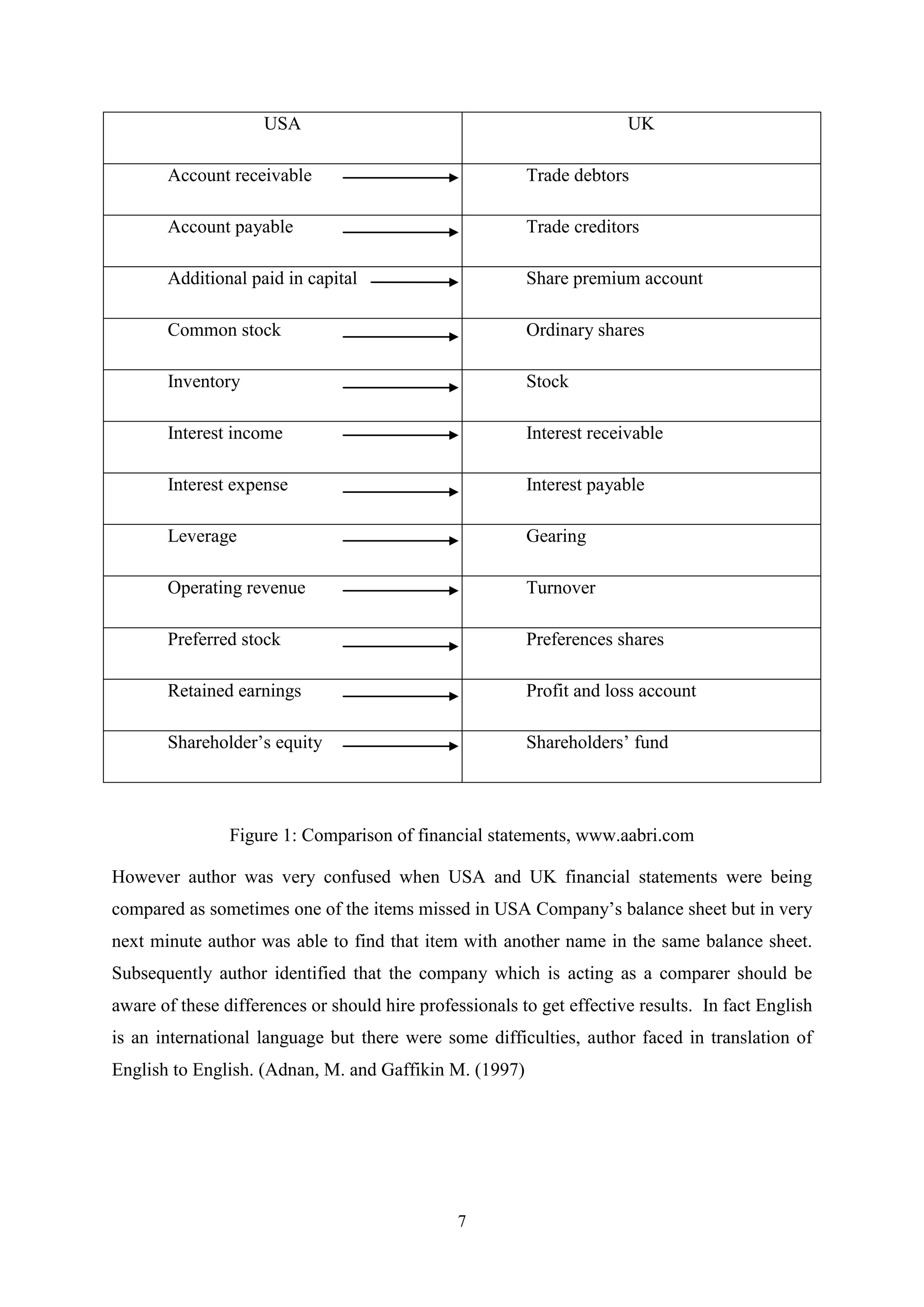
For an example, in the comparison of financial statements of UK Company with financial
statements of USA Company, author examined following differences as regards with items
names.( Adams, C. A. (2002)

6
USA

UK

Account receivable

Trade debtors

Account payable

Trade creditors

Additional paid in capital

Share premium account

Common stock

Ordinary shares

Inventory

Stock

Interest income

Interest receivable

Interest expense

Interest payable

Leverage

Gearing

Operating revenue

Turnover

Preferred stock

Preferences shares

Retained earnings

Profit and loss account

Shareholder‟s equity

Shareholders‟ fund

Figure 1: Comparison of financial statements, www.aabri.com
However author was very confused when USA and UK financial statements were being
compared as sometimes one of the items missed in USA Company‟s balance sheet but in very
next minute author was able to find that item with another name in the same balance sheet.
Subsequently author identified that the company which is acting as a comparer should be
aware of these differences or should hire professionals to get effective results. In fact English
is an international language but there were some difficulties, author faced in translation of
English to English. (Adnan, M. and Gaffikin M. (1997)

7
2.3 Format of financial statements
Different format of financial statements are used by different countries. And while the
sequence of items of these financial statements changes, some items of balance sheet are
missing in other country‟s financial statements. (http://www.emeraldinsight.com)
Examples:
In the UK, the vertical format balance sheet typically shows two years figures, with a single
column for each year. In the US, they tend to split each year into two or three columns, with
sub-totals for Assets, Liabilities and Equity or capital in the right hand column. In some ways
this makes it easier to see how the balance is arrived at. This can produce balance sheet with
the items in a slightly different order, with the Capital or Equity shown at the top of the
Liabilities, rather than at the bottom to balance out Total Assets with Total Liabilities. . The
move to IFRS has also highlighted how there were differences in the way certain figures for
the balance sheet were calculated in different countries.
Moreover, companies in the United States usually choose between two common formats for
their balance sheets such as the Account format or the Report format. U.S. companies list
assets and liabilities on the balance sheet in order of liquidity, from most liquid (cash) to least
liquid (often intangible assets). The same is true in Canada, Mexico, and Japan. The actual
line items appearing in both formats are the same but the only difference is the way in which
companies lay out the items in assets and liabilities are presented in decreasing order of
liquidity. (Refer figure 2)
(Doupnik, Hoyle, Schafer (2007)

8
Figure 2: Balance sheet in an account format of a US company, Geof (2003)
However the formula which is followed by US Company for balance sheet is,
Assets=Liabilities Shareholder‟s equity
And in UK it is,
Shareholders‟ equity = Assets-Liabilities

9
Nevertheless author faced so many problems in finding the items where it was unable to find
item called „reserves‟ in US balance sheet comparing to UK company‟s balance sheet format.
In contrast to the operational format income statement commonly found in the United States,
many UK companies present their income statement using a type of expenditure format.
Differences take place when comparing the annual reports of different countries. Such as
delay in audit reports of companies can create a major effect to the company‟s performance
when other subsidiary company requires doing a comparison.
For an example, USA companies always include consolidated financial statements in their
annual reports, while UK companies include their parent companies balance sheets to their
annual reports in addition of consolidated financial statements. In parent company balance
sheet, investments in subsidiaries are not consolidated but UK companies mention as share in
group undertakings in fixed asset section.
Nevertheless author understood that main difficulty is to compare annual reports with
different countries is the unavailability of updated data. In fact audit report for 2009 will be
available in July 2010 in UK and audit report for 2009 will be available in March 2010 in
USA. This happens because; legal system within those two countries allows them to present
financial information differently.
(http://eurojournals.com/ and http://eurojournals.com)

10
2.4 International perspective on general accounting problems
2.4.1 Providers of financing
The major providers of financing for business enterprises are family members, banks,
governments, and shareholders. Banks and the state will often be represented on the board of
directors and will therefore be able to obtain information necessary for decision making from
inside the company. However by emphasising on balance sheet it gives preferences to use
conservative accounting with regard to assets and liabilities. In general the major financial
bodies are banks for any businesses. But in Japan and France it will be their government. But
in some countries, general public act as a finance providers as in those countries, companies
focus on profits and loss or income statements.
For an example, financial providers of UK and USA are capital markets which demonstrate
high profit figures in the financial statements in terms of maximizing its share value in
market. Likewise in comparison author figured out that Japan and France have high asset
figures in financial statements whereas UK and USA demonstrate high figures of profits.
Linked to the consideration of the providers of finance is the need to consider the
sophistication of the users of financial statements. There is little point in producing account
that cannot be understood by the major target user. This consideration may also affect the
need to have financial statements made available in bulk, to a wide variety of users.
For an example the need to give every employee a set of accounts would be considered a
waste of scare resources in India, USA, France, Poland, Japan and both employees in other
developing and developed countries. Hence there can also be a difference in financial
statement orientation, with stockholders more interested in profit on the income statement
and banks more interested in solvency and liquidity on the balance sheet.
(Rahman, Zubaidur M)

11
2.4.2 Legal system
Different countries have different national legal systems. It was suggested that many
countries in the world can be put into one of two categories with respect to their main legal
system, common law and civil law. Civil law is a legislative system in which company law or
commercial codes need to establish rules in detail for financial reporting. For example, in
Germany, company accounting is to a larger extent a branch of company law where by
accounting becomes effectively a process of compliance with the laws of the country.
Common law is basically non legislative law which influences company law and does not
prescribe a large number of detailed rules to cover the behaviour of companies and how then
they publish their financial statements.
For example, In France, author noticed that accounting laws are general and does not provide
any general information and does not provide detail information about specific accounting
practices and there is no guidance available in certain areas such as leases, cash flow
statement and foreign currency translation. (Collins, Stephen H)

12
2.4.3 Accounting models
And different accounting models fulfil distinctive accounting needs. Those accounting
models namely as, British American model, continental model, inflation model, mixed
economy model, Islamic model and communist model, and each model has its own
limitations and accounting rules.
For example, Saudi Arabia has implemented the Islamic model which prohibits recognition
of interest on loan and accounting is based on religious principles. And after examine a
financial statement of Saudi company, author realised that there is no interest on loan.
Furthermore followings are one of the major distinctions in Saudi financial statements,
noticed by author.
•

Use the word „Zakat‟ instead of income tax.

•

Use the word „ijarah‟ instead of leasing

•

Use the word „takaful‟ instead of insurance.

However in comparing financial information of UK multinational company with Saudi
company, author noticed that it is a hurdle, because Saudi companies doesn‟t have any
interest figure in their profit and loss account which deducted from profit. But author also
noticed that some adjustments have been taken place in order to resolve this matter, but still it
is complicated. (Doupnik, Hoyle, Schafer (2007)

13
2.4.4 International ratios
The use of ratios analysis produces different results due to the limitations of ratio analysis.
Companies in Japan prefer short term loans than long term, because banks are the Japanese
main providers of financing and it will be so beneficial for banks to give Japanese companies
short term loans. And this will be beneficial for MNEs in Japan, because of lower rate of
interest on short term loans.
For example, current ratio and debt ratio of Japanese companies are not attractive to UK
companies due to high value of short term loans which may even meet short term obligations.
Furthermore author noticed though rules of thumb of Japanese accounts applicable for one
country, those thumb of rules may not be applicable for every country. Especially capital
markets are major financing providers for UK, not banks. Therefore current and debt ratio in
UK are very strong and will make difficult for financial analysis to compare performance of
both companies. (http://books.google.co.uk/books)

14
2.4.5 Significant distinctions exist across countries in the accounting behaviour of items.
In United States companies are not allowed to report property, plant and equipment at
amounts greater than historical cots, whereas the companies in UK are allowed to report their
assets is the balance sheet at market values. In France, development cost capitalized as an
asset. Chinese companies are required to use the direct method in preparing the statements of
cash flows whereas most companies in UK use the indirect method. Different accounting
rules to serve accounting items make comparison difficult.

For example in United states good will treat as an asset in balance sheet and it measured
initially as the excess of the acquisitions price over the fair value of net assets and for
subsequent balance sheet dated, good will is written down to a lower value only if deemed to
be impaired). In Japan goodwill value is calculated by subtracting the fair value from
purchase value of an asset. Subsequent to initial purchase good will is amortized over its
useful life not to exec 20 years. There is no specific rule available in India to measure good
will. When capitalized as an asset, subsequent good will ranges from no amortization over a
period of 10 years.
The figures can be compared but the different methods of calculating these figures make
comparison useless. I was comparing assets figures of US, UK, Japanaes multinational
companies but when I realised the different methods used for calculations of figures I could
not any satisfied results. (Nobes, Christopher W)

15
2.5 Taxation
According to Seidler (1981), there is a solid relationship between tax and accounting.
For example, in code law countries such as France and Japan financial statements serve as the
basis for taxable income. Therefore when these countries entitle into businesses, these
countries always try to minimize the income for tax purposes. On the other hand, USA use
straight line depreciation method for financial statements and accelerated depreciation for tax.
And there is not the degree of separation between tax and financial reporting that is found in
the UK in the shape of capital allowance. . However author noticed even though USA faced
the difference between rise of tax and income effect to the necessity of account for deferred
income taxes, this problem does not exist in code law countries such as Japan and France.
And also author stated that those different methods of calculating tax will generate results for
comparison. For example when Cuba has higher inflation rate than UK, it is observed that
government is always trying to impose heavy taxes providing a method which is beneficial
for government. (International Auditing Differences, Article,)

16
2.6 Inflation
Inflation is often associated with economic growth and is a major influence on accounting.
The cumulative effect of inflation over a number of years can render all accounting
information

meaningless

unless

it

is

appropriately

adjusted.

Therefore

an

economy‟s level of inflation can also be considered in the context of its influence on a
country‟s accounting system, in particular because it affects the asset valuation method and
because, in conditions of high inflation, it is essential to have an accounting system suited to
inflationary conditions.
For example, countries such as the U.S. or Great Britain (Saudagaran, 2004, 8) in which
inflation levels are mostly under control apply the historical cost method for the needs of
financial reporting. This method, however, cannot be fully applied in countries such as
Bolivia or Mexico (Saudagaran, 2004, 8), which have had or do have a high rate of inflation;
instead, these countries use different models that seek to reduce the impact of inflation on
financial reporting to obtain relevant information. And author also noticed that country like
Japan which has very low inflation, record assets on cost prices with no subsequent
adjustments because reporting currency is stable. In contrast Japan with India which higher
inflation rate, constant revaluation of long term assets changes in general price levels make
accounting complex. This will create problems where companies have to adjust accounts.
(“Towards a General Model of the Reasons for International Differences in Financial
Reporting.”)

17
2.7 Language problems
Multinational companies in different countries prepare financial statements in accordance
with their local regulations. These regulations usually require companies to keep books in
local language using local accounting principles.
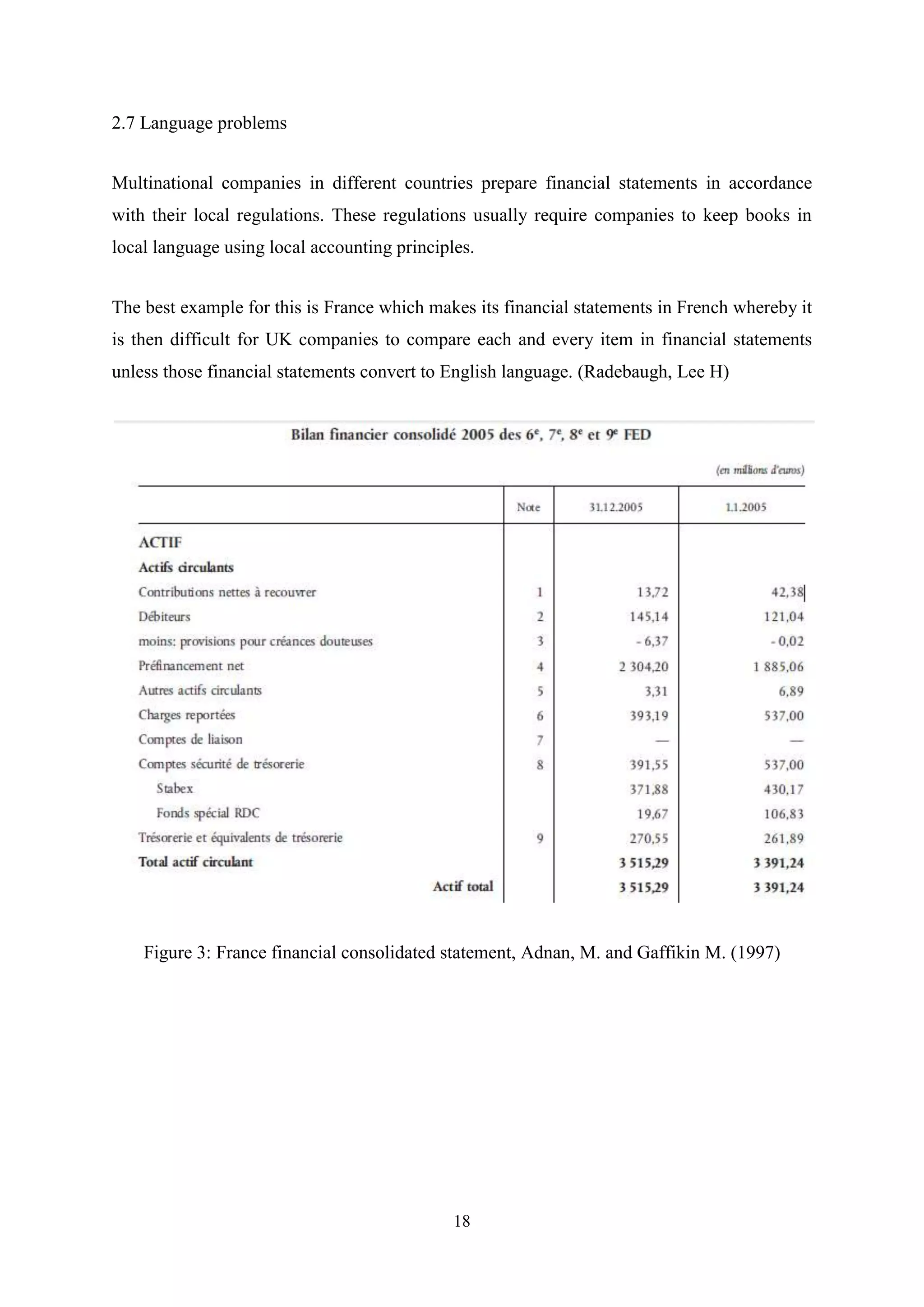
The best example for this is France which makes its financial statements in French whereby it
is then difficult for UK companies to compare each and every item in financial statements
unless those financial statements convert to English language. (Radebaugh, Lee H)

Figure 3: France financial consolidated statement, Adnan, M. and Gaffikin M. (1997)

18
2.8 Consolidated Financial Statements
Consolidated financial statements present the financial position and results of operations for a
parent (controlling entity) and one or more subsidiaries (controlled entities) as if the
individual entities actually were a single company or entity. To consolidate statements, the
following must be consolidated:
– Language
– Accounting Concepts (GAAP)
– Currency
And Consolidation is required when a corporation owns a majority of another corporation‟s
outstanding common stock. Consolidated financial statements do not always give a more
accurate picture of the financial health of an enterprise because the individual accounting
reports from the subsidiaries do not show up anywhere but in the notes section of the
consolidated finances. This makes it possible to hide problems in the subsidiary reports. Due
to different accounting policies in different countries, these multinational corporations will
typically have to prepare two sets of financial statements: one set that meets local standards,
and another set that meet the guidelines of the parent country. (Collins, Stephen H)
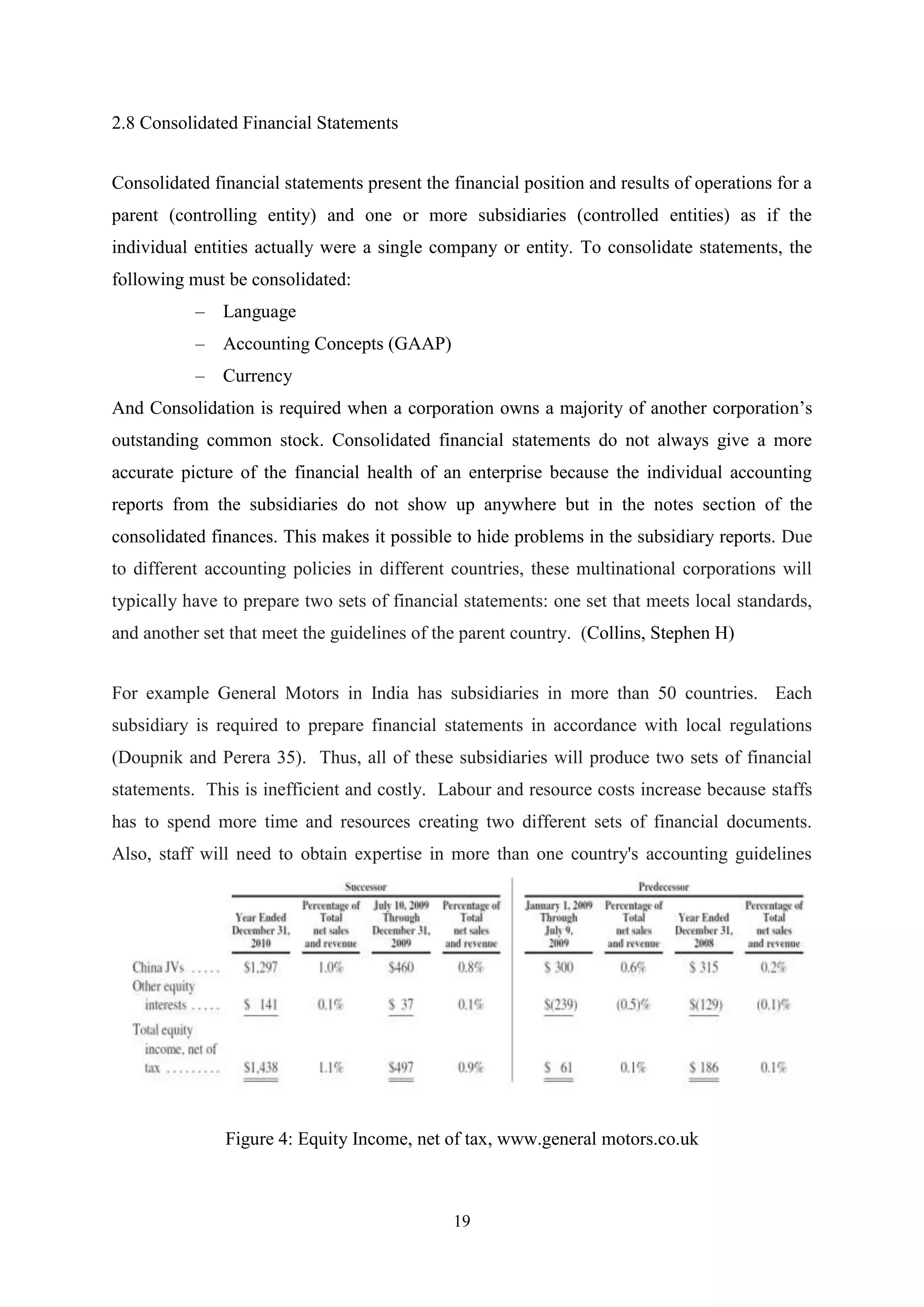
For example General Motors in India has subsidiaries in more than 50 countries. Each
subsidiary is required to prepare financial statements in accordance with local regulations
(Doupnik and Perera 35). Thus, all of these subsidiaries will produce two sets of financial
statements. This is inefficient and costly. Labour and resource costs increase because staffs
has to spend more time and resources creating two different sets of financial documents.
Also, staff will need to obtain expertise in more than one country's accounting guidelines

Figure 4: Equity Income, net of tax, www.general motors.co.uk

19
2.9 Foreign currency translation
Translation the foreign currency is necessary whenever a company with operations in more
than one country prepares consolidated financial statements that combine financial accounts
denominated in one national currency with accounts denominated in another currency. And
daily fluctuations in foreign currency are one of the major problems in different countries.
The local regulations also enforce the companies to keep records in books in local currency
such as US dollar in USA, yen in Japan, riyal in Saudi Arabia, euro in France and Indian
rupees in India. Moreover author realised that it is vital to know by every company operates
in different countries that how shall foreign currency financial statements be translated in
particular what exchange rates are to be used for different assets/ liabilities/equity accounts
and how and when shall foreign exchange gains or losses be recognized.
For example when French company uses Euro and UK Company uses Pound for consolidated
financial statements, a common currency is needed for a comparison. And though there are 3
different rates available in statements to translate statements which include average rate,
current rate and end of year rate, still it is a significant difficult matter in terms of
comparison. And when UK Company had 100 British pounds on deposit in a London bank at
the end of 2010 when the exchange rate is $1.80. To report the deposit on company‟s 2011
Balance Sheet stated in dollars, company would translate the deposit at the current rate and
you would report an asset of $180. In these scenarios issues can be raised such as which
exchange rate should be used to translate foreign currency balances to domestic currency and
how should translation gains and losses be accounted for? or Should they be included in
income?. (http://financial-education.com)

20
2.10 Different recognition criteria
Items that satisfy the recognition criteria should be recognized in the balance sheet or income
statement. The failure to recognise such items is not recognized by disclosure of the
accounting policies used nor by notes or explanatory material.
For example Unlike the U.S. GAAP, the Australian GAAP allows for the capitalization of
intangible assets. In Australia, intangible assets can be broadly categorized into goodwill,
R&D, and identifiable intangible assets (such as brand name, patents, mastheads, etc.).
However, there is no specific accounting standard to guide the accounting of identifiable
intangible assets.
And Financial Reporting Standards applicable in the UK and Republic of Ireland currently
include FRS 15 „Tangible Fixed Assets‟. FRS 15 does not specifically address recognition
criteria for tangible assets. However, FRS 5 „Reporting the substance of transactions‟ sets out
the general criteria that apply to the recognition of assets and liabilities Another differences in
USA GAAP and FRS is the availability of alternatives.
For example if one set if standard allows using 2 or more alternative for a specific topic, the
other standard requires only one defend method to be used, moreover the presentation of
financial statement‟s items such as sequence of assets and liabilities in balance sheet changes
in IFRS and US GAAP. Differences in the presentation of information in notes to financial
statements are also available like disclosure is required or not. (Meek, Gary K., and Sharokh
M. Saudagaran.)
2.11 Inconsistency in IFRS
IFRSs‟ are not based on consistent set of principles and there are conceptual inconsistencies
within and between standards. Certain standards allow alternative which is further source of
inconsistency. (Cochrane, James)
For example IAS 31‟interest in joint venture‟ allows the recognition of interest by using
either equity method or proportionate method. Therefore companies in different courtiers
such as France, Japan, and UK use distinctive methods which make comparison difficult.

21
Recommendations
The difference between global accounting practices can head to poor business decisionmaking difficulties in raising capital in different or foreign markets and while International
Accounting Standard Committee, is trying to make a single set of high quality
understandable, enforceable accounting standards worldwide. After evaluating the problems
which cause to diversify accounting in different countries, author presents his
recommendations in general as followings.
The differences between local rules and international rules for preparation of financial
statements should be minimised and the uniform of standards of accounting should be
applied for all multinational companies. And new standards should be issued and
existing ones should be improved to eliminate the management judgements,
assumptions and guesses and at the same time use of alternatives should be eliminated
and standard accounting treatment should be encouraged.
Special care should be taken to understand the companies‟ consolidation policies and
how they translate the financial statements of their foreign operations.
Consensus on the use of single currency in accounts like dollar by all the
multinational companies.
Strengthen of accounting profession, move from national GAAP to IFRS in respective
countries.
Auditing of accounts by external auditors and setting of internal audit department
within companies will act as deterrence against creative accounting.
If the differences within a company also expressed in percentages the currency
translation problem can be resolved.
Use of common language by multinationals for the preparation of financial statements
can eliminate the confusion and bring more clearly and makes accounts
understandable for stakeholders.
Financial statements and annual reports should easily be able for the uses by
developing data warehouses.
If the additional information will be available in the notes of financial statements, the
problem regarding format can be overcome and the comparison of financial
performances within different countries multinationals can easily be performed.

22
Furthermore the process of inventory valuation is different in countries such as Japan where
companies use cost methods such as FIFO, LIFO or weighted averages. But UK companies
use lower of cost or net realisable value in accordance of general IFRS practices and USA
companies use the lower LIFO and current replacement cost. So author realised that need of
harmonization emerges due to differences in accounting rules across countries. Therefore it
may be impossible to remove all differences, but still possible to reduce distinctive with the
acceptance of other countries.
In addition author sees that UK Company‟s reports on inflation accounting identified 20
possible combinations of net asset and capital maintenance that could define profit. Thus it is
not the individual policy choice in itself that constitutes „manipulation‟ but the intention
behind it. However author notified where a number of such accounting approaches arise in
one company‟s accounts then the suspicion of manipulation grows and make difficult to
compare with different country‟s financial statements. Therefore the difference in accounting
principles between countries could really cause inconsistencies between international
operations. Maybe if an international standard were set for all countries, there would be less
quarrelling and more agreement in accounting between countries. There would be less
discrepancy in the accounting principles and the balance sheet for each country. Finally, the
diversity that exists in financial reporting has caused many problems for multinational
corporations in preparing financial statement on the basis of a single set of accounting rule.

23
Conclusion
Different countries apply different accounting practices. This accounting diversity is the
reason that one company may seem profitable while another seems to be operating at a loss.
Harmonization of the international accounting information systems has tended to follow the
integration of the markets served by the accounts. According to the business practice it is
understandable that the usage of harmonized international accounting system guides to a
reduction of the information irregularity between the owners and the managers. So author
notified that following distinctive accounting rules in different countries also make
comparison difficult and meaningless. Moreover it makes much complicated when
companies trying to satisfy two rules in countries, at first domestic or national or local GAAP
and second international rules or legal GAAP.
The „true and fair view‟ concept is one of two competing but not mutually exclusive legal
standards for financial reporting quality that have been subject to debate on their meaning,
use and importance. While the former is closely identified with judgement and is used in the
United Kingdom, the European Union, Singapore, Australia, and New Zealand, the latter is
the standard for United States financial reporting and tends to be more rules based.
(Hopwood, Page, & Turley, 1990). Furthermore author noticed that when UK has affiliated to
the EU, the "true and fair" has been raised to an overall principle within EU's accounting
directive. In the Swedish Accounts Legislation has the "true and fair" been translated to
"correct view". The essence in the concept is still unclear and can be interpreted in many
ways. In Germany, which has a continental interpretation, the "true and fair view" implies
that the accounting should be stated according to laws and recommendations.
Blake (1998) argues that there are 4 ways in which creative accounting may arise. Firstly by
exercise of choice between permitted alternative policies, secondly by applying bias in the
making of accounting estimates, thirdly by structuring transactions in such a way as to
manipulate the results in the financial statement and finally by timing genius transactions as
to manipulate accounting. One way to identify a tendency towards a „creative‟ bias in
company reports is to consider the impact of its overall selection of accounting policies. So in
the future, author hopes that a common standard can be agreed upon by all the multinational
corporations.

24
References
Afterman, Allan B. International Accounting, Financial Reporting, and Analysis. New
York: Warren, Gorham & Lamont, 1995, pp. C1-17, C1-22.
Accounting Standards Board, (1991). The objective of financial statements and the
qualitative characteristics of financial information. Accountancy, September 1991.
Adams, C. A. (2002). Internal Organizational Factors Influencing Corporate Social
and Ethical Reporting: Beyond Current Theory. Accounting, Auditing and
Accountability Journal, Vol.15, No. 2, pp.223-250.
Adhikari, A. and Tondkar R. H. (1992). Environmental factors influencing accounting
disclosure requirements of global stock exchanges. Journal of International Financial
Management and Accounting Vol.4, No. 2, pp. 75- 105.
Adnan, M. and Gaffikin M. (1997). The Shari‟ah, Islamic Banks and Accounting
Concepts and Practices. Accounting, Commerce and Finance: the Islamic Perspective.
Paper presented at International Conference, University of Western Sydney,
Macarthur, Australia
Accounting for Foreign Currency Translation, Accessed on 22nd March 2012.
http://financial-education.com/2007/09/19/accounting-for-foreign-currencytransactions/
Accounting, Auditing & Accountability journal, Accessed

on 1st April 2012

http://www.emeraldinsight.com/products/journals/journals.htm?PHPSESSID=5ltjrpu5
3cn3gerjhlm037sc24&id=aaaj
Accounting diversity and the value relevant of accounting earnings and book value in
four countries, The United states, The United Kingdom, Japan & Canada. Accessed
on 2nd April 2012.

25
Cochrane, James L.; James E. Shapiro; and Jean E. Tobin. “Foreign Equities and U.S.
Investors: Breaking Down the Barriers Separating Supply and Demand.” NYSE
Working Paper, 95-04, 1995.
Collins, Stephen H. “The Move to Globalization,” Journal of Accountancy, March
1989.
Comparative International Accounting and Practices, Accessed on 10th April 2012,
http://eurojournals.com/ and http://eurojournals.com/ijas_1_03.pdf.
Doupnik, Timothy S., and Stephen B. Salter. “An Empirical Test of a Judgemental
International Classification of Financial Reporting Practices.” Journal of International
Business Studies, First Quarter 1993, pp. 41–60.
Doupnik, Timothy S., and George T. Tsakumis. “A Review of Empirical Tests of
Gray‟s Framework and Suggestions for Future Research.” Journal of Accounting
Literature, 2004, pp. 1–48.
Doupnik, Hoyle, Schafer (2007) Advanced Accounting, 8th ed. McGraw-Hill Irwin
Doupnik,T and Salter, S (1995) “External environment, culture, and accounting
practice; a preliminary test of a general model of international accounting
development”, International Journal of Accounting, 30, 3.
Gernon, H., and Gary Meek. Accounting: An International Perspective, 5th ed. Burr
Ridge, IL: Irwin/McGraw-Hill, 2001.
Gray, S. J. “Towards a Theory of Cultural Influence on the Development of
Accounting Systems Internationally.” Abacus, March 1988, pp. 1–15.
International Auditing Differences, Article, Accessed on 15th April 2012, Journal
article by Carol A. Frost, Kurt P. Ramin; Journal of Accountancy, Vol. 181, 1996
http://www.questia.com/googleScholar.qst?docId=5000338642 .

26
International Financial Reporting Standards Desk Reference, Accessed on 23rd April
2012, http://books.google.co.uk/
Meek, Gary K., and Sharokh M. Saudagaran. “A Survey of Research on Financial
Reporting in a Transnational Context.” Journal of Accounting Literature, 1990, pp.
145–82.
Nobes, Christopher W. “A Judgemental International Classification of Financial
Reporting Practices.” Journal of Business Finance and Accounting, Spring 1983.
Towards an Understanding of Cultural Influence on the International Practice of
Accounting, Nigel Finch, Macquarie University, Accessed on 22nd March 2012,
http://aabri.com/journals.html and http://aabri.com/manuscripts/09175.pdf
“Towards a General Model of the Reasons for International Differences in Financial
Reporting.” Abacus 34, no. 2 (1998), p. 166.
Radebaugh, Lee H., and Sidney J. Gray. International Accounting and Multinational
Enterprises, 5th Ed. New York: Wiley, 2002.
Rahman, Zubaidur M. “The Role of Accounting in the East Asian Financial Crisis:
Lessons Learned?” Transnational Corporations 7, no. 3 (December 1998), pp. 1–52.
U.S. Department of Commerce. “U.S. Intern

27

Ia print

  • 1.
    INTERNATIONAL ACCOUNTING MA InternationalBusiness Student Identity: 1128054 1
  • 2.
    Acknowledgment First and foremostI offer my sincerest gratitude to my lecture and supervisor, Dr. Paul saw as his encouragement, guidance and support throughout the whole assignment enabled me to develop an understanding of the subject and with his patience and knowledge I was allowed to work in my own way. And also Dr. Paul saw lectured more general scenarios which directed me to present the assignment precisely. And then, I offer my regards and blessings to my parents who encouraged me through online, and friends who supported me in any respect during the completion of the assignment 2
  • 3.
    Contents 1. Introduction........................................................................................................4 2. Examinationof problems and examples............................................................5 2.1 Financial data and information accessibility............................................................5 2.2 Terminology in financial statements........................................................................5 2.3 Format of financial statements.................................................................................8 2.4 International perspective on general accounting problems....................................11 2.4.1Providers of financing..........................................................................................11 2.4.2 Legal system........................................................................................................12 2.4.3 Accounting models..............................................................................................13 2.4.4 International ratios...............................................................................................14 2.4.5 Significant distinctions exist across countries in the accounting behaviour of scenarios.......................................................................................................................15 2.5 Taxation..................................................................................................................16 2.6 Inflation..................................................................................................................17 2.7 Language problems................................................................................................18 2.8 Consolidated Financial Statements........................................................................19 2.9 Foreign currency translation...................................................................................20 2.10 Different recognition criteria................................................................................21 2.11 Inconsistency in IFRS..........................................................................................21 Recommendations........................................................................................................22 Conclusion....................................................................................................................24 References....................................................................................................................25 3
  • 4.
    1. Introduction Although thereis a growing awareness of the varying influences of environmental factors on accounting development in a global context, many accounting experts also understand that there may be systematically different problems of accounting behaviour applicable to various groups of countries. According to Nobes and Parker, 2008 there are distinctions in accounting rules and principles in different countries. Differences between the national and international accounting rules make the contrast complicated for financial performances. Besides accounting rules themselves may be at variance not just between countries but also within countries In an effort to generate comparable and reliable accounting information to help investors, creditors and others, each country has developed its own national financial accounting standards. These standards reflect the culture, history, and the characteristics of accounting problems facing that country. Accounting bodies therefore attended to reduce the degree of variation in international accounting practices by forming International Accounting Standards Committee (IASC). However most MNEs arrange their consolidated financial statements in accordance with GAAP which develops sets of accounting rules applicable worldwide or with IFRS which was issued by International Accounting Standard Board (ISAB) and some multinational companies find out those difficulties such as lease accounting, consolidation accounting and foreign currency translation have been tackled with different procedures in different countries. Furthermore factors such as legal system, the influence of taxation in financial reporting, corporate financial system, inflation, political and economic ties between countries and national culture also make financial performance difficult to compare among multinational companies in different countries. (Afterman, Allan B) However the author intended to present about above mentioned problems precisely in this report at the scenario of comparing financial statements of UK multinational company with other companies of same industry registered in America, Cuba, France, India, Saudi Arabia and Poland. 4
  • 5.
    2. Examination ofproblems and examples 2.1 Financial data and information accessibility It is not unproblematic to get financial data of foreign companies from sources because some companies do business of developing database that provides financial information of foreign companies such as Copustat global database. But on the other hand there are so many limitations for using these databases such as, emerging errors when data entered into the database, several formats of financial statements of different foreign companies. However databases follow only one format, none of commercial database provides a complete set of notes which restrict to obtain qualitative and quantitative information. For an example, when author tried to search financial data and information using industry code from standard industry codes on web, it gave author an error instead of financial information, such as ‘ERROR: Expression using IN has components that are of different data types.’ Although it was difficult to get financial information of Cuba, Poland and Saudi Arabia, there are some companies whose financial information is easily accessible. At regular period companies should prepare financial statements. Then Management use it to plan ahead and set goals for upcoming periods and compare them with their different country‟s‟ financial statements for comparison with macro economical data and forecasts. Although, in most countries ending period of financial year for companies is 31st of December and in contrast some companies ending period of financial year is 31 of March. Besides author also highlighted that time gap between the publication of financial statement and end of the year is different across countries. For an example, UK companies publish their accounts within 6 months when USA companies publish their accounts within 60 days. However the unavailability of financial data of different country‟s companies makes impossible to compare the financial performance with current data. In UK after 6 months of last financial year, the financial data will be published and after 2 months it will be published in USA. Therefore different time lag between the publications of financial statements also creates problems in comparison. (Accounting Standards Board, (1991) 5
  • 6.
    2.2 Terminology infinancial statements When local companies attend to compare its financial statements with its competitors or with its foreign companies, items with different names in financial statements of those different countries confuse the local companies by misleading them to identify the precise figure. For an example, in the comparison of financial statements of UK Company with financial statements of USA Company, author examined following differences as regards with items names.( Adams, C. A. (2002) 6
  • 7.
    USA UK Account receivable Trade debtors Accountpayable Trade creditors Additional paid in capital Share premium account Common stock Ordinary shares Inventory Stock Interest income Interest receivable Interest expense Interest payable Leverage Gearing Operating revenue Turnover Preferred stock Preferences shares Retained earnings Profit and loss account Shareholder‟s equity Shareholders‟ fund Figure 1: Comparison of financial statements, www.aabri.com However author was very confused when USA and UK financial statements were being compared as sometimes one of the items missed in USA Company‟s balance sheet but in very next minute author was able to find that item with another name in the same balance sheet. Subsequently author identified that the company which is acting as a comparer should be aware of these differences or should hire professionals to get effective results. In fact English is an international language but there were some difficulties, author faced in translation of English to English. (Adnan, M. and Gaffikin M. (1997) 7
  • 8.
    2.3 Format offinancial statements Different format of financial statements are used by different countries. And while the sequence of items of these financial statements changes, some items of balance sheet are missing in other country‟s financial statements. (http://www.emeraldinsight.com) Examples: In the UK, the vertical format balance sheet typically shows two years figures, with a single column for each year. In the US, they tend to split each year into two or three columns, with sub-totals for Assets, Liabilities and Equity or capital in the right hand column. In some ways this makes it easier to see how the balance is arrived at. This can produce balance sheet with the items in a slightly different order, with the Capital or Equity shown at the top of the Liabilities, rather than at the bottom to balance out Total Assets with Total Liabilities. . The move to IFRS has also highlighted how there were differences in the way certain figures for the balance sheet were calculated in different countries. Moreover, companies in the United States usually choose between two common formats for their balance sheets such as the Account format or the Report format. U.S. companies list assets and liabilities on the balance sheet in order of liquidity, from most liquid (cash) to least liquid (often intangible assets). The same is true in Canada, Mexico, and Japan. The actual line items appearing in both formats are the same but the only difference is the way in which companies lay out the items in assets and liabilities are presented in decreasing order of liquidity. (Refer figure 2) (Doupnik, Hoyle, Schafer (2007) 8
  • 9.
    Figure 2: Balancesheet in an account format of a US company, Geof (2003) However the formula which is followed by US Company for balance sheet is, Assets=Liabilities Shareholder‟s equity And in UK it is, Shareholders‟ equity = Assets-Liabilities 9
  • 10.
    Nevertheless author facedso many problems in finding the items where it was unable to find item called „reserves‟ in US balance sheet comparing to UK company‟s balance sheet format. In contrast to the operational format income statement commonly found in the United States, many UK companies present their income statement using a type of expenditure format. Differences take place when comparing the annual reports of different countries. Such as delay in audit reports of companies can create a major effect to the company‟s performance when other subsidiary company requires doing a comparison. For an example, USA companies always include consolidated financial statements in their annual reports, while UK companies include their parent companies balance sheets to their annual reports in addition of consolidated financial statements. In parent company balance sheet, investments in subsidiaries are not consolidated but UK companies mention as share in group undertakings in fixed asset section. Nevertheless author understood that main difficulty is to compare annual reports with different countries is the unavailability of updated data. In fact audit report for 2009 will be available in July 2010 in UK and audit report for 2009 will be available in March 2010 in USA. This happens because; legal system within those two countries allows them to present financial information differently. (http://eurojournals.com/ and http://eurojournals.com) 10
  • 11.
    2.4 International perspectiveon general accounting problems 2.4.1 Providers of financing The major providers of financing for business enterprises are family members, banks, governments, and shareholders. Banks and the state will often be represented on the board of directors and will therefore be able to obtain information necessary for decision making from inside the company. However by emphasising on balance sheet it gives preferences to use conservative accounting with regard to assets and liabilities. In general the major financial bodies are banks for any businesses. But in Japan and France it will be their government. But in some countries, general public act as a finance providers as in those countries, companies focus on profits and loss or income statements. For an example, financial providers of UK and USA are capital markets which demonstrate high profit figures in the financial statements in terms of maximizing its share value in market. Likewise in comparison author figured out that Japan and France have high asset figures in financial statements whereas UK and USA demonstrate high figures of profits. Linked to the consideration of the providers of finance is the need to consider the sophistication of the users of financial statements. There is little point in producing account that cannot be understood by the major target user. This consideration may also affect the need to have financial statements made available in bulk, to a wide variety of users. For an example the need to give every employee a set of accounts would be considered a waste of scare resources in India, USA, France, Poland, Japan and both employees in other developing and developed countries. Hence there can also be a difference in financial statement orientation, with stockholders more interested in profit on the income statement and banks more interested in solvency and liquidity on the balance sheet. (Rahman, Zubaidur M) 11
  • 12.
    2.4.2 Legal system Differentcountries have different national legal systems. It was suggested that many countries in the world can be put into one of two categories with respect to their main legal system, common law and civil law. Civil law is a legislative system in which company law or commercial codes need to establish rules in detail for financial reporting. For example, in Germany, company accounting is to a larger extent a branch of company law where by accounting becomes effectively a process of compliance with the laws of the country. Common law is basically non legislative law which influences company law and does not prescribe a large number of detailed rules to cover the behaviour of companies and how then they publish their financial statements. For example, In France, author noticed that accounting laws are general and does not provide any general information and does not provide detail information about specific accounting practices and there is no guidance available in certain areas such as leases, cash flow statement and foreign currency translation. (Collins, Stephen H) 12
  • 13.
    2.4.3 Accounting models Anddifferent accounting models fulfil distinctive accounting needs. Those accounting models namely as, British American model, continental model, inflation model, mixed economy model, Islamic model and communist model, and each model has its own limitations and accounting rules. For example, Saudi Arabia has implemented the Islamic model which prohibits recognition of interest on loan and accounting is based on religious principles. And after examine a financial statement of Saudi company, author realised that there is no interest on loan. Furthermore followings are one of the major distinctions in Saudi financial statements, noticed by author. • Use the word „Zakat‟ instead of income tax. • Use the word „ijarah‟ instead of leasing • Use the word „takaful‟ instead of insurance. However in comparing financial information of UK multinational company with Saudi company, author noticed that it is a hurdle, because Saudi companies doesn‟t have any interest figure in their profit and loss account which deducted from profit. But author also noticed that some adjustments have been taken place in order to resolve this matter, but still it is complicated. (Doupnik, Hoyle, Schafer (2007) 13
  • 14.
    2.4.4 International ratios Theuse of ratios analysis produces different results due to the limitations of ratio analysis. Companies in Japan prefer short term loans than long term, because banks are the Japanese main providers of financing and it will be so beneficial for banks to give Japanese companies short term loans. And this will be beneficial for MNEs in Japan, because of lower rate of interest on short term loans. For example, current ratio and debt ratio of Japanese companies are not attractive to UK companies due to high value of short term loans which may even meet short term obligations. Furthermore author noticed though rules of thumb of Japanese accounts applicable for one country, those thumb of rules may not be applicable for every country. Especially capital markets are major financing providers for UK, not banks. Therefore current and debt ratio in UK are very strong and will make difficult for financial analysis to compare performance of both companies. (http://books.google.co.uk/books) 14
  • 15.
    2.4.5 Significant distinctionsexist across countries in the accounting behaviour of items. In United States companies are not allowed to report property, plant and equipment at amounts greater than historical cots, whereas the companies in UK are allowed to report their assets is the balance sheet at market values. In France, development cost capitalized as an asset. Chinese companies are required to use the direct method in preparing the statements of cash flows whereas most companies in UK use the indirect method. Different accounting rules to serve accounting items make comparison difficult. For example in United states good will treat as an asset in balance sheet and it measured initially as the excess of the acquisitions price over the fair value of net assets and for subsequent balance sheet dated, good will is written down to a lower value only if deemed to be impaired). In Japan goodwill value is calculated by subtracting the fair value from purchase value of an asset. Subsequent to initial purchase good will is amortized over its useful life not to exec 20 years. There is no specific rule available in India to measure good will. When capitalized as an asset, subsequent good will ranges from no amortization over a period of 10 years. The figures can be compared but the different methods of calculating these figures make comparison useless. I was comparing assets figures of US, UK, Japanaes multinational companies but when I realised the different methods used for calculations of figures I could not any satisfied results. (Nobes, Christopher W) 15
  • 16.
    2.5 Taxation According toSeidler (1981), there is a solid relationship between tax and accounting. For example, in code law countries such as France and Japan financial statements serve as the basis for taxable income. Therefore when these countries entitle into businesses, these countries always try to minimize the income for tax purposes. On the other hand, USA use straight line depreciation method for financial statements and accelerated depreciation for tax. And there is not the degree of separation between tax and financial reporting that is found in the UK in the shape of capital allowance. . However author noticed even though USA faced the difference between rise of tax and income effect to the necessity of account for deferred income taxes, this problem does not exist in code law countries such as Japan and France. And also author stated that those different methods of calculating tax will generate results for comparison. For example when Cuba has higher inflation rate than UK, it is observed that government is always trying to impose heavy taxes providing a method which is beneficial for government. (International Auditing Differences, Article,) 16
  • 17.
    2.6 Inflation Inflation isoften associated with economic growth and is a major influence on accounting. The cumulative effect of inflation over a number of years can render all accounting information meaningless unless it is appropriately adjusted. Therefore an economy‟s level of inflation can also be considered in the context of its influence on a country‟s accounting system, in particular because it affects the asset valuation method and because, in conditions of high inflation, it is essential to have an accounting system suited to inflationary conditions. For example, countries such as the U.S. or Great Britain (Saudagaran, 2004, 8) in which inflation levels are mostly under control apply the historical cost method for the needs of financial reporting. This method, however, cannot be fully applied in countries such as Bolivia or Mexico (Saudagaran, 2004, 8), which have had or do have a high rate of inflation; instead, these countries use different models that seek to reduce the impact of inflation on financial reporting to obtain relevant information. And author also noticed that country like Japan which has very low inflation, record assets on cost prices with no subsequent adjustments because reporting currency is stable. In contrast Japan with India which higher inflation rate, constant revaluation of long term assets changes in general price levels make accounting complex. This will create problems where companies have to adjust accounts. (“Towards a General Model of the Reasons for International Differences in Financial Reporting.”) 17
  • 18.
    2.7 Language problems Multinationalcompanies in different countries prepare financial statements in accordance with their local regulations. These regulations usually require companies to keep books in local language using local accounting principles. The best example for this is France which makes its financial statements in French whereby it is then difficult for UK companies to compare each and every item in financial statements unless those financial statements convert to English language. (Radebaugh, Lee H) Figure 3: France financial consolidated statement, Adnan, M. and Gaffikin M. (1997) 18
  • 19.
    2.8 Consolidated FinancialStatements Consolidated financial statements present the financial position and results of operations for a parent (controlling entity) and one or more subsidiaries (controlled entities) as if the individual entities actually were a single company or entity. To consolidate statements, the following must be consolidated: – Language – Accounting Concepts (GAAP) – Currency And Consolidation is required when a corporation owns a majority of another corporation‟s outstanding common stock. Consolidated financial statements do not always give a more accurate picture of the financial health of an enterprise because the individual accounting reports from the subsidiaries do not show up anywhere but in the notes section of the consolidated finances. This makes it possible to hide problems in the subsidiary reports. Due to different accounting policies in different countries, these multinational corporations will typically have to prepare two sets of financial statements: one set that meets local standards, and another set that meet the guidelines of the parent country. (Collins, Stephen H) For example General Motors in India has subsidiaries in more than 50 countries. Each subsidiary is required to prepare financial statements in accordance with local regulations (Doupnik and Perera 35). Thus, all of these subsidiaries will produce two sets of financial statements. This is inefficient and costly. Labour and resource costs increase because staffs has to spend more time and resources creating two different sets of financial documents. Also, staff will need to obtain expertise in more than one country's accounting guidelines Figure 4: Equity Income, net of tax, www.general motors.co.uk 19
  • 20.
    2.9 Foreign currencytranslation Translation the foreign currency is necessary whenever a company with operations in more than one country prepares consolidated financial statements that combine financial accounts denominated in one national currency with accounts denominated in another currency. And daily fluctuations in foreign currency are one of the major problems in different countries. The local regulations also enforce the companies to keep records in books in local currency such as US dollar in USA, yen in Japan, riyal in Saudi Arabia, euro in France and Indian rupees in India. Moreover author realised that it is vital to know by every company operates in different countries that how shall foreign currency financial statements be translated in particular what exchange rates are to be used for different assets/ liabilities/equity accounts and how and when shall foreign exchange gains or losses be recognized. For example when French company uses Euro and UK Company uses Pound for consolidated financial statements, a common currency is needed for a comparison. And though there are 3 different rates available in statements to translate statements which include average rate, current rate and end of year rate, still it is a significant difficult matter in terms of comparison. And when UK Company had 100 British pounds on deposit in a London bank at the end of 2010 when the exchange rate is $1.80. To report the deposit on company‟s 2011 Balance Sheet stated in dollars, company would translate the deposit at the current rate and you would report an asset of $180. In these scenarios issues can be raised such as which exchange rate should be used to translate foreign currency balances to domestic currency and how should translation gains and losses be accounted for? or Should they be included in income?. (http://financial-education.com) 20
  • 21.
    2.10 Different recognitioncriteria Items that satisfy the recognition criteria should be recognized in the balance sheet or income statement. The failure to recognise such items is not recognized by disclosure of the accounting policies used nor by notes or explanatory material. For example Unlike the U.S. GAAP, the Australian GAAP allows for the capitalization of intangible assets. In Australia, intangible assets can be broadly categorized into goodwill, R&D, and identifiable intangible assets (such as brand name, patents, mastheads, etc.). However, there is no specific accounting standard to guide the accounting of identifiable intangible assets. And Financial Reporting Standards applicable in the UK and Republic of Ireland currently include FRS 15 „Tangible Fixed Assets‟. FRS 15 does not specifically address recognition criteria for tangible assets. However, FRS 5 „Reporting the substance of transactions‟ sets out the general criteria that apply to the recognition of assets and liabilities Another differences in USA GAAP and FRS is the availability of alternatives. For example if one set if standard allows using 2 or more alternative for a specific topic, the other standard requires only one defend method to be used, moreover the presentation of financial statement‟s items such as sequence of assets and liabilities in balance sheet changes in IFRS and US GAAP. Differences in the presentation of information in notes to financial statements are also available like disclosure is required or not. (Meek, Gary K., and Sharokh M. Saudagaran.) 2.11 Inconsistency in IFRS IFRSs‟ are not based on consistent set of principles and there are conceptual inconsistencies within and between standards. Certain standards allow alternative which is further source of inconsistency. (Cochrane, James) For example IAS 31‟interest in joint venture‟ allows the recognition of interest by using either equity method or proportionate method. Therefore companies in different courtiers such as France, Japan, and UK use distinctive methods which make comparison difficult. 21
  • 22.
    Recommendations The difference betweenglobal accounting practices can head to poor business decisionmaking difficulties in raising capital in different or foreign markets and while International Accounting Standard Committee, is trying to make a single set of high quality understandable, enforceable accounting standards worldwide. After evaluating the problems which cause to diversify accounting in different countries, author presents his recommendations in general as followings. The differences between local rules and international rules for preparation of financial statements should be minimised and the uniform of standards of accounting should be applied for all multinational companies. And new standards should be issued and existing ones should be improved to eliminate the management judgements, assumptions and guesses and at the same time use of alternatives should be eliminated and standard accounting treatment should be encouraged. Special care should be taken to understand the companies‟ consolidation policies and how they translate the financial statements of their foreign operations. Consensus on the use of single currency in accounts like dollar by all the multinational companies. Strengthen of accounting profession, move from national GAAP to IFRS in respective countries. Auditing of accounts by external auditors and setting of internal audit department within companies will act as deterrence against creative accounting. If the differences within a company also expressed in percentages the currency translation problem can be resolved. Use of common language by multinationals for the preparation of financial statements can eliminate the confusion and bring more clearly and makes accounts understandable for stakeholders. Financial statements and annual reports should easily be able for the uses by developing data warehouses. If the additional information will be available in the notes of financial statements, the problem regarding format can be overcome and the comparison of financial performances within different countries multinationals can easily be performed. 22
  • 23.
    Furthermore the processof inventory valuation is different in countries such as Japan where companies use cost methods such as FIFO, LIFO or weighted averages. But UK companies use lower of cost or net realisable value in accordance of general IFRS practices and USA companies use the lower LIFO and current replacement cost. So author realised that need of harmonization emerges due to differences in accounting rules across countries. Therefore it may be impossible to remove all differences, but still possible to reduce distinctive with the acceptance of other countries. In addition author sees that UK Company‟s reports on inflation accounting identified 20 possible combinations of net asset and capital maintenance that could define profit. Thus it is not the individual policy choice in itself that constitutes „manipulation‟ but the intention behind it. However author notified where a number of such accounting approaches arise in one company‟s accounts then the suspicion of manipulation grows and make difficult to compare with different country‟s financial statements. Therefore the difference in accounting principles between countries could really cause inconsistencies between international operations. Maybe if an international standard were set for all countries, there would be less quarrelling and more agreement in accounting between countries. There would be less discrepancy in the accounting principles and the balance sheet for each country. Finally, the diversity that exists in financial reporting has caused many problems for multinational corporations in preparing financial statement on the basis of a single set of accounting rule. 23
  • 24.
    Conclusion Different countries applydifferent accounting practices. This accounting diversity is the reason that one company may seem profitable while another seems to be operating at a loss. Harmonization of the international accounting information systems has tended to follow the integration of the markets served by the accounts. According to the business practice it is understandable that the usage of harmonized international accounting system guides to a reduction of the information irregularity between the owners and the managers. So author notified that following distinctive accounting rules in different countries also make comparison difficult and meaningless. Moreover it makes much complicated when companies trying to satisfy two rules in countries, at first domestic or national or local GAAP and second international rules or legal GAAP. The „true and fair view‟ concept is one of two competing but not mutually exclusive legal standards for financial reporting quality that have been subject to debate on their meaning, use and importance. While the former is closely identified with judgement and is used in the United Kingdom, the European Union, Singapore, Australia, and New Zealand, the latter is the standard for United States financial reporting and tends to be more rules based. (Hopwood, Page, & Turley, 1990). Furthermore author noticed that when UK has affiliated to the EU, the "true and fair" has been raised to an overall principle within EU's accounting directive. In the Swedish Accounts Legislation has the "true and fair" been translated to "correct view". The essence in the concept is still unclear and can be interpreted in many ways. In Germany, which has a continental interpretation, the "true and fair view" implies that the accounting should be stated according to laws and recommendations. Blake (1998) argues that there are 4 ways in which creative accounting may arise. Firstly by exercise of choice between permitted alternative policies, secondly by applying bias in the making of accounting estimates, thirdly by structuring transactions in such a way as to manipulate the results in the financial statement and finally by timing genius transactions as to manipulate accounting. One way to identify a tendency towards a „creative‟ bias in company reports is to consider the impact of its overall selection of accounting policies. So in the future, author hopes that a common standard can be agreed upon by all the multinational corporations. 24
  • 25.
    References Afterman, Allan B.International Accounting, Financial Reporting, and Analysis. New York: Warren, Gorham & Lamont, 1995, pp. C1-17, C1-22. Accounting Standards Board, (1991). The objective of financial statements and the qualitative characteristics of financial information. Accountancy, September 1991. Adams, C. A. (2002). Internal Organizational Factors Influencing Corporate Social and Ethical Reporting: Beyond Current Theory. Accounting, Auditing and Accountability Journal, Vol.15, No. 2, pp.223-250. Adhikari, A. and Tondkar R. H. (1992). Environmental factors influencing accounting disclosure requirements of global stock exchanges. Journal of International Financial Management and Accounting Vol.4, No. 2, pp. 75- 105. Adnan, M. and Gaffikin M. (1997). The Shari‟ah, Islamic Banks and Accounting Concepts and Practices. Accounting, Commerce and Finance: the Islamic Perspective. Paper presented at International Conference, University of Western Sydney, Macarthur, Australia Accounting for Foreign Currency Translation, Accessed on 22nd March 2012. http://financial-education.com/2007/09/19/accounting-for-foreign-currencytransactions/ Accounting, Auditing & Accountability journal, Accessed on 1st April 2012 http://www.emeraldinsight.com/products/journals/journals.htm?PHPSESSID=5ltjrpu5 3cn3gerjhlm037sc24&id=aaaj Accounting diversity and the value relevant of accounting earnings and book value in four countries, The United states, The United Kingdom, Japan & Canada. Accessed on 2nd April 2012. 25
  • 26.
    Cochrane, James L.;James E. Shapiro; and Jean E. Tobin. “Foreign Equities and U.S. Investors: Breaking Down the Barriers Separating Supply and Demand.” NYSE Working Paper, 95-04, 1995. Collins, Stephen H. “The Move to Globalization,” Journal of Accountancy, March 1989. Comparative International Accounting and Practices, Accessed on 10th April 2012, http://eurojournals.com/ and http://eurojournals.com/ijas_1_03.pdf. Doupnik, Timothy S., and Stephen B. Salter. “An Empirical Test of a Judgemental International Classification of Financial Reporting Practices.” Journal of International Business Studies, First Quarter 1993, pp. 41–60. Doupnik, Timothy S., and George T. Tsakumis. “A Review of Empirical Tests of Gray‟s Framework and Suggestions for Future Research.” Journal of Accounting Literature, 2004, pp. 1–48. Doupnik, Hoyle, Schafer (2007) Advanced Accounting, 8th ed. McGraw-Hill Irwin Doupnik,T and Salter, S (1995) “External environment, culture, and accounting practice; a preliminary test of a general model of international accounting development”, International Journal of Accounting, 30, 3. Gernon, H., and Gary Meek. Accounting: An International Perspective, 5th ed. Burr Ridge, IL: Irwin/McGraw-Hill, 2001. Gray, S. J. “Towards a Theory of Cultural Influence on the Development of Accounting Systems Internationally.” Abacus, March 1988, pp. 1–15. International Auditing Differences, Article, Accessed on 15th April 2012, Journal article by Carol A. Frost, Kurt P. Ramin; Journal of Accountancy, Vol. 181, 1996 http://www.questia.com/googleScholar.qst?docId=5000338642 . 26
  • 27.
    International Financial ReportingStandards Desk Reference, Accessed on 23rd April 2012, http://books.google.co.uk/ Meek, Gary K., and Sharokh M. Saudagaran. “A Survey of Research on Financial Reporting in a Transnational Context.” Journal of Accounting Literature, 1990, pp. 145–82. Nobes, Christopher W. “A Judgemental International Classification of Financial Reporting Practices.” Journal of Business Finance and Accounting, Spring 1983. Towards an Understanding of Cultural Influence on the International Practice of Accounting, Nigel Finch, Macquarie University, Accessed on 22nd March 2012, http://aabri.com/journals.html and http://aabri.com/manuscripts/09175.pdf “Towards a General Model of the Reasons for International Differences in Financial Reporting.” Abacus 34, no. 2 (1998), p. 166. Radebaugh, Lee H., and Sidney J. Gray. International Accounting and Multinational Enterprises, 5th Ed. New York: Wiley, 2002. Rahman, Zubaidur M. “The Role of Accounting in the East Asian Financial Crisis: Lessons Learned?” Transnational Corporations 7, no. 3 (December 1998), pp. 1–52. U.S. Department of Commerce. “U.S. Intern 27