Impact
Assessment
Definitio
ns
• Impact – having a strong effect on
someone or something
• Assessment – refers to analyzing
and evaluating impacts on
someone or something
Definitio
ns
• Analysis – objective task of identifying
actions and of taking measurements of
baseline conditions that are likely to
occur as a result of the action
• Evaluation - subjective or normative task
which depends on the application of
human values; involves determining the
significance of the effects on the affected
parties
Impact Assessment
• a structured process for considering the
implications, for people and their
environment, of proposed actions while
there is still an opportunity to modify (or
even, if appropriate, to abandon) the
proposals
• applied to all levels of decision-making,
from policies to specific projects
Example of Impact
Assessment
• Environmental Impact Assessment
• a.k.a. Ecological Impact Assessment
• a wide range of predictive tasks
within environmental planning
• focuses on prediction and evaluation of
the effects of human activities on the
structure and functions of “normal”
ecosystem components
Environmental Impact
Assessment
• assess the impacts of human
activities on nature: the ecosystem
and its resources
• conducted by government agency
(DENR) and experts from both private
and public sectors (project proponent
and/or external agency)
Rationale of
EIA
• to have an opportunity to identify costly
and undesirable effects
• to modify projects in the design stage
Phases of EIA
• Phase 1: Defining Study Goals
• Phase 2: Identifying Potential Impacts
• Phase 3: Measuring Baseline
Conditions and Predicting Significant
Impacts
• Phase 4: Evaluating Significance of
Findings
• Phase 5: Considering
Alternatives to the Proposed Action
• Phase 6: Communication of
Findings and Recommendations
IA Template
IA Project
Template
• Long size
• 1.5 spacing
• Font style Times New Roman
12
• Strictly NO Borders
Template
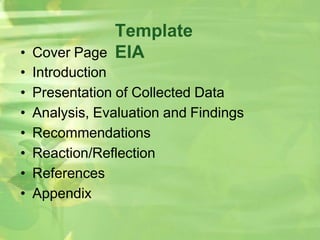
EIA
• Cover Page
• Introduction
• Presentation of Collected Data
• Analysis, Evaluation and Findings
• Recommendations
• Reaction/Reflection
• References
• Appendix
Cover
Page
• Title of Chosen Project/Activity
- e.g. “An Impact Assessment on SM
Supermart”
• Members (alphabetical order)
• Course, Yr., & Section
• Academic Year
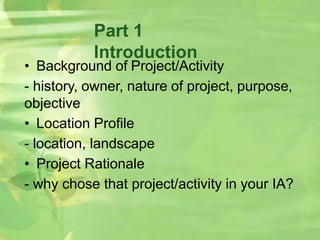
Part 1
Introduction
• Background of Project/Activity
- history, owner, nature of project, purpose,
objective
• Location Profile
- location, landscape
• Project Rationale
- why chose that project/activity in your IA?
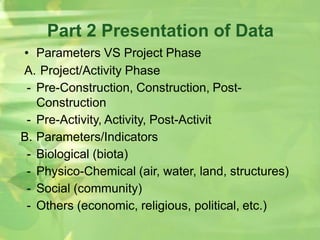
Part 2 Presentation of Data
• Parameters VS Project Phase
A. Project/Activity Phase
- Pre-Construction, Construction, Post-
Construction
- Pre-Activity, Activity, Post-Activit
B. Parameters/Indicators
- Biological (biota)
- Physico-Chemical (air, water, land, structures)
- Social (community)
- Others (economic, religious, political, etc.)
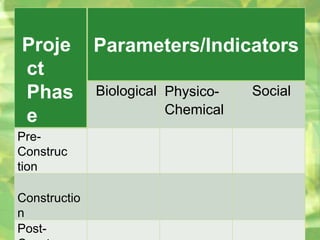
Proje
ct
Phas
e
Parameters/Indicators
Biological Physico-
Chemical
Social
Pre-
Construc
tion
Constructio
n
Post-
Activit
y
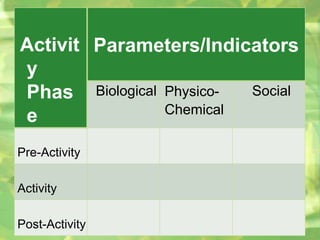
Phas
e
Parameters/Indicators
Biological Physico-
Chemical
Social
Pre-Activity
Activity
Post-Activity
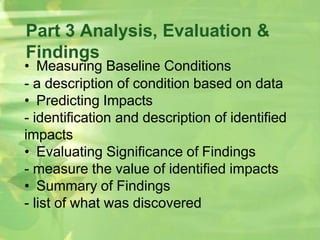
Part 3 Analysis, Evaluation &
Findings
• Measuring Baseline Conditions
- a description of condition based on data
• Predicting Impacts
- identification and description of identified
impacts
• Evaluating Significance of Findings
- measure the value of identified impacts
• Summary of Findings
- list of what was discovered
Part 4 Recommendations
• list of suggestions on how to improve
project or mitigate (if present) problems
identified
- alternative actions or solutions
Part 5
Reaction/Reflection
• individual post-IA output describing
your learnings, realizations, insights,
comments or challenges encountered
in the conduct of the impact
assessment
Part 6 References
- list of sources used during conduct of
impact assessment
Part 7
Appendix
- evidences of the conduct of IA (with
captions) like actual or target site,
interview
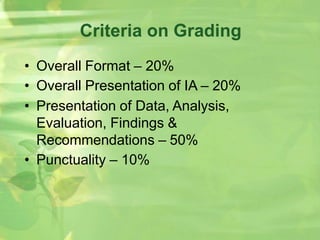
Criteria on Grading
• Overall Format – 20%
• Overall Presentation of IA – 20%
• Presentation of Data, Analysis,
Evaluation, Findings &
Recommendations – 50%
• Punctuality – 10%
Thank You!!

IA.pptx a presentation about impact assessment

  • 1.
  • 2.
    Definitio ns • Impact –having a strong effect on someone or something • Assessment – refers to analyzing and evaluating impacts on someone or something
  • 3.
    Definitio ns • Analysis –objective task of identifying actions and of taking measurements of baseline conditions that are likely to occur as a result of the action • Evaluation - subjective or normative task which depends on the application of human values; involves determining the significance of the effects on the affected parties
  • 4.
    Impact Assessment • astructured process for considering the implications, for people and their environment, of proposed actions while there is still an opportunity to modify (or even, if appropriate, to abandon) the proposals • applied to all levels of decision-making, from policies to specific projects
  • 5.
    Example of Impact Assessment •Environmental Impact Assessment • a.k.a. Ecological Impact Assessment • a wide range of predictive tasks within environmental planning • focuses on prediction and evaluation of the effects of human activities on the structure and functions of “normal” ecosystem components
  • 6.
    Environmental Impact Assessment • assessthe impacts of human activities on nature: the ecosystem and its resources • conducted by government agency (DENR) and experts from both private and public sectors (project proponent and/or external agency)
  • 7.
    Rationale of EIA • tohave an opportunity to identify costly and undesirable effects • to modify projects in the design stage
  • 8.
    Phases of EIA •Phase 1: Defining Study Goals • Phase 2: Identifying Potential Impacts • Phase 3: Measuring Baseline Conditions and Predicting Significant Impacts • Phase 4: Evaluating Significance of Findings • Phase 5: Considering Alternatives to the Proposed Action • Phase 6: Communication of Findings and Recommendations
  • 9.
  • 10.
    IA Project Template • Longsize • 1.5 spacing • Font style Times New Roman 12 • Strictly NO Borders
  • 11.
    Template EIA • Cover Page •Introduction • Presentation of Collected Data • Analysis, Evaluation and Findings • Recommendations • Reaction/Reflection • References • Appendix
  • 12.
    Cover Page • Title ofChosen Project/Activity - e.g. “An Impact Assessment on SM Supermart” • Members (alphabetical order) • Course, Yr., & Section • Academic Year
  • 13.
    Part 1 Introduction • Backgroundof Project/Activity - history, owner, nature of project, purpose, objective • Location Profile - location, landscape • Project Rationale - why chose that project/activity in your IA?
  • 14.
    Part 2 Presentationof Data • Parameters VS Project Phase A. Project/Activity Phase - Pre-Construction, Construction, Post- Construction - Pre-Activity, Activity, Post-Activit B. Parameters/Indicators - Biological (biota) - Physico-Chemical (air, water, land, structures) - Social (community) - Others (economic, religious, political, etc.)
  • 15.
  • 16.
  • 17.
    Part 3 Analysis,Evaluation & Findings • Measuring Baseline Conditions - a description of condition based on data • Predicting Impacts - identification and description of identified impacts • Evaluating Significance of Findings - measure the value of identified impacts • Summary of Findings - list of what was discovered
  • 18.
    Part 4 Recommendations •list of suggestions on how to improve project or mitigate (if present) problems identified - alternative actions or solutions
  • 19.
    Part 5 Reaction/Reflection • individualpost-IA output describing your learnings, realizations, insights, comments or challenges encountered in the conduct of the impact assessment
  • 20.
    Part 6 References -list of sources used during conduct of impact assessment
  • 21.
    Part 7 Appendix - evidencesof the conduct of IA (with captions) like actual or target site, interview
  • 22.
    Criteria on Grading •Overall Format – 20% • Overall Presentation of IA – 20% • Presentation of Data, Analysis, Evaluation, Findings & Recommendations – 50% • Punctuality – 10%
  • 23.