




I <3 APIs
San Jose, October 2015
API first?
@mikermcneil
API first?
©2015 Apigee Corp. All Rights Rese
The views expressed in this presentation are those
of the presenter, and not necessarily those of Apigee
Corporation or the presenter’s employer.
Mike McNeil
@mikermcneil
github.com/mikermcneil
Mike McNeil
Founder/CEO Treeline (YC W15)

creator & BDFL of
the leading open-source
MVC framework for Node.js
demo
For a deeper dive, google:
“Sails.js Platzi”
1. No REST For The Weary
2. Upside Down
3. Everyday APIs
REST
No
for the weary.
1.
A good starting point
for building any cloud API.
REST
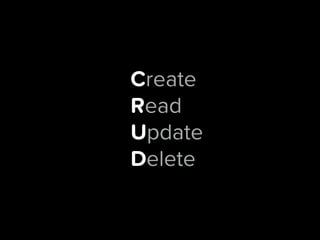
REST CRUD===
For our purposes:
Create
Read
Update
Delete
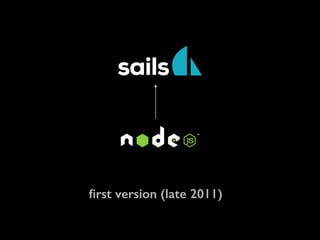
first version (late 2011)
custom app-specific adapters

(LDAP / Active Directory / etc)
~20 other community adapters
A noun-centric ontology
works great for building
databases.
Never works for 100%
of any app.
CRUD
Search the store.
search({	


  query:	
  ‘shoes’	
  
});
Search the store.
Product.find({	


  or:	
  [	


  {	
  name:	
  {contains:	
  ’shoes’}},	


  {	
  description:	
  {contains:	
  ’shoes’}}	


  ]	
  
});
//	
  …also	
  search	
  recipes
//	
  …also	
  search	
  comments	
  then	
  for	
  each	
  one,	
  look	
  up	
  
//	
  the	
  containing	
  product	
  or	
  recipe…
Search the store.
//	
  …then	
  rank	
  results..	
  oh	
  wait	
  but	
  actually	
  this	
  should	
  all	
  
be	
  in	
  an	
  index	
  of	
  some	
  kind
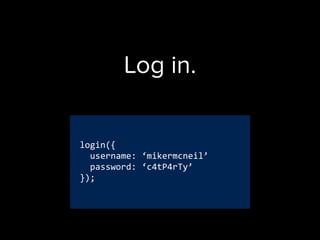
Log in.
login({	


  username:	
  ‘mikermcneil’	


  password:	
  ‘c4tP4rTy’	
  
});
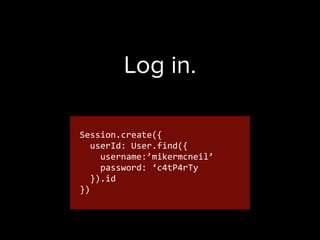
Log in.
Session.create({	


  userId:	
  User.find({	


  username:’mikermcneil’	


  password:	
  ‘c4tP4rTy	


  }).id	
  
})
Log in.
So do we use CRUD?
Because half the time,
we don’t actually know what
we’re supposed to be building.
2. Upside Down
API first?
API first?
API centric, UI first.
We need to flip things
upside down
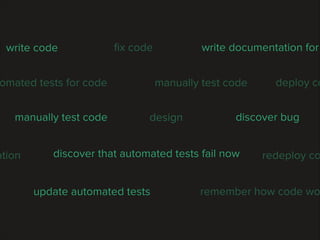
omated tests for code
write documentation forwrite code
manually test code deploy co
discover bug
remember how code wo
fix code
manually test code
discover that automated tests fail now
update automated tests
ation redeploy co
design
omated tests for code
write documentation forwrite code
manually test code deploy co
discover bug
remember how code wo
fix code
manually test code
discover that automated tests fail now
update automated tests
ation redeploy co
design
How we think as product
designers:
1. User interface design
2. Interaction design
3. Cross fingers (development starts)
…
4. Oh crap, one more thing I forgot to mention…
5. Can I see a preview?
6. AHHH WHAT IS THIS?!
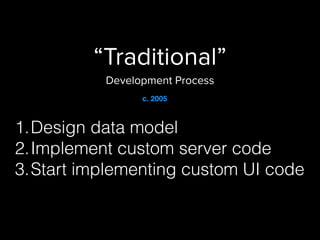
“Traditional”
Development Process
1.Design data model
2.Implement custom server code
3.Start implementing custom UI code
c. 2005
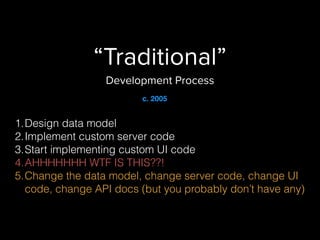
“Traditional”
Development Process
1.Design data model
2.Implement custom server code
3.Start implementing custom UI code
4.AHHHHHHH WTF IS THIS??!
5.Change the data model, change server code, change UI
code, change API docs (but you probably don’t have any)
c. 2005
“NoSQL”
Development Process
1.Implement custom server code
2.Implement custom UI code
3.Stumble upon (then maybe even document!)
your cloud API
4.Stumble upon your data model
c. 2011
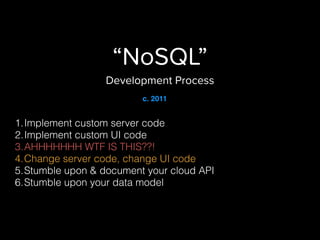
“NoSQL”
Development Process
1.Implement custom server code
2.Implement custom UI code
3.AHHHHHHH WTF IS THIS??!
4.Change server code, change UI code
5.Stumble upon & document your cloud API
6.Stumble upon your data model
c. 2011
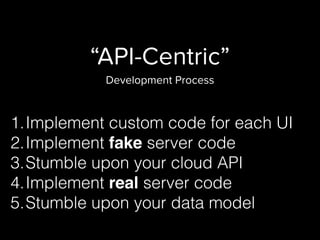
“API-Centric”
Development Process
1.Implement custom code for each UI
2.Implement fake server code
3.Stumble upon your cloud API
4.Implement real server code
5.Stumble upon your data model
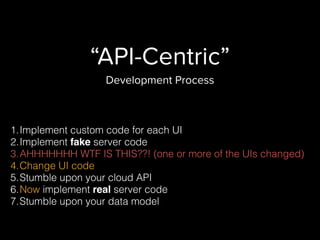
“API-Centric”
Development Process
1.Implement custom code for each UI
2.Implement fake server code
3.AHHHHHHH WTF IS THIS??! (one or more of the UIs changed)
4.Change UI code
5.Stumble upon your cloud API
6.Now implement real server code
7.Stumble upon your data model
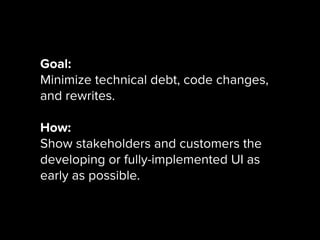
Goal:
Minimize technical debt, code changes,
and rewrites.
How:
Show stakeholders and customers the
developing or fully-implemented UI as
early as possible.
It’s ok if the backend
starts off… fake.
3. Everyday APIs
We don’t design most of
the APIs we use.
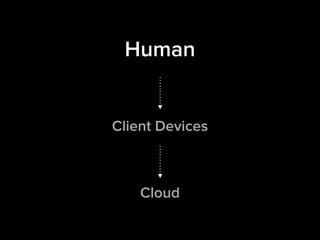
Human
Client Devices
Cloud
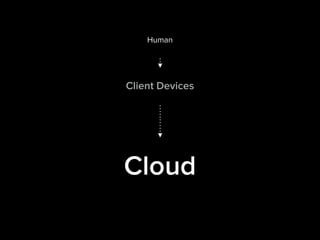
Human
Client Devices
Cloud
Human
Client Devices
Cloud
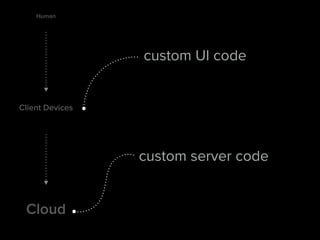
Human
Client Devices
Cloud
custom UI code
custom server code
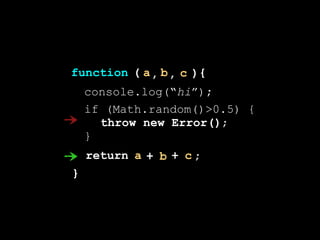
Every time we write a function,
we’re designing an API.
We're just giving you functions
that return functions that you
do things with.
Doug Wilson
Lead Maintainer, Express
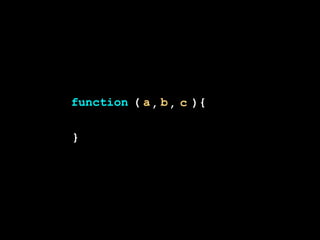
)
}
(function {
)
}
(function {a b c, ,
)
}
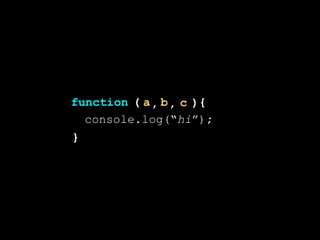
(function {a b c, ,
console.log(“hi”);
)
}
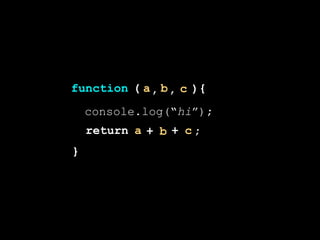
(function {a b c, ,
console.log(“hi”);
return a b c ;+ +
)
}
(function {a b c, ,
console.log(“hi”);
return a b c ;+ +
if (Math.random()>0.5) {
}
throw new Error();
)
}
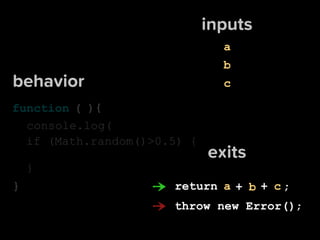
(function {
console.log(
a
b
c
return a b c ;+ +
exits
inputs
throw new Error();
if (Math.random()>0.5) {
}
behavior
a
b
c
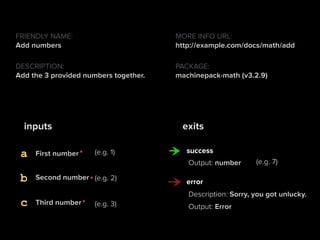
exitsinputs
Output: number
Output: Error
error
success
Description: Sorry, you got unlucky.
First number
Second number
Third number
(e.g. 7)
(e.g. 2)
(e.g. 3)
(e.g. 1)
DESCRIPTION:
Add the 3 provided numbers together.
MORE INFO URL:
http://example.com/docs/math/add
FRIENDLY NAME:
Add numbers
PACKAGE:
machinepack-math (v3.2.9)
*
*
*
The
Node Machine
Project
Like Swagger
for
node-machine.org/spec
JavaScript functions.
Like Swagger
for
node-machine.org/spec
middleware.
Like Swagger
for
node-machine.org/spec
Node modules.
npm install
npm publish
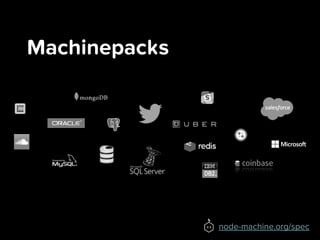
Machinepacks
node-machine.org/spec
node-machine.org
sailsjs.org
Questions?
@mikermcneilnode-machine.org
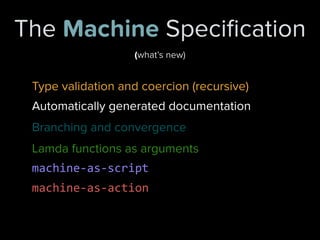
The Machine Specification
Branching and convergence
Lamda functions as arguments
Type validation and coercion (recursive)
Automatically generated documentation
machine-­‐as-­‐script
machine-­‐as-­‐action
(what’s new)

I Love APIs - Oct 2015