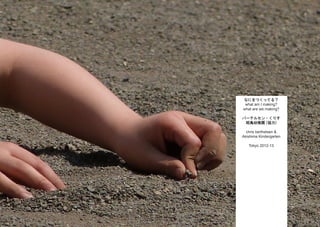
なにをつくってる?
what am I making?
what are we making?
バーテルセン・くりす
昭島幼稚園 (協力)
chris berthelsen &
Akishima Kindergarten
Tokyo 2012-13
協力 | akishima.ac.jp
昭島幼稚園:こころが育つ幼稚園

コンセプト|写真|文

by a-small-lab.com

なにをつくってる?
what am I making?
what are we making?
バーテルセン・くりす | 昭島幼稚園 (協力)
chris berthelsen | Akishima Kindergarten
Tokyo 2012-13

昭島幼稚園:akishima.ac.jp
chris@a-small-lab.com
a-small-lab.com/with/akishima-kindergarten
前書き | foreword

8-9

何かを作っている子どもたち | children making stuff

12-87

素材一覧 | list of materials

89-92

コーダ | coda

93-96
8

9

foreword
The makings of children are difficult to understand. The curry
made in the playground today is tomorrow’s foot bath. And the
day after that it’s a zoo. At the same time a volcano may erupt.
Hand cream made of sand can turn into poison rice balls while
you’re distracted. Some days cake making parties drag out
interminably but some afternoons they switch without warning
to preparation for a long journey. In the midst of all this, fixed
production methods and quality assessment systems are not
as rare as you’d think. And fine-grained craftsmanship shines
through. As an adult I can make my own (weak) interpretations
but in the field I am at the mercy of the children.
This book shows but a tiny selection of the makings that the
children of Akishima Kindergarten in Tokyo introduced me to.
With a nearby friend, spend time inspecting these images,
wondering what is being made (or what you would like to
make), and conjuring up your own stories – in the process I
hope that you can become a little more conversant with the joy
that is ‘making with hands’.
Chris Berthelsen

「前書き」
子どもたちのものづくりは分かりにくい。園庭での今日のカレ
ーは明日の足湯。そして明後日の動物園。同時に火山が噴火し
たりする可能性もある。砂で作られたクリームは気がつかない
うちに毒おにぎりになってしまう。ケーキづくりがめちゃくち
ゃ長引く日もあれば突然旅の準備に変わるアフタヌーンもあ
る。その中で生産プロセスや評価の仕方が決まってくる場合も
少なくない。繊細な職人の技能も見えてくる。大人は自分なり
の解釈はできるかもしれないが現場では子どものいうことを聞
くしかない。
この本は昭島幼稚園(東京都昭島市)の子供たちが教えてくれ
たものづくりの一例にすぎない。近くにいる子どもと一緒にぼ
ーと眺めたり、「何を作っているかな?」と話し合ったり、自
分でストーリを想像したりしながら「自分の手でつくる」とい
う喜びをもう少し近づいてみていただければと思います。
バーテルセン・くりす
Chris Berthelsen
12

はさみ | scissors

ゆび | fingers

ぼくのおやゆび | my thumb

がようし | craft paper

13
14

おっこのて | okko’s hand

15

はさみ | scissors
ぼくのて | my hand

ひも | string

だんぼーる | cardboard

えのぐ | paint
16

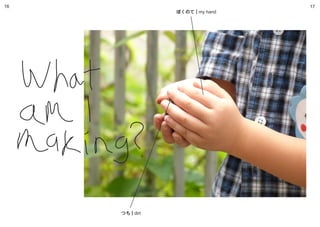
ぼくのて | my hand

つち | dirt

17
18

やさしいゆび | gentle finger

どろみず | muddy water

しゃべる | shovel

こっぷ | cup

19
ともだちのあし | my friend’s foot

わたしのて | my hand
20

じょうぶなほっぺた | strong cheeks

ぼくのて | my hand

21
ともだち | my friend

あつがみ | craft paper
22

23
あたたかいかっこう | warm wear

こおっているゆき | frozen snow

ながぐつ | gumboots

ゆき | snow
24

25
ちいさなけが | small injury

よくできているだんご | beautiful dango

ぎんがみのゆびわ | foil ring

おおきなひび | big crack

ゆび | finger
26
ながそで | long-sleeved tee

ざる | sieve

つぶ | grains

て | hand

ばけつ | bucket

あな | hole

つち | dirt

27
28

29

ばけつ | bucket
ともだちのて | friend’s hand
ぼくのて | my hand

ざる | sieve

しゃべる | shovel

ざいりょう | resources

だれかのて | someone’s hand
30

31
ともだちのしゃべる | friend’s spade

わたしのて | my hand

わたしのぼうし | my hat

みす | water

あふれ | overflow

わたしのくつ | my shoes
32

33
みず | water

ともだち | friend

じゃぐち | tap

ぷらあみ | plastic grill

はだし | bare feet

ばけつ | bucket

よごれたくつ | dirty shoes
34

ぼくのくつ | my shoes

35

こえだ | stick

こいし | rock

て | hand
はっぱ | leaf

ばけつ | bucket

つち | dirt
36
なにかのつぼみ | some kind of bud

たまごけーす | egg container

37
ともだちのあし | friend’s leg

て | hand

くつ | shoes
くつ | shoes
つち | dirt

はっぱ | leaf

て | hand
38

39
き | wood

ぶらんこ | swing

くさり | chain

つち | dirt

て | hand

ひざ | knee

くつ | shoes
40

て | hand

せんせい | teacher

しゃべる | shovel

たいや | tyres

41
しゃべる | shovel

すなば | sandpit

しゃべる | shovel
ともだち | friend

つち | dirt
42

てつぼう | monkey bars

43

ぼうし | hat

こえだ | twig

ぼーる | ball

かげ | shadow

うで | arm

て | hand

ゆび | fingers
じゃり | gravel
44

のばしている | stretching

45
どろ | mud

さぎょうちゅうのて | hands at work

ひざ | knee
たいや | tyre
46

47
やま | mountain

とんだ! | jump!

くつ | shoes

たいや | tyre

ぼうかんしゃ | onlooker

すな | sand
48

49

といれっとぺーぱーろーる | toilet paper roll

かざり | decoration

てーぷ | tape

ゆび | fingers
50

ひじ | elbow
うで | arm

51

ちいさなやま | small mountain
こっぷ | cup

こし | back

だぶるしゃべる | double shovel
はだし | bare feet

すな | sand

そーとさわっているて | gentle hand
52

はっぱ | leaf

53
て | hand

てーぶる | table

みぞ | gap

はな | flower

じゃり | gravel
54
ゆびとゆび | fingers on fingers

じゃり | gravel

あし | leg

こえだ | twigs

えんていのはしっこ | the edge of the playground

かれは | dry leaves

くつ | shoes

55
56

57
て | hand

ふた | cap

がようし | craft paper

まーかー | marker

ゆび | fingers
58

59
じゃり | gravel
ざる | sieve

ばけつ | bucket

どろみず | muddy water

て | hand
60

61
おかあさんのて | mum’s hand

ぼくのて | my hand

どろ | mud
62

63
ちょっとしたひび | a little crack

ちょっとしたよごれ | bit of dirt

きれいなだんご | beautiful dirtball

ぼくのて | my hand
64

じゅんび | preparation

65
ぼくのて | my hands

こまかいすな | fine dust
66

67
つち | dirt

しんちょうなもちかた | very careful grip
68

69

ぼうし | hat

みち | road

じゃり | gravel

しゃべる | shovel

さく | fence
70

71

ともだち | friend
あらそい | conflict

こーん | cone

じゃり | gravel
72

73
どろみす | muddy water

はだし | bare feet
74

75

うで | arms
ともだち | friend

つち | dirt

たいや | tyre
76

77
ともだち | friends

なにか | something
78

79

つよいうで | strong arms
ぶらんこ | swing

こまかいすな | fine dust
80

81
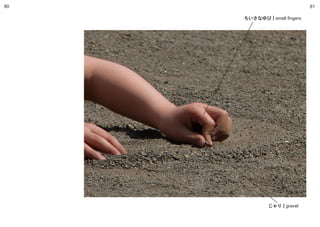
ちいさなゆび | small fingers

じゃり | gravel
82

83
ぼくのて | my hand

どろ | mud

ともだち | my friend

ひざ | my knee

たいや | tyres
84

85
さんにんのともだち | three friends

かぶとむし | kabutomushi

なにか | something

て | hand
86

87
かご | crate

あし | foot

せなか | back
89

「素材」
90

91
はさみ | scissors
ぼくのおやゆび | my thumb
がようし | craft paper
ゆび | fingers
おっこのて | okko’s hand
ひも | string
ぼくのて | my hand
だんぼーる | cardboard
えのぐ | paint
つち | dirt
やさしいゆび | gentle finger
しゃべる | shovel
ともだちのあし | my friend’s foot
どろみず | muddy water
こっぷ | cup
わたしのて | my hand
じょうぶなほっぺた | strong cheeks
ともだち | my friend
あつがみ | craft paper
あたたかいかっこう | warm wear
こおっているゆき | frozen snow
ながぐつ | gumboots
ゆき | snow
ちいさなけが | small injury
よくできているだんご | beautiful dango
ぎんがみのゆびわ | foil ring
おおきなひび | big crack
ながそで | long-sleeved tee
ざる | sieve
つぶ | grains
て | hand
ばけつ | bucket
あな | hole
ともだちのて | friend’s hand
しゃべる | shovel
だれかのて | someone’s hand
ともだちのしゃべる | friend’s spade
わたしのぼうし | my hat
みす | water
じゃぐち | tap
ぷらあみ | plastic grill

はだし | bare feet
よごれたくつ | dirty shoes
こいし | rock
こえだ | stick
はっぱ | leaf
くつ | shoes
たまごけーす | egg container
なにかのつぼみ | some kind of bud
き | wood
くさり | chain
ぶらんこ | swing
ひざ | knee
せんせい | teacher
たいや | tyres
すなば | sandpit
ぼーる | ball
てつぼう | monkey bars
ぼうし | hat
じゃり | gravel
うで | arm
どろ | mud
さぎょうちゅうのて | hands at work
やま | mountain
ぼうかんしゃ | onlooker
すな | sand
といれっとぺーぱーろーる | toilet paper roll
かざり | decoration
てーぷ | tape
ひじ | elbow
こし | back
はだし | bare feet
ちいさなやま | small mountain
そーとさわっているて | gentle hand
だぶるしゃべる | double shovel
てーぶる | table
はな | flower
みぞ | gap
ゆびとゆび | fingers on fingers
あし | leg
えんていのはしっこ | the edge of the playground
かれは | dry leaves
92

93
まーかー | marker
ふた | cap
おかあさんのて | mum’s hand
ちょっとしたひび | a little crack
きれいなだんご | beautiful dirtball
ちょっとしたよごれ | bit of dirt
こまかいすな | fine dust
しんちょうなもちかた | very careful grip
みち | road
さく | fence
あらそい | conflict
こーん | cone
なにか | something
つよいうで | strong arms
ちいさなゆび | small fingers
かご | crate
せなか | back
and?

「コーダ」
「子どもは自分が脆弱ということが分かっている。それでも世
に心を開いている。」i
「歩道の線を踏まないように必死になっている子どもを笑う
な。儀式を生み出している可能性が高い。」ii
子どもは犬に出会うたびに「ワンちゃん!」と興奮する。ベビ
ーカーから飛び出しそうになり、「ワン!ワン!」と叫んでい
る。
経験豊かな大人はそうならない。むしろ子どもの喜びに疲れて
しまう一方だ。「はいはい、ワンちゃんね。静かに座りな。」
と冷たく対応する場合も少なくない。
私はワンちゃんに興味がない。犬ならとっくに見たことがある
からiii。
94

95
Coda
大人の世界の「理屈」や「合理的な生産」が通用しない子ども
の世界では、子どもたちは大人が慣れすぎて忘れている日常か
ら自分の心地良い居場所を彫ってゆく。
日々の「やったこと」が増幅していく。その毎日は濃厚だiv。
「Playing」というのは想像でもあれば創造でもある。
終わらない出来事v。
切のない妄想。
自分の周りを自分の手で変えながら子どもは人間として現れて
くるvi。
「Playing」は特定の場所や物に限られていない。子どもたちの
ために用意されているものと子どもの実際の動きは別次元と思
って良いvii。子どもたちをいい子にさせたりする遊び場は大体
オシャレで衛生的で安全な環境である。だが、「playing」とい
う人間の基礎とのつながりは薄いviii。
ものを動かせる状態は人間にとって一番幸せな状態かもしれな
い。活動が整理されていない混沌とした中では自分次第の整頓
が美しい。
これは喜びがあふれるほどのmessyな仕事だix。
i Tuan (1977: 137)
ii Superstudio (1982:52)
iii Gaarder (1994:15-6)
iv Certeau (1984)
v Ward (1979:86 quoting Arvid Bengtson)
vi Ward (1979:210)
vii Ward (1979: 210)
viii Alexander et al. (1977: 368)
ix Hurtwood (1968:16)

“Children know they are frail; they seek security and yet remain
open to the world.” i
“Don’t ever laugh at the child jumping along the road trying not
to step on the cracks between the paving stones; he is probably
inventing a rite.” ii
The child looks up and says “Bow-wow” every time it sees a dog.
It jumps up and down in its stroller, waving its arms: “Bow-wow!
Bow-wow!”
We who are older and wiser may feel somewhat exhausted by
the child’s enthusiasm. “All right, all right, it’s a bow-wow,” we
say, unimpressed. “Please sit still.”
We are not enthralled. We have seen a dog beforeiii.
In a world where the harsh light of reason and the logic of
production of the adult world has little currency children carve
out cozy pockets of habitable space from the everyday materials
that we take for granted.
Here, stories and memories are amplified. And every day is rich
and denseiv.
‘Playing’ is a function of the imagination, a constant act of
creation.
A constant happeningv.
An endless hallucination.
Through play children unfold as individuals in the creative
manipulation of their surroundingsvi.
‘Playing’ is not confined to any particular objects or spaces.
Spaces prepared for children operate on one plane but children
operate on anothervii. Environments which pacify children may
be stylish, hygienic and safe but they cannot satisfy the central
necessities for playviii.
People are happiest when they can move things around. The selfinscribed order that arises from undefined action is beautiful.
This is a delightfully messy occupationix.
i Tuan (1977: 137)
ii Superstudio (1982:52)
96
iii Gaarder (1994:15-6)
iv Certeau (1984)
v Ward (1979:86 quoting Arvid Bengtson)
vi Ward (1979:210)
vii Ward (1979: 210)
viii Alexander et al. (1977: 368)
ix Hurtwood (1968:16)
引用文献 | References
Alexander, C., Ishikawa, S., Silverstein, M., Jacobson, M., Fiksdahl-King, I., and
Angel, S. 1977. A Pattern Language. New York, Oxford University Press.
Certeau, M. 1984. The Practice of Everyday Life. Berkley/Los Angeles/London,
University of California Press.
Gaarder, J. 1994. Sophie’s World. New York/Berkley Publishing Group
Hurtwood, Lady Allen of, 1968, Planning for Play. London, Thames and
Hudson.
Superstudio & The Moriyama Editors Studio. 1982. Superstudio & Radicals.
Tokyo, Japan Interior Inc.
Tuan, Y. 1977. Space and Place: The Perspective of Experience. Minneapolis/
London, University of Minnesota Press.
Ward, C. 1978. The Child in the City. New York, Pantheon Books.
end

くりす berthelsen | a-small-lab.com

chris@a-small-lab.com

昭島幼稚園:akishima.ac.jp

なにをつくってる? | what am I making, what are we making?

  • 1.
    なにをつくってる? what am Imaking? what are we making? バーテルセン・くりす 昭島幼稚園 (協力) chris berthelsen & Akishima Kindergarten Tokyo 2012-13
  • 2.
    協力 | akishima.ac.jp 昭島幼稚園:こころが育つ幼稚園 コンセプト|写真|文 bya-small-lab.com なにをつくってる? what am I making? what are we making? バーテルセン・くりす | 昭島幼稚園 (協力) chris berthelsen | Akishima Kindergarten Tokyo 2012-13 昭島幼稚園:akishima.ac.jp chris@a-small-lab.com a-small-lab.com/with/akishima-kindergarten
  • 3.
    前書き | foreword 8-9 何かを作っている子どもたち| children making stuff 12-87 素材一覧 | list of materials 89-92 コーダ | coda 93-96
  • 4.
    8 9 foreword The makings ofchildren are difficult to understand. The curry made in the playground today is tomorrow’s foot bath. And the day after that it’s a zoo. At the same time a volcano may erupt. Hand cream made of sand can turn into poison rice balls while you’re distracted. Some days cake making parties drag out interminably but some afternoons they switch without warning to preparation for a long journey. In the midst of all this, fixed production methods and quality assessment systems are not as rare as you’d think. And fine-grained craftsmanship shines through. As an adult I can make my own (weak) interpretations but in the field I am at the mercy of the children. This book shows but a tiny selection of the makings that the children of Akishima Kindergarten in Tokyo introduced me to. With a nearby friend, spend time inspecting these images, wondering what is being made (or what you would like to make), and conjuring up your own stories – in the process I hope that you can become a little more conversant with the joy that is ‘making with hands’. Chris Berthelsen 「前書き」 子どもたちのものづくりは分かりにくい。園庭での今日のカレ ーは明日の足湯。そして明後日の動物園。同時に火山が噴火し たりする可能性もある。砂で作られたクリームは気がつかない うちに毒おにぎりになってしまう。ケーキづくりがめちゃくち ゃ長引く日もあれば突然旅の準備に変わるアフタヌーンもあ る。その中で生産プロセスや評価の仕方が決まってくる場合も 少なくない。繊細な職人の技能も見えてくる。大人は自分なり の解釈はできるかもしれないが現場では子どものいうことを聞 くしかない。 この本は昭島幼稚園(東京都昭島市)の子供たちが教えてくれ たものづくりの一例にすぎない。近くにいる子どもと一緒にぼ ーと眺めたり、「何を作っているかな?」と話し合ったり、自 分でストーリを想像したりしながら「自分の手でつくる」とい う喜びをもう少し近づいてみていただければと思います。 バーテルセン・くりす Chris Berthelsen
  • 6.
    12 はさみ | scissors ゆび| fingers ぼくのおやゆび | my thumb がようし | craft paper 13
  • 7.
    14 おっこのて | okko’shand 15 はさみ | scissors ぼくのて | my hand ひも | string だんぼーる | cardboard えのぐ | paint
  • 8.
    16 ぼくのて | myhand つち | dirt 17
  • 9.
    18 やさしいゆび | gentlefinger どろみず | muddy water しゃべる | shovel こっぷ | cup 19 ともだちのあし | my friend’s foot わたしのて | my hand
  • 10.
    20 じょうぶなほっぺた | strongcheeks ぼくのて | my hand 21 ともだち | my friend あつがみ | craft paper
  • 11.
    22 23 あたたかいかっこう | warmwear こおっているゆき | frozen snow ながぐつ | gumboots ゆき | snow
  • 12.
    24 25 ちいさなけが | smallinjury よくできているだんご | beautiful dango ぎんがみのゆびわ | foil ring おおきなひび | big crack ゆび | finger
  • 13.
    26 ながそで | long-sleevedtee ざる | sieve つぶ | grains て | hand ばけつ | bucket あな | hole つち | dirt 27
  • 14.
    28 29 ばけつ | bucket ともだちのて| friend’s hand ぼくのて | my hand ざる | sieve しゃべる | shovel ざいりょう | resources だれかのて | someone’s hand
  • 15.
    30 31 ともだちのしゃべる | friend’sspade わたしのて | my hand わたしのぼうし | my hat みす | water あふれ | overflow わたしのくつ | my shoes
  • 16.
    32 33 みず | water ともだち| friend じゃぐち | tap ぷらあみ | plastic grill はだし | bare feet ばけつ | bucket よごれたくつ | dirty shoes
  • 17.
    34 ぼくのくつ | myshoes 35 こえだ | stick こいし | rock て | hand はっぱ | leaf ばけつ | bucket つち | dirt
  • 18.
    36 なにかのつぼみ | somekind of bud たまごけーす | egg container 37 ともだちのあし | friend’s leg て | hand くつ | shoes くつ | shoes つち | dirt はっぱ | leaf て | hand
  • 19.
    38 39 き | wood ぶらんこ| swing くさり | chain つち | dirt て | hand ひざ | knee くつ | shoes
  • 20.
    40 て | hand せんせい| teacher しゃべる | shovel たいや | tyres 41 しゃべる | shovel すなば | sandpit しゃべる | shovel ともだち | friend つち | dirt
  • 21.
    42 てつぼう | monkeybars 43 ぼうし | hat こえだ | twig ぼーる | ball かげ | shadow うで | arm て | hand ゆび | fingers じゃり | gravel
  • 22.
    44 のばしている | stretching 45 どろ| mud さぎょうちゅうのて | hands at work ひざ | knee たいや | tyre
  • 23.
    46 47 やま | mountain とんだ!| jump! くつ | shoes たいや | tyre ぼうかんしゃ | onlooker すな | sand
  • 24.
    48 49 といれっとぺーぱーろーる | toiletpaper roll かざり | decoration てーぷ | tape ゆび | fingers
  • 25.
    50 ひじ | elbow うで| arm 51 ちいさなやま | small mountain こっぷ | cup こし | back だぶるしゃべる | double shovel はだし | bare feet すな | sand そーとさわっているて | gentle hand
  • 26.
    52 はっぱ | leaf 53 て| hand てーぶる | table みぞ | gap はな | flower じゃり | gravel
  • 27.
    54 ゆびとゆび | fingerson fingers じゃり | gravel あし | leg こえだ | twigs えんていのはしっこ | the edge of the playground かれは | dry leaves くつ | shoes 55
  • 28.
    56 57 て | hand ふた| cap がようし | craft paper まーかー | marker ゆび | fingers
  • 29.
    58 59 じゃり | gravel ざる| sieve ばけつ | bucket どろみず | muddy water て | hand
  • 30.
    60 61 おかあさんのて | mum’shand ぼくのて | my hand どろ | mud
  • 31.
    62 63 ちょっとしたひび | alittle crack ちょっとしたよごれ | bit of dirt きれいなだんご | beautiful dirtball ぼくのて | my hand
  • 32.
    64 じゅんび | preparation 65 ぼくのて| my hands こまかいすな | fine dust
  • 33.
  • 34.
    68 69 ぼうし | hat みち| road じゃり | gravel しゃべる | shovel さく | fence
  • 35.
    70 71 ともだち | friend あらそい| conflict こーん | cone じゃり | gravel
  • 36.
    72 73 どろみす | muddywater はだし | bare feet
  • 37.
    74 75 うで | arms ともだち| friend つち | dirt たいや | tyre
  • 38.
  • 39.
    78 79 つよいうで | strongarms ぶらんこ | swing こまかいすな | fine dust
  • 40.
    80 81 ちいさなゆび | smallfingers じゃり | gravel
  • 41.
    82 83 ぼくのて | myhand どろ | mud ともだち | my friend ひざ | my knee たいや | tyres
  • 42.
    84 85 さんにんのともだち | threefriends かぶとむし | kabutomushi なにか | something て | hand
  • 43.
    86 87 かご | crate あし| foot せなか | back
  • 44.
  • 45.
    90 91 はさみ | scissors ぼくのおやゆび| my thumb がようし | craft paper ゆび | fingers おっこのて | okko’s hand ひも | string ぼくのて | my hand だんぼーる | cardboard えのぐ | paint つち | dirt やさしいゆび | gentle finger しゃべる | shovel ともだちのあし | my friend’s foot どろみず | muddy water こっぷ | cup わたしのて | my hand じょうぶなほっぺた | strong cheeks ともだち | my friend あつがみ | craft paper あたたかいかっこう | warm wear こおっているゆき | frozen snow ながぐつ | gumboots ゆき | snow ちいさなけが | small injury よくできているだんご | beautiful dango ぎんがみのゆびわ | foil ring おおきなひび | big crack ながそで | long-sleeved tee ざる | sieve つぶ | grains て | hand ばけつ | bucket あな | hole ともだちのて | friend’s hand しゃべる | shovel だれかのて | someone’s hand ともだちのしゃべる | friend’s spade わたしのぼうし | my hat みす | water じゃぐち | tap ぷらあみ | plastic grill はだし | bare feet よごれたくつ | dirty shoes こいし | rock こえだ | stick はっぱ | leaf くつ | shoes たまごけーす | egg container なにかのつぼみ | some kind of bud き | wood くさり | chain ぶらんこ | swing ひざ | knee せんせい | teacher たいや | tyres すなば | sandpit ぼーる | ball てつぼう | monkey bars ぼうし | hat じゃり | gravel うで | arm どろ | mud さぎょうちゅうのて | hands at work やま | mountain ぼうかんしゃ | onlooker すな | sand といれっとぺーぱーろーる | toilet paper roll かざり | decoration てーぷ | tape ひじ | elbow こし | back はだし | bare feet ちいさなやま | small mountain そーとさわっているて | gentle hand だぶるしゃべる | double shovel てーぶる | table はな | flower みぞ | gap ゆびとゆび | fingers on fingers あし | leg えんていのはしっこ | the edge of the playground かれは | dry leaves
  • 46.
    92 93 まーかー | marker ふた| cap おかあさんのて | mum’s hand ちょっとしたひび | a little crack きれいなだんご | beautiful dirtball ちょっとしたよごれ | bit of dirt こまかいすな | fine dust しんちょうなもちかた | very careful grip みち | road さく | fence あらそい | conflict こーん | cone なにか | something つよいうで | strong arms ちいさなゆび | small fingers かご | crate せなか | back and? 「コーダ」 「子どもは自分が脆弱ということが分かっている。それでも世 に心を開いている。」i 「歩道の線を踏まないように必死になっている子どもを笑う な。儀式を生み出している可能性が高い。」ii 子どもは犬に出会うたびに「ワンちゃん!」と興奮する。ベビ ーカーから飛び出しそうになり、「ワン!ワン!」と叫んでい る。 経験豊かな大人はそうならない。むしろ子どもの喜びに疲れて しまう一方だ。「はいはい、ワンちゃんね。静かに座りな。」 と冷たく対応する場合も少なくない。 私はワンちゃんに興味がない。犬ならとっくに見たことがある からiii。
  • 47.
    94 95 Coda 大人の世界の「理屈」や「合理的な生産」が通用しない子ども の世界では、子どもたちは大人が慣れすぎて忘れている日常か ら自分の心地良い居場所を彫ってゆく。 日々の「やったこと」が増幅していく。その毎日は濃厚だiv。 「Playing」というのは想像でもあれば創造でもある。 終わらない出来事v。 切のない妄想。 自分の周りを自分の手で変えながら子どもは人間として現れて くるvi。 「Playing」は特定の場所や物に限られていない。子どもたちの ために用意されているものと子どもの実際の動きは別次元と思 って良いvii。子どもたちをいい子にさせたりする遊び場は大体 オシャレで衛生的で安全な環境である。だが、「playing」とい う人間の基礎とのつながりは薄いviii。 ものを動かせる状態は人間にとって一番幸せな状態かもしれな い。活動が整理されていない混沌とした中では自分次第の整頓 が美しい。 これは喜びがあふれるほどのmessyな仕事だix。 i Tuan (1977:137) ii Superstudio (1982:52) iii Gaarder (1994:15-6) iv Certeau (1984) v Ward (1979:86 quoting Arvid Bengtson) vi Ward (1979:210) vii Ward (1979: 210) viii Alexander et al. (1977: 368) ix Hurtwood (1968:16) “Children know they are frail; they seek security and yet remain open to the world.” i “Don’t ever laugh at the child jumping along the road trying not to step on the cracks between the paving stones; he is probably inventing a rite.” ii The child looks up and says “Bow-wow” every time it sees a dog. It jumps up and down in its stroller, waving its arms: “Bow-wow! Bow-wow!” We who are older and wiser may feel somewhat exhausted by the child’s enthusiasm. “All right, all right, it’s a bow-wow,” we say, unimpressed. “Please sit still.” We are not enthralled. We have seen a dog beforeiii. In a world where the harsh light of reason and the logic of production of the adult world has little currency children carve out cozy pockets of habitable space from the everyday materials that we take for granted. Here, stories and memories are amplified. And every day is rich and denseiv. ‘Playing’ is a function of the imagination, a constant act of creation. A constant happeningv. An endless hallucination. Through play children unfold as individuals in the creative manipulation of their surroundingsvi. ‘Playing’ is not confined to any particular objects or spaces. Spaces prepared for children operate on one plane but children operate on anothervii. Environments which pacify children may be stylish, hygienic and safe but they cannot satisfy the central necessities for playviii. People are happiest when they can move things around. The selfinscribed order that arises from undefined action is beautiful. This is a delightfully messy occupationix. i Tuan (1977: 137) ii Superstudio (1982:52)
  • 48.
    96 iii Gaarder (1994:15-6) ivCerteau (1984) v Ward (1979:86 quoting Arvid Bengtson) vi Ward (1979:210) vii Ward (1979: 210) viii Alexander et al. (1977: 368) ix Hurtwood (1968:16) 引用文献 | References Alexander, C., Ishikawa, S., Silverstein, M., Jacobson, M., Fiksdahl-King, I., and Angel, S. 1977. A Pattern Language. New York, Oxford University Press. Certeau, M. 1984. The Practice of Everyday Life. Berkley/Los Angeles/London, University of California Press. Gaarder, J. 1994. Sophie’s World. New York/Berkley Publishing Group Hurtwood, Lady Allen of, 1968, Planning for Play. London, Thames and Hudson. Superstudio & The Moriyama Editors Studio. 1982. Superstudio & Radicals. Tokyo, Japan Interior Inc. Tuan, Y. 1977. Space and Place: The Perspective of Experience. Minneapolis/ London, University of Minnesota Press. Ward, C. 1978. The Child in the City. New York, Pantheon Books.
  • 49.
    end くりす berthelsen |a-small-lab.com chris@a-small-lab.com 昭島幼稚園:akishima.ac.jp