CHAPTER - 10
LIGHT: REFLECTION AND
REFRACTION
Class :- X
Subject :- Science
Name of Teacher :- Mr. Irfan ahmad ansari (PGT
CHEMISTRY)
School :- KV ITBP Shivpuri
2.
1) Light :-
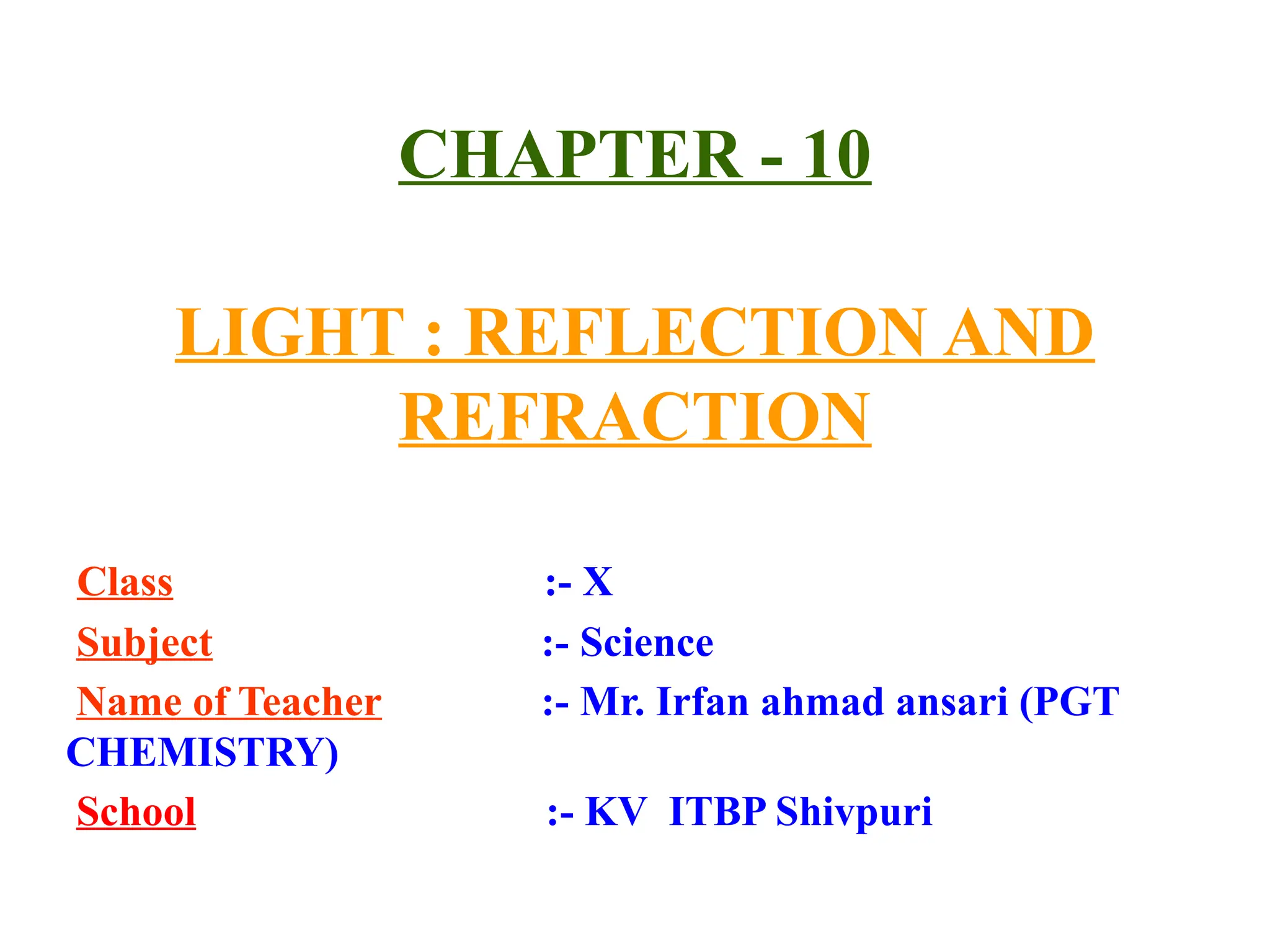
i)Light is a form of energy which helps us to see objects.
ii) When light falls on objects, it reflects the light and when the
reflected light reaches our eyes then we see the objects.
iii) Light travels in straight line.
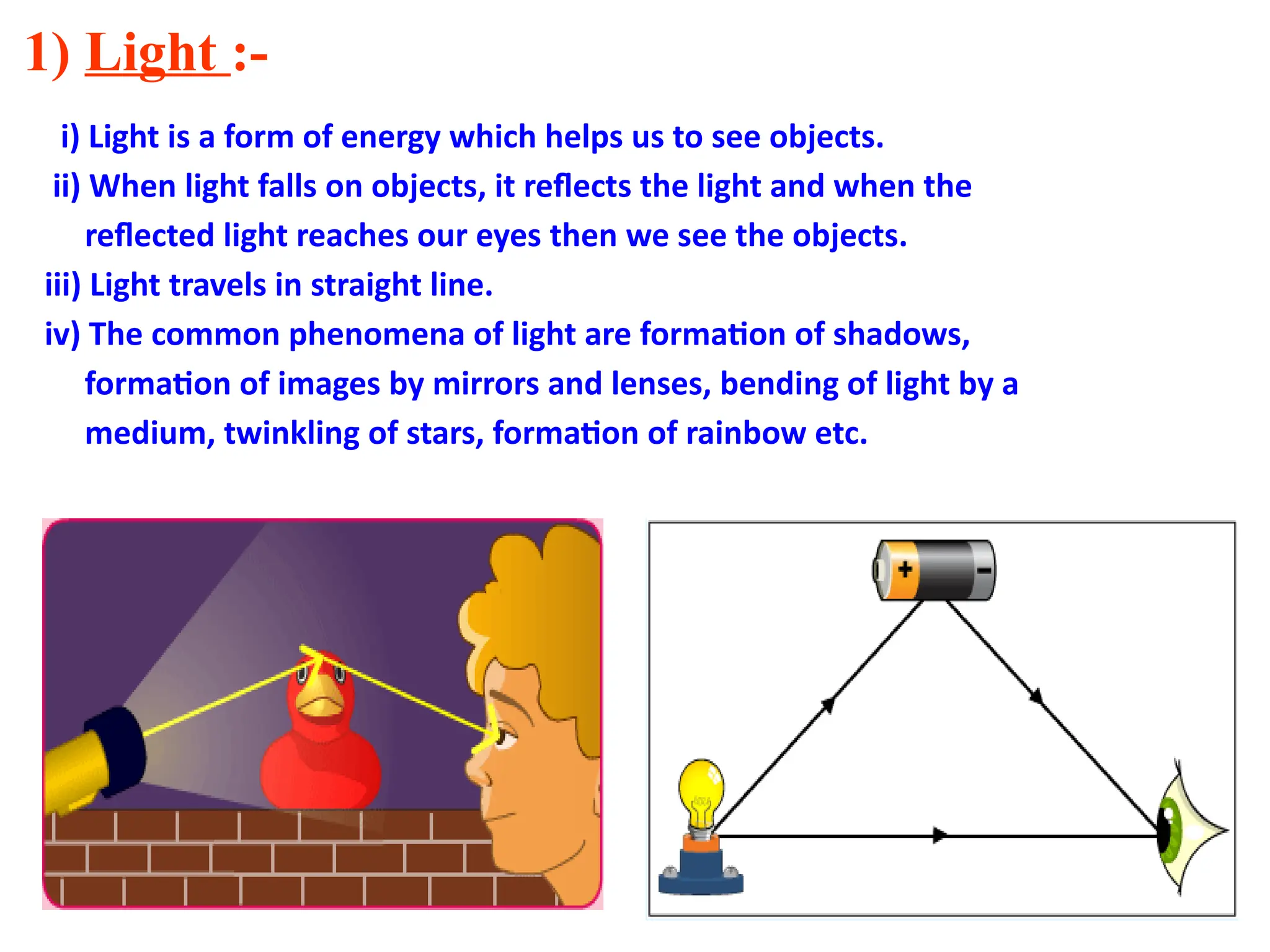
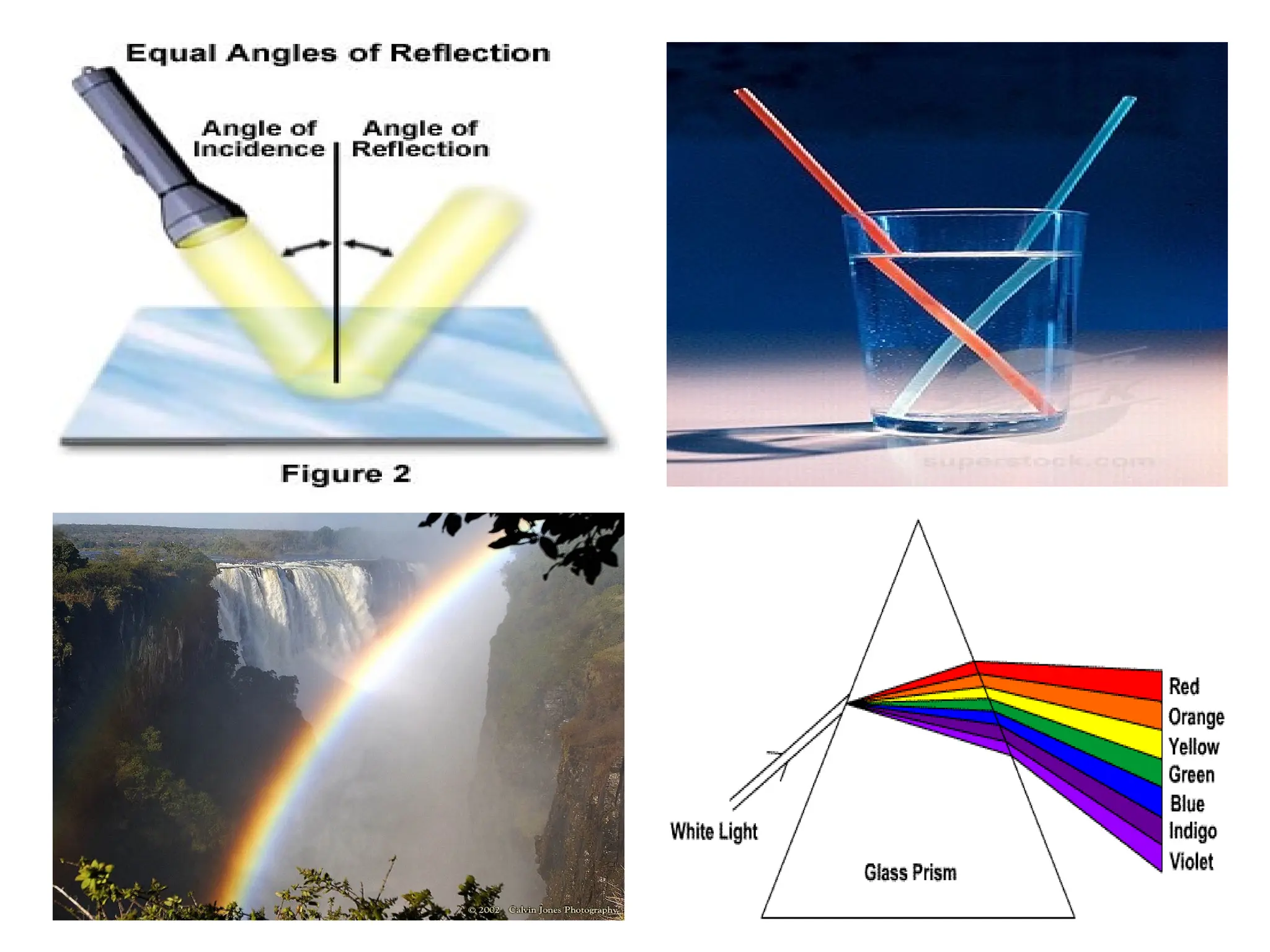
iv) The common phenomena of light are formation of shadows,
formation of images by mirrors and lenses, bending of light by a
medium, twinkling of stars, formation of rainbow etc.
4.
2a) Reflection oflight :-
When light falls on a highly polished surface like a mirror most of
the light is sent back into the same medium. This process is called
reflection of light.
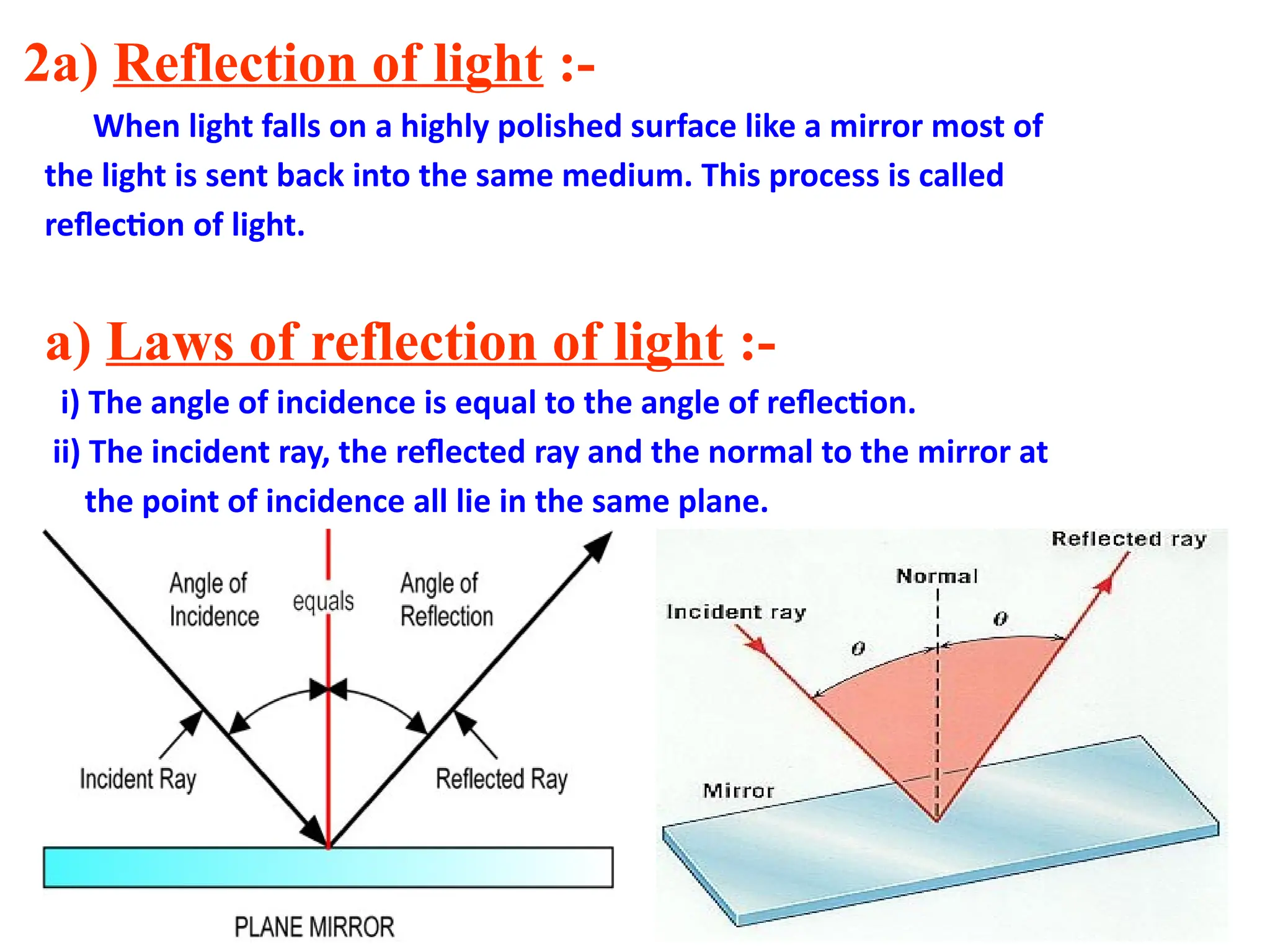
a) Laws of reflection of light :-
i) The angle of incidence is equal to the angle of reflection.
ii) The incident ray, the reflected ray and the normal to the mirror at
the point of incidence all lie in the same plane.
5.
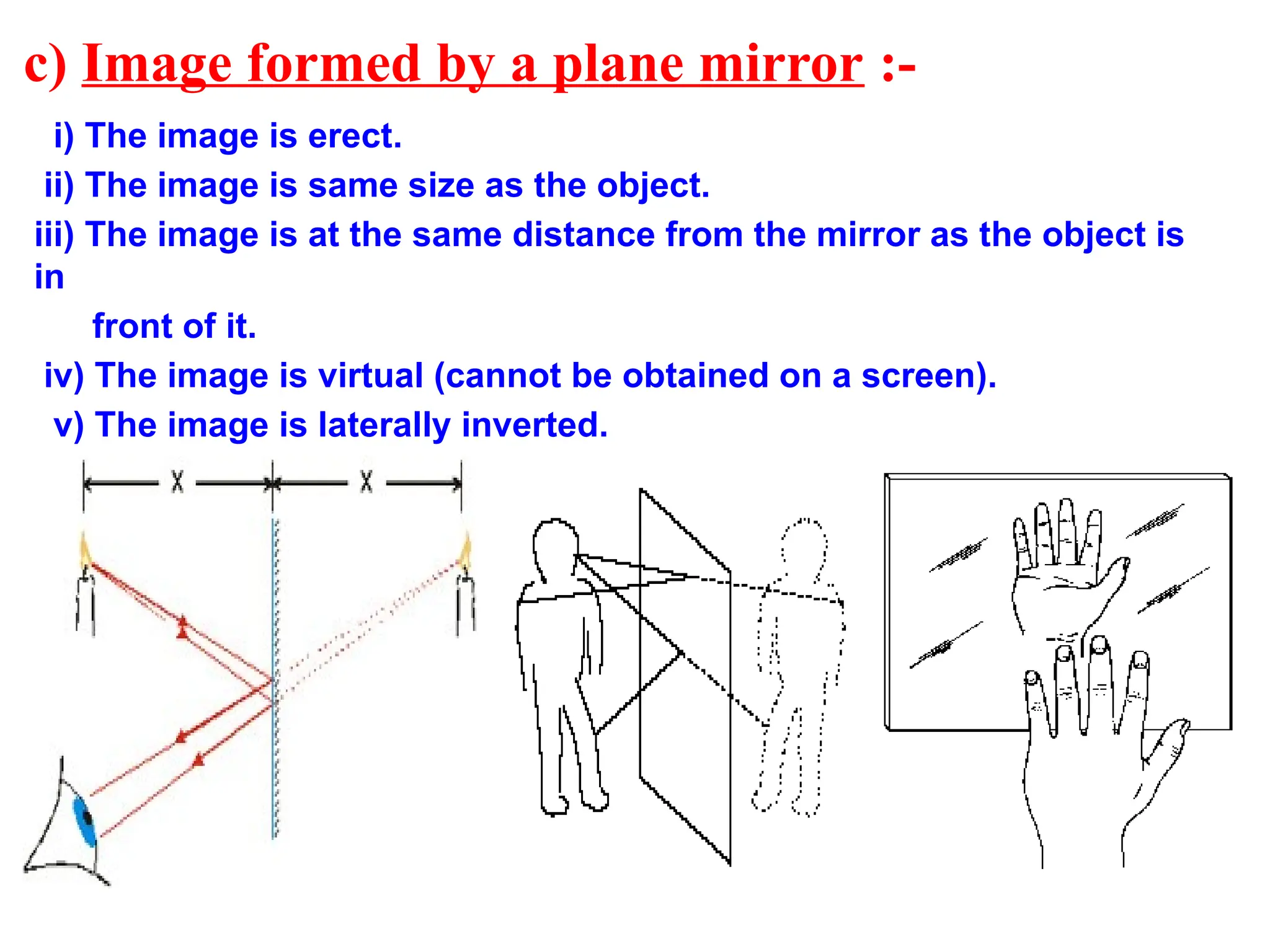
c) Image formedby a plane mirror :-
i) The image is erect.
ii) The image is same size as the object.
iii) The image is at the same distance from the mirror as the object is
in
front of it.
iv) The image is virtual (cannot be obtained on a screen).
v) The image is laterally inverted.
6.
3) Spherical mirrors:-
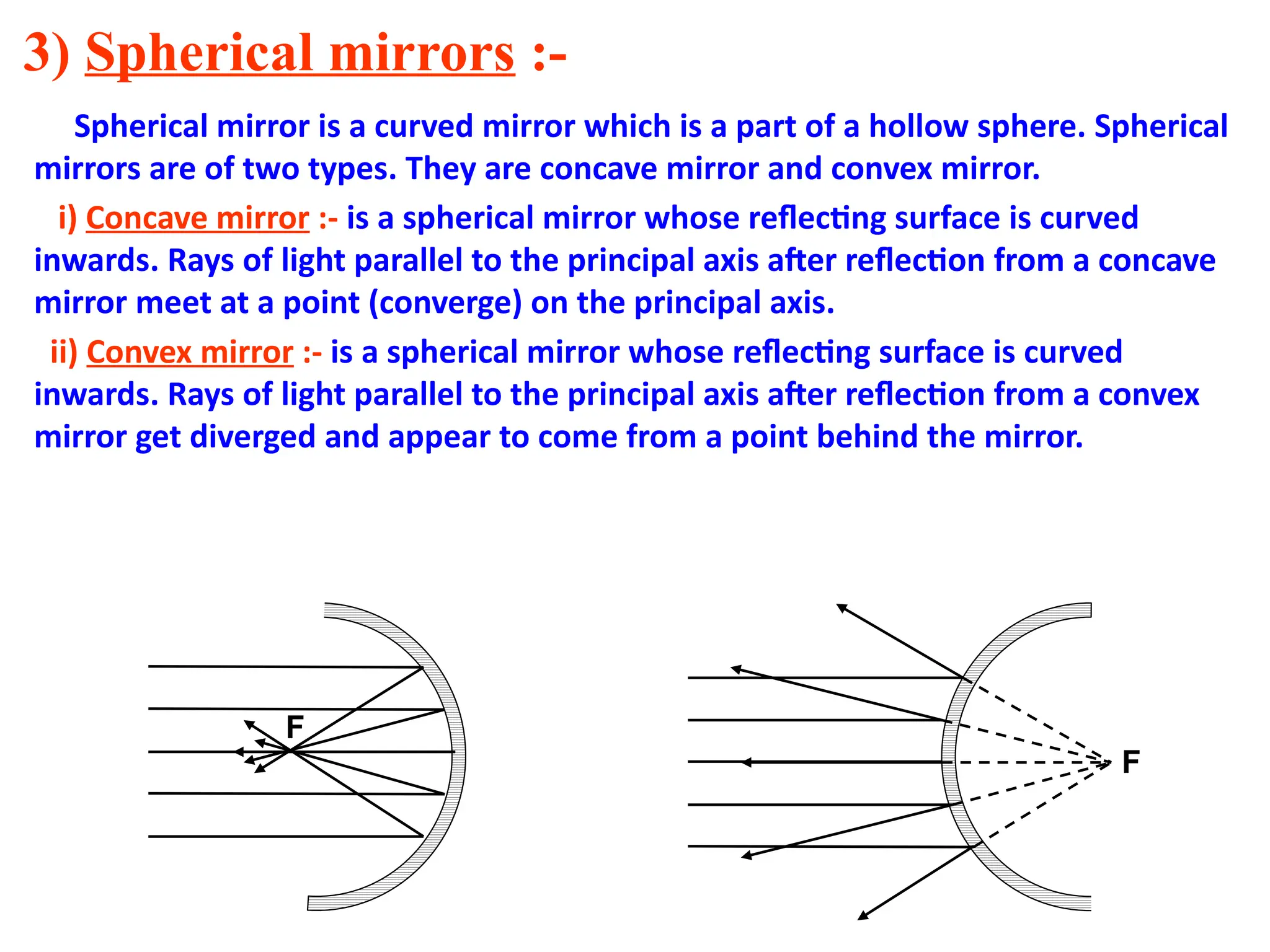
Spherical mirror is a curved mirror which is a part of a hollow sphere. Spherical
mirrors are of two types. They are concave mirror and convex mirror.
i) Concave mirror :- is a spherical mirror whose reflecting surface is curved
inwards. Rays of light parallel to the principal axis after reflection from a concave
mirror meet at a point (converge) on the principal axis.
ii) Convex mirror :- is a spherical mirror whose reflecting surface is curved
inwards. Rays of light parallel to the principal axis after reflection from a convex
mirror get diverged and appear to come from a point behind the mirror.
F
F
7.
4) Terms usedin the study of spherical mirrors :-
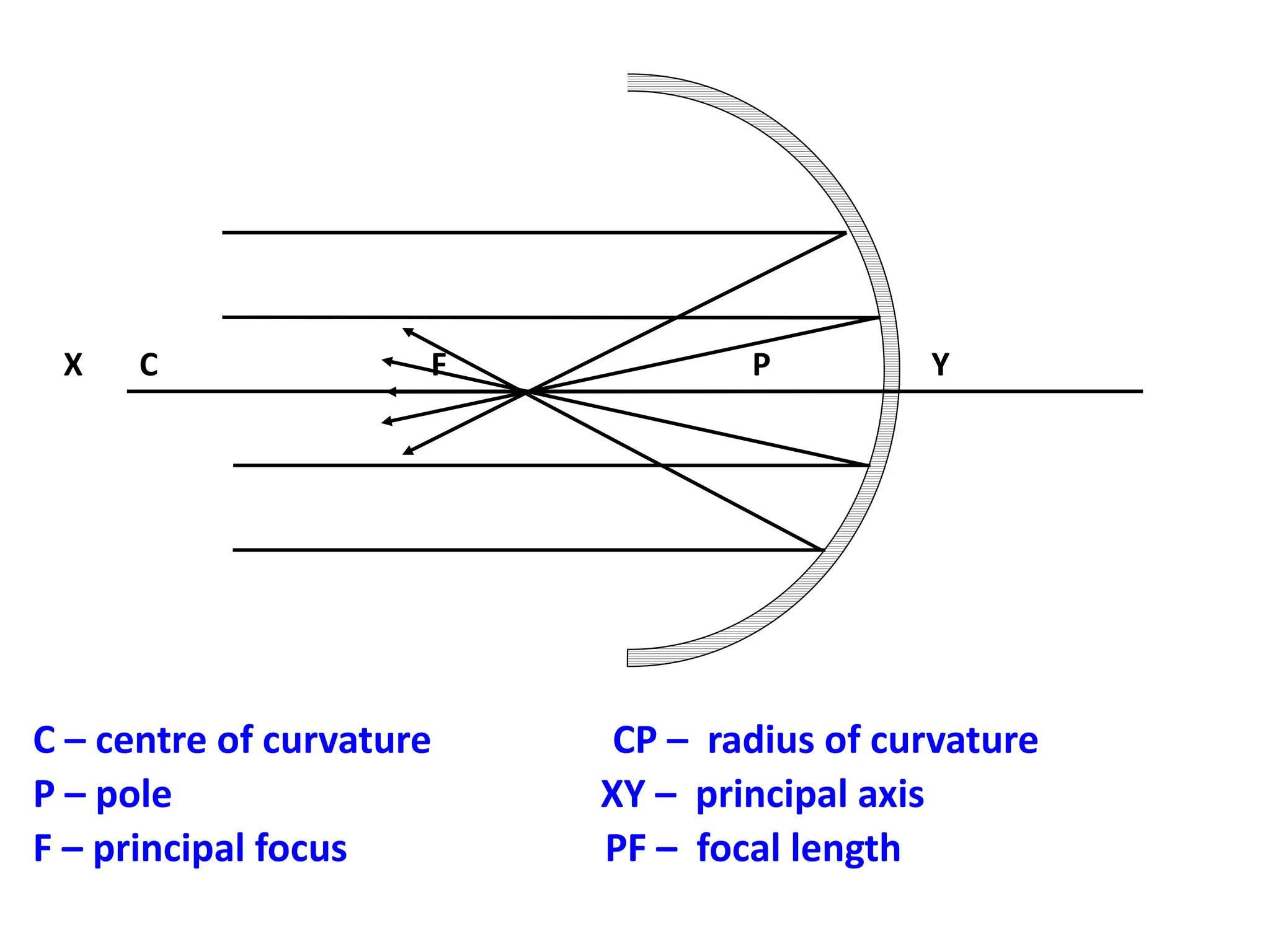
i) Center of curvature :- is the centre of the sphere of which the mirror
is a part (C).
ii) Radius of curvature :- is the radius of the sphere of which the mirror
is a part (CP).
iii) Pole :- is the centre of the spherical mirror (P).
iv) Principal axis :- is the straight line passing through the centre of
curvature and the pole (X-Y).
v) Principal focus :-
In a concave mirror, rays of light parallel to the principal axis after
reflection meet at a point on the principal axis called principal
focus(F).
In a convex mirror, rays of light parallel to the principal axis after
reflection get diverged and appear to come from a point on the
principal axis behind the mirror called principal focus (F).
vi) Focal length :- is the distance between the pole and principal focus
(f). In a spherical mirror the radius of curvature is twice the focal
length.
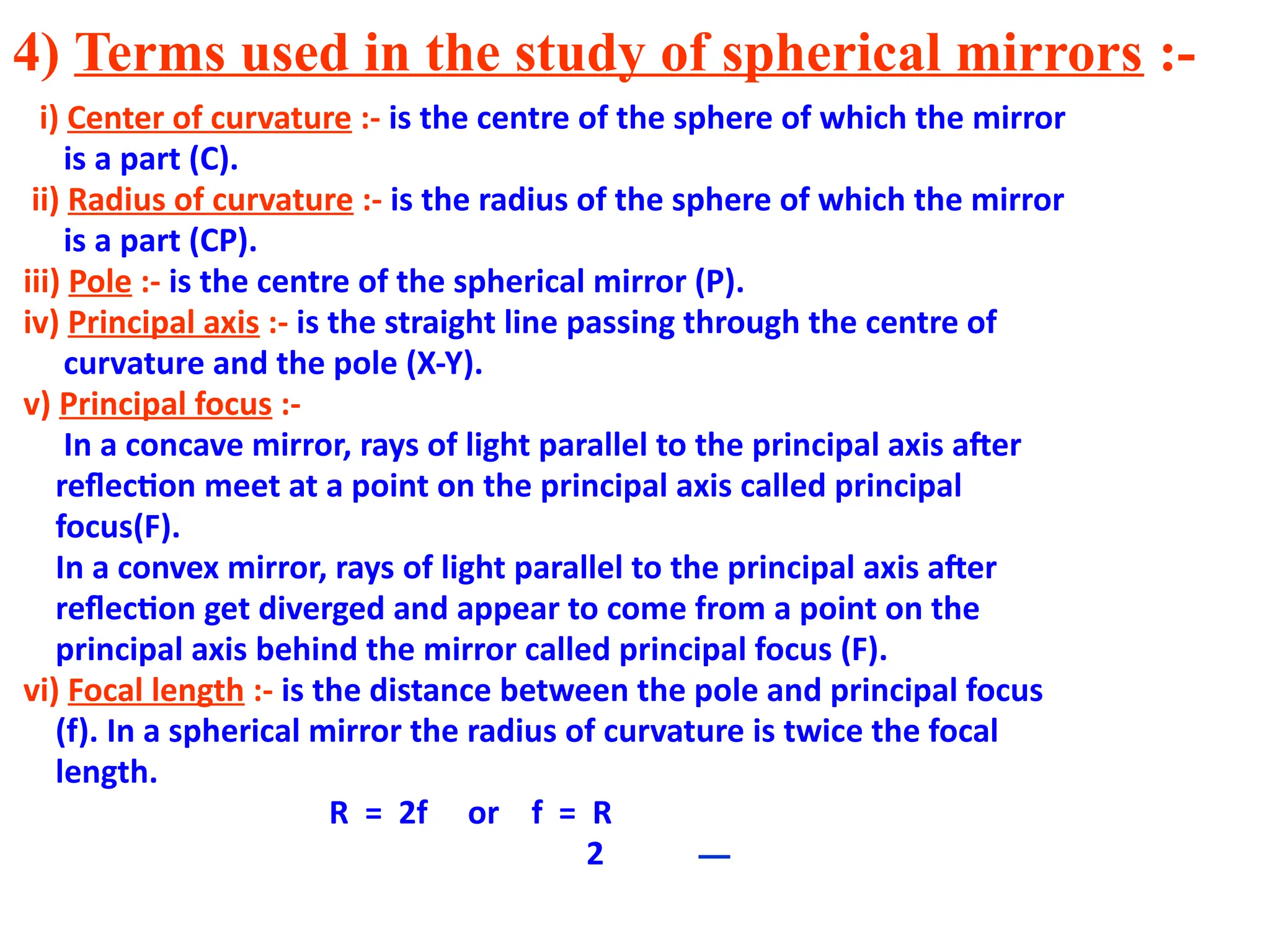
R = 2f or f = R
2
8.
X C FP Y
C – centre of curvature CP – radius of curvature
P – pole XY – principal axis
F – principal focus PF – focal length
9.
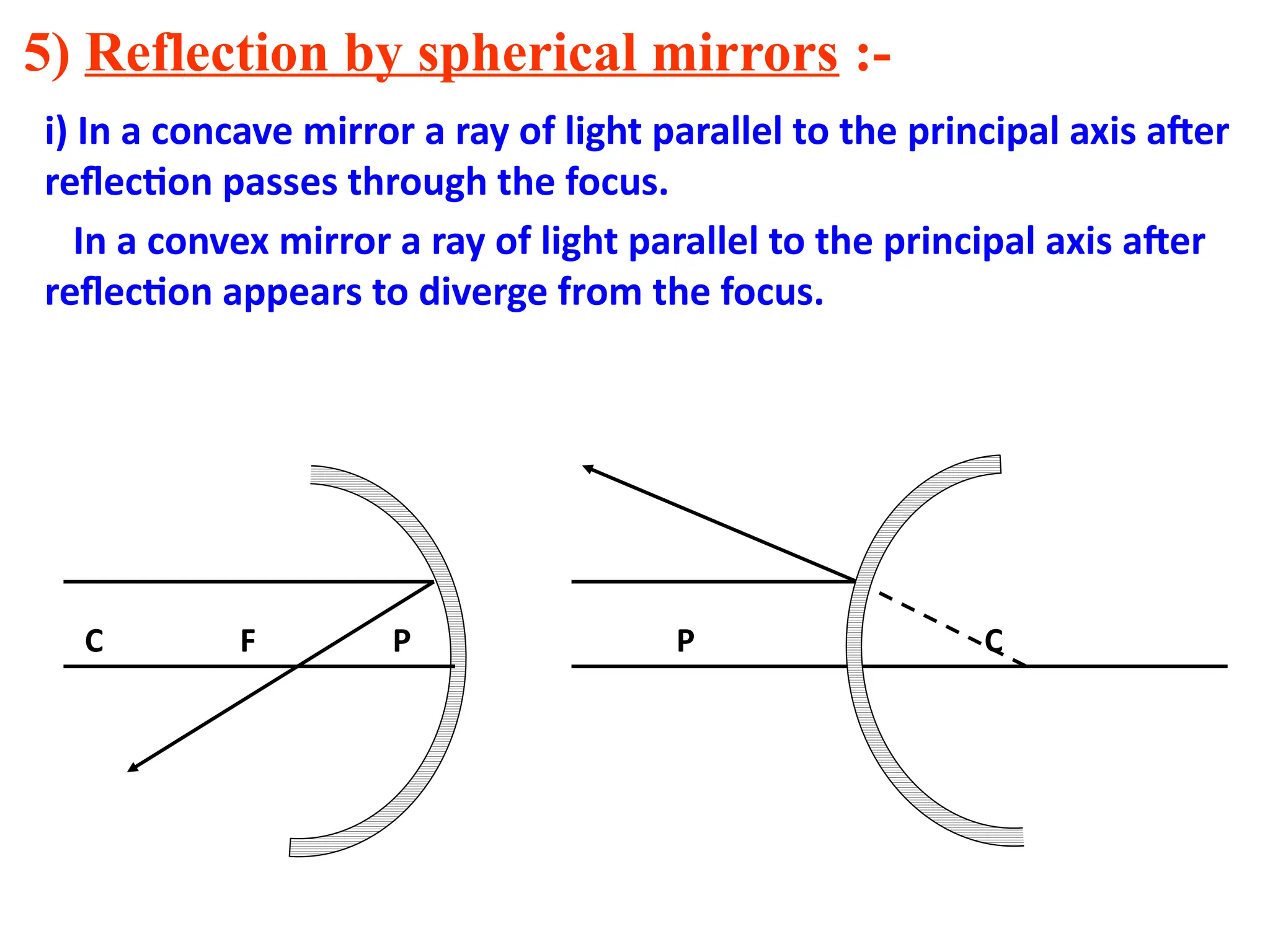
5) Reflection byspherical mirrors :-
i) In a concave mirror a ray of light parallel to the principal axis after
reflection passes through the focus.
In a convex mirror a ray of light parallel to the principal axis after
reflection appears to diverge from the focus.
C F P P F C
10.
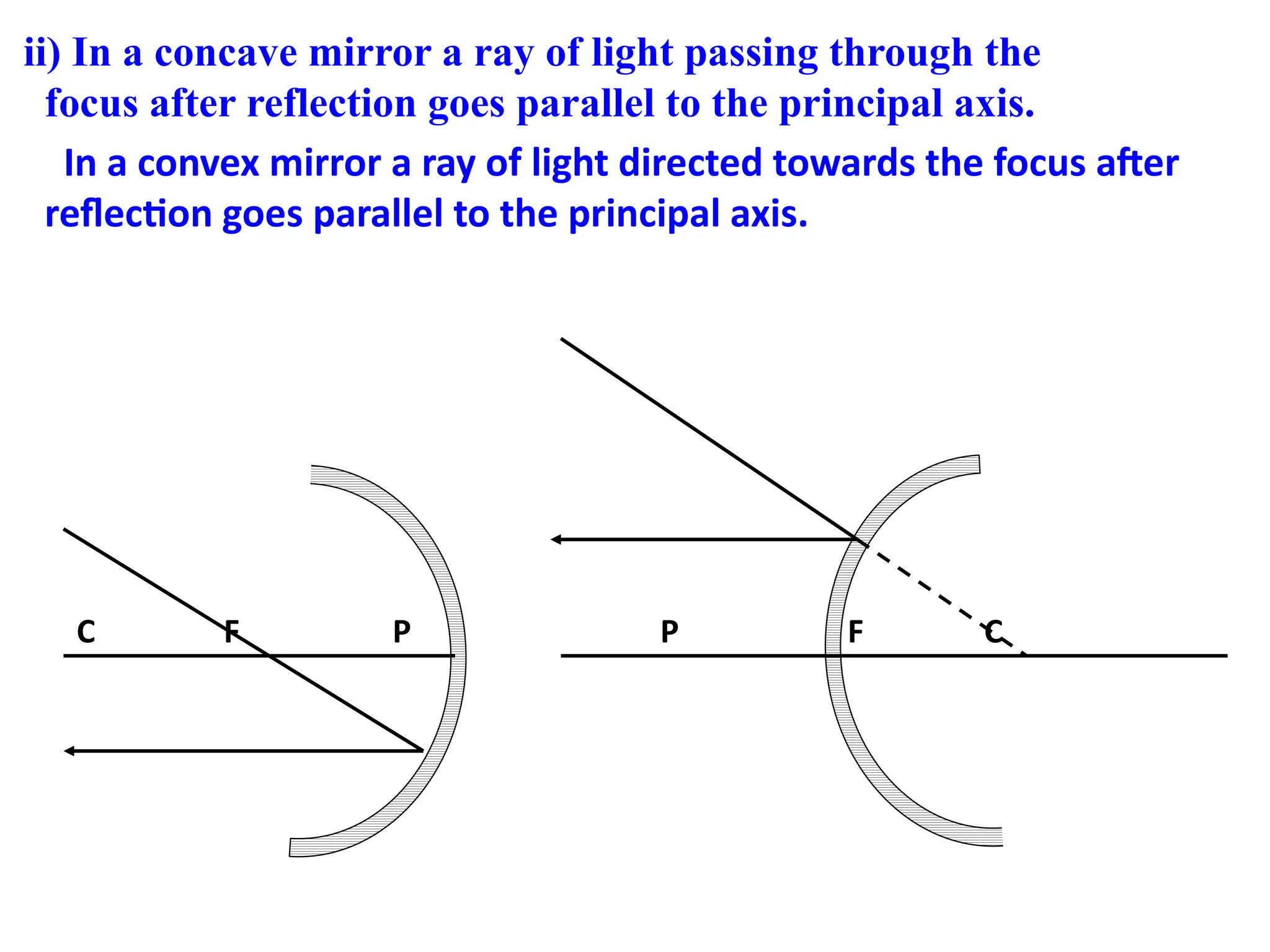
ii) In aconcave mirror a ray of light passing through the
focus after reflection goes parallel to the principal axis.
In a convex mirror a ray of light directed towards the focus after
reflection goes parallel to the principal axis.
C F P P F C
11.
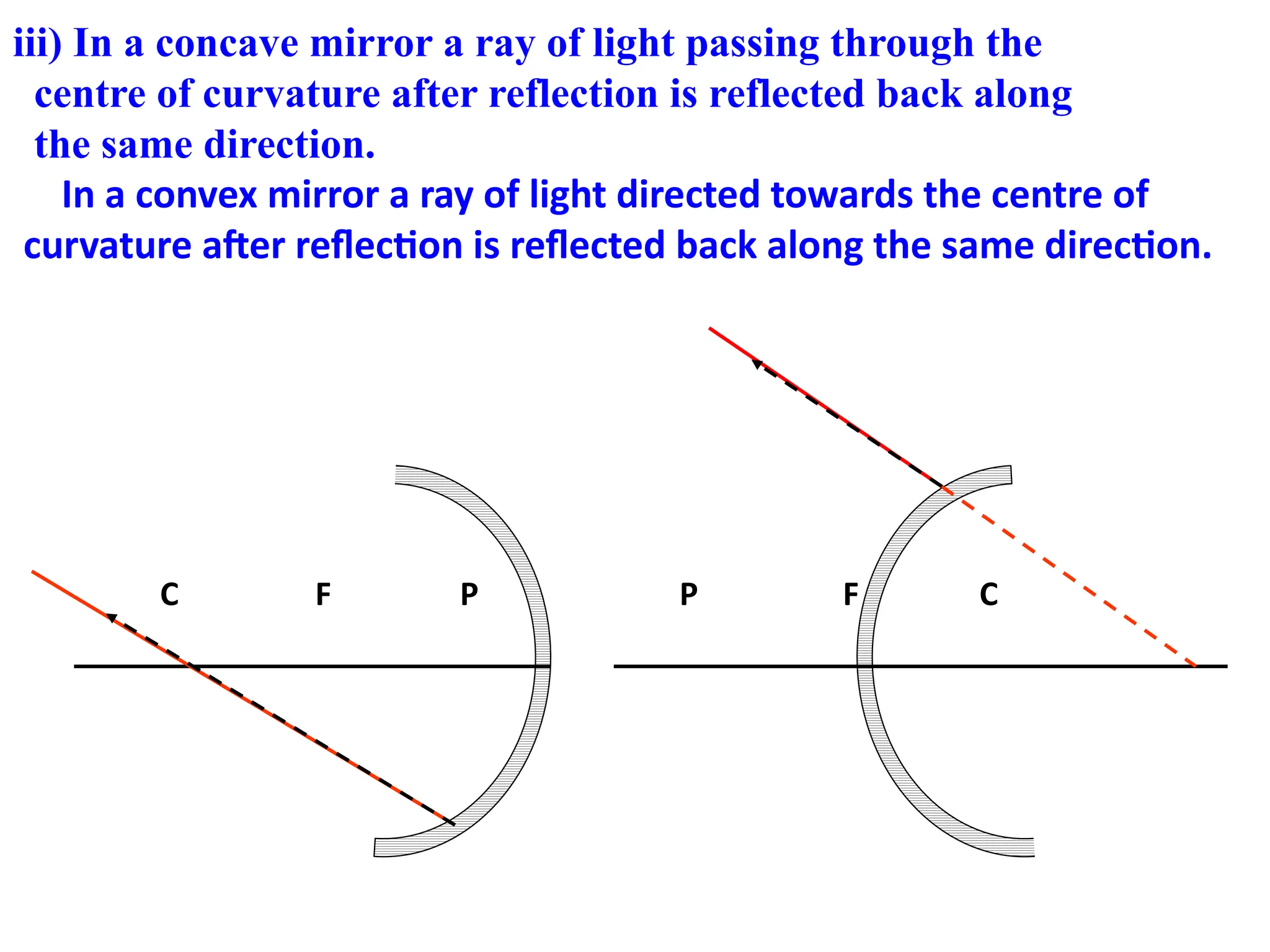
iii) In aconcave mirror a ray of light passing through the
centre of curvature after reflection is reflected back along
the same direction.
In a convex mirror a ray of light directed towards the centre of
curvature after reflection is reflected back along the same direction.
C F P P F C
12.
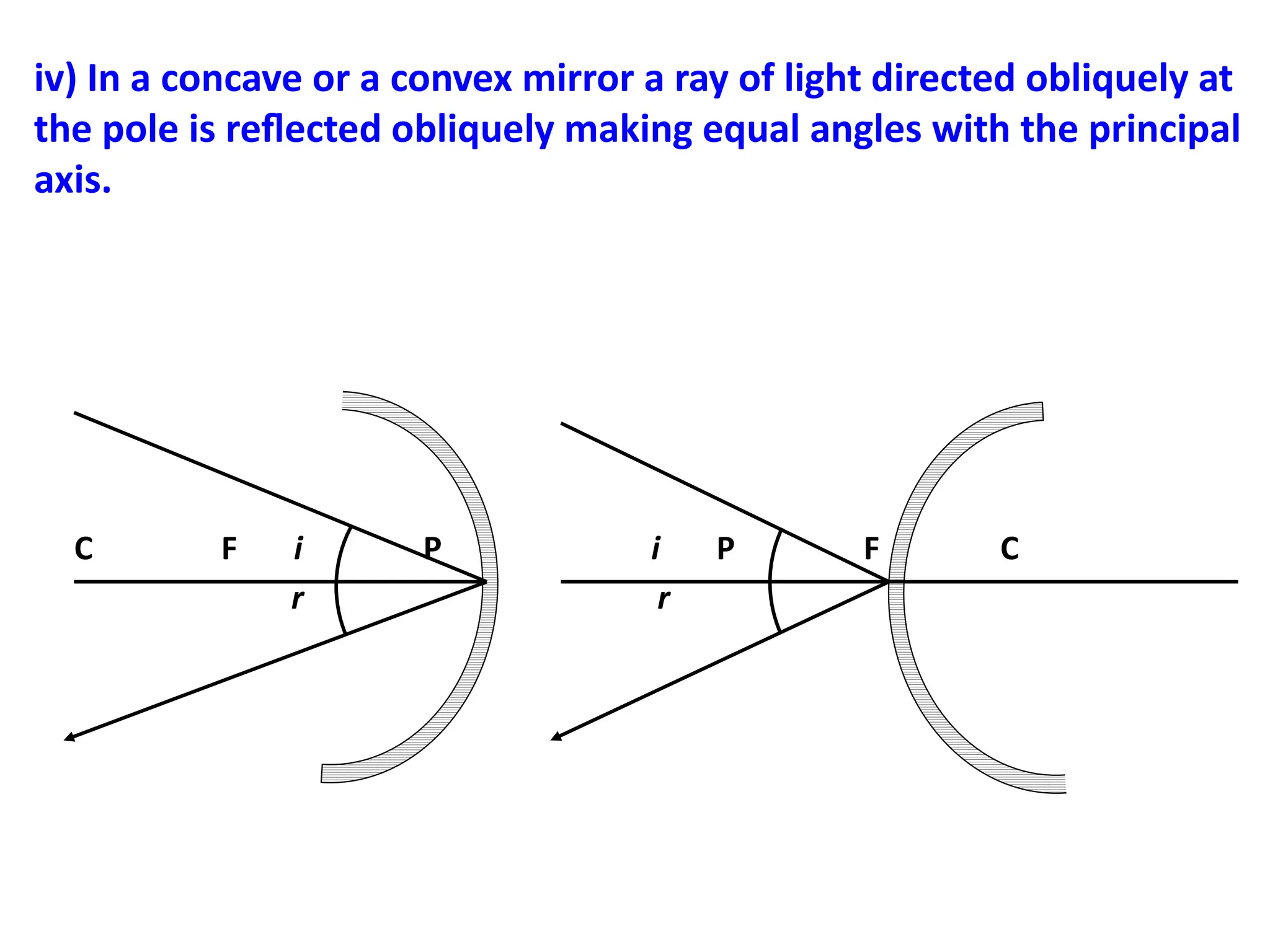
iv) In aconcave or a convex mirror a ray of light directed obliquely at
the pole is reflected obliquely making equal angles with the principal
axis.
C F i P i P F C
r r
13.
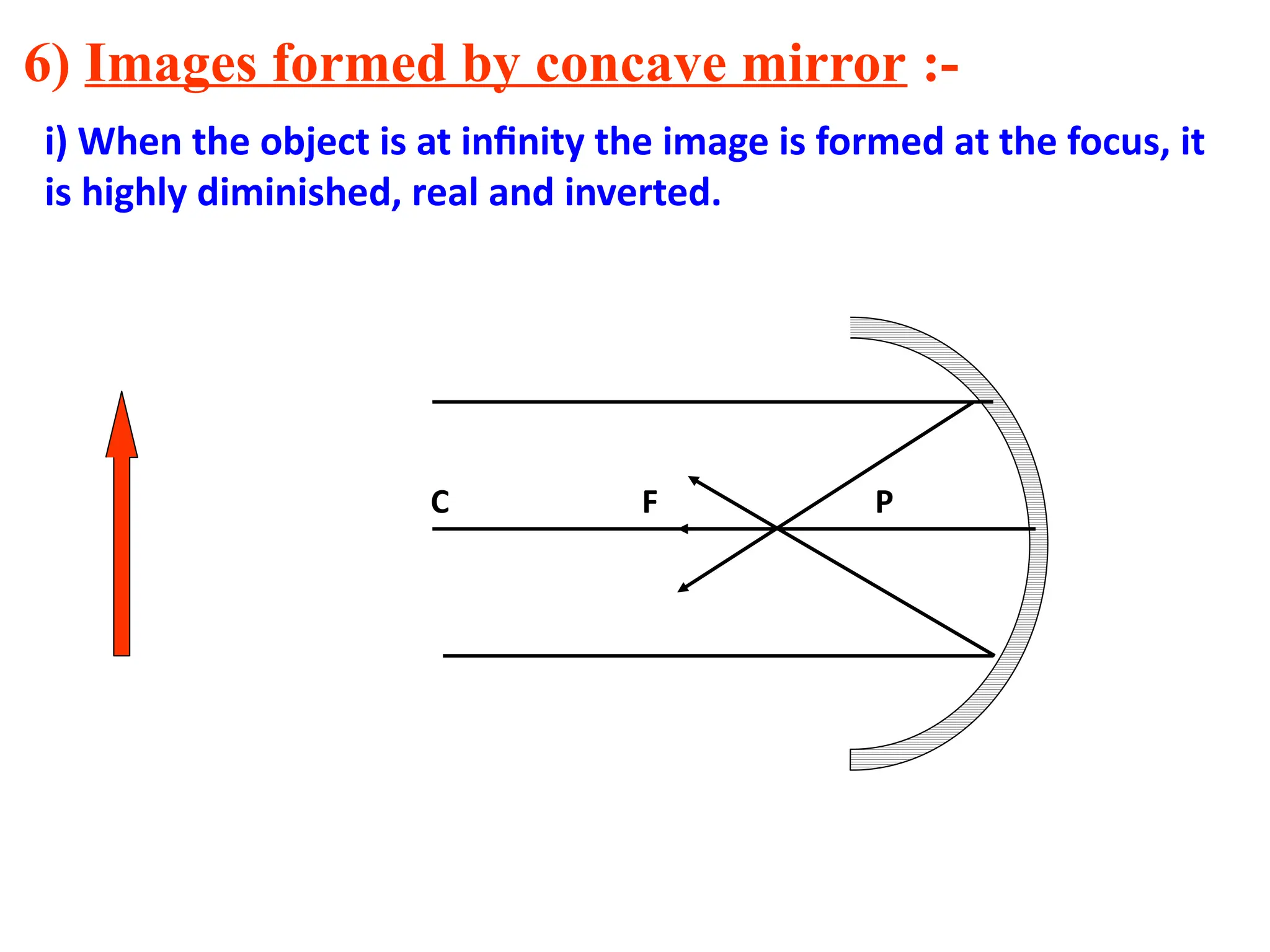
6) Images formedby concave mirror :-
i) When the object is at infinity the image is formed at the focus, it
is highly diminished, real and inverted.
C F P
14.
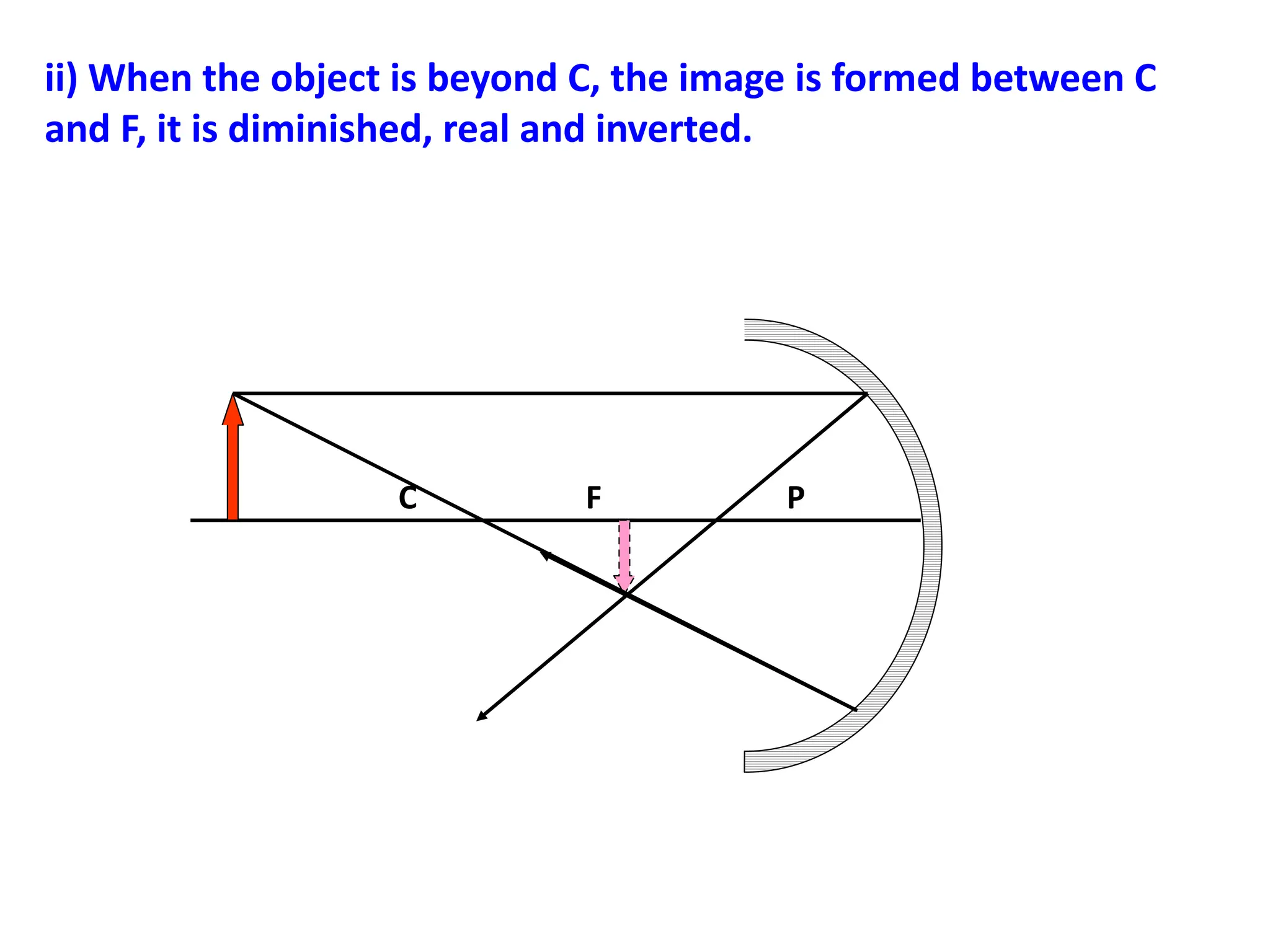
ii) When theobject is beyond C, the image is formed between C
and F, it is diminished, real and inverted.
C F P
15.
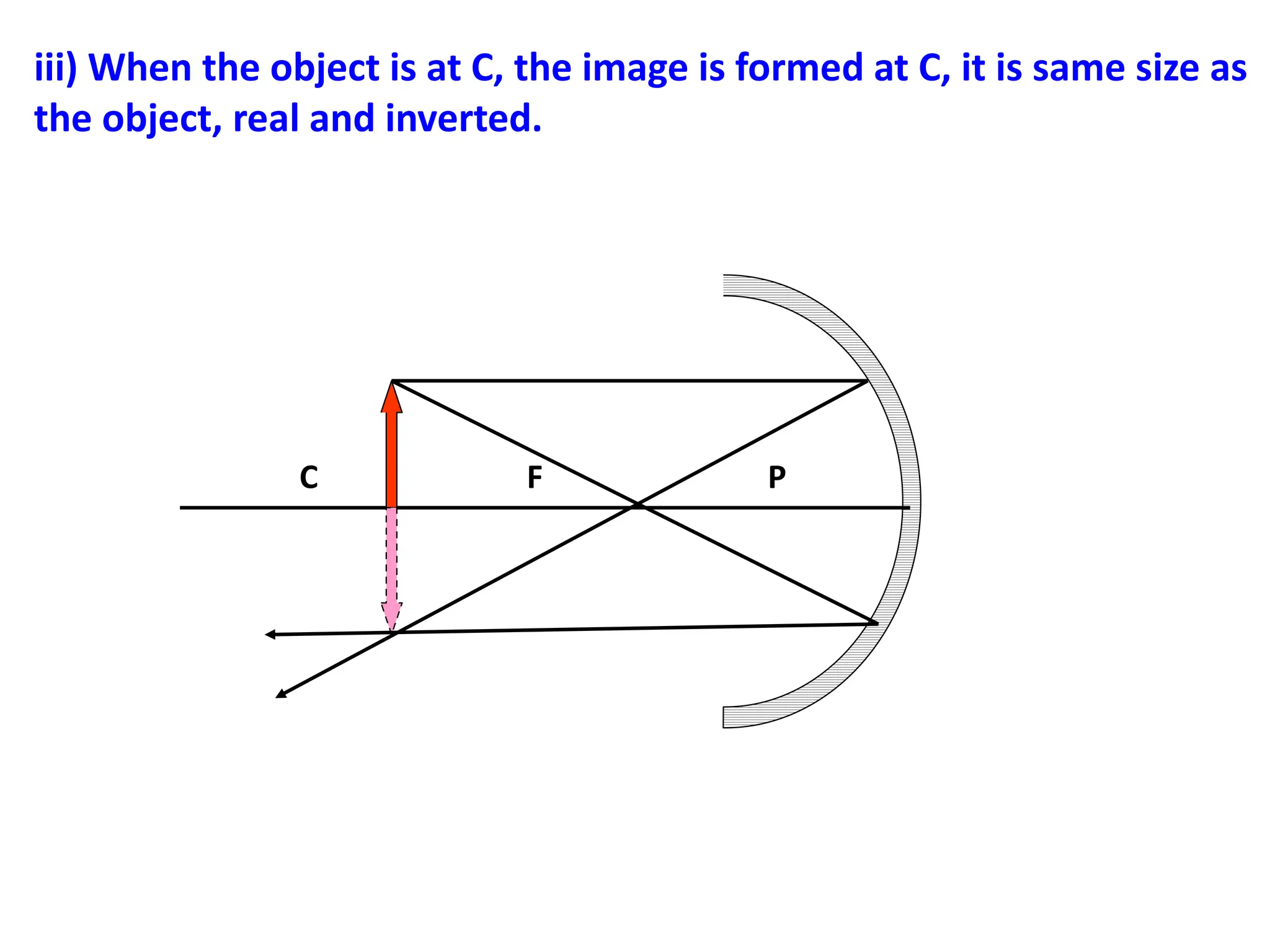
iii) When theobject is at C, the image is formed at C, it is same size as
the object, real and inverted.
C F P
16.
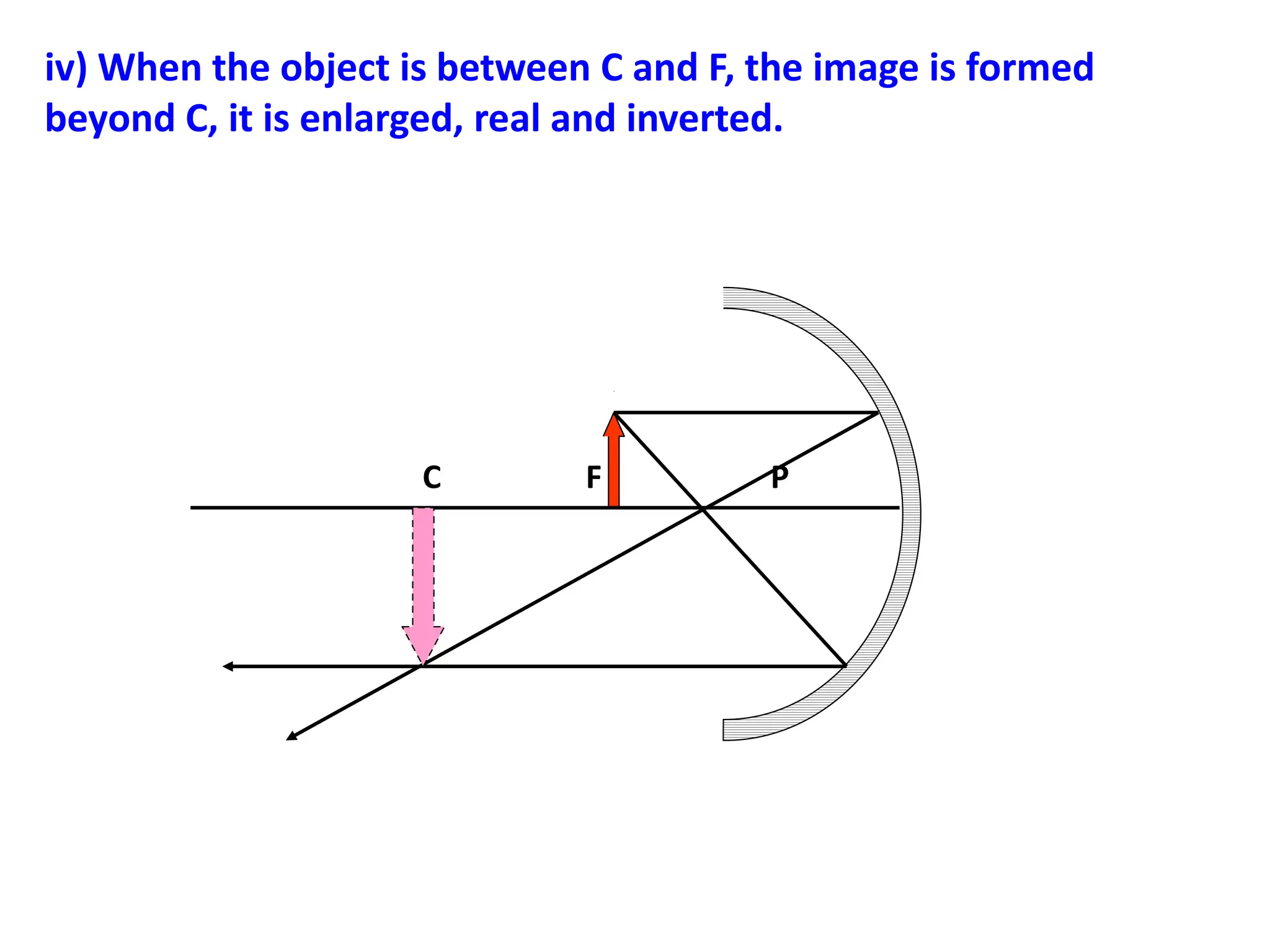
iv) When theobject is between C and F, the image is formed
beyond C, it is enlarged, real and inverted.
C F P
17.
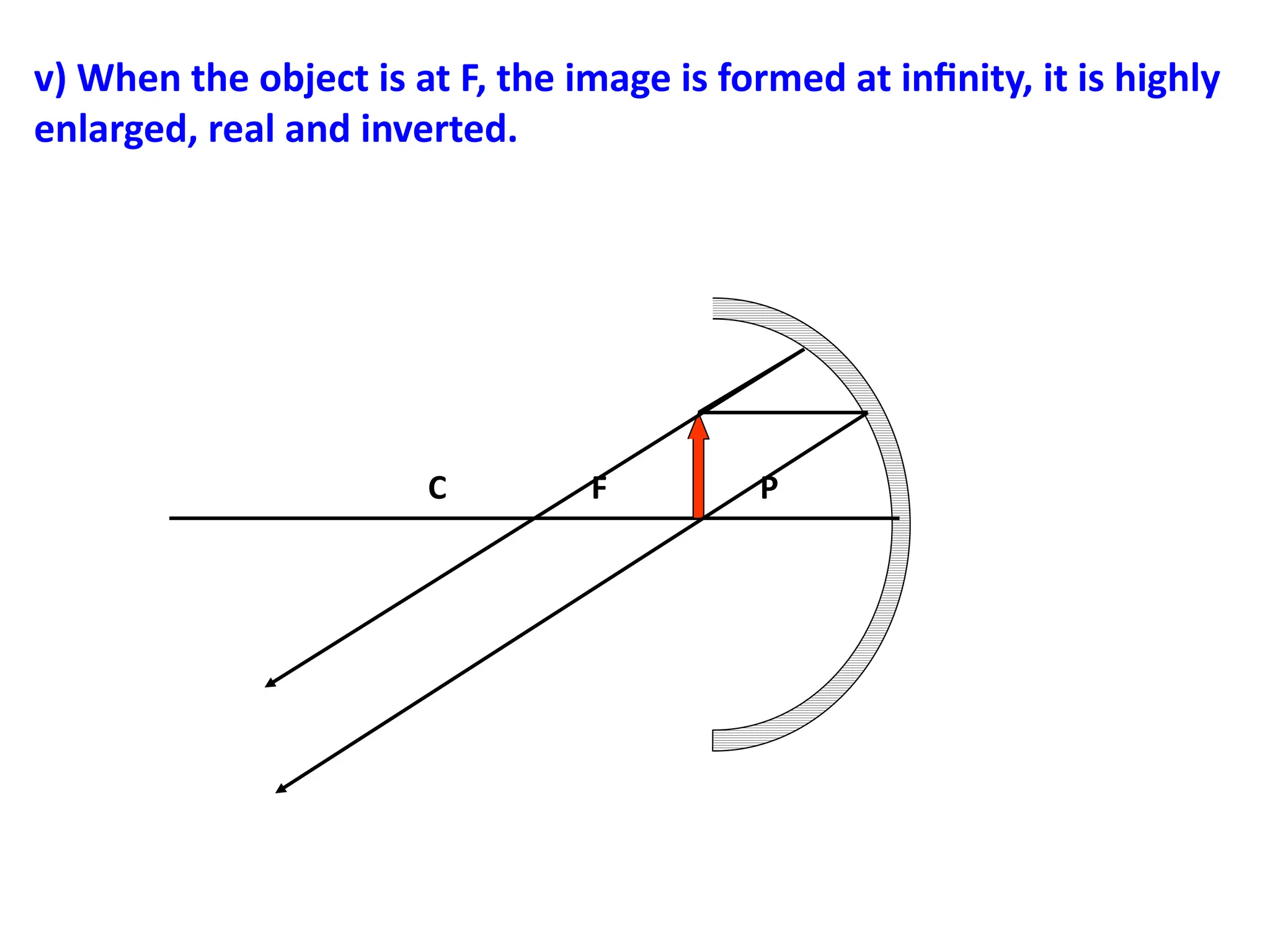
v) When theobject is at F, the image is formed at infinity, it is highly
enlarged, real and inverted.
C F P
18.
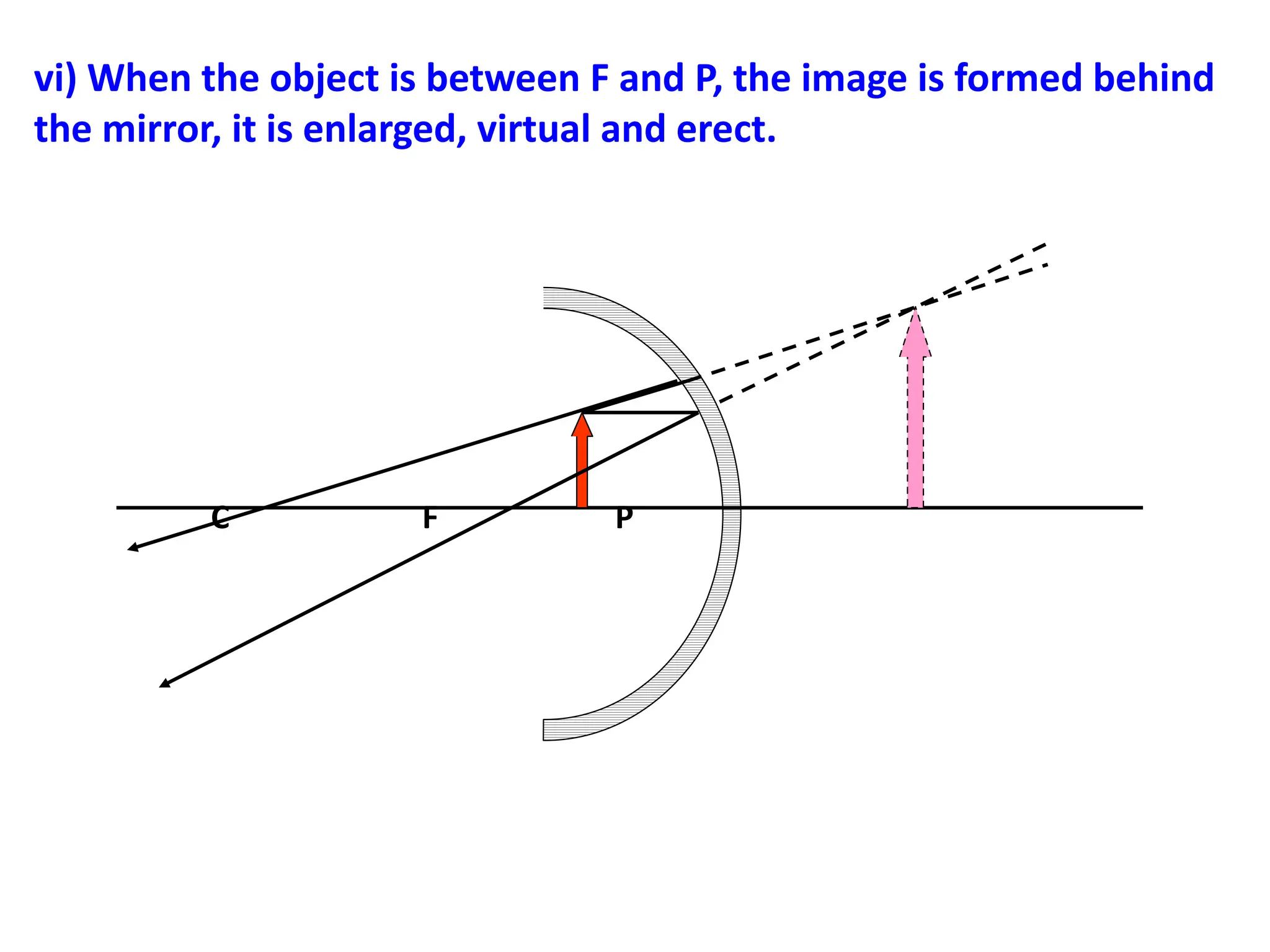
vi) When theobject is between F and P, the image is formed behind
the mirror, it is enlarged, virtual and erect.
C F P
19.
7) Images formedby convex mirror :-
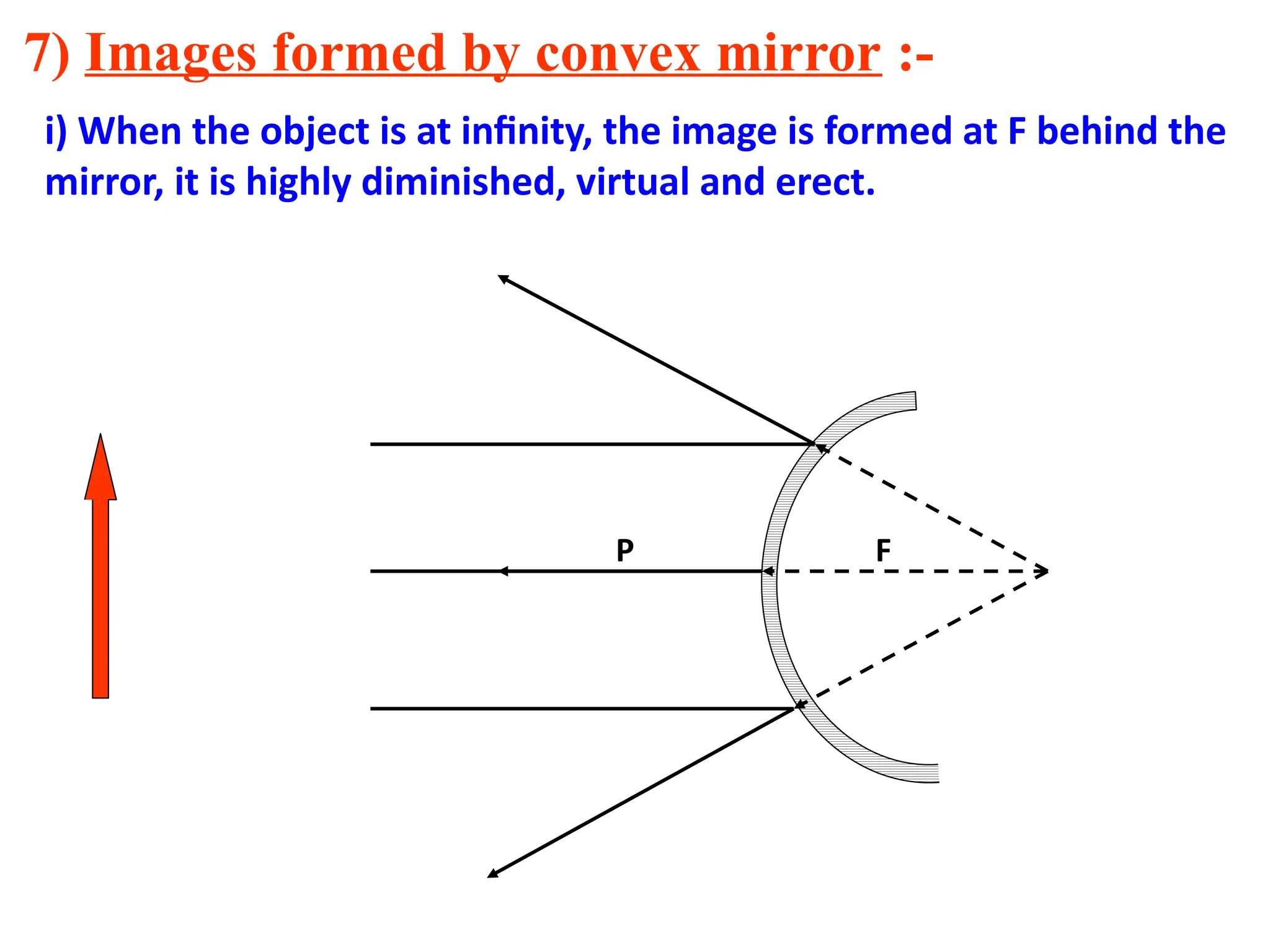
i) When the object is at infinity, the image is formed at F behind the
mirror, it is highly diminished, virtual and erect.
P F
20.
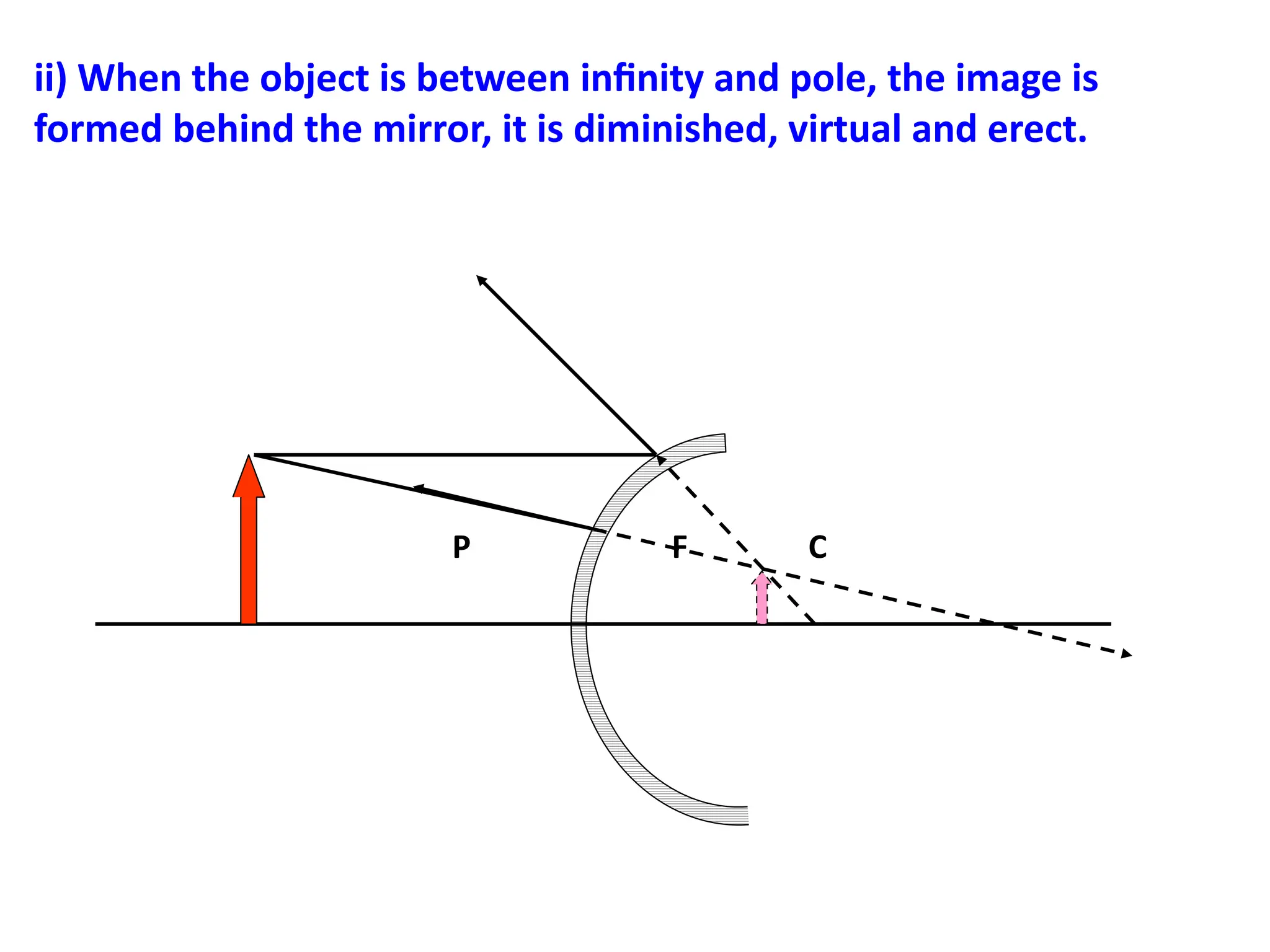
ii) When theobject is between infinity and pole, the image is
formed behind the mirror, it is diminished, virtual and erect.
P F C
21.
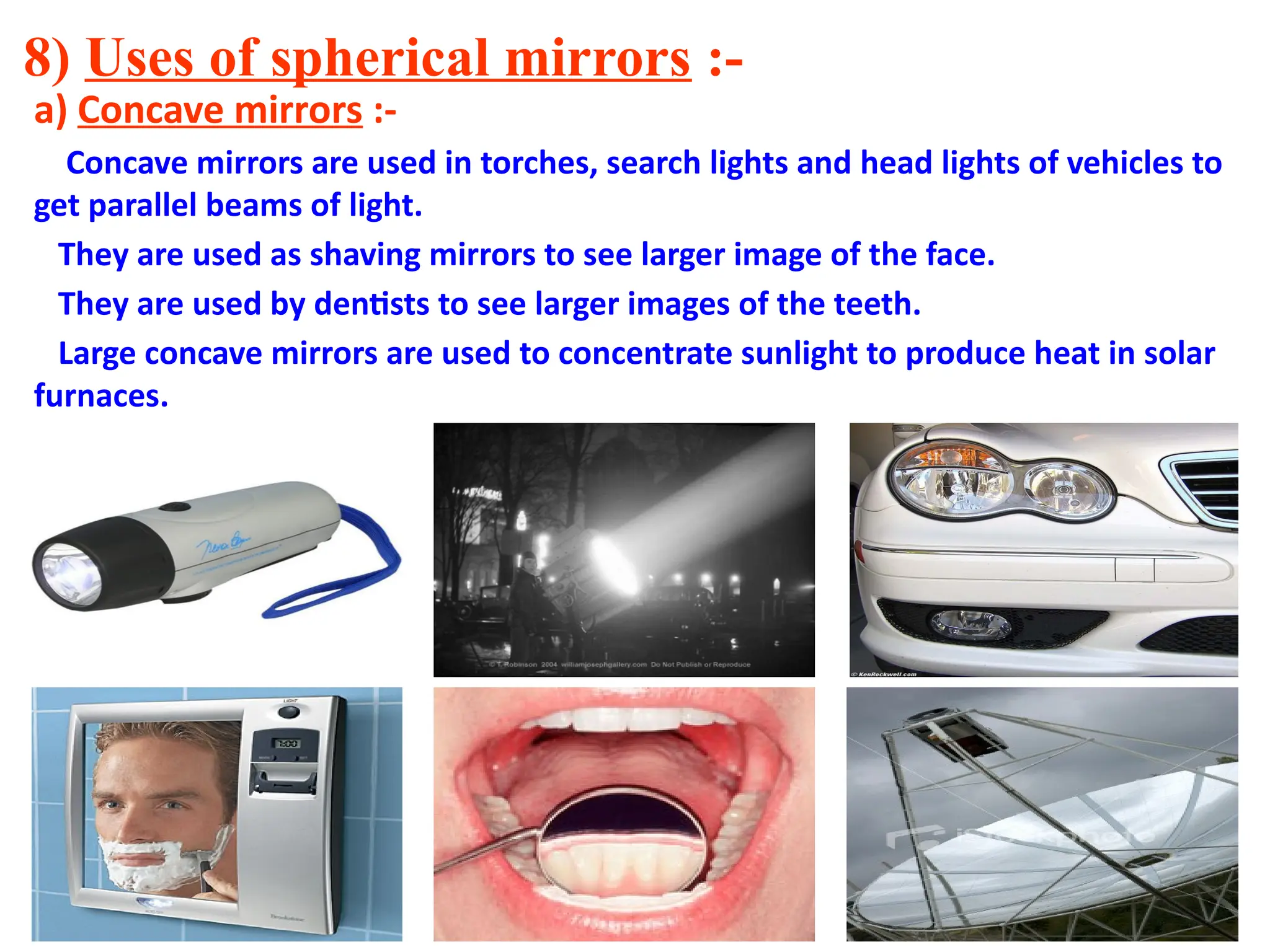
8) Uses ofspherical mirrors :-
a) Concave mirrors :-
Concave mirrors are used in torches, search lights and head lights of vehicles to
get parallel beams of light.
They are used as shaving mirrors to see larger image of the face.
They are used by dentists to see larger images of the teeth.
Large concave mirrors are used to concentrate sunlight to produce heat in solar
furnaces.
22.
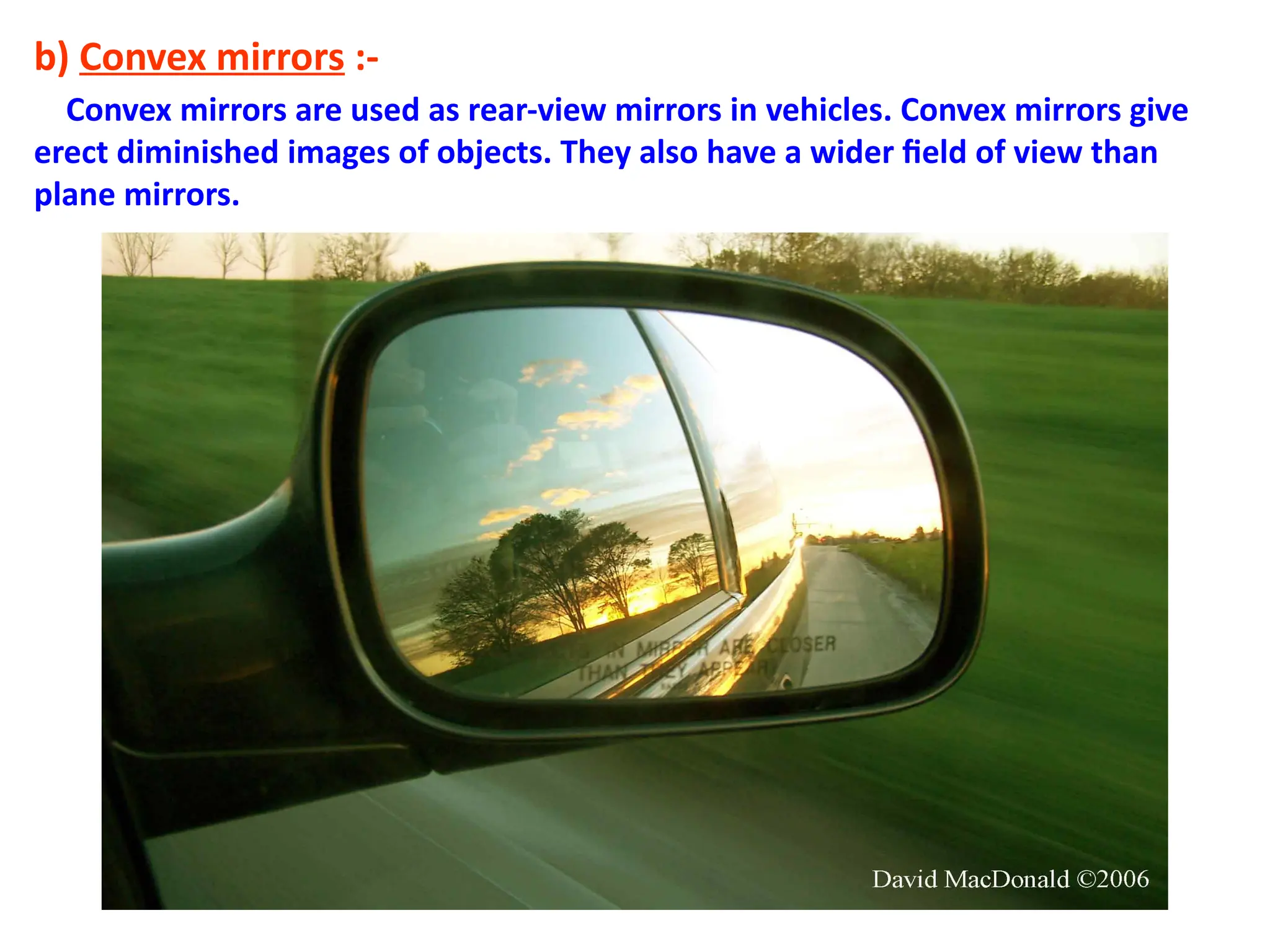
b) Convex mirrors:-
Convex mirrors are used as rear-view mirrors in vehicles. Convex mirrors give
erect diminished images of objects. They also have a wider field of view than
plane mirrors.
23.
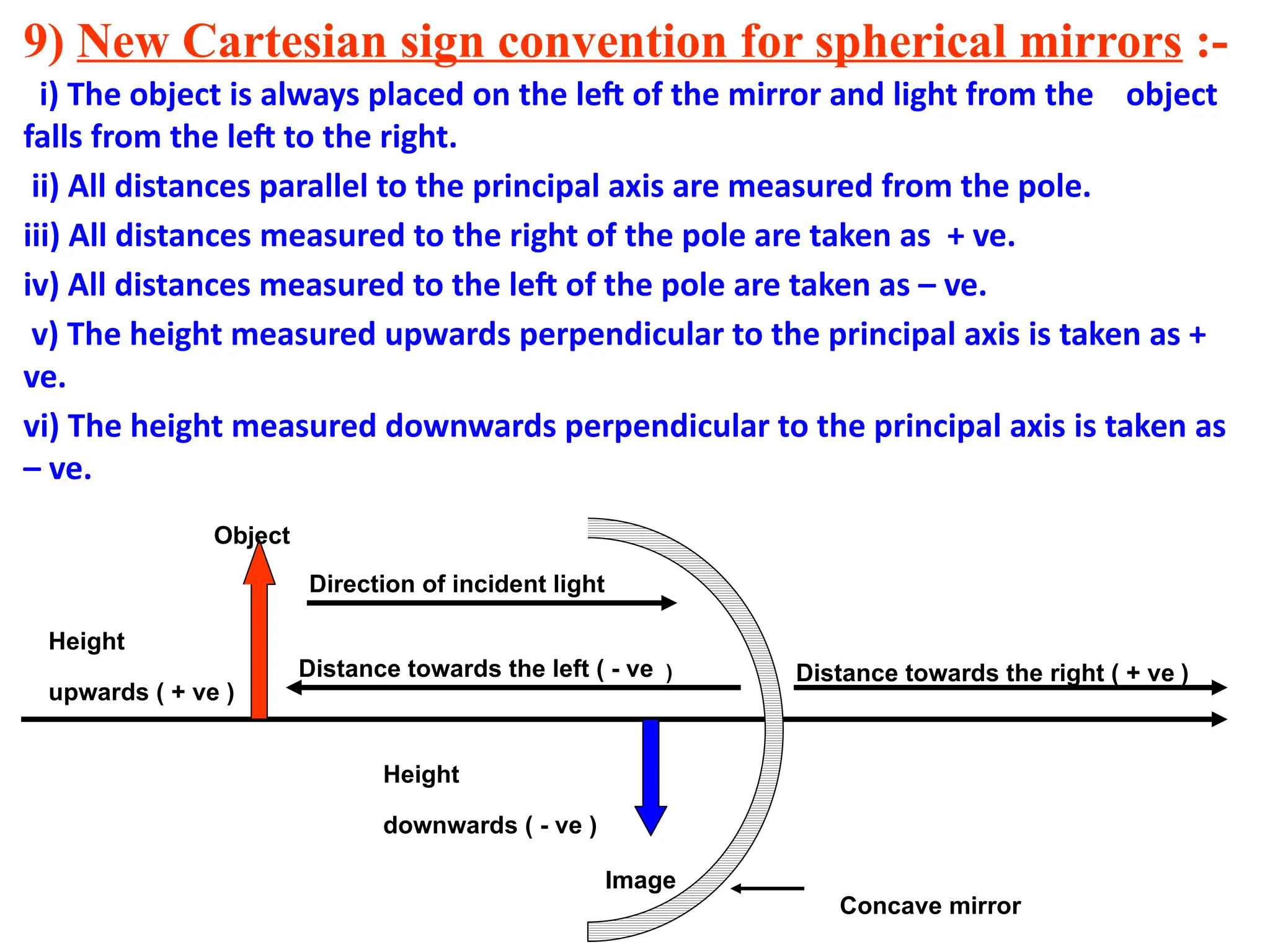
9) New Cartesiansign convention for spherical mirrors :-
i) The object is always placed on the left of the mirror and light from the object
falls from the left to the right.
ii) All distances parallel to the principal axis are measured from the pole.
iii) All distances measured to the right of the pole are taken as + ve.
iv) All distances measured to the left of the pole are taken as – ve.
v) The height measured upwards perpendicular to the principal axis is taken as +
ve.
vi) The height measured downwards perpendicular to the principal axis is taken as
– ve.
Direction of incident light
Distance towards the left ( - ve ) Distance towards the right ( + ve )
Height
downwards ( - ve )
Height
upwards ( + ve )
Concave mirror
Object
Image
24.
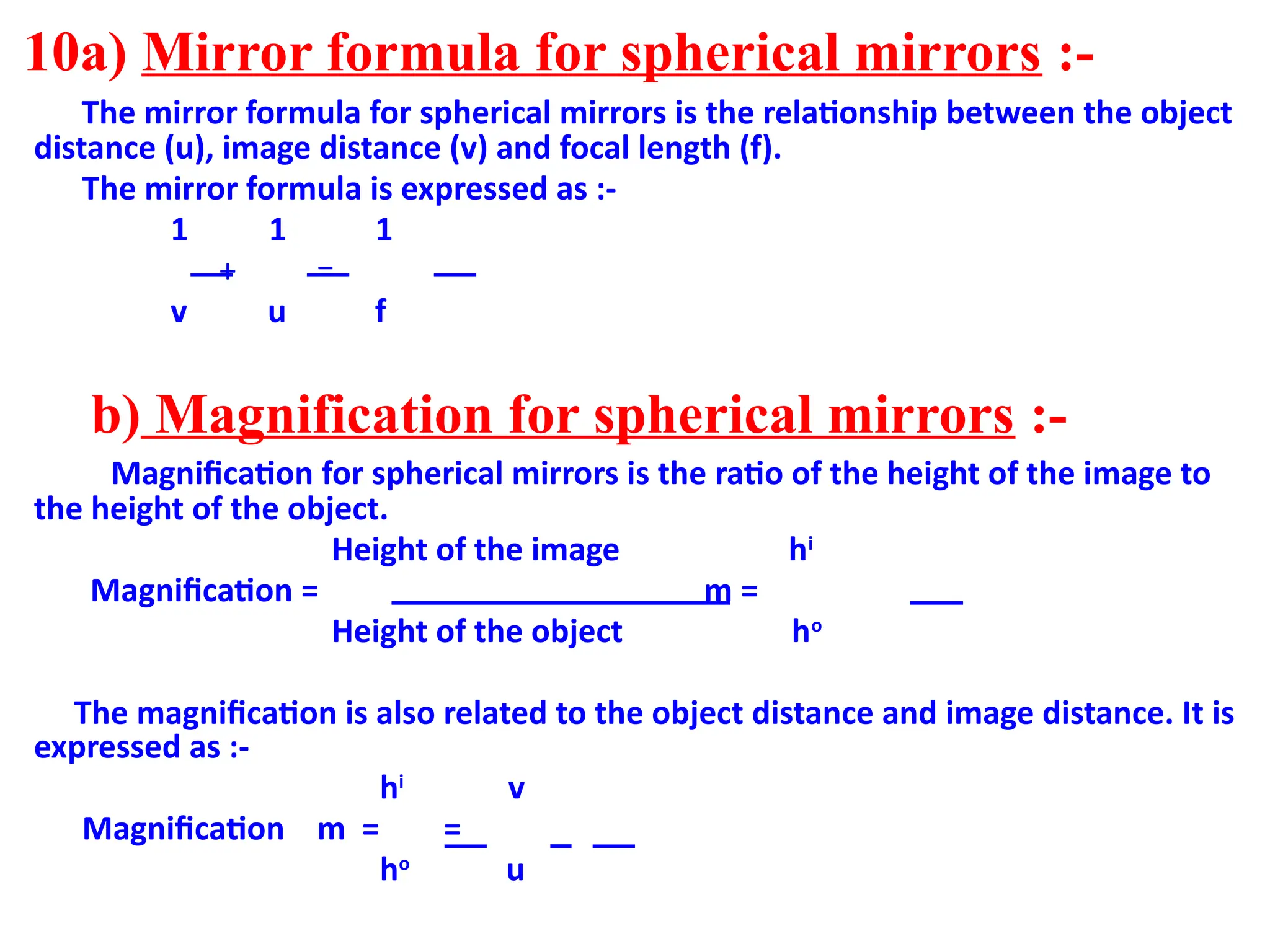
10a) Mirror formulafor spherical mirrors :-
The mirror formula for spherical mirrors is the relationship between the object
distance (u), image distance (v) and focal length (f).
The mirror formula is expressed as :-
1 1 1
+ =
v u f
b) Magnification for spherical mirrors :-
Magnification for spherical mirrors is the ratio of the height of the image to
the height of the object.
Height of the image hi
Magnification = m =
Height of the object ho
The magnification is also related to the object distance and image distance. It is
expressed as :-
hi
v
Magnification m = =
ho
u
25.
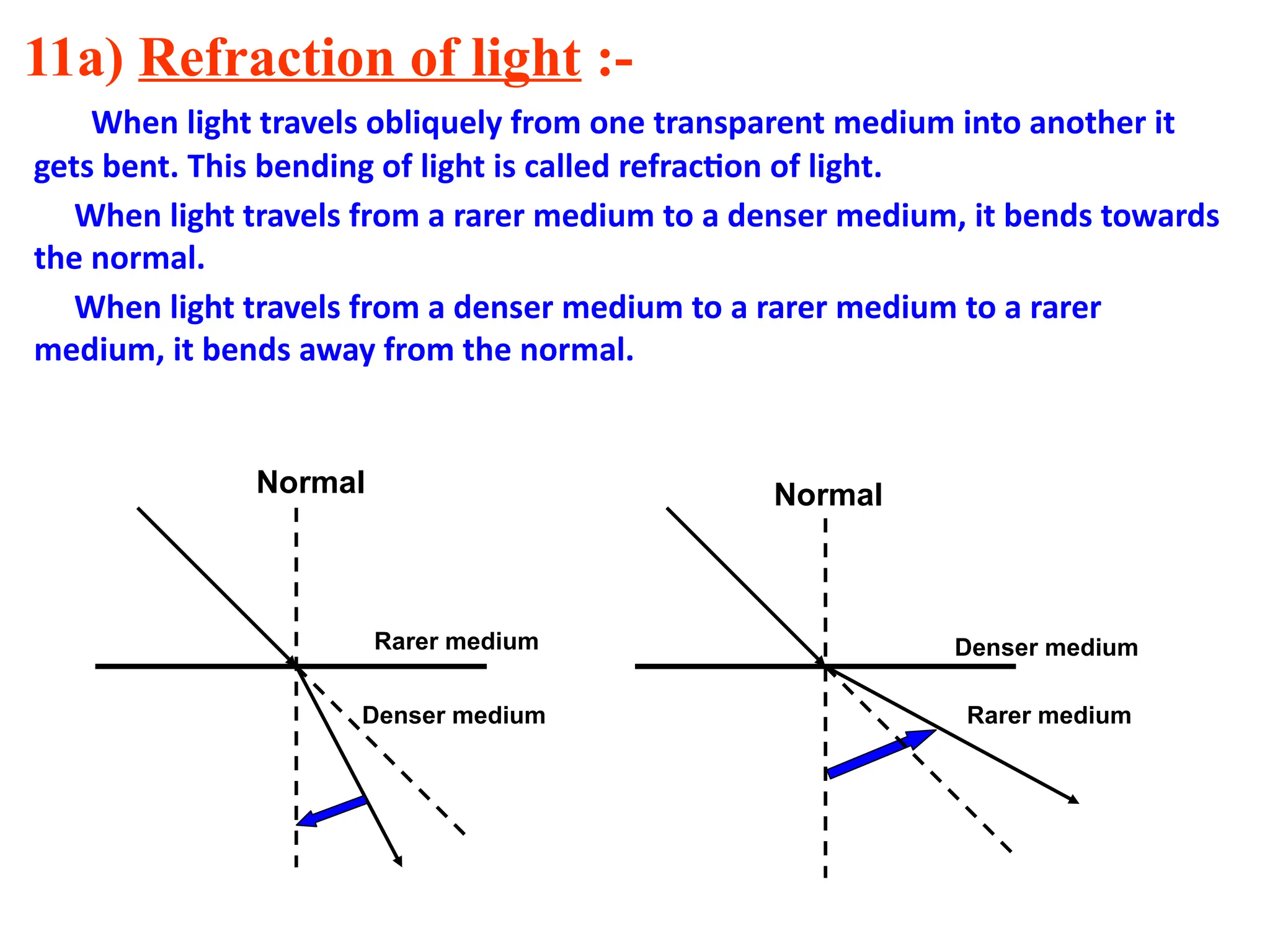
11a) Refraction oflight :-
When light travels obliquely from one transparent medium into another it
gets bent. This bending of light is called refraction of light.
When light travels from a rarer medium to a denser medium, it bends towards
the normal.
When light travels from a denser medium to a rarer medium to a rarer
medium, it bends away from the normal.
Denser medium Rarer medium
Rarer medium Denser medium
Normal Normal
26.
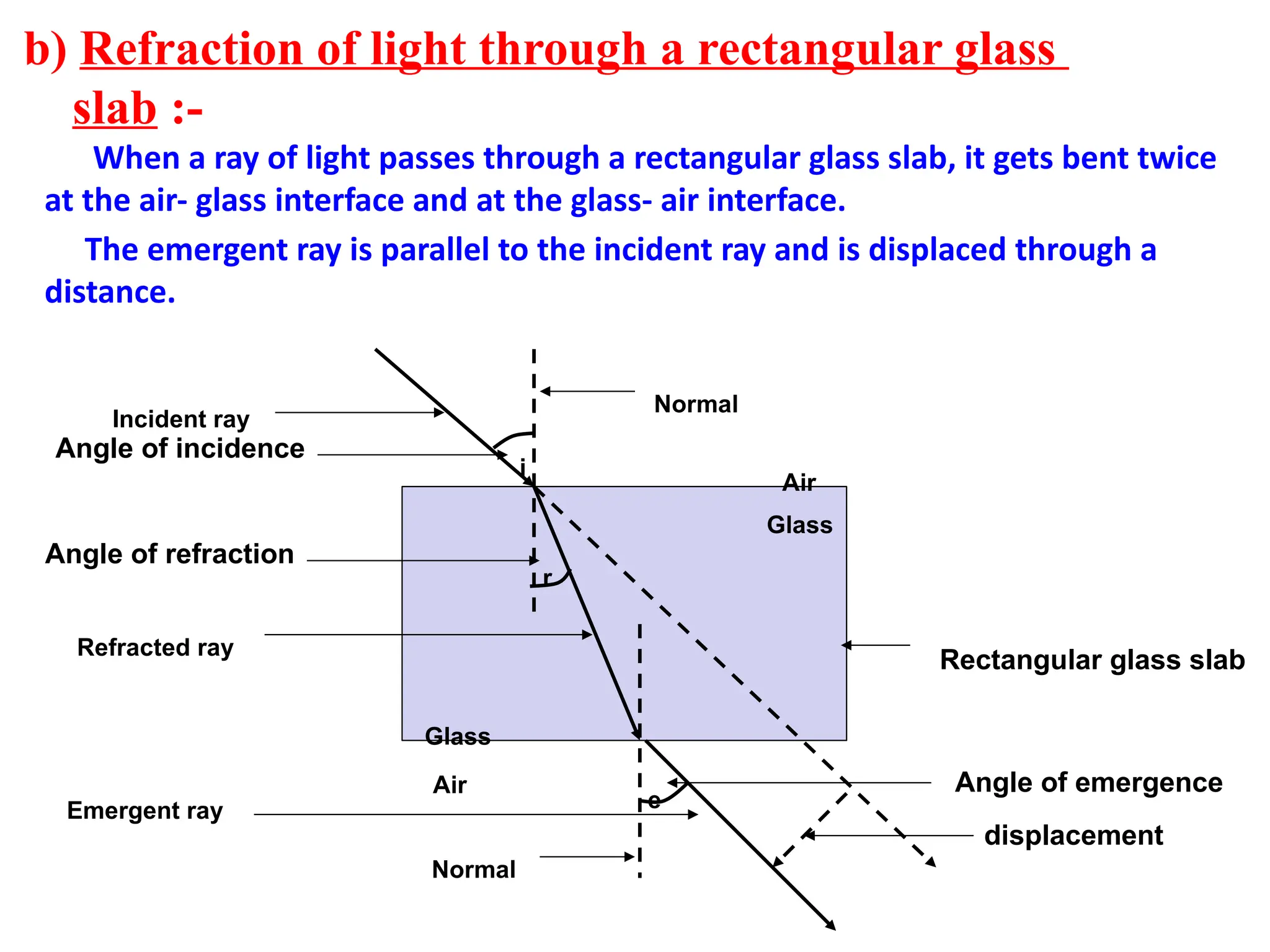
b) Refraction oflight through a rectangular glass
slab :-
When a ray of light passes through a rectangular glass slab, it gets bent twice
at the air- glass interface and at the glass- air interface.
The emergent ray is parallel to the incident ray and is displaced through a
distance.
i
e
Normal
Incident ray
Emergent ray
Refracted ray
Glass
Air
Normal
r
Glass
Air
Rectangular glass slab
displacement
Angle of emergence
Angle of incidence
Angle of refraction
27.
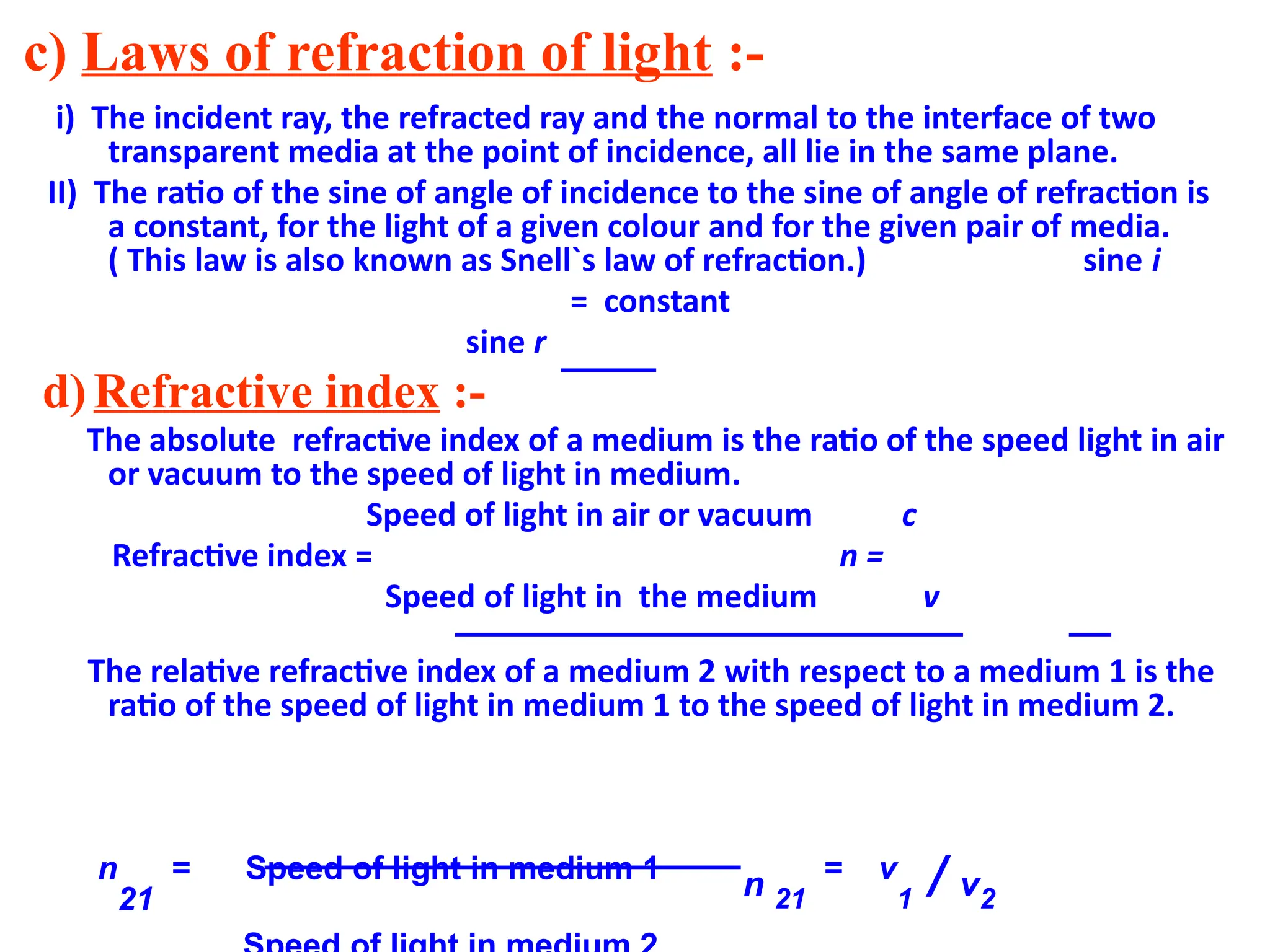
c) Laws ofrefraction of light :-
i) The incident ray, the refracted ray and the normal to the interface of two
transparent media at the point of incidence, all lie in the same plane.
II) The ratio of the sine of angle of incidence to the sine of angle of refraction is
a constant, for the light of a given colour and for the given pair of media.
( This law is also known as Snell`s law of refraction.) sine i
= constant
sine r
d)Refractive index :-
The absolute refractive index of a medium is the ratio of the speed light in air
or vacuum to the speed of light in medium.
Speed of light in air or vacuum c
Refractive index = n =
Speed of light in the medium v
The relative refractive index of a medium 2 with respect to a medium 1 is the
ratio of the speed of light in medium 1 to the speed of light in medium 2.
n
21
= Speed of light in medium 1
n 21
= v
1 / v2
28.
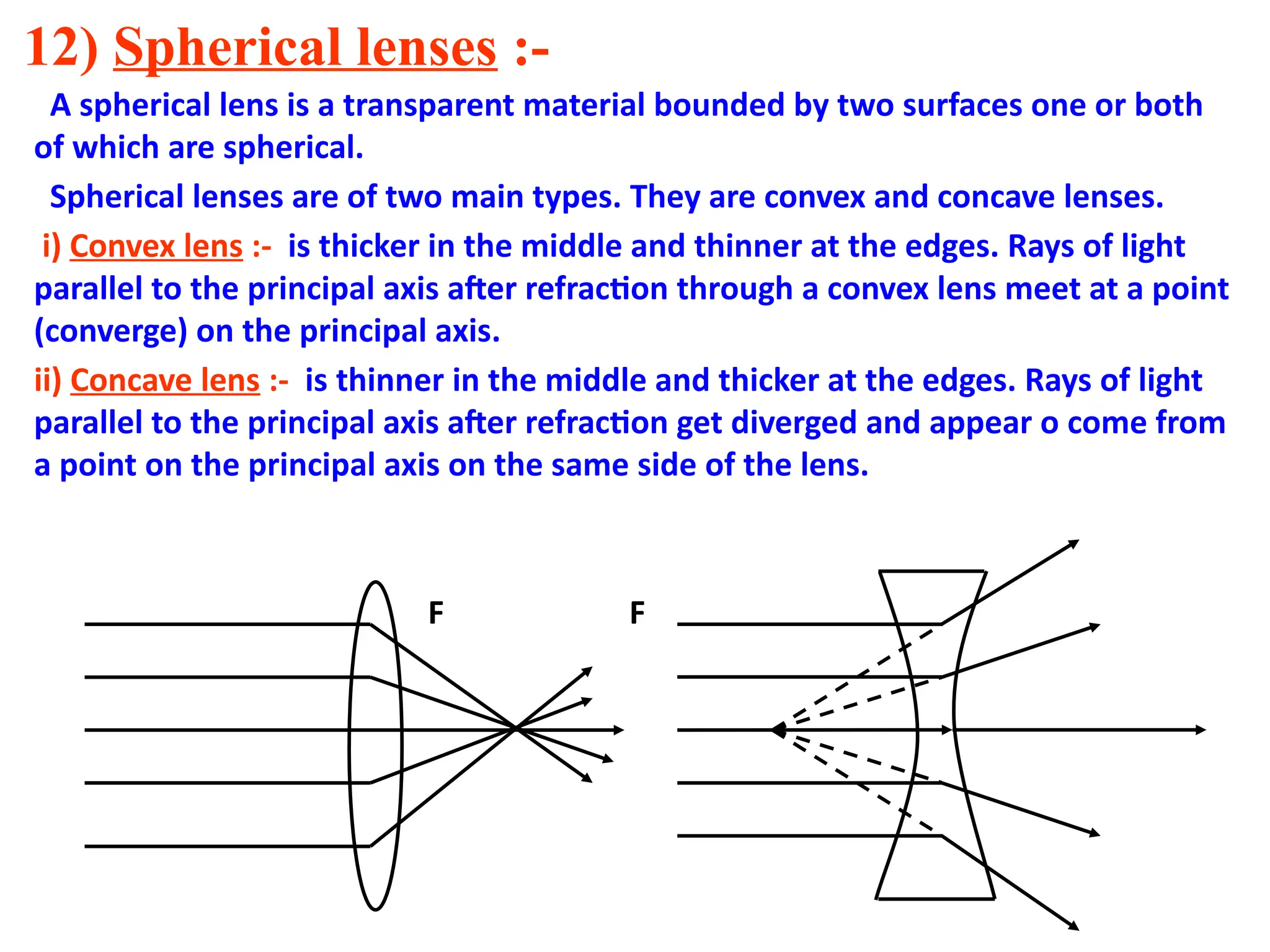
12) Spherical lenses:-
A spherical lens is a transparent material bounded by two surfaces one or both
of which are spherical.
Spherical lenses are of two main types. They are convex and concave lenses.
i) Convex lens :- is thicker in the middle and thinner at the edges. Rays of light
parallel to the principal axis after refraction through a convex lens meet at a point
(converge) on the principal axis.
ii) Concave lens :- is thinner in the middle and thicker at the edges. Rays of light
parallel to the principal axis after refraction get diverged and appear o come from
a point on the principal axis on the same side of the lens.
F F
29.
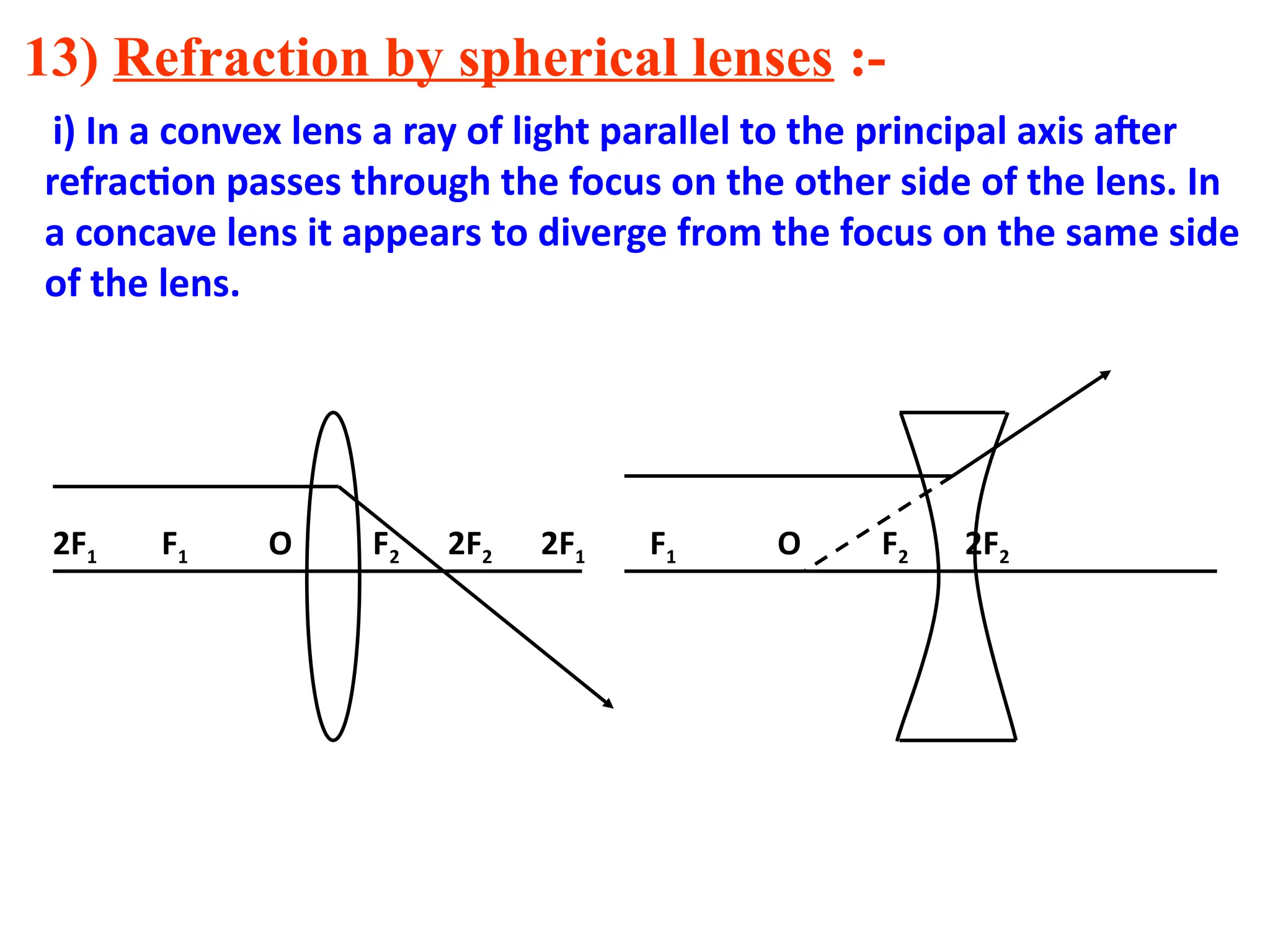
13) Refraction byspherical lenses :-
i) In a convex lens a ray of light parallel to the principal axis after
refraction passes through the focus on the other side of the lens. In
a concave lens it appears to diverge from the focus on the same side
of the lens.
2F1 F1 O F2 2F2 2F1 F1 O F2 2F2
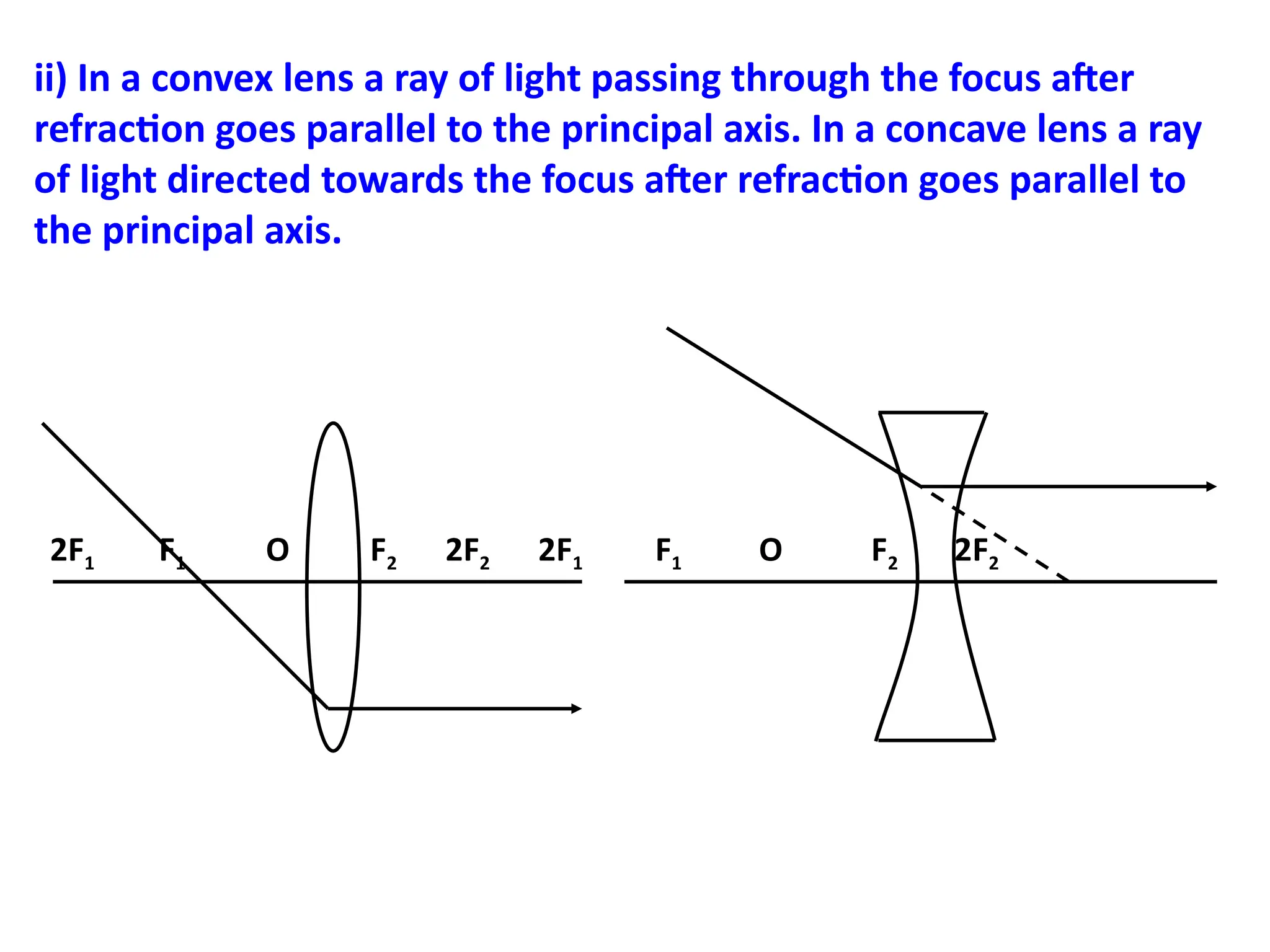
30.
ii) In aconvex lens a ray of light passing through the focus after
refraction goes parallel to the principal axis. In a concave lens a ray
of light directed towards the focus after refraction goes parallel to
the principal axis.
2F1 F1 O F2 2F2 2F1 F1 O F2 2F2
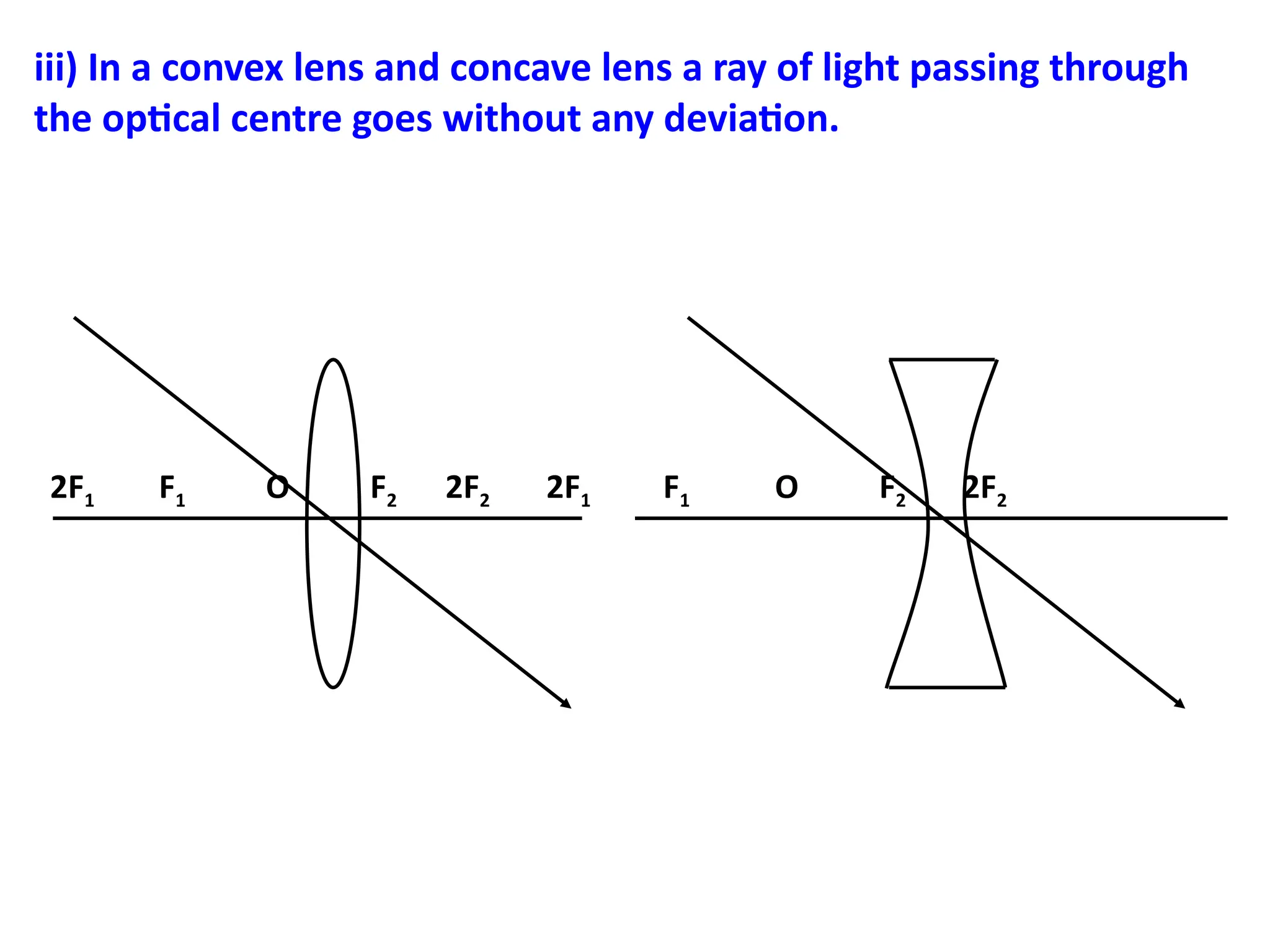
31.
iii) In aconvex lens and concave lens a ray of light passing through
the optical centre goes without any deviation.
2F1 F1 O F2 2F2 2F1 F1 O F2 2F2
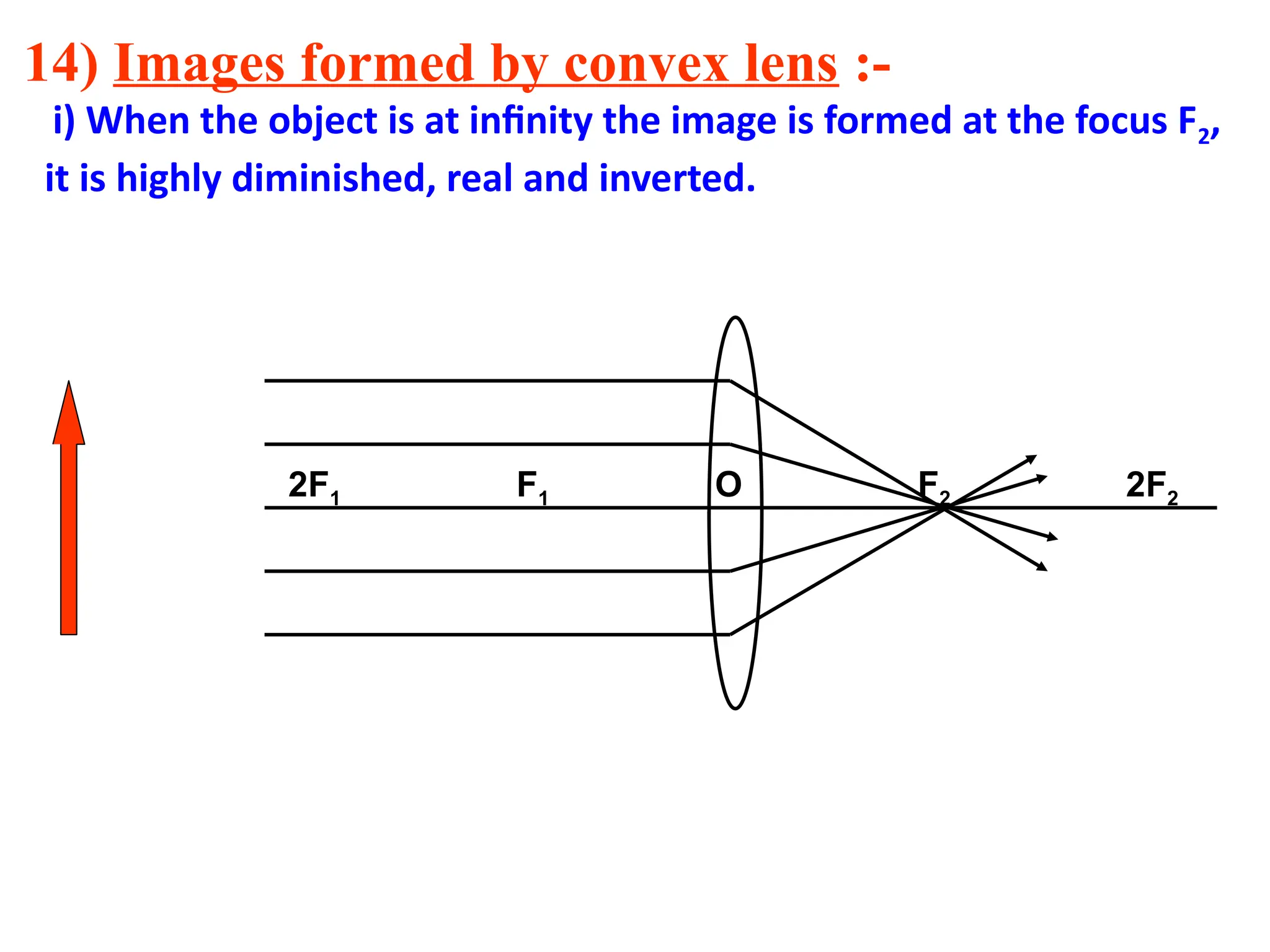
32.
14) Images formedby convex lens :-
i) When the object is at infinity the image is formed at the focus F2,
it is highly diminished, real and inverted.
2F1 F1 O F2 2F2
33.
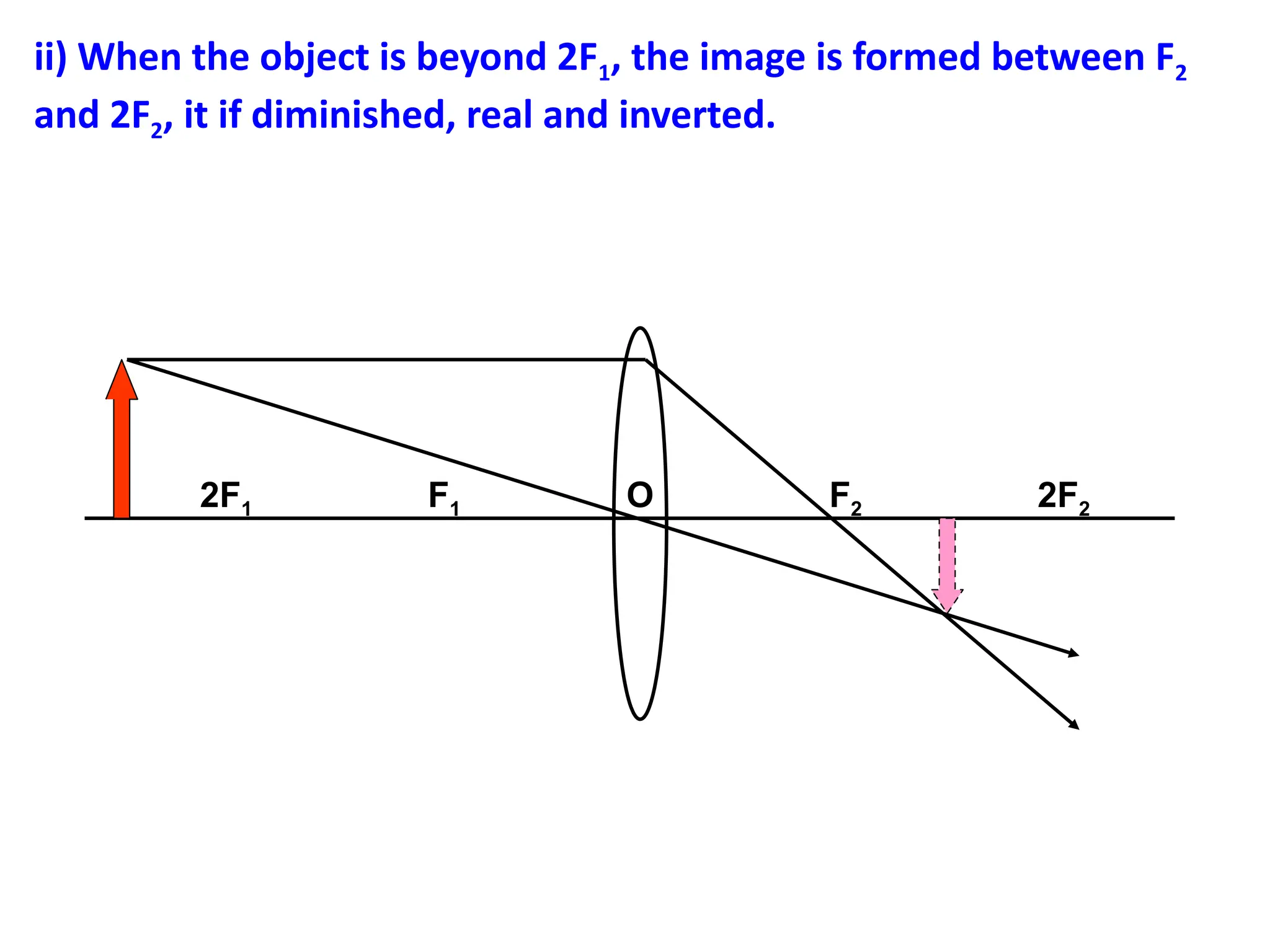
ii) When theobject is beyond 2F1, the image is formed between F2
and 2F2, it if diminished, real and inverted.
2F1 F1 O F2 2F2
34.
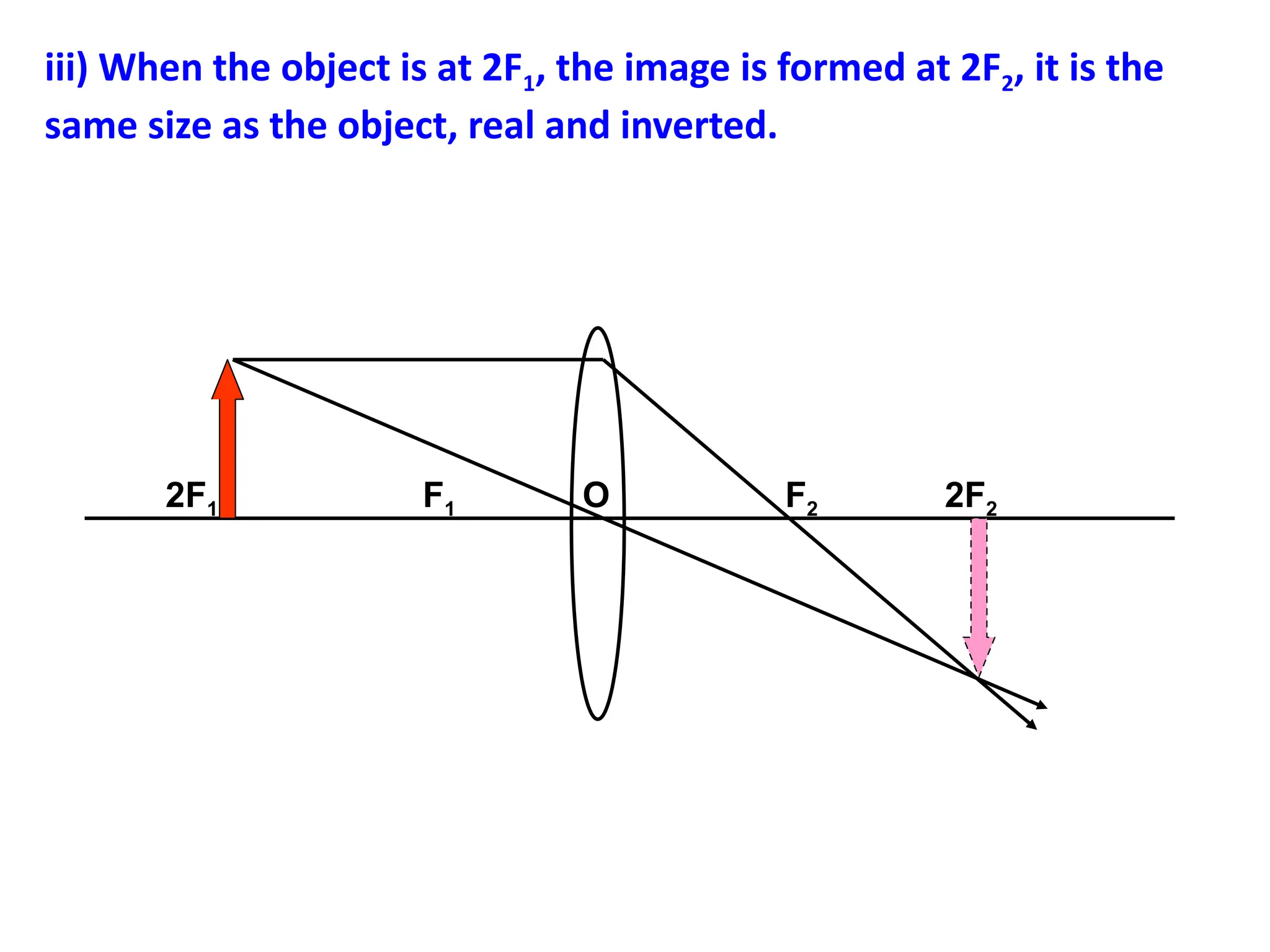
iii) When theobject is at 2F1, the image is formed at 2F2, it is the
same size as the object, real and inverted.
2F1 F1 O F2 2F2
35.
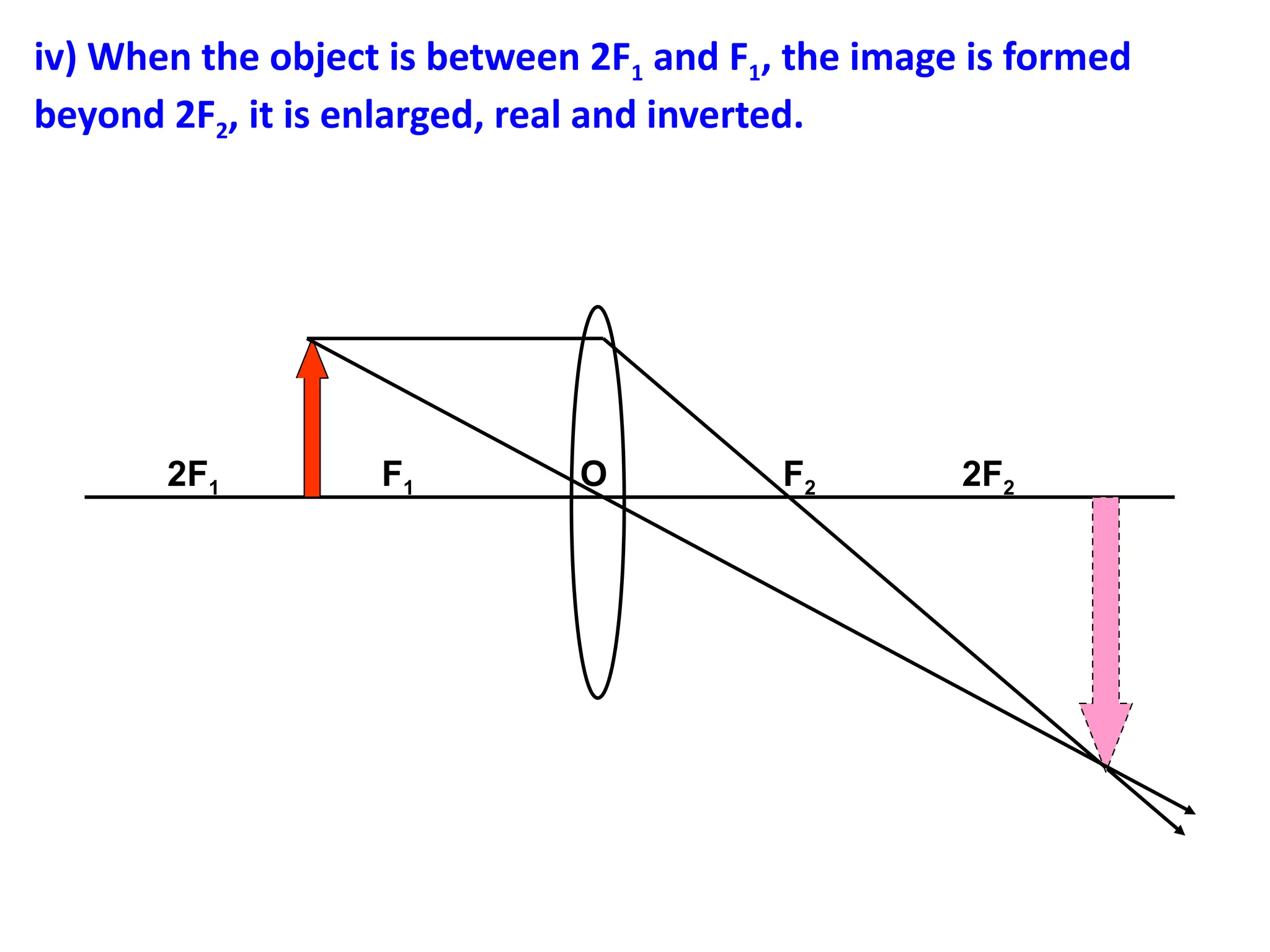
iv) When theobject is between 2F1 and F1, the image is formed
beyond 2F2, it is enlarged, real and inverted.
2F1 F1 O F2 2F2
36.
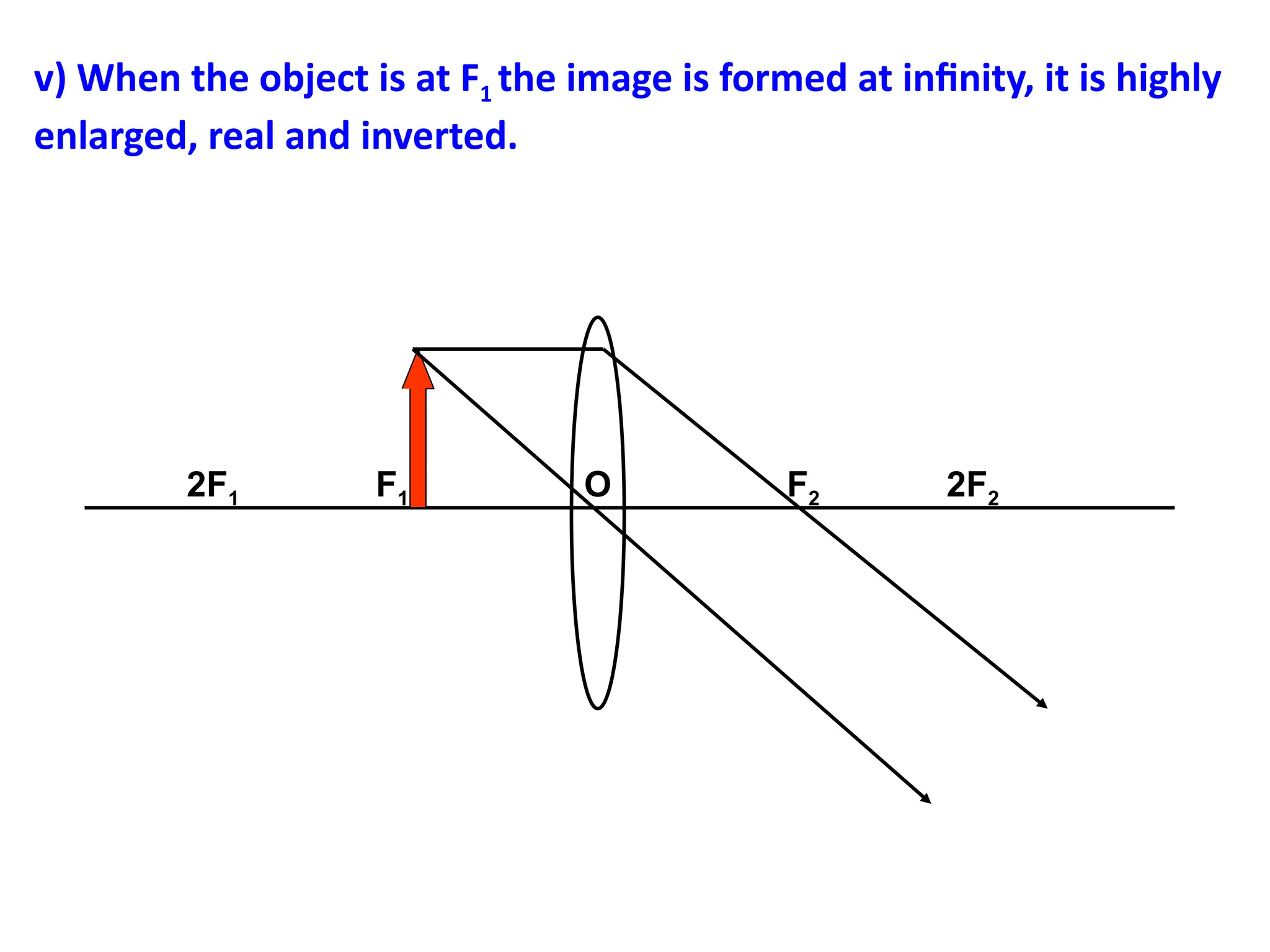
v) When theobject is at F1 the image is formed at infinity, it is highly
enlarged, real and inverted.
2F1 F1 O F2 2F2
37.
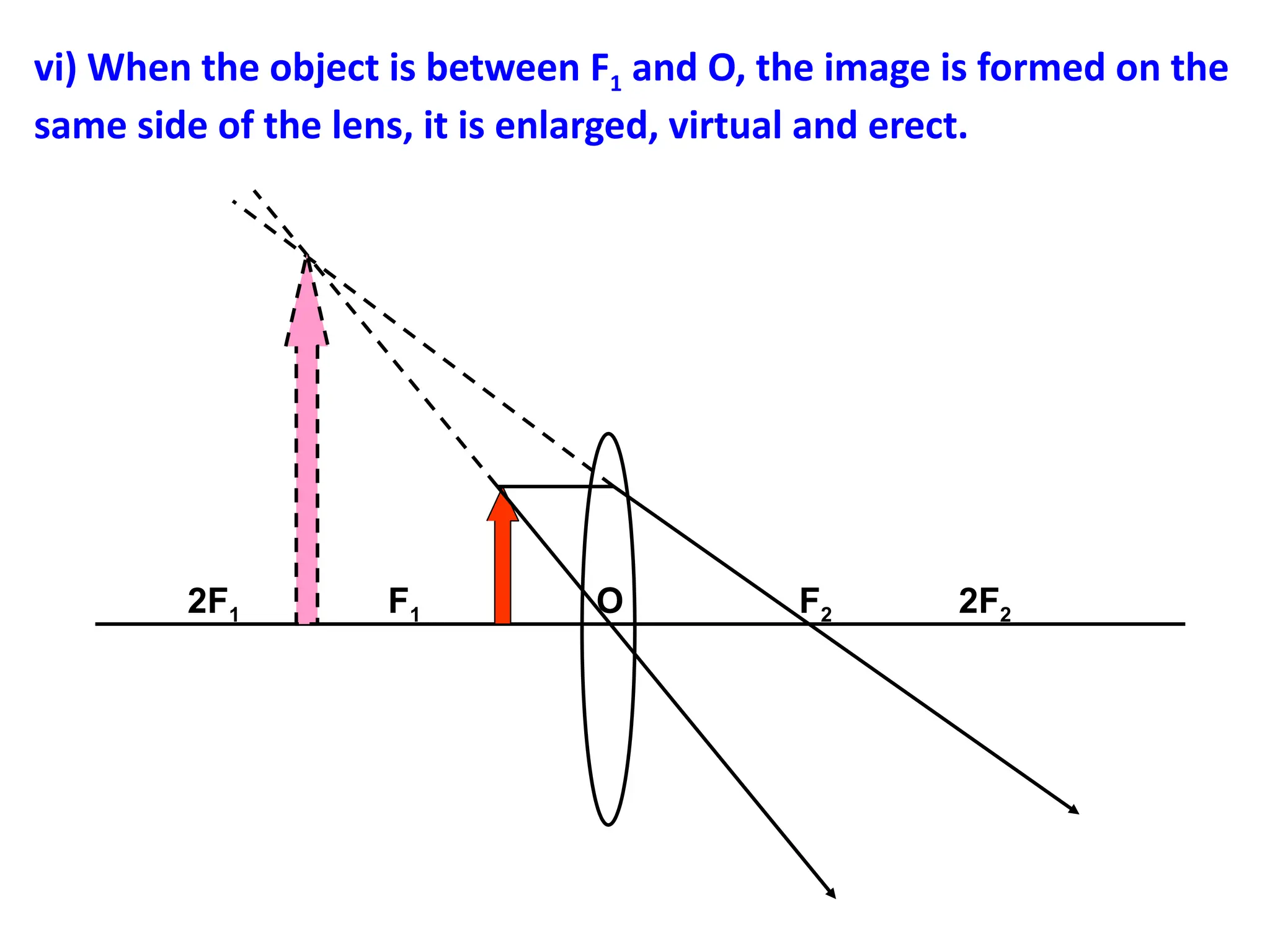
vi) When theobject is between F1 and O, the image is formed on the
same side of the lens, it is enlarged, virtual and erect.
2F1 F1 O F2 2F2
38.
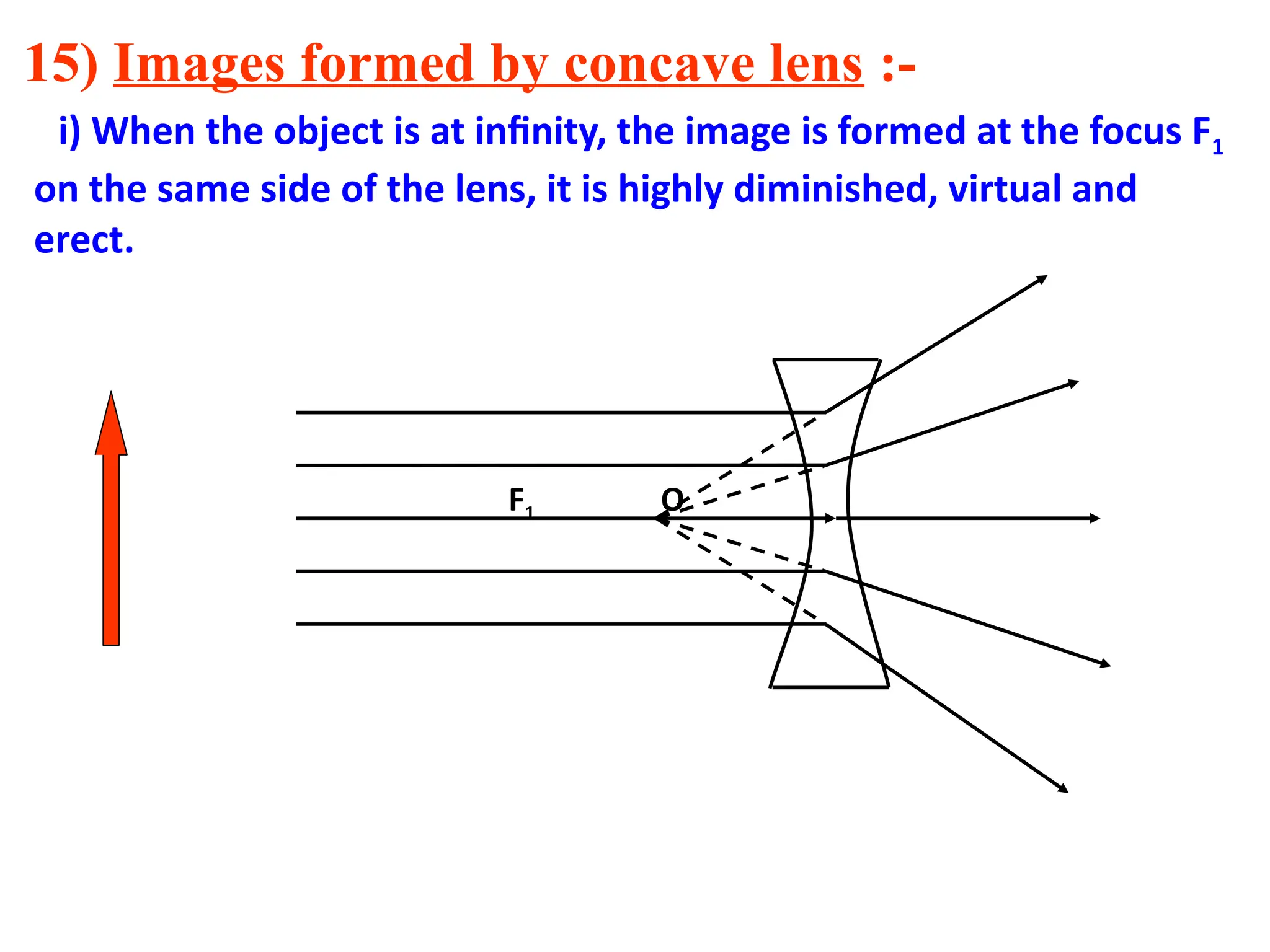
15) Images formedby concave lens :-
i) When the object is at infinity, the image is formed at the focus F1
on the same side of the lens, it is highly diminished, virtual and
erect.
F1 O
39.
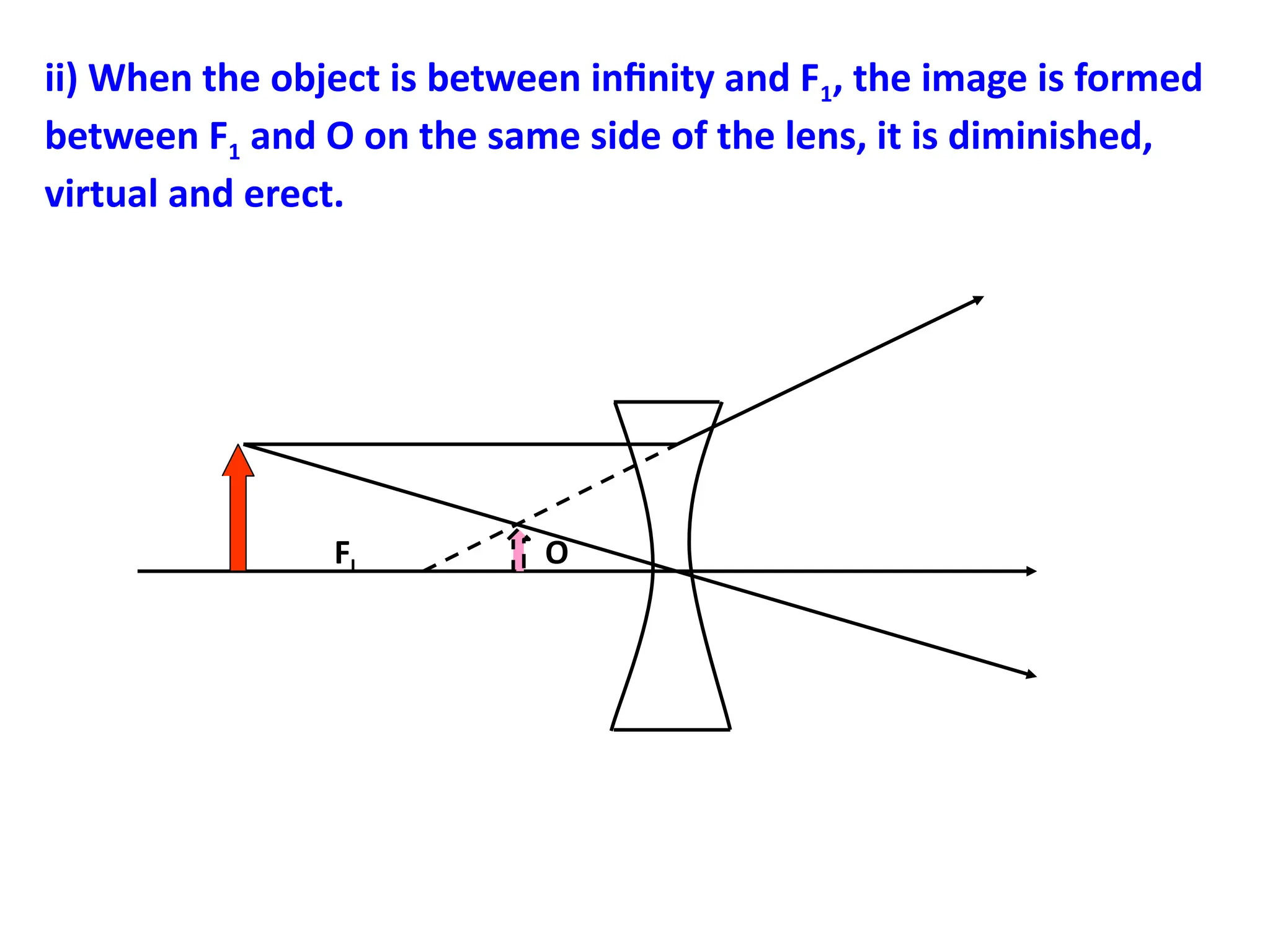
ii) When theobject is between infinity and F1, the image is formed
between F1 and O on the same side of the lens, it is diminished,
virtual and erect.
FI O
40.
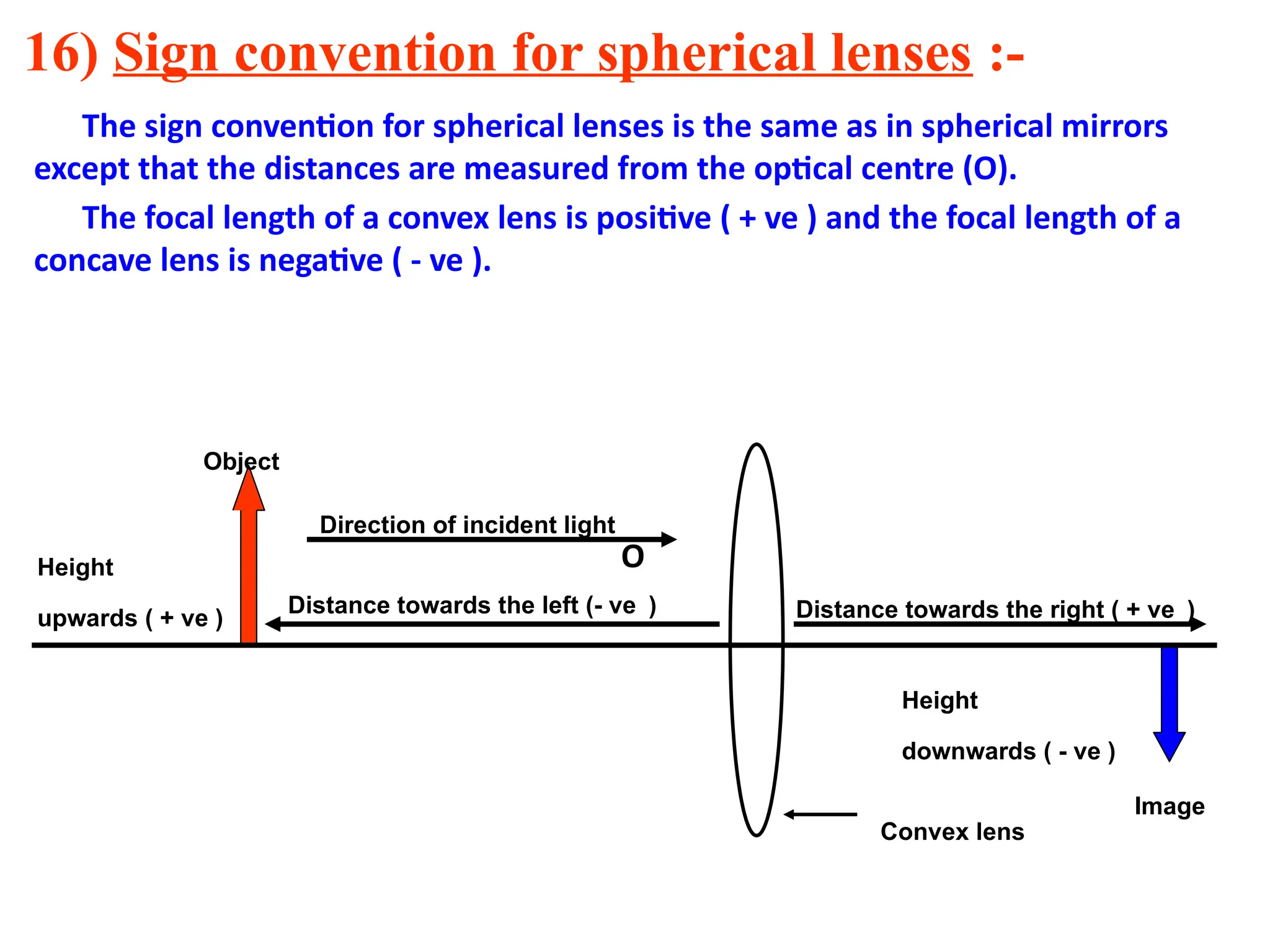
16) Sign conventionfor spherical lenses :-
The sign convention for spherical lenses is the same as in spherical mirrors
except that the distances are measured from the optical centre (O).
The focal length of a convex lens is positive ( + ve ) and the focal length of a
concave lens is negative ( - ve ).
O
Direction of incident light
Distance towards the left (- ve )
Height
downwards ( - ve )
Height
upwards ( + ve )
Convex lens
Object
Image
Distance towards the right ( + ve )
41.
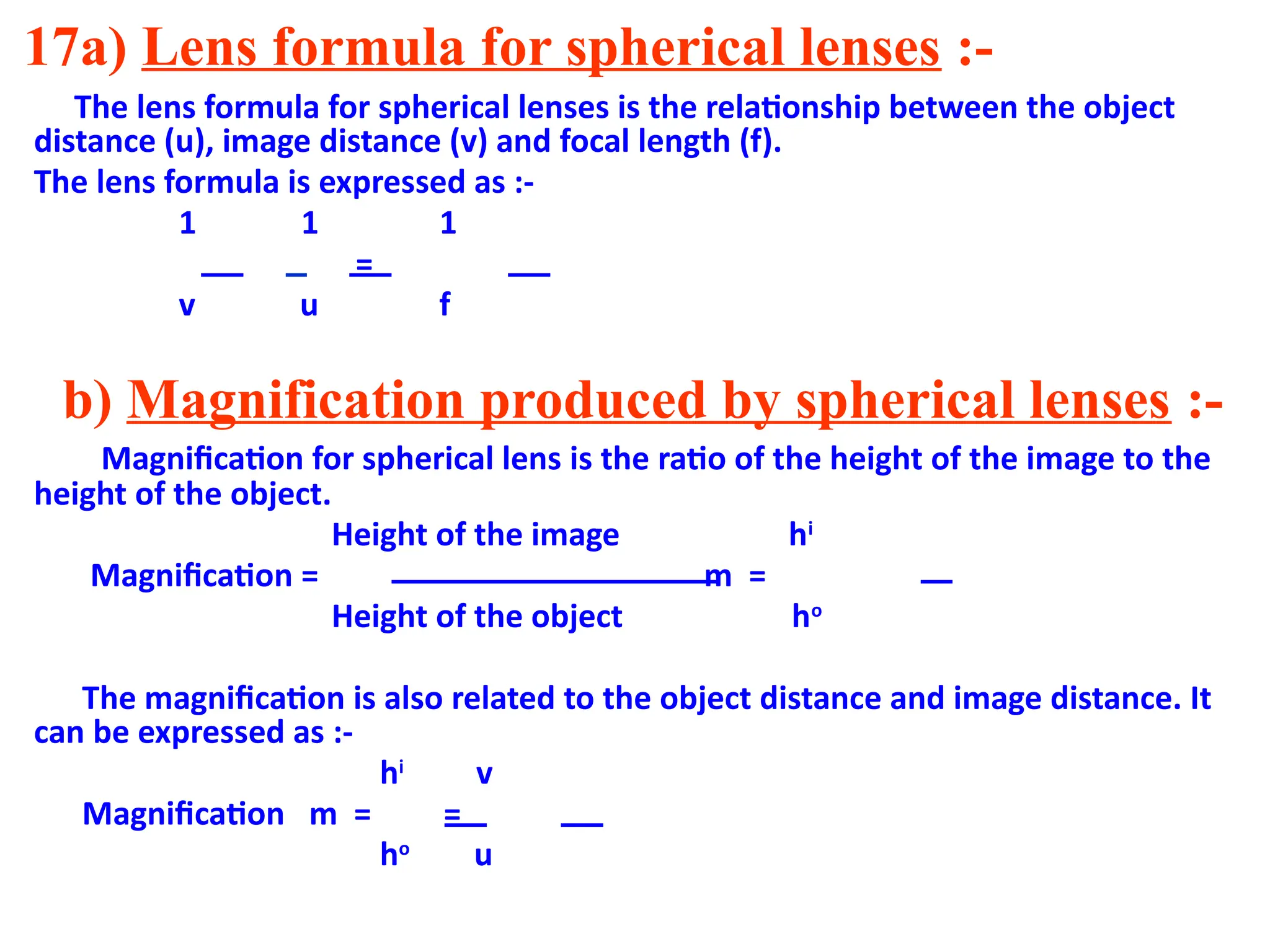
17a) Lens formulafor spherical lenses :-
The lens formula for spherical lenses is the relationship between the object
distance (u), image distance (v) and focal length (f).
The lens formula is expressed as :-
1 1 1
=
v u f
b) Magnification produced by spherical lenses :-
Magnification for spherical lens is the ratio of the height of the image to the
height of the object.
Height of the image hi
Magnification = m =
Height of the object ho
The magnification is also related to the object distance and image distance. It
can be expressed as :-
hi
v
Magnification m = =
ho
u
42.
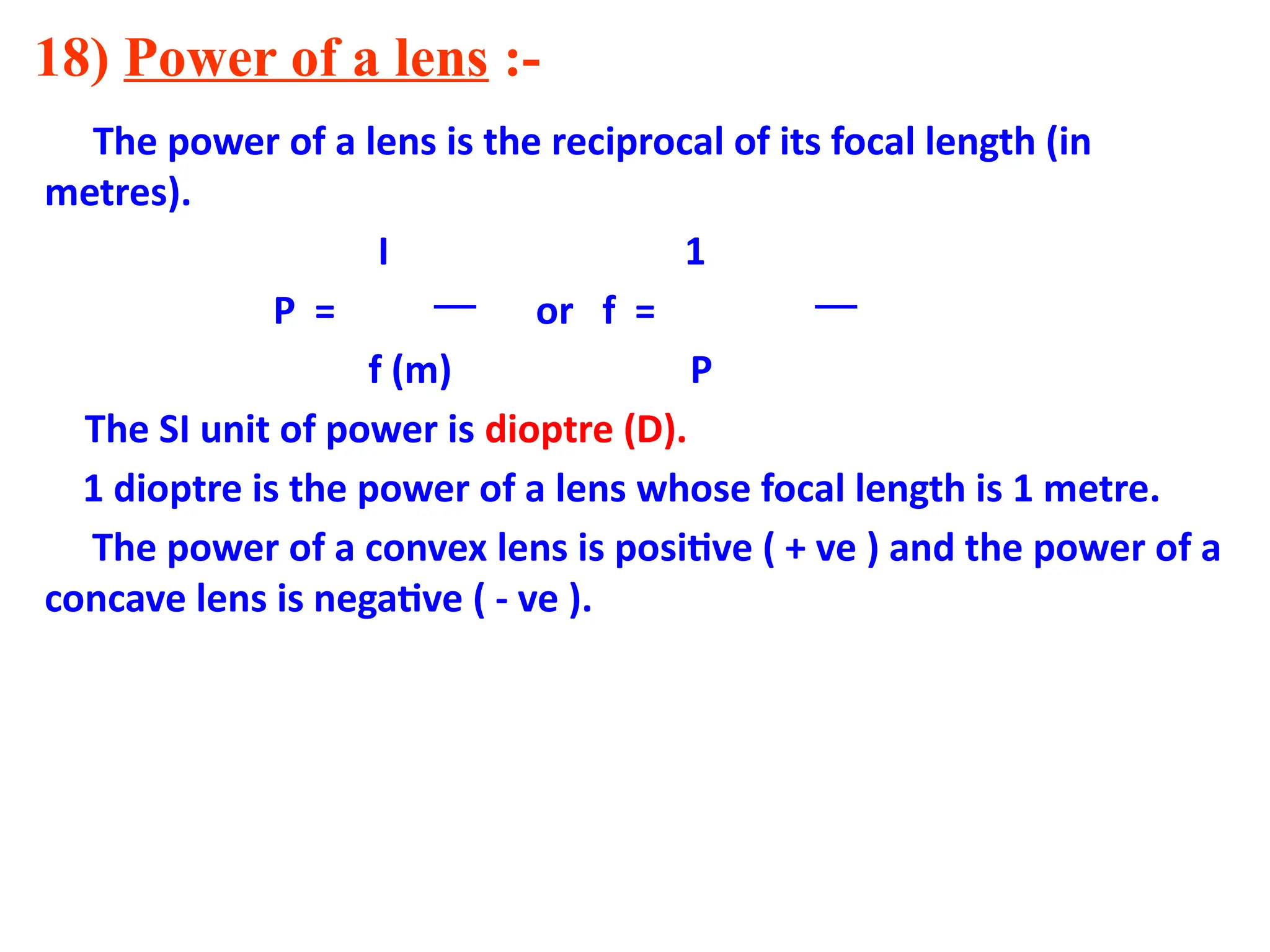
18) Power ofa lens :-
The power of a lens is the reciprocal of its focal length (in
metres).
I 1
P = or f =
f (m) P
The SI unit of power is dioptre (D).
1 dioptre is the power of a lens whose focal length is 1 metre.
The power of a convex lens is positive ( + ve ) and the power of a
concave lens is negative ( - ve ).