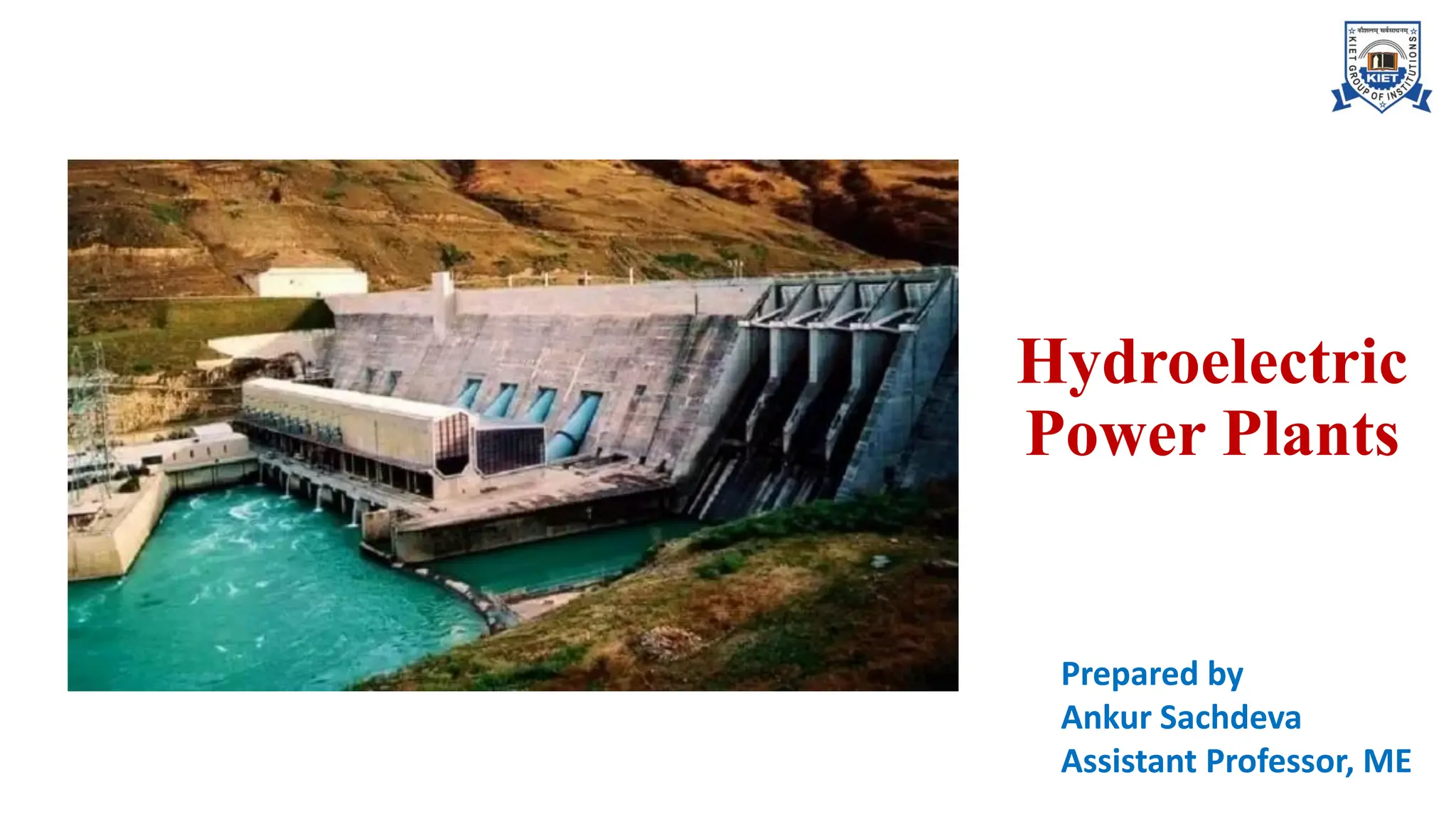
Hydroelectric
Power Plants
Prepared by
Ankur Sachdeva
Assistant Professor, ME
• Hydropower or water power is power derived from the energy of falling or fast-running
water, which may be harnessed for useful purposes.
• Since ancient times, hydropower from many kinds of watermills has been used as
a renewable energy source for irrigation and the operation of various mechanical devices,
such as gristmills, sawmills, textile mills, trip hammers, dock cranes, domestic lifts etc.
• Hydro projects are developed for the following purposes:
1. To control the floods in the rivers.
2. Generation of power.
3. Storage of irrigation water.
4. Storage of the drinking water supply.
HYDROPOWER
Working Principle of Hydroelectric Power Plant
• Hydroelectric power is developed from Hydroelectric Power Plant or Hydroelectric Power Station.
• It develops hydroelectricity to utilize the potential energy of water.
• In hydroelectric power plants, water is stored in a dam called hydroelectric dam which is located upper level from
the ground, especially any hilly areas.
• Water head is created by construction of the dam across any river or lake.
• This type of water head stores huge potential energy.
• The water falls into water turbine and the potential energy of water is converted into kinetic energy.
• This kinetic energy is converted into mechanical energy at the turbine shaft.
• A hydroelectric generator or alternator is coupled with turbine shaft to convert mechanical energy into electrical
energy.
• The power P is developed-
1. Since water is the main source of energy, so no fossil fuels are required.
2. This plant is neat and clean and no smoke or as disposal is required.
3. It is the cheapest operating and maintenance cost as compared to the other power plants because water is
freely available in the world.
4. It is very reliable, and robust and has a longer life app rocks 45 to 60 years.
5. This plant can start instantly.
6. It can start hydroelectric power with fluctuating load demand.
7. The efficiency does not fall at the age of this plant.
8. There is no standby loss in this plant.
9. At the initial time of construction highly skilled engineers are required and after that only few
experienced persons can run the plant.
10. This plant also serves to help in irrigation and Flood control etc.
11. Since these plants are located in remote areas, so land is available and competitively cheaper rates.
ADVANTAGES OF HYDROPOWER PLANT
DISADVANTAGES OF HYDROPOWER PLANT
1. The capital cost of the plant is very high.
2. The hydroelectric plant takes much longer in design and execution.
3. These plants are usually located in hilly areas far away from the load center.
4. Transformation and transmission costs are very high.
5. The output of a hydroelectric plant is never constant due to the vagaries of
monsoons and their dependence on the rate of water flow in a river.
ESSENTIAL FEATURES OF A WATER-POWER PLANT
The essential features of a water power plant are as
below:
1. Catchment area.
2. Reservoir.
3. Dam and intake house.
4. Inlet waterway.
5. Powerhouse.
6. Tail race or outlet waterway.
LAYOUT OF HYDROPOWER PLANT
CLASSIFICATION OF HYDRO-PLANT
• Water must fall from a higher elevation to a lower one to release its stored energy.
• The difference between these elevations (the water level in the forebay and tail bay) is
called the head.
• Three categories of hydropower plant based on design head values are
❖ High-head (100m and above)
❖ Medium-head (30m to 100m)
❖ Low-head (less than 30m)
BASED ON THE AVAILABILITY OF HEAD
HIGH HEAD POWER PLANTS
• A hydel plant with a water head of more than 100 meters is termed a high-head plant.
• In this case, the water from the main reservoir is carried through tunnels up to the
surge tank, from where it is taken through the penstock.
• Since the water head is very high the effect of the water hammer is too severe in such
plants, it is essential to provide a surge tank in the water line at the appropriate
location.
• The surge tank takes care of the increasing and decreasing water levels during the low-
demand and high-demand periods, respectively.
• The Francis and Pelton wheel turbines are most suitable for high-head plants.
MEDIUM HEAD POWER PLANTS
• A hydel plant with a water head of in the range of 30 to 100 meters is termed as a
medium head power plant.
• The forebay provided at the beginning of the penstock serves as water reservoir.
• The water is generally carried in open canals from main reservoir to the forebay and
then to the power house through the penstock
• The forebay itself actsas the surge tank, and hence receives the excesswater during the
low demand periods.
• This type of plant commonly uses Francis turbines.
LOW HEAD HYDEL POWER PLANT
• A plant with a water head of less than 30 meters is termed a low head plant.
• No surge tank is required for this plant, dam itself discharge the surplus water from the
river
• In such plants, a small dam is constructed across a river to obtain the necessary water
head.
• The excess water is allowed to flow over the dam, while the water head is made use to
run a hydraulic turbine.
• This type of plant uses vertical shaft Francis or Kaplan turbine.
PLANT CAPACITY
•Large-hydro
> 100 MW feeding into a large electricity grid
•Medium-hydro
15 - 100 MW usually feeding a grid
•Small-hydro
1 - 15 MW - usually feeding into a grid
• It doesn’t store water and uses as the water
comes.
• There is no control on flow of water so that
during high floods or low loads water is wasted
while during low runoff the plant capacity is
considerably reduced.
• Generating capacity primarily depending on the
rate of flow of water
• During dry periods the power production will be
very poor, since the water flow rate will be low.
• Due to non-uniformity of supply and lack of
assistance from a firm capacity the utility of
these plants are much less than those of other
types.
RUN OFF RIVER PLANTS WITHOUT PONDAGE
Pondage: the collection of water behind a dam at the plant and increases the stream capacity
for a short period say a week.
Storage: a collection of in upstream reservoirs and this increases the capacity of the streams
over an extended period of several months.
The usefulness of runoff rivers is increased by pondage
These plants may work satisfactorily as base load and peak load plants.
As compared to that without pondage, is more reliable and its generating capacity is less
dependent on the flow rates of water available.
RUN OFF RIVER PLANTS WITH PONDAGE
• This type of plant, water is stored behind the dam and water is available throughout
the year even in the dry season
• Storage type plant is one with a reservoir of sufficiently large size to permit carry over
storage from the wet season to the dry season and thus to supply firm flow
substantially more than the minimum natural flow.
• This plant can be used as a base load plant as well as a peak load plant as water is
available with control as required.
• The majority of hydroelectric power plants in our country are of this type.
STORAGE TYPE PLANTS (IMPOUNDMENT PLANTS)
• Are employed at places where the quantity of water available for power generation is
inadequate
• Water passing through the turbine is stored in the tail race pond. During low load periods,
this water is pumped back to the head reservoir, which can be used during peak load plants.
• This water can be again used for generating power during peak load periods.
• Pumping of water may be done seasonally or daily depending upon the conditions of the
site and the nature of the load on the plant.
• Usually interconnected with steam or diesel power plants.
PUMPED STORAGE PLANT
SITE SELECTION FOR
HYDROELECTRIC POWER PLANT
1. Water Availability: The main fuel of this plant is water. So, such plants should be
located nearer to rivers, canals, etc. where sufficient water is available all the time.
2. Water Storage:
• Storage of water in a suitable reservoir or dam has to be placed by a careful geological
study of the area to get the maximum advantage of that water. A dam should be located
across the river to get a continuous water supply throughout the year, especially in the dry
season. The storage capacity of the dam can be determined by hydrograph or mass curve
or using analytical methods. Adequate facilities for the erection of a dam and storage of
water are two important matters for the site selection of hydroelectric power plants.
3. Water Head:
• It is an important point for site selection of hydroelectric power plants. Water head is
directly related to the cost of generation of electric power. If the effective head is
increased, water storage has to be reduced as well as capital cost of the plant is reduced.
SITE SELECTION FOR
HYDROELECTRIC POWER PLANT
4. Distance from the load center:
• Since it is located away from the load center, more transmission line is required to
supply the power. To avoid the line loss and economic power supply, the distance
of such a plant should need more attention.
5. Transportation Facilities:
• Good transportation facilities must be available to any hydroelectric power plant
so that necessary equipment should be reached easily.
6. Availability of land:
• Hydro electric power plant needs enough space. It should be kept in mind that
land costs must be cheap.

Hydropower plants.pdf

  • 1.
    Hydroelectric Power Plants Prepared by AnkurSachdeva Assistant Professor, ME
  • 2.
    • Hydropower orwater power is power derived from the energy of falling or fast-running water, which may be harnessed for useful purposes. • Since ancient times, hydropower from many kinds of watermills has been used as a renewable energy source for irrigation and the operation of various mechanical devices, such as gristmills, sawmills, textile mills, trip hammers, dock cranes, domestic lifts etc. • Hydro projects are developed for the following purposes: 1. To control the floods in the rivers. 2. Generation of power. 3. Storage of irrigation water. 4. Storage of the drinking water supply. HYDROPOWER
  • 3.
    Working Principle ofHydroelectric Power Plant • Hydroelectric power is developed from Hydroelectric Power Plant or Hydroelectric Power Station. • It develops hydroelectricity to utilize the potential energy of water. • In hydroelectric power plants, water is stored in a dam called hydroelectric dam which is located upper level from the ground, especially any hilly areas. • Water head is created by construction of the dam across any river or lake. • This type of water head stores huge potential energy. • The water falls into water turbine and the potential energy of water is converted into kinetic energy. • This kinetic energy is converted into mechanical energy at the turbine shaft. • A hydroelectric generator or alternator is coupled with turbine shaft to convert mechanical energy into electrical energy. • The power P is developed-
  • 4.
    1. Since wateris the main source of energy, so no fossil fuels are required. 2. This plant is neat and clean and no smoke or as disposal is required. 3. It is the cheapest operating and maintenance cost as compared to the other power plants because water is freely available in the world. 4. It is very reliable, and robust and has a longer life app rocks 45 to 60 years. 5. This plant can start instantly. 6. It can start hydroelectric power with fluctuating load demand. 7. The efficiency does not fall at the age of this plant. 8. There is no standby loss in this plant. 9. At the initial time of construction highly skilled engineers are required and after that only few experienced persons can run the plant. 10. This plant also serves to help in irrigation and Flood control etc. 11. Since these plants are located in remote areas, so land is available and competitively cheaper rates. ADVANTAGES OF HYDROPOWER PLANT
  • 5.
    DISADVANTAGES OF HYDROPOWERPLANT 1. The capital cost of the plant is very high. 2. The hydroelectric plant takes much longer in design and execution. 3. These plants are usually located in hilly areas far away from the load center. 4. Transformation and transmission costs are very high. 5. The output of a hydroelectric plant is never constant due to the vagaries of monsoons and their dependence on the rate of water flow in a river.
  • 6.
    ESSENTIAL FEATURES OFA WATER-POWER PLANT The essential features of a water power plant are as below: 1. Catchment area. 2. Reservoir. 3. Dam and intake house. 4. Inlet waterway. 5. Powerhouse. 6. Tail race or outlet waterway.
  • 7.
  • 8.
  • 9.
    • Water mustfall from a higher elevation to a lower one to release its stored energy. • The difference between these elevations (the water level in the forebay and tail bay) is called the head. • Three categories of hydropower plant based on design head values are ❖ High-head (100m and above) ❖ Medium-head (30m to 100m) ❖ Low-head (less than 30m) BASED ON THE AVAILABILITY OF HEAD
  • 10.
  • 11.
    • A hydelplant with a water head of more than 100 meters is termed a high-head plant. • In this case, the water from the main reservoir is carried through tunnels up to the surge tank, from where it is taken through the penstock. • Since the water head is very high the effect of the water hammer is too severe in such plants, it is essential to provide a surge tank in the water line at the appropriate location. • The surge tank takes care of the increasing and decreasing water levels during the low- demand and high-demand periods, respectively. • The Francis and Pelton wheel turbines are most suitable for high-head plants.
  • 12.
  • 13.
    • A hydelplant with a water head of in the range of 30 to 100 meters is termed as a medium head power plant. • The forebay provided at the beginning of the penstock serves as water reservoir. • The water is generally carried in open canals from main reservoir to the forebay and then to the power house through the penstock • The forebay itself actsas the surge tank, and hence receives the excesswater during the low demand periods. • This type of plant commonly uses Francis turbines.
  • 14.
    LOW HEAD HYDELPOWER PLANT
  • 15.
    • A plantwith a water head of less than 30 meters is termed a low head plant. • No surge tank is required for this plant, dam itself discharge the surplus water from the river • In such plants, a small dam is constructed across a river to obtain the necessary water head. • The excess water is allowed to flow over the dam, while the water head is made use to run a hydraulic turbine. • This type of plant uses vertical shaft Francis or Kaplan turbine.
  • 16.
    PLANT CAPACITY •Large-hydro > 100MW feeding into a large electricity grid •Medium-hydro 15 - 100 MW usually feeding a grid •Small-hydro 1 - 15 MW - usually feeding into a grid
  • 17.
    • It doesn’tstore water and uses as the water comes. • There is no control on flow of water so that during high floods or low loads water is wasted while during low runoff the plant capacity is considerably reduced. • Generating capacity primarily depending on the rate of flow of water • During dry periods the power production will be very poor, since the water flow rate will be low. • Due to non-uniformity of supply and lack of assistance from a firm capacity the utility of these plants are much less than those of other types. RUN OFF RIVER PLANTS WITHOUT PONDAGE
  • 18.
    Pondage: the collectionof water behind a dam at the plant and increases the stream capacity for a short period say a week. Storage: a collection of in upstream reservoirs and this increases the capacity of the streams over an extended period of several months. The usefulness of runoff rivers is increased by pondage These plants may work satisfactorily as base load and peak load plants. As compared to that without pondage, is more reliable and its generating capacity is less dependent on the flow rates of water available. RUN OFF RIVER PLANTS WITH PONDAGE
  • 19.
    • This typeof plant, water is stored behind the dam and water is available throughout the year even in the dry season • Storage type plant is one with a reservoir of sufficiently large size to permit carry over storage from the wet season to the dry season and thus to supply firm flow substantially more than the minimum natural flow. • This plant can be used as a base load plant as well as a peak load plant as water is available with control as required. • The majority of hydroelectric power plants in our country are of this type. STORAGE TYPE PLANTS (IMPOUNDMENT PLANTS)
  • 20.
    • Are employedat places where the quantity of water available for power generation is inadequate • Water passing through the turbine is stored in the tail race pond. During low load periods, this water is pumped back to the head reservoir, which can be used during peak load plants. • This water can be again used for generating power during peak load periods. • Pumping of water may be done seasonally or daily depending upon the conditions of the site and the nature of the load on the plant. • Usually interconnected with steam or diesel power plants. PUMPED STORAGE PLANT
  • 22.
    SITE SELECTION FOR HYDROELECTRICPOWER PLANT 1. Water Availability: The main fuel of this plant is water. So, such plants should be located nearer to rivers, canals, etc. where sufficient water is available all the time. 2. Water Storage: • Storage of water in a suitable reservoir or dam has to be placed by a careful geological study of the area to get the maximum advantage of that water. A dam should be located across the river to get a continuous water supply throughout the year, especially in the dry season. The storage capacity of the dam can be determined by hydrograph or mass curve or using analytical methods. Adequate facilities for the erection of a dam and storage of water are two important matters for the site selection of hydroelectric power plants. 3. Water Head: • It is an important point for site selection of hydroelectric power plants. Water head is directly related to the cost of generation of electric power. If the effective head is increased, water storage has to be reduced as well as capital cost of the plant is reduced.
  • 23.
    SITE SELECTION FOR HYDROELECTRICPOWER PLANT 4. Distance from the load center: • Since it is located away from the load center, more transmission line is required to supply the power. To avoid the line loss and economic power supply, the distance of such a plant should need more attention. 5. Transportation Facilities: • Good transportation facilities must be available to any hydroelectric power plant so that necessary equipment should be reached easily. 6. Availability of land: • Hydro electric power plant needs enough space. It should be kept in mind that land costs must be cheap.