Hydrology
River Ecosystems and Humans
Dimensions of river ecosystems
• Longitudinal
• Lateral
• Vertical
• Temporal
2
Longitudinal Changes in Streams
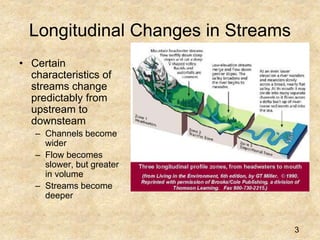
• Certain
characteristics of
streams change
predictably from
upstream to
downsteam
– Channels become
wider
– Flow becomes
slower, but greater
in volume
– Streams become
deeper
3
Longitudinal Changes
– Reach Scale
• Longitudinal changes are
also observed at shorter
scales than the entire
river length
• We call this shorter scale
the “reach” scale
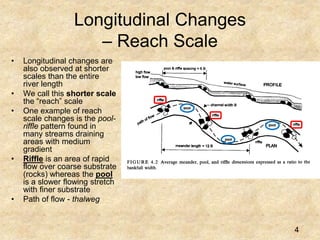
• One example of reach
scale changes is the pool-
riffle pattern found in
many streams draining
areas with medium
gradient
• Riffle is an area of rapid
flow over coarse substrate
(rocks) whereas the pool
is a slower flowing stretch
with finer substrate
• Path of flow - thalweg
4
Lateral Patterns
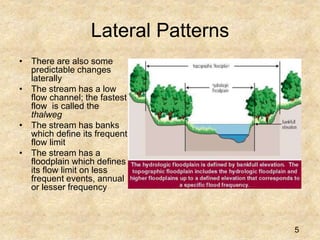
• There are also some
predictable changes
laterally
• The stream has a low
flow channel; the fastest
flow is called the
thalweg
• The stream has banks
which define its frequent
flow limit
• The stream has a
floodplain which defines
its flow limit on less
frequent events, annual
or lesser frequency
5
Lateral Patterns
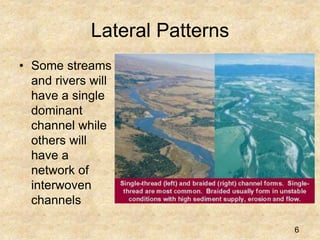
• Some streams
and rivers will
have a single
dominant
channel while
others will
have a
network of
interwoven
channels
6
Lateral Features
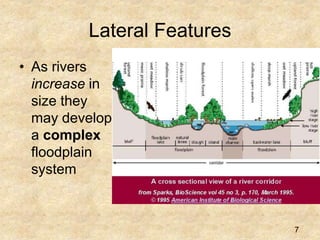
• As rivers
increase in
size they
may develop
a complex
floodplain
system
7
Vertical dimensions
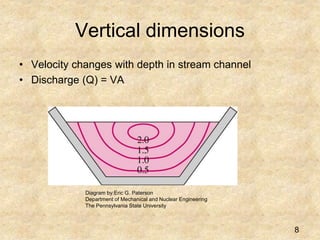
• Velocity changes with depth in stream channel
• Discharge (Q) = VA
Diagram by:Eric G. Paterson
Department of Mechanical and Nuclear Engineering
The Pennsylvania State University
8
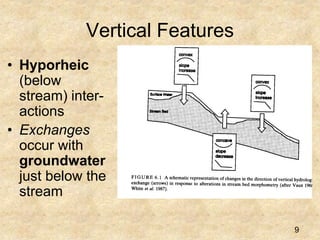
Vertical Features
• Hyporheic
(below
stream) inter-
actions
• Exchanges
occur with
groundwater
just below the
stream
9
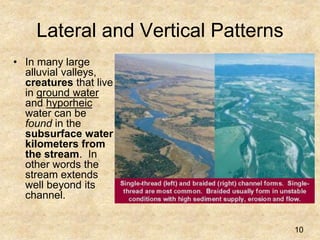
Lateral and Vertical Patterns
• In many large
alluvial valleys,
creatures that live
in ground water
and hyporheic
water can be
found in the
subsurface water
kilometers from
the stream. In
other words the
stream extends
well beyond its
channel.
10
Temporal dimension
• Stream flow changes
Second by second
Hourly
Daily
Monthly
Seasonally
Annually
Milleniumly
11
Selected Important Habitat Factors
• Substrate
• Temperature
• Oxygen levels
• Flow velocity
• Food availability
• pH
• Nutrient and sediment regimes
• Organic input and transport
12
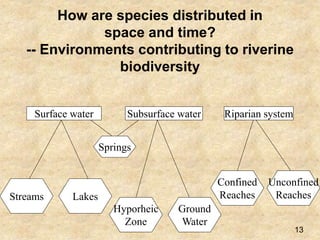
How are species distributed in
space and time?
-- Environments contributing to riverine
biodiversity
Surface water Subsurface water Riparian system
Streams
Springs
Lakes
Hyporheic
Zone
Ground
Water
Confined
Reaches
Unconfined
Reaches
13
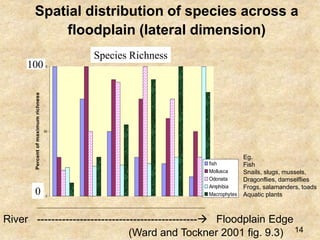
River --------------------------------------------- Floodplain Edge
Spatial distribution of species across a
floodplain (lateral dimension)
Species Richness
0
50
100
Percent
of
maximum
richness
fish
Mollusca
Odonata
Amphibia
Macrophytes
(Ward and Tockner 2001 fig. 9.3)
Species Richness
0
100
Eg.
Fish
Snails, slugs, mussels,
Dragonflies, damselflies
Frogs, salamanders, toads
Aquatic plants
14
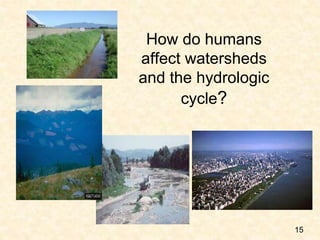
How do humans
affect watersheds
and the hydrologic
cycle?
15
Human caused disturbances
• Agriculture
• Timber harvest
• Mining
• Urbanization
• Introduction of exotic species
• Harvesting of fish and wildlife
16
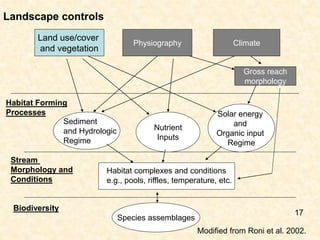
Land use/cover
and vegetation
Physiography Climate
Landscape controls
Nutrient
Inputs
Solar energy
and
Organic input
Regime
Gross reach
morphology
Habitat Forming
Processes
Species assemblages
Stream
Morphology and
Conditions
Biodiversity
Habitat complexes and conditions
e.g., pools, riffles, temperature, etc.
Sediment
and Hydrologic
Regime
Modified from Roni et al. 2002.
17
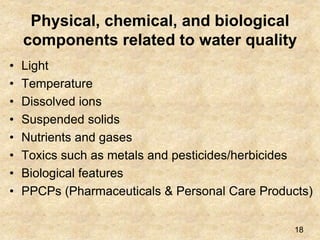
Physical, chemical, and biological
components related to water quality
• Light
• Temperature
• Dissolved ions
• Suspended solids
• Nutrients and gases
• Toxics such as metals and pesticides/herbicides
• Biological features
• PPCPs (Pharmaceuticals & Personal Care Products)
18
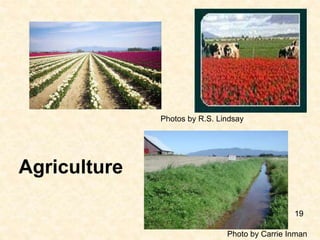
Photos by R.S. Lindsay
Photo by Carrie Inman
Agriculture
19
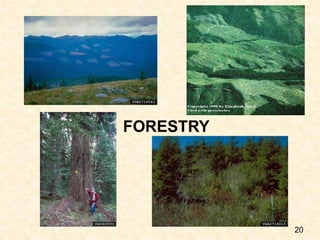
FORESTRY
20
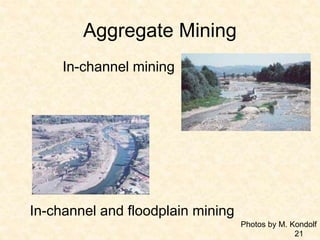
Aggregate Mining
In-channel mining
In-channel and floodplain mining
Photos by M. Kondolf
21
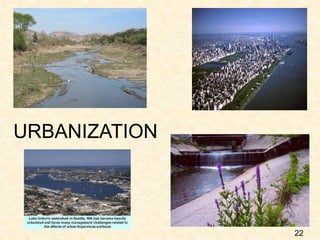
URBANIZATION
22
Forestry, agriculture and
urbanization
• Remove trees and other vegetation
• Reduce organic matter delivery
• Build roads
23
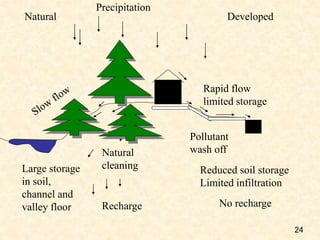
Large storage
in soil,
channel and
valley floor Recharge
Natural
cleaning
Pollutant
wash off
No recharge
Rapid flow
limited storage
Natural Developed
Reduced soil storage
Limited infiltration
Precipitation
24
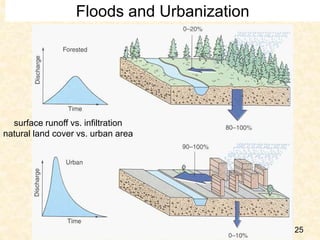
Floods and Urbanization
surface runoff vs. infiltration
natural land cover vs. urban area
25
How do we manage watershed?
• Dept of Natural Resources Regulations
• U.S. Forest Service Regulations
• Clean water act
• Endangered Species Act
• Total Maximum Daily Loads (TMDLs)
26
27
28
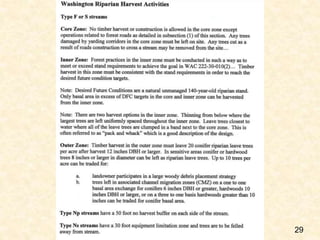
29
Take Home Messages
• Understand the interactions between land
use/land cover and components of the
hydrologic cycle
• Be able to describe what is typically
measured in watersheds and why
30
Hydrology Report
~ 2-3 pages due May 25 individually
Include:
Name, Date, Title
Introduction
Methods
Results and Discussion (w tables)
Conclusions
Appendix (if needed for raw calculations)
31

Hydrology.ppt

  • 1.
  • 2.
    Dimensions of riverecosystems • Longitudinal • Lateral • Vertical • Temporal 2
  • 3.
    Longitudinal Changes inStreams • Certain characteristics of streams change predictably from upstream to downsteam – Channels become wider – Flow becomes slower, but greater in volume – Streams become deeper 3
  • 4.
    Longitudinal Changes – ReachScale • Longitudinal changes are also observed at shorter scales than the entire river length • We call this shorter scale the “reach” scale • One example of reach scale changes is the pool- riffle pattern found in many streams draining areas with medium gradient • Riffle is an area of rapid flow over coarse substrate (rocks) whereas the pool is a slower flowing stretch with finer substrate • Path of flow - thalweg 4
  • 5.
    Lateral Patterns • Thereare also some predictable changes laterally • The stream has a low flow channel; the fastest flow is called the thalweg • The stream has banks which define its frequent flow limit • The stream has a floodplain which defines its flow limit on less frequent events, annual or lesser frequency 5
  • 6.
    Lateral Patterns • Somestreams and rivers will have a single dominant channel while others will have a network of interwoven channels 6
  • 7.
    Lateral Features • Asrivers increase in size they may develop a complex floodplain system 7
  • 8.
    Vertical dimensions • Velocitychanges with depth in stream channel • Discharge (Q) = VA Diagram by:Eric G. Paterson Department of Mechanical and Nuclear Engineering The Pennsylvania State University 8
  • 9.
    Vertical Features • Hyporheic (below stream)inter- actions • Exchanges occur with groundwater just below the stream 9
  • 10.
    Lateral and VerticalPatterns • In many large alluvial valleys, creatures that live in ground water and hyporheic water can be found in the subsurface water kilometers from the stream. In other words the stream extends well beyond its channel. 10
  • 11.
    Temporal dimension • Streamflow changes Second by second Hourly Daily Monthly Seasonally Annually Milleniumly 11
  • 12.
    Selected Important HabitatFactors • Substrate • Temperature • Oxygen levels • Flow velocity • Food availability • pH • Nutrient and sediment regimes • Organic input and transport 12
  • 13.
    How are speciesdistributed in space and time? -- Environments contributing to riverine biodiversity Surface water Subsurface water Riparian system Streams Springs Lakes Hyporheic Zone Ground Water Confined Reaches Unconfined Reaches 13
  • 14.
    River --------------------------------------------- FloodplainEdge Spatial distribution of species across a floodplain (lateral dimension) Species Richness 0 50 100 Percent of maximum richness fish Mollusca Odonata Amphibia Macrophytes (Ward and Tockner 2001 fig. 9.3) Species Richness 0 100 Eg. Fish Snails, slugs, mussels, Dragonflies, damselflies Frogs, salamanders, toads Aquatic plants 14
  • 15.
    How do humans affectwatersheds and the hydrologic cycle? 15
  • 16.
    Human caused disturbances •Agriculture • Timber harvest • Mining • Urbanization • Introduction of exotic species • Harvesting of fish and wildlife 16
  • 17.
    Land use/cover and vegetation PhysiographyClimate Landscape controls Nutrient Inputs Solar energy and Organic input Regime Gross reach morphology Habitat Forming Processes Species assemblages Stream Morphology and Conditions Biodiversity Habitat complexes and conditions e.g., pools, riffles, temperature, etc. Sediment and Hydrologic Regime Modified from Roni et al. 2002. 17
  • 18.
    Physical, chemical, andbiological components related to water quality • Light • Temperature • Dissolved ions • Suspended solids • Nutrients and gases • Toxics such as metals and pesticides/herbicides • Biological features • PPCPs (Pharmaceuticals & Personal Care Products) 18
  • 19.
    Photos by R.S.Lindsay Photo by Carrie Inman Agriculture 19
  • 20.
  • 21.
    Aggregate Mining In-channel mining In-channeland floodplain mining Photos by M. Kondolf 21
  • 22.
  • 23.
    Forestry, agriculture and urbanization •Remove trees and other vegetation • Reduce organic matter delivery • Build roads 23
  • 24.
    Large storage in soil, channeland valley floor Recharge Natural cleaning Pollutant wash off No recharge Rapid flow limited storage Natural Developed Reduced soil storage Limited infiltration Precipitation 24
  • 25.
    Floods and Urbanization surfacerunoff vs. infiltration natural land cover vs. urban area 25
  • 26.
    How do wemanage watershed? • Dept of Natural Resources Regulations • U.S. Forest Service Regulations • Clean water act • Endangered Species Act • Total Maximum Daily Loads (TMDLs) 26
  • 27.
  • 28.
  • 29.
  • 30.
    Take Home Messages •Understand the interactions between land use/land cover and components of the hydrologic cycle • Be able to describe what is typically measured in watersheds and why 30
  • 31.
    Hydrology Report ~ 2-3pages due May 25 individually Include: Name, Date, Title Introduction Methods Results and Discussion (w tables) Conclusions Appendix (if needed for raw calculations) 31