




HYDROGEN BASED FUEL CELL
TECHNOLOGY
PRESENTED BY : ZEESHAN ALI
ROLL NO : 3806
(2016)
GOVERNMENT COLLEGE UNIVERSITY FSD
HISTORY
 The concept of the fuel cell was first demonstrated by Humphry Davy in
1801.
 William Grove, a chemist invented the first working fuel cell in 1839.
 First commercial use of fuel cells was in NASA space programs to
generate power for probes, satellites and space capsules
 In 1966, General Motors developed the first fuel cell road vehicle, the
Chevrolet Electrovan. It had a PEM fuel cell a range of 120 miles and a top
speed of 70 mph.
 Fuel cell stacks were still limited principally to space applications in the
1980s, including the Space Shuttle by NASA.
WHY WE NEED FUEL CELL TECHNOLOGY
WHY WE NEED FUEL CELL
 Cars and trucks using petroleum fuels are one of
the leading causes of air pollution.
 Air pollution is single handedly responsible for up
to 30,000 premature deaths each year.
 In 2013, transportation contributed more than half
of the carbon monoxide and nitrogen oxides, and
almost a quarter of the hydrocarbons emitted into
our air.
 Ozone depletion which can impair vision and
breathing. From 1979 to the present, the hole has
deepened within which ozone concentration has
fallen by almost 40%.
 Global warming due to continuous increase in
temperature.
 Getting hard to fulfill the increasing fuel
requirements.
 Acid rain which is harmful for humans and plants
equally.
WHAT IS FUEL CELL?
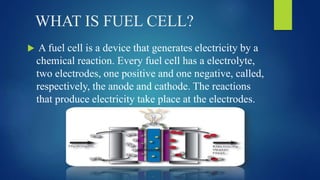
 A fuel cell is a device that generates electricity by a
chemical reaction. Every fuel cell has a electrolyte,
two electrodes, one positive and one negative, called,
respectively, the anode and cathode. The reactions
that produce electricity take place at the electrodes.
WORKING
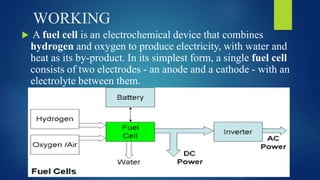
 A fuel cell is an electrochemical device that combines
hydrogen and oxygen to produce electricity, with water and
heat as its by-product. In its simplest form, a single fuel cell
consists of two electrodes - an anode and a cathode - with an
electrolyte between them.
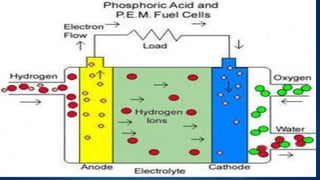
• At the anode the oxidation reaction occur and
at the cathode the reduction reaction occur.
In the oxidation reaction, the H convert into –ve and +ve
ions.
In the reduction reaction, the O convert into ions.
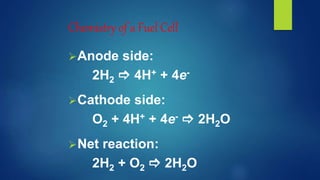
Chemistry of a Fuel Cell
Anode side:
2H2  4H+ + 4e-
Cathode side:
O2 + 4H+ + 4e-  2H2O
Net reaction:
2H2 + O2  2H2O
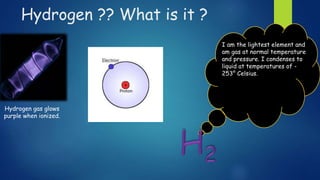
Hydrogen ?? What is it ?
Hydrogen gas glows
purple when ionized.
I am the lightest element and
am gas at normal temperature
and pressure. I condenses to
liquid at temperatures of -
253° Celsius.
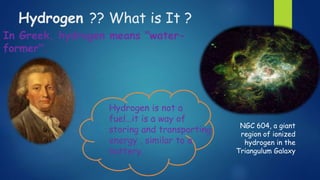
Hydrogen ?? What is It ?
In Greek, hydrogen means "water-
former".
NGC 604, a giant
region of ionized
hydrogen in the
Triangulum Galaxy
Hydrogen is not a
fuel…it is a way of
storing and transporting
energy , similar to a
battery.
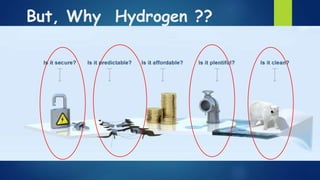
But, Why Hydrogen ??
FORMATION OF ELECTROLYTE
 The electrolyte material is considered to be the heart of a Fuel cell.
 It can be prepared by co-precipitation or Sol-gel method but the co-
precipitation method is so suitable. Because for fuel cell the
electrolyte must be dense. If the electrolyte more dense them the
ions pass more quickly from them.
 The selection of the material for the electrolyte must be based on
that the electrolyte must be stop the flow of electron and only ions
pass from them. And mostly it is based on Cerium oxide and
zerconia oxide.
 The nanocompsite are placed on electrolyte for improving the
working of fuel cell.
Formation of electrodes
 In fuel cell, anode electrodes are prepare by NiO , ZnO, CuO etc and
noble material but mostly used NiO due to low cost.
 The following property must be in our mind for selecting anod material
1- stability in reducing environment.
2- sufficient electronic and ionic conductivity.
3- porous structure.
4- thermal expansion coefficient matching electrolyte.
5- higly catalytic activity.
 The anode electrodes are mostly prepare by using the Sol-gel method.
 The cathode electrodes are prepare by (Sm, Sr)CoO3, (Ba,Sr)(Co,Fe)O3-δ ,
(GdBaCoO5+δ), (La1-xSrxMnO3) etc.
 The following property must be in our mind for selecting cathode
material
1- stability in oxidizing environment.
2- sufficient electronic and ionic conductivity.
3- porous structure.
4- thermal expansion coefficient matching electrolyte.
The mostly cathode electrodes are prepared by Sol-gel method .
COMMON FUELS
 Hydrogen
 Hydrazine
 Ammonia
 Hydrocarbon(gases)
 Hydrocarbon(liquid)
 Synthesis gases
 Methanol
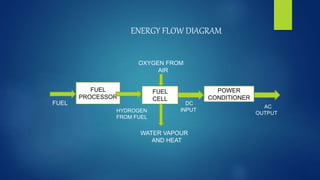
ENERGY FLOW DIAGRAM
FUEL
PROCESSOR
FUEL
CELL
POWER
CONDITIONER
FUEL
HYDROGEN
FROM FUEL
DC
INPUT
AC
OUTPUT
OXYGEN FROM
AIR
WATER VAPOUR
AND HEAT
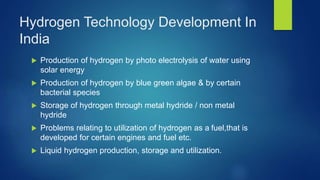
Hydrogen Technology Development In
India
 Production of hydrogen by photo electrolysis of water using
solar energy
 Production of hydrogen by blue green algae & by certain
bacterial species
 Storage of hydrogen through metal hydride / non metal
hydride
 Problems relating to utilization of hydrogen as a fuel,that is
developed for certain engines and fuel etc.
 Liquid hydrogen production, storage and utilization.
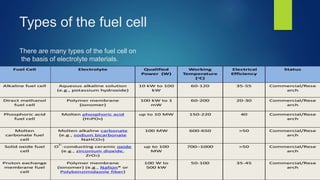
Types of the fuel cell
There are many types of the fuel cell on
the basis of electrolyte materials.
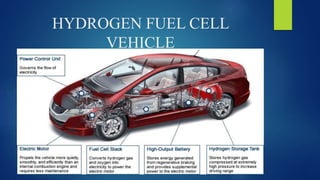
HYDROGEN FUEL CELL
VEHICLE
MERITS
 Fuel cell vehicles (FCVs) powered by pure hydrogen emit no GHGs
from their tailpipe, only heat and water.
 FCVs could reduce our dependence on foreign oil since hydrogen can
be derived from domestic sources, such as natural gas and coal, as
well as renewable resources such as water, biogas, and agricultural
waste. That would make our economy less dependent on other
countries
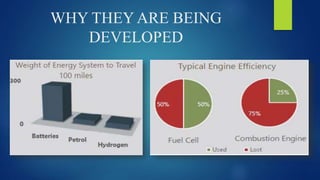
 Fuel cells have a higher efficiency than diesel or gas engines.
 Hydrogen is a renewable fuel source as it is very plentiful. The trick is
to break the water molecules down to release it.
MERITS(CONTINUED)
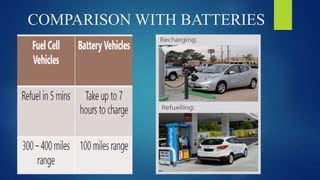
 Unlike all-electric vehicles (EVs), FCV’s hold a comparable
distance range and refueling time to gasoline vehicles.
 Unlike vehicles which have internal combustion engine,
FCV’s require less maintainance.
 Low noise pollution and thermal pollution.
 Unlike electric vehicles FCV’s does not require recharging.
CHALLENGES
 FCVs are currently more expensive than conventional
vehicles and hybrids, but costs have decreased significantly
and are approaching to more affordable rates till 2017.
 The current infrastructure for producing, delivering, and
dispensing hydrogen to consumers cannot yet support the
widespread adoption of FCVs.
 Warranty issues on major electric components. Dealership
and repair shop not familiar with new components.
 Great amount of policy support and investment is essential to
achieve market readiness.
CHALLEHGES (CONTINUED)
 Fuel cell technology must be embraced by consumers
before its benefits can be realized. They must become
familiar with a new kind of fuel. Public education can
accelerate this process.
 Hydrogen fuel cell vehicles are the lack of sufficient
infrastructure for hydrogen refueling, and the cost of the
catalysts. Platinum is one of the most commonly used
catalysts for fuel cells, but it's very expensive.
WHY THEY ARE BEING
DEVELOPED
COMPARISON WITH BATTERIES
Challenges to Fuel Cell Technology
 Durability and Reliability
 Durability of fuel cell systems have not yet been adequately
established
 The durability standard for automobiles is approximately
150,000 miles and the ability to function under normal
vehicle operating conditions
 For stationary systems 40,000 hours of reliable operation in
a temperature range of -35 degree Celsius to 40 degrees
Celsius will be required for market acceptance
Disadvantages
 Activation losses
 These losses are caused by the slowness of the reaction taking place
on the surface of the electrodes.
 Ohmic losses
 The voltage drop due to the resistance to the flow of electrons through
the material of the electrodes.
 This loss varies linearly with current density.
 Concentration losses
 Losses that result from the change in concentration of the reactants at
the surface of the electrodes as the fuel is used.
 Fuel crossover losses
 Losses that result from the waste of fuel passing through the electrolyte
and electron conduction through the electrolyte.
(a) Stationary energy resources:
•Power for municipalities, rural areas and industries.
•Heat and electricity for homes.
•Long-lasting mobile power for computers, cell phones and other
electronics
(b) Transportation:
•Non polluting automobiles
•Inexpensive fuels
(c) Military applications:
• Fuel cells could significantly reduce deployment costs
Other Applications
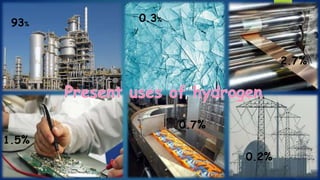
93%
0.3%
0.7%
2.7%
0.2%
1.5%
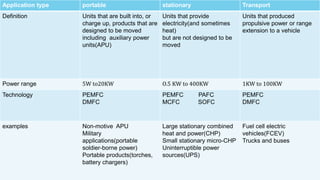
Application type portable stationary Transport
Definition Units that are built into, or
charge up, products that are
designed to be moved
including auxiliary power
units(APU)
Units that provide
electricity(and sometimes
heat)
but are not designed to be
moved
Units that produced
propulsive power or range
extension to a vehicle
Power range 5W to20KW O.5 KW to 400KW 1KW to 100KW
Technology PEMFC
DMFC
PEMFC PAFC
MCFC SOFC
PEMFC
DMFC
examples Non-motive APU
Military
applications(portable
soldier-borne power)
Portable products(torches,
battery chargers)
Large stationary combined
heat and power(CHP)
Small stationary micro-CHP
Uninterruptible power
sources(UPS)
Fuel cell electric
vehicles(FCEV)
Trucks and buses
PRESENT STATUS
 Fuel cell industry began its road to commercialisation in 2007
 An 11.2 MW installation in Korea is the world’s largest fuel cell power
plant till today
 In Germany more than 250 fuel cell micro-CHP system have been
installed under the callux programme
 Commercial production of fuel cell scooters has started in Taiwan in
2012
 At the end of 2011, 215 hydrogen refuelling stations was in operation
worldwide. The stations are located in Europe (85), North America
(80), Asia Pacific (47) and the Rest of the World (3).
 In USA, at the end of 2011 Clear Edge has over 100 installations of its 5
kW ClearEdge5 HT PEMFC unit in California
 Hyundai ix35 FCEV, Mercedes-Benz B-Class F-CELL Mercedes-Benz
Citron fuel cell buses
 In May 2012, the world’s largest platinum producer Anglo American
Platinum launched a fuel cell powered mine locomotive prototype.
 Some of the agencies involved in development of fuel cells in India are
 Ministry of New and Renewable Energy Sources (MNES)
 Delhi Transport Corporation (DTC)
 Indian Railways,
 Indian Institute of Science and Central Glass & Ceramic Research Institute,
 Tata Energy Research Institute (TERI), Bharat Heavy Electricals Ltd.
(BHEL), and Reva Electric Car Company
 At Vijayawada and Chennai hydrogen filling station are established
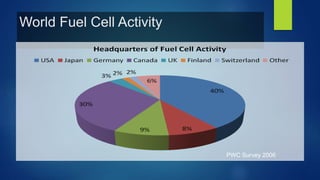
World Fuel Cell Activity
PWC Survey 2006
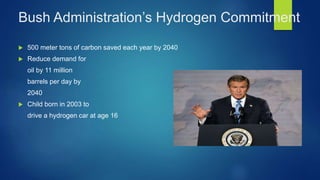
Bush Administration’s Hydrogen Commitment
 500 meter tons of carbon saved each year by 2040
 Reduce demand for
oil by 11 million
barrels per day by
2040
 Child born in 2003 to
drive a hydrogen car at age 16
REFEreNCE
 Khan, B.H., Non Conventional Energy Resources,,New
Delhi: McGraw-Hill Third Reprint 2008
 Kothari,D.P, Singhal K.C,Ranja,Rakesh,Renewable Energy Sources and
Emerging Technologies,New Delhi: PHI Learning Private Limited
Second Edition Nov 2011
 Nice,Karim and Strickland, Jonathan. "How Fuel Cells Work:
Polymer Exchange Membrane Fuel Cells". How Stuff Works,
accessed August 4, 2011
 http://openaccesslibrary.org/images/HAR224_Adesh_Sharma.pdf
 http://policy.rutgers.edu/ceeep/hydrogen/education/Thermodynami
csFuelCells.pdf
 http://www.fuelcelltoday.com/media/1713685/fct_review_2012.pdf
 http://www.fuelcellenergy.com/knowledge-library.php
 http://ezinearticles.com/?Disadvantage-of-Fuel-
Cells&id=1788240
 National Renewable Energy Laboratory
http://www.nrel.gov/hydrogen/proj_production_delivery.html
 DoE Alternative Fuels Data Center
http://www.eere.energy.gov/afdc/laws/epact_2005.html
 Hydrogen Fuel Cell Realm
http://www.geocities.com/aardduck/fc_basic.html
 Non conventional energy source G D rai 2006 edition
 FuelCellWorks.com
 www.hydrogenhighway.ca.gov
HYDROGEN BASED Fuel cell

HYDROGEN BASED Fuel cell

  • 2.
    HYDROGEN BASED FUELCELL TECHNOLOGY PRESENTED BY : ZEESHAN ALI ROLL NO : 3806 (2016) GOVERNMENT COLLEGE UNIVERSITY FSD
  • 3.
    HISTORY  The conceptof the fuel cell was first demonstrated by Humphry Davy in 1801.  William Grove, a chemist invented the first working fuel cell in 1839.  First commercial use of fuel cells was in NASA space programs to generate power for probes, satellites and space capsules  In 1966, General Motors developed the first fuel cell road vehicle, the Chevrolet Electrovan. It had a PEM fuel cell a range of 120 miles and a top speed of 70 mph.  Fuel cell stacks were still limited principally to space applications in the 1980s, including the Space Shuttle by NASA.
  • 4.
    WHY WE NEEDFUEL CELL TECHNOLOGY
  • 7.
    WHY WE NEEDFUEL CELL  Cars and trucks using petroleum fuels are one of the leading causes of air pollution.  Air pollution is single handedly responsible for up to 30,000 premature deaths each year.  In 2013, transportation contributed more than half of the carbon monoxide and nitrogen oxides, and almost a quarter of the hydrocarbons emitted into our air.
  • 8.
     Ozone depletionwhich can impair vision and breathing. From 1979 to the present, the hole has deepened within which ozone concentration has fallen by almost 40%.  Global warming due to continuous increase in temperature.  Getting hard to fulfill the increasing fuel requirements.  Acid rain which is harmful for humans and plants equally.
  • 9.
    WHAT IS FUELCELL?  A fuel cell is a device that generates electricity by a chemical reaction. Every fuel cell has a electrolyte, two electrodes, one positive and one negative, called, respectively, the anode and cathode. The reactions that produce electricity take place at the electrodes.
  • 10.
    WORKING  A fuelcell is an electrochemical device that combines hydrogen and oxygen to produce electricity, with water and heat as its by-product. In its simplest form, a single fuel cell consists of two electrodes - an anode and a cathode - with an electrolyte between them.
  • 12.
    • At theanode the oxidation reaction occur and at the cathode the reduction reaction occur. In the oxidation reaction, the H convert into –ve and +ve ions. In the reduction reaction, the O convert into ions.
  • 13.
    Chemistry of aFuel Cell Anode side: 2H2  4H+ + 4e- Cathode side: O2 + 4H+ + 4e-  2H2O Net reaction: 2H2 + O2  2H2O
  • 14.
    Hydrogen ?? Whatis it ? Hydrogen gas glows purple when ionized. I am the lightest element and am gas at normal temperature and pressure. I condenses to liquid at temperatures of - 253° Celsius.
  • 15.
    Hydrogen ?? Whatis It ? In Greek, hydrogen means "water- former". NGC 604, a giant region of ionized hydrogen in the Triangulum Galaxy Hydrogen is not a fuel…it is a way of storing and transporting energy , similar to a battery.
  • 16.
  • 17.
    FORMATION OF ELECTROLYTE The electrolyte material is considered to be the heart of a Fuel cell.  It can be prepared by co-precipitation or Sol-gel method but the co- precipitation method is so suitable. Because for fuel cell the electrolyte must be dense. If the electrolyte more dense them the ions pass more quickly from them.  The selection of the material for the electrolyte must be based on that the electrolyte must be stop the flow of electron and only ions pass from them. And mostly it is based on Cerium oxide and zerconia oxide.  The nanocompsite are placed on electrolyte for improving the working of fuel cell.
  • 18.
    Formation of electrodes In fuel cell, anode electrodes are prepare by NiO , ZnO, CuO etc and noble material but mostly used NiO due to low cost.  The following property must be in our mind for selecting anod material 1- stability in reducing environment. 2- sufficient electronic and ionic conductivity. 3- porous structure. 4- thermal expansion coefficient matching electrolyte. 5- higly catalytic activity.  The anode electrodes are mostly prepare by using the Sol-gel method.  The cathode electrodes are prepare by (Sm, Sr)CoO3, (Ba,Sr)(Co,Fe)O3-δ , (GdBaCoO5+δ), (La1-xSrxMnO3) etc.
  • 19.
     The followingproperty must be in our mind for selecting cathode material 1- stability in oxidizing environment. 2- sufficient electronic and ionic conductivity. 3- porous structure. 4- thermal expansion coefficient matching electrolyte. The mostly cathode electrodes are prepared by Sol-gel method .
  • 20.
    COMMON FUELS  Hydrogen Hydrazine  Ammonia  Hydrocarbon(gases)  Hydrocarbon(liquid)  Synthesis gases  Methanol
  • 21.
    ENERGY FLOW DIAGRAM FUEL PROCESSOR FUEL CELL POWER CONDITIONER FUEL HYDROGEN FROMFUEL DC INPUT AC OUTPUT OXYGEN FROM AIR WATER VAPOUR AND HEAT
  • 22.
    Hydrogen Technology DevelopmentIn India  Production of hydrogen by photo electrolysis of water using solar energy  Production of hydrogen by blue green algae & by certain bacterial species  Storage of hydrogen through metal hydride / non metal hydride  Problems relating to utilization of hydrogen as a fuel,that is developed for certain engines and fuel etc.  Liquid hydrogen production, storage and utilization.
  • 23.
    Types of thefuel cell There are many types of the fuel cell on the basis of electrolyte materials.
  • 24.
  • 25.
    MERITS  Fuel cellvehicles (FCVs) powered by pure hydrogen emit no GHGs from their tailpipe, only heat and water.  FCVs could reduce our dependence on foreign oil since hydrogen can be derived from domestic sources, such as natural gas and coal, as well as renewable resources such as water, biogas, and agricultural waste. That would make our economy less dependent on other countries  Fuel cells have a higher efficiency than diesel or gas engines.  Hydrogen is a renewable fuel source as it is very plentiful. The trick is to break the water molecules down to release it.
  • 26.
    MERITS(CONTINUED)  Unlike all-electricvehicles (EVs), FCV’s hold a comparable distance range and refueling time to gasoline vehicles.  Unlike vehicles which have internal combustion engine, FCV’s require less maintainance.  Low noise pollution and thermal pollution.  Unlike electric vehicles FCV’s does not require recharging.
  • 27.
    CHALLENGES  FCVs arecurrently more expensive than conventional vehicles and hybrids, but costs have decreased significantly and are approaching to more affordable rates till 2017.  The current infrastructure for producing, delivering, and dispensing hydrogen to consumers cannot yet support the widespread adoption of FCVs.  Warranty issues on major electric components. Dealership and repair shop not familiar with new components.  Great amount of policy support and investment is essential to achieve market readiness.
  • 28.
    CHALLEHGES (CONTINUED)  Fuelcell technology must be embraced by consumers before its benefits can be realized. They must become familiar with a new kind of fuel. Public education can accelerate this process.  Hydrogen fuel cell vehicles are the lack of sufficient infrastructure for hydrogen refueling, and the cost of the catalysts. Platinum is one of the most commonly used catalysts for fuel cells, but it's very expensive.
  • 29.
    WHY THEY AREBEING DEVELOPED
  • 30.
  • 31.
    Challenges to FuelCell Technology  Durability and Reliability  Durability of fuel cell systems have not yet been adequately established  The durability standard for automobiles is approximately 150,000 miles and the ability to function under normal vehicle operating conditions  For stationary systems 40,000 hours of reliable operation in a temperature range of -35 degree Celsius to 40 degrees Celsius will be required for market acceptance
  • 32.
    Disadvantages  Activation losses These losses are caused by the slowness of the reaction taking place on the surface of the electrodes.  Ohmic losses  The voltage drop due to the resistance to the flow of electrons through the material of the electrodes.  This loss varies linearly with current density.  Concentration losses  Losses that result from the change in concentration of the reactants at the surface of the electrodes as the fuel is used.  Fuel crossover losses  Losses that result from the waste of fuel passing through the electrolyte and electron conduction through the electrolyte.
  • 33.
    (a) Stationary energyresources: •Power for municipalities, rural areas and industries. •Heat and electricity for homes. •Long-lasting mobile power for computers, cell phones and other electronics (b) Transportation: •Non polluting automobiles •Inexpensive fuels (c) Military applications: • Fuel cells could significantly reduce deployment costs Other Applications
  • 34.
  • 35.
    Application type portablestationary Transport Definition Units that are built into, or charge up, products that are designed to be moved including auxiliary power units(APU) Units that provide electricity(and sometimes heat) but are not designed to be moved Units that produced propulsive power or range extension to a vehicle Power range 5W to20KW O.5 KW to 400KW 1KW to 100KW Technology PEMFC DMFC PEMFC PAFC MCFC SOFC PEMFC DMFC examples Non-motive APU Military applications(portable soldier-borne power) Portable products(torches, battery chargers) Large stationary combined heat and power(CHP) Small stationary micro-CHP Uninterruptible power sources(UPS) Fuel cell electric vehicles(FCEV) Trucks and buses
  • 36.
    PRESENT STATUS  Fuelcell industry began its road to commercialisation in 2007  An 11.2 MW installation in Korea is the world’s largest fuel cell power plant till today  In Germany more than 250 fuel cell micro-CHP system have been installed under the callux programme  Commercial production of fuel cell scooters has started in Taiwan in 2012  At the end of 2011, 215 hydrogen refuelling stations was in operation worldwide. The stations are located in Europe (85), North America (80), Asia Pacific (47) and the Rest of the World (3).  In USA, at the end of 2011 Clear Edge has over 100 installations of its 5 kW ClearEdge5 HT PEMFC unit in California
  • 37.
     Hyundai ix35FCEV, Mercedes-Benz B-Class F-CELL Mercedes-Benz Citron fuel cell buses  In May 2012, the world’s largest platinum producer Anglo American Platinum launched a fuel cell powered mine locomotive prototype.  Some of the agencies involved in development of fuel cells in India are  Ministry of New and Renewable Energy Sources (MNES)  Delhi Transport Corporation (DTC)  Indian Railways,  Indian Institute of Science and Central Glass & Ceramic Research Institute,  Tata Energy Research Institute (TERI), Bharat Heavy Electricals Ltd. (BHEL), and Reva Electric Car Company  At Vijayawada and Chennai hydrogen filling station are established
  • 38.
    World Fuel CellActivity PWC Survey 2006
  • 39.
    Bush Administration’s HydrogenCommitment  500 meter tons of carbon saved each year by 2040  Reduce demand for oil by 11 million barrels per day by 2040  Child born in 2003 to drive a hydrogen car at age 16
  • 40.
    REFEreNCE  Khan, B.H.,Non Conventional Energy Resources,,New Delhi: McGraw-Hill Third Reprint 2008  Kothari,D.P, Singhal K.C,Ranja,Rakesh,Renewable Energy Sources and Emerging Technologies,New Delhi: PHI Learning Private Limited Second Edition Nov 2011  Nice,Karim and Strickland, Jonathan. "How Fuel Cells Work: Polymer Exchange Membrane Fuel Cells". How Stuff Works, accessed August 4, 2011  http://openaccesslibrary.org/images/HAR224_Adesh_Sharma.pdf  http://policy.rutgers.edu/ceeep/hydrogen/education/Thermodynami csFuelCells.pdf  http://www.fuelcelltoday.com/media/1713685/fct_review_2012.pdf
  • 41.
     http://www.fuelcellenergy.com/knowledge-library.php  http://ezinearticles.com/?Disadvantage-of-Fuel- Cells&id=1788240 National Renewable Energy Laboratory http://www.nrel.gov/hydrogen/proj_production_delivery.html  DoE Alternative Fuels Data Center http://www.eere.energy.gov/afdc/laws/epact_2005.html  Hydrogen Fuel Cell Realm http://www.geocities.com/aardduck/fc_basic.html  Non conventional energy source G D rai 2006 edition  FuelCellWorks.com  www.hydrogenhighway.ca.gov