HYDRAULIC POWER
There arethree hydraulic systems that supply hydraulic power for user systems. These systems
are the same.
The main and auxiliary hydraulic systems supply pressurized fluid to these airplane systems:
- The two thrust reversers
- Power transfer unit (PTU) motor
- Landing gear extension and retraction
- Nose wheel steering
- Main gear brakes
- Primary flight controls
- Secondary flight controls.
These systems make up the hydraulic power system:
- Main hydraulic systems
- Ground servicing system
- Auxiliary hydraulic systems
- Hydraulic indicating systems.
Main Hydraulic Systems
The main hydraulic systems are A and B. System A has most of its components on the left side
of the airplane and system B on the right side.
Ground Servicing System
The ground servicing system fills all hydraulic reservoirs from one central location.
Auxiliary Hydraulic Systems
The auxiliary hydraulic systems are the standby hydraulic system and the power transfer unit
(PTU) system.
The standby hydraulic system is a demand system that supplies reserve hydraulic power to
these components:
- Rudder
- Leading edge flaps and slats
- The two thrust reversers.
The hydraulic power transfer unit (PTU) system is an alternative source of hydraulic power for
the leading edge flaps and slats and autoslat system.
Hydraulic Indicating Systems
These are the indicating systems:
- Hydraulic fluid quantity
- Hydraulic pressure
- Hydraulic pump low pressure warning
- Hydraulic fluid overheat warning.
The hydraulic indicating systems show these indications
in the flight compartment:
- System A and B reservoir quantity
- Standby reservoir low quantity
2.
- System Aand B pressure
- System A and B engine-driven pump (EDP) low pressure
- System A and B electric motor-driven pump (EMDP) low pressure
- Standby electric motor-driven pump low pressure
- System A and B electric motor-driven pump (EMDP) overheat.
IN SUMMARY:
FOR SYSTEM A & B – RESERVOIR QTY, HYD PR,
EDP - LOW PR,
EMDP – LOW PR & OVERHEAT
FOR STDBY RESERVOIR – LOW QTY,
STDBY EMDP – LOW PR
The hydraulic systems use BMS 3-11 TYPE IV erosion arresting, fire resistant hydraulic fluid.
PRESSURIZATION
Air pressure from the reservoir pressurization system keeps head pressure on hydraulic system
A, system B, and the standby hydraulic system reservoirs. The pressurized reservoirs supply a
constant flow of
fluid to the hydraulic pumps.
Hydraulic system A supplies pressure to these airplane systems:
- Power transfer unit motor
- Left thrust reverser
- Landing gear extension and retraction
- Nose wheel steering
- Alternate brakes
- Aileron
- Autopilot A
- Elevators
- Elevator feel
- Flight spoilers 2, 4, 9, and 11
- Ground spoilers 1, 6, 7, and 12
- Rudder.
Hydraulic system B supplies pressure to these airplanesystems:
- Right thrust reverser
- Alternate landing gear retraction
- Alternate nose wheel steering
- Normal brakes
- Aileron
- Autopilot B
- Elevators
- Elevator feel
- Flight spoilers 3, 5, 8, and 10
- Rudder
3.
- Trailing edgeflaps
- Leading edge flaps and slats
- Yaw damper.
Standby Hydraulic System
The standby hydraulic system supplies alternative hydraulic pressure to these airplane systems:
- The two thrust reversers
- Standby rudder
- Leading edge flaps and slats.
Hydraulic Power Transfer Unit (PTU) System
The PTU system is a hydraulic motor-pump assembly that supplies alternative pressure to
leading edge flaps and slats and autoslat system if system B EDP pressure decreases. The PTU
control valve controls the PTU.
System A pressurizes the motor when the PTU control valve is open. System B supplies the fluid
to the pump.
HYDRAULIC POWER -- CONTROLS AND INDICATIONS
The controls and indications for hydraulic power systems are on the hydraulic panel and flight
control panel.
The hydraulic panel and flight control panel is on the P5 forward overhead panel in the flight
compartment.
The Engine Driven Pumps (EDP) and Electric Motor Driven Pumps (EMDP) each have a switch on
the hydraulic panel. The switches have two positions, ON and OFF.
Each pump has a depressurization solenoid valve. The valve isolates pump output pressure
from the main hydraulic power system when the ENG 1 or ENG 2 HYD PUMP switch is in the OFF
position.
The ELEC 2 HYD PUMP switch controls the EMDP for system A. The ELEC 1 HYD PUMP switch
controls the EMDP for system B.
These switches operate components in the standby hydraulic system:
- FLT CONTROL A and B switches
- ALTERNATE FLAPS arm switch
- ALTERNATE FLAPS control switch.
Move one of the two FLT CONTROL A or B switches to the STBY RUD position to start the
standby hydraulic system EMDP and open the standby rudder shutoff valve in the standby
system module.
Move the ALTERNATE FLAPS arm switch to the ARM position to start the standby hydraulic
system EMDP.
These are the hydraulic indications in the flight compartment for hydraulic systems A and B:
- Quantity
- System pressure
- Pump low pressure
- Overheat (EMDPs only)
4.
- Master caution.
Theseare the indications for the standby hydraulic system:
- Low quantity
- Low pressure
- Standby rudder on.
Hydraulic pressure shows on the systems display for systems A and B.
Hydraulic fluid quantity shows in percent of full on the systems display for systems A and B
reservoirs.
The LOW QUANTITY amber light to the right of the FLT CONTROL switches on the flight control
panel comes on when the hydraulic fluid quantity decreases to less than normal in the standby
hydraulic system reservoir.
The amber LOW PRESSURE lights come on for each pump when the output pressure is less than
normal.
The hydraulic systems A and B LOW PRESSURE lights are above the HYD PUMP control switches
on the hydraulic panel.
The standby system LOW PRESSURE light is to the right of the FLT CONTROL switches on the
flight control panel.
The amber OVERHEAT lights for the hydraulic system A and B EMDPs come on when the pump
case drain hydraulic fluid temperature is more than normal. These lights are above each HYD
PUMP control switch on the hydraulic
panel.
The standby hydraulic system does not have an overheat indicator.
When one of the amber lights on the hydraulic control panel come on, the MASTER CAUTION
lights and the HYD light on the system annunciator panel (P7) also come on.
When one of the amber lights on the flight control panel come on, the MASTER CAUTION lights
and FLT CONT light on the system annunciator panel (P7) also come on.
HYDRAULIC POWER -- COMPONENT LOCATION
Main Hydraulic Systems
System A components are on the left side of the airplane. System B components are on the
right side of the airplane.
System A EDP and case drain filter module are on the left engine
System B EDP and case drain filter module are on the right engine.
These are the components in the main landing gear wheel well:
5.
- Reservoir (2)
-EDP supply shutoff valve (2)
- Electric motor-driven pump (EMDP) (2)
- Pressure module (2)
- EMDP case drain filter module (2)
- Return filter module (2).
These are the components in the main fuel tanks:
- System A heat exchanger in main tank 1
- System B heat exchanger in main tank 2.
These are the components in the ram air bays:
- System A ground service disconnect module in the left ram air bay
- System B ground service disconnect module in the right ram air bay.
Standby Hydraulic System
These are the components in the main landing gear wheel well:
- Reservoir
- Standby hydraulic system module
- Case drain filter module.
The standby system EMDP is in the right aft wing-to body fairing.
Hydraulic Power Transfer Unit System
These are the components in the main landing gear wheel well:
- Power transfer unit (PTU)
- PTU pressure filter module
- PTU flow limiter
- PTU control valve
- EDP pressure switch autoslat system.
Ground Servicing System
The ground servicing system components are in the right forward corner of the main wheel
well.
MAIN HYDRAULIC SYSTEMS
There are two main hydraulic systems, system A and system B. Normally the two systems
operate full-time during flight.
The ground servicing system permits hydraulic servicing of systems A and B reservoirs and the
standby reservoir from one location.
6.
The systems operateat 3000 psi normal pressure and are almost the same.
The engine and APU fire control panel controls the EDP supply shutoff valves.
EDP supply shutoff valves for each system control hydraulic fluid to the engine-driven pump
(EDP).
Case drain fluid removes heat from internal components of the pump and
goes to a case drain filter module from each pump.
The pressure module cleans, monitors, and does distribution of the fluid pressure from each
pump. The pressure module also gives overpressure protection to the system.
A case drain filter module cleans the case drain fluid from each pump before it goes to the heat
exchanger.
Two heat exchangers are in the main fuel tanks.
The controls for the main hydraulic system pumps are on the hydraulic panel. This panel is on
the P5 forward overhead panel.
The engine fire switches on the P8 aft electronics panel control the fluid supply to the engine-
driven pumps (EDPs).
The ELEC 2 HYD PUMP switch controls the EMDP for system A. The ELEC 1 HYD PUMP switch
controls the EMDP for system B.
When you operate one of the engine fire switches, the pump LOW PRESSURE amber light
disarms, and the hydraulic fluid supply to the related EDP stops.
A temperature switch in the electric motor case monitors the EMDP electric motor for overheat.
OVERHEAT amber lights for each EMDP come on when the case fluid temperature in the motor
is more than normal. The OVERHEAT amber lights are above each EMDP LOW PRESSURE amber
light.
Temperature switches in the case drain line downstream of the pump monitor the EMDP pump
case drain fluid for overheat. The same OVERHEAT amber lights for each EMDP come on when
the case drain fluid temperature is more
than normal. The OVERHEAT amber lights are above each EMDP LOW PRESSURE amber light.
Because the EDP depressurization solenoid valve gets electrical power when the EDP HYD
PUMP switch is OFF, you normally keep the switch in the ON position.
When you do maintenance, if the switch is in the OFF position for a long time, you must open
the circuit breaker for the HYD SYS ENG PUMP DEPRESS VALVE 1 or HYD SYS ENG PUMP
DEPRESS VALVE 2.
These are the components in the main landing gear wheel well:
- Reservoir pressurization manifold
- Reservoir (2)
- Engine-driven pump (EDP) supply shutoff valve (2)
- Electric motor-driven pump (EMDP) (2)
7.
- Pressure module(2)
- Case drain filter module (2)
- Return filter module (2).
RESERVOIR PRESSURIZATION SYSTEM
The reservoir pressurization system gets pressure from one of these sources:
- Engine bleed systems
- APU bleed system
- External air.
The standby system reservoir gets pressure from a fill and balance line that connects to the
system B reservoir.
These are the reservoir pressurization system
components:
- Manifold assembly
- Air charging valve
- Air pressure indicator
- Cross fitting (2)
- Sump tube and orifice plug assembly (2)
- Filter (2)
- Pressure relief valve (2).
Most of the reservoir pressurization system components are in the main landing gear wheel
well.
The reservoir pressurization manifold assembly is on a bracket on the forward bulkhead in the
main landing gear wheel well.
The reservoir pressurization manifold assembly has these components:
- Manifold
- Air charging valve.
The manifold has ports for system connections. The air charging valve lets you remove
pressurization from the reservoirs. It also lets you pressurize the hydraulic system reservoirs on
the ground for maintenance purposes.
The cross fittings send pneumatic pressure from the pneumatic system to the hydraulic system
reservoirs.
The cross fittings are located adjacent to the system A and B reservoirs at the top of the main
landing gear wheel well. Each cross fitting contains a check valve and a restrictor.
The check valves isolate the left and right pneumatic manifolds and prevent a loss of pneumatic
pressure if one or the other side loses pressure. The restrictors control the pneumatic flow to a
maximum of 2.8 cfm to the reservoirs.
The sump tube and orifice plug assemblies remove moisture from the reservoir pressurization
system.
8.
The sump tubeand orifice plug assemblies are very low on the left and right sides of the
forward main landing gear wheel well bulkhead.
The filters are in the left and right air conditioning compartments on the forward side adjacent
to the pneumatic system crossover manifold
duct.
The air filters prevent contamination downstream in the system. The filter assembly has a 200
micron cleanable metal element. The filters have no bypass. You can clean the metal filter
element by ultrasonic
cleaning.
The air pressure indicator for hydraulic system A and B reservoirs is immediately above the
reservoir pressurization manifold assembly.
(PRESSURE – 40 TO 42 PSI)
A pressure relief valve for each main reservoir opens for protection of the reservoir when the air
pressure in the reservoir increases to 60-65 psi. High pressure from one of the reservoirs goes
out through the APU
fuel line shroud drain mast.
Before you remove the air filters, you must remove the air pressure in the
reservoir pressurization system.
If you remove pressure from the system B reservoir, you also remove pressure from the
standby system reservoir.
Remove air pressure from system A and system B reservoirs before you do a vent cap check.
FUNCTIONAL DESCRIPTION
The pneumatic system pressurizes the hydraulic system reservoirs to 42 psi nominal. This
pressurizes the supply fluid flow from the reservoirs to the pumps and pressurizes the return
fluid in the hydraulic system.
The filters have a hard seat check valve in the exit port to keep reservoir fumes and fluid back
flow out of the ECS ducts.
The balance line connects reservoir pressurization air to hydraulic system A and system B
reservoirs and to the manifold assembly. This balances the pressure. The balance line supplies
air pressure to the 2 reservoirs if only 1 pneumatic system has pressure.
To give protection to the reservoirs, a pressure relief valve opens if the air or fluid pressure in
the reservoir is more than 60 to 65 psi.
To remove pneumatic pressure from a reservoir, the pneumatic manifold must not have
pressure. You open the air charge valve to remove pressure from the reservoir pressurization
system. When the airflow stops, the reservoirs are at ambient pressure.
9.
To pressurize thereservoirs, you open the air charge valve and connect an external air source.
External air then goes to pressurize the reservoirs to 45 to 50 psi.
CAUTION: DO NOT USE MORE THAN 70 PSIG PRESSURE. IF YOU USE TOO MUCH PRESSURE,
DAMAGE TO THE EQUIPMENT CAN OCCUR.
RESERVOIR
The hydraulic system A reservoir is in the center of the main wheel well on the forward
bulkhead.
The hydraulic system B reservoir is on the right forward bulkhead of the main wheel well.
The hydraulic system A reservoir has a capacity of 6.8 gallons (25.8 liters).
The hydraulic system B reservoir has a capacity of 10.7 gallons (40.6 liters).
Each reservoir is an airtight metal shell that has these components:
- Air pressure port
- EDP and EMDP supply line port
- Return line port
- Drain valve
- Hydraulic fluid quantity transmitter/indicator.
The hydraulic system A reservoir has a standpipe for the engine-driven pump (EDP). A port at
the bottom of the reservoir supplies fluid to the electric motor driven pump (EMDP). The
reservoir drain valve at the bottom manually operates.
The hydraulic system B reservoir has a standpipe for the EDP and EMDP. A port at the bottom of
reservoir supplies fluid to the power transfer unit (PTU) pump. The reservoir drain valve at the
bottom manually
operates.
The fill and balance line connects the system B reservoir to the standby reservoir. System B
reservoir pressure also pressurizes the standby hydraulic system reservoir.
The quantity indicator shows 0 for empty, RFL for refill, and F for full.
RESERVOIRS QUANTITY
(GAL/L)
QUANTITY
SHOWN ON
UPPER CENTER
DISPLAY UNIT
10.
A FULL LEVEL5.7 / 21.6 100%
REFILL 4.7 / 17.7 76%
EDP STANDPIPE 2.3 / 8.5 20%
OVERFILL MORE THAN
5.7 / 21.6
101-106%
B FULL LEVEL 8.2 / 31.1 100%
REFILL 6.9 / 26.0 76%
FILL & BALANCE 6.6 / 25.1 72%
EDP/EMDP STANDPIPE 1.3 / 4.9 20%
OVERFILL MORE THAN
8.2 / 31.1
101-106%
EDP SUPPLY SHUTOFF VALVE
The EDP supply shutoff valve for hydraulic system A is in the supply line between the reservoir
and the engine 1 EDP on the left side of the upper bulkhead of the main landing gear wheel
well.
The EDP supply shutoff valve for hydraulic system B is in the supply line between the reservoir
and the engine 2 EDP on the right side of the upper bulkhead of the main landing wheel well.
The EDP supply shutoff valve is a two-position, 28v dc motor-operated valve that is normally
open.
A position indicator on the valve shows valve position, OPEN or CLSD. You cannot use the
position indicator to open or close the EDP supply shutoff valve manually.
When you pull the engine fire switch, the EDP supply shutoff valve moves to the closed position.
This stops the supply of hydraulic fluid to the EDP.
The EDP supply shutoff valve moves to the open position when you move the engine fire switch
to the down or normal position.
Because the supply of hydraulic fluid to the pump stops when you move the engine fire switch
up, case drain flow does not flow through the EDP.
If the engine continues to turn (windmill) with the valve in the closed position, EDP damage can
occur. You must do an inspection of the EDP pressure and case drain filters.
If you replace the EDP supply shutoff valve, remove the pressure from the reservoir and drain it.
ENGINE-DRIVEN PUMP (EDP)
The EDP attaches with a pump attach clamp to the front face of the engine accessory gearbox
(AGB) on the left side of the engine.
The EDP is an axial-piston, variable-displacement, cam actuated, pressure compensated
hydraulic pump with a solenoid-operated depressurization valve.
11.
The pump hasthese three lines that attach to it:
- Hydraulic fluid supply line
- Output pressure line
- Case drain line.
The pressure hydraulic line connection at the pump has a self-sealing, quick-release disconnect.
The supply and case drain lines are threaded type fittings.
The pump weight (wet) is 32 lbs.
The case drain fluid removes heat and lubricates the pump before it goes to the heat exchanger
and reservoir through the case drain filter module.
A pressure compensator in the pump keeps a set pressure by control of the fluid flow out of the
pump in response to changes in system demands.
The pump operates in the pressurized or depressurized mode. In the depressurized mode the
pump is isolated from the hydraulic system and operates at a zero output flow. The solenoid
operated depressurization valve controls the pressurized or depressurized modes of the pump.
CAUTION: do not operate the hydraulic systems a and b Engine-driven pumps for more than
two minutes Without fuel in the fuel tanks. Main tank 1 (for hydraulic system a) and main tank 2
(for Hydraulic system b) must have a minimum of 250 Gallons (1675 pounds/760 kg) of fuel in
them. If there is not sufficient fuel in the fuel Tanks, the engine-driven pumps will become too
Hot. This can cause damage to the engine driven Pumps.
ELECTRIC MOTOR-DRIVEN PUMP (EMDP)
The EMDPs attach to a vibration absorption mount in the center of the main wheel well on the
forward bulkhead.
The EMDP assembly has these components:
- Hydraulic fluid-cooled, three-phase, 115v ac motor
- Centrifugal pump
- Single-stage, variable-displacement, pressure compensated hydraulic pump.
The EMDP has these connections:
- Supply - with a quick disconnect at the system A reservoir and a quick disconnect between the
EMDP
and the system B reservoir
- Pressure
- Case drain.
The dry pump weight is 30 lb.
An acoustic filter is in the pressure line that connects to the EMDP.
The acoustic filter decreases the noise and vibration from the EMDP.
Hydraulic fluid goes into the electric motor housing to remove heat from the electric motor.
12.
An internal temperatureswitch in the EMDP monitors the temperature of the EMDP. When the
temperature is 235F (113C) or more, a signal goes to the hydraulic control panel and causes the
OVERHEAT light for the pump to come on. The temperature switch does a reset at temperatures
between 185F (85C) and 215F (102C).
Retention cables prevent damage to the aileron components if the system A EMDP breaks away
from its mount.
The EMDP has a rating of 5.7 gpm at 2700 psi.
If you operate the EMDPs intermittently, do :
- In a five-minute period do not make more than five starts of a pump
- Wait 30 seconds before you start the pump again.
If you try more than five starts in a five-minute period, do one of these steps:
- Operate the pump continuously for 5 minutes after the fifth start while you monitor the
overheat warning lights
- Set the pump to OFF and let the temperature decrease for more than 30 minutes
PRESSURE MODULE
The pressure module does these functions for hydraulic system A and B:
- Gives hydraulic pump pressure to user systems
- Cleans pressure fluid from EDP and EMDP
- Monitors EDP and EMDP pressure
- Monitors system pressure
- Gives high pressure system protection.
The system A pressure module is on the left side of the forward bulkhead of the main gear
wheel well.
The system B pressure module is near the center of the forward bulkhead of the main gear
wheel well.
The pressure module has these components:
- Pressure filter (2) – NO BYPASS
- Pump low pressure switch (2)
- EDP pressure switch auto slat system (system B only)
- Check valve (2)
- Pressure transmitter
- Pressure relief valve.
The pressure modules are interchangeable.
The Pump low pressure switches cause a LOW PRESSURE light on the hydraulic panel to
illuminate when either the EDP or EMDP pressure decreases to less than normal.
13.
The EDP pressureswitch auto slat system (system B pressure module only) sends a signal to the
hydraulic power transfer unit (PTU) system when the system B EDP pump pressure decreases to
less than 2350 psi.
A pressure transmitter monitors system pressure and sends signals to the display electronics
unit (DEU) in the electronics equipment compartment. The DEU sends the data to the common
display system in the flight compartment.
The pressure relief valve starts to open at 3500 psi to give protection to the system.
If you replace the filter element, you must do the pressure filter element installation test.
CASE DRAIN FILTER MODULE
The case drain filter modules clean the case drain fluid from the engine-driven pumps (EDP) and
electric motor-driven pumps (EMDP) before it goes through the heat exchangers and back to
the reservoirs.
The EDP case drain filter modules are on each engine in the case drain line between the EDP
and the hydraulic disconnects on the engine strut.
The EMDP case drain filter modules are in the case drain line immediately below their related
pump in the main landing gear wheel well on the forward bulkhead.
The case drain filter module is non-bypass type with a 10-20 micron, cartridge type filter
element that you cannot clean.
The case drain filter module has these components:
- Filter module head
- Filter bowl
- Replaceable filter element.
If you replace a pump because of a malfunction, you must also replace the case drain filter
element for that pump.
If you operate the engine fire switch, and the EDP continues to operate for five minutes, you
must do an inspection of the EDP case drain filter for pump damage and replace the filter.
An EMDP case drain filter that has contamination can cause an EMDP overheat and put on the
OVERHEAT light, the MASTER CAUTION lights, and the HYD light on the systems annunciator
panel.
If you find metal contamination in the EMDP case drain filter, you must do an EMDP case drain
filter metal contamination check.
HEAT EXCHANGER
The heat exchangers remove heat from the hydraulic case drain fluid from the pumps before
the fluid goes back to the reservoir.
14.
The heat exchangeris a fin-tube type assembly
The system A heat exchanger is in the case drain line of the engine-driven pump and the electric
motor-driven pump. The heat exchanger is in the bottom of fuel tank 1.
The system B heat exchanger is in the case drain line of the engine-driven pump and the
electric motor-driven pump. The heat exchanger is in the bottom of fuel tank 2.
The heat exchanger weight is 7.6 lbs.
The heat exchangers are interchangeable.
The heat exchanger moves heat from the hydraulic fluid to the fuel in the tank.
RETURN FILTER MODULE
The return filter module for systems A and B are on the forward bulkhead of the main gear
wheel well below the reservoirs.
When a clogged return filter causes a differential pressure across the filter element of 65 psi,
the red differential pressure indicator visibly extends. The differential pressure indicator does
not move when the
temperature is less than 36F (2C).
If the differential pressure is 100 psi or more, the bypass valve opens and the fluid will go
around the filter and return to the reservoir.
Two check valves in the filter module head make a negative-pressure loop. The negative-
pressure loop permits opposite flow of hydraulic fluid from the reservoir to the system without
opposite flow through the filter element.
When the filter element is removed, the shutoff valve in the filter module head closes to prevent
fluid loss from the reservoir.
GROUND SERVICE DISCONNECT MODULE
The ground service disconnect module lets you pressurize the hydraulic systems A and B from a
ground service cart.
The hydraulic system A ground service disconnect module is on the aft bulkhead of the left ram
air bay.
The hydraulic system B ground service disconnect module is on the aft bulkhead of the right
ram air bay.
The pressure and return connections are a quick disconnect type fitting.
15.
The pressure filteris a non-bypass type with a 5-15 micron, cartridge-type filter element that
you cannot clean.
When there is electrical power and ground hydraulic power on the airplane, system pressure
shows on a pressure indicator in the flight compartment.
NOTE: Do not operate the EDPs or EMDPs with the portable hydraulic cart return and pressure
lines connected. This can put a limit on the hydraulic
fluid flow that goes from the reservoirs to the pumps and can cause cavitation of the pumps.
ENGINE-DRIVEN PUMP - FUNCTIONAL DESCRIPTION
To stop output flow from the EDP, move the ENG 1 HYD PUMP or ENG 2 HYD PUMP switch on
the hydraulic panel to the OFF position. This does not stop the rotation of the pump or the
internal pressure in the pump.
The pump can operate in a normal mode or in a depressurized mode. In the normal mode, the
pump is rated at a maximum of 37.5 gpm and 2850 psi at 3750 rpm. Maximum discharge
pressure is rated at 2950 psi to 3075 psi at 0 flow.
A depressurization solenoid valve in the pump controls the EDP output pressure when you
move the ENG HYD PUMP switch on the hydraulic panel to the OFF position. This completes a
28v dc electrical circuit and energizes the valve to the closed position.
When the pump operates in the normal or depressurized modes, case drain fluid is used for
lubrication and cooling. The case drain fluid circulates through the pump and back to the EDP
case drain filter and heat exchanger before it goes to the related reservoir.
The case drain flow continues in the pump when the depressurization solenoid valve is in the
closed position.
When the engine fire switch is moved to the FIRE position, the EDP supply shutoff valve moves
to the CLOSE position. This stops the supply of hydraulic fluid to the EDP. There is no case drain
flow in this condition.
When the engine fire switch is in the FIRE position, the hydraulic pump LOW PRESSURE light is
inhibited.
The EDP supply shutoff valve moves to the open position when the engine fire switch is in the
NORMAL position.
Keep the ENG 1 HYD PUMP and ENG 2 HYD PUMP switches in the ON position even when
airplane power is removed. This will extend the service life of the depressurization solenoid
valve.
ELECTRIC MOTOR-DRIVEN PUMP - FUNCTIONAL DESCRIPTION
A protection circuit removes power from the electric motor when there is a ground fault or
overcurrent.
16.
The ground faultdetector for system A EMDP is in the P92 power distribution panel in the EE
compartment. The ground fault detector for system B EMDP is in the P91 panel in the EE
compartment.
The trip coil in the ground fault detector energizes in one of these two conditions:
- Ground fault
- Overcurrent.
If a ground fault occurs, and the detector gets an input differential of 2 to 4 amps or more
between two coils, the trip coil energizes.
If an overcurrent occurs, and the detector gets an input overcurrent of between 80 and 90
amps from one 115v ac phase, the trip coil energizes.
Replacement of the power distribution panel is not necessary when you replace the ground
fault detector.
Push the reset switch on the ground fault detector to move the trip coil contacts to their normal
position.
MAIN HYDRAULIC SYSTEMS -- SYSTEM A - FUNCTIONAL DESCRIPTION
Hydraulic system A supplies pressurized fluid to these systems:
- Left thrust reverser
- Power transfer unit (PTU) motor
- Landing gear extension and retraction
- Nose wheel steering
- Alternate brake
- Ailerons
- Autopilot A
- Elevators
- Elevator feel
- Flight spoilers 2, 4, 9, and 11
- Ground spoilers 1, 6, 7, and 12
- Rudder.
The reservoir supplies fluid to the EDP through a standpipe.
The PTU motor receives pressure and supplies an emergency source of hydraulic power to the
leading edge flaps and slats.
Temperature switches monitor the EMDP electric motor and the EMDP case drain fluid
temperatures.
Pump pressure switches monitor the EMDP and EDP pump pressures.
The system pressure transmitter monitors the system pressure.
MAIN HYDRAULIC SYSTEMS -- SYSTEM B - FUNCTIONAL DESCRIPTION
17.
Hydraulic system Bsupplies pressurized fluid to these systems:
- Right thrust reverser
- Alternate landing gear retraction
- Alternate nose wheel steering
- Normal brakes
- Ailerons
- Autopilot B
- Elevators
- Elevator feel
- Flight spoilers 3, 5, 8, and 10
- Rudder
- Trailing edge flaps
- Leading edge flaps and slats
- Yaw damper.
The reservoir supplies pressurized fluid to the EDP and EMDP through a standpipe.
The PTU pump receives fluid from the bottom of the reservoir.
The PTU pump supplies an emergency source of hydraulic power to the leading edge flaps and
slats.
GROUND SERVICING SYSTEM
The ground servicing system fills all hydraulic reservoirs from one location.
The system components are in the right main gear wheel well on the lower outboard area of
the forward bulkhead.
The reservoir fill selector valve lets you select the reservoir to receive the hydraulic fluid.
These are the three positions:
- Port A
- Port B
- Closed.
CAUTION: DO NOT SUPPLY HYDRAULIC FLUID AT MORE THAN 75 PSI TO THE PRESSURE FILL
CONNECTION. A PRESSURE OF MORE THAT 75 PSI CAN CAUSE DAMAGE TO THE HYDRAULIC
SYSTEM.
To get the correct results when you do a check of the hydraulic fluid quantities or fill the
reservoirs, the airplane must be in this condition:
- Flight controls - neutral
- LE flaps and slats - up
- TE flaps - up
- Spoilers - down
- Landing gear - down
- Thrust reversers - closed
- Hydraulic system A and system B - off
- Brake accumulator pressure - 2800 psi or more.
18.
AUXILIARY HYDRAULIC SYSTEMS
Theauxiliary hydraulic systems supply alternative pressure sources to hydraulic systems A and
B.
These are the auxiliary hydraulic systems:
- Standby hydraulic system
- Hydraulic power transfer unit (PTU) system.
The standby hydraulic system supplies alternate hydraulic pressure to these systems:
- Thrust reversers
- Leading edge flaps and slats
- Rudder.
The standby hydraulic system has these two modes of operation:
- Manual for the leading edge devices and thrust reversers
- Automatic for the rudder.
STANDBY HYDRAULIC SYSTEM
The standby hydraulic system supplies alternate hydraulic pressure for these systems:
- Thrust reversers
- Leading edge flaps and slats
- Rudder.
The standby hydraulic system module does these functions:
- Cleans the pressure fluid from the standby EMDP
- Controls pressure to the leading edge flaps and slats
- Controls pressure to the standby rudder power control unit (PCU)
- Supplies metered pressure to the thrust reversers
- Monitors system pressure
- Gives system over-pressure protection.
The controls and indications for the standby hydraulic system are on the flight control panel.
The flight control panel is on the P5 forward overhead panel in the flight compartment.
These switches operate components in the standby hydraulic system:
- FLT CONTROL A and B switches
- ALTERNATE FLAPS arm switch
- ALTERNATE FLAPS control switch.
Move one of the two FLT CONTROL A or B switches to the STBY RUD position to start the
standby hydraulic system EMDP and open the standby rudder shutoff valve in the standby
system module.
Move the ALTERNATE FLAPS arm switch to the ARM position to start the standby hydraulic
system EMDP.
19.
Move the ALTERNATEFLAPS control switch to the down position momentarily to open the
leading edge flaps and slats shutoff valve in the standby system module.
The amber STANDBY HYD LOW QUANTITY light comes on when the hydraulic fluid in the
standby reservoir decreases to less than 50 percent.
The amber STANDBY HYD LOW PRESSURE light comes on when the pressure from the standby
hydraulic system EMDP decreases to less than normal during automatic or manual operation of
the EMDP.
The amber STANDBY RUDDER ON light comes on when the standby rudder system is in
operation.
The standby system electric motor-driven pump (EMDP) is in the aft wing-to-body fairing.
STANDBY HYDRAULIC SYSTEM – RESERVOIR
The standby hydraulic system reservoir is on the keel beam in the main landing gear wheel well.
The standby hydraulic system reservoir is an airtight metal shell that contains 3.6 gallons (13.3
liters) of hydraulic fluid.
The reservoir has these components and connections:
- Ground service line
- Fill and balance line
- EMDP supply line
- Low quantity switch.
The standby hydraulic system reservoir has no drain valve.
The fill and balance connection connects the standby reservoir to the hydraulic system B
reservoir. The fill and balance line does these functions:
- Overfill from the servicing system to the system B reservoir
- Thermal expansion of the standby hydraulic system reservoir
- Supply pressure from the hydraulic system B reservoir.
The reservoir low quantity switch sends a signal to the amber STANDBY HYD LOW QUANTITY
light on the flight control panel in the flight compartment when the fluid level in the reservoir is
less than 50 percent.
The standby hydraulic system reservoir has a quick disconnect at the bottom for the standby
hydraulic system EMDP supply line.
STANDBY HYDRAULIC SYSTEM -- ELECTRIC MOTOR-DRIVEN PUMP
The standby hydraulic system EMDP is in the right aft wing to body fairing, inboard of the brake
accumulator.
The EMDP has these connections:
- Supply
20.
- Pressure
- Casedrain.
The EMDP is rated at 3.7 gpm at 2700 psi.
The motor is air cooled through a cooling duct. Air flows from outside the airplane and goes
thru a vent in the right aft wing to body fairing access panel to the EMDP cooling duct. Air then
goes through the EMDP plenum and into the compartment. There is a vent in the left aft wing
to body fairing on the other side of the fuselage for cooling airflow exhaust.
The hydraulic pump or electric motor can be replaced individually.
STANDBY HYDRAULIC SYSTEM MODULE AND CASE DRAIN FILTER MODULE
The standby hydraulic system module does these functions:
- Cleans the pressure flow from the standby EMDP
- Controls pressure to the leading edge flaps and slats
- Controls pressure to the standby rudder power control unit (PCU)
- Supplies metered pressure to the thrust reversers
- Monitor system pressure
- Protect system from over pressure.
The case drain filter module cleans the case drain flow from the standby pump.
The standby hydraulic system module and the case drain filter module are on the aft bulkhead
of the main Landing gear wheel well.
The standby hydraulic system module has these components:
- Leading edge flaps and slats shutoff valve
- Standby rudder shutoff valve
- Pressure filter module
- Pressure relief valve
- EMDP low pressure switch.
The leading edge flaps and slats shutoff valve and standby rudder shutoff valve are identical.
Each valve has a manual override lever.
The EMDP pump low pressure switch sends signals to the STANDBY HYD LOW PRESSURE light
on the flight control panel in the flight compartment when the pressure is less than normal.
The standby rudder shutoff valve operates electrically to control standby pressure to the
standby rudder power control unit. A lever on the valve shows the valve position. You use the
lever to move the valve to the
open or closed position.
The leading edge flaps and slats shutoff valve operates electrically to control standby pressure
to the leading edge flaps and slats. The valve opens during alternate operation of the leading
21.
edge flaps andslats. A lever on the valve shows the valve position. You use the lever to move
the valve to the open or closed position.
STANDBY HYDRAULIC SYSTEM -- FUNCTIONAL DESCRIPTION
The standby hydraulic system operates automatically or manually as a backup to the hydraulic
systems A and B.
The standby hydraulic system supplies hydraulic fluid under pressure to operate these
components:
- Leading edge flaps and slats
- Standby rudder power control unit.
- Left and right thrust reversers
The fill balance line connects the standby reservoir to the system B reservoir. The system B
reservoir can supply fluid and pressurization to the standby reservoir.
The ground servicing system lets you add fluid to the standby reservoir. This also adds fluid to
the system B reservoir through the fill and balance line.
A volume fuse in the standby system pressure line to the leading edge flaps and slats closes
when hydraulic fluid flow increases to 270-350 cubic inches. A flow limiting valve downstream of
the volume fuse limits the standby hydraulic fluid flow to 2.1 gallons per minute.
A check valve in the standby pressure line upstream of the left thrust reverser shuttle valve
prevents transfer of system A fluid into system B.
Volume fuses in the standby system pressure lines to the thrust reversers close when hydraulic
fluid flow increase to 175 cubic inches. This prevents hydraulic fluid loss if there is a leak in the
system.
Shuttle valves make a selection between system A and B pressure or standby pressure, to
supply the thrust reversers.
You operate the standby system hydraulic electric motor-driven pump (EMDP) with one of these
switches on the flight control panel:
- FLT CONTROL A switch to STBY RUD
- FLT CONTROL B switch to STBY RUD
- ALTERNATE FLAPS arm switch to ARM.
The standby pump operates automatically if all of these conditions are true:
- FLT CONTROL A or B switch is ON
- ALTERNATE FLAPS arm switch is OFF
- Trailing edge flaps not up
- Airplane in the air or wheel speed more than 60 kts
- Low flight control system A or B pressure.
The standby pump also operates automatically when all of these conditions are true:
- FLT CONTROL A or B switch is ON
- ALTERNATE FLAPS arm switch is OFF
22.
- The forcefight monitor (FFM) in the main rudder PCU finds more than 3600 PSI for more than
5 seconds.
The standby rudder shutoff valve operates manually or automatically. In the automatic mode
the standby hydraulic system supplies enough control of the rudder during takeoff, approach,
and landing if one of the main hydraulic systems has a failure or if a force fight is found by the
force fight monitor (FFM) in the main rudder PCU. The leading edge flaps and slats shutoff valve
only operates manually.
The standby rudder shutoff valve closes when you move the two FLT CONTROL switches to the
OFF or ON positions. The standby rudder shutoff valve also closes when the standby hydraulic
system EMDP stops automatic operation.
During a system test of the standby hydraulic system you operate the standby hydraulic system
and put the airplane in the air mode.
NOTE: If you put the airplane in the air mode, you must make sure that the takeoff warning
horn can not operate.
NOTE: If you put the airplane in the air mode, you must make sure that the weather radar can
not operate.
NOTE: If you put the airplane in the air mode for more than one minute, you must do a
deactivation of the drain mast heat.
During the standby hydraulic system test, you put the airplane in the air mode by one of these
three ways:
- Use the AIR/GROUND OVERRIDE in the proximity switch electronics unit (PSEU) BITE.
- Put deactuators on the nose and main landing gear to put the airplane in the air mode
- Put the airplane on jacks.
STANDBY HYDRAULIC SYSTEM -- OPERATIONAL LOGIC
To manually operate the standby hydraulic system, move one or the two FLT CONTROL A or B
switches to the STBY RUD position.
During manual operation these conditions occur:
- Standby hydraulic pump starts
- Standby rudder shutoff valve opens
- STBY RUD ON amber light on the P5-3 comes on
- MASTER CAUTION and FLT CONT annunciator lights on the P7 glareshield come on.
The related amber FLT CONTROL A or B LOW PRESSURE annunciator light on the P5-3 goes off
after the standby rudder shutoff valve opens during manual
Operation.
During PTU system test, you put the airplane in the air mode. To do this:
- Use the AIR/GROUND OVERRIDE in the proximity switch electronics unit (PSEU) BITE
- Put deactuators on the nose and main landing gear
- Lift the airplane on jacks.
23.
Automatic operation ofthe standby hydraulic system is available when one or the two FLT
CONTROL A or B switches are in the ON position.
The standby hydraulic system operates automatically when all these conditions occur:
- Main gear wheel speed is more than 60 knots, or the airplane is in the air
- Flaps are not up
- Flight control A or B pressure is less than 1300 psi.
The standby hydraulic system also operates automatically when the force fight monitor on the
rudder main PCU finds a force fight condition of more
than 3600 psi for more than 5 seconds.
During automatic operation these conditions occur:
- Standby hydraulic pump starts
- Standby rudder shutoff valve opens
- STBY RUD ON amber light on the P5-3 comes on
- MASTER CAUTION and FLT CONT annunciator lights on the P7 glareshield come on.
HYD POWER TRANSFER UNIT SYSTEM
The hydraulic power transfer unit (PTU) system supplies alternate hydraulic pressure to the
leading edge flaps and slats when hydraulic system B engine-driven pump (EDP) pressure is less
than normal.
The hydraulic power transfer unit (PTU) system supplies alternative hydraulic pressure to the
leading edge flaps and slats only. PTU pressure can be used for normal operation or for
autoslat operation when system B engine-drive pump (EDP) pressure is below normal.
The hydraulic PTU system has these components:
- Power transfer unit
- Check valve (2)
- PTU pressure filter module
- Flow limiter
- PTU control valve
- EDP pressure switch auto slat system.
The PTU assembly has a hydraulic motor and a hydraulic pump connected by a common shaft.
The motor receives pressure from hydraulic system A through the PTU control valve to turn the
motor. The pump receives fluid supply from the hydraulic system B reservoir and supplies
alternative pressure to the leading edge flaps and slats.
The EDP pressure switch auto slat system monitors the pressure from the hydraulic system B
engine-driven pump. The signal from the switch goes to the control circuit.
24.
When the standbyhydraulic system is in operation, and the LE devices get a down command
with the ALTERNATE FLAPS control switch, the power transfer unit does not operate.
If the power transfer unit is in operation, and you select the lE devices up or down with the TE
flap handle, the LE devices annunciator show lights for each LE flap and slat movement.
These are the components in the main landing gear wheel well:
- PTU control valve
- Power transfer unit
- Hydraulic system B pressure module.
The PTU is on top of the keel beam in the main gear wheel well.
The PTU pressure filter is in the main gear wheel well below the bracket for the system B EMDP.
The PTU flow limiter is upstream of the PTU control valve on the forward bulkhead in the main
gear wheel well.
The case drain fluid for the motor goes back to the system A reservoir through the return filter
module. Case drain fluid from the pump goes back to the system B reservoir through the
electric motor-driven pump case drain filter module. If case drain fluid from the pump
temperature is more than normal, the hydraulic fluid overheat warning switch puts on the
system B OVERHEAT light.
The PTU flow limiter puts a limit on the flow of hydraulic fluid from system A that goes through
the PTU control valve. The hydraulic fluid flow limit is 13.7 gpm.
CAUTION: INSTALL THE PTU WITH THE MOTOR ON THE LEFT SIDE OF THE AIRPLANE. THE
SYSTEM WILL NOT OPERATE IF YOU INSTALL IT INCORRECTLY.
The PTU control valve is on the forward bulkhead below the hydraulic system A EMDP in the
main gear wheel well. You use the position indicator to open or close the PTU control valve
manually.
The EDP pressure switch auto slat system is on the hydraulic system B pressure module.
The position indicator points approximately 45 degrees forward of inboard when the valve is
open and aft of inboard when the valve is closed.
WARNING: MAKE SURE CHOCKS ARE INSTALLED AT THE WHEELS. PUTTING THE AIRPLANE IN
THE AIR MODE WILL CAUSE THE BRAKES TO RELEASE. THIS MAY CAUSE
THE AIRPLANE TO MOVE SUDDENLY.
The PTU control valve opens when these conditions are true:
- Airplane in the air
- Trailing edge (TE) flap position not up
- System B EDP low pressure.
The TE FLAPS UP switch is on the flap control unit in the main landing gear wheel well. It
supplies the flap position signal.
25.
The engine drivenpump (EDP) pressure switch is on the hydraulic system B pressure module. It
supplies a system B EDP low pressure signal when the pump pressure is less than 2350 psi for
more than 0.5 seconds.
The PTU control valve moves to the closed position for any of these conditions:
- Airplane is on the ground
- Airplane is in the air, and the trailing edge flaps move to the up position.
The PTU control valve moves to the closed position when the ALTERNATE FLAPS arm switch
moves to the ARM position, and the ALTERNATE FLAPS control switch momentarily moves to the
DOWN position.
HYDRAULIC INDICATING SYSTEM
- Hydraulic fluid quantity indicating system
- Hydraulic pressure indicating system
- Hydraulic pump low pressure indicating system
- Hydraulic fluid overheat warning system.
The hydraulic fluid quantity indicating system gives indications of fluid quantity in the hydraulic
system A, B and standby reservoirs.
The quantity for system A and system B show as a percentage of full on
the systems display.
The system uses a quantity switch in the standby reservoir to send signals to the STANDBY HYD
LOW QUANTITY light on the flight control panel.
The hydraulic fluid overheat warning system gives indications when the temperature of
hydraulic system A or system B electric motor-driven pump (EMDP) is more than normal. The
system uses temperature switches in the EMDPs and in the pump case drain lines to send
signals to the HYD PUMP OVERHEAT lights on the hydraulic panel.
The hydraulic fluid quantity transmitter/indicators are on the hydraulic systems A and B
reservoirs in the main gear wheel well.
The indicator has these marks:
- O for empty
- RFL for refill
- F for full.
The fluid quantity transmitters are not interchangeable. The bolt hole positions on the system.
A transmitter are different than on the system B transmitter. Internal calibrations are different
because of different reservoir sizes.
The system B quantity transmitter has a low quantity switch. When the system B hydraulic fluid
quantity is less than 21%, the switch opens. This inhibits alternate nose wheel steering.
26.
When you fillthe reservoir to the F (full) position, the quantity indication must show 100% on
the engine display in the flight compartment.
The quantity switch is on the top of the standby hydraulic system reservoir in the main landing
gear wheel well.
The standby hydraulic system reservoir low quantity switch is a magnetic reed switch.
The reed switch sends a signal when the fluid level is less than 50 percent (1.8 gallons, 6.7
liters). The signal goes to the standby hydraulic LOW QUANTITY amber light on the flight control
panel.
The quantity transmitters send signals for quantities between empty and overfill (106 percent).
The two quantity transmitters send signals to the two DEUs.
The quantity information shows as a percent of full on the systems display above the pressure
indication for hydraulic systems A and B.
When the quantity in a reservoir is less than 76 adjacent to the quantity indication. The RF
message can show only when the airplane is on the ground and the trailing edge flaps are
retracted or the two engines
are not in operation.
The low quantity switch in the system B transmitter opens when the quantity is less than 21
percent. This switch is used for the alternate nose wheel steering system.
The standby hydraulic system reservoir low quantity switch closes and supplies a ground when
the fluid quantity in the standby hydraulic reservoir is less than 50 percent (1.8 gallons, 6.7
liters). This lets
the STANDBY HYD LOW QUANTITY light come on.
The ground from the switch also causes the MASTER CAUTION lights and the FLT CONT light on
the system annunciator panel to come on. The ground from the switch also sends a signal to
the flight data acquisition unit (FDAU).
The hydraulic systems A and B pressure transmitters are on the hydraulic systems A and B
pressure modules in the main landing gear wheel well forward bulkhead.
The system pressure transmitters are interchangeable.
The system transmitters send pressure data to the lower center common display unit systems
display between 0 and 4000 psi.
The pressure settings of the pressure transmitters are not adjustable.
Pressure transmitters on each hydraulic systems A and B pressure modules measure system
pressure. System pressure is the combined output from both the engine driven pump (EDPs)
and the electric motor-driven pump (EMDPs).
The hydraulic system A and B EDP and EMDP pump low pressure switches are on the hydraulic
system A and B pressure modules in the main landing gear wheel well forward bulkhead.
27.
The standby hydraulicpump pressure switch is on the standby hydraulic system module in the
main landing gear wheel well aft bulkhead.
Hydraulic system A and system B engine-driven pump(EDPs) and electric motor-driven pump
(EMDPs) pump LOW PRESSURE amber lights come on when the hydraulic pump pressure is less
than 1300 psi. The LOW PRESSURE amber
lights go off when the hydraulic pressure is more than 1600 psi.
The standby hydraulic LOW PRESSURE amber light comes on when the EMDP pressure is less
than 1300 psi and goes off when the hydraulic pressure is more than 1600 psi.
System A and system B pump low pressure switches are interchangeable.
The engine fire switches isolate the engine when these occur:
- There is an engine fire
- The hydraulic fluid supply to the related EDP stops.
An engine fire switch disarms the related pump LOW PRESSURE amber light.
NOTE: If you stop the related EDP when the EMDP is on, it is possible the HYD PUMP LOW
PRESSURE light for the EDP will not come on for two minutes or more because of hydraulic
pressure in the line between the EDP and the pressure module.
Because the supply of hydraulic fluid to the pump stops when you move the engine fire switch
up, case drain flow does not flow through the EDP.
If the engine continues to turn (windmill) with the valve in the closed position, the EDP can be
damaged. You must do an inspection of the EDP pressure and case drain filters.
The hydraulic fluid overheat warning switch is in the case drain line between the related EMDP
and case drain filter module in the main landing gear wheel well.
When the hydraulic fluid temperature in the case drain line from the EMDP increases to 225F or
more, the switch sends a signal to the hydraulic temperature in the case drain line decreases to
less than 185F (85C), the hydraulic pump OVERHEAT light goes off.
HYDRAULIC POWER – OPERATION
Normally the ENG 1 and ENG 2 switches are in the ON position. When the engines are on, the
EDPs come on to pressurize systems A and B. If you move the ENG switches to the OFF position,
this stops pump output pressure.
The OVERHEAT lights monitor system A and system B only. The standby hydraulic system does
not have an overheat light.
To pressurize hydraulic system A, connect a ground service cart to the left ground service
disconnect.
To pressurize hydraulic system B, connect a ground service cart to the right ground service
disconnect.
28.
You do notpressurize the standby system from a ground service cart.
If you pressurize the hydraulic systems with the hydraulic pumps, make sure there is sufficient
fuel in the main fuel tanks to remove heat from the heat exchangers.
Before you pressurize a hydraulic system with a ground service cart, you must remove the
pressure from the hydraulic reservoir.
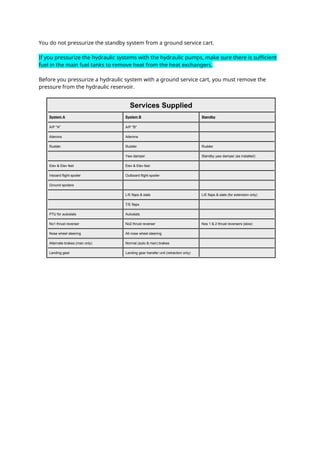
Services Supplied
System A System B Standby
A/P "A" A/P "B"
Ailerons Ailerons
Rudder Rudder Rudder
Yaw damper Standby yaw damper (as installed)
Elev & Elev feel Elev & Elev feel
Inboard flight spoiler Outboard flight spoiler
Ground spoilers
L/E flaps & slats L/E flaps & slats (for extension only)
T/E flaps
PTU for autoslats Autoslats
No1 thrust reverser No2 thrust reverser Nos 1 & 2 thrust reversers (slow)
Nose wheel steering Alt nose wheel steering
Alternate brakes (man only) Normal (auto & man) brakes
Landing gear Landing gear transfer unit (retraction only)













![[Deck] What's New in Spark-Iceberg Integration via DSV2.pptx](https://cdn.slidesharecdn.com/ss_thumbnails/deckwhatsnewinspark-icebergintegrationviadsv2-260210005337-25955b12-thumbnail.jpg?width=640&height=640&fit=bounds)


