What is it?
PUBLIC CLOUD
H Y B R I D C LO U D
PRIVATE CLOUD
Some companies may be able to provide on-site IT dedicated to data management, but
for companies unable to dedicate the time and money, a managed service provider can be a solution.PRO TIP:
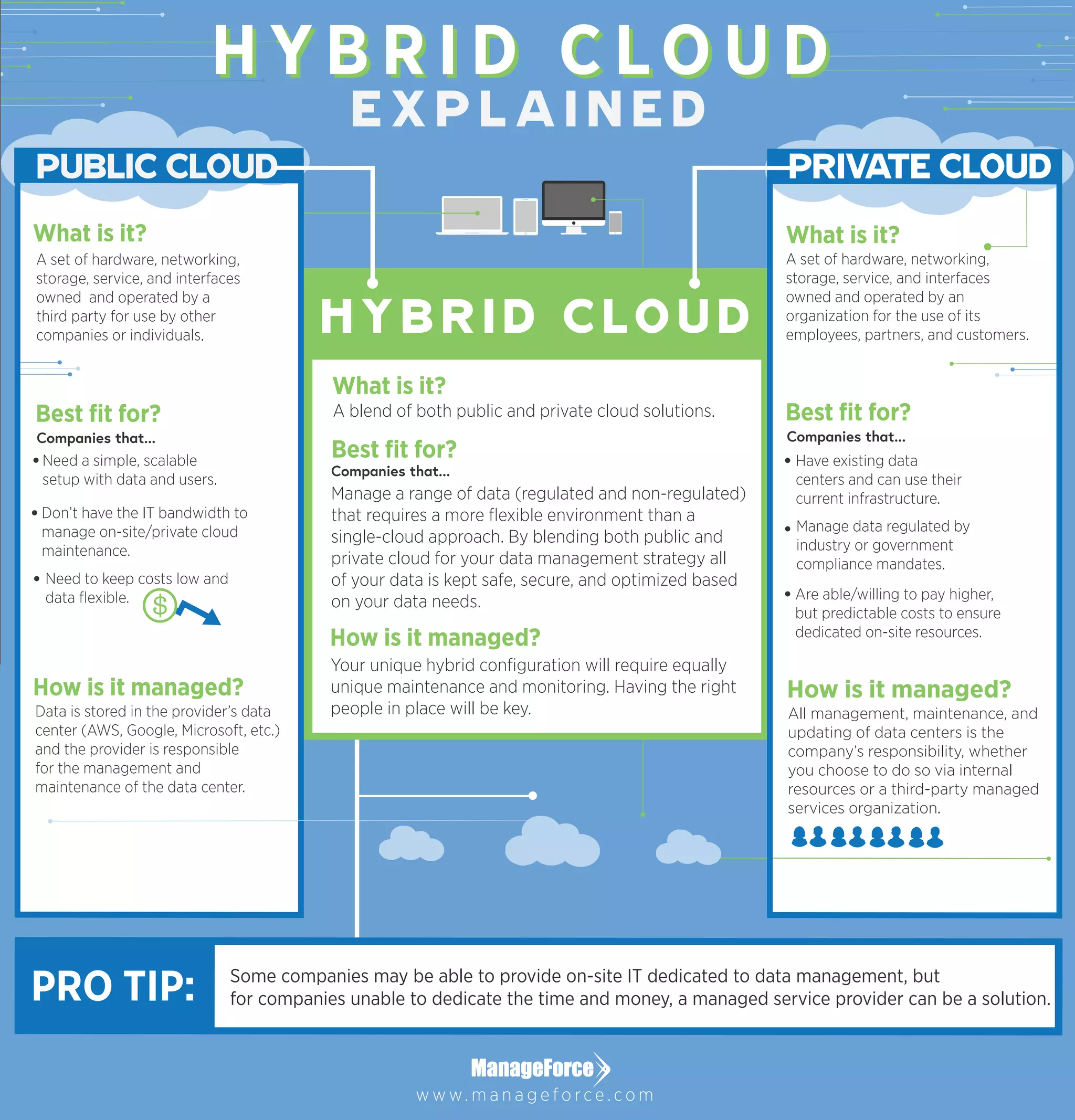
What is it?
A blend of both public and private cloud solutions.
How is it managed?
Best fit for?
Manage a range of data (regulated and non-regulated)
that requires a more flexible environment than a
single-cloud approach. By blending both public and
private cloud for your data management strategy all
of your data is kept safe, secure, and optimized based
on your data needs.
Companies that...
Your unique hybrid configuration will require equally
unique maintenance and monitoring. Having the right
people in place will be key.
Best fit for?
Need a simple, scalable
setup with data and users.
Don’t have the IT bandwidth to
manage on-site/private cloud
maintenance.
Companies that...
How is it managed?
Data is stored in the provider’s data
center (AWS, Google, Microsoft, etc.)
and the provider is responsible
for the management and
maintenance of the data center.
A set of hardware, networking,
storage, service, and interfaces
owned and operated by a
third party for use by other
companies or individuals.
What is it?
A set of hardware, networking,
storage, service, and interfaces
owned and operated by an
organization for the use of its
employees, partners, and customers.
How is it managed?
All management, maintenance, and
updating of data centers is the
company’s responsibility, whether
you choose to do so via internal
resources or a third-party managed
services organization.
Best fit for?
Have existing data
centers and can use their
current infrastructure.
Manage data regulated by
industry or government
compliance mandates.
Are able/willing to pay higher,
but predictable costs to ensure
dedicated on-site resources.
Companies that...
H Y B R I D C LO U DH Y B R I D C LO U D
E X P L A I N E D
Need to keep costs low and
data flexible.
w w w. m a n a g e f o r c e . c o m

Hybrid Cloud Explained

  • 1.
    What is it? PUBLICCLOUD H Y B R I D C LO U D PRIVATE CLOUD Some companies may be able to provide on-site IT dedicated to data management, but for companies unable to dedicate the time and money, a managed service provider can be a solution.PRO TIP: What is it? A blend of both public and private cloud solutions. How is it managed? Best fit for? Manage a range of data (regulated and non-regulated) that requires a more flexible environment than a single-cloud approach. By blending both public and private cloud for your data management strategy all of your data is kept safe, secure, and optimized based on your data needs. Companies that... Your unique hybrid configuration will require equally unique maintenance and monitoring. Having the right people in place will be key. Best fit for? Need a simple, scalable setup with data and users. Don’t have the IT bandwidth to manage on-site/private cloud maintenance. Companies that... How is it managed? Data is stored in the provider’s data center (AWS, Google, Microsoft, etc.) and the provider is responsible for the management and maintenance of the data center. A set of hardware, networking, storage, service, and interfaces owned and operated by a third party for use by other companies or individuals. What is it? A set of hardware, networking, storage, service, and interfaces owned and operated by an organization for the use of its employees, partners, and customers. How is it managed? All management, maintenance, and updating of data centers is the company’s responsibility, whether you choose to do so via internal resources or a third-party managed services organization. Best fit for? Have existing data centers and can use their current infrastructure. Manage data regulated by industry or government compliance mandates. Are able/willing to pay higher, but predictable costs to ensure dedicated on-site resources. Companies that... H Y B R I D C LO U DH Y B R I D C LO U D E X P L A I N E D Need to keep costs low and data flexible. w w w. m a n a g e f o r c e . c o m