Hybrid Additive
Manufacturing
Somnath Chattopadhyaya
Associate Professor,
Department of Mechanical Engineering,
Indian Institute of Technology (Indian School of Mines),
Dhanbad, Jharkahand,
Email: somuismu@gmail.com
Definition
Hybrid Additive Manufacturing till date is
known as the object-oriented combination
of laser cladding and CNC operation
within a single machine environment.
2
Slides of Hybrid Additive Manufacturing - Somnath Chattopadhyaya
Definition
•Hybrid additive manufacturing has
been attracting a lot of attention over
the past half a decade or so but it is
still in its infancy with lot of
technological hiccups that have to be
adroitly addressed.
3
Slides of Hybrid Additive Manufacturing - Somnath Chattopadhyaya
Definition
•It refers to a new class of machine tool that
brings the additive metal deposition nozzle
capability of the latest three dimensional printing
together with the axis control and metal-cutting
capabilities of modern machining centers.
•This combination means that metal deposition
can be performed along various axes.
4
Slides of Hybrid Additive Manufacturing - Somnath Chattopadhyaya
Definition
•The 3D printed material can be machined to
precise tolerances at any stage in the process,
even going back and forth between metal
deposition and metal cutting as often as
required.
•This adroit combination of additive and
subtractive manufacturing is the basis of the
term: hybrid-additive manufacturing.
5
Slides of Hybrid Additive Manufacturing - Somnath Chattopadhyaya
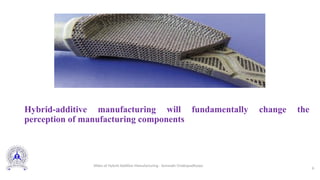
Hybrid-additive manufacturing will fundamentally change the
perception of manufacturing components
6
Slides of Hybrid Additive Manufacturing - Somnath Chattopadhyaya
Importance
•Give food to the people who are hungry and
give hunger to the people who have food.
– Publo Neruda (1904 – 1973)
7
Slides of Hybrid Additive Manufacturing - Somnath Chattopadhyaya
Importance
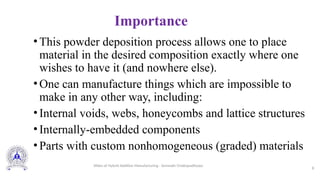
•This powder deposition process allows one to place
material in the desired composition exactly where one
wishes to have it (and nowhere else).
•One can manufacture things which are impossible to
make in any other way, including:
•Internal voids, webs, honeycombs and lattice structures
•Internally-embedded components
•Parts with custom nonhomogeneous (graded) materials
8
Slides of Hybrid Additive Manufacturing - Somnath Chattopadhyaya
9
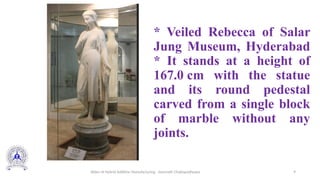
* Veiled Rebecca of Salar
Jung Museum, Hyderabad
* It stands at a height of
167.0 cm with the statue
and its round pedestal
carved from a single block
of marble without any
joints.
Slides of Hybrid Additive Manufacturing - Somnath Chattopadhyaya
Veiled Rebecca
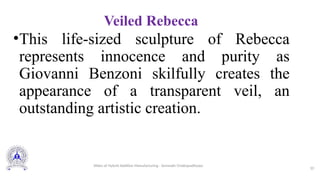
•This life-sized sculpture of Rebecca
represents innocence and purity as
Giovanni Benzoni skilfully creates the
appearance of a transparent veil, an
outstanding artistic creation.
10
Slides of Hybrid Additive Manufacturing - Somnath Chattopadhyaya
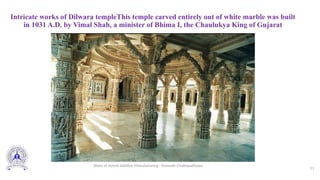
Intricate works of Dilwara templeThis temple carved entirely out of white marble was built
in 1031 A.D. by Vimal Shah, a minister of Bhima I, the Chaulukya King of Gujarat
11
Slides of Hybrid Additive Manufacturing - Somnath Chattopadhyaya
Slides of Hybrid Additive Manufacturing - Somnath Chattopadh
yaya
12
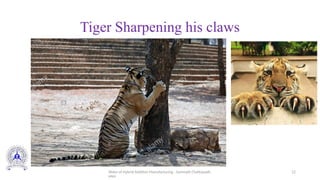
Tiger Sharpening his claws
Living Root Bridges of Meghalaya
13
Slides of Hybrid Additive Manufacturing - Somnath Chattopadhyaya
Slides of Hybrid Additive Manufacturing - Somnath Chattopadh
yaya
14
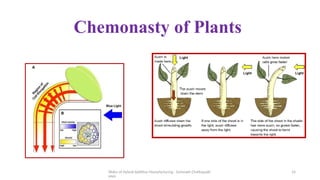
Chemonasty of Plants
Importance Hybrid Additive Manufacturing
•As a result, material composition and
placement become design variables, and
engineering part performance can be
dramatically improved.
•It might not be too ambitious to say that
this technology will be the important
catalyst for the next industrial revolution.
15
Slides of Hybrid Additive Manufacturing - Somnath Chattopadhyaya
Importance Hybrid Additive Manufacturing
•The relevant software provides support
for new hybrid-manufacturing
technologies in which additive
manufacturing (3D printing or metal
deposition) is incorporated with
subtractive (cutting) methods in a
conventional machine-tool environment.
16
Slides of Hybrid Additive Manufacturing - Somnath Chattopadhyaya
Importance Hybrid Additive Manufacturing
•These manufacturing techniques will reform the
way one thinks about manufacturing parts.
• By building complex and complicated
geometries, including internal cavities, and then
machining them for close and challenging
tolerances as they are manufactured, new classes
of machine parts can be manufactured, or many
setups may be compacted into one.
17
Slides of Hybrid Additive Manufacturing - Somnath Chattopadhyaya
Importance Hybrid Additive Manufacturing
•On the face of it, the dueling production techniques of
additive and subtractive seem like they would be
difficult to combine together, and, in some aspects,
they are.
•But if both additive and subtractive have been
synchronized appropriately, they can offer powerful
novel capabilities to manufacturing industries willing
to comprehend these new manufacturing processes.
18
Slides of Hybrid Additive Manufacturing - Somnath Chattopadhyaya
Potential of Hybrid Additive Manufacturing
•• Enable new designs
•• Machine internal areas during build
•• Repair parts easily
•• Tightly control tolerance during build
•• Produce finished parts on one machine
19
Slides of Hybrid Additive Manufacturing - Somnath Chattopadhyaya
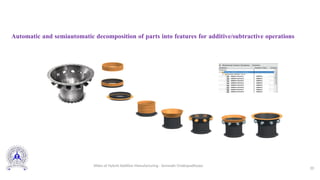
Automatic and semiautomatic decomposition of parts into features for additive/subtractive operations
20
Slides of Hybrid Additive Manufacturing - Somnath Chattopadhyaya
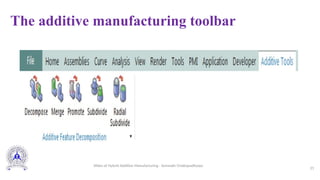
The additive manufacturing toolbar
21
Slides of Hybrid Additive Manufacturing - Somnath Chattopadhyaya
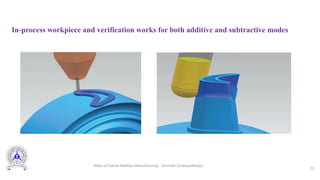
In-process workpiece and verification works for both additive and subtractive modes
22
Slides of Hybrid Additive Manufacturing - Somnath Chattopadhyaya
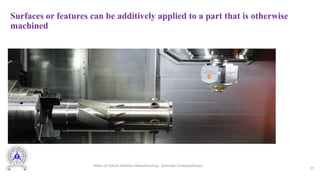
Surfaces or features can be additively applied to a part that is otherwise
machined
23
Slides of Hybrid Additive Manufacturing - Somnath Chattopadhyaya
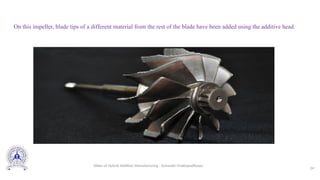
On this impeller, blade tips of a different material from the rest of the blade have been added using the additive head.
24
Slides of Hybrid Additive Manufacturing - Somnath Chattopadhyaya
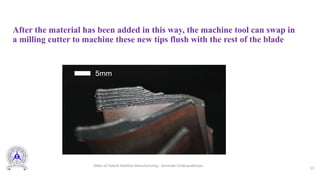
After the material has been added in this way, the machine tool can swap in
a milling cutter to machine these new tips flush with the rest of the blade
25
Slides of Hybrid Additive Manufacturing - Somnath Chattopadhyaya
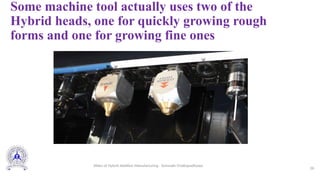
Some machine tool actually uses two of the
Hybrid heads, one for quickly growing rough
forms and one for growing fine ones
26
Slides of Hybrid Additive Manufacturing - Somnath Chattopadhyaya
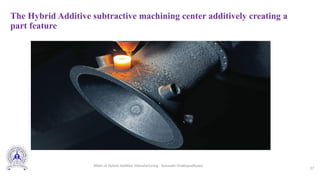
The Hybrid Additive subtractive machining center additively creating a
part feature
27
Slides of Hybrid Additive Manufacturing - Somnath Chattopadhyaya
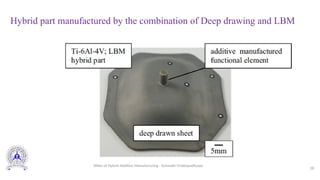
Hybrid part manufactured by the combination of Deep drawing and LBM
28
Slides of Hybrid Additive Manufacturing - Somnath Chattopadhyaya
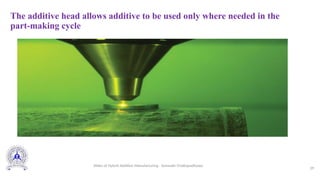
The additive head allows additive to be used only where needed in the
part-making cycle
29
Slides of Hybrid Additive Manufacturing - Somnath Chattopadhyaya
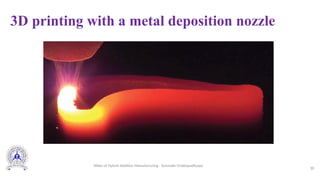
3D printing with a metal deposition nozzle
30
Slides of Hybrid Additive Manufacturing - Somnath Chattopadhyaya
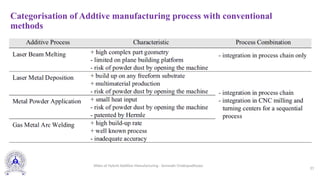
Categorisation of Addtive manufacturing process with conventional
methods
31
Slides of Hybrid Additive Manufacturing - Somnath Chattopadhyaya
Summary
•Science-enabled technology
development for 5-axis Hybrid
Additive Machining Center
• Robotic free-form deposition system
•Commercialization of technologies
with existing Industry linkages
32
Slides of Hybrid Additive Manufacturing - Somnath Chattopadhyaya
References
•[1] NX 11: Neue Entwicklungstechnologie für ein
neues Innovationszeitalter, www.siemens.com/plm
•[2] Slides of Ramesh Singh Machine Tools Lab,
Department of Mechanical Engineering, Indian
Institute of Technology Bombay
•[3] Marion Marklein et. al.,Friedrich-Alexander-
Universität Erlangen-Nürnberg, Egerlandstr. 13,
91058 Erlangen, Germany
33
Slides of Hybrid Additive Manufacturing - Somnath Chattopadhyaya

Hybrid Additive Manufacturing application and advanced

  • 1.
    Hybrid Additive Manufacturing Somnath Chattopadhyaya AssociateProfessor, Department of Mechanical Engineering, Indian Institute of Technology (Indian School of Mines), Dhanbad, Jharkahand, Email: somuismu@gmail.com
  • 2.
    Definition Hybrid Additive Manufacturingtill date is known as the object-oriented combination of laser cladding and CNC operation within a single machine environment. 2 Slides of Hybrid Additive Manufacturing - Somnath Chattopadhyaya
  • 3.
    Definition •Hybrid additive manufacturinghas been attracting a lot of attention over the past half a decade or so but it is still in its infancy with lot of technological hiccups that have to be adroitly addressed. 3 Slides of Hybrid Additive Manufacturing - Somnath Chattopadhyaya
  • 4.
    Definition •It refers toa new class of machine tool that brings the additive metal deposition nozzle capability of the latest three dimensional printing together with the axis control and metal-cutting capabilities of modern machining centers. •This combination means that metal deposition can be performed along various axes. 4 Slides of Hybrid Additive Manufacturing - Somnath Chattopadhyaya
  • 5.
    Definition •The 3D printedmaterial can be machined to precise tolerances at any stage in the process, even going back and forth between metal deposition and metal cutting as often as required. •This adroit combination of additive and subtractive manufacturing is the basis of the term: hybrid-additive manufacturing. 5 Slides of Hybrid Additive Manufacturing - Somnath Chattopadhyaya
  • 6.
    Hybrid-additive manufacturing willfundamentally change the perception of manufacturing components 6 Slides of Hybrid Additive Manufacturing - Somnath Chattopadhyaya
  • 7.
    Importance •Give food tothe people who are hungry and give hunger to the people who have food. – Publo Neruda (1904 – 1973) 7 Slides of Hybrid Additive Manufacturing - Somnath Chattopadhyaya
  • 8.
    Importance •This powder depositionprocess allows one to place material in the desired composition exactly where one wishes to have it (and nowhere else). •One can manufacture things which are impossible to make in any other way, including: •Internal voids, webs, honeycombs and lattice structures •Internally-embedded components •Parts with custom nonhomogeneous (graded) materials 8 Slides of Hybrid Additive Manufacturing - Somnath Chattopadhyaya
  • 9.
    9 * Veiled Rebeccaof Salar Jung Museum, Hyderabad * It stands at a height of 167.0 cm with the statue and its round pedestal carved from a single block of marble without any joints. Slides of Hybrid Additive Manufacturing - Somnath Chattopadhyaya
  • 10.
    Veiled Rebecca •This life-sizedsculpture of Rebecca represents innocence and purity as Giovanni Benzoni skilfully creates the appearance of a transparent veil, an outstanding artistic creation. 10 Slides of Hybrid Additive Manufacturing - Somnath Chattopadhyaya
  • 11.
    Intricate works ofDilwara templeThis temple carved entirely out of white marble was built in 1031 A.D. by Vimal Shah, a minister of Bhima I, the Chaulukya King of Gujarat 11 Slides of Hybrid Additive Manufacturing - Somnath Chattopadhyaya
  • 12.
    Slides of HybridAdditive Manufacturing - Somnath Chattopadh yaya 12 Tiger Sharpening his claws
  • 13.
    Living Root Bridgesof Meghalaya 13 Slides of Hybrid Additive Manufacturing - Somnath Chattopadhyaya
  • 14.
    Slides of HybridAdditive Manufacturing - Somnath Chattopadh yaya 14 Chemonasty of Plants
  • 15.
    Importance Hybrid AdditiveManufacturing •As a result, material composition and placement become design variables, and engineering part performance can be dramatically improved. •It might not be too ambitious to say that this technology will be the important catalyst for the next industrial revolution. 15 Slides of Hybrid Additive Manufacturing - Somnath Chattopadhyaya
  • 16.
    Importance Hybrid AdditiveManufacturing •The relevant software provides support for new hybrid-manufacturing technologies in which additive manufacturing (3D printing or metal deposition) is incorporated with subtractive (cutting) methods in a conventional machine-tool environment. 16 Slides of Hybrid Additive Manufacturing - Somnath Chattopadhyaya
  • 17.
    Importance Hybrid AdditiveManufacturing •These manufacturing techniques will reform the way one thinks about manufacturing parts. • By building complex and complicated geometries, including internal cavities, and then machining them for close and challenging tolerances as they are manufactured, new classes of machine parts can be manufactured, or many setups may be compacted into one. 17 Slides of Hybrid Additive Manufacturing - Somnath Chattopadhyaya
  • 18.
    Importance Hybrid AdditiveManufacturing •On the face of it, the dueling production techniques of additive and subtractive seem like they would be difficult to combine together, and, in some aspects, they are. •But if both additive and subtractive have been synchronized appropriately, they can offer powerful novel capabilities to manufacturing industries willing to comprehend these new manufacturing processes. 18 Slides of Hybrid Additive Manufacturing - Somnath Chattopadhyaya
  • 19.
    Potential of HybridAdditive Manufacturing •• Enable new designs •• Machine internal areas during build •• Repair parts easily •• Tightly control tolerance during build •• Produce finished parts on one machine 19 Slides of Hybrid Additive Manufacturing - Somnath Chattopadhyaya
  • 20.
    Automatic and semiautomaticdecomposition of parts into features for additive/subtractive operations 20 Slides of Hybrid Additive Manufacturing - Somnath Chattopadhyaya
  • 21.
    The additive manufacturingtoolbar 21 Slides of Hybrid Additive Manufacturing - Somnath Chattopadhyaya
  • 22.
    In-process workpiece andverification works for both additive and subtractive modes 22 Slides of Hybrid Additive Manufacturing - Somnath Chattopadhyaya
  • 23.
    Surfaces or featurescan be additively applied to a part that is otherwise machined 23 Slides of Hybrid Additive Manufacturing - Somnath Chattopadhyaya
  • 24.
    On this impeller,blade tips of a different material from the rest of the blade have been added using the additive head. 24 Slides of Hybrid Additive Manufacturing - Somnath Chattopadhyaya
  • 25.
    After the materialhas been added in this way, the machine tool can swap in a milling cutter to machine these new tips flush with the rest of the blade 25 Slides of Hybrid Additive Manufacturing - Somnath Chattopadhyaya
  • 26.
    Some machine toolactually uses two of the Hybrid heads, one for quickly growing rough forms and one for growing fine ones 26 Slides of Hybrid Additive Manufacturing - Somnath Chattopadhyaya
  • 27.
    The Hybrid Additivesubtractive machining center additively creating a part feature 27 Slides of Hybrid Additive Manufacturing - Somnath Chattopadhyaya
  • 28.
    Hybrid part manufacturedby the combination of Deep drawing and LBM 28 Slides of Hybrid Additive Manufacturing - Somnath Chattopadhyaya
  • 29.
    The additive headallows additive to be used only where needed in the part-making cycle 29 Slides of Hybrid Additive Manufacturing - Somnath Chattopadhyaya
  • 30.
    3D printing witha metal deposition nozzle 30 Slides of Hybrid Additive Manufacturing - Somnath Chattopadhyaya
  • 31.
    Categorisation of Addtivemanufacturing process with conventional methods 31 Slides of Hybrid Additive Manufacturing - Somnath Chattopadhyaya
  • 32.
    Summary •Science-enabled technology development for5-axis Hybrid Additive Machining Center • Robotic free-form deposition system •Commercialization of technologies with existing Industry linkages 32 Slides of Hybrid Additive Manufacturing - Somnath Chattopadhyaya
  • 33.
    References •[1] NX 11:Neue Entwicklungstechnologie für ein neues Innovationszeitalter, www.siemens.com/plm •[2] Slides of Ramesh Singh Machine Tools Lab, Department of Mechanical Engineering, Indian Institute of Technology Bombay •[3] Marion Marklein et. al.,Friedrich-Alexander- Universität Erlangen-Nürnberg, Egerlandstr. 13, 91058 Erlangen, Germany 33 Slides of Hybrid Additive Manufacturing - Somnath Chattopadhyaya