F I N A L R E P O R T
April 2022
Foreword..................................................................................................................................01
Overview of Recommendations....................................................................................................02
Introduction..............................................................................................................................03
	
g About the Hunt-Lee Commission......................................................................................04
	
g About this Report.............................................................................................................05
	
g Our Collective Responsibility............................................................................................06
Build on What We Have.................................................................................................................07
	
g Strengthen Our Data Information and Sharing...........................................................................07
	
g Model Potential Enhancements to Our School Finance System.................................................08
	
g Increase the Availability of Child Care Subsidies........................................................................08
	
g Reduce Barriers to Access for NC Pre-K......................................................................................09
	
g Incentivize Excellent Teachers to Work in High-Need Schools...................................................10
	
g Expand the Advanced Teaching Roles Pilot................................................................................11
	
g Grow the School Leader Pipeline................................................................................................11
	
g Improve Schools’ and Districts’ Ability to Respond to Student Needs.......................................12
Invite and Test New Ideas...............................................................................................................14
	
g Identify Opportunities to Make Early Child Education a Financially Viable Career................14
	
g Incentivize Providers to Open More Spaces for Infant and Toddler Care...........................15
	
g Bridge Student Transitions from Middle to High School....................................................16
Implement Proven Solutions..........................................................................................................17
	
g Expand Home Visiting Programs.......................................................................................17
	
g Renew and Sustain the State’s Financial Support for Students Pursuing a Two-Year Degree....17
	
g Expand Eligibility for In-State Tuition................................................................................18
	
g Increase Non-Academic Supports for Postsecondary Students.........................................18
	
g Increase Support for FAFSA Completion............................................................................19
Conclusion................................................................................................................................20
Appendix A: Meeting Overviews....................................................................................................22
Appendix B: Commission Members................................................................................................23
TABLE OF CONTENTS
FOREWARD
Policymakers, practitioners, advocates, and agencies from across North Carolina have long
pursued opportunities to strengthen our education system. We are proud of the progress
we have made as a state. At the same time, we must acknowledge that stark differences in
student outcomes and opportunities persist, many of which the pandemic has made worse.
We know that the best solutions to our longstanding challenges in North Carolina’s
education system (early learning through higher education) do not lie with any single
group; real change requires that leaders from across the state, across the education
continuum, and across sectors build trust, find common ground, and work together on
behalf of students and families.
It is with these understandings in mind that we formed the Hunt-Lee Commission to
identify strategies to address some of the most deep-rooted challenges facing North
Carolina’s education continuum and to strengthen the systems responsible for overseeing
it. In so doing, we tapped into The Hunt Institute’s strong relationships across the state and
its capacity to bring together the people and resources necessary to drive strategic action.
The result is a commission that represents leaders from government, business, and
philanthropy and reflects the full diversity of the state we seek to serve. Moreover, it
brings together leaders who might not otherwise sit around the same table to think outside
the box and problem-solve, building relationships that will continue well beyond this body’s
work.
We are exceedingly grateful to all the Commissioners who volunteered their time for this
effort. Over the course of four meetings, they paused their many responsibilities to gather,
learn from local and national experts, talk with one another, and identify a path forward.
The recommendations that follow represent our collective will, and we are committed to
seeing them through.
Sincerely,
Governor James B. Hunt Senator Howard Lee Senator Michael Lee
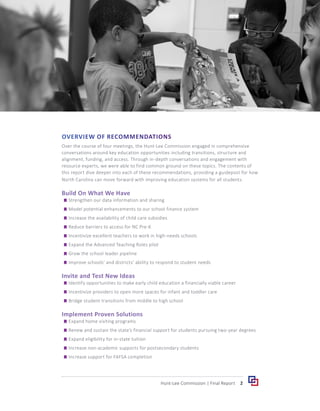
OVERVIEW OF RECOMMENDATIONS
Over the course of four meetings, the Hunt-Lee Commission engaged in comprehensive
conversations around key education opportunities including transitions, structure and
alignment, funding, and access. Through in-depth conversations and engagement with
resource experts, we were able to find common ground on these topics. The contents of
this report dive deeper into each of these recommendations, providing a guidepost for how
North Carolina can move forward with improving education systems for all students.
Build On What We Have
	
g Strengthen our data information and sharing
	
g Model potential enhancements to our school finance system
	
g Increase the availability of child care subsidies
	
g Reduce barriers to access for NC Pre-K
	
g Incentivize excellent teachers to work in high-needs schools
	
g Expand the Advanced Teaching Roles pilot
	
g Grow the school leader pipeline

	
g Improve schools’ and districts’ ability to respond to student needs
Invite and Test New Ideas
	
g Identify opportunities to make early child education a financially viable career
	
g Incentivize providers to open more spaces for infant and toddler care
	
g Bridge student transitions from middle to high school
Implement Proven Solutions
	
g Expand home visiting programs
	
g Renew and sustain the state’s financial support for students pursuing two-year degrees
	
g Expand eligibility for in-state tuition
	
g Increase non-academic supports for postsecondary students
	
g Increase support for FAFSA completion
2
Hunt-Lee Commission | Final Report
3 Hunt-Lee Commission | Final Report
INTRODUCTION
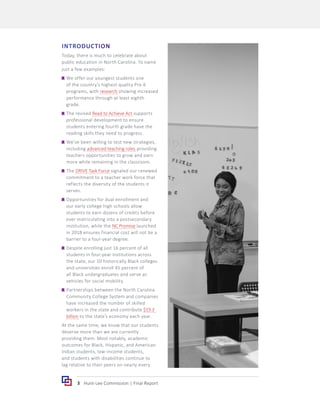
Today, there is much to celebrate about
public education in North Carolina. To name
just a few examples:
	
g We offer our youngest students one
of the country’s highest quality Pre-K
programs, with research showing increased
performance through at least eighth
grade.
	
g The revised Read to Achieve Act supports
professional development to ensure
students entering fourth grade have the
reading skills they need to progress.
	
g We’ve been willing to test new strategies,
including advanced teaching roles providing
teachers opportunities to grow and earn
more while remaining in the classroom.
	
g The DRIVE Task Force signaled our renewed
commitment to a teacher work force that
reflects the diversity of the students it
serves.
	
g Opportunities for dual enrollment and
our early college high schools allow
students to earn dozens of credits before
ever matriculating into a postsecondary
institution, while the NC Promise launched
in 2018 ensures financial cost will not be a
barrier to a four-year degree.
	
g Despite enrolling just 16 percent of all
students in four-year institutions across
the state, our 10 historically Black colleges
and universities enroll 45 percent of
all Black undergraduates and serve as
vehicles for social mobility.
	
g Partnerships between the North Carolina
Community College System and companies
have increased the number of skilled
workers in the state and contribute $19.3
billion to the state’s economy each year.
At the same time, we know that our students
deserve more than we are currently
providing them. Most notably, academic
outcomes for Black, Hispanic, and American
Indian students, low-income students,
and students with disabilities continue to
lag relative to their peers on nearly every
4
Hunt-Lee Commission | Final Report
metric from kindergarten readiness and third grade reading to high school graduation and
post-secondary attainment. Moreover, the COVID-19 pandemic exacerbated inequities by
imposing additional challenges in the form of unfinished learning, enrollment decreases,
educator shortages, and untold emotional trauma.
Let there be no question; we all share responsibility for our students’ success. And
our systems provide some communities and students less access to the resources and
opportunities they need to succeed. But these issues and concerns are not new. A variety
of policymakers and practitioners, as well as committees, court cases, consultants, and
other education advocates have studied the challenges our education systems face and
have proposed changes. While those efforts have led to some changes, for a variety of
reasons, they have not yet gotten us where we need to be.
About the Hunt-Lee Commission
The Hunt-Lee Commission formed to offer a new approach to old barriers. Central to that
new approach are our members:
	
g We are a bipartisan group with the support of leaders in both the North Carolina House
of Representatives and Senate, as well as the Governor’s Office.
	
g We represent the full continuum from birth through workforce development,
recognizing that the different bodies supporting students along their journey must work
in concert with one another and coordinate efforts.
	
g Our expertise crosses sectors, to include education, business, government, and
philanthropy.
	
g We represent the growing racial and ethnic diversity of our state and the students it
serves.
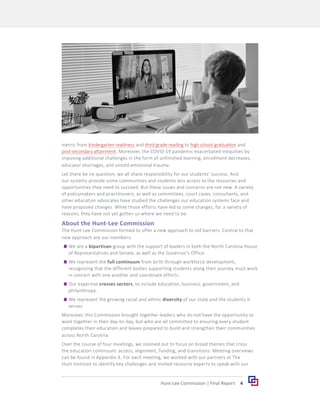
Moreover, this Commission brought together leaders who do not have the opportunity to
work together in their day-to-day, but who are all committed to ensuring every student
completes their education and leaves prepared to build and strengthen their communities
across North Carolina.
Over the course of four meetings, we zoomed out to focus on broad themes that cross
the education continuum: access, alignment, funding, and transitions. Meeting overviews
can be found in Appendix A. For each meeting, we worked with our partners at The
Hunt Institute to identify key challenges and invited resource experts to speak with our
5 Hunt-Lee Commission | Final Report
Commissioners. Commissioners then had the opportunity to discuss their reactions
and consider key questions within the context of our state’s educational landscape and
systems. We also created a running list of potential recommendations, which we refined
and reconsidered with each new piece of information.
About this Report
Based on those meetings and discussions, several things became clear. First, we have
many strong systems and programs in place. Where possible, we should improve on the
foundation we have already created to ensure our education systems benefit all students,
regardless of geographic location, race, or income-level. In other areas, we are still figuring
out what’s needed. In those cases, we should test new strategies and use what we learn
to forge a path forward. But there are also instances where we already know what works,
and we need to find the policy and resources – both financial and otherwise – to act
accordingly.
Moreover, our work highlighted the extent to which agencies and localities often have the
authority to do what’s needed without further action from lawmakers. Hence, we all share
responsibility for finding answers and implementing solutions.
This group did not set out to develop a comprehensive plan for North Carolina education.
Rather, its members sought to look across our education system and identify areas of
consensus from which we can build trust and forward momentum. As such, this report
represents a starting point, rather than a silver bullet. Nonetheless, it offers critical proof
that if we chip away at the challenges before us, we can – and will – make inroads for the
benefit of all students.
6
Hunt-Lee Commission | Final Report
OUR COLLECTIVE RESPONSIBILITY
As we consider strategies to improve public education in North Carolina,
it is important to acknowledge that we all share responsibility for both the
process and the outcomes. Many of the recommendations that follow focus on
steps lawmakers could take. But our conversations also highlighted the many
solutions that live outside of the General Assembly, including the need to align
and coordinate across organizations and to exercise agency where it already
exists.
Coordination and Alignment
The critical importance of alignment across sectors and across the education
continuum arose as a theme throughout the Commission’s work. Whether
aligning state, district, and local school improvement plans, transitioning
students between grades, buildings, and institutions, or tapping public-private
partnerships to provide services to students and families, providers must work
with one another to both get the job done and ensure students and families
have what they need to succeed. Moreover, doing so often requires time and
strong relationships more so than dollars or new policies.
Fortunately, there are already local working groups and non-governmental
organizations working to fill this space. myFutureNC partnered with the
UNC School of Government’s ncIMPACT Initiative to launch 15 community
collaboratives aimed at better aligning their education systems with the needs
of their regional economies. Similarly, the NC Division of Child Development
and Early Education is partnering with The Hunt Institute to support diverse
county-level, cross-sector human services leadership teams to develop or
enhance scalable and sustainable local strategic plans drawing on early
childhood data. And the longest operating system of local coordination, the
state’s network of Smart Start Local Partnerships, are facilitating county-wide,
cross-sector alignment. As we look ahead, we should prioritize and seek out
opportunities to partner in these ways.
Exercising Agency
Another theme from our meetings was how much practitioners can already
do and the need to exercise agency where it exists. For example, any district
can set a public goal for increasing educator diversity within their schools
and report back on progress. Similarly, system leaders and the agencies
that support them can identify key developmental and career information
that students, families and educators ought to receive and create a plan for
providing it.
Throughout the recommendations that follow, we therefore highlight where
there is a role for stakeholders outside of the General Assembly to step up and
help to move this important work forward.
7 Hunt-Lee Commission | Final Report
BUILD ON WHAT WE HAVE
As noted at the beginning of this report, North Carolina is doing a lot that is right. To that
end, Commissioners identified eight opportunities to build on or improve the systems and
programs we already have.
Strengthen our data information and sharing.
Empowering policymakers and practitioners with access to accurate and timely data can
change the way we deliver education. It follows that states across the country are seeking
ways to build systems that effectively collect, compile, and analyze data across agencies
to answer complex questions. Access to accurate and timely data will allow us to better
understand which students are not successful, where on the continuum they are lost, and
what barriers they may experience.
In 2012, NC General Statute 116E established the state’s Longitudinal Data System (NCLDS),
which connects data sources across the education continuum. More specifically, the NCLDS
captures data from the early childhood (NC Department of Health and Human Services),
K-12 (DPI), and postsecondary (the NC Community College System, the UNC System, and NC
Independent Colleges and Universities) sectors. It also includes data from the workforce
sector in the form of wage data from the NC Department of Commerce. These partners have
signed a memorandum of understanding (MOU) that governs how they share data through
the NCLDS. Moreover, Executive Order No. 249 codifies the NCLDS Governance Board, and
the Government Data Analytics Center (GDAC) provides general oversight and direction.
The Challenge. NCLDS currently faces several challenges that impede its effectiveness.
In some cases, the data from different systems do not always “talk” to one another as
intended because those systems apply different rules in how they measure and label
information. Equally important, the demand for analyzing NCLDS data far outstrips the
current capacity to do so across the contributing agencies.
Recommendations. To address the challenges above, we recommend six steps:
	
g Support additional staffing for data analysts at contributing agencies and entities.
	
g Ensure the individuals and organizations working directly with the data system
have mechanisms in place to communicate and share information with one another
intentionally.
	
g Work with policymakers to develop an understanding of what data they need to inform
policymaking.
	
g Intentionally inform stakeholders beyond the traditional state agencies (i.e., public/
private partnerships, contracting bodies, etc.) of the data available for review and
analysis to inform their work.
	
g Include NCLDS stakeholders in the system design process to ensure the technical
infrastructure has the flexibility to support NCLDS’ short- and long-term goals, and the
safeguards to address concerns about data quality, security, and privacy.
	
g Create datasets and dashboards to guide policymakers, researchers, and analysts
towards the system’s research priorities and to provide them with high-quality, timely
data in a timely and efficient manner.
	
g Continually identify and seek out opportunities to add additional datasets to the NCLDS
and connect different data systems by standardizing system specifications and contract
terms across agencies and sectors where possible and appropriate.
8
Hunt-Lee Commission | Final Report
Model potential enhancements to our school finance system.
Public education aims to provide all students with the skills and knowledge they need
to be successful and productive adults. To that end, the research makes clear that money
matters. At the same time, how schools and districts spend money is also critical. To
assess the impact our educational investments have on student outcomes, there must be
transparency both in how dollars flow and how schools and districts use those dollars to
support student outcomes.
The Challenge. Some of our Commissioners shared that they struggle to understand how
state education dollars in North Carolina flow, making it difficult to evaluate the equity of
our process, assess the impact those dollars have, and hold practitioners accountable for
the decisions they make. Others noted the inherent complexity of school funding and the
risks of over-simplifying. It is clear, however, that North Carolina is an outlier nationally with
respect to its allocation-based school funding formula, and that some pieces of our current
funding formula could be improved.
Ultimately, policymakers, practitioners, and the public need better information to
understand how our funding allocations would look if we adjusted parts of the formula and
what we might lose – or gain – by simplifying our current process.
Recommendation. Request that the General Assembly create a model that allows
policymakers to consider and weigh different options and trade-offs to how we fund
schools, including but not limited to:
	
g Changing the weights and caps we currently apply
	
g Adding additional weights to reflect student needs
	
g Having dollars follow students to districts
	
g Identifying transition costs associated with any changes
	
g Identifying the impact of overall district funding associated with any change
	
g Identifying how any changes would impact the funding directed to districts serving
students with the greatest needs
Increase the availability of child care subsidies.
Research shows that giving families child care subsidies improves outcomes for children and
families in two key ways. First, it allows families to choose higher quality child care, which
can help children grow and develop well. Secondly, subsidies help parents remain in the
workforce, thus boosting their lifetime earnings and improving their long-term financial
health. In turn, higher family incomes and reduced time in poverty are both associated with
better long-term outcomes for children.
Since 1990, North Carolina has provided families the opportunity to receive subsidies to
offset the cost of child care. Currently, families earning up to 200 percent of the federal
poverty level (~$56,000 for a family of four) are eligible for these subsidies. In addition,
families are responsible for a co-pay that varies based on their income.
The Challenge. Demand for child care subsidies far exceeds supply, with waiting lists in
the thousands. Moreover, although co-pays vary based on family income, the size of the
subsidy families receive does not. As a result, a small increase in family income could result
in a family becoming ineligible, and the lowest-income families receive as large a subsidy as
those earning at the top of the eligibility window. In addition, subsidies do not cover true
market costs. For these reasons, the Department of Health and Human Services is planning
to hire a consultant to research new ways to structure its child care subsidy.
9 Hunt-Lee Commission | Final Report
Recommendation. Test different funding mechanisms that would expand access to child
care subsidies to more families, including:
	
g Increasing the number of current subsidies available
	
g Increasing the maximum amount of the subsidy
	
g Scaling the subsidy amount based on family income
Reduce barriers to access for NC Pre-K.
The NC Pre-K program offers eligible four-year-old children high-quality educational
experiences addressing all five of the developmental domains critical to children’s overall
well-being and success as they enter school. Duke University researchers studied the impact
of the More at Four program (now NC Pre-K) on academic outcomes among middle school
students in a 2019 report. They found that program participation resulted in higher end-of-
grade scores in both reading and math, lower retention rates, and fewer special education
placements. Moreover, the positive results grew over time.
The Challenge. Currently, just over half of eligible students participate in NC Pre-K, and the
state has struggled to increase that figure due largely to challenges related to supply. Since
2012, reimbursement rates have increased just two percent - about $57 per slot – which
does not incentivize additional slots. The state also has an insufficient allowable amount
of funding for administrative costs. In addition, private centers generally pay their Pre-K
teachers less than the public schools because there is not a pay scale. But as a result,
certified Pre-K teachers often leave for public school positions if given the opportunity.
Space for program expansion is also a challenge, though the latest budget begins to
make some inroads on this lack of capacity by including a line item to support quality
improvements, including increases to a facility’s capacity.
Recommendation. Address the challenges described above by testing and assessing the
relative impact of the following strategies:
	
g Increasing the reimbursement rate to reflect market costs more accurately
	
g Increasing the allowable amount of funding for administrative costs
	
g Providing pay parity between NC Pre-K teachers located in private centers and public
schools
PRE-K AND THE CRITICAL IMPORTANCE OF STRONG IMPLEMENTATION
A recent study of a Pre-K program in Tennessee makes clear that all programs
are not equal, and strong implementation is key. Fortunately, North Carolina’s
Pre-K program has over 15 years of evidence from both the University of North
Carolina and Duke, showing that its play-based curriculum and insistence on
well-trained, highly-qualified teachers has lasting impacts for children. Hence,
it is vitally important that any efforts to increase access to Pre-K in North
Carolina maintain the state’s high-quality bar.
10
Hunt-Lee Commission | Final Report
Incentivize excellent teachers to work in high-need schools.
National Board Certification (NBCT) is a rigorous teacher certification process that aims to
develop, retain, and recognize accomplished teachers as well as generate ongoing school
improvement. Teachers earn their certification by demonstrating that they know and can
implement the strategies of highly effective teachers. Numerous studies have found NBCT to
positively increase student performance. At least one study also found that attrition is lower
among NCBTs.
North Carolina has successfully incentivized its teachers to pursue their national board
certification. Candidates can apply for a state-subsidized $1900 loan to pay for the program
application process and receive up to three days of paid release time to develop their
portfolios. Upon completion of the program, NCBTs are eligible for an annual 12 percent pay
differential. As a result of these incentives, North Carolina now leads the nation with 23,418
National Board-Certified teachers.
The Challenge. Data shows, however, that our most well-credentialed teachers – to
include those who have earned their National Board certification – are less likely to teach
in schools serving higher percentages of low-income students and students of color. As
one example, the lowest poverty districts have almost twice as many NCBTs as the highest
poverty districts. Meanwhile, principals who persistently earn high growth in their schools
can receive a $30,000 annual salary supplement to move to a low-performing school for up to
three years.
Recommendation. Build off the state’s success incentivizing teachers to attain national
board certification by piloting different mechanisms for encouraging our most effective
teachers to work in high-needs schools, such as:
	
g Providing additional compensation for NBCT teachers and/or teachers with the highest
EVAAS scores to work and/or remain in high-poverty schools.
	
g Offering loan forgiveness to the teacher OR their immediate family (i.e., spouse,
children)
Moreover, pilots could explore offering these incentives to individual teachers or to groups
of teachers (and potentially, their principal as well) who transfer to a low-performing school
together as part of a strategic staffing initiative.
OUR COLLECTIVE RESPONSIBILITY: DRAWING ON PUBLIC-PRIVATE
PARTNERSHIPS TO INCREASE ACCESS TO EARLY LEARNING
Even if NC Pre-K or other early childhood programs were to receive funding
to increase access, centers must identify and secure physical spaces to hold
their classes. Ideally, those new spaces would also include underserved
communities most in need of additional providers. Hence increasing access
to early childhood goes beyond funding and legislative policy; it also requires
coordination and alignment across local partners that can provide additional
teachers and space.
11
Hunt-Lee Commission | Final Report
Expand the Advanced Teaching Roles pilot.
North Carolina launched the advanced teaching roles (ATR) initiative in 2016 to enable
outstanding educators to extend their reach to more students without leaving the
classroom, recognize teacher leaders with higher compensation, and improve professional
development for developing teachers.
The Challenge. Fifteen districts participated in the initiative in the 2021-22 school year,
though pilots have not included all teachers in every district. ATR models also differ across
districts, though several use Public Impact’s Opportunity Culture model. According to a
2020 evaluation submitted to the State Board of Education, the preliminary impact of ATR
on student outcomes were not consistent or definitive, though researchers concluded
that “the program has the potential to contribute to positive changes in overall school
performance.” They also found, however, that advanced teaching roles were well received
by teachers and that turnover for those roles was low.
Recommendation. Continue and expand the ATR initiative with the goal of collecting
better data that will allow the state to measure the relative impact of different ATR models.
Expansion should prioritize:
	
g Growth within existing districts with the strongest implementation to evaluate the
impact of ATRs at scale
	
g Growth in districts under-represented within the current pilot sites
	
g Plans that compensate teachers for additional work
	
g Models that offer pathways into teaching for teaching assistants by partnering with
institutions of higher education
Grow the school leader pipeline.
Principals work to foster school culture, serve as instructional leaders, and recruit, develop,
and retain school staff. As such, they play a critical role within schools and have a large
impact on student learning; studies estimate that school leaders account for one-fourth
of school-based effects on student achievement, making their impact second only to
teachers.
The Challenge. According to the Department of Public Instruction, North Carolina needs
250-300 highly trained school leaders each year who are ready to serve as principals.
OUR COLLECTIVE RESPONSIBILITY: SUPPORTING TEACHERS AS
THEY ADVANCE
In addition to providing career pathways, it is also important to develop
teachers so they are prepared to assume new and more challenging roles
over time. Hence, as districts design new roles, they should do so with an eye
towards baking development opportunities into their models.
Districts committed to building a workforce that is both excellent and diverse
must also take steps to ensure that all teachers are encouraged and have
opportunities to pursue advanced roles, including setting targets for different
teachers pursuing advanced roles and being intentional in outreach efforts.
12
Hunt-Lee Commission | Final Report
However, the state struggles to meet that goal each year, the consequences of which
disproportionately impact high-need schools. The North Carolina Principal Fellows Program
formed to help build the state’s principal pipeline, and has had some positive results, but
it only produces about 40 percent of the school leaders the state needs each year. NC DPI
also recently announced a partnership with the North Carolina Principals and Assistant
Principals’ Association and the Belk Foundation to fast-track high-potential assistant
principals into principal roles, but that program is currently a pilot and will take several
years to produce candidates ready to fully lead.
Recommendation. Moving forward, the state needs to grow the principal pipeline by
expanding existing programs with proven results and/or supplementing with new programs
that can meet specific needs, such as a training program focused specifically on turnaround
leaders or ensuring our school leaders reflect the diversity of the students they serve.
Improve schools’ and districts’ ability to respond to student needs.
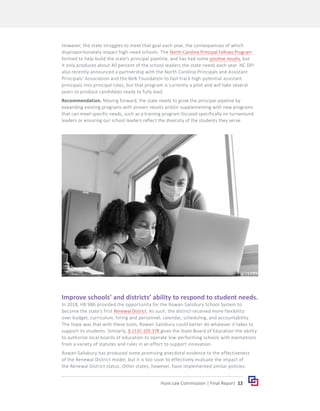
In 2018, HB 986 provided the opportunity for the Rowan-Salisbury School System to
become the state’s first Renewal District. As such, the district received more flexibility
over budget, curriculum, hiring and personnel, calendar, scheduling, and accountability.
The hope was that with these tools, Rowan-Salisbury could better do whatever it takes to
support its students. Similarly, § 115C-105.37B gives the State Board of Education the ability
to authorize local boards of education to operate low-performing schools with exemptions
from a variety of statutes and rules in an effort to support innovation.
Rowan-Salisbury has produced some promising anecdotal evidence to the effectiveness
of the Renewal District model, but it is too soon to effectively evaluate the impact of
the Renewal District status. Other states, however, have implemented similar policies.
13 Hunt-Lee Commission | Final Report
Nineteen Texas districts are part of the System of Great Schools, which allows district leaders
to expand what works, replace what doesn’t, and “pursue all possible options to create
high-quality, best-fit schools.” Meanwhile, Indiana’s policymakers passed legislation in 2015
creating Innovation Network Schools within Indianapolis Public Schools, granting individual
schools more opportunity to respond to student needs. According to a 2019 study from
Stanford University’s CREDO Institute, students attending Indianapolis’ Innovation Network
Schools achieved growth equivalent to 53 days of additional learning in ELA and 89 days of
additional learning in math compared to students in the district’s traditional public schools.
The Challenge. Even when more data is available for Rowan-Salisbury, the results from a
single district will not provide compelling evidence that the model does or does not work.
Meanwhile, the idea of providing educators greater opportunity to support students as
they deem best makes intuitive sense and deserves further attention.
Recommendation. Hence, we recommend introducing legislation that expands operational
flexibilities for districts that want to apply, to include high-performing schools and districts.
Then, in practice, the policy should include clear accountability metrics and identify metrics
for evaluating the initiative across sites.
OUR COLLECTIVE RESPONSIBILITY: LEVERAGING THE FLEXIBILITY
SCHOOLS AND DISTRICTS ALREADY HAVE
Several Commissioners noted that schools and districts often have more
flexibility than they realize, even without a special status. As one example,
leaders in Rowan-Salisbury found that a considerable number of changes
they wanted to implement were already possible without Renewal status.
Hence, rather than starting with the assumption that something cannot be
done, districts and schools should assume there is a path forward and look to
identify opportunities to address student needs within current structures.
14
Hunt-Lee Commission | Final Report
INVITE AND TEST NEW IDEAS
The Commission identified a variety of challenges facing our education systems for which we
need to step outside the box and test new ideas to determine what works, what doesn’t, and
the feasibility of scaling successful efforts. This next section focuses on those challenges and
opportunities, describing the challenge as we understand it, recent actions that the state has taken,
and recommendations for pilot programs that would allow us to evaluate innovative strategies.
As part of these efforts, however, it is essential that policymakers set expectations for data
collection, monitoring, and evaluation to identify not only if there is an impact on student outcomes,
but which students benefit most or differently and the relative cost of any benefits.
Identify opportunities to
make early child education a
financially viable career.
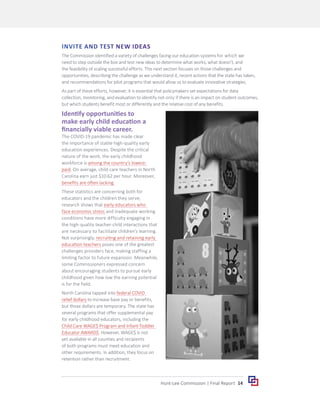
The COVID-19 pandemic has made clear
the importance of stable high-quality early
education experiences. Despite the critical
nature of the work, the early childhood
workforce is among the country’s lowest-
paid. On average, child care teachers in North
Carolina earn just $10.62 per hour. Moreover,
benefits are often lacking.
These statistics are concerning both for
educators and the children they serve;
research shows that early educators who
face economic stress and inadequate working
conditions have more difficulty engaging in
the high-quality teacher-child interactions that
are necessary to facilitate children’s learning.
Not surprisingly, recruiting and retaining early
education teachers poses one of the greatest
challenges providers face, making staffing a
limiting factor to future expansion. Meanwhile,
some Commissioners expressed concern
about encouraging students to pursue early
childhood given how low the earning potential
is for the field.
North Carolina tapped into federal COVID
relief dollars to increase base pay or benefits,
but those dollars are temporary. The state has
several programs that offer supplemental pay
for early childhood educators, including the
Child Care WAGE$ Program and Infant-Toddler
Educator AWARD$. However, WAGE$ is not
yet available in all counties and recipients
of both programs must meet education and
other requirements. In addition, they focus on
retention rather than recruitment.
15 Hunt-Lee Commission | Final Report
Recommendation. In addition to continuing WAGE$ and AWARD$, the state should create a
competitive grant program where localities can test additional funding mechanisms aimed at
recruiting and retaining early childhood educators with the goal of identifying structures that are
most effective and scalable. In so doing, pilot programs should consider:
	
g Recruitment bonuses
	
g Wage increases
	
g Retention bonuses
	
g Wage parity with K12 educators
	
g Career pathways that allow for increased responsibility and pay
	
g Opportunities to access the state benefits system
	
g Efforts to increase enrollment and lower the administrative burden within existing programs
like WAGE$ and AWARD$
Based on the findings from these pilot programs, the state can evaluate the cost / benefit of
different approaches and identify the most promising strategies to expand into additional counties.
Incentivize providers to open
more spaces for infant and toddler
care.
On average, more than five families with
infants (0-12 months) and toddlers (12-36
months) compete for each available child
care space. Given that 60 percent of parents
of infants and toddlers work, this mismatch
between supply and demand impacts not
only child well-being and families’ financial
stability, but the broader workforce.
Moreover, the impact is often greatest for
families earning the least; they most need
to return to work and often have the fewest
options available for child care.
As part of the American Rescue Plan Act
of 2021, North Carolina offered child
care providers stabilization grants, and
providers received additional funds based
on the percentage of infants and toddlers
served. By and large, however, the financial
structure for infant and toddler care does
not encourage licensed providers to expand
those slots. Infant and toddler rooms
require more staff, and hence cost more.
But state subsidies for child care do not
bridge this difference; though the 75 percent
reimbursement rate centers receive is
higher for infants and toddlers than for older
children in terms of absolute dollars, so too
is the remaining 25 percent.
16
Hunt-Lee Commission | Final Report
Ultimately, centers do not have the necessary funds to expand. Moreover, family child care
taking place in residential homes is among the most under-resourced, even as it serves
many infants and toddlers.
Recommendation. The state should run a series of pilots to evaluate different incentives
for child care providers to grow their infant and toddler slots. The pilots should test both
“expansion” grants to grow centers, with the expectation of adding a certain number or
percentage of infant and toddler slots, as well as increasing the subsidy rate for infant and
toddler slots. In so doing, however, it is also critical that evaluators consider the potential
impact on slots for three- and four-year-olds.
Bridge student transitions from middle to high school.
Research shows that students’ academic standing during ninth grade largely predicts whether
they graduate from high school. However, adolescents moving from middle school to
high school (from eighth to ninth grades) often struggle to navigate the tension between
increasing responsibility and decreasing supervision and support. The demands and
stresses of peer relationships can also overshadow academics. Given this multitude of
challenges, students often experience declines in achievement and attendance and increases
in behavior issues during this time. Moreover, the challenges students face as they
transition to high school do not start in ninth grade, but often begin much earlier.
Although North Carolina has programs to support student transitions into kindergarten
(e.g. Pre-K to Kindergarten Transition Pilot) and into higher education (e.g., GEAR UP and the
Crosby Scholars), we do not have the same programs in place as students transition from
middle to high school. Meanwhile, a 2011 study found that opportunities for collaboration
between middle and high school staff to plan for transitions, providing student middle
school performance data to high schools, and acclimating children to high school
culture, each resulted in favorable student outcomes.
Recommendation. Invite schools and/or districts to submit plans to design, implement, and
evaluate bridge programs aimed at easing the transition from middle to high school. The
pilots should emphasize research-based strategies and target the needs of specific student
populations, including English Learners, students struggling academically, and students
with disabilities.
OUR COLLECTIVE RESPONSIBILITY: BLURRING THE LINES
BETWEEN OUR SYSTEMS
In addition to bridge programs, education leaders can consider ways to better
“blur” the lines between grades, as well as between early childhood, K-12,
higher education, and workforce so that the transition from one to the next is
less abrupt for students. Doing so will require more intentional communication
and coordination between systems. In addition, the different bodies across the
continuum can – and should –identify and study the breadth of transition strategies
already in place, what works best, and for whom based on student need.
17 Hunt-Lee Commission | Final Report
IMPLEMENT PROVEN SOLUTIONS
A recurring theme emerged during the Commission’s final meeting; in many cases, we have data
to show what works, but as a state, we have chosen not to implement those strategies for one
reason or another. For every “piece” within the continuum, Commissioners pointed to research
studies and data as evidence that a particular program or effort worked. Several instances, they
noted that we have had many of the same conversations for several decades.
Of course, our financial resources are finite, and we understand that policymaking is an exercise
in trade-offs. But in many cases, more research or pilots are not necessary. Rather, we must
decide to implement the proven strategies we have already tested, or we must admit that
we are not willing to invest the political and financial capital required. As resources become
available, we encourage policymakers to consider the strategies that follow and prioritize the
families and communities with the least access and greatest needs.
Expand home visiting programs.
Home visiting is a prevention strategy serving pregnant mothers and new families to promote
child wellbeing, maternal health, and school readiness. Trained professionals build relationships
with families by visiting either in-person or virtually to provide information about community
resources, parenting support, and risk assessments. Ideally, these programs are tailored to the
local communities they serve and consider a family’s culture and language.
Research shows that home visiting programs lead to healthier parents and babies, children
who are better prepared for school, and more self-sufficient families. Moreover, home visiting
programs produce cost-savings in the long-term by preventing incidences like hospital visits. As
one example, a study of Durham Connects (now Family Connects Durham), which included home
visits from nurses, found that in the first six months of life, the program saved three dollars per
every dollar invested by reducing emergency room visits and overnight hospital stays.
Despite these outcomes, only about two percent of families with children under five
participated in home visiting programs in 2019. Meanwhile, 72 percent of existing home visiting
programs have a waitlist, and 12 counties lack a home visiting program at all.
Renew and sustain the state’s financial support for students
pursuing a two-year degree.
Beginning in 2021, the Longleaf Commitment has offered eligible students the opportunity
to receive up to $2,800 a year to attend one of our state’s “Great 58” community colleges.
In practice, the program makes community college free for low-income students.
COLLECTIVE RESPONSIBILITY: PARTNERING ON HOME VISITING
PROGRAMS
Expanding home visiting programs will require coordination and partnership
between local agencies and other organizations able to provide the
programming. Smart Start is uniquely positioned for this role; the network
already has a local presence that reaches into all 100 counties and the
majority administer a home visiting or parent education program.
18
Hunt-Lee Commission | Final Report
In multiple studies, this program and others like it nationally have been shown to increase
first-time enrollment and postsecondary attainment and reduce the number of students
borrowing.
Federal relief funding has supported the Longleaf Commitment. Without reliable recurring
funding, however, the program is at risk of being cut. Meanwhile, studies show that these
programs are less effective when they have an expiration date because future students are
not able to count on that funding in their college planning.
The state should identify a regular, recurring funding stream to support students pursuing
their two-year degree. That funding could continue the Longleaf Commitment or consider
other structures for all or some residents.
Expand eligibility for in-state tuition.
Roughly 3,000 North Carolina residents who graduate from high school each year are not
eligible for in-state tuition because they lack legal residency. As a result, these students
face a significant barrier to a postsecondary degree with ripple effects that impact our larger
economy for generations.
In contrast, a growing number of states are adopting provisions allowing any students who
have graduated from high school or obtained a GED in the state and attended public
schools for a certain number of years to pay in-state tuition rates.
Both national and state specific studies have found significant effects on college enrollment
following policy changes that lowered tuition for non-citizens. Other studies show that in-
state tuition policies significantly and positively impact high school graduation rates among
undocumented students.
Increase non-academic supports for postsecondary students.
Even when students begin a postsecondary pathway, too many fail to complete their
education. A range of challenges from child care and transportation to mental health and
work demands all threaten to derail students. These challenges are particularly relevant
to today’s postsecondary students who are older, more likely to have children, more likely to
work, and more likely to be first-generation college students compared to postsecondary
students just a generation or two ago.
In response, a growing number of programs offer postsecondary students a battery of
non-academic services, such as advising from counselors with low caseloads, job placement
services, and financial support for non-tuition expenses.
19 Hunt-Lee Commission | Final Report
A study of one such program – One Million Degrees in Chicago – found that retention
rates nearly doubled for program participants, leading to a 35 percent increase in full-time
enrollment. Meanwhile, Nash Community College in North Carolina, implemented Single
Stop, a national nonprofit that coordinates access to a safety net of benefits and connects
people to the resources they need to attain higher education. Results showed that
retention among students using Single Stop was 56 percent higher year-to-year compared
to their peers who did not use the service. Single Stop participants also completed more
credit hours per semester than they did before seeking help. And following Hurricane
Florence, emergency scholarship grants of up to $1,250 helped qualifying students at more
than 20 community colleges continue their education. The most successful programs tend
to tailor to the students they are serving and make students feel welcome and supported,
including providing language services if needed.
These programs are time and personnel intensive, however. Currently, they are also not
available to all postsecondary students who need them.
Increase support for FAFSA completion.
Completing the Free Application for Federal Student Aid, or FAFSA, often predicts whether
a student will attend and complete higher education. Many students, however, struggle
to do so. For example, estimates suggest that the majority of twelfth graders eligible for
Pell Grants do not complete their FAFSA. Some do not believe they will be able to afford
college, and so do not bother. Others find it difficult to complete and give up.
In response, many states, districts, and schools have taken a more hands-on approach,
engaging students early and often, targeting students who do not complete the FAFSA
by a particular date with one-on-one support, and building a campaign around FAFSA
completion. There are also partnerships with community organizations like College Advising
Corp and Say Yes Guilford to build capacity and reach a broader audience, including, for
example, ensuring Spanish-speakers are on site during events to support families as
needed.
Several studies point to the importance of high-quality, timely information and
personalized support to improve FAFSA completion. For example, an analysis of a
“customized nudging” process in Texas that included personalized messaging and
counseling was linked to positive impacts on FAFSA completion. So, too, was an experiment
in Ohio and North Carolina that offered eligible families individual support completing their
FAFSA application after filing their taxes at H&R Block.
COLLECTIVE RESPONSIBILITY: PARTNERING TO SUPPORT
POSTSECONDARY STUDENTS
Similar to the birth-to-five system, public-private partnerships play a key role
providing students with non-academic supports. Rather than provide services
directly, colleges and universities can leverage community partners and focus
their efforts on identifying students and connecting them with resources in
the community.
20
Hunt-Lee Commission | Final Report
CONCLUSION
The recommendations captured in this report offer actionable steps for improving
education in North Carolina from early childhood through higher education. Our
Commissioners stand by them, look forward to their implementation, and anticipate the
benefits students will reap as a result.
As we conclude this round of work, however, we are also struck by the value created
through the Commission process itself. The Commission provided a facilitated space
where leaders from across the state, across sectors, and across parties could engage in
conversation, build relationships, and find solutions. We look forward to continuing these
conversations and seeking out other opportunities to engage in additional education
topics. Those opportunities are rarer than they ought to be, and we encourage some
version of this body to continue into the future.
OUR COLLECTIVE RESPONSIBILITY: PARTNERING TO MEET
FAMILIES WHERE THEY ARE
Once again, public-private partnerships offer opportunities to increase
capacity and expand a program’s reach. Schools and districts should work
to partner with financial institutions and tax companies to help families
to complete the FAFSA at the same time they are receiving other services.
Moreover, there is an opportunity to build on the programs and structures
already in place to increase FAFSA completion through partnerships.
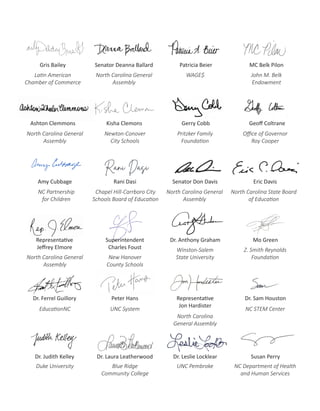
Gris Bailey Senator Deanna Ballard Patricia Beier MC Belk Pilon
Latin American
Chamber of Commerce
North Carolina General
Assembly
WAGE$ John M. Belk
Endowment
Ashton Clemmons Kisha Clemons Gerry Cobb Geoff Coltrane
Amy Cubbage Rani Dasi Senator Don Davis Eric Davis
Representative
Jeffrey Elmore
Superintendent
Charles Foust
Dr. Anthony Graham Mo Green
Dr. Ferrel Guillory Peter Hans Representative
Jon Hardister
Dr. Sam Houston
Dr. Judith Kelley Dr. Laura Leatherwood Dr. Leslie Locklear Susan Perry
Rani Dasi
North Carolina General
Assembly
Newton-Conover
City Schools
Pritzker Family
Foundation
Office of Governor
Roy Cooper
NC Partnership
for Children
Chapel Hill-Carrboro City
Schools Board of Education
North Carolina General
Assembly
North Carolina State Board
of Education
North Carolina General
Assembly
New Hanover
County Schools
Winston-Salem
State University
Z. Smith Reynolds
Foundation
EducationNC UNC System
North Carolina
General Assembly
NC STEM Center
Duke University Blue Ridge
Community College
UNC Pembroke NC Department of Health
and Human Services
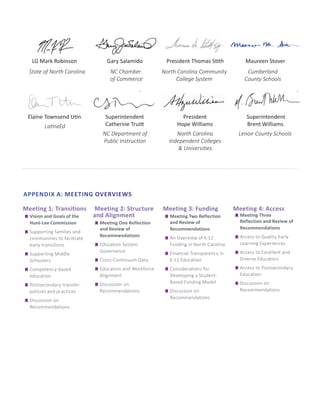
LG Mark Robinson Gary Salamido President Thomas Stith Maureen Stover
Elaine Townsend Utin Superintendent
Catherine Truitt
President
Hope Williams
Superintendent
Brent Williams
APPENDIX A: MEETING OVERVIEWS
Meeting 1: Transitions
	
g Vision and Goals of the
Hunt-Lee Commission
	
g Supporting families and
communities to facilitate
early transitions
	
g Supporting Middle
Schoolers
	
g Competency-based
education
	
g Postsecondary transfer
policies and practices
	
g Discussion on
Recommendations
Meeting 2: Structure
and Alignment
	
g Meeting One Reflection
and Review of
Recommendations
	
g Education System
Governance
	
g Cross-Continuum Data
	
g Education and Workforce
Alignment
	
g Discussion on
Recommendations
Meeting 3: Funding
	
g Meeting Two Reflection
and Review of
Recommendations
	
g An Overview of K-12
Funding in North Carolina
	
g Financial Transparency in
K-12 Education
	
g Considerations for
Developing a Student-
Based Funding Model
	
g Discussion on
Recommendations
Meeting 4: Access
	
g Meeting Three
Reflection and Review of
Recommendations
	
g Access to Quality Early
Learning Experiences
	
g Access to Excellent and
Diverse Educators
	
g Access to Postsecondary
Education
	
g Discussion on
Recommendations
State of North Carolina NC Chamber
of Commerce
North Carolina Community
College System
Cumberland
County Schools
LatinxEd
NC Department of
Public Instruction
North Carolina
Independent Colleges
& Universities
Lenoir County Schools
23 Hunt-Lee Commission | Final Report
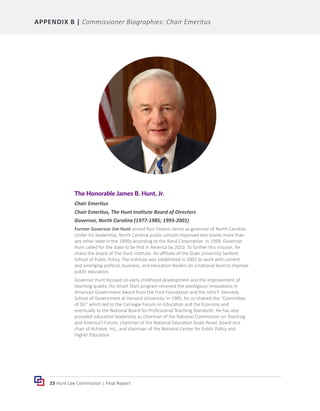
The Honorable James B. Hunt, Jr.
Chair Emeritus
Chair Emeritus, The Hunt Institute Board of Directors
Governor, North Carolina (1977-1985; 1993-2001)
Former Governor Jim Hunt served four historic terms as governor of North Carolina.
Under his leadership, North Carolina public schools improved test scores more than
any other state in the 1990s according to the Rand Corporation. In 1999, Governor
Hunt called for the state to be first in America by 2010. To further this mission, he
chairs the board of The Hunt Institute. An affiliate of the Duke University Sanford
School of Public Policy, The Institute was established in 2001 to work with current
and emerging political, business, and education leaders on a national level to improve
public education.
Governor Hunt focused on early childhood development and the improvement of
teaching quality. His Smart Start program received the prestigious Innovations in
American Government Award from the Ford Foundation and the John F. Kennedy
School of Government at Harvard University. In 1985, he co-chaired the “Committee
of 50,” which led to the Carnegie Forum on Education and the Economy and
eventually to the National Board for Professional Teaching Standards. He has also
provided education leadership as chairman of the National Commission on Teaching
and America’s Future, chairman of the National Education Goals Panel, board vice
chair of Achieve, Inc., and chairman of the National Center for Public Policy and
Higher Education.
APPENDIX B | Commissioner Biographies: Chair Emeritus
24
Hunt-Lee Commission | Final Report
APPENDIX B | Commissioner Biographies: Co-Chairs
The Honorable Howard Lee
Co-Chair
Howard Nathaniel Lee, born July 28, 1934, grew up on a sharecropper’s
farm in Lithonia, Georgia. He has led a life of public service in North Carolina
as both an educator and policymaker. In 1969, Lee was elected and served
three terms (1975) as Mayor of Chapel Hill. From 1966-1975, Lee served
as an administrator at Duke University and on the faculty at North Carolina
Central University. From 1982-1991, he was a faculty member of the School
of Social Work at The University of North Carolina at Chapel Hill.
In 1990, Lee was elected to the North Carolina Senate where he served
for 13 years. During his tenure, he held several powerful committee
chairmanships, presiding over education, transportation, and appropriations
committees. In the North Carolina Senate, Lee fought for higher teacher
salaries, increased funding for public and higher education, and advocated
for raising teacher and student standards.
From 2003-2009, Lee was elected Chairman of the North Carolina
State Board of Education and a member of the North Carolina Utilities
Commission. From March 2009- September 2011, Lee served as the first
Executive Director of the North Carolina Education Cabinet.
The Honorable Michael Lee
Co-Chair
Senator Michael Lee is a North Carolina State Senator representing the ninth
Senatorial District. Senator Lee joined The Hunt Institute’s Board of Directors
in the spring of 2019. Senator Lee has chaired the Education Committee,
the Appropriations Subcommittee on Education, and the Legislative Ethics
Committee. As Chair of the Education Committee, Senator Lee serves as
co-chair of The Hunt Institute’s Holshouser Legislators Retreat, which brings
together North Carolina policymakers, state and national research experts,
and education practitioners for candid dialogue about critical issues on
public education.
Senator Lee is also a member of the fifth cohort of The Institute’s Hunt-
Kean Leadership Fellows program. The Fellows program seeks to partner
with senior-level state leaders who have the knowledge, skill, and will to be
effective, reform-minded education policymakers. The program exposes
Fellows to the best research and analyses on innovative policies and
practices.
Prior to his service in the NC Senate, Senator Lee served on the NC Board
of Transportation and chaired the NC Ports Authority Board of Directors.
Senator Lee currently practices law in Wilmington, NC, where he represents
developers of office, retail, industrial, and residential projects.
25 Hunt-Lee Commission | Final Report
Griselda (Gris) Bailey
Griselda Bailey (Gris) is the President & CEO of the Latin American Chamber of Commerce.
Bailey has over 15 years of experience in leadership, market research, business development,
sales training, and education. She most recently served as a Regional Director for a national
college planning firm where she helped launch and scale three separate companies in three
different regions. Prior to serving as Regional Director, Bailey taught in one of the nation’s
largest school districts, served as a seminar instructor and oversaw the Spanish Delegate
Division at the National Notary Association, and operated an independent consultant company.
The Honorable Deanna Ballard
Deanna Ballard represents the 45th Senatorial District of North Carolina, which consists of
Alleghany, Ashe, Surry, Watauga, and Wilkes counties. Senator Ballard serves as Chairwoman
on the Committees on Education/Higher Education Appropriations, Education/Higher
Education Policy, and Pensions. Senator Ballard is a member of the following standing
committees: Health Care, Health Care Appropriations, Appropriations/Base Budget,
Government Operations, Finance, Nominations and Rules/Operations of the Senate. Senator
Ballard has dedicated her life to public service, serving in a number of capacities in the
Department of Education under Secretary Rod Paige, the Department of Homeland Security
under Secretary Michael Chertoff, and the White House under President George W. Bush and
First Lady Laura Bush. She currently serves as Director of Public Policy for Samaritan’s Purse,
an international Christian relief organization headquartered in Boone.
Patricia Beier
Patricia Beier serves as Chief Executive Officer for Wayne Action Group for Economic
Solvency, Inc. (WAGES), a large community action agency in North Carolina. In this role, she
provides executive leadership and oversight for 12 diverse human service programs that
provide services for children, seniors, and families including: early education, economic and
workforce development, nutrition, and senior volunteer programming. Beier also serves on
the local Domestic Violence Shelter Board, Wayne Forward, Literacy Council Board, and the
Goldsboro-Wayne Habitat for Humanity Board of Directors. In addition, she currently serves
on several statewide and regional Boards, including as Immediate President of the North
Carolina Head Start Association, Vice-Chair of the Board for NC Child, the Region IV Head
Start Association Board, and the North Carolina Community Action Board of Directors. Beier
was honored as a 2019 Defender of Justice by the NC Justice Center and as a 2019 Early
Childhood Champion by Guilford Child Development.
MC Belk Pilon
MC Belk Pilon is President and Board Chair of the John M. Belk Endowment, where she and
her team are committed to increasing access to and completion of postsecondary education
for all North Carolinians. Guided by the vision she shared with her father, the late John Belk,
Belk Pilon leads the Endowment on its mission to create a stronger North Carolina. She is
currently Chair of The John M. Belk Scholarship Advisory Board at Davidson College and is
active on the boards of myFutureNC, Inc., The Belk Foundation, College Advising Corps., New
Republic Partners, The Winer Family Foundation Advisory Board, The Belk Center Advisory
Board, and The Charlotte Country Day School Board of Trustees, as well as their Advancement
and Investment Committees. Recently, Belk Pilon was the winner of the 2020 I.E. Ready
Award, the highest honor bestowed by the State Board of Community Colleges. She was also
awarded the 2016 Roanoke College Medal, the highest honor for an alumnus to receive, and
the 2015 Central Piedmont Community College Distinguished Service Award.
APPENDIX B | Commissioner Biographies
26
Hunt-Lee Commission | Final Report
The Honorable Ashton Clemmons
Dr. Ashton Clemmons represents the 57th House District of North Carolina, which consists
of Guilford County. Representative Clemmons is a member of the following standing
committees: Commerce, Education K-12, Education-Community Colleges, Finance, and
Marine Resources and Aqua Culture. She also serves as the Early Childhood Caucus Co-
Chair. After graduating as a NC Teaching Fellow, she taught in Durham and Guilford counties.
She also served as a school principal in Rockingham and Guilford counties and as assistant
superintendent of the Thomasville City Schools. Representative Clemmons was selected as
one of the Triad Business Journal’s “40 Leaders under 40” and has also been honored by the
United Way with its Human Rights Advocate award.
Kisha Clemons
Kisha Clemons is the 2020 Wells Fargo North Carolina Principal of the Year. She is currently
the principal of Shuford Elementary in Newton-Conover City Schools and a doctoral candidate
in the Educational Leadership Department at UNC-Greensboro. She is a North Carolina
Principal Fellow and North Carolina Teaching Fellow alumnus from Appalachian State
University. Under her leadership, Shuford Elementary has been selected as a National
Title I Distinguished School and recognized for their work with personalized learning.
Clemons’ personal vision is to inspire greatness in others, and she is proud to be a
champion for her students, staff, and community.
Gerry Cobb
Gerry Cobb serves as the Director of the Pritzker Children’s Initiative, a national initiative of
the JB and MK Pritzker Family Foundation focused on improving state policy and investment
for children and their families. The focus of the initiative particularly emphasizes healthy
beginnings, high quality early care, and education and support to families of infants and
toddlers. Prior to joining the Foundation, Cobb served as State Services Director for the BUILD
Initiative for nearly seven years and was the primary liaison to states in supporting their
efforts to build comprehensive early childhood systems. She also worked for North Carolina’s
Smart Start Initiative for 13 years, creating the Smart Start National Technical Assistance
Center (NTAC).
Geoff Coltrane
Geoff Coltrane serves as Senior Education Policy Advisor in the Office of Governor Roy
Cooper. Previously, Coltrane served as the Director of Institutional Research and Strategic
Initiatives at the NC School of Science and Mathematics, the Director of Program and Policy
at The Hunt Institute, and the Research and Communications Director at the NC New Schools
Project. Coltrane started his career as an elementary teacher in Durham, NC. A North Carolina
Teaching Fellow, Coltrane earned his undergraduate degree in education from UNC-Chapel
Hill and his Master of Public Policy degree from Duke University.
27 Hunt-Lee Commission | Final Report
Amy Cubbage
Amy Cubbage is the President of the North Carolina Partnership for Children (NCPC), leading
Smart Start, North Carolina’s comprehensive early childhood system. Cubbage began her
career as an early childhood teacher and worked as a National Head Start Fellow for the
federal Administration for Children and Families (ACF). She consulted with early childhood
education agencies on a range of topics, taught advocacy and leadership courses at both
Wheelock College and Eastern Connecticut State University, and researched and wrote about
early childhood education. Cubbage previously worked at the National Center for Research
on Early Childhood Education at the University of Virginia and at Teachstone, where she
managed teacher coaching, training, and professional development, as well as public policy,
legal, and strategy work.
Eric C. Davis
Eric C. Davis was appointed as an at-large member of the NC State Board of Education in
January 2015. He served as Vice Chair of the State Board from April – September 2018.
Subsequently, he was elected Chair of the State Board at the September 2018 and 2020
meetings. Davis was elected to the Charlotte-Mecklenburg Board of Education representing
District 5 serving from 2009-2017 and served as chair from 2009 to 2011. He graduated 9th in
the Class of 1983 from the United States Military Academy in West Point, NY, with a Bachelor
of Science degree in Civil Engineering. He served as an Airborne Ranger Combat Engineer
officer in the US Army and is a professional engineer in North Carolina. Davis is a Charlotte
native who attended Charlotte-Mecklenburg and Lincoln County schools.
The Honorable Donald G. Davis
Dr. Donald G. Davis represents the fifth Senatorial District of North Carolina, which consists
of Pitt and Greene counties. Senator Davis is a member of the following standing committees:
Agriculture, Energy, and Environment; Appropriations on Education/Higher Education;
Education/Higher Education; Health Care; Redistricting and Election; Rules and Operations of
the Senate; and Select Committee on Nominations. He served as the mayor of Snow Hill for
seven years and as a member of the East Carolina University Board of Visitors for eight years.
He has over 20 years of experience in higher education and served over 8 years on active duty
in the United States Air Force. He is a 1994 graduate of the United States Air Force Academy
with a Bachelor of Science in Social Sciences degree.
Rani Dasi
Rani Dasi is an active leader in a number of organizations which support education,
including the Chapel Hill-Carrboro City Schools Board of Education, the board of The Walking
Classroom, the North Carolina Beginning Teacher of the Year Steering Committee, and the
executive board of the North Carolina Caucus of Black School Board Members. Professionally,
Dasi serves as Finance Director at RTI International, where she leads the finance organization
across the Education, Justice, and Health divisions. She holds an undergraduate degree in
Industrial Engineering and Management Science from Northwestern University and an MBA
from the University of Chicago.
28
Hunt-Lee Commission | Final Report
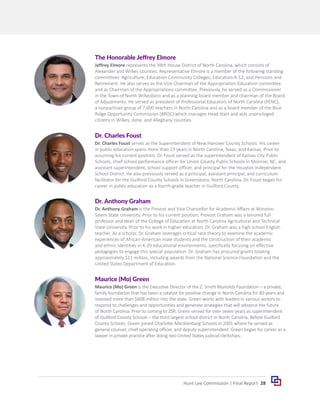
Dr. Anthony Graham
Dr. Anthony Graham is the Provost and Vice Chancellor for Academic Affairs at Winston-
Salem State University. Prior to his current position, Provost Graham was a tenured full
professor and dean of the College of Education at North Carolina Agricultural and Technical
State University. Prior to his work in higher education, Dr. Graham was a high school English
teacher. As a scholar, Dr. Graham leverages critical race theory to examine the academic
experiences of African-American male students and the construction of their academic
and ethnic identities in K-20 educational environments, specifically focusing on effective
pedagogies to engage this special population. Dr. Graham has procured grants totaling
approximately $11 million, including awards from the National Science Foundation and the
United States Department of Education.
Maurice (Mo) Green
Maurice (Mo) Green is the Executive Director of the Z. Smith Reynolds Foundation – a private,
family foundation that has been a catalyst for positive change in North Carolina for 80 years and
invested more than $608 million into the state. Green works with leaders in various sectors to
respond to challenges and opportunities and generate strategies that will advance the future
of North Carolina. Prior to coming to ZSR, Green served for over seven years as superintendent
of Guilford County Schools – the third largest school district in North Carolina. Before Guilford
County Schools, Green joined Charlotte-Mecklenburg Schools in 2001 where he served as
general counsel, chief operating officer, and deputy superintendent. Green began his career as a
lawyer in private practice after doing two United States judicial clerkships.
Dr. Charles Foust
Dr. Charles Foust serves as the Superintendent of New Hanover County Schools. His career
in public education spans more than 23 years in North Carolina, Texas, and Kansas. Prior to
assuming his current position, Dr. Foust served as the superintendent of Kansas City Public
Schools, chief school performance officer for Union County Public Schools in Monroe, NC, and
assistant superintendent, school support officer, and principal for the Houston Independent
School District. He also previously served as a principal, assistant principal, and curriculum
facilitator for the Guilford County Schools in Greensboro, North Carolina. Dr. Foust began his
career in public education as a fourth-grade teacher in Guilford County.
The Honorable Jeffrey Elmore
Jeffrey Elmore represents the 94th House District of North Carolina, which consists of
Alexander and Wilkes counties. Representative Elmore is a member of the following standing
committees: Agriculture; Education-Community Colleges; Education-K-12; and Pensions and
Retirement. He also serves as the Vice Chairman of the Appropriation-Education committee
and as Chairman of the Appropriations committee. Previously, he served as a Commissioner
in the Town of North Wilkesboro and as a planning board member and chairman of the Board
of Adjustments. He served as president of Professional Educators of North Carolina (PENC),
a nonpartisan group of 7,000 teachers in North Carolina and as a board member of the Blue
Ridge Opportunity Commission (BROC) which manages Head Start and aids unprivileged
citizens in Wilkes, Ashe, and Alleghany counties.
29 Hunt-Lee Commission | Final Report
The Honorable Jon Hardister
Jon Hardister represents the 59th House District of North Carolina, which consists of Guilford
County. Representative Hardister serves as the House Majority Whip and is a member of
the Judiciary and Redistricting and Rules/Operations of the House standing committees.
He serves as the Vice Chairman of the UNC Board of Governors Nominations, Alcoholic
Beverage Control, and Appropriations committees. Representative Hardister also serves
as the Chairman of the Appropriations-Education and the Education-Universities standing
committees. Previously, Representative Hardister served as the Vice President of Marketing at
First Carolina Mortgage, a small business owned and operated by his family.
Dr. Samuel Houston
Dr. Samuel H. Houston, Jr. is President and Chief Executive Officer of the North Carolina
Science, Mathematics, and Technology Education Center. Prior to this appointment, Dr.
Houston served as Vice President for Program and Policy of EdGate, Inc. and was the
first executive director of the University of North Carolina Center for School Leadership
Development. A former public-school teacher and veteran educational administrator,
Dr. Houston also previously served as executive director of the North Carolina Education
Standards and Accountability Commission at the invitation of Governor James B. Hunt Jr. Dr.
Houston has also served as an elementary school teacher, assistant principal, principal, school
superintendent, and professor.
Peter Hans
Peter Hans is the seventh President of the University of North Carolina System. As a first-
generation college graduate, he is committed to providing accessible, affordable, high-quality
educational opportunities for all. Prior to his election in 2020, he served as the ninth president
of the North Carolina Community College system. President Hans was elected by the legislature
to the State Board of Community Colleges (1997-2003) and UNC Board of Governors (2003-
2015) where he was chosen by peers for leadership roles and fought for streamlining the
transfer of student credits. Previously, he served as senior policy advisor to three members of
the United States Senate, counseled the private sector on public affairs at one of the state’s
largest law firms, and supported UNC system President Margaret Spellings on key initiatives.
Dr. Ferrel Guillory
Dr. Ferrel Guillory is journalism professor of the practice emeritus at the University of North
Carolina at Chapel Hill. In 1997, he founded the UNC Program on Public Life, which worked
to bring university scholarship to bear on the public agenda and leadership in North Carolina
and the South. In 2014, Guillory co-founded EducationNC, a nonprofit organization, devoted
to providing North Carolina with news, research, and policy analysis of trends and issues in
pre-K-12 education and community colleges. He is also a Senior Fellow at MDC, a Durham-
based research nonprofit. He spent eight years on the board of trustees of the NC Center for
the Advancement of Teaching, was a member of the Education First Task Force in 2001-02
and served on the steering committee of the Rural Prosperity Task Force in 1999-2000. Before
academia, Guillory spent 25 years as a newspaper and magazine journalist.
30
Hunt-Lee Commission | Final Report
Dr. Leslie Locklear
Dr. Leslie Locklear, a member of the Lumbee, Waccamaw Siouan, and Coharie tribes,
hails from Hoke County, NC. Dr. Locklear is currently employed at the University of North
Carolina at Pembroke as the Program Coordinator for the First Americans Teacher Education
(FATE) program and First Americans Educational Leadership (FAEL) program where she
trains American Indian teachers and administrators to work in American Indian schools.
She also serves as the Co-Chair of the North Carolina Native American Youth Organization
(NCNAYO) Adult Advisory Committee. As a student and educator, Leslie’s passions include
culturally relevant curricula, working with American Indian youth councils, college and career
counseling, and supporting educators in the classroom.
Susan Perry
Susan Perry was appointed to the role of Deputy Secretary for the North Carolina
Department of Health and Human Services (NCDHHS) in April 2017, serving first as the
Deputy Secretary for Human Services and currently as the Chief Deputy Secretary for
Opportunity and Well-Being. Chief Deputy Secretary Perry has experience leading complex
early childhood and human services systems and organizations at the local, state, and
national levels. Her primary work, expertise, and passion has focused on early childhood
development and well-being. Prior to coming to NCDHHS, Perry served in several executive
roles, including Executive Director of the state of Delaware Office of Early Learning, appointed
by Governor Jack Markell; founding Executive Director of the North Carolina Early Childhood
Foundation; Senior Director of Policy and Programs at The North Carolina Partnership for
Children; and Deputy Executive Director of Child Care Aware of America.
Dr. Laura B. Leatherwood
Dr. Laura B. Leatherwood is the fourth President of Blue Ridge Community College. Prior
to being president, she served for 17 years in various roles at Haywood Community College,
including as vice president of student and workforce development, executive director of the
Haywood Community College Foundation, and director of institutional advancement. She
currently serves on the board of Henderson County Partnership for Economic Development,
Mountain Area Workforce Development, American Red Cross Asheville-Mountain Area,
Henderson County Chamber of Commerce, National Technical Honor Society, and Advent
Health Hendersonville. She also serves on the Western North Carolina Leadership Team for
myFutureNC/Land of Sky Collaborative and on the Executive Committee of the NC Association
of Community College Presidents.
Dr. Judith Kelley
Dr. Judith Kelley is the Dean of the Sanford School of Public Policy at Duke University. Dr. Kelly
is also the ITT/Terry Sanford Professor of Public Policy and a Professor of Political Science.
Dr. Kelley is an expert on international relations and researches how international actors can
promote democratic and human rights reforms. Dr. Kelley is also a senior fellow with the
Kenan Institute for Ethics and is an elected member of the board of the journal International
Organization. She has also been awarded the Sanford School’s Susan E. Tifft Undergraduate
Teaching and Mentoring Award and was the 2016 inaugural recipient of the Brownell-
Whetten Award for Diversity and Inclusion.
31 Hunt-Lee Commission | Final Report
Maureen Stover
Maureen Stover is the 2020 Burroughs Wellcome Fund North Carolina Teacher of the Year
(NCTOY) and a 2021 National Teacher of the Year Finalist. Prior to her position as the NCTOY,
she taught ninth and tenth grade biology, earth and environmental science, and advancement
via individual determination (AVID) at Cumberland International Early College High School
in Fayetteville, NC. Stover has taught at the elementary, middle, and high school levels and
worked as an educational consultant for the National Science Teaching Association. As an
educator, Stover is dedicated to improving the educational opportunities for every student
through equitable education initiatives and seeks to provide clear pathways for students to
successfully enter the career or college program of their choice upon graduation from high
school. Prior to becoming a teacher, Stover served as an Intelligence Officer in the United
States Air Force.
Thomas A. Stith III
Thomas A. Stith III became the tenth President of the North Carolina Community College
System on January 11, 2021. Prior to his selection, he was district director of the U.S. Small
Business Administration, where he led the federal agency’s $16 billion response to COVID-19
in North Carolina. President Stith served as chief of staff to former Governor Pat McCrory and
was a three-term city council member in Durham. President Stith has extensive experience
in both private and public sector executive roles during his professional career. He has
served on the boards of the Golden LEAF Foundation, the North Carolina Institute of Political
Leadership, and the United Way of the Greater Triangle, North Carolina Leadership Forum
member, and is a deacon at Union Baptist Church.
Gary Salamido
Gary Salamido serves as the President & CEO of the North Carolina Chamber of Commerce.
Previously, Salamido led the Chamber’s lobbying, advocacy and political efforts and also
served as chief operating officer. Prior to joining the NC Chamber in September 2011,
Salamido worked 19 years at GlaxoSmithKline, the last 10 years serving as GSK’s director
of state government affairs. Salamido’s advocacy responsibilities spanned a broad range of
issues including corporate tax, environmental impact, tort and liability reform, economic
development, workforce development, employment, and Medicaid. Salamido’s previous work
experience includes serving as senior account manager of integrated healthcare markets for
GSK and as director of professional and state government affairs for GlaxoWellcome.
The Honorable Mark Robinson
Mark Robinson serves as the 35th Lieutenant Governor of North Carolina. As Lieutenant
Governor, he serves on the State Board of Education and the State Board of Community
Colleges. Lieutenant Governor Robinson is a native of Greensboro, North Carolina and
previously served in the United States Army Reserves. He is the first African American to be
elected Lieutenant Governor of North Carolina. In his professional life, Lt. Gov. Robinson has
worked in various industries, including a long stint in furniture manufacturing.
32
Hunt-Lee Commission | Final Report
Dr. A. Hope Williams
Dr. A. Hope Williams is in her 29th year as President of North Carolina Independent Colleges
and Universities (NCICU), the statewide office of the 36 private, nonprofit colleges and
universities in North Carolina. She works closely with the State of North Carolina and the
federal government, and the North Carolina public K-12 and higher education sectors to
address education policy and funding issues. In addition, she oversees fundraising for student
scholarships and grants, such as the current Teagle Foundation’s Transfer Pathways grant,
as well as the development of collaborative programs for the benefit of NCICU campuses.
President Williams chairs the boards of MCNC, Dupont Circle Investments, and the North
Carolina Aquarium Society; serves on the Governor’s Education Cabinet; and serves on the
boards of the National Student Clearinghouse Research Center and the National Student
Clearinghouse, College Foundation, Inc., the National Advisory Board of the Institute for
Emerging Issues, the NCWorks Commission, the myFutureNC Commission, and Communities
in Schools of North Carolina.
Brent Williams
Brent Williams was named Superintendent of Lenoir County Public Schools in 2015 and has
led the rural eastern North Carolina district of 17 schools, 8,500 students, and 1,100 staff
members since then. His career in public education spans 28 years and has involved many
varied leadership roles including teacher, assistant principal, principal, Director of Testing and
Accountability, Executive Director of Operations, and Associate Superintendent for Curriculum
and Instruction. In July 2020, Superintendent Williams was named the Southeast Regional
Superintendent of the Year for 2020-2021. In December 2020, he was named the 2021
North Carolina A. Craig Phillips Superintendent of the Year. He currently serves as Southeast
Regional President, a member of the board of directors of the North Carolina Association for
Supervision and Curriculum Development, and as the President-Elect of the North Carolina
School Superintendents’ Association.
The Honorable Catherine Truitt
Catherine Truitt serves as the North Carolina State Superintendent of Public Instruction. In
this role, she is focused on improving the state’s public schools, expanding innovation, and
creating new opportunities for students to learn, grow, and successfully transition into the
post-secondary plans of their choice. Her service in education began as a high school English
teacher and turnaround coach. In 2015, Superintendent Truitt was appointed as Gov. Pat
McCrory’s senior education advisor. She has also served as chancellor of Western Governors
University North Carolina (WGU NC). Prior to joining WGU NC, she served as Associate Vice
President of University and P-12 Partnerships at UNC General Administration.
Elaine Townsend Utin
Elaine Townsend Utin—a proud Peruvian-American—is the Co-Founder and Executive
Director of LatinxEd, where she leads state-wide efforts to expand educational equity and
opportunity for Latinx immigrant families in North Carolina. Townsend Utin specializes in
conscious leadership development, talent pipelines and coaching, and positive racial-ethnic
identity formation. Her work focuses on advocating for Latinx students, especially those
facing various financial and geographic limitations. This originates from her own experiences
growing up in rural North Carolina as a 1.75-generation immigrant from a low-income family.
She was recognized on Forbes’s 30 Under 30: Education list for her work in creating pathways
to educational, professional, and civic engagement opportunities for new generations of
Latinx leaders. Although raised in Waxhaw, NC, she has lived in Durham, NC, with her husband
and toddler for the past five years.
4000 Centregreen Way | Suite 301 | Cary, NC 27513 | p: 984.377.5200

Hunt-Lee Final Report

  • 1.
    F I NA L R E P O R T April 2022
  • 3.
    Foreword..................................................................................................................................01 Overview of Recommendations....................................................................................................02 Introduction..............................................................................................................................03 gAbout the Hunt-Lee Commission......................................................................................04 g About this Report.............................................................................................................05 g Our Collective Responsibility............................................................................................06 Build on What We Have.................................................................................................................07 g Strengthen Our Data Information and Sharing...........................................................................07 g Model Potential Enhancements to Our School Finance System.................................................08 g Increase the Availability of Child Care Subsidies........................................................................08 g Reduce Barriers to Access for NC Pre-K......................................................................................09 g Incentivize Excellent Teachers to Work in High-Need Schools...................................................10 g Expand the Advanced Teaching Roles Pilot................................................................................11 g Grow the School Leader Pipeline................................................................................................11 g Improve Schools’ and Districts’ Ability to Respond to Student Needs.......................................12 Invite and Test New Ideas...............................................................................................................14 g Identify Opportunities to Make Early Child Education a Financially Viable Career................14 g Incentivize Providers to Open More Spaces for Infant and Toddler Care...........................15 g Bridge Student Transitions from Middle to High School....................................................16 Implement Proven Solutions..........................................................................................................17 g Expand Home Visiting Programs.......................................................................................17 g Renew and Sustain the State’s Financial Support for Students Pursuing a Two-Year Degree....17 g Expand Eligibility for In-State Tuition................................................................................18 g Increase Non-Academic Supports for Postsecondary Students.........................................18 g Increase Support for FAFSA Completion............................................................................19 Conclusion................................................................................................................................20 Appendix A: Meeting Overviews....................................................................................................22 Appendix B: Commission Members................................................................................................23 TABLE OF CONTENTS
  • 4.
    FOREWARD Policymakers, practitioners, advocates,and agencies from across North Carolina have long pursued opportunities to strengthen our education system. We are proud of the progress we have made as a state. At the same time, we must acknowledge that stark differences in student outcomes and opportunities persist, many of which the pandemic has made worse. We know that the best solutions to our longstanding challenges in North Carolina’s education system (early learning through higher education) do not lie with any single group; real change requires that leaders from across the state, across the education continuum, and across sectors build trust, find common ground, and work together on behalf of students and families. It is with these understandings in mind that we formed the Hunt-Lee Commission to identify strategies to address some of the most deep-rooted challenges facing North Carolina’s education continuum and to strengthen the systems responsible for overseeing it. In so doing, we tapped into The Hunt Institute’s strong relationships across the state and its capacity to bring together the people and resources necessary to drive strategic action. The result is a commission that represents leaders from government, business, and philanthropy and reflects the full diversity of the state we seek to serve. Moreover, it brings together leaders who might not otherwise sit around the same table to think outside the box and problem-solve, building relationships that will continue well beyond this body’s work. We are exceedingly grateful to all the Commissioners who volunteered their time for this effort. Over the course of four meetings, they paused their many responsibilities to gather, learn from local and national experts, talk with one another, and identify a path forward. The recommendations that follow represent our collective will, and we are committed to seeing them through. Sincerely, Governor James B. Hunt Senator Howard Lee Senator Michael Lee
  • 5.
    OVERVIEW OF RECOMMENDATIONS Overthe course of four meetings, the Hunt-Lee Commission engaged in comprehensive conversations around key education opportunities including transitions, structure and alignment, funding, and access. Through in-depth conversations and engagement with resource experts, we were able to find common ground on these topics. The contents of this report dive deeper into each of these recommendations, providing a guidepost for how North Carolina can move forward with improving education systems for all students. Build On What We Have g Strengthen our data information and sharing g Model potential enhancements to our school finance system g Increase the availability of child care subsidies g Reduce barriers to access for NC Pre-K g Incentivize excellent teachers to work in high-needs schools g Expand the Advanced Teaching Roles pilot g Grow the school leader pipeline g Improve schools’ and districts’ ability to respond to student needs Invite and Test New Ideas g Identify opportunities to make early child education a financially viable career g Incentivize providers to open more spaces for infant and toddler care g Bridge student transitions from middle to high school Implement Proven Solutions g Expand home visiting programs g Renew and sustain the state’s financial support for students pursuing two-year degrees g Expand eligibility for in-state tuition g Increase non-academic supports for postsecondary students g Increase support for FAFSA completion 2 Hunt-Lee Commission | Final Report
  • 6.
    3 Hunt-Lee Commission| Final Report INTRODUCTION Today, there is much to celebrate about public education in North Carolina. To name just a few examples: g We offer our youngest students one of the country’s highest quality Pre-K programs, with research showing increased performance through at least eighth grade. g The revised Read to Achieve Act supports professional development to ensure students entering fourth grade have the reading skills they need to progress. g We’ve been willing to test new strategies, including advanced teaching roles providing teachers opportunities to grow and earn more while remaining in the classroom. g The DRIVE Task Force signaled our renewed commitment to a teacher work force that reflects the diversity of the students it serves. g Opportunities for dual enrollment and our early college high schools allow students to earn dozens of credits before ever matriculating into a postsecondary institution, while the NC Promise launched in 2018 ensures financial cost will not be a barrier to a four-year degree. g Despite enrolling just 16 percent of all students in four-year institutions across the state, our 10 historically Black colleges and universities enroll 45 percent of all Black undergraduates and serve as vehicles for social mobility. g Partnerships between the North Carolina Community College System and companies have increased the number of skilled workers in the state and contribute $19.3 billion to the state’s economy each year. At the same time, we know that our students deserve more than we are currently providing them. Most notably, academic outcomes for Black, Hispanic, and American Indian students, low-income students, and students with disabilities continue to lag relative to their peers on nearly every
  • 7.
    4 Hunt-Lee Commission |Final Report metric from kindergarten readiness and third grade reading to high school graduation and post-secondary attainment. Moreover, the COVID-19 pandemic exacerbated inequities by imposing additional challenges in the form of unfinished learning, enrollment decreases, educator shortages, and untold emotional trauma. Let there be no question; we all share responsibility for our students’ success. And our systems provide some communities and students less access to the resources and opportunities they need to succeed. But these issues and concerns are not new. A variety of policymakers and practitioners, as well as committees, court cases, consultants, and other education advocates have studied the challenges our education systems face and have proposed changes. While those efforts have led to some changes, for a variety of reasons, they have not yet gotten us where we need to be. About the Hunt-Lee Commission The Hunt-Lee Commission formed to offer a new approach to old barriers. Central to that new approach are our members: g We are a bipartisan group with the support of leaders in both the North Carolina House of Representatives and Senate, as well as the Governor’s Office. g We represent the full continuum from birth through workforce development, recognizing that the different bodies supporting students along their journey must work in concert with one another and coordinate efforts. g Our expertise crosses sectors, to include education, business, government, and philanthropy. g We represent the growing racial and ethnic diversity of our state and the students it serves. Moreover, this Commission brought together leaders who do not have the opportunity to work together in their day-to-day, but who are all committed to ensuring every student completes their education and leaves prepared to build and strengthen their communities across North Carolina. Over the course of four meetings, we zoomed out to focus on broad themes that cross the education continuum: access, alignment, funding, and transitions. Meeting overviews can be found in Appendix A. For each meeting, we worked with our partners at The Hunt Institute to identify key challenges and invited resource experts to speak with our
  • 8.
    5 Hunt-Lee Commission| Final Report Commissioners. Commissioners then had the opportunity to discuss their reactions and consider key questions within the context of our state’s educational landscape and systems. We also created a running list of potential recommendations, which we refined and reconsidered with each new piece of information. About this Report Based on those meetings and discussions, several things became clear. First, we have many strong systems and programs in place. Where possible, we should improve on the foundation we have already created to ensure our education systems benefit all students, regardless of geographic location, race, or income-level. In other areas, we are still figuring out what’s needed. In those cases, we should test new strategies and use what we learn to forge a path forward. But there are also instances where we already know what works, and we need to find the policy and resources – both financial and otherwise – to act accordingly. Moreover, our work highlighted the extent to which agencies and localities often have the authority to do what’s needed without further action from lawmakers. Hence, we all share responsibility for finding answers and implementing solutions. This group did not set out to develop a comprehensive plan for North Carolina education. Rather, its members sought to look across our education system and identify areas of consensus from which we can build trust and forward momentum. As such, this report represents a starting point, rather than a silver bullet. Nonetheless, it offers critical proof that if we chip away at the challenges before us, we can – and will – make inroads for the benefit of all students.
  • 9.
    6 Hunt-Lee Commission |Final Report OUR COLLECTIVE RESPONSIBILITY As we consider strategies to improve public education in North Carolina, it is important to acknowledge that we all share responsibility for both the process and the outcomes. Many of the recommendations that follow focus on steps lawmakers could take. But our conversations also highlighted the many solutions that live outside of the General Assembly, including the need to align and coordinate across organizations and to exercise agency where it already exists. Coordination and Alignment The critical importance of alignment across sectors and across the education continuum arose as a theme throughout the Commission’s work. Whether aligning state, district, and local school improvement plans, transitioning students between grades, buildings, and institutions, or tapping public-private partnerships to provide services to students and families, providers must work with one another to both get the job done and ensure students and families have what they need to succeed. Moreover, doing so often requires time and strong relationships more so than dollars or new policies. Fortunately, there are already local working groups and non-governmental organizations working to fill this space. myFutureNC partnered with the UNC School of Government’s ncIMPACT Initiative to launch 15 community collaboratives aimed at better aligning their education systems with the needs of their regional economies. Similarly, the NC Division of Child Development and Early Education is partnering with The Hunt Institute to support diverse county-level, cross-sector human services leadership teams to develop or enhance scalable and sustainable local strategic plans drawing on early childhood data. And the longest operating system of local coordination, the state’s network of Smart Start Local Partnerships, are facilitating county-wide, cross-sector alignment. As we look ahead, we should prioritize and seek out opportunities to partner in these ways. Exercising Agency Another theme from our meetings was how much practitioners can already do and the need to exercise agency where it exists. For example, any district can set a public goal for increasing educator diversity within their schools and report back on progress. Similarly, system leaders and the agencies that support them can identify key developmental and career information that students, families and educators ought to receive and create a plan for providing it. Throughout the recommendations that follow, we therefore highlight where there is a role for stakeholders outside of the General Assembly to step up and help to move this important work forward.
  • 10.
    7 Hunt-Lee Commission| Final Report BUILD ON WHAT WE HAVE As noted at the beginning of this report, North Carolina is doing a lot that is right. To that end, Commissioners identified eight opportunities to build on or improve the systems and programs we already have. Strengthen our data information and sharing. Empowering policymakers and practitioners with access to accurate and timely data can change the way we deliver education. It follows that states across the country are seeking ways to build systems that effectively collect, compile, and analyze data across agencies to answer complex questions. Access to accurate and timely data will allow us to better understand which students are not successful, where on the continuum they are lost, and what barriers they may experience. In 2012, NC General Statute 116E established the state’s Longitudinal Data System (NCLDS), which connects data sources across the education continuum. More specifically, the NCLDS captures data from the early childhood (NC Department of Health and Human Services), K-12 (DPI), and postsecondary (the NC Community College System, the UNC System, and NC Independent Colleges and Universities) sectors. It also includes data from the workforce sector in the form of wage data from the NC Department of Commerce. These partners have signed a memorandum of understanding (MOU) that governs how they share data through the NCLDS. Moreover, Executive Order No. 249 codifies the NCLDS Governance Board, and the Government Data Analytics Center (GDAC) provides general oversight and direction. The Challenge. NCLDS currently faces several challenges that impede its effectiveness. In some cases, the data from different systems do not always “talk” to one another as intended because those systems apply different rules in how they measure and label information. Equally important, the demand for analyzing NCLDS data far outstrips the current capacity to do so across the contributing agencies. Recommendations. To address the challenges above, we recommend six steps: g Support additional staffing for data analysts at contributing agencies and entities. g Ensure the individuals and organizations working directly with the data system have mechanisms in place to communicate and share information with one another intentionally. g Work with policymakers to develop an understanding of what data they need to inform policymaking. g Intentionally inform stakeholders beyond the traditional state agencies (i.e., public/ private partnerships, contracting bodies, etc.) of the data available for review and analysis to inform their work. g Include NCLDS stakeholders in the system design process to ensure the technical infrastructure has the flexibility to support NCLDS’ short- and long-term goals, and the safeguards to address concerns about data quality, security, and privacy. g Create datasets and dashboards to guide policymakers, researchers, and analysts towards the system’s research priorities and to provide them with high-quality, timely data in a timely and efficient manner. g Continually identify and seek out opportunities to add additional datasets to the NCLDS and connect different data systems by standardizing system specifications and contract terms across agencies and sectors where possible and appropriate.
  • 11.
    8 Hunt-Lee Commission |Final Report Model potential enhancements to our school finance system. Public education aims to provide all students with the skills and knowledge they need to be successful and productive adults. To that end, the research makes clear that money matters. At the same time, how schools and districts spend money is also critical. To assess the impact our educational investments have on student outcomes, there must be transparency both in how dollars flow and how schools and districts use those dollars to support student outcomes. The Challenge. Some of our Commissioners shared that they struggle to understand how state education dollars in North Carolina flow, making it difficult to evaluate the equity of our process, assess the impact those dollars have, and hold practitioners accountable for the decisions they make. Others noted the inherent complexity of school funding and the risks of over-simplifying. It is clear, however, that North Carolina is an outlier nationally with respect to its allocation-based school funding formula, and that some pieces of our current funding formula could be improved. Ultimately, policymakers, practitioners, and the public need better information to understand how our funding allocations would look if we adjusted parts of the formula and what we might lose – or gain – by simplifying our current process. Recommendation. Request that the General Assembly create a model that allows policymakers to consider and weigh different options and trade-offs to how we fund schools, including but not limited to: g Changing the weights and caps we currently apply g Adding additional weights to reflect student needs g Having dollars follow students to districts g Identifying transition costs associated with any changes g Identifying the impact of overall district funding associated with any change g Identifying how any changes would impact the funding directed to districts serving students with the greatest needs Increase the availability of child care subsidies. Research shows that giving families child care subsidies improves outcomes for children and families in two key ways. First, it allows families to choose higher quality child care, which can help children grow and develop well. Secondly, subsidies help parents remain in the workforce, thus boosting their lifetime earnings and improving their long-term financial health. In turn, higher family incomes and reduced time in poverty are both associated with better long-term outcomes for children. Since 1990, North Carolina has provided families the opportunity to receive subsidies to offset the cost of child care. Currently, families earning up to 200 percent of the federal poverty level (~$56,000 for a family of four) are eligible for these subsidies. In addition, families are responsible for a co-pay that varies based on their income. The Challenge. Demand for child care subsidies far exceeds supply, with waiting lists in the thousands. Moreover, although co-pays vary based on family income, the size of the subsidy families receive does not. As a result, a small increase in family income could result in a family becoming ineligible, and the lowest-income families receive as large a subsidy as those earning at the top of the eligibility window. In addition, subsidies do not cover true market costs. For these reasons, the Department of Health and Human Services is planning to hire a consultant to research new ways to structure its child care subsidy.
  • 12.
    9 Hunt-Lee Commission| Final Report Recommendation. Test different funding mechanisms that would expand access to child care subsidies to more families, including: g Increasing the number of current subsidies available g Increasing the maximum amount of the subsidy g Scaling the subsidy amount based on family income Reduce barriers to access for NC Pre-K. The NC Pre-K program offers eligible four-year-old children high-quality educational experiences addressing all five of the developmental domains critical to children’s overall well-being and success as they enter school. Duke University researchers studied the impact of the More at Four program (now NC Pre-K) on academic outcomes among middle school students in a 2019 report. They found that program participation resulted in higher end-of- grade scores in both reading and math, lower retention rates, and fewer special education placements. Moreover, the positive results grew over time. The Challenge. Currently, just over half of eligible students participate in NC Pre-K, and the state has struggled to increase that figure due largely to challenges related to supply. Since 2012, reimbursement rates have increased just two percent - about $57 per slot – which does not incentivize additional slots. The state also has an insufficient allowable amount of funding for administrative costs. In addition, private centers generally pay their Pre-K teachers less than the public schools because there is not a pay scale. But as a result, certified Pre-K teachers often leave for public school positions if given the opportunity. Space for program expansion is also a challenge, though the latest budget begins to make some inroads on this lack of capacity by including a line item to support quality improvements, including increases to a facility’s capacity. Recommendation. Address the challenges described above by testing and assessing the relative impact of the following strategies: g Increasing the reimbursement rate to reflect market costs more accurately g Increasing the allowable amount of funding for administrative costs g Providing pay parity between NC Pre-K teachers located in private centers and public schools PRE-K AND THE CRITICAL IMPORTANCE OF STRONG IMPLEMENTATION A recent study of a Pre-K program in Tennessee makes clear that all programs are not equal, and strong implementation is key. Fortunately, North Carolina’s Pre-K program has over 15 years of evidence from both the University of North Carolina and Duke, showing that its play-based curriculum and insistence on well-trained, highly-qualified teachers has lasting impacts for children. Hence, it is vitally important that any efforts to increase access to Pre-K in North Carolina maintain the state’s high-quality bar.
  • 13.
    10 Hunt-Lee Commission |Final Report Incentivize excellent teachers to work in high-need schools. National Board Certification (NBCT) is a rigorous teacher certification process that aims to develop, retain, and recognize accomplished teachers as well as generate ongoing school improvement. Teachers earn their certification by demonstrating that they know and can implement the strategies of highly effective teachers. Numerous studies have found NBCT to positively increase student performance. At least one study also found that attrition is lower among NCBTs. North Carolina has successfully incentivized its teachers to pursue their national board certification. Candidates can apply for a state-subsidized $1900 loan to pay for the program application process and receive up to three days of paid release time to develop their portfolios. Upon completion of the program, NCBTs are eligible for an annual 12 percent pay differential. As a result of these incentives, North Carolina now leads the nation with 23,418 National Board-Certified teachers. The Challenge. Data shows, however, that our most well-credentialed teachers – to include those who have earned their National Board certification – are less likely to teach in schools serving higher percentages of low-income students and students of color. As one example, the lowest poverty districts have almost twice as many NCBTs as the highest poverty districts. Meanwhile, principals who persistently earn high growth in their schools can receive a $30,000 annual salary supplement to move to a low-performing school for up to three years. Recommendation. Build off the state’s success incentivizing teachers to attain national board certification by piloting different mechanisms for encouraging our most effective teachers to work in high-needs schools, such as: g Providing additional compensation for NBCT teachers and/or teachers with the highest EVAAS scores to work and/or remain in high-poverty schools. g Offering loan forgiveness to the teacher OR their immediate family (i.e., spouse, children) Moreover, pilots could explore offering these incentives to individual teachers or to groups of teachers (and potentially, their principal as well) who transfer to a low-performing school together as part of a strategic staffing initiative. OUR COLLECTIVE RESPONSIBILITY: DRAWING ON PUBLIC-PRIVATE PARTNERSHIPS TO INCREASE ACCESS TO EARLY LEARNING Even if NC Pre-K or other early childhood programs were to receive funding to increase access, centers must identify and secure physical spaces to hold their classes. Ideally, those new spaces would also include underserved communities most in need of additional providers. Hence increasing access to early childhood goes beyond funding and legislative policy; it also requires coordination and alignment across local partners that can provide additional teachers and space.
  • 14.
    11 Hunt-Lee Commission |Final Report Expand the Advanced Teaching Roles pilot. North Carolina launched the advanced teaching roles (ATR) initiative in 2016 to enable outstanding educators to extend their reach to more students without leaving the classroom, recognize teacher leaders with higher compensation, and improve professional development for developing teachers. The Challenge. Fifteen districts participated in the initiative in the 2021-22 school year, though pilots have not included all teachers in every district. ATR models also differ across districts, though several use Public Impact’s Opportunity Culture model. According to a 2020 evaluation submitted to the State Board of Education, the preliminary impact of ATR on student outcomes were not consistent or definitive, though researchers concluded that “the program has the potential to contribute to positive changes in overall school performance.” They also found, however, that advanced teaching roles were well received by teachers and that turnover for those roles was low. Recommendation. Continue and expand the ATR initiative with the goal of collecting better data that will allow the state to measure the relative impact of different ATR models. Expansion should prioritize: g Growth within existing districts with the strongest implementation to evaluate the impact of ATRs at scale g Growth in districts under-represented within the current pilot sites g Plans that compensate teachers for additional work g Models that offer pathways into teaching for teaching assistants by partnering with institutions of higher education Grow the school leader pipeline. Principals work to foster school culture, serve as instructional leaders, and recruit, develop, and retain school staff. As such, they play a critical role within schools and have a large impact on student learning; studies estimate that school leaders account for one-fourth of school-based effects on student achievement, making their impact second only to teachers. The Challenge. According to the Department of Public Instruction, North Carolina needs 250-300 highly trained school leaders each year who are ready to serve as principals. OUR COLLECTIVE RESPONSIBILITY: SUPPORTING TEACHERS AS THEY ADVANCE In addition to providing career pathways, it is also important to develop teachers so they are prepared to assume new and more challenging roles over time. Hence, as districts design new roles, they should do so with an eye towards baking development opportunities into their models. Districts committed to building a workforce that is both excellent and diverse must also take steps to ensure that all teachers are encouraged and have opportunities to pursue advanced roles, including setting targets for different teachers pursuing advanced roles and being intentional in outreach efforts.
  • 15.
    12 Hunt-Lee Commission |Final Report However, the state struggles to meet that goal each year, the consequences of which disproportionately impact high-need schools. The North Carolina Principal Fellows Program formed to help build the state’s principal pipeline, and has had some positive results, but it only produces about 40 percent of the school leaders the state needs each year. NC DPI also recently announced a partnership with the North Carolina Principals and Assistant Principals’ Association and the Belk Foundation to fast-track high-potential assistant principals into principal roles, but that program is currently a pilot and will take several years to produce candidates ready to fully lead. Recommendation. Moving forward, the state needs to grow the principal pipeline by expanding existing programs with proven results and/or supplementing with new programs that can meet specific needs, such as a training program focused specifically on turnaround leaders or ensuring our school leaders reflect the diversity of the students they serve. Improve schools’ and districts’ ability to respond to student needs. In 2018, HB 986 provided the opportunity for the Rowan-Salisbury School System to become the state’s first Renewal District. As such, the district received more flexibility over budget, curriculum, hiring and personnel, calendar, scheduling, and accountability. The hope was that with these tools, Rowan-Salisbury could better do whatever it takes to support its students. Similarly, § 115C-105.37B gives the State Board of Education the ability to authorize local boards of education to operate low-performing schools with exemptions from a variety of statutes and rules in an effort to support innovation. Rowan-Salisbury has produced some promising anecdotal evidence to the effectiveness of the Renewal District model, but it is too soon to effectively evaluate the impact of the Renewal District status. Other states, however, have implemented similar policies.
  • 16.
    13 Hunt-Lee Commission| Final Report Nineteen Texas districts are part of the System of Great Schools, which allows district leaders to expand what works, replace what doesn’t, and “pursue all possible options to create high-quality, best-fit schools.” Meanwhile, Indiana’s policymakers passed legislation in 2015 creating Innovation Network Schools within Indianapolis Public Schools, granting individual schools more opportunity to respond to student needs. According to a 2019 study from Stanford University’s CREDO Institute, students attending Indianapolis’ Innovation Network Schools achieved growth equivalent to 53 days of additional learning in ELA and 89 days of additional learning in math compared to students in the district’s traditional public schools. The Challenge. Even when more data is available for Rowan-Salisbury, the results from a single district will not provide compelling evidence that the model does or does not work. Meanwhile, the idea of providing educators greater opportunity to support students as they deem best makes intuitive sense and deserves further attention. Recommendation. Hence, we recommend introducing legislation that expands operational flexibilities for districts that want to apply, to include high-performing schools and districts. Then, in practice, the policy should include clear accountability metrics and identify metrics for evaluating the initiative across sites. OUR COLLECTIVE RESPONSIBILITY: LEVERAGING THE FLEXIBILITY SCHOOLS AND DISTRICTS ALREADY HAVE Several Commissioners noted that schools and districts often have more flexibility than they realize, even without a special status. As one example, leaders in Rowan-Salisbury found that a considerable number of changes they wanted to implement were already possible without Renewal status. Hence, rather than starting with the assumption that something cannot be done, districts and schools should assume there is a path forward and look to identify opportunities to address student needs within current structures.
  • 17.
    14 Hunt-Lee Commission |Final Report INVITE AND TEST NEW IDEAS The Commission identified a variety of challenges facing our education systems for which we need to step outside the box and test new ideas to determine what works, what doesn’t, and the feasibility of scaling successful efforts. This next section focuses on those challenges and opportunities, describing the challenge as we understand it, recent actions that the state has taken, and recommendations for pilot programs that would allow us to evaluate innovative strategies. As part of these efforts, however, it is essential that policymakers set expectations for data collection, monitoring, and evaluation to identify not only if there is an impact on student outcomes, but which students benefit most or differently and the relative cost of any benefits. Identify opportunities to make early child education a financially viable career. The COVID-19 pandemic has made clear the importance of stable high-quality early education experiences. Despite the critical nature of the work, the early childhood workforce is among the country’s lowest- paid. On average, child care teachers in North Carolina earn just $10.62 per hour. Moreover, benefits are often lacking. These statistics are concerning both for educators and the children they serve; research shows that early educators who face economic stress and inadequate working conditions have more difficulty engaging in the high-quality teacher-child interactions that are necessary to facilitate children’s learning. Not surprisingly, recruiting and retaining early education teachers poses one of the greatest challenges providers face, making staffing a limiting factor to future expansion. Meanwhile, some Commissioners expressed concern about encouraging students to pursue early childhood given how low the earning potential is for the field. North Carolina tapped into federal COVID relief dollars to increase base pay or benefits, but those dollars are temporary. The state has several programs that offer supplemental pay for early childhood educators, including the Child Care WAGE$ Program and Infant-Toddler Educator AWARD$. However, WAGE$ is not yet available in all counties and recipients of both programs must meet education and other requirements. In addition, they focus on retention rather than recruitment.
  • 18.
    15 Hunt-Lee Commission| Final Report Recommendation. In addition to continuing WAGE$ and AWARD$, the state should create a competitive grant program where localities can test additional funding mechanisms aimed at recruiting and retaining early childhood educators with the goal of identifying structures that are most effective and scalable. In so doing, pilot programs should consider: g Recruitment bonuses g Wage increases g Retention bonuses g Wage parity with K12 educators g Career pathways that allow for increased responsibility and pay g Opportunities to access the state benefits system g Efforts to increase enrollment and lower the administrative burden within existing programs like WAGE$ and AWARD$ Based on the findings from these pilot programs, the state can evaluate the cost / benefit of different approaches and identify the most promising strategies to expand into additional counties. Incentivize providers to open more spaces for infant and toddler care. On average, more than five families with infants (0-12 months) and toddlers (12-36 months) compete for each available child care space. Given that 60 percent of parents of infants and toddlers work, this mismatch between supply and demand impacts not only child well-being and families’ financial stability, but the broader workforce. Moreover, the impact is often greatest for families earning the least; they most need to return to work and often have the fewest options available for child care. As part of the American Rescue Plan Act of 2021, North Carolina offered child care providers stabilization grants, and providers received additional funds based on the percentage of infants and toddlers served. By and large, however, the financial structure for infant and toddler care does not encourage licensed providers to expand those slots. Infant and toddler rooms require more staff, and hence cost more. But state subsidies for child care do not bridge this difference; though the 75 percent reimbursement rate centers receive is higher for infants and toddlers than for older children in terms of absolute dollars, so too is the remaining 25 percent.
  • 19.
    16 Hunt-Lee Commission |Final Report Ultimately, centers do not have the necessary funds to expand. Moreover, family child care taking place in residential homes is among the most under-resourced, even as it serves many infants and toddlers. Recommendation. The state should run a series of pilots to evaluate different incentives for child care providers to grow their infant and toddler slots. The pilots should test both “expansion” grants to grow centers, with the expectation of adding a certain number or percentage of infant and toddler slots, as well as increasing the subsidy rate for infant and toddler slots. In so doing, however, it is also critical that evaluators consider the potential impact on slots for three- and four-year-olds. Bridge student transitions from middle to high school. Research shows that students’ academic standing during ninth grade largely predicts whether they graduate from high school. However, adolescents moving from middle school to high school (from eighth to ninth grades) often struggle to navigate the tension between increasing responsibility and decreasing supervision and support. The demands and stresses of peer relationships can also overshadow academics. Given this multitude of challenges, students often experience declines in achievement and attendance and increases in behavior issues during this time. Moreover, the challenges students face as they transition to high school do not start in ninth grade, but often begin much earlier. Although North Carolina has programs to support student transitions into kindergarten (e.g. Pre-K to Kindergarten Transition Pilot) and into higher education (e.g., GEAR UP and the Crosby Scholars), we do not have the same programs in place as students transition from middle to high school. Meanwhile, a 2011 study found that opportunities for collaboration between middle and high school staff to plan for transitions, providing student middle school performance data to high schools, and acclimating children to high school culture, each resulted in favorable student outcomes. Recommendation. Invite schools and/or districts to submit plans to design, implement, and evaluate bridge programs aimed at easing the transition from middle to high school. The pilots should emphasize research-based strategies and target the needs of specific student populations, including English Learners, students struggling academically, and students with disabilities. OUR COLLECTIVE RESPONSIBILITY: BLURRING THE LINES BETWEEN OUR SYSTEMS In addition to bridge programs, education leaders can consider ways to better “blur” the lines between grades, as well as between early childhood, K-12, higher education, and workforce so that the transition from one to the next is less abrupt for students. Doing so will require more intentional communication and coordination between systems. In addition, the different bodies across the continuum can – and should –identify and study the breadth of transition strategies already in place, what works best, and for whom based on student need.
  • 20.
    17 Hunt-Lee Commission| Final Report IMPLEMENT PROVEN SOLUTIONS A recurring theme emerged during the Commission’s final meeting; in many cases, we have data to show what works, but as a state, we have chosen not to implement those strategies for one reason or another. For every “piece” within the continuum, Commissioners pointed to research studies and data as evidence that a particular program or effort worked. Several instances, they noted that we have had many of the same conversations for several decades. Of course, our financial resources are finite, and we understand that policymaking is an exercise in trade-offs. But in many cases, more research or pilots are not necessary. Rather, we must decide to implement the proven strategies we have already tested, or we must admit that we are not willing to invest the political and financial capital required. As resources become available, we encourage policymakers to consider the strategies that follow and prioritize the families and communities with the least access and greatest needs. Expand home visiting programs. Home visiting is a prevention strategy serving pregnant mothers and new families to promote child wellbeing, maternal health, and school readiness. Trained professionals build relationships with families by visiting either in-person or virtually to provide information about community resources, parenting support, and risk assessments. Ideally, these programs are tailored to the local communities they serve and consider a family’s culture and language. Research shows that home visiting programs lead to healthier parents and babies, children who are better prepared for school, and more self-sufficient families. Moreover, home visiting programs produce cost-savings in the long-term by preventing incidences like hospital visits. As one example, a study of Durham Connects (now Family Connects Durham), which included home visits from nurses, found that in the first six months of life, the program saved three dollars per every dollar invested by reducing emergency room visits and overnight hospital stays. Despite these outcomes, only about two percent of families with children under five participated in home visiting programs in 2019. Meanwhile, 72 percent of existing home visiting programs have a waitlist, and 12 counties lack a home visiting program at all. Renew and sustain the state’s financial support for students pursuing a two-year degree. Beginning in 2021, the Longleaf Commitment has offered eligible students the opportunity to receive up to $2,800 a year to attend one of our state’s “Great 58” community colleges. In practice, the program makes community college free for low-income students. COLLECTIVE RESPONSIBILITY: PARTNERING ON HOME VISITING PROGRAMS Expanding home visiting programs will require coordination and partnership between local agencies and other organizations able to provide the programming. Smart Start is uniquely positioned for this role; the network already has a local presence that reaches into all 100 counties and the majority administer a home visiting or parent education program.
  • 21.
    18 Hunt-Lee Commission |Final Report In multiple studies, this program and others like it nationally have been shown to increase first-time enrollment and postsecondary attainment and reduce the number of students borrowing. Federal relief funding has supported the Longleaf Commitment. Without reliable recurring funding, however, the program is at risk of being cut. Meanwhile, studies show that these programs are less effective when they have an expiration date because future students are not able to count on that funding in their college planning. The state should identify a regular, recurring funding stream to support students pursuing their two-year degree. That funding could continue the Longleaf Commitment or consider other structures for all or some residents. Expand eligibility for in-state tuition. Roughly 3,000 North Carolina residents who graduate from high school each year are not eligible for in-state tuition because they lack legal residency. As a result, these students face a significant barrier to a postsecondary degree with ripple effects that impact our larger economy for generations. In contrast, a growing number of states are adopting provisions allowing any students who have graduated from high school or obtained a GED in the state and attended public schools for a certain number of years to pay in-state tuition rates. Both national and state specific studies have found significant effects on college enrollment following policy changes that lowered tuition for non-citizens. Other studies show that in- state tuition policies significantly and positively impact high school graduation rates among undocumented students. Increase non-academic supports for postsecondary students. Even when students begin a postsecondary pathway, too many fail to complete their education. A range of challenges from child care and transportation to mental health and work demands all threaten to derail students. These challenges are particularly relevant to today’s postsecondary students who are older, more likely to have children, more likely to work, and more likely to be first-generation college students compared to postsecondary students just a generation or two ago. In response, a growing number of programs offer postsecondary students a battery of non-academic services, such as advising from counselors with low caseloads, job placement services, and financial support for non-tuition expenses.
  • 22.
    19 Hunt-Lee Commission| Final Report A study of one such program – One Million Degrees in Chicago – found that retention rates nearly doubled for program participants, leading to a 35 percent increase in full-time enrollment. Meanwhile, Nash Community College in North Carolina, implemented Single Stop, a national nonprofit that coordinates access to a safety net of benefits and connects people to the resources they need to attain higher education. Results showed that retention among students using Single Stop was 56 percent higher year-to-year compared to their peers who did not use the service. Single Stop participants also completed more credit hours per semester than they did before seeking help. And following Hurricane Florence, emergency scholarship grants of up to $1,250 helped qualifying students at more than 20 community colleges continue their education. The most successful programs tend to tailor to the students they are serving and make students feel welcome and supported, including providing language services if needed. These programs are time and personnel intensive, however. Currently, they are also not available to all postsecondary students who need them. Increase support for FAFSA completion. Completing the Free Application for Federal Student Aid, or FAFSA, often predicts whether a student will attend and complete higher education. Many students, however, struggle to do so. For example, estimates suggest that the majority of twelfth graders eligible for Pell Grants do not complete their FAFSA. Some do not believe they will be able to afford college, and so do not bother. Others find it difficult to complete and give up. In response, many states, districts, and schools have taken a more hands-on approach, engaging students early and often, targeting students who do not complete the FAFSA by a particular date with one-on-one support, and building a campaign around FAFSA completion. There are also partnerships with community organizations like College Advising Corp and Say Yes Guilford to build capacity and reach a broader audience, including, for example, ensuring Spanish-speakers are on site during events to support families as needed. Several studies point to the importance of high-quality, timely information and personalized support to improve FAFSA completion. For example, an analysis of a “customized nudging” process in Texas that included personalized messaging and counseling was linked to positive impacts on FAFSA completion. So, too, was an experiment in Ohio and North Carolina that offered eligible families individual support completing their FAFSA application after filing their taxes at H&R Block. COLLECTIVE RESPONSIBILITY: PARTNERING TO SUPPORT POSTSECONDARY STUDENTS Similar to the birth-to-five system, public-private partnerships play a key role providing students with non-academic supports. Rather than provide services directly, colleges and universities can leverage community partners and focus their efforts on identifying students and connecting them with resources in the community.
  • 23.
    20 Hunt-Lee Commission |Final Report CONCLUSION The recommendations captured in this report offer actionable steps for improving education in North Carolina from early childhood through higher education. Our Commissioners stand by them, look forward to their implementation, and anticipate the benefits students will reap as a result. As we conclude this round of work, however, we are also struck by the value created through the Commission process itself. The Commission provided a facilitated space where leaders from across the state, across sectors, and across parties could engage in conversation, build relationships, and find solutions. We look forward to continuing these conversations and seeking out other opportunities to engage in additional education topics. Those opportunities are rarer than they ought to be, and we encourage some version of this body to continue into the future. OUR COLLECTIVE RESPONSIBILITY: PARTNERING TO MEET FAMILIES WHERE THEY ARE Once again, public-private partnerships offer opportunities to increase capacity and expand a program’s reach. Schools and districts should work to partner with financial institutions and tax companies to help families to complete the FAFSA at the same time they are receiving other services. Moreover, there is an opportunity to build on the programs and structures already in place to increase FAFSA completion through partnerships.
  • 24.
    Gris Bailey SenatorDeanna Ballard Patricia Beier MC Belk Pilon Latin American Chamber of Commerce North Carolina General Assembly WAGE$ John M. Belk Endowment Ashton Clemmons Kisha Clemons Gerry Cobb Geoff Coltrane Amy Cubbage Rani Dasi Senator Don Davis Eric Davis Representative Jeffrey Elmore Superintendent Charles Foust Dr. Anthony Graham Mo Green Dr. Ferrel Guillory Peter Hans Representative Jon Hardister Dr. Sam Houston Dr. Judith Kelley Dr. Laura Leatherwood Dr. Leslie Locklear Susan Perry Rani Dasi North Carolina General Assembly Newton-Conover City Schools Pritzker Family Foundation Office of Governor Roy Cooper NC Partnership for Children Chapel Hill-Carrboro City Schools Board of Education North Carolina General Assembly North Carolina State Board of Education North Carolina General Assembly New Hanover County Schools Winston-Salem State University Z. Smith Reynolds Foundation EducationNC UNC System North Carolina General Assembly NC STEM Center Duke University Blue Ridge Community College UNC Pembroke NC Department of Health and Human Services
  • 25.
    LG Mark RobinsonGary Salamido President Thomas Stith Maureen Stover Elaine Townsend Utin Superintendent Catherine Truitt President Hope Williams Superintendent Brent Williams APPENDIX A: MEETING OVERVIEWS Meeting 1: Transitions g Vision and Goals of the Hunt-Lee Commission g Supporting families and communities to facilitate early transitions g Supporting Middle Schoolers g Competency-based education g Postsecondary transfer policies and practices g Discussion on Recommendations Meeting 2: Structure and Alignment g Meeting One Reflection and Review of Recommendations g Education System Governance g Cross-Continuum Data g Education and Workforce Alignment g Discussion on Recommendations Meeting 3: Funding g Meeting Two Reflection and Review of Recommendations g An Overview of K-12 Funding in North Carolina g Financial Transparency in K-12 Education g Considerations for Developing a Student- Based Funding Model g Discussion on Recommendations Meeting 4: Access g Meeting Three Reflection and Review of Recommendations g Access to Quality Early Learning Experiences g Access to Excellent and Diverse Educators g Access to Postsecondary Education g Discussion on Recommendations State of North Carolina NC Chamber of Commerce North Carolina Community College System Cumberland County Schools LatinxEd NC Department of Public Instruction North Carolina Independent Colleges & Universities Lenoir County Schools
  • 26.
    23 Hunt-Lee Commission| Final Report The Honorable James B. Hunt, Jr. Chair Emeritus Chair Emeritus, The Hunt Institute Board of Directors Governor, North Carolina (1977-1985; 1993-2001) Former Governor Jim Hunt served four historic terms as governor of North Carolina. Under his leadership, North Carolina public schools improved test scores more than any other state in the 1990s according to the Rand Corporation. In 1999, Governor Hunt called for the state to be first in America by 2010. To further this mission, he chairs the board of The Hunt Institute. An affiliate of the Duke University Sanford School of Public Policy, The Institute was established in 2001 to work with current and emerging political, business, and education leaders on a national level to improve public education. Governor Hunt focused on early childhood development and the improvement of teaching quality. His Smart Start program received the prestigious Innovations in American Government Award from the Ford Foundation and the John F. Kennedy School of Government at Harvard University. In 1985, he co-chaired the “Committee of 50,” which led to the Carnegie Forum on Education and the Economy and eventually to the National Board for Professional Teaching Standards. He has also provided education leadership as chairman of the National Commission on Teaching and America’s Future, chairman of the National Education Goals Panel, board vice chair of Achieve, Inc., and chairman of the National Center for Public Policy and Higher Education. APPENDIX B | Commissioner Biographies: Chair Emeritus
  • 27.
    24 Hunt-Lee Commission |Final Report APPENDIX B | Commissioner Biographies: Co-Chairs The Honorable Howard Lee Co-Chair Howard Nathaniel Lee, born July 28, 1934, grew up on a sharecropper’s farm in Lithonia, Georgia. He has led a life of public service in North Carolina as both an educator and policymaker. In 1969, Lee was elected and served three terms (1975) as Mayor of Chapel Hill. From 1966-1975, Lee served as an administrator at Duke University and on the faculty at North Carolina Central University. From 1982-1991, he was a faculty member of the School of Social Work at The University of North Carolina at Chapel Hill. In 1990, Lee was elected to the North Carolina Senate where he served for 13 years. During his tenure, he held several powerful committee chairmanships, presiding over education, transportation, and appropriations committees. In the North Carolina Senate, Lee fought for higher teacher salaries, increased funding for public and higher education, and advocated for raising teacher and student standards. From 2003-2009, Lee was elected Chairman of the North Carolina State Board of Education and a member of the North Carolina Utilities Commission. From March 2009- September 2011, Lee served as the first Executive Director of the North Carolina Education Cabinet. The Honorable Michael Lee Co-Chair Senator Michael Lee is a North Carolina State Senator representing the ninth Senatorial District. Senator Lee joined The Hunt Institute’s Board of Directors in the spring of 2019. Senator Lee has chaired the Education Committee, the Appropriations Subcommittee on Education, and the Legislative Ethics Committee. As Chair of the Education Committee, Senator Lee serves as co-chair of The Hunt Institute’s Holshouser Legislators Retreat, which brings together North Carolina policymakers, state and national research experts, and education practitioners for candid dialogue about critical issues on public education. Senator Lee is also a member of the fifth cohort of The Institute’s Hunt- Kean Leadership Fellows program. The Fellows program seeks to partner with senior-level state leaders who have the knowledge, skill, and will to be effective, reform-minded education policymakers. The program exposes Fellows to the best research and analyses on innovative policies and practices. Prior to his service in the NC Senate, Senator Lee served on the NC Board of Transportation and chaired the NC Ports Authority Board of Directors. Senator Lee currently practices law in Wilmington, NC, where he represents developers of office, retail, industrial, and residential projects.
  • 28.
    25 Hunt-Lee Commission| Final Report Griselda (Gris) Bailey Griselda Bailey (Gris) is the President & CEO of the Latin American Chamber of Commerce. Bailey has over 15 years of experience in leadership, market research, business development, sales training, and education. She most recently served as a Regional Director for a national college planning firm where she helped launch and scale three separate companies in three different regions. Prior to serving as Regional Director, Bailey taught in one of the nation’s largest school districts, served as a seminar instructor and oversaw the Spanish Delegate Division at the National Notary Association, and operated an independent consultant company. The Honorable Deanna Ballard Deanna Ballard represents the 45th Senatorial District of North Carolina, which consists of Alleghany, Ashe, Surry, Watauga, and Wilkes counties. Senator Ballard serves as Chairwoman on the Committees on Education/Higher Education Appropriations, Education/Higher Education Policy, and Pensions. Senator Ballard is a member of the following standing committees: Health Care, Health Care Appropriations, Appropriations/Base Budget, Government Operations, Finance, Nominations and Rules/Operations of the Senate. Senator Ballard has dedicated her life to public service, serving in a number of capacities in the Department of Education under Secretary Rod Paige, the Department of Homeland Security under Secretary Michael Chertoff, and the White House under President George W. Bush and First Lady Laura Bush. She currently serves as Director of Public Policy for Samaritan’s Purse, an international Christian relief organization headquartered in Boone. Patricia Beier Patricia Beier serves as Chief Executive Officer for Wayne Action Group for Economic Solvency, Inc. (WAGES), a large community action agency in North Carolina. In this role, she provides executive leadership and oversight for 12 diverse human service programs that provide services for children, seniors, and families including: early education, economic and workforce development, nutrition, and senior volunteer programming. Beier also serves on the local Domestic Violence Shelter Board, Wayne Forward, Literacy Council Board, and the Goldsboro-Wayne Habitat for Humanity Board of Directors. In addition, she currently serves on several statewide and regional Boards, including as Immediate President of the North Carolina Head Start Association, Vice-Chair of the Board for NC Child, the Region IV Head Start Association Board, and the North Carolina Community Action Board of Directors. Beier was honored as a 2019 Defender of Justice by the NC Justice Center and as a 2019 Early Childhood Champion by Guilford Child Development. MC Belk Pilon MC Belk Pilon is President and Board Chair of the John M. Belk Endowment, where she and her team are committed to increasing access to and completion of postsecondary education for all North Carolinians. Guided by the vision she shared with her father, the late John Belk, Belk Pilon leads the Endowment on its mission to create a stronger North Carolina. She is currently Chair of The John M. Belk Scholarship Advisory Board at Davidson College and is active on the boards of myFutureNC, Inc., The Belk Foundation, College Advising Corps., New Republic Partners, The Winer Family Foundation Advisory Board, The Belk Center Advisory Board, and The Charlotte Country Day School Board of Trustees, as well as their Advancement and Investment Committees. Recently, Belk Pilon was the winner of the 2020 I.E. Ready Award, the highest honor bestowed by the State Board of Community Colleges. She was also awarded the 2016 Roanoke College Medal, the highest honor for an alumnus to receive, and the 2015 Central Piedmont Community College Distinguished Service Award. APPENDIX B | Commissioner Biographies
  • 29.
    26 Hunt-Lee Commission |Final Report The Honorable Ashton Clemmons Dr. Ashton Clemmons represents the 57th House District of North Carolina, which consists of Guilford County. Representative Clemmons is a member of the following standing committees: Commerce, Education K-12, Education-Community Colleges, Finance, and Marine Resources and Aqua Culture. She also serves as the Early Childhood Caucus Co- Chair. After graduating as a NC Teaching Fellow, she taught in Durham and Guilford counties. She also served as a school principal in Rockingham and Guilford counties and as assistant superintendent of the Thomasville City Schools. Representative Clemmons was selected as one of the Triad Business Journal’s “40 Leaders under 40” and has also been honored by the United Way with its Human Rights Advocate award. Kisha Clemons Kisha Clemons is the 2020 Wells Fargo North Carolina Principal of the Year. She is currently the principal of Shuford Elementary in Newton-Conover City Schools and a doctoral candidate in the Educational Leadership Department at UNC-Greensboro. She is a North Carolina Principal Fellow and North Carolina Teaching Fellow alumnus from Appalachian State University. Under her leadership, Shuford Elementary has been selected as a National Title I Distinguished School and recognized for their work with personalized learning. Clemons’ personal vision is to inspire greatness in others, and she is proud to be a champion for her students, staff, and community. Gerry Cobb Gerry Cobb serves as the Director of the Pritzker Children’s Initiative, a national initiative of the JB and MK Pritzker Family Foundation focused on improving state policy and investment for children and their families. The focus of the initiative particularly emphasizes healthy beginnings, high quality early care, and education and support to families of infants and toddlers. Prior to joining the Foundation, Cobb served as State Services Director for the BUILD Initiative for nearly seven years and was the primary liaison to states in supporting their efforts to build comprehensive early childhood systems. She also worked for North Carolina’s Smart Start Initiative for 13 years, creating the Smart Start National Technical Assistance Center (NTAC). Geoff Coltrane Geoff Coltrane serves as Senior Education Policy Advisor in the Office of Governor Roy Cooper. Previously, Coltrane served as the Director of Institutional Research and Strategic Initiatives at the NC School of Science and Mathematics, the Director of Program and Policy at The Hunt Institute, and the Research and Communications Director at the NC New Schools Project. Coltrane started his career as an elementary teacher in Durham, NC. A North Carolina Teaching Fellow, Coltrane earned his undergraduate degree in education from UNC-Chapel Hill and his Master of Public Policy degree from Duke University.
  • 30.
    27 Hunt-Lee Commission| Final Report Amy Cubbage Amy Cubbage is the President of the North Carolina Partnership for Children (NCPC), leading Smart Start, North Carolina’s comprehensive early childhood system. Cubbage began her career as an early childhood teacher and worked as a National Head Start Fellow for the federal Administration for Children and Families (ACF). She consulted with early childhood education agencies on a range of topics, taught advocacy and leadership courses at both Wheelock College and Eastern Connecticut State University, and researched and wrote about early childhood education. Cubbage previously worked at the National Center for Research on Early Childhood Education at the University of Virginia and at Teachstone, where she managed teacher coaching, training, and professional development, as well as public policy, legal, and strategy work. Eric C. Davis Eric C. Davis was appointed as an at-large member of the NC State Board of Education in January 2015. He served as Vice Chair of the State Board from April – September 2018. Subsequently, he was elected Chair of the State Board at the September 2018 and 2020 meetings. Davis was elected to the Charlotte-Mecklenburg Board of Education representing District 5 serving from 2009-2017 and served as chair from 2009 to 2011. He graduated 9th in the Class of 1983 from the United States Military Academy in West Point, NY, with a Bachelor of Science degree in Civil Engineering. He served as an Airborne Ranger Combat Engineer officer in the US Army and is a professional engineer in North Carolina. Davis is a Charlotte native who attended Charlotte-Mecklenburg and Lincoln County schools. The Honorable Donald G. Davis Dr. Donald G. Davis represents the fifth Senatorial District of North Carolina, which consists of Pitt and Greene counties. Senator Davis is a member of the following standing committees: Agriculture, Energy, and Environment; Appropriations on Education/Higher Education; Education/Higher Education; Health Care; Redistricting and Election; Rules and Operations of the Senate; and Select Committee on Nominations. He served as the mayor of Snow Hill for seven years and as a member of the East Carolina University Board of Visitors for eight years. He has over 20 years of experience in higher education and served over 8 years on active duty in the United States Air Force. He is a 1994 graduate of the United States Air Force Academy with a Bachelor of Science in Social Sciences degree. Rani Dasi Rani Dasi is an active leader in a number of organizations which support education, including the Chapel Hill-Carrboro City Schools Board of Education, the board of The Walking Classroom, the North Carolina Beginning Teacher of the Year Steering Committee, and the executive board of the North Carolina Caucus of Black School Board Members. Professionally, Dasi serves as Finance Director at RTI International, where she leads the finance organization across the Education, Justice, and Health divisions. She holds an undergraduate degree in Industrial Engineering and Management Science from Northwestern University and an MBA from the University of Chicago.
  • 31.
    28 Hunt-Lee Commission |Final Report Dr. Anthony Graham Dr. Anthony Graham is the Provost and Vice Chancellor for Academic Affairs at Winston- Salem State University. Prior to his current position, Provost Graham was a tenured full professor and dean of the College of Education at North Carolina Agricultural and Technical State University. Prior to his work in higher education, Dr. Graham was a high school English teacher. As a scholar, Dr. Graham leverages critical race theory to examine the academic experiences of African-American male students and the construction of their academic and ethnic identities in K-20 educational environments, specifically focusing on effective pedagogies to engage this special population. Dr. Graham has procured grants totaling approximately $11 million, including awards from the National Science Foundation and the United States Department of Education. Maurice (Mo) Green Maurice (Mo) Green is the Executive Director of the Z. Smith Reynolds Foundation – a private, family foundation that has been a catalyst for positive change in North Carolina for 80 years and invested more than $608 million into the state. Green works with leaders in various sectors to respond to challenges and opportunities and generate strategies that will advance the future of North Carolina. Prior to coming to ZSR, Green served for over seven years as superintendent of Guilford County Schools – the third largest school district in North Carolina. Before Guilford County Schools, Green joined Charlotte-Mecklenburg Schools in 2001 where he served as general counsel, chief operating officer, and deputy superintendent. Green began his career as a lawyer in private practice after doing two United States judicial clerkships. Dr. Charles Foust Dr. Charles Foust serves as the Superintendent of New Hanover County Schools. His career in public education spans more than 23 years in North Carolina, Texas, and Kansas. Prior to assuming his current position, Dr. Foust served as the superintendent of Kansas City Public Schools, chief school performance officer for Union County Public Schools in Monroe, NC, and assistant superintendent, school support officer, and principal for the Houston Independent School District. He also previously served as a principal, assistant principal, and curriculum facilitator for the Guilford County Schools in Greensboro, North Carolina. Dr. Foust began his career in public education as a fourth-grade teacher in Guilford County. The Honorable Jeffrey Elmore Jeffrey Elmore represents the 94th House District of North Carolina, which consists of Alexander and Wilkes counties. Representative Elmore is a member of the following standing committees: Agriculture; Education-Community Colleges; Education-K-12; and Pensions and Retirement. He also serves as the Vice Chairman of the Appropriation-Education committee and as Chairman of the Appropriations committee. Previously, he served as a Commissioner in the Town of North Wilkesboro and as a planning board member and chairman of the Board of Adjustments. He served as president of Professional Educators of North Carolina (PENC), a nonpartisan group of 7,000 teachers in North Carolina and as a board member of the Blue Ridge Opportunity Commission (BROC) which manages Head Start and aids unprivileged citizens in Wilkes, Ashe, and Alleghany counties.
  • 32.
    29 Hunt-Lee Commission| Final Report The Honorable Jon Hardister Jon Hardister represents the 59th House District of North Carolina, which consists of Guilford County. Representative Hardister serves as the House Majority Whip and is a member of the Judiciary and Redistricting and Rules/Operations of the House standing committees. He serves as the Vice Chairman of the UNC Board of Governors Nominations, Alcoholic Beverage Control, and Appropriations committees. Representative Hardister also serves as the Chairman of the Appropriations-Education and the Education-Universities standing committees. Previously, Representative Hardister served as the Vice President of Marketing at First Carolina Mortgage, a small business owned and operated by his family. Dr. Samuel Houston Dr. Samuel H. Houston, Jr. is President and Chief Executive Officer of the North Carolina Science, Mathematics, and Technology Education Center. Prior to this appointment, Dr. Houston served as Vice President for Program and Policy of EdGate, Inc. and was the first executive director of the University of North Carolina Center for School Leadership Development. A former public-school teacher and veteran educational administrator, Dr. Houston also previously served as executive director of the North Carolina Education Standards and Accountability Commission at the invitation of Governor James B. Hunt Jr. Dr. Houston has also served as an elementary school teacher, assistant principal, principal, school superintendent, and professor. Peter Hans Peter Hans is the seventh President of the University of North Carolina System. As a first- generation college graduate, he is committed to providing accessible, affordable, high-quality educational opportunities for all. Prior to his election in 2020, he served as the ninth president of the North Carolina Community College system. President Hans was elected by the legislature to the State Board of Community Colleges (1997-2003) and UNC Board of Governors (2003- 2015) where he was chosen by peers for leadership roles and fought for streamlining the transfer of student credits. Previously, he served as senior policy advisor to three members of the United States Senate, counseled the private sector on public affairs at one of the state’s largest law firms, and supported UNC system President Margaret Spellings on key initiatives. Dr. Ferrel Guillory Dr. Ferrel Guillory is journalism professor of the practice emeritus at the University of North Carolina at Chapel Hill. In 1997, he founded the UNC Program on Public Life, which worked to bring university scholarship to bear on the public agenda and leadership in North Carolina and the South. In 2014, Guillory co-founded EducationNC, a nonprofit organization, devoted to providing North Carolina with news, research, and policy analysis of trends and issues in pre-K-12 education and community colleges. He is also a Senior Fellow at MDC, a Durham- based research nonprofit. He spent eight years on the board of trustees of the NC Center for the Advancement of Teaching, was a member of the Education First Task Force in 2001-02 and served on the steering committee of the Rural Prosperity Task Force in 1999-2000. Before academia, Guillory spent 25 years as a newspaper and magazine journalist.
  • 33.
    30 Hunt-Lee Commission |Final Report Dr. Leslie Locklear Dr. Leslie Locklear, a member of the Lumbee, Waccamaw Siouan, and Coharie tribes, hails from Hoke County, NC. Dr. Locklear is currently employed at the University of North Carolina at Pembroke as the Program Coordinator for the First Americans Teacher Education (FATE) program and First Americans Educational Leadership (FAEL) program where she trains American Indian teachers and administrators to work in American Indian schools. She also serves as the Co-Chair of the North Carolina Native American Youth Organization (NCNAYO) Adult Advisory Committee. As a student and educator, Leslie’s passions include culturally relevant curricula, working with American Indian youth councils, college and career counseling, and supporting educators in the classroom. Susan Perry Susan Perry was appointed to the role of Deputy Secretary for the North Carolina Department of Health and Human Services (NCDHHS) in April 2017, serving first as the Deputy Secretary for Human Services and currently as the Chief Deputy Secretary for Opportunity and Well-Being. Chief Deputy Secretary Perry has experience leading complex early childhood and human services systems and organizations at the local, state, and national levels. Her primary work, expertise, and passion has focused on early childhood development and well-being. Prior to coming to NCDHHS, Perry served in several executive roles, including Executive Director of the state of Delaware Office of Early Learning, appointed by Governor Jack Markell; founding Executive Director of the North Carolina Early Childhood Foundation; Senior Director of Policy and Programs at The North Carolina Partnership for Children; and Deputy Executive Director of Child Care Aware of America. Dr. Laura B. Leatherwood Dr. Laura B. Leatherwood is the fourth President of Blue Ridge Community College. Prior to being president, she served for 17 years in various roles at Haywood Community College, including as vice president of student and workforce development, executive director of the Haywood Community College Foundation, and director of institutional advancement. She currently serves on the board of Henderson County Partnership for Economic Development, Mountain Area Workforce Development, American Red Cross Asheville-Mountain Area, Henderson County Chamber of Commerce, National Technical Honor Society, and Advent Health Hendersonville. She also serves on the Western North Carolina Leadership Team for myFutureNC/Land of Sky Collaborative and on the Executive Committee of the NC Association of Community College Presidents. Dr. Judith Kelley Dr. Judith Kelley is the Dean of the Sanford School of Public Policy at Duke University. Dr. Kelly is also the ITT/Terry Sanford Professor of Public Policy and a Professor of Political Science. Dr. Kelley is an expert on international relations and researches how international actors can promote democratic and human rights reforms. Dr. Kelley is also a senior fellow with the Kenan Institute for Ethics and is an elected member of the board of the journal International Organization. She has also been awarded the Sanford School’s Susan E. Tifft Undergraduate Teaching and Mentoring Award and was the 2016 inaugural recipient of the Brownell- Whetten Award for Diversity and Inclusion.
  • 34.
    31 Hunt-Lee Commission| Final Report Maureen Stover Maureen Stover is the 2020 Burroughs Wellcome Fund North Carolina Teacher of the Year (NCTOY) and a 2021 National Teacher of the Year Finalist. Prior to her position as the NCTOY, she taught ninth and tenth grade biology, earth and environmental science, and advancement via individual determination (AVID) at Cumberland International Early College High School in Fayetteville, NC. Stover has taught at the elementary, middle, and high school levels and worked as an educational consultant for the National Science Teaching Association. As an educator, Stover is dedicated to improving the educational opportunities for every student through equitable education initiatives and seeks to provide clear pathways for students to successfully enter the career or college program of their choice upon graduation from high school. Prior to becoming a teacher, Stover served as an Intelligence Officer in the United States Air Force. Thomas A. Stith III Thomas A. Stith III became the tenth President of the North Carolina Community College System on January 11, 2021. Prior to his selection, he was district director of the U.S. Small Business Administration, where he led the federal agency’s $16 billion response to COVID-19 in North Carolina. President Stith served as chief of staff to former Governor Pat McCrory and was a three-term city council member in Durham. President Stith has extensive experience in both private and public sector executive roles during his professional career. He has served on the boards of the Golden LEAF Foundation, the North Carolina Institute of Political Leadership, and the United Way of the Greater Triangle, North Carolina Leadership Forum member, and is a deacon at Union Baptist Church. Gary Salamido Gary Salamido serves as the President & CEO of the North Carolina Chamber of Commerce. Previously, Salamido led the Chamber’s lobbying, advocacy and political efforts and also served as chief operating officer. Prior to joining the NC Chamber in September 2011, Salamido worked 19 years at GlaxoSmithKline, the last 10 years serving as GSK’s director of state government affairs. Salamido’s advocacy responsibilities spanned a broad range of issues including corporate tax, environmental impact, tort and liability reform, economic development, workforce development, employment, and Medicaid. Salamido’s previous work experience includes serving as senior account manager of integrated healthcare markets for GSK and as director of professional and state government affairs for GlaxoWellcome. The Honorable Mark Robinson Mark Robinson serves as the 35th Lieutenant Governor of North Carolina. As Lieutenant Governor, he serves on the State Board of Education and the State Board of Community Colleges. Lieutenant Governor Robinson is a native of Greensboro, North Carolina and previously served in the United States Army Reserves. He is the first African American to be elected Lieutenant Governor of North Carolina. In his professional life, Lt. Gov. Robinson has worked in various industries, including a long stint in furniture manufacturing.
  • 35.
    32 Hunt-Lee Commission |Final Report Dr. A. Hope Williams Dr. A. Hope Williams is in her 29th year as President of North Carolina Independent Colleges and Universities (NCICU), the statewide office of the 36 private, nonprofit colleges and universities in North Carolina. She works closely with the State of North Carolina and the federal government, and the North Carolina public K-12 and higher education sectors to address education policy and funding issues. In addition, she oversees fundraising for student scholarships and grants, such as the current Teagle Foundation’s Transfer Pathways grant, as well as the development of collaborative programs for the benefit of NCICU campuses. President Williams chairs the boards of MCNC, Dupont Circle Investments, and the North Carolina Aquarium Society; serves on the Governor’s Education Cabinet; and serves on the boards of the National Student Clearinghouse Research Center and the National Student Clearinghouse, College Foundation, Inc., the National Advisory Board of the Institute for Emerging Issues, the NCWorks Commission, the myFutureNC Commission, and Communities in Schools of North Carolina. Brent Williams Brent Williams was named Superintendent of Lenoir County Public Schools in 2015 and has led the rural eastern North Carolina district of 17 schools, 8,500 students, and 1,100 staff members since then. His career in public education spans 28 years and has involved many varied leadership roles including teacher, assistant principal, principal, Director of Testing and Accountability, Executive Director of Operations, and Associate Superintendent for Curriculum and Instruction. In July 2020, Superintendent Williams was named the Southeast Regional Superintendent of the Year for 2020-2021. In December 2020, he was named the 2021 North Carolina A. Craig Phillips Superintendent of the Year. He currently serves as Southeast Regional President, a member of the board of directors of the North Carolina Association for Supervision and Curriculum Development, and as the President-Elect of the North Carolina School Superintendents’ Association. The Honorable Catherine Truitt Catherine Truitt serves as the North Carolina State Superintendent of Public Instruction. In this role, she is focused on improving the state’s public schools, expanding innovation, and creating new opportunities for students to learn, grow, and successfully transition into the post-secondary plans of their choice. Her service in education began as a high school English teacher and turnaround coach. In 2015, Superintendent Truitt was appointed as Gov. Pat McCrory’s senior education advisor. She has also served as chancellor of Western Governors University North Carolina (WGU NC). Prior to joining WGU NC, she served as Associate Vice President of University and P-12 Partnerships at UNC General Administration. Elaine Townsend Utin Elaine Townsend Utin—a proud Peruvian-American—is the Co-Founder and Executive Director of LatinxEd, where she leads state-wide efforts to expand educational equity and opportunity for Latinx immigrant families in North Carolina. Townsend Utin specializes in conscious leadership development, talent pipelines and coaching, and positive racial-ethnic identity formation. Her work focuses on advocating for Latinx students, especially those facing various financial and geographic limitations. This originates from her own experiences growing up in rural North Carolina as a 1.75-generation immigrant from a low-income family. She was recognized on Forbes’s 30 Under 30: Education list for her work in creating pathways to educational, professional, and civic engagement opportunities for new generations of Latinx leaders. Although raised in Waxhaw, NC, she has lived in Durham, NC, with her husband and toddler for the past five years.
  • 36.
    4000 Centregreen Way| Suite 301 | Cary, NC 27513 | p: 984.377.5200