LEARNIN
G
OBJECTIV
ES
Explain the processof
measuring economic
development.
Discuss how demographic
characteristics relate to
development.
Propose measures on how
Philippines can promote
economic development.
7.
Economics is thesocial
science focused on the
production, distribution
and consumption of goods
and services. It includes a
wide range of our daily
activities, including what
we do for a living and how
LEARNING
CONTENT
8.
Nearly every economicexchange has
spatial dimension to it, and
exchanges occur on a number of
spatial scales. Economic geography
helps us understand how wealth is
created, distributed and moves
between individuals, communities
and even countries.
9.
A solid graspof how the economy
works is essential to understanding
how almost any aspect of our society
works. People who have a robust
understanding of the mechanisms of
our economy can often understand
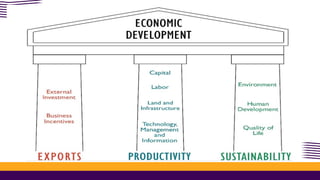
many issues that involve culture,
politics, religion, ethnicity, and
dozens of other topics. Economics
was no doubt a key factor in your
10.
It probably explainsa significant part
of why you are in this class or
attending this college. If you see the
power of money, and the influence of
the economic system in the
operation of daily life, you might find
some value in the political - economic
ideology of Marxism. You may find
the Marxist social science
methodology known as Historical
11.
If you’re notcareful though, you
might be accused of falling into the
trap of economic determinism, which
like some of the other deterministic
views introduced elsewhere in this
text, can lead to an over-reliance on a
single causal variable.
12.
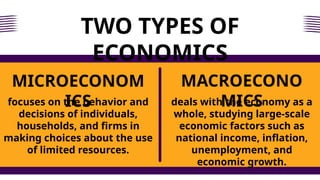
TWO TYPES OF
ECONOMICS
focuseson the behavior and
decisions of individuals,
households, and firms in
making choices about the use
of limited resources.
MICROECONOM
ICS
MACROECONO
MICS
deals with the economy as a
whole, studying large-scale
economic factors such as
national income, inflation,
unemployment, and
economic growth.
13.
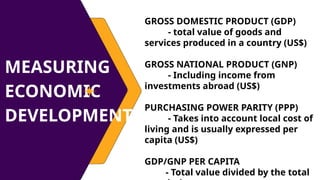
MEASURING
ECONOMIC
DEVELOPMENT
GROSS DOMESTIC PRODUCT(GDP)
- total value of goods and
services produced in a country (US$)
GROSS NATIONAL PRODUCT (GNP)
- Including income from
investments abroad (US$)
PURCHASING POWER PARITY (PPP)
- Takes into account local cost of
living and is usually expressed per
capita (US$)
GDP/GNP PER CAPITA
- Total value divided by the total
14.
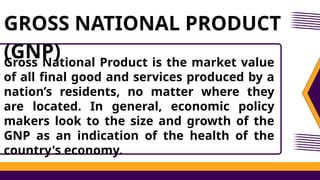
Gross National Productis the market value
of all final good and services produced by a
nation’s residents, no matter where they
are located. In general, economic policy
makers look to the size and growth of the
GNP as an indication of the health of the
country's economy.
GROSS NATIONAL PRODUCT
(GNP)
15.
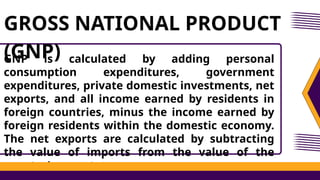
GNP is calculatedby adding personal
consumption expenditures, government
expenditures, private domestic investments, net
exports, and all income earned by residents in
foreign countries, minus the income earned by
foreign residents within the domestic economy.
The net exports are calculated by subtracting
the value of imports from the value of the
country’s exports.
GROSS NATIONAL PRODUCT
(GNP)
16.
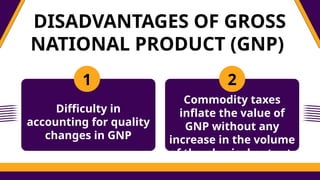
DISADVANTAGES OF GROSS
NATIONALPRODUCT (GNP)
1 2
Difficulty in
accounting for quality
changes in GNP
Commodity taxes
inflate the value of
GNP without any
increase in the volume
of the physical output.
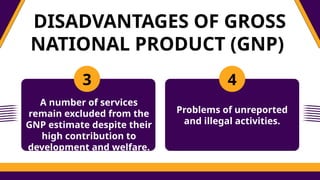
17.
DISADVANTAGES OF GROSS
NATIONALPRODUCT (GNP)
3 4
A number of services
remain excluded from the
GNP estimate despite their
high contribution to
development and welfare.
Problems of unreported
and illegal activities.
Gross Domestic Productis the most widely used
measure of a nation’s economic performance. It
is the market value of all final goods and
services produced in a nation during a period of
time, usually a year. It relies on markets to
establish the relative value of goods and
services. GDP is a quantitative, rather than
qualitative, measure of the output of goods and
services.
GROSS DOMESTIC PRODUCT
(GDP)
20.
A method usedto compare the economic
productivity and standards of living between
countries. It adjusts GDP by taking into account
the local cost of living and inflation rates,
providing a more accurate picture of what
people can actually buy with their income. PPP
is usually expressed per capita (US$) and helps
compare the real well-being of citizens across
nations.
PURCHASING POWER PARITY
(PPP)
21.
The total GDPor GNP divided by the population
of the country. This measures the average
income or economic output per person. A higher
per capita figure indicates better living
standards, though it does not account for
income inequality within the population.
GDP/GNP PER CAPITA
22.
Population, health, andeconomic
development are determinants as well
as consequences of each other.
Improved health directly affects
population size, age-sex structure, labor
force participation, and productivity
level, all of which may either inhibit or
facilitate economic progress.
DEMOGRAPHIC
INDICATORS OF
DEVELOPMENT
FERTILITY
Refers to thenumber of live births in a
population. It is often measured through the
fertility rate (average number of children a
woman is expected to have in her lifetime). It
indicates population growth potential.
25.
MORTALITY
Refers to theincidence of death in a
population. Mortality rates (like infant
mortality or crude death rate) show health
conditions, life expectancy, and overall quality
of life in a country.
26.
MIGRATION
The movement ofpeople from one place to
another, either within a country (internal
migration) or across borders (international
migration). It affects population size, labor
force, and cultural diversity.
27.
COMPOSITION OF
POPULATION
Refers tothe structure of the population in
terms of age, gender, sex, marital status,
education, occupation (skilled/unskilled), etc.
It helps analyze workforce potential and
social characteristics of a population.
28.
DISTRIBUTION OF
POPULATION
Refers tohow people are spread across a
given area or region. Some areas may be
densely populated while others are sparsely
populated, affecting resource allocation and
development planning.
29.
NATURAL INCREASE
The differencebetween the number of births
and deaths in a population over a period of
time. If births exceed deaths, the population
grows; if deaths exceed births, the population
decreases.
30.
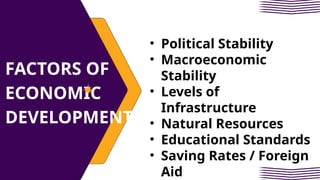
FACTORS OF
ECONOMIC
DEVELOPMENT
• PoliticalStability
• Macroeconomic
Stability
• Levels of
Infrastructure
• Natural Resources
• Educational Standards
• Saving Rates / Foreign
Aid
31.
POLITICAL STABILITY
A stablegovernment promotes peace,
enforces laws, and creates a secure
environment for businesses and investors.
Political instability (e.g., corruption, conflict,
frequent changes in leadership) discourages
growth.
32.
MACROECONOMIC
STABILITY
Refers to stableprices, low inflation,
sustainable government debt, and steady
economic growth. A stable economy builds
confidence among investors and ensures
long-term development.
33.
LEVELS OF
INFRASTRUCTURE
Infrastructure includesroads, electricity,
water supply, transport, and communication
systems. Strong infrastructure lowers
production costs, improves efficiency, and
attracts investment.
34.
NATURAL RESOURCES
Availability ofland, minerals, water, forests,
and energy resources contributes to
development. However, effective
management is essential, as over-reliance can
cause economic vulnerability.
35.
EDUCATIONAL
STANDARDS
A skilled andeducated workforce increases
productivity, innovation, and the ability to
adapt to new technologies, which drives
sustainable growth.
36.
SAVING RATES /FOREIGN
AID
High savings provide capital for investment in
industries and development projects. Foreign
aid also supports infrastructure, health, and
education in developing nations.
37.
BARRIERS TO TRADE
Tariffs,quotas, and trade restrictions can
limit economic growth by reducing market
access. Open trade policies allow countries to
specialize, export goods, and attract foreign
investment.
38.
The base ofall economic development is
investment. When private investment fails
to meet a community's particular needs,
public investment or public/private
partnerships may be necessary. Current
realities and future challenges of economic
development give rise to three foundational
principles on which economic development
investments should be based: exports,
HOW COUNTRIES CAN
PROMOTE ECONOMIC
DEVELOPMENT?
39.
Exports have motivatedmuch of economic
development activity in the past, but the
shift from a manufacturing service-based
economy and increasing global competition
has emphasized the importance of
productivity. A growing awareness of the
need for human development and the
scarcity of natural resources also highlights
the need for a sustainable approach.
HOW COUNTRIES CAN
PROMOTE ECONOMIC
DEVELOPMENT?
40.
Exports, productivity, andsustainability
are the three principles of economic
development - the pillars that form the
core support of the economic
development edifice. With too much or
too little investment in any one of the
three, the structure becomes unstable.
HOW COUNTRIES CAN
PROMOTE ECONOMIC
DEVELOPMENT?
#5 Tariff - A tariff is a tax or duty imposed by a government on goods imported from other countries. It is usually charged as a percentage of the value of the imported goods or as a fixed amount per unit.
The Trump administration imposed a reciprocal tariff of up to 20% on Philippine exports to the U.S., which was later reduced to 19% after negotiations.
This tariff makes Philippine goods more expensive in the U.S., which may reduce demand for exports like electronics, coconut products, and seafood.
Exports are a major part of the economy, so lower demand could slow economic growth and affect GDP.
Some estimates suggest the tariffs could cost the Philippines around US$1.89 billion (≈₱94.5 billion) in trade revenue.
The tariffs could also create supply chain disruptions, especially in electronics and intermediate goods industries.
There is a risk of peso volatility and higher import costs, which could push up inflation.
The impact is partially mitigated because some goods are exempted from tariffs, and the Philippines’ economy is largely domestic-driven.
The tariffs may encourage the Philippines to diversify trade markets and reduce dependence on the U.S. alone.
It could also push local industries to increase production capacity and focus on higher-value goods for resilience.
Overall, the tariffs present challenges, but careful government strategies and business adjustments can reduce negative effects.
#8 Economic Geography is a branch of geography that studies how people use the Earth’s resources, where economic activities are located, and why certain industries and jobs develop in specific places.
It connects economics (production, distribution, consumption) with geography (location, environment, space).
#9 Economics influences your decision to go to college because it affects your future opportunities and income.
College is considered an investment in yourself, where you spend money, time, and effort now to gain better opportunities later.
You consider the costs of college, like tuition and allowance, versus the benefits, such as a higher-paying job and career stability.
Going to college increases your chances of financial security and a stable career.
Your decision is also influenced by the desire for economic mobility and improving your family’s standard of living.
Choosing college involves opportunity cost, meaning you give up other opportunities like working full time, but you believe the benefits are worth it.
#11 Economic determinism is the idea that economic factors are the primary influence on society, politics, and human behavior. In other words, the way a society produces, distributes, and consumes goods and wealth shapes its social structures, laws, culture, and even ideas.
It is closely associated with Marxist theory, which says that the economic base (means of production and relations of production) determines the superstructure (culture, politics, and institutions).
#38 Investment is the foundation of all economic development because it provides the resources needed for growth and progress.
When private investment is insufficient to meet the specific needs of a community, government investment or collaboration between the public and private sectors may be required.
Economic development should focus on exports, meaning producing goods or services that can be sold to other regions or countries to generate income.
Productivity is essential, as improving efficiency and output helps the economy grow and supports higher standards of living.
Sustainability must be considered to ensure that economic growth does not harm the environment or deplete resources, allowing long-term development.
Current realities, like limited resources and global competition, and future challenges, such as climate change and population growth, make these principles critical in planning economic development.
#39 In the past, exports were a major driver of economic growth because selling goods to other countries brought income and jobs.
Over time, many economies have shifted from manufacturing-based to service-based industries, like finance, education, and IT.
Increasing global competition means countries must focus on productivity, working more efficiently to stay competitive.
There is growing recognition that human development, such as education and skills, is crucial for sustaining economic growth.
The scarcity of natural resources shows the need to use resources wisely and adopt a sustainable approach in economic activities.
#40 Exports drive economic growth by bringing in foreign income, creating jobs, and increasing national revenue.
Productivity measures how efficiently resources like labor and capital are used, which improves output and economic performance.
Sustainability ensures that economic growth does not harm the environment or deplete resources, allowing development to continue in the long term.
Economic development is strongest when all three principles are balanced and working together.
If one principle is neglected, such as low productivity, over-reliance on exports, or ignoring sustainability, the economy becomes unstable and growth may falter.
Together, exports, productivity, and sustainability act like the pillars of a building, supporting a stable and lasting economic development structure.











![Eco 8th Lecture[1]](https://cdn.slidesharecdn.com/ss_thumbnails/eco8thlecture1-12532565523311-phpapp02-thumbnail.jpg?width=640&height=640&fit=bounds)


