Visit https://testbankdeal.com todownload the full version and
explore more testbank or solutions manual
Human Physiology 12th Edition Fox Test Bank
_____ Click the link below to download _____
https://testbankdeal.com/product/human-physiology-12th-
edition-fox-test-bank/
Explore and download more testbank or solutions manual at testbankdeal.com
2.
Here are somerecommended products that we believe you will be
interested in. You can click the link to download.
Human Physiology 14th Edition Fox Test Bank
https://testbankdeal.com/product/human-physiology-14th-edition-fox-
test-bank/
Human Physiology 14th Edition Fox Solutions Manual
https://testbankdeal.com/product/human-physiology-14th-edition-fox-
solutions-manual/
Human Physiology 13th Edition Stuart Ira Fox Test Bank
https://testbankdeal.com/product/human-physiology-13th-edition-stuart-
ira-fox-test-bank/
Macroeconomics 6th Edition Hall Solutions Manual
https://testbankdeal.com/product/macroeconomics-6th-edition-hall-
solutions-manual/
3.
Accounting 25th EditionWarren Solutions Manual
https://testbankdeal.com/product/accounting-25th-edition-warren-
solutions-manual/
Economics of Social Issues 20th Edition Sharp Test Bank
https://testbankdeal.com/product/economics-of-social-issues-20th-
edition-sharp-test-bank/
Lesikars Business Communication Connecting in a Digital
World 13th Edition Rentz Solutions Manual
https://testbankdeal.com/product/lesikars-business-communication-
connecting-in-a-digital-world-13th-edition-rentz-solutions-manual/
First Course in Mathematical Modeling 5th Edition Giordano
Solutions Manual
https://testbankdeal.com/product/first-course-in-mathematical-
modeling-5th-edition-giordano-solutions-manual/
Business Communication Today 12th Edition Bovee Test Bank
https://testbankdeal.com/product/business-communication-today-12th-
edition-bovee-test-bank/
Chapter 08 -The Central Nervous System
8-1
Chapter 08
The Central Nervous System
True / False Questions
1. The neural tube and neural crest cells are of endodermal origin.
FALSE
Bloom's Level: 1. Remember
Section: 8.01
Topic: Nervous System
2. The forebrain develops into the telencephalon and the diencephalon.
TRUE
Bloom's Level: 1. Remember
Section: 8.01
Topic: Nervous System
3. Damage to the white matter of the brain would prevent transmission of information
between nuclei.
TRUE
Bloom's Level: 2. Understand
Section: 8.01
Topic: Nervous System
Multiple Choice Questions
6.
Chapter 08 -The Central Nervous System
8-2
4. __________ innervate muscles and glands.
A. Sensory neurons
B. Ganglia
C. Motor neurons
D. Association neurons
Bloom's Level: 1. Remember
Section: 8.01
Topic: Nervous System
5. Destruction of the embryonic ____________ will prevent formation of the nervous system.
A. ectoderm
B. mesoderm
C. endoderm
D. mesoglia
Bloom's Level: 2. Understand
Section: 8.01
Topic: Nervous System
6. In the cerebrum, the _________ matter is generally superficial and the _______ matter is
deep.
A. white, gray
B. gray, white
Bloom's Level: 1. Remember
Section: 8.01
Topic: Nervous System
True / False Questions
7.
Chapter 08 -The Central Nervous System
8-3
7. The cerebral cortex is made up of both gray and white matter.
FALSE
Bloom's Level: 1. Remember
Section: 8.01
Topic: Nervous System
8. Gray matter is found only in the cerebral cortex.
FALSE
Bloom's Level: 1. Remember
Section: 8.01
Topic: Nervous System
Multiple Choice Questions
9. The midbrain forms from the
A. telencephalon.
B. mesencephalon.
C. myelencephalon.
D. diencephalon.
Bloom's Level: 1. Remember
Section: 8.01
Topic: Nervous System
10. The cerebellum forms from the
A. telencephalon.
B. metencephalon.
C. myelencephalon.
D. diencephalon.
Bloom's Level: 1. Remember
Section: 8.01
Topic: Nervous System
8.
Chapter 08 -The Central Nervous System
8-4
11. Cerebrospinal fluid is found
A. within the central canal.
B. within the ventricles.
C. within the olfactory bulbs.
D. both within the central canal and within the ventricles.
Bloom's Level: 1. Remember
Section: 8.01
Topic: Nervous System
12. Neural crest cells differentiate into
A. the telencephalon.
B. the red nucleus.
C. the basal nuclei.
D. peripheral nervous system ganglia.
Bloom's Level: 1. Remember
Section: 8.01
Topic: Nervous System
13. The function of ____________ neurons is to link sensory stimuli with the appropriate
motor responses.
A. bipolar
B. association
C. motor
D. pseudounipolar
Bloom's Level: 1. Remember
Section: 8.01
Topic: Nervous System
9.
Chapter 08 -The Central Nervous System
8-5
14. _________% of total blood flow to the body per minute goes to the brain.
A. 15
B. 20
C. 25
D. 30
Bloom's Level: 1. Remember
Section: 8.01
Topic: Nervous System
True / False Questions
15. The brain ventricles are remnants of the hollow neural tube.
TRUE
Bloom's Level: 1. Remember
Section: 8.01
Topic: Nervous System
Multiple Choice Questions
16. Neural stem cells in adult mammalian brains are found in the
A. cerebral cortex.
B. subventricular zone.
C. midbrain.
D. subgranular zone.
E. both the subventricular and subgranular zones.
Bloom's Level: 1. Remember
Section: 8.01
Topic: Nervous System
10.
Chapter 08 -The Central Nervous System
8-6
17. Which area of the brain contains neural stem cells that are apparently important in
learning and memory?
A. arcuate fasciculus
B. subgranular zone of the hippocampus
C. temporal lobe
D. cerebral cortex
Bloom's Level: 1. Remember
Section: 8.01
Topic: Nervous System
18. Neural stem cells from the subventricular zone are important in the renewal of _______
neurons.
A. visual
B. gustatory
C. olfactory
D. auditory
Bloom's Level: 1. Remember
Section: 8.01
Topic: Nervous System
19. Neurogenesis is the formation of new ______________ from neural stem cells.
A. ependymal cells
B. astrocytes
C. neurons
D. All of the choices are correct.
Bloom's Level: 1. Remember
Section: 8.01
Topic: Nervous System
True / False Questions
11.
Chapter 08 -The Central Nervous System
8-7
20. Communication between the cerebrum and cerebellum is facilitated by the corpus
callosum.
FALSE
Bloom's Level: 1. Remember
Section: 8.02
Topic: Nervous System
21. Damage to the parietal lobe of the cerebrum would impair somatesthetic interpretation.
TRUE
Bloom's Level: 1. Remember
Section: 8.02
Topic: Nervous System
22. Visual inputs are interpreted on the occipital lobe of the cerebral cortex.
TRUE
Bloom's Level: 1. Remember
Section: 8.02
Topic: Nervous System
Multiple Choice Questions
23. Which of the following is the correct list of the lobes of the cerebrum?
A. insula, temporal, parietal, pons, occipital
B. temporal, frontal, insula, cerebellum, occipital
C. frontal, parietal, temporal, insula, occipital
D. cerebrum, midbrain, thalamus, pons, medulla oblongata
Bloom's Level: 1. Remember
Section: 8.02
Topic: Nervous System
12.
Chapter 08 -The Central Nervous System
8-8
24. The ____________ is a cerebral lobe that is involved in memory and integration of
sensory information (mostly pain) with visceral responses.
A. temporal
B. frontal
C. parietal
D. insula
Bloom's Level: 1. Remember
Section: 8.02
Topic: Nervous System
True / False Questions
25. The largest body regions have the largest areas of the cerebral cortex.
FALSE
Bloom's Level: 1. Remember
Section: 8.02
Topic: Nervous System
Multiple Choice Questions
26. Which of the following statements is true of the cerebral cortex?
A. Sensations from the feet would be on the most inferior area of the somatesthetic cortex.
B. Areas of the body with the greatest density of receptors will have larger areas on the
somatesthetic cortex.
C. The hands have a very small area on the motor cortex.
D. The left side of the motor cortex controls muscles on the left side of the body.
Bloom's Level: 2. Understand
Section: 8.02
Topic: Nervous System
13.
Chapter 08 -The Central Nervous System
8-9
27. _________________ is an enzyme that catalyzes the formation of a particular damaging
amyloid -peptide that is implicated in inherited forms of early-onset Alzheimer's disease.
A. -secretase
B. -secretase
C. -secretase
D. -secretase
Bloom's Level: 1. Remember
Section: 8.02
Topic: Nervous System
28. Which of the following is NOT a characteristic of Alzheimer's disease?
A. an accumulation of intracellular proteins that form neurofibrillar tangles
B. loss of neurons in the hippocampus and cerebral cortex
C. an accumulation of extracellular proteins that form senile plaques
D. most cases are inherited
Bloom's Level: 1. Remember
Section: 8.02
Topic: Nervous System
29. Damage to the temporal lobe of the cerebrum would limit
A. voluntary skeletal muscle contraction.
B. integration of cerebral activities.
C. hearing.
D. vision.
Bloom's Level: 1. Remember
Section: 8.02
Topic: Nervous System
14.
Chapter 08 -The Central Nervous System
8-10
30. What type of neurons are found in the precentral gyrus?
A. sensory neurons
B. lower motor neurons
C. upper motor neurons
D. middle motor neurons
Bloom's Level: 1. Remember
Section: 8.02
Topic: Nervous System
31. What structure separates the frontal and parietal lobes?
A. corpus callosum
B. central sulcus
C. lateral sulcus
D. longitudinal fissure
Bloom's Level: 1. Remember
Section: 8.02
Topic: Nervous System
32. A raised area on the cerebral cortex is a
A. sulcus.
B. fissure.
C. gyrus.
D. mirror neuron.
Bloom's Level: 1. Remember
Section: 8.02
Topic: Nervous System
15.
Chapter 08 -The Central Nervous System
8-11
33. What condition may be partly caused by impairment of mirror neuron function?
A. Alzheimer's disease
B. autism spectrum disorder
C. Parkinson's disease
D. epilepsy
Bloom's Level: 1. Remember
Section: 8.02
Topic: Nervous System
34. What type of neurons aid in imitating, understanding intentions and behaviors of others,
and having empathy with the emotions of others?
A. sensory neurons
B. motor neurons
C. association neurons
D. mirror neurons
Bloom's Level: 1. Remember
Section: 8.02
Topic: Nervous System
True / False Questions
35. Mirror neurons are found in the frontal lobe, parietal lobe, and Broca's motor speech area;
and are connected to the limbic system through the insula.
TRUE
Bloom's Level: 1. Remember
Section: 8.02
Topic: Nervous System
Multiple Choice Questions
16.
Chapter 08 -The Central Nervous System
8-12
36. __________________ is a technique for visualizing brain region activity indirectly by
detecting increases in blood oxygen levels.
A. Computed tomography
B. Electroencephalogram
C. Functional magnetic resonance imaging
D. Positron emission tomography
Bloom's Level: 2. Understand
Section: 8.02
Topic: Nervous System
37. Brain metabolism may be best studied by
A. electroencephalography.
B. computed tomography.
C. magnetic resonance imaging.
D. positron-emission tomography.
Bloom's Level: 2. Understand
Section: 8.02
Topic: Nervous System
38. Magnetic resonance imaging (MRI) uses ______________ as its basis for producing
images.
A. x-rays
B. gamma rays
C. spinning protons
D. electrical currents
Bloom's Level: 1. Remember
Section: 8.02
Topic: Nervous System
17.
Chapter 08 -The Central Nervous System
8-13
39. Which imaging technique uses magnetic fields produced by postsynaptic electric currents
to produce an image?
A. EEG
B. fMRI
C. MEG
D. PET
Bloom's Level: 1. Remember
Section: 8.02
Topic: Nervous System
40. A record of the electrical currents of the cerebral cortex is a/an
A. computed tomograph.
B. electroencephalogram.
C. magnetic resonance image.
D. positron-emission tomograph.
Bloom's Level: 1. Remember
Section: 8.02
Topic: Nervous System
True / False Questions
41. Delta waves in an awake infant indicate brain damage.
FALSE
Bloom's Level: 1. Remember
Section: 8.02
Topic: Nervous System
Multiple Choice Questions
18.
Chapter 08 -The Central Nervous System
8-14
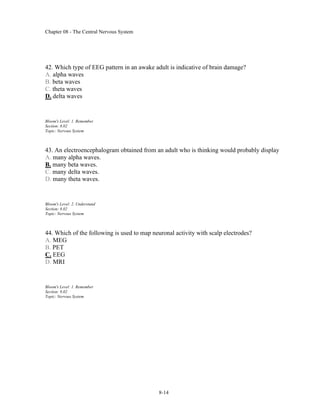
42. Which type of EEG pattern in an awake adult is indicative of brain damage?
A. alpha waves
B. beta waves
C. theta waves
D. delta waves
Bloom's Level: 1. Remember
Section: 8.02
Topic: Nervous System
43. An electroencephalogram obtained from an adult who is thinking would probably display
A. many alpha waves.
B. many beta waves.
C. many delta waves.
D. many theta waves.
Bloom's Level: 2. Understand
Section: 8.02
Topic: Nervous System
44. Which of the following is used to map neuronal activity with scalp electrodes?
A. MEG
B. PET
C. EEG
D. MRI
Bloom's Level: 1. Remember
Section: 8.02
Topic: Nervous System
19.
Chapter 08 -The Central Nervous System
8-15
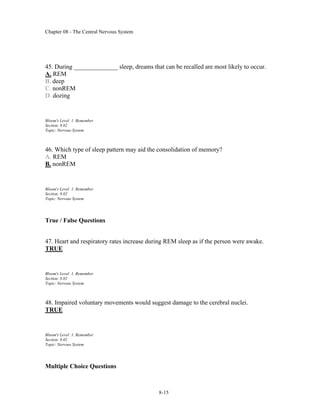
45. During ______________ sleep, dreams that can be recalled are most likely to occur.
A. REM
B. deep
C. nonREM
D. dozing
Bloom's Level: 1. Remember
Section: 8.02
Topic: Nervous System
46. Which type of sleep pattern may aid the consolidation of memory?
A. REM
B. nonREM
Bloom's Level: 1. Remember
Section: 8.02
Topic: Nervous System
True / False Questions
47. Heart and respiratory rates increase during REM sleep as if the person were awake.
TRUE
Bloom's Level: 1. Remember
Section: 8.02
Topic: Nervous System
48. Impaired voluntary movements would suggest damage to the cerebral nuclei.
TRUE
Bloom's Level: 1. Remember
Section: 8.02
Topic: Nervous System
Multiple Choice Questions
20.
Chapter 08 -The Central Nervous System
8-16
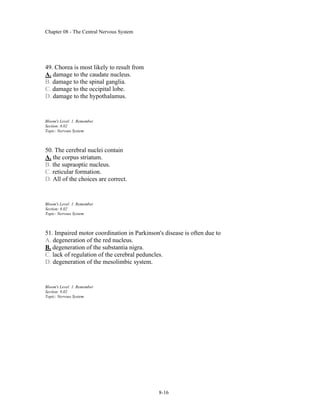
49. Chorea is most likely to result from
A. damage to the caudate nucleus.
B. damage to the spinal ganglia.
C. damage to the occipital lobe.
D. damage to the hypothalamus.
Bloom's Level: 1. Remember
Section: 8.02
Topic: Nervous System
50. The cerebral nuclei contain
A. the corpus striatum.
B. the supraoptic nucleus.
C. reticular formation.
D. All of the choices are correct.
Bloom's Level: 1. Remember
Section: 8.02
Topic: Nervous System
51. Impaired motor coordination in Parkinson's disease is often due to
A. degeneration of the red nucleus.
B. degeneration of the substantia nigra.
C. lack of regulation of the cerebral peduncles.
D. degeneration of the mesolimbic system.
Bloom's Level: 1. Remember
Section: 8.02
Topic: Nervous System
21.
Chapter 08 -The Central Nervous System
8-17
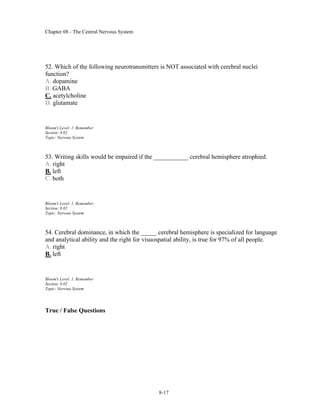
52. Which of the following neurotransmitters is NOT associated with cerebral nuclei
function?
A. dopamine
B. GABA
C. acetylcholine
D. glutamate
Bloom's Level: 1. Remember
Section: 8.02
Topic: Nervous System
53. Writing skills would be impaired if the ___________ cerebral hemisphere atrophied.
A. right
B. left
C. both
Bloom's Level: 1. Remember
Section: 8.02
Topic: Nervous System
54. Cerebral dominance, in which the _____ cerebral hemisphere is specialized for language
and analytical ability and the right for visuospatial ability, is true for 97% of all people.
A. right
B. left
Bloom's Level: 1. Remember
Section: 8.02
Topic: Nervous System
True / False Questions
22.
Chapter 08 -The Central Nervous System
8-18
55. Damage to the right motor cortex will generally mean motor problems on the right side of
the body.
FALSE
Bloom's Level: 2. Understand
Section: 8.02
Topic: Nervous System
56. Destruction of Wernicke's area destroys language comprehension.
TRUE
Bloom's Level: 1. Remember
Section: 8.02
Topic: Nervous System
Multiple Choice Questions
57. Aphasias are most often associated with damage to ___________ and ___________
areas.
A. Wernicke's and the angular gyrus
B. fornix and Broca's
C. Broca's and Wernicke's
D. the angular gyrus and septal nuclei
Bloom's Level: 1. Remember
Section: 8.02
Topic: Nervous System
23.
Chapter 08 -The Central Nervous System
8-19
58. Individuals with aphasia
A. often have damage to spinal nerves.
B. may not be able to write if the angular gyrus is damaged.
C. often speak slowly if Wernicke's area is damaged.
D. often form nonsensical sentences if Broca's area is damaged.
Bloom's Level: 1. Remember
Section: 8.02
Topic: Nervous System
59. Permanent aphasias often occur when
A. Wernicke's area is damaged.
B. Broca's area is damaged.
C. the angular gyrus is damaged.
D. spinal nerves are damaged.
Bloom's Level: 1. Remember
Section: 8.02
Topic: Nervous System
60. What structure connects Wernicke's area to Broca's area?
A. corpus striatum
B. angular gyrus
C. arcuate fasciculus
D. corpus callosum
Bloom's Level: 1. Remember
Section: 8.02
Topic: Nervous System
True / False Questions
24.
Chapter 08 -The Central Nervous System
8-20
61. Ablation of the limbic system may result in an absence of fear.
TRUE
Bloom's Level: 1. Remember
Section: 8.02
Topic: Nervous System
Multiple Choice Questions
62. Damage to the Papez circuit prevents communication between
A. the limbic system and olfactory bulbs.
B. the limbic system and hippocampus.
C. the limbic system and the diencephalon.
D. the limbic system and the cerebrum.
Bloom's Level: 1. Remember
Section: 8.02
Topic: Nervous System
63. Ablation of the amygdala and limbic system would primarily result in
A. loss of voluntary muscle contraction.
B. attenuation of aggressive behaviors.
C. loss of ability to detect olfactory inputs.
D. no noticeable effects.
Bloom's Level: 2. Understand
Section: 8.02
Topic: Nervous System
many instances occurredof vendettas pursued in the face of
apparently insuperable difficulties and consummated after years of
effort. By the standard of modern morality the Japanese samurai
would be counted cruel. Holding that death was the natural sequel
of defeat and the only certain way of avoiding disgrace, he did not
seek quarter himself or think of extending it to an enemy. Yet in his
treatment of the latter he loved to display courtesy until the supreme
moment when all considerations of mercy were laid aside. It cannot
be doubted that the practice of employing torture judicially tended
to educate a mood of callousness towards suffering, or that the
many idle hours of a military man’s life in time of peace encouraged
a measure of dissipation. But there does not seem to be any valid
ground for concluding that either of these defects was conspicuous
in the character of the Japanese samurai. Faithlessness towards
women was the greatest fault that can be laid to his door. The
samurai lady claimed no privilege of timidity on account of her sex.
She knew how to die in the cause of honour just as readily as her
husband, her father or her brother died, and conjugal fidelity did not
rank as a virtue in her eyes, being regarded as a simple duty. But
her husband held marital faith in small esteem and ranked his wife
far below his sword. It has to be remembered that when we speak
of a samurai’s suicide, there is no question of poison, the bullet,
drowning or any comparatively painless manner of exit from the
world. The invariable method was to cut open the abdomen (hara-
kiri or seppuku) and afterwards, if strength remained, the sword was
turned against the throat. To such endurance had the samurai
trained himself that he went through this cruel ordeal without
flinching in the smallest degree.
The heimin or commoners were divided into three classes—
husbandmen, artisans and traders. The farmer, as the nation lived by
27.
Heimin.
his labour, wascounted the most respectable among the bread-
winners, and a cultivator of his own estate might
even carry one sword but never two, that
privilege being strictly reserved to a samurai. The
artisan, too, received much consideration, as is easily understood
when we remember that included in his ranks were artists, sword-
smiths, armourers, sculptors of sacred images or sword-furniture,
ceramists and lacquerers. Many artisans were in the permanent
service of feudal chiefs from whom they received fixed salaries.
Tradesmen, however, were regarded with disdain and stood lowest
of all in the social organization. Too much despised to be even
included in that organization were the eta (defiled folks) and the
hinin (outcasts). The exact origin of these latter pariahs is uncertain,
but the ancestors of the eta would seem to have been prisoners of
war or the enslaved families of criminals. To such people were
assigned the defiling duties of tending tombs, disposing of the
bodies of the dead, slaughtering animals or tanning hides. The hinin
were mendicants. On them devolved the task of removing and
burying the corpses of executed criminals. Living in segregated
hamlets, forbidden to marry with heimin, still less with samurai, not
allowed to eat, drink or associate with persons above their own
class, the eta remained under the ban of ostracism from generation
to generation, though many of them contrived to amass much
wealth. They were governed by their own headmen, and they had
three chiefs, one residing in each of the cities of Yedo, Osaka and
Kiōto. All these members of the submerged classes were relieved
from proscription and admitted to the ranks of the commoners under
the enlightened system of Meiji. The 12th of October 1871 saw their
enfranchisement, and at that date the census showed 287,111 eta
and 695,689 hinin.
28.
Decline and Fall
ofthe
Shōgunate.
Naturally, as the unbroken peace of the Tokugawa régime became
habitual, the mood of the nation underwent a change. The samurai,
no longer required to lead the frugal life of camp or barracks, began
to live beyond their incomes. “They found
difficulty in meeting the pecuniary engagements
of everyday existence, so that money acquired
new importance in their eyes, and they gradually
forfeited the respect which their traditional
disinterestedness had won for them in the past.” At the same time
the abuses of feudalism were thrown into increased salience. A large
body of hereditary soldiers become an anomaly when fighting has
passed even out of memory. On the other hand, the agricultural and
commercial classes acquired new importance. The enormous sums
disbursed every year in Yedo, for the maintenance of the great
establishments which the feudal chiefs vied with each other in
keeping there, enriched the merchants and traders so greatly that
their scale of living underwent radical change. Buddhism was a
potent influence, but its ethical restraints were weakened by the
conduct of its priests, who themselves often yielded to the
temptation of the time. The aristocracy adhered to its refined
pastimes—performances of the No; tea reunions; poem composing;
polo; football; equestrian archery; fencing and gambling—but the
commoner, being excluded from all this realm and, at the same time,
emerging rapidly from his old position of penury and degradation,
began to develop luxurious proclivities and to demand corresponding
amusements. Thus the theatre came into existence; the dancing girl
and the jester found lucrative employment; a popular school of art
was founded and quickly carried to perfection; the lupanar assumed
unprecedented dimensions; rich and costly costumes acquired wide
vogue in despite of sumptuary laws enacted from time to time;
29.
wrestling became animportant institution, and plutocracy asserted
itself in the face of caste distinctions.
30.
Simultaneously with thechange of social conditions thus taking
place, history repeated itself at the shōgun’s court. The substance of
administrative power passed into the hands of a minister, its shadow
alone remaining to the shōgun. During only two generations were
the successors of Iyeyasu able to resist this traditional tendency. The
representative of the third—Iyetsuna (1661-1680)—succumbed to
the machinations of an ambitious minister, Sakai Takakiyo, and it
may be said that from that time the nominal repository of
administrative authority in Yedo was generally a species of
magnificent recluse, secluded from contact with the outer world and
seeing and hearing only through the eyes and ears of the ladies of
his household. In this respect the descendants of the great
Tokugawa statesman found themselves reduced to a position
precisely analogous to that of the emperor in Kiōto. Sovereign and
shōgun were alike mere abstractions so far as the practical work of
government was concerned. With the great mass of the feudal chiefs
things fared similarly. These men who, in the days of Nobunaga,
Hideyoshi and Iyeyasu, had directed the policies of their fiefs and led
their armies in the field, were gradually transformed, during the long
peace of the Tokugawa era, into voluptuous fainéants or, at best,
thoughtless dilettanti, willing to abandon the direction of their affairs
to seneschals and mayors, who, while on the whole their
administration was able and loyal, found their account in contriving
and perpetuating the effacement of their chiefs. Thus, in effect, the
government of the country, taken out of the hands of the shōgun
and the feudatories, fell into those of their vassals. There were
exceptions, of course, but so rare as to be merely accidental.
Another important factor has to be noted. It has been shown
above that Iyeyasu bestowed upon his three sons the rich fiefs of
31.
Owari, Kii (Kishū)and Mito, and that these three families exclusively
enjoyed the privilege of furnishing an heir to the shōgun should the
latter be without direct issue. Mito ought therefore to have been a
most unlikely place for the conception and propagation of principles
subversive of the shōgun’s administrative autocracy. Nevertheless, in
the days of the second of the Mito chiefs at the close of the 17th
century, there arose in that province a school of thinkers who,
revolting against the ascendancy of Chinese literature and of
Buddhism, devoted themselves to compiling a history such as should
recall the attention of the nation to its own annals and revive its
allegiance to Shintō. It would seem that in patronizing the
compilation of this great work the Mito chief was swayed by the
spirit of pure patriotism and studentship, and that he discerned
nothing of the goal to which the new researches must lead the
litterati of his fief. “He and they, for the sake of history and without
any thought of politics, undertook a retrospect of their country’s
annals, and their frank analysis furnished conclusive proof that the
emperor was the prime source of administrative authority and that
its independent exercise by a shōgun must be regarded as a
usurpation. They did not attempt to give practical effect to their
discoveries; the era was essentially academical. But this galaxy of
scholars projected into the future a light which burned with growing
force in each succeeding generation and ultimately burst into a
flame which consumed feudalism and the shōgunate,” fused the
nation into one, and restored the governing authority to the
emperor. Of course the Mito men were not alone in this matter:
many students subsequently trod in their footsteps and many others
sought to stem the tendency; but the net result was fatal to faith in
the dual system of government. Possibly had nothing occurred to
furnish signal proof of the system’s practical defects, it might have
32.
long survived thistheoretical disapproval. But the crisis caused by
the advent of foreign ships and by the forceful renewal of foreign
intercourse in the 19th century afforded convincing evidence of the
shōgunate’s incapacity to protect the state’s supposed interests and
to enforce the traditional policy of isolation which the nation had
learned to consider essential to the empire’s integrity.
Another important factor made for the fall of the shōgunate. That
factor was the traditional disaffection of the two great southern fiefs,
Satsuma and Chōshū. When Iyeyasu parcelled out the empire, he
deemed it the wisest policy to leave these chieftains in full
possession of their large estates. But this measure, construed as an
evidence of weakness rather than a token of liberality, neither won
the allegiance of the big feudatories nor cooled their ambition. Thus
no sooner did the nation divide into two camps over the question of
renewed foreign intercourse than men of the above clans, in concert
with representatives of certain of the old court nobles, placed
themselves at the head of a movement animated by two loudly
proclaimed purposes: restoration of the administration to the
emperor, and expulsion of aliens. This latter aspiration underwent a
radical change when the bombardment of the Satsuma capital,
Kagoshima, and the destruction of the Chōshū forts and ships at
Shimonoseki proved conclusively to the Satsuma and Chōshū clans
that Japan in her unequipped and backward condition could not
hope to stand for a moment against the Occident in arms. But the
unwelcome discovery was accompanied by a conviction that only a
thoroughly united nation might aspire to preserve its independence,
and thus the abolition of the dual form of government became more
than ever an article of public faith. It is unnecessary to recount the
successive incidents which conspired to undermine the shōgun’s
authority, and to destroy the prestige of the Yedo administration.
33.
Both had beenreduced to vanishing quantities by the year 1866
when Keiki succeeded to the shōgunate.
Keiki, known historically as Yoshinobu, the last of the shōguns,
was a man of matured intellect and high capacities. He had been put
forward by the anti-foreign Conservatives for the succession to the
shōgunate in 1857 when the complications of foreign intercourse
were in their first stage of acuteness. But, like many other intelligent
Japanese, he had learned, in the interval between 1857 and 1866,
that to keep her doors closed was an impossible task for Japan, and
very quickly after taking the reins of office he recognized that
national union could never be achieved while power was divided
between Kiōto and Yedo. At this juncture there was addressed to
him by Yōdō, chief of the great Tosa fief, a memorial setting forth
the hopelessness of the position in which the Yedo court now found
itself, and urging that, in the interests of good government and in
order that the nation’s united strength might be available to meet
the exigencies of its new career, the administration should be
restored to the emperor. Keiki received this memorial in Kiōto. He
immediately summoned a council of all the feudatories and high
officials then in the Imperial city, announced to them his intention to
lay down his office, and, the next day, presented his resignation to
the sovereign. This happened on the 14th of October 1867. It must
be ranked among the signal events of the world’s history, for it
signified the voluntary surrender of kingly authority wielded
uninterruptedly for nearly three centuries. That the shōgun’s
resignation was tendered in good faith there can be no doubt, and
had it been accepted in the same spirit, the great danger it involved
might have been consummated without bloodshed or disorder. But
the clansmen of Satsuma and Chōshū were distrustful. One of the
shōgun’s first acts after assuming office had been to obtain from the
34.
throne an edictfor imposing penalties on Chōshū, and there was a
precedent for suspecting that the renunciation of power by the
shōgun might merely prelude its resumption on a firmer basis.
Therefore steps were taken to induce the emperor, then a youth of
fifteen, to issue a secret rescript to Satsuma and Chōshū,
denouncing the shōgun as the nation’s enemy and enjoining his
destruction. At the same time all officials connected with the
Tokugawa or suspected of sympathy with them were expelled from
office in Kiōto, and the shōgun’s troops were deprived of the custody
of the palace gates by methods which verged upon the use of armed
force. In the face of such provocation Keiki’s earnest efforts to
restrain the indignation of his vassals and adherents failed. They
marched against Kiōto and were defeated, whereupon Keiki left his
castle at Osaka and retired to Yedo, where he subsequently made
unconditional surrender to the Imperial army. There is little more to
be set down on this page of the history. The Yedo court consented
to lay aside its dignities and be stripped of its administrative
authority, but all the Tokugawa vassals and adherents did not prove
equally placable. There was resistance in the northern provinces,
where the Aizu feudatory refused to abandon the Tokugawa cause;
there was an attempt to set up a rival candidate for the throne in the
person of an Imperial prince who presided over the Uyeno
Monastery in Yedo; and there was a wild essay on the part of the
admiral of the shōgun’s fleet to establish a republic in the island of
Yezo. But these were mere ripples on the surface of the broad
stream which set towards the peaceful overthrow of the dual system
of government and ultimately towards the fall of feudalism itself.
That this system, the outcome of five centuries of nearly continuous
warfare, was swept away in almost as many weeks with little loss of
life or destruction of property constitutes, perhaps, the most striking
35.
incident, certainly themost momentous, in the history of the
Japanese nation.
The Meiji Era.—It must be remembered that when reference is
made to the Japanese nation in connexion with these radical
changes, only the nobles and the samurai are indicated—in other
words, a section of the population representing about one-sixteenth
of the whole. The bulk of the people—the agricultural, the industrial
and the mercantile classes—remained outside the sphere of politics,
not sharing the anti-foreign prejudice, or taking any serious interest
in the great questions of the time. Foreigners often noted with
surprise the contrast between the fierce antipathy displayed towards
them by certain samurai on the one hand, and the genial, hospitable
reception given to them by the common people on the other. History
teaches that the latter was the natural disposition of the Japanese,
the former a mood educated by special experiences. Further, even
the comparatively narrow statement that the restoration of the
administrative power to the emperor was the work of the nobles and
the samurai must be taken with limitations. A majority of the nobles
entertained no idea of any necessity for change. They were either
held fast in the vice of Tokugawa authority, or paralyzed by the
sensuous seductions of the lives provided for them by the
machinations of their retainers, who transferred the administrative
authority of the fiefs to their own hands, leaving its shadow only to
their lords. It was among the retainers that longings for a new order
of things were generated. Some of these men were sincere disciples
of progress—a small band of students and deep thinkers who,
looking through the narrow Dutch window at Deshima, had caught a
glimmering perception of the realities that lay beyond the horizon of
their country’s prejudices. But the influence of such Liberals was
comparatively insignificant. Though they showed remarkable moral
36.
Character of
the Revolution.
courageand tenacity of purpose, the age did not furnish any strong
object lesson to enforce their propaganda of progress. The factors
chiefly making for change were, first, the ambition of the southern
clans to oust the Tokugawa, and, secondly, the samurai’s loyal
instinct, reinforced by the teachings of his country’s history, by the
revival of the Shintō cult, by the promptings of national enterprise,
and by the object-lessons of foreign intercourse.
But though essentially imperialistic in its prime purposes, the
revolution which involved the fall of the shōgunate, and ultimately of
feudalism, may be called democratic with regard to the personnel of
those who planned and directed it. They were, for
the most part, men without either official rank or
social standing. That is a point essential to a clear
understanding of the issue. Fifty-five individuals
may be said to have planned and carried out the overthrow of the
Yedo administration, and only five of them were territorial nobles.
Eight, belonging to the court nobility, laboured under the traditional
disadvantages of their class, poverty and political insignificance; and
the remaining forty-two, the hearts and hands of the movement,
may be described as ambitious youths, who sought to make a career
for themselves in the first place, and for their country in the second.
The average age of the whole did not exceed thirty. There was
another element for which any student of Japanese history might
have been prepared: the Satsuma samurai aimed originally not
merely at overthrowing the Tokugawa but also at obtaining the
shōgunate for their own chief. Possibly it would be unjust to say that
all the leaders of the great southern clan harboured that idea. But
some of them certainly did, and not until they had consented to
abandon the project did their union with Chōshū, the other great
southern clan, become possible—a union without which the
37.
The Anti-feudal
Idea.
revolution couldscarcely have been accomplished. This ambition of
the Satsuma clansmen deserves special mention, because it bore
remarkable fruit; it may be said to have laid the foundation of
constitutional government in Japan. For, in consequence of the
distrust engendered by such aspirations, the authors of the
Restoration agreed that when the emperor assumed the reins of
power, he should solemnly pledge himself to convene a deliberative
assembly, to appoint to administrative posts men of intellect and
erudition wherever they might be found, and to decide all measures
in accordance with public opinion. This promise, referred to
frequently in later times as the Imperial oath at the Restoration,
came to be accounted the basis of representative institutions,
though in reality it was intended solely as a guarantee against the
political ascendancy of any one clan.
At the outset the necessity of abolishing feudalism did not present
itself clearly to the leaders of the revolution. Their sole idea was the
unification of the nation. But when they came to consider closely the
practical side of the problem, they understood
how far it would lead them. Evidently that one
homogeneous system of law should replace the
more or less heterogeneous systems operative in
the various fiefs was essential, and such a substitution meant that
the feudatories must be deprived of their local autonomy and,
incidentally, of their control of local finances. That was a stupendous
change. Hitherto each feudal chief had collected the revenues of his
fief and had employed them at will, subject to the sole condition of
maintaining a body of troops proportionate to his income. He had
been, and was still, an autocrat within the limits of his territory. On
the other hand, the active authors of the revolution were a small
band of men mainly without prestige or territorial influence. It was
38.
impossible that theyshould dictate any measure sensibly impairing
the local and fiscal autonomy of the feudatories. No power capable
of enforcing such a measure existed at the time. All the great
political changes in Japan had formerly been preceded by wars
culminating in the accession of some strong clan to supreme
authority, whereas in this case there had been a displacement
without a substitution—the Tokugawa had been overthrown and no
new administrators had been set up in their stead. It was, moreover,
certain that an attempt on the part of any one clan to constitute
itself executor of the sovereign’s mandates would have stirred the
other clans to vehement resistance. In short, the leaders of the
revolution found themselves pledged to a new theory of government
without any machinery for carrying it into effect, or any means of
abolishing the old practice. An ingenious exit from this curious
dilemma was devised by the young reformers. They induced the
feudal chiefs of Satsuma, Chōshū, Tosa and Hizen, the four most
powerful clans in the south, publicly to surrender their fiefs to the
emperor, praying his majesty to reorganize them and to bring them
all under the same system of law. In the case of Shimazu, chief of
Satsuma, and Yōdō, chief of Tosa, this act must stand to their credit
as a noble sacrifice. To them the exercise of power had been a
reality and the effort of surrendering it must have been
correspondingly costly. But the chiefs of Chōshū and Hizen obeyed
the suggestions of their principal vassals with little, if any, sense of
the probable cost of obedience. The same remark applies to all the
other feudatories, with exceptions so rare as to emphasize the rule.
They had long been accustomed to abandon the management of
their affairs to their leading clansmen, and they allowed themselves
to follow the same guidance at this crisis. Out of more than 250
39.
Motives of the
Reformers.
feudatories,only 17 hesitated to imitate the example of the four
southern fiefs.
An explanation of this remarkable incident has been sought by
supposing that the samurai of the various clans, when they advised
a course so inconsistent with fidelity to the interests of their feudal
chiefs, were influenced by motives of personal
ambition, imagining that they themselves might
find great opportunities under the new régime.
Some hope of that kind may fairly be assumed,
and was certainly realized, in the case of the leading samurai of the
four southern clans which headed the movement. But it is plain that
no such expectations can have been generally entertained. The
simplest explanation seems to be the true one: a certain course,
indicated by the action of the four southern clans, was conceived to
be in accord with the spirit of the Restoration, and not to adopt it
would have been to shrink publicly from a sacrifice dictated by the
principle of loyalty to the Throne—a principle which had acquired
supreme sanctity in the eyes of the men of that era. There might
have been some uncertainty about the initial step; but so soon as
that was taken by the southern clans their example acquired
compelling force. History shows that in political crises the Japanese
samurai is generally ready to pay deference to certain canons of
almost romantic morality. There was a fever of loyalty and of
patriotism in the air of the year 1869. Any one hesitating, for
obviously selfish reasons, to adopt a precedent such as that offered
by the procedure of the great southern clans, would have seemed to
forfeit the right of calling himself a samurai. But although the leaders
of this remarkable movement now understood that they must
contrive the total abolition of feudalism and build up a new
administrative edifice on foundations of constitutional monarchy,
40.
Defects of the
FirstMeasures.
they appreciated the necessity of advancing slowly towards a goal
which still lay beyond the range of their followers’ vision. Thus the
first steps taken after the surrender of the fiefs were to appoint the
feudatories to the position of governors in the districts over which
they had previously ruled; to confirm the samurai in the possession
of their incomes and official positions; to put an end to the
distinction between court nobles and territorial nobles, and to
organize in Kiōto a cabinet consisting of the leaders of the
restoration. Each new governor received one-tenth of the income of
the fief by way of emoluments; the pay of the officials and the
samurai, as well as the administrative expenses of the district, was
defrayed from the same source, and the residue, if any, was to pass
into the treasury of the central government.
The defects of this system from a monarchical point of view soon
became evident. It did not give the power of either the purse or the
sword to the sovereign. The revenues of the administrative districts
continued to be collected and disbursed by the
former feudatories, who also retained the control
of the troops, the right of appointing and
dismissing officials, and almost complete local
autonomy. A further radical step had to be taken, and the leaders of
reform, seeing nothing better than to continue the method of
procedure which had thus far proved so successful, contrived, first,
that several of the administrative districts should send in petitions
offering to surrender their local autonomy and be brought under the
direct rule of the central government; secondly, that a number of
samurai should apply for permission to lay aside their swords. While
the nation was digesting the principles embodied in these petitions,
the government made preparations for further measures of reform.
The ex-chief of Satsuma, who showed some umbrage because the
41.
Adoption of
Radical
Measures.
services ofhis clan in promoting the restoration had not been more
fully recognized, was induced to take high ministerial office, as were
also the ex-chiefs of Chōshū and Tosa. Each of the four great clans
had now three representatives in the ministry. These clans were
further persuaded to send to Tōkyō—whither the emperor had
moved his court—contingents of troops to form the nucleus of a
national army. Importance attaches to these details because the
principle of clan representation, illustrated in the organization of the
cabinet of 1871, continued to be approximately observed for many
years in forming ministries, and ultimately became a target for the
attacks of party politicians.
On the 29th of August 1871 an Imperial decree announced the
abolition of the system of local autonomy, and the removal of the
territorial nobles from the posts of governor. The taxes of the former
fiefs were to be paid thenceforth into the central
treasury; all officials were to be appointed by the
Imperial government, and the feudatories,
retaining permanently an income of one-tenth of
their original revenues, were to make Tōkyō their
place of residence. As for the samurai, they remained for the
moment in possession of their hereditary pensions. Radical as these
changes seem, the disturbance caused by them was not great, since
they left the incomes of the military class untouched. Some of the
incomes were for life only, but the majority were hereditary, and all
had been granted in consideration of their holders devoting
themselves to military service. Four hundred thousand men
approximately were in receipt of such emoluments, and the total
amount annually taken from the tax-payers for this purpose was
about £2,000,000. Plainly the nation would have to be relieved of
this burden sooner or later. The samurai were essentially an element
42.
Treatment of
the Samurai.
ofthe feudal system, and that they should survive the latter’s fall
would have been incongruous. On the other hand, suddenly and
wholly to deprive these men and their families—a total of some two
million persons—of the means of subsistence on which they had
hitherto relied with absolute confidence, and in return for which they
and their forefathers had rendered faithful service, would have been
an act of inhumanity. It may easily be conceived that this problem
caused extreme perplexity to the administrators of the new Japan.
They left it unsolved for the moment, trusting that time and the
loyalty of the samurai themselves would suggest some solution. As
for the feudal chiefs, who had now been deprived of all official status
and reduced to the position of private gentlemen, without even a
patent of nobility to distinguish them from ordinary individuals, they
did not find anything specially irksome or regrettable in their altered
position. No scrutiny had been made into the contents of their
treasuries. They were allowed to retain unquestioned possession of
all the accumulated funds of their former fiefs, and they also became
public creditors for annual allowances equal to one-tenth of their
feudal revenues. They had never previously been so pleasantly
circumstanced. It is true that they were entirely stripped of all
administrative and military authority; but since their possession of
such authority had been in most cases merely nominal, they only felt
the change as a relief from responsibility.
By degrees public opinion began to declare itself with regard to
the samurai. If they were to be absorbed into the bulk of the people
and to lose their fixed revenues, some capital must be placed at
their disposal to begin the world again. The
samurai themselves showed a noble faculty of
resignation. They had been a privileged class, but
they had purchased their privileges with their
43.
blood and byserving as patterns of all the qualities most prized
among Japanese national characteristics. The record of their acts
and the recognition of the people entitled them to look for
munificent treatment at the hands of the government which they
had been the means of setting up. Yet none of these considerations
blinded them to the painful fact that the time had passed them by;
that no place existed for them in the new polity. Many of them
voluntarily stepped down into the company of the peasant or the
tradesman, and many others signified their willingness to join the
ranks of common bread-winners if some aid was given to equip
them for such a career. After two years’ consideration the
government took action. A decree announced, in 1873, that the
treasury was prepared to commute the pensions of the samurai at
the rate of six years’ purchase for hereditary pensions and four years
for life pensions—one-half of the commutation to be paid in cash,
and one-half in bonds bearing interest at the rate of 8%. It will be
seen that a perpetual pension of £10 would be exchanged for a
payment of £30 in cash, together with securities giving an income of
£2, 8s.; and that a £10 life pensioner received £20 in cash and
securities yielding £1, 12s. annually. It is scarcely credible that the
samurai should have accepted such an arrangement. Something,
perhaps, must be ascribed to their want of business knowledge, but
the general explanation is that they made a large sacrifice in the
interests of their country. Nothing in all their career as soldiers
became them better than their manner of abandoning it. They were
told that they might lay aside their swords, and many of them did
so, though from time immemorial they had cherished the sword as
the mark of a gentleman, the most precious possession of a warrior,
and the one outward evidence that distinguished men of their order
from common toilers after gain. They saw themselves deprived of
44.
Saigō
Takamori.
their military employment,were invited to surrender more than one-
half of the income it brought, and knew that they were unprepared
alike by education and by tradition to earn bread in any calling save
that of arms. Yet, at the invitation of a government which they had
helped to establish, many of them bowed their heads quietly to this
sharp reverse of fortune. It was certainly a striking instance of the
fortitude and resignation which the creed of the samurai required
him to display in the presence of adversity. As yet, however, the
government’s measures with regard to the samurai were not
compulsory. Men laid aside their swords and commuted their
pensions at their own option.
Meanwhile differences of opinion began to occur among the
leaders of progress themselves. Coalitions formed for destructive
purposes are often found unable to endure the strain of constructive
efforts. Such lack of cohesion might easily have
been foreseen in the case of the Japanese
reformers. Young men without experience of
public affairs, or special education to fit them for
responsible posts, found the duty suddenly imposed on them not
only of devising administrative and fiscal systems universally
applicable to a nation hitherto divided into a congeries of semi-
independent principalities, but also of shaping the country’s
demeanour towards novel problems of foreign intercourse and alien
civilization. So long as the heat of their assault upon the shōgunate
fused them into a homogeneous party they worked together
successfully. But when they had to build a brand-new edifice on the
ruins of a still vivid past, it was inevitable that their opinions should
vary as to the nature of the materials to be employed. In this
divergence of views many of the capital incidents of Japan’s modern
history had their origin. Of the fifty-five men whose united efforts
45.
had compassed thefall of the shōgunate, five stood conspicuous
above their colleagues. They were Iwakura and Sanjō, court nobles;
Saigō and Okubo, samurai of Satsuma, and Kido, a samurai of
Chōshū. In the second rank came many men of great gifts, whose
youth alone disqualified them for prominence—Itō, the constructive
statesman of the Meiji era, who inspired nearly all the important
measures of the time, though he did not openly figure as their
originator; Inouye, who never lacked a resource or swerved from the
dictates of loyalty; Okuma, a politician of subtle, versatile and
vigorous intellect; Itagaki, the Rousseau of his era; and a score of
others created by the extraordinary circumstances with which they
had to deal. But the five first mentioned were the captains, the rest
only lieutenants. Among the five, four were sincere reformers—not
free, of course, from selfish motives, but truthfully bent upon
promoting the interests of their country before all other aims. The
fifth, Saigō Takamori, was a man in whom boundless ambition lay
concealed under qualities of the noblest and most enduring type. His
absolute freedom from every trace of sordidness gave currency to a
belief that his aims were of the simplest; the story of his career
satisfied the highest canons of the samurai; his massive physique,
commanding presence and sunny aspect impressed and attracted
even those who had no opportunity of admiring his life of self-
sacrificing effort or appreciating the remarkable military talent he
possessed. In the first part of his career, the elevation of his clan to
supreme power seems to have been his sole motive, but
subsequently personal ambition appears to have swayed him. To the
consummation of either object the preservation of the military class
was essential. By the swords of the samurai alone could a new
imperium in imperio be carved out. On the other hand, Saigō’s
colleagues in the ministry saw clearly not only that the samurai were
46.
Split among the
Reformers.
anunwarrantable burden on the nation, but also that their continued
existence after the fall of feudalism would be a menace to public
peace as well as an anomaly. Therefore they took the steps already
described, and followed them by a conscription law, making every
adult male liable for military service without regard to his social
standing. It is easy to conceive how painfully unwelcome this
conscription law proved to the samurai. Many of them were not
unwilling to commute their pensions, since their creed had always
forbidden them to care for money. Many of them were not unwilling
to abandon the habit of carrying swords, since the adoption of
foreign costume rendered such a custom incongruous and
inconvenient. But very few of them could readily consent to step
down from their cherished position as the military class, and
relinquish their traditional title to bear the whole responsibility and
enjoy the whole honour of fighting their country’s battles. They had
supposed, not unreasonably, that service in the army and navy
would be reserved exclusively for them and their sons, whereas now
the commonest rustic, mechanic or tradesman would be equally
eligible.
While the pain of this blow was still fresh there occurred a trouble
with Korea. The little state had behaved with insulting contumely,
and when Japan’s course came to be debated in Tōkyō, a disruption
resulted in the ranks of the reformers. Saigō saw
in a foreign war the sole remaining chance of
achieving his ambition by lawful means. The
government’s conscription scheme, yet in its
infancy, had not produced even the skeleton of an army. If Korea
had to be conquered, the samurai must be employed; and their
employment would mean, if not their rehabilitation, at least their
organization into a force which, under Saigō’s leadership, might
47.
dictate a newpolicy. Other members of the cabinet believed that the
nation would be disgraced if it tamely endured Korea’s insults. Thus
several influential voices swelled the clamour for war. But a peace
party offered strenuous opposition. Its members saw the collateral
issues of the problem, and declared that the country must not think
of taking up arms during a period of radical transition. The final
discussion took place in the emperor’s presence. The advocates of
peace understood the national significance of the issue and
perceived that they were debating, not merely whether there should
be peace or war, but whether the country should halt or advance on
its newly adopted path of progress. They prevailed, and four
members of the cabinet, including Saigō, resigned. This rupture was
destined to have far-reaching consequences. One of the seceders
immediately raised the standard of revolt. Among the devices
employed by him to win adherents was an attempt to fan into flame
the dying embers of the anti-foreign sentiment. The government
easily crushed the insurrection. Another seceder was Itagaki Taisuke.
The third and most prominent was Saigō, who seems to have
concluded from that moment that he must abandon his aims or
achieve them by force. He retired to his native province of Satsuma,
and applied his whole resources, his great reputation and the
devoted loyalty of a number of able followers to organizing and
equipping a strong body of samurai. Matters were facilitated for him
by the conservatism of the celebrated Shimazu Saburō, former chief
of Satsuma, who, though not opposed to foreign intercourse, had
been revolted by the wholesale iconoclasm of the time, and by the
indiscriminate rejection of Japanese customs in favour of foreign. He
protested vehemently against what seemed to him a slavish
abandonment of the nation’s individuality, and finding his protest
fruitless, he set himself to preserve in his own distant province,
48.
Final Abolition
of Sword-
wearingand
Pensions.
where the writ of the Yedo government had never run, the fashions,
institutions and customs which his former colleagues in the
administration were ruthlessly rejecting. Satsuma thus became a
centre of conservative influences, among which Saigō and his
constantly augmenting band of samurai found a congenial
environment. During four years this breach between the central
government and the southern clan grew constantly.
In the meanwhile (1876) two extreme measures were adopted by
the government: a veto on the wearing of swords, and an edict
ordering the compulsory commutation of the pensions and
allowances received by the nobles and the
samurai. Three years previously the discarding of
swords had been declared optional, and a scheme
of voluntary commutation had been announced.
Many had bowed quietly to the spirit of these
enactments. But many still retained their swords
and drew their pensions as of old, obstructing, in the former respect,
the government’s projects for the reorganization of society, and
imposing, in the latter, an intolerable burden on the resources of the
treasury. The government thought that the time had come, and that
its own strength sufficed, to substitute compulsion for persuasion.
The financial measure—which was contrived so as to affect the
smallest pension-holders least injuriously—evoked no complaint. The
samurai remained faithful to the creed which forbade them to be
concerned about money. But the veto against sword-wearing
overtaxed the patience of the extreme Conservatives. It seemed to
them that all the most honoured traditions of their country were
being ruthlessly sacrificed on the altar of alien innovations. Armed
protests ensued. A few score of samurai, equipping themselves with
the hauberks and weapons of old times, fell upon the garrison of a
49.
Satsuma
Insurrection.
castle, killed orwounded some 300, and then, retiring to an
adjacent mountain, died by their own hands. Their example found
imitators in two other places, and finally the Satsuma samurai rose
in arms under Saigō.
This was an insurrection very different in dimensions and motives
from the outbreaks that had preceded it. During four years the
preparations of the Satsuma men had been unremitting. They were
equipped with rifles and cannon; they numbered
some 30,000; they were all of the military class,
and in addition to high training in western tactics
and in the use of modern arms of precision, they
knew how to wield that formidable weapon, the Japanese sword, of
which their opponents were for the most part ignorant. Ostensibly
their object was to restore the samurai to their old supremacy, and
to secure for them all the posts in the army, the navy and the
administration. But although they doubtless entertained that
intention, it was put forward mainly with the hope of winning the co-
operation of the military class throughout the empire. The real
purpose of the revolt was to secure the governing power for
Satsuma. A bitter struggle ensued. Beginning on the 29th of January
1877, it was brought to a close on the 24th of September by the
death, voluntary or in battle, of all the rebel leaders. During that
period the number of men engaged on the government’s side had
been 66,000 and the number on the side of the rebels 40,000, out of
which total the killed and wounded aggregated 35,000, or 33% of
the whole. Had the government’s troops been finally defeated, there
can be no doubt that the samurai’s exclusive title to man and direct
the army and navy would have been re-established, and Japan
would have found herself permanently saddled with a military class,
heavily burdening her finances, seriously impeding her progress
50.
Steps of
Progress.
towards constitutionalgovernment, and perpetuating all the abuses
incidental to a policy in which the power of the sword rests entirely
in the hands of one section of the people. The nation scarcely
appreciated the great issues that were at stake. It found more
interest in the struggle as furnishing a conclusive test of the
efficiency of the new military system compared with the old. The
army sent to quell the insurrection consisted of recruits drawn
indiscriminately from every class of the people. Viewed in the light of
history, it was an army of commoners, deficient in the fighting
instinct, and traditionally demoralized for all purposes of resistance
to the military class. The Satsuma insurgents, on the contrary,
represented the flower of the samurai, long trained for this very
struggle, and led by men whom the nation regarded as its bravest
captains. The result dispelled all doubts about the fighting quality of
the people at large.
Concurrently with these events the government diligently
endeavoured to equip the country with all the paraphernalia of
Occidental civilization. It is easy to understand that the master-
minds of the era, who had planned and carried
out the Restoration, continued to take the lead in
all paths of progress. Their intellectual superiority
entitled them to act as guides; they had enjoyed
exceptional opportunities of acquiring enlightenment by visits to
Europe and America, and the Japanese people had not yet lost the
habit of looking to officialdom for every initiative. But the spectacle
thus presented to foreign onlookers was not altogether without
disquieting suggestions. The government’s reforms seemed to
outstrip the nation’s readiness for them, and the results wore an air
of some artificiality and confusion. Englishmen were employed to
superintend the building of railways, the erection of telegraphs, the
51.
construction of lighthousesand the organization of a navy. To
Frenchmen was entrusted the work of recasting the laws and
training the army in strategy and tactics. Educational affairs, the
organization of a postal service, the improvement of agriculture and
the work of colonization were supervised by Americans. The
teaching of medical science, the compilation of a commercial code,
the elaboration of a system of local government, and ultimately the
training of military officers were assigned to Germans. For
instruction in sculpture and painting Italians were engaged. Was it
possible that so many novelties should be successfully assimilated,
or that the nation should adapt itself to systems planned by a motley
band of aliens who knew nothing of its character and customs?
These questions did not trouble the Japanese nearly so much as
they troubled strangers. The truth is that conservatism was not
really required to make the great sacrifices suggested by
appearances. Among all the innovations of the era the only one that
a Japanese could not lay aside at will was the new fashion of
dressing the hair. He abandoned the queue irrevocably. But for the
rest he lived a dual life. During hours of duty he wore a fine uniform,
shaped and decorated in foreign style. But so soon as he stepped
out of office or off parade, he reverted to his own comfortable and
picturesque costume. Handsome houses were built and furnished
according to Western models. But each had an annex where alcoves,
verandas, matted floors and paper sliding doors continued to do
traditional duty. Beefsteaks, beer, “grape-wine,” knives and forks
came into use on occasion. But rice-bowls and chopsticks held their
everyday place as of old. In a word, though the Japanese adopted
every convenient and serviceable attribute of foreign civilization,
such as railways, steamships, telegraphs, post-offices, banks and
machinery of all kinds; though they accepted Occidental sciences,
52.
Development of
Representative
Government.
and, toa large extent, Occidental philosophies; though they
recognized the superiority of European jurisprudence and set
themselves to bring their laws into accord with it, they nevertheless
preserved the essentials of their own mode of life and never lost
their individuality. A remarkable spirit of liberalism and a fine eclectic
instinct were needed for the part they acted, but they did no radical
violence to their own traditions, creeds and conventions. There was
indeed a certain element of incongruity and even grotesqueness in
the nation’s doings. Old people cannot fit their feet to new roads
without some clumsiness. The Japanese had grown very old in their
special paths, and their novel departure was occasionally disfigured
by solecisms. The refined taste that guided them unerringly in all the
affairs of life as they had been accustomed to live it, seemed to fail
them signally when they emerged into an alien atmosphere. They
have given their proofs, however. It is now seen that the apparently
excessive rapidity of their progress did not overtax their capacities;
that they have emerged safely from their destructive era and carried
their constructive career within reach of certain success, and that
while they have still to develop some of the traits of their new
civilization, there is no prospect whatever of its proving ultimately
unsuited to them.
After the Satsuma rebellion, nothing disturbed the even tenor of
Japan’s domestic politics except an attempt on the part of some of
her people to force the growth of parliamentary government. It is
evident that the united effort made by the fiefs to
overthrow the system of dual government and
wrest the administrative power from the shōgun
could have only one logical outcome: the
combined exercise of the recovered power by
those who had been instrumental in recovering it. That was the
53.
meaning of theoath taken by the emperor at the Restoration, when
the youthful sovereign was made to say that wise counsels should
be widely sought, and all things determined by public discussion. But
the framers of the oath had the samurai alone in view. Into their
consideration the common people—farmers, mechanics, tradesmen
—did not enter at all, nor had the common people themselves any
idea of advancing a claim to be considered. A voice in the
administration would have been to them an embarrassing rather
than a pleasing privilege. Thus the first deliberative assembly was
composed of nobles and samurai only. A mere debating club without
any legislative authority, it was permanently dissolved after two
sessions. Possibly the problem of a parliament might have been long
postponed after that fiasco, had it not found an ardent advocate in
Itagaki Taisuke (afterwards Count Itagaki). A Tosa samurai
conspicuous as a leader of the restoration movement, Itagaki was
among the advocates of recourse to strong measures against Korea
in 1873, and his failure to carry his point, supplemented by a belief
that a large section of public opinion would have supported him had
there been any machinery for appealing to it, gave fresh impetus to
his faith in constitutional government. Resigning office on account of
the Korean question, he became the nucleus of agitation in favour of
a parliamentary system, and under his banner were enrolled not
only discontented samurai but also many of the young men who,
returning from direct observation of the working of constitutional
systems in Europe or America, and failing to obtain official posts in
Japan, attributed their failure to the oligarchical form of their
country’s polity. Thus in the interval between 1873 and 1877 there
were two centres of disturbance in Japan: one in Satsuma, where
Saigō figured as leader; the other in Tosa, under Itagaki’s guidance.
When the Satsuma men appealed to arms in 1877, a widespread
54.
apprehension prevailed lestthe Tosa politicians should throw in their
lot with the insurgents. Such a fear had its origin in failure to
understand the object of the one side or to appreciate the sincerity
of the other. Saigō and his adherents fought to substitute a Satsuma
clique for the oligarchy already in power. Itagaki and his followers
struggled for constitutional institutions. The two could not have
anything in common. There was consequently no coalition. But the
Tosa agitators did not neglect to make capital out of the
embarrassment caused by the Satsuma rebellion. While the struggle
was at its height, they addressed to the government a memorial,
charging the administration with oppressive measures to restrain the
voice of public opinion, with usurpation of power to the exclusion of
the nation at large, and with levelling downwards instead of
upwards, since the samurai had been reduced to the rank of
commoners, whereas the commoners should have been educated up
to the standard of the samurai. This memorial asked for a
representative assembly and talked of popular rights. But since the
document admitted that the people were uneducated, it is plain that
there cannot have been any serious idea of giving them a share in
the administration. In fact, the Tosa Liberals were not really
contending for popular representation in the full sense of the term.
What they wanted was the creation of some machinery for securing
to the samurai at large a voice in the management of state affairs.
They chafed against the fact that, whereas the efforts and sacrifices
demanded by the Restoration had fallen equally on the whole
military class, the official prizes under the new system were
monopolized by a small coterie of men belonging to the four
principal clans. It is on record that Itagaki would have been content
originally with an assembly consisting half of officials, half of non-
official samurai, and not including any popular element whatever.
55.
But the governmentdid not believe that the time had come even
for a measure such as the Tosa Liberals advocated. The statesmen in
power conceived that the nation must be educated up to
constitutional standards, and that the first step should be to provide
an official model. Accordingly, in 1874, arrangements were made for
periodically convening an assembly of prefectural governors, in order
that they might act as channels of communication between the
central authorities and the provincial population, and mutually
exchange ideas as to the safest and most effective methods of
encouraging progress within the limits of their jurisdictions. This was
intended to be the embryo of representative institutions. But the
governors, being officials appointed by the cabinet, did not bear in
any sense the character of popular nominees, nor could it even be
said that they reflected the public feeling of the districts they
administered, for their habitual and natural tendency was to try, by
means of heroic object lessons, to win the people’s allegiance to the
government’s progressive policy, rather than to convince the
government of the danger of overstepping the people’s capacities.
These conventions of local officials had no legislative power
whatever. The foundations of a body for discharging that function
were laid in 1875, when a senate (genro-in) was organized. It
consisted of official nominees, and its duty was to discuss and revise
all laws and ordinances prior to their promulgation. It is to be noted,
however, that expediency not less than a spirit of progress presided
at the creation of the senate. Into its ranks were drafted a number
of men for whom no places could be found in the executive, and
who, without some official employment, would have been drawn into
the current of disaffection. From that point of view the senate soon
came to be regarded as a kind of hospital for administrative invalids,
56.
Assassination
of Okubo.
but undoubtedlyits discharge of quasi-legislative functions proved
suggestive, useful and instructive.
The second meeting of the provincial governors had just been
prorogued when, in the spring of 1878, the great minister, Okubo
Toshimitsu, was assassinated. Okubo, uniformly ready to bear the
heaviest burden of responsibility in every political
complication, had stood prominently before the
nation as Saigō’s opponent. He fell under the
swords of Saigō’s sympathizers. They immediately
surrendered themselves to justice, having taken previous care to
circulate a statement of motives, which showed that they ranked the
government’s failure to establish representative institutions as a sin
scarcely less heinous than its alleged abuses of power. Well-informed
followers of Saigō could never have been sincere believers in
representative institutions. These men belonged to a province far
removed from the scene of Saigō’s desperate struggle. But the broad
fact that they had sealed with their life-blood an appeal for a political
change indicated the existence of a strong public conviction which
would derive further strength from their act. The Japanese are
essentially a brave people. Throughout the troublous events that
preceded and followed the Restoration, it is not possible to point to
one man whose obedience to duty or conviction was visibly
weakened by prospects of personal peril. Okubo’s assassination did
not alarm any of his colleagues; but they understood its
suggestiveness, and hastened to give effect to a previously formed
resolve.
Two months after Okubo’s death, an edict announced that elective
assemblies should forthwith be established in various prefectures
and cities. These assemblies were to consist of members having a
57.
Welcome to ourwebsite – the ideal destination for book lovers and
knowledge seekers. With a mission to inspire endlessly, we offer a
vast collection of books, ranging from classic literary works to
specialized publications, self-development books, and children's
literature. Each book is a new journey of discovery, expanding
knowledge and enriching the soul of the reade
Our website is not just a platform for buying books, but a bridge
connecting readers to the timeless values of culture and wisdom. With
an elegant, user-friendly interface and an intelligent search system,
we are committed to providing a quick and convenient shopping
experience. Additionally, our special promotions and home delivery
services ensure that you save time and fully enjoy the joy of reading.
Let us accompany you on the journey of exploring knowledge and
personal growth!
testbankdeal.com