An HOG-LBP Human Detector with Partial Occlusion Handling  Xiaoyu Wang*, Tony X. Han*, and Shuicheng Yan†*ECE Department  University of Missouri, Columbia, MO, USA† 	 ECE Department 	 National University of Singapore, Singapore
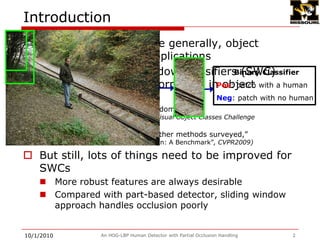
Human detection, or more generally, object detection, has wide applicationsCurrently, Sliding Window Classifiers (SWC) achieves the best performance in object detection“Sliding window classifier predominant”(Everinghamet al. The PASCAL Visual Object Classes Challenge workshop 2008, 2009)-“HOG tends to outperform other methods surveyed,”(Dollar et al. “Pedestrian Detection: A Benchmark”, CVPR2009)But still, lots of things need to be improved for SWCs More robust features are always desirableCompared with part-based detector, sliding window approach handles occlusion poorlyAn HOG-LBP Human Detector with Partial Occlusion Handling2Introduction9/28/2009Binary ClassifierPos: patch with a humanNeg: patch with no human
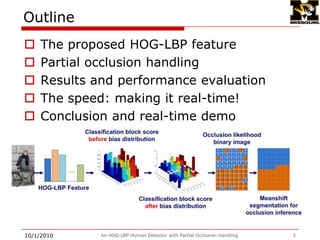
An HOG-LBP Human Detector with Partial Occlusion Handling3OutlineThe proposed HOG-LBP featurePartial occlusion handlingResults and performance evaluationThe speed: making it real-time!Conclusion and real-time demo9/28/2009
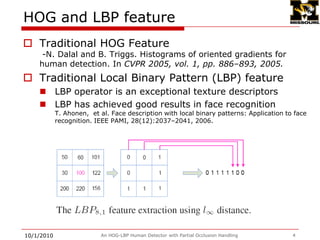
HOG and LBP featureTraditional HOG Feature -N. Dalal and B. Triggs. Histograms of oriented gradients for human detection. In CVPR 2005, vol. 1, pp. 886–893, 2005.Traditional Local Binary Pattern (LBP) featureLBP operator is an exceptional texture descriptorsLBP has achieved good results in face recognitionT. Ahonen,  et al. Face description with local binary patterns: Application to face recognition. IEEE PAMI, 28(12):2037–2041, 2006.9/28/2009An HOG-LBP Human Detector with Partial Occlusion Handling4
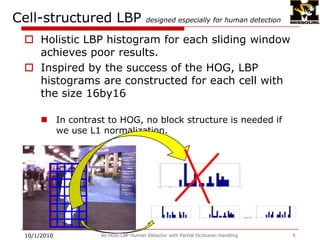
Cell-structured LBP designed especially for human detectionHolistic LBP histogram for each sliding window achieves poor results.Inspired by the success of the HOG, LBP histograms are constructed for each cell with the size 16by16In contrast to HOG, no block structure is needed if we use L1 normalization.9/28/2009An HOG-LBP Human Detector with Partial Occlusion Handling5…
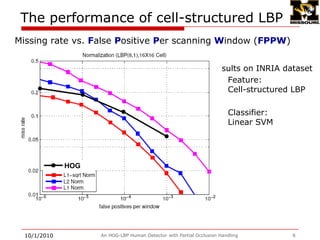
The performance of cell-structured LBP 9/28/2009An HOG-LBP Human Detector with Partial Occlusion Handling6Missing rate vs. False Positive Per scanning Window (FPPW)Results on INRIA datasetFeature:Cell-structured LBP
Classifier:Linear SVM         HOG
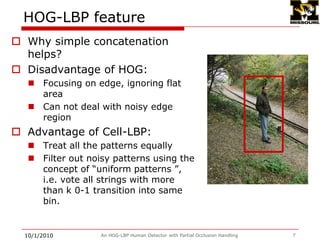
HOG-LBP featureWhy simple concatenation helps?Disadvantage of HOG:Focusing on edge, ignoring flat areaCan not deal with noisy edge region Advantage of Cell-LBP: Treat all the patterns equally Filter out noisy patterns using the concept of “uniform patterns ”, i.e. vote all strings with more than k 0-1 transition into same bin.9/28/2009An HOG-LBP Human Detector with Partial Occlusion Handling7
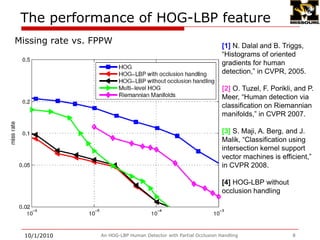
The performance of HOG-LBP feature 9/28/2009An HOG-LBP Human Detector with Partial Occlusion Handling8Missing rate vs. FPPW[1] N. Dalal and B. Triggs, “Histograms of oriented gradients for human detection,” in CVPR, 2005.[2] O. Tuzel, F. Porikli, and P. Meer, “Human detection via classification on Riemannian manifolds,” in CVPR 2007.[3] S. Maji, A. Berg, and J. Malik, “Classification using intersection kernel supportvector machines is efficient,” in CVPR 2008.[4] HOG-LBP without occlusion handling
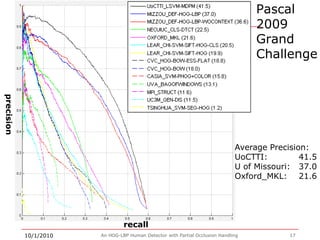
HOG-LBP feature for general object detectionThe proposed HOG-LBP feature works pretty well for general object detection.We attended the Pascal 2009 grand challenge in object detection. Among 20 categories, using  the HOG-LBP as feature, our team (Mizzou) got:Number 1 in two categories:  chair, potted plantNumber 2 in four categories: bottle, car, person, horse9/28/2009An HOG-LBP Human Detector with Partial Occlusion Handling9
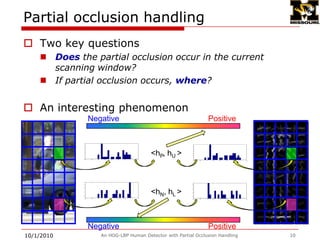
Two key questionsDoes the partial occlusion occur in the current scanning window?If partial occlusion occurs, where?An interesting phenomenonPartial occlusion handling9/28/2009An HOG-LBP Human Detector with Partial Occlusion Handling10Negative Positive<hP, hU><hN, hL>Negative  Positive
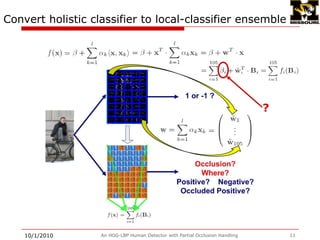
Convert holistic classifier to local-classifier ensemble9/28/2009An HOG-LBP Human Detector with Partial Occlusion Handling11?
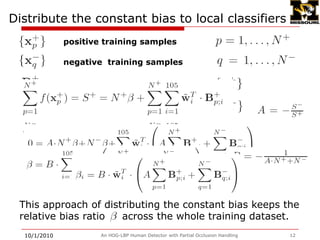
Distribute the constant bias to local classifiers9/28/2009An HOG-LBP Human Detector with Partial Occlusion Handling12positive training samplesnegative  training samplesthe feature of the ith blocks ofthe feature of the ith blocks ofThis approach of distributing the constant bias keeps the relative bias ratio     across the whole training dataset.
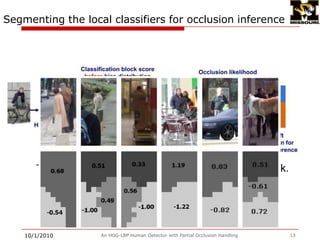
Segmenting the local classifiers for occlusion inferenceThe over all occlusion reasoning/handling framework.9/28/2009An HOG-LBP Human Detector with Partial Occlusion Handling13
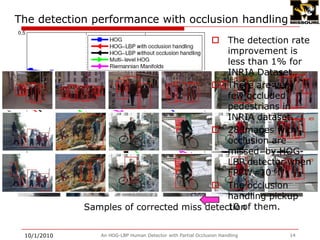
The detection performance with occlusion handlingSamples of corrected miss detection9/28/2009An HOG-LBP Human Detector with Partial Occlusion Handling14The detection rate improvement is less than 1% for INRIA Dataset.
There are very few occluded pedestrians in INRIA dataset.
28 images with occlusion are missed  by HOG-LBP detector when FPPW=10-6
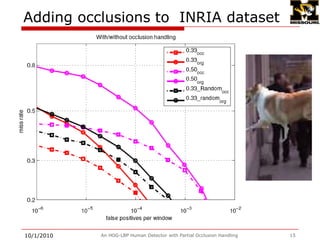
The occlusion handling pickup 10 of them.Adding occlusions to  INRIA dataset 9/28/2009An HOG-LBP Human Detector with Partial Occlusion Handling15
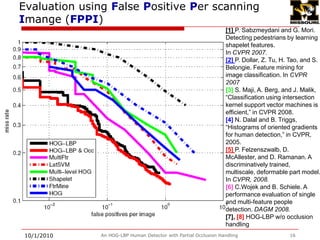
Evaluation using False Positive Per scanning Imange (FPPI)9/28/2009An HOG-LBP Human Detector with Partial Occlusion Handling16[1] P. Sabzmeydani and G. Mori. Detecting pedestrians by learning shapelet features.In CVPR 2007.[2] P. Dollar, Z. Tu, H. Tao, and S. Belongie. Feature mining for image classification. In CVPR 2007[3] S. Maji, A. Berg, and J. Malik, “Classification using intersection kernel support vector machines is efficient,” in CVPR 2008.[4] N. Dalal and B. Triggs, “Histograms of oriented gradients for human detection,” in CVPR, 2005.[5] P. Felzenszwalb, D. McAllester, and D. Ramanan. A discriminatively trained,multiscale, deformable part model. In CVPR, 2008.[6] C.Wojek and B. Schiele. A performance evaluation of single and multi-feature people detection. DAGM 2008. [7], [8] HOG-LBP w/o occlusion handling
9/28/2009An HOG-LBP Human Detector with Partial Occlusion Handling17Pascal 2009 Grand ChallengeprecisionAverage Precision:UoCTTI:	41.5U of Missouri:	37.0Oxford_MKL:	21.6recall
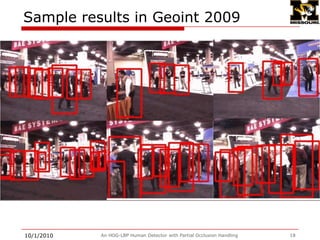
Sample results in Geoint 20099/28/2009An HOG-LBP Human Detector with Partial Occlusion Handling18

Human detection iccv09

  • 1.
    An HOG-LBP HumanDetector with Partial Occlusion Handling Xiaoyu Wang*, Tony X. Han*, and Shuicheng Yan†*ECE Department University of Missouri, Columbia, MO, USA† ECE Department National University of Singapore, Singapore
  • 2.
    Human detection, ormore generally, object detection, has wide applicationsCurrently, Sliding Window Classifiers (SWC) achieves the best performance in object detection“Sliding window classifier predominant”(Everinghamet al. The PASCAL Visual Object Classes Challenge workshop 2008, 2009)-“HOG tends to outperform other methods surveyed,”(Dollar et al. “Pedestrian Detection: A Benchmark”, CVPR2009)But still, lots of things need to be improved for SWCs More robust features are always desirableCompared with part-based detector, sliding window approach handles occlusion poorlyAn HOG-LBP Human Detector with Partial Occlusion Handling2Introduction9/28/2009Binary ClassifierPos: patch with a humanNeg: patch with no human
  • 3.
    An HOG-LBP HumanDetector with Partial Occlusion Handling3OutlineThe proposed HOG-LBP featurePartial occlusion handlingResults and performance evaluationThe speed: making it real-time!Conclusion and real-time demo9/28/2009
  • 4.
    HOG and LBPfeatureTraditional HOG Feature -N. Dalal and B. Triggs. Histograms of oriented gradients for human detection. In CVPR 2005, vol. 1, pp. 886–893, 2005.Traditional Local Binary Pattern (LBP) featureLBP operator is an exceptional texture descriptorsLBP has achieved good results in face recognitionT. Ahonen, et al. Face description with local binary patterns: Application to face recognition. IEEE PAMI, 28(12):2037–2041, 2006.9/28/2009An HOG-LBP Human Detector with Partial Occlusion Handling4
  • 5.
    Cell-structured LBP designedespecially for human detectionHolistic LBP histogram for each sliding window achieves poor results.Inspired by the success of the HOG, LBP histograms are constructed for each cell with the size 16by16In contrast to HOG, no block structure is needed if we use L1 normalization.9/28/2009An HOG-LBP Human Detector with Partial Occlusion Handling5…
  • 6.
    The performance ofcell-structured LBP 9/28/2009An HOG-LBP Human Detector with Partial Occlusion Handling6Missing rate vs. False Positive Per scanning Window (FPPW)Results on INRIA datasetFeature:Cell-structured LBP
  • 7.
  • 8.
    HOG-LBP featureWhy simpleconcatenation helps?Disadvantage of HOG:Focusing on edge, ignoring flat areaCan not deal with noisy edge region Advantage of Cell-LBP: Treat all the patterns equally Filter out noisy patterns using the concept of “uniform patterns ”, i.e. vote all strings with more than k 0-1 transition into same bin.9/28/2009An HOG-LBP Human Detector with Partial Occlusion Handling7
  • 9.
    The performance ofHOG-LBP feature 9/28/2009An HOG-LBP Human Detector with Partial Occlusion Handling8Missing rate vs. FPPW[1] N. Dalal and B. Triggs, “Histograms of oriented gradients for human detection,” in CVPR, 2005.[2] O. Tuzel, F. Porikli, and P. Meer, “Human detection via classification on Riemannian manifolds,” in CVPR 2007.[3] S. Maji, A. Berg, and J. Malik, “Classification using intersection kernel supportvector machines is efficient,” in CVPR 2008.[4] HOG-LBP without occlusion handling
  • 10.
    HOG-LBP feature forgeneral object detectionThe proposed HOG-LBP feature works pretty well for general object detection.We attended the Pascal 2009 grand challenge in object detection. Among 20 categories, using the HOG-LBP as feature, our team (Mizzou) got:Number 1 in two categories: chair, potted plantNumber 2 in four categories: bottle, car, person, horse9/28/2009An HOG-LBP Human Detector with Partial Occlusion Handling9
  • 11.
    Two key questionsDoesthe partial occlusion occur in the current scanning window?If partial occlusion occurs, where?An interesting phenomenonPartial occlusion handling9/28/2009An HOG-LBP Human Detector with Partial Occlusion Handling10Negative Positive<hP, hU><hN, hL>Negative Positive
  • 12.
    Convert holistic classifierto local-classifier ensemble9/28/2009An HOG-LBP Human Detector with Partial Occlusion Handling11?
  • 13.
    Distribute the constantbias to local classifiers9/28/2009An HOG-LBP Human Detector with Partial Occlusion Handling12positive training samplesnegative training samplesthe feature of the ith blocks ofthe feature of the ith blocks ofThis approach of distributing the constant bias keeps the relative bias ratio across the whole training dataset.
  • 14.
    Segmenting the localclassifiers for occlusion inferenceThe over all occlusion reasoning/handling framework.9/28/2009An HOG-LBP Human Detector with Partial Occlusion Handling13
  • 15.
    The detection performancewith occlusion handlingSamples of corrected miss detection9/28/2009An HOG-LBP Human Detector with Partial Occlusion Handling14The detection rate improvement is less than 1% for INRIA Dataset.
  • 16.
    There are veryfew occluded pedestrians in INRIA dataset.
  • 17.
    28 images withocclusion are missed by HOG-LBP detector when FPPW=10-6
  • 18.
    The occlusion handlingpickup 10 of them.Adding occlusions to INRIA dataset 9/28/2009An HOG-LBP Human Detector with Partial Occlusion Handling15
  • 19.
    Evaluation using FalsePositive Per scanning Imange (FPPI)9/28/2009An HOG-LBP Human Detector with Partial Occlusion Handling16[1] P. Sabzmeydani and G. Mori. Detecting pedestrians by learning shapelet features.In CVPR 2007.[2] P. Dollar, Z. Tu, H. Tao, and S. Belongie. Feature mining for image classification. In CVPR 2007[3] S. Maji, A. Berg, and J. Malik, “Classification using intersection kernel support vector machines is efficient,” in CVPR 2008.[4] N. Dalal and B. Triggs, “Histograms of oriented gradients for human detection,” in CVPR, 2005.[5] P. Felzenszwalb, D. McAllester, and D. Ramanan. A discriminatively trained,multiscale, deformable part model. In CVPR, 2008.[6] C.Wojek and B. Schiele. A performance evaluation of single and multi-feature people detection. DAGM 2008. [7], [8] HOG-LBP w/o occlusion handling
  • 20.
    9/28/2009An HOG-LBP HumanDetector with Partial Occlusion Handling17Pascal 2009 Grand ChallengeprecisionAverage Precision:UoCTTI: 41.5U of Missouri: 37.0Oxford_MKL: 21.6recall
  • 21.
    Sample results inGeoint 20099/28/2009An HOG-LBP Human Detector with Partial Occlusion Handling18
  • 22.
    Evaluation Issue9/28/2009An HOG-LBPHuman Detector with Partial Occlusion Handling19Many factors affect FFPI:Like nonmaximum suppression, bandwidth of meanshift, local thresholding/filtering before merging.Therefore:Using FPPW for sliding window classifier to select feature and classification scheme. WARNING: avoid encoding the class label implicitlyUsing FPPI to evaluate the over all performance of the detector, can be used as a protocol to compare all kinds of detectors
  • 23.
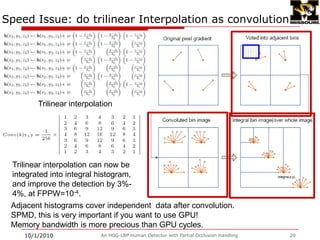
    Speed Issue: dotrilinear Interpolation as convolution9/28/2009An HOG-LBP Human Detector with Partial Occlusion Handling20Linear interpolationTrilinear interpolationTrilinear interpolation can now be integrated into integral histogram, and improve the detection by 3%-4%, at FPPW=10-4.Adjacent histograms cover independent data after convolution. SPMD, this is very important if you want to use GPU! Memory bandwidth is more precious than GPU cycles.
  • 24.
    An HOG-LBP HumanDetector with Partial Occlusion Handling21Conclusion and DemoThe HOG-LBP feature achieves the state of the art detection.Segmentation on local classifications inside sliding window helps to infer occlusion.Implementing trilinear interpolation as a 2D convolution makes it an addable component of integral histogram.Demo Does it work? Press keyboard and pray......We may still have long way to go9/28/2009