Huffman Coding:  An Application of Binary Trees and Priority Queues CS 102
Encoding and Compression of Data Fax Machines ASCII Variations on ASCII min number of bits needed cost of savings patterns modifications CS 102
Purpose of Huffman Coding Proposed by Dr. David A. Huffman in 1952 “ A Method for the Construction of Minimum Redundancy Codes” Applicable to many forms of data transmission Our example: text files CS 102
The Basic Algorithm Huffman coding is a form of statistical coding Not all characters occur with the same frequency! Yet all characters are allocated the same amount of space 1 char = 1 byte, be it  e  or  x CS 102
The Basic Algorithm Any savings in tailoring codes to frequency of character? Code word lengths are no longer fixed like ASCII. Code word lengths vary and will be shorter for the more frequently used characters. CS 102
The (Real) Basic Algorithm CS 102 1. Scan text to be compressed and tally  occurrence of all characters. 2. Sort or prioritize characters based on  number of occurrences in text. 3. Build Huffman code tree based on  prioritized list. 4. Perform a traversal of tree to determine  all code words. 5. Scan text again and create new file  using the Huffman codes.
Building a Tree Scan the original text Consider the following short text: Eerie eyes seen near lake. Count up the occurrences of all characters in the text CS 102
Building a Tree Scan the original text Eerie eyes seen near lake. What characters are present? CS 102 E  e  r  i space  y s n a r l k .
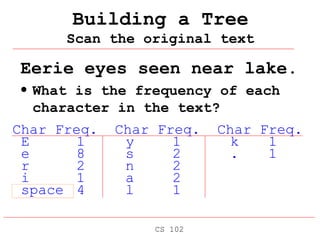
Building a Tree Scan the original text Eerie eyes seen near lake. What is the frequency of each character in the text? CS 102 Char Freq.  Char Freq.  Char Freq. E  1   y 1   k 1 e  8   s  2   . 1 r  2   n  2   i  1   a 2 space  4   l 1
Building a Tree Prioritize characters Create binary tree nodes with character and frequency of each character Place nodes in a priority queue The  lower  the occurrence, the higher the priority in the queue CS 102
Building a Tree Prioritize characters Uses binary tree nodes public class HuffNode { public char myChar; public int myFrequency; public HuffNode myLeft, myRight; } priorityQueue myQueue; CS 102
Building a Tree The queue after inserting all nodes Null Pointers are not shown CS 102 E 1 i 1 y 1 l 1 k 1 . 1 r 2 s 2 n 2 a 2 sp 4 e 8
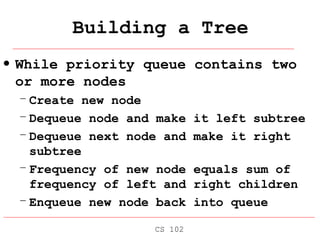
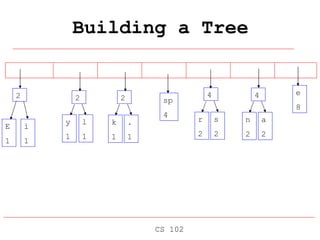
Building a Tree While priority queue contains two or more nodes Create new node Dequeue node and make it left subtree Dequeue next node and make it right subtree Frequency of new node equals sum of frequency of left and right children Enqueue new node back into queue CS 102
Building a Tree CS 102 E 1 i 1 y 1 l 1 k 1 . 1 r 2 s 2 n 2 a 2 sp 4 e 8
Building a Tree CS 102 E 1 i 1 y 1 l 1 k 1 . 1 r 2 s 2 n 2 a 2 sp 4 e 8 2
Building a Tree CS 102 E 1 i 1 k 1 . 1 r 2 s 2 n 2 a 2 sp 4 e 8 2 y 1 l 1 2
Building a Tree CS 102 E 1 i 1 r 2 s 2 n 2 a 2 sp 4 e 8 2 y 1 l 1 2 k 1 . 1 2
Building a Tree CS 102 E 1 i 1 n 2 a 2 sp 4 e 8 2 y 1 l 1 2 k 1 . 1 2 r 2 s 2 4
Building a Tree CS 102 E 1 i 1 sp 4 e 8 2 y 1 l 1 2 k 1 . 1 2 r 2 s 2 4 n 2 a 2 4
Building a Tree CS 102 E 1 i 1 sp 4 e 8 2 y 1 l 1 2 k 1 . 1 2 r 2 s 2 4 n 2 a 2 4 4
Building a Tree CS 102 E 1 i 1 sp 4 e 8 2 y 1 l 1 2 k 1 . 1 2 r 2 s 2 4 n 2 a 2 4 4 6
Building a Tree CS 102 E 1 i 1 sp 4 e 8 2 y 1 l 1 2 k 1 . 1 2 r 2 s 2 4 n 2 a 2 4 4 6 What is happening to the characters with a low number of occurrences?
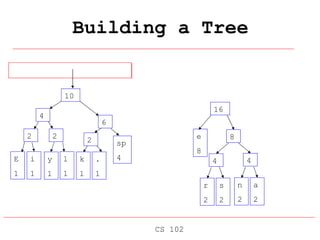
Building a Tree CS 102 E 1 i 1 sp 4 e 8 2 y 1 l 1 2 k 1 . 1 2 r 2 s 2 4 n 2 a 2 4 4 6 8
Building a Tree CS 102 E 1 i 1 sp 4 e 8 2 y 1 l 1 2 k 1 . 1 2 r 2 s 2 4 n 2 a 2 4 4 6 8 10
Building a Tree CS 102 E 1 i 1 sp 4 e 8 2 y 1 l 1 2 k 1 . 1 2 r 2 s 2 4 n 2 a 2 4 4 6 8 10 16
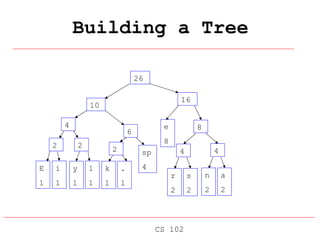
Building a Tree CS 102 E 1 i 1 sp 4 e 8 2 y 1 l 1 2 k 1 . 1 2 r 2 s 2 4 n 2 a 2 4 4 6 8 10 16 26
Building a Tree CS 102 E 1 i 1 sp 4 e 8 2 y 1 l 1 2 k 1 . 1 2 r 2 s 2 4 n 2 a 2 4 4 6 8 10 16 26 After enqueueing this node there is only one node left in priority queue.
Building a Tree CS 102 Dequeue the single node left in the queue. This tree contains the new code words for each character. Frequency of root node should equal number of characters in text. Eerie eyes seen near lake.    26 characters E 1 i 1 sp 4 e 8 2 y 1 l 1 2 k 1 . 1 2 r 2 s 2 4 n 2 a 2 4 4 6 8 10 16 26
Encoding the File Traverse Tree for Codes Perform a traversal of the tree to obtain new code words Going left is a 0 going right is a 1 code word is only completed when a leaf node is reached  CS 102 E 1 i 1 sp 4 e 8 2 y 1 l 1 2 k 1 . 1 2 r 2 s 2 4 n 2 a 2 4 4 6 8 10 16 26
Encoding the File Traverse Tree for Codes Char Code E 0000 i 0001 y 0010 l 0011 k 0100 . 0101 space 011 e 10 r 1100 s 1101 n 1110 a 1111 CS 102 E 1 i 1 sp 4 e 8 2 y 1 l 1 2 k 1 . 1 2 r 2 s 2 4 n 2 a 2 4 4 6 8 10 16 26
Encoding the File Rescan text and encode file using new code words Eerie eyes seen near lake. CS 102 Char Code E 0000 i 0001 y 0010 l 0011 k 0100 . 0101 space 011 e 10 r 1100 s 1101 n 1110 a 1111 0000101100000110011100010101101101001111101011111100011001111110100100101 Why is there no need for a separator character? .
Encoding the File Results Have we made things any better? 73 bits to encode the text ASCII would take 8 * 26 = 208 bits CS 102 0000101100000110011100010101101101001111101011111100011001111110100100101 If modified code used 4 bits per  character are needed.  Total bits  4 * 26 = 104.  Savings not as great.
Decoding the File How does receiver know what the codes are? Tree constructed for each text file.  Considers frequency for each file Big hit on compression, especially for smaller files Tree predetermined based on statistical analysis of text files or file types Data transmission is bit based versus byte based CS 102
Decoding the File Once receiver has tree it scans incoming bit stream 0    go left 1    go right CS 102 10100011011110111101111110000110101 E 1 i 1 sp 4 e 8 2 y 1 l 1 2 k 1 . 1 2 r 2 s 2 4 n 2 a 2 4 4 6 8 10 16 26
Summary Huffman coding is a technique used to compress files for transmission Uses statistical coding more frequently used symbols have shorter code words Works well for text and fax transmissions An application that uses several data structures CS 102

Huffman 2

  • 1.
    Huffman Coding: An Application of Binary Trees and Priority Queues CS 102
  • 2.
    Encoding and Compressionof Data Fax Machines ASCII Variations on ASCII min number of bits needed cost of savings patterns modifications CS 102
  • 3.
    Purpose of HuffmanCoding Proposed by Dr. David A. Huffman in 1952 “ A Method for the Construction of Minimum Redundancy Codes” Applicable to many forms of data transmission Our example: text files CS 102
  • 4.
    The Basic AlgorithmHuffman coding is a form of statistical coding Not all characters occur with the same frequency! Yet all characters are allocated the same amount of space 1 char = 1 byte, be it e or x CS 102
  • 5.
    The Basic AlgorithmAny savings in tailoring codes to frequency of character? Code word lengths are no longer fixed like ASCII. Code word lengths vary and will be shorter for the more frequently used characters. CS 102
  • 6.
    The (Real) BasicAlgorithm CS 102 1. Scan text to be compressed and tally occurrence of all characters. 2. Sort or prioritize characters based on number of occurrences in text. 3. Build Huffman code tree based on prioritized list. 4. Perform a traversal of tree to determine all code words. 5. Scan text again and create new file using the Huffman codes.
  • 7.
    Building a TreeScan the original text Consider the following short text: Eerie eyes seen near lake. Count up the occurrences of all characters in the text CS 102
  • 8.
    Building a TreeScan the original text Eerie eyes seen near lake. What characters are present? CS 102 E e r i space y s n a r l k .
  • 9.
    Building a TreeScan the original text Eerie eyes seen near lake. What is the frequency of each character in the text? CS 102 Char Freq. Char Freq. Char Freq. E 1 y 1 k 1 e 8 s 2 . 1 r 2 n 2 i 1 a 2 space 4 l 1
  • 10.
    Building a TreePrioritize characters Create binary tree nodes with character and frequency of each character Place nodes in a priority queue The lower the occurrence, the higher the priority in the queue CS 102
  • 11.
    Building a TreePrioritize characters Uses binary tree nodes public class HuffNode { public char myChar; public int myFrequency; public HuffNode myLeft, myRight; } priorityQueue myQueue; CS 102
  • 12.
    Building a TreeThe queue after inserting all nodes Null Pointers are not shown CS 102 E 1 i 1 y 1 l 1 k 1 . 1 r 2 s 2 n 2 a 2 sp 4 e 8
  • 13.
    Building a TreeWhile priority queue contains two or more nodes Create new node Dequeue node and make it left subtree Dequeue next node and make it right subtree Frequency of new node equals sum of frequency of left and right children Enqueue new node back into queue CS 102
  • 14.
    Building a TreeCS 102 E 1 i 1 y 1 l 1 k 1 . 1 r 2 s 2 n 2 a 2 sp 4 e 8
  • 15.
    Building a TreeCS 102 E 1 i 1 y 1 l 1 k 1 . 1 r 2 s 2 n 2 a 2 sp 4 e 8 2
  • 16.
    Building a TreeCS 102 E 1 i 1 y 1 l 1 k 1 . 1 r 2 s 2 n 2 a 2 sp 4 e 8 2
  • 17.
    Building a TreeCS 102 E 1 i 1 k 1 . 1 r 2 s 2 n 2 a 2 sp 4 e 8 2 y 1 l 1 2
  • 18.
    Building a TreeCS 102 E 1 i 1 k 1 . 1 r 2 s 2 n 2 a 2 sp 4 e 8 2 y 1 l 1 2
  • 19.
    Building a TreeCS 102 E 1 i 1 r 2 s 2 n 2 a 2 sp 4 e 8 2 y 1 l 1 2 k 1 . 1 2
  • 20.
    Building a TreeCS 102 E 1 i 1 r 2 s 2 n 2 a 2 sp 4 e 8 2 y 1 l 1 2 k 1 . 1 2
  • 21.
    Building a TreeCS 102 E 1 i 1 n 2 a 2 sp 4 e 8 2 y 1 l 1 2 k 1 . 1 2 r 2 s 2 4
  • 22.
    Building a TreeCS 102 E 1 i 1 n 2 a 2 sp 4 e 8 2 y 1 l 1 2 k 1 . 1 2 r 2 s 2 4
  • 23.
    Building a TreeCS 102 E 1 i 1 sp 4 e 8 2 y 1 l 1 2 k 1 . 1 2 r 2 s 2 4 n 2 a 2 4
  • 24.
    Building a TreeCS 102 E 1 i 1 sp 4 e 8 2 y 1 l 1 2 k 1 . 1 2 r 2 s 2 4 n 2 a 2 4
  • 25.
    Building a TreeCS 102 E 1 i 1 sp 4 e 8 2 y 1 l 1 2 k 1 . 1 2 r 2 s 2 4 n 2 a 2 4 4
  • 26.
    Building a TreeCS 102 E 1 i 1 sp 4 e 8 2 y 1 l 1 2 k 1 . 1 2 r 2 s 2 4 n 2 a 2 4 4
  • 27.
    Building a TreeCS 102 E 1 i 1 sp 4 e 8 2 y 1 l 1 2 k 1 . 1 2 r 2 s 2 4 n 2 a 2 4 4 6
  • 28.
    Building a TreeCS 102 E 1 i 1 sp 4 e 8 2 y 1 l 1 2 k 1 . 1 2 r 2 s 2 4 n 2 a 2 4 4 6 What is happening to the characters with a low number of occurrences?
  • 29.
    Building a TreeCS 102 E 1 i 1 sp 4 e 8 2 y 1 l 1 2 k 1 . 1 2 r 2 s 2 4 n 2 a 2 4 4 6 8
  • 30.
    Building a TreeCS 102 E 1 i 1 sp 4 e 8 2 y 1 l 1 2 k 1 . 1 2 r 2 s 2 4 n 2 a 2 4 4 6 8
  • 31.
    Building a TreeCS 102 E 1 i 1 sp 4 e 8 2 y 1 l 1 2 k 1 . 1 2 r 2 s 2 4 n 2 a 2 4 4 6 8 10
  • 32.
    Building a TreeCS 102 E 1 i 1 sp 4 e 8 2 y 1 l 1 2 k 1 . 1 2 r 2 s 2 4 n 2 a 2 4 4 6 8 10
  • 33.
    Building a TreeCS 102 E 1 i 1 sp 4 e 8 2 y 1 l 1 2 k 1 . 1 2 r 2 s 2 4 n 2 a 2 4 4 6 8 10 16
  • 34.
    Building a TreeCS 102 E 1 i 1 sp 4 e 8 2 y 1 l 1 2 k 1 . 1 2 r 2 s 2 4 n 2 a 2 4 4 6 8 10 16
  • 35.
    Building a TreeCS 102 E 1 i 1 sp 4 e 8 2 y 1 l 1 2 k 1 . 1 2 r 2 s 2 4 n 2 a 2 4 4 6 8 10 16 26
  • 36.
    Building a TreeCS 102 E 1 i 1 sp 4 e 8 2 y 1 l 1 2 k 1 . 1 2 r 2 s 2 4 n 2 a 2 4 4 6 8 10 16 26 After enqueueing this node there is only one node left in priority queue.
  • 37.
    Building a TreeCS 102 Dequeue the single node left in the queue. This tree contains the new code words for each character. Frequency of root node should equal number of characters in text. Eerie eyes seen near lake.  26 characters E 1 i 1 sp 4 e 8 2 y 1 l 1 2 k 1 . 1 2 r 2 s 2 4 n 2 a 2 4 4 6 8 10 16 26
  • 38.
    Encoding the FileTraverse Tree for Codes Perform a traversal of the tree to obtain new code words Going left is a 0 going right is a 1 code word is only completed when a leaf node is reached CS 102 E 1 i 1 sp 4 e 8 2 y 1 l 1 2 k 1 . 1 2 r 2 s 2 4 n 2 a 2 4 4 6 8 10 16 26
  • 39.
    Encoding the FileTraverse Tree for Codes Char Code E 0000 i 0001 y 0010 l 0011 k 0100 . 0101 space 011 e 10 r 1100 s 1101 n 1110 a 1111 CS 102 E 1 i 1 sp 4 e 8 2 y 1 l 1 2 k 1 . 1 2 r 2 s 2 4 n 2 a 2 4 4 6 8 10 16 26
  • 40.
    Encoding the FileRescan text and encode file using new code words Eerie eyes seen near lake. CS 102 Char Code E 0000 i 0001 y 0010 l 0011 k 0100 . 0101 space 011 e 10 r 1100 s 1101 n 1110 a 1111 0000101100000110011100010101101101001111101011111100011001111110100100101 Why is there no need for a separator character? .
  • 41.
    Encoding the FileResults Have we made things any better? 73 bits to encode the text ASCII would take 8 * 26 = 208 bits CS 102 0000101100000110011100010101101101001111101011111100011001111110100100101 If modified code used 4 bits per character are needed. Total bits 4 * 26 = 104. Savings not as great.
  • 42.
    Decoding the FileHow does receiver know what the codes are? Tree constructed for each text file. Considers frequency for each file Big hit on compression, especially for smaller files Tree predetermined based on statistical analysis of text files or file types Data transmission is bit based versus byte based CS 102
  • 43.
    Decoding the FileOnce receiver has tree it scans incoming bit stream 0  go left 1  go right CS 102 10100011011110111101111110000110101 E 1 i 1 sp 4 e 8 2 y 1 l 1 2 k 1 . 1 2 r 2 s 2 4 n 2 a 2 4 4 6 8 10 16 26
  • 44.
    Summary Huffman codingis a technique used to compress files for transmission Uses statistical coding more frequently used symbols have shorter code words Works well for text and fax transmissions An application that uses several data structures CS 102