
HTML5Revolution
HTML5 essentials. Concepts. Facts. Importance.etc.
The last version of the
HTML language, that
has been used to
create web content
for the past couple of
decades.
HTML5
What is
?
Hypertext Markup Language
Main tool used to build web pages
HTML
HTML5 is still in the
development process.
NO! You just need to be aware that there are some features
that still need work, and are prone to change. You must
keep informed on the drafts evolution.
HTML5 is not yet ready for
production?
Does that mean…
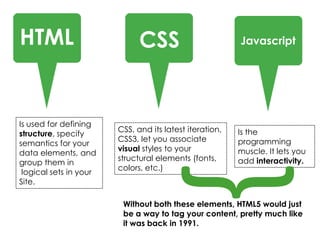
HTML CSS Javascript
Is used for defining
structure, specify
semantics for your
data elements, and
group them in
logical sets in your
Site.
CSS, and its latest iteration,
CSS3, let you associate
visual styles to your
structural elements (fonts,
colors, etc.)
Is the
programming
muscle. It lets you
add interactivity.
Without both these elements, HTML5 would just
be a way to tag your content, pretty much like
it was back in 1991.
Using the three of them
combined, you can
overcome their limitations,
complement them, and
create rich content.
Mobile is changing the way people
work and live.
CHANGES…
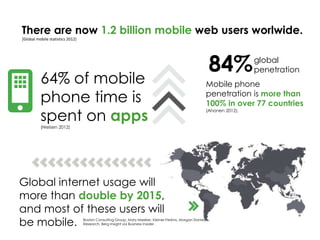
Global internet usage will
more than double by 2015,
and most of these users will
be mobile.
Mobile phone
penetration is more than
100% in over 77 countries
(Ahonen 2012).
84%global
penetration
64% of mobile
phone time is
spent on apps
(Nielsen 2012)
There are now 1.2 billion mobile web users worlwide.
(Global mobile statistics 2012)
Boston Consulting Group, Mary Meeker, Kleiner Perkins, Morgan Stanley
Research, Berg Insight via Business Insider.
Why
HTML5?
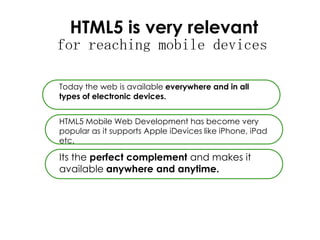
HTML5 is very relevant
for reaching mobile devices
Today the web is available everywhere and in all
types of electronic devices.
HTML5 Mobile Web Development has become very
popular as it supports Apple iDevices like iPhone, iPad
etc.
Its the perfect complement and makes it
available anywhere and anytime.
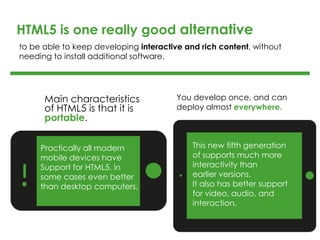
Main characteristics
of HTML5 is that it is
portable.
You develop once, and can
deploy almost everywhere.
HTML5 is one really good alternative
Practically all modern
mobile devices have
Support for HTML5, in
some cases even better
than desktop computers.
This new fifth generation
of supports much more
interactivity than
earlier versions.
It also has better support
for video, audio, and
interaction.
to be able to keep developing interactive and rich content, without
needing to install additional software.
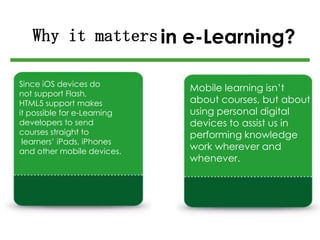
in e-Learning?
Since iOS devices do
not support Flash,
HTML5 support makes
it possible for e-Learning
developers to send
courses straight to
learners’ iPads, iPhones
and other mobile devices.
Mobile learning isn’t
about courses, but about
using personal digital
devices to assist us in
performing knowledge
work wherever and
whenever.
Why it matters
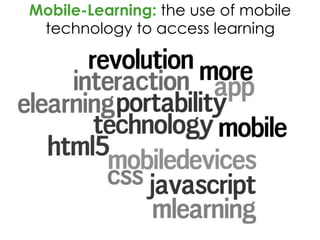
Mobile-Learning: the use of mobile
technology to access learning
Think about…
What browser your learners will be using to
access the content: Probably the main
determining factor on whether to develop in
an HTML5 or Flash capable environment.
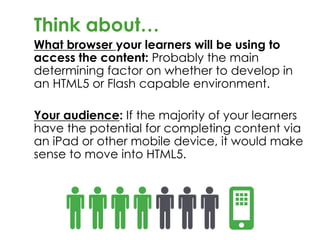
Your audience: If the majority of your learners
have the potential for completing content via
an iPad or other mobile device, it would make
sense to move into HTML5.
Connect and follow us! @shiftelearning
www.shiftelearning.com
Resources
• http://mobithinking.com/mobile-marketing-tools/latest-mobile-stats
• Wikipedia on HTML5
• Apple on HTML5
• Adobe on HTML5
• Microsoft on HTML5
• Google on HTML5
• Responsive Design
• Mobile First
• Apache Cordova
• Appcelerator Titanium
• W3 Schools
• Treehouse
• HTML5 Rocks
• HTML5 W3C Specification
• HTML5 Language Reference
• Smashing Magazine
• The WHATWG community
• Chrome Dev Relations
• David Travis.
• http://msdn.microsoft.com/en-us/magazine/hh335062.aspx
• http://www.misfitgeek.com/2011/12/building-apps-with-html5/
• http://www.tripwiremagazine.com/2012/03/html5-examples-tutorials.html
• http://blog.adobexpert.com/cambios-plataforma-flash-adobe/

Html5 Revolution

  • 1.
  • 2.
    The last versionof the HTML language, that has been used to create web content for the past couple of decades. HTML5 What is ? Hypertext Markup Language Main tool used to build web pages HTML
  • 3.
    HTML5 is stillin the development process. NO! You just need to be aware that there are some features that still need work, and are prone to change. You must keep informed on the drafts evolution. HTML5 is not yet ready for production? Does that mean…
  • 4.
    HTML CSS Javascript Isused for defining structure, specify semantics for your data elements, and group them in logical sets in your Site. CSS, and its latest iteration, CSS3, let you associate visual styles to your structural elements (fonts, colors, etc.) Is the programming muscle. It lets you add interactivity. Without both these elements, HTML5 would just be a way to tag your content, pretty much like it was back in 1991.
  • 5.
    Using the threeof them combined, you can overcome their limitations, complement them, and create rich content.
  • 6.
    Mobile is changingthe way people work and live. CHANGES…
  • 7.
    Global internet usagewill more than double by 2015, and most of these users will be mobile. Mobile phone penetration is more than 100% in over 77 countries (Ahonen 2012). 84%global penetration 64% of mobile phone time is spent on apps (Nielsen 2012) There are now 1.2 billion mobile web users worlwide. (Global mobile statistics 2012) Boston Consulting Group, Mary Meeker, Kleiner Perkins, Morgan Stanley Research, Berg Insight via Business Insider.
  • 8.
  • 9.
    HTML5 is veryrelevant for reaching mobile devices Today the web is available everywhere and in all types of electronic devices. HTML5 Mobile Web Development has become very popular as it supports Apple iDevices like iPhone, iPad etc. Its the perfect complement and makes it available anywhere and anytime.
  • 10.
    Main characteristics of HTML5is that it is portable. You develop once, and can deploy almost everywhere. HTML5 is one really good alternative Practically all modern mobile devices have Support for HTML5, in some cases even better than desktop computers. This new fifth generation of supports much more interactivity than earlier versions. It also has better support for video, audio, and interaction. to be able to keep developing interactive and rich content, without needing to install additional software.
  • 11.
    in e-Learning? Since iOSdevices do not support Flash, HTML5 support makes it possible for e-Learning developers to send courses straight to learners’ iPads, iPhones and other mobile devices. Mobile learning isn’t about courses, but about using personal digital devices to assist us in performing knowledge work wherever and whenever. Why it matters
  • 12.
    Mobile-Learning: the useof mobile technology to access learning
  • 14.
    Think about… What browseryour learners will be using to access the content: Probably the main determining factor on whether to develop in an HTML5 or Flash capable environment. Your audience: If the majority of your learners have the potential for completing content via an iPad or other mobile device, it would make sense to move into HTML5.
  • 15.
    Connect and followus! @shiftelearning www.shiftelearning.com
  • 16.
    Resources • http://mobithinking.com/mobile-marketing-tools/latest-mobile-stats • Wikipediaon HTML5 • Apple on HTML5 • Adobe on HTML5 • Microsoft on HTML5 • Google on HTML5 • Responsive Design • Mobile First • Apache Cordova • Appcelerator Titanium • W3 Schools • Treehouse • HTML5 Rocks • HTML5 W3C Specification • HTML5 Language Reference • Smashing Magazine • The WHATWG community • Chrome Dev Relations • David Travis. • http://msdn.microsoft.com/en-us/magazine/hh335062.aspx • http://www.misfitgeek.com/2011/12/building-apps-with-html5/ • http://www.tripwiremagazine.com/2012/03/html5-examples-tutorials.html • http://blog.adobexpert.com/cambios-plataforma-flash-adobe/