HTML Pocket Reference 2nd Edition Jennifer Niederst Robbins
HTML Pocket Reference 2nd Edition Jennifer Niederst Robbins
HTML Pocket Reference 2nd Edition Jennifer Niederst Robbins
HTML Pocket Reference 2nd Edition Jennifer Niederst Robbins
HTML Pocket Reference 2nd Edition Jennifer Niederst Robbins
1.
HTML Pocket Reference2nd Edition Jennifer
Niederst Robbins pdf download
https://ebookfinal.com/download/html-pocket-reference-2nd-
edition-jennifer-niederst-robbins/
Explore and download more ebooks or textbooks
at ebookfinal.com
2.
We have selectedsome products that you may be interested in
Click the link to download now or visit ebookfinal.com
for more options!.
Learning Web Design A Beginner s Guide to HTML CSS
JavaScript and Web Graphics 4th Edition Jennifer Niederst
Robbins
https://ebookfinal.com/download/learning-web-design-a-beginner-s-
guide-to-html-css-javascript-and-web-graphics-4th-edition-jennifer-
niederst-robbins/
C 4 0 Pocket Reference Pocket Reference O Reilly 3rd
Edition Ben Albahari
https://ebookfinal.com/download/c-4-0-pocket-reference-pocket-
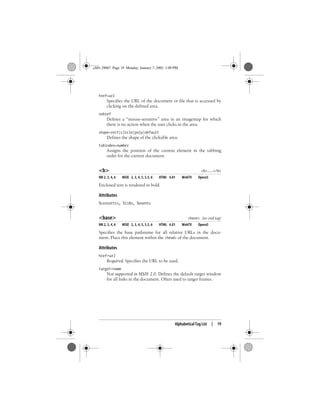
reference-o-reilly-3rd-edition-ben-albahari/
TOAD pocket reference for Oracle 2nd ed Edition Patrick
Mcgrath
https://ebookfinal.com/download/toad-pocket-reference-for-oracle-2nd-
ed-edition-patrick-mcgrath/
Swift pocket reference Second Edition Gray
https://ebookfinal.com/download/swift-pocket-reference-second-edition-
gray/
3.
PICmicro microcontroller pocketreference 1st Edition
Predko
https://ebookfinal.com/download/picmicro-microcontroller-pocket-
reference-1st-edition-predko/
Perl pocket reference 5th Edition Johan Vromans
https://ebookfinal.com/download/perl-pocket-reference-5th-edition-
johan-vromans/
JavaScript Pocket Reference Third Edition David Flanagan
https://ebookfinal.com/download/javascript-pocket-reference-third-
edition-david-flanagan/
Quick Reference Dictionary for Physical Therapy 2nd
Edition Jennifer Bottomley Phd2 Ms Pt
https://ebookfinal.com/download/quick-reference-dictionary-for-
physical-therapy-2nd-edition-jennifer-bottomley-phd2-ms-pt/
Clinician s pocket reference 9th ed Edition Haist
https://ebookfinal.com/download/clinician-s-pocket-reference-9th-ed-
edition-haist/
5.
HTML Pocket Reference2nd Edition Jennifer Niederst
Robbins Digital Instant Download
Author(s): Jennifer Niederst Robbins
ISBN(s): 9780596002961, 0596002963
Edition: 2nd
File Details: PDF, 1.33 MB
Year: 2002
Language: english
1
Chapter 1
HTML PocketReference
Introduction
This pocket reference provides a concise, yet thorough, list-
ing of HTML tags and attributes specified by the W3C
HTML 4.01 Specification, Netscape Navigator, and Internet
Explorer.
Using This Book
The majority of this reference is an alphabetical listing of tags
and their attributes with explanations and browser support
information.
The “Tag Groups” section lists tags that are related in func-
tionality, and “Tag Structures” provides examples of how
standard web page elements are constructed.
At the end of the book are useful charts, including character
entities and decimal to hexadecimal conversions.
For Further Reading
More in-depth explanations of HTML and web design can be
found in O’Reilly & Associates’ Web Design in a Nutshell by
Jennifer Niederst and HTML and XHTML: The Definitive
Guide by Chuck Musciano and Bill Kennedy. Also useful is
Webmaster in a Nutshell by Stephen Spainhour and Robert
Eckstein.
,ch01.29067 Page 1 Monday, January 7, 2002 1:09 PM
8.
2 | HTMLPocket Reference
The browser support information in this book was provided
by the HTML Compendium created by Ron Woodall. I
encourage you to check out the Compendium’s site (http://
www.htmlcompendium.org) for extremely in-depth explana-
tions of HTML tags, attributes, and values and the browsers
that support them.
Conventions Used in This Book
The correct syntax appears to the right of each tag and indi-
cates whether the tag is a container (with an end tag) or
stands alone. Browser support information is indicated
below each tag. Browsers that do not support the tag are
shown in gray. Attribute support is indicated in italics in the
attribute description.
Tag Groups
The following lists group HTML tags by similar function. See
the “Alphabetical Tag List” section for complete descrip-
tions of each tag.
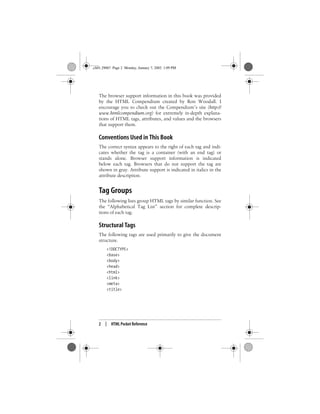
Structural Tags
The following tags are used primarily to give the document
structure.
<!DOCTYPE>
<base>
<body>
<head>
<html>
<link>
<meta>
<title>
,ch01.29067 Page 2 Monday, January 7, 2002 1:09 PM
9.
Tag Groups |3
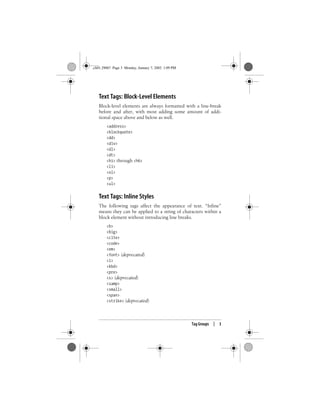
Text Tags: Block-Level Elements
Block-level elements are always formatted with a line-break
before and after, with most adding some amount of addi-
tional space above and below as well.
<address>
<blockquote>
<dd>
<div>
<dl>
<dt>
<h1> through <h6>
<li>
<ol>
<p>
<ul>
Text Tags: Inline Styles
The following tags affect the appearance of text. “Inline”
means they can be applied to a string of characters within a
block element without introducing line breaks.
<b>
<big>
<cite>
<code>
<em>
<font> (deprecated)
<i>
<kbd>
<pre>
<s> (deprecated)
<samp>
<small>
<span>
<strike> (deprecated)
,ch01.29067 Page 3 Monday, January 7, 2002 1:09 PM
10.
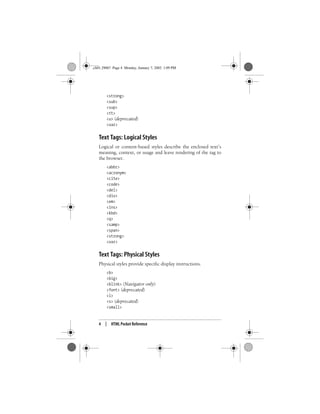
4 | HTMLPocket Reference
<strong>
<sub>
<sup>
<tt>
<u> (deprecated)
<var>
Text Tags: Logical Styles
Logical or content-based styles describe the enclosed text’s
meaning, context, or usage and leave rendering of the tag to
the browser.
<abbr>
<acronym>
<cite>
<code>
<del>
<div>
<em>
<ins>
<kbd>
<q>
<samp>
<span>
<strong>
<var>
Text Tags: Physical Styles
Physical styles provide specific display instructions.
<b>
<big>
<blink> (Navigator only)
<font> (deprecated)
<i>
<s> (deprecated)
<small>
,ch01.29067 Page 4 Monday, January 7, 2002 1:09 PM
11.
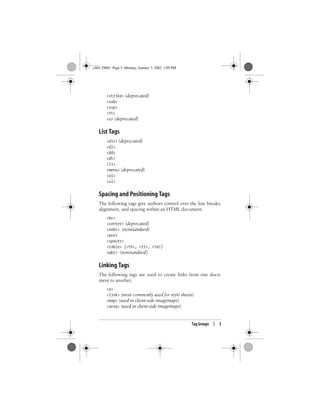
Tag Groups |5
<strike> (deprecated)
<sub>
<sup>
<tt>
<u> (deprecated)
List Tags
<dir> (deprecated)
<dl>
<dd>
<dt>
<li>
<menu> (deprecated)
<ol>
<ul>
Spacing and Positioning Tags
The following tags give authors control over the line breaks,
alignment, and spacing within an HTML document.
<br>
<center> (deprecated)
<nobr> (nonstandard)
<pre>
<spacer>
<table> (<th>, <tr>, <td>)
<wbr> (nonstandard)
Linking Tags
The following tags are used to create links from one docu-
ment to another.
<a>
<link> (most commonly used for style sheets)
<map> (used in client-side imagemaps)
<area> (used in client-side imagemaps)
,ch01.29067 Page 5 Monday, January 7, 2002 1:09 PM
12.
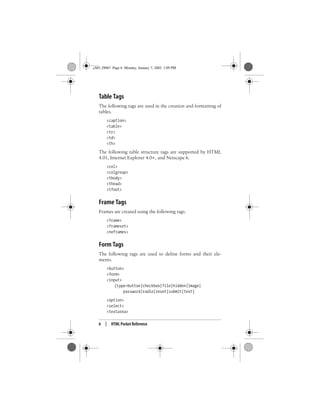
6 | HTMLPocket Reference
Table Tags
The following tags are used in the creation and formatting of
tables.
<caption>
<table>
<tr>
<td>
<th>
The following table structure tags are supported by HTML
4.01, Internet Explorer 4.0+, and Netscape 6.
<col>
<colgroup>
<tbody>
<thead>
<tfoot>
Frame Tags
Frames are created using the following tags.
<frame>
<frameset>
<noframes>
Form Tags
The following tags are used to define forms and their ele-
ments.
<button>
<form>
<input>
(type=button|checkbox|file|hidden|image|
password|radio|reset|submit|text)
<option>
<select>
<textarea>
,ch01.29067 Page 6 Monday, January 7, 2002 1:09 PM
13.
Tag Groups |7
The following form tags are supported by HTML 4.01, Inter-
net Explorer 4.0+, and Netscape 6.
<fieldset>
<label>
<legend>
Multimedia Tags
The following tags are used to add multimedia elements to
web pages.
<applet> (deprecated)
<bgsound> (Internet Explorer only)
<embed> (dropped from HTML 4)
<object>
<param>
Script Tags
The following tags are used to add scripts to HTML docu-
ments.
<script>
<noscript>
Deprecated Tags
The following tags have been deprecated in the HTML 4.01
specification, usually in favor of style sheet controls.
<applet>
<basefont>
<center>
<dir>
<font>
<isindex>
<menu>
<s>
<strike>
<u>
,ch01.29067 Page 7 Monday, January 7, 2002 1:09 PM
14.
8 | HTMLPocket Reference
Navigator-only Tags
The following tags are supported only by Navigator.
<blink>
<ilayer>
<keygen>
<layer>
<multicol>
<server>
<spacer>
Internet Explorer-only Tags
The following tags are supported only by Internet Explorer.
<bgsound>
<comment>
<marquee>
<ruby>
<rt>
Tag Structures
The examples below show the tag structure for common web
page elements. When an attribute appears in the tag, it indi-
cates that the attribute is required.
HTML Document
The standard skeletal structure of an HTML document is as
follows:
<HTML>
<HEAD>
<TITLE>document title</TITLE>
</HEAD>
<BODY>
contents of document
</BODY>
</HTML>
,ch01.29067 Page 8 Monday, January 7, 2002 1:09 PM
15.
Tag Structures |9
Lists
The following are examples of simple lists.
Definition list
<DL>
<DT>
<DD>
<DT>
<DD>
</DL>
Ordered (numbered) list
<OL>
<LI>
<LI>
<LI>
</OL>
Unordered (bulleted) list
<UL>
<LI>
<LI>
<LI>
</UL>
Nested list
<OL>
<LI>
<LI>
<UL>
<LI>
<LI>
</UL>
</OL>
Linking Within a Document
The first <a> tag specifies a named fragment; the second <a>
tag links back to that named fragment.
<A NAME="fragmentname">Text</A>
...
<A HREF="#fragmentname">Link to Text</A>
,ch01.29067 Page 9 Monday, January 7, 2002 1:09 PM
16.
10 | HTMLPocket Reference
Client-Side Imagemap
In the example below, the image graphic.gif is an imagemap
that contains two clickable areas and uses the client-side
imagemap named map1.
<MAP NAME="map1">
<AREA SHAPE="rect" COORDS="123,20,234,40"
HREF="http://www.oreilly.com/">
<AREA SHAPE="circ" COORDS="111,50,25"
HREF="index.html">
</MAP>
<IMG SRC="graphic.gif" USEMAP="map1">
Basic Table
The following HTML sample shows the basic structure for a
simple four-cell table. The number of columns is determined
by the number of cells (<td>) that appear within each row
(<tr>). The table in the example below has two rows and two
columns.
<TABLE>
<TR>
<TD></TD>
<TD></TD>
</TR>
<TR>
<TD></TD>
<TD></TD>
</TR>
</TABLE>
Framed Document
The following code creates a framed document with two
frames, side by side. The number of columns is established
by the number of measurements listed in the cols attribute.
To create a framed document with horizontal frames, use the
ROWS attribute. For instance, <FRAMESET ROWS="*,*,*"> creates
,ch01.29067 Page 10 Monday, January 7, 2002 1:09 PM
17.
Tag Structures |11
a framed document with three horizontal frames of equal
height.
<HTML>
<HEAD>
<TITLE>Frame Document</TITLE>
</HEAD>
<FRAMESET COLS="*,*">
<FRAME SRC="doc1.html">
<FRAME SRC="doc2.html">
</FRAMESET>
<NOFRAMES>Your browser does not support frames.
</NOFRAMES>
</HTML>
Nested frames
You can place one frameset within another as shown in the
following example.
<FRAMESET COLS="*,*">
<FRAME SRC="doc1.html">
<FRAMESET ROWS="50,150">
<FRAME SRC="doc2.html">
<FRAME SRC="doc3.html">
</FRAMESET>
Adding Style Sheet Information
There are three methods for adding style sheet information
to a document.
External style sheets:
<HEAD>
<LINK rel="stylesheet" href="url of css file"
type="text/css">
</HEAD>
Embedded style sheets:
<HEAD>
<STYLE type="text/css">
<!--
selector {property: value}
,ch01.29067 Page 11 Monday, January 7, 2002 1:09 PM
18.
12 | HTMLPocket Reference
-->
</STYLE>
</HEAD>
Inline styles (using the style attribute in an element tag):
<ELEMENT style="property: value">...</ELEMENT>
Example:
<H1 style="color: blue; font-size: 18pt;">...</H1>
Alphabetical Tag List
A number of attributes in the HTML 4.01 specification are
shared by nearly all elements. To save space, they have been
abbreviated in this book as they are in the specification as
follows.
%coreattrs indicates the collection of core HTML attributes
according to the HTML 4.01 specification:
id
Assigns a unique identifying name to the element
class
Assigns a classification name to the element
style
Associated style information
title
Advisory title/amplification
%i18n stands for “internationalization” (i + 18 characters + n)
and includes attributes related to making documents and ele-
ments accessible in all languages:
lang
Specifies the language for the element by its two-
character language code
dir
Specifies the direction of the element; values are ltr
(left to right) or rtl (right to left)
,ch01.29067 Page 12 Monday, January 7, 2002 1:09 PM
19.
Alphabetical Tag List| 13
%events indicates the core events (as defined in the HTML
4.01 Document Type Definition) used by scripting lan-
guages which are applicable to the element:
onclick, ondblclick, onmousedown, onmouseup,
onmouseover, onmousemove, onmouseout, onkeypress,
onkeydown, onkeyup
<!--...--> <!-->...</-->
NN 2, 3, 4, 6 MSIE 2, 3, 4, 5, 5.5, 6 HTML 4.01 WebTV Opera5
Identifies a comment. Text within comment tags will not be
displayed by the browser.
<!DOCTYPE> <!DOCTYPE "DTD NAME">
NN 2, 3, 4, 6 MSIE 2, 3, 4, 5, 5.5, 6 HTML 4.01 WebTV Opera5
Specifies the document type definition that applies to the
document.
Examples
<!DOCTYPE HTML PUBLIC "-//W3C//DTD HTML 4.01//EN">
<!DOCTYPE HTML PUBLIC "-//W3C//DTD HTML 4.01 Transitional/
/EN">
<a> <a>...</a>
NN 2, 3, 4, 6 MSIE 2, 3, 4, 5, 5.5, 6 HTML 4.01 WebTV Opera5
Defines an anchor within the document. An anchor is used to link
to another document or web resource. It can also serve to label a
fragment within a document (also called a named anchor), which
serves as a destination anchor for linking to a specific point in an
HTML document.
Attributes
The attributes labeled “HTML 4.01” are new to the HTML 4.01
specification and are generally supported only by Internet
Explorer 5.5 and higher and Netscape 6.
%coreattrs, %i18n, %events, onfocus, onblur
,ch01.29067 Page 13 Monday, January 7, 2002 1:09 PM
20.
14 | HTMLPocket Reference
accesskey=character
HTML 4.01. Assigns an access key (shortcut key command)
to the link. Access keys are also used for form fields. The
value is a single character. Users may access the element by
hitting Alt-key (PC) or Ctrl-key (Mac).
charset=charset
HTML 4.01. Specifies the character encoding of the target
document.
coords=x,y coordinates
HTML 4.01. Specifies the x,y coordinates for a clickable area
in an imagemap. HTML 4.0 proposes that client-side
imagemaps be replaced by an <object> tag containing the
image and a set of anchor tags defining the “hot” areas (with
shapes and coordinate attributes). This system has not yet
been implemented by browsers.
href=url
Specifies the URL of the destination HTML document or web
resource (such as an image, audio, PDF, or other media file).
hreflang=language code
HTML 4.01. Specifies the base language of the target
document.
id=text
Gives the link a unique name (similar to the name attribute) so
it can be referenced from a link, script, or style sheet. It is
more versatile than name, but it is not as universally
supported.
name=text
Places a fragment identifier within an HTML document.
rel=relationship
Establishes a relationship between the current document and
the target document. Common relationships include
stylesheet, next, prev, copyright, index, and glossary.
rev=relationship
Specifies the relationship from the target back to the source
(the opposite of the rev attribute).
,ch01.29067 Page 14 Monday, January 7, 2002 1:09 PM
21.
Alphabetical Tag List| 15
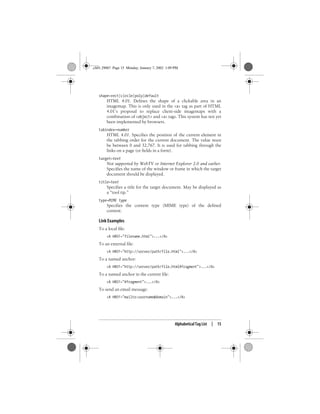
shape=rect|circle|poly|default
HTML 4.01. Defines the shape of a clickable area in an
imagemap. This is only used in the <a> tag as part of HTML
4.01’s proposal to replace client-side imagemaps with a
combination of <object> and <a> tags. This system has not yet
been implemented by browsers.
tabindex=number
HTML 4.01. Specifies the position of the current element in
the tabbing order for the current document. The value must
be between 0 and 32,767. It is used for tabbing through the
links on a page (or fields in a form).
target=text
Not supported by WebTV or Internet Explorer 2.0 and earlier.
Specifies the name of the window or frame in which the target
document should be displayed.
title=text
Specifies a title for the target document. May be displayed as
a “tool tip.”
type=MIME type
Specifies the content type (MIME type) of the defined
content.
Link Examples
To a local file:
<A HREF="filename.html">...</A>
To an external file:
<A HREF="http://server/path/file.html">...</A>
To a named anchor:
<A HREF="http://server/path/file.html#fragment">...</A>
To a named anchor in the current file:
<A HREF="#fragment">...</A>
To send an email message:
<A HREF="mailto:username@domain">...</A>
,ch01.29067 Page 15 Monday, January 7, 2002 1:09 PM
22.
16 | HTMLPocket Reference
To a file on an FTP server:
<A HREF="ftp://server/path/filename">...</A>
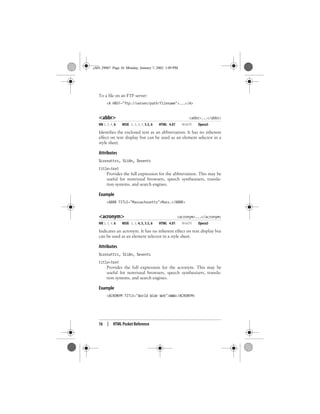
<abbr> <abbr>...</abbr>
NN 2, 3, 4, 6 MSIE 2, 3, 4, 5, 5.5, 6 HTML 4.01 WebTV Opera5
Identifies the enclosed text as an abbreviation. It has no inherent
effect on text display but can be used as an element selector in a
style sheet.
Attributes
%coreattrs, %i18n, %events
title=text
Provides the full expression for the abbreviation. This may be
useful for nonvisual browsers, speech synthesizers, transla-
tion systems, and search engines.
Example
<ABBR TITLE="Massachusetts">Mass.</ABBR>
<acronym> <acronym>...</acronym>
NN 2, 3, 4, 6 MSIE 2, 3, 4, 5, 5.5, 6 HTML 4.01 WebTV Opera5
Indicates an acronym. It has no inherent effect on text display but
can be used as an element selector in a style sheet.
Attributes
%coreattrs, %i18n, %events
title=text
Provides the full expression for the acronym. This may be
useful for nonvisual browsers, speech synthesizers, transla-
tion systems, and search engines.
Example
<ACRONYM TITLE="World Wide Web">WWW</ACRONYM>
,ch01.29067 Page 16 Monday, January 7, 2002 1:09 PM
23.
Alphabetical Tag List| 17
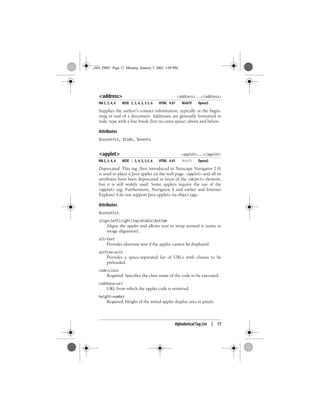
<address> <address>...</address>
NN 2, 3, 4, 6 MSIE 2, 3, 4, 5, 5.5, 6 HTML 4.01 WebTV Opera5
Supplies the author’s contact information, typically at the begin-
ning or end of a document. Addresses are generally formatted in
italic type with a line break (but no extra space) above and below.
Attributes
%coreattrs, %i18n, %events
<applet> <applet>...</applet>
NN 2, 3, 4, 6 MSIE 2, 3, 4, 5, 5.5, 6 HTML 4.01 WebTV Opera5
Deprecated. This tag (first introduced in Netscape Navigator 2.0)
is used to place a Java applet on the web page. <applet> and all its
attributes have been deprecated in favor of the <object> element,
but it is still widely used. Some applets require the use of the
<applet> tag. Furthermore, Navigator 4 and earlier and Internet
Explorer 4 do not support Java applets via object tags.
Attributes
%coreattrs
align=left|right|top|middle|bottom
Aligns the applet and allows text to wrap around it (same as
image alignment).
alt=text
Provides alternate text if the applet cannot be displayed.
archive=urls
Provides a space-separated list of URLs with classes to be
preloaded.
code=class
Required. Specifies the class name of the code to be executed.
codebase=url
URL from which the applet code is retrieved.
height=number
Required. Height of the initial applet display area in pixels.
,ch01.29067 Page 17 Monday, January 7, 2002 1:09 PM
24.
18 | HTMLPocket Reference
hspace=number
Holds number pixels space clear to the left and right of the
applet window.
name=text
Names the applet for reference from elsewhere on the page.
object=text
Names a resource containing a serialized representation of an
applet’s state. It is interpreted relative to the applet’s code-
base. The serialized data contains the applet’s class name but
not the implementation. The class name is used to retrieve the
implementation from a class file or archive. Either code or
object must be present. If both code and object are given, it is
an error if they provide different class names.
vspace=number
Holds number pixels space clear above and below the applet
window.
width=number
Required. Width of the initial applet display area in pixels.
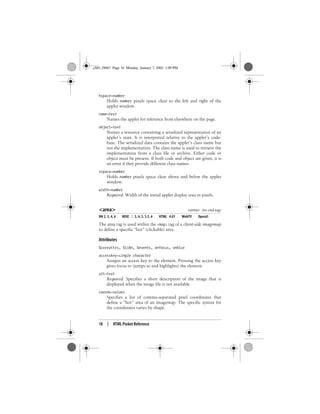
<area> <area> (no end tag)
NN 2, 3, 4, 6 MSIE 2, 3, 4, 5, 5.5, 6 HTML 4.01 WebTV Opera5
The area tag is used within the <map> tag of a client-side imagemap
to define a specific “hot” (clickable) area.
Attributes
%coreattrs, %i18n, %events, onfocus, onblur
accesskey=single character
Assigns an access key to the element. Pressing the access key
gives focus to (jumps to and highlights) the element.
alt=text
Required. Specifies a short description of the image that is
displayed when the image file is not available.
coords=values
Specifies a list of comma-separated pixel coordinates that
define a “hot” area of an imagemap. The specific syntax for
the coordinates varies by shape.
,ch01.29067 Page 18 Monday, January 7, 2002 1:09 PM
25.
Alphabetical Tag List| 19
href=url
Specifies the URL of the document or file that is accessed by
clicking on the defined area.
nohref
Defines a “mouse-sensitive” area in an imagemap for which
there is no action when the user clicks in the area.
shape=rect|circle|poly|default
Defines the shape of the clickable area.
tabindex=number
Assigns the position of the current element in the tabbing
order for the current document.
<b> <b>...</b>
NN 2, 3, 4, 6 MSIE 2, 3, 4, 5, 5.5, 6 HTML 4.01 WebTV Opera5
Enclosed text is rendered in bold.
Attributes
%coreattrs, %i18n, %events
<base> <base> (no end tag)
NN 2, 3, 4, 6 MSIE 2, 3, 4, 5, 5.5, 6 HTML 4.01 WebTV Opera5
Specifies the base pathname for all relative URLs in the docu-
ment. Place this element within the <head> of the document.
Attributes
href=url
Required. Specifies the URL to be used.
target=name
Not supported in MSIE 2.0. Defines the default target window
for all links in the document. Often used to target frames.
,ch01.29067 Page 19 Monday, January 7, 2002 1:09 PM
Lo, the fruitthat had been sown
By my toil that had no end,
When to sweetness it had grown,
Was by destiny my friend
Given to me for my own.
Scarce to this unheard of pass
Could I come, when I, alas!
Came the bitter truth to know,
That I should but grief and woe
From that happiness amass.
In my hand the fruit I hold,
And to hold it wearies me,
For amidst my woes untold
In the largest ear I see
A worm gnawing, fierce and bold;
I abhor what I adore,
And that which doth life restore
Brings death; for myself I shape
Winding mazes, whence escape
Is denied for evermore.
In my loss for death I sigh,
For 'tis life unto my woe.
In the truth I find a lie,
Greater doth the evil grow
Whether I be far or nigh;
No hope is there that is sure
Such an ill as this to cure;
Whether I remain or go,
Of this living death the woe
I must evermore endure.
OROMPO.
28.
'Tis sure anerror clear
To argue that the loss which death hath sent
Since it extends so far,
Doth bring in part content,
Because it takes away
The hope that fosters grief and makes it stay.
If of the glory dead
The memory that doth disturb our peace
Forever shall have fled,
The sorrow doth decrease,
Which at its loss we feel,
Since we can hope no more to keep it still.
But if the memory stays,
The memory of the bliss already fled
Doth live the more and blaze
Than when possessed indeed;
Who doubteth that this pain
Doth more than others untold miseries gain?
MARS.
If it should be the chance
Of a poor traveller by some unknown way
To find at his advance
Fleeing at close of day
The inn of his desire,
The inn for which he doth in vain aspire,
Doubtless he will remain
Dazed by the fear the dark and silent night
Inspires, and yet again
Hapless will be his plight,
If dawn comes not, for Heaven
To him hath not its gladdening radiance given.
The traveller am I,
I journey on to reach a happy inn;
Whene'er I think that nigh
I come to enter in,
Then, like a fleeting shadow,
Bliss flees away, and grief doth overshadow.
29.
CRISIO.
E'en as thetorrent deep
Is wont the traveller's weary steps to hold,
And doth the traveller keep
'Midst wind and snow and cold,
And, just a little space
Beyond, the inn appears before his face,
E'en so my happiness
Is by this painful tedious absence stayed;
To comfort my distress
'Tis ever sore afraid,
And yet before mine eyes
I see the healer of my miseries.
And thus to see so near
The cure of my distress afflicts me sore,
And makes it greater far,
Because my bliss before
My hand doth further flee
For some strange cause, the nearer 'tis to me.
ORFENIO.
30.
I saw beforemine eyes
A noble inn, that did in bliss abound,
I triumphed in my prize,
Too soon, alas, I found
That vile it had become,
Changed by my fate to darkness and to gloom.
There, where we ever see
The bliss of those who love each other well,
There is my misery;
There where is wont to dwell
All bliss, is evil plain,
United in alliance with disdain.
In this abode I lie—
And never do I strive to issue hence—
Built by my agony,
And with so strange a fence,
Methinks they to the ground
Bring it, who love, see, and resist its wound.
OROMPO.
31.
Sooner the paththat is his own, the sun
Shall end, whereon he wanders through the sky
After he hath through all the Zodiac run,
Than we the least part of our agony
According to our pain can well declare,
However much we raise our speech on high.
He who lives absent dies, says Crisio there,
But I, that I am dead, since to the reign
Of death fate handed o'er my life's career.
And boldly thou, Marsilio, dost maintain
That thou of joy and bliss hast lost all chance,
Since that which slayeth thee is fierce disdain.
Unto this thought thou givest utterance,
Orfenio, that 'tis through thy soul doth pass,
Not through thy breast alone, the jealous lance.
As each the woes through which his fellows pass
Feels not, he praiseth but the grief he knows,
Thinking it doth his fellows' pangs surpass.
Wherefore his bank rich Tagus overflows,
Swollen by our strife of tears and mournfulness,
Wherein with piteous words we moan our woes.
Our pain doth not thereby become the less,
Rather because we handle so the wound,
It doth condemn us to the more distress.
We must our plaints renew with all the sound
Our tongues can utter, and with all the thought
That can within our intellects be found.
Then let us cease our disputation, taught
That every ill doth anguish bring and pain,
Nor is there good with sure contentment fraught.
Sufficient ill he hath that doth constrain
His life within the confines of a tomb,
And doth in bitter loneliness remain,
Unhappy he—and mournful is his doom—
Who suffereth the pangs of jealousy,
In whom nor strength nor judgment findeth room,
And he, who spends his days in misery,
By the cruel power of absence long oppressed
32.
By the cruelpower of absence long oppressed,
Patience his only staff, weak though it be;
Nor doth the eager lover suffer least
Who feels, when most he burns, his lady's power,
By her hard heart and coldness sore distressed.
CRISIO.
His bidding let us do, for lo, the hour
E'en now with rapid flight comes on apace,
When we our herds must needs collect once more.
And while unto the wonted sheltering-place
We go, and whilst the radiant sun to rest
Sinketh and from the meadow hides his face,
With bitter voice and mourning manifest,
Making the while harmonious melody,
Sing we the grief that hath our souls oppressed.
MARS.
Begin then, Crisio, may thine accents fly
With speed unto Claraura's ears once more,
Borne gently by the winds that hasten by,
As unto one who doth their grief restore.
CRISIO.
Whoso from the grievous cup
Of dread absence comes to drink,
Hath no ill from which to shrink,
Nor yet good for which to hope.
In this bitter misery
Every evil is contained:
Fear lest we should be disdained,
Of our rivals' jealousy.
Whoso shall with absence cope,
Straightway will he come to think
That from no ill can he shrink,
Nor for any good can hope.
33.
OROMPO.
True 'tis illthat makes me sigh
More than any death I know,
Since life findeth cause of woe
In that death doth pass it by.
For when death did take away
All my glory and content,
That it might the more torment,
It allowed my life to stay.
Evil comes, and hastily
With such swiftness good doth go,
That life findeth cause of woe
In that death doth pass it by.
MARS.
In my dread and grievous woe
Now are wanting to my eyes
Tears, and breath unto my sighs,
Should my troubles greater grow,
For ingratitude, disdain,
Hold me in their toils so fast
That from death I hope at last
Longer life and greater gain.
Little can it linger now,
Since are wanting to my eyes
Tears, and breath unto my sighs,
Should my troubles greater grow.
ORFENIO.
34.
If it could,my joy should be
Truly all things else above:
If but jealousy were love,
And if love were jealousy.
From this transformation I
So much bliss and pride should gain
That of love I would attain
To the palm and victory.
If 'twere so, then jealousy
Would so much my champion prove,
That, if jealousy were love,
Nothing I save love should be.
With this last song of the jealous Orfenio, the discreet shepherds
made an end of their eclogue, leaving all who had heard them
satisfied with their discretion: especially Damon and Thyrsis, who
felt great pleasure at hearing them, for it seemed to them that the
reasonings and arguments which the four shepherds had
propounded to carry through their proposition, seemed of more than
shepherd wit. But a contest having arisen between many of the
bystanders as to which of the four had pleaded his cause best, at
last the opinion of all came to agree with that which discreet Damon
gave, saying to them that he for his part held that, among all the
distasteful and unpleasing things that love brings with it, nothing so
much distresses the loving breast as the incurable plague of
jealousy, and neither Orompo's loss, nor Crisio's absence, nor
Marsilio's despair could be equalled to it.
'The cause is,' he said, 'that it is not in reason that things which
have become impossible of attainment should be able for long to
compel the will to love them, or weary the desire to attain them; for
when a man has the will and desire to attain the impossible, it is
clear that the more desire is excessive in him, the more he would
lack understanding. And for this same reason I say that the pain
Orompo suffers is but grief and pity for a lost happiness; and
because he has lost it in such a way that it is not possible to recover
it again, this impossibility must be the cause of his sorrow ending.
35.
For although humanunderstanding cannot be always so united with
reason as to cease feeling the loss of the happiness which cannot be
recovered, and must in fact give tokens of its feeling by tender tears,
ardent sighs, and piteous words, under pain, should one not do this,
of being counted rather brute than rational man—in a word, the
course of time cures this sorrowing, reason softens it, and new
events have a great share in blotting it from memory. All this is the
contrary in absence, as Crisio well pointed out in his verses, for, as in
the absent one, hope is so united to desire, the postponement of
return gives him terrible distress; seeing that, as nothing hinders
him from enjoying his happiness except some arm of the sea, or
some stretch of land, it seems to him, having the chief thing, which
is the good-will of the beloved person, that flagrant wrong is done to
his bliss, in that things so trivial as a little water or land should
hinder his happiness and glory. To this pain are also joined the fear
of being forgotten, and the changes of human hearts; and so long
as absence endures, strange without a doubt is the harshness and
rigour with which it treats the soul of the hapless absent one. But as
it has the remedy so near, which consists in return, its torment can
be borne with some ease; and if it should happen that the absence
should be such that it is impossible to return to the desired
presence, that impossibility comes to be the remedy, as in the case
of death. As for the sorrow of which Marsilio complains, though it is,
as it were, the same that I suffer, and on this account must needs
have seemed to me greater than any other, I will not therefore fail to
say what reason shows me, rather than that to which passion urges
me. I confess that it is a terrible sorrow to love and not be loved;
but 'twould be a greater to love and be loathed. And if we new
lovers guided ourselves by what reason and experience teach us, we
would see that every beginning in anything is difficult, and that this
rule suffers no exception in the affairs of love, but rather in them is
confirmed and strengthened the more; so that for the new lover to
complain of the hardness of his lady's rebellious breast, goes beyond
all bounds of reason. For as love is, and has to be, voluntary, and
not constrained, I ought not to complain of not being loved by
anyone I love, nor ought I to attach importance to the burden I
36.
impose on her,telling her that she is obliged to love me since I love
her; seeing that, though the beloved person ought, in accordance
with the law of nature and with fair courtesy, not to show herself
ungrateful toward him who loves her well, it must not for this reason
be a matter of constraint and obligation that she should respond, all
in all, to her lover's desires. For if this were so, there would be a
thousand importunate lovers who would gain by their solicitude what
would perhaps not be due to them of right; and as love has the
understanding for father, it may be that she who is well loved by me
does not find in me qualities so good as to move her and incline her
to love me. And so she is not obliged, as I have already said, to love
me, in the same way that I shall be obliged to adore her, for I found
in her what is lacking in me; and for this reason he who is disdained
ought not to complain of his beloved, but of his fortune, which
denied him the graces that might move his lady's understanding to
love him well. And so he ought to seek, with constant services, with
loving words, with not unseasonable presence, and with practised
virtues, to improve and amend in himself the fault that nature
caused; for this is so essential a remedy that I am ready to affirm
that it will be impossible for him to fail to be loved, who, by means
so fitting, shall seek to win his lady's good-will. And since this evil of
disdain has with it the good of this cure, let Marsilio console himself,
and pity the hapless and jealous Orfenio, in whose misfortune is
enclosed the greatest that can be imagined in those of love. Oh
jealousy, disturber of the tranquil peace of love! jealousy, knife of
the firmest hopes! I know not what he could know of lineage who
made thee child of love, since thou art so much the contrary, that,
for that very reason, love would have ceased to be love, had it
begotten such children. Oh jealousy, hypocrite and false thief! seeing
that, in order that account may be taken of thee in the world, as
soon as thou seest any spark of love born in any breast, thou
seekest to mingle with it, changing thyself to its colour, and even
seekest to usurp from it the lordship and dominion it has. Hence it
comes that as men see thee so united with love, though by thy
results thou showest that thou art not love itself, yet thou seekest to
give the ignorant man to understand that thou art love's son, though
37.
in truth thouart born from a low suspicion, begotten by a vile and
ill-starred fear, nurtured at the breast of false imaginings, growing
up amidst vilest envies, sustained by slanders and falsehoods. And
that we may see the ruin caused in loving hearts by this cursed
affliction of raging jealousy, when the lover is jealous, it behoves
him, with the leave of jealous lovers be it said, it behoves him, I say,
to be, as he is, traitorous, cunning, truculent, slanderous, capricious,
and even ill-bred; and so far extends the jealous rage that masters
him, that the person he loves most is the one to whom he wishes
the most ill. The jealous lover would wish that his lady were fair for
him alone, and ugly for all the world; he desires that she may not
have eyes to see more than he might wish, nor ears to hear, nor
tongue to speak; that she may be retiring, insipid, proud and ill-
mannered; and at times he even desires, oppressed by this devilish
passion, that his lady should die, and that all should end. All these
passions jealousy begets in the minds of jealous lovers; the opposite
to the virtues which pure and simple love multiplies in true and
courteous lovers, for in the breast of a good lover are enclosed
discretion, valour, generosity, courtesy, and all that can make him
praiseworthy in the eyes of men. At the same time the force of this
cruel poison contains yet more, for there is no antidote to preserve
it, counsel to avail it, friend to aid it, nor excuse to fit it; all this is
contained in the jealous lover, and more—every shadow terrifies
him, every trifle disturbs him, and every suspicion, false or true,
undoes him. And to all this misfortune another is added, namely, the
excuses that deceive him. And since there is no other medicine than
excuses for the disease of jealousy, and since the jealous man
suffering from it does not wish to admit them, it follows that this
disease is without remedy, and should be placed before all others.
And thus it is my opinion that Orfenio is the most afflicted, but not
the most in love; for jealousy is not the token of much love, but of
much ill-advised curiosity. And if it is a token of love, it is like fever in
a sick man, for to have it is a sign of having life, but a life sick and
diseased; and so the jealous lover has love, but it is love sick and ill-
conditioned; and moreover to be jealous is a token of little
confidence in one's own worth. And that this is true the discreet and
38.
firm lover teachesus, who, without reaching the darkness of
jealousy, touches on the shadows of fear, but does not enter so far
into them that they obscure the sun of his bliss; nor goes so far
away from them that they relieve him from walking in solicitude and
fear; for if this discreet fear should be wanting in the lover, I would
count him proud and over-confident. For as a common proverb of
ours says: "Who loves well, fears"; and indeed it is right that the
lover should fear, lest, as the thing he loves is extremely good, or
seemed to him to be so, it should seem the same to the eyes of
anyone who beholds it; and for the same reason love is begotten in
another who is able to disturb his love and succeeds in so doing. The
good lover fears, and let him fear, the changes of time, of the new
events which might offer themselves to his hurt, and lest the happy
state he is enjoying may quickly end; and this fear must be so
secret, that it does not come to his tongue to utter it, nor yet to his
eyes to express it. And this fear produces effects so contrary to
those which jealousy produces in loving breasts, that it fosters in
them new desires to increase love more if they could, to strive with
all solicitude that the eyes of their beloved should not see in them
aught that is not worthy of praise, showing themselves generous,
courteous, gallant, pure and well-bred; and as much as it is right
that this virtuous fear should be praised, so much, and even more, is
it fitting that jealousy should be blamed.'
The renowned Damon said this and was silent, and drew in the wake
of his own opinion the opposite ones of some who had been
listening to him, leaving all satisfied with the truth he had shown
them with such plainness. But he would not have remained without
reply, had the shepherds Orompo, Crisio, Marsilio, and Orfenio been
present at his discourse; who, wearied by the eclogue they had
recited, had gone to the house of their friend Daranio. All being thus
occupied, at the moment the various dances were about to be
renewed, they saw three comely shepherds entering on one side of
the square, who were straightway recognised by all. They were the
graceful Francenio, the frank Lauso, and the old Arsindo, who came
between the two shepherds with a lovely garland of green laurel in
39.
his hands; andcrossing through the square, they came to a stop
where Thyrsis, Damon, Elicio, and Erastro, and all the chief
shepherds were, whom they greeted with courteous words, and
were received by them with no less courtesy, especially Lauso by
Damon, whose old and true friend he was. Compliments having
ceased, Arsindo, setting eyes on Damon and Thyrsis, began to speak
in this wise:
'It is the renown of your wisdom, which extends near and far,
discreet and gallant shepherds, that brings these shepherds and
myself to beg you to consent to be judges of a graceful contest that
has arisen between these two shepherds; and it is that, the feast
being over, Francenio and Lauso, who are here, found themselves in
a company of fair shepherdesses, and in order to pass without
tedium the leisure hours of the day amongst them, they set on foot,
amongst many other games, the one which is called 'themes.' It
happened then that, the turn to propose and begin coming to one of
these shepherds, fate would have it that the shepherdess at his side
and on his right hand was, as he says, the treasurer of his soul's
secrets, and the one who was, in the opinion of all, accounted the
most discreet and most in love. Approaching then her ear, he said to
her:
"Hope doth fly and will not stay."
The shepherdess, without being at a loss, went on, and, each one
afterwards repeating in public what he had said to the other in
secret, it was found that the shepherdess had capped the theme by
saying:
"With desire to check its flight."
The acuteness of this reply was praised by those who were present;
but the one to extol it most was the shepherd Lauso, and it seemed
no less good to Francenio, and so each one, seeing that the theme
and the reply were verses of the same measure, offered to gloss
them. After having done so, each one claims that his gloss excels
40.
the other's, andto have certainty in this, they wished to make me
judge of it, but, as I knew that your presence was gladdening our
banks, I counselled them to come to you, to whose consuminate
learning and wisdom questions of greater import might well be
trusted. They have followed my opinion, and I have gladly taken the
trouble to make this garland that it may be given as a prize to him
whom you, shepherds, decide to have glossed the better.'
Arsindo was silent and awaited the shepherds' reply, which was to
thank him for the good opinion he had of them and to offer
themselves to be impartial judges in that honourable contest. With
this assurance straightway Francenio once more repeated the verses
and recited his gloss, which was as follows:
Hope doth fly and will not stay,
With desire to check its flight.
GLOSS.
When to save myself I think,
In the faith of love believing,
Merit fails me on the brink,
And the excesses of my grieving
Straightway from my presence shrink;
Confidence doth die away,
And life's pulse doth cease to beat,
Since misfortune seems to say,
That, when fear pursues in heat,
Hope doth fly and will not stay.
Yes, it flies, and from my pain
With it takes away content,
And the keys of this my chain
For my greater punishment
In my enemy's power remain;
Far it rises to a height
Where 'twill soon be seen no more,
Far it flies, so swift and light
That it is not in my power
With desire to check its flight.
41.
Francenio having recitedhis gloss, Lauso began his, which was as
follows:
In the hour I saw thee first,
As I viewed thy beauty rare,
Straightway did I fear and thirst;
Yet at last I did so fear,
That I was with fear accursed;
Feeble confidence straightway,
When I see thee, leads astray,
With it comes a coward's fear.
Lest they should remain so near,
Hope doth fly and will not stay.
Though it leaves me and doth go
With so wondrous a career,
Soon a miracle will show
That the end of life is near,
But with love it is not so.
I am in a hopeless plight,
Yet that I his trophy might
Win, who loves but knows not why,
Though I could, I would not try
With desire to check its flight.
As Lauso ceased reciting his gloss, Arsindo said:
'Here you see declared, famous Damon and Thyrsis, the cause of the
contest between these shepherds; it only remains now that you
should give the garland to him whom you should decide to deserve
it with better right; for Lauso and Francenio are such friends, and
your award will be so just that, what shall be decided by you, they
will count as right.'
'Do not think, Arsindo,' replied Thyrsis, 'that, though our intellects
were of the quality you imagine them to be, the difference, if there
be any, between these discreet glosses can or ought to be decided
with such haste. What I can say of them, and what Damon will not
seek to contradict, is that both are equally good, and that the
garland should be given to the shepherdess who was the cause of so
curious and praiseworthy a contest; and, if you are satisfied with this
42.
judgment, reward usfor it by honouring the nuptials of our friend
Daranio, gladdening them with your pleasing songs, and giving
lustre to them by your honourable presence.'
The award of Thyrsis seemed good to all, the two shepherds
approved it and offered to do what Thyrsis bade them. But the
shepherdesses and shepherds, who knew Lauso, were astonished to
see his unfettered mind entangled in the net of love, for straightway
they saw, from the paleness of his countenance, the silence of his
tongue, and the contest he had had with Francenio, that his will was
not as free as it was wont to be, and they went wondering among
themselves who the shepherdess might be who had triumphed over
his free heart. One thought it was the discreet Belisa, another that it
was the gay Leandra, and some that it was the peerless Arminda,
being moved to think this by Lauso's usual practice to visit the huts
of these shepherdesses, and because each of them was likely by her
grace, worth, and beauty, to subdue other hearts as free as that of
Lauso, and it was many days ere they resolved this doubt, for the
love-sick shepherd scarce trusted to himself the secret of his love.
This being ended, straightway all the youth of the village renewed
the dances, and the rustic instruments made pleasing music. But
seeing that the sun was already hastening his course towards the
setting, the concerted voices ceased, and all who were there
determined to escort the bridal pair to their house. And the aged
Arsindo, in order to fulfil what he had promised to Thyrsis, in the
space there was between the square and Daranio's house, to the
sound of Erastro's pipe went singing these verses:
ARSINDO.
43.
Now let Heaventokens show
Of rejoicing and of mirth
On so fortunate a day,
'Midst the joy of all below
Let all peoples on the earth
Celebrate this wedding gay.
From to-day let all their mourning
Into joyous song be turning,
And in place of grief and pain
Pleasures let the myriads gain,
From their hearts all sorrow spurning.
Let prosperity abound
With the happy bridal-pair,
Who were for each other made,
On their elms may pears be found,
In their oak-groves cherries rare,
Sloes amid the myrtle glade,
Pearls upon the rocky steep.
May they grapes from mastic reap,
Apples from the carob-tree.
May their sheepfolds larger be,
And no wolves attack their sheep.
May their ewes that barren were,
Fruitful prove, and may they double
By their fruitfulness their flock.
May the busy bees prepare
'Midst the threshing floor and stubble,
Of sweet honey plenteous stock.
May they ever find their seed,
In the town and in the mead,
Plucked at fitting time and hour,
May no grub their vines devour,
And their wheat no blighting weed.
In good time with children twain,
Perfect fruit of peace and love,
May the happy pair be blest.
And when manhood they attain,
May the one a doctor prove,
And the other a parish priest.
May they ever take the lead
In both wealth and goodly deed.
Thus they gentlemen will be
44.
Thus they gentlemenwill be,
If they give security
For no gauger full of greed.
May they live for longer years
E'en than Sarah, hale and strong,
And the sorrowing doctor shun.
May they shed no bitter tears
For a daughter wedded wrong,
For a gambling spendthrift son.
May their death be, when the twain
Shall Methusaleh's years attain,
Free from guilty fear; the date
May the people celebrate
For ever and aye, Amen.
With the greatest pleasure Arsindo's rude verses were listened to,
and he would have gone on further with them, had not their arrival
at Daranio's house hindered it. The latter, inviting all who came with
him, remained there, save that Galatea and Florisa, through fear lest
Teolinda should be recognised by Thyrsis and Damon, would not
remain at the wedding banquet. Elicio and Erastro would fain have
accompanied Galatea to her house, but it was not possible for her to
consent to it, and so they had to remain with their friends, and the
shepherdesses, wearied with the dances of that day, departed. And
Teolinda felt more pain than ever, seeing that at Daranio's solemn
nuptials, where so many shepherds had assisted, only her Artidoro
was wanting. With this painful thought she passed that night in
company with Galatea and Florisa, who passed it with hearts more
free and more dispassionate, until on the new day to come there
happened to them what will be told in the book which follows.
45.
BOOK IV.
With greatdesire the fair Teolinda awaited the coming day to take
leave of Galatea and Florisa and to finish searching by all the banks
of the Tagus for her dear Artidoro, intending to end her life in sad
and bitter solitude, if she were so poor in fortune as to learn no
news of her beloved shepherd. The wished-for hour, then, having
come, when the sun was beginning to spread his rays over the
earth, she arose, and, with tears in her eyes, asked leave of the two
shepherdesses to prosecute her quest. They with many reasonings
urged her to wait some days more in their company, Galatea offering
to her to send one of her father's shepherds to search for Artidoro
by all the banks of the Tagus, and wherever it might be thought he
could be found. Teolinda thanked her for her offers, but would not
do what they asked of her, nay rather, after having shown in the best
words she could the obligation in which she lay to cherish all the
days of her life the favours she had received from them, she
embraced them with tender feeling and begged them not to detain
her a single hour. Then Galatea and Florisa, seeing how vainly they
wrought in thinking to detain her, charged her to try to inform them
of any incident, good or bad, that might befall her in that loving
quest, assuring her of the pleasure they would feel at her happiness,
and of their pain at her misery. Teolinda offered to be herself the
one to bring the tidings of her good fortune, since, if they were bad,
life would not have patience to endure them, and so it would be
superfluous to learn them from her. With this promise of Teolinda
46.
Galatea and Florisawere content, and they determined to
accompany her some distance from the place. And so, the two only
taking their crooks, and having furnished Teolinda's wallet with some
victuals for the toilsome journey, they went forth with her from the
village at a time when the sun's rays were already beginning to
strike the earth more directly and with greater force. And having
accompanied her almost half a league from the place, at the
moment they were intending to return and leave her, they saw four
men on horseback and some on foot crossing by some broken
ground which lay a little off their way. At once they recognised them
to be hunters by their attire and by the hawks and dogs they had
with them, and whilst they were looking at them with attention to
see if they knew them, they saw two shepherdesses of gallant
bearing and spirit come out from among some thick bushes which
were near the broken ground; they had their faces muffled with two
white linen kerchiefs, and one of them, raising her voice, asked the
hunters to stop, which they did; and both coming up to one of them,
who from his bearing and figure seemed the chief of all, seized the
reins of his horse and stood awhile talking with him without the
three shepherdesses being able to hear a word of what they said,
because of the distance from the spot which prevented it. They only
saw that after they had talked with him a little while, the horseman
dismounted, and having, as far as could be judged, bidden those
who accompanied him to return, only a boy remaining with his
horse, he took the two shepherdesses by the hands and gradually
began to enter with them into a thick wood that was there. The
three shepherdesses, Galatea, Florisa, and Teolinda, seeing this,
determined to see, if they could, who the masked shepherdesses,
and the horseman who escorted them were. And so they agreed to
go round by a part of the wood, and see if they could place
themselves in some part which might be such as to satisfy them in
what they desired. And acting in the manner they had intended,
they overtook the horseman and the shepherdesses, and Galatea,
watching through the branches what they were doing, saw that they
turned to the right and plunged into the thickest part of the wood;
and straightway they followed them in their very footsteps until the
47.
horseman and theshepherdesses, thinking they were well within the
wood, halted in the middle of a narrow little meadow which was
surrounded by countless thickets of bramble. Galatea and her
companions came so near that without being seen or perceived,
they saw all the horseman and the shepherdesses did and said; and
when the latter had looked on all sides to see if they could be seen
by anyone, and were assured on this point, one removed her veil,
and scarcely had she done so when she was recognised by Teolinda,
who, approaching Galatea's ear, said to her in as low a voice as she
could:
'This is a very strange adventure; for, unless it be that I have lost my
understanding from the grief I suffer, without any doubt that
shepherdess who has removed her veil, is the fair Rosaura, daughter
of Roselio, lord of a village near ours, and I know not what can be
the reason that has moved her to adopt so strange a garb and to
leave her district,—things which speak so much to the detriment of
her honour. But, alas, hapless one!' added Teolinda, 'for the
horseman who is with her is Grisaldo, eldest son of rich Laurencio,
who owns two villages close to this of yours.'
'You speak truth, Teolinda,' replied Galatea, 'for I know him; but be
silent and keep quiet, for we shall soon see the purpose of his
coming here.'
Thereat Teolinda was still, and set herself attentively to watch what
Rosaura was doing. She, going up to the horseman, who seemed
about twenty years old, began to say to him with troubled voice and
angry countenance:
'We are in a spot, faithless man, where I may take the wished for
vengeance for your lack of love and your neglect. But though I took
it on you in such a way that it would cost you your life, it were little
recompense for the wrong you have done me. Here am I,
unrecognised so as to recognise you, Grisaldo, who failed to
recognise my love; here is one who changed her garb to seek for
you, she who never changed her will to love you. Consider,
ungrateful and loveless one, that she who in her own house and
48.
amongst her servantsscarce could move a step, now for your sake
goes from vale to vale, and from ridge to ridge, amidst such
loneliness seeking your companionship.'
To all these words the fair Rosaura was uttering, the horseman
listened with his eyes fixed on the ground, and making lines on the
earth with the point of a hunting knife he held in his hand. But
Rosaura, not content with what she had said, pursued her discourse
with words such as these:
'Tell me, do you know peradventure, do you know, Grisaldo, that I
am she who not long ago dried your tears, stayed your sighs, healed
your pains, and above all, she who believed your words? or
perchance do you understand that you are he who thought all the
oaths that could be imagined feeble and of no strength to assure me
of the truth with which you deceived me? Are you by chance,
Grisaldo, he whose countless tears softened the hardness of my pure
heart? It is you, for indeed I see you, and it is I, for indeed I know
myself. But if you are the Grisaldo of my belief, and I am Rosaura, as
you think her to be, fulfil to me the word you gave me, and I will
give you the promise I have never denied you. They have told me
that you are marrying Leopersia, Marcelio's daughter, so gladly that
it is actually you who are wooing her; if this news has caused me
sorrow, can well be seen by what I have done in coming to prevent
its fulfilment, and if you can confirm it, I leave the matter to your
conscience. What do you reply to this, mortal enemy of my peace?
Do you admit perchance, by your silence, that which it were right
should not pass even through your thought. Now raise your eyes
and set them on those that beheld you to their hurt; lift them and
behold her whom you are deceiving, whom you are abandoning and
forgetting. You will see, if you ponder it well, that you are deceiving
her who always spoke truth to you, you are abandoning her who has
abandoned her honour and herself to follow you, you are forgetting
her who never banished you from her memory. Consider, Grisaldo,
that in birth I am your equal, that in wealth I am not your inferior,
and that I excel you in goodness of heart and in firmness of faith.
Fulfil to me, sir, the faith you gave me, if you are proud to be a
49.
gentleman, and arenot ashamed to be a Christian. Behold, if you do
not respond to what you owe me, I will pray Heaven to punish you,
fire to burn you, air to fail you, water to drown you, earth not to
endure you, and my kinsmen to avenge me! Behold, if you fail in
your duty towards me, you will have in me a perpetual disturber of
your joys so long as my life shall last, and even after I am dead, if it
may be, I shall with constant shadows affright your faithless spirit,
and with frightful visions torment your deceiving eyes! Mark that I
but ask what is my own, and that by giving it you gain what you lose
by refusing it! Now move your tongue to undeceive me for the many
times you have moved it to wound me!'
Saying this, the fair lady was silent, and for a short while was
waiting to see what Grisaldo replied. He, raising his face, which up
till then he had kept down, crimsoned with the shame Rosaura's
words had caused in him, with calm voice replied to her in this wise:
'If I sought to deny, oh Rosaura, that I am your debtor in more than
what you say, I would likewise deny that the sunlight is bright, and
would even say that fire is cold and air solid. So that herein I confess
what I owe you, and am obliged to pay it; but for me to confess that
I can pay you as you wish is impossible, for my father's command
has forbidden it, and your cruel disdain has rendered it impossible.
Nor do I wish to call any other witness to this truth than yourself, as
one who knows so well how many times and with what tears I
begged you to accept me as your husband, and to deign to permit
me to fulfil the word I had given you to be it. And you, for the
reasons you fancied, or because you thought it was well to respond
to Artandro's vain promises, never wished matters to come to such
an issue; but rather went on from day to day putting me off, and
making trials of my firmness, though you could make sure of it in
every way by accepting me for your own. You also know, Rosaura,
the desire my father had to settle me in life, and the haste he
showed in the matter, bringing forward the rich and honourable
marriages you know of, and how I with a thousand excuses held
aloof from his importunities, always telling you of them, so that you
should no longer defer what suited you so well and what I desired;
50.
and that afterall this I told you one day that my father's wish was
for me to marry Leopersia, and you, on hearing Leopersia's name, in
a desperate rage told me to speak to you no more, and that I might
marry Leopersia with your blessing, or anyone I liked better. You
know also that I urged you many times to cease those jealous
frenzies, for I was yours and not Leopersia's, and that you would
never receive my excuses, nor yield to my prayers, but rather,
persevering in your obstinacy and hardness, and in favouring
Artandro, you sent to tell me that it would give you pleasure that I
should never see you more. I did what you bade me, and, so as to
have no opportunity to transgress your bidding, seeing also that I
was fulfilling that of my father, I resolved to marry Leopersia, or at
least I shall marry her to-morrow, for so it is agreed between her
kinsmen and mine; wherefore you see, Rosaura, how guiltless I am
of the charge you lay against me, and how late you have come to
know the injustice with which you treated me. But that you may not
judge me henceforward to be as ungrateful as you have pictured me
in your fancy, see if there is anything wherein I can satisfy your
wish, for, so it be not to marry you, I will hazard, to serve you,
property, life and honour.'
While Grisaldo was saying these words, the fair Rosaura kept her
eyes riveted on his face, shedding through them so many tears that
they showed full well the grief she felt in her soul. But, seeing that
Grisaldo was silent, heaving a deep and woful sigh, she said to him:
'As it cannot be, oh Grisaldo, that your green years should have a
long and skilled experience of the countless accidents of love, I do
not wonder that a little disdain of mine has placed you in the
freedom you boast of; but if you knew that jealous fears are the
spurs which make love quicken his pace, you would see clearly that
those I had about Leopersia, redounded to make me love you more.
But as you made such sport of my affairs, on the slightest pretext
that you could conceive, you revealed the little love in your breast,
and confirmed my true suspicions; and in such a way that tells me
you are marrying Leopersia to-morrow. But I assure you, before you
bear her to the marriage-couch, you must bear me to the tomb,
51.
unless, indeed, youare so cruel as to refuse to give one to the dead
body of her over whose soul you were always absolute lord. And,
that you may know clearly and see that she who lost for you her
modesty, and exposed her honour to harm, will count it little to lose
her life, this sharp poniard which here I hold will accomplish my
desperate and honourable purpose, and will be a witness of the
cruelty you hold in that false breast of yours.'
And saying this she drew from her bosom a naked dagger, and with
great haste was going to plunge it in her heart, had not Grisaldo
with greater speed seized her arm, and had not the veiled
shepherdess, her companion, hurried to close with her. Grisaldo and
the shepherdess were a long while before they took the dagger from
the hands of Rosaura, who said to Grisaldo:
'Permit me, traitorous foe, to end at once the tragedy of my life,
without your loveless disdain making me experience death so often.'
'You shall not taste of death on my account,' replied Grisaldo, 'since I
would rather that my father should fail in the word he has given to
Leopersia on my behalf, than that I should fail at all in what I know I
owe you. Calm your breast, Rosaura, since I assure you that this
breast of mine can desire naught save what may be to your
happiness.'
At these loving words of Grisaldo, Rosaura awakened from the death
of her sorrow to the life of her joy, and, without ceasing to weep,
knelt down before Grisaldo, begging for his hands in token of the
favour he did her. Grisaldo did the same, and threw his arms round
her neck; for a long while they remained without power to say a
word one to the other, both shedding many loving tears. The veiled
shepherdess, seeing her companion's happy fortune, wearied by the
fatigue she had sustained in helping to take the dagger from
Rosaura, being unable to bear her veil any longer, took it off,
disclosing a face so like Teolinda's, that Galatea and Florisa were
amazed to see it. But Teolinda was more so, since, without being
able to conceal it, she raised her voice, saying:
52.
'Oh Heavens, andwhat is it that I see? Is not this by chance my
sister Leonarda, the disturber of my repose? She it is without a
doubt.'
And, without further delay, she came out from where she was, and
with her Galatea and Florisa; and as the other shepherdess saw
Teolinda, straightway she recognised her, and with open arms they
ran one to the other, wondering to have found each other in such a
place, and at such a time and juncture. Then Grisaldo and Rosaura,
seeing what Leonarda was doing with Teolinda, and that they had
been discovered by the shepherdesses Galatea and Florisa, arose,
with no small shame that they had been found by them in that
fashion, and, drying their tears, with reserve and courtesy received
the shepherdesses, who were at once recognised by Grisaldo. But
the discreet Galatea, in order to change into confidence the
displeasure that perchance the two loving shepherds had felt at
seeing her, said to them with that grace, with which she said
everything:
'Be not troubled by our coming, happy Grisaldo and Rosaura, for it
will merely serve to increase your joy, since it has been shared with
one who will always have joy in serving you. Our fortune has
ordained that we should see you, and in a part where no part of
your thoughts has been concealed from us, and since Heaven has
brought them to so happy a pass, in satisfaction thereof calm your
breasts and pardon our boldness.'
'Never has your presence, fair Galatea,' replied Grisaldo, 'failed to
give pleasure wherever it might be; and this truth being so well
known, we are rather under an obligation at sight of you, than
annoyed at your coming.'
With these there passed some other courteous words, far different
from those that passed between Leonarda and Teolinda, who, after
having embraced once and yet again, with tender words, mingled
with loving tears, demanded the story of each other's adventures,
filling all those that were there with amazement at seeing them, for
they resembled each other so closely, that they could almost be
53.
called not alike,but one and the same; and had it not been that
Teolinda's dress was different from Leonarda's, without a doubt
Galatea and Florisa could not have distinguished them; and then
they saw with what reason Artidoro had been deceived in thinking
that Leonarda was Teolinda. But when Florisa saw that the sun was
about midway in the sky, and that it would be well to seek some
shade to protect them from its rays, or at least to return to the
village, since, as the opportunity failed them to pasture their sheep,
they ought not to be so long in the meadow, she said to Teolinda
and Leonarda:
'There will be time, shepherdesses, when with greater ease you can
satisfy our desires, and give us a longer account of your thoughts,
and for the present let us seek where we may spend the rigour of
the noon-tide heat that threatens us, either by a fresh spring that is
at the outlet of the valley we are leaving behind, or in returning to
the village, where Leonarda will be treated with the kindness which
you, Teolinda, have experienced from Galatea and myself. And if I
make this offer only to you, shepherdesses, it is not because I forget
Grisaldo and Rosaura, but because it seems to me that I cannot
offer to their worth and deserving more than good-will.'
'This shall not be wanting in me as long as life shall last,' replied
Grisaldo, 'the will to do, shepherdess, what may be to your service,
since the kindness you show us cannot be paid with less; but since it
appears to me that it will be well to do what you say, and because I
have learnt that you are not ignorant of what has passed between
me and Rosaura, I do not wish to waste your time or mine in
referring to it, I only ask you to be kind enough to take Rosaura in
your company to your village, whilst I prepare in mine some things
which are necessary to fulfil what our hearts desire; and in order
that Rosaura may be free from suspicion, and may never cherish
suspicion of the good faith of my intentions, with deliberate will on
my part, you being witnesses thereof, I give her my hand to be her
true husband.'
54.
And, saying this,he stretched out his hand, and took fair Rosaura's,
and she was so beside herself to see what Grisaldo did, that she
scarce could answer him a word, only she allowed him to take her
hand, and a little while after said:
'Love had brought me, Grisaldo, my lord, to such a pass, that, with
less than you have done for me, I would remain for ever your
debtor; but since you have wished to have regard rather for what
you yourself are, than for my deserving, I shall do what in me lies,
which is to give you my soul anew in recompense for this favour, and
may Heaven give you the reward for so welcome a kindness.'
'No more, no more, my friends,' said Galatea at this moment, 'for
where deeds are so true, excessive compliments must find no place.
What remains is to pray Heaven to lead to a happy issue these
beginnings, and that you may enjoy your love in a long and
beneficent peace. And as for what you say, Grisaldo, that Rosaura
should come to our village, the favour you do us therein is so great,
that we ourselves beg it of you.'
'So gladly will I go in your company,' said Rosaura, 'that I know not
how to enhance it more than by telling you that I will not much
regret Grisaldo's absence, when I am in your company.'
'Then come,' said Florisa, 'for the village is far away, and the sun
strong, and our delay in returning there conspicuous. You, señor
Grisaldo, can go and do what you wish, for in Galatea's house you
will find Rosaura, and these, or rather this one shepherdess, for
being so much alike, they ought not to be called two.'
'Be it as you wish,' said Grisaldo; and, he taking Rosaura by the
hand, they all went from the wood, having agreed among
themselves that Grisaldo should on the morrow send a shepherd,
from the many his father had, to tell Rosaura what she was to do,
and that this shepherd, when sent, might be able to speak to
Galatea or to Florisa without being observed, and give the
instructions that suited best. This agreement seemed good to all,
and, having come out from the wood, Grisaldo saw that his servant
55.
was waiting forhim with the horse, and embracing Rosaura anew,
and taking leave of the shepherdesses, he went away accompanied
with tears and by Rosaura's eyes, which never left him until they lost
him from sight. As the shepherdesses were left alone, straightway
Teolinda went away with Leonarda, in the desire to learn the cause
of her coming. And Rosaura, too, as she went, related to Galatea
and to Florisa the occasion that had moved her to take a
shepherdess's dress, and to come to look for Grisaldo, saying:
'It would not cause you wonder, fair shepherdesses, to see me in
this dress, if you knew how far love's mighty power extends, which
makes those who love well change not only their garb, but will and
soul, in the way that is most to its taste, and I had lost my love for
ever, had I not availed myself of the artifice of this dress. For you
must know, my friends, that, as I was in Leonarda's village, of which
my father is the lord, Grisaldo came to it with the intention of being
there some days, engaged in the pleasing pastime of the chase; and
as my father was a great friend of his father, he arranged to receive
him in the house, and to offer him all the hospitality that he could.
This he did; and Grisaldo's coming to my house resulted in driving
me from it; for indeed, though it be at the cost of my shame, I must
tell you that the sight, the converse, and the worth of Grisaldo made
such an impression on my soul, that, without knowing how, when he
had been there a few days, I came to be quite beside myself, and
neither wished nor was able to exist without making him master of
my freedom. However, it was not so heedlessly but that I was first
satisfied that Grisaldo's wish did not differ in any way from mine, as
he gave me to understand with many very true tokens. I then, being
convinced of this truth, and seeing how well it pleased me to have
Grisaldo for husband, came to acquiesce in his desires, and to put
mine into effect; and so, by the mediation of a handmaiden of mine,
Grisaldo and I saw each other many times in a secluded corridor,
without our being alone extending further than for us to see each
other, and for him to give me the word, which to-day he has given
me again with more force in your presence. My sad fortune then
decreed, that at the time I was enjoying so sweet a state, there
56.
came also tovisit my father a valiant gentleman from Aragón, who
was called Artandro; he being overcome, according to what he
showed, by my beauty, if I have any, sought with the greatest
solicitude that I should marry him without my father knowing it.
Meanwhile Grisaldo had sought to carry out his purpose, and I,
showing myself somewhat harsher than was necessary, kept putting
him off with words, with the intention that my father should set
about marrying me, and that then Grisaldo should seek me for his
wife; but he did not wish to do this, since he was aware that his
father's wish was to marry him to the rich and beauteous Leopersia,
for you must know her well by the report of her riches and beauty.
This came to my knowledge, and I took the opportunity to try to
make him jealous of me, though feignedly, merely to make trial of
the sincerity of his faith; and I was so careless, or rather so simple,
that thinking I gained something thereby, I began to show some
favours to Artandro. Grisaldo, seeing this, often declared to me the
pain he felt at my dealings with Artandro, and he even informed me
that if it was not my wish that he should fulfil to me the word he had
given me, he could not fail to obey the wish of his parents. To all
these words of warning and advice I replied unadvisedly, full of pride
and arrogance, confident that the bonds which my beauty had cast
over Grisaldo's soul could not be so easily broken, or even touched,
by any other beauty. But my confidence turned out to be much
mistaken, as Grisaldo soon showed me, who, wearied of my foolish
and scornful disdain, saw fit to leave me and to obey his father's
behest. But scarcely had he gone from my village and left my
presence, when I recognised the error into which I had fallen, and
with such force did Grisaldo's absence and jealousy of Leopersia
begin to torment me that his absence overwhelmed me and jealousy
of her consumed me. Considering then, that, if my remedy were
deferred, I must leave my life in the hands of grief, I resolved to risk
losing the lesser, which in my opinion was reputation, in order to
gain the greater, which is Grisaldo. And so, on the pretext I gave my
father, of going to see an aunt of mine, the mistress of another
village near ours, I left my home, accompanied by many of my
father's servants, and when I reached my aunt's house, I disclosed
57.
to her allmy secret thoughts, and asked her to be kind enough to
allow me to put on this dress and come to speak to Grisaldo,
assuring her that if I did not come myself, my affairs would have a
poor issue. She consented to this on condition that I took with me
Leonarda, as one in whom she had much confidence. I sent for her
to our village and procured this garb, and, bearing in mind some
things which we two had to do, we took leave of her eight days ago;
and, though we came to Grisaldo's village six days ago, we have
never been able to find an opportunity of speaking to him alone, as I
desired, until this morning, when I knew he was going to the chase.
I awaited him in the same place where he took leave of us, and
there has passed between us what you, friends, have seen, at which
happy issue I am as happy as it is right she should be who desired it
so much. This, shepherdesses, is the story of my life, and if I have
wearied you in telling it you, throw the blame on the desire you had
to know it, and on mine which could not do less than satisfy you.'
'Nay, rather,' replied Florisa, 'we are so grateful for the favour you
have done us, that, though we may always busy ourselves in your
service we shall not escape from the debt.'
'I am the one who remains in debt,' answered Rosaura, 'and who will
seek to repay it as my powers may allow. But, leaving this aside,
turn your eyes, shepherdesses, and you will see those of Teolinda
and Leonarda so full of tears that they will move yours without fail to
accompany them therein.'
Galatea and Florisa turned to look at them, and saw that what
Rosaura said was true. What caused the weeping of the two sisters
was that after Leonarda had told her sister all that Rosaura had
related to Galatea and Florisa, she said to her:
'You must know, sister, that, as you were missing from our village, it
was thought that the shepherd Artidoro had taken you away, for that
same day he too was missing without taking leave of anyone. I
confirmed this opinion in my parents, because I told them what had
passed with Artidoro in the forest. With this evidence the suspicion
increased, and my father determined to go in search of you and of
58.
Artidoro, and infact would have done so had not there come to our
village two days afterwards a shepherd whom all took for Artidoro
when they saw him. When the news reached my father that your
ravisher was there, straightway he came with the constables to
where the shepherd was, and they asked him if he knew you or
where he had taken you to. The shepherd denied on oath that he
had ever seen you in all his life, or that he knew what it was they
were asking him about. All that were present wondered to see the
shepherd denying that he knew you, since he had been ten days in
the village and had spoken and danced with you many a time, and
without any doubt all believed that Artidoro was guilty of what was
imputed to him. Without wishing to admit his defence or to hear a
word from him, they took him to prison, where he remained without
anyone speaking to him for some days, at the end of which, when
they came to take his confession, he swore again that he did not
know you, nor in all his life had he been more than that once in that
village, and that they should consider—and this he had said at other
times—whether the Artidoro they thought he was, was not by
chance a brother of his, who resembled him so exactly as truth
would reveal when it showed them that they had deceived
themselves in taking him for Artidoro; for he was called Galercio, son
of Briseno, a native of Grisaldo's village. And, in fact, he gave such
indications and showed such proofs that all clearly saw that he was
not Artidoro, whereat they were more amazed, saying that such a
marvel as that of my likeness to you, and Galercio's to Artidoro, had
not been seen in the world. This announcement concerning Galercio
moved me to go and see him many times where he was confined;
and the sight of him was such that I was deprived of sight, at least
for the purpose of seeing things to give me pleasure, so long as I did
not see Galercio. But the worst of it is, sister, that he went from the
village without knowing that he took with him my freedom, nor had I
the opportunity of telling it him, and so I remained with such a grief
as may be imagined, until Rosaura's aunt sent for me for a few days,
all for the purpose of coming to accompany Rosaura; whereat I felt
extreme joy, for I knew that we were going to Galercio's village, and
that there I might make him acquainted with his debt to me. But I
59.
have been sopoor in fortune that we have been four days in his
village and I have never seen him, though I have asked for him, and
they tell me that he is in the country with his flock. I have also asked
for Artidoro, and they have told me that for some days he has not
appeared in the village; and, in order not to leave Rosaura, I have
not taken an opportunity of going to look for Galercio, from whom it
might be possible to learn news of Artidoro. This is what has
happened to me, besides what you have seen with Grisaldo, since
you have been missing, sister, from the village.'
Teolinda was astonished at what her sister told her; but when she
came to know that in Artidoro's village no news was known of him,
she could not restrain her tears, though she consoled herself in part,
believing that Galercio would have news of his brother; and so she
resolved to go next day to look for Galercio wherever he might be.
And having told her sister as briefly as she could all that had
happened to her since she went in search of Artidoro, Teolinda
embraced her again and returned to where the shepherdesses were.
They were walking along a little distance from the road, in among
some trees which protected them a little from the heat of the sun.
Teolinda coming up to them told them all that her sister had said to
her concerning the issue of her love, and the likeness of Galercio
and Artidoro; whereat they wondered not a little, though Galatea
said:
'Whoever sees the strange likeness there is between you, Teolinda,
and your sister, cannot wonder though he sees others, since no
likeness, as I believe, is equal to yours.'
'There is no doubt,' replied Leonarda, 'but that the likeness there is
between Artidoro and Galercio is so great that, if it does not surpass
ours, at least it will be in no way behind it.'
'May Heaven please,' said Florisa, 'that as you four resemble one
another, so may you agree and be like one another in fortune, that
which fate grants to your desires being so good that all the world
may envy your joys, as it wonders at your likenesses.'
60.
Teolinda would havereplied to these words, had not a voice they
heard issuing from among the trees prevented it; and all stopping to
listen to it, they straightway recognised that it was the voice of the
shepherd Lauso, whereat Galatea and Florisa felt great joy, for they
wished very much to know of whom Lauso was enamoured, and
believed that what the shepherd should sing would relieve them of
this doubt, and for this reason, without moving from where they
were, they listened to him in the greatest silence. The shepherd was
seated at the foot of a green willow, accompanied by his thoughts
alone, and by a little rebeck, to the sound of which he sang in this
wise:
LAUSO.
61.
Welcome to ourwebsite – the ideal destination for book lovers and
knowledge seekers. With a mission to inspire endlessly, we offer a
vast collection of books, ranging from classic literary works to
specialized publications, self-development books, and children's
literature. Each book is a new journey of discovery, expanding
knowledge and enriching the soul of the reade
Our website is not just a platform for buying books, but a bridge
connecting readers to the timeless values of culture and wisdom. With
an elegant, user-friendly interface and an intelligent search system,
we are committed to providing a quick and convenient shopping
experience. Additionally, our special promotions and home delivery
services ensure that you save time and fully enjoy the joy of reading.
Let us accompany you on the journey of exploring knowledge and
personal growth!
ebookfinal.com