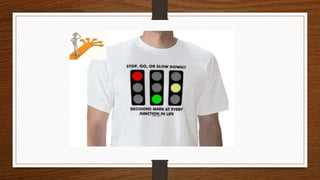
“Sometimes we need to reason through
our options and carefully analyze the
possibilities. And sometimes we need to
listen to our emotions.”
How We Decide
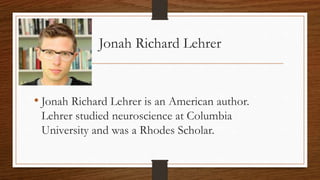
Jonah Richard Lehrer
• Jonah Richard Lehrer is an American author.
Lehrer studied neuroscience at Columbia
University and was a Rhodes Scholar.
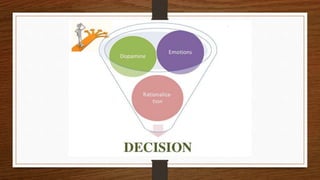
The history of Western thought is so full of paeans to the virtues of rationality
that people have neglected to fully consider its limitations.
The prefrontal cortex, it turns out, is easy to hoodwink.
All it takes is a few additional digits or a slightly bigger candy scoop, and this
rational brain region will start making irrational decisions.
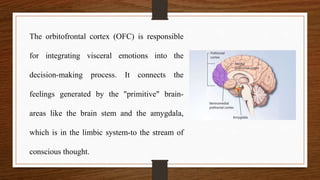
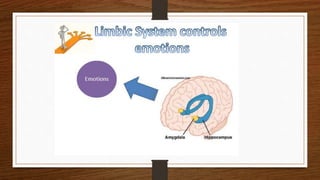
The orbitofrontal cortex (OFC) is responsible
for integrating visceral emotions into the
decision-making process. It connects the
feelings generated by the "primitive" brain-
areas like the brain stem and the amygdala,
which is in the limbic system-to the stream of
conscious thought.
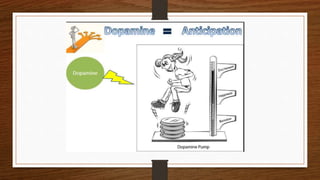
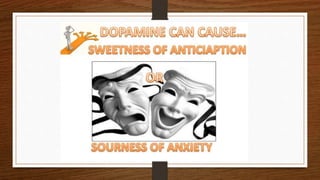
In the brain, dopamine functions as a neurotransmitter—a chemical
released by neurons (nerve cells) to send signals to other nerve cells. The
brain includes several distinct dopamine pathways, one of which plays a
major role in the motivational component of reward-motivated behavior.
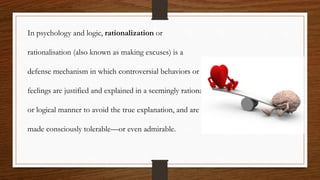
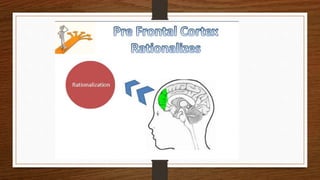
In psychology and logic, rationalization or
rationalisation (also known as making excuses) is a
defense mechanism in which controversial behaviors or
feelings are justified and explained in a seemingly rational
or logical manner to avoid the true explanation, and are
made consciously tolerable—or even admirable.
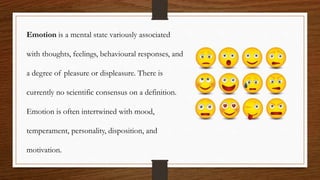
Emotion is a mental state variously associated
with thoughts, feelings, behavioural responses, and
a degree of pleasure or displeasure. There is
currently no scientific consensus on a definition.
Emotion is often intertwined with mood,
temperament, personality, disposition, and
motivation.
When a person is drawn to something, the mind is trying to tell him that he should
choose that option. It has already assessed the alternatives - this analysis takes
place outside of conscious awareness - and converted that assessment into a
positive emotion. And when he sees an option he doesn't like, it is the OFC that
makes him want to get away.
The world is full of things, and it is our feelings that help us choose among them.
Emotion and motivation share the same Latin root, movere, which means
"to move.“
Feelings are often an accurate shortcut, a concise expression of decades' worth of
experience. They already know how to do it.
The process of thinking requires feeling, for feelings are what let us
understand all the information that we can't directly comprehend. Reason
without emotion is impotent.
Our brains completely misinterpret what's actually going on. We trust our
feelings and perceive patterns, but the patterns don't actually exist.
Human emotions are rooted in the predictions of highly flexible brain cells,
which are constantly adjusting their connections to reflect reality. Every time you
make a mistake or encounter something new, your brain cells are busy changing
themselves. Our emotions are deeply empirical.
These wise yet inexplicable feelings are an essential part of the decision-making
process. Even when we think we know nothing, our brains know something.
That's what our feelings are trying to tell us.
Daniel Kahneman
• 2002 Nobel Laureate in Economics
• Like William James, believes we have 2 mental ‘systems’:
• System 1, for near-instinctual decisions;
• System 2, for higher logic.
• We make most decisions based on emotion, but even the
rational parts:
• Depend on our mood;
• Are often flawed,
• No matter how smart we are.
Kahneman’s examples
• Seeing frequent advertising leads to a more
favorable opinion of the product.
• We need simplicity, so we jump to false (but
consistent) conclusions.
• “People, including scientists, often search for
information that confirms their own beliefs.”
How we decide powerpoint presentation.pptx

How we decide powerpoint presentation.pptx

  • 1.
    “Sometimes we needto reason through our options and carefully analyze the possibilities. And sometimes we need to listen to our emotions.”
  • 2.
  • 3.
    Jonah Richard Lehrer •Jonah Richard Lehrer is an American author. Lehrer studied neuroscience at Columbia University and was a Rhodes Scholar.
  • 4.
    The history ofWestern thought is so full of paeans to the virtues of rationality that people have neglected to fully consider its limitations. The prefrontal cortex, it turns out, is easy to hoodwink. All it takes is a few additional digits or a slightly bigger candy scoop, and this rational brain region will start making irrational decisions.
  • 5.
    The orbitofrontal cortex(OFC) is responsible for integrating visceral emotions into the decision-making process. It connects the feelings generated by the "primitive" brain- areas like the brain stem and the amygdala, which is in the limbic system-to the stream of conscious thought.
  • 7.
    In the brain,dopamine functions as a neurotransmitter—a chemical released by neurons (nerve cells) to send signals to other nerve cells. The brain includes several distinct dopamine pathways, one of which plays a major role in the motivational component of reward-motivated behavior.
  • 9.
    In psychology andlogic, rationalization or rationalisation (also known as making excuses) is a defense mechanism in which controversial behaviors or feelings are justified and explained in a seemingly rational or logical manner to avoid the true explanation, and are made consciously tolerable—or even admirable.
  • 11.
    Emotion is amental state variously associated with thoughts, feelings, behavioural responses, and a degree of pleasure or displeasure. There is currently no scientific consensus on a definition. Emotion is often intertwined with mood, temperament, personality, disposition, and motivation.
  • 13.
    When a personis drawn to something, the mind is trying to tell him that he should choose that option. It has already assessed the alternatives - this analysis takes place outside of conscious awareness - and converted that assessment into a positive emotion. And when he sees an option he doesn't like, it is the OFC that makes him want to get away.
  • 14.
    The world isfull of things, and it is our feelings that help us choose among them. Emotion and motivation share the same Latin root, movere, which means "to move.“ Feelings are often an accurate shortcut, a concise expression of decades' worth of experience. They already know how to do it.
  • 15.
    The process ofthinking requires feeling, for feelings are what let us understand all the information that we can't directly comprehend. Reason without emotion is impotent. Our brains completely misinterpret what's actually going on. We trust our feelings and perceive patterns, but the patterns don't actually exist.
  • 16.
    Human emotions arerooted in the predictions of highly flexible brain cells, which are constantly adjusting their connections to reflect reality. Every time you make a mistake or encounter something new, your brain cells are busy changing themselves. Our emotions are deeply empirical. These wise yet inexplicable feelings are an essential part of the decision-making process. Even when we think we know nothing, our brains know something. That's what our feelings are trying to tell us.
  • 20.
    Daniel Kahneman • 2002Nobel Laureate in Economics • Like William James, believes we have 2 mental ‘systems’: • System 1, for near-instinctual decisions; • System 2, for higher logic. • We make most decisions based on emotion, but even the rational parts: • Depend on our mood; • Are often flawed, • No matter how smart we are.
  • 21.
    Kahneman’s examples • Seeingfrequent advertising leads to a more favorable opinion of the product. • We need simplicity, so we jump to false (but consistent) conclusions. • “People, including scientists, often search for information that confirms their own beliefs.”

Editor's Notes

  • #3 Jonah Lehrer’s engaging new book, “How We Decide,” puts our decision-making skills under the microscope. Lehrer is something of a popular science prodigy
  • #21 System 1 includes very simple arithmetic