Page 1 of 1 
Article Review   
The purpose of an article review is to provide a summary and evaluation of a piece of 
writing. When a lecturer reads an article review written by a student, they want to see 
evidence that the student has not only understood the topic of the article, but is able to 
evaluate the article in relation to their own knowledge of the topic and other relevant 
knowledge in the field. The annotated example below provides useful guidance on how to 
organise information within your article review and how to select and use language 
strategies which help make your writing more evaluative. 
Annotated Example of an Article Review  
This is an authentic example of student writing. Therefore you should not view this as a 
model – while it contains many attributes of a successful article review, it is not a perfect 
piece of writing. The comments on the right hand‐side draw your attention to both 
strengths and weaknesses in the review, but are not comprehensive and as such you 
should not assume that sections of the article review which do not have comments are 
without problems. Please not that the language in this article review is not without 
grammatical errors. 
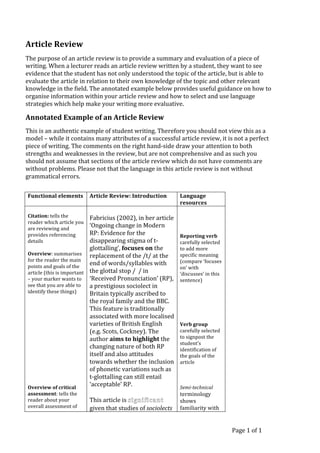
Functional elements 
 
Article Review: Introduction  Language 
resources 
 
Citation: tells the 
reader which article you 
are reviewing and 
provides referencing 
details  
 
Overview: summarises 
for the reader the main 
points and goals of the 
article (this is important 
– your marker wants to 
see that you are able to 
identify these things) 


Overview of critical 
assessment: tells the 
reader about your 
overall assessment of 
 
Fabricius (2002), in her article 
‘Ongoing change in Modern 
RP: Evidence for the 
disappearing stigma of t‐
glottalling’, focuses on the 
replacement of the /t/ at the 
end of words/syllables with 
the glottal stop /  / in 
‘Received Pronunciation’ (RP), 
a prestigious sociolect in 
Britain typically ascribed to 
the royal family and the BBC. 
This feature is traditionally 
associated with more localised 
varieties of British English 
(e.g. Scots, Cockney). The 
author aims to highlight the 
changing nature of both RP 
itself and also attitudes 
towards whether the inclusion 
of phonetic variations such as 
t‐glottalling can still entail 
‘acceptable’ RP. 
 
This article is significant 
given that studies of sociolects 


Reporting verb 
carefully selected 
to add more 
specific meaning 
(compare ‘focuses 
on’ with 
‘discusses’ in this 
sentence) 


Verb group 
carefully selected 
to signpost the 
student’s 
identification of 
the goals of the 
article 


Semi­technical 
terminology 
shows 
familiarity with 
Page 2 of 2 


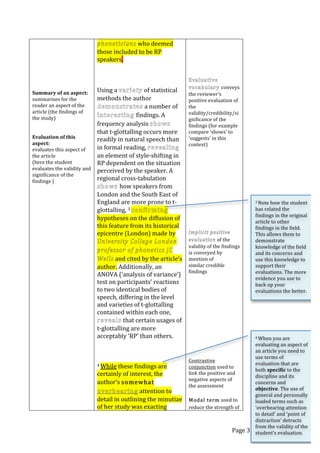
Functional elements  Article Review: Body  Language 
resources 
 
Summary of an aspect: 
summarises for the 
reader an aspect of the 
article (the 
methodological 
approach) 
 
 
Evaluation of this 
aspect: 
evaluates this aspect of 
the article (here the 
student evaluates the 
originality, rigour and 
credibility of the 
methodological 
approach) 


2 After a detailed background 
review of both RP itself and 
the numerous studies of it, the 
author turns her attention to 
the main focus of the study: an 
original quantitative analysis 
of glottalling in RP. The data is 
taken from 24 interviews 
conducted amongst university 
students, all of whom were 
deemed of a similar, ‘higher’ 
social class, categorised thus 
by the application of the 
Cambridge Scale to their 
parents’ occupations coupled 
with their educational 
background. As well as social 
class, the interviewees’ 
linguistic profile was 
evaluated by professional 
 
Evaluative 
vocabulary conveys 
the reviewer’s 
positive assessment 
of the rigour and 
originality of the 
approach 


Implicit positive 
evaluation of the 
credibility/rigour of 
the methodological 
approach is conveyed 
through mention of 
the Cambridge 
Scale/professional 
phoneticians 
 
 
the article 
(here the student 
evaluates the article in 
terms of ‘significance’ 
and 
‘accessibility’) 
 
 
deemed to be of a ‘higher’ 
status than others 
(predominantly as a result of 
speakers’ higher 
socioeconomic profile) are 
relativelyrelatively rare. 1 However 
as a result of the highly 
technical nature of its analysis 
and somewhat abstract 
implications, the article would 
perhapsperhaps only be of 
interest to relevant experts 
well versed in sociolinguistic 
theory and statistical 
processes.  
 
important 
concepts within 
the discipline 
 
Contrastive 
conjunction used 
to link the 
positive and 
negative aspects 
of the assessment  
 
Modal termModal term 
used to reduce 
the strength of 
the reviewer’s 
assessment of 
the article  
 
2 Note how the student 
has integrated 
summary and 
evaluation through the 
use of  (sometimes 
implicitly) evaluative 
terms and phrases, 
such as ‘detailed’ and 
‘evaluated by 
professional 
phoneticians’ to 
summarise this aspect 
of the article. Good 
critical writing often 
does this. 
 
1Your marker wants to 
see that you can relate 
the content of the article 
to other knowledge 
within the discipline — 
in this case the student’s 
negative evaluation is 
too general to 
demonstrate this type of 
understanding.  
 
Page 3 of 3 


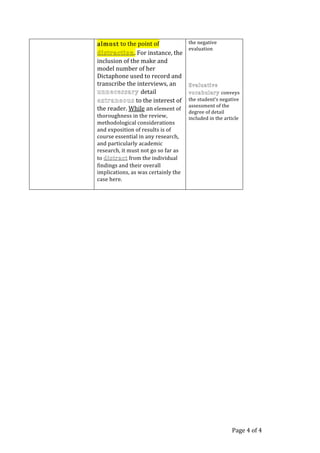
Summary of an aspect: 
summarises for the 
reader an aspect of the 
article (the findings of 
the study) 
 
 
Evaluation of this 
aspect: 
evaluates this aspect of 
the article   
(here the student 
evaluates the validity and 
significance of the 
findings ) 


phoneticians who deemed 
those included to be RP 
speakers. 


Using a variety of statistical 
methods the author 
demonstrates a number of 
interesting findings. A 
frequency analysis shows 
that t‐glottalling occurs more 
readily in natural speech than 
in formal reading, revealing 
an element of style‐shifting in 
RP dependent on the situation 
perceived by the speaker. A 
regional cross‐tabulation 
shows how speakers from 
London and the South East of 
England are more prone to t‐
glottalling, 3 confirming 
hypotheses on the diffusion of 
this feature from its historical 
epicentre (London) made by 
University College London 
professor of phonetics JC 
Wells and cited by the article’s 
author. Additionally, an 
ANOVA (‘analysis of variance’) 
test on participants’ reactions 
to two identical bodies of 
speech, differing in the level 
and varieties of t‐glottalling 
contained within each one, 
reveals that certain usages of 
t‐glottalling are more 
acceptably ‘RP’ than others. 


4 While these findings are 
certainly of interest, the 
author’s somewhatsomewhat 
overbearing attention to 
detail in outlining the minutiae 
of her study was exacting 


Evaluative 
vocabulary conveys 
the reviewer’s 
positive evaluation of 
the 
validity/credibility/si
gnificance of the 
findings (for example 
compare ’shows’ to 
‘suggests’ in this 
context) 


Implicit positive 
evaluation of the 
validity of the findings 
is conveyed by 
mention of  
similar credible 
findings 


Contrastive 
conjunction used to 
link the positive and 
negative aspects of 
the assessment 
 
Modal termModal term used to 
reduce the strength of 
3 Note how the student 
has related the 
findings in the original 
article to other 
findings in the field. 
This allows them to 
demonstrate 
knowledge of the field 
and its concerns and 
use this knowledge to 
support their 
evaluations. The more 
evidence you use to 
back up your 
evaluations the better. 
 
4 When you are 
evaluating an aspect of 
an article you need to 
use terms of 
evaluation that are 
both specific to the 
discipline and its 
concerns and 
objective. The use of 
general and personally 
loaded terms such as 
‘overbearing attention 
to detail’ and ‘point of 
distraction’ detracts 
from the validity of the 
student’s evaluation.  
 
Page 4 of 4 
almostalmost to the point of 
distraction. For instance, the 
inclusion of the make and 
model number of her 
Dictaphone used to record and 
transcribe the interviews, an 
unnecessary detail 
extraneous to the interest of 
the reader. While an element of 
thoroughness in the review, 
methodological considerations 
and exposition of results is of 
course essential in any research, 
and particularly academic 
research, it must not go so far as 
to distract from the individual 
findings and their overall 
implications, as was certainly the 
case here.  
 
the negative 
evaluation 


Evaluative 
vocabulary conveys 
the student’s negative 
assessment of the 
degree of detail 
included in the article 


Page 5 of 5 
 
Functional elements  Article Review: Conclusion  Language 
resources 
 
Summary of evaluation: 
summarises for the 
reader the main points 
made in the Review stage 
in terms of your 
evaluation of each aspect  


Overall assessment: 
tells the reader what 
your overall assessment 
of the article is (here 
positive assessment in 
terms of the rigour and 
significance and negative 
assessment in terms of 
accessibility) 


In conclusion, Fabricius’ article 
provides a comprehensive 
review of past research into 
RP and presents interesting 
findings from the author’s own 
thorough study of the 
changing nature of RP and 
attitudes towards this change 
with regards to the 
replacement of the /t/ sound 
at the ends of words/syllables 
with the /  / glottal stop. 
However, the author’s failure 
to explain findings in simple 
terms and provide real‐world 
examples renders this 
research inaccessible to lay 
audiences who are 
nevertheless stakeholders in 
the status of RP (e.g. media 
commentators, those in the 
dramatic arts).  
 
The relevance of this 
otherwise comprehensive 
and contemporary study is 
therefore 5somewhatsomewhat 
compromised by its 
relatively restricted 
accessibility. 
 
Evaluative 
vocabulary conveys 
the reviewer’s 
positive assessment 
of the rigour and 
significance of the 
study and negative 
assessment of the 
degree of detail and 
lack of focus 


Contrastive 
conjunction used to 
link the positive and 
negative aspects of 
the assessment 


Modal termModal term used to 
reduce the strength of 
the negative 
evaluation 


5 The use of modal 
terms and tempering 
vocabulary is 
important as by 
reducing the strength 
of your claims and 
evaluations you leave 
less room for your 
reader to dispute your 
claims and evaluations. 
 

How to write an article review