O
b
j
e
c
t
-
o
r
i
e
n
t
e
d
E
n
g
l
i
s
h
G
r
a
m
m
a
r
B
y
F
u
z
h
a
n
g
D
e
n
g
B
y
F
u
z
h
a
n
g
D
e
n
g
Preface
English is a rigorous and logical language with a systematic grammar system. However, the traditional English
grammar is too fragmented and complicated, including many concepts such as attributive, adverbial, complement,
subject clause, predicative clause, indirect object, appositive and so on. It can be said that in most cases it lists
grammatical phenomena without explanations, which makes English learners fall into rote learning, failing to
master English grammar comprehensively and accurately.
In order to solve this problem simply and effectively, in this book the author reinterprets English grammar from
an entirely new perspective, employing the concept of thinking in object widely used in computer programming,
and creatively establishes a brand-new grammar system called Object-oriented English Grammar, in which object
is the core concept. The author believes that the whole world is composed of various objects, which possess
attributes, perform actions, and are interconnected with each other. Language is a social phenomenon, and its
function is to describe the attributes, actions, identities of all the objects in the world and their relationships with
each other (From this perspective, object-oriented grammar can be used to analyze and learn any language) so as
to achieve the purpose of conveying information.
Based on this understanding, the author, by analyzing a large number of sentences from authentic sources, finds
that there are only five basic simple sentence patterns in English. When two simple sentences are closely related,
they can be combined. If there is repeated or inferential information in them, usually it can be omitted. Moreover,
some information fragments in English can be encapsulated to form fused words, thereby making sentences
conciser (Combinations, omissions, and fused words, on the one hand, shorten sentences, but on the other hand
complicate them).
In Object-oriented English Grammar, we can use a few fundamental concepts (relative clause, independent clause,
noun clause, omission, fused word, scenario verb, and hidden information) to perfectly explain a large variety of
traditional grammatical concepts, helping you fully understand the logic behind English phenomena.
We can liken the five basic simple sentence patterns to five different building blocks. By stacking and adjusting
these building blocks, we can construct all kinds of objects, that is, sentences. Therefore, theoretically speaking,
English sentences can be infinitely long, but they can all be broken down into five basic simple sentences.
When you are familiar with these concepts and can use them effectively in the analysis of sentences, you have
learnt how to think in English and can read and write long sentences with ease.
This book is intended for intermediate and advanced learners of English. If you are a beginner, it is advised to
prepare yourself well before reading it.
When writing the book, the author benefited a lot from the internet, many English dictionaries and grammar
books, the main ones of which are listed in the bibliography. Sincere thanks to all the writters.
Fuzhang Deng 2022.05.01
B
y
F
u
z
h
a
n
g
D
e
n
g
2
To the Readers
Having been registered, this book is protected by copyright with no commercial
use allowed. You can contact the author through WeChat(18938563818),
QQ(380088832) or email(380088832@qq.com) to get a Chinese version or a
paper book.
Join our QQ groups to study it together:
B
y
F
u
z
h
a
n
g
D
e
n
g
3
Contents
Preface............................................................................................................................................................................ 1
Chapter 1 Overview.......................................................................................................................................................8
1. Simple Sentence.................................................................................................................................................8
2. Main Word Classes............................................................................................................................................ 8
1) Noun...........................................................................................................................................................8
2) Pronoun.....................................................................................................................................................8
3) Verb............................................................................................................................................................8
4) Adjective....................................................................................................................................................8
5) Adverb....................................................................................................................................................... 8
6) Preposition................................................................................................................................................8
7) Article.........................................................................................................................................................9
8) Conjunction............................................................................................................................................... 9
3. Five Types of Basic Simple Sentence Patterns................................................................................................9
4. Declarative Sentences and Interrogative Sentences.................................................................................... 10
1) Declarative Sentences............................................................................................................................ 10
2) Interrogative Sentences.........................................................................................................................10
Chapter 2 Relative Clauses......................................................................................................................................... 11
1. Relative Clauses............................................................................................................................................... 11
1) Restrictive Relative Clauses...................................................................................................................11
2) Nonrestrictive Relative Clauses.............................................................................................................11
2. Relative Pronouns and Relative Adverbs...................................................................................................... 12
1) Fused Words............................................................................................................................................12
2) Common Relative Pronouns and Relative Adverbs............................................................................. 12
3. Exercises...........................................................................................................................................................14
A. Fill in the blanks with suitable relative pronouns or relative adverbs.............................................. 14
B. Answer the questions below by choosing A, B, C or D.........................................................................14
Chapter 3 Noun Clauses..............................................................................................................................................17
1. Objects..............................................................................................................................................................17
2. Noun Clause..................................................................................................................................................... 17
1) Declarative sentences used as noun clauses........................................................................................17
2) Interrogative sentences used as noun clauses.....................................................................................17
3) Exclamatory sentences used as noun clauses......................................................................................18
3. Exercises...........................................................................................................................................................18
Answer the questions below by choosing A, B, C or D.............................................................................18
Chapter 4 Predicate.....................................................................................................................................................21
1. Time, Aspect, Voice and Person..................................................................................................................... 21
2. How to show time............................................................................................................................................22
3. How to show aspect........................................................................................................................................ 22
4. How to show voice.......................................................................................................................................... 22
5. How to combine voice, aspect, time and person together...........................................................................22
6. Exercises...........................................................................................................................................................24
Point out the predicate verb (s) in each sentence below and name the voice, aspect, time and person.
.......................................................................................................................................................................24
B
y
F
u
z
h
a
n
g
D
e
n
g
4
Chapter 5 Reduction of Restrictive Relative Clauses............................................................................................... 25
1. Reduction of Restrictive Relative Clauses..................................................................................................... 25
2. The Rules for Reducing Restrictive Relative Clauses................................................................................... 28
3. Exercises...........................................................................................................................................................30
A. Try to reduce the relative clauses in bold.............................................................................................30
B. Answer the questions below by choosing A, B, C or D.........................................................................31
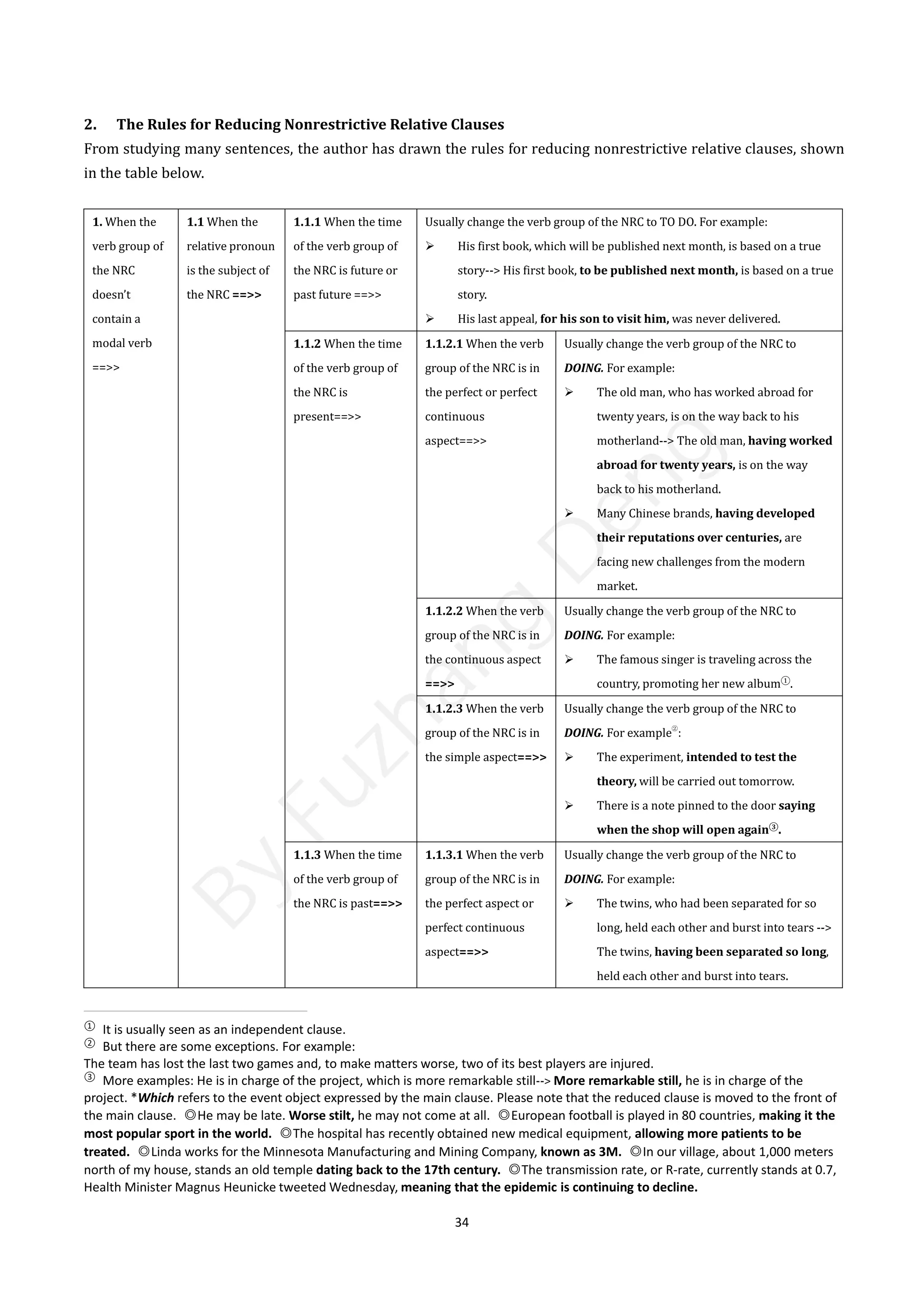
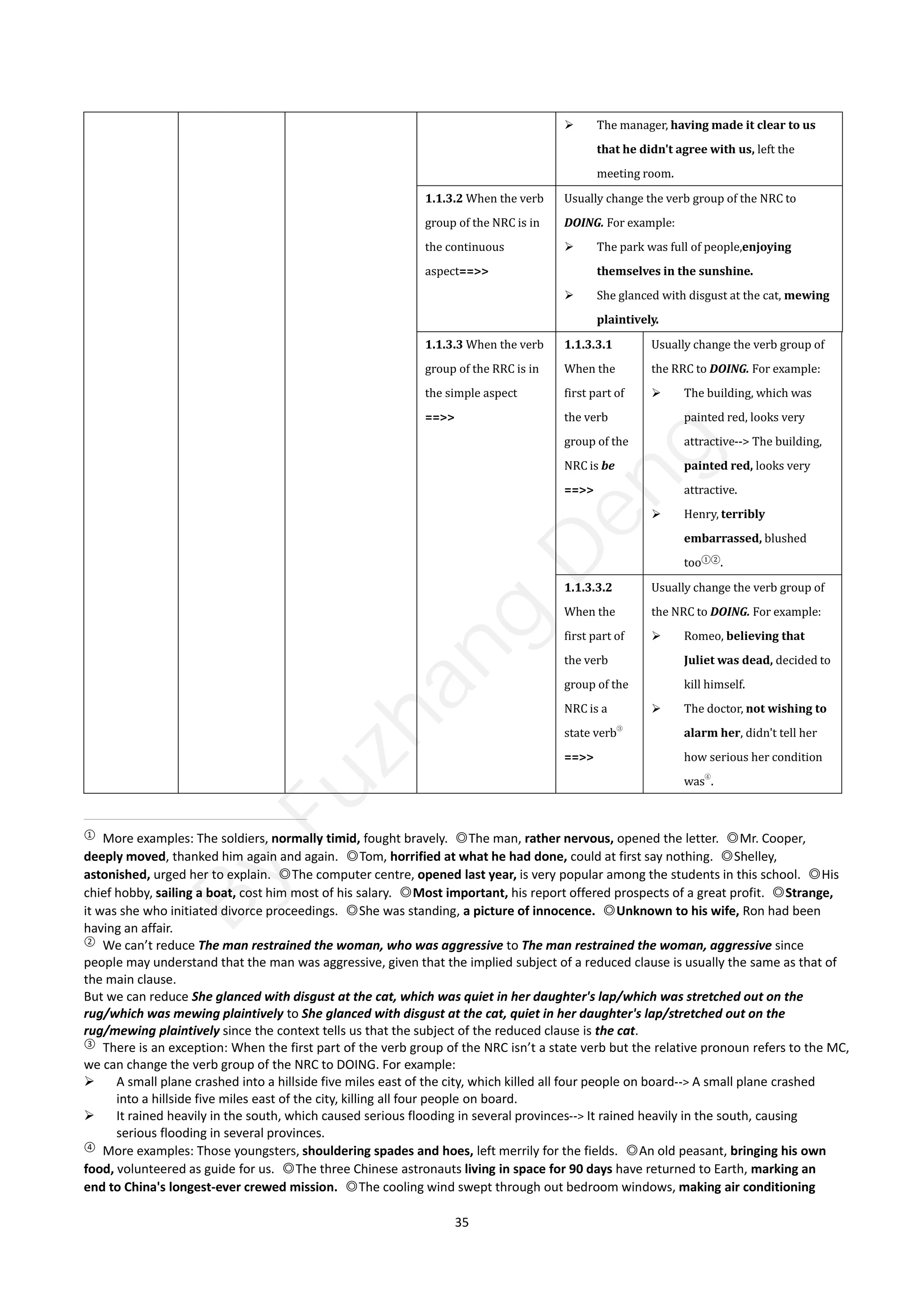
Chapter 6 Reduction of Nonrestrictive Relative Clauses......................................................................................... 33
1. Reduction of Nonrestrictive Relative Clauses...............................................................................................33
2. The Rules for Reducing Nonrestrictive Relative Clauses.............................................................................34
3. Exercises...........................................................................................................................................................36
A. Try to reduce the relative clauses in bold.............................................................................................36
B. Answer the questions below by choosing A, B, C or D.........................................................................36
Chapter 7 Reduction of Independent Clauses.......................................................................................................... 38
1. Reduction of Independent Clauses................................................................................................................ 38
2. The Rules for Reducing Independent Clauses.............................................................................................. 40
3. Exercises...........................................................................................................................................................43
A. Try to reduce the independent clauses in bold.................................................................................... 43
B. Answer the questions below by choosing A, B, C or D.........................................................................43
Chapter 8 Reduction of Noun Clauses....................................................................................................................... 46
1. Reduction of Noun Clauses.............................................................................................................................46
2. The Rules for Reducing Noun Clauses...........................................................................................................48
3. Exercises...........................................................................................................................................................51
A. Try to reduce the noun clauses in bold................................................................................................. 51
B. Answer the questions below by choosing A, B, C or D.........................................................................51
Chapter 9 The Use of Object-oriented English Grammar in Analyzing English Sentences.................................. 53
1. The Analyses of Examples.............................................................................................................................. 53
2. Exercises...........................................................................................................................................................67
Answer the questions below by choosing A, B, C or D.............................................................................67
Chapter 10 Adverb Clauses.........................................................................................................................................77
1. Adverb Clauses................................................................................................................................................ 77
2. Reduction of Adverb Clauses..........................................................................................................................78
3. Exercises...........................................................................................................................................................79
Answer the questions below by choosing A, B, C or D.............................................................................79
Chapter 11 Preposition...............................................................................................................................................82
1. Preposition.......................................................................................................................................................82
2. The main usages of the common prepositions.............................................................................................82
ON................................................................................................................................................................. 82
IN...................................................................................................................................................................83
UNDER..........................................................................................................................................................83
BELOW......................................................................................................................................................... 83
OVER.............................................................................................................................................................84
ABOVE.......................................................................................................................................................... 84
BEHIND........................................................................................................................................................ 84
BEFORE........................................................................................................................................................ 85
B
y
F
u
z
h
a
n
g
D
e
n
g
5
BETWEEN.................................................................................................................................................... 85
AMONG.........................................................................................................................................................85
AROUND.......................................................................................................................................................85
BESIDE/NEXT TO........................................................................................................................................85
BY..................................................................................................................................................................86
FROM............................................................................................................................................................ 86
OF..................................................................................................................................................................87
WITH............................................................................................................................................................ 87
TO..................................................................................................................................................................88
FOR............................................................................................................................................................... 88
3. Exercises...........................................................................................................................................................89
Answer the questions below by choosing A, B, C or D.............................................................................89
Chapter 12 Nouns........................................................................................................................................................93
1. Common and Proper Nouns........................................................................................................................... 93
2. Countable and Uncountable Nouns............................................................................................................... 93
3. Singular and Plural Forms of Nouns..............................................................................................................93
4. The Possessive Form.......................................................................................................................................94
3. Exercises...........................................................................................................................................................94
Answer the questions below by choosing A, B, C or D.............................................................................94
Chapter 13 Articles: A/An and The............................................................................................................................96
1. The Articles: A/An and The.............................................................................................................................96
2. The Usages of A/An......................................................................................................................................... 96
3. The Usages of The............................................................................................................................................97
4. Exercises...........................................................................................................................................................98
Answer the questions below by choosing A, B, C or D.............................................................................98
Chapter 14 Pronouns................................................................................................................................................ 100
1. Eight Types of Pronouns...............................................................................................................................100
2. Exercises.........................................................................................................................................................101
Answer the questions below by choosing A, B, C or D...........................................................................101
Chapter 15 Numbers.................................................................................................................................................103
1. Cardinal Numbers and Ordinal Numbers................................................................................................... 103
2. Exercises.........................................................................................................................................................103
Answer the questions below by choosing A, B, C or D...........................................................................103
Chapter 16 Verbs....................................................................................................................................................... 106
1. How to form the past tenses and past participles......................................................................................106
2. How to form the -ing forms..........................................................................................................................106
3. How to form the -s forms..............................................................................................................................106
Chapter 17 Adjectives............................................................................................................................................... 107
1. Adjectives Order............................................................................................................................................ 107
2. Comparatives and Superlatives....................................................................................................................107
3. How to Form an Adjective’s Comparative and Superlative....................................................................... 107
4. Exercises.........................................................................................................................................................108
Answer the questions below by choosing A, B, C or D...........................................................................108
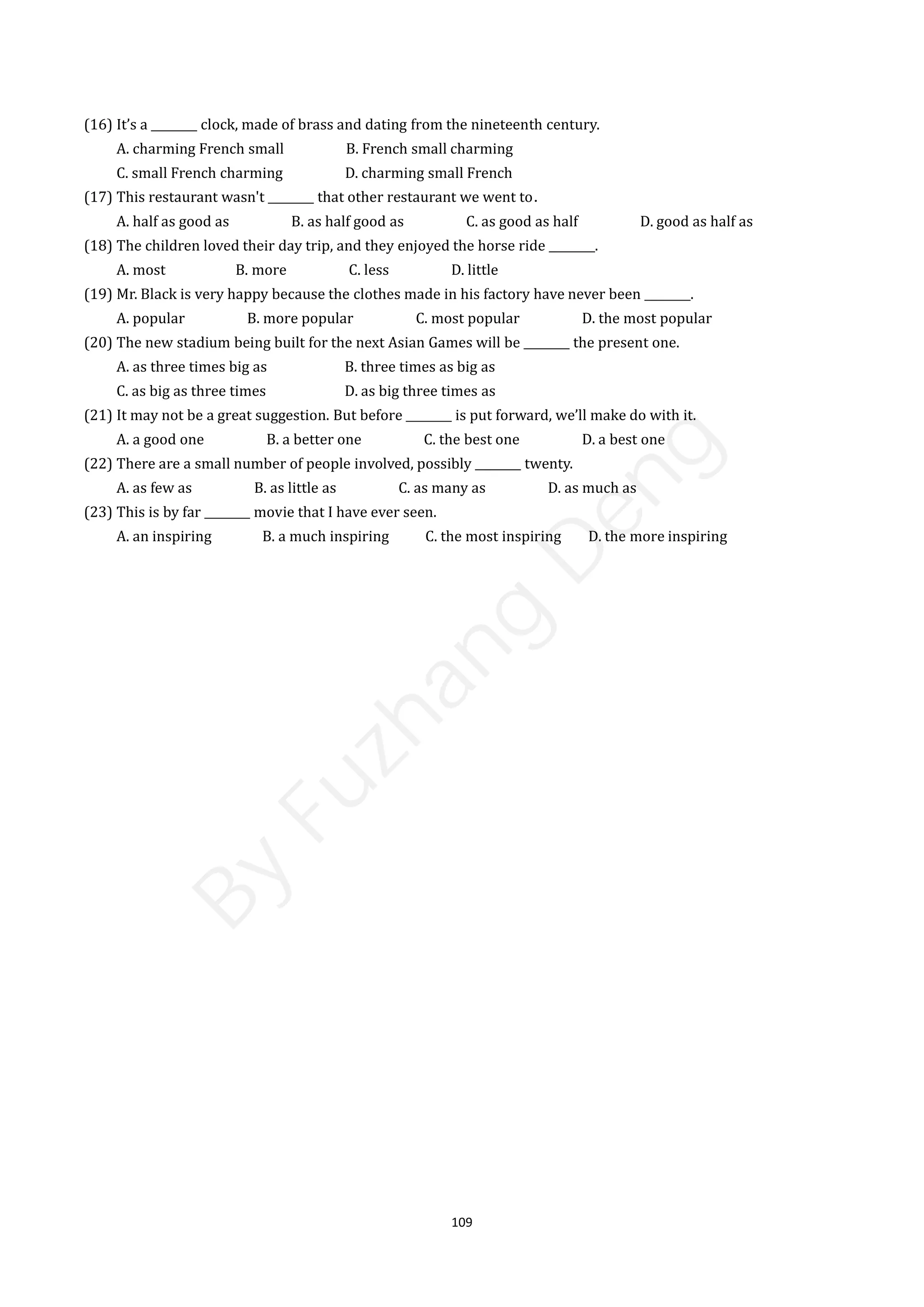
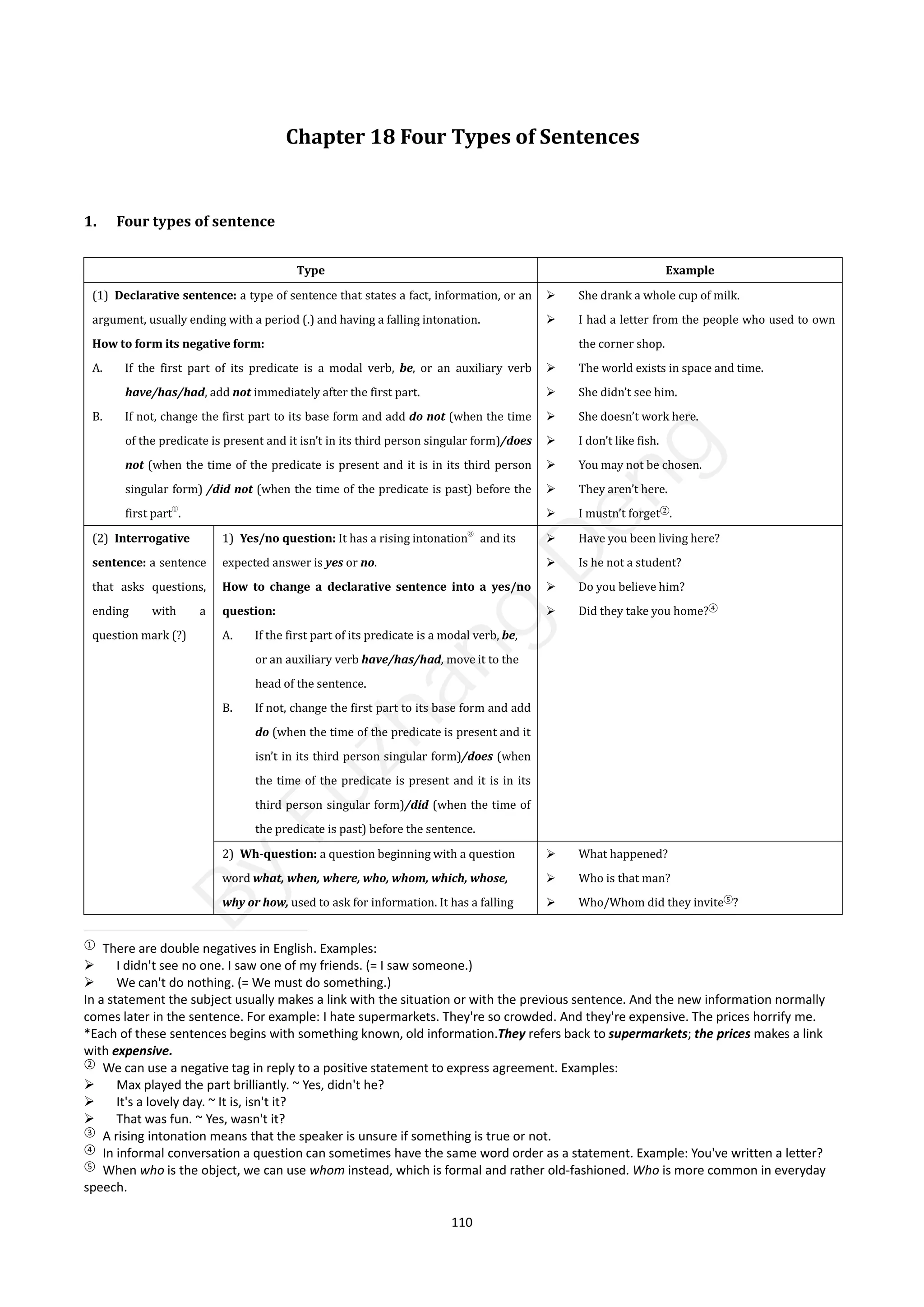
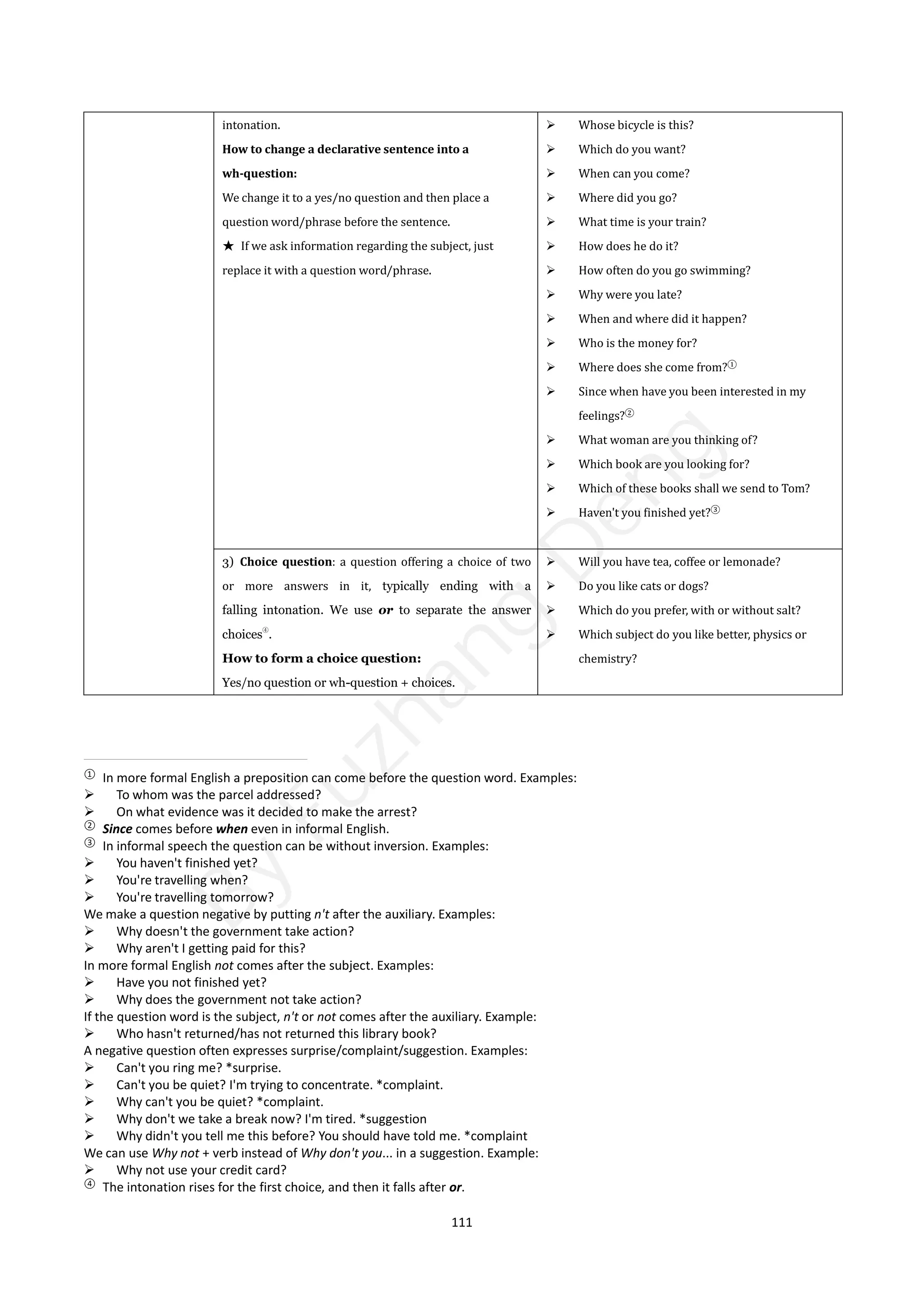
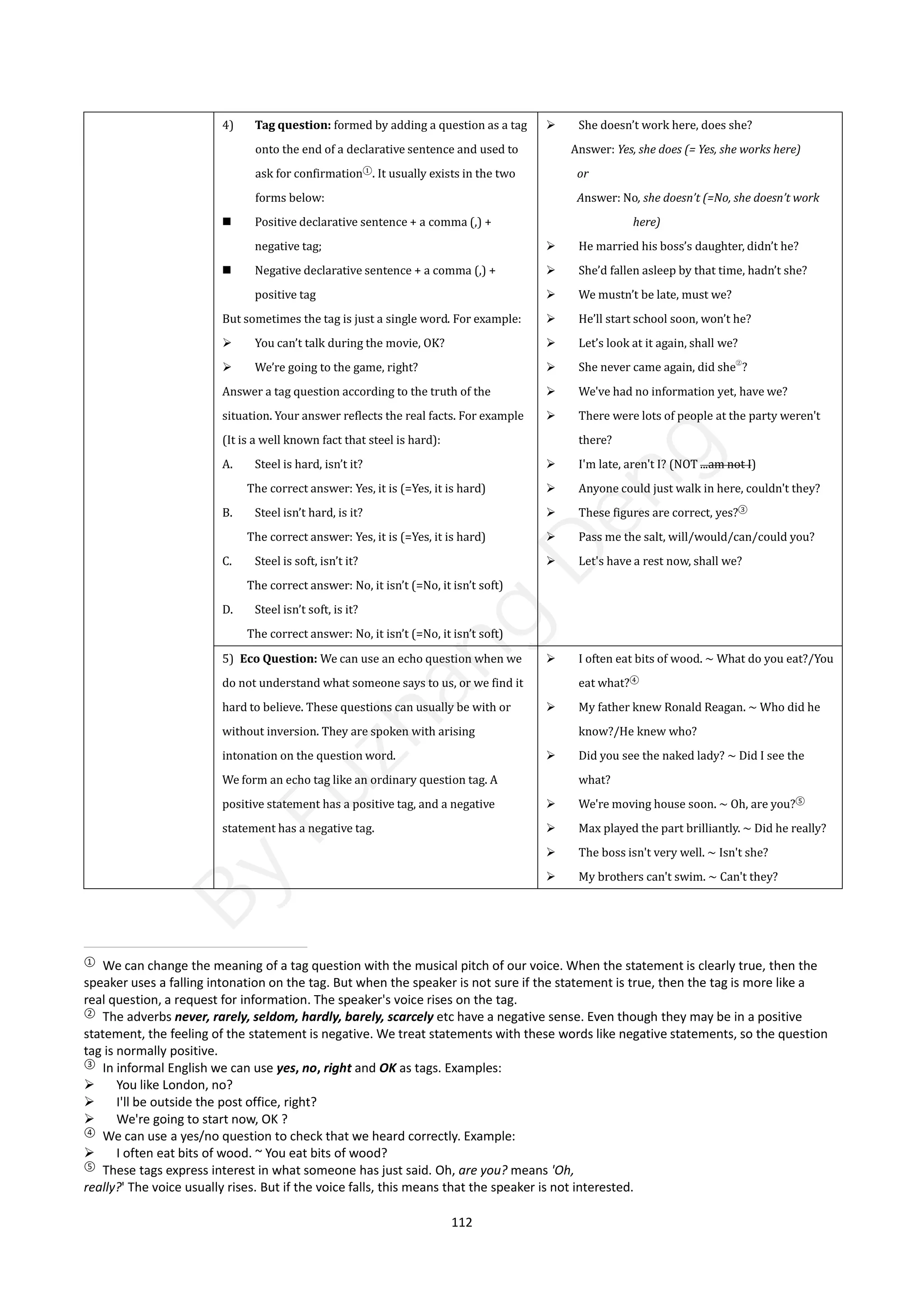
Chapter 18 Four Types of Sentences....................................................................................................................... 110
B
y
F
u
z
h
a
n
g
D
e
n
g
6
1. Four types of sentence..................................................................................................................................110
2. Exercises.........................................................................................................................................................113
Answer the questions below by choosing A, B, C or D...........................................................................113
Chapter 19 Tenses..................................................................................................................................................... 116
1. Present Simple...............................................................................................................................................116
2. Past Simple.....................................................................................................................................................117
3. Future Simple.................................................................................................................................................117
4. Past Future Simple........................................................................................................................................ 118
5. Present Continuous.......................................................................................................................................118
6. Past Continuous.............................................................................................................................................119
7. Future Continuous.........................................................................................................................................119
8. Past Future Continuous................................................................................................................................ 120
9. Present Perfect...............................................................................................................................................120
10. Past Perfect.................................................................................................................................................. 121
11. Future Perfect..............................................................................................................................................121
12. Past Future Perfect......................................................................................................................................121
13. Present Perfect Continuous........................................................................................................................121
14. Past Perfect Continuous..............................................................................................................................122
15. Future Perfect Continuous......................................................................................................................... 122
16. Past Future Perfect Continuous................................................................................................................. 122
17. Be going to................................................................................................................................................... 123
18. Be to do........................................................................................................................................................ 123
19. Exercises...................................................................................................................................................... 124
Answer the questions below by choosing A, B, C or D...........................................................................124
Chapter 20 Subject-verb Agreement....................................................................................................................... 127
1. Subject-verb Agreement...............................................................................................................................127
2. Exercises.........................................................................................................................................................128
Answer the questions below by choosing A, B, C or D...........................................................................128
Chapter 21 Moods..................................................................................................................................................... 131
1. Mood...............................................................................................................................................................131
1) Indicative Mood.................................................................................................................................... 131
2) Imperative mood.................................................................................................................................. 131
3) Subjunctive mood.................................................................................................................................131
2. If-clause.......................................................................................................................................................... 131
3. Noun clause as the object of wish................................................................................................................132
4. Subjunctive mood used in other cases........................................................................................................ 132
5. Exercises.........................................................................................................................................................133
Answer the questions below by choosing A, B, C or D...........................................................................133
Chapter 22 Word Order............................................................................................................................................ 136
1. Word Order.................................................................................................................................................... 136
2. Exercises.........................................................................................................................................................137
Answer the questions below by choosing A, B, C or D...........................................................................137
Chapter 23 Modal Verbs............................................................................................................................................140
1. Modal Verbs................................................................................................................................................... 140
B
y
F
u
z
h
a
n
g
D
e
n
g
7
CAN............................................................................................................................................................. 140
COULD........................................................................................................................................................ 140
MAY.............................................................................................................................................................140
MIGHT........................................................................................................................................................ 141
SHALL.........................................................................................................................................................141
SHOULD......................................................................................................................................................141
WILL........................................................................................................................................................... 142
WOULD.......................................................................................................................................................142
MUST.......................................................................................................................................................... 143
OUGHT TO..................................................................................................................................................143
USED TO..................................................................................................................................................... 143
HAD BETTER/BEST.................................................................................................................................. 143
DARE...........................................................................................................................................................144
2. Exercises.........................................................................................................................................................144
Answer the questions below by choosing A, B, C or D...........................................................................144
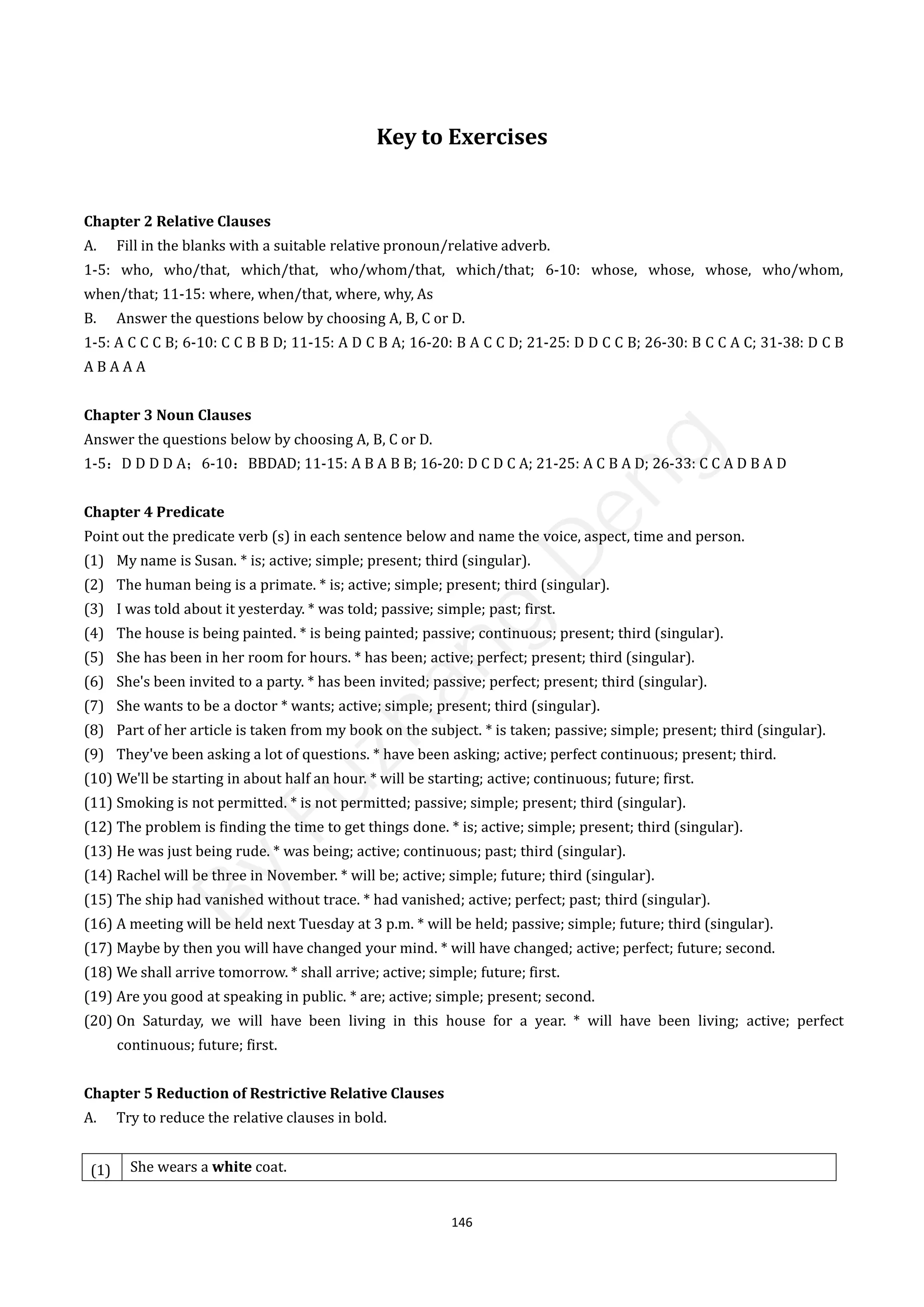
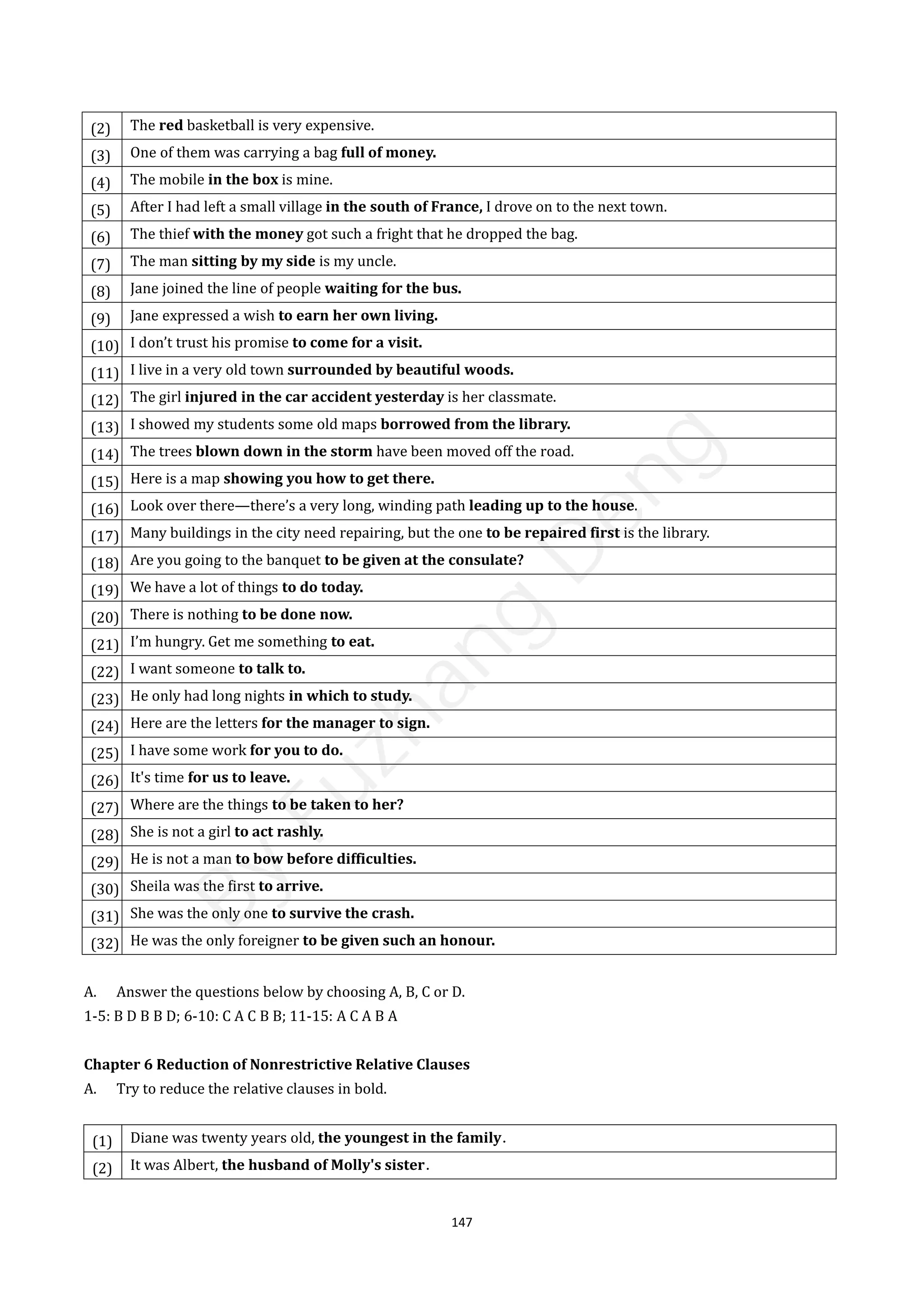
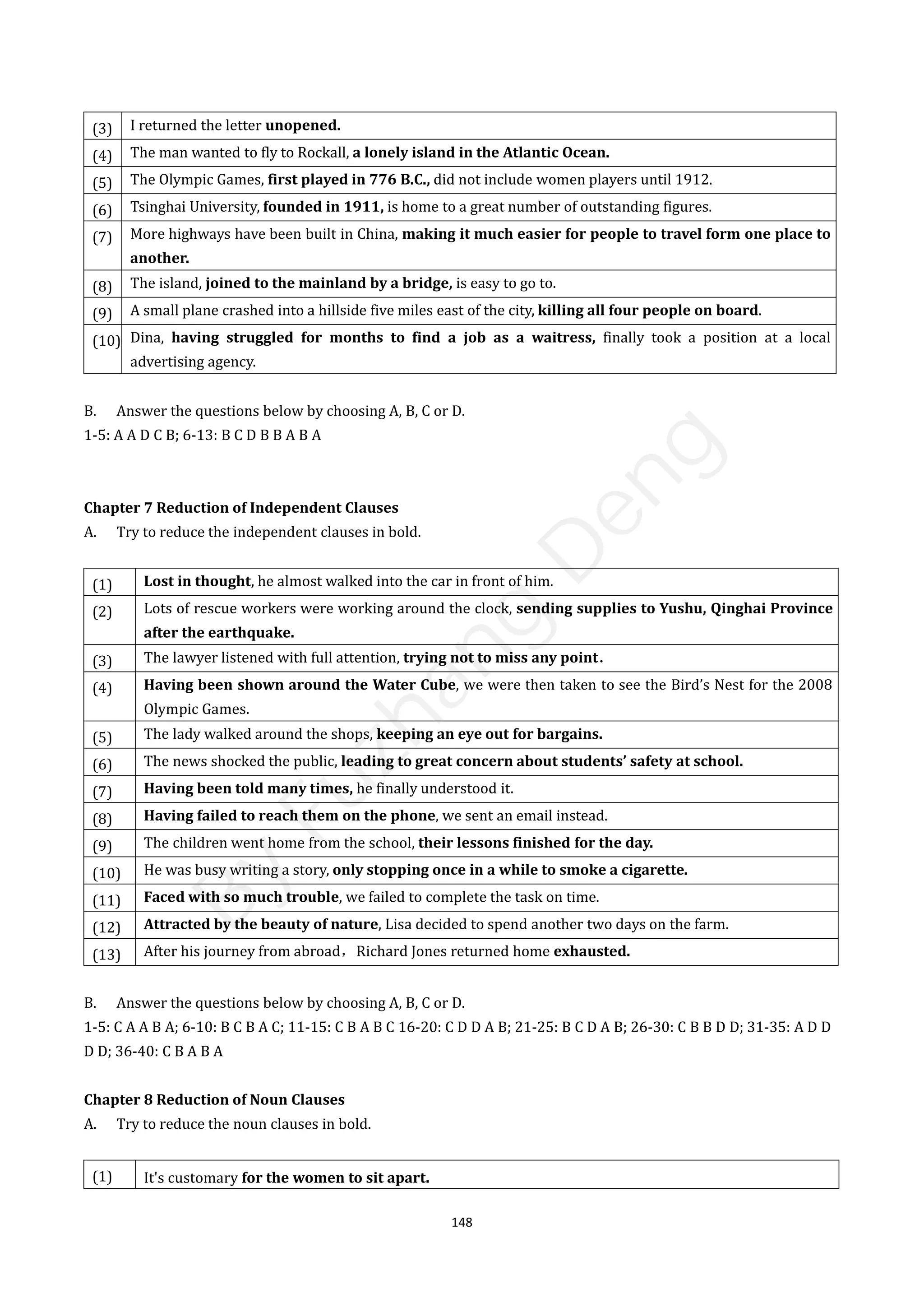
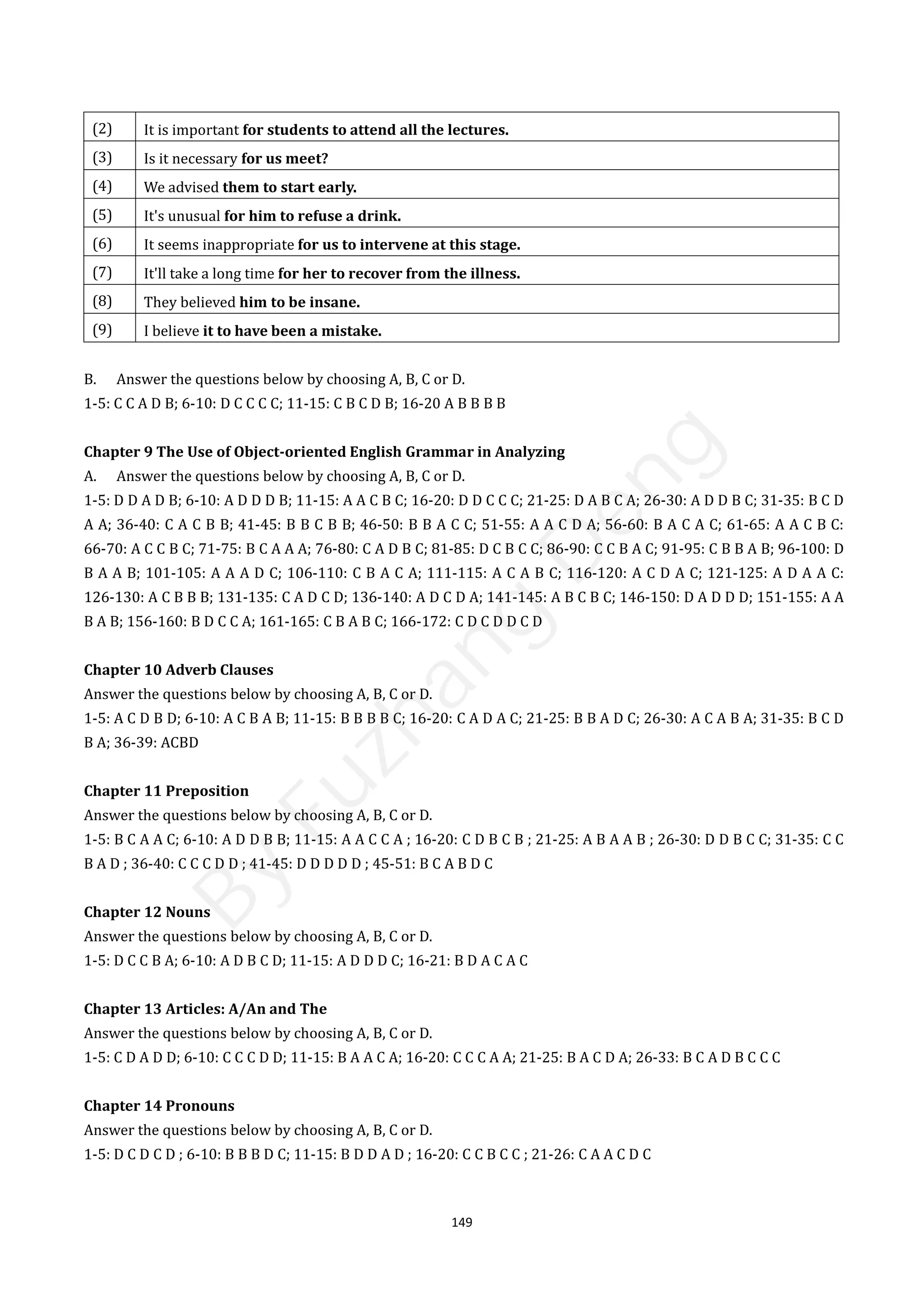
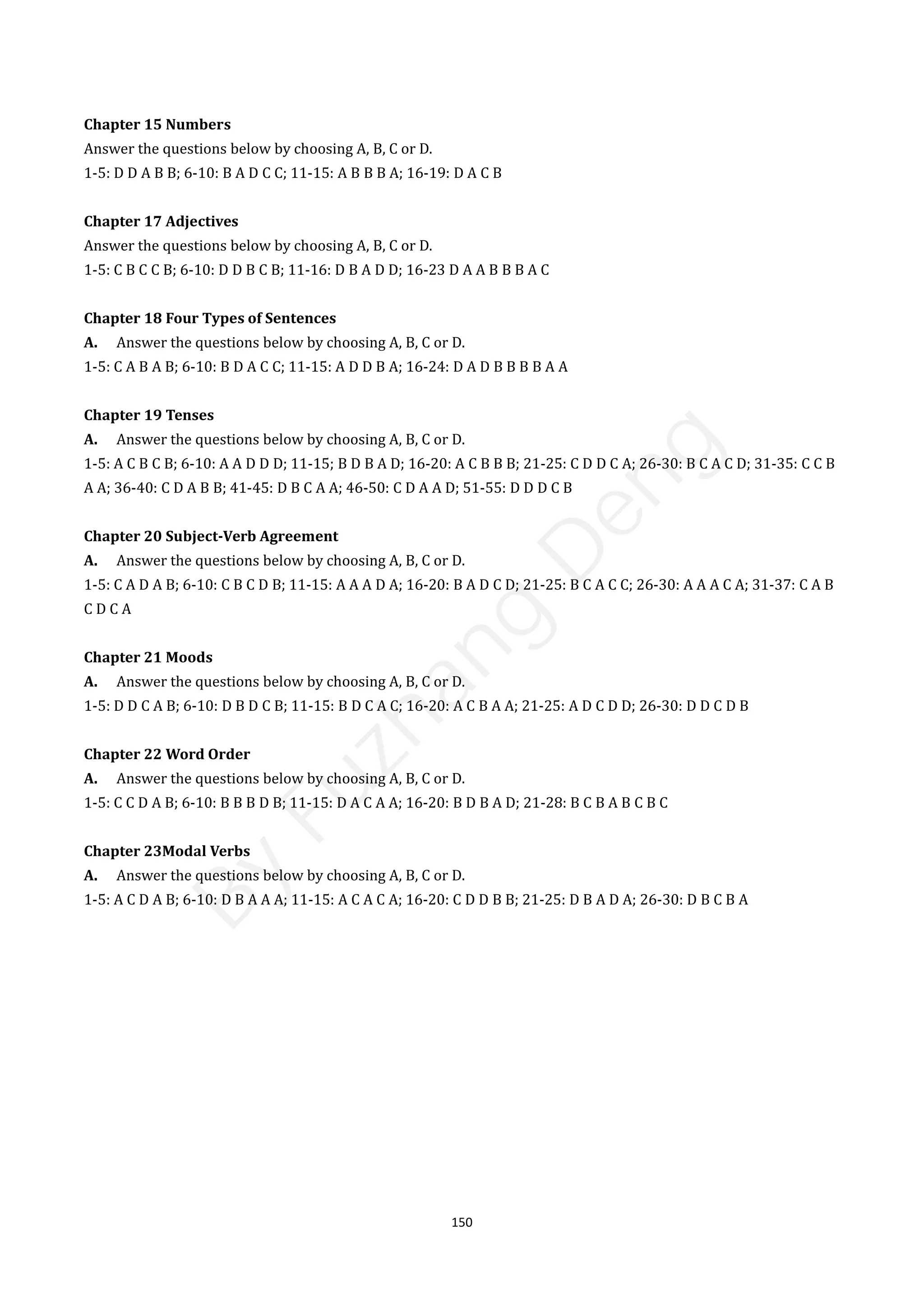
Key to Exercises.........................................................................................................................................................146
Bibliography...............................................................................................................................................................151
B
y
F
u
z
h
a
n
g
D
e
n
g
8
Chapter 1 Overview
1. Simple Sentence
Every simple sentence must have a subject and a predicate. The subject is a noun, noun phrase
①
, or pronoun that
usually comes before a main verb. The predicate, including at least one verb, gives information about the subject.
Examples:
 The tree (subject) is very tall (predicate)
②
.
 He (subject) likes swimming (predicate) .
 The black dog (subject) is barking in the room (predicate) .
2. Main Word Classes
1) Noun
A noun is the name of a person, place, thing or quality and can function as the subject or object of a verb, the object
of a preposition, or a Predicate Noun. Examples: Tom; New York; dog; book; idea; kindness.
2) Pronoun
Pronouns are words that represent nouns, used in the same ways as nouns, and they can function as subjects or
objects. Common pronouns: you; I; she; him; it; they; us; someone/somebody.
3) Verb
Verbs are words that describe actions or existence of people, animals, places, or things, functioning as the root of a
predicate. They include action words like run, fly, cut, sing and think, as well as the word be, which describes
existence.
4) Adjective
Adjectives are words that describe the qualities of people, animals, places, or things, used to modify nouns.
Examples: tall; blue; fast; pretty; big; kind; wide.
5) Adverb
Adverbs are words that modify verbs, adjectives, other adverbs, or even whole sentences. They can appear
anywhere in a sentence, depending on what they modify, normally formed from adjectives by adding -ly to the end.
Examples:quickly in Tom ran quickly; very in It's very cold; surprisingly in Surprisingly, no one came.
6) Preposition
Prepositions are words that express a static space, time or logical relationship between two things
③
. Examples:
 The computer is on the desk. *space relationship.
①
Phrase: a group of words used to form part of a sentence. Examples:
the tree, the back dog (noun phrase); very tall, most beautiful (adjective phrase); is, is barking, can swim (verb phrase); on the table,
by the window (prepositional phrase).
②
A written sentence begins with a capital letter and ends with a full stop, a question mark or an exclamation mark.
③
Things is in a broad sense here, meaning everything (concrete or abstract) in the world, people,animals, places, actions and
events included.
B
y
F
u
z
h
a
n
g
D
e
n
g
9
 The ball is under the table. *space relationship.
 After the war many soldiers stayed in France. *time relationship between the event (Many soldiers stayed in
France.) and the war.
 The new road should be completed before the end of the year. *time relationship between the event (The
new road should be completed.) and the end of the year.
 He jumped for joy. *logical relationship between the result event (He jumped.) and joy (reason).
 The handle of the umbrella is small. *logical relationship, showing that the handle belongs to the umbrella.
7) Article
There are two articles:
A. the indefinite article a/an (A is used before consonant sounds and an before vowel sounds.): used to identify
nonspecific or generic people, places, or things.
B. the definite article the: used to identify a specific or unique person, place, or thing.
Examples:
 A boy and a girl were sitting on a bench. The boy was smiling but the girl looked angry.
 I ordered a pizza and salad. The pizza was nice but the salad was disgusting.
8) Conjunction
In Object-oriented English Grammar, only the words and and or are regarded as conjunctions, used to connect
words, phrases, or independent clauses that have the same grammatical function in a construction. Examples:
 He was tall, dark and handsome.
 Jim plays the piano and sings folk songs.
 He didn't speak to anyone and nobody spoke to him.
 Is the baby a boy or a girl?①
 Is it green or blue?②
3. Five Types of Basic Simple Sentence Patterns
1) Subject (noun, pronoun or something③
amounting to a noun) + Predicate Verb (intransitive verb④
)
*describing the action of the subject. Examples:
 She runs.
 The birds sing.
 The baby cried.
2) Subject (noun, pronoun or something amounting to a noun) + Predicate Verb (transitive verb⑤
) + Object
(noun, pronoun or something amounting to a noun) *describing the action of the subject and its dynamic
relationship with the object. Examples:
 Jim hits the table.
 He cuts the apple.
①
We can use and or or to connect words of the same part of a sentence even if they are of different kinds. Examples: The book has
become famous and a best-seller; We can meet here or in town; The hotel was quiet and well back from the road.
②
There is also a small class of words called “interjections”, including oh, ah and mhm.
③
Something refers to “TO DO”, “DOING” or a noun clause.
④
An intransitive verb cannot take an object.
⑤
A transitive verb needs to take an object. A verb can be intransitive in one meaning and transitive in another. For example:
He runs his own business. *Run is transitive when it means manage.
B
y
F
u
z
h
a
n
g
D
e
n
g
10
 I read the book.
3) Subject (noun, pronoun or something amounting to a noun) + Predicate Verb (be) + Predicate Adjective
(adjective) *describing the quality of the subject. Examples:
 I am fat.
 Tom is tall.
 He is fast.
4) Subject (noun, pronoun or something amounting to a noun) + Predicate Verb (be) + Predicate Noun (noun)
*describing the identity of the subject. Examples:
 I am a teacher.
 He is a student.
 They are workers.
5) Subject (noun, pronoun or something amounting to a noun) + Predicate Verb (be) + Preposition + Object
(noun, pronoun or something amounting to a noun) *describing the static relationship between the subject
and the object. Examples:
 I am in the room.
 The cup is on the table.
 The lamp is over the computer.
4. Declarative Sentences and Interrogative Sentences
1) Declarative Sentences
A declarative sentence is a type of sentence that states a fact, information, or an argument, usually ending with a
period (.). Examples:
 It is cheap.
 He won the race.
 It will rain tomorrow.
 They have cleaned the room.
2) Interrogative Sentences
An interrogative sentence is simply a sentence that asks a question, always ending with a question mark (?). When
making a sentence into a question, we almost always put an auxiliary verb before the subject. Examples:
 Do you hate your boss? (yes/no question)
 Is he tall? (yes/no question) *Is is not an auxiliary verb.
 Will she come tomorrow? (yes/no question)
 Have you finished your work? (yes/no question)
 What are you doing? (wh-question) *Wh-questions begin with a question word, e.g. where, what. In most
questions there is an inversion of subject and auxiliary verb.
 Who is your headteacher? (wh-question)
 Which book do you like? (wh-question)
B
y
F
u
z
h
a
n
g
D
e
n
g
11
Chapter 2 Relative Clauses
1. Relative Clauses
1) Restrictive Relative Clauses
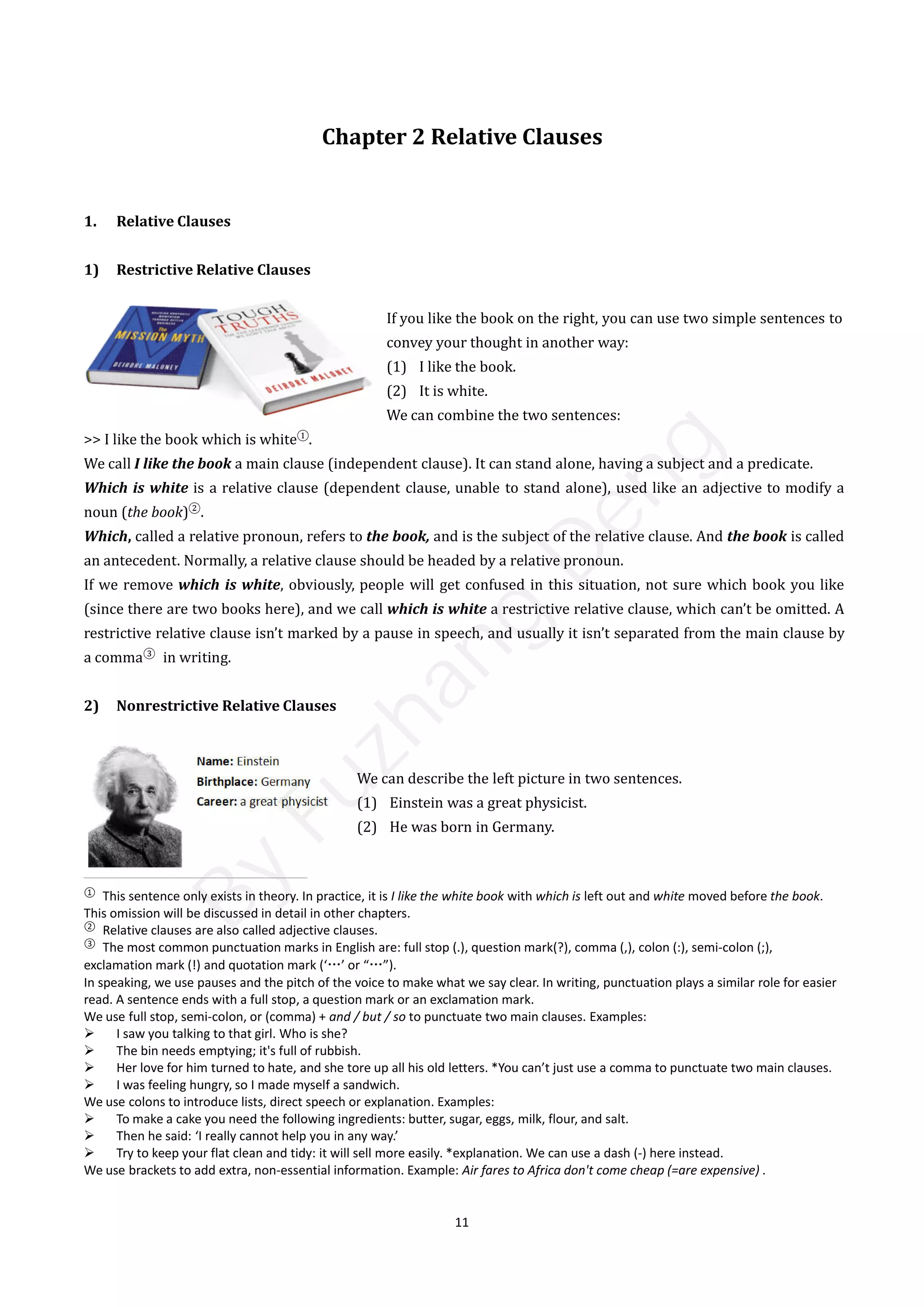
If you like the book on the right, you can use two simple sentences to
convey your thought in another way:
(1) I like the book.
(2) It is white.
We can combine the two sentences:
>> I like the book which is white①
.
We call I like the book a main clause (independent clause). It can stand alone, having a subject and a predicate.
Which is white is a relative clause (dependent clause, unable to stand alone), used like an adjective to modify a
noun (the book)②
.
Which, called a relative pronoun, refers to the book, and is the subject of the relative clause. And the book is called
an antecedent. Normally, a relative clause should be headed by a relative pronoun.
If we remove which is white, obviously, people will get confused in this situation, not sure which book you like
(since there are two books here), and we call which is white a restrictive relative clause, which can’t be omitted. A
restrictive relative clause isn’t marked by a pause in speech, and usually it isn’t separated from the main clause by
a comma③
in writing.
2) Nonrestrictive Relative Clauses
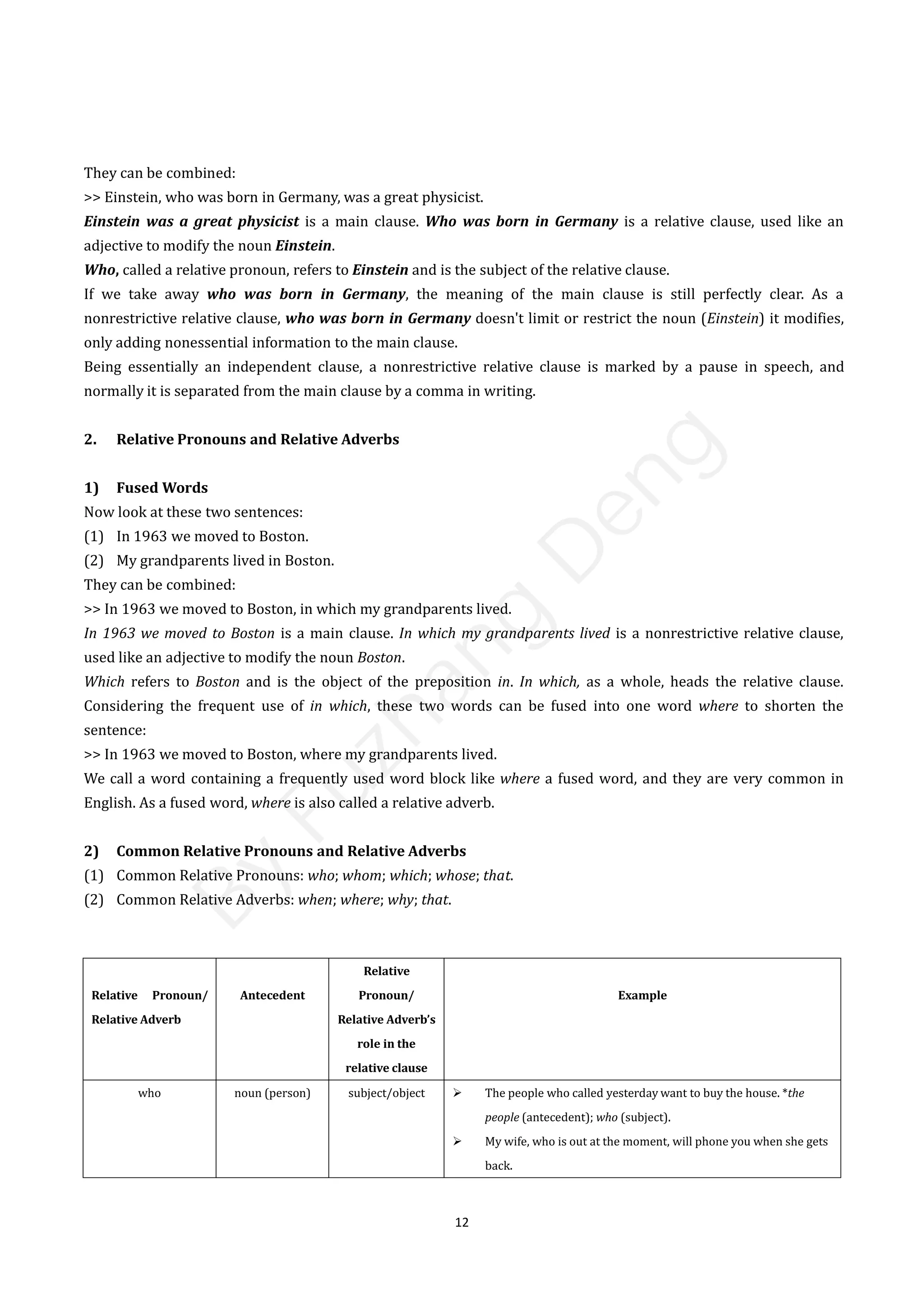
We can describe the left picture in two sentences.
(1) Einstein was a great physicist.
(2) He was born in Germany.
①
This sentence only exists in theory. In practice, it is I like the white book with which is left out and white moved before the book.
This omission will be discussed in detail in other chapters.
②
Relative clauses are also called adjective clauses.
③
The most common punctuation marks in English are: full stop (.), question mark(?), comma (,), colon (:), semi-colon (;),
exclamation mark (!) and quotation mark (‘…’ or “…”).
In speaking, we use pauses and the pitch of the voice to make what we say clear. In writing, punctuation plays a similar role for easier
read. A sentence ends with a full stop, a question mark or an exclamation mark.
We use full stop, semi-colon, or (comma) + and / but / so to punctuate two main clauses. Examples:
 I saw you talking to that girl. Who is she?
 The bin needs emptying; it's full of rubbish.
 Her love for him turned to hate, and she tore up all his old letters. *You can’t just use a comma to punctuate two main clauses.
 I was feeling hungry, so I made myself a sandwich.
We use colons to introduce lists, direct speech or explanation. Examples:
 To make a cake you need the following ingredients: butter, sugar, eggs, milk, flour, and salt.
 Then he said: ‘I really cannot help you in any way.’
 Try to keep your flat clean and tidy: it will sell more easily. *explanation. We can use a dash (-) here instead.
We use brackets to add extra, non-essential information. Example: Air fares to Africa don't come cheap (=are expensive) .
B
y
F
u
z
h
a
n
g
D
e
n
g
12
They can be combined:
>> Einstein, who was born in Germany, was a great physicist.
Einstein was a great physicist is a main clause. Who was born in Germany is a relative clause, used like an
adjective to modify the noun Einstein.
Who, called a relative pronoun, refers to Einstein and is the subject of the relative clause.
If we take away who was born in Germany, the meaning of the main clause is still perfectly clear. As a
nonrestrictive relative clause, who was born in Germany doesn't limit or restrict the noun (Einstein) it modifies,
only adding nonessential information to the main clause.
Being essentially an independent clause, a nonrestrictive relative clause is marked by a pause in speech, and
normally it is separated from the main clause by a comma in writing.
2. Relative Pronouns and Relative Adverbs
1) Fused Words
Now look at these two sentences:
(1) In 1963 we moved to Boston.
(2) My grandparents lived in Boston.
They can be combined:
>> In 1963 we moved to Boston, in which my grandparents lived.
In 1963 we moved to Boston is a main clause. In which my grandparents lived is a nonrestrictive relative clause,
used like an adjective to modify the noun Boston.
Which refers to Boston and is the object of the preposition in. In which, as a whole, heads the relative clause.
Considering the frequent use of in which, these two words can be fused into one word where to shorten the
sentence:
>> In 1963 we moved to Boston, where my grandparents lived.
We call a word containing a frequently used word block like where a fused word, and they are very common in
English. As a fused word, where is also called a relative adverb.
2) Common Relative Pronouns and Relative Adverbs
(1) Common Relative Pronouns: who; whom; which; whose; that.
(2) Common Relative Adverbs: when; where; why; that.
Relative Pronoun/
Relative Adverb
Antecedent
Relative
Pronoun/
Relative Adverb’s
role in the
relative clause
Example
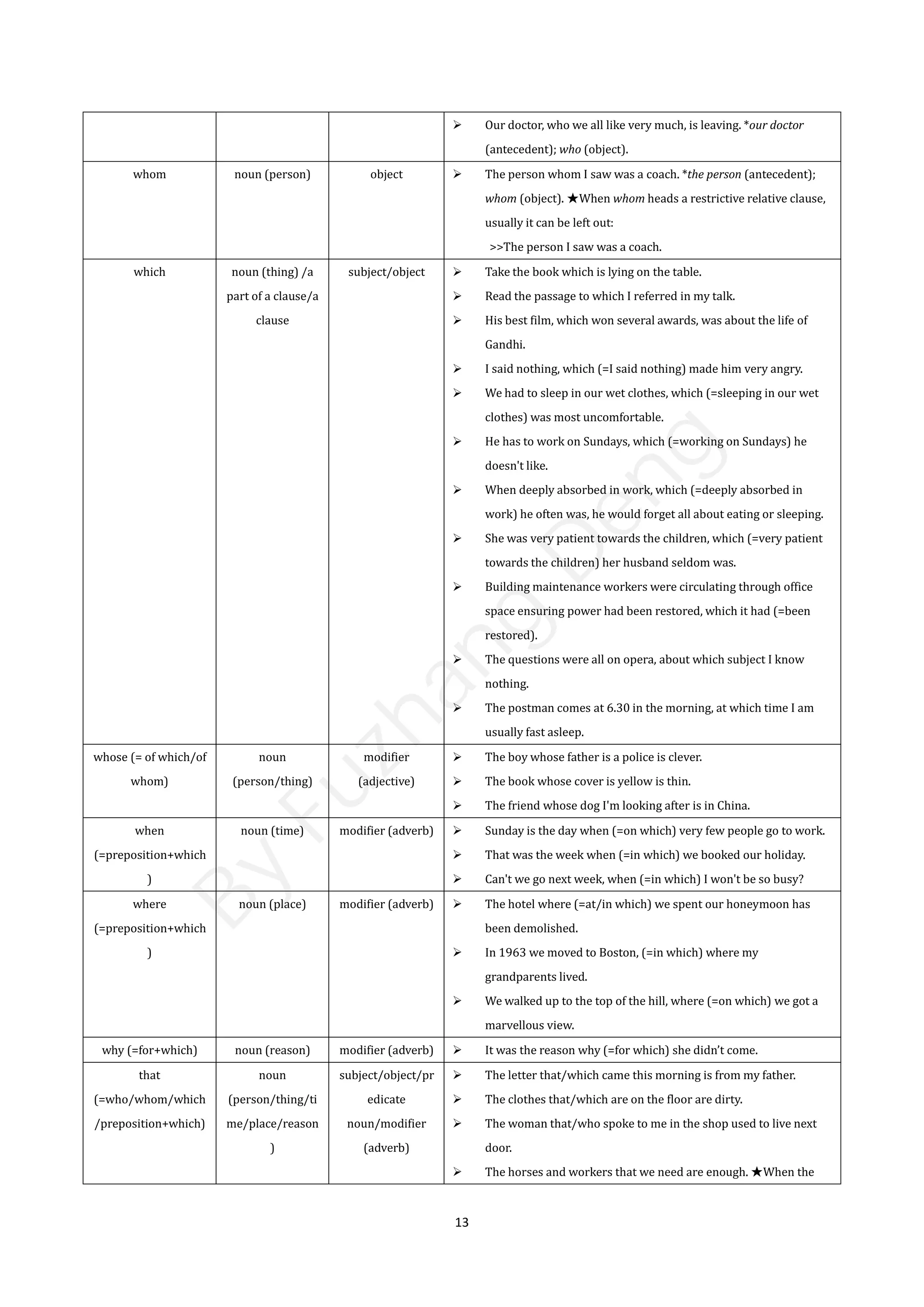
who noun (person) subject/object  The people who called yesterday want to buy the house. *the
people (antecedent); who (subject).
 My wife, who is out at the moment, will phone you when she gets
back.
B
y
F
u
z
h
a
n
g
D
e
n
g
13
 Our doctor, who we all like very much, is leaving. *our doctor
(antecedent); who (object).
whom noun (person) object  The person whom I saw was a coach. *the person (antecedent);
whom (object). ★When whom heads a restrictive relative clause,
usually it can be left out:
>>The person I saw was a coach.
which noun (thing) /a
part of a clause/a
clause
subject/object  Take the book which is lying on the table.
 Read the passage to which I referred in my talk.
 His best film, which won several awards, was about the life of
Gandhi.
 I said nothing, which (=I said nothing) made him very angry.
 We had to sleep in our wet clothes, which (=sleeping in our wet
clothes) was most uncomfortable.
 He has to work on Sundays, which (=working on Sundays) he
doesn't like.
 When deeply absorbed in work, which (=deeply absorbed in
work) he often was, he would forget all about eating or sleeping.
 She was very patient towards the children, which (=very patient
towards the children) her husband seldom was.
 Building maintenance workers were circulating through office
space ensuring power had been restored, which it had (=been
restored).
 The questions were all on opera, about which subject I know
nothing.
 The postman comes at 6.30 in the morning, at which time I am
usually fast asleep.
whose (= of which/of
whom)
noun
(person/thing)
modifier
(adjective)
 The boy whose father is a police is clever.
 The book whose cover is yellow is thin.
 The friend whose dog I'm looking after is in China.
when
(=preposition+which
)
noun (time) modifier (adverb)  Sunday is the day when (=on which) very few people go to work.
 That was the week when (=in which) we booked our holiday.
 Can't we go next week, when (=in which) I won't be so busy?
where
(=preposition+which
)
noun (place) modifier (adverb)  The hotel where (=at/in which) we spent our honeymoon has
been demolished.
 In 1963 we moved to Boston, (=in which) where my
grandparents lived.
 We walked up to the top of the hill, where (=on which) we got a
marvellous view.
why (=for+which) noun (reason) modifier (adverb)  It was the reason why (=for which) she didn’t come.
that
(=who/whom/which
/preposition+which)
noun
(person/thing/ti
me/place/reason
)
subject/object/pr
edicate
noun/modifier
(adverb)
 The letter that/which came this morning is from my father.
 The clothes that/which are on the floor are dirty.
 The woman that/who spoke to me in the shop used to live next
door.
 The horses and workers that we need are enough. ★When the
B
y
F
u
z
h
a
n
g
D
e
n
g
14
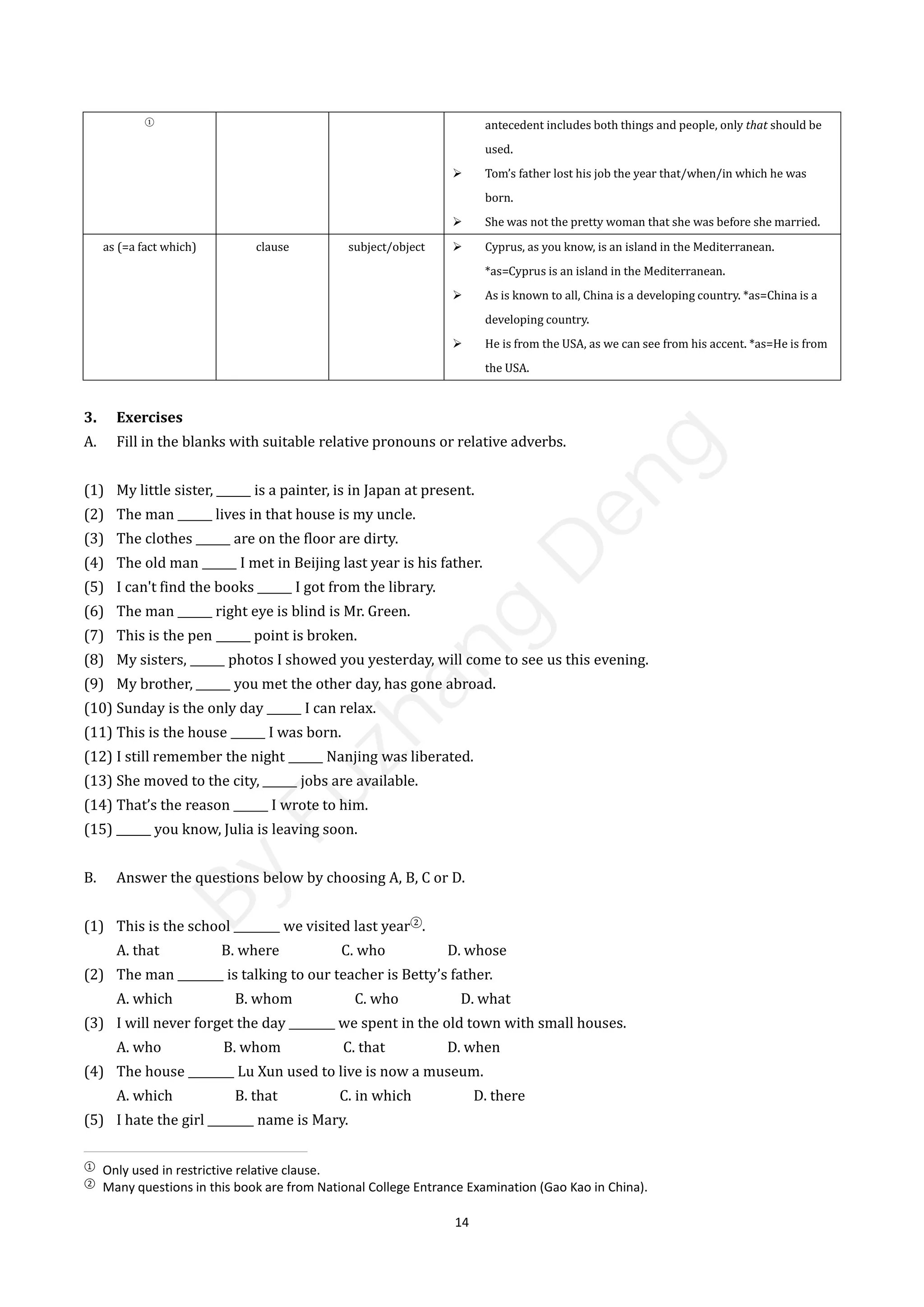
3. Exercises
A. Fill in the blanks with suitable relative pronouns or relative adverbs.
(1) My little sister, ______ is a painter, is in Japan at present.
(2) The man ______ lives in that house is my uncle.
(3) The clothes ______ are on the floor are dirty.
(4) The old man ______ I met in Beijing last year is his father.
(5) I can't find the books ______ I got from the library.
(6) The man ______ right eye is blind is Mr. Green.
(7) This is the pen ______ point is broken.
(8) My sisters, ______ photos I showed you yesterday, will come to see us this evening.
(9) My brother, ______ you met the other day, has gone abroad.
(10) Sunday is the only day ______ I can relax.
(11) This is the house ______ I was born.
(12) I still remember the night ______ Nanjing was liberated.
(13) She moved to the city, ______ jobs are available.
(14) That’s the reason ______ I wrote to him.
(15) ______ you know, Julia is leaving soon.
B. Answer the questions below by choosing A, B, C or D.
(1) This is the school ________ we visited last year②
.
A. that B. where C. who D. whose
(2) The man ________ is talking to our teacher is Betty’s father.
A. which B. whom C. who D. what
(3) I will never forget the day ________ we spent in the old town with small houses.
A. who B. whom C. that D. when
(4) The house ________ Lu Xun used to live is now a museum.
A. which B. that C. in which D. there
(5) I hate the girl ________ name is Mary.
①
Only used in restrictive relative clause.
②
Many questions in this book are from National College Entrance Examination (Gao Kao in China).
①
antecedent includes both things and people, only that should be
used.
 Tom’s father lost his job the year that/when/in which he was
born.
 She was not the pretty woman that she was before she married.
as (=a fact which) clause subject/object  Cyprus, as you know, is an island in the Mediterranean.
*as=Cyprus is an island in the Mediterranean.
 As is known to all, China is a developing country. *as=China is a
developing country.
 He is from the USA, as we can see from his accent. *as=He is from
the USA.
B
y
F
u
z
h
a
n
g
D
e
n
g
15
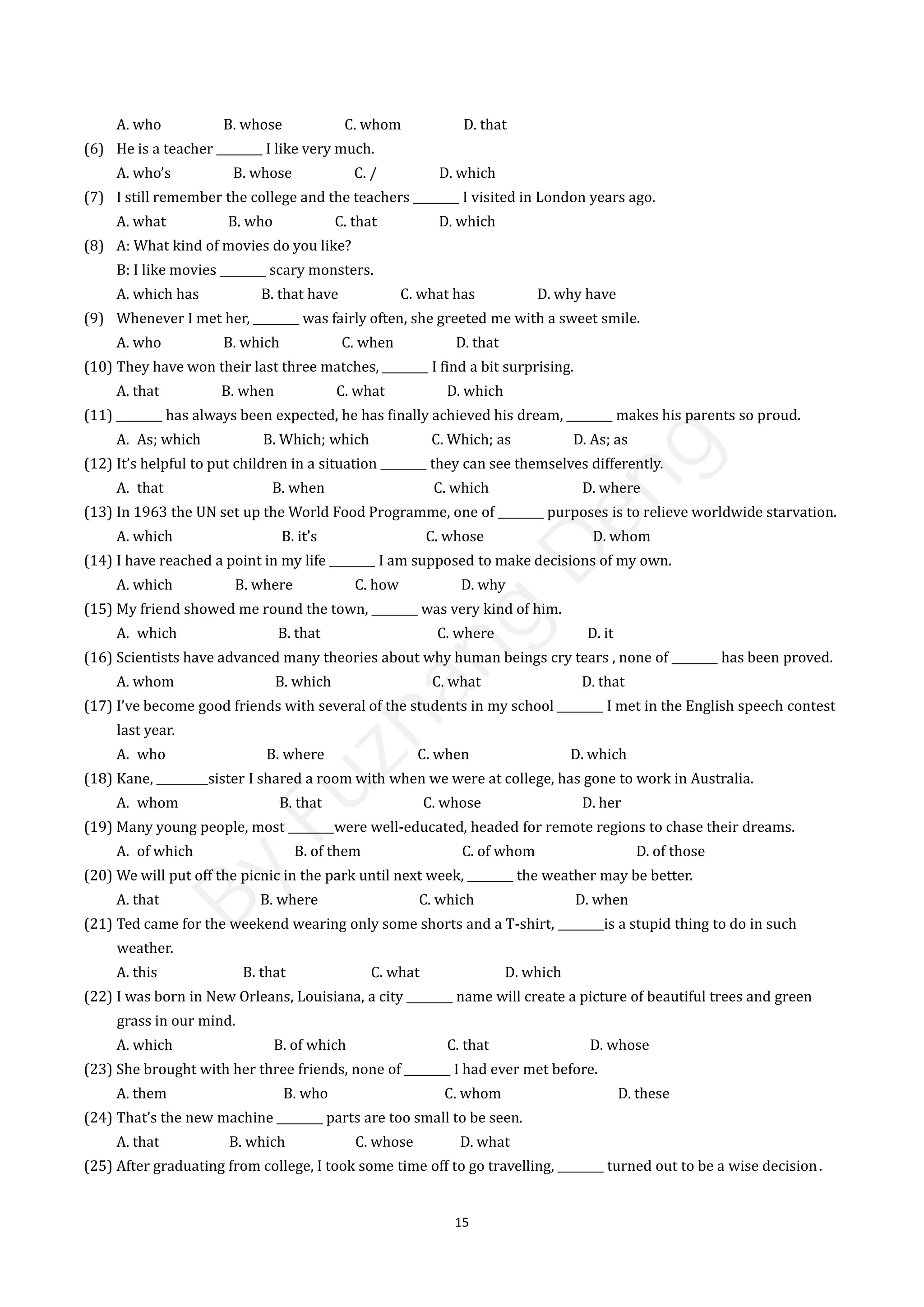
A. who B. whose C. whom D. that
(6) He is a teacher ________ I like very much.
A. who’s B. whose C. / D. which
(7) I still remember the college and the teachers ________ I visited in London years ago.
A. what B. who C. that D. which
(8) A: What kind of movies do you like?
B: I like movies ________ scary monsters.
A. which has B. that have C. what has D. why have
(9) Whenever I met her, ________ was fairly often, she greeted me with a sweet smile.
A. who B. which C. when D. that
(10) They have won their last three matches, ________ I find a bit surprising.
A. that B. when C. what D. which
(11) ________ has always been expected, he has finally achieved his dream, ________ makes his parents so proud.
A. As; which B. Which; which C. Which; as D. As; as
(12) It’s helpful to put children in a situation ________ they can see themselves differently.
A. that B. when C. which D. where
(13) In 1963 the UN set up the World Food Programme, one of ________ purposes is to relieve worldwide starvation.
A. which B. it’s C. whose D. whom
(14) I have reached a point in my life ________ I am supposed to make decisions of my own.
A. which B. where C. how D. why
(15) My friend showed me round the town, ________ was very kind of him.
A. which B. that C. where D. it
(16) Scientists have advanced many theories about why human beings cry tears , none of ________ has been proved.
A. whom B. which C. what D. that
(17) I’ve become good friends with several of the students in my school ________ I met in the English speech contest
last year.
A. who B. where C. when D. which
(18) Kane, _________sister I shared a room with when we were at college, has gone to work in Australia.
A. whom B. that C. whose D. her
(19) Many young people, most ________were well-educated, headed for remote regions to chase their dreams.
A. of which B. of them C. of whom D. of those
(20) We will put off the picnic in the park until next week, ________ the weather may be better.
A. that B. where C. which D. when
(21) Ted came for the weekend wearing only some shorts and a T-shirt, ________is a stupid thing to do in such
weather.
A. this B. that C. what D. which
(22) I was born in New Orleans, Louisiana, a city ________ name will create a picture of beautiful trees and green
grass in our mind.
A. which B. of which C. that D. whose
(23) She brought with her three friends, none of ________ I had ever met before.
A. them B. who C. whom D. these
(24) That’s the new machine ________ parts are too small to be seen.
A. that B. which C. whose D. what
(25) After graduating from college, I took some time off to go travelling, ________ turned out to be a wise decision.
B
y
F
u
z
h
a
n
g
D
e
n
g
16
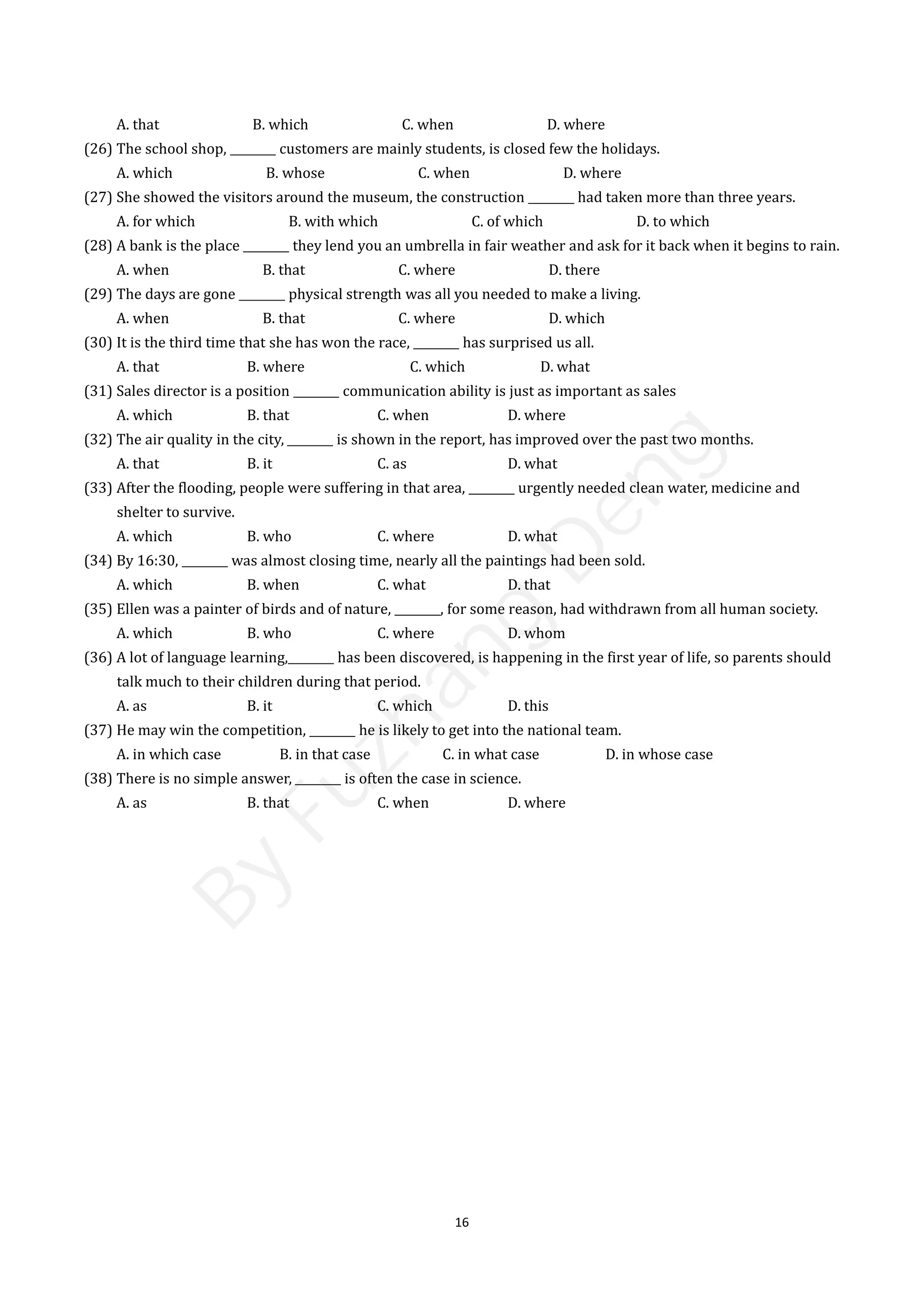
A. that B. which C. when D. where
(26) The school shop, ________ customers are mainly students, is closed few the holidays.
A. which B. whose C. when D. where
(27) She showed the visitors around the museum, the construction ________ had taken more than three years.
A. for which B. with which C. of which D. to which
(28) A bank is the place ________ they lend you an umbrella in fair weather and ask for it back when it begins to rain.
A. when B. that C. where D. there
(29) The days are gone ________ physical strength was all you needed to make a living.
A. when B. that C. where D. which
(30) It is the third time that she has won the race, ________ has surprised us all.
A. that B. where C. which D. what
(31) Sales director is a position ________ communication ability is just as important as sales
A. which B. that C. when D. where
(32) The air quality in the city, ________ is shown in the report, has improved over the past two months.
A. that B. it C. as D. what
(33) After the flooding, people were suffering in that area, ________ urgently needed clean water, medicine and
shelter to survive.
A. which B. who C. where D. what
(34) By 16:30, ________ was almost closing time, nearly all the paintings had been sold.
A. which B. when C. what D. that
(35) Ellen was a painter of birds and of nature, ________, for some reason, had withdrawn from all human society.
A. which B. who C. where D. whom
(36) A lot of language learning,________ has been discovered, is happening in the first year of life, so parents should
talk much to their children during that period.
A. as B. it C. which D. this
(37) He may win the competition, ________ he is likely to get into the national team.
A. in which case B. in that case C. in what case D. in whose case
(38) There is no simple answer, ________ is often the case in science.
A. as B. that C. when D. where
B
y
F
u
z
h
a
n
g
D
e
n
g
17
Chapter 3 Noun Clauses
1. Objects
What do you see in the picture?
Your answer may be: a woman, a child, an elephant, a train, a
basketball etc.
They are all objects. Simply put, all the things (concrete or
abstract) in the universe, including people, are objects. Examples:
teacher (concrete object), cup (concrete object), phone, black,
seven (abstract object), idea, to swim/swimming (action object)
①
, eating banana (action object), being beautiful
(state object), being in the room (state object), I want to go home (event object), He hasn't received the letter (event
object)
②
. All languages are used to describe:
(1) the action of an object: He is running.
(2) the action of an object and its dynamic relationship with another one: John drunk water.
(3) the quality of an object: She is short.
(4) the identity of an object: It is a tiger.
(5) the static relationship between an object and another one: The chair is behind the door.
2. Noun Clause
As an object, an event can also function like a noun in a sentence, called a noun clause.
1) Declarative sentences used as noun clauses
Add that in front of a declarative sentence. Examples:
 That he will win the election is certain. *He will win the election is an event object, acting as the subject in
the sentence. That is a functional word, indicating that the sentence immediately behind it is used like a noun.
 That he passed the test surprised me.
 It is a fact that the earth is round. *To balance the sentence, It is placed in the front, referring backward to
that the earth is round.
 She found (that) the box was empty. *The box was empty is an event object, acting as the object in the
sentence. When heading a noun clause as a verb object, usually that can be left out.
 We know (that) greenhouse gases can affect the climate.
 The trouble is that we don’t have money.
 The problem is that she isn’t in the town.
 The idea that she can repair the car is wrong③
.
 Her suggestion that Jack should leave is correct.
 It's astonishing to me that he should be absent.
2) Interrogative sentences used as noun clauses
①
An action object can be expressed in two ways: TO DO (infinitive with to) and DOING (-ing form). Examples: Walking is good for
you; It's difficult not smoking for a whole day. I'd prefer not to sit at the front. *Not is before TO DO/DOING.
②
Note: movement=moving or being moved; kill=killing; waste=wasting or being wasted; beauty=being beautiful; smoothness=being
smooth.
③
The idea (which is) that she can repair the car is wrong. *Which is is omitted.
B
y
F
u
z
h
a
n
g
D
e
n
g
18
(1) Yes/no question
Change the yes/no question to a declarative sentence and then add whether in front of it. Examples:
 Whether he will come isn’t known. *Will he come?-->He will come-->Whether he will come (an event object,
acting as the subject in the sentence ).
 I didn’t know if/whether he had a car. *If a yes/no question is used as an object in a sentence, it can be
headed by either whether or if.
 The question is whether he loves you. *Does he love you?-->He loves you-->whether he loves you.
 We’ll discuss the problem whether he is competent①
.
(2) Wh-question
Change the wh-question to a declarative sentence and then move the wh-word to the front. Examples:
 Where we will spend the holiday isn’t decided. *Where will we spend the holiday?-->We will spend the
holiday where-->Where we will spend the holiday (an event object, acting as the subject in the sentence ).
 Who she is doesn’t matter.
 I don’t know who the girl riding a bike is.
 The question is where he lives? *where does he live? -->he lives where-->where he lives.
 My question, why he didn’t come, hasn’t been answered.
 She asked me who would look after the baby.
 The problem is who will water my plants when I am I away.
 I'm not sure which she prefers.
 They did not consult us on whose names should be put forward.
 We have solved the problem (of) who was at fault.
 I don't know who wants what.
3) Exclamatory sentences used as noun clauses
Just place the exclamatory sentence in the right place without any changes. Examples:
 Most people know what a great scientist Edison became.
 All I can think about is what a joy he was to be with.
 Everyone said how awful the weather was.
 Nobody will believe what difficulty we have had/believe how difficult it has been for us.
 It's incredible how fast she can run.
 I remember what a good time I had at your party.
 I read an account of what an impression you had made.
3. Exercises
Answer the questions below by choosing A, B, C or D.
(1) It suddenly occurred to him ________ he had left his keys in the office.
A. whether B. where C. which D. that
(2) It remains to be seen ________ the newly formed committee’s policy can be put into practice.
A. that B. which C. what D. whether
(3) It was never clear ________ the man hadn’t reported the accident sooner.
A. that B. how C. when D. why
①
We’ll discuss the problem (which is ) whether he is competent.
B
y
F
u
z
h
a
n
g
D
e
n
g
19
(4) It’s good to know ________ the dogs will be well cared for while we’re away.
A. what B. whose C. which D. that
(5) The shocking news made her realize ________ terrible problems she would face.
A. what B. how C. that D. why
(6) A: Do you know ________ the meeting?
B: Tomorrow morning.
A. when they had B. when they are going to have
C. when did they had D. when are they going to have
(7) A: Mum, summer holiday is coming. I wonder ________.
B: How about Qinling Wild Zoo?
A. where can we go B. where we can go C. how we can go D. how we can go
(8) ________ his dream of going to college will come true is uncertain.
A. That B. Even if C. If D. Whether
(9) ________ caused the accident is still a complete mystery.
A. What B. That C. How D. Where
(10) The reason for her failure is ________ she was too proud.
A. Because B. why C. How D. that
(11) It is not a problem ________ we can win the battle; it’s just a matter of time.
A. whether B. why C. when D. where
(12) Scientists have obtained more evidence ________ plastic is finding its way into the human body.
A. what B. that C. which D. where
(13) One reason for her preference for city life is ________ she can have easy access to places like shops and
restaurants.
A. that B. how C. what D. why
(14) When changing lanes, a driver should use his turning signal to let other drivers know ________ .
A. he is entering which lane B. which lane he is entering
C. is he entering which lane D. which lane is he entering
(15) How much one enjoys himself travelling depends largely on ________ he goes with, whether his friends or
relatives.
A. what B. who C. how D. why
(16) We haven’t discussed yet ________ we are going to place our new furniture.
A. that B. which C. what D. where
(17) The fact has worried many scientists ________ the earth is becoming warmer and warmer these years.
A. what B. which C. that D. though
(18) He asked ________ for a violin.
A. did I pay how much B. I paid how much
C. how much did I pay D. how much I paid
(19) She asked me ________ I had returned the books to the library, and I admitted that I hadn't.
A. when B. where C. whether D. what
(20) Do not let any failures discourage you, for you can never tell ________ close you may be to victory.
A. how B. that C. which D. where
(21) When asked ________ they needed most, the kids said they wanted to feel important and loved.
A. what B. why C. whom D. which
(22) The mother asked her son ________.
B
y
F
u
z
h
a
n
g
D
e
n
g
20
A. what did he do the day before B. where did he find his lost wallet
C. what time he got up that morning D. that if he had finished his homework
(23) It surprised us all ________ Kate made such big progress in this final exam.
A. when B. that C. how D.whether
(24) I wonder how much ________.
A. the watch costs B. did the watch cost C. the watch costed D. does the watch cost
(25) ________ will win in the race?
A. Do you suppose who B. Whom you suppose
C. Do you suppose whom D. Who do you suppose
(26) ________ basic first-aid techniques will help you respond quickly to emergencies.
A. Known B. Having known C. Knowing D. Being known
(27) Shortly after suffering from a massive earthquake and ________ to ruins, the city took on a new look.
A. reducing B. reduced C. being reduced D. having reduced
(28) A: I wonder ________ you’ll water this kind of flower.
B: Every other day.
A. how often B. how long C. how soon D. how much
(29) Cindy shut the door heavily and burst into tears. No one in the office knew ________ she was so angry.
A. where B. whether C. that D. why
(30) As a new graduate, he doesn’t know ________ it takes to start a business here.
A. how B. what C. when D. which
(31) It is still under discussion ________ the old bus station should be replaced with a modern hotel or not.
A. whether B. when C. which D. where
(32) It is by no means clear ________ the president can do to end the strike.
A. how B. which C. that D. what
B
y
F
u
z
h
a
n
g
D
e
n
g
21
Chapter 4 Predicate
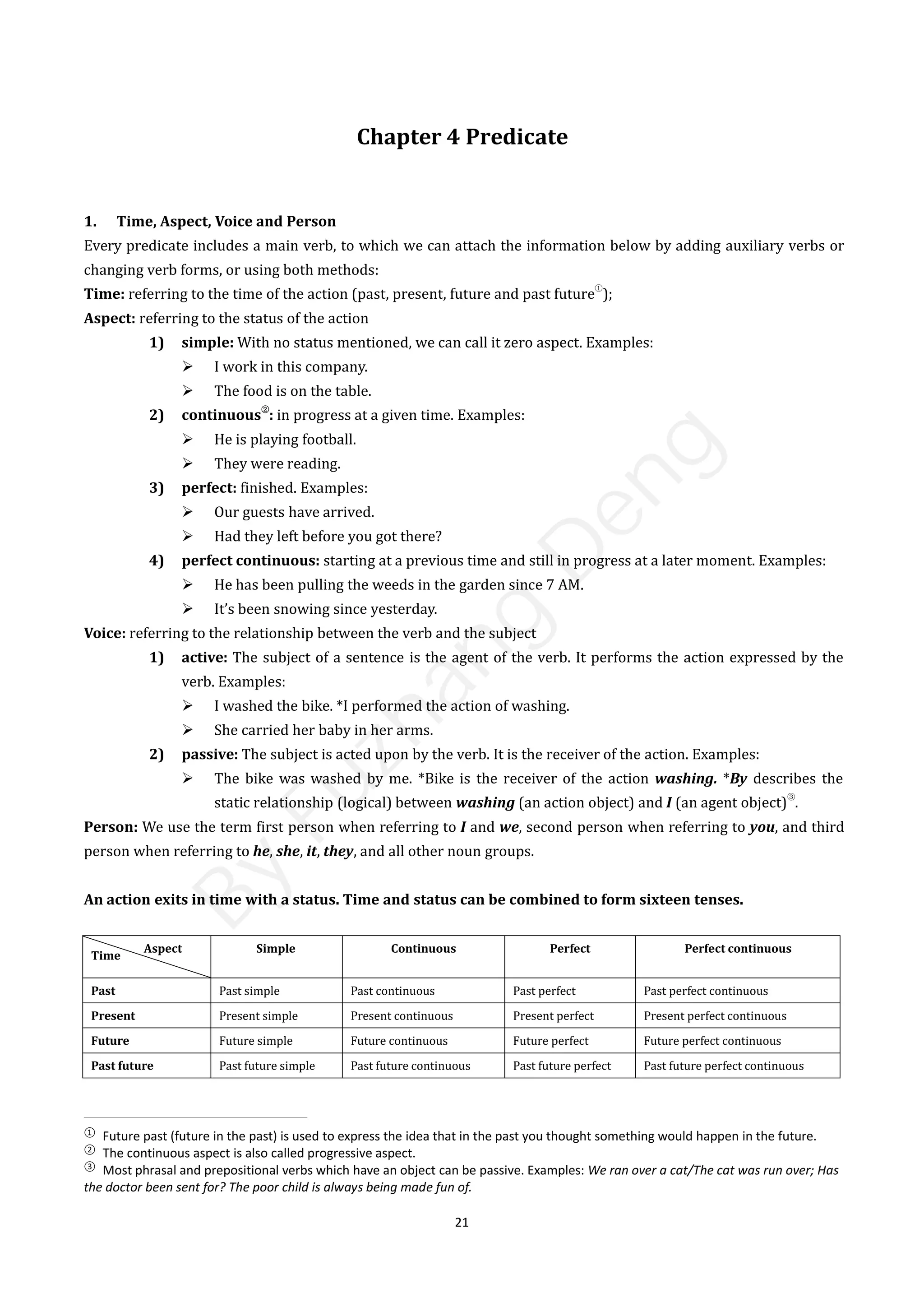
1. Time, Aspect, Voice and Person
Every predicate includes a main verb, to which we can attach the information below by adding auxiliary verbs or
changing verb forms, or using both methods:
Time: referring to the time of the action (past, present, future and past future
①
);
Aspect: referring to the status of the action
1) simple: With no status mentioned, we can call it zero aspect. Examples:
 I work in this company.
 The food is on the table.
2) continuous
②
: in progress at a given time. Examples:
 He is playing football.
 They were reading.
3) perfect: finished. Examples:
 Our guests have arrived.
 Had they left before you got there?
4) perfect continuous: starting at a previous time and still in progress at a later moment. Examples:
 He has been pulling the weeds in the garden since 7 AM.
 It’s been snowing since yesterday.
Voice: referring to the relationship between the verb and the subject
1) active: The subject of a sentence is the agent of the verb. It performs the action expressed by the
verb. Examples:
 I washed the bike. *I performed the action of washing.
 She carried her baby in her arms.
2) passive: The subject is acted upon by the verb. It is the receiver of the action. Examples:
 The bike was washed by me. *Bike is the receiver of the action washing. *By describes the
static relationship (logical) between washing (an action object) and I (an agent object)
③
.
Person: We use the term first person when referring to I and we, second person when referring to you, and third
person when referring to he, she, it, they, and all other noun groups.
An action exits in time with a status. Time and status can be combined to form sixteen tenses.
Time
Aspect Simple Continuous Perfect Perfect continuous
Past Past simple Past continuous Past perfect Past perfect continuous
Present Present simple Present continuous Present perfect Present perfect continuous
Future Future simple Future continuous Future perfect Future perfect continuous
Past future Past future simple Past future continuous Past future perfect Past future perfect continuous
①
Future past (future in the past) is used to express the idea that in the past you thought something would happen in the future.
②
The continuous aspect is also called progressive aspect.
③
Most phrasal and prepositional verbs which have an object can be passive. Examples: We ran over a cat/The cat was run over; Has
the doctor been sent for? The poor child is always being made fun of.
B
y
F
u
z
h
a
n
g
D
e
n
g
22
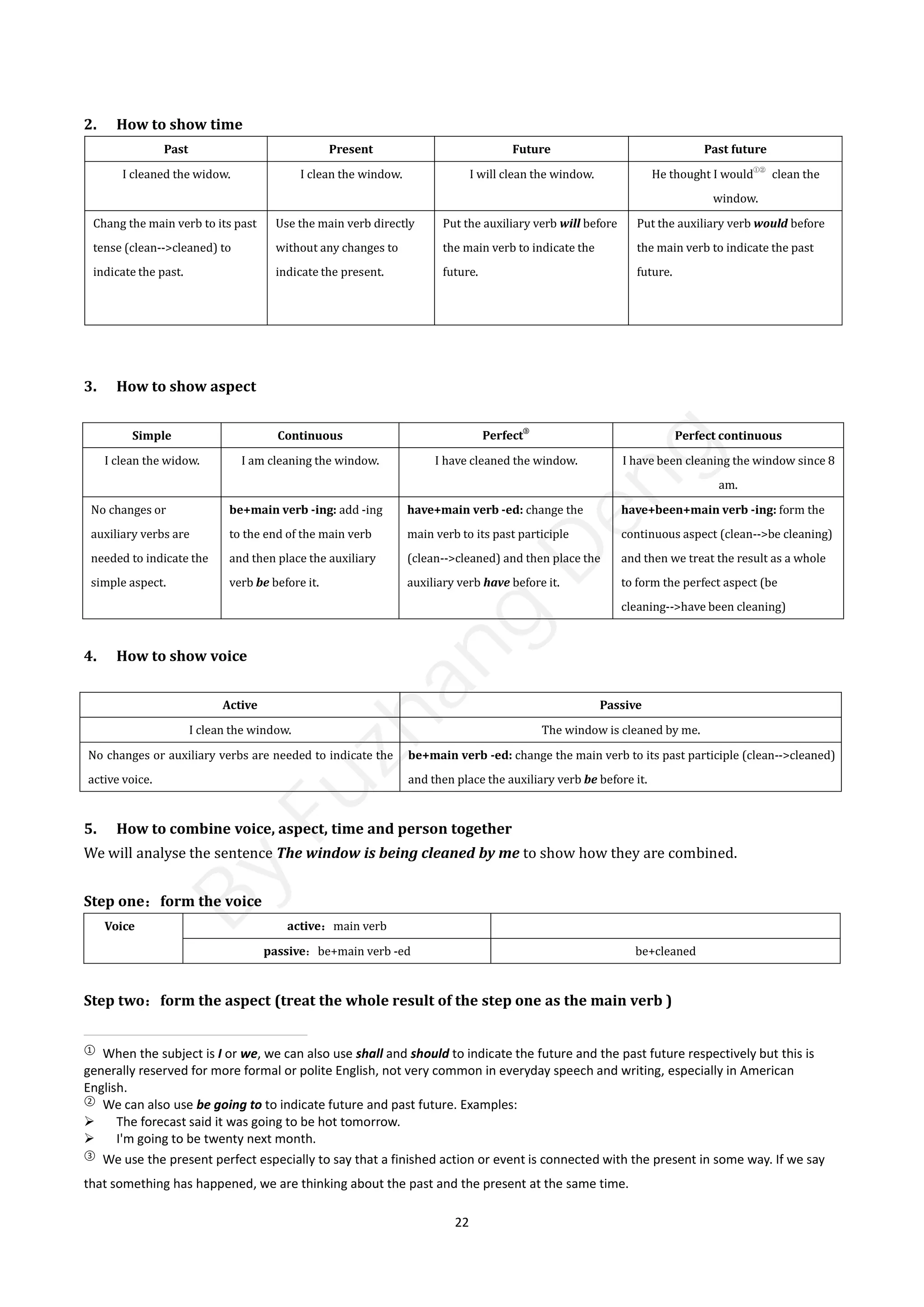
2. How to show time
Past Present Future Past future
I cleaned the widow. I clean the window. I will clean the window. He thought I would
①②
clean the
window.
Chang the main verb to its past
tense (clean-->cleaned) to
indicate the past.
Use the main verb directly
without any changes to
indicate the present.
Put the auxiliary verb will before
the main verb to indicate the
future.
Put the auxiliary verb would before
the main verb to indicate the past
future.
3. How to show aspect
Simple Continuous Perfect
③
Perfect continuous
I clean the widow. I am cleaning the window. I have cleaned the window. I have been cleaning the window since 8
am.
No changes or
auxiliary verbs are
needed to indicate the
simple aspect.
be+main verb -ing: add -ing
to the end of the main verb
and then place the auxiliary
verb be before it.
have+main verb -ed: change the
main verb to its past participle
(clean-->cleaned) and then place the
auxiliary verb have before it.
have+been+main verb -ing: form the
continuous aspect (clean-->be cleaning)
and then we treat the result as a whole
to form the perfect aspect (be
cleaning-->have been cleaning)
4. How to show voice
Active Passive
I clean the window. The window is cleaned by me.
No changes or auxiliary verbs are needed to indicate the
active voice.
be+main verb -ed: change the main verb to its past participle (clean-->cleaned)
and then place the auxiliary verb be before it.
5. How to combine voice, aspect, time and person together
We will analyse the sentence The window is being cleaned by me to show how they are combined.
Step one:form the voice
Voice active:main verb
passive:be+main verb -ed be+cleaned
Step two:form the aspect (treat the whole result of the step one as the main verb )
①
When the subject is I or we, we can also use shall and should to indicate the future and the past future respectively but this is
generally reserved for more formal or polite English, not very common in everyday speech and writing, especially in American
English.
②
We can also use be going to to indicate future and past future. Examples:
 The forecast said it was going to be hot tomorrow.
 I'm going to be twenty next month.
③
We use the present perfect especially to say that a finished action or event is connected with the present in some way. If we say
that something has happened, we are thinking about the past and the present at the same time.
B
y
F
u
z
h
a
n
g
D
e
n
g
23
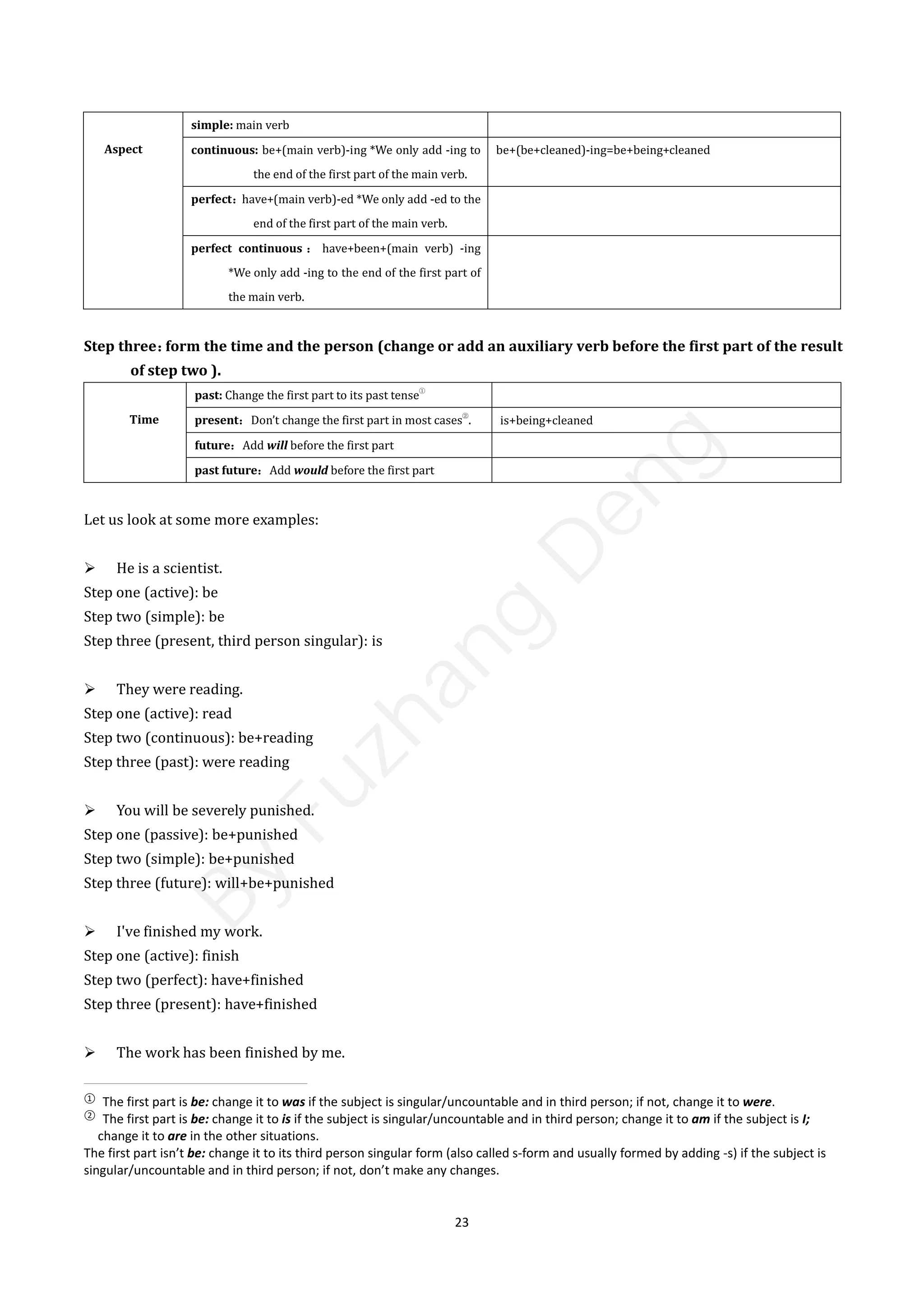
Aspect
simple: main verb
continuous: be+(main verb)-ing *We only add -ing to
the end of the first part of the main verb.
be+(be+cleaned)-ing=be+being+cleaned
perfect:have+(main verb)-ed *We only add -ed to the
end of the first part of the main verb.
perfect continuous : have+been+(main verb) -ing
*We only add -ing to the end of the first part of
the main verb.
Step three:
form the time and the person (change or add an auxiliary verb before the first part of the result
of step two ).
Time
past: Change the first part to its past tense①
present:Don’t change the first part in most cases②
. is+being+cleaned
future:Add will before the first part
past future:Add would before the first part
Let us look at some more examples:
 He is a scientist.
Step one (active): be
Step two (simple): be
Step three (present, third person singular): is
 They were reading.
Step one (active): read
Step two (continuous): be+reading
Step three (past): were reading
 You will be severely punished.
Step one (passive): be+punished
Step two (simple): be+punished
Step three (future): will+be+punished
 I've finished my work.
Step one (active): finish
Step two (perfect): have+finished
Step three (present): have+finished
 The work has been finished by me.
①
The first part is be: change it to was if the subject is singular/uncountable and in third person; if not, change it to were.
②
The first part is be: change it to is if the subject is singular/uncountable and in third person; change it to am if the subject is I;
change it to are in the other situations.
The first part isn’t be: change it to its third person singular form (also called s-form and usually formed by adding -s) if the subject is
singular/uncountable and in third person; if not, don’t make any changes.
B
y
F
u
z
h
a
n
g
D
e
n
g
24
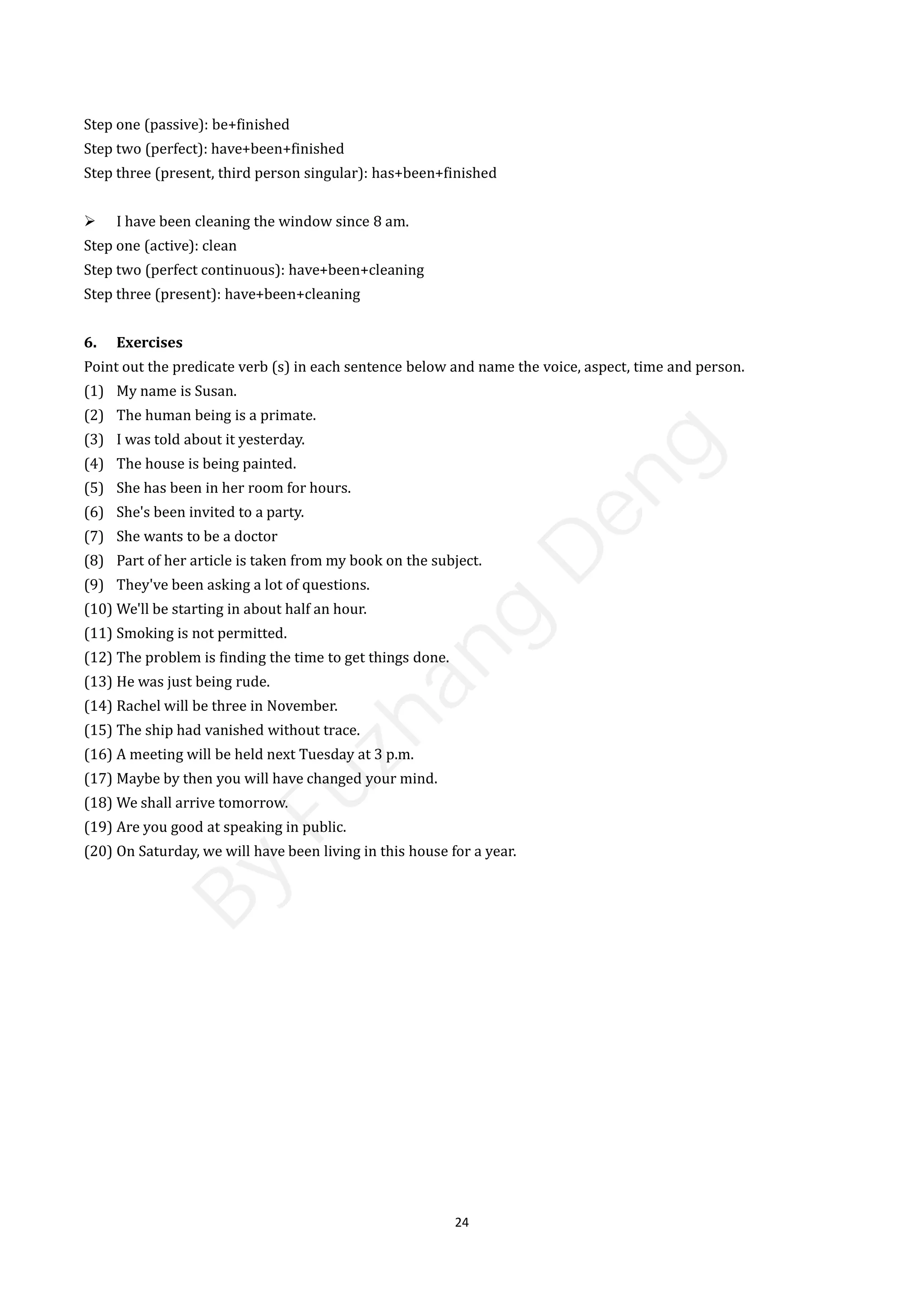
Step one (passive): be+finished
Step two (perfect): have+been+finished
Step three (present, third person singular): has+been+finished
 I have been cleaning the window since 8 am.
Step one (active): clean
Step two (perfect continuous): have+been+cleaning
Step three (present): have+been+cleaning
6. Exercises
Point out the predicate verb (s) in each sentence below and name the voice, aspect, time and person.
(1) My name is Susan.
(2) The human being is a primate.
(3) I was told about it yesterday.
(4) The house is being painted.
(5) She has been in her room for hours.
(6) She's been invited to a party.
(7) She wants to be a doctor
(8) Part of her article is taken from my book on the subject.
(9) They've been asking a lot of questions.
(10) We'll be starting in about half an hour.
(11) Smoking is not permitted.
(12) The problem is finding the time to get things done.
(13) He was just being rude.
(14) Rachel will be three in November.
(15) The ship had vanished without trace.
(16) A meeting will be held next Tuesday at 3 p.m.
(17) Maybe by then you will have changed your mind.
(18) We shall arrive tomorrow.
(19) Are you good at speaking in public.
(20) On Saturday, we will have been living in this house for a year.
B
y
F
u
z
h
a
n
g
D
e
n
g
25
Chapter 5 Reduction of Restrictive Relative Clauses
1. Reduction of Restrictive Relative Clauses
Most of the repeated information in a restrictive relative clause can be omitted. Examples:
1) The book which is on the desk is black.
MC
①
: The book is black.
RRC
②
:which is on the desk.
-->The book on the desk is black
③
. *Which refers to the book, and as repeated information, it can be left out. Then
we change is to being (Its time is present--the same as that of the main clause--and is left out.), and being can be
omitted as well since it is a functional word of no meaning.
2) The woman who is beautiful is in the bedroom.
MC: The woman is in the bedroom.
RRC:who is beautiful.
-->The beautiful woman is in the bedroom. * After the reduction, if only one word is left, usually it should be
moved before the antecedent.
The time of the reduced clause depends on the context, usually the same as that of the main clause. When we see
The beautiful woman is in the bedroom, we determine from the context (is) that the time of the reduced clause
beautiful is present.
If unsure of your reduction, you can always restore it to see if it is right. Let’s look at another example: The girl
who was beautiful is in the bedroom-->The beautiful woman is in the bedroom
According to the context (is), we will restore the reduction to:
MC: The woman is in the bedroom.
RRC:who is beautiful.
Obviously the reduction is incorrect and the original sentence can’t be reduced.
3) The girl who is drinking water is beautiful.
MC: The girl is beautiful.
RRC:who is drinking water.
-->The girl drinking water is beautiful. *Who is omitted. Is is changed to being, which is then left out.
In English, the time, aspect, and voice of an action, person and mood can be glued onto the main predict verb by
adding auxiliary verbs (be,do and have) and modal verbs
④
to form a verb group. When the verb group is reduced,
we change it to do or doing.
In who is drinking water, is drinking is the verb group and we change it to being drinking, then omit being.
★Be is also a DO verb.
4) The house which is being built there is our new dorm.
MC: The house is our new dorm.
①
MC is an acronym for main clause.
②
RRC is an acronym for restrictive relative clause.
③
In English, people prefer to use neater sentences to express themselves, so the reduced form of The book which is on the desk is
black is in common use.
④
Main modal verbs: can, could, may, might, shall, should, will, would, must, ought to, used to, need, had better, and dare.
B
y
F
u
z
h
a
n
g
D
e
n
g
26
RRC:which is being built there.
-->The house being built there is our new dorm. *In which is being built there, is being built is the verb group
and we change it to being being built, then omit the first being
①
.
5) He has a burning ambition which is to become famous.
MC: He has a burning ambition.
RRC:which is to become famous.
-->He has a burning ambition to become famous.
6) The girl who wore a hat slept.
MC: The girl slept.
RRC:who wore a hat.
-->The girl wearing a hat slept. *Wore is changed to wearing.
7) The people who love peace are kind.
MC: The people are kind.
RRC:who love peace
-->The people loving peace are kind. *Loving people can be fused into peace-loving--->The peace-loving people
are kind②
.
8) The basketball which/that I like is red.
MC: The basketball is red.
RRC:which/that I like.
-->The basketball I like is red. *Which/that refers to the basketball, and as repeated information, it can be left
out, but the verb group must remain unchanged since the subject I can’t be omitted.
9) I like the room which the girl is in.
MC: I like the room.
RRC:which the girl is in.
-->I like the room the girl is in
③
.
10) He is not the man that he was.
MC: He is not the man.
RRC:that he was.
-->He is not the man he was.
11) The girl who is beautiful will come.
MC: The girl will come.
RRC:who is beautiful.
-->The beautiful girl will come.
①
The second being can’t be left out or the aspect of the main verb will be missing.
②
Similar examples: a fast-growing economy; English-speaking countries; world-shaking events; a five-year-old boy; a two-hour test
(=a test which lasts for two hours).
③
Similar example: Who on earth is that female he's with?
B
y
F
u
z
h
a
n
g
D
e
n
g
27
12) We are invited to a party which will be held in our club next Friday.
MC: We are invited to a party.
RRC:which will be held in our club next Friday.
-->We are invited to a party to be held in our club next Friday. *Which refers to a party, and as repeated
information, it can be left out. Will be held is the verb group, and since its time is future, we change it to to be
held.
13) She has a large family that she must support.
MC: She has a large family.
RRC:that she must support.
-->She has a large family to support. *Must support is the verb group and since it contains the modal verb must,
we change it to to support.
14) Here are some books that you can read on the way.
MC: Here are some books.
RRC:that you can read on the way.
-->Here are some books for you to read on the way. *Can read is the verb group, and since it contains the modal
verb can, we change it to to read. As you isn’t repeated information, we need to keep it by adding for before it. For
describes the static relationship (logical) between you (a doer object) and to read (an action object)
①
.
15) It is time when you should reconsider your decision.
MC: It is time.
RRC:when you should reconsider your decision.
-->It is time for you to reconsider your decision. *Should reconsider is the verb group, and since it contains the
modal verb should, we change it to to reconsider. As you isn’t repeated information, we need to keep it by adding
for before it. As a fused word, when (=at which) is left out as well.
16) She must have time in which she can pack.
MC: She must have time.
RRC:in which she can pack.
-->She must have time to pack. *Can pack is the verb group, and since it contains the modal verb can, we change
it to to pack
②
. In should be kept in theory, but it is usually left out in practice, considering time functions as an
antecedent.
17) He also had a revolver with which he could defend himself.
MC: He also had a revolver.
RRC:with which he could defend himself.
-->He also had a revolver to defend himself with/He also had a revolver with which to defend himself. *People
prefer to use the former reduction and the latter is more formal
③
.
18) They were the last guests who arrived.
①
It's a good idea for you to finish the course and get a qualification. *For describes the same static relationship.
②
She must have time in which to pack. * In which can be kept, but this isn’t in common use.
③
Another example: I need some information to base the article on; I need some information on which to base the article.
B
y
F
u
z
h
a
n
g
D
e
n
g
28
MC: They were the last guests.
RRC:who arrived.
-->They were the last guests to arrive. *Arrived is the verb group, and since the antecedent is modified by last, we
need to change it to arrive. There are always special cases in English, which need to remembered with great care
①
.
2. The Rules for Reducing Restrictive Relative Clauses
When reducing a clause, we should follow the two principles below:
A. After the reduction, the omitted information (e.g. time, aspect and voice of the verb group of the reduced
clause) can be recovered from the context without ambiguity.
B. The reduction helps to make the whole sentence concise to some extent.
From studying many sentences, the author has drawn the rules for reducing restrictive relative clauses, shown in
the table below
②
.
1. When the verb
group of the RRC
doesn’t contain a
modal verb ==>>
1.1 When the
relative pronoun
is the subject of
the RRC③
==>>
1.1.1
When the time of the
verb group of the
RRC is future or past
future ==>>
Usually change the verb group of the RRC to TO DO. For example:
 I will attend the meeting which will be held next month --> I will
attend the meeting to be held next month.
 Are you going to the banquet to be given at the consulate?
 These are the major problems to be discussed at the meeting.
1.1.2 When the time
of the verb group of
the RRC is
present==>>
1.1.2.1 When the verb
group of the RRC is in the
perfect or perfect
continuous aspect ==>>
Generally, we don’t reduce the RRC
④
. For
example:
 She is looking for the man who has
paid for the meal for her.
1.1.2.2 When the verb
group of the RRC is in the
continuous aspect ==>>
When the time of the verb group of the
MC is present, future or past future,
usually change the verb group of the RRC
to DOING
⑤
. For example:
 The girl who is drinking water is
beautiful --> The girl drinking
water is beautiful.
 Who is the woman talking to Jim?
 We must keep a secret of the things
①
TO DO itself is not necessarily associated with the future/past future.
②
Some of the extra examples in the footnote are difficult to understand. It is advised for you to read chapter 9 first, in which many
detailed analyses of simple sentences are given.
③
When the antecedent is modified by an ordinary number/next/last/only/a superlative adjective, usually we change the verb group
of the RRC to TO DO. Examples:
 Sheila was the first who arrived --> Sheila was the first to arrive.
 She was the only one to survive the crash.
④
There are a few exceptions. Examples:
 The road is blocked by a tree which has fallen--> The road is blocked by a fallen tree.
 The leaders of the uprising which had failed attempted to flee the country--> The leaders of the failed uprising attempted to
flee the country.
 The prisoner who had escaped was soon recaptured--> The escaped prisoner was soon recaptured.
⑤
Let’s look at an example: The girl who is singing in the hall was a popular star.
We can't reduce this sentence to The girl singing in the hall was a popular star, since people will restore it to The girl who was
singing in the hall was a popular star, considering the time of the verb group of the MC is past. *In other words, the omitted
information of the reduced sentence (time) can’t be recovered from the context, so the reduction is incorrect.
B
y
F
u
z
h
a
n
g
D
e
n
g
29
being discussed here①
.
1.1.2.3 When the verb
group of the RRC is in the
simple aspect==>>
Usually change the verb group of the RRC
to DOING. For example:
 Anyone who touches that wire will
get a shock--> Anyone touching②
that wire will get a shock.
 His ability to get on with people is
his chief asset.*...which is to get...
 What's the language spoken in
that country③
?
1.1.3 When the time
of the verb group of
the RRC is past==>>
1.1.3.1 When the verb
group of the RRC is in the
perfect aspect or perfect
continuous aspect==>>
Generally, we don’t reduce the RRC.
1.1.3.2 When the verb
group of the RRC is in the
continuous aspect==>>
Usually change the verb group of the RRC
to DOING. For example:
 The girl who was drinking water
was beautiful --> The girl drinking
water was beautiful.
 l knew nothing about the
experiment being conducted
there.
1.1.3.3 When the verb
group of the RRC is in the
simple aspect ==>>
1.1.3.3.1
When the
first part
of the verb
group of
the RRC is
be ==>>
Usually change the verb
group of the RRC to DOING.
For example:
 The girl who was
little was in the
bedroom --> The
little girl was in the
bedroom.
 His decision to
resign was
welcomed by the
Opposition④
.
①
More examples: ◎A pair of wildfires burning in California's parched Sierra Nevada mountains have forced the closure of much
of Sequoia National Park -- including its most treasured areas, home to some of the largest trees on Earth. ◎There is not much
clearance for tall vehicles passing under this bridge.
②
DOING itself is not, in spite of its appearance, necessarily associated with the continuous aspect.
③
More examples: ◎Soldiers timid or cowardly don't fight well. ◎Soldiers normally timid don't fight well. ◎A man usually
honest will sometimes cheat. ◎The flowers smelling sweet in the botanic garden attract the visitors to the beauty of nature. ◎Is
there anybody injured? ◎Here is a leaflet giving full particulars of the plan. ◎Everything belonging to you should be marked with
your own name. ◎They plan to build a highway leading into the mountains. ◎Long-distance coaches departing from the two
cities have also been suspended. ◎The picture hanging on the wall is painted by my nephew. ◎The government plans to bring in
new laws forcing parents to take more responsibility for the education of their children. ◎There are many other examples
reflecting the development of Chinese writing. ◎There is a great deal of evidence indicating that music activities engage different
parts of the brain.
④
More examples: They're problems left over by history. ◎ls there anything planned for tonight ? ◎Suddenly there appeared a
B
y
F
u
z
h
a
n
g
D
e
n
g
30
1.1.3.3.2
When the
first part
of the verb
group of
the RRC is
a state
verb①
==>>
Usually change the verb
group of the RRC to DOING.
For example:
 The girl who wore a
hat slept--> The girl
wearing a hat
slept②
.
1.2 When the relative pronoun is the object or the predicate noun of the RRC, generally only the relative pronoun can
be left out
③
. For example:
 I like the toy which you made --> I like the toy you made.
2. When the verb group of the RRC contains any of these
modal verbs of the meaning shown in the brackets:
can/could (indicating ability),
must (indicating obligation),
should/ought to (indicating obligation ),
will/would(indicating willingness or habit),
should (indicating surprise )==>>
Usually change the verb group of the RRC to TO DO. For example:
 I have a lot of work that you must do --> I have a lot of work for you to do.
 I am looking for a house in which you can live --> I am looking for a house
for you to live in.
 Here's a saw for you to cut it with.
 This is not the right attitude to take.
 He is not a man to bow before difficulties. *Indicating willingness
④
.
 What have I said to make you so angry?
3. Exercises
A. Try to reduce the relative clauses in bold.
(1) She wears a coat which is white.
(2) The basketball which is red is very expensive.
(3) One of them was carrying a bag which was full of money.
(4) The mobile which is in the box is mine.
young woman dressed in green. ◎The experience gained will be of great value to us. ◎The people on the bus were singing.
①
State verbs express states or conditions which are relatively static, including verbs of perception, cognition, the senses, emotion
and state of being and they are usually not used in continuous aspects. Examples: appear, believe, belong, consider, consist, contain,
cost, doubt, exist, fit, hate, hear, have, know, like, love, matter, mean, need, owe, own, prefer, remember, resemble, seem, suppose,
suspect, understand, want, wish.
★ If the verb group of the RRC expresses a single complete action, usually the RRC can’t be reduced. For example:
 The boy who broke the window yesterday morning is my little brother. *We can’t reduce this sentence to The boy breaking the
window yesterday morning is my little brother, since people will restore it to The boy who was breaking the window
yesterday morning is my little brother, considering the context (yesterday morning).
 There was a noise that woke me up.
But there are some exceptions. For example:
Malala Yousafzai, the Nobel Peace Prize-winning Pakistani activist, has gotten married, she announced on Instagram on Tuesday.
②
More example: A petition was circulated asking for a longer lunch break. *It is stylistically preferable for the part following the
verb to be longer than the part preceding it. In this example the subject is a petition asking for a longer lunch break, but the reduced
RRC is placed after the verb.
③
But when the time of the verb group of the RRC is future or past future, there are a few exceptions. For example:
 I have decided the day on which I will pay him a visit-->I have decided the day on which to pay him a visit/I have decided the
day to pay him a visit on.
④
More examples: They would raise some money with which to buy medicines. ◎There's nothing to get excited about. ◎I need a
vase to put these flowers in.
B
y
F
u
z
h
a
n
g
D
e
n
g
31
(5) After I had left a small village which was in the south of France, I drove on to the next town.
(6) The thief who was with the money got such a fright that he dropped the bag.
(7) The man who is sitting by my side is my uncle.
(8) Jane joined the line of people who were waiting for the bus.
(9) Jane expressed a wish which was to earn her own living.
(10) I don’t trust his promise which is to come for a visit.
(11) I live in a very old town which is surrounded by beautiful woods.
(12) The girl who was injured in the car accident yesterday is her classmate.
(13) I showed my students some old maps which were borrowed from the library.
(14) The trees which were blown down in the storm have been moved off the road.
(15) Here is a map which shows you how to get there.
(16) Look over there—there’s a very long, winding path which leads up to the house.
(17) Many buildings in the city need repairing, but the one which will be repaired first is the library.
(18) Are you going to the banquet which will be given at the consulate?
(19) We have a lot of things that we must do today.
(20) There is nothing that can be done now.
(21) I' m hungry. Get me something that I can eat.
(22) I want someone to whom I can talk.
(23) He only had long nights in which he could study.
(24) Here are the letters which the manager should sign.
(25) I have some work that you must do.
(26) It's time we should leave.
(27) Where are the things which should be taken to her?
(28) She is not a girl who will act rashly.
(29) He is not a man who will bow before difficulties.
(30) Sheila was the first that arrived.
(31) She was the only one that survived the crash.
(32) He was the only foreigner who was given such an honour.
B. Answer the questions below by choosing A, B, C or D.
(1) The picture ________ on the wall is painted by my nephew.
A. having hung B. hanging C. hangs D. being hung
(2) When I got back home I saw a message pinned to the door ________ “Sorry to miss you; will call later.”
A. read B. reads C. to read D. reading
(3) Recently a survey ________ prices of the same goods in two different supermarkets has caused heated debate
among citizens.
A. compared B. comparing C. compares D. being compared
(4) I have a lot of readings ________ before the end of this term.
A. completing B. to complete C. completed D. being completed
(5) The traffic rule says young children under the age of four and ________ less than 40 pounds must be in a child
safety seat.
A. being weighed B. to weigh C. weighed D. weighing
(6) The play ________ next month aims mainly to reflect the local culture.
B
y
F
u
z
h
a
n
g
D
e
n
g
32
A. produced B. being produced C. to be produced D. having been produced
(7) For breakfast he only drinks juice from fresh fruit ________ on his own farm.
A. grown B. being grown C. to be grown D. to grow
(8) When I handed the report to John, he said that George was the person ________.
A. to send B. for sending it C. to send it to D. for sending it to
(9) There are five pairs ________, but I’m at a loss which to choose.
A. to be chosen B. to choose from C. to choose D. choosing
(10) Nowadays electrical energy _________ from the sun has become the most widely used energy.
A. comes B. coming C. to come D. came
(11) So far nobody has claimed the money _________ in the library.
A. discovered B. to be discovered C. discovering D. having discovered
(12) On receiving a phone call from his wife _________ she had a fall, Mr. Gordon immediately rushed home from his
office.
A. says B. said C. saying D. to say
(13) We’re having a meeting in half an hour. The decision _________ at the meeting will influence the future of our
company.
A. to be made B. being made C. made D. having been made
(14) John has really got the job because he showed me the official letter _________ him it.
A. offered B. offering C. to offer D. to be offered
(15) The room is empty except for a bookshelf _________ in one corner.
A. standing B. to stand C. stands D. stood
B
y
F
u
z
h
a
n
g
D
e
n
g
33
Chapter 6 Reduction of Nonrestrictive Relative Clauses
1. Reduction of Nonrestrictive Relative Clauses
Most of the repeated information in a nonrestrictive relative clause can be omitted. Examples:
1) Robert, who is our teacher, likes fishing.
MC: Robert likes fishing.
NRC
①
: who is our teacher.
-->Robert, our teacher, likes fishing.
2) The building, which was painted red, looks very attractive.
MC: The building looks very attractive.
NRC: which was painted red.
-->The building, painted red, looks very attractive.
3) His first book, which will be published next month, is based on a true story.
MC: His first book is based on a true story.
NRC: which will be published next month.
-->His first book, to be published next month, is based on a true story.
4) The old man, who has worked abroad for twenty years, is on the way back to his motherland.
MC: The old man is on the way back to his motherland.
NRC: who has worked abroad for twenty years.
-->The old man, having worked abroad for twenty years, is on the way back to his motherland.
5) It rained heavily in the south, which caused serious flooding in several provinces.
MC: It rained heavily in the south.
NRC: which caused serious flooding in several provinces.
-->It rained heavily in the south, causing serious flooding in several provinces. *Which refers to It rained heavily
in the south.
6) He missed the train, which was a great pity.
MC: He missed the train.
NRC: which was a great pity.
-->He missed the train, a great pity. *Which refers to He missed the train.
7) Mike found his missing car in the street outside his house, which looked newly cleaned and polished.
MC: Mike found his missing car in the street outside his house.
NRC: which looked newly cleaned and polished.
-->Mike found his missing car in the street outside his house, looking newly cleaned and polished. *Which refers to
his missing car.
①
NRC is an acronym for nonrestrictive relative cause.
B
y
F
u
z
h
a
n
g
D
e
n
g
34
2. The Rules for Reducing Nonrestrictive Relative Clauses
From studying many sentences, the author has drawn the rules for reducing nonrestrictive relative clauses, shown
in the table below.
1. When the
verb group of
the NRC
doesn’t
contain a
modal verb
==>>
1.1 When the
relative pronoun
is the subject of
the NRC ==>>
1.1.1 When the time
of the verb group of
the NRC is future or
past future ==>>
Usually change the verb group of the NRC to TO DO. For example:
 His first book, which will be published next month, is based on a true
story--> His first book, to be published next month, is based on a true
story.
 His last appeal, for his son to visit him, was never delivered.
1.1.2 When the time
of the verb group of
the NRC is
present==>>
1.1.2.1 When the verb
group of the NRC is in
the perfect or perfect
continuous
aspect==>>
Usually change the verb group of the NRC to
DOING. For example:
 The old man, who has worked abroad for
twenty years, is on the way back to his
motherland--> The old man, having worked
abroad for twenty years, is on the way
back to his motherland.
 Many Chinese brands, having developed
their reputations over centuries, are
facing new challenges from the modern
market.
1.1.2.2 When the verb
group of the NRC is in
the continuous aspect
==>>
Usually change the verb group of the NRC to
DOING. For example:
 The famous singer is traveling across the
country, promoting her new album①
.
1.1.2.3 When the verb
group of the NRC is in
the simple aspect==>>
Usually change the verb group of the NRC to
DOING. For example
②
:
 The experiment, intended to test the
theory, will be carried out tomorrow.
 There is a note pinned to the door saying
when the shop will open again③
.
1.1.3 When the time
of the verb group of
the NRC is past==>>
1.1.3.1 When the verb
group of the NRC is in
the perfect aspect or
perfect continuous
aspect==>>
Usually change the verb group of the NRC to
DOING. For example:
 The twins, who had been separated for so
long, held each other and burst into tears -->
The twins, having been separated so long,
held each other and burst into tears.
①
It is usually seen as an independent clause.
②
But there are some exceptions. For example:
The team has lost the last two games and, to make matters worse, two of its best players are injured.
③
More examples: He is in charge of the project, which is more remarkable still--> More remarkable still, he is in charge of the
project. *Which refers to the event object expressed by the main clause. Please note that the reduced clause is moved to the front of
the main clause. ◎He may be late. Worse stilt, he may not come at all. ◎European football is played in 80 countries, making it the
most popular sport in the world. ◎The hospital has recently obtained new medical equipment, allowing more patients to be
treated. ◎Linda works for the Minnesota Manufacturing and Mining Company, known as 3M. ◎In our village, about 1,000 meters
north of my house, stands an old temple dating back to the 17th century. ◎The transmission rate, or R-rate, currently stands at 0.7,
Health Minister Magnus Heunicke tweeted Wednesday, meaning that the epidemic is continuing to decline.
B
y
F
u
z
h
a
n
g
D
e
n
g
35
 The manager, having made it clear to us
that he didn't agree with us, left the
meeting room.
1.1.3.2 When the verb
group of the NRC is in
the continuous
aspect==>>
Usually change the verb group of the NRC to
DOING. For example:
 The park was full of people,enjoying
themselves in the sunshine.
 She glanced with disgust at the cat, mewing
plaintively.
1.1.3.3 When the verb
group of the RRC is in
the simple aspect
==>>
1.1.3.3.1
When the
first part of
the verb
group of the
NRC is be
==>>
Usually change the verb group of
the RRC to DOING. For example:
 The building, which was
painted red, looks very
attractive--> The building,
painted red, looks very
attractive.
 Henry, terribly
embarrassed, blushed
too①②
.
1.1.3.3.2
When the
first part of
the verb
group of the
NRC is a
state verb
③
==>>
Usually change the verb group of
the NRC to DOING. For example:
 Romeo, believing that
Juliet was dead, decided to
kill himself.
 The doctor, not wishing to
alarm her, didn't tell her
how serious her condition
was
④
.
①
More examples: The soldiers, normally timid, fought bravely. ◎The man, rather nervous, opened the letter. ◎Mr. Cooper,
deeply moved, thanked him again and again. ◎Tom, horrified at what he had done, could at first say nothing. ◎Shelley,
astonished, urged her to explain. ◎The computer centre, opened last year, is very popular among the students in this school. ◎His
chief hobby, sailing a boat, cost him most of his salary. ◎Most important, his report offered prospects of a great profit. ◎Strange,
it was she who initiated divorce proceedings. ◎She was standing, a picture of innocence. ◎Unknown to his wife, Ron had been
having an affair.
②
We can’t reduce The man restrained the woman, who was aggressive to The man restrained the woman, aggressive since
people may understand that the man was aggressive, given that the implied subject of a reduced clause is usually the same as that of
the main clause.
But we can reduce She glanced with disgust at the cat, which was quiet in her daughter's lap/which was stretched out on the
rug/which was mewing plaintively to She glanced with disgust at the cat, quiet in her daughter's lap/stretched out on the
rug/mewing plaintively since the context tells us that the subject of the reduced clause is the cat.
③
There is an exception: When the first part of the verb group of the NRC isn’t a state verb but the relative pronoun refers to the MC,
we can change the verb group of the NRC to DOING. For example:
 A small plane crashed into a hillside five miles east of the city, which killed all four people on board--> A small plane crashed
into a hillside five miles east of the city, killing all four people on board.
 It rained heavily in the south, which caused serious flooding in several provinces--> It rained heavily in the south, causing
serious flooding in several provinces.
④
More examples: Those youngsters, shouldering spades and hoes, left merrily for the fields. ◎An old peasant, bringing his own
food, volunteered as guide for us. ◎The three Chinese astronauts living in space for 90 days have returned to Earth, marking an
end to China's longest-ever crewed mission. ◎The cooling wind swept through out bedroom windows, making air conditioning
B
y
F
u
z
h
a
n
g
D
e
n
g
36
1.2 When the relative pronoun isn’t the
subject of the NRC ==>>
Normally the NRC can’t be reduced.
2. When the verb group of the RRC
contains any of these modal verbs of the
meaning shown in the brackets:
can/could (indicating possibility)==>>
Usually change the verb group of the RRC to TO DO. For example:
 This herb, which can be found in Asian, is poisonous--> This herb, to be found in Asian, is
poisonous.
3. Exercises
A. Try to reduce the relative clauses in bold.
(1) Diane was twenty years old, who was the youngest in the family.
(2) It was Albert, who was the husband of Molly's sister.
(3) I returned the letter, which was unopened.
(4) The man wanted to fly to Rockall, which is a lonely island in the Atlantic Ocean.
(5) The Olympic Games, which were first played in 776 B.C., did not include women players until 1912.
(6) Tsinghai University, which was founded in 1911, is home to a great number of outstanding figures.
(7) More highways have been built in China, which makes it much easier for people to travel form one place
to another.
(8) The island, which is joined to the mainland by a bridge, is easy to go to.
(9) A small plane crashed into a hillside five miles east of the city, which killed all four people on board.
(10) Dina, who had struggled for months to find a job as a waitress, finally took a position at a local advertising
agency.
B. Answer the questions below by choosing A, B, C or D.
(1) Mr. Smith, ________ of the ________ speech, started to read a novel.
A. tired; boring B. tiring; bored C. tired; bored D. tiring; boring
(2) European football is played in 80 countries, ________ it the most popular sport in the world.
A. making B. makes C. made D. to make
(3) Play, often ________ as an activity for young children, is still important in the social development of teenagers.
A. to see B. seeing C. to be seen D. seen
(4) This school, ________ for two years, is intended for the disabled children.
A. being built B. having built C. having been built D. was built
(5) The schedule, originally ________ out last week, had to be canceled because of the unexpected snow storm.
A. carried B. to be carried C. being carried D. was carried
(6) Shanghai, ________ on the Huangpu River, is the largest city of China.
A. being situated B. situated C. be situated D. situating
(7) A 3G mobile phone, ________ to be most useful and fashionable, is popular with some teenagers.
A. consider B. considering C. considered D. to be considered
(8) So far, several cases of a disease, ________ as H1N1, are reported to have been found in the country.
unnecessary. ◎He mistook me for a teacher, causing me some embarrassment. ◎Parker scribbled a note to Sullivan before
deplaning, expressing his gratitude and pleasure at having met and spoken with her. ◎The leader, finding the rule unfair for
women, suggested it be banned. ◎The next week, a family spokesperson issued a statement indicating that the injury was more
serious and outlining more details of the incident. ◎Two days after the shooting, Murdaugh released a statement saying he was
entering rehab. ◎A few days after the interview, I received a letter offering me admission to the university.
B
y
F
u
z
h
a
n
g
D
e
n
g
37
A. knowing B. to be known C. having known D. known
(9) The twins, _______ so long, held each other and burst into tears.
A. being separated B. having been separated C. having separated D. had been separated
(10) Fireworks, _______ of gun powder or flash powder _______ in a tight paper tube, make the big flash or boom
effect.
A. consisting; wrapping B. consisting; wrapped
C. consisted; wrapped D. being consisted; wrapped
(11) The rare fish, _______ from the cooking pot, has been returned to the sea.
A. saved B. saving C. to be saved D. having saved
(12) "Genius" is a complicated concept, _______ many different factors.
A. involved B. involving C. to involve D. being involved
(13) The lecture, _______at 7:00 pm last night, was followed by an observation of the moon with telescopes.
A. starting B. being started C. to start D. to be started
B
y
F
u
z
h
a
n
g
D
e
n
g
38
Chapter 7 Reduction of Independent Clauses
1. Reduction of Independent Clauses
Most of the repeated information in an independent clause that is connected to another one with and can
be omitted. Examples:
1) My little sister is tall and her hair is black.
IC 1①
:My little sister is tall.
IC 2:Her hair is black.
-->My little sister is tall, her hair black. *After the reduction, and is replaced by a comma.
2) Bats are surprisingly long-lived creatures and some have a life span of around 20 years.
IC 1:Bats are surprisingly long-lived creatures.
IC 2:Some have a life span of around 20 years.
-->Bats are surprisingly long-lived creatures, some having a life span of around 20 years.
3) They were walking in the street and they were looking for somewhere to stay.
IC 1:They were walking in the street.
IC 2:They were looking for somewhere to stay.
-->They were walking in the street, looking for somewhere to stay.
4) He didn’t realize that he was in great danger and he walked deeper into the forest.
IC 1:He didn’t realize that he was in great danger.
IC 2:He walked deeper into the forest.
-->Not realizing that he was in great danger, he walked deeper into the forest. * Not comes before DOING.
5) My cousin came to see me from the country and he brought me a full basket of fresh fruits.
IC 1: My cousin came to see me from the country.
IC 2: He brought me a full basket of fresh fruits.
-->My cousin came to see me from the country, bringing me a full basket of fresh fruits.
6) Betty pretended to be cheerful and she said nothing about the argument.
IC 1: Betty pretended to be cheerful.
IC 2: She said nothing about the argument.
-->Betty pretended to be cheerful, saying nothing about the argument.
7) He had a wonderful childhood and he traveled with his mother to all corners of the world.
IC 1: He had a wonderful childhood.
IC 2: He traveled with his mother to all corners of the world.
-->He had a wonderful childhood, traveling with his mother to all corners of the world.
8) Andy and Ruby were the first to reach the top of Mount Tai and they were tired and short of breath.
①
IC is an acronym for independent clause.
B
y
F
u
z
h
a
n
g
D
e
n
g
39
IC 1: Andy and Ruby were the first to reach the top of Mount Tai.
IC 2: They were tired and short of breath.
-->Andy and Ruby were the first to reach the top of Mount Tai, tired and short of breath/Tired and short of breath,
Andy and Ruby were the first to reach the top of Mount Tai.
9) He came into the room and sat down on the sofa.
IC 1: He came into the room.
IC 2: (He) sat down on the sofa.
-->He came into the room, sitting down on the sofa/Coming into the room, he sat down on the sofa.
10) The match was over and they went home.
IC 1: The match was over.
IC 2: They went home.
-->The match over, they went home.
11) All the money had been spent and we started looking for work.
IC 1: All the money had been spent.
IC 2: We started looking for work.
-->All the money having been spent, we started looking for work①
.
12) The tall building had been attacked by terrorists and it collapsed.
IC 1: The tall building had been attacked by terrorists.
IC 2: It collapsed.
-->Having been attacked by terrorists, the tall building collapsed②
.
13) Tom is dressed in a white uniform and he looks more like a cook than a doctor.
IC 1: Tom is dressed in a white uniform
IC 2: He looks more like a cook than a doctor.
-->Dressed in a white uniform, Tom looks more like a cook than a doctor.
14) I send you 100 dollars today and the rest will follow in a year.
IC 1: I send you 100 dollars today.
IC 2: The rest will follow in a year.
-->I send you 100 dollars today, the rest to follow in a year.
15) We shall assemble at ten forty-five and the procession will start moving at precisely eleven.
IC 1: We shall assemble at ten forty-five.
IC 2: The procession will start moving at precisely eleven.
-->We shall assemble at ten forty-five, the procession to start moving at precisely eleven.
16) I arrived at the shop and I only found I'd left all my money at home.
①
Similar example: The lights having gone out, we couldn't see a thing.
②
Similar examples: Having lost his job, he'd begun to interest himself in local voluntary work; Having waited an hour, the crowd
were getting impatient.
B
y
F
u
z
h
a
n
g
D
e
n
g
40
IC 1:I arrived at the shop.
IC 2: I only found I'd left all my money at home.
-->I arrived at the shop only to find I'd left all my money at home. *Since the second independent clause is an
expression of a surprise, we change the verb group of the second independent clause to to find①
.
2. The Rules for Reducing Independent Clauses
From studying many sentences, the author has drawn the rules for reducing independent clauses, shown in the
table below.
1. When the verb
group of the IC
doesn’t contain a
modal verb ==>>
1.1 When the time of
the verb group of the
IC is future or past
future ==>>
Usually change the verb group of the IC to TO DO. For example:
 We shall assemble at ten forty-five and the procession will start moving at precisely
eleven-->We shall assemble at ten forty-five, the procession to start moving at
precisely eleven.
 The plan was that the two parties should first reach an agreement on the basic
principle, the details to be worked out later.
★ But there is an exception: when the subject of the IC is the same as that of the other one
and the actions expressed by their verb groups happen at the same time or in succession, we
usually change the verb group of the IC to DOING. For example:
 I will sit here reading the book at this time tomorrow.
 They'll send you the book for $ 2.75, postage included.
1.2 When the time of
the verb group of the
IC is present==>>
1.2.1 When the
verb group of the IC
is in the perfect or
perfect continuous
aspect==>>
Usually change the verb group of the IC to DOING. For example:
 I have just ate an apple and I don’t want to eat anything
now-->Having just ate an apple, I don’t want to eat anything
now.
 Not having completed the programme, they have to stay
there for another two weeks
②
.
1.2.2 When the
verb group of the IC
is in the continuous
aspect ==>>
Usually change the verb group of the IC to DOING. For example:
 The famous singer is traveling across the country, promoting
her new album.
 Don’t just stand there gawking at those girls!
1.2.3 When the
verb group of the IC
is in the simple
aspect==>>
Usually change the verb group of the IC to DOING. For example:
 Bats are surprisingly long-lived creatures and some have a life
span of around 20 years-->Bats are surprisingly long-lived
creatures, some having a life span of around 20 years.
 Everything considered, his plan seems better.
 Written in simple English, the book is easy to read③
.
①
TO DO and DOING can also express a comment on the sentence. Examples: To be frank, you didn't make a very good impression.
◎I'm a bit tired of sightseeing, to tell you the truth. ◎Strictly speaking, that school is not very old. ◎l think, personally speaking,
it's a good idea.
②
More examples: Having been invited to speak, I'll start making preparations tomorrow. ◎Having suffered from heart trouble for
years, Professor White has to take some medicine with him wherever he goes. ◎Having suffered such heavy pollution already, it
may now be too late to clean up the river.
③
More examples: Ripe, these apples are sweet. ◎Enthusiastic, they make good students. ◎We often provide our children with
toys, footballs or basketballs, thinking that all children like these things. ◎Please fill in this form, giving your name, address, etc.
◎More and more people are signing up for Yoga classes nowadays, taking advantage of the health and relaxation benefits. ◎The
glass doors have taken the place of the wooden ones at the entrance, letting in the natural light during the day. ◎West of our
B
y
F
u
z
h
a
n
g
D
e
n
g
41
1.3 When the time of
the verb group of the
IC is past==>>
1.3.1 When the
verb group of the IC
is in the perfect or
perfect continuous
aspect==>>
Usually change the verb group of the IC to DOING. For example:
 The tall building had been attacked by terrorists and it
collapsed-->Having been attacked by terrorists, the tall
building collapsed.
 Her aunt having left the room, I asked Ann for some personal
help①
.
1.3.2 When the
verb group of the IC
is in the continuous
aspect ==>>
Usually change the verb group of the IC to DOING. For example:
 They were walking in the street and they were looking for
somewhere to stay-->They were walking in the street, looking
for somewhere to stay.
 The molten metal was being cooled in the air and the molten
metal hardened --> Being cooled in the air, the molten metal
hardened.
 She was lying in bed crying②
.
1.3.3 When the
verb group of the IC
is in the simple
aspect==>>
1.3.3.1 When the first
part of the verb group
of the IC is be ==>>
Usually change the verb group of the IC to
DOING. For example:
 The match was over and they went
home --> The match over, they went
home.
 The purse not yet found, we went
to the police
③
.
1.3.3.2 When the
first part of the verb
group of the IC is a
Usually change the verb group of the IC to
DOING. For example:
 She denied any interest in politics
and she claimed that she wished to
school lies our stadium, seating about 5000 people in all. ◎Smelling sweet and fresh, this kind of food is so popular with local
people and the tourists. ◎Of the obligatory elements, the main verb is the one that wholly or largely determines what form the rest
of the structure will take. ◎The man is a fool, a complete idiot.
①
More examples: The damaged window having been paid for by the parents, the police were not called. ◎Having found a hotel,
they began to look for a restaurant. ◎Having been ill for two weeks, she felt rather weak. ◎Not having got an answer, I decided to
write him another letter. ◎Having been shown around the Water Cube, we were then taken to see the Bird’s Nest for the 2008
Olympic Games. ◎They left the restaurant, having spent two hours over lunch.
Compare these two sentences:
 Eating a hearty breakfast, we prepared for our long journey. [1]
 Having eaten a hearty breakfast, we prepared for our long journey. [2]
From [1], we understand that the eating and the preparation took place together, while from [2], we understand that the breakfast
preceded the preparation.
②
More examples: He ran out of the house shouting. ◎l stood watching her, not knowing what to do. ◎The boy came running
into the house. ◎She was in the kitchen preparing supper. ◎The poor little girl still knelt there, tears running down her cheeks.
③
More examples: Unhappy with the result, she returned to work. ◎Long and untidy, his hair played in the breeze. ◎It being a
holiday, all the shops were shut. ◎There being ice on the road, I told the driver to slow down. ◎She looked at him expectantly, her
eyes full of excitement and curiosity. ◎Mavis sat in the front seat, her hands in her lap. ◎Considered works of art, they were
admitted into the country without customs duties. ◎Too nervous to reply, he stared at the floor. ◎Of humble parentage, he began
his working life in a shoe factory. ◎Being a student, he was naturally interested in museums. ◎Aroused by the crash, he leapt to
his feet. ◎The driver escaped unhurt from the accident. ◎He being ill, I attended the meeting instead of him last week. ◎
Convinced that they were trying to poison her, she refused to eat anything. ◎Weakened by successive storms, the bridge was no
longer safe. ◎She entered, accompanied by her mother. ◎He soon felt asleep, exhausted by the journey. ◎She gave him the
overcoat, anxious to be of service. ◎Frustrated, he went back to his hometown. ◎He turned away disappointed. ◎In February,
at 3.5 per cent and 5.5 per cent respectively, unemployment rates in Canada and the United States were at generational lows and
worker shortages were everywhere. ◎They went to the teacher in fear and trembling to tell her that they'd broken a window.
B
y
F
u
z
h
a
n
g
D
e
n
g
42
state verb①
==>> continue in forensic medicine -->
Denying any interest in politics,
she claimed that she wished to
continue in forensic medicine.
 We explored the caves, Peter acting
as guide.
 Feeling tired, I went to bed②
.
★ But there is an exception: when the
subject of the IC is the same as that of the
other one and the actions expressed by
their verb groups happen at the same time
or in succession, we usually change the
verb group of the IC to DOING. For
example:
 He opened the door and put down
the key on the desk --> He opened
the door, putting down the
key/Opening the door, he put down
the key on the desk.
 Taking off our shoes, we crept
along the passage③
.
①
★ But there is an exception: when the subject of the IC is the same as that of the other one and the event expressed by the IC is
unexpected, we usually change the verb group of the IC to TO DO. For example:
 I arrived at the shop and I only found I'd left all my money at home --> I arrived at the shop only to found I'd left all my money
at home.
 She went abroad never to return.
②
More examples: Not knowing her address, we couldn't get in touch with her. ◎They sent us an open letter, hoping to get our
support. ◎They went on with their struggle, thinking theirs was a just cause. ◎He never went out in daylight, fearing that the
police would recognize him. ◎l got home, feeling very tired.
③
More examples: He seated himself at the desk and his mother began to tell him a story --> He seating himself at the desk, his
mother began to tell him a story. ◎Opening the drawer, he took out a box. ◎Taking a key out of his pocket, he opened the door.
◎She went out, slamming the door. ◎He fired, wounding one of the bandits. ◎Mary walked round the town, looking at the
sights. ◎It has since spread throughout the province, infecting more than 100 people in three cities. ◎Seeing nobody at home,
she decided to leave them a note. ◎Turning around, she saw an ambulance driving up. ◎Hearing the news, they all jumped with
joy. ◎Arriving at the worksite, he found them busy laying bricks. ◎Returning home, he began writing a melody for it. ◎A tree fell,
just missing his car. ◎Pyongyang fired the first missiles on Wednesday, sending two into waters off the east coast of the Korean
Peninsula five minutes apart, at 12:38 p.m. and 12:43 p.m. local time (11:38 p.m. and 11:43 p.m. ET), according to Japan's Coast
Guard. ◎Seoul followed that test less than three hours later, firing a new submarine-launched ballistic missile (SLBM) from the
submerged 3,700-ton submarine ROKS Dosan Ahn Changho, South Korea's Defense Ministry said. ◎They complained about the
room, the wife pointing out that they were promised a sea view. ◎In Sri Lanka, 20 people have died in recent days, most from
drowning.
Compare: Calling early, she found him at home. ◎Called early, he ate a quick breakfast. ◎Having been called early, he felt sleepy
all day.
★ Having filled his glass/Filling his glass, Max took a long drink.
But when the first action is not short, we must use the perfect: Having dug a hole in the road, the men just disappeared. NOT Digging
a hole in the road, the men just disappeared. More examples:
a. After he had left the building, the man hailed a taxi.
b. After leaving the building,...
c. After having left the building,...
d. Having left the building,...
e. Leaving the building,...
*Sentence (a) is the most neutral in style and the most usual of these patterns in everyday speech. (b) is also fairly usual, although a
B
y
F
u
z
h
a
n
g
D
e
n
g
43
2. When the verb group of the IC contains any of these
modal verbs of the meaning shown in the brackets:
should (indicating surprise ),
should/ought to (indicating obligation )==>>
Usually change the verb group of the IC to TO DO. For example:
 He must have been blind, not to see that
 This is only a passing infatuation, not to be taken too seriously.
3. Exercises
A. Try to reduce the independent clauses in bold.
(1) He was lost in thought and he almost walked into the car in front of him.
(2) Lots of rescue workers were working around the clock and they were sending supplies to Yushu, Qinghai
Province after the earthquake.
(3) The lawyer listened with full attention and she was trying not to miss any point.
(4) We had been shown around the Water Cube and we were then taken to see the Bird’s Nest for the 2008
Olympic Games.
(5) The lady walked around the shops and she kept an eye out for bargains.
(6) The news shocked the public and it led to great concern about students’ safety at school.
(7) He had been told many times and he finally understood it.
(8) We had failed to reach them on the phone and we sent an email instead.
(9) The children went home from the school and their lessons were finished for the day.
(10) He was busy writing a story and he only stopped once in a while to smoke a cigarette.
(11) We were faced with so much trouble and we failed to complete the task on time.
(12) Lisa was attracted by the beauty of nature and she decided to spend another two days on the farm.
(13) After his journey from abroad, Richard Jones returned home and he was exhausted.
B. Answer the questions below by choosing A, B, C or D.
(1) ________ in 1636, Harvard is one of the most famous universities in the United States.
A. Being founded B. It was founded C. Founded D. Founding
(2) ________ into use in April 2000, the hotline was meant for residents reporting water and heating supply
breakdowns.
A. Put B. Putting C. Having put D. Being put
(3) More and more people are signing up for Yoga classes nowadays, ________ advantage of the health and
relaxation benefits.
A. taking B. taken C. having taken D. having been taken
(4) ________ in the mountains for a week, the two students were finally saved by the local police
A. Having lost B. Lost C. Being lost D. Losing
(5) Whenever he was asked why he was late for class, he would answer carelessly, always ________ the same thing.
A. saying B. said C. to say D. having said
(6) ________ for the breakdown of the school computer network, Alice was in low spirits.
A. Blaming B. Blamed C. To blame D. To be blamed
(7) Don’t sit there ________ nothing. Come and help me with this table.
little more formal. (c) is less usual because after and having both repeat the idea of one action following the other. (d) and (e) are
rather literary. (e) means that the two actions were very close in time.
B
y
F
u
z
h
a
n
g
D
e
n
g
44
A. do B. to do C. doing D. and doing
(8) He hurried to the booking office only ________ that all the tickets had been sold out.
A. to tell B. to be told C. telling D. told
(9) We often provide our children with toys, footballs or basketballs, ________ that all children like these things.
A. thinking B. think C. to think D. thought
(10) Do you wake up every morning ________ energetic and ready to start a new day?
A. feel B. to feel C. feeling D. felt
(11) ________ around the fire, the tourists danced with the local people.
A. Gather B. To gather C. Gathering D. To be gathering
(12) ________ into English, the sentence was found to have an entirely different word order.
A. Translating B. Translated C. To translate D. Having translated
(13) When we visited my family home, memory came ________ back.
A. flooding B. to flood C. flood D. flooded
(14) ________ not to miss the flight at 15:20, the manager set out for the airport in a hurry.
A. Reminding B. Reminded C. To remind D. Having reminded
(15) ________ their hats into the air, the fans of the winning team let out loud shouts of victory.
A. To throw B. Thrown C. Throwing D. Being thrown
(16) ________ in the queue for half an hour, the old man suddenly realized he had left the cheque in the car.
A. Waiting B. To wait C. Having waited D. To have waited
(17) We had an anxious couple of weeks ________ for the results of the experiment.
A. wait B. to being waiting C. waited D. waiting
(18) Finding her car stolen, ________.
A. a policeman was asked to help B. the area was searching thoroughly
C. it was looked for everywhere D. she hurried to a policeman for help
(19) Faced with a bill for $ 10,000, ________.
A. John has taken an extra job B. the boss has given john an extra job
C. an extra job has been taken D. an extra job has been given to John
(20) ________ some officials, Napoleon inspected his army.
A. Followed B. Followed by C. Being followed D. Having been followed by
(21) ________ all the required books, he didn't answer the questions fluently in class.
A. Having not read B. Not having read C. Not read D. Not to read
(22) The soldier rushed into the cave, his right hand ________ a gun and his face ________ with sweat.
A. held; covered B. holding; covering C. holding; covered D. held; covering
(23) ________ Sunday, the students are at home.
A. Being B. To be C. It is D. It being
(24) The children are having a good time, ________ with sand, others with toys.
A. some of them playing B. some of them are playing
C. some of them D. who playing
(25) The villagers, ________ damaged by the flood, were given help by the International Red Cross.
A. all whose houses B. all their houses C. all of whose houses D. their all houses
(26) ________, I attended the meeting instead of him last week.
A. He was ill B. His being ill C. He being ill D. Him being ill
(27) All her time ________ experiments, she has no time for films.
A. devoted to do B. devoted to doing C. devoting to doing D. is devoted to doing
B
y
F
u
z
h
a
n
g
D
e
n
g
45
(28) ________ by the thought that she was suffering a heart attack, she screamed for help.
A. Terrifying B. Terrified C. Being terrified D. Having terrified
(29) A new technique ________, the production as a whole increased by 20 % percent last year.
A. employing B. having employed
C. to have been employed D. having been employed
(30) Terrible as the storm was, umbrellas tightly ________ in our hands, we continued our way.
A. to hold B. holding C. were held D. held
(31) At the age of 29, Dave was a worker, ________ in a small apartment near Boston and ___ what to do about his
future.
A. living; wondering B. lived; wondering C. lived; wonder D. living; wondered
(32) Suddenly, a tall man driving a golden carriage ________ the girl and took her away, ________ into the woods.
A. seizing; disappeared B. seized; disappeared
C. seizing; disappearing D. seized; disappearing
(33) ________ in her finest skirt, the girl tried to make herself ________ at the party.
A. Dressing; noticing B. Dressed; noticing
C. Dressing; being noticed D. Dressed; noticed
(34) ________ the sound of the gun,many people came out, ________ to see what was the matter.
A. Heard, running B. Heard, run C. Hearing, run D. Hearing, running
(35) _______ full preparations, we decided to put off the party till next week.
A. We did not make B. Having not made C. We had not made D. Not having made
(36) At one point I made up my mind to talk to Uncle Sam. Then I changed my mind, ________that he could do
nothing to help.
A. to realize B. realized C. realizing D. being realized
(37) Sit down, Emma. You will only make yourself more tired, ________ on your feet.
A. to keep B. keeping C. having kept D. to have kept
(38) The sunlight is white and blinding, _______ hard-edged shadows on the ground.
A. throwing B. being thrown C. to throw D. to be thrown
(39) When I was little, my mother used to sit by my bed, _______ me stories till I till asleep,
A. having told B. telling C.told D. to tell
(40) ________which university to attend, the girl asked her teacher for advice.
A. Not knowing B. Knowing not C. Not known D. Known not
B
y
F
u
z
h
a
n
g
D
e
n
g
46
Chapter 8 Reduction of Noun Clauses
1. Reduction of Noun Clauses
Most of the repeated information in a noun clause can be omitted. Examples:
1) I remember that he objected to the scheme.
-->I remember his objecting to the scheme. *Sb does/did sth is an event object, and we can reduce it in two ways
with the time of its verb group omitted:
(Doing Form) Of sb doing sth: of describes the static relationship (logical) between doing (an action object) and
sb (a doer object).
(To Do Form) For sb to do sth: for describes the static relationship (logical) between to do (an action object) and
sb (a doer object).
In most cases, Doing Form is used, but in both forms, the time of the verb group depends on its context.
We can infer from the context (remember
①
) that the time of objecting is past in I remember his②
objecting to the
scheme③
.
2) What upset the child was that he was not allowed to visit his mother in the hospital.
-->What upset the child was his not being allowed to visit his mother in the hospital.
3) I hear that he is singing.
-->I hear him singing. *Since the main clause’s main verb hear is a sense verb, we change the verb group (is
singing) of the noun clause to to be singing and then omit to be. In theory he should be changed to for him, but
for is left out in practice, considering the noun clause functions as an object in the main clause. In this sentence, To
Do Form is used.
4) Do you think that it is likely?
-->Do you think it likely? *Since the main clause’s main verb clause think is a mental verb expressing opinion, we
change the verb group (is) of the noun clause to to be and then omit to be. In theory it should be changed to for it,
but for is left out in practice. In this sentence, To Do Form is used.
5) It’s important that the figures should be updated regularly.
-->It’s important for the figures to be updated regularly. * Sb should
④
do sth is an event object, and since its verb
group contains the modal verb should, we can reduce it in the way below with the time of its verb group omitted:
①
To have a picture or idea in your mind of people, events, places etc from the past.
②
His (=of him) is a fused word.
③
Usually, an event object can be expressed in two reduced forms, its time depending on the context:
1) For sb/sth+TO DO (e.g. I'd hate you to go.) *For is left out.
2) Of sb/sth (possessive)+DOING (e.g. I didn't like him/his taking all the credit; I dislike people asking me personal questions; I'm
fed up with Sarah/Sarah's laughing at my accent.)
④
Used to indicate obligation.
B
y
F
u
z
h
a
n
g
D
e
n
g
47
(To Do Form) For sb to do sth: for describes the static relationship (logical) between to do (an action object) and
sb (a doer object).
It refers to that the figures should be updated regularly, which is placed at the end to balance the sentence. After
the reduction, the noun clause has been changed to for the figures to be updated regularly.
6) That she should have survived such an ordeal was remarkable.
-->For her to have survived such an ordeal was remarkable. *Should is used to express surprise in the noun clause.
7) It's useless that we will continue.
-->It's useless for us to continue. * Sb will/would do sth is an event object, and since the time of its verb group is
future/past future, we can reduce it in the way below:
(To Do Form) For sb to do sth: for describes the static relationship (logical) between to do (an action object) and
sb (a doer object).
After the reduction, the time of the verb group can be future or past future, depending on its context.
It refers to that we will continue, which is placed at the end to balance the sentence. After the reduction, the noun
clause has been changed to for us to continue.
8) It's very likely that she'll ring me tonight.
-->She is very likely to ring me tonight. *After the reduction, the sentence has been changed to It's very likely for
her to ring me tonight. But in practice, we shorten it further by deleting it, moving for her to ring me tonight to
its original position (subject), dropping for and changing her to she
①
.
9) The workers were proud that their products were praised highly by the public.
-->The workers were proud of their products being praised highly by the public. * Be proud of sth: feeling pleased
about something that you have done or something that you own, or about someone or something you are involved
with or related to.
★Generally speaking, when an infinitive (to do) or a noun clause headed by that acts as a preposition object, the
preposition should be left out. In The workers were proud that their products were praised highly by the
public, of is left out. Of is added when it has been reduced
②
.
10) He was very anxious that Tom should take the examination.
-->He was very anxious for Tom to take the examination. *Be anxious for sth (e.g. anxious for their safety ):
strongly wishing sth. In this sentence, sth is for Tom to take the examination and the first for is left out
③
.
11) I insist that you take immediate action to put this right.
①
Similar examples: It is certain that he will agree/He is certain to agree; You're sure to fail if you do it that way.
②
Similar examples: I'm glad to hear he's feeling better (About is left out); I shudder to think of the problems ahead of us (At is left
out); l am sorry to have given you so much trouble. (For is left out)
③
Similar example: We are waiting for the rain to stop; There are telephones for drivers to call for help if they break down; For plants
to grow properly, you have to water them regularly.
B
y
F
u
z
h
a
n
g
D
e
n
g
48
-->I insist on your taking immediate action to put this right. *Insist on sth: to demand that something should
happen.
12) It is said that he is the richest man in the world.
--->He is said to be the richest man in the world. *According to the grammatical habits, when the main clause’s
main verb is say or report, To Do Form is used in the reduction: for him to be the richest man in the world. And
we shorten it further by deleting it, moving for him to be the richest man in the world to its original position
(subject), dropping for and changing him to He①
.
13) That you remember my birthday is really thoughtful.
-->It is really thoughtful of you to remember my birthday/You are really thoughtful to remember my birthday.
*According to the grammatical habits, when the noun clause shows the mental quality of its subject, To Do Form is
used in the reduction: of you to remember my birthday. And of is placed in front of its subject (you) instead of for.
And we can shorten the sentence further: You are really thoughtful to remember my birthday.
✭ There are some special cases like this in English, which should be remembered
②
.
14) I don’t know what I should say.
-->I don’t know what to say. *The To Do Form is used with the repeated information (I) left out
③
.
15) I don’t know how I can get to your house.
-->I don’t know how to get to your house. *The To Do Form is used.
16) Have you thought about what you should send as a present?
->Have you thought about what to send as a present?
17) He told us whether we would have a picnic was still under discussion.
-->He told us whether to have a picnic was still under discussion.
2. The Rules for Reducing Noun Clauses
From studying many sentences, the author has drawn the rules for reducing noun clauses, shown in the table
below.
①
Similar example: The storm is reported to have killed five people.
②
Similar examples: It was brave of you to speak in front of all those people. ◎You were right to do what you did. ◎l was wrong to
speak to her about it. ◎You were foolish to act like that. ◎He was generous to give you so much money.
Compare these two sentences:
 It was nice of Tom to take the dog for a walk. (Nice expressing a personal quality: it was a kind action by Tom.)
 It was nice for Tom to take the dog for a walk.(It was a pleasant experience for Tom.)
③
Similar example: I was worried about what to wear.
B
y
F
u
z
h
a
n
g
D
e
n
g
49
1. When a
declarative
sentence
used as a
noun
clause==>>
1. 1 When
the verb
group of
the NC①
doesn’t
contain a
modal
verb ==>>
1.1.1 When the
verb group of the
NC is in the simple
aspect==>>
1.1.1.1 When the time of
the verb group of the NC
is future or past future
==>>
Usually change the verb group of the NC to TO DO. For
example:
 It’s useless that we will continue --> It’s useless for
us to continue.
 You would expect there to be strong disagreement
about this. *There would be...②
1.1.1.2 When the time of
the verb group of the NC
is past or present==>>
Usually change the verb group of the NC to DOING. For
example:
 Do you remember that the students and teachers
protested against the new rule? --> Do you remember
the students and teachers protesting against the
new rule? *Since the subject of NC is too long, it is in
common case in reduction, not in genitive case
③
.
 My forgetting her name was embarrassing④
.
But, when the NC functions as the object of a sense verb
(e.g. see)/a causative verb(e.g. cause and make)/ a mental
verb (e.g. think)/a reporting verb(e.g. report and say),
usually change the verb group of the NC to TO DO. For
example:
 I saw that he left a few minutes ago --> I saw him
leave a few minutes ago. *To is left out.
 Her jokes made that us all laughed --> Her jokes
made us all laugh. *To is left out
⑤
.
①
NC is an acronym for noun clause.
②
More examples: Dave arranged that someone would drive him home --> Dave arranged for someone to drive him home. ◎He
know that with him to help her, she could and would succeed. ◎For sales to increase, we must lower our prices. ◎In Australia’s
New South Wales, a group of animals are at risk of losing their home with a new logging program soon to start.
③
After the DOING reduction, the item realizing the subject of the NC may be in the genitive case or otherwise in the objective case
(for pronouns having a distinctive objective case) or common case (for all other noun phrases). In general, the genitive is preferred if
the item is a pronoun, the noun phrase has personal reference, and the style is formal.
④
More examples: l object to anyone smoking in here. ◎Would you mind my asking you a few questions? ◎Excuse my opening
your letter by mistake. ◎I'm not surprised at your misunderstanding me. ◎The biggest obstacle facing Tom was his being in the
big leagues for roughly two months and playing just 53 games. ◎What would my mother think of my being arrested? ◎With the
children at school, we can't take our vacations when we want to. ◎The murderer was brought in, with his hands tied behind his
back. ◎With Australia making a deal with the United States and the United Kingdom to begin a nuclear-powered submarine
program, we can expect the Aussie subs will look a lot like the latest versions in the US and British arsenals. ◎The story is about
several boys hunting for treasure in the mountains. ◎He sat with his arms clasped round his knees. ◎All afternoon he worked
with the door locked. ◎That year ended with nothing settled. ◎We rely on our neighbors watering the plants while we're away.
◎I dislike people asking me personal questions. ◎Many people are against new drugs being tested on animals.
⑤
More examples: We like that our students take part in college sports activities --> We like our students to take part in college
sports activities. ◎We consider this (to be) very important. ◎I’ve recently had my appendix removed. ◎He watched the bed
carried out of the door. ◎She didn't want her daughter taken out after dark. ◎At 4:30 p.m. the chairman declared the session
closed. ◎Keep your mouth shut and your eyes open.
B
y
F
u
z
h
a
n
g
D
e
n
g
50
1.1.2 When the
verb group of the
NC is in the
continuous
aspect==>>
Usually we don’t reduce it
①
.
But, when the NC functions as the object of a sense verb (e.g. see)/a mental verb (e.g.
think)/a reporting verb(e.g. report and say), we usually change the verb group of the NC
to TO DO. For example:
 I saw that she was running away from the scene of the crime --> I saw her
running away from the scene of the crime. *To being is left out.
 The allied forces were reported to be pushing towards Berlin②
.
1.1.3 When the
verb group of the
NC is in the perfect
or perfect
continuous
aspect==>>
1.1.3.1 When the time of
the verb group of the NC
is future or past future
==>>
Usually change the verb group of the NC to TO DO. For
example:
 I expect that I will have read this book by next
Tuesday --> I expect to have read this book by next
Tuesday.
1.1.3.2 When the time of
the verb group of the NC
is past or present==>>
Usually change the verb group of the NC to DOING. For
example:
 I regret that he ever has raised the matter--> I regret
his ever having raised the matter.
 Jane’s not having received proper training was to
her disadvantage
③
.
But, when the NC functions as the object of a sense verb
(e.g. see)/a causative verb(e.g. cause and make)/ a mental
verb (e.g. think)/a reporting verb(e.g. report and say),
usually change the verb group of the NC to TO DO. For
example:
 I believe it to have been a mistake.
 He was known to have worked for the French④
.
1.2 When the verb group of the IC contains any of these
modal verbs of the meaning shown in the brackets:
can/could (indicating ability),
must (indicating obligation),
should/ought to (indicating obligation ),
will/would(indicating willingness or habit),
Usually change the verb group of the NC to TO DO. For example:
 It’s important that the figures should be updated
regularly --> It’s important for the figures to be
updated regularly.
 We think it strange that he should say a thing like that -->
We think it strange for him to say a thing like that⑤
.
①
There is an exception: When an NC functions as the object of with, we usually change the verb group of the NC to DOING. For
example:
 With the temple being repaired, we can’t visited it.
 We jumped into the water with bullets whizzing past our ears. *Being is left out.
 With the audience turning restive,the chairman curtailed his long introduction.
 With the financial crisis spreading across the globe, a lot of companies have shut down and many people have been out of
work.
 I was carried out on a stretcher, with everyone gawping at me.
②
More examples: They were thought to be hiding in the woods. ◎He is supposed to be washing the car. ◎She is believed to be
living in Tokyo. ◎We saw them being threatened by the gang .
③
More examples: Excuse me not having come earlier. ◎we know nothing about Henry Adams having served in the army. ◎Dr.
Henry Foster, withdrew his name from consideration after conservative Republicans objected to his having performed abortions.
④
More examples: He is said to have won another gold medal. ◎She is said to have been doing this work for twenty years. ◎He
is believed to have been working hard.
⑤
More examples: He was ashamed for his son to ask such a simple question. *Indicating surprise. ◎Computer technology
makes it possible that many people can work from home --> Computer technology makes it possible for many people to work from
B
y
F
u
z
h
a
n
g
D
e
n
g
51
should (indicating surprise ). *Indicating surprise.
2. When an interrogative sentence used as a noun clause with its verb
group containing any of these modal verbs of the meaning shown in the
brackets:
can/could (indicating ability),
must (indicating obligation),
should/ought to (indicating obligation ),
will/would(indicating willingness or habit),
Usually change the verb group of the NC to TO DO. For example:
 I don’t know what I should say-->I don’t know what to say.
 The problem was how to contact everyone.
 I'm not sure (about) what to do.
 He didn't tell us whether to wait for him or go on without
him①
.
3. Exercises
A. Try to reduce the noun clauses in bold.
(1) It's customary that the women should sit apart.
(2) It is important that students (should) attend all the lectures.
(3) Is it necessary that we should meet?
(4) We advised that they should start early.
(5) It's unusual that he should refuse a drink.
(6) It seems inappropriate that we will intervene at this stage.
(7) It'll take a long time that she will recover from the illness.
(8) They believed that he was insane.
(9) I believe that it has been a mistake.
B. Answer the questions below by choosing A, B, C or D.
(1) The discovery of new evidence led to ________.
A. the thief having caught B. catch the thief
C. the thief being caught D. the thief to be caught
(2) Victor apologized for ________ to inform me of the change in the plan.
A. his being not able B. him not to be able C. his not being able D. him to be not able
(3) Robert is said ________ abroad, but I don’t know what country he studied in.
A. to have studied B. to study C. to be studying D. to have been studying
(4) I still remember ________ to the Famen Temple and what I saw there.
A. to take B. to be taken C. taking D. being taken
(5) I hear they’ve promoted Tom, but he didn’t mention ________ when we talked on the phone.
A. to promote B. having been promoted C. having promoted D. to be promoted
(6) When passing me he pretended ________ me.
home.
①
More examples: You must learn when to give advice and when to be silent. ◎He explained how to use the parachute. ◎Ask
him where to go. ◎l don't know who to ask advice from. ◎I must think what to do. ◎He was wondering whether to follow her
or to go upstairs. ◎He forgot which way to go. ◎l discovered how to start the machine.
B
y
F
u
z
h
a
n
g
D
e
n
g
52
A. to see B. not having seen C. to have not seen D. not to have seen
(7) A: We really appreciate ________ us.
B: My pleasure.
A. you help B. help C. your helping D. to help
(8) Please excuse my ________ in without ________.
A. come; permitted B. coming; permitted
C. coming; being permitted D. to come; being permitted
(9) She was glad to see her child well ________ care of.
A. take B. to be taken C. taken D. taking
(10) How about the two of us ________ a walk down the garden?
A. to take B. take C. taking D. to be taken
(11) What’s troubling them is ________ enough experienced workers.
A. that they have to B. they have not C. their not having D. not their having
(12) Sometimes new ideas have to be tested many times before ________.
A. accepting fully B. being fully accepted C. fully accepting D. fully to be accepted
(13) The murderer was brought in, with his hands ________ behind his back.
A. to be tied B. being tied C. tied D. having tie
(14) He looked around and caught a man ________ his hand into the pocket of a passenger.
A. put B. to be putting C. to put D. putting
(15) She never dreamed of ________ a chance for her to meet her old friends again.
A. there was B. there being C. there to be D. being
(16) ________ the illegal mobile WAP sites worries many parents.
A. The children’s surfing B. The children surf
C. The children surfing D. The children have surfed
(17) He is said ________ a book on the history of Chinese stone bridge, but I don’t know if he has finished it.
A. to have written B. to be writing C. having writing D. writing
(18) The bank is reported in the local newspaper ________ in broad daylight yesterday.
A. being robbed B. to be robbed C. robbed D. having been robbed
(19) It is no use ________ me not to worry.
A. you tell B. your telling C. for you to have told D. having told
(20) Even the best writers sometimes find themselves ________ for words.
A. lose B. lost C. to lose D. having lost
B
y
F
u
z
h
a
n
g
D
e
n
g
53
Chapter 9 The Use of Object-oriented English Grammar in Analyzing
English Sentences
The five types of simple sentences combine to form complicated ones, resulting in various grammatical
phenomenons, some of which are rather confusing. After the previous chapters, we have learned the basics of
Object-oriented English Grammar, and in this chapter we use them to analyze some typical sentences to help you
have a better understanding.
1. The Analyses of Examples
1) The tall boy is a singer.
MC: The boy is a singer.
RRC: tall={who (=boy①
) is} tall.
2) The pen in the drawer is blue.
MC: The pen is blue.
RRC: in the drawer={which (=pen) is} in the drawer.
3) The black keyboard on the desk is ugly.
MC: The keyboard is ugly.
RRC1: black={which (=keyboard) is} black.
RRC2: on the desk={which (=keyboard) is} on the desk.
4) There is a steep roof over the stadium.
MC: A roof is over the stadium.
RRC: steep={which (=roof) is} steep.
★As an empty word with no meaning, there is used to draw attention to say that something exists.
5) I heard the ringing of the phone.
MC: I heard the ringing.
RRC: of the phone={which (=ringing) was} of the phone. *Of describes the static relationship (logical) between
ringing (an action object) and phone (a doer object).
6) The little boy cleaning the room is from India.
MC: The boy is from India.
RRC1: little={who(=oy) is} little.
RRC2: cleaning the room={who (=boy) is} cleaning the room.
7) The girl wearing a red dress was Mary.
①
Boy is the understood subject (logical subject) of the RRC. The understood subject of the reduced clause is usually the same as
that of the main clause. For example:
 Walking across the field, we saw a plane fly past. *NOT Walking across the field, a plane flew past. This suggests that the plane
was walking across the field, which is nonsense.
It helps us understand a complex sentence to restore the reduced clauses in it.
B
y
F
u
z
h
a
n
g
D
e
n
g
54
MC: The girl was Mary.
RRC1: wearing a red dress={who (=girl) } wore a red dress.
RRC2: red={which (=dress) was} red.
8) The killed animal was a huge elephant.
MC: The animal was an elephant.
RRC1: killed={which (=animal) was} killed.
RRC2: huge={which (=elephant) was} huge.
9) The big tree being cut is leafless.
MC: The tree is leafless.
RRC1: big={which (=tree) is} big.
RRC2: being cut={which (=tree) is} being cut.
10) Her boss, James, is a kind guy.
MC: Her boss is a kind guy.
NRC: James={who (=her boss) is} James①
.
11) He has gone to Alice Springs, a small town in the centre of Australia.
MC: He has gone to Alice Springs.
NRC: a small town in the centre of Australia={which (=Alice Springs) is} a small town in the centre of Australia.
★In theory, all complicated English sentences can be broken into five types of simple sentences.
12) Her wish to earn one billion dollars is impossible.
MC: Her wish is impossible.
RRC: to earn one billion dollars={which (=her wish) is} to earn one billion dollars②
.
13) I heard the news that our team had won.
MC: I heard the news.
RRC: that our team had won={which (=the news) was} that our team had won.
14) I have much work to do.
MC: I have much work.
RRC1: to do=which (=work) I should do.
15) I have much work for you to do.
MC: I have much work.
RRC1: to do=which (=work) you should do.
16) The train to arrive is blue.
①
In The novelist Joseph Conrad couldn't speak English until he was 4 7, Joseph Conrad (=who was Joseph Conrad) is a reduced RRC.
Note that there is no comma after the novelist.
②
If you are a learner of traditional English grammar, you may think to earn one billion dollars is just an appositive and the analysis is
complicating the issue. Actually, the analyses tell you the rules behind the various grammatical phenomena, helping you learn English
somewhat like math by using these rules to avoid rote learning and a large number of grammatical concepts as much as possible.
B
y
F
u
z
h
a
n
g
D
e
n
g
55
MC: The train is blue.
RRC1: to arrive={which (=train) will} arrive.
17) I like the silk dress.
MC: I like the dress.
RRC1: silk={which (=dress) is of} silk. *Of describes the static relationship (logical) between dress (a thing object)
and silk (its material object)
①
and it is dropped.
18) I am swimming in the pool.
MC: I am swimming.
NRC: in the pool={who (=I) am} in the pool.
Or NRC: in the pool={which (=swimming) is } in the pool. *In describes the static relationship (space) between
swimming (an action object) and pool (a place object, where swimming occurs).
19) His brother sat on the table.
MC: His brother sat.
NRC: on the table={who (=his brother) was} on the table.
Or NRC: on the table={which②
(=sitting) was} on the table.
20) She cried for two hours.
MC: She cried.
NRC: for two hours={which (=crying) was} for two hours. *For describes the static relationship (logical) between
crying (an action object) and two hours (a time object, during which crying lasted).
21) He crawled for 150 meters.
MC: He crawled.
NRC: for 150 meters={which (=crawling) was} for 150 meters. *For describes the static relationship (logical)
between crawling (an action object) and 150 meters (a distance object).
22) The cup was broken by Peter.
MC: The cup was broken.
NRC: by Peter={which (=breaking) was} by Peter. *By describes the static relationship (logical) between breaking
(an action object) and Peter (a doer object).
23) He was walking to the huge machine.
MC: He was walking.
NRC: to the huge machine={which (=walking) was} to the huge machine. *To describes the static relationship
(space) between walking (an action object) and the huge machine (a direction object)
③
.
①
Similar examples: a summer holiday (=a holiday in summer); a country cottage (=a cottage in the country); the oven door (=the
door of the oven).
②
Which can refer to a part of a clause.
③
Similar example: We're going to France for our holidays this year.
Let’s look at another example: We are going to buy a house.
Be going to sth: Literally it means moving towards sth. If sth is an action object (to do sth), be going to do sth (The preposition to is
left out.) is used in its figurative sense to express intention: we are going to buy a house=we intend to buy a house.
B
y
F
u
z
h
a
n
g
D
e
n
g
56
24) He suggested taking the children to the zoo.
MC: He suggested taking the children to the zoo. *Taking the children to the zoo is an action object
①
.
NRC: to the zoo={which (=taking) was} to the zoo.
25) On the last day I made a big decision.
MC: I made a big decision.
NRC: on the last day ={which (=making) was} on the last day. *On describes the static relationship (logical)
between making (an action object) and the last day (a time object--time of the action).
26) They had a wonderful holiday, despite the bad weather.
Despite is a fused word: not affected by sth
②
. We substitute its content for it: They had a wonderful holiday, not
affected by the bad weather.
MC: They had a wonderful holiday.
NRC: not affected by the bad weather={which (=that they had a wonderful holiday) was} not affected by the bad
weather.
27) He cuts the carrots with a knife.
MC: He cuts the carrots.
NRC: with a knife={which (=cutting) is }with a knife. *With describes the static relationship (logical) between
cutting (an action object) and a knife (a tool object, which is used to carry out the action).
28) She hit him with a book on the head.
MC: She hit him.
NRC1: with a book={which (=hitting) was} with a book.
NRC2: on the head={which (=hitting) was} on the head.
29) You open the door by pressing the button.
MC: You open the door
NRC: by pressing the button={which (=opening) is} by pressing the button. *By describes the static relationship
(logical) between opening (an action object) and pressing the button (an action object, through which the action
opening is achieved).
30) The sun rose above the horizon.
MC: The sun rose.
①
As stated in the previous chapter, an action object can be expressed in two ways: TO DO (Infinitive with to) and DOING (-ing form),
but some verbs can only take one form:
1. only take TO DO: refuse, plan, hope etc. Examples: I absolutely refuse to take part in anything that's illegal; When do you plan to
take your holiday? Joan's hoping to study law at Harvard.
2. only take DOING: admit, avoid, deny etc. Examples: He admitted having stolen the car; I just avoided running over the cat; He
denied knowing anything about it.
Some can take both forms with almost no difference in meaning (e.g. begin, like, bother etc ). Examples: I began teaching/to teach in
1984; I don't like talking/to talk in public; Many young people didn't bother voting/to vote.
Some can take both forms with difference in meaning (e.g. remember, stop etc ). Examples:
 Remember (ie Don't forget) to lock the door/I remember posting the letters, ie I have the memory of doing so in my mind.
 I stopped digging and looked at him.(If you stop doing something, you do not continue to do it.)/I stopped to tie my shoe. (to
pause in an activity, journey etc in order to do something else before you continue)
②
When unsure of the content of a fused word, you can always look it up in dictionaries.
B
y
F
u
z
h
a
n
g
D
e
n
g
57
NRC: above the horizon={which (=that the sun rose) was} (with the result that it was) above the horizon.
*According to the grammatical habits, with the result that it was is left out.
And we can analyze this sentence in another way:
IC1: The sun rose.
IC2: above the horizon={and
①
it was} above the horizon.
31) The hunter shot the tiger dead.
MC: The hunter shot the tiger.
NRC: dead={which (=that the hunter shot the tiger) was} (with the result that it was) dead. *According to the
grammatical habits, with the result that it was is left out.
And we can analyze this sentence in another way:
IC1: The hunter shot the tiger.
IC2: dead={and it was} dead.
32) He pushed the door open.
MC: He pushed the door.
NRC: open={which (=that he pushed the door) was} (with the result that it was) open.
And we can analyze this sentence in another way:
IC1: He pushed the door.
IC2: open={and it was} open
②
.
33) I put the book on the table.
MC: I put the book.
NRC: on the table={which (=that I put the book) was} (with the result that it was) on the table.
And we can analyze this sentence in another way:
IC1: I put the book.
IC2: on the table={and it was} on the table.
34) I'm glad about your passing the test.
MC: I’m glad.
NRC: about your passing the test={which (=that I am glad is } about your passing the test.
*Let’s look at a sentence containing about first: I found an English garden all about me {=I found that an English
garden was all about me}. In its original sense, about describes the static relationship (space) between garden (a
thing object) and me (a person object), indicating that the garden surrounds me.
In its extended sense
③
, about describes the static relationship (logical) between that I am glad (an event object,
which is the result) and your passing the test (an event object, which is the reason).
35) She is sharpening the knife to cut the meat.
MC: She is sharpening the knife.
①
Used to indicate result. Examples:I pulled the trigger and the gun went off; I missed supper and I'm starving; She fell downstairs
and broke her leg.
②
Similar examples: He pulled his belt tight; He writes his letters large; We painted the walls bright yellow; He blushed scarlet; The
door banged shut.
③
Learning the original sense of a word helps you understand its extended senses. Let’s look at another example:
We're about to start=we will start soon. * be about sth: sth=to start.
B
y
F
u
z
h
a
n
g
D
e
n
g
58
NRC: to cut the meat={which (=that she is sharpening the knife) is for} to cut the meat. *For describes the static
relationship (logical) between that she is sharpening the knife (an event object) and to cut the meat (an action
object, which is the purpose), and it is left out since its object is an infinitive (to cut the meat)
①
.
36) I am glad to see you.
MC: I am glad.
NRC: to see you={which (=that I am glad) is about} to see you. *About is left out
②
.
37) She stood by the window reading a thick book.
IC1: She stood by the window.
IC2: reading a thick book=She was reading a thick book.
38) The teacher entered the classroom, followed by two students.
IC1: The teacher entered the room.
IC2: followed by two students=She/He③
was followed by two students.
39) He is very tall.
MC: He is tall.
NRC: very [in a high degree]={which (=being tall) is} in a high degree. *As an adverb, very is a fused word: in a
high degree. Being tall is a status object.
40) She spoke loudly.
MC: She spoke.
NRC: loudly [in a loud way]={which (=speaking)} was in a loud way. *As an adverb, loudly is a fused word: in a
loud way. In its extended sense, in describes the static relationship (logical) between speaking (an action object)
and a loud way (a place object), indicating the action follows the way. We are discussing something abstract here
and the use of your imagination helps you understand it.
★Almost all adverbs are fused words and their contents are usually: preposition+noun.
41) I bought a book yesterday.
MC: I bought a book.
NRC: yesterday={which (=buying) was on} yesterday. *According to the grammatical habit, the preposition in front
of a common time noun is usually left out. On is left out here
④
.
①
If the purpose object is in the front of a sentence, it is usually separated by a comma. Example: To get a good seat, you need to
arrive early.
②
More examples:
 They were proud to belong/that they belonged to such a fine team. *Of is left out.
 She's not slow to tell us what she thinks. *In/about is left out.
③
Obviously classroom isn’t the logical subject of IC2.
④
Examples: I will come tomorrow; Are you doing anything tonight? *On is omitted in both sentences.
Habitual omission is very common in English. Examples:
 You are (under an obligation) to report to the police=You must/should report to the police.
 Audrey and Jimmy are (on the way to) to be married in June=Audrey and Jimmy are going to be married in June. *On the way to
is used in its figurative sense to express an arrangement.
 I'd love to go swimming. *For is left out.
B
y
F
u
z
h
a
n
g
D
e
n
g
59
42) They are possibly students.
As an adverb, possibly is a fused word: which is possible. We substitute its content for it: They are students, which
is possible.
MC: They are students.
NRC: which(=that they are students) is possible.
43) Tired, she slept on the long soft sofa.
IC1: Tired=She was tired.
IC2: she slept on the long soft sofa.
44) The village is very isolated, there being no bus service.
IC1: The village is very isolated.
IC2: there being no bus service=(and) there is no bus service.
45) I didn't expect there to be such a big crowd.
*there to be such a big crowd=there would be such a big crowd. It is a reduced noun clause.
46) She sat on the floor, very worried.
IC1: She sat on the floor.
IC2: very worried=she was very worried.
47) Last week I went to the theatre.
MC: I went.
NRC1: to the theatre={which (=going) was} to the theatre.
NRC2: last week={which (=going) was} (on) last week.
48) The lamp is one meter above the floor.
IC1: The lamp is above the floor.
IC2: one meter=(the distance between the lamp and the floor is) one meter. *We infer the distance between the
lamp and the floor from the context above.
49) We arrived after you left.
MC: We arrived.
NRC: after you left={which (=that we arrived) was} after (that) you left. *After describes the static relationship
(time) between that we arrived (an event object) and that you left (an event object).
Or NRC: after you left={which (=arriving) was} after (that) you left.
50) When he saw her, he waved.
*When is a fused word: at the time at which. We substitute its content for it: At the time at which he saw her, he
waved.
MC: he waved.
NRC: At the time at which he saw her={which (=waving) was} at the time at which he saw her.
51) Stay where you are.
B
y
F
u
z
h
a
n
g
D
e
n
g
60
*Where is a fused word: at/in the place at/in which. We substitute its content for it: Stay at/in the place at/in
which you are.
MC: Stay.
NRC: at/in the place at/in which you are ={which (=staying) is} at/in the place at/in which you are.
52) We'll stay at home if it rains.
*If is a fused word: on the condition that. We substitute its content for it: We’ll stay at home on the condition that it
rains.
MC: We’ll stay at home.
NRC: on the condition that it rains={which (=that we’ll stay at home) is} on the condition that it rains.
RC: that it rains={which (=the condition) is} that it rains.
53) I don’t like the car because it is too big.
*Because is a fused word: for the reason that. We substitute its content for it: I don’t like the car for the reason that
it is too big.
MC: I don’t like the car.
NRC: for the reason that it is too big={which (=that I don’t like the car) is} for the reason that it is too big. For
describes the static relationship (logical) between that I don’t like the car (an event object, which is the result)
and the reason (a reason object).
RC: the reason={which (=the reason) is} that it is too big.
54) He was late due to the very heavy traffic.
*Due to (=for) is an idiom
①
, which should be understood as a unit, describing the static relationship (logical)
between that he was late (an event object, which is the result) and the very heavy traffic (a reason object).
55) I got up early so that I could catch the first bus.
*So is a fused word: for the purpose. We substitute its content for it: I got up early for the purpose that I could
catch the first bus.
MC: I got up early.
NRC: for the purpose that I could catch the first bus ={which (=that I got up early) was} for the purpose that I
could catch the first bus. *For describes the static relationship (logical) between that I got up early (an event
object) and the purpose (a purpose object).
RC: the purpose={which (=the purpose) was} that I could catch the first bus.
56) She was so angry that she couldn't speak.
MC: She was so angry.
NRC: that she couldn’t speak={which (=that she was so angry) was} (with the result) that she couldn’t speak.
*According to the grammatical habits, with the result is left out.
57) Though he was poor he was happy.
*Though is a fused word: despite the fact that. We substitute its content for it: Despite the fact that he was poor he
was happy.
①
Idiom: a phrase or sentence whose meaning is not clear from the meaning of its individual words and which must be learnt as a
whole unit. Similar Examples: Owing to a lack of funds, the project will not continue next year; He had to retire because of ill health.
B
y
F
u
z
h
a
n
g
D
e
n
g
61
MC: He was happy.
NRC: despite the fact that he was poor={which (=that he was happy) was} despite the fact that he was poor.
58) She is as tall as her father (is tall).
*The first as is a fused word: to the degree. The second as is a fused word as well, but of different content: to
which. After the substitution, we get She is tall to the degree to which her father (is tall).
MC: She is tall.
NRC: to the degree to which her father (is tall) ={which (=being tall) is to the degree} to which her father (is tall).
*To describes the static relationship (space) between being tall (a status object) and the degree (a place object),
indicating it reaches this degree.
59) Think as I think.
*As is a fused word: in the way in which. We substitute its content for it: Think in the way in which I think.
MC: Think
NRC: in the way in which I think={which (=thinking) is} in the way in which I think.
60) She was asleep with her head on her arms.
MC: She was asleep.
NRC: with her head on her arms={which (=that she was asleep) was} with (that her head was on her arms). *With
describes the static relationship (space&time) between that she was asleep (an event object) and that her head
was on her arms (an event object), indicating the two events are in the same place at the same time. That her
head was on her arms is reduced.
We can rewrite this sentence:
She was asleep, her head on her arms.
IC1: She was asleep.
IC2: her head on her arms=her head was on her arms.
61) We jumped into the water with bullets whizzing past our ears.
MC: We jumped into the water.
NRC: with bullets whizzing past our ears={which (=that we jumped into the water) was} with that bullets were
whizzing past our ears. * That bullets were whizzing past our ears was reduced.
62) What we need is food.
*What is a fused word: the thing that. We substitute its content for it: The thing that we need is food.
MC: The thing is food.
RRC: that (=the thing) we need.
63) He was aboard the ship.
*Aboard is a fused word: on the board of (sth). We substitute its content for it: He was on the board of the ship.
MC: He was on the board.
RRC: of the ship={which (=the board) was} of the ship. *Of describes the static relationship (logical) between the
board (a thing object) and the ship (a thing object), indicating it belongs to the ship
①
. We notice that the board is
①
Be of can be fused into one word have. Examples: Professor Dawkins is of the same opinion as Dr Jones=...has...Jones; Her mother
B
y
F
u
z
h
a
n
g
D
e
n
g
62
hidden information and it is modified by the outside information the ship. Understanding the definition of a word
helps you discover the hidden information.
★Both hidden information and fused word are extremely important concepts in Object-oriented English
Grammar, which facilitate your understanding of seemingly confusing grammatical phenomenons
①
.
64) He accused me of cheating.
*Accuse: to say that someone has done something morally wrong, illegal or unkind
We can see that something is hidden information.
MC: He accused me.
RRC: of cheating={which (=something) was} of cheating. *Of describes the static relationship (logical) between
something (a type object) and cheating (an action object), indicating cheating is an example of something.
★Uncovering the reasons behind grammatical phenomenons helps you understand sentences and avoid learning
by rote.
65) The trees give some welcome shade from the sun.
*Shade: slight darkness caused by something blocking the direct light from something bright.
The second something is hidden information.
MC: The trees give some welcome shade.
RRC: from the sun={which (=the direct light) is} from the sun. *From describes the static relationship (place)
between the direct light (a thing object) and the sun (a thing object), indicating its starting point.
66) The view from the mountain is amazing.
*View: what can be seen from a particular place
See is the hidden information.
MC: The view is amazing.
NRC: from the mountain=which (=seeing) is from the mountain.
67) They named their child John.
*Name: give a name to sb/sth
Name is the hidden information.
RRC: John={which (=name) was} John.
★You may find the word name rather weird. And we are studying it further to introduce another important
concept.
First, let’s look at some examples:
 Sally is pouring/sprinkling water on the flowers.
 She is putting oil onto the bicycle chain.
 The covered the yard with a roof.
 I used the Google search engine to obtain information about Everest on the World Wide Web.
 Liz made her skirt smooth.
In English, when an action scenario is relatively common, we can use a core word (sometimes with a suffix)in it to
represent it to get your expression neater. And we call the core word a scenario verb. By using this concept, we get:
is of German ancestry; The museum is of great interest, both to experts and to casual visitors.
①
Let’s look at an another example: He appeared unhappy.
Appear is a fused word: give the impression of being or doing sth. We substitute its content for it: He gave the impression of being
unhappy.
B
y
F
u
z
h
a
n
g
D
e
n
g
63
 Sally is watering the flowers. *to pour/sprinkle water on sth=to water.
 She is oiling the bicycle chain. *to put oil on sth=to oil.
 The roofed the yard. *to cover sth with a roof=to roof.
 I googled Everest. *to use the Google...Web=to google.
 Liz smoothed her skirt smooth. *to make sth smooth=to smooth.
Obviously, name is a scenario verb
①
.
68) I saw him crying.
I saw him crying=I saw (that) he was crying. *Saw is sense verb and the To Do Form is used in the reduction
②
(was
crying-->to be crying-->crying; To be is left out).
69) I saw him cry.
I saw him cry=I saw (that) he cried. *The To Do Form is used in the reduction
③
(cried-->to cry-->cry; To is left out).
70) He made the girl laugh.
He made the girl laugh=He made (that) the girl laughed. *The original meaning of make: to produce something, for
example by putting the different parts of it together. Here the event object that the girl laughed is made.
According the grammatical habits, the To Do Form is used in the reduction
④
(laughed-->to laugh-->laugh; To is left
out).
71) His actions made him respected.
His actions made him respected=His actions made (that) he was respected. *To Do Form is used in the reduction
(was respected-->to be respected-->respected; To be is left out).
72) The news made her happy.
The news made her happy=The news made (that) she was happy.
73) He makes it a rule never to borrow money.
He makes it a rule never to borrow money=He makes (that) it is a rule never to borrow money. *To Do Form is
used in the reduction and to be is left out.
74) I'd hate (for) him to think I wasn't interested.
*For can be left out. It describes the static relationship (logical) between to think I wasn't interested (an action
object) and him (a doer object).
75) She wants me to go with her.
①
More examples: We quickened our steps; I never sweeten my tea; Dogs treed the raccoon; I'll phone you this evening; Blood from
the wound had caked on his face.
②
The passive form is He was seen crying by me.
③
The passive form is Hes was seen to cry.
④
Similar words: cause, get, have. Examples:
The cold weather caused the plants to die. *To is kept. ◎She soon got the children ready for school. ◎Do you think you'll get the
work finished on time? ◎I couldn't get the car to start this morning. ◎He got his sister to help him with his homework. ◎I’ll have
the gardener plant some trees. ◎They're going to have their house painted.
NOTE:
 We had a window broken in the storm. *Have means experience.
 Charles had his head cut off.
B
y
F
u
z
h
a
n
g
D
e
n
g
64
She wants me to go with her=She wants that I will go with her. *To Do Form is used in the reduction and for is left
out.
76) We would like you to come and visit us.
We would like you to come and visit us=We would like that you will come and visit us. *To Do Form is used in the
reduction and for is left out.
77) My boss allows me to use the telephone.
My boss allows me to use the telephone=My boss allows that I can use the telephone. *To Do Form is used in the
reduction and for is left out.
78) I asked James to buy some bread.
I asked James to buy some bread=I asked that James should buy some bread. *To Do Form is used in the reduction
and for is left out.
79) He is finding this trip very exciting.
He is finding this trip very exciting=He is finding that this trip is very exciting. *To Do Form is used in the reduction
and to be is left out.
80) I found her in the classroom.
I found her in the classroom=I found (that) she was in the classroom. *To Do Form is used in the reduction and to
be is left out.
81) I gave her brother a book.
MC: I gave a book.
NRC: her brother={which (=giving) was to} her brother. *According to the grammatical habits, when her brother
is moved before the object of the sentence (a book), to is left out
①
.
82) The school awarded Merry a prize.
MC: The school awarded a prize.
NRC: Merry={which (=awarding) was to} Merry. *To is left out.
83) I bought her a present.
MC: I bought a present.
NRC: her ={which (=present) was for} her. *In its basic sense, for/to describes the static relationship
(logical) between object A and object B, indicating one-to-one correspondence.
In its extended sense, for describes the static relationship (logical) between a present (a thing object) and she (a
①
Either of these objects can be the subject of a passive sentence: A book is given to her brother/Her brother is given a book. More
examples: The chairman was handed a note; I've been offered a job; We were told all the details; The residents will be found new
homes.
In a sentence with give, send, buy etc, there is a choice of pattern between “give sb sth” and “give sth to sb”. The choice depends on
what information is new. The new information often goes at the end of the sentence. Example: I am going to send this book to my
sister. (my sister is the new information)
When there is a pronoun, it usually comes before a noun phrase. Example: We sent him a letter.
When there are two pronouns after the verb, we normally use to or for. Example: I didn't steal it! Maria gave it to me!
B
y
F
u
z
h
a
n
g
D
e
n
g
65
person object), indicating she is the recipient. And For is left out.
84) It's too cold to go in the sea.
MC: It’s too cold.
NRC: to go in the sea={which (=that it’s too cold) is for} to go in the sea. *For describes the static relationship
(logical) between that it’s too cold (an event object) and to go in the sea (an action object), indicating one-to-one
correspondence
①
.
85) She made me some sandwiches.
MC: She made some sandwiches.
NRC: me={which (=sandwiches) was for} me.
86) He kept silent.
*Keep: to stay in a particular state, condition, or position, or to make someone or something do this.
State is the hidden information: state of being (?). In this sentence, ? is silent: state of being silent.
87) The flowers smell sweet.
*Smell: to have a smell of the specified type.
Smell is the hidden information: smell of being (?). In this sentence, ? is sweet: smell of being sweet.
88) The meat smells of garlic.
*Smell is the hidden information: smell of (?). In this sentence, ? is garlic: smell of garlic.
89) She got fat.
*Get: to reach the specified state or condition
*State is the hidden information: state of being (?). In this sentence, ? is fat: state of being fat.
90) Can you account for your movements on that night?
*As a fused word, account: to give a satisfactory explanation for sth.
RRC: for your movements on that night={which (=explanation) is} for your movements on that night. *For
indicates one-to-one correspondence.
91) I can swim.
*As a fused word, can: to have the ability to do something or to know how to do something.
Ability is the hidden information: ability of (?). In this sentence, ? is to swim: ability to swim. And to is dropped.
★Called a modal verb, Can is a special fused word. All modal verbs are fused words without third person singular
forms.
92) You can’t park here.
*As a fused word, can: to be allowed to do something or to have the right or power to do something.
*Something is the hidden information: something of (?). In this sentence, ? is to park here. And to is dropped.
93) All passengers must wear seat belts.
①
Similar examples: The kitchen is too small for the whole family to eat in;There's too much work for you to finish today.
B
y
F
u
z
h
a
n
g
D
e
n
g
66
*As a fused word, must: to have an obligation.
*Obligation is the hidden information: obligation of (?). In this sentence, ? is to wear seat belts.
94) France fell behind in coal production.
MC: France fell.
NRC1: behind={which (=France) was} behind (?). *? is left out since it is unnecessary to mention it or it can be
inferred from the context
①
.
95) The fire is dying down.
MC: The fire is dying.
NRC: down [from a higher to a lower level] *Down is a fused word
②
.
96) He lives in retirement in Cornwall.
MC: He lives.
NRC1: in retirement ={who (=he) is} in retirement. * In describes the static relationship (space) between he (a
person object) and retirement
③
(a state object).
NRC2: in Cornwall ={which (=living) is} in Cornwall.
97) She is five years of age.
MC: She is of age. * Of describes the static relationship (logical) between she (a person object) and age (a thing
object), indicating ownership.
RRC: five years={which (=age) is} five years. *According to the grammatical habits, five years has been moved
before of after the reduction.
98) Volleyball is interesting to watch.
*The original word order in this sentence is: To watch volleyball is interesting. According to the grammatical
habits, when a sentence is in the form --To do (or do+preposition) sth+be+adjective--to balance the sentence,
To do (or do+preposition) is usually moved to the end of the sentence. For example:
To land on the moon is expensive-->The moon is expensive to land on.
★ Change in word order is quite common in English, creating difficulties in our understanding of sentences. It is
advised to learn how to restore the word order through practice
④
.
99) He is certain to agree.
*The original sentence is That he will agree is certain. After the reduction, to agree is moved to the end of the
①
France has fallen behind (Germany) in coal production.
②
There are many expressions involving prepositions that you need to learn as items of vocabulary/idiom. Figuring out the reasons
behind them helps your memory. More examples:
 I gave most of my books away when I left college. *give away: to give something to someone because you do not want or need
it for yourself.
 Key in your password and press “Enter”. *key in: to put information into a computer or other machine, using buttons or a
keyboard.
 We must put an end to their threats. *put a stop/an end to sth: to stop an activity that is harmful or unacceptable.
 Payments were made under the table to local officials. *under the table: money that is paid under the table is paid secretly and
illegally.
③
Retirement=being retired.
④
Similar examples: She's interesting to talk to; He was amusing to be with; Rosa will be easy to deal with; She was hard to convince.
B
y
F
u
z
h
a
n
g
D
e
n
g
67
sentence with for left out.
100)Pat is more generous than I am.
*More is a fused word: in a degree above the degree.
*Than is a fused word: in which.
After the substitution, we get: Pat is generous in a degree above the degree in which I am (generous).
MC: Pat is generous.
NRC: in a degree above the degree in which I am (generous)={which (=being generous) is} in a degree above the
degree in which I am (generous).
101)He is taller than you are.
*-er amounts to more: in a degree above the degree.
After the substitution, we get: He is tall in a degree above the degree in which you are (tall).
MC: He is tall.
NRC: in a degree above the degree in which you are (tall)={which (being tall) is} in a degree above the degree in
which you are (tall).
102)He is as tall as you are.
*As a fused word, the first as: in the degree.
As a fused word, the second as: in which.
After the substitution, we get: He is tall in the degree in which you are (tall)
MC: He is tall.
NRC: in the degree in which you are (tall)={which (=being tall) is} in the degree in which you are (tall).
103)I will give you a lift.
*Will is a fused word (modal verb): have the will to do sth. We substitute its content for it: I have the will to give
your a lift.
MC: I have the will.
RRC: to give you a lift={which (=will) is} to give you a lift.
2. Exercises
Answer the questions below by choosing A, B, C or D.
(1) Finally, the thief handed everything ________ he had stolen to the police.
A. which B. what C. whatever D. that
(2) After Mandela was free in 1990, he chose to shake hands with the people ________ wanted to kill him.
A. whose B. which C. / D. who
(3) They will fly to Washington, ________ they plan to stay for two or three days.
A. where B. there C. which D. when
(4) The man pulled out a gold watch, ________ were made of small diamonds.
A. the hands of whom B. whom the hands of C. which the hands of D. the hands of which
(5) All the neighbor admire this family,________ the parents are treating their child like a friend.
A. why B. where C. which D. that
(6) He was educated at the local high school, ________ he went on to Beijing University.
A. after which B. after that C. in which D. in that
B
y
F
u
z
h
a
n
g
D
e
n
g
68
(7) It is reported that two schools, ________ are being built in my hometown,will open next year.
A. they both B. which both C. both of them D. both of which
(8) Those successful deaf dancers think that dancing is an activity ________ sight matters more than hearing.
A. when B. whose C. which D. where
(9) My uncle is quite worn out from years of hard work. He is no longer the man ________ he was fifteen years ago.
A. which B. whom C. who D. that
(10) Jimmy’s restaurant on Baker Street, ________ used to be poorly run, is now a successful business.
A. that B. which C. who D. where
(11) In the dark street, there wasn't a single person ________ she could turn for help.
A. to whom B. who C. from whom D. that
(12) Between the two parts of the concert is an interval, ________ the audience can buy ice-cream.
A. when B. where C. that D. which
(13) Susan may have missed her train, in _______ case she won’t arrive for another hour.
A. that B. what C. which D. whose
(14) I’ve never seen such an interesting film _______ we saw last night.
A. when B. as C. that D. which
(15) When we talk about the cities in United States, the first _______ comes into our mind is New York.
A. one B. city C. that D. which
(16) Many Chinese universities provide scholarships for students ________ financial aid.
A. in favour of B. in honour of C. in face of D. in need of
(17) Mr. Green stood up in defence of the 16-year-old boy, saying that he was not the one ________.
A. blamed B. blaming C. to blame D. to be blamed
(18) A: The last one ________ pays the meal.
B: Agreed!
A. arrived B. arrives C. to arrive D. arriving
(19) Can those ________ at the back of the classroom hear me?
A. seat B. sit C. seated D. sat
(20) Speaking of all the songs he has written, I think this is probably his ________ one.
A. better-known B. well-known C. best-known D. most-known
(21) In fact the Swede did not understand the three questions ________ were asked in French.
A. where B. who C. in which D. which
(22) Most of the people ________ to the party were famous scientists.
A. invited B. to invite C. being invited D. inviting
(23) There was a terrible noise ________ the sudden burst of light.
A. followed B. following C. to be followed D. being followed
(24) There are hundreds of visitors ________ in front of the Art Gallery to have a look at Van Gogh’s paintings.
A. waited B. to wait C. waiting D. wait
(25) The movie originally ________ for children under 12 is now being used to educate adults
A. intended B. being intended
C. to be intended D. having been intended
(26) The girl ________ under the tree is my older sister.
A. sitting B. sits C. is sitting D. sat
(27) All books ________ to the library more than three days late will be subject to a fine.
A. return B. returning C. to return D. returned
B
y
F
u
z
h
a
n
g
D
e
n
g
69
(28) There are still many problems ________ before we are ready for a long stay on the Moon.
A. solving B. solved C. being solved D. to be solved
(29) The airport ________ next year will help promote tourism in this area.
A. being completed B. to be completed C. completed D. having been completed
(30) Sichuan food is hotter than Shanghainese food. That’s ________.
A. what I like it B. what do I like it C. why I like it D. why do I like it
(31) The best moment for the football star was ________ he scored the winning goal.
A. where B. when C. how D. why
(32) ________ was most important to her, she told me, was her family.
A. It B. This C. What D. As
(33) When you read the book, you'd better make a mark ________ you have any questions.
A. at which B. at where C. the place where D. where
(34) Upon graduation he asked to be sent to ________.
A. where he is most needed B. where he needed
C. where he is mostly needed D. where is he mostly needed
(35) You can eat ________ you like.
A. whatever B. it C. that D. which
(36) ________ of you comes first will receive a prize.
A. Who B. One C. Whichever D. That
(37) The seaside here draws a lot of tourists every summer. Warm sunshine and soft sands make ________ it is.
A. what B. which C. how D. where
(38) From space, the earth looks blue. This is ________ about seventy-one percent of its surface is covered by water.
A. why B. how C. because D. whether
(39) ________ and happy, Tony stood up and accepted the prize.
A. Surprising B. Surprised C. Being surprised D. To be surprising
(40) Mike went to the library ________ some books yesterday.
A. borrow B. to borrow C. borrows D. borrowed
(41) ________ you use your dictionary often, your spelling will improve.
A. Whether B. If C. Though D. While
(42) He found it increasingly difficult to read, ________ his eyesight was beginning to fail.
A. though B. for C. but D. so
(43) Nancy enjoyed herself so much ________ she visited her friends in Sydney last year.
A. that B. which C. when D. where
(44) A: It’s thirty years since we last met.
B: But I still remember the story, believe it or not, ________ we got lost on a rainy night.
A. which B. that C. what D. when
(45) Nobody believed his reason for being absent from the class ________ he had to meet his uncle at the airport.
A. why B. that C. where D. because
(46) Doris' success lies in the fact ________ she is co-operative and eager to learn from others.
A. which B. that C. when D. why
(47) The notice came around two in the afternoon ________ the meeting would be postponed.
A. when B. that C. whether D. how
(48) We should consider the students’ request ________ the school library provide more books on popular science.
A. that B. when C. which D. where
B
y
F
u
z
h
a
n
g
D
e
n
g
70
(49) Birds’ singing is sometimes a warning to other birds ________ away.
A. stayed B. staying C. to stay D. stay
(50) The order ________ the prisoner be set free arrived too late.
A. which B. whether C. that D. what
(51) He often asked me the question ________ the work was worth doing.
A. whether B. where C. that D. when
(52) To save class time, our teacher has ________ students do half of the exercise in class and complete the other half
for homework.
A. us B. we C. our D. ours
(53) The workers want us ________ together with them.
A. work B. working C. to work D. worked
(54) She wants her paintings ________ in the gallery, but we don t think they would be very popular.
A. display B. to display C. displaying D. displayed
(55) He is very popular among his students as he always tries to make them ________ in his lectures.
A. interested B. interesting C. interest D. to interest
(56) Aunt Li often asks her son ________ too much meat. It’s bad for his health.
A. don’t eat B. not to eat C. not eat D. to not eat
(57) A: Excuse me sir, where is Room 301?
B: Just a minute. I’ll have Bob ________ you to your room.
A. show B. shows C. to show D. showing
(58) A: Did Peter fix the computer himself?
B: He ________, because he doesn't know much about computers.
A. has it fixed B. had fixed it C. had it fixed D. fixed it
(59) The next morning she found the man ________ in bed, dead.
A. lying B. lie C. lay D. laying
(60) It was so cold that they kept the fire ________ all night.
A. to burn B. burn C. burning D. burned
(61) John was made ________ the truck for a week as a punishment.
A. to wash B. washing C. wash D. to be washing
(62) I will get my good friend Amy ________ you when you are in the USA.
A. to help B. help C. helping D. helped
(63) You shouldn’t come in here leaving the customers ________ at the counter
A. wait B. to wait C. waiting D. waited
(64) A: What fruit is in season now?
B: Pears and apples, ________.
A. I know B. I think C. I see D. I feel
(65) A: How do you like the movie?
B: ________, it’s not exciting enough, though lots of money has been spent on it.
A. To be general B. To speak highly of it C. To be honest D. To be worth it
(66) ________, the examination tomorrow has been canceled.
A. Believe it or not B. It depends C. It is up to you D. To make things worse
(67) He fell off his bike and hurt his back. ________, he will have to stay in hospital for a long time.
A. After all B. In any case C. As a result D. In this way
(68) If metal is heated and then cooled very quickly, ________, by dipping in cold water, it will be very hard but will
B
y
F
u
z
h
a
n
g
D
e
n
g
71
break easily.
A. what’s more B. in general C. for example D. on the other hand
(69) Correct the errors in his composition, ________.
A. if possible B. if any C. if ever D. if necessary
(70) The student did not catch the last bus, ________, it began to rain cats and dogs.
A. in the flesh B. at times C. what’s worse D. back and forth
(71) She is lucky to have found a job she likes and ________, she can get there within 10 minutes.
A. in other words B. what's more C. as a result D. on the contrary
(72) ________, children under eight years old are still unable to take care of themselves.
A. To be frank B. As a result C. Generally speaking D. To tell you the truth
(73) It’s natural that I didn’t recognize her immediately I saw her. ________, it’s almost 5 years since we met last.
A. After all B. In addition C. What’s more D. In particular
(74) He doesn’t have interest in cooking. ________, he’s getting tired of it.
A. On the contrary B. On the one hand C. On the other hand D. On the whole
(75) ________ from the past performance, he is not likely to do very well in his exam.
A. Judging B. Judged C. To judge D. Having judged
(76) Your performance in the driving test didn’t reach the required standard, ________, you failed.
A. in the end B. after all C. in other words D. at the same time
(77) ________with you,I have no money to spare.
A. To be frank B. What’s more C. In addition D. However
(78) No sooner had he gone to bed than he fell ________.
A. sleeping B. sleep C. slept D. asleep
(79) These apples look ________.
A. nicely B. nice C. well D. sweetly
(80) Which do you think tastes ________, the chicken or the fish?
A. well B. good C. better D. best
(81) The story sounds ________.
A. to be true B. as true C. being true D. true
(82) In spring, all the flowers in the garden ________ sweet.
A. become B. taste C. smell D. sound
(83) His wish to become a driver has ________ true.
A. realized B. come C. grown D. turned
(84) When her mother came home yesterday, it was ________ dark.
A. running B. coming C. getting D. going
(85) The table ________ very smooth.
A. look B. turn C. feels D. smell
(86) ________ felt funny watching myself on TV.
A. One B. This C. It D. That
(87) They say that ________ a lot of water is good for you.
A. drink B. having drunk C. drinking D. drank
(88) ________ should not become a serious disadvantage in life and work.
A. To be not tall B. Not being tall C. Being not tall D. Not to be tall
(89) ________ matters most in learning English is enough practice.
A. What B. Why C. Where D. Which
B
y
F
u
z
h
a
n
g
D
e
n
g
72
(90) I can’t stand ________ with Jane in the same office. She just refuses ________ talking while she works.
A. working; stopping B. to work; stopping
C. working; to stop D. to work; to stop
(91) The parents suggested ________ in the hotel room but their kids were anxious to camp out during the trip.
A. sleep B. to sleep C. sleeping D. having slept
(92) Tom has decided ________ an online shop after graduating from school.
A. open B. to open C. opened D. opening
(93) The young man made a ________ to his parents that he would try to earn his own living after graduation.
A. prediction B. promise C. plan D. contribution
(94) Choosing the right dictionary depends on ________ you want to use it for.
A. what B. why C. how D. whether
(95) Having checked the doors were closed, and ________ all the lights were off, the boy opened the door to his
bedroom.
A. why B. that C. when D. where
(96) A: Robert is indeed a wise man.
B: Oh, yes. How often I have regretted ________ his advice!
A. to take B. taking C. not to take D. not taking
(97) Please remain ________; the winner of the prize will be announced soon.
A. seating B. seated C. to seat D. to be seated
(98) Tom sounds very much ________ in the job, but I’m not sure whether he can manage it.
A. interested B. interesting C. interestingly D. interestedly
(99) Ask her ________ come with me.
A. if she will B. if will she C. whether will she D. will she
(100) There isn’t any difference between the two. I really don't know ________.
A. where to choose B. which to choose C. to choose what D. to choose which
(101) Although it’s raining, ________ are still working in the fields.
A. they B. but they C. and they D. so they
(102) He doesn't know ________ to stay or not.
A. whether B. if C. either D. if he will
(103) Don't you remember ________?
A. seeing the man before B. to see the man before
C. saw the man before D. to have seen the man before
(104) Would you mind ________ your radio a little, please?
A. turn off B. turning off C. to turn down D. turning down
(105) People couldn't help ________ the foolish emperor in the procession.
A. laugh at B. to laugh at C. laughing at D. laughing on
(106) Can you tell me ________?
A. who is that gentleman B. that gentleman is who
C. who that gentleman is D. whom is that gentleman
(107) Tell him ________ the window.
A. to shut not B. not to shut C. to not shut D. not shut
(108) They have no idea at all ________.
A. where he has gone B. where did he go C. which place has he gone D. where has he gone
(109) Is ________ necessary to complete the design before National Day?
B
y
F
u
z
h
a
n
g
D
e
n
g
73
A. this B. that C. it D. he
(110) Last summer I took a course on ________.
A. how to make dresses B. how dresses be made
C. how to be made dresses D. how dresses to be made
(111) The library needs ________.
A. cleaning B. be cleaned C. clean D. being cleaned
(112) A: The light in the office is still on.
B: Oh, I forgot ________.
A. turning it off B. turn it off C. to turn it off D. having turned it off
(113) Go and get your coat. It's ________ you left it.
A. where B. there C. there where D. where there
(114) It’s said that Singapore is really a beautiful country. And I’m considering ________ it.
A. to visit B. visiting C. to visiting D. being visited
(115) A: I’m sorry, but I didn’t mean ________ out your secret.
B: But you know, letting out secret means ________ one’s feelings.
A. to let; to hurt B. letting; hurting C. to let; hurting D. letting; to hurt
(116) The boy was lucky enough to have escaped ________ for being late for school.
A. being punished B. to be punished C. punishing D. to have been punished
(117) Look at the sign, Sir. We don’t permit ________ in the hall.
A. smoke B. to smoke C. smoking D. to have a smoke
(118) I asked Jack ________ so much progress in English.
A. that he made B. when he makes C. if he makes D. how he made
(119) Can you tell me ________ the railway station?
A. how I can get to B. how can I get to C. where I can get to D. where can I get to
(120) It was along the Mississippi River ________ Mark Twain spent much of his childhood.
A. how B. which C. that D. where
(121) It was at the gate ________ he told me the news.
A. that B. what C. which D. when
(122) It ________ we had stayed together for a couple of weeks ________ I found we had a lot in common.
A. was until; when B. was until; that C. wasn’t until; when D. wasn’t until; that
(123) David said that it was because of his strong interest in literature ________ he chose the course.
A. that B. what C. why D. how
(124) It was in the small house ________ was built with stone by his father ________ he spent his childhood.
A. which, that B. that, which C. which, which D. that, where
(125) A: ________ you got to know I traveled to the USA?
B: Through one of your colleagues.
A. Where it was that B. When it was that C. How was it that D. Why was it that
(126) Where is it ________ you picked up the wallet yesterday?
A. that B. which C. the place D. /
(127) It was when I arrived home ________ I realized I had left my bag in the library.
A. what B. because C. that D. until
(128) It’s not what we do once in a while ________ shapes our lives, but what we do consistently.
A. which B. that C. how D. when
(129) It was with the help of the local guide ________ the mountain climber was rescued.
B
y
F
u
z
h
a
n
g
D
e
n
g
74
A. who B. that C. when D. how
(130) It was some time later ________ I realized he had lied to me.
A. when B. that C. since D. before
(131) I really don’t know ________ I had my money stolen.
A. when was it that B. that it was when C. where it was that D. it was where that
(132) It was Jackie Chan ________ made me interested in Chinese kung fu.
A. who B. which C. whom D. what
(133) It was ________ John ________ we won the game.
A. because; who B. because of; whom C. as; that D. thanks to; that
(134) What ________ makes him so upset?
A. is that B. is it C. is it that D. is that it
(135) It was so dark in the cinema that I could hardly ________ my friend.
A. turn out B. bring out C. call out D. pick out
(136) The neighbors are always willing to ________ a hand.
A. lend B. shake C. wave D. want
(137) Children these days ________ their parents too much. They should learn how to look after themselves.
A. get on B. keep on C. hold on D. depend on
(138) A: I’m sorry, sir. I can’t finish the work on time.
B: Never mind. ________, the work is quite difficult.
A. At least B. For instance C. After all D. First of all
(139) A: If you ________ a new idea, please call me as soon as possible.
B: Sure, I will.
A. keep up with B. catch up with C. feed up with D. come up with
(140) I began to feel ________ in the new school when I saw some familiar faces
A. at home B. at heart C. at will D. at sight
(141) If a person has not had enough sleep, his actions will give him ________ during the day.
A. away B. up C. in D. back
(142) ________ a moment and I will go to your rescue.
A. Go on B. Hold on C. Move to D. Carry on
(143) The teacher stressed again that the students should not ________ any important details while retelling the
story.
A. bring out B. let out C. leave out D. make out
(144) A: Why do you suggest we buy a new machine?
B: Because the old one has been damaged ________.
A. beyond reach B. beyond repair C. beyond control D. beyond description
(145) We firmly believe that war never settles anything. It only ________ violence.
A. runs into B. comes from C. leads to D. begins with
(146) The open-air celebration has been put off ________ the bad weather.
A. in case of B. in spite of C. instead of D. because of
(147) Hardly could he ________ this amount of work in such a short time.
A. get through B. get off C. get into D. get down
(148) Would you please ________ this form for me to see if I’ve filled it in right?
A. take off B. look after C. give up D. go over
(149) People usually think lions are ________ scary.
B
y
F
u
z
h
a
n
g
D
e
n
g
75
A. kinds of B. kind C. a kind of D. kind of
(150) The thieves ran away as soon as the alarm ________. 150
A. gave off B. put off C. showed off D. went off
(151) Is this your necklace, Mary? I ________ it when I was cleaning the bathroom this morning.
A. came across B. dealt with C. looked after D. went for
(152) Our teacher always speaks slowly and clearly in class ________.
A. so as to be understood B. to have understood
C. so as to understand D. to understand
(153) Cooper is ________ tired ________ do anything this morning.
A. so; that B. too; to C. both; and D. so; as
(154) In many people’s opinion, that company, though relatively small, is pleasant ________.
A. to deal with B. dealing with C. to be dealt with D. dealt with
(155) I like getting up very early in summer. The morning air is so good _________.
A. to be breathed B. to breathe C. breathing D. being breathed
(156) There is no doubt the couple did the right thing in coming back home earlier than planned.
A. whether B. that C. why D. when
(157) Nine is to three ________ three is to one.
A. when B. that C. which D. what
(158) With his work ________, he went home happily.
A. finishing B. to finish C. finished D. had finished
(159) Tom looked at Jenny, with tears ________ his eyes, and shouted out the words ________ in his heart for years.
A. filling; having hidden B. filled; hidden C. filling; hidden D. filled; hiding
(160) If you find Tom hard ________, you’d better keep away from him.
A. to get along with B. to get along C. to be got along with D. getting along with
(161) A volunteer is a person willing to help others, one who offers to do something without ________.
A. paying B. paid C. being paid D. to pay
(162) We need to take action instead of waiting here for problems ________.
A. to solve B. to be solved C. solved D. being solved
(163) With so much work ________ with, I doubt if I shall have time to visit you.
A. to deal B. dealing C. dealt D. having dealt
(164) The student completed this experiment to make come true ________ Professor Joseph had said.
A. that B. what C. when D. where
(165) Without his support, we wouldn’t be _________ we are now.
A. how B. when C. where D. why
(166) The gold medal will be awarded to _________ wins the first place in the bicycle race.
A. whomever B. wherever C. whoever D. whatever
(167) By boat is the only way to get here, which is _________ we arrived.
A. where B. when C. why D. how
(168) The last time we had great fun was _________ we were visiting the Water Park.
A. where B. how C. when D. why
(169) _________ the project in time, the staff were working at weekends.
A. Competing B. Having completed C. To have completed D. To complete
(170) John's success has nothing to do with good luck. It is years of hard work _________ has made him what he
is today.
B
y
F
u
z
h
a
n
g
D
e
n
g
76
A. why B. when C. which D. that 170
(171) Some insects _________ the color of their surroundings to protect themselves.
A. take in B. take off C. take on D. take out
(172) This machine is very easy _________. Anybody can learn to use it in a few minutes.
A. operating B. to be operating C. operated D. to operate
B
y
F
u
z
h
a
n
g
D
e
n
g
77
Chapter 10 Adverb Clauses
1. Adverb Clauses
An adverb clause is a dependent clause that functions as an adverb within a sentence to indicate time, place,
reason, purpose, result, condition, concession, contrast or way. Essentially, all adverb clauses are reduced
nonrestrictive relative clauses. Below are the common adverb clauses.
Type Common Introduction
word/words
Example
Time when, whenever, as, while, before,
after, until, till, since, ever since,
once, as soon as, every time, the
moment, instantly, directly
 It was raining when we arrived.
 Whenever she comes, she brings a friend.
 I watched her as she combed her hair.
 While Mary was writing a letter, the children were playing outside.
 It may be many years before we meet again.
 The sun came out after the storm ceased.
 Until she spoke I hadn't realized she was foreign.
 Don’t leave till I arrive.
 What have you been doing since I last saw you?
 I have lived here ever since I was a child.
 Once he arrives we can start.
 I'll tell him as soon as I see him.
 Every time he phones I always seem to be in the bath.
 The moment (= As soon as) I get the money I’ll send the ticket.
 Tell me instantly he arrives.
 I went home directly I had finished work.
Place where , wherever  He lives where the climate is mild.
 Wherever she goes, there are crowds of people waiting to see her.
Reason as, because, for, since, seeing(that),
now that
 I went to bed early, as I was exhausted.
 John didn’t attend the meeting because he was ill.
 We can’t go for it is raining.
 Since we’ve no money we can't buy a new car.
 Seeing (that) the weather is bad, we'll stay at home.
 Now that spring is here, we can expect milder weather.
Purpose that, so that, in order that, lest, for
fear that, in case
 She worked hard so that everything would be ready by 6 o'clock.
 He has so organized his life that his wife suspects nothing.
 He left early in order that he would arrive on time.
 He ran away lest he should/might be seen.
 We spoke in whispers for fear (that) we might wake the baby.
 It may rain--you'd better take an umbrella (just) in case (it does).
Result that, so … that, such … that  She was so angry (that) she couldn't speak.
 It was such a boring speech (that) I fell asleep.
condition if, unless, supposing, so/as long as,  If you ask him, he will help you.
B
y
F
u
z
h
a
n
g
D
e
n
g
78
on condition(that), provided
( that )
 You'll fail in French unless you work harder.
 Supposing (that) it rains, can we play the match indoors?
 As/so long as it doesn't rain we can play.
 You can go out on condition that you wear an overcoat.
 Provided we get good weather it will be a successful holiday.
Concession though, although, no matter, even
if, even though, however, whatever
 Though it was raining, he went there.
 Although they are poor they are happy.
 Don't open the door, no matter who comes.
 We'll go even if it rains.
 Even though it was raining, she walked to work.
 She leaves her bedroom window open, however cold it is.
 He will never succeed however hard he tries.
 Keep calm, whatever happens.
Contrast than, as  I know you better than he (does)
 She's a better player than (she was) last year.
 He can run as fast as I can.
 She's as good an actress as she is a singer.
Way as, as if, as though  Do as I say and sit down.
 She looked as if/though she were made of ice.
2. Reduction of Adverb Clauses
Most of the repeated information in an adverb clause can be omitted. Examples:
Type Example
Time  When visiting London I like to travel by bus=When I visit London I like to travel by us. *For clearness, it is advised
to keep the introduction word in the reduced form①
.
 Approaching the city center, we saw a stone statue of about 10 meters in height=When we approached the city
center, we saw a stone statue of about 10 meters in height.
 Leaving the room, he tripped over the mat.
 When questioned, she denied being a member of the group.
 Seen from the hill, the city looks magnificent.
 The apples were picked ripe .
 He fell asleep while doing his homework=He fell asleep while he was doing his homework②
.
 While at college, he was a prominent member of the dramatic society.
 Once having left the premises, you must buy another ticket to reenter.
 Whenever asked about it, he could hardly hold back his emotions.
 He sells them new.
 I can't drink it hot.
 You must eat it when fresh.
①
Example: Looking out of the window, the mountains appeared very close. *This sentence is incorrect since this seems to say that
the mountains were looking out of the window. This structure is usually avoided in careful writing because of the danger of
misunderstanding.
②
The sentence below shows how the advantage of compactness must be balanced against the danger of ambiguity,for the absence
of a subject leaves doubt as to which nearby nominal element is notionally the subject:
We met you (when you?/we? were) leaving the room. *This reduction is incorrect.
B
y
F
u
z
h
a
n
g
D
e
n
g
79
 They married young.
 They parted good friends.
Concession  No matter how frequently performed, the works of Beethoven still attract people all over the world=No matter how
frequently they are performed, the works of Beethoven still attract people all over the world.
 Though surprised to see us, the professor gave us a warm welcome=Though she/he was surprised to see us, the
professor gave us a warm welcome.
 Though somewhat edgy, she said she would stay a little longer.
 Though understanding no Spanish, she was able to communicate with the other students.
 Whether sick or well, she is always cheerful=Whether she is sick or well, she is always cheerful.
 Whether right or wrong, he always comes off worst in argument.
Condition  If necessary, I will come at 6=If it is necessary, I will come at 6. *It is left out
①
.
 The flowers will die unless watered every day=The flowers will die unless they are watered every day.
 Kept in the refrigerator, the drug should remain effective for at least three months.
 Weather permitting, the match will be played on Wednesday=If weather permits, the match will be played on
Wednesday.
 These shoes should never be placed too close to the heat if wet.
Reason  The last bus having gone, we had to walk home=Because the last bus had gone, we had to walk home. *According to
the grammatical habits, the introduction word because shouldn’t be kept. Of course, we can regard them as two
independent clauses with the first one in the reduced form.
 Knowing English well, he translated the article without much difficulty=Since he knew English well, he translated
the article without much difficulty. *According to the grammatical habits, the introduction word since shouldn’t be
kept. Of course, we can regard them as two independent clauses with the first one in the reduced form.
Way  The old man listened as though brooding=The old man listened as though he was brooding.
 Jim hurriedly left the room as if angry=Jim hurriedly left the room as if he was angry.
3. Exercises
Answer the questions below by choosing A, B, C or D.
(1) He didn’t go to school yesterday ________ he was ill.
A. because B. because of C. if D. so
(2) ________ she is young, she knows quite a lot.
A. When B. However C. Although D. Unless
(3) I will keep calling Nancy ________ she answers.
A. when B. after C. but D. till
(4) The car is ________ expensive ________ he can’t buy it.
A. too; to B. so; that C. such; that D. enough; that
(5) She was standing exactly ________ you are standing now.
A. before B. until C. unless D. where
(6) The teacher speaks very loudly ________ all the students can hear her.
A. so that B. because C. since D. when
(7) Father won’t allow me to play outside ________ I wash up the dishes.
A. if not B. if C. unless D. because
(8) The students hurried to the classroom ________ the bell rang.
①
If the first verb of an If-clause isn’t be, we usually don’t reduce it. For example: If you work hard, you will succeed.
B
y
F
u
z
h
a
n
g
D
e
n
g
80
A. until B. as soon as C. if D. so that
(9) I took my driving license with me on holiday, ________ I wanted to hire a car.
A. in case B. even if C. ever since D. if only
(10) A: Did Jack come back early last night?
B: Yes. It was not yet eight o’clock ________ he arrived home.
A. before B. when C. that D. until
(11) The young couple, who returned my lost wallet, left _______ I could ask for their names.
A. while B. before C. after D. since
(12) The roof leaks _______ it rains.
A. whatever B. whenever C. whoever D. however
(13) It's ________ a tiny kitchen ________ I don't have to do much to keep it clean.
A. so; that B. such; that C. so; because D. such; because
(14) Generally speaking, ________ according to the directions, the drug has no side effect.
A. when taking B. when taken C. when to take D. when to be taken
(15) When ________ different cultures, we often pay attention only to the differences without noticing the many
similarities.
A. compared B. being compared C. comparing D. having compared
(16) The experiment shows that proper amounts of exercise, if ________ regularly, can improve our health.
A. being carried out B. carrying out C. carried out D. to carry out
(17) ________ from the top of the tower, the south foot of the mountain is a sea of trees.
A. Seen B. Seeing C. Having seen D. To see
(18) Michael’s new house is like a huge palace, ________ with his old one.
A. comparing B. compares C. to compare D. compared
(19) The flowers his friend gave him will die unless ________ every day.
A. watered B. watering B. water D. to water
(20) ________ small, the company has about 1,000 buyers in over 30 countries.
A. As B. If C. Although D. Once
(21) Time, ________ correctly, is money in the bank.
A. to use B. used C. using D. use
(22) You must learn to consult your feelings and your reason ________ you reach any decision.
A. although B. before C. because D. unless
(23) She had just finished her homework ________ her mother asked her to practice playing the piano yesterday.
A. when B. while C. after D. since
(24) There's no way of knowing why one man makes an important discovery ________ another man, also intelligent,
fails.
A. since B. if C. as D. while
(25) Every evening after dinner, if not ________ from work, I will spend some time walking my dog.
A. being tired B. tiring C. tired D. to be tired
(26) ________ the police thought he was the most likely one, since they had no exact proof about it, they could not
arrest him.
A. Although B. As long as C. If only D. As soon as
(27) Mary made coffee ________ her guests were finishing their meal.
A. so that B. although C. while D. as if
(28) I have heard a lot of good things about you ________ I came back from abroad.
B
y
F
u
z
h
a
n
g
D
e
n
g
81
A. since B. until C. before D. when
(29) The little boy won’t go to sleep ________ his mother tells him a story.
A. or B. unless C. but D. whether
(30) Jack wasn’t saying anything, but the teacher smiled at him ________ he had done something very clever.
A. as if B. in case C. while D. though
(31) Frank insisted that he was not asleep ________ I had great difficulty in waking him up.
A. whether B. although C. for D. so
(32) He had his camera ready ________ he saw something that would make a good picture.
A. even if B. if only C. in case D. so that
(33) Film has a much shorter history, especially when ________ such art forms as music and painting.
A. having compared to B. comparing to
C. compare to D. compared to
(34) Hot _______the night air was, we slept deeply because we were so tired after the long journey.
A. although B. as C. while D. however
(35) All the photographs in this book, _______ stated otherwise, date from the 1950s.
A. unless B. until C. once D. if
(36) ________ I always felt I would pass the exam, I never thought I would get an A.
A. While B. Once C. If D. Until
(37) One’s life has value ________ one brings value to the life of others.
A. so that B. no matter how C. as long as D. except that
(38) A number of high buildings have arisen ________ there was nothing a year ago but ruins.
A. when B. where C. before D. until
(39) Mark needs to learn Chinese ________ his company is opening a branch in Beijing.
A. unless B. until C. although D. since
B
y
F
u
z
h
a
n
g
D
e
n
g
82
Chapter 11 Preposition
1. Preposition
Prepositions are words that express a static space, time or logical relationship between two things. The
illustrations and examples below including the common prepositions will help you have a better understanding of
the static relationships.
 The computer is on the desk.
 The lamp is over the desk.
 The picture is above the desk.
 The book is under the desk.
 The dog is below the desk.
 The key is in the desk.
 The girl is behind the door.
 They stood face to face.
 I sat with my back to the window.
 Red is for danger.
 There is a sash around her waist.
 The desk is between the chair and
the bookcase.
We treat in front of and next to as two prepositions. And the prepositions across, through, up, down, into, out of
are all fused words in essence:
Preposition Examples
across [from one side to the other side of (sth)]  I walked across the street=I walked from one side to the other side of the
street. *From describes the static relationship (space) between walking (an
action object) and one side (a thing object, staring point).
through [from one end or side to the other end or
side of (sth)]
 I drove through the tunnel=I drove from one end to the other end of the tunnel.
up [from a lower to a higher point on (sth)]  I walked up the hill=I walked from a lower to a higher point on the hill.
down [from a higher to a lower point on (sth)]  I ran down the hill=I ran from a higher to a lower point on the hill.
into [to the inside of (sth)]  She went into the house=She went to the inside of the house.
out of [from the inside of (sth) to its outside]  I went out of the shop=I went from the inside of the shop to its outside.
2. The main usages of the common prepositions
ON
Main usage Example
(1) Used to indicate position above and
supported by or in contact with
 The vase is on the table.
 We rested on our hands and knees.
B
y
F
u
z
h
a
n
g
D
e
n
g
83
 a ring on one’s finger
(2) Used to indicate contact with or extent over
(a surface) regardless of position
 a picture on the wall
 a rash on my back
 dirty marks on the ceiling
(3) Used to indicate location at or along  the pasture on the south side of the river
 a house on the highway
(4) Used to indicate figurative or abstract
position
 a lesson on philosophy
 have sth on one’s mind
 He stopped on chapter two.
 on her third beer
 On arriving home I discovered the burglary.
 She was born on July 1st.
(5) Used to indicate actual motion toward,
against, or onto
 jumped on the table
 the march on Washington
IN
Main usage Example
(1) Within the limits, bounds, or area of  a chair in the garden
 the highest mountain in the world
 was hit in the face
(2) Used to indicate figurative or abstract
position
 born in the spring
 It happened in the past.
 It will be ready in a week.
 a woman in love
 They were in debt.
(3) From the outside to a point within; into  Threw the letter in the wastebasket.
UNDER
Main usage Example
(1) In a lower position or place than  a rug under a chair
 Let’s shelter under the trees.
 a village under the hill
(2) Used to indicate figurative or abstract
position
 If you are under 26 you can buy cheap rail tickets.
 They work under a kind leader.
 The army is under the King’s direct command.
(3) To or into a lower position or place than  rolled the ball under the couch
BELOW
B
y
F
u
z
h
a
n
g
D
e
n
g
84
Main usage Example
(1) In a lower position or place than  There was an ugly scar below his left eye.
 The kitchen is directly below her bedroom.
 Please do not write below this line.
(2) Used to indicate figurative or abstract
position
 The temperature remained below freezing all day.
 A sergeant in the police force is below an inspector.
OVER
Main usage Example
(1) In or at a position above or higher than  a sign over the door
 a hawk gliding over the hills
(2) Upon the surface of  put a coat of varnish over the woodwork
 Spread a cloth over the table.
(3) Used to indicate figurative or abstract
position
 records maintained over two years
 stayed over the holidays
 He’s over fifty.
 There is no one over him in the department.
 a chat over coffee
(4) from one side of (sth) to the other  run over the grass
 look over the hedge
(5) Across the edge of and down  fell over the cliff
(6) On the other side of  a village over the border
(7) Through the extent of; all through  walked over the grounds
 looked over the report
ABOVE
Main usage Example
(1) In a higher position than something else  The sun rose above the horizon.
 We were flying above the clouds.
(2) Used to indicate figurative or abstract
position
 The temperature has been above the average recently.
 Applicants must be above/over the age of 18.
 A miser loves gold above his life.
BEHIND
Main usage Example
(1) At the back of or in the rear of  He sat behind her.
 The golf course is behind our house.
B
y
F
u
z
h
a
n
g
D
e
n
g
85
(2) Used to indicate figurative or abstract
position
 He’s behind the rest of the class in reading.
 What's behind the smart suit and eager smile?
BEFORE
Main usage Example
(1) In front of (sb/sth)  He stood before her.
 He was brought before the judge.
(2) Used to indicate figurative or abstract
position
 B comes before C in the alphabet.
 Our troops recoiled before the attack.
BETWEEN
Main usage Example
(1) In the space separating (two or more objects,
etc)
 Peter sat between Mary and Jane.
 The wall between East and West Berlin came down in 1989.
(2) Used to indicate figurative or abstract
position
 Between astonishment and joy, she couldn't help bursting into tears.
 He arrived between 6 and 7 last night.
AMONG
Main usage Example
(1) In the midst of; surrounded by  a pine tree among cedars
 a village among hills
(2) Used to indicate figurative or abstract
position
 He was only one among many who needed help.
 She is among the wealthy.
AROUND
Main usage Example
(1) On all sides of  trees around the field
 He put his arms around her shoulders.
 The earth moves around the sun.
(2) Here and there within; throughout  running around the playground
 Chairs were left untidily around the room.
(3) Near  She lives around Norfolk.
(4) Used to indicate figurative or abstract
position
 It’ll be finished around Christmas.
 There are around 80 pyramids in Egypt.
BESIDE/NEXT TO
Main usage Example
B
y
F
u
z
h
a
n
g
D
e
n
g
86
(1) At the side of; next to.  Sit beside your sister.
 I keep a dictionary beside me when I'm doing crosswords
 Peter sat next to Paul on the sofa.
(2) Used to indicate figurative or abstract
position
 His argument is beside the subject.
 Beside your earlier work this piece seems rather disappointing.
 She has earned a place beside the best performers in the business.
 Birmingham is the largest city in Britain next to London.
BY
Main usage Example
(1) Near (sb/sth); at the side of; beside  The telephone is by the window.
 Come and sit by me.
(2) Used to indicate figurative or abstract
position
 One by one they left.
 The children came in two by two.
(3) Not later than (a time); before  Can you finish the work by five o’clock?
(4) Used especially with a passive verb to say
who or what does something or makes
something happen
 He was arrested by the police.
 a play (written) by Shakespeare
 was killed by a bullet
 sell eggs by the dozen, material by the yard, coal by the ton
 The room measures fifteen feet by twenty feet.
 He is a solicitor by profession.
 I met her quite by chance.
(5) Used to say what means or method someone
uses to do something
 You switch the radio on by pressing this button.
 He earns his living by writing.
 I shall contact you by letter.
 May I pay by cheque? *by (writing a) cheque.
 He entered by the back door. *by (passing through) the back door.
 They travelled to Chicago by train. *by (taking a) train.
 take sb by the hand *by (holding) the hand.
(6) During  She sleeps by day and works by night.
(7) From one side to the other of (sth/sb)  He walked by me without speaking.
(8) To the extent of (sth)  The bullet missed him by two inches.
 The carpet is too short by three feet.
(9) According to  play a game by the rules
 By my watch it is two o’clock.
FROM
Main usage Example
(1) Used for stating the origin of sb/sth  I’m from China.
 a wind from the north
B
y
F
u
z
h
a
n
g
D
e
n
g
87
 Has the train from London arrived?
 a present from a friend
 Wine is made from grapes.
(2) Used to indicate figurative or abstract
position
 I walked home from the station。
 We lived in Scotland from 1960 to 1973.
 He was blind from birth.
 She felt sick from tiredness.
 From her looks I'd say she was Swedish.
 protect children from violence
OF
Main usage Example
(1) Belonging or connected to:  the wall of the garden
 the rights of man
 the miners of Wales
 the works of Shakespeare
 a map (showing the main features) of Ireland
 It died (as a result) of fever.
(2) Used to say what something contains  a cup of coffee
 several packets of cigarettes
 a kilo of butter
 a herd of elephants
(3) Possessing; having  a child of strange appearance
 a man of ability
 a person of honor
(4) Used to state specifically which thing of the
general type mentioned you are referring to
 the city of Dublin
 the issue of housing
 at the age of 16
 This spade is made of iron.
 a dress (made) of silk
 I was robbed of my cash and cheque-book.
(5) Introducing the object of the action
expressed by the preceding
 the forging of a banknote
 the telling of lies
 the fear of the dark
(6) Introducing the subject of the action
expressed by the preceding
 the arrival of the delegation *arrival = arriving
 the killing of innocent people
WITH
Main usage Example
(1) Used to say that two or more people or  I saw Jimmy in town with his girlfriend.
B
y
F
u
z
h
a
n
g
D
e
n
g
88
things are Together in the same place  Put this bag with the others.
 Can I wear this tie with my blue shirt?
 He’s been with the department (=working in it) since 1982.
 drift with the current
(2) Used to indicate figurative or abstract
position
 I’m with you all the way!
 She trembled with fear.
 I’ll do it with pleasure.
 She sleeps with the light on.
 The shadows lengthened with the approach of sunset.
 Is there something wrong with your phone?
(3) Possessing; having  the man with the scar
 a person with a knowledge of European markets
(4) Used when talking about an action or
activity to say which other person, group, or
country is involved
 He is discussing the plan with an expert.
(5) Indicating the tool or material used:  He hit the door with a hammer.
(6) Used to say which person or thing someone
has a particular feeling or attitude towards
 careful with the glasses
 angry with my children
 patient with your aunt
(7) And; plus  My books, with my brother’s, make a sizable library.
 We had turkey with all the trimmings.
(8) Inclusive of; including:  comes to $29.95 with postage and handling.
TO
Main usage Example
(1) Close enough to be touching (sb/sth); facing  We were standing face to face.
 I sat with my back to the window.
 The shed is to the side of the house.
 cars queuing bumper to bumper on the motorway
 dance cheek to cheek
(2) Used to indicate figurative or abstract
position
 the key to the door
 We won by six goals to three.
 There are 100 centimeters to the meter.
 do 30 miles to the gallon
 It feels like velvet to me.
 I am walking to the office.
 The garden extends to the river bank.
 Her dress reached down to her ankles.
 He tore the letter to pieces.
FOR
B
y
F
u
z
h
a
n
g
D
e
n
g
89
Main usage Example
(1) Used to indicate one-to-one
correspondence
 repeated the conversation word for word
 Who’s the MP for Bradford?
 There's one bad apple for every three good ones. You get a coupon for every 3 gallons
of petrol.
 Shaking your head for “No” is not universal.
 There were 50 applicants for the post.
 a letter for you
 a chair for visitors
 It’s quite warm for January.
 paid ten dollars for a ticket
 It’s a machine for slicing bread.
 Is this the train for Glasgow?
 The deputy manager ran the firm for him while he was ill.
 go for a walk
 Would you please translate this letter for me?
 search for treasure
 Are you for or against the new road scheme?
 I’m going away for a few days.
 He crawled on his hands and knees for 100 meters.
(2) Used to introduce the logical subject
of an infinitive
 It’s useless for us to continue.
 For her to have survived such an ordeal was remarkable.
 It’s customary for the women to sit apart.
3. Exercises
Answer the questions below by choosing A, B, C or D.
(1) There is a new bridge ________ the river in front of my house.
A. on B. over C. above D. near
(2) Ice is not often seen here in winter as the temperature normally stays ________ zero.
A. up B. down C. above D. below
(3) The desk is ________ the way. Please carry it to an empty room.
A. in B. on C. to D. by
(4) The river goes ________ the city and many people like to have a race to swim ________ it every summer.
A. through; across B. across; through C. through; through D. across; across
(5) Try on this red skirt; you will look great ________ it.
A. on B. by C. in D. for
(6) The bottle is full ________ water. Who has filled it ________ water?
A. of; with B. with; of C. with; with D. of; of
(7) Please read it and give the answer ________ the question.
A. at B. for C. in D. to
(8) Look ________ the girl. She looks ________ her sister.
A. at; at B. like; like C. after; like D. at; like
(9) You have to study ________ the Chinese test ________ Monday night.
B
y
F
u
z
h
a
n
g
D
e
n
g
90
A. at; on B. for; on C. on; for D. at; in
(10) I often watch TV ________ seven ________ Sunday evenings.
A. in; on B. at; on C. at; in D. in; at
(11) ________ New Year’s Eve, we can watch fireworks and enjoy performances.
A. On B. In C. At D. With
(12) The story happened ________ the 19th century
A. in B. at C. on D. of
(13) All of us went to the park ________ Bob. He had to look after his sister.
A. besides B. with C. except D. around
(14) A: How do you study ________ a test?
B: I study ________ making flashcards
A. by; for B. for; for C. for; by D. by; by
(15) Four Chinese models were ________ the 14 people awarded prizes on Friday at the World Supermodel
Competition.
A. among B. between C. along D. beside
(16) Every day I do my homework ________ two hours.
A. to B. in C. for D. on
(17) The boy standing ________ Tina is too tall, so she can’t see the picture on the wall.
A. behind B. next to C. beside D. in front of
(18) A: When did you live in Beijing, Mary?
B: I lived there____ 2008 to 2013.
A. on B. from C. for D. of
(19) Please call Mary ________ 685-6034.
A. in B. for C. at D. on
(20) Suzhou is famous ________ its beautiful gardens and this garden is know ________ one of the best.
A. for; for B. for; as C. as; for D. as; as
(21) In hot summer, we should pay attention to protecting ourselves ________ strong sunlight.
A. from B. for C. with D. to
(22) They arrived ________ London ________ a cold winter night.
A. at; in B. in; on C. at; on D. in; at
(23) Helen got up too late this morning, so she went to school ________ breakfast.
A. without B. through C. by D. for
(24) Mr. Lee arrived ________ Beijing ________ May 6th ________ about 12:00 .
A. in; on; at B. at; on; on C. for; in; at D. in; in; at
(25) A: Is the tie made ________ silk?
B: Yes, it’s made ________ Italy.
A. from; in B. of; in C. from; of D. of; from
(26) I have got two tickets ________ tomorrow’s evening show. Would you like to come with me?
A. in B. by C. from D. for
(27) They usually go shopping ________ their lunch break.
A. against B. among C. between D. during
(28) The moonlight is shining ________ the window. Everything in the room looks so nice.
A. over B. through C. across D. past
(29) I often get up at 6:00 ________ the morning and go to bed at 10:00 ________ night.
B
y
F
u
z
h
a
n
g
D
e
n
g
91
A. in; in B. at; in C. in; at D. in; on
(30) Can you provide us ________ some information ________ the computer?
A. for; for B. with; with C. with; about D. about; with
(31) The young woman was wanted ________ murder.
A. to B. about C. for D. with
(32) A: Do you live with your family here, Mr. Wang?
B: Yes. I live with my family ________ a flat ________ a quiet street.
A. in; at B. on; at C. in; on D. on; in
(33) A: Did your brother agree to sell his house?
B: Yes, he did, though it was ________ his own wishes.
A. for B. against C. without D. as
(34) You should be polite ________ the old.
A. to B. for C. of D. with
(35) I hope the train will arrive on time, but it’s ________ my control.
A. within B. without C. under D. beyond
(36) Would you mind not picking the flowers in the garden? They are ________ everyone's enjoyment.
A. in B. at C. for D. to
(37) Nowadays some hospitals refer to patients ________ name, not case number.
A. of B. as C. by D. with
(38) I agree to his suggestion ________ the condition that he drops all charges.
A. by B. in C. on D. to
(39) It was a real race _______ time to get the project done. Luckily, we made it.
A. over B. by C. for D. against
(40) The dictionary is what I want, but I don’t have enough money ________ me.
A. by B. for C. in D. with
(41) My father warned me ________ going to the West Coast because it was crowed with tourists.
A. by B. on C. for D. against
(42) Shirley, a real book lover, often brings home many books to read ________ the library.
A. in B. for C. by D. from
(43) Nick, it’s good for you to read some books ________ China before you start your trip there.
A. in B. for C. of D. on
(44) I’m sorry I didn’t phone you, but I’ve been very busy ________ the past couple of weeks.
A. beyond B. with C. among D. over
(45) He was a good student and scored ________ average in most subjects.
A. below B. of C. on D. above
(46) Sometimes proper answers are not far to seek______ food safety problem.
A. in B. to C. on D. after
(47) The Well Hotel stands in a quiet place ________ the main road at the far end of the lake.
A. to B. for C. off D. out
(48) An agreement seems to be impossible because the majority of the committee members are ________ it.
A. against B. for C. to D. with
(49) ________ all the animals I've ever had, these two dogs are the most sensitive to the spoken word.
A. From B. Of C. For D. With
(50) A serious study of physics is impossible ________ some knowledge of mathematics.
B
y
F
u
z
h
a
n
g
D
e
n
g
92
A. against B. before C. beyond D. without
(51) Before you pay a visit to a place of interest, look in your local library ________ a book about it.
A. on B. at C. for D. to
B
y
F
u
z
h
a
n
g
D
e
n
g
93
Chapter 12 Nouns
1. Common and Proper Nouns
Nouns are divided into common nouns and proper nouns. Common nouns are words for people, animals, places, or
things such as book, family, air and health. Proper nouns are names for particular people, places or things, always
beginning with a capital letter, such as Tom, China, New York and American.
2. Countable and Uncountable Nouns
Countable nouns are objects that can be counted such as pen, bed, plane, ant and worker.
Uncountable nouns are substances, concepts etc that can’t be divided into separate elements, such as water, iron,
advice and power.
3. Singular and Plural Forms of Nouns
Only countable nouns have singular and plural forms. The singular form refers to just a single item such as a
window, a child and an apple. The plural form of a noun refers to more than one item such as windows, children
and apples. Generally, we follow the rules in the table below to form plural forms:
Rules Example
(1) Most nouns are made plural by adding -s at the end and it is
pronounced [z] after voiced consonant sounds or vowel sounds, and [s]
after unvoiced consonant sounds.
bird/birds, camel/camels, egg/eggs, flower/flowers
(2) If a noun ends in -s, -x, -z, -ch or -sh, add -es. And it is pronounced [iz]. bus/buses, box/boxes, buzz/buzzes, watch/watches,
dish/dishes
(3) If a noun ends in a consonant+y, we change y to i and then add -es.
And it is pronounced [iz].
city/cities, body/bodies, factory/factories
(4) If a noun ends in -f or -fe, usually we change -f or -fe to v and then add
-es. And it is pronounced [vz]. But some nouns don’t need this change and
you just add -s, which is pronounced [z]; some nouns can have both forms
when in the plural.
Add -es:half/ halves, leaf/leaves, knife/knives,wife/wives
Add -s directly :chef/chefs, chief/chiefs, cliff/cliffs,
roof/roofs, sheriff/sheriffs
Both forms:dwarf/dwarfs/dwarves,
handkerchief/handkerchiefs/handkerchieves,
hoof/hoofs/hooves, scarf/scarfs/scarves
(5) If a noun ends in -o, usually we add -s, and sometimes we add -es.
Some nouns can have both forms when in the plural.
Add -es: tomato/tomatoes, potato/potatoes, hero/heroes
Add-s: piano/pianos, radio/radios, photo/photos
Both forms:mosquito/mosquitoes /mosquitos,
zero/zeroes/zeros, buffalo/buffaloes/buffalos
(6) Some nouns’ plural forms are irregular, which have to be learnt by
heart.
child/children, goose/geese, foot/feet, man/men,
mouse/mice, ox/oxen, tooth/teeth, woman/women
sheep/sheep, fish/fish, deer/deer, Chinese/Chinese,
Japanese/Japanese
(7) Some nouns only have plural forms. They are usually composed of two
parts.
compasses, glasses, pants, pajamas, trousers, sandals
B
y
F
u
z
h
a
n
g
D
e
n
g
94
(8) The plural forms of compound nouns:
A) Generally, we follow the rules mentioned above.
B) If it is composed of a noun and adverb, just change the noun.
C)If man or woman is a part of the noun, change it to men or women.
story-tellers, fire-engines, highways
lookers-on, passers-by, sons-in-law
chairwoman/chairwomen, fireman/firemen
man teacher/men teachers, woman doctor/women doctors
4. The Possessive Form
As mentioned in the previous example the handle of the umbrella, of indicates a logical relationship (possession),
showing that the handle belongs to the umbrella.
In theory, we can use the Of-form with all objects to show possession, but in practice we normally use it with
inanimate objects. Examples: the lid of the box; the end of the play; the wheel of the car; the trunk of the tree.
We normally use the ‘s form with people and animals in the three ways below to indicate possession:
1) singular noun not ending in -s--> + 's①
: his father's pen
2) plural noun ending in -s--> + ' : my brothers' names
3) plural noun not ending in-s--> + 's: the children's hats
3. Exercises
Answer the questions below by choosing A, B, C or D.
(1) A: When is ________ Day?
B: It’s on June 1st.
A. Child B. Children C. Child’s D. Children’s
(2) There is a nice picture in the little ________ bedroom. She likes it very much.
A. girl B. girls C. girl’s D. girls’
(3) He is a student of ________.
A. Class First B. the Class One C. Class One D. First Class
(4) My brother told me he was soon going to visit ________.
A. the United State B. the United States C. United States D. United State
(5) Miss Smith is a friend of ________.
A. Mary’s mother's B. Mary’s mother C. Mother’s of Mary D. Mary mother’s
(6) The tables are made of ________.
A. wood B. woods C. wooden D. some woods
(7) ________ work has been done to improve the people's living standard.
A. Many B. A great many C. A large number of D. A great deal of
(8) As it was a stormy night, ________ people went to see the film.
A. a few B. few C. several D. many
(9) We always keep ________ spare paper, in case we ran out.
A. too much B. a number of C. plenty of D. a good many
(10) A: What would you like?
B: I’d like ________ orange juice, please.
A. a B. an C. two glass of D. a glass of
(11) Don’t worry. There is ________ time left.
A. a little B. a few C. little D. few
①
If a singular noun ends in -s, there are two possible forms: 1. Add 's: Thomas's book. 2. Add only ': Thomas’ book.
B
y
F
u
z
h
a
n
g
D
e
n
g
95
(12) After playing football about half an hour, the students took ________ rest.
A. a little minute’s B. a little minutes’ C. a few minute’s D. a few minutes’
(13) There are fifty ________ in our school. They are all friendly to us.
A. woman teachers B. women teacher
C. woman teacher D. women teachers
(14) The football under the bed is ________.
A. Lily and Lucy B. Lily’s and Lucy’s C. Lily’s and Lucy D. Lily and Lucy’s
(15) Rooms with ________ appear clean and bright.
A. few furnitures B. few furniture C. little furniture D. little furnitures
(16) ________ couldn’t help stopping to listen to the blind performer’s wonderful music and leaving him some
________.
A. Passer-bys; changes B. Passers-by; change
C. Passer-bys; change D. Passers-by; changes
(17) The concert last month was ________ that all the audience wanted to attend it once again.
A. so success B. such success C. so a success D. such a success
(18) It took us quite a long time to get here. It was ________ journey.
A. a three-hour B. a three hour C. three hour D. three hours
(19) Whenever we’re in ________, we should never lose ________ but try to think of the way out.
A. the trouble; our hearts B. troubles; hearts
C. trouble; heart D. the trouble; the heart
(20) —Hello, Jack, where were you last night?
—________. We were talking about the war on Iraq.
A. At the Roberts’ B. To the Roberts C. To Roberts D. At the Roberts
(21) The ____________ shoes were covered with mud, so I asked them to take them off before they got into __________
car.
A. girl’s; Tom’s B. girls’; Toms’ C. girls’; Tom’s D. girl’s; Toms’
B
y
F
u
z
h
a
n
g
D
e
n
g
96
Chapter 13 Articles: A/An and The
1. The Articles: A/An and The
A (placed before a consonant sound )/An①
( placed before a vowel sound) is the indefinite article, used only with
a singular noun.
The②
is the definite article, used with any noun when it is clear which one we mean.
2. The Usages of A/An
③
Common Usage Example
(1) Used when you are talking about a single thing or person that
has not been mentioned before.
 There is a cat in the garden.
 I have bought an egg.
 I heard a baby crying.
(2) Used when you are referring to any person or thing of a
particular type and do not want to be specific.
 She wants to train to be an teacher.
 Would you like an apple?
 Can you ride a bike?
 An owl can see in the dark.
(3) Used before some uncountable nouns when you want to limit
their meaning in some way, such as when describing them more
completely or referring to one example of them.
 I have a good knowledge of chemistry.
 There was a terrible sadness in his eyes.
(4) Used before someone’s family name to show that they belong
to that family.
 As far as I can recall, Patti was a Smith.
(5) Meaning one.  I can only carry two at a time.
 You’ll have to wait an hour or two.
(6) Meaning each.  I get paid once a month.
(7) Used before two nouns seen as a unit  a cup and saucer
 a knife and fork
(8) Used before the -ing forms of verbs when they are used as
nouns referring to an action, event, or sound.
 There was a beating of wings overhead.
 I became aware of a humming.
 “It befell at the Moat House?” Dick ventured, with a beating at
his heart.
(9) Used before the name of a drink to refer to a cup or glass of
that drink.
 Can I get you a coffee?
(10) Used with sb's name to show that the speaker does not know
the person.
 A Mrs Green is waiting to see you.
 There is a Mr Tom Wilkins on the phone.
(11) Used before the name of a famous artist to refer to a painting
by that artist.
 The painting my grandfather gave me turned out to be a
Constable.
(12) Used before a name to mean someone or something that has  My boss is a little Napoleon.
①
The basic meaning of a/an is one.
②
The basic meaning of the is this/these/that/those. The is usually pronounced /ðə/ before a consonant and /ði/ before a vowel,
but pronounced /ði:/ when you are emphasizing it.
③
Though many and various, the usages of the indefinite article are all based on its basic meaning (one).
B
y
F
u
z
h
a
n
g
D
e
n
g
97
the same qualities as that person or thing.
(13) Used before some words that express a number or amount.  a few cups
 a lot of sand
3. The Usages of The
Common Usage Example
(1) Used when you are talking about a
particular thing or person that has already been
mentioned, is already known about, or is the
only one.
 A boy and a girl were sitting on a bench. The boy was smiling but the girl looked
angry.
 There was an accident here yesterday. A car hit a tree. The driver was killed.
 What was the weather like?
 I looked out into the darkness.
 the tallest building in the world
 the best day of your life
 What was the last thing I said?
 sailing across the Pacific
 sit in the sun
(2) Used when the person or thing that is
referred to is obvious within the situation.
 Have you seen the paper?
 Would you pass the salt, please?
(3) Used before a noun followed by a phrase or
a clause which identifies the person or thing.
 the rights of man
 the responsibilities of a nurse
 The clothes that are on the floor are dirty.
 The woman that spoke to me in the shop used to live next door.
 I haven't got the time to talk to you now.
(4) Used before nouns that refer to people,
things, services, or institutions that are
associated with everyday life.
 He got up to answer the phone.
 The sky was blue.
 You're old enough to travel on the train by yourself.
(5) Used before the name of a family in the
plural to refer to all the members of that family.
 The Johnsons had lived in this house for many years①
.
 The Jacksons are coming to lunch on Saturday.
(6) Used before an adjective to make it into a
plural noun when you are referring to all the
people that the adjective describes.
 She devoted her life to helping the poor.
 trying to do the impossible
(7) Used before a singular noun when you are
referring to a particular type of thing or person
in a general way.
 The tiger is without doubt the most magnificent of the big cats.
 The wolf is an endangered species.
(8) Used before some nouns referring to
musical instruments or dances to mean the type
of instrument or dance in general.
 Nico is learning to play the piano.
 play the violin
 Can you do the waltz?
(9) Used in front of a unit of measure to mean
every.
 My car does forty miles to the gallon.
 I work free-lance and am paid by the hour.
①
We usually use a capital letter in these places: at the beginning of a sentence; for the pronoun I; with the names of a particular
person/place/.
B
y
F
u
z
h
a
n
g
D
e
n
g
98
(10) Used instead of a possessive adjective
such as your, her or my.
 He held his daughter by the arm.
 grab him by the neck
 I can't remember where I parked the (=my) car.
4. Exercises
Answer the questions below by choosing A, B, C or D.
(1) A: Do you often play ________ tennis after school?
B: No, I don’t like sports. I often play ________ guitar.
A. a, the B. the, / C. /, the D. the, a
(2) ________ orange on the desk is for you, Mike.
A. A B. An C. / D. The
(3) A: What’s that on the table?
B: It’s ________ map.
A. a B. an C. the D. /
(4) ________ Father’s Day is coming. Jerry will buy a new wallet for his father.
A. A B. An C. The D. /
(5) I know you don’t like ________ music very much. But what do you think of ________ music in the film we saw
yesterday?
A. /; / B. the; the C. the; / D. /; the
(6) My neighbor asked me to go for ________ walk, but I don’t think I’ve got ________ energy.
A. a; / B. the; the C. a;the D. /; the
(7) In many places in China, ________ bicycle is still ________ poplar means of transportation.
A. a; the B. /; a C. the; a D. the; the
(8) I ate ________ sandwich while I was waiting for ________ 20:08 train.
A. the, a B. the, the C. a, the D. a, a
(9) How about taking ________ short break? I want to make ________ call.
A. the;a B. a;the C. the;the D. a;a
(10) ________ are planning to go on vacation.
A. Black’s B. A Black’s C. The Black’s D. The Blacks
(11) A: Why do you like Jack?
B: Because he is ________ honest boy.
A. a B. an C. the D. /
(12) Lily, don’t have ________ breakfast before the TV set. You should have meals at ________ table.
A. /, the B. the, a C. the, / D. /, a
(13) According to the instructions, ________ medicine should be taken three times ________ day.
A. the; a B. a; the C. /; / D. the; /
(14) A: How did you pay the workers?
B: As ________ rule, they were paid by ________ hour.
A. the; the B. a; an C. a; the D. the; an
(15) Reading is ________ good habit. Stick to it, and you’ll make ________ great progress.
A. a; / B. a; a C .the; a D. /; a
(16) George.W. Bush, ________ President of the United States, is to visit China ________ third time.
A. a; a B. the; a C. /; a D. /; the
B
y
F
u
z
h
a
n
g
D
e
n
g
99
(17) Bell invented ________ telephone in 1876.
A. / B. a C. the D. one
(18) France is ________ European country. And India is ________ Asian country.
A. a; the B. the; an C. a; an D. an; an
(19) A: What’s the matter?
B: I have ________ headache.
A. a B. an C. the D. /
(20) ________ Yellow River is ________ second longest river in ________ China.
A. The, the, / B. The, the, the C. A, the, the D. The, a, /
(21) There’s ________ old pencil on the book. ________ pencil is mine.
A. /, The B. an, The C. the, The C. the, a
(22) I seldom take ________ bus to school. I often go to school by ________ bike.
A. a, / B. /, a C. a, the D. /, the
(23) We can never expect ________ bluer sky unless we create ________ less polluted world.
A. the; a B. a; the C. a; a D. the; the
(24) ________ second Sunday of May is ________ Mother’s Day.
A. A; the B. The; a C. /; a D. The; /
(25) Our class teacher is still on ________ holiday, so our monitor will be in ________ charge of the meeting today.
A. /; / B. the; the C. a; / D. the; a
(26) In order to find ________ better job, he decided to study ________ second foreign language.
A. the; a B. a; a C. the; the D. a; the
(27) If we sit near ________ front of the bus, we’ll have ________ better view.
A. /; the B. /; a C. the; a D. the; the
(28) It is generally accepted that ________ boy must learn to stand up and fight like ________ man.
A. a; a B. a; the C. the; the D. a; /
(29) As he reached ________ front door, Jack saw ________ strange sight.
A. the; / B. a; the C. /; a D. the; a
(30) A: It’s said John will be in a job paying over $60,000 ________ year.
B: Right, he will also get paid by ________ week.
A. the; the B. a; the C. the; a D. a; a
(31) Sarah looked at ________ finished painting with ________ satisfaction.
A. /; a B. a; the C. the; / D. the; a
(32) I woke up with ________ bad headache, yet by ________ evening the pain had gone.
A. the; the B. the; an C. a; the D. a; an
(33) The parents were shocked by ________ news that their son needed ________ operation on his knee.
A. a;/ B. the; / C. the; an D. a; an
B
y
F
u
z
h
a
n
g
D
e
n
g
100
Chapter 14 Pronouns
1. Eight Types of Pronouns
Pronoun Type Example&Remark
(1) Personal
pronouns
Subject Form I you he she it we you they
Object Form me you him her it us you them
*We use the subject form when the pronoun is the subject; the object form when the pronoun is not the subject or
is on its own.
 When he asked me to marry him I said yes. *The pronoun I is always a capital letter.
 Give them to me.
 She and I are from the same country.
 Tom and I are good friends. *Normally I/me comes last.
 “Who’s there?” “Only me.” *The pronoun is on its own.
 Oh, them! We needn’t worry about them.
(2) Possessive
pronouns
Function as an adjective my your its our your their
Function as a noun. mine yours its ours yours theirs
 Where’s my hat?
 That’s your coat there; mine is here.
(3) Reflexive
pronouns
Singular Form myself yourself himself herself itself
Plural Form ourselves yourselves themselves
 I am teaching myself computer.
 Take good care of yourself.
 The child himself drew this picture.
 You should ask the children themselves.
(4) Reciprocal
pronouns
each other/one another
used to show that each of two or more people does something to the other or others.
 The boys like each other.
 The students help one another.
(5) Demonstrative
pronouns
They are this, these, that and those.
 This is my husband.
 Look at that!
 Would you give her these?
 Those look juicier than these.
 Come here and look at this picture.
 How much are those apples at the back?
(6) Interrogative
pronoun
They are who, whom, whose, what and which.
 What does it mean?
 Whom/who are you looking for?
 Which is your favourite subject?
(7) Relative They are who, whose, whom, that, which and as.
B
y
F
u
z
h
a
n
g
D
e
n
g
101
pronouns  The clothes that are on the floor are dirty.
 This is the pen whose point is broken.
 As is known to everybody, the moon travels round the earth once every month.
(8) Indefinite
pronouns
Main indefinite pronouns: some, somebody, someone, something, everybody, everyone, everything, any, anybody,
anyone, anything, nobody, nothing, whoever, all, both, neither, none, either, each, other, the other, others, the others,
another, one, much, many, few, a few, little, a little, that
 That’s all I know.
 Nothing gives me more pleasure than listening to Mozart.
 You’ll find some in the cupboard.
 Have you got any?
 I forgot to bring a pen. Can you lend me one?
 There’s something under the table.
 I chose neither of them.
 She never eats much for breakfast.
 I understood little of what he said.
2. Exercises
Answer the questions below by choosing A, B, C or D.
(1) Nine in ten parents said there were significant differences in their approach to educating their children
compared with ________ of their parents.
A. those B. one C. both D. that
(2) One of the most important questions they had to consider was ________ of public health.
A. what B. this C. that D. which
(3) Charles was alone at home, with ________ looking after him.
A. someone B. anyone C. not one D. no one
(4) The CDs are on sale! Buy one and you get ________ completely free.
A. other B. others C. one D. ones
(5) A: Wow! You’ve got so many clothes.
B: But _____ of them are in fashion now.
A. all B. both C. neither D. none
(6) Over the past 20 years, the Internet has helped change our world in ________ way or another for the better.
A. any B. one C. every D. either
(7) I felt so bad all day yesterday that I decided this morning I couldn’t face ________ day like that.
A. other B. another C. the other D. others
(8) I like this house with a beautiful garden in front, but I don’t have enough money to buy ________.
A. one B. it C. this D. that
(9) A: I’ve read another book this week .
B: Well, maybe ________ is not how much you read but what you read that counts .
A .this B. that C. there D. it
(10) You are the team star! Working with ________ is really your cup of tea.
A. both B. either C. others D. the other
(11) I’ll spend half of my holiday practicing English and ________ half learning drawing.
A. another B. the other C. other’s D. other
B
y
F
u
z
h
a
n
g
D
e
n
g
102
(12) The doctor thought ________ would be good for you to have a holiday.
A. this B. that C. one D. it
(13) Helping others is a habit, ________ you can learn even at an early age.
A. it B. that C. what D. one
(14) The cost of renting a house in central Xi’an is higher than ________ in any other area of the city.
A. that B. this C. it D. one
(15) I got this bicycle for ________; my friend gave it to me when she bought a new one.
A. everything B. something C. anything D. nothing
(16) The employment rate has continued to rise in big cities thanks to the efforts of the local governments to
increase ________.
A. them B. those C. it D. that
(17) We have various summer camps for your holidays. You can choose ________ based on your own interests.
A. either B. each C. one D. it
(18) Why don’t you bring ________ to his attention that you’re too ill to work on?
A. that B. it C. this D. him
(19) Surprisingly, Susan’s beautiful hair reached below her knees and made____ almost an overcoat for her.
A. them B. her C. itself D. herself
(20) Larry asks Bill and Peter to go on a picnic with him, but ________ of them wants to, because they have work to
do.
A. either B. any C. neither D. none
(21) A: Have you figured out how much the trip will cost?
B: $4,000, or ________ like that.
A. anything B. everything C. something D. nothing
(22) Studying Wendy's menu, I found that many of the items are similar to______ of McDonald's.
A. those B. ones C. any D. all
(23) When you are done with the book, just give it to Lucy or Helen or ________.
A. whoever B. wherever C. whatever D. however
(24) Maria has written two novels, both of ______ have been made into television series.
A. them B. that C. which D. what
(25) It's an either-or situation -- we can buy a new car this year or we can go on holiday but we can’t do ________.
A. others B. either C. another D. both
(26) At our factory there are a few machines similar to ______ described in this magazine.
A. them B. these C. those D. ones
B
y
F
u
z
h
a
n
g
D
e
n
g
103
Chapter 15 Numbers
1. Cardinal Numbers and Ordinal Numbers
Cardinal numbers: used to count the specific quantity of a noun. They can only be used with countable nouns.
Ordinal numbers: ordinal numbers do not represent quantity, but are used to indicate the rank or position of a
noun in a list or series.
Cardinal numbers 1—10:one, two, three, four, five, six, seven, eight, nine, ten
11—19:eleven, twelve, thirteen, fourteen, fifteen, sixteen, seventeen, eighteen, nineteen
21—99:
1) 20, 30...90: twenty, thirty, forty, fifty, sixty, seventy, eighty, ninety
2) Use a hyphen (-) to express other numbers, such as 32 (thirty-two), 56 (fifty-six) and 87 (eighty-seven).
100-999
1) 100, 200...900: 100 (one hundred), 200 (two hundred)...900 (nine hundred)
2) Use and to express other numbers, such as 345 (three hundred and forty-five), 203 (two hundred and
three), 320 (three hundred and twenty), 647 (six hundred and forty-seven).
Other numbers
In writing large numbers, use a comma (,) to separate thousands, millions, billion, trillion, etc. (1,000;
1,000,000;1,000,000,000; 1,000,000,000,000; etc.), such as 3,843 (three thousand eight hundred and
forty-three) and17,350,064 (seventeen million three hundred and fifty thousand and sixty-four).
Cardinal numbers are usually used as a singular, but there are some exceptions. Examples:
 Her hat cost hundreds of pounds. *A large number.
 He is in his thirties. *His age ranges from 30 to 39.
 It took place in the 1970s.
 They arrived in twos and threes.
 sixes and sevens
 Four fives is (are) twenty.
Ordinal numbers 1-19
1) One-->first, two-->second, three-->third, five-->fifth, eight-->eighth, nine-->ninth, twelve-->twelfth
2) the others are formed by adding -th, such as six-->sixth and nineteen-->nineteenth.
20-99
1) 20, 30, 40...90: change y to i and then add -eth, such as twenty-->twentieth, thirty-->thirtieth, and
ninety-->ninetieth.
2) Use a hyphen (-) to express other numbers, such as thirty-third, fifty-sixth, seventy-sixth, ninety-ninth.
Other numbers
Change the last cardinal number to an ordinary number, such as one hundredth, one hundred and twenty-first,
and five thousand two hundred and twentieth.
2. Exercises
Answer the questions below by choosing A, B, C or D.
B
y
F
u
z
h
a
n
g
D
e
n
g
104
(1) When he arrived at the airport, James found that ________ fans were waiting for him there.
A. hundred B. hundreds C. hundred of D. hundreds of
(2) He has ________ children, two boys and two girls.
A. fourth B. forty C. fourteen D. four
(3) It is reported that the floods have left about ________ people homeless.
A. two thousand B. two-thousands C. two thousands D. two thousands of
(4) He wrote a ________ report.
A. two-thousand-words B. two-thousand-word
C. two-thousands-word D. two-thousands-words
(5) Most of us came here ________.
A. in 1978 May B. in May 1978 C. on May 1978 D. 1978, May
(6) About ________ of the workers in that company are young people.
A. third-fifths B. three-fifths C. three-fives D. three-fifth
(7) The hero of the story is an artist in his ________.
A. thirties B. thirty C. thirty's D. thirtieth
(8) We need three ________ boxes.
A. dozens of B. dozens C. dozen of D. dozen
(9) A: How much is the white coat?
B: It’s ________ yuan.
A. one thousand, six hundred, eighty-eight B. one thousand six hundred eighty-eight
C. one thousand, six hundred and eighty-eight D. one thousand and six hundred and eighty-eight
(10) ________ and three is ten.
A. Five B. Six C. Seven D. Nine
(11) A: Which is the smallest number of the four?
B: ________.
A. A quarter B. A half C. Two-thirds D. Three-fourths
(12) Please turn to Page ________ and read the ________ story.
A. Ten; two B. Ten; second C. Tenth; second D. Tenth; two
(13) A: Is Mary ________?
B: No, she is a ________ girl.
A. twelve years old; fourteen years old B. twelve years old; fourteen-year-old
C. twelve-year-old; fourteen years old D. twelve-year-old; fourteen-year-old
(14) ________ the students in this school is about four thousand, and ________ of them are boys.
A. A number of, three fifth B. The number of, three fifths
C. A number of, three fifths D. The number of, three fifth
(15) Helen is my friend. She is in ________ at Beijing No.11Middle School.
A. Year 3 B. 3 grade C. 3th Year D. grade third
(16) 220, 309 should be read ________.
A. two thousand and twenty thousands, three hundred and nine
B. two hundred and twenty thousand and three hundred and nine
C. two hundred and twenty thousands and three hundred and nine
D. two hundred and twenty thousand, three hundred and nine
B
y
F
u
z
h
a
n
g
D
e
n
g
105
(17) The river is very long and it is about ________.
A. 20 metres wide B. 15 metres long C. 30 metres high D. 50 metres tall
(18) ________ the students in our class didn't go to see the film last night.
A. Ten percent B. Ten of percent C. Ten percent of D. Ten percents
(19) About ________ of the workers in the factory were born in the ________.
A. two-thirds, 1970 B. two-thirds, 1970s C. two-third,1970 D. two-third, 1970s
B
y
F
u
z
h
a
n
g
D
e
n
g
106
Chapter 16 Verbs
In chapter four, we learn that past tenses, part participles, -ing forms and third person singular forms are needed
in forming predicates. In this chapter, we study how to make these forms.
1. How to form the past tenses and past participles
Most verbs’ past tenses and participles are the same, normally formed by adding -ed.
Rules Example
(1) For most verbs, add -ed, and it is pronounced [d] after voiced consonant sounds or
vowel sounds, [t] after unvoiced consonant sounds, and [id] after the letter t or d.
want-->wanted ; talk-->talked; clean-->cleaned
(2) If a verb ends in -e, add d. live-->lived; free-->freed
(3) If a verb ends in a voiced consonant+y, change y to i and then add -ed. study-->studied; try-->tried
(4) If a verb ends in a stressed closed syllable which only has a consonant letter at its
end, we usually double the letter and add -ed
①
.
chat-->chatted; fit-->fitted; stop-->stopped;
regret-->regretted
(5) Some verbs’ past tenses and participles are irregular and need to be remembered. go/went (past tense)/gone (past participle)
run/ran (past tense)/run (past participle)
2. How to form the -ing forms
Rule Example
(1) For most verbs, add -ing. do-->doing; go-->going; sing-->singing
(2) If a verb ends in -e, usually we remove it and add -ing
②
. dance-->dancing; like-->liking; make-->making
(3) If a verb ends in a stressed closed syllable which only has a consonant
letter at its end, we usually double the letter and add -ing.
cut/cutting; beg/begging; swim/swimming
(4) If a verb ends in -ie, change it to y and add -ing. die-->dying; lie-->lying
3. How to form the -s forms
Rule Example
(1) For most verbs, add -s. get-->gets; play-->plays; show-->shows
(2) If a verb ends in -ch, -ss, -sh, -x, -o or -zz, add -es. catch-->catches; flash-->flashes; do-->does; miss-->misses; buzz-buzzes
(3) If a verb ends in a consonant+y, change y to i and then add
-es.
cry-->cries; fly-->flies; fry-->fries
(4) The s-forms of have and be are irregular. have-->has; be-->is
(5) If a verb ends in -s or -z, double the -s or -z and add -es. But
these verbs are few.
quiz-->quizzes
①
The closed syllable word contains one vowel, which is followed by one or more consonants. The vowel sound is short. This pattern
is often referred to as the CVC pattern (consonant–vowel–consonant), although a closed syllable does not always begin with a
consonant.
Exception: -w and -x are not doubled: plow-->plowed; fix-->fixed.
②
Exception: If a verb ends in -ee, the final -e is not dropped: seeing, agreeing, freeing.
B
y
F
u
z
h
a
n
g
D
e
n
g
107
Chapter 17 Adjectives
1. Adjectives Order
When two or more adjectives come before a noun, usually there is a fixed order
①
:
opinion + size + quality + age + shape + colour + participle forms + origin + material + type + purpose.
 Opinion: fabulous, excellent, lovely, terrible, nice, awful, etc
 Size: huge, small, long, short, tiny, tall, etc
 Quality: busy, lazy, famous, important, clear, noisy, etc
 Age: old, new, ancient
 Shape: round, square, fat, thick, wide, narrow, etc
 Colour: gray, white, blue, green, dark, etc
 Participle forms: varnished, covered, foiled, broken, running, missing, etc
 Origin: Chinese, Italian, American, etc
 Material: steel, paper, plastic, wooden, etc
 Type: human, chemical, domestic, electronic, money (problems), etc
 Purpose: dining (table), tennis (court), football (boots), etc
Examples:
 four small round white bowls (size + shape + colour)②
 a beautiful new steel table (opinion + age + material)
2. Comparatives and Superlatives
Comparative adjectives, such as bigger or better, compare two nouns. We can use them to express that a person or
thing has less or more of something.
Superlative adjectives, such as biggest or best, compare one person or thing against a whole group. We can use
superlatives to express that a noun has more of something than any thing else in that group.
3. How to Form an Adjective’s Comparative and Superlative
Regular comparative and superlative adjectives are formed with the suffixes -er and -est or the adverbs more and
most respectively
③
.
Rules for one-syllable adjectives and some two-syllables adjectives Example
(1) We usually add –er and –est to an adjective to make its comparative and
superlative respectively.
Great/greater/greatest
Young/younger/youngest
(2) If an adjective ends in a silent e, remove it and add -r and -st respectively. wide/wider/widest; large/larger/largest
(3) If an adjective ends in a stressed closed syllable which only has a consonant
letter at its end, double the letter and add -er and -est respectively.
big/bigger/biggest; hot/hotter/hottest
(4) If an adjective ends in a voiced consonant+y, change y to i and then add -er and happy/happier/happiest; busy/busier/busiest
①
The order can sometimes be different. We sometimes prefer to put a short adjective before a long one. In general, the adjective
closest to the noun has the closest link in meaning with the noun and expresses what is most permanent about it. For example, in the
phrase two excellent public tennis courts, the word tennis is closely linked to courts, whereas excellent is not linked so closely. The
fact that the courts are for tennis is permanent, but their excellence is a matter of opinion.
②
We can use two adjectives together without a linking word, e.g. a cold, gloomy day.
③
We follow almost the same rules to form an adverb’s comparative and superlative.
B
y
F
u
z
h
a
n
g
D
e
n
g
108
-est respectively.
To form comparatives and superlatives of some two-syllables adjectives and all adjectives with three or more
syllables, we put more and most before them respectively. Examples: beautiful/more beautiful/most beautiful;
attractive/more attractive/most attractive
The comparatives and superlatives of some adjectives are irregular and have to be learnt by heart. Examples: bad
or ill/worse/worst; good or well/better/best; many or much/more/most
4. Exercises
Answer the questions below by choosing A, B, C or D.
(1) A:How is the weather today?
B:It’s ________.
A. hot and sun B. cold and wind C. warm and sunny D. snow and windy
(2) I’m as tall as Jimmy although he’s ________ than me.
A. old B. older C. oldest D. young
(3) Although Mary is a new teacher, she knows ________ student in her class.
A. either B. all C. every D. none
(4) A little wine will not be ________ to your health. Just don’t drink too much.
A. helpful B. helpless C. harmful D. harmless
(5) Air pollution has become ________ than ever before.
A. serious B. more serious C. most serious D. the most serious
(6) The Great Wall of China is ________ wall in the world.
A. long B. longer C. longest D. the longest
(7) A: Which is ________, the sun, the moon or the earth?
B: Of course the moon is.
A. small B. smaller C. smallest D. the smallest
(8) Ten years ago the population of our village was ________ that of theirs.
A. as twice large as B. twice as large as C. twice as much as D. as twice much as
(9) Of the two sisters, Betty is ________ one, and she is also the one who loves to be quiet.
A. a younger B. a youngest C. the younger D. the youngest
(10) Can we do our work better with ________ money and ________ people?
A. lesser, few B. less, fewer C. little, less D. few, less
(11) ________ the temperature, ________ water turns into steam.
A. The high, the fast B. Higher, faster C. The more higher, the faster D. The higher, the faster
(12) I’m good at English, and I want to learn ________ foreign language.
A. other B. another C. the other D. others
(13) A: What’s in your ________ hand?
B: Nothing but a coin.
A. other B. the other C. another D. others
(14) The price of petrol is not ________ that of last year, so some more people are planning to buy cars.
A. as expensive as B. so cheap as C. as low as D. so high as
(15) He was so ________ when he heard the ________ news that he got the first prize in the contest.
A. exciting, exciting B. exciting, excited C. excited, excited D. excited, exciting
B
y
F
u
z
h
a
n
g
D
e
n
g
109
(16) It’s a ________ clock, made of brass and dating from the nineteenth century.
A. charming French small B. French small charming
C. small French charming D. charming small French
(17) This restaurant wasn't ________ that other restaurant we went to.
A. half as good as B. as half good as C. as good as half D. good as half as
(18) The children loved their day trip, and they enjoyed the horse ride ________.
A. most B. more C. less D. little
(19) Mr. Black is very happy because the clothes made in his factory have never been ________.
A. popular B. more popular C. most popular D. the most popular
(20) The new stadium being built for the next Asian Games will be ________ the present one.
A. as three times big as B. three times as big as
C. as big as three times D. as big three times as
(21) It may not be a great suggestion. But before ________ is put forward, we’ll make do with it.
A. a good one B. a better one C. the best one D. a best one
(22) There are a small number of people involved, possibly ________ twenty.
A. as few as B. as little as C. as many as D. as much as
(23) This is by far ________ movie that I have ever seen.
A. an inspiring B. a much inspiring C. the most inspiring D. the more inspiring
B
y
F
u
z
h
a
n
g
D
e
n
g
110
Chapter 18 Four Types of Sentences
1. Four types of sentence
Type Example
(1) Declarative sentence: a type of sentence that states a fact, information, or an
argument, usually ending with a period (.) and having a falling intonation.
How to form its negative form:
A. If the first part of its predicate is a modal verb, be, or an auxiliary verb
have/has/had, add not immediately after the first part.
B. If not, change the first part to its base form and add do not (when the time
of the predicate is present and it isn’t in its third person singular form)/does
not (when the time of the predicate is present and it is in its third person
singular form) /did not (when the time of the predicate is past) before the
first part
①
.
 She drank a whole cup of milk.
 I had a letter from the people who used to own
the corner shop.
 The world exists in space and time.
 She didn’t see him.
 She doesn’t work here.
 I don’t like fish.
 You may not be chosen.
 They aren’t here.
 I mustn’t forget②
.
(2) Interrogative
sentence: a sentence
that asks questions,
ending with a
question mark (?)
1) Yes/no question: It has a rising intonation
③
and its
expected answer is yes or no.
How to change a declarative sentence into a yes/no
question:
A. If the first part of its predicate is a modal verb, be,
or an auxiliary verb have/has/had, move it to the
head of the sentence.
B. If not, change the first part to its base form and add
do (when the time of the predicate is present and it
isn’t in its third person singular form)/does (when
the time of the predicate is present and it is in its
third person singular form)/did (when the time of
the predicate is past) before the sentence.
 Have you been living here?
 Is he not a student?
 Do you believe him?
 Did they take you home?④
2) Wh-question: a question beginning with a question
word what, when, where, who, whom, which, whose,
why or how, used to ask for information. It has a falling
 What happened?
 Who is that man?
 Who/Whom did they invite⑤
?
①
There are double negatives in English. Examples:
 I didn't see no one. I saw one of my friends. (= I saw someone.)
 We can't do nothing. (= We must do something.)
In a statement the subject usually makes a link with the situation or with the previous sentence. And the new information normally
comes later in the sentence. For example: I hate supermarkets. They're so crowded. And they're expensive. The prices horrify me.
*Each of these sentences begins with something known, old information.They refers back to supermarkets; the prices makes a link
with expensive.
②
We can use a negative tag in reply to a positive statement to express agreement. Examples:
 Max played the part brilliantly. ~ Yes, didn't he?
 It's a lovely day. ~ It is, isn't it?
 That was fun. ~ Yes, wasn't it?
③
A rising intonation means that the speaker is unsure if something is true or not.
④
In informal conversation a question can sometimes have the same word order as a statement. Example: You've written a letter?
⑤
When who is the object, we can use whom instead, which is formal and rather old-fashioned. Who is more common in everyday
speech.
B
y
F
u
z
h
a
n
g
D
e
n
g
111
intonation.
How to change a declarative sentence into a
wh-question:
We change it to a yes/no question and then place a
question word/phrase before the sentence.
★ If we ask information regarding the subject, just
replace it with a question word/phrase.
 Whose bicycle is this?
 Which do you want?
 When can you come?
 Where did you go?
 What time is your train?
 How does he do it?
 How often do you go swimming?
 Why were you late?
 When and where did it happen?
 Who is the money for?
 Where does she come from?①
 Since when have you been interested in my
feelings?②
 What woman are you thinking of?
 Which book are you looking for?
 Which of these books shall we send to Tom?
 Haven't you finished yet?③
3) Choice question: a question offering a choice of two
or more answers in it, typically ending with a
falling intonation. We use or to separate the answer
choices
④
.
How to form a choice question:
Yes/no question or wh-question + choices.
 Will you have tea, coffee or lemonade?
 Do you like cats or dogs?
 Which do you prefer, with or without salt?
 Which subject do you like better, physics or
chemistry?
①
In more formal English a preposition can come before the question word. Examples:
 To whom was the parcel addressed?
 On what evidence was it decided to make the arrest?
②
Since comes before when even in informal English.
③
In informal speech the question can be without inversion. Examples:
 You haven't finished yet?
 You're travelling when?
 You're travelling tomorrow?
We make a question negative by putting n't after the auxiliary. Examples:
 Why doesn't the government take action?
 Why aren't I getting paid for this?
In more formal English not comes after the subject. Examples:
 Have you not finished yet?
 Why does the government not take action?
If the question word is the subject, n't or not comes after the auxiliary. Example:
 Who hasn't returned/has not returned this library book?
A negative question often expresses surprise/complaint/suggestion. Examples:
 Can't you ring me? *surprise.
 Can't you be quiet? I'm trying to concentrate. *complaint.
 Why can't you be quiet? *complaint.
 Why don't we take a break now? I'm tired. *suggestion
 Why didn't you tell me this before? You should have told me. *complaint
We can use Why not + verb instead of Why don't you... in a suggestion. Example:
 Why not use your credit card?
④
The intonation rises for the first choice, and then it falls after or.
B
y
F
u
z
h
a
n
g
D
e
n
g
112
4) Tag question: formed by adding a question as a tag
onto the end of a declarative sentence and used to
ask for confirmation①
. It usually exists in the two
forms below:
 Positive declarative sentence + a comma (,) +
negative tag;
 Negative declarative sentence + a comma (,) +
positive tag
But sometimes the tag is just a single word. For example:
 You can’t talk during the movie, OK?
 We’re going to the game, right?
Answer a tag question according to the truth of the
situation. Your answer reflects the real facts. For example
(It is a well known fact that steel is hard):
A. Steel is hard, isn’t it?
The correct answer: Yes, it is (=Yes, it is hard)
B. Steel isn’t hard, is it?
The correct answer: Yes, it is (=Yes, it is hard)
C. Steel is soft, isn’t it?
The correct answer: No, it isn’t (=No, it isn’t soft)
D. Steel isn’t soft, is it?
The correct answer: No, it isn’t (=No, it isn’t soft)
 She doesn’t work here, does she?
Answer: Yes, she does (= Yes, she works here)
or
Answer: No, she doesn’t (=No, she doesn’t work
here)
 He married his boss’s daughter, didn’t he?
 She’d fallen asleep by that time, hadn’t she?
 We mustn’t be late, must we?
 He’ll start school soon, won’t he?
 Let’s look at it again, shall we?
 She never came again, did she②
?
 We've had no information yet, have we?
 There were lots of people at the party weren't
there?
 I'm late, aren't I? (NOT ...am not I)
 Anyone could just walk in here, couldn't they?
 These figures are correct, yes?③
 Pass me the salt, will/would/can/could you?
 Let's have a rest now, shall we?
5) Eco Question: We can use an echo question when we
do not understand what someone says to us, or we find it
hard to believe. These questions can usually be with or
without inversion. They are spoken with arising
intonation on the question word.
We form an echo tag like an ordinary question tag. A
positive statement has a positive tag, and a negative
statement has a negative tag.
 I often eat bits of wood. ~ What do you eat?/You
eat what?④
 My father knew Ronald Reagan. ~ Who did he
know?/He knew who?
 Did you see the naked lady? ~ Did I see the
what?
 We're moving house soon. ~ Oh, are you?⑤
 Max played the part brilliantly. ~ Did he really?
 The boss isn't very well. ~ Isn't she?
 My brothers can't swim. ~ Can't they?
①
We can change the meaning of a tag question with the musical pitch of our voice. When the statement is clearly true, then the
speaker uses a falling intonation on the tag. But when the speaker is not sure if the statement is true, then the tag is more like a
real question, a request for information. The speaker's voice rises on the tag.
②
The adverbs never, rarely, seldom, hardly, barely, scarcely etc have a negative sense. Even though they may be in a positive
statement, the feeling of the statement is negative. We treat statements with these words like negative statements, so the question
tag is normally positive.
③
In informal English we can use yes, no, right and OK as tags. Examples:
 You like London, no?
 I'll be outside the post office, right?
 We're going to start now, OK ?
④
We can use a yes/no question to check that we heard correctly. Example:
 I often eat bits of wood. ~ You eat bits of wood?
⑤
These tags express interest in what someone has just said. Oh, are you? means 'Oh,
really?' The voice usually rises. But if the voice falls, this means that the speaker is not interested.
B
y
F
u
z
h
a
n
g
D
e
n
g
113
(3) Imperative sentence: used to give orders, commands or general instructions
with a falling intonation.
We use the base form of the verb to make an imperative with the subject usually
omitted, and it can be intensified by adding an exclamation mark (!) at the end①
.
 Come here!
 Don’t forget to write.
 Do be careful②
.
 Get out your books③
.
 Get lost.
 Don't you talk to me like that.
 Have a nice holiday.
 You be careful what you're saying④
.
 All of you sit down!
 Everyone stop what you're doing.
(4) Exclamatory sentence: used to express strong feelings or opinion usually in
one of the two forms below with a falling intonation:
 How + adjective/adverb (emphasized part) + the other parts of the sentence
+ exclamation mark (!)
⑤
 What + noun/noun phrase (emphasized part) + the other parts of the
sentence + exclamation mark (!)
 How beautiful it is!
 How well you look!
 What a small house!
 What bright colours!
 What an interesting book it is!
 What big feet you've got!
 What beautiful flowers!⑥
2. Exercises
Answer the questions below by choosing A, B, C or D.
(1) A: ________ does Linda want to be when she grows up?
B: A tennis player like Li Na.
A. How B. When C. What D. Where
(2) A: On Bill’s 14th birthday, his friends had a surprise party for him.
B: ________ lucky boy!
A. What a B. What C. How D. How is
(3) A: ________ did you buy your e-dictionary?
B: Two days ago.
①
We can use question tags (will you? won't you? would you?can you? can't you? could you?) with imperatives for emphasis, but
they remain imperatives and don’t require a direct answer. Examples:
 Get out your books, will/would/can/could you?
 Keep still, won't/can't you? *A negative tag expresses greater feeling of anxiousness or annoyance.
In warnings, reminders and good wishes, the tag is won't you? after a positive imperative and will you? after a negative.
 Have a nice holiday, won't you?
 Don't forget your key, will you?
In offers and invitations the tag is will you? or won't you?
 Take a seat, will/won't you?
②
For emphasis we use do + base form.
③
We often make an order less abrupt by expressing it as a request in question form. Examples:
 Can you get out your books, please?
 Could you just keep still a moment?
④
We can mention the subject when it contrasts with another person or to make an order emphatic or even aggressive. Example: I'll
wait here. You go round the back.
⑤
How can also modify a verb. Example: How he snores! ie He snores very loudly.
⑥
Some exclamations can be in the form of a negative question with the voice rising then falling. Examples:
 Aren't you lucky! (= How lucky you are!)
 Didn't we laugh! (= How we laughed!)
B
y
F
u
z
h
a
n
g
D
e
n
g
114
A. Why B. When C. How D. Where
(4) A: ________ is it from your home to school?
B: It’s three miles.
A. How far B. How long C. How big D. How high
(5) ________ delicious these beef noodles are!
A. What B. How C. What a D. How a
(6) A: Your father never watch the drama series on TV, ________?
B: ________. He thinks these drama series are boring and dull.
A. does he; Yes, he does B. does he; No, he doesn’t
C. doesn’t he ; Yes, he does D. doesn’t he ; No, he doesn’t
(7) A: ________ can you finish the report on food safety?
B: In two days.
A. How far B. How much C. How often D. How soon
(8) ________ carefully, Henry! There’s a school ahead.
A. Drive B. To drive C. Drove D. Driving
(9) We forgot to bring our tickets, but please let us enter, ________.
A. do you B. can we C. will you D. shall we
(10) There’s not much news in today's paper, ________?
A. isn’t it B. are there C. is there D. aren’t there
(11) A: Isn’t your uncle an engineer?
B: ________.
A. No, he isn’t. B. No, he is. C. Yes, he isn’t. D. Yes, he does.
(12) ________ we have today!
A. A fine weather B. What a fine weather C. How a fine weather D. What fine weather
(13) It’s a fine day. Let’s go fishing, ________?
A. won't we B. will we C. don't we D. shall we
(14) A: Please don’t make a noise.
B: ________. I’ll be as quiet as a mouse.
A. Yes, I won’t B. No, I won’t C. No, I will D.Yes, I will
(15) Be sure to write to us, ________?
A. will you B. aren’t you C. can you D. mustn't you
(16) A: Do you think it’s going to rain over the weekend?
B: ________.
A. I don’t believe B. I don’t believe it C. I believe not so D. I believe not
(17) I don’t think she will agree with us, ________?
A. will she B. won’t she C. don’t you D. do you
(18) You and I could hardly work together, ________?
A. could you B. couldn’t I C. couldn’t we D. could we
(19) Sally’s never seen a play in the Shanghai Grand Theatre, ________?
A. hasn’t she B. has she C. isn’t she D. is she
(20) ________ a strange plant! I've never seen it before.
A. Which B. What C. How D. Whether
(21) A: I didn’t ask for the name list. Why ________ on my desk?
B: I put it there just now in case you needed it.
B
y
F
u
z
h
a
n
g
D
e
n
g
115
A. does it land B. has it landed C. will it land D. had it landed
(22) George said that he would come to school to see me the next day, but he ________.
A. wouldn’t B. didn’t C. hasn’t D. hadn’t
(23) ________ at the door before you enter my room, please.
A. Knock B. Knocking C. Knocked D. To knock
(24) There is little doubt in your mind that he is innocent, _______?
A. is there B. isn’t there C. is he D. isn’t he
B
y
F
u
z
h
a
n
g
D
e
n
g
116
Chapter 19 Tenses
In this chapter, we learn the main usages of sixteen tenses with examples given.
1. Present Simple
Main usages
①
(1) For a present state or action.  She is in the classroom.
 I am a worker.
 He doesn't smoke.
 He loves classical music.
 She teaches at our local school②
.
(2) Used to say something happens all the time
or repeatedly③
or that something is true in
general.
 Nurses look after patients in hospitals.
 Trees grow more quickly in summer than in winter.
 It seldom snows here.
 He always takes a walk after supper. *Habit.
 I leave work at 5.30 most days.
 The sun rises in the east and sets in the west.
 Metal expands when heated.
 Actions speak louder than words.
(3) For something that is fixed in the future.  Her plane leaves at 9 a.m. tomorrow.
 School begins the day after tomorrow.
 When does the play begin?
 The next meeting of the committee is on November 5th.
 There is a full moon tonight.
 The sun rises at 5.16 tomorrow.
(4) Used in subordinate clauses of
time/condition instead future simple④
.
 If anyone calls tell them I'm not at home.
 Provided the right software is available, I should be able to solve the problem.
 I'll bring a compass in case we get lost.
 Whether he agrees or not, I will stay at home.
 When your elder sister returns, we will have lunch.
①
In general, the present simple expresses events or situations that exist always, usually or habitually.
②
We also use the present simple in spoken English in phrases such as I gather, I hear, I see, and I understand to introduce news
that we have heard, read or seen (e.g. on television). Examples:
 I gather you're worried about the new job?
 The Prince is coming to visit, and I hear he's very rich.
③
Typical time expressions used are always, often, usually, sometimes, ever/never; every day/week etc.
④
We use the present simple in that- and wh- clauses when both the main clause and the that- /wh- clause refer to the future.
Examples:
 I'm going to make sure (that) you are invited next time.
 I'll let you know when she gets here.
If the main clause has a present simple verb (e.g. I expect), then normally we cannot use another present simple verb for the future.
Examples:
 I expect the rain will stop soon.
 I keep reminding myself that I'll be lying on the beach next week.
But after hope we can use either a present or a future form. Example: I hope you have/you'll have a nice time.
B
y
F
u
z
h
a
n
g
D
e
n
g
117
 We will leave as soon as you are ready①
.
 You cannot leave until your work is finished.
 After you go another 50 meters, you'll see a path to your left.
(5) For giving directions or instructions.  Go down this way, and turn left at the firth crossing.
 You read the questions first and then you write down your answers.
 You hold the can in one hand. Right, you're holding it in one hand; now you take
off the lid with the other.
(6) For short actions that are happening now,
which are so short that they are almost finished
as soon as you've said the sentence. This is often
used in sports commentary.
 Francis slips past, passes the ball to Yao Ming, who jumps, catches and shoots it
into the basket.
 Now, look, I press the button and turn on the machine.
 There goes the bell.
 Here comes the bus.
(7) For news headlines to report past events.  China Declares Manned Spaceflight Successful.
 Laura Bush Arrives in Moscow.
(8) For warning.  You mind your own business.
 If he does that again, he goes to prison.
(9) For telling a story. It makes the action seem
more direct, as if happening now.
 I'm standing outside the bank, and a man comes up to me and grabs hold of my
arm.
2. Past Simple
Main usages
(1) For past states or actions.  He arrived only yesterday.
 I was very busy lash Friday.
 Chinese craftsmen invented both paper and printing.
 She was a doctor
②
.
 When I was younger I played badminton for my local team.
 The Pharaohs ruled Egypt for thousands of years.
(2) For repeated actions in the past.
★We can also use used to or would to express
repeated action in the past.
 He always went to class last.
 You used to smoke a pipe, didn’t you?
 He would sit for hours doing nothing.
3. Future Simple
Main usages
Used to describing a future fact.
 Tomorrow will be Friday.
①
Since both the main clause and the subordinate clause are about the future, there is no need to repeat the time information.
Examples: I'll think of you here when I'm lying on the beach next week; Let's wait until the rain has stopped.
②
In some contexts the choice of present or past depends on the speaker's attitude.
 Have you a moment? I want to ask you something.
 Have you a moment? I wanted to ask you something. *Here the present tense is more direct. The past tense is more distant. It
makes the request more tentative and so more polite.
B
y
F
u
z
h
a
n
g
D
e
n
g
118
 A meeting will be held next Tuesday at 3 p.m.
 Coffee will be available from 9.30 onwards.
4. Past Future Simple
Main usages
Past future simple and past simple are similar in usage, but we use the former to say that an action or event would
happened in the past future. Examples:
 It would soon be dark.
 It was six o’clock. The sun would soon set.
 They rang to say they would be with us by ten o’clock but then their flight was canceled.
 They said they would meet us at 10.30 at the station.
 She told us that she would not go with us, if it rained.
5. Present Continuous
Main usages
(1) To speak about actions which are happening/in
progress at the exact moment of speaking.
 I am writing now.
 He is walking in the park.
 Tom is driving to work.
 Who are you phoning①
?
(2) To speak about actions happening currently, but not
at the moment of speaking②
.
 I am writing a new book recently.
 They are planting trees these days.
 You are working hard today.
 I’m not drinking much coffee these days. I’m trying to cut down.
(3) To speak about actions or events planned for the near
future.
 She is leaving for Beijing tomorrow.
 They’re getting married next month.
 She's making a speech at the conference next week.
(4) Used with words such as, always, constantly and
forever to express the idea that something irritating or
shocking often happens.
 She’s constantly complaining.
 You’re always playing games.
 Why are you always biting your nails?
 He is forever thinking of doing more for the students.
 They're constantly having parties until the early hours of the morning.
(5) To speak about something which is gradually
changing.
 The house is falling down.
 The weather is changing for the better.
 I'm forgetting my English.
①
When we tell a story or joke we often describe the main events using the present (or past) simple and longer, background events
using the present (or past) continuous. Example:She goes (or went) up to this man and looks (or looked) straight into his eyes. She's
carrying (or was carrying) a bag full of shopping.
②
We can use the present continuous or the present simple to describe something that we regularly do at a particular time.
Compare:
 We usually watch the news on TV at 9.00. (= we start watching at 9.00)
 We're usually watching the news on TV at 9.00. (= we're already watching at 9.00)
B
y
F
u
z
h
a
n
g
D
e
n
g
119
 Food is costing more.
(6) To tell a story.  The other day I'm just walking down the street when suddenly this man
comes up to me and asks me to lend him some money.
(7) To speak about a temporary situation which is true
around the moment of speaking.
 Who’s looking after the children while you’re here?
 The boy is being naughty. *Means: he is behaving naughtily at the
moment and he isn’t usually like this. Compare it with:
The boy is naughty. (= He is naughty generally, not only at the moment)
 I don't think you are being fair①
.
6. Past Continuous
Main usages
7. Future Continuous
Main Usages
(1) To speak about actions which will be happening/in
progress at a certain moment or over a period in the future.
 What will he be doing this time tomorrow morning?
 He will be sleeping when we arrive.
(2) To speak about arrangements or routines in the future②
.  The bus will be arriving at one o’ clock.
①
Compare these two sentences:
 You're being stupid. (behaviour for a time)
 You're stupid. (permanent quality)
We use the present continuous to imply that a situation is or may be temporary.
Compare:
 Banks lend money to make a profit, (this is what usually happens)
 Banks are lending more money (these days) to encourage businesses to expand, (implies a temporary arrangement)
 She teaches Maths in a school in Bonn, (a permanent arrangement)
 She's teaching Maths in a school in Bonn, (implies that this is not, or may not be, permanent)
②
We can often use either the future continuous or the present continuous when we talk about planned activities or events in the
future. Examples:
(1) To speak about actions which were happening/in
progress at a certain moment in the past.
 What was he doing at 8AM yesterday?
 Jim was watching TV when we arrived.
 She was shaking with anger as she left the hotel.
 Sally was reading to the children while Kevin was washing up.
(2) To speak about actions which were happening/in
progress over a period in the past.
 We were repairing the house last summer.
 I was working in a car factory during the summer of 1976.
(3) To speak about repeated/habitual actions which
were temporary in the past.
 I was getting up at six o’clock every day that week.
 When Carlo was in hospital, we were visiting him twice a day.
(4) Used with words such as, always, constantly and
forever to express the idea that something irritating or
shocking often happened in the past.
 John was always coming to school late.
 He was forever including me in his crazy schemes.
(5) To speak about actions or events planned for the
near past future.
 They were leaving two days later.
B
y
F
u
z
h
a
n
g
D
e
n
g
120
 I'll be seeing you tomorrow.
 They won’t be coming to the party this evening.
8. Past Future Continuous
Main Usages
Past future continuous and present continuous are similar in usage, but we use the former to say that an action or
event would be happening in the past future. For example:
 I asked him what he would be doing that night.
9. Present Perfect
Main Usages
①
(1) Especially used to to say that a finished action or event is
connected with the present in some way. If we say that
something has happened, we are thinking about the past and
the present at the same time, emphasizing its result.
 She has spent all of her money. *Implied meaning: She has no money
now.
 I’ve washed my car. *Implied meaning: My car is clean now.
 I have just locked the door. *Implied meaning: The door is locked
now.
 He has gone to Beijing
②
.
 My ceiling has fallen in and the kitchen is flooded③
.
(2) Used to talk about actions or events that started in the
past and have continued up to the present. They may just
have finished or continue, depending on the context.
 Tom has lived here since 2006. *Two possibilities: He is living here
and will continue living here or he has just moved to another place,
depending on the context.
 Prices have fallen sharply over the past six months.
 Science has made many major advances this century.
 The strike has continued for several weeks④
.
(3) Used to talk about actions or events that started in the
past and have repeated several times up to the present. They
may just have finished or continue, depending on the context.
 I’ve been to New York three times so far.
 She has always gone to work by bus.
 I've often wished I'd learned to read music.
 We will be leaving / are leaving for Istanbul at 7.00 in the evening.
 Professor Hodge will be giving / is giving the first presentation at the conference.
①
The present perfect expresses the idea that something happened before now, at an unspecified time in the past. The exact time it
happened is not important. If there is a specific mention of time,the past simple is used. The adverbs ever,never, already, yet, still,
and just are frequently used with the present perfect.
②
Another example: He has been to Beijing. (He has now come back) *Gone means “gone and still away”. Been means “gone and
come back”.
We say: It’s the first/second,etc time something has happened. Examples: It’s the first time he has driven a car; This is the second
time this has happened.
③
In news reports, you will often read or hear events introduced with the present perfect, and then the past simple is used to give
the details. Example: The film star Jim Cooper has died of cancer. He was 68and lived in Texas.
④
We can use the present perfect with today / this morning / this year etc. when these periods are not finished at the time of
speaking. When the time is over, we use the past simple. Examples:
 It has been windy this morning. (The morning is not yet over.)
 It was windy this morning. (It is afternoon or evening.)
 I didn't shave today. (= the usual time has passed; suggests I will not shave today)
 I haven't shaved today. (= today is not finished; I may shave later or may not)
B
y
F
u
z
h
a
n
g
D
e
n
g
121
10. Past Perfect
Main Usages
Past perfect and present perfect are similar in usage, but we use the former to say that an action or event
happened in the past and was connected with a later time in the past in some way. Examples:
 Had they left before you got there?
 He said that he had been in China for over ten years.
 The film had already begun by the time we got to the cinema.
 She had just stepped into her office when the telephone rang.
 She said that she had often gone to Paris on business①
.
11. Future Perfect
Main Usages
Future perfect and present perfect are similar in usage, but we use the former to say that an action or event will
happen in the future and will be connected with a later time in the future in some way. Examples:
 They will have finished by the time we arrive.
 She will have arrived at the cinema before the film starts.
 They will have stayed here for five years by the end of this week.
 By the time you get home I will have cleaned the house from top to bottom.
12. Past Future Perfect
Main Usages
Past future perfect and present perfect are similar in usage, but we use the former to say that an action or event
would happen in the past future and would be connected with a later time in the past future in some way.
13. Present Perfect Continuous
Main Usages
(1) Used to talk about actions or events which started in the
past and are still going on, and may continue, depending on
the context.
 I have been washing the dishes since 1 PM.
 I have been writing a book recently.
 I has been raining all day.
①
To say that someone finished one action and then did something else, we use either when... had done or after... did/had done.
Examples:
 When Miranda had written the letter, she went out to post it.
 After Miranda wrote/had written the letter, she went out to post it
Sometimes the choice of past simple or past perfect can make a difference to the meaning. Examples:
 When the boss arrived, the meeting began. (The boss arrived and then the meeting began.)
 When the boss arrived, the meeting had begun. (The meeting began before the boss arrived.)
 When Max spoke, Miranda put the phone down. (= When Max started speaking...)
 When Max had spoken, Miranda put the phone down. (= When Max finished speaking...)
B
y
F
u
z
h
a
n
g
D
e
n
g
122
 We've been discussing the proposals for a number of years.
 How long have you been waiting for m①
e?
(2) Used to talk about repeated actions up to now, which
may continue, depending on the context.
 She has been writing letters to the school.
 People have been phoning me all day.
 I have been waking up in the night a lot. I think I'll see the doctor.
(3) Used to talk about actions or events which have just
stopped with present results.
 You are out of breath. --Yes, I've been running.
 Your eyes are red -- have you been crying?
 I must just go and wash. I have been sweeping the dead leaves away
in the back yard②
.
14. Past Perfect Continuous
Main Usages
Past perfect continuous and present perfect continuous are similar in usage, but we use the former to say that an
action or event happened in the past and was still going on. Examples:
 I'd been working hard, so I felt that I deserved a holiday,
 They had been expecting the news for some time.
 She had been wearing high-heeled shoes, and her feet hurt.
 She had been suffering from flu when shew as interviewed.
 Bill had been saving since Christmas to buy a new bike.
15. Future Perfect Continuous
Main Usages
Future perfect continuous and present perfect continuous are similar in usage, but we use the former to say that
an action or event will happen and will be still going on at a later time in the future. Examples:
 On Saturday, we will have been living in this house for a year.
 Next year I will have been working in the company for 30 years.
 Henry will have been studying for two hours by the time his friends arrive.
16. Past Future Perfect Continuous
Main Usages
①
We use both the present perfect continuous and the present perfect to talk about something that started in the past and which
affects the situation that exists now. The difference is that the present perfect continuous focuses on the activity or event which may
or may not be finished. The present perfect, however, focuses on the effect of the activity or event, or the fact that something has
been achieved. Sometimes the difference between them is simply one of emphasis. Examples:
 I've been following their discussions with great interest.(Emphasizes the activity: my following their discussions)
 I've followed their discussions with great interest. (Emphasizes the result: I may now react to what was said or decided)
②
Compare the present perfect continuous and the present perfect for a single action.
Period of time: I've been washing the car. I'm rather wet.
Complete action: I've washed the car. It looks a lot cleaner now.
The perfect continuous here focuses on the action going on. The present perfect focuses on the result of the action. The choice
depends on how the speaker sees the action.
B
y
F
u
z
h
a
n
g
D
e
n
g
123
Past future perfect continuous and present perfect continuous are similar in usage, but we use the former to say
that an action or event would happen and would be still going on at a later time in the past future.
17. Be going to
Main Usage Example
(1) Used to show what sb is intending or planning to do in the future.  We're going to spend our holidays in Wales this year①
.
 We're going to do some climbing in the Pyrenees.
(2) Used to indicate sth that is about to happen or is likely to happen in
the future.
 I'm going to be sick.
 Look at those black clouds; there's going to be a storm.
18. Be to do
Main Usage Example
(1) Used to talk about arrangements for the future.  Two men are to appear in court on charges of armed robbery.
 We were to have gone away last week, but I was ill.
(2) Used to give an order or to tell someone about a rule.  You are to wait here in this room until I return.
 All staff are to wear uniforms.
(3) Used to say or ask what someone should do or what should
happen
 What am I to tell her?
 He is not to be blamed.
(4) Used to ask how something can be done  How are we to get out of the present mess?
If the time of a main clause is past/past future, the time of its noun clause functioning as an object is usually the same. Examples
 He said he could swim.
 Tom said she might come.
 He didn't think anyone would believe him.
But there are some exceptions listed in the table below to be remembered.
The time of the
main clause
Noun clause as an object Example
Past/past future 1) When the noun clause express a universal fact, its
time should be present.
 Long ago people didn't know that the earth moves
around the sun.
 The teacher said that practice makes perfect.
2) When the noun clause expresses an event which
is true at present or hasn’t happened yet, its time
should be present and future respectively.
 He said he will come tomorrow. *He hasn’t come
yet
②
.
 He said he is a teacher. *He is teacher
③
.
 Somebody told me you are a writer. *You are a
writer.
①
In speech, going to is often pronounced “gonna." When the speaker is expressing a prior plan, only be going to is used and will is
inappropriate.
②
He said he would come tomorrow. *He came.
③
He said he was a teacher. *He isn’t a teacher now.
B
y
F
u
z
h
a
n
g
D
e
n
g
124
19. Exercises
Answer the questions below by choosing A, B, C or D.
(1) Every day, too much water ________ in our school.
A. is wasted B. wastes C. was wasted D. wasted
(2) Three bridges ________ over the river five years ago.
A. built B. build C. were built D. are built
(3) There ________ a football match on TV this evening.
A. will have B. is going to be C. has D. is going to have
(4) A: Hurry up! We’re all waiting for you.
B: I ________ for an important phone call. Go without me.
A. wait B. was waiting C. am waiting D. waited
(5) A: Did you go to Linda’s birthday party, Jill?
B: No. I ________.
A. didn’t invite B. wasn’t invited C. am not invited D. haven’t invited
(6) If everyone ________ the traffic rules, there will be fewer accidents on the road.
A. follows B. follow C. breaks D. break
(7) Robert turned on the computer and ________ an e-mail to his friend.
A. sent B. send C. sends D. will send
(8) Betty can play the piece of music very well because she ________ many times.
A. practiced B. will practice C. is practicing D. has practiced
(9) By the end of last week, she ________ in the west of China for two months helping the homeless children.
A. will stay B. has stayed C. would stay D. had stayed
(10) Susan and Lily ________ tomatoes and other vegetables on the farm this time yesterday.
A. pick B. are picking C. will pick D. were picking
(11) Aunt Lucy will tell us something about her trip to Australia when she ________ back.
A. came B. comes C. would come D. will come
(12) The house belongs to my aunt but she ________ here any more.
A. hasn't lived B. didn't live C. hadn't lived D. doesn't live
(13) The office phones are dirty and they ________ next week
A. will clean B. will be cleaned C. are cleaning D. are cleaned
(14) Be quiet! I ________ my homework.
A. am doing B. have done C. do D. did
(15) A new hospital ________ in my town next year.
A. builds B. built C. is built D. will be built
(16) A: What do you often do at weekends?
B: I often ________ my grandparents.
A. visit B. visited C. have visited D. will visit
(17) He ________ in this factory for 20 years already.
A. will work B. works C. has worked D. is working
(18) He ________ football regularly for many years when he was young.
A. was playing B. played C. has played D. had played
(19) They became friends again that day. Until then, they ________ to each other for nearly two years.
A. didn’t speak B. hadn’t spoken C. haven’t spoken D. haven’t been speaking
B
y
F
u
z
h
a
n
g
D
e
n
g
125
(20) Judy is going to marry the sailor she ________ in Rome last year.
A. meets B. met C. has met D. would meet
(21) A: Have you read book called Waiting for Anya?
B: Who ________ it?
A. writes B. has written C. wrote D. had written
(22) A: I’m sure Andrew will win the first prize in the final.
B: I think so. He ________ for it for months.
A. is preparing B. was preparing C. had been preparing D. has been preparing
(23) I like these English songs and they ________ many times on the radio.
A. taught B. have taught C. are taught D. have been taught
(24) A: Tom, you didn’t come to the party last night?
B: I ________, but I suddenly remembered I had homework to do.
A. had to B. didn’t C. was going to D. wouldn’t
(25) A:What were you doing when we were playing basketball yesterday afternoon?
B:I ________ the classroom.
A. was cleaning B. have cleaned C. will clean D. clean
(26) I ________ tennis with my cousin every day when I was in America.
A. play B. played C. had played D. has played
(27) We ________ for a picnic if it ________ rain this Sunday.
A. go, doesn’t B. will go, won’t C. will go, doesn’t D. go, won’t
(28) A: Could I use your car tomorrow morning?
B: Sure. I ________ a report at home.
A. will be writing B. will have written C. have written D. have been writing
(29) When I talked with my grandma on the phone, she sounded weak, but by the time we ________ up, her voice
had been full of life.
A. were hanging B. had hung C. hung D. would hang
(30) A:Ann is in hospital.
B:Oh, really? I ________ know. I ________ go and visit her.
A. didn’t; am going to B. don’t; would C. don’t; will D. didn't; will
(31) A:Hi, Terry, can I use your computer for a while this afternoon?
B:Sorry. ________ .
A. It' s repaired B. It has been repaired C. It's being repaired D. It had been repaired
(32) Progress ________ so far very good and we are sure that the work will be finished on time.
A. was B. had been C. has been D. will be
(33) Mary went to the box office at lunch time, but all the tickets ________ out.
A. would sell B. had sold C. have sold D. was selling
(34) Professor Williams keeps telling his students that the future ________ to the well-educated.
A. belongs B. is belonged C. is belonging D. will be belonged
(35) A: You speak very good French !
B:Thanks. I ________ French in Sichuan University for four years.
A. studied B. study C. was studying D. had studied
(36) Over the past decades, sea ice ________ in the Arctic as a result of global warming.
A. had decreased B. decreased C. has been decreasing D. is decreasing
(37) If you plant watermelon seeds in the spring, you ________ fresh watermelon in the fall.
B
y
F
u
z
h
a
n
g
D
e
n
g
126
A. eat B. would cat C. have eaten D. will be eating
(38) A: Have you finished reading Jane Eyre?
B: No, I ________ my homework all day yesterday.
A . was doing B . would do C . had done D . do
(39) When you are home, give a call to let me know you ________ safely.
A. are arriving B. have arrived C. had arrived D. will arrive
(40) I walked slowly through the market, where people ________ all kinds of fruits and vegetables. I studied the
prices carefully and bought what I needed.
A. sell B. were selling C. had sold D. have sold
(41) I'm tired out. I ________ all afternoon and I don't seem to have finished anything.
A. shopped B. have shopped C. had shopped D. have been shopping
(42) I ________ all the cooking for my family, but recently I’ve been too busy to do it.
A. will do B. do C. am doing D. had done
(43) Linda, make sure the tables ________ before the guests arrive.
A. be set B. set C. are set D. are setting
(44) Excuse me. I ________ I was blocking your way.
A. didn’t realize B. don’t realize C. haven’t realized D. wasn’t realizing
(45) Did you predict that many students ________ up for the dance competition?
A. would sign B. signed C. have signed D. had signed
(46) Planing so far ahead ________ no sense--so many thing will have changed by next year.
A. made B. is making C. makes D. has made
(47) By the time Jack returned home from England, his son ________ from college.
A. graduated B. has graduated C. had been D. had graduated
(48) A: I hear that Jason is planning to buy a car.
B: I know. By next month, he ________ enough for a used one.
A. will have saved B. will be saving C. has saved D. saves
(49) I feel so excited! At this time tomorrow morning I ________ to Shanghai.
A. will be flying B. will fly C. have been flying D. have flown
(50) "The moment _____soon," he thought to himself, waiting nervously.
A. came B. has tome C. was coming D. is coming
(51) All the scientific evidence ________ that increasing use of chemicals in farming ________ damaging our health.
A. show; are B. shows; are C. show; is D. shows; is
(52) In order to find the missing child, villagers ________ all they can over the past five hours.
A. did B. do C. had done D. have been doing
(53) After school we went to the reading-room to do some reading, only to be told that it ________.
A. was decorated B. had decorated
C. had been decorating D. was being decorated
(54) We ________ very early so we packed the night before.
A. leave B. had left C. were leaving D. have left
(55) We are confident that the environment ________ by our further efforts to reduce pollution.
A. had been improved B. will be improved
C. is improved D. was improved
B
y
F
u
z
h
a
n
g
D
e
n
g
127
Chapter 20 Subject-verb Agreement
1. Subject-verb Agreement
Generally, when the subject of a sentence is in the third person and is singular or unaccountable, the verb group of
its predicate should be in its third person singular form, and when the subject refers to plural nouns, it is seen as a
plural. Examples:
 The boy likes English.
 She is watching TV.
 The student, as well as the committee members, is excited.
 We each have a different point of view.
 Half of his work is still undone.
 Half of the apples are rotten. *Half refers to some apples.
 All is dependent on your decision.
 All are agreed. *All refers all people.
 The crowd were surrounding the government official.
 What they want to get are a number of good books. *What refers to some books.
 What they want is a good English book.
 The following is of the greatest importance.
 The following are extracts from the original article.
 These trousers cost $30 a pair.
 A pair of shoes has been sold.
 Two more pairs of trousers are dirty.
 A number of problems have arisen.
 The news is boring.
 The police have arrived.
 English is spoken in India.
 The English drink tea.
 Three and two is five. *Arithmetic expressions require singular verbs.
 Ten dollars is enough. *Expressions of time, money, and distance usually require a singular verb.
 None of the boys is/are here. *Subjects with none of are considered singular in very formal English, but plural
verbs are often used in informal speech writing.
As you can see from the examples above, basically it is what the subject refers to that determines whether the
predicate should be in its third person singular form. But there are some exceptions listed below to be learnt by
heart.
Situation Example
1) If the subject is many a+noun, it is considered singular.  Many a famous pop star has been ruined by drugs.
2) If the subject is more than one+noun, it is considered singular.  More than one computer has been sold
3) If the subject of a sentence is composed of two or more nouns or
pronouns connected by and, it is considered plural.
 She and her sister look alike.
B
y
F
u
z
h
a
n
g
D
e
n
g
128
4) If the subject of a sentence is composed of two or more nouns or
pronouns connected by not only...but also..., not just...but..., or,
either...or..., neither...nor..., the verb should agree with the part
of the subject that is closest to the verb. This is also called the
rule of proximity, which also applies to the there be pattern.
 Neither my friends nor I was able to persuade him to acce
pt our advice.
 There is a book and two pencils on the desk.
5) If the subject is a collective noun, usually it is considered singular,
but plural when the focus is on the individuals in the group.
 His family has moved into the new house.
 My family are having dinner now. *Focus is on the
individuals.
 The crowd were surrounding the government official.
6) If the subject of a sentence is composed of two singular nouns
connected by and and each of them is modified by each, every or
no, it is considered singular.
 No book and no pen is found in the schoolbag.
7) If the subject of a sentence is modified by one and a half, it is
considered singular or plural.
 One and a half hours is / are allowed for the exam.
2. Exercises
Answer the questions below by choosing A, B, C or D.
(1) The traffic is moving very slowly as so many cars ________ on their way back to Shanghai.
A. am B. is C. are D. be
(2) A: What ________ the number of the girls in your class?
B: About twenty.
A. is B. am C. are D. be
(3) Nobody in our class but Tom and I ________ that our monitor is going abroad for further education.
A. know B. am to know C. have known D. knows
(4) Three-fourths of the surface of the earth ________ sea.
A. is B. are C. were D. has been
(5) Not only I but also Jane and Mary ________ tired of having one examination after another.
A. is B. are C. am D. be
(6) Everyone in our class ________ English.
A. plays B. play C. likes D. like
(7) A set of keys ________ on the desk. Some boxes ________ on the desk, too.
A. are, are B. is, are C. is, is D. is, am
(8) There ________ an exercise book and three books on the teacher’s desk.
A. be B. have C. is D. are
(9) Mr. Li, with his wife and son, often ________ to Harbin for skiing in winter.
A. go B. went C. going D. goes
(10) Only one of the answers ________ right. Either he or I ________ right.
A. are; am B. is; am C. are; are D. am; are
(11) Dr. Smith as well as his daughters, ________ visit Beijing this summer.
A. is going to B. are going to C. was going to D. were going to
(12) About 6% of the population in New Zealand ________ Asians.
A. are B. is C. make up D. are from
(13) The ________ of the students in our class ________ girls.
B
y
F
u
z
h
a
n
g
D
e
n
g
129
A. majority, are B. most, are C. majorities, are D. majority, is
(14) It is reported that many a new house ________ at present in the disaster area.
A. are being built B. were being built C. was being built D. is being built
(15) ________ in the earthquake ________ taken to the hospitals in other cities.
A. The injured; were B. The injured; was C. The injuries; were D. The injuries; was
(16) Both rice and wheat ________ grown in our country.
A. is B. are C. was D. were
(17) A poet and artist ________ going to make a speech tomorrow afternoon about Chinese literature.
A. is B. are C. was D. were
(18) ________ of the apple ________ bad and he had to throw it away.
A. Two third; went B. Two thirds; goes C. Two thirds; go D. Two thirds; went
(19) Tony and I ________ good friends.
A. am B. is C. are D. be
(20) A: There ________ lots of information on sports on ESPN.com.
B: But most of it is in English.
A. has B. have C. are D. is
(21) A: Here ________ some books for you, Tom.
B: Thanks a lot.
A. is B. are C. am D. be
(22) ________ have a racing bicycle.
A. Each B. Each of us C. We each D. Every one
(23) One of my teachers ________ an Englishman.
A. is B. are C. do D. does
(24) It is Tom as well as his two friends that ________ for the job.
A. have applied B. have been applied C. has applied D. has been applied
(25) How close parents are to their children ________ a strong influence on the development of the children's
characters.
A. having B. had C. has D. have
(26) The newspaper's owner and editor ________ away on holiday.
A. is B. are C. be D. have been
(27) The cattle ________ grazing on the fields.
A. are B. was C. be D. is
(28) How many countries ________ the European Union made up of, do you know?
A. is B. are C. have D. has
(29) Playing football and watching TV ________ both interesting.
A. were B. was C. are D. is
(30) The best means to go there ________ walking.
A. is B. are C. to be D. be
(31) All they need ________ a small piece of land.
A. are B. was C. is D. were
(32) The university estimates that living expenses for international students ________ around $8,450 a year, which
________ a burden for some of them.
A. are; is B. are; are C. is; are D. is; is
(33) Either you or one of your students ________ to attend the meeting that is due tomorrow.
B
y
F
u
z
h
a
n
g
D
e
n
g
130
A. are B. is C. have D. be
(34) The number of foreign students attending Chinese universities ________ rising steadily since1990.
A. is B. are C. has been D. have been
(35) The teacher together with the students ________ discussing Reading Skills that ________ newly published in
America.
A. are; were B. is; were C. are; was D. is; was
(36) Listening to loud music at rock concerts ________ caused hearing loss in some teenagers.
A. is B. are C. has D. have
(37) Such poets as Shakespeare ________ widely read, of whose works, however, some ________ difficult to
understand.
A. are; are B. is; is C. are; is D. is; are
B
y
F
u
z
h
a
n
g
D
e
n
g
131
Chapter 21 Moods
1. Mood
It is used to indicate the speaker's attitude toward the reality or likelihood of the events expressed. There are three
moods in English: the indicative mood, the imperative mood and the subjunctive mood.
1) Indicative Mood
When an event is real, will certainly happen or is highly likely to happen, we use indicative mood without changing
the verb group of its predicate. Examples:
 Mary is a teacher.
 I am going to China next month.
 They are on holiday in the Lake District.
 If anyone calls tell them I'm not at home.
2) Imperative mood
We use imperative mood to express a command or request. In an imperative sentence, the main verb should be in
its base form with the subject usually omitted. Examples:
 Come here.
 Be a good boy.
 Speak more slowly, please.
 Don't open the windows.
 Do give me a call.
3) Subjunctive mood
When an event is unreal, is highly unlikely to happen or is a wish, an obligation, a suggestion or a demand, we use
subjunctive mood. In a sentence with a subjunctive mood, the time of its predicate verb group is always past.
2. If-clause
In an if-clause, when the events can really happen at present or in the future, we use indicative mood. Examples:
 If he doesn't hurry up, he will miss the bus.
 If he is free, he will ask me to tell stories.
In other situations, we use subjunctive mood.
①
If the main verb is be, were should be used
②
The use of past forms means the events are unreal since we can’t go back into the past.
Situation Predicate of the
if-clause
Predicate of the main sentence Example
Contrary to
the present
situation
past simple
①
would/should/could/might + verb’s
base form
 If I were your teacher, I would criticize you more
severely. *I am your teacher and I will criticize you
more severely are both untrue, so we use past forms
②
to show subjective mood.
 If I knew his telephone number, I would tell you.
B
y
F
u
z
h
a
n
g
D
e
n
g
132
3. Noun clause as the object of wish
4. Subjunctive mood used in other cases
 l would have gone with you, but I had to study. *Often the if-clause is implied, not stated.
 She talked to him as if he were a child. *Usually the idea following as if/as though is untrue.
 When she came in from the rainstorm, she looked as if she had taken a shower with her clothes on.
 He acted as though he had never met her.
 She spoke as if she wouldn't be here.
 The general director of the project ordered that the work (should) be started at once.
①
Frequently the time in the if-clause and the time in the main sentence are different: one clause may be in the present and the
other in the past. Notice that past and present times are mixed in these sentences. Examples:
 If I had eaten breakfast several hours ago (past), I would not be hungry now (present).
 If he were a good student (present), he would have studied for the test yesterday (past).
②
If the main verb is be, were should be used
 If there were no air or water, there would be no living
things on the earth.
 If he were here, he might be able to help.
 If I were a bird, I could fly freely in the sky.
 Even if he were here himself, he should not know what
to do.
 Were she here, she would support the motion. *If is left
out with a partial inversion.
Contrary to
the past
situation
past perfect (had
done)
would/should/could/might + have
done
 If he had got up earlier, he could have caught the train.
 If he had taken my advice, he would not have made
such a mistake.
 If you had been more careful, the mistake might have
been avoided.
 If I had married her, I would have been unhappy.
 Even if he had been ill, he would have gone to his office.
 Had I been less forthright, I would have acquired more
support. *If is left out with a partial inversion.
Contrary to
the future
situation
past
simple/should +
verb’s base
form/were + to
do
would/should/could/might + verb’s
base form
 If he should come/came here tomorrow, I
should/would talk to him. *He is highly unlikely to
come here tomorrow.
 If it were to rain tomorrow, the football match would be
put off①
.
Situation Predicate the noun clause Example
Contrary to the present situation past simple
②
/past continuous  I wish I were rich.
Contrary to the past situation
would/could+have + done, or had
done
 I wish prices would come down.
 I wish the train would come.
Contrary to the future situation would/could + verb’s base form  She wished she had stayed at home.
B
y
F
u
z
h
a
n
g
D
e
n
g
133
 He commanded that we (should) attack at once.
 I insisted that he (should) stay.
 We all insist that we not rest until we finish the work.
 The detective insisted that he have a look.
 The doctor advised that he change his job.
 They recommend that this tax be abolished.
 I suggest that we (should) have lunch right now.
 The doctor advised [suggested] that he (should) not smoke.
 I propose that the matter be put to the vote at once.
 Mr. Chairman, I move that the matter be discussed after lunch.
 Congress has voted that the present law be maintained.
 I ask that he leave.
 He requires that I (should) appear.
 He demands that he be told/demands to be told everything.
 She requested that no one be told of her decision until the next meeting.
 He urged that we should go/urged (our) going/urged us to go.
 They arranged that the minister should be met at the airport.
 She desires that you (should) see her at once.
 You intended that she go.
 The owners directed that the factory be closed.
 She examined the door again for fear that a thief (should) come in.
 He ran away lest he (should/might) be seen.
 It's important to me that you should be there.
 Do you think it is necessary that he (should) not be sent to China?
 It is (high / about) time that I went to pick up my daughter at school.
 It's high time you got a job.
 I should agree with you.
 Would you mind my shutting the door?
 I should like to make a phone call, if possible.
5. Exercises
Answer the questions below by choosing A, B, C or D.
(1) What a pity. Considering his ability and experience, he ________ better.
A. need have done B. must have done C. can have done D. might have done
(2) If Newton lived today, he would be surprise by what ________ in science and technology.
A. had discovered B. had been discovered C. has discovered D. has been discovered
(3) It is absolutely essential that William ________ his study in spite of some learning difficulties.
A. will continue B. continued C. continue D. continues
(4) It's high time we ________ cutting down the rainforests.
A. stopped B. had to stop C. shall stop D. stop
(5) A: I’m sorry. I ________ at you the other day.
B: Forget it. I was a bit out of control myself.
A. shouldn’t shout B. shouldn’t have shouted C. mustn’t shout D. mustn’t have shouted
B
y
F
u
z
h
a
n
g
D
e
n
g
134
(6) If there were no subjunctive mood, English ________ much easier.
A. will be B. would have been C. could have been D. would be
(7) The guard at the gate insisted that everybody ________ the rules.
A. obeys B. obey C. will obey D. would obey
(8) The plant is dead. I ________ it more water.
A. will give B. would have given C. must give D. should have given
(9) ________ your coat at once. We must hurry.
A. Wear B. Wearing C. Put on D. Putting on
(10) ________ it rain heavily tomorrow, we would have to put off the visit to the Forbidden City.
A. Were B. Should C. Would D. Will
(11) If he had spent more time practicing speaking English before, he ________ able to speak it much better now.
A. will be B. would be C. has been D. would have been
(12) But for their help, we ________ the program in time.
A. can not finish B. will not finish C. had not finished D. could not have finished
(13) He did not regret saying what he did but felt that he ________ it differently.
A. could express B. would express C. could have expressed D. must have expressed
(14) What do you mean, there are only ten tickets? There ________ be twelve.
A. should B .would C. will D. shall
(15) A: Hi, Tom. Any idea where Jane is?
B: She ________ in the classroom. I saw her there just now.
A. shall be B. should have been C. must be D. might have been
(16) Had I known about this computer program, a huge amount of time and energy ________.
A. would have been saved B. had been saved C. will be saved D. was saved
(17) If he ________ my advice, he wouldn't have lost his job.
A. followed B. should follow C. had followed D. would follow
(18) George is going to talk about the geography of his country, but I’d rather he_______ more on its culture.
A. focus B. focused C. would focus D. had focused
(19) If you have a job,_______ yourself to it and finally you’ll succeed.
A. do devote B. don't devote C. devoting D. not devoting
(20) A: Where are the children? The dinner’s going to be completely ruined.
B:I wish they ________ always late.
A. weren’t B. hadn’t been C. wouldn’t be D. wouldn’t have been
(21) I ________ through that bitter period without your generous help.
A. couldn’t have gone B. didn’t go C. wouldn’t go D. hadn’t gone
(22) I ________ sooner but I didn’t know that they were waiting for me.
A. had come B. was coming C. would come D. would have come
(23) We ________ the difficulty together, but why didn’t you tell me?
A. should face B. might face C. could have faced D. must have faced
(24) Jack is a great talker. It’s high time that he ________ something instead of just talking.
A. will do B. has done C. do D. did
(25) Sorry, I am too busy now. If I ________ time, I would certainly go for an outing with you.
A. have had B. had had C. have D. had
(26) Had they known what was coming next, they ________ second thoughts.
A. may have B. could have C. must have had D. might have had
B
y
F
u
z
h
a
n
g
D
e
n
g
135
(27) Grace doesn’t want to move to New York because she thinks if she ________ there, she wouldn’t be able to see
her parents very often.
A. lives B. would live C. has lived D. were to live
(28) If we ________ now to protect the environment, we'll live to regret it.
A. hadn't acted B. haven't acted C. don't act D. won't act
(29) I ________ to my cousin’s birthday party last night, but I was not available.
A. went B. had gone C. would go D. would have gone
(30) Eye doctors recommend that a child’s first eye exam ________ at the age of six months old.
A. was B. be C. were D. is
B
y
F
u
z
h
a
n
g
D
e
n
g
136
Chapter 22 Word Order
1. Word Order
Word order refers to the conventional arrangement of words in a sentence, which is is fairly rigid in English. The
subject often heads a statement, but not always. We can put other information before the subject to emphasize it
①
or make a link or a contrast with what has gone before, sometimes involving an inversion (a partial inversion or a
full inversion).
Partial inversion: place the modal verb, auxiliary verb or be before the subject
②
.
Full inversion: place the verb group before the subject.
Examples:
 Seldom have I read an article that was so full of lies. *Partial inversion.
 At the end of the garden was a tall tree. *Full inversion.
 I've read the book. The film I haven't yet seen. *No inversion
 Jason deals with the post every morning. The routine letters he answers himself. The rest he passes on to the
boss③
.
 A horrible mess you’ve made of it.
 Very strange it seemed④
.
 A scandal we call it.
 Young as I am, I already know what career I want to follow.
 Eloquent though she was, she could not persuade them.
Partial Inversion
1) When negative information heads a sentence, we usually use partial inversion.
 Not a single person did I know at the party.
 Not since his childhood had Tom been back to the village.
 Seldom do I go to work by bus.
 Not until twelve o’clock did she go to bed last night.
①
There is an another special pattern for emphasis: It + a form of be + emphasized part + that + other parts of the sentence.
Examples:
 It is Jimmy that/who has a pet. *The original sentence is Jimmy has a pet. If the emphasized part is the subject, we use who,
which or that, otherwise we normally use that.
 It is Tom that I met in the station. 
 It is in the morning that I gave the gift to her.
 It was because she got hurt that she was in the hospital.
 It is chairman that we elected James.
 It was a doctor that Lily eventually became.
 I was me who told you, remember? *When a pronoun comes after be, it is usually in the object form.
 It was Amundsen, not Scott, who reached the South Pole in 1911.
In a present/past simple sentence, we can emphasize the verb by adding a form of do before it. Examples:
The girl does look pretty; I do want to go to the cinema; I did break the vase.
②
If there are no such verbs, add do, does or did. The pattern with inversion can sound formal and literary.
③
When writing a text, we usually try to start each sentence with something known or expected in the context. Usually it relates to
something just mentioned. The new information comes later in the sentence. Examples:
 The men are in prison. They raided five banks.
 The girls did well. Celia won the first prize.
 There were lots of prizes. The first prize went to Celia.
 We can't get all the furniture in. The sofa is too big to go through the door.
④
Putting a phrase in front position can make it more prominent than in its normal position.
B
y
F
u
z
h
a
n
g
D
e
n
g
137
 Not only does television appeal to those who can read but to those who can’t.
 At no time did the company break the law
2) When only+adverbial phrase heads a sentence, we usually use partial inversion.
 Only in this way can you solve this problem.
 Only after he had spoken out the word did he realize he had made a big mistake.
 Only in summer is it hot enough to sit outside. *Since the main verb is be, we use full inversion.
3) When so/such (…that) heads a sentence, we usually use partial inversion.
 So fast does he run that he is far ahead of others.
 So angry was he that he couldn’t speak. *Since the verb group only has be (was), we move it before the
subject.
4) When an adverb of manner or frequency heads a sentence, we sometimes use partial inversion.
 Often did they think of going there, but they never had a chance.
 Gladly would I pay more if I could get better service by doing so.
★ When the subject is very long, we can use full inversion.
Full Inversion 1) When an predicate adjective/adjectives heads a sentence and the subject is quite long, we use full inversion.
 Poor are the people who have lost their houses in the fire.
2) When an adverb expressing direction or an onomatopoeic word heads a sentence with its main verb indicating
movement, such as go and come, we generally use full inversion.
 Up went the rocket into the air.
 Boom went the cannon!
★If the subject is a pronoun, there is no inversion
 Lower and lower he bent.
3) When a preposition phrase expressing place heads a sentence, we sometimes use full inversion.
 In this chapter will be found a particular answer.
 Round the corner walked a fat policeman.
 Under the table was lying an unconscious young man.
4) When the adverb, here, there, now or then heads a sentence, we usually use full inversion.
 There appeared to be nobody willing to help.
 There's a man at the bus-stop.
 Here comes the bus!
 Now comes your turn.
★If the subject is a pronoun, there is no inversion
 Here it comes!
5) We usually use full inversion in direct discourse
①
.
 “What do you mean?” asked Henry. “
 “What do you mean?” he asked. “
2. Exercises
Answer the questions below by choosing A, B, C or D.
(1) It was announced that only when the fire was under control ________ to return to their homes.
A. the residents would be permitted B. had the residents been permitted
①
Direct discourse is the practice of relaying what a speaker has said word for word. It is in contrast to indirect discourse, in which
the author uses paraphrasing to get across the meaning of a speaker.
B
y
F
u
z
h
a
n
g
D
e
n
g
138
C. would the residents be permitted D. the residents had been permitted
(2) In the exam, the ________ you are, the ________ mistakes you’ll make.
A. carefully, little B. more carefully, fewest C. more careful, fewer D. more careful, less
(3) ________, his idea was accepted by all the people at the meeting.
A. Strange as might it sound B. As it might sound strange
C. As strange it might sound D. Strange as it might sound
(4) I like sports and ________ my brother.
A. so does B. so is C. so D. so likes
(5) She is not fond of cooking, ________ I.
A. so am B. nor am C. neither do D. nor do
(6) Only in this way ________ progress in your English.
A. you make B. can you make C. you be able to make D. will you able to make
(7) ________ got into the room, ________ the telephone rang.
A. He hardly had, then B. Hardly had he, when C. He had not, than D. Not had he, when
(8) At the foot of the mountain ________.
A. a village lie B. lies a village C. does a village lie D. lying a village
(9) I’ve tried very hard to improve my English. But by no means ________ with my progress.
A. the teacher is not satisfied B. is the teacher not satisfied
C. the teacher is satisfied D. is the teacher satisfied
(10) A:I have changed my job.
B:________.
A. So do I B. So have I C. So I do D. So I have
(11) ________ the morning train, he would not have been late for the meeting.
A. Did he catch B. should he catch C. has he caught D. Had he caught
(12) Among the crisis that face humans ________ the lack of natural resources.
A. is B. are C. is there D. are there
(13) ________ on the endless green grass are sheep, cattle and horses.
A. Being wandered B. Being wandering C. Wandering D. Wandered
(14) ________ that we all think it worth the money.
A. Such fine furniture has he bought B. So fine a furniture has he bought
C. Such fine furniture he has bought D. So fine a furniture he has bought
(15) The door opened and in ________.
A. he came B. came he C. did he come D. he come
(16) For a moment nothing happened, then ________ all shouting together.
A. voices had come B. came voices C. voices would come D. did voices come
(17) According to the literary review, Shakespeare ________ his characters live through their language in his plays.
A. will make B. had made C. was making D. makes
(18) The computer was used in teaching. As a result, not only ________, but students became more interested in the
lessons.
A. saved was teachers’ energy B. was teachers’ energy saved
C. teachers’ energy was saved D. was saved teachers’ energy
(19) A: Have you seen the film Under the Hawthorn Tree?
B: Of course, I have. It was in our village ________ it was made.
A. that B. where C. when D. which
B
y
F
u
z
h
a
n
g
D
e
n
g
139
(20) Hearing the dog barking fiercely, away ________.
A. fleeing the thief B. was fleeing the thief C. the thief was fleeing D. fled the thief
(21) Unsatisfied ________ with the payment, he took the job just to got some work experience.
A. though was he B. though he was C. he was though D. was he though
(22) So sudden ________ that the enemy had no time to escape.
A. did the attack B. the attack did C. was the attack D. the attack was
(23) Not until I came home last night ________ to bed.
A. Mum did go B. did Mum go C. went Mum D. Mum went
(24) At the meeting place of the Yangtze River and Jialing River_______, one of the largest cities in china.
A. lies Chongqing B. Chongqing lies C. does lie Chongqing D. does Chongqing lie
(25) No matter how_______, it is not necessarily lifeless.
A. a desert may be dry B. dry a desert may be
C. may a desert be dry D. dry may a desert be
(26) It is not how much we do but how much love we put into what we do ________ benefits our work most.
A. who B. which C. that D. what
(27) Only after they had discussed the matter for several hours ________ a decision.
A. they reached B. did they reach C. they reach D. do they reach
(28) Never before ________ seen anybody who can play tennis as well as Robert.
A. had she B. she had C. has she D. she has
B
y
F
u
z
h
a
n
g
D
e
n
g
140
Chapter 23 Modal Verbs
1. Modal Verbs
They are all used with other verbs to express ideas such as possibility, permission, or intention. The common
modal verbs are these: can, could, may, might, shall, should, will, would, must, ought to, used to, need, had
better/best and dare. A modal verb always has the same form and never has an ending such as -s, -ing, or -ed,
followed by an infinitive without to.
CAN
Common Usage Example
(1) Used to indicate physical or mental ability.  I can run fast.
 I can swim.
(2) Used to indicate possession of a specified power,
right, or privilege.
 The President can veto congressional bills.
(3) Indicating possibility.  That can’t be Mary--she’s in hospital.
 I wonder if my long lost neighbor can still be alive.
(4) Indicating requests.  Can you feed the cat?
 Can you hold on a minute, please?
(5) Indicating permission.  Can I read your newspaper?
 You can take the car, if you want.
(6) Used to describe typical behaviour or state.  She can be very forgetful.
 Scotland can be very cold.
COULD
Common Usage Example
(1) Indicating possibility.  You could be right, I suppose.
 If you’re not careful, you could get into even worse trouble.
(2) Indicating requests.  Could you baby-sit for us on Friday?
 Could you help me with these boxes?
(3) Indicating permission.  Could I use your phone?
 Could I come round next week?
(4) Indicating suggestions.  We could write a letter to the headmaster.
 You could always try his home number.
MAY
B
y
F
u
z
h
a
n
g
D
e
n
g
141
Common Usage Example
(1) Indicating possibility.  It may rain today.
 This coat may be Peter’s.
(2) Indicating permission.  You may come if you wish.
 May I take a swim? Yes, you may.
(3) Used to express contingency, purpose, or result
in clauses introduced by that or so that.
 Write to him at once so that he may know in time.
 Express ideas so that the average person may understand.
(4) Used to express a desire or fervent wish.  May you both be very happy!
MIGHT①
Common Usage Example
(1) Indicating possibility.  We might discover a pot of gold at the end of the rainbow.
 He might get here in time, but I can’t be sure.
(2) Used to make polite requests or appeals.  You might just (ie Please) call in at the supermarket for me.
 I think you might at least offer to help!
 You might write more frequently.
(3) Indicating permission.  Might I ask a question?
 Might I express my opinion?
SHALL
Common Usage Example
(1) Something, such as an order, a promise, a
requirement, or an obligation.
 She shall not enter my house again.
 Candidates shall remain in their seats until all the papers have been
collected.
 You shall have an answer by tomorrow.
 The lease stated that tenants should maintain the property in good
condition.
(2) Indicating offers or suggestions.  Shall I carry your bag?
 Let’s look at it again, shall we?
SHOULD
Common Usage Example
①
The same modal verb form can refer to the present or the future. Examples:
 Present: I'm looking for the letter. It might be somewhere in this pile of papers.
 Future: I posted the letter today. It might get there tomorrow.
The context shows whether the present or the future is meant.
B
y
F
u
z
h
a
n
g
D
e
n
g
142
(1) Used to say or ask what is the correct or best
thing to do.
 Children should obey their parents.
 She should stop smoking.
(2) Used to refer to a possible event or situation.  If you should change your mind, do let me know.
 Should anyone phone (ie If anyone phones), please tell them I'm busy.
(3) Used to show something is expected.  I should have finished reading it by Friday.
 We should arrive before dark.
(4) Used to say that sth that was expected has not
happened.
 It should be snowing now, according to the weather forecast.
 The bus should have arrived ten minutes ago.
(5) Used to say that sth was unexpected.  That he should speak to you like that is quite astonishing.
 I am delighted that he should take that view.
 We’re sorry that you should feel uncomfortable.
 Why should he think that?
(6) Used after so that/in order that to express
purpose.
 He took his umbrella so that he shouldn’t get wet.
 He put the cases in the car so that he should be able to make an early start.
 She repeated the instructions slowly in order that he should understand.
WILL
Common Usage Example
(1) Used to show that someone is willing to do
something.
 He’ll take you home--you only have to ask.
 I’ll check this letter for you, if you want.
 Will you post this letter for me, please?
 You'll water the plants while I'm away, won't you?
(2) Indicating present predictions.  This will be the book you are looking for.
 That will be the messenger ringing.
 They’ll be home by this time.
(3) Used to indicate requirement or command.  You will report to me afterward.
 Will you be quiet!
(4) Describing general truths.  Oil will float on water.
 Matches will not strike if they are damp.
(5) Describing habits in the present or past.  People will talk.
 She will listen to records, alone in her room, for hours.
 He would spend hours in the bathroom or on the telephone.
 He will comb his hair at the table, even though he knows I don’t like it.
 He would keep telling those dreadful stories.
(6) Used to indicate capacity or ability.  This bus will hold 40 people.
 This metal will not crack under heavy pressure.
WOULD
B
y
F
u
z
h
a
n
g
D
e
n
g
143
Common Usage Example
(1) Used to show that someone is willing to do
something.
 Would you pay me in cash, please?
 Would she like to borrow my bicycle?
 I’d love a coffee.
 I’d be only too glad to help.
(2) Used to give opinions that you are not certain
about.
 It would seem to be getting warmer.
 I would imagine the journey will take about an hour.
MUST
Common Usage Example
(1) Indicating obligation.  We must obey orders.
 You must not do it.
 I must go to the bank to get some money.
 I must ask you not to do that again.
(2) Drawing a logical conclusion.  You must be tired after your long journey.
 He must have earned a large sum of money.
 We must have read the same report.
(3) To be determined to; have as a fixed resolve.  If you must leave, do it quietly.
 Why must it rain on Sunday?
OUGHT TO
Common Usage Example
(1) Indicating obligation.  You ought to work harder than that.
 You ought to wear a raincoat.
 There ought to be more buses during the rush hour.
 You ought to see her new film.
(2) Drawing a tentative conclusion.  She ought to finish by next week.
 Look at the sky--it ought to be a fine afternoon.
USED TO
Common Usage Example
If something used to happen, it happened regularly or
all the time in the past, but does not happen now.
 I used to live in London.
 We used to go there every year.
 Our company used to do business with theirs.
HAD BETTER/BEST
B
y
F
u
z
h
a
n
g
D
e
n
g
144
Common Usage Example
Had better/best:would be wise to.  We had better go before the storm becomes worse.
 We’d better not invite him.
DARE
Common Usage Example
Have sufficient courage or impudence to do sth.  I wonder whether he dare stand up in public.
 They hardly dared breathe as somebody walked past the door!
2. Exercises
Answer the questions below by choosing A, B, C or D.
(1) A: Whose pencil box is this?
B: It ________ be Tom’s. It has his name on it.
A. must B. may C. might D. can’t
(2) A: Where is Jenny?
B: I’m not sure. She ________ in the school library.
A. maybe B. must be C. may be D. will be
(3) A: Must I hand in my homework now, Mr. Smith?
B: No, you ________.
A. can’t B. shouldn’t C. wouldn’t D. needn’t
(4) She ________ have left school, for her bike is still here.
A. can’t B. wouldn’t C. shouldn’t D. needn’t
(5) It is usually warm in my hometown in March, but it ________ be rather cold sometime.
A. must B. can C. should D. would
(6) “You ________ borrow my notes provided you take care of them,” I told my friend.
A. could B. should C. must D. can
(7) I didn't hear the phone. I ________ asleep.
A. must be B. must have been C. should be D. should have been
(8) A:Excuse me, may I keep the book a little longer?
B:Sorry. You ________ return it today.
A. must B. mustn’t C. can D. can’t
(9) He is very strong. He ________ lift the heavy box.
A. can B. need C. must D. have to
(10) You look quite tired. I think you ________ lie down and have a rest.
A. should B. will C. would D. can
(11) A: ________ I smoke here?
B: No. You are not allowed to smoke in public places.
A. Could B. Must C. Should D. Might
(12) My grandfather ________ me stories when I was young.
A. was used to tell B. is used to telling C. used to tell D. used to telling
(13) You’d better ________ too much meat. You are much too fat.
A. not eat B. eat C. not to eat D. eat not
B
y
F
u
z
h
a
n
g
D
e
n
g
145
(14) A: Will you stay for some more days?
B: Sorry, I ________. My mother called to ask me to go back at once.
A. mustn’t B. may not C. can’t D. wouldn’t
(15) A: ________ I use your eraser, Rose?
B: Sure. Here you are.
A. May B. Would C. Need D. Must
(16) His room is dark. He must ________ to bed.
A. go B. be going C. have gone D. have been gone
(17) I missed the last bus, so I ________ go home on foot.
A. must B. have to C. may D. had to
(18) Life is unpredictable; even the poorest ________ become the richest.
A. shall B. must C. need D. might
(19) When I was a child, I ________ watch TV whenever I wanted to.
A. should B. could C. must D. need
(20) Some people who don’t like to talk much are not necessarily shy; they ________ just be quiet people.
A. must B. may C. should D. would
(21) One of the few things you ________ say about English people with certainty is that they talk a lot about the
weather.
A. need B. must C. should D. can
(22) This printer is of good quality. If it ________ break down within the first year, we would repair it at our expense.
A. would B. should C. could D. might
(23) Just be patient. You ________ expect the world to change so soon.
A. can’t B. needn’t C. may not D. will not
(24) You ________ buy a gift, but you can if you want to.
A. must B. mustn't C. have to D. don't have to
(25) Mark ________ have hurried. After driving at top speed, he arrived half an hour early.
A. needn’t B. wouldn’t C. mustn’t D. couldn’t
(26) They ________ have arrived at lunchtime but their flight was delayed.
A. will B. can C. must D. should
(27) It ________ be the postman at the door. It’s only six o’clock.
A. mustn’t B. can’t C. won’t D. needn’t
(28) One of our rules is that every student ________ wear school uniform while at school.
A. might B. could C. shall D. will
(29) Since nobody gave him any help, he ________ have done the research on his own.
A. can B. must C. would D. need
(30) My mom suggests that we ________ eat out for a change this weekend.
A. should B. might C. could D. would
B
y
F
u
z
h
a
n
g
D
e
n
g
146
Key to Exercises
Chapter 2 Relative Clauses
A. Fill in the blanks with a suitable relative pronoun/relative adverb.
1-5: who, who/that, which/that, who/whom/that, which/that; 6-10: whose, whose, whose, who/whom,
when/that; 11-15: where, when/that, where, why, As
B. Answer the questions below by choosing A, B, C or D.
1-5: A C C C B; 6-10: C C B B D; 11-15: A D C B A; 16-20: B A C C D; 21-25: D D C C B; 26-30: B C C A C; 31-38: D C B
A B A A A
Chapter 3 Noun Clauses
Answer the questions below by choosing A, B, C or D.
1-5:D D D D A;6-10:BBDAD; 11-15: A B A B B; 16-20: D C D C A; 21-25: A C B A D; 26-33: C C A D B A D
Chapter 4 Predicate
Point out the predicate verb (s) in each sentence below and name the voice, aspect, time and person.
(1) My name is Susan. * is; active; simple; present; third (singular).
(2) The human being is a primate. * is; active; simple; present; third (singular).
(3) I was told about it yesterday. * was told; passive; simple; past; first.
(4) The house is being painted. * is being painted; passive; continuous; present; third (singular).
(5) She has been in her room for hours. * has been; active; perfect; present; third (singular).
(6) She's been invited to a party. * has been invited; passive; perfect; present; third (singular).
(7) She wants to be a doctor * wants; active; simple; present; third (singular).
(8) Part of her article is taken from my book on the subject. * is taken; passive; simple; present; third (singular).
(9) They've been asking a lot of questions. * have been asking; active; perfect continuous; present; third.
(10) We'll be starting in about half an hour. * will be starting; active; continuous; future; first.
(11) Smoking is not permitted. * is not permitted; passive; simple; present; third (singular).
(12) The problem is finding the time to get things done. * is; active; simple; present; third (singular).
(13) He was just being rude. * was being; active; continuous; past; third (singular).
(14) Rachel will be three in November. * will be; active; simple; future; third (singular).
(15) The ship had vanished without trace. * had vanished; active; perfect; past; third (singular).
(16) A meeting will be held next Tuesday at 3 p.m. * will be held; passive; simple; future; third (singular).
(17) Maybe by then you will have changed your mind. * will have changed; active; perfect; future; second.
(18) We shall arrive tomorrow. * shall arrive; active; simple; future; first.
(19) Are you good at speaking in public. * are; active; simple; present; second.
(20) On Saturday, we will have been living in this house for a year. * will have been living; active; perfect
continuous; future; first.
Chapter 5 Reduction of Restrictive Relative Clauses
A. Try to reduce the relative clauses in bold.
(1) She wears a white coat.
B
y
F
u
z
h
a
n
g
D
e
n
g
147
(2) The red basketball is very expensive.
(3) One of them was carrying a bag full of money.
(4) The mobile in the box is mine.
(5) After I had left a small village in the south of France, I drove on to the next town.
(6) The thief with the money got such a fright that he dropped the bag.
(7) The man sitting by my side is my uncle.
(8) Jane joined the line of people waiting for the bus.
(9) Jane expressed a wish to earn her own living.
(10) I don’t trust his promise to come for a visit.
(11) I live in a very old town surrounded by beautiful woods.
(12) The girl injured in the car accident yesterday is her classmate.
(13) I showed my students some old maps borrowed from the library.
(14) The trees blown down in the storm have been moved off the road.
(15) Here is a map showing you how to get there.
(16) Look over there—there’s a very long, winding path leading up to the house.
(17) Many buildings in the city need repairing, but the one to be repaired first is the library.
(18) Are you going to the banquet to be given at the consulate?
(19) We have a lot of things to do today.
(20) There is nothing to be done now.
(21) I’m hungry. Get me something to eat.
(22) I want someone to talk to.
(23) He only had long nights in which to study.
(24) Here are the letters for the manager to sign.
(25) I have some work for you to do.
(26) It's time for us to leave.
(27) Where are the things to be taken to her?
(28) She is not a girl to act rashly.
(29) He is not a man to bow before difficulties.
(30) Sheila was the first to arrive.
(31) She was the only one to survive the crash.
(32) He was the only foreigner to be given such an honour.
A. Answer the questions below by choosing A, B, C or D.
1-5: B D B B D; 6-10: C A C B B; 11-15: A C A B A
Chapter 6 Reduction of Nonrestrictive Relative Clauses
A. Try to reduce the relative clauses in bold.
(1) Diane was twenty years old, the youngest in the family.
(2) It was Albert, the husband of Molly's sister.
B
y
F
u
z
h
a
n
g
D
e
n
g
148
(3) I returned the letter unopened.
(4) The man wanted to fly to Rockall, a lonely island in the Atlantic Ocean.
(5) The Olympic Games, first played in 776 B.C., did not include women players until 1912.
(6) Tsinghai University, founded in 1911, is home to a great number of outstanding figures.
(7) More highways have been built in China, making it much easier for people to travel form one place to
another.
(8) The island, joined to the mainland by a bridge, is easy to go to.
(9) A small plane crashed into a hillside five miles east of the city, killing all four people on board.
(10) Dina, having struggled for months to find a job as a waitress, finally took a position at a local
advertising agency.
B. Answer the questions below by choosing A, B, C or D.
1-5: A A D C B; 6-13: B C D B B A B A
Chapter 7 Reduction of Independent Clauses
A. Try to reduce the independent clauses in bold.
(1) Lost in thought, he almost walked into the car in front of him.
(2) Lots of rescue workers were working around the clock, sending supplies to Yushu, Qinghai Province
after the earthquake.
(3) The lawyer listened with full attention, trying not to miss any point.
(4) Having been shown around the Water Cube, we were then taken to see the Bird’s Nest for the 2008
Olympic Games.
(5) The lady walked around the shops, keeping an eye out for bargains.
(6) The news shocked the public, leading to great concern about students’ safety at school.
(7) Having been told many times, he finally understood it.
(8) Having failed to reach them on the phone, we sent an email instead.
(9) The children went home from the school, their lessons finished for the day.
(10) He was busy writing a story, only stopping once in a while to smoke a cigarette.
(11) Faced with so much trouble, we failed to complete the task on time.
(12) Attracted by the beauty of nature, Lisa decided to spend another two days on the farm.
(13) After his journey from abroad,Richard Jones returned home exhausted.
B. Answer the questions below by choosing A, B, C or D.
1-5: C A A B A; 6-10: B C B A C; 11-15: C B A B C 16-20: C D D A B; 21-25: B C D A B; 26-30: C B B D D; 31-35: A D D
D D; 36-40: C B A B A
Chapter 8 Reduction of Noun Clauses
A. Try to reduce the noun clauses in bold.
(1) It's customary for the women to sit apart.
B
y
F
u
z
h
a
n
g
D
e
n
g
149
(2) It is important for students to attend all the lectures.
(3) Is it necessary for us meet?
(4) We advised them to start early.
(5) It's unusual for him to refuse a drink.
(6) It seems inappropriate for us to intervene at this stage.
(7) It'll take a long time for her to recover from the illness.
(8) They believed him to be insane.
(9) I believe it to have been a mistake.
B. Answer the questions below by choosing A, B, C or D.
1-5: C C A D B; 6-10: D C C C C; 11-15: C B C D B; 16-20 A B B B B
Chapter 9 The Use of Object-oriented English Grammar in Analyzing
A. Answer the questions below by choosing A, B, C or D.
1-5: D D A D B; 6-10: A D D D B; 11-15: A A C B C; 16-20: D D C C C; 21-25: D A B C A; 26-30: A D D B C; 31-35: B C D
A A; 36-40: C A C B B; 41-45: B B C B B; 46-50: B B A C C; 51-55: A A C D A; 56-60: B A C A C; 61-65: A A C B C:
66-70: A C C B C; 71-75: B C A A A; 76-80: C A D B C; 81-85: D C B C C; 86-90: C C B A C; 91-95: C B B A B; 96-100: D
B A A B; 101-105: A A A D C; 106-110: C B A C A; 111-115: A C A B C; 116-120: A C D A C; 121-125: A D A A C:
126-130: A C B B B; 131-135: C A D C D; 136-140: A D C D A; 141-145: A B C B C; 146-150: D A D D D; 151-155: A A
B A B; 156-160: B D C C A; 161-165: C B A B C; 166-172: C D C D D C D
Chapter 10 Adverb Clauses
Answer the questions below by choosing A, B, C or D.
1-5: A C D B D; 6-10: A C B A B; 11-15: B B B B C; 16-20: C A D A C; 21-25: B B A D C; 26-30: A C A B A; 31-35: B C D
B A; 36-39: ACBD
Chapter 11 Preposition
Answer the questions below by choosing A, B, C or D.
1-5: B C A A C; 6-10: A D D B B; 11-15: A A C C A ; 16-20: C D B C B ; 21-25: A B A A B ; 26-30: D D B C C; 31-35: C C
B A D ; 36-40: C C C D D ; 41-45: D D D D D ; 45-51: B C A B D C
Chapter 12 Nouns
Answer the questions below by choosing A, B, C or D.
1-5: D C C B A; 6-10: A D B C D; 11-15: A D D D C; 16-21: B D A C A C
Chapter 13 Articles: A/An and The
Answer the questions below by choosing A, B, C or D.
1-5: C D A D D; 6-10: C C C D D; 11-15: B A A C A; 16-20: C C C A A; 21-25: B A C D A; 26-33: B C A D B C C C
Chapter 14 Pronouns
Answer the questions below by choosing A, B, C or D.
1-5: D C D C D ; 6-10: B B B D C; 11-15: B D D A D ; 16-20: C C B C C ; 21-26: C A A C D C
B
y
F
u
z
h
a
n
g
D
e
n
g
150
Chapter 15 Numbers
Answer the questions below by choosing A, B, C or D.
1-5: D D A B B; 6-10: B A D C C; 11-15: A B B B A; 16-19: D A C B
Chapter 17 Adjectives
Answer the questions below by choosing A, B, C or D.
1-5: C B C C B; 6-10: D D B C B; 11-16: D B A D D; 16-23 D A A B B B A C
Chapter 18 Four Types of Sentences
A. Answer the questions below by choosing A, B, C or D.
1-5: C A B A B; 6-10: B D A C C; 11-15: A D D B A; 16-24: D A D B B B B A A
Chapter 19 Tenses
A. Answer the questions below by choosing A, B, C or D.
1-5: A C B C B; 6-10: A A D D D; 11-15; B D B A D; 16-20: A C B B B; 21-25: C D D C A; 26-30: B C A C D; 31-35: C C B
A A; 36-40: C D A B B; 41-45: D B C A A; 46-50: C D A A D; 51-55: D D D C B
Chapter 20 Subject-Verb Agreement
A. Answer the questions below by choosing A, B, C or D.
1-5: C A D A B; 6-10: C B C D B; 11-15: A A A D A; 16-20: B A D C D; 21-25: B C A C C; 26-30: A A A C A; 31-37: C A B
C D C A
Chapter 21 Moods
A. Answer the questions below by choosing A, B, C or D.
1-5: D D C A B; 6-10: D B D C B; 11-15: B D C A C; 16-20: A C B A A; 21-25: A D C D D; 26-30: D D C D B
Chapter 22 Word Order
A. Answer the questions below by choosing A, B, C or D.
1-5: C C D A B; 6-10: B B B D B; 11-15: D A C A A; 16-20: B D B A D; 21-28: B C B A B C B C
Chapter 23Modal Verbs
A. Answer the questions below by choosing A, B, C or D.
1-5: A C D A B; 6-10: D B A A A; 11-15: A C A C A; 16-20: C D D B B; 21-25: D B A D A; 26-30: D B C B A
B
y
F
u
z
h
a
n
g
D
e
n
g
151
Bibliography
Betty Schrampfer Azar (2002) Understanding and Using English Grammar, New York: Longman
John Eastwood (1994) Oxford Guide to English Grammar, New York: Oxford University Press
John Eastwood (2005) Oxford Learner’s Grammar Finder, New York: Oxford University Press
L. G. Alexander (1990) Longman English Grammar Practice for Intermediate Students, New York: Longman
Martin Hewings (1999) Advanced Grammar in Use, Cambridge: Cambridge University Press
Michael Swan (2005) Practical English Usage, New York: Oxford University Press
Peter Herring (2016) Complete English Grammar Rules, South Carolina: CreateSpace
Randolph Quirk, Sidney Greenbaum, Geoffrey Leech and Jan Svartvik (1985) A Comprehensive Grammar of the
English Language, New York: Longman
Raymond Murphy (2004) English Grammar in Use, Cambridge: Cambridge University Press
Rodney Huddleston and Geoffrey K. Pullum (2002) The Cambridge Grammar of the English Language, Cambridge:
Cambridge University Press
B
y
F
u
z
h
a
n
g
D
e
n
g

How to Think In English (Object-oriented English Grammar) 220501.pdf

  • 1.
  • 2.
    Preface English is arigorous and logical language with a systematic grammar system. However, the traditional English grammar is too fragmented and complicated, including many concepts such as attributive, adverbial, complement, subject clause, predicative clause, indirect object, appositive and so on. It can be said that in most cases it lists grammatical phenomena without explanations, which makes English learners fall into rote learning, failing to master English grammar comprehensively and accurately. In order to solve this problem simply and effectively, in this book the author reinterprets English grammar from an entirely new perspective, employing the concept of thinking in object widely used in computer programming, and creatively establishes a brand-new grammar system called Object-oriented English Grammar, in which object is the core concept. The author believes that the whole world is composed of various objects, which possess attributes, perform actions, and are interconnected with each other. Language is a social phenomenon, and its function is to describe the attributes, actions, identities of all the objects in the world and their relationships with each other (From this perspective, object-oriented grammar can be used to analyze and learn any language) so as to achieve the purpose of conveying information. Based on this understanding, the author, by analyzing a large number of sentences from authentic sources, finds that there are only five basic simple sentence patterns in English. When two simple sentences are closely related, they can be combined. If there is repeated or inferential information in them, usually it can be omitted. Moreover, some information fragments in English can be encapsulated to form fused words, thereby making sentences conciser (Combinations, omissions, and fused words, on the one hand, shorten sentences, but on the other hand complicate them). In Object-oriented English Grammar, we can use a few fundamental concepts (relative clause, independent clause, noun clause, omission, fused word, scenario verb, and hidden information) to perfectly explain a large variety of traditional grammatical concepts, helping you fully understand the logic behind English phenomena. We can liken the five basic simple sentence patterns to five different building blocks. By stacking and adjusting these building blocks, we can construct all kinds of objects, that is, sentences. Therefore, theoretically speaking, English sentences can be infinitely long, but they can all be broken down into five basic simple sentences. When you are familiar with these concepts and can use them effectively in the analysis of sentences, you have learnt how to think in English and can read and write long sentences with ease. This book is intended for intermediate and advanced learners of English. If you are a beginner, it is advised to prepare yourself well before reading it. When writing the book, the author benefited a lot from the internet, many English dictionaries and grammar books, the main ones of which are listed in the bibliography. Sincere thanks to all the writters. Fuzhang Deng 2022.05.01 B y F u z h a n g D e n g
  • 3.
    2 To the Readers Havingbeen registered, this book is protected by copyright with no commercial use allowed. You can contact the author through WeChat(18938563818), QQ(380088832) or email(380088832@qq.com) to get a Chinese version or a paper book. Join our QQ groups to study it together: B y F u z h a n g D e n g
  • 4.
    3 Contents Preface............................................................................................................................................................................ 1 Chapter 1Overview.......................................................................................................................................................8 1. Simple Sentence.................................................................................................................................................8 2. Main Word Classes............................................................................................................................................ 8 1) Noun...........................................................................................................................................................8 2) Pronoun.....................................................................................................................................................8 3) Verb............................................................................................................................................................8 4) Adjective....................................................................................................................................................8 5) Adverb....................................................................................................................................................... 8 6) Preposition................................................................................................................................................8 7) Article.........................................................................................................................................................9 8) Conjunction............................................................................................................................................... 9 3. Five Types of Basic Simple Sentence Patterns................................................................................................9 4. Declarative Sentences and Interrogative Sentences.................................................................................... 10 1) Declarative Sentences............................................................................................................................ 10 2) Interrogative Sentences.........................................................................................................................10 Chapter 2 Relative Clauses......................................................................................................................................... 11 1. Relative Clauses............................................................................................................................................... 11 1) Restrictive Relative Clauses...................................................................................................................11 2) Nonrestrictive Relative Clauses.............................................................................................................11 2. Relative Pronouns and Relative Adverbs...................................................................................................... 12 1) Fused Words............................................................................................................................................12 2) Common Relative Pronouns and Relative Adverbs............................................................................. 12 3. Exercises...........................................................................................................................................................14 A. Fill in the blanks with suitable relative pronouns or relative adverbs.............................................. 14 B. Answer the questions below by choosing A, B, C or D.........................................................................14 Chapter 3 Noun Clauses..............................................................................................................................................17 1. Objects..............................................................................................................................................................17 2. Noun Clause..................................................................................................................................................... 17 1) Declarative sentences used as noun clauses........................................................................................17 2) Interrogative sentences used as noun clauses.....................................................................................17 3) Exclamatory sentences used as noun clauses......................................................................................18 3. Exercises...........................................................................................................................................................18 Answer the questions below by choosing A, B, C or D.............................................................................18 Chapter 4 Predicate.....................................................................................................................................................21 1. Time, Aspect, Voice and Person..................................................................................................................... 21 2. How to show time............................................................................................................................................22 3. How to show aspect........................................................................................................................................ 22 4. How to show voice.......................................................................................................................................... 22 5. How to combine voice, aspect, time and person together...........................................................................22 6. Exercises...........................................................................................................................................................24 Point out the predicate verb (s) in each sentence below and name the voice, aspect, time and person. .......................................................................................................................................................................24 B y F u z h a n g D e n g
  • 5.
    4 Chapter 5 Reductionof Restrictive Relative Clauses............................................................................................... 25 1. Reduction of Restrictive Relative Clauses..................................................................................................... 25 2. The Rules for Reducing Restrictive Relative Clauses................................................................................... 28 3. Exercises...........................................................................................................................................................30 A. Try to reduce the relative clauses in bold.............................................................................................30 B. Answer the questions below by choosing A, B, C or D.........................................................................31 Chapter 6 Reduction of Nonrestrictive Relative Clauses......................................................................................... 33 1. Reduction of Nonrestrictive Relative Clauses...............................................................................................33 2. The Rules for Reducing Nonrestrictive Relative Clauses.............................................................................34 3. Exercises...........................................................................................................................................................36 A. Try to reduce the relative clauses in bold.............................................................................................36 B. Answer the questions below by choosing A, B, C or D.........................................................................36 Chapter 7 Reduction of Independent Clauses.......................................................................................................... 38 1. Reduction of Independent Clauses................................................................................................................ 38 2. The Rules for Reducing Independent Clauses.............................................................................................. 40 3. Exercises...........................................................................................................................................................43 A. Try to reduce the independent clauses in bold.................................................................................... 43 B. Answer the questions below by choosing A, B, C or D.........................................................................43 Chapter 8 Reduction of Noun Clauses....................................................................................................................... 46 1. Reduction of Noun Clauses.............................................................................................................................46 2. The Rules for Reducing Noun Clauses...........................................................................................................48 3. Exercises...........................................................................................................................................................51 A. Try to reduce the noun clauses in bold................................................................................................. 51 B. Answer the questions below by choosing A, B, C or D.........................................................................51 Chapter 9 The Use of Object-oriented English Grammar in Analyzing English Sentences.................................. 53 1. The Analyses of Examples.............................................................................................................................. 53 2. Exercises...........................................................................................................................................................67 Answer the questions below by choosing A, B, C or D.............................................................................67 Chapter 10 Adverb Clauses.........................................................................................................................................77 1. Adverb Clauses................................................................................................................................................ 77 2. Reduction of Adverb Clauses..........................................................................................................................78 3. Exercises...........................................................................................................................................................79 Answer the questions below by choosing A, B, C or D.............................................................................79 Chapter 11 Preposition...............................................................................................................................................82 1. Preposition.......................................................................................................................................................82 2. The main usages of the common prepositions.............................................................................................82 ON................................................................................................................................................................. 82 IN...................................................................................................................................................................83 UNDER..........................................................................................................................................................83 BELOW......................................................................................................................................................... 83 OVER.............................................................................................................................................................84 ABOVE.......................................................................................................................................................... 84 BEHIND........................................................................................................................................................ 84 BEFORE........................................................................................................................................................ 85 B y F u z h a n g D e n g
  • 6.
    5 BETWEEN.................................................................................................................................................... 85 AMONG.........................................................................................................................................................85 AROUND.......................................................................................................................................................85 BESIDE/NEXT TO........................................................................................................................................85 BY..................................................................................................................................................................86 FROM............................................................................................................................................................86 OF..................................................................................................................................................................87 WITH............................................................................................................................................................ 87 TO..................................................................................................................................................................88 FOR............................................................................................................................................................... 88 3. Exercises...........................................................................................................................................................89 Answer the questions below by choosing A, B, C or D.............................................................................89 Chapter 12 Nouns........................................................................................................................................................93 1. Common and Proper Nouns........................................................................................................................... 93 2. Countable and Uncountable Nouns............................................................................................................... 93 3. Singular and Plural Forms of Nouns..............................................................................................................93 4. The Possessive Form.......................................................................................................................................94 3. Exercises...........................................................................................................................................................94 Answer the questions below by choosing A, B, C or D.............................................................................94 Chapter 13 Articles: A/An and The............................................................................................................................96 1. The Articles: A/An and The.............................................................................................................................96 2. The Usages of A/An......................................................................................................................................... 96 3. The Usages of The............................................................................................................................................97 4. Exercises...........................................................................................................................................................98 Answer the questions below by choosing A, B, C or D.............................................................................98 Chapter 14 Pronouns................................................................................................................................................ 100 1. Eight Types of Pronouns...............................................................................................................................100 2. Exercises.........................................................................................................................................................101 Answer the questions below by choosing A, B, C or D...........................................................................101 Chapter 15 Numbers.................................................................................................................................................103 1. Cardinal Numbers and Ordinal Numbers................................................................................................... 103 2. Exercises.........................................................................................................................................................103 Answer the questions below by choosing A, B, C or D...........................................................................103 Chapter 16 Verbs....................................................................................................................................................... 106 1. How to form the past tenses and past participles......................................................................................106 2. How to form the -ing forms..........................................................................................................................106 3. How to form the -s forms..............................................................................................................................106 Chapter 17 Adjectives............................................................................................................................................... 107 1. Adjectives Order............................................................................................................................................ 107 2. Comparatives and Superlatives....................................................................................................................107 3. How to Form an Adjective’s Comparative and Superlative....................................................................... 107 4. Exercises.........................................................................................................................................................108 Answer the questions below by choosing A, B, C or D...........................................................................108 Chapter 18 Four Types of Sentences....................................................................................................................... 110 B y F u z h a n g D e n g
  • 7.
    6 1. Four typesof sentence..................................................................................................................................110 2. Exercises.........................................................................................................................................................113 Answer the questions below by choosing A, B, C or D...........................................................................113 Chapter 19 Tenses..................................................................................................................................................... 116 1. Present Simple...............................................................................................................................................116 2. Past Simple.....................................................................................................................................................117 3. Future Simple.................................................................................................................................................117 4. Past Future Simple........................................................................................................................................ 118 5. Present Continuous.......................................................................................................................................118 6. Past Continuous.............................................................................................................................................119 7. Future Continuous.........................................................................................................................................119 8. Past Future Continuous................................................................................................................................ 120 9. Present Perfect...............................................................................................................................................120 10. Past Perfect.................................................................................................................................................. 121 11. Future Perfect..............................................................................................................................................121 12. Past Future Perfect......................................................................................................................................121 13. Present Perfect Continuous........................................................................................................................121 14. Past Perfect Continuous..............................................................................................................................122 15. Future Perfect Continuous......................................................................................................................... 122 16. Past Future Perfect Continuous................................................................................................................. 122 17. Be going to................................................................................................................................................... 123 18. Be to do........................................................................................................................................................ 123 19. Exercises...................................................................................................................................................... 124 Answer the questions below by choosing A, B, C or D...........................................................................124 Chapter 20 Subject-verb Agreement....................................................................................................................... 127 1. Subject-verb Agreement...............................................................................................................................127 2. Exercises.........................................................................................................................................................128 Answer the questions below by choosing A, B, C or D...........................................................................128 Chapter 21 Moods..................................................................................................................................................... 131 1. Mood...............................................................................................................................................................131 1) Indicative Mood.................................................................................................................................... 131 2) Imperative mood.................................................................................................................................. 131 3) Subjunctive mood.................................................................................................................................131 2. If-clause.......................................................................................................................................................... 131 3. Noun clause as the object of wish................................................................................................................132 4. Subjunctive mood used in other cases........................................................................................................ 132 5. Exercises.........................................................................................................................................................133 Answer the questions below by choosing A, B, C or D...........................................................................133 Chapter 22 Word Order............................................................................................................................................ 136 1. Word Order.................................................................................................................................................... 136 2. Exercises.........................................................................................................................................................137 Answer the questions below by choosing A, B, C or D...........................................................................137 Chapter 23 Modal Verbs............................................................................................................................................140 1. Modal Verbs................................................................................................................................................... 140 B y F u z h a n g D e n g
  • 8.
    7 CAN............................................................................................................................................................. 140 COULD........................................................................................................................................................ 140 MAY.............................................................................................................................................................140 MIGHT........................................................................................................................................................141 SHALL.........................................................................................................................................................141 SHOULD......................................................................................................................................................141 WILL........................................................................................................................................................... 142 WOULD.......................................................................................................................................................142 MUST.......................................................................................................................................................... 143 OUGHT TO..................................................................................................................................................143 USED TO..................................................................................................................................................... 143 HAD BETTER/BEST.................................................................................................................................. 143 DARE...........................................................................................................................................................144 2. Exercises.........................................................................................................................................................144 Answer the questions below by choosing A, B, C or D...........................................................................144 Key to Exercises.........................................................................................................................................................146 Bibliography...............................................................................................................................................................151 B y F u z h a n g D e n g
  • 9.
    8 Chapter 1 Overview 1.Simple Sentence Every simple sentence must have a subject and a predicate. The subject is a noun, noun phrase ① , or pronoun that usually comes before a main verb. The predicate, including at least one verb, gives information about the subject. Examples:  The tree (subject) is very tall (predicate) ② .  He (subject) likes swimming (predicate) .  The black dog (subject) is barking in the room (predicate) . 2. Main Word Classes 1) Noun A noun is the name of a person, place, thing or quality and can function as the subject or object of a verb, the object of a preposition, or a Predicate Noun. Examples: Tom; New York; dog; book; idea; kindness. 2) Pronoun Pronouns are words that represent nouns, used in the same ways as nouns, and they can function as subjects or objects. Common pronouns: you; I; she; him; it; they; us; someone/somebody. 3) Verb Verbs are words that describe actions or existence of people, animals, places, or things, functioning as the root of a predicate. They include action words like run, fly, cut, sing and think, as well as the word be, which describes existence. 4) Adjective Adjectives are words that describe the qualities of people, animals, places, or things, used to modify nouns. Examples: tall; blue; fast; pretty; big; kind; wide. 5) Adverb Adverbs are words that modify verbs, adjectives, other adverbs, or even whole sentences. They can appear anywhere in a sentence, depending on what they modify, normally formed from adjectives by adding -ly to the end. Examples:quickly in Tom ran quickly; very in It's very cold; surprisingly in Surprisingly, no one came. 6) Preposition Prepositions are words that express a static space, time or logical relationship between two things ③ . Examples:  The computer is on the desk. *space relationship. ① Phrase: a group of words used to form part of a sentence. Examples: the tree, the back dog (noun phrase); very tall, most beautiful (adjective phrase); is, is barking, can swim (verb phrase); on the table, by the window (prepositional phrase). ② A written sentence begins with a capital letter and ends with a full stop, a question mark or an exclamation mark. ③ Things is in a broad sense here, meaning everything (concrete or abstract) in the world, people,animals, places, actions and events included. B y F u z h a n g D e n g
  • 10.
    9  The ballis under the table. *space relationship.  After the war many soldiers stayed in France. *time relationship between the event (Many soldiers stayed in France.) and the war.  The new road should be completed before the end of the year. *time relationship between the event (The new road should be completed.) and the end of the year.  He jumped for joy. *logical relationship between the result event (He jumped.) and joy (reason).  The handle of the umbrella is small. *logical relationship, showing that the handle belongs to the umbrella. 7) Article There are two articles: A. the indefinite article a/an (A is used before consonant sounds and an before vowel sounds.): used to identify nonspecific or generic people, places, or things. B. the definite article the: used to identify a specific or unique person, place, or thing. Examples:  A boy and a girl were sitting on a bench. The boy was smiling but the girl looked angry.  I ordered a pizza and salad. The pizza was nice but the salad was disgusting. 8) Conjunction In Object-oriented English Grammar, only the words and and or are regarded as conjunctions, used to connect words, phrases, or independent clauses that have the same grammatical function in a construction. Examples:  He was tall, dark and handsome.  Jim plays the piano and sings folk songs.  He didn't speak to anyone and nobody spoke to him.  Is the baby a boy or a girl?①  Is it green or blue?② 3. Five Types of Basic Simple Sentence Patterns 1) Subject (noun, pronoun or something③ amounting to a noun) + Predicate Verb (intransitive verb④ ) *describing the action of the subject. Examples:  She runs.  The birds sing.  The baby cried. 2) Subject (noun, pronoun or something amounting to a noun) + Predicate Verb (transitive verb⑤ ) + Object (noun, pronoun or something amounting to a noun) *describing the action of the subject and its dynamic relationship with the object. Examples:  Jim hits the table.  He cuts the apple. ① We can use and or or to connect words of the same part of a sentence even if they are of different kinds. Examples: The book has become famous and a best-seller; We can meet here or in town; The hotel was quiet and well back from the road. ② There is also a small class of words called “interjections”, including oh, ah and mhm. ③ Something refers to “TO DO”, “DOING” or a noun clause. ④ An intransitive verb cannot take an object. ⑤ A transitive verb needs to take an object. A verb can be intransitive in one meaning and transitive in another. For example: He runs his own business. *Run is transitive when it means manage. B y F u z h a n g D e n g
  • 11.
    10  I readthe book. 3) Subject (noun, pronoun or something amounting to a noun) + Predicate Verb (be) + Predicate Adjective (adjective) *describing the quality of the subject. Examples:  I am fat.  Tom is tall.  He is fast. 4) Subject (noun, pronoun or something amounting to a noun) + Predicate Verb (be) + Predicate Noun (noun) *describing the identity of the subject. Examples:  I am a teacher.  He is a student.  They are workers. 5) Subject (noun, pronoun or something amounting to a noun) + Predicate Verb (be) + Preposition + Object (noun, pronoun or something amounting to a noun) *describing the static relationship between the subject and the object. Examples:  I am in the room.  The cup is on the table.  The lamp is over the computer. 4. Declarative Sentences and Interrogative Sentences 1) Declarative Sentences A declarative sentence is a type of sentence that states a fact, information, or an argument, usually ending with a period (.). Examples:  It is cheap.  He won the race.  It will rain tomorrow.  They have cleaned the room. 2) Interrogative Sentences An interrogative sentence is simply a sentence that asks a question, always ending with a question mark (?). When making a sentence into a question, we almost always put an auxiliary verb before the subject. Examples:  Do you hate your boss? (yes/no question)  Is he tall? (yes/no question) *Is is not an auxiliary verb.  Will she come tomorrow? (yes/no question)  Have you finished your work? (yes/no question)  What are you doing? (wh-question) *Wh-questions begin with a question word, e.g. where, what. In most questions there is an inversion of subject and auxiliary verb.  Who is your headteacher? (wh-question)  Which book do you like? (wh-question) B y F u z h a n g D e n g
  • 12.
    11 Chapter 2 RelativeClauses 1. Relative Clauses 1) Restrictive Relative Clauses If you like the book on the right, you can use two simple sentences to convey your thought in another way: (1) I like the book. (2) It is white. We can combine the two sentences: >> I like the book which is white① . We call I like the book a main clause (independent clause). It can stand alone, having a subject and a predicate. Which is white is a relative clause (dependent clause, unable to stand alone), used like an adjective to modify a noun (the book)② . Which, called a relative pronoun, refers to the book, and is the subject of the relative clause. And the book is called an antecedent. Normally, a relative clause should be headed by a relative pronoun. If we remove which is white, obviously, people will get confused in this situation, not sure which book you like (since there are two books here), and we call which is white a restrictive relative clause, which can’t be omitted. A restrictive relative clause isn’t marked by a pause in speech, and usually it isn’t separated from the main clause by a comma③ in writing. 2) Nonrestrictive Relative Clauses We can describe the left picture in two sentences. (1) Einstein was a great physicist. (2) He was born in Germany. ① This sentence only exists in theory. In practice, it is I like the white book with which is left out and white moved before the book. This omission will be discussed in detail in other chapters. ② Relative clauses are also called adjective clauses. ③ The most common punctuation marks in English are: full stop (.), question mark(?), comma (,), colon (:), semi-colon (;), exclamation mark (!) and quotation mark (‘…’ or “…”). In speaking, we use pauses and the pitch of the voice to make what we say clear. In writing, punctuation plays a similar role for easier read. A sentence ends with a full stop, a question mark or an exclamation mark. We use full stop, semi-colon, or (comma) + and / but / so to punctuate two main clauses. Examples:  I saw you talking to that girl. Who is she?  The bin needs emptying; it's full of rubbish.  Her love for him turned to hate, and she tore up all his old letters. *You can’t just use a comma to punctuate two main clauses.  I was feeling hungry, so I made myself a sandwich. We use colons to introduce lists, direct speech or explanation. Examples:  To make a cake you need the following ingredients: butter, sugar, eggs, milk, flour, and salt.  Then he said: ‘I really cannot help you in any way.’  Try to keep your flat clean and tidy: it will sell more easily. *explanation. We can use a dash (-) here instead. We use brackets to add extra, non-essential information. Example: Air fares to Africa don't come cheap (=are expensive) . B y F u z h a n g D e n g
  • 13.
    12 They can becombined: >> Einstein, who was born in Germany, was a great physicist. Einstein was a great physicist is a main clause. Who was born in Germany is a relative clause, used like an adjective to modify the noun Einstein. Who, called a relative pronoun, refers to Einstein and is the subject of the relative clause. If we take away who was born in Germany, the meaning of the main clause is still perfectly clear. As a nonrestrictive relative clause, who was born in Germany doesn't limit or restrict the noun (Einstein) it modifies, only adding nonessential information to the main clause. Being essentially an independent clause, a nonrestrictive relative clause is marked by a pause in speech, and normally it is separated from the main clause by a comma in writing. 2. Relative Pronouns and Relative Adverbs 1) Fused Words Now look at these two sentences: (1) In 1963 we moved to Boston. (2) My grandparents lived in Boston. They can be combined: >> In 1963 we moved to Boston, in which my grandparents lived. In 1963 we moved to Boston is a main clause. In which my grandparents lived is a nonrestrictive relative clause, used like an adjective to modify the noun Boston. Which refers to Boston and is the object of the preposition in. In which, as a whole, heads the relative clause. Considering the frequent use of in which, these two words can be fused into one word where to shorten the sentence: >> In 1963 we moved to Boston, where my grandparents lived. We call a word containing a frequently used word block like where a fused word, and they are very common in English. As a fused word, where is also called a relative adverb. 2) Common Relative Pronouns and Relative Adverbs (1) Common Relative Pronouns: who; whom; which; whose; that. (2) Common Relative Adverbs: when; where; why; that. Relative Pronoun/ Relative Adverb Antecedent Relative Pronoun/ Relative Adverb’s role in the relative clause Example who noun (person) subject/object  The people who called yesterday want to buy the house. *the people (antecedent); who (subject).  My wife, who is out at the moment, will phone you when she gets back. B y F u z h a n g D e n g
  • 14.
    13  Our doctor,who we all like very much, is leaving. *our doctor (antecedent); who (object). whom noun (person) object  The person whom I saw was a coach. *the person (antecedent); whom (object). ★When whom heads a restrictive relative clause, usually it can be left out: >>The person I saw was a coach. which noun (thing) /a part of a clause/a clause subject/object  Take the book which is lying on the table.  Read the passage to which I referred in my talk.  His best film, which won several awards, was about the life of Gandhi.  I said nothing, which (=I said nothing) made him very angry.  We had to sleep in our wet clothes, which (=sleeping in our wet clothes) was most uncomfortable.  He has to work on Sundays, which (=working on Sundays) he doesn't like.  When deeply absorbed in work, which (=deeply absorbed in work) he often was, he would forget all about eating or sleeping.  She was very patient towards the children, which (=very patient towards the children) her husband seldom was.  Building maintenance workers were circulating through office space ensuring power had been restored, which it had (=been restored).  The questions were all on opera, about which subject I know nothing.  The postman comes at 6.30 in the morning, at which time I am usually fast asleep. whose (= of which/of whom) noun (person/thing) modifier (adjective)  The boy whose father is a police is clever.  The book whose cover is yellow is thin.  The friend whose dog I'm looking after is in China. when (=preposition+which ) noun (time) modifier (adverb)  Sunday is the day when (=on which) very few people go to work.  That was the week when (=in which) we booked our holiday.  Can't we go next week, when (=in which) I won't be so busy? where (=preposition+which ) noun (place) modifier (adverb)  The hotel where (=at/in which) we spent our honeymoon has been demolished.  In 1963 we moved to Boston, (=in which) where my grandparents lived.  We walked up to the top of the hill, where (=on which) we got a marvellous view. why (=for+which) noun (reason) modifier (adverb)  It was the reason why (=for which) she didn’t come. that (=who/whom/which /preposition+which) noun (person/thing/ti me/place/reason ) subject/object/pr edicate noun/modifier (adverb)  The letter that/which came this morning is from my father.  The clothes that/which are on the floor are dirty.  The woman that/who spoke to me in the shop used to live next door.  The horses and workers that we need are enough. ★When the B y F u z h a n g D e n g
  • 15.
    14 3. Exercises A. Fillin the blanks with suitable relative pronouns or relative adverbs. (1) My little sister, ______ is a painter, is in Japan at present. (2) The man ______ lives in that house is my uncle. (3) The clothes ______ are on the floor are dirty. (4) The old man ______ I met in Beijing last year is his father. (5) I can't find the books ______ I got from the library. (6) The man ______ right eye is blind is Mr. Green. (7) This is the pen ______ point is broken. (8) My sisters, ______ photos I showed you yesterday, will come to see us this evening. (9) My brother, ______ you met the other day, has gone abroad. (10) Sunday is the only day ______ I can relax. (11) This is the house ______ I was born. (12) I still remember the night ______ Nanjing was liberated. (13) She moved to the city, ______ jobs are available. (14) That’s the reason ______ I wrote to him. (15) ______ you know, Julia is leaving soon. B. Answer the questions below by choosing A, B, C or D. (1) This is the school ________ we visited last year② . A. that B. where C. who D. whose (2) The man ________ is talking to our teacher is Betty’s father. A. which B. whom C. who D. what (3) I will never forget the day ________ we spent in the old town with small houses. A. who B. whom C. that D. when (4) The house ________ Lu Xun used to live is now a museum. A. which B. that C. in which D. there (5) I hate the girl ________ name is Mary. ① Only used in restrictive relative clause. ② Many questions in this book are from National College Entrance Examination (Gao Kao in China). ① antecedent includes both things and people, only that should be used.  Tom’s father lost his job the year that/when/in which he was born.  She was not the pretty woman that she was before she married. as (=a fact which) clause subject/object  Cyprus, as you know, is an island in the Mediterranean. *as=Cyprus is an island in the Mediterranean.  As is known to all, China is a developing country. *as=China is a developing country.  He is from the USA, as we can see from his accent. *as=He is from the USA. B y F u z h a n g D e n g
  • 16.
    15 A. who B.whose C. whom D. that (6) He is a teacher ________ I like very much. A. who’s B. whose C. / D. which (7) I still remember the college and the teachers ________ I visited in London years ago. A. what B. who C. that D. which (8) A: What kind of movies do you like? B: I like movies ________ scary monsters. A. which has B. that have C. what has D. why have (9) Whenever I met her, ________ was fairly often, she greeted me with a sweet smile. A. who B. which C. when D. that (10) They have won their last three matches, ________ I find a bit surprising. A. that B. when C. what D. which (11) ________ has always been expected, he has finally achieved his dream, ________ makes his parents so proud. A. As; which B. Which; which C. Which; as D. As; as (12) It’s helpful to put children in a situation ________ they can see themselves differently. A. that B. when C. which D. where (13) In 1963 the UN set up the World Food Programme, one of ________ purposes is to relieve worldwide starvation. A. which B. it’s C. whose D. whom (14) I have reached a point in my life ________ I am supposed to make decisions of my own. A. which B. where C. how D. why (15) My friend showed me round the town, ________ was very kind of him. A. which B. that C. where D. it (16) Scientists have advanced many theories about why human beings cry tears , none of ________ has been proved. A. whom B. which C. what D. that (17) I’ve become good friends with several of the students in my school ________ I met in the English speech contest last year. A. who B. where C. when D. which (18) Kane, _________sister I shared a room with when we were at college, has gone to work in Australia. A. whom B. that C. whose D. her (19) Many young people, most ________were well-educated, headed for remote regions to chase their dreams. A. of which B. of them C. of whom D. of those (20) We will put off the picnic in the park until next week, ________ the weather may be better. A. that B. where C. which D. when (21) Ted came for the weekend wearing only some shorts and a T-shirt, ________is a stupid thing to do in such weather. A. this B. that C. what D. which (22) I was born in New Orleans, Louisiana, a city ________ name will create a picture of beautiful trees and green grass in our mind. A. which B. of which C. that D. whose (23) She brought with her three friends, none of ________ I had ever met before. A. them B. who C. whom D. these (24) That’s the new machine ________ parts are too small to be seen. A. that B. which C. whose D. what (25) After graduating from college, I took some time off to go travelling, ________ turned out to be a wise decision. B y F u z h a n g D e n g
  • 17.
    16 A. that B.which C. when D. where (26) The school shop, ________ customers are mainly students, is closed few the holidays. A. which B. whose C. when D. where (27) She showed the visitors around the museum, the construction ________ had taken more than three years. A. for which B. with which C. of which D. to which (28) A bank is the place ________ they lend you an umbrella in fair weather and ask for it back when it begins to rain. A. when B. that C. where D. there (29) The days are gone ________ physical strength was all you needed to make a living. A. when B. that C. where D. which (30) It is the third time that she has won the race, ________ has surprised us all. A. that B. where C. which D. what (31) Sales director is a position ________ communication ability is just as important as sales A. which B. that C. when D. where (32) The air quality in the city, ________ is shown in the report, has improved over the past two months. A. that B. it C. as D. what (33) After the flooding, people were suffering in that area, ________ urgently needed clean water, medicine and shelter to survive. A. which B. who C. where D. what (34) By 16:30, ________ was almost closing time, nearly all the paintings had been sold. A. which B. when C. what D. that (35) Ellen was a painter of birds and of nature, ________, for some reason, had withdrawn from all human society. A. which B. who C. where D. whom (36) A lot of language learning,________ has been discovered, is happening in the first year of life, so parents should talk much to their children during that period. A. as B. it C. which D. this (37) He may win the competition, ________ he is likely to get into the national team. A. in which case B. in that case C. in what case D. in whose case (38) There is no simple answer, ________ is often the case in science. A. as B. that C. when D. where B y F u z h a n g D e n g
  • 18.
    17 Chapter 3 NounClauses 1. Objects What do you see in the picture? Your answer may be: a woman, a child, an elephant, a train, a basketball etc. They are all objects. Simply put, all the things (concrete or abstract) in the universe, including people, are objects. Examples: teacher (concrete object), cup (concrete object), phone, black, seven (abstract object), idea, to swim/swimming (action object) ① , eating banana (action object), being beautiful (state object), being in the room (state object), I want to go home (event object), He hasn't received the letter (event object) ② . All languages are used to describe: (1) the action of an object: He is running. (2) the action of an object and its dynamic relationship with another one: John drunk water. (3) the quality of an object: She is short. (4) the identity of an object: It is a tiger. (5) the static relationship between an object and another one: The chair is behind the door. 2. Noun Clause As an object, an event can also function like a noun in a sentence, called a noun clause. 1) Declarative sentences used as noun clauses Add that in front of a declarative sentence. Examples:  That he will win the election is certain. *He will win the election is an event object, acting as the subject in the sentence. That is a functional word, indicating that the sentence immediately behind it is used like a noun.  That he passed the test surprised me.  It is a fact that the earth is round. *To balance the sentence, It is placed in the front, referring backward to that the earth is round.  She found (that) the box was empty. *The box was empty is an event object, acting as the object in the sentence. When heading a noun clause as a verb object, usually that can be left out.  We know (that) greenhouse gases can affect the climate.  The trouble is that we don’t have money.  The problem is that she isn’t in the town.  The idea that she can repair the car is wrong③ .  Her suggestion that Jack should leave is correct.  It's astonishing to me that he should be absent. 2) Interrogative sentences used as noun clauses ① An action object can be expressed in two ways: TO DO (infinitive with to) and DOING (-ing form). Examples: Walking is good for you; It's difficult not smoking for a whole day. I'd prefer not to sit at the front. *Not is before TO DO/DOING. ② Note: movement=moving or being moved; kill=killing; waste=wasting or being wasted; beauty=being beautiful; smoothness=being smooth. ③ The idea (which is) that she can repair the car is wrong. *Which is is omitted. B y F u z h a n g D e n g
  • 19.
    18 (1) Yes/no question Changethe yes/no question to a declarative sentence and then add whether in front of it. Examples:  Whether he will come isn’t known. *Will he come?-->He will come-->Whether he will come (an event object, acting as the subject in the sentence ).  I didn’t know if/whether he had a car. *If a yes/no question is used as an object in a sentence, it can be headed by either whether or if.  The question is whether he loves you. *Does he love you?-->He loves you-->whether he loves you.  We’ll discuss the problem whether he is competent① . (2) Wh-question Change the wh-question to a declarative sentence and then move the wh-word to the front. Examples:  Where we will spend the holiday isn’t decided. *Where will we spend the holiday?-->We will spend the holiday where-->Where we will spend the holiday (an event object, acting as the subject in the sentence ).  Who she is doesn’t matter.  I don’t know who the girl riding a bike is.  The question is where he lives? *where does he live? -->he lives where-->where he lives.  My question, why he didn’t come, hasn’t been answered.  She asked me who would look after the baby.  The problem is who will water my plants when I am I away.  I'm not sure which she prefers.  They did not consult us on whose names should be put forward.  We have solved the problem (of) who was at fault.  I don't know who wants what. 3) Exclamatory sentences used as noun clauses Just place the exclamatory sentence in the right place without any changes. Examples:  Most people know what a great scientist Edison became.  All I can think about is what a joy he was to be with.  Everyone said how awful the weather was.  Nobody will believe what difficulty we have had/believe how difficult it has been for us.  It's incredible how fast she can run.  I remember what a good time I had at your party.  I read an account of what an impression you had made. 3. Exercises Answer the questions below by choosing A, B, C or D. (1) It suddenly occurred to him ________ he had left his keys in the office. A. whether B. where C. which D. that (2) It remains to be seen ________ the newly formed committee’s policy can be put into practice. A. that B. which C. what D. whether (3) It was never clear ________ the man hadn’t reported the accident sooner. A. that B. how C. when D. why ① We’ll discuss the problem (which is ) whether he is competent. B y F u z h a n g D e n g
  • 20.
    19 (4) It’s goodto know ________ the dogs will be well cared for while we’re away. A. what B. whose C. which D. that (5) The shocking news made her realize ________ terrible problems she would face. A. what B. how C. that D. why (6) A: Do you know ________ the meeting? B: Tomorrow morning. A. when they had B. when they are going to have C. when did they had D. when are they going to have (7) A: Mum, summer holiday is coming. I wonder ________. B: How about Qinling Wild Zoo? A. where can we go B. where we can go C. how we can go D. how we can go (8) ________ his dream of going to college will come true is uncertain. A. That B. Even if C. If D. Whether (9) ________ caused the accident is still a complete mystery. A. What B. That C. How D. Where (10) The reason for her failure is ________ she was too proud. A. Because B. why C. How D. that (11) It is not a problem ________ we can win the battle; it’s just a matter of time. A. whether B. why C. when D. where (12) Scientists have obtained more evidence ________ plastic is finding its way into the human body. A. what B. that C. which D. where (13) One reason for her preference for city life is ________ she can have easy access to places like shops and restaurants. A. that B. how C. what D. why (14) When changing lanes, a driver should use his turning signal to let other drivers know ________ . A. he is entering which lane B. which lane he is entering C. is he entering which lane D. which lane is he entering (15) How much one enjoys himself travelling depends largely on ________ he goes with, whether his friends or relatives. A. what B. who C. how D. why (16) We haven’t discussed yet ________ we are going to place our new furniture. A. that B. which C. what D. where (17) The fact has worried many scientists ________ the earth is becoming warmer and warmer these years. A. what B. which C. that D. though (18) He asked ________ for a violin. A. did I pay how much B. I paid how much C. how much did I pay D. how much I paid (19) She asked me ________ I had returned the books to the library, and I admitted that I hadn't. A. when B. where C. whether D. what (20) Do not let any failures discourage you, for you can never tell ________ close you may be to victory. A. how B. that C. which D. where (21) When asked ________ they needed most, the kids said they wanted to feel important and loved. A. what B. why C. whom D. which (22) The mother asked her son ________. B y F u z h a n g D e n g
  • 21.
    20 A. what didhe do the day before B. where did he find his lost wallet C. what time he got up that morning D. that if he had finished his homework (23) It surprised us all ________ Kate made such big progress in this final exam. A. when B. that C. how D.whether (24) I wonder how much ________. A. the watch costs B. did the watch cost C. the watch costed D. does the watch cost (25) ________ will win in the race? A. Do you suppose who B. Whom you suppose C. Do you suppose whom D. Who do you suppose (26) ________ basic first-aid techniques will help you respond quickly to emergencies. A. Known B. Having known C. Knowing D. Being known (27) Shortly after suffering from a massive earthquake and ________ to ruins, the city took on a new look. A. reducing B. reduced C. being reduced D. having reduced (28) A: I wonder ________ you’ll water this kind of flower. B: Every other day. A. how often B. how long C. how soon D. how much (29) Cindy shut the door heavily and burst into tears. No one in the office knew ________ she was so angry. A. where B. whether C. that D. why (30) As a new graduate, he doesn’t know ________ it takes to start a business here. A. how B. what C. when D. which (31) It is still under discussion ________ the old bus station should be replaced with a modern hotel or not. A. whether B. when C. which D. where (32) It is by no means clear ________ the president can do to end the strike. A. how B. which C. that D. what B y F u z h a n g D e n g
  • 22.
    21 Chapter 4 Predicate 1.Time, Aspect, Voice and Person Every predicate includes a main verb, to which we can attach the information below by adding auxiliary verbs or changing verb forms, or using both methods: Time: referring to the time of the action (past, present, future and past future ① ); Aspect: referring to the status of the action 1) simple: With no status mentioned, we can call it zero aspect. Examples:  I work in this company.  The food is on the table. 2) continuous ② : in progress at a given time. Examples:  He is playing football.  They were reading. 3) perfect: finished. Examples:  Our guests have arrived.  Had they left before you got there? 4) perfect continuous: starting at a previous time and still in progress at a later moment. Examples:  He has been pulling the weeds in the garden since 7 AM.  It’s been snowing since yesterday. Voice: referring to the relationship between the verb and the subject 1) active: The subject of a sentence is the agent of the verb. It performs the action expressed by the verb. Examples:  I washed the bike. *I performed the action of washing.  She carried her baby in her arms. 2) passive: The subject is acted upon by the verb. It is the receiver of the action. Examples:  The bike was washed by me. *Bike is the receiver of the action washing. *By describes the static relationship (logical) between washing (an action object) and I (an agent object) ③ . Person: We use the term first person when referring to I and we, second person when referring to you, and third person when referring to he, she, it, they, and all other noun groups. An action exits in time with a status. Time and status can be combined to form sixteen tenses. Time Aspect Simple Continuous Perfect Perfect continuous Past Past simple Past continuous Past perfect Past perfect continuous Present Present simple Present continuous Present perfect Present perfect continuous Future Future simple Future continuous Future perfect Future perfect continuous Past future Past future simple Past future continuous Past future perfect Past future perfect continuous ① Future past (future in the past) is used to express the idea that in the past you thought something would happen in the future. ② The continuous aspect is also called progressive aspect. ③ Most phrasal and prepositional verbs which have an object can be passive. Examples: We ran over a cat/The cat was run over; Has the doctor been sent for? The poor child is always being made fun of. B y F u z h a n g D e n g
  • 23.
    22 2. How toshow time Past Present Future Past future I cleaned the widow. I clean the window. I will clean the window. He thought I would ①② clean the window. Chang the main verb to its past tense (clean-->cleaned) to indicate the past. Use the main verb directly without any changes to indicate the present. Put the auxiliary verb will before the main verb to indicate the future. Put the auxiliary verb would before the main verb to indicate the past future. 3. How to show aspect Simple Continuous Perfect ③ Perfect continuous I clean the widow. I am cleaning the window. I have cleaned the window. I have been cleaning the window since 8 am. No changes or auxiliary verbs are needed to indicate the simple aspect. be+main verb -ing: add -ing to the end of the main verb and then place the auxiliary verb be before it. have+main verb -ed: change the main verb to its past participle (clean-->cleaned) and then place the auxiliary verb have before it. have+been+main verb -ing: form the continuous aspect (clean-->be cleaning) and then we treat the result as a whole to form the perfect aspect (be cleaning-->have been cleaning) 4. How to show voice Active Passive I clean the window. The window is cleaned by me. No changes or auxiliary verbs are needed to indicate the active voice. be+main verb -ed: change the main verb to its past participle (clean-->cleaned) and then place the auxiliary verb be before it. 5. How to combine voice, aspect, time and person together We will analyse the sentence The window is being cleaned by me to show how they are combined. Step one:form the voice Voice active:main verb passive:be+main verb -ed be+cleaned Step two:form the aspect (treat the whole result of the step one as the main verb ) ① When the subject is I or we, we can also use shall and should to indicate the future and the past future respectively but this is generally reserved for more formal or polite English, not very common in everyday speech and writing, especially in American English. ② We can also use be going to to indicate future and past future. Examples:  The forecast said it was going to be hot tomorrow.  I'm going to be twenty next month. ③ We use the present perfect especially to say that a finished action or event is connected with the present in some way. If we say that something has happened, we are thinking about the past and the present at the same time. B y F u z h a n g D e n g
  • 24.
    23 Aspect simple: main verb continuous:be+(main verb)-ing *We only add -ing to the end of the first part of the main verb. be+(be+cleaned)-ing=be+being+cleaned perfect:have+(main verb)-ed *We only add -ed to the end of the first part of the main verb. perfect continuous : have+been+(main verb) -ing *We only add -ing to the end of the first part of the main verb. Step three: form the time and the person (change or add an auxiliary verb before the first part of the result of step two ). Time past: Change the first part to its past tense① present:Don’t change the first part in most cases② . is+being+cleaned future:Add will before the first part past future:Add would before the first part Let us look at some more examples:  He is a scientist. Step one (active): be Step two (simple): be Step three (present, third person singular): is  They were reading. Step one (active): read Step two (continuous): be+reading Step three (past): were reading  You will be severely punished. Step one (passive): be+punished Step two (simple): be+punished Step three (future): will+be+punished  I've finished my work. Step one (active): finish Step two (perfect): have+finished Step three (present): have+finished  The work has been finished by me. ① The first part is be: change it to was if the subject is singular/uncountable and in third person; if not, change it to were. ② The first part is be: change it to is if the subject is singular/uncountable and in third person; change it to am if the subject is I; change it to are in the other situations. The first part isn’t be: change it to its third person singular form (also called s-form and usually formed by adding -s) if the subject is singular/uncountable and in third person; if not, don’t make any changes. B y F u z h a n g D e n g
  • 25.
    24 Step one (passive):be+finished Step two (perfect): have+been+finished Step three (present, third person singular): has+been+finished  I have been cleaning the window since 8 am. Step one (active): clean Step two (perfect continuous): have+been+cleaning Step three (present): have+been+cleaning 6. Exercises Point out the predicate verb (s) in each sentence below and name the voice, aspect, time and person. (1) My name is Susan. (2) The human being is a primate. (3) I was told about it yesterday. (4) The house is being painted. (5) She has been in her room for hours. (6) She's been invited to a party. (7) She wants to be a doctor (8) Part of her article is taken from my book on the subject. (9) They've been asking a lot of questions. (10) We'll be starting in about half an hour. (11) Smoking is not permitted. (12) The problem is finding the time to get things done. (13) He was just being rude. (14) Rachel will be three in November. (15) The ship had vanished without trace. (16) A meeting will be held next Tuesday at 3 p.m. (17) Maybe by then you will have changed your mind. (18) We shall arrive tomorrow. (19) Are you good at speaking in public. (20) On Saturday, we will have been living in this house for a year. B y F u z h a n g D e n g
  • 26.
    25 Chapter 5 Reductionof Restrictive Relative Clauses 1. Reduction of Restrictive Relative Clauses Most of the repeated information in a restrictive relative clause can be omitted. Examples: 1) The book which is on the desk is black. MC ① : The book is black. RRC ② :which is on the desk. -->The book on the desk is black ③ . *Which refers to the book, and as repeated information, it can be left out. Then we change is to being (Its time is present--the same as that of the main clause--and is left out.), and being can be omitted as well since it is a functional word of no meaning. 2) The woman who is beautiful is in the bedroom. MC: The woman is in the bedroom. RRC:who is beautiful. -->The beautiful woman is in the bedroom. * After the reduction, if only one word is left, usually it should be moved before the antecedent. The time of the reduced clause depends on the context, usually the same as that of the main clause. When we see The beautiful woman is in the bedroom, we determine from the context (is) that the time of the reduced clause beautiful is present. If unsure of your reduction, you can always restore it to see if it is right. Let’s look at another example: The girl who was beautiful is in the bedroom-->The beautiful woman is in the bedroom According to the context (is), we will restore the reduction to: MC: The woman is in the bedroom. RRC:who is beautiful. Obviously the reduction is incorrect and the original sentence can’t be reduced. 3) The girl who is drinking water is beautiful. MC: The girl is beautiful. RRC:who is drinking water. -->The girl drinking water is beautiful. *Who is omitted. Is is changed to being, which is then left out. In English, the time, aspect, and voice of an action, person and mood can be glued onto the main predict verb by adding auxiliary verbs (be,do and have) and modal verbs ④ to form a verb group. When the verb group is reduced, we change it to do or doing. In who is drinking water, is drinking is the verb group and we change it to being drinking, then omit being. ★Be is also a DO verb. 4) The house which is being built there is our new dorm. MC: The house is our new dorm. ① MC is an acronym for main clause. ② RRC is an acronym for restrictive relative clause. ③ In English, people prefer to use neater sentences to express themselves, so the reduced form of The book which is on the desk is black is in common use. ④ Main modal verbs: can, could, may, might, shall, should, will, would, must, ought to, used to, need, had better, and dare. B y F u z h a n g D e n g
  • 27.
    26 RRC:which is beingbuilt there. -->The house being built there is our new dorm. *In which is being built there, is being built is the verb group and we change it to being being built, then omit the first being ① . 5) He has a burning ambition which is to become famous. MC: He has a burning ambition. RRC:which is to become famous. -->He has a burning ambition to become famous. 6) The girl who wore a hat slept. MC: The girl slept. RRC:who wore a hat. -->The girl wearing a hat slept. *Wore is changed to wearing. 7) The people who love peace are kind. MC: The people are kind. RRC:who love peace -->The people loving peace are kind. *Loving people can be fused into peace-loving--->The peace-loving people are kind② . 8) The basketball which/that I like is red. MC: The basketball is red. RRC:which/that I like. -->The basketball I like is red. *Which/that refers to the basketball, and as repeated information, it can be left out, but the verb group must remain unchanged since the subject I can’t be omitted. 9) I like the room which the girl is in. MC: I like the room. RRC:which the girl is in. -->I like the room the girl is in ③ . 10) He is not the man that he was. MC: He is not the man. RRC:that he was. -->He is not the man he was. 11) The girl who is beautiful will come. MC: The girl will come. RRC:who is beautiful. -->The beautiful girl will come. ① The second being can’t be left out or the aspect of the main verb will be missing. ② Similar examples: a fast-growing economy; English-speaking countries; world-shaking events; a five-year-old boy; a two-hour test (=a test which lasts for two hours). ③ Similar example: Who on earth is that female he's with? B y F u z h a n g D e n g
  • 28.
    27 12) We areinvited to a party which will be held in our club next Friday. MC: We are invited to a party. RRC:which will be held in our club next Friday. -->We are invited to a party to be held in our club next Friday. *Which refers to a party, and as repeated information, it can be left out. Will be held is the verb group, and since its time is future, we change it to to be held. 13) She has a large family that she must support. MC: She has a large family. RRC:that she must support. -->She has a large family to support. *Must support is the verb group and since it contains the modal verb must, we change it to to support. 14) Here are some books that you can read on the way. MC: Here are some books. RRC:that you can read on the way. -->Here are some books for you to read on the way. *Can read is the verb group, and since it contains the modal verb can, we change it to to read. As you isn’t repeated information, we need to keep it by adding for before it. For describes the static relationship (logical) between you (a doer object) and to read (an action object) ① . 15) It is time when you should reconsider your decision. MC: It is time. RRC:when you should reconsider your decision. -->It is time for you to reconsider your decision. *Should reconsider is the verb group, and since it contains the modal verb should, we change it to to reconsider. As you isn’t repeated information, we need to keep it by adding for before it. As a fused word, when (=at which) is left out as well. 16) She must have time in which she can pack. MC: She must have time. RRC:in which she can pack. -->She must have time to pack. *Can pack is the verb group, and since it contains the modal verb can, we change it to to pack ② . In should be kept in theory, but it is usually left out in practice, considering time functions as an antecedent. 17) He also had a revolver with which he could defend himself. MC: He also had a revolver. RRC:with which he could defend himself. -->He also had a revolver to defend himself with/He also had a revolver with which to defend himself. *People prefer to use the former reduction and the latter is more formal ③ . 18) They were the last guests who arrived. ① It's a good idea for you to finish the course and get a qualification. *For describes the same static relationship. ② She must have time in which to pack. * In which can be kept, but this isn’t in common use. ③ Another example: I need some information to base the article on; I need some information on which to base the article. B y F u z h a n g D e n g
  • 29.
    28 MC: They werethe last guests. RRC:who arrived. -->They were the last guests to arrive. *Arrived is the verb group, and since the antecedent is modified by last, we need to change it to arrive. There are always special cases in English, which need to remembered with great care ① . 2. The Rules for Reducing Restrictive Relative Clauses When reducing a clause, we should follow the two principles below: A. After the reduction, the omitted information (e.g. time, aspect and voice of the verb group of the reduced clause) can be recovered from the context without ambiguity. B. The reduction helps to make the whole sentence concise to some extent. From studying many sentences, the author has drawn the rules for reducing restrictive relative clauses, shown in the table below ② . 1. When the verb group of the RRC doesn’t contain a modal verb ==>> 1.1 When the relative pronoun is the subject of the RRC③ ==>> 1.1.1 When the time of the verb group of the RRC is future or past future ==>> Usually change the verb group of the RRC to TO DO. For example:  I will attend the meeting which will be held next month --> I will attend the meeting to be held next month.  Are you going to the banquet to be given at the consulate?  These are the major problems to be discussed at the meeting. 1.1.2 When the time of the verb group of the RRC is present==>> 1.1.2.1 When the verb group of the RRC is in the perfect or perfect continuous aspect ==>> Generally, we don’t reduce the RRC ④ . For example:  She is looking for the man who has paid for the meal for her. 1.1.2.2 When the verb group of the RRC is in the continuous aspect ==>> When the time of the verb group of the MC is present, future or past future, usually change the verb group of the RRC to DOING ⑤ . For example:  The girl who is drinking water is beautiful --> The girl drinking water is beautiful.  Who is the woman talking to Jim?  We must keep a secret of the things ① TO DO itself is not necessarily associated with the future/past future. ② Some of the extra examples in the footnote are difficult to understand. It is advised for you to read chapter 9 first, in which many detailed analyses of simple sentences are given. ③ When the antecedent is modified by an ordinary number/next/last/only/a superlative adjective, usually we change the verb group of the RRC to TO DO. Examples:  Sheila was the first who arrived --> Sheila was the first to arrive.  She was the only one to survive the crash. ④ There are a few exceptions. Examples:  The road is blocked by a tree which has fallen--> The road is blocked by a fallen tree.  The leaders of the uprising which had failed attempted to flee the country--> The leaders of the failed uprising attempted to flee the country.  The prisoner who had escaped was soon recaptured--> The escaped prisoner was soon recaptured. ⑤ Let’s look at an example: The girl who is singing in the hall was a popular star. We can't reduce this sentence to The girl singing in the hall was a popular star, since people will restore it to The girl who was singing in the hall was a popular star, considering the time of the verb group of the MC is past. *In other words, the omitted information of the reduced sentence (time) can’t be recovered from the context, so the reduction is incorrect. B y F u z h a n g D e n g
  • 30.
    29 being discussed here① . 1.1.2.3When the verb group of the RRC is in the simple aspect==>> Usually change the verb group of the RRC to DOING. For example:  Anyone who touches that wire will get a shock--> Anyone touching② that wire will get a shock.  His ability to get on with people is his chief asset.*...which is to get...  What's the language spoken in that country③ ? 1.1.3 When the time of the verb group of the RRC is past==>> 1.1.3.1 When the verb group of the RRC is in the perfect aspect or perfect continuous aspect==>> Generally, we don’t reduce the RRC. 1.1.3.2 When the verb group of the RRC is in the continuous aspect==>> Usually change the verb group of the RRC to DOING. For example:  The girl who was drinking water was beautiful --> The girl drinking water was beautiful.  l knew nothing about the experiment being conducted there. 1.1.3.3 When the verb group of the RRC is in the simple aspect ==>> 1.1.3.3.1 When the first part of the verb group of the RRC is be ==>> Usually change the verb group of the RRC to DOING. For example:  The girl who was little was in the bedroom --> The little girl was in the bedroom.  His decision to resign was welcomed by the Opposition④ . ① More examples: ◎A pair of wildfires burning in California's parched Sierra Nevada mountains have forced the closure of much of Sequoia National Park -- including its most treasured areas, home to some of the largest trees on Earth. ◎There is not much clearance for tall vehicles passing under this bridge. ② DOING itself is not, in spite of its appearance, necessarily associated with the continuous aspect. ③ More examples: ◎Soldiers timid or cowardly don't fight well. ◎Soldiers normally timid don't fight well. ◎A man usually honest will sometimes cheat. ◎The flowers smelling sweet in the botanic garden attract the visitors to the beauty of nature. ◎Is there anybody injured? ◎Here is a leaflet giving full particulars of the plan. ◎Everything belonging to you should be marked with your own name. ◎They plan to build a highway leading into the mountains. ◎Long-distance coaches departing from the two cities have also been suspended. ◎The picture hanging on the wall is painted by my nephew. ◎The government plans to bring in new laws forcing parents to take more responsibility for the education of their children. ◎There are many other examples reflecting the development of Chinese writing. ◎There is a great deal of evidence indicating that music activities engage different parts of the brain. ④ More examples: They're problems left over by history. ◎ls there anything planned for tonight ? ◎Suddenly there appeared a B y F u z h a n g D e n g
  • 31.
    30 1.1.3.3.2 When the first part ofthe verb group of the RRC is a state verb① ==>> Usually change the verb group of the RRC to DOING. For example:  The girl who wore a hat slept--> The girl wearing a hat slept② . 1.2 When the relative pronoun is the object or the predicate noun of the RRC, generally only the relative pronoun can be left out ③ . For example:  I like the toy which you made --> I like the toy you made. 2. When the verb group of the RRC contains any of these modal verbs of the meaning shown in the brackets: can/could (indicating ability), must (indicating obligation), should/ought to (indicating obligation ), will/would(indicating willingness or habit), should (indicating surprise )==>> Usually change the verb group of the RRC to TO DO. For example:  I have a lot of work that you must do --> I have a lot of work for you to do.  I am looking for a house in which you can live --> I am looking for a house for you to live in.  Here's a saw for you to cut it with.  This is not the right attitude to take.  He is not a man to bow before difficulties. *Indicating willingness ④ .  What have I said to make you so angry? 3. Exercises A. Try to reduce the relative clauses in bold. (1) She wears a coat which is white. (2) The basketball which is red is very expensive. (3) One of them was carrying a bag which was full of money. (4) The mobile which is in the box is mine. young woman dressed in green. ◎The experience gained will be of great value to us. ◎The people on the bus were singing. ① State verbs express states or conditions which are relatively static, including verbs of perception, cognition, the senses, emotion and state of being and they are usually not used in continuous aspects. Examples: appear, believe, belong, consider, consist, contain, cost, doubt, exist, fit, hate, hear, have, know, like, love, matter, mean, need, owe, own, prefer, remember, resemble, seem, suppose, suspect, understand, want, wish. ★ If the verb group of the RRC expresses a single complete action, usually the RRC can’t be reduced. For example:  The boy who broke the window yesterday morning is my little brother. *We can’t reduce this sentence to The boy breaking the window yesterday morning is my little brother, since people will restore it to The boy who was breaking the window yesterday morning is my little brother, considering the context (yesterday morning).  There was a noise that woke me up. But there are some exceptions. For example: Malala Yousafzai, the Nobel Peace Prize-winning Pakistani activist, has gotten married, she announced on Instagram on Tuesday. ② More example: A petition was circulated asking for a longer lunch break. *It is stylistically preferable for the part following the verb to be longer than the part preceding it. In this example the subject is a petition asking for a longer lunch break, but the reduced RRC is placed after the verb. ③ But when the time of the verb group of the RRC is future or past future, there are a few exceptions. For example:  I have decided the day on which I will pay him a visit-->I have decided the day on which to pay him a visit/I have decided the day to pay him a visit on. ④ More examples: They would raise some money with which to buy medicines. ◎There's nothing to get excited about. ◎I need a vase to put these flowers in. B y F u z h a n g D e n g
  • 32.
    31 (5) After Ihad left a small village which was in the south of France, I drove on to the next town. (6) The thief who was with the money got such a fright that he dropped the bag. (7) The man who is sitting by my side is my uncle. (8) Jane joined the line of people who were waiting for the bus. (9) Jane expressed a wish which was to earn her own living. (10) I don’t trust his promise which is to come for a visit. (11) I live in a very old town which is surrounded by beautiful woods. (12) The girl who was injured in the car accident yesterday is her classmate. (13) I showed my students some old maps which were borrowed from the library. (14) The trees which were blown down in the storm have been moved off the road. (15) Here is a map which shows you how to get there. (16) Look over there—there’s a very long, winding path which leads up to the house. (17) Many buildings in the city need repairing, but the one which will be repaired first is the library. (18) Are you going to the banquet which will be given at the consulate? (19) We have a lot of things that we must do today. (20) There is nothing that can be done now. (21) I' m hungry. Get me something that I can eat. (22) I want someone to whom I can talk. (23) He only had long nights in which he could study. (24) Here are the letters which the manager should sign. (25) I have some work that you must do. (26) It's time we should leave. (27) Where are the things which should be taken to her? (28) She is not a girl who will act rashly. (29) He is not a man who will bow before difficulties. (30) Sheila was the first that arrived. (31) She was the only one that survived the crash. (32) He was the only foreigner who was given such an honour. B. Answer the questions below by choosing A, B, C or D. (1) The picture ________ on the wall is painted by my nephew. A. having hung B. hanging C. hangs D. being hung (2) When I got back home I saw a message pinned to the door ________ “Sorry to miss you; will call later.” A. read B. reads C. to read D. reading (3) Recently a survey ________ prices of the same goods in two different supermarkets has caused heated debate among citizens. A. compared B. comparing C. compares D. being compared (4) I have a lot of readings ________ before the end of this term. A. completing B. to complete C. completed D. being completed (5) The traffic rule says young children under the age of four and ________ less than 40 pounds must be in a child safety seat. A. being weighed B. to weigh C. weighed D. weighing (6) The play ________ next month aims mainly to reflect the local culture. B y F u z h a n g D e n g
  • 33.
    32 A. produced B.being produced C. to be produced D. having been produced (7) For breakfast he only drinks juice from fresh fruit ________ on his own farm. A. grown B. being grown C. to be grown D. to grow (8) When I handed the report to John, he said that George was the person ________. A. to send B. for sending it C. to send it to D. for sending it to (9) There are five pairs ________, but I’m at a loss which to choose. A. to be chosen B. to choose from C. to choose D. choosing (10) Nowadays electrical energy _________ from the sun has become the most widely used energy. A. comes B. coming C. to come D. came (11) So far nobody has claimed the money _________ in the library. A. discovered B. to be discovered C. discovering D. having discovered (12) On receiving a phone call from his wife _________ she had a fall, Mr. Gordon immediately rushed home from his office. A. says B. said C. saying D. to say (13) We’re having a meeting in half an hour. The decision _________ at the meeting will influence the future of our company. A. to be made B. being made C. made D. having been made (14) John has really got the job because he showed me the official letter _________ him it. A. offered B. offering C. to offer D. to be offered (15) The room is empty except for a bookshelf _________ in one corner. A. standing B. to stand C. stands D. stood B y F u z h a n g D e n g
  • 34.
    33 Chapter 6 Reductionof Nonrestrictive Relative Clauses 1. Reduction of Nonrestrictive Relative Clauses Most of the repeated information in a nonrestrictive relative clause can be omitted. Examples: 1) Robert, who is our teacher, likes fishing. MC: Robert likes fishing. NRC ① : who is our teacher. -->Robert, our teacher, likes fishing. 2) The building, which was painted red, looks very attractive. MC: The building looks very attractive. NRC: which was painted red. -->The building, painted red, looks very attractive. 3) His first book, which will be published next month, is based on a true story. MC: His first book is based on a true story. NRC: which will be published next month. -->His first book, to be published next month, is based on a true story. 4) The old man, who has worked abroad for twenty years, is on the way back to his motherland. MC: The old man is on the way back to his motherland. NRC: who has worked abroad for twenty years. -->The old man, having worked abroad for twenty years, is on the way back to his motherland. 5) It rained heavily in the south, which caused serious flooding in several provinces. MC: It rained heavily in the south. NRC: which caused serious flooding in several provinces. -->It rained heavily in the south, causing serious flooding in several provinces. *Which refers to It rained heavily in the south. 6) He missed the train, which was a great pity. MC: He missed the train. NRC: which was a great pity. -->He missed the train, a great pity. *Which refers to He missed the train. 7) Mike found his missing car in the street outside his house, which looked newly cleaned and polished. MC: Mike found his missing car in the street outside his house. NRC: which looked newly cleaned and polished. -->Mike found his missing car in the street outside his house, looking newly cleaned and polished. *Which refers to his missing car. ① NRC is an acronym for nonrestrictive relative cause. B y F u z h a n g D e n g
  • 35.
    34 2. The Rulesfor Reducing Nonrestrictive Relative Clauses From studying many sentences, the author has drawn the rules for reducing nonrestrictive relative clauses, shown in the table below. 1. When the verb group of the NRC doesn’t contain a modal verb ==>> 1.1 When the relative pronoun is the subject of the NRC ==>> 1.1.1 When the time of the verb group of the NRC is future or past future ==>> Usually change the verb group of the NRC to TO DO. For example:  His first book, which will be published next month, is based on a true story--> His first book, to be published next month, is based on a true story.  His last appeal, for his son to visit him, was never delivered. 1.1.2 When the time of the verb group of the NRC is present==>> 1.1.2.1 When the verb group of the NRC is in the perfect or perfect continuous aspect==>> Usually change the verb group of the NRC to DOING. For example:  The old man, who has worked abroad for twenty years, is on the way back to his motherland--> The old man, having worked abroad for twenty years, is on the way back to his motherland.  Many Chinese brands, having developed their reputations over centuries, are facing new challenges from the modern market. 1.1.2.2 When the verb group of the NRC is in the continuous aspect ==>> Usually change the verb group of the NRC to DOING. For example:  The famous singer is traveling across the country, promoting her new album① . 1.1.2.3 When the verb group of the NRC is in the simple aspect==>> Usually change the verb group of the NRC to DOING. For example ② :  The experiment, intended to test the theory, will be carried out tomorrow.  There is a note pinned to the door saying when the shop will open again③ . 1.1.3 When the time of the verb group of the NRC is past==>> 1.1.3.1 When the verb group of the NRC is in the perfect aspect or perfect continuous aspect==>> Usually change the verb group of the NRC to DOING. For example:  The twins, who had been separated for so long, held each other and burst into tears --> The twins, having been separated so long, held each other and burst into tears. ① It is usually seen as an independent clause. ② But there are some exceptions. For example: The team has lost the last two games and, to make matters worse, two of its best players are injured. ③ More examples: He is in charge of the project, which is more remarkable still--> More remarkable still, he is in charge of the project. *Which refers to the event object expressed by the main clause. Please note that the reduced clause is moved to the front of the main clause. ◎He may be late. Worse stilt, he may not come at all. ◎European football is played in 80 countries, making it the most popular sport in the world. ◎The hospital has recently obtained new medical equipment, allowing more patients to be treated. ◎Linda works for the Minnesota Manufacturing and Mining Company, known as 3M. ◎In our village, about 1,000 meters north of my house, stands an old temple dating back to the 17th century. ◎The transmission rate, or R-rate, currently stands at 0.7, Health Minister Magnus Heunicke tweeted Wednesday, meaning that the epidemic is continuing to decline. B y F u z h a n g D e n g
  • 36.
    35  The manager,having made it clear to us that he didn't agree with us, left the meeting room. 1.1.3.2 When the verb group of the NRC is in the continuous aspect==>> Usually change the verb group of the NRC to DOING. For example:  The park was full of people,enjoying themselves in the sunshine.  She glanced with disgust at the cat, mewing plaintively. 1.1.3.3 When the verb group of the RRC is in the simple aspect ==>> 1.1.3.3.1 When the first part of the verb group of the NRC is be ==>> Usually change the verb group of the RRC to DOING. For example:  The building, which was painted red, looks very attractive--> The building, painted red, looks very attractive.  Henry, terribly embarrassed, blushed too①② . 1.1.3.3.2 When the first part of the verb group of the NRC is a state verb ③ ==>> Usually change the verb group of the NRC to DOING. For example:  Romeo, believing that Juliet was dead, decided to kill himself.  The doctor, not wishing to alarm her, didn't tell her how serious her condition was ④ . ① More examples: The soldiers, normally timid, fought bravely. ◎The man, rather nervous, opened the letter. ◎Mr. Cooper, deeply moved, thanked him again and again. ◎Tom, horrified at what he had done, could at first say nothing. ◎Shelley, astonished, urged her to explain. ◎The computer centre, opened last year, is very popular among the students in this school. ◎His chief hobby, sailing a boat, cost him most of his salary. ◎Most important, his report offered prospects of a great profit. ◎Strange, it was she who initiated divorce proceedings. ◎She was standing, a picture of innocence. ◎Unknown to his wife, Ron had been having an affair. ② We can’t reduce The man restrained the woman, who was aggressive to The man restrained the woman, aggressive since people may understand that the man was aggressive, given that the implied subject of a reduced clause is usually the same as that of the main clause. But we can reduce She glanced with disgust at the cat, which was quiet in her daughter's lap/which was stretched out on the rug/which was mewing plaintively to She glanced with disgust at the cat, quiet in her daughter's lap/stretched out on the rug/mewing plaintively since the context tells us that the subject of the reduced clause is the cat. ③ There is an exception: When the first part of the verb group of the NRC isn’t a state verb but the relative pronoun refers to the MC, we can change the verb group of the NRC to DOING. For example:  A small plane crashed into a hillside five miles east of the city, which killed all four people on board--> A small plane crashed into a hillside five miles east of the city, killing all four people on board.  It rained heavily in the south, which caused serious flooding in several provinces--> It rained heavily in the south, causing serious flooding in several provinces. ④ More examples: Those youngsters, shouldering spades and hoes, left merrily for the fields. ◎An old peasant, bringing his own food, volunteered as guide for us. ◎The three Chinese astronauts living in space for 90 days have returned to Earth, marking an end to China's longest-ever crewed mission. ◎The cooling wind swept through out bedroom windows, making air conditioning B y F u z h a n g D e n g
  • 37.
    36 1.2 When therelative pronoun isn’t the subject of the NRC ==>> Normally the NRC can’t be reduced. 2. When the verb group of the RRC contains any of these modal verbs of the meaning shown in the brackets: can/could (indicating possibility)==>> Usually change the verb group of the RRC to TO DO. For example:  This herb, which can be found in Asian, is poisonous--> This herb, to be found in Asian, is poisonous. 3. Exercises A. Try to reduce the relative clauses in bold. (1) Diane was twenty years old, who was the youngest in the family. (2) It was Albert, who was the husband of Molly's sister. (3) I returned the letter, which was unopened. (4) The man wanted to fly to Rockall, which is a lonely island in the Atlantic Ocean. (5) The Olympic Games, which were first played in 776 B.C., did not include women players until 1912. (6) Tsinghai University, which was founded in 1911, is home to a great number of outstanding figures. (7) More highways have been built in China, which makes it much easier for people to travel form one place to another. (8) The island, which is joined to the mainland by a bridge, is easy to go to. (9) A small plane crashed into a hillside five miles east of the city, which killed all four people on board. (10) Dina, who had struggled for months to find a job as a waitress, finally took a position at a local advertising agency. B. Answer the questions below by choosing A, B, C or D. (1) Mr. Smith, ________ of the ________ speech, started to read a novel. A. tired; boring B. tiring; bored C. tired; bored D. tiring; boring (2) European football is played in 80 countries, ________ it the most popular sport in the world. A. making B. makes C. made D. to make (3) Play, often ________ as an activity for young children, is still important in the social development of teenagers. A. to see B. seeing C. to be seen D. seen (4) This school, ________ for two years, is intended for the disabled children. A. being built B. having built C. having been built D. was built (5) The schedule, originally ________ out last week, had to be canceled because of the unexpected snow storm. A. carried B. to be carried C. being carried D. was carried (6) Shanghai, ________ on the Huangpu River, is the largest city of China. A. being situated B. situated C. be situated D. situating (7) A 3G mobile phone, ________ to be most useful and fashionable, is popular with some teenagers. A. consider B. considering C. considered D. to be considered (8) So far, several cases of a disease, ________ as H1N1, are reported to have been found in the country. unnecessary. ◎He mistook me for a teacher, causing me some embarrassment. ◎Parker scribbled a note to Sullivan before deplaning, expressing his gratitude and pleasure at having met and spoken with her. ◎The leader, finding the rule unfair for women, suggested it be banned. ◎The next week, a family spokesperson issued a statement indicating that the injury was more serious and outlining more details of the incident. ◎Two days after the shooting, Murdaugh released a statement saying he was entering rehab. ◎A few days after the interview, I received a letter offering me admission to the university. B y F u z h a n g D e n g
  • 38.
    37 A. knowing B.to be known C. having known D. known (9) The twins, _______ so long, held each other and burst into tears. A. being separated B. having been separated C. having separated D. had been separated (10) Fireworks, _______ of gun powder or flash powder _______ in a tight paper tube, make the big flash or boom effect. A. consisting; wrapping B. consisting; wrapped C. consisted; wrapped D. being consisted; wrapped (11) The rare fish, _______ from the cooking pot, has been returned to the sea. A. saved B. saving C. to be saved D. having saved (12) "Genius" is a complicated concept, _______ many different factors. A. involved B. involving C. to involve D. being involved (13) The lecture, _______at 7:00 pm last night, was followed by an observation of the moon with telescopes. A. starting B. being started C. to start D. to be started B y F u z h a n g D e n g
  • 39.
    38 Chapter 7 Reductionof Independent Clauses 1. Reduction of Independent Clauses Most of the repeated information in an independent clause that is connected to another one with and can be omitted. Examples: 1) My little sister is tall and her hair is black. IC 1① :My little sister is tall. IC 2:Her hair is black. -->My little sister is tall, her hair black. *After the reduction, and is replaced by a comma. 2) Bats are surprisingly long-lived creatures and some have a life span of around 20 years. IC 1:Bats are surprisingly long-lived creatures. IC 2:Some have a life span of around 20 years. -->Bats are surprisingly long-lived creatures, some having a life span of around 20 years. 3) They were walking in the street and they were looking for somewhere to stay. IC 1:They were walking in the street. IC 2:They were looking for somewhere to stay. -->They were walking in the street, looking for somewhere to stay. 4) He didn’t realize that he was in great danger and he walked deeper into the forest. IC 1:He didn’t realize that he was in great danger. IC 2:He walked deeper into the forest. -->Not realizing that he was in great danger, he walked deeper into the forest. * Not comes before DOING. 5) My cousin came to see me from the country and he brought me a full basket of fresh fruits. IC 1: My cousin came to see me from the country. IC 2: He brought me a full basket of fresh fruits. -->My cousin came to see me from the country, bringing me a full basket of fresh fruits. 6) Betty pretended to be cheerful and she said nothing about the argument. IC 1: Betty pretended to be cheerful. IC 2: She said nothing about the argument. -->Betty pretended to be cheerful, saying nothing about the argument. 7) He had a wonderful childhood and he traveled with his mother to all corners of the world. IC 1: He had a wonderful childhood. IC 2: He traveled with his mother to all corners of the world. -->He had a wonderful childhood, traveling with his mother to all corners of the world. 8) Andy and Ruby were the first to reach the top of Mount Tai and they were tired and short of breath. ① IC is an acronym for independent clause. B y F u z h a n g D e n g
  • 40.
    39 IC 1: Andyand Ruby were the first to reach the top of Mount Tai. IC 2: They were tired and short of breath. -->Andy and Ruby were the first to reach the top of Mount Tai, tired and short of breath/Tired and short of breath, Andy and Ruby were the first to reach the top of Mount Tai. 9) He came into the room and sat down on the sofa. IC 1: He came into the room. IC 2: (He) sat down on the sofa. -->He came into the room, sitting down on the sofa/Coming into the room, he sat down on the sofa. 10) The match was over and they went home. IC 1: The match was over. IC 2: They went home. -->The match over, they went home. 11) All the money had been spent and we started looking for work. IC 1: All the money had been spent. IC 2: We started looking for work. -->All the money having been spent, we started looking for work① . 12) The tall building had been attacked by terrorists and it collapsed. IC 1: The tall building had been attacked by terrorists. IC 2: It collapsed. -->Having been attacked by terrorists, the tall building collapsed② . 13) Tom is dressed in a white uniform and he looks more like a cook than a doctor. IC 1: Tom is dressed in a white uniform IC 2: He looks more like a cook than a doctor. -->Dressed in a white uniform, Tom looks more like a cook than a doctor. 14) I send you 100 dollars today and the rest will follow in a year. IC 1: I send you 100 dollars today. IC 2: The rest will follow in a year. -->I send you 100 dollars today, the rest to follow in a year. 15) We shall assemble at ten forty-five and the procession will start moving at precisely eleven. IC 1: We shall assemble at ten forty-five. IC 2: The procession will start moving at precisely eleven. -->We shall assemble at ten forty-five, the procession to start moving at precisely eleven. 16) I arrived at the shop and I only found I'd left all my money at home. ① Similar example: The lights having gone out, we couldn't see a thing. ② Similar examples: Having lost his job, he'd begun to interest himself in local voluntary work; Having waited an hour, the crowd were getting impatient. B y F u z h a n g D e n g
  • 41.
    40 IC 1:I arrivedat the shop. IC 2: I only found I'd left all my money at home. -->I arrived at the shop only to find I'd left all my money at home. *Since the second independent clause is an expression of a surprise, we change the verb group of the second independent clause to to find① . 2. The Rules for Reducing Independent Clauses From studying many sentences, the author has drawn the rules for reducing independent clauses, shown in the table below. 1. When the verb group of the IC doesn’t contain a modal verb ==>> 1.1 When the time of the verb group of the IC is future or past future ==>> Usually change the verb group of the IC to TO DO. For example:  We shall assemble at ten forty-five and the procession will start moving at precisely eleven-->We shall assemble at ten forty-five, the procession to start moving at precisely eleven.  The plan was that the two parties should first reach an agreement on the basic principle, the details to be worked out later. ★ But there is an exception: when the subject of the IC is the same as that of the other one and the actions expressed by their verb groups happen at the same time or in succession, we usually change the verb group of the IC to DOING. For example:  I will sit here reading the book at this time tomorrow.  They'll send you the book for $ 2.75, postage included. 1.2 When the time of the verb group of the IC is present==>> 1.2.1 When the verb group of the IC is in the perfect or perfect continuous aspect==>> Usually change the verb group of the IC to DOING. For example:  I have just ate an apple and I don’t want to eat anything now-->Having just ate an apple, I don’t want to eat anything now.  Not having completed the programme, they have to stay there for another two weeks ② . 1.2.2 When the verb group of the IC is in the continuous aspect ==>> Usually change the verb group of the IC to DOING. For example:  The famous singer is traveling across the country, promoting her new album.  Don’t just stand there gawking at those girls! 1.2.3 When the verb group of the IC is in the simple aspect==>> Usually change the verb group of the IC to DOING. For example:  Bats are surprisingly long-lived creatures and some have a life span of around 20 years-->Bats are surprisingly long-lived creatures, some having a life span of around 20 years.  Everything considered, his plan seems better.  Written in simple English, the book is easy to read③ . ① TO DO and DOING can also express a comment on the sentence. Examples: To be frank, you didn't make a very good impression. ◎I'm a bit tired of sightseeing, to tell you the truth. ◎Strictly speaking, that school is not very old. ◎l think, personally speaking, it's a good idea. ② More examples: Having been invited to speak, I'll start making preparations tomorrow. ◎Having suffered from heart trouble for years, Professor White has to take some medicine with him wherever he goes. ◎Having suffered such heavy pollution already, it may now be too late to clean up the river. ③ More examples: Ripe, these apples are sweet. ◎Enthusiastic, they make good students. ◎We often provide our children with toys, footballs or basketballs, thinking that all children like these things. ◎Please fill in this form, giving your name, address, etc. ◎More and more people are signing up for Yoga classes nowadays, taking advantage of the health and relaxation benefits. ◎The glass doors have taken the place of the wooden ones at the entrance, letting in the natural light during the day. ◎West of our B y F u z h a n g D e n g
  • 42.
    41 1.3 When thetime of the verb group of the IC is past==>> 1.3.1 When the verb group of the IC is in the perfect or perfect continuous aspect==>> Usually change the verb group of the IC to DOING. For example:  The tall building had been attacked by terrorists and it collapsed-->Having been attacked by terrorists, the tall building collapsed.  Her aunt having left the room, I asked Ann for some personal help① . 1.3.2 When the verb group of the IC is in the continuous aspect ==>> Usually change the verb group of the IC to DOING. For example:  They were walking in the street and they were looking for somewhere to stay-->They were walking in the street, looking for somewhere to stay.  The molten metal was being cooled in the air and the molten metal hardened --> Being cooled in the air, the molten metal hardened.  She was lying in bed crying② . 1.3.3 When the verb group of the IC is in the simple aspect==>> 1.3.3.1 When the first part of the verb group of the IC is be ==>> Usually change the verb group of the IC to DOING. For example:  The match was over and they went home --> The match over, they went home.  The purse not yet found, we went to the police ③ . 1.3.3.2 When the first part of the verb group of the IC is a Usually change the verb group of the IC to DOING. For example:  She denied any interest in politics and she claimed that she wished to school lies our stadium, seating about 5000 people in all. ◎Smelling sweet and fresh, this kind of food is so popular with local people and the tourists. ◎Of the obligatory elements, the main verb is the one that wholly or largely determines what form the rest of the structure will take. ◎The man is a fool, a complete idiot. ① More examples: The damaged window having been paid for by the parents, the police were not called. ◎Having found a hotel, they began to look for a restaurant. ◎Having been ill for two weeks, she felt rather weak. ◎Not having got an answer, I decided to write him another letter. ◎Having been shown around the Water Cube, we were then taken to see the Bird’s Nest for the 2008 Olympic Games. ◎They left the restaurant, having spent two hours over lunch. Compare these two sentences:  Eating a hearty breakfast, we prepared for our long journey. [1]  Having eaten a hearty breakfast, we prepared for our long journey. [2] From [1], we understand that the eating and the preparation took place together, while from [2], we understand that the breakfast preceded the preparation. ② More examples: He ran out of the house shouting. ◎l stood watching her, not knowing what to do. ◎The boy came running into the house. ◎She was in the kitchen preparing supper. ◎The poor little girl still knelt there, tears running down her cheeks. ③ More examples: Unhappy with the result, she returned to work. ◎Long and untidy, his hair played in the breeze. ◎It being a holiday, all the shops were shut. ◎There being ice on the road, I told the driver to slow down. ◎She looked at him expectantly, her eyes full of excitement and curiosity. ◎Mavis sat in the front seat, her hands in her lap. ◎Considered works of art, they were admitted into the country without customs duties. ◎Too nervous to reply, he stared at the floor. ◎Of humble parentage, he began his working life in a shoe factory. ◎Being a student, he was naturally interested in museums. ◎Aroused by the crash, he leapt to his feet. ◎The driver escaped unhurt from the accident. ◎He being ill, I attended the meeting instead of him last week. ◎ Convinced that they were trying to poison her, she refused to eat anything. ◎Weakened by successive storms, the bridge was no longer safe. ◎She entered, accompanied by her mother. ◎He soon felt asleep, exhausted by the journey. ◎She gave him the overcoat, anxious to be of service. ◎Frustrated, he went back to his hometown. ◎He turned away disappointed. ◎In February, at 3.5 per cent and 5.5 per cent respectively, unemployment rates in Canada and the United States were at generational lows and worker shortages were everywhere. ◎They went to the teacher in fear and trembling to tell her that they'd broken a window. B y F u z h a n g D e n g
  • 43.
    42 state verb① ==>> continuein forensic medicine --> Denying any interest in politics, she claimed that she wished to continue in forensic medicine.  We explored the caves, Peter acting as guide.  Feeling tired, I went to bed② . ★ But there is an exception: when the subject of the IC is the same as that of the other one and the actions expressed by their verb groups happen at the same time or in succession, we usually change the verb group of the IC to DOING. For example:  He opened the door and put down the key on the desk --> He opened the door, putting down the key/Opening the door, he put down the key on the desk.  Taking off our shoes, we crept along the passage③ . ① ★ But there is an exception: when the subject of the IC is the same as that of the other one and the event expressed by the IC is unexpected, we usually change the verb group of the IC to TO DO. For example:  I arrived at the shop and I only found I'd left all my money at home --> I arrived at the shop only to found I'd left all my money at home.  She went abroad never to return. ② More examples: Not knowing her address, we couldn't get in touch with her. ◎They sent us an open letter, hoping to get our support. ◎They went on with their struggle, thinking theirs was a just cause. ◎He never went out in daylight, fearing that the police would recognize him. ◎l got home, feeling very tired. ③ More examples: He seated himself at the desk and his mother began to tell him a story --> He seating himself at the desk, his mother began to tell him a story. ◎Opening the drawer, he took out a box. ◎Taking a key out of his pocket, he opened the door. ◎She went out, slamming the door. ◎He fired, wounding one of the bandits. ◎Mary walked round the town, looking at the sights. ◎It has since spread throughout the province, infecting more than 100 people in three cities. ◎Seeing nobody at home, she decided to leave them a note. ◎Turning around, she saw an ambulance driving up. ◎Hearing the news, they all jumped with joy. ◎Arriving at the worksite, he found them busy laying bricks. ◎Returning home, he began writing a melody for it. ◎A tree fell, just missing his car. ◎Pyongyang fired the first missiles on Wednesday, sending two into waters off the east coast of the Korean Peninsula five minutes apart, at 12:38 p.m. and 12:43 p.m. local time (11:38 p.m. and 11:43 p.m. ET), according to Japan's Coast Guard. ◎Seoul followed that test less than three hours later, firing a new submarine-launched ballistic missile (SLBM) from the submerged 3,700-ton submarine ROKS Dosan Ahn Changho, South Korea's Defense Ministry said. ◎They complained about the room, the wife pointing out that they were promised a sea view. ◎In Sri Lanka, 20 people have died in recent days, most from drowning. Compare: Calling early, she found him at home. ◎Called early, he ate a quick breakfast. ◎Having been called early, he felt sleepy all day. ★ Having filled his glass/Filling his glass, Max took a long drink. But when the first action is not short, we must use the perfect: Having dug a hole in the road, the men just disappeared. NOT Digging a hole in the road, the men just disappeared. More examples: a. After he had left the building, the man hailed a taxi. b. After leaving the building,... c. After having left the building,... d. Having left the building,... e. Leaving the building,... *Sentence (a) is the most neutral in style and the most usual of these patterns in everyday speech. (b) is also fairly usual, although a B y F u z h a n g D e n g
  • 44.
    43 2. When theverb group of the IC contains any of these modal verbs of the meaning shown in the brackets: should (indicating surprise ), should/ought to (indicating obligation )==>> Usually change the verb group of the IC to TO DO. For example:  He must have been blind, not to see that  This is only a passing infatuation, not to be taken too seriously. 3. Exercises A. Try to reduce the independent clauses in bold. (1) He was lost in thought and he almost walked into the car in front of him. (2) Lots of rescue workers were working around the clock and they were sending supplies to Yushu, Qinghai Province after the earthquake. (3) The lawyer listened with full attention and she was trying not to miss any point. (4) We had been shown around the Water Cube and we were then taken to see the Bird’s Nest for the 2008 Olympic Games. (5) The lady walked around the shops and she kept an eye out for bargains. (6) The news shocked the public and it led to great concern about students’ safety at school. (7) He had been told many times and he finally understood it. (8) We had failed to reach them on the phone and we sent an email instead. (9) The children went home from the school and their lessons were finished for the day. (10) He was busy writing a story and he only stopped once in a while to smoke a cigarette. (11) We were faced with so much trouble and we failed to complete the task on time. (12) Lisa was attracted by the beauty of nature and she decided to spend another two days on the farm. (13) After his journey from abroad, Richard Jones returned home and he was exhausted. B. Answer the questions below by choosing A, B, C or D. (1) ________ in 1636, Harvard is one of the most famous universities in the United States. A. Being founded B. It was founded C. Founded D. Founding (2) ________ into use in April 2000, the hotline was meant for residents reporting water and heating supply breakdowns. A. Put B. Putting C. Having put D. Being put (3) More and more people are signing up for Yoga classes nowadays, ________ advantage of the health and relaxation benefits. A. taking B. taken C. having taken D. having been taken (4) ________ in the mountains for a week, the two students were finally saved by the local police A. Having lost B. Lost C. Being lost D. Losing (5) Whenever he was asked why he was late for class, he would answer carelessly, always ________ the same thing. A. saying B. said C. to say D. having said (6) ________ for the breakdown of the school computer network, Alice was in low spirits. A. Blaming B. Blamed C. To blame D. To be blamed (7) Don’t sit there ________ nothing. Come and help me with this table. little more formal. (c) is less usual because after and having both repeat the idea of one action following the other. (d) and (e) are rather literary. (e) means that the two actions were very close in time. B y F u z h a n g D e n g
  • 45.
    44 A. do B.to do C. doing D. and doing (8) He hurried to the booking office only ________ that all the tickets had been sold out. A. to tell B. to be told C. telling D. told (9) We often provide our children with toys, footballs or basketballs, ________ that all children like these things. A. thinking B. think C. to think D. thought (10) Do you wake up every morning ________ energetic and ready to start a new day? A. feel B. to feel C. feeling D. felt (11) ________ around the fire, the tourists danced with the local people. A. Gather B. To gather C. Gathering D. To be gathering (12) ________ into English, the sentence was found to have an entirely different word order. A. Translating B. Translated C. To translate D. Having translated (13) When we visited my family home, memory came ________ back. A. flooding B. to flood C. flood D. flooded (14) ________ not to miss the flight at 15:20, the manager set out for the airport in a hurry. A. Reminding B. Reminded C. To remind D. Having reminded (15) ________ their hats into the air, the fans of the winning team let out loud shouts of victory. A. To throw B. Thrown C. Throwing D. Being thrown (16) ________ in the queue for half an hour, the old man suddenly realized he had left the cheque in the car. A. Waiting B. To wait C. Having waited D. To have waited (17) We had an anxious couple of weeks ________ for the results of the experiment. A. wait B. to being waiting C. waited D. waiting (18) Finding her car stolen, ________. A. a policeman was asked to help B. the area was searching thoroughly C. it was looked for everywhere D. she hurried to a policeman for help (19) Faced with a bill for $ 10,000, ________. A. John has taken an extra job B. the boss has given john an extra job C. an extra job has been taken D. an extra job has been given to John (20) ________ some officials, Napoleon inspected his army. A. Followed B. Followed by C. Being followed D. Having been followed by (21) ________ all the required books, he didn't answer the questions fluently in class. A. Having not read B. Not having read C. Not read D. Not to read (22) The soldier rushed into the cave, his right hand ________ a gun and his face ________ with sweat. A. held; covered B. holding; covering C. holding; covered D. held; covering (23) ________ Sunday, the students are at home. A. Being B. To be C. It is D. It being (24) The children are having a good time, ________ with sand, others with toys. A. some of them playing B. some of them are playing C. some of them D. who playing (25) The villagers, ________ damaged by the flood, were given help by the International Red Cross. A. all whose houses B. all their houses C. all of whose houses D. their all houses (26) ________, I attended the meeting instead of him last week. A. He was ill B. His being ill C. He being ill D. Him being ill (27) All her time ________ experiments, she has no time for films. A. devoted to do B. devoted to doing C. devoting to doing D. is devoted to doing B y F u z h a n g D e n g
  • 46.
    45 (28) ________ bythe thought that she was suffering a heart attack, she screamed for help. A. Terrifying B. Terrified C. Being terrified D. Having terrified (29) A new technique ________, the production as a whole increased by 20 % percent last year. A. employing B. having employed C. to have been employed D. having been employed (30) Terrible as the storm was, umbrellas tightly ________ in our hands, we continued our way. A. to hold B. holding C. were held D. held (31) At the age of 29, Dave was a worker, ________ in a small apartment near Boston and ___ what to do about his future. A. living; wondering B. lived; wondering C. lived; wonder D. living; wondered (32) Suddenly, a tall man driving a golden carriage ________ the girl and took her away, ________ into the woods. A. seizing; disappeared B. seized; disappeared C. seizing; disappearing D. seized; disappearing (33) ________ in her finest skirt, the girl tried to make herself ________ at the party. A. Dressing; noticing B. Dressed; noticing C. Dressing; being noticed D. Dressed; noticed (34) ________ the sound of the gun,many people came out, ________ to see what was the matter. A. Heard, running B. Heard, run C. Hearing, run D. Hearing, running (35) _______ full preparations, we decided to put off the party till next week. A. We did not make B. Having not made C. We had not made D. Not having made (36) At one point I made up my mind to talk to Uncle Sam. Then I changed my mind, ________that he could do nothing to help. A. to realize B. realized C. realizing D. being realized (37) Sit down, Emma. You will only make yourself more tired, ________ on your feet. A. to keep B. keeping C. having kept D. to have kept (38) The sunlight is white and blinding, _______ hard-edged shadows on the ground. A. throwing B. being thrown C. to throw D. to be thrown (39) When I was little, my mother used to sit by my bed, _______ me stories till I till asleep, A. having told B. telling C.told D. to tell (40) ________which university to attend, the girl asked her teacher for advice. A. Not knowing B. Knowing not C. Not known D. Known not B y F u z h a n g D e n g
  • 47.
    46 Chapter 8 Reductionof Noun Clauses 1. Reduction of Noun Clauses Most of the repeated information in a noun clause can be omitted. Examples: 1) I remember that he objected to the scheme. -->I remember his objecting to the scheme. *Sb does/did sth is an event object, and we can reduce it in two ways with the time of its verb group omitted: (Doing Form) Of sb doing sth: of describes the static relationship (logical) between doing (an action object) and sb (a doer object). (To Do Form) For sb to do sth: for describes the static relationship (logical) between to do (an action object) and sb (a doer object). In most cases, Doing Form is used, but in both forms, the time of the verb group depends on its context. We can infer from the context (remember ① ) that the time of objecting is past in I remember his② objecting to the scheme③ . 2) What upset the child was that he was not allowed to visit his mother in the hospital. -->What upset the child was his not being allowed to visit his mother in the hospital. 3) I hear that he is singing. -->I hear him singing. *Since the main clause’s main verb hear is a sense verb, we change the verb group (is singing) of the noun clause to to be singing and then omit to be. In theory he should be changed to for him, but for is left out in practice, considering the noun clause functions as an object in the main clause. In this sentence, To Do Form is used. 4) Do you think that it is likely? -->Do you think it likely? *Since the main clause’s main verb clause think is a mental verb expressing opinion, we change the verb group (is) of the noun clause to to be and then omit to be. In theory it should be changed to for it, but for is left out in practice. In this sentence, To Do Form is used. 5) It’s important that the figures should be updated regularly. -->It’s important for the figures to be updated regularly. * Sb should ④ do sth is an event object, and since its verb group contains the modal verb should, we can reduce it in the way below with the time of its verb group omitted: ① To have a picture or idea in your mind of people, events, places etc from the past. ② His (=of him) is a fused word. ③ Usually, an event object can be expressed in two reduced forms, its time depending on the context: 1) For sb/sth+TO DO (e.g. I'd hate you to go.) *For is left out. 2) Of sb/sth (possessive)+DOING (e.g. I didn't like him/his taking all the credit; I dislike people asking me personal questions; I'm fed up with Sarah/Sarah's laughing at my accent.) ④ Used to indicate obligation. B y F u z h a n g D e n g
  • 48.
    47 (To Do Form)For sb to do sth: for describes the static relationship (logical) between to do (an action object) and sb (a doer object). It refers to that the figures should be updated regularly, which is placed at the end to balance the sentence. After the reduction, the noun clause has been changed to for the figures to be updated regularly. 6) That she should have survived such an ordeal was remarkable. -->For her to have survived such an ordeal was remarkable. *Should is used to express surprise in the noun clause. 7) It's useless that we will continue. -->It's useless for us to continue. * Sb will/would do sth is an event object, and since the time of its verb group is future/past future, we can reduce it in the way below: (To Do Form) For sb to do sth: for describes the static relationship (logical) between to do (an action object) and sb (a doer object). After the reduction, the time of the verb group can be future or past future, depending on its context. It refers to that we will continue, which is placed at the end to balance the sentence. After the reduction, the noun clause has been changed to for us to continue. 8) It's very likely that she'll ring me tonight. -->She is very likely to ring me tonight. *After the reduction, the sentence has been changed to It's very likely for her to ring me tonight. But in practice, we shorten it further by deleting it, moving for her to ring me tonight to its original position (subject), dropping for and changing her to she ① . 9) The workers were proud that their products were praised highly by the public. -->The workers were proud of their products being praised highly by the public. * Be proud of sth: feeling pleased about something that you have done or something that you own, or about someone or something you are involved with or related to. ★Generally speaking, when an infinitive (to do) or a noun clause headed by that acts as a preposition object, the preposition should be left out. In The workers were proud that their products were praised highly by the public, of is left out. Of is added when it has been reduced ② . 10) He was very anxious that Tom should take the examination. -->He was very anxious for Tom to take the examination. *Be anxious for sth (e.g. anxious for their safety ): strongly wishing sth. In this sentence, sth is for Tom to take the examination and the first for is left out ③ . 11) I insist that you take immediate action to put this right. ① Similar examples: It is certain that he will agree/He is certain to agree; You're sure to fail if you do it that way. ② Similar examples: I'm glad to hear he's feeling better (About is left out); I shudder to think of the problems ahead of us (At is left out); l am sorry to have given you so much trouble. (For is left out) ③ Similar example: We are waiting for the rain to stop; There are telephones for drivers to call for help if they break down; For plants to grow properly, you have to water them regularly. B y F u z h a n g D e n g
  • 49.
    48 -->I insist onyour taking immediate action to put this right. *Insist on sth: to demand that something should happen. 12) It is said that he is the richest man in the world. --->He is said to be the richest man in the world. *According to the grammatical habits, when the main clause’s main verb is say or report, To Do Form is used in the reduction: for him to be the richest man in the world. And we shorten it further by deleting it, moving for him to be the richest man in the world to its original position (subject), dropping for and changing him to He① . 13) That you remember my birthday is really thoughtful. -->It is really thoughtful of you to remember my birthday/You are really thoughtful to remember my birthday. *According to the grammatical habits, when the noun clause shows the mental quality of its subject, To Do Form is used in the reduction: of you to remember my birthday. And of is placed in front of its subject (you) instead of for. And we can shorten the sentence further: You are really thoughtful to remember my birthday. ✭ There are some special cases like this in English, which should be remembered ② . 14) I don’t know what I should say. -->I don’t know what to say. *The To Do Form is used with the repeated information (I) left out ③ . 15) I don’t know how I can get to your house. -->I don’t know how to get to your house. *The To Do Form is used. 16) Have you thought about what you should send as a present? ->Have you thought about what to send as a present? 17) He told us whether we would have a picnic was still under discussion. -->He told us whether to have a picnic was still under discussion. 2. The Rules for Reducing Noun Clauses From studying many sentences, the author has drawn the rules for reducing noun clauses, shown in the table below. ① Similar example: The storm is reported to have killed five people. ② Similar examples: It was brave of you to speak in front of all those people. ◎You were right to do what you did. ◎l was wrong to speak to her about it. ◎You were foolish to act like that. ◎He was generous to give you so much money. Compare these two sentences:  It was nice of Tom to take the dog for a walk. (Nice expressing a personal quality: it was a kind action by Tom.)  It was nice for Tom to take the dog for a walk.(It was a pleasant experience for Tom.) ③ Similar example: I was worried about what to wear. B y F u z h a n g D e n g
  • 50.
    49 1. When a declarative sentence usedas a noun clause==>> 1. 1 When the verb group of the NC① doesn’t contain a modal verb ==>> 1.1.1 When the verb group of the NC is in the simple aspect==>> 1.1.1.1 When the time of the verb group of the NC is future or past future ==>> Usually change the verb group of the NC to TO DO. For example:  It’s useless that we will continue --> It’s useless for us to continue.  You would expect there to be strong disagreement about this. *There would be...② 1.1.1.2 When the time of the verb group of the NC is past or present==>> Usually change the verb group of the NC to DOING. For example:  Do you remember that the students and teachers protested against the new rule? --> Do you remember the students and teachers protesting against the new rule? *Since the subject of NC is too long, it is in common case in reduction, not in genitive case ③ .  My forgetting her name was embarrassing④ . But, when the NC functions as the object of a sense verb (e.g. see)/a causative verb(e.g. cause and make)/ a mental verb (e.g. think)/a reporting verb(e.g. report and say), usually change the verb group of the NC to TO DO. For example:  I saw that he left a few minutes ago --> I saw him leave a few minutes ago. *To is left out.  Her jokes made that us all laughed --> Her jokes made us all laugh. *To is left out ⑤ . ① NC is an acronym for noun clause. ② More examples: Dave arranged that someone would drive him home --> Dave arranged for someone to drive him home. ◎He know that with him to help her, she could and would succeed. ◎For sales to increase, we must lower our prices. ◎In Australia’s New South Wales, a group of animals are at risk of losing their home with a new logging program soon to start. ③ After the DOING reduction, the item realizing the subject of the NC may be in the genitive case or otherwise in the objective case (for pronouns having a distinctive objective case) or common case (for all other noun phrases). In general, the genitive is preferred if the item is a pronoun, the noun phrase has personal reference, and the style is formal. ④ More examples: l object to anyone smoking in here. ◎Would you mind my asking you a few questions? ◎Excuse my opening your letter by mistake. ◎I'm not surprised at your misunderstanding me. ◎The biggest obstacle facing Tom was his being in the big leagues for roughly two months and playing just 53 games. ◎What would my mother think of my being arrested? ◎With the children at school, we can't take our vacations when we want to. ◎The murderer was brought in, with his hands tied behind his back. ◎With Australia making a deal with the United States and the United Kingdom to begin a nuclear-powered submarine program, we can expect the Aussie subs will look a lot like the latest versions in the US and British arsenals. ◎The story is about several boys hunting for treasure in the mountains. ◎He sat with his arms clasped round his knees. ◎All afternoon he worked with the door locked. ◎That year ended with nothing settled. ◎We rely on our neighbors watering the plants while we're away. ◎I dislike people asking me personal questions. ◎Many people are against new drugs being tested on animals. ⑤ More examples: We like that our students take part in college sports activities --> We like our students to take part in college sports activities. ◎We consider this (to be) very important. ◎I’ve recently had my appendix removed. ◎He watched the bed carried out of the door. ◎She didn't want her daughter taken out after dark. ◎At 4:30 p.m. the chairman declared the session closed. ◎Keep your mouth shut and your eyes open. B y F u z h a n g D e n g
  • 51.
    50 1.1.2 When the verbgroup of the NC is in the continuous aspect==>> Usually we don’t reduce it ① . But, when the NC functions as the object of a sense verb (e.g. see)/a mental verb (e.g. think)/a reporting verb(e.g. report and say), we usually change the verb group of the NC to TO DO. For example:  I saw that she was running away from the scene of the crime --> I saw her running away from the scene of the crime. *To being is left out.  The allied forces were reported to be pushing towards Berlin② . 1.1.3 When the verb group of the NC is in the perfect or perfect continuous aspect==>> 1.1.3.1 When the time of the verb group of the NC is future or past future ==>> Usually change the verb group of the NC to TO DO. For example:  I expect that I will have read this book by next Tuesday --> I expect to have read this book by next Tuesday. 1.1.3.2 When the time of the verb group of the NC is past or present==>> Usually change the verb group of the NC to DOING. For example:  I regret that he ever has raised the matter--> I regret his ever having raised the matter.  Jane’s not having received proper training was to her disadvantage ③ . But, when the NC functions as the object of a sense verb (e.g. see)/a causative verb(e.g. cause and make)/ a mental verb (e.g. think)/a reporting verb(e.g. report and say), usually change the verb group of the NC to TO DO. For example:  I believe it to have been a mistake.  He was known to have worked for the French④ . 1.2 When the verb group of the IC contains any of these modal verbs of the meaning shown in the brackets: can/could (indicating ability), must (indicating obligation), should/ought to (indicating obligation ), will/would(indicating willingness or habit), Usually change the verb group of the NC to TO DO. For example:  It’s important that the figures should be updated regularly --> It’s important for the figures to be updated regularly.  We think it strange that he should say a thing like that --> We think it strange for him to say a thing like that⑤ . ① There is an exception: When an NC functions as the object of with, we usually change the verb group of the NC to DOING. For example:  With the temple being repaired, we can’t visited it.  We jumped into the water with bullets whizzing past our ears. *Being is left out.  With the audience turning restive,the chairman curtailed his long introduction.  With the financial crisis spreading across the globe, a lot of companies have shut down and many people have been out of work.  I was carried out on a stretcher, with everyone gawping at me. ② More examples: They were thought to be hiding in the woods. ◎He is supposed to be washing the car. ◎She is believed to be living in Tokyo. ◎We saw them being threatened by the gang . ③ More examples: Excuse me not having come earlier. ◎we know nothing about Henry Adams having served in the army. ◎Dr. Henry Foster, withdrew his name from consideration after conservative Republicans objected to his having performed abortions. ④ More examples: He is said to have won another gold medal. ◎She is said to have been doing this work for twenty years. ◎He is believed to have been working hard. ⑤ More examples: He was ashamed for his son to ask such a simple question. *Indicating surprise. ◎Computer technology makes it possible that many people can work from home --> Computer technology makes it possible for many people to work from B y F u z h a n g D e n g
  • 52.
    51 should (indicating surprise). *Indicating surprise. 2. When an interrogative sentence used as a noun clause with its verb group containing any of these modal verbs of the meaning shown in the brackets: can/could (indicating ability), must (indicating obligation), should/ought to (indicating obligation ), will/would(indicating willingness or habit), Usually change the verb group of the NC to TO DO. For example:  I don’t know what I should say-->I don’t know what to say.  The problem was how to contact everyone.  I'm not sure (about) what to do.  He didn't tell us whether to wait for him or go on without him① . 3. Exercises A. Try to reduce the noun clauses in bold. (1) It's customary that the women should sit apart. (2) It is important that students (should) attend all the lectures. (3) Is it necessary that we should meet? (4) We advised that they should start early. (5) It's unusual that he should refuse a drink. (6) It seems inappropriate that we will intervene at this stage. (7) It'll take a long time that she will recover from the illness. (8) They believed that he was insane. (9) I believe that it has been a mistake. B. Answer the questions below by choosing A, B, C or D. (1) The discovery of new evidence led to ________. A. the thief having caught B. catch the thief C. the thief being caught D. the thief to be caught (2) Victor apologized for ________ to inform me of the change in the plan. A. his being not able B. him not to be able C. his not being able D. him to be not able (3) Robert is said ________ abroad, but I don’t know what country he studied in. A. to have studied B. to study C. to be studying D. to have been studying (4) I still remember ________ to the Famen Temple and what I saw there. A. to take B. to be taken C. taking D. being taken (5) I hear they’ve promoted Tom, but he didn’t mention ________ when we talked on the phone. A. to promote B. having been promoted C. having promoted D. to be promoted (6) When passing me he pretended ________ me. home. ① More examples: You must learn when to give advice and when to be silent. ◎He explained how to use the parachute. ◎Ask him where to go. ◎l don't know who to ask advice from. ◎I must think what to do. ◎He was wondering whether to follow her or to go upstairs. ◎He forgot which way to go. ◎l discovered how to start the machine. B y F u z h a n g D e n g
  • 53.
    52 A. to seeB. not having seen C. to have not seen D. not to have seen (7) A: We really appreciate ________ us. B: My pleasure. A. you help B. help C. your helping D. to help (8) Please excuse my ________ in without ________. A. come; permitted B. coming; permitted C. coming; being permitted D. to come; being permitted (9) She was glad to see her child well ________ care of. A. take B. to be taken C. taken D. taking (10) How about the two of us ________ a walk down the garden? A. to take B. take C. taking D. to be taken (11) What’s troubling them is ________ enough experienced workers. A. that they have to B. they have not C. their not having D. not their having (12) Sometimes new ideas have to be tested many times before ________. A. accepting fully B. being fully accepted C. fully accepting D. fully to be accepted (13) The murderer was brought in, with his hands ________ behind his back. A. to be tied B. being tied C. tied D. having tie (14) He looked around and caught a man ________ his hand into the pocket of a passenger. A. put B. to be putting C. to put D. putting (15) She never dreamed of ________ a chance for her to meet her old friends again. A. there was B. there being C. there to be D. being (16) ________ the illegal mobile WAP sites worries many parents. A. The children’s surfing B. The children surf C. The children surfing D. The children have surfed (17) He is said ________ a book on the history of Chinese stone bridge, but I don’t know if he has finished it. A. to have written B. to be writing C. having writing D. writing (18) The bank is reported in the local newspaper ________ in broad daylight yesterday. A. being robbed B. to be robbed C. robbed D. having been robbed (19) It is no use ________ me not to worry. A. you tell B. your telling C. for you to have told D. having told (20) Even the best writers sometimes find themselves ________ for words. A. lose B. lost C. to lose D. having lost B y F u z h a n g D e n g
  • 54.
    53 Chapter 9 TheUse of Object-oriented English Grammar in Analyzing English Sentences The five types of simple sentences combine to form complicated ones, resulting in various grammatical phenomenons, some of which are rather confusing. After the previous chapters, we have learned the basics of Object-oriented English Grammar, and in this chapter we use them to analyze some typical sentences to help you have a better understanding. 1. The Analyses of Examples 1) The tall boy is a singer. MC: The boy is a singer. RRC: tall={who (=boy① ) is} tall. 2) The pen in the drawer is blue. MC: The pen is blue. RRC: in the drawer={which (=pen) is} in the drawer. 3) The black keyboard on the desk is ugly. MC: The keyboard is ugly. RRC1: black={which (=keyboard) is} black. RRC2: on the desk={which (=keyboard) is} on the desk. 4) There is a steep roof over the stadium. MC: A roof is over the stadium. RRC: steep={which (=roof) is} steep. ★As an empty word with no meaning, there is used to draw attention to say that something exists. 5) I heard the ringing of the phone. MC: I heard the ringing. RRC: of the phone={which (=ringing) was} of the phone. *Of describes the static relationship (logical) between ringing (an action object) and phone (a doer object). 6) The little boy cleaning the room is from India. MC: The boy is from India. RRC1: little={who(=oy) is} little. RRC2: cleaning the room={who (=boy) is} cleaning the room. 7) The girl wearing a red dress was Mary. ① Boy is the understood subject (logical subject) of the RRC. The understood subject of the reduced clause is usually the same as that of the main clause. For example:  Walking across the field, we saw a plane fly past. *NOT Walking across the field, a plane flew past. This suggests that the plane was walking across the field, which is nonsense. It helps us understand a complex sentence to restore the reduced clauses in it. B y F u z h a n g D e n g
  • 55.
    54 MC: The girlwas Mary. RRC1: wearing a red dress={who (=girl) } wore a red dress. RRC2: red={which (=dress) was} red. 8) The killed animal was a huge elephant. MC: The animal was an elephant. RRC1: killed={which (=animal) was} killed. RRC2: huge={which (=elephant) was} huge. 9) The big tree being cut is leafless. MC: The tree is leafless. RRC1: big={which (=tree) is} big. RRC2: being cut={which (=tree) is} being cut. 10) Her boss, James, is a kind guy. MC: Her boss is a kind guy. NRC: James={who (=her boss) is} James① . 11) He has gone to Alice Springs, a small town in the centre of Australia. MC: He has gone to Alice Springs. NRC: a small town in the centre of Australia={which (=Alice Springs) is} a small town in the centre of Australia. ★In theory, all complicated English sentences can be broken into five types of simple sentences. 12) Her wish to earn one billion dollars is impossible. MC: Her wish is impossible. RRC: to earn one billion dollars={which (=her wish) is} to earn one billion dollars② . 13) I heard the news that our team had won. MC: I heard the news. RRC: that our team had won={which (=the news) was} that our team had won. 14) I have much work to do. MC: I have much work. RRC1: to do=which (=work) I should do. 15) I have much work for you to do. MC: I have much work. RRC1: to do=which (=work) you should do. 16) The train to arrive is blue. ① In The novelist Joseph Conrad couldn't speak English until he was 4 7, Joseph Conrad (=who was Joseph Conrad) is a reduced RRC. Note that there is no comma after the novelist. ② If you are a learner of traditional English grammar, you may think to earn one billion dollars is just an appositive and the analysis is complicating the issue. Actually, the analyses tell you the rules behind the various grammatical phenomena, helping you learn English somewhat like math by using these rules to avoid rote learning and a large number of grammatical concepts as much as possible. B y F u z h a n g D e n g
  • 56.
    55 MC: The trainis blue. RRC1: to arrive={which (=train) will} arrive. 17) I like the silk dress. MC: I like the dress. RRC1: silk={which (=dress) is of} silk. *Of describes the static relationship (logical) between dress (a thing object) and silk (its material object) ① and it is dropped. 18) I am swimming in the pool. MC: I am swimming. NRC: in the pool={who (=I) am} in the pool. Or NRC: in the pool={which (=swimming) is } in the pool. *In describes the static relationship (space) between swimming (an action object) and pool (a place object, where swimming occurs). 19) His brother sat on the table. MC: His brother sat. NRC: on the table={who (=his brother) was} on the table. Or NRC: on the table={which② (=sitting) was} on the table. 20) She cried for two hours. MC: She cried. NRC: for two hours={which (=crying) was} for two hours. *For describes the static relationship (logical) between crying (an action object) and two hours (a time object, during which crying lasted). 21) He crawled for 150 meters. MC: He crawled. NRC: for 150 meters={which (=crawling) was} for 150 meters. *For describes the static relationship (logical) between crawling (an action object) and 150 meters (a distance object). 22) The cup was broken by Peter. MC: The cup was broken. NRC: by Peter={which (=breaking) was} by Peter. *By describes the static relationship (logical) between breaking (an action object) and Peter (a doer object). 23) He was walking to the huge machine. MC: He was walking. NRC: to the huge machine={which (=walking) was} to the huge machine. *To describes the static relationship (space) between walking (an action object) and the huge machine (a direction object) ③ . ① Similar examples: a summer holiday (=a holiday in summer); a country cottage (=a cottage in the country); the oven door (=the door of the oven). ② Which can refer to a part of a clause. ③ Similar example: We're going to France for our holidays this year. Let’s look at another example: We are going to buy a house. Be going to sth: Literally it means moving towards sth. If sth is an action object (to do sth), be going to do sth (The preposition to is left out.) is used in its figurative sense to express intention: we are going to buy a house=we intend to buy a house. B y F u z h a n g D e n g
  • 57.
    56 24) He suggestedtaking the children to the zoo. MC: He suggested taking the children to the zoo. *Taking the children to the zoo is an action object ① . NRC: to the zoo={which (=taking) was} to the zoo. 25) On the last day I made a big decision. MC: I made a big decision. NRC: on the last day ={which (=making) was} on the last day. *On describes the static relationship (logical) between making (an action object) and the last day (a time object--time of the action). 26) They had a wonderful holiday, despite the bad weather. Despite is a fused word: not affected by sth ② . We substitute its content for it: They had a wonderful holiday, not affected by the bad weather. MC: They had a wonderful holiday. NRC: not affected by the bad weather={which (=that they had a wonderful holiday) was} not affected by the bad weather. 27) He cuts the carrots with a knife. MC: He cuts the carrots. NRC: with a knife={which (=cutting) is }with a knife. *With describes the static relationship (logical) between cutting (an action object) and a knife (a tool object, which is used to carry out the action). 28) She hit him with a book on the head. MC: She hit him. NRC1: with a book={which (=hitting) was} with a book. NRC2: on the head={which (=hitting) was} on the head. 29) You open the door by pressing the button. MC: You open the door NRC: by pressing the button={which (=opening) is} by pressing the button. *By describes the static relationship (logical) between opening (an action object) and pressing the button (an action object, through which the action opening is achieved). 30) The sun rose above the horizon. MC: The sun rose. ① As stated in the previous chapter, an action object can be expressed in two ways: TO DO (Infinitive with to) and DOING (-ing form), but some verbs can only take one form: 1. only take TO DO: refuse, plan, hope etc. Examples: I absolutely refuse to take part in anything that's illegal; When do you plan to take your holiday? Joan's hoping to study law at Harvard. 2. only take DOING: admit, avoid, deny etc. Examples: He admitted having stolen the car; I just avoided running over the cat; He denied knowing anything about it. Some can take both forms with almost no difference in meaning (e.g. begin, like, bother etc ). Examples: I began teaching/to teach in 1984; I don't like talking/to talk in public; Many young people didn't bother voting/to vote. Some can take both forms with difference in meaning (e.g. remember, stop etc ). Examples:  Remember (ie Don't forget) to lock the door/I remember posting the letters, ie I have the memory of doing so in my mind.  I stopped digging and looked at him.(If you stop doing something, you do not continue to do it.)/I stopped to tie my shoe. (to pause in an activity, journey etc in order to do something else before you continue) ② When unsure of the content of a fused word, you can always look it up in dictionaries. B y F u z h a n g D e n g
  • 58.
    57 NRC: above thehorizon={which (=that the sun rose) was} (with the result that it was) above the horizon. *According to the grammatical habits, with the result that it was is left out. And we can analyze this sentence in another way: IC1: The sun rose. IC2: above the horizon={and ① it was} above the horizon. 31) The hunter shot the tiger dead. MC: The hunter shot the tiger. NRC: dead={which (=that the hunter shot the tiger) was} (with the result that it was) dead. *According to the grammatical habits, with the result that it was is left out. And we can analyze this sentence in another way: IC1: The hunter shot the tiger. IC2: dead={and it was} dead. 32) He pushed the door open. MC: He pushed the door. NRC: open={which (=that he pushed the door) was} (with the result that it was) open. And we can analyze this sentence in another way: IC1: He pushed the door. IC2: open={and it was} open ② . 33) I put the book on the table. MC: I put the book. NRC: on the table={which (=that I put the book) was} (with the result that it was) on the table. And we can analyze this sentence in another way: IC1: I put the book. IC2: on the table={and it was} on the table. 34) I'm glad about your passing the test. MC: I’m glad. NRC: about your passing the test={which (=that I am glad is } about your passing the test. *Let’s look at a sentence containing about first: I found an English garden all about me {=I found that an English garden was all about me}. In its original sense, about describes the static relationship (space) between garden (a thing object) and me (a person object), indicating that the garden surrounds me. In its extended sense ③ , about describes the static relationship (logical) between that I am glad (an event object, which is the result) and your passing the test (an event object, which is the reason). 35) She is sharpening the knife to cut the meat. MC: She is sharpening the knife. ① Used to indicate result. Examples:I pulled the trigger and the gun went off; I missed supper and I'm starving; She fell downstairs and broke her leg. ② Similar examples: He pulled his belt tight; He writes his letters large; We painted the walls bright yellow; He blushed scarlet; The door banged shut. ③ Learning the original sense of a word helps you understand its extended senses. Let’s look at another example: We're about to start=we will start soon. * be about sth: sth=to start. B y F u z h a n g D e n g
  • 59.
    58 NRC: to cutthe meat={which (=that she is sharpening the knife) is for} to cut the meat. *For describes the static relationship (logical) between that she is sharpening the knife (an event object) and to cut the meat (an action object, which is the purpose), and it is left out since its object is an infinitive (to cut the meat) ① . 36) I am glad to see you. MC: I am glad. NRC: to see you={which (=that I am glad) is about} to see you. *About is left out ② . 37) She stood by the window reading a thick book. IC1: She stood by the window. IC2: reading a thick book=She was reading a thick book. 38) The teacher entered the classroom, followed by two students. IC1: The teacher entered the room. IC2: followed by two students=She/He③ was followed by two students. 39) He is very tall. MC: He is tall. NRC: very [in a high degree]={which (=being tall) is} in a high degree. *As an adverb, very is a fused word: in a high degree. Being tall is a status object. 40) She spoke loudly. MC: She spoke. NRC: loudly [in a loud way]={which (=speaking)} was in a loud way. *As an adverb, loudly is a fused word: in a loud way. In its extended sense, in describes the static relationship (logical) between speaking (an action object) and a loud way (a place object), indicating the action follows the way. We are discussing something abstract here and the use of your imagination helps you understand it. ★Almost all adverbs are fused words and their contents are usually: preposition+noun. 41) I bought a book yesterday. MC: I bought a book. NRC: yesterday={which (=buying) was on} yesterday. *According to the grammatical habit, the preposition in front of a common time noun is usually left out. On is left out here ④ . ① If the purpose object is in the front of a sentence, it is usually separated by a comma. Example: To get a good seat, you need to arrive early. ② More examples:  They were proud to belong/that they belonged to such a fine team. *Of is left out.  She's not slow to tell us what she thinks. *In/about is left out. ③ Obviously classroom isn’t the logical subject of IC2. ④ Examples: I will come tomorrow; Are you doing anything tonight? *On is omitted in both sentences. Habitual omission is very common in English. Examples:  You are (under an obligation) to report to the police=You must/should report to the police.  Audrey and Jimmy are (on the way to) to be married in June=Audrey and Jimmy are going to be married in June. *On the way to is used in its figurative sense to express an arrangement.  I'd love to go swimming. *For is left out. B y F u z h a n g D e n g
  • 60.
    59 42) They arepossibly students. As an adverb, possibly is a fused word: which is possible. We substitute its content for it: They are students, which is possible. MC: They are students. NRC: which(=that they are students) is possible. 43) Tired, she slept on the long soft sofa. IC1: Tired=She was tired. IC2: she slept on the long soft sofa. 44) The village is very isolated, there being no bus service. IC1: The village is very isolated. IC2: there being no bus service=(and) there is no bus service. 45) I didn't expect there to be such a big crowd. *there to be such a big crowd=there would be such a big crowd. It is a reduced noun clause. 46) She sat on the floor, very worried. IC1: She sat on the floor. IC2: very worried=she was very worried. 47) Last week I went to the theatre. MC: I went. NRC1: to the theatre={which (=going) was} to the theatre. NRC2: last week={which (=going) was} (on) last week. 48) The lamp is one meter above the floor. IC1: The lamp is above the floor. IC2: one meter=(the distance between the lamp and the floor is) one meter. *We infer the distance between the lamp and the floor from the context above. 49) We arrived after you left. MC: We arrived. NRC: after you left={which (=that we arrived) was} after (that) you left. *After describes the static relationship (time) between that we arrived (an event object) and that you left (an event object). Or NRC: after you left={which (=arriving) was} after (that) you left. 50) When he saw her, he waved. *When is a fused word: at the time at which. We substitute its content for it: At the time at which he saw her, he waved. MC: he waved. NRC: At the time at which he saw her={which (=waving) was} at the time at which he saw her. 51) Stay where you are. B y F u z h a n g D e n g
  • 61.
    60 *Where is afused word: at/in the place at/in which. We substitute its content for it: Stay at/in the place at/in which you are. MC: Stay. NRC: at/in the place at/in which you are ={which (=staying) is} at/in the place at/in which you are. 52) We'll stay at home if it rains. *If is a fused word: on the condition that. We substitute its content for it: We’ll stay at home on the condition that it rains. MC: We’ll stay at home. NRC: on the condition that it rains={which (=that we’ll stay at home) is} on the condition that it rains. RC: that it rains={which (=the condition) is} that it rains. 53) I don’t like the car because it is too big. *Because is a fused word: for the reason that. We substitute its content for it: I don’t like the car for the reason that it is too big. MC: I don’t like the car. NRC: for the reason that it is too big={which (=that I don’t like the car) is} for the reason that it is too big. For describes the static relationship (logical) between that I don’t like the car (an event object, which is the result) and the reason (a reason object). RC: the reason={which (=the reason) is} that it is too big. 54) He was late due to the very heavy traffic. *Due to (=for) is an idiom ① , which should be understood as a unit, describing the static relationship (logical) between that he was late (an event object, which is the result) and the very heavy traffic (a reason object). 55) I got up early so that I could catch the first bus. *So is a fused word: for the purpose. We substitute its content for it: I got up early for the purpose that I could catch the first bus. MC: I got up early. NRC: for the purpose that I could catch the first bus ={which (=that I got up early) was} for the purpose that I could catch the first bus. *For describes the static relationship (logical) between that I got up early (an event object) and the purpose (a purpose object). RC: the purpose={which (=the purpose) was} that I could catch the first bus. 56) She was so angry that she couldn't speak. MC: She was so angry. NRC: that she couldn’t speak={which (=that she was so angry) was} (with the result) that she couldn’t speak. *According to the grammatical habits, with the result is left out. 57) Though he was poor he was happy. *Though is a fused word: despite the fact that. We substitute its content for it: Despite the fact that he was poor he was happy. ① Idiom: a phrase or sentence whose meaning is not clear from the meaning of its individual words and which must be learnt as a whole unit. Similar Examples: Owing to a lack of funds, the project will not continue next year; He had to retire because of ill health. B y F u z h a n g D e n g
  • 62.
    61 MC: He washappy. NRC: despite the fact that he was poor={which (=that he was happy) was} despite the fact that he was poor. 58) She is as tall as her father (is tall). *The first as is a fused word: to the degree. The second as is a fused word as well, but of different content: to which. After the substitution, we get She is tall to the degree to which her father (is tall). MC: She is tall. NRC: to the degree to which her father (is tall) ={which (=being tall) is to the degree} to which her father (is tall). *To describes the static relationship (space) between being tall (a status object) and the degree (a place object), indicating it reaches this degree. 59) Think as I think. *As is a fused word: in the way in which. We substitute its content for it: Think in the way in which I think. MC: Think NRC: in the way in which I think={which (=thinking) is} in the way in which I think. 60) She was asleep with her head on her arms. MC: She was asleep. NRC: with her head on her arms={which (=that she was asleep) was} with (that her head was on her arms). *With describes the static relationship (space&time) between that she was asleep (an event object) and that her head was on her arms (an event object), indicating the two events are in the same place at the same time. That her head was on her arms is reduced. We can rewrite this sentence: She was asleep, her head on her arms. IC1: She was asleep. IC2: her head on her arms=her head was on her arms. 61) We jumped into the water with bullets whizzing past our ears. MC: We jumped into the water. NRC: with bullets whizzing past our ears={which (=that we jumped into the water) was} with that bullets were whizzing past our ears. * That bullets were whizzing past our ears was reduced. 62) What we need is food. *What is a fused word: the thing that. We substitute its content for it: The thing that we need is food. MC: The thing is food. RRC: that (=the thing) we need. 63) He was aboard the ship. *Aboard is a fused word: on the board of (sth). We substitute its content for it: He was on the board of the ship. MC: He was on the board. RRC: of the ship={which (=the board) was} of the ship. *Of describes the static relationship (logical) between the board (a thing object) and the ship (a thing object), indicating it belongs to the ship ① . We notice that the board is ① Be of can be fused into one word have. Examples: Professor Dawkins is of the same opinion as Dr Jones=...has...Jones; Her mother B y F u z h a n g D e n g
  • 63.
    62 hidden information andit is modified by the outside information the ship. Understanding the definition of a word helps you discover the hidden information. ★Both hidden information and fused word are extremely important concepts in Object-oriented English Grammar, which facilitate your understanding of seemingly confusing grammatical phenomenons ① . 64) He accused me of cheating. *Accuse: to say that someone has done something morally wrong, illegal or unkind We can see that something is hidden information. MC: He accused me. RRC: of cheating={which (=something) was} of cheating. *Of describes the static relationship (logical) between something (a type object) and cheating (an action object), indicating cheating is an example of something. ★Uncovering the reasons behind grammatical phenomenons helps you understand sentences and avoid learning by rote. 65) The trees give some welcome shade from the sun. *Shade: slight darkness caused by something blocking the direct light from something bright. The second something is hidden information. MC: The trees give some welcome shade. RRC: from the sun={which (=the direct light) is} from the sun. *From describes the static relationship (place) between the direct light (a thing object) and the sun (a thing object), indicating its starting point. 66) The view from the mountain is amazing. *View: what can be seen from a particular place See is the hidden information. MC: The view is amazing. NRC: from the mountain=which (=seeing) is from the mountain. 67) They named their child John. *Name: give a name to sb/sth Name is the hidden information. RRC: John={which (=name) was} John. ★You may find the word name rather weird. And we are studying it further to introduce another important concept. First, let’s look at some examples:  Sally is pouring/sprinkling water on the flowers.  She is putting oil onto the bicycle chain.  The covered the yard with a roof.  I used the Google search engine to obtain information about Everest on the World Wide Web.  Liz made her skirt smooth. In English, when an action scenario is relatively common, we can use a core word (sometimes with a suffix)in it to represent it to get your expression neater. And we call the core word a scenario verb. By using this concept, we get: is of German ancestry; The museum is of great interest, both to experts and to casual visitors. ① Let’s look at an another example: He appeared unhappy. Appear is a fused word: give the impression of being or doing sth. We substitute its content for it: He gave the impression of being unhappy. B y F u z h a n g D e n g
  • 64.
    63  Sally iswatering the flowers. *to pour/sprinkle water on sth=to water.  She is oiling the bicycle chain. *to put oil on sth=to oil.  The roofed the yard. *to cover sth with a roof=to roof.  I googled Everest. *to use the Google...Web=to google.  Liz smoothed her skirt smooth. *to make sth smooth=to smooth. Obviously, name is a scenario verb ① . 68) I saw him crying. I saw him crying=I saw (that) he was crying. *Saw is sense verb and the To Do Form is used in the reduction ② (was crying-->to be crying-->crying; To be is left out). 69) I saw him cry. I saw him cry=I saw (that) he cried. *The To Do Form is used in the reduction ③ (cried-->to cry-->cry; To is left out). 70) He made the girl laugh. He made the girl laugh=He made (that) the girl laughed. *The original meaning of make: to produce something, for example by putting the different parts of it together. Here the event object that the girl laughed is made. According the grammatical habits, the To Do Form is used in the reduction ④ (laughed-->to laugh-->laugh; To is left out). 71) His actions made him respected. His actions made him respected=His actions made (that) he was respected. *To Do Form is used in the reduction (was respected-->to be respected-->respected; To be is left out). 72) The news made her happy. The news made her happy=The news made (that) she was happy. 73) He makes it a rule never to borrow money. He makes it a rule never to borrow money=He makes (that) it is a rule never to borrow money. *To Do Form is used in the reduction and to be is left out. 74) I'd hate (for) him to think I wasn't interested. *For can be left out. It describes the static relationship (logical) between to think I wasn't interested (an action object) and him (a doer object). 75) She wants me to go with her. ① More examples: We quickened our steps; I never sweeten my tea; Dogs treed the raccoon; I'll phone you this evening; Blood from the wound had caked on his face. ② The passive form is He was seen crying by me. ③ The passive form is Hes was seen to cry. ④ Similar words: cause, get, have. Examples: The cold weather caused the plants to die. *To is kept. ◎She soon got the children ready for school. ◎Do you think you'll get the work finished on time? ◎I couldn't get the car to start this morning. ◎He got his sister to help him with his homework. ◎I’ll have the gardener plant some trees. ◎They're going to have their house painted. NOTE:  We had a window broken in the storm. *Have means experience.  Charles had his head cut off. B y F u z h a n g D e n g
  • 65.
    64 She wants meto go with her=She wants that I will go with her. *To Do Form is used in the reduction and for is left out. 76) We would like you to come and visit us. We would like you to come and visit us=We would like that you will come and visit us. *To Do Form is used in the reduction and for is left out. 77) My boss allows me to use the telephone. My boss allows me to use the telephone=My boss allows that I can use the telephone. *To Do Form is used in the reduction and for is left out. 78) I asked James to buy some bread. I asked James to buy some bread=I asked that James should buy some bread. *To Do Form is used in the reduction and for is left out. 79) He is finding this trip very exciting. He is finding this trip very exciting=He is finding that this trip is very exciting. *To Do Form is used in the reduction and to be is left out. 80) I found her in the classroom. I found her in the classroom=I found (that) she was in the classroom. *To Do Form is used in the reduction and to be is left out. 81) I gave her brother a book. MC: I gave a book. NRC: her brother={which (=giving) was to} her brother. *According to the grammatical habits, when her brother is moved before the object of the sentence (a book), to is left out ① . 82) The school awarded Merry a prize. MC: The school awarded a prize. NRC: Merry={which (=awarding) was to} Merry. *To is left out. 83) I bought her a present. MC: I bought a present. NRC: her ={which (=present) was for} her. *In its basic sense, for/to describes the static relationship (logical) between object A and object B, indicating one-to-one correspondence. In its extended sense, for describes the static relationship (logical) between a present (a thing object) and she (a ① Either of these objects can be the subject of a passive sentence: A book is given to her brother/Her brother is given a book. More examples: The chairman was handed a note; I've been offered a job; We were told all the details; The residents will be found new homes. In a sentence with give, send, buy etc, there is a choice of pattern between “give sb sth” and “give sth to sb”. The choice depends on what information is new. The new information often goes at the end of the sentence. Example: I am going to send this book to my sister. (my sister is the new information) When there is a pronoun, it usually comes before a noun phrase. Example: We sent him a letter. When there are two pronouns after the verb, we normally use to or for. Example: I didn't steal it! Maria gave it to me! B y F u z h a n g D e n g
  • 66.
    65 person object), indicatingshe is the recipient. And For is left out. 84) It's too cold to go in the sea. MC: It’s too cold. NRC: to go in the sea={which (=that it’s too cold) is for} to go in the sea. *For describes the static relationship (logical) between that it’s too cold (an event object) and to go in the sea (an action object), indicating one-to-one correspondence ① . 85) She made me some sandwiches. MC: She made some sandwiches. NRC: me={which (=sandwiches) was for} me. 86) He kept silent. *Keep: to stay in a particular state, condition, or position, or to make someone or something do this. State is the hidden information: state of being (?). In this sentence, ? is silent: state of being silent. 87) The flowers smell sweet. *Smell: to have a smell of the specified type. Smell is the hidden information: smell of being (?). In this sentence, ? is sweet: smell of being sweet. 88) The meat smells of garlic. *Smell is the hidden information: smell of (?). In this sentence, ? is garlic: smell of garlic. 89) She got fat. *Get: to reach the specified state or condition *State is the hidden information: state of being (?). In this sentence, ? is fat: state of being fat. 90) Can you account for your movements on that night? *As a fused word, account: to give a satisfactory explanation for sth. RRC: for your movements on that night={which (=explanation) is} for your movements on that night. *For indicates one-to-one correspondence. 91) I can swim. *As a fused word, can: to have the ability to do something or to know how to do something. Ability is the hidden information: ability of (?). In this sentence, ? is to swim: ability to swim. And to is dropped. ★Called a modal verb, Can is a special fused word. All modal verbs are fused words without third person singular forms. 92) You can’t park here. *As a fused word, can: to be allowed to do something or to have the right or power to do something. *Something is the hidden information: something of (?). In this sentence, ? is to park here. And to is dropped. 93) All passengers must wear seat belts. ① Similar examples: The kitchen is too small for the whole family to eat in;There's too much work for you to finish today. B y F u z h a n g D e n g
  • 67.
    66 *As a fusedword, must: to have an obligation. *Obligation is the hidden information: obligation of (?). In this sentence, ? is to wear seat belts. 94) France fell behind in coal production. MC: France fell. NRC1: behind={which (=France) was} behind (?). *? is left out since it is unnecessary to mention it or it can be inferred from the context ① . 95) The fire is dying down. MC: The fire is dying. NRC: down [from a higher to a lower level] *Down is a fused word ② . 96) He lives in retirement in Cornwall. MC: He lives. NRC1: in retirement ={who (=he) is} in retirement. * In describes the static relationship (space) between he (a person object) and retirement ③ (a state object). NRC2: in Cornwall ={which (=living) is} in Cornwall. 97) She is five years of age. MC: She is of age. * Of describes the static relationship (logical) between she (a person object) and age (a thing object), indicating ownership. RRC: five years={which (=age) is} five years. *According to the grammatical habits, five years has been moved before of after the reduction. 98) Volleyball is interesting to watch. *The original word order in this sentence is: To watch volleyball is interesting. According to the grammatical habits, when a sentence is in the form --To do (or do+preposition) sth+be+adjective--to balance the sentence, To do (or do+preposition) is usually moved to the end of the sentence. For example: To land on the moon is expensive-->The moon is expensive to land on. ★ Change in word order is quite common in English, creating difficulties in our understanding of sentences. It is advised to learn how to restore the word order through practice ④ . 99) He is certain to agree. *The original sentence is That he will agree is certain. After the reduction, to agree is moved to the end of the ① France has fallen behind (Germany) in coal production. ② There are many expressions involving prepositions that you need to learn as items of vocabulary/idiom. Figuring out the reasons behind them helps your memory. More examples:  I gave most of my books away when I left college. *give away: to give something to someone because you do not want or need it for yourself.  Key in your password and press “Enter”. *key in: to put information into a computer or other machine, using buttons or a keyboard.  We must put an end to their threats. *put a stop/an end to sth: to stop an activity that is harmful or unacceptable.  Payments were made under the table to local officials. *under the table: money that is paid under the table is paid secretly and illegally. ③ Retirement=being retired. ④ Similar examples: She's interesting to talk to; He was amusing to be with; Rosa will be easy to deal with; She was hard to convince. B y F u z h a n g D e n g
  • 68.
    67 sentence with forleft out. 100)Pat is more generous than I am. *More is a fused word: in a degree above the degree. *Than is a fused word: in which. After the substitution, we get: Pat is generous in a degree above the degree in which I am (generous). MC: Pat is generous. NRC: in a degree above the degree in which I am (generous)={which (=being generous) is} in a degree above the degree in which I am (generous). 101)He is taller than you are. *-er amounts to more: in a degree above the degree. After the substitution, we get: He is tall in a degree above the degree in which you are (tall). MC: He is tall. NRC: in a degree above the degree in which you are (tall)={which (being tall) is} in a degree above the degree in which you are (tall). 102)He is as tall as you are. *As a fused word, the first as: in the degree. As a fused word, the second as: in which. After the substitution, we get: He is tall in the degree in which you are (tall) MC: He is tall. NRC: in the degree in which you are (tall)={which (=being tall) is} in the degree in which you are (tall). 103)I will give you a lift. *Will is a fused word (modal verb): have the will to do sth. We substitute its content for it: I have the will to give your a lift. MC: I have the will. RRC: to give you a lift={which (=will) is} to give you a lift. 2. Exercises Answer the questions below by choosing A, B, C or D. (1) Finally, the thief handed everything ________ he had stolen to the police. A. which B. what C. whatever D. that (2) After Mandela was free in 1990, he chose to shake hands with the people ________ wanted to kill him. A. whose B. which C. / D. who (3) They will fly to Washington, ________ they plan to stay for two or three days. A. where B. there C. which D. when (4) The man pulled out a gold watch, ________ were made of small diamonds. A. the hands of whom B. whom the hands of C. which the hands of D. the hands of which (5) All the neighbor admire this family,________ the parents are treating their child like a friend. A. why B. where C. which D. that (6) He was educated at the local high school, ________ he went on to Beijing University. A. after which B. after that C. in which D. in that B y F u z h a n g D e n g
  • 69.
    68 (7) It isreported that two schools, ________ are being built in my hometown,will open next year. A. they both B. which both C. both of them D. both of which (8) Those successful deaf dancers think that dancing is an activity ________ sight matters more than hearing. A. when B. whose C. which D. where (9) My uncle is quite worn out from years of hard work. He is no longer the man ________ he was fifteen years ago. A. which B. whom C. who D. that (10) Jimmy’s restaurant on Baker Street, ________ used to be poorly run, is now a successful business. A. that B. which C. who D. where (11) In the dark street, there wasn't a single person ________ she could turn for help. A. to whom B. who C. from whom D. that (12) Between the two parts of the concert is an interval, ________ the audience can buy ice-cream. A. when B. where C. that D. which (13) Susan may have missed her train, in _______ case she won’t arrive for another hour. A. that B. what C. which D. whose (14) I’ve never seen such an interesting film _______ we saw last night. A. when B. as C. that D. which (15) When we talk about the cities in United States, the first _______ comes into our mind is New York. A. one B. city C. that D. which (16) Many Chinese universities provide scholarships for students ________ financial aid. A. in favour of B. in honour of C. in face of D. in need of (17) Mr. Green stood up in defence of the 16-year-old boy, saying that he was not the one ________. A. blamed B. blaming C. to blame D. to be blamed (18) A: The last one ________ pays the meal. B: Agreed! A. arrived B. arrives C. to arrive D. arriving (19) Can those ________ at the back of the classroom hear me? A. seat B. sit C. seated D. sat (20) Speaking of all the songs he has written, I think this is probably his ________ one. A. better-known B. well-known C. best-known D. most-known (21) In fact the Swede did not understand the three questions ________ were asked in French. A. where B. who C. in which D. which (22) Most of the people ________ to the party were famous scientists. A. invited B. to invite C. being invited D. inviting (23) There was a terrible noise ________ the sudden burst of light. A. followed B. following C. to be followed D. being followed (24) There are hundreds of visitors ________ in front of the Art Gallery to have a look at Van Gogh’s paintings. A. waited B. to wait C. waiting D. wait (25) The movie originally ________ for children under 12 is now being used to educate adults A. intended B. being intended C. to be intended D. having been intended (26) The girl ________ under the tree is my older sister. A. sitting B. sits C. is sitting D. sat (27) All books ________ to the library more than three days late will be subject to a fine. A. return B. returning C. to return D. returned B y F u z h a n g D e n g
  • 70.
    69 (28) There arestill many problems ________ before we are ready for a long stay on the Moon. A. solving B. solved C. being solved D. to be solved (29) The airport ________ next year will help promote tourism in this area. A. being completed B. to be completed C. completed D. having been completed (30) Sichuan food is hotter than Shanghainese food. That’s ________. A. what I like it B. what do I like it C. why I like it D. why do I like it (31) The best moment for the football star was ________ he scored the winning goal. A. where B. when C. how D. why (32) ________ was most important to her, she told me, was her family. A. It B. This C. What D. As (33) When you read the book, you'd better make a mark ________ you have any questions. A. at which B. at where C. the place where D. where (34) Upon graduation he asked to be sent to ________. A. where he is most needed B. where he needed C. where he is mostly needed D. where is he mostly needed (35) You can eat ________ you like. A. whatever B. it C. that D. which (36) ________ of you comes first will receive a prize. A. Who B. One C. Whichever D. That (37) The seaside here draws a lot of tourists every summer. Warm sunshine and soft sands make ________ it is. A. what B. which C. how D. where (38) From space, the earth looks blue. This is ________ about seventy-one percent of its surface is covered by water. A. why B. how C. because D. whether (39) ________ and happy, Tony stood up and accepted the prize. A. Surprising B. Surprised C. Being surprised D. To be surprising (40) Mike went to the library ________ some books yesterday. A. borrow B. to borrow C. borrows D. borrowed (41) ________ you use your dictionary often, your spelling will improve. A. Whether B. If C. Though D. While (42) He found it increasingly difficult to read, ________ his eyesight was beginning to fail. A. though B. for C. but D. so (43) Nancy enjoyed herself so much ________ she visited her friends in Sydney last year. A. that B. which C. when D. where (44) A: It’s thirty years since we last met. B: But I still remember the story, believe it or not, ________ we got lost on a rainy night. A. which B. that C. what D. when (45) Nobody believed his reason for being absent from the class ________ he had to meet his uncle at the airport. A. why B. that C. where D. because (46) Doris' success lies in the fact ________ she is co-operative and eager to learn from others. A. which B. that C. when D. why (47) The notice came around two in the afternoon ________ the meeting would be postponed. A. when B. that C. whether D. how (48) We should consider the students’ request ________ the school library provide more books on popular science. A. that B. when C. which D. where B y F u z h a n g D e n g
  • 71.
    70 (49) Birds’ singingis sometimes a warning to other birds ________ away. A. stayed B. staying C. to stay D. stay (50) The order ________ the prisoner be set free arrived too late. A. which B. whether C. that D. what (51) He often asked me the question ________ the work was worth doing. A. whether B. where C. that D. when (52) To save class time, our teacher has ________ students do half of the exercise in class and complete the other half for homework. A. us B. we C. our D. ours (53) The workers want us ________ together with them. A. work B. working C. to work D. worked (54) She wants her paintings ________ in the gallery, but we don t think they would be very popular. A. display B. to display C. displaying D. displayed (55) He is very popular among his students as he always tries to make them ________ in his lectures. A. interested B. interesting C. interest D. to interest (56) Aunt Li often asks her son ________ too much meat. It’s bad for his health. A. don’t eat B. not to eat C. not eat D. to not eat (57) A: Excuse me sir, where is Room 301? B: Just a minute. I’ll have Bob ________ you to your room. A. show B. shows C. to show D. showing (58) A: Did Peter fix the computer himself? B: He ________, because he doesn't know much about computers. A. has it fixed B. had fixed it C. had it fixed D. fixed it (59) The next morning she found the man ________ in bed, dead. A. lying B. lie C. lay D. laying (60) It was so cold that they kept the fire ________ all night. A. to burn B. burn C. burning D. burned (61) John was made ________ the truck for a week as a punishment. A. to wash B. washing C. wash D. to be washing (62) I will get my good friend Amy ________ you when you are in the USA. A. to help B. help C. helping D. helped (63) You shouldn’t come in here leaving the customers ________ at the counter A. wait B. to wait C. waiting D. waited (64) A: What fruit is in season now? B: Pears and apples, ________. A. I know B. I think C. I see D. I feel (65) A: How do you like the movie? B: ________, it’s not exciting enough, though lots of money has been spent on it. A. To be general B. To speak highly of it C. To be honest D. To be worth it (66) ________, the examination tomorrow has been canceled. A. Believe it or not B. It depends C. It is up to you D. To make things worse (67) He fell off his bike and hurt his back. ________, he will have to stay in hospital for a long time. A. After all B. In any case C. As a result D. In this way (68) If metal is heated and then cooled very quickly, ________, by dipping in cold water, it will be very hard but will B y F u z h a n g D e n g
  • 72.
    71 break easily. A. what’smore B. in general C. for example D. on the other hand (69) Correct the errors in his composition, ________. A. if possible B. if any C. if ever D. if necessary (70) The student did not catch the last bus, ________, it began to rain cats and dogs. A. in the flesh B. at times C. what’s worse D. back and forth (71) She is lucky to have found a job she likes and ________, she can get there within 10 minutes. A. in other words B. what's more C. as a result D. on the contrary (72) ________, children under eight years old are still unable to take care of themselves. A. To be frank B. As a result C. Generally speaking D. To tell you the truth (73) It’s natural that I didn’t recognize her immediately I saw her. ________, it’s almost 5 years since we met last. A. After all B. In addition C. What’s more D. In particular (74) He doesn’t have interest in cooking. ________, he’s getting tired of it. A. On the contrary B. On the one hand C. On the other hand D. On the whole (75) ________ from the past performance, he is not likely to do very well in his exam. A. Judging B. Judged C. To judge D. Having judged (76) Your performance in the driving test didn’t reach the required standard, ________, you failed. A. in the end B. after all C. in other words D. at the same time (77) ________with you,I have no money to spare. A. To be frank B. What’s more C. In addition D. However (78) No sooner had he gone to bed than he fell ________. A. sleeping B. sleep C. slept D. asleep (79) These apples look ________. A. nicely B. nice C. well D. sweetly (80) Which do you think tastes ________, the chicken or the fish? A. well B. good C. better D. best (81) The story sounds ________. A. to be true B. as true C. being true D. true (82) In spring, all the flowers in the garden ________ sweet. A. become B. taste C. smell D. sound (83) His wish to become a driver has ________ true. A. realized B. come C. grown D. turned (84) When her mother came home yesterday, it was ________ dark. A. running B. coming C. getting D. going (85) The table ________ very smooth. A. look B. turn C. feels D. smell (86) ________ felt funny watching myself on TV. A. One B. This C. It D. That (87) They say that ________ a lot of water is good for you. A. drink B. having drunk C. drinking D. drank (88) ________ should not become a serious disadvantage in life and work. A. To be not tall B. Not being tall C. Being not tall D. Not to be tall (89) ________ matters most in learning English is enough practice. A. What B. Why C. Where D. Which B y F u z h a n g D e n g
  • 73.
    72 (90) I can’tstand ________ with Jane in the same office. She just refuses ________ talking while she works. A. working; stopping B. to work; stopping C. working; to stop D. to work; to stop (91) The parents suggested ________ in the hotel room but their kids were anxious to camp out during the trip. A. sleep B. to sleep C. sleeping D. having slept (92) Tom has decided ________ an online shop after graduating from school. A. open B. to open C. opened D. opening (93) The young man made a ________ to his parents that he would try to earn his own living after graduation. A. prediction B. promise C. plan D. contribution (94) Choosing the right dictionary depends on ________ you want to use it for. A. what B. why C. how D. whether (95) Having checked the doors were closed, and ________ all the lights were off, the boy opened the door to his bedroom. A. why B. that C. when D. where (96) A: Robert is indeed a wise man. B: Oh, yes. How often I have regretted ________ his advice! A. to take B. taking C. not to take D. not taking (97) Please remain ________; the winner of the prize will be announced soon. A. seating B. seated C. to seat D. to be seated (98) Tom sounds very much ________ in the job, but I’m not sure whether he can manage it. A. interested B. interesting C. interestingly D. interestedly (99) Ask her ________ come with me. A. if she will B. if will she C. whether will she D. will she (100) There isn’t any difference between the two. I really don't know ________. A. where to choose B. which to choose C. to choose what D. to choose which (101) Although it’s raining, ________ are still working in the fields. A. they B. but they C. and they D. so they (102) He doesn't know ________ to stay or not. A. whether B. if C. either D. if he will (103) Don't you remember ________? A. seeing the man before B. to see the man before C. saw the man before D. to have seen the man before (104) Would you mind ________ your radio a little, please? A. turn off B. turning off C. to turn down D. turning down (105) People couldn't help ________ the foolish emperor in the procession. A. laugh at B. to laugh at C. laughing at D. laughing on (106) Can you tell me ________? A. who is that gentleman B. that gentleman is who C. who that gentleman is D. whom is that gentleman (107) Tell him ________ the window. A. to shut not B. not to shut C. to not shut D. not shut (108) They have no idea at all ________. A. where he has gone B. where did he go C. which place has he gone D. where has he gone (109) Is ________ necessary to complete the design before National Day? B y F u z h a n g D e n g
  • 74.
    73 A. this B.that C. it D. he (110) Last summer I took a course on ________. A. how to make dresses B. how dresses be made C. how to be made dresses D. how dresses to be made (111) The library needs ________. A. cleaning B. be cleaned C. clean D. being cleaned (112) A: The light in the office is still on. B: Oh, I forgot ________. A. turning it off B. turn it off C. to turn it off D. having turned it off (113) Go and get your coat. It's ________ you left it. A. where B. there C. there where D. where there (114) It’s said that Singapore is really a beautiful country. And I’m considering ________ it. A. to visit B. visiting C. to visiting D. being visited (115) A: I’m sorry, but I didn’t mean ________ out your secret. B: But you know, letting out secret means ________ one’s feelings. A. to let; to hurt B. letting; hurting C. to let; hurting D. letting; to hurt (116) The boy was lucky enough to have escaped ________ for being late for school. A. being punished B. to be punished C. punishing D. to have been punished (117) Look at the sign, Sir. We don’t permit ________ in the hall. A. smoke B. to smoke C. smoking D. to have a smoke (118) I asked Jack ________ so much progress in English. A. that he made B. when he makes C. if he makes D. how he made (119) Can you tell me ________ the railway station? A. how I can get to B. how can I get to C. where I can get to D. where can I get to (120) It was along the Mississippi River ________ Mark Twain spent much of his childhood. A. how B. which C. that D. where (121) It was at the gate ________ he told me the news. A. that B. what C. which D. when (122) It ________ we had stayed together for a couple of weeks ________ I found we had a lot in common. A. was until; when B. was until; that C. wasn’t until; when D. wasn’t until; that (123) David said that it was because of his strong interest in literature ________ he chose the course. A. that B. what C. why D. how (124) It was in the small house ________ was built with stone by his father ________ he spent his childhood. A. which, that B. that, which C. which, which D. that, where (125) A: ________ you got to know I traveled to the USA? B: Through one of your colleagues. A. Where it was that B. When it was that C. How was it that D. Why was it that (126) Where is it ________ you picked up the wallet yesterday? A. that B. which C. the place D. / (127) It was when I arrived home ________ I realized I had left my bag in the library. A. what B. because C. that D. until (128) It’s not what we do once in a while ________ shapes our lives, but what we do consistently. A. which B. that C. how D. when (129) It was with the help of the local guide ________ the mountain climber was rescued. B y F u z h a n g D e n g
  • 75.
    74 A. who B.that C. when D. how (130) It was some time later ________ I realized he had lied to me. A. when B. that C. since D. before (131) I really don’t know ________ I had my money stolen. A. when was it that B. that it was when C. where it was that D. it was where that (132) It was Jackie Chan ________ made me interested in Chinese kung fu. A. who B. which C. whom D. what (133) It was ________ John ________ we won the game. A. because; who B. because of; whom C. as; that D. thanks to; that (134) What ________ makes him so upset? A. is that B. is it C. is it that D. is that it (135) It was so dark in the cinema that I could hardly ________ my friend. A. turn out B. bring out C. call out D. pick out (136) The neighbors are always willing to ________ a hand. A. lend B. shake C. wave D. want (137) Children these days ________ their parents too much. They should learn how to look after themselves. A. get on B. keep on C. hold on D. depend on (138) A: I’m sorry, sir. I can’t finish the work on time. B: Never mind. ________, the work is quite difficult. A. At least B. For instance C. After all D. First of all (139) A: If you ________ a new idea, please call me as soon as possible. B: Sure, I will. A. keep up with B. catch up with C. feed up with D. come up with (140) I began to feel ________ in the new school when I saw some familiar faces A. at home B. at heart C. at will D. at sight (141) If a person has not had enough sleep, his actions will give him ________ during the day. A. away B. up C. in D. back (142) ________ a moment and I will go to your rescue. A. Go on B. Hold on C. Move to D. Carry on (143) The teacher stressed again that the students should not ________ any important details while retelling the story. A. bring out B. let out C. leave out D. make out (144) A: Why do you suggest we buy a new machine? B: Because the old one has been damaged ________. A. beyond reach B. beyond repair C. beyond control D. beyond description (145) We firmly believe that war never settles anything. It only ________ violence. A. runs into B. comes from C. leads to D. begins with (146) The open-air celebration has been put off ________ the bad weather. A. in case of B. in spite of C. instead of D. because of (147) Hardly could he ________ this amount of work in such a short time. A. get through B. get off C. get into D. get down (148) Would you please ________ this form for me to see if I’ve filled it in right? A. take off B. look after C. give up D. go over (149) People usually think lions are ________ scary. B y F u z h a n g D e n g
  • 76.
    75 A. kinds ofB. kind C. a kind of D. kind of (150) The thieves ran away as soon as the alarm ________. 150 A. gave off B. put off C. showed off D. went off (151) Is this your necklace, Mary? I ________ it when I was cleaning the bathroom this morning. A. came across B. dealt with C. looked after D. went for (152) Our teacher always speaks slowly and clearly in class ________. A. so as to be understood B. to have understood C. so as to understand D. to understand (153) Cooper is ________ tired ________ do anything this morning. A. so; that B. too; to C. both; and D. so; as (154) In many people’s opinion, that company, though relatively small, is pleasant ________. A. to deal with B. dealing with C. to be dealt with D. dealt with (155) I like getting up very early in summer. The morning air is so good _________. A. to be breathed B. to breathe C. breathing D. being breathed (156) There is no doubt the couple did the right thing in coming back home earlier than planned. A. whether B. that C. why D. when (157) Nine is to three ________ three is to one. A. when B. that C. which D. what (158) With his work ________, he went home happily. A. finishing B. to finish C. finished D. had finished (159) Tom looked at Jenny, with tears ________ his eyes, and shouted out the words ________ in his heart for years. A. filling; having hidden B. filled; hidden C. filling; hidden D. filled; hiding (160) If you find Tom hard ________, you’d better keep away from him. A. to get along with B. to get along C. to be got along with D. getting along with (161) A volunteer is a person willing to help others, one who offers to do something without ________. A. paying B. paid C. being paid D. to pay (162) We need to take action instead of waiting here for problems ________. A. to solve B. to be solved C. solved D. being solved (163) With so much work ________ with, I doubt if I shall have time to visit you. A. to deal B. dealing C. dealt D. having dealt (164) The student completed this experiment to make come true ________ Professor Joseph had said. A. that B. what C. when D. where (165) Without his support, we wouldn’t be _________ we are now. A. how B. when C. where D. why (166) The gold medal will be awarded to _________ wins the first place in the bicycle race. A. whomever B. wherever C. whoever D. whatever (167) By boat is the only way to get here, which is _________ we arrived. A. where B. when C. why D. how (168) The last time we had great fun was _________ we were visiting the Water Park. A. where B. how C. when D. why (169) _________ the project in time, the staff were working at weekends. A. Competing B. Having completed C. To have completed D. To complete (170) John's success has nothing to do with good luck. It is years of hard work _________ has made him what he is today. B y F u z h a n g D e n g
  • 77.
    76 A. why B.when C. which D. that 170 (171) Some insects _________ the color of their surroundings to protect themselves. A. take in B. take off C. take on D. take out (172) This machine is very easy _________. Anybody can learn to use it in a few minutes. A. operating B. to be operating C. operated D. to operate B y F u z h a n g D e n g
  • 78.
    77 Chapter 10 AdverbClauses 1. Adverb Clauses An adverb clause is a dependent clause that functions as an adverb within a sentence to indicate time, place, reason, purpose, result, condition, concession, contrast or way. Essentially, all adverb clauses are reduced nonrestrictive relative clauses. Below are the common adverb clauses. Type Common Introduction word/words Example Time when, whenever, as, while, before, after, until, till, since, ever since, once, as soon as, every time, the moment, instantly, directly  It was raining when we arrived.  Whenever she comes, she brings a friend.  I watched her as she combed her hair.  While Mary was writing a letter, the children were playing outside.  It may be many years before we meet again.  The sun came out after the storm ceased.  Until she spoke I hadn't realized she was foreign.  Don’t leave till I arrive.  What have you been doing since I last saw you?  I have lived here ever since I was a child.  Once he arrives we can start.  I'll tell him as soon as I see him.  Every time he phones I always seem to be in the bath.  The moment (= As soon as) I get the money I’ll send the ticket.  Tell me instantly he arrives.  I went home directly I had finished work. Place where , wherever  He lives where the climate is mild.  Wherever she goes, there are crowds of people waiting to see her. Reason as, because, for, since, seeing(that), now that  I went to bed early, as I was exhausted.  John didn’t attend the meeting because he was ill.  We can’t go for it is raining.  Since we’ve no money we can't buy a new car.  Seeing (that) the weather is bad, we'll stay at home.  Now that spring is here, we can expect milder weather. Purpose that, so that, in order that, lest, for fear that, in case  She worked hard so that everything would be ready by 6 o'clock.  He has so organized his life that his wife suspects nothing.  He left early in order that he would arrive on time.  He ran away lest he should/might be seen.  We spoke in whispers for fear (that) we might wake the baby.  It may rain--you'd better take an umbrella (just) in case (it does). Result that, so … that, such … that  She was so angry (that) she couldn't speak.  It was such a boring speech (that) I fell asleep. condition if, unless, supposing, so/as long as,  If you ask him, he will help you. B y F u z h a n g D e n g
  • 79.
    78 on condition(that), provided (that )  You'll fail in French unless you work harder.  Supposing (that) it rains, can we play the match indoors?  As/so long as it doesn't rain we can play.  You can go out on condition that you wear an overcoat.  Provided we get good weather it will be a successful holiday. Concession though, although, no matter, even if, even though, however, whatever  Though it was raining, he went there.  Although they are poor they are happy.  Don't open the door, no matter who comes.  We'll go even if it rains.  Even though it was raining, she walked to work.  She leaves her bedroom window open, however cold it is.  He will never succeed however hard he tries.  Keep calm, whatever happens. Contrast than, as  I know you better than he (does)  She's a better player than (she was) last year.  He can run as fast as I can.  She's as good an actress as she is a singer. Way as, as if, as though  Do as I say and sit down.  She looked as if/though she were made of ice. 2. Reduction of Adverb Clauses Most of the repeated information in an adverb clause can be omitted. Examples: Type Example Time  When visiting London I like to travel by bus=When I visit London I like to travel by us. *For clearness, it is advised to keep the introduction word in the reduced form① .  Approaching the city center, we saw a stone statue of about 10 meters in height=When we approached the city center, we saw a stone statue of about 10 meters in height.  Leaving the room, he tripped over the mat.  When questioned, she denied being a member of the group.  Seen from the hill, the city looks magnificent.  The apples were picked ripe .  He fell asleep while doing his homework=He fell asleep while he was doing his homework② .  While at college, he was a prominent member of the dramatic society.  Once having left the premises, you must buy another ticket to reenter.  Whenever asked about it, he could hardly hold back his emotions.  He sells them new.  I can't drink it hot.  You must eat it when fresh. ① Example: Looking out of the window, the mountains appeared very close. *This sentence is incorrect since this seems to say that the mountains were looking out of the window. This structure is usually avoided in careful writing because of the danger of misunderstanding. ② The sentence below shows how the advantage of compactness must be balanced against the danger of ambiguity,for the absence of a subject leaves doubt as to which nearby nominal element is notionally the subject: We met you (when you?/we? were) leaving the room. *This reduction is incorrect. B y F u z h a n g D e n g
  • 80.
    79  They marriedyoung.  They parted good friends. Concession  No matter how frequently performed, the works of Beethoven still attract people all over the world=No matter how frequently they are performed, the works of Beethoven still attract people all over the world.  Though surprised to see us, the professor gave us a warm welcome=Though she/he was surprised to see us, the professor gave us a warm welcome.  Though somewhat edgy, she said she would stay a little longer.  Though understanding no Spanish, she was able to communicate with the other students.  Whether sick or well, she is always cheerful=Whether she is sick or well, she is always cheerful.  Whether right or wrong, he always comes off worst in argument. Condition  If necessary, I will come at 6=If it is necessary, I will come at 6. *It is left out ① .  The flowers will die unless watered every day=The flowers will die unless they are watered every day.  Kept in the refrigerator, the drug should remain effective for at least three months.  Weather permitting, the match will be played on Wednesday=If weather permits, the match will be played on Wednesday.  These shoes should never be placed too close to the heat if wet. Reason  The last bus having gone, we had to walk home=Because the last bus had gone, we had to walk home. *According to the grammatical habits, the introduction word because shouldn’t be kept. Of course, we can regard them as two independent clauses with the first one in the reduced form.  Knowing English well, he translated the article without much difficulty=Since he knew English well, he translated the article without much difficulty. *According to the grammatical habits, the introduction word since shouldn’t be kept. Of course, we can regard them as two independent clauses with the first one in the reduced form. Way  The old man listened as though brooding=The old man listened as though he was brooding.  Jim hurriedly left the room as if angry=Jim hurriedly left the room as if he was angry. 3. Exercises Answer the questions below by choosing A, B, C or D. (1) He didn’t go to school yesterday ________ he was ill. A. because B. because of C. if D. so (2) ________ she is young, she knows quite a lot. A. When B. However C. Although D. Unless (3) I will keep calling Nancy ________ she answers. A. when B. after C. but D. till (4) The car is ________ expensive ________ he can’t buy it. A. too; to B. so; that C. such; that D. enough; that (5) She was standing exactly ________ you are standing now. A. before B. until C. unless D. where (6) The teacher speaks very loudly ________ all the students can hear her. A. so that B. because C. since D. when (7) Father won’t allow me to play outside ________ I wash up the dishes. A. if not B. if C. unless D. because (8) The students hurried to the classroom ________ the bell rang. ① If the first verb of an If-clause isn’t be, we usually don’t reduce it. For example: If you work hard, you will succeed. B y F u z h a n g D e n g
  • 81.
    80 A. until B.as soon as C. if D. so that (9) I took my driving license with me on holiday, ________ I wanted to hire a car. A. in case B. even if C. ever since D. if only (10) A: Did Jack come back early last night? B: Yes. It was not yet eight o’clock ________ he arrived home. A. before B. when C. that D. until (11) The young couple, who returned my lost wallet, left _______ I could ask for their names. A. while B. before C. after D. since (12) The roof leaks _______ it rains. A. whatever B. whenever C. whoever D. however (13) It's ________ a tiny kitchen ________ I don't have to do much to keep it clean. A. so; that B. such; that C. so; because D. such; because (14) Generally speaking, ________ according to the directions, the drug has no side effect. A. when taking B. when taken C. when to take D. when to be taken (15) When ________ different cultures, we often pay attention only to the differences without noticing the many similarities. A. compared B. being compared C. comparing D. having compared (16) The experiment shows that proper amounts of exercise, if ________ regularly, can improve our health. A. being carried out B. carrying out C. carried out D. to carry out (17) ________ from the top of the tower, the south foot of the mountain is a sea of trees. A. Seen B. Seeing C. Having seen D. To see (18) Michael’s new house is like a huge palace, ________ with his old one. A. comparing B. compares C. to compare D. compared (19) The flowers his friend gave him will die unless ________ every day. A. watered B. watering B. water D. to water (20) ________ small, the company has about 1,000 buyers in over 30 countries. A. As B. If C. Although D. Once (21) Time, ________ correctly, is money in the bank. A. to use B. used C. using D. use (22) You must learn to consult your feelings and your reason ________ you reach any decision. A. although B. before C. because D. unless (23) She had just finished her homework ________ her mother asked her to practice playing the piano yesterday. A. when B. while C. after D. since (24) There's no way of knowing why one man makes an important discovery ________ another man, also intelligent, fails. A. since B. if C. as D. while (25) Every evening after dinner, if not ________ from work, I will spend some time walking my dog. A. being tired B. tiring C. tired D. to be tired (26) ________ the police thought he was the most likely one, since they had no exact proof about it, they could not arrest him. A. Although B. As long as C. If only D. As soon as (27) Mary made coffee ________ her guests were finishing their meal. A. so that B. although C. while D. as if (28) I have heard a lot of good things about you ________ I came back from abroad. B y F u z h a n g D e n g
  • 82.
    81 A. since B.until C. before D. when (29) The little boy won’t go to sleep ________ his mother tells him a story. A. or B. unless C. but D. whether (30) Jack wasn’t saying anything, but the teacher smiled at him ________ he had done something very clever. A. as if B. in case C. while D. though (31) Frank insisted that he was not asleep ________ I had great difficulty in waking him up. A. whether B. although C. for D. so (32) He had his camera ready ________ he saw something that would make a good picture. A. even if B. if only C. in case D. so that (33) Film has a much shorter history, especially when ________ such art forms as music and painting. A. having compared to B. comparing to C. compare to D. compared to (34) Hot _______the night air was, we slept deeply because we were so tired after the long journey. A. although B. as C. while D. however (35) All the photographs in this book, _______ stated otherwise, date from the 1950s. A. unless B. until C. once D. if (36) ________ I always felt I would pass the exam, I never thought I would get an A. A. While B. Once C. If D. Until (37) One’s life has value ________ one brings value to the life of others. A. so that B. no matter how C. as long as D. except that (38) A number of high buildings have arisen ________ there was nothing a year ago but ruins. A. when B. where C. before D. until (39) Mark needs to learn Chinese ________ his company is opening a branch in Beijing. A. unless B. until C. although D. since B y F u z h a n g D e n g
  • 83.
    82 Chapter 11 Preposition 1.Preposition Prepositions are words that express a static space, time or logical relationship between two things. The illustrations and examples below including the common prepositions will help you have a better understanding of the static relationships.  The computer is on the desk.  The lamp is over the desk.  The picture is above the desk.  The book is under the desk.  The dog is below the desk.  The key is in the desk.  The girl is behind the door.  They stood face to face.  I sat with my back to the window.  Red is for danger.  There is a sash around her waist.  The desk is between the chair and the bookcase. We treat in front of and next to as two prepositions. And the prepositions across, through, up, down, into, out of are all fused words in essence: Preposition Examples across [from one side to the other side of (sth)]  I walked across the street=I walked from one side to the other side of the street. *From describes the static relationship (space) between walking (an action object) and one side (a thing object, staring point). through [from one end or side to the other end or side of (sth)]  I drove through the tunnel=I drove from one end to the other end of the tunnel. up [from a lower to a higher point on (sth)]  I walked up the hill=I walked from a lower to a higher point on the hill. down [from a higher to a lower point on (sth)]  I ran down the hill=I ran from a higher to a lower point on the hill. into [to the inside of (sth)]  She went into the house=She went to the inside of the house. out of [from the inside of (sth) to its outside]  I went out of the shop=I went from the inside of the shop to its outside. 2. The main usages of the common prepositions ON Main usage Example (1) Used to indicate position above and supported by or in contact with  The vase is on the table.  We rested on our hands and knees. B y F u z h a n g D e n g
  • 84.
    83  a ringon one’s finger (2) Used to indicate contact with or extent over (a surface) regardless of position  a picture on the wall  a rash on my back  dirty marks on the ceiling (3) Used to indicate location at or along  the pasture on the south side of the river  a house on the highway (4) Used to indicate figurative or abstract position  a lesson on philosophy  have sth on one’s mind  He stopped on chapter two.  on her third beer  On arriving home I discovered the burglary.  She was born on July 1st. (5) Used to indicate actual motion toward, against, or onto  jumped on the table  the march on Washington IN Main usage Example (1) Within the limits, bounds, or area of  a chair in the garden  the highest mountain in the world  was hit in the face (2) Used to indicate figurative or abstract position  born in the spring  It happened in the past.  It will be ready in a week.  a woman in love  They were in debt. (3) From the outside to a point within; into  Threw the letter in the wastebasket. UNDER Main usage Example (1) In a lower position or place than  a rug under a chair  Let’s shelter under the trees.  a village under the hill (2) Used to indicate figurative or abstract position  If you are under 26 you can buy cheap rail tickets.  They work under a kind leader.  The army is under the King’s direct command. (3) To or into a lower position or place than  rolled the ball under the couch BELOW B y F u z h a n g D e n g
  • 85.
    84 Main usage Example (1)In a lower position or place than  There was an ugly scar below his left eye.  The kitchen is directly below her bedroom.  Please do not write below this line. (2) Used to indicate figurative or abstract position  The temperature remained below freezing all day.  A sergeant in the police force is below an inspector. OVER Main usage Example (1) In or at a position above or higher than  a sign over the door  a hawk gliding over the hills (2) Upon the surface of  put a coat of varnish over the woodwork  Spread a cloth over the table. (3) Used to indicate figurative or abstract position  records maintained over two years  stayed over the holidays  He’s over fifty.  There is no one over him in the department.  a chat over coffee (4) from one side of (sth) to the other  run over the grass  look over the hedge (5) Across the edge of and down  fell over the cliff (6) On the other side of  a village over the border (7) Through the extent of; all through  walked over the grounds  looked over the report ABOVE Main usage Example (1) In a higher position than something else  The sun rose above the horizon.  We were flying above the clouds. (2) Used to indicate figurative or abstract position  The temperature has been above the average recently.  Applicants must be above/over the age of 18.  A miser loves gold above his life. BEHIND Main usage Example (1) At the back of or in the rear of  He sat behind her.  The golf course is behind our house. B y F u z h a n g D e n g
  • 86.
    85 (2) Used toindicate figurative or abstract position  He’s behind the rest of the class in reading.  What's behind the smart suit and eager smile? BEFORE Main usage Example (1) In front of (sb/sth)  He stood before her.  He was brought before the judge. (2) Used to indicate figurative or abstract position  B comes before C in the alphabet.  Our troops recoiled before the attack. BETWEEN Main usage Example (1) In the space separating (two or more objects, etc)  Peter sat between Mary and Jane.  The wall between East and West Berlin came down in 1989. (2) Used to indicate figurative or abstract position  Between astonishment and joy, she couldn't help bursting into tears.  He arrived between 6 and 7 last night. AMONG Main usage Example (1) In the midst of; surrounded by  a pine tree among cedars  a village among hills (2) Used to indicate figurative or abstract position  He was only one among many who needed help.  She is among the wealthy. AROUND Main usage Example (1) On all sides of  trees around the field  He put his arms around her shoulders.  The earth moves around the sun. (2) Here and there within; throughout  running around the playground  Chairs were left untidily around the room. (3) Near  She lives around Norfolk. (4) Used to indicate figurative or abstract position  It’ll be finished around Christmas.  There are around 80 pyramids in Egypt. BESIDE/NEXT TO Main usage Example B y F u z h a n g D e n g
  • 87.
    86 (1) At theside of; next to.  Sit beside your sister.  I keep a dictionary beside me when I'm doing crosswords  Peter sat next to Paul on the sofa. (2) Used to indicate figurative or abstract position  His argument is beside the subject.  Beside your earlier work this piece seems rather disappointing.  She has earned a place beside the best performers in the business.  Birmingham is the largest city in Britain next to London. BY Main usage Example (1) Near (sb/sth); at the side of; beside  The telephone is by the window.  Come and sit by me. (2) Used to indicate figurative or abstract position  One by one they left.  The children came in two by two. (3) Not later than (a time); before  Can you finish the work by five o’clock? (4) Used especially with a passive verb to say who or what does something or makes something happen  He was arrested by the police.  a play (written) by Shakespeare  was killed by a bullet  sell eggs by the dozen, material by the yard, coal by the ton  The room measures fifteen feet by twenty feet.  He is a solicitor by profession.  I met her quite by chance. (5) Used to say what means or method someone uses to do something  You switch the radio on by pressing this button.  He earns his living by writing.  I shall contact you by letter.  May I pay by cheque? *by (writing a) cheque.  He entered by the back door. *by (passing through) the back door.  They travelled to Chicago by train. *by (taking a) train.  take sb by the hand *by (holding) the hand. (6) During  She sleeps by day and works by night. (7) From one side to the other of (sth/sb)  He walked by me without speaking. (8) To the extent of (sth)  The bullet missed him by two inches.  The carpet is too short by three feet. (9) According to  play a game by the rules  By my watch it is two o’clock. FROM Main usage Example (1) Used for stating the origin of sb/sth  I’m from China.  a wind from the north B y F u z h a n g D e n g
  • 88.
    87  Has thetrain from London arrived?  a present from a friend  Wine is made from grapes. (2) Used to indicate figurative or abstract position  I walked home from the station。  We lived in Scotland from 1960 to 1973.  He was blind from birth.  She felt sick from tiredness.  From her looks I'd say she was Swedish.  protect children from violence OF Main usage Example (1) Belonging or connected to:  the wall of the garden  the rights of man  the miners of Wales  the works of Shakespeare  a map (showing the main features) of Ireland  It died (as a result) of fever. (2) Used to say what something contains  a cup of coffee  several packets of cigarettes  a kilo of butter  a herd of elephants (3) Possessing; having  a child of strange appearance  a man of ability  a person of honor (4) Used to state specifically which thing of the general type mentioned you are referring to  the city of Dublin  the issue of housing  at the age of 16  This spade is made of iron.  a dress (made) of silk  I was robbed of my cash and cheque-book. (5) Introducing the object of the action expressed by the preceding  the forging of a banknote  the telling of lies  the fear of the dark (6) Introducing the subject of the action expressed by the preceding  the arrival of the delegation *arrival = arriving  the killing of innocent people WITH Main usage Example (1) Used to say that two or more people or  I saw Jimmy in town with his girlfriend. B y F u z h a n g D e n g
  • 89.
    88 things are Togetherin the same place  Put this bag with the others.  Can I wear this tie with my blue shirt?  He’s been with the department (=working in it) since 1982.  drift with the current (2) Used to indicate figurative or abstract position  I’m with you all the way!  She trembled with fear.  I’ll do it with pleasure.  She sleeps with the light on.  The shadows lengthened with the approach of sunset.  Is there something wrong with your phone? (3) Possessing; having  the man with the scar  a person with a knowledge of European markets (4) Used when talking about an action or activity to say which other person, group, or country is involved  He is discussing the plan with an expert. (5) Indicating the tool or material used:  He hit the door with a hammer. (6) Used to say which person or thing someone has a particular feeling or attitude towards  careful with the glasses  angry with my children  patient with your aunt (7) And; plus  My books, with my brother’s, make a sizable library.  We had turkey with all the trimmings. (8) Inclusive of; including:  comes to $29.95 with postage and handling. TO Main usage Example (1) Close enough to be touching (sb/sth); facing  We were standing face to face.  I sat with my back to the window.  The shed is to the side of the house.  cars queuing bumper to bumper on the motorway  dance cheek to cheek (2) Used to indicate figurative or abstract position  the key to the door  We won by six goals to three.  There are 100 centimeters to the meter.  do 30 miles to the gallon  It feels like velvet to me.  I am walking to the office.  The garden extends to the river bank.  Her dress reached down to her ankles.  He tore the letter to pieces. FOR B y F u z h a n g D e n g
  • 90.
    89 Main usage Example (1)Used to indicate one-to-one correspondence  repeated the conversation word for word  Who’s the MP for Bradford?  There's one bad apple for every three good ones. You get a coupon for every 3 gallons of petrol.  Shaking your head for “No” is not universal.  There were 50 applicants for the post.  a letter for you  a chair for visitors  It’s quite warm for January.  paid ten dollars for a ticket  It’s a machine for slicing bread.  Is this the train for Glasgow?  The deputy manager ran the firm for him while he was ill.  go for a walk  Would you please translate this letter for me?  search for treasure  Are you for or against the new road scheme?  I’m going away for a few days.  He crawled on his hands and knees for 100 meters. (2) Used to introduce the logical subject of an infinitive  It’s useless for us to continue.  For her to have survived such an ordeal was remarkable.  It’s customary for the women to sit apart. 3. Exercises Answer the questions below by choosing A, B, C or D. (1) There is a new bridge ________ the river in front of my house. A. on B. over C. above D. near (2) Ice is not often seen here in winter as the temperature normally stays ________ zero. A. up B. down C. above D. below (3) The desk is ________ the way. Please carry it to an empty room. A. in B. on C. to D. by (4) The river goes ________ the city and many people like to have a race to swim ________ it every summer. A. through; across B. across; through C. through; through D. across; across (5) Try on this red skirt; you will look great ________ it. A. on B. by C. in D. for (6) The bottle is full ________ water. Who has filled it ________ water? A. of; with B. with; of C. with; with D. of; of (7) Please read it and give the answer ________ the question. A. at B. for C. in D. to (8) Look ________ the girl. She looks ________ her sister. A. at; at B. like; like C. after; like D. at; like (9) You have to study ________ the Chinese test ________ Monday night. B y F u z h a n g D e n g
  • 91.
    90 A. at; onB. for; on C. on; for D. at; in (10) I often watch TV ________ seven ________ Sunday evenings. A. in; on B. at; on C. at; in D. in; at (11) ________ New Year’s Eve, we can watch fireworks and enjoy performances. A. On B. In C. At D. With (12) The story happened ________ the 19th century A. in B. at C. on D. of (13) All of us went to the park ________ Bob. He had to look after his sister. A. besides B. with C. except D. around (14) A: How do you study ________ a test? B: I study ________ making flashcards A. by; for B. for; for C. for; by D. by; by (15) Four Chinese models were ________ the 14 people awarded prizes on Friday at the World Supermodel Competition. A. among B. between C. along D. beside (16) Every day I do my homework ________ two hours. A. to B. in C. for D. on (17) The boy standing ________ Tina is too tall, so she can’t see the picture on the wall. A. behind B. next to C. beside D. in front of (18) A: When did you live in Beijing, Mary? B: I lived there____ 2008 to 2013. A. on B. from C. for D. of (19) Please call Mary ________ 685-6034. A. in B. for C. at D. on (20) Suzhou is famous ________ its beautiful gardens and this garden is know ________ one of the best. A. for; for B. for; as C. as; for D. as; as (21) In hot summer, we should pay attention to protecting ourselves ________ strong sunlight. A. from B. for C. with D. to (22) They arrived ________ London ________ a cold winter night. A. at; in B. in; on C. at; on D. in; at (23) Helen got up too late this morning, so she went to school ________ breakfast. A. without B. through C. by D. for (24) Mr. Lee arrived ________ Beijing ________ May 6th ________ about 12:00 . A. in; on; at B. at; on; on C. for; in; at D. in; in; at (25) A: Is the tie made ________ silk? B: Yes, it’s made ________ Italy. A. from; in B. of; in C. from; of D. of; from (26) I have got two tickets ________ tomorrow’s evening show. Would you like to come with me? A. in B. by C. from D. for (27) They usually go shopping ________ their lunch break. A. against B. among C. between D. during (28) The moonlight is shining ________ the window. Everything in the room looks so nice. A. over B. through C. across D. past (29) I often get up at 6:00 ________ the morning and go to bed at 10:00 ________ night. B y F u z h a n g D e n g
  • 92.
    91 A. in; inB. at; in C. in; at D. in; on (30) Can you provide us ________ some information ________ the computer? A. for; for B. with; with C. with; about D. about; with (31) The young woman was wanted ________ murder. A. to B. about C. for D. with (32) A: Do you live with your family here, Mr. Wang? B: Yes. I live with my family ________ a flat ________ a quiet street. A. in; at B. on; at C. in; on D. on; in (33) A: Did your brother agree to sell his house? B: Yes, he did, though it was ________ his own wishes. A. for B. against C. without D. as (34) You should be polite ________ the old. A. to B. for C. of D. with (35) I hope the train will arrive on time, but it’s ________ my control. A. within B. without C. under D. beyond (36) Would you mind not picking the flowers in the garden? They are ________ everyone's enjoyment. A. in B. at C. for D. to (37) Nowadays some hospitals refer to patients ________ name, not case number. A. of B. as C. by D. with (38) I agree to his suggestion ________ the condition that he drops all charges. A. by B. in C. on D. to (39) It was a real race _______ time to get the project done. Luckily, we made it. A. over B. by C. for D. against (40) The dictionary is what I want, but I don’t have enough money ________ me. A. by B. for C. in D. with (41) My father warned me ________ going to the West Coast because it was crowed with tourists. A. by B. on C. for D. against (42) Shirley, a real book lover, often brings home many books to read ________ the library. A. in B. for C. by D. from (43) Nick, it’s good for you to read some books ________ China before you start your trip there. A. in B. for C. of D. on (44) I’m sorry I didn’t phone you, but I’ve been very busy ________ the past couple of weeks. A. beyond B. with C. among D. over (45) He was a good student and scored ________ average in most subjects. A. below B. of C. on D. above (46) Sometimes proper answers are not far to seek______ food safety problem. A. in B. to C. on D. after (47) The Well Hotel stands in a quiet place ________ the main road at the far end of the lake. A. to B. for C. off D. out (48) An agreement seems to be impossible because the majority of the committee members are ________ it. A. against B. for C. to D. with (49) ________ all the animals I've ever had, these two dogs are the most sensitive to the spoken word. A. From B. Of C. For D. With (50) A serious study of physics is impossible ________ some knowledge of mathematics. B y F u z h a n g D e n g
  • 93.
    92 A. against B.before C. beyond D. without (51) Before you pay a visit to a place of interest, look in your local library ________ a book about it. A. on B. at C. for D. to B y F u z h a n g D e n g
  • 94.
    93 Chapter 12 Nouns 1.Common and Proper Nouns Nouns are divided into common nouns and proper nouns. Common nouns are words for people, animals, places, or things such as book, family, air and health. Proper nouns are names for particular people, places or things, always beginning with a capital letter, such as Tom, China, New York and American. 2. Countable and Uncountable Nouns Countable nouns are objects that can be counted such as pen, bed, plane, ant and worker. Uncountable nouns are substances, concepts etc that can’t be divided into separate elements, such as water, iron, advice and power. 3. Singular and Plural Forms of Nouns Only countable nouns have singular and plural forms. The singular form refers to just a single item such as a window, a child and an apple. The plural form of a noun refers to more than one item such as windows, children and apples. Generally, we follow the rules in the table below to form plural forms: Rules Example (1) Most nouns are made plural by adding -s at the end and it is pronounced [z] after voiced consonant sounds or vowel sounds, and [s] after unvoiced consonant sounds. bird/birds, camel/camels, egg/eggs, flower/flowers (2) If a noun ends in -s, -x, -z, -ch or -sh, add -es. And it is pronounced [iz]. bus/buses, box/boxes, buzz/buzzes, watch/watches, dish/dishes (3) If a noun ends in a consonant+y, we change y to i and then add -es. And it is pronounced [iz]. city/cities, body/bodies, factory/factories (4) If a noun ends in -f or -fe, usually we change -f or -fe to v and then add -es. And it is pronounced [vz]. But some nouns don’t need this change and you just add -s, which is pronounced [z]; some nouns can have both forms when in the plural. Add -es:half/ halves, leaf/leaves, knife/knives,wife/wives Add -s directly :chef/chefs, chief/chiefs, cliff/cliffs, roof/roofs, sheriff/sheriffs Both forms:dwarf/dwarfs/dwarves, handkerchief/handkerchiefs/handkerchieves, hoof/hoofs/hooves, scarf/scarfs/scarves (5) If a noun ends in -o, usually we add -s, and sometimes we add -es. Some nouns can have both forms when in the plural. Add -es: tomato/tomatoes, potato/potatoes, hero/heroes Add-s: piano/pianos, radio/radios, photo/photos Both forms:mosquito/mosquitoes /mosquitos, zero/zeroes/zeros, buffalo/buffaloes/buffalos (6) Some nouns’ plural forms are irregular, which have to be learnt by heart. child/children, goose/geese, foot/feet, man/men, mouse/mice, ox/oxen, tooth/teeth, woman/women sheep/sheep, fish/fish, deer/deer, Chinese/Chinese, Japanese/Japanese (7) Some nouns only have plural forms. They are usually composed of two parts. compasses, glasses, pants, pajamas, trousers, sandals B y F u z h a n g D e n g
  • 95.
    94 (8) The pluralforms of compound nouns: A) Generally, we follow the rules mentioned above. B) If it is composed of a noun and adverb, just change the noun. C)If man or woman is a part of the noun, change it to men or women. story-tellers, fire-engines, highways lookers-on, passers-by, sons-in-law chairwoman/chairwomen, fireman/firemen man teacher/men teachers, woman doctor/women doctors 4. The Possessive Form As mentioned in the previous example the handle of the umbrella, of indicates a logical relationship (possession), showing that the handle belongs to the umbrella. In theory, we can use the Of-form with all objects to show possession, but in practice we normally use it with inanimate objects. Examples: the lid of the box; the end of the play; the wheel of the car; the trunk of the tree. We normally use the ‘s form with people and animals in the three ways below to indicate possession: 1) singular noun not ending in -s--> + 's① : his father's pen 2) plural noun ending in -s--> + ' : my brothers' names 3) plural noun not ending in-s--> + 's: the children's hats 3. Exercises Answer the questions below by choosing A, B, C or D. (1) A: When is ________ Day? B: It’s on June 1st. A. Child B. Children C. Child’s D. Children’s (2) There is a nice picture in the little ________ bedroom. She likes it very much. A. girl B. girls C. girl’s D. girls’ (3) He is a student of ________. A. Class First B. the Class One C. Class One D. First Class (4) My brother told me he was soon going to visit ________. A. the United State B. the United States C. United States D. United State (5) Miss Smith is a friend of ________. A. Mary’s mother's B. Mary’s mother C. Mother’s of Mary D. Mary mother’s (6) The tables are made of ________. A. wood B. woods C. wooden D. some woods (7) ________ work has been done to improve the people's living standard. A. Many B. A great many C. A large number of D. A great deal of (8) As it was a stormy night, ________ people went to see the film. A. a few B. few C. several D. many (9) We always keep ________ spare paper, in case we ran out. A. too much B. a number of C. plenty of D. a good many (10) A: What would you like? B: I’d like ________ orange juice, please. A. a B. an C. two glass of D. a glass of (11) Don’t worry. There is ________ time left. A. a little B. a few C. little D. few ① If a singular noun ends in -s, there are two possible forms: 1. Add 's: Thomas's book. 2. Add only ': Thomas’ book. B y F u z h a n g D e n g
  • 96.
    95 (12) After playingfootball about half an hour, the students took ________ rest. A. a little minute’s B. a little minutes’ C. a few minute’s D. a few minutes’ (13) There are fifty ________ in our school. They are all friendly to us. A. woman teachers B. women teacher C. woman teacher D. women teachers (14) The football under the bed is ________. A. Lily and Lucy B. Lily’s and Lucy’s C. Lily’s and Lucy D. Lily and Lucy’s (15) Rooms with ________ appear clean and bright. A. few furnitures B. few furniture C. little furniture D. little furnitures (16) ________ couldn’t help stopping to listen to the blind performer’s wonderful music and leaving him some ________. A. Passer-bys; changes B. Passers-by; change C. Passer-bys; change D. Passers-by; changes (17) The concert last month was ________ that all the audience wanted to attend it once again. A. so success B. such success C. so a success D. such a success (18) It took us quite a long time to get here. It was ________ journey. A. a three-hour B. a three hour C. three hour D. three hours (19) Whenever we’re in ________, we should never lose ________ but try to think of the way out. A. the trouble; our hearts B. troubles; hearts C. trouble; heart D. the trouble; the heart (20) —Hello, Jack, where were you last night? —________. We were talking about the war on Iraq. A. At the Roberts’ B. To the Roberts C. To Roberts D. At the Roberts (21) The ____________ shoes were covered with mud, so I asked them to take them off before they got into __________ car. A. girl’s; Tom’s B. girls’; Toms’ C. girls’; Tom’s D. girl’s; Toms’ B y F u z h a n g D e n g
  • 97.
    96 Chapter 13 Articles:A/An and The 1. The Articles: A/An and The A (placed before a consonant sound )/An① ( placed before a vowel sound) is the indefinite article, used only with a singular noun. The② is the definite article, used with any noun when it is clear which one we mean. 2. The Usages of A/An ③ Common Usage Example (1) Used when you are talking about a single thing or person that has not been mentioned before.  There is a cat in the garden.  I have bought an egg.  I heard a baby crying. (2) Used when you are referring to any person or thing of a particular type and do not want to be specific.  She wants to train to be an teacher.  Would you like an apple?  Can you ride a bike?  An owl can see in the dark. (3) Used before some uncountable nouns when you want to limit their meaning in some way, such as when describing them more completely or referring to one example of them.  I have a good knowledge of chemistry.  There was a terrible sadness in his eyes. (4) Used before someone’s family name to show that they belong to that family.  As far as I can recall, Patti was a Smith. (5) Meaning one.  I can only carry two at a time.  You’ll have to wait an hour or two. (6) Meaning each.  I get paid once a month. (7) Used before two nouns seen as a unit  a cup and saucer  a knife and fork (8) Used before the -ing forms of verbs when they are used as nouns referring to an action, event, or sound.  There was a beating of wings overhead.  I became aware of a humming.  “It befell at the Moat House?” Dick ventured, with a beating at his heart. (9) Used before the name of a drink to refer to a cup or glass of that drink.  Can I get you a coffee? (10) Used with sb's name to show that the speaker does not know the person.  A Mrs Green is waiting to see you.  There is a Mr Tom Wilkins on the phone. (11) Used before the name of a famous artist to refer to a painting by that artist.  The painting my grandfather gave me turned out to be a Constable. (12) Used before a name to mean someone or something that has  My boss is a little Napoleon. ① The basic meaning of a/an is one. ② The basic meaning of the is this/these/that/those. The is usually pronounced /ðə/ before a consonant and /ði/ before a vowel, but pronounced /ði:/ when you are emphasizing it. ③ Though many and various, the usages of the indefinite article are all based on its basic meaning (one). B y F u z h a n g D e n g
  • 98.
    97 the same qualitiesas that person or thing. (13) Used before some words that express a number or amount.  a few cups  a lot of sand 3. The Usages of The Common Usage Example (1) Used when you are talking about a particular thing or person that has already been mentioned, is already known about, or is the only one.  A boy and a girl were sitting on a bench. The boy was smiling but the girl looked angry.  There was an accident here yesterday. A car hit a tree. The driver was killed.  What was the weather like?  I looked out into the darkness.  the tallest building in the world  the best day of your life  What was the last thing I said?  sailing across the Pacific  sit in the sun (2) Used when the person or thing that is referred to is obvious within the situation.  Have you seen the paper?  Would you pass the salt, please? (3) Used before a noun followed by a phrase or a clause which identifies the person or thing.  the rights of man  the responsibilities of a nurse  The clothes that are on the floor are dirty.  The woman that spoke to me in the shop used to live next door.  I haven't got the time to talk to you now. (4) Used before nouns that refer to people, things, services, or institutions that are associated with everyday life.  He got up to answer the phone.  The sky was blue.  You're old enough to travel on the train by yourself. (5) Used before the name of a family in the plural to refer to all the members of that family.  The Johnsons had lived in this house for many years① .  The Jacksons are coming to lunch on Saturday. (6) Used before an adjective to make it into a plural noun when you are referring to all the people that the adjective describes.  She devoted her life to helping the poor.  trying to do the impossible (7) Used before a singular noun when you are referring to a particular type of thing or person in a general way.  The tiger is without doubt the most magnificent of the big cats.  The wolf is an endangered species. (8) Used before some nouns referring to musical instruments or dances to mean the type of instrument or dance in general.  Nico is learning to play the piano.  play the violin  Can you do the waltz? (9) Used in front of a unit of measure to mean every.  My car does forty miles to the gallon.  I work free-lance and am paid by the hour. ① We usually use a capital letter in these places: at the beginning of a sentence; for the pronoun I; with the names of a particular person/place/. B y F u z h a n g D e n g
  • 99.
    98 (10) Used insteadof a possessive adjective such as your, her or my.  He held his daughter by the arm.  grab him by the neck  I can't remember where I parked the (=my) car. 4. Exercises Answer the questions below by choosing A, B, C or D. (1) A: Do you often play ________ tennis after school? B: No, I don’t like sports. I often play ________ guitar. A. a, the B. the, / C. /, the D. the, a (2) ________ orange on the desk is for you, Mike. A. A B. An C. / D. The (3) A: What’s that on the table? B: It’s ________ map. A. a B. an C. the D. / (4) ________ Father’s Day is coming. Jerry will buy a new wallet for his father. A. A B. An C. The D. / (5) I know you don’t like ________ music very much. But what do you think of ________ music in the film we saw yesterday? A. /; / B. the; the C. the; / D. /; the (6) My neighbor asked me to go for ________ walk, but I don’t think I’ve got ________ energy. A. a; / B. the; the C. a;the D. /; the (7) In many places in China, ________ bicycle is still ________ poplar means of transportation. A. a; the B. /; a C. the; a D. the; the (8) I ate ________ sandwich while I was waiting for ________ 20:08 train. A. the, a B. the, the C. a, the D. a, a (9) How about taking ________ short break? I want to make ________ call. A. the;a B. a;the C. the;the D. a;a (10) ________ are planning to go on vacation. A. Black’s B. A Black’s C. The Black’s D. The Blacks (11) A: Why do you like Jack? B: Because he is ________ honest boy. A. a B. an C. the D. / (12) Lily, don’t have ________ breakfast before the TV set. You should have meals at ________ table. A. /, the B. the, a C. the, / D. /, a (13) According to the instructions, ________ medicine should be taken three times ________ day. A. the; a B. a; the C. /; / D. the; / (14) A: How did you pay the workers? B: As ________ rule, they were paid by ________ hour. A. the; the B. a; an C. a; the D. the; an (15) Reading is ________ good habit. Stick to it, and you’ll make ________ great progress. A. a; / B. a; a C .the; a D. /; a (16) George.W. Bush, ________ President of the United States, is to visit China ________ third time. A. a; a B. the; a C. /; a D. /; the B y F u z h a n g D e n g
  • 100.
    99 (17) Bell invented________ telephone in 1876. A. / B. a C. the D. one (18) France is ________ European country. And India is ________ Asian country. A. a; the B. the; an C. a; an D. an; an (19) A: What’s the matter? B: I have ________ headache. A. a B. an C. the D. / (20) ________ Yellow River is ________ second longest river in ________ China. A. The, the, / B. The, the, the C. A, the, the D. The, a, / (21) There’s ________ old pencil on the book. ________ pencil is mine. A. /, The B. an, The C. the, The C. the, a (22) I seldom take ________ bus to school. I often go to school by ________ bike. A. a, / B. /, a C. a, the D. /, the (23) We can never expect ________ bluer sky unless we create ________ less polluted world. A. the; a B. a; the C. a; a D. the; the (24) ________ second Sunday of May is ________ Mother’s Day. A. A; the B. The; a C. /; a D. The; / (25) Our class teacher is still on ________ holiday, so our monitor will be in ________ charge of the meeting today. A. /; / B. the; the C. a; / D. the; a (26) In order to find ________ better job, he decided to study ________ second foreign language. A. the; a B. a; a C. the; the D. a; the (27) If we sit near ________ front of the bus, we’ll have ________ better view. A. /; the B. /; a C. the; a D. the; the (28) It is generally accepted that ________ boy must learn to stand up and fight like ________ man. A. a; a B. a; the C. the; the D. a; / (29) As he reached ________ front door, Jack saw ________ strange sight. A. the; / B. a; the C. /; a D. the; a (30) A: It’s said John will be in a job paying over $60,000 ________ year. B: Right, he will also get paid by ________ week. A. the; the B. a; the C. the; a D. a; a (31) Sarah looked at ________ finished painting with ________ satisfaction. A. /; a B. a; the C. the; / D. the; a (32) I woke up with ________ bad headache, yet by ________ evening the pain had gone. A. the; the B. the; an C. a; the D. a; an (33) The parents were shocked by ________ news that their son needed ________ operation on his knee. A. a;/ B. the; / C. the; an D. a; an B y F u z h a n g D e n g
  • 101.
    100 Chapter 14 Pronouns 1.Eight Types of Pronouns Pronoun Type Example&Remark (1) Personal pronouns Subject Form I you he she it we you they Object Form me you him her it us you them *We use the subject form when the pronoun is the subject; the object form when the pronoun is not the subject or is on its own.  When he asked me to marry him I said yes. *The pronoun I is always a capital letter.  Give them to me.  She and I are from the same country.  Tom and I are good friends. *Normally I/me comes last.  “Who’s there?” “Only me.” *The pronoun is on its own.  Oh, them! We needn’t worry about them. (2) Possessive pronouns Function as an adjective my your its our your their Function as a noun. mine yours its ours yours theirs  Where’s my hat?  That’s your coat there; mine is here. (3) Reflexive pronouns Singular Form myself yourself himself herself itself Plural Form ourselves yourselves themselves  I am teaching myself computer.  Take good care of yourself.  The child himself drew this picture.  You should ask the children themselves. (4) Reciprocal pronouns each other/one another used to show that each of two or more people does something to the other or others.  The boys like each other.  The students help one another. (5) Demonstrative pronouns They are this, these, that and those.  This is my husband.  Look at that!  Would you give her these?  Those look juicier than these.  Come here and look at this picture.  How much are those apples at the back? (6) Interrogative pronoun They are who, whom, whose, what and which.  What does it mean?  Whom/who are you looking for?  Which is your favourite subject? (7) Relative They are who, whose, whom, that, which and as. B y F u z h a n g D e n g
  • 102.
    101 pronouns  Theclothes that are on the floor are dirty.  This is the pen whose point is broken.  As is known to everybody, the moon travels round the earth once every month. (8) Indefinite pronouns Main indefinite pronouns: some, somebody, someone, something, everybody, everyone, everything, any, anybody, anyone, anything, nobody, nothing, whoever, all, both, neither, none, either, each, other, the other, others, the others, another, one, much, many, few, a few, little, a little, that  That’s all I know.  Nothing gives me more pleasure than listening to Mozart.  You’ll find some in the cupboard.  Have you got any?  I forgot to bring a pen. Can you lend me one?  There’s something under the table.  I chose neither of them.  She never eats much for breakfast.  I understood little of what he said. 2. Exercises Answer the questions below by choosing A, B, C or D. (1) Nine in ten parents said there were significant differences in their approach to educating their children compared with ________ of their parents. A. those B. one C. both D. that (2) One of the most important questions they had to consider was ________ of public health. A. what B. this C. that D. which (3) Charles was alone at home, with ________ looking after him. A. someone B. anyone C. not one D. no one (4) The CDs are on sale! Buy one and you get ________ completely free. A. other B. others C. one D. ones (5) A: Wow! You’ve got so many clothes. B: But _____ of them are in fashion now. A. all B. both C. neither D. none (6) Over the past 20 years, the Internet has helped change our world in ________ way or another for the better. A. any B. one C. every D. either (7) I felt so bad all day yesterday that I decided this morning I couldn’t face ________ day like that. A. other B. another C. the other D. others (8) I like this house with a beautiful garden in front, but I don’t have enough money to buy ________. A. one B. it C. this D. that (9) A: I’ve read another book this week . B: Well, maybe ________ is not how much you read but what you read that counts . A .this B. that C. there D. it (10) You are the team star! Working with ________ is really your cup of tea. A. both B. either C. others D. the other (11) I’ll spend half of my holiday practicing English and ________ half learning drawing. A. another B. the other C. other’s D. other B y F u z h a n g D e n g
  • 103.
    102 (12) The doctorthought ________ would be good for you to have a holiday. A. this B. that C. one D. it (13) Helping others is a habit, ________ you can learn even at an early age. A. it B. that C. what D. one (14) The cost of renting a house in central Xi’an is higher than ________ in any other area of the city. A. that B. this C. it D. one (15) I got this bicycle for ________; my friend gave it to me when she bought a new one. A. everything B. something C. anything D. nothing (16) The employment rate has continued to rise in big cities thanks to the efforts of the local governments to increase ________. A. them B. those C. it D. that (17) We have various summer camps for your holidays. You can choose ________ based on your own interests. A. either B. each C. one D. it (18) Why don’t you bring ________ to his attention that you’re too ill to work on? A. that B. it C. this D. him (19) Surprisingly, Susan’s beautiful hair reached below her knees and made____ almost an overcoat for her. A. them B. her C. itself D. herself (20) Larry asks Bill and Peter to go on a picnic with him, but ________ of them wants to, because they have work to do. A. either B. any C. neither D. none (21) A: Have you figured out how much the trip will cost? B: $4,000, or ________ like that. A. anything B. everything C. something D. nothing (22) Studying Wendy's menu, I found that many of the items are similar to______ of McDonald's. A. those B. ones C. any D. all (23) When you are done with the book, just give it to Lucy or Helen or ________. A. whoever B. wherever C. whatever D. however (24) Maria has written two novels, both of ______ have been made into television series. A. them B. that C. which D. what (25) It's an either-or situation -- we can buy a new car this year or we can go on holiday but we can’t do ________. A. others B. either C. another D. both (26) At our factory there are a few machines similar to ______ described in this magazine. A. them B. these C. those D. ones B y F u z h a n g D e n g
  • 104.
    103 Chapter 15 Numbers 1.Cardinal Numbers and Ordinal Numbers Cardinal numbers: used to count the specific quantity of a noun. They can only be used with countable nouns. Ordinal numbers: ordinal numbers do not represent quantity, but are used to indicate the rank or position of a noun in a list or series. Cardinal numbers 1—10:one, two, three, four, five, six, seven, eight, nine, ten 11—19:eleven, twelve, thirteen, fourteen, fifteen, sixteen, seventeen, eighteen, nineteen 21—99: 1) 20, 30...90: twenty, thirty, forty, fifty, sixty, seventy, eighty, ninety 2) Use a hyphen (-) to express other numbers, such as 32 (thirty-two), 56 (fifty-six) and 87 (eighty-seven). 100-999 1) 100, 200...900: 100 (one hundred), 200 (two hundred)...900 (nine hundred) 2) Use and to express other numbers, such as 345 (three hundred and forty-five), 203 (two hundred and three), 320 (three hundred and twenty), 647 (six hundred and forty-seven). Other numbers In writing large numbers, use a comma (,) to separate thousands, millions, billion, trillion, etc. (1,000; 1,000,000;1,000,000,000; 1,000,000,000,000; etc.), such as 3,843 (three thousand eight hundred and forty-three) and17,350,064 (seventeen million three hundred and fifty thousand and sixty-four). Cardinal numbers are usually used as a singular, but there are some exceptions. Examples:  Her hat cost hundreds of pounds. *A large number.  He is in his thirties. *His age ranges from 30 to 39.  It took place in the 1970s.  They arrived in twos and threes.  sixes and sevens  Four fives is (are) twenty. Ordinal numbers 1-19 1) One-->first, two-->second, three-->third, five-->fifth, eight-->eighth, nine-->ninth, twelve-->twelfth 2) the others are formed by adding -th, such as six-->sixth and nineteen-->nineteenth. 20-99 1) 20, 30, 40...90: change y to i and then add -eth, such as twenty-->twentieth, thirty-->thirtieth, and ninety-->ninetieth. 2) Use a hyphen (-) to express other numbers, such as thirty-third, fifty-sixth, seventy-sixth, ninety-ninth. Other numbers Change the last cardinal number to an ordinary number, such as one hundredth, one hundred and twenty-first, and five thousand two hundred and twentieth. 2. Exercises Answer the questions below by choosing A, B, C or D. B y F u z h a n g D e n g
  • 105.
    104 (1) When hearrived at the airport, James found that ________ fans were waiting for him there. A. hundred B. hundreds C. hundred of D. hundreds of (2) He has ________ children, two boys and two girls. A. fourth B. forty C. fourteen D. four (3) It is reported that the floods have left about ________ people homeless. A. two thousand B. two-thousands C. two thousands D. two thousands of (4) He wrote a ________ report. A. two-thousand-words B. two-thousand-word C. two-thousands-word D. two-thousands-words (5) Most of us came here ________. A. in 1978 May B. in May 1978 C. on May 1978 D. 1978, May (6) About ________ of the workers in that company are young people. A. third-fifths B. three-fifths C. three-fives D. three-fifth (7) The hero of the story is an artist in his ________. A. thirties B. thirty C. thirty's D. thirtieth (8) We need three ________ boxes. A. dozens of B. dozens C. dozen of D. dozen (9) A: How much is the white coat? B: It’s ________ yuan. A. one thousand, six hundred, eighty-eight B. one thousand six hundred eighty-eight C. one thousand, six hundred and eighty-eight D. one thousand and six hundred and eighty-eight (10) ________ and three is ten. A. Five B. Six C. Seven D. Nine (11) A: Which is the smallest number of the four? B: ________. A. A quarter B. A half C. Two-thirds D. Three-fourths (12) Please turn to Page ________ and read the ________ story. A. Ten; two B. Ten; second C. Tenth; second D. Tenth; two (13) A: Is Mary ________? B: No, she is a ________ girl. A. twelve years old; fourteen years old B. twelve years old; fourteen-year-old C. twelve-year-old; fourteen years old D. twelve-year-old; fourteen-year-old (14) ________ the students in this school is about four thousand, and ________ of them are boys. A. A number of, three fifth B. The number of, three fifths C. A number of, three fifths D. The number of, three fifth (15) Helen is my friend. She is in ________ at Beijing No.11Middle School. A. Year 3 B. 3 grade C. 3th Year D. grade third (16) 220, 309 should be read ________. A. two thousand and twenty thousands, three hundred and nine B. two hundred and twenty thousand and three hundred and nine C. two hundred and twenty thousands and three hundred and nine D. two hundred and twenty thousand, three hundred and nine B y F u z h a n g D e n g
  • 106.
    105 (17) The riveris very long and it is about ________. A. 20 metres wide B. 15 metres long C. 30 metres high D. 50 metres tall (18) ________ the students in our class didn't go to see the film last night. A. Ten percent B. Ten of percent C. Ten percent of D. Ten percents (19) About ________ of the workers in the factory were born in the ________. A. two-thirds, 1970 B. two-thirds, 1970s C. two-third,1970 D. two-third, 1970s B y F u z h a n g D e n g
  • 107.
    106 Chapter 16 Verbs Inchapter four, we learn that past tenses, part participles, -ing forms and third person singular forms are needed in forming predicates. In this chapter, we study how to make these forms. 1. How to form the past tenses and past participles Most verbs’ past tenses and participles are the same, normally formed by adding -ed. Rules Example (1) For most verbs, add -ed, and it is pronounced [d] after voiced consonant sounds or vowel sounds, [t] after unvoiced consonant sounds, and [id] after the letter t or d. want-->wanted ; talk-->talked; clean-->cleaned (2) If a verb ends in -e, add d. live-->lived; free-->freed (3) If a verb ends in a voiced consonant+y, change y to i and then add -ed. study-->studied; try-->tried (4) If a verb ends in a stressed closed syllable which only has a consonant letter at its end, we usually double the letter and add -ed ① . chat-->chatted; fit-->fitted; stop-->stopped; regret-->regretted (5) Some verbs’ past tenses and participles are irregular and need to be remembered. go/went (past tense)/gone (past participle) run/ran (past tense)/run (past participle) 2. How to form the -ing forms Rule Example (1) For most verbs, add -ing. do-->doing; go-->going; sing-->singing (2) If a verb ends in -e, usually we remove it and add -ing ② . dance-->dancing; like-->liking; make-->making (3) If a verb ends in a stressed closed syllable which only has a consonant letter at its end, we usually double the letter and add -ing. cut/cutting; beg/begging; swim/swimming (4) If a verb ends in -ie, change it to y and add -ing. die-->dying; lie-->lying 3. How to form the -s forms Rule Example (1) For most verbs, add -s. get-->gets; play-->plays; show-->shows (2) If a verb ends in -ch, -ss, -sh, -x, -o or -zz, add -es. catch-->catches; flash-->flashes; do-->does; miss-->misses; buzz-buzzes (3) If a verb ends in a consonant+y, change y to i and then add -es. cry-->cries; fly-->flies; fry-->fries (4) The s-forms of have and be are irregular. have-->has; be-->is (5) If a verb ends in -s or -z, double the -s or -z and add -es. But these verbs are few. quiz-->quizzes ① The closed syllable word contains one vowel, which is followed by one or more consonants. The vowel sound is short. This pattern is often referred to as the CVC pattern (consonant–vowel–consonant), although a closed syllable does not always begin with a consonant. Exception: -w and -x are not doubled: plow-->plowed; fix-->fixed. ② Exception: If a verb ends in -ee, the final -e is not dropped: seeing, agreeing, freeing. B y F u z h a n g D e n g
  • 108.
    107 Chapter 17 Adjectives 1.Adjectives Order When two or more adjectives come before a noun, usually there is a fixed order ① : opinion + size + quality + age + shape + colour + participle forms + origin + material + type + purpose.  Opinion: fabulous, excellent, lovely, terrible, nice, awful, etc  Size: huge, small, long, short, tiny, tall, etc  Quality: busy, lazy, famous, important, clear, noisy, etc  Age: old, new, ancient  Shape: round, square, fat, thick, wide, narrow, etc  Colour: gray, white, blue, green, dark, etc  Participle forms: varnished, covered, foiled, broken, running, missing, etc  Origin: Chinese, Italian, American, etc  Material: steel, paper, plastic, wooden, etc  Type: human, chemical, domestic, electronic, money (problems), etc  Purpose: dining (table), tennis (court), football (boots), etc Examples:  four small round white bowls (size + shape + colour)②  a beautiful new steel table (opinion + age + material) 2. Comparatives and Superlatives Comparative adjectives, such as bigger or better, compare two nouns. We can use them to express that a person or thing has less or more of something. Superlative adjectives, such as biggest or best, compare one person or thing against a whole group. We can use superlatives to express that a noun has more of something than any thing else in that group. 3. How to Form an Adjective’s Comparative and Superlative Regular comparative and superlative adjectives are formed with the suffixes -er and -est or the adverbs more and most respectively ③ . Rules for one-syllable adjectives and some two-syllables adjectives Example (1) We usually add –er and –est to an adjective to make its comparative and superlative respectively. Great/greater/greatest Young/younger/youngest (2) If an adjective ends in a silent e, remove it and add -r and -st respectively. wide/wider/widest; large/larger/largest (3) If an adjective ends in a stressed closed syllable which only has a consonant letter at its end, double the letter and add -er and -est respectively. big/bigger/biggest; hot/hotter/hottest (4) If an adjective ends in a voiced consonant+y, change y to i and then add -er and happy/happier/happiest; busy/busier/busiest ① The order can sometimes be different. We sometimes prefer to put a short adjective before a long one. In general, the adjective closest to the noun has the closest link in meaning with the noun and expresses what is most permanent about it. For example, in the phrase two excellent public tennis courts, the word tennis is closely linked to courts, whereas excellent is not linked so closely. The fact that the courts are for tennis is permanent, but their excellence is a matter of opinion. ② We can use two adjectives together without a linking word, e.g. a cold, gloomy day. ③ We follow almost the same rules to form an adverb’s comparative and superlative. B y F u z h a n g D e n g
  • 109.
    108 -est respectively. To formcomparatives and superlatives of some two-syllables adjectives and all adjectives with three or more syllables, we put more and most before them respectively. Examples: beautiful/more beautiful/most beautiful; attractive/more attractive/most attractive The comparatives and superlatives of some adjectives are irregular and have to be learnt by heart. Examples: bad or ill/worse/worst; good or well/better/best; many or much/more/most 4. Exercises Answer the questions below by choosing A, B, C or D. (1) A:How is the weather today? B:It’s ________. A. hot and sun B. cold and wind C. warm and sunny D. snow and windy (2) I’m as tall as Jimmy although he’s ________ than me. A. old B. older C. oldest D. young (3) Although Mary is a new teacher, she knows ________ student in her class. A. either B. all C. every D. none (4) A little wine will not be ________ to your health. Just don’t drink too much. A. helpful B. helpless C. harmful D. harmless (5) Air pollution has become ________ than ever before. A. serious B. more serious C. most serious D. the most serious (6) The Great Wall of China is ________ wall in the world. A. long B. longer C. longest D. the longest (7) A: Which is ________, the sun, the moon or the earth? B: Of course the moon is. A. small B. smaller C. smallest D. the smallest (8) Ten years ago the population of our village was ________ that of theirs. A. as twice large as B. twice as large as C. twice as much as D. as twice much as (9) Of the two sisters, Betty is ________ one, and she is also the one who loves to be quiet. A. a younger B. a youngest C. the younger D. the youngest (10) Can we do our work better with ________ money and ________ people? A. lesser, few B. less, fewer C. little, less D. few, less (11) ________ the temperature, ________ water turns into steam. A. The high, the fast B. Higher, faster C. The more higher, the faster D. The higher, the faster (12) I’m good at English, and I want to learn ________ foreign language. A. other B. another C. the other D. others (13) A: What’s in your ________ hand? B: Nothing but a coin. A. other B. the other C. another D. others (14) The price of petrol is not ________ that of last year, so some more people are planning to buy cars. A. as expensive as B. so cheap as C. as low as D. so high as (15) He was so ________ when he heard the ________ news that he got the first prize in the contest. A. exciting, exciting B. exciting, excited C. excited, excited D. excited, exciting B y F u z h a n g D e n g
  • 110.
    109 (16) It’s a________ clock, made of brass and dating from the nineteenth century. A. charming French small B. French small charming C. small French charming D. charming small French (17) This restaurant wasn't ________ that other restaurant we went to. A. half as good as B. as half good as C. as good as half D. good as half as (18) The children loved their day trip, and they enjoyed the horse ride ________. A. most B. more C. less D. little (19) Mr. Black is very happy because the clothes made in his factory have never been ________. A. popular B. more popular C. most popular D. the most popular (20) The new stadium being built for the next Asian Games will be ________ the present one. A. as three times big as B. three times as big as C. as big as three times D. as big three times as (21) It may not be a great suggestion. But before ________ is put forward, we’ll make do with it. A. a good one B. a better one C. the best one D. a best one (22) There are a small number of people involved, possibly ________ twenty. A. as few as B. as little as C. as many as D. as much as (23) This is by far ________ movie that I have ever seen. A. an inspiring B. a much inspiring C. the most inspiring D. the more inspiring B y F u z h a n g D e n g
  • 111.
    110 Chapter 18 FourTypes of Sentences 1. Four types of sentence Type Example (1) Declarative sentence: a type of sentence that states a fact, information, or an argument, usually ending with a period (.) and having a falling intonation. How to form its negative form: A. If the first part of its predicate is a modal verb, be, or an auxiliary verb have/has/had, add not immediately after the first part. B. If not, change the first part to its base form and add do not (when the time of the predicate is present and it isn’t in its third person singular form)/does not (when the time of the predicate is present and it is in its third person singular form) /did not (when the time of the predicate is past) before the first part ① .  She drank a whole cup of milk.  I had a letter from the people who used to own the corner shop.  The world exists in space and time.  She didn’t see him.  She doesn’t work here.  I don’t like fish.  You may not be chosen.  They aren’t here.  I mustn’t forget② . (2) Interrogative sentence: a sentence that asks questions, ending with a question mark (?) 1) Yes/no question: It has a rising intonation ③ and its expected answer is yes or no. How to change a declarative sentence into a yes/no question: A. If the first part of its predicate is a modal verb, be, or an auxiliary verb have/has/had, move it to the head of the sentence. B. If not, change the first part to its base form and add do (when the time of the predicate is present and it isn’t in its third person singular form)/does (when the time of the predicate is present and it is in its third person singular form)/did (when the time of the predicate is past) before the sentence.  Have you been living here?  Is he not a student?  Do you believe him?  Did they take you home?④ 2) Wh-question: a question beginning with a question word what, when, where, who, whom, which, whose, why or how, used to ask for information. It has a falling  What happened?  Who is that man?  Who/Whom did they invite⑤ ? ① There are double negatives in English. Examples:  I didn't see no one. I saw one of my friends. (= I saw someone.)  We can't do nothing. (= We must do something.) In a statement the subject usually makes a link with the situation or with the previous sentence. And the new information normally comes later in the sentence. For example: I hate supermarkets. They're so crowded. And they're expensive. The prices horrify me. *Each of these sentences begins with something known, old information.They refers back to supermarkets; the prices makes a link with expensive. ② We can use a negative tag in reply to a positive statement to express agreement. Examples:  Max played the part brilliantly. ~ Yes, didn't he?  It's a lovely day. ~ It is, isn't it?  That was fun. ~ Yes, wasn't it? ③ A rising intonation means that the speaker is unsure if something is true or not. ④ In informal conversation a question can sometimes have the same word order as a statement. Example: You've written a letter? ⑤ When who is the object, we can use whom instead, which is formal and rather old-fashioned. Who is more common in everyday speech. B y F u z h a n g D e n g
  • 112.
    111 intonation. How to changea declarative sentence into a wh-question: We change it to a yes/no question and then place a question word/phrase before the sentence. ★ If we ask information regarding the subject, just replace it with a question word/phrase.  Whose bicycle is this?  Which do you want?  When can you come?  Where did you go?  What time is your train?  How does he do it?  How often do you go swimming?  Why were you late?  When and where did it happen?  Who is the money for?  Where does she come from?①  Since when have you been interested in my feelings?②  What woman are you thinking of?  Which book are you looking for?  Which of these books shall we send to Tom?  Haven't you finished yet?③ 3) Choice question: a question offering a choice of two or more answers in it, typically ending with a falling intonation. We use or to separate the answer choices ④ . How to form a choice question: Yes/no question or wh-question + choices.  Will you have tea, coffee or lemonade?  Do you like cats or dogs?  Which do you prefer, with or without salt?  Which subject do you like better, physics or chemistry? ① In more formal English a preposition can come before the question word. Examples:  To whom was the parcel addressed?  On what evidence was it decided to make the arrest? ② Since comes before when even in informal English. ③ In informal speech the question can be without inversion. Examples:  You haven't finished yet?  You're travelling when?  You're travelling tomorrow? We make a question negative by putting n't after the auxiliary. Examples:  Why doesn't the government take action?  Why aren't I getting paid for this? In more formal English not comes after the subject. Examples:  Have you not finished yet?  Why does the government not take action? If the question word is the subject, n't or not comes after the auxiliary. Example:  Who hasn't returned/has not returned this library book? A negative question often expresses surprise/complaint/suggestion. Examples:  Can't you ring me? *surprise.  Can't you be quiet? I'm trying to concentrate. *complaint.  Why can't you be quiet? *complaint.  Why don't we take a break now? I'm tired. *suggestion  Why didn't you tell me this before? You should have told me. *complaint We can use Why not + verb instead of Why don't you... in a suggestion. Example:  Why not use your credit card? ④ The intonation rises for the first choice, and then it falls after or. B y F u z h a n g D e n g
  • 113.
    112 4) Tag question:formed by adding a question as a tag onto the end of a declarative sentence and used to ask for confirmation① . It usually exists in the two forms below:  Positive declarative sentence + a comma (,) + negative tag;  Negative declarative sentence + a comma (,) + positive tag But sometimes the tag is just a single word. For example:  You can’t talk during the movie, OK?  We’re going to the game, right? Answer a tag question according to the truth of the situation. Your answer reflects the real facts. For example (It is a well known fact that steel is hard): A. Steel is hard, isn’t it? The correct answer: Yes, it is (=Yes, it is hard) B. Steel isn’t hard, is it? The correct answer: Yes, it is (=Yes, it is hard) C. Steel is soft, isn’t it? The correct answer: No, it isn’t (=No, it isn’t soft) D. Steel isn’t soft, is it? The correct answer: No, it isn’t (=No, it isn’t soft)  She doesn’t work here, does she? Answer: Yes, she does (= Yes, she works here) or Answer: No, she doesn’t (=No, she doesn’t work here)  He married his boss’s daughter, didn’t he?  She’d fallen asleep by that time, hadn’t she?  We mustn’t be late, must we?  He’ll start school soon, won’t he?  Let’s look at it again, shall we?  She never came again, did she② ?  We've had no information yet, have we?  There were lots of people at the party weren't there?  I'm late, aren't I? (NOT ...am not I)  Anyone could just walk in here, couldn't they?  These figures are correct, yes?③  Pass me the salt, will/would/can/could you?  Let's have a rest now, shall we? 5) Eco Question: We can use an echo question when we do not understand what someone says to us, or we find it hard to believe. These questions can usually be with or without inversion. They are spoken with arising intonation on the question word. We form an echo tag like an ordinary question tag. A positive statement has a positive tag, and a negative statement has a negative tag.  I often eat bits of wood. ~ What do you eat?/You eat what?④  My father knew Ronald Reagan. ~ Who did he know?/He knew who?  Did you see the naked lady? ~ Did I see the what?  We're moving house soon. ~ Oh, are you?⑤  Max played the part brilliantly. ~ Did he really?  The boss isn't very well. ~ Isn't she?  My brothers can't swim. ~ Can't they? ① We can change the meaning of a tag question with the musical pitch of our voice. When the statement is clearly true, then the speaker uses a falling intonation on the tag. But when the speaker is not sure if the statement is true, then the tag is more like a real question, a request for information. The speaker's voice rises on the tag. ② The adverbs never, rarely, seldom, hardly, barely, scarcely etc have a negative sense. Even though they may be in a positive statement, the feeling of the statement is negative. We treat statements with these words like negative statements, so the question tag is normally positive. ③ In informal English we can use yes, no, right and OK as tags. Examples:  You like London, no?  I'll be outside the post office, right?  We're going to start now, OK ? ④ We can use a yes/no question to check that we heard correctly. Example:  I often eat bits of wood. ~ You eat bits of wood? ⑤ These tags express interest in what someone has just said. Oh, are you? means 'Oh, really?' The voice usually rises. But if the voice falls, this means that the speaker is not interested. B y F u z h a n g D e n g
  • 114.
    113 (3) Imperative sentence:used to give orders, commands or general instructions with a falling intonation. We use the base form of the verb to make an imperative with the subject usually omitted, and it can be intensified by adding an exclamation mark (!) at the end① .  Come here!  Don’t forget to write.  Do be careful② .  Get out your books③ .  Get lost.  Don't you talk to me like that.  Have a nice holiday.  You be careful what you're saying④ .  All of you sit down!  Everyone stop what you're doing. (4) Exclamatory sentence: used to express strong feelings or opinion usually in one of the two forms below with a falling intonation:  How + adjective/adverb (emphasized part) + the other parts of the sentence + exclamation mark (!) ⑤  What + noun/noun phrase (emphasized part) + the other parts of the sentence + exclamation mark (!)  How beautiful it is!  How well you look!  What a small house!  What bright colours!  What an interesting book it is!  What big feet you've got!  What beautiful flowers!⑥ 2. Exercises Answer the questions below by choosing A, B, C or D. (1) A: ________ does Linda want to be when she grows up? B: A tennis player like Li Na. A. How B. When C. What D. Where (2) A: On Bill’s 14th birthday, his friends had a surprise party for him. B: ________ lucky boy! A. What a B. What C. How D. How is (3) A: ________ did you buy your e-dictionary? B: Two days ago. ① We can use question tags (will you? won't you? would you?can you? can't you? could you?) with imperatives for emphasis, but they remain imperatives and don’t require a direct answer. Examples:  Get out your books, will/would/can/could you?  Keep still, won't/can't you? *A negative tag expresses greater feeling of anxiousness or annoyance. In warnings, reminders and good wishes, the tag is won't you? after a positive imperative and will you? after a negative.  Have a nice holiday, won't you?  Don't forget your key, will you? In offers and invitations the tag is will you? or won't you?  Take a seat, will/won't you? ② For emphasis we use do + base form. ③ We often make an order less abrupt by expressing it as a request in question form. Examples:  Can you get out your books, please?  Could you just keep still a moment? ④ We can mention the subject when it contrasts with another person or to make an order emphatic or even aggressive. Example: I'll wait here. You go round the back. ⑤ How can also modify a verb. Example: How he snores! ie He snores very loudly. ⑥ Some exclamations can be in the form of a negative question with the voice rising then falling. Examples:  Aren't you lucky! (= How lucky you are!)  Didn't we laugh! (= How we laughed!) B y F u z h a n g D e n g
  • 115.
    114 A. Why B.When C. How D. Where (4) A: ________ is it from your home to school? B: It’s three miles. A. How far B. How long C. How big D. How high (5) ________ delicious these beef noodles are! A. What B. How C. What a D. How a (6) A: Your father never watch the drama series on TV, ________? B: ________. He thinks these drama series are boring and dull. A. does he; Yes, he does B. does he; No, he doesn’t C. doesn’t he ; Yes, he does D. doesn’t he ; No, he doesn’t (7) A: ________ can you finish the report on food safety? B: In two days. A. How far B. How much C. How often D. How soon (8) ________ carefully, Henry! There’s a school ahead. A. Drive B. To drive C. Drove D. Driving (9) We forgot to bring our tickets, but please let us enter, ________. A. do you B. can we C. will you D. shall we (10) There’s not much news in today's paper, ________? A. isn’t it B. are there C. is there D. aren’t there (11) A: Isn’t your uncle an engineer? B: ________. A. No, he isn’t. B. No, he is. C. Yes, he isn’t. D. Yes, he does. (12) ________ we have today! A. A fine weather B. What a fine weather C. How a fine weather D. What fine weather (13) It’s a fine day. Let’s go fishing, ________? A. won't we B. will we C. don't we D. shall we (14) A: Please don’t make a noise. B: ________. I’ll be as quiet as a mouse. A. Yes, I won’t B. No, I won’t C. No, I will D.Yes, I will (15) Be sure to write to us, ________? A. will you B. aren’t you C. can you D. mustn't you (16) A: Do you think it’s going to rain over the weekend? B: ________. A. I don’t believe B. I don’t believe it C. I believe not so D. I believe not (17) I don’t think she will agree with us, ________? A. will she B. won’t she C. don’t you D. do you (18) You and I could hardly work together, ________? A. could you B. couldn’t I C. couldn’t we D. could we (19) Sally’s never seen a play in the Shanghai Grand Theatre, ________? A. hasn’t she B. has she C. isn’t she D. is she (20) ________ a strange plant! I've never seen it before. A. Which B. What C. How D. Whether (21) A: I didn’t ask for the name list. Why ________ on my desk? B: I put it there just now in case you needed it. B y F u z h a n g D e n g
  • 116.
    115 A. does itland B. has it landed C. will it land D. had it landed (22) George said that he would come to school to see me the next day, but he ________. A. wouldn’t B. didn’t C. hasn’t D. hadn’t (23) ________ at the door before you enter my room, please. A. Knock B. Knocking C. Knocked D. To knock (24) There is little doubt in your mind that he is innocent, _______? A. is there B. isn’t there C. is he D. isn’t he B y F u z h a n g D e n g
  • 117.
    116 Chapter 19 Tenses Inthis chapter, we learn the main usages of sixteen tenses with examples given. 1. Present Simple Main usages ① (1) For a present state or action.  She is in the classroom.  I am a worker.  He doesn't smoke.  He loves classical music.  She teaches at our local school② . (2) Used to say something happens all the time or repeatedly③ or that something is true in general.  Nurses look after patients in hospitals.  Trees grow more quickly in summer than in winter.  It seldom snows here.  He always takes a walk after supper. *Habit.  I leave work at 5.30 most days.  The sun rises in the east and sets in the west.  Metal expands when heated.  Actions speak louder than words. (3) For something that is fixed in the future.  Her plane leaves at 9 a.m. tomorrow.  School begins the day after tomorrow.  When does the play begin?  The next meeting of the committee is on November 5th.  There is a full moon tonight.  The sun rises at 5.16 tomorrow. (4) Used in subordinate clauses of time/condition instead future simple④ .  If anyone calls tell them I'm not at home.  Provided the right software is available, I should be able to solve the problem.  I'll bring a compass in case we get lost.  Whether he agrees or not, I will stay at home.  When your elder sister returns, we will have lunch. ① In general, the present simple expresses events or situations that exist always, usually or habitually. ② We also use the present simple in spoken English in phrases such as I gather, I hear, I see, and I understand to introduce news that we have heard, read or seen (e.g. on television). Examples:  I gather you're worried about the new job?  The Prince is coming to visit, and I hear he's very rich. ③ Typical time expressions used are always, often, usually, sometimes, ever/never; every day/week etc. ④ We use the present simple in that- and wh- clauses when both the main clause and the that- /wh- clause refer to the future. Examples:  I'm going to make sure (that) you are invited next time.  I'll let you know when she gets here. If the main clause has a present simple verb (e.g. I expect), then normally we cannot use another present simple verb for the future. Examples:  I expect the rain will stop soon.  I keep reminding myself that I'll be lying on the beach next week. But after hope we can use either a present or a future form. Example: I hope you have/you'll have a nice time. B y F u z h a n g D e n g
  • 118.
    117  We willleave as soon as you are ready① .  You cannot leave until your work is finished.  After you go another 50 meters, you'll see a path to your left. (5) For giving directions or instructions.  Go down this way, and turn left at the firth crossing.  You read the questions first and then you write down your answers.  You hold the can in one hand. Right, you're holding it in one hand; now you take off the lid with the other. (6) For short actions that are happening now, which are so short that they are almost finished as soon as you've said the sentence. This is often used in sports commentary.  Francis slips past, passes the ball to Yao Ming, who jumps, catches and shoots it into the basket.  Now, look, I press the button and turn on the machine.  There goes the bell.  Here comes the bus. (7) For news headlines to report past events.  China Declares Manned Spaceflight Successful.  Laura Bush Arrives in Moscow. (8) For warning.  You mind your own business.  If he does that again, he goes to prison. (9) For telling a story. It makes the action seem more direct, as if happening now.  I'm standing outside the bank, and a man comes up to me and grabs hold of my arm. 2. Past Simple Main usages (1) For past states or actions.  He arrived only yesterday.  I was very busy lash Friday.  Chinese craftsmen invented both paper and printing.  She was a doctor ② .  When I was younger I played badminton for my local team.  The Pharaohs ruled Egypt for thousands of years. (2) For repeated actions in the past. ★We can also use used to or would to express repeated action in the past.  He always went to class last.  You used to smoke a pipe, didn’t you?  He would sit for hours doing nothing. 3. Future Simple Main usages Used to describing a future fact.  Tomorrow will be Friday. ① Since both the main clause and the subordinate clause are about the future, there is no need to repeat the time information. Examples: I'll think of you here when I'm lying on the beach next week; Let's wait until the rain has stopped. ② In some contexts the choice of present or past depends on the speaker's attitude.  Have you a moment? I want to ask you something.  Have you a moment? I wanted to ask you something. *Here the present tense is more direct. The past tense is more distant. It makes the request more tentative and so more polite. B y F u z h a n g D e n g
  • 119.
    118  A meetingwill be held next Tuesday at 3 p.m.  Coffee will be available from 9.30 onwards. 4. Past Future Simple Main usages Past future simple and past simple are similar in usage, but we use the former to say that an action or event would happened in the past future. Examples:  It would soon be dark.  It was six o’clock. The sun would soon set.  They rang to say they would be with us by ten o’clock but then their flight was canceled.  They said they would meet us at 10.30 at the station.  She told us that she would not go with us, if it rained. 5. Present Continuous Main usages (1) To speak about actions which are happening/in progress at the exact moment of speaking.  I am writing now.  He is walking in the park.  Tom is driving to work.  Who are you phoning① ? (2) To speak about actions happening currently, but not at the moment of speaking② .  I am writing a new book recently.  They are planting trees these days.  You are working hard today.  I’m not drinking much coffee these days. I’m trying to cut down. (3) To speak about actions or events planned for the near future.  She is leaving for Beijing tomorrow.  They’re getting married next month.  She's making a speech at the conference next week. (4) Used with words such as, always, constantly and forever to express the idea that something irritating or shocking often happens.  She’s constantly complaining.  You’re always playing games.  Why are you always biting your nails?  He is forever thinking of doing more for the students.  They're constantly having parties until the early hours of the morning. (5) To speak about something which is gradually changing.  The house is falling down.  The weather is changing for the better.  I'm forgetting my English. ① When we tell a story or joke we often describe the main events using the present (or past) simple and longer, background events using the present (or past) continuous. Example:She goes (or went) up to this man and looks (or looked) straight into his eyes. She's carrying (or was carrying) a bag full of shopping. ② We can use the present continuous or the present simple to describe something that we regularly do at a particular time. Compare:  We usually watch the news on TV at 9.00. (= we start watching at 9.00)  We're usually watching the news on TV at 9.00. (= we're already watching at 9.00) B y F u z h a n g D e n g
  • 120.
    119  Food iscosting more. (6) To tell a story.  The other day I'm just walking down the street when suddenly this man comes up to me and asks me to lend him some money. (7) To speak about a temporary situation which is true around the moment of speaking.  Who’s looking after the children while you’re here?  The boy is being naughty. *Means: he is behaving naughtily at the moment and he isn’t usually like this. Compare it with: The boy is naughty. (= He is naughty generally, not only at the moment)  I don't think you are being fair① . 6. Past Continuous Main usages 7. Future Continuous Main Usages (1) To speak about actions which will be happening/in progress at a certain moment or over a period in the future.  What will he be doing this time tomorrow morning?  He will be sleeping when we arrive. (2) To speak about arrangements or routines in the future② .  The bus will be arriving at one o’ clock. ① Compare these two sentences:  You're being stupid. (behaviour for a time)  You're stupid. (permanent quality) We use the present continuous to imply that a situation is or may be temporary. Compare:  Banks lend money to make a profit, (this is what usually happens)  Banks are lending more money (these days) to encourage businesses to expand, (implies a temporary arrangement)  She teaches Maths in a school in Bonn, (a permanent arrangement)  She's teaching Maths in a school in Bonn, (implies that this is not, or may not be, permanent) ② We can often use either the future continuous or the present continuous when we talk about planned activities or events in the future. Examples: (1) To speak about actions which were happening/in progress at a certain moment in the past.  What was he doing at 8AM yesterday?  Jim was watching TV when we arrived.  She was shaking with anger as she left the hotel.  Sally was reading to the children while Kevin was washing up. (2) To speak about actions which were happening/in progress over a period in the past.  We were repairing the house last summer.  I was working in a car factory during the summer of 1976. (3) To speak about repeated/habitual actions which were temporary in the past.  I was getting up at six o’clock every day that week.  When Carlo was in hospital, we were visiting him twice a day. (4) Used with words such as, always, constantly and forever to express the idea that something irritating or shocking often happened in the past.  John was always coming to school late.  He was forever including me in his crazy schemes. (5) To speak about actions or events planned for the near past future.  They were leaving two days later. B y F u z h a n g D e n g
  • 121.
    120  I'll beseeing you tomorrow.  They won’t be coming to the party this evening. 8. Past Future Continuous Main Usages Past future continuous and present continuous are similar in usage, but we use the former to say that an action or event would be happening in the past future. For example:  I asked him what he would be doing that night. 9. Present Perfect Main Usages ① (1) Especially used to to say that a finished action or event is connected with the present in some way. If we say that something has happened, we are thinking about the past and the present at the same time, emphasizing its result.  She has spent all of her money. *Implied meaning: She has no money now.  I’ve washed my car. *Implied meaning: My car is clean now.  I have just locked the door. *Implied meaning: The door is locked now.  He has gone to Beijing ② .  My ceiling has fallen in and the kitchen is flooded③ . (2) Used to talk about actions or events that started in the past and have continued up to the present. They may just have finished or continue, depending on the context.  Tom has lived here since 2006. *Two possibilities: He is living here and will continue living here or he has just moved to another place, depending on the context.  Prices have fallen sharply over the past six months.  Science has made many major advances this century.  The strike has continued for several weeks④ . (3) Used to talk about actions or events that started in the past and have repeated several times up to the present. They may just have finished or continue, depending on the context.  I’ve been to New York three times so far.  She has always gone to work by bus.  I've often wished I'd learned to read music.  We will be leaving / are leaving for Istanbul at 7.00 in the evening.  Professor Hodge will be giving / is giving the first presentation at the conference. ① The present perfect expresses the idea that something happened before now, at an unspecified time in the past. The exact time it happened is not important. If there is a specific mention of time,the past simple is used. The adverbs ever,never, already, yet, still, and just are frequently used with the present perfect. ② Another example: He has been to Beijing. (He has now come back) *Gone means “gone and still away”. Been means “gone and come back”. We say: It’s the first/second,etc time something has happened. Examples: It’s the first time he has driven a car; This is the second time this has happened. ③ In news reports, you will often read or hear events introduced with the present perfect, and then the past simple is used to give the details. Example: The film star Jim Cooper has died of cancer. He was 68and lived in Texas. ④ We can use the present perfect with today / this morning / this year etc. when these periods are not finished at the time of speaking. When the time is over, we use the past simple. Examples:  It has been windy this morning. (The morning is not yet over.)  It was windy this morning. (It is afternoon or evening.)  I didn't shave today. (= the usual time has passed; suggests I will not shave today)  I haven't shaved today. (= today is not finished; I may shave later or may not) B y F u z h a n g D e n g
  • 122.
    121 10. Past Perfect MainUsages Past perfect and present perfect are similar in usage, but we use the former to say that an action or event happened in the past and was connected with a later time in the past in some way. Examples:  Had they left before you got there?  He said that he had been in China for over ten years.  The film had already begun by the time we got to the cinema.  She had just stepped into her office when the telephone rang.  She said that she had often gone to Paris on business① . 11. Future Perfect Main Usages Future perfect and present perfect are similar in usage, but we use the former to say that an action or event will happen in the future and will be connected with a later time in the future in some way. Examples:  They will have finished by the time we arrive.  She will have arrived at the cinema before the film starts.  They will have stayed here for five years by the end of this week.  By the time you get home I will have cleaned the house from top to bottom. 12. Past Future Perfect Main Usages Past future perfect and present perfect are similar in usage, but we use the former to say that an action or event would happen in the past future and would be connected with a later time in the past future in some way. 13. Present Perfect Continuous Main Usages (1) Used to talk about actions or events which started in the past and are still going on, and may continue, depending on the context.  I have been washing the dishes since 1 PM.  I have been writing a book recently.  I has been raining all day. ① To say that someone finished one action and then did something else, we use either when... had done or after... did/had done. Examples:  When Miranda had written the letter, she went out to post it.  After Miranda wrote/had written the letter, she went out to post it Sometimes the choice of past simple or past perfect can make a difference to the meaning. Examples:  When the boss arrived, the meeting began. (The boss arrived and then the meeting began.)  When the boss arrived, the meeting had begun. (The meeting began before the boss arrived.)  When Max spoke, Miranda put the phone down. (= When Max started speaking...)  When Max had spoken, Miranda put the phone down. (= When Max finished speaking...) B y F u z h a n g D e n g
  • 123.
    122  We've beendiscussing the proposals for a number of years.  How long have you been waiting for m① e? (2) Used to talk about repeated actions up to now, which may continue, depending on the context.  She has been writing letters to the school.  People have been phoning me all day.  I have been waking up in the night a lot. I think I'll see the doctor. (3) Used to talk about actions or events which have just stopped with present results.  You are out of breath. --Yes, I've been running.  Your eyes are red -- have you been crying?  I must just go and wash. I have been sweeping the dead leaves away in the back yard② . 14. Past Perfect Continuous Main Usages Past perfect continuous and present perfect continuous are similar in usage, but we use the former to say that an action or event happened in the past and was still going on. Examples:  I'd been working hard, so I felt that I deserved a holiday,  They had been expecting the news for some time.  She had been wearing high-heeled shoes, and her feet hurt.  She had been suffering from flu when shew as interviewed.  Bill had been saving since Christmas to buy a new bike. 15. Future Perfect Continuous Main Usages Future perfect continuous and present perfect continuous are similar in usage, but we use the former to say that an action or event will happen and will be still going on at a later time in the future. Examples:  On Saturday, we will have been living in this house for a year.  Next year I will have been working in the company for 30 years.  Henry will have been studying for two hours by the time his friends arrive. 16. Past Future Perfect Continuous Main Usages ① We use both the present perfect continuous and the present perfect to talk about something that started in the past and which affects the situation that exists now. The difference is that the present perfect continuous focuses on the activity or event which may or may not be finished. The present perfect, however, focuses on the effect of the activity or event, or the fact that something has been achieved. Sometimes the difference between them is simply one of emphasis. Examples:  I've been following their discussions with great interest.(Emphasizes the activity: my following their discussions)  I've followed their discussions with great interest. (Emphasizes the result: I may now react to what was said or decided) ② Compare the present perfect continuous and the present perfect for a single action. Period of time: I've been washing the car. I'm rather wet. Complete action: I've washed the car. It looks a lot cleaner now. The perfect continuous here focuses on the action going on. The present perfect focuses on the result of the action. The choice depends on how the speaker sees the action. B y F u z h a n g D e n g
  • 124.
    123 Past future perfectcontinuous and present perfect continuous are similar in usage, but we use the former to say that an action or event would happen and would be still going on at a later time in the past future. 17. Be going to Main Usage Example (1) Used to show what sb is intending or planning to do in the future.  We're going to spend our holidays in Wales this year① .  We're going to do some climbing in the Pyrenees. (2) Used to indicate sth that is about to happen or is likely to happen in the future.  I'm going to be sick.  Look at those black clouds; there's going to be a storm. 18. Be to do Main Usage Example (1) Used to talk about arrangements for the future.  Two men are to appear in court on charges of armed robbery.  We were to have gone away last week, but I was ill. (2) Used to give an order or to tell someone about a rule.  You are to wait here in this room until I return.  All staff are to wear uniforms. (3) Used to say or ask what someone should do or what should happen  What am I to tell her?  He is not to be blamed. (4) Used to ask how something can be done  How are we to get out of the present mess? If the time of a main clause is past/past future, the time of its noun clause functioning as an object is usually the same. Examples  He said he could swim.  Tom said she might come.  He didn't think anyone would believe him. But there are some exceptions listed in the table below to be remembered. The time of the main clause Noun clause as an object Example Past/past future 1) When the noun clause express a universal fact, its time should be present.  Long ago people didn't know that the earth moves around the sun.  The teacher said that practice makes perfect. 2) When the noun clause expresses an event which is true at present or hasn’t happened yet, its time should be present and future respectively.  He said he will come tomorrow. *He hasn’t come yet ② .  He said he is a teacher. *He is teacher ③ .  Somebody told me you are a writer. *You are a writer. ① In speech, going to is often pronounced “gonna." When the speaker is expressing a prior plan, only be going to is used and will is inappropriate. ② He said he would come tomorrow. *He came. ③ He said he was a teacher. *He isn’t a teacher now. B y F u z h a n g D e n g
  • 125.
    124 19. Exercises Answer thequestions below by choosing A, B, C or D. (1) Every day, too much water ________ in our school. A. is wasted B. wastes C. was wasted D. wasted (2) Three bridges ________ over the river five years ago. A. built B. build C. were built D. are built (3) There ________ a football match on TV this evening. A. will have B. is going to be C. has D. is going to have (4) A: Hurry up! We’re all waiting for you. B: I ________ for an important phone call. Go without me. A. wait B. was waiting C. am waiting D. waited (5) A: Did you go to Linda’s birthday party, Jill? B: No. I ________. A. didn’t invite B. wasn’t invited C. am not invited D. haven’t invited (6) If everyone ________ the traffic rules, there will be fewer accidents on the road. A. follows B. follow C. breaks D. break (7) Robert turned on the computer and ________ an e-mail to his friend. A. sent B. send C. sends D. will send (8) Betty can play the piece of music very well because she ________ many times. A. practiced B. will practice C. is practicing D. has practiced (9) By the end of last week, she ________ in the west of China for two months helping the homeless children. A. will stay B. has stayed C. would stay D. had stayed (10) Susan and Lily ________ tomatoes and other vegetables on the farm this time yesterday. A. pick B. are picking C. will pick D. were picking (11) Aunt Lucy will tell us something about her trip to Australia when she ________ back. A. came B. comes C. would come D. will come (12) The house belongs to my aunt but she ________ here any more. A. hasn't lived B. didn't live C. hadn't lived D. doesn't live (13) The office phones are dirty and they ________ next week A. will clean B. will be cleaned C. are cleaning D. are cleaned (14) Be quiet! I ________ my homework. A. am doing B. have done C. do D. did (15) A new hospital ________ in my town next year. A. builds B. built C. is built D. will be built (16) A: What do you often do at weekends? B: I often ________ my grandparents. A. visit B. visited C. have visited D. will visit (17) He ________ in this factory for 20 years already. A. will work B. works C. has worked D. is working (18) He ________ football regularly for many years when he was young. A. was playing B. played C. has played D. had played (19) They became friends again that day. Until then, they ________ to each other for nearly two years. A. didn’t speak B. hadn’t spoken C. haven’t spoken D. haven’t been speaking B y F u z h a n g D e n g
  • 126.
    125 (20) Judy isgoing to marry the sailor she ________ in Rome last year. A. meets B. met C. has met D. would meet (21) A: Have you read book called Waiting for Anya? B: Who ________ it? A. writes B. has written C. wrote D. had written (22) A: I’m sure Andrew will win the first prize in the final. B: I think so. He ________ for it for months. A. is preparing B. was preparing C. had been preparing D. has been preparing (23) I like these English songs and they ________ many times on the radio. A. taught B. have taught C. are taught D. have been taught (24) A: Tom, you didn’t come to the party last night? B: I ________, but I suddenly remembered I had homework to do. A. had to B. didn’t C. was going to D. wouldn’t (25) A:What were you doing when we were playing basketball yesterday afternoon? B:I ________ the classroom. A. was cleaning B. have cleaned C. will clean D. clean (26) I ________ tennis with my cousin every day when I was in America. A. play B. played C. had played D. has played (27) We ________ for a picnic if it ________ rain this Sunday. A. go, doesn’t B. will go, won’t C. will go, doesn’t D. go, won’t (28) A: Could I use your car tomorrow morning? B: Sure. I ________ a report at home. A. will be writing B. will have written C. have written D. have been writing (29) When I talked with my grandma on the phone, she sounded weak, but by the time we ________ up, her voice had been full of life. A. were hanging B. had hung C. hung D. would hang (30) A:Ann is in hospital. B:Oh, really? I ________ know. I ________ go and visit her. A. didn’t; am going to B. don’t; would C. don’t; will D. didn't; will (31) A:Hi, Terry, can I use your computer for a while this afternoon? B:Sorry. ________ . A. It' s repaired B. It has been repaired C. It's being repaired D. It had been repaired (32) Progress ________ so far very good and we are sure that the work will be finished on time. A. was B. had been C. has been D. will be (33) Mary went to the box office at lunch time, but all the tickets ________ out. A. would sell B. had sold C. have sold D. was selling (34) Professor Williams keeps telling his students that the future ________ to the well-educated. A. belongs B. is belonged C. is belonging D. will be belonged (35) A: You speak very good French ! B:Thanks. I ________ French in Sichuan University for four years. A. studied B. study C. was studying D. had studied (36) Over the past decades, sea ice ________ in the Arctic as a result of global warming. A. had decreased B. decreased C. has been decreasing D. is decreasing (37) If you plant watermelon seeds in the spring, you ________ fresh watermelon in the fall. B y F u z h a n g D e n g
  • 127.
    126 A. eat B.would cat C. have eaten D. will be eating (38) A: Have you finished reading Jane Eyre? B: No, I ________ my homework all day yesterday. A . was doing B . would do C . had done D . do (39) When you are home, give a call to let me know you ________ safely. A. are arriving B. have arrived C. had arrived D. will arrive (40) I walked slowly through the market, where people ________ all kinds of fruits and vegetables. I studied the prices carefully and bought what I needed. A. sell B. were selling C. had sold D. have sold (41) I'm tired out. I ________ all afternoon and I don't seem to have finished anything. A. shopped B. have shopped C. had shopped D. have been shopping (42) I ________ all the cooking for my family, but recently I’ve been too busy to do it. A. will do B. do C. am doing D. had done (43) Linda, make sure the tables ________ before the guests arrive. A. be set B. set C. are set D. are setting (44) Excuse me. I ________ I was blocking your way. A. didn’t realize B. don’t realize C. haven’t realized D. wasn’t realizing (45) Did you predict that many students ________ up for the dance competition? A. would sign B. signed C. have signed D. had signed (46) Planing so far ahead ________ no sense--so many thing will have changed by next year. A. made B. is making C. makes D. has made (47) By the time Jack returned home from England, his son ________ from college. A. graduated B. has graduated C. had been D. had graduated (48) A: I hear that Jason is planning to buy a car. B: I know. By next month, he ________ enough for a used one. A. will have saved B. will be saving C. has saved D. saves (49) I feel so excited! At this time tomorrow morning I ________ to Shanghai. A. will be flying B. will fly C. have been flying D. have flown (50) "The moment _____soon," he thought to himself, waiting nervously. A. came B. has tome C. was coming D. is coming (51) All the scientific evidence ________ that increasing use of chemicals in farming ________ damaging our health. A. show; are B. shows; are C. show; is D. shows; is (52) In order to find the missing child, villagers ________ all they can over the past five hours. A. did B. do C. had done D. have been doing (53) After school we went to the reading-room to do some reading, only to be told that it ________. A. was decorated B. had decorated C. had been decorating D. was being decorated (54) We ________ very early so we packed the night before. A. leave B. had left C. were leaving D. have left (55) We are confident that the environment ________ by our further efforts to reduce pollution. A. had been improved B. will be improved C. is improved D. was improved B y F u z h a n g D e n g
  • 128.
    127 Chapter 20 Subject-verbAgreement 1. Subject-verb Agreement Generally, when the subject of a sentence is in the third person and is singular or unaccountable, the verb group of its predicate should be in its third person singular form, and when the subject refers to plural nouns, it is seen as a plural. Examples:  The boy likes English.  She is watching TV.  The student, as well as the committee members, is excited.  We each have a different point of view.  Half of his work is still undone.  Half of the apples are rotten. *Half refers to some apples.  All is dependent on your decision.  All are agreed. *All refers all people.  The crowd were surrounding the government official.  What they want to get are a number of good books. *What refers to some books.  What they want is a good English book.  The following is of the greatest importance.  The following are extracts from the original article.  These trousers cost $30 a pair.  A pair of shoes has been sold.  Two more pairs of trousers are dirty.  A number of problems have arisen.  The news is boring.  The police have arrived.  English is spoken in India.  The English drink tea.  Three and two is five. *Arithmetic expressions require singular verbs.  Ten dollars is enough. *Expressions of time, money, and distance usually require a singular verb.  None of the boys is/are here. *Subjects with none of are considered singular in very formal English, but plural verbs are often used in informal speech writing. As you can see from the examples above, basically it is what the subject refers to that determines whether the predicate should be in its third person singular form. But there are some exceptions listed below to be learnt by heart. Situation Example 1) If the subject is many a+noun, it is considered singular.  Many a famous pop star has been ruined by drugs. 2) If the subject is more than one+noun, it is considered singular.  More than one computer has been sold 3) If the subject of a sentence is composed of two or more nouns or pronouns connected by and, it is considered plural.  She and her sister look alike. B y F u z h a n g D e n g
  • 129.
    128 4) If thesubject of a sentence is composed of two or more nouns or pronouns connected by not only...but also..., not just...but..., or, either...or..., neither...nor..., the verb should agree with the part of the subject that is closest to the verb. This is also called the rule of proximity, which also applies to the there be pattern.  Neither my friends nor I was able to persuade him to acce pt our advice.  There is a book and two pencils on the desk. 5) If the subject is a collective noun, usually it is considered singular, but plural when the focus is on the individuals in the group.  His family has moved into the new house.  My family are having dinner now. *Focus is on the individuals.  The crowd were surrounding the government official. 6) If the subject of a sentence is composed of two singular nouns connected by and and each of them is modified by each, every or no, it is considered singular.  No book and no pen is found in the schoolbag. 7) If the subject of a sentence is modified by one and a half, it is considered singular or plural.  One and a half hours is / are allowed for the exam. 2. Exercises Answer the questions below by choosing A, B, C or D. (1) The traffic is moving very slowly as so many cars ________ on their way back to Shanghai. A. am B. is C. are D. be (2) A: What ________ the number of the girls in your class? B: About twenty. A. is B. am C. are D. be (3) Nobody in our class but Tom and I ________ that our monitor is going abroad for further education. A. know B. am to know C. have known D. knows (4) Three-fourths of the surface of the earth ________ sea. A. is B. are C. were D. has been (5) Not only I but also Jane and Mary ________ tired of having one examination after another. A. is B. are C. am D. be (6) Everyone in our class ________ English. A. plays B. play C. likes D. like (7) A set of keys ________ on the desk. Some boxes ________ on the desk, too. A. are, are B. is, are C. is, is D. is, am (8) There ________ an exercise book and three books on the teacher’s desk. A. be B. have C. is D. are (9) Mr. Li, with his wife and son, often ________ to Harbin for skiing in winter. A. go B. went C. going D. goes (10) Only one of the answers ________ right. Either he or I ________ right. A. are; am B. is; am C. are; are D. am; are (11) Dr. Smith as well as his daughters, ________ visit Beijing this summer. A. is going to B. are going to C. was going to D. were going to (12) About 6% of the population in New Zealand ________ Asians. A. are B. is C. make up D. are from (13) The ________ of the students in our class ________ girls. B y F u z h a n g D e n g
  • 130.
    129 A. majority, areB. most, are C. majorities, are D. majority, is (14) It is reported that many a new house ________ at present in the disaster area. A. are being built B. were being built C. was being built D. is being built (15) ________ in the earthquake ________ taken to the hospitals in other cities. A. The injured; were B. The injured; was C. The injuries; were D. The injuries; was (16) Both rice and wheat ________ grown in our country. A. is B. are C. was D. were (17) A poet and artist ________ going to make a speech tomorrow afternoon about Chinese literature. A. is B. are C. was D. were (18) ________ of the apple ________ bad and he had to throw it away. A. Two third; went B. Two thirds; goes C. Two thirds; go D. Two thirds; went (19) Tony and I ________ good friends. A. am B. is C. are D. be (20) A: There ________ lots of information on sports on ESPN.com. B: But most of it is in English. A. has B. have C. are D. is (21) A: Here ________ some books for you, Tom. B: Thanks a lot. A. is B. are C. am D. be (22) ________ have a racing bicycle. A. Each B. Each of us C. We each D. Every one (23) One of my teachers ________ an Englishman. A. is B. are C. do D. does (24) It is Tom as well as his two friends that ________ for the job. A. have applied B. have been applied C. has applied D. has been applied (25) How close parents are to their children ________ a strong influence on the development of the children's characters. A. having B. had C. has D. have (26) The newspaper's owner and editor ________ away on holiday. A. is B. are C. be D. have been (27) The cattle ________ grazing on the fields. A. are B. was C. be D. is (28) How many countries ________ the European Union made up of, do you know? A. is B. are C. have D. has (29) Playing football and watching TV ________ both interesting. A. were B. was C. are D. is (30) The best means to go there ________ walking. A. is B. are C. to be D. be (31) All they need ________ a small piece of land. A. are B. was C. is D. were (32) The university estimates that living expenses for international students ________ around $8,450 a year, which ________ a burden for some of them. A. are; is B. are; are C. is; are D. is; is (33) Either you or one of your students ________ to attend the meeting that is due tomorrow. B y F u z h a n g D e n g
  • 131.
    130 A. are B.is C. have D. be (34) The number of foreign students attending Chinese universities ________ rising steadily since1990. A. is B. are C. has been D. have been (35) The teacher together with the students ________ discussing Reading Skills that ________ newly published in America. A. are; were B. is; were C. are; was D. is; was (36) Listening to loud music at rock concerts ________ caused hearing loss in some teenagers. A. is B. are C. has D. have (37) Such poets as Shakespeare ________ widely read, of whose works, however, some ________ difficult to understand. A. are; are B. is; is C. are; is D. is; are B y F u z h a n g D e n g
  • 132.
    131 Chapter 21 Moods 1.Mood It is used to indicate the speaker's attitude toward the reality or likelihood of the events expressed. There are three moods in English: the indicative mood, the imperative mood and the subjunctive mood. 1) Indicative Mood When an event is real, will certainly happen or is highly likely to happen, we use indicative mood without changing the verb group of its predicate. Examples:  Mary is a teacher.  I am going to China next month.  They are on holiday in the Lake District.  If anyone calls tell them I'm not at home. 2) Imperative mood We use imperative mood to express a command or request. In an imperative sentence, the main verb should be in its base form with the subject usually omitted. Examples:  Come here.  Be a good boy.  Speak more slowly, please.  Don't open the windows.  Do give me a call. 3) Subjunctive mood When an event is unreal, is highly unlikely to happen or is a wish, an obligation, a suggestion or a demand, we use subjunctive mood. In a sentence with a subjunctive mood, the time of its predicate verb group is always past. 2. If-clause In an if-clause, when the events can really happen at present or in the future, we use indicative mood. Examples:  If he doesn't hurry up, he will miss the bus.  If he is free, he will ask me to tell stories. In other situations, we use subjunctive mood. ① If the main verb is be, were should be used ② The use of past forms means the events are unreal since we can’t go back into the past. Situation Predicate of the if-clause Predicate of the main sentence Example Contrary to the present situation past simple ① would/should/could/might + verb’s base form  If I were your teacher, I would criticize you more severely. *I am your teacher and I will criticize you more severely are both untrue, so we use past forms ② to show subjective mood.  If I knew his telephone number, I would tell you. B y F u z h a n g D e n g
  • 133.
    132 3. Noun clauseas the object of wish 4. Subjunctive mood used in other cases  l would have gone with you, but I had to study. *Often the if-clause is implied, not stated.  She talked to him as if he were a child. *Usually the idea following as if/as though is untrue.  When she came in from the rainstorm, she looked as if she had taken a shower with her clothes on.  He acted as though he had never met her.  She spoke as if she wouldn't be here.  The general director of the project ordered that the work (should) be started at once. ① Frequently the time in the if-clause and the time in the main sentence are different: one clause may be in the present and the other in the past. Notice that past and present times are mixed in these sentences. Examples:  If I had eaten breakfast several hours ago (past), I would not be hungry now (present).  If he were a good student (present), he would have studied for the test yesterday (past). ② If the main verb is be, were should be used  If there were no air or water, there would be no living things on the earth.  If he were here, he might be able to help.  If I were a bird, I could fly freely in the sky.  Even if he were here himself, he should not know what to do.  Were she here, she would support the motion. *If is left out with a partial inversion. Contrary to the past situation past perfect (had done) would/should/could/might + have done  If he had got up earlier, he could have caught the train.  If he had taken my advice, he would not have made such a mistake.  If you had been more careful, the mistake might have been avoided.  If I had married her, I would have been unhappy.  Even if he had been ill, he would have gone to his office.  Had I been less forthright, I would have acquired more support. *If is left out with a partial inversion. Contrary to the future situation past simple/should + verb’s base form/were + to do would/should/could/might + verb’s base form  If he should come/came here tomorrow, I should/would talk to him. *He is highly unlikely to come here tomorrow.  If it were to rain tomorrow, the football match would be put off① . Situation Predicate the noun clause Example Contrary to the present situation past simple ② /past continuous  I wish I were rich. Contrary to the past situation would/could+have + done, or had done  I wish prices would come down.  I wish the train would come. Contrary to the future situation would/could + verb’s base form  She wished she had stayed at home. B y F u z h a n g D e n g
  • 134.
    133  He commandedthat we (should) attack at once.  I insisted that he (should) stay.  We all insist that we not rest until we finish the work.  The detective insisted that he have a look.  The doctor advised that he change his job.  They recommend that this tax be abolished.  I suggest that we (should) have lunch right now.  The doctor advised [suggested] that he (should) not smoke.  I propose that the matter be put to the vote at once.  Mr. Chairman, I move that the matter be discussed after lunch.  Congress has voted that the present law be maintained.  I ask that he leave.  He requires that I (should) appear.  He demands that he be told/demands to be told everything.  She requested that no one be told of her decision until the next meeting.  He urged that we should go/urged (our) going/urged us to go.  They arranged that the minister should be met at the airport.  She desires that you (should) see her at once.  You intended that she go.  The owners directed that the factory be closed.  She examined the door again for fear that a thief (should) come in.  He ran away lest he (should/might) be seen.  It's important to me that you should be there.  Do you think it is necessary that he (should) not be sent to China?  It is (high / about) time that I went to pick up my daughter at school.  It's high time you got a job.  I should agree with you.  Would you mind my shutting the door?  I should like to make a phone call, if possible. 5. Exercises Answer the questions below by choosing A, B, C or D. (1) What a pity. Considering his ability and experience, he ________ better. A. need have done B. must have done C. can have done D. might have done (2) If Newton lived today, he would be surprise by what ________ in science and technology. A. had discovered B. had been discovered C. has discovered D. has been discovered (3) It is absolutely essential that William ________ his study in spite of some learning difficulties. A. will continue B. continued C. continue D. continues (4) It's high time we ________ cutting down the rainforests. A. stopped B. had to stop C. shall stop D. stop (5) A: I’m sorry. I ________ at you the other day. B: Forget it. I was a bit out of control myself. A. shouldn’t shout B. shouldn’t have shouted C. mustn’t shout D. mustn’t have shouted B y F u z h a n g D e n g
  • 135.
    134 (6) If therewere no subjunctive mood, English ________ much easier. A. will be B. would have been C. could have been D. would be (7) The guard at the gate insisted that everybody ________ the rules. A. obeys B. obey C. will obey D. would obey (8) The plant is dead. I ________ it more water. A. will give B. would have given C. must give D. should have given (9) ________ your coat at once. We must hurry. A. Wear B. Wearing C. Put on D. Putting on (10) ________ it rain heavily tomorrow, we would have to put off the visit to the Forbidden City. A. Were B. Should C. Would D. Will (11) If he had spent more time practicing speaking English before, he ________ able to speak it much better now. A. will be B. would be C. has been D. would have been (12) But for their help, we ________ the program in time. A. can not finish B. will not finish C. had not finished D. could not have finished (13) He did not regret saying what he did but felt that he ________ it differently. A. could express B. would express C. could have expressed D. must have expressed (14) What do you mean, there are only ten tickets? There ________ be twelve. A. should B .would C. will D. shall (15) A: Hi, Tom. Any idea where Jane is? B: She ________ in the classroom. I saw her there just now. A. shall be B. should have been C. must be D. might have been (16) Had I known about this computer program, a huge amount of time and energy ________. A. would have been saved B. had been saved C. will be saved D. was saved (17) If he ________ my advice, he wouldn't have lost his job. A. followed B. should follow C. had followed D. would follow (18) George is going to talk about the geography of his country, but I’d rather he_______ more on its culture. A. focus B. focused C. would focus D. had focused (19) If you have a job,_______ yourself to it and finally you’ll succeed. A. do devote B. don't devote C. devoting D. not devoting (20) A: Where are the children? The dinner’s going to be completely ruined. B:I wish they ________ always late. A. weren’t B. hadn’t been C. wouldn’t be D. wouldn’t have been (21) I ________ through that bitter period without your generous help. A. couldn’t have gone B. didn’t go C. wouldn’t go D. hadn’t gone (22) I ________ sooner but I didn’t know that they were waiting for me. A. had come B. was coming C. would come D. would have come (23) We ________ the difficulty together, but why didn’t you tell me? A. should face B. might face C. could have faced D. must have faced (24) Jack is a great talker. It’s high time that he ________ something instead of just talking. A. will do B. has done C. do D. did (25) Sorry, I am too busy now. If I ________ time, I would certainly go for an outing with you. A. have had B. had had C. have D. had (26) Had they known what was coming next, they ________ second thoughts. A. may have B. could have C. must have had D. might have had B y F u z h a n g D e n g
  • 136.
    135 (27) Grace doesn’twant to move to New York because she thinks if she ________ there, she wouldn’t be able to see her parents very often. A. lives B. would live C. has lived D. were to live (28) If we ________ now to protect the environment, we'll live to regret it. A. hadn't acted B. haven't acted C. don't act D. won't act (29) I ________ to my cousin’s birthday party last night, but I was not available. A. went B. had gone C. would go D. would have gone (30) Eye doctors recommend that a child’s first eye exam ________ at the age of six months old. A. was B. be C. were D. is B y F u z h a n g D e n g
  • 137.
    136 Chapter 22 WordOrder 1. Word Order Word order refers to the conventional arrangement of words in a sentence, which is is fairly rigid in English. The subject often heads a statement, but not always. We can put other information before the subject to emphasize it ① or make a link or a contrast with what has gone before, sometimes involving an inversion (a partial inversion or a full inversion). Partial inversion: place the modal verb, auxiliary verb or be before the subject ② . Full inversion: place the verb group before the subject. Examples:  Seldom have I read an article that was so full of lies. *Partial inversion.  At the end of the garden was a tall tree. *Full inversion.  I've read the book. The film I haven't yet seen. *No inversion  Jason deals with the post every morning. The routine letters he answers himself. The rest he passes on to the boss③ .  A horrible mess you’ve made of it.  Very strange it seemed④ .  A scandal we call it.  Young as I am, I already know what career I want to follow.  Eloquent though she was, she could not persuade them. Partial Inversion 1) When negative information heads a sentence, we usually use partial inversion.  Not a single person did I know at the party.  Not since his childhood had Tom been back to the village.  Seldom do I go to work by bus.  Not until twelve o’clock did she go to bed last night. ① There is an another special pattern for emphasis: It + a form of be + emphasized part + that + other parts of the sentence. Examples:  It is Jimmy that/who has a pet. *The original sentence is Jimmy has a pet. If the emphasized part is the subject, we use who, which or that, otherwise we normally use that.  It is Tom that I met in the station.   It is in the morning that I gave the gift to her.  It was because she got hurt that she was in the hospital.  It is chairman that we elected James.  It was a doctor that Lily eventually became.  I was me who told you, remember? *When a pronoun comes after be, it is usually in the object form.  It was Amundsen, not Scott, who reached the South Pole in 1911. In a present/past simple sentence, we can emphasize the verb by adding a form of do before it. Examples: The girl does look pretty; I do want to go to the cinema; I did break the vase. ② If there are no such verbs, add do, does or did. The pattern with inversion can sound formal and literary. ③ When writing a text, we usually try to start each sentence with something known or expected in the context. Usually it relates to something just mentioned. The new information comes later in the sentence. Examples:  The men are in prison. They raided five banks.  The girls did well. Celia won the first prize.  There were lots of prizes. The first prize went to Celia.  We can't get all the furniture in. The sofa is too big to go through the door. ④ Putting a phrase in front position can make it more prominent than in its normal position. B y F u z h a n g D e n g
  • 138.
    137  Not onlydoes television appeal to those who can read but to those who can’t.  At no time did the company break the law 2) When only+adverbial phrase heads a sentence, we usually use partial inversion.  Only in this way can you solve this problem.  Only after he had spoken out the word did he realize he had made a big mistake.  Only in summer is it hot enough to sit outside. *Since the main verb is be, we use full inversion. 3) When so/such (…that) heads a sentence, we usually use partial inversion.  So fast does he run that he is far ahead of others.  So angry was he that he couldn’t speak. *Since the verb group only has be (was), we move it before the subject. 4) When an adverb of manner or frequency heads a sentence, we sometimes use partial inversion.  Often did they think of going there, but they never had a chance.  Gladly would I pay more if I could get better service by doing so. ★ When the subject is very long, we can use full inversion. Full Inversion 1) When an predicate adjective/adjectives heads a sentence and the subject is quite long, we use full inversion.  Poor are the people who have lost their houses in the fire. 2) When an adverb expressing direction or an onomatopoeic word heads a sentence with its main verb indicating movement, such as go and come, we generally use full inversion.  Up went the rocket into the air.  Boom went the cannon! ★If the subject is a pronoun, there is no inversion  Lower and lower he bent. 3) When a preposition phrase expressing place heads a sentence, we sometimes use full inversion.  In this chapter will be found a particular answer.  Round the corner walked a fat policeman.  Under the table was lying an unconscious young man. 4) When the adverb, here, there, now or then heads a sentence, we usually use full inversion.  There appeared to be nobody willing to help.  There's a man at the bus-stop.  Here comes the bus!  Now comes your turn. ★If the subject is a pronoun, there is no inversion  Here it comes! 5) We usually use full inversion in direct discourse ① .  “What do you mean?” asked Henry. “  “What do you mean?” he asked. “ 2. Exercises Answer the questions below by choosing A, B, C or D. (1) It was announced that only when the fire was under control ________ to return to their homes. A. the residents would be permitted B. had the residents been permitted ① Direct discourse is the practice of relaying what a speaker has said word for word. It is in contrast to indirect discourse, in which the author uses paraphrasing to get across the meaning of a speaker. B y F u z h a n g D e n g
  • 139.
    138 C. would theresidents be permitted D. the residents had been permitted (2) In the exam, the ________ you are, the ________ mistakes you’ll make. A. carefully, little B. more carefully, fewest C. more careful, fewer D. more careful, less (3) ________, his idea was accepted by all the people at the meeting. A. Strange as might it sound B. As it might sound strange C. As strange it might sound D. Strange as it might sound (4) I like sports and ________ my brother. A. so does B. so is C. so D. so likes (5) She is not fond of cooking, ________ I. A. so am B. nor am C. neither do D. nor do (6) Only in this way ________ progress in your English. A. you make B. can you make C. you be able to make D. will you able to make (7) ________ got into the room, ________ the telephone rang. A. He hardly had, then B. Hardly had he, when C. He had not, than D. Not had he, when (8) At the foot of the mountain ________. A. a village lie B. lies a village C. does a village lie D. lying a village (9) I’ve tried very hard to improve my English. But by no means ________ with my progress. A. the teacher is not satisfied B. is the teacher not satisfied C. the teacher is satisfied D. is the teacher satisfied (10) A:I have changed my job. B:________. A. So do I B. So have I C. So I do D. So I have (11) ________ the morning train, he would not have been late for the meeting. A. Did he catch B. should he catch C. has he caught D. Had he caught (12) Among the crisis that face humans ________ the lack of natural resources. A. is B. are C. is there D. are there (13) ________ on the endless green grass are sheep, cattle and horses. A. Being wandered B. Being wandering C. Wandering D. Wandered (14) ________ that we all think it worth the money. A. Such fine furniture has he bought B. So fine a furniture has he bought C. Such fine furniture he has bought D. So fine a furniture he has bought (15) The door opened and in ________. A. he came B. came he C. did he come D. he come (16) For a moment nothing happened, then ________ all shouting together. A. voices had come B. came voices C. voices would come D. did voices come (17) According to the literary review, Shakespeare ________ his characters live through their language in his plays. A. will make B. had made C. was making D. makes (18) The computer was used in teaching. As a result, not only ________, but students became more interested in the lessons. A. saved was teachers’ energy B. was teachers’ energy saved C. teachers’ energy was saved D. was saved teachers’ energy (19) A: Have you seen the film Under the Hawthorn Tree? B: Of course, I have. It was in our village ________ it was made. A. that B. where C. when D. which B y F u z h a n g D e n g
  • 140.
    139 (20) Hearing thedog barking fiercely, away ________. A. fleeing the thief B. was fleeing the thief C. the thief was fleeing D. fled the thief (21) Unsatisfied ________ with the payment, he took the job just to got some work experience. A. though was he B. though he was C. he was though D. was he though (22) So sudden ________ that the enemy had no time to escape. A. did the attack B. the attack did C. was the attack D. the attack was (23) Not until I came home last night ________ to bed. A. Mum did go B. did Mum go C. went Mum D. Mum went (24) At the meeting place of the Yangtze River and Jialing River_______, one of the largest cities in china. A. lies Chongqing B. Chongqing lies C. does lie Chongqing D. does Chongqing lie (25) No matter how_______, it is not necessarily lifeless. A. a desert may be dry B. dry a desert may be C. may a desert be dry D. dry may a desert be (26) It is not how much we do but how much love we put into what we do ________ benefits our work most. A. who B. which C. that D. what (27) Only after they had discussed the matter for several hours ________ a decision. A. they reached B. did they reach C. they reach D. do they reach (28) Never before ________ seen anybody who can play tennis as well as Robert. A. had she B. she had C. has she D. she has B y F u z h a n g D e n g
  • 141.
    140 Chapter 23 ModalVerbs 1. Modal Verbs They are all used with other verbs to express ideas such as possibility, permission, or intention. The common modal verbs are these: can, could, may, might, shall, should, will, would, must, ought to, used to, need, had better/best and dare. A modal verb always has the same form and never has an ending such as -s, -ing, or -ed, followed by an infinitive without to. CAN Common Usage Example (1) Used to indicate physical or mental ability.  I can run fast.  I can swim. (2) Used to indicate possession of a specified power, right, or privilege.  The President can veto congressional bills. (3) Indicating possibility.  That can’t be Mary--she’s in hospital.  I wonder if my long lost neighbor can still be alive. (4) Indicating requests.  Can you feed the cat?  Can you hold on a minute, please? (5) Indicating permission.  Can I read your newspaper?  You can take the car, if you want. (6) Used to describe typical behaviour or state.  She can be very forgetful.  Scotland can be very cold. COULD Common Usage Example (1) Indicating possibility.  You could be right, I suppose.  If you’re not careful, you could get into even worse trouble. (2) Indicating requests.  Could you baby-sit for us on Friday?  Could you help me with these boxes? (3) Indicating permission.  Could I use your phone?  Could I come round next week? (4) Indicating suggestions.  We could write a letter to the headmaster.  You could always try his home number. MAY B y F u z h a n g D e n g
  • 142.
    141 Common Usage Example (1)Indicating possibility.  It may rain today.  This coat may be Peter’s. (2) Indicating permission.  You may come if you wish.  May I take a swim? Yes, you may. (3) Used to express contingency, purpose, or result in clauses introduced by that or so that.  Write to him at once so that he may know in time.  Express ideas so that the average person may understand. (4) Used to express a desire or fervent wish.  May you both be very happy! MIGHT① Common Usage Example (1) Indicating possibility.  We might discover a pot of gold at the end of the rainbow.  He might get here in time, but I can’t be sure. (2) Used to make polite requests or appeals.  You might just (ie Please) call in at the supermarket for me.  I think you might at least offer to help!  You might write more frequently. (3) Indicating permission.  Might I ask a question?  Might I express my opinion? SHALL Common Usage Example (1) Something, such as an order, a promise, a requirement, or an obligation.  She shall not enter my house again.  Candidates shall remain in their seats until all the papers have been collected.  You shall have an answer by tomorrow.  The lease stated that tenants should maintain the property in good condition. (2) Indicating offers or suggestions.  Shall I carry your bag?  Let’s look at it again, shall we? SHOULD Common Usage Example ① The same modal verb form can refer to the present or the future. Examples:  Present: I'm looking for the letter. It might be somewhere in this pile of papers.  Future: I posted the letter today. It might get there tomorrow. The context shows whether the present or the future is meant. B y F u z h a n g D e n g
  • 143.
    142 (1) Used tosay or ask what is the correct or best thing to do.  Children should obey their parents.  She should stop smoking. (2) Used to refer to a possible event or situation.  If you should change your mind, do let me know.  Should anyone phone (ie If anyone phones), please tell them I'm busy. (3) Used to show something is expected.  I should have finished reading it by Friday.  We should arrive before dark. (4) Used to say that sth that was expected has not happened.  It should be snowing now, according to the weather forecast.  The bus should have arrived ten minutes ago. (5) Used to say that sth was unexpected.  That he should speak to you like that is quite astonishing.  I am delighted that he should take that view.  We’re sorry that you should feel uncomfortable.  Why should he think that? (6) Used after so that/in order that to express purpose.  He took his umbrella so that he shouldn’t get wet.  He put the cases in the car so that he should be able to make an early start.  She repeated the instructions slowly in order that he should understand. WILL Common Usage Example (1) Used to show that someone is willing to do something.  He’ll take you home--you only have to ask.  I’ll check this letter for you, if you want.  Will you post this letter for me, please?  You'll water the plants while I'm away, won't you? (2) Indicating present predictions.  This will be the book you are looking for.  That will be the messenger ringing.  They’ll be home by this time. (3) Used to indicate requirement or command.  You will report to me afterward.  Will you be quiet! (4) Describing general truths.  Oil will float on water.  Matches will not strike if they are damp. (5) Describing habits in the present or past.  People will talk.  She will listen to records, alone in her room, for hours.  He would spend hours in the bathroom or on the telephone.  He will comb his hair at the table, even though he knows I don’t like it.  He would keep telling those dreadful stories. (6) Used to indicate capacity or ability.  This bus will hold 40 people.  This metal will not crack under heavy pressure. WOULD B y F u z h a n g D e n g
  • 144.
    143 Common Usage Example (1)Used to show that someone is willing to do something.  Would you pay me in cash, please?  Would she like to borrow my bicycle?  I’d love a coffee.  I’d be only too glad to help. (2) Used to give opinions that you are not certain about.  It would seem to be getting warmer.  I would imagine the journey will take about an hour. MUST Common Usage Example (1) Indicating obligation.  We must obey orders.  You must not do it.  I must go to the bank to get some money.  I must ask you not to do that again. (2) Drawing a logical conclusion.  You must be tired after your long journey.  He must have earned a large sum of money.  We must have read the same report. (3) To be determined to; have as a fixed resolve.  If you must leave, do it quietly.  Why must it rain on Sunday? OUGHT TO Common Usage Example (1) Indicating obligation.  You ought to work harder than that.  You ought to wear a raincoat.  There ought to be more buses during the rush hour.  You ought to see her new film. (2) Drawing a tentative conclusion.  She ought to finish by next week.  Look at the sky--it ought to be a fine afternoon. USED TO Common Usage Example If something used to happen, it happened regularly or all the time in the past, but does not happen now.  I used to live in London.  We used to go there every year.  Our company used to do business with theirs. HAD BETTER/BEST B y F u z h a n g D e n g
  • 145.
    144 Common Usage Example Hadbetter/best:would be wise to.  We had better go before the storm becomes worse.  We’d better not invite him. DARE Common Usage Example Have sufficient courage or impudence to do sth.  I wonder whether he dare stand up in public.  They hardly dared breathe as somebody walked past the door! 2. Exercises Answer the questions below by choosing A, B, C or D. (1) A: Whose pencil box is this? B: It ________ be Tom’s. It has his name on it. A. must B. may C. might D. can’t (2) A: Where is Jenny? B: I’m not sure. She ________ in the school library. A. maybe B. must be C. may be D. will be (3) A: Must I hand in my homework now, Mr. Smith? B: No, you ________. A. can’t B. shouldn’t C. wouldn’t D. needn’t (4) She ________ have left school, for her bike is still here. A. can’t B. wouldn’t C. shouldn’t D. needn’t (5) It is usually warm in my hometown in March, but it ________ be rather cold sometime. A. must B. can C. should D. would (6) “You ________ borrow my notes provided you take care of them,” I told my friend. A. could B. should C. must D. can (7) I didn't hear the phone. I ________ asleep. A. must be B. must have been C. should be D. should have been (8) A:Excuse me, may I keep the book a little longer? B:Sorry. You ________ return it today. A. must B. mustn’t C. can D. can’t (9) He is very strong. He ________ lift the heavy box. A. can B. need C. must D. have to (10) You look quite tired. I think you ________ lie down and have a rest. A. should B. will C. would D. can (11) A: ________ I smoke here? B: No. You are not allowed to smoke in public places. A. Could B. Must C. Should D. Might (12) My grandfather ________ me stories when I was young. A. was used to tell B. is used to telling C. used to tell D. used to telling (13) You’d better ________ too much meat. You are much too fat. A. not eat B. eat C. not to eat D. eat not B y F u z h a n g D e n g
  • 146.
    145 (14) A: Willyou stay for some more days? B: Sorry, I ________. My mother called to ask me to go back at once. A. mustn’t B. may not C. can’t D. wouldn’t (15) A: ________ I use your eraser, Rose? B: Sure. Here you are. A. May B. Would C. Need D. Must (16) His room is dark. He must ________ to bed. A. go B. be going C. have gone D. have been gone (17) I missed the last bus, so I ________ go home on foot. A. must B. have to C. may D. had to (18) Life is unpredictable; even the poorest ________ become the richest. A. shall B. must C. need D. might (19) When I was a child, I ________ watch TV whenever I wanted to. A. should B. could C. must D. need (20) Some people who don’t like to talk much are not necessarily shy; they ________ just be quiet people. A. must B. may C. should D. would (21) One of the few things you ________ say about English people with certainty is that they talk a lot about the weather. A. need B. must C. should D. can (22) This printer is of good quality. If it ________ break down within the first year, we would repair it at our expense. A. would B. should C. could D. might (23) Just be patient. You ________ expect the world to change so soon. A. can’t B. needn’t C. may not D. will not (24) You ________ buy a gift, but you can if you want to. A. must B. mustn't C. have to D. don't have to (25) Mark ________ have hurried. After driving at top speed, he arrived half an hour early. A. needn’t B. wouldn’t C. mustn’t D. couldn’t (26) They ________ have arrived at lunchtime but their flight was delayed. A. will B. can C. must D. should (27) It ________ be the postman at the door. It’s only six o’clock. A. mustn’t B. can’t C. won’t D. needn’t (28) One of our rules is that every student ________ wear school uniform while at school. A. might B. could C. shall D. will (29) Since nobody gave him any help, he ________ have done the research on his own. A. can B. must C. would D. need (30) My mom suggests that we ________ eat out for a change this weekend. A. should B. might C. could D. would B y F u z h a n g D e n g
  • 147.
    146 Key to Exercises Chapter2 Relative Clauses A. Fill in the blanks with a suitable relative pronoun/relative adverb. 1-5: who, who/that, which/that, who/whom/that, which/that; 6-10: whose, whose, whose, who/whom, when/that; 11-15: where, when/that, where, why, As B. Answer the questions below by choosing A, B, C or D. 1-5: A C C C B; 6-10: C C B B D; 11-15: A D C B A; 16-20: B A C C D; 21-25: D D C C B; 26-30: B C C A C; 31-38: D C B A B A A A Chapter 3 Noun Clauses Answer the questions below by choosing A, B, C or D. 1-5:D D D D A;6-10:BBDAD; 11-15: A B A B B; 16-20: D C D C A; 21-25: A C B A D; 26-33: C C A D B A D Chapter 4 Predicate Point out the predicate verb (s) in each sentence below and name the voice, aspect, time and person. (1) My name is Susan. * is; active; simple; present; third (singular). (2) The human being is a primate. * is; active; simple; present; third (singular). (3) I was told about it yesterday. * was told; passive; simple; past; first. (4) The house is being painted. * is being painted; passive; continuous; present; third (singular). (5) She has been in her room for hours. * has been; active; perfect; present; third (singular). (6) She's been invited to a party. * has been invited; passive; perfect; present; third (singular). (7) She wants to be a doctor * wants; active; simple; present; third (singular). (8) Part of her article is taken from my book on the subject. * is taken; passive; simple; present; third (singular). (9) They've been asking a lot of questions. * have been asking; active; perfect continuous; present; third. (10) We'll be starting in about half an hour. * will be starting; active; continuous; future; first. (11) Smoking is not permitted. * is not permitted; passive; simple; present; third (singular). (12) The problem is finding the time to get things done. * is; active; simple; present; third (singular). (13) He was just being rude. * was being; active; continuous; past; third (singular). (14) Rachel will be three in November. * will be; active; simple; future; third (singular). (15) The ship had vanished without trace. * had vanished; active; perfect; past; third (singular). (16) A meeting will be held next Tuesday at 3 p.m. * will be held; passive; simple; future; third (singular). (17) Maybe by then you will have changed your mind. * will have changed; active; perfect; future; second. (18) We shall arrive tomorrow. * shall arrive; active; simple; future; first. (19) Are you good at speaking in public. * are; active; simple; present; second. (20) On Saturday, we will have been living in this house for a year. * will have been living; active; perfect continuous; future; first. Chapter 5 Reduction of Restrictive Relative Clauses A. Try to reduce the relative clauses in bold. (1) She wears a white coat. B y F u z h a n g D e n g
  • 148.
    147 (2) The redbasketball is very expensive. (3) One of them was carrying a bag full of money. (4) The mobile in the box is mine. (5) After I had left a small village in the south of France, I drove on to the next town. (6) The thief with the money got such a fright that he dropped the bag. (7) The man sitting by my side is my uncle. (8) Jane joined the line of people waiting for the bus. (9) Jane expressed a wish to earn her own living. (10) I don’t trust his promise to come for a visit. (11) I live in a very old town surrounded by beautiful woods. (12) The girl injured in the car accident yesterday is her classmate. (13) I showed my students some old maps borrowed from the library. (14) The trees blown down in the storm have been moved off the road. (15) Here is a map showing you how to get there. (16) Look over there—there’s a very long, winding path leading up to the house. (17) Many buildings in the city need repairing, but the one to be repaired first is the library. (18) Are you going to the banquet to be given at the consulate? (19) We have a lot of things to do today. (20) There is nothing to be done now. (21) I’m hungry. Get me something to eat. (22) I want someone to talk to. (23) He only had long nights in which to study. (24) Here are the letters for the manager to sign. (25) I have some work for you to do. (26) It's time for us to leave. (27) Where are the things to be taken to her? (28) She is not a girl to act rashly. (29) He is not a man to bow before difficulties. (30) Sheila was the first to arrive. (31) She was the only one to survive the crash. (32) He was the only foreigner to be given such an honour. A. Answer the questions below by choosing A, B, C or D. 1-5: B D B B D; 6-10: C A C B B; 11-15: A C A B A Chapter 6 Reduction of Nonrestrictive Relative Clauses A. Try to reduce the relative clauses in bold. (1) Diane was twenty years old, the youngest in the family. (2) It was Albert, the husband of Molly's sister. B y F u z h a n g D e n g
  • 149.
    148 (3) I returnedthe letter unopened. (4) The man wanted to fly to Rockall, a lonely island in the Atlantic Ocean. (5) The Olympic Games, first played in 776 B.C., did not include women players until 1912. (6) Tsinghai University, founded in 1911, is home to a great number of outstanding figures. (7) More highways have been built in China, making it much easier for people to travel form one place to another. (8) The island, joined to the mainland by a bridge, is easy to go to. (9) A small plane crashed into a hillside five miles east of the city, killing all four people on board. (10) Dina, having struggled for months to find a job as a waitress, finally took a position at a local advertising agency. B. Answer the questions below by choosing A, B, C or D. 1-5: A A D C B; 6-13: B C D B B A B A Chapter 7 Reduction of Independent Clauses A. Try to reduce the independent clauses in bold. (1) Lost in thought, he almost walked into the car in front of him. (2) Lots of rescue workers were working around the clock, sending supplies to Yushu, Qinghai Province after the earthquake. (3) The lawyer listened with full attention, trying not to miss any point. (4) Having been shown around the Water Cube, we were then taken to see the Bird’s Nest for the 2008 Olympic Games. (5) The lady walked around the shops, keeping an eye out for bargains. (6) The news shocked the public, leading to great concern about students’ safety at school. (7) Having been told many times, he finally understood it. (8) Having failed to reach them on the phone, we sent an email instead. (9) The children went home from the school, their lessons finished for the day. (10) He was busy writing a story, only stopping once in a while to smoke a cigarette. (11) Faced with so much trouble, we failed to complete the task on time. (12) Attracted by the beauty of nature, Lisa decided to spend another two days on the farm. (13) After his journey from abroad,Richard Jones returned home exhausted. B. Answer the questions below by choosing A, B, C or D. 1-5: C A A B A; 6-10: B C B A C; 11-15: C B A B C 16-20: C D D A B; 21-25: B C D A B; 26-30: C B B D D; 31-35: A D D D D; 36-40: C B A B A Chapter 8 Reduction of Noun Clauses A. Try to reduce the noun clauses in bold. (1) It's customary for the women to sit apart. B y F u z h a n g D e n g
  • 150.
    149 (2) It isimportant for students to attend all the lectures. (3) Is it necessary for us meet? (4) We advised them to start early. (5) It's unusual for him to refuse a drink. (6) It seems inappropriate for us to intervene at this stage. (7) It'll take a long time for her to recover from the illness. (8) They believed him to be insane. (9) I believe it to have been a mistake. B. Answer the questions below by choosing A, B, C or D. 1-5: C C A D B; 6-10: D C C C C; 11-15: C B C D B; 16-20 A B B B B Chapter 9 The Use of Object-oriented English Grammar in Analyzing A. Answer the questions below by choosing A, B, C or D. 1-5: D D A D B; 6-10: A D D D B; 11-15: A A C B C; 16-20: D D C C C; 21-25: D A B C A; 26-30: A D D B C; 31-35: B C D A A; 36-40: C A C B B; 41-45: B B C B B; 46-50: B B A C C; 51-55: A A C D A; 56-60: B A C A C; 61-65: A A C B C: 66-70: A C C B C; 71-75: B C A A A; 76-80: C A D B C; 81-85: D C B C C; 86-90: C C B A C; 91-95: C B B A B; 96-100: D B A A B; 101-105: A A A D C; 106-110: C B A C A; 111-115: A C A B C; 116-120: A C D A C; 121-125: A D A A C: 126-130: A C B B B; 131-135: C A D C D; 136-140: A D C D A; 141-145: A B C B C; 146-150: D A D D D; 151-155: A A B A B; 156-160: B D C C A; 161-165: C B A B C; 166-172: C D C D D C D Chapter 10 Adverb Clauses Answer the questions below by choosing A, B, C or D. 1-5: A C D B D; 6-10: A C B A B; 11-15: B B B B C; 16-20: C A D A C; 21-25: B B A D C; 26-30: A C A B A; 31-35: B C D B A; 36-39: ACBD Chapter 11 Preposition Answer the questions below by choosing A, B, C or D. 1-5: B C A A C; 6-10: A D D B B; 11-15: A A C C A ; 16-20: C D B C B ; 21-25: A B A A B ; 26-30: D D B C C; 31-35: C C B A D ; 36-40: C C C D D ; 41-45: D D D D D ; 45-51: B C A B D C Chapter 12 Nouns Answer the questions below by choosing A, B, C or D. 1-5: D C C B A; 6-10: A D B C D; 11-15: A D D D C; 16-21: B D A C A C Chapter 13 Articles: A/An and The Answer the questions below by choosing A, B, C or D. 1-5: C D A D D; 6-10: C C C D D; 11-15: B A A C A; 16-20: C C C A A; 21-25: B A C D A; 26-33: B C A D B C C C Chapter 14 Pronouns Answer the questions below by choosing A, B, C or D. 1-5: D C D C D ; 6-10: B B B D C; 11-15: B D D A D ; 16-20: C C B C C ; 21-26: C A A C D C B y F u z h a n g D e n g
  • 151.
    150 Chapter 15 Numbers Answerthe questions below by choosing A, B, C or D. 1-5: D D A B B; 6-10: B A D C C; 11-15: A B B B A; 16-19: D A C B Chapter 17 Adjectives Answer the questions below by choosing A, B, C or D. 1-5: C B C C B; 6-10: D D B C B; 11-16: D B A D D; 16-23 D A A B B B A C Chapter 18 Four Types of Sentences A. Answer the questions below by choosing A, B, C or D. 1-5: C A B A B; 6-10: B D A C C; 11-15: A D D B A; 16-24: D A D B B B B A A Chapter 19 Tenses A. Answer the questions below by choosing A, B, C or D. 1-5: A C B C B; 6-10: A A D D D; 11-15; B D B A D; 16-20: A C B B B; 21-25: C D D C A; 26-30: B C A C D; 31-35: C C B A A; 36-40: C D A B B; 41-45: D B C A A; 46-50: C D A A D; 51-55: D D D C B Chapter 20 Subject-Verb Agreement A. Answer the questions below by choosing A, B, C or D. 1-5: C A D A B; 6-10: C B C D B; 11-15: A A A D A; 16-20: B A D C D; 21-25: B C A C C; 26-30: A A A C A; 31-37: C A B C D C A Chapter 21 Moods A. Answer the questions below by choosing A, B, C or D. 1-5: D D C A B; 6-10: D B D C B; 11-15: B D C A C; 16-20: A C B A A; 21-25: A D C D D; 26-30: D D C D B Chapter 22 Word Order A. Answer the questions below by choosing A, B, C or D. 1-5: C C D A B; 6-10: B B B D B; 11-15: D A C A A; 16-20: B D B A D; 21-28: B C B A B C B C Chapter 23Modal Verbs A. Answer the questions below by choosing A, B, C or D. 1-5: A C D A B; 6-10: D B A A A; 11-15: A C A C A; 16-20: C D D B B; 21-25: D B A D A; 26-30: D B C B A B y F u z h a n g D e n g
  • 152.
    151 Bibliography Betty Schrampfer Azar(2002) Understanding and Using English Grammar, New York: Longman John Eastwood (1994) Oxford Guide to English Grammar, New York: Oxford University Press John Eastwood (2005) Oxford Learner’s Grammar Finder, New York: Oxford University Press L. G. Alexander (1990) Longman English Grammar Practice for Intermediate Students, New York: Longman Martin Hewings (1999) Advanced Grammar in Use, Cambridge: Cambridge University Press Michael Swan (2005) Practical English Usage, New York: Oxford University Press Peter Herring (2016) Complete English Grammar Rules, South Carolina: CreateSpace Randolph Quirk, Sidney Greenbaum, Geoffrey Leech and Jan Svartvik (1985) A Comprehensive Grammar of the English Language, New York: Longman Raymond Murphy (2004) English Grammar in Use, Cambridge: Cambridge University Press Rodney Huddleston and Geoffrey K. Pullum (2002) The Cambridge Grammar of the English Language, Cambridge: Cambridge University Press B y F u z h a n g D e n g