http://mycfo.in
How to get the best from
your CFO
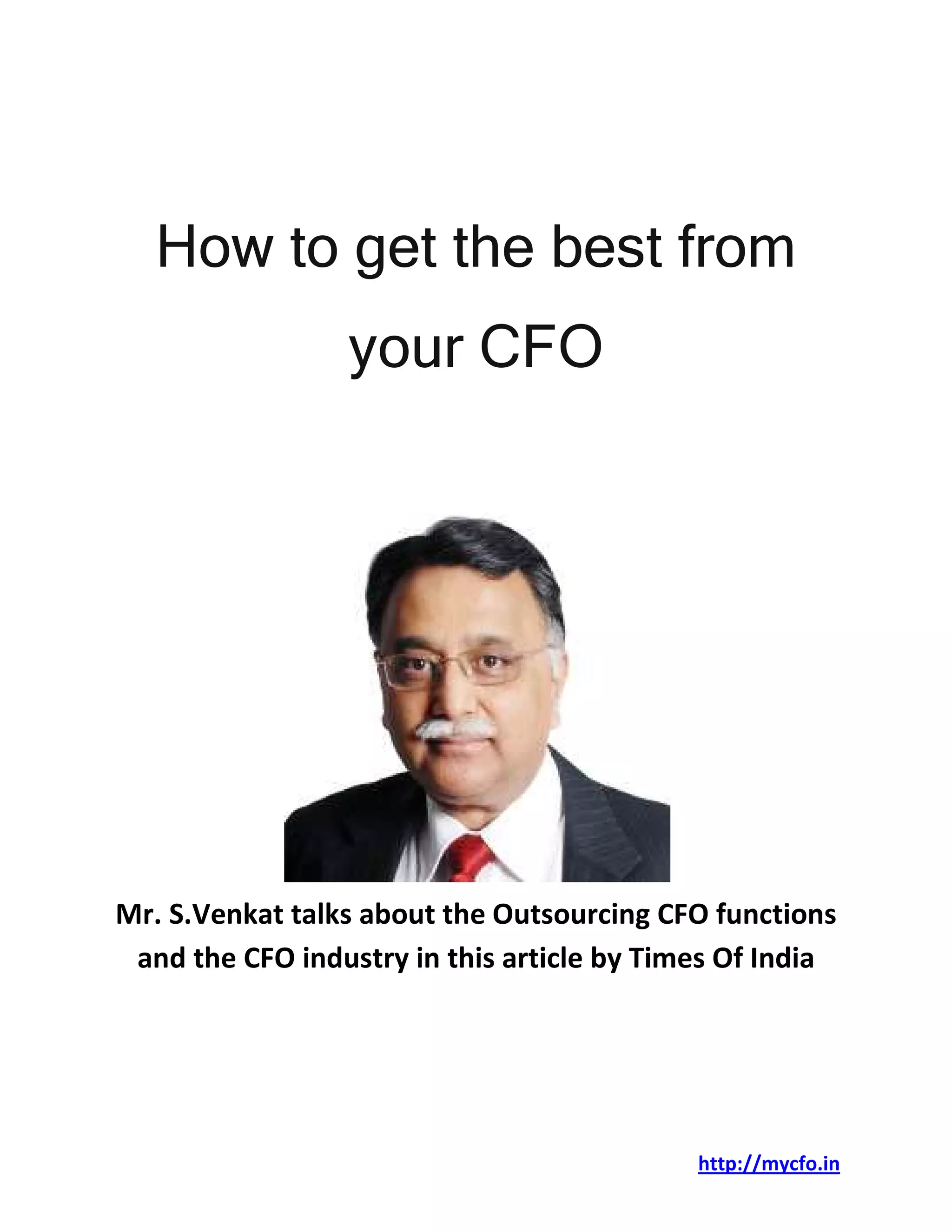
Mr. S.Venkat talks about the Outsourcing CFO functions
and the CFO industry in this article by Times Of India
http://mycfo.in
Traditionally, the CFO represents the Finance
function, just as the CMO represents the Marketing
function, the CTO the Technology function and so on.
Within the finance function, the CFO is expected to deal
with accounting, taxation (both direct and indirect),
banking, auditing, working capital management, risk
management, corporate governance, internal controls,
investor relationships (esp. relevant in case of a listed
company), budgeting, costing. He has also to deal with
various tax authorities (income tax/service
tax/customs/excise/VAT etc. depts.), external stakeholders
(customers and vendors for important commercial
negotiations, auditors, govt. depts., stock exchanges and
analysts in case of a listed company and private equity
and VC investors in case of a private company), Board
members (to explain the company’s performance, satisfy
them regarding the company’s corporate governance
processes etc.), company executives (i.e. heads of other
http://mycfo.in
functions and colleagues within the company in
connection with the company’s operations), CFO’s of other
companies (to share knowledge/information that may be
useful to each other) etc..
Many of the areas described above require
specialised expertise and act as a powerful magnet
attracting the CFO’s time and efforts. The CFO is required
to be a specialist in these areas and at the same time, a
generalist who has to deal with the variety of people
(sample listed above) and speak their language (i.e. be
comfortable wearing different hats while interacting with
different people at different times). He has to also visualise
the current pace of the company and whether at the end of
the year, it will achieve the targets it had planned at the
beginning of the year and accordingly, adjust all the other
parameters that will be impacted by the estimated results
(eg. if the company is likely to achieve/fall short of its
http://mycfo.in
targets, the advance tax payments should proportionately
be increased/decreased).
In essence, the CFO is required to maximise the
return on capital employed. For this purpose, the CFO has
to maximise the “bang for the buck” of all transactions
undertaken and in that sense, can be regarded as the
Chief Efficiency Officer of the company. To illustrate with
examples, if the company is planning to buy high value
assets, the CFO needs to assess whether the assets
should be leased or bought outright, based on various
factors eg. funds availability, cost, impact on financial
ratios etc.. Equally important, if not more, the CFO needs
to be aware of the company’s operational requirements
due to which the asset is being acquired and be satisfied
that the process for justifying the asset purchase has been
complied with. Otherwise, the company may land up
acquiring an asset that was not required although the
http://mycfo.in
asset acquisition was done on the most efficient financial
terms. The same principle applies in case of high value
expenditures eg. on training, advertising etc.. The CFO is
required to satisfy himself that the internal control
processes proposing such expenditures are complied with
and then assess whether those expenditures will have the
highest impact before actually incurring the expenditures
eg. before approving spending from the advertising
budget, the CFO should assess the internal control
process followed for selection of the advertising medium
(eg. print, TV, digital and within each of these, the
particular paper/channel/website) and satisfy himself that
the advertising medium selected will have the maximum
impact for the expenditure incurred. While the CFO is not
responsible for operational decisions, the CFO is required
to satisfy himself regarding compliance with the internal
control processes on which such operational decisions are
based. Otherwise, a company may incur several crores on
http://mycfo.in
advertising on TV (as an example) whereas it should have
actually used some other medium which had a higher
effectiveness. This represents an inefficient use of money
for which the CFO is responsible.
What therefore emerges is that for the CFO to be the
Chief Efficiency Officer, the CFO has to be fully involved in
the company’s operations and not confined to an ivory
tower within which the CFO and his team will deal with the
various specialised areas listed above. For this purpose,
• The CFO should be a part of various internal
meetings where the functioning of each department is
reviewed. This will enable the CFO to provide inputs to
increase the financial effectiveness of that department’s
performance and also help the CFO to evaluate better
asset acquisition/expenditure proposals for that
department. The CFO should not be kept out of such
meetings on the logic that these meetings are for
http://mycfo.in
reviewing operations and do not involve any of the
traditional CFO areas;
• The CFO should be facilitated to meet decision
makers and his counterpart in key customers, so that a
better bonding and connect is established with those
customers. This helps in having a little more wriggle room
at the time of negotiating revision in commercial terms and
discussing opportunities for future collaboration either in
the growth plans or resolving pain points of the customer.
The same principle applies for meeting key vendors;
• The CFO should be involved in the legal
negotiations or at least be made aware of the key issues
in any long term contract with a vendor/customer before
the agreement is signed. This is to avoid committing to
any transaction regarding which the CFO may have some
objection eg. if a contract with a vendor is assuring a
particular quantity of purchases every quarter in order to
http://mycfo.in
avail lower purchase rates (which may enable the
purchase department to lower the cost of procurement),
before signing that contract, the CFO needs to be satisfied
that the quantity assured to be purchased will not be in
excess of the company’s requirements. Otherwise the
company will be left with unutilised inventory and storage
costs;
• As a principle, the CFO should not be looked upon
as a problem solver but as a problem avoider. Thus, rather
than involving the CFO after the transaction has resulted
in a problem that requires to be solved, the CFO should be
involved at the early stage/before finally signing the
contract in case of all transactions above a particular
value.
The company will truly obtain the benefit of the CFO’s
role if he plays the role of the Chief Efficiency Officer and
for that, the CFO needs to be involved in key operational
http://mycfo.in
decisions also in addition to handling the traditional
elements of the finance function.
Read the full article here: http://mycfo.in/blog/?p=677
Source Link: http://mycfo.in/blog/?p=419
Website: http://mycfo.in/
Facebook: https://www.facebook.com/mycfo.in
Twitter: https://twitter.com/mycfo1
Google+: https://plus.google.com/u/0/+MycfoIn/about
LinkedIn: https://www.linkedin.com/company/mycfo-india

How to get the best from your CFO

  • 1.
    http://mycfo.in How to getthe best from your CFO Mr. S.Venkat talks about the Outsourcing CFO functions and the CFO industry in this article by Times Of India
  • 2.
    http://mycfo.in Traditionally, the CFOrepresents the Finance function, just as the CMO represents the Marketing function, the CTO the Technology function and so on. Within the finance function, the CFO is expected to deal with accounting, taxation (both direct and indirect), banking, auditing, working capital management, risk management, corporate governance, internal controls, investor relationships (esp. relevant in case of a listed company), budgeting, costing. He has also to deal with various tax authorities (income tax/service tax/customs/excise/VAT etc. depts.), external stakeholders (customers and vendors for important commercial negotiations, auditors, govt. depts., stock exchanges and analysts in case of a listed company and private equity and VC investors in case of a private company), Board members (to explain the company’s performance, satisfy them regarding the company’s corporate governance processes etc.), company executives (i.e. heads of other
  • 3.
    http://mycfo.in functions and colleagueswithin the company in connection with the company’s operations), CFO’s of other companies (to share knowledge/information that may be useful to each other) etc.. Many of the areas described above require specialised expertise and act as a powerful magnet attracting the CFO’s time and efforts. The CFO is required to be a specialist in these areas and at the same time, a generalist who has to deal with the variety of people (sample listed above) and speak their language (i.e. be comfortable wearing different hats while interacting with different people at different times). He has to also visualise the current pace of the company and whether at the end of the year, it will achieve the targets it had planned at the beginning of the year and accordingly, adjust all the other parameters that will be impacted by the estimated results (eg. if the company is likely to achieve/fall short of its
  • 4.
    http://mycfo.in targets, the advancetax payments should proportionately be increased/decreased). In essence, the CFO is required to maximise the return on capital employed. For this purpose, the CFO has to maximise the “bang for the buck” of all transactions undertaken and in that sense, can be regarded as the Chief Efficiency Officer of the company. To illustrate with examples, if the company is planning to buy high value assets, the CFO needs to assess whether the assets should be leased or bought outright, based on various factors eg. funds availability, cost, impact on financial ratios etc.. Equally important, if not more, the CFO needs to be aware of the company’s operational requirements due to which the asset is being acquired and be satisfied that the process for justifying the asset purchase has been complied with. Otherwise, the company may land up acquiring an asset that was not required although the
  • 5.
    http://mycfo.in asset acquisition wasdone on the most efficient financial terms. The same principle applies in case of high value expenditures eg. on training, advertising etc.. The CFO is required to satisfy himself that the internal control processes proposing such expenditures are complied with and then assess whether those expenditures will have the highest impact before actually incurring the expenditures eg. before approving spending from the advertising budget, the CFO should assess the internal control process followed for selection of the advertising medium (eg. print, TV, digital and within each of these, the particular paper/channel/website) and satisfy himself that the advertising medium selected will have the maximum impact for the expenditure incurred. While the CFO is not responsible for operational decisions, the CFO is required to satisfy himself regarding compliance with the internal control processes on which such operational decisions are based. Otherwise, a company may incur several crores on
  • 6.
    http://mycfo.in advertising on TV(as an example) whereas it should have actually used some other medium which had a higher effectiveness. This represents an inefficient use of money for which the CFO is responsible. What therefore emerges is that for the CFO to be the Chief Efficiency Officer, the CFO has to be fully involved in the company’s operations and not confined to an ivory tower within which the CFO and his team will deal with the various specialised areas listed above. For this purpose, • The CFO should be a part of various internal meetings where the functioning of each department is reviewed. This will enable the CFO to provide inputs to increase the financial effectiveness of that department’s performance and also help the CFO to evaluate better asset acquisition/expenditure proposals for that department. The CFO should not be kept out of such meetings on the logic that these meetings are for
  • 7.
    http://mycfo.in reviewing operations anddo not involve any of the traditional CFO areas; • The CFO should be facilitated to meet decision makers and his counterpart in key customers, so that a better bonding and connect is established with those customers. This helps in having a little more wriggle room at the time of negotiating revision in commercial terms and discussing opportunities for future collaboration either in the growth plans or resolving pain points of the customer. The same principle applies for meeting key vendors; • The CFO should be involved in the legal negotiations or at least be made aware of the key issues in any long term contract with a vendor/customer before the agreement is signed. This is to avoid committing to any transaction regarding which the CFO may have some objection eg. if a contract with a vendor is assuring a particular quantity of purchases every quarter in order to
  • 8.
    http://mycfo.in avail lower purchaserates (which may enable the purchase department to lower the cost of procurement), before signing that contract, the CFO needs to be satisfied that the quantity assured to be purchased will not be in excess of the company’s requirements. Otherwise the company will be left with unutilised inventory and storage costs; • As a principle, the CFO should not be looked upon as a problem solver but as a problem avoider. Thus, rather than involving the CFO after the transaction has resulted in a problem that requires to be solved, the CFO should be involved at the early stage/before finally signing the contract in case of all transactions above a particular value. The company will truly obtain the benefit of the CFO’s role if he plays the role of the Chief Efficiency Officer and for that, the CFO needs to be involved in key operational
  • 9.
    http://mycfo.in decisions also inaddition to handling the traditional elements of the finance function. Read the full article here: http://mycfo.in/blog/?p=677 Source Link: http://mycfo.in/blog/?p=419 Website: http://mycfo.in/ Facebook: https://www.facebook.com/mycfo.in Twitter: https://twitter.com/mycfo1 Google+: https://plus.google.com/u/0/+MycfoIn/about LinkedIn: https://www.linkedin.com/company/mycfo-india