What’s Important about
            ASSESSING FOR
           UNDERSTANDING?
      (a.k.a. Checking for Understanding


08/22/12         dd_pg_jb_as_kb_lv.vocab_instructPD
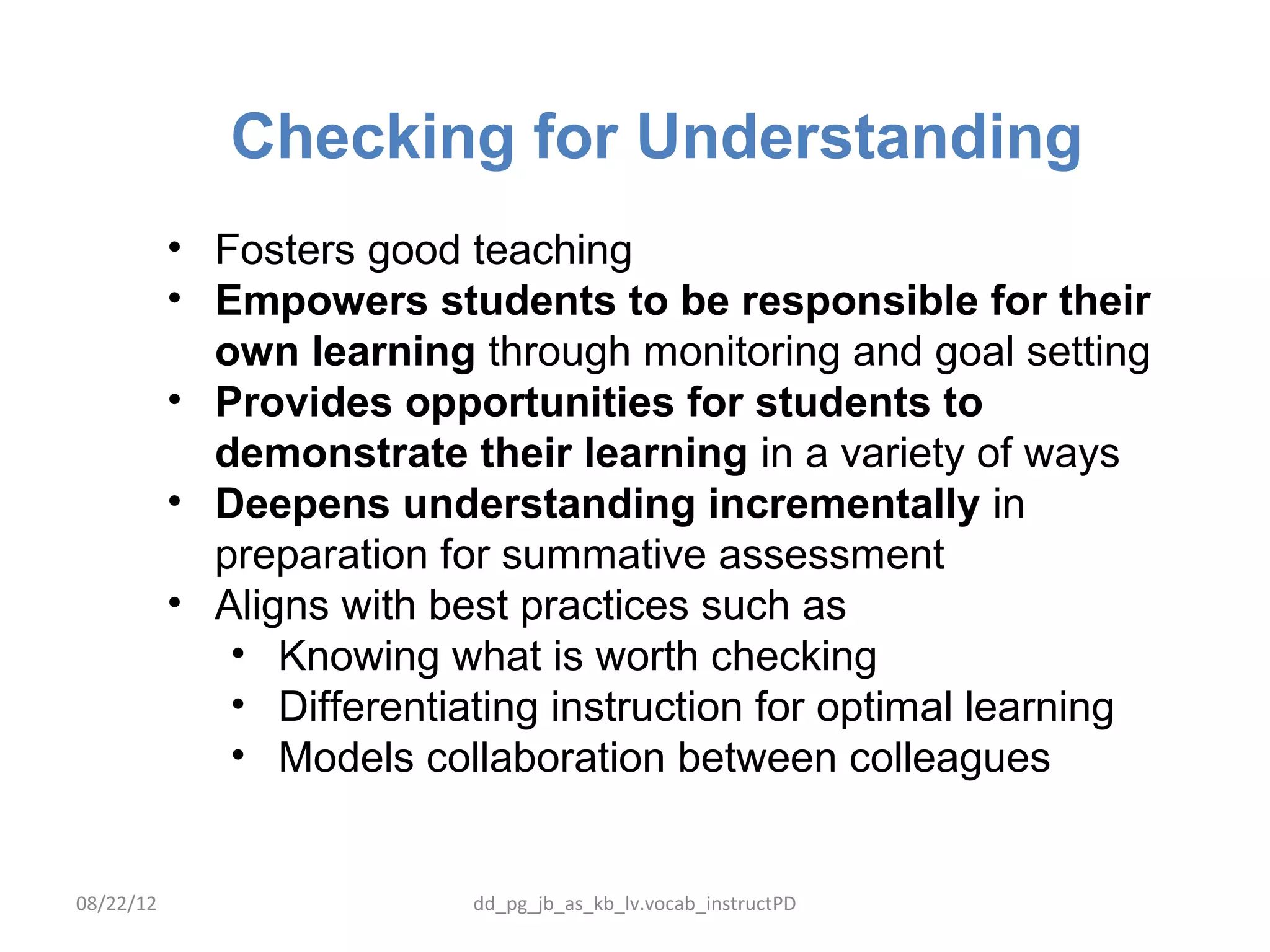
Checking for Understanding
           • Fosters good teaching
           • Empowers students to be responsible for their
             own learning through monitoring and goal setting
           • Provides opportunities for students to
             demonstrate their learning in a variety of ways
           • Deepens understanding incrementally in
             preparation for summative assessment
           • Aligns with best practices such as
              • Knowing what is worth checking
              • Differentiating instruction for optimal learning
              • Models collaboration between colleagues


08/22/12                   dd_pg_jb_as_kb_lv.vocab_instructPD
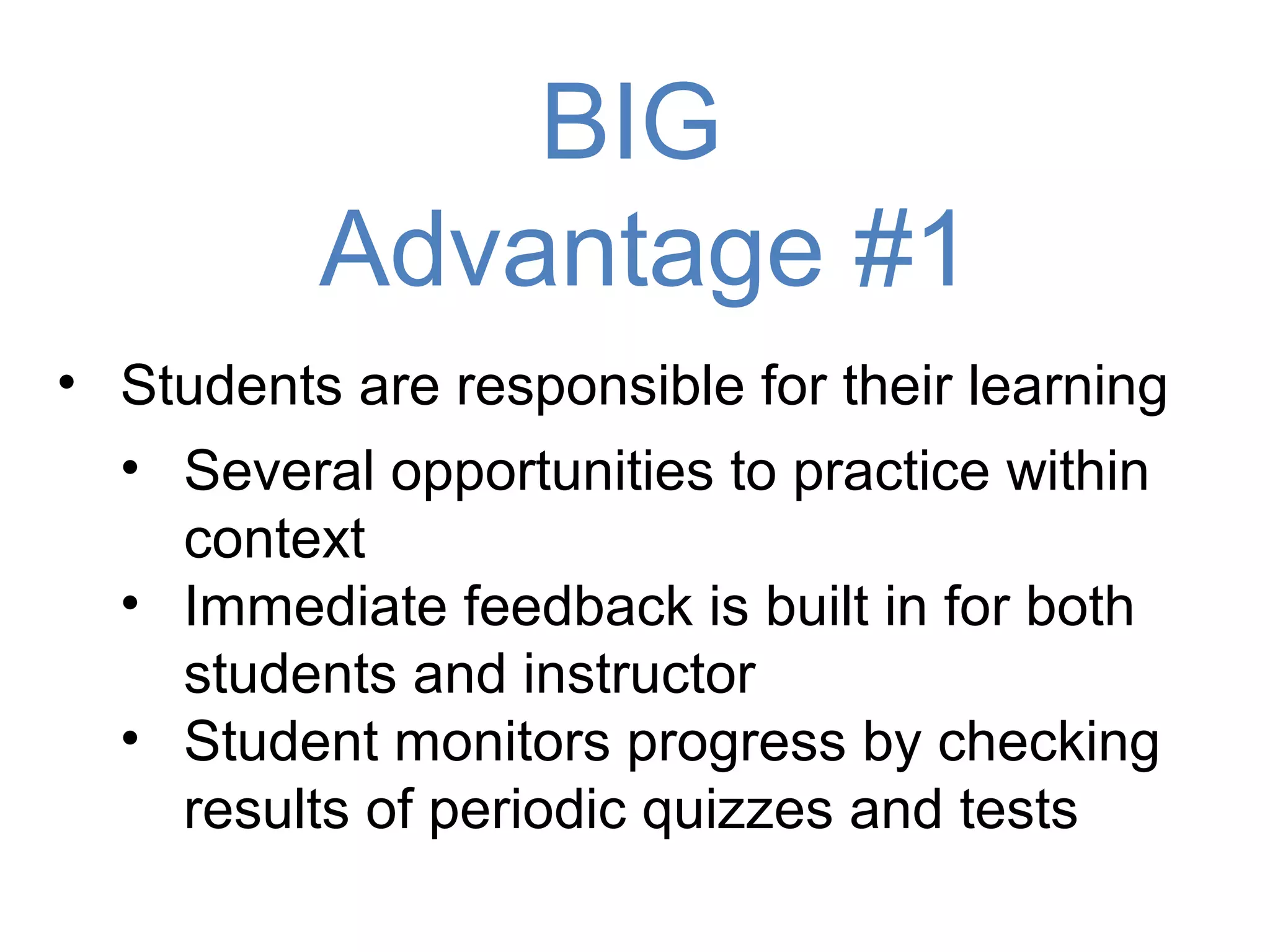
BIG
          Advantage #1
• Students are responsible for their learning
  • Several opportunities to practice within
    context
  • Immediate feedback is built in for both
    students and instructor
  • Student monitors progress by checking
    results of periodic quizzes and tests
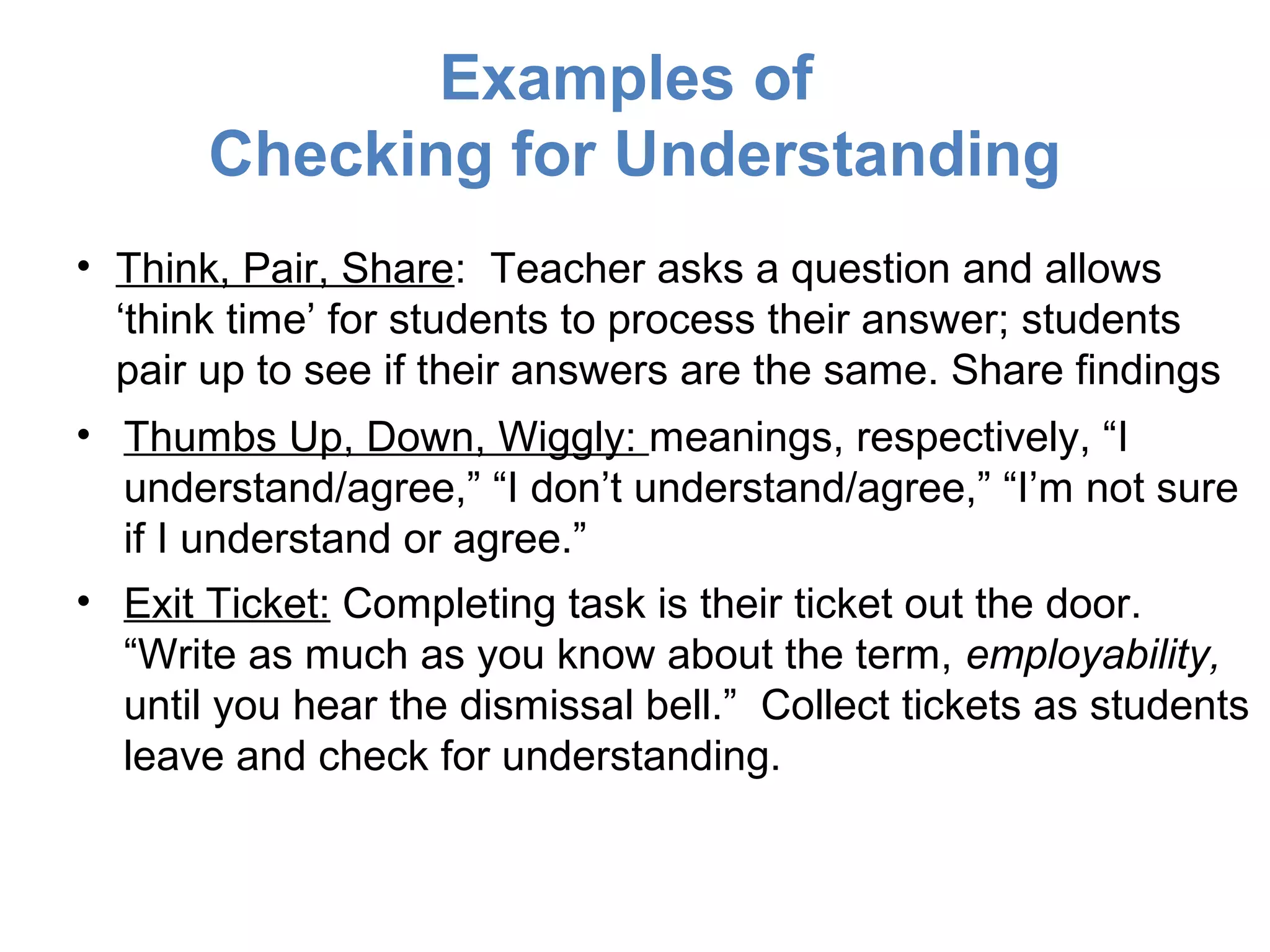
Examples of
       Checking for Understanding
• Think, Pair, Share: Teacher asks a question and allows
  ‘think time’ for students to process their answer; students
  pair up to see if their answers are the same. Share findings
• Thumbs Up, Down, Wiggly: meanings, respectively, “I
  understand/agree,” “I don’t understand/agree,” “I’m not sure
  if I understand or agree.”
• Exit Ticket: Completing task is their ticket out the door.
  “Write as much as you know about the term, employability,
  until you hear the dismissal bell.” Collect tickets as students
  leave and check for understanding.
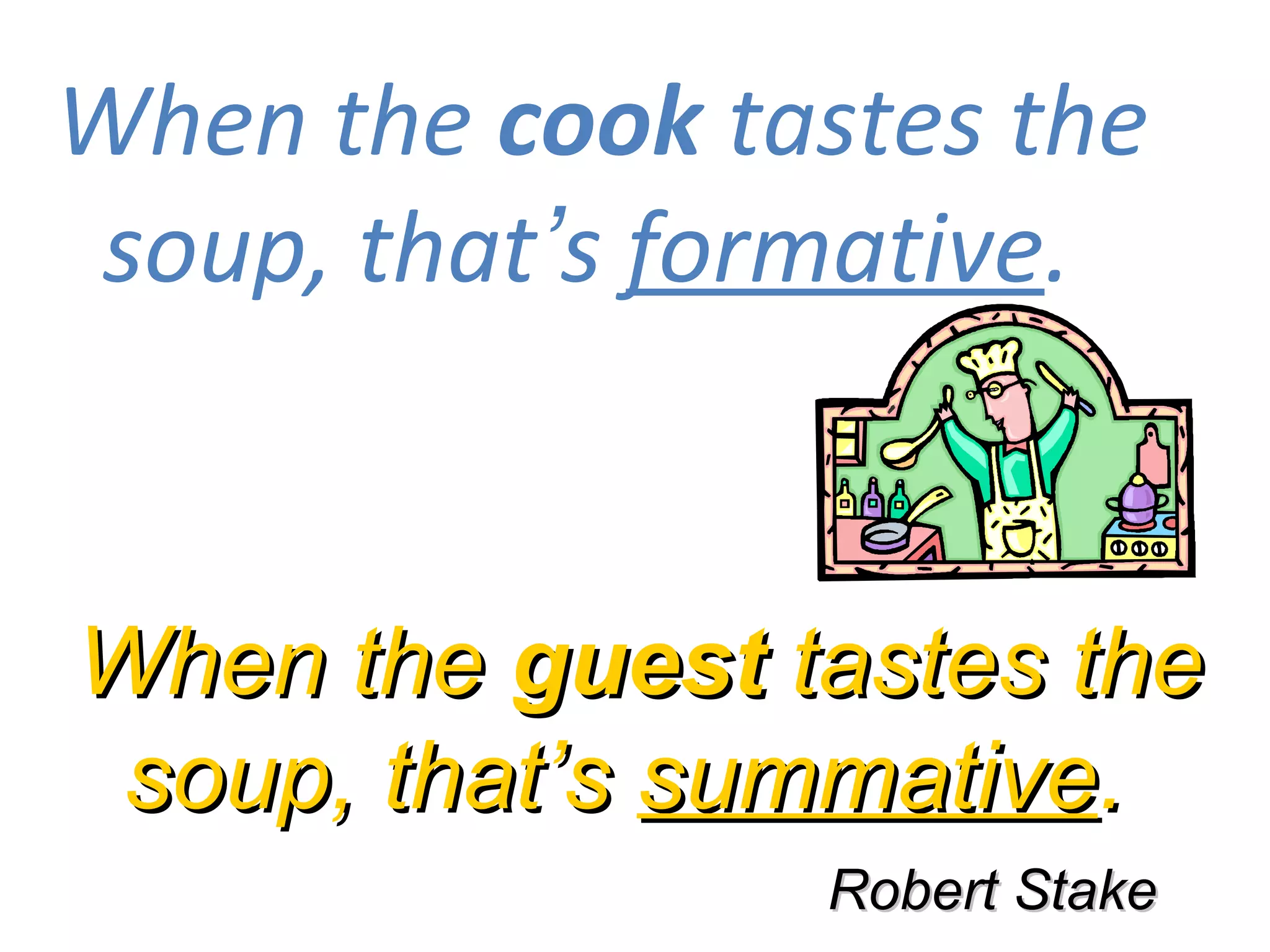
When the cook tastes the
 soup, that’s formative.


When the guest tastes the
 soup, that’s summative.
                Robert Stake
BIG
          Advantage #2
• Provides students with a variety of ways to
  demonstrate understanding and deepen
  their knowledge of the vocabulary
  • Promotes student engagement
  • Allows for adjustment in the learning
     process
  • Encourages goal setting
Examples of
       Checking for Understanding
• Group Answers: Work teams are given term(s) to learn.
  The group is responsible for everyone’s learning; only one
  person (no one knows who) in the group will be asked by
  the teacher to respond so all must know the terms.
• Question Everyone: Randomly select students to answer
  questions. Use names on popsicle sticks, draw names, etc.
  If student doesn’t answer correctly, rephrase question and
  ask again. May move on to another student; after a few
  questions return to first student to re-check for
  understanding.
• Response Cards/White Boards: Have students respond by
  writing answer on white board or holding up response card.
  Responses are shown simultaneously at a given signal.
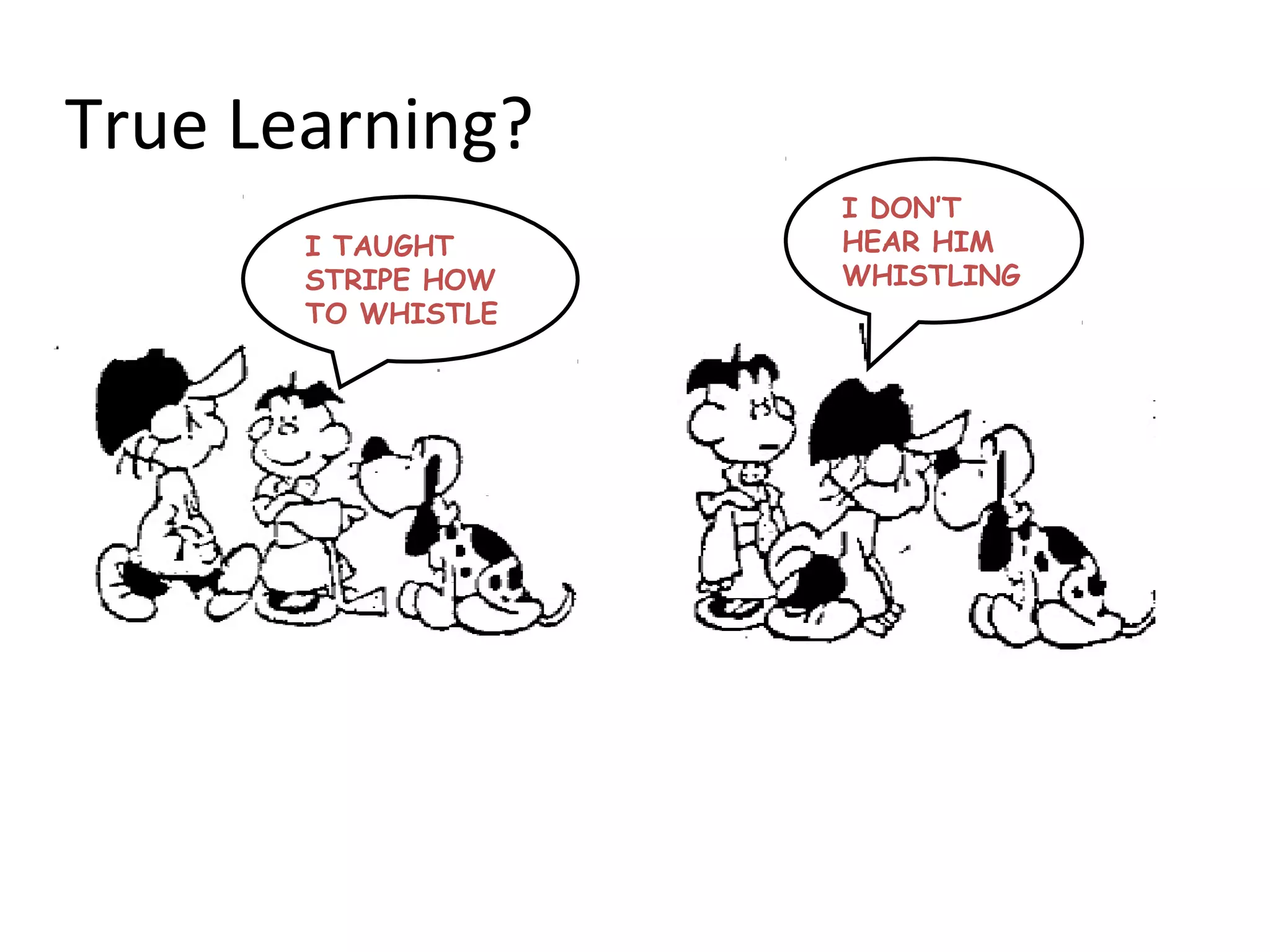
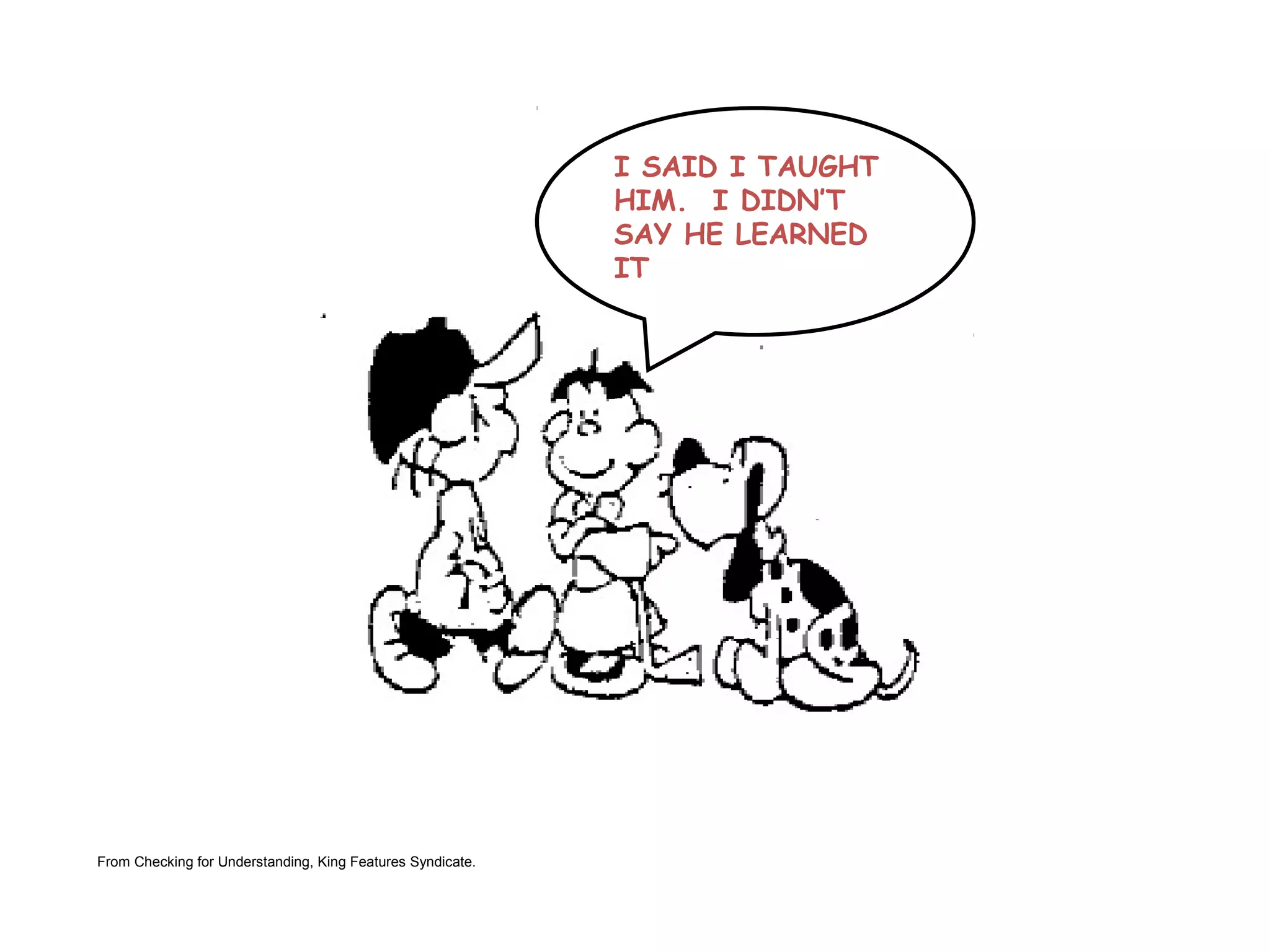
True Learning?
                    I DON’T
       I TAUGHT     HEAR HIM
       STRIPE HOW   WHISTLING
       TO WHISTLE
I SAID I TAUGHT
                                                            HIM. I DIDN’T
                                                            SAY HE LEARNED
                                                            IT


From Checking for Understanding, King Features Syndicate.
EXPAND
           Understanding and
              Knowledge


08/22/12        dd_pg_jb_as_kb_lv.vocab_instructPD
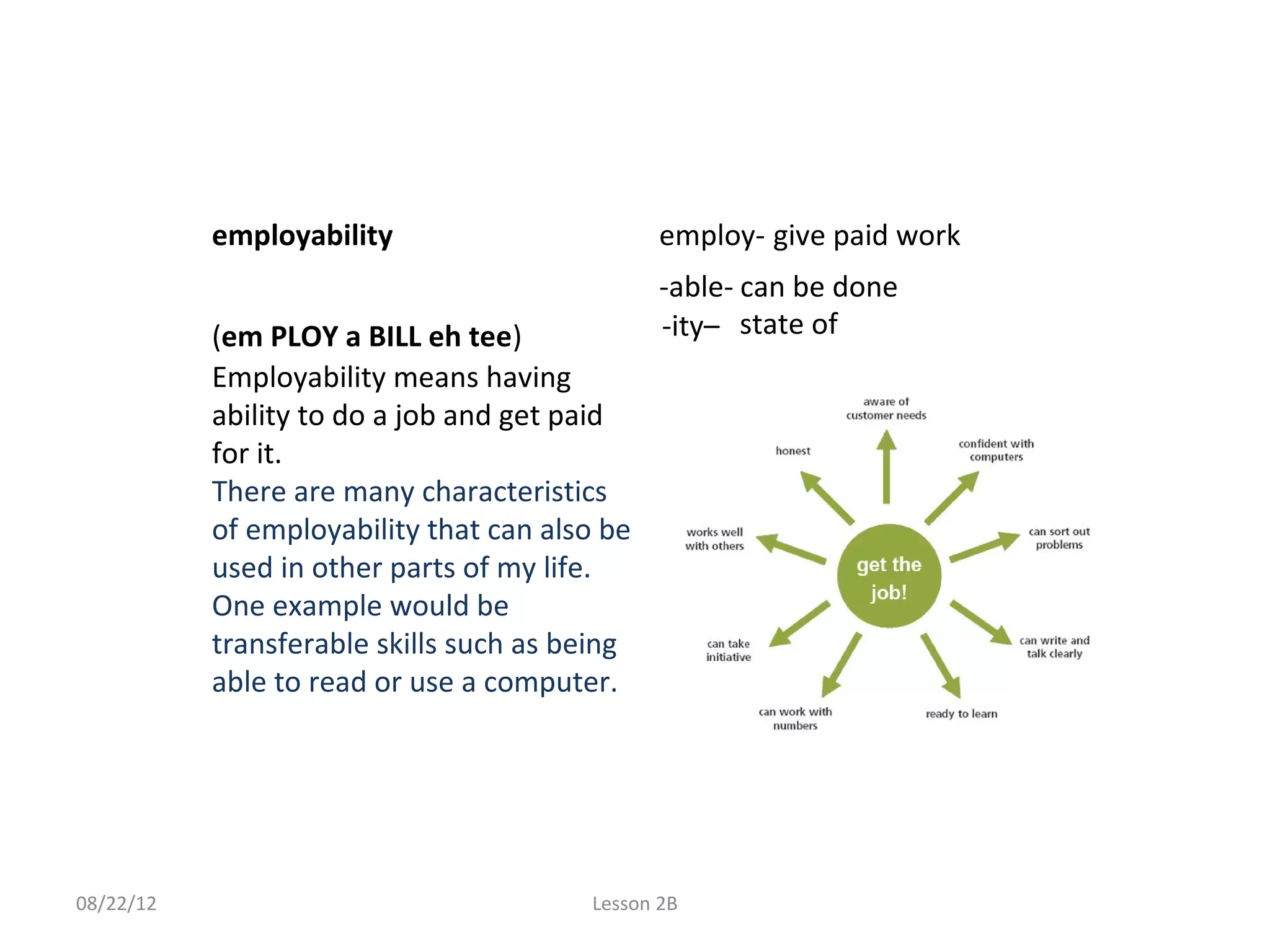
employability                       employ- give paid work
                                               -able- can be done
           (em PLOY a BILL eh tee)             -ity– state of
           Employability means having
           ability to do a job and get paid
           for it.
           There are many characteristics
           of employability that can also be
           used in other parts of my life.
           One example would be
           transferable skills such as being
           able to read or use a computer.


08/22/12                                Lesson 2B
REVIEW OFTEN
 •Find and compare similarities and differences
 •Classify into categories
 •Create metaphors
 •Create analogies
 •Use acronyms
 •Review older terms in relation to new ones
 •Use games, challenges, and competitions
 •Provide articles and books about the content
 •Demonstrate how to use the organizer to study
 •Encourage review over time
                                                           See: Intensifying the Use of the Vocabulary
                                                           Organizer Rubric


08/22/12              dd_pg_jb_as_kb_lv.vocab_instructPD
“Teachers use formative
  assessment to inform
  instructional methods… at the
  very least, teachers should check
  for understanding every 15
  minutes.”
          -Douglas Fisher
          Checking for Understanding

How to check for understanding

  • 1.
    What’s Important about ASSESSING FOR UNDERSTANDING? (a.k.a. Checking for Understanding 08/22/12 dd_pg_jb_as_kb_lv.vocab_instructPD
  • 2.
    Checking for Understanding • Fosters good teaching • Empowers students to be responsible for their own learning through monitoring and goal setting • Provides opportunities for students to demonstrate their learning in a variety of ways • Deepens understanding incrementally in preparation for summative assessment • Aligns with best practices such as • Knowing what is worth checking • Differentiating instruction for optimal learning • Models collaboration between colleagues 08/22/12 dd_pg_jb_as_kb_lv.vocab_instructPD
  • 3.
    BIG Advantage #1 • Students are responsible for their learning • Several opportunities to practice within context • Immediate feedback is built in for both students and instructor • Student monitors progress by checking results of periodic quizzes and tests
  • 4.
    Examples of Checking for Understanding • Think, Pair, Share: Teacher asks a question and allows ‘think time’ for students to process their answer; students pair up to see if their answers are the same. Share findings • Thumbs Up, Down, Wiggly: meanings, respectively, “I understand/agree,” “I don’t understand/agree,” “I’m not sure if I understand or agree.” • Exit Ticket: Completing task is their ticket out the door. “Write as much as you know about the term, employability, until you hear the dismissal bell.” Collect tickets as students leave and check for understanding.
  • 5.
    When the cooktastes the soup, that’s formative. When the guest tastes the soup, that’s summative. Robert Stake
  • 6.
    BIG Advantage #2 • Provides students with a variety of ways to demonstrate understanding and deepen their knowledge of the vocabulary • Promotes student engagement • Allows for adjustment in the learning process • Encourages goal setting
  • 7.
    Examples of Checking for Understanding • Group Answers: Work teams are given term(s) to learn. The group is responsible for everyone’s learning; only one person (no one knows who) in the group will be asked by the teacher to respond so all must know the terms. • Question Everyone: Randomly select students to answer questions. Use names on popsicle sticks, draw names, etc. If student doesn’t answer correctly, rephrase question and ask again. May move on to another student; after a few questions return to first student to re-check for understanding. • Response Cards/White Boards: Have students respond by writing answer on white board or holding up response card. Responses are shown simultaneously at a given signal.
  • 8.
    True Learning? I DON’T I TAUGHT HEAR HIM STRIPE HOW WHISTLING TO WHISTLE
  • 9.
    I SAID ITAUGHT HIM. I DIDN’T SAY HE LEARNED IT From Checking for Understanding, King Features Syndicate.
  • 10.
    EXPAND Understanding and Knowledge 08/22/12 dd_pg_jb_as_kb_lv.vocab_instructPD
  • 11.
    employability employ- give paid work -able- can be done (em PLOY a BILL eh tee) -ity– state of Employability means having ability to do a job and get paid for it. There are many characteristics of employability that can also be used in other parts of my life. One example would be transferable skills such as being able to read or use a computer. 08/22/12 Lesson 2B
  • 12.
    REVIEW OFTEN •Findand compare similarities and differences •Classify into categories •Create metaphors •Create analogies •Use acronyms •Review older terms in relation to new ones •Use games, challenges, and competitions •Provide articles and books about the content •Demonstrate how to use the organizer to study •Encourage review over time See: Intensifying the Use of the Vocabulary Organizer Rubric 08/22/12 dd_pg_jb_as_kb_lv.vocab_instructPD
  • 13.
    “Teachers use formative assessment to inform instructional methods… at the very least, teachers should check for understanding every 15 minutes.” -Douglas Fisher Checking for Understanding

Editor's Notes

  • #2 Assessing for understanding is key in helping you as the teacher make the decision to re-teach or to move the instruction forward. There are quick ways to determine the level of understanding of each of your students. But why is assessing for understanding important or even necessary?
  • #3 Checking for understanding allows for all the above The BIG advantages of checking for understanding are in BOLD Remember, checking for understanding IS NOT the final exam or state achievement test. It is mainly just short, brief activities designed to give you and your students a ‘status’ check in the learning process. The more you know about where each student is in the process, the better able you will be to adjust your teaching accordingly. Also, the more students are informed of their progress, the more motivated they will become to achieve.
  • #4 By checking for understanding, a teacher knows where all of his students are in their learning at any given time, and can make adjustments accordingly. This is ‘good teaching.’ A BIG advantage of checking for understanding as the learning progresses is that students become responsible for their own learning by monitoring what they know and by goal setting. So, how do you check for understanding?
  • #7 A BIG advantage #2 of checking for understanding is the engagement/motivation that happens because students are given a variety of ways to demonstrate their understanding.
  • #11 Using the students’ knowledge and understanding, expand the description and correct any misconceptions. For example, expanding on the term employability.
  • #12 the vocab organizer can be used to increase student understanding and fluidity by updating, elaborating, applying and practicing the terms in their certification notebook. allow for expanding of student knowledge. Reviewing the terms (multiple exposures within context) can be as simple as having students pair up, review specific terms (each group will be different) for a few minutes and then report out; Use different informal assessments Class warm-up activity White boards Response cards Exit slip
  • #13 Reviewing frequently and in a variety of ways provides for multiple exposures which lead to excellent performance and long-term understanding. There are a number of ways to review: Comparing similarities and differences: e.g. what is the difference between a Foley and a Robinson catheter? Finding similarities and differences: How are malnutrition and hunger the same? What accounts for the differences? Classifying into two types of words: Provide a list of terms and tell the students that all the words fall into two categories: e.g. tools and uses; diseases and treatment procedures; heart diseases and test protocols, etc. Creating metaphors: The endocrine system is like radio signals-they go out from the tower in a variety of directions but only those set to receive the signal will get it (the radio) Creating analogies: pituitary gland is to the endocrine system as heart is to the circulatory system; hammer is to nail as drill is to bit. Using acronyms: UG spreads – explains the 2 common traits of cancer—Uncontrolled Growth and the migration from the original site to other sites. Reviewing older terms as they relate to the newer ones—scaffolded, sequential learning Using games, challenges, competitions Provide opportunities form students to read about what they are studying in multiple contexts…then have them discuss their reading in context with others using one of the previously mentioned review methods. Students should be reminded often to study their vocabulary organizer as well as their notes. Studying incrementally lends to enduring understanding