Excel Models: 3 Essential Types
A Systematic Approach to Developing
Fit-for-Purpose Excel Models
How much time do you spend
on creating Excel models?
Most people spend too much time
on perfecting their work.
Start EVERY Model
by answering 2 key questions.
What is the purpose of the model?
Oftentimes, the model will be simple and used only for
some quick analysis. A core data set, simple formulae
(e.g., VLOOKUP), and pivot tables might suffice.
Photo Credit: Greg Rakozy
Who is your client?
Consider both formatting and usability of the model depending on your
client. If it is for your own use (i.e., other people will not see it) or you are
asked to “come up with a number,” then nothing fancy is required.
If the output is to be formally handed over to an external client, then a
top-notch model is what you will want to go for.
Photo Credit: Anders Jildén
Then you will know
where to go next.
It really is: horses for courses.
Photo Credit: Bethany Legg
Essential
Excel Model
Maturity Levels.3 	
  
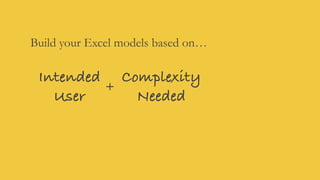
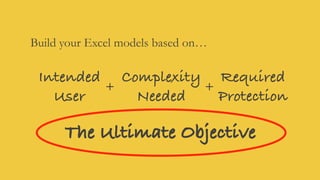
Build your Excel models based on…
Intended
User
Build your Excel models based on…
Intended
User
Complexity
Needed
+
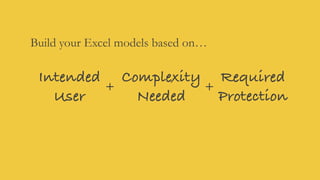
Build your Excel models based on…
Intended
User
Complexity
Needed
Required
Protection
+ +
Build your Excel models based on…
Intended
User
The Ultimate Objective
Complexity
Needed
Required
Protection
+ +
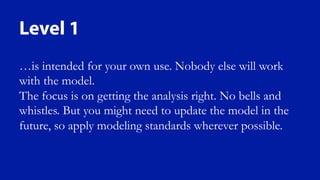
Level 1
…is intended for your own use. Nobody else will work
with the model.
The focus is on getting the analysis right. No bells and
whistles. But you might need to update the model in the
future, so apply modeling standards wherever possible.
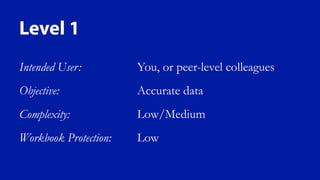
Level 1
Intended User:
Objective:
Complexity:
Workbook Protection:
You, or peer-level colleagues
Accurate data
Low/Medium
Low
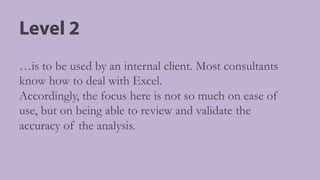
Level 2
…is to be used by an internal client. Most consultants
know how to deal with Excel.
Accordingly, the focus here is not so much on ease of
use, but on being able to review and validate the
accuracy of the analysis.
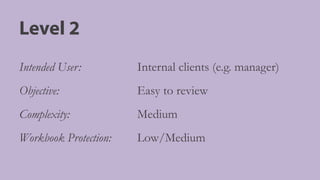
Level 2
Intended User:
Objective:
Complexity:
Workbook Protection:
Internal clients (e.g. manager)
Easy to review
Medium
Low/Medium
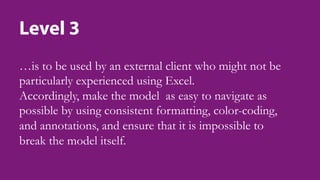
Level 3
…is to be used by an external client who might not be
particularly experienced using Excel.
Accordingly, make the model as easy to navigate as
possible by using consistent formatting, color-coding,
and annotations, and ensure that it is impossible to
break the model itself.
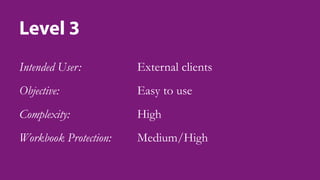
Level 3
Intended User:
Objective:
Complexity:
Workbook Protection:
External clients
Easy to use
High
Medium/High
Do you want to learn more
about how to get things done in
a fast-paced work environment like consulting?
Get started with…
The Aspiring Advisor
Strategies and Tools for a Successful Consulting Career
YES,	
  I	
  WANT	
  THIS	
  BOOK!	
  
Click it! Click it!
CONSULTANT & AUTHOR
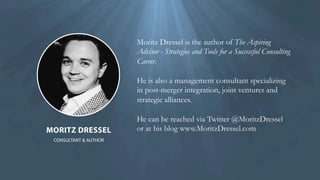
MORITZ DRESSEL
Moritz Dressel is the author of The Aspiring
Advisor - Strategies and Tools for a Successful Consulting
Career.
He can be reached via Twitter @MoritzDressel 
or at his blog www.MoritzDressel.com
He is also a management consultant specializing
in post-merger integration, joint ventures and
strategic alliances.

How to Build Fit-for-Purpose Excel Models

  • 1.
    Excel Models: 3Essential Types A Systematic Approach to Developing Fit-for-Purpose Excel Models
  • 2.
    How much timedo you spend on creating Excel models?
  • 3.
    Most people spendtoo much time on perfecting their work.
  • 4.
    Start EVERY Model byanswering 2 key questions.
  • 5.
    What is thepurpose of the model? Oftentimes, the model will be simple and used only for some quick analysis. A core data set, simple formulae (e.g., VLOOKUP), and pivot tables might suffice. Photo Credit: Greg Rakozy
  • 6.
    Who is yourclient? Consider both formatting and usability of the model depending on your client. If it is for your own use (i.e., other people will not see it) or you are asked to “come up with a number,” then nothing fancy is required. If the output is to be formally handed over to an external client, then a top-notch model is what you will want to go for. Photo Credit: Anders Jildén
  • 7.
    Then you willknow where to go next.
  • 8.
    It really is:horses for courses. Photo Credit: Bethany Legg
  • 9.
  • 10.
    Build your Excelmodels based on… Intended User
  • 11.
    Build your Excelmodels based on… Intended User Complexity Needed +
  • 12.
    Build your Excelmodels based on… Intended User Complexity Needed Required Protection + +
  • 13.
    Build your Excelmodels based on… Intended User The Ultimate Objective Complexity Needed Required Protection + +
  • 14.
    Level 1 …is intendedfor your own use. Nobody else will work with the model. The focus is on getting the analysis right. No bells and whistles. But you might need to update the model in the future, so apply modeling standards wherever possible.
  • 15.
    Level 1 Intended User: Objective: Complexity: WorkbookProtection: You, or peer-level colleagues Accurate data Low/Medium Low
  • 16.
    Level 2 …is tobe used by an internal client. Most consultants know how to deal with Excel. Accordingly, the focus here is not so much on ease of use, but on being able to review and validate the accuracy of the analysis.
  • 17.
    Level 2 Intended User: Objective: Complexity: WorkbookProtection: Internal clients (e.g. manager) Easy to review Medium Low/Medium
  • 18.
    Level 3 …is tobe used by an external client who might not be particularly experienced using Excel. Accordingly, make the model as easy to navigate as possible by using consistent formatting, color-coding, and annotations, and ensure that it is impossible to break the model itself.
  • 19.
    Level 3 Intended User: Objective: Complexity: WorkbookProtection: External clients Easy to use High Medium/High
  • 20.
    Do you wantto learn more about how to get things done in a fast-paced work environment like consulting? Get started with…
  • 21.
    The Aspiring Advisor Strategiesand Tools for a Successful Consulting Career YES,  I  WANT  THIS  BOOK!   Click it! Click it!
  • 22.
    CONSULTANT & AUTHOR MORITZDRESSEL Moritz Dressel is the author of The Aspiring Advisor - Strategies and Tools for a Successful Consulting Career. He can be reached via Twitter @MoritzDressel  or at his blog www.MoritzDressel.com He is also a management consultant specializing in post-merger integration, joint ventures and strategic alliances.